
Saginaw City Zoning Code
ARTICLE 8
- SUPPLEMENTAL DISTRICT REGULATIONS
Sec. 8-1.- Site plan requirements.
A.
Generally. Whenever a site plan is required by this ordinance, such site plan must conform to the requirements of this section. Unless otherwise specified in this ordinance, all site plans must be approved by the city council, upon recommendation of the planning and zoning commission. The site plan submitted in support of an application shall satisfy the requirements for site plan submittals as set forth by the city staff. Site plans shall be reviewed by the city staff, and comments shall be returned after the review by the city staff. The submittal date of the site plan shall be the date upon which the site plan is found to be in compliance with the provisions of the site plan application by the city staff.
B.
Required prior to building permit. When required by this ordinance, a site plan must be approved prior to the issuance of a building permit by the city.
C.
Changes to the site plan. Changes to the site plan shall be processed in the same manner as the original approved site plan.
1.
Except as otherwise provided in paragraph 3 below, any site plan that is amended shall require approval of the city council, upon recommendation of the planning and zoning commission.
2.
Changes to the site plan which will affect the use of the land may require either an amendment to a planned development or a rezoning of property, whichever applies.
3.
Changes of details within a site plan which do not alter the basic physical relationship of the property to adjacent properties; do not alter the use permitted; and do not increase the density, floor area, height, or reduce the yards provided at the boundary of the site as indicated on the approved site plan, may be authorized by the administrative official or his/her designee. An aggrieved party may appeal the decision of the administrative official or his/her designee to the board of adjustment in accordance with the provisions of this ordinance.
D.
Council approval. Council approval of a site plan that accompanies a zoning change request shall become part of the amending ordinance.
E.
Site plan content. The site plan shall contain the information listed below, and any or all of the required features may be incorporated on a single drawing if the drawing is clear and capable of evaluation by the city council and the staff personnel required to enforce and interpret this ordinance.
1.
The boundary lines and dimensions of the property, existing subdivision lots, available utilities, easements, roadways, sidewalks, emergency access easements, and public rights-of-way.
2.
Topography of the property proposed for development in contours of not less than two feet, together with any proposed grade elevations, if different from existing elevations.
3.
Flood plains, water courses, marshes, drainage areas, and other significant environmental features including, but not limited to, rock outcroppings and major tree groupings. Topographic and drainage map information provisions may be waived by the reviewing body when the inclusion of such data would not materially contribute to the necessary evaluation of the project petition.
4.
The location and use of all existing and proposed buildings or structures, including all refuse storage areas, and the minimum distance between buildings. Where building complexes are proposed, the location of each building and the minimum distances between buildings, and between buildings and the property line, street line, and /or alley.
5.
Total number, location, and arrangement of off-street parking and loading spaces, where required.
6.
All points of vehicular ingress, egress, and circulation within the property and all special traffic regulation facilities proposed or required to assure the safe function of the circulation plan.
7.
Setbacks, lot coverage, and when relevant, the relationship of the setbacks provided and the height of any existing or proposed building or structure.
8.
The location, size, and arrangement of all outdoor signs, exterior auditory speakers, and lighting.
9.
The type, location, and quantity of all plant material used for landscaping, and the type, location, and height of fences or screening and the plantings around them.
10.
If multiple types of land uses are proposed, a delineation of the specific areas to be devoted to various land uses.
11.
Vicinity map, north point, scale, name of development, name of owner, name of planner, total acreage of project, and street address or common description of the property.
12.
Current land uses and zoning district of the property and current land uses and zoning districts of contiguous properties.
13.
Buildings on the exterior of the site and within 25 feet of all property lines.
14.
The location and size of existing and proposed surface and subsurface drainage facilities, including culverts, drains, and detention ponds, showing size and direction of flow.
15.
The number of square feet of the property after construction which will constitute impervious area or impervious surface and vegetated areas.
16.
Architectural drawings, such as elevations, concept sketches or renderings depicting building types and other significant proposed improvements including the treatment and use of open spaces, etc., where the submission of such drawings would more clearly portray the nature and character of the applicant's land use and development proposals.
17.
Legal description of the total site area proposed for rezoning, development or specific use permit.
18.
Signature, title and date of the applicant, at the conclusion of the written documents certifying the information presented in the plans, and supporting documents reflect a reasonably accurate portrayal of the general nature and character of the applicant's proposals.
Sec. 8-2. - General height requirements.
A.
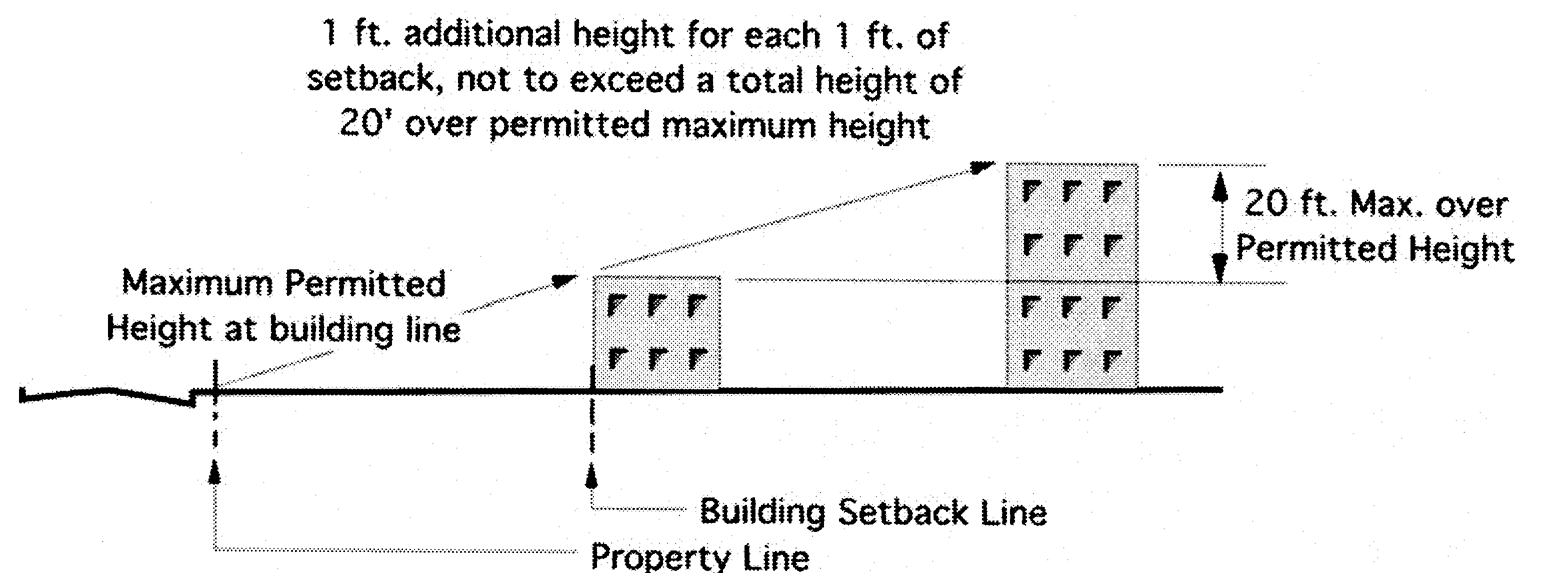
Nonresidential structures. A nonresidential building may exceed the permitted height in a zoning district by 20 feet if the following conditions are met:
1.
A site plan is provided; and
2.
For every one foot exceeding the maximum permitted height, an additional one-foot of setback is provided on the front, side, and rear yards. The height of a building shall not exceed 20 feet over the maximum permitted height established in the zoning district.
3.
A building may exceed the height described in item 2 above only upon approval of a special exception.
_____
B.
Exceptions. Height regulations do not apply to steeples, domes, cupolas, or other architectural design elements usually required to be placed above the roof level and not intended for human occupancy.
C.
Antennas. For antenna and tower height regulations see section 8-14, Wireless Communications Facilities.
Sec. 8-3. - General yard requirements.
The following general requirements provide additional criteria which apply to yard requirements in all zoning districts.
A.
Projections of structural features.
1.
Ordinary sills, belt courses, cornices, chimneys, bay windows, buttresses and ornamental features may project not more than twelve inches into a required yard; and
2.
Eaves may project not more than 36 inches into a required yard.
3.
A patio cover may be constructed in a required rear yard setback provided that:
a.
Maximum height. Maximum height of a patio cover shall not exceed 12 feet unless tied into an existing gable; or creating a gable end requires a higher elevation, as approved by the building official. In no case shall a cover be constructed that exceeds one story in height.
b.
Distance. The distance from any of the patio cover's components cannot be within five feet of the rear property line, or within any portion of the required side yard or easement.
c.
Enclosure. The cover cannot be enclosed with any weatherproofing material, permanent or temporary, and must be open on at least three sides.
d.
Materials. All materials used in the construction of the cover must be weatherproof or painted.
e.
Metal roofing. Metal roofing shall be a minimum of 26 gauge thickness.
f.
Drainage runoff. The cover must not be constructed in a manner that will redirect or divert the existing drainage runoff in a way that negatively impacts adjacent property.
B.
Porte-cochere. A porte-cochere may project into a required side yard, provided every part of such porte-cochere is unenclosed except for necessary structural supports.
C.
Gasoline facilities. Gasoline filling station pumps and pump islands may be located or project into a required yard provided they are not less than 15 feet distant from any street, highway or alley right-of-way line, and not less than 50 feet distant from any residential property line.
D.
Double frontage lots. Where lots have double frontage, running through from one street to another, a required front yard shall be provided on both streets unless otherwise established by plat or by ordinance, in which case only one required front yard need be provided.
E.
Shared yards prohibited. No part of a yard or other open space required about or in connection with any building for the purpose of complying with this ordinance shall be included as part of a yard, open space or off-street parking or loading space similarly required for any other building.
F.
Corner lots. For the purposes of determining yard requirements on corner lots and through lots, all sides of a lot adjacent to streets shall be considered frontage, and yards shall be provided as indicated in the appropriate zoning district area regulations. On corner lots where a side yard of one lot abuts the front of another lot, both yards shall be considered as front yards.
G.
Key lots. On corner lots where a side yard abuts the front yard of an adjacent lot, both yards shall be considered as front yards.
H.
Two or more zoning districts. Where the frontage on one side of the street between two intersecting streets is divided by two or more zoning districts, the front yard shall comply with the requirements of the most restrictive district for the entire frontage from one intersecting street to the other.
I.
Established building line. Where a building line has been established by plat or previous ordinance, and the line requires a front yard setback greater or lesser in depth than is prescribed by this ordinance for the district in which the building line is located, the required front yard shall comply with the building line established by the previous ordinance or plat.
J.
Measurement. The front yard shall be measured from the property line to the front face of the building, covered porch, covered terrace, or attached accessory building. Eave and roof extensions may project into the required front yard for a distance not to exceed 24 inches.
K.
Side yard setback. The side yard setback may be reduced upon approval of a reduced side yard setback as platted on an approved final plat.
(Ord. No. 2003-03, § 1, 4-1-03; Ord. No. 2010-08, § 1, 6-15-10; Ord. No. 2021-26, § 1, 11-16-21)
Sec. 8-4. - Detached accessory building regulations.
A.
Intent of regulations. It is the expressed intent of this section to regulate the placement, size, number of and height of any and all detached accessory use structures. This does not include children's tree houses or play houses except for placement. Children's playhouses may only be located in a rear yard and cannot be used for storage.
B.
Area allowed. The maximum allowable area for any accessory building or accumulative total floor area is 440 square feet. There shall be no more than two buildings per lot, the total of buildings being not larger than 25 percent of the required rear yard of the lot.
C.
Construction details. The maximum height allowed is 12 feet. Measured from the tallest portion of the building to the finished floor, providing the finished floor is not over 18 inches above the average grade of the yard on which the building is located. All buildings over 120 square feet must be on a permanent foundation, either pier and beam or slab. Any single detached building in excess of 300 square feet of floor area shall be faced with materials similar in type and color to the principal structure. All detached structures must be kept maintained in a manner so as to prevent the weathering of the building materials. This shall be subject to the inspection by city building official or staff for ensuring compliance.
D.
Permit required. Building permits are required for any buildings over the first 120 square feet on any lot. The maximum number of detached storage buildings on the lot is two.
E.
Roof covering. Material of a minimum of 26 gauge thick aluminum or steel with proper protection by paint or other materials to prevent corrosion and oxidation or by application of composition shingles applied over approved decking. Corrugated galvanized metal and all fiberglass panels are expressly prohibited.
F.
Setback. The minimum required distance of two feet from the property line or one half the height of the building in excess of ten feet in height and the roof must be so pitched or provided with gutters so as not to discharge drainage onto the neighboring property. Buildings which are in excess of ten feet in height must be setback one half the height of the building. Only portable buildings may be located within any utility easement providing the owner has letters from all affected utility companies acknowledging and allowing its placement in the utility easement accompanying the permit application for such building.
(Ord. No. 2004-09, § 1, 4-20-04; Ord. No. 2010-08, § 2, 6-15-10)
Sec. 8-5. - Additional standards.
A.
Purpose of buildings. No accessory building shall be used for any commercial purpose except when located in a nonresidential zoning district appropriate for the use of such building.
B.
Foundations. All accessory buildings in excess of 120 square feet shall be constructed upon a permanent foundation with continuous flooring.
C.
Construction materials. All accessory buildings in excess of 300 square feet shall be constructed of materials similar to those of the principal structure located on the lot, including not limited to the materials used for the exterior walls. The outside measurement of all roofed area supporting structural components and elements of all accessory buildings shall be conventional wood frame construction or conventional commercial construction kits meeting the requirements of the city building code as adopted or amended by the City of Saginaw.
Sec. 8-6. - Miscellaneous requirements.
A.
Sale of household effects and personal belongings. In connection with the residential occupancy of a dwelling the tenants thereof may offer their personal belongings and household effects for sale to the general public in a garage or other accessory building; provided, however, the interval between such sales shall be at least six months, and no sale period shall extend for more than three consecutive calendar days.
B.
Day care centers, kindergartens and private elementary schools. Day care centers, kindergartens and private elementary schools are recognized (1) as potential noise generators which may adversely affect livability of nearby residences, and (2) as uses which house for a short term, young children whose safety must be given special consideration.
1.
Permits. No building permit or certificate of occupancy shall be issued unless the sanitary facilities and water supply comply with applicable local laws and state health department regulations.
2.
Requirements. There shall be furnished on the site outdoor play area not less than 100 square feet for each child authorized by state license to be cared for on the premises.
C.
Swimming pools. It is the purpose of these provisions to recognize an outdoor swimming pool as a potential attractive nuisance and to promote the public safety and enjoyment of property rights by establishing rules and regulations governing the location and improvement of swimming pools whether privately, publicly or commercially owned or operated.
1.
Permits and approvals. No swimming pool shall be constructed or used until a swimming pool building permit and a certificate of occupancy have been issued therefore. no building permit and no final certificate of occupancy shall be issued unless the proposed sanitary facilities and water supply comply with applicable local and state health department regulations.
2.
Requirements. A swimming pool may be constructed and operated when:
a.
The pool is not located any minimum yard space;
b.
The pool area or surrounding yard area is enclosed with an approved wall or fence that is at least six feet in height and so constructed having no opening, other than for doors and gates, larger than four inches; and be equipped with self-closing and self-latching gates or doors in good working condition, with the self-latching devices attached to the top quarter of the door or gate. All and gates to such wall or fence shall be so equipped, and merely locking a nonself-latching/nonself-closing gate or door shall not satisfy this requirement.
c.
All lighting of the pool is shielded or directed to face away from adjoining residence. If lights are not individually shielded they shall be so placed, or the enclosing wall or fence shall be so designed, that direct rays from the lights shall not be visible from adjacent properties; and
d.
No broadcasting system is used for the purpose of advertising the operation of the pool or for the attraction of persons to the premises. This shall not prevent a public address system necessary or useful to the supervision of the pool and the safety of swimmers.
D.
Carports. All carports constructed prior to the repeal of the carport overlay district, and which comply with other applicable provisions of the city code, are considered lawfully existing uses. All carports constructed on or after the effective date of the ordinance from which this section derives shall comply with the regulations set forth in this subsection, other regulations contained in appendix A of this Code, and other applicable provisions of the City Code.
1.
Installation and design. The installation and design of carports shall meet the following standards:
a.
No more than one carport shall be permitted per residential lot, unless otherwise approved by city council.
b.
No carport may exceed more than 600 square feet in roofed area.
c.
No carport may exceed more than ten feet in clear opening height for any open sided area.
d.
Carports shall maintain the required side yard setback from the property. lines according to the applicable zoning district or approved development agreement.
e.
The front setback for carports shall be a minimum of ten feet from the back of the curb, but in no case shall any portion of the carport project beyond the property line.
f.
Construction must be compatible in both design and materials with the primary structure and shall meet the requirements of the city building code as adopted by the city. However, the city council may modify construction design and material requirements when reviewing a specific use permit application and may impose different conditions for construction design and materials in approving any specific use permit.
2.
Carports within property zoned LI or HI. All carports located within property zoned LI or HI shall be subject to the additional following regulations:
a.
No carports may be constructed over the building line on property abutting any one of the following roadways: Saginaw Boulevard (Business 287/81), Blue Mound Road (FM 156), McLeroy Boulevard, and Bailey Boswell Road.
b.
The maximum depth of a carport shall be 20 feet.
c.
The maximum width of carport shall not exceed maximum width of the primary building on the property.
d.
No carport shall extend or overhang into any public right-of-way or easement.
e.
All carports shall be engineered by a professional engineer who is licensed by the State of Texas.
f.
No wood construction, corrugated barn tin, corrugated fiberglass or similar construction is permitted.
g.
Shade structures are permitted, provided they are designed in accordance with subsections e and f, above.
h.
Any application permit for a carport under this section must also be approved by the city's fire department.
3.
Fees. All permits and fees relating to development shall be subject to the requirements as established by the city.
(Ord. No. 2022-08, § 4, 10-18-22)
Sec. 8-7. - Temporary uses and permitted commercial events.
A.
Generally. Certain temporary uses of land are essential to the full development and utilization of the land and are deemed to promote the health, safety, and general welfare of the city. The temporary uses and special events hereinafter enumerated shall not be deemed violations of this ordinance when conducted under the conditions herein provided.
B.
Permitted temporary uses. The permitted temporary uses, the conditions of use, the zoning districts wherein the same shall be permitted, and approvals required are as follows:
1.
Construction office. Temporary field or construction offices and temporary building material storage areas to be used solely for on-premise construction purposes in connection with the property on which they are erected, or within the same platted subdivision may be permitted in all zoning districts when approved by the administrative official. The application for a temporary use permit shall include a scale drawing showing the location and size of the building(s), all outside storage areas, and proposed construction fencing. Such permit shall be issued for temporary buildings on construction sites for a period of six months, with a renewal clause for a similar period. Such buildings must be removed within 30 days after substantial completion or abandonment of such new construction to which they are accessory, or upon the request of the administrative official or his/her designee;
2.
Temporary outdoor sales on properties zoned CC, CF, LI, and HI by the existing occupants of existing businesses of such properties, may be permitted by the city enforcement officer for a period not to exceed 30 days upon the application and granting of a temporary use permit;
3.
In no event shall such temporary uses be allowed for more than 30 consecutive days or more than once per year. All sales shall meet the special conditions, if any, imposed by the city enforcement officer and/or fire marshal for the protection of public interest and the welfare of the community;
4.
No tent or similar structure shall be erected in any required setback or designated easement. Tents shall conform to the International Fire Code and no tent shall be erected without first obtaining a permit. No outside use of property for sales will be allowed except by the existing occupants of the property. This includes parking of vehicles for a purpose other than conducting business on the premises;
5.
The temporary outdoor sale of Christmas trees may be permitted on those properties zoned CC, CF, LI, and HI for a period of 40 days prior to Christmas Day. The administrative official may issue a permit for such sale when it is found that there is available adequate off-street parking area, either improved or unimproved, as determined by the building official; and that location and layout of drives, parking areas, lighting, and sale signs will not constitute a hazard to public travel on the abutting public streets. Trees, stands, equipment, trash, signs, lighting and shelters shall be removed by the permit holder no later than January 4 following the Christmas holiday;
6.
Carnivals and circuses may be allowed as a temporary use for a period not exceeding 14 consecutive days. Such events shall be on a site in the CC, CF, LI, and HI zoning districts. Adequate parking and sanitary facilities shall be made available to the satisfaction of the building official. No carnival or circus shall begin operation before 8:00 a.m. and operation shall cease before 11:00 p.m. on all nights except on Saturday when the event shall cease operation at midnight. The administrative official shall establish the terms and conditions for the temporary use at the time of approval. In the event that a sponsor is dissatisfied with the administrative official's decision, the sponsor may appeal the requested use to the city council; and
7.
Refreshment stands and snow cone stands (temporary and seasonal). Refreshment stands and snow cone stands shall be exempt from the area and masonry requirements of the underlying zoning district.
B.1
Permitted commercial events. For the purpose of this section, "permitted commercial events" are defined as any activity or event meeting the following criteria:
1.
The event or activity is carried on for a period of time not exceeding three consecutive days;
2.
No retail sales are conducted except those incidental to the primary activity such as refreshment and souvenir sales. Charitable and nonprofit organizations may conduct retail sales for fund-raising purposes in any zoning district;
3.
Grand openings qualify as a permitted commercial event under the following conditions:
a.
For bona fide new businesses, with a new certificate of occupancy. No re-grand openings;
b.
One temporary portable trailer mounted sign for a maximum of 30 days;
c.
On premises signage only. Signs are not permitted in the right-of-way, fire lane, sidewalk or pedestrian way;
d.
Maximum size of portable sign trailer shall be five feet tall by ten feet wide, 50 square feet maximum;
e.
Sign cannot obstruct traffic visibility or be illuminated in any way;
f.
Permit fee of $25.00. Application required;
g.
Banners and balloons allowed for a maximum of 30 days from the date of the certificate of occupancy. Placement of banners and balloons shall conform to the provision of subsection c. above. If electrical power is required it must be in conformance with the electrical code and not create a tripping hazard or any other hazard; and
h.
No grand opening signs or other grand opening devices shall resemble any traffic control signs, emergency beacons, or flashing traffic signals.
C.
Contents of application. An application for approval of a temporary use or permitted commercial event shall include the following information:
1.
Brief description of the event;
2.
Exact location;
3.
Expected attendance;
4.
Anticipated number of automobiles and proposed methods of providing parking for the same;
5.
Location and construction of any temporary signs to be used in connection with the event;
6.
Exact dates of commencement and termination of the event;
7.
Signed certification by the responsible party and the record owner of the land that all information provided is true and correct and that all schedules will be strictly adhered to; and
8.
A fee in accordance with the city fee schedule.
D.
Approval by the city council. Approval of a permit for a temporary use or permitted commercial event must be approved by the city manager or his/her designee. The city manager or designee may elect, at his/her discretion, to forward any request to the city council.
(Ord. No. 2011-23, § 1, 11-15-11; Ord. No. 2012-08, § 3, 2-21-12; Ord. No. 2018-09, § 2, 7-17-18)
Sec. 8-8. - Home occupations.
The purpose of the home occupation provisions is to permit the conduct of home occupations which are compatible with the neighborhoods in which they are located.
A.
Regulations. Home occupations are a permitted accessory use in all residential districts and are subject to the requirements of the district in which the use is located, in addition to the following:
1.
Only the members of the immediate family occupying the dwelling shall be engaged in the home occupations.
2.
The home occupation shall be conducted only within the enclosed area of the dwelling unit or the garage.
3.
There shall be no exterior alterations which change the character thereof as a dwelling and/or exterior evidence of the home occupation.
4.
No storage or display of materials, goods, supplies, or equipment related to the operation of the home occupation shall be visible outside any structure located on the premises.
5.
No use shall create smoke, glare, noise, dust, vibration, fire hazard, small electrical interference or any other nuisance not normally associated with the average residential use in the district.
6.
The home occupation shall not create any greater vehicular traffic than normal for the district.
7.
No signs of any kind shall be allowed on premises advertising a home occupation or service.
Sec. 8-9. - Off-street parking and loading requirements.
Whenever any ordinance, regulation, or plan, enacted or adopted by the city council is for the purpose of providing off-street automobile parking spaces or of establishing requirements that such spaces be provided within any section or sections of the city, then such plan or requirements shall govern within such sections. Otherwise off-street automobile parking spaces shall be provided as follows, applicable to buildings hereafter erected and uses hereafter established, to such nonconforming uses as may be required to conform to the regulations hereof, and to extensions and enlargements of buildings and uses.
A.
Parking table. Except as otherwise provided in this section, off-street parking spaces shall be provided as follows:
1.
Reduction. In cases where the applicant can provide documentation that parking spaces exceed the amount necessary for the use and that a reasonable alteration of spaces may be provided. Said reduction shall not represent more than 15 percent of the total required spaces and shall require a special exception from the board of adjustment.
2.
Mixed use buildings. Where a building or a site contains two or more uses, the off-street parking requirement shall be computed as the sum of the required off-street parking spaces for each individual use with the exception of shopping centers and multi-use purposes.
3.
Drive lane widths and parking space sizes. Drive lanes and parking space sizes shall be required as shown in the following illustration. A driveway for access to any nonresidential, single parking space or to a parking lot shall not measure less than that shown in the parking layout illustration. All drive approach widths shall be no less than those indicated in the below graphic. All two-way drive lanes shall be a minimum of 24 feet in width. Parking spaces shall be nine feet wide by 18 feet deep for all 90-degree parking spaces. Angled spaces shall be as shown in the graphic.
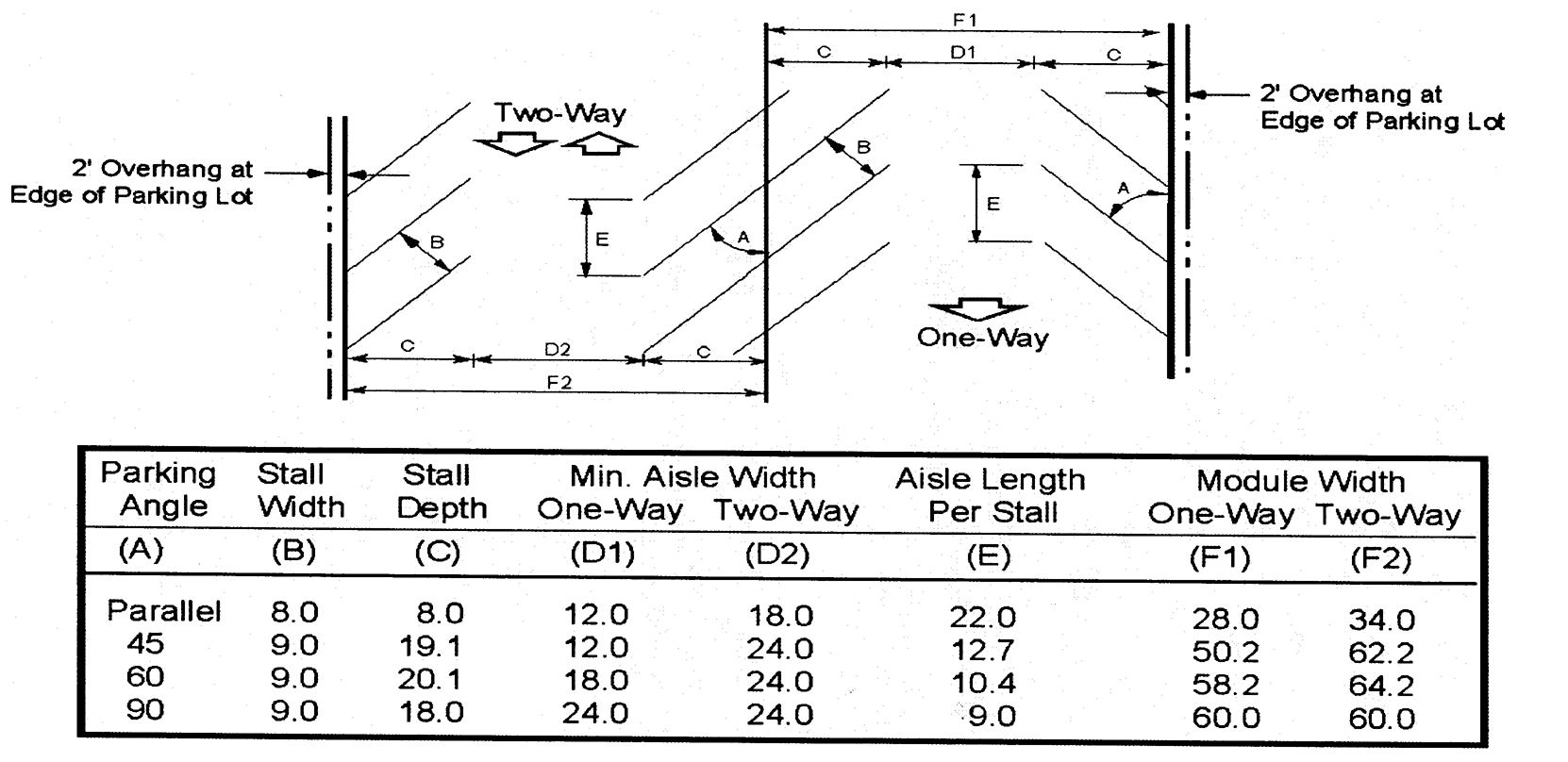
Drive Lane Widths and Parking Space Sizes
4.
On-premise parking required. All required commercial and residential parking spaces shall be located on the premises.
5.
Residential parking development standards. The following regulations shall apply to all residentially zoned districts and apply to any required front, rear, or side yard being used to park or store vehicles, including boats and trailers.
a.
All vehicles that are parked or stored on private property in residential areas are to be on an approved, paved surface (see subsections b(l) and b(2) below). All new improvements on any rear or side yard must also meet the requirements of section 9-3, "Drainage."
b.
The off-street parking for residential uses shall be paved according to the following standards:
1.
Four inches of reinforced Portland cement concrete over compacted subgrade; or
2.
Not less than two inches of hot mixed asphalt over a minimum of six inches of approved subgrade material. Approved subgrade material being crushed gravel, crushed asphalt, and concrete mix or equivalent.
c.
All driveway and sidewalk improvements shall require a permit.
d.
Vehicles must completely rest on such approved surfaces from the point they leave the public streets to the point upon which they are parked or stored.
e.
All vehicles that are parked or stored in a required rear yard shall be so placed behind a screening partition of fencing materials to obscure the vehicle from view from a public street.
f.
All vehicles shall be so parked in relation to the street and dwelling at right angles and not to extend over any walkway or be closer than eight inches from the back of the curb so they will not obstruct the pedestrian ways. Notwithstanding the foregoing, vehicles parked on residential lots maintaining a primary vehicle entryway in the side yard of the lot, of a length no greater than ten feet, may impede the pedestrian walkway if the vehicle will not fit entirely within the vehicle entryway.
g.
Any inoperable vehicle found in violation of this provision must be made operable or moved to an enclosed building within ten days from the notification of such condition existing. Properties where vehicles are parked in violation of this provision shall be subject to fines or penalties, as allowed by law. All repeat violations that occur at the same address shall be subject to immediate penalties and/or fines as allowed by law.
6.
Nonresidential parking development standards. The off-street parking or loading facilities required for nonresidential uses mentioned in these regulations shall be paved according to any of the following standards:
a.
Four inches of reinforced Portland cement concrete over compacted subgrade in all districts;
b.
Not less than two inches of hot mixed asphalt over at least six inches of lime treated subgrade or other approved material * in all districts; or
c.
Not less than two inches of hot mixed asphalt over six inches of crushed stone, flexible base subgrade, or other approved material * in "LI" or "HI" zoned districts only.
* Other approved material - other materials may be considered if design is provided by a geotechnical engineer licensed in the State of Texas. The design shall consider specific on-site conditions. These materials must be approved by the City's Chief Building Official.
d.
Lots shall be graded and drained in such a manner that run-off shall be properly channeled into a storm drain, watercourse, pond area, or other appropriate facility.
7.
Maintenance requirements. To insure that all requirements set forth in this section are carried forward, it will be the responsibility of the owner of the parking area to maintain the facility. All off-street parking areas shall be kept free of trash, debris, vehicle repair operation or display and advertising uses. At no time after initial approval of the parking area layout can changes be made in the location and number of provided spaces without approval of the city inspector.
B.
Special events and other one-time events. "Special event" means a festival, celebration, performance or other such special event which occurs no more frequently than once per year, and which will or should be reasonably anticipated to attract patrons or visitors in such numbers as to exceed the capacity of the permanent parking spaces required and provided under other provisions of this section for the property upon which the special event is to be held. Events which are conducted more frequently than once per year are not considered "special events" under the provisions of this subsection, and the property upon which these events are conducted must conform to the other provisions of this ordinance concerning parking requirements.
1.
The persons or entities conducting any such special event shall submit to the administrative official at least 45 business days prior to said event a plan for the accommodation and parking of vehicles of persons reasonably expected to attend such event. The plan must include, at a minimum, the following information:
a.
A description and the address of the premises where the event is to be held;
b.
A description and the address of any property, other than the premises described in (a) above, where parking is to be provided for patrons or visitors to the event;
c.
The name and address of the owner of the premises upon which parking for the event is to be provided, and a statement describing the terms and conditions of the agreement whereby the owner of such premises has authorized their use for parking;
d.
The dates and times that the event is to be held;
e.
The measures which will be taken by the persons or entities conducting the special event to ensure safe and orderly traffic flow to and from the event site and any parking area;
f.
A plan or diagram of the proposed layout of the parking scheme upon the property to be used for parking for such event.
2.
All parking for any such special event shall be provided off street and on an area and surface reasonably anticipated to be dry and safe for vehicular and pedestrian traffic. No public property or rights-of-way may be utilized or included in such parking areas except upon express, prior written permission by the city council.
3.
Subject to the above requirements, the surface of such parking areas need not be paved or otherwise surfaced as required by the other provisions of this ordinance for permanent parking areas, but it must be suitable for the type and amount of vehicular and pedestrian traffic reasonably anticipated for the special event at issue.
4.
Upon submittal of the required parking plan to the city, the administrative official shall review it and shall advise the applicants whether any changes or modifications to said plan will be required. The administrative official has the sole discretion to approve or reject, or require modifications to, any parking plan required hereunder. No vehicles may be parked in any location not otherwise allowed under other subsections of this section, in connection with any special event, unless and until the city council has issued a written approval of the parking plan of the special event.
5.
Such written permission may be revoked at any time by the city council if it is found that false or misleading information was contained in the proposed parking plan.
C.
Handicapped spaces. All areas of newly designed or newly constructed buildings and facilities required to be accessible under federal and state law shall comply with the standards set forth in the Texas Accessibility Standards of the Architectural Barriers Act, Texas Rev. Civil Stat. Art. Ann. § 9102 (Vernon Supp 2000.)
1.
The dimensions of each "H" parking space shall be 12 feet wide and 18 feet long.
2.
Each and every "H" parking space required by this section of the parking regulations or by other applicable regulations shall be clearly identified as reserved for the handicapped.
The number of "H" parking spaces required shall be determined by the following table:
D.
Single family attached and multi-family parking facilities. Common parking facilities for single family attached and multi-family structures shall meet the following criteria:
1.
Each dwelling unit shall have its required parking spaces provided within 100 feet of a principal entrance to a single family attached structure and 150 feet of a principal entrance to a multi-family structure.
2.
The parking facility shall be arranged so that a minimum of five feet shall separate any parked car from a solid building wall and 20 feet from a principal entrance.
3.
In the DX Land Use Districts, one of the two off-street parking spaces required for each dwelling unit may be assigned to the driveway crossing in the required front and side yards.
4.
In any residential district off-street parking provided at the rear of the lot shall be permitted to occupy any paved portion of the rear yard except that a minimum distance of 20 feet shall separate the enclosed off-street parking spaces from an alley at the rear lot line.
E.
Parking access requirements. Parking areas which would require the use of public right-of-ways for maneuvering shall not be acceptable for the furnishing of required off-street parking spaces other than for single-family detached and duplex dwelling structures. Parking parallel at the curb on a public street shall not be substituted for off-street requirements.
F.
Off-street loading requirements. Provisions for loading and unloading shall be provided on the site according to the following regulations:
1.
In the following cases all retail, office and service buildings shall provide and maintain off-street facilities for the loading and unloading of merchandise and goods within the building or on the lot adjacent to a public alley or private service drive to facilitate the movement of traffic on the public streets:
a.
When deliveries are made by truck more than once a day between the hours of 8:00 a.m. and 6:00 p.m.
b.
When the time of loading and unloading materials or goods exceeds ten minutes between those hours.
2.
Individual loading space dimensions shall be required as a minimum to be 35 feet in length, 12 feet width with a height clearance of 15 feet.
3.
The number of off-street loading spaces shall be placed according to the following table:
_____
G.
Additional regulations. Nothing in this section shall require the furnishing of additional parking spaces for buildings existing and used on the date of adoption of this ordinance. However, any enlargement or addition to an existing building shall not be approved unless such building and addition or enlargement shall be brought into full compliance with the provisions of this section.
When the occupancy of any building is changed to another use, parking shall be provided to meet the requirements for the new use.
H.
Reserved.
I.
Parking for non-residential facilities located outside the city. In addition to other parking regulations that apply, parking for any non-residential use or facility is permitted only as an accessory use, and is allowed only when immediately adjacent to a non-residential use or facility that is located within the corporate limits of the city. Any non-residential use or facility located outside of the corporate limits of the city that desires to use a parking area within the city must obtain a specific use permit authorizing such parking facility within the city. This requirement may be waived by the city council for such a parking area where the non-residential use or facility is to be developed pursuant to an interlocal agreement that places development controls on the use or facility. The city council may waive the specific requirements set forth in this section when the city council determines that the other conditions and criteria placed on the development are adequate to protect the public health, safety, and welfare.
(Ord. No. 2003-03, § 1, 4-1-03; Ord. No. 2005-04, § 1, 2-15-05; Ord. No. 2009-10, § 3, 7-21-09; Ord. No. 2013-13, § 3, 8-20-13; Ord. No. 2014-17, § 1, 10-21-14; Ord. No. 2011-18, § 3, 8-16-11; Ord. No. 2018-22, § 3, 12-18-18; Ord. No. 2023-17, § 1, 5-16-23)
Sec. 8-10. - Sign regulations.
A.
Purpose. It is hereby determined that regulation of the location, size, placement and certain features of signs is necessary to enable the public to locate goods, services and facilities without difficulty and confusion, to prevent hazards to life and property and to assure the continued attractiveness of the community and protect property values. It is further determined that signs which may lawfully be erected and maintained under the provisions of this ordinance are consistent with customary usage, and that signs which may not lawfully be erected and maintained under the provisions hereof are not consistent with customary usage, are an abuse thereof and are an unwarranted invasion of the rights of legitimate business interests and of the public.
B.
Applicability. The provision of this subsection on signs, as set forth herein, shall apply to all developments within the City of Saginaw. The following shall not be subject to the provisions of this regulation:
1.
Signs of an authorized government entity, including traffic or similar regulatory devices, legal notices, or warnings at railroad crossing.
2.
Nothing contained herein shall be construed to prohibit the display of the flag of the United States, State of Texas or any political subdivision.
3.
Flags or emblems of a political, civic, philanthropic, or educational organization.
4.
Signs which announce a campaign, drive, or event of any political, civic, philanthropic, educational, or religious organization as long as they are not displayed more than 30 days in any one period of 12 months. The period of time extending from the day of the regular election to the day of any required run-off election shall be exempt from the 30-day maximum limit. All signs must be picked up at least 48 hours following the election.
5.
Memorial signs or tablets.
6.
Signs which are required to be maintained by law or governmental order, rule, or regulation, including exit and fallout shelter signs.
7.
Signs which are displayed for the direction or convenience of the public, including signs which identify restroom. Freight entrances, or the like, but which do not exceed two square feet in area per sign.
8.
Temporary real estate signs which are located on the premise offered for sale or lease.
C.
Sign regulation procedures. The following procedures shall apply to all placement of signs within the City of Saginaw:
1.
Permits. It shall be unlawful for any person, unless otherwise provided in this ordinance, to erect, construct, reconstruct, structurally alter or relocate any sign within the city without first obtaining a sign construction permit.
2.
Application. All applications for sign construction permits shall, whenever practical, be submitted as part of any required site plan. Whenever the sign construction permit application is submitted as a separate action from the site plan, it shall be reviewed and acted on by the enforcing officer as an independent event. The sign construction permit shall be accompanied by a plan or plans drawn to scale which shall include the following:
a.
The dimensions of the sign and, where applicable, the dimensions of the wall surface of the building to which it is to be attached.
b.
The dimensions of the sign's supporting members.
c.
The maximum and minimum height of the sign.
d.
The proposed location of the sign in relation to the boundaries of the lot upon which it is to be situated.
e.
The location of all electrical transmission lines within 30 feet of any part of such proposed sign structure.
f.
If applicable, plans and specifications for the electrical system of the sign.
3.
Exceptions. A permit shall not be required for the following:
a.
The changing of the advertising copy or message of a painted sign or a face replacement of an existing sign.
b.
The electrical, repainting or cleaning maintenance of a sign.
4.
Stop orders. The issuance of a sign construction permit shall not constitute a waiver of this ordinance or other ordinances of the city. The building inspector is authorized to issue stop orders for any sign which is being constructed in violation of this or any other ordinance of the city.
5.
Construction standards. All signs regulated by this ordinance shall be designed to ensure the public safety and shall not be installed until compliance with all applicable codes and regulations, including requirements for minimum structural design criteria, fastening devices, foundations, strength and type of materials, and electrical wiring and fixtures has been demonstrated by securing approval for all necessary permits from the building inspector or other issuing agencies.
a.
A freestanding sign exceeding 25 feet in overall height shall be designed and sealed by a professional engineer.
b.
All electrical signs must display a UL sticker.
D.
Permanent signs permitted in residential districts. The following regulations shall apply to permanent signs in the residential zoning districts:
1.
Residential subdivisions are allowed one permanent identification sign at each major entrance. The total sign surface area at each entrance shall not exceed 50 square feet. The height of such sign shall not exceed eight feet above the average finished grade and the lowest point of the sign face shall be no higher than 18 inches above the adjacent grade. Each sign may be illuminated so as to be seen at night. Illumination may be from within or external sources. The source of light shall be screened from and directed away from public rights-of-way.
2.
Nameplates, not to exceed one square foot in area, shall be permitted for each dwelling unit. Such nameplates indicate only the name and/or address of occupants or premises. Address numerals shall consist of three-inch letters posted over garages or primary entrance to the structure.
3.
Multiple family complexes are allowed one sign totaling not more than 50 square feet in area per complex. The sign may be illuminated in a manner to be seen at night. Permitted signs may be anywhere on the premises except as restricted by this section. They may not project beyond any property line and, if ground mounted free-standing, the top shall not be more than eight feet over ground level and the bottom of the sign no higher than 18 inches above the adjacent ground level. If building mounted, such sign shall be flush mounted and shall not project above the roof eaves line.
4.
Advertising signs shall not be permitted in residential districts except:
(i)
Signs traditionally used by builders and realtors on a specific lot being advertised for sale, and
(ii)
Kiosk signs in public rights-of-way erected in accordance with Subsection K. of these sign regulations.
E.
Permanent signs permitted in nonresidential districts. The following regulations shall apply to permanent business signs in the nonresidential zoning districts:
1.
In all districts, the applicant for any sign permit shall provide a scaled exhibit that shows the location of pole signs; monument signs or freestanding signs located or proposed to be located on the site.
2.
NC neighborhood commercial district.
a.
One free-standing ground sign oriented for view from each abutting public street is permitted for each unified shopping center structure containing two or more businesses with an allowable total sign area of two square feet for every linear road frontage per street, with a maximum size of 100 square feet, including the frame for each sign.
b.
The height of free-standing signs including any part of the sign or structure shall not exceed 12 feet in height above the average finished grade at the front property line and the lowest point of the sign face shall be no higher than 18 inches above the adjacent grade. The sign must be located on the site where the goods or services are offered.
c.
Wall mounted signs shall be shown on the site plan(s) required by section 8-1.E, Site Plan Contents hereof.
d.
A wall sign shall not project above the roof line more than four feet. The sign must be located on the site where the goods or services are offered.
e.
No sign shall be located in a POSE (public open space easement) as established by the city.
3.
CC Community Commercial District, LI Light Industrial District, and HI Heavy Industrial District.
a.
The area of all freestanding signs shall not exceed the ratio of two square feet of sign area for each linear foot of street frontage, with a maximum size of 400 square feet per sign and a separation of 100 feet.
b.
Freestanding signs shall not exceed 40 feet in height and the lowest point of the sign face shall be no higher than 18 inches above the adjacent grade. The sign must be located on the site where the goods or services are offered.
c.
Wall mounted signs shall be shown on the site plan(s) required by section 8-1.E, Site Plan Contents hereof.
d.
A wall sign shall not project above the roof line more than four feet. The sign must be located on the site where the goods or services are offered.
4.
OP office park district. The area of freestanding signs shall not exceed the ratio of one square foot of sign area for each linear foot of building width measured along the front of the building.
F.
Permanent signs permitted in community facility districts. The following regulations shall apply to signs in the CF zoning district:
1.
The total area of all free-standing signs shall not exceed the ratio of 0.5 square feet of sign area for each linear foot of building width measured along the front of the building for each principle use.
2.
Each use shall be permitted one freestanding sign facing each bordering street. Such sign may be illuminated by a constant nonflashing light source and shall not exceed a height of five feet above the average grade.
3.
The provisions of section 8-10.I, Prohibited Signs, shall apply to CF districts.
G.
Measurement of signs. The following procedures shall be followed in measuring the area of signs to determine compliance with these regulations:
1.
Ground signs (free-standing). The sign face or surface area shall be computed as including the entire area within a regular geometric form comprising all display area of the sign and including all elements of the matter displayed including the frame.
2.
Supporting structural members not bearing advertising matter, identifying color, symbols, wording or pictures shall not be included in computation of surface area except as noted herein.
a.
Irregular signs. In calculating the area of irregular signs or separately mounted signs on one supporting structure, the area shall be that of the smallest regular geometric form that will wholly contain all of the elements including the frame.
b.
Multi-faced signs. Where a sign has two or more faces, the area of all faces shall be included separately in determining the area of the sign. The area of the signs shall be combined to meet the total requirement of maximum sign size.
3.
Measurement of detached signs. The sign area for a detached on-premise sign shall be the area included within vertical and horizontal line projections of the furthermost points of any logo, letters, or other symbols, composed of the total area of the message, and any border, trim, or surface upon which the message is displayed. One sign area will be calculated for a detached sign no matter how the message is displayed. The sign structure shall not be included in the sign area unless there is a sign displayed thereon.
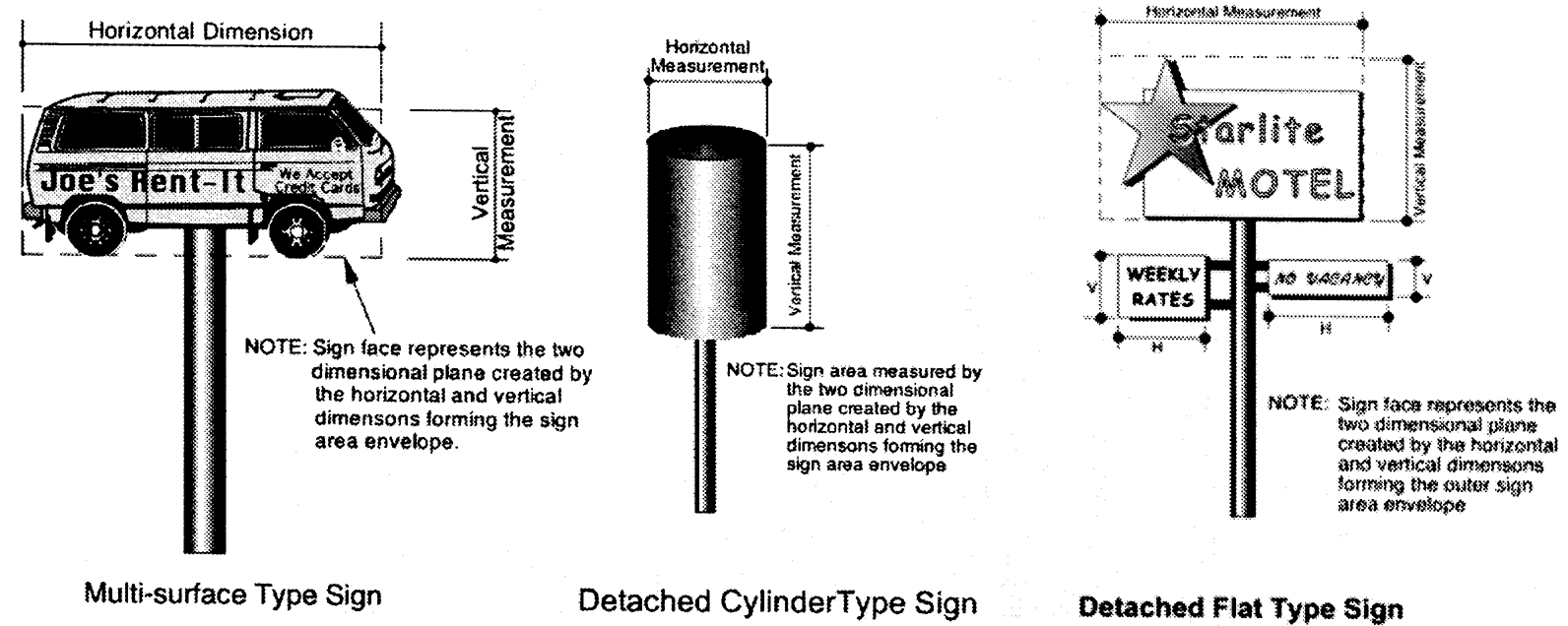
Signs (1)
4.
Measurement of attached signs. The sign area for an attached on-premise sign shall be the area included within the vertical and horizontal line projection of any logo, letters, or other symbols intended to be read together, composed of the total area of the message and any border, trim or surface upon which the message is displayed. There may be several sign areas on the wall of a building depending upon how a sign is displayed.
5.
Attached single panel wall mounted signs. Use only area of panel in calculation of sign area.
6.
Painted wall panel sign. Use painted area (for sign contrast) of wall in calculation of sign area.
7.
Attached multiple panel wall mounted sign. Calculate area of each panel and add individual panel areas together for total sign area. Total sign area maximum of ten percent for primary wall.
8.
Nonpanel wall sign (individual letters). Use overall horizontal and overall vertical measurements to calculate the sign area of a wall sign composed of individual letters attached to the wall; and use total of individual signs for total sign area.
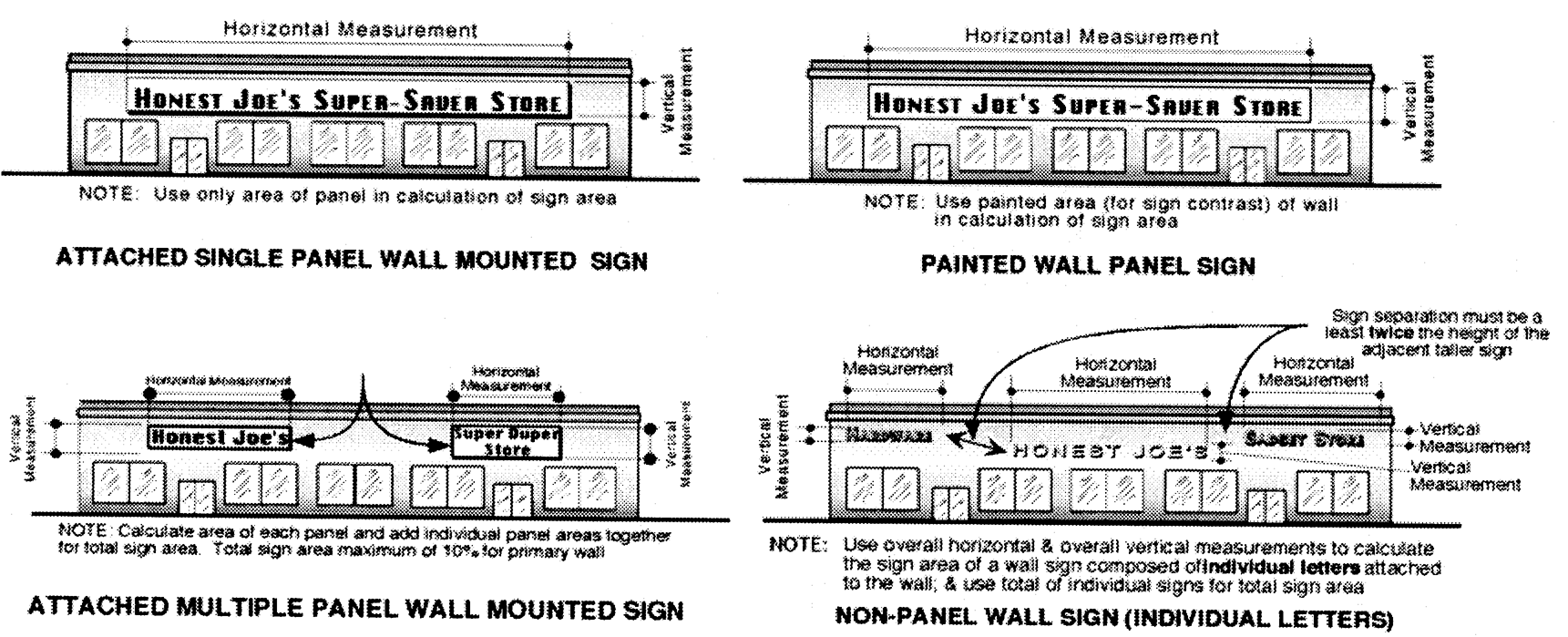
Signs (2)
H.
Sign maintenance. All signs and sign structures shall be kept in good repair and neat appearance. Signs shall be maintained at reasonable intervals including replacement of defective parts, painting, repainting and cleaning. The building inspector shall inspect all signs and sign structures on an annual basis and shall require corrections of any signs deemed in violation of this Section.
I.
Prohibited signs. The following signs are prohibited from installation, construction, repair, alteration, or relocation within the city, except as otherwise permitted in this ordinance:
1.
"A" frame or sandwich board, and sidewalk or curb signs, except as temporary signs.
2.
Balloons, or inflatable signs.
3.
Moving, flashing, animated, or rotating signs, signs with moving lights, or signs which create the illusion of movement, except for reader boards which convey messages that change.
4.
Temporary signs.
5.
Signs placed on or affixed to vehicles and/or trailers which are parked on a public right-of-way, public property, or private property so as to be visible from a public right-of-way where the apparent purpose is to advertise a product or direct people to a business or activity located on the same or nearby property. However, this does not prohibit signs placed on vehicles and trailers that are incidental to the primary use or ownership of the vehicle or trailer as transportation.
6.
Signs attached to utility poles or other surfaces which are not the property of the utility or serve a public purpose located within a public right-of-way or easement.
7.
Permanent off-premises signs, as defined by the Highway Beautification Act (excluding churches and civic organization signs not exceeding 300 square feet but meeting all other applicable sign regulations and shall be limited to one off-premises sign per organization).
8.
Signs which advertise an activity, business or service no longer conducted on the premises upon which the sign is located.
9.
Signs which contain or have attached thereto banners, posters, pennants, ribbons, streamers, strings of light bulbs, spinners or other similar devises.
10.
Signs which contain statements, words or pictures of an obscene, indecent or immoral character which offend public morals or decency.
11.
Signs or portions thereof which are located on project or extend over any public sidewalk, street, alley or other public property.
12.
Signs which constitute hazard to pedestrian or vehicular traffic, or interfere with, obstruct the view of, or be confused with any authorized traffic sign, signal or device.
13.
Signs which make use of any word, phrase, symbol or character in such manner as to interfere with, mislead or confuse vehicular traffic.
14.
Portable or wheeled signs; however, portable signs may be permitted for civic and public events for a period not to exceed 30 days, upon approval of the director of community development or his designee.
15.
Signs attached to or located upon exposed amenities such as benches or trash containers.
16.
Signs placed on the side or rear of any building of property when such sign faces upon a contiguous residential area.
J.
Signs exempt from regulation. The following signs are exempt from the provisions and regulations of this section:
1.
Public signs. Signs required by governmental bodies or specifically authorized for a public purpose by any law, statute, or ordinance. Such public signs may be of any type, number, area, height, location, or illumination as required by law, statute, or ordinance.
2.
Signs on vehicles. Signs placed on or affixed to vehicles and/or trailers where the sign is incidental to the primary use of the vehicle or trailer as transportation.
3.
Warning signs. Signs warning the public of the existence of danger but containing no advertising material; to be removed within three days upon the subsidence of danger. Such warning signs may be of any type, number, area, height, location, or illumination as deemed necessary to warn the public of the existence of danger.
4.
Flags. Flags of governmental entities or nonprofit organizations. Nothing in this ordinance shall be construed to prevent the display of a national or state flag, or to limit flags, insignias, or legal notices, or informational, directional, or traffic signs which are legally required and necessary to the essential functions of government agencies.
5.
Governmental signs. Signs of a duly constituted governmental body, including traffic or similar regulatory devices, legal notices, warnings at railroad crossings, and other instructional or regulatory signs having to do with health, hazards, parking, swimming, dumping, etc.
6.
Address numerals. Address numerals and other signs required to be maintained by law or governmental order, rule, or regulation are allowed, provided that the content and size of the sign do not exceed the requirements of such law, order, rule, or regulation.
7.
Athletic signs. Signs used as scoreboards in athletic stadiums.
8.
Directional signs. Signs which direct vehicles and pedestrian traffic, which may display arrows, words, or other symbols to indicate direction of facilities.
9.
Directory signs. Signs which are located in or adjacent to entrances or foyers.
10.
Instructional signs. Signs providing no advertising of any kind, which provide direction or instruction to guide persons to facilities intended to serve the public, including but not specifically limited to the signs identifying restrooms, public telephones, public walkways, parking areas, and other similar facilities.
11.
Public seasonal decorations or special public events.
K.
Kiosk signs. Kiosk signs are intended to create a uniform, coordinated method of providing homebuilders and developers a means of utilizing directional signs, while minimizing the negative impacts of weekend homebuilder's signs on the appearance of the city. Kiosk signs are also intended to provide a service to the public by giving directions to municipal facilities and parks, community events and school district facilities.
1.
The city council may, by duly executed license agreement, grant the exclusive right to design, erect and maintain kiosk signs within the city limits.
2.
Kiosk signs shall be designed and constructed in accordance with the specifications contained in the aforementioned license agreement.
3.
Prior to erecting any kiosk sign, the licensee shall submit a sign location map to the code enforcement supervisor for approval.
4.
Kiosk sign installations shall include break-away design features as required for traffic signs in the street right-of-way.
5.
No additional or extraneous signs, pennants, flags or other devices for visual attention or other appurtenances shall be attached to kiosk signs.
6.
Kiosk signs shall not be illuminated.
7.
Individual sign panels on kiosk signs shall have a uniform design and color.
8.
Kiosk signs shall not interfere with the use of sidewalks, walkways, bike and hiking trails; shall not obstruct the visibility of motorists, pedestrians or traffic control signs; shall not be installed in the immediate vicinity of street intersections; and shall comply with the 25-foot visibility triangle or other visibility easements.
9.
In accordance to the specifications contained in the aforementioned license agreement, a percentage of the kiosk sign panels shall be reserved for the city to use as directional signage to municipal or community facilities or locations of community events.
10.
Kiosk signs may be used by private businesses in possession of a current city-issued certificate of occupancy, on a first come first serve basis, pursuant to the current terms and conditions applicable to home builders. Businesses shall be permitted a maximum of one panel, per side, per kiosk.
(Ord. No. 2003-03, § 1, 4-1-03; Ord. No. 2003-14, § 1, 12-2-03; Ord. No. 2004-15, § 1, 9-21-04; Ord. No. 2009-04, §§ 1, 2, 2-17-09; Ord. No. 2011-24, § 1, 11-15-11)
Sec. 8-11. - Outdoor lighting requirements.
A.
Applicability. All outdoor electrically powered illuminating devices shall be installed in conformance with the provisions of this section, the Building Code and the Electrical Code of the City of Saginaw as applicable and under appropriate permit and inspection. These lighting standards shall apply to all nonresidential uses in the City of Saginaw. Unless otherwise stated, this ordinance does not regulate lighting in public road rights-of way.
B.
Outdoor lighting plan. An outdoor lighting plan must be submitted separately from any required site plan or landscape plan on all public or private properties, including rights-of-ways, public easements, franchises and utility easements for approval by the building official. An outdoor lighting plan shall be submitted prior to issuing a building permit. Plans shall include the following:
1.
A layout of the proposed fixture locations.
2.
The light source.
3.
The luminous area for each proposed light source with proposed foot-candle measurements.
4.
The type and height of the light fixture or of the light source above grade.
5.
The type of illumination.
C.
General lighting requirements. The following general outdoor lighting requirements shall apply:
1.
Unless otherwise provided herein, illumination, where required by this ordinance, shall have intensities and uniformity ratios in accordance with the current recommended practices of the Illuminating Engineering Society of North America (IESNA) as from time to time amended.
General Lighting Requirements
2.
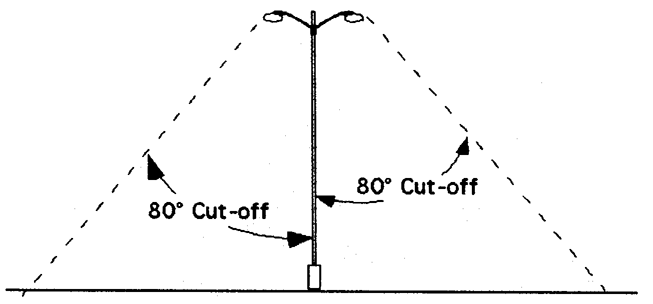
Unless otherwise provided herein, all building lighting for security or aesthetics will be fully shielded type, not allowing any upward distribution of light. Wallpack type fixtures are acceptable only if they are fully shielded with 80-degree cut-off.
3.
No use or operation in any district shall be located or conducted so as to produce glare, or either direct or indirect illumination across the bounding property line from a source of illumination into a residentially zoned property, nor shall any such light be of such intensity as to create a nuisance or detract from the use and enjoyment of adjacent property. For the purposes of this section, a nuisance shall be defined as more that 0.25 of one foot-candle of light measured at the residential property line and 2.25 of one foot-candle at any adjoining nonresidential property line.
4.
Shielding shall be required in all outdoor lighting installations as specified below.
D.
Illumination.
1.
Measurement. Illumination levels of outdoor lighting shall be measured by a qualified professional according to generally accepted IESNA methods.
2.
Computation of illumination. Illumination at a point may be computed in lieu of measurement. Computation methods shall consist of a generally accepted IESNA method, using certified photometric data furnished by the fixture manufacturer, lamp manufacturer, photometric laboratory, or other reliable authority satisfactory to the city. Computations shall be based on new, properly seasoned lamps, diffusers and other appurtenances in place, and with proper regard taken for mounting height, relative elevation, natural and manmade objects.
3.
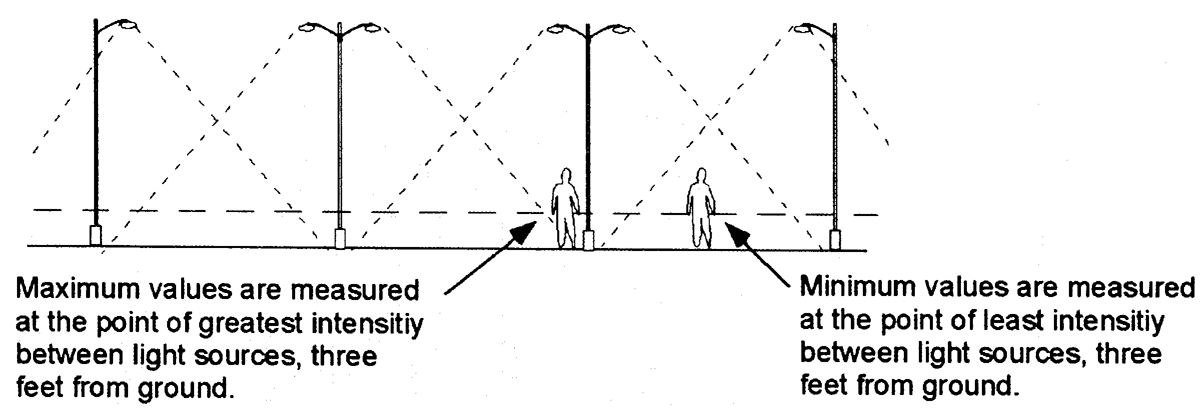
Limitations on neighboring property. The limit of illumination on neighboring property from one establishment shall be by zoning of the neighboring property. Maximum computed or measured foot-candles at the neighboring property line shall not exceed the limits provided in the following table:
E.
Nonresidential lighting parameters.
1.
All nonessential lighting shall be turned off after business hours, leaving only necessary lighting for nonresidential districts site security.
2.
Floodlights, accent, aesthetic, and security lights must be fully shielded.
3.
Parking lots and vehicle movement areas shall not exceed a maximum illumination value of 40 foot-candles nor a minimum illumination value of 1.0 foot-candles. Total pole and fixture height shall not exceed a maximum of 32 feet, measured from grade at the base. Taller poles may be considered in some situations upon approval of a special exception by the board of adjustments.
Nonresidential Lighting Parameters
4.
Display, building and aesthetic lighting must be externally lit from the top and shine downward. The lighting must be fully shielded to prevent direct glare and/or light trespass. The lighting must also be substantially contained to the target area.
5.
Limitations on establishment property. The maximum outdoor initial computed or measured luminance level on the establishment property shall not exceed 40 foot-candles outdoors at any point, except that lighting under canopies (such as service stations) shall not exceed 60-foot candles. Illumination measurements may exceed the maximum upon approval of a special exception by the board of adjustments.
F.
Public and semi-public recreational facilities.
1.
Any light source permitted by this section may be used for lighting of outdoor recreational facilities (public or private), such as, but not limited to, football fields, soccer fields, baseball fields, softball fields, tennis courts, or show areas, provided all of the following conditions are met:
a.
Any illumination level exceeding a maximum of 40 foot-candle must receive prior approval by the board of adjustments.
b.
All fixtures used for event lighting shall be fully shielded, or be designed or provided with sharp cut-off capability, so as to minimize up-light, spill-light, and glare.
c.
All events shall be scheduled so as to complete all activity before or as near to 10:30 p.m. as practical, but under no circumstances shall any illumination of the playing field, court, or track be permitted after 11:00 p.m. except to conclude a scheduled event that was in progress before 11:00 p.m. and circumstances prevented concluding before 11:00 p.m.
G.
Prohibited lighting elements. Unless otherwise authorized, the following shall be prohibited except upon prior approval by the building official.
1.
Laser source light. The use of laser source light or any similar high intensity light for outdoor advertising or entertainment, when projected above the horizontal is prohibited.
2.
Searchlights. The operation of searchlights for advertising purposes is prohibited.
H.
Exemptions. The following shall be exempted from the outdoor lighting regulations contained herein.
1.
All temporary emergency lighting needed by the police or fire departments or other emergency services, as well as all vehicular luminaries.
2.
All hazard warning luminaries required by federal regulatory agencies are exempt from the requirements of this section, except that all luminaries used must be red and must be shown to be as close as possible to the federally required minimum lumen output requirement for the specific task.
3.
Any luminary of 75 watts or less provided the accumulated illumination of 50-watt luminaries does not exceed 75 watts.
4.
Seasonal decorative lighting.
5.
The lighting of a local, state, or federal government flag.
I.
Temporary exemptions. Upon approval by the Administrative official, temporary exemptions from the requirements of this ordinance for a period not to exceed 30 days may be approved.
1.
Any person may submit a written request, on a form prepared by the city for a temporary exemption request. The request shall contain the following information:
a.
Specific exemption (s) requested
b.
Type/use of outdoor lighting fixture involved
c.
Duration of time requested
d.
Type of lamp and calculated foot-candles
e.
Total wattage of lamp(s)
f.
Proposed location of fixtures
g.
Previous temporary exemption requests
h.
Physical side of fixtures and type of shielding provided
i.
Such other data or information as may be required by the city manager's designee.
j.
Requests for renewal of exemptions shall be processed in the same way as the original request. Each renewal shall be valid for not more than 14 days or a time period designated by the administrative official.
k.
Approval for temporary exemptions will be based on the effect of location and use of outdoor lighting fixture.
J.
Nonconforming lighting. All luminaries lawfully in place prior to the date of the ordinance shall be considered as having legal nonconforming status. However, any luminary that replaces a legal nonconforming luminary, or any legal nonconforming luminary that is moved, must meet the standards of this ordinance. Screening devices and fence regulations.
Sec. 8-12. - Screening devices and fence regulations.
A.
Purpose. It is the express intent of this ordinance to regulate the placement, size and height of any and all screening devices (fence or wall) used to separate property, screen dumpster areas, and provide perimeter screening along thoroughfares. All construction shall be in accordance with the City of Saginaw Construction Standards.
B.
Screening standards: nonresidential uses. The following standards shall apply to screening devices in the nonresidential zoning districts:
1.
A screening device shall be erected along side and rear property lines adjacent to residential districts. The screening device shall be a minimum height of eight feet, unless otherwise approved by city council.
2.
The screening device shall be solid and made of masonry, wood (cedar or redwood), or chain link with opaque slats.
3.
A concept plan of the screening device shall be submitted to the city for review and approval.
4.
Screening fence or wall. An opaque vertical visual barrier constructed of appropriate materials as permitted by ordinance and meeting the appropriate height regulations as established by the city and used to block the view of the general public.
C.
Screening standards: residential uses. The following standards shall apply to screening devices in the residential zoning districts and in the Neighborhood Mixed-Use District where adjacent to properties zoned or used for entirely single-family or duplex residential uses:
1.
In areas where a single-family district abuts a multi-family district, a screening device shall be erected along side and rear property lines. The screening device shall be a minimum height of eight feet. It shall be the responsibility of the multi-family district to construct the screening device.
2.
The screening device shall be solid masonry, unless otherwise approved by city council.
3.
Living compatibility screen. Whenever a non-residential use, multi-family use, or mixed use is adjacent to a property used or zoned for single-family or duplex residential uses, the development shall provide a landscaped area of at least 20 feet in width along the common property line, planted with one canopy tree for each 30 linear feet or portion thereof of adjacent exposure. These trees may not be clustered. Connection to the adjacent neighborhood shall be provided via a sidewalk or trail through the living compatibility screen, leading to an adjacent right-of-way, sidewalk, and/or trail as applicable to provide connectivity to any adjacent neighborhoods or other developments.
D.
Screening along arterial and collector thoroughfares. The following screening requirements shall apply:
1.
A screening device is required along the side and/or rear property lines adjacent to any arterial, or applicable collector grade street as determined by the city council, and shall be a minimum height of eight feet, unless otherwise approved by the city council.
2.
The screening device shall be solid and made of masonry, wood, or a combination of masonry and ornamental iron with landscape screen, unless otherwise approved by the city council.
3.
The screening device shall be offset onto the property a distance of three feet along a minimum run of a single lot width, or a maximum run of two lot widths. The portion of such screening device perpendicular to the roadway may be built of ornamental iron with landscape screen, with approval of the city council.
4.
A concept plan of the screening device shall be submitted to the city for review and approval.
E.
Screening of parking lot areas.
1.
Developments shall screen parking from adjacent properties with a living compatibility screen in accordance with section 8-12.C.
2.
For all developments, off-street surface parking lots, excluding associated driveways, shall be screened from view from public rights-of-way and adjacent property as follows:
a.
Earthen berm planted with turf grass and/or combination of ground cover and evergreen shrubs recommended for local area use by the director of parks and recreation, with a slope not to exceed one foot of height for each two feet of width; and/or
b.
Evergreen plant materials recommended for local area use by the building official, located in a bed that is at least three feet wide with a minimum soil depth of 24 inches. Initial plantings must be capable of obtaining a solid appearance within three years. Plant materials must be placed a maximum of 24 inches on center over the entire length of the bed unless the building official approves an alternative planting density certified by a landscape authority as being capable of providing a solid appearance within three years.
F.
Special screening: Loading areas. Loading docks or structures, bays, and bay doors shall be screened from view from the public right-of-way, from adjacent residential property, and from adjacent non-residential property, other than industrial. The required screening device adjacent to a non-residential property, other than industrial, may be waived by the city council with site plan approval if the city council determines that the location of the proposed loading docks or structures, bays or bay doors in relation to the adjacent development's site layout is not detrimental.
G.
Special screening: trash receptacles. A screening device is required around all trash receptacles. The screening device shall be solid and made of masonry, wood, or chain link with opaque slats. The screening device shall be a height of eight feet, or two feet above the top of the receptacle, whichever is less.
H.
Prohibited materials. The following types of screening materials are subject to prohibition:
1.
Electric fences are specifically prohibited in all residential districts. special exception approval by the city council may be given in zoning districts other than residential.
2.
Smooth face concrete masonry units (CMU) are not to be used as a masonry wall material. Textured face CMU is acceptable.
3.
"Spite" fences shall be prohibited.
I.
Safety. The following safety provisions shall apply to screening devices within the City of Saginaw:
1.
No screening device shall be constructed or maintained in such a manner as would endanger the health or safety of the public.
2.
Fences constructed of barbed wire, walls topped with broken glass or surfaced with any like sharp material, or which are topped by "razor" wire or coiled barbed wire shall be prohibited.
3.
Screening devices constructed of materials which are not commercially available materials shall be prohibited.
4.
Security fences of not less than six feet in height may be topped by barbed wire aprons in nonresidential areas.
5.
Barbed wire fences shall be permitted in agricultural districts where such fences are providing for the actual enclosure of farm animals.
6.
No electric fence shall be permitted, except in agricultural districts where such fence is providing for the actual enclosure of farm animals, in which case said electric fence shall be posted along each adjoining public right-of-way and abutting residential areas at intervals of not less than 100 feet.
J.
Special provisions. The following special provisions for screening devices shall apply:
1.
The height of a screening device shall be the vertical distance between the ground and the top of the fence. In terrain where ground slopes at a grade of ten percent or more, the fence or wall may be built in ten foot horizontal stair-step sections; the average height of each such section shall comply with the height regulations set forth herein.
2.
No screening device located in the required front yard, according to the zoning district provisions, shall have a height of more than three feet. Such fences shall not have openings less than that which would allow a six-inch sphere to pass through the openings.
3.
No screening device located on a corner lot shall have a height in conflict with the regulations governing visibility at intersections as follows:
a.
At intersections, there shall be a visibility triangle maintained without obstruction by any structure over 30 inches in height within the POSE (public open space easement) as required by the subdivision ordinance and/or plat.
b.
Entranceways, which have decorative structures and plantings, shall be built with the same regulations as fences within the POSE (public open space easement) and as approved by the final plat/construction plans.
4.
No screening device other than decorative fence may be built nearer the street onto which the house or building faces than the front building line. Exceptions to this may be made for schools and in nonresidential districts if deemed necessary by the city council.
5.
Other yard uses, such as fences, wall, poles, posts, customary fixed yard accessories and ornaments, and roof overhangs projecting not more than 24 inches, may be permitted in any minimum required yard, subject to height limitations and requirements limiting obstruction of visibility.
6.
No screening device shall be built beyond the building line without a key lot fence permit and plan approved by the city. The plan must demonstrate that adequate sight distance will be maintained after construction of the fence using criteria set by the American Association of State Highway and Transportation Officials (AASHTO).
K.
Decorative fences. Decorative fences shall be defined as fences not over three feet in height, as measured from the top of the curb, used for landscaping or ornamentation and not primarily for enclosure. The construction of a decorative fence is subject to the following limitations:
1.
The fence must not be totally solid, and must allow for good visibility through the fence. This includes fences made of split rail, wrought iron, widely spaced pickets with six inches or more separation, or other ornamental material.
2.
If shrubs are planted along the decorative fence, they must not obstruct the visibility through the fence.
3.
Chain link fences, barbed wire fences, and other wire mesh fences that are ordinarily used to contain animals are specifically prohibited as a decorative fence.
4.
A decorative fence may be built no nearer the street than the furthermost of the following distances:
a.
Ten feet behind the curb.
b.
The edge of the street right-of-way nearest the property line.
c.
The edge of the sidewalk nearest the building line; however, in no instance shall the decorative fence enclose the sidewalk.
L.
Maintenance requirements. A screening device in public view shall be maintained by the owner and/or tenant, or homeowners association where applicable, in a manner that will eliminate leaning of any portion of the screening device that creates a public safety hazard or that could be considered unsightly. A screening device in public view shall be subject to inspection by the building inspections department for compliance.
M.
Requirements, permits, and fees. Screening device requirements shall be required for all new businesses, for any change in occupancy, or when external improvements over $2,500.00 are made to the property. All permits and fees shall be subject to the requirements as established by the City of Saginaw for building permits.
(Ord. No. 2018-08, § 1, 6-19-18; Ord. No. 2018-23, § 1, 12-18-18; Ord. No. 2022-11, § 2, 9-6-22)
Sec. 8-13. - Landscape regulations.
A.
Purpose and intent. The purpose of this section is to provide for the orderly and aesthetic development of the city and to promote the health, safety, and general welfare of the community. It is the intent of this section to achieve the following:
1.
A balance between the need for landscape treatments and the need for commercial growth in the city.
2.
Promote a flexible attitude of enforcement sufficient to meet the spirit and intent of these requirements.
3.
Promote mutually beneficial improvements by using incentives than penalties.
4.
To aid in stabilizing the ecological balance of the environment by contributing to the processes of air purification, oxygen regeneration, ground-water recharge, storm water runoff retardation and erosion control.
5.
Provide for the separation and buffering of incongruous uses and intensity of activities; and provide for the visual softening of building masses.
6.
Reduce glare from paved surfaces, dust nuisances and the impact of noise.
7.
Protect and promote the value of residential and commercial properties within the city.
8.
Promote a positive image for the attraction of new business enterprises within the city.
9.
Encourage the protection of healthy trees and vegetation and promote the natural, ecological, environmental, and aesthetic qualities of the city.
B.
Landscape and irrigation requirements.
1.
General. The requirements herein shall apply to all new nonresidential construction, subdivision development, and multi-family construction. The requirements for landscaping shall combine the buffer yard requirements, minimum landscape areas on the interior portion of the lot, and minimum landscape areas for parking areas.
a.
Existing buildings. Buildings in existence on the effective date of this section shall be considered legally nonconforming as it pertains to this section. The requirements herein shall apply to new construction necessary to replace a legally nonconforming structure if it has been damaged or destroyed to the extent of fifty percent of its value prior to the damage, or if fifty percent of its structural area has been damaged or destroyed.
b.
Pad site developments. Pad site developments or ground lease developments shall be required to provide landscaping in accordance with the interior landscape requirements of section 8-13. B.4 herein.
2.
Buffer yards. A minimum fifteen-foot buffer (interior parkway) adjacent to the right-of-way of any street is required. If the lot is a comer lot two frontages shall be required to observe the fifteen-foot buffer. If more than two frontages exist then the other right-of-way frontages shall be required to have no more than seven and one-half feet of landscaped area. Planting for buffer yards is included in the interior landscape requirements.
3.
Residential districts and attached or detached single family or two-family residential uses/structures within mixed-use districts.
a.
In the SF-1 and SF-2 districts, at minimum, one two-inch nursery caliper tree shall be required per residential lot.
b.
In the SF-3, SF-4, and mixed-use districts, at minimum, one two-inch nursery caliper tree shall be required per residential lot.
c.
In the ZLL, DX and SFA districts, at minimum, one two-inch nursery caliper tree shall be required per residential lot.
4.
Interior landscape area requirements. The amount of landscape area required on the interior of the lot (includes buffer yards) shall be based on the square footage of the proposed buildings. For the purposes of this section, the square footage of the building will be the square footage of the first floor or the square footage of the largest floor, whichever is greater. For single story retail anchor tenants having greater than 20,000 square feet of area, the building square footage shall be the front width of the building multiplied by a depth of 60 feet. The required landscape area for each zoning shall be based on the percentage of the floor area as determined above in accordance with the following chart and can be combined with required open space in mixed-use districts:
a.
Planting requirements. The following plants shall be required within the interior landscape areas at the ratio indicated:
(1)
One canopy tree per 600 square feet
(2)
One understory tree per 300 square feet
(3)
One shrub per 60 square feet
(4)
Ground cover - ten percent of required area
Example: Two-story office building (NC Zoning), floor has 4,000 square feet
b.
Location requirements. A minimum of 75 percent of all required plant material within the interior landscape areas shall be in the front and/or along either the building and/or the interior edge of the side of the building be required buffer yards.
c.
Enhanced pavement credits. For every one foot of enhanced pavement area, the required interior landscape area may be reduced by one-half foot. The maximum credit given for enhanced pavement shall be ten percent of the required interior landscape area.
d.
Right-of-way landscaping credits. The required interior landscape area may be reduced by a maximum of ten percent when the applicant chooses to establish, irrigate and maintain turf grass within the right-of-way. along the front of their property. The percentage credit shall be based on the percentage of the parkway irrigated, i.e. 50 percent of parkway irrigated, five percent credit, in accordance with section 8-13.B herein.
5.
Parking lot landscaping requirements. Excluding the LI and HI zoning districts, planter islands shall be provided in parking areas on the basis of ten square feet of landscape area for each parking stall provided. (Approximately one island per 16 stalls). Each row of parking stalls shall provide the required landscape area; however, it shall be the applicant's right to place the islands near the buildings, throughout the parking, or at the end of the rows away from the building. The council may modify the island requirement for each row in situations where it would appear beneficial to combine an end or hazardous island into a larger island within the parking area.
Planter islands shall have a minimum width of eight feet back-to-back if curbed, or nine feet edge-to-edge if not curbed, and shall be equal to the length of the parking stall. Parking lot landscape areas do count towards the total required interior landscape area.
a.
Existing trees. The city council may approve variations to the planter island requirements in order to preserve existing trees in interior parking areas. For existing trees, the minimum width of the planter island shall be as follows:
(1)
Six-inch caliper or less = eight-foot minimum width.
(2)
Six-inch to twelve-inch caliper = twelve-foot minimum width.
(3)
Greater than twelve-foot caliper = eighteen-foot minimum width.
b.
Planting requirements. A minimum of 50 percent of all planter islands in parking areas shall contain a minimum of one canopy tree with the remaining area in shrubs, ground cover, grasses or seasonal color. Planter islands which have light poles for lighting the parking areas may substitute two understory/accent trees for the required canopy tree. Planting requirements are as follows:
(1)
One canopy tree per 32 parking spaces.
(2)
One understory tree per 16 parking spaces.
(3)
One shrub per four parking spaces.
c.
Exemptions. Parking garages are not required to provide landscape areas interior to the parking area.
6.
Visibility triangle. No requirements herein shall be deemed to require plantings which would conflict with the visibility triangle at the intersection of public right-of-way. as defined in the subdivision ordinance. Consideration should also be given to visibility at the intersection of major driveways with the public right-of-way.
7.
Irrigation requirements. All required landscape areas except for single family shall be irrigated by an automatic irrigation system, provided however, the same shall be designed and installed by a licensed irrigator, landscape architect or other professional authorized by the state to design or install such systems.
a.
Water conservation. The city would like to promote the use of Xeriscape and efficient irrigation methods and practices. Xeriscape is the practice of designing landscapes with drought tolerant and/ or native plants to reduce or eliminate the need for irrigation. Where possible in planting beds, flood irrigation, porous pipe or emitter/drip systems should be utilized. Where slopes do not allow flood systems, flat spray heads should be utilized under shrubs rather than upward spray heads on risers above shrubs. Lawn spray heads should have low precipitation rates, run for longer periods of time, and water infrequently to promote deep root growth for grasses.
b.
Water conservation credits. Where automatic irrigation is used in accordance with 7.a, the required landscape area may be reduced by ten percent. When other irrigation systems are installed, the required landscaped area may be reduced by five percent.
C.
Existing tree preservation. Existing trees listed in the approved plants listing with a caliper of 12 inches or greater shall be saved and protected to five feet outside the drip line in landscape areas as a part of the development.
1.
Building footprint. The above requirement shall not apply to the area intended for the actual, building footprint plus a 30 foot distance outside this area for construction vehicle maneuvering and grading requirements.
2.
Parking areas. The above requirement shall not apply to the area intended as a fire lane or parking stalls.
D.
Plant material. The following standards and requirements shall apply:
1.
Quality standard. All plant material shall be of No. 1 grade, free from plant disease, of typical growth for the species, have a healthy, normal root system, rounded branching pattern, and shall conform to the code of standards in the current addition of the American Standard for Nursery Stock.
2.
Approved plants. The following is a list of approved plants within each plant material type. The applicant may propose plants other than those listed if the plant seems appropriate for the intended use or the applicant maintains a plant care program sufficient to properly care for the proposed plant material. The city reserves the right to approve plants and planting through a certified landscape architect horticulturist or other person so qualified.
OVERSTORY/CANOPY TREES
UNDERSTORY/ACCENT TREES
SHRUBS
GROUND COVER/VINES
3.
Size requirements when planted. All plants shall equal or exceed the following measurements when planted. Plants larger than specified may be used but use of such plants shall not decrease the size requirements of other proposed plants.
a.
Tree measurement canopy and understory trees with single trunks shall be a minimum two-inch caliper. Multi-trunk trees shall be measured by the height of the tree.
b.
Minimum sizes. Minimum plant size when planted shall be as follows:
The city council may approve smaller size shrubs based on unusual growing circumstances and/or on a specific design, which reflects the overall intent of this section.
E.
Landscape plan and irrigation plan requirements. Landscape plans and irrigation plans for all residential lots, including single-family residential lots, are excluded from this section.
1.
Qualification to prepare plans. For all lots equal to or greater than 30,000 square feet, with the exception of residential lots, landscape plans shall be prepared by a registered landscape architect. For all lots smaller than 30,000 square feet, a landscape designer or landscape contractor, knowledgeable in plant materials and landscape design may also prepare the landscape plan. A licensed irrigator or landscape architect shall prepare irrigation plans for all lots of any size.
2.
Landscape plan requirements. The following items shall be provided on the required landscape plan.
a.
Sheet size 24 inches by 36 inches, or as approved.
b.
Acceptable scale: one inch = ten feet, one inch = 20 feet, one inch = 40 feet, or as approved.
c.
North arrow, graphic and written scale in close proximity.
d.
Appropriate title (i.e. "landscape plan").
e.
Title block includes street address, lot and block, subdivision name, city, state, date of preparation.
f.
Name and address of owner.
g.
Name, address and telephone of firm preparing plan.
h.
Boundary shown with dimensions.
i.
Any existing utilities shown. (i.e. water, sewer, storm drain, gas, electric, cable, etc.)
j.
Width and type of buffer yards labeled on all sides.
k.
Location, stock size and name of all existing trees twelve-inch caliper or more.
l.
Location, quantity, size and name of all proposed plant materials.
m.
Maintenance note provided.
n.
Label type of any enhanced pavement proposed.
o.
Visibility triangles shown.
p.
Landscape architects seal signed and dated.
q.
List of plant material.
r.
Any berms delineated with one-foot contour intervals.
3.
Irrigation plan requirements. The following items shall be provided on the required irrigation plan.
a.
Sheet size 24 inches by 36 inches, or as approved.
b.
Acceptable scale: one inch = ten feet, one inch = 20 feet, one inch = 40 feet, or as approved. (Must be same as landscape plan.)
c.
North arrow, graphic and written scale in close proximity.
d.
Appropriate title (i.e. "irrigation plan").
e.
Title block includes street address, lot and block, subdivision name, city, state, date of preparation.
f.
Name and address of owner.
g.
Name, address and telephone of firm preparing plan.
h.
Boundary shown with dimensions.
i.
Location of all existing trees twelve-inch caliper or larger.
j.
All pipes labeled as to size.
k.
All heads labeled as to type. (Legend is acceptable.)
l.
Backflow prevention labeled with type and size.
m.
Connection to water service shown after meter.
n.
Second meter (with size) shown if intended.
o.
Any existing utilities shown (i.e. meter, sewer, storm drain, gas, electric, cable, etc.).
p.
Note on plan. All backflow installations and connections to city water lines must be permitted separately through the city inspection staff.
q.
Maintenance note provided.
r.
Plan sealed, signed and dated by qualified professional as authorized by state law.
F.
Other related requirements.
1.
Screening. All the requirements of the screening section of the fencing regulations shall be met and shown on the required landscape plan.
2.
Outside storage. All the requirements of the outside storage regulations shall be met and shown on the required landscape plan.
G.
Improvements in public right-of-way easements.
1.
General. It is not the intent of this section to require landscape improvements within public right-of-way other than for subdivision developments. Should the applicant elect to provide improvements in public right-of-way, the following shall apply.
2.
Subdivision development. Landscaping shall be required for all subdivision development. All developed property having a side or rear yard, which abuts an arterial or collector street shall be landscaped. The area landscaped shall be in the public right-of-way as directed by the city council through subdivision approval. Landscaping will be required at the ratio indicated:
a.
One canopy tree per 70 linear feet of frontage.
b.
One understory tree per 35 linear feet of frontage.
c.
One shrub per seven linear feet of frontage.
d.
Ground cover—all area not covered by lawn grasses.
e.
Lawn grasses—all area not covered by other landscaping.
3.
Right-of-way use agreements. Prior to any landscape/irrigation improvements within public right-of-way, a right-of-way use agreement shall be duly executed in conformance with the requirements set out by the director of public works.
4.
Replacement responsibilities. The city shall endeavor to require replacement of all landscape/irrigation improvements as a part of contracts to install public utilities within public right-of-way and/or public easements. The city and owner shall not be responsible for replacing these improvements. In the event the city anticipates utility improvements conflicting with intended landscape/irrigation improvements, the city may require that the applicant wait to install said improvements until after the public improvements have been installed or under certain circumstances, the city may prohibit landscape improvements within the right-of-way.
5.
Median and right-of-way plants shall be selected with the consideration having a less invasive lateral root system. All plants located in the right-of-way or median shall be selected through a certified landscape architect, horticulturist or other person so qualified. All plants shall maintain a minimum of four feet from back of curb and/or sidewalks. Any trees to be planted in medians or right-of-way parkways shall be approved by the city's development review committee. The city's development review committee cannot override the minimum four feet provision in this section.
H.
Review procedures.
1.
Submittal requirements. The city's building and inspection department shall establish administrative procedures necessary to facilitate the implementation and enforcement of this section, consistent with the intent and terms of this section.
2.
Authority for review. The city's building and inspection department shall be responsible for the review of all plans submitted in accordance with the requirements of this section.
3.
Review process. The city's building and inspection department shall review the required submittals and provide the applicant with a summary of corrections from the review. It shall be the applicant's responsibility to revise the submittals as necessary to obtain approval.
I.
Maintenance.
1.
General. The owner, tenant and their agent, if any, shall be jointly and severally responsible for the maintenance of all landscaping and irrigation.
a.
All required landscaping shall be maintained in a neat and orderly manner at all times. This shall include mowing, edging, pruning, fertilizing, watering, weeding, and other such activities common to the maintenance of landscaping. Landscaped areas shall be kept free of trash, litter, weeds and other such material or plants not a part of the landscaping. All plant materials shall be maintained in a healthy and growing condition as is appropriate for the season of the year. All irrigation heads or lines, which are broken and flow water, shall be replaced or repaired within 48 hours after notice by the City of Saginaw, to prevent the waste of water. If the required necessary repairs are not made within 14 calendar days the city, in addition to pursuing all other legal remedies, may terminate the water service to the property.
b.
Property owners shall be responsible for the maintenance of all landscaped areas adjacent to a part of the public street rights-of-way that are a continuous extension of their lot(s) to the back of curb of the pavement. Under this rule, property owners shall not be responsible for maintaining landscaped materials in street medians.
2.
Plant replacements. The owner shall be responsible for replacing all plant material, which shows dead branching over 75 percent or more of the normal branching pattern and repair of irrigation systems. Plant materials, which die, shall be replaced with plant material of similar variety and similar initial size. Upon notification by the city of such replacements, the owner shall have 90 days to comply with these requirements.
3.
Plan requirements. Paragraph E above shall be shown on the landscape plan and the irrigation plan.
J.
Enforcement.
1.
Building permit. No building permits for building, paving, grading or construction shall be issued until a landscape plan meeting the requirements of this section has been approved by the building official. Under certain conditions such as a "fast track" building process for large developments, the developer and the city council may negotiate the submittal of a landscape plan within 90 days after the issuance of the original building permit.
2.
Certificate of occupancy. All plantings, screening, berms, or other requirements of this section shall be installed before the issuance of a certificate of occupancy (C.O.). Any sod intended must be installed; hydro mulch areas must be sprayed. Turf establishment is not required before issuance of a C.O. In any case in which a C.O. is sought at a season of the year in which the building official determines that it would be impractical to install plantings as required herein, a temporary certificate of occupancy (T.C.O.) may be issued for the intended use for a period not to exceed six months. Upon the failure of the applicant to complete the installation requirements, the city may pursue its rights under the penalty provision of this section, or, upon 30 days' written notice may revoke the C.O. or discontinue water service.
(Ord. No. 2022-11, § 3, 9-6-22; Ord. No. 2024-26, § 1, 12-3-24)
Sec. 8-14. - Wireless communication facilities.
A.
Purpose. Certain radio equipment used in transmitting and receiving signal energy are essential and are deemed to promote the health, safety, and general welfare of the citizens of the city. The placement of such equipment shall be located such that the health, safety, welfare, and aesthetic quality of the community shall not be compromised. Therefore the regulations governing the location of such equipment shall consider the aesthetic quality of the community equal to the health, safety, and general welfare of the community. The antennas, masts, and towers hereinafter enumerated shall not be deemed violations of this ordinance when made under the conditions herein provided.
B.
Definitions. See section 12-2.D for wireless communications facilities definitions.
C.
Residentially zoned districts - amateur radio equipment and tv antennas. Amateur radio equipment, including ham radio and CB equipment and personal use TV antennas, shall be allowed in the residential zoning districts if they comply with the following regulations:
1.
Antenna facilities may be building attached, monopoles, or lattice towers;
2.
Up to three antenna facilities may be located on a lot of record, co-location is encouraged;
3.
An antenna facility, exclusive of the height of any antenna or mast, shall not exceed 35 feet in height. Provided, however, that an antenna facility shall be permitted additional height at the ratio of one added foot in height for each additional foot of setback beyond the minimum setback required of an accessory building in the zoning district regulations contained in section 8-4, Detached Accessory Building Regulations. Regardless of the above, the maximum height for a tower permitted without a special exception in any residential district shall be 65 feet;
4.
The height of an antenna, including the height of any antenna facility to which they may be fastened or attached shall not exceed 65 feet in height without a special exception;
5.
An antenna not fastened to a antenna facility shall not exceed 50 feet without a special exception, except for an antenna which does not extend more than eight feet above a building on which it is mounted;
6.
A antenna facility shall be limited to having the number and size of antennas attached to it that are allowed by the antenna facility manufacturer's designs and specifications for maximum wind load requirements;
7.
Setbacks.
a.
Antennas and antenna facilities shall not be permitted in front or side yards. Guy wires are not permitted in front yards;
b.
Guy wires are permitted in required side and rear yards;
c.
Setback for antenna facilities shall be the same as is required for accessory buildings in residential districts;
8.
Separation. There shall be no minimum or maximum separation requirements for antenna facilities from other structures on the same lot of record;
9.
Antenna facilities shall not be permitted in any easement;
10.
Lights. No auxiliary or outdoor lighting shall be allowed on antenna facilities located on residentially zoned property except such lights or lighting as may be required by the Federal Aviation Authority or the Federal Communications Commission;
11.
Construction standards. A building permit must be obtained prior to the construction and/or installation of an antenna facility. Antenna facilities must be installed as per the manufacturers recommendations or under the seal of a registered professional engineer of the State of Texas. Regardless of the above, all such antenna facilities must meet the Electronic Industries Association Standard EIA-222-D, Structural Standards for Steel Antenna Towers and Antenna Supporting Structures and the Building Code;
12.
Maintenance. Antennas and/or antenna facilities obviously not in use or obviously in need of maintenance as determined by the building official, shall be removed or brought into compliance within 30 days following notice given by the building official. This shall not preclude immediate action by the building official to safeguard life, limb, health, property, and public welfare;
13.
No part of an antenna facility or any attachment thereto may extend beyond the property lines of the owner of such antenna or antenna facility;
14.
No permit shall be issued for the installation of an antenna facility on a multi-family structure or property unless a notarized statement of permission from the owner is presented to the building department;
15.
A special exception must be obtained in the residential zoning districts for any antenna facility which does not comply with the regulations specified hereinabove.
D.
Residentially zoned districts—commercial radio equipment and tv antennas. Only building attached antenna shall be allowed in residentially zoned districts under the following conditions:
1.
A special exception must be obtained from the zoning board of adjustment. See section 3.8, Authorized Special Exceptions;
2.
The proposed antenna must be attached to or enclosed in an existing structure currently or last occupied by a non residential use as listed in section 5.1, Permitted Use Table. Or attached to a power or telephone pole, water storage tower, or other utility structure;
3.
The antenna must not exceed eight feet above the structure to which it is attached;
4.
A minimum of 1,500 feet of separation shall be required between antenna facilities;
5.
If attached to the exterior of a structure or a power or telephone pole, water storage tower or other utility structure the antenna must be at least 75 feet above grade and painted to match the structure to which it is attached;
6.
The antenna may be placed lower than 75 feet above grade if completely enclosed within existing architectural elements of a building so as not to be visible;
7.
Any associated equipment storage building shall be screened from public view by a decorative masonry wall, with landscaping for aesthetic purposes;
8.
All driveways accessing any antenna facility site or equipment storage site shall be constructed of an all weather hard surface as approved by the city engineer;
9.
Lights. No auxiliary or outdoor lighting shall be allowed on antennas located on residentially zoned property except such lights or lighting as may be required by the Federal Aviation Authority or the Federal Communications Commission;
10.
Construction standards. A building permit must be obtained prior to the construction and/or installation of a tower, antenna or mast. Towers must be installed as per the manufacturers recommendations or under the seal of a registered professional engineer of the State of Texas. Regardless of the above, all such towers, antennas or masts must meet the Electronic Industries Association Standard EIA-222-D, Structural Standards for Steel Antenna Towers and Antenna Supporting Structures and the Building Code;
11.
Maintenance. Antennas, obviously not in use or obviously in need of maintenance as determined by the building official, shall be removed or brought into compliance within 30 days following notice given by the building official. This shall not preclude immediate action by the building official to safeguard life, limb, health, property, and public welfare;
12.
No part of an antenna, or any attachment thereto may extend beyond the property lines of the owner of such antenna;
13.
No permit shall be issued for the installation of an antenna, on a structure or property unless a notarized statement of permission from the owner is presented to the building department.
E.
Nonresidential districts. Radio, television, microwave broadcast relay, receiving towers, transmission and re-transmission facilities, satellite receiving only earth stations (home dish antenna), and any electronic emission equipment of a commercial nature shall be allowed in the nonresidential zoning districts if it complies with the following regulations:
1.
Up to three antenna facilities may be located on a lot of record, co-location is encouraged;
2.
Antenna facilities shall be limited to building attached and monopoles only;
3.
An antenna facility, exclusive of the height of any attached antenna, shall not exceed 35 feet in height. Provided, however, that an antenna facility shall be permitted additional height at the ratio of one added foot in height for each additional foot of setback beyond the minimum setback required of a accessory building in the zoning district regulations herein. Regardless of the above, the maximum height for an antenna facility permitted without a special exception in any nonresidential district shall be 65 feet;
4.
With the exception of stealth facilities, the height of an antenna, including the height of any antenna facility to which they may be fastened or attached, shall not exceed 65 feet in height without a special exception;
5.
With the exception of stealth facilities, an antenna shall not extend more than eight feet above a building on which it is attached;
6.
An antenna facility shall be limited to having the number and size of antennas attached to it that are allowed by the antenna facility manufacturer's designs and specifications for maximum wind load requirements;
7.
Setbacks. With the exception of stealth facilities, antennas and antenna facilities shall not be permitted in front or side yards;
8.
Antenna facilities shall not be permitted in any easement;
9.
Lights. No auxiliary or outdoor lighting shall be allowed on antennas located on residentially zoned property except such lights or lighting as may be required by the Federal Aviation Authority or the Federal Communications Commission;
10.
Construction standards. A building permit must be obtained prior to the construction and/or installation of a tower, antenna, or mast. Antenna facilities must be installed as per the manufacturers recommendations or under the seal of a registered professional engineer of the State of Texas. Regardless of the above, all such antenna facility and antennas must meet the Electronic Industries Association Standard EIA-222-D, Structural Standards for Steel Antenna Towers and Antenna Supporting Structures and the Building Code;
11.
Maintenance. Antenna facilities and antennas obviously not in use or obviously in need of maintenance as determined by the building official, shall be removed or brought into compliance within 30 days following notice given by the building official. This shall not preclude immediate action by the building official to safeguard life, limb, health, property, and public welfare;
12.
No part of an antenna facility and antennas or any attachment thereto may extend beyond the property lines of the owner of such antenna or antenna facility;
13.
No permit shall be issued for the installation of an antenna or antenna facility on a multi-family structure or property unless a notarized statement of permission from the owner is presented to the building department;
14.
A special exception must be obtained in nonresidential zoning districts for any antenna or tower which does not comply with the regulations specified hereinabove.
15.
Stealth facilities, which meet the definition of stealth as provided in section 12-2.D, Wireless Communications Facilities Definitions shall be exempt from the height and location requirements of this section. In addition, the city manager or his designee shall be the final authority as to whether or not any facility meets the definition of "stealth".
F.
Written report upon denial of request. The City of Saginaw shall document any denial of a request to place, construct, or modify personal wireless service facilities in writing. Such documentation shall be supported by substantial evidence within the written record.
1.
Satellite receive-only antennas generally. Satellite receive-only antennas assist individuals in the receipt of satellite transmitted television signals. Satellite receive-only antennas shall not be deemed violations of this ordinance when made under the conditions herein provided. Such conditions are hereby found to be reasonable and clearly defined health, safety and aesthetic objectives.
2.
Satellite receive-only antennas. A satellite receive only antenna shall be allowed if it complies with the following:
a.
The satellite receive-only antenna is two meters or less in diameter and is located or proposed to be located in any area where commercial or industrial uses are generally permitted by non federal land use regulations or;
b.
The satellite receive-only antenna is less than one meter in diameter in any residential zoning district.
G.
Large satellite receive-only antennas. Satellite receive-only antennas that are greater than one meter in diameter in residential districts or greater than two meters in diameter in nonresidential districts shall be allowed in any zoning district if they comply with the following regulations:
1.
Only one satellite receive-only antenna per lot of record;
2.
A satellite receive-only antenna shall not exceed ten feet in height;
3.
Set backs:
a.
Front and side. Satellite receive-only antennas shall not be permitted in front or side yards;
b.
Rear. Satellite receive-only antennas shall be permitted in rear yards provided they meet the minimum setback as is required for accessory buildings in residential districts and as for all buildings in nonresidential districts;
4.
Separation. There shall be no minimum or maximum separation requirements for satellite receive-only antennas from other structures on the same lot of record;
5.
Satellite receive-only antennas shall not be permitted in easements;
6.
Lights. No auxiliary or outdoor lighting shall be allowed on satellite receive-only antennas except such lights or lighting as may be required by the Federal Aviation Authority or the Federal Communications Commission;
7.
Construction standards. A building permit must be obtained prior to the construction and/or installation of a satellite receive-only antenna. Satellite receive-only antennas must be installed as per the manufacturers recommendations or under the seal of a registered professional engineer of the State of Texas;
8.
Maintenance. Satellite receive-only antennas obviously not in use or obviously in need of maintenance as determined by the building official, shall be removed or brought into compliance within 30 days following notice given by the building official. This shall not preclude immediate action by the building official to safeguard life, limb, health, property, and public welfare;
9.
No part of a satellite receive-only antenna or any attachment thereto may extend beyond the property lines of the owner of such satellite receive-only antenna;
10.
No permit shall be issued for the installation of a satellite receive-only antenna on a multi-family structure or property unless a notarized statement of permission from the owner is presented to the building department;
11.
All satellite receive-only antennas shall be screened from view from adjoining properties by fencing or evergreen plants. A satellite receive-only antenna located within a fence surrounding the yard in which the satellite receive-only antenna is located shall be considered to be screened;
12.
A special exception must be obtained for any satellite receive only antenna which does not comply with the regulations specified hereinabove.
H.
Special exception. A special exception must be obtained for any antenna, tower, and/or satellite receive-only antenna which does not comply with the regulations specified in this section, herein above. In considering whether to grant a special exception from the regulations specified above, the following shall be considered:
1.
The effect on the value of the surrounding property;
2.
The potential for interference with the enjoyment of the use of surrounding properties;
3.
Aesthetics;
4.
The necessity of the special exception for the public health, safety, and welfare of the citizens or for governmental purposes;
5.
The zoning district and the adjoining zoning districts of the property for which the special exception is sought;
6.
The provisions of 47 C.F.R. § 25.104 which preempt local zoning or other regulations that differentiate between satellite receive-only antennas and other types of antenna facilities unless such regulations:
a.
Have a clearly defined health, safety or aesthetic objective; and
b.
Further the stated health, safety, or aesthetic objective without unnecessarily burdening the federal interest in ensuring access to satellite services and in promoting fair and effective competition among competing communications service providers;
7.
The unique conditions that govern reasonable reception on any given lot;
8.
To properly evaluate all applications to locate commercial antennas or towers which do not comply with the regulations specified hereinabove the following information must be provided by the applicant:
a.
Describe the nature of the antenna site. Indicate whether the proposed structure is a monopole or mounted to a self-supporting structure. Indicate the proposed height;
b.
Provide photos or drawings of all equipment, structures and antenna;
c.
Describe why the antenna or tower is necessary;
d.
State the name(s) of the telecommunications providers or other users of the antenna or tower and describe the use to be made by each user;
e.
Indicate if this antenna or tower site is to be connected to other sites; and if so, describe how it will be connected and who will be the back haul provider;
f.
The applicant must address whether or not they have made an effort to co-locate the facilities proposed for this antenna or tower on existing towers or facilities in the same general area. Please identify the location of these existing sites. If yes, please describe in detail these efforts and explain in detail why these existing sites were not feasible. Attach all studies or tests performed which demonstrate why the existing sites will not provide sufficient signal coverage. Provide written documentation from existing sites' owners and/or operators which confirm the statements provided. Indicate whether or not the existing sites allow/promote co-location and, if not, describe why not;
g.
Indicate whether or not co-location will be allowed to other telecommunications providers at the requested site. If they are not allowed, state every reason and the basis for each reason;
h.
If the requested location is in a residential district the applicant must address whether or not they have made an effort to locate the facility in a commercial or industrial district. Please identify the location of these commercial and or industrial district sites. Please describe in detail these efforts and explain in detail why these commercial or industrial district sites were not feasible. Attach all studies or tests performed which demonstrate why the commercial or industrial sites will not provide sufficient signal coverage. Provide written documentation from commercial or industrial district sites' owners and/or operators which confirm the statements provided;
i.
Indicate the proposed provider's current coverage area for the city. Attach maps showing the areas the proposed provider's existing antenna currently cover, the areas the applicant's existing sites and other existing sites would cover, and the areas the applicant's existing sites and the requested site would cover.
j.
Describe the applicant's master antenna and tower plan for the city. Attach maps and other related documentation. Provide information indicating each phase of the plan.
k.
Describe the applicant's plan to minimize the number of telecommunications antenna and towers needed to cover the city.
l.
The city council will approve a requested application subject to the finding that co-location of this facility with a nearby existing tower facility is technically not feasible and subject to the following conditions:
m.
Applicant will permit co-location of others at the site;
n.
Applicant will configure its antenna and other equipment to accommodate other providers;
o.
Applicant will identify its backhaul provider connecting antenna sites; and
p.
Applicant will give notice to the city identifying any providers who co-locates to the site and identify their backhaul provider.
Sec. 8-15. - Cargo container regulations.
A.
Purpose. The purpose of this section is to promote vibrant, attractive pedestrian mixed-use areas while protecting residential neighborhoods and allowing use of cargo containers by City of Saginaw businesses, contractors and community-related uses to provide secure, easily accessible accessory storage at relatively inexpensive levels.
B.
Permitted uses. Cargo containers shall be permitted in zoning disticts so indicated in the permitted use table as contained in section 5-1.
C.
General regulations.
1.
Cargo containers shall not be stacked.
2.
Cargo containers shall not occupy any required off-street parking spaces, vehicular access, pedestrian facilities or landscape areas for the site.
3.
Cargo containers shall not be located between a building and front property line. On a site with all front property lines, the cargo container shall be placed in a location that minimizes visual impact of the cargo container from surrounding streets and properties.
4.
A cargo container located within 100 feet of a residential zoning district shall be no greater in size than ten feet by 20 feet.
5.
Cargo containers shall not be used for warehouse/storage as the primary use of the property.
6.
Cargo containers shall not exceed a size of ten feet by ten feet by 30 feet unless approved by the director of community development or his designee.
7.
The quantity of cargo containers permitted on a site shall be determined by the total aggregate square foot of principal buildings according to the following rate:
0 to 35,000 sq. ft of principle building = one cargo container
35,001 sq. ft - 70,000 sq. ft = two cargo containers
70,001 sq.ft. - 105,000 sq.ft. = three cargo containers
105,001 sq.ft. - 140,000 sq.ft. = four cargo containers
140,001 sq.ft. - 175,000 sq.ft. = five cargo containers
175,501 sq.ft. - 210,000 sq.ft = six cargo containers
over 210,100 sq.ft. = amount upon approval by the city council
8.
Cargo containers shall be placed upon a surface as approved by the director of community development.
(Ord. No. 2003-03, § 1, 4-1-03)
Sec. 8-16. - Natural gas line compressor stations.
A.
Natural gas line compressor stations (the "station complex") shall be subject to the minimum development criteria set forth in this section 8-16. As a component of an SUP, the city council may modify the requirements set forth herein as it deems appropriate, to ensure that the station complex is compatible with surrounding land uses.
1.
A building permit shall be required for the station complex.
2.
The station complex shall be situated on a platted lot approved by the city and recorded in the local county jurisdiction.
B.
A minimum building setback for all compressor station buildings and equipment shall be established and maintained for all yards at the distances specified for the zoning district adjoining the station complex as shown below.
1.
Table of building setbacks for compressor station buildings and equipment.
2.
Where an adjoining planned development (PD) district contains more than one base zoning district, the most restrictive building setback shall be applied.
3.
Where a compressor station site adjoins a street right-of-way, the required building setback along that right-of-way shall be established by the zoning district designated for the property situated on the opposite side of the right-of-way.
C.
A wrought iron type fence of sufficient height to obscure the entire station complex from public view shall be required along boundary lines that front a dedicated public street right-of-way of any type, or that front a private street right-of-way dedicated for public use. Brick or stone columns shall be constructed on approximate 50-foot centers for such fence.
D.
All compressor station equipment and sound attenuation structures shall be enclosed within a building. Such building shall be designed with the following elements:
1.
The architectural design of the building shall be compatible with the visual context of the surrounding development. Such buildings may be designed as a representation of, but not be limited to, the following building types:
(i)
Barn structure or equestrian facility.
(ii)
Estate residence.
(iii)
School facility or similar institutional use.
(iv)
Gazebo or picnic area enclosures.
(v)
Club house or recreational facility.
(vi)
Retail or office building.
(vii)
Any combination of the above as approved by the city council.
2.
Vehicular access to the boundaries of the station complex from the street thoroughfare shall be paved with a concrete surface at a thickness and design approved by the city engineer or designee. This provision shall also apply to those areas inside the boundaries of the station complex where vehicular traffic and parking is to occur.
E.
The operation of the equipment shall not create any noise that causes the exterior noise level to exceed the pre-development ambient noise levels as measured within 300 feet of the compressor station building(s). The operator shall be responsible for establishing and reporting to the city the pre-development ambient noise level prior to the issuance of the building permit for the station complex.
F.
The compressor station site shall be landscaped in a manner that is compatible with the environment and existing surrounding area.
(Ord. No. 2009-13, § 3, 9-1-09)
Sec. 8-17. - Hotel/motel occupancy limits.
A.
Purposes and findings. The purpose of this section is to ensure the continued availability of quality transient lodging within the City of Saginaw and to ensure the protection of the health, safety, and welfare of hotel, motel, and extended-stay inhabitants and employees. City enforcement officials responsible for monitoring, investigating, and administrating the safety and welfare of hotels, motels, and extended-stay hotels are the city's code compliance department, police department, and fire department.
B.
Provisions applicable to hotels, motels, and extended-stay hotels.
1.
Except as otherwise provided by law, each hotel, motel, and extended-stay hotel shall post a legible copy of the text of this section 8-17 B. in an open and conspicuous place within the public lobby area, and in an open and conspicuous place where other postings are required by law, in each room available for rent.
2.
The initial construction of a hotel, motel, or extended-stay hotel and its subsequent operation shall fully comply with provisions outlined in this article and all associated zoning ordinances.
3.
Hotels, motels and extended-stay hotels operate for the benefit of travelers and transient parties conducting legitimate business in the surrounding vicinity. A legitimate business is one which has been authorized to exercise its activities by following the rules and regulations under the city's jurisdiction. No hotel, motel or extended-stay hotel may be used as housing of last resort. Housing of last resort occurs when an owner-occupant or tenant no longer has any appropriate housing options available under their discretion and is needing to seek accommodations. Housing of last resort will only be permitted during an event that is deemed a state of emergency by a government mandate.
4.
No hotel, motel, or extended stay hotel shall allow anyone of the age 17 and under to rent a room.
5.
No hotel, motel, or extended stay hotel shall offer any lodging rates based on an hourly rate to any potential or existing guest.
6.
No room within any hotel, motel, or extended-stay is allowed to have more guests than the number of people of which its available sleeping arrangements are designed for. Children, aged 17 and under, are not included in this total number.
7.
No hotel, motel, or extended-stay hotel shall have any rooms allocated for the lodging of any bona-fide employee or their family.
8.
All hotels, motels, or extended-stay hotels must maintain daily written records reflecting the renting, letting, or other provision of any of its rooms as described in subsection E. The required records shall be maintained for no less than one year or for such longer period as may be prescribed by law. All records shall be available for review by city enforcement officials during normal business hours.
9.
For every hour of operation, a hotel, motel, or extended-stay hotel must ensure a bona-fide employee is present to assist any city enforcement official in maintaining the safety of its patrons.
10.
All hotels, motels, and extended-stay hotels must provide and maintain quality running hard-wired smoke detectors or smoke alarms in all rooms and common areas for the duration of the hotel, motel, and extended-stay hotel's existence.
11.
All hotels, motels, and extended-stay hotels may have portable convenience appliances, except for toaster ovens. Portable convenience appliances are defined as devices that are designed for household tasks and can be easily relocated.
12.
All hotels, motels, and extended-stay hotels must provide daily housekeeping services with all standard room rates. Cleaning shall occur at least every 48 hours and must include the changing of linens prior to any incoming guest. Cleaning services must be logged and kept for a minimum of six months. All cleaning logs must be accessible to city officials upon request.
13.
All hotels, motels, and extended-stay hotels must maintain the cleanliness of common areas as required by law.
C.
Provisions applicable to hotels and motels.
1.
No hotel or motel shall allow any person to occupy any of its guest rooms for more than 30 consecutive days, nor more than 60 total days during a 180-day period. Any guest who has resided for 30 consecutive days at a hotel or motel must undergo a two-week (14-day) vacancy between stays before beginning any new rental agreement with said hotel or motel. A consecutive stay is constituted as an accommodation lasting longer than 24 hours beginning from check in date and ending on the checkout date at a hotel/motel. Individuals who check out and back in of their accommodations within 72-hours of their previous booking will incur time onto their original stay's length as one combined and continuous period. Any party who violates this provision is subjected to the penalties of this article; no room may again be rented, let or otherwise provided to that same party or to any individual, firm, or entity that was a member of said party.
2.
No hotel or motel may transition towards operating as an extended-stay hotel until it fully complies with all existing extended-stay hotel provisions, associated zoning ordinances, and be up to code.
3.
Any property left in a room by a person or party that has checked out shall be removed by the operator of the hotel or motel and stored or otherwise disposed of in accordance with applicable laws.
4.
Fixed cooking appliances and storage for food preparation shall not be available in any guest room at any hotel or motel. Fixed cooking appliances are considered devices which are designed to cook through the use of a stove top burner or hot plate, including but not limited to appliances such as stoves, ovens, and grills. Storage for food preparation appliances which help to preserve the freshness of food include but are not limited to, full-size refrigerators.
D.
Provisions applicable to extended-stay hotels.
1.
Any guest who has resided for more than 180 consecutive days at an extended-stay hotel must at least undergo a 90-day vacancy between stays before beginning any new rental agreement with said extended-stay hotel. A consecutive stay is constituted as an accommodation lasting longer than 24 hours beginning from check in date and ending on check out date at an extended-stay hotel. Individuals who check out and back in of their accommodations within 72-hours of their previous booking will incur time onto their original stay's length as one combined and continuous period. Any party who violates this provision is subjected to the penalties of this article; no room may again be rented, let or otherwise provided to that same party or to any individual, firm, or entity that was a member of said party.
2.
Each extended-stay hotel room intended or designed to be used, or which are used, rented, or hired out to be occupied by the public must contain fixed cooking appliances and storage for food preparation including, but not limited to, appliances such as full-size refrigerators, stoves, and ovens.
E.
Registration record keeping.
1.
All hotels, motels, and extended-stay hotels must maintain daily written or electronic records of all rental agreements between the hotel, motel, or extended-stay hotel and all patrons and their guests.
2.
All records must be kept for a minimum of 180 days after the rental agreement's termination.
3.
All records must be available during regular business hours upon the request of city enforcement officials.
4.
All records must, at a minimum, maintain the following for each patron and their guest:
(i)
Legal name, phone number, and home address;
(ii)
Room number assigned;
(iii)
Date and time of arrival, scheduled departure, and actual departure;
(iv)
The rate charged and amount collected for their room's rental;
(v)
Payment method for each room; and
(vi)
The make, model, year, color, license plate number, and license plate state of any vehicle which anticipates parking on the premises.
5.
All patrons and their guests must present valid photo identification to rent a room at any hotel, motel, or extended-stay hotel. Valid photo identification may include a legally issued document such as a current driver's license, military identification card, state identification card, or passport. A copy of the presented identification must be kept for a minimum of 180-days after their check out date. Any hotel, motel, or extended-stay operator who does not verify the identification of a patron and their guests or approves lodging services without proper identification shall be in violation of this article.
6.
It shall be unlawful for any hotel, motel, or extended-stay hotel to accept any illegitimate form of identification from any patron or guest, or to falsify any identification documentation and information needed for lodging registration.
F.
Safety.
1.
Any hotel, motel, or extended-stay hotel must report any suspicious or unlawful activity to city enforcement officials.
2.
It is the responsibility of all hotels, motels, and extended-stay hotels to inform any patron and guests that loitering by visitors is prohibited as required by the law.
3.
All exterior doors, apart from the lobby doors or doors otherwise approved by the enforcement official, must be locked between the hours of 10:00 p.m. and 6:00 a.m. and must possesses equipment that will notify the hotel, motel, or extended-stay hotel security or other employees a door has been opened. In addition, all doors must possess panic hardware to allow for emergency egress, which must be approved by enforcement officials. Furthermore, all exterior doors shall be maintained and readily accessible for emergency access by the fire department.
4.
Any hotel, motel, or extended-stay hotel must provide and maintain security in its parking area. This may include a live patrol guard, fencing consistent with the zoning code, or other security measure approved in writing by the city enforcement official.
5.
All hotels, motels, and extended-stay hotels must install a video surveillance system and/or ensure that any previously installed video surveillance systems are deemed compliant by the city enforcement official. All assessments must be requested by the hotel, motel, or extended-stay hotel within the 180-day compliance period as required in Section 3 of this Ordinance.
6.
All video surveillance systems shall be active and functioning 24 hours a day, seven days a week, and recorded footage must be retained for a minimum of 30 days.
7.
All hotels, motels, and extended-stay hotels must dedicate at least one video surveillance camera to all common spaces, including but not limited to lobbies, entrances/exits, hallways, and parking lots. Placement of cameras must be approved by the city enforcement official.
8.
All employees and customers must be notified of the video surveillance system by displaying the system's notice of approval in a bona-fide common area.
9.
Video surveillance systems shall be subject to regular inspection by the city enforcement official to determine conformity under this section. If the video surveillance system does not conform, the hotel, motel, or extended-stay hotel must immediately rectify the compliance violation.
10.
All patrons and guests who desire to park a vehicle on the premises of any hotel, motel, or extended-stay hotel, must register their vehicle upon initial registration and any time after. Vehicle registrations must be recorded as stated in subsection E.4.—6.
11.
Any registered vehicle must be provided with a placard that must at all times be easily visible from outside the vehicle by any bystander. The placard must contain the establishment's name, vehicle registration number, and check-out date at a minimum.
G.
Enforcement.
1.
All common areas and unoccupied rooms within any hotel, motel, or extended-stay hotel are subject to inspection by city enforcement officials.
2.
City enforcement officials shall have the responsibility for the enforcement of this section.
3.
If such structure or premises is occupied, city enforcement officials, shall present credentials to the occupant and request entry. If entry is refused by occupant, city enforcement officials shall have recourse to the remedies provided by law to secure entry. If such structure or premises is unoccupied, city enforcement officials shall first make a reasonable effort to locate the owner or other person having charge or control of the structure or premises and request entry. If entry is refused by the owner or other person having charge or control of the structure, city enforcement officials shall have recourse to all methods of entry allowed by law, and the owner and responsible party shall be in violation of this article and subject to punishment under section 1-13 of this Code.
H.
Unlawful operation/violation penalties.
1.
Any hotel, motel, or extended-stay hotel witnessing an entity violating the provisions of this article shall immediately ask that entity to leave the premises. If voluntary removal is not achieved, the Saginaw Police Department shall be notified to assist in the eviction and/or removal of that entity.
2.
Any hotel, motel, or extended-stay hotel operated, conducted or maintained contrary to the provisions of this article may be declared to be unlawful and a public nuisance. The city may, in addition to or in lieu of all other remedies, commence actions or proceedings for abatement, removal or enjoinment thereof, in the manner provided by state law and this Code.
3.
A nuisance may be abated upon any provision violation.
4.
Any violator of the provisions of this article shall be fined not more than $2,000.00 for each offense.
(Ord. No. 2013-04, § 2, 2-19-13; Ord. No. 2021-14, § 1, 7-20-21)
Sec. 8-18. - Activated amenities.
Should an activated amenity be provided pursuant to section 6-18, NMU (Neighborhood Mixed-Use), the activated amenity shall comply with the following:
A.
Definition. For the purpose of this section, activated amenities shall include one or more of the following:
1.
Land area of the development used for aesthetic, leisure, and recreational purposes, that is accessible to and permanently reserved for the common use and enjoyment of the occupants of the development;
2.
Golf courses, parks, and public open space areas adjacent to the development, which are readily accessible;
3.
Low-impact passive uses include conservation of open land in its natural state (for example, woodland, fallow field, or meadow), neighborhood squares, common areas, picnic areas, community gardens, walking trails, bikeways, other kinds of pathways, and similar low-impact passive recreational uses; or
4.
Active recreation uses including recreational playing fields, playgrounds, tennis courts, neighborhood pools, and clubhouse-type structures.
B.
Exclusions. Activated amenities shall not include:
1.
Land areas reserved for the exclusive use and benefit of an individual owner or tenant;
2.
Public or private street right-of-way, parkways, alleys, driveways, parking or loading areas;
3.
Religious institutions or private school sites; or
4.
Street medians or islands.
C.
Requirements.
1.
An application that includes an activated amenity or open space shall include a written description or a plan of amenities, such as identification of landscaped areas, trees and shrubs, sidewalks and trails, benches, pavilions, and/or play areas to be included in the open space areas.
2.
The maximum amount of open space used for storm water detention or retention purposes shall not exceed 25 percent of the common open space area. If the open space area contains a retention pond, the pond shall include at least one aeration device, such as a fountain, waterfall, or underwater device.
3.
Activated amenities adjacent to street rights-of-way shall be a minimum depth of 25 feet and shall be landscaped to include the retention or planting of one three-inch caliper tree per each 50 feet of street frontage, which may be clustered or distributed within the open space area.
D.
Guarantee of activated amenities. In order to guarantee the preservation and maintenance of the common open space, one of the following methods shall be required:
1.
Activated amenities may be conveyed to the city or other public agency, provided the city or other public agency accepts the conveyance and agrees to maintain the common open space and any buildings, structures or other improvements thereon; or
2.
A platted common area to be owned and maintained by an associated property owner association with an easement or notation designating perpetual public access.
E.
Public access. To be eligible for the density bonus outlined in section 6-18, NMU (Neighborhood Mixed-Use), the activated amenity shall be accessible to the public with associated public access easement(s) and signage indicating public access.
(Ord. No. 2022-11, § 4, 9-6-22)

