
Saint Francis City Zoning Code
DIVISION 2
RULES AND DEFINITIONS
10-22-00. - GENERAL DEFINITIONS
The following words and terms, wherever they occur in this Ordinance, shall be interpreted as herein defined:
10-23-00. - USE DEFINITIONS
The following uses and terms, wherever they occur in this Ordinance, shall be interpreted as herein defined:
10-24-00. - FLOODPLAIN DEFINITIONS
The following uses and terms have been established as part of the Floodplain Regulations:
10-21-01. - Rules.
The language set forth in the text of this Ordinance shall be interpreted in accordance with the following rules of construction:
A.
The singular number includes the plural, and the plural the singular.
B.
The present tense includes the past and the future tenses, and the future the present.
C.
The word "shall" is mandatory while the word "may" is permissive.
D.
The masculine gender includes the feminine and neuter.
E.
All measured distances expressed in feet shall be to the nearest tenth of a foot.
F.
For terminology not defined in this Ordinance, the City Code, the Minnesota State Building Code, or the Webster's Dictionary shall be used to define such terms.
10-22-01. - A.
Abandonment: To cease or discontinue a use or activity for any period of time without intent to resume said use or the voluntary discontinuance of a use for a continuous period of 12 months without reference to intent. An "intent to resume" can be shown through continuous operation of a portion of the facility, maintenance of public utilities, or other proof of continuance such as delivery records or other means.
Abutting: Making contact with or separated only by public thoroughfare, railroad, or public utility right-of-way.
Addition: A physical enlargement of an existing structure.
Alley: A public or private right-of-way which affords a secondary means of access to abutting property.
Amateur radio service: Radio communication services, including amateur satellite service and amateur service, which are for the purpose of self-training, intercommunication, and technical investigations, carried out by a person holding a valid amateur radio (HAM) license issued by the Federal Communications Commission.
Applicant: The owner, their agent or person having legal control, ownership and/or interest in land for which the provisions of this Ordinance are being considered or reviewed.
Approved parking surface: A parking surface paved with a bituminous or concrete surfacing not less than two (2) inches in depth, or covered with a Class V aggregate, landscaping rock (with landscaping fabric installed under the rock) or concrete paver blocks which is maintained to prevent the growth of vegetation.
(Ord. 304, SS, § 1, 2-21-2023)
10-22-02. - B.
Basement: That portion of a building between floor and ceiling, which is partly below and partly above grade, but so located that the vertical distance from grade to the floor below is more than the vertical distance from grade to ceiling. (See definition of Story.)
Berm: A man-made mound of earth in excess of two feet in vertical height used to shield or buffer properties from adjoining uses, highways, or noise, or to control the direction of surface water flow.
Best Management Practices (BMP): Erosion and sediment control and water quality management practices that are the most effective and practicable means of controlling preventing and minimizing degradation of surface water, including construction-phasing, minimizing the length of time soil areas are exposed, prohibitions, and other management practices are published by the state or designated area-wide planning agencies.
Bluff: A topographic feature such as a hill, cliff, or embankment having the following characteristics:
A.
Part or all of the feature is located in a shoreland area;
B.
The slope must drain toward the waterbody;
C.
The slope rises at least 25 feet above the ordinary high water level;
D.
The grade of the slope from the toe of the bluff to a point 25 feet or more above the ordinary high water level averages 30 percent or greater, except that an area with an average slope of less than 18 percent over a distance of at least 50 feet shall not be considered part of the bluff
Bluff, toe of: The lower point of a 50-foot segment with an average slope exceeding 18 percent or the ordinary high water level, whichever is higher.
Bluff, top of: For the purposes of measuring setbacks, the higher point of a 50-foot segment with an average slope exceeding 18 percent.
Bluff impact zone: A bluff and land located within 20 feet of the top of a bluff.
Boulevard: The portion of the street right-of-way between the curb and the property line or between the curb and the sidewalk.
Buffer: The use of land, topography, difference in elevation, space, fences or landscape plantings to screen or partially screen a use or property from another use or property or to shield or mitigate noise, lights or other impacts.
Buffer, vegetated: A strip of land utilized to screen or partially screen a use or property from another use or property or to shield or mitigate noise, lights, or other impacts.
Buffer, wetland: An area consisting of perennial vegetation, excluding invasive plants and noxious weeds, adjacent to all wetlands
Buildable area: The buildable land within a property remaining after required yards have been provided.
Buildable land: Contiguous land area excluding drainage and utility easements, wetlands, floodplain, shoreland or buff land, septic and drainfield, and shared easements.
Building: Any structure used or intended for supporting or sheltering any use or occupancy.
Building façade: That portion of the exterior elevation of a building extending from grade to the top of the parapet wall or eaves and the entire width of the building elevation.
Building line: A line parallel to a lot line or the ordinary high-water level at the required setback beyond which a structure may not extend.
10-22-03. - C.
Caliper inch: A unit of measurement for measuring the diameter of trees; measurement is taken from diameter at base height (DBH).
Canopy: An accessory roof-like structure, which is either attached to or detached from an allowable primary building; which is open on all sides, other than where attached; and, which is located over and designed to provide cover for entrances, exits, walkways, and approved off-street vehicle service areas.
Carport: An automobile shelter having one (1) or more sides open continuously.
Castings: Metal or cast iron covers or lids located or providing access to underground manholes, vaults, structures, or appurtenances.
Catch basin: An inlet to a storm drain system.
Catchment area: An area of land from which surface runoff is collected.
Cellar: The portion of a building between floor and ceiling which is wholly or partly below grade and so located that the vertical distance from grade to the floor below is equal to or greater than the vertical distance from grade to ceiling.
Certificate of survey: A correct representation of a survey, showing all distances correctly and the placement of all monuments and boundaries correctly, which is prepared and signed by a registered land surveyor under the laws of the state.
Channel: A natural or artificial depression of perceptible extent, with definite bed and banks to confine and conduct water either continuously or periodically.
City Administrator: The person hired by the St. Francis City Council who is responsible for supervising governmental operations and implementing City policies.
City Attorney: The person designated by the City Council to be the City Attorney for the City of St. Francis.
City Clerk: The St. Francis City Clerk.
City Council: The governing body for the City of St. Francis.
City Engineer: The person designated by the City Council to be the City Engineer for the City of St. Francis.
Clear cutting: The removal of an entire stand of trees or similar vegetation.
Cluster development: A development designed to concentrate buildings in a specific area on a site to allow the remaining land to be used for recreation, common open space, or preservation of environmentally sensitive areas.
Commercial vehicle: A vehicle used for commercial purposes either greater than eight (8) feet in height or greater than 22 feet in length, including, but not limited to: boom trucks, cargo trucks, dump trucks, farm implements, fire trucks, ambulances, limousines, hearses, semi-tractor trailers, tank trucks and tow trucks.
Comprehensive plan: A compilation of policy statements, goals, standards, and maps for guiding the physical, social and economic development, both private and public, of the Municipality and its environs, including air space and subsurface areas necessary for mined underground space development as pursuant to Minnesota statutes, and may include, but is not limited to, the following: statements of policies, goals, standards, a land use plan, a community facilities plan, park/trail/recreation plan, a transportation plan, stormwater management plan, sanitary sewer and water system plan, and recommendations for plan execution.
Conditional use permit: A permit issued by the City Council in accordance with procedures specified in this Ordinance, as a flexibility device to enable the City Council to assign dimensions to a proposed use or conditions surrounding it after consideration of adjacent uses and their functions and the special problems which the proposed use presents.
Construction equipment and/or construction trailers: Only such equipment and trailers as is decaled per Minnesota Department of Transportation requirements and actively used in connection with the operation of a construction-related business.
Contours: Lines of consistent elevation
Cord: Of wood, four feet wide by four feet tall by eight feet long. (4×4×8)
Cutoff: The point at which all light rays emitted by a lamp, light source or luminaire are completely eliminated at a specific angle above the ground.
Cutoff angle: The angle formed by a line drawn from the direction of light rays at the light source and a line perpendicular to the ground from the light source above which no light is emitted (see Figure 1).
Figure 1: Cut Off Angle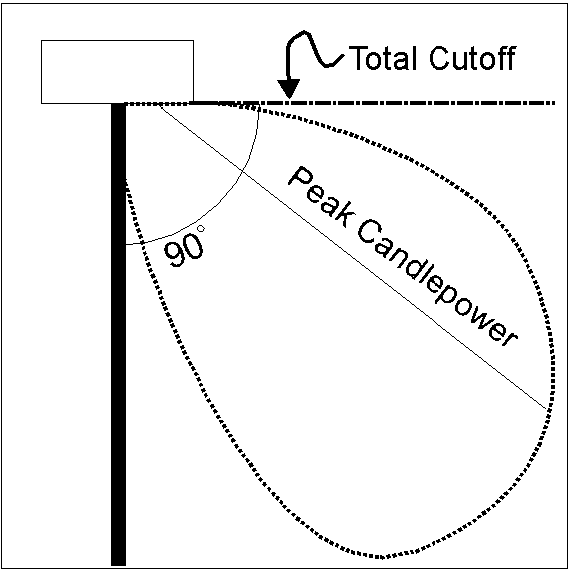
Cutoff type luminaire: A luminaire with elements such as shields, reflectors, or refractor panels which direct and cut off the light at a cutoff angle that is less than ninety (90) degrees.
10-22-04. - D.
Deck: Horizontal, unenclosed platform with or without attached railings, seats, trellises, or other features, attached or functionally related to a principal use or site and at any point extending above grade.
Density, gross: The number of dwelling units per gross acre of land.
Density, net: The number of dwelling units per buildable acres of land.
Discharge: The conveyance, channeling, runoff, or drainage, of storm water, including snowmelt, from a construction site.
Distribution lines: All those wires, poles, and appurtenant equipment used to carry electricity, generally rated below 115 kilovolts, located between a customer and a transmission line.
DNR Commissioner: The Commissioner of the Department of Natural Resources.
Draining: The removal of surface water or ground water from land.
Dredging: To enlarge or clean-out a water body, watercourse, or wetland.
Drive aisle: That portion of the off-street parking area used exclusively for the maneuvering and circulation of motor vehicles and in which parking is prohibited
10-22-05. - E.
Earth-sheltered building: A building so constructed that 50 percent or more of the completed structure is covered with earth. Earth covering is measured from the lowest level of the livable space in residential units and of usable space in nonresidential buildings. An earth sheltered building is a complete structure that does not serve just as a foundation or substructure for above grade construction. A partially covered building shall not be considered earth sheltered.
Easement: A grant by a property owner to and/or for use by the public, or other entity, for the purpose of constructing and maintaining streets, trails, sidewalks, drives, and/or utilities, including, but not limited to, wetlands, ponding areas, sanitary sewers, water mains, electric lines, telephone lines, storm sewer or storm drainageways, and gas lines.
Elevation: The height in feet above the mean sea level, referenced to the National Geodetic Vertical Datum (NGVD).
Emergency overflow (EOF): This refers to the outlet location of a pond, wetland or other drainage system that is utilized when the system floods. The overflow is designed to provide an emergency outlet for the system to avoid critical damage to adjacent property or structures.
Energy dissipation: This refers to methods employed at pipe outlets to prevent erosion. Examples include, but are not limited to: aprons, riprap, splash pads, and gabions that are designed to prevent erosion.
Engineer: An electrical, mechanical, civil, or other professional engineer licensed by the State of Minnesota.
Equal degree of encroachment: A method of determining the location of encroachment lines so that flood plain land on both sides of a stream are capable of conveying a proportionate share of flood flows. This is determined by considering the effect of encroachment on the hydraulic efficiency of the flood plain along both sides of a stream for a significant reach.
Erosion: Any process that wears away the surface of the land by the action of water, wind, ice, or gravity. Erosion can be accelerated by the activities of people and nature.
Erosion and sediment practice specifications or practice: The management procedures, techniques and methods to control soil erosion and sedimentation as officially adopted by either the City, County or local watershed group, whichever is more stringent.
Erosion control: Refers to methods employed to prevent erosion. Examples include soil stabilization practices, horizontal slope grading, temporary or permanent cover, and construction phasing.
Exposed soil areas: All areas of the construction site where the vegetation (trees, shrubs, brush, etc.) have been removed, including topsoil stockpile areas, borrow areas and disposal areas within the construction site.
Extraction: The removal of physical matter in a solid, liquid, or gaseous state from its naturally occurring location; the initial step in use of a natural resource; examples include petroleum and natural gas wells, shale and coal mines, gravel pits, timber cutting.
10-22-06. - F.
Fence: Any partition, structure, wall or gate erected as a dividing mark, barrier or enclosure.
Flashing light: A light source which is not constant in intensity or color at all times while in use.
Floor area, finished: The sum of the horizontal areas of all floors of a building or portion thereof devoted to a particular use, excluding areas such as unfinished basements, attics, or garage/storage space.
Floor area, gross: The sum of the gross horizontal areas of the several floors of the building or portion thereof devoted to a particular use, including accessory storage areas located within selling or working space such as counters, racks or closets, and any basement floor area devoted to retailing activities, to the production of processing of goods, or to business or professional offices. However, the floor area shall not include: basement or cellar floor area other than area devoted to retailing activities, the production or processing of goods, or to business or professional offices. The floor area of a residence shall not include the cellar area.
Foot candle: A unit of illumination produced on a surface, all points of which are one (1) foot from a uniform point source of one (1) candle.
Frontage: The boundary of a lot which abuts an existing or dedicated public street or private drive.
10-22-07. - G.
Grade (adjacent ground elevation): The lowest point of elevation of the finished surface of the ground, paving or sidewalk within the area between the building and the property line, or when the property line is more than five (5) feet from the building, between the building and a line five (5) feet from the building.
Grading: The act of excavation or filling or combination thereof or any leveling to a smooth horizontal or sloping surface on a property, but not including normal cultivation associated with an agricultural operation.
Gravel pit: A lot or land or part thereof used for the purpose of extracting stone, sand, gravel, or topsoil for sale and exclusive of the process of grading a lot preparatory to the construction of a building for which application for a building permit has been made.
Guyed tower: A wireless communications tower that is supported, in whole or in part, by guy wires and ground anchors or other means of support besides the superstructure of the tower itself
10-22-08. - H.
Height, structure: The vertical distance from the average elevation of the finished grade at the front of the building to the highest point of the roof for flat roofs; to the deck line of mansard roofs; and to the mean height between eaves and ridge for gable, hip and gambrel roofs.
Hydric soils: Soils that are saturated, flooded, or ponded long enough during the growing season to develop anaerobic conditions in the upper part.
Hydrophytic vegetation: Macrophytic plant life growing in water, soil or on a substrate that is at least periodically deficient in oxygen as a result of excessive water-content.
10-22-09. - I.
Impervious surface: Any man-made area that alters the natural surface course for, or does not allow for, the natural rate of absorption or retention of storm water including buildings, pavement, aggregate, gravel, and other such surfaces.
Impounded waters: Any and all liquid substances kept on public or private property in such a manner that more than five hundred (500) gallons are above the natural surface of the surrounding ground.
Individual sewage treatment system: A sewage treatment system or part thereof, serving a dwelling, building, structure or other establishment, or group thereof, and using sewage tanks or advanced treatment followed by soil treatment and disposal. An individual sewage treatment system includes holding tanks.
Infiltration: The flow of water from the land surface to the subsurface.
Infiltration basin: A depression in the surface of the land that holds water and uses infiltration as the primary outlet for the stormwater.
Interim use permit: A permit issued in accordance with procedures specified in this Ordinance, as a flexible device to enable the City Council to assign time limits and conditions to a proposed use after consideration of current or future adjacent uses and their functions.
Intermittent stream: A stream or portion of a stream that flows only in direct response to precipitation.
10-22-10. - L.
Land disturbance activity: Any land change that may result in soil erosion from water or wind and the movement of sediments into or upon waters or lands within this government's jurisdiction, including clearing and grubbing, grading, excavating, transporting, and filling of land.
Land reclamation: The process of the reestablishment of acceptable topography (i.e., slopes), vegetative cover, soil stability and the establishment of safe conditions appropriate to the subsequent use of the land.
Land surveyor: Such persons licensed by the State of Minnesota as a land surveyor.
Landscape architect: Any person who holds out as being able to perform or who does perform any professional service in connection with the development of land areas where the dominate purposed of the service is the preservation, enhancement or determination of proper land uses, natural land features, ground cover and planting, naturalistic and aesthetic values, the settings, approaches or environment for structures or other improvements, and the consideration and determination of inherent problems of the land relating to erosion, wear and tear, blight and hazards.
Light source: A single artificial point source of luminescence that emits measurable radiant energy in or near the visible spectrum.
Livestock: Generally accepted farm animals such as cows. horses, goats, pigs, sheep, llamas, and alpacas but excluding cats, dogs, and other house pets.
Loading facility: A formally delineated space, area, or berth on the same lot with a building, or contiguous to a group of buildings, for the temporary parking of a vehicle or truck while loading or unloading merchandise or materials.
Lot: Land occupied or to be occupied by a building and its accessory buildings, together with such open spaces as are required under the provisions of this Ordinance, having not less than the minimum area required by this Ordinance for a building site in the district in which such lot is situated and having its principal frontage on a public street.
Lot, base: Lots meeting all the specifications in the zoning district prior to being subdivided into a two- to four-dwelling unit subdivision.
Lot, corner: A lot situated at the junction of and abutting on two (2) or more intersecting streets; or a lot at the point of deflection in alignment of a single street, the interior angle of which is one hundred thirty-five (135) degrees or less.
Lot, interior: A lot, other than a corner lot, including through or double frontage lots.
Lot, substandard: A lot or parcel of land which does not meet the minimum lot area, structure setbacks or other dimensional standards of this Ordinance.
Lot, through: A lot fronting on two (2) parallel streets. Also defined as a "double frontage lot."
Lot, triangular: A lot in which the side lot lines converge into a single vertex. The vertex shall be deemed to be the rear lot line.
Lot, unit: Lots created from the subdivisions of a two- to four-unit having different minimum lot size requirements than the conventional base lots within the zoning district.
Lot area: The area of a horizontal plane within the property lines, often measured in square feet or acres.
Lot depth: The mean horizontal distance between the front lot line and the rear lot line measured from a ninety (90) degree angle from the street right-of-way within the lot boundaries.
Lot improvement: Any building, structure, place, work of art, or other object, or improvement of the land on which they are situated constituting a physical betterment of real property, or any part of such betterment.
Lot of record: A parcel of land, whether subdivided and/or otherwise legally described and recorded or approved by the City as a lot subsequent to such date and which is occupied by or intended for occupancy by one (1) principal building or principal use together with any accessory buildings and such open spaces as required by this Ordinance and having its principal frontage upon a street.
Lot width: The minimum required horizontal distance between the side lot lines measured at right angles to the lot depth, at the front setback line. For cul-de-sac lots, "lot width" shall mean the minimum required horizontal distance between the side lot lines, measured along a straight line at the midpoint of the front setback line.
Lower-potency hemp edible retail: A licensed establishment where lower-potency hemp edible products are sold to individual consumers.
Luminaire: A complete lighting unit consisting of a light source and all necessary mechanical, electrical and decorative parts.
(Ord. 304, SS, § 2, 2-21-2023; Ord. No. 343, SS, § 1, 1-21-2025)
10-22-11. - M.
Marsh: A type of wetland where the soil is usually waterlogged during the growing season. Vegetation includes cattails, bulrushes, spikerushes, grasses, and various other marsh plants.
Metes and bounds description: A description of real property which is not described by reference to a lot or block shown on a map, but is described by starting at a known point and describing the bearings and distances of the lines forming the boundaries of the property or delineating a fractional portion of a section, lot or area by described lines or portions thereof.
Micro unit: A mobile residential dwelling providing permanent housing within a sacred community.
Minerals/earthly deposits: Soil, clay, stone, sand and gravel and other similar solid material or substance to be excavated from natural deposits.
MN PUC: The Minnesota Public Utilities Commission.
Model home: A home which is similar to others in a development and which is open to public inspection for the purpose of selling said other homes; certain activities related to real estate businesses and offices may be allowed within the model home.
(Ord. 325, SS, § 1, 2-5-2024)
10-22-12. - N.
National Pollutant Discharge Elimination System (NPDES): The national program for issuing, modifying, revoking and reissuing, terminating, monitoring and enforcing permits, and imposing and enforcing pretreatment requirements, under Sections 307, 402, 318, and 405 of the federal Clean Water Act.
Natural drainage system: All land surface areas which by nature of their contour configuration, collect, store and channel surface water runoff.
Non-conforming use: Use of land, buildings, or structures legally existing at the present time or at the time of a subsequent amendment to this Ordinance which does not comply with the regulations as set forth.
Non-conforming use/building/structure, illegal: A structure or use that has been established in a manner that does not conform to the applicable conditions required by the regulations in place at the time the structure or use was established.
Non-conforming use/building/structure, legal: Any lawfully established structure or use which following the effective date of this Ordinance does not conform to the applicable conditions if the structure or use was to be erected under the guidance of this Ordinance.
10-22-13. - O.
Obstruction: Any dam, wall, wharf, embankment, levee, dike, pile, abutment, projection, excavation, channel modification, culvert, building, wire, fence, stockpile, refuse, fill, structure, or matter in, along, across, or projecting into any channel watercourse, or regulatory flood plain which may impede, retard, or change the direction of the flow of water, either in itself or by catching or collecting debris carried by such water.
Off-street parking: A site or a portion of a site, devoted to the off-street parking of vehicles, including parking spaces, aisles, access drives, and landscaped areas, and providing vehicular access to a public street.
Open space: Open areas including parks, nature areas, playgrounds, and trails.
Open space, common: Any open space including parks, nature areas, playgrounds, trails and recreational buildings and structures, which is an integral part of a development and is not owned on an individual basis by each owner of the dwelling unit.
Open space, usable: A required ground area or terrace area on a lot which is graded, developed, landscaped and/or equipped, and which is intended and maintained for either active or passive recreation or both, available and accessible to and usable by all persons occupying a dwelling on the lot or a development project and their guests. Such areas shall be grassed and landscaped or covered only for recreational purposes. Roofs, driveways, and parking areas shall not constitute usable open space. Required front and side yards shall be excluded from the usable open space area calculation.
Operator: Any person, including every public or governmental agency, engaged, in active or inactive excavation or the processing of sand, gravel, rock, other soils or derived products.
Ordinary high water mark (OHW): A mark delineating the highest water level which has been maintained for a sufficient period of time to leave evidence upon the landscape. The ordinary high water mark is commonly that point where the natural vegetation changes from predominantly aquatic to predominantly terrestrial. In areas where the ordinary high water mark is not evident, setbacks shall be measured from the stream bank of the following water bodies that have permanent flow or open water: the main channel, adjoining side channels, backwaters and sloughs.
Outdoor lighting: Any light source or collection of light sources, located outside a building, including, but not limited to, light sources attached to any part of a structure, located on the surface of the ground or located on freestanding poles.
Outdoor light fixture: Outdoor electrically powered illuminating devices, outdoor lighting or reflective surfaces, lamps and similar devices, permanently installed or portable, used for illumination or advertisement. The fixture includes the hardware that houses the illumination source and to which the illumination source is attached including, but not limited to, the hardware casing. Such devices shall include, but are not limited to, search, spot, and flood lights for:
A.
Buildings and structures.
B.
Recreational areas.
C.
Parking lot lighting.
D.
Landscaping lighting.
E.
Signs.
F.
Street lighting.
G.
Product display area lighting.
H.
Building overhangs and open canopies.
Outlot: A parcel of land shown on a subdivision plat as an outlot, and designated alphanumerically, (for example—Outlot A.) Outlots are used to designate one (1) of the following:
A.
Land which is smaller than the minimum size permitted for lots and which is thereby declared unbuildable until combined through platting with additional land;
B.
Land that is part of the subdivision but is to be subdivided into lots and blocks at a later date; or
C.
Land that is to be used for a specific purpose (i.e., parks, trails, stormwater holding, etc.) as designated in a developer's agreement or other agreement between the City and the developer.
Overburden: The earth, rock and other materials that lie above a natural deposit of mineral.
10-22-14. - P.
Parking facility: Any public or private land area designed and used for parking motor vehicles including parking lots, garages, private driveways, and legally designated areas of public streets.
Paved surface: A constructed hard, smooth surface made of asphalt, concrete or other pavement material. Examples include, but are not limited to, roads, sidewalks, driveways and parking lots.
Permanent cover: Meaning "final stabilization." Examples include grass, asphalt, and concrete. For the purposes of this ordinance, gravel shall also be considered a Permanent Cover.
Person: An individual, firm, partnership, association, corporation, or organization of any kind. "Person" also means an adult who is handicapped by reason of mental retardation, mental illness, chemical dependency, or physical handicap, and a child, whether handicapped or not, as defined by Minnesota Statutes, Sec. 245A.02, Subd. 4.
Planned unit development: A development procedure whereby a mixing of buildings and uses can occur which cannot be otherwise addressed under this Ordinance, and/or whereby internal site design standard deviations from this Ordinance may be allowed to improve site design and operation.
Planning and Zoning Commission: The City of St. Francis Planning and Zoning Commission.
Porous pavement: A pavement system with traditional strength characteristics, but which allows rainfall to percolate through it rather than running off.
Property line: A boundary line of any lot held in single or separate ownership except that where any portion of the lot extends into the abutting street or alley, the lot line shall be deemed to be the street or alley right-of-way.
Property line, front: The property line which is along an existing or dedicated street. In the case of a corner lot, the front lot line shall be the shortest dimension along a public street or as designated by the Zoning Administrator based on the practical front yard of the property as determined by such factors as the existing or proposed building configuration of the property and taking into consideration the characteristics of surrounding properties.
Property line, rear: The property line opposite and most distant from the front property line. If the rear property line is less than ten feet in length or if the lot forms a point at the rear, the rear property line shall be deemed to be a line ten feet in length within the lot, parallel to and at the maximum distance from the front property line.
Property line, side: Any boundary of a lot which is not a front or rear property line.
Property owner: Any legal entity, person, or otherwise who holds superior title to and can evidence superior title in real or personal property or any such person designated by the owner to represent or conduct business on behalf of the owner (developer, contractor, etc.) on matters with the City.
Publication: Notice placed in the official City newspaper stating time, location and date of meeting and description of the topic.
(Ord. No. 352, SS, § 1, 12-15-2025)
10-22-15. - R.
Reach: A hydraulic engineering term to describe a longitudinal segment of a stream or river influenced by a natural or man-made obstruction. In an urban area, the segment of a stream or river between two consecutive bridge crossings would most typically constitute a reach.
Reclamation, restoration, and rehabilitation: To renew land to a self-sustaining long term use which is compatible with contiguous land uses and compatible with the City's comprehensive land use plan. Reclamation, restoration or rehabilitation is to be in accordance with the standards set forth in this Ordinance, including the re-establishment of vegetative cover and soil stability and the establishment of safe conditions appropriate to the intended use of the land.
Restoration area: All land areas wherein Conditional Use Permits or excavation permits have been granted by the City in the past and for which permits are no longer requested or issued. Once a land area is classified as a restoration area, it cannot be reclassified or converted back to an active area unless a new Conditional Use Permit is obtained.
Restrictive covenant: A restriction on the use of land set forth in a formal binding agreement. Restrictive covenants run with the land and are binding upon subsequent owners of the property.
Roof: A structural covering over any portion of a building or structure including projections beyond the walls or supports of the building or structure.
Runoff coefficient: The average annual fraction of total precipitation that is not infiltrated or otherwise retained by the soil, concrete, asphalt or other surface upon which it falls that will appear at the conveyance as runoff.
10-22-16. - S.
Seasonally saturated soils: The highest seasonal elevation in the soil in a reduced chemical state because of soil voids filled with water causing anaerobic conditions. Seasonally saturated soil is evidenced by the presence of redoximorphic features or other information determined by scientifically established methods or empirical field measurements.
Security: A financial deposit that may be accepted by the City as a guarantee that improvements required as part of an application are satisfactorily completed.
Security lighting: Outdoor lighting fixtures installed exclusively as a measure to reduce the possible occurrence of a crime on the property.
Sediment: The product of an erosion process; solid material both mineral and organic, that is in suspension, is being transported, or has been moved by water, air, or ice, and has come to rest on the earth's surface either above or below water level.
Sediment control: The methods employed to prevent sediment from leaving a development site. Sediment control practices include silt fences, sediment traps, earth dikes, drainage swales, check dams, subsurface drains, pipe slope drains, storm drain inlet protection, and temporary or permanent sedimentation basins.
Sedimentation basin: Settling ponds formed by excavation and/or an embankment that intercept and retain sediment-laden runoff form a construction site for a sufficient period of time to allow the majority of sediment to settle out prior to being released from the site.
Selective cutting: The cutting out of trees that are mature or defective, or of inferior kinds to encourage the growth of the remaining trees in a forest or wooded area.
Setback: The required minimum horizontal distance between a structure and property line, ordinary high-water mark, top of bluff, street, or right-of-way easement. Distances are to be measured from the most outwardly extended portion of the structure at ground level, except as provided hereinafter.
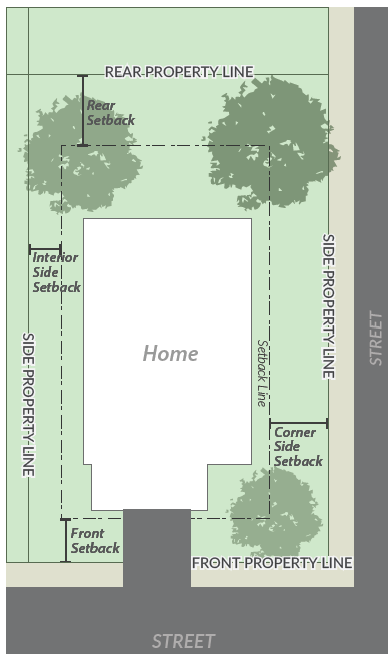
Setback, perimeter: The minimum horizontal distance between structure(s) and the most exterior property lines of a PUD or similarly planned development regardless of the existence of lot divisions within the development itself.
Sewage treatment system: Any system for the collection, treatment and dispersion of sewage including, but not limited to, septic tanks, soil absorption systems and drain fields.
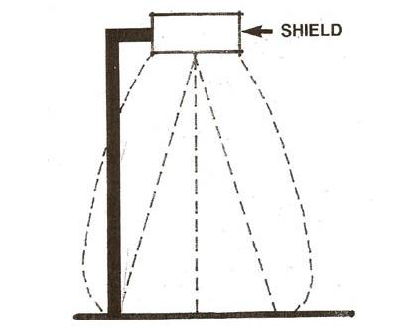
Shielding: A technique or method of construction permanently covering the top and sides of a light source by a material which restricts the light emitted to be projected below an imaginary horizontal plane passing through the light fixture (see Figure 2).
Shoreland: Land located within the following distances from public waters:
A.
1,000 feet from the ordinary high water level of a lake, pond, or flowage; and
B.
300 feet from a river or stream, or the landward extent of a floodplain designated by ordinance on a river or stream, whichever is greater.
Shrub: A small perennial bush, having several woody stems that grow from the base, which is not tree-like in appearance.
Sign: Any letter, word or symbol, device, poster, picture, statuary, reading matter, or representation in the nature of an advertisement, announcement, message or visual constructed, which is displayed to direct the attention of the public for informative or communicative purposes. Such communication located completely within an enclosed building and not exposed to view from a street shall not be considered a sign.
Sign, A-frame/sandwich board: A self-supporting temporary A-frame sign with two (2) faces made of wood or other similar durable materials.
Sign, banner: An attention-getting device which resembles a flag and is of a paper, cloth or plastic-like consistency.
Sign, blinking, flashing, or animated: An illuminated sign upon which the artificial light is not kept constant in terms of intensity or color when the sign is illuminated.
Sign, freestanding: A sign that is placed in the ground and not affixed to any part of any structure.
Sign, government: A sign constructed, placed, or maintained by the federal, state or local government or a sign that is required to be constructed, placed or maintained by the federal, state or local government directly or to enforce property owner's rights.
Sign, ground banner: A banner sign that is placed in the ground and not affixed to any part of any structure.
Sign, monument: A permanent, freestanding sign, wider than it is tall, with a height no higher than six (6) feet, which is often accompanied by landscaping.
Sign, non-conforming: Any sign which lawfully existed prior to the effective date of this Ordinance, but does not conform to the requirements of this Ordinance.
Sign, permanent: Any sign that is not a temporary sign.
Sign, portable: A sign designed to be movable from one location to another and which is not permanently attached to the ground, sales display device, or structure.
Sign, projecting: Any sign, all or any part of which extends over public property.
Sign, property identification numerals: A sign communicating only a street address.
Sign, roof: Sign erected, constructed or attached wholly or in part upon or over the roof of a building.
Sign, temporary: Signs which are erected or displayed for a limited period of time.
Sign, traffic control: All signs, signals, markings, and devices placed or erected by authority of a public body or official having jurisdiction, for the purpose of regulating, warning, or guiding traffic, including signs denoting names of streets and highways.
Sign, wall: A sign affixed to the exterior wall of a building and which is parallel to the building wall. A wall sign does not project more than 12 inches from the surface to which it is attached, nor extend beyond the top of the parapet wall.
Sign area: The space enclosed within the extreme edges of the sign for each sign face, not including the supporting structure or where attached directly to a building wall or surface, the space within the outline enclosing all the characters of the words, numbers or design.
Sign face: The entire display surface area of a sign upon, against or through which copy is placed.
Sign height: The highest portion of the actual sign, including the pole.
Sign structure: The supports, uprights, bracing and framework for a sign including the sign area.
Site plan: A plan, to scale, showing uses and structures proposed for a parcel or area of land as required by the regulations; includes lot lines, streets, building sites, reserved open space, buildings, major landscape features—both natural and manmade, the locations of proposed utility lines, and any other information that may be required in order that an informed decision can be made by the approving authority.
Slope: The degree of deviation of a surface from the horizontal, usually, expressed in percent or degrees.
Slope, steep: Lands having average slopes over 12 percent, as measured over horizontal distances of 50 feet or more, which are not bluffs.
Soil: The unconsolidated material and organic material on the immediate surface of the earth. For the purposes of this Ordinance, stockpiles of sand, gravel, aggregate, concrete or bituminous materials are not considered "soil" stockpiles.
Spa: An artificial container of water with a liquid capacity greater than 100 gallons and designed with a mechanical air injection system and/or recirculating device. These devices may filter and/or disinfect the water for reuse and are not intended to be drained between uses.
Specified anatomical areas:
A.
Less than completely or opaquely covered human genitals, pubic region, buttock(s), anus, or female breast(s) below a point immediately above the top of the areola; and
B.
Human male genitals in a discernible turgid state, even if completely and opaquely covered.
Specified sexual activities:
A.
Actual or simulated sexual intercourse, oral copulation, anal intercourse, oral-anal copulation, bestiality, direct physical stimulation of unclothed genitals, flagellation or torture in the context of a sexual relationship, or the use of excretory functions in the context of a sexual relationship, and any of the following sexually-oriented acts or conduct: anilingus, buggery, coprophagy, coprophilia, cunnilingus, fellatio, necrophilia, pederasty, pedophilia, piquerism, sapphism, zooerasty; or
B.
Clearly depicted human genitals in the state of sexual stimulation, arousal, or tumescence; or
C.
Use of human or animal ejaculation, sodomy, oral copulation, coitus, or masturbation; or
D.
Fondling or touching of nude human genitals, pubic region, buttock(s), or female breast(s); or
E.
Situations involving a person or persons, any of whom are nude, clad in undergarments or in sexually revealing costumes, and who are engaged in activities involving the flagellation, torture, fettering, binding, or other physical restraint of any such persons; or
F.
Erotic or lewd touching, fondling, or other sexually-oriented contact with an animal by a human being; or
G.
Human excretion, urination, menstruation, vaginal or anal irrigation.
Spillage: Any reflection, glare or other artificial light that emits onto any adjoining property or right-of-way and is above a defined maximum illumination.
Stabilized: The exposed ground surface after it has been covered by sod, erosion control blanket, riprap, or other material that prevents erosion from occurring. Sowing grass seed is not considered stabilization.
Stacking space: A designated area for motor vehicles to queue while waiting for service, such as at a drive through restaurant or carwash
Stockpile: On-site storage of any soil, sand, gravel, clay, mud, debris, vegetation, refuse or any other material, organic or inorganic, in a concentrated state.
Storm sewer: The system of conveyances, including curb and gutter, ditches, channels, retention basins, catch basins or similar stormwater inlets, and/or any other conveyance delivering stormwater to the public storm sewer collection and delivery system.
Stormwater: The flow of water which results from precipitation and which occurs immediately following rainfall or a snowmelt.
Stormwater management facility: Any stormwater management technique, apparatus, or facility that controls or manages the path, storage, or rate of release of stormwater runoff. Such facilities may include storm sewers, retention or detention basins, drainage channels, drainage swales, inlet or outlet structures, or other similar facilities.
Story: The portion of a building included between the surface of any floor and the surface of the floor next above it, or if there is no floor above it, then the space between the floor and the ceiling next above it and including those basements used for the principal use.
Street: A public right-of-way which affords primary means of access to abutting property, and shall also include an avenue, highway, road, or way, or however otherwise designated.
Street, access road: Streets which are adjacent and parallel to highways or arterial streets and provide access to abutting properties.
Street, arterial: A street which is the major interconnection within a community transportation system providing major access routes within the community and its environs.
Street, collector: A street which serves or is designed to serve as a traffic way for a neighborhood or as a feeder to an arterial street.
Street, local: A street intended to serve primarily as an access to abutting properties.
Street, private: A private access way that connects abutting properties within a PUD to a public street; differs from a private driveway in that it is on a separate parcel from the structures it serves, and that is owned and maintained by a home owners association or similar entity
Street width: The width of the improved surface of the street as measured at right angles or radially to the centerline of the street from curb face to curb face, or on a street without curbs from the outside edge of the improved shoulder to outside edge of improved shoulder.
Structural alteration: Any change, other than incidental repairs, which would prolong or modify the life of the supporting members of a building, such as bearing walls, columns, beams, girders or foundations.
Structure: Anything which is built, constructed or erected; an edifice or building of any kind; or any piece of work artificially built up and/or composed of parts joined together in some definite manner whether temporary or permanent in character.
Suspended solids: Solids that are in suspension in water and that are removable by laboratory filtering, expressed as mg/l.
Stormwater Pollution Prevention Plan (SWPPP): A joint stormwater and erosion and sediment control plan that is a document containing the requirements of Part 10-82-00. When implemented the plan will reduce soil erosion on a parcel of land and prevent off-site non-point pollution and sediment damages.
(Ord. 304, SS, § 3, 2-21-2023; Ord. No. 352, SS, § 2, 12-15-2025)
10-22-17. - T.
Temporary protection: Short term methods employed to prevent erosion. Examples of such protection include: straw, mulch, erosion control blankets, wood chips, and erosion netting.
Temporary structure: A structure not permanently erected on a site with a foundation that is used for emergency purposes or used on a construction site for offices and equipment storage during construction of a permanent structure.
Topsoil: Generally, the top layer of soil, characterized by having a high organic matter content and by being optimal for the growth of plants. Topsoil shall be free of sticks and roots exceeding 1 inch in diameter, rocks exceeding 3 inches in diameter, and foreign materials. The topsoil shall have a clay content of 5 percent to 35 percent, silt content of 10 percent to 60 percent, sand content of 10 percent to 70 percent, organic matter of 3 percent to 15 percent, and pH of 6.1 percent to 7.8 percent.
Trailer, semi-tractor: A trailer with a set or sets of wheels at the rear only, which may be supported in front by a truck, tractor or towing vehicle, and which is used for the purpose of, but not limited to, storage, transportation of freight, or holding freight for sale or lease.
Transmission line: Those high capacity conductors generally rated 115 kilovolts and above and associated structures which are used to carry electricity from points of generation to distribution points such as substations and distribution lines.
Tree: A woody stemmed perennial plant with lateral branching from the main stem(s) occurring a minimum of 6" off the ground and a minimum height of 10' at maturity.
Tree, deciduous: A tree which naturally sheds its leaves/foliage annually.
Tree, evergreen: Any plant that retains its leaves through the year and into the following growing season.
Tree, ornamental: A tree that does not exceed more than 25' in height or crown diameter at maturity and has an ornamental characteristics to include showy flowers, fruit, foliage, or bark.
Tree, significant: A healthy tree which measures a minimum of eight (8) inches in diameter four and one-half (4.5) feet above the ground for hardwood deciduous trees, measures a minimum of 12 inches in diameter four and one-half (4.5) feet above the ground for softwood deciduous trees, or measures greater than eight (8) feet in height for coniferous trees. Invasive trees are not considered significant. Some examples of significant deciduous trees include but are not limited to:
Hardwood: elm, birch, oak, maple (hard); and
Softwood: poplars/aspen, silver maple, willow.
(Ord. 293, SS, 1-18-2022)
10-22-18. - U.
Utilities: All lines and facilities related to the provision, distribution, collection, transmission, or disposal of water, storm and sanitary sewage, oil, gas, power, information, telecommunication and telephone cable, and includes facilities for the generation of electricity.
10-22-19. - V.
Variance: The procedure whereby the strict application of the provision of this Ordinance relating to height, area, yard requirements, and the like may be modified in a particular instance, consistent with the State enabling statute for municipalities. Variance does not apply to a use modification within a district and shall not allow uses that are prohibited.
Vegetated or grassed swales: A vegetated earthen channel that conveys stormwater, while treating the storm water by biofiltration. Pollutants are removed by both filtration and infiltration.
Vegetation: The sum total of plant life in an area; or a plant community with distinguishable characteristics.
Vertex: The corner point of a triangle, rectangle, or other geometric figure bounded by lines.
10-22-20. - W.
Wall area/surface area: The measurement of a flat surface, typically calculated by multiplying width and length/height.
Waste: Any garbage, refuse, rubbish, or other discarded materials, that may be in solid, liquid, or gaseous form.
Waste, hazardous: Any refuse, sludge, or other waste material or combination of refuse, sludge, or other waste materials in solid, semisolid, liquid, or contained gaseous form which because of its quantity, concentration, or chemical, physical, or infectious characteristics may:
A.
Cause or significantly contribute to an increase in mortality or an increase in serious or irreversible, or incapacitating reversible illness; or
B.
Pose a substantial present or potential hazard to human health or the environment when not properly treated, stored, or transported, or disposed of, or otherwise managed.
Categories of hazardous waste materials include, but are not limited to: explosives, flammable, oxidizers, poisons, irritants, and corrosives. Hazardous waste does not include sewage sludge and source, special nuclear, or byproduct material as defined by the Atomic Energy Act of 1954, as amended.
Water body: A body of water (lake, pond) or a depression of land or expanded part of a river, or an enclosed basin that holds water and is surrounded by land.
Water quality volume (WQV): Defined by the Minnesota Pollution Control Agency as one-half (½) inch of rainfall from the new impervious surfaces created by land disturbance activities.
Watercourse: A channel or depression through which water flows year-round or intermittently, such as rivers, streams, or creeks.
Wet detention facility: A permanent man-made structure for the temporary storage of runoff which contains a permanent pool of water. This basin provides temporary storage of surface runoff and is designed to release the stored runoff at a gradual rate.
Wetland: Lands transitional between terrestrial and aquatic systems where the water table is usually at or near the surface or the land is covered by shallow water. For purposes of this Ordinance, wetlands must have the following three (3) attributes:
A.
Have a predominance of hydric soils.
B.
Are inundated or saturated by surface or ground water at a frequency and duration sufficient to support a prevalence of hydrophytic vegetation typically adapted for life in saturated soil conditions.
C.
Under normal circumstances, support a prevalence of such vegetation.
10-22-21. - Y.
Yard: An open space at grade between a building and the adjoining lot lines, unoccupied and unobstructed by any portion of a structure from the ground upward, except as otherwise provided herein. In measuring a yard for the purpose of determining the width of a side yard, the depth of a front yard, or the depth of the rear yard, the minimum horizontal distance between the lot line and the main building shall be used.
Yard, front: The area extending along the full width of the lot lying between the front property line and the nearest line of the principal building.
Yard, rear: A yard extending across the full width of the lot lying between the rear property line of the lot and the nearest line of the principal building.
Yard, required: That distance specified in the yard requirements pertaining to setbacks. Setbacks and required yards are used interchangeably.
Yard, side: A yard between the side property line and the nearest line of the principal building and extending from the front yard to the rear yard.
(Ord. No. 352, SS, § 3, 12-15-2025)
10-22-22. - Z.
Zoning Administrator: The person designated by the City Council of St. Francis to enforce and administer the zoning ordinance.
Zoning district: An area or areas of the City (as delineated on the zoning map) set aside for specific uses with specific regulations and provisions for use and development as defined by this Ordinance.
Zoning district, base: All zoning districts except overlay zoning districts.
Zoning district, overlay: A zoning district containing regulations superimposed upon other zoning district regulations and superseding the underlying zoning district use regulations.
Zoning map: The map or maps incorporated into this Ordinance that delineate the boundaries of all mapped zoning districts within the physical boundary of the city
10-23-01. - A.
Accessory agricultural building: An accessory structure meeting the definition in Minn. Statutes 326B.103, Subd. 3.
Accessory dwelling unit (ADU): A self-contained dwelling unit with a separate entrance, kitchen, sleeping area, and full bathroom facilities, which is located within or attached to an existing residential dwelling or detached garage.
Adult body painting studio: An establishment or business which provides the service of applying of paint or other substance whether transparent or non-transparent to or on the body of a patron when such body is wholly or partially nude in terms of "specified anatomical areas."
Adult bookstore: A business engaging in the barter, rental, or sale of items consisting of printed matter, pictures, slides, records, audiotapes, if such shop is not open to the public generally but only one or more classes of the public, excluding any minor by reason of age, or if a substantial or significant portion of such items are distinguished or characterized by an emphasis on the depiction or description of "specified sexual activities," or "specified anatomical areas."
Adult cabaret: An establishment which provides dancing or other live entertainment, if such establishment excludes minors by reason of age or if such dancing or other live entertainment is distinguished or characterized by an emphasis on the performance, depiction, or description of "specified sexual activities" or "specified anatomical areas."
Adult companionship establishment: An establishment which excludes minors be reason of age, or which provides the service of engaging or listening to conversation, talk or discussion between an employee of the establishment and a customer, if such service is distinguished or characterized by an emphasis on "specified sexual activities" or "specified anatomical areas."
Adult entertainment use: Adult Bookstores, adult motion picture theatres, adult mini-motion picture theatres, adult massage parlors, adult saunas, adult companionship establishments, adult health clubs, adult cabarets, adult novelty businesses, adult motion picture arcades, adult modeling studios, adult hotels or motels, adult body painting studios, and other adult establishments.
Adult establishment: Any business that is characterized by, or places a significant emphasis on, providing its patrons with merchandise, services or entertainment that is characterized by an emphasis on the depiction, exposing, describing, discussing of "specified sexual activities" or "specified anatomical areas." For purposes of this definition, Adult Establishments include, without limitation, adult bookstores, adult motion picture theaters, adult massage parlors, adult saunas, adult companionship establishments, adult health clubs, adult cabarets, adult novelty businesses, adult motion picture arcades, adult modeling studios, adult hotel or motel, and adult body painting studios.
Adult hotel or motel: A hotel or motel from which minors are specifically excluded from patronage and wherein material is presented which is distinguished or characterized by an emphasis on matter depicting, describing or relating to "specified sexual activities" or "specified anatomical areas."
Adult massage parlor, health club: An establishment which restricts minors by reason of age and which provides the services of a massage, if such service is distinguished or characterized by an emphasis on "specified sexual activities" or "specified anatomical areas."
Adult mini-motion picture theatre: A business premises within an enclosed building with a capacity for less than 50 persons used for presenting visual media material if such business as a prevailing practice excludes minors be reason of age or if said material is distinguished or characterized by an emphasis on the depiction or description of "specified sexual activities" or "specified anatomical areas" for observation by patrons therein.
Adult modeling studio: An establishment whose major business is the provision, to customers, of figure models who are so provided with the intent of providing sexual stimulation or sexual gratification to such customers and who engage in "specified sexual activities" or display "specified anatomical areas" while being observed painted, painted upon, sketched, drawn, sculptured, photographed, or otherwise depicted by such customers.
Adult motion picture arcade: Any place to which the public is permitted or invited wherein coin or slug-operated or electronically, electrical, or mechanically controlled or operated still or motion picture machines, projectors, or other image-producing devices are maintained to show images to five or fewer persons per machine at any one time and where the images so displayed are distinguished by an emphasis on depicting or describing "specified sexual activities" or "specified anatomical areas."
Adult motion picture theatres: A business premises within an enclosed building with a capacity of 50 or more persons used for presenting visual medial material if said business as a prevailing practice excludes minors by reason of age or if said material is distinguished or characterized by emphasis on the depiction or description of "specified sexual activities" or "specified anatomical areas" for observation by patrons therein.
Adult novelty business: A business which has a principal activity relating to the sale of devices which simulate human genitals or devices which are designated for sexual stimulation.
Adult sauna: A sauna which excludes minors by reason of age or which provides a steam bath or heat bathing room used for the purpose of bathing, relaxation, or reducing, utilizing steam or hot air as a cleaning, relaxing or reducing agent, if the service provided by the sauna is distinguished or characterized by an emphasis on "specified sexual activities" or "specified anatomical areas."
Adult Uses, Accessory: a use, business, or establishment having 10% or less of its stock in trade or floor area located to, or 20% or less of its gross receipts derived from movie rentals, magazine sales, or sales of other merchandise, in which there is an emphasis on "specified sexual activities" or "specified anatomical areas."
Agriculture, accessory: A tract of land primarily used for residential purposes on which crops and often livestock are raised but not as a principal source of income. This use may include accessory buildings for agricultural use.
Agriculture, general: Land used actively in the production of food, fiber, or livestock including field crop farming, pasture for hay, fruit growing, roadside stand for sale of in season products grown on the premises, and livestock raising and feeding as a principal source of income. General agriculture may include accessory agricultural buildings but does not include commercial animal feedlots, retail nurseries, commercial stables, and animal boarding facilities.
Ambulance service: The provision of transporting a patient via ambulance to or between hospitals. This public or private service includes both emergency ambulance service and routine ambulance service.
Animal boarding, shelter, or day care center: Any structure or premises on which more than four (4) dogs or cats over six (6) months of age are temporarily or permanently boarded, including animal day care/spa facilities.
Animal feedlot: A lot or building or combination of lots and buildings intended for the confined feeding, breeding, raising, or holding of animals and specifically designed as a confinement area in which manure may accumulate, or where the concentration of animals is such that a vegetative cover cannot be maintained within the enclosure. Open lots used for feeding and rearing of poultry (poultry ranges), and barns, dairy farms, swine facilities, beef lots and barns, horse stalls, mink ranches and zoos, shall be considered to be animal feedlots. Pastures shall not be considered animal feedlots. Feedlots with fewer than 50 animal units as defined by the MPCA are considered an accessory agricultural use. Feedlots with greater than 50 animal units are considered to be commercial feedlots.
Animal/veterinary clinic or hospital: A clinic operated by a licensed veterinarian exclusively for the diagnosis, treatment, correction, relief, or prevention of animal disease, deformity, defect, injury, or other physical or mental conditions; the performance of obstetrical procedures for animals, including determination of pregnancy and correction of sterility or infertility; and the rendering of advice or recommendations with regard to any of the above. The facility may also provide boarding for animals as part of medical services.
Antenna, accessory: Those antennas including radio and television receiving antennas, satellite dishes, TVROs (television receive only) two meters (2 m) or less in diameter, short-wave radio dispatching antennas, or those necessary for the operation of electronic equipment such as radio receivers, ham radio transmitters and television receivers that are customary and incidental to allowed principal uses within the various zoning districts of the City.
Antenna support structure: Any building or other structure other than a tower which can be used for location of antennas.
Antenna, temporary mobile: Any mobile tower, pole, or structure located on a trailer, vehicle, or temporary platform intended primarily for the purpose of mounting an antenna or similar apparatus for personal wireless services, also commonly referred to as cellular on wheels (COW).
Antenna tower: A self-supporting lattice, guyed or monopole structure constructed from grade which supports personal wireless service antennas. The term antenna tower shall not include amateur radio operators' equipment, as licensed by the FCC.
Apartment unit: One or more rooms equipped with private bath and kitchen facilities and designed for, intended for, or occupied as a residence by a single household.
Assisted living facility: A residential facility licensed by the state which provides services on a regular basis, such as personal services, 24-hour supervision, social activities, and health-related care and services, to individuals who require the assistance, but who do not require the degree of care and treatment that a hospital or skilled nursing facility provides.
Automobile repair and service, major: General repair, rebuilding or reconditioning of engines, motor vehicles or trailers; collision services including body, frame, or fender straightening or repair; overall painting or paint shop; vehicle steam cleaning.
Automobile repair and service, minor: Incidental body or fender work, or other minor repairs, painting and upholstering, replacement of parts and motor service to passenger cars and trucks not exceeding 12,000 pounds gross weight, but not including any operation named under "Automobile Repair, Major," or any other similar thereto.
Automobile fueling station: A place where gasoline is stored only in underground tanks, kerosene or motor oil and lubricants or grease, for operation of automobiles, are retailed directly to the public on premises, and including minor accessories and services for automobiles, but not including automobile major repairs and rebuilding.
Automobile sales, leasing, and rental: The use of any building or land area, other than a street, used for the display, sale or rental of new or used motor vehicles in operable condition and where no repair work is done.
(Ord. 293, SS, 1-18-2022; Ord. 304, SS, § 4, 2-21-2023)
10-23-02. - B.
Bar: An establishment or part of an establishment used primarily for the sale or dispensing of liquor for consumption on the premises.
Bed and breakfast: An owner-occupied business with no more than six guest rooms where short-term accommodations are provided to guests for compensation. The service of food shall be limited to breakfasts served to overnight guests only.
Brewery: A facility that produces beer, ale or other beverages made from malt by fermentation and containing not less than one-half of one percent alcohol by volume.
Brewpub: A restaurant with an accessory small brewery as licensed in Section 5-8 in the City Code.
Building or other architecturally-integrated solar energy system: An active solar energy system that is an integral part of a principal or accessory building, rather than a separate mechanical device, replacing or substituting for an architectural or structural component of the building. Building-integrated systems include, but are not limited to, photovoltaic or thermal solar systems that are contained within roofing materials, windows, skylights and awnings.
10-23-03. - C.
Campground: An area accessible by vehicle and campsites or camping spurs for tents and trailer camping.
Cannabis cultivation: A cannabis business licensed to grow cannabis plants within the approved amount of space from seed or immature plant to mature plant, harvest cannabis flower from mature plant, package and label immature plants and seedlings and cannabis flower for sale to other cannabis businesses, transport cannabis flower to a cannabis manufacturer located on the same premises, and perform other actions approved by the office.
Cannabis delivery: A cannabis business licensed to purchase cannabis, cannabis products, and hemp products from retailers or cannabis business with retail endorsements for transport and delivery to customers.
Cannabis and hemp manufacturing: A business which involves the compounding, processing, packaging, or treatment of cannabis and/or hemp products.
Cannabis retail: A retail location and the retail location(s) of a mezzobusiness with a retail operations endorsement, microbusiness with a retail operations endorsement, medical combination business operating a retail location, excluding lower-potency hemp edible retailers.
Cannabis transportation: A cannabis business licensed to transport immature cannabis plants and seedlings, cannabis, cannabis products, and hemp products to licensed cannabis businesses.
Cannabis wholesale: A cannabis business licensed to purchase and/or sell immature cannabis plants and seedlings, cannabis, cannabis products, and hemp products from other licensed cannabis businesses.
Car wash: A building or portion thereof containing facilities for the washing of passenger vehicles, recreational vehicles, or other light duty equipment.
Cemetery: A parcel or tract of land used or intended to be used for the burial of the human dead including columbariums, crematories, mausoleums and mortuaries when operated within the boundaries of such cemetery.
Child care center: A state-licensed facility other than a private residence that provides for the care of children during only part of a 24-hour day. This term includes nursery schools, preschools, day care facilities, and other similar uses but excludes public and private schools or any facility offering care of individuals for a full 24-hour period.
Clinic: A facility used primarily for the provision of outpatient medical, dental, chiropractic, therapeutic, optometric or mental health care and treatment.
Club or lodge: A nonprofit association of persons who are bona fide members paying regular dues, with the use of premises being restricted to members and their guests for receptions, social recreation, and other gatherings.
Commercial center: Commercial sites that consist of primarily retail establishments with two (2) or more separate businesses managed as a total entity and sharing common access, circulation, and pedestrian and parking areas so that a public right-of-way does not need to be used to get from one business to another.
Commercial recreation use, indoor: Indoor facilities operated as a business and which are open to the public for a fee that shall include, but are not limited to, billiard parlors, skating rinks, indoor swimming pools, bowling alleys, movie theaters, arcades, health clubs, dance studios, and other similar businesses. Such businesses may also provide a snack bar, restaurant, retails sales of related items, and other support facilities.
Commercial recreation use, outdoor: Land or outdoor facilities operated as a business and which are open to the general public for a fee that shall include, but is not limited to, golf courses, outdoor swimming pools, amusement parks, and other similar businesses. Such facility may also provide a snack bar, restaurant, retail sales of related items, and other support facilities.
Commercial use: The principal use of land or buildings for the sale, lease, rental or trade of products, goods, and services in exchange for compensation. Commercial uses include all uses under the "Commercial use" heading as shown in Tables 10-42-1 and 10-44-1, Principal Use Table—Agriculture Districts and Principal Use Table—Business and Industrial Districts.
Community solar energy system (CSES, also called a "solar garden"): A solar-electric (photovoltaic array that provides retail electric power (or a financial proxy for retail power) to multiple community members or businesses residing or located off-site from the location of a solar energy system.
Construction contractor yard: A lot or portion of a lot or parcel used to store and maintain construction equipment and other materials customarily required in the building trades by a construction contractor.
Continuing care senior facility: A residential facility or complex which provides a variety of senior living choices, from independent living to long-term care, with a goal of helping residents to age in place.
(Ord. No. 343, SS, § 1, 1-21-2025)
10-23-04. - D.
Day care, family: A dwelling unit where a resident of the dwelling is providing care under Minnesota Rules, Ch. 9502 for less than 24 hours at a time for no more than 10 children, of which no more than six (6) children are under school age.
Day care, group family: A dwelling unit where a resident of the dwelling is providing care under Minnesota Rules, Ch. 9502 for less than 24 hours at a time for up to 14 children, of which no more than 10 may be school age.
Distillery: A facility that produces ethyl alcohol, hydrated oxide of ethyl, sprits of wine, whiskey, rum, brandy, gin, or other distilled spirits, including all dilutions and mixtures thereof for non-industrial use.
Domestic animal enclosure: Any accessory building or portion thereof, accessory structure or area of any kind, including, without limitation, pens, runs, kennels and pet houses, that is principally used or designed for use as a place for keeping house pets. An electronic pet containment system is not considered a house pet enclosure.
Drive-thru establishment: An establishment at which patrons may purchase products or receive service without having to leave their motor vehicle (and enter a building).
Dwelling: A building or portion thereof, designated exclusively for residential occupancy, not including hotels, bed and breakfast, mobile homes or trailers.
Dwelling, apartment: A building consisting of five or more apartment units designed exclusively for independent living, but sharing hallways and main entrances and exits.
Dwelling, apartment mixed use: A building designed for one (1) or more dwelling units as well as non-residential uses that are permitted in the zoning district to be located on the ground story, with all dwelling units sharing a joint entrance from the outside.
Dwelling, attached townhouse or rowhouse: A single residential unit which is located within a larger residential structure containing between three and eight units and which is separated from the adjoining dwelling unit(s) by a common wall. Each dwelling unit may be located on its own individual lot or on a common lot containing all of the attached units, and each dwelling unit shall have separate and individual front and rear entrances.
Dwelling, farmstead: A detached single-unit residential structure located on a parcel of land for which the primary land use is associated with agriculture.
Dwelling, live/work: A dwelling unit used jointly for both residential and commercial uses.
Dwelling, single-unit detached: A residential structure on a single lot which is not attached to any other dwelling unit, excluding accessory dwellings.
Dwelling, manufactured home: A structure, transportable in one or more sections, which, in the traveling mode, is eight body feet or more in width or 40 body feet or more in length, or, when erected, on site, is 320 or more square feet, and which is built on a permanent chassis and designed to be used as a dwelling with or without a permanent foundation when connected to the required utilities, and includes the plumbing, heating, air conditioning, and electrical systems therein, and which complies with the manufactured home building code (Minnesota Statutes, Sec. 327.31, Subd. 6).
Dwelling, twinhome: A single-unit residential structure on a single lot which is attached by a common wall or walls to an adjoining dwelling unit.
Dwelling, two- to four-unit: A residential structure on a single lot which contains two (2), three (3), or four (4) independent dwelling units.
Dwelling unit: A single unit providing complete, independent living facilities for one (1) or more persons, including permanent provisions for living, sleeping, eating, cooking, and sanitation.
(Ord. 293, SS, 1-18-2022)
10-23-05. - E.
Essential services: The erection, construction, alteration, or maintenance by private or public utilities, or Municipal departments of underground telephone, gas, electrical, communication, waste, or water transmission, distribution, collection, supply or disposal systems, including water towers, wells, poles, wires, radio receivers and transmitters, mains, drains, sewers, pipes, conduits, cables, fire alarm boxes, police call boxes, traffic signals, hydrants and other similar equipment, accessories and related structures in connection therewith for the furnishing of adequate service by such private or public utilities or municipal departments. Essential services shall not include waste facilities or personal wireless service antennas or support structures.
10-23-06. - F.
Farm: A tract of land of more than 10 acres in size usually with a house and barn plus other buildings on which crops and often livestock are raised.
Financial institution: An establishment where the principal business is the receipt, disbursement, or exchange of funds and currencies, such as banks or credit unions.
Forestry: The use and management, including logging, of a forest, woodland or plantation and related research and educational activities including the construction, alteration or maintenance of wood roads, skidways, landings, and fences.
Funeral home or mortuary: An establishment providing services such as preparing the deceased for burial or cremation and arranging and managing funerals. The facility may include a chapel for the conduct of funeral services and spaces for funeral services and informal gatherings.
10-23-07. - G.
Greenhouse: An enclosed building, permanent or portable, which is used for the growing of small plants.
Gallery: An establishment in which works of art are bought, sold, loaned, appraised, or exhibited to the general public.
Ground-mounted solar energy system: Systems which are accessory to and are designed to supply energy for a principal use.
Ground-mounted solar panels: Freestanding solar panels mounted to the ground by use of racks or poles or similar apparatus.
Gun club: Any building or premises which caters to or allows the use of firearms.
10-23-08. - H.
Home extended business: A home occupation that allows for limited business activity in a detached accessory structure.
Home occupation: Any occupation or profession engaged in by the occupant of a residential dwelling unit, which is clearly incidental and secondary to the residential use of the premises and does not change the character of said premises.
Horse stable, commercial: Uses where horses and ponies owned or used by someone other than the property owner are boarded in exchange for compensation.
Hotel: Any building containing six (6) or more guest rooms in which temporary lodging is offered to guests for compensation, and in which access to and from each room or unit is through interior lobbies, courts, or halls. Additional services such as restaurants, meeting rooms, entertainment, and recreational facilities may also be provided.
(Ord. 304, SS, § 5, 2-21-2023)
10-23-09. - I.
Industrial use: The use of land or buildings for the production, manufacture, warehousing, storage or transfer of goods, products, commodities, or other wholesale items.
10-23-10. - K.
Kennel: Any place, building, tract of land, abode or vehicle, wherein or whereon two or more dogs, over six months of age are kept, kept for sale, or boarded.
10-23-11. - L.
Large energy power generating plan (LEPGP): Any Solar Energy System capable of producing 50 megawatts or more of power.
Long-term care facility: A facility that provides meals, lodging, and nursing care to two or more individuals due to illness, age, or infirmity. Long-term care facilities include skilled nursing facilities such as nursing homes, rest homes, boarding care homes, convalescent care, and other transitional care facilities.
Lower potency hemp edible wholesale: A business licensed to purchase and sell lower-potency hemp edible products to and from other licensed cannabis and hemp businesses. These businesses may also import and export lower-potency hemp edibles.
(Ord. No. 352, SS, § 4, 12-15-2025)
10-23-12. - M.
Makerspace or studio: An establishment where hand-tools, mechanical tools and electronic tools are shared or individually used for the manufacture of artisan finished products or parts including design, processing, fabrication, assembly, treatment, and packaging of products; as well as the incidental storage, sales and distribution of such products. Typical artisan manufacturing uses include, but are not limited to: electronic goods; food and bakery products; non-alcoholic beverages; printmaking; household appliances; leather products; jewelry and clothing/apparel; metal work; furniture; glass or ceramic production; paper manufacturing.
Manufactured home park: A parcel of land under single control or ownership which has been developed for the placement of two (2) or more manufactured homes for residential use.
Manufacturing, heavy: An establishment or use of land that manufactures, assembles, or fabricates using processes that generally create odor, noise, vibration, illumination or particulates that may impact surrounding properties. This category shall also include any use of land that needs large unscreened outdoor structures or storage that cannot be incorporated into the building. Examples include, but are not limited to the following: large-scale food and bottling operations; lumber, milling and planning facilities; grain milling; aggregate, concrete, and asphalt plants; foundries, forge shops, and other intensive metal fabrication; and chemical manufacturing.
Manufacturing, light: An establishment or use of land for the assembly or processing of previously processed components or manufactured parts using processes that do not create significant amounts of noise, vibration, illumination, or particulates that may impact surrounding properties. Odors produced on-site shall not negatively affect other businesses or properties in the area. Examples include, but are not limited to the following: food; pharmaceuticals; clothes; furniture (where wood is milled off-site); hardware; toys; light sheet metal products; mechanical components; printing; small vehicle assembly; and computer software.
Microdistillery: A distillery defined by Minnesota Statute Sec. 340A.101 producing premium, distilled spirits in total quantity not to exceed 40,000 proof gallons in a calendar year.
Mining: All or any part of the process involved in the extraction of minerals by removing the overburden and extracting directly from the soil, clay, stone, sand, and gravel and other similar sold material or substance deposits thereby exposed.
Mobile food unit: A food and beverage service establishment that is a vehicle mounted unit, either:
A.
Motorized or trailered, operating no more than 21 days annually at any one place, or operating more than 21 days annually at any one place with the approval of the regulatory authority; or
B.
Operated in conjunction with a permanent business licensed under Minnesota Statutes, Ch. 157 or Ch. 28A at the site of the permanent business by the same individual or company, and readily movable, without disassembling, for transport to another location.
Municipal social, cultural, or recreational facility: Indoor or outdoor Municipal, County, State, or Federal owned social, cultural, or recreation facilities not accessory to a public park or school/university campus.
Municipal, county, state, or federal administrative or services building: A structure or structures in which municipal, county, state, or federal administrative offices are located or services are provided.
10-23-13. - N.
Nature preservation/conservation area: Any area or parcel of undeveloped land which remains in its natural state for perpetuity through deeds or other legal means.
Nursery, commercial: A business involving retail sales of trees, flowering and decorative plants, and shrubs for purposes of transplanting which may be conducted within a building or without.
Nursery, wholesale: An enterprise which conducts exclusively wholesale sale of plants grown on the site to retailers and jobbers. The only accessory items allowed are pots, potting soil, fertilizers, insecticides, hanging baskets, rakes, shovels, and other hand held tools, but not including power tools or equipment such as gas or electric lawn mowers and farm implements.
10-23-14. - O.
Office: An establishment used primarily for conducting the predominantly administrative or clerical service affairs of a business, profession, service, industry or government, or like activity. This use may include ancillary services for office workers, such as a restaurant, coffee shop, newspaper or candy stand and child care facilities.
Open and outdoor storage: The storage of personal or business property for a period greater than 24 hours outside of an enclosed building.
Open or outdoor service, sale, or rental: Any land used or occupied for the sale, rental, or display of retail merchandise or services outside of a permanent structure.
Open space: Any parcel or area of land or water essentially unimproved and set aside, dedicated, designated or reserved for public or private use or enjoyment.
Outdoor dining: A specified outdoor area for dining which is accessory to a principal restaurant or food service establishment use.
10-23-15. - P.
Park: Area of public land developed and maintained for both active and passive recreational pursuits, including tot-lots, playgrounds, neighborhood parks, play fields and special purpose areas.
Parking facility: A land surface or facility providing off-street vehicular parking spaces with drives and maneuvering lanes so as to provide access for entrance and exit. Parking facilities may include public garages, parking ramps, surface parking lots, and other similar uses.
Personal vehicle/equipment sales: Individual sales of personal vehicles or other, similar private property by the owner to a private party.
Personal wireless service: Any personal wireless services as defined in the Federal Communications Act of 1996, including services such as cellular, personal communication services (PCS), enhanced specialized mobilized radio (ESMR), paging, and similar services that currently exist or may be developed and including the support structure thereof.
Photovoltaic systems: An active solar energy system that converts solar energy directly into electricity.
Place of worship: Building(s) or structure(s) which by design, construction, and/or adaptation are primarily intended for the conducting of organized religious services and associated accessory uses.
Public utility microwave: A parabolic dish or cornucopia shaped electromagnetically reflective or conductive element used for the transmission and/or reception of point to point UHF or VHF radio waves in wireless telephone communications, and including the support structure thereof.
10-23-16. - R.
Radio and television, broadcast transmitting: A wire, set of wires, metal or carbon fiber rod or other electromagnetic element used to transmit public or commercial broadcast radio, or television programming, and including the support structure thereof.
Radio and television receiving: A wire, set of wires, metal or carbon fiber element(s), other than satellite dish antennas, used to receive radio, television, or electromagnetic waves, and including the support structure thereof.
Recreational camping vehicle, utility trailer, boat and unlicensed vehicle (operable) mean any of the following:
A.
Boat: A water craft of less than 22 feet in length that is intended for personal use by the resident.
B.
Travel trailer: A vehicular, portable structure built on a chassis, designed to be used as a temporary dwelling for travel, recreational, and vacation uses, permanently identified "Travel Trailer" by the manufacturer of the trailer.
C.
Pickup coach: A structure designed to be mounted on a truck chassis for use as a temporary dwelling for travel, creation and vacation.
D.
Motor home: A portable, temporary building to be used for travel, recreation and vacation, constructed as an integral part of a self-propelled vehicle.
E.
Camping trailer: A folding structure mounted on wheels and designed for travel, recreation and vacation uses.
F.
Utility trailer: A trailer used for the transporting of items typically associated with a residential use. Utility Trailers shall not include trailers used to transport equipment used for commercial use.
G.
Unlicensed vehicle (operable): Any passenger vehicle which does not have a current registration, but is capable of legally being operated on a public street. A vehicle having a flat tire or tires, missing wheel or wheels, lack of an engine or critical component parts thereof preventing immediate ignition of the engine, broken or cracked windshield, broken or non-functioning headlights, or other characteristics of a vehicle not capable of being immediately legally driven on a public road shall be presumed to be inoperable.
Recreation facility: A place designed and equipped for the conduct of sports and leisure-time activities.
Research, experimental, or testing laboratories: A facility used for scientific laboratory research, experimentation, or testing.
Residential care facility: An in-home residential facility licensed by the state which provides primarily nonmedical care to individuals who are in need of personal assistance to manage the activities of daily life or for the protection of the individual.
Restaurant: An establishment that serves food in individual servings for consumption on or off premises, including sit down restaurants, take out, pick up, or delivery food sales, but not including drive through facilities.
Roof- or building-mounted solar energy systems: A solar energy system that is mounted to the roof or building using brackets, stands or other apparatus.
Rural event venue: A structure or designated area used for celebration, weddings, ceremonies, receptions, corporate functions or similar activities for the benefit for someone other than the property owner that takes place on an occasional basis. This does not include uses accessory to single-family uses, such as private parties, gatherings and similar activities.
10-23-17. - S.
Sacred community: A residential settlement established on or contiguous to the grounds of a religious institution's primary worship location primarily for the purpose of providing permanent housing for chronically homeless persons, extremely low-income persons, and designated volunteers.
Satellite dish: A device incorporating a reflective surface that is solid, open mesh, or bar configured and is in the shape of a shallow dish, cone, horn, or cornucopia. Such device is used to transmit and/or receive radio or electromagnetic waves between terrestrially and/or orbitally based uses. This definition shall include, but not be limited to, what are commonly referred to as satellite earth stations, TVROs (television, receive only) and satellite microwave antennas and the support structure thereof.
School: A building used for the purpose of public or private elementary or secondary education, which meets all the requirements of compulsory education laws of the State of Minnesota, and not providing residential accommodations.
Scrap or salvage yard: Any area, lot, land, parcel, building or structure, or part thereof, used for the storage, collection, processing, purchase, sale, salvage or disposal of scrap, waste, reclaimable material or debris.
Self-storage facility: A facility designed and used for the purpose of renting or leasing individual storage spaces of varying sizes to occupants who are to have access to such facility for the purpose of storing and removing personal property. A self-service storage facility is not a warehouse.
Service business, off-site: A company that provides useful labor, maintenance, repair, and activities incidental to business production or distribution where the service is provided at the customer's location, including, but not limited to, delivery services, catering services, and plumbing and sewer services.
Short-term vacation rental: A dwelling, or portion thereof, that is used for accommodations or lodging of guests paying a fee or other compensation for a period of less than 30 consecutive days.
Short-wave radio transmitting and receiving: A wire, set of wires or a device, consisting of a metal, carbon fiber, or other electromagnetically conductive element used for the transmission and reception of radio waves used for short-wave radio communications, and including the support structure thereof.
Social assistance, welfare, or charitable service: An establishment engaged in the giving of foods, goods, financial assistance, or grants, or offering services or other socially useful programs on a nonprofit basis.
Solar collector: A device, structure or a part of a device or structure that the principal purpose is to transform solar radiant energy into thermal, mechanical, chemical or electrical energy.
Solar energy: Radiant energy received from the sun that can be collected in the form of heat or light by a solar collector.
Solar energy system (SES): An active solar energy system that collects or stores soar energy and transforms solar energy into another form of energy or transfers heat from a collector to another medium using mechanical, electrical, thermal or chemical means.
Solar farm: A commercial facility that converts sunlight into electricity, whether by photovoltaics (PV), concentrating solar thermal devices (CST) or other conversion technology, for the principal purpose of wholesale sales of generated electricity.
Solar hot water system: A system that includes a solar collector and a heat exchanger that heats or preheats water for building heating systems or other hot water needs.
Solar permit supplement: In addition to a Building permit, required for permit submission.
Specialty food or coffee shop: An establishment whose primary business is the sale of a single specialty type of food or beverage that is not considered a complete meal (e.g. candy, coffee, ice cream) for consumption on or off premises. The sale of other food, beverages, or merchandise is incidental to the sale of the specialty food or beverage.
Standalone store, retail or service: A detached structure where goods or services are sold.
Swimming pool: Any enclosure, above or below grade, having a water surface area exceeding one hundred square feet and a water depth greater than 18 inches at any point.
(Ord. 325, SS, § 2, 2-5-2024)
10-23-18. - T.
Taproom: An area accessory to a brewery, winery, or distillery for the consumption of alcoholic beverages produced on the premises.
Telecommunication tower: Any structure that is designed and constructed primarily for the purpose of supporting one or more antennas, (e.g., monopoles and similar structures).
Telecommunication tower accessory structure: Any structure located at the base of a tower for housing receiving or transmitting equipment.
Temporary/seasonal outdoor sales: Any non-residential sale or event secondary to the principal permitted use which is temporary in nature and which is held outside the principal structure. Sales include, but are not limited to, one-time sidewalk sales, Christmas tree sales, seasonal supply sales, special event sales, and produce sales.
Theater, dance, or music performance facility: A facility used for the production, preparation, and performance of dramatic, dance, musical, or other live performances.
Tree farm: Any parcel of land used to raise or harvest trees for wood products such as lumber, posts and poles, fuel wood, and Christmas trees where forest products are sold.
Truck terminal: A building or area in which freight brought by truck is assembled and/or temporarily stored for re-routing or re-shipment. The terminal facility may also include storage and/or parking areas for truck tractor and/or trailer units.
Truck stop: Any building, premises or land in which or upon which a business, service or industry involving the maintenance, cleaning, servicing, storage or repair of commercial vehicles is conducted including the dispensing of motor fuel, the sale of accessories or equipment for trucks and similar commercial vehicles. A truck stop may also include overnight accommodations, restaurant facilities, a car wash and truck wash or other ancillary uses.
10-23-19. - U.
Use: The purpose or activity for which the land or building thereon is designated, arranged, or intended or for which it is occupied, utilized or maintained, and shall include the performance of such activity as defined by the performance standards of this Ordinance.
Use, accessory: A use subordinate to and servicing the principal use or structure on the same lot and customarily incidental thereof.
Use, conditional: A use which, because of special problems of control the use presents, requires reasonable, but special, unusual and extraordinary limitations peculiar to the use for the protection of the public welfare and the integrity of the City Comprehensive Plan.
Use, interim: A temporary use of property until a particular date, until the occurrence of a particular event, or until zoning regulations no longer allow it.
Use, permitted: A land use which is specifically allowed in a zoning district.
Use, permitted with standards: A land use which is permitted by-right in a zoning district if certain standards are met.
Use, principal: The specific, primary purpose for which land is used.
Use, temporary: A use established for a fixed period of time, with the intent to discontinue such use upon the expiration of such time, that does not involve the construction or alteration of any permanent structure.
10-23-20. - V.
Vehicle sales, leasing, and rental: The use of any building or portion thereof, or other premises or portion thereof for the display, sale, rental, or lease of new or used vehicles including motor, recreational, off-road, marine, or other similar vehicles. Commercial truck sales are not included in this definition.
10-23-21. - W.
Warehouse: An establishment engaged in the storage and distribution of manufactured products, supplies, and equipment.
Wholesale establishment: An establishment primarily engaged in selling merchandise to retailers; to industrial, commercial, institutional or professional business users; to other wholesalers; or acting as agents or brokers and buying merchandise for, or selling merchandise to, individuals or companies.
Wildlife area: An area maintained in a natural state for the preservation of both animal and plant life.
Wind energy conversion system: Any device that is designed to convert wind power to another form of energy such as electricity or heat (also referred to by such common names as wind charger, wind turbine and windmill).
Winery: A processing facility used for the fermenting and processing of fruit juice into wine; or the refermenting of still wine into sparkling wine.
10-23-22. - Y.
Youth facility: A playground, park, public swimming pool, public library, or licensed day care facility.
10-24-01. - A.
Accessory use or structure: A use or structure on the same lot with, and of a nature customarily incidental and subordinate to, the principal use or structure.
10-24-02. - B.
Base flood elevation: The elevation of the "regional flood." The term "base flood elevation" is used in the flood insurance survey.
Basement: Any area of a structure, including crawl spaces, having its floor or base subgrade (below ground level) on all four sides, regardless of the depth of excavation below ground level.
10-24-03. - C.
Conditional use: A specific type of structure or land use listed in the official control that may be allowed but only after an in-depth review procedure and with appropriate conditions or restrictions as provided in the official zoning controls or building codes and upon a finding that:
A.
Certain conditions as detailed in the zoning ordinance exist.
B.
The structure and/or land use conform to the comprehensive land use plan if one exists and are compatible with the existing neighborhood.
Critical facilities: Facilities necessary to a community's public health and safety, those that store or produce highly volatile, toxic or water-reactive materials, and those that house occupants that may be insufficiently mobile to avoid loss of life or injury. Examples of critical facilities include hospitals, correctional facilities, schools, day care facilities, nursing homes, fire and police stations, wastewater treatment facilities, public electric utilities, water plants, fuel storage facilities, and waste handling and storage facilities.
10-24-04. - D.
Development: Any manmade change to improved or unimproved real estate, including buildings or other structures, mining, dredging, filling, grading, paving, excavation or drilling operations, or storage of equipment or materials.
10-24-05. - E.
Equal degree of encroachment: A method of determining the location of floodway boundaries so that floodplain lands on both sides of a stream are capable of conveying a proportionate share of flood flows.
10-24-06. - F.
Farm fence: A fence as defined by Minnesota Statutes, Sec. 344.02, Subd. 1(a)-(d). An open type fence of posts and wire is not considered to be a structure under this ordinance. Fences that have the potential to obstruct flood flows, such as chain link fences and rigid walls, are regulated as structures under this ordinance.
Flood: A temporary increase in the flow or stage of a stream or in the stage of a wetland or lake that results in the inundation of normally dry areas.
Flood frequency: The frequency for which it is expected that a specific flood stage or discharge may be equaled or exceeded.
Flood fringe: That portion of the floodplain outside of the floodway. Flood fringe is synonymous with the term "floodway fringe" used in the Flood Insurance Study for Anoka County, Minnesota.
Flood prone area: Any land susceptible to being inundated by water from any source (see "Flood").
Floodplain: The beds proper and the areas adjoining a wetland, lake or watercourse which have been or hereafter may be covered by the regional flood.
Flood proofing: A combination of structural provisions, changes, or adjustments to properties and structures subject to flooding, primarily for the reduction or elimination of flood damages.
Floodway: The bed of a wetland or lake and the channel of a watercourse and those portions of the adjoining floodplain which are reasonably required to carry or store the regional flood discharge.
10-24-07. - L.
Lowest floor: The lowest floor of the lowest enclosed area (including basement). An unfinished or flood resistant enclosure, used solely for parking of vehicles, building access, or storage in an area other than a basement area, is not considered a building's lowest floor.
10-24-08. - M.
Manufactured home: A structure, transportable in one or more sections, which is built on a permanent chassis and is designed for use with or without a permanent foundation when attached to the required utilities. The term "manufactured home" does not include the term "recreational vehicle."
10-24-09. - O.
Obstruction: Any dam, wall, wharf, embankment, levee, dike, pile, abutment, projection, excavation, channel modification, culvert, building, wire, fence, stockpile, refuse, fill, structure, or matter in, along, across, or projecting into any channel, watercourse, or regulatory floodplain which may impede, retard, or change the direction of the flow of water, either in itself or by catching or collecting debris carried by such water.
One hundred year floodplain: Lands inundated by the "Regional Flood" (see definition).
10-24-10. - P.
Principal use or structure: All uses or structures that are not accessory uses or structures.
10-24-11. - R.
Reach: A hydraulic engineering term to describe a longitudinal segment of a stream or river influenced by a natural or man-made obstruction. In an urban area, the segment of a stream or river between two consecutive bridge crossings would most typically constitute a reach.
Recreational vehicle: A vehicle that is built on a single chassis, is 400 square feet or less when measured at the largest horizontal projection, is designed to be self-propelled or permanently towable by a light duty truck, and is designed primarily not for use as a permanent dwelling but as temporary living quarters for recreational, camping, travel, or seasonal use. For the purposes of this ordinance, the term recreational vehicle is synonymous with the term "travel trailer/travel vehicle."
Regional flood: A flood which is representative of large floods known to have occurred generally in Minnesota and reasonably characteristic of what can be expected to occur on an average frequency in the magnitude of the 1% chance or 100-year recurrence interval. Regional flood is synonymous with the term "base flood" used in a flood insurance study.
Regulatory flood protection elevation (RFPE): An elevation not less than one foot above the elevation of the regional flood plus any increases in flood elevation caused by encroachments on the floodplain that result from designation of a floodway.
Repetitive loss: Flood related damages sustained by a structure on two separate occasions during a ten year period for which the cost of repairs at the time of each such flood event on the average equals or exceeds 25 percent of the market value of the structure before the damage occurred.
10-24-12. - S.
Special flood hazard area: A term used for flood insurance purposes synonymous with "One Hundred Year Floodplain."
Structure: Anything constructed or erected on the ground or attached to the ground or on-site utilities, including, but not limited to, buildings, factories, sheds, detached garages, cabins, manufactured homes, and other similar items.
Substantial damage: Damage of any origin sustained by a structure where the cost of restoring the structure to its before-damaged condition would equal or exceed 50 percent of the market value of the structure before the damage occurred.
Substantial improvement: Within any consecutive 365-day period, any reconstruction, rehabilitation (including normal maintenance and repair), repair after damage, addition, or other improvement of a structure, the cost of which equals or exceeds 50 percent of the market value of the structure before the "start of construction" of the improvement. This term includes structures that have incurred "substantial damage," regardless of the actual repair work performed. The term does not, however, include either:
A.
Any project for improvement of a structure to correct existing violations of state or local health, sanitary, or safety code specifications which have been identified by the local code enforcement official and which are the minimum necessary to assure safe living conditions.
B.
Any alteration of a "historic structure," provided that the alteration will not preclude the structure's continued designation as a "historic structure." For the purpose of this ordinance, "historic structure" is as defined in 44 Code of Federal Regulations, Part 59.1.

