
Saint Francis City Zoning Code
DIVISION 7
DEVELOPMENT STANDARDS
10-71-01. - Purpose.
The purpose of this Division is to establish general development performance standards. These standards are intended and designed to assure compatibility of uses; to prevent urban blight, deterioration and decay; and to enhance the health, safety and general welfare of the residents of the community.
10-71-02. - General provisions.
A.
Smoke. The emission of smoke by any use shall be in compliance with and regulated by the State of Minnesota Pollution Control Standards, Minnesota Regulations APC 7017, as may be amended.
B.
Dust and other particulate matter. The emission of dust, fly ash or other particulate matter by any use shall be in compliance with and regulated by the State of Minnesota Pollution Control Standards, Minnesota Regulations APC 7011, as may be amended.
C.
Air pollution. The emission of air pollution, including potentially hazardous emissions, by any use shall be in compliance with and regulated by Minnesota Statutes 116, as may be amended.
D.
Noise. Noises emanating from any use shall be in compliance with and regulated by the State of Minnesota Pollution Control Standards, Minnesota Regulations NCP 7010, as may be amended. In no case shall noise emanations constitute a nuisance as defined and regulated by this Code.
E.
Bulk storage (liquid). All uses associated with the bulk storage of all gasoline, liquid fertilizer, chemical, flammable and similar liquids shall comply with County, State, and Federal agency requirements, and have documents from those respective agencies stating the use is in compliance.
10-71-03. - Waste, refuse, junk, and recyclable material.
A.
Waste Disposal. All waste generated shall be disposed in a manner consistent with all Minnesota Pollution Control Agency rules.
B.
Waste Not Stored in Containers. Any accumulation of waste generated on any premises not stored in containers which comply with applicable requirements of this Ordinance and Minnesota Pollution Control Agency rules, or any accumulation of mixed Municipal solid waste generated on any premises which has remained thereon for more than one (1) week, or any accumulation of infectious, nuclear, pathological, or hazardous waste which is not stored and disposed in a manner consistent with Minnesota Pollution Control Agency rules is a nuisance and shall be abated and the cost of abatement may be assessed against the property where the nuisance is found.
C.
Off-Site Waste. The accumulation, storage, processing, and disposal of waste on any premises, which is not generated on that premises, is prohibited, except as specifically provided in this Ordinance.
D.
Abandoned, Unlicensed, or Inoperable Vehicles.
1.
Passenger automobiles and trucks not currently licensed by the State, or which are because of mechanical deficiency incapable of movement under their own power, parked or stored outside for a period in excess of 30 days shall be stored inside of a building or removed.
2.
All other materials stored outside in violation of City Code provisions are considered refuse or junk and shall be regulated in the manner provided for by the Chapter 8 of the City Code, Public Protection.
E.
Location and Screening:
1.
All fencing or screening shall comply with the provisions of Part 10-73-00.
2.
Single Unit Dwellings, Duplexes, and all Other Residential Structures With Four (4) or Less Residential Units: Garbage cans and recycling bins shall be kept in rear or side yards and shall be screened from neighboring properties and the public right-of-way or shall be kept indoors.
3.
Other Uses: All refuse, recyclable materials, and necessary handling equipment including, but not limited to, garbage cans, recycling bins, and dumpsters shall be stored within the principal structure, within an accessory building, or totally screened from eye-level view from all neighboring uses and the public right-of-way. Trash and/or recycling enclosures shall comply with the following:
a.
Exterior wall or fence treatment shall be similar and/or complement the principal building.
b.
The enclosed trash and/or recycling receptacle area shall be located in the rear or side yard and shall observe all applicable setback requirements and easements.
c.
The trash and/or recycling enclosure shall be in an accessible location for pick up hauling vehicles.
d.
The trash and/or recycling receptacles shall be fully screened from view of adjacent properties and the public right-of-way by a fence or wall of at least six (6) feet in height and a minimum opaqueness of eighty (80) percent.
e.
All dumpsters, recycling bins, handling equipment, and enclosures shall be kept in a good state of repair with tight-fitting lids to prevent spilling and spread of debris. The construction of trash and recycling enclosures shall be per standards established by the City Building Official and all design and construction of such enclosures shall be subject to the Building Official's approval.
(Ord. 325, SS, § 14, 2-5-2024; Ord. No. 342, SS, § 6, 1-6-2025)
10-71-04. - Exterior lighting.
A.
Purpose. It is the purpose of this Section to encourage the use of lighting systems that will reduce light pollution and promote energy conservation while increasing night-time safety, utility, security and productivity.
B.
Exemptions. The provisions of this Section shall not apply to the following:
1.
Lighting required by federal, state, county, or city ordinances and regulations.
2.
Lighting within the public right-of-way or easement for the principal purpose of illuminating roadways.
3.
Emergency lighting by police, fire, and rescue authorities.
4.
Lighting required by a government agency for the safe operation of airplanes, or security lighting required on government buildings or structures.
5.
Lighting specified or identified in a specific use permit.
6.
Architectural/historical light fixtures and street lights that feature globes that are not shielded. In no case shall the light affect adjacent property in excess of the maximum intensity defined in Item C.1, below.
7.
Temporary outdoor lighting used for civic events, performance areas, outdoor events, and construction sites.
8.
Seasonal lighting and related holiday decorations.
9.
Underwater lighting in swimming pools and other water features.
10.
Solar landscape lights.
11.
All outdoor lighting fixtures existing and legally installed prior to the effective date of this Ordinance are exempt from regulations of this Section but shall comply with the following standards:
a.
Glare. Any lighting used to illuminate an off-street parking area, sign or other structure, shall be arranged as to deflect light away from any adjoining residential zone or from the public streets. Direct or sky-reflected glare, where from flood lights or from high temperature processes such as combustion or welding shall not be directed into any adjoining property. The source of lights shall be hooded or controlled in some manner so as not to light adjacent property. Bare incandescent light bulbs shall not be permitted in view of adjacent property or public right-of-way. Any light or combination of lights which cast light on a public street shall not exceed one (1) foot candle (meter reading) as measured from the center line of said street. Any light or combination of lights which cast light on residential property shall not exceed four-tenths (0.4) foot candles (meter reading) as measured from said property.
b.
Replacement. Whenever a light fixture that was existing on the effective date of this Ordinance is replaced by a new outdoor light fixture, the provisions of this Section shall be complied with.
C.
Performance Standards.
1.
Intensity. No light source or combination thereof which cast light on a public street shall exceed one (1) foot candle meter reading as measured from the center line of said street nor shall any light source or combination thereof which cast light on adjacent property exceed four-tenths (0.4) foot candles as measured at the property line. The foot candle level of a light source shall be taken after dark with the light meter held six (6) inches above the ground with the meter facing the light source. A reading shall be taken with the light source on, then with the light source off. The difference between the two (2) readings will be identified as the light intensity.
2.
Residential Use Standards. In all residential districts, any lighting used to illuminate an off-street parking area, structure, or area shall be arranged as to deflect light away from any adjoining residential property or from any public right-of-way in accordance with the following provisions:
a.
The light fixture shall contain a cutoff which directs the light at an angle of 90 degrees or less.
b.
The light source shall be hooded or controlled so as not to light adjacent property in excess of the maximum intensity defined in Item C.1, above.
c.
Bare light bulbs shall not be permitted in view of adjacent property or public right-of-way, unless part of a permanent fixture.
3.
Commercial, Industrial, and Institutional Use Standards. Any lighting used to illuminate an off-street parking area, structure, or area shall be arranged so as to deflect light away from any adjoining property or from any public right-of-way in accordance with the following provisions:
a.
The light fixture shall contain a cutoff which directs the light at an angle of 90 degrees or less. Exposure of the light source shall not be permitted in view of adjacent property or public right-of-way.
b.
Lighting of entire facades or architectural features of a building shall be approved by the City Council. Building facades or architectural features may not be internally illuminated and shall only utilize illuminating devices mounted on top and facing downward onto the structure. In no case shall the light affect adjacent property in excess of the maximum intensity defined in Item C.1, above.
c.
Light sources shall not be permitted so as to light adjacent property in excess of the maximum intensity defined in Item C.1, above.
4.
Height. The maximum height above the ground grade permitted for poles, fixtures, and light sources mounted on a pole is 25 feet. A light source mounted on a building shall not exceed the height of the building. Exceptions to the height limits for light sources may be approved by conditional use permit provided that all other requirements of this Section are satisfied.
5.
Location.
a.
All non-public outdoor light fixtures shall be set back a minimum of 10 feet from a street right-of-way and five (5) feet from an interior side or rear lot line.
b.
No light sources shall be located on the roof unless said light enhances the architectural features of the building and is approved by the City Council.
6.
Hours.
a.
The use of outdoor lighting for parking lots serving commercial, industrial, and institutional uses shall be turned off one (1) hour after closing, except for approved security lighting.
b.
All illuminated signs shall be turned off between 11:00 PM, or one (1) hour after close whichever is later, and sunrise.
7.
Glare. Direct or reflected glare from high temperature processes such as combustion or welding shall not be visible from any adjoining property.
8.
Outdoor Recreation. Outdoor recreational uses such as, but not limited to, baseball fields, football fields, and tennis courts have special requirements for night-time lighting. Due to these unique circumstances, a conditional use permit shall be required for outdoor lighting systems for such uses that do not comply with regulations of this Section, provided that:
a.
No public or private outdoor recreation facility shall be illuminated after 11:00 PM, except for required security lighting.
b.
Off-street parking areas for outdoor recreation uses that are illuminated shall meet the requirements for commercial, industrial, and institutional applications as found in Item C.4, above.
c.
The provisions of Part 10-33-00 of this Ordinance are considered and satisfactorily met.
10-71-05. - Model homes.
A.
Purpose. The purpose of this Section is to provide for the erection of model homes, which may include temporary real estate offices, in new subdivisions without adversely affecting the character of surrounding residential neighborhoods or creating a general nuisance. As model homes represent a unique temporary commercial use, special consideration shall be given to the peculiar problems associated with them and special standards shall be applied to ensure reasonable compatibility with their environment.
B.
Qualification. To qualify for a building permit for a model home, which may include a temporary real estate office, the following shall be required:
1.
Upon receipt of final plat approval and recording, three (3) building permits for model homes in a subdivision may be granted. No final certificate of occupancy shall be issued until the infrastructure improvements including the first lift of asphalt have been completed and approved by the City.
2.
Upon completion of infrastructure improvements including the first lift of asphalt within the respective final plat subdivision, additional building permits may be issued for model homes and/or temporary real estate offices, provided that the number of model homes and/or temporary real estate offices shall not exceed ten (10) percent of the number of lots within the final plat.
C.
Procedure. The erection of a model home(s) within all residential districts, which may include a temporary real estate office(s), shall require an administrative permit, as may be issued by the Zoning Administrator.
D.
Special Requirements:
1.
Model homes and model homes with temporary real estate offices shall be allowed in all residential zoning districts in which they are located and shall be utilized solely for selling purposes of lots and/or homes within the subdivision in which they are located.
2.
Temporary parking facilities equal to four (4) paved spaces per model home dwelling unit or a model home with a temporary real estate office shall be provided. The overall design, drainage, and surfacing of the temporary parking facility shall be subject to the approval of the Zoning Administrator or City Engineer.
3.
Access from a temporary parking facility shall be directed away from developed and occupied residential neighborhoods to the greatest extent possible.
4.
No model home or model home with a temporary real estate office shall incorporate outside lighting which creates a nuisance due to glare or intensity, as provided for in Section 10-71-04 of this Ordinance.
5.
All signage shall comply with the sign regulations as contained in Part 10-91-00 of this Ordinance for the zoning district in which the model home and/or temporary real estate office is located.
6.
The administrative permit shall terminate three (3) years from its date of issuance or when 85 percent of the parcels have certificate of occupancies within the development, whichever comes first, unless extended by the City Council.
7.
No residential certificate of occupancy shall be issued for a model home or model home with a temporary real estate office until such time as the structure has been fully converted to a residence in compliance with the Uniform Building Code. Additionally, such conversion shall include, but not be limited to, parking lot restoration and the removal of signage and lighting.
8.
The restoration of all temporary parking areas with appropriate landscaping shall be completed by the end of the following growing season.
E.
Restricted Use. Model homes and model homes with temporary real estate offices shall be used solely for the display and sale of home fixtures and products, and real estate for the subdivision in which they are located unless approved by the Zoning Administrator through an administrative permit.
10-71-06. - Traffic sight visibility triangle.
A.
Except for a governmental agency for the purpose of screening, no wall, fence, structure, tree, shrub, vegetation or other obstruction shall be placed on or extend into a yard or right-of-way area so as to pose a danger to traffic by obscuring the view of approaching vehicular traffic or pedestrians from any street or driveway.
B.
Visibility from any street or driveway shall be unobstructed above a height of three (3) feet, measured from where both street or driveway center lines intersect within the triangle described as beginning at the intersection of the projected curb line of two (2) intersecting streets or drives, thence forty-five (45) along one curb line, thence diagonally to a point forty-five (45) feet from the point of beginning along the other curb line.
C.
The exception to this requirement shall be where there is a tree, planting or landscape arrangement within such area that will not create a total obstruction wider than three (3) feet.
D.
These requirements shall not apply to conditions of this Ordinance that legally exist prior to the effective date of this Ordinance, unless the City Council determines that such conditions constitute a safety hazard.
10-71-07. - Outdoor storage.
A.
District Requirements. Except as herein provided or as specifically allowed within the specific zoning districts established by this Ordinance, all materials and equipment shall be stored within a building.
B.
Exceptions.
1.
Clothes line pole and wires.
2.
Play equipment.
3.
Recreational vehicles and equipment may be parked or stored outdoors as regulated by Section 10-68-19 of this Ordinance.
4.
Construction and landscaping material currently being used on the premises.
5.
Off-street parking of operable motor vehicles as specified in the respective zoning districts.
(Ord. 291, SS, 1-18-2022)
10-71-08. - Building type and construction.
A.
General Provisions.
1.
Steel or Aluminum Buildings: Except in association with farming activities, no galvanized or unfinished steel or unfinished aluminum buildings (walls or roofs), except those specifically intended to have a corrosive designed finish shall be permitted in any zoning district.
2.
Architectural and Aesthetic Compatibility: Buildings in all zoning districts shall maintain a high standard of architectural and aesthetic compatibility with surrounding properties to ensure that they will not adversely impact the community's public health, safety and general welfare.
3.
Exterior Building Finishes:
a.
Residential Districts. The primary exterior building facade finishes for residential districts shall consist of the materials listed in Table 10-71-1, below, or other, similar materials as determined by the Zoning Administrator.
b.
Table 10-71-1 Residential District Exterior Façade Finishes.
c.
Building Foundations. Building foundations not exceeding two (2) feet and other such portions of a building's facade need not comply with the requirements for the primary facade treatment or materials.
B.
Finishes for Structures in Commercial/Industrial Districts.
1.
B-1 Central Business District.
a.
100 percent of the exterior building finish shall consist of materials comparable in grade and quality to the following: Face brick, natural stone, glass, stucco, specially designed pre-cast concrete units if the surfaces have been integrally treated with an applied decorative material, textured concrete block, or smooth concrete block if scored at least twice, wood, or horizontal lap siding (wood, masonite, steel, aluminum or vinyl).
b.
Baked enamel sheet metal siding shall not be a permitted building material.
2.
B-2 General Business District.
a.
100 percent of the exterior building finish for the front wall shall consist of materials comparable in grade and quality to the following: face brick, natural stone, glass, stucco, specially pre-case concrete units if the surfaces have been integrally treated with an applied decorative material, textured concrete block or smooth concrete block if scored at least twice.
b.
The balance of the building finish may consist of the following wood, horizontal lap siding (wood, masonite, steel, aluminum or vinyl), or other approved architectural metal siding.
c.
Baked enamel sheet siding shall not be a permitted building material.
3.
BPK Business Park District.
a.
100 percent of the exterior building finish for the front wall or a total of 25 percent of all exterior walls shall consists of materials comparable in grade and quality to the following: Face Brick, Natural Stone, Glass, Stucco, Specially designed pre-cast concrete units if the surfaces have been integrally treated with an applied decorative material, textured concrete block, or smooth concrete block if scored at least twice.
b.
The balance of the building finish may consist of the following: wood, horizontal lap siding (wood, masonite, steel, aluminum, or vinyl), or other approved architectural metal siding.
c.
Baked enamel sheet metal siding shall be a permitted building material but shall not count towards the 25 percent requirement.
4.
I-1, General Industrial District.
a.
25 percent of the exterior building finish for the front wall shall consists of material comparable in grade and quality to the to the following: face brick, natural stone, glass, stucco, Specially designed pre-cast concrete units if the surfaces have been integrally treated with an applied decorative material, textured concrete block, or smooth concrete block if scored at least twice.
b.
The balance of the building finish may consist of the following: wood, horizontal lap siding (wood, masonite, steel, aluminum, or vinyl), or other approved architectural metal siding.
c.
Baked enamel sheet metal siding shall be a permitted building material but shall not count towards the 25 requirement.
5.
Within the I-2 Isolated Industrial District, there shall be no limitations on exterior building finishes.
C.
Architectural Standards for Non-Residential and Non-Agricultural Buildings.
1.
Facade Articulation and Details. Buildings shall be designed so that building material, color, or massing changes at least every 60 linear feet for all street facing sides of the building. Massing changes may be accomplished through use of articulation details such as cornices, molding, columns, pilasters, or other ornamentation as well as vertical recess or projections of the wall face.
2.
Windows shall be installed at regular intervals along the length of all street-facing building walls.
D.
Commercial, Industrial, Institutional, and Multi-Unit Roofs.
1.
All exposed roof materials shall be similar to or an architectural equivalent of commercial grade asphalt or fiberglass shingles, wood shingles, tile shingles, finished metal standing seam, or better.
2.
Pitched roofs shall be constructed with at least a one (1) foot over hang around the perimeter of the structure.
3.
Roofing materials and standards for two-unit dwellings and townhomes shall meet the standards for single unit homes as stated in Subsection 10-61-01.C of this Ordinance.
4.
Cloth, canvas, plastic sheets, tarps, and similar materials are not allowed as roofing materials except for greenhouses, agricultural uses, and public uses for the purposes of protecting outdoor storage materials necessary for public safety, such as salt and sand.
(Ord. 307, SS, § 1, 2-21-2023)
10-72-01. - Purpose.
The regulation of off-street parking spaces, loading areas, and site access is to alleviate or prevent congestion of the public rights-of-way and to promote the safety and general welfare of the public, by establishing minimum requirements for off-street parking and loading areas for motor vehicles in accordance with the intensity of utilization of various parcels of land or structures.
10-72-02. - Application of off-street parking regulations.
The regulations and requirements set forth in this Ordinance shall apply to the required and non-required off-street parking facilities in all use districts.
A.
Truck Parking. It is unlawful to park a truck (other than a truck of 12,000 gross vehicle rated weight or less), a truck tractor, semi-trailer, bus, construction equipment, construction trailers, or manufactured home within residential districts (RR, R1, R2, and R3) of the City that are zoned and/or used for residential purposes, except for the purpose of loading or unloading the same, and then only during such time as is reasonably necessary for such activity.
B.
Parking in Residential Districts. It is unlawful to park a vehicle in the yard of any property in the RR, R1, R2, and R3 Districts except on parking surface adjacent to a driveway. In the RR district, an approved parking surface is required. In the R1, R2, or R3 districts, the parking surface shall be constructed of bituminous, concrete, or pavers. Such parking pads shall be considered an expansion of a driveway and require the issuance of a driveway permit pursuant to Section 10-72-11. Properties in the RR district may receive a waiver from the surfacing requirements as stated in Section 10-72-11.
(Ord. 307, SS, § 2, 2-21-2023; Ord. No. 352, SS, § 11, 12-15-2025)
10-72-03. - General provisions.
A.
Site Plan Requirements. All applications for a building permit or a certificate of occupancy in all zoning districts shall be accompanied by a site plan, indicating the location and number of off-street parking and loading spaces, meeting the requirements set forth in this Ordinance.
B.
Permit Required. All proposed driveway, street, and private drive connections to a City street shall require a permit.
C.
Combined with Other Permits. Sites that receive subdivision approval or site plan approval, and for which the proposed driveway or street connection was clearly depicted in the approved plans, shall not require a separate permit.
D.
Permits Prior to Effective Date. Structures or uses for which a building permit has been issued prior to the effective date of this Ordinance shall be exempt from the parking requirements in this Part if the structure is completed within six (6) months after the effective date of this Ordinance.
E.
Reduction of Existing Off-Street Parking Space. Off-street parking spaces and loading spaces existing upon the effective date of this Ordinance shall not be reduced in number unless the number exceeds the requirements set forth herein for a similar new use.
F.
Change of Use or Occupancy of Land. No change of use or occupancy of land already dedicated to a parking area, parking spaces, or loading spaces shall be made, nor shall any sale of land, division or subdivision of land be made which reduces area necessary for parking, parking stalls, or parking requirements below the minimum prescribed by this Ordinance.
G.
Change of Use or Occupancy of Buildings. Any change of use or occupancy of any building or buildings including additions thereto requiring more parking area shall not be permitted until additional parking spaces are provided as required by this ordinance.
H.
Off-Site Parking Facilities. When required accessory off-street parking facilities are provided elsewhere than on the lot in which the principal use served is located, they shall be in the same ownership or control, either by deed or long-term lease, as the property occupied by such principal use.
I.
Use of Parking Area. All parking lot designs shall be well planned to minimize conflicts between vehicular and pedestrian traffic. Required off-street parking spaces in any district shall not be utilized for vehicle repair, open storage, stockpiling of snow, debris, materials, goods or for the storage of vehicles which are inoperable or for sale or for lease. Parking spaces for the disabled shall comply with current state requirements.
J.
Computation of Required Spaces. In computing the number of parking or loading spaces required the following rules shall govern:
1.
The term "floor area" for the purpose of calculating the number of off-street parking spaces shall be the net usable floor area of the various floors, exclusive of hallways, utility space, restrooms, window show cases, and ornamental space not used for assembly.
2.
Where fractional spaces result, the parking spaces required shall be construed to be the nearest whole number.
3.
The parking space requirement for a use not specifically mentioned herein shall be the same as required for a similar use as determined by the Zoning Administrator.
4.
When computing total number of parking spaces required for a use, individual activities within the use will be calculated separately and added together to arrive at the total required parking spaces for each specific use proposed.
K.
Disability Accessible Parking. Disability parking and associated signage shall be provided per the applicable State or Federal standards, whichever are more restrictive.
10-72-04. - Performance standards.
All off-street parking facilities shall comply with the following dimensional standards:
A.
Table 10-72-1 Drive Aisles/Parking Lots/Stall Dimensions:
B.
Drive and Private Street Requirements.
1.
Two-way traffic: The minimum drive width for two-way traffic shall be twenty-four (24) feet.
2.
One-way traffic: The minimum drive width for one-way traffic shall be twenty (20) feet minimum if necessary for fire truck access.
3.
Driveways that service commercial and industrial uses may extend to the side property line with approval by the adjacent land owner.
4.
No driveway shall obstruct drainage utility access, or impair public safety. When necessary, the lot owner shall install a culvert of adequate size and type, as determined by the City Engineer.
Figure 10-72-1 Driveway Standards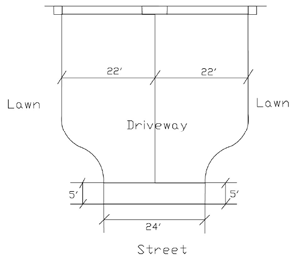
(Ord. 313, SS, § 1, 5-15-2023)
10-72-05. - Joint parking requirements.
Required parking facilities serving two (2) or more uses may be located on the same lot or in the same structure, except in residentially zoned districts, provided that the total number of parking spaces furnished shall be not less than the sum total of the separate requirements for each use during any peak hour parking period when the parking facility is used at the same time by two (2) or more uses. Conditions required for joint uses are:
A.
The proposed joint parking space is within 500 feet of the use it will serve.
B.
The applicant shall demonstrate that there is not substantial conflict in the principal operating hours of the two (2) or more buildings or uses for which joint use of off-street parking facilities is proposed.
C.
A properly drawn legal instrument executed by the parties concerned for joint use of off-street parking facilities shall be filed as a deed restriction on both properties in the recorder's office of Anoka County.
10-72-06. - Off-site parking.
A.
Any off-site parking which is used to meet the requirements of this Ordinance may, as applicable, be allowed by a Conditional Use Permit for long term off-site parking facilities as regulated under the provisions of Part 10-33-00 of this Ordinance, or an Interim Use Permit for short term temporary off-site parking facilities as regulated under the provisions Part 10-34-00 of this Ordinance, and shall be subject to the conditions listed below.
B.
Off-site parking shall be developed and maintained in compliance with all requirements and standards of this Ordinance.
C.
Reasonable access from off-site parking facilities to the use being served shall be provided.
D.
Except as provided by this Ordinance, the site used for meeting the off-street parking requirements shall be under the same ownership as the principal use being served or under public ownership.
E.
Off-site parking for multiple-unit dwellings shall not be located more than 250 feet from any normally used entrance of the principal use served.
F.
Off-site parking for non-residential uses shall not be located more than 500 feet from the main public entrance of the principal use being served. Off-site parking located more than 500 feet from the main entrance may be allowed with the provision of a private shuttle service.
G.
Any use which depends upon off-site parking to meet the requirements of this Ordinance shall maintain ownership and parking utilization of the off-site location until such time as on-site parking is provided or a site in closer proximity to the principal use is acquired and developed for parking.
10-72-07. - Proof of parking requirements.
The City may allow reductions in the number of required parking spaces to be installed under one (1) or more of the following circumstances via a conditional use permit:
A.
The unique characteristics of the proposed use are such that it will generate a need for less parking than the Ordinance standard; or
B.
All requests for reductions in the amount of required parking to be installed shall be accompanied by a plan showing where the total required parking spaces can be added on the lot, if necessary, up to the total amount required by this Ordinance, (meeting green area requirements) without requiring a variance.
10-72-08. - Design and maintenance of off-street parking.
A.
Curb Cuts and Property Access Points.
1.
Number Allowed. Lots developed for Commercial, Industrial, Multi-unit and/or Public Institutional uses may be permitted multiple driveways onto a public street subject to review and approval by the City Engineer.
2.
County/State Roads. Curb cuts onto County/State roads shall require review by the County/State Engineer. The County/State Engineer shall determine the appropriate location, size, and design of such access drives and may limit the number of access drives in the interest of public safety and efficient traffic flow.
B.
Signs. Signs shall not be located in a required parking area except as necessary for disability accessibility and for the orderly operation of traffic movement. Such signs shall not be a part of the permitted advertising space.
C.
Curbing. Except for single unit, two-unit and townhouses, all open off-street parking shall have a perimeter concrete curb barrier around the entire parking lot. Said curb barrier shall be set back a minimum of five (5) feet from any property line.
D.
Striping. Except for single unit, two-unit and townhouses, all parking stalls shall be marked with white or yellow painted lines not less than four (4) inches wide.
E.
Surfacing.
1.
All commercial, industrial, and institutional parking spaces and driveways shall be surfaced with concrete, bituminous, or pavers in all zoning districts and shall meet a 9-ton design. Other materials such as decorative rock, gravel, sand, or bare soil are prohibited.
2.
All parking areas and driveways shall be maintained in a safe and proper manner. The owner shall not allow weeds or surface materials to become deteriorated.
3.
Limited use event or overflow parking areas and related drives for athletic fields may be permitted with a gravel surface when in receipt of a conditional use permit. Such parking areas shall not be used year round and adequate measures to control dust from impacting neighboring residential areas are in place.
F.
Lighting. Lighting in an off-street parking area shall be shaded or diffused so as to reflect the light away from adjoining property and adjacent traffic areas as regulated in accordance with Section 10-71-04 of this Ordinance. All light fixtures shall be a down-cast style.
G.
Maintenance of Off-Street Parking Spaces. It shall be the joint responsibility of the operator and owner of the principal use, uses and/or building to maintain, in a neat and adequate manner, the parking space, access ways, landscaping and required fencing.
H.
Location. All accessory off-street parking facilities required herein shall be located as follows:
1.
Spaces accessory to one- and two-unit dwellings shall be on the same lot as the principal use served unless guest parking is provided elsewhere.
2.
There shall be no off-street parking space within five (5) feet of any property line except as provided below:
a.
B-1, B-2, and BPK Districts. Zero lot line parking area setbacks shall be allowed within the B-1, B-2, and BPK Districts subject to the following conditions:
i.
A five (5) foot parking area setback shall be maintained along street rights-of-way (not including alleys). Such setback area shall be sodded or landscaped with approved ground cover, shrubs or trees.
ii.
The parking area shall not abut a residential zoning district or use.
iii.
If applicable, a maintenance and joint use agreement shall be executed and recorded against the titles of the affected properties.
iv.
Encroachment into established utility easements shall be allowed only via permit and an encroachment agreement with the City.
b.
Shared Access and Joint Parking. Zero lot line setbacks shall be allowed in cases of shared access and joint parking subject to the following conditions:
i.
The access and/or parking area layout is approved by the City Engineer.
ii.
A maintenance and joint use agreement shall be executed and recorded against the titles of the affected properties.
iii.
If applicable, the conditions of Section 10-72-05 of this Ordinance related to joint parking are satisfied.
3.
When parking stalls abut a sidewalk, the minimum sidewalk width shall be six (6) feet.
4.
Parking stalls shall not be located where they obstruct doorways, driveways, or pedestrian walkways.
5.
All disability accessible stalls shall be located in close proximity to entrance areas and shall not be hindered by inappropriately located curb cuts, catch basins, etc.
I.
Use of Parking Area. Required off-street parking spaces in all districts shall not be used for open storage, or sale of goods, or for the storage of vehicles which are inoperable, for lease, rent or sale or the stockpiling of snow.
J.
Rural Parking Lots. Parking lots located outside of the Urban Service Area which serve non-residential uses may allow for different surfacing and design requirements than those found in this Section with approval of an Interim Use Permit. Considerations for the IUP may include but are not limited to: dust management, stormwater runoff, proximity of site to sensitive environmental areas and residential districts, size of parking lot, and anticipated traffic.
K.
Parking and Storage of Recreational Vehicles. The parking and storage of recreational vehicles shall be regulated in accordance with Section 7-4-5 of the City Code and Section 10-68-18 of this Ordinance.
(Ord. 291, SS, 1-18-2022; Ord. 313, § 2, 5-15-2023)
10-72-09. - Parking supply requirements.
A.
The minimum number of off-street parking and loading spaces per use shall be provided and maintained as specified in Table 10-72-2, below:
B.
Table 10-72-2 Required Number of Parking Spaces:
10-72-10. - Off-street loading requirements.
Any of the following uses with a gross floor area of 6,000 square feet or more which requires deliveries or shipments shall provide off-street loading facilities in accordance with the requirements specified below unless a Conditional Use Permit is granted:
A.
Every retail establishment, industrial or manufacturing use, warehouse, or wholesale use having a gross floor area of 6,000 square feet or more shall provide off-street loading facilities as follows:
Table 10-72-3 Loading Requirements
B.
Every public assembly use, such as auditoriums, convention halls, exhibition halls, stadiums or sports arenas, with a gross floor area of greater than one hundred thousand (100,000) square feet shall be provide a minimum of one (1) off-street loading space.
C.
Funeral Homes, restaurants and hotels with a gross floor area of greater than 30,000 square feet and offices with a gross floor area of 100,000 square feet or more shall provide a minimum of one (1) off-street loading space.
D.
Off-street loading spaces shall be at least 10 by 25 feet, excluding area for maneuvering vehicles.
E.
At no time shall any part of a truck or van be allowed to extend into the right-of-way of a public street while the truck or van is being loaded or unloaded.
10-72-11. - Residential driveway performance standards.
A.
All lots or parcels shall have direct adequate physical access for emergency vehicles along the frontage of the lot or parcel from either an existing dedicated public roadway, or an existing private roadway approved by the City.
B.
Permit Required. All proposed driveway and private drive connections to a City street shall require a permit.
C.
Driveways that access roads that have a paved surface shall be surfaced with bituminous, concrete pavement, concrete pavers, or other similar material as approved by the Zoning Administrator and shall extend from the existing paved surface to the principal structure in the urban service area, or a minimum of fifty (50) feet in the rural service district, unless a longer length is needed to control erosion.
D.
Controlling Erosion. All driveways shall be constructed in a matter which controls erosion. Driveways with moderate slopes (greater than 4%) which drain towards a paved street shall extend the bituminous, concrete pavement, concrete pavers or other similar hard surface to the crest of the hill. Drainage swales shall be utilized adjacent to the driving surface to control stormwater runoff.
E.
Driveways that access roads that have a gravel surface shall meet the rural driveway standard set forth herein. Driveways shall be constructed to minimize erosion by utilizing drainage swales adjacent to the driving surface to control stormwater runoff.
F.
No residential driveway shall be less than ten (10) feet in width or exceed twenty-four (24) feet in width at the point where it adjoins the street. The driveway shall not exceed a width of twenty-four (24) feet for a distance of at least five (5) feet behind the street, at which point the driveway may exceed twenty-four (24) feet in width.
G.
Number allowed. Residential lots within the urban service district shall be limited to one driveway access to a public street. Residential lots within the rural service area may have two driveway accesses, provided that the driveways have at least one hundred (100)-foot separation and the secondary driveway is intended to serve an accessory structure.
H.
Secondary driveways which access paved roads shall be surfaced with bituminous, concrete, or pavers from the edge of the constructed public roadway to the property line, at minimum. All other rural driveway standards shall be met.
I.
Driveways of any type surface shall maintain at least a three-foot side yard adjacent property lines in residential districts.
J.
Two single-family residences may share a driveway provided both parcels have adequate frontage, easements are recorded, both property owners agree to maintenance and dissolution agreements, and the driveway meets the minimum fire and safety standards. No more than two single-family residences may share a driveway. For the purposes of setbacks, the two parcels shall be counted as one, while the agreement is in effect.
K.
No residential driveway access shall be allowed onto a designated collector or arterial street, unless the Planning and Zoning Commission finds that no other practical alternative exists and the Council approves said access.
L.
No driveway shall obstruct drainage utility access, or impair public safety. When necessary, the lot owner shall install a culvert of adequate size and type, as determined by the City Engineer.
M.
Driveways shall not have a slope of greater than ten (10) percent.
N.
Rural Driveway Standard. Driveways shall be of a design that will provide reasonable access for emergency service vehicles and meet all fire and public safety standards. At a minimum, the driveway shall have at least a 10-foot-wide driving surface with a driveway base that is suitable to support the City's largest piece of firefighting apparatus. Gravel driveways in the rural service district shall have a minimum class 5 aggregate thickness of eight (8) inches compacted. Obstructions adjacent to and directly over the driveway, including, but not limited to; tree branches, shrubs, landscaping materials, etc. shall be removed to provide a fourteen (14) feet clear height.
O.
The property owner shall be responsible for the maintenance in safe condition of all driveways leading to his or her property, including the portions of sidewalks used as part of said driveways.
P.
In lieu of two separate townhome driveways, one shared driveway may be utilized subject to the following conditions:
1.
The shared driveway shall not exceed twenty-four (24) feet in width at the point it adjoins the street.
2.
Townhome driveways shall be required and maintained by a property owner association.
Figure 10-72-2 Driveway Standards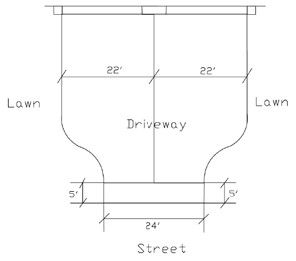
Q.
Townhomes and multi-family dwellings under the ownership and/or control of a property owner association shall be maintained, repaired, and replaced under the cost of property owner association. Said association shall maintain a capital improvement program for the driveways under its ownership.
R.
Financial Surety. Driveways that will exceed 600 feet in length and are not combined with another permit (i.e., principal structure) will require a financial surety in the amount 150% of the estimated construction cost in the form of a cash escrow or Irrevocable Letter of Credit in a form as approved by the City Attorney.
(Ord. No. 352, SS, § 12, 12-15-2025)
10-73-01. - Purpose.
The purpose of this Ordinance is to establish standards for fencing, screening, and landscaping as may be required by other chapters of this Ordinance and to protect the general health, safety, and welfare of the City.
10-73-02. - Fences.
Fences shall be permitted in all yards subject to the following:
A.
General Standards. All fences shall be located on private property, not within the public right-of-way, and outside of wetland buffers.
1.
All posts or similar supporting instruments used in the construction of fences shall be faced inward toward the property being fenced.
B.
Permit Required. It is unlawful for any person to construct or cause to be constructed any fence without first making an application for and securing a fence permit.
C.
Locations. All boundary line fences shall be located entirely upon the private property of the person constructing or causing the construction of such fence. The Zoning Administrator may require any applicant for a fence permit to establish the boundary of a person's property by a survey thereof to be made by a registered land surveyor. The location of the fence is subject to the following:
1.
Fences may be placed along the property line provided no physical damage of any kind results to the abutting property and permission is granted in writing from the abutting property owner and submitted with the application.
2.
All fences shall not obstruct roadway visibility, easements, or natural drainage.
3.
Fences on corner lots where two or more roads intersect may not construct a fence on the intersection corner that obstructs roadway safety sightlines as defined by local, County, State, and Federal guidelines.
D.
District Standards:
1.
In the RR, R-1, R-2, and R-3 Districts, fencing shall be restricted to a height of six (6) feet for side and rear yards and a height of four (4) feet within the front yard setback. All fences shall be residential in nature such as wrought iron, vinyl, split-rail, or board and picket. Fencing extending beyond the front- or street-facing façade of any structure shall be ornamental in character and may not be chain link. Barbed wire, electric, and other agricultural fences may be used in the RR District in conjunction with a legally permitted use in Section 10-68-12, Keeping of animals or fowl.
2.
In the A-1, A-2, and UR Districts, all fencing for non-agricultural purposes shall be no taller than six (6) feet in height.
3.
In the B-1 and B-2 Districts, fencing is not allowed between the principal structure and any public right-of-way. Fences shall be no greater than six (6) feet in height. Fences no greater than four (4) feet in height may be permitted with a Conditional Use Permit in front of the principal structure.
4.
In the BPK, I-1, and I-2 Districts, fences shall be no greater than eight (8) feet in height. Fences greater than four (4) feet in height shall not be placed in the front yard. Fences greater than eight (8) feet in height may be permitted with a Conditional Use Permit when meeting all district setbacks.
5.
Fences up to sixteen (16) feet in height may be allowed in any district provided the fence is used as an enclosure for a tennis or sport facility.
6.
Erosion control fences are permitted in all districts in conjunction with a permitted activity.
7.
It is unlawful for any person to erect or maintain a barbed wire fence upon his or her property, which fence is less than six (6) feet above the ground and within three (3) feet of a sidewalk or public right-of-way except in those areas in which the owners are permitted to keep, stable or board animals under the provisions of the City Code.
(Ord. 325, SS, § 15, 2-5-2024; Ord. No. 342, SS, § 7, 1-6-2025)
10-73-03. - General landscaping and maintenance.
A.
All exposed ground areas, including street boulevards, and areas not devoted to off-street parking, drives, sidewalks, patios or other such improvements shall be landscaped with grass, shrubs, trees or other ornamental landscape materials within one (1) year following the date on which the certificate of occupancy is issued.
B.
All landscaped areas shall be maintained by the property owner and kept neat, clear and uncluttered, and where landscaping is required as part of City approvals, any plant material which is diseased or dies shall be replaced with like kind of the original size.
C.
Fences and/or tree plantings may be allowed in drainage and utility easements with approval by the City Engineer. Features may be placed in such easements by the owner, at the owner's risk of removal (without compensation) by the City or other agencies that may have legal use of the easement. Such features shall not be placed in a manner that prohibits or significantly impacts the public use of the easement for any utility or drainage purpose.
(Ord. 297, SS, § 1, 6-20-2022)
10-73-04. - Required landscaping.
A.
Generally. Any provision within this Part that requires a measurement in caliper inches shall take that measurement from diameter at base height (DBH)
B.
Landscape Plan Required. All new residential subdivisions with three (3) or more lots, residential structures with three (3) or more dwelling units, commercial uses, industrial uses, and institutional uses shall be subject to minimum landscaping and planting material specification requirements outlined in this Section. Landscape plans shall be prepared by a licensed Landscape Architect or other qualified professional licensed by the State of Minnesota. The plans shall at a minimum contain the following:
1.
Landscaping plan, utilizing a copy of the current certificate of survey as a base for the site in question, depicting the following:
a.
Site boundaries, buildings, structures and other improvements shall be identified on-site with a current certificate of survey, prepared and signed by a Minnesota licensed land surveyor, depicting the following:
i.
Scale of plan (engineering scale only, at one inch equals fifty feet (1" = 50') or less.
ii.
North point indication.
iii.
Existing boundaries with lot dimension and area.
iv.
Existing site improvements.
v.
All encroachments.
vi.
Easements of record.
vii.
Legal description of the property.
viii.
Ponds, lakes, springs, rivers or other waterways bordering on or running through the subject property.
b.
Planting schedule (table) containing:
i.
Symbols.
ii.
Quantities.
iii.
Common names.
iv.
Botanical names.
v.
Sizes of plant material.
vi.
Root specification (bare root, balled and burlapped, potted, etc.).
vii.
Special planting instructions.
c.
Location, type and size of all existing significant trees to be removed or preserved.
d.
Planting detail (show all species to scale at normal mature crown diameter or spread for local hardiness zone).
e.
Typical sections with details of fences, tie walls, planter boxes, tot lots, picnic areas, berms and the like.
f.
Typical sections with details of landscape islands, planter beds, and foundation plantings with identification of materials used.
g.
Note indicating how disturbed soil areas will be restored through the use of sodding, seeding, or other techniques.
h.
Delineation of both sodded and seeded areas with respective areas in square feet.
i.
Coverage plan for underground irrigation system, if any.
j.
Where landscape or man-made materials are used to provide screening from adjacent and neighboring properties, a cross-through section shall be provided showing the perspective of the site from the neighboring property at the property line elevation.
k.
Other existing or proposed conditions which could be expected to affect landscaping.
C.
Design Standards and Criteria. All landscaping incorporated in the landscape plan shall conform to the following standards and criteria:
1.
Minimum Required Plantings.
a.
Single- and Two-Unit Residential. All new single- or two-unit units shall follow the sodding and ground cover requirements found in Item D, below, and shall plant a minimum of two (2) deciduous trees per dwelling unit, of which a minimum of one (1) in total shall be placed in the front yard.
b.
Multi-Unit, Institutional, Commercial, and Industrial.
i.
In order to achieve landscaping which is balanced with the size and scale of the proposed building(s) and site, the minimum number of caliper inches of trees required shall be determined by dividing the total gross square footage of all floors of a building by three hundred twenty (320).
ii.
The complement of trees fulfilling the caliper-inch requirement in Item 4, below, shall not be less than 25 percent deciduous, 25 percent evergreen, and 10 percent ornamental. For the purposes of this ordinance, a four (4) foot tall evergreen tree is equal to two (2) caliper inches.
iii.
Deciduous and evergreen trees shall be of a sufficient diversity such that not more than 25 percent of the total caliper inches shall be within the same genus.
iv.
Planting islands may be required where necessary to visually break-up expanses of hard surface parking areas, for safe and efficient traffic movement, and to define rows of parking. Planting islands may occupy at least five (5) percent of the required parking area.
v.
All loading, service, utility, outdoor storage areas, and parking areas not intended for customers, employees, residents, or guests shall be screened from all public roads and adjacent Residential districts. The screening shall consist of any combination of the following: earth mounds, walls, fences, evergreen trees, tall shrubs, or low shrubs. The height and depth of the screening shall be consistent with the scale (height and size) of the areas for which screening is required. When natural materials, such as trees and hedges, are used to meet the screening requirements of this Part, density and species of planting shall be such to achieve 100 percent opacity year round.
vi.
Parking areas shall be landscaped with trees in such a way as to break up long expanses of parking, with a minimum perimeter tree planting of one (1) tree per 60 feet of parking lot perimeter. Interior parking areas should have a minimum of one (1) tree per 10 spaces (excluding perimeter spaces) planted in parking lot islands and landscaping areas in order to visually break up long expanses of parking. Parking lot islands with tree plantings must be at least 200 square feet in area for each tree planted within. Trees planted to meet the requirements of this Subsection may be put toward the overall caliper-inch requirement listed in Item 4, below.
vii.
These standards may be waived for properties in the B-1 and I-2 Districts by the Zoning Administrator during the Site and Building Plan Review process, provided steps are taken to lessen the impact of the development on adjacent residential properties.
2.
Existing Trees. All existing, preserved trees or other vegetation on site that are suitable for the purpose intended by this Ordinance in the opinion of the Zoning Administrator may count towards any required plantings provided the trees/vegetation are within the grading limits, are in good condition, and are free of disease. Existing trees applied to this requirement will fall under the same warranty terms and requirements as newly planted trees and follow the same warranty period and start date. Qualifying trees may be counted towards the total caliper inch requirements for the development at a ratio of 1:1.
3.
Types of New Trees. Trees suitable for complying with this Ordinance shall be of the below identified genuses, conform to the current USDA climactic zone designation for the City, and must be deemed acceptable by the Zoning Administrator or designee:
a.
Deciduous Trees. Required plantings of deciduous trees shall be of the following type(s):
i.
Quercus (Oak);
ii.
Gymnocladus (Coffee Tree);
iii.
Tilia (Linden and Basswood);
iv.
Ulmus (Elms);
v.
Acer (Maples);
vi.
Betula (Birch);
vii.
Populus (Aspen, no cottonwood);
viii.
Maackia, Morus (Mulberry);
ix.
Gleditsia (Locust);
x.
Olneya (Ironwood);
xi.
Cladrastis (Yellowwood);
xii.
Ginkgo (male only);
xiii.
Catalpa.
b.
Evergreen Trees. Required plantings of evergreen trees shall be of the following type:
i.
Abies (Fir);
ii.
Tsuga or Carriere (Hemlock);
iii.
Pinus (Pine);
iv.
Cedrus (Cedar);
v.
Juniperus (Juniper);
vi.
Picea (Spruce).
c.
Ornamental Trees. Required plantings of ornamental trees shall be of the following type:
i.
Amelanchier (Serviceberry);
ii.
Prunus (cherry, stone fruit);
iii.
Malus (Apple, crabapple);
iv.
Cornus (Dogwood);
v.
Crataegus (Hawthorn);
vi.
Syringa (Lilac);
vii.
Sorbus (Mountain Ash).
d.
No tree, shrub, or perennial identified on the MN Department of Agriculture's Eradicate, Control, or Restricted Lists shall be accepted.
e.
Additionally, these common noxious/invasive species will also not be accepted:
i.
Russian Olive;
ii.
Cottonwood;
iii.
Female Ginkgo.
4.
Minimum Size. All plants shall meet the minimum size requirements listed in the table at the time of installation/planting:
Table 10-73-1 Minimum Planting Size for Trees
5.
Spacing.
a.
Plant material centers shall not be located closer than three (3) feet from the fence line or property line and shall not be planted to conflict with public plantings, sidewalks, trails, fences, parking areas, and driveways based on the judgment of the Zoning Administrator.
b.
Where plant materials are planted for screening purposes in two (2) or more rows, plantings shall be staggered in rows unless otherwise approved by the Zoning Administrator.
c.
Evergreen trees intended for screening shall be planted not more than fifteen (15) feet apart.
d.
Where massing of plants or screening is intended, large deciduous shrubs shall be planted four (4) feet on center or closer, and/or, evergreen shrubs shall be planted three (3) feet on center or closer.
6.
Design.
a.
Pond slopes and associated landscaping shall be subject to the review and approval of the City Engineer.
b.
All areas within the property lines (or beyond, if site grading extends beyond) shall have some type of landscape treatment indicated on the landscaping plan if not occupied by another site feature (pavement, ponding, or structure). All disturbed exterior areas not paved or designated as roads, parking, or storage shall be planted into ornamental vegetation (lawns, ground covers, or shrubs) unless otherwise approved by the Zoning Administrator or designee.
c.
Turf slopes in excess of three to one (3:1) are prohibited.
d.
All unpaved areas immediately adjacent to a building's foundation shall be installed and maintained with an orderly and decorative landscape treatment including planting beds, turf grass, and/or mulched areas, or other similar treatments. These areas shall extend a minimum of 10 feet or to the property line, whichever is less, from the building foundation on all sides to allow for access to/from and maintenance of building facades.
e.
All buildings shall have at least one (1) exterior water spigot per 2,000 square foot of building foundation or an irrigation system to ensure that landscape maintenance can be accomplished. Non-residential developments with a building footprint of more than 7,500 square feet and residential developments (excluding single unit homes) with a building footprint of more than 4,000 square feet are required to have an irrigation system.
f.
Trees and shrubs shall not be planted in the right-of-way except as approved by the City Council.
g.
All plants required as part of an approved landscaping plan shall be maintained and kept alive and in a healthy condition. Dead plants shall be replaced in kind and in accordance with the approved landscape plan provided site and environmental conditions are not prohibitive.
D.
Sodding and Ground Cover. All open areas of the site not occupied by building, pavement, ponding, or landscaping planting shall be either seeded or sodded.
1.
The property owner shall assure that the front, side, and rear yards of each lot are properly graded to allow for proper drainage and maintenance. Four (4) inches of top soil shall be uniformly added. Sod shall be laid to complete the front yard (including right-of-way), and seeding or sodding has been added to the remainder of the disturbed area of the lot. Seeding must either be protected with a hydro-mulch binder or biodegradable restoration blanketing. Seeding will be allowed in the front yard only if a sprinkler system is also installed.
2.
If a house or project is completed when weather conditions do not allow sodding or seeding, the developer or home builder shall submit to the City the following:
a.
A temporary certificate of occupancy granted for the building during the non-growing season provided that the owner establishes a cash escrow with the city as set within the City fee schedule. Upon satisfactory installation of the ground cover, the escrow will be returned to the owner and a certificate of occupancy issued.
b.
If the ground cover is not installed by June 1 of the following year, the owner will forfeit the escrowed funds and be required to vacate the property until the certificate of occupancy can be issued when ground cover has been installed. The cost to install the ground cover shall be at the property owner's expense.
E.
Landscape Guarantee. All new plants shall be guaranteed for twelve (12) months from the time all planting has been completed and a certificate of occupancy has been issued. All plants shall be alive, of good quality, with no signs of stress, and disease free at the end of the warranty period or they shall be replaced. Any replacements shall be warranted for 12 months from the time of replacement. Prior to the issuance of a Certificate of Occupancy, the City may require a Performance Bond, with a corporation approved by the City as surety thereon, or other guarantee acceptable to the City, in an amount to be determined by the City, for no more than two (2) times the amount estimated by the City as the cost of completing said landscaping and screening.
(Ord. 325, SS, § 16, 2-5-2024)
10-73-05 - Required screening.
A.
All new commercial and industrial uses shall provide screening along the boundary of any residentially-zoned parcel.
1.
Screening shall not be required for parcels separated by right-of-way.
2.
Screening shall not be required on any side of a commercial or industrial building determined by the Zoning Administrator to be the front of the building.
3.
Screening shall be a minimum of six (6) feet in height at installation.
B.
Screening of mechanical equipment waste, refuse, and recyclable material shall be required in accordance with Sections 10-73-06 and 10-71-03.
C.
Screening required by this Section shall consist of a green belt planting strip, fence or wall, berm, or combination of these elements as provided for below:
1.
Trees used to fulfill screening requirements may not be used to fulfill a site's minimum planting requirements as specified in Section 10-73-03.
2.
No new landscaping shall contain plant materials that are listed on the MN Dept. of Agriculture Noxious Weed List or the MnDNR Invasive Terrestrial Plants List.
3.
If using vegetation alone to fulfill screening requirements, a green belt planting strip shall consist of a mix of shrubs and coniferous trees:
a.
Trees shall be planted in staggered rows with trees in the same row planted at a maximum spacing of 12 feet apart. Staggered rows should be positioned to maximize overlap of tree canopy and provide adequate distance between rows to allow lower canopies to fill out.
b.
Shrubs shall be planted between the trees and the property line and may be evenly spaced or clustered.
Figure 10-73-1 Vegetative Screening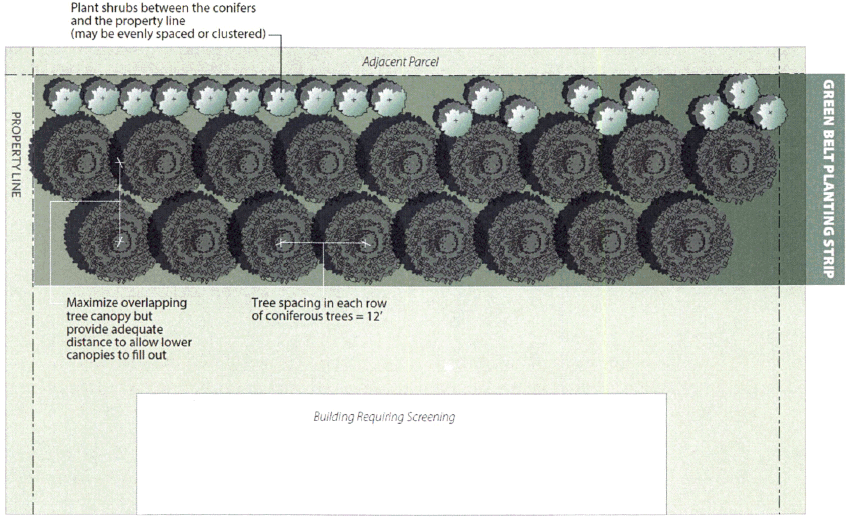
4.
Solid fences, walls, or berms may be used for screening purposes in conjunction with vegetation.
a.
Vegetation shall be planted between the constructed elements and the property line.
b.
Where constructed elements are used, the amount of vegetation required may be reduced by up to 50 percent. The type and layout of vegetation may be modified from the requirements in Item C above.
c.
Fences or walls shall be opaque and shall be constructed of masomy. brick, composite, or wood unless otherwise approved by the Zoning Administrator.
d.
Height.
i.
Solid fences and walls shall be a minimum of six (6) feet in height.
ii.
Earth mounding or berms used for screening purposes shall be no more than three (3) feet in height, and must be combined with vegetation to achieve remaining height requirement.
iii.
Height will be measured from the elevation of the shared property line.
Figure 10-73-2 Screening with Fence
Figure 10-73-3 Screening with Berm
D.
Alternative measures to provide comparable screening between commercial and industrial uses and residential uses may be proposed by the applicant and approved by the Zoning Administrator.
(Ord. 307, SS, § 3, 2-21-2023)
10-73-06. - Screening of mechanical equipment.
All rooftop and ground-mounted mechanical equipment for residential buildings having five (5) units or more and for non-residential buildings shall comply with the following standards:
A.
All rooftop and ground-mounted mechanical equipment shall be screened so as to mitigate noise in compliance with Section 10-71-02 of this Ordinance.
B.
All rooftop and ground-mounted mechanical equipment shall be designed (including exterior color) and located so as to be aesthetically harmonious and compatible with the building. Screening of and landscaping around the equipment may be required where the design, color, material, and locational characteristics of the equipment are found to not effectively buffer noise or provide aesthetic harmony and compatibility. Screening shall be constructed of durable materials which are aesthetically compatible with the structure and which may be an integral part of the structure.
C.
Rooftop mechanical equipment less than three (3) feet in height may be exempt from screening requirements by the Zoning Administrator or designee.
10-74-01. - Permit required.
A.
Any person who proposes to move the natural surface of the earth via excavation, grading, or filling on any property in the City shall apply for an interim use permit. The following are exempted:
B.
Excavation, filling, or grading in conjunction with an approved building, driveway, or other such permit.
C.
Excavation, filling, or grading in reliance on and in accordance with an approved development plan or grading plan.
D.
Excavation, filling, or grading by the State, County or City authorities in connection with construction or maintenance of roads or highways or utilities, provided such activity is conducted within the road or highway right-of-way or utility easement.
E.
Curb cuts, utility hook ups or street openings for which another permit is required from the City. Where another license or permit is not required or obtained, the excavation permit provided for in this Ordinance shall be required.
F.
Excavation, filling, or grading of less than 100 cubic yards. Such activities, however, will be subject to an administrative permit which will address erosion control, traffic, streets, safety, noise, hours of operation, duration of activity, and environmental factors. If these factors cannot be adequately addressed, the permit may be denied.
G.
Excavation, filling, or grading for agricultural purposes greater than 100 cubic yards shall require an administrative permit. Less than 100 cubic yards shall not require a permit.
H.
Excavation, filling, or grading for extraction, mining, or gravel pit purposes shall follow the procedure in Section 10-64-04 of this Ordinance.
10-74-02. - Administrative permit exemptions.
A.
In cases above where excavation, filling, and grading are administratively permitted, the following are exempted:
B.
If the excavation, grading, or filling is conducted within the Urban Service Area, is less than 15 cubic yards in volume, and is the only such activity permitted in the last year.
C.
If the excavation, grading, or filling is conducted in the Rural Service Area, is less than 45 cubic yards in volume, and is the only land disturbance activity in the last year.
10-74-03. - Application for permit.
Any person desiring a permit hereunder shall file an application on such forms as shall be provided by the Zoning Administrator. Such application shall be accompanied by a fee as set forth by City Council resolution and a large scale copy and reduced scale (11 by 17 inches) copy of detailed written and graphic materials fully explaining the proposed land filling or land excavation operation. The applicant shall submit four (4) copies for review. The scale of such materials shall be the minimum necessary to ensure legibility. The request shall be considered as being officially submitted and complete when the applicant has submitted and complied with all the following required information, as applicable and specified by the Zoning Administrator and/or City Engineer:
A.
Application. The application for a permit for excavation, filling, grading, and other such land disturbance activities shall require:
1.
Complete application on form provided by City.
2.
Written narrative describing the project including:
3.
The purpose of the excavation, grading, and/or filling.
4.
A description of the type and amount of material to be excavated, graded, or filled on the premises.
5.
The highway, streets, or other public ways in the City upon which any material is to be hauled or carried.
6.
An estimate of the time required to complete the excavation, filling, or grading.
B.
Site plan showing.
1.
Areas where soil is to be stockpiled.
2.
Location of silt fencing and other erosion control measures meeting the requirements of Section 10-81-01 of this Ordinance.
3.
Property lines.
4.
Current site topography.
5.
Proposed site topography.
6.
Public waters and wetlands on and within three hundred fifty (350) feet of the site.
7.
Flood plains on site.
C.
Stormwater Management Plan meeting the standards of Division 8 of this Ordinance, if applicable.
D.
A written right-of-entry agreement stating the City and its officers have permission to enter the land for the purpose of determining compliance with all applicable conditions imposed in the permit.
10-74-04. - Permit review criteria.
The permit shall be reviewed and approved if none of the following conditions are found to exist:
A.
Negative impact on an approved grading plan.
B.
Negative impact on neighboring properties or public drainage systems on or off-site.
C.
Fill brought on site is of an unsuitable quality.
D.
Excavation is for commercial activity/transport.
E.
Negative impact on public waters and wetlands.
F.
Hours of operation of the land disturbance activity fall outside of 7:00 a.m. to 7:00 p.m on Monday—Friday.
G.
Inadequate erosion control.
H.
Failure to comply with Division 8 of this Ordinance.
I.
The proposed transport of materials is incompatible with the neighboring land uses.
J.
The proposed transport can be safely accommodated by the existing transportation infrastructure.
10-74-05. - Interim use permit review.
In cases where the permit requires an Interim Use Permit, the process in Part 10-34-00 of this Ordinance shall be followed to determine compliance with the criteria in Section 10-74-04 of this Ordinance.
10-74-06. - Administrative permit review.
In cases where an administrative permit is required, the following process shall be followed:
A.
Permit Review.
B.
The City Engineer and Zoning Administrator shall review the application and render a decision within 60 days, unless otherwise extended.
C.
No administrative permit shall be issued for activity to be conducted over a period of time longer than 90 days.
D.
If the permit is denied, the applicant shall be notified in writing.
E.
Permit Conditions. All applicable provisions from this Ordinance shall be placed in effect at the discretion of the City Engineer. Failure to comply with all conditions shall result in the revocation of the Administrative Permit.
10-74-07. - Security.
The City may require either the applicant or the owner or user of the property on which the excavation, filling, or grading is occurring to post a security in such form and sum as determined by the City Engineer. The amount of the security shall be sufficient to cover the City's extraordinary cost and expense of repairing, from time to time, any highways, streets or other public ways where such repair work is made necessary by the special burden resulting from hauling and travel in transporting fill or excavated material. The amount of the security shall also be sufficient to ensure compliance with all requirements of this Part, and the particular permit, and to pay the expense the City may incur as a result of the permit.
10-74-08. - Failure to comply.
A.
The City may, for failure of any person to comply with any requirement made of them in writing under the provisions of such permit, as promptly as same can reasonably be done, proceed to cause said requirement to be complied with, and the cost of such work shall be certified as an assessment against the property whereon the landfill or excavation/grading operation is located, or the City may at its option proceed to collect such costs by an action against the person to whom such permit has been issued, and their superiors if a bond exists.
B.
In the event that excavation, filling, or grading operations requiring a permit are commenced prior to City review and approval, the City may require work stopped and all necessary applications filed and processed. In such cases, application fees shall be double the normal charge.
C.
Upon finding that an excavation, filling, or grading operation is being conducted out of compliance with this ordinance or any permit conditions, the City Engineer or Building Official may issue a stop work order. No such work shall be conducted while the stop work order is in effect.
D.
Upon issuance of a stop work order, completion of ordered corrective action, or taking corrective action, the City Engineer or Building Official may revoke any permit effective immediately. The City may cause to have the site brought into conformance with Section 10-74-10 of this Ordinance via the process identified in this Section.
10-74-09. - Maintenance of right-of-way.
The City Engineer or City Building Official shall also have cause to take any action identified in Section 10-74-08 of this Ordinance for operations that are damaging any right-of-way or are being maintained in a manner that allows for sediment to be deposited in any right-of-way. Cost for any corrective action taken by the City shall be the responsibility of the permit holder or violator via an assessment against the property.
10-74-10. - Completion of operation.
Upon completion of work, the permit holder shall notify the City Engineer or Zoning Administrator. At the completion of an excavation, filling, or grading operation, the premises shall be graded, leveled, and seeded or sodded with grass. The grade shall be such elevation with reference to any abutting street or public way as the City shall prescribe in the permit. The site shall also conform to such prerequisites as the City may determine with reference to storm water drainage runoff and storm water passage or flowage so that the landfill or excavation cannot become a source of, or an aggravation to, storm water drainage conditions in the area. The Zoning Administrator and/or the City Engineer shall inspect the project following completion to determine if the applicant has complied with the conditions required thereof.
10-74-11. - Operations in process.
All excavation, filling, or grading operations for which a permit has previously been issued shall terminate such operations on the date specified by the permit.

