
Saint Francisville City Zoning Code
ARTICLE II
- DEFINITIONS AND RULES OF INTERPRETATION
Sec. 2.1. - Rules of interpretation.
The following rules of interpretation shall apply to the text of this zoning ordinance:
A.
The particular controls the general.
B.
In the case of any difference in the meaning or implication between the text of this zoning ordinance and any caption or illustration, the text controls.
C.
"Shall" is always mandatory and not discriminatory.
D.
Words used in the present tense include the future; and words used in the singular include the plural, and the plural the singular, unless the context clearly states the contrary.
E.
A "building" or "structure" includes any part thereof.
F.
"Person" includes an individual, a corporation, a partnership, an incorporated association or any other similar entity.
G.
Unless the context clearly indicates the contrary, where a regulation involves two (2) or more items, conditions, provisions or events connected by the conjunction "and" or "or", the following shall apply:
1.
"And" indicates the all the connected items, conditions, provisions or events shall apply.
2.
"Or" indicates that the connected items, conditions, provisions or events may apply singularly or in any combination.
H.
Terms not defined in this chapter have the meaning customarily assigned to them, or a meaning to be assigned by a duly authorized representative of the Town of St. Francisville.
Sec. 2.2. - Definitions.
For the purpose of these regulations, these terms and words are hereby defined.
Abandonment: (Also see discontinuance) The cessation of the use of a property or of a particular use for at least six (6) months.
Accessory dwelling unit: A self-contained residential unit, considered subordinate to the principal use, and built on the same lot as an existing single-family home.
Accessory structure: A building or structure detached from, but located on the same lot as, the principal structure and the use of which is clearly incidental and subordinate to the principal structure.
Accessory use: A use that is customarily incidental and subordinate to the principal use, and which is located on the same lot as the principle use.
Addition or enlargement: Any construction that increases the size of a building or structure in terms of site coverage, height, length, width or floor area.
Adult business: An adult bookstore, adult motion picture theater, adult nightclub, or an adult massage business. Adult business also means any premises that sells or disseminates explicit adult sexual material. For purposes of this definition, the following terms shall have the following meanings:
Adult uses/materials: An establishment having a substantial or significant portion of its stock in trade in which, for any form of consideration, adult material is presented to or is available for exclusive viewing, rental or purchase by adults. As used in this ordinance, adult material shall consist of movies, films, motion pictures, video tapes, video discs, slides, photographs, or other media of visual representation; or live performances, exhibitions or presentations; or books, papers, pamphlets, magazines, periodicals or publications which are characterized by an emphasis upon the depiction or description of any of the conduct or activities set forth and described in the provisions of Louisiana Revised Statutes Title 14, Chapter 1, part VI, Sub-part C, and in that portion thereof designated as sub-paragraphs (2)(b) and (3) of paragraph A of Section 106 [R.S. 14:106A(2)(b), (3)], or as such provisions may hereafter be amended, re-enacted or re-designated from time to time, or shall consist of any instruments, devices or paraphernalia that are designed or marketed for use in connection with any such conduct or activities. As used in these regulations, the term "adult material" shall be applied to any material that meets the definition set forth in this section whether or not, as a matter of law such material is or could be classified as pornographic or obscene.
Agriculture: The use of land for the production of crops and/or livestock, including but not limited to farming, horticulture, floriculture, viticulture, dairying, animal and poultry husbandry, and the necessary accessory uses for storing such products.
Alcohol beverage sales: The sale of alcoholic beverages for on-premise consumption.
Alley: A way that affords only a secondary means of access to property abutting thereon.
Alteration: Any change, addition or modification in construction, use or occupancy.
Antenna: Any structure or device for the purpose of collecting or transmitting electromagnetic waves, including but not limited to directional antennas, such as panels, microwave dishes, and satellite dishes, and omni-directional antennas, such as whip antennas.
Amateur (HAM) radio equipment: A radio station licensed as such by the Federal Communications Commission (FCC), including equipment such as, but not limited to, a tower or alternative tower structure supporting a radiating antenna platform and other equipment.
Appurtenance: An architectural feature of a structure that is higher than the adjacent portion of the structure, such as a chimney, cupola, spire or parapet wall.
Arrays: A bundle of antennas arranged by a telecommunications service provider and place on a tower, structure or building at a given height to provide the desired directional characteristics.
Attic: The unfinished space below the roof of a structure.
Automotive repair, major: An establishment primarily engaging in the repair or maintenance of motor vehicles, trailers and similar large mechanical equipment, including paint, body and fender, and major engine and engine part overhaul, which is conducted within a completely enclosed building.
Automotive repair, minor: An establishment primarily engaging in the repair or maintenance of motor vehicles, trailers and similar large mechanical equipment, including brake, muffler, upholstery work, tire repair and change, lubrication, tune ups, and transmission work, which is conducted within a completely enclosed building.
Bar: An establishment where the principal function or business is alcoholic beverages sales for on-premises consumption.
Base flood elevation: The elevation shown on FEMA Digital Flood Insurance Rate Maps (DFIRMs) for that indicates the water-surface elevation resulting from a flood that has a one-percent chance of equaling or exceeding that level in any given year.
Bed and breakfast: An owner-occupied residential structure, which provides sleeping rooms for overnight paid occupancy of up to fifteen (15) nights. Common bathroom facilities may be provided rather than private bathrooms for each room. No cooking facilities are permitted in individual rooms.
Block A: Parcel of land within a subdivision or development, which is bounded by streets or bounded by streets and the exterior boundary of the subdivision. For this definition, an alley is not considered a street but part of the block.
Block face: The front of a block along one (1) side of the street.
Board of zoning adjustments: The term "board of zoning adjustments" shall mean the St. Francisville Board of Zoning Adjustments created under R.S. 33:4727 et seq., which shall have the powers provided for by Louisiana law and as may be provided for in this Appendix A, Zoning of the Town of St. Francisville Code of Ordinances.
Brewery: A facility listed as a "manufacturer or brewer" as defined in Title 26, Section 241 of the Louisiana Revised Statutes. The facilities may include on-site tasting facilities with retail sales of alcohol and alcoholic beverage sales of only those alcoholic beverages produced at that facility. On-site tasting facilities shall be subject to the use and parking standards of a bar and any limitations provided for in state and/or local law.
Buffer: An area established in order to protect and separate one (1) land use from another.
Buffer planting area: Area of land, which is unpaved between the side or rear property lines and designated for the preservation and placement of plant materials.
Buildable area: The area of a lot or parcel proposed for development that is available for development after setbacks, buffer yards, required open spaces, landscaped areas, stormwater detention and treatment areas, and right-of-way dedications are provided.
Building: Any structure, either temporary or permanent, having a roof and designed, intended or used for the sheltering or protection of persons, animals, chattels, or property of any kind.
Building code: The International Building Code promulgated by the International Code Council, as adopted by the State of Louisiana and the Town of St. Francisville.
Building line: The perimeter of that portion of a building or structure nearest a property line, but excluding open steps, terraces, cornices and other ornamental features projecting from the walls of the building or structure.
Building, main or principal: A building in which is conducted the principal use of the lot on which it is situated. A dwelling shall be deemed to be the main building on the lot in all residential districts.
Building, temporary: A building used temporarily for the storage of construction materials and equipment incidental and necessary to on-site permitted construction of utilities, or other community facilities, or used temporarily in conjunction with the sale of property within a subdivision under construction.
Café: An establishment whose principal business is the selling and serving of food, beverages and/or desserts wherein the facility is designed and arranged with the intention of the customer ordering and picking-up food and/or drink in a ready-to-consume state at a service counter with the consumption of the food occurring either within or off-premises. A café may have limited outdoor seating options, but cannot serve or sell alcoholic beverages, cannot offer drive-through service, and cannot have a commercial kitchen or a kitchen that includes a grease trap and/or a hood with an integrated fire suppression system.
Canopy: A roofed structure constructed of fabric or other material supported by the building or by support extending to the ground directly under the canopy placed so as to extend outward from the building providing a protective shield for doors, windows and other openings.
Carport: A canopy-like structure, open on at least two (2) sides, for the purpose of providing shelter for one (1) or more vehicles.
Car wash: A commercial establishment engaged in the washing and cleaning of passenger vehicles, recreational vehicles or other light dirty equipment, whether automatic in an enclosed structure or by hand.
Cemetery: Land used or dedicated for the burial of the dead, including crematoriums, mausoleums and necessary sales and maintenance facilities. Mortuaries and chapels may be included when operated within the boundary of said cemetery.
Certificate of appropriateness: A certificate issued by the St. Francisville Historic District Commission indicating its approval of plans for the construction, reconstruction, alteration, removal, or demolition of a structure within a historic district.
Co-location: Placement of telecommunications equipment from one (1) or more service provider on a single tower or site.
Commencement of construction: The physical improvement of land in accordance with a permit issued by the board of aldermen of the Town of St. Francisville, provided that the improvements are of a form and character which are not reasonably useable for development other than that authorized by the issued permit.
Commercial purposes: Those related solely to the economic interests of the person or persons on whose property or for whose benefit the sign is displayed, excluding signs which refer solely to the sale or lease of the premises upon which the signs are located.
Common structure: A structure, such as a garage, tool shed, or recreational facility used by more than one (1) resident in a planned development or manufactured housing development.
Community center: A facility to be used as a place of meeting, recreation, or social activity, and not operated for profit, which is open to the community and designed to accommodate the surrounding neighborhood or the larger community.
Conditional use: A use that would become harmonious or compatible with neighboring uses through the application and maintenance of qualifying conditions, as outlined in section 8.1.F of this ordinance.
Condominium: A single-dwelling unit in a multiunit dwelling or structure, that is separately owned and may be combined with an undivided interest in the common areas and facilities of the property.
Contractor storage yard: Any land or buildings used primarily for the storage of equipment, vehicles, machinery, or other building materials or construction contractor in the conduct of any building trade or craft.
Day: When used in this ordinance, day shall mean one (1) business day.
Day care center: An establishment for the care and nurture of children or adults during the school or workday.
Day care center, adult (small): Any place owned or operated for profit or not for profit, by a person, society, agency, corporation, institution, or any other group wherein are received, for a portion of a 24-hour day, fewer than ten (10) functionally-impaired adults are not related to the owner or operator of the facility for the purposes of supervision or participation in a training program. This excludes alcohol and drug abuse clientele, former inmates of prisons or correctional institutions or former patients of mental institutions who have been found not guilty by reason of insanity. The day care services should take place on a regular basis for at least twelve and a half (12.5) hours in a continuous seven-day week and no overnight stays are permitted. Facilities caring for fewer than ten (10) adults are not required to be licensed by the State of Louisiana, however if the facility receives state or federal funding, directly or indirectly, it must be licensed regardless of the number of adults in its care.
Day care center, adult (large): Any place owned or operated for profit or not for profit, by a person, society, agency, corporation, institution, or any other group wherein are received, for a portion of a 24-hour day, ten (10) or more functionally-impaired adults are not related to the owner or operator of the facility for the purposes of supervision or participation in a training program. This excludes alcohol and drug abuse clientele, former inmates of prisons or correctional institutions or former patients of mental institutions who have been found not guilty by reason of insanity. The day care services should take place on a regular basis for at least twelve and a half (12.5) hours in a continuous seven-day week and no overnight stays are permitted. All facilities caring for more than ten (10) adults must be licensed by the State of Louisiana, and if the facility receives state or federal funding, directly or indirectly, it must be licensed regardless of the number of adults in its care.
Day care center, child (small): Any place or facility operated by any institution, society, agency, corporation, person or persons, or any other group for the primary purpose of providing care, supervision and guidance to a maximum of fifteen (15) children, who are not within the immediate family of the care giver and are unaccompanied by parent or guardian, on a regular basis for at least twelve and a half (12.5) hours in a continuous seven-day week.
Day care center, child (large): Any place or facility operated by an institution society, agency, corporation, person or persons, or any other group for the primary purpose of providing care supervision and guidance to a maximum of fifty (50) children who are not within the immediate family of the care giver and are unaccompanied by parent or guardian, on a regular basis for at least twelve and a half (12.5) hours in a continuous seven-day week.
DBH: The diameter of a tree, stem or trunk measured at breast height.
Density: The number of dwelling units that are allowed on an area of land, which area of land shall be permitted to include dedicated streets contained within the development.
Design review board: The term "design review board" shall exist to review building, remodeling and/or alteration activity as specified in part VIII of this ordinance. Any opinions or advice provided by the design review board are in no way binding with respect to any official action the planning commission or board of alderman may take on the subsequent formal application.
Detention/retention pond: (Also known as bio-retention pond) A man-made basin designed to protect against flooding by storing stormwater for a limited period of time.
Development: The use of land including change or enlargement of any use or disturbance of any land and the performance of any building or mining operation.
Digital flood insurance rate map (DFIRM): An official map of the community, on which the Administrator of the National Flood Insurance Program (NFIP) has delineated both the special hazard areas and the risk premium zones applicable to the community.
Discontinuance: (Also see abandonment) The abandonment of a property or of a particular use for a period of at least six (6) months. The determination of discontinuance for nonconforming uses or structures shall be supported by evidence, satisfactory to the building official (e.g. the actual removal of equipment, furniture, machinery, structures, or other components of the nonconforming use and not replaced, the turning off of the previously connected utilities, or where there are no business receipts/records or any necessary licenses available to provide evidence that the use is in continual operation).
Distillery: A facility listed as a "manufacturer" as defined in Title 26, Section 2 of the Louisiana Revised Statutes. The facilities may include on-site tasting facilities with retail sales of alcohol and alcoholic beverage sales of only those alcoholic beverages produced at that facility. On-site tasting facilities shall be subject to the use and parking standards of a bar and any limitations provided for in state and/or local law.
Drainage plan: A plan showing proposed site drainage features for controlling storm water runoff and conveying it to public outfalls. A drainage plan shall also include runoff calculations for engineering review, evidence that the drainage plan has been submitted to and reviewed by the storm water drainage authority with jurisdiction over the site, and that the drainage plan has been approved by said authority.
Drive-through establishment: A portion of a structure used to provide or dispense products or services through an attendant, window or automated machine to persons remaining in their vehicle. A drive-through establishment is typically constructed in combination with other uses such as a "financial institution, " a "retail goods establishment" or "restaurant." A "car wash," "gas station" or "motor vehicle service and repair" shall not be considered a drive-through facility.
Driveway: A private access road, the use of which is limited to persons residing, employed, or otherwise using or visiting the parcel in which it is located.
Duly authorized representative: Person or persons designated by the mayor and/or board of aldermen to check, review and comment on all submissions regarding their nonconformance to these regulations. These bodies may designate the town engineer or any other qualified persons or agency as the duly authorized representative.
Dwelling: Any structure or portion thereof, which is designed or used for residential purposes.
Dwelling, multi-family: A building or portion thereof designed for occupancy by three (3) or more families living independently in which they may or may not share common entrances and/or other spaces. Individual dwelling units may be owned as condominiums, or offered for rent.
Dwelling, single-family: An individual dwelling unit in a structure, which is not physically connected with any other dwelling unit.
Dwelling, townhouse: A structure consisting of no less than three (3) dwelling units, with no other dwelling, or portion of other dwelling, directly above or below, where each unit has a separate entrance and direct ground-level access to the outdoors. These units are connected to other dwelling units by a single party wall with no opening. "Townhouse dwelling" shall not include "multi-family dwelling." Townhouse dwelling refers to the construction not the ownership pattern of the individual units.
Dwelling, two-family: A building designed or arranged to be occupied by two (2) families living independently, with the structure having only two (2) dwelling units.
Dwelling unit: Any room or group of rooms located within a structure forming a single habitable unit with facilities which are used or intended to be used for living, sleeping, cooking, eating and sanitation by one (1) family.
Easement: The right, granted by the property owner, to use a parcel of land for specified purposes, such as public utilities, drainage and other public purposes, the title of which shall remain with the property owner, subject to the right of use designated in the reservation of the easement (See Servitude).
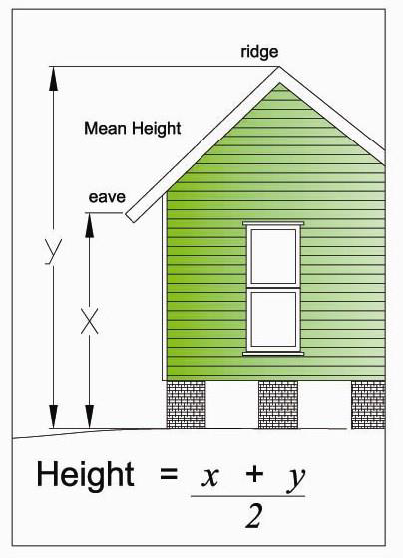
Eave: The projecting sides of a roof overhanging the wall of a building.
Educational facilities: (Also see Schools) Any land used for educational facilities, including universities, colleges, elementary and secondary, and vocational schools.
Educational facility, college/university: A post-secondary institution for higher learning that grants associate or bachelor degrees. The institution may also have research facilities and/or professional schools that grant master and doctoral degrees. This also includes post-secondary theological schools for training ministers, priests or rabbis.
Educational facility, elementary: A public, private or parochial school offering instruction at the elementary, middle and/or junior high school level. Religious facilities with elementary educational facilities shall be considered educational facilities, elementary.
Educational facility, secondary: A public, private or parochial school offering instruction at the senior high school level. This also includes secondary schools for training ministers, priests or rabbis. Religious facilities with secondary educational facilities shall be classified as educational facilities, secondary.
Educational facility, vocational school: A school established to provide for the teaching of industrial, clerical, managerial or artistic skills. This definition applies to schools that are owned and operated privately for-profit and that do not offer a complete educational curriculum.
Electrical signs: Any sign containing electrical wiring and which is attached to an electrical energy source.
Encroachment: The extension or placement of any structure or component of a structure into a required yard.
Equestrian facility: Commercial horse facilities including horse ranches, boarding stables, riding schools and academies, horse exhibition facilities, pack stations. This land use includes barns, stables, corrals and paddocks accessory and incidental to the above uses.
Façade: The exterior wall of a building exposed to public view or that wall viewed by persons not within the building.
Family: One (1) or more persons related by blood, marriage, adoption or guardianship, the occupants of a community or group home for mentally or physically challenged individuals or not more than four (4) persons not so related occupying a dwelling unit and living as a single housekeeping unit shall be considered a family. Notwithstanding any other provisions of this section, this definition does not include individuals required to be assembled under one (1) living unit for the purpose of drug or substance abuse rehabilitation or persons assigned to same as the result of criminal activity.
Fence: An artificially constructed barrier of wood, masonry, stone, wire, metal or other material erected to enclose, screen or separate uses.
Filter strip: A type of buffer strip that is in area of vegetation, generally narrow and long, that slows down the rate of stormwater runoff, allowing sediments and other pollutants that are being conveyed by the water to be removed by settling out.
Financial institution: A bank, savings and loan, credit union, mortgage office, or automated teller machine (ATM).
Finished grade: The completed surfaces of lawns, walks and roads brought to grade as shown on development plans relating thereto.
Floodplain: Floodplain or flood-prone area means any land area susceptible to being inundated by floodwater as depended by FEMA.
Floodway: The channel of a river or other watercourse and the adjacent land areas that must be reserved in order to discharge the 100-year flood without cumulatively increasing the water surface elevation more than one (1) foot at any point.
Floor area: The sum of the gross horizontal areas of the several floors of the main building but not including the area of roofed porches, terraces, or breezeways. All dimensions shall be measured between exterior faces of the walls.
Frontage: That portion of a lot abutting a street right-of-way measured along the property line of the public right-of-way and the private property.
Funeral home: (Also see mortuary) An establishment in which the dead are prepared for burial or cremation. The facility shall be permitted to include a chapel for the conduct of funeral services and spaces for funeral services and informal gatherings, and/or display of funeral equipment.
Garage: An enclosed space designed or used for storage of motor vehicles that does not contain habitual space. Garages may be either attached to the principal building or detached accessory structures. The word "garage," alone, does not include the phrase "parking garage."
Gas station: A business where flammable or combustible liquids or gases used as fuel for motor vehicles are stored and dispersed from fixed equipment into the tanks of motor vehicles. Accessory activities shall be permitted to include automotive repair and maintenance and car wash service.
Government facility: A building or structure owned, operated or occupied by a governmental agency to provide a governmental service to the public, and shall include public works and public safety facilities.
Grade: The lowest point of elevation of the existing surface of the ground, within the area between the building and a line five (5) feet from the building.
Group home or community home: A single-family residential structure, licensed by the State of Louisiana, designed or adapted for occupancy by unrelated developmentally disabled persons.
Group or community home (small): A small, residential facility located within a community, designed to serve children or adults with chronic disabilities. Small group homes may have six (6) or fewer occupants who are mentally, physically or developmentally disabled, and one (1) or more resident counselors/trained caregivers on staff twenty-four (24) hours a day. A small group home must be licensed by an agency of the State of Louisiana, the political subdivision, and/or a state-licensed child placement agency, as a group home, receiving home, or similar care facility. Alcohol and drug abuse clientele, former inmates of prisons or correctional institutions, or former patients of mental illness institutions who have been found not guilty of a criminal charge by reasons of insanity shall be excluded as occupants.
Group or community home (large): A residential facility located within a community, designed to serve children or adults with chronic disabilities. Large group homes may have twelve (12) or fewer occupants who are mentally, physically or developmentally disabled, and two (2) or more resident counselors/trained caregivers on staff twenty-four (24) hours a day. A group home must be licensed by an agency of the State of Louisiana and/or a state-licensed child placement agency, as a group home, receiving home, or similar care facility. Alcohol and drug abuse clientele, former inmates of prisons or correctional institutions, or former patients of mental illness institutions who have been found not guilty of a criminal charge by reasons of insanity shall be excluded as occupants.
Heavy sales, rental and service: This use includes retail, rental and/or service establishments that have permanent outdoor service or storage yards, or partially enclosed structures including, but not limited to, large-scale home improvement centers with outdoor storage and rental components, lumberyards, playground equipment sales and rental, truck repair establishments, and uses with permanent outdoor service or storage areas for heavy equipment such as truck rental establishments, large-scale moving centers, and temporary storage container facilities.
Height: The vertical distance of a structure measured from the average elevation of the proposed finished grade to the highest point of the roof for flat roofs, to the deck line of the mansard roof, and to the mean height between eaves and ridges for gable, hip and gambrel roofs. No height limitation in this ordinance shall apply to any of the following structures: silos, barns and other agricultural structures; church spires; cupolas; domes; monuments; water towers; smoke stacks; derricks; flag poles; masts; solar energy facilities; air conditioning equipment; elevator penthouses and similar structures required to be placed above the roof level and not intended for human occupancy.
Historic district commission: The term "historic district commission" shall mean the St. Francisville Historic District Commission created by St. Francisville Ordinance 1995-5, which shall exist to serve the municipality and review all applications for certificates of appropriateness, including plans for new construction and reconstruction of existing structures, partial renovations, and construction of new and/or refurbishment of existing signs in a historic district.
Home occupation: A business, profession, occupation or trade conducted within the principle structure of a residential use by a resident of the dwelling which is incidental and secondary to the residential use of the dwelling, does not change the essentially residential character of the use, and which complies with the requirements of section 6.3, home occupations.
Hospital: An institution designed for the diagnosis, treatment and care of human illness or infirmity and providing health services, primarily for inpatients, and including as related facilities, laboratories, outpatient departments, training facilities and staff offices. A hospital may also include accessory uses such as "retail goods establishments" and "restaurants," provided that such facilities are incidental and subordinate to the main use and part of the main structure.
Hotel or motel: An establishment providing, for a fee, sleeping accommodations and temporary living accommodations to the general public. Related ancillary uses may include, but shall not be limited to, conference and meeting rooms, restaurants and recreational facilities.
House of worship: A building where persons regularly assemble for religious worship and which building is maintained and controlled by a religious body organized to sustain religious expression.
Impervious surface: A type of ground cover that represents the portions of a site that are occupied by structures, pavement, and other impervious surfaces that do not allow for the infiltration of rainwater into the ground. Types of impervious surface include but are not limited to rooftops, traditional asphalt and concrete parking lots, driveways, roads, sidewalks, patios, pedestrian plazas, and any other surface that does not permit the natural infiltration of rainwater into the ground.
Intensity: Any factor such as square footage, number of dwelling units, or number of employees used as a basis for requiring parking or loading facilities.
Kennel: An establishment where pet animals owned by another person are temporarily boarded for pay or remuneration of any sort. Kennel shall not apply to animal hospitals operated by veterinarians duly licensed under state law where the boarding of animals is accessory to medical treatment.
Landscape area: A nonbuilt-upon area of land in which landscape materials are placed, planted or maintained.
Landscape plan: Shall mean the preparation of graphic and written criteria, specifications, and detailed plans to arrange and modify the effects of natural features such as planting ground and water forms, circulation, walks and other features to comply with the provisions of this ordinance.
Landscaping: The installation of plant material or seed as a part of development.
Letter of understanding: A letter from the building official, or his duly authorized representative, setting out the substance of a pre-application conference.
Live/work dwelling: A structure combining a dwelling unit with a nonresidential use permitted in the zoning district where the structure is located, which is principally used by one (1) or more of the residents. A live/work dwelling may also include the combination of a dwelling unit with arts-related activities, such as painting, photography, sculpture, music or film, and principally used by one (1) or more of the residents.
Loading space: A space within a main building on the same lot as a main building, providing for the standing, loading or unloading of trucks.
Lot: A parcel of land having specific boundaries and having its principal frontage upon an officially approved street.
Lot area: The total horizontal areas within the lot lines of the lot.
Lot, corner: A lot abutting two (2) or more streets at their intersection.
Lot coverage: The area of the lot covered by a structure.
Lot depth: The average horizontal distance between the front and rear lot lines.
Lot lines: The lines forming the outer boundary of a lot.
Lot of record: A recorded, platted lot or a parcel of land lot, the map of which has been recorded in the Office of the Clerk of Courts of West Feliciana Parish, or a lot described by metes and bounds, the description of which has been recorded in the Office of the Clerk of Courts of West Feliciana Parish.
Lot width: The average horizontal distance between the side lot lines measured at the required front yard line and parallel to the front street line, or measured at the street alone if no front yard is required.
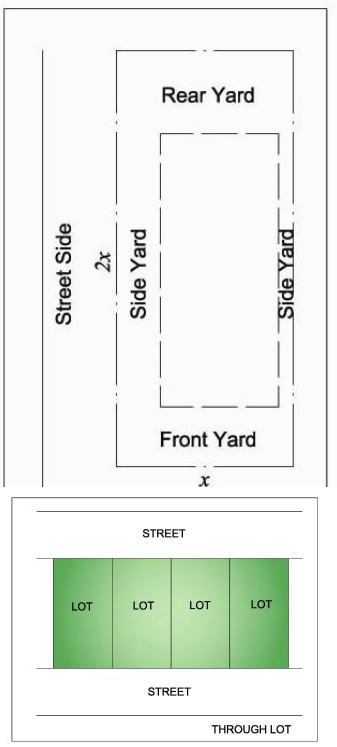
Lot, through: A lot having frontage on two (2) approximately parallel streets or places.
Lot, interior: A lot other than a corner lot.
Mansard: A roof with two (2) slopes on all four (4) sides, the lower slope being nearly vertical and the upper nearly horizontal.
Manufacturer:
(a)
R.S. 26:2: Manufacturer means any person, other than a wine producer, who personally or through any agent whatever engages in the making, blending, rectifying, or processing of any alcoholic beverage in Louisiana; engages in the making, blending, rectifying, or processing of any alcoholic beverage outside Louisiana for sale in Louisiana; or engages in the business of supplying alcoholic beverages to licensed wholesale dealers in Louisiana. A manufacturer who engages in the making, blending, rectifying, or processing of any alcoholic beverage in a facility entirely located in the state of Louisiana may sell or serve only those products that are made, blended, rectified, or processed at that facility to the public only at that facility for consumption on or off the premises but not for resale. The total amount of such sales to the public for any given month shall not exceed one (1) case per person for each thirty-day period. Any manufacturer who sells its products to the public pursuant to this Paragraph shall remit all state and parish or municipal sales and excise taxes to the proper tax collecting authority for all products sold to the public. A manufacturer who sells or serves its products to the public pursuant to this paragraph shall comply with all local zoning laws and regulations.
(b)
Notwithstanding subparagraph (a) of this paragraph and R.S. 26:359(B), wine producers shall be considered manufacturers for the purposes of R.S. 26:348 and 354.
Manufacturing, heavy: The assembly or fabrication of goods and materials, which may include the storage of large volumes of highly flammable or toxic matter. Heavy manufacturing processes ordinarily have greater impacts than average impacts on the environment, or that ordinarily have significant impacts on the use and enjoyment of adjacent property in terms of noise, smoke, fumes, odors, glare or health and safety hazards.
Manufacturing, light: The manufacturing from previously prepared materials of finished products or parts, including processing, fabrication, assembly, treatment and packaging of such products, and incidental storage, sales and distribution such products, providing all industrial activities are contained entirely within a building and noise, odor, smoke, heat, glare and vibration resulting from the industrial activity are confined within the building.
Medical/dental clinic: A facility operated by one (1) or more physicians, dentists, chiropractors, psychiatrists or other licensed practitioners of the healing arts for the examination and treatment of persons solely on an outpatient basis.
Microbrewer: Any person who, directly or indirectly, personally or through any agency, engages in the making, blending, rectifying, or other processing of beer or other malt beverages for retail sale in an amount not to exceed twelve thousand five hundred (12,500) barrels per year.
Microbrewery: A retail establishment wherein beer and other malt beverages are brewed in small quantities, not to exceed twelve thousand five hundred (12,500) barrels per year, and where such beverages are sold at retail for consumption on or off the licensed premises.
Microdistiller: Any person who operates a microdistillery.
Microdistillery: A retail outlet where a microdistiller engages in the distilling, making, blending, rectifying, or processing of any alcoholic beverage in Louisiana in quantities of not more than twelve thousand (12,000) gallons per year for retails sale for consumption on or off the licensed premises in accordance with the provision of this chapter and regulations, if any, promulgated by the commissioner.
Microvintner: Any person who operates a microwinery.
Microwinery: A retail outlet where a microvintner imports the juices of grapes, fruits, berries, honey, or vegetables for the purpose of fermenting such juices to produce and bottle wine in Louisiana in quantities of not more than twelve thousand (12,000) gallons per year for retails sale only at that location where the wine vinification takes place for consumption on or off the licensed premises in accordance with the provisions of this chapter and regulations, if any, promulgated by the commissioner.
Mini-warehouse: A structure that rents individual compartments for the purpose of storing personal property. Individual compartments shall not exceed one thousand (1,000) square feet.
Motor vehicle dealership: An establishment that sells or leases new or used, functional automobiles, trucks, vans, trailers, recreational vehicles, boats, motorcycles or other motorized transportation vehicles. A motor vehicle dealership may contain an inventory of the vehicles for sale or lease either on-site or at a nearby location, and may provide on-site facilities for the repair and service of the vehicles sold or leased by the dealership.
Mortuary: (Also see funeral home) An establishment in which the dead are prepared for burial or cremation. The facility shall be permitted to include a chapel for the conduct of funeral services and spaces for funeral services and informal gatherings, and/or display of funeral equipment.
Nonconforming lot of record: A platted lot which does not comply with the lot size requirements of the zoning district in which it is located, as outlined in section 6.1.E of this ordinance.
Nonconforming structure: Any structure, which was lawful on the effective date of this ordinance, but does not comply with all the standards and regulations of this ordinance or any amendment thereto, as outlined in section 6.1.D of this ordinance.
Nonconforming use: Any use of any land, building, or structure, which was lawful on the effective date of this ordinance, but does not comply with all the standards and regulations of this ordinance or any amendment thereto, as outlined in section 6.1.B of this ordinance.
Nursing home: A facility designed and intended to provide nursing service on a continuing basis to persons, the majority of whom require such service under trained professional nurses or physicians, and for whom medical records are maintained. The term "nursing home" shall include post-operative centers but shall not include any facility used for providing service to any inmate of any prison or other correctional institution.
Office: An establishment in which business, clerical, or professional activities are conducted.
Open space: That part of a lot, including all yards, which is open and unobstructed from grade level upward and is not occupied by off-street parking, streets, drives, or other surfaces for vehicles.
Outdoor storage yard: The storage of any material, as a principal use of the lot, or for a period of more than twenty-four (24) hours, including items for sale, lease, processing and repair not in an enclosed structure. Items within an outdoor storage yard must be owned or leased by the owner of the storage yard.
Owner: The person or persons who possesses ownership of the immovable containing a residential or commercial dwelling unit subject to a short-term rental as evidenced by an act translative of title duly recorded with the Clerk of recorder of and for the Parish of West Feliciana.
Parapet wall: That portion of the wall that extends above the roof line.
Parcel: Any quantity of land capable of being described with such definitiveness that its location and boundaries may be established and which is designed by its owner as land to be used as a unit.
Parking lot: An open, hard-surfaced area, other than a street or public way, used for the storage of operable passenger motor vehicles for limited periods of time. Parking may be available for residents, visitors, employees, clients, customers or similar users whether for compensation or at no charge.
Parking space, automobile: A space within a building, private or public parking lot, exclusive of driveways, ramps, columns, office and work areas, for the parking of an automobile.
Parks/playgrounds: A noncommercial facility designed to serve the recreational needs of the residents of the community, and shall include but not be limited to, ball fields, basketball courts, skateboard parks, playgrounds and field house which may have indoor recreation facilities.
Party wall: A wall starting from the foundation and extending continuously through all stories to or above the roof that separates one (1) building from another, but is in joint use by each building.
Penthouse, mechanical: An enclosed structure above the roof of a building, other than a roof structure or bulkhead, that shelters mechanical equipment or vertical shaft openings in a roof.
Permeable open space: Those areas of a lot open and unobstructed at grade level upward, unless otherwise permitted by this section. The required permeable open space area shall be substantially covered with grass, live groundcover, shrubs, plants, trees, or permeable outdoor hardscape features or amenities, such as seating areas, un-roofed decks constructed of wood slats over undisturbed ground, pools, permeable patios and permeable terraces. Off-street parking and loading areas, driveways or required landscape for parking lots and screening may satisfy permeable open space requirements if permeable paving is used.
Permeable paving: A pavement system designed to allow movement of stormwater through the pavement surface and into an aggregate base. Concrete bases and mortar are prohibited. Materials include but are not limited to pervious concrete and asphalt, aggregate if stabilized with a grid-system that prevents compaction and washout; and permeable pavement, such as open-jointed blocks, pavers, or bricks that provide void spaces between to allow stormwater infiltration.
Person: An individual, corporation, public agency, business, trust, partnership, association, two (2) or more persons having a joint or common interest, or any other legal entity.
Personal services establishment: An establishment or place of business primarily engaged in the provision of frequent or recurrent services of a personal nature. Typical uses include, but are not limited to, beauty shops, barbershops, tanning salons, massage parlors, animal grooming, shoe repair, personal item repair shops, Laundromats, dry cleaners, and tailors. Personal services establishments shall not include any adult uses.
Pervious materials: Materials that permit water to enter the ground by virtue of their porous nature or by large spaces in the material.
Planned unit development (PUD): A development planned under a unified site plan with the goals of: encouraging flexibility, innovation and variety in the development of land in order to promote its most appropriate use; improving the design, character and quality of development; facilitating the adequate and economic provision of streets, utilities and services; achieving beneficial land use relationships with the surrounding area; preserving the unique natural and scenic features of the landscape; and preserving open space as development occurs.
Planning commission: The term "planning commission" shall mean the St. Francisville Planning Commission created under R.S. 33:101 et seq., which shall have the powers provided for by Louisiana law and as may be provided for in this Appendix A, Zoning of the Town of St. Francisville Code of Ordinances.
Planting area: Any area designed for landscape material installation having a minimum area of twenty-five (25) square feet.
Plat: A map or plan of a parcel of land that is to be, or that has been, subdivided.
Playground: Any outdoor facility intended for recreation, open to the public, which as on the location three (3) or more separate children play apparatus intended for the recreation of children including, but not limited to, sliding boards, swing sets and teeterboards. A public park not containing such children apparatus is not to be considered a "playground".
Prefabricated housing: Any housing with structural or mechanical components manufactured and assembled away from the construction site. For purposes of this definition, the following terms shall have the following meanings:
Manufactured housing: Dwelling units constructed primarily at a plant or facility on a production line basis and delivered to the site as an assembled unit or in modular form. Manufactured housing specifically refers to housing built under the manufactured home construction and safety standards set by the U.S. Department of Housing and Urban Development (HUD).
Mobile home: Prefabricated trailer-type housing units that are semi-permanently attached to land, either the owner's fee land or leasehold, such as in a mobile-home park. A mobile home is a moveable or portable structure designed and constructed on its own chassis and intended for connection to utilities for year-round occupancy as a dwelling. Any dwelling unit that qualifies as a modular home according to the definition herein is not considered a mobile home. Furthermore, a travel trailer is not considered a mobile home.
Manufactured home community: A unified development of two (2) or more manufactured home sites, plots or stands, arranged on a large tract usually under single ownership, meeting the area and yard requirements of this article, and designed to accommodate manufactured homes for a more or less permanent duration. Such term may include travel trailer accommodations, provided that no more than twenty-five (25) percent of the park is used for such purpose.
Modular home: Modular homes are houses divided into multiple modules or sections, which are manufactured in a remote facility and delivered to their intended site of use. The modules are then assembled on a permanent foundation without a permanent chassis, into a single residential building. Unlike other prefabricated construction, modular homes conform to all state, local and regional codes (International Building Code standards) where the structure is to be located.
Travel trailer: A vehicular, portable structure built on a chassis, designed to be used as a temporary dwelling and may be hauled along a highway.
Principal building: A structure in which the primary use of the lot on which the building is located is conducted.
Principal use: The primary use and chief purpose of a lot or structure.
Prison: A facility for the detention, confinement, treatment or rehabilitation of persons located within a residential development that is limited to use by residents and their guests.
Property line: The lines forming the boundary of a lot, whether those lines are determined by metes and bounds, single lot or combination of lots or portions of lots of record.
Public improvement: Any drainage ditch, storm sewer or drainage facility, sanitary sewer, water main, roadway, parkway, sidewalk, pedestrian way, tree lawn, off-street parking area, lot improvement or other facility for which the local government may ultimately assume the responsibility for maintenance and operation, or for which the local government responsibility is established.
Public services: Uses operated by a unit of government to serve public needs, such as a police (with or without a jail), fire service ambulance, judicial court or government offices, but not including public utility stations or maintenance facilities.
Public use: Any use operated by an agency of government which provides a direct service to the public including police, fire, library, schools whether operated by a public body or not and recreational services.
Public utility station: A structure or facility used by a public or quasi-public agency to store, distribute, and/or generate electricity, gas telecommunications and related equipment, or to pump or chemically treat water. This does not include storage or treatment of sewerage, solid waste or hazardous waste.
Public way: Any street, alley or similar parcel of land essentially unobstructed from the ground to the sky, which is deeded, dedicated or otherwise permanently appropriated to the public for public use.
Quasi-public: Essentially a public use, although under private ownership or control.
Quorum: A majority of authorized members of a board or commission.
Recreational facilities: Any facility that provides recreational opportunities such as tennis clubs, health clubs or golf clubs.
Recreational facilities, indoor: A commercial establishment providing completely enclosed recreation activities. Accessory uses shall be permitted to include the preparation and serving of food and/or sale of equipment related to the enclosed uses. Included in this definition shall be bowling, roller-skating or ice-skating, billiards, pool, motion picture theaters, and related amusements.
Recreational facilities, outdoor: An area free of buildings except for restrooms, dressing rooms, equipment storage, maintenance buildings, open-air pavilions and similar structures used primarily for commercial recreational activities.
Residential care facility: A group care facility licensed by the state for twenty-four (24) hours medical or non-medical care of persons in need of personal services, supervision, or assistance essential for sustaining the activities of daily living or for the protection of the individual. A residential care facility includes assisted living, hospice facilities, nursing homes and continuum of care facilities.
Restaurant: Any establishment whose primary purpose is the service of food for consumption on or off the premises. Restaurants shall be classified as follows:
Restaurant, fast food: An establishment, which may be part of a chain of fast food outlets, that is oriented around the quick-service of meals for on-premise or off-premise consumption an no table service by restaurant employees. Typically, a fast-food restaurant's design or principal method of operation includes three (3) or more of the following characteristics: 1) a permanent menu board is provided from which to select and order food; 2) standardized floor plans, architecture and/or sign design are used over several locations; 3) customers pay for food before consuming it; 4) a self-service condiment bar is provided; 5) trash receptacles are provided for self-service bussing; 6) furnishing plan indicates hard-finished, stationary seating arrangements; 7) drive-through service is offered; and 8) most main course food items are prepackaged rather than made to order. Alcoholic beverage sales are not permitted.
Restaurant, full-service: An establishment where food and/or beverages are prepared to order, served by wait staff, and usually consumed on-premises. A standard restaurant's principal method of operation includes ordering by customers from an individual menu or menu board and the service of food and beverages by a restaurant employee at the same table or counter where the items are consumed. A full-service restaurant may have alcoholic beverage sales if licensed by the Town and State of Louisiana unless alcoholic beverage sales are specifically prohibited in the zoning district in which the restaurant is located.
Restaurant, specialty: An establishment whose primary business is the sale of one (1) or more specialty types of food or beverage that is or are not considered a complete meal (e.g., candy, coffee, or ice cream). Alcoholic beverage sales are not permitted.
Retail goods establishment: A commercial enterprise that provides physical goods, products or merchandise directly to the consumer, where such goods are typically available for immediate purchase and removal from the premises by the purchaser. Retail goods establishments shall not include alcohol, unless "retail sales of alcohol" is allowed within the district and a separate approval is obtained for such use.
Retail sales of alcohol: Retail sale of alcoholic beverages for consumption off-premises, when licensed by the Town and the State of Louisiana.
Roof line: The highest continuous horizontal line of a roof. On a sloping roof, the roofline is the principal ridgeline, or the highest line common to one (1) or more principal slopes of roof. On a flat roof, the roofline is the highest continuous line of the roof or parapet, whichever is higher.
Satellite dish antenna: A dish antenna designed for transmitting signals to a receiver or receiving station or for receiving television, radio, data, communication or other signals from other antennas, satellites or services.
Setback: The required minimum horizontal distance between any structure or projection and the related front, side, and rear property line.
Setback, building: The required minimum horizontal distance between the building and the related front, side, and rear property line. For the purpose of this section, the setback will be measured to the nearest point of the foundation wall of the building. A roof overhang or projection not to exceed two (2) feet will be allowed to project past the foundation wall.
Schools: (See educational facilities) Any land used for educational facilities, including universities, colleges, elementary and secondary, and vocational schools.
Servitude: Same as easement.
Short term rental: A dwelling unit, or any portion thereof, for the purpose of overnight lodging for less than thirty (30) consecutive days.
Sidewalk: A paved pedestrian footpath between the curb lines or the lateral lines of a roadway and the adjacent property lines.
Sight triangle: The triangle at either side of an accessway or public right-of-way at its junction with a public street with sides of not less than ten (10) feet in length each along the public right-of-way and/or accessway within which clear visibility of approaching vehicular or pedestrian traffic must be maintained in all directions.
Sign: A sign is defined as a medium of communication, including its structure and component parts, which is used or intended to be used to attract attention to its subject matter or location usually for advertising purposes, including paint on the surface of a building. Each distinctive message painted or placed on a building or other structure shall be considered an individual sign. See section 6.0.C, "definitions", of article 7, sign regulations, of this chapter 5 for additional information.
Sign area: Only one (1) side of a double-faced sign shall be included in a computation of sign area; for other signs with more than two (2) faces, each side shall be included in a computation of sign area. The area of a cylindrical sign shall be computed by multiplying one-half (½) of the circumference by the height of the sign. The area of a sign made of individually cut out letters is the sum of the area of rectangles or triangles necessary to enclose each letter. Supporting framework or bracing that is clearly incidental to the display itself shall not be computed as sign area.
Sign height: The vertical distance measured from grade to the highest point of the sign structure.
Site plan: (Also called development plan) An accurate, scaled drawing showing the location of buildings, the landscaping, parking, circulation and such other features as floor plans and elevations to help describe the existing and proposed development of a specified area.
Social club or lodge: Buildings and facilities or premises used or operated by an organization or association for some common purpose, such as, but not limited to, a fraternal, social, educational or recreational purpose, but not including clubs organized primarily for profit or to render a service that is customarily carried on as a business. Such organizations and associations shall be incorporated under the laws of the State of Louisiana as a nonprofit corporation or registered with the Secretary of State of Louisiana. Food and alcoholic beverages may be served on the premise for members and guest only unless the facility is also legally permitted and licensed as a use that allows these activities.
Story: That portion of a building included between the surface of any floor and the surface of the floor next to it; or, if there is no floor above it, then the space between the floor and the ceiling above it.
Streets: A public right-of-way or private thoroughfare, which provides vehicular and pedestrian access to adjacent properties. All streets will be within dedicated rights-of-way that have been properly processed, approved and recorded. The following shall be used to classify all streets:
Arterial streets: Public thoroughfares that serve the major movements of traffic within and through West Feliciana Parish.
Collector streets: Public thoroughfares that serve to collect and distribute traffic primarily from local residential streets to arterial streets.
Cul-de-sac: A street having an outlet at one (1) end only and having the other end permanently closed with facilities permitting vehicles to turn around.
Dead-end street: A street having an outlet at one (1) end only and terminated at the other end by undeveloped property. It may or may not have facilities permitting vehicles to turn around.
Expressways: A divided arterial highway for through traffic with full or partial control of access and generally with grade separation at major intersections.
Freeways: A divided multi-lane highway for through traffic with all crossroads separated in grade and with full control access.
Frontage road or service road: A street adjacent to a freeway, expressway or an arterial street separated there from by a dividing strip and providing ingress and egress from abutting property.
Local streets: Facilities that are used primarily for direct access to abutting properties and leading into the collector street system.
Major state or interstate highway: Those highways, which have an average daily total of at least twenty-five thousand (25,000) vehicles at the intersection or section nearest to the use in question.
Private streets: Private streets are owned by residents, and have a publicly recognized indenture, or covenant, that outlines governance and acts as a deed restriction. In order to create a private street, property owners must pay the fees to support upgrades and maintenance of said street. The Town of St. Francisville shall provide police and fire protection, as well as trash removal services. The residents shall pay for maintaining or paving sidewalks and street surfaces, maintaining or planting trees, and maintaining or installing streetlights and entry gates. Private streets must meet minimum standards for drainage and storm water regulations, pedestrian safety regulations, and fire/emergency vehicle requirements.
Public streets: A public street is a road, thoroughfare, alley, highway, or bridge under the jurisdiction of a public agency.
Structure: A combination of materials constructed or erected with a fixed location on the ground, or attached to something having a fixed location on the ground, including, but not limited to, retaining walls in excess of four (4) feet.
Subdivision: The division of a parcel of land into two (2) or more lots, tracts, or parcels for the purpose, whether immediate or future, of sale, lease or building development, or if a new street is involved, any division of a parcel of land. The term includes re-subdivision and when appropriate to the context, shall relate to the process of subdivision or to the land subdivided.
Subdivision regulations: The Town of St. Francisville Subdivision Regulations.
Surveyor: A qualified registered land surveyor in good standing with the Louisiana Board of Registration.
Tattoo parlor: Establishments where services offered are tattooing, body piercing and nonmedical body modification.
Telecommunications: As defined in the federal Telecommunications Act of 1996, means the transmission between or among points specified by the user, or information of the user's choosing, without change in the form or content of the information as sent and received.
Telecommunications antenna: A specific device, the surface of which is used to transmit and/or receive radio-frequency signals, microwave signals, or other signals transmitted to or from other antennas.
Telecommunications facility: An unstaffed structure used to house and protect the equipment necessary for processing telecommunications signals, which may include air conditioning equipment and emergency generators.
Telecommunications tower: Any ground or roof mounted pole, spire, structure, or combination thereof taller than fifteen (15) feet, including lines, cables, wires, braces, and masts, intended primarily for the purposes of mounting an antenna, meteorological device, or similar apparatus above grade. Notwithstanding any other provision of this code, "height" of a telecommunication tower is the distance from the base of the tower to the top of the structure.
Temporary use: A use that is authorized by this code to be conducted for a fixed period of time. Temporary uses are characterized by such activities as the sale of agricultural products, contractors' offices and equipment sheds, fireworks, carnivals flea markets, and garage sales.
Town planner: A person, appointed by the mayor, who is responsible for reviewing and providing recommendations on all zoning, rezoning, subdivision, re-subdivision, variance, and appeals requests to the town planning commission and/or the board of zoning adjustments.
Tract: A parcel of land identified by letter or number the boundaries of which are shown on the recorded subdivision or development plat. A tract need not be suitable for development.
Traffic impact study: An analysis of the effect of traffic generated by a development on the capacity, operations and safety of the public street and highway system.
Trash/garbage storage area: That area of a development used for the storage and containment of refuse and refuse containers (i.e. dumpsters).
Truck-stop facility: Those facilities as contemplated in R.S. 33:4862.1 et seq., which are designed primarily for serving eighteen-wheel tractor-trailer motor vehicles, but where no video draw-poker devices may be operated.
Use: The activity occurring on a lot or parcel, for which land or a building is arranged, designed or intended, or for which land or a building is or may be occupied, including all accessory uses.
Use, change of: The change within the classified use of a structure or parcel.
Variance: A permission to deviate from the height, bulk, setback, parking or other dimensional requirements established by this code, when because of special circumstances applicable to the property, strict application of the provisions herein deprive such property of privileges enjoyed by other property in the vicinity that is under the identical zoning.
Vehicle: Any means of transport on land, especially on wheels (e.g. a car, bus, bicycle etc.)
Vehicle, commercial: Those exceeding one (1) ton in size with advertising or special equipment, which distinguish it from private automobiles. Any vehicle used for commercial purposes, except passenger vehicles used for to and from work. All vehicles with more than two (2) axles except motor homes used for recreation and not used in commerce. Note: A sign alone on a vehicle does not make the vehicle commercial.
Vehicle, recreational: A vehicle designated for temporary living quarters for camping, traveling, or recreational use. It may have its own motive power, or be mounted on or pulled by another vehicle.
Vehicle storage yard: Any land or buildings used primarily for the permanent or temporary storage of inoperable vehicles, machinery, or other equipment on a temporary or permanent basis.
Warehouse, wholesale or storage: A building or premises in which goods, merchandise or equipment are stored for eventual distribution.
Yard: An open space at grade between a building and the adjoining lot lines, unoccupied and unobstructed by any portion of structure upward except as otherwise provided herein. In measuring a yard to determine the width of a yard, the minimum horizontal distance between the lot line and the maximum permissible main building shall be yard dimension.
Yard, front: A yard extending across the full width of a lot between the side lot lines and between the front property line and the front line of the building projected to the side lines of the building site. The depth of the front yard shall be measured between the front line of the building and the street line. On corner lots, the front yard shall be considered as parallel to the street upon which the lot has the least dimension. This space is considered open space.
Yard, rear: A yard extending across the rear of the lot between the side lot lines and being the minimum horizontal distance between a rear lot line and the rear of the maximum main building. The rear yard shall be at the opposite end of the lot from the front yard. However, on through lots fronting two (2) streets, two (2) front yards shall be provided.
Yard, side: A yard between the main building and the side lot line and extending from the front lot line to the rear lot line.
Yard, through: A through yard is any single zoning lot that is not a corner lot and that connects two (2) generally parallel streets. On through yards fronting two (2) streets, two (2) front yards shall be provided.
Zoning commission: The term "zoning commission" shall mean the St. Francisville Zoning Commission created under La. R.S. 33:4721 et seq., which shall have the powers provided for by Louisiana law and as may be provided for in this Appendix A, Zoning, of the Town of St. Francisville, Code of Ordinances.
(Ord. No. 2022-14, § I, 10-25-22; Ord. No. 2023-2, § I, 3-14-23; Ord. No. 2024-2, § I, 4-23-24; Ord. No. 2024-10, 10-22-24)

