
Saint Francisville City Zoning Code
ARTICLE V
- GENERAL PROVISIONS
Sec. 5.1. - Off-street parking.
A.
General. Off-street parking shall be provided in compliance with this section whenever any building is erected, altered, enlarged, converted or increased in size or capacity.
B.
Parking space requirements. The off-street parking spaces required for each use permitted by this code shall not be less than those found in Table 5.1, provided that any fractional parking space be computed as a whole. For uses not mentioned in this section, the building official or a duly authorized representative shall determine the requirements for off-street parking and loading facilities. The determination shall be based upon the most comparable use listed, AASHTO or ITE standards, and/or the specific needs of the development as determined by the building official.
C.
Combination of uses. Off-street parking spaces for separate uses may be provided collectively if the aggregate number of spaces provided is not less than the sum of the spaces required for each use separately. No parking or loading space, or portion thereof, shall serve as the required space for more than one (1) use with the exception of the following shared parking arrangement.
1.
Collective parking shall be established by legal instrument such as a recorded covenant or agreement.
2.
Any subsequent change in ownership or use shall require proof that the minimum parking requirements, per this ordinance, have been met for each use. The owner of an existing building or use shall have one hundred eighty (180) days within which to accommodate all required off-street parking or apply for a variance. If the owner is unable to accommodate the parking or fails to apply for a variance, then the occupancy permit shall be revoked with respect to the use for which the separate parking is required. The occupancy permit shall be reinstated when all applicable provisions of this article are complied with. As an alternative to a variance, a new shared-parking agreement may be arranged in accordance with this ordinance.
D.
Location of required parking spaces. Required parking spaces shall be located as follows:
1.
Single-, two-, three-, and four-family dwelling units: On same lot.
2.
All other uses: The parking spaces shall be provided on the same lot as the use or where exclusive use of such is provided on another lot not more than three hundred (300) feet measured along the nearest pedestrian walkway; provided, however, that the zoning classification for such land is the same or less restrictive than the classification of the lot upon which the main use is located.
3.
If the parking spaces are to be located on a lot other than the same lot of the principal building or use, a legal instrument assuring the continued availability of those required parking spaces shall be duly recorded in the office of the West Feliciana Parish Clerk of Court and a certificate furnished the building official prior to issuance of a building permit.
TABLE 5.1: OFF-STREET PARKING REQUIREMENTS
E.
Deferral of full parking requirement by landscape reserve.
1.
Where the expected need for off-street parking for a particular use is uncertain, due to unknown or unusual operating characteristics of the use and unavailability of comparable data to establish need, or when the required parking exceeds sixty thousand (60,000) square feet, the Planning Commission, upon recommendation of the building official or a duly authorized representative, may authorize that construction and provision of not more than thirty (30) percent of the required off-street parking stalls be deferred.
2.
The planning commission may set such conditions as necessary to guarantee provision of such deferred spaces whenever it is determined than the need exists.
3.
Land area required for provision of deferred parking shall be maintained in reserve and shall be landscaped pursuant to a plan approved by the building official demonstrating that ultimate provision of the deferred spaces will meet all requirements of this section.
4.
Upon use of the parking area at near build-out (at least ninety (90) percent occupancy) over a period of at least ten (10) years, the building official may allow the reserve area to be used for other uses that do not generate parking demand, subject to restrictions and conditions to prevent conversion to a more intense use unless sufficient additional on-site parking is provided.
F.
Maximum parking ratios.
1.
In an effort to limit the amount of impervious surface associated with development, the maximum number of parking spaces allowed shall be one hundred twenty-five (125) percent of the number of required parking spaces. Structured parking facilities are exempt from this maximum.
2.
The building official may approve parking spaces in excess of the maximum parking ratio, but only if the applicant has proven that the additional spaces area necessary for the normal operation of the business or organization. If the applicant requests parking in excess of two hundred (200) percent if the maximum ratio, then a conditional use permit shall be required.
G.
Parking stall dimensions.
1.
Surface. Parking spaces shall be surfaced with a minimum of four (4) inches of concrete or similar all-weather surface such as three-inch macadam or asphalt on a six-inch soil stabilized base and entrances shall be similarly surfaced.
2.
Design standards.
a.
All parking spaces, exclusive of access drives or aisles, shall be designed in accordance with Table 5.2: Off-Street Parking Dimensions.
b.
All parking spaces shall have a minimum vertical clearance of eight (8) feet.
c.
No parking areas shall be located in any required landscaped setback area abutting a street and no parking spaces shall be closer than four (4) feet to any property line.
Table 5.2: Off-Street
Parking Dimensions
1. Two-way traffic is permitted
3.
Exceptions.
a.
The building official may allow the designation and labeling of up to twenty-five (25) percent of the spaces in any parking facility as compact car spaces. A compact car space must be a minimum of eight (8) feet in width and a minimum of sixteen (16) feet in length.
b.
The building official may approve permeable paving materials (pavers or porous asphalt and pervious concrete) in lieu of impervious surfaces; however, regular maintenance of the permeable areas that ensure proper function shall be a condition of approval.
H.
Accessible spaces.
1.
All parking lots and structures, both accessory and as a principal use, shall provide either a minimum of one (1) accessible parking space for disabled persons or three (3) percent of the total parking spaces, whichever is greater.
2.
Accessible spaces must be marked accordingly and be adjacent to entrances, exits and/or elevators to facilitate movement. This shall not apply to single-, two-, three-, and four-family dwelling units or townhouses.
3.
An accessible off-street parking space must be a minimum of ten (10) feet in width and a minimum of eighteen (18) feet in length.
4.
All parking facilities shall comply with the Americans with Disabilities Act Accessibility Guidelines for Facilities and Buildings (ADAAG) (28 CFR Part 36, Public Law 101-336).
5.
Parking access aisles shall be part of an accessible route to the building or facility entrance and shall comply with ADAAG accessible route requirements. Two (2) accessible parking spaces may share a common access aisle.
I.
Striping. Off-street parking areas of more than ten (10) spaces shall be marked by painted lines, curbs, or other means to indicate individual spaces. Signs or markers shall be used as necessary to ensure efficient traffic flow. Accessible parking spaces shall be identified with the appropriate signage and striping, and shall be visible at all times of the year, regardless of plant growth or similar conditions.
J.
Curbing and wheel stops. Wheel stops or curbing shall be provided to prevent vehicles from damaging or encroaching upon any adjacent parking or loading space, sidewalk, landscaped area or parking lot island, fence, wall or building. Within commercial or mixed-use parking lots, box curbs at least six (6) inches in height are required.
K.
Drainage and maintenance. Off-street parking facilities shall be drained to eliminate standing water and prevent damage to abutting property and/or public streets and alleys, and surfaced with erosion-resistant material in accordance with applicable town specifications. Off-street parking areas shall be maintained in a clean, orderly and dust-free condition at the expense of the owner or lessee. A minimum of one (1) litter receptacle shall be included in any parking area of more than ten (10) spaces.
L.
Lighting. Parking lot lighting shall be provided in accordance with section 5.4 (outdoor lighting regulations) of this ordinance. Adequate lighting shall be provided of off-street parking spaces are to be used at night. The lighting shall be arranged to eliminate glare on residential properties by location of light fixtures or the use of fixtures designed to eliminate direct view of luminaries in fixtures from residential property.
M.
Landscaping and screening. All parking lots shall be landscaped in accordance with section 5.2 (landscaping and screening) of this ordinance.
N.
Off-street loading requirements.
1.
Any use having or requiring off-street parking shall provide an off-street delivery/loading space. The spaces shall be sufficient in size to accommodate vehicles that will serve the use.
2.
The location of the delivery/loading space shall not block or obstruct any public street, parking area, parking area circulation, sidewalk or pedestrian circulation area.
3.
Loading areas shall be screened pursuant to section 5.2 of this ordinance.
(Ord. No. 2022-14, § III, 10-25-22; Ord. No. 2023-2, § IV, 3-14-23; Ord. No. 2024-2, § IV, 4-23-24)
Sec. 5.2. - Landscaping and screening.
A.
Purpose and intent. The purpose of this section is to promote the health, safety and general welfare of the residents of the Town of St. Francisville and its environment by establishing minimum standards for the protection, maintenance, and enhancement of natural plant communities, natural features, and landscaped areas within the Town of St. Francisville for the following purposes:
1.
To provide minimum requirements for the landscaping of lots and parcels, street frontages, streetscapes, and paved areas.
2.
To provide minimum requirements to ensure the proper installation, or cultivation, and maintenance of landscaping materials.
3.
To promote sustainable landscapes and improve the quality of the environment by enhancing air quality, reducing the amount and rate of storm water runoff, improving storm water runoff quality, the spread of noxious weeds, and increasing the capacity for groundwater recharge.
4.
To enhance the appearance of both residential and nonresidential areas, and reduce the visual impacts of large expanses of pavement.
5.
Minimize impacts between uses both on-site and off-site. Landscaping can improve the compatibility of adjacent land uses and screen undesirable views. The landscaping standards also enhance the streetscape by separating the pedestrian from motor vehicles, auto fumes, and dust, providing shade, attenuating noise, and filtering air, buffering wind, and reducing glare.
B.
Scope.
1.
The provisions of this section shall apply to the following:
a.
All new nonresidential and multi-family residential developments and uses.
b.
Any substantially remodeled nonresidential and multi-family uses.
c.
Any newly created or added parking facilities for existing nonresidential and multi-family.
d.
Any parking facilities associated with newly created bed and breakfasts.
2.
Only height requirements for sight triangles and visibility at intersections shall apply to single-family and two-family residential uses.
3.
The standards and requirements of this ordinance shall apply to all trees in the Town of St. Francisville in addition to Ordinance 2023-8 AN ORDINANCE BY THE TOWN OF ST. FRANCISVILLE, LOUISIANA, PROVIDING FOR THE REGULATION OF PRESERVATION AND REMOVAL OF CERTAIN TREES IN THE USE DISTRICTS CTC (COMMERCIAL TOWN CENTER) AND CH (COMMERCIAL HIGHWAY) AND ANY PROPERTY OWNED BY A POLITICAL SUBDIVISION THAT DOES NOT CONFLICT WITH THE EXISTING TREE ORDINANCE WITHIN THE TOWN OF ST. FRANCISVILLE CORPORATE LIMITS. No tree shall be planted, treated, and/or removed in any manner that violates Ordinance 2023-8.
C.
General landscaping and screening requirements.
1.
Landscape plan. A landscape plan designed in accordance with this section shall be prepared, along with any required site plans, for all applicable developments. Two (2) copies of the plan shall be submitted to the building official, approved by the building official, and signed by the building official before any clearing or construction takes place and before a building permit is issued. Said plan shall be drawn by a landscape contractor or landscape architect licensed in the State of Louisiana and shall include the following:
a.
The name, address, phone number and signature of the property owner and proof of ownership.
b.
A site plan with a north arrow showing the major details of the proposed landscaping and irrigation, prepared on a scale not less than one-eighth (⅛) inch equals one (1) providing sufficient detail to evaluate the features of the landscaping and irrigation required by this section.
c.
The location of property lines and adjacent streets, the zoning and use of adjacent properties, the existing and proposed locations of all buildings, sidewalks and curb cuts, bike paths and pedestrian walkways, drive aisles and curb islands, utilities and easements, and the existing location, size, and type of all existing, healthy trees to be retained and counted as part of the landscaping requirements.
d.
The location, design and materials of all other landscaped areas including, without limitation, planting strips along all streets, earth berms, retaining walls, fences, water features, benches, trash enclosures, lights, parking and paved areas. Where fencing is used for required screening, a scaled drawing of the fence elevation must be included.
D.
Standards. Location and size of all required planting areas as well as the quantity of trees or plants may be adjusted by the building official, due to the presence of overhead or underground utilities, upon appeal in writing from the owner.
1.
Landscaping shall consist of a combination of trees species a minimum of two (2) inches dbh at planting, shrubbery, ground cover and other planting materials. Effective use of earth berms, existing topography, and existing trees is also encouraged as a component of the landscape plan and shall be considered as a part of the landscaping requirement.
2.
Trees.
a.
New trees shall be a minimum of four (4) inches dbh for class A trees and a minimum of two (2) inches dbh for class B trees.
b.
Additionally, parking lot trees shall have a minimum height of twelve (12) feet with a minimum of six (6) feet of trunk clearance.
E.
Parking and vehicular use areas. Within parking lots, landscape areas should be located to define parking areas and assist in clarifying appropriate circulation patterns.
1.
General interior parking landscape requirements.
a.
Landscaping shall be required in parking lots with more than seven (7) parking spaces or that are larger than two thousand (2,000) square feet.
b.
Planting areas shall be a minimum of ten (10) percent of the paved parking area.
2.
Specific interior parking landscape requirements.
a.
Landscaping within rows shall be located evenly between every ten (10) to fifteen (15) parking spaces. No more than fifteen (15) contiguous parking spaces shall be allowed without a minimum of one (1) landscaped island or peninsula containing trees.
b.
Every parking row shall terminate in a landscaped island containing trees. A landscape island shall not be required at the end of a parking row where the end of the parking row that abuts a street planting area or buffer planting area.
c.
Landscape islands shall be a minimum of nine (9) feet in width and not less than eighteen (18) feet in length, or the length of the adjacent parking space, whichever is greater.
d.
A landscape island shall be located at the terminus of each parking row, and should contain at least one (1) tree. A monolithic curb shall protect all landscape areas or wheel stops and remain free of trash, litter, and car bumper overhangs.
e.
A minimum of one (1) class B tree shall be planted for every seven (7) parking spaces provided. Landscaped islands shall be surfaced with ground cover, grass and/or mulch. Credit will be given on a one-to-one basis for existing trees preserved and protected in the parking areas.
f.
The required trees for a parking lot with fewer than ten (10) spaces may be located around its perimeter. Trees must be located within ten (10) feet of the edge of the parking area pavement to be considered a required tree.
g.
Shrubs shall be planted within the parking island to provide another layer of planting for visual interest. Parking lots shall be designed to drain through landscape filter areas. A filter area shall be provided where double loaded parking rows occur and a median is not required, and required medians shall also serve as filter areas. The filter area is to be a minimum of three (3) feet in width and the full length of the parking row. Catch basins should be provided as needed to prevent overflow on the parking surface. The town engineer shall review all parking lot applications for adherence to stormwater best management practices.
h.
A portion of the drainage from the parking area may be drained through the street or buffer planting areas into grassed drainage swales. Catch basins should be provided as needed to prevent overflow onto the parking surface or sidewalk.
i.
Landscape filter areas are to be planted with groundcover and/or landscape material that will achieve one hundred (100) percent coverage when mature.
F.
Screening and buffer yards.
1.
Bufferyards. When a buffer is required, as outlined in Table 5.3, the minimum buffer yard and screening requirements must be provided along with the minimum of one (1) class A tree or two (2) class B trees for every forty (40) linear feet or fraction thereof.
TABLE 5.3: REQUIRED BUFFER YARDS
2.
Screening of trash and garbage cans. Storage areas containing three (3) or more refuse, garbage or rubbish containers or one (1) or more dumpsters shall be screened on all sides with a six-foot high, seventy (70) percent sight obscuring screen of living or one hundred (100) percent sight obscuring screen of nonliving landscape material.
G.
List of recommended trees. The following lists indicate plantings that will meet the screening and shading requirements of this ordinance. Plants were selected for inclusion on these lists according to general suitability as identified by the Louisiana State University (LSU) Agricultural Center, which may be updated periodically and used as a guide in making landscape planting decisions.
TABLE 5.5: RECOMMENDED CLASS A TREE LIST
TABLE 5.6: RECOMMENDED CLASS B TREE LIST
TABLE 5.7: PARKING LOT TREE LIST
H.
Installation.
1.
All landscaping shall be installed in a sound, workmanlike manner and according to accepted good planting procedures.
2.
All plant materials required for installation shall be certified disease- and insect-free.
3.
Landscape work shall be completed as part of the total construction package and must be in place at final inspection of the building or site by the town building official. Site and landscaping improvements not installed according to the approved landscape plan may prevent approval of the applicant's occupancy of the building and site and may result in enforcement action.
4.
Existing vegetation that is to be preserved in compliance with the requirements of this section shall be protected during the development process as per section 5.2.J of this ordinance.
I.
Maintenance.
1.
The owner shall be responsible for the maintenance of required landscaping in good condition so as to present a healthy, neat and orderly appearance; and said landscaped areas shall be kept free from refuse and debris.
2.
Required planting materials that die or become diseased during or during the eighteen (18) months following completion of construction, are to be replaced with the same type and size of plant material originally specified on the landscape plan within six (6) months.
3.
Plant materials shall be pruned as required to maintain good health and character. However, tree topping is not permitted.
4.
Plant beds shall be mulched to prevent weed growth and maintain soil moisture.
J.
Protection of trees during construction.
1.
Trees to be saved shall be protected with fencing and armoring during the entire construction period. The fenced area shall enclose an area encompassing the entire drip zone of the tree. Failure to maintain the protective fencing shall result in a stop work order.
2.
During construction, planting or open ground areas surrounding preserved trees shall be protected sufficiently to prevent earth compaction of the root zone. In addition:
a.
No soil disturbance or compaction, stock piling of soil or other construction materials, vehicular traffic, or storage of heavy equipment are allowed in the tree and root protection area(s), or within the drip line of trees to be retained.
b.
No ropes, signs, wires, unprotected electrical installation or other device or material, shall be secured or fastened around or through a tree or shrub.
c.
Toxic chemicals, gas, smoke, salt brine, oil or other injurious substances shall not be stored or allowed to seep, drain or empty within the drip line of trees or shrubs in the tree and root protection area.
d.
Except for sidewalks and curb and gutter, no paving with concrete, asphalt or other impervious material within the drip line of trees to be retained shall be allowed.
3.
Exposed root should be covered with topsoil. Severed limbs should be painted. Whenever roots are damaged, a proportional amount of branches should be pruned so that the tree does not transpire more water than is takes in. Injured trees must thoroughly be irrigated to adequately repair damage.
4.
No tree shall be removed, mutilated or significantly pruned within a public right-of-way without the express approval of the building official pursuant to this ordinance.
K.
Compliance and performance assurance. Failure to comply with any of the provisions of this chapter shall result in a citation, or one of the following actions:
1.
Stop work order. Upon notice from issuing authority or its duly authorized representative, work on any project that is being done contrary to the provisions of this chapter shall be immediately stopped. Such notice shall be in writing and shall be given to the owner of the property, his authorized agent or the person or persons in charge of the activity on the property and shall state the conditions under which work may resume. Where emergency exists, neither a written notice to comply nor a written notice to stop work is required.
2.
Withholding of certificate of occupancy. If the person engaged in development activity fails to comply with a written notice to comply within the time specified, he shall be deemed in violation of this chapter and, in addition to other penalties, the administrator may request that the Town of St. Francisville building official refuse to issue a certificate of occupancy for the building or other improvements constructed or being constructed on the site until the measures necessary to achieve compliance with this chapter have been completed and all violations of this chapter have been brought into compliance.
(Ord. No. 2024-2, § IV, 4-23-24)
Sec. 5.3. - Accessory uses.
A.
Authorization. Accessory structures and uses are permitted in any zoning district in connection with any principal use or structure lawfully existing within such district provided that all development standards and regulations are in compliance.
B.
General standards.
1.
All accessory structures are subject to the requirements of this section.
2.
No structure shall be constructed or placed within the utility servitude without prior written approval of the affected utilities.
3.
All detached accessory structures and uses in any residential or neighborhood district, other than fences, garages and carports shall be located in the rear or side yard of the residential unit.
4.
Commercial trash receptacles shall be considered as accessory structure. Large trash receptacles, dumpsters, and other containers for receiving residential or commercial waste shall be placed at least fifteen (15) feet from an adjoining property line, notwithstanding any other provision of this ordinance. Any dumpster or other trash receptacle located closer than fifteen (15) feet to any property line or that is visible from any public street, shall be screened with a permanently installed buffer fence made of wood, or masonry.
C.
Accessory buildings.
1.
Attached accessory buildings. Accessory buildings that are structurally attached to a principal building shall conform to all standards that are applicable to the principal building.
2.
The combined square footage of all detached accessory structures located in the required rear yard is limited to no more than forty percent (40) of the required rear yard area.
3.
Only one (1) detached accessory structure is permitted in a residential district in a required interior side yard.
4.
No accessory structure shall be located in the front yard and/or in front of the primary structure, including the side yard.
5.
Except on corner lots, any non-residential accessory building that is not part of the main building may be built in a required side yard, providing that such accessory building, including roof extensions, is not less than three (3) feet from the nearest interior side lot line, ten (10) feet from the rear lot line, and provided not more than one (1) accessory building covers any part of the required side yard.
6.
On corner lots, accessory buildings are not permitted in required side yards on the side street side or within any portion of the rear yard area which lies between the side yard and the prolongation of the required side yard line into the rear yard area.
D.
Fences.
1.
Fences have no front, rear, or side setback requirements, however they may not be constructed or placed within the utility servitude. Additionally, no fence may be located at any point on the lot where it will create a traffic hazard on any similar type problem to the surrounding area.
2.
No fence shall exceed six (6) feet in height. Height measurement shall be measured vertically from ground level in the adjacent yard.
3.
No fence along the sides or front edge of any front yard shall exceed three (3) feet in height. Height measurement shall be measured vertically from ground level in the adjacent yard.
4.
All fences shall be maintained in good condition so as not to create an eyesore, nuisance, or hazard to the surrounding area. The use of tin, asbestos shingles or black tarpaper as fence construction materials is prohibited under this section.
E.
Garages and carports.
1.
A carport, whether attached to or detached from the principal building, shall be unenclosed on any interior side yard or corner side yard.
2.
A detached garage or carport in a required yard is limited to a maximum height of sixteen (16) feet.
(Ord. No. 2022-12, 10-25-22)
Sec. 5.4. - Outdoor lighting regulations.
A.
General. The purpose of this section is to preserve the nighttime character of the town through the establishment of standards for the use of outdoor lighting. The elimination of glare and light trespass will ensure public safety, as well as, facilitate the harmonious use of adjacent commercial and residential land uses.
B.
Applicability and permits. All nonresidential outdoor lighting and all outdoor lighting installed for multi-family residential properties of greater than four (4) units in the town shall comply with the provisions of this section as of its effective date.
1.
Permit requirements.
a.
The applicant for any building permit from the town in connection with proposed work involving outdoor lighting shall submit evidence that the proposed outdoor lighting will comply with these regulations.
b.
The applicant shall submit, as part of the permit application, a site plan indicating the location of outdoor lighting, the type of illuminating fixture and device utilized to prevent light spillage onto adjacent streets and properties, as well as, prevent upward light pollution.
C.
Lighting fixture design requirements and standards.
1.
General. Exterior lights shall not be allowed to shine directly into the eyes of any occupant of any vehicle on any public or private road, onto adjacent property, or where the illumination interferes with the visibility or readability of any traffic signs or devices. Except for the lighting of businesses which remain open twenty-four (24) hours a day, commercial signs and commercial lighting other than that necessary for security will be turned off at the later of closing time or 11:00 p.m.
2.
Restrictions on illuminance. All lighting fixtures with a lamp or lamps rated at an average of more than three thousand (3,000) lumens (2-75 watt bulbs) shall be either:
a.
Full cutoff type fixture with a single plane lens or;
b.
Fully-shielded fixture.
3.
Light source fixtures for parking lots shall conform to the following:
a.
All lighting used to illuminate any off-street parking or loading areas shall be so designed and arranged as to be confined within and directed onto the parking and loading area only. Light spillage not to exceed two (2) footcandles at the property line.
b.
Light fixtures shall not exceed a height of twenty-five (25) feet measured from the ground/pavement to the bottom/base of the fixture.
c.
Fixtures shall be limited to two (2) per pole.
d.
Fixture lamps shall be quartz halogen, fluorescent, metal halide, mercury vapor, or high-pressure sodium.
4.
Floodlights. Floodlights on all structures shall be shielded so that the light source is not visible from adjacent property.
5.
Prohibitions. Electrical illumination of outdoor advertising off-site signs between the hours of 11:00 p.m. and sunrise is prohibited.
6.
Measuring illuminance. Total foot-candles measured at three (3) feet above ground level with the measuring instrument held in the horizontal plane shall not exceed two (2) foot-candles at the property line, unless it is a public streetlight within the right-of-way.
D.
Exceptions to outdoor lighting requirements.
1.
All emergency or permanent lighting required by the police or fire department or other emergency facilities or personnel.
2.
All emergency or permanent lighting required by a hospital for emergency facilities or personnel.
3.
All outdoor lighting levels required under federal law is exempt from the requirements of this section, except where those requirements are less stringent than those contained herein.
4.
Up-Lighting for national, state or foreign nation flags located on poles independent of other structures are exempt from the requirements of this section.
5.
Public streetlights are exempt from these requirements if they are in existence at the time this section becomes effective.
6.
Exterior lights intended as holiday decorations are exempt from the restrictions of this ordinance between Thanksgiving Day and January 6th. Ground mounted floodlights are permitted if they are shielded/hooded and lamp wattage does not exceed one hundred (100) watts.
7.
Lighting systems, fixtures and devices in place and operable immediately preceding the effective date of this ordinance are exempt, but shall not be replaced, enlarged, altered nor improved except in conformity with the provisions and specifications of this ordinance once it is in effect.
Sec. 5.5. - Permitted encroachments into required yards.
A.
Building setbacks are measured from the property line to the exterior wall of the structure. However, some items may project into the setbacks as follows:
1.
Roof extensions, including overhangs, porch covers, cornices, canopies and eaves may project into front, rear or side yard setbacks, but in no case may any part of the projection extend closer than three (3) feet to any property line.
2.
Chimneys shall not project more than twenty-four (24) inches into front, rear or side yard setbacks.
3.
Window sills shall not project more than twenty-four (24) inches into front, rear or side yard setbacks.
4.
Steps and raised landings, such landings not exceeding four (4) feet by six (6) feet in area, may project to the extent of four (4) feet into front, rear or side yard setbacks if a minimum distance of three (3) feet remains open to the sky between the farthest project of such steps or landing and any interior property line.
5.
Accessory structures (as allowed per section 5.3 accessory structures and uses).
6.
An open, unenclosed, uncovered porch or terrace not exceeding the ground elevation by more than twelve (12) inches, may project into a required front yard a distance ten (10) feet or less, but in no case more than half the distance from the required building setback
(Ord. No. 2022-13, 10-25-22)
Sec. 5.6. - Outdoor sales and display.
A.
General. The purpose of this section is to preserve the character of St. Francisville by establishing standards for outdoor sales and display areas to ensure that these areas do not obstruct pedestrian or vehicular circulation or create the appearance of unsightly appearance or unrestricted clutter.
B.
Outdoor sales and display of merchandise are permitted subject to the following:
1.
Outdoor sales and display of merchandise are prohibited in residential districts.
2.
No sales and display area is permitted in any public right-of-way or located so as to obstruct pedestrians or vehicular traffic.
3.
No required parking area, vehicular circulation area, or landscape area may be used as an outdoor sales and display area.
4.
Outdoors sales and display areas shall not be located within five (5) feet of any public right-of-way and shall not be exceed thirty (30) percent of any required yard.
5.
The outdoor sales and display of automobile parts, such as tires, is prohibited.
Sec. 5.7. - Telecommunication towers.
A.
Purpose. In order to accommodate the communication needs of residents and business while protecting the public health, safety, and general welfare of the community.
B.
General prohibition. No persons shall develop, install, locate or construct any tower in any district in the town except as expressly authorized in this section and in conformance with all other ordinances of the Town of St. Francisville.
C.
Regulations of general applicability.
1.
Co-location requirements. All wireless telecommunication towers erected, constructed, or located within the parish shall comply with the following requirements:
a.
Proposals for new wireless telecommunication service towers (exceeding one hundred twenty (120) feet in height) shall not be approved unless the building official finds that the telecommunication equipment planned for the proposed tower cannot be accommodated on an existing or approved tower/building within a one-mile radius.
b.
Proposals for new wireless telecommunication service tower (less than one hundred twenty (120) feet in height) shall not be approved unless the building official finds that the proposed tower cannot be accommodated on an existing or approved tower/building within one-half-mile radius.
c.
Any wireless telecommunication service tower owner shall not prohibit any other wireless telecommunication service provider from co-locating on a tower owner's existing tower so long as the other wireless telecommunications service provider pays the tower owner reasonable compensation according to industry standards for space on the tower and pays for any and all costs, if any are required, to ensure that the existing tower is structurally safe according to industry engineering parameters to place additional antennas on the tower.
d.
All towers must be buffered for an intermediate difference in land use and meet the minimum landscaping requirements.
2.
Tower setbacks. Towers shall be set back from all property lines by a minimum distance equal to one-half (½) of the height of the tower including all antennas and attachments.
3.
Tower lighting. Towers shall be illuminated by artificial means and not display strobe lights unless the Federal Aviation Administration or other federal or state authority for a particular tower specifically requires such lighting. When the FAA does not require tower lighting, red beacons shall be installed on towers greater than or equal to one hundred (100) feet in height.
4.
Signs and advertising. The use of any portion of a tower for other than warning or equipment information signs is prohibited.
5.
Utility buildings. All utility buildings and other structures located on the same lot as a tower shall be architecturally designed to blend in with the surrounding environment and shall meet the minimum setback requirements of underlying zoning district.
6.
Abandoned towers. In the event the use of any communication tower has been discontinued for a period of six (6) months, the tower shall be deemed abandoned. The building official who shall have the right to request documentation and/or affidavits from the communication tower owner/operator regarding the issue of tower usage shall make determination of the date of abandonment. Upon such abandonment, the owner/operator of the tower shall have an additional six (6) months within which to:
a.
Reactivate the use of the tower or transfer the tower to another owner/operator who makes actual use of the tower; or
b.
Dismantle and remove the tower.
c.
Six (6) months plus from the date of abandonment without reactivation or upon the completion of dismantling and removal, any special exception and/or variance approval for the tower shall automatically expire.
7.
Antennas mounted on roofs, walls, and existing towers. The placement of wireless telecommunication antennas on roofs, walls, and existing towers may be approved by the building official, provided the antennas meet the requirements of this Code, after submittal of a final site and building plan and a prepared report by a qualified and licensed professional engineer indicating the existing structure of tower's suitability to accept the antenna, and the proposed method of affixing the antenna to the structure.
8.
Additional submittal requirements. In addition to the information elsewhere in this ordinance, development applications for towers shall include the following supplemental information:
a.
Applicant must submit plans and specifications certified by a professional engineer licensed in the State of Louisiana that demonstrate compliance with the building code as adopted by the Town of St. Francisville.
b.
Identification of the owners of all antennas and equipment to be located on the site.
c.
Written authorization from the site owner for application.
d.
Additional information as required determining that all applicable zoning regulations are met.
e.
Evidence that a valid FCC license for the proposed activity has been issued.
f.
Documentation that the proposed tower complies with regulations administered by the Federal Aviation Administration.
g.
Documentation that all reasonable options for joint use have been exhausted.
h.
A current map, or update for an existing map on file, showing locations of applicant's antennas, facilities, existing towers, and proposed towers, which are reflected, in public records, serving any property within the Town or Parish.
i.
Documentation that all manufactured equipment to be installed on the structure meets or exceeds the FCC standards.
j.
Applicant must file with the building official a written indemnification of the municipality and proof of liability insurance or financial ability to respond to claims for an amount to be determined by the director of finance in an amount not less than one million dollars ($1,000,000.00), which may arise from the operation of the facility during its life, at no cost to the municipality, in form approved by the town attorney.
k.
Applicant must submit to the building official, structural integrity reports for the telecommunication tower on a biannual basis commencing two (2) years after completion of such tower.
Sec. 5.8. - [Preservation and removal of trees in certain use districts.]
A.
Trees to be protected in the use districts. CTC (commercial town center) and CH (commercial highway) and any property owned by a political subdivision:
1.
Fifty (50) percent of all class A and B measuring more than twelve (12) inches DBH shall be preserved within the required setback area of the property. Removal of more than fifty (50) percent shall be mitigated.
2.
No live oaks measuring more than nineteen (19) inches DBH shall be removed on any part of the property without formal approval. Replacement/mitigation is required.
3.
Exclusions:
a.
Dead, diseased, or imminently hazardous trees. Documentation must be provided to the town as described within this ordinance.
b.
Undesirable or invasive tree species as follows:
i.
Chinaberry;
ii.
Mulberry;
iii.
Photinia;
iv.
Chinese Tallow;
v.
Chinese Parasol Tree; and
vi.
Chinese Privet.
B.
Methods for measuring tree diameter.
1.
Single tree trunk: Use a flexible tape and measure around the tree at 4.5 feet above the ground to get its circumference in inches. Divide that measurement by 3.14 to get the diameter in inches.
2.
Multi-tree trunk: Take the largest stem diameter and add it to half of the subsequent stem diameters. For example, a live oak has two trunks measuring twelve (12) caliper inches and ten (10) caliper inches at 4.5 feet above grade. The larger trunk is twelve (12) caliper inches, so take half of the subsequent trunk diameter (10 inches/2 = 5) and add it to the largest trunk measurement. 12 inches + 5 inches = 17-inch diameter. Attached hereto as exhibit A is a diagram showing where to measure trees based on its trunk characteristics.
Exhibit A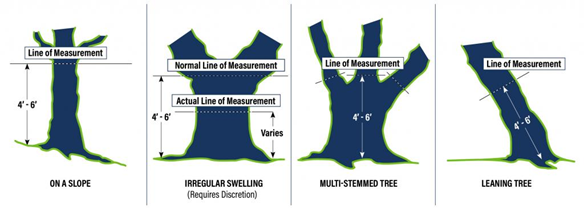
C.
Tree protection plan.
1.
A tree preservation plan shall be submitted to the town before any clearing or construction takes place and before any building permit is issued. Such a plan will become part of the building permit application file and will be considered part of the building and site approval permit. The preservation plan shall contain the following basic information:
a.
Interest and ownership. The name, address, phone number and signature of the property owner and proof of ownership.
b.
Zoning classification. The present zoning classification of the property and all property within five hundred (500) feet.
c.
Property survey. Ground survey provided by a licensed surveyor, drawn to scale. Survey shall include all existing site features (buildings, streets, paving, etc.)
d.
Tree survey. Survey of all trees over eight (8) inches DBH and larger for all trees located on the property and within the right-of-way. The data which must be obtained in the field are tree locations, trunk diameters, and species. Tree surveys are only accurate for five (5) years due to changes in tree health and trunk growth. Failure to submit accurate and complete information at the time of application may result in delays in the permitting process.
e.
[Tree removal identification.] All trees proposed to be removed shall be clearly identified on the plan including tree type and DBH size.
f.
[Site plan.] Trees to be preserved shall be shown on the site plan, with location, species, and DBH. Preserved trees shall be protected by a barrier fence consistent with article V general provisions section 5.2.J. All applications shall show tree protection on plans.
g.
Critical root zone (CRZ). The CRZ denotes the area surrounding the tree where root protection is important to tree survival. Every one (1) inch of tree diameter equals one (1) foot radius of CRZ. For example, a twenty-inch tree will have a CRZ which is twenty-foot radius from the center of the tree trunk. In plan, the CRZ shall be denoted with a dashed line. The half and quarter critical root zones are also used by staff to evaluate the likelihood of tree survival. Attached hereto as exhibit B is a diagram showing how the CRZ is calculated along with how the one-half (½) and one-fourth (¼) CRZ are determined.
Exhibit B
D.
Standard tree preservation requirements. This section of the ordinance identifies tree preservation requirements and impacts that constitute removal of regulated trees.
1.
Critical root zone. While the full root zone of the tree may extend three (3) to four (4) times the diameter of the tree's dripline, the critical root zone (CRZ) is an area surrounding the tree where root protection is important to tree survival. Critical root zone impacts reduce a tree's likelihood of survival. Impacts include:
a.
Digging, trenching, or excavating;
b.
Soil compaction; grade changes; and
c.
Chemical exposure and spills.
2.
[Impacts.] Impacts may be allowed within the CRZ as long as the following preservation criteria are met.
a.
At least fifty (50) percent of the total area (square footage) of the CRZ must be preserved at natural grade, with natural ground cover.
b.
The entirety of the half CRZ must be protected, with the exception that cut or fill of four (4) inches or less is allowed within the half CRZ.
c.
No cut or fill is allowed within the quarter CRZ.
3.
Construction impacts. Construction impacts shall not exceed the requirements listed above. Construction impacts are any impacts necessary to build what is shown on plans. Examples include site access, material staging, scaffolding locations, concrete form bracing, over excavation, utility excavations, post holes for fences, grade changes, trenching, and paving.
4.
Pruning. Not more than twenty-five (25) percent of the foliage shall be removed within an annual growing season.
E.
Alternative compliance methods. The methods below may allow for exceptions to the standard preservation requirements list in this ordinance. The use of these methods is at the discretion of the town.
1.
Remedial tree care. Tree care plan proposal shall be prepared and implemented by a qualified, licensed arborist, address specific impacts, and conform to the ANSI A300 standard for tree care and industry best practices.
2.
Low impact excavation. Low-impact excavation such as hand diffing or compressed air (air spading) may be permitted at the discretion of the town. Root diameters of one and one-half (1½) inches shall not be damaged unless approved in writing by a qualified, licensed arborist.
3.
Elevated foundations. Elevated foundations may be allowed within the half critical root zone. Elevated foundation may not span or impact.
F.
Transplants. Transplanting trees may be an option at the discretion of the town. Transplanting large trees has a significant risk for tree mortality and shall be performed under the direction of a licensed arborist.
G.
Mitigation. The primary forms of mitigation against impact on or removal of protected trees is the planting of appropriate replacement trees or payment into the tree mitigation fund in an amount equivalent to the cost thereof.
1.
Mitigation rates.
a.
Protected class A and class B trees.
i.
Class A tree (see section 5, Table 5.4.) One hundred (100) percent of the tree's caliper inches must be replaced with a class A tree(s).
ii.
Class B trees (see section 5, Table 5.5.) Fifty (50) percent of the tree's caliper inches must be replaced with either a class A or class B tree(s).
b.
Live oaks. Nineteen (19) inches to 29.9 inches DBH.
i.
One hundred (100) percent of the tree's caliper inches must be replaced with a new live oak tree(s). Minimum new tree planting size is six (6) inches DBH.
c.
Live oaks. Greater than thirty (30) inches DBH.
i.
Three hundred (300) percent of the tree's caliper inches must be replaced with a new live oak(s) if variance is granted. Minimum new tree planting size is six (6) inches DBH.
2.
Mitigation exempt. Mitigation is not required if the removed protected tree is:
a.
Dead, diseased, or imminent hazard; or
b.
Undesirable/invasive species as previously listed.
3.
Forms of mitigation. Acceptable forms of mitigation and requirements include:
a.
Replacement of trees per rates listed above.
b.
New trees must be maintained for a period of eighteen (18) months. If the replacement tree dies within eighteen (18) months of installation, it must again be replaced in the same manner.
c.
If space on-site is not available for replacement trees, or replacement is not otherwise feasible, mitigation in the form of a payment to the tree mitigation fund in an amount calculated at two hundred dollars ($200.00) per caliper inch of a tree that otherwise would have been required mitigation.
4.
Penalties. Any property owner who violates this ordinance can be fined up to five hundred dollars ($500.00) per day for each violation until permit application is filed.
(Ord. No. 2023-8, 11-28-23)

