
Saint Paul Park City Zoning Code
ARTICLE V
- OFF-STREET PARKING REQUIREMENTS7
Editor's note— Ord. No. 668, § 1, adopted April 18, 2011, repealed the former Art. V, §§ 74-256—74-265, and enacted a new Art. V as set out herein. The former Art. V pertained to similar subject matter and derived from §§ 15.090—15.099 of the 1982 Code; Ord. No. 585, § 1, 7-7-03.
Sec. 74-256.- Purpose.
The regulation of off-street parking spaces and driveways as set out in this article is to alleviate or prevent congestion of the public right-of-way and to promote the safety and general welfare of the public by establishing minimum requirements for off-street parking of motor vehicles and property access in accordance with the utilization of various parcels of land or structures.
(Ord. No. 668, § 1, 4-18-11)
Sec. 74-257. - Applicability.
The regulations and requirements set forth in this article shall apply to all off-street parking facilities and property accesses in all zoning districts of the city.
(Ord. No. 668, § 1, 4-18-11)
Sec. 74-258. - Site plan drawing required.
All applications for a building or an occupancy permit in all zoning districts shall be accompanied by a site plan drawn to scale and dimensioned indicating the location of off-street parking and loading spaces in compliance with the requirements set forth in this article.
(Ord. No. 668, § 1, 4-18-11)
Sec. 74-259. - Area, space, design and other requirements.
(a)
Floor area. The term "floor area" for the purpose of calculating the number of off-street parking spaces required shall be determined on the basis of the exterior floor area dimensions of the building, structure or use times the number of floors, minus ten percent, except as may be provided or modified in this article.
(b)
Reduction of existing off-street parking space or lot area. Off-street parking spaces and loading spaces or lot area existing upon the effective date of this chapter shall not be reduced in number or size unless such number or size exceeds the requirements set forth in this chapter for a similar new use.
(c)
Nonconforming structures. Should a nonconforming structure or use be damaged or destroyed by fire, it may be reestablished if elsewhere permitted in this chapter, except that in doing so, any off-street parking or loading space which existed before such damage or destruction shall be retained.
(d)
Change of use or occupancy of land. No change of use or occupancy of land already dedicated to a parking area, parking spaces, or loading spaces shall be made, nor shall any sale of land, division or subdivision of land be made which reduces the area necessary for parking, parking stalls, or parking requirements below the minimum prescribed by this chapter.
(e)
Change of use or occupancy of buildings. Any change of use or occupancy of any building or buildings including additions thereto requiring more parking area shall not be permitted until there is furnished such additional parking spaces as required by these zoning regulations.
(f)
Off-street parking facilitates accessory to residential use. Off-street parking facilitates accessory to residential structures shall be utilized solely for the parking of licensed and operable passenger automobiles; no more than one truck licensed by any state with a gross weight not to exceed 12,000 pounds as defined in M.S.A. § 168.001(16); and recreational vehicles and equipment. Under no circumstances shall required parking facilities accessory to residential structures be used for the storage of commercial vehicles or equipment or for the parking of automobiles belonging to the employees, owners, tenants, or customers of business or manufacturing establishments except as provided in section 74-388.
(g)
Calculating space.
(1)
When determining the number of off-street parking spaces results in a fraction, each fraction shall constitute another space.
(2)
In stadiums, sport arenas, churches and other places of public assembly in which patrons or spectators occupy benches, pews or other similar seating facilities, each 22 inches of such seating facilities shall be counted as one seat for the purpose of determining off-street parking requirements.
(3)
Except as provided for under joint parking and shopping centers, should a structure contain two or more types of use, each use shall be calculated separately for determining the total off-street parking spaces required.
(h)
Stall, aisle, and driveway design and general requirements.
(1)
Parking space size. Each parking space shall be not less than nine feet wide and 20 feet in length exclusive of access aisles, and each space shall be served adequately by access aisles.
(2)
Within structures. The off-street parking requirements may be furnished by providing a space so designed within the principal building or one structure attached thereto; however, unless provisions are made, no building permit shall be issued to convert such parking structure into a dwelling unit or living area or other activity until other adequate provisions are made to comply with the required off-street parking provisions of this article.
(3)
Except in the case of single-family, two-family, townhouse and quadraminium dwellings, parking areas shall be designed so that circulation between parking bays or aisles occurs within the designated parking lot and does not depend upon a public street or alley. Except in the case of single-family, two-family, townhouse and quadraminium dwellings, parking area design which requires backing into the public street is prohibited.
(4)
All single family homes, townhomes, and duplexes shall be constructed with a minimum 440 square foot garage for each unit.
(5)
No property access point or curb cut access shall be located less than 40 feet from the intersection of two or more street rights-of-way. This distance shall be measured from the intersection of lot lines.
(6)
Except in the case of single-family, two-family, townhouse and quadraminium dwellings, parking areas and their aisles shall be developed in compliance with the following standards:
Parallel parking: 22 feet in length.
(7)
No property access drive within the public right-of-way or curb cut shall exceed 24 feet in width unless approved by the public works supervisor.
(8)
All property access drives and/or curb cut openings shall be a minimum of five feet from the side yard property line in all districts.
(9)
Except for single-family, two-family, and townhouse dwelling units, there shall be no curb cut openings or property access drives located less than 40 feet from one another.
(10)
The grade elevation of any parking area shall not exceed five percent.
(11)
The number of property access drives and/or curb cuts shall be determined by the following process:
a.
One property access drive, whether via an alley or curb cut, shall be allowed per single family, two-family, and townhome dwelling unit. Any additional property access points for such a residence shall only be allowed when approved by the city administrator or designee when meeting the standards of section 74-267 in the following instances:
i.
The proposed access drive is not out of character with the surrounding neighborhood.
ii.
Practical difficulties are present necessitating a second access point such as topography, obstructions, or other impediments.
b.
More than one property access drive meeting the performance standards of this ordinance may be allowed for commercial, industrial, institutional, or multi-family properties not mentioned above when approved by the city administrator or designee when meeting the standards of section 74-267.
(12)
Surfacing. Within one year of issuance of a building permit, all areas intended to be utilized for parking space and driveways shall be surfaced with materials suitable to control dust and drainage such as concrete, bituminous, or pavers. Driveways and stalls shall be surfaced with a six-inch class 5 base and two-inch bituminous topping at minimum. Plans for surfacing and drainage of driveways and stalls for five or more vehicles shall be submitted to the city engineer for his review and the final drainage plan shall be subject to the city engineer's written approval.
(13)
Striping. Except for single-family, two-family, townhouse, and quadraminium dwellings, all parking stalls shall be marked with white paint lines not less than four inches wide.
(14)
Lighting. Any lighting used to illuminate an off-street parking area shall be so arranged as to reflect the light away from adjoining property, abutting residential uses and public rights-of-way and be in compliance with section 74-224.
(15)
Signs. No sign shall be so located as to restrict the sight lines and orderly operation of traffic movement within any parking lot, and such signs shall not be a part of the permitted advertising space. All signs shall conform to any other applicable ordinance.
(16)
Curbing and landscaping. Except for single-family, two-family, and townhouse dwelling units, all open off-street parking shall have a perimeter curb barrier around the entire parking lot, such barrier not to be closer than five feet to any lot line. Grass, plantings or surfacing material shall be provided in all areas bordering the parking area.
(17)
Required screening. All open, off-street parking areas of five or more spaces shall be screened and landscaped from abutting or surrounding residential districts in compliance with section 74-222.
(18)
Shared driveways may be permitted in commercial and industrial districts and multi-family developments provided they meet all other performance standards, appropriate easements are filed, and are approved by the city engineer.
(19)
No direct single-family, two-family, or townhouse residential driveway access shall be allowed onto a designated collector or arterial street unless no other practical alternative exists and the access is approved by the city engineer.
(20)
Drive aisle width. All two-way traffic drive aisles in commercial, industrial, and multi-family districts shall be 24 feet in width unless otherwise approved by the city engineer.
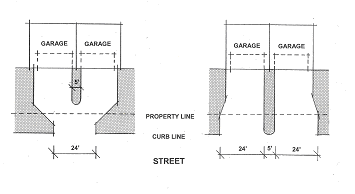
(21)
Townhome and duplex driveways. All driveways to townhome, duplex, and other similar multi-family units shall be separated by a minimum of five feet of landscaped area:
(i)
Disability parking shall be provided per the applicable state and federal standards, whichever is more restrictive.
(Ord. No. 668, § 1, 4-18-11)
Sec. 74-260. - Maintenance.
It shall be the joint and several responsibility of the lessee and owner of the principal use, uses or building to maintain in a neat and adequate manner the parking space, accessways, striping, landscaping, and required fences in the off-street parking facilities.
(Ord. No. 668, § 1, 4-18-11)
Sec. 74-261. - Location restrictions.
All accessory off-street parking facilities required by this chapter shall be located and restricted as follows:
(a)
Required accessory off-street parking shall be on the same lot under the same ownership as the principal use being served, except under the provisions of sections 74-264 and 74-265.
(b)
Except for single-family, two-family, townhouse and quadraminium dwellings, head-in parking, directly off of and adjacent to a public street, with each stall having its own direct access to the public street, shall be prohibited.
(c)
There shall be no off-street parking within 15 feet of any street surface.
(d)
The boulevard portion of the street right-of-way shall not be used for parking.
(e)
Setback area. Unless otherwise permitted within district standards, required accessory off-street parking shall not be provided in required front yards, or in required corner lot side yards in R-1 and R-2 districts.
(f)
In the case of single-family, two-family, and townhome dwelling units, parking shall be prohibited in any portion of the front yard except designated driveways leading directly into a garage or one open, surfaced space located on the side of a driveway, away from the principal use. Such extra space shall be surfaced with concrete or bituminous material.
(Ord. No. 668, § 1, 4-18-11; Ord. No. 762, § 6, 1-17-23)
Sec. 74-262. - Use of required area.
Required accessory off-street parking spaces in any district shall not be utilized for open storage, sale or rental of goods, storage of inoperable vehicles as regulated by section 74-229, and/or storage of snow.
(Ord. No. 668, § 1, 4-18-11)
Sec. 74-263. - Number of spaces required.
The following minimum number of off-street parking spaces shall be provided and maintained by ownership, easement and/or lease for and during the life of the respective uses set forth in this section:
(a)
Single-family, two-family, and townhouse units: Two spaces per unit provided in a garage minimum of 440 square feet in area. Townhouses shall provide one-fourth space per unit for guest parking.
(b)
Multiple-family dwellings, not including duplexes and townhomes: At least two free spaces per unit and one-fourth space per unit for guest parking. One space per unit shall be provided in a garage.
(c)
Church, theatre, auditorium: At least one parking space for each four seats based on the design capacity of the main assembly hall. Facilities as may be provided in conjunction with such buildings or uses shall be subject to additional requirements which are imposed by this article.
(d)
Private athletic stadiums: At least one parking space for each eight seats of design capacity.
(e)
Sanitariums, convalescent home, rest home, nursing home or day nurseries: Four spaces plus one for each three beds for which accommodations are offered.
(f)
Elderly (senior citizen) housing: At least one parking space for each unit, provided, however, that only one parking space for each two units need be provided when any such project is initially developed; and provided further, however, that after initial development, the city council may require additional parking spaces for any such development if the council finds that a need exists for such additional spaces.
(g)
Drive-in establishment and convenience food: At least one parking space for each 15 square feet of gross floor area, but not less than 15 spaces.
(h)
Office buildings, animal hospitals and professional offices: Three spaces plus at least one space for each 200 square feet of floor area.
(i)
Motor fuel station: At least four off-street parking spaces plus two off-street parking spaces for each service stall. Those facilities designed for sale of other items than strictly automotive products, parts or service shall be required to provide additional parking in compliance with other applicable sections of this article.
(j)
Retail store and service establishment: At least one off-street parking space for each 200 square feet of floor area.
(k)
Retail sales and service business with 50 percent or more of gross floor area devoted to storage, warehouses and/or industry: At least eight parking spaces or one space for each 200 square feet devoted to public sales or service plus one space for each 500 square feet of storage area; or at least eight spaces or one space for each employee on the maximum shift, whichever is appropriate.
(l)
Restaurants, cafes, private clubs serving food and/or drinks, bars, on-sale nightclubs: At least one parking space for each 40 square feet of gross floor area of dining and bar area and one space for each 80 square feet of kitchen area.
(m)
Auto repair, major bus terminal, taxi terminal, boat and marine sales and repair, bottling company, shop for trade employing six or less people, garden supply store, building material sales in structure: Eight off-street parking spaces, plus one additional space for each 800 square feet of floor area over 1,000 square feet.
(n)
Manufacturing, fabricating or processing of a product or material: One parking space for each 350 square feet of floor area, plus one space for each company owned truck, if not stored inside the principal building.
(o)
Warehousing, storage or handling of bulk goods: That space which is solely used as office shall comply with the office use requirements and one parking space for each 1,000 square feet of floor area, plus one space for each employee on the maximum shift and one space for each company owned truck, if not stored inside the principal building.
(p)
Car wash: In addition to required magazining or stacking space:
(1)
Automatic drive-through, serviced: A minimum of ten parking spaces, or one space for each employee on the maximum shift, whichever is greater.
(2)
Self-service: A minimum of two parking spaces.
(3)
Motor fuel station car wash: Zero parking spaces in addition to that required for the station.
(q)
Shopping centers: Five and one-half parking spaces for each 1,000 square feet of gross leasable floor area, exclusive of common areas.
(r)
Other uses: Other uses not specifically mentioned in this section shall be determined on an individual basis by the city council. Factors to be considered in such determination shall include, without limitation:
(1)
Size of building;
(2)
Type of use;
(3)
Number of employees;
(4)
Expected volume and turnover of customer traffic; and
(5)
Expected frequency and number of delivery or service vehicles.
(s)
Uses within the B-1 district are not required to provide the minimum parking herein with the exception of residential uses in commercial buildings which shall provide one space per bedroom with no garage requirement.
(t)
Residential uses in the MX-1A, MX-2A, and MX-2B districts shall provide one space per bedroom with no garage requirement.
(Ord. No. 668, § 1, 4-18-11; Ord. No. 762, § 7, 1-17-23)
Sec. 74-264. - Joint facilities.
The city council may, after receiving a report and recommendation from the planning commission, approve a conditional use permit for one or more businesses to provide the required off-street parking facilities by joint use of one or more sites where the total number of spaces provided are less than the sum of the total required for each business should they provide them separately. When considering a request for such a permit, the planning commission shall not recommend that such permit be granted nor shall the council approve such a permit except when the following conditions are found to exist:
(a)
Up to 50 percent of the parking facilities required for a theatre, bowling alley, dancehall, bar or restaurant may be supplied by the off-street parking facilities provided by types of uses specified as primarily daytime uses in subsection (d) of this section.
(b)
Up to 50 percent of the off-street parking facilities required for any use specified under subsection (d) of this section as primary daytime uses may be supplied by the parking facilities provided by the following nighttime or Sunday uses: auditoriums incidental to a public or parochial school, churches, bowling alleys, dancehalls, theatres, bars, apartments, or restaurants.
(c)
Up to 80 percent of the parking facilities required by this section for a church or for an auditorium incidental to a public or parochial school may be supplied by the off-street parking facilities provided by uses specified under subsection (d) of this section as primarily daytime uses.
(d)
For the purpose of this section, the following uses are considered as primarily daytime uses: banks, business offices, retail stores, personal service shops, household equipment or furniture shops, clothing or shoe repair or service shops, manufacturing, wholesale and similar uses.
(e)
Conditions required for joint use:
(1)
The building or use for which application is being made to utilize the off-street parking facilities provided by another building or use shall be located within 300 feet of such parking facilities.
(2)
The applicant shall show that there is no substantial conflict in the principal operating hours of the two buildings or uses for which joint use of off-street parking facilities is proposed.
(3)
A properly drawn legal instrument, executed by the parties concerned for joint use of off-street parking facilities, duly approved as to form and manner of execution by the city attorney, shall be filed with the city administrator and recorded with the county recorder of deeds.
(Ord. No. 668, § 1, 4-18-11)
Sec. 74-265. - Off-site parking.
(a)
Any off-street parking which is used to meet the requirements of this article shall be a conditional use as regulated by section 74-91 and shall be subject to the conditions listed in this section.
(b)
Off-site parking shall be developed and maintained in compliance with all requirements and standards of this chapter.
(c)
Reasonable access from off-site parking facilities to the use being served shall be provided.
(d)
The site used for meeting the off-site parking requirements of this article shall be under the same ownership as the principal use being served or under public ownership.
(e)
Off-site parking for multiple-family dwellings shall not be located more than 100 feet from any normally used entrance of the principal use being served.
(f)
Off-site parking for nonresidential uses shall not be located more than 300 feet from the main entrance of the principal use being served. No more than one main entrance shall be recognized for each principal building.
(g)
Any use which depends upon off-site parking to meet the requirements of this article shall maintain ownership and parking utilization of the off-site location until such time as on-site parking is provided or a site in closer proximity to the principal use is acquired and developed for parking.
(Ord. No. 668, § 1, 4-18-11)
Sec. 74-266. - Proof of parking requirements.
The city may allow reductions in the number of required parking spaces to be installed by conditional use under one or more of the following circumstances:
(a)
The unique characteristics of the proposed use are such that it will generate a need for less parking than the ordinance standard; or
(b)
All requests for reductions in the amount of required parking to be installed shall be accompanied by a plan showing where the total required parking spaces can be added on the lot, if necessary, up to the total amount required by this article, (meeting green area requirements) without requiring a variance.
(Ord. No. 668, § 1, 4-18-11)
Sec. 74-267. - Driveway permits required.
All new, relocated, or expanded property access drives and/or other driveways shall require a permit prior to construction in compliance with the following:
(a)
Application. An applicant for a permit under this article shall file with the city administrator an application setting forth:
(1)
The name, address, and means of contact for the applicant.
(2)
The name, address, and means of contact for the contractor doing the work.
(3)
Site plan showing the location of the proposed driveway and related improvements or restoration.
(4)
Specifications of the construction method and materials constituting the proposed driveway and related improvements or restoration.
(5)
Any other information requested by the city administrator or designee necessary for the determination whether a permit shall be issued under this article.
(b)
Standards for issuance. The city administrator shall issue a permit under this article when it is found that:
(1)
The work will be done in accordance to standard specifications of the city for such work.
(2)
The driveway or access point proposed will not constitute a traffic hazard with respect to either vehicular or pedestrian traffic.
(3)
The proposed driveway or access point shall not unreasonably impair public health, safety, or welfare.
(4)
The work shall be done in conformance with chapter 58 of the City Code.
(c)
Denials. If the city administrator denies a permit under this article, the applicant shall be notified in writing and shall set forth the reasons for denying the permit.
(d)
Appeals. Any person who has had such a permit denied may appeal the request as set forth in section 74-121(b).
(e)
Fee. The fee for a permit shall be in such amount as set forth in chapter 42, which shall be paid at the time of the making of the application therefore. This fee may be waived when the driveway is being constructed in conjunction with a building permit for a structure the driveway is intended to access.
(Ord. No. 668, § 1, 4-18-11)

