
Saluda City Zoning Code
CHAPTER 3
- GENERAL PROVISIONS
Sec. 3.1. - Applicability.
The following provisions shall apply throughout the jurisdiction of this ordinance, regardless of the underlying regulating district.
Sec. 3.2. - Compliance to ordinance for increases on improvements of existing uses.
3.2.1.
All general and district requirements shall apply to an existing conforming use increasing in parking area and/or building area by at least ten percent, especially landscaping, parking, and fence standards.
Sec. 3.3. - Fence and wall standards.
Except as otherwise noted in this ordinance, fences or walls are permitted in the various districts subject to the following regulations:
3.3.1.
Residential use.
A.
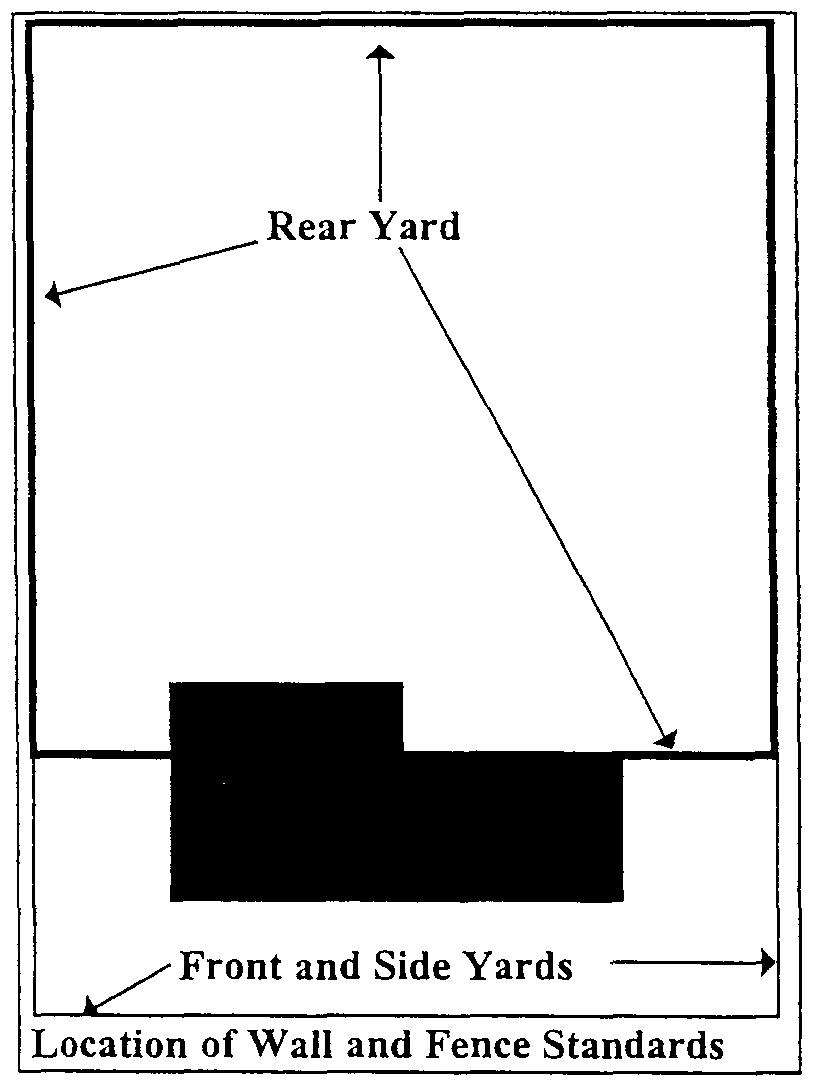
Rear yard fences and walls.
1.
Max. height: Eight feet.
B.
Side and front yard fences.
1.
Max. Height: Eight feet.
2.
Materials: Chain link, wrought iron, hedge or wood or other pre-manufactured fences.
3.3.2.
Commercial and industrial use.
A.
Rear yard fences and walls.
1.
Max. height: Eight feet.
2.
Materials: Brick, stucco, chain link (barbed wire is permitted for rear yard fences not visible from a street), wrought iron, stone, wood, concrete, or combinations of the above. When [a] combination of two or more materials is used, the heavier material shall be below.
B.
Side and front yard fences and walls.
1.
Max. height: five feet (exceptions: required screening for the affected district).
2.
Materials: brick, stucco, chain link (barbed wire is permitted for side yard fences not visible from a street), wrought iron, stone, wood, concrete, or combinations of the above. When [a] combination of two or more materials is used, the heavier material shall be below.
3.3.3.
Civic and institutional use.
A.
Fences and walls in all yards.
1.
Max. height: eight feet.
2.
Materials: brick, stucco, wrought iron, stone, wood, concrete, or combinations of the above. When [a] combination of two or more materials is used, the heavier material shall be below.
(Ord. No. 2014-006, § 1, 10-7-2014)
Sec. 3.4. - Temporary structures.
3.4.1.
Temporary structures and uses, when in compliance with all applicable provisions of the ordinance, and all other ordinances of the town shall be allowed. The following temporary structures and uses shall be permitted.
3.4.2.
Construction trailers. Trailers used in conjunction with construction projects provided that the following conditions are met:
A.
Such construction trailers may be located at a building site where there is a valid building permit for the construction project, or, in the case of a residential subdivision, a valid building permit for at least one of the residential units being constructed.
B.
All construction trailers shall be located at least ten feet off any street right-of-way and not be placed in any required rear or side yard setbacks.
C.
All construction trailers shall be removed within one month of the completion of the project or issuance of the certificate of occupancy.
3.4.3.
Temporary sales or events. Uses less than 30 days in duration and held no more than three times per year at any particular location) which would not otherwise be permitted in a particular zoning district may be issued a temporary permit as herein provided. Upon completion and submittal of an application, the zoning administrator may grant a zoning permit for the following temporary uses:
A.
Seasonal retail goods.
B.
Sidewalk sales.
C.
Revivals.
D.
Shows for civic and youth organizations.
E.
Fairs, carnivals, or other similar public activities.
The permit shall be valid for a specified period only, not to exceed 45 days in duration.
3.4.4.
Temporary manufactured homes. Manufactured homes may be allowed on a temporary basis in a zoning district in which such use in not listed as a permitted use, if a disaster occurs which results in an occupied single-family dwelling being destroyed (i.e., it receives damage greater than 60 percent of its tax value). The purpose of allowing such manufactured home on said lot is to give the occupants of the destroyed dwelling unit a place to live while a new dwelling unit is being constructed or repaired. If a manufactured home is used for such an occurrence, it is subject to the following conditions:
A.
Such manufactured home shall not be placed in the front yard and shall be located no closer than 15 feet to another structure and no closer than ten feet to any lot line.
B.
The zoning administrator shall be given the authority to issue a zoning permit for such temporary use on a one-time basis only for a period of up to nine months. Such permit may be renewed on a one-time only basis if it is determined that:
1.
Construction of a new dwelling unit is proceeding in a diligent manner; and
2.
The granting of such permit will not materially endanger the public health, welfare, or safety; and
3.
The location of the manufactured home on the site does not have a negative effect on abutting properties.
3.4.5.
Other temporary uses. All other such temporary uses not otherwise listed may be granted a temporary zoning permit only after the zoning administrator has made the following determinations:
A.
The proposed use shall not materially endanger the public, health, welfare, and safety; and
B.
The proposed use shall not have a substantial negative effect on adjoining properties.
C.
Temporary permits shall be applied for ten days in advance of the event or function.
D.
A separate permit shall be obtained for each event.
In approving such a temporary permit, the zoning administrator may authorize conditions regarding duration of the use, hours of operation, signage, lighting, etc. and such conditions shall be made part of the permit issued. Violations of such conditions shall be considered a violation of this ordinance.
Sec. 3.5. - Vibration, light, noise, and odor.
3.5.1.
Vibration. No inherent and recurring generated vibration shall be perceptible without instruments at the property line.
3.5.2.
Light. The source of exterior lighting shall not be arranged in such a manner as to be detrimental to adjacent properties or the traveling public.
3.5.3.
Noise. No persistent noise shall be detectable beyond the property line in excess of the average level of street and traffic noise generally heard at the point of observation, and no noise below such level shall be objectionable with respect to intermittence, beat, frequency, or shrillness.
3.5.4.
Odor. No objectionable odor shall be detectable beyond the property line and the emission of odors, regardless of type shall not be such as to be detrimental to the value and use of adjacent property.
Sec. 3.6. - Yard and garage sales.
Yard, garage, tag, patio, and apartment sales must obtain a permit from town hall and have permission of the property owner or leaser of the lot, as an accessory use on any residentially or institutionally developed lot in any district. Such sale shall be limited to no more than two sales per year on the same lot and are subject to the existing rules and regulations of the town.
Sec. 3.7. - Home occupations.
A home occupation shall be permitted in any residential district or structure provided that such occupation:
A.
Is conducted by members of the family residing in the dwelling and are permitted to be engaged in such occupation;
B.
Employs only members of the immediate family residing in the dwelling;
C.
Is conducted within the principal building;
D.
Utilizes not more than 25 percent of the total floor area of principal building;
E.
Produces no alteration or change in the character or exterior appearance of the principal building from that of a dwelling;
F.
Retail sales, other than items crafted on the premises, should be related to the main item crafted in connection with the home occupation;
G.
No display of products shall be visible from the street;
H.
Is not visibly evident from outside the dwelling, except for the permitted sign. (See section 3.10, signs);
I.
Does not generate traffic in greater volumes than would normally be expected in a residential neighborhood. Any need for parking shall be met by off-street parking and other than in a required front yard.
Sec. 3.8. - Pets, kennels, animals.
3.8.1.
Farm animals. The keeping of one or more horses, ponies, mules, donkeys, cows, goats, chickens or other fowl.
A.
Minimum lot area: 100,000 square feet.
B.
Stables, corrals, and piles of manure, feed, and bedding shall be located 75 feet from any street or property line in order to minimize odor and nuisance problems.
3.8.2.
Private kennel. Kennel shall mean any place in or at which dogs, cats, or other household pets are kept, except for the primary purpose of grooming, in numbers greater than the following;
A.
Two unspayed male or female cats and two unspayed male or female dogs over the age of six months upon any lot.
B.
Four unspayed male or female cats and four unspayed male or female dogs over the age of six months subject to the following provisions:
1.
Minimum lot size of 20,000 square feet or more.
2.
Such dogs shall be kept not less than 25 feet from all property lines.
C.
Additional unspayed pets above the six allowed in subsection B of this section may be kept, provided that, in addition to the requirements those requirements, the setback is increased ten feet not to exceed a maximum of 100 feet and the lot area is increased 10,000 square feet for each additional two unspayed pets.
D.
This section shall not apply to any veterinary hospital, animal hospital or any other establishment or premises wherein or whereon the practice of veterinary medicine, surgery, or dentistry, or any part thereof, is conducted.
Sec. 3.9. - Private swimming pools and tennis courts.
3.9.1.
Pools and tennis courts, including but not limited to aprons, walls, and equipment rooms, shall not protrude into any setbacks.
3.9.2.
This use shall be fenced or otherwise protected against intrusion.
Sec. 3.10. - Signs.
3.10.1.
Signs are considered to be structures and the regulations herein shall apply and govern in all zoning districts. No sign shall be erected or maintained unless it is in compliance with this section and the additional requirements located in Chapter 4 for the specific zoning district.
3.10.2.
A permit shall be required for the erection, alteration, relocation, or reconstruction of permitted signs unless otherwise noted, and shall be issued by the zoning administrator in accordance with Chapter 5.
3.10.3.
Signs must be constructed of durable materials, maintained in good condition, and not permitted to become dilapidated.
3.10.4.
Nonconforming signs.
A.
A nonconforming sign shall not be extended or enlarged except in conformity with the provisions of this ordinance.
B.
A nonconforming sign damaged more than 50 percent of its reasonable replacement cost shall not be rebuilt, altered, repaired, or replaced except in conformity with the provisions of this ordinance.
C.
A nonconforming off-premise advertising sign may be converted to a digital surface display area, provided that such conversion shall not in any way increase the existing degree of nonconformity with the provisions of this ordinance. Conversion of a non-conforming off-premise advertising sign to a digital surface display area, which allows static images to be changed instantly, must abide by the following restrictions:
1.
A permit to replace the nonconforming off-premise advertising sign display surface area with an equal or lesser digital surface area shall first be obtained in accordance with section 3.10.2 of this ordinance. A digital surface display area must be erected within one (1) year of the issuance of a permit or such permit shall become null and void.
2.
Images displayed must be static messages and the content shall not include animated, flashing, moving, scrolling, or full-motion video elements.
3.
The static images displayed may be changed in succession at a rate no faster than once every six (6) seconds.
4.
Spacing of digital faces of these signs which are visible from the same direction shall not be closer than 2,000 feet apart.
5.
All digital advertising signs shall have an automatic dimmer and a photo cell sensor to adjust the illumination intensity or brilliance of the sign so that it shall not cause glare or impair the vision of motorists. These signs shall not exceed a maximum illumination of 7,500 nits (candelas per square meter) during daylight hours and a maximum illumination of 500 nits between dusk to dawn, as measured from the sign face at maximum brightness.
6.
All digital advertising signs shall abide by the requirements of the State of South Carolina Department of Transportation, which regulates off-premise advertising signs on interstate and federal aid road systems. A permit from the State of South Carolina may contain some restrictions which are in addition to the requirements of this ordinance. Issuance of a Town of Saluda Zoning Permit for signage or permission to install digital signage does not imply approval of, or constitute a privilege to violate, any other applicable state or local ordinances, codes, laws, or private restrictive covenants.
3.10.5.
Prohibited signs.
A.
Sign imitating warning signals. No sign or structure shall display flashing or intermittent lights of any type, nor shall any colored lights be utilized for sign purposes that resemble lights utilized on emergency vehicles, including police, fire, EMS, towing, and rescue vehicles; nor shall any sign use the words "Stop", "Danger", or any other that may confuse an automobile or other vehicle driver.
B.
Signs within street or highway rights-of-way. Except traffic signs and signals, information signs erected by or authorized by a governmental or other public agency.
C.
Certain attached and painted signs. Signs painted on or attached to trees, fence posts, and telephone poles or other utility poles or signs painted on or attached to rocks or other natural features.
D.
Fluttering ribbons and banners. Except the flags of governments and their agencies.
E.
Off-premise advertising signs as defined in section 2.3. Any off-premise advertising sign in existence at the time of adoption of this ordinance shall be deemed a legal nonconforming sign.
3.10.6.
Signs for which a permit is not required.
A.
Traffic, directions, warning, or information signs authorized by any public agency.
B.
Official notices issued by any court, public agency, or officer.
C.
Nonilluminated "for sale," "for rent," or "for lease" signs not exceeding 12 square feet.
D.
One permitted home occupation sign, provided it is non-illuminating, no larger than one square foot, and mounted against a wall of the principal building.
E.
Nonilluminated signs not exceeding 12 square feet on work under construction, such as nonilluminated signs displaying the contractors, subcontractors, architects, engineers, owners, financial, selling, and development agencies.
F.
Political signs. These signs shall not be placed more than 90 days before an election and must be removed ten days after the election. These signs may only be erected on private property and not on the public right-of-way.
1.
Notice of violation. Ten days after the election, the zoning administrator shall send notice of the sign violation by registered mail, return receipt requested, to the owner of the land on which the sign is located and the violator who is responsible for the sign. Within five days of receipt or refusal of the order, the owner or violator must remove the sign.
2.
Fines. Failure to comply with the zoning administrator's order shall constitute a civil violation. Admission of liability or finding of liability shall be punishable by a fine of $100.00 for each individual charge. Each day during which the violation is found to have existed shall constitute a separate offense.
3.10.7.
Removal of signs. Whenever a sign becomes structurally unsafe or endangers the safety of a structure or premises or the public, or is erected or maintained in violation of this ordinance, the zoning administrator shall order such sign to be made safe or comply with [this] ordinance, as the case may be, or be removed. Such order shall be sent to the owner of the land on which the sign is located by registered mail and shall be complied with within 12 days from the date of mailing or such time as the zoning administrator may deem appropriate. Failure to comply shall constitute ground for the zoning administrator to have the sign removed, and the cost thereof shall be added to any fine imposed for violation under this ordinance.
(Ord. No. 2019-01, §§ 2, 3(Exh. A), 4-2-2019)
Sec. 3.11. - Landscaping.
3.11.1.
Intent. These regulations are established to protect and enhance the natural landscape of Saluda and ensure the appropriate use of plant material in new construction. It is the intent of these regulations to preserve natural tree cover and establish new tree planting with development in order to:
A.
Reinforce community identity.
B.
Reduce visual blight and noise.
C.
Increase building and property values.
D.
Prevent soil erosion.
E.
Reduce stormwater runoff.
F.
Create shade and reduce solar overheating.
3.11.2.
Landscaping is required as described in chapter 4 for the specific zoning district to provide for buffering of adjacent zones, sound and light abatement, and screening of commercial uses and parking. All required landscaping shall be installed and maintained in compliance to the following general requirements:
A.
All plant material installed shall be healthy and of the best quality.
B.
All trees shall be a minimum two inch caliper at breast height at installation.
C.
A maintenance agreement for the plant material shall be included in the property covenant.
D.
Maintenance and replacement per the original approved plan of damaged, destroyed, or dead plant materials is the responsibility of the property owner.
E.
Plant material shall be bonded for one year. A planting schedule shall be included in the bond and shall be based on seasonal considerations.
F.
Landscaping shall be provided in accordance with these regulations whenever a building or use is changed or experiences a ten percent enlargement in floor area.
G.
Landscaping shall not conflict with the visibility at street intersections.
H.
Wheel stops shall be placed three feet from required landscaping areas.
I.
Existing vegetation may be used to satisfy portions of the landscaping requirements.
3.11.3.
Large maturing trees. The following is a list intended for general reference and should not be considered all inclusive.
3.11.4.
Small maturing trees. The following is a list intended for general reference and should not be considered all inclusive.
Sec. 3.12. - Tree protection.
3.12.1.
Intent. These regulations are established to protect trees by regulating the cutting down, damaging, planting and replacement of trees during development in order to:
A.
Maintain the environmental and aesthetic benefits that trees provide;
B.
Improve the appearance of vehicular use areas;
C.
Protect and conserve property values within the town.
The provisions herein shall not be interpreted to prohibit or unduly inhibit development of private property.
3.12.2.
Exemptions.
A.
Residential exemption. Existing single and small multifamily residential uses are exempt from the requirements of this section unless such use is in the process of being converted into a commercial or industrial use.
B.
Commercial timber operation exemption. Commercial timber operations shall be exempt from the provisions of this ordinance. The town encourages the retention of a 50 foot buffer of existing trees adjacent to all public rights-of-way.
3.12.3.
Protection of trees prior to development. On a vacant parcel of land, where a building permit or subdivision approval has not been issued, the destruction, within any five year period, of more than 25 percent of the protected trees on any one parcel of non-exempt land shall be prohibited. The total number of protected trees existing on any one parcel shall not be reduced below a total number equal to 20 protected trees per acre.
3.12.4.
Protection of trees during development. For parcels of land proposed for development, a minimum number of protected trees (eight inches or greater DBH) on the entire parcel equal to 20 protected trees per acre shall be saved. For parcels containing less than 20 protected trees per acre, the total number of protected trees required to be saved shall equal the total number of protected trees existing on the parcel. Grand trees (24 inches or greater DBH) to be saved may be used to calculate the total number of protected trees to be saved.
A.
Protective barricades required. Protective barricades shall be placed around all protected trees and grand trees located in development areas, and designated to be saved, prior to the start of development activities, and shall remain in place until development activities are complete or construction in accordance with standards set forth in this section commences. The area within the protective barricade shall remain free of all building materials, dirt or other construction debris, vehicles and development activities. Barricades shall be erected at a minimum distance of ten feet from the base of each protected and grand tree.
B.
Construction within the protective barricade. Construction of impervious surfaces shall not be permitted within five feet of a protected tree or within 12 feet of the base of a grand tree, unless special construction methods, including but not limited to tree feeders and porous paving materials, are used and certified as acceptable by a reputable tree service or other qualified organization.
C.
All roots outside the protective barricade to be removed during development shall be severed clean and a two-inch layer of mulch shall be applied over the surface of exposed roots during development.
D.
All pruning of protected trees and grand trees shall be done according to the National Arborists Association, Pruning Standards for Shade Trees.
3.12.5.
Standards for removal of protected or grand trees.
A.
The removal of a protected tree shall be approved if the zoning administrator finds that one or more of the following conditions exist. This section shall not apply to grand trees.
1.
The protected tree is located where a proposed building or accessory structure is to be placed in accordance with other zoning standards; or
2.
The protected tree creates unsafe vision on a public street or right-of-way.
B.
Each protected tree or grand tree that is determined by the zoning administrator to be diseased or injured to the extent it is irreparably damaged shall be approved for removal. Replacement trees shall not be required.
3.12.6.
Tree removal, relocation, or replacement.
A.
Tree replacement required. Removal of each protected or grand tree shall require replacement with two same or similar species and at least ten feet in height on the same parcel. Applicant shall submit to the zoning administrator the species and size of replacement trees for approval.
B.
Relocation of protected trees. Relocation may be accomplished by relocating the tree on land under the same ownership within the town limits or to public land within town limits.
C.
Tree planting criteria. In the relocation or the replacement of a protected or grand tree, all trees used shall be vigorous, well shaped, branched and foliated.
D.
Maintenance. The owner of the parcel shall be responsible for the maintenance of all protected, grand, relocated or replaced trees.
3.12.7.
Application for a zoning permit. Application for a permit where land development, new construction, or addition in the footprint of a structure is proposed shall require the submission of a site plan or plat which includes the following:
A.
A tree survey which locates all protected and grand trees identified by DBH and species. Groups of trees in close proximity may be designated as a clump of trees with the predominant species, estimated number and average diameter indicated. For developments which exceed ten acres, an aerial photograph may be substituted for a tree survey with the approval of the zoning administrator in instances that they would provide the same information as the tree survey.
B.
Location of all existing and proposed structures, improvements, rights-of-way, and easements on the property and designation of all public rights-of-way and other public lands adjacent to the property.
C.
Designation of protected trees to be saved and those to be relocated or removed.
Sec. 3.13. - Parking.
3.13.1.
General design standards.
A.
Unless no other practicable alternative is available, any off-street parking area shall be designed so that vehicles may utilize such areas without backing onto a public street.
B.
Off-street parking areas of all developments shall be designed so that sanitation, emergency, and other public service vehicles can serve such developments.
C.
Circulation areas shall be designed so that vehicles can proceed safely without posing a danger to pedestrians and without interfering with parking areas.
D.
No off-street parking area shall be located over an active or auxiliary septic tank field.
E.
Retaining walls, screen, landscaping, and building walls shall be protected from vehicle contact.
F.
A permanent turn-around shall be required when the dead-end aisle exceeds 500 feet, measured along the centerline of the dead-end aisle, from the last aisle or public roadway.
3.13.2.
Parking space dimensions.
A.
Each parking space shall contain a rectangular area of at least 180 square feet.
B.
Parallel parking shall provide a space of 20 feet by nine feet.
C.
Parking areas and widths shall conform to the following table:
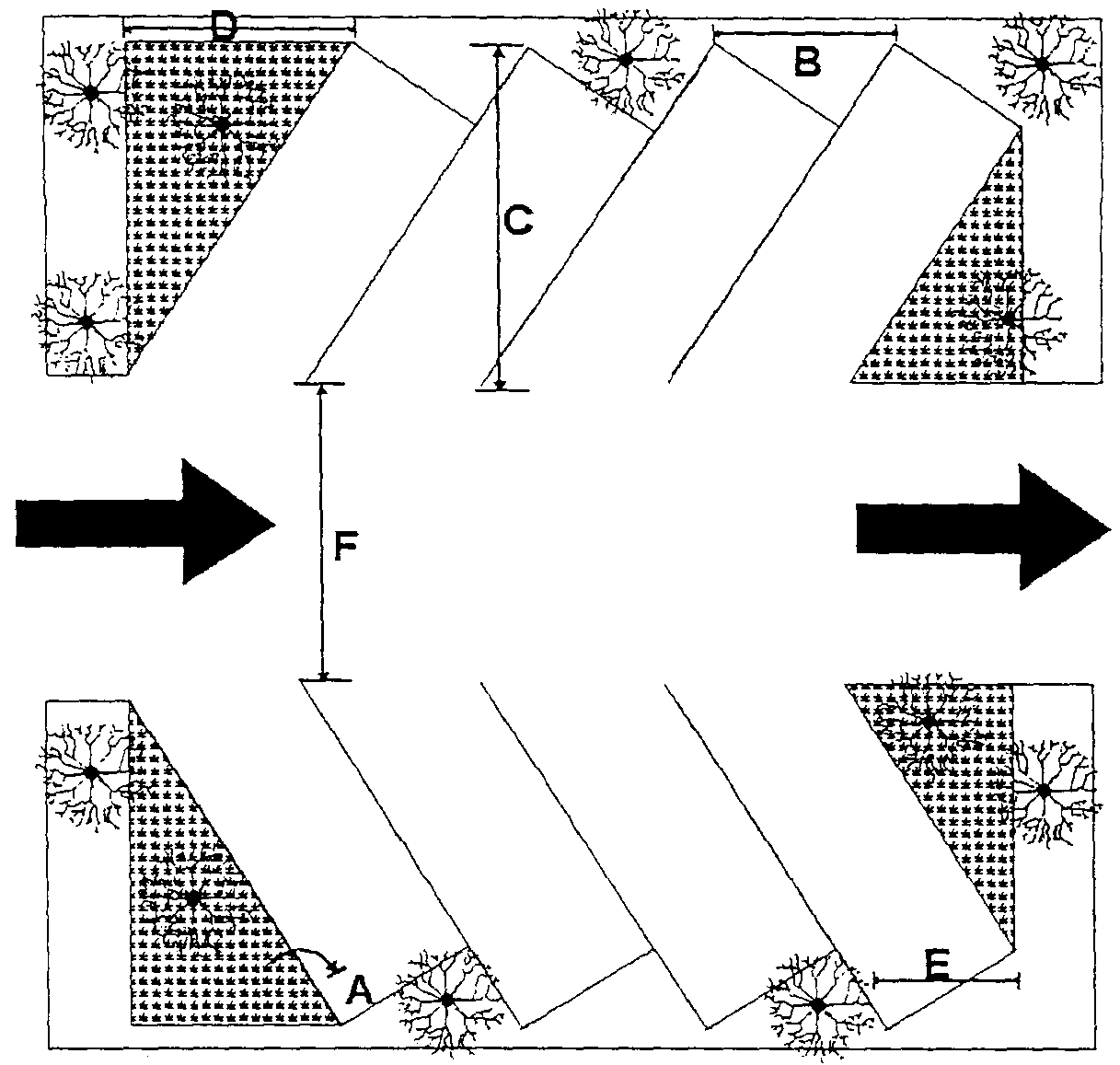
3.13.1.[3].
Disabled parking.
A.
Except for a lot containing a single-family or duplex dwelling, all uses shall be required to provide and designate the following number of spaces designed for disabled persons.
B.
Off-street parking spaces for the disabled shall be designed as follows:
1.
All spaces for the disabled shall have access to a curb-ramp or curb-cut when necessary to allow access to the building served, and shall be located so that users will not be compelled to wheel behind parked vehicles, and shall be located the shortest possible distance between the parking area and the entrance to the principal building it serves.
2.
Parallel parking spaces for the disabled shall be located either at the beginning or end of a block or adjacent to alley entrances. Curbs adjacent to such spaces shall be of a height which will not interfere with the opening and closing of motor vehicle doors.
3.
Each parking space for the disabled shall be paved and prominently outlined with paint and with a permanent sign bearing the internationally accepted wheelchair symbol, posted at the head of the parking space.
4.
The size of the parking space shall be per building code specifications.
3.13.2.[4].
Cooperative parking.
A
Refer to required parking in chapter 4 [of this ordinance] for the specific zoning district. These requirements may be met with cooperative parking.
B.
Cooperative provisions for off-street parking may be made by contract between two or more adjacent property owners. The parking area provided on any one lot may be reduced to not less than one-half the number of required parking spaces for the use occupying such lot. These lots shall be interconnected in the HC district.
3.13.3.[5].
Application of parking requirements.
A.
Mixed uses. When more than one principal or accessory use occupy the same building or parcel; the parking spaces required shall equal the sum of the requirements of the various uses computed separately.
B.
Change in use; alteration of use; or extension of use. Off-street parking spaces shall be provided in accordance with these regulations whenever a building or use is changed, altered or enlarged by at least 50 percent in floor area, number of employees, number of dwelling units, seating capacity, or otherwise.
C.
A scale drawing or layout of all required parking areas showing the location, size, and arrangement of the individual parking spaces, loading spaces, and landscaped areas shall be submitted to the zoning administrator for approval.
3.13.4.[6].
Lighting standards.
A.
All parking space area lighting shall be energy efficient and designed so that any glare is directed away from adjacent properties or create any hazardous traffic conditions.
B.
Lighting shall be provided to illuminate any off-street parking or loading spaces within developments providing customer service to the public after 5:00 p.m. Required lighting shall be designed at a mounting height, luminance, and spacing to provide a minimum average horizontal illumination of 0.6 foot-candles within the parking area and at primary building entrances.
Sec. 3.14. - Sight triangle.
3.14.1.
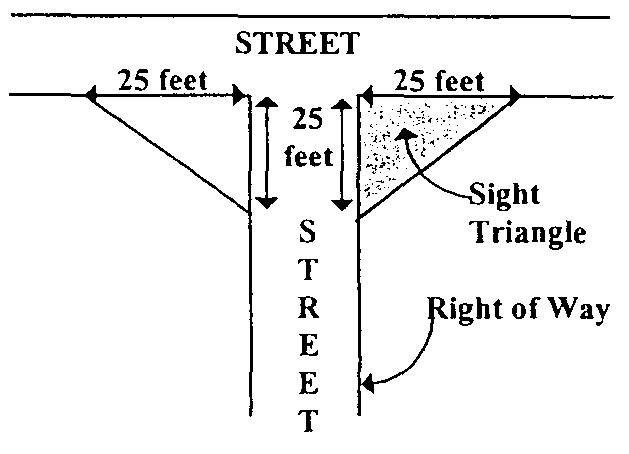
Intent. For protection against traffic hazards, no impediment to visibility shall be placed, allowed to grow, erected or maintained within visibility triangles described as follows:
3.14.2.
Size of sight triangle. A triangular-shaped portion of land 25 feet wide and 25 feet deep at the intersection.
3.14.3.
No structure, sign, or landscaping material shall exceed 3½ feet in height within the sight triangle.
3.14.4.
No parking is not allowed within the sight triangle.

