
Sanger City Zoning Code
ARTICLE XXIII
GENERAL CONDITIONS APPLIED TO ZONE DISTRICTS
Sec. 90-851. - Purpose of article.
The following general conditions, where applicable, shall apply in all districts given in divisions 1 through 4 of this article.
Sec. 90-852. - Uses permitted and permitted subject to first securing a conditional use permit.
(a)
Buildings, structures and land shall be used, designed, erected, structurally altered or enlarged only for the purposes listed as permitted or permitted subject to first securing a conditional use permit in the district in which such building or land is located, and then only after applying for and securing all permits and licenses required by law and this Code.
(b)
Any use already established within an area when it was first zoned but which is not a permitted use within such district or is a permitted use only with a conditional use permit, and the use permit has not been granted, shall be allowed to continue therein as a nonconforming use subject to all conditions and restrictions relating to nonconforming uses as provided in section 90-921 et seq. and subject to the conditions under which the use was originally established.
Sec. 90-881. - Lot area; lot dimensions; population density; building height.
The following property development standards for lot area, lot dimensions, population density and building height shall apply to all land, buildings, and structures in all districts:
(1)
Lot area. Except as hereinafter provided, no building or structure shall be erected, located or enlarged on a lot unless such building, structure or enlargement conforms with the area regulations of the district in which it is located.
a.
No required yard or other required open space around a building may be considered as providing a yard or open space for any other building; nor may any required yard or other required open space on an adjoining lot be considered as providing a yard or open space on a lot whereon a building is to be erected.
b.
Where the area of a lot is less than that prescribed for the zone district in which it is located, and the lot had been lawfully created prior to the time that the lot was zoned whereby it became nonconforming, the lot may be used, subject to compliance with all other requirements of the district.
(2)
Lot dimensions:
a.
Every lot shall have a minimum width and depth not less than that prescribed in the regulations governing the zone district in which it is located.
b.
Where a lot has a minimum width or depth less than that prescribed by this chapter, and the lot had been lawfully created prior to the time that the lot was zoned whereby it became nonconforming, the lot may be used subject to compliance with all other requirements of the zone district.
(3)
Population density. The population density regulations as set forth in the districts shall apply.
(4)
Building height. All buildings and structures shall comply with the height regulations and exceptions of the zone district in which they are located.
(Ord. No. 731, § 7, 8-2-83; Ord. No. 777, § 2, 4-15-86; Ord. No. 847, 6-6-91; Ord. No. 860, § 2, 12-5-91)
Sec. 90-882. - Yards; space between buildings; lot coverage.
The following property development standards for yards, space between buildings and lot coverage shall apply to all land, buildings and structures in all districts:
(1)
Yards:
a.
A front yard or a side yard adjoining a street shall be measured by the perpendicular distance between the street and a line through the corner or face of the building closest to and drawn parallel with the street, excluding any architectural features.
b.
The yard requirements of the zone district in which the property is located shall apply.
c.
Rear yards on residential lots may be less than the required setback, provided that a site plan authorizing such reduction is approved. The site plan authorizing such reduction may be approved only upon a finding that the reduction will not be materially detrimental to the public welfare or injurious to property and improvements in the area, and will not be contrary to the objectives of this chapter. Space equal to the reduction shall be provided elsewhere on the lot, exclusive of required yard areas. Such replacement space shall be so located that it is suitable for general use by the occupant of the premises. In no case shall the rear yard be reduced to less than the required side yard.
(2)
Space between buildings. All buildings shall comply with the space between building requirements of the district in which they are located.
(3)
Lot coverage. All buildings shall comply with the maximum building coverage requirements of the district in which they are located.
(Ord. No. 731, § 7, 8-2-83; Ord. No. 777, § 2, 4-15-86; Ord. No. 847, 6-6-91; Ord. No. 860, § 2, 12-5-91)
Sec. 90-883. - Fences, hedges and walls.
The following property development standards for fences, hedges and walls shall apply to all land, buildings and structures in all districts:
(1)
Nothing in this section shall be construed to affect the requirements established for security fencing by local, state or federal law, or by safety requirements of the Sanger Unified School District. The regulations as set forth in each district shall apply, and the following shall be in addition to those regulations.
(2)
A fence or wall shall be required along the perimeter of all areas dangerous to the public health and safety.
(3)
Corner cut-off areas. The following regulations shall apply at all intersections of streets, alleys, or private driveways in order to provide adequate visibility for vehicular traffic. There shall be no visual obstruction within the cut-off areas established herein.
a.
There shall be a corner cut-off area at all intersecting streets or highways. The cut-off line shall be in a horizontal plane, making an angle of 45 degrees, with the side, front or rear property line, as the case may be. It shall pass through the points located on both the side and front or rear property lines at a distance of 30 feet from the intersection of such lines or their projections at the corner.
b.
There shall be a corner cut-off area on each side of any private driveway intersecting a street or alley. The cut-off lines shall be in a horizontal plane, making an angle of 45 degrees with the side, front or rear property line, as the case may be. They shall pass through a point not less than ten feet from the edges of the driveway where it intersects the street or alley right-of-way.
c.
There shall be a corner cut-off area on each side of any alley intersecting a street or alley. The cut-off lines shall be in a horizontal plane, making an angle of 45 degrees with the side, front or rear property line, as the case may be. They shall pass through a point not less than ten feet from the edges of the alley where it intersects the street or alley right-of-way.
d.
Where, due to an irregular lot shape, a line at a 45-degree angle does not provide for intersection visibility, the corner cut-off shall be defined by a line drawn from a point on the front or rear property line that is not less than 30 feet from the intersection of the side and front or rear property lines and through a point on the side property line that is not less than 30 feet from the intersection of the side and front or rear property lines.
(4)
Permanent trash enclosures and/or areas of container storage out of public view shall be required and reviewed for specific requirements for all multiple-family developments of three units or greater and all commercial and industrial uses.
(5)
The use of any barbed, concertina or razor wire is generally prohibited. However, for security purposes the use of these products within commercial and industrial zones may be considered on a case-by-case basis pursuant to the site plan review provisions contained in section 90-1009. Permission to use any of these products shall not run with the land, and shall be subject to additional review upon the change of use, sale, rental, or any other change of occupancy or operations. If not subject to site plan review, then a director's review permit shall be required for review of any barbed, concertina, or razor wire fencing that is proposed. The following minimum standards for barbed, concertina, or razor wire shall be required during the review:
a.
Barbed, concertina, or razor wire may not extend over the property line;
b.
The barbed, concertina, or razor wire shall not exceed two feet in height;
c.
All barbed, concertina, or razor wire shall be located a minimum of six feet above the ground level when measured from both sides of the fence.
(Ord. No. 731, § 7, 8-2-83; Ord. No. 777, § 2, 4-15-86; Ord. No. 847, 6-6-91; Ord. No. 860, § 2, 12-5-91; Ord. No. 950, § 21, 5-16-96; Ord. No. 1056, § 1, 10-21-04; Ord. No. 1141, § 1, 7-18-13, eff. 8-18-13)
Sec. 90-884. - Off-street parking in all districts.
The following standards for providing off-street parking in all districts shall apply at the time of the erection of any main building or when off-street parking is established. These standards shall also be complied with when an existing building is altered or enlarged by the addition of dwelling units or guest rooms, or where the use is intensified by the addition of floor space, seating capacity, seats or changed to a use requiring greater parking.
(1)
Off-street automobile parking spaces maintained in connection with any existing main building or structure shall be maintained so long as the main building or structure remains, unless an equivalent number of substitute spaces are provided and thereafter maintained in conformity with the requirements of this section; provided, however, that this regulation shall not require the maintenance of more automobile parking spaces than are required herein for a new building or structure, nor the maintenance of such spaces for any type of main building or structure other than those specified herein.
(2)
No parking area or space provided in compliance with this chapter shall be relinquished, reduced or altered below the requirements established herein, unless equivalent parking facilities are provided elsewhere, the location of which is approved by the commission, following the procedures set forth in sections 90-991 through 90-993.
(3)
Where automobile parking spaces were provided and maintained on a lot in connection with a main building or structure prior to August 2, 1983, and such spaces are insufficient to meet the requirements for the use with which they are associated, or where no parking has been provided, then the building or structure may be altered or enlarged, or such use may be expanded, only if additional automobile parking spaces are provided for the enlargement, expansion or addition, in compliance with the standards for such proposed use, as set forth in this chapter; provided, however, that in cases where a change in use creates a need for an increase of two or less off-street parking spaces, no additional parking spaces shall be required. No existing parking may be counted as meeting this requirement unless it exceeds the requirement for the original structure, and then only the excess portion may be counted.
(4)
All motor vehicles incapable of movement under their own power, other than in cases of emergency, shall, in all residential districts, be stored in an entirely enclosed building.
(Ord. No. 731, § 7, 8-2-83; Ord. No. 777, § 2, 4-15-86; Ord. No. 847, 6-6-91; Ord. No. 860, § 2, 12-5-91; Ord. No. 950, § 22, 5-16-96)
Sec. 90-885. - Residential requirements for off-street parking.
The following property development standards for residential off-street parking shall apply to all land, buildings and structures in all districts:
(1)
General. The parking spaces required for residential uses shall be located on the same lot as the main building which they are intended to serve, and shall be located to the rear of the required front yard. They shall be maintained in a usable condition and shall not interfere with access to the property.
(2)
Residential dwellings. There shall be at least two parking spaces for single-family dwelling units other than mobile homes located in the T-P district per the requirements of section 90-505. For all other types of residential uses, the following minimum number of parking spaces shall be provided for each of the following units:
a.
Studios and one-bedroom unit: 1.0 parking space;
b.
Two-bedroom unit: 1.5 parking spaces; and
c.
Three-bedroom units or greater: 2.0 parking spaces.
(Ord. No. 731, § 7, 8-2-83; Ord. No. 777, § 2, 4-15-86; Ord. No. 847, 6-6-91; Ord. No. 860, § 2, 12-5-91; Ord. No. 908, § 1, 4-21-94; Ord. No. 2025-04, § 4(Exh. A, § 14), 5-15-25)
Sec. 90-886. - Nonresidential requirements for off-street parking.
For buildings or structures other than dwellings and for uses involving large concentrations of people, parking areas or spaces shall, unless otherwise provided by this chapter, be on the same lot with the main building, or on lots immediately contiguous thereto in the same district therewith and available for use by the occupants in the following ratios. Combinations of facilities shall provide the area or number of spaces required for each facility, and the area or spaces provided for one facility shall not be construed as satisfying the requirements for another facility, provided that, if there is a general parking area or parking space requirement in the particular zoning district relating to the floor area of buildings therein, and the commission determines that all of the spaces, areas, and buildings are constructed or will be constructed pursuant to an integrated site plan, the commission may, consistent with the purposes and intent of this chapter and following the procedure set forth in sections 90-981 through 90-993, determine whether the general requirements of the district or the specific requirements hereinafter enumerated shall apply.
(1)
For bowling alleys and similar establishments, there shall be at least five parking spaces for each alley and two spaces for each billiard table contained therein.
(2)
For churches, stadia, theaters, libraries, auditoriums, museums, meeting halls, gymnasiums, and similar places of assembly, there shall be at least one parking space for each five permanent seats or one parking space for every 40 square feet of area within the main auditorium, meeting hall, or room, whichever provides the greater number of spaces. In cases of a use without a building, there shall be one parking space for each five persons normally attending or using the facilities, plus one parking space for every two non-temporary employees.
(3)
For convalescent homes, homes for the aged, nursing homes, and children's homes, there shall be at least one parking space for each 2½ beds or fraction thereof.
(4)
For dance halls, skating rinks, natatoriums, and similar establishments, there shall be at least one parking space provided for each 100 square feet of gross floor area.
(5)
For establishments for the sale and consumption on the premises of food and/or beverages:
a.
Having less than 1,000 square feet of gross floor area, there shall be at least one parking space for each 200 square feet.
b.
Having less than 4,000 square feet of gross floor area, there shall be at least one parking space for each 100 square feet.
c.
Having 4,000 square feet or more of gross floor area, there shall be at least 40 parking spaces plus one for each 50 square feet in excess of 4,000 square feet.
(6)
For hospitals, sanitariums, and asylums, there shall be at least one parking space for every two beds or one space for every 1,000 square feet of gross floor area, whichever provides the greater number, plus one space for every three employees.
(7)
For hotels, tourist courts and motels, there shall be at least one parking space for every individual sleeping room or unit.
(8)
For machinery sales and wholesale stores, there shall be at least one parking space for each 800 square feet of gross floor area.
(9)
For medical offices, there shall be at least four parking spaces for each doctor, plus one space for each employee.
(10)
For motor vehicle sales and automotive repair shops, there shall be at least one parking space for each 400 square feet of gross floor area.
(11)
For mortuaries, funeral homes, and similar establishments, there shall be at least one parking space for each 20 square feet of floor area of assembly rooms, plus one space for each employee, and one space for each car owned by such establishment.
(12)
For park and recreational uses, there shall be at least one parking space for each 5,000 square feet of active recreational area.
(13)
For public utility facilities such as communications equipment buildings, electrical substations, and the like, the following standards shall apply:
a.
For facilities open to the public, there shall be at least six parking spaces per 1,000 square feet of floor area of gross floor area or fraction thereof, the parking area to be within 300 feet of the property served.
b.
For facilities not open to the public, there shall be at least one parking space for each two employees. This shall apply to the maximum number of employees on duty at any one time.
c.
For facilities wherein there are areas open and not open to the public, the parking ratios in subsections (13)a and (13)b of this section shall be used as a basis for determining the respective amount of parking areas to be provided.
(14)
For rooming houses, lodging houses, clubs, and fraternity and sorority houses, there shall be at least one parking space for each person which the building was or is designed or intended to house as a sleeping guest or member or employee.
(15)
For schools, the following standards shall apply. (When relative to public schools, these standards are advisory only):
a.
Elementary and junior high. There shall be at least one parking space for each member of the faculty and each employee.
b.
High school. There shall be at least one parking space for each member of the faculty and each employee, plus one space for each eight students regularly enrolled.
c.
Junior colleges, colleges and universities. There shall be at least one parking space for each two members of the faculty and employees, plus one space for each two (full-time or equivalent) regularly enrolled students.
d.
Schools having auditoriums or places of assembly. The provisions of subsection (2) of this section shall apply, if such application will provide a greater number of spaces than subsections (5)a, (5)b or (5)c of this section. The required parking spaces shall be within the school property or on a parking lot contiguous thereto.
e.
Day nurseries, nursery schools and child care nurseries. There shall be at least one parking space for each member of the faculty, each employee, and the owner.
(16)
For shopping centers, there shall be at least one parking space per 200 square feet of gross leasable area. "Shopping center," as used in this subsection, shall mean two or more architecturally unified commercial establishments built on a site which is planned, developed, owned, and managed as an operating unit and which has a total gross leasable area for all commercial establishments within the center of 30,000 square feet or more.
(17)
For small animal veterinary hospitals and clinics, there shall be at least four parking spaces for each doctor, plus one space per each additional employee.
(18)
For transportation facilities, including airports, railroad passenger stations, bus depots or other passenger terminal facilities, there shall be provided such parking spaces at such locations as the commission, following the procedures set forth in sections 90-991 through 90-993, shall deem to be adequate for employees, for the loading and unloading of passengers, and for spectators, visitors and others.
(19)
For emergency shelters, shall follow the provisions of section 90-899(c), and there shall be at least one parking space for each employee on duty, provided that standards do not require more parking than other residential or commercial uses within the same zone.
(Ord. No. 731, § 7, 8-2-83; Ord. No. 777, § 2, 4-15-86; Ord. No. 847, 6-6-91; Ord. No. 860, § 2, 12-5-91; Ord. No. 909, § 8, 4-21-94; Ord. No. 2025-04, § 4(Exh. A, § 14), 5-15-25)
Sec. 90-887. - Treatment of off-street parking areas.
Areas used for the parking or loading of motor vehicles or motor vehicle sales, not including single-family residential districts, shall be improved and maintained as follows:
(1)
All areas shall be graded, paved and drained; and parking stalls, lanes and directional guides shall be marked in accordance with the city's standard specifications and drawings.
(2)
Where such areas adjoin a residential district, it shall be separated therefrom by a solid masonry wall not less than six feet in height, provided the wall shall not exceed three feet in height where it adjoins the front yard area of an abutting residential district. In cases where the required wall will separate such parking area from an existing abutting parking facility, the required wall may be waived by the commission. Where no wall is required along a boundary of an area covered by this section, a concrete curb or timber barrier not less than six inches in height shall be securely installed and maintained as a safeguard to the abutting property or public right-of-way. The barrier shall be at least three feet from the property line of the subject property.
(3)
Where such areas adjoin a residential district, there shall be a border of appropriate landscaping not less than ten feet in depth along the residential street frontage to protect the character of the adjoining residential property. Such landscaping shall be maintained.
(4)
Lighting where provided to illuminate such parking, sales or display areas shall be hooded and so arranged and controlled so as not to cause a nuisance either to street or highway traffic or to surrounding properties.
(5)
No required parking space shall be so located as to require the moving of any vehicle on the premises in order to enter or leave any other stall unless an attendant is present at all times during the use of the facility.
(6)
Automobile parking shall be so arranged as not to require the backing out of motor vehicles from a parking space, garage, or other structure onto a street in or abutting any commercial or industrial district or in a multifamily district developed with four or more dwelling units.
(7)
Garages or carports shall be located not less than 20 feet from any street frontage where the garage door or carport opening faces the street. Where yard requirements pose a greater setback, such setback shall apply.
(8)
No commercial repair work or servicing of vehicles shall be conducted on a parking area.
(9)
Where automobile parking spaces are to be grouped as a common facility, the arrangement of parking spaces, aisles and access drives shall comply with the adopted design standards of the city as presented in the adopted standard specifications and drawings.
(10)
All parking areas shall be placed in a location with relation to the parking generator as to provide for the efficient use of the parking facility. On-site parking areas shall have ready vehicular access. The location of off-site parking areas shall be noted by appropriate signs located both at the parking generator and at the parking facility.
(11)
Access to individual parking spaces on a lot or portion of a lot designated for parking shall be from said lot or portion of a lot or from a public alley.
(12)
In no case shall parking spaces be so arranged that ingress or egress from a parking space requires backing into a public or private pedestrian accessway.
(13)
Off-street parking requirements for electric vehicle charging stations shall comply with section 90-901 of the Sanger City Code.
(Ord. No. 731, § 7, 8-2-83; Ord. No. 777, § 2, 4-15-86; Ord. No. 847, 6-6-91; Ord. No. 860, § 2, 12-5-91; Ord. No. 909, § 9, 4-21-94; Ord. No. 2024-02, § 2, 4-4-24)
Sec. 90-888. - Additional off-street parking requirements.
The following additional off-street parking requirements shall apply to all land, buildings and structures in all districts:
(1)
Agreements regarding maintenance of off-site parking spaces. When required parking is to be provided off the lot on which the structure or uses, or some portion thereof, is located, the owner or lessee of the development or use site shall furnish satisfactory evidence to the city that he owns or has available sufficient property to provide the required minimum off-street parking. Whether parking is to be provided on property owned by the applicant or is in another ownership, there shall have been recorded in the office of the county recorder, prior to issuance of any building permit, a covenant executed by the owners of such property for the benefit of the city, in a form approved by the city attorney, to the effect that such parking space will continue to be maintained so long as the structure, improvement, or use which it serves continues to exist. Such covenant shall also recite that the title to and right to use the lots upon which the parking space is to be provided will be subservient to the title to the premises upon which the structure is to be erected or the use maintained, and shall warrant that such lots are not and will not be made subject to any other covenant or contract for such use without the prior written consent of the city. If the owners of such structure should thereafter provide parking space equal in area within the distance allowed by this chapter and under the same conditions as to ownership upon another lot than the premises made subservient in a prior such covenant, the city will, upon written application therefor accompanied by the filing of a similar covenant, release such original subservient premises from such prior covenant, and the owners shall furnish at their own expense such title reports or other evidence as the city may require to ensure compliance with the provisions of this section.
(2)
No additional off-street parking facilities shall be required solely because of the remodeling of an existing use or building, unless there is a change in use or increase in floor area or other unit of measurement as the result of such remodeling for which additional facilities are required. See also subsection 90-884(3).
(3)
In the case of mixed uses, the total requirements for off-street parking facilities shall be the sum of the requirements for the various uses computed separately, provided that in the case of a shopping center, the requirements of subsection 90-886(16) shall apply. Off-street parking facilities for one use shall not be considered as providing required parking facilities for any other use except as herein specified for joint use.
(4)
The planning commission may authorize the joint use of parking facilities as follows:
a.
One hundred percent of the parking facilities required by this article for a primarily daytime use may be provided by the parking facilities of a primarily nighttime use. One hundred percent of the parking facilities required by this article for a primarily nighttime use may be provided by the parking facilities of a primarily daytime use, provided that such parking area shall meet the conditions set forth in subsection (4)b of this section.
b.
The following are conditions required for joint use:
1.
The building or use to utilize the off-street parking facilities provided by another building or use shall be located within 200 feet of such parking facility.
2.
The applicant shall show that there is no substantial conflict in the principal operating hours of the building or uses for which the joint use of off-street parking facilities is proposed.
3.
If the building, structure or improvement requiring parking space is in one ownership and the required parking space provided in another ownership, partially or wholly, there shall be recorded in the office of the county recorder of a covenant by such owners for the benefit of the city, in a form approved by the city, that such parking space will continue to be maintained so long as the building, structure or improvement is maintained. The covenant herein required shall stipulate that the title to and right to use the parcel or parcels upon which the parking space is to be provided will be subservient to the title to the premises upon which the building is to be erected and that the parcel or parcels are not and will not be made subject to any other covenant or contract for use without prior written consent of the city.
(5)
None of the provisions of this chapter which require off-street parking and off-street loading spaces in connection with the use of property for commercial or industrial purposes shall apply to any parcel of property located in any vehicle parking district existing under the provisions of any parking district act approved by the city council, where parking and loading facilities provided by such district are determined by the city council to be adequate to serve the district.
(Ord. No. 731, § 7, 8-2-83; Ord. No. 777, § 2, 4-15-86; Ord. No. 847, 6-6-91; Ord. No. 860, § 2, 12-5-91; Ord. No. 970, § 16, 7-17-97)
Sec. 90-889. - Parking space standards.
The following property development standards for parking spaces shall apply to all land, buildings and structures in all districts. A parking space shall have a minimum width of nine feet and a minimum length of 18 feet, exclusive of aisles and access drives, except as follows:
(1)
Parallel parking spaces shall have a minimum width of 8½ feet and a minimum length of 22 feet.
(2)
Parking spaces for compact automobiles will be permitted for all commercial, quasi-public, industrial, professional and administrative office uses providing that each parking space is not less than 15 feet in length and 7½ feet in width, exclusive of aisles and access drives. The number of compact parking spaces shall not exceed 20 percent of the total required parking space of the establishment. All compact parking shall be approved by the commission.
(3)
Parking space for physically handicapped persons shall be provided at all commercial, quasi-public, industrial, professional and administrative office uses. Each such parking space shall be not less than 18 feet in length and 12 feet in width, exclusive of aisles and access drives. Each such parking space shall be so identified by standard markings. Not less than one parking space for physically handicapped persons shall be located as near as possible to the public entrance of the establishment, as approved by the commission for each 25 on-site parking spaces. Such spaces shall conform with all statutory requirements.
(Ord. No. 731, § 7, 8-2-83; Ord. No. 777, § 2, 4-15-86; Ord. No. 847, 6-6-91; Ord. No. 860, § 2, 12-5-91; Ord. No. 909, § 10, 4-21-94)
Sec. 90-890. - Access.
Vehicular and pedestrian access shall be provided according to the regulations pertaining to each district.
(Ord. No. 731, § 7, 8-2-83; Ord. No. 777, § 2, 4-15-86; Ord. No. 847, 6-6-91; Ord. No. 860, § 2, 12-5-91)
Sec. 90-891. - Outdoor advertising (signs).
(1)
Purpose and intent. The purpose of this section is to establish guidelines and procedures for signage in the city, including the type, size, location and construction standards of signs by zone district. Signs have an obvious impact on the character, quality and economic health of the city. As a prominent part of the visual environment, suitability or appropriateness of signs helps to set the tone of the community.
It is the intent of these provisions to emphasize the importance of business activity to the economic vitality of the city, help improve the ability of business owners and operators to identify their businesses to the community in order to enhance the furtherance of commerce, foster varied and interesting places of trade, and promote public safety by making business signage visible to the passing public.
The objectives of this section include the following:
a.
To reinforce that signage should serve primarily to identify the general nature of an establishment or to direct attention to a project, activity, place, person, organization, or enterprise.
b.
As identification devices, signs must not subject the citizens of the city to excessive competition for their visual attention. As appropriate identification devices, signs must harmonize with the building, the neighborhood, and other signs in the surrounding area.
c.
The City of Sanger intends to encourage the installation of signs that improve the appearance of buildings, property and the neighborhood and to enhance the economic effectiveness of signs.
d.
The provisions in this section provide standards and guidelines to safeguard life, health, property, and public welfare in keeping with the character of the City of Sanger by regulating the size, height, structural design, quality of materials, construction location, electrification, illumination and maintenance of all types of signs and sign structures.
e.
The provisions in this section present criteria to assure that signs conform to the above intentions of suitability and safety.
(2)
Definitions. As used in this chapter, the following items are defined in this section.
"Advertising structure" means any notice or advertisement, pictorial or otherwise, and all such structures used as an outdoor display, including billboards, regardless of size and shape, for the purposes of making anything known, the origin or place of sale of which is not on the property with such advertising structure.
"Animated sign" means a sign with action or motion, whether by flashing lights, color changes, wind, rotation, movement of any parts of the sign or letters or parts of the sign structure, or other motion.
"Banner" means any cloth, bunting, plastic, paper, or similar material attached to, or appended on or from any structure, staff, pole, line, or framing upon which there is an advertising message.
"Changeable copy sign" means a sign or portion thereof with characters, letters, or illustrations that can be changed or rearranged without altering the face or the surface of the sign. A sign on which the only copy that changes is an electronic or mechanical indication of time or temperature shall be considered a "time and temperature" sign and not a changeable copy sign for purposes of this chapter.
"Canopy/awning sign" means a sign that is constructed in or on, attached to the face of, or suspended below a canopy or cantilevered covered walkway or arcade, whether parallel to or at right angles to the face of the building.
"Directional sign" means signs giving only information and direction to the viewer and containing no advertising message.
"Externally illuminated sign" means a sign, which has light cast on its surface from an artificial exterior source installed for the purpose of illuminating the sign;
"Freestanding sign" means a sign, which is supported by one or more columns, uprights, or braces in or upon the ground.
"Freeway/expressway-oriented sign" means for the purposes of this chapter, any sign that is designed to be visible from at least one direction along State Highway 180.
"Frontage occupancy" means a single lineal dimension measured horizontally along the front of a building which defines the limits of a particular occupancy at that location and which has direct pedestrian access through an exterior wall, which is visible from the public right-of-way.
"Height of sign" means the vertical distance from the uppermost point used in measuring the area of a sign to ground level of the foundation of the sign.
Exhibit 1: Selected Sign Definitions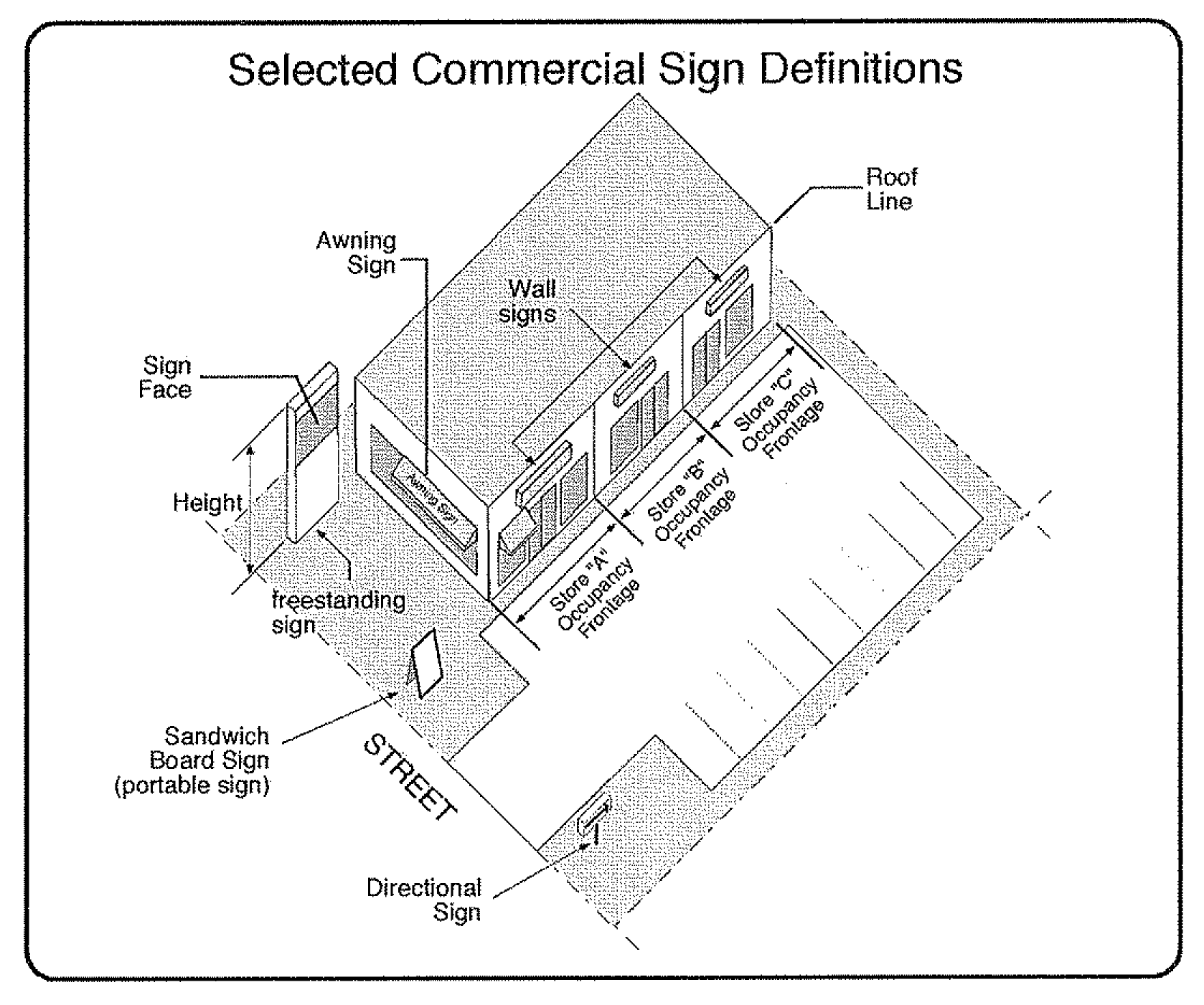
"Internally illuminated sign" means any sign whose illumination originates from within the structure of the sign and the source of which is not visible from the exterior of the sign.
"Master sign program" means a coordinated signage criteria for a retail shopping center, office or industrial park/complex consisting of three or more individual tenants, including any other large-scale developments of four acres or more, automotive dealerships and buildings over two stories in height.
"Off-premises signs and billboards" means any sign not located on the same lot or project site as the use, product, or service it advertises.
"Open air use" means a use (such as vehicle sales) where merchandise or products are displayed or dispensed in the usual course of business from an open lot and not within an enclosed structure.
"Roof line" means the highest point of a parapet wall or the main roof structure or a highest point of a parapet wall other than such architectural features as cupolas, pylons, projections or minor raised portions of the roof.
"Pedestrian access" means a doorway, which has been designed for the primary use of the patrons or customers of that commercial use.
"Pedestrian oriented sign" means a sign, which is specifically located and designed to be viewed from a pedestrian right-of-way.
"Pennant" means series of lightweight plastic, fabric, or other materials, suspended from a rope, wire, or string designed to move in the wind. Pennants shall not include banners as defined in this chapter or individual flags mounted on a single pole.
"Political sign" means a sign advertising a candidate for political office, a political party or a measure scheduled for an election.
"Portable sign" means a sign which is capable of being carried or moved by manual or mechanical means from one location to another and which is not affixed to the ground, a structure, or a vehicle. Portable signs also include blimps and balloons, which may or may not contain an advertising message.
"Projecting sign" shall mean a sign that projects perpendicular from and supported by a wall or a façade of a building, and are also referred to as marquee signs.
"Reader board" or "electronic message board" means a type of changeable copy sign capable of displaying words, symbols, figures or images that can be electronically or mechanically changed by remote or automatic means, including but not limited to church, school, and commercial signs
"Roof sign" means a sign erected upon or above a roof or parapet of a building.
"Sandwich board sign" means a portable sign with advertising messages mounted on two surfaces with two edges connected and the other two edges spread so that the two faces read from different directions;
"Setback area" means the open space area defined in the Sanger Municipal Code in section 90-7 under the term yard, and where applicable, includes the definitions of yard, rear; yard, front; and yard, side; as defined in said title.
"Shopping center" means a group of two or more commercial uses planned and designed to function as an integral unit on a single parcel or contiguous parcels and which utilize common off-street parking and access, landscaping, loading facilities and points of ingress and egress.
"Sign" means any words or symbols used for visual communication including its structure and component parts intended to be used to attract attention to an activity.
"Sign area" means the geometric area of a sign including all elements such as board or frames, perforated or a solid background, ornamental embellishments, arrows or other sign media (see Figure 2).
"Sign copy" means any words, letters, numbers, figures, designs, or other symbolic representations incorporated into a sign face and/or its structure with the purpose of attracting attention to the subject matter.
"Sign face" means the panel surface of a sign, which carries the advertising or identification message.
"Sign structure" means any structure, which supports or is capable of supporting any sign. A sign structure may or may not be an integral part of a building. For the purpose of a freestanding sign, the sign structure shall include the aggregate area of the sign including the sign copy and all structural elements of the sign.
"Site" means the length of a site along the street or other principal public thoroughfare, but not including such a length along an alley, watercourse, railroad or freeway.
"Special events sign" means any sign advertising specific temporary events, such as carnivals, festivals, exhibits, and parades, but not including promotional sales or grand opening signs.
"Structural alteration" means any change to the sign structure.
"Subdivision" or "multiple housing entrance sign" means a sign identifying the name of a subdivision or multiple housing projects and consisting of letters or symbols attached to a wall or a fence or freestanding sign located within the boundaries of a recorded and developed subdivision or multiple housing projects.
"Temporary sign" means any banner, pennant, valance, balloon, streamer, placard, corrugated wire, "A" Frame, T-Frame or similar impermanent sign advertising device or display with or without letters, words, numbers or figures thereon, which directs, advertises or promotes a service or price, or which is otherwise designed to attract attention.
"Temporary subdivision sign" means a sign erected and maintained within the boundaries of a recorded subdivision and indicating the name of the subdivision, the name of the contractor and/or subdivider, the name of the owner and/or agent, and giving information regarding directions, price or terms concerning the sale or lease of parcels within the subdivision.
"Wall sign" means a sign attached to or erected against the wall or façade of a building or structure with the exposed face of the sign in a plane parallel to the plane of the wall or façade.
"Window sign" means and sign temporarily displayed on the inside of a window, or temporarily painted on a window, and facing a street, alley, highway, parking lot, walkway or sidewalk.
"Wind sign" means any display of streamers, pennants, whirligigs or similar devices made of flexible lightweight material, strung together or attached in such a manner as to move by wind pressure.
(3)
Applicability. All signs shall be erected, placed, established, painted, created, or maintained in the city, in conformance with the standards, guidelines, procedures, and other requirements of these provisions.
The regulations in this chapter are in addition to those set forth in the California Building Code, the California Electrical Code and the 1997 Uniform Sign Code, as adopted, and any amendments made thereto by the city, and the nuisance provisions in the Sanger City Code.
(4)
Standards by zone districts. Signs permitted by zone district are listed as follows:
1.
Residential Zone Districts (R-1-10, R-1-7.5, R-1-6, RM-2.5, RM-2.5(s), RM-1.5, RM-1.5(s), RM-1, and T-P). Unlighted signs and other commercial advertising shall be permitted in residential districts as provided by subsection 1. as follows:
a.
Name plates shall be permitted subject to the following conditions:
i.
Maximum size: Two square feet; up to four square feet for Bed & Breakfast establishments per section 90-896
ii.
Content: Nameplates may display the following information:
• Name of the premises upon which it is displayed.
• Name of the owner or lessee of the premises.
• Address of the premises.
• Nature of a home occupation engaged in/on the premises.
iii.
Placement: Name plates shall be affixed flush to the subject building
b.
"For Rent" and "For Sale" signs.
c.
"Yard Sale" signs.
d.
For subdivisions, apartment complexes and mobile home parks, churches and other permitted institutional uses, no more than one sign shall be erected at any entrance to the development. Signs shall not exceed 35 square feet for all readable surfaces, nor exceed six feet in height.
e.
Recognized quasi-public/institutional uses such as schools and churches and philanthropic organizations may be permitted the display of two temporary banner signs, not exceeding an aggregate area of 100 square feet. Said signs may not be utilized for 90 days per calendar year and may not exceed 30 feet in height above the ground surface.
2.
Residential Zone Districts (U-R and R-A Districts). In addition to signage permitted under subsection 1. above, the following signage is permitted in the U-R and R-A zones
a.
Signs advertising products for sale: There may be permitted one non-flashing sign for each street frontage advertising products for sale upon the premises or services rendered thereon. The total area of such sign shall not exceed 40 square feet. This type of sign may be mounted flush to a building wall, or may be a freestanding sign no more than five feet in height.
3.
Commercial and Industrial Zone Districts (C-P, C-1, C-2, C-3, C-4, C-M, M-L and M-H). The following signs are permitted for each business in commercial and industrial districts (see Exhibit 2 for graphic illustration of standards for various sign types). For multi-tenant shopping centers, office parks/complex and industrial parks containing three or more individual business uses, and large scale developments of four acres or more, automotive dealerships and buildings over two stories high, a coordinated master sign program shall be submitted for city planning review and approval.
a.
Wall signs.
i.
Maximum height: Not to exceed the top of the vertical wall surface on which the sign is mounted. Signs mounted on a pitched roof may not extend the peak of the ridge line of the roof.
ii.
Calculation of area: One square feet of sign area permitted for each foot of linear occupancy frontage, up to 150 square feet of sign area. All businesses shall be permitted a minimum of 25 square feet of sign area.
iii.
Maximum number per business: Up to three wall signs may be permitted; one sign on the wall with a public (customer) entrance, and one sign on each wall that faces a public street or is visible from the public street of the business frontage (other than a local residential street).
iv.
For Bed & Breakfast establishments the provisions of section 90-896 shall apply.
b.
Free-standing signs.
i.
Maximum height: Ten feet.
ii.
Maximum area: 35 square feet per sign face.
iii.
Sign design: Free-standing signs should be designed as a monument structure with a solid base extending the entire height of the sign, unless a different design is architecturally appropriate, as determined by city planning. Individual businesses that are listed on a freestanding sign for a multi-tenant site should be limited to primary tenants.
iv.
Number per site/parcel: One.
v.
Setbacks: A free standing sign shall be set back a minimum of three feet from the property line. Encroachment into a setback may be permitted where the location of existing improvements presents a functional hardship in compliance with the three-foot setback.
vi.
For Bed & Breakfast establishments the provisions of section 90-896 shall apply.
c.
Directional signs.
i.
Maximum height: Four feet.
ii.
Maximum area: Six square feet.
iii.
Number per site: One per driveway from a public street.
iv.
Location: Within five feet of a driveway that accesses the site from a public street. Placement of directional signs shall ensure the sight safety of vehicles entering/leaving a site is not compromised.
d.
Directory signs.
i.
Maximum area: 35 square feet.
ii.
Maximum height (if freestanding): Six feet.
iii.
Location: No directory sign which is a freestanding sign may locate closer than five feet to any neighboring property line or closer than three feet to any point of ingress/egress.
e.
Temporary signs (located on-site of the business).
1.
Grand opening banners (includes "coming soon", "now open" or "under new management"):
a.
Maximum height: Not to exceed roof line of nearest building or building affixed to but in no case shall any part of a banner be higher than 30 feet from the surface of the ground.
b.
Maximum area: Up to 25 percent of the area of the business storefront facing a street.
c.
Permitted time: May be displayed up to 90 days per business with a one time extension of 90 additional days.
d.
Number per business: Two, with one banner on building façade facing a street.
e.
All banners shall be of durable materials, such as canvas or vinyl. The use of butcher-type paper or other non-durable material is not permitted.
f.
Banners shall be maintained in a well kept, clean and legible condition at all times of display.
g.
"Coming Soon" banners may be displayed only after issuance of a city business license.
2.
Special event banners (for sales promotions, offerings or related announcements by an established business or restaurant):
a.
Maximum height: Not to exceed roof line or ridge of nearest building or building affixed to but in no case shall any part of a banner be higher than 30 feet from the surface of the ground.
b.
Maximum area: 100 square feet aggregate.
c.
Permitted time: A banner may be used to identify the business in lieu of a permanent sign for a period not to exceed one year from occupancy and operation of the business. Number per business: One banner sign per street frontage of the business is permitted.
d.
Banners shall be maintained in a well kept, clean and legible condition at all times of display.
e.
A business that enters into a written agreement with the city to not use banner signs or other temporary display advertising may be permitted a changeable message sign or electronic reader board to be incorporated into its free-standing sign, or as a building wall sign, provided that the overall sign area allowed for the business is not increased (see Exhibit 3).
3.
Portable A-Frame signs (limited to establishments located within the downtown C-3, Central Commercial Zone District):
a.
Maximum height and width: Three feet wide and four feet tall.
b.
Maximum area: 12 square feet.
c.
Number per site: One.
d.
Location: May be placed upon a public sidewalk with approved encroachment permit in front of the subject business, but must permit a minimum of four feet of passage area on the sidewalk.
e.
Permitted display time: Only during business hours.
f.
Signs shall be of a design quality that is attractive and constructed with durable materials, such a wood or plastic.
f.
Projecting signs.
i.
Maximum height and projection: Not to exceed roof line of wall or structure to which projecting sign is attached. (Note: Bottom of sign shall be a minimum of eight feet from ground to provide proper clearance.).
ii.
Calculation of area: One square foot of sign area for each lineal foot of building frontage of the business to which sign pertains.
iii.
Maximum area: 50 square feet.
iv.
Location: Projecting signs may extend over public rights-of-ways including public sidewalks not to exceed two-thirds of the distance from the building face to which the sign is attached to the curb face.
Exhibit 2: Commercial Sign Standards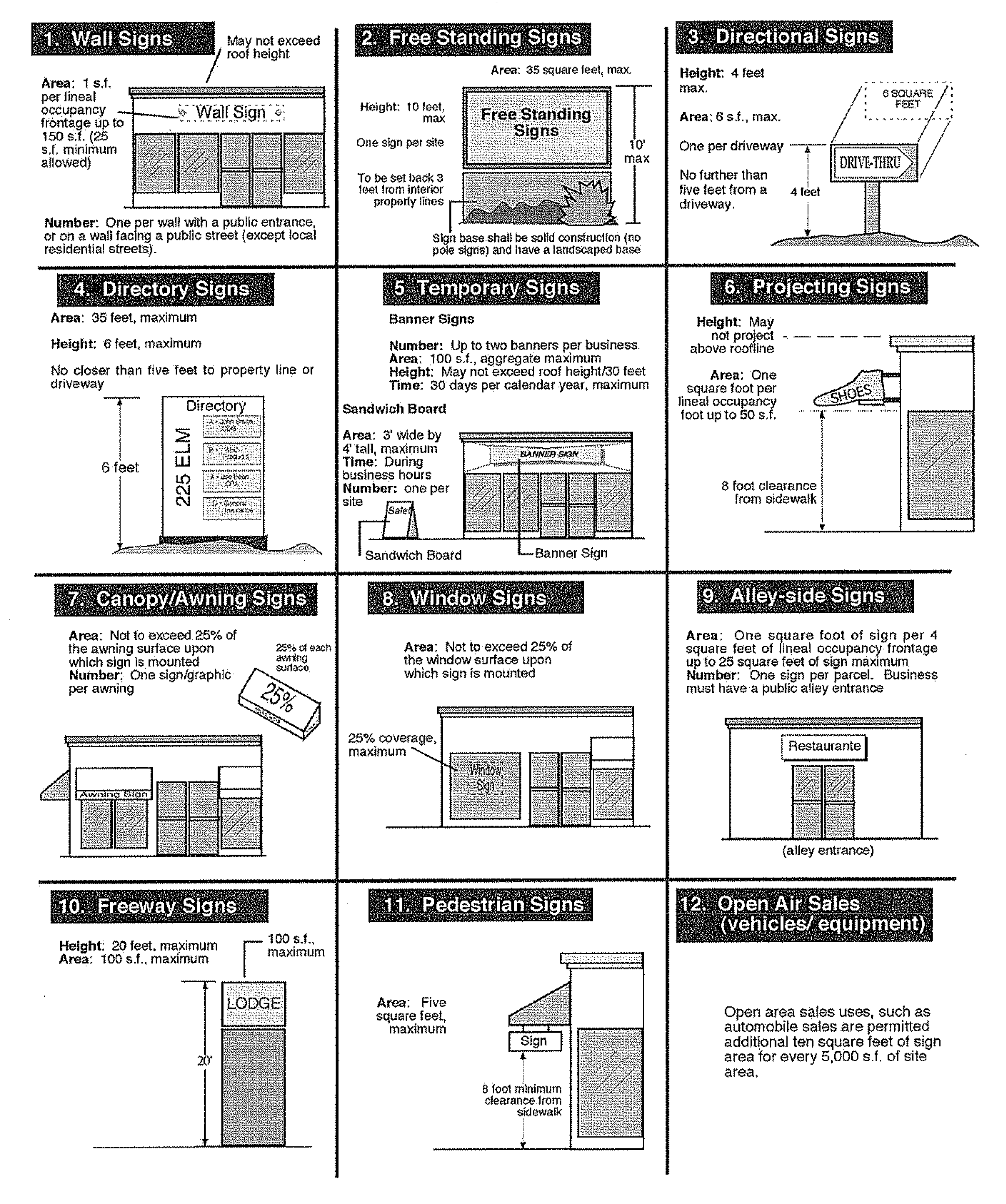
g.
Canopy/awning signs.
i.
Number of signs: Awning signs may be used instead of allowable wall signs on the same building façade.
ii.
Maximum area: The area of signage on each surface of a canopy or awning shall not exceed 25 percent of the area of the individual surface.
iii.
Location and colors: Awning signs shall be made of removable materials and may be located on one of the three exterior surfaces of a canopy.
iv:
Height: No less than eight feet above the sidewalk.
h.
Window signs.
Maximum area: Up to 25 percent of the area of each individual window may be covered with a window sign or graphic. Window signs shall not be used in lieu of a building wall sign or canopy/awning sign to identify a business.
i.
Alley-side signs.
Maximum area: Any business, which has a building facing a public alley, shall be permitted a minimum of 25 square feet of additional sign area at a ratio of one square foot of sign area for each four feet of building frontage facing the alley.
j.
Expressway/freeway signs (Hwy 180).
i.
Maximum height: 20 feet.
ii.
Maximum area: 100 square feet of sign copy per sign face.
iii.
Number of signs: One per parcel. Businesses on adjoining parcels are encouraged to cluster signs on one monument sign.
iv.
Location: Limited to parcels adjacent to the State Highway 180 expressway/freeway or to a frontage road that abuts the expressway/freeway right-of-way.
k.
"For Sale", "For Rent", or similar signs.
i.
Number/size: One sign shall be permitted per street frontage.
ii.
Maximum size: 32 square feet, per sign.
iii.
Height: Maximum of six feet.
l.
Pedestrian signs.
i.
Number: One pedestrian oriented sign that projects or hangs above a sidewalk on each side of a building with a public entrance.
ii.
Size: Each sign may be a maximum of five square feet in size and may hang or be suspended no lower than eight feet above grade level.
m.
Special uses standards.
(1)
Open air sales. In addition to the sign area permitted under this section, ten square feet of sign area is permitted for every 5,000 square feet of site area for vehicle and large equipment sales operations. The additional signage may be used to increase the allowable area for wall signs and freestanding signs, except that height shall not be increased for freestanding signs.
(2)
Drive-through menu boards. No more than two drive-through menu/order boards are permitted for each food and/or beverage establishment featuring a drive through. Each sign shall not exceed 40 square feet and be no taller than six feet.
(3)
Recycling collection facilities (small and large). Signs may be installed for small and large recycling collection facilities consistent with the following standards.
a.
Recycling facilities may have identification signs with a maximum of 20 percent per side or 16 square feet, whichever is larger, in addition to informational signs on recycling containers as permitted in section 90-1095(12); in the case of a wheeled facility, the side will be measured from the pavement to the top of the container.
b.
Signs must be consistent with the character of the location.
c.
Directional signs, bearing no advertising message, may be installed if necessary to facilitate traffic circulation, or if the facility is not visible from the public right-of-way.
d.
City planning may authorize increases in the number and size of signs upon findings that it is compatible with adjacent businesses.
(5)
Design criteria (See Exhibit 3 for illustrations of selected criteria).
a.
Design compatibility: The design of all signs shall be compatible and harmonious with the colors, materials and architecture of the building and the immediate vicinity. Freestanding signs shall be finished with the same or compatible materials as the building on the site.
b.
Sign area: The area of individual signs shall be measured in accordance with the "Sign Area Measurement" diagram.
c.
Sign faces counted: Where a sign has two faces containing sign copy, which are oriented back to back and separated by not more than 24 inches at any point, the area of the sign shall be measured using one sign face only.
d.
Wall mounted letters: Where a sign is composed of letters individually mounted or painted on a building wall, without a border or decorative enclosure, the sign area is that of the smallest area within which all letters and words can be enclosed.
e.
Three-dimensional signs: Where a sign consists of one or more three-dimensional objects such as balls, cubes, clusters of objects, or sculptural or statute-type trademarks, the sign area shall be measured as the area of the smallest rectangle within which the object(s) can be enclosed, when viewed from a point where the largest area of the object(s) can be seen.
f.
Size: Notwithstanding applicable sign standards elsewhere in this chapter, sign size shall be proportionate to the size and scale of the site and building upon which the sign is proposed. Sign dimensions as specified in this chapter are maximum allowable dimensions; it may be necessary that signs be smaller than the maximum allowed in order to be proportionate in size and scale to achieve the design objectives of this section.
g.
Commercial, office and industrial center signs: Individual tenant signs within multi-tenant centers shall be coordinated in size, location, materials and illumination. Review and approval of a Master Sign Program by the city planning is required.
h.
Color: Colors shall be used in coordinated groupings, and shall be compatible with those colors used in the building or project design. In general, a dark sign background is preferred with light colored copy (characters/graphics).
i.
Logos and trademarks: The use of established corporate colors or logos shall not be prohibited by this section. When established corporate colors are incompatible with buildings colors, compatibility in design with the surrounding development shall be accomplished through the use of appropriate background colors or other design features.
j.
Lighting intensity: The light emitted or reflected by a sign, or emitted by a light source, shall be of reasonable intensity and shall be compatible with the architecture of the building and the immediate vicinity. Artificial light sources shall be shielded to prevent light spillage, glare or annoyance to persons on or inside adjoining properties or to public or private rights-of-way.
k.
Illumination: Internally illuminated signs where the entire face of the sign is illuminated rather than just the graphics, are not consistent with the desired character of signs within the city and are discouraged. Illumination of established corporate logos or trademarks shall not be prohibited by this provision.
l.
Sign bases and frames: Freestanding signs should be either housed in a frame, or set onto a base, presenting a solid, attractive, and well-proportioned appearance. The size and shape of the frame or base is to be proportionate to the size and mass of the sign and should be low-profile in design. The use of pole type signs is not encouraged.
m.
Landscaping: Freestanding signs should be located in a landscaped area proportionate to the size of the sign. Appropriate accent landscaping placed at the base of the sign.
n.
Sign copy: Sign copy shall be simple and concise without excessive description of services or products. Copy shall be limited to the name and nature of the business along with address of the site. On freestanding signs, sign copy shall be designed to contribute to the design of the structure on which it is displayed. In all cases, freestanding sign design and sign copy should be coordinated to provide an attractively designed freestanding element which identities the development or project.
o.
Wall signs: Building signs shall be mounted flush against the building, and shall not project above the roof ridge or the top of the parapet.
p.
Screening: Guy wires, angle irons, braces and other support or construction elements should be screened or hidden from view.
q.
Maintenance: All signs and their supporting members shall be kept in good repair and maintained in good structural condition at all times. The city building official shall inspect and have the authority to order the owner to paint, repair, alter or remove the sign(s) that have become dilapidated or that constitute a physical hazard to the public safety.
Exhibit 3: Selected Sign Design Standards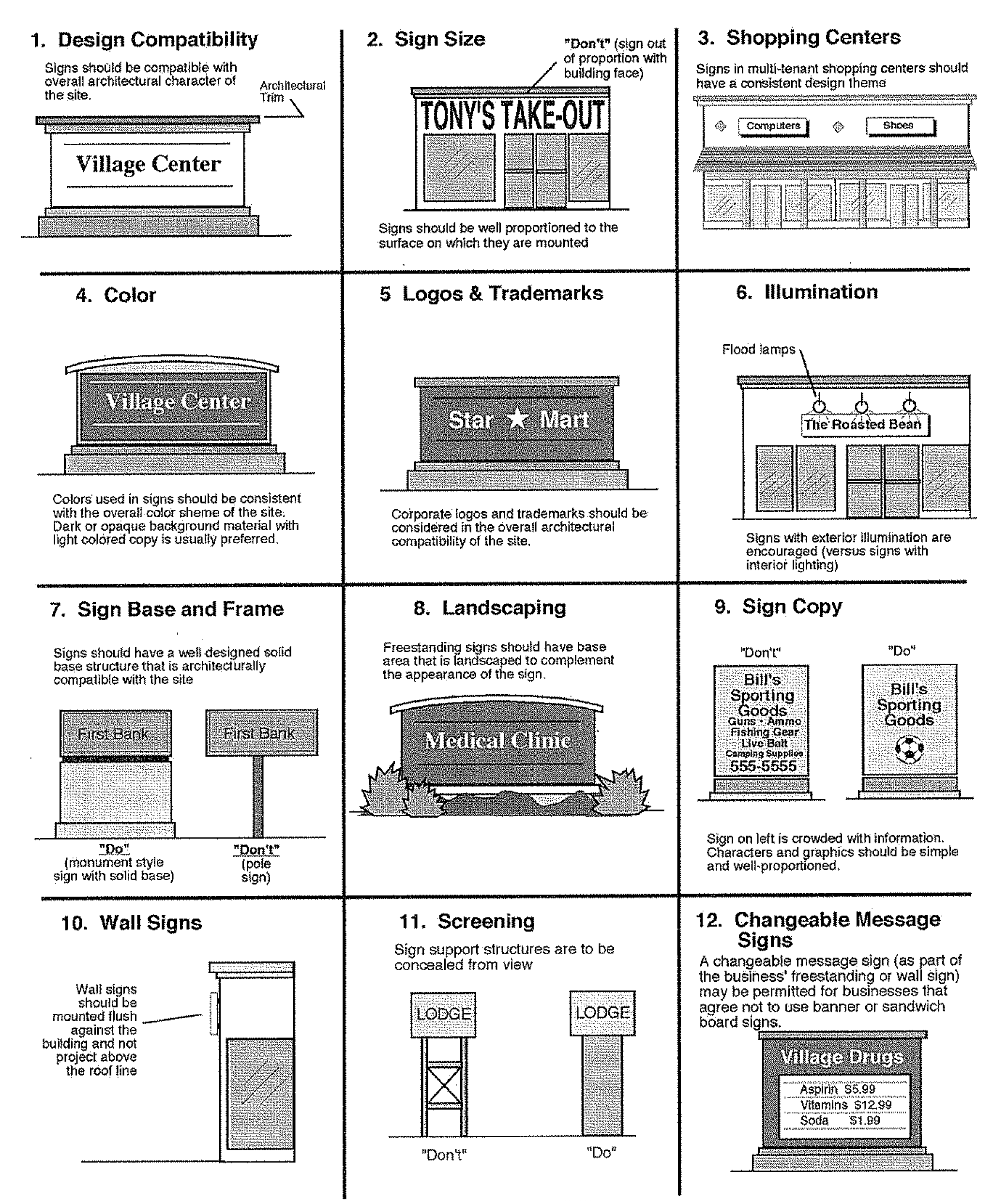
Exhibit 4: Sign Area Measurement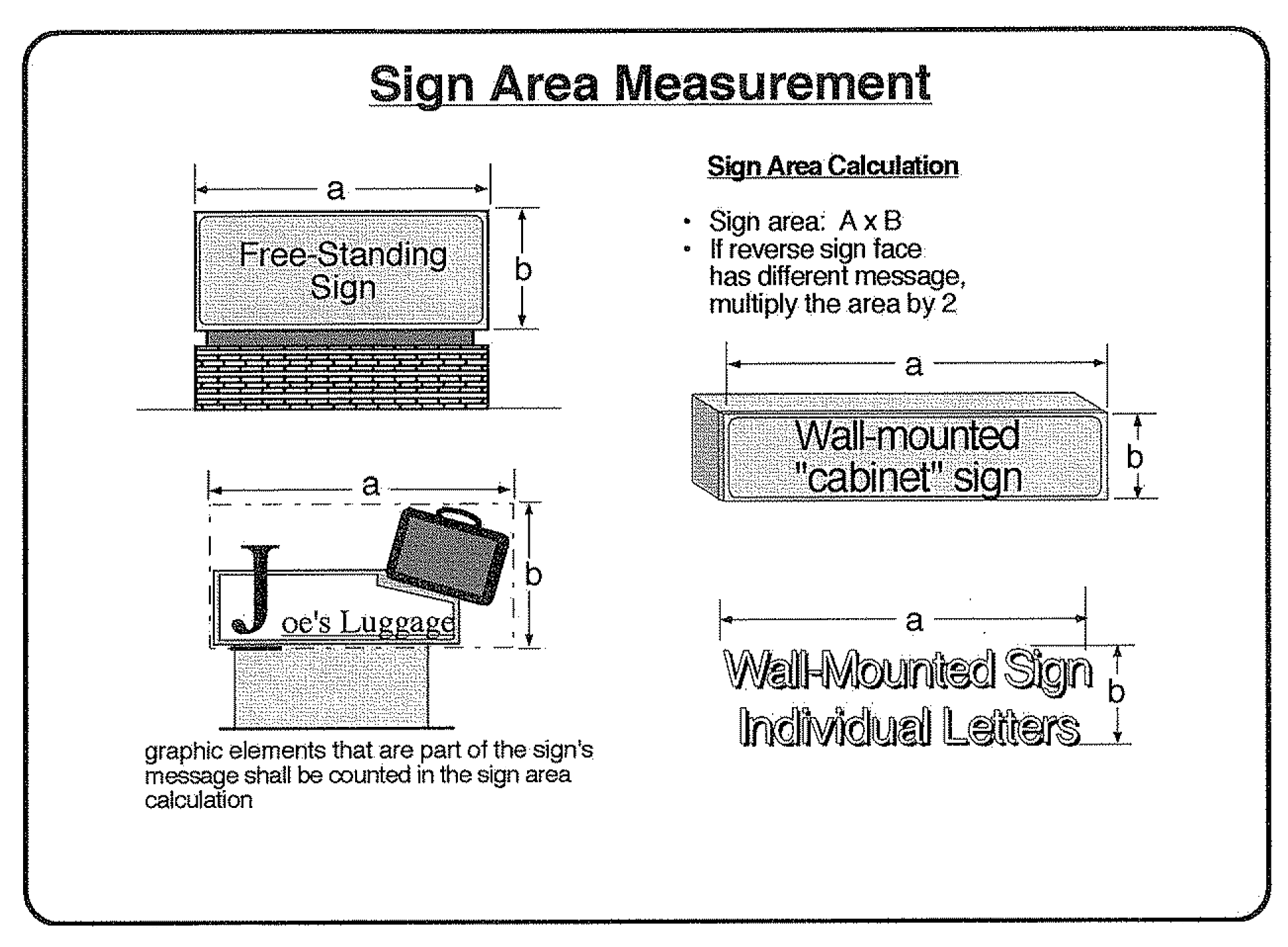
(6)
Miscellaneous signs.
a.
Construction project signs. Construction project signs shall not exceed 32 square feet in area, and eight feet in overall height, unless legally required by governmental contract to be larger. A construction project sign shall not require a sign permit and may exist no longer than the period of construction.
b.
Subdivision signs for subdivisions under active construction.
i.
Signs, with the exception of flags, banners, open house style signs, and model home signs, advertising residential subdivisions under active construction shall require the approval of a director review permit. Said permit shall be valid for a period of two years or less. Said permit is renewable. Multiple signs may be allowed per permit.
ii.
Subdivision signs shall be removed when the subdivision is sold-out.
iii.
No subdivision sign shall exceed 98 square feet in area per face.
iv.
For subdivisions up to 40 acres in area, the total amount of signs shall not exceed 392 square feet.
v.
For subdivisions greater than 40 acres, an additional 196 square feet of area is permitted.
vi.
As the subdivision is completed, the number of signs and square footage shall be correspondingly reduced.
vii.
All signs shall be located on private property within the subdivision being advertised, with the exception of the use of banners, small open house style signs and small open house signs.
viii.
Banners advertising the subdivision may be allowed to be placed on the street frontage side of a block wall or fence that borders the subdivision. One banner per major street frontage is permitted. Banners shall be limited to not more than four feet in height and 15 feet in length. The location of the banner shall be submitted to and approved by the community development director or his/her designee. A site plan review is not required.
ix.
Flags may be placed within the subdivision provided that said flags are located on private property within the subdivision.
x.
Small open house style signs may be placed at the entrance of the subdivision provided that they are limited to 7:00 a.m. and removed at dusk. Said signs shall not hinder pedestrian travel nor block intersections.
xi.
Model home lots: Signs are permitted on the same lot with a model home provided they do not exceed four in number and ten square feet each in area. Signs shall be removed after the developer concludes the initial sale of the lots or homes to their initial owners.
xii.
All advertisement shall be maintained in good working condition. Signs, flags, and banners shall be replaced when faded, tattered, damaged, or defaced.
(7)
Prohibited signs and locations. Prohibited signs are as follows:
a.
Vehicles used only for the purpose as a sign advertising platform/structure in lieu of permitted signage provided by these provisions when parked or stored off site and the vehicle is not used in the daily operation of the business.
b.
Any sign or sign structure which has become a public nuisance due to inadequate maintenance, dilapidation, or abandonment.
c.
Any sign which obstructs in any manner the ingress to, or egress from, a door, window, fire escape, or other access way required by building codes adopted by the City of Sanger.
d.
Any sign unlawfully installed, erected, or maintained.
e.
Any sign now or hereafter existing which no longer advertises a business conducted or a product sold as prescribed in this chapter.
f.
Any sign which encroaches into any city right-of-way and/or easement, except an under canopy sign or projecting sign.
g.
Any sign that flashes, blinks, moves, changes color, appears to change color, changes intensity, or contains any part of attachment which does the same except that standard barber poles, time and temperature signs and approved bulletin board signs shall be permitted in commercial and industrial zones if otherwise in compliance with these provisions.
h.
Any unofficial sign, signal or device, or any sign, signal or device which purports to be or is an imitation of, or resembles an official traffic sign or signal, or which attempts to direct the movement of traffic, or which hides from view any official sign or signal.
i.
Any light of any color of such brilliance as to blind or dazzle the vision of drivers upon any roadway or highway nor shall any light be placed in such position as to prevent the driver of a vehicle from readily recognizing any traffic sign or signal.
j.
Any sign located so that it interferes with visibility at an intersection, public right-of-way, driveway, or other ingress/egress.
k.
Any sign located or displayed on or over public property except as expressly permitted by these provisions unless approved by the city council.
l.
Any sign attached to a utility pole or tower, utility equipment structures or cabinets, trees or other vegetation.
m.
Any roof-top or roof ridge mounted sign.
n.
Any sign erected or maintained which has less horizontal or vertical clearance from communication lines and energized electrical power lines than that prescribed by the state, or rules and regulations duly promulgated by agencies thereof.
o.
Off-site signs, advertising structures and billboards
p.
Portable signs, other than approved temporary signs. The use of any temporary or window signage shall not be used in lieu of permanent wall or freestanding signs.
q.
Any sign which, in the opinion of the city, is in conflict with the spirit or intent of this chapter.
(8)
Exempted signs. The following signs and devices shall not be subject to the provisions in this chapter:
a.
Signs placed by a governmental body or public utility, required to be maintained by law.
b.
Memorial tablets or plaques placed by recognized historical agencies.
c.
Flags of the City of Sanger, National or State Government.
d.
Traffic or other signs of government agencies, signs required by law or contract with a governmental agency, railroad crossing signs, legal notices, and such temporary emergency or non-advertising signs as may be authorized by the city council.
e.
Seasonal holiday decorations and displays, including painted storefront window displays to celebrate nationally recognized holidays and celebrations including local celebrations.
f.
Political signs, that adhere to the following regulations: (In accordance with § 5405.3 California Business and Professions Code).
1.
Political signs are permitted on lots or parcels privately owned with permission of the property owner.
2.
The combined area of sign by any one candidate on any one parcel shall not exceed 32 square feet.
3.
Political signs shall not be attached to trees, fence posts, or utility poles, except on private property where signs may be attached to trees and fence posts with permission of the property owner.
4.
Political signs shall not be lighted either directly or indirectly.
5.
No political sign or portion thereof shall be placed in any street right-of-way or on any city-owned property.
6.
No sign shall be erected in violation of street corner setback requirements, which are established to ensure traffic safety, nor shall any such sign interference with pedestrian traffic.
7.
Political signs shall be erected no sooner than 90 days prior to the date of the scheduled election.
8.
All political signs shall be removed within ten days following the date of the election. A statement of responsibility shall be filed with the city clerk certifying a person who will be responsible for removing the temporary political signs and who will reimburse the city for any costs incurred for their removal. Signs not removed within this period may be removed by the city and the cost of removal assessed against the candidate.
9.
Provisions of this subsection shall not apply to political advertising on legally established existing commercial billboard structures.
(9)
Murals. It is the intent of the city council, for purposes of promoting the local economy, tourism, and for further purposes of beautifying the City of Sanger, to adopt standards regarding murals, their location and design.
a.
Location. Murals may be located on the sides of buildings and walls on property in any commercial, industrial or public/quasi-public zone district within the City of Sanger.
b.
Mural design approval. Prior to painting, installation and execution of a mural, an application shall be submitted to city planning. The application shall include a detailed drawing or sketch of the mural plus other details as prescribed on the application or to be pertinent. In addition, the application shall provide proof that an easement has been secured for the wall on which the mural will be placed. The proposed mural design application shall be forwarded with a recommendation to the planning commission. The commission shall review and approve, approve with modifications, or deny the application as submitted.
c.
Criteria for design of murals.
(1)
Murals of historical significance to Sanger's history and heritage are encouraged. However, the planning commission welcomes all submissions for review. A mural shall not contain elements that advertise an existing business or product or make a political statement.
(2)
The paint to be used shall be appropriate for use in an outdoor locale, for an artistic rendition and shall be of a permanent, long-lasting quality.
(3)
The mural shall be designed and painted by qualified mural artists with sufficient knowledge in the design and painting of such projects.
(4)
To the extent feasible, the mural shall be vandal and graffiti resistant.
(5)
The mural shall be maintained by the property owner through a written agreement with the city.
d.
Planning commission review. Approval of a mural permit shall occur only after public notice and an opportunity for interested parties to present any appropriate comments, either in writing or orally, to the planning commission.
e.
Appeal to city council. Within ten days of the planning commission's decision by resolution on a mural permit, any interested party may appeal a decision of the planning commission regarding a mural application. The appeal must be in writing accompanied by a fee and be received by the city planner or city clerk within ten days of the action by the planning commission. Following public notice and public hearing, the appeal shall be considered by the city council. Action of the city council shall be considered final.
f.
Mural design amendment. The planning commission shall consider such amendment in accordance with the provisions for review and approval of a mural as provided in subsection (9)a.—e.
(10)
Non-conforming signs. The lawful use of a sign existing on the effective date of this chapter, although such use does not conform to the provisions of this chapter, may be thus continued; provided, however, a non-confirming sign which has been abandoned, or the use for which it is advertised has ceased to function for a period of 90 days or more, shall be brought into conformity with the provisions of this chapter.
a.
Non-conforming sign shall not in any manner (except for sign copy/ face changes) be structurally altered, reconstructed, or moved without being made to comply with the provisions of this chapter; however, nothing herein shall prohibit the painting, maintenance, or repairing of such sign, including the changing of sign copy/face.
b.
If, at any time, any sign in existence or maintained on the effective date of this chapter, which does not conform to the provisions of this chapter, is destroyed by fire, accident, explosion or act of nature to the extent of more than 50 percent of the value thereof, such sign shall be subject to all the provisions of this chapter. For the purposes of this chapter, the value of any sign shall be the estimated cost of replacement of the sign in kind as determined by the building official.
c.
The chief building official or his/her designee shall immediately cause the removal of any sign which, in the judgment of the city manager is found to be within the public right-of-way and/or easements and are found to place citizens in immediate peril, by any or a combination of the following methods using sound judgment under the circumstances:
1.
Removal or modification of said sign by city staff with business owner (or property owner if business has ceased operations) to be billed for time and materials.
2.
Notification orally or in writing to the business owner causing the removal of said signs within a 24-hour period or lesser period of time, as prescribed by the city manager.
3.
Immediate citation of the business owner (or property owner if business has ceased operations) or party responsible for said sign.
d.
Any business that has ceased operations for at least 30 days shall remove all temporary signs and all window signs.
(11)
Minor deviations. A minor deviation of up to ten percent in permitted sign area, including height and location standards may be granted by the city upon written request, subject to such conditions as it may impose without any notice or appeal, if the city planner finds that to do so would not be detrimental to the public welfare or injurious to property and improvements in the area in which the property is located.
a.
A minor deviation may be granted upon making the following findings:
1.
There are exceptional or extraordinary circumstances or conditions, which apply to the property involved or the existing or intended use of the property which do not apply generally to other properties in the same zoning district.
2.
Granting of a minor deviation will not negatively impact surrounding properties.
(12)
Administration. Building permits are required for all signs, except for window signs, painted signs and temporary signs including banner signs and sandwich board signs.
a.
Permit applications for sign approvals shall be made upon city forms provided by the building official and shall include a plot plan, sign design details, mounting and electrical details and engineered footing(s) (for freestanding signs) and any additional information required by the building official in the review and issuance of building permits.
b.
Appeals. The provisions of section 90-1018 shall apply.
c.
Violations. The provisions of section 90-1055 shall apply.
(Ord. No. 731, § 7, 8-2-83; Ord. No. 777, § 2, 4-15-86; Ord. No. 847, 6-6-91; Ord. No. 860, § 2, 12-5-91; Ord. No. 1092, Exh. A, 7-19-07; Ord. No. 1125, § 1(Exh. A), 2-2-12; Ord. No. 1155, § 1, 1-15-15; Ord. No. 1164, § 1(Exh. A), 10-15-15; Ord. No. 1168, §§ 1, 2, 2-18-16)
Sec. 90-892. - Loading space requirements.
The following property development standards for loading spaces shall apply to all land, buildings and structures in all districts:
(1)
Every commercial and industrial building shall provide and maintain loading spaces as provided in the following tables:
(2)
The following general requirements shall apply to the location and design of loading spaces.
a.
When the lot upon which the loading spaces are located abuts upon any alley, such loading space shall adjoin or have access from the alley.
b.
A loading space may occupy a rear or side yard, except such portion required to be landscaped, or unless specifically prohibited by the yard requirements of the zone district.
c.
In no case shall any part of an alley or street be used for providing required loading space.
d.
Where the loading area has access from a street, such access shall conform to the city standard specifications.
e.
Loading spaces shall be not less than 12 feet in width and 40 feet in length, and shall have not less than 14 feet of vertical clearance.
f.
Loading spaces maintained in connection with any main building shall continue to be maintained so long as the building remains, unless an equivalent number of spaces are provided on a contiguous lot or elsewhere on the same lot, in conformity with the requirements of this section; provided, however, that this regulation shall not require the maintenance of more loading space than is required for a new building.
g.
No required loading space shall be relinquished or reduced in any manner below the requirements established in this chapter unless equivalent facilities are provided elsewhere, the equivalency of which is determined by the commission, following the procedure set forth in sections 90-991 through 90-993.
h.
Where a loading area is adjacent to a residential district, loading shall be done only between the hours of 8:00 a.m. and 6:00 p.m.; unless the loading area is located at least 100 feet from such district or is completely enclosed.
(Ord. No. 731, § 7, 8-2-83; Ord. No. 777, § 2, 4-15-86; Ord. No. 847, 6-6-91; Ord. No. 860, § 2, 12-5-91)
Sec. 90-893. - Lot lines; landscaping.
The following property development standards for lot lines and landscaping shall apply to all land, buildings and structures in all districts:
(1)
Lot lines.
a.
Lot line, front.
1.
On an interior lot, the front lot line is the property line or lines abutting the street.
2.
On a corner or reversed corner lot, the front lot line is the shorter property line abutting a street.
3.
On a through lot, or a lot with three or more sides abutting a street or a corner or reversed corner lot, with lot lines of equal length, the commission, following the procedure set forth in sections 90-991 through 90-993, shall determine which property line or lines shall be the front lot line or lines for purposes of compliance with yard and setback provisions of this chapter.
b.
Lot line, rear. In the case of an irregular or goreshaped triangular lot, the rear lot line shall be a line within the lot, parallel to and at a maximum distance from the front lot line, having a length of not less than ten feet. A lot which is bounded on all sides by streets may have no rear lot lines.
c.
Lot line, side. On a lot with three or more sides abutting a street, all lot lines abutting such street or streets, other than the front lot line or lines, may be side lot lines.
(2)
Landscaping. Whenever this chapter or any permit granted hereunder requires landscaping, the following standards of design, practice, and maintenance shall be observed.
a.
When property is undeveloped at the time landscaping requirements are imposed upon the property, landscaped yards and areas shall be provided and maintained at the time a main building is constructed and occupied or when any open use, other than agricultural, occurs on the property.
b.
All vegetation shall be provided with an adequate, permanent, and nearby source of water which shall be provided by installed on-site water sprinklers, flood, or drip irrigation systems.
c.
All vegetation shall be maintained free of physical damage or injury from lack of water, excess chemical fertilizer or other toxic chemical, blight, or disease, and such vegetation or those that show signs of such damage or injury at any time shall be replaced by the same, similar, or substitute vegetation of a size, form and character which will be comparable at full growth.
d.
Landscaping provided with any use requiring a site plan shall be designated on the site plan.
(Ord. No. 731, § 7, 8-2-83; Ord. No. 777, § 2, 4-15-86; Ord. No. 847, 6-6-91; Ord. No. 860, § 2, 12-5-91)
Sec. 90-894. - Special standards and regulations.
The following special standards and regulations for property development shall apply to all land, buildings and structures in all districts:
(1)
Easements. No building or structure shall be constructed which may be in conflict with an easement.
(2)
Greenhouses. A greenhouse shall be classified as a building in determining lot coverage. The property development standards of the district shall apply if such structure exceeds the permitted fence height for the district or if such structure exceeds 100 square feet in area.
(3)
Structure, temporary. A temporary structure shall be subject to all applicable property development standards for the district in which it is located.
(4)
Accessory structures.
a.
Where an accessory building is part of or joined to the main building by a common wall, the accessory building shall be deemed a main building for purposes of applying the property development standards of this chapter.
b.
Where an accessory building, either attached to or detached from the main building, is less than six feet from the main building, the accessory building shall be deemed a main building for purposes of applying the property development standards of this chapter.
c.
Where an accessory building is detached and separated from the main building by six feet or more, the accessory building need not be considered a main building for purposes of applying the property development standards of this chapter.
d.
Where an accessory building is attached to the main building by a breezeway roof with an intervening space of six feet or more and where the space is open on at least two sides, the accessory building need not be considered a main building for purposes of applying the property development standards of this chapter.
(5)
Accessory dwelling units.
a.
Purpose. The purpose of this article is to establish the regulations and procedures for the review of accessory dwelling units (ADU[s]) and junior accessory dwelling units (JADU[s]), in conformance with the California Government Code Title 7, Division 1, Chapter 13, Accessory Dwelling Units.
b.
Applicability. Any construction, establishment, alteration, enlargement, or modification of an ADU shall comply with the requirements of this subsection and Title 14. For purposes of this subsection, ADUs include detached, attached, and JADUs.
c.
Permit required.
1.
A building permit is required for ADUs and JADUs.
2.
The provisions included in this section are applicable to all lots that (1) are zoned to allow single-family or multifamily residential uses and (2) include a proposed or existing dwelling unit.
3.
Any application for an ADU that meets the location and development standards contained in this section shall be approved ministerially without discretionary review or public hearing.
d.
Processing time and submittal requirements.
1.
Processing time.
(a)
State-exempt ADUs that qualify under Government Code Section 66323 shall be subject to ministerial approval within 60 days of submittal of a complete application.
(b)
On lots with an existing single-family or multifamily dwelling, an application to create an ADU or JADU shall be approved within 60 days of submission of a complete application, unless either:
1.
The permit application to create an ADU or JADU is submitted concurrently with a permit application to create a new single-family or multifamily dwelling on the lot, in which case the city shall not act on the permit application for the ADU or JADU until the city acts on the permit application for the new single-family or multifamily dwelling unit; or
2.
The applicant requests a delay, in which case the 60-day time period shall be tolled for the period of the delay.
(c)
Once the application for the new single-family dwelling or multifamily dwelling has been approved, the permit application for the ADU or JADU shall be processed and either approved or denied within 60 days.
(d)
If the city has not acted upon the completed application for the ADU or JADU within 60 days, and neither of the above exceptions are met, then the application for the ADU or JADU shall be deemed approved.
2.
Submittal requirements. The application for an ADU or JADU shall be submitted to the department. An ADU shall be reviewed as part of the established building permit process, and compliance with the standards of this article will be verified through the ministerial planning review process.
3.
Denial/remedies. If the city denies an application for an ADU or JADU, the city will provide in writing a full set of comments within 60 days to the applicant from the date they received a completed application with a list of items that are defective or deficient and a description of how the application can be remedied by the applicant. When the primary dwelling is proposed concurrent with the ADU then more than 60 days can be taken by the city.
e.
Rental and sale limitations.
1.
Long-term rentals only. Rental of the ADU created pursuant to this section shall be for a term 30 days or longer (Government Code Section 66315). Occupancy of the ADU or JADU shall not be allowed until the city approves occupancy of the primary dwelling unit (Government Code Section 66328).
2.
Sale and conveyance. An ADU may be sold or conveyed separately from the primary residence to a qualified buyer if all the requirements of Government Code Section 66341 are met.
3.
If all the requirements of Government Code § 66342 are met, the separate conveyance of the primary dwelling unit and ADU are allowed as condominiums.
f.
General development and operational standards.
1.
When a garage, carport, or covered parking structure is demolished in conjunction with the construction or conversion of a detached or attached ADU, replacement parking is not required (Government Code Section 66314, subd. (d)(11)).
2.
A demolition permit for a detached garage that is to be replaced with a detached or attached ADU shall be reviewed with the application for the ADU and issued at the same time (Government Code Section 66314, subd. (e)).
3.
Availability of utilities all accessory dwelling units shall be connected to public utilities or their equivalent, including water, electric, and sewer services, unless the accessory dwelling unit was constructed with a new single-family dwelling (Government Code Section 66324).
4.
Fire sprinklers. If fire sprinklers are not required for the primary residence, then installation of fire sprinklers are not required in an ADU. The construction of an ADU shall not trigger a requirement for fire sprinklers to be installed in the existing primary dwelling. However, if the primary residence undergoes significant remodeling and is required to install fire sprinklers, an ADU created after the remodel would also be required to install fire sprinklers (Government Code Section 66314, subd. (d)(12)).
5.
Building code. Building code requirements for detached dwellings shall be applied to ADUs, except that the construction of an ADU shall not constitute a Group R occupancy change under the building code, as described in Section 310 of the California Building Code (Title 24 of the California Code of Regulations) (Government Code Section 66314, subd. (d)(8)).
6.
Occupancy. Owner occupancy is not required on a property with an ADU.
g.
Conditions for nonconforming uses and structures.
1.
Nonconforming conditions. Until January 1, 2030, an owner of an ADU or JADU that receives a notice to correct violations or abate nuisance, in relation to the ADU or JADU, may request a delay for five years in enforcement of a building standard, as long as the violation is not a health and safety issue as determined by the local agency, subject to compliance with the Government Code Section 66331 and Health and Safety Code Section 17980.12(a)-(c), and the following conditions:
(a)
The ADU or JADU was built before January 1, 2020.
(b)
The ADU or JADU was built on or after January 1, 2020, in a local jurisdiction that, at the time the ADU or JADU was built, had a noncompliant ADU or JADU ordinance, but the ordinance is compliant at the time the request is made.
(c)
This subsection shall remain in effect only until January 1, 2035, and as of that date is repealed.
h.
Number of ADUs or JADUs Permitted Per Legal Parcel or Lot. An application for a permit to establish an ADU or JADU that meets at least one of the following descriptions shall be ministerially approved without a public hearing and is not subject to the development standards of this chapter (Government Code Section 66317, subd. (a)).
1.
(One ADU and one JADU are permitted per lot within the existing or proposed space of a single-family dwelling or within an existing accessory structure, that meets specified requirements such as exterior access and setbacks for fire and safety (Government Code Section 66323, subd. (a)(1)).
2.
One detached new construction ADU. One JADU may also be combined with a detached ADU (Government Code Section 66323, subd. (a)(2)).
3.
Multiple ADUs within the portions of multifamily dwelling structures that are not used as livable space. Local agencies must allow an amount of ADUs up to 25 percent of the dwelling units in existing multifamily dwelling structures, or a minimum of one, whichever is greater (Government Code Section 66323, subd. (a)(3)).
4.
Up to two detached ADUs on a lot that has proposed multifamily dwellings (Government Code Section 66323, subd. (a)(4)).
5.
Up to eight detached ADUs on a lot that has existing multiple family dwellings provided that the number of ADUs does not exceed the number of existing dwelling units on the lot. (Government Code Section 66323, subd. (a)(4))
i.
State-exempt ADUs.
1.
State-exempt ADUs shall not be subject to any local development or design standard that is not authorized by Section 66323 but shall comply with applicable building code and health and safety standards.
j.
Detached ADUs.
1.
Location. Detached ADUs must be accompanied by a proposed or existing single-family or multifamily dwelling. An existing dwelling on-site may be classified as the detached ADU after construction and occupation of a proposed dwelling on-site. Detached ADUs may be located in an existing accessory structure.
2.
Maximum number of detached ADUs.
(a)
When accompanied by a proposed or existing single-family dwelling, the maximum number of detached ADUs shall be one. The detached ADU may be in addition to an existing or proposed attached ADU or an existing or proposed JADU (Government Code Section 66314, subd. (d)(2)).
(b)
When accompanied by a proposed multifamily dwelling, the maximum number of detached ADUs shall be two per lot. Detached ADUs are not required to be detached from each other but must be detached from the multifamily dwelling (Government Code Section 66323, subd. (a)(4)(A).
(c)
When accompanied by an existing multifamily dwelling, the maximum number of detached ADUs shall be eight per lot. However, the number of ADUs shall not exceed the number of existing dwelling units on the lot (Government Code Section 66323, subd. (a)(4)(ii)). Detached ADUs are not required to be detached from each other but must be detached from the multifamily dwelling (Government Code Section 66323, subd. (a)(4)(A)).
3.
Floor area.
(a)
The minimum floor area shall be 150 square feet.
(b)
When accompanied by an existing or proposed single-family dwelling, the maximum floor area shall be no more than 1,200 square feet (Government Code Section 66314, subd. (d)(5)).
4.
Minimum setbacks.
(a)
The minimum side, street side, and rear-yard setback shall be four feet, except when converting or replacing an existing accessory structure that is less than four feet from the side, street side, or rear yard (Government Code Sections 66314, subd. (d)(7), and 66323, subd. (a)(2)).
(b)
No setback shall be required for an existing living area or accessory structure or a structure constructed in the same location and to the same dimensions as an existing structure that is converted to an accessory dwelling unit or to a portion of an ADU, and a setback of no more than four feet from the side and rear lot lines shall be required for an ADU that is not converted from an existing structure or a new structure constructed in the same location and to the same dimensions as an existing structure (Government Code Section 66317, subd. (a)).
5.
Maximum height. The maximum height of detached ADUs shall be as follows (Government Code Section 66321, subd. (b)(4)):
(a)
For one-story detached ADUs, the maximum height shall be 16 feet. Where the detached ADU is within one-half-mile walking distance of a major transit stop or a high-quality transit corridor, as defined in Section 21155 of the California Public Resources Code, or with an existing or proposed multifamily dwelling of more than one story, the maximum height shall be 18 feet.
(b)
For two-story detached ADUs, the maximum height shall be 25 feet.
(c)
Height exceptions.
1.
An additional two feet in height shall be allowed to accommodate a roof pitch on an ADU that is aligned with the roof pitch of the primary dwelling unit.
2.
When an existing accessory structure is converted to a detached ADU, the maximum height may exceed the limits of subsection 5.(a) of this section to an amount equal to the height of the existing accessory structure to be converted.
6.
Parking.
(a)
Parking requirements. A maximum of one parking space shall be required per ADU or per bedroom, whichever is less. These spaces may be provided as tandem parking on a driveway or in front and/or rear setback areas. (Government Code Section 66314, subd. (d)(10)).
(b)
Exceptions. No parking shall be required for ADUs in any of the following instances (Government Code Sections 66314, subd. (b)(2), and 66322, subd. (a)):
1.
The ADU is within one-half-mile walking distance of public transit.
2.
The ADU is within an architecturally and historically significant historic district.
3.
The ADU is part of the proposed or existing primary residence or an accessory structure.
4.
When on-street parking permits are required but not offered to the occupant(s) of the ADU.
5.
There is a car-share vehicle within one block of the ADU.
6.
When a permit application for the ADU is submitted with a permit application to create a new single-family dwelling or a new multifamily dwelling on the same lot, provided that the ADU or the parcel satisfies any other criteria listed in Government Code Section 66322, subd. (a).
(c)
Development standards. Detached ADUs shall comply with all applicable base zone district objective development standards, including lot coverage, floor area ratio, open space, front setbacks, and minimum lot size, unless application of any one or more of these standards precludes construction of at least an 800-square-foot detached ADU.
k.
Attached ADUs.
1.
Location. Attached ADUs must be accompanied by a proposed or existing single-family or multifamily dwelling.
2.
Maximum number of attached ADUs.
(a)
When accompanied by a proposed or existing single-family dwelling, the maximum number of attached ADUs shall be one. The attached ADU may be in addition to an existing or proposed detached ADU and/or an existing or proposed JADU (Government Code Section 66323, subd. (a)(1-2)).
(b)
When accompanied by a proposed or existing multifamily dwelling, the maximum number of attached ADUs allowed shall be no more than 25 percent of the number of existing or proposed multifamily units. However, in no case shall less than one attached ADU be allowed (Government Code Section 66323, subd. (a)(3)).
3.
Floor area.
(a)
The minimum floor area shall be 150 square feet.
(b)
Single-family attached ADU (Government Code Section 66323, subd. (a)(1)(A)).
1.
The maximum floor area may expand up to 150 square feet from the existing primary dwelling unit.
2.
If the ADU expands beyond 151 square feet from the existing primary dwelling unit, then the floor area shall not exceed 50 percent of the living area of the existing primary dwelling unit.
4.
Minimum setbacks.
(a)
The minimum side, street side, and rear yard setback shall be four feet, except when converting or replacing an existing attached accessory structure that is less than four feet from the side, street side, or rear yard.
(b)
No setback shall be required for an existing living area or accessory structure or a structure constructed in the same location and to the same dimensions as an existing structure that is converted to an accessory dwelling unit or to a portion of an ADU, and a setback of no more than 4 feet from the side and rear lot lines shall be required for an ADU that is not converted from an existing structure or a new structure constructed in the same location and to the same dimensions as an existing structure (Government Code Section 66314, subd. (c)(7)).
5.
Maximum height.
(a)
The maximum height of attached ADUs shall be two stories and 25 feet or the maximum height specified by the base zone district for the primary dwelling, whichever is lower (Government Code Section 66321, subd. (b)(4)).
(b)
Attached ADUs that are interior to an existing structure that is converted shall not exceed the height of that existing structure.
6.
Parking. No parking shall be required for an attached ADU.
7.
Development standards.
(a)
Attached ADUs shall comply with all applicable base zone district objective development standards (Government Code Section 66321, subd. (b)(3)), including limits on lot coverage, objective design standards, floor area ratio, open space, front setbacks, and minimum lot size unless application of any one or more of these standards precludes construction of at least an 800-square-foot attached ADU with four feet side and rear yard setbacks.
(b)
The city shall not use or impose additional standards other than those provided in Government Code Section 66314, including an owner-occupant requirement, except that the city may require that the property may be used for rentals of terms 30 days or longer (Government Code Section 66315).
l.
Junior accessory dwelling units.
1.
Location. JADUs must be accompanied by a proposed or existing single-family dwelling on a lot zoned for single-family use. A JADU must be within the walls of the primary single-family dwelling, including, but not limited to, an attached garage (Government Code Section 66323, subd. (a)(1)). One JADU may also be combined with a detached ADU (Government Code Section 66323, subd. (a)(2)).
2.
Maximum number of JADUs.
(a)
When accompanied by a proposed or existing single-family dwelling, the maximum number of JADUs shall be one per lot. The JADU may be in addition to an existing or proposed detached ADU or an existing or proposed attached ADU.
3.
Floor area.
(a)
The minimum floor area shall be 150 square feet.
(b)
The maximum floor area shall be 500 square feet.
4.
Parking. No parking shall be required for a JADU, including replacement parking.
5.
Exterior access. Access shall be provided to the JADU independent from the primary dwelling.
6.
Sanitation facilities. Sanitation facilities may be separate or shared with the primary dwelling. If shared with the primary dwelling, the JADU shall provide an interior entry to the living area of the primary dwelling, separate from the exterior access required to the JADU.
8.
Kitchen features. An efficiency kitchen shall be provided, including all of the following (Government Code Section 66333, subd. (f)):
(a)
A cooking facility with appliances.
(b)
A food preparation counter and storage cabinets that are of reasonable size in relation to the size of the junior accessory dwelling unit.
9.
Occupancy. Owner-occupancy shall be required in either the remaining portion of the primary single-family dwelling or the newly created JADU. Owner-occupancy shall not be required if the owner is another governmental agency, land trust, or housing organization (Government Code Section 66333, subd. (b)).
10.
Deed restriction. A deed restriction shall be recorded on the property which shall run with the land, and a copy of which shall be provided to the planning department. The deed restriction shall include both of the following (Government Code Section 66333, subd. (c)):
(a)
A prohibition on the sale of the JADU separate from the sale of the single-family dwelling, including a statement that the deed restriction may be enforced against future purchasers.
(b)
A restriction on the size and attributes of the JADU that conforms with this section.
(6)
Satellite dishes, towers and similar electronic antennae.
a.
All satellite dishes, towers and similar electronic antennae shall be considered buildings and shall meet all applicable setback requirements.
b.
Such antennae shall be screened from view from adjacent properties by structural screens. All such antennae shall be reviewed and approved by the building official prior to installation.
c.
A satellite antenna shall not exceed 13 feet in diameter.
d.
A satellite antenna shall be ground-mounted and shall not exceed a height of 12 feet at its highest point.
e.
Antennae exceeding 13 feet in diameter or 12 feet in height shall be permitted only by conditional use permit pursuant to sections 90-998 through 90-1001.
(7)
Carnivals and similar events. Carnival activity as defined in Municipal Code section 18-83 and similar events conducted by charitable organizations that have the potential to attract attendance by more than 100 persons shall require the approval of a director's review permit.
(8)
Residential projects located on sites 2, 3, 17 in Table 1N-6 and site 52 in Table 1N-7 of the 2023- 2031 Housing Element identified to meet the lower income RHNA providing appropriate densities and a minimum of 20 percent of the units in the development as affordable to lower income households shall be allowed by right pursuant to Government Code section 65583.2(i).
(Ord. No. 731, § 7, 8-2-83; Ord. No. 777, § 2, 4-15-86; Ord. No. 847, 6-6-91; Ord. No. 860, § 2, 12-5-91; Ord. No. 1165, § 1, 11-19-15; Ord. No. 1171, § 2, 6-16-16; Ord. No. 2025-04, § 4(Exh. A, § 14), 5-15-25)
Sec. 90-895. - Recycling areas in development projects.
The following development standards for recycling areas shall apply to all land, buildings and structures in all districts in development projects: Development projects shall provide a recycling area equivalent to a minimum of 25 percent of the total area required for solid waste collection and loading; or to one full space for the location of a similar type of solid waste container required for the development project, whichever is greater. This area shall be paved and maintained in the same manner as the area for the collection and loading of solid waste, and shall be located adjacent to it.
(Ord. No. 925, § 3, 1-5-95)
Sec. 90-896. - Bed and breakfast establishments.
Bed and breakfast facilities may be operated in the RA and CP zone districts, within a single-family residential structure existing as of January 1, 2004, subject to the following standards:
The bed and breakfast facility shall be operated by the owner/occupant of the property on which it is located.
Guest occupancy of bed and breakfast facilities shall not exceed 30 consecutive days for each guest.
The bed and breakfast activity shall be conducted within a dwelling or an accessory building involving a maximum of five bedrooms accommodating no more than ten guests. Accessory buildings shall be subject to the provisions of subsections 90-894(4)a. through d.
Signs identifying the bed and breakfast facility shall be limited to one freestanding sign and one wall-mounted sign. The freestanding sign shall not exceed a height of six feet nor exceed 32 square feet in area. The wall-mounted sign shall be a nameplate not to exceed four square feet in area. Signs shall be designed to compliment the facility and subject to the provisions of section 90-891.
The bed and breakfast facility shall be limited in employment to residents of the property and a maximum of two nonresident employees for said use.
In addition to the parking requirements specified under sections 90-884 through 90-889, one parking space shall be required per each guest bedroom and employee. Said parking shall be located on-site and outside of the front yard and street side yards of the subject parcel.
Prior to establishment of any bed and breakfast operation, a conditional use permit application shall have been submitted to and approved by the planning commission pursuant to the provisions of section 90-998.
(Ord. No. 1045, § 4, 2-19-04)
Sec. 90-897. - Home occupations.
A home occupation may be permitted by issuance of a home occupation permit in accordance with this section.
Applications for home occupation permits shall be made by a resident living at the site that will operate the home occupation, and shall have the written consent of the property owner.
Home occupation permits shall be processed and approved as an administrative matter by the planning director.
A home occupation permit may not be transferred to another site, nor may it be transferred to another resident.
The following standards and conditions shall apply to all home occupations:
a.
The home occupation shall be clearly incidental to the use of the site as a residence.
b.
There shall be no employment or contracting of help other than a resident of the dwelling or a family member of a resident of the dwelling, with the exception that a cottage food operation is allowed to employ one full-time equivalent employee.
c.
There shall be no sales of products on the premises, except that products from a cottage food operation may be sold directly to consumers.
d.
The use shall not generate pedestrian or vehicular traffic beyond that normal to the district in which it is located.
e.
The use shall not involve the use of commercial vehicles for delivery of materials or products to or from the premises, other than a vehicle not to exceed one ton payload capacity, owned by the operator of the home occupation. The vehicle shall not be stored in a location visible from a public street.
f.
There shall be no excessive or unsightly storage of materials or supplies, indoors or outdoors, other than those permitted in the district.
g.
There shall be no signs advertising the business or identifying the site as a home occupation.
h.
No building or space outside of the main building shall be used for home occupation purposes.
i.
No required parking spaces for the residence shall be used for home occupation purposes.
j.
In no way shall the appearance of the structure or site be altered such that the structure or site may be reasonably recognized as serving a nonresidential use, either by color, materials, construction, lighting, signage, noises, or vibrations.
k.
There shall be no use of utilities or community facilities beyond that normal to the use of the property for residential purposes.
l.
The use shall not generate sewage or solid waste of a type that differs or of an amount that is greater than a typical residence within the district in which it is located.
m.
All food preparation in conjunction with a cottage food operation must take place in the residence's existing kitchen.
n.
A permit for a home occupation that requires an additional permit or approval from another agency to operate, such as a cottage food operation, shall not be effective until that permit or approval is obtained, and shall automatically expire if the other required permit or approval expires, is disapproved, or is revoked.
o.
A copy of any additional permit or approval from another agency to operate, such as a cottage food operation permit, shall be provided to the city planning department within ten working days of the issuance of that permit or approval.
In addition to the standards and conditions specified above, the planning director may add additional conditions to the home occupation permit approval that are deemed necessary to promote general health, safety, and welfare.
Upon violation of a standard condition, the planner director may revoke a home occupation permit if, 1) the violation has not been remedied within ten days after a notice of violation has been issued, or 2) there are repeated violations.
In the event of denial or revocation of a home occupation permit, or in the event of an objection to the limitations placed upon the home occupation, an appeal may be made by the permit applicant to the planning commission.
A home occupation permit shall expire and become void if one of the following occurs:
a.
The use is not commenced with six months of the issuance of the permit,
b.
The use has not been conducted for a period of six months,
c.
The city business tax license for the use has expired,
d.
The property changes ownership.
(Ord. No. 1140, § 2, 7-18-13, eff. 8-18-13)
Sec. 90-898. - Manufactured housing.
(a)
Manufactured housing shall be allowed in all residential zone districts on lots where conventional single family residential dwellings are allowed subject to the following provisions:
(1)
Certification. Manufactured housing that is proposed to be installed shall be certified under the National Manufactured Housing Construction and Safety Standards Act of 1974 as may be amended
(2)
Aesthetic features. Manufactured housing shall comply with the City of Sanger Community Design Standards and Guidelines for Single Family Residential as expressed in Section 3-4, Aesthetic Requirements.
Roof pitch shall be a minimum of 4:12.
(3)
Architectural features. Manufactured housing shall incorporate the use of composition asphalt shingle roofing materials with a minimum 25-year warranty.
Eave overhang shall be a minimum of 16 inches.
Siding materials shall be of a permanent material not to include aluminum or other metal.
(4)
Structural features. Manufactured housing shall be installed on a permanent foundation system in accordance with Health and Safety Code § 18551 with the following provisions:
a.
That the maximum distance between surface ground level to the floor of the manufactured housing unit be eight inches;
b.
That a permanent continuous solid masonry continuous stem wall be constructed along the perimeter of the structure.
(5)
Date of installation. Manufactured housing shall be precluded from being installed if more than ten years have elapsed between the date of manufacture of the manufactured housing and the date of application for the issuance of a permit to install the manufactured housing.
(Ord. No. 1161, § 2(Exh. A), 9-3-15)
Sec. 90-899. - Emergency shelters.
(a)
Emergency shelters shall conform to all property development standards of the zoning district in which located except as modified by these development standards.
(b)
The maximum number of beds permitted in a shelter shall be in accordance with applicable fire/building code capacity, but shall not exceed 21.
(c)
The parking requirements shall comply with section 90-886(19).
(d)
The shelter shall provide a bicycle parking area.
(e)
Emergency shelters shall provide no less than ten square feet of interior waiting and client intake space per bed. In addition, there shall be no less than two offices or cubicles in the shelter, and at least one must be an enclosed office with walls, a ceiling, and a door for purposes of maintaining privacy.
(f)
On-site management shall be present at all times that the shelter is open and in operation. Prior to the operation of the shelter and annually thereafter, the shelter shall prepare and file a management plan with the community and economic development department that includes the following information:
(1)
Operational rules and standards that address: (a) client supervision; (b) staff training to meet the needs of shelter residents; (c) hours of operation; (d) client services to be provided either at the shelter or other locations, particularly those to assist residents with obtaining permanent shelter and income. If services are provided offsite the management plan shall describe transportation needs; (e) community outreach; (f) screening of residents to ensure compatibility with the services provided at or through the shelter; (g) storage/handling of personal belongings; (h) laundry services; (i) food services; (j) security measures; (k) emergency contact information; and (l) maintenance of the property and facility. Note: laundry services and food services do not need to be provided on-site, however the management plan shall address how these services will be provided.
(2)
Floor plan of the emergency shelter. If homeless families are to be served, separate area(s) shall be provided that have privacy. If both genders are to be served by the shelter, the floor plan shall show separated areas of accommodations and bathroom facilities for both male and female residents. Bathroom facilities shall include showers and be sized in accordance with the most current adopted building and plumbing code.
(g)
The length of client/resident stay shall be limited to no more than six months in any consecutive 12-month period.
(h)
Adequate external lighting shall be provided for security purposes. The lighting shall be stationary, directed away from adjacent properties and public rights-of-way, and of an intensity compatible with the neighborhood.
(i)
The shelter shall be non-smoking. Outside smoking areas shall be located to the rear of the building or structure and not visible from the public rights-of-way.
(j)
Optional facilities: the shelter may provide one or more of the following facilities for the exclusive use of the residents and staff: recreation room, counseling center, child care facilities, and/or other support services as described in the management plan.
(k)
Emergency shelters shall provide a trash and recycle enclosure that is consistent with the city's specifications.
(l)
Emergency shelters shall not provide outdoor public telephones or space for outdoor congregating in front of the building or structure or otherwise visible from the public rights-of-way.
(m)
The design of the shelter shall comply with the city's design standards and guidelines.
(n)
An emergency shelter shall obtain and maintain in good standing all required licenses, permits, and approvals from applicable city, county and state agencies or departments.
(o)
A zoning clearance checklist shall document compliance of the emergency shelter with the above requirements and shall be kept on file in the community and economic development department for the duration of the operation of the shelter.
(Ord. No. 1167, § 3, 2-18-16; Ord. No. 2025-04, § 4(Exh. A, § 14), 5-15-25)
Editor's note— Ord. No. 1167, § 3, adopted Feb. 18, 2016, amended ch. 90 with the addition of § 90-898 to the Code. Inasmuch as there was already a section so designated, said section has been designated as § 90-899 at the discretion of the editor.
Sec. 90-900. - Reasonable accommodation in housing.
(a)
Purpose. The purpose of this section is to provide a procedure for individuals with disabilities to request reasonable accommodation in seeing equal access to housing under the federal Fair Housing Act and the California Fair Employment and Housing Act (hereafter "Acts") in the application of zoning laws and other land use regulations, policies, and procedures.
(b)
Applicability.
(1)
A request for reasonable accommodation may be made by any person with a disability or their representative, when the application of a requirement of this zoning code or other city requirement, policy, or practice acts as a barrier to fair housing opportunities. For the purposes of this chapter, a "person with a disability" is any person who has a physical or mental impairment that limits or substantially limits one or more major life activities, anyone who is regarded as having such impairment, or anyone who has a record of such impairment. This chapter is intended to apply to those persons who are defined as disabled under the Acts.
(2)
A request for reasonable accommodation may include a modification or exception to the rules, standards, and practices for the siting, development, and use of housing or housing-related facilities that would eliminate regulatory barriers and provide a person with a disability equal opportunity to housing of their choice.
(3)
A request for reasonable accommodation is granted only to the household unit that needs the accommodation and does not apply to successors in interest to the site.
(4)
A reasonable accommodation may be granted in compliance with this Section without the need for approval of a variance.
(c)
Procedure.
(1)
A request for reasonable accommodation shall be submitted on an application form provided by the community development department or in the form of a letter to the director of the community development department, and shall contain the following information:
a.
The applicant's name, address, and telephone number;
b.
The address of the property for which the request is being made;
c.
The basis for the claim that the individual is considered disabled under the Acts, including verification of such claim;
d.
The zoning code provision, regulation, or policy from which reasonable accommodation is being requested; and
e.
Why the reasonable accommodation is necessary to make the specific property accessible to the individual.
(2)
If the project for which the request for reasonable accommodation is being made requires some other discretionary approval (including use permit, design review, etc.), then the applicant shall file the information required by subsection (1) of this section for concurrent review with the application for discretionary approval.
(3)
A request for reasonable accommodation shall be reviewed by the director of the community development department and/or his/her designee, if no approval is sought other than the request for reasonable accommodation. The director and his/her designee shall make a written determination within 45 days of the application being deemed complete and either grant, grant with modifications, or deny a request for reasonable accommodation.
(4)
A request for reasonable accommodation submitted for concurrent review with another discretionary land use application shall be reviewed by the planning commission. The written determination on whether to grant or deny the request for reasonable accommodation shall be made by the planning commission in compliance with the applicable review procedure for the discretionary review.
(d)
Approval findings. The written decision to grant or deny a request for reasonable accommodation will be consistent with the Acts and shall be based on the consideration of the following factors:
(1)
Whether the housing in the request will be used by a person with a disability under the Acts;
(2)
Whether the request for reasonable accommodation is necessary to make specific housing available to a person with a disability under the Acts;
(3)
Whether the requested reasonable accommodation would pose an undue financial, administrative, or enforcement burden to the city;
(4)
Whether the requested reasonable accommodation would require a fundamental alteration in the nature of a city program or law, including but not limited to land use and zoning;
(5)
Potential impact on surrounding areas;
(6)
Physical attributes of the property and structures; and
(7)
Other reasonable accommodations that may provide an equivalent level of benefit.
(e)
Conditions of approval. In granting a request for reasonable accommodation, the director of the community development department or his/her designee, or the planning commission as the case might be, may impose any conditions of approval deemed reasonable and necessary to ensure that the reasonable accommodation would comply with the findings. The conditions shall also require that the accommodation be designed to be compliant with ADA standards subject to the issuance of a building permit.
(f)
Appeals.
(1)
Any person dissatisfied with any action of the director of community development department pertaining to this chapter may appeal to the planning commission within ten days after written notice of the director's decision is sent to the applicant. The appeal is taken by filing a written notice of appeal with the director of the community development department and shall specify the reasons for the appeal and the grounds asserted relief.
(2)
Any person dissatisfied with any action of the planning commission pertaining to this chapter may appeal to the city council within ten days after the rendition of the decision of the planning commission. The appeal is taken by filing a written notice of appeal with the director of the community development department and shall specify the reasons for the appeal and the grounds asserted for relief.
(3)
The city council shall, by resolution, adopt and from time to time amend a fee for the filing of appeals. Such fee shall be for the sole purpose of defraying costs incurred for the administration of appeals. The fee for an appeal should be paid at the time of and with the filing of an appeal. No appeal shall be deemed valid unless the prescribed has been paid.
(4)
If an appeal is not filed within the time frame of or in the manner prescribed by this section, the right to review of the action against which the complaint is made shall be deemed to have been waived.
(5)
After filing an appeal, the appropriate hearing body shall conduct a public hearing for the purpose of determining whether the appeal should be granted. Written notice of the time, date, and place of the hearing shall be given to the appellant, and to any other persons who have filed a written request for notice. Such notices shall be mailed to the appellant and the applicant at least ten days prior to the hearing.
(6)
The planning commission or city council shall review de novo the entire proceeding or proceedings relating to the decision, and may make any order it deems just and equitable, including the approval of the application. Any hearing may be continued from time to time.
(7)
At the conclusion of the hearing, the hearing body shall prepare a written decision which either grants or denies the appeal and contains findings of fact and conclusions. The written decision, including a copy thereof shall be provided to the appellant and the project applicant.
(Ord. No. 1172, § 1, 6-16-16)
Editor's note— Ord. No. 1172, § 1, adopted June 16, 2016, amended ch. 90 with the addition of § 90-899 to the Code. Inasmuch as there was already a section so designated, said section has been designated as § 90-900 at the discretion of the editor.
Sec. 90-901. - Off-street parking requirements—Electric vehicle charging stations.
The following off-street parking requirements shall apply to electric vehicle charging stations:
(1)
Consistent with Government Code §§ 65850.7 and 65850.71 and as amended, the building official shall implement an expedited, streamlined permitting process for electric vehicle charging stations and adopt a checklist of all requirements which electric vehicle charging stations shall comply with in order to be eligible for expedited review. The expedited, streamlined permitting process and checklist may refer to the recommendations contained in the most current version of the "Plug-In Electric Vehicle Infrastructure Permitting Checklist" of the "Zero-Emission Vehicles in California: Community Readiness Guidebook" as published by the governor's office of planning and research.
(2)
The city's adopted checklist, application form, and any associated documents required for application approval shall be published on the city's website.
(3)
Electrical vehicle charging stations shall meet the following requirements:
a.
Electric vehicle charging station equipment shall meet the requirements of the Cal. Electrical Code, the Society of Automotive Engineers, the National Electrical Manufacturers Association, and accredited testing laboratories such as underwriters laboratories, and rules of the public utilities commission or a municipal electric utility company regarding safety and reliability.
b.
Installation of electric vehicle charging stations and associated wiring, bonding disconnecting means, and overcurrent protective devices shall meet the requirements of Electrical Code Art. 625 and all applicable provisions of the Cal. Electrical Code.
c.
Installation of electric vehicle charging stations shall be incorporated into the load calculations of all new or existing electrical services and shall meet the requirements of the Cal. Electrical Code. Electric vehicle charging equipment shall be considered a continuous load.
d.
Anchorage of either floor-mounted or wall-mounted electric vehicle charging stations shall meet the requirements of the Cal. Building or Residential Code as applicable per occupancy, and the provisions of the manufacturer's installation instructions. Mounting of charging stations shall not adversely affect building elements.
e.
All electric vehicle charging stations shall meet all applicable health and safety standards and requirements, including but not limited to any requirements imposed by the state and the city, local fire department and utility director, the California Building Code, City of Sanger Zoning Ordinance, and Federal laws including the Americans with Disabilities Act.
(4)
Prior to submitting an application for processing, the applicant shall verify that the installation of an electric vehicle charging station will not have specific, adverse impact to public health and safety and building occupants. Verification by the applicant includes but is not limited to: electrical system capacity and loads; electrical system wiring, bonding and overcurrent protection; building infrastructure affected by charging station equipment and associated conduits; areas of charging station equipment and vehicle parking.
(5)
Consistent with Government Code § 65850.7, the building official shall allow for electronic submittal of permit applications covered by this section and associated supporting documentations. In accepting such permit applications, the building official shall also accept electronic signatures on all forms, applications, and other documentation in lieu of a wet signature by any applicant.
(6)
The building official shall implement an administrative review process to expedite approval of electric vehicle charging stations. Review of a complete permit application shall be limited to the building official's review of whether it meets all health and safety requirements of local, state and federal law. Local law requirements shall be limited to those standards and regulations necessary to ensure there is no specific, adverse impact on public health or safety by the proposed installation.
(7)
A permit application that satisfies the information requirements in the city's adopted checklist shall be deemed complete and be promptly processed. Upon confirmation by the building official that the permit application and supporting documents meets the requirements of the city adopted checklist and is consistent with all applicable laws and health and safety standards, the building official shall, consistent with Government Code §§ 65850.7 and 65850.71, approve the application and issue all necessary permits. Such approval does not authorize an applicant to energize or utilize the electric vehicle charging station until approval is granted by the city. If the building official determines that the permit application is incomplete, he or she shall issue a written correction notice to the applicant, detailing all deficiencies in the application and any additional information required to be eligible for expedited permit issuance.
(8)
It is the intent of this section to encourage the installation of electric vehicle charging stations by removing obstacles to permitting for charging stations so long as the action does not supersede the building official's authority to address higher priority life-safety situations. If the building official makes a finding based on substantial evidence that the electric vehicle charging station could have a specific adverse impact upon the public health or safety, as defined in this chapter, the city may require the applicant to apply for a use permit.
(9)
In the technical review of a charging station, consistent with Government Code §§ 65850.7 and 65850.71, the building official shall not condition the approval for any electric vehicle charging station permit on the approval of such a system by an association, as that term is defined by Civil Code § 4080.
(10)
General electric vehicle parking requirements—All vehicles:
a.
All electric vehicle parking spaces required under this section, including electric vehicle charging stations, shall be counted toward the off-street parking required by section 90-887 of this chapter and the accessible parking spaces, including electric vehicle charging spaces, shall be as required by the current California Building Code.
b.
Vehicle parking spaces required under this section, including electric vehicle charging stations, shall be clearly marked with both signage and pavement stencils, except that in private garages associated with single-family, townhome, and accessory dwelling unit uses.
c.
Parking spaces required under this section, including electric vehicle charging stations, shall meet the dimensional standards of section 90-886 of this chapter. Electric vehicle charging equipment shall not reduce the size of the parking space.
(11)
Electric vehicle (EV) parking requirements for residential land uses.
a.
For one- and two-family dwellings and townhouses with attached private garages, each new dwelling unit, install two level 2 EV ready spaces. For dwelling units with only one parking space, install one level 2 EV ready space.
b.
New accessory dwelling units constructed on the lot are required to include the installation of two level 2 EV ready spaces. For accessory dwelling units with only one parking space, install one level 2 EV ready space.
c.
For multifamily buildings with less than or equal to 20 dwelling units, one parking space per dwelling unit with parking shall be provided with a level 2 EV ready space.
d.
When more than 20 multifamily dwelling units are constructed, 75 percent of the dwelling units with parking spaces shall be provided with at least one level 2 EV ready space spaces capable of supporting future electric vehicle supply equipment (EVSE). Calculations for the required minimum number of level 2 EV ready spaces shall be rounded up to the nearest whole number. In addition, each remaining dwelling unit with parking space(s) shall be provided with at least a level 2 EV capable circuit.
e.
Exceptions.
1.
Accessory dwelling units without additional parking facilities are not required to comply with section 90-887(15)(a).
2.
Spaces accessible only by automated mechanical car parking systems are excepted from providing EV charging infrastructure.
(12)
Electric vehicle parking requirements for nonresidential land uses.
(13)
Office buildings. In buildings designated primarily for office use, when ten or more parking spaces are constructed, 20 percent of the available parking spaces on site shall be equipped with a level 2 electric vehicle charging station (EVCS). An additional 30 percent shall be at least level 2 EV capable. Calculations for the required minimum number of spaces equipped with level 2 EVCS, level 2 EV ready spaces and EV capable spaces shall all be rounded up to the nearest whole number.
(14)
Service stations. New and remodeled service stations shall be equipped with one level 3 EVCS per every three fueling pumps. Calculations for the required minimum number of spaces equipped with level 3 EVCS shall all be rounded up to the nearest whole number.
(15)
Other nonresidential buildings. In nonresidential buildings that are not designated primarily for office or gas station use, such as hotel, retail, industrial, or public and institutional uses, when ten or more parking spaces are constructed, 15 percent of the available parking spaces on site shall be equipped with level 2 EVCS. Calculations for the required minimum number of spaces equipped with level 2 EVCS, level 2 EV ready spaces and EV capable spaces shall all be rounded up to the nearest whole number.
(16)
Exceptions:
a.
Institutional uses. At the discretion of the zoning administrator, modified EV parking requirements may be permitted for institutional uses on a case-by-case basis if compelling reasons exist for reduced or modified EV parking, depending on the circumstances for the particular use.
(17)
Electric vehicle parking requirements for mixed use developments shall comply with the applicable residential and nonresidential requirements specified above in accordance with the square footage and number of parking spaces by land use type.
(18)
Technical requirements. Raceways for electric vehicle charging spaces are required to be installed at the time of construction and shall be installed prior to occupancy/operation in accordance with the California Electrical Code. Construction plans and specifications shall include, but are not limited to, the following:
a.
Type and location of the EVSE:
1.
The raceway(s) shall originate at a service panel, or a subpanel(s) serving the area and shall terminate near the proposed location of the charging equipment and into listed suitable cabinet(s), box(es), enclosure(s) or equivalent.
2.
Electrical calculations shall substantiate the design of the electrical system, to include the rating of equipment and any on-site distribution transformers and have sufficient capacity to simultaneously charge all required EVCS at its full rated amperage.
3.
The service panel or subpanel(s) shall have sufficient capacity to accommodate the required number of dedicated branch circuit(s) for the future installation of the EVSE.
4.
Electric vehicle charging stations shall be equipped with electrical outlets, and may also be equipped with card readers, controls, connector devices and other equipment as necessary for use. Electric cords shall not cross a pathway. All such equipment shall comply with the building regulations in title 24, including all applicable provisions of the California Green Building Standards Code pertaining to electric vehicle charging.
(Ord. No. 2024-02, § 3, 4-4-24)
Sec. 90-902. - Residential care facilities.
(a)
Purpose. The purpose of this section is to implement the applicable state regulations in a manner that allows for the establishment of residential care facilities while preserving the character of the zone in which the uses are located. To protect the public health, safety and welfare, to preserve and protect the integrity of residential neighborhoods, and to ensure this code does not act as a disincentive to or unreasonably restrict the development of residential care facilities residential care facilities shall be assessed, allowed and developed in accordance with the standards set forth in this section.
(b)
Permitted zones.
(1)
Large licensed residential care facilities shall be considered a residential use of property and shall be permitted with a conditional use permit in all zones permitting residential uses in the City of Sanger, subject to the requirements of sections 90-998 through 90-1001.
(2)
A large licensed residential care facility that also qualifies as supportive housing or transitional housing shall be subject only to those restrictions and development standards that apply to other residential dwellings of the same type (e.g., single-family or multifamily) in the same zone. Notwithstanding the previous sentence, if the facility qualifies as "supportive housing" as defined in Government Code Section 65650 (which has a different definition of "target population" than the definition in section 90-54, then the facility shall be a use by-right in all zones where multifamily and mixed uses are permitted and shall be processed as required by Government Code Sections 65650, et seq.
(3)
Small licensed residential care facilities and unlicensed residential care facilities shall be considered a residential use of property. Small residential care facilities, licensed, and unlicensed residential care facilities are permitted uses in all zones permitting residential uses in Sanger subject to compliance with the restrictions and development standards for other residential dwellings of the same type (e.g., single-family or multifamily) in the same zone.
(c)
Development standards. The following development standards shall apply to a large licensed residential care facility:
(1)
Development standards. Unless otherwise indicated below, the large residential care facility must conform to the development standards for the zoning classification in which it is located.
(2)
Accessory dwelling units. The large licensed residential care facility shall not be located in an accessory dwelling unit unless the primary dwelling unit is used for the same purpose.
(3)
Kitchens. The large licensed residential care facility must provide either of the following:
a.
Congregate dining facilities; or
b.
Kitchens in individual units.
(4)
Landscaping. The large licensed residential care facility shall provide minimum landscaped areas in accordance with the landscaping standards for the zoning classification in which it is located.
(5)
Signs. The large licensed residential care facility shall comply with the provisions of section 90-891 (Signs).
(6)
Lighting. The large licensed residential care facility shall comply with the provisions of the lighting standards for the zoning classification in which it is located. Security night lighting must be shielded so that the light source cannot be seen from adjacent residential properties.
(7)
Parking. The large licensed residential care facility shall provide one off-street automobile parking space per the greatest number of employees on duty at any one time, as well as a minimum of one off-street automobile parking space for every ten residents for visitors.
(8)
Common areas and open space. The large licensed residential care facilities shall include at least 350 square feet of indoor or outdoor common areas or open space, plus five square feet per resident. The common area(s) or open space shall be furnished. Appropriate furnishings for indoor spaces include, but are not limited to, such items as lounge chairs, couches, tables with chairs, writing desks, and televisions. Outdoor furnishings include but are not limited to such items as outdoor benches, tables with chairs, barbeques, and shade coverings like arbors, patio covers, garden shelters or trellises. A central dining room shall be provided. The size of the room shall be sufficient to accommodate all of the residents. The minimum room size shall be the product of the proposed maximum number of residents in the facility multiplied by five square feet per resident; however, in no instance shall the central dining room be less than 350 square feet.
(9)
Management. The large licensed residential care facilities shall have either:
a.
A manager who resides on-site; or
b.
A number of persons acting as a manager who are either present at the facility on a 24-hour basis or who will be available 24 hours a day, seven days a week to physically respond within 45 minutes notice and who are responsible for the day-to-day operation of the facility. The provisions of this section shall be superseded by any management requirements imposed on the large licensed residential care facilities pursuant to state law.
(10)
Security. A designated area for on-site personnel shall be located at the main entrance to the facility for the purpose of controlling admittance to the facility and providing security. Emergency contact information shall be posted on the exterior of the facility adjacent to the main entrance, as well as on the interior in a location accessible to all residents.
(11)
Personal storage. Each resident of the large licensed residential care facility shall be provided with at least one private storage area or private closet, with a lock or other security mechanism, in which to store their personal belongings.
(d)
Application procedures. The application for a large licensed residential care facility shall be submitted and processed in accordance with the requirements for residential developments in the zone in which the large licensed residential care facility is proposed, and with the requirements outlined in sections 90-998 through 90-1001. In addition, the application for a large licensed residential care facility shall include the following:
(1)
Applicant information. The name and address of the applicant, including the name and address of the lessee, if the property is to be leased by someone other than the applicant; and the name and address of the owner of the property for which the conditional use permit is requested. If the applicant and/or lessee or owner is a partnership, corporation, firm, or association, then the applicant/lessee shall provide the additional names and addresses as follows and such persons shall also sign the application:
a.
Every general partners of the partnership;
b.
Every owner with a controlling interest in the corporation; or
c.
The person designated by the officers of the corporation as set forth in a resolution of the corporation that is to be designated as the permit holder for the use permit.
(2)
Owner authorization. If the operator of the large licensed residential care facility is not the legal owner of the property, the operator shall provide written documentation evidencing the owner's authorization and approval to operate the large licensed residential care facility at the property.
(3)
Parcel information. The zoning and general plan designations and assessor's parcel number(s) of the site on which the large licensed residential care facility is proposed.
(4)
Project description. A narrative project description of the large licensed residential care facility that summarizes the proposed use and its purpose.
(5)
Plan, building diagram, and floor plan. A preliminary site plan, drawn to scale, showing the facility's building footprint and property lines as well a diagram intended to show:
a.
All building(s) to be occupied, including a floor plan for all rooms intended for residents' use indicating the number of residents per bedroom, the location and number of beds for all residents; and
b.
On-site parking, including designations of staff and visitor parking.
(6)
Facility users. The projected number and types of users of the facility, including but not limited to, residents, staff, clients, visitors, and students.
(7)
Transportation and parking. Expected parking demand and vehicular use and the availability of and proximity to public transportation or other means to transport facility users.
(8)
Management plan. A comprehensive management plan, which shall include, at a minimum, the following:
a.
Detailed information on property management policies and operations, including information regarding maintenance and repairs;
b.
An explanation of how the large licensed residential care facility, intends to meet the requirements of subsection (3)(9) of this section;
c.
An explanation of how the large licensed residential care facility, intends to meet the requirements of subsection (3)(10) of this section;
d.
A copy of the large licensed residential care facility's written resident intake procedures, including rental procedures and rates;
e.
A copy of the large licensed residential care facility's written termination and eviction procedures;
f.
A copy of the large licensed residential care facility's resident and guest rules; and
g.
If applicable, the large licensed residential care facility's plan for disposing of medical waste or other bio-waste.
(9)
Licensing. Proof of all required licensing from the California Department of Social Services, the California Department of Health and Human Services, the California Department of Health Care Services, or other applicable regulatory agency, along with a license and permit history of the applicant(s), including whether such applicant(s), in previously operating a similar use in this or another city, county or state under license and/or permit, has had such license and/or permit revoked or suspended, and the reason therefore.
(10)
Similar facilities. A list of addresses of all other licensed facilities for which a conditional use permit is requested in the State of California owned or operated by the applicant(s) within the past five years and whether such facilities have been found by state or local authorities to be operating in violation of state or local law.
(11)
Project review. The planning commission shall review an application for the large licensed residential care facility and shall approve, conditionally approve, or disapprove of the application for the large licensed residential care facility. The decision of the planning commission shall be final unless appealed to the city council within the timeframes set forth in the Sanger Municipal Code.
(12)
Findings and decision. The planning commission shall only approve an application for a large licensed residential care facility if the planning commission makes all of the findings required pursuant to sections 90-998 through 90-1001 and conforms with all provisions of this section.
(13)
Design review. The large licenses residential care facility shall require design review approval, pursuant to the city's single-family residential design guidelines for the zoning classification in which it is located, prior to issuance of a building permit.
(Ord. No. 2025-04, § 4(Exh. A, § 14), 5-15-25)
Sec. 90-903. - Transitional and supportive housing.
(a)
Supportive and transitional housing, generally. Pursuant to California Government Code Section 65583(c)(3), transitional and supportive housing constitute a residential use and are subject only to those restrictions that apply to other residential uses of the same type in the same zoning district.
(b)
Supportive housing, up to 50 units. Pursuant to California Government Code Section 65651, supportive housing development with up to 50 supportive housing units shall be permitted by right in all zoning districts where multi-family and mixed use residential development are permitted provided the development satisfies all of the following requirements:
(1)
All supportive housing units within the development are subject to a recorded affordability restriction for 55 years.
(2)
One hundred percent of the units, excluding managers' units, within the development are dedicated to lower income households and are receiving public funding to ensure affordability of the housing to lower income Californians. For purposes of this paragraph, "lower income households" has the same meaning as defined in Section 50079.5 of the Health and Safety Code.
(3)
At least 25 percent of the units in the development or 12 units, whichever is greater, are restricted to residents in supportive housing who meet criteria of the target population. If the development consists of fewer than 12 units, then 100 percent of the units, excluding managers' units, in the development shall be restricted to residents in supportive housing.
(4)
The developer shall provide the information required by California Government Code Section 65652 to the Planning & Economic Development.
(5)
Nonresidential floor area shall be used for onsite supportive services in the following amounts:
a.
For a development with 20 or fewer total units, at least 90 square feet shall be provided for on site supportive services.
b.
For a development with more than 20 units, at least three percent of the total nonresidential floor area shall be provided for onsite supportive services that are limited to tenant use, including, but not limited to, community rooms, case management offices, computer rooms, and community kitchens.
(6)
The developer replaces any dwelling units on the site of the supportive housing development in the manner provided in paragraph (3) of subdivision (c) of Section 65915.
(7)
Units within the development, excluding managers' units, include at least one bathroom and a kitchen or other cooking facilities, including, at minimum, a stovetop, a sink, and a refrigerator.
(8)
Notwithstanding any other provision of this section to the contrary, the local government shall, at the request of the project owner, reduce the number of residents required to live in supportive housing if the project-based rental assistance or operating subsidy for a supportive housing project is terminated through no fault of the project owner, but only if all of the following conditions have been met:
a.
The owner demonstrates that it has made good faith efforts to find other sources of financial support.
b.
Any change in the number of supportive service units is restricted to the minimum necessary to maintain project's financial feasibility.
c.
Any change to the occupancy of the supportive housing units is made in a manner that minimizes tenant disruption and only upon the vacancy of any supportive housing units.
(Ord. No. 2025-04, § 4(Exh. A, § 14), 5-15-25)
Sec. 90-904. - Employee housing (for farmworkers).
(a)
Six or fewer employees. Employee housing providing accommodations for six or fewer employees shall be deemed to be a single-unit structure with a residential land use and shall be treated the same as a single unit dwelling of the same type in the same zoning district.
(b)
Districts where agriculture uses are allowed. The permitted occupancy in employee housing in a zone allowing agricultural uses shall include agricultural employees who do not work on the property where the employee housing is located, and may consist of no more than 36 beds in a group quarters or 12 units or spaces designed for use by a single family or household on land zoned for agricultural uses. Such employee housing shall be considered to be an activity that in no way differs from an agricultural use.
(c)
Streamlined approval for agricultural employee housing developments. To be eligible for streamlined approval under this section, an agricultural employee housing development must meet all of the following requirements:
(1)
The development must be located on land designated as agricultural in the City of Sanger General Plan.
(2)
The development must be 12 units or less.
(3)
The development must not be located in any of the following areas:
a.
Wetlands, as defined in the United States Fish and Wildlife Service Manual, Part 660 FW 2 (June 21, 1993).
b.
A very high fire hazard severity zone, as determined by the Department of Forestry and Fire Protection pursuant to Section 51178 of the Government Code.
c.
A hazardous waste site that is listed pursuant to Section 65962.5 of the Government Code or a hazardous waste site designated by the Department of Toxic Substances Control pursuant to Section 25356.
d.
A delineated earthquake fault zone as determined by the state geologist in any official maps published by the state geologist.
e.
A flood plain as determined by maps promulgated by the Federal Emergency Management Agency.
(4)
The development must meet all applicable requirements of the City of Sanger Municipal Code, including but not limited to the following:
a.
The development must have adequate water and wastewater facilities.
b.
The development must comply with all applicable zoning and land use regulations.
c.
The development must comply with all applicable building and safety codes.
(Ord. No. 2025-04, § 4(Exh. A, § 14), 5-15-25)
Sec. 90-921. - In general.
(a)
A nonconforming use is one which was lawfully established and maintained prior to the adoption of this chapter, but which under this chapter does not conform with the use regulations of the district in which it is located.
(b)
A nonconforming building or structure is one which was lawfully erected prior to the adoption of this chapter, but which under this chapter does not conform with the conditions of lot coverage, yard spaces, building height, space between buildings, or other standards prescribed in the regulations for the district in which the structure is located.
Sec. 90-922. - Use of nonconforming sites.
Except as otherwise provided in this division a site having an area, frontage, width or depth less than the minimum prescribed for the zone in which the site is located, as depicted on a duly approved and recorded subdivision map, or a site for which a deed or valid contract of sale was recorded prior to the adoption of this chapter, and which had a legal area, frontage, width and depth at the time that the subdivision map, deed or contract of sale was recorded, such sites may be used for any permitted use, but shall be subject to all other regulations for the zone in which the site is located.
Sec. 90-923. - Nonconforming uses and structures—Basis for existence; continuation and maintenance.
(a)
Basis for existence:
(1)
A nonconforming use is a use of a structure or land which was lawfully established and maintained prior to the adoption of this chapter but which, under this chapter, does not conform with the use regulations for the district in which it is located. This section is intended to limit the number and extent of nonconforming uses by prohibiting their enlargement and their reestablishment after abandonment and by prohibiting the alteration of the structures they occupy and their restoration after destruction.
(2)
A nonconforming structure is a structure which was lawfully erected prior to the adoption of this chapter but which, under this chapter, does not conform with the standards of coverage, yard spaces, height of structures or distance between structures prescribed in the regulations for the district in which the structure is located. While permitting the use and maintenance of nonconforming structures, this section is intended to limit the number and extent of nonconforming structures by prohibiting their being moved, altered or enlarged so as to increase the discrepancy between existing conditions and the standards prescribed in this chapter and by prohibiting their restoration after destruction.
(b)
Continuation and maintenance:
(1)
The use lawfully occupying a structure or a site on October 5, 1982, or the effective date of amendments to this chapter which does not conform with the use regulations for the district in which the use is located shall be deemed to be a nonconforming use and may be continued as provided in this division.
(2)
A structure lawfully occupying a site on October 5, 1982, or the effective date of amendments to this chapter which does not conform with the standards of coverage, front yard, side yards, rear yard, or distances between structures prescribed in the regulations for the district in which the structure may be used and maintained as provided in this section.
(3)
Routine maintenance and repairs may be performed on a structure or site, the use of which is nonconforming, and on a nonconforming structure.
Sec. 90-924. - Same—Alterations and additions.
(a)
Alterations and additions to nonconforming uses. Except as provided in this division, no structure, the use of which is nonconforming, shall be moved, altered or enlarged unless required by lease or unless the moving, alteration or enlargement will result in the elimination of the nonconforming use. No structure partially occupied by a nonconforming use shall be moved, altered or enlarged in such a way as to permit the enlargement of the space occupied by the nonconforming use.
(b)
Alterations and additions to nonconforming structures. No nonconforming structure shall be moved, altered, enlarged or reconstructed so as to increase the discrepancy between existing conditions and the standards of coverage, front yard, side yards, rear yard, height of structure or distances between structures prescribed in the regulations for the district in which the structure is located, subject to section 90-1008, minor deviations.
Sec. 90-925. - Same—Change of use.
Except as otherwise prescribed in this division, the nonconforming use of a structure or site may be changed to another nonconforming use provided that the change of use is approved by the planning commission in accordance with the following procedure:
(1)
Application for a change of use shall be made to the commission on a form prescribed by the commission which shall include the following data:
a.
Name and address of the applicant.
b.
Statement that the applicant is the owner of the property or is the authorized agent of the owner.
c.
Address or description of the property.
d.
Statement of the precise nature of the existing or pre-existing nonconforming use and the proposed nonconforming use and any other data pertinent to the findings prerequisite to the granting of an application prescribed in subsection (3) of this section.
The application shall be filed with the planning commission. The commission shall give notice to the applicant of the time when the application will be considered, and may give notice of the time to any other interested party.
(2)
The planning commission may hold a public hearing on an application for a change of use. Notice of the hearing shall be given in the manner prescribed by sections 90-998 through 90-1001.
(3)
The planning commission may grant an application for a change of use if, on the basis of the application and the evidence submitted, the commission makes the following findings:
a.
That the proposed use is classified in a more restricted category than the existing or preexisting use by the district regulations of this chapter. The classification of a nonconforming use shall be determined on the basis of the district in which it is first permitted, provided that a conditional use shall be deemed to be in a less restrictive category than a permitted use in the same district.
b.
That the proposed use will not be detrimental to the public health, safety or welfare, or materially injurious to properties or improvements in the vicinity.
(4)
The planning commission may grant an application for a change of use for a limited time period or subject to such conditions as the commission may prescribe. The commission may deny an application for a change of use.
(5)
An action of the planning commission granting an application for a change of nonconforming use shall become null and void 180 days following the date of action unless, prior to the expiration of 180 days, a building permit is issued by the building official and construction is commenced and diligently pursued toward completion on the site which was the subject of the application. The action of the commission may be extended for an additional 180 days if, before the expiration of the original application, an application to continue the action in effect is made to the commission. The commission may grant or deny an application to continue its action in effect.
(6)
An action of the planning commission granting an application for a change of nonconforming use subject to a condition or conditions shall be revoked by the commission if the condition or conditions are not complied with within one year after the date of approval or extension.
(7)
Following the date of denial of an application for a change of nonconforming use or revocation of an action of the planning commission granting an application, no application for the same or substantially the same structure or on the same or substantially the same site shall be filed within six months of denial of the application or revocation of the action of the commission.
Sec. 90-926. - Same—Abandonment of nonconforming use; restoration of damaged structure.
(a)
Abandonment of nonconforming use. Whenever a nonconforming use has been abandoned, discontinued or changed to a conforming use for a continuous period of 12 months, the nonconforming use shall not be reestablished and the use of the structure or site thereafter shall be in conformity with the regulations for the district in which it is located.
(b)
Restoration of damaged structure. Whenever a nonconforming use or a nonconforming structure shall be damaged or destroyed by fire or other calamity, or by an act of God or by the public enemy to the extent of less than 75 percent, the structure may be restored and the nonconforming use may be resumed, provided that restoration is started within one year and diligently pursued to completion. Except as hereinafter provided, whenever a nonconforming use or a nonconforming structure shall be damaged or destroyed by fire or other calamity, or by an act of God or by the public enemy to the extent of 75 percent or more, or shall be voluntarily razed or shall be required by law to be razed, the structure shall not be restored except in full conformity with the regulations for the district in which it is located, and the nonconforming use shall not be resumed. The extent of damage to any structure shall be determined by the building official.
(c)
Exception. Whenever a nonconforming residential use or structure within the M-H heavy/industrial district shall be damaged or destroyed by fire or other calamity, or by an act of God or by the public enemy, the nonconforming residential structure or use may be restored and/or resumed, provided that all necessary permits to restore the structure are secured within one year of the date of destruction and restoration of the structure is diligently pursued to completion.
(Ord. No. 901, § 1, 11-18-93)
Sec. 90-927. - Same—Elimination of nonconforming uses; time when use or structure becomes nonconforming.
(a)
Elimination of nonconforming uses.
(1)
The following nonconforming uses and structures shall be discontinued and completely removed or altered and converted to a conforming status within five years after October 5, 1982:
a.
A nonconforming use which does not occupy a structure.
b.
A nonconforming use occupying a structure having an assessed valuation of less than $100.00.
(2)
Uses permitted only in a C or M district which are located in an R or RM district shall be completely removed or altered and converted to a conforming status in accordance with the following schedule:
The period of amortization shall begin on the date of use first became nonconforming on or after October 5, 1982. The time schedule is deemed to provide for the amortization of the affected uses. When the nonconforming use is removed, at or before the end of the amortization period, every future use shall be in conformity with the provisions of this chapter. Repairs necessary to maintain a nonconforming use, and minor alterations not exceeding an assessed valuation of $250.00, shall not be construed as lengthening the amortization period set forth by this section.
(b)
Time when use or structure becomes nonconforming. Whenever a use or structure becomes nonconforming because of a change of zoning district boundaries or a change of regulations for the district in which the site is located, the period of time prescribed in this section for the elimination of the use shall be computed from the effective date of the change of district or regulations.
Sec. 90-928. - Nonconforming fences, hedges and walls; nonconforming off-street parking and loading spaces.
(a)
Nonconforming fences, hedges and walls. Fences, hedges and walls which do not conform to the corner cut-off provision of this chapter shall, within five years after October 5, 1982, be removed or made to conform.
(b)
Nonconforming off-street parking and loading spaces. No existing use of land or structure shall be deemed to be a nonconforming use solely because of the lack of off-street parking facilities or off-street loading facilities prescribed in this chapter provided that facilities being used for off-street parking and off-street loading on October 5, 1982, shall not be reduced to less than the minimum standards prescribed in this section. Where an existing use is expanded, the parking requirements of this chapter shall apply only to the addition.
Sec. 90-929. - Nonconforming uses, buildings and structures under variance, special or conditional use permit; merger of nonconforming lots.
(a)
Nonconforming uses, buildings and structures under variance, special or conditional use permit. Those nonconforming uses, buildings, and structures which are existing or authorized under a variance, special or conditional use permit granted under this chapter or any previous ordinance shall be permitted to continue under the conditions and regulations imposed in the permit or variance.
(b)
Merger of nonconforming lots. Two or more contiguous parcels or units of land which have been created under the laws of the state or any prior law regulating the division of land, or a local ordinance enacted pursuant thereto or where not subject to such provisions at the time of their creation, are merged if any one or more of such contiguous parcels or units held by the same owner does not conform to standards for minimum parcel size of the city to permit use or development under a zoning, subdivision or other ordinance of the city and at least one of such contiguous parcels or units is not developed with a building for which a permit has been issued by the city or which was built prior to the time such permits were required by the city.
Residential zoned parcels or units shall, for the purpose of this section, be considered as conforming if there is a minimum frontage on a public road, street or highway of not less than 50 feet and a total square footage of area not less than 6,000 square feet. If such common ownership exists of sufficient contiguous nonconforming parcels or units to create two or more parcels or units meeting minimum conformance requirements as set forth in this section, such common owner or owners may request the appropriate number of minimum conformance parcels or units by filing a tentative map with the city planning department and if approved as to sufficiency and technical adequacy by the city planner, the notice recorded by the city as to such merger will reflect the new parcels or units which thereafter will be considered conforming for the purposes of this section.
Sec. 90-961. - Purpose; contents; record.
The following uses shall apply to all buildings and uses:
(1)
For use of buildings. No building hereafter erected, moved, enlarged or altered shall be occupied, used, or changed in use until after a certificate of occupancy shall have been issued by the building inspector. Such certificate shall be applied for coincident with the application for a building permit and shall be issued only after such building, enlargement or alteration has been completed in conformity with the provisions of this chapter and with an approved site plan and any required conditions, and when the proposed use conforms to this chapter and any required conditions.
Any use legally occupying an existing building on October 5, 1982, may be continued but shall not be changed unless a certificate of occupancy for the new use shall have been issued by the building inspector after finding that such use conforms to this chapter and any required conditions.
(2)
Contents of certificates. The certificate of occupancy shall state that the building or proposed use of a building or land has complied with all laws and ordinances, including the provisions of this chapter, and with an approved site plan and any conditions required by the commission or council, relative to the proposed building or use.
(3)
Record. A record of all certificates of occupancy shall be kept by the building inspector and copies shall be furnished on request to any person having a proprietary or tenancy interest in the subject building, use or land.

