
Satellite Beach City Zoning Code
ARTICLE VI
SUPPLEMENTAL REGULATIONS
Sec. 30-601. - Intent.
This section recognizes that the intended purpose of residential zoning is the quiet enjoyment of one's home. Home occupations are not authorized by residential zoning; they are allowed only when specifically authorized by the city council or to the extent any provisions are preempted by state law. While there are always other locations to conduct any business, residential areas are the only place where city residents can peacefully enjoy their homes. Accordingly, any home occupation that interferes with another's quiet enjoyment of home is inappropriate in a residential area.
(Ord. No. 1213, § 1, 4-27-22)
Sec. 30-602. - General provisions.
(a)
The use of a residence for any home occupation shall be clearly incidental and subordinate to its use as a residence.
(b)
There shall be no change in the residential character or outside appearance of the structure or premises or other visible evidence of the conduct of such home occupation.
(c)
No interruption, congestion, or change to the character of the neighborhood in terms of appearance, noise, traffic, or vehicular parking shall result from operation of the home occupation.
(d)
Any employee of the home occupation must reside in the residence, except that up to two employees or independent contractors who do not reside in the residence may work for the business operating as a home occupation.
(Ord. No. 1213, § 1, 4-27-22)
Sec. 30-603. - Business tax receipt required.
Any person desiring to conduct a home occupation in or from a residence must obtain a business tax receipt from the city. The issuance, suspension, or revocation of any local business tax receipt shall be governed by chapter 58, article 3, of this Code.
(Ord. No. 958, § 1, 2-7-07; Ord. No. 972, § 30, 8-15-07; Ord. No. 1213, § 1, 4-27-22)
Sec. 30-604. - Business vehicles.
Parking related to the home occupation activities:
(1)
Shall comply with local zoning requirements;
(2)
Shall not generate a need for parking greater in volume than a similar residence where no business is being conducted; and
(3)
Must be parked in legal parking spaces that are not located within the right-of-way, on or over a sidewalk or on any unimproved surfaces on the property at which the home occupation is operated.
The parking or storage of "heavy equipment," as that term is defined in F.S. § 559.955 is prohibited in any residentially-zoned property, except as may be specifically allowed by Code.
(Ord. No. 972, § 31, 8-15-07; Ord. No. 1213, § 1, 4-27-22)
Sec. 30-605. - Business activities.
(a)
No business activity, materials, equipment, or merchandise shall be visible from the street, sidewalk, or surrounding properties.
(b)
Loading and unloading of goods and materials shall be limited to one hour per day. Deliveries to any home-occupation residence shall be limited to vehicles with no more than three axles.
(c)
No business activity, equipment, tools, or process shall create a nuisance or hazard due to noise, traffic, vibration, glare, fumes, odors, or electro-magnetic interference.
(Ord. No. 1213, § 1, 4-27-22)
Sec. 30-606. - Prohibited uses.
(a)
Tourist or transient residential units, including any business commonly referred to as a bed and breakfast.
(b)
Any business or occupation conducted in or from a residence where the business owner does not reside full-time.
(c)
Any use not allowed as a permitted use in any of the city's zoning districts.
(Ord. No. 946, § 10, 8-16-06; Ord. No. 1213, § 1, 4-27-22)
Sec. 30-610. - Establishments selling or dispensing alcoholic beverages.
Establishments selling or dispensing alcoholic beverages shall be located at least 500 feet from the nearest church and 1,000 feet from the nearest school; playground; or adult bookstore, dancing establishment, or motion picture theater. The distance shall be measured as a straight line between the points where the respective property lines are nearest to each other. Additional provisions in the Conditional Uses Table shall also apply. No variance to this setback requirement shall be allowed. An establishment shall be exempt from the foregoing setback requirements, provided that:
(a)
The alcohol license is limited to a 1APS, 2APS, or SBX series license from the Division of Alcoholic Beverages and Tobacco; or
(b)
The business is licensed by the Department of Business and Professional Regulation as a public food service establishment pursuant to F.S. ch. 509; has a 1COP, 2COP, or SRX series license from the Division of Alcoholic Beverages and Tobacco; provides seating; and serves alcoholic beverages for on-premises consumption only.
Sec. 30-611. - Trash, debris, and waste.
(a)
Disposal.
(1)
All trash and waste shall be deposited in dumpsters or waste cans, which shall have lids closed at all times except when trash or waste is being deposited. No trash, debris, or waste of any kind shall be buried or burned within the city limits. It shall be prohibited to deposit any refuse, waste material, or other noxious or malodorous material onto or into any property, street, Indian River Lagoon system, canal, or ditch within the city.
(2)
All construction sites shall have trash cans or wire enclosure receptacles, which shall be used to collect and control trash such as paper, cardboard, plastics, cans, bottles, etc. This trash shall be removed when the receptacle is full. All other debris shall be removed from construction sites before final inspection.
(3)
Trash collection in residential areas. Trash shall be placed within four feet of the curb, but not on the paved street surface or sidewalk or within 15 feet of a fire hydrant. Garbage and household trash shall not be placed at the collection point prior to 5:00 p.m. on the day before collection, and emptied containers shall be removed by 8:00 p.m. on collection day.
(b)
Containers. All dumpsters, waste cans, recycling bins, and waste container areas shall be:
(1)
Hidden from the street and adjacent properties except for waste cans provided by the solid waste franchisee which shall be placed next to the principal structure;
(2)
Maintained in a manner which prevents the accumulation of trash, garbage, and debris in the vicinity of the receptacles and prevents such materials from being blown by the wind to other portions of the site or to streets or other properties; and
(3)
Maintained in good repair in a clean and sanitary condition so as not to create an offensive odor, health hazard, or other nuisance.
(Ord. No. 972, § 32, 8-15-07)
Sec. 30-612. - Outside storage areas.
All outside storage areas shall be hidden from the street and adjacent properties.
Sec. 30-613. - Portable storage containers.
Portable storage containers may be placed on a parcel of land within the city subject to the following conditions:
(a)
A permit shall be obtained from the city for each portable storage container. The permit application shall include a drawing which shows where the container will be placed.
(b)
The portable storage container shall be located totally on private property and shall not be located on any sidewalk or right-of-way.
(c)
Except for portable storage containers used for construction sites which have a valid building permit, the maximum amount of time a portable storage container may be placed on any lot shall be 30 days within a 12-month period. If the lot has multiple separate entities in occupancy, each entity may have one container for a maximum of 30 days within a 12-month period.
(d)
At no time shall a portable storage container be used for temporary outside sales except as authorized by a "special events permit".
(Ord. No. 946, § 11, 8-16-06)
Sec. 30-614. - Underground petroleum storage tanks.
Whenever a business which dispenses petroleum products stops dispensing said products, all underground petroleum storage tanks shall be removed within 180 days after the business stops dispensing said products.
Sec. 30-615. - Commercial and recreational vehicles in residential areas.
(a)
Commercial vehicles. It shall be unlawful for any person to park or store a commercial vehicle in a residential zoned district at any time, except that such vehicles may be parked for a period not to exceed eight hours during loading or unloading, or for construction, transportation, or other services rendered to residential property at the location where parked.
(b)
Recreational vehicles.
(1)
It shall be unlawful for any person to park or store a recreational vehicle in a residential zoned district from Monday 12:00 p.m. to Friday 12:00 p.m. except on improved residential lots behind the front outside corners of the primary structure (except a trailer hitch only may extend beyond the front outside corners of the primary residence) or in a covered garage. A maximum of three hours per day shall be allowed for loading/unloading which time is exempt from requirements of this section. On corner lots, parking of such vehicles shall be allowed behind a 95 percent opaque fence and not be visible over the top of the fence, a vegetative buffer may be substituted for conventional fencing. It shall be unlawful to locate, park, or store any recreational vehicle in a right-of-way or sidewalk, or part thereof, whether paved or unpaved.
(2)
The site upon which recreational vehicles are stored or parked shall be well kept and free from weeds and other growth. Recreational vehicles may be stored or parked on grass or on any pervious surface such as marl, mulch, gravel, or any combination thereof. No permit shall be required for such surfaces. If concrete, interlocking paver blocks, asphalt, or similar hardened surface is to be used for storage or parking of a recreational vehicle, a permit shall be required prior to construction thereof. In addition, the requirements of section 30-536 of this chapter, or any amendments thereto, shall be met.
(3)
No vehicle shall be used for living, sleeping, housekeeping, or other residential purpose, or for office or commercial purposes in any location not approved for such use under the land development regulations of the city.
(4)
All recreational vehicles shall have attached, at all times, a current vehicle registration and license plate.
(c)
Variances. No variance may be granted to any provisions of this section.
(Ord. No. 972, § 33, 8-15-07; Ord. No. 993, § 2, 6-18-08; Ord. No. 1148, § 5, 11-15-17)
Sec. 30-616. - Street address numbers.
All principal structures shall have their official street address number affixed to the front of the structure, or to a separate curb-side structure in front of the principal structure (mailbox, post, wall, etc.) in a manner that is clearly visible and legible from the fronting right-of-way. All numbers shall be Arabic block numbers, all portions of which shall be at least one-half inch wide and have a color which contrasts with the immediate background of the structure to which affixed. Numbers affixed to the principal structure shall be at least four inches high. Numbers affixed to a separate curb-side structure shall be at least three inches high and be clearly visible to both directions of traffic.
Sec. 30-617. - Visibility triangles.
(a)
As shown in Figure 1, where a driveway intersects a street right-of-way, a visibility triangle shall be created on each side of the driveway. Two sides of this triangle shall extend at least ten feet each way from the point of intersection of the driveway pavement and the right-of-way. The third side of this triangle shall be a line connecting the ends of the other two sides.
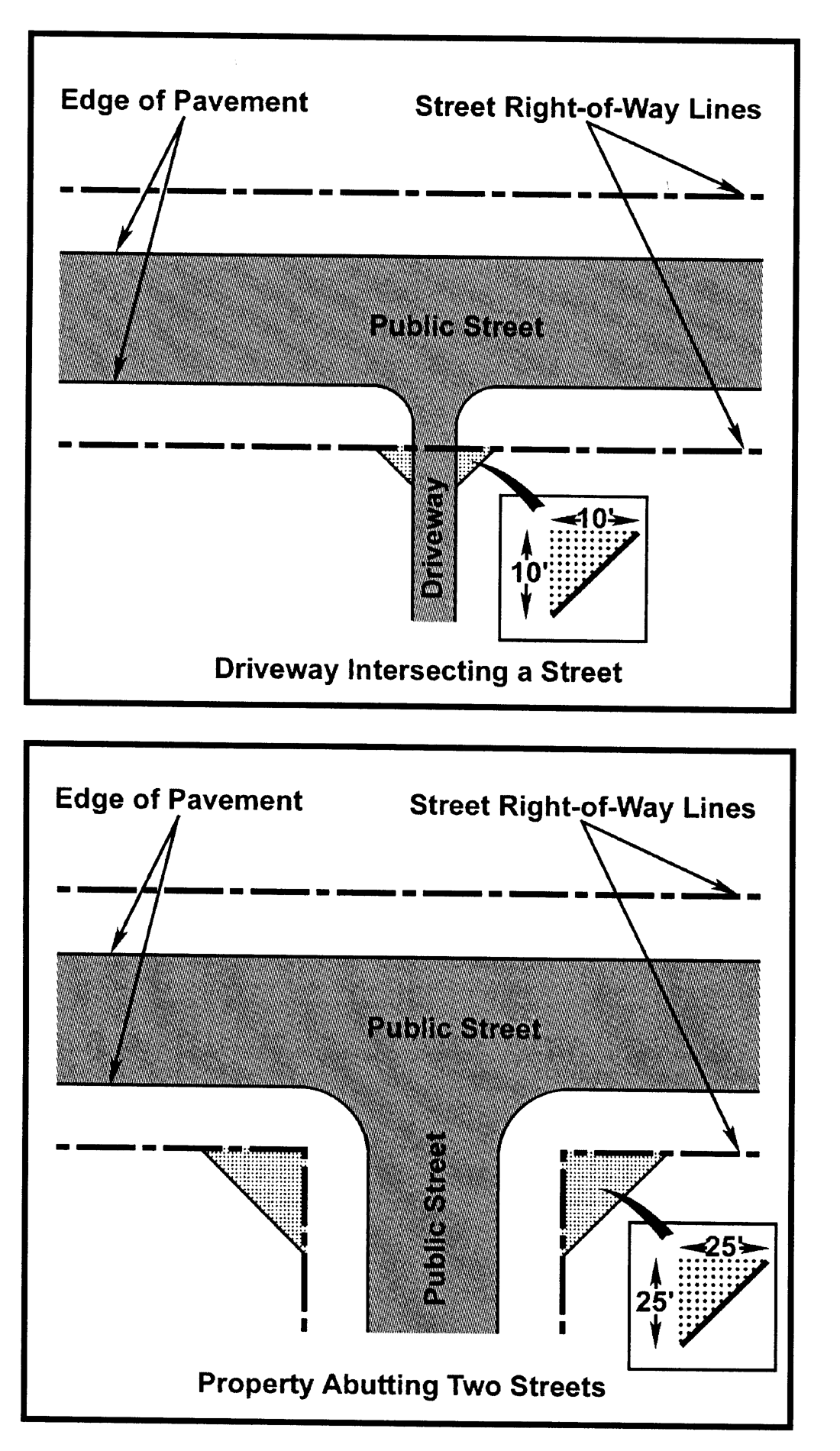
Figure 1. Visibility Triangles
(b)
As shown in Figure 1, where a property abuts the intersection of two street rights-of-way, a visibility triangle shall be created at such intersection in addition to any visibility triangles required for driveways. Two sides of this triangle shall extend at least 25 feet along the abutting right-of-way lines, measured from the point of intersection or the point of intersection established when the lines are extended in a straight line so as to intersect. The third side of this triangle shall be a line connecting the ends of the other two sides.
(c)
Required visibility area. Visibility shall be unobstructed at a level between 32 inches and six feet above the crown of the adjacent roadway. Vegetation shall be trimmed so that no limbs or foliage extend into the required visibility area.
(d)
Alternative visibility triangles. Alternative visibility triangles may be required in individual cases if they are deemed necessary by the building official to ensure adequate traffic safety. If alternative visibility triangles are required, they shall result in traffic safety equivalent or superior to the minimum requirements of this subsection.
Sec. 30-618. - Garage sales.
(a)
Frequency and hours of operation. Garage sales shall be limited to no more than three sales in a one-year period and each sale limited to the daylight hours of three consecutive days.
(b)
Display of garage sale property. Personal property offered for sale may be displayed only within a residence, in a garage, and/or front yard. No personal property offered for sale shall be displayed in the side or rear yard areas of any such premises or in any public right-of-way. A vehicle offered for sale may be displayed on a permanently constructed driveway within such front or side yards.
(c)
Provision, control of parking. The owner or tenant of the lot on which the sale is conducted shall ensure that vehicles are parked in such a way as to avoid creation of a hazardous or unsafe condition and shall not impede the passage of traffic on any street.
(d)
Responsibility for conduct of persons on the premises. The owner or tenant of the property on which the sale is conducted shall be responsible for the maintenance of good order and decorum. There shall be no loud or boisterous conduct on the premises.
Exemptions:
(a)
Persons selling goods pursuant to an order or a process of a court of competent jurisdiction.
(b)
Persons acting in accordance with their powers and duties as public officials.
(c)
Any bona fide charitable, educational, cultural, or governmental institution or organization when the proceeds from the sale are used directly for the charitable purposes of the institution or organization and the goods or articles are not sold on a consignment basis.
Sec. 30-619. - Required surveys.
(a)
Lot survey. All lots must be surveyed and staked by a registered surveyor to reflect the location of all corners of the lot prior to commencement of any construction. A copy of the survey shall be provided to the building official, showing all setback dimensions.
(b)
Elevation survey. Within those incorporated areas of the city designated as special flood hazard areas by the flood maps, all building permit applications for the construction or substantial improvement of residential and nonresidential structures shall be accompanied by a survey, signed and sealed by a professional surveyor licensed by the state, which designates the existing ground elevation of the property and the proposed first-floor elevation of such new structure, or substantial improvement to existing structures. Such survey shall be attached to the building permit application and must be approved as meeting the requirements of this article by the building official of the city prior to the issuance of a building permit.
(c)
Certification of lowest floor elevation. All construction or substantial improvement of residential and nonresidential structures, including prefabricated or mobile homes, shall have the lowest floor elevation certified by a registered surveyor licensed by the state, as being at or exceeding the 100-year flood elevation for the appropriate flood hazard zone. Such certification shall take place after the completion of the foundation or slab for the intended structure and no further construction shall take place pending submission and review of the certification. The building official, or his authorized agent, shall authorize continuation of construction, provided that the certification indicates the lowest floor of the structure is elevated to or exceeds the designated 100-year flood elevation of the appropriate flood hazard zone.
(d)
As-built survey. Before a certificate of occupancy is issued for the structure an as-built survey shall be submitted to the building official and the building official shall inspect the premises to ensure that the requirements of this chapter have been met.
Sec. 30-620. - Limitations on rezoning commercial property.
Zoning changes from commercial to residential will not be authorized unless the loss of commercial land is offset by at least a 1:1 area ratio of other land changed to commercial use (i.e., there will be no net loss of land zoned commercial.) (Comprehensive Plan Future Land Use Policy 1.1.14)
(Ord. No. 1030, § 3, 2-17-10)
Sec. 30-621. - Pain management clinics.
(a)
Pain management clinics shall be allowed only in the C, commercial district of the city and shall be prohibited as home occupations. Pain management clinics are subject to the following supplemental regulations:
(1)
On-site sale, provision, or dispensing of those substances identified in Schedules I, II, III and IV in F.S. § 893.03, and those identified in and by F.S. §§ 893.035 and 893.0356, is prohibited, unless otherwise expressly permitted by state or federal law.
(2)
Any parking demand created by a pain management clinic shall not exceed the parking spaces located or allocated on site, as required by the city's parking regulations. An applicant shall be required to demonstrate that on-site traffic and parking attributable to the pain management clinic will be sufficient to accommodate traffic and parking demands generated by the pain management clinic, based upon a current traffic and parking study prepared by a certified professional. Traffic and parking analyses shall be predicated in part upon traffic and parking impacts from existing pain management clinics in Florida. The source of any such information shall be provided to the city for purposes of verification. City staff shall be required to verify the information contained in traffic and parking study(ies) with the appropriate official(s) of the local government(s) where the comparable information is derived.
(3)
No pain management clinic shall limit the form of payment for goods or services to cash only.
(4)
No pain management clinic shall be located within 1,000 feet of any school, as defined in section 10-36, Satellite Beach City Code.
(5)
Pain management clinics may operate daily during the hours of 8:00 a.m. to 8:00 p.m.
(6)
Each business day, on a form promulgated by the city, pain management clinics shall provide to the Satellite Beach Police Department a daily summary containing the following information from the prior business day:
a.
The total number of prescriptions written that day by each person authorized by law at the pain management clinic to prescribe drugs;
b.
The total number of doses of drugs sold and/or dispensed by the pain management clinic that day (including samples), indicating which doses were sold or dispensed; the person prescribing same; and the manner of payment by each person who was dispensed drugs at said clinic that day;
c.
The total number of persons seen by the pain management clinic that day; and
d.
The state of residence of each person to whom drugs were prescribed or dispensed that day.
Information required under this section shall be provided under oath by the medical director and/or the person prescribing or dispensing the drugs. To the extent such information is not otherwise required to be maintained by any other law, the back-up for the required daily summary shall be maintained by the pain management clinic for 24 months.
(7)
Each application for a certificate of occupancy or business tax receipt for a pain management clinic shall disclose each owner and operator of such clinic, and the individual principals of any entity that owns such clinic. Such information shall be updated within 30 days of any change in ownership or the principals of any owner.
(8)
No pain management clinic shall be wholly or partially owned by, or have any contractual relationship (whether as a principal, partner, officer, member, managing member, employee, independent contractor, or otherwise) with any physician, pharmacist, or any other person who prescribes drugs and who, within five years prior to the receipt of any application for a certificate of occupancy or business tax receipt, (i) has been suspended, had his or her license revoked, or been subject to disciplinary action for prescribing, dispensing, administering, providing, supplying, or selling any controlled substance in violation of any state, federal, or similar law where such person is licensed to practice; (ii) has been convicted of, pled nolo contendere to, or violated any plea agreement regarding an arrest for, a violation of any state, federal, or similar law where such person is licensed to practice related to drugs or alcohol, specifically including but not limited to, prescribing, dispensing, administering, providing, supplying, or selling any controlled substance; (iii) has been suspended, had his or her license revoked, or been subject to disciplinary action by any state, federal, or other governmental entity where such person is licensed to practice; (iv) has had any state, federal, or other governmental entity where such person is licensed to practice take any action against such person's license as a result of dependency on drugs or alcohol; or (v) has been convicted of, pled nolo contendere to, or violated any plea agreement regarding an arrest for, any felony or crime involving moral turpitude.
(9)
No pain management clinic shall be wholly or partially owned by, or have as a principal, partner, officer, member, managing member, or otherwise where the owner is an entity, any person who (i) has been convicted of, pled nolo contendere to, or violated any plea agreement regarding an arrest for, a violation of any state, federal, or similar law where related to drugs or alcohol, or (ii) has been convicted of, pled nolo contendere to, or violated any plea agreement regarding an arrest for, any felony or crime involving moral turpitude.
(10)
No pain medication clinic shall employ any person who has been convicted of, pled nolo contendere to, or violated any plea agreement regarding an arrest for, any felony or crime involving moral turpitude within any five-year period before any application for a certificate of occupancy or business tax receipt. Any application for a certificate of occupancy or business tax receipt shall include an affidavit, under oath, by the medical director, attesting that neither the medical director nor any other person employed in any capacity by the pain management clinic, whether an employee, independent contractor, or otherwise, (i) has been convicted of, pled nolo contendere to, or violated any plea agreement regarding an arrest for, a violation of any state, federal, or similar law related to drugs or alcohol, specifically including but not limited to, prescribing, dispensing, administering, providing, supplying, or selling any controlled substance; or (ii) has been convicted of, pled nolo contendere to, or violated any plea agreement regarding an arrest for, any felony or crime involving moral turpitude. The failure to provide the required affidavit shall result in the automatic revocation of the pain management clinic's right to operate in the city.
(11)
A pain management clinic shall be operated by a medical director who is a Florida-licensed physician, board-certified in pain medicine.
(12)
In order to obtain a certificate of occupancy or business tax receipt, a pain management clinic shall provide with its application (i) an inventory of diagnostic equipment to be located at the clinic, (ii) a natural disaster management plan, and (iii) a floor plan showing the location and nature of adequate security measures, including those required by the State of Florida for controlled substances, to safeguard all drugs to be dispensed in the course of its business.
(b)
Any remedies related to enforcement of the regulations recited herein are in addition and supplemental to those existing by law.
(Ord. No. 1033, § 4, 6-16-10)
Sec. 30-622. - Medical marijuana treatment centers and dispensing facilities.
(a)
Medical marijuana treatment centers and medical marijuana treatment center dispensing facilities are permissible only in those zoning district(s) specifically authorizing same in these land development regulations.
(b)
No medical marijuana treatment center cultivating or processing facility or medical marijuana treatment center dispensing facility shall be located within 500 feet of the real property comprising a public or private elementary school, middle school or secondary school. The 500 foot distance shall be measured from the nearest property line of the property comprising the school property to the nearest property line of the real property upon which the medical marijuana cultivation, processing or dispensing is located. If such cultivation, processing or dispensing activity is located within a multi-tenant building, the distance shall be measured from the nearest property of the real property comprising the school property to the nearest property line of the leasehold or other space controlled or occupied by the person or entity in which the cultivation, processing or dispensing occurs.
(c)
Interpretation/intent. The siting of, and approval of any development permit(s)/order(s) for, medical marijuana treatment centers and medical marijuana treatment center dispensing facilities shall comply with all requirements and regulations imposed for commercially zoned properties, generally, and pharmacies, specifically. To the extent not otherwise regulated by the Florida law, all such centers and facilities shall comply with subsection 30-621(a)(12) of this Code, regulating pain clinics, and may only dispense medical marijuana or medical marijuana delivery devices between the hours of 7:00 a.m. and 9:00 p.m.
(d)
No city liability; indemnification; no defense.
(e)
By accepting any development permit or order to operate a medical marijuana treatment center or medical marijuana treatment center dispensing facility, any person owning, operating or engaging in the business of any such center or facility, waives any claim concerning, and releases the city, its elected and appointed officials, officers, employees, agents, attorneys, representatives, volunteers and independent contractors, both in their official and individual/personal capacities, and their respective sureties, insurers, successors, assigns and legal representatives from, any liability for injuries or damages of any kind that result from any arrests or prosecutions of principals, officers, directors, owners, managers of any kind, members, employees, operators, or similar persons, or any clients or customers of the center or facility for any violation of state or federal laws, rules or regulations.
(f)
By accepting any development permit or development order to operate a medical marijuana treatment center or medical marijuana treatment center dispensing facility, such center or facility shall indemnify, defend and hold harmless the city, its elected and appointed officials, officers, employees, agents, attorneys, representatives, volunteers and independent contractors, both in their official and individual/personal capacities, and their respective sureties, insurers, successors, assigns and legal representatives, from and against any and all claims, actions, liabilities, causes of action, demands, penalties, fines, fees, judgments, damages, losses, and expenses, including any regulatory actions (whether or not a lawsuit or administrative proceeding is filed), including but not limited to costs, expenses, attorneys' and paralegals' fees, expert witness fees, and any other court, regulatory and witness fees (whether in litigation, regulatory proceeding or appeal or as a part of settlement negotiations), on account of any injury, loss or damages, including without limitation claims arising from bodily injury, personal injury, sickness, disease, death, property loss or damage, or any other loss of any kind whatsoever, arising out of, in any manner connected with or resulting from the operation of such center or facility that is subject to any development permit or development order.
(g)
The issuance of a development permit or development order pursuant to this chapter shall not be deemed to create an exception, defense, or immunity for any person related to any potential or actual criminal liability any person may have under state or federal law for the acquisition, cultivation, possession, processing, transferring, transportation, sale, distribution, dispensing or administration of marijuana, medical marijuana or products containing marijuana, as such items remain Schedule 1 drugs under state and federal law.
(Ord. No. 1149, § 4, 11-15-17)

