
Sayreville City Zoning Code
ARTICLE V
DEVELOPMENT REQUIREMENTS AND STANDARDS
26-95 - PROCEDURE AND APPLICABILITY.
a.
Deviations from requirements of this article, except as otherwise specifically indicated, shall be permitted via design waiver granted by the Board.
b.
Where applicable, the Residential Site Improvement Standards, as amended from time to time, shall apply.
(Ord. #637-99)
26-96 - GENERAL DESIGN STANDARDS.
26-96.1 Guidelines.
a.
The following standards shall be viewed as guidelines. Applicants are encouraged to follow these standards to the extent possible.
b.
The design and layout of buildings and parking areas shall provide an aesthetically pleasing design and efficient arrangement compatible with the character of surrounding development. Particular attention shall be given to safety and fire protection and the impact on surrounding development and adjacent buildings and lands.
c.
Groups of related buildings shall be designed to present a harmonious appearance in terms of building silhouette, architectural style and scale; massing of building form; surface material, finish and texture; decorative features; window and doorway proportions, entry way placement and location, signage and landscaping.
d.
Buildings shall be designed so as to have attractive, finished appearances from all public spaces.
e.
Roof Form. All roofs on one (1) and two (2) story principal buildings in residential districts should be pitched. Flat roofs shall not be permitted.
f.
All additions, alterations and accessory buildings should be compatible with the principal structure in design and materials.
(Ord. #637-99)
26-96.2 Appurtenances.
a.
In commercial districts, exterior store window security gates shall not be permitted. Interior gates may be permitted if they are behind the doorways or display cases, and are separated from storefront display windows by commercial displays or other screening. Aluminum or steel roll-down door and window protectors shall not be permitted in any district.
b.
Fire escapes shall be constructed only against the side or rear wall of a building and shall be located and/or screened so as not to detract from the appearance of such buildings.
c.
Rooftop equipment shall be screened by facade walls in a manner approved by the Board.
(Ord. #673-99)
26-96.3 Supplemental Design Standards in the Residential Districts.
a.
Garage space shall be provided at the rate of at least one (1) garage space per dwelling.
b.
No more than fifty (50%) percent of the first floor facade which is facing the street shall be devoted to garages or car ports.
c.
The entry face of a garage shall be offset a minimum of three (3′) feet from the face of the first story of the house or have a design which similarly minimizes the streetscape dominance of the garage.
d.
The maximum driveway width on a lot with a one (1) car garage shall be ten (10′) feet; the maximum driveway width on a lot with a two (2) car garage shall be twenty (20′) feet.
e.
Parking areas in the front yard shall not cover (50%) percent or more of the total front yard area of the subject property.
(Ord. #637-99)
(Ord. No. 18-25, § 1, 8-18-2025)
26-96.4 Supplemental Design Standards in the PO District. Front yards shall be landscaped and not used for parking. Driveways shall be permitted to traverse front yards. A landscaped strip of at least five (5′) feet in width shall be provided along side and rear property lines.
(Ord. #637-99)
26-96.5 Public or Common Private Open Space Design.
a.
All open space shall incorporate elements such as shrubbery, attractive paving materials, street furniture, lighting, low walls, fountains and other architectural and artistic amenities so as to produce and provide a pleasant environment at all levels and to complement the surrounding buildings. All open space shall be designed to invite and attract the public.
b.
Adequate lighting shall be provided to promote a sense of security in the open space.
c.
Open spaces shall be so located as to provide for maximum usability and to create a harmonious relationship between buildings.
(Ord. #637-99)
26-96.6 Buffer Design.
a.
Buffers may include fences, walls or landscaping to minimize any adverse impacts or nuisances such as the headlights of vehicles, noise, light from structures and the movement of people and vehicles on the site or from adjacent areas. Buffers shall be used, where appropriate and/or where required, in the following areas:
1.
Along property lines shielding various uses from each other;
2.
Within or adjacent to parking areas, garbage collection areas and loading and unloading areas.
b.
All buffer areas shall be maintained and kept free of all debris, garbage and weeds.
c.
No structure, activity, storage or materials or parking of vehicles shall be permitted within the buffer area except where permitted by the Board.
d.
The buffer area shall consist of a solid and continuous landscaped screen to be planted and maintained. The landscaping shall consist of lawns, evergreens and deciduous trees and shrubs of such species and density as will provide, within two (2) growing seasons, a continuous, year-long screen not less than six (6′) feet in height. The proposed vegetation should be spaced according to industry standard to allow for the growth of the species.
e.
All trees shall be balled and burlapped and all planting shall be of specimen quality as established by the American Association of Nurserymen. All trees within the buffer area shall be watered weekly throughout the first growing season.
f.
Specimen trees located within the buffer area shall be saved whenever possible. Existing vegetation within buffer areas is encouraged to be retained, if appropriate. Trees should be retained in clumps. Existing vegetation should be saved by not varying the grade around trees by more than six (6″) inches; construction of temporary tree wells and erection of protective fences around the drip line of the trees prior to construction.
g.
Buffers shall not obstruct required sight triangles.
h.
If the proposed use is visually attractive and not detrimental to the appearance of the neighboring uses, the Board may permit the reduction of buffer width and/or density of plantings.
(Ord. #637-99)
26-96.7 Landscape Design.
a.
All lots, regardless of the type of use, shall have a minimum of twenty (20%) percent of the lot landscaped. All lots having an existing front yard setback or required to maintain a front yard setback under Article IV of this chapter, shall provide not less than five (5%) percent of such landscaping along the public right-of-way. All areas not occupied by buildings, parking areas, patios, walkways and/or any other impervious surface shall be suitably landscaped. No landscaping shall interfere with required sight triangles.
b.
Natural features such as trees, hilltops and views, natural terrain, open waters, natural drainage ridge lines and natural drainage channels shall be preserved whenever possible in designing any development on a lot containing such features. Existing trees of larger caliper shall be saved to the extent possible.
c.
The reuse of existing, on-site plant material of good landscape value and quality is encouraged to meet landscaping requirements.
d.
Landscaping should provide a variety and mixture of plantings. The selection should consider appropriateness to the subject planting zone, susceptibility to disease, colors, seasons, hardiness, texture, shapes, blossoms and foliage.
e.
Deciduous trees shall have at least a three (3″) inch caliper, and evergreens shall be at least four (4′) feet tall. All trees shall be balled and burlapped and be of specimen quality as established by the American Association of Nurserymen.
f.
All trees four (4′) feet or greater in height shall be staked per Borough Design Detail.
g.
A hole in which a tree is to be planted shall be one (1′) foot larger in width and six (6″) inches larger in depth than the existing rootball of the tree to be planted, and shall contain proper amounts of top solid and peat moss at a 5:1 ratio. Said material shall be free of acidic marl, sticks, large stones, debris or other material which will interfere with the growth of the tree. No chemical fertilizer shall be added until the tree has been planted for one (1) year.
h.
Evergreen and deciduous shrub plantings shall be mulched with wood chips, peat, cedar mulch, or approved material four (4″) inches thick, extending to the branch limits.
i.
Foundation plantings around multi-family and commercial or industrial structures shall be of suitable size in proportion to the building structure, and shall be planted in beds not less than five (5′) feet wide on any side of the building structure.
j.
Except in conservation easements and areas specifically designated to remain in their natural state, the developer shall selectively thin or remove all dead or dying vegetation, either standing or fallen, from the site including grubbing out stumps and all undesirable trees and undergrowth. Tree stumps, portions of tree trunks and/or limbs shall not be buried at any location on-site.
k.
Landscaping of area of cut and fill and terraces in multi-family commercial or industrial sites shall be sufficient to prevent soil erosion. All slopes are to be a maximum one (1′) foot vertical for every three (3′) horizontal feet and planted with suitable cover plants combined with grasses and/or sodding.
l.
All plants shall be pruned to enhance vigor prior to, or upon, installation while retaining the natural habit of the plants. The central leader shall not be cut. Damaged, broken or conflicting branches shall be pruned cleanly, flush with the main trunk or branch.
m.
All disturbed areas shall be subject to the requirements for both temporary vegetative cover and permanent vegetative cover as detailed in Chapter 24 of the Borough Ordinance, Soil Removal and Fill Placement, and Chapter 30, Tree Conservation and Reforestation.
n.
The Board may waive or modify the requirements of this section in areas unsuitable for plantings, or because of other exceptional conditions, and/or may require supplementary plantings. The landscaping plan shall generally be designed to complement the proposed uses and structures and to promote energy conservation through the location and types of plantings proposed and shall consider sight distances and other features which affect public safety and welfare.
o.
Any landscaping which, within two (2) years of planting, dies, for any reason, shall be replaced by the developer(s) at their expense, within sixty (60) days of written notification.
(Ord. #637-99)
26-96.8 Lighting Design. The following general design specifications for lighting shall be followed:
a.
The style of the light and light standard shall be consistent with the architectural style of the principal building.
b.
All lighting shall be designed in accordance with minimum standards of safety and suggested lighting levels as specified herein and in the standards of the Illuminating Engineering Society (I.E.S.).
c.
Multi-phased projects shall be designed in phases and all fixtures, light sources, standards and lighting levels shall be consistent throughout, unless otherwise approved by the Board.
d.
The maximum height of freestanding lights should not exceed the height of the principal building or twenty-five (25′) feet, whichever is less.
e.
All lights shall be shielded to restrict the maximum apex angle of the cone of illumination to seventy-five (75°) degrees from vertical.
f.
Lights shall be appropriately shielded and directed so that the lighting, to the extent possible, shall not spill over onto adjacent properties.
g.
Freestanding lights shall be so located and protected to avoid being damaged by vehicles.
h.
The following intensity in footcandles shall be maintained:
1.
Multi-family residential parking lots: a minimum of 0.25 footcandles throughout, maintained with established depreciation factor calculated into lighting level at a maximum to minimum illumination ratio not to exceed 15:1.
2.
Commercial parking lots: a minimum of 0.5 footcandles throughout, maintained with established depreciation factor calculated into lighting level at a maximum to minimum illumination ratio not to exceed 15:1.
3.
Roadway lighting: (Classified as Residential Collector Type Roadway) 0.5 footcandles minimum maintained with established depreciation factor calculated into lighting level at a maximum to minimum illumination ratio not to exceed 4:1.
4.
Maximum at property lines: one-half (0.5) footcandle.
5.
Sidewalks: a minimum of one (1) footcandle entire length.
i.
All wiring shall be laid underground, and the lighting fixtures shall be so arranged that the direct source of light is not visible from any adjacent residential area. Glare from bright electric light bulbs shall be eliminated through the use of diffusers or the equivalent.
j.
Lighting Fixtures.
1.
All lighting fixtures are to be of an approved type and supplied by a reputable manufacturer.
2.
All lighting fixtures shall utilize maximum seventy-five (75°) degree cutoff luminaire type reflector so as to minimize glare.
3.
All fixtures being utilized shall be submitted with complete fixture photometrics, as supplied by manufacturer. Any fixture which is submitted without photometrics is not acceptable.
4.
Where determined to be required by the Board, house side shield (internal or external) shall be provided to minimize fixture glare and light pollution onto adjacent properties.
5.
All fixtures shall be aesthetically compatible with the lighting standard (poles), contiguous fixtures, and the adjacent environment.
6.
All lamps shall be of an inside coated type phospor coating or inside frost. No clear lamps shall be permitted.
7.
All fixtures shall contain a shielding medium within the fixture to protect lamps, such as, clear tempered glass door or borosilciate prismatic refractor. Unprotected lamps other than incandescent type units, shall not be permitted.
8.
Where incandescent lamps are exposed to the weather they shall be of the proper type (Ex. "Par" Lamps).
k.
Lighting Standard (Poles).
1.
All poles shall be of an approved type, able to withstand wind loads typical to the region and supplied by a reputable manufacturer.
2.
The maximum allowable pole height shall be thirty-five (35′) feet measured from the highest point of pole and fixture to finished grade.
3.
All poles shall be aesthetically compatible with the lighting fixtures and surrounding environment.
4.
Pole bases shall be designed in accordance with manufacturer's recommendations and approved by a licensed Professional Engineer as to structural stability.
5.
Corten means rust inhibiting type steel poles shall not be permitted.
l.
Plan Submissions. The lighting plan shall include the following information:
1.
Fixture manufacturer literature: showing fixture type, color, etc.;
2.
Fixture photometrics as furnished by the manufacturer;
3.
Lighting standard (poles) literature showing pole type, height, etc.;
4.
Site lighting plans showing fixture locations and photometric data (isolux diagrams) indicating footcandle intensities along fixture output distribution drawn to plan scale;
5.
Design criteria, containing:
(a)
Lighting source utilized.
(b)
Footcandle level.
6.
Type of light source:
(a)
Incandescent.
(b)
Quartz.
(c)
Metal halide high intensity discharge sources.
(d)
High pressure sodium high intensity discharge sources.
(e)
Low pressure sodium high intensity discharge sources.
7.
Wattages of lamps shall be indicated on drawings.
8.
All other data deemed necessary to make an informed decision on the application.
m.
Lighting Along Public Roadways. It is recognized that Jersey Central Power and Light Company provides lighting along public right-of-ways and the utility company does not provide electric plans to the developer until after preliminary approval of the project is obtained.
Lighting plans for public roadways shall be submitted to the Borough engineer for approval prior to construction. If deemed acceptable, the Borough Engineer shall recommend approval to the Board wherein the Board shall take action to approve or disapprove the lighting plan.
(Ord. #637-99)
26-96.9 Building Appearance.
a.
General.
1.
The elements of this subsection are intended to be read in conjunction with all other standards which are specified herein. If any of the standards of this subsection are determined to be in conflict with those standards which specifically relate to an enumerated type of development or use, these standards are to be viewed as advisory and shall yield to those enumerated specified standards.
2.
The standards of this section shall not apply to the construction of, or improvement to a single home on a single conforming lot.
3.
Except as otherwise provided in this chapter, no building shall be erected on the same street and within three hundred (300′) feet of any pre-approved or pre-existing building, which has substantially the same exterior design and appearance. The distance herein specified shall be construed to be the distance between the sidelines of each lot or parcel as extended and measured along the center line of the street.
4.
In determining whether a building has substantially the same exterior design and appearance, factors to be considered shall include, but not be limited to, facade, exterior silhouettes, roof design, including roof pitch and roof lines, chimneys, overhangs, fascias, porches, porticos, arrangement of doors and entranceways, and orientation of garages, if any. A building shall be considered to have substantially similar exterior design and appearance if the building is of the same model, but has an opposite or reverse facade and/or floor plan, regardless of the changes to the exterior of said building.
5.
Except as otherwise provided in this chapter, a building permit may be denied to a proposed development consisting of two (2) or more houses where the proposed development proposes to construct a building or buildings of such a dissimilar character and appearance to those prior existing structures and/or buildings as to destroy the character of the existing neighborhood. In determining whether a proposed building is of such dissimilar character, a review shall be made of the existing neighborhood on the same street within three hundred (300′) feet of the proposed building or buildings. The distance herein specified shall be construed to mean the distance between the sidelines of each lot or parcel as extended and measured along the center line of the street. In determining the character of the existing neighborhood, and/or the similarity or dissimilarity to that neighborhood, the review process shall be based upon basic house design standards universally accepted by architects and planners. (For example, the review shall include whether the proposed and/or existing buildings are of split-level, ranch bi-level, cape cod, colonial, Victorian, adobe, etc., and further whether the proposed design is so similar or dissimilar as to affect the character of the existing neighborhood.) In addition, the review shall include, but not be limited to, a determination as to the existence of any historical buildings or landmarks as determined by the laws of the State of New Jersey, and a determination as to the existence of environmentally sensitive areas, including but not limited to wetlands.
6.
In determining whether a proposed development is of such a similar and/or dissimilar character to the prior existing buildings, any proposed building which is either twenty-five (25%) percent larger and/or smaller in height, mass, and/or displacement shall be presumed to be dissimilar. A potential developer may rebut the presumption by presenting evidence indicating that the proposed building is proportionately sized with respect to the proposed lot as are the prior existing buildings in the neighborhood, that the proposed building is situated and/or landscaped to present the appearance of a building much smaller or much larger than its actual size, and other evidence which is relevant to this issue.
7.
In all developments which are subject to the regulations of this section, utility boxes, fixtures, outdoor heating or cooling units, rooftop apparatus, etc., shall be screened from view throughout all seasons of the year, so that their presence shall not be distinguishable from any public street, right-of-way or private street or cartway. Screening of the aforesaid apparatus may be by evergreen shrubbery, fencing or other materials, provided said screening shall meet the requirements of preventing said apparatus from being in view all year round.
8.
In all developments which are subject to the regulations of this section, building setbacks of adjacent and/or neighboring buildings shall be staggered to the maximum extent possible.
9.
Design themes and exterior treatments, including but not limited to siding, shutters and ornamentation, shall be continued around all sides of the structure. Flat and/or bare exterior walls shall be avoided whenever possible. In order to achieve the goals of this subsection, the architectural and visual review process shall include, but not be limited to, a review of the following use of recesses and/or protrusions, false windows, building materials, use of colors and variations of colors, trellises, site walls, landscaped features, plantings, etc.
10.
The size, location, design, color, texture and materials of all exterior lighting fixtures, and/or signs shall be coordinated to continue the theme of any proposed development. (For example: If the proposed development of two (2) or more buildings shall be of colonial design, said lighting features shall be designed to accentuate the colonial design theme.) Nothing in this section shall be construed to limit a developer from requirements of illumination as enumerated by the Department of Transportation of the State of New Jersey, County of Middlesex or Borough of Sayreville.
11.
All vertical antennas, utility towers, etc., shall be situated so as to provide the maximum screening of visibility from any public street, drive or right-of-way, as well as any private street, drive, etc. Where shielding of said antennas or utility towers, etc. is deemed impossible, said antennas or utility towers, etc., shall be colored in a sky blue painting or coating so as to blend into the background. Nothing in this subsection shall be deemed to pre-empt any Federal, State or County law or regulation.
12.
Chimneys and/or smokestacks shall be designed so as to blend in with the general exterior treatment of the building. Chimneys servicing heating equipment and/or fireplaces shall be enclosed in masonry and/or material similar to the exterior siding or treatment of the building. Exposed, unfinished metal chimneys are prohibited. Nothing in this paragraph shall be construed as to supersede the Uniform Construction Code of the State of New Jersey.
b.
Single-Family Homes. The following architectural and visual standards for single-family homes shall apply to all developments of two (2) or more homes. This subsection shall not apply to any existing or proposed single-family home, nor any proposed construction of a single-family home on a single conforming lot.
1.
In any proposed development of two (2) or more single-family houses, there shall be a variety of separate basic house designs. In no event shall there be less than the following separate basic designs:
2.
In each proposed development of single-family homes, an architectural design theme shall be established. Said design shall be presented by the developer and shall be established by objective criteria. Where more than two hundred fifty (250) single-family units are proposed, the developer shall be required to create two (2) or more separate sections consisting of separate general architectural design themes. In no event shall any one section contain more than two hundred fifty (250) units of the same general architectural design theme. In determining whether a proposed architectural design theme has been sufficiently established by a developer, objective criteria shall be used including but not limited to those criteria set forth in the general architectural visual standards of this section.
3.
Exposed concrete block (cinder block) or other such masonry units shall not be permitted as an exposed surface in residential zones. Split-face, ribbed, scored and glazed masonry units, or an approved equal, with integral color, are permitted. Nothing in this section shall be construed as to limiting brick, brick face, stone or other similar materials.
4.
Plumbing vents, dryer vents, rooftop vents and all other protrusions shall be finished, coated or painted to blend in with the general color of the roof and/or siding as the case may be.
c.
Multi-Family and Single-Family Attached Development.
1.
General. Unless otherwise specified herein, the following standard shall apply to all townhouse, garden flat, garden apartment and/or patio home developments:
(a)
A general architectural design theme shall be established. Said design theme shall be presented by the developer and shall be established by the objective criteria.
(b)
The sidewalls in all multiple family developments shall have at least the same proportion of openings to solid wall as the front and rear walls. For the purposes of this subsection, openings shall include but not be limited to doors and windows. In those instances where a sidewall faces another single or multiple family unit, to the maximum extent possible, all openings shall be staggered to minimize direct sitelines between units.
(c)
Fences or walls enclosing individually owned or controlled outdoor space shall be consistent throughout the development, and shall complement the architecture and design of the buildings.
(d)
Patios, decks, porches or other exterior living spaces shall be provided with screening, fencing, landscaping, etc., so that said exterior living spaces are not visible from public roads, streets, rights-of-way or private roads or parking areas. Said patios, decks, porches or exterior living spaces shall be at least ten (10%) percent of the size of the total square footage of the interior floor plan, and shall be designed so as to complement the design and architecture of the building. Where an enclosed storage area is required, said storage area shall be a minimum of forty (40) square feet and shall be integrated into the architectural design of the buildings.
(e)
Where parking is proposed adjacent to buildings, the finished floor which is closest to grade level of the building shall be designed to be at least three (3′) feet higher than the elevation of the parking stalls.
(f)
The use of dumpsters shall be discouraged as a method of solid waste disposal in multiple family developments. Where the developer can establish that curbside collection is not feasible, or too costly, the developer shall include dumpster storage areas in the general design. Said dumpster storage areas shall be appropriately sized to accommodate separate receptacles for each material which is recycled by the Borough of Sayreville, as well as a general trash receptacle. Each dumpster storage area shall be enclosed by solid screening of a minimum of five (5′) feet in height on all sides of the enclosure where access is not required. Required access doors shall be designed to totally screen the dumpsters from view. The enclosure shall be roofed to prevent dumpster visibility from upper levels of nearby dwellings. Appropriate lighting and landscaping shall be provided for each proposed dumpster storage area. Unless otherwise specified herein, chain-link fencing with woven wire fabric slats shall not be acceptable as a screening for dumpster storage areas.
2.
Townhouse Architectural and Visual Standards.
(a)
A minimum variation of three (3′) feet shall be required in the front facade line of each individual townhouse unit. This front facade staggering may be accomplished by extending or recessing one (1) floor relative to another floor, in two (2) story units, and/or by the use of porches, varied rooflines, etc.
(b)
A minimum variation of four (4′) feet is required in the main building line at the front and rear of every two (2) units.
(c)
Units at the end of buildings shall, to the maximum extent possible, be different from interior units. Buildings with identical floor plans shall not be located directly adjacent to each other. A maximum of two (2) units with identical or mirror image floor plans is allowed per building. Not more than twenty-five (25%) percent of the total development shall utilize any one (1) basic building configuration. The developer shall be required to vary the number of units per building, types of units contained in the buildings, and the relative positions of the units in a building to the maximum extent possible.
3.
Stacked Townhouse, Apartment, Garden Flat or Garden Apartment Architectural and Visual Standards.
(a)
A minimum variation of three (3′) feet shall be required in the facade and roofline of each unit, exclusive of any patio, deck, entry porch, etc.
(b)
Individual or group entry shall be well-defined and visible from the road, right-of-way or parking area serving the building. All entryways shall be properly illuminated so as to provide appropriate security, and to allow easy identification of each individual unit address.
(c)
The types and arrangements of units shall be varied to allow the maximum range of building configurations within the development. Not more than one-third (⅓) of the buildings shall have identical floor plans.
4.
Patio Home Regulations.
(a)
Patio homes shall be designed so that the major living space is oriented toward the front, rear or side yard facing an open space. The wall facing the side yard shall have at least the same proportion of openings to solid wall as the front and rear walls.
(b)
A developer shall be required to incorporate variations in materials, rooflines and exterior walls in order to achieve an appearance of diversity within the building. In two (2) story units, the upper levels must be recessed a minimum of five (5′) feet from the lower floor along the side coincident with the property line.
(c)
At least one (1) four (4′) foot break in the front wall and roofline shall be required.
(d)
Not more than twenty-five (25%) percent of the units in a development may be of the same basic model, type or floor plan. Identical units shall not be constructed adjacent to each other.
d.
General Commercial Business and Industrial Regulations.
1.
This section shall apply to all proposed commercial, business and/or industrial development within the Borough of Sayreville.
2.
All commercial and/or business development located within three hundred (300′) feet of an existing residential dwelling shall, to the maximum extent possible, be designed to complement the existing architectural and/or design theme of the residential neighborhood. This may be accomplished through incorporating landscaping, decorative ornamentation, false roofs, and/or where appropriate, incorporation of siding, roofing and/or building materials utilized by the existing neighborhood. Where the size and use of the proposed structure prohibits incorporation of building materials, etc., the facade of the building facing residential properties shall be designed to reduce its apparent size. In addition, the developer shall be required to provide buffering, landscaping and/or fencing to screen the property from the residential area.
3.
The architectural design of commercial business and industrial facilities shall, to the maximum extent possible, avoid the appearance of clutter by integrating mechanical, electrical, storage structures, loading facilities, chimneys, smokestacks, etc., into the general architectural concept for the site.
4.
Commercial, business and industrial developments consisting of two (2) or more buildings, whether individually owned or owned by separate entities, shall maintain a consistent design theme throughout the development. Within this overall design theme, individual buildings may be differentiated by size, shape, detailing and fenestration.
5.
Construction of new chain-link fencing shall be prohibited in new developments parallel to, perpendicular to, or visible from a public street or right-of-way in a commercial, business or industrial zone, unless said chain-link fence shall be totally screened and buffered to the full width and height of the fencing by evergreen planting materials.
6.
All rooftop apparatus shall be totally screened from view via material integrated with the building architecture.
(Ord. #637-99)
26-97 - STREETS.
26-97.1 Street Design Standards.
a.
Official Grades. All streets shall be constructed in accordance with official grades adopted by the Borough Engineer and the Board if previously established.
b.
The arrangement of street shall be such as to provide for the extension of existing streets where appropriate.
c.
In general, local residential streets shall be designed to discourage through traffic, and proposed larger traffic generators shall not be permitted through local residential streets. Streets and roadways shall be located to blend with the topographic and aesthetic features of the site. Local residential roads shall be curved wherever possible to avoid conformity of lot appearance and to discourage through traffic. The grade of the streets shall run with the site topography wherever possible and in a manner that provides most of the lots to be at or above the grade of the road.
d.
If the subdivision or site plan abuts a major arterial road, the proposed plan shall include provisions to minimize the number of curb cuts or entrances onto and exits from same. Wherever possible, reverse frontage streets shall be employed.
e.
Streets shall be of sufficient width and of suitable design to accommodate prospective traffic, but in all cases shall have a right-of-way width, measured from lot line to lot line, of not less than fifty (50′) feet for minor or marginal access streets and not less than sixty (60′) feet for collector and arterial streets.
f.
The paved surface width of a municipal street shall be as measured between the face of curbs and shall be as follows:
1.
Arterial and collector streets: thirty-six (36′) feet minimum.
2.
Minor and marginal street: thirty (30′) feet.
g.
In a subdivision that adjoins or includes an existing street that does not conform to the width designated in the master plan, official map or as required herein, such additional width shall be dedicated along either or both sides of such street as the Municipal Reviewing Agency may determine to be necessary and reasonable.
h.
The width of the right-of-way of internal roads, alleys and service-ways in multi-family, commercial and industrial developments shall be determined on an individual basis, and in all cases shall be of sufficient width and of suitable design to comply with all applicable municipal requirements and to safely accommodate the anticipated peak traffic, parking and loading needs and to provide sufficient access and turnaround space for fire-fighting emergency equipment and buses.
i.
Grades for minor residential streets shall not exceed eight (8%) percent or have a minimum grade of less than seventy-five hundredths (0.75%) percent. Within fifty (50′) feet of the intersection of any street with an arterial street, the maximum grade shall be limited to two (2%) percent. For arterial, collector, industrial or commercial roadways, the maximum grade shall be seven (7%) percent.
j.
Street intersections shall be as nearly at right angles as is possible, and in no case shall be less than sixty (60°) degrees. At the street corners, curbs shall be rounded with a curve having a radius of not less than twenty-five (25′) feet.
k.
A vertical curve of sufficient length shall be provided at all changes of grade of streets to provide moving vehicles with a smooth transition and to allow sufficient sight distance to drivers in order to assure traffic and pedestrian safety.
l.
Cul-de-sacs shall be avoided to the extent feasible. When needed, such streets shall be no longer than six hundred (600′) feet, from the intersection of the centerline of the two streets to the centerpoint of the turnaround, and shall provide a turnaround right-of-way at the end with a radius of not less than sixty (60′) feet, tangent whenever possible to the right side of the street. Where the street or alley is in excess of one hundred (100′) feet in length, it shall be subject to a determination by the Municipal Reviewing Agency that the design is such that fire-fighting apparatus and emergency vehicles of the Borough shall not be deprived of ready access to structures served by such cul-de-sac. Future extension of the street shall result in the reversion of the right-of-way to the adjoining properties, removal of the existing turnaround. Roadway restoration shall be an off-tract responsibility of the developer creating the improved street extension.
m.
In residential developments, four (4) way intersections shall be prohibited except where deemed desirable by the Borough.
n.
Street jogs with centerline offsets of less than one hundred twenty-five (125′) feet shall be prohibited.
o.
Longitudinal changes in direction along a street shall be made by means of a curve with a minimum centerline radius of one hundred fifty (150′) feet for minor streets and a minimum of three hundred (300′) feet for arterial or collector roads.
p.
Where streets have a reverse curve, a tangent of at least one hundred (100′) feet in length shall be required.
q.
The names of new streets shall be assigned in accordance with Section 13-3 of the Revised General Ordinances of the Borough of Sayreville. All house numbers, as that term is defined in Section 13-3.3 shall also be assigned in accordance with Section 13-3. Additionally, residential developers shall be required to comply with Section 13-3.1 requiring the display of house numbers.
r.
All intersections shall be provided with sight triangle easements of ninety by ninety (90′ x 90′) feet for intersections of minor streets and a triangle with a two hundred (200′) foot base for collector roads. Measurement shall be from the centerlines of the respective intersecting streets.
s.
Pavement Specifications.
1.
All underground utilities shall be installed prior to the installation of pavement.
2.
All unsuitable materials, such as debris, stumps, loose boulders, soft clay, muck or other materials, shall be removed from the right-of-way limits as may be directed by the Borough Engineer.
3.
All excavation for utilities or for removing unsuitable materials shall be refilled to the proper road grade in twelve (12″) inch maximum lifts with select fill material consisting of an approved sand and gravel material. Each select fill lift shall be compacted to ninety-five (95%) percent of its modified Proctor density. Where deemed necessary by the Borough Engineer, crushed stone or NJDOT type 5, class A quarry process stone shall be utilized.
4.
If the road base remains wet for prolonged periods or is unstable as a result of wet conditions, the Borough Engineer may require the installation of subsurface piping to drain the road base.
5.
Road Base Course. After the subbase has been thoroughly compacted to ninety-five (95%) percent of its modified Proctor density, graded, shaped and approved by the Borough Engineer, a minimum of six (6″) inches of hot bituminous stabilized base course shall be installed in two (2) three (3″) inch lifts in all minor roads in accordance with the latest requirements of the New Jersey Department of Transportation Standard Specifications for Road and Bridge Construction, as revised. The Borough Engineer may permit installation of one (1) six (6″) inch lift if conditions warrant. The thickness of the base course shall be increased as deemed necessary by the Borough Engineer, depending on anticipated traffic and soils conditions for roads other than minor and local roads. The base course for the entire road or large section thereof shall be installed as soon as possible to afford access to the site and shall be installed prior to issuing certificates of occupancy for any house fronting same.
6.
Road Surface Wearing Course. The road surface pavement course shall be hot type FABC-1 bituminous concrete surface course and shall be manufactured and installed in accordance with the New Jersey Department of Transportation Standards for Road and Bridge Construction, as revised. The required minimum compacted thickness shall be one and one-half (1 ½″) inches for all minor streets with sound and stable base. For collector roads or other streets, the minimum compacted thickness shall be two (2″) inches. Prior to the placement of the road surface wearing course, the cleaned road base course shall be given an application of grade RC-70 or RC-T cutback asphalt or grade RS-1 emulsified asphalt at a rate of 0.02 to 0.08 gallons per square yard as directed by the Borough Engineer. All work shall be in accordance with the New Jersey Department of Transportation Standards for Road and Bridge Construction, as revised. The wearing surface shall not be permitted to be installed until all major construction is completed, public and private underground utilities are installed, all curbs and sidewalks repaired, all base pavement repairs are made in accordance with the directions of the Borough Engineer, all low spots are brought to grade with leveling wedges, all manhole and inlet castings are grouted and the road is approved for paving by the Borough Engineer. The last two (2) certificates of occupancy shall not be issued until the paving is completed unless waived by the Borough or as otherwise required by the subdivision site plan ordinance.
7.
Development Along Existing Streets. Where existing streets are to be excavated for curbs, utilities extension or other purposes, trenches shall be backfilled, and pavement replacement shall be in accordance with requirements of this section, except where existing pavement or replacement shall be reinforced concrete in accordance with the requirements of the Borough Engineer. After completion of all pavement excavations, curbing and utility installations in existing streets, the pavement base shall be replaced as specified in this section, and the roadway shall be overlayed with one and one-half (1 ½″) inches of bituminous concrete surface overlay along the entire frontage to the centerline of the roadway if deemed necessary by the Borough Engineer.
t.
Curbing. Concrete curb or Belgian Block curb shall be installed, in accordance with the standard details of the Borough, along every street within the development and at intersections with municipal roads, County roads and State highways. The standard curb section to be used shall not be more than ten (10′) feet in length, shall be set in accordance with approved lines and grades, and radial curbs shall be formed in an arc segment, in a smooth curve. Chord segments are prohibited. Concrete curbs shall be six (6″) inches by twenty (20″) inches by eight (8″) inches, using Class B concrete having a twenty-eight (28) day compressive strength of four thousand five hundred (4,500) p.s.i. At locations specified by the Borough Engineer, the curbing shall be designated to provide a ramp for bicycles and/or wheelchairs.
u.
Sidewalks. Where required, sidewalks shall be at least four (4′) feet wide and installed in accordance with the standard details of the municipality. Sidewalks shall be at least four (4″) inches thick, except at points of vehicular crossing where they shall be at least six (6″) inches thick of class C wire reinforced concrete having a twenty-eight (28) day comprehensive strength of three thousand five hundred (3,500) p.s.i., and shall be air-entrained. Where directed by the Borough Engineer, the sidewalk shall be poured on a shaped and graded base of three (3″) inches of gravel or broken stone. Handicap ramps shall be provided at all intersections and points of required pedestrian crossing.
1.
Sidewalks shall be provided along the frontage of all but industrial zones and in their locations deemed necessary by the Borough except as waived by the appropriate Board.
2.
Sidewalks and sitting areas shall be surfaced so that they will be easily maintained and properly illuminated if in use after sunset. Walks along the frontage of property shall be in accordance with Borough standards.
3.
A private pedestrian walk shall have a minimum paved width of four (4′) feet, and, if dedicated to the Borough as a public walkway, the pedestrian walk shall have an easement with a minimum width of ten (10′) feet.
v.
Street Signs. Street signs shall be reflective faced metal on concrete embedded metal posts of the type, design and standard required in the street ordinance or, if there is no street ordinance in effect at the time, then as approved by the Municipal Reviewing Agency on advice of the Borough Engineer. The location of the street signs shall be determined by the Engineer but there shall be at least two (2) signs furnished at each four-way intersection and one (1) street sign at each "T" intersection. All signs shall be installed free of visual obstruction.
(Ord. #637-99; Ord. #722-01, § 1)
26-97.2 Street Appurtenances, Obstructions and Sight Distance.
a.
Sidewalks. Sidewalks shall be concrete, are required on all streets and shall have a minimum width of four (4′) feet. Sidewalk areas shall be landscaped and durably paved and shall be properly illuminated with adequate lighting as per Section 26-90 above.
b.
Traffic Signs and Control Devices. These improvements, such as "Stop," "Yield" and "OneWay" signs, etc., shall be designed and installed in accordance with applicable Federal, State, County and Municipal regulations. Recommendation as to their installation may be made by the Police Department or other competent agency.
c.
Street Trees.
1.
Street trees shall be required on all development applications. Trees shall be approximately fifty (50′) feet apart and located between the setback line and the street right-of-way line if possible (including the side street on corner lots) and not closer than twenty-five (25′) feet from any existing or proposed streetlight or street intersection.
2.
The trees shall be planted so as not to interfere with utilities, roadways or sidewalks.
3.
Trees shall be nursery grown stock of not less than two and one-half (2-½″) inches in caliper at breast height (dbh), with branches commencing not less than eight (8′) feet above grade when planted and staked in an approved manner. Where there is adequate existing growth, the Borough may waive this requirement. Species which provide shading and aesthetic benefit, conform to prevailing street tree patterns in the Borough and take branching pattern and hardiness into consideration, are recommended.
d.
Street Furniture. The site plan shall provide for those elements of street furniture made of the same or similar materials to ensure design continuity and be appropriate to the particular use. They may include phone booths, benches, bike racks, trash receptacles, bus shelters and landscaping planters. All trash receptacles shall be adequately secured, enclosed and screened on all sides by landscaping or other types of attractive materials.
e.
Obstructions and Sight Triangles.
1.
On a corner lot in any district, sight triangles shall be required in which no grading, planting or structure shall be erected or maintained more than three (3′) feet above the street center line or lower than twelve (12′) feet above the street center line. Traffic control devices, street name poles and utility poles shall be permitted in sight triangle areas.
2.
Sight triangles shall be provided and shown at all street intersections to assure full visibility of approaching traffic. The sight triangle shall be triangular with the street sides being at least the following lengths: along a county road, as required by the County Planning Board; along an existing municipal street crossing an intersection, fifty (50′) feet; and along an existing street ending at an intersection, thirty (30′) feet.
(Ord. #637-99)
26-98 - OFF-STREET CIRCULATION, PARKING AND LOADING.
a.
Where applicable, the Residential Site Improvement Standards, as amended from time to time, shall apply.
b.
Off-street parking and loading areas shall be coordinated with the public street system serving the area in order to avoid conflicts with through-traffic, obstruction to pedestrian walkways and vehicular thoroughfares. Shared parking among mixed-uses shall be encouraged.
c.
Parking space allocations should be oriented to specific buildings wherever possible.
d.
Where pedestrians must cross service roads to reach parking areas, crosswalks should be clearly designated by pavement markings or signs. Crosswalk surfaces should be slightly raised to designate them to drivers, unless drainage problems would result. A one (1) way car movement (to the left or counter-clockwise) should be encouraged. A major loop road should be developed around the perpendicular of the access roads.
e.
Driveways should approach from the right to permit passengers to alight to or from the sidewalk.
f.
Whenever possible, one-way traffic should be established at building entrances.
g.
Where buses are a design factor, the Board shall consider special bus identification slots off of the roadway to allow passengers to enter and exit quickly and safely.
h.
Roads and driveways from main roads should be located at-grade and not below the crest of vertical curves.
i.
A minimum of ten (10%) percent of any surface parking facility shall be landscaped about the interior and shall include one (1) shade tree for every twenty (20) parking spaces.
j.
All parking and loading areas abutting mixed-use/residential areas shall be landscaped about their periphery with shrubs, trees and/or ground cover.
(Ord. #637-99)
26-98.1 Off-Street Parking.
a.
Application. Except as noted below, there shall be provided, at the time any building or structure is erected, enlarged, or changed in use, off-street parking spaces and loading and unloading areas in accordance with the requirements set forth in this article and other articles of this chapter. Such facilities shall be completed prior to the issuance of a Certificate of Occupancy.
b.
Standards for Off-Street Parking Areas.
1.
Dimension of Parking Spaces. Every such space provided shall measure at least nine (9′) feet in width and eighteen (18′) feet in length, exclusive of access drives and aisles. Hairpin striping shall be required. End-to-end parking spaces shall measure not less than eight (8′) feet in width by twenty-two (22′) feet in length.
2.
Size of Aisles. The width of all aisles providing direct access to individual parking spaces shall be in accordance with the requirements set forth below. Only one-way traffic shall be permitted in aisles serving parking spaces placed at an angle other than ninety (90°) degrees.
3.
Access. There shall be adequate provisions for safe and convenient ingress and egress to all parking areas. Each off-street parking, loading or service area shall be connected to a public street right-of-way by means of a driveway, and each parking space shall connect to an aisle providing access thereto.
4.
Location of Curb Cuts. At street intersections, curb cuts shall be set back not less than fifty (50′) feet from the intersection of the two (2) curblines, or such lines extended, and shall be set back not less than ten (10′) feet from the intersection of two (2) property lines, or such lines extended except in residential zones where the minimum distance between the property line and edge of driveway shall be five (5′) feet. Between the curb returns for any two (2) driveways serving the same property, there shall be at least twenty-five (25′) feet of curb, except that this distance may be reduced to as little as five (5′) feet where it is demonstrated to the Board that restricted frontage makes this necessary to provide adequate driveways (not more than two (2)) for the property on any one roadway.
5.
Curbing. All parking lots and all loading areas shall have concrete or Belgian block curbing, in accordance with the Borough′s standard details, around the perimeter of the parking and loading areas in conjunction with an overall grading and drainage plan. Curbing shall be either depressed at the driveway or have the curbing rounded at the corners with the access drive connected to the street in the same manner as another street if approved by the appropriate Board. Curbing between vehicular and pedestrian ways shall be designed with periodic ramps from the street or parking grade to the sidewalk, which shall be no less frequent than one every sixty-five (65′) feet and located in accordance with a pedestrian circulation plan.
6.
Sidewalks. Sidewalks between parking areas and principal structures, along aisles and driveways, and wherever pedestrian traffic shall occur, shall be provided, in accordance with the Borough′s standard details, with a minimum width of four (4′) feet of passable area and shall be raised six (6″) inches or more above the parking area, except when crossing streets or driveways, guardrails, and wheel stops permanently anchored to the ground shall be provided in appropriate locations. Parked vehicles shall not overhang or extend over sidewalk areas, unless an additional sidewalk width of two and one-half (2 ½′) feet is provided to accommodate such overhang.
7.
Surfacing Details. All off-street parking areas, interior driveways and loading/unloading areas shall be surfaced with bituminous concrete pavement in the following thicknesses:
(a)
Residential Driveways. Residential driveways shall be constructed of six (6″) inches of compacted type 2 or type 5 Class A Soil Aggregate in accordance with N.J. Department of Transportation Specifications, latest revision. The compacted soil aggregate shall be placed on a properly shaped, graded and compacted subgrade. A minimum of two and one-half (2 ½″) inches compacted bituminous concrete, Commercial Mix equivalent to N.J. Department of Transportation Specifications Mix I-5 or Mix I-6 latest revision, shall be placed on the soil aggregate.
(b)
Light traffic areas and car parking stalls shall be paved with one and one-half (1 ½″) inches FABC-1 over three (3″) inches bituminous stabilized base course bearing on a suitable compacted subgrade approved by the Borough Engineer. (This specification does not apply to areas traversed by refuse trucks or other heavy vehicles.)
(c)
Moderate traffic areas for single unit trucks shall be paved with two (2″) inches FABC-2 over four (4″) inches bituminous stabilized base course bearing on a compacted subgrade approved by the Borough Engineer.
(d)
Heavy industrial traffic areas used by large truck units shall be paved with two (2″) inches FABC-1 over five (5″) inches bituminous stabilized base course bearing on a suitable compacted subgrade approved by the Borough Engineer.
8.
Location of Parking Spaces. All permitted and required off-street parking spaces, open or enclosed, shall be located on the same lot as the use to which such spaces are accessory. Parking spaces may be located on another lot owned by the applicant, provided that fifty (50%) percent of the spaces are within five hundred (500′) feet of any customer entranceway to the principal building. These parking areas shall not be developed for other uses while the requirement for parking is in effect. No off-street parking or loading area shall be located in a minimum required front yard setback area or within five (5′) feet of a property line. No access drive, driveway or other means of ingress or egress to nonresidential uses shall be located in a residential zone.
c.
Other Design Criteria.
1.
Landscaping in all loading areas and in and around parking lots shall be shown on a landscaping plan. The landscaping plan shall be sufficiently detailed to indicate species, size and spacing; shall show grassed areas and mulched areas, flower beds, plantings and other items required by the Board. Trees shall be staggered and/or spaced so as not to interfere with driver vision at intersections of driveways and streets and at the ends of parking rows, having branches no lower than six (6′) feet, and shall number at least one (1) tree with a caliper of two (2″) inches for every ten (10) parking spaces. All areas between the parking area and the building shall be landscaped. All landscaped or buffer screen areas within the parking lot or loading area shall be protected by concrete or Belgian block curbing. Any plantings which do not live shall be replaced within one (1) year or one (1) growing season. A majority of the parking area shall be obscured from public streets by buildings, landscaped berms, natural ground elevations, low evergreen or plantings singularly or in combination. Shrubbery and tree species selected shall be resistant to pollutants typically found in parking areas.
2.
Drainage. All parking and loading areas shall be drained in accordance with good engineering practice as outlined in Section VII (Water Distribution) of this standard and as approved by the Borough Engineer. Where sub-base conditions are wet, springy or of such nature that surfacing would be inadvisable without first treating the sub-base, these areas shall be excavated to a depth as necessary to provide a stable sub-base and filled with a suitable sub-base material acceptable to the Borough Engineer. Where required by the Engineer, a system of porous pipe sub-surface drains shall be constructed beneath the surface of the paving and connected to a suitable drain. After the sub-base material has been properly placed and compacted, the parking area surfacing material shall be applied. Off-site drainage facilities and structures requiring enlargement, modification or reconstruction resulting in part from or totally as the result of the proposed development shall be subject to off-site improvement requirements and standards as established in Section VII (Water Distribution) of this standard.
3.
All parking areas shall be effectively screened on any side which abuts or faces any premises situated in any residential zone or existing residential use by a buffering screen at least six (6′) feet in height, maintained in good condition, if required by the site plan approved by the Municipal Reviewing Agency provided, that such fence, wall or hedge may be waived by the Municipal Reviewing Agency if, because of topographic or other extraordinary or exceptional conditions, the same shall not be necessary to protect any abutting or facing premises situated in any residential zone or existing residential use.
4.
All such parking areas shall be used only for the parking of automobiles. No commercial repair work or sales of any kind shall be conducted in any parking area unless specifically approved for the use. No sign other than entrance, exit, stop, identification and conditions of use signs shall be maintained in any parking area without prior approval. No such sign shall be larger than two (2) square feet in area. Nothing herein contained shall be construed to permit any required parking area to be used for the commercial storage of new or used motor vehicles by a new or used car dealer or motor vehicle rental agency.
5.
Lighting. All off-street parking areas and roadways shall be designed in accordance with the requirements for lighting in other applicable sections of these design standards.
6.
Markings and Access. Parking stalls, driveways and aisles shall be clearly marked and delineated. The Municipal Reviewing Agency shall require certain areas to be maintained for firefighting, handicapped or other emergency purposes, pursuant to direction of the appropriate code officers in the Borough. All areas of the parking lot or loading zone shall be appropriately marked, delineated and signed in accordance with the Federal Highway Administration "Manual on Uniform Traffic Control Devices," latest revision.
7.
Multi-Family Circulation Systems. Multi-family developments should be serviced by a complete loop street system of at least thirty (30′) feet in width affording at least two (2) means of ingress to the site. Crossovers should be provided. When a complete system is not practical, a thirty-four (34′) or forty (40′) foot side street should be considered with a divided road at least at the entrance.
d.
Waiver of Parking and Off-Street Loading and Unloading Requirements. If any applicant can clearly demonstrate to the Board or if the Board determines that, because of the nature of the operation or use, the parking or loading or unloading requirements of this chapter are unnecessary or excessive, or that deviations from the requirements are de minimis, the Board shall have the power to approve a site plan showing fewer paved parking and loading and unloading areas than are required by this chapter.
e.
Garages in Residential Zones. Garages for not more than three (3) motor vehicles may be provided on a single lot in any residential zone for any one (1), two (2) or three (3) family residence as an accessory use.
f.
Commercial Vehicles in Residential Zones and Parking of Recreational Equipment. As governed in Article IV of this chapter.
(Ord. #637-99)
26-98.2 Off-Street Loading.
a.
Application. In any zone, in connection with every building or building group, or part thereof hereafter erected which is to be occupied by nonresidential uses, there shall be provided and maintain, on the same lot, off-street loading berths in accordance with the requirements set forth below and in Article IV of this chapter.
b.
Required Off-Street Loading Facilities.
1.
Dimension of Loading Berths. Required off-street loading berths shall be a minimum of fifty (50′) feet long, twelve (12′) feet wide and fifteen (15′) feet high, and shall not occupy any part of any required front, side or rear yard setback area, provided, however, that no lots on which the rear yard abuts a limited access highway or railroad, such loading space may occupy the rear yard up to the rear property line.
2.
Location of Loading Berths. All loading areas shall be on the same lot as the use which is to be served. Such areas shall be located only in a side or rear yard. Such areas shall not encroach upon any required open space, accessway, off-street parking area or public right-of-way. Where located adjacent to any residential district, they shall be set back a minimum of five (5′) feet from such property line. Loading spaces shall abut the building being served and shall be located to directly serve the building for which the space is provided.
3.
Access. All required off-street loading areas shall provide sufficient turning spaces and access. Garbage dumpsters or receptacles shall be located in screened, off-street loading berths or areas of sufficient size and location to permit ingress and egress for pickup.
(Ord. #637-99)
26-98.3 Driveways.
a.
Driveway Location.
1.
All entrance and exit driveways shall be located to afford maximum safety to traffic, provide for safe and convenient ingress and egress to and from the site, and to minimize conflict with the flow of traffic.
2.
Any exit driveway or driveway lane shall be so designated in profile and grading and located in such a manner as to provide a minimum sight distance measured in each direction of one hundred fifty (150′) feet. The maximum allowable speed in any such driveway shall be fifteen (15) miles per hour. The measurements shall be made from the driver′s seat of a vehicle standing on that portion of the exit driveway that is immediately outside the edge of the road right-of-way.
3.
No entrance or exit driveway shall be located on a rotary, ramp of an interchange or within twenty (20′) feet of the beginning of any ramp or other portion of an interchange.
b.
Driveway Angle.
1.
Two (2) way operation: Driveways used for two (2) way operation shall intersect the road at an angle to be as near ninety (90°) degrees as site condition will permit and in no case will be less than sixty (60°) degrees.
2.
One (1) way operation: Driveways used by vehicles in one direction of travel (right turn only) shall not form an angle greater than forty-five (45°) degrees with a road, unless acceleration and deceleration lanes are provided.
c.
Driveway Dimensions. The dimensions of driveways shall be designed to adequately accommodate the volume and character of vehicles anticipated to be attracted daily onto the land development for which site plan is prepared. The required maximum and minimum dimensions for driveways are indicated below. Driveways serving large volumes of daily traffic of over fifteen (15%) percent truck traffic shall be required to utilize high to maximum dimensions. If parking is to be permitted along the driveway, all driveways dimensions shall be five (5′) feet wider at the curb line of an intersecting road and this additional width shall be maintained for a distance of twenty (20′) feet into the site.
d.
Driveway Profile. Any vertical curve on a driveway shall be so designed to prevent the dragging of any vehicle undercarriage. Should the sidewalk be so close to the curb at a depressed curb driveway as to cause the ramp to be too steep and be likely to cause undercarriage drag, the sidewalk shall be appropriately lowered to provide a suitable ramp gradient.
e.
Acceleration Lanes. Where a driveway serves right turning traffic from a parking area providing two hundred (200) or more parking spaces, and the road has a peak traffic volume exceeding seven thousand five hundred (7,500) vehicles per day, an acceleration lane shall be provided which is at least two hundred (200′) feet long and at least thirteen (13′) feet wide measured from the road curb line. A minimum thirty-five (35′) foot curb return radius shall be used from the driveway to the acceleration lane. Other factors as determined by the Board may warrant the construction of acceleration and/or deceleration lanes.
f.
Deceleration Lanes. Where a driveway serves as an entrance to a land development providing one hundred (100) or more parking spaces, a deceleration lane shall be provided for traffic turning right into the driveway from the road. The deceleration lane shall be at least two hundred (200′) feet long and at least thirteen (13′) feet wide measured from the road curb line. A minimum thirty-five (35′) foot curb return radius shall be used from the deceleration lane into the driveway.
(Ord. #637-99)
26-99 - UTILITIES.
All essential public utilities and related facilities shall be located underground. In such event that they cannot be installed underground, facilities such as pumping stations or transformers shall be enclosed in buildings or effectively screened with an evergreen hedge and/or fencing as approved by the Board.
(Ord. #637-99)
26-99.1 Sanitary Sewers.
a.
All subdivisions and site plans shall be provided with sanitary sewer facilities in such a manner as to provide adequate sewerage within the development to transport all sewage from each lot and the total development to said collection system. Where a collection system is part of the adopted municipal capital improvements program and said system will be accessible to the proposed development, the developer shall install dry sewers designed to tie into the proposed facility upon its completion.
1.
Any sanitary sewer collection system shall be adequate to handle all present and probable future development. Alignments outside streets shall require easements of rights-of-way in accordance with subsection 26-99.4 entitled "Easements" in this article.
2.
Any collection system, including individual on-lot septic systems, shall be designed in accordance with the requirements of the New Jersey Department of Environmental Protection Regional Utilities Authority and applicable municipal ordinances.
3.
The following sanitary sewer standards are required for all developments in the immediate vicinity of sanitary sewerage facilities:
(a)
A complete Engineer's report, setting forth the basis of design, shall be submitted to the approving authority.
(b)
All sewer mains shall be extended along the entire frontage of the tract from the existing sewer main.
(c)
All sanitary sewers shall be designed to carry the average flow estimated twenty-five (25) years in advance with a peaking factor of .4 unless otherwise determined by the Borough Engineer. Average flow shall be assumed to be one hundred (100) gallons per person, per day, with each house unit being occupied by four (4) persons.
(d)
All trunk and interceptor sewers shall conform generally to the municipality's sanitary sewer master plan where applicable.
(e)
Gravity sewers shall be designed to flow with a minimum velocity of not less than two (2′) feet per second at full flow based on Kutter′s Formula with "n" = 0.013. Inverted siphons and force mains shall be designed for a minimum velocity of three (3′) feet per second. The minimum gravity sewer size shall be eight (8″) inches in diameter. The minimum sewer lateral and force main size shall be four (4″) inches in diameter.
(f)
All residential units shall be connected to a sanitary sewer by a four (4″) inch (minimum) diameter sewer lateral. The lateral shall include connecting fitting and cleanout and shall be in accordance with the Borough's Standard Details. No lateral shall be accepted if the line has not been tested for water tightness. No connection shall be made without the approval of the Borough Engineer or Sewer Utility Superintendent and receipt of all required municipal permits and connection fees.
(g)
Commercial and industrial units shall utilize a sewer lateral size in accordance with estimated sewage flow from the particular unit with a minimum size of four (4″) inches.
(h)
Materials used in the construction of sewers, force mains and outfalls shall be as follows:
(1)
Gravity sewers shall be constructed of reinforced concrete pipe with steel and rubber joints, PVC pipe SDR-35, or cement-lined ductile iron pipe. Sewer laterals shall be constructed of PVC pipe. Cleanouts shall be of cast iron soil pipe or PVC construction with brass caps.
(2)
Inverted siphons and outfalls shall be constructed of cement-lined ductile iron pipe. Force mains shall be constructed of cement-lined ductile iron pipe, or PVC pressure pipe.
(3)
Inverted siphons shall consist of a minimum of two (2) pipes with provision for flushing.
(4)
Flow control gates shall be provided in the chambers.
(5)
Construction details are specified under "Detailed Information on Sewers" below.
4.
A general map of the entire project shall be furnished showing sewers, pumping stations and appurtenances. Plans shall show sanitary sewers and shall be of uniform size, twenty-four inches by thirty-six inches (24″ x 36″), with a one-half (½″) inch border on top, bottom and right side, and a two (2″) inch border on the left side, the last one for binding. The plans shall show the following:
(a)
Details. The plans shall show contours of all existing and proposed streets and surface elevations of all breaks in grade and street intersections, tributary areas with population per acre, the true or magnetic meridian, boundary line, title, date and scale. Any area from which the sewage is to be pumped shall be indicated clearly. All sheets shall be numbered.
(b)
Symbols. Sewers to be built now and to be constructed later shall be shown by solid and dashed lines respectively. Existing sanitary sewers shall be shown by special designation. All topographical symbols and conventions shall be the same as the ones of the United States Geological Survey.
(c)
Elevations. All permanent bench marks of New Jersey Coast and Geodetic Survey shall be shown. Elevations of streets shall be placed outside the street lines. The elevations of sewer inverts, shown as street intersections, ends of lines and at changes of grades, shall be written parallel with the sewer lines and between the street lines. The elevation of street surfaces and manhole rims shall be shown to the nearest 0.01 foot, the sewer inverts to the nearest 0.01 foot.
(d)
Distances, Grades and Sizes. The distances and stationing between manholes, grades in decimals and sewer sizes and material shall be shown on the plans. Arrows shall show the direction of the flow.
(e)
Profiles. Profiles shall show all manholes, siphons, pumping stations and elevations of stream crossings, gradients and sizes of sewers, surface elevations and sewer inverts shall be shown at each manhole. The profile shall be drawn to standard engineering scale, and the scale shall also be shown in each sheet.
(f)
Details of Construction of Manholes, Etc. The standard details of the Borough for manholes, building service connections, siphons, etc., shall accompany the plans. Details shall be drawn to standards scales to show clearly the nature of design.
(g)
Detailed plans for sewage pumping stations of a type acceptable to the Borough Engineer shall be provided.
5.
Complete specifications for the construction for the proposed sewerage system and appurtenances, including sewage pumping stations, shall accompany the plans.
6.
A detailed estimate of the entire cost of construction shall be furnished. This estimate shall include cost of right-of-way, inspections, "as-built" plans, etc.
b.
Construction Standards.
1.
Sewer connections shall be made to a street main only under the inspection of the Borough Engineer or Sewer Utility Superintendent. Connection to the sewer shall be made through an approved wye, wye saddle or manhole-stub. Connections shall be watertight and shall be in accordance with the Borough's standard details. Connection to an existing manhole shall be made with a coring machine where a stub or knockout bulkhead has not been provided.
2.
Concrete pipe shall meet all requirements of A.S.T.M. Specifications C 76 latest revisions. All pipe shall be Class III strength except where stronger pipe is required.
(a)
For depths less than three (3′) feet, measured from the top of the pipe, installed under traffic areas, Class IV pipe shall be required.
(b)
The following trench depths are maximum for the pipe classes noted, installed with ordinary bedding, where the trench width equals the pipe outside diameter, plus sixteen (16″) inches:
(c)
Usual conditions not covered by paragraph b.2.(a) or (b) above shall be given special consideration.
3.
PVC pipe shall meet A.S.T.M. D3034—SDR 35, latest revision. PVC force main shall comply with AWWA C-900, latest revision and pressure class required by the Borough Engineer.
4.
Cement lined ductile iron pipe shall be Class 52 and must meet AWWA C104 and C151, latest revision.
5.
When the cover above the sewer pipe is three (3′) feet or less, a higher strength pipe, ductile iron pipe or concrete cradle or encasement shall be required.
6.
Joints for sewer pipes shall be as specified below:
(a)
Reinforced concrete pipe: Push-on rubber gasket and steel joint for non-pressure pipe complying with A.S.T.M. C361, latest revision.
(b)
PVC pipe: Push-on rubber gasket complying with A.S.T.M. D1869, latest revision.
(c)
Ductile iron pipe: Push-on rubber gasket complying with AWWA C111, latest revision.
7.
Ordinary bedding shall be required as per the appropriate section contained in the Water Distribution Requirements of these standards.
8.
Concrete cradle bedding shall be as specified in the appropriate section contained in the Water Distribution System.
9.
Concrete encased pipe bedding shall be as specified in the Water Distribution System Standards.
10.
Manholes shall be provided at ends of sewer lines, at intersections and at changes of grade or alignment. Distances shall not exceed four hundred (400′) feet for sizes eighteen (18″) inches or less. Where internal sewers enter manholes at elevations two (2′) feet or more above the invert, an internal drop line shall be provided and drop manholes shall be built. Manholes shall be precast concrete and comply with A.S.T.M. C478-64T, latest revision.
11.
Manhole frames and covers shall be of cast iron conforming to specifications A.S.T.M. A-48, latest revision. Frames shall weigh a minimum of three hundred twelve (312) pounds. Manholes in roadways shall be Campbell Foundry Company No. 1203 with non-penetrating pickholes. Manholes in easements shall be Campbell Foundry No. 1487. Manholes in all areas subject to flooding shall be watertight. Manhole covers shall be casted with municipal designation as shown on the detail sheet.
12.
Pumping Stations. The type of sewage pumping station to be utilized shall be determined on an individual basis by the Borough Engineer. The following general criteria will be applicable to all sewage pumping stations:
(a)
The wet well shall have at least a 1:1 slope toward the pump intake. Raw sewage shall be screened before pumping. At least two (2) pumps shall be designed, each capable of handling the total peak flow. If more than two (2) pumps are used, their capacities shall be such that upon the failure of the largest pump, the others will handle the peak flow.
(b)
Force main velocities shall be not less than two (2′) feet per second at normal pumping rates.
(c)
All pump stations shall have watertight and lockable access covers. The detention time of the wet well shall not exceed ten (10) minutes at average daily flow.
(d)
Pump controls and alarm conditions shall utilize encapsulated mercury switches designed for use with sewage.
(e)
All pump stations shall be provided with an emergency power source housed in a masonry building approved by the Engineer.
(f)
All force main headers shall have sewage-type gate and swing check valves.
(g)
A cleanout/emergency bypass chamber shall be provided.
(h)
Automatic audible and visual alarms shall be installed independently of station power and they shall give warning of illegal entry, lag pump on, high water and power failure conditions. Telemetry equipment shall be provided to transmit the alarm conditions to the receiving point designated by the Borough. All pump stations shall be enclosed in a six (6′) foot chain link fence. Complete repair tools, accessories and four (4) bound sets of complete operation and maintenance manuals shall be provided with the pump station.
(i)
Separate gates must be provided for pedestrian and truck use.
(j)
Detailed estimates of operating and maintenance costs of the proposed pumping station must be submitted.
c.
Approval of Plans by State Agencies and Others. Approval of plans, a permit to construct, and a permit to operate by the Regional Utilities Authority and/or the New Jersey State Department of Environmental Protection must be obtained by the applicant before the Borough's final approval will be given. The applicant shall obtain permits for all stream crossings or encroachments from the New Jersey Department of Environmental Protection. Permits to construct sewers and/or other structures within the right-of-way limits of State, County and Municipal roads and all railroads must be secured and paid for by the applicant. The applicant must secure any necessary clearance from any public utility involved.
d.
Testing of Completed Sewerage. All sewers shall be subjected to an infiltration and/or exfiltration test as may be determined by the Borough Engineer. Exfiltration tests shall be conducted in lieu of infiltration tests when the pipe has been paid above the groundwater level. The tests shall be performed between two (2) manholes or as otherwise directed by the Borough Engineer and shall include all related system components including the house connection. The contractor shall furnish all labor, material and equipment necessary for the testing. Exfiltration tests shall be under at least a four (4′) foot head or a pressure corresponding to a head equal to the depth of the lower manhole of the section under test. Allowable infiltration or exfiltration shall not exceed a rate of ten (10) gallons per mile per inch of diameter of sewer per twenty-four (24) hours for gravity sewers. All gravity sewers, siphons and force mains with infiltration or exfiltration in excess of the permissible limit shall be repaired, or removed and replaced, before proceeding with construction. Allowable exfiltration for force mains shall not exceed:
L = allowable leakage (GPH)
N = number of joints tested
P = average test pressure
D = nominal diameter of pipe
e.
Use of system:
1.
During construction and before final acceptance, the Borough shall have the right to use any portion completed without waiving their right to order correction of any defects.
2.
Use of the system for the discharge of sump pumps, or drainage from cellar drains, leaders, downspout, drainage tile, developers cellar pits or pumping out septic tanks shall not be permitted.
3.
Sewage delivered into the facilities shall comply with the requirements of Regional Utilities Authority treating the sewage from the site and specifically shall not:
(a)
Be of such a nature and in such quantity as to impair the hydraulic capacity of such facilities, normal and reasonable wear and usage expected;
(b)
Be of such a nature as to, by either chemical or mechanical action, impair the strength or the durability of the sewer structures;
(c)
Be of such a nature as to create explosive conditions in such facilities;
(d)
Have a flash point lower than 187 degrees F, as determined by the Tagliabue (Tag.) close up method;
(e)
Have a ph index value lower than 5.0, or higher than 9.0;
(f)
Include any radioactive substances, unless the Borough and Regional Utilities Authority shall have given written consent to its inclusion;
(g)
Include any garbage other than that received directly into public sewers from residences, after proper shredding, unless the Borough and Regional Utilities Authority consent to its inclusion.
f.
Within thirty (30) days after construction and before final acceptance by the Borough, the applicant is to furnish the Borough one (1) mylar tracing of "as-built" drawings in ink, acceptable to the Borough Engineer, and six (6) sets of prints (block on white) of each drawing showing the sewers, connections, etc. as constructed.
The "as-built" plans shall accurately show the completed sewer system in sufficient detail to permit the future location and determination of all components of the system; including sewer lines, manholes, wyes or connections, service lines, clean outs and other pertinent features. The size and type of the components shall be indicated and shall be dimensioned and tied to existing physical features such as manholes, curbs and buildings as may be appropriate. The plan and profile shall indicate invert in and out elevations of all pipes at manholes and as-built slopes of all pipelines.
Preliminary "as-built" may be required by the Borough Engineer prior to paving in order to ensure facilities locations, beneath paved areas.
(Ord. #637-99)
26-99.2 Water Distribution System.
a.
All subdivision and site plans shall be provided with water distribution facilities in such a manner as to provide adequate and continuous potable water to each buildable lot within the development or site. The water system shall be so designed to provide a minimum of twenty (20) p.s.i. on the highest floors of proposed structures.
b.
All water distribution systems shall be adequate to handle all present and probable future development. Alignments outside streets shall require easements or right-of-way in accordance with subsection 26-99.4 entitled "Easements" in this article.
c.
All potable water distribution systems shall be designed in accordance with the requirements of the American Water Works Association, Inc. (AWWA), New Jersey State Department of Environmental Protection, Division of Water Resources and applicable municipal ordinances.
d.
The following potable water system standards are required for all developments to be served:
1.
A complete Engineer's report, setting forth the basis of design, average daily, peak daily and peak hourly demands shall be submitted.
2.
All water distribution mains shall conform to the Borough's water system master plan where applicable.
3.
All water mains shall be designed for a minimum working pressure of one hundred fifty (150) psi. unless higher pressure ratings are required. Water main size shall be a minimum of eight (8″) inches in diameter and provide a minimum flowrate of eight hundred (800) GPM at all hydrants unless otherwise approved. Water mains shall be designed with Hazen-Williams coefficient "C" of one hundred twenty (120). All water main sizes, flowrates and hydrant locations shall be subject to change and approval by the Municipal Fire Subcode Official. Water mains shall be looped to avoid dead ends. Six (6″) inch diameter water mains may be approved when deemed acceptable by the Engineer.
4.
Materials and details of construction shall comply with other applicable sections of these requirements.
5.
A general map of the entire project shall be furnished showing water mains, hydrants, main valves, lateral locations, etc.
6.
Plans shall show all water distribution, sanitary sewer and drainage facilities and shall be of a uniform size, twenty-four inches by thirty-six inches (24″ x 36″), with a one-half (½″) inch border on top, bottom and right side, and a two (2″) inch border on the left side, the last one for binding. The placement of electric lines within water sanitary or storm sewer trenches is strictly prohibited. The plan shall show the following:
(a)
Details. The plans shall show contours of all existing and proposed streets and surface elevations of all breaks in grade and street intersections, the true or magnetic meridian, boundary line, title, date and scale. All sheets shall be numbered.
(b)
Symbols. Water mains to be built now and to be constructed later shall be shown by solid and dashed lines respectively. Existing water mains shall be shown by special designation. All topographical symbols and conventions shall be the same as the ones of the United States Geological Survey.
(c)
Profiles. Profiles shall show all water mains, valves, hydrants, stream crossings and clearance between sanitary and storm sewers and other underground utilities. The size and material of the water mains and the inverts of the water mains to the nearest 0.1 foot using a USGS datum shall be shown. They shall be drawn to standard engineering scale and the scale shall be shown on each sheet. An index of streets shall also be shown on each sheet.
(d)
Details of Construction. The standard details of the Borough for hydrants, valves, vale boxes, individual water service, sanitary sewer-water main clearances, etc. shall accompany the plans. Details shall be drawn to standard scales to show clearly the nature of design.
7.
Construction Standards.
(a)
Water connections shall be made to a street main only under the supervision and inspection of the Borough Engineer or water utility superintendent. Connection to the main shall be made with a wet tap machine and AWWA approved service saddles, tapping sleeves, valves and other appurtenances.
(b)
All underground components of the water distribution system shall be installed with a minimum cover of four (4′) feet or below the most severe frost line, whichever is greater.
(c)
Pipe.
(1)
Cement lined ductile iron pipe and fittings shall meet the standards of AWWA C150, AWWA C151, AWWA C110 and AWWA C104 1A test revisions. The minimum allowable pipe class shall be Class 52.
(2)
All joints for the water main shall be of the "push-on" joints type utilizing a neoprene rubber gasket with bronze conductivity wedges or mechanical joints using lead tipped gaskets. Joints shall meet the standards of AWWA C111, latest revisions.
(d)
Valves shall meet AWWA Standard C509, latest revision, for resilient-seated non-rising stem gate valves. All valves should open counter clockwise.
(e)
Valve boxes, curb boxes and meter boxes shall be constructed of the finest quality gray cast iron and meet all applicable AWWA standards.
(f)
Corporation cocks and curb stops shall be constructed of the finest quality red brass and meet all applicable AWWA standards.
(g)
Service Piping.
(1)
All service line three-fourths (3/4″) inch through two (2″) inch shall be soft temper type K meeting standard ASTM B88, latest revision. Copper piping may be used to a nominal size of four (4″) inches.
(2)
Cement-lined ductile iron pipe shall meet AWWA standards C150, C151, C110, C111 and C104, latest revisions.
(h)
The service saddle shall meet ASTM A536 and A307, latest revisions when required.
(i)
The fire hydrant shall be installed in accordance with the Borough's standard detail and shall be model A-421 as manufactured by Mueller, and shall include a fire hydrant marker with flag for easy identification in deep snow, heavy brush or weed growth. The fire hydrant marker with flag shall not be a "spring rod" type, but shall be stationary, and shall be of a type approved by the Borough Engineer and Water and Sewer Department. Additionally, there shall be painted on the roadway directly adjacent to the fire hydrant a yellow, Maltese Cross, located in such manner so as to remain visible if a motor vehicle is parked near the fire hydrant.
(j)
Water meters on water services shall be subject to approval by the water utility superintendent and meet the latest standards of AWWA Sections C700-C708 and shall be as manufactured by Rockwell.
(k)
"Ordinary bedding" shall be utilized for the installation of mains except where subsurface conditions require special stone bedding or concrete craddle bedding, by the Borough Engineer. Ordinary bedding shall be defined as that method of bedding mains in which the main is bedded, on approved granular material, with "ordinary" care in an earth foundations shaped to fit the lower part of the main exterior with reasonable closeness for a width of at least fifty (50%) percent of the main diameter; and in which the remainder of the main is surrounded to a height of at least 0.5 feet above its top with approved granular material, shovel placed and shovel tamped to completely fill all spaces under and adjacent to the main; all under the general direction of the Borough Engineer or water utility superintendent during the course of construction. In all cases, the type and amount of granular material shall be approved by the Borough Engineer.
(l)
"Concrete craddle bedding" is that method of bedding mains in which the lower part of the main exterior is bedded in two thousand (2,000) pound concrete without reinforcement, having a minimum thickness under the pipe of one-fourth (¼) its nominal internal diameter and extending upward to a height equal to one-half (½) of the nominal inside diameter and same shall be utilized where so ordered by the Borough Engineer.
(m)
"Concrete encased pipe bedding" is that method of bedding main in which the entire exterior is encased in two thousand (2,000) pound concrete or better and same shall be utilized where ordered by the Borough Engineer.
(n)
All water mains shall be extended along the entire frontage of the site to the farthest property limit from the existing main.
(o)
Valves shall be provided at the intersection of each street and shall be a minimum of one thousand (1,000′) feet apart. Accordingly, three (3) gate valves are required at T-type intersections. Valves shall be provided between the water main and fire hydrant, upstream of all wet taps for water main extensions, at all wyes, tees and crosses in the mains, and at other locations recommended by the Borough Engineer or water utility superintendent.
(p)
Thrust blocks to resist any movement in mains and fittings shall be placed at all valves, fittings, reducers, tees, crosses, bends, hydrants and dead ends. All thrust blocks shall be cast-in-place concrete, two thousand (2,000) p.s.i. strength. All bearings surfaces of thrust blocks shall be against undisturbed soil. The use of epoxy coated anchor rods and fittings or mechanical joint retainer glands may be required at the discretion of the Borough Engineer or water utility superintendent.
(q)
Fire hydrants shall be located as directed by the Borough Engineer and/or fire subcode official and shall be required at the end of all dead-end mains and a minimum of five hundred (500′) feet apart as measured along the curbline of the roadway. Hydrants shall be provided at all high spots as a means of air release and at low points as a means of blow off. Fire hydrants shall be equipped with six (6″) inch gate valves and shall be constructed with the Borough standard details.
8.
Approval of Plans by State Agencies and Others.
(a)
In the event that required approvals(s) from a governmental agency other than the Municipal Reviewing Agency is pending, the approving agency may, in appropriate instances and upon good cause demonstrated by the applicant, condition its final approval upon the subsequent approval of such governmental agency.
(1)
Conditional approval shall not be granted without evidence confirming that required applications have been properly submitted and pursued.
(2)
Conditional approval granted by the Municipal Reviewing Agency shall be for an initial period not to exceed sixty-five (65) days. In the event that the pending approval or permit has not been obtained upon the expiration of the conditional period, the approval granted by the reviewing agency shall be null and void.
(3)
The approving authority may upon application and for good cause demonstrated, extend the conditional approval for additional periods, each not exceeding sixty-five (65) days.
9.
Testing of the Completed Water System. The water distribution system shall be subject to a hydrostatic test with a pressure between one hundred fifty (150) PSIG and two hundred fifty (250) PSIG as directed by the Borough Engineer or water utility superintendent. Any joint or component of the distribution system having a visible leak during testing shall be repaired or replaced prior to continuing construction.
10.
Disinfection of Water System.
(a)
After completion of the public water supply (including transmission and distribution mains and distribution system tanks), all surfaces with which adequately protected water may come into contact, shall be effectively disinfected in accordance with AWWA C601, latest revision, and tested for the presence of bacteria by a NJDEP certified laboratory, before being placed into service.
11.
Use of System.
(a)
During construction and before final acceptance, the Borough shall have the right to use any portion completed without waiving their right to order correction of any defects.
(b)
The water supplied through the distribution system shall be properly chlorinated and treated to meet the potable water standards of the New Jersey Department of Environmental Protection, latest revision.
(c)
The water distribution system shall be protected from contamination by sewage, radioactive, toxic, biological and other materials which may pose a hazard to public health and welfare by air-gap or backflow prevention devices meeting AWWA 506, latest revision.
12.
Within thirty (30) days after construction, and before final acceptance by the Borough, the applicant is to furnish the Borough one mylar tracing of as-built drawings in ink, acceptable to the Borough Engineer, and six (6) sets of prints (black on white) of each drawing showing the water mains, connections, etc. as-constructed.
The "as-built" drawings shall accurately show the completed water system in sufficient detail to permit the future location and determination of all components of the system; including: watermains, valves, fittings, wet taps, corporations, services, curb stops and boxes, hydrants and other pertinent features. The size and type of the components shall be indicated and be dimensioned and tied to existing physical features such as manholes, curbs, buildings, hydrants and other major items acceptable to the Borough Engineer; where "blow-up" details are required for clarity they shall be provided.
Preliminary "as-builts" may be required by the Borough Engineer prior to paving in order to ensure facilities locations beneath paved areas.
13.
All new residential and commercial units shall be equipped with remote readout water meters installed in accordance with the Borough Utility Department.
(Ord. #637-99; Ord. #790-02, § 1)
26-99.3 Storm Drainage Facilities.
a.
All development plans for subdivisions, site plans and individual residential lots shall include provisions for safely and satisfactorily controlling stormwater run-off, drainage and stream flows in a manner that will not adversely affect existing and proposed properties, both upstream and downstream of the site. When developing a site in an aquifer outcrop area or other area affecting same, the development plan shall include provisions for on-site recharge of underground formations.
b.
All streets shall be provided with catch basins and pipes where the same may be necessary for proper surface drainage. The requirements of this section shall not be satisfied by the construction of dry wells. The system shall be adequate to carry off or store the stormwater and natural drainage water which originates within the development boundaries and that which originated beyond the development boundaries and passes through the development calculated on the basis of maximum potential development as permitted under this chapter. No stormwater run-off of natural drainage water shall be so diverted as to overload existing drainage systems or create flooding or the need for additional drainage structures on other lands without proper and approved provisions being made for taking care of these conditions, including off-tract improvements.
c.
The applicant's engineer shall submit a drainage plan and report along with the proposed development plans for all major subdivisions and site plans. Other applicants may be required to submit same if deemed necessary by the Borough Engineer.
1.
The drainage plan shall include all data necessary to properly evaluate the existing and proposed drainage systems, including overall drainage basins and subbasins, if applicable, with boundaries clearly indicated, areas shown in acres, topographic data, all existing and proposed drainage facilities, size, type, slope and elevations of all pipelines, culverts and drainage channels, location and type of land use within the drainage basin, drainage area to each inlet, ditch or other collection device and all other factors that may affect the drainage facilities.
2.
The drainage report and drainage system plans shall include:
(a)
An analysis of run-off before and after development, considering undeveloped areas with run-off to the site to be fully developed in accordance with the zoning requirements of same.
(b)
An analysis of potential impact of the drainage facilities on adjoining properties and upstream and downstream drainage facilities.
(c)
The drainage system shall be designed utilizing the Rational Method (Q = CIA) and shall be designed for a storm with a frequency of one (1) in twenty-five (25) years, except major drainage channels, detention basins and other facilities as deemed necessary by the Borough Engineer, shall be designed for a storm with a frequency of one (1) in one hundred (100) years. The duration of a storm used in computing storm water run-off shall be the equivalent of the time required for water falling at the most remote point of the drainage area to reach the point in the drainage system under consideration. Rainfall intensity (I) shall be determined utilizing the Sandy Hook, NJ intensity/duration curves.
(d)
All drainage channels and detention ponds shall be designed with a one-foot freeboard.
(e)
Pipe sizing shall be determined by the Manning formula with "n = 0.013" for concrete pipe and "n = 0.022" for corrugated metal pipe. The pipe size determined to be adequate for the run-off computed shall be increased by at least one (1) standard pipe size for the type of pipe being used in order to provide adequate allowance for the normal accumulation of sediment and debris in the storm drainage system. The minimum pipe size in a surface water drainage system shall not be less than fifteen (15″) inches in diameter.
(f)
Catch basins shall be located at all intersections and located in streets with inlets on both sides of the street at intervals of not more than four hundred (400′) feet or such shorter distances as required to prevent the flow of surface water from exceeding six (6.0′) cubic feet per second at the catch basin inlet. Access manholes shall be placed at maximum five hundred (500′) foot intervals throughout the system and at pipe junctions where there are catch basins.
(g)
Dished gutters on municipal streets shall be permitted only at intersections involving minor streets. Dished gutters shall not be permitted on arterial or collector roads.
(h)
Storm drain pipes running longitudinally along streets shall not be located under curbing.
(i)
Storm drain pipes shall be reinforced concrete pipe, except where aluminum culvert pipe is permitted as hereinafter specified, and shall be the size specified and laid to the exact lines and grades approved by the Borough Engineer. Reinforced concrete pipe shall conform to the A.S.T.M. specifications C76-61 Class IV. In locations other than within the right-of-way of public roads where, because of severe topographic conditions or the desire to minimize the destruction of trees and vegetation, corrugated aluminum pipe, pipe arch or helical corrugated pipe may be used upon approval of the Borough Engineer. The material used shall comply with the Standard Specifications for Corrugated aluminum Alloy Culvert Pipe and pipe arch AASHO designation M-196-62 or the Standard Specification for Aluminum Alloy Helical Pipe AASHO designation M-211-65. The minimum thickness of the aluminum pipe to be used shall be: less than twenty-four (24″) inch diameter or equivalent, 0.075 inches (14 gauge); twenty-four (24″) inch diameter and less than forty-eight (48″) inch diameter or equivalent, 0.105 inches (12 gauge); forty-nine (49″) inch but less than seventy-two (72″) inch diameter or equivalent, and larger, 0.164 inches (8 gauge).
(j)
Catch basins shall be designed in accordance with the standard details of the Borough.
(k)
Manholes shall be precast concrete and shall be constructed in accordance with the Borough′s standard details.
(l)
Poured concrete headwalls or precast flared end pipe sections shall be constructed at the point of discharge of all storm drains, in accordance with the latest New Jersey State Department of Transportation standard plans and specifications. They shall include precast, cast in place or grouted rip-rap energy dissipators at the discharge point.
(m)
For both major and minor developments and site plans, blocks and lots shall be graded and swaled to secure proper drainage away from all buildings and to prevent the collection of stormwater in pools on any lot and to avoid the concentration of stormwater from each lot to adjacent lots.
(n)
Land subject to periodic or occasional flooding shall not be designed for residential occupancy nor for any other purpose which may endanger life or property or aggravate the flood hazard. Such land within a lot shall be considered for open spaces, yards or other similar uses in accordance with flood plain regulations.
(o)
Where a minor or major development is traversed by a watercourse, surface or underground drainageway or drainage system, channel or stream, or detention/retention pond, there shall be provided and dedicated a drainage right-of-way easement to the municipality conforming substantially with the lines of such watercourse, and such further width or construction or both, as will be adequate to accommodate expected stormwater run-off in the future based upon reasonable growth potential in the municipality and, in addition thereto, a minimum of fifteen (15′) feet beyond the bank top on at least one (1) side for access to the drainage right-of-way and, in any event, meeting any minimum widths and locations shown on any adopted official map or master plan or as required under the subsection 26-99.4 entitled "Easements" in this article.
(p)
Easements or rights-of-way shall be required in accordance with the subsection 26-99.4 entitled "Easements" in this article where storm drains are installed outside streets.
(q)
Vegetation. All drainage ditches, swales, channels, diversion dikes and berms shall be stabilized with vegetation in accordance with the requirements for soil erosion and sediment control in New Jersey with specific regard to slope velocity and other applicable design factors.
3.
Building Drain Connections to Storm Drainage System. All proposed dwellings and buildings with a basement shall be provided a connection to a storm drainage system for the purposes of utilizing this connection for possible discharge of sump pump and/or gravity basement drains. The connections to the storm sewer shall meet the following requirements.
(a)
Each dwelling unit or other building with a basement shall be provided a four (4″) inch diameter (minimum) connection to be located between curb and sidewalk and five (5′) feet towards the center of the lot from the edge of the interior side of the driveway depressed curb.
(b)
Lots fronting roads with existing or proposed storm sewers will be permitted to provide a connection in accordance with the Borough′s standard Basement Drainage Connection Detail.
(c)
Lots fronting roads with no existing or proposed storm sewers shall also be required to provide a connection for basement drainage by providing a separate drainage system which shall discharge to an approved storm sewer, drainage ditch, seepage pit or by other methods approved by the Borough Engineer. Seepage pits for individual dwelling will not be permitted when a storm sewer, drainage ditch or other stormwater system is within two hundred (200′) feet of the subject property, unless otherwise approved by the Borough Engineer.
(d)
Where it is necessary to construct a separate drainage system to accommodate flows from gravity basement drains or sump pumps due to absence of existing or proposed storm sewers, the Borough′s standards listed in the Basement Drainage System Design Criteria shall be utilized and a design prepared by a licensed professional engineer shall be submitted for approval. Plans for all minor or major subdivisions and site plans are required to include provisions for a drainage connection from each lot.
4.
Within thirty (30) days after construction and before final acceptance by the Borough, the applicant is to furnish the Borough one (1) mylar tracing of "as-built" drawings of the drainage and grading of the site, acceptable to the Borough Engineer and six (6) sets of prints (black or white) of each drawing showing the storm drainage system and principal grading elevations of the site as constructed.
The "as-built" plans shall accurately show the completed storm drainage system and grading of the site in sufficient detail to permit the future location and determination of all components of the system; including: storm sewer lines, manholes, inlets, culverts, special drainage structures, elevations of principal features of the site to indicate compliance with approved plans and other pertinent features. The size, type, slopes and elevations of all pipelines shall be indicated and the elevation of all rims and grates shall be provided. The system and major components shall be dimensioned and tied to existing physical features as may be deemed appropriate by the Borough Engineer.
(Ord. #637-99)
26-99.4 Easements.
a.
Easements along rear property lines or elsewhere for utility installation shall be required. Such easements shall be at least twenty (20′) feet wide for one (1) utility and five (5′) additional feet for each additional utility and be located in consultation with the companies or municipal departments concerned and, to the fullest extent possible, be centered on or adjacent to rear or side lot line.
b.
Flood plains and conservation easements shall be indicated on the preliminary and final plats and shown in such a manner that their boundaries can be accurately determined.
c.
The removal of trees and ground cover shall be prohibited in a conservation easement of flood plain except for the following purposes: the removal of dead and diseased trees; limited thinning of trees and growth to encourage the most desirable growth; and the removal of trees to allow for structures designed to impound water or in areas to be flooded in the creation of ponds or lakes.
d.
The boundary line of any easement shall be monumented along one (1) side at its intersection with all existing or proposed street lines. Such easement dedication shall be expressed on the plat as follows: "Utility" easement granted to the Borough as provided for in the ordinances of the Borough and a deed of easement shall be provided for all easement to the Borough.
(Ord. #637-99)
26-99.5 Connections to Approved Public Utility System. All public services shall be connected to an approved public utility system where one exists. The Developer shall arrange with the servicing utility for the underground installation of the utilities distribution supply lines and service connections in accordance with the provisions of the applicable standard terms and conditions incorporated as part of its tariff as the same are then on file with the State of New Jersey Board of Public Utility Commissioners, and the Developers shall provide the Borough with four (4) copies of a final plan showing the installed location of the utilities. The Developer shall submit to the appropriate local board, prior to the granting of final approval, a written instrument from each serving utility which shall evidence full compliance or intended full compliance with the provisions of this subsection; provided, however, those lots which abut existing streets where overhead electric or telephone distribution supply lines and service connections have heretofore been installed may be supplied with electric and telephone service from these overhead lines, but any new service connections from the utilities overhead lines shall be installed underground. In cases where extensions of service to existing buildings or new buildings in established subdivisions, industrial parks or shopping centers are needed, the present method of service may be continued. In the case of existing overhead utilities, however, should a road widening or an extension of service or other such conditions occur as a result of the development and necessitate the replacement or relocation of such utilities, such replacement or relocation shall be underground.
(Ord. #637-99)
26-99.6 Stormwater Control.
26-99.6A Scope and Purpose.
a.
Policy Statement. Flood control, groundwater recharge, and pollutant reduction shall be achieved through the use of stormwater management measures, including green infrastructure best management practices (GI BMPs) and nonstructural stormwater management strategies. GI BMPs and low impact development (LID) should be utilized to meet the goal of maintaining natural hydrology to reduce stormwater runoff volume, reduce erosion, encourage infiltration and groundwater recharge, and reduce pollution. GI BMPs and LID should be developed based upon physical site conditions and the origin, nature and the anticipated quantity, or amount, of potential pollutants. Multiple stormwater management BMPs may be necessary to achieve the established performance standards for water quality, quantity, and groundwater recharge.
b.
Purpose. The purpose of this section is to establish minimum stormwater management requirements and controls for "major development," as defined below in subsection 26-99.6B of this section.
c.
Applicability.
1.
This section shall be applicable to all site plans and subdivisions for the following major developments that require preliminary or final site plan or subdivision review:
(a)
Non-residential major developments; and
(b)
Aspects of residential major developments that are not pre-empted by the Residential Site Improvement Standards at N.J.A.C. 5:21.
2.
This section shall also be applicable to all major developments undertaken by Borough of Sayreville.
3.
An application required by ordinance pursuant to c.1. above that has been submitted prior to July 15, 2024, shall be subject to the stormwater management requirements in effect on July 14, 2024.
4.
An application required by ordinance for approval pursuant to c.1. above that has been submitted on or after March 2, 2021, but prior to July 15, 2024, shall be subject to the stormwater management requirements in effect on July 14, 2024.
5.
Notwithstanding any rule to the contrary, a major development for any public roadway or railroad project conducted by a public transportation entity that has determined a preferred alternative or reached an equivalent milestone before July 17, 2023, shall be subject to the stormwater management requirements in effect prior to July 17, 2023.
d.
Compatibility with Other Permit and Ordinance Requirements. Development approvals issued pursuant to this section are to be considered an integral part of development approvals and do not relieve the applicant of the responsibility to secure required permits or approvals for activities regulated by any other applicable code, rule, act, or ordinance. In their interpretation and application, the provisions of this section shall be held to be the minimum requirements for the promotion of the public health, safety, and general welfare. This section is not intended to interfere with, abrogate, or annul any other section, rule or regulation, statute, or other provision of law except that, where any provision of this section imposes restrictions different from those imposed by any other section, rule or regulation, or other provision of law, the more restrictive provisions or higher standards shall control.
(Ord. #975-06, § 1)
(Ord. No. 518-21, 2-22-2021; Ord. No. 32-24, § 1, 7-15-2024)
Editor's note— Ord. No. 518-21, adopted Feb. 22, 2021, changed the title subsection 26-99.6A from "General Provisions." to read as herein set out.
26-99.6B Definitions:
For the purpose of this section, the following terms, phrases, words and their derivations shall have the meanings stated herein unless their use in the text of this chapter clearly demonstrates a different meaning. When not inconsistent with the context, words used in the present tense include the future, words used in the plural number include the singular number, and words used in the singular number include the plural number. The word "shall" is always mandatory and not merely directory. The definitions below are the same as or based on the corresponding definitions in the Stormwater Management Rules at N.J.A.C. 7:8-1.2.
CAFRA centers, cores or nodes means those areas with boundaries incorporated by reference or revised by the department in accordance with N.J.A.C. 7:7-13.16.
CAFRA planning map means the map used by the department to identify the location of coastal planning areas, CAFRA centers, CAFRA cores, and CAFRA nodes. The CAFRA planning map is available on the department's geographic information system (GIS).
Community basin means an infiltration system, sand filter designed to infiltrate, standard constructed wetland, or wet pond, established in accordance with N.J.A.C. 7:8-4.2(c)14, that is designed and constructed in accordance with the New Jersey Stormwater Best Management Practices Manual, or an alternate design, approved in accordance with N.J.A.C. 7:8-5.2(g), for an infiltration system, sand filter designed to infiltrate, standard constructed wetland, or wet pond and that complies with the requirements of this section.
Compaction means the increase in soil bulk density.
Contributory drainage area means the area from which stormwater runoff drains to a stormwater management measure, not including the area of the stormwater management measure itself.
Core means a pedestrian-oriented area of commercial and civic uses serving the surrounding municipality, generally including housing and access to public transportation.
County review agency means an agency designated by the county board of chosen freeholders to review municipal stormwater management plans and implementing ordinance(s). The county review agency may either be:
1.
A county planning agency; or
2.
A county water resource association created under N.J.S.A 58:16A-55.5, if the ordinance or resolution delegates authority to approve, conditionally approve, or disapprove municipal stormwater management plans and implementing ordinances.
Department means the Department of Environmental Protection.
Designated center means a state development and redevelopment plan center as designated by the state planning commission such as urban, regional, town, village, or hamlet.
Design engineer means a person professionally qualified and duly licensed in New Jersey to perform engineering services that may include, but not necessarily be limited to, development of project requirements, creation and development of project design and preparation of drawings and specifications.
Development means the division of a parcel of land into two (2) or more parcels, the construction, reconstruction, conversion, structural alteration, relocation or enlarge-enlargement of any building or structure, any mining excavation or landfill, and any use or change in the use of any building or other structure, or land or extension of use of land, for which permission is required under the Municipal Land Use Law, N.J.S.A. 40:55D-1 et seq.
In the case of development of agricultural land, development means: any activity that requires a state permit, any activity reviewed by the county agricultural board (CAB) and the state agricultural development committee (SADC), and municipal review of any activity not exempted by the Right to Farm Act , N.J.S.A 4:1C-1 et seq.
Disturbance means the placement or reconstruction of impervious surface or motor vehicle surface, or exposure and/or movement of soil or bedrock or clearing, cutting, or removing of vegetation. Milling and repaving is not considered disturbance for the purposes of this definition.
Drainage area means a geographic area within which stormwater, sediments, or dissolved materials drain to a particular receiving waterbody or to a particular point along a receiving waterbody.
Environmentally constrained area means the following areas where the physical alteration of the land is in some way restricted, either through regulation, easement, deed restriction or ownership such as: wetlands, floodplains, threatened and endangered species sites or designated habitats, and parks and preserves. Habitats of endangered or threatened species are identified using the department's landscape project as approved by the department's endangered and nongame species program.
Environmentally critical area means an area or feature which is of significant environmental value, including but not limited to: stream corridors, natural heritage priority sites, habitats of endangered or threatened species, large areas of contiguous open space or upland forest, steep slopes, and well head protection and groundwater recharge areas. Habitats of endangered or threatened species are identified using the department's landscape project as approved by the department's endangered and nongame species program.
Empowerment neighborhoods means neighborhoods designated by the urban coordinating council "in consultation and conjunction with" the New Jersey Redevelopment Authority pursuant to N.J.S.A 55:19-69.
Erosion means the detachment and movement of soil or rock fragments by water, wind, ice, or gravity.
Green infrastructure means a stormwater management measure that manages stormwater close to its source by:
1.
Treating stormwater runoff through infiltration into subsoil;
2.
Treating stormwater runoff through filtration by vegetation or soil; or
3.
Storing stormwater runoff for reuse.
HUC 14 or hydrologic unit code 14 means an area within which water drains to a particular receiving surface water body, also known as a subwatershed, which is identified by a 14-digit hydrologic unit boundary designation, delineated within New Jersey by the United States Geological Survey.
Impervious surface means a surface that has been covered with a layer of material so that it is highly resistant to infiltration by water.
Infiltration is the process by which water seeps into the soil from precipitation.
Lead planning agency means one (1) or more public entities having stormwater management planning authority designated by the regional stormwater management planning committee pursuant to N.J.A.C. 7:8-3.2, that serves as the primary representative of the committee.
Major development means an individual "development," as well as multiple developments that individually or collectively result in:
1.
The disturbance of one (1) or more acres of land since February 2, 2004;
2.
The creation of one-quarter (.25) acre or more of "regulated impervious surface" since February 2, 2004;
3.
The creation of one-quarter (.25) acre or more of "regulated motor vehicle surface" since March 2, 2021; or
4.
A combination of 2 and 3 above that totals an area of one-quarter (.25) acre or more. The same surface shall not be counted twice when determining if the combination area equals one-quarter (.25) acre or more.
Major development includes all developments that are part of a common plan of development or sale (for example, phased residential development) that collectively or individually meet any one (1) or more of paragraphs 1, 2, 3, or 4 above. Projects undertaken by any government agency that otherwise meet the definition of "major development" but which do not require approval under the Municipal Land Use Law, N.J.S.A. 40:55D-1 et seq., are also considered "major development."
NOTE: The definition of major development above aligns with the definition at N.J.A.C. 7:8-1.2 and is recommended for consistency. Alternatively, a municipality may adopt the following definition, which is the minimum standard required. Municipalities that have already adopted the definition at N.J.A.C. 7:8-1.2 or another definition that goes beyond the minimum requirement should not reduce the stringency of their definition by adopting the minimum standard.
"Major development" means an individual "development," as well as multiple developments that individually or collectively result in the disturbance of one (1) or more acres of land since February 2, 2004.
Major development includes all developments that are part of a common plan of development or sale (for example, phased residential development) that collectively or individually result in the disturbance of one (1) or more acres of land since February 2, 2004. Projects undertaken by any government agency that otherwise meet the definition of "major development" but which do not require approval under the Municipal Land Use Law, N.J.S.A. 40:55D-1 et seq., are also considered "major development."
Additionally, individual municipalities may define major development with a smaller area of disturbance, a smaller area of regulated impervious or motor vehicle surface, or both.
Motor vehicle means land vehicles propelled other than by muscular power, such as automobiles, motorcycles, autocycles, and low speed vehicles. For the purposes of this definition, motor vehicle does not include farm equipment, snowmobiles, all-terrain vehicles, motorized wheelchairs, go-carts, gas buggies, golf carts, ski-slope grooming machines, or vehicles that run only on rails or tracks.
Motor vehicle surface means any pervious or impervious surface that is intended to be used by "motor vehicles" and/or aircraft, and is directly exposed to precipitation including, but not limited to, driveways, parking areas, parking garages, roads, racetracks, and runways.
Municipality means any city, borough, town, township, or village.
New Jersey Stormwater Best Management Practices (BMP) Manual or BMP Manual means the manual maintained by the department providing, in part, design specifications, removal rates, calculation methods, and soil testing procedures approved by the department as being capable of contributing to the achievement of the stormwater management standards specified in this chapter. The BMP Manual is periodically amended by the department as necessary to provide design specifications on additional best management practices and new information on already included practices reflecting the best available current information regarding the particular practice and the department's determination as to the ability of that best management practice to contribute to compliance with the standards contained in this chapter. Alternative stormwater management measures, removal rates, or calculation methods may be utilized, subject to any limitations specified in this chapter, provided the design engineer demonstrates to the municipality, in accordance with subsection 26-99.6D.f. of this section, and N.J.A.C. 7:8-5.2(g), that the proposed measure and its design will contribute to achievement of the design and performance standards established by this chapter.
Node means an area designated by the state planning commission concentrating facilities and activities which are not organized in a compact form.
Nutrient means a chemical element or compound, such as nitrogen or phosphorus, which is essential to and promotes the development of organisms.
Person means any individual, corporation, company, partnership, firm, association, political subdivision of this state and any state, interstate or federal agency.
Pollutant means any dredged spoil, solid waste, incinerator residue, filter backwash, sewage, garbage, refuse, oil, grease, sewage sludge, munitions, chemical wastes, biological materials, medical wastes, radioactive substance (except those regulated under the Atomic Energy Act of 1954, as amended (42 U.S.C. §§ 2011 et seq.)), thermal waste, wrecked or discarded equipment, rock, sand, cellar dirt, industrial, municipal, agricultural, and construction waste or runoff, or other residue discharged directly or indirectly to the land, ground waters or surface waters of the state, or to a domestic treatment works. "Pollutant" includes both hazardous and nonhazardous pollutants.
Public roadway or railroad means a pathway for use by motor vehicles or trains that is intended for public use and is constructed by, or on behalf of, a public transportation entity. A public roadway or railroad does not include a roadway or railroad constructed as part of a private development, regardless of whether the roadway or railroad is ultimately to be dedicated to and/or maintained by a governmental entity.
Public transportation entity means a Federal, State, county, or municipal government, an independent State authority, or a statutorily authorized public-private partnership program pursuant to P.L. 2018, c. 90 (N.J.S.A. 40A:11-52 et seq.), that performs a public roadway or railroad project that includes new construction, expansion, reconstruction, or improvement of a public roadway or railroad.
Recharge means the amount of water from precipitation that infiltrates into the ground and is not evapotranspired.
Regulated impervious surface means any of the following, alone or in combination:
1.
A net increase of impervious surface;
2.
The total area of impervious surface collected by a new stormwater conveyance system (for the purpose of this definition, a "new stormwater conveyance system" is a stormwater conveyance system that is constructed where one did not exist immediately prior to its construction or an existing system for which a new discharge location is created);
3.
The total area of impervious surface proposed to be newly collected by an existing stormwater conveyance system; and/or
4.
The total area of impervious surface collected by an existing stormwater conveyance system where the capacity of that conveyance system is increased.
Regulated motor vehicle surface means any of the following, alone or in combination:
1.
The total area of motor vehicle surface that is currently receiving water;
2.
A net increase in motor vehicle surface; and/or quality treatment either by vegetation or soil, by an existing stormwater management measure, or by treatment at a wastewater treatment plant, where the water quality treatment will be modified or removed.
Sediment means solid material, mineral or organic, that is in suspension, is being transported, or has been moved from its site of origin by air, water or gravity as a product of erosion.
Site means the lot or lots upon which a major development is to occur or has occurred.
Soil means all unconsolidated mineral and organic material of any origin.
State development and redevelopment plan metropolitan planning area (PA1) means an area delineated on the state plan policy map and adopted by the state planning commission that is intended to be the focus for much of the state's future redevelopment and revitalization efforts.
State plan policy map is defined as the geographic application of the state development and redevelopment plan's goals and statewide policies, and the official map of these goals and policies.
Stormwater means water resulting from precipitation (including rain and snow) that runs off the land's surface, is transmitted to the subsurface, or is captured by separate storm sewers or other sewage or drainage facilities, or conveyed by snow removal equipment.
Stormwater management BMP means an excavation or embankment and related areas designed to retain stormwater runoff. A stormwater management BMP may either be normally dry (that is, a detention basin or infiltration system), retain water in a permanent pool (a retention basin), or be planted mainly with wetland vegetation (most constructed stormwater wetlands).
Stormwater management measure means any practice, technology, process, program, or other method intended to control or reduce stormwater runoff and associated pollutants, or to induce or control the infiltration or groundwater recharge of stormwater or to eliminate illicit or illegal non-stormwater discharges into stormwater conveyances.
Stormwater runoff means water flow on the surface of the ground or in storm sewers, resulting from precipitation.
Stormwater management planning agency means a public body authorized by legislation to prepare stormwater management plans.
Stormwater management planning area means the geographic area for which a stormwater management planning agency is authorized to prepare stormwater management plans, or a specific portion of that area identified in a stormwater management plan prepared by that agency.
Tidal flood hazard area means a flood hazard area in which the flood elevation resulting from the two- (2), ten- (10), or one hundred (100) year storm, as applicable, is governed by tidal flooding from the Atlantic Ocean. Flooding in a tidal flood hazard area may be contributed to, or influenced by, stormwater runoff from inland areas, but the depth of flooding generated by the tidal rise and fall of the Atlantic Ocean is greater than flooding from any fluvial sources. In some situations, depending upon the extent of the storm surge from a particular storm event, a flood hazard area may be tidal in the one hundred-year (100-year) storm, but fluvial in more frequent storm events.
Urban coordinating council empowerment neighborhood means a neighborhood given priority access to state resources through the New Jersey Redevelopment Authority.
Urban enterprise zones means a zone designated by the New Jersey Enterprise Zone Authority pursuant to the New Jersey Urban Enterprise Zones Act, N.J.S.A. 52:27H-60 et. seq.
Urban redevelopment area is defined as previously developed portions of areas:
1.
Delineated on the state plan policy map (SPPM) as the metropolitan planning area (PA1), designated centers, cores or nodes;
2.
Designated as CAFRA centers, cores or nodes;
3.
Designated as urban enterprise zones; and
4.
Designated as urban coordinating council empowerment neighborhoods.
Water control structure means a structure within, or adjacent to, a water, which intentionally or coincidentally alters the hydraulic capacity, the flood elevation resulting from the two- (2), ten- (10), or one hundred (100) year storm, flood hazard area limit, and/or floodway limit of the water. Examples of a water control structure may include a bridge, culvert, dam, embankment, ford (if above grade), retaining wall, and weir.
Waters of the state means the ocean and its estuaries, all springs, streams, wetlands, and bodies of surface or groundwater, whether natural or artificial, within the boundaries of the State of New Jersey or subject to its jurisdiction.
Wetlands or wetland means an area that is inundated or saturated by surface water or ground water at a frequency and duration sufficient to support, and that under normal circumstances does support, a prevalence of vegetation typically adapted for life in saturated soil conditions, commonly known as hydrophytic vegetation.
(Ord. #975-06, § 2)
(Ord. No. 518-21, 2-22-2021; Ord. No. 32-24, § 1, 7-15-2024)
26-99.6C Design and Performance Standards for Stormwater Management Measures.
a.
Stormwater management measures for major development shall be designed to provide erosion control, groundwater recharge, stormwater runoff quantity control, and stormwater runoff quality treatment as follows:
1.
The minimum standards for erosion control are those established under the Soil and Sediment Control Act, N.J.S.A. 4:24-39 et seq., and implementing rules at N.J.A.C. 2:90.
2.
The minimum standards for groundwater recharge, stormwater quality, and stormwater runoff quantity shall be met by incorporating green infrastructure.
b.
The standards in this section apply only to new major development and are intended to minimize the impact of stormwater runoff on water quality and water quantity in receiving water bodies and maintain groundwater recharge. The standards do not apply to new major development to the extent that alternative design and performance standards are applicable under a regional stormwater management plan or water quality management plan adopted in accordance with department rules.
(Ord. #975-06, § 3)
(Ord. No. 518-21, 2-22-2021)
Editor's note— Ord. No. 518-21, adopted Feb. 22, 2021, changed the title of subsection 26-99.6C from "General Standards." to read as herein set out.
26-99.6D Stormwater Management Requirements for Major Development.
a.
The development shall incorporate a maintenance plan for the stormwater management measures incorporated into the design of a major development in accordance with subsection 26-99.6J.
b.
Stormwater management measures shall avoid adverse impacts of concentrated flow on habitat for threatened and endangered species as documented in the Department's Landscape Project or Natural Heritage Database established under N.J.S.A. 13:1B-15.147 through 15.150, particularly Helonias bullata (swamp pink) and/or Clemmys muhlnebergi (bog turtle).
c.
The following linear development projects are exempt from the groundwater recharge, stormwater runoff quality, and stormwater runoff quantity requirements of subsections 26-99.6D.p, q and r:
1.
The construction of an underground utility line provided that the disturbed areas are revegetated upon completion;
2.
The construction of an aboveground utility line provided that the existing conditions are maintained to the maximum extent practicable; and
3.
The construction of a public pedestrian access, such as a sidewalk or trail with a maximum width of fourteen (14) feet, provided that the access is made of permeable material.
d.
A waiver from strict compliance from the green infrastructure, groundwater recharge, stormwater runoff quality, and stormwater runoff quantity requirements of subsections 26-99.6D.o, p, q and r may be obtained for the enlargement of an existing public roadway or railroad; or the construction or enlargement of a public pedestrian access, provided that the following conditions are met:
1.
The applicant demonstrates that there is a public need for the project that cannot be accomplished by any other means;
2.
The applicant demonstrates through an alternatives analysis, that through the use of stormwater management measures, the option selected complies with the requirements of subsections 26-99.6D.o, p, q and r to the maximum extent practicable;
3.
The applicant demonstrates that, in order to meet the requirements of subsections 26-99.6D.o, p, q and r, existing structures currently in use, such as homes and buildings, would need to be condemned; and
4.
The applicant demonstrates that it does not own or have other rights to areas, including the potential to obtain through condemnation lands not falling under subsection 26-99.6D.d.3 above within the upstream drainage area of the receiving stream, that would provide additional opportunities to mitigate the requirements of subsections 26-99.6D.o, p, q and r that were not achievable onsite.
e.
Tables 1 through 3 below summarize the ability of stormwater best management practices identified and described in the New Jersey Stormwater Best Management Practices Manual to satisfy the green infrastructure, groundwater recharge, stormwater runoff quality and stormwater runoff quantity standards specified in subsections 26-99.6D.o, p, q and r. When designed in accordance with the most current version of the New Jersey Stormwater Best Management Practices Manual, the stormwater management measures found at N.J.A.C. 7:8-5.2 (f) Tables 5-1, 5-2 and 5-3 and listed below in Tables 1, 2 and 3 are presumed to be capable of providing stormwater controls for the design and performance standards as outlined in the tables below. Upon amendments of the New Jersey Stormwater Best Management Practices to reflect additions or deletions of BMPs meeting these standards, or changes in the presumed performance of BMPs designed in accordance with the New Jersey Stormwater BMP Manual, the department shall publish in the New Jersey Registers a notice of administrative change revising the applicable table. The most current version of the BMP manual can be found on the department's website at: https://dep.nj.gov/stormwater/bmp-manual/.
f.
Where the BMP tables in the New Jersey Stormwater Management Rule are different due to updates or amendments with the tables in this section the BMP Tables in the stormwater management rule at N.J.A.C. 7:8-5.2(f) shall take precedence.
*(Notes corresponding to annotations (a) through (g) are found below Table 3)
*(Notes corresponding to annotations (b) through (d) are found below Table 3)
*Notes to Tables 1, 2, and 3:
(a) Subject to the applicable contributory drainage area limitation specified at subsection 26-99.6D.o.2;
(b) Designed to infiltrate into the subsoil;
(c) Designed with underdrains;
(d) Designed to maintain at least a ten-foot (10 foot) wide area of native vegetation along at least fifty (50%) percent of the shoreline and to include a stormwater runoff retention component designed to capture stormwater runoff for beneficial reuse, such as irrigation;
(e) Designed with a slope of less than two (2%) percent;
(f) Designed with a slope of equal to or greater than two (2%) percent;
(g) Manufactured treatment devices that meet the definition of green infrastructure at subsection 26-99.6B;
(h) Manufactured treatment devices that do not meet the definition of green infrastructure at subsection 26-99.6B.
_____
g.
An alternative stormwater management measure, alternative removal rate, and/or alternative method to calculate the removal rate may be used if the design engineer demonstrates the capability of the proposed alternative stormwater management measure and/or the validity of the alternative rate or method to the municipality. A copy of any approved alternative stormwater management measure, alternative removal rate, and/or alternative method to calculate the removal rate shall be provided to the department in accordance with subsection 26-99.6D.b. Alternative stormwater management measures may be used to satisfy the requirements at subsection 26-99.6D.o only if the measures meet the definition of green infrastructure at subsection 26-99.6B. Alternative stormwater management measures that function in a similar manner to a BMP listed at subsection 26-99.6D.o.2 are subject to the contributory drainage area limitation specified at subsection 26-99.6D.o.2 for that similarly functioning BMP. Alternative stormwater management measures approved in accordance with this subsection that do not function in a similar manner to any BMP listed at subsection 26-99.6D.o.2 shall have a contributory drainage area less than or equal to two and one-half (2.5) acres, except for alternative stormwater management measures that function similarly to cisterns, grass swales, green roofs, standard constructed wetlands, vegetative filter strips, and wet ponds, which are not subject to a contributory drainage area limitation. Alternative measures that function similarly to standard constructed wetlands or wet ponds shall not be used for compliance with the stormwater runoff quality standard unless a variance in accordance with N.J.A.C. 7:8-4.6 or a waiver from strict compliance in accordance with subsection 26-99.6D.d is granted from subsection 26-99.6D.o.
h.
Whenever the stormwater management design includes one (1) or more BMPs that will infiltrate stormwater into subsoil, the design engineer shall assess the hydraulic impact on the groundwater table and design the site, so as to avoid adverse hydraulic impacts. Potential adverse hydraulic impacts include, but are not limited to, exacerbating a naturally or seasonally high water table, so as to cause surficial ponding, flooding of basements, or interference with the proper operation of subsurface sewage disposal systems or other subsurface structures within the zone of influence of the groundwater mound, or interference with the proper functioning of the stormwater management measure itself.
i.
Design standards for stormwater management measures are as follows:
1.
Stormwater management measures shall be designed to take into account the existing site conditions, including, but not limited to, environmentally critical areas; wetlands; flood-prone areas; slopes; depth to seasonal high water table; soil type, permeability, and texture; drainage area and drainage patterns; and the presence of solution-prone carbonate rocks (limestone);
2.
Stormwater management measures shall be designed to minimize maintenance, facilitate maintenance and repairs, and ensure proper functioning. Trash racks shall be installed at the intake to the outlet structure, as appropriate, and shall have parallel bars with one-inch (1-inch) spacing between the bars to the elevation of the water quality design storm. For elevations higher than the water quality design storm, the parallel bars at the outlet structure shall be spaced no greater than one-third (1/3) the width of the diameter of the orifice or one-third (1/3) the width of the weir, with a minimum spacing between bars of one (1) inch and a maximum spacing between bars of six (6) inches. In addition, the design of trash racks must comply with the requirements of subsection 26-99.6H.c;
3.
Stormwater management measures shall be designed, constructed, and installed to be strong, durable, and corrosion resistant. Measures that are consistent with the relevant portions of the Residential Site Improvement Standards at N.J.A.C. 5:21-7.3, 7.4, and 7.5 shall be deemed to meet this requirement;
4.
Stormwater management BMPs shall be designed to meet the minimum safety standards for stormwater management BMPs at subsection 26-99.6H; and
5.
The size of the orifice at the intake to the outlet from the stormwater management BMP shall be a minimum of two and one-half (2.5) inches in diameter.
j.
Manufactured treatment devices may be used to meet the requirements of this subchapter, provided the pollutant removal rates are verified by the New Jersey Corporation for Advanced Technology and certified by the department. Manufactured treatment devices that do not meet the definition of green infrastructure at subsection 26-99.6B may be used only under the circumstances described at subsection 26-99.6D.o.4.
k.
Any application for a new agricultural development that meets the definition of major development at subsection 26-99.6B shall be submitted to the soil conservation district for review and approval in accordance with the requirements at subsections 26-99.6D.o, p, q and r and any applicable soil conservation district guidelines for stormwater runoff quantity and erosion control. For purposes of this subsection, "agricultural development" means land uses normally associated with the production of food, fiber, and livestock for sale. Such uses do not include the development of land for the processing or sale of food and the manufacture of agriculturally related products.
l.
If there is more than one (1) drainage area, the groundwater recharge, stormwater runoff quality, and stormwater runoff quantity standards at subsections 26-99.6D.p, q and r shall be met in each drainage area, unless the runoff from the drainage areas converge onsite and no adverse environmental impact would occur as a result of compliance with any one (1) or more of the individual standards being determined utilizing a weighted average of the results achieved for that individual standard across the affected drainage areas.
m.
Any stormwater management measure authorized under the municipal stormwater management plan or section shall be reflected in a deed notice recorded in the office of the Middlesex County Clerk. A form of deed notice shall be submitted to the municipality for approval prior to filing. The deed notice shall contain a description of the stormwater management measure(s) used to meet the green infrastructure, groundwater recharge, stormwater runoff quality, and stormwater runoff quantity standards at subsections 26-99.6D.o, p, q and r and shall identify the location of the stormwater management measure(s) in NAD 1983 State Plane New Jersey FIPS 2900 US Feet or Latitude and Longitude in decimal degrees. The deed notice shall also reference the maintenance plan required to be recorded upon the deed pursuant to subsection 26-99.6J.b.5. Prior to the commencement of construction, proof that the above required deed notice has been filed shall be submitted to the municipality. Proof that the required information has been recorded on the deed shall be in the form of either a copy of the complete recorded document or a receipt from the clerk or other proof of recordation provided by the recording office. However, if the initial proof provided to the municipality is not a copy of the complete recorded document, a copy of the complete recorded document shall be provided to the municipality within one hundred eighty (180) calendar days of the authorization granted by the municipality.
n.
A stormwater management measure approved under the municipal stormwater management plan or section may be altered or replaced with the approval of the municipality, if the municipality determines that the proposed alteration or replacement meets the design and performance standards pursuant to subsection 26-99.6D of this section and provides the same level of stormwater management as the previously approved stormwater management measure that is being altered or replaced. If an alteration or replacement is approved, a revised deed notice shall be submitted to the municipality for approval and subsequently recorded with the office of the county clerk and shall contain a description and location of the stormwater management measure, as well as reference to the maintenance plan, in accordance with m above. Prior to the commencement of construction, proof that the above required deed notice has been filed shall be submitted to the municipality in accordance with subsection 26.99.6D.m above.
o.
Green Infrastructure Standards.
1.
This subsection specifies the types of green infrastructure BMPs that may be used to satisfy the groundwater recharge, stormwater runoff quality, and stormwater runoff quantity standards.
2.
To satisfy the groundwater recharge and stormwater runoff quality standards at subsections 26-99.6D.p and q, the design engineer shall utilize green infrastructure BMPs identified in Table 1 at subsection 26-99.6D.f. and/or an alternative stormwater management measure approved in accordance with subsection 26-99.6D.g. The following green infrastructure BMPs are subject to the following maximum contributory drainage area limitations:
3.
To satisfy the stormwater runoff quantity standards at subsection 26-99.6D.r, the design engineer shall utilize BMPs from Table 1 or from Table 2 and/or an alternative stormwater management measure approved in accordance with subsection 26-99.6D.g.
4.
If a variance in accordance with N.J.A.C. 7:8-4.6 or a waiver from strict compliance in accordance with subsection 26-99.6D.d is granted from the requirements of this subsection, then BMPs from Table 1, 2, or 3, and/or an alternative stormwater management measure approved in accordance with subsection 26-99.6D.g may be used to meet the groundwater recharge, stormwater runoff quality, and stormwater runoff quantity standards at subsections 26-99.6D.p, q and r.
5.
For separate or combined storm sewer improvement projects, such as sewer separation, undertaken by a government agency or public utility (for example, a sewerage company), the requirements of this subsection shall only apply to areas owned in fee simple by the government agency or utility, and areas within a right-of-way or easement held or controlled by the government agency or utility; the entity shall not be required to obtain additional property or property rights to fully satisfy the requirements of this subsection. Regardless of the amount of area of a separate or combined storm sewer improvement project subject to the green infrastructure requirements of this subsection, each project shall fully comply with the applicable groundwater recharge, stormwater runoff quality control, and stormwater runoff quantity standards at subsections 26-99.6D.p, q and r, unless the project is granted a waiver from strict compliance in accordance with subsection 26-99.6D.d.
p.
Groundwater Recharge Standards.
1.
This subsection contains the minimum design and performance standards for groundwater recharge as follows:
2.
The design engineer shall, using the assumptions and factors for stormwater runoff and groundwater recharge calculations at subsection 26-99.6E, either:
(a)
Demonstrate through hydrologic and hydraulic analysis that the site and its stormwater management measures maintain one hundred (100%) percent of the average annual pre-construction groundwater recharge volume for the site; or
(b)
Demonstrate through hydrologic and hydraulic analysis that the increase of stormwater runoff volume from pre-construction to post-construction for the projected two (2)-year storm, as defined and determined pursuant to Section 26-99.6E d. of this ordinance, is infiltrated.
3.
This groundwater recharge requirement does not apply to projects within the "urban redevelopment area," or to projects subject to 4 below.
4.
The following types of stormwater shall not be recharged:
(a)
Stormwater from areas of high pollutant loading. High pollutant loading areas are areas in industrial and commercial developments where solvents and/or petroleum products are loaded/unloaded, stored, or applied, areas where pesticides are loaded/unloaded or stored; areas where hazardous materials are expected to be present in greater than "reportable quantities" as defined by the United States Environmental Protection Agency (EPA) at 40 CFR 302.4; areas where recharge would be inconsistent with Department approved remedial action work plan approved pursuant to the Administrative Requirements for the Remediation of Contaminated Sites rules, N.J.A.C. 7:26C, or department landfill closure plan and areas; and areas with high risks for spills of toxic materials, such as gas stations and vehicle maintenance facilities; and
(b)
Industrial stormwater exposed to "source material." "Source material" means any material(s) or machinery, located at an industrial facility, that is directly or indirectly related to process, manufacturing or other industrial activities, which could be a source of pollutants in any industrial stormwater discharge to groundwater. Source materials include, but are not limited to, raw materials; intermediate products; final products; waste materials; by-products; industrial machinery and fuels, and lubricants, solvents, and detergents that are related to process, manufacturing, or other industrial activities that are exposed to stormwater.
q.
Stormwater Runoff Quality Standards.
1.
This subsection contains the minimum design and performance standards to control stormwater runoff quality impacts of major development. Stormwater runoff quality standards are applicable when the major development results in an increase of one-quarter (.25) acre or more of regulated motor vehicle surface.
2.
Stormwater management measures shall be designed to reduce the post-construction load of total suspended solids (TSS) in stormwater runoff generated from the water quality design storm as follows:
(a)
Eighty (80%) percent TSS removal of the anticipated load, expressed as an annual average shall be achieved for the stormwater runoff from the net increase of motor vehicle surface.
(b)
If the surface is considered regulated motor vehicle surface because the water quality treatment for an area of motor vehicle surface that is currently receiving water quality treatment either by vegetation or soil, by an existing stormwater management measure, or by treatment at a wastewater treatment plant is to be modified or removed, the project shall maintain or increase the existing TSS removal of the anticipated load expressed as an annual average.
3.
The requirement to reduce TSS does not apply to any stormwater runoff in a discharge regulated under a numeric effluent limitation for TSS imposed under the New Jersey Pollutant Discharge Elimination System (NJPDES) rules, N.J.A.C. 7:14A, or in a discharge specifically exempt under a NJPDES permit from this requirement. Every major development, including any that discharge into a combined sewer system, shall comply with 2 above, unless the major development is itself subject to a NJPDES permit with a numeric effluent limitation for TSS or the NJPDES permit to which the major development is subject exempts the development from a numeric effluent limitation for TSS.
4.
The water quality design storm is one and one-half (1.25) inches of rainfall in two (2) hours. Water quality calculations shall take into account the distribution of rain from the water quality design storm, as reflected in Table 4, below. The calculation of the volume of runoff may take into account the implementation of stormwater management measures.
Table 4 - Water Quality Design Storm Distribution
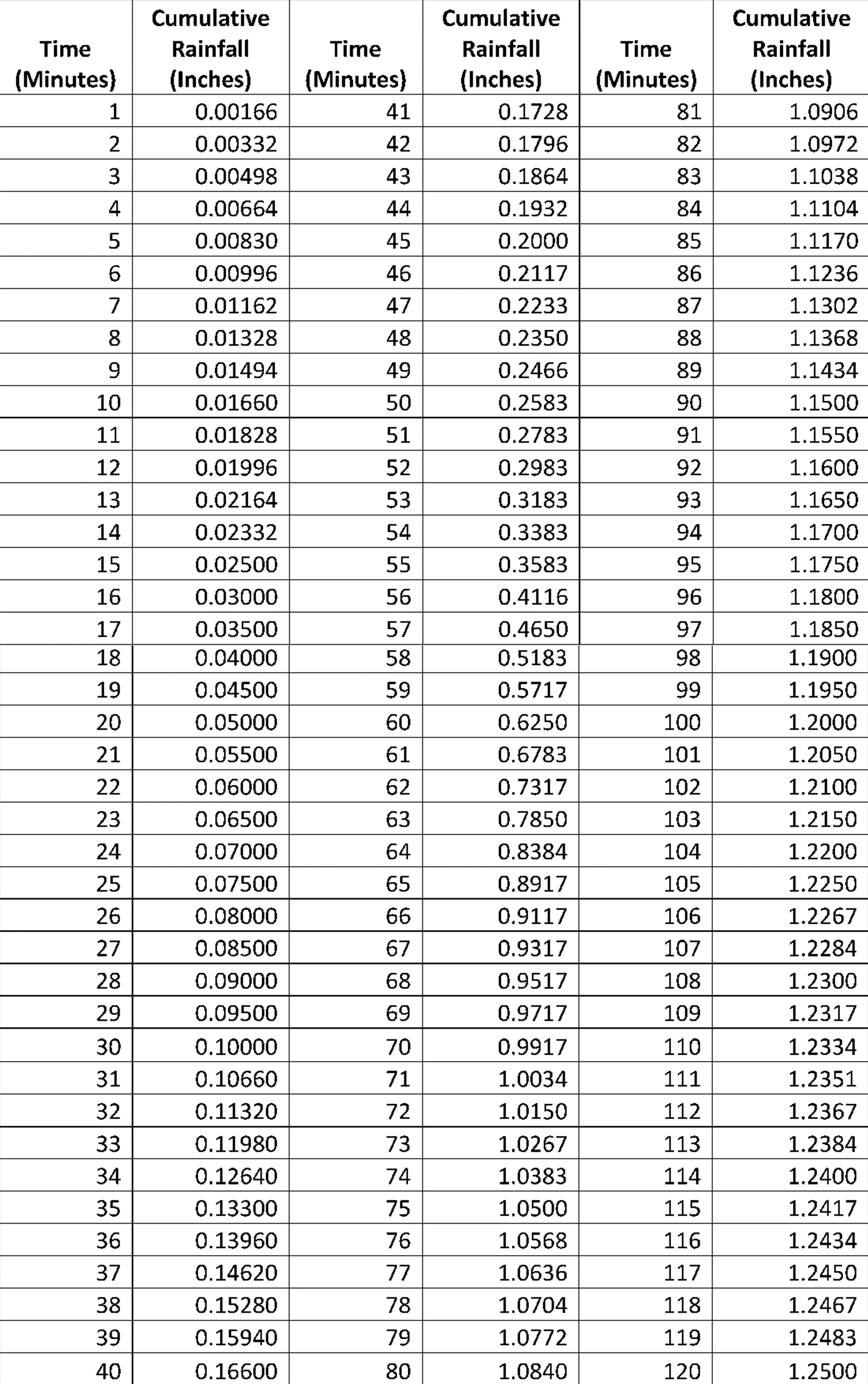
5.
If more than one (1) BMP in series is necessary to achieve the required eighty (80%) percent TSS reduction for a site, the applicant shall utilize the following formula to calculate TSS reduction:
R = A + B—(AxB)/100
6.
Stormwater management measures shall also be designed to reduce, to the maximum extent feasible, the post-construction nutrient load of the anticipated load from the developed site in stormwater runoff generated from the water quality design storm. In achieving reduction of nutrients to the maximum extent feasible, the design of the site shall include green infrastructure BMPs that optimize nutrient removal while still achieving the performance standards in subsections 26-99.6D.p, q and r.
7.
In accordance with the definition of FW1 at N.J.A.C. 7:9B-1.4, stormwater management measures shall be designed to prevent any increase in stormwater runoff to waters classified as FW1.
8.
The Flood Hazard Area Control Act Rules at N.J.A.C. 7:13-4.1(c)1 establish three hundred (300') foot riparian zones along Category One waters, as designated in the Surface Water Quality Standards at N.J.A.C. 7:9B, and certain upstream tributaries to Category One waters. A person shall not undertake a major development that is located within or discharges into a three hundred (300') foot riparian zone without prior authorization from the department under N.J.A.C. 7:13.
9.
Pursuant to the Flood Hazard Area Control Act Rules at N.J.A.C. 7:13-11.2(j)3.i, runoff from the water quality design storm that is discharged within a three hundred (300') foot riparian zone shall be treated in accordance with this subsection to reduce the post-construction load of total suspended solids by ninety-five (95%) percent of the anticipated load from the developed site, expressed as an annual average.
10.
This stormwater runoff quality standards do not apply to the construction of one (1) individual single-family dwelling, provided that it is not part of a larger development or subdivision that has received preliminary or final site plan approval prior to December 3, 2018, and that the motor vehicle surfaces are made of permeable material(s) such as gravel, dirt, and/or shells.
r.
Stormwater Runoff Quantity Standards.
1.
This subsection contains the minimum design and performance standards to control stormwater runoff quantity impacts of major development.
2.
In order to control stormwater runoff quantity impacts, the design engineer shall, using the assumptions and factors for stormwater runoff calculations at subsection 26-99.6F, complete one (1) of the following:
(a)
Demonstrate through hydrologic and hydraulic analysis that for stormwater leaving the site, post-construction runoff hydrographs for the current and projected two (2)-, ten (10)-, and one hundred (100)-year storm events, as defined and determined in Section 26-99.6E, c and d, respectively, of this ordinance, do not exceed, at any point in time, the pre-construction runoff hydrographs for the same storm events;
(b)
Demonstrate through hydrologic and hydraulic analysis that there is no increase, as compared to the pre-construction condition, in the peak runoff rates of stormwater leaving the site for the current and projected two (2)-, ten (10)-, and one hundred (100)-year storm events, as defined and determined pursuant to Section 26-99.6E, c and d, respectively, of this ordinance, and that the increased volume or change in timing of stormwater runoff will not increase flood damage at or downstream of the site. This analysis shall include the analysis of impacts of existing land uses and projected land uses assuming full development under existing zoning and land use ordinances in the drainage area;
(c)
Design stormwater management measures so that the post-construction peak runoff rates for the current and projected two (2)-, ten (10)-, and one hundred (100)-year storm events, as defined and determined in Section 26-99.6E, c and d, respectively, of this ordinance, are fifty (50%), seventy-five (75%) and eighty (80%) percent, respectively, of the pre-construction peak runoff rates. The percentages apply only to the post-construction stormwater runoff that is attributable to the portion of the site on which the proposed development or project is to be constructed; or
(d)
In tidal flood hazard areas, stormwater runoff quantity analysis in accordance with 2.i, ii and iii above is required unless the design engineer demonstrates through hydrologic and hydraulic analysis that the increased volume, change in timing, or increased rate of the stormwater runoff, or any combination of the three (3) will not result in additional flood damage below the point of discharge of the major development. No analysis is required if the stormwater is discharged directly into any ocean, bay, inlet, or the reach of any watercourse between its confluence with an ocean, bay, or inlet and downstream of the first water control structure.
3.
The stormwater runoff quantity standards shall be applied at the site's boundary to each abutting lot, roadway, watercourse, or receiving storm sewer system.
(Ord. #975-06, § 4; Ord. No. 518-21, 2-22-2021; Ord. No. 32-24, § 1, 7-15-2024; Ord. No. 42-24, § 1, 9-23-2024)
26-99.6E Calculation of Stormwater Runoff and Groundwater Recharge.
a.
Stormwater runoff shall be calculated in accordance with the following:
1.
The design engineer shall calculate runoff using the following method:
(a)
The USDA Natural Resources Conservation Service (NRCS) methodology, including the NRCS Runoff Equation and Dimensionless Unit Hydrograph, as described in Chapters 7, 9, 10, 15 and 16 Part 630, Hydrology National Engineering Handbook, incorporated herein by reference as amended and supplemented. This methodology is additionally described in Technical Release 55 - Urban Hydrology for Small Watersheds (TR-55), dated June 1986, incorporated herein by reference as amended and supplemented. Information regarding the methodology is available from the Natural Resources Conservation Service website at:
https://directives.sc.egov.usda.gov/viewerFS.aspx?hid=21422
or at United States Department of Agriculture Natural Resources Conservation Service, New Jersey State Office.
2.
For the purpose of calculating curve numbers and groundwater recharge, there is a presumption that the pre-construction condition of a site or portion thereof is a wooded land use with good hydrologic condition. The term "curve number" applies to the NRCS methodology above at Section 26-99E, a.1.(a) A curve number or a groundwater recharge land cover for an existing condition may be used on all or a portion of the site if the design engineer verifies that the hydrologic condition has existed on the site or portion of the site for at least five (5) years without interruption prior to the time of application. If more than one (1) land cover has existed on the site during the five (5) years immediately prior to the time of application, the land cover with the lowest runoff potential shall be used for the computations. In addition, there is the presumption that the site is in good hydrologic condition (if the land use type is pasture, lawn, or park), with good cover (if the land use type is woods), or with good hydrologic condition and conservation treatment (if the land use type is cultivation).
3.
In computing pre-construction stormwater runoff, the design engineer shall account for all significant land features and structures, such as ponds, wetlands, depressions, hedgerows, or culverts that may reduce pre-construction stormwater runoff rates and volumes.
4.
In computing stormwater runoff from all design storms, the design engineer shall consider the relative, stormwater runoff rates and/or volumes of pervious and impervious surfaces separately to accurately compute the rates and volume of stormwater runoff from the site. To calculate runoff from unconnected impervious cover, urban impervious area modifications as described in the NRCS Technical Release 55—Urban Hydrology for Small Watersheds and other methods may be employed.
5.
If the invert of the outlet structure of a stormwater management measure is below the flood hazard design flood elevation as defined at N.J.A.C. 7:13, the design engineer shall take into account the effects of tailwater in the design of structural stormwater management measures.
b.
Groundwater recharge may be calculated in accordance with the following:
1.
The New Jersey Geological Survey Report G8R-32 A Method for Evaluating Ground-Water Recharge Areas in New Jersey, incorporated herein by reference as amended and supplemented. Information regarding the methodology is available from the New Jersey Stormwater Best Management Practices Manual; at http://www.state.nj.us/dep/njgs/; or at New Jersey Geological Survey, 29 Arctic Parkway, P.O. Box 427 Trenton, New Jersey 08625-0427; (609) 984-6587.
c.
The precipitation depths of the current two (2)-, ten (10)-, and one hundred (100)-year storm events shall be determined by multiplying the values determined in accordance with items 1. and 2. below:
1.
The applicant shall utilize the National Oceanographic and Atmospheric Administration (NOAA), National Weather Service's Atlas 14 Point Precipitation Frequency Estimates: NJ, in accordance with the location(s) of the drainage area(s) of the site. This data is available at:
https://hdsc.nws.noaa.gov/hdsc/pfds/pfds_map_cont.html?bkmrk=nj; and
2.
The applicant shall utilize Table 5: Current Precipitation Adjustment Factors below, which sets forth the applicable multiplier for the drainage area(s) of the site, in accordance with the county or counties where the drainage area(s) of the site is located. Where the major development lies in more than one (1) county, the precipitation values shall be adjusted according to the percentage of the drainage area in each county. Alternately, separate rainfall totals can be developed for each county using the values in the table below.
Table 5: Current Precipitation Adjustment Factors
d.
Table 6: Future precipitation change factors provided below sets forth the change factors to be used in determining the projected two-, 10-, and 100-year storm events for use in this chapter, which are organized alphabetically by county. The precipitation depth of the projected two (2)-, ten (10)-, and one hundred (100)-year storm events of a site shall be determined by multiplying the precipitation depth of the two (2)-, ten (10)-, and one hundred (100)-year storm events determined from the National Weather Service's Atlas 14 Point Precipitation Frequency Estimates pursuant to c.1. above, by the change factor in the table below, in accordance with the county or counties where the drainage area(s) of the site is located. Where the major development and/or its drainage area lies in more than one (1) county, the precipitation values shall be adjusted according to the percentage of the drainage area in each county. Alternately, separate rainfall totals can be developed for each county using the values in the table below.
Table 6: Future Precipitation Change Factors
(Ord. #975-06, § 5)
(Ord. No. 518-21, 2-22-2021; Ord. No. 32-24, § 1, 7-15-2024)
26-99.6F Sources for Technical Guidance.
a.
Technical guidance for stormwater management measures can be found in the documents listed below, which are available to download from the department's website at:
https://dep.nj.gov/stormwater/bmp-manual/.
1.
Guidelines for stormwater management measures are contained in the New Jersey Stormwater Best Management Practices Manual, as amended and supplemented. Information is provided on stormwater management measures such as, but not limited to, those listed in Tables 1, 2, and 3.
2.
Additional maintenance guidance is available on the department's website at:
https://dep.nj.gov/stormwater/maintenance-guidance/.
b.
Submissions required for review by the department should be mailed to:
The Division of Watershed Protection and Restoration, New Jersey Department of Environmental Protection, Mail Code 501-02A, PO Box 420, Trenton, New Jersey 08625-0420.
(Ord. #975-06, § 6; Ord. No. 518-21, 2-22-2021; Ord. No. 32-24, § 1, 7-15-2024; Ord. No. 42-24, § 1, 9-23-2024)
Editor's note— Ord. No. 518-21, adopted Feb. 22, 2021, changed the title of subsection 26-99.6F from "Standards for Structural Stormwater Management Measures." to read as herein set out.
26-99.6G Solids and Floatable Materials Control Standards.
a.
Site design features identified under section 26-99.6D.f above, or alternative designs in accordance with section 26-99.6D.g above, to prevent discharge of trash and debris from drainage systems shall comply with the following standard to control passage of solid and floatable materials through storm drain inlets. For purposes of this paragraph, solid and floatable materials means sediment, debris, trash, and other floating, suspended, or settleable solids. For exemptions to this standard see section 26-99.6G.a.2 below.
1.
Design engineers shall use one (1) of the following grates whenever they use a grate in pavement or another ground surface to collect stormwater from that surface into a storm drain or surface water body under that grate:
i.
The New Jersey Department of Transportation (NJDOT) bicycle safe grate, which is described in Chapter 2.4 of the NJDOT Bicycle Compatible Roadways and Bikeways Planning and Design Guidelines; or
ii.
A different grate, if each individual clear space in that grate has an area of no more than seven (7.0) square inches, or is no greater than 0.5 inches across the smallest dimension.
Examples of grates subject to this standard include grates in grate inlets, the grate portion (non-curb-opening portion) of combination inlets, grates on storm sewer manholes, ditch grates, trench grates, and grates of spacer bars in slotted drains. Examples of ground surfaces include surfaces of roads (including bridges), driveways, parking areas, bikeways, plazas, sidewalks, lawns, fields, open channels, and stormwater system floors used to collect stormwater from the surface into a storm drain or surface water body.
iii.
For curb-opening inlets, including curb-opening inlets in combination inlets, the clear space in that curb opening, or each individual clear space if the curb opening has two or more clear spaces, shall have an area of no more than seven (7.0) square inches, or be no greater than two (2.0) inches across the smallest dimension.
2.
The standard in a.1. above does not apply:
i.
Where each individual clear space in the curb opening in existing curb-opening inlet does not have an area of more than nine (9.0) square inches;
ii.
Where the municipality agrees that the standards would cause inadequate hydraulic performance that could not practicably be overcome by using additional or larger storm drain inlets;
iii.
Where flows from the water quality design storm as specified in N.J.A.C. 7:8 are conveyed through any device (e.g., end of pipe netting facility, manufactured treatment device, or a catch basin hood) that is designed, at a minimum, to prevent delivery of all solid and floatable materials that could not pass through one of the following:
a.
A rectangular space four and five-eighths (4.625) inches long and one and one-half (1.5) inches wide (this option does not apply for outfall netting facilities); or
b.
A bar screen having a bar spacing of 0.5 inches.
Note that these exemptions do not authorize any infringement of requirements in the Residential Site Improvement Standards for bicycle safe grates in new residential development (N.J.A.C. 5:21-4.18(b)2 and 7.4(b)1).
iv.
Where flows are conveyed through a trash rack that has parallel bars with one-inch (1 inch) spacing between the bars, to the elevation of the Water Quality Design Storm as specified in N.J.A.C. 7:8; or
v.
Where the New Jersey Department of Environmental Protection determines, pursuant to the New Jersey Register of Historic Places Rules at N.J.A.C. 7:4-7.2(c), that action to meet this standard is an undertaking that constitutes an encroachment or will damage or destroy the New Jersey Register listed historic property.
(Ord. #975-06, § 7; Ord. No. 518-21, 2-22-2021)
Editor's note— Ord. No. 518-21, adopted Feb. 22, 2021, changed the title of subsection 26-99.6G from "Sources for Technical Guidance." to read as herein set out.
26-99.6H Safety Standards for Stormwater Management Basins.
a.
This section sets forth requirements to protect public safety through the proper design and operation of stormwater management BMPs. This section applies to any new stormwater management BMP.
b.
The provisions of this section are not intended to preempt more stringent municipal or county safety requirements for new or existing stormwater management BMPs. Municipal and county stormwater management plans and ordinances may, pursuant to their authority, require existing stormwater management BMPs to be retrofitted to meet one (1) or more of the safety standards in subsections 26-99.6H.c.1, 26-99.6H.c.2, and 26-99.6H.c.3 for trash racks, overflow grates, and escape provisions at outlet structures.
c.
Requirements for Trash Racks, Overflow Grates and Escape Provisions.
1.
A trash rack is a device designed to catch trash and debris and prevent the clogging of outlet structures. Trash racks shall be installed at the intake to the outlet from the stormwater management BMP to ensure proper functioning of the BMP outlets in accordance with the following:
(a)
The trash rack shall have parallel bars, with no greater than six-inch (6 inch) spacing between the bars;
(b)
The trash rack shall be designed so as not to adversely affect the hydraulic performance of the outlet pipe or structure;
(c)
The average velocity of flow through a clean trash rack is not to exceed two and one-half (2.5) feet per second under the full range of stage and discharge. Velocity is to be computed on the basis of the net area of opening through the rack; and
(d)
The trash rack shall be constructed of rigid, durable, and corrosion resistant material and designed to withstand a perpendicular live loading of three hundred (300) pounds per square foot.
2.
An overflow grate is designed to prevent obstruction of the overflow structure. If an outlet structure has an overflow grate, such grate shall meet the following requirements:
(a)
The overflow grate shall be secured to the outlet structure but removable for emergencies and maintenance.
(b)
The overflow grate spacing shall be no less than two (2) inches across the smallest dimension.
(c)
The overflow grate shall be constructed and installed to be rigid, durable, and corrosion resistant, and shall be designed to withstand a perpendicular live loading of three hundred (300) pounds per square foot.
3.
Stormwater management BMPs shall include escape provisions as follows:
(a)
If a stormwater management BMP has an outlet structure, escape provisions shall be incorporated in or on the structure. Escape provisions include the installation of permanent ladders, steps, rungs, or other features that provide easily accessible means of egress from stormwater management BMPs. With the prior approval of the municipality pursuant to subsection 26-99.6H.c, a free-standing outlet structure may be exempted from this requirement;
(b)
Safety ledges shall be constructed on the slopes of all new stormwater management BMPs having a permanent pool of water deeper than two and one-half (2.5) feet. Safety ledges shall be comprised of two (2) steps. Each step shall be four (4) to six (6) feet in width. One (1) step shall be located approximately two and one-half (2.5) feet below the permanent water surface, and the second step shall be located one (1) to one and one-half (1.5) feet above the permanent water surface. See subsection 26-99.6H.e for an illustration of safety ledges in a stormwater management BMP; and
(c)
In new stormwater management BMPs, the maximum interior slope for an earthen dam, embankment, or berm shall not be steeper than three (3) horizontal to one (1) vertical.
d.
Variance or Exemption from Safety Standard. A variance or exemption from the safety standards for stormwater management BMPs may be granted only upon a written finding by the municipality that the variance or exemption will not constitute a threat to public safety.
e.
Safety Ledge Illustration.
Elevation View - Basin Safety Ledge Configuration
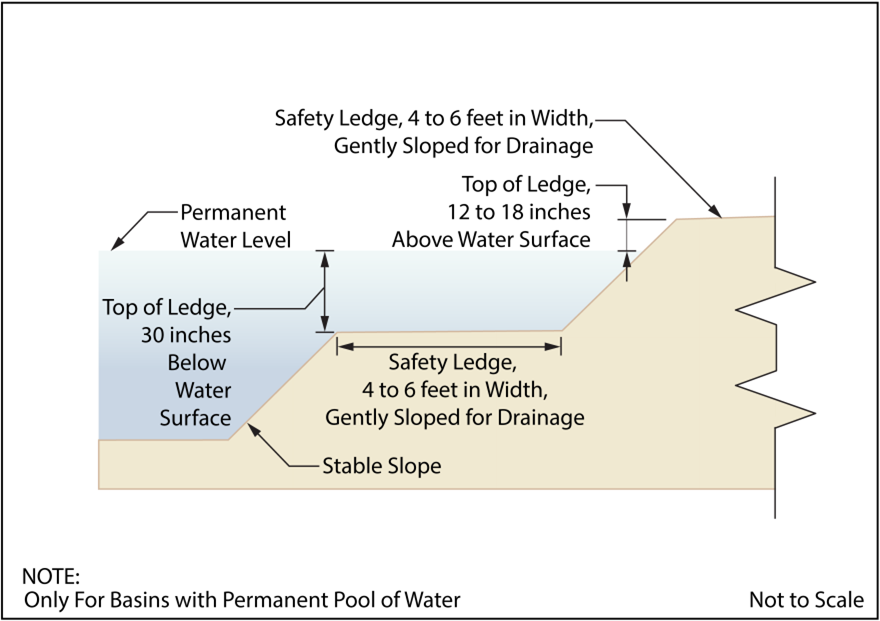
(Ord. #975-06, § 8; Ord. No. 518-21, 2-22-2021)
26-99.6I Requirements for a Site Development Stormwater Plan.
a.
Submission of Site Development Stormwater Plan.
1.
Whenever an applicant seeks municipal approval of a development subject to this section, the applicant shall submit all of the required components of the checklist for the site development stormwater plan at subsection 26-99.6I.c below as part of the submission of the application for approval.
2.
The applicant shall demonstrate that the project meets the standards set forth in this section.
3.
The applicant shall submit five (5) copies of the materials listed in the checklist for site development stormwater plans in accordance with subsection 26-99.6I.c.
b.
Site Development Stormwater Plan Approval. The applicant's site development project shall be reviewed as part of the subdivision or site plan review process by the municipal board or official from whom municipal approval is sought. That municipal board or official shall consult the engineer retained by the planning and/or zoning board (as appropriate) to determine if all of the checklist requirements have been satisfied and to determine if the project meets the standards set forth in this section.
c.
Submission of Site Development Stormwater Plan. The following information shall be required:
1.
Topographic Base Map. The reviewing engineer may require upstream tributary drainage system information as necessary. It is recommended that the topographic base map of the site be submitted which extends a minimum of two hundred (200) feet beyond the limits of the proposed development, at a scale of one inch equals two hundred feet (1" = 200') or greater, showing two-foot (2 foot) contour intervals. The map as appropriate may indicate the following: existing surface water drainage, shorelines, steep slopes, soils, erodible soils, perennial or intermittent streams that drain into or upstream of the Category One waters, wetlands and flood plains along with their appropriate buffer strips, marshlands and other wetlands, pervious or vegetative surfaces, existing man-made structures, roads, bearing and distances of property lines, and significant natural and manmade features not otherwise shown.
2.
Environmental Site Analysis. A written and graphic description of the natural and man-made features of the site and its surroundings should be submitted. This description should include a discussion of soil conditions, slopes, wetlands, waterways and vegetation on the site. Particular attention should be given to unique, unusual, or environmentally sensitive features and to those that provide particular opportunities or constraints for development.
3.
Project Description and Site Plans. A map (or maps) at the scale of the topographical base map indicating the location of existing and proposed buildings roads, parking areas, utilities, structural facilities for stormwater management and sediment control, and other permanent structures. The map(s) shall also clearly show areas where alterations will occur in the natural terrain and cover, including lawns and other landscaping, and seasonal high groundwater elevations. A written description of the site plan and justification for proposed changes in natural conditions shall also be provided.
4.
Land Use Planning and Source Control Plan. This plan shall provide a demonstration of how the goals and standards of subsections 26-99.6C through 26-99.6E are being met. The focus of this plan shall be to describe how the site is being developed to meet the objective of controlling groundwater recharge, stormwater quality and stormwater quantity problems at the source by land management and source controls whenever possible.
5.
Stormwater Management Facilities Map. The following information, illustrated on a map of the same scale as the topographic base map, shall be included:
(a)
Total area to be disturbed, paved or built upon, proposed surface contours, land area to be occupied by the stormwater management facilities and the type of vegetation thereon, and details of the proposed plan to control and dispose of stormwater.
(b)
Details of all stormwater management facility designs, during and after construction, including discharge provisions, discharge capacity for each outlet at different levels of detention and emergency spillway provisions with maximum discharge capacity of each spillway.
6.
Calculations.
(a)
Comprehensive hydrologic and hydraulic design calculations for the pre-development and post-development conditions for the design storms specified in subsection 26-99.6D.
(b)
When the proposed stormwater management control measures depend on the hydrologic properties of soils or require certain separation from the seasonal high water table, then a soils report shall be submitted. The soils report shall be based on onsite boring logs or soil pit profiles. The number and location of required soil borings or soil pits shall be determined based on what is needed to determine the suitability and distribution of soils present at the location of the control measure.
7.
Maintenance and Repair Plan. The design and planning of the stormwater management facility shall meet the maintenance requirements of subsection 26-99.6J.
8.
Waiver from Submission Requirements. The municipal official or board reviewing an application under this section may, in consultation with the municipality's review engineer, waive submission of any of the requirements in subsections 26-99.6I.c.1 through 26-99.6I.c.6 of this section when it can be demonstrated that the information requested is impossible to obtain or it would create a hardship on the applicant to obtain and its absence will not materially affect the review process.
(Ord. #975-06, § 9)
(Ord. No. 518-21, 2-22-2021)
26-99.6J Maintenance and Repair.
a.
Applicability. Projects subject to review as in subsection 26-99.6A.c of this section shall comply with the requirements of subsections 26-99.6J.b and 26-99.6J.c.
b.
General Maintenance.
1.
The design engineer shall prepare a maintenance plan for the stormwater management measures incorporated into the design of a major development.
2.
The maintenance plan shall contain specific preventative maintenance tasks and schedules; cost estimates, including estimated cost of sediment, debris, or trash removal; and the name, address, and telephone number of the person or persons responsible for preventative and corrective maintenance (including replacement). The plan shall contain information on BMP location, design, ownership, maintenance tasks and frequencies, and other details as specified in Chapter 8 of the NJ BMP Manual, as well as the tasks specific to the type of BMP, as described in the applicable chapter containing design specifics.
3.
If the maintenance plan identifies a person other than the property owner (for example, a developer, a public agency or homeowners' association) as having the responsibility for maintenance, the plan shall include documentation of such person's or entity's agreement to assume this responsibility, or of the owner's obligation to dedicate a stormwater management facility to such person under an applicable ordinance or regulation.
4.
Responsibility for maintenance shall not be assigned or transferred to the owner or tenant of an individual property in a residential development or project, unless such owner or tenant owns or leases the entire residential development or project. The individual property owner may be assigned incidental tasks, such as weeding of a green infrastructure BMP, provided the individual agrees to assume these tasks; however, the individual cannot be legally responsible for all of the maintenance required.
5.
If the party responsible for maintenance identified under subsection 26-99.6J.b.3 above is not a public agency, the maintenance plan and any future revisions based on subsection 26-99.6J.b.7 shall be recorded upon the deed of record for each property on which the maintenance described in the maintenance plan must be undertaken.
6.
Preventative and corrective maintenance shall be performed to maintain the functional parameters (storage volume, infiltration rates, inflow/outflow capacity, etc.) of the stormwater management measure, including, but not limited to, repairs or replacement to the structure; removal of sediment, debris, or trash; restoration of eroded areas; snow and ice removal; fence repair or replacement; restoration of vegetation; and repair or replacement of non-vegetated linings.
7.
The party responsible for maintenance identified under subsection 26-99.6J.b.3 above shall perform all of the following requirements:
(a)
Maintain a detailed log of all preventative and corrective maintenance for the structural stormwater management measures incorporated into the design of the development, including a record of all inspections and copies of all maintenance-related work orders;
(b)
Evaluate the effectiveness of the maintenance plan at least once per year and adjust the plan and the deed as needed; and
(c)
Retain and make available, upon request by any public entity with administrative, health, environmental, or safety authority over the site, the maintenance plan and the documentation required by subsections 26-99.6J.b.6 and b.7 above.
8.
The requirements of subsections 26-99.6J.b.3 and b.4 do not apply to stormwater management facilities that are dedicated to and accepted by the municipality or another governmental agency, subject to all applicable municipal stormwater general permit conditions, as issued by the department.
9.
In the event that the stormwater management facility becomes a danger to public safety or public health, or if it is in need of maintenance or repair, the municipality shall so notify the responsible person in writing. Upon receipt of that notice, the responsible person shall have fourteen (14) days to effect maintenance and repair of the facility in a manner that is approved by the municipal engineer or his designee. The municipality, in its discretion, may extend the time allowed for effecting maintenance and repair for good cause. If the responsible person fails or refuses to perform such maintenance and repair, the municipality or county may immediately proceed to do so and shall bill the cost thereof to the responsible person. Nonpayment of such bill may result in a lien on the property.
c.
Nothing in this subsection shall preclude the municipality in which the major development is located from requiring the posting of a performance or maintenance guarantee in accordance with N.J.S.A. 40:55D-53.
(Ord. #975-06, § 10; Ord. No. 518-21, 2-22-2021)
26-99.6K Penalties.
Any person who erects, constructs, alters, repairs, converts, maintains, or uses any building, structure or land in violation of this section shall be subject to the maximum penalties allowed by law.
(Ord. #975-06, § 11; Ord. No. 518-21, 2-22-2021)
26-99.6L Severability.
Each section, subsection, sentence, clause and phrase of this section is declared to be an independent section, subsection, sentence, clause and phrase, and the finding or holding of any such portion of this section to be unconstitutional, void, or ineffective for any cause, or reason, shall not affect any other portion of this section.
(Ord. No. 518-21, 2-22-2021)
26-99.6M Effective Date.
This section shall be in full force and effect from and after its adoption and any publication as required by law.
(Ord. No. 518-21, 2-22-2021)
26-100 - PERFORMANCE STANDARDS.
a.
As a condition of approval and the continuance of any use, occupancy of any structure and operation of any process or equipment, the applicant shall certify compliance with the performance standards contained herein. Permits and certificates required by other government agencies shall be submitted to the Board as proof of compliance with applicable codes.
b.
Temporary Certificates of Occupancy.
1.
In the event that a determination cannot be made at the time of application that a proposed use, process or equipment will meet the standards established in this section, the Board may recommend issuance of a temporary certificate of occupancy. The temporary certificate of occupancy shall be based on submission of evidence that the proposed use, process or equipment will meet the standards established herein after completion or installation and operation.
2.
Within sixty (60) days after a temporary certificate of occupancy is granted, satisfactory evidence shall be submitted to the Construction Official that all standards established by this section have been met. Upon such submission, a final certificate of occupancy shall be issued.
c.
Regulation of Nuisance Elements.
1.
The determination of the existence of nuisance elements shall be made to the following locations:
2.
Continued compliance with the performance standards stated herein shall be a requirement for the continued occupancy of any structure or the operation of any process or equipment.
d.
Standards to be Enforced.
1.
Air Pollution.
(a)
General. No substance shall be emitted into the atmosphere in quantities which are injurious to human, plant or animal life or to property or which interfere unreasonably with the comfortable enjoyment of life and property anywhere in the Borough. All provisions of Title 7, Chapter 27 of the New Jersey Administrative Code, (N.J.A.C.), as amended, or the regulations contained in this section, whichever shall be more stringent, shall apply.
(b)
Smoke. In any non-residential zone, no smoke, the shade or appearance of which is darker than No. 1 on the Ringelmann Smoke Chart, shall be emitted into the open air from any fuel-burning equipment; provide, however, that smoke emitted during the cleaning of a firebox or the building of a new fire, the shade or appearance of which is not darker than No. 2 on the Ringelmann Smoke Chart, may be permitted for a period or periods aggregating no more than three (3) minutes in any fifteen (15) consecutive minutes. Smoke emissions from the combustion of fuel and mobile sources and from stationary internal combustion engines shall not exceed the limits set forth in N.J.A.C. 7:27.
(c)
No open burning shall be permitted in any district.
(d)
Odors. In any zone, no odorous material may be emitted into the atmosphere in quantities sufficient to be detected.
2.
Wastes.
(a)
Liquid Wastes. No liquid waste shall be discharged into any watercourse in the Borough without all necessary permits from the New Jersey Department of Environmental Protection (NJDEP). No liquid waste shall be discharged into the public sewage collection and disposal system unless the appropriate Borough official shall have first investigated the character and volume of such wastes and shall have certified that the Borough will accept the discharge of such waste material into the system. The applicant shall comply with any requirements of said officials, including the pretreating of such wastes, the installation of processing methods, separation or screening of wastes, control of pH and other methods of improving such wastes prior to discharge, as a condition of approval of such facilities.
(b)
Solid Waste. Each property owner shall be responsible for:
(1)
Adequate and regular collection and removal of all refuse, except where the Borough assumes such responsibility.
(2)
Compliance with all applicable provisions of the NJDEP.
(3)
Compliance with all provisions of Title 7, Chapter 26, of the N.J.A.C., where applicable.
(4)
No accumulation on the property of any junk or other objectionable materials except in designated trash receptacles.
3.
Noise. All applications shall comply with the provisions of N.J.A.C. 7:29.
4.
Vibration. In any zone, vibrations discernible without instruments at the measuring location shall not be permitted.
5.
Glare. No single standard for glare is promulgated in this chapter due to the impracticality of establishing such standards. It is the intent of these performance standards to ensure that both direct and indirect glare, to the extent possible, are eliminated or that activities producing such glare are carried on within a structure. Necessary glare-producing devices such as roadway and walkway lighting shall be designed, constructed and maintained in such a manner as not to be a nuisance to surrounding uses.
6.
Temperature Change. Any use or process shall not produce a temperature change greater than three degrees Celsius (3° C.) at the measuring location.
7.
Fire and Explosive Hazards. If it appears that any proposed use, structure, process or resulting product or material may constitute a fire or explosion hazard, the Board may require the applicant to supply proof of:
(a)
Approval of the use, structure, process or resulting product or material from the State Department of Labor indicating that adequate safeguards against fire and explosion have been taken or installed.
(b)
Approval from the Borough of Sayreville Fire Department that the applicant has complied with all applicable Borough fire prevention regulations.
8.
Control of Radioactivity or Electrical Disturbance. There shall be no activities which emit dangerous or harmful radioactivity. There shall be no disturbance adversely affecting the operation of any equipment located beyond the property of the creator of such disturbance.
9.
Industrial Waste or Storage. No use shall be conducted in such a way as to discharge any sewerage or industrial waste except as shall be approved by the Health Office and all other State or other agencies.
10.
Provisions and Use of Water. All water requirements shall be stated in the application. Water shall be supplied from wells only after approved or accepted geological study furnished by the applicant and certification by a professional geologist that the underground water supply and levels will not be appreciably altered in such a way as to endanger the water level and supply for other properties. Supply of water shall comply with all State requirements regulating use and supply of water.
(Ord. #637-99)
26-101 - RECYCLING FACILITIES FOR NEW MULTI-FAMILY HOUSING DEVELOPMENTS.
a.
There shall be included in any new multi-family housing development that requires subdivision or site plan approval an indoor or outdoor recycling area for the collection and storage of residentially generated recyclable materials. The dimensions of the recycling area shall be sufficient to accommodate recycling bins or containers which are of adequate size and number and which are consistent with anticipated usage and with current methods of collection in the area in which the project is located.
b.
The recycling area shall be conveniently located for the disposition of source-separated recyclable materials by residents of the multi-family housing development, preferably near, but clearly separated from, a refuse dumpster.
c.
The recycling area shall be well lit and shall be safely and easily accessible by recycling personnel and vehicles. Collection vehicles shall be able to access the recycling area without interference from parked cars or other obstacles. Reasonable measures shall be taken to protect the recycling area, and the bins or containers placed therein, against theft of recyclable materials, bins or containers.
d.
Any bins or containers which are used for the collection of recyclable paper or cardboard and which are located in an outdoor recycling area shall be equipped with a lid, or otherwise covered, so as to keep the paper or cardboard dry.
e.
Signs clearly identifying the recycling area and the materials accepted therein shall be posted adjacent to all points of access to the recycling area. Individual bins or containers shall be equipped with signs indicating the materials to be placed therein.
f.
Landscaping and/or fencing shall be provided around any outdoor recycling area and shall be developed in an aesthetically pleasing manner.
(Ord. #637-99)
26-102 - CONSTRUCTION REQUIREMENTS.
a.
Borough Standards. All standards and specifications of the Borough as now or hereafter adopted, if any, shall govern the design, construction and installation of all required improvements. Failure of the developer, his contractor or agent to conform to said specifications shall be just cause for the suspension of the work being performed. No developer shall have the right to demand or claim damages from the Borough, its officers, agents or servants by reason of said suspension.
b.
Other Standards. In the event that the Borough has not adopted standards for a specific type of improvement, then generally accepted engineering standards, as set forth in current engineering and construction manuals as may be approved and modified by the Borough Engineer for a specific situation, shall be used.
c.
Grades. All construction stakes and grades shall be set by a licensed land surveyor. One (1) copy of all cut sheets shall be filed with the Borough Engineer prior to the commencement of any construction.
d.
Approved Plans. Prior to commencement of construction of required improvements, the Borough Engineer shall have received and approved the complete plans and profiles of all improvements to be installed or constructed. No improvements shall be accepted by the governing body and no performance guaranties released until the Borough Engineer has received and approved reproducible drawings showing the plans, grades and profiles of all improvements as finally constructed.
e.
Site Conditions. During construction, the site shall be maintained and left each day in a safe, clean and orderly manner, and any condition which could lead to personal injury or property damage shall be immediately corrected by the developer upon an order by the Construction Official or other authorized personnel.
f.
Duty of Developers to Provide Service. It shall be the duty and responsibility of the developer of a major residential subdivision to provide the following services until acceptance of a public street by the Borough:
1.
Sweeping of streets;
2.
Snowplowing;
3.
Garbage collection twice per week from the front of each unit;
4.
Payment of street lighting utility cost.
g.
Disposal of Dead Trees, Litter, Building Materials. All stumps, litter, rubbish, brush, weeds, dead and dying trees, debris and excess or scrap building materials shall be removed or destroyed immediately upon the request of and to the satisfaction of the Construction Official prior to issuing an occupancy permit. No such refuse shall be buried on the site.
h.
Changes in Elevation.
1.
No change shall be made in the elevation or contour of any lot or site by the removal of earth to another lot or site other than as shown on an approved preliminary plan.
2.
Minimal changes in elevation or contours necessitated by field conditions may be made only after approval by the Borough Engineer. All said changes shall be shown on the final plan and indicated as a change from the preliminary, or if final approval has been granted, all changes shall be shown on the as-built plans.
i.
Excavations. No excavation shall be created or maintained, except when required for the foundations of structures or in connection with and during the installation of facilities for permitted uses. Such excavation shall be used for the intended purpose or shall be refilled to the average surrounding ground level, in such a manner as to prevent the collection of water, erosion of earth or collapse or sliding of banks, within six (6) months from the date of commencement of such excavation.
j.
Topsoil Removal. No topsoil shall be removed from the site or used as fill unless the applicant has received a soil removal permit. Topsoil moved during the course of construction shall be redistributed so as to provide at least four (4″) inches of cover to all areas of the subdivision and shall be stabilized by seeding or planting.
k.
Inspections.
1.
Prior to commencement of construction, the developer shall arrange for a preconstruction conference between the developer, contractor and Engineer. All improvements and utility installations shall be inspected during the time of their installation under the supervision of the Engineer to ensure satisfactory completion. The Engineer shall be notified by the developer three (3) working days in advance of the start of construction, any new item of construction, recommencement of construction and request for site inspection.
2.
The developer shall be required to pay the Borough inspection fees based upon the total amount of the outside improvements proposed to be dedicated to the Borough and for such improvements necessary to the general health, safety and welfare of residents or visitors to the site as calculated by the Borough Engineer in accordance with Article VII of this chapter. In no event shall the inspection fee be less than two hundred fifty ($250.00) dollars. No underground installation shall be covered until it has been inspected and improved.
3.
If the inspection costs shall exceed the deposit, the developer shall deposit with the Borough Treasurer additional sums upon notice from the Borough Engineer. Any unspent funds shall be returned to the developer at the end of the maintenance period.
(Ord. #637-99)
26-103 - IMPROVEMENTS.
a.
General. Prior to the granting of final approval, the applicant shall have installed or constructed improvements required by the Board or have posted a performance guaranty or surety sufficient to cover the costs of said improvements. The Board may solicit local, county, state, federal, public or semipublic agencies and knowledgeable individuals on what improvements shall be required. Improvements recommended by other agencies, such as a utilities authority, county, state or other governmental agencies, may be required by the Board as a condition of final approval. It is recognized, however, that in certain situations all of the improvements listed below may not be appropriate or needed. These items may then be waived by the Board.
b.
Specific Improvements to be Constructed or Installed.
1.
Stormwater. The on-site stormwater disposal system shall be in accordance with this chapter.
2.
Sewage Disposal. Provisions shall be made to convey effluent from each lot through laterals and interceptors of adequate size, material and capacity to collectors and then to trunk sewers to public treatment facilities.
3.
Water. Provision shall be made to provide each lot with an adequate and continuous supply of potable water.
4.
Utilities. Gas lines, telephone lines, electrical service, cable television and similar utilities shall consist of those improvements required by the applicable utility or Federal or State Law.
5.
Vehicular and Pedestrian Improvements. Such improvements shall include paving, curbs, gutters, sidewalks, bicycle paths, driveways, lighting, traffic signs, traffic control devices and guardrails.
6.
Other Improvements. These improvements shall include but are not limited to the following: street trees, topsoil, earth removal, borrow and fill and improvements to prevent damage to adjacent property.
7.
Monuments. Monuments shall be of such size, shape and location as required by the Map Filing Law.*
c.
Temporary Improvements. During construction, the Borough Engineer may require the installation or construction of improvements to prevent or correct temporary conditions on the site which could cause personal injury, damage to property or constitute a health hazard. These conditions may result from flooding, heavy construction traffic and pollution. Improvements may include grading, planting, retaining walls, culverts, pipes, guardrails, temporary roads and other appropriate to the specific conditions.
d.
Completion; Building Permits.
1.
No more than seventy-five (75%) percent of building permits in a residential development or approved subsection thereof, except for model buildings in the first subsection, will be issued until the installation of curbs, utilities in or under the street cartway, functioning water supply and wastewater disposal facilities, necessary underground and/or surface storm facilities to ensure proper drainage of the lots and surrounding land, rough grading of lots according to the standard of the approved soil erosion and sediment control plan for the buffer plantings and berms, street subbase and base courses are installed to serve all lots and structures within the development or approved subsection thereof. The owner shall request and the Construction Official shall receive favorable reports from all involved utility and inspection officials certifying the conditional acceptance for uses subject to minor punch list repairs, and final acceptance by the Borough Council, where appropriate, of necessary installed improvements.
2.
Completion of all improvements within the development or approved subsection, including installation of any remaining utilities in or under the sidewalk or bikeway right-of-way, installation of sidewalks and bikeways, surface course paving, final site grading and seeding and plantings, subject only to minor punch list repairs or replacement will be required prior to the issuance of the last ten (10%) percent of occupancy permits in the development or approved subsection thereof and prior to issuance of building permits in any subsequent subjection of the development or, in lieu thereof, the owner shall post a cash bond in an amount equal to the cost of the remaining improvements, as determined by the Borough Engineer, the costs to include allowances for contingency and engineering fees and the cost of a maintenance bond. In no event shall the last certificate of occupancy be issued for the development or approved section until all punch list items are completed.
(Ord. #637-99)
* Editor's Note: See N.J.S.A. 46:23-9.9 et seq.
26-104 - OFF-TRACT IMPROVEMENTS.
26-104.1 Compliance with Provisions; Performance Guarantees. Where the need for off-tract improvements is in whole or in part made necessary by the application of the developer and the installation of the improvements would confer a benefit upon the development, a determination of the contribution of the developer for the off-tract improvements shall be made in accordance with the provisions as hereinafter set forth, and the performance of the work or the posting of adequate performance guarantees to ensure installation of the required off-tract improvements shall be made by the developer.
(Ord. #637-99)
26-104.2 Recommendation and Report. Where the Board has determined the necessity of an off-tract improvement, it shall forward its recommendation, together with the estimated cost of the off-tract improvement, to the Borough Council. The estimated cost of the off-tract improvement shall set forth an estimate by which all properties to be serviced thereby, including the developer's property, shall be benefited. Upon receipt of the recommendation and report of the Board, the Borough Council shall, within thirty (30) days from the date of receipt thereof, make a determination. If the Borough Council, by resolution, concurs with the recommendation of the Board in whole or in part, it shall notify the Planning Board of its recommendation, and the Board shall then, with the aid of the Borough Engineer or such other persons who have pertinent information or expertise, calculate the cost of the improvement and the amount by which all properties to be serviced thereby, including the subdivider's property, will be benefited.
(Ord. #637-99)
26-104.3 Manner of Construction. Upon completion of the Board studies with respect to the cost of the improvement and special benefits to be conferred, these reports shall be forwarded to the Borough Council and a determination made by the Borough Council as to whether the off-tract improvement is to be constructed:
a.
By the Borough as a general improvement;
b.
By the Borough as a local improvement;
c.
By the developer under a formula providing for partial reimbursement by the Borough for benefits to properties other than the development;
d.
By the developer under a formula providing for partial reimbursement by other private parties (developer, property owner) for benefits to properties other than the development.
(Ord. #637-99)
26-104.4 Amount of Contribution. When this has been determined, the developer may be required to provide, as a condition for final approval of the development, a bond or a cash deposit to ensure payment to the Borough of one (1) of the following amounts:
a.
If the improvement is to be constructed by the Borough as a general improvement, an amount equal to the difference between the estimated cost of the improvement and the estimated total amount, if less, by which all properties to be served thereby, including the developer's property, will be specially benefited by the off-tract improvement.
b.
If the improvement is to be constructed by the Borough as a local improvement, the estimated amount by which the subdivision will be specially benefited by the off-tract improvement.
c.
If the improvement is to be constructed by the developer, an amount equal to the estimated cost of the off-tract improvements, less an offset for benefits to properties other than the development.
(Ord. #637-99)
26-104.5 Determination of Special Benefits. In determining benefits conferred to properties specially benefited by an off-tract improvement, the following formula shall, subject to adjustment for peculiar or exceptional conditions, be used:
a.
The development shall be allocated that percentage of one hundred (100) computed by dividing the development land area by the total land area benefited by the off-tract development.
b.
The development shall be allotted that percentage of one hundred (100) computed by dividing the maximum potential intensity of use of the development (total square feet of building floor area) by the maximum potential intensity of use under existing zoning limitations in the total land area benefited by the off-tract improvement.
c.
In the case of linear improvements, i.e., roads, curbing, sidewalks, pipes, drains, sewers, drainage easements, etc., the development shall be allotted that percentage of one hundred (100) computed by dividing the distance (measured along the course of the off-tract improvement) from the connecting facility to the farthest abutting point of the subdivision by the sum of the distance of all intervening properties, including the developments abutting the off-tract improvements which shall be apportioned to the developer.
(Ord. #637-99)
26-104.6 When Required. The requirement of appropriate off-tract improvements and the apportionment of the cost of a portion thereof to the developer shall, when applicable, be a condition of either preliminary approval or final approval of a subdivision or site plan. If not imposed as a condition of preliminary approval, such off-tract improvements and the apportionment of the cost thereof shall be considered improvements under N.J.S.A. 40:55D-1 et seq., which may be imposed at the time of final approval.
(Ord. #637-99)
26-104.7 Payment of Allocated Cost.
a.
The estimated cost of the off-tract improvement allocated by the developer, if deposited in cash, shall be paid by the developer to the Borough Treasurer, who shall provide a suitable depository therefor, and such funds shall be used only for the off-tract improvements serving the same purpose. If such improvements are not initiated by the Borough within a period of ten (10) years from the date of payment, then funds so deposited shall be returned together with accumulated interest or other interest thereof, if any.
b.
In the event the payment by the developer to the Borough Treasurer provided for herein is less than its share of the actual cost of the off-tract improvements, then it shall be required to pay its additional share of the cost thereof.
c.
In the event the payment by a developer to the Borough Treasurer provided for above is more than its appropriate share for the actual cost of installation of the off-tract improvements, it shall be repaid an amount equal to the difference between the deposit and its share of the actual cost.
d.
Before apportioning the cost of off-tract improvements to a developer, the Board shall notify and afford the developer an opportunity to be heard thereon at a public meeting. If the developer shall deem that any of the amounts so estimated by the Board are unreasonable, it may challenge them and seek to have them revised in appropriate development application proceedings.
e.
If the developer and the Borough cannot agree with respect to the developer's appropriate share of the actual cost of the off-tract improvement if the off-tract improvement is constructed as a local improvement, the dispute shall be decided in an appropriate judicial proceeding.
(Ord. #637-99)
26-104.8 Assessment of Properties. Upon receipt from the developer of its allocated share of the costs of the off-tract improvements, the Borough may adopt a local improvement assessment ordinance for the purpose of construction and installation of the off-tract improvements based upon the actual cost thereof. Any portion of the cost of the improvements not defrayed by a developer may be assessed against benefiting property owners by the Borough. Any assessments for benefits conferred made against the developer or its successors in interest shall be first offset by a pro-rata share credit of the allocated costs previously deposited with the Borough Treasurer pertaining thereto. The developer, or his successors in interest, shall not be liable for any part of an assessment for such improvements unless the assessment exceeds its pro-rata share credit for its deposit, and then only to the extent of the deficiency.
(Ord. #637-99)
26-104.9 Credit for Work Performed. In the event the developer installs and constructs an off-tract development or any portion thereof, which improvement is accepted by the Borough, then the cost shall be treated as a credit against any future assessment for that particular off-tract improvement, or portion thereof constructed by the Borough in the same manner as if the developer had deposited its apportioned cost with the Borough Treasurer, as provided herein.
(Ord. #637-99)
26-104.10 Installation of Improvements by Applicant.
a.
At the discretion and option of the Borough, the Borough may enter into a contract with the developer providing for the installation and construction of the off-tract improvements by the developer upon contribution by the Borough of the remaining unallocated portion of the cost of the off-tract improvement.
b.
In the event the Borough so elects to contribute to the cost and expense of installation of the off-tract improvements by the developer, the portion contributed by the Borough shall be subject to possible certification and assessment as a local improvement against benefiting property owners in the manner provided by law, if applicable.
(Ord. #637-99)
26-104.11 Design Standards. Should the developer and the Borough enter into a contract for the construction of the off-tract improvements to be performed by the developer, it shall observe all requirements and principles of this chapter and other ordinances in the design of such improvements.
(Ord. #637-99)

