
Schoolcraft City Zoning Code
ARTICLE IV
GENERAL REGULATIONS
Sec. 62-71.- Effects of zoning.
Zoning affects every structure and use. Except as hereinafter specified, no building, structure or premises shall hereafter be used or occupied, and no building or part thereof or other structure shall be erected, moved, placed, reconstructed, extended, enlarged, or altered, except when in conformity with the regulations herein specified for the zoning district in which it is located.
In case any building or part thereof is issued, erected, altered or occupied contrary to law or to the provisions of this chapter, such building shall be declared a nuisance and may be required to be vacated, torn down, or abated by any legal means and shall not be used or occupied until it has been brought into conformance.
If construction on a building is lawfully begun prior to adoption of this chapter or is in existence at the time of the adoption of this chapter, nothing in this chapter shall be deemed to require any change in the planned or designed use of any such building provided that actual construction is being diligently carried on, and further provided that such building shall be entirely completed for its planned or designed use within one year from the effective date of this chapter, or affecting amendment.
Sec. 62-72. - Application of regulations.
The regulations set by this chapter throughout the village and within each district shall be minimum regulations and shall apply uniformly to each class or kind of structure, land or use.
(1)
All buildings, structures or land may hereafter be used, constructed, altered or occupied, only when in conformity with all of the regulations herein specified for the district in which it is located.
(2)
No building or other structure shall hereafter be altered:
a.
To accommodate or house a greater number of persons or families than permitted by the zoning district.
b.
To have narrower or smaller rear yards, front yards, or other side yards, other than permitted.
(3)
No yard or lot existing at the time of passage of this chapter shall be subdivided or reduced in dimension or area below the minimum requirements set forth herein. Yards or lots created after the effective date of this chapter shall meet at least the minimum requirements established by this chapter.
Sec. 62-73. - Schedule of district regulations.
Regulations affecting the arrangement of buildings, materials and equipment occupying such land for each of the districts are hereby established as set forth in the schedule of regulations.
Sec. 62-74. - General regulations.
(a)
Building permit required—Conformance to zoning. In accordance with other village codes, ordinances and regulations duly adopted by the village council, and in accordance with this chapter, no building shall hereafter be erected, relocated or altered in its exterior or interior dimension or use, and no excavation for any building shall be begun until a building permit has been issued. With respect to this Zoning Ordinance, eligibility for a building permit shall be established upon conformance with the provisions contained herein.
This shall apply to all new construction and all major improvements to existing structures. In the case of detached accessory buildings and structures, a building permit is required. (A permit is not required for commercially purchased storage sheds.)
(b)
Certificate of occupancy required. No new principal building or dwelling subject to the provisions of this chapter shall be occupied, inhabited or used until a certificate of occupancy is issued by the building inspector.
(c)
Structures.
(1)
Restoring unsafe buildings: Nothing in this chapter shall prevent the strengthening or restoring to a safe condition of any part of any building or structure declared unsafe by the building inspector or the county health department. A building or structure condemned by the building official may be restored to safe condition provided change of use or occupancy is not contemplated nor compelled by reason of such reconstruction or restoration; except that if the damage or cost of reconstruction or restoration is equal to or in excess of its state equalized value, the structure shall be made to comply in all respects with the requirements for materials and methods of construction of structures hereafter erected.
(2)
Structure to have access: Every principal structure hereafter erected or moved shall be on a lot adjacent to a public street, or with access to an approved private street, and all structures shall be located on lots as to provide safe and convenient access for servicing fire protection, and required off-street parking.
(3)
Fences, walls, and hedges.
a.
Permit. It shall be unlawful for any person to construct or to cause to have constructed any fence, wall, or hedge upon any property within the village without first having obtained a permit in the manner provided in this section of the ordinance.
b.
Permit application. Any person desiring to build or to cause to be built a fence or wall or grow a hedge or cause a hedge to be grown upon property located in the village shall first apply to the building inspector for a permit. Such application shall contain any and all information required by the building inspector necessary for the determination of whether the erection of such fence, wall or hedge will violate any provision of this section.
c.
Front yards.
1.
Fences not more than three feet in height are permitted in front yards of all zones, provided said fence is not more than 75 percent solid.
2.
Retaining walls and hedges not more than three feet in height are permitted in front yards of all zones, provided they do not impede traffic visibility. Hedges must be planted and maintained in a way where two feet of clearance exists between the edge of the hedge and the front property line or the road right-of-way line if the property line is located within the road right-of-way.
d.
Side and rear yards. Walls and solid fences or hedges up to six feet in height are permitted in side and rear yards in all zones.
e.
Corner lots. In all zones, both street frontages for corner lots shall comply with the provisions for front yards described herein. In addition, no fence, wall, or planting over 30 inches in height above the curb line, except deciduous trees, shall be erected or maintained within 20 feet of intersecting street right-of-way lines so as to interfere with traffic visibility across the corner.
f.
Permitted materials and/or fence or wall types.
1.
Front yards. Wood, brick, vinyl, wrought iron, tubular aluminum, or other decorative material approved by the village manager or their designee.
2.
Side and rear yards. Wood, brick, vinyl panels, plastic panels, wrought iron, tubular aluminum, chain link, six feet tall wooden fence with three horizontal support beams per panel, or other decorative material approved by the village manager or their designee.
g.
Prohibited materials and/or fence types. Log stockade, slats inserted in chain link, barbed wire (except as noted herein), razor wire, electric, scrap wood, metal panels, canvas or cloth fences, poultry fences, turkey wire, temporary plastic fencing, or any material of a similar nature not intended for use as a fence or barrier.
h.
Construction.
1.
All fences shall be constructed and supported by its own structural frame system of posts sunk in the soil half the height of the fence, and rails of a suitable material noted herein.
2.
Fences shall not be attached, connected, secured, or supported by other fencing, trees, structures, etc. in the vicinity. They shall be installed in a professional manner and be plumb, straight, and true, and stepped, tapered, or cut to follow the contour of the land.
3.
Fences shall be made from naturally water-resistant material or be pressure treated, stained, painted, or vinyl coated.
4.
When installed, the decorative side of the fence or wall shall face the abutting property.
i.
Landscape protection. Mesh, netting, or other similar devices used for the primary purpose of protecting individual plants or small landscaped or garden areas from harsh weather or animal intrusion shall not be considered fences for the purposes of this chapter.
j.
Placement. Fences and walls may be placed up to the property line. If the property line is located within the road right-of-way, then the fence or wall may be placed up to the road right-of-way line, provided the fence is placed a minimum of two feet from the inside edge of the sidewalk. Hedges must be planted and maintained in a way where two feet of clearance exists between the edge of the fully grown and mature hedge and the front property line, or the inside edge of the sidewalk, or the road right-of-way line if the property line is located within the road right-of-way, whichever is the most restrictive.
k.
Barbed wire. Barbed wire fences are prohibited in all zoning districts. However, a permit granted by the village planning commission shall be required of those individuals wishing to erect a protective measures fence in a non-residential district. Such permit shall be granted only after demonstration of the need of such fence. When such protective measures fence employs barbed wire along the uppermost edge, the minimum height for such fence below the barbed wire extension shall be six feet.
l.
Maintenance.
1.
Any person within the corporate limits of the village erecting or maintaining any fence or wall shall be fully responsible for the care and maintenance of the fence or wall and shall assume full responsibility for any damages arising due to the erection and location of such fence.
2.
All fences shall be maintained in good, safe, and stable condition to include being reasonably plumb, straight, and true. Rotten, broken, or missing components shall be replaced or repaired immediately.
(4)
Accessory building:
a.
Accessory buildings and structures must be located on the same site, parcel, or lot as the principal use.
b.
No accessory building shall be erected in any front yard. The side and rear yard setbacks for accessory buildings shall be three feet.
c.
Except as provided in subsection (4)d. (below), accessory buildings and structures shall not exceed 15 percent lot coverage of the site, parcel, or lot in which it is located.
d.
In addition to the lot coverage permitted above, each lot may have one portable accessory building, which is not permanently affixed to the ground, with a floor area no greater than 200 square feet and a height no greater than ten feet. This portable structure will not count towards the lot coverage requirements for the site, parcel, or lot. Portable accessory structures include any portable shed, yard barn, carport, covered metal structure, or similar accessory structures or buildings. All portable accessory buildings or structures must meet all placement and setback requirements of permanent accessory buildings.
e.
Accessory buildings or structures with a floor area greater than 200 square feet are required to be permanent, anchored to the ground and with a proper foundation, according to applicable building codes enforced by the village.
f.
Attached or freestanding carports must be anchored to the ground and have a floor covered with an impervious surface such as asphalt or concrete.
g.
Accessory buildings may be no taller than the principal structure located on the same site.
(5)
Exceptions to height regulation: The height limitations contained in the Ordinance do not apply to spires, belfries, cupolas, antennae, water tanks, ventilators, chimneys, or other appurtenances usually required to be placed above the roof level and not intended for human occupancy.
(d)
Lots.
(1)
New lots to be buildable: All newly created lots shall have buildable area. The net buildable area of a lot shall be at least 75 percent of the minimum lot area of the respective zoning district and a continuous piece of land excluding land subject to flooding six months of the year, wetlands, poor drainage, steep slopes, rock outcrops and land encumbered by easements preventing the use of the land.
(2)
No new lots shall be created which do not meet the minimum lot size regulations of this chapter.
(3)
Corner lots: On a corner lot, each lot line which abuts a street shall be deemed to be a front lot line, and the required yard along both lot frontages shall be a required front yard. The owner shall, elect, and so designate in his application for permit, which of the remaining two required yards shall be the required side yard and which the required rear yard.
(4)
Existing platted lots: Any residential lot laid out on an approved plat or existing at the time of adoption of this chapter, that fails to comply with the minimum requirements of this chapter may be used for single-family dwelling, provided said lot can meet the setback requirements of the respective zoning district.
(e)
Off-street parking and loading.
(1)
Use and change of use.
a.
Every property owner shall provide and maintain off-street parking and loading facilities adequate for the use intended and in compliance with the requirements outlined herein, unless otherwise exempted.
b.
Parking areas shall be used solely for the parking of passenger automobiles.
c.
Single-family residential uses are exempt from this chapter and shall be regulated by the village's residential parking ordinance.
d.
Land uses within the CBD: Central business district are exempt from the table of parking requirements outlined herein.
e.
If any building, structure, or intensity of use is increased through the addition of dwelling units, floor area, seating capacity, or other means that affect parking requirements, additional off-street parking shall be provided to bring the site into compliance.
(2)
Parking design requirements.
a.
Location. Off-street parking facilities shall be provided on the same lot as the use it serves, except as allowed:
1.
For commercial and all nonresidential uses in commercial zones, required parking may be provided within 350 feet.
2.
For industrial uses, required parking may be provided within 400 feet.
3.
Where a distance is specified, it shall be measured from the nearest point of the parking facility to the nearest point of the building that facility is intended to serve.
4.
The establishment and/or operation of a parking area accessory to a commercial or industrial use is prohibited within a residential district.
b.
Setbacks for multiple-family, institutional, and other nonresidential uses in residential districts. Parking areas shall not extend into the front yard more than one-half of the front yard setback for the zoning district in which it is located. If the lot lies between two residential zoned or used properties, the full front yard setback shall be observed. In either case, the front yard area not occupied by the access drive shall be landscaped.
c.
Impervious surface. All off-street parking facilities shall be constructed of materials which will have an impervious surface, such as asphalt or concrete, that is resistant to erosion. The use of other impermeable material, which are like a paved surface such as brick pavers or stone, may be approved by the planning commission through the site plan review process.
d.
Striping. Off-street parking areas of three or more spaces shall include clearly visible lines to indicate parking space limits.
e.
Curbs and/or vehicle stops. All off-street parking lots shall include curbs or similar devices at least five inches in height to prevent vehicle overhang on or into public rights-of-way, sidewalks, walkways, adjacent property, or landscaped areas.
f.
Accessible spaces. Barrier free parking spaces and accessible loading aisles shall be provided, designed, and constructed in accordance with the Americans with Disabilities Act (ADA) of 1990, using the most recent design standards.
g.
Exiting. All off-street parking lots shall be designed so forward movement is required to exit the site. Backing into or from the street is prohibited.
h.
Entrance location. Each entrance/exit from an off-street parking lot shall be at least 20 feet from any adjacent residentially zoned property. The distance an entrance/exit curb cut shall be from a street intersection shall be determined by the village engineer as part of the site plan review process to ensure safety of vehicular movements.
i.
Lighting. Any lighting in connection with off-street parking shall be arranged to reflect light away from adjacent streets and any residentially zoned or used properties. Lighting provisions of section 62-75(1) shall regulate.
j.
Screening. Off-street parking for nonresidential uses shall be effectively screened on any side which adjoins or faces a residentially zoned or used property or institutional use, by a screening or evergreen hedge or other material approved by the planning commission. Screening provisions in section 62-75(2) shall regulate.
k.
Signs. No sign, other than entrance, exit, and condition of use signs, shall be maintained, and the aggregate area of all such signs shall not exceed 12 square feet
l.
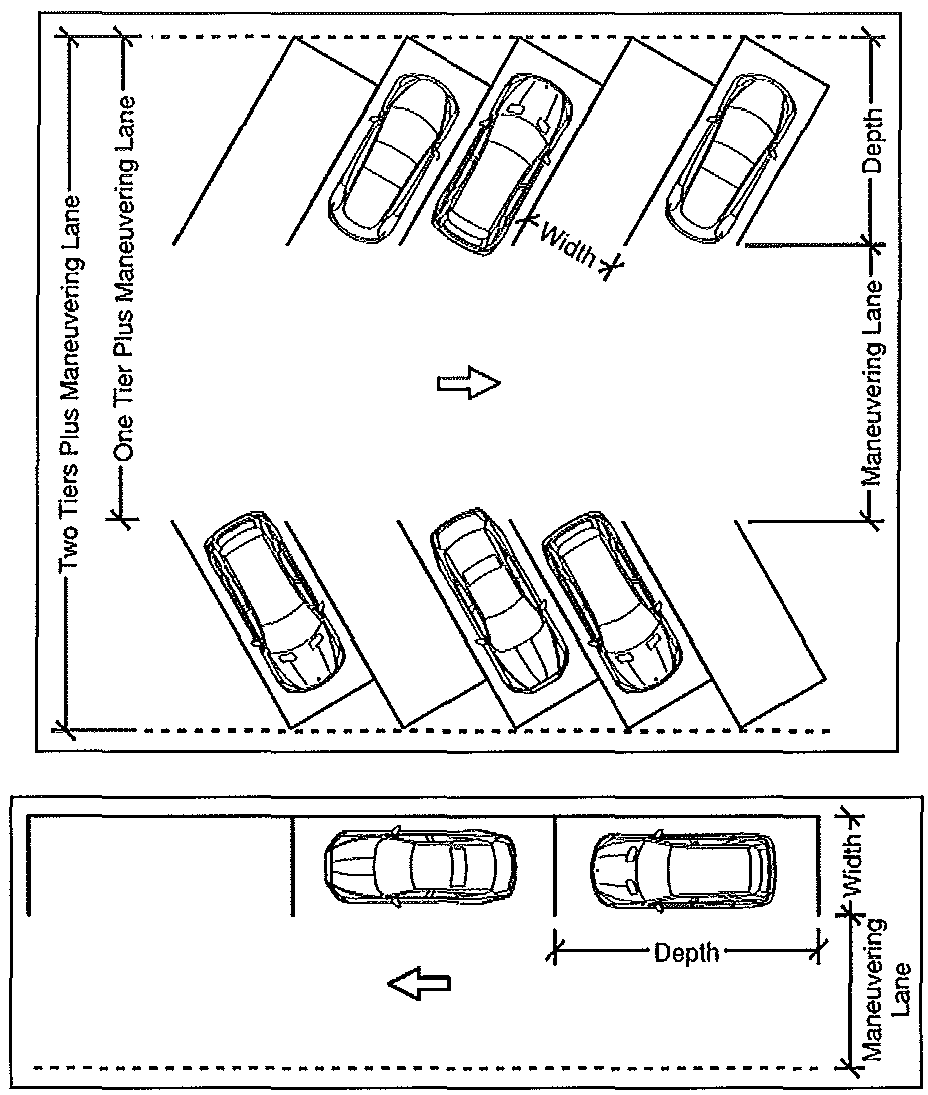
Space dimensions. The dimension of off-street parking spaces shall be in accordance with the following minimum dimensions:
Parking Layout Graphics (not drawn to scale)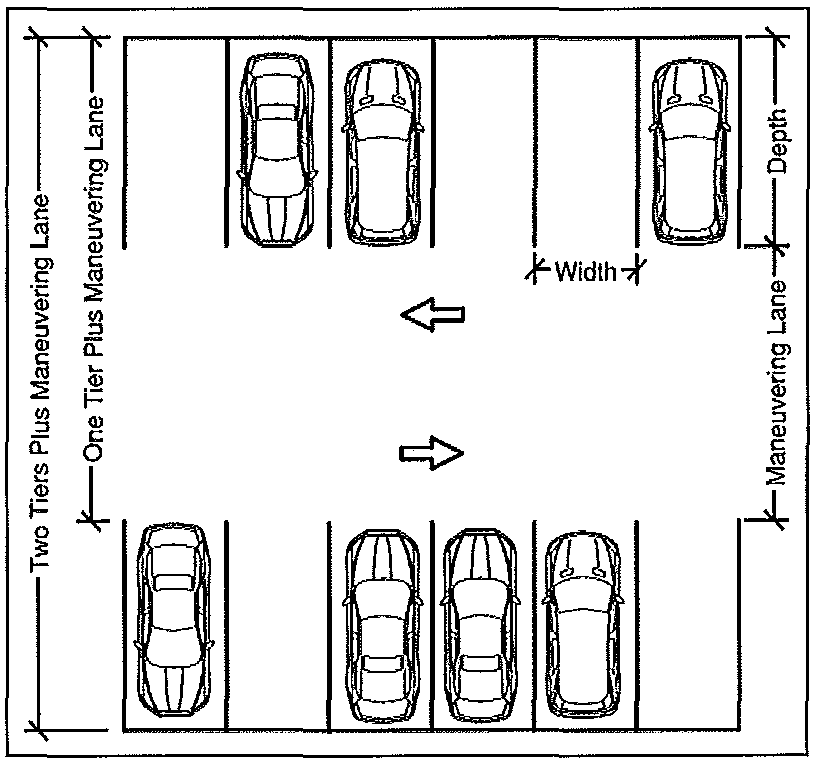
m.
Stormwater runoff. All stormwater runoff created from a parking area shall be completely retained on the property it serves unless easements are provided for a shared stormwater system.
(3)
Required spaces.
a.
Table of parking requirements: The amount of required off-street parking shall be determined in accordance with the following table:
b.
Uses not mentioned. For those uses not specifically mentioned, the requirement for off-street parking shall be based on uses similar in parking demand as determined by the village manager who may defer the decision to the planning commission.
c.
Mixed use developments.
1.
The total requirements for off-street parking areas shall be the sum of the requirements for each individual use computed separately.
2.
For those uses within a mixed-use development that have parking demands outside of normal office or commercial operational hours, the planning commission may allow up to a 20 percent reduction in required parking. Parking agreements must be established between uses to assure that the spaces are available for each use.
3.
If uses are unknown, parking shall be calculated assuming that half of the square footage will be retail sales and half will be restaurant uses.
d.
Shared parking. For uses on separate but adjacent properties who have entered into a shared parking agreement, the number of total parking spaces determined for each individual use shall be reduced by ten percent. Written evidence of the shared parking agreement shall be provided to the village manager.
e.
Maximum parking. No parking area shall exceed the minimum number of required spaces by more than 20 percent, unless approved by the planning commission through the site plan review process.
(4)
Required off-street loading.
a.
Number of loading spaces. Nonresidential uses which require receipt or delivery of materials or merchandise shall provide and maintain, on the same premises with such buildings, off-street loading spaces in relation to gross floor area as follows:
5,000 to 20,000 square feet .....1 space
20,000 to 50,000 square feet .....2 spaces
50,000 to 100,000 square feet .....3 spaces
One additional space is required for each additional 100,000 square feet or part thereof.
b.
Size. Each loading space shall be at least 12 feet in width, 44 feet in length, and have a clearance of 14 feet above grade.
c.
Location. Loading spaces may be in the side or rear yard. Placement in the front yard is prohibited.
d.
Departure. The planning commission may approve, as part of the site plan review process, a reduced size loading space or modify the number of loading spaces where another measure or location would be more appropriate due to onsite constraints, or the number and type of deliveries experienced by a particular use.
(5)
Drive thru stacking spaces. A minimum of five nine-foot by 18-foot stacking spaces for a restaurant and three stacking spaces for all other drive thru uses shall be provided. Stacking spaces shall be measured from each individual point of service (order pedestal, window, etc.). Stacking spaces shall not block or impede pedestrian and/or vehicle circulation. Stacking spaces shall not be considered parking spaces toward meeting minimum requirements.
(6)
Bicycle parking. A minimum of two bicycle parking spaces shall be required for every nonresidential use. Bicycle parking facilities shall allow a cyclist to safely secure a bicycle from incidental damage or theft, while not hindering access for pedestrians or other vehicles. Bicycle parking facilities shall be in highly visible and accessible areas. Bicycle parking facilities shall be located at least three feet from adjacent walls, poles, landscaping, street furniture, drive aisles, and primary pedestrian routes and at least six feet from vehicle parking spaces.
(7)
Prohibited uses.
a.
Automotive vehicles of any kind or type without current license plates shall be in accordance with the village's ordinance on unlicensed cars.
b.
No commercial repair work or sales or service of any kind shall be conducted on such parking lot.
(8)
Parking plans. Plans showing the location, size, shape, design, landscape, curb cuts, and other features of the proposed parking lot shall be reviewed by the planning commission through the site plan review process. If approval is granted, it may be revoked at any time if the requirements of this chapter have not been met.
(9)
Approval period. All parking lots shall be completed within a period of 12-months from the date of site plan approval. If the lot is not constructed within the required time, an extension may be requested through the steps outlined in section 62-77, site plan review.
(10)
Deferred parking. The planning commission may allow deferred construction of a portion of the required number of parking spaces for any nonresidential use if the following conditions can be satisfied:
a.
The property owner shall demonstrate to the satisfaction of the planning commission that the required number of parking spaces is excessive for the nature of their business or operational needs.
b.
The site plan shall be designed to show all required parking spaces, including those proposed as deferred so that they may be constructed in the future if required.
c.
The area intended for the deferred parking shall be retained as open space on the site.
d.
Stormwater management requirements shall be based on the full amount of required parking to ensure adequate capacity if the construction of the deferred parking is deemed necessary.
e.
The owner shall provide a written agreement to construct the deferred parking within six months of a written notice from the village manager based on observed need, or to give at least 30 days prior notice to the village manager if the deferred parking area is to be constructed.
(f)
Animals, bees, livestock and fowl-use, shelter and storage. No farm animals, bees or exotic animals shall be sheltered outside of the principal structure.
(g)
Noncommercial antennas and satellite receiving stations. Antennas and satellite receiving stations, when not utilized for commercial broadcasting, are permitted as accessory uses in all zoning districts, except the Parking District. Standards associated with their use shall be in accordance with Section 62-454(a)(14).
(Ord. No. 215, §§ 2, 3, 10-20-2008; Ord. No. 220, § 2, 6-7-2010; Ord. No. 241, § 4, 10-18-2021; Ord. No. 247, § Art. I, 5-20-2024)
Sec. 62-75. - Additional general regulations.
General lighting, screening requirements, and fences.
(1)
Lighting. The purpose of this section is to require sufficient but not excessive exterior lighting for parking areas, walkways, driveways, building entrances, loading areas and common areas, to ensure the security of property and safety of persons and to encourage the use of exterior lighting that complements and enhances the environment and character of the village. The standards of this Section are intended to prevent the adverse effects of inappropriate lighting, including glare, light trespass onto adjoining properties, light pollution, sky glow and waste of energy.
a.
General requirements.
1.
Exterior lighting shall be provided in an amount sufficient to permit safe movement of vehicles and pedestrians at night.
2.
All lighting for parking areas, external illumination of buildings or grounds and illumination of signs shall be concealed source fixtures, shielded, directed downward and screened from adjacent properties, with particular consideration to protecting residential districts and uses. Such fixtures shall be designed to prevent light from projecting above a horizontal plane.
3.
Lighting shall be so arranged as to not adversely affect driver visibility on adjacent public rights-of-way.
4.
Maximum light intensity shall be as provided in the following table:
5.
Light intensity shall be measured at grade level within a site. A photometric plan may be required at site plan review to ensure that the site conforms with the standards of this section.
6.
Nonessential lighting shall be turned off after business hours, except for the minimum necessary security lighting.
7.
The type of lighting and style of fixtures utilized shall be consistent throughout a project.
b.
Specific requirements.
1.
Any canopy structure used at a business location (such as a gasoline service station) must have recessed lights with diffusers which do not extend below the surface of the canopy.
2.
The maximum height of pole-mounted light fixtures shall be 25 feet or the height of the building on the site, whichever is shorter.
c.
Prohibited exterior lighting.
1.
Unshielded illumination of the exterior of a building or landscaping shall be prohibited.
2.
The use of laser light sources, strobe lighting, or similar high intensity light for outdoor advertising, promotion, or entertainment projected above the horizontal plane shall be prohibited, except where permitted on a temporary basis.
3.
Neon accent lighting around and within window and door openings shall be prohibited.
d.
Exceptions.
1.
The planning commission may approve internally illuminated architectural bands or similar shielded lighting accents as architectural details on the exterior of any building façade, subject to site plan approval, provided that such lighting accents would enhance the aesthetics of the site and would not cause off-site glare or light pollution.
2.
The planning commission may approve light intensities of up to 20 footcandles under a gasoline station canopy or within a dealership sales lot, subject to site plan approval and provided that site lighting is otherwise in compliance with this section.
3.
Temporary lighting for holidays, limited to a maximum of 30 days.
4.
Lighting necessary by fire, police, rescue, or other emergency personnel for temporary emergency situations.
5.
When there are special requirements, such as sports facilities, monuments, or flag lighting; all such lighting shall be selected and installed to shield the lamp(s) from direct view to the greatest extent possible, and to minimize upward lighting and light trespass.
e.
Sign illumination.
1.
Signs illumination shall be designed, installed, and maintained in a manner that minimizes off-site glare, light trespass, and light pollution. Illumination shall be concentrated within the area of the sign to prevent glare upon the street or adjacent property. Sign illumination shall be provided solely by electrical means or devices, and shall not be of a flashing, intermittent, moving or animated type.
2.
For externally illuminated signs, lighting fixtures shall be located above the sign in order that they may be directed downward and avoid excessive sky glow.
(2)
Nonresidential uses abutting residentially zoned lots. Except as otherwise provided in this zoning ordinance, all premises used for business, commercial or industrial purposes shall be screened from abutting residential districts. Screening shall be any of the following and shall apply to side yard and rear yards:
a.
A natural buffer planted with evergreens or shrubbery which maintains their density and screening effect throughout the calendar year, not less than four feet in height at the time of planting and maintained in a neat and attractive manner commensurate with the adjoining residential district.
b.
A wall or fence of sufficient density or compactness to screen the structures and activities of the business from the view of occupants of adjoining premises, not less than five feet in height and maintained in a neat and attractive manner, commensurate with the adjoining residential district.
c.
An earth berm not less than four feet in height and planted.
d.
For side yard screening, no such wall plant material or fence shall impair safe site distances. Such evaluation shall be made by the planning commission.
(3)
Fences.
a.
It shall be unlawful for any person to construct or to cause to have constructed any fence upon any property within the village without first having obtained a permit in the manner provided in this section of the ordinance.
b.
Any person desiring to build or to cause to be built a fence upon property located in the village, shall first apply to the building inspector for a permit. Such application shall contain any and all information required by the building inspector necessary for the determination of whether the erection of such fence will violate any provision of this section.
c.
Retaining walls and fences not more than three feet in height are permitted in required yards of all zones, provided said fences are not more than 75 percent solid. Walls and solid fences of not more than six feet in height are permitted only in side or rear yards in any zone. When installed, the decorative side of the fence or wall shall face the abutting property.
In all districts, both street frontages for corner lots shall comply with the provisions for front yard fencing. In addition, no fence, structure or planting over 30 inches in height above the curb line except deciduous trees shall be erected or maintained within 20 feet of intersecting street right-of-way lines so as to interfere with traffic visibility across the corner.
d.
In residential zoning districts, all fences shall be constructed of posts sunk in the soil at least three feet with boards, nonbarbed wire, or other suitable material. Temporary plastic fencing shall not be considered suitable material.
e.
Mesh, netting, or other similar devices used for the primary purpose of protecting individual plants or small landscaped or garden areas from harsh weather or animal intrusion shall not be considered fences for the purposes of this chapter.
f.
No fence shall extend towards the street beyond two feet from the established lot line, nor shall any fence or portion of a fence be erected in any area on or parallel to the front lot line except that it shall be located a minimum of two feet behind the inside edge of the established sidewalk line. It shall be deemed unlawful to plant or cause to have planted any shrub or bush outside of the established sidewalk line.
g.
Barbed wire fences are prohibited in all zoning districts. However, barbed wire strands may be used to enclose storage areas or other similar industrial and commercial uses if approved as part of the site plan review. The strands shall be restricted to the upper most portion of the fence and shall not extend lower than a height of eight feet from the nearest ground level.
h.
Any person within the corporate limits of the village erecting or maintaining any fence between the edge of the established lot line and the inside edge of the sidewalk or where any sidewalk would normally be shall be fully responsible for the care and maintenance of the fence and shall assume full responsibility for any damages arising due to the erection of such fence.
(Ord. No. 215, § 4, 10-20-2008; Ord. No. 220, § 3, 6-7-2010)
Cross reference— Fences, § 18-61 et seq.
Sec. 62-76. - Nonconformities.
(a)
Continuance of nonconforming uses and structures. Only lawful nonconforming uses or structures in existence at the time of passage of this chapter or amendments thereof, may be continued, but shall not be extended or added to unless each such extension or addition is in conformity with the provisions of this chapter. Land now occupied by an illegal nonconforming use or structure shall not be eligible for any variance or zoning permit until the illegal nonconformity is removed.
(b)
Alterations. Alterations of an existing nonconforming structure may be permitted if the alteration does not extend beyond the existing footprint of the structure.
(c)
Discontinuance of nonconforming uses. If the nonconforming use of any land shall terminate for a continuous period of over 12 months or more, such use shall not be re-established and any future use of such land or structure shall be in conformity with this chapter.
(d)
Removal of a nonconforming structure.
(1)
Should a nonconforming building or structure be damaged, demolished, or destroyed by storm, fire, flood, or other involuntary catastrophe by more than 50 percent of the footprint of the first floor of the building or structure at grade, it shall be reconstructed only in conformance with the provisions of this chapter.
(2)
Should a nonconforming building or structure be damaged, demolished, or destroyed by storm, fire, flood, or other involuntary catastrophe to an extent equal to or less than 50 percent of the footprint of the first floor of the building or structure at grade it may be reconstructed in its nonconforming location. Any additions or expansions to the reconstructed building must comply with all dimensional standards of the zone district in which it is located.
(3)
Should any portion of a nonconforming building be voluntarily demolished; reconstruction must comply with all dimensional standards of the zone district in which it is located.
(e)
Restoration and repair.
(1)
Such repairs and maintenance work as are required to keep a nonconforming building or structure in a sound condition may be made.
(2)
In the event any nonconforming building or structure is damaged by fire, wind, act of God, or act of war, it may be rebuilt or restored provided it does not increase its nonconformity or create any additional nonconformities.
(f)
Change of use or structure. A nonconforming use may be changed to another nonconforming use if the zoning board of appeals finds that such new use would markedly decrease the degree of nonconformance and would enhance the desirability of adjacent conforming uses. This shall not be construed to permit the conversion of a nonconforming use to a prior nonconforming use, not to waive the other provisions of this chapter.
(g)
Nonconforming due to reclassification. The foregoing provisions of this chapter shall also apply to buildings, land or uses which thereafter become nonconforming due to any reclassification or districts or any subsequent change in the regulations of this chapter.
(Ord. No. 216, § 4, 12-15-2008; Ord. No. 241, § 5, 10-18-2021)
Sec. 62-77. - Site plan review and approval.
(a)
Purpose. A site plan review procedure is hereby established for the Village of Schoolcraft. The purpose of a site plan review is to determine compliance with the provisions set forth herein and to promote the orderly development of the village, the stability of land values and investments in the general welfare, and to help prevent impairment or depreciation of land values and development by the erection of structures or additions or alterations thereto without proper attention to siting and appearance.
(b)
Applicability.
(1)
Prior to the establishment of a use, addition to an existing use, or the erection of any building, a site plan shall be submitted to and approved by the village in accordance with the procedures of this chapter, and the development requirements of this and other applicable ordinances.
(2)
The village shall not approve the issuance of a building permit until a site plan, where required, has been approved and is in effect. Obtaining site plan approval does not guarantee issuance of a building permit.
(3)
No grading, removal of trees or other vegetation, landfilling, installation of utilities, or other construction improvements shall commence for any development which requires site plan approval until said plan is approved and is in effect, except as permitted by this chapter.
(4)
The provisions in this section shall apply to multiple family residences, mobile home parks, and commercial and industrial uses. Other development procedures such as special use permits, planned unit development, or site condominiums will require submittal of a site plan and site plan review, but will also require alternative procedures detailed elsewhere in this chapter.
(5)
Single- and two-family residences shall not be subject to site plan review approval by the planning commission.
(6)
Site plans are not required for the following, but must be approved by the village manager or their designee through a zoning permit:
a.
Reuse of an existing building where no expansion or modifications to the building is proposed and the new use is similar or less intensive in terms of parking, traffic generation, drainage, utility needs, noise, aesthetics, and other external effects.
b.
Temporary uses, buildings, and/or structures.
c.
Change of use/occupancy of an individual suite/unit within a shopping center.
(c)
Application procedure.
(1)
Submission requirements. Requests for site plan review shall be made by filing the required documentation with the village. The following information shall be required:
a.
A review fee as determined by resolution of the village council and as filed with the village clerk for public information.
b.
Site plan review application.
c.
A legal description of the property under consideration.
d.
A map indicating the gross land area of the development, the present zoning classification thereof and the zoning classification and land use of the area surrounding the proposed development, including the location of structures and other improvements.
e.
The names and addresses of the architect, designer, or engineer responsible for the preparation of the site plan.
f.
Drawings or sketches of the exterior and elevations, and/or perspective drawings of the building or structures under consideration.
g.
Eleven copies of the proposed site plan.
(2)
Process. All site plan review shall use the following procedures:
a.
Professional review by an approved architect, planner or engineer may be obtained by the village at the request of the village manager and/or the planning commission. The cost of review will be passed along to the applicant. No zoning permit will be issued until this fee is paid.
b.
The planning commission shall review the site plan at its next regularly scheduled meeting provided that is has been submitted within 30 calendar days of the meeting, and that the site plan is complete.
c.
At that time, the planning commission may decide to approve, approve with conditions, deny the applicant's request, or postpone until the next regular meeting pending the submission of required information or further review using the standards described in subsection (e) of this chapter.
d.
Conditions or changes stipulated by the planning commission shall be recorded in the minutes of the meeting and made available to the applicant in writing. Three copies of an approved site plan, with changes, shall contain the signatures of the chairman of the planning commission, and the applicant. One copy will be returned to the applicant.
(3)
Site plan. The site plan shall contain all the information listed below to be considered complete and to begin the review process for submission to the planning commission:
a.
The following information shall accompany all plans submitted for review:
1.
A legal description of the property under consideration.
2.
A map indicating the gross land area of the development, the present zoning classification thereof and the zoning classification and land use of the area surrounding the proposed development, including the location of structures and other improvements.
3.
The names and addresses of the architect, planner, designer, or engineer responsible for the preparation of the site plan.
4.
Drawings or sketches of the exterior and elevations, and/or perspective drawings of the building or structures under consideration.
b.
The following information shall be included on the site plan:
1.
Seal of the architect, designer, or engineer responsible for the preparation of the plan.
2.
A scale of not less than 1" = 40', if the subject property is less than three acres, and 1" = 100', if it is three acres or more.
3.
Date, north point, and scale.
4.
The dimensions of all lot and property lines, showing the relationship of the subject property to abutting properties.
5.
The siting of all structures on the subject property and abutting properties.
6.
The location of each proposed structure in the development area, the use or uses to be contained therein, the number of stories, gross building areas, distances between structures and lot lines, setback lines, and approximate location of vehicular entrances and loading points.
7.
The location of all existing and proposed drives and parking areas with the number of parking and/or loading spaces provided.
8.
All pedestrian walks, malls, and open areas.
9.
Location and height of all walls, fences, and screen planting, including a general plan for the landscaping of the development and the method by which landscaping is to be accomplished and be maintained. (Plant materials shall be chosen and installed in accordance with standards recommended by the County Cooperative Extension Service or American Nursery Association.)
10.
The location and right-of-way widths of all abutting streets.
11.
Types of surfacing, such as paving, turfing or gravel to be used at the various locations.
12.
A grading plan with topographic elevations of the area, showing method of storm drainage.
13.
Size and location of proposed sewer and water lines and connections.
14.
The number of proposed units (or multiple family developments).
15.
Significant environmental features such as wetlands, shoreline, streams, woodlots, existing trees, and vegetation.
16.
Detail of the property address, including size, color, and location on the building.
17.
Information as may be required by the planning commission to assist in the consideration of the proposed development.
c.
Phased construction. Where phases or staged construction is contemplated for the development of a project, the site plan submitted must show the inter-relationship of the proposed project to the future stages, including the following:
1.
Relationship and identification of future structures, roadways, drainage, water, and sewer.
2.
Pedestrian and vehicular circulation.
3.
Time schedule for completion of the various phases of the proposed construction.
4.
Temporary facilities or construction of same as required to facilitate the stated development.
d.
The planning commission, village manager, or their designee may waive any of the above requirements whenever it is determined that such requirements are not necessary for a specific site plan if:
1.
Evidence is presented that the requirement does not apply to the use or site under review and is therefore unnecessary to evaluate; or
2.
Evidence is presented that the requirement can be waived or modified because there are difficulties of a nonmonetary nature in carrying out the strict letter of the requirement, and that a waiver or modification is appropriate so that the spirit of the ordinance is observed, public safety is secured, and there is no detriment resulting from or alleviated by the waiver.
(d)
Application review.
(1)
The site plan may be reviewed by the fire chief, village police chief, and other appropriate bodies as heretofore designated with a recommendation for its approval or disapproval and any conditions these individuals or departments feel should be imposed.
(2)
The planning commission shall have the function and power to approve or disapprove the site plan subject to compliance with such modifications and conditions as may be deemed necessary to carry out the purpose of these regulations and other ordinances or resolutions of the village.
(3)
The village manager and/or planning commission shall have the function and power to request additional professional review from the village attorney, engineer and/or planning consultant, and the permittee shall be responsible for any and all charges incurred, therefore.
(e)
Criteria for review. In order that building, open space, and landscaping will be in harmony with other structures and improvements in the area, and to assure that no undesirable health, safety, noise, and traffic conditions will result, the site plan shall meet the following criteria, unless the planning commission determines that one or more of such criteria are inapplicable:
(1)
The vehicular transportation system shall provide for circulation throughout the site and for efficient ingress and egress to all parts of the site by fire and safety equipment.
(2)
Pedestrian walkways shall be provided as deemed necessary by the planning commission for separating pedestrian and vehicular traffic.
(3)
Recreation and open space areas shall be provided in all multiple family residential developments.
(4)
The site plan shall comply with the district requirements for minimum floor space, height of building, lot size, yard space, density and all other requirements as set forth in the Village of Schoolcraft Zoning Ordinance, unless otherwise provided.
(5)
The requirements for fencing, walks, and other protective barriers shall be compiled with as provided in the Zoning Ordinance of the Village of Schoolcraft and as deemed appropriate by the planning commission.
(6)
The site plan shall provide for adequate storage space for the use therein.
(7)
Security measures shall be provided as deemed necessary by the police chief for resident protection in all multiple family residential developments.
(8)
Fire protection measures shall be provided as deemed necessary by the fire chief in conformance with all applicable laws of the State of Michigan for the protection of residents and/or occupants of the structures.
(9)
The site plan shall comply with all requirements of the applicable zoning district, unless otherwise provided.
(f)
Conformity to approved site plan.
(1)
An approval of a site plan shall last for 12 months at which time it will expire unless a building permit (and/or other necessary permits) has been applied for and granted within that time period. Site plan approval may be extended one time for a period of up to 12 months with approval of the planning commission. If the site plan approval expires, it may be reapproved through the same process by which it was originally approved.
(2)
The zoning permit may be revoked in any case where the conditions of such permit have not been or are not being complied with, in which case the planning commission shall give the permittee notice of intention to revoke such permit at least ten days prior to review of such permit by the planning commission. After conclusion of such review the planning commission may revoke such permit if it feels that a violation in fact exists and has not been remedied prior to such hearing.
(3)
At least two complete sets of record construction drawings signed by a licensed architect, engineer, landscape architect, or contractor shall be submitted to the village at the time of application for a certificate of occupancy or, in the case of residential developments before a building permit may be issued.
(g)
Amendment to a site plan.
(1)
Once site plan approval has been granted by the planning commission, changes to the approved site plan shall require a resubmission in the same manner as the original application, except as provided herein.
(2)
The village manager, or their designee, may approve minor changes to an approved site plan, upon the submittal of the revised site plan and in accordance with the following:
a.
Plantings approved in the landscape plan may be replaced by similar types and sizes of landscaping which provide a similar screening effect on an equal or greater basis.
b.
Improvements to site access or circulation, such as deceleration lanes, boulevards, curbing, pedestrian/bicycle paths, but not the addition of new driveways.
c.
Changes of building materials or design, fencing, screening, or site amenities which will result in a higher quality development, as determined by the village manager.
d.
Construction and/or relocation of signs, screening walls, fences, waste receptacles, sidewalks, building lights, and light poles.
e.
Modification, minor expansion, or repaving and restriping of an existing parking lot and loading/unloading zones.
f.
Changes required or requested by a county, state, or federal agency for safety reasons or for compliance with applicable laws that do not alter the basic design, compliance with the standards of approval, nor any specified conditions of the approved site plan.
g.
Situations the village manager deems similar to the above that do not alter the basic design, compliance with the standards of approval, nor any specified conditions of the approved site plan.
(3)
The village manager, or their designee, will notify the planning commission at their next regularly scheduled meeting of any site plan amendments that received administrative approval.
(Ord. No. 215, § 5, 10-20-2008; Ord. No. 220, § 4, 6-7-2010; Ord. No. 241, § 6, 10-18-2021)
Sec. 62-78. - Special use permit procedures.
(a)
Special use permits are required for proposed activities which are essentially compatible with other uses, sign, or activities permitted in a zoning district, but which possess characteristics or locational qualities which require individual review. The purpose of this individual review is to ensure compatibility with the character of the surrounding area, with public services and facilities, with adjacent properties, and to ensure conformance with the standards set forth in this chapter.
A site plan in accordance with section 62-77 is required for submission and approval of all special use permit applications. Only those uses signs, or activities specifically identified in the use districts of this chapter require special use permits.
(b)
Procedures. The following steps shall be taken when considering a proposed special use.
(1)
A special use permit application shall be filed by the applicant with the village clerk along with the required site plan, fee, statement with supporting evidence to which the proposed activity meets the criteria and any other pertinent information upon which the applicant intends to rely upon for approval.
(2)
The village clerk shall forward the application to the planning commission for their review and consideration.
(3)
Upon receipt of an application, the planning commission shall schedule a public hearing. A notice of the public hearing shall be published in a newspaper of general circulation in the village not less than 15 days before the date of the hearing. A notice shall also be sent by mail or personal delivery to the owners of property that is the subject of the request, to all persons to whom real property is assessed within 300 feet of the property that is the subject of the request, and to the occupants of all structures within 300 feet of the subject property regardless of whether the property or structure is located in the Village of Schoolcraft. Notification need not be given to more than one occupant of a structure, except that if a structure contains more than one dwelling unit or spatial area owned or leased by different persons, one occupant of each unit or spatial area shall be given notice. If a single structure contains more than four dwelling units or other distinct spatial areas owned or leased by different persons, notice may be given to the manager or owner of the structure, who shall be requested to post the notice at the primary entrance to the structure. The notice is considered to be given when personally delivered or when deposited during normal business hours for delivery with the United States Postal Service or other public or private delivery service. The notice shall be given not less than 15 days before the date the request will be considered. If the name of the occupant is not known, the term "occupant" may be used for the intended recipient of the notice.
(4)
The notice shall do all of the following:
a.
Describe the nature of the special use permit request.
b.
Indicate the property that is the subject of the special use permit request. The notice shall include a listing of all existing street addresses within the property. Street addresses do not need to be created and listed if no such addresses currently exist within the property. If there are no street addresses, other means of identification may be used.
c.
State when and where the special use permit request will be considered.
d.
Indicate when and where written comments will be received concerning the special use permit request.
(5)
After review of the application and public hearing or written comments, if any, the planning commission shall recommend approval, approval with conditions, or denial of the permit based upon the standards of the special use as set forth in the appropriate use district. The recommendation on a special use permit application shall be incorporated in a statement of findings and conclusions relative to the special use permit which specifies the basis for the decision and any conditions imposed.
(6)
The recommendation shall be forwarded to the village council which shall approve, approve with conditions, or deny the permit at its next regularly scheduled meeting.
(7)
Approval of a special use permit shall last for 24 months at which time it will expire unless a building permit (and/or other necessary permits) has been applied for and granted within that time period. Special use permit approval may be extended one time for a period of up to 12 months with approval of the planning commission. If the special use permit expires, it may be reapproved through the same process by which it was originally approved.
(Ord. No. 216, § 5, 12-15-2008; Ord. No. 220, § 5, 6-7-2010)
Sec. 62-79. - Temporary permits.
Temporary permits may be authorized by the planning commission for a period not to exceed one year for nonconforming uses incidental to construction projects on the same premises and including such uses as storage of building supplies and machinery, signs, and the assembly of building materials. In addition, the planning commission may authorize a certification for a dwelling house to be temporarily used as a sales and management office for the sale of homes within a subdivision for a period of one year, provided all of the following requirements are complied with:
(1)
The house to be used as such office is built upon a lot approved as part of the approved subdivision and is of substantially similar design as those houses to be sold within the subdivision.
(2)
No retail sales or business other than that accessory to the management and sales of the land in the subdivision owned by the applicant shall be permitted.
(3)
Said dwelling house shall meet all other zoning restrictions of the zone in which it is located.
(Ord. No. 216, § 6, 12-15-2008)
Sec. 62-80. - Temporary sales and service (outdoor).
(a)
Outdoor temporary sales or service uses may only operate after obtaining a temporary use permit from the village manager, who may review the application with the building inspector, police chief, and/or fire chief. The village manager shall respond within 30 days of submittal of a complete application and fee as established by resolution of the village council. The permit must be maintained on site at the temporary sales or service use and be visible. Any costs associated with review by the building inspector or other outside officials, or consultants shall be the responsibility of the applicant and will be added to the total fees for the review.
(b)
An application for a temporary use permit shall be established by the village clerk and made available at the village hall. A fee for the review of a temporary use permit application shall be established by resolution of the village council and shall be submitted with the application in order to initiate review. The application form shall be accompanied by a scaled drawing of the property depicting the existing and surrounding uses and improvements and the proposed temporary sales or service use.
(c)
Outdoor temporary sales or service uses are permitted only in the B-1, B-2, and CBD zoning districts unless otherwise specified within this section.
(d)
No outdoor temporary sales or service use may operate on a vacant parcel, on a parking lot on a property on which there is no other permitted primary use, or on any other property that is abandoned or has not been through site plan approval (see section 62-77).
(e)
Each temporary outdoor sales or service use shall be accessory to a permitted nonresidential primary use on the property. If the applicant is not the owner of the property, he/she shall be the proprietor of the business located at the site and shall provide signed evidence of the property owner's permission to proceed with the application. Exceptions are as follows:
(1)
Any permitted nonresidential primary use may permit an outdoor temporary sales or service use operated by, in support of, or as a fundraiser for, a local school or church. Such uses may be permitted for up to three consecutive days, three times per year.
(2)
Temporary outdoor recreational or related activities such as auctions, carnivals, festivals, and the like, which may be approved in any zoning district provided the event will not have adverse impacts on the surrounding uses and shall not exceed three consecutive days in duration.
(3)
Garage sales, estate sales, or similar types of sales may be permitted in any zoning district provided they are limited to a maximum of three consecutive days and shall be limited to three sales annually at a given location.
(4)
Farm market stands, subject to the additional conditions identified below in paragraph (q).
(f)
No outdoor temporary sales or service use shall be located in the public right-of-way or on public property unless a permit has been obtained from the appropriate authority. Outdoor temporary sales or service uses shall also be located away from intersections so as to maintain clear visibility and site distance.
(g)
A proposed outdoor temporary sales or service use shall meet the following general requirements in order to be approved:
(1)
Site suitability, including site size, drainage, and flood hazard;
(2)
Adequate public service and facilities, including sanitary facilities, emergency service, and the like;
(3)
Compliance with all local building, electrical, and other codes;
(4)
Adequate street access and off-street parking; and
(5)
No adverse impact on the general health, safety, or welfare of the community or adjacent uses.
(h)
The village manager may revoke a permit for a temporary outdoor sales or service use if the applicant fails to comply with any of the requirements of this section or the conditions imposed.
(i)
No property shall have outdoor temporary sales or services uses operating on the property for more than 30 days in any calendar year, unless otherwise specified within this article.
(j)
The property on which an outdoor temporary sales or service use operates shall be kept clean and sanitary condition at all times, and all litter and trash shall be removed at the end of each day. All lawn areas shall remain maintained in accordance with village requirements.
(k)
The location of the outdoor temporary sales or service activity shall allow customers to drive into an existing off-street parking area. No temporary outdoor sales may interrupt the flow of traffic on public streets or access ways into a shopping area.
(l)
An outdoor sales or service use operating from a tent or similar enclosure may require prior approval from the fire chief.
(m)
The area occupied by the outdoor temporary sales and service activity, plus any required area for emergency vehicle access, shall be limited by the following, unless otherwise provided herein:
(1)
The area set aside for the temporary sales and service use shall not occupy more than 30 percent of the total parking lot area.
(2)
The total area occupied by the outdoor temporary sales or service use shall not exceed 7,500 square feet.
(3)
The applicant shall demonstrate that there will be adequate parking and maneuvering space for the existing structures as well as the temporary outdoor sales.
(n)
All trucks, tents, and associated parking shall be located on asphalt, concrete, or equivalent surface unless the applicant demonstrates no adverse effect on drainage, access, or the intent of this chapter, as determined by the village manager.
(o)
Outdoor temporary sales and service uses shall not operate after 8:00 p.m. or before 8:00 a.m.
(p)
Any applicant who possesses a valid permit in accordance with the requirements of this section, and while currently engaged in temporary sales operations, may display one temporary sign not to exceed 12 square feet in area on one surface and not to exceed six feet in height at the location. Such sign shall satisfy all other applicable sign standards of the underlying zoning district, as provided in article XVIII, and must be approved by the village manager. An approved temporary use permit for temporary outdoor sales activity shall serve as a sign permit for the sign permitted by this section.
(q)
Farm market stands.
(1)
A farm market stand is an outdoor temporary sales or service use that includes the retail sale of fresh fruits, vegetables, flowers, herbs, or plants. It may also include the sales of other locally produced, unprocessed foodstuffs and home processed food products.
(2)
A farm market stand may be permitted as a temporary use in the R-A, R-1, R-2, B-1, or B-2 districts.
(3)
A farm market stand shall not include sales directly from a motor vehicle or any type of trailer that can be attached to a motor vehicle.
(4)
A tent, table, stand, or other temporary structure 200 square feet or less shall be utilized to display and sell goods. This area may be increased in the B-1 or B-2 district upon approval by the village manager.
(5)
One temporary sign, attached to the farm market stand, no larger than 12 square feet, may be utilized to advertise the products for sale. Freestanding signs are not permitted.
(6)
The stand may be permitted for up to 150 days in the R-A, R-1, and R-2 Districts and 30 days in the B-1 and B-2 districts per calendar year. The days need not be consecutive.
(7)
All products for sale shall be completely removed at the end of each day. Exceptions may be granted by the village manager for limited items if the sale is scheduled to occur on consecutive days, provided the site is well maintained.
(8)
Structures and devices used to display goods shall be removed at the end of the sale.
(Ord. No. 215, § 6, 10-20-2008; Ord. No. 223, § 1, 5-16-2011; Ord. No. 241, § 7, 10-18-2021)
Sec. 62-81. - Murals
(a)
Zoning districts. Murals shall be allowed in all nonresidential districts.
(b)
Permission of owner. The owner of the building or structure in which the mural is placed must provide written permission as part of the permit application to the village.
(c)
Design standards.
(1)
A mural may not be larger than 200 square feet.
(2)
Murals shall be applied utilizing weather resistant paints or materials.
(3)
No mural shall obstruct or be painted on any window, door, or architectural feature of the exterior façade on which the mural is placed.
(4)
A mural may only be located on an exterior facade of a building, and it must be affixed in a structurally sound and workmanlike manner.
(5)
Murals shall not be designed to constitute or create a traffic hazard.
(d)
Maintenance. A mural must be maintained in a manner that ensures the prevention of visual clutter or blight. If a mural begins to fade, flake, or is vandalized, improvements must be completed to ensure the mural is an aesthetic enhancement to the building, or the mural must be removed. If a mural is not appropriately maintained, the property owner will have 60 days to make the needed improvements, after receiving written notice from the village. If these improvements are not completed within 60 days, the village may remove or paint over the mural and assess the cost to the property owner. A deferment of this requirement may be requested by the property owner during those months of the year where outdoor improvements are not possible. The village manager, or their designee, will approve a deferment, if warranted.
(e)
Permit required. A permit must be obtained from the village manager, or their designee, prior to the establishment of a mural. The village manager reserves the right to send the mural permit application to the planning commission for final approval if the design, size, or location is such that the village manager believes additional review is warranted. The permit application will include the following:
(1)
Contact information for the applicant.
(2)
Contact information for the property owner.
(3)
Written permission from the property owner if they are not the applicant.
(4)
Architectural elevations of the building, including any architectural features and wall signs, as well as the condition of the wall where the mural will be affixed.
(5)
Proposed image of the mural and a statement of its purpose or significance.
(6)
Name and contact information of the artist.
(Ord. No. 241, § 8, 10-18-2021)

