
Screven County Unincorporated
City Zoning Code
City Zoning Code
ARTICLE 18
- SIGN REGULATIONS9
Editor's note— Ord. of 4-27-2004(2), § 3, adopted April 27, 2004, amended article 18 in its entirety to read as herein set out. The provisions of Ord. of 4-27-2004(2) were specifically delineated as §§ 3-7-1—3-7-19; hence, the inclusion of these provisions, as specified on the ordinance, was at the discretion of the editor. For stylistic purposes, capitalization has been changed to conform to the Code of Ordinances; however, internal references remain unchanged from the original ordinance. Former article 18, §§ 1801—1813, pertained to similar subject matter, and derived from the county's zoning ordinance, as adopted by the board of commissioners on October 27, 1998.
Sec. 3-7-1.- Title.
This ordinance shall be known and may be cited as the "Screven County Sign Ordinance".
(Ord. of 4-27-2004(2), § 3)
Sec. 3-7-2. - Purpose.
Sign regulations achieve public safety rationales not achieved by standard building code provisions. Without a sign ordinance, signs can pose a clear danger to public safety. It has long been recognized that sign controls are needed to promote traffic safety and avoid traffic accidents. Signs can distract motorists by impairing visibility. Traffic safety is improved by restricting the size, height, and location of signs. Signs, if unregulated, can confuse motorists by mimicking traffic safety signals and signs.
Unregulated signs may negatively affect the character of communities and the value of buildings. For example, blighted signs and antiquated signs and sign structures (i.e., the pole with a blank structure for a sign face) can contribute to an overall image of blight and a reduction of property values in declining areas if not addressed and removed via sign controls. Unregulated signs can reduce the effectiveness of signs needed to direct the public because they compete with public purpose signs and reduce their visibility and effectiveness. Unregulated signage in special character areas, such as the downtown, would almost assuredly neutralize any public plans and investments to improve streetscapes.
Sign regulation serves the interests of the business community. Unregulated competition among businesses where individual business signs are not adequately visible results in too many signs and a point of diminishing returns. Sign regulations help to maintain the scenic heritage and unique character of the community. Signs substantially influence the appearance of the community, and sign regulation is essential to the community's long-term economic viability. Sign controls improve visual character.
This ordinance is adopted to serve substantial governmental interests by correcting and avoiding multiple problems that would occur without the regulation of signs and advertising devices. The regulations contained herein are no more extensive than necessary to serve the substantial governmental interests identified in this statement of purposes.
(Ord. of 4-27-2004(2), § 3)
Sec. 3-7-3. - Intent.
It is not the intent of this ordinance to apply regulation to signs because of a disagreement with the message that they convey, to foreclose important and distinct mediums of expression for political, religious, or personal messages, or to suggest the county regulate the message content of signs in any manner. It is, however, the intent of this ordinance to regulate the time, place, and manner of signs in a minimal manner sufficient to meet the public purposes articulated in the purpose section of this ordinance.
Notwithstanding any other restrictions in this sign ordinance, any sign, display or device allowed under this ordinance may contain any commercial or non-commercial message, or any political or non-political message; except that such messages cannot depict obscenity, as defined by O.C.G.A. § 16-12-80, nor can they depict sexual conduct or sexually explicit nudity, as defined in O.C.G.A. § 36-60-3, nor advertise any activity illegal under the laws of Georgia or the United States.
(Ord. of 4-27-2004(2), § 3; Ord. of 4-13-2021(2), § 40)
Sec. 3-7-4. - Applicability.
A sign may be erected, placed, established, painted, created, or maintained within the planning jurisdiction of the county only in conformance with the standards, procedures, exemptions, and other requirements of this ordinance.
The effect of this ordinance as more specifically set forth herein shall:
(a)
Establish a permit system to allow a variety of types of signs in commercial, residential and industrial areas that are subject to the standards and the permit procedures of this ordinance.
(b)
Allow certain signs that are small, unobtrusive, and incidental to the principal use of the respective lots on which they are located, subject to the substantive requirements of this ordinance, but without a requirement for permits.
(c)
Provide for temporary signs without commercial messages in limited circumstances in the public right-of-way.
(d)
Prohibit all signs not expressly permitted by this ordinance.
(e)
Provide for the enforcement of the provisions of this ordinance.
(Ord. of 4-27-2004(2), § 3)
Sec. 3-7-5. - Definitions and interpretations.
Words and phrases used in this article shall have the meanings set forth in this section. Words and phrases not defined in this section but defined in this ordinance, shall be given the meanings set forth. All other words and phrases shall be given their common, generally accepted meaning, unless the context clearly requires otherwise.
Animated sign : Any sign that uses movement or change of lighting to depict action or create a special effect or scene.
Banner : Any sign of lightweight fabric or similar material that is securely mounted to a pole or a building. National flags, state or municipal flags, or the official flag of any institution or business shall not be considered banners.
Banner (commercial) : Any banner containing a commercial message.
Banner (noncommercial) : Any banner containing no commercial message.
Beacon : Any light with one or more beams directed into the atmosphere or directed at one or more points not on the same lot as the light source; also, any light with one or more beams that rotate or move.
Building marker : Any sign indicating the name of a building, date, and/or incidental information about its construction, which sign is cut into a masonry surface or made of bronze or other permanent material.
Building sign : Any sign attached to any part of a building, as contrasted to a freestanding sign.
Canopy sign : Any sign that is a part of or attached to an awning, canopy, or other fabric, plastic, or structural protective cover over a door, entrance, window, or outdoor service area. A marquee is not a canopy.
Changeable copy sign : A sign or portion thereof with characters, letters, or illustrations that can be changed or rearranged without altering the face or the surface of the sign. A sign on which the message changes more than eight times per day shall be considered an animated sign and not a changeable copy sign for purposes of this ordinance. A sign on which the only copy that changes is an electronic or mechanical indication of time or temperature shall be considered a "time and temperature" portion of a sign and not a changeable copy sign for purposes of this ordinance.
Commercial message : Any sign wording, logo, or other representation that, directly or indirectly, names, advertises, or calls attention to a business, product, service, or other commercial activity.
Flag : Any fabric, banner, or bunting containing distinctive colors, patterns, or symbols, used as a symbol of a government, political subdivision, or other entity.
Freestanding sign : Any sign supported by structures or supports that are placed on, or anchored in, the ground and that are independent from any building or other structure.
Incidental sign : A sign, generally informational, that has a purpose secondary to the use of the lot on which it is located, such as "no parking," "entrance," "loading only," "telephone," and other similar directives. No sign with a commercial message legible from a position off the lot on which the sign is located shall be considered incidental.
Marquee: Any permanent roof-like structure projecting beyond a building or extending along and projecting beyond the wall of the building, generally designed and constructed to provide protection from the weather.
Marquee sign : Any sign attached to, in any manner, or made a part of a marquee.
Nonconforming sign : Any sign that does not conform to the requirements of this ordinance.
Pennant : Any lightweight plastic, fabric, or other material, whether or not containing a message of any kind, suspended from a rope, wire, or string, usually in series, designed to move in the wind.
Portable sign : A sign not permanently attached to the ground or other permanent structure, or a sign designed to be transported, but not including trailer signs (as herein defined); signs converted to A- or T-frames; menu or sandwich board signs; balloons used as signs; umbrellas used for advertising; and signs attached to or painted on vehicles parked and visible from the public right-of-way, unless said vehicle is used in the normal day-to-day operations of business.
Projecting sign : Any sign affixed to a building or wall in such a manner that its leading edge extends more than six inches beyond the surface of such building or wall.
Residential sign : Any sign located in a district for residential uses.
Roof sign : Any sign erected and constructed wholly on and over the roof of a building, supported by the roof structure, and extending vertically above the highest portion of the roof. Roof signs, as defined by this ordinance, are not permitted.
Roof sign, integral : Any sign erected or constructed as an integral or essentially integral part of a normal roof structure of any design, such that no part of the sign extends vertically above the highest portion of the roof and such that no part of the sign is separated from the rest of the roof by a space of more than six inches.
Sign : Any device, fixture, placard, or structure that uses any color, form, graphic, illumination, symbol, or writing to advertise, announce the purpose of, or identify the purpose of a person or entity, or to communicate information of any kind to the public.
Sign setback line : An imaginary line created by this ordinance to establish an easily determined setback from any public thoroughfares for the placement of certain temporary signs. The sign setback line shall be ten feet from the back of the street curb edge of pavement or stabilized shoulder.
Streamer : A streamer is defined the same as a pennant for purposes of this ordinance.
Suspended sign : A sign that is suspended from the underside of a horizontal plane surface and is supported by such surface.
Temporary sign : Any sign that is used only temporarily and is not permanently mounted.
Trailer sign : Any sign designed to be transported by means of wheels, whether or not the wheels remain attached, located on the ground and permanently attached thereto, and which is usually a two-sided sign and including any single-or double-surface painted or postered panel type sign, or any variation thereof.
Wall sign : Any sign attached parallel to but within six inches of a wall; painted on the wall surface of; or erected and confined within the limits of an outside wall of any building or structure which is supported by such wall or building, and which displays only one sign surface.
Window sign : Any sign, pictures, symbol, or combination, thereof, designed to communicate information about an activity, business, commodity, event, sale, or service, that is placed inside a window or upon the window panes or glass and is visible from the exterior of the window.
(Ord. of 4-27-2004(2), § 3)
Sec. 3-7-6. - Master or common signage plan required.
No permit shall be issued for an individual sign requiring a permit unless and until a master signage plan or a common signage plan for the lot on which the sign will be erected has been submitted to and approved by the county as conforming with this section.
3-7-6.1. Master signage plan. For any lot on which the owner proposes to erect one or more signs requiring a permit, unless such lot is included in a common signage plan, the owner shall submit to the county, a master signage plan containing the following:
(a)
An accurate plot plan of the lot at such scale as the county may reasonably require.
(b)
Location of buildings, parking lots, driveways, and landscaped areas on such lot.
(c)
Computation of the maximum total sign area, the maximum area for individual signs, the height of signs, and the number of freestanding signs allowed on the lot(s) included in the plan under this ordinance.
(d)
An accurate indication on the plot plan of the proposed location of each present and future sign of any type, whether requiring a permit or not, except that incidental signs and signs not regulated by this ordinance need not be shown.
(e)
The name of the owner of the property and, if different from the owner, the name of the applicant.
3-7-6.2. Common signage plan. If the owners of two or more contiguous (disregarding intervening streets and alleys) lots, or the owner of a single lot with more than one building (not including any accessory building) file with the county for such lots a common signage plan conforming with the provisions of this section, a 25 percent increase in the maximum total sign area shall be allowed for each included lot. This bonus may be allocated within each lot as the owner(s) elects.
3-7-6.3. Provisions of common signage plan. The common signage plan shall contain all of the information required for a master signage plan and shall also specify standards for consistency among all signs on the lots affected by the plan with regard to:
(a)
Color scheme;
(b)
Lighting;
(c)
Location of each sign on the buildings;
(d)
Material; and,
(e)
Sign proportions.
3-7-6.4. Limit on freestanding signs under common signage plan. The common signage plan, for all lots with multiple uses or multiple users, shall limit the number of freestanding signs to a total of one for each street on which the lots included in the plan have frontage and shall provide for shared or common usage of such signs. In any instance where the properties included within a common signage plan may contain an intervening street, the number of freestanding signs shall be limited to one for each street and such properties shall be treated as a unified lot. The maximum height of the freestanding signs permitted shall be 30 feet.
3-7-6.5. Other provisions of master or common signage plans. The master or common signage plan may contain such other restrictions as the owner(s) of the lots may reasonably determine.
3-7-6.6. Consent. The master or common signage plan shall be signed by all owners or their authorized agents in such form as the county shall require.
3-7-6.7. Joint processing. A master or common signage plan shall be included in any development plan, site plan, planned unit development plan, or other official plan required by the county for the proposed development and shall be processed simultaneously with such other plan.
3-7-6.8. Amendment. A master or common signage plan may be amended by filing a new master or common signage plan that conforms to all requirements of the ordinance then in effect. In general, amendments shall be reviewed and acted upon by the county; provided, however, that any amendment of a common signage plan which affects those items governed by subsection 3-7-6.3 (Provisions of common signage plan) of this section, shall be acted upon in a like procedure to the original plan.
3-7-6.9. Existing signs not conforming to master or common signage plan. When a master or common signage plan is filed for a property on which existing signs are located, it shall include a schedule for bringing into conformance all signs not conforming to the proposed amendment plan or to the requirements of this ordinance in effect on the date of submission.
3-7-6.10. Binding effect. After approval of a master or common signage plan, no sign shall be erected, placed, painted, or maintained, except in conformance with such plan and such plan may be enforced in the same way as any provision of this ordinance. In case of any conflict between the provisions of such plan and any other provision of this ordinance, the ordinance shall control.
(Ord. of 4-27-2004(2), § 3; Ord. of 4-13-2021(2), § 40)
Sec. 3-7-7. - Permitting procedures.
3-7-7.1. Permits required. If a sign requiring a permit under any provision of this ordinance is to be placed constructed, erected, or modified on a lot, the owner of the lot shall secure a sign permit prior to the construction, placement, erection, or modification of such a sign in accordance with the requirements of this section. Furthermore, the property owner shall maintain in force, at all times, a sign permit for such sign in accordance with subsection 3-7-7.4, (Permits to remain current and in force) of this section.
No sign shall be erected in the public right-of-way, except in accordance with section 3-7-14 and the permit requirements of subsection 3-7-7.2.
No sign permit of any kind shall be issued for an existing or proposed sign, unless such sign is consistent with the requirements of this ordinance, including those protecting existing signs, in every respect and with the master signage plan or common signage plan in effect for the property.
3-7-7.2. Application and review procedures. The following procedures shall govern the application for, and issuance of, all sign permits under this ordinance, and the submission and review of common signage plans and master signage plans.
3-7-7.2.1. Application. All applications for sign permits of any kind and for approval of a master or common signage plan shall be submitted to the county on an application form or in accordance with the application specifications established by the county.
3-7-7.2.2. Fees. Each application for a sign permit or for approval of a master or common signage plan shall be accompanied by the applicable fees, which shall be established by the county from time to time by ordinance.
3-7-7.2.3. Completeness. Within five working days of receiving an application for a sign permit or for a master or common signage plan, the county shall review it for completeness. If the county finds that it is complete, the application shall then be processed and issue a sign permit with days of receiving a completed application. If the application is incomplete, the county shall provide to the applicant a notice of the specific ways in which the application is deficient, with appropriate references to the applicable sections of this ordinance.
3-7-7.2.4. Action on plan. On any application for approval of a master signage plan or common signage plan, the county shall take action on one of the following dates:
(a)
Fourteen days after the submission of a complete application if the application is for signs for existing buildings; or,
(b)
On the date of final action on any related application for a building permit, site plan, or development plan for signs involving new construction.
3-7-7.2.5. Failure to act on plan. Failure by the county to take action within the time periods indicated above shall not be construed so as to relieve the applicant from compliance with all provisions of this article on or before such date, the county shall either:
(a)
Approve the proposed plan if the sign(s) as shown on the plan and the plan itself conforms in every respect with the requirements of this ordinance; or,
(b)
Reject the proposed plan if the sign(s) as shown on the plan or the plan itself fails in any way to conform to the requirements of this ordinance. In case of a rejection, the county/county shall specify in the rejection the section or sections of the ordinance with which the plan is inconsistent.
3-7-7.3. Permits to construct or modify signs. It shall be unlawful for any person to post, display, substantially change, or erect a sign in the county without first having obtained a building permit, if required by the standard building code as adopted by the county, for said sign. The applicant for a building permit shall submit application materials as specified by the building inspector, including a sketch or print drawn to scale showing pertinent information, such as wind pressure requirements and display materials, in accordance with the standard building code. Such permits shall be issued only in accordance with the following requirements and procedures.
3-7-7.3.1. Permit for new sign or for sign modification. An application for construction, creation, or installation of a new sign or for modification of an existing sign shall be accompanied by detailed drawings to show the dimension, design, structure, and location of each particular sign, to the extent that such details are not contained on a master signage plan or common signage plan then in effect for the lot. One application and permit may include multiple signs on the same lot.
3-7-7.3.2. Inspection. The county shall inspect each lot for which a permit for a new sign or for modification of an existing sign is issued on or before six months from the date of issuance of such permit. If the construction is not substantially complete within six months from the date of issuance, the permit shall lapse and become void. If the construction is complete and in full compliance with this ordinance and electrical codes, the county shall affix to the premises a permanent symbol identifying the sign(s) and the applicable permit, by number or other reference. If the construction is substantially complete, but not in full compliance with this ordinance and applicable codes, the county shall give the owner or applicant notice of the deficiencies and shall allow an additional 30 days from the date of inspection for the deficiencies to be corrected. If the deficiencies are not corrected by such date, the permit shall lapse and become void. If the construction is completed, the county shall affix to the premises the permanent symbol as described above.
3-7-7.4. Permits to remain current and in force. The owner of a lot containing signs requiring a permit under this ordinance shall, at all times, maintain in force a sign permit for such property. Sign permits shall be issued for individual lots, notwithstanding, that a particular lot may be included with other lots in a common signage plan.
3-7-7.4.1. Initial sign permit. The county covering the completed sign installation, construction, or modification shall issue an initial sign permit.
3-7-7.4.2. Assignment of sign permits. A current and valid sign permit shall be freely assigned or transferred to a successor as owner of the property or holder of a business license for the same premises, subject only to filing such application as the county may require and paying any applicable fee. The assignment shall be accomplished by filing and shall not require approval.
(Ord. of 4-27-2004(2), § 3; Ord. of 4-13-2021(2), § 40)
Sec. 3-7-8. - Temporary permits.
Permits for temporary signs shall be subject to the following requirements.
3-7-8.1. Temporary sign permits. Temporary signs shall be allowed only upon the issuance of a temporary sign permit, which shall be subject to the following requirements.
(a)
Permit exception. No permit is required for temporary political signs and banners in accordance with this ordinance.
(b)
Sign setback. A temporary sign shall not be erected, placed or maintained on the thoroughfare side of the sign setback line.
(c)
Traffic hazard, prohibited. In addition to other setback requirements, temporary signs shall be located such that at any intersection ingress/egress point the traffic visibility shall not be impaired.
(d)
Size. Temporary signs shall not exceed 16 square feet, with the exception of a sign located at a construction project. If the temporary sign is located on property that faces more than one street, one sign may be allowed for each frontage. Each such sign shall be located no closer than five feet to a street right-of-way.
Although a temporary sign, a sign located at a construction project may not exceed 32 square feet. Such sign may be displayed from the beginning of the construction of the project, through the completion of the project.
3-7-8.2. Banners. Temporary permits for banners shall be allowed upon the issuance of a temporary sign permit, subject to the following requirements.
(a)
Size and number. Temporary banners shall not exceed 40 square feet, and no more than one banner shall be permitted for each business or other tenant occupying any lot.
(b)
Installation. A banner shall be securely attached to a building or other permanent structure on the lot.
(c)
In lieu of permanent signage. A banner may be used in lieu of permanent signage for a period not to exceed six months. All criteria concerning area and dimensions for permanent signage shall apply.
3-7-8.3. Pennants and streamers. Temporary permits for pennants and streamers shall be allowed upon the issuance of a temporary sign permit, subject to the following requirement.
(a)
Installation. Pennants and/or streamers shall be securely attached to a building or other permanent structure on the lot.
3-7-8.4. Inflatable signs and tethered balloons. Temporary permits for inflatable signs and tethered balloons shall be allowed upon the issuance of a temporary sign permit, subject to the following requirement.
(a)
Installation. An inflatable sign or tethered balloon shall be securely attached and/or anchored so as to remain safe and secure during the term of its use.
(Ord. of 4-27-2004(2), § 3)
Sec. 3-7-9. - Signs exempt from regulation under this ordinance.
The following signs shall be exempt from regulation under this ordinance.
(a)
Any public notice or warning required by a valid and applicable federal, state, or local law, regulation, or ordinance.
(b)
Any sign that is not legible from a distance of more than three feet beyond the lot line of the lot or parcel on which such sign is located.
(c)
Works of art.
(d)
Holiday signs.
(e)
Private street name and traffic control signs on private property, such as "Stop", "Yield" and similar signs, the face of which meet county transportation standards, and of which contain no commercial message.
(f)
"No Trespassing," "No Hunting," "No Fishing," "No Loitering," and like signs not exceeding one square foot in area.
(g)
Incidental signs as defined by this article.
(h)
One unlighted sign, not exceeding four square feet in area, may be permitted on any lot in a residential district.
(i)
A temporary sign placed in a residential district.
(Ord. of 4-27-2004(2), § 3; Ord. of 4-13-2021(2), § 40)
Sec. 3-7-10. - Maximum height of signs.
The maximum height of any ground sign regulated by this ordinance shall be 30 feet. No attached wall sign, except those exempted by this ordinance, shall exceed the height of the tallest building on the lot.
(Ord. of 4-27-2004(2), § 3)
Sec. 3-7-11. - Minimum setback from right-of-way.
No sign regulated by this ordinance shall be placed or erected closer than two feet of a city, county, state, or federal road right-of-way.
(Ord. of 4-27-2004(2), § 3)
Sec. 3-7-12. - Free standing signs.
The provisions of this section shall govern the number, location, and spacing of freestanding signs."
3-7-12.1. Residential and office subdivision. Signs located in residential and office subdivisions shall be located at the primary entrance(s) to the development/subdivision or at the beginning of the street upon which the development/subdivision connects directly to an arterial or collector street as shown on the major thoroughfare plan.
3-7-12.2. Freestanding signs. Freestanding signs shall be limited to one per entrance, but no more than a total of two such signs for the development, subject to the spacing distance limitations noted in subpart 3 (below), of this section.
3-7-12.3. Spacing limitations of freestanding signs. Except as provided in subsections 1 and 2 above, freestanding signs on any premises shall be spaced at minimum intervals of 200 feet along each public way that views the premises. In the event that less than 200 feet of any premises is visible from any one public way, only one sign shall be permitted along that public way.
(Ord. of 4-27-2004(2), § 3; Ord. of 4-13-2021(2), § 40)
Sec. 3-7-13. - Computations.
The following principles shall control the computation of sign area and sign height.
3-7-13.1. Computation of area of individual signs. The area of a sign face (which is also the sign area of a wall sign or other sign with only one face) shall be computed by means of the smallest square, circle, rectangle, triangle, or combination thereof that will encompass the extreme limits of the writing, representation, emblem, or other display, together with any material or color forming an integral part of the background of the display or used to differentiate the sign from the backdrop or structure against which it is placed, but not including any supporting framework, bracing, or decorative fence or wall.
3-7-13.2. Computation of area of multi-faced signs. The sign area for a sign with more than one face shall be computed by adding together the area of all sign faces visible from any one point. When two identical sign faces are placed back to back, so that both faces cannot be viewed from any point at the same time, and when such sign faces are part of the same sign structure, the sign area shall be computed by the measurement of one of the faces.
3-7-13.3. Computation of height. The height of a sign shall be computed as the distance from the base of the sign at normal grade to the top of the highest point of the sign face. Normal grade shall be construed to be the newly established grade after construction, exclusive of any filling, berming, mounding, or excavating solely for the purpose of locating the sign. In cases in which the normal grade of the sign is lower than the grade of the adjacent public street, normal grade shall be construed to be the grade of the adjacent public street. "Adjacent public street" shall mean the street providing approved vehicle access to the property and which does or would bear the street address for the property.
3-7-13.4. Computation of maximum total permitted sign area. Lots fronting on two or more streets are allowed the permitted sign area for each street frontage. However, the total sign area that is oriented toward a particular street may not exceed the portion of the lot's total sign area allocation that is derived from the lot, building, or wall area frontage on that street.
(Ord. of 4-27-2004(2), § 3)
Sec. 3-7-14. - Design, construction, and maintenance.
All signs shall be designed, constructed, and maintained in accordance with the following standards.
(a)
Except for banners, flags, and temporary signs conforming in all respects with the requirements of this ordinance, all signs shall be constructed of permanent materials and shall be permanently attached to the ground, a building, or other structure by direct attachment to a rigid wall, frame, or structure.
(b)
Every sign, including, but not limited to those signs for which permits are required, shall be maintained in a safe, presentable, and sound structural condition.
(1)
To prevent rust, peeling, flaking, fading or rotting, all signs and supports shall be painted, unless anodized or similarly treated.
(2)
Broken panels, missing letters, defective illumination, torn fabric, flaking or peeling paint and other damage to a sign, shall be replaced or repaired.
(c)
If a determination is made by the county that any sign is unsafe, not secure, in violation of this section, or is in violation of any applicable law or a public danger, notice of such violation shall be given to the property owner and/or occupant where such sign is located. The property owner and/or occupant shall have 30 days from the date of said notice to remove, repair, or remedy said violation.
(Ord. of 4-27-2004(2), § 3)
Sec. 3-7-15. - Signs in the public right-of-way.
No signs shall be allowed in the public right-of-way except the following. 3-7-15.1. Permanent Signs.
(a)
Public signs erected by or on behalf of a governmental body to post legal notices, identify public property, convey public information, and direct or regulate pedestrian or vehicular traffic.
(b)
Bus stop signs erected by a public transit company.
(c)
Informational signs of a public utility regarding its poles, lines, pipes, or facilities.
(d)
Awning, projecting, and suspended signs projecting over a public right-of-way are permitted with a permit.
(Ord. of 4-27-2004(2), § 3)
Sec. 3-7-16. - Signs prohibited under this ordinance.
All signs not expressly permitted under this ordinance, or exempt from regulation hereunder in accordance with the previous section, are prohibited in the planning jurisdiction of the county. Such signs include, but are not limited to the following.
(a)
Beacons.
(b)
Pennants and streamers not in accordance with section 5.0.
(c)
Strings of lights not permanently mounted to a rigid background, except those exempt under the provision of section 4.0.
(d)
Inflatable signs and tethered balloons not in accordance with subsection 5.5.
(e)
Signs painted on or attached to trees, fence posts, rocks or other natural features, telephone or utility poles, or painted on the roofs of building visible from any public thoroughfare.
(f)
Signs using the words "stop", "danger", or any other word, phrase, symbol or character in a manner that misleads, confuses or distracts a vehicle driver.
(g)
Trailer signs.
(h)
Roof signs.
(i)
Any sign or sign structure other than freestanding and vertical wall extension, any portion of which extends above the parapet, building roof line or canopy against which the sign is located.
(Ord. of 4-27-2004(2), § 3)
Sec. 3-7-17. - Nonconforming signs and signs without permits.
3-7-17.1. Signs existing on effective date. O.C.G.A. 32-6-83 states, "Any municipal corporation or county is authorized to acquire by purchase, gift, or condemnation and to pay just compensation for any property rights in outdoor advertising signs, displays, and devices which were lawfully erected but which do not conform with the provisions of any lawful ordinance, regulation, or which at a later date fail to comply with the provisions of any lawful ordinance, regulation, or due to changed conditions beyond the control of the sign owner. No municipal corporation or county shall remove or cause to be removed any such nonconforming outdoor advertising sign, display, or device without paying just compensation." In accordance, signs existing in the planning jurisdiction which were made nonconforming by the adoption of this ordinance shall be permitted to remain in place and be maintained, provided that no action is taken which increases the degree or extent of the nonconformity.
(Ord. of 4-27-2004(2), § 3)
Sec. 3-7-18. - Criteria for approval of sign variances.
A variance may be granted upon application if an individual case of unusual hardship is placed upon the applicant. The request for a variance must meet the following conditions.
(a)
There exist extraordinary and exceptional conditions pertaining to the property in question resulting from its size, shape, or topography that are not applicable to other lands or structures in the area.
(b)
A literal interpretation of the provisions of this ordinance would deprive the applicant of rights commonly enjoyed by other similar properties.
(c)
Granting the variance requested would not confer upon the property of the applicant any significant privileges that are denied to other similar properties.
(d)
The requested variance will be in harmony with the purpose and intent of these regulations and will not be injurious to the neighborhood or to the general welfare.
(e)
The special circumstances are not the result of actions of the applicant.
(f)
The variance is not a request to permit a type of sign which otherwise is prohibited by this ordinance.
(g)
The mere existence of a nonconforming sign or advertising device shall not constitute a valid reason to grant a variance.
(Ord. of 4-27-2004(2), § 3)
Sec. 3-7-19. - Signs permitted and maximum sizes.
Signs permitted in the county shall be as provided for in Table 3-7-19.1 below. Each of the types of signs listed in Table 3-7-19.1 are mutually exclusive; meaning, a property owner is entitled to each of the following signs, independently of each other, if it clearly pertains to the land use as provided for in Table 3-7-19.1.
(Ord. of 4-27-2004(2), § 3)
TABLE 3-7-19.1
Signs Permitted by Type of Land Use
TABLE 3-7-19.2
Maximum Total Sign Area
The maximum total area of all signs on a lot except incidental, building marker, temporary signs in compliance with section 5.0, and identification signs, and flags, shall not exceed the lesser of the following:
TABLE 3-7-19.3
Number, Dimensions, and Location of Individual Signs
Individual signs shall not exceed the applicable maximum number dimensions or setbacks shown on this table and on TABLE 7-D.
(a)
For locations that are situated within 500 feet of a freeway interchange, the maximum height of freestanding signs shall be 125 feet and the maximum area shall be 250 square feet.
(b)
Maximum sign height is 24 feet, and minimum setback is five feet; however, in no case shall the actual sign height exceed the actual sign setback from any adjacent lot that is zoned and used for residential purposes. For example, if the sign is set back seven feet from such a lot, it may be no more than seven feet high.
(c)
In addition to the setback requirements on this table, signs shall be located such that there is at every street intersection a clear view between heights of three feet and ten feet in a triangle formed by the corner and points on the curb 30 feet from the intersection or entrance way.
(d)
The percentage figure here shall mean the percentage of the area of the wall of which such sign is a part or to which each such sign is most nearly parallel. Provided, however, that the area of such signs shall not exceed the area of a freestanding sign permitted for the property.
TABLE 3-7-19.4
Number and Dimensions of Certain Individual Signs by Sign Type
TABLE 3-7-19.5
Types of Attached Signs
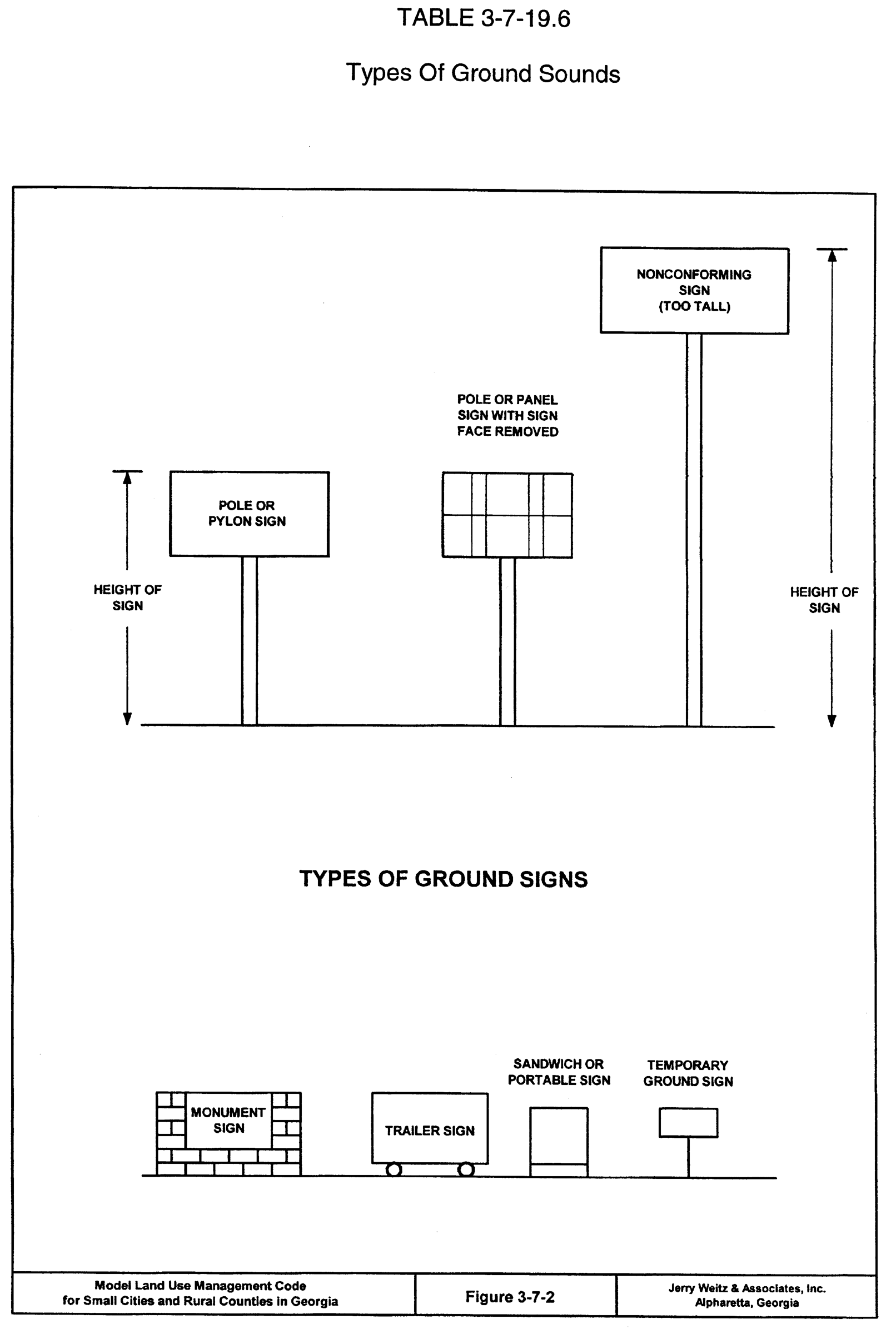
Types of Ground Signs

