
Sedgwick County Unincorporated
City Zoning Code
City Zoning Code
ARTICLE IV
SITE DEVELOPMENT STANDARDS
A.- OFF-STREET PARKING AND LOADING
1.
Applicability. The standards of this section shall apply to all new Development and to existing Development that is modified to the extent that it includes Uses or Buildings that were not specifically shown on previously approved plans, provided that Development in the CBD and OT-O districts shall be exempt from compliance with the Parking, queuing and Loading regulations in Secs. IV-A.4, IV-A.11 and IV-A.14.
a.
No reduction below minimum requirements. Existing Parking and Loading Spaces shall not be reduced below the minimums required in this section. Any change in Use of a Building or Lot that increases the off-street Parking as required under this Code shall be unlawful and a violation of this Code until such time as the off-street Parking complies with the provisions of this Code.
b.
New Development. Off-street Parking and Loading facilities shall be provided for any new Building constructed and for any new Use established, in accordance with the standards of this section.
c.
Enlargements of existing Development. Except as provided in this section for existing Multi-Family Dwelling Units and nonresidential Uses, when an existing Structure or Use is expanded or enlarged, accessory off-street Parking shall be provided in accordance with the off-street Parking schedule of Sec. IV-A.4.
(1)
Multi-Family Dwelling Units in existence prior to July 16, 1991. When additional Dwelling Units are added to an apartment building or apartment complex that was in existence prior to July 16, 1991, only the additional Dwelling Units shall be required to provide off-street Parking Spaces in accordance with these regulations. The construction of additional Dwelling Units shall not trigger a requirement that off-street Parking Spaces be provided for the apartment Dwelling Units in existence prior to July 16, 1991.
(2)
Nonresidential Use in existence prior to July 16, 1991. When the expansion of a nonresidential Use in existence prior to July 16, 1991 and not having sufficient Parking to meet the Parking regulations that became effective on that date does not exceed ten percent of the total Floor Area of the existing Use, only the additional Use area shall be required to comply with the off-street Parking standards of Sec. IV-A.4, and such expansion of the existing Use shall not require additional Parking Spaces to be provided for the existing Use.
d.
Remodeling of existing Development. When an existing Structure or Use is remodeled, rehabilitated or altered such that the value of the remodeling exceeds 50 percent of the value of the Structure being remodeled or altered, off-street Parking shall be provided in accordance with the off-street Parking schedule of Sec. IV-A.4.
e.
Nonconformity status. A land use that was legally established shall not be deemed a nonconformity solely as a result of providing fewer off-street Parking and Loading Spaces than required in this article.
2.
Parking Area improvements. Off-street Parking shall be prohibited on unsurfaced areas.
a.
Low-density residential Developments. Parking areas and driveways for Single-family, Duplex, or Multi-Family with three or four Dwelling Units shall be surfaced with an All-Weather Surface, except however, that such Developments located on unpaved Streets may be of the same material as the Streets. Within 90 days after the Streets are paved, the Parking Areas and driveways shall be improved with an All-Weather Surface.
b.
All other Developments. All Parking areas, Loading areas and driveways on all Developments other than low-density residential Developments shall be surfaced with concrete, asphaltic concrete, asphalt or other comparable surfacing and shall be maintained in good condition and free of all weeds, dust, trash and other debris.
3.
Use and maintenance of Setback areas and Yards not devoted to off-street Parking. Required Setback areas and Yard areas, except where surfaced for Parking, Loading and circulation aisles, shall be Landscaped with grass, shrubs, trees or groundcover, and shall be maintained in good condition.
4.
Off-street Parking schedule. Off-street Parking Spaces shall be provided in accordance with the following off-street Parking schedule.
a.
Unless noted otherwise, "square feet" means "gross floor area" or "gross leasable area," whichever is determined by OCI to be the appropriate category on which to make the calculation.
b.
Parking study indicates that the applicant may submit a parking demand analysis that substantiates the number of spaces proposed by the applicant. If an analysis is not submitted, staff will select a use that is most similar to the proposed use and use that parking standard.
5.
Computing Parking and Loading requirements
a.
Multiple Uses. Lots containing more than one Use shall provide Parking and Loading in an amount equal to the total of the requirements for all Uses, unless a shared Parking plan is approved pursuant to Sec. IV-9.
b.
Fractions. When measurements of the number of required spaces result in fractions, any fraction of less than one-half shall be disregarded and any fraction of one-half or more shall be rounded upward to the next highest whole number.
c.
Floor Area. Unless otherwise noted in the provisions, all square footage based Parking and Loading standards shall be computed on the basis of gross Floor Area within the Principal Building. Off-street Parking shall be adequate, however, to serve the entire Use, including outdoor display areas and other outdoor uses.
d.
Employees, students and occupant-based standards. For the purpose of computing Parking requirements based on the number of employees, students, residents or occupants, calculations shall based on the largest number of persons working on any single shift, the maximum enrollment or the maximum fire-rated capacity, whichever is applicable.
e.
Unlisted Uses. Upon receiving a development application for a Use not specifically listed in this section, the Zoning Administrator shall apply the Parking and Loading requirements specified for the listed use that is deemed most similar to the Use proposed in the application.
6.
Location of required Parking. Except as provided in Secs. IV-A.9 and IV-A.10, all required off-street Parking Spaces shall be provided upon the same zoning Lot as the Principal Use. The location of required off-street Parking Spaces shall not interfere with normal traffic flow or with the operation of queuing and backup areas.
a.
Parking and circulation areas within Setbacks. Off-street Parking Spaces, including ingress and egress drives, and circulation aisles, shall not occupy any part of a required Front Setback or any part of a required Street Side Setback, except for the following:
(1)
Required Setbacks in the NO through GI Districts not otherwise required to be Landscaped;
(2)
Ingress and egress drives providing access to required off-street Parking and Loading Spaces;
(3)
Circular driveways for Single-Family Dwelling Units when the Lot is of sufficient size to comply with all other applicable regulations, including, in the City of Wichita Chapter 10.16 of the City Code, provided, however, that the Open Space area between the circular driveway and the public right-of-way line shall not be less than eight feet in depth and Landscaped with a combination of shrubs, trees, grass and other landscaping materials;
(4)
Additional accessory off-street Parking for Single-Family and Duplex dwellings shall be permitted within the required Setbacks in residential zoning Districts when the Setback area of the Lot is Abutting a street having on-street Parking limitations and there is no reasonable access to the Interior Side or Rear Setbacks, provided, however, the total surfaced area within the required Setback shall not exceed 750 square feet or 50 percent of the required Setback, whichever is less;
(5)
Additional accessory off-street Parking for Single-Family and Duplex dwellings shall be permitted within 50 percent of the required Setbacks in residential subdivisions wherein Street widths have been reduced with a direct stipulation that additional off-street Parking be provided;
(6)
Additional accessory off-street Parking for Single-Family dwellings on a surfaced area Contiguous to an ingress driveway when there is no reasonable access to the Side or Rear Setback, provided, however, the total surfaced area within the required Setback shall not exceed 750 square feet or 50 percent of the required Setback, whichever is less;
(7)
Parking on ingress and egress driveways for Single-Family and Duplex dwellings when the parking is additional accessory off-street Parking; and
(8)
Parking on an existing surfaced driveway when a portion of an existing Single-Family dwelling is converted to dwelling purposes by utilizing the required off-street Parking Space.
b.
Distance from Building or Use. No required off-street Parking Space shall be located more than 600 feet from the Building or Use it is intended to serve, measured along the shortest legal, practical walking route. This standard shall not apply to Parking Spaces provided for Auditoriums, Stadiums, assembly halls or other places of assembly, nor shall it apply to Hospitals or community or regional shopping centers or industrial, Wholesaling, Manufacturing or business park uses.
c.
Garages and carports. Space within a carport or Garage may be used to satisfy off-street Parking standards.
7.
Use of required off-street Parking Areas. Required off-street Parking Spaces shall be reserved for the sole use of the occupants of the Building or Lot, and the visitors thereto. Required Parking Spaces shall specifically not be used for the storage, sale or display of goods or materials, including shopping cart storage corrals, or for the sale, repair or servicing of Vehicles. Parking Areas providing required Parking Spaces shall not be used to satisfy required off-street Parking for new Structures or additions to existing Buildings, Structures or uses of land. Required Parking Spaces shall be maintained and shall not be reduced so long as the Main Building, Structure or Use remains, unless an equivalent number of such Parking Spaces are provided elsewhere.
8.
Parking Spaces for persons with disabilities. A portion of the total number of required Parking Spaces in each off-street Parking Area shall be specifically designated, located and reserved for use by persons with disabilities.
a.
Number of spaces. The minimum number of Parking Spaces to be provided shall be a portion of the total number of Parking Spaces required, as determined from the following schedule. Parking Spaces reserved for persons with disabilities shall be counted toward fulfilling the overall off-street Parking standards.
b.
Minimum dimensions. All Parking Spaces reserved for persons with disabilities shall comply with the size requirements of the Americans With Disabilities Act and other applicable codes.
c.
Location of Parking Spaces. Required Parking Spaces for persons with disabilities shall be located in close proximity to Building entrances and shall be designed to permit occupants of Vehicles to reach the Building entrance on an unobstructed path with a minimum width of three feet. The Zoning Administrator may require that off-street Parking Spaces provided for persons with disabilities be dispersed throughout the project if deemed necessary to ensure safe, convenient and accessible Parking Spaces for all users of the project.
d.
Signs and marking. Required Parking Spaces for persons with disabilities shall be designated with Signs as required by the Americans with Disabilities Act and other applicable codes.
9.
Shared Parking. The Zoning Administrator may authorize a reduction in the number of required Parking Spaces for multiple use Developments or for Uses that are located near one another and that have different peak parking demands and operating hours. Shared Parking shall be subject to the following standards.
a.
Location. Shared off-street Parking Spaces shall be located no further than 600 feet from the Buildings and Uses they are intended to serve. Off-site Parking Spaces shall not be separated from the use by an arterial Street, expressway, or freeway unless a grade-separated pedestrian walkway is provided.
b.
Shared parking analysis. A parking analysis acceptable to the Zoning Administrator shall be submitted that clearly establishes that Uses will make use of the shared Parking Spaces at different times of the day, week, month or year. The study shall:
(1)
Address the size and type of activities, the composition of tenants, the rate of turnover for proposed shared Parking Spaces, and the anticipated peak Parking and traffic loads;
(2)
Provide for a reduction by not more than 50 percent of the combined Parking required for each Use; and
(3)
Provide for no reduction in the number of Parking Spaces reserved for persons with disabilities.
c.
Agreement for shared parking plan. A shared parking plan shall be enforced through written agreement. An attested copy of the agreement between the Owners of record shall be submitted to the Register of Deeds for recordation on forms made available in the office of the Zoning Administrator. Proof of recordation of the agreement shall be presented to the Zoning Administrator prior to issuance of a Building Permit.
d.
Revocation of Permits. Failure to comply with the shared Parking provisions of this section shall constitute a violation of this Code and shall specifically be cause for revocation of a certificate of occupancy.
e.
Parking for religious, educational and health-care related institutional uses. For religious, educational and health-care related institutional uses, Parking areas may be separated from the zoning Lot on which such Use is located by a public or private Street or Alley and still be considered as onsite Parking, provided the subject Parking area is under the same ownership as the Use being served, and the zoning classification of the separate Lot is not more restrictive than that of the main Zoning Lot on which the primary Use is located.
10.
Off-site Parking. Required off-street Parking Spaces shall be located on the same Zoning Lot as the Use the Parking Spaces are intended to serve, provided that the Zoning Administrator may permit up to 50% of the required Parking Spaces to be located on a remote Lot, which is defined as a Lot separated by a Street, Alley or Lot under separate ownership or control from the Lot on which the Principal Use is located. The Zoning Administrator, in conjunction with the Planning Director, may authorize up to 100% of the required Parking Spaces to be located on a separate lot when the following standards are met.
a.
Necessity. The applicant shall demonstrate that it is not feasible to locate all of the required Parking on the same Lot as the Principal Use.
b.
Location. No required off-site Parking Space shall be located more than 600 feet from the primary entrance of the Use served, measured along the shortest legal, practical walking route. Off-site Parking Spaces shall not be separated from the Use by an arterial Street, expressway or freeway unless a grade-separated pedestrian walkway is provided.
c.
Zoning classification. Off-site parking areas shall require the same zoning classification as required for the Use served, or a zoning classification that permits a commercial Parking Area, or have received Conditional Use approval for Parking Area (and/or accessory drive), Ancillary.
d.
Agreement for off-site Parking. In the event that an off-site Parking Area is not under the same Ownership as the Principal Use served, a written agreement shall be required. An attested copy of the agreement between the Owners of record shall be submitted to the Register of Deeds for recordation on forms made available in the office of the Zoning Administrator. Proof of recordation of the agreement shall be presented to the Zoning Administrator prior to issuance of a Building Permit.
e.
Parking for religious, educational and healthcare related institutional uses. For religious, educational and health-care related institutional uses, Parking areas may be separated from the Zoning Lot on which such use is located by a public or private Street or Alley and still be considered as onsite Parking, provided the subject Parking area is under the same ownership as the Use being served, and the zoning classification of the separate Lot is not more restrictive than that of the Zoning Lot on which the primary Use is located.
11.
Queuing requirements for drive-through facilities. In addition to meeting the off-street Parking requirements of this section, drive-through facilities shall meet the following standards.
a.
Queue space schedule. The minimum number of queue spaces required shall be as follows. Variations from these minimums may be allowed based on a traffic study submitted for review and approval by the Traffic Engineer. Queue spaces may not utilize public right-of-way.
* If there is no order box, the spaces shall be measured from the pick-up window.
b.
Dimensions. Queue spaces shall be a minimum of ten feet by 20 feet in size.
12.
Parking Area design standards. Off-street Parking Areas shall be designed and installed in accordance with applicable City and County standards, including the City Public Works Department's Typical Standards for Off-Street Parking.
13.
Parking plans. A parking plan shall be submitted to the Zoning Administrator for review and approval prior to the issuance of any Building Permit, Use or occupancy permit, except in the case of Single-Family dwellings that may be approved without a parking plan. The parking plan and layout shall be approved only after the Zoning Administrator determines that the plan complies with all applicable standards relating to: arrangement of Parking Spaces; number, location and dimensions of Parking Spaces; adequate aisle widths and markings for channelization appropriate to the type of design; adequate turnarounds, if needed; the location and width of adequate means of ingress and egress; and where required or necessary, the location and height of required Screening and the location of protective bumper guards. Where the required Screening Walls and Landscaped areas conflict with applicable intersection visibility standards, the Zoning Administrator shall order the parking lot to be redesigned and the required Screening to be relocated so as not to interfere with intersection visibility.
14.
Off-street Loading schedule. Off-street Loading Spaces shall be provided in accordance with the following schedule.
15.
Loading area design standards. Off-street Loading areas shall be designed and installed in accordance with applicable City and County standards, including the City Public Works Department's Typical Standards for Off-Street Parking.
16.
Parking Area lighting standards. All lighted Parking Areas shall comply with the lighting standards of Sec. IV-B.4.
(City of Wichita Ord. No. 52-035, § 1, 2-28-2023; Sedgwick County Res. No. 057-2023, § 1, 3-22-2023)
B. - SCREENING AND LIGHTING
1.
Purpose. The Screening and lighting standards of this section are intended to protect residential Districts from adverse visual impacts associated with nonresidential Development.
2.
Applicability. Screening shall be provided on all properties developed for all Uses except Single-family and Duplex when such Uses are established on property within, Abutting, or across a Street or Alley from residential zoning Districts, except when separated by a Major Barrier.
3.
Screening Standards. Solid Screening shall be required except in those situations where a landscaped street yard or landscape buffer sufficient to comply with Sec. IV-B.3.c—e are allowed. Screening may be provided by Screening Fences, Screening Walls, vegetation, landscaped earth berms or, by Landscaping per the Wichita Landscape Ordinance in certain locations within the City of Wichita.
a.
Screening Fences or Screening Walls shall be not less than six feet nor more than eight feet in height, except that within 20 feet of Street Right-of-Way Line in the Front Setback, the Height shall be reduced to three feet.
b.
When Solid Screening is required and vegetation or landscaped earth berms are proposed for the Solid Screening, a landscape plan shall be submitted to the Planning Director and the Zoning Administrator for review and approval.
c.
Additional landscaped street yard standards
(1)
General. A landscaped street yard per the Wichita Landscape Ordinance may replace Solid Screening in the Front Setback or in a Street Side Setback or Rear Setback where the Building façade functions as a front façade, with no overhead doors, queuing lanes or additional Screening requirements per Sec. IV-B.3.e between the Building and the Lot Line.
(2)
Screening for Manufactured Home Park. Where the Manufactured Home Park Abuts an arterial or collector Street, Screening shall be provided to prevent the passage of debris and light and to mitigate adverse visual impacts. Screening shall be in the form of a Screening Wall or Fence constructed of brick, stone, concrete masonry, stucco, concrete, wood, or other similar material or in the form of evergreen vegetation. Said Screening requirement shall apply only to Manufactured Home Parks developed on property for which the MH zoning District is established after June 23, 2006.
d.
Screening along interior side and rear yards
(1)
General. Screening of all nonresidential Uses shall be provided along all side or rear Lot Lines Abutting or across an Alley from a residential zoning District and screening of Multi-Family and Manufactured Home Park Uses shall be provided along all side or rear Lot Lines Abutting or across an Alley from property zoned TF-3 or more restrictive.
(2)
Solid Screening with Fencing, Screening Walls, evergreen vegetation or landscaped earth berm may be omitted for Multi-Family, Manufactured Home Park, office and institutional uses along any side or rear Lot Line, or portion thereof, whenever such development provides at least a 15-foot-wide Landscape buffer Contiguous to such Lot Line or portion thereof. The buffer shall provide a minimum of one shade tree or equivalent ornamental tree or evergreen tree and five shrubs for every 30 linear feet of Abutting Lot Line and/or Contiguous property line or one shade tree or equivalent ornamental tree or evergreen tree every 20 linear feet without shrubbery, in either case with at least one-third of all plant material being evergreen, or applicable standards of the City of Wichita Landscape Code if these are more stringent.
e.
Screening of mechanical equipment and outdoor work and storage areas
(1)
Nonresidential Screening from ground level view. Except along local or collector Streets bounded on both sides by the LI or GI district, screening shall be provided on all nonresidential Development sufficient to reasonably hide from ground level view all loading docks, trash receptacles, ground level heating, air conditioning and mechanical equipment, freestanding coolers or refrigeration units, Outdoor Storage including Portable Storage Containers, outdoor work areas or similar uses from any residential zoning District or public Street Right-of-Way located within 150 feet of such Uses.
(a)
Screening for Portable Storage Containers in the LC District may be satisfied by meeting the requirements in Sec. III-B.14.e(3)(e). If these conditions are not met, Solid Screening shall be provided with a Screening Wall or Screening Fence as required in this section of the Code.
(b)
Screening for Portable Storage Containers in the GC and more intensive Districts may consist of the wall(s) of the Portable Storage Container if the container has no openings or signs facing a public Street or Adjacent property in a residential zoning District and if the wall(s) match the predominant material and colors of the existing Structure or are an earth tone color that complements and appears inconspicuous against the color of the Principal Building when these conditions are met:
1)
Located at least five feet behind the wall line of the Principal Building that faces a Street,
2)
Meets Side and Rear Setback requirements for Buildings, are separated by no more than ten feet from the Principal Building except when screened from view of a residential zoning District, residential Use or arterial Street by Landscaping, earth berms or by other nonresidential Buildings; and are located at least 20 feet from any Abutting property zoned TF-3 or more restrictive, or
If these conditions are not met, Screening shall be provided with a Screening Wall or Fence as required in this section of the Code.
(2)
Nonresidential Screening from roof-mounted equipment. Except along local or collector Streets bounded on both sides by the LI or GI district, roof-mounted heating, air conditioning and mechanical equipment on new buildings located within 150 feet of a residential zoning District or public Street Right-of-Way either shall be screened from ground level view or set back a minimum of five feet from the top edge of the building wall for every foot in height above the height of the wall.
(3)
Trash receptacles, mechanical equipment and outdoor work and storage areas in Multi-Family and Manufactured Housing District. Screening to sufficiently hide from ground level view shall be required for trash receptacles, mechanical equipment and outdoor work and storage areas on properties developed for Multi-Family or Manufactured Home Park uses from any residential zoning District or public Street Right-of-Way located within 150 feet of these Uses.
f.
Driveway openings on alleys. Whenever properties are developed Abutting an Alley, Screening may be omitted at driveways deemed essential for ingress and egress from the Alley to Uses established on the property.
g.
Use of screening areas. Landscaped yards required by this section shall not be used for driveways, Parking, Loading, Outdoor Storage, outdoor display, work areas, recreational areas, Signs or similar uses.
h.
Materials used in screening walls and fences. Screening Walls and Fences shall be constructed of standard building materials customarily used for Wall and Fence construction such as brick, stone, concrete masonry, stucco, concrete or wood.
i.
Deferral of screening requirements. If Screening exists on either side of a developing property line that meets or exceeds the standards of this section, additional Screening shall not be required. However, if at any time the existing Screening fails to meet the requirements of this section, compliance shall be attained by the property owners in the less restrictive zoning District.
4.
Lighting Standards. Outdoor lighting sources, including base or pedestal, pole and fixture, shall employ cut-off luminaries to minimize light trespass and glare, and shall be mounted at a height not exceeding one-half the distance from the neighboring Lot, unless evidence is provided to the satisfaction of the Zoning Administrator that the light source will be aimed or shielded such that the light source is not visible from the neighboring Lot. Lighting sources shall be limited to 15 feet in height within 200 feet of residential zoning Districts.
C. - COMPATIBILITY STANDARDS
1.
Purpose. The compatibility standards of this section are intended to preserve and protect residential neighborhoods.
2.
Applicability
a.
Setbacks and height. Compatibility standards for Setbacks and Height shall apply to all uses in MF-18 and less restrictive base zoning Districts when such uses are located on Zoning Lots within 500 feet of property zoned TF-3 or more restrictive, except, however, that when the separating Street is a freeway or expressway, compliance with the compatibility standards shall not be required. Compatibility standards for Setbacks and Height shall also apply to all nonresidential Uses in the RR, SF-20, SF-10, SF-5 and TF-3 Districts when such Uses are located on Zoning Lots within 500 feet of property zoned TF-3 or more restrictive, except however, that when the separating Street is a freeway or expressway, compliance with the compatibility standards shall not be required.
b.
Noise. Compatibility standards for noise shall apply to all Uses in NO and more intensive base zoning Districts when such Uses are located on Zoning Lots that are within 500 feet of any property zoned MH or more restrictive.
c.
Site design standards. Compatibility site design standards shall apply to swimming pool, tennis court, ball field or playground area associated with a Parks and Recreation facility (public) when such uses are located within 50 feet of property zoned TF-3 or more restrictive; and to dumpsters and refuse receptacles when such uses are located within 20 feet of property zoned TF-3 or more restrictive.
3.
Exemptions. Notwithstanding the applicability provisions of Sec. IV-C.2, the following shall not trigger the compatibility standards:
a.
Construction in the MF-18 or less restrictive base zoning District of a Use that is less intensive than the existing Uses on the Zoning Lots zoned TF-3 or more restrictive that are Contiguous or on the site across the Street shall not trigger compliance with the Setback or Height compatibility standards, but only with the noise compatibility standards.
b.
Structural alteration of an existing Building or Structure when such alteration does not increase the Floor Area or Height of a building;
c.
A change in Use to a Use that is no more Intensive than the existing Use.
d.
Property zoned TF-3 or more restrictive that is public right-of-way, railroad track, Street, median or utility easement.
4.
Compatibility Setback standards. Compatibility Setback standards shall only apply to side and rear Lot Lines Adjacent to property zoned TF-3 or more restrictive. The minimum Building compatibility Setback shall be 15 feet plus one foot for each five feet of (subject tract) Lot Width over 50 feet. In no case shall the compatibility Setback standards alone require more than a 25-foot Setback.
5.
Compatibility Height standards. Compatibility Height standards. The following Height standards shall apply to Development that is subject to compatibility standards, unless reduced or waived through the provisions of Sec. V-I.2.
a.
No Structure shall exceed 35 feet in height within 50 feet of the lot line of property zoned TF-3 or more restrictive. Structures located more than 50 feet from the Lot Line of property zoned TF-3 or more restrictive may increase Height (if permitted by the base District regulations) at a ratio of one foot in Height for each three feet of Setback beyond 50 feet. For example, a Structure limited to 35 feet in Height at 50 feet from the Lot Line of property zoned TF-3 or more restrictive could be increased to a Height of 85 feet at a distance of 200 feet from the Lot Line of property zoned TF-3 or more restrictive.
b.
Wireless Communications Facilities shall not exceed a Height equal to the distance to the Lot Line of property zoned TF-3 or more restrictive. For example, a Wireless Communication Facility located 100 feet from the Lot Line of property zoned TF-3 or more restrictive cannot exceed a Height of 100 feet.
6.
Compatibility noise standards. No sound amplification system for projecting music or human voices shall be permitted on any property zoned NO or more intensive if the music and/or voices can be heard within any residential zoning District that is located within a 500-foot radius of the subject site.
7.
Compatibility site design. The following additional site design standards shall apply to development that is subject to compatibility standards.
a.
No swimming pool, tennis court, ball field or playground area associated with a Parks and Recreation facility (public) shall be permitted within 50 feet of an Abutting TF-3 or more restrictive district.
b.
Dumpsters and refuse receptacles shall be located a minimum of 20 feet from any property zoned TF-3 or more restrictive.
D. - RESIDENTIAL-DESIGN MANUFACTURED HOMES
Residential-Design Manufactured Homes shall be subject to the following standards.
1.
Roof. The roof must be predominantly double-pitched and have a minimum vertical rise of 2.2 inches for every twelve inches of horizontal run, and must be covered with material that is customarily used on site-built dwellings, including approved wood, asphalt composition shingles, or fiberglass, but excluding aluminum, corrugated fiberglass, or metal roof. The roof shall have a minimum eave projection and roof overhang of ten inches, which may include a gutter.
2.
Siding. Exterior siding shall be of a material customarily used on site-built dwellings, which does not have a high gloss finish, such as wood, composition, simulated wood, clapboards, conventional vinyl or metal siding, brick, stucco or similar materials, but excluding smooth, ribbed or corrugated metal or plastic panels. Siding material shall extend below the top of the exterior of the foundation or curtain wall or the joint between siding and enclosure wall shall be flashed in accordance with building codes adopted by the Governing Body.
3.
Installation. The home shall be installed in accordance with the recommended installation procedures of the manufacturer and the standards set by the Building Codes of the Governing Body in Chapter 6, Article VII of Sedgwick County Code or Chapter 26.04 of the Code of the City of Wichita. A continuous, permanent concrete or masonry foundation or masonry curtain wall, unpierced except for required ventilation and access, which may include walk-out basements and garages, shall be installed under the perimeter of the home, also in accordance with the above-referenced codes.
4.
Entrance landing area. At the main entrance door there shall be a landing that is a minimum of three feet by three feet that is constructed to meet the requirements of the Building Codes adopted by the Governing Body.
5.
Transport equipment. All Manufactured Home running gear, tongues, axles, and wheels must be removed at the time of installation of the home on the lot.
6.
Finished floor elevation. The finished floor of the Residential-Design Manufactured Home shall be a maximum of 24 inches above the exterior finish grade of the Lot on which it is located, as measured at the main entrance into the Dwelling Unit.
7.
Attached additions. Any attached addition shall comply with the Building Codes adopted by the Governing Body. Architectural and aesthetic standards, as specified above, shall be applicable to all additions.
8.
Garages. Detached Garages that may be constructed on the same lot as a Residential-Design Manufactured Home shall comply with all requirements of the Building Codes adopted by the Governing Body and with all architectural and aesthetic standards, as specified above.
9.
Installation in Historic District. If the Residential-Design Manufactured Home is to be installed in a Historic District, a Certificate of Appropriateness shall be required to be obtained before a permit to install the home may be issued by the Zoning Administrator.
E. - HOME OCCUPATIONS
The Home Occupation standards of this section are intended to permit the establishment of certain incidental and accessory Home Occupations in residential and rural areas under conditions that will ensure their compatibility with the character of the subject area. They are intended to permit residents to engage in Home Occupations that are compatible with residential land Uses and to ensure that Home Occupations do not adversely affect the integrity of residential and rural areas. A Home Occupation shall be considered an Accessory Use, subject to the following standards. This section of the Code divides those uses deemed suitable as a Home Occupation into two subcategories. The first subcategory includes those uses permitted as a Home Occupation in Dwelling Units regardless of the property's zoning, subject to applicable development standards, and are referred to as Home Occupations. The second Home Occupation subcategory includes additional uses, referred to as rural Home Occupations, that may be permitted in the RR and SF-20 zoning districts if they are operated in compliance with applicable standards described below.
Home Occupations
(except those considered Rural Home Occupations)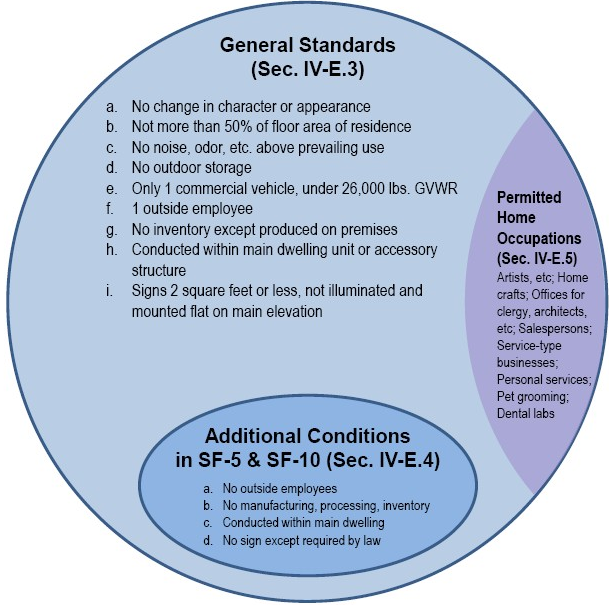
1.
Where allowed. Home Occupations shall be permitted in any Dwelling Unit or permitted Accessory Structure unless otherwise prohibited or restricted by this section.
2.
Use limitations. In addition to all of the use limitations applicable to the District in which it is located, no Home Occupation shall be permitted unless it complies with the standards of this section.
3.
General standards. The following standards shall apply to all Home Occupations unless specifically modified by the standards of Sec. IV-E.4 or Sec. IV-E.6.f.
a.
No alteration of the Principal Building or premises shall be made that changes the character or appearance thereof.
b.
The Home Occupation shall not occupy more than 50 percent of the gross Floor Area contained within the Dwelling Unit.
c.
No equipment shall be used that creates noise, vibration, electrical interference, smoke or particulate matter emission, or odors that are in excess of ordinary and usual conditions prevailing in the immediate neighborhood as determined by the Zoning Administrator.
d.
There shall be no Outdoor Storage of equipment, including but not limited to construction equipment, materials or Vehicles used in the Home Occupation unless allowed as a rural Home Occupation in the RR district.
e.
No more than one Commercial Vehicle may be Parked inside or outside of a building and the one permitted Commercial Vehicle shall not exceed 26,000 pounds gross vehicle weight rating unless the Vehicle is associated with a rural Home Occupation as permitted by Sec. IV-E.8.l.
f.
With the exception of Day Care, Limited, no more than one person other than persons occupying such Dwelling Unit as their residence shall be employed except that up to the equivalent of four persons may be employed in a Home Occupation in the SF-20 and RR districts. A full time employee is a person employed by, or who conducts business on behalf of, a rural Home Occupation in time increments of eight hours or more per day. A part time equivalent full time employee is defined as any person employed by, or who conducts business on behalf of, a rural Home Occupation in time increments of less than eight hours per day. Determination of an employee's status as a full time or part time equivalent on-site status shall be determined by payroll records, time cards or other business records. Employees or persons lacking a record on which to determine the employee's full time or part time equivalent shall be considered full time employees. The number of employees permitted for a Day Care, Limited Home Occupation shall be as determined by the State of Kansas, but shall in no case be more than two individuals at any one time.
g.
No inventory (except articles produced on the premises either by members of the immediate family residing on the premises or employees of the Home Occupation) shall be displayed or sold on the premises.
h.
The Home Occupation shall be conducted entirely within the principal Dwelling Unit or in a permitted Accessory Structure.
i.
No Sign shall be permitted larger than two square feet; provided that it shall not be illuminated and shall be mounted flat against the main face of the Dwelling Unit or Building involved.
4.
SF-10 and SF-5 District standards. The following standards shall apply in the SF-10 and SF-5 Districts. In the event of conflict with the general standards of Sec. IV-E.3, the specific SF-10 and SF-5 District standards of this section shall control.
a.
In the SF-10 and SF-5 Districts, no persons shall be engaged in a Home Occupation other than persons occupying the subject Dwelling Unit as their residence.
b.
In the SF-10 and SF-5 Districts, no Manufacturing or processing or conducting of a trade of any sort shall be done and no inventory shall be displayed or sold on the premises.
c.
In the SF-10 and SF-5 Districts, the Home Occupation shall be conducted entirely within the main Dwelling Unit. In the SF-10 and SF-5 Districts, no Home Occupations shall be conducted within an Accessory Structure or Garage, whether attached or detached.
d.
In the SF-10 and SF-5 Districts, no Sign shall be permitted except when required by law. When such a Sign is required, it shall not be larger than two square feet, provided that it shall not be illuminated and shall be mounted flat against the main face of the Dwelling Unit or Building involved.
5.
Types of Home Occupations permitted. Home Occupations shall include the following list of occupations, plus uses that are similar in character; all other occupations shall be prohibited:
a.
Artists, authors or composers, dancers, music teachers, and other similar artists, including instruction thereof; provided that instruction shall be limited to not more than 12 pupils at a time;
b.
Home crafts, such as model making, rug weaving, lapidary work, cabinet making, small appliance repairs, etc.;
c.
Office facilities for ministers, rabbis and priests;
d.
Office facilities for architects, engineers, lawyers, doctors, dentists and members of similar professions;
e.
Office facilities for salespersons, sales representatives and manufacturer's representatives, when no retailing or wholesaling is made or transacted on the premises except through electronic means;
f.
Office facilities for service-type businesses such as insurance agents, brokers, decorators, painters, business consultants, tax advisors and photographers;
g.
Personal services, such as dressmakers, seamstresses, tailors, barber shops, and beauty shops;
h.
Pet grooming, but not including veterinary services or boarding;
i.
Dental laboratories;
j.
Tattooing and Body Piercing Facilities (County); and
k.
Uses determined by the Zoning Administrator to be similar in character to those listed above.
Rural Home Occupations in RR and SF-20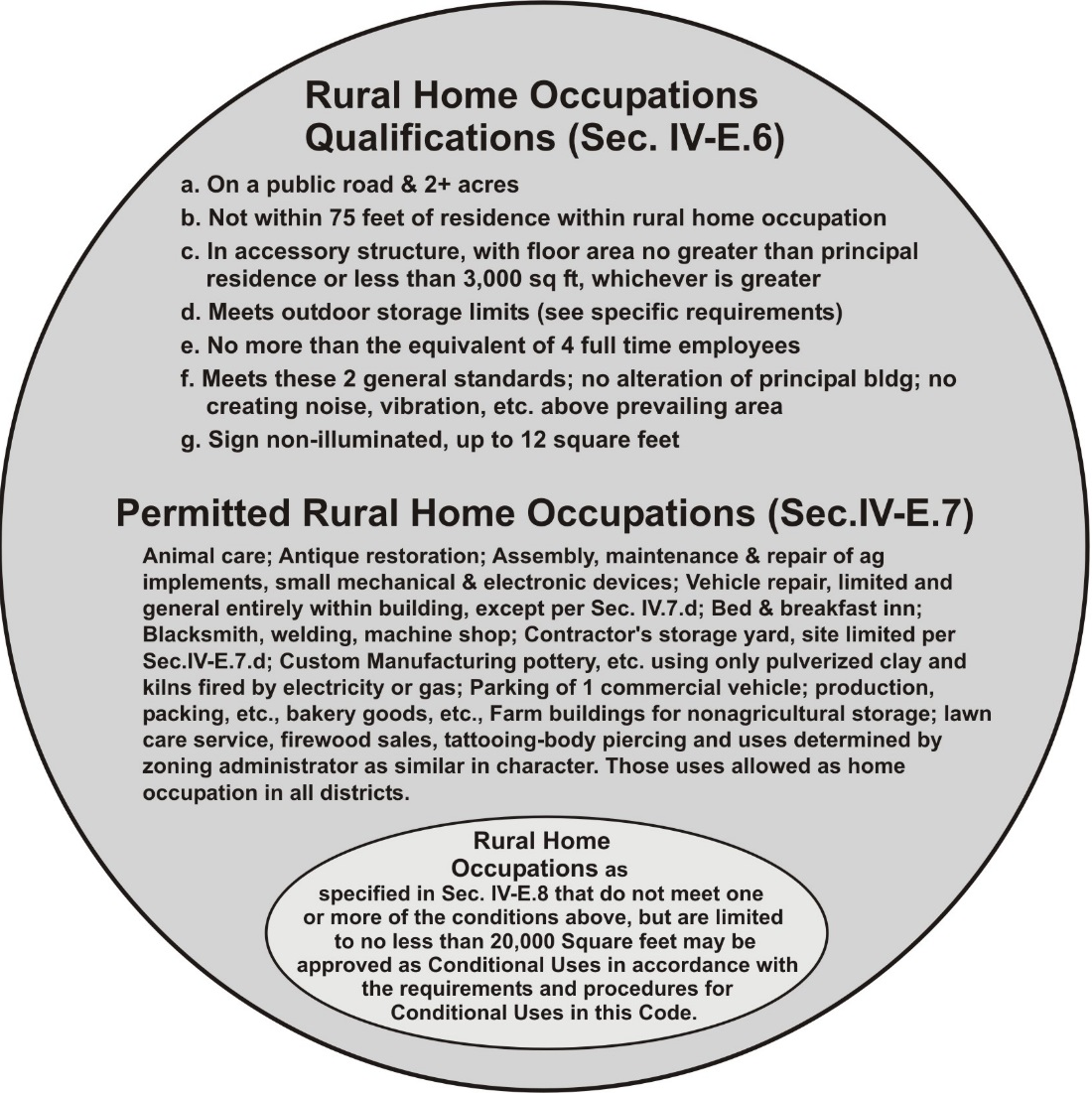
6.
Types of Home Occupations not permitted. None of the following uses shall be deemed to be similar in character to permitted home occupations:
a.
Animal Care, General and Limited, except as provided in Sec. IV-E. 8;
b.
Vehicle Repair, General and Limited, except as provided in Sec. IV-E.8;
c.
Bed and Breakfast Inn, except as provided in Sec. IV-E.8;
d.
contractor's storage, except as provided in Sec. IV-E.8;
e.
Funeral Homes;
f.
Kennels and Riding Academy or Stables when carried on as a business activity;
g.
Medical services other than medical or dental offices;
h.
Renting of trailers, vehicles or other equipment;
i.
Restaurants except as provided in Sec. IV-E.8;
j.
Tattooing and Body Piercing Facilities (City); and
k.
Any use first allowed by right or by Conditional Use in the LI or GI Districts, unless specifically listed as permitted in Sec. IV-E.8.
7.
Qualifying conditions for rural Home Occupations. In addition to the Home Occupations allowed by Sec. IV-E.5, rural Home Occupations (as specified in Sec. IV-E.8) are allowed by right on Sites in the RR and SF-20 zoning Districts under the following conditions:
a.
Each Lot or tract shall be located upon a public road and shall contain a minimum of two acres.
b.
A rural Home Occupation must be located at least 75 feet from residences located off-site from the zoning lot or property containing the rural Home Occupation unless the off-site residence operates a rural home occupation.
c.
The rural Home Occupation may be conducted in an Accessory Structure having a Floor Area equal to the Floor Area of the principal residence or up to 3,000 square feet, whichever is greater.
d.
Outdoor Storage is permitted provided the size of the storage area does not exceed 10,000 square feet. The storage area shall be located behind the front of the buildings within which the Home Occupation is conducted. Outside storage shall not be located within any required Building Setback or within 50 feet of a property line, whichever is greater. Screening of the storage area by Structures, solid or semi-solid fencing and/or landscape materials from Abutting roads and Adjacent properties is required on properties of less than five acres in size or within 50 feet of a property line or public right-of-way. Fences used to accomplish Screening shall be constructed to prevent the passage of debris or light and constructed of either brick, stone, architectural tile, masonry units wood or similar material (not including woven wire) and shall be not less than six nor more than eight feet in Height. Landscape material intended to be used for Screening purposes must be indicated on a plan drawn to scale and submitted to the Planning Director for review and approval. Landscape material must provide the desired Screening effect within the first growing season following installation and throughout the year every year thereafter. Screening requirements for rural Home Occupations may be reduced or waived by Administrative Adjustment as described in Sec. V-I.2.
e.
No more than the equivalent of four full time employees or persons, other than persons occupying the Dwelling Unit as their residence, shall be employed at any rural Home Occupation site. A full time employee is a person employed by, or who conducts business on behalf of, a rural Home Occupation in time increments of eight hours or more per day. A part time equivalent full time employee is defined as any person employed by, or who conducts business on behalf of, a rural Home Occupation in time increments of less than eight hours per day. Determination of an employee's status as a full time or part time equivalent on-site status shall be determined by payroll records, time cards or other business records. Employees or persons lacking a record on which to determine the employee's full time or part time equivalent shall be considered full time employees.
f.
Only the standards of Secs. IV-E.3.a and IV-E.3.c shall apply to rural Home Occupations.
g.
One onsite, free-standing (or attached to an Accessory Building), non-illuminated Sign up to 12 square feet in size located outside public right-of-way shall be permitted.
h.
Rural Home Occupations as specified in Sec. IV-E.8 that do not meet one or more of the conditions above, but are limited to no less than 20,000 Square feet may be approved as Conditional Uses in accordance with the requirements and procedures for Conditional Uses in this Code.
8.
Types of rural Home Occupations permitted. Rural Home Occupations permitted, in addition to those allowed by Sec. IV-E.5, include:
a.
Animal Care, General and Limited;
b.
Antique restoration;
c.
Assembly, maintenance and repair of agricultural implements and equipment;
d.
Assembly of small mechanical devices, electronic devices and components;
e.
Vehicle repair, limited and general; vehicle repair, general must be conducted entirely within an enclosed structure. Notwithstanding the definition of Vehicle repair, limited, such use may be conducted outside as a rural Home Occupation.
f.
Bed and Breakfast Inn subject to all applicable codes concerning tourist accommodations and food handling enterprises;
g.
Blacksmith shop, Welding, heat treating and Machine Shop;
h.
Contractor's storage, subject to size limitations and setback requirements as set out in Sec. IV-E.7.d above regardless of on-site location;
i.
Custom butchering, meat curing and processing;
j.
Household dining establishments conducted within the main residence by prior reservation only, and subject to applicable licensing and Building Code requirements;
k.
Manufacturing of pottery, statuary, figurines, or other similar ceramic products using only previously pulverized clay and kilns fired only by electricity or gas;
l.
The Parking or storage of one Commercial Vehicle that exceeds 26,000 pounds gross vehicle weight rating when owned by the occupant. Nothing is this section prohibits Commercial Vehicles of less than 26,000 pounds gross vehicle weight rating that comply with other applicable regulations.
m.
Production, compounding, processing, packing or treatment of such products as bakery goods, candy, dairy products and food related products;
n.
Production, fabrication and assembly of small implements used in the home, office, shop, garage, lawn, garden and farm;
o.
Use of farm buildings for nonagricultural storage;
p.
Lawn care service;
q.
Truck farm or garden;
r.
Sale, cutting, splitting and storage of firewood;
s.
Tattooing and Body Piercing Facilities; and
t.
Uses determined by the Zoning Administrator to be similar in character to those listed above.
(City of Wichita Ord. No. 52-035, § 1, 2-28-2023; Sedgwick County Res. No. 057-2023, § 1, 3-22-2023)
F. - PROPERTY MAINTENANCE
1.
Responsibility. It shall be the responsibility of the Owner or the Owner's successors in interest to maintain in good condition all required improvements on the Owner's property. This shall include, but not be limited to, Fences, Screening, Landscaping, off-street Parking and off-street Loading Areas.
2.
Violations. When it is determined by the Zoning Administrator that improvements required by this Code are not being maintained, the Zoning Administrator shall initiate enforcement proceedings pursuant to the procedures and standards of Article VIII.
G. - CONSTRUCTION USES
Offices, sheds, warehouses and open-air storage areas used by building contractors in connection with the building of a Principal Building or the development of an area may be erected and used in any District, provided they shall be removed from the premises within ten days after substantial completion of the project or unusual suspension of work. A Manufactured Home or Recreational Vehicle may be occupied at a construction site by a night watchman for the duration of a construction project when approved by the Zoning Administrator.
H. - EASEMENTS
No Building, nor any addition thereto, shall be erected over or under any public sewer or public utility lines, nor upon any platted or recorded easement, unless permission is granted, in writing, by the Zoning Administrator or the public utility whose lines are involved.

