
Seneca City Zoning Code
ARTICLE 4
- General Provisions
Section 4.01.- Provisions of Ordinance Declared to be Minimum Requirements.
In their interpretation and application, the provisions of this Ordinance shall be held to be minimum requirements, adopted for the promotion of the public health, safety, morals, or general welfare. Whenever the provisions of this Ordinance are in conflict with the provisions of any other ordinance or municipal law, the ordinance or municipal law with the most restrictive provisions shall govern.
Section 4.02. - Zoning Effects on Every Building and Use.
All building or land uses shall hereafter follow the requirements listed below:
1.
New Structures - All structures built after the effective date of this Ordinance shall comply with all provisions of these zoning regulations. Any structures moved from one site to another, shall comply with all pertinent regulations.
2.
Old Structures - If the use of any structure is hereafter changed to another use, then the new use must comply with all district regulations unless stated otherwise herein.
3.
Remodeling - If any structure is hereafter remodeled resulting in additional square feet:
a.
The entire structure as remodeled shall comply with all district regulations.
b.
Any alterations, enlargements or additions shall comply with the bulk requirements of these regulations.
Section 4.03. - Lot.
4.03.01 Every building hereafter erected, reconstructed, converted, moved or structurally altered shall be located on a lot or lot of record and in no case shall there be more than one principal building on a lot unless otherwise provided.
4.03.02 More than one principal building of a single permitted use may be located upon a lot or tract in the following instances if recommended by the Planning Commission and approved by the City Council.
1.
Institutional buildings
2.
Public or semi-public buildings
3.
Multiple-family dwellings
4.
Commercial or industrial buildings
5.
Home for the aged
6.
Agricultural buildings
7.
Planned Unit Developments
Section 4.04. - Reductions in Lot Area Prohibited.
No lot, even though it may consist of one or more adjacent lots of record, shall be reduced in area so that yards, lot area per family, lot width, building area, or other requirements of this Ordinance are not maintained. This section shall not apply when a portion of a lot is acquired for a public purpose.
Section 4.05. - Obstructions to Vision at Street Intersections Prohibited.
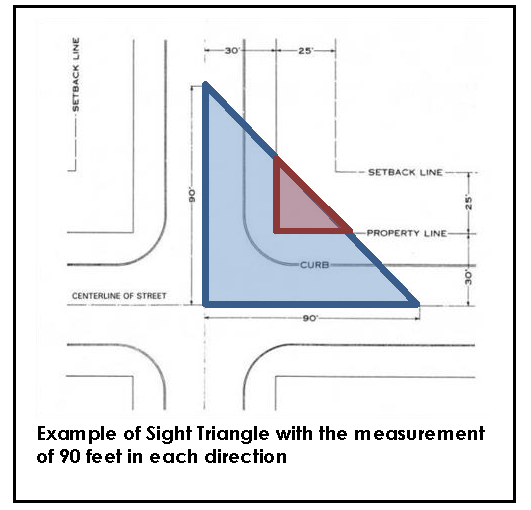
On a corner lot, within the area formed by the center line of streets at a distance of 90 feet from their intersections, there shall be no obstruction to vision between a height of two and one-half feet and a height of 10 feet above the grades of the bottom of the curb of the intersecting streets, measured from the point of intersection of the centerline of the streets. At the intersection of major or arterial streets, the 90-foot distance shall be increased to 120 feet for each arterial leg of the intersection. The requirements of this section shall not be deemed to prohibit any necessary retaining wall. See "Sight Triangle," as defined in Article 2 of this Ordinance.
Section 4.06. - Yard Requirements.
4.06.01 Yard requirements shall be set forth under the Schedule of Lot, Yard, and Bulk Requirements for each zoning district. Front, side and rear yards shall be provided in accordance with the regulations hereinafter indicated and shall be unobstructed from the ground level to the sky, except as herein permitted.
4.06.02 No part of a yard, or other open space, or off-street parking or loading space, required in connection with any building for the purpose of complying with this Ordinance, shall be included as part of a yard, open space, or off-street parking or loading space required for another building and or lot.
4.06.03 No yard or lot existing at the time of passage of this Ordinance shall be reduced in dimension or area below the minimum requirements set forth herein. Yards or lots created after the effective date of this Ordinance shall meet the minimum requirements herein.
4.06.04 All accessory buildings when connected to the principal building (e.g. attached garages) shall comply with the yard requirements of the principal building, unless otherwise specified.
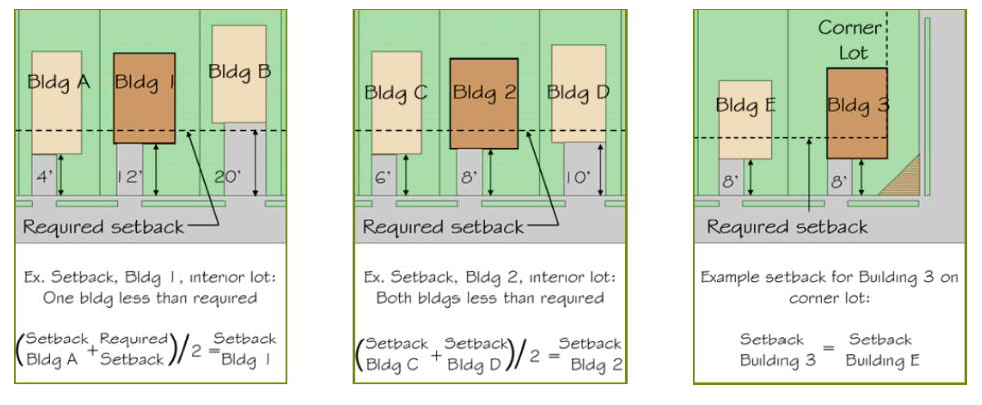
4.06.05 The Development Administrator may permit a variation in front yard setbacks to allow new or relocated structures to conform to the average existing setback provided that 1.) More than 40 percent of the frontage on one side of a street between intersecting streets is occupied by structures on the effective date of this Ordinance, and 2.) A minority of such structures have observed or conformed to an average setback line, see illustration for different provisions:
4.06.06 Any side or rear yard in a residential district which is adjacent to any existing industrial or commercial use shall be no less than 25 feet and shall contain the owner shall install and maintain landscaping and planting suitable to provide effective screening.
4.06.07 Any yard for a commercial or industrial use located within any Commercial or Industrial Zoning District, which is adjacent to any residential use, or district shall be increased to 40 feet and shall contain landscaping and planting suitable to provide effective screening; except in the Downtown Commercial District.
Section 4.07. - Drainage.
No building, structure, or use shall be erected on any land and no change shall be made in the existing contours of any land, including any change in the course, width, or elevation of any natural or other drainage channel, that will obstruct, interfere with, or substantially change the drainage from such land to the detriment of neighboring lands.
Anyone desiring to build or otherwise change the existing drainage situation shall be responsible for providing to the City or their designated agent that such changes will not be a detriment to the neighboring lands.
Section 4.08. - Permitted Obstructions in Required Yards.
The following shall not be considered to be obstructions when located in the required yards:
4.08.01 All Yards:
•
Steps and accessibility ramps used for wheelchair and other assisting devices which are four feet or less above grade which will not exceed minimum requirements of the Americans with Disabilities Act are necessary for access to a permitted building or for access to a lot from a street or alley;
•
Chimneys projecting 24 inches or less into the yard;
•
Arbors and trellises;
•
Flag poles;
•
Window air conditioners projecting not more than 18 inches into the required yard; and
•
Fences or walls subject to applicable height restrictions are permitted in all yards.
4.08.02 Rear and Side Yards:
•
Open off-street parking spaces;
•
Playground and other recreational equipment;
•
Clothes lines;
•
Outside elements of central air conditioning systems;
•
Emergency egress systems for basements on an existing structure.
4.08.03 Double Frontage Lots: The required front yard shall be provided on each street.
4.08.04 Building Groupings: For the purpose of the side yard regulation a group of business or industrial buildings separated by a common party wall shall be considered as one building occupying one lot.
Section 4.09 - Accessory Building and Uses
4.09.01 No accessory building or structure shall be constructed on a lot without a principal building or structure.
4.09.02 In no event shall an accessory building be used as a dwelling.
4.09.03 In no event shall a portable storage container be used as permanent storage/accessory building within any residential district.
4.09.04 No detached accessory building or structure shall exceed the maximum permitted height allowed in the individual district, unless otherwise provided.
4.09.05 No accessory building shall be constructed in the required front yard.
4.09.06 Detached accessory buildings or structures shall be located no closer to any other accessory or principal building than 10 feet.
4.09.07 When a detached garage or other outbuilding is built within the required setback for a principal structure, the principal structure and detached building shall remain as separate structures and maintain the required separation distances found in Section 4.09.06 above.
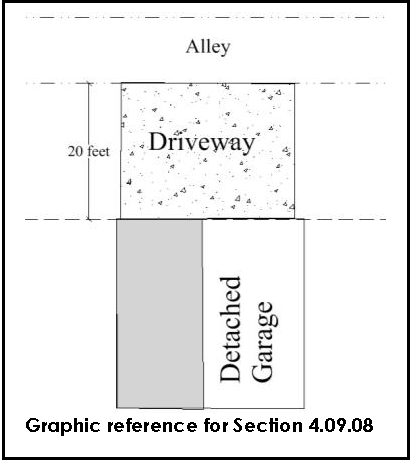
4.09.08 When a detached garage has access to an alley, the rear yard setback shall be increased to 20 feet for garages directly accessing the alley from the garage and door is parallel to the alley. Otherwise it shall be a minimum of five feet.
4.09.09 The total of all accessory buildings shall not exceed 15% of the total lot area with the TA-1 and any residential district.
4.09.10 Temporary and portable carports may be allowed in designated zoning districts provided the following criteria shall be met:
1.
The carport shall be anchored to the ground with a permanent footing.
2.
Carport shall not be allowed to have more than two sides covered with a siding material.
3.
Siding material shall match the style of the primary structure on the lot.
4.
Shall meet all minimum setbacks.
4.09.11 Detached private garages and outbuildings in the Residential Districts within the corporate limits of the City of Seneca for automobiles and/or storage use and other structures customary and appurtenant to the permitted uses and detached accessory garages shall be constructed of materials customarily used in residential construction, and meet the following:
1.
Materials may include non-galvanized, painted corrugated or wide-rib steel for siding and roofing.
2.
Structures exceeding 400 square feet shall have a roof overhang of not less than 12 inches on gable ends and eves, excluding carports.
3.
Garages shall not exceed a maximum width or length of 50 feet.
4.
Accessory structures shall not exceed total square feet in excess of 10% lot coverage with a maximum of 1,800 square feet.
5.
Structures shall have a maximum height of 18 feet measured at the highest roof point down to the highest ground level around the structure.
6.
Any accessory structure shall have a roof with no less than a 3/12 pitch, excluding carports.
4.09.12 Regulation of accessory uses shall be as follows:
1.
Except as herein provided, no accessory building shall project beyond a required yard line along any street.
2.
Service station pumps and pump island may occupy the required yards, provided, however, that they are not less than 15 feet from street lines.
3.
Storage of any boat, boat trailer, camp trailer, or other vehicle shall not be permitted in any required yard; except that a boat, boat trailer, camp trailer may be placed on rock or concrete surfacing in a side yard or rear yard.
(Ord. No. 1392, § 1, 5-1-2019)
Section 4.10. - Permitted Modifications of Height Regulations.
4.10.01 The height limitations of this Ordinance shall not apply to:
Provided that the appropriate yard setbacks are increased by one foot for every two feet in excess of the maximum height requirement for the given zoning district.
4.10.02 When permitted in a district, public or semi-public service buildings, hospitals, institutions, or schools may be erected to a height not exceeding 75 feet when each required yard line is increased by at least one foot for each one foot of additional building height above the height regulations for the district in which the building is located.
Section 4.11. - Occupancy of Basements and Cellars.
No basement or cellar shall be occupied for residential purposes until the remainder of the building has been substantially completed, and any required emergency egress requirements of the City of Seneca have been installed as required per state and life-safety codes.
Section 4.12. - Residential Structure Design Standards.
All residential structures within any Residential District shall comply with the following design standards:
1.
Minimum roof pitch shall be 3 inches in height to 12 running inches.
2.
Exterior siding material shall be made of non-reflective materials. Siding material shall be wood, stucco, ceramic tile, brick, stone, masonry or finished aluminum lap siding as normally found on site-built homes.
3.
Roofing materials shall be wood shingles, wood shakes, composition shingles, fiberglass shingles, asphalt shingles, clay or concrete tile, slate, or metal roofing materials. Roofing materials and methods shall comply with the International Building code as adopted by the governing body of the City of Seneca. Corrugated and galvanized metal roofing materials shall not be permitted on the residential structure.
4.
On level sites the main floor shall be no greater than 20 inches above finished grade. On sloping or irregular sites, the side closest to grade level shall be no greater than 20 inches above finished grade at the foundation.
5.
The home shall be mounted on a foundation or basement that meets the requirements of the Seneca Building Code.
6.
If 70% of the residential structures on both the block face and the opposite block face where the home is to be located have attached garages, then a garage constructed according to the provisions of the Seneca Building Code shall be attached to the residential design manufactured home.
Section 4.13. - Non-Conforming, General Intent.
This section addresses the few instances when existing development does not conform to provisions of these Regulations (nonconformities). The continued existence of nonconformities may be inconsistent with the purposes of these Regulations. Therefore, this section provides for the gradual elimination of nonconformities. This section restricts further expansion of nonconforming structures or uses.
4.13.01 Non-Conforming Uses Which May Be Continued:
1.
The following lawful non-conforming uses of land may be continued:
a.
A use of land which existed prior to the effective date of this Zoning Ordinance.
b.
A use of land existing at the time of the annexation.
c.
A use of land existing at the time an amendment is made to the Zoning Ordinance which changes such land to a more restricted district or extends the jurisdiction of the Zoning Ordinance to the land use.
2.
The lawful use of a building located upon any land, except as provided in Section 4.13.02 below, may be continued although such use does not conform with the provisions of this Zoning Ordinance, and such use may be continued throughout the building if no structural alterations are made therein, except those required by law or ordinance. If no structural alterations are made in such building, a non-conforming use of the building may be changed to another non-conforming use if deemed by the Zoning Administrator to be of a similar non-conforming use or a non-conforming use that is more appropriate to the district. The foregoing provisions shall also apply to any uses of buildings which may be made non-conforming by any subsequent amendment or change of this Zoning Ordinance.
3.
Normal maintenance and incidental repair, or replacement, installation or relocation of nonbearing walls, nonbearing partitions, fixtures, wiring or plumbing, may be performed on any structure that is devoted in whole or in part to a non-conforming use.
4.
Nothing in these regulations shall be deemed to prevent the strengthening or restoring to a safe condition of a structure in accordance with an order of a public official who is charged with protecting the public safety who declares such structure to be unsafe and dangerous and orders its restoration to a safe condition.
5.
The property owner shall be responsible for establishing that said nonconformity is a legal nonconformity.
4.13.02 Non-Conforming Uses Which May Not Be Continued:
1.
When a non-conforming use is discontinued or abandoned, for a period of 12 consecutive months, such use shall not thereafter be re-established or resumed, and any subsequent use or occupancy of such land shall comply with these Regulations.
2.
No use which is accessory to a principal non-conforming use shall continue after such principal use shall cease or terminate.
3.
No non-conforming structure shall be moved in whole or in part for any distance whatever, to any other location on the same or any other lot unless the entire structure shall thereafter conform to the regulations of the zoning district in which it is located after being moved.
4.
Whenever a non-conforming use of building has been changed to a conforming use, such use shall not thereafter be changed back to a non-conforming use.
5.
A non-conforming building which has been damaged to the extent of more than 50 percent of its fair market value by any means including fire, explosion, act of God, or the public enemy shall not be restored, except in accordance with all zoning regulations of the zoning district. In the event a question may arise on the fair market value of such a building, the same shall be determined by three appraisers: One shall be selected by the Governing Body, one shall be selected by the owner of the building, and the third appraiser shall be selected by the two selected appraisers. If the first two appraisers selected cannot agree on the selection of the third such appraiser, the Judge of the appropriate court shall be requested to appoint the third appraiser. The decision of the appraisers, or a majority of them, shall be final and conclusive and shall be binding upon all concerned to the purpose of determining whether the damaged property may be restored. The cost of such appraisal shall be paid by the property owner.
Section 4.14. - Nonconforming Lots of Record.
In any district notwithstanding limitations imposed by other provisions of these Regulations, a structure and customary accessory building may be erected on any single lot of record at the effective date of adoption or amendment of these Regulations, provided such development shall be subjected to all applicable bulk regulations of the zoning district, unless otherwise permitted by variance.
Section 4.15. - Repairs and Maintenance.
4.15.01 On any building devoted in whole or in part to any nonconforming use, work including ordinary repairs or on repair or replacement of non-bearing walls, fixtures, wiring or plumbing may be done provided that the cubic content of the building as it existed at the time of passage of amendment of these Regulations shall not be increased.
4.15.02 Nothing in these Regulations shall be deemed to prevent the strengthening or restoring to a safe condition of any building or part thereof declared to be unsafe and dangerous by order of the Building Official.
Section 4.16. - Vesting of Development Rights.
4.16.01 For the purpose of residential developments, development rights shall vest upon recording a plat of such land. If construction is not commenced on such land within five years of recording a plat, the development rights in such shall expire and the plat shall be resubmitted for review and approval.
4.16.02 For all purposes other than single-family developments, the right to use land for a particular purpose shall vest upon the issuance of all permits required for such use by the city and construction has begun and substantial amounts of work have been completed under a validly issued permit.
Section 4.17. - Uses under Conditional Use Permit not Nonconforming Uses.
Any use for which a special exception has been issued as provided in previous Ordinances shall not be deemed a nonconforming use, but shall without further action be deemed a conforming use in such district.
Section 4.18. - Zero Lot Line.
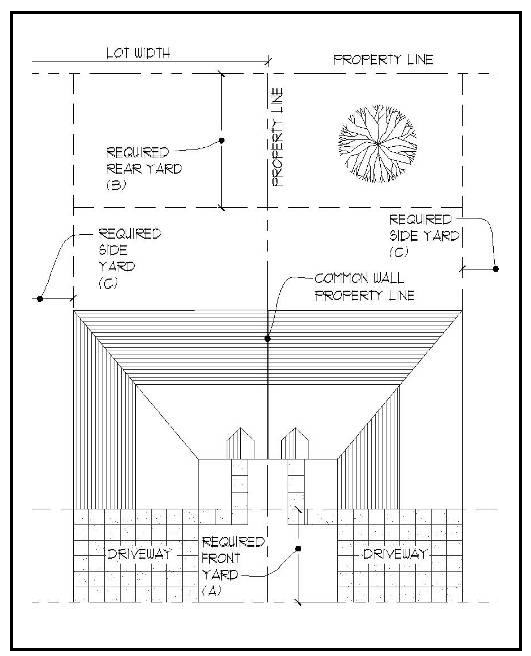
4.18.01 Zero lot line concept is where a single- or two-family dwelling has one exterior wall on or within one foot of a side property line and the remaining side yard is double the normal side yard required by the district regulations. Zero Lot Line Developments may be built under the following conditions:
1.
When submitted as part of a new subdivision plat or an amendment to an existing subdivision and each lot to be developed using the Zero Lot Line concept is so designated showing which lot line is the Zero Lot Line.
2.
On an existing lot in a partially developed subdivision when submitted to and approved by the Board of Zoning Appeals as a variance under Article 11 of the zoning regulations.
4.18.02 On any lot approved for the Zero Lot Line concept by platting, re-platting or approval of the Board of Zoning Appeals, the following stipulations shall apply:
1.
A maintenance easement at least five feet in width shall be provided and recorded on the property adjoining the designated Zero Lot Line.
2.
There shall be no door or window openings on the side of the house which is built on the Zero Lot Line.
3.
No portion of a roof, gutter or other part of the structure shall project past the Zero Lot Line and all roof drainage will be installed so as to keep all run-off water off of the adjoining property.
Section 4.19. - Rear Yard Setbacks Reduction.
The rear yard setback may be the lesser of the required setback in a district or 20 percent of the depth of the lot.
Section 4.20. - Temporary Uses and Permits.
4.20.01 The Administrator shall issue temporary permits for buildings to be constructed and used for storage incidental to construction of buildings on the property and for signs advertising a subdivision or tract of land or the lots thereon. The permits shall not exceed 180 days in duration unless the following conditions apply:
1.
Model homes or apartments, if contained within the development to which they pertain.
2.
Development sales offices. Such offices may remain in place until 90 percent of the lots or units within the development are sold and may not be located within a mobile home or manufactured home/structure.
3.
Public assemblies, displays, and exhibits.
4.
Christmas tree or other holiday-related merchandise sales lots, provided that such facilities are not located in a residential zoning district.
5.
Construction site offices, if located on the construction site itself.
6.
Outdoor special sales, provided that such sales operate no more than three days in the same week and five days in the same month; and are located in commercial or industrial zoning districts.
7.
Construction Batch Plants, provided that:
a.
No plant may be located within 600 feet of a developed residential use, park, or school.
b.
Hours of operation do not exceed 12 hours per day.
c.
The duration of the plant's operation does not exceed 180 days, but may be extended by the Development Administrator if unforeseen circumstances have delayed the project.
4.20.02 Required Conditions of All Temporary Uses
1.
Each site shall be left free of debris, litter, or other evidence of the use upon its completion or removal.
2.
The Planning Commission, or its designee, may establish other conditions which he/she deems necessary to ensure compatibility with surrounding land uses.
4.20.03 Permit Application and Issuance
1.
An application to conduct a temporary use shall be made to the Development Administrator and shall include at a minimum a description of the proposed use; a diagram of its location; information regarding hours and duration of operation; and other information necessary to evaluate the application.
2.
The Planning Commission, or its designee, may authorize a temporary use only if he/she determines that:
a.
The use will not impair the normal operation of a present or future permanent use on the site.
b.
The use will be compatible with surrounding uses and will not adversely affect the public health, safety, and welfare.
3.
The duration of the permit shall be explicitly stated on the permit.
Section 4.21. - Sanitation Requirements.
Hereafter all structures used for habitation, employment or otherwise - providing indoor plumbing facilities shall be connected to a municipal type, public benefit, or approved private sewerage disposal system. It shall be unlawful to occupy any structure without providing for said system. It shall be unlawful to discharge sewage either beneath or on top of the ground without an approved system. It shall be unlawful to operate a malfunctioning sewerage system that discharges effluent to the surface of the ground.
Section 4.22. - Prohibited Uses.
All uses which are not specifically permitted or are not permissible as a Conditional Use throughout each district of this Ordinance are prohibited until such time as the Ordinance is amended accordingly.
Section 4.23. - Fees.
The payment of any and all fees for any zoning or subdivision related action or permit request shall be required prior to the issuance or investigation of any said action or permit request. Such fees shall be adopted and published by the City Council by separate Resolution.

