
Seneca City Zoning Code
ARTICLE 7
- Parking Requirements
Section 7.01.- Purpose.
The Off-Street Parking Regulations require developments provide parking in proportion to the need created by each use. The regulations further establish standards for the functional design of parking facilities. These regulations are intended to accommodate vehicles in a functionally satisfactory manner and to minimize external effects on neighboring properties.
Section 7.02. - Off-Street Automobile Storage.
7.02.01 Off-street automobile storage or standing space shall be provided on any lot on which any of the uses or similar uses found in Section 7.03.
7.02.02 All off-street parking facilities shall be so designed and constructed to meet the requirements set forth by the City Engineer.
7.02.03 All areas used for parking shall be maintained in good condition free of holes, dust, and debris.
7.02.04 Off-street automobile storage or standing space shall be provided with vehicular access to a street or an alley.
7.02.05 For purposes of computing the number of parking spaces available in a given area, the ratio of 250 square feet per parking space shall be used. Where calculations in accordance with the foregoing list results in requiring a fractional space, any fraction less than one-half shall be disregarded and any fraction of one-half or more shall require one space.
7.02.06 All parking spaces for single-family, two-family, and multi-family dwellings, rooming and boarding houses, convalescent homes, and mobile homes shall be either gravel or paved with asphalt or concrete.
7.02.07 In Districts R-1, R-2 and R-3 required off-street parking for residential uses shall be provided on the lot on which the use is located. In all other Districts, if the vehicle storage space or standing space required in Section 7.03 cannot be reasonably provided on the same lot on which the principal use is conducted in the opinion of the Planning Commission and City Council, the City Council may permit such space to be provided on another off-street property, provided such space lies within 400 feet of an entrance to such principal use. Such vehicle standing space shall be deemed to be required open space associated with the permitted use and shall not thereafter be reduced or encroached upon in any manner.
7.02.08 Where off-street parking is located on a lot other than the lot occupied by the use, which requires it, site plan approval for both lots is required.
7.02.09 Some uses may require two different use types to be calculated together in order to determine the total parking requirement, i.e. primary schools may require one a calculation for classrooms and another for assembly areas.
7.02.10 The parking requirements herein do not apply to the C-1 Downtown Commercial District.
7.02.11 All off-street parking conditions shall meet the ADA requirements in Section 7.05 of this Ordinance.
Section 7.03. - Schedule of Minimum Off-Street Parking and Loading Requirements.
Section 7.04. - Off-Street Parking: Shared Parking Requirements.
7.04.01 Notwithstanding the provisions of Section 7.03, in cases where parking and building patterns are such that overlapping uses of a majority of the total number of parking spaces in a common parking lot is likely to occur, compliance with the standard parking ratios may be decreased by the Planning Commission and City Council.
Section 7.05. - Off-Street Parking: Parking for Individuals with Disabilities.
7.05.01 In conformance with the Americans with Disabilities Act (ADA), if parking spaces are provided for self-parking by employees or visitors, or both, then accessible spaces shall be provided in each parking area in conformance with the table in this section. Spaces required by the table need not be provided in the particular lot. They may be provided in a different, if equivalent or greater accessibility, in terms of distance from an accessible entrance, cost and convenience, is ensured.
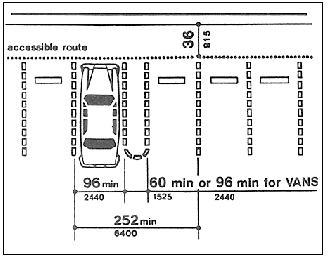
Source: http://www.ada.gov/adastd94.pdf
7.05.02 Access aisles adjacent to accessible spaces shall be 60 inches wide at a minimum.
1.
One in every eight accessible spaces, but not less than one, shall be served by an access aisle 96 inches wide minimum and shall be designated "van accessible" as required by Section 7.05.04 of this Ordinance. The vertical clearance at such spaces shall comply with 7.05.05 of this Ordinance. All such spaces may be grouped on one level of a parking structure.
2.
Parking access aisles shall be part of an accessible route to the building or facility entrance. Two accessible parking spaces may share a common access aisle.
3.
Parked vehicle overhangs shall not reduce the clear width of an accessible route.
4.
Parking spaces and access aisles shall be level with slopes not exceeding two percent in all directions.
5.
If passenger-loading zones are provided, then at least one passenger loading zone shall comply with 7.05.06 of this Ordinance.
6.
At facilities providing medical care and other services for persons with mobility impairments, parking spaces complying with 7.05 of this Ordinance shall be provided in accordance with 7.05.01 of this Ordinance; except as follows:
a.
Outpatient units and facilities: 10 percent of the total number of parking spaces provided serving each such outpatient unit or facility;
b.
Units and facilities that specialize in treatment or services for persons with mobility impairments: 20 percent of the total number of parking spaces provided serving each such unit or facility.
7.
Valet parking: valet parking facilities shall provide a passenger loading zone complying with 7.05.06 of this Ordinance located on an accessible route to the entrance of the facility. Sections 7.05.01, 7.05.02 (1), and 7.05.02 (3) of this Ordinance do not apply to valet parking.
7.05.03 Location of accessible parking spaces serving a particular building shall be located on the shortest accessible route of travel from adjacent parking to an accessible entrance.
1.
In parking facilities that do not serve a particular building, accessible parking shall be located on the shortest accessible route of travel to an accessible pedestrian entrance of the parking facility.
2.
In buildings with multiple accessible entrances with adjacent parking, accessible parking spaces shall be dispersed and located closest to the accessible entrances.
7.05.04 Signage of accessible parking spaces shall be designated as reserved by a sign showing the symbol of accessibility. Spaces complying with Section 7.05.02 (1) shall have an additional sign stating the stall is "Van Accessible" mounted below the symbol of accessibility. Such signs shall be located so they cannot be obscured by a vehicle parked in the space.
7.05.05 Minimum vertical clearance of 114 inches at accessible passenger loading zones and along at least one vehicle access route to such areas from site entrance(s) and exit(s). At parking spaces complying with 7.05.02 (1), provide minimum vertical clearance of 98 inches at the parking space and along at least one vehicle access route to such spaces from site entrance(s) and exit(s).
7.05.06 Passenger Loading Zones shall provide an access aisle at least 60 inches wide and 240 inches long adjacent and parallel to the vehicle pull-up space. If there are curbs between the access aisle and the vehicle pull-up space, then a curb ramp complying with accessibility standards shall be provided. Vehicle standing spaces and access aisles shall be level with surface slopes not exceeding two percent in all directions.
Section 7.06. - Off-Street Parking Design Criteria.
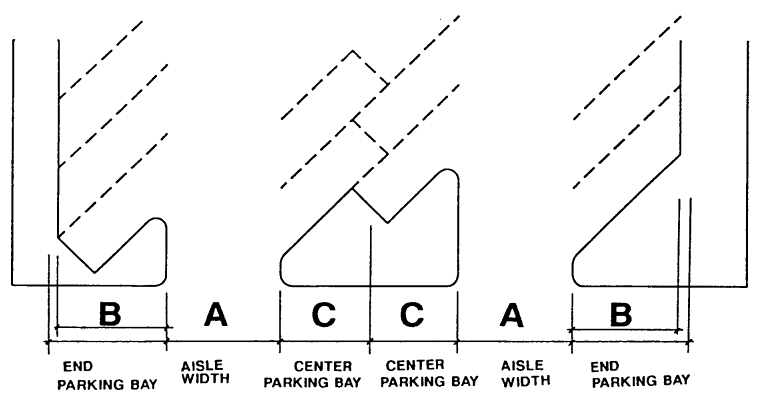
7.06.01 Standard parking stall dimensions shall not be less than nine feet by 18 feet, plus the necessary space for maneuvering into and out of the space. Where the end of the parking space abuts a curbed area at least five feet in width (with landscaping or sidewalk), an overhang may be permitted which would reduce the length of the parking space by two feet. Such overhang shall be measured from the face of the curb. For standard parking lots, minimum dimensions shall be as follows:
7.06.02 Minimum dimensions for a parallel parking space shall be nine feet by 23 feet.
7.06.03 Off-street parking areas shall be oriented to and within a reasonable walking distance of the buildings they are designed to serve.
7.06.04 Access to parking areas shall be designed so as not to obstruct free flow of traffic. There shall be adequate provision for ingress to and egress from all parking spaces to ensure ease of mobility, ample clearance, and safety of vehicles and pedestrians.
7.06.05 Minimum parking dimensions for other configurations or for parking lots with compact car spaces shall be determined by the Planning Commission and City Council upon recommendation of the City Engineer.
7.06.06 Parking facilities shall be designed to provide visibility of and between pedestrians and vehicles when circulating within or entering or leaving the facility; and shall not create blind, hidden, or hazardous areas.
7.06.07 Where sidewalks occur in parking areas, parked vehicles shall not overhang the sidewalk unless an additional one foot is provided in order to accommodate such overhang.
7.06.08 Parking areas shall be suitably landscaped to minimize noise, glare, and other nuisance characteristics as well as to improve the environment of the site and surrounding area. Large parking lots shall be broken down into sections as appropriate for the type and size of the development. Sections shall be separated by landscaped dividing strips, berms, and similar elements.
7.06.09 Circulation patterns shall be designed in accord with accepted standards of traffic engineering and safety.
7.06.10 All parking facilities shall be maintained to assure the continued usefulness and compatibility of the facility. Acceptable maintenance includes keeping the facility free of refuse, debris, and litter; maintaining parking surfaces in sound condition; and providing proper care of landscaped areas.
7.06.11 Lighting:
1.
Any lighting used to illuminate any off-street parking area shall be arranged to direct light away from adjoining properties in any residential district.
2.
Lighting standards or shall not exceed 22 feet in height and shall be equipped with top and side shields when necessary to prevent glare onto adjacent properties.
3.
The average maintained lighting levels for multi-family units shall not exceed 10 foot-candles at buildings/parking lots/other areas within a residential district. The maximum to average ratio shall not exceed 2.5 to 1.

