
Senoia City Zoning Code
ARTICLE VIIB
INCLUSIVE COMMUNITY
Sec. 74-146.- Purpose of the inclusive community district (IC).
The purpose of the inclusive community district is to (1) address the lack of affordable and moderately-priced housing characterizing the Senoia housing supply, (2) foster neighborhood cohesiveness and social interaction, (3) promote infill development in locations served by public improvements rather than development of greenfields, (4) create walkable settings, (5) foster residential development compatible with existing neighborhoods and (6) realize savings in infrastructure and public services delivery costs. These purposes may be achieved by such approaches as reduced dwelling floor areas, smaller lot sizes in combination with greenspace reservation, and implementation of a sidewalk network linking such developments to town center.
The inclusive community district is intended to foster development of affordable housing that blends with the historic development pattern of the city. Given the dominance of market rate housing, demonstrating price escalation that is placing homeownership beyond the reach of many of Senoia households, the IC shall be limited to developments that mandate that all dwellings be affordable as defined by U.S. Department of Housing and Urban Development guidelines. This limitation is significant as public policy objectives of inclusiveness are paired with substantial infrastructure improvements designed to achieve these important objectives.
The inclusive community district is established to allow single family detached dwellings at an approximate density of five dwellings per acre. Public water and sanitary sewer systems are required to support such development.
(Ord. No. 19-06, § 1c, 7-1-2019)
Sec. 74-147. - Connectivity improvements within IC district.
A development strategy identified in the Draft 2016—2036 Comprehensive Plan states, "The city intends to protect these areas (R-40 residential developments) from incompatible adjacent development, particularly loud or noxious uses. The construction of sidewalks in these subdivisions where there are none. The connectivity of these subdivisions to each other and near to commercial areas via multi-use trails, paths, and sidewalks. The city shall endeavor to construct pedestrian and street connectivity to future developments." The provision of public improvements such as sidewalks to serve new inclusive community district neighborhoods is consistent with this plan strategy. Input gleaned from a visioning exercise revealed the following comments concerning housing that support the tenets of the inclusive community district:
• Affordable, yet historic; and
• Senior housing that is historic and affordable; and
• Smaller homes; and
• Quality housing for all economic groups.
(Ord. No. 19-06, § 1c, 7-1-2019)
Sec. 74-148. - Policy objectives.
Public policy objectives associated with the IC district include a desire to focus moderate density residential development near the town center and expand housing options to offer a wider range of price points. Based on price escalation in the local housing market, IC developments and price points will concentrate on affordable housing. Accordingly, the IC will be limited to publicly owned land within which land costs can be controlled and infrastructure improvements can be provided by the City of Senoia. Only the following properties shall be rezoned to the inclusive community district to facilitate such development:
(Ord. No. 19-06, § 1c, 7-1-2019)
Sec. 74-149. - Development standards.
The following development standards are intended to foster construction of medium density, affordable housing in compact subdivisions featuring smaller lot sizes and reduced dwelling unit floor areas:
Floor area and housing prices. In an effort to improve housing affordability, minimum average floor area in the inclusive community district shall be 1,000 square feet and minimum dwelling floor area shall be 800 square feet. Dwelling unit sizes shall range from 800 square feet to 1,250 square feet. All dimensions refer to heated floor area.
Minimum and average lot size. Together with minimum floor area, architectural design and exterior finish, minimum lot area forms a significant indicator of housing cost. The cost of land to the developer is a substantial portion of total development costs. These costs are passed on to the buyer and larger lot size tends to yield higher housing costs. The cost of larger lots also becomes a real cost to the community, as the costs of new streets and eventually street maintenance, and the cost of all public improvements, are associated with the linear footage of improvements such as sidewalks, potable water, sanitary sewer service, stormwater systems, lighting and street trees. Smaller lots mean shorter utility runs and long term savings to the City of Senoia.
Senoia has historically developed with a reliance on septic systems. However, Senoia has been building sanitary sewer capacity and this capacity can serve commercial, industrial and residential development. Public sanitary sewer service allows residential development on relatively small lots.
The inclusive community district establishes a minimum average lot size of 8,000 square feet and an absolute minimum lot size of 6,000 square feet. Minimum lot size for developments that feature rear alleys and a "village green" shall be 3,200 square feet. For the purposes of this district, a village green shall be any contiguous space that contains a minimum area of 4,800 square feet. The village green shall be served by a public sidewalk and landscaped with canopy trees, treeform shrubs and ground covers. The green shall also feature a minimum of one picnic shelter appropriately sized to the scale of the development. The village green shall be dedicated to the City of Senoia. The purpose of the village green is to promote social interaction, relegate personal vehicles to the rear of the lot, and allow reduced front yard setbacks to place dwellings near the village green. See exhibit "A" attached [below].
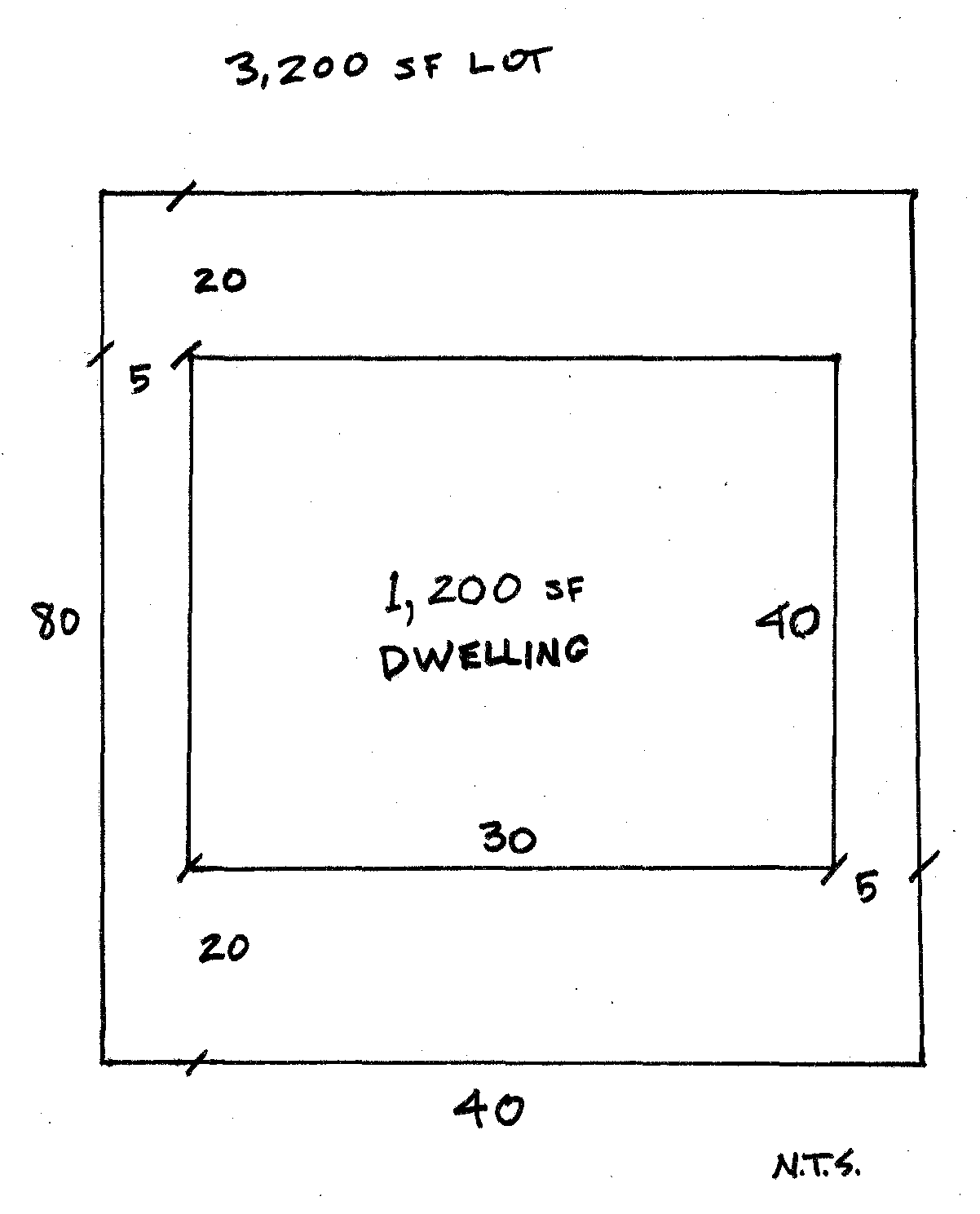
Exhibit A
Architectural design and finishes. Given Senoia's historic character and a desire to promote inclusiveness by blending new housing with the characteristics of historic homes in and around the town center, the following architectural standards shall apply to the inclusive community district:
(1)
Architectural style shall be limited to craftsman, cottage and victorian styles.
(2)
Minimum roof pitch shall be 6:12 using materials as currently permitted; provided that the craftsman style dwellings may have a minimum roof pitch of 4:12. Dwelling roofs shall have a surface of wood shakes, asphalt composition, wood shingles, concrete, fiberglass or metal tiles, slate, built up gravel materials or other materials approved by the building inspector.
(3)
Exterior finishes shall be of a clapboard design featuring wood, fiber cement siding or high quality vinyl and other siding materials and application techniques, including masonry, concrete stucco, masonite, and vinyl lap or other material of like appearance.
(4)
Front loading garages and carports shall be allowed, provided these structures are recessed a minimum of four feet from the front elevation of the dwelling.
Placement on the lot. The front yard setback shall be a minimum of ten feet on a local street to accommodate a physical connection to the village green. The street side setback of a corner lot in an IC development shall be 15 feet and minimum lot width of a corner lot shall be 60 feet. The street side setback of a corner lot in an IC development using the village green option shall be ten feet and minimum lot width of a corner lot shall be 40 feet. All other development standards shall be as indicated in Table 6.1, below:
Driveway materials, maximum width and location. Parking areas and driveways shall consist of concrete pavement. Driveways accessing a one-car garage or a parking pad shall have a maximum width of ten feet. Driveways accessing a two-car garage or a tandem parking pad shall have a maximum width of 16 feet at the garage and a maximum width of 12 feet at the street with a flare no further than 20 feet from the garage or tandem parking pad. No driveway shall be located less than five feet from a side lot line.
Ample buffering. A typical method for mitigating the impact of a more intense use on a less intense use is a landscape buffer. More often used to diminish the impact of commercial uses on residential uses, this same method can be used to protect low density single family neighborhoods from the depreciating effects of small lot development, if any exist. Accordingly, the inclusive community district shall meet the following buffer standards:
(1)
A landscaped buffer having a minimum horizontal dimension of 30 feet and consisting of tree form shrubs and hardwood species to approximate a natural condition while achieving a partial screen shall be established along all common boundaries with any property developed or zoned as single family residential. Such buffer shall achieve a minimum height of six feet at the time of planting and shall be subject to approval by the zoning official who may approve a buffer dimension of 20 feet based on berming and other design characteristics that will achieve an appropriate screen. Such buffer shall be established and permanently maintained on the higher density property.
(2)
A landscaped buffer having a minimum horizontal dimension of 100 feet and consisting of tree form shrubs and hardwood species to approximate a natural condition and while also achieving a partial screen shall be established by the developer along any property boundary fronting on an arterial or collector street. An identical buffer having a minimum horizontal dimension of 50 feet shall be established by the developer along any property boundary fronting on a local street. Such buffers shall be dedicated as public right-of-way.
(3)
Such buffers shall be depicted on the recorded final plat accompanied by a statement as to the perpetual maintenance of the dimensions and character of the buffer.
Parking and vehicle storage. A maximum of two vehicles shall be parked or stored outdoors on the lot at any time.
(Ord. No. 19-06, § 1c, 7-1-2019)

