
Shakopee City Zoning Code
PERFORMANCE STANDARDS
151.105 Purpose
- The guiding of land development into a compatible relationship of uses depends upon the maintenance of certain standards. The purpose of this subchapter is to establish limitations on certain activities with a high potential for pollution or nuisance.
- The performance standards shall apply in all zones, unless specifically stated to the contrary.
(2013 Code, § 11.60) (Ord. 1, passed 4-1-1978; Ord. 31, passed 10-25-1979; Ord. 96, passed 11-11-1982; Ord. 132, passed 9-22-1983; Ord. 158, passed 1-31-1985; Ord. 246, passed 6-17-1988; Ord. 253, passed 10-14-1988; Ord. 259, passed 11-11-1988; Ord. 272, passed 8-25-1989; Ord. 338, passed 8-6-1992; Ord. 377, passed 7-7-1994; Ord. 434, passed 11-30-1995; Ord. 430, passed 2-1-1996; Ord. 815, passed 3-26-2009)
151.106 Exterior Storage
- In all zones, exterior storage is prohibited except as regulated by conditional use permit, planned unit development, or as specifically provided in the zone regulations.
- Notwithstanding the above, exterior storage of the following items is a permitted accessory use in residential zones:
- Laundry drying;
- Recreational equipment;
- Construction and landscaping materials and equipment currently being used on the premises;
- Agricultural equipment and materials if these are used or intended for use on the premises; and
- Off-street parking of personal vehicles.
(2013 Code, § 11.60) (Ord. 1, passed 4-1-1978; Ord. 31, passed 10-25-1979; Ord. 96, passed 11-11-1982; Ord. 132, passed 9-22-1983; Ord. 158, passed 1-31-1985; Ord. 246, passed 6-17-1988; Ord. 253, passed 10-14-1988; Ord. 259, passed 11-11-1988; Ord. 272, passed 8-25-1989; Ord. 338, passed 8-6-1992; Ord. 377, passed 7-7-1994; Ord. 434, passed 11-30-1995; Ord. 430, passed 2-1-1996; Ord. 815, passed 3-26-2009)
151.107 Refuse
All refuse shall be stored and disposed of in accordance with Ch. 51.
(2013 Code, § 11.60) (Ord. 1, passed 4-1-1978; Ord. 31, passed 10-25-1979; Ord. 96, passed 11-11-1982; Ord. 132, passed 9-22-1983; Ord. 158, passed 1-31-1985; Ord. 246, passed 6-17-1988; Ord. 253, passed 10-14-1988; Ord. 259, passed 11-11-1988; Ord. 272, passed 8-25-1989; Ord. 338, passed 8-6-1992; Ord. 377, passed 7-7-1994; Ord. 434, passed 11-30-1995; Ord. 430, passed 2-1-1996; Ord. 815, passed 3-26-2009)
151.108 Construction Material
- Special minimum requirements and performance standards for all commercial and industrial uses.
- Building design and materials.
- Building materials shall be attractive in appearance, have a durable finish, and be of an architectural character and quality that is compatible and harmonious with adjacent structures. All buildings shall be of high architectural quality so as to maintain and enhance the property values of neighboring properties, and not adversely impact the community’s public health, safety, and general welfare.
B-3 B-1, B-2, MR, NC, Commercial uses in PRD & CC, and Institutional Uses in residential zones. Mixed Use Buildings follow R-3 / R-4 standards. I-1, I-2 BP Permitted Major Exterior Building Materials Face brick, glass, brick veneer, pre-cast concrete panels with integrated thin / cast-in brick, natural stone, simulated natural stone. Buildings greater than two levels above grade are permitted to have accent materials as major exterior materials for the façade areas above the second level. Brick, manufactured and natural stone, integral color precast concrete panels (painted and raked finishes are not permitted), glass, color impregnated decorative block, fiber cement siding or wall panels, spandrel glass, engineered wood siding. Brick, manufactured and natural stone, integral color precast concrete panels (painted and raked finishes are not permitted), color impregnated decorative concrete block, glass, reflective glass, fiber cement wall panels. Brick, manufactured and natural stone, precast concrete panels (painted and raked finishes are not permitted), glass, reflective glass, color impregnated decorative concrete block, fiber cement wall panels. Permitted Accent Materials (all accent materials combined must total less than 30% of façade) Exterior finished wood, polished concrete block, decorative architectural metal (copper, cast iron, bronze, brass, or similar materials), stucco > 12' above grade, glazed brick, fiber cement wall panels, glass block, lap siding, non-corrugated insulated metal panel systems. Natural or synthetic stucco > 12' above grade, exterior finished wood, decorative architectural metal (copper, cast iron, bronze, brass, or similar materials), spandrel glass, glass block, non-corrugated insulated metal panel systems. Decorative architectural metal (copper, cast iron, bronze, brass, or similar materials), spandrel glass, glass block, exterior finished wood, glass block, non-corrugated insulated metal panel systems, engineered wood fiber siding*, fiber cement siding* Decorative architectural metal (copper, cast iron, bronze, brass, or similar materials), non-corrugated insulated metal panel systems, spandrel glass, glass block, Exterior finished wood for up to 10% of a façade. Prohibited Materials In Specific Zone Reflective glass, manufactured stone, wood / simulated wood shakes, stucco, spandrel glass, painted brick, or stucco over brick. Smooth, unfinished, or painted concrete block, painted pre-cast concrete panels, synthetic stucco (Dryvit / EIFS) < 12' above grade, corrugated metal, vinyl siding. Smooth, unfinished, or painted concrete block, painted pre-cast concrete panels, natural or synthetic stucco (Dryvit / EIFS) < 12' above grade, corrugated metal, vinyl siding. Smooth, unfinished, or painted concrete block, painted pre-cast concrete panels, natural synthetic stucco (Dryvit / EIFS) < 12' above grade, corrugated metal, vinyl siding. Smooth, unfinished, or painted concrete block, painted pre-cast concrete panels, natural or synthetic stucco (Dryvit / EIFS) < 12' above grade, corrugated metal, vinyl siding. Specific Minimum Requirements The dominant material of a first level facade must be brick, with at least 40% of a façade facing a right of way as windows. Existing single or two family dwellings may follow single-family residential design standards. At least 25% of the façade with a main entrance as windows. Buildings greater than 10,000 square-feet in floor area must have 5% of facades facing right-of-ways as windows or glass block. Existing single or two family dwellings may follow single-family residential design standards. Multi-family buildings may follow R-3 / R-4 standards. At least 4% of façade facing right-of-ways as windows. Coolers, mechanical rooms, or portions of a building façade for bulk storage of raw materials; such as grain, asphalt, liquids, or gases. etc. may be excluded from the window area requirement. At least 10 % of façade facing right-of-ways as windows, 15 % windows for facades facing US Hwy 169, main entrance features with at least 300 square-feet of windows. Required Design Features In-fill buildings (new buildings located on a half-block with at least 2 other existing structures, or at least 4 other buildings on an entire block) must match front setback of directly adjacent structures and not exceed height of directly adjacent structures by greater than two levels. Louvers and vents must be color integral to match surrounding materials Color integral horizontal and vertical design features or banding and contrasting and complementary colors. Franchise or prototypical architecture shall be adapted to reflect the design standards of this subsection. Louvers and vents must be color integral to match surrounding materials Color integral horizontal and vertical design features or banding and contrasting and complementary colors. For facades facing a right of way: Wall height variations of at least 7.5% of height every 100' horizontally. Louvers and vents must be color integral to match surrounding materials Color integral horizontal and vertical design features, contrasting and complementary trim colors. For facades facing a right of way: Wall depth and height varations. Wall depth variation at least 2% of the depth of building, with variations at least 10' in width at least every 100’ horizontally. Wall height variations of at least 7.5% of building height at least every 100' horizontally of building façade. Louvers and vents must be color integral to match surrounding materials Prohibited Design Features / Techniques By Zone Bricked up / covered (wholly or partially) window openings, shutters, mansard roofs, bowed awnings, sandblasting brick, Fencing (except for duration of construction projects), pitched roofs, painting or covering up existing brick, cornices, or other historic design features. Major materials, accent materials, or trim of buildings must not be bright or non-earthtone colors; such as fluorescent or reflective colors. Windows must not be covered with signage, wraps, graphics or images, unless permitted by the sign ordinance. Bricked up / covered (wholly or partially) window openings, windows must not be covered with signage, wraps, graphics or images, unless permitted by the sign ordinance. Truck loading docks shall not face right-of-ways unless screened by landscaping or berms, or a combination there of to a height of 8' at time of planting or construction. A screening wall must be at least as tall as the items it is intended to screen and be constructed of the same materials as the principal building. Truck loading docks shall not face rights-of-way unless screened by landscaping or berms, or a combination there of to a height of 8' at time of planting or construction. A screening wall must be at least as tall as the items it is intended to screen and be constructed of the same materials as the principal building. Special Requirements For buildings greater than 15,000 square-feet of floor area: The front façade must have covered entryways or arcades. Recesses, projections, cornices, pilasters, or a combination of these features must be used at least every 30' on facades with a main entrance or facing a street For buildings greater than 30,000 square-feet in floor area: The front façade must have covered entryways or arcades at least 6' in depth. Recesses, projections, cornices, pilasters, or a combination of these features must be used at least every 50' on facades facing a street or having a main entrance. *: Engineered wood siding and fiber cement siding is not permitted as accent material for buildings greater than 10,000 square-feet of floor area Zone R-3 & R-4 Permitted Major Exterior Building Materials Brick, natural and synthetic stucco > 12' above grade, natural and manufactured stone, integral color precast concrete panels with integrated thin / cast-in brick (smooth, raked, or painted finishes are not permitted), fiber cement siding or wall panels, engineered wood siding. Permitted Accent Materials (all accent materials combined must total less than 30% of façade) Exterior finished wood, decorative architectural metal, non-corrugated insulated metal panel systems, glass block Prohibited Materials In Specific Zone Smooth, unfinished, or painted concrete block, painted pre-cast concrete panels, synthetic stucco (Dryvit / EIFS) < 12' above grade, corrugated metal, vinyl siding Specific Minimum Requirements At least 30% of all façades as windows Required Design Features Pitched and flat roofs require variation in roofline at least every 30 feet measured horizontally. Minimum roof pitch for pitched roofs is 6:12 (rise : run), wall depths must vary at least every 30' by at least 5% of building depth. Decks and balconies on 75% of total units at least 6' in depth and 7’ in width may qualify as varying wall depth. Louvers and vents must be color integral to match surrounding materials Prohibited Design Features / Techniques By Zone Mansard roofs
- Building materials shall be attractive in appearance, have a durable finish, and be of an architectural character and quality that is compatible and harmonious with adjacent structures. All buildings shall be of high architectural quality so as to maintain and enhance the property values of neighboring properties, and not adversely impact the community’s public health, safety, and general welfare.
- Accent materials and visual relief. Accent materials shall be wrapped around walls visible from public view. Painting of materials or walls shall not be substituted for visual relief, accenting, or a required element. No wall shall exceed 100 feet in length without visual relief. VISUAL RELIEF may be defined as the incorporation of design features such as windows, horizontal and vertical patterns, contrasting material colors, or varying wall depths.
- Major exterior materials permitted. Major exterior materials of all walls shall comply with the materials table above.
- Major exterior materials prohibited. Unadorned pre-stressed concrete panels, whether smooth or raked; non-decorative concrete block; sheet metal; corrugated metal; or unfinished metal (except copper or other metal specifically engineered for exterior architectural use, shall not be used as exterior materials. This restriction shall apply to all principal structures and to all accessory buildings except those accessory buildings not visible from any property line. No more than 25% of any exterior wall on a building shall be wood or metal accent material.
- Building materials visible from roadways. This subchapter shall apply to all exterior repairs, remodeling, or expansions of existing buildings that require a building permit. Roadways means all public roadways, whether local streets, collector streets, arterial, freeway, or other classification.
- Roof materials. Roofs that are exposed or an integral part of the building aesthetics shall be constructed only of commercial grade asphalt shingles, wood shingles, standing seam metal, slate, tile, copper, or materials similar in appearance and performance. Flat roofs, which are generally parallel with the first floor elevation, are not subject to these material limitations.
- Materials standards. All building and roofing materials shall meet current accepted industry standards, and tolerances, and shall be subject to review and approval by the Development Review Committee for quality, durability, and aesthetic appeal. For all new buildings and building exterior renovations, the applicant shall submit to the city product samples, color building elevations, and associated drawings which illustrate the construction techniques to be used in the installation of such materials. Building and roofing materials not specifically approved in this subchapter may be allowed by a conditional use permit or planned unit development only after it is demonstrated that the proposed material is equal to or better than approved materials. The long-range maintenance of the proposed material shall be incorporated as a condition of the approval and filed on the property.
- Trash handling and recycling. All trash, recyclable materials, and trash and recyclable materials handling equipment shall be stored within the principal structure; totally screened from public view by the principal building; or stored within an accessory structure constructed of building materials compatible with the principal structure enclosed by a roof, and readily served through swinging doors or an overhead door on tracks. Compactors shall be totally screened from eye level view from public streets and adjacent properties. Existing uses shall comply with the enclosure requirements listed in this subchapter within 6 months of receiving notice from the city.
- Accessory structures. Garages, accessory structures, screen walls, and exposed areas of retaining walls shall be of a similar type, quality, and appearance as the principal structure.
- Mechanical Unit screening. The ground level view of all mechanical equipment and related piping, ducting, electrical, and mechanical utilities for commercial, industrial, institutional, and multi-family residential buildings greater than 10 units shall be painted to match the building, designed to be compatible with the architectural treatment of the principal structure or screened by the use of parapet or screening walls. Mechanical units greater than 3.5' in height above a roof or grade must be screened by an approved screening method other than paint. Wood fencing shall not be used for screening.
- Building design and materials.
B. Minimum Requirements in R-2, R-3, R-4, and PRD Zones:
Building design and materials. Building materials shall be attractive in appearance, durable, and of an architectural quality which is compatible with adjacent structures. All buildings shall be of good aesthetic and architectural quality, as demonstrated by the inclusion of at least 3 of the following elements:
- Accent materials;
- A front entry that, in addition to doors, shall have an area of accent materials a minimum of 150 square feet around the door entrance for single occupancy buildings and a minimum of 300 square feet total for the front of multi-tenant buildings (this area shall be counted as one element);
- Contrasting, yet complementary material colors;
- A combination of horizontal and vertical design features;
- Varying wall depths and shapes;
- Varying roof line, design, or materials;
- Decorative lighting design;
- Art or sculptural elements; or
- Other unique architectural features in the overall architectural concept.
- Major exterior materials. Major exterior surfaces on all walls shall be facing brick (glazed or unglazed), glass, clay facing tile, stone masonry (granite, limestone, marble, slate, sandstone, or quartzite, or manufactured stone), finished texture stucco (cement or synthetic), exterior finished wood siding (painted, stained, or weather-sealed), exterior finished metal siding (not including sheet metal or corrugated metal / pole barn siding of any kind).
- Minimum requirements for all residential uses in zones other than the R-3 and R-4 zones:
- fiber cement siding or wall panels, engineered wood siding, exterior rated vinyl siding.
- Plans and materials samples. For all new development projects, buildings, and building exterior renovations, the applicant or architect shall submit to the city product samples, color building elevations, and associated drawings that illustrate the construction techniques to be used in the installation of such materials. If complementary building styles, materials, and color schemes are proposed for a development, the developer shall submit to the city a plan showing the distribution of the styles, materials, and colors throughout the development.
- Materials and design standards: All building and roofing materials shall meet current accepted industry standards, and tolerances, and shall be subject to review and approval by the city for quality, durability, and aesthetic appeal.
- For single family dwellings and townhomes, an attached front-loading garage must not protrude from the front facade greater than 50% of the width of the living space of the front facade of each unit, up to a maximum garage protrusion of 14 feet.
- Covered front porches with a depth of at least five feet with a width of at least 50% of the width of the facade of the living space portion of the facade that have a width of at least eight feet may count as living space for purposes of this section. Finished habitable living space, such as a bonus room located directly above a garage and within four feet of the front building line of a garage is considered living space for purposes of this section.
- Side-loading garages that meet the following design criteria are permitted to protrude beyond the front building line of a house if both of the following conditions are met:
- At least 15% of garage facade facing a street or private drive is windows
- At least 25% of garage facade facing a street or private drive is brick, stone, or manufactured stone
- At least 15% of garage facade facing a street or private drive is windows
- Windows are required on all sides of new single-family and attached residential dwellings in subdivisions receiving preliminary plat approval after July 1, 2019. Windows must be installed in accordance with the following requirements:
- Facades, whether the front or rear of the building that face a street or private drive: at least 10% of the building facade
- For corner lots, a facade other than the front facade must have at least 5% of the facade as windows
- All other sides of the building: at least 5% of the facade as windows
- Additions greater than 200 square-feet floor area to existing structures must meet the window coverage requirements
- Windows that are part of overhead garage doors and other exterior doors are included in the calculations for buildings up to six units.
- Facades, whether the front or rear of the building that face a street or private drive: at least 10% of the building facade
- Trash handling and recycling. Except in R-1A Low-Density Residential, R-1B Urban Residential, and R-1C Old Shakopee Residential, all trash, recyclable materials, and trash and recyclable materials handling equipment shall be stored within the principal structure, totally screened from public view by the principal building, or stored within an accessory structure constructed of building materials compatible with the principal structure, enclosed by a roof, and readily served through swinging doors. Compactors that are attached to the principal structure shall be totally screened from eye level view from public streets and adjacent properties to a screening wall constructed of the same building material as the principal structure. Existing uses shall comply with the enclosure requirements listed in this subchapter within 5 years of receiving notice from the city.
- On-site screening. Except in R-1A Low-Density Residential, R-1B Urban Residential, and R-1C - Old Shakopee Residential, all mechanical equipment, utility meters, storage, and service areas and similar features shall be completely screened from the eye-level view from adjacent properties and public streets, or designed to be compatible with the architectural treatment of the principal structure. Agricultural uses. Agriculture uses in the Rural Residential Zone are exempt from the materials standards listed above.
- Minimum requirements for all residential uses in zones other than the R-3 and R-4 zones:
(Ord. 896, passed 11-18-2014) (Ord. 1, passed 4-1-1978; Ord. 31, passed 10-25-1979; Ord. 96, passed 11-11-1982; Ord. 132, passed 9-22-1983; Ord. 158, passed 1-31-1985; Ord. 246, passed 6-17-1988; Ord. 253, passed 10-14-1988; Ord. 259, passed 11-11-1988; Ord. 272, passed 8-25-1989; Ord. 338, passed 8-6-1992; Ord. 377, passed 7-7-1994; Ord. 434, passed 11-30-1995; Ord. 430, passed 2-1-1996; Ord. 677, passed 8-28-2003; Ord. 815, passed 3-26-2009, Ord. O2021-006, passed 03-16-2021 )
Amended by Ord. O2019-010 Amending Off Street Parking on 8/7/2019
Amended by Ord. O2019-016 on 11/19/2019
151.109 Bulk Storage Of Liquids
All bulk storage of oil, gasoline, liquid fertilizer, chemicals, and similar liquids shall comply with the requirements of the appropriate state or federal agency. Within the Agricultural Preservation (AG) and Rural Residential (RR) Zones, all bulk storage shall be in above-ground containers.
(2013 Code, § 11.60) (Ord. 1, passed 4-1-1978; Ord. 31, passed 10-25-1979; Ord. 96, passed 11-11-1982; Ord. 132, passed 9-22-1983; Ord. 158, passed 1-31-1985; Ord. 246, passed 6-17-1988; Ord. 253, passed 10-14-1988; Ord. 259, passed 11-11-1988; Ord. 272, passed 8-25-1989; Ord. 338, passed 8-6-1992; Ord. 377, passed 7-7-1994; Ord. 434, passed 11-30-1995; Ord. 430, passed 2-1-1996; Ord. 815, passed 3-26-2009)
151.110 Grading, Filling, And Excavations
- Definition. The term GRADING as used in this section means any excavating, grading, filling, or any other change in the earth’s topography involving disturbing 5,000 square feet or more; removing, importing, or moving more than 50 cubic yards of soil, dirt, or similar materials.
- Grading associates with development. Grading that is proposed to be done in contemplation of, in connection with, or in any manner associated with, the development, subdivision, or platting of land, may only be undertaken after a grading permit has been approved and issued by the City Engineer pursuant to an approved preliminary plat, planned unit development, or conditional use permit. Any such grading must be done in accordance with the plans as approved by the City Engineer.
- Other grading. Grading that is not associated with development may only be done after the grading plans have been approved by the City Engineer and after the issuance of a grading permit by the City Engineer. Any such grading must be done in accordance with the plans as approved by the City Engineer.
- Conditional use permit required. A conditional use permit is required for grading or vegetation alteration in a designated floodplain or designated Shoreland Overlay Zone.
- Exceptions to grading permit requirement. A grading permit is not required for the following activities, except as may be required by other chapters of this code of ordinances, state statutes or rules, or federal law:
- Earthwork that will result in removing, importing, or moving less than 50 cubic yards of soil, dirt, or similar material that does not take place in any designated floodplain or Shoreland Overlay Zone; or
- Removal of trees that are storm damaged; or
- Agricultural activities; or
- Grading or tree removal that has been approved and authorized pursuant to a Woodland Management Plan subject to § 151.113, or a building permit properly issued under Ch. 111.
- Grading permit submittal requirements. No grading permit will be issued until the applicant:
- Pays the grading permit fee set forth in the city’s most recently adopted fee schedule;
- Submits a complete grading permit application in a form approved by the City Engineer;
- Submits all plans, drawings, and calculations required by the City Engineer;
- Obtains approvals or permits required by other governmental entities;
- Provides the city with a certificate of general liability insurance with limits of at least the amounts established by M.S. § 466.04, as it may be amended from time to time, and naming the city as an additional insured for all work to be done as part of the grading; and
- Provides the city with a cash deposit or a letter of credit in a form approved by the City Attorney in the amount of 125% of the estimated costs for installation and construction (including the costs of city inspection and administration) of all erosion control devices and site restoration, or $1,000 per disturbed acre, whichever is higher.
(2013 Code, § 11.60) (Ord. 1, passed 4-1-1978; Ord. 31, passed 10-25-1979; Ord. 96, passed 11-11-1982; Ord. 132, passed 9-22-1983; Ord. 158, passed 1-31-1985; Ord. 246, passed 6-17-1988; Ord. 253, passed 10-14-1988; Ord. 259, passed 11-11-1988; Ord. 272, passed 8-25-1989; Ord. 338, passed 8-6-1992; Ord. 377, passed 7-7-1994; Ord. 434, passed 11-30-1995; Ord. 430, passed 2-1-1996; Ord. 790, passed 3-20-2008; Ord. 815, passed 3-26-2009; Ord. O2021-023, passed 10-19-2021)
151.111 Screening
- Whenever required, screening shall be accomplished through the use of landscaping, topography, site planning, or construction materials. Screening shall provide an opaque obstruction to view. All construction materials used shall be of good quality and compatible with the materials of the principal structure. Chain link fencing interwoven with slats shall not be allowed as a screening material. Landscaping materials utilized for screening shall be healthy specimens of hardy species appropriate for the purpose. All screening shall be maintained in good condition or repair and shall be replaced when it no longer serves its intended function.
- Screening shall be accomplished in accordance with the following:
- All exterior storage permitted by this chapter shall be screened, except for the following: goods being displayed for sale, materials and equipment being used for construction on the premises, merchandise located on gas station pump islands, and accessory uses in residential zones (except parking facilities as specified below);
- Off-street parking facilities in the Medium-Density Residential (R-2) and Multiple-Family Residential (R-3/R-4) Zones shall be screened whenever the parking facility contains more than 4 parking spaces and is within 30 feet of a lot line, and whenever the driveway to a parking facility of more than 6 parking spaces is within 15 feet of a lot line by landscaping and where practicable, berming;
- Parking facilities within any required front yard setback shall be screened to a height of 3 feet by landscaping and where practicable, berming or low wall;
- Screening shall be required in all business and industry zones whenever any business or industrial use is adjacent to or across a street from property zoned or developed for residential use;
- Screening shall be required between any multifamily complex and single family property(ies);
- All roof top mechanical equipment shall be totally screened from view from adjacent properties and existing and planned streets, painted to match or complement the building, or incorporated into an architectural design which is aesthetically compatible with the building;
- Refuse containers in business and industry zones which are visible from existing or planned streets, residential areas, institutional uses, or places of public assembly shall be screened to a height of 6 feet and be fully enclosed;
- Loading and service areas located between a street and a building in any commercial or industry zone shall be screened to a height of 4 feet; and
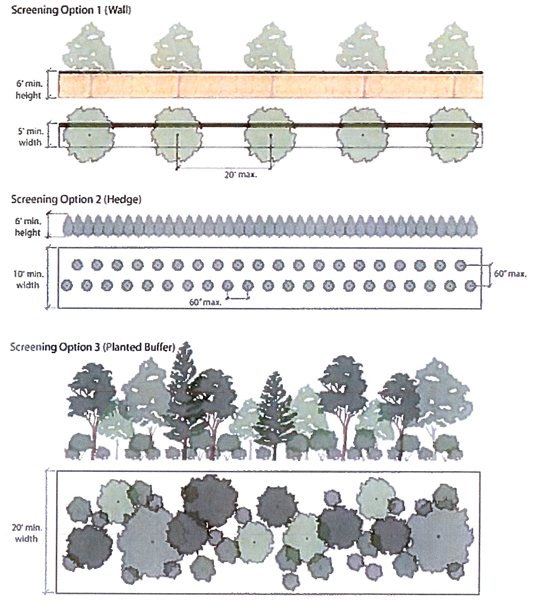
- When commercial or industrial development abuts existing residential development or residentially zoned properties, the nonresidential development shall provide one of the following screening treatments along all lot lines abutting single-family detached dwellings:
- Buffer yard with a minimum width of five feet that includes a solid masonry wall measuring at least 6 feet in height and canopy trees planted along the outside perimeter with a maximum on-center spacing of 20 feet; or
- Buffer yard with a minimum width of ten feet that includes an alternating double row of various evergreen shrubs and may include a berm to achieve a minimum height at time of planting of 6 feet, planted a maximum of 60 inches on-center per the table of approved plant materials or spacing on industry plant standards; or
- Buffer yard with a minimum width of 20 feet that includes vegetative screening meeting the following standards per 100 linear feet and the requirements.
- Eight canopy trees (at least two evergreen); and
- Four understory trees (at least one evergreen); and
- Twenty-five shrubs (at least 16 evergreen shrubs).
- Additional buffer yard is not required when residential uses are separated from other uses by a public street. Ordinary landscaping requirements must still be met.
(2013 Code, § 11.60) (Ord. 1, passed 4-1- 1978; Ord. 31, passed 10-25-1979; Ord. 96, passed 11-11-1982; Ord. 132, passed 9-22-1983; Ord. 158, passed 1-31-1985; Ord. 246, passed 6-17-1988; Ord. 253, passed 10-14- 1988; Ord. 259, passed 11-11-1988; Ord. 272, passed 8-25-1989; Ord. 338, passed 8-6-1992; Ord. 377, passed 7-7-1994; Ord. 434, passed 11-30-1995; Ord. 430, passed 2-1-1996; Ord. 563, passed 11-25- 1999; Ord. 631, passed 6-27-2002; Ord. 815, passed 3-26-2009; Ord. O2018-003, passed 4-3-2018)
Amended by Ord. O2018-003 Modifying the Screening, Landscape and Tree Preservation on 4/3/2018
151.112 Landscaping Requirements
Landscaping shall be required in all residential, commercial, and industrial zones.
- Definitions. For this section, the following definitions shall apply unless the context clearly indicates or requires a different meaning.
EXTERIOR SIDEWALK CONNECTION. A sidewalk or trail which connects the interior sidewalk or trail network to a required or existing public sidewalk or trail.
GROSS FLOOR AREA. The total floor area for every floor inside the building envelope, including the external walls, and excluding the roof.
INTERIOR SIDEWALK CONNECTION. A sidewalk or trail network which is within a development project to connect multiple businesses, or parking facilities to primary entrances or privately owned open space areas.
SIDEWALK. A finished hard surface with a width of at least five feet.
TRAIL. A finished hard surface or a firm and stable natural surfacing material with a width of at least eight feet. - Landscaping materials.
- For all single-family residential uses in the R-1 A, R-1B, R-1C, R-2 and Planned Residential District, the following landscaping materials shall be provided prior to the issuance of a final certificate of occupancy:
- Placement of at least six inches of topsoil meeting requirements set in division (M) below;
- Each single family lot shall have a minimum of two street trees in the boulevard or if not feasible, two non-ornamental trees (planted or preserved), in the front yard. In R-1 A, three non-ornamental trees (planted or preserved) must be placed in the front yard. If trees cannot be placed in the front yard due to easements or spacing, trees shall be placed in the rear yard;
- Sod shall be placed in the front yard; and
- The side yards and rear yard shall be seeded.
- Native plants may be substituted for sod or seeding as long as they meet the requirements set in the city native landscape plant list (see city website).
- For all single-family residential uses in the R-1 A, R-1B, R-1C, R-2 and Planned Residential District, the following landscaping materials shall be provided prior to the issuance of a final certificate of occupancy:
- Landscape requirements for residential business, and industrial uses. For all residential uses containing six or more dwellings, and for all business and industrial uses, at least 15% of the lot area shall be landscaped with grass, shrubs and trees per the required table. The landscaping shall be concentrated between the principal structure and any adjacent street right-of-way or other areas of the lot which are visible from a street. Street trees shall be placed every 40 feet or if not permitted, tree shall be placed in the front yard
Building Footprint Area Required Landscaping First 10,000 square feet 2 trees/1,000 square feet 10,001 to 50,000 square feet Additional 1.5 trees/1,000 square feet 50,001 to 100,000 square feet Additional 1 tree/1,000 square feet 100,001 square feet and greater Additional 1 tree/1,500 square fee Maximum number of ornamental trees 25% of required landscaping trees - Impervious areas. In addition to trees required for gross building area, for projects with impervious areas which exceed 4,000 square feet, one shade tree shall be required for each 4,000 square feet of impervious area. When calculating the required landscaping, square feet shall be rounded up to the nearest 1,000 square feet and pervious pavement shall be excluded.
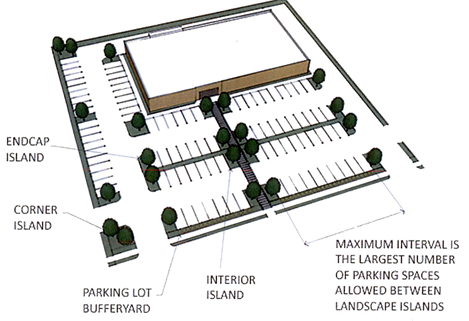
- Parking facilities. A portion of the required landscaping shall be placed in a parking facility containing more than 25 parking spaces in accordance with the following minimum landscaping requirements.
- At least one deciduous shade tree shall be planted for every ten spaces;
- Landscape islands shall meet the following requirements:
- Contain at least one shade tree;
- Provide the appropriate available rooting space listed in division (G) below;
- A minimum of ten feet wide;
- Curbed around all outside corners/radius of end caps and extending ten feet from the corner/end of the radius;
- Concrete ribbon curbing must be provided on any paved edge which is not curbed; and
- Proper drainage must be provided within landscape islands which allow storm water flow into the island.
- Non-permanent car stops and asphalt curbing shall not be used.
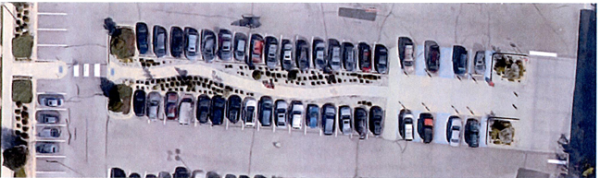
- Example.
- Trees needed. Number of trees needed to be placed within the parking area equals one tree for every ten spaces plus street trees and perimeter landscaping.
- Example.
- Minimum size requirements.
- Deciduous trees. Two and a half inch caliper for commercial/industrial and two inch for single family residential;
- Coniferous trees. Six feet in height;
- Ornamental trees. One and a half inch caliper
- Shrubbery. Five gallons
- No more than 25% of the trees may be made up of ornamental species.
- Minimum soil volume for required trees.
Planting Space Soil Volume Required Cubic Feet Maximum Depth for Volume Calculation Maximum Compaction One tree 700 3 feet 200 PSI or 80% Standard Proctor Two trees 1,000 3 feet 200 PSI or 80% Standard Proctor - Allowable trees. Landscaping trees shall not be any species presently under disease or insect epidemics, considered invasive, or a species that composes a high percentage of the city's urban forest without prior written approval from the city. Recommended species can be found on the city's website, shakopeemn.gov under Forestry Specification Manual.
- Tree diversity. If less than 30 trees are required, one species shall make up no more than one-fourth of the total and meet the requirements set in the city's Forestry Specifications Manual on the city website.
Diversity for Required/Replacement Trees Maximum Quantity Species 10% Genus 20% Family 30% - Trees location. Trees shall not be planted in a location that will interfere with other infrastructure or be in extreme competition for resources with other trees at maturity.
- Landscaping credit.
- If healthy landscaping of acceptable species and location exist on a site prior to development and is preserved, the city's Zoning Administrator may allow credit for such landscaping to meet up to 30% of the trees required.
- Credit may be given based on the following:
Preserved Trees Tree Credit Excluded tree No Credit Common significant tree > 6 inches 1 tree Exceptional significant tree > 4 inches 4 trees High priority tree > 15 inches 8 trees
 Pedestrian sidewalk system in Commercial and Industrial Zones. In all zoning districts the pedestrian sidewalk system shall meet the following standards.
- In retail center developments, interior sidewalk connections are required between each building.
- A pedestrian island or walkway at least five feet in width shall be required for all parking facilities which have parking spaces greater than 250 feet from a main entrance to a building and in accordance with the following:
- A pedestrian island or walkway shall be provided to separate pedestrian traffic and vehicular traffic.
- A pedestrian island or walkway must provide pedestrian access spanning in a generally direct route from main entrance to the furthest drive aisle within a parking facility. City staff may allow pedestrian walkways or islands to be of a reduced length if other adjacent sidewalks and trails outside of the parking area allow pedestrians access to a main entrance of a building.
- Pedestrian islands or walkways which are adjacent to handicapped (ADA compliant) parking shall provide ADA compliant pedestrian ramps or be at the same elevation as the parking and loading area.
- The pedestrian island shall be landscaped in accordance with the requirements for landscape islands and parking lots.
- Pedestrian islands and walkways shall be designed to limit vehicle encroachment into walkway area, either by two feet setback from parking lot to walkway edge or a physical barrier such as but not limited to: curbing, trees, shrubs, or bollards.
- An exterior sidewalk connection is required for all sites which have existing and/or required public sidewalks, adjacent trails, parks, or green ways.
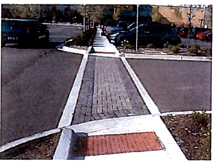
- Where pedestrian islands and walkways cross drive aisles, crossing areas shall be clearly designated by striping or differentiated paving material.
- Topsoil. Topsoil in landscaped areas shall be at least six inches in depth and a sandy loam, silt loam, loam, or sandy clay consisting of no more than 65% sand, 1.5% to 10% organic matter, a pH of 4.5 to 6.8, soluble salts less than 2 mmhos/em, free of chemical contaminants, and not compacted beyond 80% of Standard Proctor or 200 PSI. Subsoil shall be scarified before topsoil is spread. Soil shall be generally free of debris such as large rocks and fragments of wood.
- Financial security.
- The city shall require submission of a financial security in form of a cash escrow, or other form of security that the city deems acceptable, in the amount of 150% of the total tree replacement estimate, at $400 per replacement tree or as is updated from time to time in the city's fee schedule.
- The city shall require a landscaping escrow prior to issuance of any certificate of occupancy including temporary or permanent if landscaping work is not completed. The escrow amount shall be 150%. of the contract value as reviewed and approved by the city. The landscape escrow agreement shall also include a right of entry for the city to install landscaping using the escrow if it is not completed or if plantings die within six months or next growing cycle of TCO or permanent CO.
- The financial security shall be collected before the grading permit is issued for tree replacement and prior to TCO or CO if all the landscaping is completed.
- All required landscaping plants must be warranted for two years to guarantee survival. The warranty period shall begin upon inspection and acceptance by city staff of the installed plants for proper planting, size, species, health, and location, and if at any time during the warranty period the plants are found to be unhealthy by city staff, they are required to be replaced with the same size and species by the applicant at the soonest appropriate planting time.
- For commercial/industrial sites and residential developers, up to 75% of the financial security may be returned upon inspection and acceptance by the city of installed plants and upon the submittal of a city-approved two year warranty from the landscape contractor who installed the plants. This warranty must cover plant health issues relating to excess or insufficient water. The remaining financial security will be held by the city for two years. When reducing the financial security, 75% will be returned unless city staff feels the trees have a heightened risk of failure.
- For builders of individual residential lots in a subdivision who receive a two year warranty from the landscape contractor who installed the plants, up to 100% of the financial security may be returned upon:
- Inspection and acceptance of installed plants by the city; and
- Providing the lot buyer with the copy of the two year warranty from the landscape contractor and contact information to make a claim on the warranty.
- If the financial security has not been returned in full after the inspection of the installed trees, at the end of a 2-year warranty period the applicant shall schedule a final inspection with city staff.
- Prior to the inspection, the applicant shall confirm the following conditions are met:
- All trees have 1 dominate leader, are free of deadwood, and injured branches;
- All tree wrap is removed;
- All stakes and wires are removed; and
- Plants are in leaf.
- At the time of final inspection the city shall decide to:
- Refund the financial security in full; or
- Require the installation of new plants to replace what did not survive or are declared unhealthy by city staff. If 25% or more of the plants are required to be replaced, the appropriate amount of financial security may be held for an additional 2 years for said plants.
- Prior to the inspection, the applicant shall confirm the following conditions are met:
- The financial security will be used by the city only if the applicant does not install the plants required in this division (N). The owner/builder/developer grants the city access to its property to replace required place using the financial security that has been provided if plants are not replaced within 60 days or such time as negotiated by city staff.
- Effective date. This section becomes effective from and after its passage and publication.
(Ord. 1, passed 4-1-1978; Ord. 31, passed 10-25-1979; Ord. 96, passed 11-11-1982; Ord. 132, passed 9-22-1983; Ord. 158, passed 1-31-1985; Ord. 246, passed 6-17-1988; Ord. 253, passed 10-14-1988; Ord. 259, passed 11-11-1988; Ord. 272, passed 8-25-1989; Ord. 338, passed 8-6-1992; Ord. 377, passed 7-7-1994; Ord. 434, passed 11-30-1995; Ord. 430, passed 2-1-1996; Ord. 487, passed 7-10-1997; Ord. 815, passed 3-26-2009; Ord. 884, passed 5-20-2014; Ord. 923, passed 11-17-2015; Ord. O2018-003, passed 4-3-2018)
Amended by Ord. O2018-003 Modifying the Screening, Landscaping and Tree Preservation on 4/3/2018
151.113 Tree Preservation Regulations
- Purpose. The city regards natural features such as woodlands and bluffs as part of the community's identity, attracting residents and businesses to the area, City Council recognizes that not protecting these assets would have a quantifiable economic, social, and environmental loss. An objective of the city's Comprehensive Plan is to preserve, enhance, and maintain natural wooded areas within the city. This section aims to achieve this objective by encouraging responsible land development through rewarding those who use creative site design and minimize the impact to existing landscape and neighborhood character.
- Regulations. The following requirements and standards shall apply to any tree removal including, a preliminary plat, final plat, minor subdivision, building permit, demolition permit, conditional use permit variance, or grading permit is required by the city on any parcel of land containing a significant tree. The city is authorized to deny or revoke any permits extended by the city for individuals or organizations in violation of this section.
- Applicability. The following developments are exempt from the requirements for tree replacement:
- Any alteration of the tree canopy taking place on a residential property less than two and a half acres in size other than for an initial dwelling;
- Home gardens or an individual's home landscaping, repairs, and maintenance work;
- Existing agricultural, horticultural, or silvicultural operations. Expansions of existing agricultural operations will be subject to the requirements for tree replacement;
- Emergency work to prevent or alleviate immediate damages to life, limb, property, or natural resources. In such event, if tree replacement had been required but for emergency, the obligations of this division (C) shall apply and shall be performed at the earliest reasonable time thereafter;
- Maintenance of existing infrastructure by the city is exempt from the requirements of this section.
- Definitions. For the purpose of this section, the following definitions shall apply unless the context clearly indicates or requires a different meaning.
APPLICANT. Any person submitting an application to the city for any activity for which a preliminary plat, final plat, minor subdivision, building permit, demolition permit, conditional use permit, variance, or grading permit is required on land containing a significant tree.
BASIC INFRASTRUCTURE. Includes roads, streets, sidewalks, rights-of-way, sanitary sewer, storm sewer, septic tanks, dram fields, water, natural gas, electric, cable television service, drainage ways, and storm ponds.
BUILDABLE LAND. Any land not considered a wetland or easement as defined in the City Code or a bluff impact zone as defined in the design criteria.
BUILDING PARAMETER. The footprint of a building or structure with a distance not to exceed 20 feet in each direction thereof. The area of disturbance on either side of a driveway, when added together, shall not exceed 20 feet.
CALIPER INCH. The measurement of a tree trunk measured at 4.5 feet above the root ball.
COMMON TREE. Any of the following trees: poplar; red maple; ash; elm; cedar; mulberry; balsam fir; birch; pine; spruce; tamarack; black locust; or other fast growing deciduous trees not listed as an exceptional tree. Trees that are not included in overall tree inventory and are not required to be replaced are ash, buckthorn, willow, fruit trees, cottonwood.
CONTIGUOUS WOODLAND. A contiguous tree canopy greater than 2 acres regardless of land ownership.
CRITICAL ROOT ZONE or CRZ. A radius of 1½ feet for every 1 inch of DBH for the tree trunk of the tree being preserved. Example: If a tree's DBH is 10 inches, its CRZ is 15 feet (10 x 1 1/2 = 15).
DEVELOPMENT. Any activity for which a preliminary plat, final plat, minor subdivision, building permit, demolition permit, conditional use permit, variance, fence permit, or grading permit is required on land containing a tree.
DIAMETER AT BREAST HEIGHT or DBH. The diameter of the trunk of a tree measured in inches 4 1/2 feet above the ground from the uphill side of the tree.
DIAMETER AT ROOT COLLAR or DRC. Used for measuring multi-stem trees. Trees are examined to see if they have a unified crown and are counted at each stem and multiplied by .6. Single trees are measured individually if there is no shared canopy.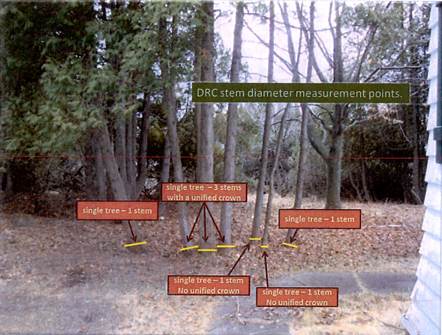
EXCEPTIONAL TREE. Any of the following trees: oak; hickory; basswood; sugar maple; black maple; cherry; catalpa; walnut; hackberry; hornbeam; coffee tree; butternut; buckeye; or horse chestnut.
FORESTRY SPECIALIST. A state registered land surveyor, civil engineer, landscape architect, forester, or certified arborist, who is capable of identifying a tree by species. Only an arborist can identify and classify trees that are in poor health or considered hazardous.
HAZARD TREE. A tree posing a threat to property or people that has visible hazardous defects such as dead wood, cracks, weak branch unions, decay, cankers, root problems, or poor tree architecture as defined by the U.S. Department of Agriculture, Forest Service, Northeastern Area's publication How to Recognize Hazardous Defects in Trees (NA-FR-01-96).
HIGH PRIORITY AREA. A group of three or more exceptional trees ten inches DBH or greater with near contiguous canopies or group of any trees that provide a buffer or screening along an adjacent property or street.
HIGH PRIORITY TREE. An exceptional tree 15 inches DBH or greater, or any tree the city has a strong desire to preserve and is declared healthy by the city's staff.
MULTI-STEM TREE. A group of trees that share both a unified crown and common root stock. The diameter is recorded as the diameter at root collar.
REPLACEMENT TREE. A tree that replaces diameter inches of a removed tree. The number of replacement trees required is based off the number of replacement inches calculated with the "remove:replace" ratio.
RESIDENTIAL BUILDING PERMIT. A building permit required for the building of an initial dwelling.
SIGNIFICANT TREE. A living specimen of a woody plant species that is either an exceptional tree whose diameter is 4 inches or greater DBH; a common tree whose diameter is six inches or greater DBH, or a multi-stem tree with 2 or more stems measuring four inches or greater in diameter measured above the root collar.
TREE PRESERVATION PLAN. The tree inventory, site plan, and tree replacement sheet for a site where an applicant proposes to remove a significant tree.
TREE PROTECTION FENCE. Orange snow fencing or polyethylene laminate safety netting placed at the critical root zone of a tree to be preserved.
TREE REPLACEMENT ESTIMATE. The city's cost for a three inch balled and burlapped tree for the current year. The city is required to get three quotes per year and post the chosen quote in the current fee schedule.
WOODLAND ALTERATION. Any private or public infrastructure and utility installation, building construction, excavation, grading, clearing, filling, or other earth change on any parcel of land, where any cutting, removal, or killing of a significant tree on any parcel of land will occur. Residential parcels of land less than two and a half acres in size are subject to the requirements in this section only if the WOODLAND ALTERATION for an initial dwelling.
WOODLAND ALTERATION PERMIT. A permit to allow woodland alteration. - Tree preservation plan requirements.
- Requirements generally. All applicants are required to submit and follow the approved tree preservation plan.
- Requirements of the tree preservation plan. The tree preservation plan must be completed by a forestry specialist and meet the following requirements.
- Tree inventory.
- The tree inventory must include every significant tree on buildable land on the property where the permit is being applied for. In addition to trees on said property, significant trees on adjacent property which have CRZ overlapping onto said property must be inventoried. Each inventoried tree must be tagged with a unique identification number.
- In circumstances where larger areas of the site are not being altered/graded or have no flexibility in planning around significant trees, the applicant may request permission from the city's Planning Department to use a stratified random sample with a fixed area plot to calculate an estimated tree DBH and species for each stratum. The survey results must be within less than 10% of standard error for each stratum. Plots must be marked to allow for replication of survey if necessary.
- The applicant must provide a working digital copy and hard copy spreadsheet displaying the following information for each inventoried tree:
- Identification number;
- Tree size (DBH or DRC);
- Tree species;
- Tree type (common, exceptional, or high priority);
- On-site or off-site (adjacent property);
- Critical root zone (if being preserved);
- Removed or preserved;
- Whether the tree is within a contiguous woodland or high priority area; and
- The total diameter inches of both high priority trees and significant trees inventoried must be displayed.
- Site plan.
- Generally. A scaled drawing of the site including:
- The location, identification number, and tree type (common, exceptional, or high priority) of all inventoried trees;
- Proposed trees to remove and preserve:
- High priority areas and contiguous woodland area;
- Critical root zones of all trees being preserved along with any area within critical root zone that will be impacted;
- Proposed construction/grading limits, lot lines, building parameter, basic infrastructure, buildable land, and building footprint/elevation;
- Locations of tree protection fence and silt fence; and
- Soil stockpile and parking locations during construction.
- Additional requirements.
- A survey of the lot meeting all possible requirements of the tree inventory and site plan must be provided to the builder of the lot. The city must be provided a digital copy of the tree survey for each individual lot.
- Note areas with oak wilt, Dutch elm disease. Emerald Ash Borer, invasive plants such as buckthorn or others listed on the current year's State Department of Agriculture's noxious weed list.
- Generally. A scaled drawing of the site including:
- Tree replacement sheet.
- The tree replacement sheet is a scaled drawing of the site depicting where the replacement trees will be planted.
- The plan must include:
- Calculations for determination of required replacement trees and landscaping required by division (H) below;
- Locations of all trees and other plants being installed on-site;
- Plant list including species, size, and stock type of installed plants;
- Planting details that meet the city's tree planting specifications; and
- Easements, right-of-ways, construction limits, building pads, driveways, and basic infrastructure.
- Residential building permit tree preservation plan. The applicant must complete the city's "residential building-tree preservation plan" as their tree preservation plan which includes a survey meeting all requirements of this division (E) to the city.
- Permit prerequisites. No woodland alteration, grading, or building permits shall be issued by the city until the applicant has installed any required tree protection fencing and it has been inspected and approved by the city.
- Changes to tree preservation plan. Any changes to the tree preservation plan shall be submitted in writing to the city by the applicant for approval. If the change includes any additional significant tree removal, an additional inspection and approval by the city of the tree protection fencing will be required.
- Current tree preservation plan. All information contained in the tree preservation plan must not be more than two years old at the time of submittal. City staff may grant reasonable exceptions to this requirement for residential builders of an individual lot.
- Removal of significant trees. Significant trees required to be removed pursuant to § 130.17, shall be identified as removed on the tree preservation plan and must be removed. Significant trees that are removed for this reason are exempt from the replacement requirements of this division (E).
- Tree inventory.
- Allowable tree removal.
- Generally.
- Developers and builders are required to save as many trees as feasible when grading or building a site.
- When developing the site plan the developer or builder shall:
- Identify high priority trees and areas (using the tree inventory) that are most worthy of preservation;
- Locate roads, buildings, utilities, parking areas, or other infrastructure so as to minimize their impacts on exceptional and high priority trees;
- Preserve trees in groves or clusters recognizing that survivability is greater for groups of trees than individuals;
- Manipulate proposed grading and the limits of disturbance by changing the elevation/location of building pads, parking lots, and streets, and consider the use of retaining walls to reduce the impact of the trees; and
- Review all construction factors that influence tree survivability.
- Standards for site developments.
Type of Development Permitted Removal Caliper Inches Significant Trees Above Permitted Removal Caliper Inches High Priority Trees Excluded Trees and Trees Health Classified "Poor"/Hazard Trees Residential buildings 6 units or less during subdivision 30% of inventoried DBH 1:1 DBH inventoried 1:1.5 (remove: replace) None Residential 6 units or less after subdivision 100% DBH within building parameter None None None Commercial. industrial > 6 unit residential buildings 60% of inventoried DBH 1:1 DBH inventoried 1:1.5 (remove: replace) None Redevelopment 60% of inventoried DBH 1:1 DBH inventoried 1:1.5 (remove: replace None - Tree removal beyond the lot being built on is allowed only for the installation of basic infrastructure. 15% of the inventoried DBH on the buildable land for that lot may be removed without replacement; and
- Removal in excess of this 15% requires replacement of 1:1.5 DBH (remove: replace).
- For any applicant proposing redevelopment of a lot, 30% of the inventoried DBH on the buildable land for the lot being redeveloped is allowed to be removed without replacement. Removal in excess of this 30% requires replacement of 1:1.5 DBH (remove:replace).
- Proposal to remove more than 35% of high priority trees. If an applicant proposes to remove more than 35% of the high priority trees or 25% of a contiguous woodland, based on DBH, the city must be shown site plan alternatives considered by the applicant as evidence an attempt to remove less than said amount of trees was made and an explanation as to why this plan does not work.
- Generally.
- Tree preservation requirements.
- The applicant must preserve all trees identified to be preserved on the tree preservation plan.
- For grading being done between the dates of April 1 and July 31, the CRZ for an oak tree may be increased due to threat of oak wilt. During this time, wound dressing will be applied immediately after damage of an oak tree takes place.
- A tree shall be considered removed if:
- More than 30% of the CRZ is compacted over 80% of Standard Proctor or 200 PSI, cut, filled, or paved;
- More than 30% of the circumference of the trunk is damaged;
- The hydrology in the area of preserved trees changes due to site grading; or
- Severe damage to an oak tree takes place between April 1 and July 31.
- Tree protection fence shall be placed outside of the CRZ of trees being preserved. If fencing is not possible, covering and maintaining the CRZ with geotextile fabric and six plus inches of wood-chip mulch will suffice.
- There may be no construction activity within the CRZ of a significant tree located on an adjacent property.
- Tree replacement standards.
- A replacement tree shall not be any species presently under disease or insect epidemics, considered invasive, or a species that composes a high percentage of the city's urban forest without prior written approval from the city. Recommended species can be found in the city's Forestry Specification Manual.
- Replacement trees must meet the planting size requirements for required landscaping.
- All replacement trees must be installed during appropriate season for that planting stock.
- Replacement trees are not to be installed until exterior construction activities are complete in that area.
- If there are greater or equal to 30 trees that are required, they shall be composed of no more than 10% of one species, 20% of one genus, and 30% of one family. If there are less than 30 trees are required, one species shall make up no more than 25% of the total.
- Replacement trees shall not be planted in a location that will interfere with other infrastructure or be in extreme competition for resources with other trees at maturity.
- The city may accept other vegetative or environmental alternatives proposed by an applicant if those alternatives are monetarily or ecologically equivalent to the value of the replacement trees required by this section.
- Replacement trees shall be planted not more than 18 months from the date of the final approved tree replacement sheet as part of the tree preservation plan. Extensions may be requested in writing to the city.
- If the number of replacement trees cannot be met on-site, the following is required:
- A cash payment of $400 per replacement tree shall be provided to the city for the planting of trees that are as close as possible to the site that payment was received for or to subsidize trees sold to the city's residents;
- Trees may be planted in city-owned or managed land as approved by the city;
- Replacement trees may be installed on other properties owned by the applicant within the city. If a buffer area as defined by the natural resource corridor map is on said property, replacement trees shall be planted in this area first.
- Unauthorized significant tree removal.
- Any person, firm, or corporation who removes or causes the loss of a significant tree identified to be preserved on an approved tree preservation plan or without a permit allowing woodland alteration, shall be required to complete 1 of the following as determined by the city:
- Installation of replacement trees within the same development at a 1:2 DBH (remove:replace); or
- Payment to the city of $500 for every one inch of significant tree removed that was unauthorized. Measurement of each tree will be at DBH or diameter of the stump, whichever is readily available. This amount may be taken by the city from the financial security posted by the applicant for tree replacement, if any. A minimum of $15,000 payment will be required if measurements are unavailable.
- This provision also applies to a conservation easement area that is disturbed during or after development as well as removing a publicly managed tree of any size without written city authorization.
- The city may withhold permits from any person, firm, or corporation who fails to complete the requirements above.
- Any person, firm, or corporation who removes or causes the loss of a significant tree identified to be preserved on an approved tree preservation plan or without a permit allowing woodland alteration, shall be required to complete 1 of the following as determined by the city:
- Financial security.
- The applicant shall provide the city with a cash escrow, or other form of security that the city deems acceptable, in the amount of 150% of the total tree replacement estimate.
- Formula. Number of replacement trees x tree replacement estimate x 150%= financial security due.
- The financial security required for the replacement trees is due prior to the issuance of the grading permit or the commencement of any woodland alteration activity.
- All replacement trees must be warrantied to guarantee survival. The warranty period shall begin upon inspection and acceptance by city staff of the installed trees for proper planting, size, species, health, and location. If at any time during the warranty period replacement trees are found to be unhealthy by city staff they are required to be replaced with the same size and species by the applicant at the soonest appropriate planting time.
- For commercial/industrial sites and residential developers, up to 75% of the financial security may be returned upon inspection and acceptance by the city of installed trees and the submittal of a city-approved two year warranty from the landscape contractor who installed the trees. This warranty must cover tree health issues relating to excess or insufficient water. The remaining financial security will be held by the city for 2 years. When reducing the financial security, 75% will be returned unless city staff feels the trees have a heightened risk of failure.
- For builders of individual residential lots within a subdivision who receives a one-year warranty from the landscape contractor who installed the trees, 100% of the financial security will be returned upon:
- Inspection and acceptance of installed trees by the city; and
- Providing the lot buyer with the copy of the two-year warranty from the landscape contractor and contact information to make a claim on the warranty.
- If the financial security has not been returned in full after the inspection of the installed trees, at the end of a 2-year warranty period, the applicant shall schedule a final inspection with city staff.
- Prior to scheduling the inspection, the applicant shall confirm the following conditions are met:
- All trees have 1 dominate leader, are free of deadwood, and injured branches;
- All tree wrap is removed;
- All stakes and wires are removed; and
- Trees are in leaf.
- At the time of final inspection the city shall decide to:
- Refund the financial security in full; or
- Require the planting of new trees to replace the replacement trees which do not survive or are declared unhealthy by city staff. If 25% or more of the replacement trees are required to be replaced, the appropriate amount of financial security will be held for an additional 2 years for said trees.
- Prior to scheduling the inspection, the applicant shall confirm the following conditions are met:
- The financial security will be used by the city only if the applicant does not install the initial or subsequent replacement trees required in this chapter.
- Any trees required to be removed per § 130.17 from a site, shall be removed and disposed of according to § 130.17 prior to release of the financial security.
- The city shall be exempt from the financial security requirement of this section.
- The applicant shall provide the city with a cash escrow, or other form of security that the city deems acceptable, in the amount of 150% of the total tree replacement estimate.
- General regulations.
- If the applicant disagrees with the city staff's decision with respect to the interpretation or enforcement of this chapter, the applicant may appeal that decision by following the procedure established in § 151.016.
- Land previously planted for commercial tree farm purposes shall be subject to tree replacement requirements as determined appropriate by the city with the maximum requirement being the current allowable tree removal requirements of division (F) above.
- Inspections required in this chapter will be conducted by staff from the city's Natural Resources Department or other city staff as assigned.
- Effective Date. This section becomes effective from and after its passage and publication.
(Ord. 1, passed 4-1-1978; Ord. 31, passed 10-25-1979; Ord. 96, passed 11-11-1982; Ord. 132, passed 9-22-1983; Ord. 158, passed 1-31-1985; Ord. 246, passed 6-17-1988; Ord. 253, passed 10-14-1988; Ord. 259, passed 11-11-1988; Ord. 272, passed 8-25-1989; Ord. 338, passed 8-6-1992; Ord. 377, passed 7-7-1994; Ord. 434, passed 11-30-1995; Ord. 430, passed 2-1-1996; Ord. 815, passed 3-26-2009; Ord. 883, passed 5-20-2014; Ord. O2018-003, passed 4-3-2018)
Amended by Ord. O2018-003 Modifying the Screening, Landscaping and Tree Preservation on 4/3/2018
151.114 Exterior Lighting
- Exterior lighting shall be designed and constructed to limit direct illumination and glare upon or into any other lot or street.
- Reflected glare or spill light shall not exceed five-tenths footcandle as measured on the property line when abutting any residential, lot, and 1 footcandle on any property line abutting a business or industrial lot. Street lights installed in public right-of-way and lights in city parks shall be excepted from these standards.
- Mitigative measures shall be employed to limit glare and spill light to protect neighboring lots and to maintain traffic safety on streets.
- These measures shall include lenses, shields, louvers, prismatic control devices, and limitations on the height and type of fixtures. The city also may limit the hours of operation of outdoor lighting if it is deemed necessary to reduce impacts on the surrounding neighborhood.
- No flickering or flashing lights shall be permitted except where required by the Federal Aviation Administration.
- Direct off-site views of the light source shall be blocked or screened except for globe or ornamental light fixtures, which may be approved when it can be demonstrated that the off-site impacts stemming from direct views of the light source are mitigated by the fixture design or location.
- The city may require submission of a light distribution plan if deemed necessary to ensure compliance with the intent of this chapter.
- In any Industry Zone, light may spill from 1 lot to any other lot; provided, that it does not extend beyond the boundaries of the industry zone.
(2013 Code, § 11.60) (Ord. 1, passed 4-1-1978; Ord. 31, passed 10-25-1979; Ord. 96, passed 11-11-1982; Ord. 132, passed 9-22-1983; Ord. 158, passed 1-31-1985; Ord. 246, passed 6-17-1988; Ord. 253, passed 10-14-1988; Ord. 259, passed 11-11-1988; Ord. 272, passed 8-25-1989; Ord. 377, passed 7-7-1994; Ord. 338, passed 8-6-1992; Ord. 434, passed 11-30-1995; Ord. 430, passed 2-1-1996; Ord. 815, passed 3-26-2009)
151.115 Noise And Vibration
- Noises emanating from any use shall be in compliance with § 130.45, and shall not exceed any standards set by the State Pollution Control Agency.
- Any use established or remodeled after the effective date of this chapter shall be so operated as to prevent vibration discernable at any point beyond the lot line of the site on which such use is located.
- Ground vibration and noise caused by trains, aircraft operations, temporary construction, or demolition, or vehicles other than those involved in a major commercial recreation use or on private property shall be exempt from these regulations.
(2013 Code, § 11.60) (Ord. 1, passed 4-1-1978; Ord. 31, passed 10-25--1979; Ord. 96, passed 11-11-1982; Ord. 132, passed 9-22-1983; Ord. 158, passed 1-31-1985; Ord. 246, passed 6-17-1988; Ord. 253, passed 10-14-1988; Ord. 259, passed 11-11-1988; Ord. 272, passed 8-25-1989; Ord. 338, passed 8-6-1992; Ord. 377, passed 7-7-1994; Ord. 434, passed 11-30-1995; Ord. 430, passed 2-1-1996; Ord. 815, passed 3-26-2009) Penalty, see § 151.999
151.116 Smoke And Particulate Matter
No use shall produce or emit smoke, dust, or particulate matter exceeding applicable regulations established by the State Pollution Control Agency.
(2013 Code, § 11.60) (Ord. 1, passed 4-1-1978; Ord. 31, passed 10-25-1979; Ord. 96, passed 11-11-1982; Ord. 132, passed 9-22-1983; Ord. 158, passed 1-31-1985; Ord. 246, passed 6-17-1988; Ord. 253, passed 10-14-1988; Ord. 259, passed 11-11-1988; Ord. 272, passed 8-25-1989; Ord. 338, passed 8-6-1992; Ord. 377, passed 7-7-1994; Ord. 434, passed 11-30-1995; Ord. 430, passed 2-1-1996; Ord. 815, passed 3-26-2009) Penalty, see § 151.999
151.117 Odor
No use shall produce odors exceeding applicable regulations established by the State Pollution Control Agency.
(2013 Code, § 11.60) (Ord. 1, passed 4-1-1978; Ord. 31, passed 10-25-1979; Ord. 96, passed 11-11-1982; Ord. 132, passed 9-22-1983; Ord. 158, passed 1-31-1985; Ord. 246, passed 6-17-1988; Ord. 253, passed 10-14-1988; Ord. 259, passed 11-11-1988; Ord. 272, passed 8-25-1989; Ord. 377, passed 7-7-1994; Ord. 338, passed 8-6-1992; Ord. 434, passed 11-30-1995; Ord. 430, passed 2-1-1996; Ord. 815, passed 3-26-2009) Penalty, see § 151.999
151.118 Toxic Or Noxious Matter
No use or operation shall emit toxic or noxious matter across the property line which exceeds applicable regulations of the State Pollution Control Agency.
(2013 Code, § 11.60) (Ord. 1, passed 4-1-1978; Ord. 31, passed 10-25-1979; Ord. 96, passed 11-11-1982; Ord. 132, passed 9-22-1983; Ord. 158, passed 1-31-1985; Ord. 246, passed 6-17-1988; Ord. 253, passed 10-14-1988; Ord. 259, passed 11-11-1988; Ord. 272, passed 8-25-1989; Ord. 338, passed 8-6-1992; Ord. 377, passed 7-7-1994; Ord. 434, passed 11-30-1995; Ord. 430, passed 2-1-1996; Ord. 815, passed 3-26-2009) Penalty, see § 151.999
151.119 Hazardous Materials Or Waste, Infectious Waste, And Pollutants
- Each use involving hazardous materials or waste, infectious waste, or pollutants, shall comply with all applicable laws and regulations of the U.S. Environmental Protection Agency, the office of Safety and Health Administration, the State Pollution Control Agency, the State Department of Health, and any other applicable federal, state, and local regulatory provisions.
- Any project for which an EAW is mandatory under Minn. Rules 4410.4300, shall request an EAW from the responsible governmental unit specified in that rule.
- The project shall not be developed until all environmental issues have been resolved to the satisfaction of the responsible governmental unit, including incorporating any mitigation measures into the project.
(2013 Code, § 11.60) (Ord. 1, passed 4-1-1978; Ord. 31, passed 10-25-1979; Ord. 96, passed 11-11-1982; Ord. 132, passed 9-22-1983; Ord. 158, passed 1-31-1985; Ord. 246, passed 6-17-1988; Ord. 253, passed 10-14-1988; Ord. 259, passed 11-11-1988; Ord. 272, passed 8-25-1989; Ord. 338, passed 8-6-1992; Ord. 377, passed 7-7-1994; Ord. 434, passed 11-30-1995; Ord. 430, passed 2-1-1996; Ord. 815, passed 3-26-2009)
151.120 Radiation
No operation shall be conducted which exceeds the standards established by applicable state or federal regulations.
(2013 Code, § 11.60) (Ord. 1, passed 4-1-1978;; Ord. 31, passed 10-25-1979; Ord. 96, passed 11-11-1982; Ord. 132, passed 9-22-1983; Ord. 158, passed 1-31-1985; Ord. 246, passed 6-17-1988; Ord. 253, passed 10-14-1988; Ord. 259, passed 11-11-1988; Ord. 272, passed 8-25-1989; Ord. 338, passed 8-6-1992; Ord. 377, passed 7-7-1994; Ord. 434, passed 11-30-1995; Ord. 430, passed 2-1-1996; Ord. 815, passed 3-26-2009) Penalty, see § 151.999
151.121 Electromagnetic Interference
No use shall produce electromagnetic interference which exceeds applicable standards established by any applicable federal or state regulations.
(2013 Code, § 11.60) (Ord. 1, passed 4-1-1978; Ord. 31, passed 10-25-1979; Ord. 96, passed 11-11-1982; Ord. 132, passed 9-22-1983; Ord. 158, passed 1-31-1985; Ord. 246, passed 6-17-1988; Ord. 253, passed 10-14-1988; Ord. 259, passed 11-11-1988; Ord. 272, passed 8-25-1989; Ord. 338, passed 8-6-1992; Ord. 377, passed 7-7-1994; Ord. 434, passed 11-30-1995; Ord. 430, passed 2-1-1996; Ord. 815, passed 3-26-2009) Penalty, see § 151.999
151.122 Receive-Only Satellite Dish Antennas And Other Antenna Devices
Receive-only satellite dish antennas and other antenna devices are subject to the following requirements:
- Shall be in compliance with all city building and electrical code requirements;
- Shall have verification that the structural design and mounting system have been approved by a professional engineer;
- Shall be limited to 1 per building or, if more than 1 antenna is proposed, the antennas shall be clustered in a single, screened location;
- Shall not have any advertising message on the antenna structure;
- Shall comply with setback requirements for principal structures and in no event shall be located between the principal structure and the front lot line;
- Shall be screened to the greatest extent practicable to minimize visual impacts on surrounding properties. Screening shall include landscape materials for ground mounted antennas, and materials compatible with those utilized on the exterior of the building for roof mounted antennas;
- Shall be designed and engineered to collapse progressively within the distance between the antenna and the property line, if the antenna is located closer to a property line than the height of the antenna; and
- Shall be in compliance with all applicable Federal Communications Commission requirements.
(2013 Code, § 11.60) (Ord. 1, passed 4-1-1978; Ord. 31, passed 10-25-1979; Ord. 96, passed 11-11-1982; Ord. 132, passed 9-22-1983; Ord. 158, passed 1-31-1985; Ord. 246, passed 6-17-1988; Ord. 253, passed 10-14-1988; Ord. 259, passed 11-11-1988; Ord. 272, passed 8-25-1989; Ord. 338, passed 8-6-1992; Ord. 377, passed 7-7-1994; Ord. 434, passed 11-30-1995; Ord. 430, passed 2-1-1996; Ord. 815, passed 3-26-2009)
151.123 Preservation Of Surface Waters
- All development shall be planned and constructed to minimize the impact on natural drainage.
- Above-ground drainage systems may be constructed to augment the natural drainage system. The widths of a constructed drainage system shaft be sufficient to adequately channel runoff from a ten-year storm.
- Adequacy shall be determined by the expected runoff when full development of the drainage area is reached.
- No fences or structures may be constructed across the drainage system which will reduce or restrict the flow of water.
- The bed of the drainage system shall be at such a grade that will not result in a velocity that will cause erosion of the banks of the drainage system, and in no event shall exceed 5 feet of horizontal distance for each foot of vertical distance.
- The bed of the drainage system shall be protected with turf, sod, or concrete. If turf or sod will not function properly, riprap may be used. Rip rap shall consist of quarried limestone or fieldstone.
- The riprap shall be no smaller than 2 inches square nor larger than 2 feet square.
- The banks or walls of the drainage system shall be protected with turf, if the flow velocity in the drainage system is such that erosion of the turf sidewall will occur and the velocity cannot be decreased by means of velocity control structures, gravel or riprap may be used to replace the turf.
- To prevent sedimentation of drainage systems, pervious and impervious sediment traps and other sediment control structures shall be incorporated throughout the contributing watershed.
- During construction, the city may require temporary pervious sediment traps, such as a construction of bales of hay with a low spillway embankment subchapter of sand and gravel that permits a slow movement of water while filtering sediment.
- The city also shall utilize permanent impervious sediment control structures, such as debris basins, desilting basins, or silt traps to remove sediment from runoff prior to its disposal in any permanent body of water.
- All erosion and velocity control structures shall be maintained in a condition that will ensure continuous functioning.
- Sediment basins shall be maintained as the need occurs to ensure continuous desilting action.
- The areas utilized for runoff drainage systems and sediment basins shall not be allowed to exist in an unsightly condition. The banks of the sediment basins and drainage systems shall be landscaped.
(2013 Code, § 11.60) (Ord. 1, passed 4-1-1978; Ord. 31, passed 10-25-1979; Ord. 96, passed 11-11-1982; Ord. 132, passed 9-22-1983; Ord. 158, passed 1-31-1985; Ord. 246, passed 6-17-1988; Ord. 253, passed 10-14-1988; Ord. 259, passed 11-11-1988; Ord. 272, passed 8-25-1989; Ord. 338, passed 8-6-1992; Ord. 377, passed 7-7-1994; Ord. 434, passed 11-30-1995; Ord. 430, passed 2-1-1996; Ord. 815, passed 3-26-2009)
151.124 Ground Water Protection
- No use may dispose of any waste directly into the ground water in violation of the requirements of the State Pollution Control Agency.
- No use shall operate in a manner which will cause alterations of the existing water table, unless such alteration meets all requirements of the State Pollution Control Agency.
(2013 Code, § 11.60) (Ord. 1, passed 4-1-1978; Ord. 31, passed 10-25-1979; Ord. 96, passed 11-11-1982; Ord. 132, passed 9-22-1983; Ord. 158, passed 1-31-1985; Ord. 246, passed 6-17-1988; Ord. 253, passed 10-14-1988; Ord. 259, passed 11-11-1988; Ord. 272, passed 8-25-1989; Ord. 338, passed 8-6-1992; Ord. 377, passed 7-7-1994; Ord. 434, passed 11-30-1995; Ord. 430, passed 2-1-1996; Ord. 815, passed 3-26-2009)
151.125 Sight Triangles
- The area between 3 and 10 feet in height shall be maintained clear of all obstructions at the intersections of streets with other streets and driveways for safety of pedestrians and people in vehicles. Structures and landscaping are prohibited within any sight triangle, except that structures or landscaping are permitted if they do not exceed 1 foot in width or diameter.
- Property in the Central Business (B-3) Zone is exempt from the sight triangle requirements.
- Street intersections. The chart below specifies the required clear area for each street intersection. The City Engineer may require additional triangle area if a traffic study or special conditions indicate that additional protection is needed.
Intersection of Width Major Arterial Minor Arterial Collector Local Collector B B B Local B B B B Major Arterial A A B B Minor Arterial A B B B Key:
A = 100 feet by 100 feet sight triangle B = 50 feet by 50 feet sight triangle for lots receiving preliminary plat approval after March 26, 2009 B = 30 feet by 30 feet sight triangle for lots receiving preliminary plat approval prior to March 26, 2009 - Processing sight triangles. The following graphic shall serve as an explanation as to the process for measuring sight triangles.
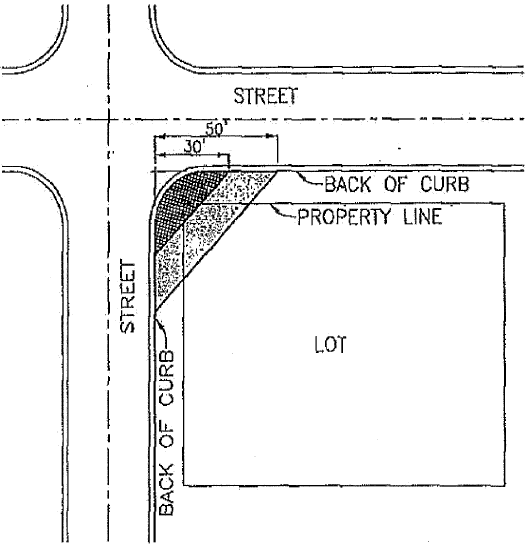
- Driveway intersections.
- The street/driveway sight triangle shall be calculated by measuring a straight line down the edges of the pavement or curb or projection thereof, and drawing a third straight line connecting the extremities of the other 2 lines.
- On the right side of the driveway, as determined when standing in the driveway facing the street, the sight triangle shall extend 40 feet down the street and 12 feet from the edge of the street up the driveway pavement, with a third line connecting the other 2 lines. On the left side of the driveway, the sight triangle shall extend 65 feet down the street and 12 feet up the driveway pavement, with a third line connecting the other 2 lines.
- Street intersections. The chart below specifies the required clear area for each street intersection. The City Engineer may require additional triangle area if a traffic study or special conditions indicate that additional protection is needed.
(2013 Code, § 11.60) (Ord. 1, passed 4-1-1978; Ord. 31, passed 10-25-1979; Ord. 96, passed 11-11-1982; Ord. 132, passed 9-22-1983; Ord. 158, passed 1-31-1985; Ord. 246, passed 6-17-1988; Ord. 253, passed 10-14-1988; Ord. 259, passed 11-11-1988; Ord. 272, passed 8-25-1989; Ord. 338, passed 8-6-1992; Ord. 377, passed 7-7-1994; Ord. 434, passed 11-30-1995; Ord. 430, passed 2-1-1996; Ord. 815, passed 3-26-2009)

