
Shakopee City Zoning Code
PARKING
151.140 Purpose
The purpose for the regulation of off-street parking is to alleviate or prevent congestion of the public right-of-way and to promote the safety and general welfare of the public by establishing minimum requirements for off-street parking of vehicles based on the use of the land.
(2013 Code, § 11.61) (Ord. 31, passed 10-25-1979; Ord. 96, passed 11-11-1982; Ord. 158, passed 1-31-1985; Ord. 185, passed 12-25-1985; Ord. 246, passed 6-17-1988; Ord. 259, passed 11-11-1988; Ord. 264, passed 5-26-1989; Ord. 279, passed 12-1-1989; Ord. 377, passed 7-7-1994; Ord. 546, passed 5-6-1999; Ord. 877, passed 12-3-2013)
151.141 General Provisions
- Application. The provisions of this subchapter apply to the required and non-required off-street parking in all zones, except that property within the Central Business (B-3) Zone is exempt from the off-street parking requirements. These provisions apply to the entire area used for vehicular circulation and parking.
- Where may park.
- Except in the Agricultural Preservation (AG) Zone, a vehicle may be parked only on a street or alley, or in a properly surfaced parking facility. Vehicles may be parked on grass or outside a parking facility when a flood or other emergency prohibits the use of the parking facility, when a vehicle is being washed and dried, or when the required parking for a particular use is insufficient to meet a business rush, such as during the holiday season.
- A recreational vehicle may be parked for more than 24 hours only on an approved sales lot or self-storage facility, as specified in the parking provisions relating to residential parking facilities, or in a campground.
- Expansion of existing uses. Any existing commercial, industrial, or multiple-family residential use or structure which is altered or enlarged must comply with the provisions of this subchapter, unless otherwise specified.
- Reduction of parking spaces. Off-street parking spaces existing upon the effective date of this chapter shall not be reduced in number below the requirements set forth in this subchapter for that use.
- Use of parking space. No required off-street parking space shall be used for an open sales lot or for open storage.
- Maintenance. The owner of the principal use, uses, or structure shall maintain the parking facility and curbing in a neat and adequate manner.
- Residential parking facilities.
- Required. Off-street parking facilities located outside of required setbacks shall be provided for at least 2 vehicles for all single-family dwellings. A suitable location for both a garage measuring at least 20 feet by 24 feet and a ten-foot driveway, which do not require a variance, shall be provided and indicated as such on a survey or site plan to be submitted when applying for a building permit to construct a new dwelling or alter an existing garage.
- Use. Off-street parking facilities in an Rural Residential (RR), Low-Density Residential (R-1A), Urban Residential (R-1B), Old Shakopee Residential (R-1C), Medium-Density (R-2), or Multiple-Family Residential (R-3) Zone, shall be used solely for the parking of personal vehicles.
- Location. Off-street parking facilities in a residential zone shall not be located in the front yard setback or in a street side yard setback. For single-family residential units, no more than 45% of a front yard area may be paved area for driveway and parking of vehicles. The front yard is determined as the area between the front building line of the home and garage and the front lot line.
- Recreational vehicles.
- In a residential zones other than Multiple-Family Residential (R-3) and High Density Residential (R-4), 1 of the exterior driveway parking spaces for a dwelling or a properly surfaced parking area meeting parking requirements for the zone may be used for parking or storing an unoccupied recreational vehicle that is either defined as a recreational vehicle (RV) under state law or which is a camper and that is less than 35 feet in length. If parked in a location other than the driveway within a single-family residential zone, RVs and campers shall be setback 5 feet from an interior side or rear lot line, 15 feet from a street side lot line. RVs and camper shall not be parked in the front yard unless they utilize an exterior driveway parking space. No living quarters shall be maintained nor any business practiced in the recreational vehicle while it is so parked or stored. The recreational vehicle shall utilize only the existing driveway into the site. The vehicle shall be owned or leased by the property owner or resident on which the vehicle is parked.
- No more than 2 utility trailers, trailers for recreational vehicles such as snowmobiles and all-terrain vehicles (ATVs), and boats may be stored in a rear or side yard on lawn or turf or other surface, but must be setback 5 feet from an interior side or rear lot line, 15 feet from a street side lot line. the total length of the trailer, including trailer tongue and all items stored on the trailer must not exceed 20 feet.
- A camper or RV recreational vehicle brought by a visitor may be parked or occupied for a period not to exceed 30 days while visiting the resident of the property.
- Sales trailers. Sales trailers may not be parked in any zoning district in the city.
- Combined parking facilities. Required off-street parking facilities for more than 1 use, lot, or parcel of land may be provided through joint parking facility, a shared parking plan, or a cooperative parking plan. When required off-street parking facilities are provided off-site, written authority for using such property for off-street parking during the existence of the use shall be filed with the city. No such parking facility at its closest point shall be located more then 500 feet from the use being served.
- Joint parking. Off-street parking facilities for 2 or more uses may be provided in a joint facility. The joint parking facility shall include sufficient spaces to meet the separate requirements for each use.
- Shared parking.
- Off-street parking facilities for 2 or more uses with substantially different hours of operation may be provided in a shared facility.
- Evidence must be submitted showing that the uses normally are not open, used, or operated during substantially the same hours. Up to 50% of the required off-street parking facilities for a use may be provided in a shared parking facility.
- Shared parking is not a right, and the city shall have the discretion to give credit up to the 50% limitation based upon its review of plans, uses, and other information related to the off-street parking needs.
- Cooperative parking. Off-street parking facilities for 1 use may be provided on the property of another use in a cooperative facility when that use has more parking spaces than are required. The excess spaces may be shared with another use through a cooperative parking plan.
- Application.
- An application for approval of a shared parking plan or a cooperative parking plan shall be filed with the Zoning Administrator. The application shall be signed by the owner or owners of the entire land area to be included within the cooperative parking plan, the owner or owners of all structures then existing on such land areas, and all parties having a legal interest in such land area and structures.
- The application shall include plans showing the location of the use or structures for which off-street parking facilities are required, the location of the off-street parking facilities, and the schedule of times used by those sharing in common.
- Review. The application shall be reviewed by the Zoning Administrator. Upon approval of a shared parking plan or a cooperative parking plan, the plan shall be recorded in the office of the County Recorder.
- Residential parking facilities. Required off-street parking in residential zones shall be on the same lot or parcel of land as the structure for which parking is required.
(2013 Code, § 11.61) (Ord. 31, passed 10-25-1979; Ord. 96, passed 11-11-1982; Ord. 158, passed 1-31-1985; Ord. 185, passed 12-25-1985; Ord. 246, passed 6-17-1988; Ord. 259, passed 11-11-1988; Ord. 264, passed 5-26-1989; Ord. 279, passed 12-1-1989; Ord. 377, passed 7-7-1994; Ord. 546, passed 5-6-1999; Ord. 609, passed 8-30-2001; Ord. 648, passed 1-2-2003; Ord. 877, passed 12-3-2013) Penalty, see Shakopee Code 151.999
Amended by Ord. O2019-003 Amending Off Street Parking on 1/22/2019
151.142 Design Standards
- Access. Parking facilities shall provide a direct access to a public alley or street.
- Traffic flow.
- Parking facilities shall be designed so that vehicles may enter, circulate, park, and exit in a convenient and orderly fashion.
- Backing onto streets is prohibited in multiple-family, business, and industry zones.
- Angled parking. Parking spaces oriented at less than 90 degrees to the aisle shall be limited to one-way circulation, unless an adequate drive aisle width and stall design is provided for two- way traffic.
- Surfacing. Except for parking facilities for single-family dwellings within the Agricultural Preservation (AG) and Rural Residential (RR) Zones, the entire driveway and parking facility shall be surfaced with asphalt or concrete. Unpaved residential parking areas and driveways constructed prior to January 22, 2019 are permitted to remain in accordance with Minnesota Statutes 462.357 relating to nonconforming uses.
- Setback.
- In all multiple-family residential, business, and industry zones, a minimum 15- foot setback shall be required between any parking facility and a property line abutting a public street.
- A minimum five-foot setback shall be required between any parking facility and any other property line.
- These parking setbacks shall be landscaped in accordance with the requirements listed in Shakopee Code 151.105 through 151.125.
- Handicap facilities. Required handicap spaces and ramps shall be provided as specified in the State Building Code.
- Minimum size of parking spaces.
- Each parking space shall be not less than 9 feet wide, except spaces for compact cars.
- Other minimum dimensional requirements for the design of parking facilities are shown in the following table, Table 1 - Parking Lot Design. Parking spaces beyond the minimum required number may be smaller or of different dimensions.
Table 1
Parking Lot Design
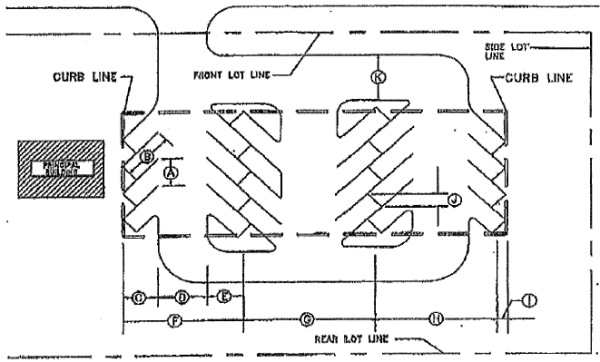
Angle of Parking Dimension Diagram 45 Degrees 60 Degrees 75 Degrees 90 Degrees Space width, parallel to aisle A 12.7 10.4 9.3 9.0 Space length of line B 25.0 22.0 20.0 18.0 Space depth C 17.5 19.0 19.5 18.0 Aisle width between space lines D 12.0 16.0 23.0 24.0 Space depth, interlock E 15.3 17.5 18.8 24.0 Module, edge of pavement to interlock F 44.8 52.5 61.3 64.0 Module interlocking G 42.6 51.0 61.0 64. Module, interlocking to curb face H 42.8 50.2 58.8 60.5 Bumper overhang I 1.0 1.0 1.0 1.0 Offset J 6.3 2.7 0.5 0.0 Cross aisle, 1 way K 14.0 14.0 14.0 14.0 Cross aisle, 2 way K 24.0 24.0 24.0 24.0
- Bumper overhang. To receive a reduction in space depth for parking stalls adjacent to walkways or sidewalks, a clear space in the sidewalk or walkway of at least 5 feet in width must be maintained that is free of sign posts, bumper overhangs, bollards, or other obstructions. Screening such as trees, shrubs, bushes, or fencing must be located and maintained in a manner that allows at least 1.0 foot of clear space between the parking area and the screening both at the time of installation and at full and mature size for plantings.
(2013 Code, § 11.61) (Ord. 31, passed 10-25-1979; Ord. 96, passed 11-11-1982; Ord. 158, passed 1-31-1985; Ord. 185, passed 12-25-1985; Ord. 246, passed 6-17-1988; Ord. 259, passed 11-11-1988; Ord. 264, passed 5-26-1989; Ord. 279, passed 12-1-1989; Ord. 377, passed 7-7-1994; Ord. 546, passed 5-6-1999; Ord. 877, passed 12-3-2013; Ord. 914, passed 9-1-2015)
Amended by Ord. O2019-003 Amending Off Street Parking on 1/22/2019
151.143 Required Number Of Parking Spaces
- Floor area. The term FLOOR AREA for the purpose of calculating the number of required off-street parking spaces, shall be the total floor area of all levels of a building, minus hallways, utility spaces, storage areas for uses not involving warehousing, and other accessory spaces.
- Calculating space. When determining the number of required off-street parking spaces results in a fraction, each fraction of one-half or more shall constitute another space.
- Benches. In public assembly places where seating is provided on benches, pews, or other similar items, each 22 inches of such seating shall be counted as 1 seat for the purpose of determining required parking.
- Uses not listed. When the parking requirements for a use are not specified, the Zoning Administrator shall determine which listed use or uses are the most similar to the proposed use. The parking requirements for that listed use or uses shall apply to the proposed use.
- Maximum number of spaces. The amount of off-street parking for uses requiring greater than 30 parking spaces must not exceed the minimum required off-street parking spaces by more than 20%. All off-street parking spaces provided beyond the minimum requirements must be surfaced with a pervious pavement surface acceptable to the Public Works Director. Any variance request to exceed this requirement must include a travel demand study prepared by a licensed traffic engineer under supervision of the city and paid for by the applicant. Garages are exempt from providing pervious parking spaces.
- Compact car parking. Up to 10% of required parking spaces may be designated as compact spaces that are signed with permanent signage for each space. Pavement marking as the sole means of marking compact spaces is not permitted. The minimum size of a compact space is 8 feet x 16 feet for 90-degree stalls. For angled parking, the compact stall size requirement is the most recent standard adopted by the Institute of Traffic Engineers.
- Required bicycle parking. Bicycle parking shall be provided in accordance with the following standards for apartment/condominium developments with greater than 8 units, institutional/educational, commercial, and industrial uses.
- Design.
- All facilities for required bicycle parking must meet Association of Pedestrian and Bicycle Professionals Standards for design.
- Racks and other facilities must not interfere with accessible paths of travel, or accessible parking as required bv the Americans with Disabilities Act.
- Bicycle parking must be located at least as close to the main entrance of a building as the nearest non-accessible/handicapped parking space, or 100 feet, whichever is less.
- Multi-tenant buildings are permitted to have 1 centrally located bicycle parking area.
- Bicycle parking facilities may be placed in public right-of-way with the approval of the Public Works Director, or designee.
- Outdoor racks must be in areas that are lit by exterior lighting. Use of building or pole mounted lighting is acceptable.
- An area of at least 2 feet x 6 feet of clear space is required for each bicycle parking space. Bicycle racks directly adjacent to automobile parking areas shall be placed at least 2.5 feet from all parts of an automobile parking space to not interfere with doors, bumpers, etc.
- If covered automobile parking is provided, at least 50% of required bicycle parking must be covered.
- Number of spaces. The amount of required bicycle parking for multiple-family dwellings, (excluding townhomes), commercial, institutional, and industrial uses is equal to 2 spaces + 5% of the required number of automobile parking spaces. Fractions of spaces greater than one-half of a space are rounded up to the nearest whole number of spaces. The Zoning Administrator may waive or reduce the requirement for bicycle parking for uses that are unlikely to generate bicycle trips; such as cemeteries, car washes, kennels, commercial feedlots, junk yards, etc. All new multi-family residential buildings greater than 12 units, commercial, and industrial buildings, and buildings that are remodeled, renovated, added onto, or altered by a building permit with a construction valuation greater than $100,000 are required to comply with the bicycle parking requirements.
- Design.
- Proof of parking. Up to 20% of the minimum off-street parking requirements may be provided as "proof of parking". A proof of parking area is an area that may be developed for additional parking spaces and drive aisles that is located outside of required parking setbacks, required green space, wetlands, easement areas, ponding areas, or required landscape areas and buffers. The proof of parking areas must be clearly depicted on site and development plans as proof of parking. Proof of parking areas must be level graded for future parking and have turf established. Required landscaping must not be located in the proof of parking area. If the provided parking area is found to be insufficient on more than 3 days in a 30-day period, the developer/property owner must develop the proof of parking area parking spaces upon direction from the Zoning Administrator. The number of spaces and timeline for construction will be determined by the Zoning Administrator.
- Required off-street parking. Each use must provide, at a minimum, the number of required off-street parking spaces listed on Table 2 in this division (I). For lots or parcels of land containing more than 1 use, the minimum number of required off-street parking spaces for each use must be provided.
Table 2
Number of Required Off-Street Parking Spaces
Per Unit of MeasurementUse or Use Category Number Business/Industry Animal hospitals, veterinary clinics 1 per 500 square feet Bowling alley 5 per bowling lane Breweries 1 per 500 square feet of floor area or employee on largest shift, whichever is greater Brewpubs 1 per 3 seats, plus 1 per 50 square feet of congregation area Bus terminals 1 per 500 square feet Car washes 3 per stall Cemeteries 4 minimum Commercial feedlots 1 per employee on largest shift Concrete or asphalt plants 1 per employee on largest shift Day care facility 1 per 5 children Distilleries 1 per 500 square feet of floor area or employee on largest shift, whichever is greater, plus 1 per 50 square feet congregation area Dry cleaning plants 1 per 300 square feet Financial institutions 1 per 200 square feet of floor area Forestry and nursery uses 1 per 500 square feet of floor area Funeral homes 1 per 3.50 seats Furniture and appliance stores 1 per 400 square feet of floor area, up to 9,999 square feet. For stores greater than 10,001 square feet: 1 per 600 square feet of floor area Gas stations 1 per 6 gas pumps, plus 1 per 150 square feet Grain elevators 1 per employee on largest shift Grocery stores Stores greater than 5,000 square feet: 1 per 200 square feet. Stores 5,000 square feet or less: 1 per 150 square feet Industrial or technical training schools 1 per 3 students, plus 1 per employee on largest shift Junkyards 1 per employee on largest shift Kennels 1 per 600 square feet Landscaping service and contractors 1 per employee on largest shift, plus 1 per 500 square feet of sales area Laundromats 1 per 4 machines Manufacturing and processing facilities 1 per 600 square feet of floor area, or employee on largest shift, whichever is greater Medical, dental clinics 1 per 225 square feet of floor area Motor freight terminals 1 per 1,000 square feet, plus 1 per 200 square feet of office area Offices 1 per 250 square feet of floor area Open sales lots, uses with exterior storage of goods for sale 1 per 500 square feet of sales area Pet daycare and boarding 1 per 10 pets Printing or publishing facilities 1 per employee on largest shift Private lodges and clubs 1 per 4 seats Railroad operations 1 per employee on largest shift Recycling or composting facilities 1 per 1,000 square feet of floor area, or employee on largest shift, whichever is greater Research, experimental or testing facilities 1 per employee on largest shift Restaurants (Class I) 1 per 3 seats Restaurants (Class II) 1 per 50 square feet of congregation area, plus 1 per 3 seats Retail centers 1 per 250 square feet of floor area Retail establishments 1 per 200 square feet of floor area up to 10,000 square feet of floor area: 1 per 200 square feet of floor area 10,001 to 49,999 square feet of floor area: 1 per 225 square feet of floor area Seasonal produce stands 3 minimum Self-storage facilities 1 per 10 storage units, plus 1 per employee on largest shift, plus 1 per resident manager Service garages for major vehicle repair 4 minimum, plus 1 per service stall Taprooms 1 per 3 seats, plus 1 per 50 square feet of congregation area Tasting area, winery, distillery 1 per 3 seats, plus 1 per 50 square feet of congregation area Taverns 1 per 3 seats, plus 1 per 50 square feet of congregation area Theaters, auditoriums, or sports arenas 1 per 4 seats Truck or trailer rental facilities 1 per 400 square feet Uses having a drive-up or drive-through window 1 driving lane Vehicle, marine, implement, garden supply, building and material sates 6 minimum, plus 1 per 500 square feet of floor area over 1,000 square feet Vehicle rental facilities 1 per rental vehicle, plus 1 per 500 square feet of floor area Warehouses 1 per employee largest shift Wholesaling establishments 1 per 1,000 square feet of floor area, or employee on largest shift, whichever is greater Wineries 1 per 500 square feet of floor area or employee on largest shift, whichever is greater Education, Cultural, and Institutional Athletic field 1 per 8 seats minimum Churches, auditoriums, funeral homes 1 per 3.5 seats in main assembly area Commercial recreation 15 commercial, plus 50 per acre of developed recreation area Golf courses, sports facility, fitness club 20 minimum, plus 1 per 300 square feet or floor area over 1,000 square feet Hospitals 1 per 2 hospital beds Middle, elementary, and nursery schools 1 per classroom, plus 1 per 50 student design capacity Nursing homes 1 space per 3 beds, plus 1 space per employee on largest shift Public buildings, community centers, public libraries, art galleries, museums, post office 10 minimum, plus 1 per 300 square feet of floor area over 1,000 square feet Public recreation 1 per 3 persons attending, design capacity Senior high schools 1 per 7 student design capacity, plus 1 per classroom Residential and Lodging Bed and breakfast inns 1 per guest room 1 per operator Motels, hotels - excluding restaurants and night clubs 1 per guest room, plus 1 per 2 employees Multiple-family dwellings Studio and 1 bedroom units: 1.50 spaces per unit 2 bedroom units: 2 spaces per unit 3 bedroom units: 2.50 spaces per unit Developments within ¼ mile walking distance of an operating transit station may reduce the total parking requirements by 5% Senior citizen housing, including independent living and congregate housing 1 per dwelling Single-family, two-family dwellings 2 per dwelling Residential facilities 1 per employee on largest shift, plus 1 per 3 residents
(2013 Code, § 11.61) (Ord. 31, passed 10-25-1979; Ord. 96, passed 11-11-1982; Ord. 158, passed 1-31-1985; Ord. 185, passed 12-25-1985; Ord. 246, passed 6-17-1988; Ord. 259, passed 11-11-1988; Ord. 264, passed 5-26-1989; Ord. 279, passed 12-1-1989; Ord. 377, passed 7-7-1994; Ord. 546, passed 5-6-1999; Ord. 877, passed 12-3-2013)
Amended by Ord. O2019-003 Amending Off Street Parking on 1/22/2019

