
Sheffield City Zoning Code
ARTICLE I
- IN GENERAL
Sec. 118-1.- Definitions.
The following words, terms and phrases, when used in this chapter, shall have the meanings ascribed to them in this section, except where the context clearly indicates a different meaning:
Access means a way or means of approach to provide physical entrance to a property.
Accessory structure setback line means a line delineating the minimum allowable distance between a property line or the right-of-way line of an abutting street and an accessory structure or building on a lot.
Accessory use or structure means a use or structure that is permitted on a property in conjunction with a principal use.
Alcohol:
(1)
Lounge means any place or premises in which liquor or wine is offered for sale or consumption within the building in which the establishment is located, which is operated by a responsible person of good reputation, and which meets the following additional requirements:
a.
A space of at least 1,000 square feet on one floor in one room accommodating at least 30 persons at one time.
b.
A minimum of two off-street parking spaces provided for each 80 square feet of space inside the establishment.
c.
Such establishment shall meet the minimum requirements for a state alcoholic beverage control board on-premises lounge retail liquor license.
(2)
Restaurant means a reputable place licensed as a restaurant, operated by a responsible person of good reputation, in which a diversified selection of food, refreshments, and alcoholic beverages are offered for sale or consumption within the building in which the establishment is located, and which meets the following additional requirements:
a.
A dining space of at least 1,000 square feet of one floor in one room, said dining room to be equipped with tables and chairs accommodating at least 50 persons at one time.
b.
A kitchen separate and apart from said dining area, but adjoining the same in which food is prepared for consumption by the public and in which the food or meals served in said dining area are prepared.
c.
At least one meal per day shall be served at least five days a week, with the exception of holidays, vacations, and periods for redecorating. A minimum of two off-street parking spaces shall be provided for each 80 square feet of space inside the establishment, plus an additional parking space for each employee.
d.
Such place shall meet the minimum requirements for a state alcoholic beverage control board on-premises license.
e.
The serving of food or meals shall constitute the principal business of such establishment, with the serving of liquor, malt or brewed beverages, wines or other alcoholic beverages being only an incidental part of the business. During any 90-day period, the gross receipts from the serving of meals and food shall constitute more than 50 percent of the gross receipts of the business. The owner of such establishment shall maintain separate cash register receipts, one for food and one for liquor, malt or brewed beverages, wines or other alcoholic beverages. In addition, the owner of such establishment shall maintain all invoices for the purchase of food and liquor and shall preserve such records for not less than two years. All such records shall be open for inspection and checking during such regular business hours as the city clerk, or his duly authorized representative, may request.
Amusement place means a business establishment providing leisure entertainment such as, but not limited to, video games or other coin-operated amusement devices, billiard and poolhalls, bowling alleys, and skating rinks, but excluding sexually oriented adult uses.
Apparel store means a retail sales business selling new apparel and related items.
Applicant means a property owner or his authorized representative who has petitioned the city for approval of a rezoning, special use, special exception, hardship variance, interpretation, or appeal under the provisions of this chapter.
Application means a petition for approval of a rezoning, special use, special exception, hardship variance, interpretation, or appeal under the provisions of this chapter.
Assisted living facility means a permanent building, portion of a building, or group of buildings (not to include mobile homes) in which room, board, meals, laundry, and assistance with personal care and other services are provided for not less than 24 hours in any week to a minimum of two ambulatory adults not related by blood or marriage to the owner and/or administrator. Such facility is for residents who need a watchful environment but who do not have an illness, injury, or disability that requires chronic or convalescent care such as medical or nursing services.
(1)
Family assisted living facility means an assisted living facility for two or three adults under watchful care.
(2)
Group assisted living facility means an assisted living facility for four to 16 adults under watchful care.
(3)
Congregate assisted living facility means an assisted living facility for 17 or more adults under watchful care.
Automobile service station means buildings and premises where gasoline or diesel fuel is dispensed at retail for automobiles, recreation vehicles and motorcycles, and where in addition at least one of the following services is rendered:
(1)
Sale, replacement, or servicing of sparkplugs, oil, water hoses, brake fluids, batteries, distributors, tires, carburetors, brakes, fuel pumps, or other automotive parts or accessories, etc.
(2)
Uses permissible at an automobile service station shall not include major mechanical work and bodywork, straightening of body parts, painting, welding, or storage of automobiles not in an operable condition. See Automotive service establishment where major mechanical activities are allowed.
Automotive body shop means the use of a building or premises for the repair of automotive bodies and/or major mechanical works, straightening of body parts, painting, or welding, and may involve the temporary storage of automobiles not in an operable condition.
Automotive sales means the use of any building, land area or other premises for the display and sale of new or used motorized vehicles such as automobiles, panel trucks or vans, motorcycles, busses, boats, or recreation vehicles, and which may include any repair service conducted as an accessory use.
Automotive service and repair establishment means a business principally engaged in the repair of automobiles or other motorized vehicles, or the installation or repair of equipment or parts on motorized vehicles such as mufflers, brakes, tires, radios, transmissions, and engines or engine parts.
Bait store or sales means a business establishment that sells live bait such as minnows, crickets, or earthworms.
Bed and breakfast facility means a business establishment operated within an historic structure or district (as designated by the city council) within a dwelling by the owner-occupant, offering temporary lodging and breakfast to the traveling public while away from their normal places of residence, and containing no more than seven bedrooms available for temporary lodging. See Hotel; see also Motel.
Berm means a mound of earth, or the act of pushing earth into a mound.
Board of adjustment means the city board of adjustment as established by the city council and state code. The board of adjustment takes final action on requests for special uses as well as special exceptions, hardship variances, and all other appeals.
Boarding home means a dwelling unit within which a resident family or manager offers lodging and meals to two or more unrelated adults in exchange for monetary compensation or other consideration.
Brewery means any premises licensed by the city to engage in the distillation, production, fermenting, brewing, rectifying or otherwise in the manufacture of only beer, or malt, or brewed alcoholic beverages as well as engaging in the receiving, storing, or warehousing only of beer, or malt, or brewed beverages within the city for trans-shipment inside and outside the state.
Brewpub means an establishment licensed as and meeting the qualifications of a brewpub under the state alcoholic beverage control laws, including the Code of Alabama 1975, title 28, chapter 4A, which qualifications include but are not necessarily limited to the requirements that such brewpub must contain and operate a restaurant and that the beer shall be sold at retail in the restaurant for on-premises consumption only and to licensed wholesale distributors.
Buffer means an area of natural vegetation or manmade construction which is intended to provide a visual and dimensional separation between dissimilar land uses.
(1)
Natural buffer means a visual screen created by vegetation of such density so as to present an opaque visual separation when viewed from one side to the other throughout the year.
(2)
Structural buffer means a visual screen created through construction of a solid wooden fence, decorative masonry wall, earthen berm, or combination of fence or wall with an earthen berm, which may be supplemented with vegetation, so as to present an opaque visual separation when viewed from one side to the other throughout the year.
Buildable area of lot means that portion of a lot bounded by and interior to the required rear, side and front building setback lines.
Building means any structure having a roof supported by columns or walls and intended for the shelter, housing, or enclosure of any individual, animal, process, equipment, goods, or materials of any kind.
Building area means the total floor area of all heated spaces within a building as measured within the outside of the exterior walls, exclusive of uncovered porches, terraces, and unheated stairwells, storage areas, garages and loading docks.
Building code means all building codes adopted and in effect in the city.
Building contractor's business means an establishment from which residential, commercial and industrial building services are provided such as plumbing, heating and cooling, electrical services and construction.
Building height means the vertical distance measured to the highest point of a building from the average finished grade across those sides of a building that face a street.
Building materials sales means an establishment offering lumber or other construction materials used in buildings for sale to contractors or the general public.
Business office. See Office.
Caliper means the diameter of a tree (usually nursery stock) measured at a point six inches above the ground or top of root bail for up to and including four-inch caliper trees, and at a point 12 inches above the ground or top of the root ball for larger sizes.
Canopy means a roof-like structure supported by columns or projecting from a building and open on at least three sides.
Carwash means any building or premises or portions thereof dedicated to use for washing automobiles, recreation vehicles and motorcycles, whether by hand or mechanical means.
Cemetery means a facility for the burial of deceased human beings or animals.
Church means any institution used as a place of worship which is recognized under state law as a tax-exempt religious institution.
City building official means the city building official or his designee as designated by the city council under the building code. The city building official administers the procedures provided in this chapter and enforces its requirements.
Clinic means an establishment where medical or dental patients, who are not lodged overnight, are admitted for examination or treatment requiring less than an hour recovery time.
Club or fraternal organization means buildings and facilities owned or operated by an association or persons for a social or recreational purpose, but not operated primarily for profit.
Commercial recreation facility. See Recreation facility, commercial.
Common open space. See Open space.
Congregate assisted living facility: See Assisted living facility.
Consignment shop means a business establishment that sells used goods for owners (consigners).
Construction supplies and materials sales and distribution means a business selling and distributing electrical, HVAC, plumbing, welding or other construction related supplies and materials.
Convenience gas station means a building or premises where gasoline, diesel fuel and oil may be dispensed at retail with no automobile repair facilities. Uses permissible also include the sale of cold drinks, packaged foods, tobacco and similar household convenience goods for station customers.
Curb break or curb cut means any interruption or break in the line of a street curb for the purpose of connecting a driveway to a street, or otherwise to provide vehicular access to abutting property.
Day care, family home, means an accessory use within a private residence operated by the occupant of the dwelling, licensed by the state department of human resources that enrolls, for pay or otherwise, six or less children and provides supervision and nonmedical care, with no overnight stays.
Day care, group home, means an establishment that is required to be licensed by the state department of human resources that enrolls, for pay or otherwise, seven to 12 children and provides supervision and nonmedical care with no overnight stays.
Day care or night care center means an establishment that is required to be licensed by the state department of human resources that enrolls, for pay or otherwise, 13 or more children and provides supervision and nonmedical care with or without overnight stays.
Diameter breast height (DBH) means the diameter of a tree trunk (usually a mature tree) measured at a height of 4½ feet above the ground. If a tree splits into multiple trunks below 4½ feet, the trunk is measured at its most narrow point beneath the split.
Dwelling means a building or portion of a building arranged or designed to provide living quarters for one or more families on a permanent or long-term basis.
(1)
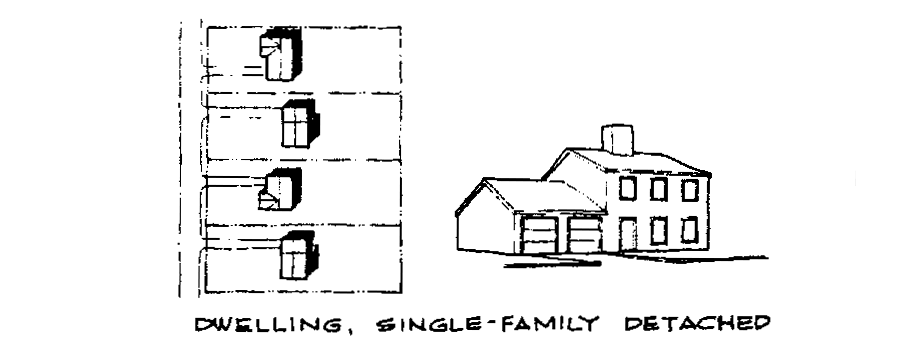
Single-family detached dwelling means a residential building designed for or occupied exclusively by one family; and constructed on the building site from basic materials (such as lumber, shingles and bricks) and interior finish modules (such as cabinets and plumbing fixtures) delivered individually to the site.
(2)
Two-family dwelling means a residential building designed for or occupied exclusively by two families in separate dwelling units living independently of each other.
(3)
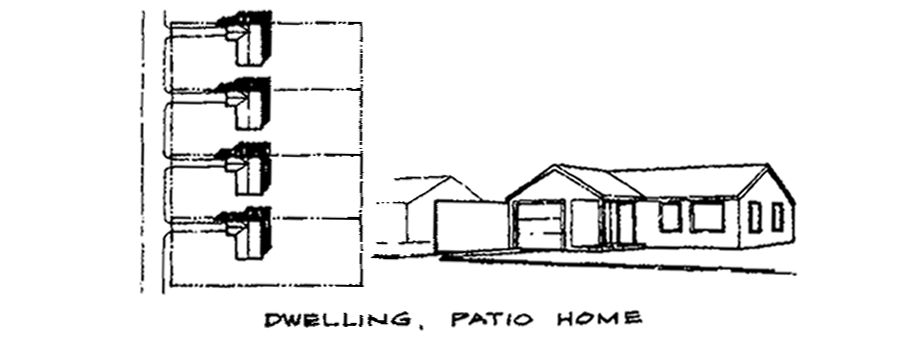
Patio home means a single-family detached or two-family dwelling that may be placed on a lot with an exterior wall adjoining one or more boundary lines of the lot. See Zero-lot line development.
(4)
Multifamily dwelling means a residential building exclusively designed for or occupied by three or more families in separate dwelling units living independently of each other.
a.
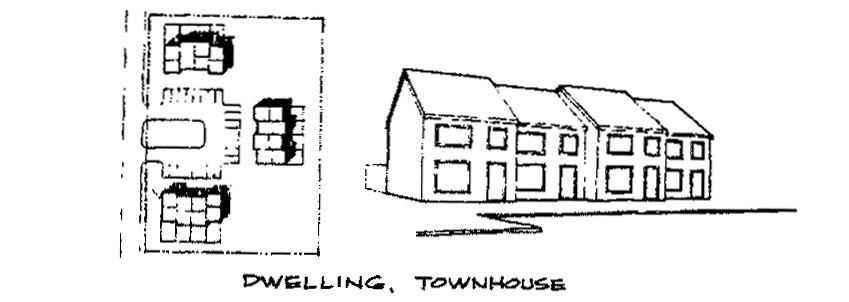
Townhouse means a multifamily dwelling in which the dwelling units may adjoin one another only at the vertical walls and no dwelling unit may be located above another.
b.
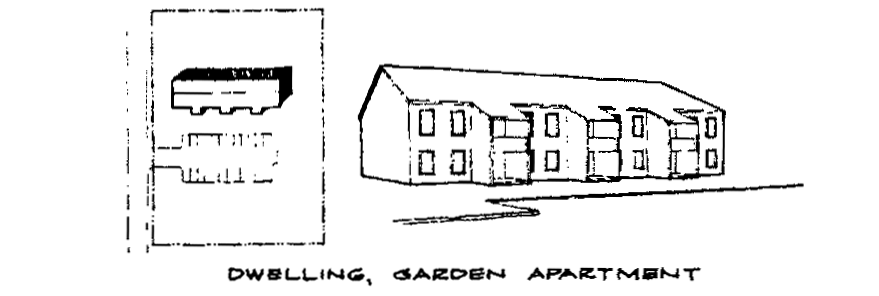
Garden apartment building means a multifamily dwelling in which a dwelling unit may be located above another.
c.
Loft dwelling means, in a building originally constructed for nonresidential purposes, a dwelling unit located in a building above the first floor, the first floor being used for nonresidential purposes such as stores or offices.
d.
Basement dwelling means in a building originally constructed for nonresidential purposes, a dwelling unit located in a building below the first floor, the first floor being used for nonresidential purposes such as stores or offices.
Dwelling unit means one or more rooms connected together and constituting a separate, independent housekeeping establishment with complete provisions for cooking, eating, sleeping, bathing and personal hygiene, and physically set apart from any other dwelling unit in the same structure.
Event center means a multi-purpose venue facility hosting special events such as graduations, weddings, anniversaries, holiday gathering, trade shows, corporate functions or parties, concert settings, and general get-togethers. An event center could typically have a catering kitchen, indoor and outdoor seating and a stage or event area.
Family means an individual or two or more persons living together as a household.
Family assisted living facility. See Assisted living facility.
Fast food restaurant means any establishment, building or structure where food or drink is served for consumption, either on or off the premises, by order from or service to persons either over an interior counter, outside the structure or from an outdoor service window or automobile service window, or by delivery. This definition shall not include otherwise permitted restaurants where outdoor table service is provided to customers in established outdoor dining areas.
Fence means an artificially constructed barrier of wood, wire, wire mesh, or decorative metal erected to enclose, screen or separate portions of a lot.
Frontage or street frontage means the width in linear feet of a lot where it abuts the right-of-way of any street from which access may be directly gained.
Funeral home means a building used for the preparation of deceased human beings for services or burial, and ceremonies connected therewith before burial or cremation.
Garden apartment building. See Dwelling.
Greenhouse means a building whose roof and sides are made largely of glass or other transparent or translucent material and in which the temperature and humidity can be regulated for the cultivation of plants for subsequent sale or for personal enjoyment.
Gross floor area means the total area of all floors of a building, measured from the outside planes of the exterior walls.
Group assisted living facility. See Assisted living facility.
Guesthouse means an accessory use to a dwelling designed and intended for the temporary housing of visitors to a property at the behest of the owner for no fee or other consideration. A guesthouse is treated as an accessory structure.
Handicapped parking space means a space laid out and designated by signage in accordance with the requirements of the federal Americans with Disabilities Act.
Health club or fitness center means a business that provides facilities for aerobic exercises, such as running and jogging tracks, exercise equipment, game courts, gymnasiums, or swimming facilities.
Heated living space means the total area of all floors in a dwelling unit used for residential activities and heated in accordance with the building code. Heated living space normally includes living, dining and recreation rooms; bedrooms, hallways and kitchens; bathrooms, closets and utility rooms.
Home occupation means any activity carried out for profit by the resident and conducted as an accessory use in the resident's dwelling unit.
Hospital means a building providing primary or tertiary health services and medical or surgical care to persons, including inpatients and outpatients, suffering from illness, disease, injury, deformity and other abnormal physical or mental conditions, and including as an integral part of the institution, related facilities such as laboratories, outpatient facilities or training facilities.
Hotel means a business establishment offering temporary lodging to the traveling public while away from their normal places of residence, and in which ingress and egress to and from the rooms are made primarily through an inside lobby. See Bed and breakfast facility; see also Motel.
Household means an individual living alone or a group of individuals living together in a single dwelling unit, sharing common use of and access to all living and eating areas, bathrooms, and food preparation areas, who mutually combine their efforts and share responsibilities for domestic chores such as child rearing, cleaning and cooking in a permanent and long-term relationship, as contrasted to one in a transient relationship, such as a boarder, who pays for lodging.
Judge of probate means the Judge of Probate of Colbert County, Alabama.
Junkyard or salvage yard means a lot, land, structure or part thereof, used primarily for the collecting, storage or sale of wastepaper, rags, scrap metal or other discarded material; and for the collecting, dismantling, storage, or salvage of machinery or vehicles not in running condition, or for the sale of parts thereof.
Kennel means a shelter where dogs or cats are bred, raised, trained or boarded as a business.
Lot means a parcel or tract of land held in common ownership which may include one or more separately deeded or platted parcels.
(1)
Corner lot means any lot bounded by two or more streets at their intersection.
(2)
Through lot means a lot bounding on two or more streets, but not at their intersection, so that it is not a corner lot. A through lot abutting two or more streets may be referred to as a "double frontage lot."
(3)
Interior lot means a lot having frontage on only one street.
Lot area means the total horizontal area included within lot lines.
Lot coverage means the portion of a lot covered by principal and accessory buildings.
Lot lines means the boundary dividing a given lot from the street, an alley, or adjacent lots.
(1)
Front lot line means any boundary line of a lot that abuts a public street right-of-way line. A lot adjacent to more than one street will have more than one front lot line.
(2)
Rear lot line means any boundary line of a lot that does not intersect with a public street right-of-way line and is not a front lot line.
(3)
Side lot line means any boundary line of a lot that intersects with a public street right-of-way line and is not a front lot line.
Lot of record means a lot that is part of a subdivision recorded in the office of the judge of probate of the county, or a lot described by metes and bounds, the description of which has been so recorded.
Lot width means the distance measured along the front principal building setback line between intersecting lot lines.
Manufactured home means a structure, transportable in one or more sections, which, in the traveling mode, is eight body feet or more in width or 40 body feet or more in length, or, when erected on site, is 320 or more square feet in floor area, and which is built on a permanent chassis and designed to be used as a dwelling with or without a permanent foundation when connected to the required utilities, and includes the plumbing, heating, air conditioning, and electrical systems contained therein; or otherwise comes within the definition of a manufactured home under the National Manufactured Housing Construction and Safety Standards Act of 1974, as amended (42 USC 5401—5445).
Manufactured home community means any lot or parcel under single ownership on which two or more manufactured homes are to be located or intended to be located for purposes of residential occupancy.
Manufactured home sales lot means premises on which manufactured homes are displayed for sale.
Manufacturing means the creation of finished goods from raw materials or intermediate component parts.
(1)
Heavy manufacturing means the extraction of natural resources or the transformation of raw materials through mechanical or chemical means into basic products for subsequent assembly, fabrication or use in the production of finished goods.
(2)
Light manufacturing means the finishing, fabrication or assembly of previously manufactured parts into a final product or component products ready for retail sale. Light manufacturing is characterized by no emission of noxious odors, dust, fumes, gas, noise, or vibration outside of any building.
Medical cannabis dispensary means an entity licensed by the Alabama Medical Cannabis Commission that is "authorized to dispense and sell medical cannabis at dispensing sites to registered qualified patients and registered caregivers."
Medical cannabis integrated facility means an entity licensed "to perform the functions of a medical cannabis cultivator, processor, secure transporter, and dispensary."
Medical or dental office. See Office.
Microbrewery means a brewery that produces less than 15,000 barrels of beer per year and includes an on-site tasting tap-room where samples of product manufactured on the premises can be sampled or purchased for on-site consumption as provided for in the Code of Alabama 1975, title 28, chapter 3A-6.
Miniwarehouse means a building or group of buildings in a controlled-access and fenced compound that contains varying sizes of individual, compartmentalized stalls or lockers for the "dead" storage of a customers' goods or wares. No sales, service, or repair activities other than the rental of dead storage units are permitted on the premises.
Mobile food vending unit means any motorized or non-motorized vehicle, trailer, kiosk, pushcart, pedal cart, stand, display, carried container, blanket, ground covering or other device designed to be portable and not permanently attached to the ground from which food and /or beverages are being peddled, vended, sold, served, displayed, or offered for sale or given away. This definition does not include a mobile wholesale delivery unit, a vehicle which is used solely to transport or deliver food, or a common carrier regulated by the state or federal government.
(1)
Stationary mobile food vending unit means a unit that is parked in one place for the duration of an event or an extended period of time.
(2)
Circulating mobile food vending unit means a unit that moves from place to place stopping only when encountering customers to serve and moving along after the transaction.
Mobile home. See Manufactured home.
Motel means a business establishment offering temporary lodging to the traveling public while away from their normal places of residence, and in which ingress and egress to and from the rooms are made primarily direct from an exterior walkway rather than from an inside lobby. See Bed and breakfast facility; see also Hotel.
Multifamily dwelling. See Dwelling.
Nursery school. See Day care center.
Nursing home means an extended or intermediate care facility required to be licensed or approved by the state to provide fulltime convalescent or chronic care to individuals who, by reason of advanced age, chronic illness or infirmity, are unable to care for themselves.
Office means a building or portion of a building used primarily for conducting the affairs of a business, profession, service, industry, or government and generally furnished with desks, tables, files, and communication equipment.
(1)
Business office means an office used primarily for the administrative or legal affairs of a company.
(2)
Medical or dental office means an office occupied and maintained for the provision of services by a person licensed by the state to practice in healing arts for humans, such as a physician, surgeon, dentist, or optometrist.
(3)
Professional office means an office occupied by a member of a recognized profession and maintained for the provision of professional services, such as a lawyer, architect, city planner, landscape architect, accountant, interior designer, or engineer.
Opaque means impenetrable to view, or so obscuring to view that features, buildings, structures, and uses become visually indistinguishable.
Open space means an essentially unimproved area of land or water permanently set aside through dedication, designation, or reservation for passive recreation or enjoyment.
(1)
Common open space means useable land area of a site that is available to all occupants of a development on a continuing and permanent basis and is not covered by buildings (except recreational structures) or public rights-of-way.
(2)
Public open space means land reserved for leisure and/or recreational use but dedicated in fee simple to a governing body or agency to be responsible for its operation and maintenance; therefore, such land is not for the exclusive use of the residents of a specific development.
Outdoor display area means a portion of a property outside of any building where merchandise, goods or other items are placed in public view for the purpose of direct sale or lease to customers.
Outdoor storage. See Storage, outdoor.
Parking aisle means the traveled way, which is not the public right-of-way, by which cars enter and depart parking spaces.
Parking area means any public or private area at grade or within a structure used for the express purpose of temporarily parking automobiles and other vehicles otherwise in operation for personal or business use.
Parking bay means three or more parking spaces adjacent to one another and aligned side-by-side.
Parking garage means an accessory building or portion of a principal building used only for the private storage of motor vehicles as an accessory use. See Commercial parking lot.
Parking lot, commercial, means an area or structure dedicated to the temporary storage of automobiles or other vehicles for periods of less than 24 hours for a fee, operated as the principal use of the property or structure.
Parking space means a space identified and set aside for the temporary parking of an automobile or other motor vehicle.
Patio home. See Dwelling.
Pawnshop means an establishment in which merchandise is offered as collateral for obtaining loans and wherein such merchandise is offered for sale in recompense for default of loan repayment.
Planning commission means the city planning commission as established by the city council and state code. The planning commission advises the city council on planning issues, rezoning requests, text amendments and interpretations of this chapter.
Plant nursery means land or greenhouses used to raise flowers, shrubs, trees, and other plants for sale to distributors or for subsequent replanting by the owner, a landscape company or others.
Premises means an area of land with its appurtenances and buildings which, because of its unity of use, is one unit of real estate.
Presiding official means the person chairing a meeting of the planning commission, board of adjustment, or the city council in his official capacity.
Principal building means a building in which is conducted a principal use.
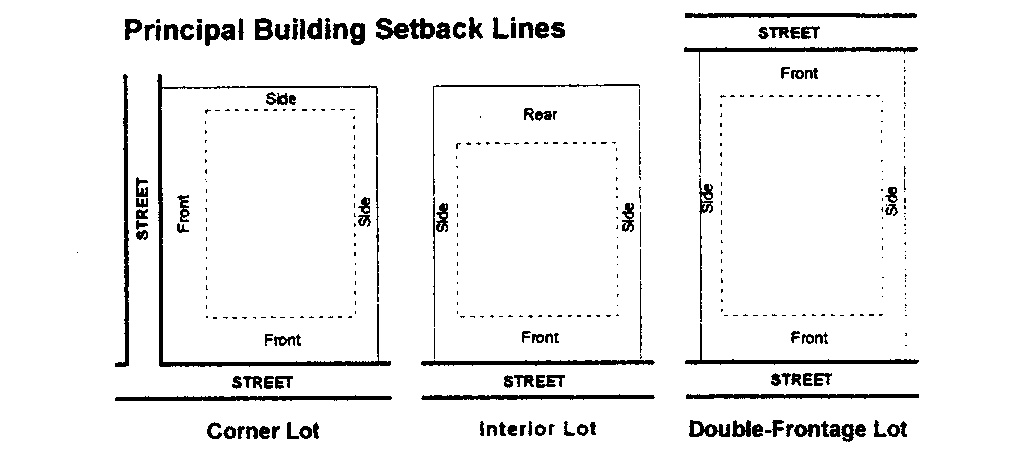
Principal building setback line means a line delineating the minimum allowable distance between a property line or the right-of-way line of an abutting street and a principal building on a lot.
(1)
Front building setback means the minimum allowable distance between the right-of-way line of any abutting street and any part of a principal building on a lot. The front setback distance is applied along the full length of the right-of-way line and is parallel to it. In the event the lot abuts more than one street, the setback to streets other than the primary front may be one-half of the required front building setback distance, provided the building shall not be located closer to the right-of-way than other adjacent buildings on the nonprimary front of the lot.
(2)
Rear building setback means the minimum allowable distance between a rear lot line and any part of a principal building on a lot. The rear building setback extends along the full length of the rear lot line.
(3)
Side building setback means the minimum allowable distance between a side lot line and any part of a principal building on a lot. The side building setback extends along the side lot line between the front building setback and a rear building setback.
Principal use means the specific, primary purpose for which land or a structure is used.
Professional office. See Office.
Prohibited use means a use that is not permitted in a zoning district by right, as an accessory use, or as a conditional use.
Property or parcel of land. See Lot.
Property owner means an individual, firm, association, syndicate, partnership, corporation or other organization, person or group having a majority proprietary interest in real estate, or their authorized representative.
Public open space. See Open space.
Recreation facility, commercial, means a business offering leisure sports facilities such as a commercial golf course or driving range, miniature golf, softball fields, batting cages, or a go-cart track.
Recreation facility, community, means a swimming pool, tennis court, or other recreation facility owned by or provided for the use of the residents of a subdivision, apartment project, or other residential development.
Recreation facility, private, means an accessory use to a dwelling designed and equipped for the conduct of personal leisure time activities such as a swimming pool, tennis court, deck, or patio. See Commercial recreation; see also Community recreation facility.
Recycling center means a use operated exclusively for the collection and temporary storage of used paper, glass, metal, and similar materials suitable for reprocessing, which are transported elsewhere for separating, processing, or storage.
Rehabilitation center means a facility operated for the primary purpose of assisting in the rehabilitation of disabled persons through an integrated program of medical, psychological, social, and vocational services under competent professional supervision.
Rental services establishment means any business establishment that rents or leases items of personal property such as tools, appliances, and equipment to the general public.
Residential treatment facility, chemical dependency unit, means a freestanding unit that has beds that are organized, properly staffed, and equipped to render services over a continuous period exceeding 24 hours to individuals requiring diagnosis and treatment of alcohol and other drug-related dependencies.
Residential treatment facility, psychiatric, means a facility that provides nonacute psychiatric care in a structured living environment to children and adolescents not exceeding the age of 18 years whose primary diagnosis is that of mental illness and who require removal from their existing environment to facilitate treatment.
Restaurant means an establishment where food and drink are prepared to individual order, ordered and served at the table, and consumed primarily within the principal building, as contrasted to a fast food restaurant.
Retail sales business means an establishment principally engaged in offering a category of similar goods or products for sale to the general public, such as a grocery store, hardware store, pharmacy, clothing shop, home furnishings store, office supplies store, and the like.
Retail services business means an establishment principally engaged in providing a service, as opposed to products, to the general public, such as a banking or financial institution, real estate or insurance office, barber or beauty shop, travel agency, amusement or recreation center, health clinic, legal firm, professional service, and the like.
Retirement community or home means an age-restricted residential development that offers significant services and facilities for the elderly, including social and recreational activities, personal care services, or health facilities limited to use by the development's residents. At least 80 percent of the units must be occupied by residents 62 years old or older, and the remaining units must be occupied by at least one resident 55 years old or older.
Rezoning means an amendment to the official zoning map that has the effect of changing the zoning district designation on a property through a change in the location of a zoning district boundary.
Roominghouse means a dwelling unit within which a resident family offers lodging to two or more unrelated adults in exchange for monetary compensation or other consideration. See Boarding home for instances in which meals are also provided.
School means a facility used for education or instruction in any branch of knowledge.
(1)
Academic school means any building or part thereof that is designed, constructed or used for education or instruction following the same curriculum offered in a public elementary, secondary, trade or technical, or higher education facility, and accredited to award diplomas as such.
(2)
Commercial school means any building or part thereof which is designed, constructed or used for education or instruction in any branch of knowledge or vocational pursuit, other than an academic school.
Semipublic use means a use owned or operated by a nonprofit, religious, or eleemosynary institution for the purpose of providing educational, cultural, recreational, religious, or social services to the general public.
Setback means the shortest straight line distance between a street right-of-way or lot line and the nearest point of a structure or building or projection therefrom (excluding roof overhangs of 18 inches or less).
Setback, minimum, means the shortest distance allowed between a street right-of-way line or any other lot line and any principal or accessory building on a lot. Minimum setback requirements for buildings are associated with the type of lot line from which the setback is taken; for instance, a side yard setback is measured from a side lot line.
Single-family detached dwelling. SeeDwelling.
Special use means a use not otherwise permitted by right in a zoning district that may be compatible with other uses in the zoning district under certain circumstances or with special restrictions. A special use must be listed as possible for approval under the property's zoning district and must be approved by the board of adjustment in order to be established on a property.
Storage means the placement, keeping, or retention of vehicles, equipment, materials, goods, or products on a temporary basis for intermittent use or subsequent distribution or transfer.
Storage, outdoor, means the keeping within an unroofed and unenclosed area of any goods, material, merchandise or vehicles in the same place for more than 24 hours.
Street means an improved way for the conveyance of motor driven, rubber-tired vehicles, such as automobiles and trucks.
(1)
Arterial street means a state or U.S. numbered highway. Arterial streets are used for traffic of moderate to fast speeds and high volumes between major local centers of employment, recreation and shopping.
(2)
Collector street means a major street used for traffic of moderate speeds and high peak volumes between local streets and arterial streets or serving as a principal entrance street or primary circulation route within a neighborhood or other limited area. Collector streets serve nonresidential or multifamily areas, or 100 dwelling units or more in residential subdivisions, but are not state or U.S. numbered highways.
(3)
Local street means a minor street used for traffic of relatively low speeds and volumes and for primary access to abutting properties. Local streets serve fewer than 100 dwelling units.
Structure means anything constructed or erected with a fixed location on the ground or attached to something having a fixed location on the ground. Among other things, structures include but are not limited to buildings, driveways, parking lots, walls, fences, signs, and swimming pools.
Structure height means the vertical distance to the highest point of a structure, as measured from the average grade at the base of the structure or directly below a projecting structure.
Temporary use means a use established for a fixed period of time with the intent to discontinue such use upon the expiration of the time period.
Theater means a building or part of a building devoted to showing motion pictures, or for dramatic, musical or live performances.
Theater, drive-in, means an open lot with its appurtenant facilities devoted primarily to the showing of motion pictures or theatrical productions to patrons seated in automobiles.
Thrift store means a business establishment or charitable organization that sells and/or gives away donated used apparel and household items.
Tobacco store means a business establishment whose principal products include tobacco, tobacco byproducts, tobacco derivatives or implements for tobacco use. This includes cigar stores, vape shops, hookah bars and similar stores.
Townhouse. See Dwelling.
Travel trailer means a motorized camper, converted bus, tent trailer, motor home, or other similar vehicular or portable structure used or designed for temporary portable housing or occupancy while on vacation or other recreational trip and provided with sleeping accommodations.
Truck loading docks means a portion of a building designed for the loading and unloading of trucks.
Truck terminal means a building or premises where trucks load and unload cargo and freight and where the cargo and freight may be broken down or aggregated into smaller or larger loads for transfer to other vehicles or modes of transportation.
Two-family dwelling. See Dwelling.
Use means the purpose for which land or a building or other structure is designed or arranged, or for which it is occupied. See Principal use; see also Accessory use or structure.
Utility company means a private business providing electricity, natural gas, telephone, or other services under the regulation of the state public services commission.
Veterinarian means a veterinary hospital or clinic providing medical care and treatment for animals.
(1)
Large animal veterinarian means a place where horses, cattle, sheep or other animals normally kept in agricultural settings are given medical or surgical treatment and the boarding of animals is limited to short-term care.
(2)
Small animal veterinarian means a place where dogs, cats, birds or other animals normally kept as household pets are given medical or surgical treatment and the boarding of animals is limited to short-term care.
Warehouse means a building used primarily for the storage of goods and materials. See Miniwarehouse.
Wholesale trade establishment means a place of business primarily engaged in selling merchandise to retailers; to industrial, commercial, institutional, or professional business users, or to other wholesalers; or acting as agents or brokers and buying merchandise for, or selling merchandise to, such individuals or companies.
Yard means an area that lies between the principal building on a lot and the nearest lot line.
(1)
Front yard means a yard situated along any public street right-of-way or private street easement.
(2)
Rear yard means a yard situated along a rear lot line.
(3)
Side yard means a yard situated along a side lot line, but not extending into a front or rear yard.
Zero-lot line development means a pattern of development in which a principal building on a lot may be allowed to have no minimum setback from one or more of the lot's boundary lines. See Dwelling, patio home.
(Ord. No. 98-0921, §§ 1.5.2, 2.1.1, 3.1.2, 4.1.2, Glossary, 9-21-1998; Ord. No. 2003-0908, § 1, 9-8-2003; Ord. No. 2008-0317, § 2, 3-17-2008; Ord. No. 2010-1220, 12-20-2010; Ord. No. 2011-0711, 7-18-2011; Ord. No. 2013-1021B, 10-21-2013; Ord. No. 2015-0209, 2-9-2015; Ord. No. 2015-0526, 5-26-2015; Ord. No. 2022-0912, 9-12-2022; Ord. No. 2023-0320B, 3-24-2023; Ord. No. 2021-0426A, 4-26-2021)
Sec. 118-2. - Use of figures.
Figures associated with defined terms or regulatory paragraphs in this chapter are provided for illustration only and do not limit or change the meaning of the term as defined or the requirements of the regulation as written.
(Ord. No. 98-0921, § 1.5.2, 9-21-1998)
Sec. 118-3. - Other rules of interpretation.
For the purpose of this chapter, the following shall apply to the use of words and phrases:
(1)
The term "such as" is intended to introduce one or more examples in illustration of a requirement or point, and is used herein to mean "including but not limited to the following."
(2)
The verbs "zone" and "rezone" have the same meaning and refer to the act of amending the official zoning map through the process established by this chapter.
(3)
The nouns "zone," "zoning district" and "district" have the same meaning and refer to the zoning districts established under this chapter.
(4)
The word "day" shall mean a calendar day unless otherwise indicated.
(5)
All words and phrases shall be interpreted within the context of the sentence, section and article in which they occur.
(Ord. No. 98-0921, § 1.5.3, 9-21-1998)
Sec. 118-4. - Purpose and intent.
(a)
These regulations are designed to lessen congestion in the streets; to secure safety from fire, panic and other dangers; to promote health and the general welfare; to provide adequate light and air; to prevent the overcrowding of land; to avoid undue concentrations of population; and to facilitate the adequate provision of transportation, water, sewerage, schools, parks, and other public requirements.
(b)
In the interpretation and application of this chapter all provisions shall be:
(1)
Considered as minimum requirements;
(2)
Liberally construed in favor of the governing body; and
(3)
Deemed neither to limit nor repeal any other powers granted under state statutes.
(c)
These regulations are not intended to affect any valid easement, covenant, or deed restriction that has been recorded with the judge of probate prior to the effective date of the ordinance from which this chapter is derived.
(Ord. No. 98-0921, § 1.3, 9-21-1998)
Sec. 118-5. - Compliance.
(a)
Generally.
(1)
Use of land or structures.
a.
No structure or land shall hereafter be used, located, extended, converted, or structurally altered except in full compliance with the provisions of this chapter.
b.
No part of any land area or facilities required in connection with any use or structure for the purpose of complying with this chapter shall be included as part of any land area or facilities required for any other use or structure.
c.
Street rights-of-way shall not be considered a part of a lot or front yard setback for the purpose of meeting the minimum requirements of this chapter.
(2)
Certificate of occupancy required. A certificate of occupancy issued by the city building official is required:
a.
Before occupancy or use of a building or building expansion that has been constructed or moved after the effective date of the ordinance from which this chapter is derived.
b.
For authorization to change the use of any building or land.
(3)
Street frontage required. No building permit shall be issued for and no building or other structure shall be erected on any lot within the city unless the street giving access to such lot upon which said building is proposed to be placed shall be accepted and opened as, or shall otherwise receive the legal status of, a public street prior to that time.
(4)
One principal house on a lot. With respect to single-family detached dwellings, only one principal building and its customary accessory buildings may be erected on any one lot.
(5)
Lot reduction prohibited. No lot existing prior to the effective date of the ordinance from which this chapter is derived or any subsequent amendment shall be reduced in dimension or area below the minimum requirements of this chapter. Lots created after the effective date of the ordinance from which this chapter is derived shall meet at least the minimum requirements established by this chapter.
(b)
Exemptions.
(1)
Previously issued permits. The provisions of this chapter and any subsequent amendments shall not affect the validity of any lawfully issued and effective building permit if:
a.
The development activity or building construction authorized by the permit has been commenced prior to the effective date of the ordinance from which this chapter is derived or the amendment, or will be commenced after such effective date but within six months of issuance of the permit; and
b.
The development activity or building construction continues without interruption (except because of war or natural disaster) until the development or construction is complete. If the permit expires, any further development or construction on that site shall occur only in conformance with the requirements of this chapter in effect on the date of the permit expiration.
(2)
Governmental bodies. The city and all city public bodies and boards are exempt from the regulations contained in this chapter.
(Ord. No. 98-0921, §§ 1.4.1, 1.4.2, 9-21-1998; Ord. No. 2001-0219, 2-19-2001)
Sec. 118-6. - Nonconforming development.
Lawful nonconforming uses, structures, and lots are declared by this chapter to be incompatible with land uses, structures, and lots that conform to the requirements of the zoning districts in which the nonconformity exists.
(1)
Nonconforming uses.
a.
A nonconforming use is a use or activity on a property that was previously lawfully permitted but which, by reason of the adoption or subsequent amendment of this chapter, is no longer permitted on the property by this chapter.
b.
To avoid undue hardship, the nonconforming use of any structure or land may be continued even though the use does not conform to the provisions of this chapter, except that the nonconforming use:
1.
Shall not be changed to another nonconforming use.
2.
Shall not be reestablished after discontinuance for six months or more. Discontinuance means that the previous occupant of the land or building has failed to purchase a current business license, vacated the premises, or has otherwise ceased operations, activities, or tenancy on the premises.
3.
Shall not be repaired, rebuilt, or altered after damage exceeding 50 percent of its replacement cost at the time of destruction.
4.
Shall not be enlarged or altered in a way that increases its nonconformity.
c.
Nothing herein shall be deemed to prevent the strengthening or restoration to a safe condition of any structure or part thereof declared to be unsafe by an official charged with protecting the public safety or health, upon order of such official.
d.
Any existing use on a property that may be allowed as a special use shall not be considered a nonconforming use.
(2)
Nonconforming structures.
a.
A nonconforming structure is a structure or building whose size, height, dimensions, or location on a property were previously lawful but which, by reason of the adoption or subsequent amendment of this chapter, no longer meets or conforms to one or more such requirements of this chapter.
b.
A nonconforming structure may continue to be occupied and used, except that the nonconforming structure:
1.
Shall not be repaired, rebuilt, or altered after damage exceeding 50 percent of its replacement cost at the time of destruction.
2.
Shall not be enlarged or altered in a way that increases its nonconformity.
(3)
Nonconforming lots.
a.
A nonconforming lot is a lot of record whose location, area, frontage, width, or other dimensions were previously lawful but which, by reason of the adoption or subsequent amendment of this chapter, no longer meets or exceeds one or more such requirements of the applicable zoning district.
b.
Where the owner of a lawful lot of record does not own sufficient land to conform to the minimum lot size or lot width requirement of this chapter, such lot may nonetheless be used as a building site provided that:
1.
Access to a public street is provided; and
2.
The minimum building setbacks are provided.
(Ord. No. 98-0921, § 1.4.3, 9-21-1998; Ord. No. 99-0920, 9-20-1999)
Sec. 118-7. - Violation and penalties.
(a)
Violation of the provisions of this chapter shall constitute a misdemeanor.
(b)
Any person found guilty of violating this chapter shall, upon conviction, be fined not more than $500.00 or imprisoned for not more than 90 days, or both, and in addition, shall pay all costs and expenses involved in the case. Each day such violation continues shall be considered a separate offense.
(Ord. No. 98-0921, § 5.5.3, 9-21-1998; Ord. No. 2024-0701, 7-3-2024)

