
Sheffield City Zoning Code
ARTICLE V
- DEVELOPMENT STANDARDS
Sec. 118-414. - Sight triangle.
A sight triangle easement shall be located at every street intersection, delineated
by the two intersecting street right-of-way lines and a line connecting the right-of-way
lines at the points indicated in the sight triangle table. The connecting points shall
be measured from the right-of-way lines extended to their point of intersection.
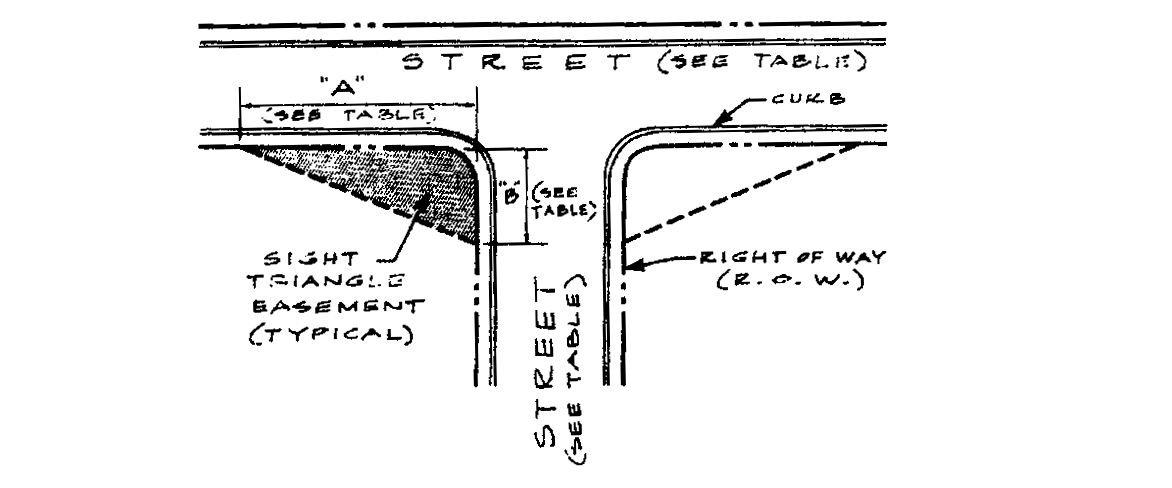
SIGHT TRIANGLE TABLE
(See Drawing)
(1)
Within the sight triangle easement, the planting of trees or other vegetation or the location of structures exceeding 30 inches in height that would obstruct the clear sight across the area of the easement shall be prohibited.
(2)
The easement shall provide right of entry to the city for the purpose of removing any object or vegetation that obstructs the clear sight.
(Ord. No. 98-0921, § 3.6, 9-21-1998)
Sec. 118-442. - Minimum lot size.
Every lot upon which a principal building or use may be located shall meet or exceed the following requirements for the zoning district in which the lot is situated:
1 Minimum for zoning district; no minimum lot size.
(Ord. No. 98-0921, § 3.2.1, 9-21-1998)
Sec. 118-443. - Minimum principal building setbacks.
(a)
All principal buildings on a lot shall be set back from the street rights-of-way lines and property lines bounding the lot no less than the distances shown as follows:
1 Minimum building separation: eight feet.
2 Minimum building separation: 25 feet.
3 20 feet, if adjacent to a residential district.
4 40 feet, if adjacent to a residential district.
(b)
In the O-I and B-1 zoning districts, minimum setback requirements shall be increased by one foot in width for each one foot the principal building exceeds ten feet in height.
(c)
In the B-2 zoning district, at least one foot of setback shall be provided from all front or side property lines for each two feet of principal building height.
(Ord. No. 98-0921, § 3.2.2, 9-21-1998)
Sec. 118-444. - Minimum accessory structure setbacks.
(a)
Minimum setbacks. Minimum setbacks for all accessory structures (including parking lots) other than swimming pools, driveways, fences and freestanding walls, gasoline pumps and signs shall be as follows:
1 Other than swimming pools, driveways, fences, and freestanding walls.
(b)
Swimming pools. Swimming pools and related structures (such as cabanas) shall conform to the minimum setback requirements for principal buildings in each zoning district.
(c)
Fences and freestanding walls. There shall be no minimum setback for fences or freestanding walls, provided that any fence or freestanding wall shall not obstruct visibility at street intersections and shall conform to the height restrictions under section 118-445(c).
(d)
Night watchman residences. Night watchman residences shall conform to the minimum setback requirements for principal buildings in each zoning district.
(e)
Gasoline pumps. Pumps that dispense gasoline and diesel fuels shall be set back at least 12 feet from any street right-of-way line.
(f)
Canopies. Canopies shall conform to the minimum building setback requirements for principal buildings in each zoning district.
(Ord. No. 98-0921, § 3.2.3, 9-21-1998)
Sec. 118-445. - Maximum structure height.
(a)
Table of structure heights. The maximum height of all structures in each zoning district (except as provided in the subsections (b) and (c) of this section) shall be as follows:
(b)
Exceptions to height restrictions. The following structures are exempt from the height limitations: Spires, belfries, cupolas, domes, water tanks, ventilators, chimneys, radio and TV reception antennas, and other appurtenances commonly placed or extending above the roof of a building and not intended for occupancy.
(c)
Heights for fences and freestanding walls. Height limitations for fences and freestanding walls.
(1)
In the business and industrial zoning districts, no fence or freestanding wall may exceed eight feet in height, with no more than an additional two feet of security wire.
(2)
In the T-R, MF-1, MH-1, and O-I zoning districts, no fence or freestanding wall may exceed eight feet in height.
(3)
In the SF-90, SF-70, SF-50, and R-G zoning districts, the following shall apply:
a.
A fence or freestanding wall in any minimum principal building setback area adjacent to a street may not exceed 30 inches in height, except that: A chain link fence up to 48 inches in height is permitted, provided that its location is approved by the city building official in conformance with the sight triangle requirements of section 118-414.
b.
A fence or freestanding wall in any side or rear yard may not exceed eight feet in height.
(Ord. No. 98-0921, § 3.2.2, 9-21-1998; Ord. No. 99-0215, § 2, 3-1-1999)
Sec. 118-474. - Buffers required.
A buffer shall be required in any multifamily or nonresidential development project along a side or rear lot line that abuts a residential zoning district, as follows:
(Ord. No. 98-0921, § 3.3.1, 9-21-1998)
Sec. 118-475. - Buffer design standards.
(a)
General. Buffer areas shall contain no driveways, parking areas, patios, stormwater detention facilities, or any other structures or accessory uses except for a fence, wall, or earthen berm constructed to provide the visual screening required to meet the standards of this chapter. Underground utilities may be permitted to cross a buffer if the screening standards of this chapter will subsequently be achieved.
(b)
Natural buffers. Natural buffers may contain deciduous or perennial vegetation, but shall contain evergreen shrubs and trees suitable to local growing conditions that will provide an opaque visual screen during all seasons of the year.
(c)
Structural buffers. Structural buffers shall meet the following criteria:
(1)
Structural buffers shall be vegetated throughout the minimum area required for the buffer around any fences or walls and upon any earthen berms, which may include grass, ground covers, shrubs, and trees.
(2)
Trees shall be located or planted within any structural buffer at a density of no less than one tree for each 20 feet of buffer length or portion thereof. New trees shall have a caliper of no less than two inches upon planting, and may be clustered for decorative effect following professional landscaping standards for spacing, location, and design.
(3)
Fences and freestanding walls shall present a finished and decorative appearance to the abutting property, and shall be located no closer to the property line than two feet. Shrubs, ground covers, or other vegetation shall be provided between the fence or wall and the property line so as to provide a decorative effect, following professional landscaping standards for spacing, location and design.
(d)
Examples of buffers. The following illustration provides examples of natural and structural buffers. Other solutions meeting the minimum requirements of this section are also acceptable.
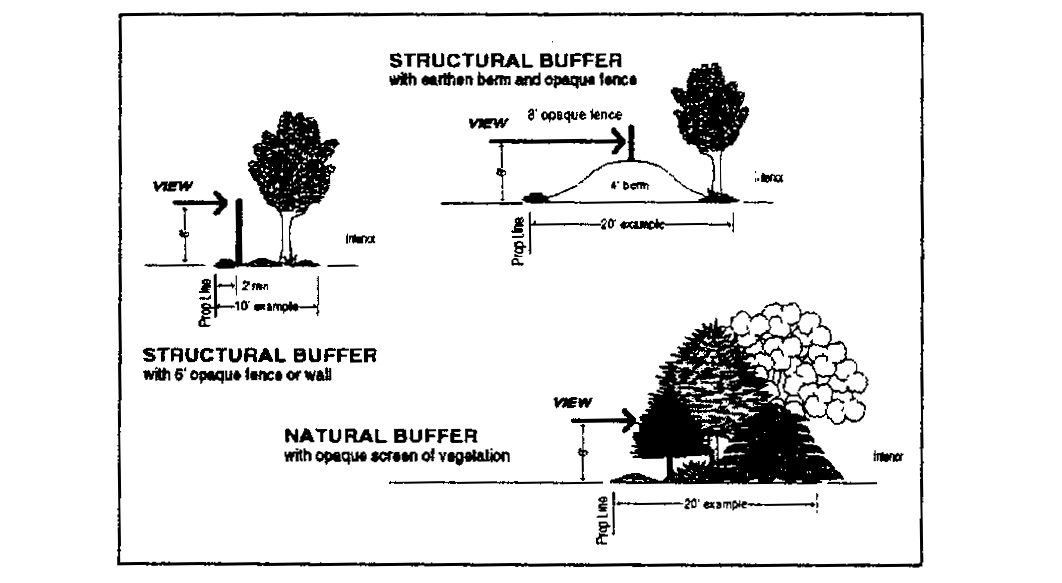
(Ord. No. 98-0921, § 3.3.2, 9-21-1998)
Sec. 118-476. - Minimum buffer requirements.
A buffer required by this division shall meet the following criteria:
(1)
Width of buffer.
a.
Side lot line. Buffers required along any side lot line shall be no less than one-half of the minimum required width of the side principal building setback, or ten feet, whichever is greater.
b.
Rear lot line. Buffers required along any rear lot line shall be no less than the minimum required width of the rear principal building setback.
1 Additional setback requirements in the O-I, B-1 and B-2 zoning districts based on building height may increase required buffer width. See section 118-445.
(2)
Minimum required screening. Minimum required screening shall consist of a natural buffer utilizing existing vegetation or a structural buffer, whichever provides an opaque visual screen to a height of six feet, or any combination of existing and replanted vegetation which can reasonably be expected to create an opaque visual screen six feet high within two growing seasons.
(Ord. No. 98-0921, § 3.3.3, 9-21-1998)
Sec. 118-477. - Buffer modifications.
(a)
If a structural buffer is provided that creates an opaque screen to a height of no less than eight feet, the buffer may be reduced to a width of no less than five feet.
(b)
Buffers may be relocated on the site to best achieve the screening required.
(c)
The board of adjustment may waive a buffer requirement if the comprehensive plan anticipates future development on the adjoining property in a land use category equal to or more intensive than the subject site.
(Ord. No. 98-0921, § 3.3.4, 9-21-1998)
Sec. 118-508. - Compliance.
At the time of the establishment of any use, or erection of any building, or at the time any principal building is enlarged or increased in capacity by adding dwelling units, guestrooms, seats or floor area, there shall be provided permanent off-street parking spaces improved with an asphalt or concrete surface in accordance with the requirements of this division.
(Ord. No. 98-0921, § 3.4, 9-21-1998)
Sec. 118-509. - Central business district parking.
Due to the availability of on-street parking in the downtown area devoted to customer use, off-street parking shall not be required for any nonresidential use in the B-3 zoning district.
(Ord. No. 98-0921, § 3.4.1, 9-21-1998)
Sec. 118-510. - Combination of required parking spaces.
The required parking spaces for any number of separate uses may be combined in one lot but the required spaces assigned to each use may not be assigned to another use.
(Ord. No. 98-0921, § 3.4.2, 9-21-1998)
Sec. 118-511. - Proximity of off-street parking spaces to use.
All required parking for all uses shall be either on the same lot or within a walking distance of 300 feet of the building or use it is to serve; provided, however, that no required parking spaces may be located across any state or U.S. highway from the use it is intended to serve.
(Ord. No. 98-0921, § 3.4.3, 9-21-1998)
Sec. 118-512. - Requirements for design of parking lots.
(a)
Except for parcels of land devoted to one-family, two-family and townhouse residential uses, all areas devoted to off-street parking shall be so designed and be of such size that no vehicle is required to back into a public street to obtain access.
(b)
Off-street parking lots.
(1)
Each parking space shall be not less than nine feet wide by 20 feet long.
(2)
Adequate driving aisles shall be provided for ease of access to all parking spaces. Two-way aisles shall be not less than 24 feet wide. The following diagrams provide guidance to the layout of parking lots using various design standards:
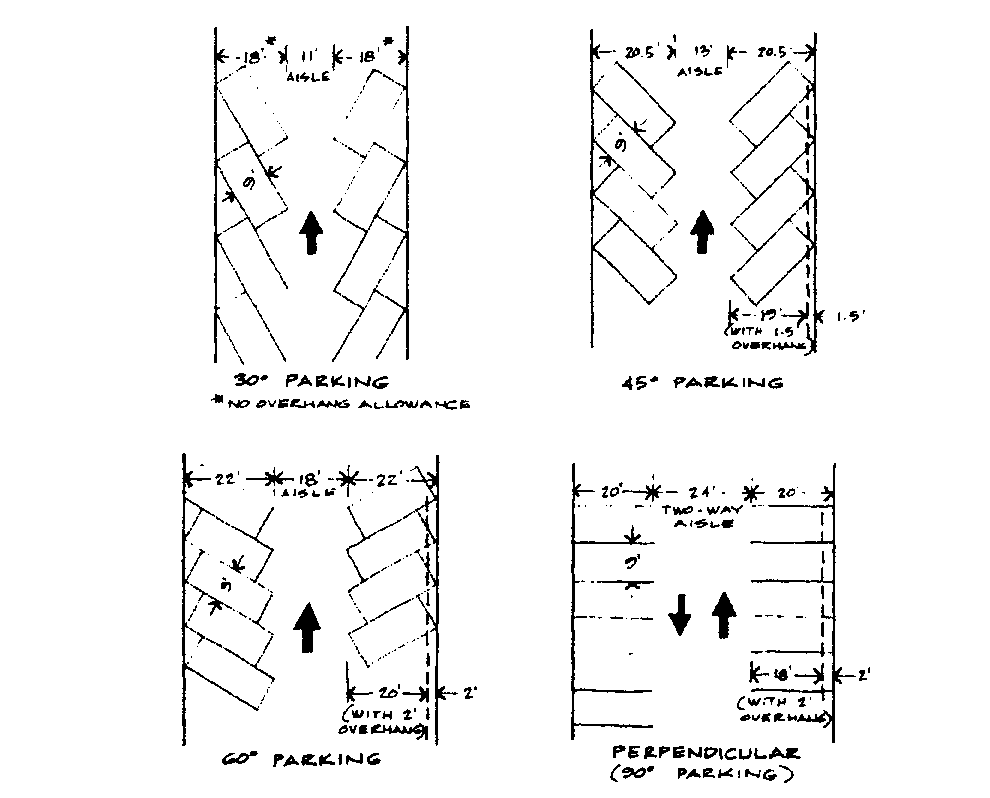
(c)
Handicapped parking spaces.
(1)
Handicapped parking spaces shall have an adjacent aisle five feet wide, and one in every eight handicapped spaces shall be adjacent to an aisle eight feet wide and the space shall be signed "van accessible." Handicapped parking space aisles shall be clearly demarcated.
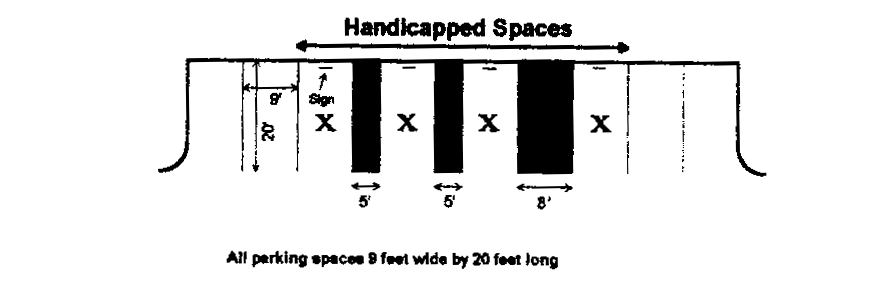
(2)
Handicapped spaces shall be provided in each parking lot in the following ratio to the total number of spaces required for the use:
(3)
In addition to the requirements of this subsection (c), all handicapped parking shall comply with the requirements of the federal Americans with Disabilities Act.
(Ord. No. 98-0921, § 3.4.4, 9-21-1998)
Sec. 118-513. - Off-street parking requirements by use.
The minimum number of off-street parking spaces required for each type of land use shall be determined by the following, in addition to the number of spaces required for handicapped parking:
(1)
Single-family and two-family dwellings (including patio homes) and manufactured homes: Two spaces per dwelling unit.
(2)
Multifamily dwellings (townhouses and garden apartments): Two spaces for each dwelling unit.
(3)
Group dwellings, roominghouses and boardinghouses: One space for each two rooms to be rented.
(4)
Motels, hotels, and bed and breakfast facilities: One space for each room to be rented, plus one additional space for each 400 square feet of floor area devoted to meeting space, restaurants and administrative offices.
(5)
Medical and dental clinics: One space for each 200 square feet of gross floor area.
(6)
Hospital: One space for each two beds licensed for patients' use, exclusive of bassinets.
(7)
Schools, elementary and middle school: Two spaces for each classroom.
(8)
High school: Five spaces for each classroom.
(9)
Day care center: One space for each 400 square feet of gross floor area.
(10)
Auditorium, theaters, places of worship, funeral homes, stadiums, and similar places of public assembly: One space for each four seats, or 12 feet of benches, or per 30 square feet of usable floor area in the largest assembly room (whichever is greater), plus one space for each 200 square feet of floor area used for amusement, entertainment, or assembly exclusive of the major assembly room.
(11)
General and professional offices, banks and other financial service establishments, insurance and real estate offices: One space for each 250 square feet of gross floor area.
(12)
Automobile service station, auto and truck repairs or maintenance: Five spaces for each service bay, plus one space for each 200 square feet of gross floor area devoted to retail sales or showroom.
(13)
Automobile, truck, manufactured home, recreational vehicle, and utility structure sales: One space for each 600 square feet of gross floor area of indoor sales and showroom space, plus one space for each 2,500 square feet of outdoor display area, plus five spaces for each service bay devoted to vehicle repairs or maintenance.
(14)
Restaurants: One space per 150 square feet of gross floor area.
(15)
Fast food restaurants: One space for each 50 square feet of gross floor area.
(16)
Retail sales and services businesses not listed above: One space for each 200 square feet of gross floor area and permanent outdoor sales area.
(17)
Wholesale and office-warehouse uses: One space for each 200 square feet of gross floor area devoted to sales or office use, plus one space for each 1,000 square feet of gross floor area devoted to storage.
(18)
Warehouse and storage uses: One space for each 600 square feet of gross floor area and outdoor storage area.
(19)
Manufacturing uses: One space for each 500 square feet of gross floor area.
(Ord. No. 98-0921, § 3.4.5, 9-21-1998)
Sec. 118-514. - Landscaping requirements.
(a)
Landscape strips. A minimum ten-foot wide landscape strip shall be provided between any parking lot designed or intended to accommodate five cars or more and any street frontage of the property on which the parking lot is located, unless the parking area is otherwise screened from the street by a building or other means.
(1)
Landscape strips shall contain no structures, parking areas, patios, stormwater detention facilities, or any other accessory uses except for retaining walls or earthen berms constructed as part of an overall landscape design, pedestrian-oriented facilities such as sidewalks and bus stops, underground utilities, driveways required to access the property, and signs otherwise permitted by this chapter.
(2)
One tree shall be provided within the landscape strip for every 40 feet of length of street frontage, or portion thereof. Such trees may be deciduous or evergreen, but must be of a type that is suitable to local growing conditions and that will normally reach at least 12 inches in diameter at breast height upon maturity.
(3)
All portions of a landscape strip shall be planted in trees, shrubs, grass or ground cover, except for those ground areas that are mulched or covered by permitted structures.
(4)
Upon planting, new trees shall have a caliper of no less than two inches, and may be clustered for decorative effect following professional landscaping standards for spacing, location, and design.
(b)
Parking lot trees. Deciduous shade trees shall be provided within any parking lot designed or intended to accommodate five cars or more, in accordance with the requirements of this section.
(1)
One deciduous shade tree shall be provided within the parking lot for every 20 parking spaces, or portion thereof. Each tree shall be located within the parking lot in reasonable proximity to the spaces for which the tree was required. Trees provided to meet the minimum requirements of any landscape strip or buffer may not be counted toward this requirement.
(2)
A landscaping island shall be located at the end of every parking bay between the last parking space and an adjacent travel aisle or driveway. The island shall be no less than eight feet wide for at least one-half the length of the adjacent parking space. The island shall be planted in trees, shrubs, grass, or ground cover except for those areas that are mulched.
(3)
Tree planting areas shall be no less than eight feet in width and shall provide at least 100 square feet of planting area per tree. No tree shall be located less than 2½ feet from the edge of pavement or back of curb; if curbing is not provided around the tree planting area, curb stops shall be placed such that vehicles will not overhang the tree planting area.
(4)
Landscaping islands and tree planting areas shall be well drained and contain suitable soil and natural irrigation characteristics for the planting materials they contain.
(Ord. No. 98-0921, § 3.4.6, 9-21-1998)
Sec. 118-515. - Restriction on use of required parking.
The required off-street parking spaces and related aisles and driveways shall be for employees, occupants, customers, clients, and visitors to the property and shall be limited in use to temporary parking of motor vehicles with current license plates. The storage of merchandise, the parking of motor vehicles for sale, and the servicing or repairing of vehicles or equipment is prohibited within the area designated to meet the minimum parking requirements of this chapter.
(Ord. No. 98-0921, § 3.4.7, 9-21-1998)
Sec. 118-516. - Mobile food vending.
Mobile food vending. Mobile food vending in Sheffield shall conform to the following regulations:
(1)
Stationary mobile food vending units located in applicable districts shall have a minimum buffer of 100 feet as measured from the primary entrance of existing restaurants, cafes, and other food related establishments not also owned by the owner of the mobile food vending unit unless written permission is provided.
(2)
Stationary mobile food vending units are permitted to operate between the hours of 6:00 a.m.—10:00 p.m. Sunday through Wednesday and between the hours of 6:00 a.m.—12:00 a.m. Thursday through Sunday in B-2 general business; B-3 central business, O-I office and institution, M-1 light industrial, M-2 heavy industrial, and in designated areas of planned unit development districts.
(3)
Circulating mobile food vending units are permitted to operate from of 10:00 a.m. until dusk Monday through Sunday in B-1 neighborhood business, SF-50 single family residential, SF-70 single family residential, SF-90 single family residential, R-G residential garden home, T-R townhouse residential, and MF-1 multiple family residential districts.
(4)
Mobile food vending units are permitted in PPF parks and public facilities districts during the hours open to the public in locations designated by Sheffield Parks and Recreation.
(5)
Mobile food vending units shall be removed from the premises each night unless during a multi-day special event approved by city hall.
(6)
Circulating mobile food vending units are permitted to operate only on streets where the speed limit does not exceed 25 MPH and shall only permit transactions from the shoulder of the road.
(7)
The annual business license application must be accompanied by a current mobile food permit issued by the Colbert County Health Department, a permit issued by the fire marshal, or his/her designee, and written consent from the property owner (if applicable). Food preparation shall be regulated by the Colbert County Health Department. Each license in non-transferrable to another owner and/or operator and shall apply to only (1) mobile food vending unit. A separate license shall be required for each additional mobile food vending unit. License shall be issued for the period beginning January 1 and ending December 31 of each year.
(8)
Mobile food vending sites shall have public toilet facilities for operators, including employees, and patrons, which meet the requirements of the Colbert County Health Department for food establishment toilet rooms.
(9)
Mobile food vending units are not permitted to operate in loading zones, public rights-of-way, or obstruct or impede the flow of traffic for neighboring businesses. Mobile food vending units shall not be allowed to consume otherwise necessary parking spaces.
(10)
Signage not attached to the mobile food vending unit must not impede foot traffic or obstruct views.
(11)
Mobile food vending units must provide sufficient artificial lighting during non-daylight hours.
(12)
No excessive distraction(s) shall be permitted as a part of the mobile food vending unit's operation. No outdoor loudspeaker, public address system, music, or other form of entertainment shall be audible from stationary mobile food vending units. Sounds produced by circulating mobile food vending units shall conform to the municipal noise ordinance.
(13)
Any on-site preparation of food to be performed other than inside the primary vending unit shall require written approval from the fire marshal and conform to Colbert County Health Department regulations. Tables, chairs, benches, etc. shall not be utilized as part of the operation of the mobile food vending unit.
(14)
Mobile food vending unit operators are responsible for properly containing and disposing of any/all waste and trash associated with the operation of the unit. Waste and trash shall not be placed in any public trash container or in any private container without proper permission.
(15)
The licensee must provide its own utilities and shall not use the city's utilities.
(Ord. No. 2022-0418B, 4-18-2022)
Sec. 118-539. - Approval required.
No curbs or medians on public streets or rights-of-way shall be cut or altered for access without the approval of the city building official. Access points on all state roads are subject to Alabama Department of Transportation permitting requirements.
(Ord. No. 98-0921, § 3.5.1, 9-21-1998; Ord. No. 2015-0526, 5-26-2015)
Sec. 118-540. - Driveway connections.
(a)
Requirements for access from properties to streets. Vehicular access from properties to streets shall comply with the following dimensional requirements, measured at the right-of-way line:
(b)
Points of access allowed along major streets. Along major streets other than state or U.S. highways, no more than two points of vehicular access from a property to each abutting public street shall be permitted for each 400 feet of lot frontage, or fraction thereof; provided however, that lots with less than 100 feet of frontage shall have no more than one point of access to any one public street.
(c)
Points of access along state roads, U.S. highways and Reservation Road. Along state roads or U.S. highways and Reservation Road in the MSR Overlay District, the standards specified in the Alabama Department of Transportation Access Management Manual found at the following link shall be followed.
https://www.dot.state.al.us/maweb/doc/ALDOT%20Access%20Management%20Manual.pdf
(d)
Driveway connections. Driveway connections shall be provided between the edge of pavement or back of curb to the right-of-way line. No property may be afforded access from a public street except as follows:
(1)
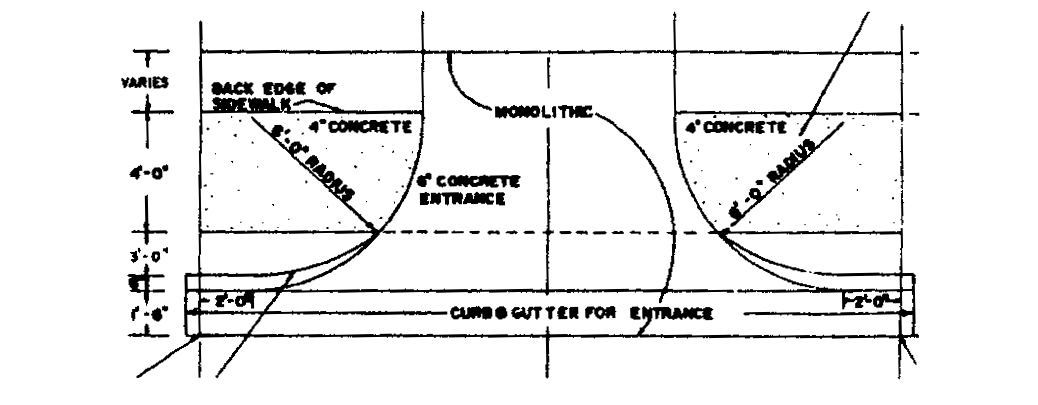
Curb and gutter streets shall be provided with a driveway apron constructed of 3,000 psi concrete at least six inches thick. Sidewalks, where provided, shall be warped to the driveway apron.
(2)
Swale ditch section streets shall be provided with a driveway apron constructed of 3,000 psi concrete at least six inches thick, or asphaltic concrete of the same thickness and type as the paving course for the street.
(3)
All driveway aprons shall have a radius connecting the driveway to the curbline or pavement edge as follows:
Example—Residential Driveway Apron
(Ord. No. 98-0921, § 3.5.2, 9-21-1998; Ord. No. 2015-0526, 5-26-2015)
Sec. 118-541. - Limitations on access.
(a)
Requirements of the state department of transportation shall apply whenever more restrictive than the standards in this chapter.
(b)
No point of access shall be allowed within 35 feet of the right-of-way line of any street intersections.
(Ord. No. 98-0921, § 3.5.3, 9-21-1998)

