
Siloam Springs City Zoning Code
ARTICLE I
- GENERAL PROVISIONS
Sec. 102-1. - Definitions.
Except as necessarily implied by context, the definitions provided here and in Chapter 54 of this Code shall apply to this chapter.
Abandoned means the disuse of a structure or property, excluding any casual or intermittent occupancy for six or more consecutive months.
Administrator means the City Administrator, or person designated by the City Administrator.
Accessory building means a building not used for human occupancy and which is physically separated from buildings intended for human occupancy, meeting the requirements of Section 102-72 of this Code.
Accessory use means a use of land incidental to, and on the same lot with, the principal use of the land.
Building means any manmade structure which shelters a space beneath a roof.
Building, main means the largest building on a lot; and as among buildings of equal size, that which has the greater floor area dedicated to the principal use of the land.
Caliper is a measurement of tree diameter taken at approximately 12 inches above normal ground level, and excluding any knots or swelling.
Cellar means any room(s) of a building having one-half or more of its floor-to-ceiling height below the average grade of the adjacent ground.
Construction means work undertaken for the purposes of, and any work-product resulting from, making, fabricating, erecting, placing, or demolishing, part or all of any building or other improvement upon land.
Drive-through or Drive-thru shall mean a vehicular lane(s) or aisle(s) provided to serve a drive-thru retail or service use including the required drive-through stacking area, area in front of the order and pick-up windows, and the exit lane(s) or aisle(s) to a public street. A drive-through lane shall not be considered a driveway unless it also functions as a driveway as defined by this Code.
Drive-through use means any use, which by design, physical facilities, services, or operating procedures, permits persons to receive services, or obtain or drop off goods, while remaining in their motor vehicle. Drive-through facilities may include, but are not limited to, facilities at donation drop-offs, banks, dry cleaners, pharmacies, car washes, and restaurants or other facilities that include a drive-through lane or aisle.
Driveway means a surface intended for motor vehicle access from a right-of-way to a garage, carport, parking space, or parking lane on private property.
Driveway width means the measurement of the paved surface when taken from the side to opposite side, opposite to the driveway's length, at the street or alley's right-of-way line, and for commercial uses, the driveway width is also measured at the first parking space or at the start of the parking lane.
Dwelling, multiple-family means a building containing more than two dwelling units, or more than two detached dwelling units situated on one lot or parcel.
Dwelling, single-family detached means a building containing one dwelling unit only, situated on one lot or parcel.
Dwelling, single-family attached means a single dwelling unit that is housed in a building that contains an additional independent use.
Dwelling, two-family means a building containing two dwelling units only; a duplex.
Dwelling unit means one or more contiguous rooms, designed for occupancy by a single family, either owner occupied or leased, and providing complete, independent, and permanent facilities for sleeping, cooking, and sanitation.
Family means one or more persons living together as a single housekeeping unit, but including no more than four persons not related by blood, marriage, adoption, or guardianship (related by blood being within the fourth degree of consanguinity).
Family entertainment or recreation means entertainment or recreation that is not age restricted and does not contain activity relating to alcohol distribution and adult uses regulated under Use Unit 21.
Fence means any manmade roofless structure erected to provide a barrier for privacy or protection, or erected decoratively to resemble such a barrier.
Floor area means the total surface area of all floors of a building except the cellar, but measured from the exterior faces of the exterior walls, or from the outer edges of the roof where covered areas are without exterior walls.
Footcandle means a measure of light falling on a surface. One footcandle is equal to the amount of light generated by one candle shining on a one square foot surface located one foot away.
Front (of lot) means the boundary of a lot which borders a street; or, where two or more boundaries of the lot border a street, the boundary which is designated for a street address by the Administrator.
Floor-to-area ratio (FAR) means a ratio having the covered floor area (all building levels) upon the lot as its numerator, and the total lot surface area as its denominator.
Grass pave means a paved surface, meeting vehicular load standards, in which grass can grow through holes within the paving structure to give the appearance of a lawn.
Historic structure means any structure or building documented to have an age of 50 years or greater and retaining a minimum of 50 percent of its original building material and hardware.
Hotel/motel means a business consisting of a building or group of buildings so arranged as to furnish overnight accommodations for transient guests, and which does not meet the requirements of Bed and Breakfast or short-term rental business.
Industry means a facility specializing in the manufacturing, processing or distribution of goods.
Institution means an organization dedicated to education, public service, culture, or a place of worship.
Land leased community means a defined area of manufactured housing in which the lots for each dwelling unit are leased by the landowner.
Landscaped buffer means a portion of lot surface area occupied by a combination of lawn, shrubs, vines, hedges, trees, and other living ground vegetation, and non-living durable materials common to landscaping including mulch materials, walls, and fences, but not including paved surfaces.
Lawn means an area of a lot or parcel containing a surface landscaped with grass, routinely maintained, meeting all such restrictions provided under Chapter 66 of this Code.
Lot means a portion of a subdivision, or any other parcel of land, intended as a unit of transfer of ownership or for development.
Lot coverage means a ratio having the total lot surface area as its denominator, and the total footprint area of all buildings, sidewalks, driveways, and parking areas on the lot as its numerator.
Lot width means the linear dimension of a lot measured between the lot's side boundaries at the front building setback line.
Lot surface area means the total surface area of a horizontal plane circumscribed by, and perpendicular to, vertical planes passing through each boundary of a lot.
Manufactured home means a single-family dwelling unit constructed at an off-site factory in accordance with federal standards and meeting the definitions set forth under A.C.A. § 20-25-102, for installation or assembly at a building site, and bearing a certificate showing that the unit complies with the National Manufactured Housing Construction and Safety Standards Act of 1974, 42 U.S.C. Section 5401 et seq., and applicable regulations promulgated by the U.S. Department of Housing and Urban Development.
Manufactured home development means a lot, meeting the zoning requirements set forth for the M-H zone, designed for occupancy by more than one manufactured home in a land leased community, or similar arrangement, containing no less than five acres.
Manufactured home park means a lot designed for occupancy by more than one manufactured home, or adjoining lots where each is designed for occupancy by a single manufactured home, provided that the lot or adjoining lots contains more manufactured homes than any other type of single-family dwelling.
Mast means a stand-alone pole-like structure over 40 feet in height intended for flying flags or for other purposes, light poles shall not be considered masts.
Mobile home means a single-family dwelling unit constructed in an off-site factory before the effective date of federal standards, for installation at a building site, and not bearing a certificate showing that the unit complies with the National Manufactured Housing Construction and Safety Standards Act of 1974, 42 U.S.C. Section 5401 et seq.
Modular home means a structure intended for residential use and manufactured off-site in accordance with the International Fire Prevention Building Code, and resembles a site-built residential structure in size, siting and design.
Motor vehicle shall mean a vehicle intended for operation on public streets powered by a combustion, electric, or hybrid engine.
Nonconforming land use means the use of a structure, lot, or parcel in the city that does not conform to the use units allowed in the base zoning district on which said structure, lot or parcel sits.
Nonconforming lots mean a platted lot which does not meet the dimensional requirements of this chapter, including, but not limited to, the minimum lot width and land area.
Nonconforming structures and lot improvements mean the use of a structure including, but not limited to, the size, location or other dimensional aspects of said structure, which do not conform to the provisions and requirements of this chapter and/or any manmade improvements to any lot, or parcel, including, but not limited to, the paved surface, improved surface type, greenspace areas, or driveways, which do not conform to the provisions and requirements of this chapter.
Nonconforming tracts mean a non-platted metes and bounds tract which does not meet the dimensional requirements of this chapter, but not limited to, the minimum lot width and land area.
Open space means the portion of the lot or parcel that is not occupied by a structure and contains no impervious surfaces.
Parking lane means the portion of a parking lot intended to facilitate the ingress and egress of vehicles and having designated parking stalls, or a parking island, directly abutting to it.
Parking space means a designated location for the temporary storage of motor vehicles.
Person means any individual, association, or legal entity.
Planning area means the state law designated area, no greater than one-mile out from the corporate City limits, or as defined by State law, in which the City has territorial jurisdiction over the subdivision of land and no zoning police powers. The planning area is also used for the planning scope of the City's Comprehensive Plan and Master Street Plan.
Recreational vehicle (RV) means a vehicle-type unit bearing current license plates and being fully licensed and registered for road use by the State of Arkansas or meeting equivalent requirements of the unit's home state and which is one of the following:
(1)
A portable camping trailer mounted on wheels and constructed with collapsible partial side walls which fold for towing by another vehicle and unfold for camping.
(2)
A motor home designed to provide temporary living quarters for recreational, camping, or travel use and built on or permanently attached to a self-propelled motor vehicle chassis or on a chassis cab or van that is an integral part of the completed vehicle.
(3)
A travel trailer permanently mounted on wheels, designed to provide temporary living quarters for recreational, camping, or travel use, of a size or weight that may or may not require special highway movement permits when towed by a motorized vehicle and having a trailer area of less than 320 square feet. This type includes fifth wheel trailers.
(4)
A pick-up truck, the bed of which has been fitted with a removable or non-removable cabin designed for human occupancy.
Setback means a line on a lot or parcel indicating a limit beyond which no building or structure may be erected.
Short-term rental business means a single residential dwelling unit leased or rented to guests for a period of less than 30 consecutive days as a single unit and not by individual room. Short term rentals are allowed by right within any 'R' or 'C' base zoning district and shall not be subject to the use unit designations in Section 102-41 of the Municipal Code, provided that the owner or operator first receives a business privilege license for the said use. With said business license, the applicant shall provide contact information for a property manager or owner.
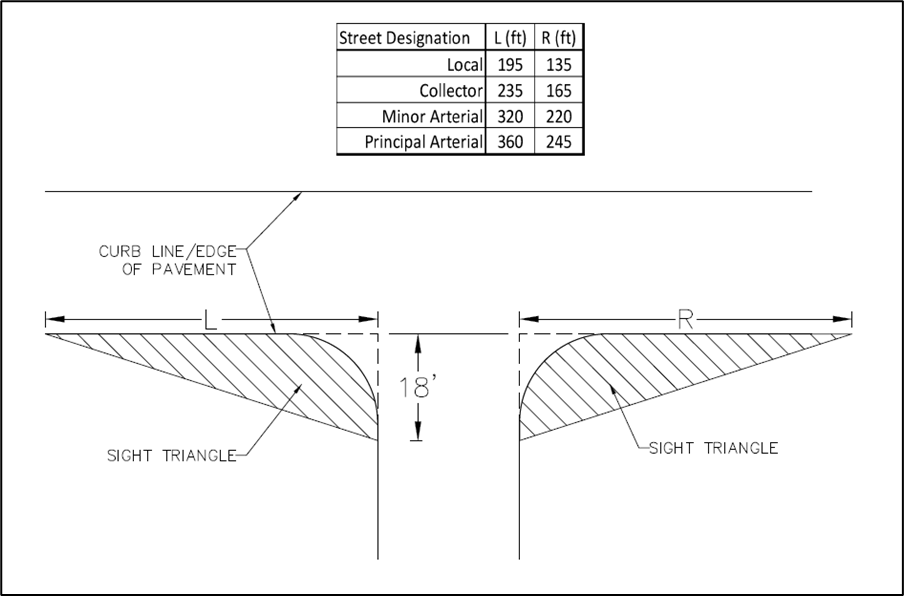
Sight distance triangle means a triangular area at the corner between any two intersecting streets, as depicted in the diagram below this definition, where: (1) the apex of the triangle is the point of intersection of the two street curb lines/edge of pavements; (2) the shorter leg of the triangle, which is parallel to a vehicle stopped at a traffic signal, device, or stop sign, is extended 18 feet from the apex along the abutting curb or edge of roadway pavement; (3) the longer leg (either right or left side) is measured perpendicular to the said stopped vehicle, measured abutting the curb or edge of roadway pavement at the distance based on the street class designation as shown in the chart in the diagram below this definition; and (4) the hypotenuse joins the ends of the triangle legs. No stationary object, either permanent or temporary, taller than 30 inches, as measured from the pavement elevation upon which a motor vehicle rests, shall be permitted within the sight distance triangle other than traffic control devices, or structures, erected by, or for the purpose of, a governmental entity.
Structure means anything erected or constructed by persons and requiring stationary location on the ground; provided however that mailboxes, or similar small features, or parking lots, and other construction having a vertical height of less than one foot above ground level shall not be deemed a structure for the purposes of determining setback distances. For the purpose of this definition, in-ground swimming pools, regardless of height, shall be considered a structure.
Street means any public right-of-way, except an alley, designed for motor vehicle use.
Territorial jurisdiction means the City's limited jurisdiction within the City's Planning Area.
Use of land means any land development and any activity upon land.
(Ord. No. 08-26, § I, 1-6-2009; Ord. No. 10-08, § I, 8-17-2010; Ord. No. 14-26, § I, 12-2-2014; Ord. No. 15-24, § I, 11-3-2015; Ord. No. 17-23, §§ 1, 2, 9-19-2017; Ord. No. 17-25, § 1, 10-17-2017; Ord. No. 19-27, § 1, 1-7-2020; Ord. No. 20-06, § 1, 4-7-2020; Ord. No. 20-08, § 1, 5-5-2020; Ord. No. 20-32, § 1, 12-1-2020; Ord. No. 24-09, § 1, 5-7-2024)
Sec. 102-2. - Use of land regulated.
No person shall cause or allow use of land within the municipal boundaries of the City of Siloam Springs, except in full compliance with these zoning district regulations and the Municipal Code.
(Ord. No. 08-26, § I, 1-6-2009)
Sec. 102-3. - Planned uses and special uses.
Planned uses and special uses listed for each zoning districts are subject to the permit procedures of chapter 54 of this Code, and shall not be otherwise construed as creating a right to a particular use.
(Ord. No. 08-26, § I, 1-6-2009; Ord. No. 19-11, § 22, 5-7-2019)
Editor's note— Ord. No. 19-11, § 22, adopted May 7, 2019, repealed § 102-3 and renumbered former § 102-4 as § 102-3. Former § 102-3 pertained to prohibited uses and derived from Ord. No. 08-26, § I, adopted Jan. 6, 2009.
Sec. 102-4. - Administrator's authority.
(a)
The administrator shall implement operational policies and procedures useful and proper in administering all provisions of this Code pertaining to use of land, and no development permit shall issue except upon the applicant's full and prompt compliance with the policies and procedures.
(b)
The administrator is authorized, without limitation, to require that development permit applicants shall submit plans for site use, plans for construction of buildings or other improvements, drainage plans, plans for installation of streets and utility infrastructure, elevations showing in scale, buildings, structures, and buildings facades, and all plans and documents useful and proper in administering all provisions of this Code pertaining to use of land.
(Ord. No. 08-26, § I, 1-6-2009; Ord. No. 19-11, § 22, 5-7-2019)
Editor's note— Ord. No. 19-11, § 22, adopted May 7, 2019, renumbered former § 102-5 as § 102-4.
Sec. 102-5. - Amendments.
The Board of Directors may determine that the City's land regulations require amendment from time to time. No vested rights shall be created by the City's land regulations.
(Ord. No. 08-26, § I, 1-6-2009; Ord. No. 19-11, § 22, 5-7-2019)
Editor's note— Ord. No. 19-11, § 22, adopted May 7, 2019, renumbered former § 102-6 as § 102-5.
Sec. 102-6. - Conflicting provisions.
When the provisions of the City's land regulations appear inconsistent with one another, or with other sections of the Municipal Code, the most restrictive provision shall govern.
(Ord. No. 08-26, § I, 1-6-2009; Ord. No. 19-11, § 22, 5-7-2019)
Editor's note— Ord. No. 19-11, § 22, adopted May 7, 2019, renumbered former § 102-7 as § 102-6.
Sec. 102-7. - Severance.
If any portion or provision whatever of the City's land regulations is declared invalid in a legal action to which the City is a party, the remaining provisions shall continue to control as appears reasonably consistent with legislative intent.
(Ord. No. 08-26, § I, 1-6-2009; Ord. No. 19-11, § 22, 5-7-2019)
Editor's note— Ord. No. 19-11, § 22, adopted May 7, 2019, renumbered former § 102-8 as § 102-7.

