
Skokie City Zoning Code
ARTICLE XI
OFF-STREET PARKING AND LOADING FACILITIES10
Editor's note— Ord. No. 19-4-C-4451, § 1, adopted April 15, 2019, renumbered Art. IV as Art. XI.
Cross reference— Stopping, standing and parking, § 106-91 et seq.
Sec. 118-201.- Scope of regulations.
The off-street parking and loading provisions of this article shall apply as follows:
(1)
Off-street parking and loading shall be provided as required by the regulations of this article for all buildings and structures erected and all uses of land established in each district after the effective date of the ordinance from which this article is derived.
(2)
When the intensity of use of any building, structure, or premises shall be increased through the addition of residential units, gross floor area, seating capacity, bedrooms, or other specified units of measurement, additional parking and loading shall be provided as required by this article. Any additional parking or loading may require additional water detention as required in § 118-64.
(3)
Whenever the existing use of a building or structure changes to a new use, required parking and loading shall be provided for the new use. However, if the existing building or structure was erected prior to March 2, 1965, additional parking and loading facilities are mandatory only in the amount by which the requirements for the new use would exceed those for the existing use, if the latter were subject to the parking and loading provisions of this article.
(Zon. Ord., § 11.1; Ord. No. 01-10-Z-3034, § 1, 10-1-2001; Ord. No. 02-5-Z-3078, § 2, 5-6-2002; Ord. No. 03-1-Z-3144, § 1, 1-6-2003; Ord. No. 19-4-C-4451, § 1, 4-15-2019)
Sec. 118-202. - Enforcement.
The Department of Public Works shall be responsible for all inspections and enforcement of the provisions of this article.
(Zon. Ord., § 11.16)
Sec. 118-203. - Existing parking.
Off-street parking in existence on March 2, 1965, and located on the same lot as the building or use served shall not hereafter be reduced below the requirements, except to meet the State of Illinois Accessibility Standards Act.
(Zon. Ord., § 11.2; Ord. No. 03-1-Z-3144, § 1, 1-6-2003)
Sec. 118-204. - Permissive parking and loading.
Nothing in this article shall prevent the voluntary establishment of off-street parking and loading to serve any existing use of land or buildings, provided that all regulations governing the location, design, and operation of such facilities are met.
(Zon. Ord., § 11.3; Ord. No. 03-1-Z-3144, § 1, 1-6-2003)
Sec. 118-205. - Reserved.
Editor's note— Ord. No. 13-10-C-4010, § 4, adopted Oct. 7, 2013, repealed § 118-205, which pertained to provision of facilities upon damage or destruction of building and derived from Zon. Ord. § 11.4.
Sec. 118-206. - Control of off-street parking.
(a)
Required off-street parking and the use it serves shall be on lots with the same titleholder of record, except for detached residences as restricted below in (b), off-site parking as allowed in this article, and nonresidential uses and residential guest parking in the CX Core Mixed-Use district.
(b)
Required off-street parking for detached residences shall be provided on the same lot as the principal building.
(c)
Required off-street parking shall be solely for patrons, occupants, or employees, including public passenger vehicles otherwise parked in compliance with this Code and designated shared parking spaces available to the public.
(d)
When a parking area is shared by principal users or by the public, vehicles shall not be allowed to be parked in or otherwise block common driveways, sidewalks, aisles, or other points of access at any time, shall only be parked in designated parking spaces, and shall not overlap the striped lines of designated parking spaces, unless parked in a fenced and screened storage area as allowed and by this chapter.
(Ord. No. 03-1-Z-3144, § 1(11.5), 1-6-2003; Ord. No. 05-9-C-3383, § 2, 9-6-2005; Ord. No. 08-1-C-3577, § 3, 1-7-2008; Ord. No. 08-9-C-3641, § 2, 9-15-2008; Ord. No. 09-1-C-3657, § 2, 1-5-2009; Ord. No. 12-2-C-3885, § 1, 2-6-2012)
Sec. 118-207. - Control of off-site parking.
(a)
The Engineering Division shall approve the location of any off-site parking.
(b)
A covenant running with the land restricting the use of those required off-site parking spaces for parking by the grantee shall be filed with the County Recorder of Deeds. The covenant shall require that the Village Manager or designee join in its release.
(c)
A certified copy of the recorded covenant from the County Recorder of Deeds must be deposited with the Village Manager or designee before a building permit is issued.
(d)
The covenant shall not be released by the Village Manager or designee until such time as either one of the following conditions occur:
(1)
The structure on the lot containing the principal use is removed or the principal use terminated; or
(2)
Replacement required parking is provided in accordance with the provisions of this article.
(Ord. No. 03-1-Z-3144, § 1(11.6), 1-6-2003; Ord. No. 05-9-C-3383, § 3, 9-6-2005; Ord. No. 09-1-C-3657, § 2, 1-5-2009)
Sec. 118-208. - Outdoor storage lots.
(a)
Lots for outdoor storage of vehicles shall not be used for customer or employee parking or vehicle preparation activities and may be used for sale or rental of motor vehicles and boats in conjunction with a motor vehicle and boat sales facility.
(b)
Except for lots used for sale or rental of motor vehicles and boats in conjunction with a motor vehicle and boat sales facility, a storage lot shall not be required to meet the design requirements of this article, provided that it is surfaced with gravel and drained subject to the approval of the Engineering Division. If such a lot is to be paved, it shall comply with the drainage and surfacing requirements in § 118-64.
(Ord. No. 03-1-Z-3144, § 1(11.7), 1-6-2003; Ord. No. 19-4-C-4451, § 1, 4-15-2019)
Sec. 118-209. - Assigned parking spaces.
For nonresidential uses, no more than 10 percent of required off-street parking shall be assigned. Required parking spaces shall not be assigned in nonresidential parking lots serving multiple uses.
(Zon. Ord., § 11.8; Ord. No. 09-3-C-3669, § 1, 3-16-2009)
Sec. 118-210. - Reserved.
Editor's note— Ord. No. 19-8-C-4479, § 1, adopted August 19, 2019, repealed § 118-210, which pertained to computations of number of parking spaces resulting in fractional number and derived from Zon. Ord., § 11.9; Ord. No. 07-9-C-3543, § 1, adopted Sept. 4, 2007.
Sec. 118-211. - Collective use of parking spaces.
No parking spaces shall serve as a required space for more than 1 use, except in mixed-use developments on the same site, where up to 20% of required parking for residential uses may be shared with commercial uses through a shared parking agreement approved by the Village.
(Zon. Ord., § 11.10; Ord. No. 22-8-C-4611, § 2, 8-1-2022)
Sec. 118-212. - Motor vehicle parking facility design standards.
(a)
Size and clearance.
(1)
A required off-street parking space shall have a width and a length, exclusive of access drives or aisles, ramps, columns or office or work areas, as follows:
MINIMUM STANDARDS FOR PARKING STALLS
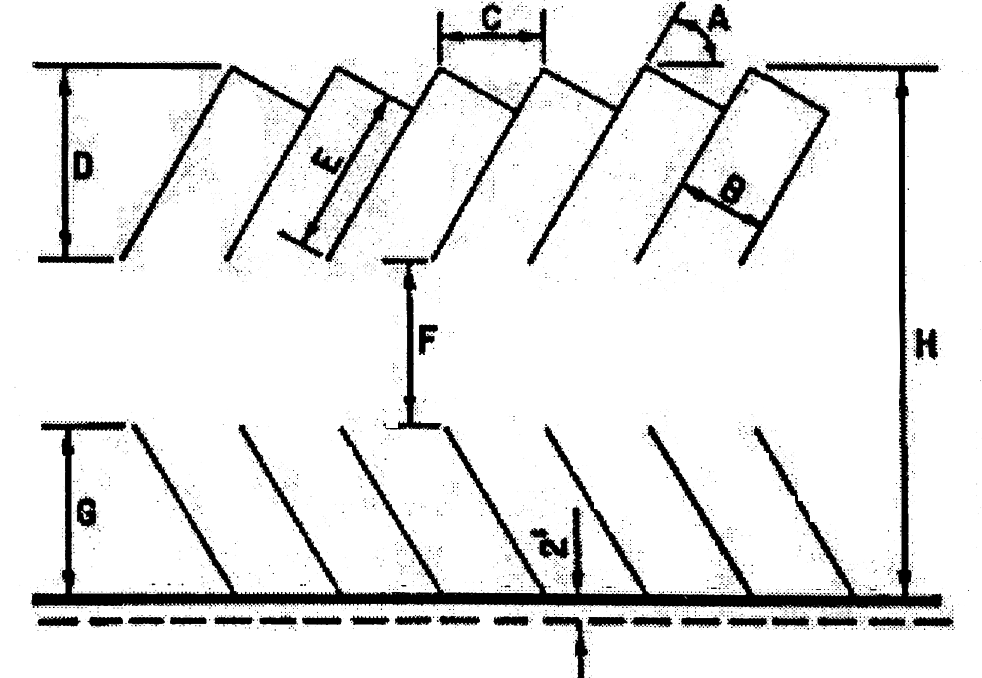
Minimum Parking Layout Dimensions for Head-In Parking
for 9-Foot-Wide Regular Parking Stalls at Various Angles
*Vehicular overhang shall not encroach into a walkway or sidewalk area reducing the width to less than 3 feet.
(2)
Angle interpretation for parking stalls shall be allowed by Village Manager or designee approval only.
(3)
Where parallel parking is permitted, the stall length shall be 24 feet and the width shall be 8 feet. Open-end spaces shall have a minimum length of 20 feet. Aisle width shall be a minimum of 14 feet.
(4)
Parking space(s) for the physically disabled shall be designed and provided in accordance with State requirements.
(5)
The full width of an alley, but no portion of a street, may be used in computing such aisle or access area. All off-street parking facilities shall be provided with appropriate means of vehicular access to a street or alley.
(6)
For all uses, except detached, duplex, and townhouse residences, required off-street parking spaces abutting walls, fences, or other obstructions greater than 15 percent of the length of the stall shall have a minimum width of 10 feet. This regulation shall also apply to outdoor required parking spaces for townhouse residences.
(b)
Ramp and driveway grade.
(1)
Exterior ramp grades shall not exceed 6 percent.
(2)
Interior ramp grades shall not exceed 10 percent.
(3)
Handicapped ramp grades shall be 1 inch per 1 foot.
(4)
Driveways for all residential types except multifamily residences with 3 or more units shall have a grade between 1 percent and 6 percent on private property sloping downward to the right-of-way line.
(5)
The part of a driveway that is within the public right-of-way shall have a grade between 1 percent and 10 percent sloping downward to the back of the curb of the street.
(c)
Access driveways to off-street parking and loading spaces.
(1)
Width of driveways (measured at the street right-of-way line abutting the lot) shall be as follows:
a.
Residences without shared driveways: Not less than 9 feet wide and not more than 22 feet wide.
b.
Nonresidence uses and all residences with shared driveways:
1.
Not less than 14 feet wide for a one-way driveway;
2.
Not less than 20 feet wide for a two-way driveway when less than 20 parking spaces are being served;
3.
Not less than 24 feet wide for a two-way driveway when 20 or more parking spaces or 2 or more loading spaces are being served; and
4.
Not more than 35 feet wide.
(2)
The radius connecting the street pavement edge and driveway edges shall conform with the Standards for Parking Lots and Driveways as established by the Engineering Division.
(3)
The acute angle formed at the intersection of a driveway and street pavement edges shall be not less than 60 degrees.
(4)
The spacing between separate driveway entrances on a lot (measured at the street right-of-way line abutting the lot) shall be as follows:
a.
On arterials: Not less than 30 feet.
b.
On streets not classified as arterials: Not less than 16 feet.
(5)
On corner lots, the spacing between the driveway entrance and the right-of-way line of the adjacent intersecting street shall be as follows:
a.
To intersecting arterials: Not less than 15 feet.
b.
To an intersecting street not classified as an arterial: Not less than 8 feet.
(6)
Location. Access to off-street parking can only be from a public alley. Subsequent to October 16, 2023, new curb cuts are prohibited unless the lot does not abut a public improved alley. Relief may only be granted for mixed-use, business or industrial properties.
(d)
Access. Each required off-street parking space shall open directly upon an aisle or driveway of such applicable width and design as set forth in this article in order to provide safe and efficient means of vehicular access to such parking space. Tandem parking shall not be allowed to meet off-street parking requirements, except as part of a Village-approved plan in designated redevelopment areas in the M1 Office Assembly Industry, M2 Light Industry and M3 Industry districts. In these areas tandem parking can be provided, however, only the parking spaces on private property that are accessed from a public street where there is approved parkway parking shall be allowed to meet off-street parking requirements.
(e)
Vertical clearance. Enclosed parking spaces shall have a vertical clearance of at least 7 feet. All pipes, sprinklers, vent fans and other such obstructions shall not encroach into the clearance.
(f)
Surfacing. All off-street parking areas shall be fully improved with a pavement meeting the Village design standards. This standard shall not apply to storage lots unless such lots are paved. Unpaved storage lots shall be surfaced with gravel and drained subject to the approval of the Engineering Division.
(g)
Drainage. Drainage shall be provided in accordance with § 118-64.
(h)
Signing and striping.
(1)
Signing and pavement markings shall be provided for regulatory purposes pertaining to the operation of the parking lot as determined by the Village Manager or designee, and striping of the pavement surface shall be provided to define each parking space.
(2)
Signage and striping shall be in accordance with this Code.
(i)
Curbing and walks.
(1)
All surface parking lots shall have continuous curbing located a minimum of 6 feet from, and parallel to, any property line which is adjacent to a street frontage, except as noted in this subsection.
(2)
The required continuous curbing may be located closer than 6 feet to the property line when the area between the curbing and the property line does not equal more than 10 percent of the total area of the off-street parking lot.
(3)
Any parking area serving either detached or 2-unit multifamily residences shall be exempt from the curbing requirement of this section.
(4)
For unimproved existing lots and deficient existing lots which are to be improved, where the continuous curbing is not used as wheel stops, such curbing may be closer than 6 feet to the property line when it would result in a reduction in the number of standard off-street parking spaces or if it would reduce the width of an access aisle or driveway below the minimum requirements.
(5)
For unimproved existing lots and deficient existing lots which are to be improved, where the continuous curbing is used as wheel stops, such curbing may be located up to a minimum of 3 feet from the property line if the placement of the curbing at a distance of greater than 3 feet would result in a reduction in the number of standard off-street parking spaces which were previously provided or if it would reduce the width of an access aisle or driveway below the minimum requirements.
(6)
When the continuous curbing would fall within a utility easement, the requirement must be reviewed by the Director of Engineering. The Director of Engineering shall determine, after a review of written statements from the public utility companies, whether each utility company is now using the easement or plans to do so in the future, and the characteristics of such use, the type of utility line, its horizontal and vertical placement, its relationship to other utilities, and the access needed for installation and maintenance. When the utility easement is or will be in use, the Director of Engineering shall determine whether the continuous curbing on the easement will interfere with the utility companies' use of the easement and shall then determine a suitable location for the continuous curbing.
(7)
If the continuous curbing cannot be so placed as to avoid interference with the utilities, then alternate curbing and/or location shall be determined by the Director of Engineering. When none of the foregoing are possible, a variance to waive this requirement may be sought from the Zoning Board of Appeals, or, if the subject site is under consideration for a special use permit, then the waiver of this requirement may be sought from the Plan Commission as part of the special use.
(8)
Perimeter curbing shall meet the curve of the street curb. Where this continuous street-to-parking-area curbing meets a pedestrian sidewalk, there shall be no on grade separation.
(9)
Continuous curbing shall be required within the interior of an off-street area, to ensure the public safety and protect landscaping, or as required by the Director of Engineering. Adequate methods of containing vehicular parking shall be provided, subject to the approval of the Director of Engineering, if continuous curbing cannot be provided. Such methods shall include but not be limited to wheel stops and approved roping devices.
(10)
For all new parking lots with aisles, a minimum 5-foot sidewalk shall be provided alongside a building abutting an off-street parking area to provide access to the building from the parking area. If the building depth (or width) is less than the depth (or width) of the property, the sidewalk shall extend beyond the building and run the length (or depth) of the parking area. In addition, the minimum 5-foot sidewalk shall be provided at the rear of a building or structure behind which aisle parking is provided.
(11)
The required sidewalk may be reduced in width to 3 feet under the following circumstances:
a.
Where any parking area has direct access to the parking stalls from an alley and is also located directly to the rear of the building; and
b.
Where the sidewalk abutting the parking area or which provides access to the building from the parking area is not in conflict with vehicular traffic maneuvers, including backup maneuvers.
(j)
Screening and landscaping.
(1)
For all new and existing lot improvements, adequate visual screening shall be erected along any lot line of a nonresidential property which abuts residentially zoned property and is not separated by an alley from such property. If an intervening alley separates residentially zoned property from nonresidentially used property, then the visual screening shall be erected 1 foot within the side or rear lot line of the nonresidentially used property to screen the off-street parking and/or loading areas.
a.
Only the following types of visual screening shall be permitted for the purpose of this article:
1.
Face brick wall.
2.
Reinforced concrete wall with decorative finish.
3.
Solid board-on-board wooden fence.
4.
Dense evergreen living shrubs.
5.
A combination of the types of screening listed in this subsection.
b.
The height of the required screening shall be 5 feet, except in residentially zoned districts it shall be 4 feet. Screening shall not be required in the R1 and R2 residential districts, except by special use permit.
c.
Where access to an intervening alley is provided from an off-street parking and/or loading area, the height of the required screening on either side of the access area shall be 30 inches for a minimum of 10 feet.
d.
All required screening other than permitted screening types shall be subject to the approval of the Appearance Commission.
e.
All required screening shall be adequately protected from vehicular maneuvers. Protection may include wheel stops, curbing, guardrails and/or earth berming. Where required screening other than landscaping is provided at an alley, the 1-foot area between the property line and the required screening shall be covered with a hard surface, subject to the approval of the Director of Engineering.
f.
When the required screening would fall in a utility easement or an alley boundary which is used by 1 or more of the utility companies for its service, the requirement must be reviewed by the Director of Engineering. The Director of Engineering shall determine, after a review of written statements from the public utility companies, whether each utility company is now using the easement or plans to in the future and the characteristics of such use, the type of utility line, its horizontal and vertical placement, its relationship to other utilities and the access needed for installation and maintenance. When the utility easement is or will be in use, the Director of Engineering shall determine when the required screening on a lot would interfere with the utility companies' use of the easement and shall then determine a suitable location for such screening. If required screening cannot be so placed to avoid interference with the utilities, alternate screening and location shall be determined by the Director of Engineering and the Director of Community Development.
(k)
Lighting.
(1)
Lighting shall be required for all new commercial and industrial off-street parking areas. Lighting shall also be required for all residential parking areas with more than 20 spaces. Residential developments consisting of only detached residences shall be exempt.
(2)
Any lighting shall be directed away from abutting or adjacent properties, streets, or public rights-of-way.
(3)
The illumination level for all off-street parking areas shall be as follows, unless otherwise approved as part of Site Plan approval:
a.
The illumination level for an off-street parking area shall be an average maintained horizontal footcandle ratio of 1.0 to 3.0 footcandles or per IES required standards for other application purposes.
b.
Uniform illumination is desirable, and the lowest footcandle value at any point on the pavement should not be less than ¼ the designed average maintained horizontal footcandles.
c.
The type of luminaries, shielding, pole height and the lighting design, uniformity ratio and the entire lighting scheme shall be subject to the approval of the Village Traffic Engineer. All lighting units shall be of the full cutoff type.
(Zon. Ord., § 11.11; Ord. No. 00-4-Z-2886, § 1, 4-3-2000; Ord. No. 01-6-Z-2987, § 1, 6-4-2001; Ord. No. 01-9-Z-3028, § 2, 9-20-2001; Ord. No. 01-10-Z-3034, § 1, 10-1-2001; Ord. No. 03-1-Z-3144, § 1, 1-6-2003; Ord. No. 03-1-Z-3145, § 1, 1-6-2003; Ord. No. 05-8-C-3375, § 1, 8-1-2005; Ord. No. 05-9-C-3383, § 4, 9-6-2005; Ord. No. 06-4-C-3429, § 1, 4-17-2006; Ord. No. 07-9-C-3543, § 1, 9-4-2007; Ord. No. 08-6-C-3621, § 1, 6-2-2008; Ord. No. 08-11-C-3649, § 1, 11-3-2008; Ord. No. 09-7-C-3692, § 1, 7-20-2009; Ord. No. 10-4-C-3757, § 1, 4-7-2010; Ord. No. 11-3-C-3823, § 1, 3-7-2011; Ord. No. 15-5-C-4142, § 4, 5-4-2015; Ord. No. 19-4-C-4451, § 1, 4-15-2019; Ord. No. 22-12-C-4629, § 2, 12-19-2022; Ord. No. 23-10-C-4663, § 1, 10-16-2023)
Sec. 118-213. - Parking requirements for additions and improvements in nonresidential zones.
If any nonresidential establishment expands its gross floor area, thereby requiring additional off-street parking spaces, the additional parking area shall conform to all requirements for a new lot. The existing parking area shall be made to conform to the requirements for a new lot for paving, drainage, curbing, lighting, striping, and landscaping. If any nonresidential establishment expands its gross floor area by 50 percent or more, the existing parking area shall be made to conform to the requirements for a new lot for paving, drainage, curbing, lighting, striping, and landscaping.
(Zon. Ord., § 11.12)
Sec. 118-214. - Maintenance of parking areas.
All parking areas shall be maintained at all times in broom clean condition, without potholes, broken wheel stops and/or curbing or other surface irregularities. All landscaping shall be maintained in a flourishing condition, free of weeds and debris, and all dead landscaping shall be replaced. Pavement markings shall be visible at all times, and parking lot signage shall be readable at all times, with the signpost maintained in an upright manner. Compliance is required with all conditions of the Village's private property fire lane sign maintenance program and the Village's designation of private property handicapped parking spaces program. All area lighting shall be maintained in functioning condition. Drainage systems shall be maintained in a free-flowing working condition. It shall be unlawful to alter any aspects of an approved parking lot plan unless approval has been received through the Director of Engineering.
(Zon. Ord., § 11.13)
Sec. 118-215. - Use of parking areas for storage; leasing of parking spaces; charging fee for parking spaces.
(a)
Parking areas shall be used exclusively for parking purposes and not for storage of vehicles, boats, trailers, campers or other personal property, unless allowed under other sections of this article.
(b)
Parking spaces may be leased only where the parking spaces provided are in excess of the parking requirements of the principal use, and only those excess spaces may be leased. Nothing contained in this section shall permit the leasing of parking space for vehicles that are not permitted to be parked in the zoning district.
(c)
All required off-street parking spaces shall be part of the principal premises lease, and no fee shall be charged therefor, unless the space is additional to the parking required by this article.
(d)
The provisions of this section shall apply as of the date of adoption of the ordinance from which this section is derived.
(Zon. Ord., § 11.15)
Sec. 118-216. - Reserved.
Editor's note— Ord. No. 19-8-C-4479, § 1, adopted August 19, 2019, repealed § 118-216, which pertained to computation of required employee parking and derived from Zon. Ord., § 11.17.
Sec. 118-217. - Motor vehicle parking in yards.
(a)
Inoperable vehicles. No vehicles that are inoperable shall be permitted to be stored in the open in any yard. A motor vehicle will be considered inoperable if it is wrecked, dismantled, partially dismantled, incapable of operation by its own power upon a public street, or the wheels, engine, transmission or any substantial part thereof have been removed.
(b)
Surface. Open off-street parking shall be located upon a surface approved by the Director of Engineering and constructed in compliance with Village engineering standards.
(c)
Residential districts.
(1)
Permitted vehicles.
a.
Generally. Only the following motor vehicles shall be allowed to be parked in the open on a lot in a residential district:
1.
Motorcycles.
2.
Recreational vehicles, boats, and boat trailers in accordance with § 118-62 and elsewhere in this chapter.
3.
Noncommercial vehicles with passenger or Class B license plates.
4.
Public passenger vehicles as defined in Section 118-31 only under the following circumstances:
a.
The vehicle has a parking permit issued by the Village.
b.
The location has been approved by the Village Manager or his designee.
c.
The vehicle must be parked in a rear yard and cannot be parked in a front or side yard, except in a parking lot for multiple residence buildings.
d.
Not more than 1 vehicle is allowed to park per dwelling unit.
e.
Village owned or operated parking lots.
b.
Noncommercial vehicles. For the purpose of this section, those factors that determine a noncommercial vehicle shall include, but not be limited to, all of the following:
1.
Single rear wheels only.
2.
No signs, advertisements, business identifications or business license plates.
3.
No attached auxiliary equipment, including but not limited to plows, equipment racks or storage boxes or lockers.
4.
No debris, construction materials or equipment intended for commercial or business use may be present whether in the open or covered by removable material or fabric.
5.
Cargo and panel vans that comply with subsections (c)(1)b.1 through 4 of this section and have side and rear windows and seating behind the driver's seat.
(2)
Detached, townhouse, and 2-unit multifamily residences.
a.
Open off-street parking spaces may be located in any yard except as otherwise stated in this section.
b.
Open off-street parking spaces shall be:
1.
Accessed from a driveway constructed in compliance with Village engineering standards.
2.
In compliance with yard and lot impermeable surface coverage requirements.
3.
Located at least 5 feet from a property line abutting a street.
4.
Set back from the nearest street right-of-way line intersection a distance equal to the required front and side yards abutting a street.
5.
Contiguous, having a common, usable vehicle access aisle that meets the Village engineering standards.
c.
Required off-street parking in a front or side yard abutting a street shall only be allowed when the required parking is eliminated as a direct result of remodeling additions or garage conversions and there is no other location on the site for the parking. Parking may also be allowed on a circular driveway, for residential lots that abut a traffic arterial, when other required parking cannot be provided. Under these circumstances:
1.
A maximum of 2 motor vehicles shall be permitted to park in the front or side yard.
2.
The addition or remodeling shall not decrease the existing number of off-street parking spaces required by this chapter.
3.
When required parking can be provided elsewhere or driveway standards cannot be met, the existing driveway and approach shall be removed, the parkway returned to landscaping, and the public sidewalk and gutter replaced according to Village engineering standards.
d.
Nonrequired parking in a front or side yard abutting a street shall only be allowed when the parking is located on a driveway in compliance with Village engineering standards leading to an approved off-street parking area.
e.
All motor vehicles not permitted to be parked in the open on a lot must be parked within a garage unless a variation is received from the Zoning Board of Appeals.
(3)
Other residential uses. For uses other than detached, townhouse, and 2-unit multifamily residences, off-street parking spaces, open to the sky, may be located in any yard except a required front yard or a required side yard abutting a street in all residential districts. Off street parking spaces are prohibited within 10 feet of a side lot line that abuts a street.
(d)
Nonresidential districts.
(1)
Parking in a required front yard shall be permitted only in B4 Regional Shopping, M2 Light Industry, and M3 Industry districts.
(2)
Mixed-use and business districts.
a.
Trucks with an Illinois "B" license plate classification or other commercial vehicles with a gross weight of 8,000 pounds or less shall be permitted to park in yards, consistent with this Section and Section 118-206.
b.
Commercial vehicles in excess of 8,000 pounds gross weight shall be permitted to park in all allowable yards between 7:00 a.m. and 9:30 p.m.
c.
Commercial vehicles in excess of 8,000 pounds gross weight are prohibited from parking in a front yard or corner side yard between 9:30 p.m. and 7:00 a.m.
d.
Commercial vehicles in excess of 8,000 pounds gross weight may park in an interior side yard or rear yard with an administrative permit from the Village Manager or designee under the following conditions:
1.
The vehicle is generally screened from view from any public streets in right-of-way abutting the lot or an abutting residential zoning district.
2.
The vehicle is free from exposed equipment such as racks, ladders, equipment boxes, towing or other rigging, compressors, roll-off containers, lifts, open storage, or other similar equipment.
3.
The vehicle cannot be parked indoors at the location.
4.
Parking the vehicle at the location is necessary to the operation of the business.
(Zon. Ord., § 11.18; Ord. No. 01-8-Z-3021, § 6, 8-6-2001; Ord. No. 01-10-Z-3034, § 1, 10-1-2001; Ord. No. 02-4-Z-3075, §§ 1, 2, 4-1-2002; Ord. No. 02-5-Z-3078, § 3, 5-6-2002; Ord. No. 05-8-C-3375, § 1, 8-1-2005; Ord. No. 05-9-C-3383, § 5, 9-6-2005; Ord. No. 08-1-C-3577, § 4, 1-7-2008; Ord. No. 08-11-C-3649, § 1, 11-3-2008; Ord. No. 09-7-C-3691, § 1, 7-20-2009; Ord. No. 10-4-C-3757, § 1, 4-7-2010; Ord. No. 11-3-C-3823, § 1, 3-7-2011; Ord. No. 19-4-C-4451, § 1, 4-15-2019)
Sec. 118-218. - Required number of off-street motor vehicle parking spaces.
(a)
Calculation of number of spaces.
(1)
Fractional numbers. When determination of the number of parking spaces required by this article results in a requirement of a fractional space, any fraction less than ½ may be disregarded, while a fraction ½ or greater shall be counted as 1 parking space.
(2)
Required on an employee basis. Parking spaces required on an employee basis shall be based on the average number of employees during the highest period of employment.
(3)
Owned, rented, or leased vehicles. Except for residences, in addition to the minimum requirements listed in subsection (b), 1 additional parking space shall be required for each vehicle owned, rented, or leased by the use that is kept on site.
(4)
EV Parking Spaces. Electric vehicle charging stations may be located in required off-street parking spaces and may be counted toward satisfying minimum off-street parking space requirements where the determination for parking does not exceed the minimum parking determination, and the application is residential, the electric vehicle charging station/parking spaces may not be restricted by time between the hours of 7:00 p.m. and 7:00 a.m.
(b)
Minimum number of spaces. The minimum number of parking spaces required for designated uses shall be as follows:
(1)
Residential and lodging uses.
Congregate living facilities: For residential units with 5 or less bedrooms, parking shall conform to the requirements of the type of residential unit it occupies if the building were not used for a congregate living facility. For units with 6 or more bedrooms, the Plan Commission shall determine off-street parking.
Dormitory: Off-street parking requirements shall be determined by the Plan Commission.
Elderly and disabled housing:
a.
Market rate units: 1 parking space for each unit.
b.
Subsidized units: 1 parking space for every 3 units.
c.
For buildings containing 5 or more units, a minimum of 10 percent of the required parking spaces shall be unenclosed and available for guests and/or unit owners on an unrestricted first come, first served basis.
Hotels or private clubs and lodges: 1 parking space for each lodging room, plus 1 parking space for each 100 ft 2 of dining area, meeting rooms, and bars and cocktail lounges. In addition, other uses, such as retail sales or offices, which do not exclusively serve the subject establishment, shall provide parking spaces on the basis of the off-street parking requirements set forth elsewhere in this article.
Residences:
a.
For purposes of this section, any room other than a kitchen, living room, dining room, living-dining room, laundry room, bathroom or lavatory shall be deemed a bedroom, if it is more than 60 percent enclosed from an adjacent space.
b.
For residences built after the effective date of the ordinance from which this article is derived, all required handicapped and guest parking spaces shall be accessible to the public.
c.
Off-street parking shall be provided for each unit as indicated in the table below:
d.
Guest parking is eligible for a financial contribution in lieu of providing the parking in a CX Core Mixed-Use district, subject to the provisions in (7)e. of this section. The Village Manager or designee may waive contribution if it is shown that appropriate shared parking or Municipal Parking exists in the area.
Skilled nursing facilities: 1 parking space for each 3 beds.
(2)
Schools, places of worship, institutions, auditoriums and other places of assembly.
Assembly uses, including religious assembly, auditoriums, gymnasiums, stadiums, grandstands, meeting halls and institutional establishments: Off-street parking requirements shall be determined by the Plan Commission.
Religious assembly: Off-street parking requirements shall be determined by the Plan Commission.
Colleges and universities: Off-street parking requirements shall be determined by the Plan Commission but such requirements shall not be less than 1 parking space per 300 ft 2 of net floor area.
Courts: The Plan Commission shall determine off-street parking requirements.
Cultural centers: Off-street parking requirements shall be determined by the Plan Commission.
Libraries or archives: 1 parking space for each 800 ft 2 of net floor area.
Schools: The greater of the required parking spaces as listed below or the required parking spaces for an auditorium or other places of public assembly accessory to the school.
a.
Alternate education: 1 parking space for each faculty member and each other full-time employee plus 1 parking space for each 7 high school students based on the maximum number of students that can be accommodated in accordance with such design capacity of the building.
b.
Driving: 1 parking space for each school employee.
c.
Elementary and middle: 1 parking space for each faculty member and each other full-time employee.
d.
Fine and performing arts or sports and recreation: 1 parking space for each 2 employees, plus 1 space for each 4 students or 1 space per 300 ft 2 , whichever is greater.
e.
Technical and trade: 1 parking space for each employee, plus 1 space for each 2 students, or 1 space per 200 ft 2 , whichever is greater.
f.
Senior high: 1 parking space for each 7 students based on the maximum number of students that can be accommodated in accordance with the design capacity of the building.
All other schools, institutions, and assembly uses: Off-street parking requirements shall be determined by the Plan Commission.
(3)
Arts, entertainment, and recreation uses.
Bowling alleys: 7 parking spaces for each lane. In addition, other uses, such as restaurants, shall provide parking spaces on the basis of the off-street requirements set forth elsewhere in this article.
Dancehalls, including discotheques, and commercial skating rinks: 1 parking space for each 100 ft 2 of net floor area. In addition, other uses, such as restaurants, shall provide parking spaces on the basis of the off-street parking requirements set forth elsewhere in this article.
Firing range: Determined by the Plan Commission.
Games arcade establishment: 1 parking space for each 200 ft 2 of net floor area, or 1 space per 4-person capacity plus 1 space per employee, whichever is greater.
Health and fitness centers and swimming pools: Determined by the Plan Commission.
Indoor court facilities, racquetball and handball courts: 5 parking spaces for each court. In addition, other uses, such as restaurants, shall provide parking spaces on the basis of the off-street parking requirements set forth elsewhere in this article.
Museums: 1 parking space for each 800 ft 2 of net floor area.
Parks, recreation areas, and community centers: 1 parking space for each 2 employees, plus spaces in adequate numbers as determined by the Plan Commission to serve the visiting public.
Tennis courts: 7 parking spaces for each court and 6 additional spaces for staff. Other uses, such as restaurants, shall provide parking spaces on the basis of the off-street parking requirements set forth elsewhere in this article.
Theater, dance, music establishments (live performance): 1 parking space for each 3 seats.
All other arts, entertainment, and recreation uses: Determined by the Plan Commission.
(4)
Office, retail, service, and industrial uses.
Animal shelter: Determined by the Plan Commission.
Art galleries: 1 parking space for each 800 ft 2 of net floor area.
Auction house: 1 parking space for every 100 ft 2 of auctioneering and seating area if the seats to be used are portable; and, in addition, 1 parking space for each 1,500 ft 2 of gross floor area for all other floor area, or 1 parking space for each 2 employees, whichever is greater number of required spaces.
Automobile sales and service establishments: Off-street parking for all uses under this category shall be calculated cumulatively for each use on the site as listed below:
a.
Vehicle dealer (all types): 3.0 parking spaces per 1,000 ft 2 of floor area for the first 1,000 ft 2 , then 1.2 parking spaces per 1,000 ft 2 of floor area thereafter.
b.
Automotive fuel station: 2 parking spaces plus 1 parking space for tire inflation.
c.
Automotive repair facility and hand car wash: 3.5 spaces for each service bay. Service bays are not to be included in meeting the off-street parking requirements, and required parking spaces cannot be used as service bays.
d.
Car wash: Determined by the Plan Commission.
e.
Motor vehicle parts and accessories store: 3.0 parking spaces per 1,000 ft 2 of floor area.
f.
Any parking spaces as required for other uses listed in this section.
Banks and other financial institutions, walk-in: 1 parking space for each 300 ft 2 of net floor area.
Banks and other financial institutions, drive-in: Off-street parking and stacking requirements to be determined by the Plan Commission. The petitioner must provide a traffic impact study from a recognized traffic engineering consultant, indicating the impact on the surrounding road network.
Barbershops, beauty parlors, and other similar establishments: 1 parking space for each 200 ft 2 of net floor area.
Cannabis dispensaries: 1 parking space for each 300 ft 2 of net floor area.
Computer services establishment: 1 parking space for each 200 ft 2 of net floor area, or 1 space per 4-person capacity plus 1 space per employee, whichever is greater. Other uses, such as restaurants, training schools, and computer repair, shall provide parking spaces on the basis of the off-street parking requirements set forth elsewhere in this chapter.
Construction material sales centers, machinery related contractor, and heavy construction businesses: 1 space for each 1,500 ft 2 of net floor area, plus 1 parking space for each employee.
Co-working office: 1 parking space for each 300 ft 2 of net floor area.
Dry cleaning and laundry establishments: 1 parking space for each 300 ft 2 of net floor area.
Dry cleaning and laundry plant: 1 parking space for each 600 ft 2 of net floor area.
Electronic answering services, collections, or telemarketing: 1 parking space for each 100 ft 2 of net floor area.
Emergency response: 1 parking space for each 300 ft 2 of net floor area or 1 parking space for each employee, whichever results in the greater number of off-street parking requirements.
Food establishments and food services:
a.
Brew pub: Off-street parking requirements shall be determined by the Plan Commission.
b.
Caterer: 1 parking space for each 300 ft 2 of net floor area.
c.
Carryout restaurant: 1 parking space for each 300 ft 2 of net floor area.
d.
Food establishments (all categories in Appendix A): 1 parking space for each 300 ft 2 of net floor area.
e.
Limited-service restaurant and full-service restaurant, and bar or drinking place: 1 parking space for each 100 ft 2 of net floor area.
f.
Tap room: Off-street parking requirements for production area shall be determined by the Plan Commission.
Funeral homes and mortuaries:
a.
Funeral homes: 1 parking space for each 100 ft 2 of net floor area.
b.
Mortuaries: 1 parking space for each 300 ft 2 of net floor area.
Furniture and appliance stores, carpet and rug stores, electrical fixture sales and showrooms, orthopedic and medical appliance stores, machinery sales and service and establishments for sale or repair of major household equipment or furniture or major kitchen or bathroom accessories or fixtures: 1 parking space for each 800 ft 2 of ground floor area, plus 1 parking space for each 1,500 ft 2 of net floor area other than net ground floor area. Any item for sale or rent shall not occupy an off-street parking space required by this article.
Greenhouse, nursery, and floriculture:
a.
Floriculture production food crops grown under cover, and all other indoor crop farming: 1.5 parking spaces for each 1,000 ft 2 of gross floor area, except that if any portion of the facility or operations is for retail use then the requirement is 3.0 parking spaces for each 1,000 ft 2 of gross floor area for the whole facility.
b.
Medical cannabis cultivation center: Determined by the Plan Commission.
Health and human services:
a.
Medical and diagnostic laboratories: 1.5 parking spaces for each 1,000 feet 2 of gross floor area.
b.
Child day care: 2.0 parking spaces for each 1,000 feet 2 not in residences, no additional parking required beyond that of the residence use in residences.
c.
Child and youth services, community food services, home hospice and home health care agencies, and services for the elderly and disabled: 3.0 parking spaces for each 1,000 feet 2 of gross floor area.
d.
Clinics and outpatient care centers, blood and organ banks: 5.0 parking spaces for each 1,000 feet 2 of gross floor area.
e.
Hospitals: Determined by the Plan Commission.
Health and personal care: 3.0 parking spaces for each 1,000 ft 2 of gross floor area. If a clinic or outpatient care use is operated in conjunction with this use, 5.0 parking spaces for each 1,000 ft 2 of gross floor area are required for that portion of the use.
Laundromats: 1 parking space for each 200 ft 2 of net floor area.
Mail order and direct selling establishment: 1 parking space for each 300 ft 2 of net floor area. In industrial districts, use manufacturing and whole trade requirements.
Manufacturing and wholesale trade uses. Off-street parking for all uses under this category shall be calculated cumulatively for each activity on site as listed below:
a.
Electronic answering services, collections, or telemarketing and retail uses: as listed for that use elsewhere in this section.
b.
Office uses and dental laboratories: 1 parking space per 300 ft 2 of net floor area.
c.
Manufacturing uses, including production, processing, printing, repackaging, assembling, cleaning, servicing, testing, or repairing of materials, goods, or products, and limited manufacturing processes as permitted in mixed-use and business districts: 1 parking space for each 600 ft 2 of net floor area.
d.
Conventional warehouses, including storage, wholesale, and mail order establishments where no other activities involving the product are performed, and where the product remains intact in the same physical state as it arrived, except for necessary packaging (but not repackaging), storage, or mailing containers: 1 parking space for each 1,500 ft 2 of net floor area.
e.
Self-service storage facility: determined by the Plan Commission.
Microbrewery, microdistillery or micro-winery: Off-street parking requirements for production area shall be determined by the Plan Commission.
Motion picture viewing or exhibition services: 1 parking space for each 3 seats.
Newspaper distribution agencies: 1 parking space for each 300 ft 2 of net floor area or 1 parking space for each employee, whichever results in the greater number of off-street parking requirements.
Offices, nonmedical and nontreatment: 1 parking space for each 300 ft 2 of net floor area.
Private security agencies, including canine patrols: 1 parking space for each 300 ft 2 of net floor area, excluding animal quarters, or 1 parking space for each employee, whichever results in the greater off-street parking requirements.
Public utility and public service uses: 1 parking space for each 2 employees.
Rental and leasing uses:
a.
Leasing of commercial or industrial machinery or equipment: 1.2 parking spaces for each 1,000 ft 2 of gross floor area.
b.
All other rental and leasing uses: 3.0 parking spaces for each 1,000 ft 2 of gross floor area.
Research and development services: 1 parking space for each 600 ft 2 of net floor area.
Road, ground, passenger, and transit transportation:
a.
Local transit systems: no parking required.
b.
Interurban and charter bus establishments, school and employee bus transportation, and taxi and limousine service: 3.0 parking spaces for each 1,000 ft 2 of gross floor area.
Road materials recycling: Off-street parking requirements shall be determined by the Plan Commission.
Truck and freight transportation services: Off-street parking requirements shall be determined by the Plan Commission.
All other retail, business offices and commercial establishments: 1 parking space for each 300 ft 2 of net floor area.
(5)
Parking determinations. The Plan Commission will base their determination of off-street parking on a signed statement describing the operation of the proposed use, information and recommendations contained in the Staff Report of the Plan Commission, and any other information that affects the type and amount of parking necessary for the use, as determined by Staff and listed on the Petition for Parking Determination. This additional information may include, but is not limited to, professional parking studies measuring real parking demand, the number of employees at the location throughout the day, peak use periods, parking spaces needed for specific functions (e.g. pick-up/drop-off, vehicles used or stored by the use, et cetera), occupancy of different spaces and usage of different areas within the location.
(6)
Uses in B4 Regional Shopping district. For the purpose of determining the required number of parking spaces, the B4 Regional Shopping district shall be divided into 3 categories:
a.
Category A: When less than 50% of the floor area is devoted to retail sales, the required number of parking spaces for each use established in the B4 district shall be the same as the required number of parking spaces as set forth in subsections (b)(1) through (b)(4) of this section for such uses.
b.
Category B: When 50% or more of the floor area is devoted to retail sales, the required number of parking spaces shall be 4 parking spaces for each 1,000 ft 2 of the total horizontal area of all floors that are at least 6 feet 9 inches in height, measured from the exterior faces of the exterior walls, except those areas used for parking facilities. The parking requirement is reduced to 3.8 parking spaces per 1,000 ft 2 if a transit station serving at least 4 routes exists on-site.
c.
Category C: In addition to the required retail parking in this section, parking for upper story over non-residential use and/or residence, 3-or more unit multi-family shall be provided on a basis of 1.35 spaces per residential unit plus 0.15 spaces for guests per unit.
(7)
Uses in mixed-use districts. The number of off-street parking spaces required shall be determined as follows:
a.
In CX districts, 2.0 parking spaces for each 1,000 ft 2 of gross floor area for permitted and special uses, except that the following uses shall have the parking requirements so indicated:
b.
Parking requirements as listed in (b)(1), (b)(2), (b)(3), and (b)(4) of this section for non-conforming uses in CX districts and all uses in NX and TX districts.
c.
No additional off-street parking shall be required for the continued use, change of use when the parking requirement for the new and old use are the same, or remodeling of existing structures or buildings for permitted and special uses in the district.
d.
In CX districts, for the following use categories listed in Appendix A: consumer goods, food establishments, health and personal care, professional offices, and food services:
1.
No additional off-street parking shall be required for new construction and building additions when the total gross floor area after the addition is less than 8,000 ft 2 . The Village Manager or designee, may waive an additional 2,000 ft 2 (up to 10,000 ft 2 ) or the conversion of the existing second floor to a maximum of 2 dwelling units if it can be demonstrated that appropriate shared parking or Municipal Parking exists in the area.
2.
Off-street parking shall be required at 2.0 parking spaces for each 1,000 ft 2 of gross floor area after the first 8,000 ft 2 .
e.
Financial contribution in lieu of providing off-street parking. Since a variance or relief from providing required off-street motor vehicle parking is not permitted, a payment shall be made to the Village, to be held in a reserve account to provide for the acquisition, erection, construction, or installation of public parking structures or lots within or adjacent to a mixed-use district, for each deficient required parking space under the following conditions:
1.
The off-street parking space is not a required resident space for residence use in (b)(1) of this section but may be a space required for guests.
2.
The off-street parking space is required for a use other than in (b)(7)e.1. of this section.
3.
The off-street parking space is being used as a credit for an FAR bonus in Section 118-184(b) for a commercial parking space in excess of required parking requirements available for nonrestricted public use.
4.
A contribution of $15,000 for each of the first 5 parking spaces requested and $24,000 for each additional parking space requested thereafter must be paid prior to the issuance of a building permit.
(8)
Uses in B6 Downtown Science and Technology district. The number of off-street parking spaces required for nonresidential uses shall be reduced by 15% from the required number of parking spaces as set forth in subsections (b)(1) through (b)(4) of this section for such uses.
(Zon. Ord., § 11.19; Ord. No. 00-6-Z-2898, § 1, 6-19-2000; Ord. No. 00-8-Z-2912, § 3, 8-7-2000; Ord. No. 00-11-Z-2952, § 4, 11-20-2000; Ord. No. 01-1-Z-2967, § 1, 1-2-2001; Ord. No. 01-3-Z-2977, § 9, 3-19-2001; Ord. No. 01-8-Z-3021, § 6, 8-6-2001; Ord. No. 01-10-Z-3034, § 1, 10-1-2001; Ord. No. 02-3-Z-3073, § 3, 3-4-2002; Ord. No. 02-5-Z-3082, § 11, 5-6-2002; Ord. No. 02-6-Z-3094, § 7, 6-3-2002; Ord. No. 02-10-Z-3120, § 16, 10-7-2002; Ord. No. 05-8-C-3375, § 1, 8-1-2005; Ord. No. 05-9-C-3383, § 6, 9-6-2005; Ord. No. 06-3-C-3422, § 3, 3-6-2006; Ord. No. 07-1-C-3483, § 1, 1-16-2007; Ord. No. 07-3-C-3491, § 1, 3-5-2007; Ord. No. 07-4-C-3499, § 1, 4-4-2007; Ord. No. 07-12-C-3566, § 1, 12-3-2007; Ord. No. 08-2-C-3600, § 1, 2-19-2008; Ord. No. 08-3-C-3604, § 1, 3-17-2008; Ord. No. 08-9-C-3641, § 3, 9-15-2008; Ord. No. 09-1-C-3657, § 2,1-5-2009; Ord. No. 09-3-C-3669, § 1, 3-16-2009; Ord. No. 09-7-C-3690, § 1, 7-20-2009; Ord. No. 10-2-C-3734, § 1, 2-1-2010; Ord. No. 11-3-C-3822, § 1, 3-7-2011; Ord. No. 11-3-C-3823, § 1, 3-7-2011; Ord. No. 12-2-C-3885, § 1, 2-6-2012; Ord. No. 14-2-C-4036, § 2, 2-18-2014; Ord. No. 14-6-C-4064, § 1, 6-2-2014; Ord. No. 14-6-C-4065, § 1, 6-2-2014; Ord. No. 14-12-C-4108, § 1, 12-1-2014; Ord. No. 16-8-C-4241, § 1, 8-1-2016; Ord. No. 16-10-C-4250, § 3, 10-6-2016; Ord. No. 18-3-C-4363, § 1, 3-5-2018; Ord. No. 18-3-C-4368, § 1, 3-19-2018; Ord. No. 18-8-C-4404, § 2, 8-6-2018; Ord. No. 18-10-C-4416, § 3, 10-15-2018; Ord. No. 19-4-C-4450, § 1, 4-15-2019; Ord. No. 19-6-C-4463, § 1, 6-3-2019; Ord. No. 19-8-C-4479, § 1, 8-19-2019; Ord. No. 19-9-C-4488, § 1, 9-16-2019; Ord. No. 21-1-C-4547, § 1, 1-19-2021; Ord. No. 22-8-C-4611, § 2, 8-1-2022; Ord. No. 22-9-C-4616, § 3, 9-19-2022; Ord. No. 23-9-C-4656, § 2, 9-18-2023; Ord. No. 24-2-C-4678, § 2, 2-5-2024)
Sec. 118-219. - Parking spaces for handicapped persons.
Parking space(s) for the physically handicapped shall be provided in accordance with State requirements.
(Zon. Ord., § 11.20)
Sec. 118-220. - Off-street loading.
Off-street loading spaces shall be provided as follows:
(1)
Location. All required loading spaces shall be located on the same lot as the use served. No permitted or required loading space shall be located within 40 feet of the nearest point of intersection of any 2 streets. No loading space shall be located in a required side yard abutting a residential district or a required front yard. Any loading space located in a required yard shall be open to the sky.
(2)
Access. Each required off-street loading space shall be designed with appropriate means of vehicular access to a street or alley in a manner conforming with standards set forth in Section 118-212. Design vehicles shall be allowed to back into loading spaces from local streets only.
(3)
Surfacing. All open off-street loading spaces shall be improved with pavement and stormwater drainage facilities in accordance with such standards set forth in this article and § 118-64.
(4)
Access through parking areas. Employee and customer parking areas may be used for access to loading docks. Truck standing is prohibited in customer parking areas.
(5)
Required number of loading spaces.
a.
Residential, mixed-use, and business districts. The minimum number of off-street loading spaces for nonresidential shall be: 1 loading space for buildings containing 10,000 to 100,000 ft 2 of gross floor area, plus 1 additional loading space for each additional 100,000 ft 2 of gross floor area or fraction thereof. The minimum required size of such loading spaces shall be 10 feet in width and 25 feet in length, exclusive of aisle and maneuvering space, and spaces shall have a vertical clearance of not less than 12 feet.
b.
Industrial districts. The minimum number and size of off-street loading spaces in industrial districts shall be in accordance with the following schedule:
For each additional 100,000 ft 2 of gross floor area, or fraction thereof, 1 additional loading space is required. Such additional space shall be at least 12 feet in width by 50 feet in length and have a vertical clearance of not less than 14 feet. Vehicles shall be allowed to back into loading spaces from local streets only.
(Zon. Ord., § 11.21; Ord. No. 01-10-Z-3034, § 1, 10-1-2001; Ord. No. 03-1-Z-3144, § 1, 1-6-2003; Ord. No. 09-1-C-3657, § 2, 1-5-2009; Ord. No. 19-4-C-4451, § 1, 4-15-2019)
Sec. 118-221. - Bicycle parking location and design.
(a)
The location of required bicycle parking spaces shall be located within 40 feet of a building entrance. If there is no such feasible location within 40 feet of a building entrance then an alternate location maybe be utilized with the approval of the Director of Community Development or designee.
(b)
Directional signage shall be provided if the parking spaces are not readily visible from a building entrance.
(c)
In the spaces provided, there shall be a bicycle rack(s) which will allow a bicycle to be secured in 2 locations on the frame. The style of said rack is subject to approval by the Director of Community Development or designee. The bicycle rack that is utilized must be installed per the manufacturer's specifications and the parking pad for the space shall be constructed of concrete.
(d)
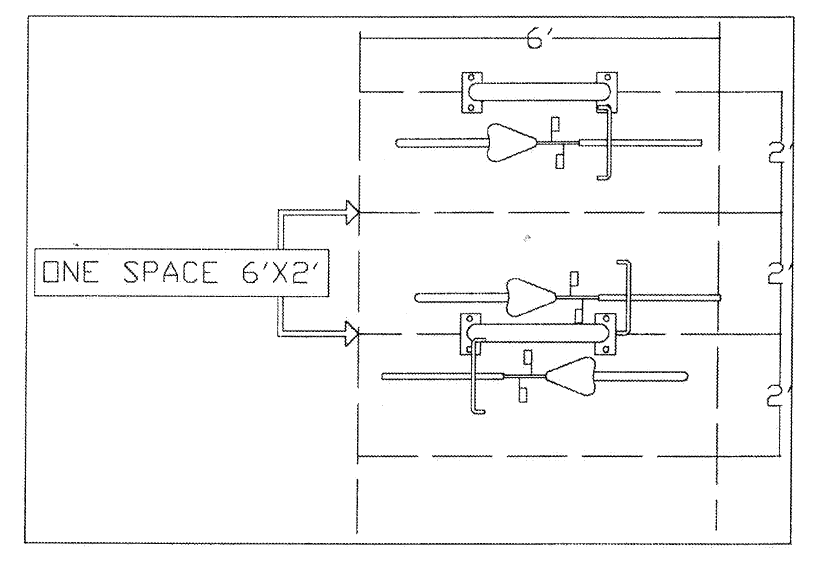
The minimum size for a single parking space is 2 feet by 6 feet, with a 5-foot wide access aisle, running parallel with the short side of the required spaces. A sidewalk adjacent to the space may serve as the access aisle.
(Ord. No. 05-9-C-3383, § 7, 9-6-2005)
Sec. 118-222. - Required number of bicycle parking spaces.
(a)
Bicycle parking shall be required for all new construction or when a change in use results in the requirement for additional off-street motor vehicle parking.
(b)
The minimum number of required off-street bicycle parking spaces is as follows:
(1)
Residential and lodging uses.
(a)
Detached, 2-unit multifamily, and townhouse residences: none.
(b)
Residences within transit oriented developments (TODs) and in mixed-use districts: 15% of motor vehicle parking requirements with a minimum of 1 space.
(c)
Multifamily residences neither in TODs nor in mixed-use districts and all other uses: 10% of motor vehicle parking requirements with a minimum of 1 space.
(2)
Schools, places of worship, institutions, auditoriums and other places of assembly.
(a)
Schools: 10% of the number of students.
(b)
All other uses: 5% of motor vehicle parking requirements, with a minimum of 1 space.
(3)
Arts, entertainment, and recreation uses. 10% of motor vehicle requirements, with a minimum of 10 spaces for games arcade establishments and 3 spaces for all other uses.
(4)
Office, retail, service, and industrial uses. 5% of motor vehicle parking requirements, with a minimum of 1 space.
(5)
Uses in B4 Regional Shopping district. 5% of motor vehicle parking requirements.
(6)
Uses with motor vehicle parking requirements determined by the Plan Commission. Bicycle parking requirements are determined by the Plan Commission.
(c)
Where the motor vehicle parking requirements are determined by the Plan Commission, the Commission shall also determine bicycle parking requirements.
(d)
The required bicycle parking spaces for a multi-tenant commercial or industrial development may be combined at one location on the site provided that the total number of spaces is not less than the required sum for the combined square footage of all of the tenants, and the location is within 200 feet of each tenant entrance. If space is not available on a site to provide the required number of bicycle parking spaces, the Director of Community Development or designee may determine that fewer or no spaces be provided.
(Ord. No. 05-9-C-3383, § 8, 9-6-2005; Ord. No. 11-3-C-3823, § 1, 3-7-2011; Ord. No. 14-6-C-4064, § 1, 6-2-2014)

