
Slaughter City Zoning Code
ARTICLE II
- SUBDIVISION REGULATION1
Editor's note— All references to certain appendices (e.g., Appendix A, Appendix G) within this article refer to appendices to the original ordinance from which this article's provisions are derived. These appendices are available for review at the town administration offices.
State Law reference— Subdivision regulations generally, R.S. 33:111 et seq.; local government power to adopt subdivision plans, R.S. 33:102.
Sec. 28-19. - Definitions.
The following words, terms and phrases, when used in this chapter, shall have the meanings ascribed to them in this section, except where the context clearly indicates a different meaning:
Act means the town subdivision ordinance as herein enumerated.
Alley means a dedicated right-of-way not less than 20 feet in width to provide access to the back side of properties also abutting on a street.
Commission means the planning and zoning commission of the Town of Slaughter, Louisiana.
Developer means any person, firm or corporation subdividing land into lots, plots, parcels or tracts for sale or other transfer of title.
Engineer means a qualified, professional engineer licensed in the state.
Lot means a portion of a tract or other parcel of land. Every lot must front on a public street for a minimum distance as required by the zoning ordinance.
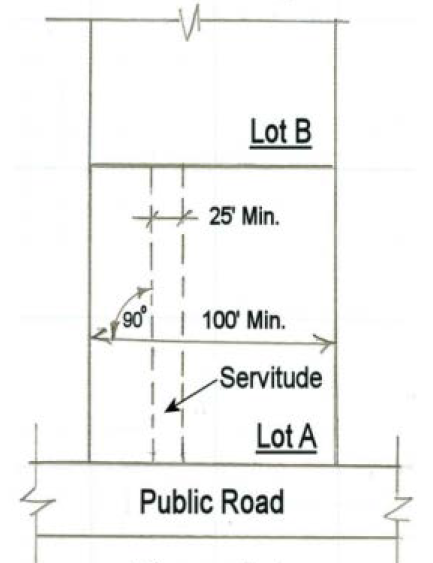
Private servitude of passage means a strip of ground to be reserved by the developer for private access by owners of other lots connected to this servitude, the title to which shall remain in the possession of the property owner, subject to the right of use of passage. No public access is allowed. Servitude will not be maintained by the town. A private servitude of passage shall be at least 25 feet in width. The minimum width of a lot at any point perpendicular to a private servitude of passage shall be 100 feet.
Right-of-way, where same involves a street, avenue, road, or highway, means a strip of ground dedicated by the developer for public use, ownership of which shall rest in the public.
Servitude means a strip of ground to be reserved by the developer for public utilities, drainage, and other public purposes, the title to which shall remain in the possession of the property owner, subject to the right of use designated in the reservation of the servitude; or a strip of ground designated or intended by the developer to be used for access to building sites or for other public purposes.
Street, avenue, road and/or highway or any other similar designation all mean the same for the general purposes of this chapter.
Subdivision means the division of a lot, tract, or parcel of land into two or more lots, plots, parcels, or building sites, for the purpose of sale or other transfer of title, either immediate or future, that requires the construction of new streets, drainage facilities, or utilities. It also includes the re-subdivision or rearrangement of one or more lots, plots, parcels, or building sites in said subdivision.
Surveyor means a qualified, professional surveyor licensed in the state.
Town council means the governing body of the Town of Slaughter, Louisiana.
Town houses means a single family attached dwelling on individual lots shall not be allowed.
(Ord. of 2-10-2015, § I; Ord. No. 45, 9-16-2022, eff. 9-1-2022; Ord. No. 62, 6-17-2024)
Sec. 28-20. - Exceptions.
(a)
The regulations contained in this article shall not apply to the following:
(1)
A subdivision legally established and recorded prior to the adoption of the ordinance from which this chapter is derived, in which subdivision the streets, avenues, roads or highways have been accepted by the town for public maintenance, unless lots therein are further subdivided.
(2)
The subdivision of land to be used only for orchards, forestry, raising of crops and/or livestock, in tracts greater than or equal to 50 acres and labeled on the plat thereof as not a building site.
(3)
Parcels, tracts or lots of land exchanged between adjoining property owners, where such exchange does not create additional lots, or where such transfer is affected pursuant to settlement or establishment of a boundary line.
(4)
Partition of property among co-owners, provided that any private servitude of passage established for the benefit of the lots so partitioned, shall not be maintained by the town, said partition map, however, shall be approved by the town, provided that there is noted there on the following certification by an attorney licensed to practice law in the state:
"I hereby certify that this partition of property between (list co-owners) is not being confected for the purpose of avoiding the operation of the town subdivision ordinance."
(5)
Donations of property between blood relatives, provided that further subdivision of any such lot shall be governed by the provisions of this article.
(6)
The division of a lot, tract, or parcel of land into two or more lots, plats, or parcels or building sites fronting on an existing public street, avenue, road or highway, provided that each such lot, tract or parcel of land has a minimum square footage of 1,500 square feet and a minimum of 100 feet of frontage on a public road, subject to approval by the town council and only after submission, for approval, of a plat of survey, and provided that each lot will meet all other subdivision requirements contained herein.
(7)
A private subdivision of land wherein the owner desires that the streets or roads therein remain closed to the public, provided, however, that construction and subdivision of the same must otherwise comply with the provisions of this article and be approved by the town council.
(8)
A transfer of land title by inheritance.
(9)
A firm, partnership, corporation or individual may be authorized by the commission and the town council to subdivide one contiguous tract of land into four lots or less which lots may be served by a private servitude of passage. The subdivision may be done at one time or at several times, but in no case shall the division of the original tract result in more than four lots that are served by the private servitude of passage. No segment of the private servitude of passage, established under this exemption, shall serve more than four lots. This exception may be utilized only once for any firm, or entity which shall have previously obtained authority for sales permitted hereunder. Such firm or entity shall be prohibited from applying for an additional authorization under this exception. Any corporation, firm or partnership which is owned, in whole or in part, by an individual, firm, partnership, or corporation which previously obtained authority for sale of lots, shall not be entitled to claim or obtain approval for sale of lots under this exception. In the event that the town council or commission determines that title of a tract of land has been vested in a party of convenience in order to avoid the limiting provisions hereof, approval shall be denied. Lots subdivided under the provisions of this exception shall conform to all minimum town standards of this article regarding sanitary sewage disposal and zoning. Plats of survey shall be submitted to the commission and the town for approval and all plats submitted hereunder shall include all lots to be subdivided. In the event that individual lots have been previously approved under this provision, such previously approved lots shall be depicted on the plat. Each plat of survey shall bear the following notation: An original and seven copies of the plat shall be submitted to the commission.
(b)
R.S. 33:106.1 may override plat requirements.
(Ord. of 2-10-2015, § II)
Sec. 28-21. - Survey plat requirements.
(a)
A survey and/or subdivision shall only be prepared by a registered professional surveyor. An engineer is not legally eligible for this type work. The surveyor must certify the survey and resultant map were prepared under his supervision and conforms to the minimum standards as set forth by the state board of registration (LAPELS) and R.S. 33:5051 and to all town ordinances governing the subdivision of land.
(b)
The minimum standards require many details pertinent to survey requirements. This is an issue primarily between the surveyor and the state board. The commission is not required to verify that each and every one of these details is shown except insofar as the map is sufficiently adequate to depict the survey and subdivision.
(c)
The vicinity map shall be sufficient to pictorially show the project location to a layman or non-surveying person. Vicinity maps shall include, with names, all streets, roads, and highways within the limits of the vicinity map, watercourses, physically definable features, such as lakes, power lines, etc.; section lines, etc.; not simply as "an xx.xx acre tract of land …."
(d)
The title of the map, and the body of the map, shall refer to the letter or number assigned to the property being surveyed and subdivided, such as "Tract A of the named property." If the property has never been subdivided, it may be referred to as "An unsubdivided xx.xx acre tract of land, being the named property."
(e)
The title of the map, and the body of the map, shall show the tract numbers of the new lots or tracts being created. For all tracts being created, including, where applicable, the remainder thereof, the title of the map shall indicate the historical name of the property. All properties shall have an historical name associated with the chain of title, whether it is from the original land grant or elsewhere. At no time shall a tract of land be referred to as a "piece of property." It shall be assigned a new designation.
(f)
The entirety of the property being subdivided shall be indicated on the map, not just the portion being removed. Therefore, the surveyor shall indicate the entirety of the property from a legal description or from a previous survey, if available. Otherwise, note that a previous survey is not available.
(g)
Lot numbers of parcels of land sold to or exchanged between adjourning property owners, where such sale or exchange does not create additional lots, must be re-designated. The property exchanged or sold shall not be designated as a separate lot, but shall be incorporated into the existing lot and renamed. For example: in an exchange between existing Lot 1 and existing Lot 2, the resulting lots will be renamed Lots 1-A and 2-A. The surveyor shall certify on the plat that such sale or exchange does not create any additional lots.
(h)
If a lot size changes, the lot number shall change.
(i)
Surveys of property falling under any of the exceptions described in section 28-20 will meet the following requirements under appendix A, preliminary plat check list Nos. 2 through 17, 19 and 21 through 23.
(Ord. of 2-10-2015, § III)
Sec. 28-22. - Preliminary plat.
(a)
In seeking to subdivide land into lots or building sites, or to dedicate streets, alleys or land for other public use, the developer shall submit seven copies of a preliminary plat to the commission. The preliminary plat shall be drawn to scale, not smaller than one inch equals 100 feet and shall show the following (also see appendix A):
(1)
The location of all existing property lines, North arrow, scale streets, alleys, buildings, irrigation canals, sewer mains, water mains, drainage ditches, gas mains, telephone and electrical lines, culverts, and other underground structures, easements, and other existing features within the area to be subdivided and all tie-ins in the adjoining or abutting streets.
(2)
The names of all adjoining property owners.
(3)
The proposed location and width of all streets and lots.
(4)
The name under which the proposed subdivision is to be recorded and the name of the owner. No two subdivisions shall have the same or similar name.
(5)
A contour map, or certain elevation data which shall be based upon the official datum (U.S. Coast and Geodetic Survey) if any area on the plat is in a flood hazard zone as shown on the latest FEMA flood map. Flood elevations shall be indicated on said plat. If no area on the plat is in a flood hazard zone as herein defined, then said plat must contain such certification by a surveyor or engineer and must conform to the floodplain management ordinance of the town.
(6)
Designation of public agencies, private individuals or corporations responsible for perpetual maintenance of sewerage, gas, electrical, water and other utilities, to be installed along designated servitudes within area to be subdivided.
(7)
Statement of proposed utility, street improvements, water supply, and method of sewerage disposal along with a certification from the parish sanitarian.
(8)
The name and address of the existing utility districts that will serve the proposed development.
(9)
All lot lines and intended uses for each lot.
(10)
All items listed in appendix A.
(b)
If any portion of the proposed subdivision is located within the jurisdiction of any political subdivision of the parish, such as water or gas districts, sewerage districts or municipalities, copies of the preliminary plat shall also be filed with appropriate agents of these political subdivisions.
(c)
Review procedures. The commission will follow the procedures as set forth in this section.
(1)
Developer shall file a subdivision application (see appendix G) requesting such change, together with a plat of the property to be changed and the preliminary plat review fee (see section 28-26). This fee shall not be refundable.
(2)
Subdivision applications shall be filed, complete with all required information, by the 15th of a month to be considered by the commission at the next commission meeting. At that meeting, the commission will review the application and if the application is deemed complete, will schedule a public hearing which will be held immediately preceding the next scheduled commission meeting.
(3)
Upon receiving an application and establishing the date of the public hearing concerning the petitioned request, the town shall "erect in a conspicuous place" on the property in question or on the right-of-way of the nearest public road if the property does not front a public road, a sign giving public notice of the subdivision request and the scheduled date and place for the public hearing. The town may post more than one such sign.
(4)
Notice of the time and place of the public hearing shall be published once a week for three different weeks in the official journal of the parish, and at least 15 days shall elapse between the first publication and the date of the public hearing as set forth in R.S. 33:4780.64 et seq.
(5)
The public hearing shall be conducted by the commission or town council of the town.
(6)
The commission shall make a recommendation to the town council stating its approval or disapproval of the request. Such recommendation shall be made by the commission within 90 days of the public hearing.
(7)
An application may be withdrawn by the applicant after the public hearing has been advertised and the commission may, by majority vote, allow an application to be withdrawn without prejudice.
(8)
The town council shall make the final decision to approve or disapprove the request.
(d)
Upon approval of the application and preliminary plat by the town council, the developer shall submit complete construction plans for the entire development of the area given preliminary approval and meeting all requirements listed under section 28-25. If the owner fails to submit a final plat within one year of the preliminary approval, the commission's approval of the preliminary plat shall expire. One copy of the preliminary plat shall be retained in the files of the commission.
(e)
No sale or other transfer of land may take place based on approval or conditional approval of a preliminary plat. Any such sale or transfer prior to approval, acceptance by the town council and recordation of a final plat, shall be null and void and shall subject the developer and/or transferee to the penalties herein contained.
(Ord. of 2-10-2015, § IV)
Sec. 28-23. - Design standards.
(a)
Streets and easements.
(1)
The developer, where practical, shall provide for the continuation or projection of existing streets in surrounding areas.
(2)
Street jogs with centerline offsets of less than 125 feet are prohibited.
(3)
A tangent of at least 100 feet shall be introduced between reverse curves on streets.
(4)
Streets shall be laid out so as to intersect as nearly as possible at right angles, and no street shall intersect any other street at less than 75 degrees.
(5)
Half-streets shall be prohibited, except where essential to the reasonable development of the subdivision, and when it will be practical to require the dedication of the other when the adjoining property is subdivided.
(6)
Dead-end streets, designed as such permanently, shall forever remain dead-ended and have an all paved cul-de-sac or "T" design as follows:
a.
Cul-de-sac:
b.
"T" design. A minimum of 35 feet deep and minimum length on each arm of 50 feet.
(7)
Street right-of-way widths shall be no less than 60 feet for open ditch sections and no less than 50 feet for curb and gutter sections.
(8)
No street names shall be used which will duplicate or be confused with names of existing streets. Streets that are obviously in alignment with others already named shall bear the names of the existing streets. Street names shall be subject to the approval of the town council.
(9)
Alleys at the rear of residential lots are not allowed except under unusual conditions.
(10)
Where a subdivision is traversed by a watercourse, drainageway, channel or stream, same shall be noted on the plat and there shall be provided a stormwater easement or drainage right-of-way conforming substantially to the lines of such watercourses, and such further width or construction, or both as will be adequate for the purpose. Parallel streets or parkways may be required in connection therewith. Widths required shall be determined by the town council.
(11)
Street construction shall be as required in subsections (b) and (c) of this section.
(12)
The commission will require easements not less than 15 feet in width or 7½ feet at common lot lines for all wires, conduits, storm and sanitary sewers, gas, water, or other (underground) utility lines on front, rear, and/or alongside lot lines unless the utility company certifies this to be impractical or unless it is not feasible in the opinion of the commission.
(13)
In accordance with R.S. 48:35 regarding highway design and maintenance, all roads shall meet the minimum safety standards of the state department of transportation and development with the following exceptions: this shall not apply to existing alleys, lanes, and other roads that do not connect throughways. All new roads must conform.
(b)
Blocks and lots. No block shall be more than 800 feet in length and the shape of blocks shall be determined with due regard to:
(1)
Provisions of adequate building sites suitable to the special needs of the type of use contemplated.
(2)
Requirements as to lot sizes and dimensions.
(3)
Needs for convenient access, circulation, control and safety of street traffic.
a.
New subdivision developments consisting of 25 or more lots shall, at a minimum, provide two separate and distinct points of access that connect the subdivision to an existing street(s) or highway(s). These access points shall allow for entry and exit at each location from any lot within the subdivision.
b.
Entry/exit locations connected to the same street or highway shall require the approval of the planning and zoning commission. These requirements are necessary to protect the health, safety, and welfare of the community.
(4)
Limitations and opportunities of topography.
a.
The lot size shall be a minimum of 87,120 sq. ft. (2 acres) with a minimum road frontage of 200 feet and conform to R-1-S requirements in article IV of this chapter. Setbacks should be as follows: front 30 ft., side 10 ft., rear 10 ft.; lots adjacent to the Slaughter Airport (FAA L577) shall have a minimum set back of 20 feet from the Airpark. Homes shall be designed by a licensed architect or civil engineer and constructed in accordance with all town ordinances and parish and state statutes.
b.
Corner lots shall have extra width to permit appropriate building setback from orientation to both streets.
c.
The subdivision of the land shall be such as to provide each lot, by means of a public street, with satisfactory access to an existing public street.
d.
Side lot lines shall be substantially at right angles or radial to street lines.
(c)
Street construction.
(1)
All streets shall consist of a minimum thickness of three inches of asphaltic concrete wearing surface or six inches of Portland cement concrete (3,800 psi at 28 days) with a minimum width of 20 feet on a ten-inch soil cement base which is at least 22 feet wide. All sealers and wearing surfaces must meet the latest state DOTD standards. A four-foot shoulder is required on each side of the road. No gravel roads shall be accepted or approved by the town council.
(2)
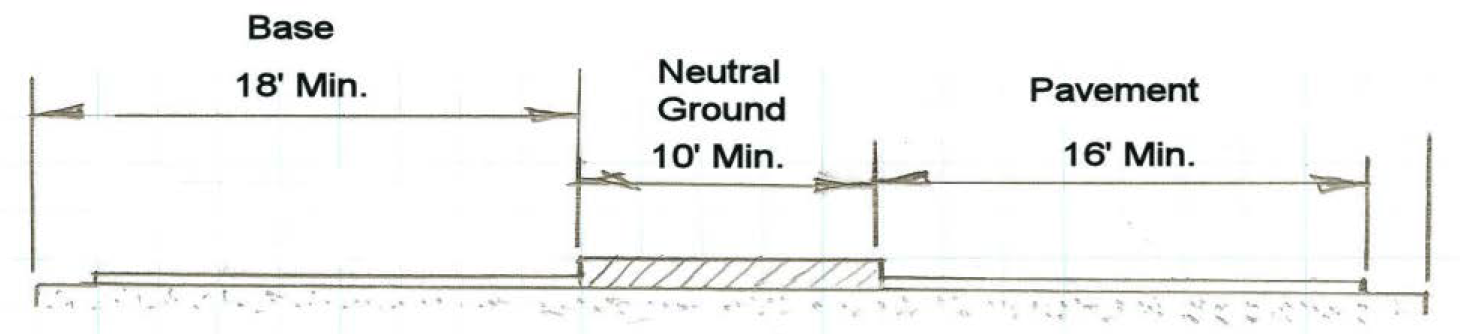
Where the street is of the boulevard type, that is, two lanes of traffic and these separated by a neutral ground or strip, with a minimum of ten feet in width, the paving on each traffic lane shall not be less than 16 feet in width with an 18-foot wide base.
(3)
Where conditions do not permit economical cement stabilization, as determined by a testing laboratory, alternative pavement construction may be submitted for approval.
(4)
If curbs and gutters are not provided, ditches shall be provided having at least 3:1 fore slopes (or side slopes on the street side having at least three feet of horizontal distances for each one foot of vertical drop, with four feet of flat bottom ditch on the property side and 5:1 back slopes (or side slopes on the property side having at least five feet of horizontal distance for each one foot of vertical drop.

(5)
It shall be indicated on all subdivision plats submitted with streets without curbing, gutters and storm sewer drains that no property owner shall be permitted to place drain lines or structures in road or street ditches along the property without first obtaining a culvert permit granted by the town, and then the size and catchbasin requirements shall be determined by the town council upon application by the property owner.
(6)
Minimum shoulder widths on open ditch sections shall be four feet.
(7)
Approved street markers bearing the names of the streets and block numbers shall be provided and installed at each intersection in the subdivision.
(8)
Refer to appendix A for required materials, testing and construction control for roads and streets in the town.
(9)
The right-of-way of all streets shall be seeded with grass seed to prevent the erosion of topsoil onto adjacent streets and into drainage ditches as required by appendix B.
(10)
Street light standards shall be located in all subdivisions and may be located on either side of the street or in the center of the median on boulevards as required by appendix D. The developer shall arrange with the utility franchise for the arrangement of the monthly utility cost with the bills rendered to the customers within the subdivision.
(11)
The full right-of-way shall be graded.
(d)
Sewers.
(1)
If the subdivision is located where a public sanitary sewer system is accessible, the developer shall connect with such sanitary sewer system and provide adequate sewer lines to each lot. Sewer connections and subdivision sewerage collection and disposal systems shall comply with the regulations of the state department of health and human resources. The parish sanitarian will review and approve the engineering calculations for these systems prior to any construction. Sewerage collection lines, treatment plants, etc., shall be inspected by the parish sanitarian and written approval of these improvements shall be obtained from the parish sanitarian.
(2)
If no sanitary sewer is accessible, then each single-family dwelling in a subdivision of five homes or less, will require a treatment plant approved by the state board of health and parish sanitarian.
(3)
All subdivisions with more than five homes but less than 75 homes will require a system designed by an engineer, a sanitary sewage community collection and treatment system approved by parish sanitarian.
(4)
All subdivisions with 75 or more homes will require a sewer system designed by an engineer and approved by the district engineer office of public health and department of health and hospitals.
(e)
Storm drainage.
(1)
All surface drainage courses (open ditches), shall have at least 3:1 side slopes (slopes having at least three feet of horizontal distance for each one foot of vertical drop). Drainage design should be for 25-year intensity.

(2)
The grade along the bottom of a surface drainage course shall be the slope required by the designated representative of the town council.
(3)
The slope of each drainage course shall be shown on the plans.
(4)
The plat or subdivision deed restriction shall carry the notation or provision that the size and grade of culverts for driveways and other pipes in roadside ditches shall be approved by the jury or their authorized representative. In no case shall the pipe size be less than 12 inches. Cross pipes under streets shall be reinforced concrete or coated corrugated metal as approved by the town council or its authorized representative.
(5)
It is required that a contour map be furnished showing the area comprising the subdivision and all additional areas necessary to include all watersheds that drain into the property to be developed.
(6)
In the design of the drainage for the subdivision, provisions shall be made to adequately take care of adjacent watershed areas after they have been developed. All drainage structures shall be sufficient for the drainage of the watershed after complete development of the area, and where ditches and canals are used, adequate servitudes shall be provided for future needs. The flow line elevation of each drainage structure to be constructed or incorporated into the overall plan shall show the location at which the effluent from the new drainage facilities enter into a publicly maintained canal or stream of sufficient capacity to absorb the volume of flow. The flow line elevation of this point shall be shown on the plans.
(7)
Drainage system must be designed and stamped by an engineer.
(f)
Water systems.
(1)
General requirements. All water systems must meet ten-state standards.
a.
Public water district supply. Any developer requesting water service in an undeveloped area is required to obtain approval from the town. Water district system is hereinafter referred to as "the water system".
b.
Submission of request. Developer should submit his request along with a map representing the proposed development in writing to the appropriate water system's board of directors for consideration. If the proposed development is approved by the water system, the developer will be required to submit the name of the contractor qualified to install the water mains.
c.
Pre-construction meeting. The contractor will be required to contact the water system to schedule a pre-construction meeting. At the time of the pre-construction meeting the contractor will be required to provide a copy of their license, bond and insurance certificate listing the water system as additionally insured. The water system will provide a construction inspector during construction to certify that lines are installed to specifications.
d.
New development tie-in to existing system. New development tie-ins to the water system's existing piping will be performed by water system personnel. All materials required to tie-in a new development will be supplied by the water system at the contractor's expense, billable to the contractor upon completion of the tie-in.
e.
Post-completion testing. Upon completion of the tie-in, the contractor will be required to super chlorinate, flush and sample the new line.
f.
Acceptance of development. After final inspection approval of the new construction by the water system and receipt of written proof of clear health samples, the water system will accept the deed of ownership for the new development.
(2)
Specific requirements. Specifications for line extensions, water mains and associated work in subdivisions are as follows:
a.
Any new subdivision developments must be tied into a six-inch main or larger.
b.
Pipe size requirements for new line extensions shall be equal to the pipe size currently available in the area.
(3)
All water mains shall be six-inch (minimum) to comply with fire suppression requirements and must be approved by town engineer to comply with town water system. All mains shall be traced with 12 gauge locator wire.
(4)
All fittings shall be mechanical joint, cement-lined ductile iron. This applies to all 90-degree fittings, tees, 45-degree fittings and any fittings used in the system.
(5)
Fire hydrants shall be 5¼-inch size in accordance with AWWA standard C-502. Hydrants shall be three-way with national standard threads AWWA C502 and shall be installed with restraint fittings and concrete thrust blocks. Fire hydrants should be installed off the water main with their own individual six-inch gate valve coupled to the main line tee with an anchor coupling. Fire hydrant assemblies shall be placed in a dedicated utility servitude unobstructed from and within 20 feet of a public street. One fire hydrant assembly shall be placed in such location at each street intersection and along such streets so that a separation of not more than 500 feet exists between each fire hydrant.
(6)
All creek and drain crossings shall be directional bored.
(7)
All water mains shall have a minimum of 30 inches of cover from top of the water main to grade.
(8)
Water mains and associated work must be inspected by water system personnel during construction and deeded to the water system upon completion.
(9)
All work shall meet the water district specifications and standards in effect at the time of construction.
(g)
Gas. Where a public gas supply is available, the developer shall connect with such gas system and provide adequate gas lines to each lot.
(h)
Electrical. The developer shall be responsible for obtaining, along a designated servitude, a (underground) power line such that each lot, tract or parcel of land shall have access to same.
(i)
Utility connections. The responsibility of developers is as follows:
(1)
The developer shall be responsible for obtaining, along a designated servitude, underground power line such that each lot, tract or parcel of land shall have access to same.
(2)
The developer shall only be required to make available, at the property line, or along a public servitude, those public utilities mentioned in subsections (d) through (h) of this section. Responsibility for payment for connection of each individual lot, tract or parcel of land to the water, sewerage, gas or electrical underground lines acquired per subsections (d) through (h) of this section shall be paid by the lot owner.
(j)
Permanent markers. The drawings shall show locations of all subdivisions boundary corners and the four corners of all street intersections where permanent monuments are required. A permanent marker shall be so designated and shall be steel, at least one-half inch in width which extends a minimum of 16 inches below the ground line. Should conditions prohibit the placing of monuments on line, offset marking will be permitted, provided that exact offset courses and distances are shown on the subdivision plat.
(k)
Housing in R-1 R-2 and R-3 Zoning Districts. Single-family housing in an R-1 and R-2 Zoning District (medium to high density) and multifamily housing in an R-3 Zoning District shall be designed by a licensed architect or civil engineer and constructed in accordance with all town ordinances, parish and state statutes.
(Ord. of 2-10-2015, § V; Ord. No. 45, 9-16-2022, eff. 9-1-2022; Ord. No. 62, 6-17-2024; Ord. No. 67, 12-17-2024)
Sec. 28-24. - Construction plans, inspections and maintenance bond.
(a)
Upon approval of the preliminary plat, the developer may proceed with preparation of construction plans. Construction plans shall include complete design of the street system, the water system, the utility system, the drainage system and the sanitary sewer system, if applicable, for the entire area to be subdivided. The construction plans shall be in compliance with the design standards set forth in this article (see section 28-22). They shall be submitted along with the construction plans review fee to the commission to determine that the proposed improvements meet the requirements of this article. After construction plans have been approved by the town council and the inspection fees have been paid, the developer may proceed with the required improvements. The town council shall be notified in advance of the date that construction will begin, and all work shall be performed pursuant to the guidelines of this article.
(b)
At the discretion of the town council, subdivisions containing sewers, sewage treatment plants, water supply systems, park areas, street, trees or other physical facilities necessary or desirable for the welfare of the area of that are for common use or benefit and cannot satisfactorily be maintained by an existing public agency, provisions shall be made by trust agreement, which shall become part of the deed restrictions, acceptable to any agency having jurisdiction over the location and improvement of such facilities, for the proper and continuous maintenance and supervision by the developer of such facilities.
(c)
After the construction plans and specifications have been approved by the town council, the developer may construct the required improvements. The town council shall be notified by the developer in advance of the date that such construction shall begin. Construction shall be subject to inspection by the town engineer. However, this in no way shall relieve the developer or his engineer of close field supervision and final compliance with the approved plans and specifications. All inspections and testing will be paid for by the developer.
(1)
The following general inspections shall be made by the town engineer:
a.
Excavations.
b.
Subsurface drainage.
c.
Inlets, junctions and manholes.
d.
Sanitary sewer collection lines.
e.
Sanitary sewer manholes.
f.
Sanitary sewer treatment facilities.
g.
Base processing.
h.
Sidewalks.
i.
Curbs and medians.
j.
Roadway pavements.
k.
Utilities installation.
l.
Installation of all drainage and sanitary sewer pipes.
m.
Safety signs and signals.
(2)
The developer's engineer shall be responsible for the following:
a.
The engineer shall provide a survey party for the stakeout of lines and grades to complete the work.
b.
The engineer shall inspect the laying of sanitary sewer lines, utilities service (water, gas, electricity, etc.) and the storm drainage, including the preparation of as-built records. This service may be performed by the testing laboratory.
c.
The engineer shall perform the inspection of the same items covered under section 28-23, this section, paragraph D, and subparagraph 1.
d.
The engineer shall request intermediate site inspections to be performed by the town engineer.
e.
The engineer shall request final inspection by the town engineer.
(3)
The testing laboratory shall be responsible for the following:
a.
The testing laboratory shall test the concrete used in the construction of the street pavements, curbs and sidewalks.
b.
There shall be a resident inspector of the testing laboratory to inspect the base processing of streets.
c.
There shall be a resident inspector of the testing laboratory to inspect the street pavements, including asphalt.
d.
A representative of the testing laboratory shall attend intermediate site inspections when called upon.
e.
A representative of the testing laboratory shall attend the final inspection.
f.
The testing laboratory shall furnish to the town engineer and the developer's engineer and contractor, reports on subsections (a) through (e) of this section.
g.
The testing laboratory shall inspect the laying of the sanitary sewer lines and storm drainage if the developer's engineer does not perform this function.
h.
All concrete, metal, clay, plastic, or other acceptable pipes shall be stamped as approved by the testing laboratory, prior to being delivered to the job site.
(d)
If the above procedure is not followed, the town council has the authority to close down the job, after written notice to the developer.
(e)
When construction is complete in accordance with the approved plans and specifications, and conforms to the provisions of this article, the developer, through his engineer, shall certify that all work has been completed and shall request final inspection by the town council so that he may obtain written approval and acceptance from the town council.
(f)
Warranty and performance bond. The developer shall warrant all improvements and maintain same for a period of one year. A maintenance bond, written by a commercial surety company licensed in the state, in the amount of ten percent of the construction cost of all improvements shall be posted by the developer in favor of the town and covering a period of one year from date of acceptance of the final plat. No final plat approval will be granted by the town council until the town council has received the bond.
(g)
After the final inspection, approval and acceptance is required by vote of the town council.
(Ord. of 2-10-2015, § VI)
Sec. 28-25. - Final plat approval.
(a)
Upon final approval of constructed improvements or acceptance of construction bond (see section 28-32) by the town council, the developer shall prepare the final plat. No lots shall be sold until the final plat has been approved by the commission, town engineer, parish sanitarian, and the town council. The final plat shall note on the face thereof such certifications as are required by this article.
(b)
Final plats shall be filed as follows:
(1)
Commission: Original and 15 copies of final plat.
(2)
Parish sanitarian: One copy of final plat.
(c)
The developer shall forward evidence of approval of construction plans by town council and parish sanitarian to the commission with final plat.
(d)
The commission will consider approval of the final plat only after receipt of:
(1)
Certification that all improvements have been installed in accordance with the approved construction plans and this chapter; and evidence that all required bonds payable to the town council have been posted.
(2)
Certification by the town manager that all applicable fees have been paid. These fees shall be non-refundable.
(3)
Evidence of payment of testing lab fees.
(e)
When the final plat is approved and signed by the commission and the town council, the original drawings will be returned to the developer and one copy retained in the files of the commission.
(f)
The developer shall furnish the commission with 13 copies of the signed final plat. After the commission has been furnished these copies, an additional copy shall be recorded by the developer with the parish clerk of court within 30 days and prior to sale or other transfer of lots. Copies shall be distributed in East Feliciana Parish as follows:
(1)
Commission: Nine copies.
(2)
Clerk of court: One copy.
(3)
Parish assessor: One paper copy and one electronic copy in AutoCAD format.
(4)
Town council: One copy and one electronic copy in PDF format.
(5)
Parish sanitarian: One copy.
(g)
The final plat shall be printed on sheets having a minimum of 24 inches by 36 inches and shall be at a scale of 100 feet to one inch or larger. Where necessary, the plat may be on several sheets accompanied by an index sheet showing the entire subdivision. The final plat shall show the following in addition to the requirements of the preliminary plat:
(1)
Township, range and section in which the subdivision is located. If section corner, township line or range line falls within the subdivision, it shall be shown.
(2)
Primary control points, or description and ties to such control points, to which all dimensions, angles, bearings, and similar data on the plat shall be referred.
(3)
Tract boundary lines, right-of-way lines of streets, easements, and other right-of-way, and property lines of residential lots and other sites, with accurate dimensions, bearings or deflection angles, and radii, arcs, and central angles of all curves.
(4)
Name and right-of-way width of each street or other right-of-way.
(5)
Location, dimensions, and purpose of any easement.
(6)
Number to identify each lot or site.
(7)
Minimum building setback line on all residential lots and sites.
(8)
Location and description of monuments.
(9)
Names of record owners or adjoining unplatted land.
(10)
Reference to recorded subdivision plats of adjoining platted land by recorded name.
(11)
Certification by registered land surveyor certifying the accuracy of survey and plat.
(12)
Statement by owner dedicating servitudes, rights-of-way, easements, and any sites for public use, together with a statement of transfer of ownership to the town of all streets, avenues, roads or highways.
(13)
Title, scale, north point, and date.
(14)
Name of engineer or surveyor.
(15)
Any certifications required by this article.
(16)
The final plat shall not be approved unless and until all site improvements are properly installed and inspected and all requirements of this article are met.
(17)
Floodplain status.
(h)
See appendix E for final plat checklist.
(Ord. of 2-10-2015, § VII)
Sec. 28-26. - Fees.
In order to defray the cost to the town for reviewing and evaluating subdivision plans and inspecting subdivision construction works, the developer shall pay to the town treasurer fees according to the following schedule:
(1)
Preliminary plat review fee: $500.00 plus $20.00/lot
(2)
Construction drawing review fee: $1,000.00 plus $40.00/lot
(3)
Inspection fee: $2,500.00 plus $100.00/lot
(4)
Final plat review fee: $500.00 plus $40.00/lot
NOTE: Fees are for initial reviews and inspections only. Repeat reviews and inspections due to incompletion, errors, or omissions will be extra at engineer's cost plus ten percent.
(Ord. of 2-10-2015, § VIII)
Sec. 28-27. - Variances and exceptions.
(a)
The town council reserves the right to consider variance of the requirements of this article, when it is clearly evident that an extraordinary condition exists that would make it impractical and not feasible to comply with all the requirements of the article. In such an event, any variance shall require concurrence of the commission, parish sanitarian, town engineer and a two-thirds majority of the town council.
(b)
Under these circumstances, the commission may make a recommendation to the town council that a variance be granted. Any variance so recommended is required to be entered in writing in the minutes of the commission and the reasons which justified the departure. The town council has the final authority to grant any variance in accordance with the guidelines expressed in subsection (a) of this section.
(c)
The request for variance and its justification shall be submitted to the commission by the developer in writing.
(Ord. of 2-10-2015, § IX)
Sec. 28-28. - Building permits.
Building permits shall be obtained in accordance with the parish building code ordinance.
(Ord. of 2-10-2015, § X)
Sec. 28-29. - Violation and penalty.
(a)
It shall be illegal to sell or otherwise transfer by lot, tract, parcel, block, or total subdivision without compliance with this article and until the final plat has been approved by the town council and recorded in the office of the clerk of court.
(b)
It shall be illegal for any gas, water, electric, or other utility company to provide services to any lot, tract, parcel, block or total subdivision, covered by this article, unless such lot, tract, parcel, block or total subdivision was established and approved in accordance herewith.
(c)
Any person, partnership, firm, unincorporated association or corporation who violates any of the provisions of this article, or aids or abets in the violation of any of the provisions of this chapter shall be fined not more than $500.00 per lot, tract, parcel, block or total subdivision sold or provided. Each violation shall constitute a separate offense.
(Ord. of 2-10-2015, § XI)
Sec. 28-30. - Repeal of conflicting ordinance.
All ordinances or parts of ordinances in conflict herewith or inconsistent with the provisions of this chapter are hereby repealed.
(Ord. of 2-10-2015, § XII)
Sec. 28-31. - Validity.
If any section, clause, paragraph, provision, or other portion of this article be held invalid or unconstitutional by any court of competent jurisdiction, such holding shall not affect any other section, clause, paragraph, provision or other portion of this article.
(Ord. of 2-10-2015, § XIII)
Sec. 28-32. - Bonding in lieu of immediate construction.
In lieu of immediate construction of improvements as required by this article, the developer may file with the commission and the town council an agreement and bond, in the form and substance of the samples made a part hereof, securing to the town council the actual satisfactory construction and completion of improvements required by this article within a period of not more than two years from date of such agreement and bond. The amount of the bond shall be set by the commission and approved by the town council and the surety for such bond shall be a commercial insurance company authorized and qualified to do business in the state. Such bond may only be cancelled upon written approval of the commission and the town council.
(Ord. of 2-10-2015, § XIV)
Sec. 28-33. - Subdivision of a portion of a tract.
The owner or developer shall prepare a preliminary plat of the entire tract in which development is desired. Thereafter, the owner or developer may submit a final plat for approval for a portion of the entire tract so long as the improvements required by this article are installed and completed in the area for which final approval is sought. Thereafter, the owner shall only sell, lease or offer for sale or lease those lots in that portion of the tract which has been granted final approval.
(Ord. of 2-10-2015, § XV)

