
Smyrna City Zoning Code
SECTION 5
- District regulations.
District regulations shall be as set forth in this section, section 6 of this ordinance, Supplementary District Regulations, and the schedule of district regulations hereby adopted by reference and declared to be part of this ordinance.
1.
Agricultural district A. The regulations of this district are intended to accommodate agricultural land uses and related activities including nonfarm residences at a very low density. The agricultural district will also provide a land reserve for future development.
a.
[Permitted uses.] The following uses are permitted:
(1)
Farms, provided that no poultry or livestock other than pets shall be housed or confined within 200 feet of any district boundary. Fox, mink and hog farms shall be prohibited. Slaughter houses shall also be prohibited.
(2)
One-family detached dwellings.
(3)
Establishments for packing and storing agricultural products.
(4)
Roadside stands offering for sale products grown on the premises.
(5)
Laboratory for scientific agricultural research.
(6)
Veterinary establishments and dog kennels, but not closer than 300 feet from any residential or institutional and recreational district boundary lines.
(7)
Greenhouses and nurseries.
(8)
If approved as a special exception by the board of adjustment pursuant to section 9(2) of this ordinance, cemeteries, and institutions of an educational, religious, medical, charitable or philanthropic nature.
(9)
If approved as a special exception by the board of adjustment pursuant to section 9(2) of this ordinance, public utility rights-of-way and structures.
(10)
If approved as a special exception by the board of adjustment pursuant to § 9(2) of this ordinance, school bus stop shelters as defined in § 19, definitions.
(11)
Uses permitted as a conditional use:
(a)
Crematory provided that:
(1)
The building lot line upon which a crematory is established shall be located at least 100 feet from any residential zone.
(2)
Receiving area(s) shall be completely screened from view from the street.
(12)
Accessory uses and structures:
(a)
Minor home occupation pursuant to section 6.19 of this ordinance.
(b)
Other accessory uses and structures clearly incidental and customary to and associated with the permitted use.
(c)
Major home occupation only if approved as a special exception sections 6.19 of this ordinance.
b.
[Restriction of uses and structures.] The foregoing uses and structures are subject to the requirements as set forth in the schedule of district regulations and the supplementary district regulations.
(Ord. of 8-16-93(1), § 1; Ord. No. 021-04, §§ 1—3; Ord. No. 007-07, § 1, 7-16-07; Ord. No. 003-07, § 1, 10-15-07; Ord. No. 004-08, § 1, 5-19-08)
2.
Residential district R-1.
A.
Declaration of legislative intent. The regulations of this district are intended to provide for a pleasant, quiet, hazard-free residential environment permitting residential and related uses. Presently developed single-family residential areas are included in this district as well as land which will develop in this manner in the future. These areas are protected from encroachment by incompatible uses.
B.
[Permitted uses.] The following uses are permitted: No building or premises shall be used and no building or part of a building shall be erected which is arranged, intended or designed to be used, in whole or in part, for any purpose except the following and in accordance with section 6 of this ordinance and the Smyrna subdivision regulations:
(1)
One-family detached dwellings which are constructed in accordance with the standards set forth in the Town of Smyrna building code and [such dwelling] is not designed to be transported to the dwelling site on its own chassis.
EXCEPTION: Mobile offices to be used as temporary real estate offices shall be permitted when approved by special exception pursuant to section 9(2) of this ordinance. Placement and setup shall be approved by the building official. Mobile offices shall be removed upon issuance of a certificate of occupancy for the first completed permanent structure, not to exceed one year.
(2)
Public and private parks and playgrounds.
(3)
Public and private boat landings.
(4)
Family day care home.
(5)
Accessory uses and structures:
(a)
Private noncommercial swimming pools.
(b)
Other accessory uses and structures clearly incidental and customary to and associated with the permitted use.
(c)
Minor home occupation pursuant to section 6.19 of this ordinance.
(d)
Major home occupation only if approved as a special exception sections 6.19 of this ordinance.
C.
[Uses permitted as special exception.] The following uses are permitted only if approved as a special exception pursuant to section 9(2) of this ordinance:
(1)
Cemeteries.
(2)
Institutions of a religious, medical, charitable or philanthropic nature.
(3)
Temporary real estate offices in developments containing a minimum of ten lots.
(4)
If approved as a special exception by the board of adjustment pursuant to § 9(2) of this ordinance, school bus stop shelters as defined in § 19, definitions.
D.
Uses permitted as conditional use. The following uses are permitted only if approved as a conditional use pursuant to section 6.14 of this ordinance:
(1)
Institutions of an educational nature.
(2)
Public utility uses.
(3)
Governmental building, structure, facilities and uses including but not limited to, police stations, fire houses, ambulance stations, government offices, library.
(4)
Planned Village Community, pursuant to the design and development standards and minimum lot requirements outlined in section 6.14 (Conditional uses, general guides and standards).
(5)
Accessory dwelling units, in accordance with the standards outlined in section 6.14 (Conditional uses, general guides and standards).
(Ord. No. 005-09, § 1, 9-21-09; Ord. No. 001-13, § 1, 2-4-13; Ord. No. 004-19, § 1, 4-15-19; Ord. No. 015-20, § 1, 7-20-20; Ord. No. 018-22, § 2, 10-17-22)
E.
Parking. Parking shall be in accordance with section 6, supplementary district regulations.
F.
Minimum requirements.
(1)
Dwelling, one family (per unit):
a.
Minimum lot area, 11,000 sq. ft.
b.
Minimum lot width, 85 ft.
c.
Minimum lot depth, 125 ft.
d.
Maximum height, 2½ stories, 35 ft. Institutions, three stories, 45 ft.
e.
Front yard setback, 30 ft.
f.
Side yard setback, min. ten ft., with an aggregate of 20 ft.
g.
Rear yard setback, 40 ft.
h.
Maximum lot coverage, 25%.
G.
Accessory buildings. For minimum requirements, see section 6.8, Accessory buildings.
H.
Maximum gross density. The maximum gross density shall be 3.75 units per acre.
(Ord. of 5-17-93; Ord. of 4-3-95(1), § 1; Ord. of 8-7-95(1), § 1; Ord. No. 015-04, § 1, 10-18-04; Ord. No. 007-07, § 1, 7-16-07; Ord. No. 003-07, § 1, 10-15-07; Ord. No. 004-08, § 1, 5-19-08; Ord. No. 004-19, § 2, 4-15-19)
3.
Residential district R-1A.
A.
Declaration of legislative intent. The regulations of this district are intended to provide for a pleasant, quiet, hazard-free residential environment permitting residential and related uses. Presently developed single-family residential areas are included in this district as well as land which will develop in this manner in the future. These areas are protected from encroachment by incompatible uses while at the same time permitting single-family development on smaller lot sizes.
B.
[Permitted uses.] The following uses are permitted: No building or premises shall be used and no building or part of a building shall be erected which is arranged, intended or designed to be used, in whole or in part, for any purpose except the following and in accordance with section 6 of this ordinance and the Smyrna subdivision regulations:
(1)
One-family detached dwellings which are constructed in accordance with the standards set forth in the Town of Smyrna building code and are not designed to be transported to the dwelling site on its own chassis.
EXCEPTION: Mobile offices to be used as temporary real estate offices shall be permitted when approved by special exception pursuant to section 9(2) of this ordinance. Placement and setup shall be approved by the building official. Mobile offices shall be removed upon issuance of a certificate of occupancy for the first completed permanent structure, not to exceed one year.
(2)
Public and private parks and playgrounds.
(3)
Public and private boat landings.
(4)
Family day care home.
(5)
Accessory uses and structures:
(a)
Private noncommercial swimming pools.
(b)
Other accessory uses and structures clearly incidental and customary to and associated with the permitted use.
(c)
Minor home occupation pursuant to section 6.19 of this ordinance.
(d)
Major home occupation only if approved as a special exception sections 6.19 of this ordinance.
C.
[Uses permitted as special exception.] The following uses are permitted only if approved as a special exception pursuant to section 9(2) of this ordinance:
(1)
Cemeteries.
(2)
Institutions of a religious, medical, charitable or philanthropic nature.
(3)
Temporary real estate offices in developments containing a minimum of ten lots.
(4)
If approved as a special exception by the board of adjustment pursuant to § 9(2) of this ordinance, school bus stop shelters as defined in § 19, definitions.
D.
Uses permitted as conditional use. The following uses are permitted only if approved as a conditional use pursuant to section 6.14 of this ordinance:
(1)
Institutions of an educational nature.
(2)
Public utility uses.
(3)
Governmental building, structure, facilities and uses including but not limited to, police stations, fire houses, ambulance stations, government offices, library.
(4)
Planned Village Community, pursuant to the design and development standards and minimum lot requirements outlined in section 6.14 (Conditional uses, general guides and standards).
(5)
Accessory dwelling units, in accordance with the standards outlined in section 6.14 (Conditional uses, general guides and standards).
(Ord. No. 005-09, § 2, 9-21-09; Ord. No. 001-13, § 2, 2-4-13; Ord. No. 004-19, § 3, 4-15-19; Ord. No. 015-20, § 2, 7-20-20; Ord. No. 018-22, § 3, 10-17-22)
E.
Parking. Parking shall be in accordance with section 6, Supplementary district regulations.
F.
Minimum requirements.
(1)
Dwelling, one family (per unit):
a.
Minimum lot area, 8,000 sq. ft.
b.
Minimum lot width, 70 ft.
c.
Minimum lot depth, 110 ft.
d.
Maximum height, 2½ stories, 35 ft. Institutions, three stories, 45 ft.
e.
Front yard setback, 30 ft.
f.
Side yard setback, min. ten ft., with an aggregate of 20 ft.
g.
Rear yard setback, 30 ft.
h.
Maximum lot coverage, 35%.
G.
Accessory buildings. For minimum requirements, see section 6.8, Accessory buildings.
H.
Maximum gross density. The maximum gross density shall be 4 units per acre.
(Ord. of 5-17-93; Ord. of 4-3-95(1), § 2; Ord. of 8-7-95(1), § 2; Ord. No. 015-04, § 2, 10-18-04; Ord. No. 007-07, § 1, 7-16-07; Ord. No. 003-07, § 1, 10-15-07; Ord. No. 004-08, § 1, 5-19-08; Ord. No. 004-19, § 4, 4-15-19)
4.
Residential district R-2.
A.
Declaration of legislative intent. This district is intended to accomplish the same objectives as in the R-1 and R-1A districts while affording a greater variety of dwelling and lot types.
B.
[Permitted uses.] The following uses are permitted: No building or premises shall be used and no building or part of a building shall be erected which is arranged, intended or designed to be used, in whole or in part, for any purpose except the following and in accordance with section 6 of this ordinance and the Smyrna subdivision regulations:
(1)
All uses permitted within the residential districts R-1.
EXCEPTION: Mobile offices to be used as temporary real estate offices shall be permitted when approved by special exception pursuant to section 9(2) of this ordinance. Placement and setup shall be approved by the building official. Mobile offices shall be removed upon issuance of a certificate of occupancy for the first completed permanent structure, not to exceed one year.
(2)
Two-family dwellings which are constructed in accordance with the standards set forth in the Town of Smyrna building code and [the dwelling] is not designed to be transported to the dwelling site on its own chassis.
(3)
Semidetached dwellings which are constructed in accordance with the standards set forth in the Town of Smyrna building code and [the dwelling] is not designed to be transported to the dwelling site on its own chassis.
(4)
Accessory uses and structures:
(a)
Accessory uses as permitted in the residential districts R-1 and R-1A.
(b)
Minor home occupation pursuant to section 6.19 of this ordinance.
(c)
The renting of one room to non-transient roomers or boarders.
(d)
Other accessory uses and structures clearly incidental and customary to and associated with the permitted use.
(e)
Major home occupation only if approved as a special exception sections 6.19 of this ordinance.
C.
Uses permitted as special exception. The following uses are permitted only if approved as a special exception pursuant to section 9(2) of this ordinance:
(1)
Temporary real estate offices in developments containing a minimum of ten lots.
(2)
Bed and breakfast establishments, provided that (a) for at least three years prior to the application for special exception use, all guest rooms shall have been a part of the primary structure and not constructed, reconstructed, or remodeled to create such guest rooms; (b) not more than one softly-illuminated (not to exceed 100 watts) exterior sign, not exceeding two feet by three feet shall be permitted; and (c) requirements for bed and breakfast establishments outlined in the central commercial district (CC) are complied with.
(3)
If approved as a special exception by the board of adjustment pursuant to § 9(2) of this ordinance, school bus stop shelters as defined in § 19, definitions.
(Ord. of 5-20-02, § 2; Ord. No. 021-14, § 3, 1-20-15; Ord. No. 009-19, § 8, 12-2-19)
(4)
Residential conversions provided the following requirements are met:
(a)
Structures eligible for residential conversion shall have a gross minimum floor area of 2,000 square feet. Basement areas shall not be included in the minimum floor area calculations.
(b)
The maximum number of dwelling units created by the residential conversion shall be no more than four dwelling units.
(c)
Each dwelling unit shall be completely separated by horizontal floors or a combination of horizontal floors and vertical walls with separate housekeeping and cooking facilities and bathroom facilities for each dwelling unit.
(d)
External alterations shall be consistent with the architectural character of the structure prior to the residential conversion.
(e)
Two paved off-street parking spaces with direct access to a street or alley shall be required for each dwelling unit. The stacking of motor vehicles whereby one vehicle must be moved to allow another to exit is prohibited. Permeable pavement is encouraged. For purpose of this ordinance, permeable pavement shall be defined as a method of paving that allows stormwater to seep into the ground as it falls rather than running off into storm drains, etc. Examples of permeable pavement include: porous asphalt, pervious concrete, and concrete/brick pervious pavers.
(f)
Where there is no sidewalk along the frontage of the subject property, a sidewalk shall be constructed prior to a certificate of occupancy being issued.
(g)
A fire sprinkler system will be required if 1) 50 percent or more of the interior walls and or partitions have been removed during remodeling, rehabilitation or alteration, a fire sprinkler system will be required or 2)the building area for a residential use increases by 50 percent or more from the area of the building (existing as of the date of adoption of this section of the ordinance) through the acquisition of additional property, expansion, remodeling, rehabilitation or alteration, a fire sprinkler system will be required.
(h)
In addition to the above mentioned requirements, all dwelling units shall comply with all applicable provisions of Chapter 18 - Buildings and Building Regulations of the Smyrna Town Code.
(Ord. No. 018-14, § 1, 12-1-14)
D.
Uses permitted as conditional use. The following uses are permitted only if approved as a conditional use pursuant to section 6.14 of this ordinance:
(1)
Institutions of an educational nature.
(2)
Public utility uses.
(3)
Governmental building, structure, facilities and uses including but not limited to, police stations, fire houses, ambulance stations, government offices, library.
(4)
Planned Village Community, pursuant to the design and development standards and minimum lot requirements outlined in section 6.14 (Conditional uses, general guides and standards).
(5)
Accessory dwelling units, in accordance with the standards outlined in section 6.14 (Conditional uses, general guides and standards).
(Ord. No. 005-09, § 3, 9-21-09; Ord. No. 001-13, § 3, 2-4-13; Ord. No. 004-19, § 5, 4-15-19; Ord. No. 015-20, § 3, 7-20-20; Ord. No. 018-22, § 4, 10-17-22)
E.
Parking. Parking shall be in accordance with section 6, Supplementary district regulations.
F.
Minimum requirements.
(1)
Dwelling, one family (per unit):
a.
Minimum lot area, 6,500 sq. ft.
b.
Minimum lot width, 50 ft.
c.
Minimum lot depth, 110 ft.
d.
Maximum height, 2½ stories, 35 ft. Institutions, three stories, 45 ft.
e.
Front yard setback, 30 ft.
f.
Side yard setback, min. six ft., with an aggregate of 15 ft., where access to rear yard is available to all adjoining property owners by a paved alley. If a paved alley is not available, access to rear must be provided by one of the following:
(1)
Increase the minimum side yard setback on one side to ten ft.
(2)
Record in the deeds of adjoining property owners' side yards a minimum six-ft. easement on each side of the property line which guarantees access along the side property by the town and either property owner. Fences and plantings are not permitted in this easement area.
g.
Rear yard setback, 30 ft.
h.
Maximum lot coverage, 35%.
(2)
Dwelling, semidetached (per unit):
a.
Minimum lot area, 6,500 sq. ft.
b.
Minimum lot width, 50 ft.
c.
Minimum lot depth, 110 ft.
d.
Maximum height, 2½ stories, 35 ft.; three stories, 45 ft.
e.
Front yard setback, 30 ft.
f.
Unattached side yard setback, ten ft.
g.
Attached side yard setback, zero ft.
h.
Rear yard setback, 30 ft.
i.
Maximum lot coverage, 35%.
G.
Accessory buildings. For minimum requirements, see section 6.8, Accessory buildings.
H.
Maximum gross density. The maximum gross density shall be 6 units per acre.
(Ord. of 5-17-93; Ord. of 4-3-95(1), § 3; Ord. of 8-7-95(1), § 3; Ord. No. 007-07, § 1, 7-16-07; Ord. No. 003-07, § 1, 10-15-07; Ord. No. 004-08, § 1, 5-19-08; Ord. No. 004-19, § 6, 4-15-19)
5.
Residential district R-2A.
A.
Declaration of legislative intent. This district is intended to protect residential development from harmful non-residential uses while affording a wide variety of dwelling types and population densities within the town.
B.
[Uses permitted.] The following uses are permitted: No building or premises shall be used and no building or part of a building shall be erected which is arranged, intended or designed to be used, in whole or in part, for any purpose except the following and in accordance with performance standards of section 6 and subject to the site development plan approval as set forth in section 7.5 of the Smyrna zoning ordinance and the Smyrna subdivision regulations:
(1)
All uses permitted within the residential R-2 district.
EXCEPTION: Mobile offices to be used as temporary real estate offices shall be permitted when approved by special exception pursuant to Section 9(2) of this ordinance. Placement and setup shall be approved by the building official. Mobile offices shall be removed upon issuance of a certificate of occupancy for the first completed permanent structure, not to exceed one year.
(2)
Two-family dwellings which are constructed in accordance with the standards set forth in the Town of Smyrna building code and [the dwelling] is not designed to be transported to the dwelling site on its own chassis.
EXCEPTION: Mobile offices to be used as temporary real estate offices shall be permitted when approved by special exception pursuant to section 9(2) of this ordinance. Placement and setup shall be approved by the building official. Mobile offices shall be removed upon issuance of a certificate of occupancy for the first completed permanent structure, not to exceed one year.
(3)
Townhouse dwellings which are constructed in accordance with the standards set forth in the Town of Smyrna building code and are not designed to be transported to the dwelling site on their own chassis provided that not more than seven such units be in a row.
(Ord. No. 020-14, § 1, 12-15-14)
(4)
Accessory uses as permitted in the residential district R-2.
C.
[Uses permitted as special exception.] The following uses are permitted only if approved as a special exception pursuant to section 9(2) of this ordinance:
(1)
Apartment dwellings.
(2)
Cemeteries.
(3)
Institutions of religious, medical, charitable or philanthropic nature.
(4)
Medical clinics.
(5)
Professional offices.
(6)
Temporary real estate offices in developments containing a minimum of ten lots.
(7)
If approved as a special exception by the board of adjustment pursuant to § 9(2) of this ordinance, school bus stop shelters as defined in § 19, definitions.
(8)
Residential conversions provided that the requirements found in subsection 4(C)4 of the Residential R2 district, incorporated herein by reference, are satisfied.
(Ord. No. 018-14, § 2, 12-1-14)
D.
Uses permitted as conditional use. The following uses are permitted only if approved as a conditional use pursuant to section 6.14 of this ordinance:
(1)
Institutions of an educational nature.
(2)
Public utility uses.
(3)
Governmental building, structure, facilities and uses including but not limited to, police stations, fire houses, ambulance stations, government offices, library.
(4)
Planned Village Community, pursuant to the design and development standards and minimum lot requirements outlined in section 6.14 (Conditional uses, general guides and standards).
(5)
Accessory dwelling units, in accordance with the standards outlined in section 6.14 (Conditional uses, general guides and standards).
(Ord. No. 005-09, § 4, 9-21-09; Ord. No. 001-13, § 4, 2-4-13; Ord. No. 004-19, § 7, 4-15-19; Ord. No. 015-20, § 4, 7-20-20; Ord. No. 018-22, § 5, 10-17-22)
E.
Parking. Parking shall be in accordance with section 6, Supplementary district regulations.
F.
Minimum requirements.
(1)
Dwelling, one family (per unit):
a.
Minimum lot area, 6,500 sq. ft.
b.
Minimum lot width, 50 ft.
c.
Minimum lot depth, 110 ft.
d.
Maximum height, 2½ stories, 35 ft.
Institutions, 3 stories, 45 ft.
e.
Front yard setback, 20 ft.
f.
Side yard setback, min. six feet, with an aggregate of 15 ft., where access to rear yard is available to all adjoining property owners by an paved alley. If an paved alley is not available, access to rear must be provided by one of the following:
(1)
Increase the minimum side yard setback on one side to ten feet.
(2)
Record in the deeds of adjoining property owners side yards a minimum six feet easement on each side of the property line which guarantees access along the side property by the town and either property owner. Fences and plantings are not permitted in this easement area.
g.
Rear yard setback, 30 ft.
h.
Maximum lot coverage, 35%
(2)
Dwelling, semidetached (per unit):
a.
Minimum lot area, 3,500 sq. ft.
b.
Minimum lot width, 30 ft.
c.
Minimum lot depth, 110 ft.
d.
Maximum height, 45 ft.
e.
Front yard setback, 20 ft.
f.
Unattached side yard setback, ten ft.
g.
Attached side yard setback, zero ft.
h.
Rear yard setback, 30 ft.
i.
Maximum lot coverage, 50%.
(Ord. No. 020-14, § 2, 12-15-14)
G.
Accessory buildings. For minimum requirements, see section 6.8, Accessory buildings.
(Ord. of 5-17-93; Ord. of 4-3-95(1), § 4; Ord. of 8-7-95(1), § 4; Ord. of 12-16-96(2), §§ 1—4; Ord. No. 003-07, § 1, 10-15-07)
H.
Site and design standards for townhouse and apartment dwellings. The site and design standards outlined in this subsection H shall not apply to townhouse and apartment dwellings that are constructed in a Planned Village Community development.
(1)
Declaration of intent. The Town of Smyrna's historic development patterns reflect several areas of growth and annexation. The residential neighborhoods of the historic town-core are composed of small lots in traditional grid patterns and narrow streets.
The desired characteristics of townhouse and apartment dwelling developments are intended to do the following:
(a)
Ensure that townhouse and apartment dwelling developments are designed to be compatible with surrounding neighborhoods and land uses.
(b)
Encourage townhouse and apartment dwelling developments that residents can take pride in and have a sense of ownership in their neighborhood.
(c)
Enhance the public interface of townhouse and apartment dwelling developments with attention to structural placement, building orientation, and landscaping treatment along the streetscape and open space areas.
(d)
Ensure that townhouse and apartment dwelling developments incorporate common open space and amenities that enrich the lives of future residents.
(e)
Ensure that townhouse and apartment dwelling developments are designed with proper setbacks, landscaping, and massing to address privacy and compatibility with adjacent developments or land.
(2)
Site planning. Site planning arranges building masses, open space, parking and circulation to create a site design that is orderly, visually pleasing, and that contributes positively to both the surrounding area and the development itself. Historic development patterns in the Town of Smyrna relate to the street, encouraging people to participate more fully in their community.
These site design guidelines orient and cluster buildings, and design parking, landscaping and open space in ways that connect to surrounding neighborhoods, and compliment view sheds and surrounding natural features.
(a)
The following requirements shall apply to all townhouse and apartment dwelling developments:
i.
Appropriate building siting can reduce the perceived density of townhouse and apartment developments, maximize open space areas, provide "eyes on the street" surveillance and enhance community by creating public gathering spaces. Townhouse and apartment dwelling buildings shall be oriented parallel to the street, with direct entrances and windows facing the street.
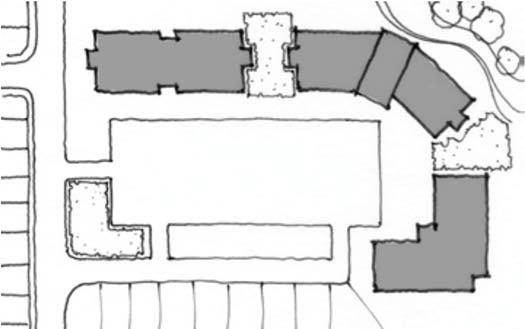
Illustration 1 - Example of an undesirable site plan layout
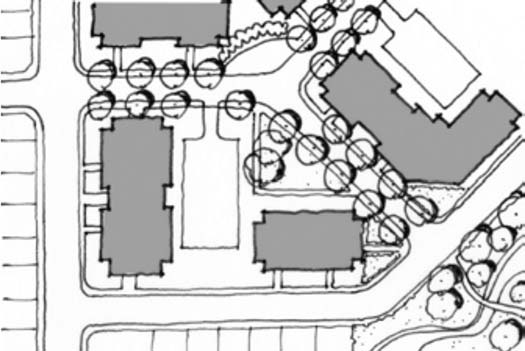
Illustration 2 - Example of a desirable site plan layout
ii.
Townhouse and apartment dwelling developments with two or more buildings shall be designed with variation between building setbacks and/or placement to avoid the creation of monotonous streetscapes. Additionally, site plans shall be designed with variation in both the patterns and the siting of structures so the appearance of the streetscape is not repetitive.
(b)
Minimum requirements.
i.
Townhouse dwellings:
a)
Minimum lot width (per unit): 20 feet.
b)
Minimum lot depth (per unit): 110 feet.
c)
Maximum height: 45 feet.
d)
Minimum front yard setback, principal dwelling: 10 feet.
e)
Maximum front yard setback, principal dwelling: 20 feet.
f)
Minimum front yard setback, open front porch, steps: 6 feet.
g)
Minimum side yard setback: 12 feet.
h)
Minimum side yard setback (corner lot): 20 feet.
i)
Minimum rear yard setback 20: feet.
j)
Not more than seven units in a row.
k)
Easements as required per Appendix B - Subdivision and Land Development Ordinance of the Smyrna Town Code.
l)
Alleys. Townhouse developments shall have access to driveways, garages or off-street parking spaces from a rear alley only. Driveways accessible from an alley shall have a minimum width of 12 feet, not to exceed a maximum width of 14 feet. On-street parking in alleys shall be prohibited.
Alleys shall be created at the time of subdivision approval and shall be one-way and connected to a street at both ends.
Alleys shall have a minimum paving width of 16 feet and a minimum right-of-way of 20 feet, not to exceed a maximum right-of-way of 24 feet.
Alleys shall be installed according to town specifications and shall be dedicated to the town for public use.
ii.
Apartment dwellings:
a)
Maximum height: 45 feet.
b)
Minimum front yard setback, principal dwelling: 10 feet.
c)
Maximum front yard setback, principal dwelling: 20 feet.
d)
Minimum front yard setback, open front porch, steps: 6 feet.
e)
Minimum side yard setback: 15 feet.
f)
Minimum side yard setback (corner lot): 20 feet.
g)
Minimum rear yard setback: 20 feet
h)
The greatest length or depth of an apartment dwelling shall not exceed four times its height. Notwithstanding the foregoing, the length shall be no more than a maximum length of 180 feet.
i)
Easements as required per Appendix B - Subdivision and Land Development Ordinance of the Smyrna Town Code.
(3)
Parking lot requirements.
(a)
Parking lots shall be located in the development's interior and not along street frontages.
(b)
Parking rows shall be no longer than ten consecutive parking spaces without being interrupted by a 15-foot by nine-foot landscaped island to separate adjacent parking spaces. Two trees and two low-lying shrubs shall be required for each landscaped island.
(c)
All parking rows shall be terminated with a 36-foot by nine-foot landscaped terminal islands to protect parked vehicles and confine thru traffic to aisles and driveways. Two trees and two low-lying shrubs shall be required per terminal island.
(d)
Clearly defined pedestrian connections shall be provided between parking lots and building entrances. Pedestrian walkways shall be a minimum width of five feet of clear, unobstructed passage and the type and nature of all materials shall be consistent within a development.
(4)
Open space requirements.
(a)
In addition to the requirements per Appendix B, Subdivision and Land Development Ordinance, Section 5.07, Open Space Requirements, common open space shall be incorporated into the site plan as a primary design feature and not just remnant pieces of land used as open space. The open space should be centrally located and provides opportunities for casual social interaction and safe play areas for children. Open spaces should be sheltered from the noise and traffic of adjacent streets or other incompatible uses.
(b)
Recreation amenities. All townhouse and apartment dwelling developments shall provide at least three of the following recreation amenities to accommodate a variety of ages and activities to meet the needs of the residents and contribute to the residential quality of life for each development:
i.
Site furnishings (benches, tables, trashcans).
ii.
Playground area (tot lot/play structures).
iii.
Community garden that provides gardening space for the raising of flowers, fruits and vegetables for residents.
iv.
Walking/biking trails that provide interconnectivity between abutting neighborhoods and pathway systems.
v.
Covered structure (gazebo, pavilion, etc.).
vi.
Swimming pool.
vii.
Sport courts (tennis, basketball, volleyball, etc.).
viii.
Athletic fields (soccer, football, baseball, etc.).
(5)
Street tree requirements.
(a)
Street trees shall be planted in or adjacent to all roadways; one (1) tree for every 30 linear feet of street frontage is required. This includes cul-de-sacs, corner lots, etc.
(b)
Street trees must be planted at least 20 feet apart but not more than 40 feet apart and shall be planted in accordance with standards and requirements as outlined per Appendix B, Subdivision and Land Development Ordinance, Section 5.17, Tree Planting Standards and Requirements.
(6)
Building scale and character standards. To maintain Smyrna's small-town character through building design guidelines that address the overall appearance of townhouse and apartment dwellings through façade design elements, all exterior design elements shall form an integrated development and ensure that large buildings reduce their apparent mass and bulk on elevations visible from the street or pedestrian routes to ensure that buildings are based on human scale (i.e., the relationship of the size of the building's features to the people that use the building).
(a)
The following requirements shall apply to all townhouse and apartment dwellings:
i.
Building length of individual building facades defined as the continuous horizontal distance, measured from end-wall to end-wall, shall not exceed 180 feet.
ii.
Primary pedestrian entrances shall be facing and visible from the primary street and a porch, covered stoop, or similar entry feature shall be located at the ground floor exterior entrance of each townhouse or apartment dwelling unit to offer overhead protection and provide shelter from inclement weather. Entrance doors are encouraged to include architectural detailing such as contrasting paint color(s) and decorative trim.
iii.
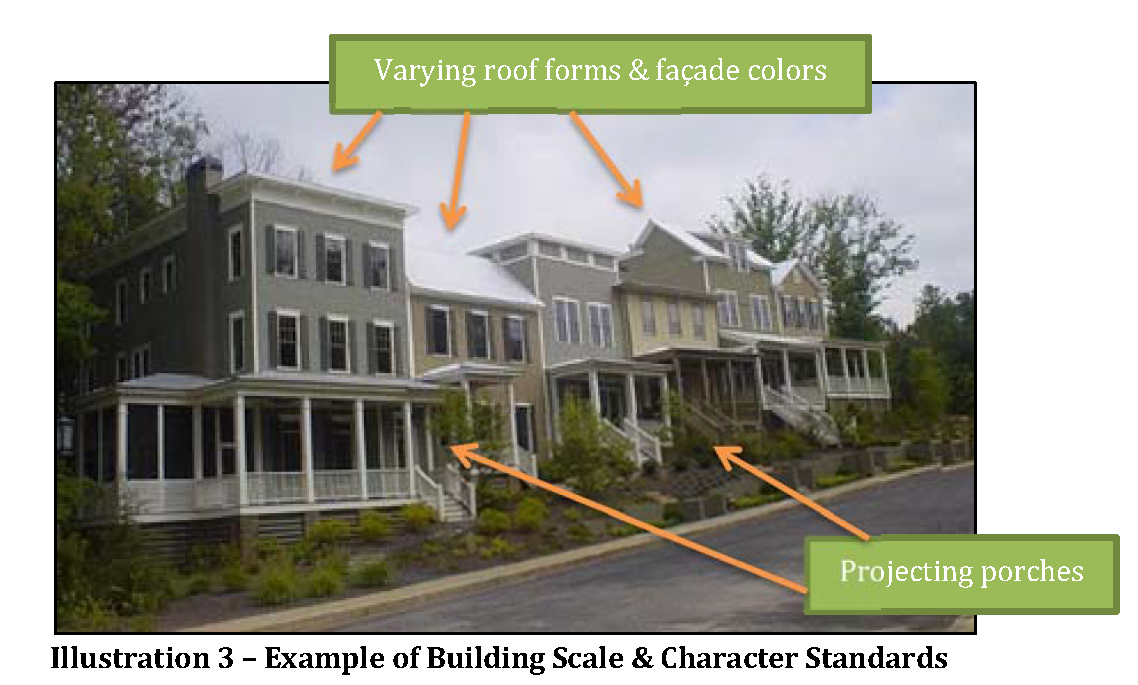
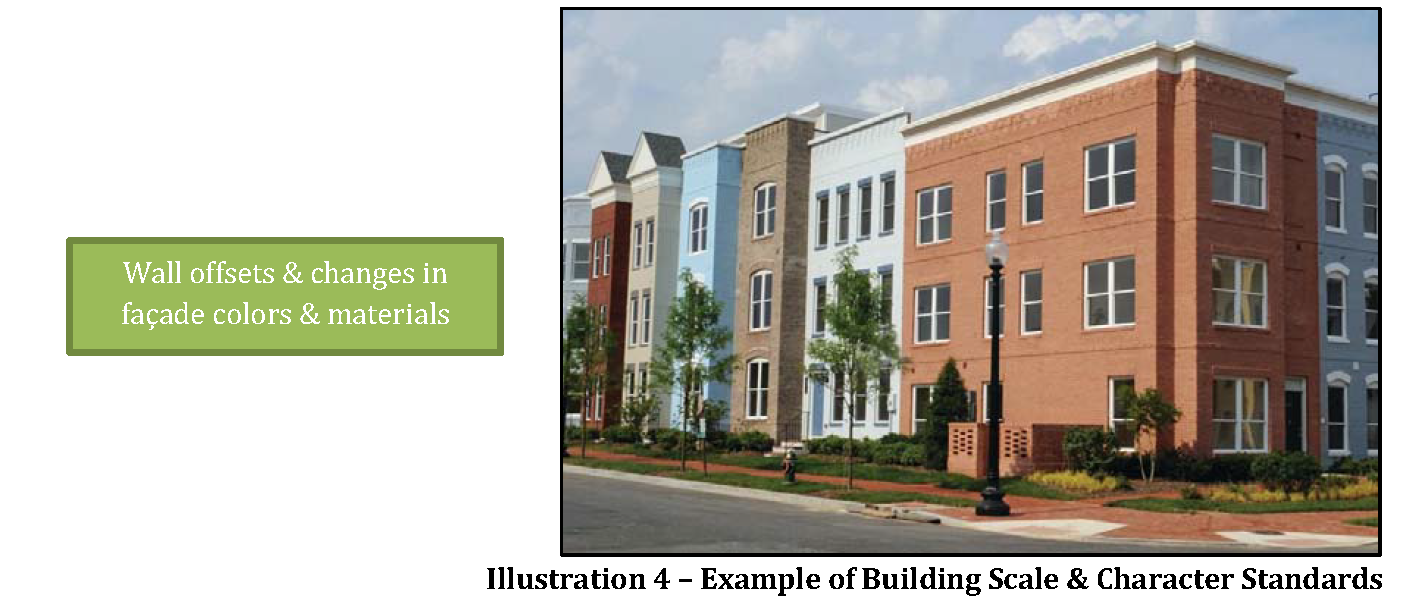
All townhouse and apartment buildings shall incorporate design elements that will break up large expanses of uninterrupted building surfaces (blank walls). Along the façade of all townhouse and apartment buildings, design elements shall occur at a minimum interval of 20 feet.
iv.
The following design elements shall be included:
a)
Varying roof lines and forms:
i.
Roof lines shall be varied through combinations of roof heights and styles that create variation and visual interest.
ii.
Guidelines:
a)
Provide offsets or breaks in roof elevations of two (2) feet or greater in height.
b)
Incorporate the roof pitch and materials of adjacent buildings into carport or garage roofs.
b)
Building façade colors and materials:
i.
At least two variations in color and materials shall be used in the treatment of the building façade.
ii.
Guidelines:
a)
Decorative patterns on exterior materials may include scales/shingles, wainscoting, ornamentation, and similar features.
c)
Bays, porches or balconies.
i.
Guidelines:
a)
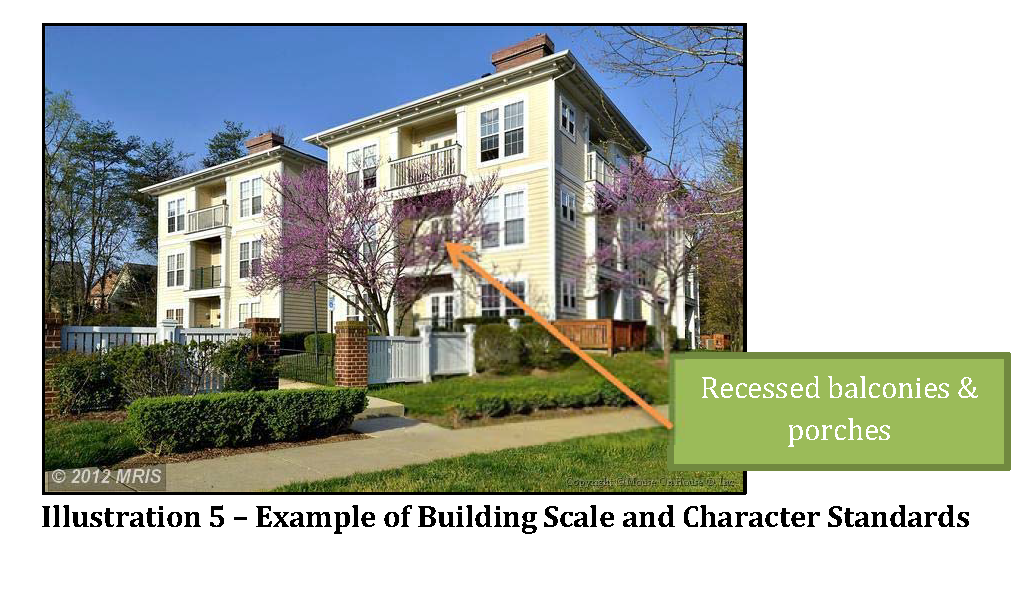
Incorporate smaller-scale forms such as bays, recessed or projecting balconies or porches and dormers into the design to visually reduce the height and scale of the building and to emphasize the definition of individual units.
d)
Wall offsets.
i.
A wall offset is defined as a projection or recess of a façade wall of at least two feet in depth. Wall offsets shall be incorporated onto those building facades having a length of at least 20 feet or greater. Wall offsets shall be a minimum of six feet in length.
e)
Windows.
i.
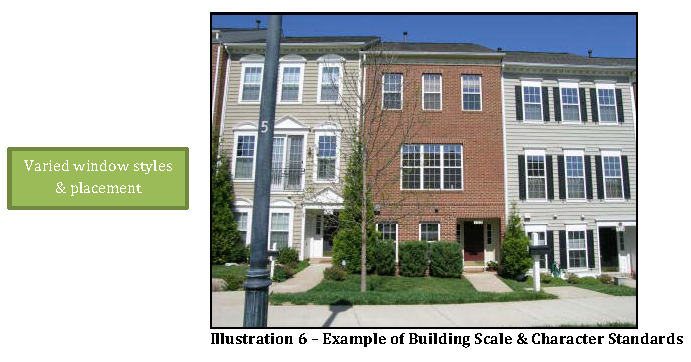
Decorative window features, such as arched windows, transoms, decorative pediments, and/or window shutters that are sized appropriately and proportionally to the window shall be required on those facades fronting on streets.
ii.
Guidelines:
a)
Windows of varied shape, size, and placement are encouraged.
b)
The use of recessed windows, moldings, decorative trim and wood frames to add three-dimensional quality and shadow lines to the façade.
f)
Front yards.
i.
Landscaped front yards offer a welcoming and safe transition from public to private space, define property lines, create a unique identity, buffer noise and provide visual screening. A minimum of 50 percent of the front yard shall be landscaped with flowering or evergreens shrubs and shall not exceed a maximum of three feet in height at maturity. All grassed areas shall be sodded with a drought-resistant grass.
ii.
A four-foot wide walkway constructed of concrete or decorative pavers shall extend from the sidewalk to the exterior entrance of each townhouse or apartment dwelling unit.
(Ord. No. 020-14, § 3, 12-15-14; Ord. No. 015-20, § 4, 7-20-20)
I.
Density provisions
(1)
The maximum gross density shall be 6 units per acre.
(2)
A density bonus of up to three additional units per acre above the maximum gross density per acre may be granted by the town council, after considering the recommendation of the planning and zoning commission, if a developer provides improvements in accordance with the standards outlined herein. Planned village communities shall not be eligible for density bonuses under this provision.
(a)
Open space. For each ten-percent increase in common open space over the minimum 25-percent open space requirement, a gross density bonus of one-half unit per acre may be granted.
(b)
Recreation amenities. Where the developer provides recreation amenities in excess of the three amenities as required by subsection H(4)(b) of this ordinance, a gross density bonus one-half unit per acre may be granted.
(c)
Community buildings. The construction of a community building to serve as a meeting hall for various community functions, including, but not limited to, civic meetings, recreational purposes, receptions and special events, may be granted a gross density bonus of one unit per acre.
(d)
School sites. The donation of a school site as approved by the town council and the Smyrna School District Board of Education may increase the permitted gross density by one (1) unit per acre.
(e)
Public facilities sites. The donation of a public facilities site to be used by public services such as emergency responders, governmental agencies, etc. may increase the permitted gross density by one unit per acre if the location is approved by the town and the agency to whom the site is to be provided.
(f)
Preservation easements. The establishment of a permanent easement for the purpose of preserving and protecting a historic resource (any building, structure, object, or other historic use that the Town considers to be important from a historic, architectural, or archaeological aspect in the history of the Town) may be granted a gross density bonus of one-half unit per acre.
g)
Conservation easements. The establishment of a permanent easement for the purpose of conserving and protecting a woodland area, a wetland area, and/or a stream corridor from removal of existing natural vegetation, and/or encroachment by future development may be granted a gross density bonus of one-half unit per acre.
(Ord. No. 020-14, § 4, 12-15-14; Ord. No. 004-19, § 8, 4-15-19)
6.
Residential district R-3.
A.
Declaration of legislative intent. This district is intended to protect residential development from harmful non-residential uses while affording the widest variety of dwelling types (condominiums, homeowners' associations, and apartment complexes) and the highest population densities. The entire parcel must remain under single ownership in this zoning district.
B.
[Uses permitted.] The following uses are permitted: No building or premises shall be used and no building or part of a building shall be erected which is arranged, intended or designed to be used, in whole or in part, for any purpose except the following and in accordance with performance standards of section 6 and subject to the site development plan approval as set forth in section 7.5 of the Smyrna zoning ordinance and the Smyrna subdivision regulations:
(1)
All uses permitted within the residential district R-2.
EXCEPTION: Mobile offices to be used as temporary real estate offices shall be permitted when approved by special exception pursuant to section 9(2) of this ordinance. Placement and setup shall be approved by the building official. Mobile offices shall be removed upon issuance of a certificate of occupancy for the first completed permanent structure, not to exceed one year.
(2)
Townhouse dwellings which are constructed in accordance with the standards set forth in the Town of Smyrna building code and are not designed to be transported to the dwelling site on their own chassis provided that not more than eight such units be in a row.
(Ord. No. 020-14, § 5, 12-15-14)
(3)
Apartment dwellings which are constructed in accordance with the standards set forth in the Town of Smyrna building code and [the dwelling] is not designed to be transported to the dwelling site on its own chassis provided the greatest dimension in length or depth of an apartment house shall not exceed four times its height. Notwithstanding the foregoing, the length shall be no more than a maximum length of 180 feet
(Ord. No. 020-14, § 6, 12-15-14)
(4)
Accessory uses as permitted in the residential district R-2A.
C.
[Uses permitted as special exception.] The following uses are permitted only if approved as a special exception pursuant to section 9(2) of this ordinance:
(1)
Cemeteries.
(2)
Institutions of religious, medical, charitable or philanthropic nature.
(3)
Medical clinics.
(4)
Professional offices.
(5)
Temporary real estate offices in developments containing a minimum of ten lots.
(6)
If approved as a special exception by the board of adjustment pursuant to § 9(2) of this ordinance, school bus stop shelters as defined in § 19, definitions.
(7)
Residential conversions provided that the requirements found in subsection 4(C)4 of the Residential R2 district, incorporated herein by reference, are satisfied.
(Ord. No. 018-14, § 3, 12-1-14)
D.
Uses permitted as conditional use. The following uses are permitted only if approved as a conditional use pursuant to section 6.14 of this ordinance:
(1)
Institutions of an educational nature.
(2)
Public utility uses.
(3)
Governmental building, structure, facilities and uses including but not limited to, police stations, fire houses, ambulance stations, government offices, library.
(4)
Planned Village Community, pursuant to the design and development standards and minimum lot requirements outlined in section 6.14 (Conditional uses, general guides and standards).
(5)
Accessory dwelling units, in accordance with the standards outlined in section 6.14 (Conditional uses, general guides and standards).
(Ord. No. 005-09, § 5, 9-21-09; Ord. No. 001-13, § 5, 2-4-13; Ord. No. 004-19, § 9, 4-15-19; Ord. No. 015-20, § 5, 7-20-20; Ord. No. 018-22, § 6, 10-17-22)
E.
Parking. Parking shall be in accordance with section 6, Supplementary District regulations.
F.
Minimum requirements.
(1)
Dwelling, one family (per unit):
a.
Minimum lot area, 5,500 sq. ft.
b.
Minimum lot width, 50 ft.
c.
Minimum lot depth, 110 ft.
d.
Maximum height, 45 ft.
e.
Front yard setback, 20 ft.
f.
Side yard setback, six ft., where access to rear yard is available to all adjoining property owners by a paved alley. If an alley is not available access to rear must be provided by one of the following:
(1)
Increase the minimum side yard setback on one side to ten ft.
(2)
Record in the deeds of adjoining property owners' side yards a minimum six-ft. easement on each side of the property line which guarantees access along the side property by the town and either property owner.
g.
Rear yard setback, 30 ft.
h.
Maximum lot coverage, 50%.
(2)
Dwelling, semidetached:
a.
Minimum lot area (per unit), 2,500 sq. ft. or 2½ times the total floor area, whichever is greater.
b.
Minimum lot width (per unit), 30 ft.
c.
Minimum lot depth (per unit), 110 ft.
d.
Maximum height, 45 ft.
e.
Front yard setback, 20 ft.
f.
Unattached side yard interior unit, ten ft.
g.
Unattached side yard exterior end unit, 20 ft.
h.
Attached side yard setback, zero.
i.
Rear yard setback, 30 ft.
j.
Maximum lot coverage, 50%.
(Ord. No. 020-14, § 7, 12-15-14)
G.
Accessory buildings. For minimum requirements, see section 6.8, Accessory buildings.
(Ord. of 5-17-93; Ord. of 6-20-94(2), §§ 1—4; Ord. of 4-3-95(1), § 5; Ord. of 8-7-95(1), § 5; Ord. of 3-6-00(1), § 1; Ord. No. 003-07, § 1, 10-15-07)
H.
Site and design standards for townhouse and apartment dwellings.
(1)
The site and design standards for townhouse dwellings and apartment dwellings in the residential R-3 district shall be the same as those found in subsection 5(H) of the residential R2-A district and are incorporated herein by reference. Notwithstanding the foregoing, the site and design standards incorporated herein shall not apply to townhouse and apartment dwellings that are constructed in a planned village community development.
(Ord. No. 020-14, § 8, 12-15-14; Ord. No. 015-20, § 5, 7-20-20)
I.
Density provisions.
(1)
The maximum gross density shall be 12 units per acre.
(a)
The density bonus provisions in the residential R-3 district shall be the same as those found in subsection 5.I(2) of the residential R2-A district and are incorporated herein by reference.
(Ord. No. 020-14, § 9, 12-15-14; Ord. No. 004-19, § 10, 4-15-19)
7.
Institutional and recreational district I & R.
a.
[Permitted uses.] The following uses are permitted:
(1)
Hospitals and institutions of an educational, medical, philanthropic, charitable nature which are related thereto.
(2)
Public, private and commercial recreation beaches, bathhouses, boat landings, and similar outdoor recreation facilities.
(3)
Cemetery as permitted in the R-1 district.
(4)
Research establishments properly located near and related to a hospital.
(5)
Public utility uses as permitted in the R-1 district.
(6)
Accessory uses and structures:
(a)
Provisions for housing persons working full time on the premises of a hospital or allied use.
(b)
Accessory uses and structures clearly incidental and customary to and associated with the operation of the permitted use.
(7)
Institutions of a religious nature.
(8)
Libraries and museums.
(9)
Theaters.
(10)
Governmental buildings, structures, facilities and uses including, but not limited to, police stations, fire houses, ambulance stations, and government offices.
b.
Uses permitted as conditional use. The following uses are permitted only if approved as a conditional use pursuant to the applicable section of this code concerning public hearings:
(1)
Temporary portable classrooms to be used by institutions of an educational nature.
c.
[Restriction of uses and structures.] The foregoing uses and structures are subject to the requirements as set forth in the schedule of district regulations and the supplementary district regulations.
(Ord. of 3-15-99(1), §§ 1, 2; Ord. No. 003-07, § 1, 10-15-07; Ord. No. 003-16, § 1, 3-21-16; Ord. No. 019-20, § 1, 10-19-20)
8.
Local commercial district LC. This district is intended to provide areas in which the daily shopping and business needs of nearby residents can be met. This district contains retail and service uses which serve the needs of the neighborhood population.
a.
[Uses permitted.] The following uses are permitted by right:
(1)
Convenience stores and shops such as grocery stores and drugstores.
(2)
Personal services. A certificate of zoning compliance shall not be issued for a personal service establishment until the town has received a copy of all licenses and permits required by the State of Delaware or any other government or regulatory body or agency for the establishment and/or the establishment's employees. After giving 15 days' written notice, a certificate of zoning compliance may be revoked due to the failure of the establishment or any of its employees to have a valid license or permit, and it shall not be reinstated until a valid license or permit has been provided to the town. If a personal service establishment or employee disputes the need to obtain a permit or license, the personal service establishment or employee may request a hearing before the town council. If a hearing is requested, any existing certificate of zoning compliance shall not be revoked prior to the hearing but no new certificate of zoning compliance shall be issued prior to the hearing. If a permit or license is not provided to the town, the town may require a letter of no objection from the entity responsible for issuing the permit or license prior to the town issuing a certificate of zoning compliance.
(3)
Bank, office, restaurant, bar.
(4)
Day care center and nursery schools (see section 6).
(5)
Automobile service station not to include repair garages or junkyards.
(6)
Public utility uses provided, however, that nonresidential towers shall be permitted only if approved as a conditional use pursuant to section 6.15 of this ordinance. All principal parts of the tower, excluding any guy cables, shall be set back from the street line or any other lot line of the lot on which it is located a distance not less than the height of the tower.
(7)
If approved as a special exception by the board of adjustment pursuant to section 9(2) of this appendix, private clubs and lodges.
(8)
Public and/or governmental buildings, structures, facilities and uses including, but not limited to, police stations, fire houses, ambulance stations, government offices, libraries, etc.
(9)
Specialty store.
(10)
If approved as a special exception by the board of adjustment pursuant to section 9(2) of this ordinance, any uses permitted in the R-3 district.
(11)
Accessory uses and structures clearly incidental and customary to and associated with the operation of the permitted use.
(12)
Commercial services.
b.
[Restriction of uses and structures.] The foregoing uses and structures are subject to the requirements as set forth in the supplementary district regulations.
c.
Parking. Shall be in accordance with Section 6. Supplementary District Regulations.
d.
Minimum requirements.
(1)
Minimum lot area, none except for dwellings where R-3 applies.
(2)
Minimum lot width, none except for dwellings where R-3 applies.
(3)
Minimum lot depth, none except for dwellings where R-3 applies.
(4)
Maximum height, three stories, 45 feet.
(5)
Minimum front yard, 35 feet.
(6)
Minimum side yard, none except 20 feet shall be provided and shall be planted when adjoining a residential district.
(7)
Minimum rear yard, 20 feet.
(8)
Maximum lot coverage, 80 percent.
e.
[Uses permitted as conditional uses.] The following uses are permitted only if approved as a conditional use pursuant to section 6.16 [6.15] of this ordinance:
(1)
Indoor storage facilities provided that:
(a)
No structure is located less than 100 feet from the buildable area of any residential or mobile home park zoning districts;
(b)
All property lines abutting non-commercial zoning districts must be screened and landscaped with materials approved by the building inspector;
(c)
No entrances or exits may be installed from non-commercial property lines.
f.
[Uses permitted as special exception.] The following uses are permitted only if approved by the board of adjustment as a special exception:
(1)
Institutions of a religious nature.
(2)
Body art establishments, as defined at section 5.10.b.(2) of this Zoning Code.
(Ord. of 3-15-93(2); Ord. of 11-22-95, § 1; Ord. of 11-3-97(2), §§ 1, 4; Ord. of 10-16-00(3), § 1; Ord. of 12-17-01(1), §§ 1, 2; Ord. No. 014-04, §§ 1—3, 8-16-04; Ord. No. 003-07, § 1, 10-15-07; Ord. No. 011-14, § 1, 7-7-14; Ord. No. 003-16, § 2, 3-21-16; Ord. No. 003-20, §§ 1, 2, 1-6-20; Ord. No. 018-20, § 1, 7-20-20)
9.
Central commercial district CC. This district is the centralized, historic core of the Town and is intended to provide for establishments offering a mix of retail, office, and residential uses which are consistent with the existing scale and character of the surrounding historic district, in order to promote the economic viability of the community and surrounding area.
a.
Permitted uses. The following uses are permitted:
(1)
General retail business.
(2)
Offices (Except those offices located on the first floor of a building fronting on Main Street between Mt. Vernon and South Streets and fronting on Commerce Street between U.S. Route 13 and Union Street, shall require conditional use approval).
(3)
Financial institutions.
(4)
Restaurant or café.
(5)
Restaurant patios and sidewalk cafes provided that:
(a)
Total size shall not exceed 1,000 square feet.
(b)
Food and beverages shall be served only to seated patrons.
(c)
Outdoor cooking facilities are prohibited.
(d)
No electronically amplified sound shall be permitted except that one person electronically amplified performances intended as accessory or background music or non-electronically amplified performances shall be permitted.
(e)
No overflow of patrons on sidewalks and/or street right-of-way shall be permitted.
(f)
A minimum four-foot wide clear pedestrian path between any obstruction and the restaurant patio/sidewalk cafe shall be maintained at all times, but in no case shall the restaurant patio sidewalk cafe encroach into the public right-of-way.
(g)
Tables, chairs, umbrellas, and any other objects provided in connection with a facility located directly on sidewalks shall be secured in an orderly fashion or removed from the sidewalk area when dining facility is closed to the public.
(h)
No tables and chairs nor any other parts of restaurant patios or sidewalk cafes shall be attached, chained, or in any manner affixed to any tree, post, sign, or other public fixtures.
(i)
Tables, chairs, umbrellas, and any other objects provided with a sidewalk cafe shall be maintained in a clean and attractive appearance and shall be in good repair at all times.
(j)
No vending machines of any kind shall be permitted.
(k)
For facilities directly on sidewalks, such facilities shall be swept and washed daily by restaurant operator including the adjoining sidewalks to the street curb. Raised decks, porches, and similar structures shall also be swept daily. Debris shall be disposed of properly in owner/manager's containers.
(6)
Lodging to include hotels and motels.
(7)
Bed and breakfast establishments offering no more than five bedrooms for lodging purposes and subject to the following requirements:
(a)
The owner or owner's representative must reside full-time on the premises.
(b)
Not more than three guests shall be permitted per guest room. All bed and breakfast establishments shall maintain a current guest register including names, permanent addresses, dates of occupancy, and motor vehicle license of all guests. Such register shall be open to inspection by the town's planning and inspections office.
(c)
No guest shall be permitted to lodge on the premises for more than seven consecutive days.
(d)
Breakfast and/or light fare may be served to registered guests only, not to include lunch and/or dinner. No food preparation shall be permitted in any guest room.
(e)
[Reserved.]
(f)
No construction, remodeling, reconstruction, or other revisions shall be made to the exterior of the premises as would materially change the appearance thereof from that of a single-family dwelling.
(g)
No bed and breakfast shall offer guest rooms to the general public until a business license has been obtained from the State of Delaware and Town of Smyrna and the Town of Smyrna has issued a certificate of zoning compliance.
(h)
No bed and breakfast shall offer guest rooms to the general public until all applicable State and Town permits have been approved and issued. Every bed and breakfast shall be required to meet all governing state and town building, fire, plumbing, electrical, safety, housing, and property maintenance codes as a continuing condition of operation and shall be subject to inspection by the town building inspection office upon not less than ten days' prior notice (except where compelling exigent circumstances involving the public health or safety requires less notice).
(8)
Restaurant, full-service and brewery-pubs; provided that:
(a)
Suitable on-site kitchen facilities are provided.
(b)
The primary use consists of sit-down, full meal service to patrons.
(c)
Adequate seating arrangements for patrons are provided on the premises.
(d)
Those facilities serving alcohol shall be licensed by the Delaware Alcoholic Beverage Control Commission as a brewery-pub under 4 Del. C. § 512B or as a restaurant authorized to serve alcohol and shall provide sit-down, full meal service to patrons with lunch, dinner and dessert menus during all hours of operation; except that limited late meal service may be substituted beginning 90 minutes before the time alcoholic beverages are no longer served. The limited late mean service shall consist of such foods as sandwiches, salads, pizza, and similar items.
(e)
Alcoholic beverages served for consumption on the premises shall be ancillary to the primary food service use. "Ancillary" for purposes of this section means subordinate, auxiliary, smaller and less intensive than the primary use.
(f)
Sale, consumption and closing. There shall be no alcoholic beverages sold on the premises after 1:00 a.m. There shall be no alcoholic beverages consumed on the premises after 2:00 a.m. All facilities which sell alcohol for on-premise consumption must close to the public by 2:00 a.m.
(9)
[Reserved.]
(10)
Personal services (except massage parlors which are located within 250 feet of another massage parlor shall require a conditional use approval). The operation of a personal service establishment and the issuance of a certificate of zoning compliance for the same shall be in accordance with the requirements for personal services as outlined in the Local Commercial District (LC).
(Ord. No. 010-23, § 1, 5-15-23)
(11)
[Reserved.]
(12)
Craft distillery and microbrewery establishments, as defined at 4 Del. C. §§ 512(c) and 512(e), provided that:
(a)
All permits and approvals required by the Delaware Alcoholic Beverage Commission are obtained and remain in full force and effect.
(b)
All aspects of the distilling or brewing process are completely confined within a building, including storage of all materials and finished products.
(c)
Such establishment offers the public, on a regular and continuing basis, various activities ancillary to its distilling and/or brewing process, including by way of example: tours of the premises, educational classes, demonstrations, tasting rooms, and retail sales areas limited to the sale of beer, mead, cider, or spirits brewed or distilled on the premises for consumption off-premises and other retail items identified in 4 Del. C. § 512E(c)(5).
(d)
On-site consumption or tasting associated with a craft distillery or microbrewery establishment shall be permitted. Any area associated with on-site consumption or tasting shall not operate as a stand-alone bar or tavern, shall be located on the premises of the craft distillery or microbrewery establishment, and shall be ancillary to the primary use. "Ancillary" for purposes of this section means subordinate, auxiliary, smaller and less intensive than the primary use. On-site consumption or tasting of alcohol shall be limited to those products brewed or distilled on the premises, except as otherwise permitted by 4 Del. C. §§ 512C or 512E, as the same may be amended, or any other corresponding provision of Delaware law.
(e)
All food sales shall be limited to prepackaged snack items or those food items prepared by a food establishment licensed by the State of Delaware. If a craft distillery or microbrewery intends to operate on its premises a food establishment that is otherwise a permitted use in this district (i.e. restaurant, café, or full-service restaurant), the town may require the property owner to provide the town with a letter of no objection from the Delaware Alcoholic Beverage Control Commissioner regarding the operation of a food establishment on the premises of a craft distillery or microbrewery.
(f)
Outdoor seating and gathering areas shall be permitted subject to the following requirements:
i.
Permanent and temporary outdoor seating and gathering areas shall be subject to building permit application and approval requirements.
ii.
Outdoor seating and gathering areas and ancillary improvements shall include physical barriers from public rights-of-way and physical and visual barriers from adjoining properties. Physical barriers along public rights-of-way shall restrict access from the public rights-of-way to the outdoor seating and gathering areas and shall not exceed four feet in height. Barriers along adjoining property lines shall create a physical and visual barrier consisting of fencing six feet in height or vegetation at least six feet in height. The regulations herein shall be in addition to any regulations imposed by the State of Delaware.
iii.
Maximum occupancy and points of ingress/egress shall be clearly marked. Occupancy of outdoor seating and gathering areas shall not exceed one person per 15 square feet of the outdoor seating and gathering areas identified in the building plans or any other occupancy limit established by the office of the state fire marshal.
iv.
All structures and uses related to outdoor seating and gathering areas and facilities are subject to the Town of Smyrna Building Code and the Performance Standards of the Town of Smyrna Zoning Code Supplementary District Regulations.
v.
The occupancy of outdoor seating and gathering areas shall be included when calculating the building requirements and minimum amenities required by the Town of Smyrna and State of Delaware. Outdoor seating and gathering areas shall meet all requirements of the Town of Smyrna and the State of Delaware.
vi.
Tables, chairs, umbrellas, equipment, games, and any other items provided in connection with outdoor seating and gathering areas shall be maintained in good repair and shall be secured during non-business hours in a safe and orderly manner.
vii.
Vending machines are prohibited and must be immediately removed upon notice from the Town of Smyrna.
viii.
Any licensing required by the Delaware Alcoholic Beverage Control Commissioner for outdoor seating and gathering areas shall be obtained.
(13)
Mixed-use buildings.
(14)
Accessory use and structures:
(a)
Minor home occupations pursuant to section 6.19 of this ordinance.
(b)
Major home occupations only if approved as a special exception pursuant to section 6.19 of this ordinance.
(c)
Accessory uses and structures clearly incidental and customary to and associated with the operations of the permitted uses.
(15)
Uses permitted as a special exception. The following uses are permitted only if approved as a special exception pursuant to section 9(2) of this ordinance:
(a)
[Reserved.]
(b)
[Reserved.]
(c)
[Reserved.]
(d)
Light manufacturing and/or processing provided that:
(i)
At least 30 percent of the building shall be used for the sale of goods produced or processed on the premises; the portion of the first floor of the building that fronts the street shall be used entirely for retail purposes.
(ii)
Such area devoted to the production or processing of goods shall be fully concealed from any street.
(iii)
All aspects of the production or processing of goods are completely confined within the building, including storage of all materials and finished products.
(iv)
Not more than four employees are engaged in such production or processing.
(e)
Funeral homes, including associated display and sales of monuments, when screened from public view.
(f)
[Reserved.]
(g)
Body art establishments, as defined at section 5.10.b.(2) of this Zoning Code.
(16)
Uses permitted as conditional uses. The following uses are permitted only if approved as a conditional use pursuant to Section 6.14 of this ordinance:
(a)
Emergency services.
(b)
Commercial services.
(c)
Day care center.
(d)
Parking structures.
(e)
Public utility uses.
(f)
Alcoholic beverage establishments provided that:
1)
The alcoholic beverage establishment and its permittee shall comply with all applicable Delaware Alcoholic Beverage Commission rules and regulations. Suspension of the alcoholic beverage establishment's or its permittee's DABCC license may constitute sufficient cause or basis for review and possible revocation of its conditional use approval.
2)
Exterior lighting shall be installed as necessary to adequately illuminate the sidewalk or other public right of ways adjacent to the establishment and any parking lots or landscaped areas located on the premises. Lighting shall be hooded or oriented so as to deflect light away from adjacent properties.
3)
The permittee shall, for the first six months, schedule a monthly meeting with the manager of planning and zoning and the chief of police in order to identify and mitigate any noise/parking/lighting problems and/or neighborhood concerns.
4)
In conjunction with granting a conditional use approval as authorized herein, mayor and council may impose conditions on the proposed use as deemed necessary by mayor and council to ensure that the public health, safety, morals, and general welfare of persons and property will not be adversely affected and to provide for the protection of surrounding property, persons and neighborhood values.
5)
Failure to comply with any of the conditions of approval may result in mayor and council terminating the conditional use approval.
(g)
One-family, semidetached, townhouse, and apartment dwellings. Lot, height, density, and yard requirements shall be the same as for the corresponding type of residential use found in the PVC district. In determining whether the standard in section 6.14 ("Conditional uses, general guides and standards") for granting a conditional use has been satisfied, the town council shall consider whether the proposed residential use will negatively impact the economic vitality and purpose and intent of the central commercial (CC) district. In making this determination, the town council shall consider factors including, but not limited to, the following:
1)
Whether the proposed use will detract from the economic vitality and purpose and intent of the CC district as a result of the number of non-commercial uses already located within the same vicinity as the property.
2)
The suitability and potential of the property for a future commercial use that would further the economic vitality and purpose and intent of the CC district.
3)
Whether the proposed use will detract from the economic vitality and purpose and intent of the CC district due to the property's proximity to the commercial core of the CC district situated at the intersection of Commerce and Main Streets.
(h)
Accessory dwelling units, in accordance with the standards outlined in section 6.14 (Conditional uses, general guides and standards).
b.
Restriction of uses and structures. The foregoing uses and structures are subject to the requirements as set forth in the supplementary district regulations.
c.
Parking. Shall be in accordance with Section 6, Supplementary district regulations.
d.
Minimum requirements.
(1)
Minimum lot area, none except for dwellings where R-3 applies.
(2)
Minimum Lot width, none except for dwellings where R-3 applies.
(3)
Minimum Lot depth, none except for dwellings where R-3 applies.
(4)
Maximum height, 45 feet, R-3 District requirements shall apply to residential uses.
(5)
Minimum front yard, none.
(6)
Minimum side yard, none except 20 feet shall be provided and shall be planted when adjoining residential zoning district.
(7)
Minimum rear yard, none except 20 feet shall be provided and shall be planted when adjoining a residential zoning district.
(8)
Maximum impervious lot coverage, 90 percent.
(Ord. of 11-22-95, § 2; Ord. of 11-3-97(2), §§ 2,5; Ord. of 8-5-02(3), § 1; Ord. No. 035-03, § 1, 1-20-04; Ord. No. 018-04, § 1, 11-15-04; Ord. No. 003-05, § 1, 1-18-05; Ord. No. 003-07, § 1, 10-15-07; Ord. No. 012-12, §§ 1—3, 12-3-12; Ord. No. 011-14, § 1, 7-7-14; Ord. No. 021-14, § 1, 1-20-15; Ord. No. 013-15, § 2, 9-21-15; Ord. No. 003-16, § 3, 3-21-16; Ord. No. 003-17, § 1, 3-6-17; Ord. No. 005-17, § 1, 8-21-17; Ord. No. 008-17, § 1, 11-20-17; Ord. No. 011-17, § 1, 12-18-17; Ord. No. 009-18, §§ 1, 2, 7-16-18; Ord. No. 004-19, § 11, 4-15-19; Ord. No. 003-20, §§ 3, 4, 1-6-20; Ord. No. 019-20, §§ 2, 3, 10-19-20; Ord. No. 022-21, §§ 1, 2, 12-6-21; Ord. No. 018-22, § 7, 10-17-22)
10.
Highway commercial district HC. The highway commercial district is intended to meet commercial and service needs which can best be satisfied by establishments located adjacent to a main highway. The requirements of the local and regional population as well as those of travelers will be served within this district.
a.
[Permitted uses.] The following uses are permitted:
(1)
Uses as permitted in the central commercial district. All uses in the central commercial district requiring special exception or conditional use approvals shall require the same approvals in this district.
(2)
Drive-in facilities not to include drive-in theaters.
(3)
Automobile courts and motels.
(4)
Automobile, truck, farm and marine equipment repair, sales and service, not to include junkyards.
(5)
Outdoor recreation facilities.
(6)
Carwashes.
(7)
Eating and drinking establishments.
(8)
Trailer and memorial stone sales.
(9)
Truck and bus terminals.
(10)
Household moving and storage facilities.
(11)
Wholesale, storage and warehouse establishments.
(12)
Sale and storage of agriculturally oriented products including grain and feed.
(13)
Roadside produce stands.
(14)
Building materials sales yard.
(15)
Building contractor's office and storage of equipment and material, provided that storage areas be screened from public view.
(16)
Public utility uses provided, however, that nonresidential towers shall be permitted only if approved as a conditional use pursuant to section 6.15 of this ordinance. All principal parts of the tower, excluding any guy cables, shall be set back from the street line or any other lot line of the lot on which it is located a distance not less than the height of the tower.
(17)
Accessory uses and structures clearly incidental and customary to and associated with the operation of the permitted uses.
(18)
Any established residence, whether conforming or nonconforming, may be continued to be used as a residence provided that it is not enlarged, increased or altered in any way or moved for any distance. Should such structure be destroyed by any means to an extent of more than 50 percent of its replacement cost at the time of the destruction as determined by the building inspector, it shall not be reconstructed except in conformity with the provisions of this ordinance.
(19)
If approved as a special exception by the board of adjustment pursuant to section 9(2) of this ordinance, bulk storage of flammable liquids/gases.
(20)
If approved as a special exception by the board of adjustment pursuant to section 9(2) of this section, school bus stop shelters as defined in § 19, definitions.
(21)
Brewery-pub establishments, as defined at 4 Del. C. § 512B, provided that:
a.
All permits and approvals required by the Delaware Alcoholic Beverage Commissioner to operate a brewery-pub are obtained and remain in full force and effect.
b.
All aspects of the brewing process are completely confined within a building, including storage of all materials and finished products.
b.
[Uses permitted as a special exception]. The following uses are permitted only if approved as a Special Exception pursuant to section 9(2) of this ordinance:
(1)
One off-premises sign provided that:
(i)
Such sign shall not exceed 5.0 square feet in size;
(ii)
Such sign shall be set back a minimum of 5 feet from the right-of-way/property line of all public streets/roads;
(iii)
Such sign shall be no higher than 3.0 feet above grade;
(iv)
Such sign shall not be placed within the 25-foot sight triangle;
(v)
Such sign shall be no further than 1,000 feet from the property line of the premises of the business it refers to.
(2)
If approved as a special exception by the Board of Adjustment pursuant to Section 9(2) of this Ordinance, Adult Entertainment Establishments, as defined by 24 Del. C. Chapter 16, and Body Art Establishments as defined by 16 Del. Admin. C. § 4451 (Body Art Establishments), as the same may be amended from time to time and any other existing or future corresponding provision of law, adopted under authority of 16 Del. C. Chapter 1, § 122(3)(w), shall be permitted in the Highway Commercial District (HC), only, subject to additional time, place and manner restrictions set forth at Section 9(2) of this Ordinance.
(a)
Nonconforming uses pre-existing the effective date of this Ordinance shall be governed by section 4 of the Zoning Code.
c.
[Uses permitted as a conditional use]. The following uses are permitted only if approved by the board of adjustment as a conditional use pursuant to section 6.14 of this ordinance:
(1)
Large scale indoor entertainment uses provided that:
(i)
All large scale indoor entertainment uses shall strictly comply with all provisions of 24 Del. C. Chapter 16, as now in effect or as hereafter amended. Failure to comply with this requirement shall void the conditional use approval.
(ii)
No more than one large scale indoor entertainment use shall be permitted on any lot or property.
(iii)
No large scale indoor entertainment use shall be permitted in any building otherwise used in whole or part for residential purposes.
(iv)
No large scale indoor entertainment use shall be permitted on any lot which is located within 1,000 feet of any other lot on which is located another large scale indoor entertainment use. This distance shall be measured from the nearest property line of such use to the nearest property line of the proposed large scale indoor entertainment use.
(v)
No large scale indoor entertainment use shall be permitted on any lot which is located within 1,000 feet of any lot in any residential district. This distance shall be measured from the nearest property line of any residential district to the nearest property line of the proposed large scale indoor entertainment use.
(vi)
No large scale indoor entertainment use shall be permitted on any lot which is located within 1,000 feet of any lot on which is located a church, community center, funeral home, school, day-care center, hospital, alcoholism center or drug treatment center, counseling or psychiatric treatment facility or public park. This distance shall be measured from the nearest property line of such above use to the nearest property line of the proposed large scale indoor entertainment use.
(vi)
No large scale indoor entertainment use shall be permitted on any lot which is located within 1,000 feet of any school bus stop. This distance shall be measured from the nearest school bus stop to the nearest property line of the proposed large scale indoor entertainment use.
(vii)
The proposed use shall meet all other requirements of the laws of the Town of Smyrna, including but not limited to district lot and bulk regulations, parking regulations and signage requirements.
(viii)
Large scale indoor entertainment uses may operate only between the hours of 11:00 a.m. and 1:00 a.m. All staff must leave the building and the building must be securely locked not later than one hour after closing time.
(ix)
All large scale indoor entertainment uses shall continuously carry liability insurance with minimum limits of $1,000,000.00 single limit.
(x)
All large scale indoor entertainment uses shall provide on-site crowd control and security during all operating hours, ensure that designated parking is available and adequate for the expected activity, and operate such that no music or other noise is discernable at a distance of 1,000 feet in all directions from the use.
(xi)
In the event the large scale indoor entertainment use applicant shall meet all of the above requirements, the conditional use shall be issued subject to forfeiture for a violation of any of the requirements imposed by this ordinance.
(xi)
Any conditional use issued or granted pursuant to this amendment to the zoning code shall be personal to the applicant only, and shall not be deemed to go with the land or lot upon which the use is located, and shall not be transferable.
(xii)
All large scale indoor entertainment use conditional use issued or granted pursuant to this amendment to the zoning code shall be of a limited duration of three years, however, any such conditional use applicant may apply to the board of adjustment for renewal of said conditional use within six months of the expiration date of the current conditional use.
(xiii)
All large scale indoor entertainment use conditional use holders shall permit the State of Delaware, through its designated agents, and the Town of Smyrna, through its designated agents, to enter upon the entirety of the premises upon which the use is conducted during its hours of operation, for the purpose of inspection and testing, and for the purpose of determining whether the terms of applicable state and town laws are being complied with.
(xiv)
Nonconforming uses preexisting at the effective date of this ordinance shall be governed by section 4 of the zoning code.
d.
[Restriction of uses and structures.] The foregoing uses and structures are subject to the requirements as set forth in the supplementary district regulations.
e.
[Residency on business premises.] Owner or caretaker permitted to live on premises of a business.
f.
Parking. Shall be in accordance with Section 6. Supplementary District Regulations.
g.
Minimum requirements.
(1)
Minimum lot area, none.
(2)
Minimum lot width, none.
(3)
Minimum lot depth, none.
(4)
Maximum height, three stories, 45 feet.
(5)
Minimum front yard, 30 feet.
(6)
Minimum side yard, none except 20 feet shall be provided and shall be planted when adjoining a residential district.
(7)
Minimum rear yard, 30 feet.
(8)
Maximum lot coverage, 80 percent.
(Ord. of 3-15-93(2); Ord. of 6-5-95(1), § 1; Ord. of 11-22-95, § 3; Ord. of 11-3-97(2), §§ 3, 6; Ord. of 10-21-02, §§ 1, 2; Ord. No. 004-07, § 1, 7-2-07; Ord. No. 003-07, § 1, 10-15-07; Ord. No. 013-07, § 1, 11-5-07; Ord. No. 001-08, §§ 1, 2, 1-7-08; Ord. No. 011-14, § 1, 7-7-14; Ord. No. 013-15, § 2, 9-21-15; Ord. No. 003-20, § 5, 1-6-20; Ord. No. 009-19, § 9, 12-2-19)
11.
Manufacturing district M.
a.
Declaration of legislative intent. This district is intended to include structures and land located near residential and commercial uses existing and proposed; therefore, the manufacturing uses must be restricted in order to eliminate any adverse effects that they may have upon the surrounding area.
b.
[Permitted uses.] The following uses are permitted: No building or premises shall be used and no building or part of a building shall be erected which is arranged, intended or designed to be used, in whole or in part, for any purpose except the following and in accordance with performance standards of section 6 and subject to the site development plan approval as set forth in section 7.5 of the Smyrna zoning ordinance:
(1)
Research, testing and development laboratories.
(2)
Printing, publishing, binding, packaging, storage, warehousing and trucking terminals.
(3)
Storage and processing of farm products.
(4)
Manufacturing or assembling from prepared materials.
(5)
Public utility uses provided, however, that nonresidential towers shall be permitted only if approved as a conditional use pursuant to section 6.15 of this ordinance. All principal parts of the tower, excluding any guy cables, shall be set back from the street line or any other lot line of the lot on which it is located a distance not less than the height of the tower.
(6)
Firms manufacturing textiles, clothing, hosiery, electronic equipment, appliances and mechanical instruments.
(7)
Contractors' yards for the storage of material and equipment.
c.
[Uses permitted as special exceptions.] The following uses are permitted only if approved as a special exception pursuant to section 9(2) of this ordinance:
(1)
Any other industrial uses which would not violate the intent of the "manufacturing district."
(2)
Retail sale of products manufactured or processed on the premises.
(3)
Bulk storage of flammable liquids/gases.
d.
[Uses permitted as conditional uses.] The following uses are permitted only if approved as a conditional use pursuant to section 6.15 of this ordinance:
(1)
Nonresidential towers. All principal parts of the tower, excluding any guy cables, shall be set back from the street line or any other lot line of the lot on which it is located a distance not less than the height of the tower.
e.
Parking. Parking shall be in accordance with section 6, Supplementary district regulations.
f.
Minimum requirements.
(1)
Minimum lot area, none.
(2)
Minimum lot width, none.
(3)
Minimum lot depth, none.
(4)
Maximum height (except grain elevators), three stories, 45 feet.
(5)
Front yard setback, 30 feet.
(6)
Side yard setback, none, except when adjoining a residential district, 100 feet shall be provided and shall be planted.
(7)
Rear yard setback, none, except when adjoining a residential district, 100 feet shall be provided and shall be planted.
(8)
Maximum lot coverage, 80%.
(Ord. of 4-3-95(2), §§ 1, 2; Ord. of 6-5-95(1), § 2; Ord. of 11-6-95(3), § 1; Ord. of 11-22-95, §§ 4, 5; Ord. of 2-5-01, § 1; Ord. No. 003-07, § 1, 10-15-07)
12.
Environmental protection overlay district.
a.
Declaration of legislative intent. The intent of this ordinance is to establish standards and criteria for the protection of environmentally sensitive areas of the Town of Smyrna, including floodplains, floodprone soils, areas of mature woodlands, steep slopes, erodible soils, and areas having a seasonal high water table within six inches of the soil surface. More specifically, these provisions are designed to:
(1)
Preserve natural environmental resources and maintain ecological stability by:
(a)
Strictly controlling the use of floodplains and alluvial soils;
(b)
Promoting the proper development of steep, and very steep, slopes with special consideration for those with unstable soils;
(c)
Protecting the quality of existing surface waters by controlling erosion and sedimentation and developing needed stormwater management systems;
(d)
Maintaining groundwater resources through the provision of open space areas for groundwater recharge;
(e)
Avoiding the disruption of woodlands which are highly diverse and biologically rich.
(2)
Preserve the visual character of the landscape by:
(a)
Discouraging development in areas which will create significant changes in the visual character of the town.
(b)
Encouraging the use of buffer areas to preserve existing environmental quality and amenity values.
(3)
Provide for more efficient allocation and maintenance of open space.
(4)
Provide for necessary active and passive recreation areas to complement those which exist.
(5)
Aid in the implementation of the comprehensive plan and the attainment of the aims and objectives contained therein.
b.
Applicability of the district. Regulations contained in this ordinance shall be applicable to land areas in the town that are zoned environmental protection overlay district (EPOD), delineated on the official zoning map and consist of or contain the natural resources listed as follows:
(1)
Flood hazard areas and high ground water areas;
(2)
Steeply sloped—slopes ranging from 15 to 25 percent; and very steep slopes—slopes in excess of 25 percent;
(3)
Prime woodlands—Areas of forest capability class I as defined by the Delaware department of agriculture; and any woodlands wherein the canopy species are greater than 12 inches in caliper;
(4)
Visually sensitive areas—Unvegetated lands characterized by slopes in excess of eight percent; and lands situated on any major or minor ridges and hilltops.
c.
Definitions.
Base flood. The flood which has been selected to serve as the basis upon which the floodplain management provision of this and other ordinances have been prepared; for purposes of this ordinance, the 100-year flood.
Basement. Any area of the building having its floor subgrade (below ground level on all sides).
Development. Any manmade change to improved or unimproved real estate, including but not limited to buildings or other structures, mining, dredging, filling, grading, paving, excavation or drilling operations.
Flood. A general and temporary inundation of normally dry land areas.
Floodplain.
(1)
A relatively flat or low land area adjoining a river, stream or watercourse which is subject to partial or complete inundation;
(2)
An area subject to unusual and rapid accumulation or runoff of surface waters from any source.
Floodway. The channel of a river or other watercourse and the adjacent land area that must be reserved to discharge the base flood without increasing the water surface elevation of that flood more than one foot at any point.
Floodproofing. Any combination of structural and nonstructural additions, changes or adjustments to structures which reduce or eliminate flood damage to real estate or improved real property, water and sanitary facilities, structures, and their contents.
Lowest floor. The lowest floor of the lowest enclosed area (including basement). An unfinished or flood-resistant enclosure usable solely for parking of vehicles, building access or storage in an area other than a basement area is not considered a building's lowest floor provided that such enclosure is not built so as to render the structure in violation of the applicable nonelevation design requirements of this ordinance.
Manufactured home. A structure, transportable in one or more sections, which is built on a permanent chassis and is designed for use with or without a permanent foundation when connected [to] the required utilities. The term also includes park trailers, travel trailers, and other similar vehicles placed on a site for greater than 180 consecutive days.
Manufactured home park or subdivision. A parcel (or contiguous parcels) of land divided into two or more manufactured home lots for rent or sale.
New construction. Structures for which the start of construction as herein defined commenced on or after the effective date of this ordinance establishing the environmental protection overlay district.
One-hundred-year flood. A flood that has one chance in 100 or a one-percent chance of being equaled or exceeded in any given year.
Person. Any individual or group of individuals, corporation, cooperative, partnership, association or other entity, including state and local governments and agencies.
Principally above ground. Where at least 51 percent of the actual cash value of a structure, less land value, is above ground.
Start of construction. The first placement of permanent construction of a structure on a site, such as the pouring of slab or footings, the installation of piles, the construction of columns, or any work beyond the stage of excavation; or the placement of a manufactured home on a foundation. Permanent construction does not include land preparation such as clearing, grading and filling; nor does it include the installation of streets and/or walkways; nor does it include excavation for a basement, footings, piers, or foundations or the erection of temporary forms; nor does it include the installation on the property of accessory buildings, such as garages or sheds not occupied as dwelling units or not part of the main structure.
Structure. A walled and roofed building, including a gas or liquid storage tank, that is principally above ground, as well as a manufactured home.
Substantial improvement. Any repair, reconstruction or improvement of a structure, the cost of which equals or exceeds 50 percent of the market value of the structure either:
(a)
Before the improvement or repair is started; or
(b)
Any alteration of a structure listed on the National Register of Historic Places or a state inventory of historic places.
d.
Environmental impact assessment report.
(1)
In order to more effectively evaluate applications for rezoning of the underlying district, subdivision and/or land development proposals, the applicant shall be required to evaluate the environmental consequences or effects of such proposals through the submission of an environmental impact assessment (EIA) report. An EIA report shall be required for any proposal which includes areas zoned as environmental protection overlay district (EPOD).
(2)
The EIA report shall contain text, tables, maps and analysis which document the probable impact resulting from the proposed rezoning, subdivision and/or land development.
(3)
Within the EIA report, specific emphasis shall be directed toward the proposed project's effects on and relationship to applicable site, neighborhood (including areas in adjacent jurisdictions where applicable) and town-wide resources, conditions or characteristics. The EIA report shall include text, tables, maps and analysis for the purpose of describing the project site, proposed use(s), environmental characteristics and the environmental effects of the proposal as follows:
(a)
An identification of the site location and area through the use of a location map drawn at a scale of not more than 2,000 feet to the inch. The location map shall depict all streets, adjoining properties, zoning district boundaries and municipal boundaries within 3,000 feet of any part of the tract. In the case of development of a section of the entire tract, the location map shall also show the relationship of the section of the entire tract;
(b)
An identification of the site character and appearance through the presentation of black and white photographs or copies thereof. Such photographs shall provide a representation of what the site looks like from the ground. Photographs should be properly identified or captioned and shall be keyed to a map of the site;
(c)
An identification of the nature of the proposals through the presentation of the following;
(1)
A site development plan including notes pertaining to the number and type of lots or units, the square footage and/or acreage of the tract and a depiction of the features which are proposed such as streets, driveways, parking areas, buildings and other structures and all impervious surfaces. The plan shall be drawn at a scale of not more than 100 feet to the inch and may be submitted as an attachment to the report;
(2)
Plans and elevations depicting the proposed size, square footage, height, number of rooms (where applicable) of any buildings and/or other structures;
(3)
A statement indicating the existing and proposed ownership of the tract and, where applicable, the type of ownership, operation and maintenance proposed for areas devoted to open space or otherwise not under the control of a single lot owner;
(4)
A statement indicating the proposed staging or phasing of the project and a map depicting the boundaries of each stage or phase of the project. Such boundaries shall be superimposed on a version of the site development plan.
(d)
An identification of physical resources associated with the natural environment of the tract including such features as geology, topography, soils, hydrology and the like. The identification of physical resources shall include a narrative description of the qualitative and quantitative aspects of each of the resources mentioned above. In addition, these resources shall be mapped at a scale of not more than 100 feet to the inch as specified below and may be either incorporated into the EIA report or submitted as attachments to the report. These maps shall include:
(1)
A map depicting the geological characteristics of the tract. Such map shall define the location and boundaries of the rock formations at or influencing the tract and features such as faults and/or fractures;
(2)
A map depicting the topographical characteristics of the tract. Such map shall contain contours with at least two-foot intervals; and, shall depict slopes from zero to four percent, four to ten percent, 15-25 percent, and greater than 25 percent;
(3)
A map depicting the soil characteristics of the tract. Such map shall depict all soil types and shall include a table identifying soil characteristics pertinent to the proposed subdivision and/or land development such as depth of bedrock, depth of water table, flood hazard potential, and limitations of septic tank filter fields;
(4)
A map depicting the hydrological characteristics of the tract. Such shall depict: surface water resources, their drainage characteristics, watersheds and floodplains and groundwater resources. Surface water resources include features such as creeks, runs and other streams, ponds, other natural bodies of water, springs, wetlands and any man-made impoundments. Groundwater resources include features such as aquifers and aquifer recharge areas.
(e)
An identification of biological resources associated with the natural environment of tract including such features as vegetation and wildlife. The identification of biological resources shall include a narrative description of each of the resources mentioned above. In addition, these resources shall be mapped at a scale of not more than 100 feet to the inch, as specified below; and, may be either incorporated into the EIA report or submitted as attachments to the report. These maps include:
(1)
A map depicting the vegetation characteristic of the tract. Such map shall define the locations and boundaries of the wooded areas of the tract and shall note the types of vegetation associations which exist in terms of their species types and sizes. In addition, all trees 12 inches in caliper or greater, shall be accurately located on the map either as freestanding trees or as tree masses;
(2)
A map depicting characteristics associated with wildlife habitats. Such map may draw upon the vegetation, hydrology and soil maps in order to express habitat characteristics associated with terrestrial and aquatic wildlife on the tract and the relationship of the overall habitat(s).
(f)
An identification of the land use conditions and characteristics associated with the tract such as: current and past use, land cover and encumbrances, and the relationship of these to adjacent tracts. The identification of land use conditions and characteristics shall include a narrative description of the above. In addition, the following maps drawn at a scale of not more than 100 feet to the inch, unless otherwise noted, shall be incorporated into the EIA report or submitted as attachments to it:
(1)
A map depicting the land cover characteristics of the tract. Such map shall define existing features including: paved or other impervious surfaces, wooded areas, cultivated areas, pasture, old fields, lawns and landscaped areas and the like;
(2)
A map depicting any encumbrances to the tract. Such map shall define easements and other areas where certain rights of way exist;
(3)
A map depicting the land uses adjacent to the proposed tract. Such map may be at the same scale as the location map.
(g)
An identification of the historic resources associated with the tract such as areas, structures and/or routes and trails which are significant. Areas, structures and/or routes and trails included on the National Register of Historic Places, and the Historic American Building Survey, and those identified in the comprehensive plan shall be identified. The identification of historic resources shall include a narrative description of the above. In addition, a map drawn at a scale of not more than 100 feet to the inch depicting historic resources shall be incorporated into the EIA report or submitted as an attachment to the report;
(h)
An identification of the visual resources associated with the tract such as areas which have a particular amenity value and areas which offer interest in viewing the tract. The identification of visual resources shall include a narrative description of the above. In addition, a map drawn at a scale of not more than 100 feet to the inch depicting visual resources shall be incorporated into the EIA report or submitted as attachment to the report;
(i)
An identification of characteristics and conditions associated with existing, construction related, and future air and water quality and noise levels, vibration, toxic materials, electrical interference, odor, glare and heat, fire and explosion, smoke, dust, fumes, vapors and gases and/or radioactive materials;
(j)
The implications of the proposed subdivision and land development in terms of: the type of beneficial or adverse effects which may result from it; and, the duration of these effects in terms of their short-term or long-term nature. To indicate such effects, there shall be a discussion of the implications of the proposed subdivision and/or land development to the resources, conditions and characteristics described in subsections (d) through (h) above. In addition to a narrative presentation of implications, the applicant shall display where the rezoning of the underlying district, subdivision and/or land development adversely affects the tract through use of a map drawn at a scale of not more than 100 feet to the inch, wherein the areas adversely affected from proposed development are highlighted. Such map may be either incorporated into the EIA report or submitted as an attachment to the report, Further, the applicant must demonstrate and specify in the EIA report how and where the findings in EIA report and its attachment are reflected in the subdivision and/or land development plan;
(k)
Alternatives to the proposed subdivision and/or land development. To indicate such alternatives, the applicant shall submit exhibits or diagrams which will depict the type of alternatives described in narrative form. The applicant shall comment on how alternatives such as: revised location redesign, layout or citing of buildings, roads and other structures, alternate methods for sewage disposal and water supply, reduction in the size of proposed structures or number of structures and the like would preclude, reduce or lessen potential adverse impact or produce beneficial effects;
(l)
Probable adverse effects which cannot be precluded. In indicating such effects a discussion shall be presented regarding whether they will have direct or indirect influence on a particular resource, condition or characteristic;
(m)
Measures to mitigate adverse effects. To indicate such measure, the applicant shall submit exhibits or diagrams which will depict the type of remedial, protective and mitigative measures described in narrative form. These resources shall include those required through existing procedures and standards and those unique to a specific project, as follows:
(1)
Mitigation measures which pertain to existing procedures and standards are those related to current requirements of state, county and/or township for remedial or protective action such as: sedimentation and erosion control, stormwater runoff control, water quality control, air quality control and the like.
(n)
Any irreversible environmental changes which would occur due to the proposed rezoning of the underlying district, subdivision and/or land development, should it be implemented. To indicate such changes, the use of non-renewable resources during the initial and continued phases of the rezoning of the underlying district, subdivision and/or land development shall be discussed. Further, the loss of environmental resources shall be indicated through a presentation of the quantity of loss and related qualitative effects.
4.
In making its evaluation, the town council, planning commission and/or the board of adjustment may request any additional information it deems necessary to adequately assess potential environmental impacts. Further, whenever any information requested in subsection (c) above is not applicable to the proposed rezoning of the underlying district, subdivision, site plan, conditional use or special exception, a waiver may be granted as follows:
The town council may waive any or all of the requirements to address such information upon a finding of such inapplicability for rezoning applications, subdivision applications and conditional use applications.
The planning commission may waive any or all of the requirements to address such information upon a finding of such inapplicability for site plan applications.
The board of adjustment may waive any or all of the requirements to address such information upon a finding of such inapplicability for special exception applications.
A written request for a waiver shall be made by the applicant and shall be submitted at the time an application is made for rezoning of the underlying district, subdivision, site plan, conditional use and/or special exception.
5.
The EIA report shall be prepared by an engineer, architect, landscape architect or land planner.
e.
Establishment of the floodplain subdistrict.
(1)
The floodplain subdistrict shall include all areas subject to inundation by the waters of the 100-year flood. The source of the delineation shall be the current Flood Insurance Study for Smyrna, Delaware, as prepared by the Federal Emergency Management Agency, available for inspection in the town offices.
(2)
The floodplain subdistrict shall be comprised of three distinct areas as follows:
(a)
Floodway (F1). That portion of the floodplain subdistrict required to carry and discharge the waters of the 100-year flood without increasing the water surface elevation at any point more than one foot as demonstrated in the flood insurance study as referenced above.
(b)
Approximated floodplain. Those portions of land within the floodplain subdistrict subject to inundation by the 100-year flood, where a detailed study has not been performed, but where a 100-year floodplain boundary has been approximated. Within the approximated floodplain, zone A, it is required that all new subdivision proposals and other proposed developments (including proposals for manufactured home parks and subdivisions) greater than 50 lots or five acres, whichever is the lesser, include within such proposals base flood elevation data.
(c)
Floodway fringe (F2). Those areas of land within the floodplain subdistrict for which specific 100-year flood elevations have been determined in the FIS but which lie beyond the floodway area.
(3)
The delineation of the floodplain subdistrict may be revised, amended and modified by the town council in compliance with the National Flood Insurance Program when:
(a)
There are changes through natural or other causes;
(b)
Changes are indicated by future detailed hydrologic and hydraulic studies.
All such changes shall be subject to the review and approval of the Federal Insurance Administrator.
(4)
Utilization of the floodplain subdistrict.
(a)
Floodway (F1). In the floodway, no development shall be permitted which would result in any increase in the base flood elevation during the occurrence of the base flood discharge. When a developer proposes to offset the effects of development in the floodway by construction of stream improvements, he shall submit an engineering study prepared by a registered professional engineer which fully evaluates the effects of such construction. The report shall use the base flood as herein defined as the basis of analysis. All adjacent communities, D.N.R.E.C. and budget and planning shall be notified by the developer by certified mail of such intended activities prior to any alteration or relocation of a watercourse and shall submit copies of such notification to the Federal Insurance Administrator. In addition, the developer shall assure the town, in writing, that the flood-carrying capacity within the altered or relocated portion of the watercourse in question will be maintained.
All uses, activities and other developments shall be undertaken in strict compliance with the floodproofing and related provisions contained herein and in all other applicable codes, ordinances and regulations.
In the floodway, the placement of any manufactured homes, except in an existing manufactured home park or subdivision, shall be prohibited.
(b)
Floodway fringe (F2) and approximated floodplain (F3). In the floodway fringe and approximated floodplain, any development and/or use of land shall be permitted provided that all such uses, activities and/or development shall be undertaken in strict compliance with the floodproofing and related provisions contained herein and in all other applicable codes or ordinances. In every subdivision within the floodway fringe or approximated floodplain, the owner or operator of the manufactured home park or subdivision shall file with the emergency planning and operations center of Kent County an evacuation plan which indicates alternate vehicular access routes.
In addition, whenever a developer intends to alter or relocate a watercourse within the floodway fringe or approximated floodplain, the developer shall notify in writing by certified mail all adjacent communities, D.N.R.E.C. and budget and planning of all such intended activities prior to any alteration or relocation of the watercourse, and shall submit copies of such notification to the Federal Insurance Administrator. The developer shall also assure the county in writing that the flood-carrying capacity within the altered or relocated portion of the watercourse in question will be maintained.
The approximated area shall be those areas identified as an A zone on the FIRM and for which no 100-year flood elevations have been provided. For these areas, elevation and floodway information from other federal, state or other acceptable source shall be used when available. Where other acceptable information is not available, the elevation shall be determined by using the elevation of a point on the boundary of the identified floodplain area which is nearest the construction site. The Town of Smyrna may require the applicant to determine the elevation with hydrologic and hydraulic engineering techniques. Hydrologic and hydraulic analyses shall be undertaken only by professional engineers or others of demonstrated qualifications who shall certify that the technical methods used correctly reflect currently accepted technical concepts. Studies, analyses, computations, etc., shall be submitted in sufficient detail to allow a thorough technical review by the Town of Smyrna.
f.
Regulations. The foregoing is subject to the requirements as set forth in the schedule of supplementary district regulations in section 6-9 and the administration and enforcement provisions in section 7-8 of this ordinance.
(Ord. of 4-5-93(1), §§ 1, 2; Ord. of 10-19-98(2), §§ 3, 4)
13.
Mobile home park district MHP. This district is intended to provide for the placement and arrangement of mobile home residential units in the community.
a.
[Permitted uses.] The following uses are permitted subject to site development plan approval as set forth in section 7 of the Town of Smyrna subdivision ordinance. No building or premises shall be used and no building shall be erected which is arranged, intended or designed to be used in whole or in part for any purposes, except as a mobile home park for the leasing of mobile home stands for mobile homes designed for single-family occupancy, provided that:
(1)
The minimum number of mobile home stands completed and ready for occupancy before the first mobile home is permitted on the premises for residential use is 35 mobile home stands;
(2)
No mobile home stand shall be leased or occupied for residential use of a mobile home, except for periods of 30 consecutive days or more;
(3)
No mobile home shall be permitted in any mobile home park unless it can be demonstrated that the mobile home meets the requirements of the Manufactured Home Construction and Safety Standards as set forth in 24 CFR 3280, 3282 and 3283 (42 USC 5401 et seq.) as manufactured in the United States of America or, for manufactured homes built prior to June 15, 1976, to those complying with the Standard for Mobile Homes, NFPA 501B-1974/ANSI A119.1-1975 in effect at the time of manufacture.
b.
Minimum tract size. The minimum tract size shall be 15 acres; excluding the rights-of-way of existing public roads.
c.
Maximum density. The gross density in a MHP district shall not exceed 5½ dwelling units per acre.
d.
Ownership. The entire land area occupied by a mobile home park shall be maintained in single ownership throughout the entire life of the mobile home park or in multiple ownership under the provisions of the laws of the state dealing with unit properties, provided that multiple ownership shall be permitted only where application is made for multiple ownership at the time the application to establish the mobile home is presented to the town.
e.
Minimum lot areas. The minimum lot area for a mobile home unit shall be at least 5,500 square feet.
NOTE: Lot lines must be shown for site plan approval.
f.
Minimum dimensions.
(1)
Lot width at building setback line, all units, 50 feet.
(2)
Lot depth, all units, 110 feet.
(3)
Front yard, 25 feet.
(4)
Side yards, six feet on one side, 20 feet combined both sides.
(5)
Rear yard, seven and one-half feet.
(6)
Distance between mobile homes. The distance between mobile homes or mobile home stands shall not be less than 20 feet. If structural additions to a mobile home are anticipated in the development program, design distances between mobile homes must be computed on the assumption that the addition is already a part of the mobile home or stand. Unenclosed exterior decks or patios with superstructures less than three feet in height are not considered structural additions to a mobile home for the purposes of these design distance requirements.
g.
Parking requirements. Parking of vehicles on unpaved surfaces within the front yard of all residential districts shall be prohibited. Exception: Emergency vehicles responding to an emergency, special delivery or moving vehicles which require front door access on a one-time basis. Automobile parking spaces shall be provided in sufficient number to meet the needs of the occupants of the property and their guests without interference with normal movement of traffic. Such facilities shall be provided at the rate of a least 2.2 automobile spaces per mobile home lot. At least one paved off-street parking space shall be provided for each dwelling on the same lot therewith. The other space may be on the same lot or in other common parking facilities located within 150 feet from the mobile home lot for which it is intended. Trucks over 1½ tons and recreational vehicles such as trailers, motor homes, camping trucks, boats or boat trailers, and similar equipment shall not be stored on individual lots or sites. The park or subdivision shall provide a paved, fenced and adequately sized and lighted area within the development for the parking and storage of such vehicles.
h.
Common parking areas.
(1)
Aisle width. Where common parking facilities are to be used, no parking aisle shall be less than 22 feet in width.
(2)
Required green areas. Ten percent of all common parking areas on each tract shall be devoted to green areas consisting mostly of grass, evergreen trees or other approved vegetation which must be interspersed within the paved parking areas to channel traffic or divide parking areas. The green areas required by this section shall not constitute a portion of any green area or common open spaces otherwise required by this ordinance or any other ordinance or regulation of the town. The exact design and location of the green areas required by this section shall be indicated on a development or subdivision or other similar plan and be permanently maintained as such.
i.
Management facilities. A permanent management office facility shall be established, limited to the following uses:
(1)
A management area, with the requisite equipment;
(2)
Storage space for utility connection supplies in quantity, mobile home accessories and maintenance materials and equipment;
(3)
Laundry facilities equipped with washing machines and dryers;
(4)
Community building facilities, including indoor recreation acres;
(5)
Beauty shops and/or barbershops.
j.
Buffer zone.
(1)
There shall be a parcel of ground (a buffer zone) no less than 40 feet between each mobile home lot and the boundary line of the entire tract, including but not limited to the line abutting any public street.
(2)
No mobile home or other building or structure shall be located within the buffer zone.
(3)
Planting shall be required within the buffer zone as follows:
(a)
A planting strip of evergreens or other suitable shrubbery and trees so arranged to provide a suitable screen. Continuous hedges shall not be used. Such planting strip shall be located within the 40-foot buffer zone and shall be a minimum of 15 feet in width and six feet in height. The remainder of the buffer zone shall be planted in grass and kept mowed.
(b)
Recreation areas. Not less than ten percent of the total area of a mobile home park, exclusive of buffer areas and road rights-of-way, shall be devoted to accessible open space and recreational areas. At least 50 percent of the recreational open space land shall be of character suitable for active recreation, such as playgrounds or ballfields.
k.
Recreation areas. Not less than ten percent of the total area of a mobile home park, exclusive of buffer areas and road rights-of-way, shall be devoted to accessible open space and recreational areas. At least 100 percent of the recreational open space land shall be of character suitable for active recreation, such as playgrounds or ballfields.
(1)
The developer shall provide space and install facilities to meet the recreational needs of the projected residents, "such facilities to be approved by town upon installation;" and
(2)
Demonstrate to the planning commission and town council the manner in which the above-stated performance standard would be met.
(3)
If the development is completed in phases, the proportion of the total open space and recreation area for the entire tract required to be completed at any point during the phased development period shall be the same as the proportion of mobile home stands occupied to total mobile home stands permitted in the overall development plan.
(4)
The open space and recreational areas shall be continuously under the complete control of the owner of the mobile home park and maintained by said owner.
l.
Streets. All mobile home developments shall be provided with safe and convenient vehicular access from abutting public streets or roads to each mobile home lot. Such access shall be provided by streets, driveways or other means. Streets shall be offered for dedication to the town and accepted by ordinance or resolution by the town upon a favorable inspection by the town engineer.
(1)
Entrance streets. Entrances to mobile home developments shall have direct connections to a public street and shall be designed to allow free movement of traffic on such adjacent public streets.
(a)
No parking shall be permitted on the entrance for a distance of 100 feet from its point of beginning.
(b)
Number of lanes, lane widths and turning lanes shall be adequate for the anticipated traffic generated by the development during peak hours.
(c)
Entrances should be focused on community buildings, facilities or natural features rather than on residential living areas.
(2)
Circulation. The street system shall provide convenient and safe access to individual lots and community facilities, and ensure pedestrian safety within living areas.
(a)
A hierarchy of entrance, collector and local streets shall be provided, as specified below.
(b)
Entrance points shall be well-defined, uncluttered, safe and attractive.
(c)
The street system should take into account the topographic conditions of the site.
(d)
Lot frontage on entrance or collector streets should be minimized.
(e)
Street systems should be developed in consideration of reasonable movement and placement of mobile homes on individual sites.
(f)
Closed ends of dead-end streets serving more than 12 homes or greater than 300 feet in length shall be provided with an adequate paved vehicular turning circle (cul-de-sac) at least 80 feet in diameter. Cul-de-sac streets shall serve no more than 30 homes or be no greater than 600 feet in length unless there are unusual site conditions or topography. Dead-end streets serving less than 20 mobile homes may utilize parking courts with adequate provision for directional change.
(3)
Pavement and right-of-way widths. Pavements and right-of-way widths shall meet the following minimum requirements:
(4)
Street design and construction standards. The street system shall meet all design standards of the Town of Smyrna land subdivision regulations, section II-A to G, with the exception that curbs may be the roll-type curbs. In the case of culs-de-sac and streetlights, the regulations in this article shall take precedence.
(5)
Streetlights. Lighting shall be designed to produce a minimum of 0.1 footcandle at street level throughout the system. Potentially hazardous locations, such as major street intersections and steps or stepped ramps, shall be individually illuminated with a minimum of 0.3 footcandle.
(6)
Utilities. All utilities, other than electric power, except for short lateral spurs for connection to individual mobile home units, shall be located within the street right-of-way unless directed otherwise by the town. The location of all electric meters shall be approved by the town. Each mobile home shall have an individual water meter. Said meter shall be in a frost-free area and shall be placed so as to allow easy access and inspection by the town.
m.
Additional requirements.
(1)
Mobile home stands. All mobile homes shall be supported by an adequate number of concrete piers (a minimum of 24 inches below finished grade) per the manufacturer's specifications for the support of the maximum anticipated loads. A vapor barrier, either concrete or 4 mil clear poly, shall be secured on the ground under the mobile home.
(2)
Anchoring. Every mobile home placed within a mobile home development shall be anchored to the mobile home stand where it is located prior to the unit being occupied or used in any other way, or the expiration of seven days, whichever occurs first. The anchoring system shall be designed to resist a minimum wind velocity of 90 miles per hour.
(3)
Stability. All mobile homes placed within a mobile home development shall, prior to occupancy or other use, be affixed to their mobile home stands in such a way so as to prevent tilting of the unit. No mobile home shall permanently rest on the wheels used to transport the unit.
(4)
Skirts. All mobile homes placed within a mobile home development shall, prior to occupancy or other use, have skirts installed which are designed to complement the appearance of the mobile home and are coordinated throughout the park.
(5)
Hitch. The hitch or tow bar attached to a mobile home for transport purposes shall be removed from the mobile home when it is placed on its mobile home stand.
(6)
Floodplains. Regulations for mobile homes/manufactured homes in floodprone areas are in sections 5-10.e., 6-9 and 7-8 of this ordinance.
n.
Site development plan approval. Site development plan approval for mobile home park district must be in accordance with section [sic] of the Town of Smyrna subdivision regulations and shall be required prior to the issuance of building permits for the erection of any buildings and mobile home stands and related accessory structures. After initial site development plan approval, reapproval shall not be required prior to the issuance of building permits or the alterations to individual mobile home stands or accessory buildings such as storage areas and patios, which in the judgment of the building inspector do not materially alter the site development plan approval by the town council and are requested as adjustments to the mobile home lot leased by an individual family and designate [designed] for the convenience and comfort of the individual lessee.
(Ord. of 8-16-93(2), § 4; Ord. of 11-3-97(3), §§ 1—5; Ord. of 7-20-98(5), §§ 1—6; Ord. of 3-6-00(2), § 1; Ord. No. 003-07, § 1, 10-15-07)
14.
Industrial/office/research park district.
Legislative Intent. The purpose of the IORP district is to allow the development of light industrial, manufacturing, office, warehouse and distribution, and research and development type uses and businesses. This area is intended to attract a variety of small, medium, and large businesses in a variety of complimentary industry sectors and serve as the primary employment center within Smyrna.
a.
[Permitted uses.] The following uses are permitted: No building or premises shall be used and no building or part of a building shall be erected, which is arranged, intended or designed to be used, in whole or in part, for any purpose, except the following, and in accordance with performance standards of section 6 and subject to site development plan approval as set forth in section VII of the Town of Smyrna subdivision ordinance:
(1)
Manufacturing, assembling, converting, altering, finishing, cleaning, cooking, baking or any other type of manufacturing or industrial processing, handling, and storage of any goods, materials, products, instruments, appliances and devices, including the following:
(a)
Production of fabric, fiber, textiles, clothing and apparel, hosiery, and carpets and rugs;
(b)
Millwork, furniture, and home furnishings production;
(c)
Prefabricated and modular housing components;
(d)
Commercial printing, publishing, and bookbinding;
(e)
Paper, fiber, and corrugated boxes, bags, stationary, tubes, drums, and other related paperboard and plastics products. This does not include pulp or paper mills;
(f)
Pharmaceutical drugs, medicinal chemicals, and other similar botanical products;
(g)
Plastic and synthetic goods and products including toys, film, medical equipment, vehicle and building component parts, hoses, gaskets, pipes, bottles, plumbing fixtures, and similar related products, provided that the use does not involve onsite plastic manufacturing but instead uses plastic pellets or a similar product manufactured offsite and imported for the manufacturing of the permitted products;
(h)
Leather goods, luggage, and footwear;
(i)
Glassware, porcelain, earthenware, and other pottery related products;
(j)
Metal fabrication, rolling, drawing, extruding, and coating;
(k)
Agricultural implements and farm machinery;
(l)
Machine tools, including scientific and precision instruments;
(m)
Household and commercial appliances, lighting, equipment, batteries, wiring, and machinery;
(n)
Video, audio, electronic devices, and other communication equipment;
(o)
Motor vehicles, trailers, campers, boats, ships, aircraft, and associated engines and component parts thereof;
(p)
Photographic equipment, laboratory and medical instruments, and watches, clocks, and related devices.
(2)
Research, design, testing and development laboratories.
(3)
Wholesale storage, warehouse and distribution facilities, building contractors yards, and lumberyards.
(4)
Business, professional or medical offices, including offices for credit card and financial loan processing and call centers.
(4.5)
National Guard Readiness Center.
(5)
Electric substation, distribution and transmission facilities including all appurtenances.
(5.5)
Solar-powered electric generation parks.
(6)
Food processing, including beverage blending and bottling, pasteurizing, bakery products, candy manufacturing, dairy products and ice cream, fruit and vegetable processing and canning, production and packaging of pet food, but not including flour mills, meatpacking and processing or slaughterhouses.
(7)
Nursery, commercial greenhouse and hydroponic facilities (not including growing and distribution of marijuana), and garden and agricultural supply sales.
(8)
Motor vehicle sales, repair, service, rental, and storage, including for boat, RV, or farm equipment.
(9)
Indoor commercial recreation and athletic training facilities.
(10)
Government offices, motor pools, storage/repair yards, and other related facilities.
(11)
Veterinary clinics and hospitals.
(12)
Kennels, animal boarding, and animal training facilities.
(13)
Commercial services.
(14)
Cafeterias and recreational facilities exclusively serving the employees of the primary use.
(15)
Temporary structures or trailers used only in connection with and during construction (any or all of which are hereafter referred to as "construction trailers") provided that such construction trailers are:
(a)
Located on the property upon which the related construction is taking place, or on a parcel immediately abutting the same, from and to which direct vehicular access is available;
(b)
Are used only by architects, engineers, surveyors, construction managers, contractors or subcontractors (any or all of which are hereinafter referred to as "contractors') involved in the project;
(c)
Are used only for temporary construction offices, storage of construction tools, equipment, materials, or similar items, and are at no time used for habitation or sleeping quarters;
(d)
Are removed from the property upon the first of the following to occur:
(1)
Upon the expiration of 21 days from the date of final completion of that contractor's work on the project (unless occupancy is assumed by another contractor actively involved in work on the project);
(2)
Prior to the issuance of a certificate of occupancy; or
(3)
Upon the expiration of 12 months from the date that the construction trailer was first placed on the property;
Provided that the town council may, for good cause shown, extend such time for up to an additional 12 months.
(e)
Are properly anchored to the ground with mobile home anchors and straps or other acceptable anchoring system to safely sustain winds of 125 mph without moving off their anchored location;
(f)
Are kept in proper repair and condition so as to be secure from the elements or intruders
(g)
Are subject to such additional site conditions (e.g. placement, screening, lighting and light shielding, fencing, dust abatement, security, fire protection) as reasonably imposed by the town manager, subject to appeal to the Board of Adjustment.
(16)
Temporary open storage (i.e. not within an enclosed structure) of construction materials (including dirt, stone, gravel, and the like), equipment, or vehicles, used only in connection with and during construction; temporary placement of construction-related facilities (e.g. "porta-potties", dumpsters, temporary fuel tanks, security lighting) used only in connection with and during construction; and temporary parking areas for vehicles operated by workers involved in the construction project, provided that such uses/activities are:
(a)
Located on the property upon which the related construction is taking place, or on a parcel immediately abutting the same, from and to which direct vehicular access is available;
(b)
Are used only by contractors or workers involved in the project;
(c)
Removed from the property upon the first of the following to occur:
(1)
Upon the expiration of 21 days from the date that such storage area, parking area, or facility is no longer reasonably required in the sound judgement of the town manager;
(2)
Prior to the issuance of a certificate of occupancy; or
(3)
Upon the expiration of 12 months from the date that such storage area, parking area, or facility was first placed on the property;
Provided that the town council may, for good cause shown, extend such time for up to an additional 12 months.
(d)
Are maintained in good order, repair, and condition, and free of all rubbish and debris
(e)
Are subject to such additional site conditions (e.g. placement, screening, lighting, light-shielding, fencing, dust abatement, security, fire protection) as reasonably imposed by the town manager, subject to appeal to the board of adjustment.
(17)
Temporary facilities and equipment for the production or manufacture of concrete (a process involving the mixture of Portland cement, sand, gravel, and/or water) (such facilities and equipment hereinafter referred to as a "concrete batch plant") used only in connection with and during construction provided that such temporary concrete batch plant(s) is/are:
(a)
Located on the property upon which the related construction is taking place;
(b)
Designed, installed, and operated in full compliance with all governing laws and regulations of the State of Delaware;
(c)
Sited on the property at a location approved by the town manager as reasonably selected to minimize, as much as reasonably possible, any potential adverse impacts on neighboring residential and/or commercial uses;
(d)
Subject to such additional site conditions (e.g. screening, lighting, lightshielding, fencing, dust abatement, security, fire protection) as reasonably imposed by the town manager, subject to appeal to the board of adjustment;
(e)
Removed from the property upon the first of the following to occur:
(1)
The expiration of 21 days from the completion of all major concrete work involved in the construction;
(2)
Prior to the issuance of a certificate of occupancy; or
(3)
Upon the expiration of 12 months from the date that such concrete batch plant was first placed on the property;
Provided that the town council may, for good cause shown, extend such time for up to an additional 12 months.
(18)
(Uses permitted as conditional uses.) The following uses are permitted only if approved as a conditional use pursuant to sections 6.15, 6.16 and 6.18 of this ordinance:
(1)
Public, private or professional schools and vocational training centers.
(2)
Grain elevators, grain storage facilities, and feed mills.
(3)
Bulk storage of flammable liquids/gases and agricultural chemicals and fertilizer.
(4)
Crematory, provided that:
(a)
The building lot line upon which a crematory is established shall be located at least 100 feet from any residential zone.
(b)
Receiving area(s) shall be completely screened from view from the street.
(5)
Facilities owned by any municipality of the state or by any municipal electric company formed pursuant to 22 Del. C. Ch. 13 for the production of electricity having a combined net output of no more than 100 megawatts, provided that the fuel burned is natural gas or low-sulphur oil.
(6)
Hotel and conference center.
(7)
Manufacture, packaging, and distribution of bricks, cement, concrete, and related products.
(8)
Recycling centers and processing facilities;
(9)
Meatpacking and processing facilities;
(10)
Sawmills;
(11)
Waste-to-energy plants and facilities;
(12)
Flour mills;
(13)
Indoor farmers markets and flea markets;
(14)
Hospitals and emergency centers;
(15)
In-patient rehabilitation hospitals and nursing facilities;
(16)
Cutting, screening, packaging and sale or distribution of stone products;
(17)
Truck terminals and truck stops;
(18)
Registered compassion centers and registered safety compliance facilities, as defined in 16 Del. C. Chapter 49A "The Delaware Medical Marijuana Act," provided that:
a.
All regulations found in 16 Del. C. Chapter 49A and Title 16 of the Delaware Administrative Code, as either may from time to time hereafter be amended or in accordance with any other existing or future corresponding provisions of law, are fully complied with, and all permits and approvals required by the same are obtained and remain in full force and effect. All terms used in this subsection shall have the same definitions as found in 16 Del. C. Chapter 49A and/or Title 16 of the Delaware Administrative Code.
b.
Registered compassion centers and/or registered safety compliance facilities are not located within 1,000 feet, as measured from the property lines, of a preexisting public or private school.
c.
No registered compassion center or registered safety compliance facility may operate between 8:00 p.m. and 9:00 a.m.
d.
No registered compassion center or registered safety compliance facility may operate on Saturday or Sunday.
e.
The disposal of plant material shall be done in a safe and secure manner which does not permit those without the proper permits to access or obtain any disposed plant material. Trash dumpsters shall be enclosed by a screened enclosure so as not to be accessible to the public.
f.
No marijuana shall be smoked, ingested, or otherwise consumed on the premises of a registered compassion center or registered safety compliance facility.
g.
Lighting shall be located on the premises to adequately illuminate registered compassion centers and registered safety compliance facilities, including the parking lot and landscaped areas. Lighting shall be hooded or oriented so as to deflect light away from adjacent properties.
h.
No person under the age of 18 shall be permitted on the premises, including parking lots and landscaped areas, of the registered compassion center or registered safety compliance facility.
i.
Notice shall be posted at all entrances to registered compassion centers and registered safety compliance facilities indicating that the use of marijuana on the premises, including parking lots and landscaped areas, is prohibited and indicating that individuals under the age of 18 are not permitted on the premises, including parking lots and landscaped areas.
j.
No area or portion of a registered compassion center or registered safety compliance facility where marijuana is cultivated or stored shall be visible from the street or other public areas.
(19)
Craft distillery, farm wineries, and microbrewery establishments, as defined at 4 Del. C. Sections 512A, 512C and 512E, provided that:
a.
All permits and approvals required by the Delaware Alcoholic Beverage Commissioner to operate a craft distillery or microbrewery are obtained and remain in full force and effect.
b.
On-site consumption or tasting of alcohol shall be limited to those products brewed or distilled on the premises. All facilities licensed by the Delaware Alcoholic Beverage Control Commissioner for tastings pursuant to 4 Del. C. § 525 or for on-site consumption of alcohol in accordance with a license issue pursuant to 4 Del. C. §§ 512A, 512C or 512E shall only operate as follows: (a) between the hours of 11:00 a.m. and 11:00 p.m. Monday through Saturday; (b) between the hours of 1:00 p.m. and 9:00 p.m. on Sundays; and (c) at such other times specifically authorized by the town council for special events (e.g. new product release or promotional events).
c.
All aspects of the distilling or brewing process are completely confined within a building.
d.
Such establishment offers the public, on a regular and continuing basis, various activities ancillary to its distilling and/or brewing process, which activities are limited to the following: tours of the premises, educational classes, demonstrations, tasting rooms, and retail sales areas limited to the sale of beer, mead, cider, or spirits brewed or distilled on the premises and other retail items identified in 4 Del. C. § 512E(c)(5).
e.
All food sales shall be limited to prepackaged snack items or those food items prepared by a food establishment licensed by the State of Delaware. On the same premises as a craft distillery or microbrewery, a restaurant or café may be operated as an ancillary use. If at any time the craft distillery or microbrewery ceases production, the restaurant or café shall be required to close. The town may require the property owner to provide the town with a letter of no objection from the Delaware Alcoholic Beverage Control Commissioner regarding the operation of a restaurant or café on the premises of a craft distillery or microbrewery.
f.
Outdoor seating and gathering areas shall be permitted subject to the following requirements:
i.
Permanent and temporary outdoor seating and gathering areas shall be subject to building permit application and approval requirements.
ii.
Outdoor seating and gathering areas and ancillary improvements shall include physical barriers from public rights-of-way and physical and visual barriers from adjoining properties. Physical barriers along public rights-of-way shall restrict access from the public rights-of-way to the outdoor seating and gathering areas and shall not exceed four feet in height. Barriers along adjoining property lines shall create a physical and visual barrier consisting of fencing six feet in height or vegetation at least six feet in height. The regulations herein shall be in addition to any regulations imposed by the State of Delaware.
iii.
Maximum occupancy and points of ingress/egress shall be clearly marked. Occupancy of outdoor seating and gathering areas shall not exceed one person per 15 square feet of the outdoor seating and gathering areas identified in the building plans or any other occupancy limit established by the office of the state fire marshal.
iv.
All structures and uses related to outdoor seating and gathering areas and facilities are subject to the Town of Smyrna Building Code and the Performance Standards of the Town of Smyrna Zoning Code Supplementary District Regulations.
v.
The occupancy of outdoor seating and gathering areas shall be included when calculating the building requirements and minimum amenities and off-street parking required by the Town of Smyrna and State of Delaware. Outdoor seating and gathering areas shall meet all requirements of the Town of Smyrna and the State of Delaware.
vi.
Tables, chairs, umbrellas, equipment, games, and any other items provided in connection with outdoor seating and gathering areas shall be maintained in good repair and shall be secured during non-business hours in a safe and orderly manner.
vii.
Vending machines are prohibited and must be immediately removed upon notice from the Town of Smyrna.
viii.
Any licensing required by the Delaware Alcoholic Beverage Control Commissioner for outdoor seating and gathering areas shall be obtained.
(Ord. of 1-16-01(3), § 1; Ord. of 2-20-01(3), §§ 1, 2; Ord. of 12-2-02(3), §§ 1—4; Ord. No. 005-05, § 1, 3-21-05; Ord. No. 004-07, § 1, 7-2-07; Ord. No. 007-11, § 1, 10-3-11; Ord. No. 004-14, § 1, 4-7-14; Ord. No. 005-14, § 1, 6-2-14; Ord. No. 003-16, § 4, 3-21-16; Ord. No. 005-16, § 1, 6-20-16; Ord. No. 003-17, § 2, 3-6-17; Ord. No. 008-17, § 2, 11-20-17; Ord. No. 020-21, § 1, 11-15-21)
b.
Prohibited uses. The following uses are specifically prohibited:
(1)
Manufacturing uses involving production or stock piling (storage) of the following products: asphalt, "hot mix", charcoal, explosives, and fuel briquettes; provided however, anything in this paragraph to the contrary notwithstanding, temporary uses and activities authorized under subparagraph (18) of paragraph (a) of section 5-14 above shall be permitted in accordance with that subparagraph. Manufacturing uses involving the production of fertilizers and plastics.
(2)
Operations involving stockyards.
(3)
Dumps.
(4)
Quarries, stone crushers, and screening plants.
(5)
Junkyards, automobile dismantling plants or storage of used parts of automobiles or other machines or vehicles or of dismantled or junked automobiles.
(Ord. of 12-2-03(3), §§ 3, 4; Ord. No. 020-21, § 1, 11-15-21)
c.
Minimum lot size. The minimum lot size in the IORP district shall be 60,000 square feet.
d.
Development standards.
(1)
Minimum lot width: 100 feet.
(2)
Minimum lot depth: 100 feet.
(3)
Minimum front yard: 40 feet.
(4)
Minimum side yards: 20 feet.
(5)
Minimum rear yard: 20 feet.
(6)
Minimum side or rear yard which adjoins a residential zone: 50 feet.
(7)
Maximum permitted height: 60 feet.
(8)
Maximum floor area ratio: 0.5.
(9)
Maximum impervious coverage: 80 percent.
(Ord. No. 020-21, § 1, 11-15-21)
e.
Planned industrial park development. Land in an industrial/office/research park district may be developed on a conventional, individual-lot basis or as planned industrial park development made up of multiple individual lots and containing an internal road system, when the following eligibility requirements are met:
(1)
The development shall consist of a contiguous area of at least 25 acres in single ownership.
(2)
The development will be served by public water supply and public sewerage which shall be in place at the time construction of the first stage of the industrial park begins.
(3)
The frontage of the development shall be on an arterial road and be of sufficient width that safe and efficient access to the industrial park can be adequately spaced from points of access to adjacent properties.
f.
Design standards for planned industrial park development.
(1)
The design standards, including dimensional requirements and sign regulations for a planned industrial park, shall be the same as required for conventional individual-lot development for land in an industrial/office/research park district.
(2)
In a planned industrial park, no structure may be located within 100 feet of the property line of the development tract.
(3)
There shall be a landscaped buffer area of not less than ten feet wide along all tract property lines. Where adjacent to residential districts, the buffer shall include at installation, and approved by the Town of Smyrna, landscape screen not less than 6½ feet high. All landscaping shall be properly maintained throughout the life of any use on the lot.
(4)
Access to state highways and arterial roads shall be controlled by standards set forth by the Delaware department of transportation. The internal circulation system shall be separated from the external public street system, and pedestrian traffic shall be separated from vehicular traffic by means of appropriate site design and traffic control devices.
(5)
No less than 35 percent of the site area shall consist of grass and landscaped areas. Parking areas shall be approved landscaping, including trees.
(6)
Permanent facilities shall be provided by the developer to handle increased stormwater runoff which will result from increasing the impervious surface area of the site in accordance with the state Soils Erosion and Sedimentation Control Act. Such provision shall include contributions toward the cost of off-site facilities constructed by the town to the extent that the improvements are necessitated by the construction of the planned industrial park.
g.
Site development plan approval. Site development plan approval in accordance with section VII of the Town of Smyrna subdivision ordinance shall be required for either conventional individual-lot development or planned industrial park development prior to the issuance of certificates of occupancy for any change of use. In the case of planned industrial parks, the requirement will apply to each individual lot within the development in addition to the requirement to obtain site development plan approval for the development as a whole. The application for site-development plan approval for a planned industrial park shall include, in addition to the usual requirements:
(1)
Demonstration of the need for the planned industrial park based on the developer's market analysis and expression of tenant or buyer's interest;
(2)
Nature of the applicant's interest in the development;
(3)
The proposed uses, height and floor area of all buildings and other structures;
(4)
Preliminary traffic study and proposed methods for alleviation of adverse impact on adjacent roads, subject to review by the Delaware department of transportation;
(5)
Approximate size and capacity of all proposed parking areas;
(6)
Proposed stormwater management plan;
(7)
Plans of existing natural features showing topography, soils, drainage and vegetation;
(8)
Site plans showing approximate locations of buildings, roads, parking, landscaping and utility and drainage easements;
(9)
An outline or a draft text of any proposed protective covenants governing architectural controls, landscaping, lighting, etc., that the developer intends to impose on tenants or property owners within the planned industrial park.
h.
Performance standards. All uses are subject to performance standards as set forth in section 6.
(Ord. of 6-5-95(1), § 3; Ord. of 5-6-96(5), §§ 1, 2; Ord. of 6-17-96(3), § 1; Ord. of 7-20-98(6), §§ 1—3; Ord. of 3-15-99(2), § 1; Ord. of 8-16-99(2), §§ 1, 2; Ord. of 10-16-00(4), § 1; Ord. of 2-5-01, § 1; Ord. No. 003-07, § 1, 10-15-07; Ord. No. 002-12, § 1, 2-21-12)
15.
Downtown residential (DR) district.
A.
Declaration of legislative intent. This district includes historic and generally compact residential neighborhoods surrounding the CC - central commercial district. It is intended that land uses in the DR district, including all new construction and activities, shall complement the existing scale and character of these historic residential neighborhoods.
B.
[Permitted uses.] The following uses are permitted. No building or premises shall be used and no building or part of a building shall be erected which is arranged, intended, or designed to be used, in whole or in part, for any purpose except the following and in accordance with section 6 of this ordinance and the Smyrna Subdivision and Land Development Ordinance:
(1)
One-family dwellings, two-family dwellings, and semi-detached dwellings, subject to the following requirements:
(a)
Front-loaded garages are strongly discouraged. Garages shall be located in the rear of the dwelling facing a rear-access alley wherever possible. Front-loaded garages shall be set back from the front of the dwelling a minimum of 12 feet.
(b)
On corner lots for single-family detached dwellings, front-loaded garages must be located on the interior (side) lot line of the block. Alternatively, garages may be located to the rear of the dwelling and empty onto the secondary street frontage.
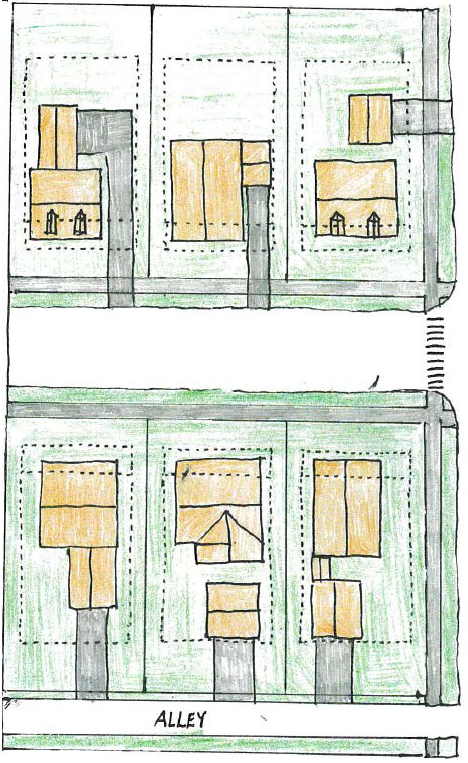 | 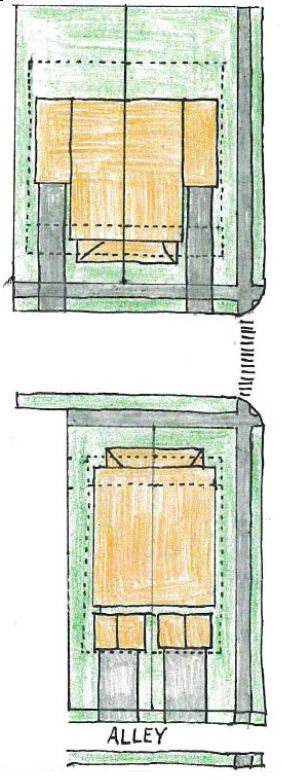 |
| Potential single-family dwelling configurations | Potential semi-detached dwelling configurations |
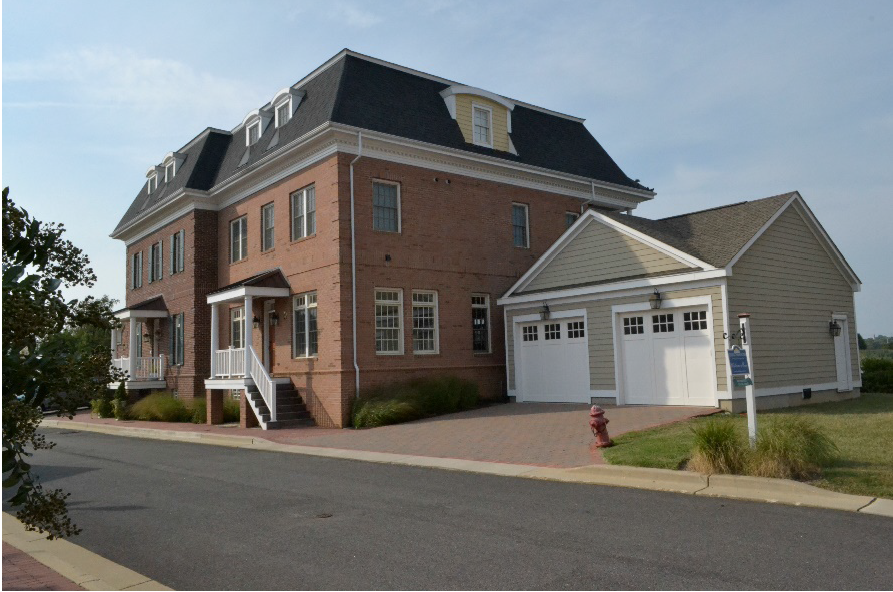
Appropriately-scaled and located front-loaded garage
(2)
Accessory uses and structures:
(a)
Accessory uses as permitted in the R-1 and R-1A residential districts, subject to the same approvals required in those districts.
(b)
The renting of one room to non-transient roomers or boarders.
C.
Uses permitted as special exception. The following uses are permitted only if approved as a special exception pursuant to section 9(2) of this ordinance:
(1)
School bus stop shelters.
D.
[Uses permitted as conditional uses.] The following uses are permitted only if approved as a conditional use pursuant to section 6.14 of this ordinance:
(1)
Institutions of an educational nature or religious nature.
(2)
Public utility uses.
(3)
Governmental buildings, structures, facilities and uses including, but not limited to, police stations, fire houses, ambulance stations, government offices, library.
(4)
Townhouse dwellings, subject to the following requirements:
(a)
All townhouse dwelling units must be served by rear-access alleys and may have attached or detached garages or carports that face the rear-access alley. Front-loaded garages are prohibited.
(b)
Townhouse dwellings may not exceed four consecutive units.
(c)
No more than two adjoining townhouse dwelling units shall be constructed of the same exterior building material or color.
(d)
Townhouse dwellings must be two to three stories in height.
(e)
At least 50 percent of the townhouse dwelling units in each dwelling block must have an unenclosed front covered entry porch a minimum of six feet in depth and six feet in width.
(f)
A concrete sidewalk at least four feet in width must extend from the street to the front entrance and/or entry porch/stoop of the dwelling.
(g)
On corner lots, the front entrance to the end townhouse dwelling unit may face either street frontage.
(5)
Apartment dwellings, professional offices, and select commercial uses, subject to the following requirements:
(a)
The apartment dwelling, professional office, or commercial building shall be designed to resemble the large mansion houses historically located in central Smyrna and shall be two to three stories in height.
(b)
All exterior unit and/or building entrances must be served by a covered porch or portico at least four feet in width and four feet in depth.
(c)
A concrete sidewalk at least four feet in width must extend from the street to each exterior entrance and/or entry porch/stoop of the dwelling.
(d)
An apartment dwelling shall contain three to six dwelling units.
(e)
A commercial or professional office building shall not exceed 4,000 square feet in gross floor area.
(f)
Off-street parking spaces are encouraged to be located to the rear of the building, though side parking is acceptable. Parking is prohibited in the front yard of the building. With corner lots, the property owner shall designate one of the street frontages as the side yard for parking purposes. All parking areas fronting any public street, including side yard parking on a corner lot, must be screened by appropriate vegetative screening. Garages must be located to the rear of the building.
(g)
Commercial uses are limited to professional and medical offices, personal services (excluding laundromats, tattoo parlors and massage parlors), and restaurants or cafés. Outdoor seating is prohibited in the front yard setback and must be adequately screened. Up to two dwelling units may be included as long as each unit has a separate entrance.
(h)
Anything in this Appendix A - Zoning to the contrary notwithstanding, each commercial or professional office building is limited to one wall sign no greater than ten square feet in size and one monument sign no greater than ten square feet in size and no greater than four feet in height. Illuminated and electronic variable messaging signs are prohibited.
(i)
Where a commercial or professional office building property shares a property line with a residential property, the adjoining property line(s) shall be adequately screened.
(6)
Bed and breakfast establishments, subject to the following requirements:
(a)
Requirements for bed and breakfast establishments outlined in Section 9.a(7) of the central commercial district (CC) shall be complied with unless otherwise specified herein.
(b)
Off-street parking spaces are encouraged to be located to the rear of the building, though side parking is also acceptable. With corner lots, the property owner shall designate one of the street frontages as the side yard for parking purposes. All parking areas fronting any public street, including side yard parking on a corner lot, must be screened by appropriate vegetative screening. Garages must be located to the rear of the building.
(c)
Anything in this Appendix A - Zoning to the contrary notwithstanding, each bed and breakfast establishment is limited to one wall sign no greater than eight square feet in size and one monument sign no greater than eight square feet in size and no greater than four feet in height. Illuminated and electronic variable messaging signs are prohibited.
(d)
Where directly adjacent to a residential property, the adjoining property line(s) shall be adequately screened.
(7)
Accessory dwelling units, in accordance with the standards outlined in section 6.14 (Conditional uses, general guides and standards) and the following.
(a)
A concrete sidewalk at least four feet in width must extend from the street to each exterior entrance and/or entry porch/stoop of the building.
(8)
Building conversions whereby an existing one-family dwelling is renovated, altered, or rehabilitated into two or more independent units to be used for any combination of residential, professional office, and/or commercial service uses, provided the following requirements are met:
(a)
Structures eligible for building conversions shall have a gross minimum floor area of 2,000 square feet. Basement areas shall not be included in the minimum floor area calculations.
(b)
No more than a combined total of four residential, commercial, and/or professional office units shall be created by a building conversion.
(c)
Each unit shall be completely separated by horizontal floors or a combination of horizontal floors and vertical walls. Residential units shall consist of a minimum of 600 square feet and have separate housekeeping, cooking, and bathroom facilities for each unit. Commercial and professional office units shall have separate bathroom facilities for each unit.
(d)
External alterations shall be consistent with the residential architectural characteristics of the structure prior to the building conversion.
(e)
No dedicated off-street parking shall be required. Permeable pavement is encouraged, which is defined as a method of paving that allows stormwater to seep into the ground as it falls rather than running off into storm drains, etc. Examples of permeable pavement include: porous asphalt, pervious concrete, and concrete/brick pervious pavers.
(f)
Where there is no sidewalk along the frontage of the subject property, a sidewalk shall be constructed prior to a certificate of occupancy being issued.
(g)
In addition to the above-mentioned requirements, all units shall comply with all applicable provisions of chapter 18 - Buildings and Building Regulations of the Smyrna Town Code.
E.
Parking. Parking shall be in accordance with section 6, Supplementary district regulations.
F.
Minimum requirements.
(1)
Dwelling, one-family and dwelling, two-family:
(a)
Minimum lot area: 2,880 square feet.
(b)
Minimum lot width: 36 feet.
(c)
Minimum lot depth: 80 feet.
(d)
Minimum height, one and one-half stories; maximum height, three stories, 45 feet.
(e)
Minimum Front yard setback, five feet; maximum front yard setback, 20 feet.
(f)
Side yard setback: six feet.
(g)
Rear yard setback: 10 feet.
(h)
Maximum lot coverage: 80 percent.
(2)
Dwelling, semidetached (per unit):
(a)
Minimum lot area: 2,400 square feet.
(b)
Minimum lot width: 30 feet.
(c)
Minimum lot depth: 80 feet.
(d)
Minimum height, two stories; maximum height, three stories, 45 feet.
(e)
Minimum front yard setback, five feet; maximum front setback, 20 feet.
(f)
Unattached side yard setback: six feet.
(g)
Attached side yard setback: zero feet.
(h)
Rear yard setback: ten feet.
(i)
Maximum lot coverage: 85 percent.
(3)
Dwelling, townhouse (per unit):
(a)
Minimum lot area: 1,600 square feet.
(b)
Minimum lot width: 20 feet.
(c)
Minimum lot depth: 80 feet.
(d)
Minimum height, two stories; maximum height, three stories, 45 feet.
(e)
Minimum front yard setback, five feet; maximum front setback, 20 feet.
(f)
Unattached side yard setback: six feet.
(g)
Attached side yard setback: zero feet.
(h)
Rear yard setback: 10 feet.
(i)
Maximum lot coverage: 90 percent.
(4)
Commercial/office/apartment buildings:
(a)
Minimum height, two stories; maximum height, three stories, 45 feet.
(b)
Minimum front yard setback: five feet.
(c)
Unattached side yard setback: ten feet.
(d)
Rear yard setback: 20 feet.
(e)
Maximum lot coverage: 80 percent.
G.
Accessory buildings. For minimum requirements, see section 6.8, Accessory buildings.
(Ord. No. 018-21, § 2, 11-15-21; Ord. No. 018-22, § 8, 10-17-22)
Editor's note— Ord. No. 018-21, §§ 1, 2, adopted November 15, 2021, repealed the former § 5.15, and enacted a new § 5.15 as set out herein. The former § 5.15 pertained to central residential overlay (CRD) district and derived from Ord. of 2-5-2001; and Ord. No. 003-07, § 1, 10-15-2007.
16.
Limited office district L-O. This district is intended to protect the residential character of the area as well as provide office space.
A.
[Permitted uses.] The following uses are permitted: No building or premises shall be used and no building or part of a building shall be erected, which is arranged, intended or designed to be used, in whole or in part, for any purpose, except the following, and in accordance with performance standards of section 6 and subject to site development plan approval as set forth in section 7.5 of the Smyrna zoning ordinance:
(1)
Government offices.
(2)
Professional offices.
(3)
Banks.
(4)
Warehouses.
(a)
Minimum lot size shall be five acres.
(b)
In addition to the setbacks listed in D. [E.], Minimum requirements, there shall be an additional 30-foot planted buffer along all lot lines which are adjacent to a residential district.
B.
[Uses permitted as special exceptions.] The following uses are permitted only if approved as a special exception pursuant to section 9(2) of this ordinance:
(1)
Office supply business, restaurant, barbershop, beauty shop, travel agency, and professional service offices.
(2)
Residential uses as permitted in the residential district R-3; height, and yard requirements shall be the same as in the R-3 district.
(3)
Warehouses.
(a)
In addition to the setbacks listed in D. [E.], Minimum requirements, there shall be an additional 30-foot planted buffer along all lot lines which are adjacent to a residential district.
(4)
Day care centers and nursery schools.
(Ord. of 3-19-01, § 1)
[C.]
Parking. Shall be in accordance with section 6, Supplementary district regulations.
[D.]
Minimum requirements.
[(1)]
Minimum lot area, none.
[(2)]
Minimum lot width, none.
[(3)]
Minimum lot depth, none.
[(4)]
Maximum height, three stories, 45 feet.
[(5)]
Front yard setback, 30 feet.
[(6)]
Side yard setback, none except when adjoining a residence district 20 feet shall be provided and shall be planted.
[(7)]
Rear yard setback, none except when adjoining a residence district 20 feet shall be provided and shall be planted.
[(8)]
Maximum lot coverage, 80%.
(Ord. of 10-19-92; Ord. of 2-5-01, § 1; Ord. No. 003-07, § 1, 10-15-07)
17.
Shopping center (SC).
A.
[Declaration of legislative intent.] This district is intended to provide for and to encourage grouping of commercial establishments on any lot or parcel (or on any group of two or more substantially contiguous lots or parcels) containing a minimum total lot area of not less than five acres as shown and identified on a proposed site plan (hereinafter "shopping center"; "development"; or "shopping center development") for safer access, greater convenience, and improved aesthetics for shopping areas in the community. The frontage of the development shall be of sufficient width that safe and efficient access to the shopping center can be adequately spaced from accesses to adjacent public streets.
(Ord. of 7-16-01(2), §§ 1, 2)
B.
[Permitted uses.] The following uses are permitted: No building or premises shall be used and no building or part of a building shall be erected which is arranged, intended or designed to be used, in whole or in part, for any purpose except the following and in accordance with performance standards of section 6 and subject to the site development plan approval as set forth in section 7.5 of the Smyrna zoning ordinance:
(1)
Bowling alleys.
(2)
Theaters and cinemas.
(3)
Convenience stores and shops such as grocery stores and drugstores.
(4)
Liquors stores for sale of liquor to be consumed off site.
(5)
Jewelry stores.
(6)
Department and variety stores.
(7)
Business, professional and government offices; banks; restaurants with sale of liquor only associated with meals.
(8)
Personal services. The operation of a personal service establishment and the issuance of a certificate of zoning compliance for the same shall be in accordance with the requirements for personal services as outlined in the Local Commercial District (LC).
(9)
Day care center/nursery school (see section 6).
(10)
Outlets and pickup stations for laundries and cleaning establishments. Except in self-service, automatic laundry establishments containing not more than 30 washing machines, washing of wearing apparel on the premises is prohibited. Except for incidental removal of spots with flammable solvent, cleaning of wearing apparel or household effects on the premises is permitted only if nonflammable solvent is used.
(11)
Manufacturing, assembling, converting, altering, finishing, cleaning or any other processing of products where goods so produced or processed are to be sold at retail exclusively on the premises, provided that:
(a)
An area fully concealed from any street and equal to not more than 20 percent of the area devoted to retail sales shall be so used;
(b)
Except in connection with clothes pressing, electrical power not exceeding a total of five rated horsepower and steam pressure not in excess of 60 pounds of pressure per square inch shall be used exclusively;
(c)
Not more than four employees are engaged in such production or processing.
C.
[Uses permitted as special exceptions.] The following uses are permitted only if approved as a special exception pursuant to section 9(2) of this ordinance:
(1)
Automobile repair and service, not to include junkyards.
(2)
Billiard parlors.
(3)
Temporary carnivals.
(4)
Sale of alcoholic beverages as an accessory use with a bowling alley.
(5)
Institutions of a religious, medical, charitable or philanthropic nature.
(Ord. of 2-5-01, § 1; Ord. of 7-16-01(2), §§ 3—5; Ord. No. 003-09, § 1, 9-8-09; Ord. No. 003-20, § 6, 1-6-20)
D.
[Uses permitted as a conditional use]. The following uses are permitted only if approved by the board of adjustment as a conditional use pursuant to section 6.14 of this ordinance:
(1)
Large scale indoor entertainment uses provided that:
(i)
All large scale indoor entertainment uses shall strictly comply with all provisions of 24 Del. C. Chapter 16, as now in effect or as hereafter amended. Failure to comply with this requirement shall void the conditional use approval.
(ii)
No more than one large scale indoor entertainment use shall be permitted within any single shopping center zone or property.
(iii)
No large scale indoor entertainment use shall be permitted in any building otherwise used in whole or part for residential purposes.
(iv)
No large scale indoor entertainment use shall be permitted on any lot which is located within 1,000 feet of any other lot on which is located another large scale indoor entertainment use. This distance shall be measured from the nearest property line of such use to the nearest property line of the proposed large scale indoor entertainment use.
(v)
No large scale indoor entertainment use shall be permitted on any lot which is located within 1,000 feet of any lot in any residential district. This distance shall be measured from the nearest property line of any residential district to the nearest property line of the proposed large scale indoor entertainment use.
(vi)
No large scale indoor entertainment use shall be permitted on any lot which is located within 1,000 feet of any lot on which is located a church, community center, funeral home, school, day-care center, hospital, alcoholism center or drug treatment center, counseling or psychiatric treatment facility or public park. This distance shall be measured from the nearest property line of such above use to the nearest property line of the proposed large scale indoor entertainment use.
(vi)
No large scale indoor entertainment use shall be permitted on any lot which is located within 1,000 feet of any school bus stop. This distance shall be measured from the nearest school bus stop to the nearest property line of the proposed large scale indoor entertainment use.
(vii)
The proposed use shall meet all other requirements of the laws of the Town of Smyrna, including but not limited to district lot and bulk regulations, parking regulations and signage requirements.
(viii)
Large scale indoor entertainment uses may operate only between the hours of 11:00 a.m. and 1:00 a.m. All staff must leave the building and the building must be securely locked not later than one hour after closing time.
(ix)
All large scale indoor entertainment uses shall continuously carry liability insurance with minimum limits of $1,000,000.00 single limit.
(x)
All large scale indoor entertainment uses shall provide on-site crowd control and security during all operating hours, ensure that designated parking is available and adequate for the expected activity, and operate such that no music or other noise is discernable at a distance of 1,000 feet in all directions from the use.
(xi)
In the event the large scale indoor entertainment use conditional use applicant shall meet all of the above requirements, the conditional use approval shall be issued, subject to forfeiture for a violation of any of the requirements imposed by this ordinance.
(xi)
Any conditional use issued or granted pursuant to this amendment to the zoning code shall be personal to the applicant only, and shall not be deemed to go with the land or lot upon which the use is located, and shall not be transferable.
(xii)
All large scale indoor entertainment use conditional use approvals issued or granted pursuant to this Amendment to the zoning code shall be of a limited duration of three years, however, any such conditional use applicant may apply to the board of adjustment for renewal of said conditional use within six months of the expiration date of the current conditional use.
(xiii)
All large scale indoor entertainment use conditional use holders shall permit the State of Delaware, through its designated agents, and the Town of Smyrna, through its designated agents, to enter upon the entirety of the premises upon which the use is conducted during its hours of operation, for the purpose of inspection and testing, and for the purpose of determining whether the terms of applicable state and town laws are being complied with.
(xiv)
Nonconforming uses preexisting at the effective date of this ordinance shall be governed by section 4 of the zoning code.
E.
Parking requirements. All shopping centers shall have not less than 3.5 parking spaces for every 1,000 square feet of gross leasable area, allowing a minimum area of 180 square feet per space plus adequate provision for ingress and egress.
F.
Access and circulation. The internal circulation system shall be separated from the external public street system, and pedestrian traffic shall be separated from vehicular traffic by means of appropriate site design and traffic control devices.
G.
Minimum dimensional requirements.
(1)
Lot area; setback; lot coverage; height.
(a)
Lot area. No lot or parcel, or group of two or more lots or parcels, shall be zoned SC ("shopping center") unless the total lot area of all substantially contiguous lots or parcels exceeds five acres.
(b)
Minimum setback from all abutting street rights of way: 50 feet
(c)
Minimum setback from all non-residential zones: 50 feet
(d)
Minimum setback from all residential zones: 100 feet
(e)
Maximum lot coverage: 80 percent of each separately owned or leased parcel or lot within the SC district; 80 percent cumulatively for all lots within the SC district.
(f)
Maximum height limit for all structures: 45 feet
H.
Buffering and landscaping. There shall be a landscaped buffer area of not less than ten feet wide along all lot lines of the external perimeter of the shopping center development. Where adjacent to residential zones, the buffers shall include an approved landscape screen not less than six feet high at installation. All landscaping shall be properly maintained throughout the life of any use on the property. Parking shall not be permitted in the buffer area. A buffer shall not be required along any property line abutting a street situated at the front of the parcel, and a corner parcel shall not be required to have buffering on either property line abutting the street.
I.
Parking; street access. No lot or parcel, or group of two or more lots or parcels, shall be zoned SC ("shopping center") unless all separately occupied, leased, or owned parcels within the shopping center development have recorded cross easements guaranteeing access to shared parking facilities within that shopping center development and have permanent rights of ingress and egress to and from a public street for each and every parcel or lot within that shopping center development.
(Ord. of 10-19-92; Ord. of 2-5-01, § 1; Ord. of 7-16-01(2), §§ 3—6; Ord. No. 003-07, § 1, 10-15-07; Ord. No. 001-08, §§ 3, 4, 1-7-08; Ord. No. 005-19, § 4, 4-15-19)
18.
Source water protection area (SWPA).
a.
Purpose. The purpose of the source water protection area regulations is to ensure the protection of the public drinking water supply from contamination. The Town of Smyrna herein adopts the overlay maps delineating, as source water protection areas: wellhead protection and excellent ground-water recharge potential areas. To ensure the protection of these drinking water supplies, this ordinance establishes a zoning overlay to be known as the source water protection overlay. The purpose of the source water protection overlay is to protect public health and safety by minimizing contamination of aquifers, preserving, and protecting existing and potential sources of drinking water supplies. It is the intent to accomplish this through both public education and public cooperation, as well as by creating appropriate land use regulations that may be imposed in addition to those currently imposed by existing zoning districts or other state and county regulations.
The source water protection area maps are superimposed on current zoning districts. It shall apply to all new construction, redevelopment, or expansion of existing buildings and new or expanded uses. Applicable activities/uses allowed in a portion of one of the underlying zoning districts that fall within the source water protection overlay must additionally comply with the requirements of this district. Uses prohibited in the underlying zoning districts shall not be permitted in the source water protection overlay district.
b.
Definitions. This section defines words, terms, and phrases found in this subsection.
Aboveground storage tank (AST): An AST is a single containment vessel greater than 250 gallons as defined in the Delaware Regulations Governing Aboveground Storage Tanks, dated February 11, 2005. ASTs with a storage capacity greater than 12,499 gallons containing petroleum or hazardous substances, and ASTs with a storage capacity greater than 39,999 gallons containing diesel, heating fuel or kerosene are subject to the design, construction, operation, and maintenance requirements of the Delaware AST regulations.
Applicant: A person, firm, or government agency that executes the necessary forms to obtain approval or a permit for any zoning, subdivision, land development, building, land disturbance, or other activity regulated.
Aquifer: A geological formation, group of formations or part of a formation composed of rock, sand, or gravel capable of storing and yielding groundwater to wells.
CERCLA hazardous substances: Those substances either specifically designated as hazardous under the Comprehensive Environmental Response, Compensation, and Liability Act (CERCLA), otherwise known as the Superfund law, or those substances identified under other laws. In all, the Superfund law includes references to four other laws to designate more than 800 substances as hazardous, and identify many more as potentially hazardous due to their characteristics and the circumstances of their release. See: http://www.epa.gov/superfund/programs/er/hazsubs/cercsubs.htm
Contamination: Any physical, chemical, biological, or radiological substance that enters the hydrological cycle through human action and may cause a deleterious effect on ground water resources; it shall include but is not limited to hazardous waste, limiting nutrients, and sanitary sewage.
Delineation: The process of defining and/or mapping a boundary that approximates the areas that contribute water to a particular water source used as a public water supply.
Environmental impact assessment report (EIAR): A report required by this ordinance that assesses the environmental characteristics of a source water protection area and determines what effects or impacts will result if the area is altered or disturbed by a proposed action that would increase impervious cover beyond the recommended 20 percent threshold.
Excellent ground-water recharge potential area: Those areas with high percentages of sand and gravel that have "excellent" potential for recharge as determined through a Stack Unit Mapping Analysis delineated by the Delaware Geological Survey and presented in the Report of Investigations No. 66, Ground-water Recharge Potential Mapping in Kent and Sussex Counties, Delaware, Geological Survey, 2004.
Geologist: An individual who is registered in the State of Delaware to practice the profession of geology.
Good ground-water recharge potential area: Those areas with a significant percentage of sand and gravel that have a "good" potential for recharge as determined through a Stack Unit Mapping Analysis delineated by the Delaware Geological Survey and presented in the Report of Investigations No. 66, Ground-water Recharge Potential Mapping in Kent and Sussex Counties, Delaware, Geological Survey, 2004.
Ground water: The water contained in interconnected pores located below the water table in an unconfined aquifer or located in a confined aquifer.
Hazardous substance UST system: An underground storage tank system that contains a hazardous substance defined in 101(14) of the CERCLA (but not including any substance regulated as a hazardous waste under RCRA Subtitle C) or any mixture of such substances and petroleum, and which is not a petroleum UST system.
Hazardous waste: A solid waste, or combination of solid wastes, which because of its quantity, concentration, or physical, chemical, or infectious characteristics may cause or significantly contribute to an increase in mortality or an increase in serious irreversible or incapacitating illness, or pose a substantial present or potential hazard to human health or the environment when improperly treated, stored, transported, or dispose of, or otherwise managed. Without limitation, included within this definition are those hazardous wastes described in Sections 261.31, 261.32, and 261.33 of the Delaware Regulations Governing Hazardous Waste.
Impervious cover: Surfaces providing negligible infiltration such as pavement, buildings, recreation facilities (e.g. tennis courts, swimming pools, etc.), and covered driveways.
Nonconforming use: An existing use of a lot or a building that was legal at the time of its creation that is not permitted by this subsection in the district in which it is located.
Natural condition: Open space that is essentially unimproved and set aside, dedicated, designated, or reserved for public or private use.
On-site wastewater treatment and disposal system: Conventional or alternative wastewater treatment and disposal systems installed or proposed to be installed on land of the owner or on other land to which the owner has the legal right to install the system.
Passive recreation: Recreation that involves existing natural resources and has a minimal impact because they do not require the alteration of existing topography. Such passive recreation shall include but not be limited to non-motorized vehicles, hiking, bicycling, picnicking, and bird-watching.
Public water supply well: Any well from which the water is used to serve a community water system by Section 22.146 (Public Water Systems) in the Delaware State Regulations Governing Public Drinking Water Systems.
Public drinking water system: A community, non-community, or non-transient noncommunity water system, which provides piped water to the public for human consumption. The system must have at least 15 service connections or regularly serve at least 25 individuals daily for at least 60 days.
Redevelopment: Any proposed expansion, addition, or major facade change to an existing building, structure, or parking facility.
Runoff: That portion of precipitation or snow melt that has not evaporated or infiltrated into the soil, but flows on land or impervious surfaces.
Sanitary landfill: A land site at which solid waste is deposited on or into the land as fill for the purpose of permanent disposal, except that it will not include any facility that has been approved for the disposal of hazardous waste under the Delaware Regulations Governing Hazardous Waste.
Site plan approval: A process for the review and approval of a development plan prior to the issuance of a development.
Source water: Any aquifer from which water is drawn either periodically or continuously by a public water system.
Source water assessment area: The area delineated by DNREC source water assessment and protection program that contributes water to public water supply system.
Source water assessment plan: The October 1999 U.S. EPA approved plan for evaluating the sources of public drinking water in Delaware for their vulnerability and susceptibility to contamination.
Source water assessment report (SWAP): The identification and evaluation of the sources of water within the state used by public water systems in an effort to determine the vulnerability and susceptibility to contamination.
Stormwater: The runoff of water from the surface of the land resulting from precipitation or snow or ice melts.
Stormwater management:
(a)
For water quantity control, a system of vegetative, structural, and other measures that may control the volume and rate of stormwater runoff which may be caused by land disturbing activities or activities upon the land; and
(b)
For water quality control, a system of vegetative, structural, and other measures that control adverse effects on water quality that may be caused by land disturbing activities or activities upon the land.
Source water protection area: Wellhead protection areas, good and excellent ground-water recharge potential areas.
Vacant property: Lands or buildings that are not actively used for any purpose as designated in the underlying zoning district/overlay for one year.
Underground storage tank (UST): An UST is one or a combination of tanks including underground pipes, the volume of which is ten percent or more belowground, as defined in the Delaware Regulations Governing Underground Storage Tank Systems, dated March 12, 1995. The following USTs are not subject to the design, construction, operation, and maintenance requirements of the Delaware UST Regulations: Residential heating fuel, agricultural, and residential motor fuel USTs less than 1,100 gallons and any UST less than 110 gallons.
Wastewater: Water-carried waste from septic tanks, water closets, residences, building, industrial establishments, or other places, together with such groundwater infiltration, subsurface water, and mixtures of industrial wastes or other wastes as may be present.
Water quality: Those characteristics of stormwater runoff from an impervious surface or a land disturbing activity that relate to the chemical, physical, biological, or radiological integrity of water.
Water quantity:
(a)
Those characteristics of stormwater runoff that relate to the volume of stormwater runoff to downstream-gradient areas resulting from land disturbing activities.
(b)
Those characteristics of stormwater that relate to the volume of stormwater that infiltrates the land surface and enters the underlying aquifer.
Wellhead: The upper terminal of a well, including adapters, ports, seals, valves, and other attachments.
Wellhead protection areas (WHPA): Surface and subsurface areas surrounding public water supply wells or well fields where the quantity or quality of ground water moving toward the wells or well fields may be adversely affected by land use activity.
Wellhead protection plan: The March 1990 U.S. EPA approved plan for protecting the quality of drinking water derived from public water supply wells in Delaware.
Wellhead protection (WHP) zone 1: The surface area extending to a minimum 150-foot radius around the wellhead.
Wellhead protection (WHP) zone 2: The remaining surface area of the delineated wellhead protection area outside zone 1.
Wellhead protection (WHP) zone 3: Where a WHP zone 2 area overlays an excellent ground-water recharge potential area.
c.
Source water protection areas (SWPA). Source water protection areas are wellhead protection areas and excellent ground water recharge potential areas. All such areas are as depicted on source water protection area maps located in Town Hall as adopted as part of the update and implementation of the 2010 Comprehensive Land Use Plan. These maps are also available in GIS overlays from Delaware Department of Natural Resources and Environmental Control, Division of Water Resources, Source Water Assessment and Protection Program.
These areas shall be managed as required by the following sections to protect public drinking water resources from activities and substances that may harm water quality and subtract from overall water quantity.
d.
Prohibited uses. Activities shall be subject to the land use restrictions contained within this ordinance that will protect the quality and quantity of ground water supplies. All uses not permitted in the underlying zone district are prohibited.
Conditional:
(*) Impervious cover: Wellhead protection areas within zone 3 shall be preserved in a natural condition. Impervious cover shall not be permitted.
(#) Dry wells/sumps, except for single-family residences directing gutter downspouts to a drywell.
(#) Injection wells other than those used in the remediation of ground water contamination that inject oxygen releasing compounds.
e.
Wellhead protection areas (WHPA). The DNREC source water assessment and protection program delineates wellhead protection areas to ensure the integrity of public drinking water. Deep wells drilled into confined aquifers and low volume wells in unconfined aquifers have at minimum a one hundred and fifty foot radius wellhead protection area. The wellhead protection area surrounding public supply wells in unconfined aquifers that pump more than 50,000 gallons per day are delineated using a thematical model. This type of well draws large quantities of water and can have much larger wellhead protection areas. Zone classifications have been created to manage land use within the wellhead protection area. They are defined as follows:
Wellhead protection (WHP) zone 1 is the surface area extending in a one-hundred and fifty (150) foot radius around the wellhead.
Wellhead protection (WHP) zone 2 is the remaining surface area of the wellhead protection area outside of zone 1. Land use restrictions within zone 2 are required to insure adequate protection of public drinking water supply.
Wellhead protection (WHP) zone 3 exist where a WHP zone 2 area overlays an excellent ground-water recharge potential area. Land use restrictions within zone 3 are required to insure adequate protection of public drinking water supply.
(1)
WHP zone 1 requirements:
(a)
Parcels of land within a WHP zone 1 wellhead protection area will be preserved in a natural condition with the exception of impervious surface limited to building and access associated with the well and distribution and treatment facilities and their maintenance.
(b)
Aboveground storage tanks for materials used in the treatment facility operations are permitted.
(c)
Underground storage tanks are prohibited.
(d)
Stormwater runoff will be diverted away from the wellhead.
(e)
Stormwater infiltration practices designed to handle runoff are prohibited.
(f)
The minimum lot area for a proposed public water supply well and related facility drawing from a confined aquifer shall be one-half acres, and the minimum lot area for a public well drawing form an unconfined aquifer shall be one-half acres.
(g)
On-site wastewater and disposal systems shall not be permitted.
(2)
WHP zone 2 requirements:
(a)
Impervious cover.
(1)
Wellhead protection areas within zone 2 shall not exceed 20 percent impervious cover (based on the total site area). New development and redevelopment in this zone may exceed the 20 percent total site area impervious cover threshold within wellhead protection areas but shall be no more than 50 percent impervious cover (based on total site area), provided the applicant submits and receives approval on an environmental impact assessment report.
(b)
Stormwater.
(1)
Stormwater shall be treated by an approved stormwater quality management practice in accordance with current requirements of the Delaware Sediment and Stormwater Regulations dated October 11, 2006 or as later revised.
(2)
For all new construction, all new and redeveloped structures used for residential or business purposes shall be required to discharge roof run off to grassed areas or use a best management practice for water quality treatment prior to directing flow over impervious surfaces.
(c)
Underground storage tanks.
(1)
Underground storage tanks with a capacity greater than 100 gallons containing petroleum, and residential and agricultural USTs with a capacity greater than 1,100 gallons containing heating fuel or motor fuel shall be permitted in a designated wellhead area if the USTs are designed, constructed, maintained, and operated in accordance with the Delaware Regulations Governing Underground Storage Tank Systems, dated March 12, 1995 or as later revised. (NOTE: regulated USTs must be constructed with secondary containment of the tanks and piping and must have continuous monitoring for releases.)
(2)
Underground storage tanks with a capacity greater than 110 gallons containing a hazardous substance as defined in CERCLA 101 (14) shall be permitted in a designated wellhead area if the USTs are designed, constructed, maintained and operated in accordance with the Delaware Regulations Governing Underground Storage Tank Systems, March 12, 1995 or as later revised. (NOTE: Regulated USTs must be constructed with secondary containment of the tanks and piping and must have continuous monitoring for releases.)
(d)
Aboveground storage tanks.
(1)
Aboveground storage tanks with a capacity greater than 12,499 gallons containing petroleum or hazardous substances, and ASTs with a storage capacity greater than 39,999 gallons containing diesel, heating fuel or kerosene shall be permitted in a delineated wellhead area if the ASTs are designed, constructed, operated and maintained with the applicable requirements in the Delaware Regulations Governing Aboveground Storage Tanks, dated February 11, 2005 or as later revised.
(e)
Wastewater treatment and disposal systems.
(1)
On-site wastewater treatment and disposal systems shall not be permitted.
(3)
WHP zone 3 requirements:
(a)
Impervious cover: Wellhead protection areas within zone 3 shall be preserved in a natural condition. Impervious cover shall not be permitted.
(1)
Permitted uses: passive recreation.
f.
Excellent ground-water recharge potential areas.
(1)
Impervious cover. Wellhead protection areas within zone 2 shall not exceed 20 percent impervious cover (based on the total site area). New development and redevelopment in this zone may exceed the 20 percent total site area impervious cover threshold within wellhead protection areas but shall be no more than 50 percent impervious cover (based on total site area), provided the applicant submits and receives approval on an environmental impact assessment report.
(2)
Stormwater. Stormwater shall be treated by an approved stormwater quality management practice in accordance with current requirements of the Delaware Sediment and Stormwater Regulations dated October 11, 2006 or as later revised.
(3)
New construction. All structures shall be required to discharge roof drains onto permeable surfaces.
(4)
Underground storage tanks with a capacity greater than 110 gallons containing petroleum, and residential and agricultural USTs with a capacity greater than 1,100 gallons containing heating fuel or motor fuel shall be permitted in a excellent ground-water recharge potential area if the USTs are designed, constructed, maintained and operated in accordance with the Delaware Regulations Governing Underground Storage Tank Systems, dated March 12, 1995 or as later revised. (NOTE: Regulated USTs must be constructed with secondary containment of the tanks and piping and must have continuous monitoring for releases.)
(5)
Underground storage tanks with a capacity greater than 110 gallons containing a hazardous substance as defined in CERCLA § 101(14) shall be permitted in a delineated excellent ground-water recharge potential area if the USTs are designed, constructed, maintained and operated in accordance with the Delaware Regulations Governing Underground Storage Tank Systems, dated March 12, 1995 or as later revised. (NOTE: Regulated USTs must be constructed with secondary containment of the tanks and piping and must have continuous monitoring for releases.)
(6)
Aboveground storage tanks with a capacity greater than 12,499 gallons containing petroleum or hazardous substances, and ASTs with a storage capacity greater than 39,999 gallons containing diesel, heating fuel or kerosene shall be permitted in a delineated excellent ground-water recharge potential area if the ASTs are designed, constructed, operated and maintained with the applicable requirements in of the Delaware Regulations Governing Aboveground Storage Tanks, dated February 11, 2005 or as later revised.
g.
Boundary determination for SWPA.
(1)
All subdivision and land development plans depicting development or land disturbance submitted for town review shall be evaluated for the existence of source water protection areas. All such areas are as depicted on source water protection area maps located in Town Hall as adopted as part of the update and implementation of the most current update to the 2010 Comprehensive Land Use Plan. These maps are also available in GIS overlays. Maps/overlays are available from Delaware Department of Natural Resources and Environmental Control (DNREC), Division of Water Resources, Source Water Assessment and Protection Program (SWAPP). If a SWPA exists within a proposed development site, the boundaries of these areas shall be delineated on the plan by the applicant's State of Delaware Professional Engineer or Professional Geologist.
(2)
DNREC SWAPP may, when based on sound science and information, revise and update the overlay maps of wellhead protection areas.
(3)
The Delaware Geological Survey (DGS) may, when based on sound science and information, revise and update the overlay maps of excellent ground-water recharge potential areas.
(4)
When there appears to be a conflict between the mapped boundary and actual site conditions, the applicant may engage the services of professional geologist to prepare a report intended to determine more accurately the precise boundary of the source water protection area. The report shall include:
(a)
A detailed topographic layout of the subdivision and/or area to be developed and prepared by a state-registered professional land surveyor or professional geologist.
(b)
Evidence derived from a site-specific investigation that may include aquifer testing, test borings, test pits, observation wells, groundwater elevations, and topography surveys as appropriate for the type of source water protection area that clearly demonstrate that the area in question does not meet the definition of a source water protection area as defined.
(c)
Any challenges to the delineations of the excellent ground-water recharge potential areas must follow the methods used in the Delaware Geological Survey publication: Report of Investigations No. 66, Ground-Water Recharge Potential Mapping in Kent and Sussex Counties, Delaware. The challenge must be approved by DGS and DNREC SWAPP.
(d)
Notwithstanding any other section pertaining to source water protection areas, if an owner initiates a precise boundary delineation pursuant to this section, any and all time review limitations shall be stayed pending the submission of the complete report contemplated by this section. Following submission of the report and all supporting documents, the department shall have 90 days to finally approve or disapprove the exploratory sketch plan submission or such further time as deemed necessary by the department, but not to exceed an additional 90 days.
h.
Redevelopment.
(1)
Impervious cover restrictions.
(a)
Site modifications that require site plan approval must create a 15 percent reduction in the total amount of impervious cover on the site when compared to pre-redevelopment conditions.
(b)
If the 15 percent reduction in total existing impervious area would require a site to go below the 20 percent maximum impervious cover provisions of source water protection areas, then the maximum impervious surface cover for the site is 20 percent (based on existing total site area).
(c)
Sites that do not meet the 20 percent impervious cover threshold must employ rooftop infiltration practices. Rooftop runoff shall be treated for quality using best management practices (BMP) in accordance with the current requirements of the Delaware Sediment and Stormwater Regulations dated October 11, 2006 or as later revised. The minimum acceptable BMP for redevelopment is to provide sheet flow for rooftop runoff over a grassed area (minimum) 20 feet in length prior to flow over impervious areas. The slope of the grassed area for rooftop infiltration practices shall be five percent or less. An environmental impact assessment report will be required (see subsection j.). If the grading of the property does not allow for overland flow by gravity or best management practice (prior to directing flow to impervious surfaces), a variance for a reduction in roof area requiring quality treatment can be requested.
(2)
Abandoned or vacant property.
(a)
Impervious cover restrictions A, B, and C of this subsection h. ("redevelopment") do not apply to vacant or abandoned property. These properties must comply with the source water protection area zoning district regulations.
i.
Uniform standards and criteria.
(1)
Hazardous waste treatment, storage, and disposal facilities, as defined in 7 DE Admin. Code 1302, Delaware Regulations Governing Hazardous Waste, shall not be permitted in source water protection areas.
(2)
Sanitary and industrial landfills, as defined in 7 DE Admin. Code 1301, Delaware Regulations Governing Solid Waste, shall not be permitted in source water protection areas.
j.
Environmental impact assessment report. New development in the Town of Smyrna may exceed the 20 percent total site impervious cover (prior to re-subdivision) threshold within excellent ground water recharge potential areas and WHP zone 2, but be no more than 50 percent impervious (total site area prior to re-subdivision) provided the applicant submits an approved environmental assessment report including a climatic water budget and systems to augment recharge that assure water quality as well as water quantity. The environmental impact assessment must document that post development recharge will be no less than predevelopment recharge when computed on an annual basis.
Commonly, the applicant offsets the loss of recharge due to impervious cover by constructing recharge basins that convey pretreated rooftop runoff for infiltration to ground water. Refer to Supplement 1 entitled Ground-Water Recharge Design Methodology, dated May 2005 or later as revised for the details of how to design recharge facilities in Delaware source water protection areas.
(1)
Delaware Registered Professional Engineer and/or Professional Geologist prepares an environmental assessment report, usually containing the following elements of planning, design, construction, and maintenance of ground-water recharge facilities:
(a)
Site description of proposed development within the water resource protection area.
(b)
Climatic water balance comparing predevelopment and post-development recharge potential.
(c)
Subsurface exploration including borings, test pits, and infiltration tests.
(d)
Design of ground-water recharge facilities that assure water quality as well as quantity.
(e)
Construction and maintenance considerations.
(f)
Recommended ground-water monitoring plan.
(g)
Water management agreement between the applicant and the town, city, or county providing for monitoring and maintenance of the recharge system. The applicant will abide by the ground water management agreement as written in DNREC Supplement 1 to the Source Water Protection Guidance Manual for the Local Governments of Delaware: Ground-Water Recharge Design Methodology, dated May 2005 or as later revised.
k.
Nonconforming uses. Nonconforming uses may continue in wellhead protection areas and excellent ground-water recharge potential areas in the form in which they existed at the time of the adoption of this ordinance, unless they pose a direct hazard to the town's water supply, as determined by the water and waste water department upon advice from the Delaware Division of Public Health, or are causing some foreign substances (oil, salts, chemicals, or other substances) to be introduced into the town's water supply, as determined by the water and waste water department upon advice from DNREC's division of air and waste management and/or division of water resources. In the latter case, the building department shall issue a mandatory cease and desist to stop the offending activity within the area. Nonconforming existing underground or above-ground storage of oil, petroleum, and petroleum products shall require secondary containment pursuant to the State of Delaware regulations governing underground storage tanks or for above-ground storage of petroleum products secondary containment facilities capable of capturing the material stored on the site, for existing facilities that are proposed either to be upgraded or replaced.
l.
Replacement and new wells.
(1)
The replacement of any existing public water supply well that was not required to meet this wellhead protection requirement at the date of its original installation and that has failed shall be exempt from meeting this wellhead protection requirement.
(2)
All public water supply wells within a housing development, subdivision, or strip development recorded on or after the implementation of the Delaware Regulations Governing the Construction and Use of Wells, dated April 6, 1997 or as later revised, shall be located at least 150 feet within the subdivision's or development's outermost property lines.
(Ord. of 7-20-98(7), § 1; Ord. of 4-15-02(2), § 2; Ord. No. 001-12, § 1, 2-21-12)
19.
Historic preservation overlay district (HPOD).
a.
Declaration of legislative intent. The historic preservation overlay district (HPOD) is created for the purpose of safeguarding the heritage of the town, and preserving and protecting structures and areas having historic, architectural, cultural, or aesthetic value. The purpose of the historic preservation overlay district is to preserve and enhance the heritage and historic character of downtown Smyrna as an area of special importance and interest. It is particularly intended that the regulations prevent any change of conditions that would be deemed to lead to a deterioration or degradation of the present visual or architectural qualities, or the integrity of the district. Any provisions adopted hereunder shall be consistent with the policies, purposes, principles and provisions of the Historic Preservation Ordinance (chapter 19).
b.
Designation of areas within the historic preservation overlay district (HPOD). The historic preservation overlay district (HPOD) shall include the following:
(1)
The lots fronting on the following streets (whether occupied by a structure or not):
(a)
East Commerce Street from Main Street to East Street;
(b)
West Commerce Street from Main Street to Union Street;
(c)
Market Street Plaza from Commerce Street to South Street;
(d)
North Main Street from Commerce Street to North Street;
(e)
South Main Street from Commerce Street to South Street, including, but not limited to, the property known as the Smyrna Opera House & Library.
(2)
The corner lots located at the intersection of the following streets (whether occupied by a structure or not):
(a)
East Street and East Commerce Street;
(b)
Union Street and West Commerce Street;
(c)
Delaware Street and West Commerce Street;
(d)
North Street and North Main Street;
(e)
Mount Vernon Street and North Main Street;
(f)
Market Street Plaza and West Commerce Street; and
(g)
South Street and South Main Street.
(3)
The Historic Preservation Overlay District is expanded to include the following areas by recommendation of the Historic District Review Board (Meeting of 9/23/04):
(a)
West Mount Vernon Street from North Main Street to North High Street;
(b)
West Frazier Street from South Main Street to South School Lane;
(c)
Union Street from West Mount Vernon Street to West Frazier Street;
(d)
School Lane from West Mount Vernon to West Frazier Street;
(e)
West South Street from South Main Street to South School Lane;
(f)
Delaware Street from West North Street to West Frazier Street;
(g)
North Market Street from West Mount Vernon to West Commerce Street;
(h)
Houses fronting Cummins Street from South High Street to Market Street Plaza;
(i)
Houses fronting Mulberry Street from South School Lane to South High Street;
(j)
West Commerce Street from Union Street to South High Street, and also including the property located at the juncture of West Commerce Street, Smyrna-Clayton Boulevard and South High Street;
(k)
South Main Street from South Street to Lake Drive, also including those properties located on the east side of South Main Street from Lake Drive to Mill Street;
(l)
The property located at 215 North Main Street.
This extension of the district shall also include the corner lots located at the intersections of the following streets (whether occupied by a structure or not)
(a)
North High Street and West Mount Vernon Street;
(b)
South High Street and West Commerce Street;
(c)
North School Lane and West Mount Vernon Street;
(d)
North School Lane and Peterson Street;
(e)
South School Lane and West South Street;
(f)
South School Lane and West Frazier Street;
(g)
South School Lane and Anthony Lane;
(h)
South School Lane and West Cummins Street;
(i)
South School Lane and Mulberry Street;
(j)
School Lane and West Commerce Street;
(k)
North Delaware Street and West North Street;
(l)
North Delaware Street and West Mount Vernon Street;
(m)
South Delaware Street and West Cummins Street;
(n)
South Delaware Street and West South Street;
(o)
South Delaware Street and West Frazier Street;
(p)
Delaware Street and West Commerce Street;
(q)
North Union Street and West Mount Vernon Street;
(r)
Union Street and West Commerce Street;
(s)
South Union Street and West Cummins Street;
(t)
South Union Street and West South Street;
(u)
South Union Street and Anthony Lane;
(v)
South Union Street and West Frazier Street;
(w)
North New Street and West Mount Vernon;
(x)
North New Street and Smyrna-Clayton Boulevard;
c.
Historic review and certificate. All areas of land and structures located within the historic preservation overlay district shall be subject to review by the historic preservation overlay district review board for any actions requiring review under the Historic Preservation Ordinance (chapter 19 of the Town Code). A historic review certificate shall be issued only after consideration by the board as provided in the Historic Preservation Ordinance.
d.
Design guidelines. All areas of land and structures located within the historic preservation overlay district shall be subject to the design guidelines adopted by town council under the Historic Preservation Ordinance (chapter 19 of the Town Code).
e.
The use and bulk requirements shall be those of the underlying zone designation as set forth in the zoning ordinance, except for those aspects of the structure's height, bulk, setback, and appearance as are set forth in the historic review certification criteria of the Historic Preservation Ordinance (chapter 19).
f.
Photographs of the historic preservation overlay district. A set of digital color photographs meeting the standards of the Federal Emergency Management Agency's Guidelines for photographing historic properties shall be created and maintained by the town for the building and inspections office and the historic preservation overlay district review board for the purpose of documenting physical appearance of structures within the historic preservation overlay district (and shall be updated as changes to the structures occur). The photographs shall be considered definitive as to the structure's physical appearance at the time such photograph was take. The photographs shall be used by the historic preservation overlay district review board to consider any actions requiring review under the Historic Preservation Ordinance (chapter 19 of the Town Code).
(Ord. No. 015-03, § 2, 6-16-03; Ord. No. 008-05, §§ 1—11, 8-15-05)
20.
Limited Manufacturing (LM).
a.
Intent. The Limited Manufacturing (LM) zoning district is composed of land and structures occupied by or suitable for light manufacturing, wholesaling and similar uses. Limited Manufacturing (LM) zoning district regulations are designed to permit a range of light manufacturing activities with few off-site impacts from noise, smoke, waste, odor and other features adversely effecting, adjacent residential, commercial and institutional/recreational districts.
b.
Permitted uses. The following uses are permitted when the manufacturing, compounding or processing is conducted entirely within a completely enclosed structure. Where adjacent to residential districts, the buffer shall include, at installation and approved by the town of Smyrna, landscape screening not less than six feet high. All landscaping shall be properly maintained throughout the life of any use on the lot. That portion of the land with open storage facilities for materials or equipment used in the manufacturing, compounding, final product storage or processing shall be totally obscured by a six-foot wall and/or barrier of suitable material on those sides abutting any residential, commercial or institutional/recreational district or right-of-way.
(1)
Industrial establishments:
(a)
The assembly, fabrication, manufacture, packaging or treatment of such products including but not limited to the following previously prepared materials: bone, canvas, cellophane, cloth, cork, felt fiber, glass, horn, leather, paper, plastics, clay, precious or semi-precious metals or stones, sheet metal, shell, textiles, wax, wire, wood (excluding saw and planing mills) and yarns.
(b)
Metal working machines and equipment; manufacturing of tools, dies, jigs, and fixtures; musical instruments, electrical instruments, appliances; electronics; ceramics.
(2)
Retail sale of products manufactured or processed on the premises
(3)
Public utility uses: All uses related to the provision of public utilities including, but not limited to, renewable energy facilities (such as solar power), electric transformer stations and substations, electric transmission towers, municipal buildings and uses, gas regulators, municipal utility pumping stations, and other uses related to sewer and water utility services.
(4)
Accessory uses and buildings customarily incidental to the above.
c.
Performance standards. All uses permitted within this section shall comply with the limitations and requirements including but not limited to the performance standards in section 6(9) of this chapter, including expansion of existing industrial uses. Particularly sensitive to:
(1)
Vibration. Any industrial operation or activity which shall cause, at any time and at any point along the nearest adjacent lot line, excessive noise or earth borne vibration is hereby declared to be a public nuisance, and shall be prohibited in a Limited Manufacturing (LM) zoning district.
(2)
Air pollution. The emission from any operation of smoke, particulate matter, toxic matter, or noxious and odorous matter, in such manner or quantity as to be detrimental to, or endanger the public health, safety, welfare, or reasonable comfort, is hereby declared to be a public nuisance, and shall be prohibited in a Limited Manufacturing (LM) zoning district.
(3)
Humidity, glare, or heat. Any operation producing excessive humidity in the form of steam or moist air, or producing intense glare or heat, shall be performed within an enclosure and in such a manner as not to be perceptible at or beyond any lot line. Exposed sources of light shall be shielded so as not to create a nuisance across lot lines.
d.
Prohibited uses. All prohibited uses expressly identified in section 5(14), Industrial/Office/Research Park (IORP) zoning district shall apply to the Limited Manufacturing (LM) zoning district. Including but not limited to:
(1)
Storage of explosives, bulk or wholesale storage of gasoline, propane gas, natural gas or other highly flammable or highly combustible gases or liquids above ground; provided however, that the storage of ammunition, gasoline, propane gas, paints, paint thinners, aerosols, and/or other highly flammable or highly combustible gases or liquids above ground shall not be considered "bulk or wholesale storage" whenever such products or commodities have been placed in the individual packages or containers in which they will ultimately be offered for retail sale to individual consumers. That such individually packaged or contained products or commodities are stored on pallets, flats, crates, boxes, or shelves in large quantities for shipment to retail stores shall not render them as "bulk or wholesale storage"; and further provided that the storage of ammunition under the circumstances described in the preceding proviso shall not be considered the "storage of explosives."
e.
Parking. Parking shall be in accordance with section 6, Supplementary district regulations.
f.
Minimum requirements
(1)
Minimum lot area: none.
(2)
Minimum lot width: none.
(3)
Minimum lot depth: none.
(4)
Maximum height, three stories: 45 ft.
(5)
Minimum front yard setback: 30 ft.
(6)
Minimum side yard setback: 30 ft.
(7)
Minimum rear yard setback: 30 ft.
(8)
Maximum lot coverage: 80%.
(9)
There shall be a landscaped buffer area of not less than ten feet wide, included in the setback requirement, along all tract property lines.
g.
Special exceptions. The following uses are permitted only if approved as a special exception pursuant to section 9(2) of this chapter:
1)
Retail and service establishments
2)
Other uses determined by the Board of Adjustment to be compatible with the principal permitted uses and special land uses of the district and would not violate the intent of the Limited Manufacturing (LM) zoning district.
(Ord. No. 010-12, § 1, 8-6-12)
21.
Corridor commercial (CCM) district.
a.
The purpose of the corridor commercial CCM zoning district is to provide regulations and graphic design standards to enhance both the function and appearance of the U.S. Route 13 Corridor through the implementation of strategies outlined in both the Smyrna U.S. 13 Corridor Plan and Design Book and the Town of Smyrna Comprehensive Plan.
b.
Purpose.
(1)
Construct buildings close to the roadway that possess an architectural form and theme reflective of the character of Smyrna's Historic District.
(2)
Provide retail and service establishments that supply commodities or perform services that will meet the needs of adjacent residential neighborhoods as well as the needs of travelers and visitors.
(3)
Allow greater diversity of housing choices by permitting residential uses located directly above first floor retail or office space.
(4)
Create convenient and controlled vehicular access onto U.S. Route 13, reducing the need for additional curb cuts and promoting interconnectivity between lots.
(5)
Establish off-street parking located at the rear or side of the buildings, reducing the visual impact of parking lots.
(6)
Encourage pedestrian and multi-modal connectivity and safety by requiring sidewalks, crosswalks, streetlights, walking and bike trails, and bike racks.
(7)
Promote "complete" site design through various design standards, such as landscaping, decorative elements, interconnectivity and open space requirements.
(8)
Reduce the visual clutter of various types of existing signage along the corridor and implement consistent standards regulating the height, placement, lighting and materials.
(9)
Provide a variety of functional open space and recreational amenities to serve and compliment the commercial, office, and residential uses within a project and in adjacent areas.
(10)
Create a vibrant, uniform, safe, and attractive streetscape along the U.S. Route 13 corridor through the planting and installation of street trees, wide sidewalks, streetlights, appropriately-scaled signage, and a mix of buildings and uses that mimic that of a downtown commercial district.
Illustrations included in this document are examples of how the intent of the required standards can be achieved.
c.
Applicability. From and after the date of the final adoption of this corridor commercial (CCM) zoning district, any building, structure, premise, parcel, sign or other facility located wholly or partially in the corridor commercial district (1) being in any manner erected, constructed, built, converted, created, reconstructed, modified, moved, altered, added to or converted; or for any change in the exterior architectural appearance of any structure by additions, alteration, or replacement; and (2) which requires a site plan, subdivision, building permit, or demolition permit shall conform with the provisions pertaining to this district.
Anything to the contrary notwithstanding, the provisions contained herein shall not apply to any of the following: (1) additions to a building cumulatively totaling ten percent or less of the total square footage of the existing building(s) as of the date of adoption of this ordinance; (2) interior only renovations and rehabilitation projects that require a building permit; (3) the construction of accessory structures that are smaller than the lesser of 1,500 square feet or 50 percent of the gross floor area of the commercial use areas of the principal building; (4) minor projects that do not require a building permit or demolition permit or (5) ordinary exterior maintenance and repairs to prevent or correct wear or damage to a structure, or any part thereof, including deterioration of exterior walls or siding materials, columns, posts or other vertical supports; roofs, cornices soffits or fascia; exterior chimneys; exterior plaster, mortar, or ornamental trim; doors, windows, shutters, porches, railings or any other exterior features; or exterior paint due to extended lack of maintenance and upkeep.
(1)
Existing conditions. U.S. Route 13, from Duck Creek north to the S.R. 1 interchange currently functions as a high-speed arterial with a posted speed limit of 55 mph. This area is lined with a mixture of suburban-style commercial buildings, mid-20th century-style houses and vacant land, with the majority of buildings set back from the road. Sidewalks, bike paths and pedestrian scale improvements are not present; signage with no consistent design style appears cluttered and various curb cuts for property access gives the impression that the corridor is built for thru-traffic only and lacks character and purpose.
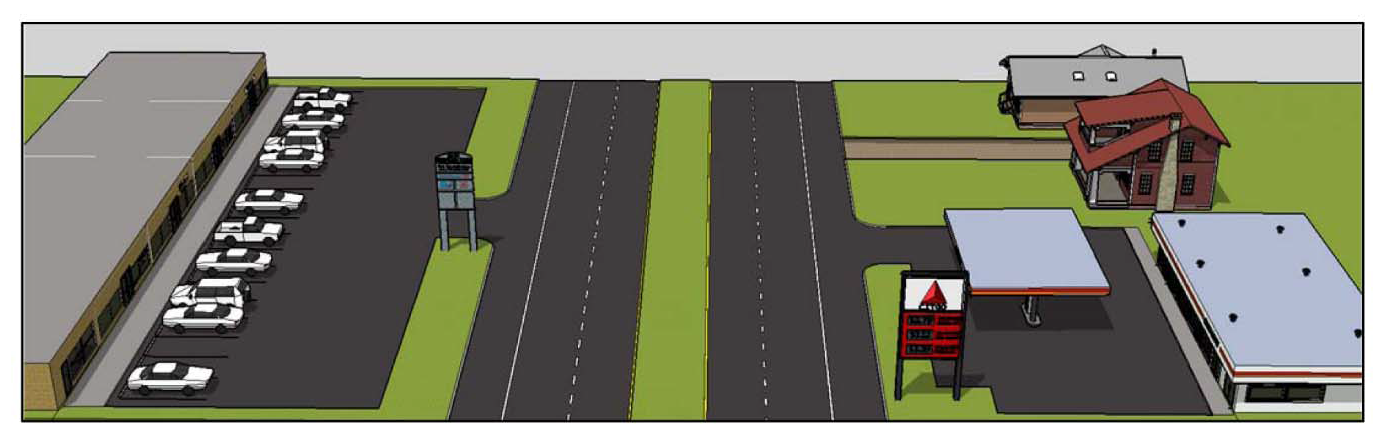
Illustration 1 - Existing, undesired conditions
(2)
Required conditions. The corridor will continue to serve as a regional transportation route, but it is envisioned to become a more attractive urban-style boulevard. Two to three story buildings will be encouraged, with all buildings required to be constructed close to a ten-foot-wide paved sidewalk adjacent to a five-foot-wide grass buffer located in the existing right-of-way on both sides of the roadway. Streetlights will be installed at regular intervals to create a more pedestrian-friendly environment.
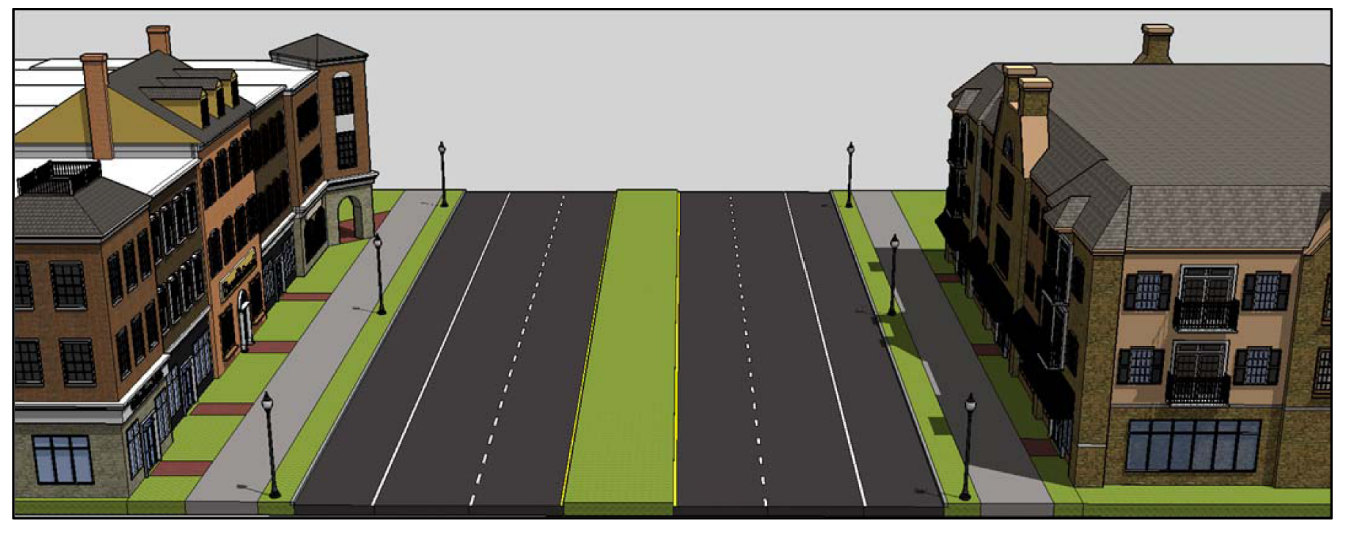
Illustration 2 - Preferred Conditions
d.
Building setback standards.
(1)
Intent. Buildings constructed along U.S. Route 13 are to be located within close proximity to the sidewalk and in general alignment with adjacent buildings in a manner that is reflective of Smyrna's historic downtown to ensure the visibility of retail businesses and encourage active, lively uses. Buildings, along with trees and landscaping shall be predominant rather than parking lots.
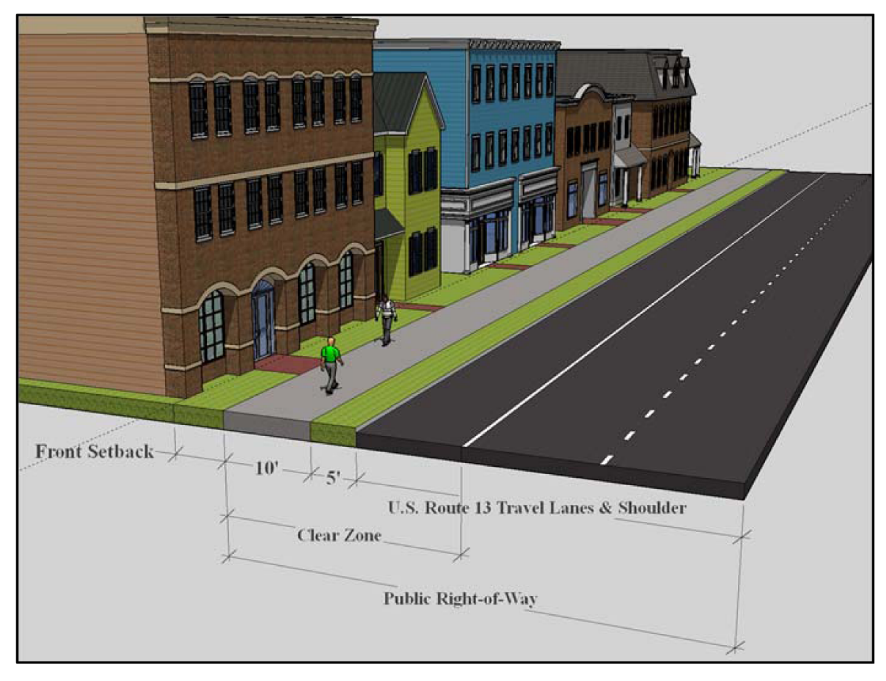
Illustration 3 - Front Yard Setback Example
(2)
Minimum lot requirements.
(a)
Minimum lot width: 50 feet.
(b)
Minimum lot depth: 100 feet.
(3)
Setback standards.
(a)
Front yard setback:
i.
Minimum: five feet.
ii.
Maximum: 15 feet.
(b)
Rear yard setback:
i.
Minimum: zero feet, except a minimum of 20 feet shall be provided to include a ten-foot planted buffer when adjacent to an existing residential use.
ii.
Maximum: N/A
(c)
Side yard setback:
i.
Minimum: Zero feet, except a minimum of 20 feet shall be provided to include a ten-foot planted buffer when adjacent to an existing residential district.
ii.
Maximum: N/A
(d)
The front yard setback will be calculated from the property line fronting U.S. Route 13 or, when a building is not adjacent to U.S. Route 13 but is instead adjacent to a public or private internal street situated on the property, from the outside of the adjacent sidewalk. Rear-access alleys and streets shall not be considered internal streets for the purposes of meeting the front setback. Where a building or site has multiple street frontages, the front yard shall be measured from U.S. Route 13 or, where that is not reasonably practical, from the side of the sidewalk abutting the adjacent street that directly accesses U.S. Route 13. The planning commission may waive a maximum front yard setback for a building directly fronting a green, plaza, or other open space.
e.
Building height/massing standards.
(1)
Intent. To reduce the apparent bulk of buildings and to maintain pedestrian scale, a sense of "base" and "top" shall be provided. Building facades shall have a distinct "base" using articulation and materials that reinforce the character of the streetscape by encouraging the greatest amount of visual interest along the ground floor, street facing facades of buildings. The roofline or "top" of a building shall emphasize a distinct profile or outline. The "middle" of the building is encouraged to be made distinct by a change in material or colors, windows, balconies, setbacks and signage.
The construction of two to three story buildings is strongly encouraged to emulate the traditional character of Smyrna's historic downtown, however single-story buildings are permitted, provided that they have a minimum height of 16 feet with a decorative parapet, gabled, hipped, mansard, or gambrel roof. (See definitions.)
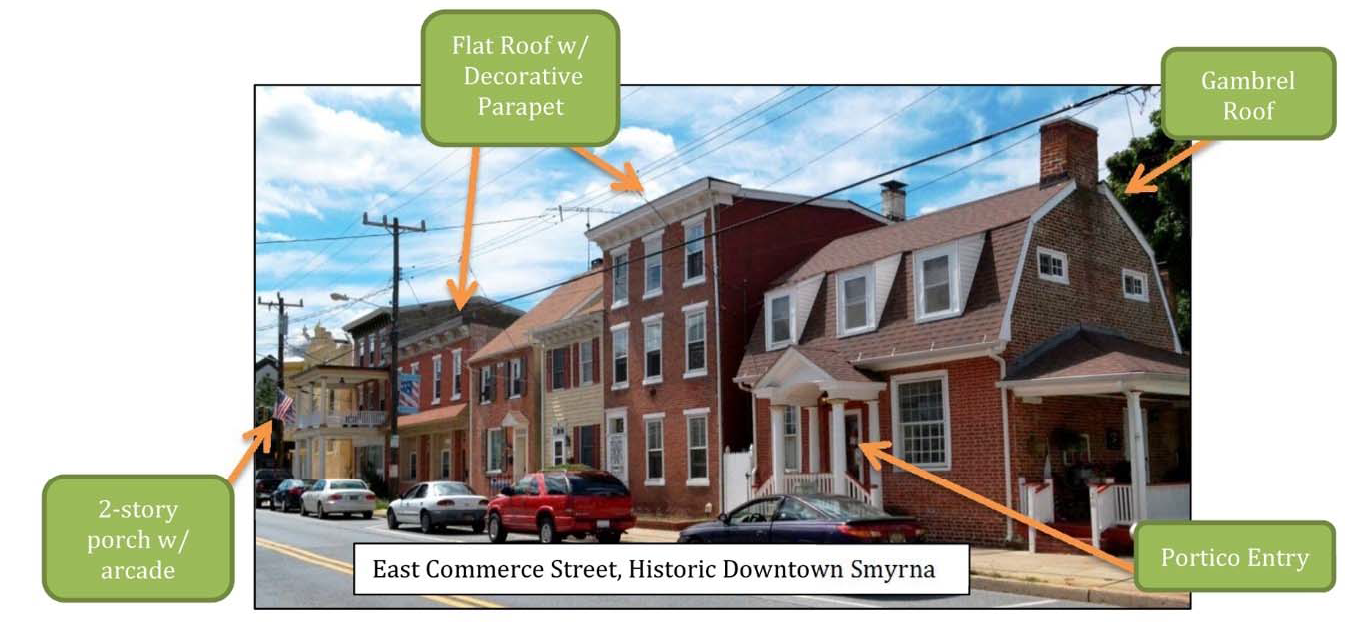
(2)
Building height standards. Building height shall be defined as the vertical distance from the finished grade to the top of the highest roof beams on a flat roof, to the deck level on a mansard roof, and the average distance between the eaves and the ridge level for gable, hipped and gambrel roofs.
(a)
Height:
i.
Minimum: 16 feet.
ii.
Maximum: 60 feet, maximum four stories.
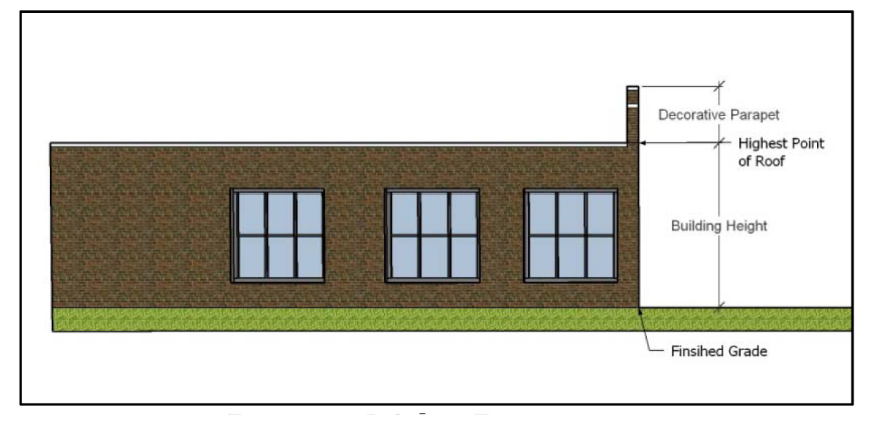
Illustration 4 - Building Height - Flat Roof
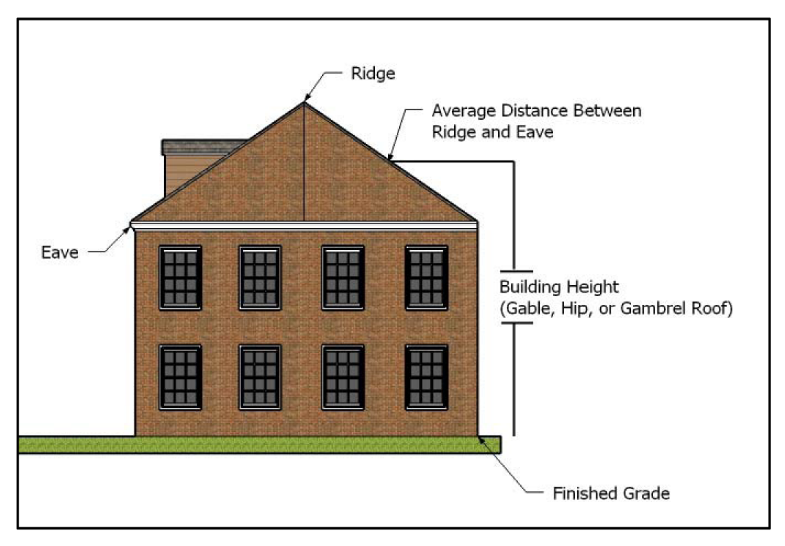
Illustration 5 - Building Height - Gable, Hipped, or Gambrel Roof
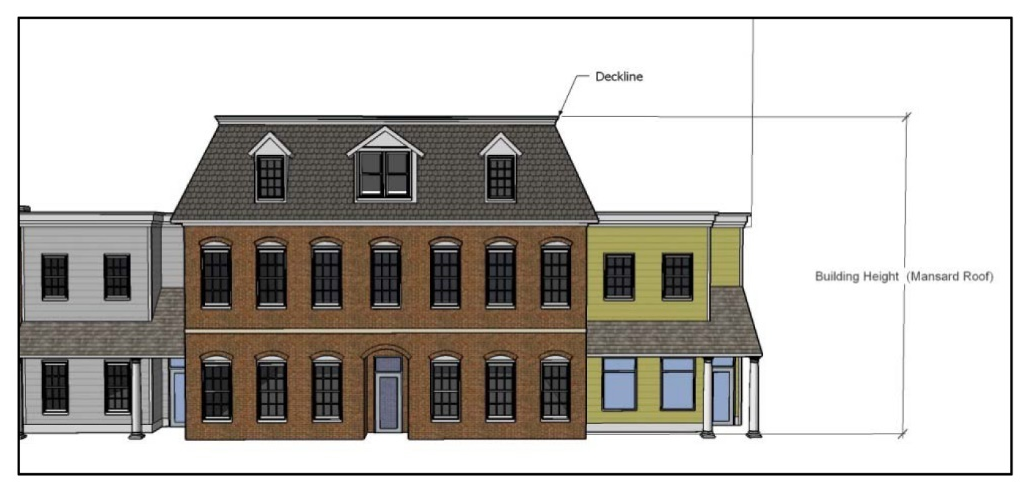
Illustration 6 - Building Height - Mansard Roof
(b)
Stories. Multi-story buildings are strongly preferred throughout the CCM district and especially fronting on U.S. Route 13. One-story buildings shall utilize raised parapets, gable and gambrel style raised roofs, faux second- or third-story windows, and/or other decorative features to replicate the scale and character of traditional downtown multi-story commercial and mixed-use buildings.
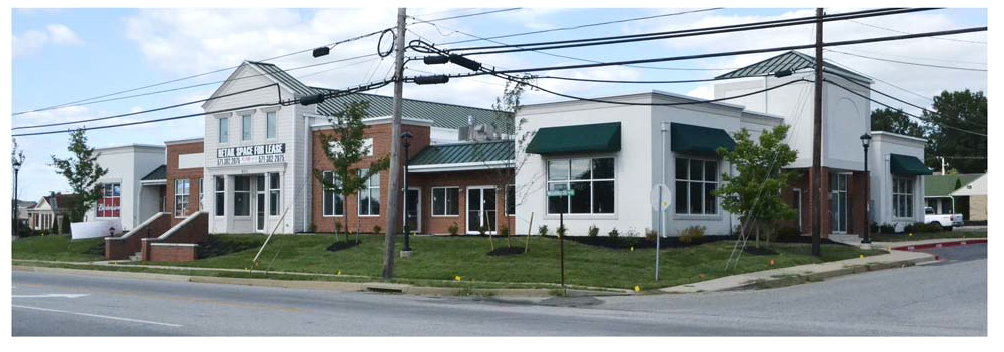
Illustration - New one-story commercial building in Chestertown, MD made to emulate
a diverse 1½ to 2-story downtown storefront
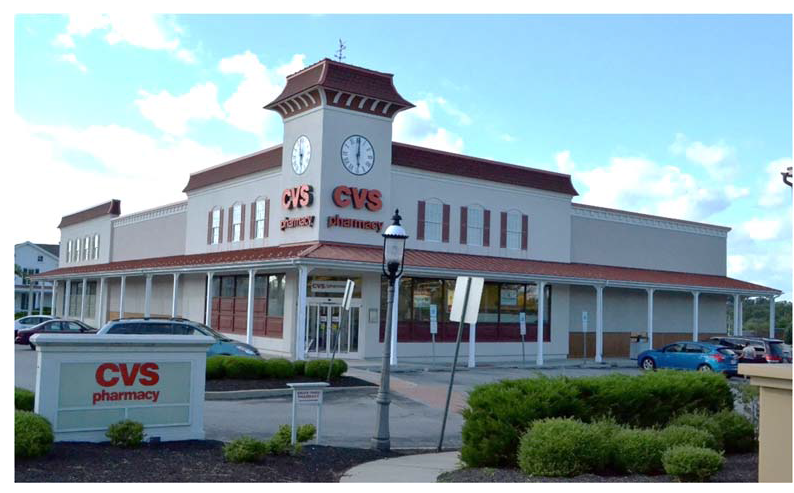
Illustration - New one-story CVS in Eagle, PA that utilized numerous architectural
embellishments to resemble a two-story commercial building
(3)
Facade "base" standards. Ground floor facades facing U.S. Route 13 shall incorporate at least five of the following elements: (Note: Ground floor facades facing a public street other than U.S. Route 13 or common amenity space shall incorporate at least three of the following elements:)
(a)
Translucent windows.
(b)
Arcades.
(c)
Porches, porticos.
(d)
Marquees.
(e)
Decorative belt courses.
(f)
Canopies, awnings.
(g)
Decorative window lintels.
(h)
Decorative lighting.
(i)
Pilasters or columns.
(j)
Any standard not listed, as approved by the planning and zoning commission.
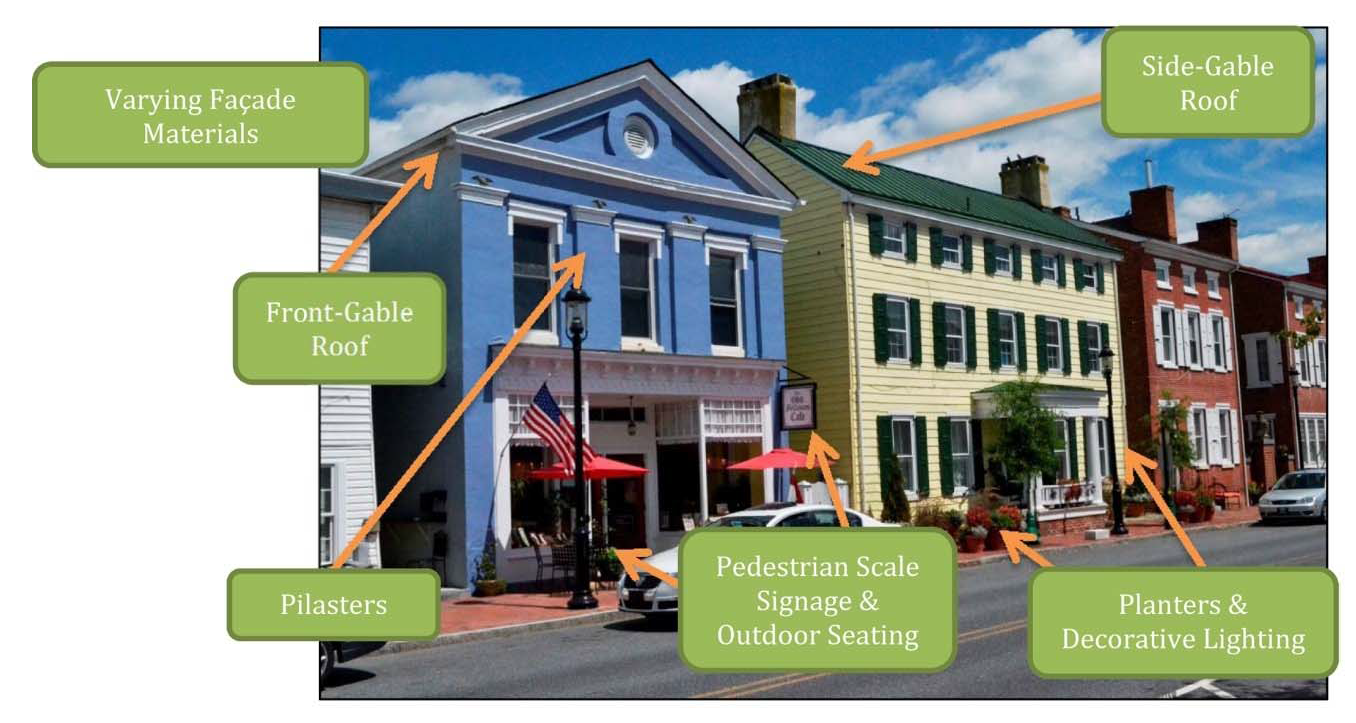
(4)
Roofline "top" guidelines. At least two of the following elements are required:
(a)
Varying roof styles and heights.
(b)
Dormers.
(c)
Chimneys.
(d)
Cupolas.
(e)
Belfries.
(f)
Balustrades.
(g)
Decorative cornices.
(h)
Any standard not listed, as approved by the planning and zoning commission.
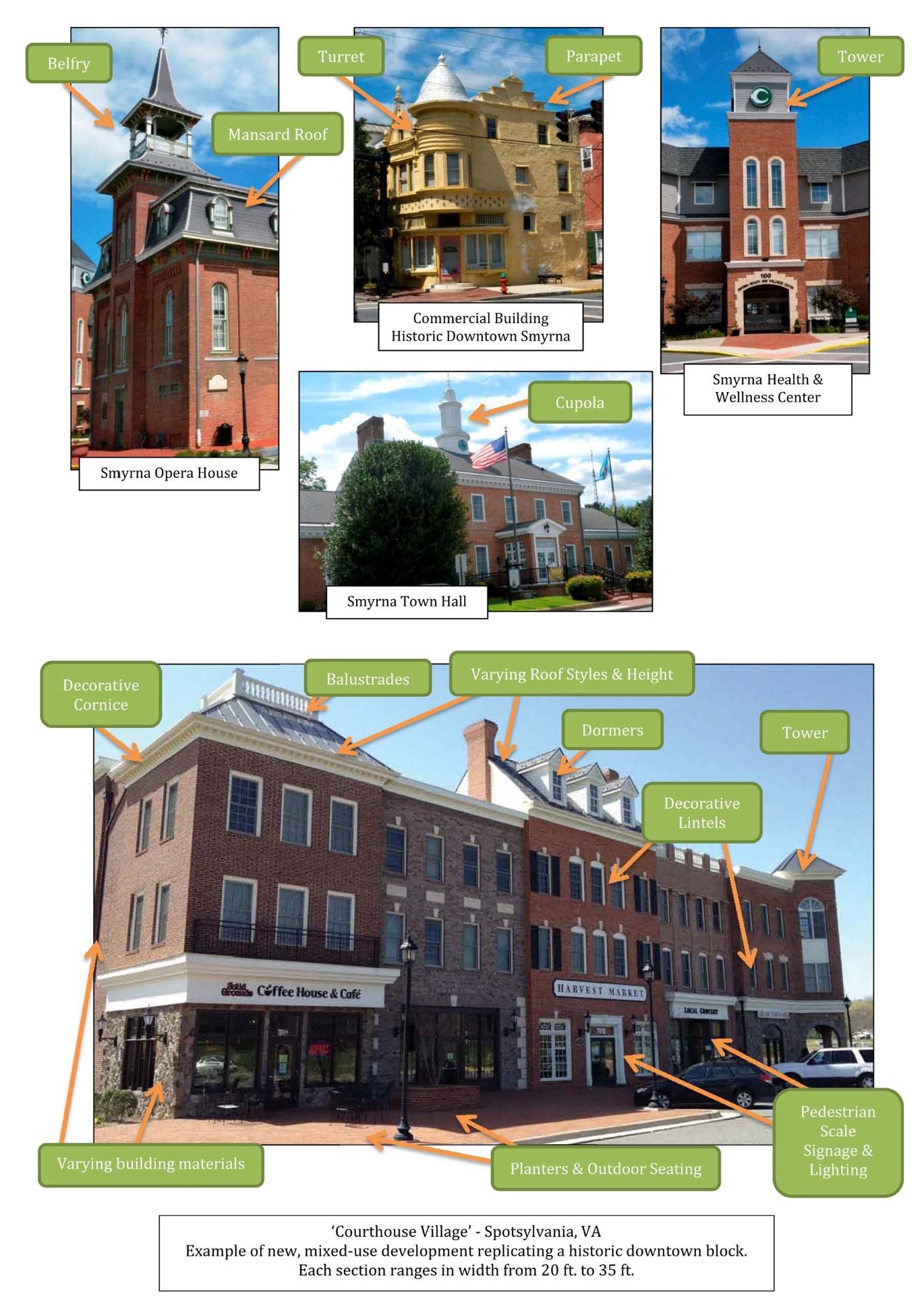
f.
Facade articulation standards.
(1)
Intent. Buildings shall provide diversity and variation in facade type, width, and roof heights and types to reinforce the character of the streetscape by encouraging visual interest along the ground level of buildings. The facade of large single-use buildings like grocery stores, big box stores, and office buildings shall be broken up to mimic a series of smaller storefront buildings in the historic downtown of Smyrna.
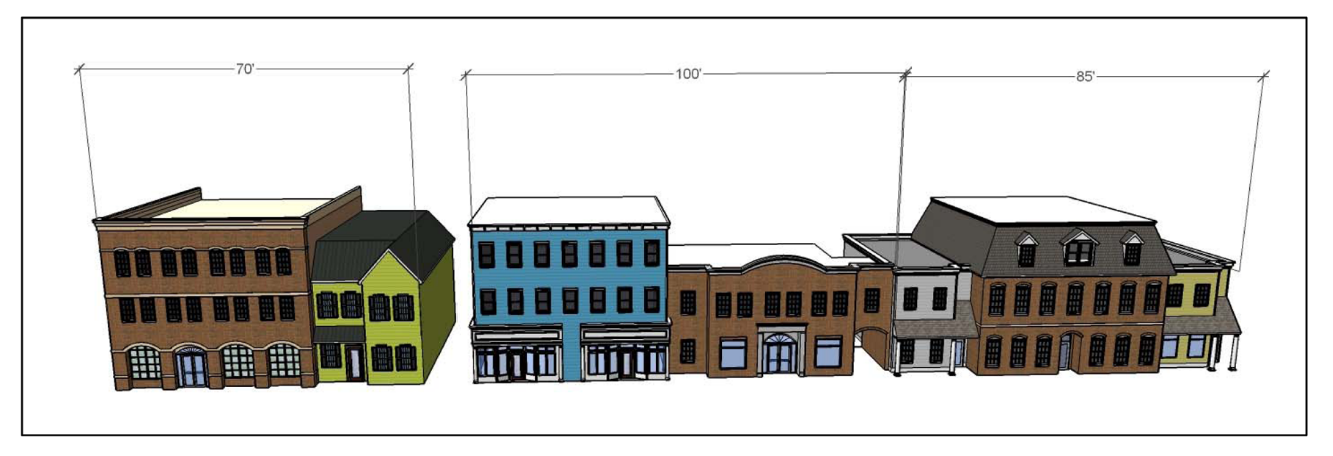
Illustration 7 - Facade Articulation Standards Example
(2)
Buildings with a length of at least 60 feet or greater shall provide at least three of the following architectural facade treatments:
(a)
Variation in building materials.
(b)
Porches, portico, canopies, etc.
(c)
Translucent windows.
(d)
Wall offsets.
(e)
Varying roof types or heights.
(f)
An architectural element not listed above, as approved by the planning and zoning commission.
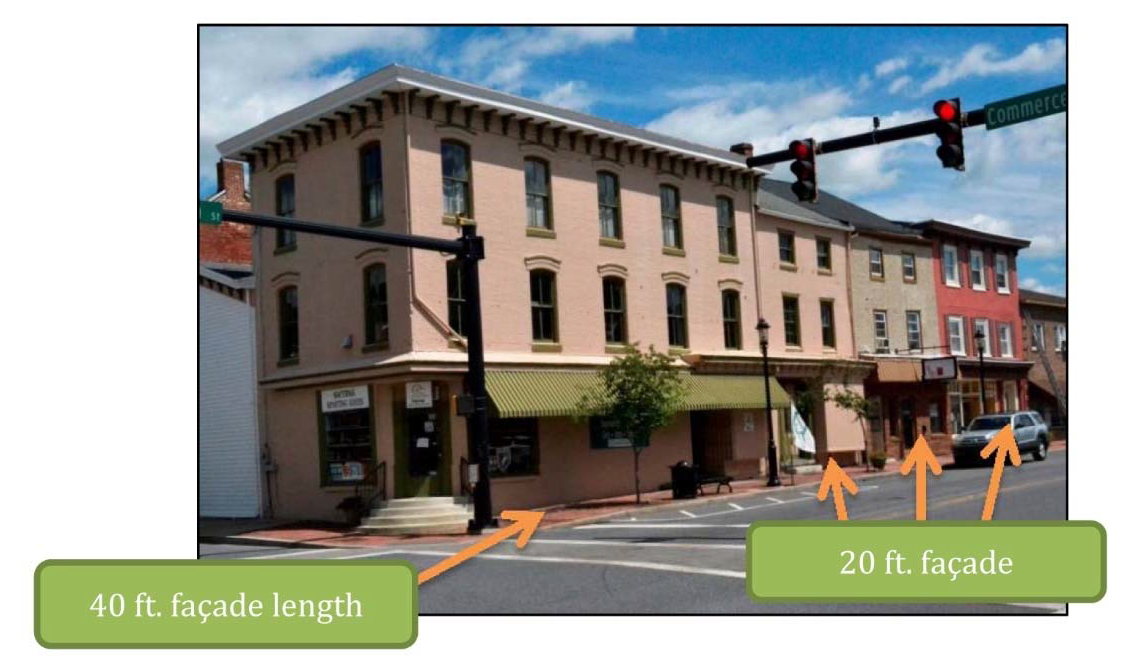
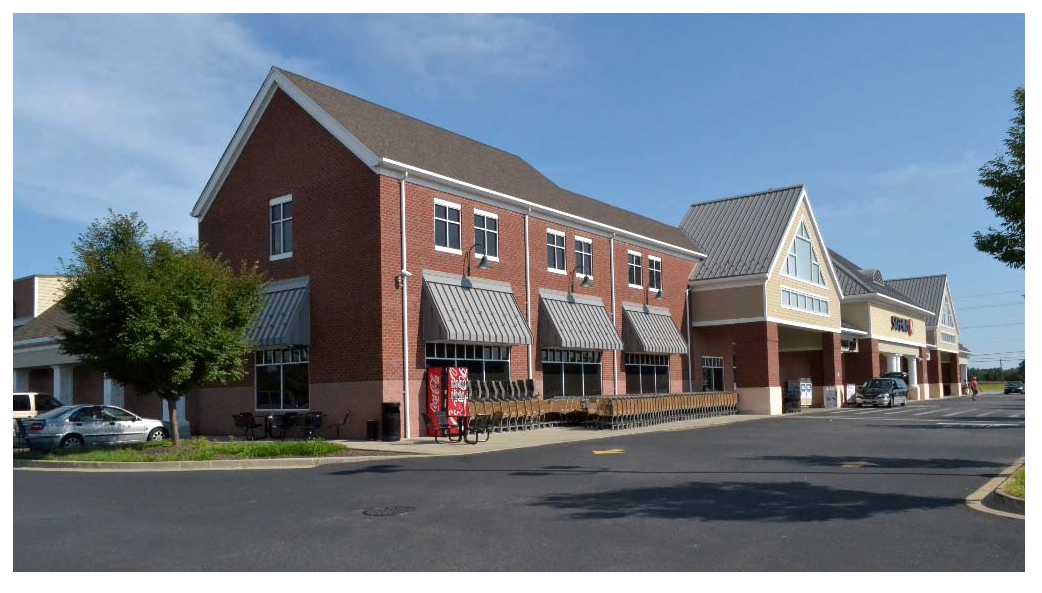
Illustration - Grocery store with architectural improvements to break up the facade
of this 60,000 square feet into smaller sections as may be found in an historic downtown
commercial district.
g.
Window standards.
(1)
Intent. Windows shall be provided on the ground floor facade of all buildings facing U.S. Route 13 and all other internal public or private streets (except rear-access alleys). Apartment buildings and townhouses shall be exempt from these standards.
(2)
Standards:
(a)
Forty percent of the area of all ground floor building facades situated higher than two feet and lower than ten feet above ground level fronting U.S. Route 13 and other public and private streets (except rear-access alleys) shall consist of windows.
(b)
Sills of the windows shall be no higher than three feet above grade.
(c)
Windows on front facades facing a street shall be transparent or translucent glass.
(d)
The use of opaque glass, such as tinted, smoked, or mirrored glass is not permitted.
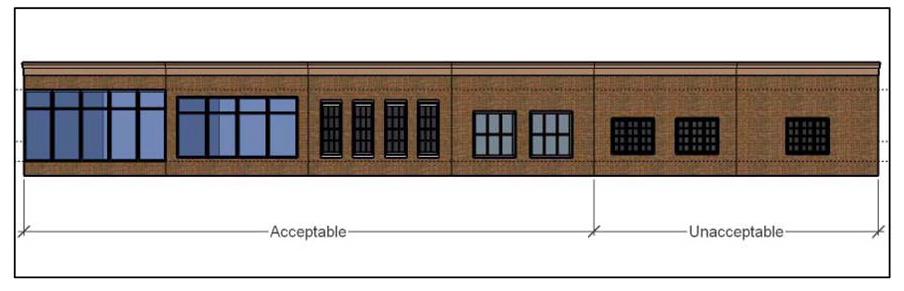
Illustration 8 - Window Standards Example
h.
Streetscape design standards.
(1)
Intent. Streetscape design shall ensure that the street edge provides a transition between the roadway, the sidewalk and buildings. Buildings, along with sidewalks, trees, and landscaping shall be predominant rather than parking lots. Street wall/buffer standards shall screen parking lots, driveways and service station fuel pumps. Site furnishings such as benches and trash receptacles compliment the streetscape and create a more pedestrian-friendly atmosphere.
(2)
Sidewalk standards.
(a)
Sidewalks along U.S. Route 13 shall be concrete and ten feet in width and separated from the shoulder of U.S. Route 13 by a grass area five feet in width.
(b)
Sidewalks along all other roadways shall be five feet in width and separated from the shoulder of the roadway by a grass area five feet in width.
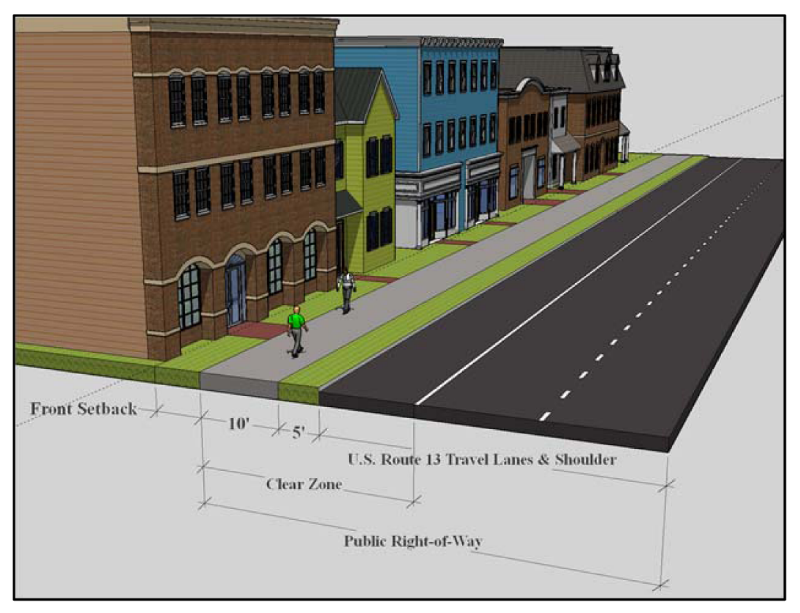
Illustration 9 - Sidewalk - U.S. Route 13
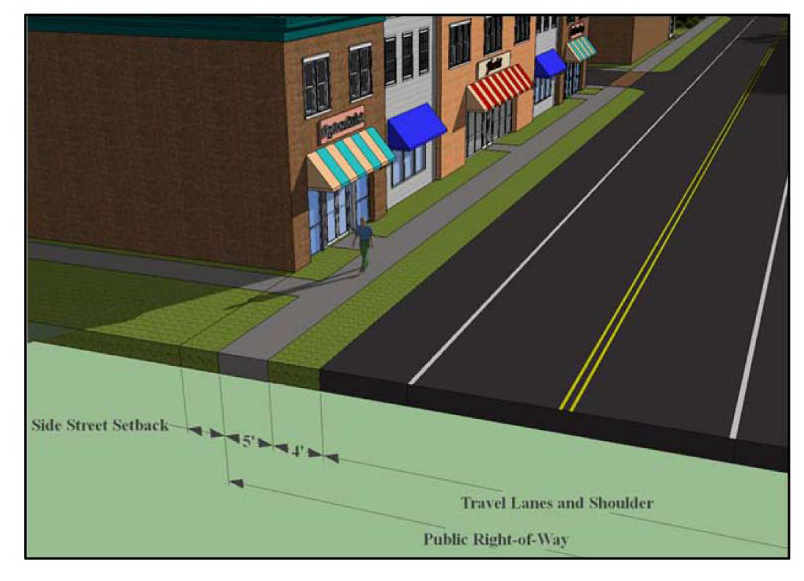
Illustration 10 - Sidewalks - All other Roadways
(3)
Street wall/buffer standards.
(a)
A street wall or buffer shall be required to be installed and maintained wherever a parking lot, driveway, drive-thru, or service station fuel pumps directly front a public or private street (except rear-access alleys) within this district. The purpose and intent are to create an attractive streetscape and shield and minimize auto-related uses from public view.
(b)
Street wall/buffers shall not be located in the public right-of-way and shall be located along the outside of the sidewalk beyond the clear zone as defined by DelDOT.
(c)
Street wall/buffers shall be permanently maintained by the property owner and/or development association.
(d)
The preferred street wall or buffer consists of brick piers two feet square with a maximum height of three and one-half to four feet tall, constructed at intervals of 20 feet with a connecting black iron, steel, aluminum (or approved alternative) fencing constructed to a height of two and one-half to three feet. Fence openings shall have a spacing between four and eight inches. Low-lying shrubs are encouraged to be planted at the base of said street buffer and shall not exceed a maximum height of three feet at maturity. This preferred street wall/buffer is outlined below in illustrations 11 and 12 below.
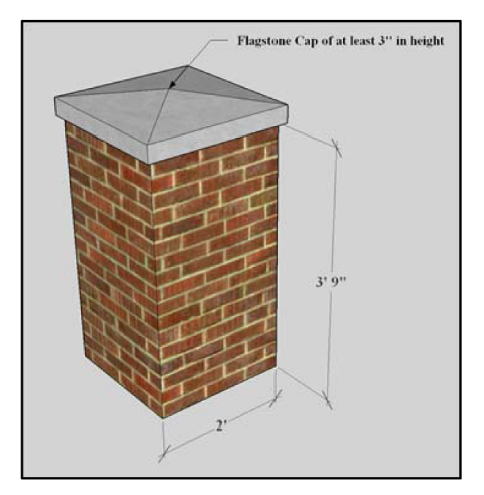 | 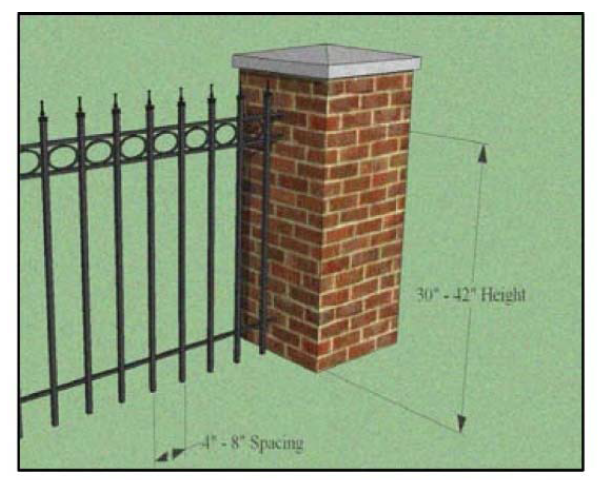 |
| Illustration 11 - Example of Preferred Brick Pier | Illustration 12 - Example of Preferred Street Wall/Buffer Fence Detail |
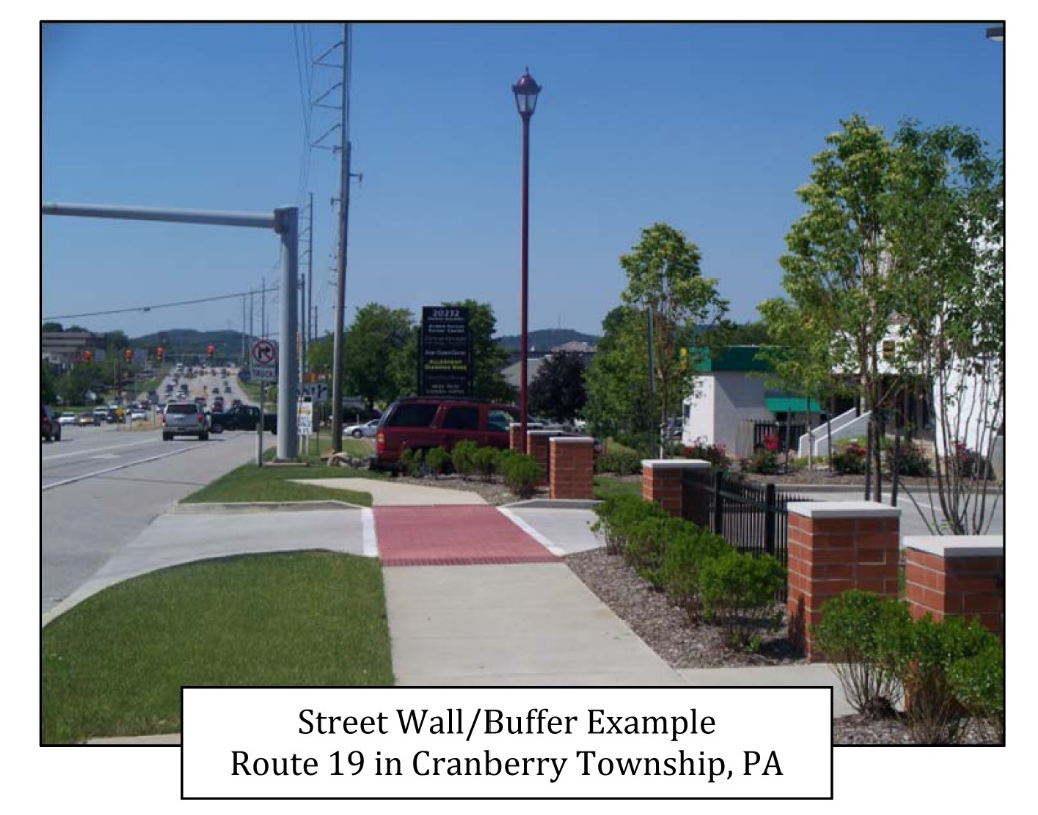
(e)
An acceptable alternative to a street wall/buffer is to plant a continuous vegetative evergreen hedge between three and four feet in height as outlined in the illustration below.
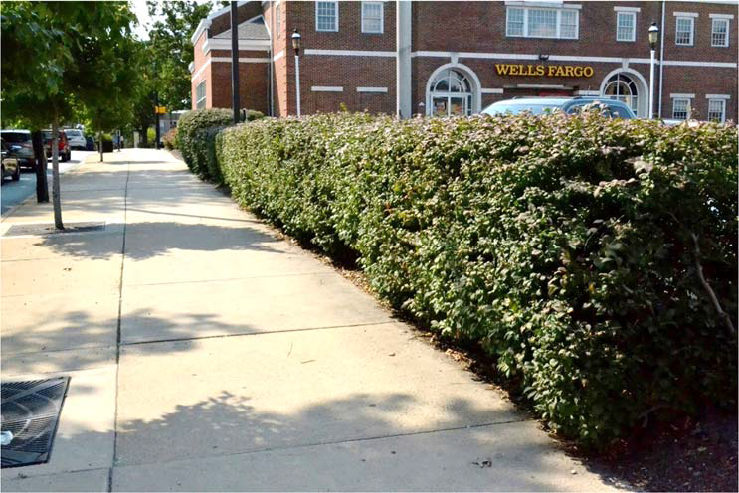
Illustration - Continuous vegetative hedge screening a financial institution's parking
lot along Baltimore Pike (U.S. Route 1) in Media, PA
(f)
An acceptable alternative to a street wall/buffer is to install a continuous brick or stone masonry wall between three and four feet in height as outlined in the illustration below. Low lying shrubs and/or flower bedding are encouraged to be planted at the base of said masonry wall facing the sidewalk.
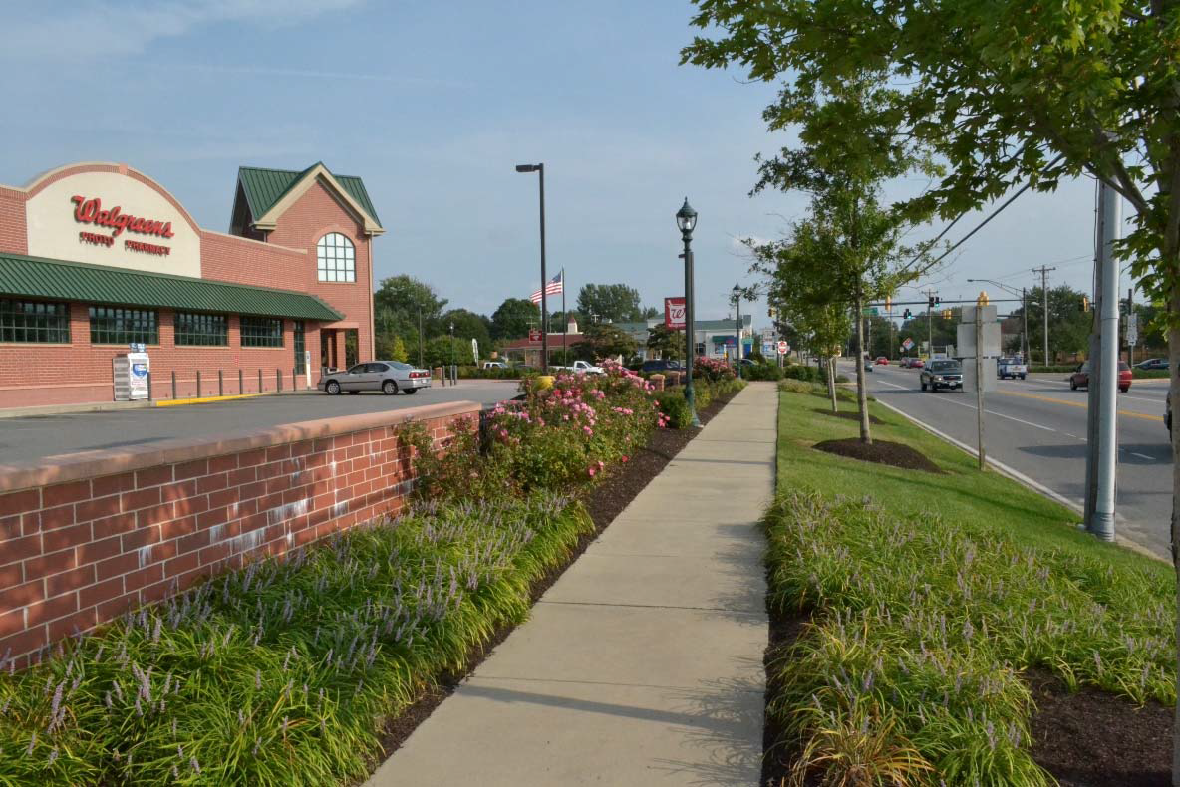
Illustration - Continuous masonry wall with attractive shrubbery and flower bedding
at the wall's base in Chestertown, MD
(g)
The planning commission may approve an alternative street wall/buffer not listed here so long as it meets the intent of this section.
(4)
Street tree standards.
(a)
One street tree shall be planted every 30 linear feet of frontage along U.S. Route 13 and along all internal public and private streets.
(b)
Street trees shall be planted between the curb and the sidewalk where practical, and not within 60 feet of an intersection.
(c)
At the time of planting, street trees shall be no less than two inches in caliper.
(d)
No more than three street trees of the same species may be planted in a row.
(e)
The following street trees may be planted:
• Ginkgo biloba 'Princeton Sentry' (male no fruit).
• Shawnee Brave Bald cypress (Taxodium distichum 'Mickelson').
• Hardy rubber tree (Eucommia ulmoides).
• Freeman maple (Acer x freemanii 'Scarsen') Scarlet Sentinel.
• Thornless Honeylocust (Gleditsia triacanthos var. inermis 'Shademaster').
• American Hornbeam (Carpinus caroliniana).
• New Horizon Elm (Ulmus 'New Horizon').
• Hornbeam (Carpinus betulus 'Fastigiata').
• Eastern Hop Hornbeam (Ostrya virginiana).
• Trident Maple (Acer buergeriaman).
• Miyabei Maple (Acer miyabei 'Morton' State Street).
(f)
Alternative street trees that meet the intent of this zoning district may be approved on a case-by-case basis by the Smyrna Shade Tree Commission.
(5)
Streetlights.
(a)
To ensure pedestrian lighting and safety, streetlights shall be installed every 60 linear feet, but no closer than 15 feet from any street tree, along all public and private streets (except rear-access alleys)
(b)
Streetlights shall be a Sternberg Lighting Model Town Square A880SRLED as shown below or a close alternative approved by the planning commission.
 | 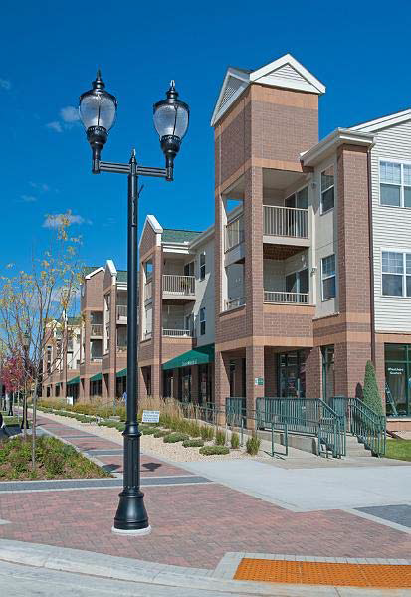 |
| Sternberg Lighting Model Town Square A880SRLED with a single acorn-shaped luminaire | Sternberg Lighting Model Town Square A880SRLED with dual acorn-shaped luminaires |
i.
Building placement (drive-thru buildings and service stations).
(1)
Intent—Drive-thru buildings. Drive-thru buildings contain a drive-thru as a part of the commercial or service establishment. Typical uses include banks, pharmacies and fast-food establishments.
(2)
Standards—Drive-thru buildings.
(a)
Drive-thru buildings shall not locate drive-thru windows on those facades directly facing U.S. Route 13.
(b)
Drive-thru buildings located on a corner lot shall provide a separate entrance along U.S. Route 13 and exit along the side street.
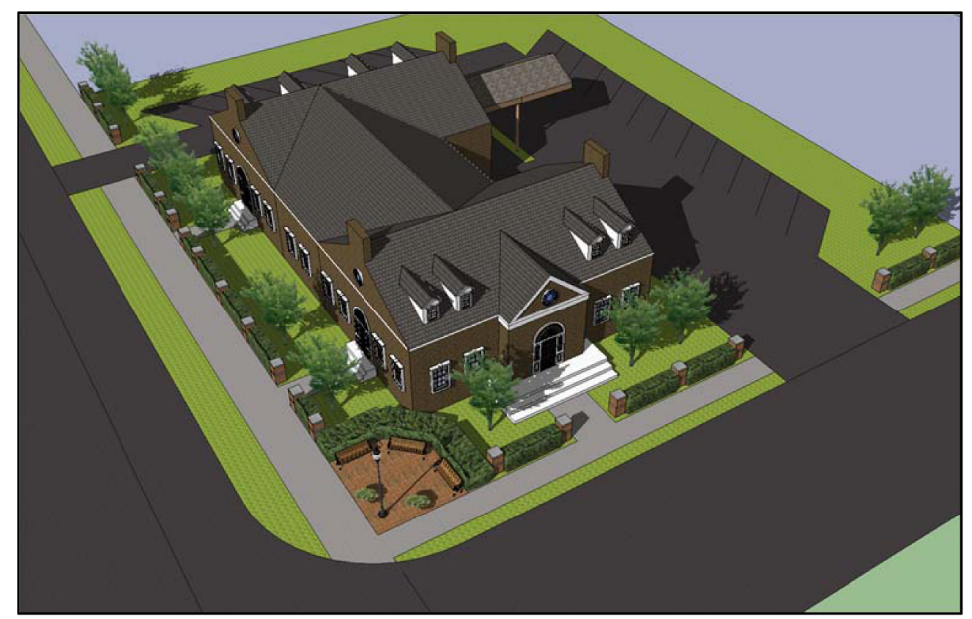
Illustration 13 - Drive-thru Building, Corner Lot - Example
(c)
It is strongly preferred that drive-thru buildings provide a separate entrance and exit with one-way automobile circulation as shown below.
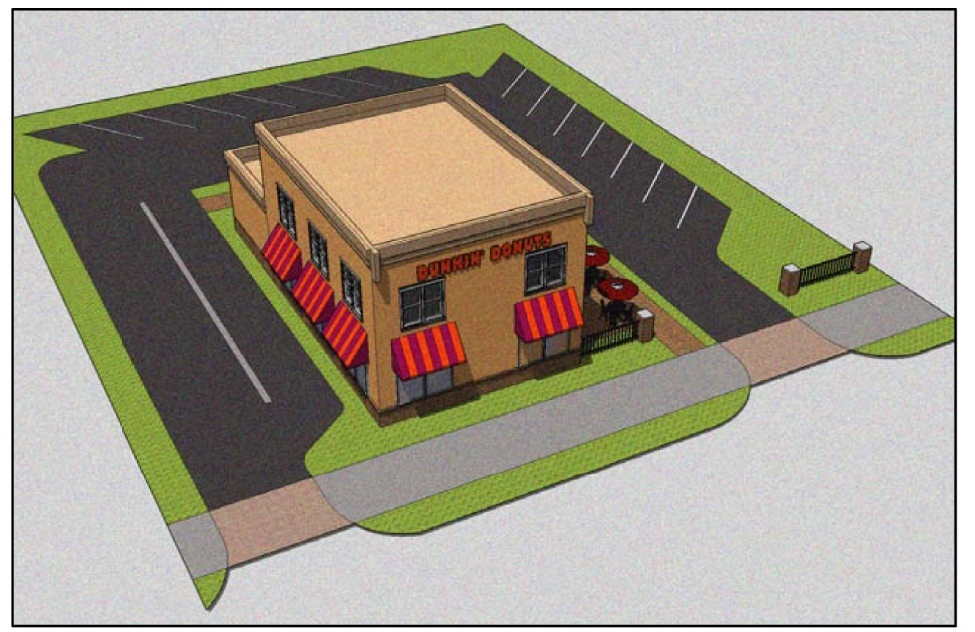
(d)
Drive-thru buildings may be configured with a drive aisle positioned in the front yard (as shown below) if the following criteria are met: it is impractical to provide separate entrances and exits to the facility, the building is located no farther than 25 feet from the front property line, and the applicant obtains a waiver from the planning commission.
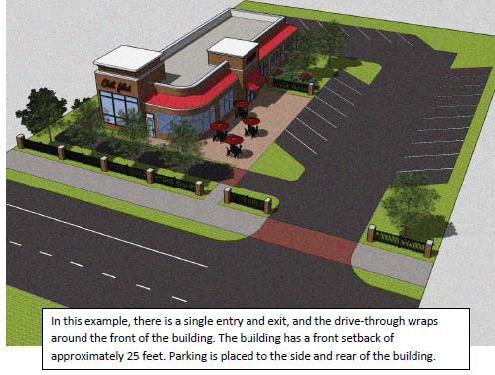
Illustration 14 - Drive-thru Building, Entrance - Example
(3)
Intent—Service stations. Service stations feature one or more islands of fuel pumps and a convenience store. The intent of this section is to minimize the road frontage visibility of fuel pumps and maximize the visibility of the convenience store.
(4)
Standards—Service stations.
(a)
Fuel pumps are strongly encouraged to be located to the rear of the convenience store, shielded from frontage along U.S. Route 13.
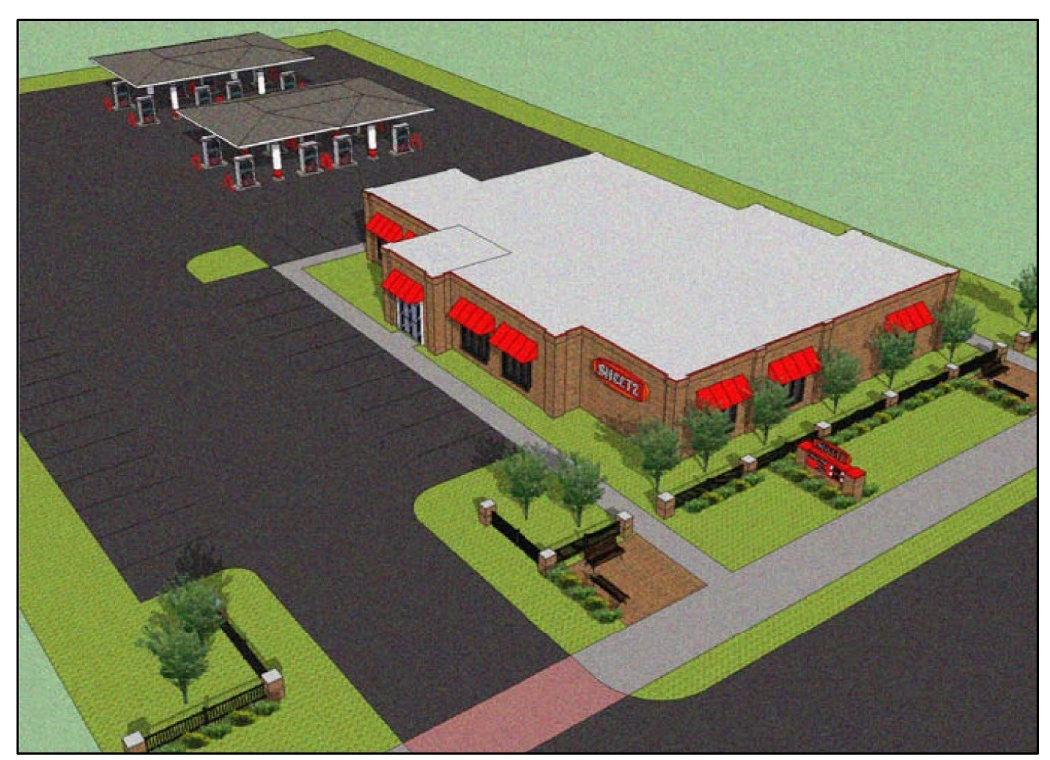
Illustration 15 - Fuel Pumps, Rear Location - Preferred Example
(b)
Fuel pumps may be located to the side of the convenience store. Fuel pumps shall not be located in the front yard of those parcels fronting U.S. Route 13.
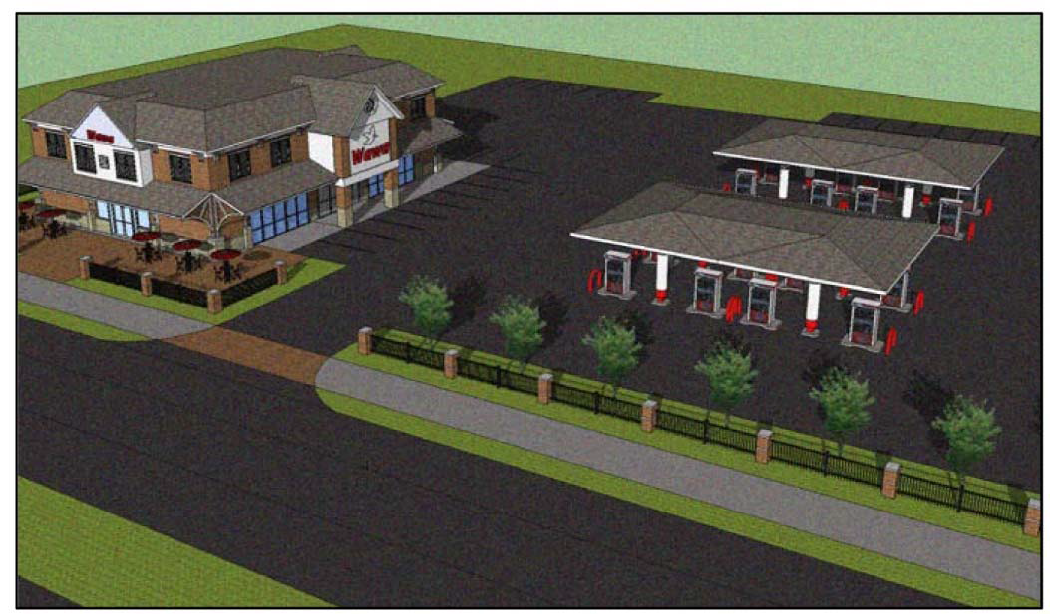
Illustration 16 - Fuel Pumps, Side Yard Location - Acceptable Example
(c)
Fuel pump canopies shall be constructed utilizing the same building materials used in the construction of the associated convenience store.
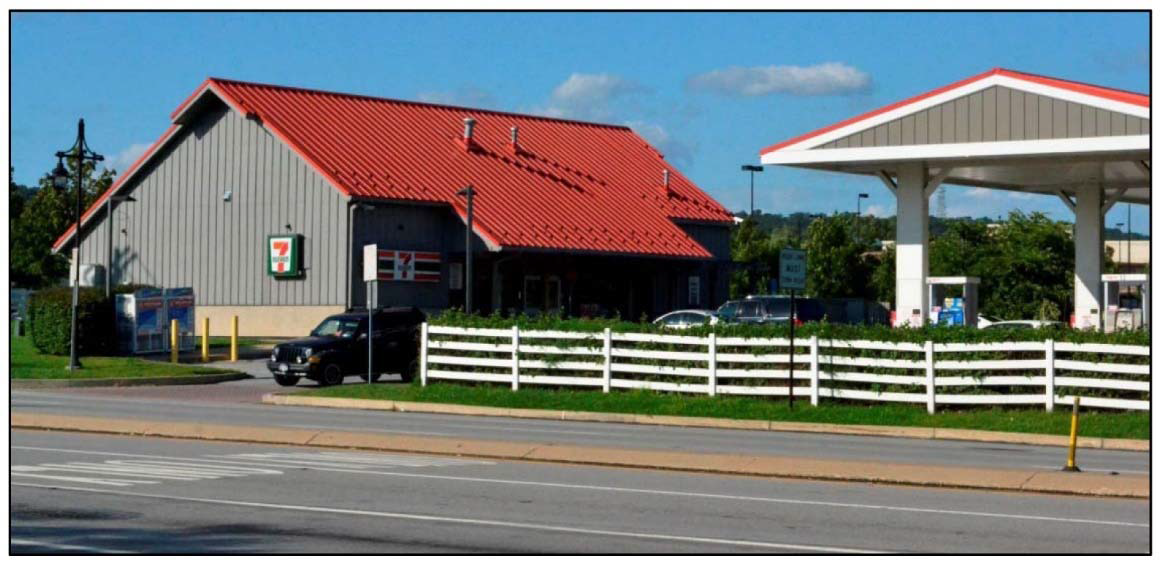
(d)
Fuel pumps shall not be located closer than 25 feet to the public right-of-way along U.S. Route 13.
j.
Parking lot design.
(1)
Intent. A streetscape formed by a continuous row of buildings located close to the sidewalk with minimal parking lot frontage along U.S. Route 13 will create an attractive urban-boulevard, reflective of the town's historic downtown. Parking lots shall be landscaped to provide an aesthetically pleasing streetscape.
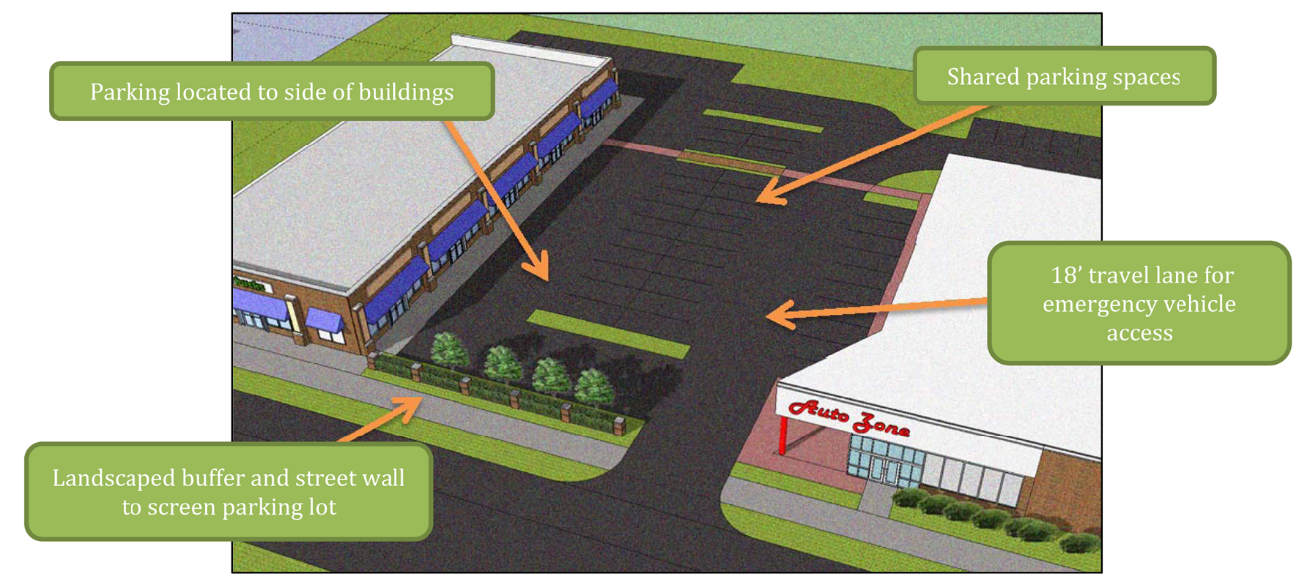
(2)
Standards.
(a)
Parking lots shall be designed to the maximum extent feasible to connect parking lots on adjacent lots by providing cross-property easements to share driveways and reduce the need for additional curb cuts. Future connections for parking lot interconnectivity between adjacent lots shall be required.
(b)
In the case of a driveway located between parking rows adjacent to buildings, a minimum of 18 feet shall be provided for emergency vehicle access.
(c)
Access to fire connections shall be provided for.
(d)
Parking lot speed bumps shall be prohibited.
(e)
Bicycle racks shall be provided and shall be located in well-lit parking areas, safe from vehicular traffic. A minimum of one rack with five bicycle parking spaces shall be provided in all parking lots containing 20 or more parking spaces. Bicycle racks shall be black in color.
(f)
Parking is not permitted in the front of a building. It is preferred that parking be located to the rear of a building to reduce the visual impact of the parking lot, though parking to the side of a building is acceptable.
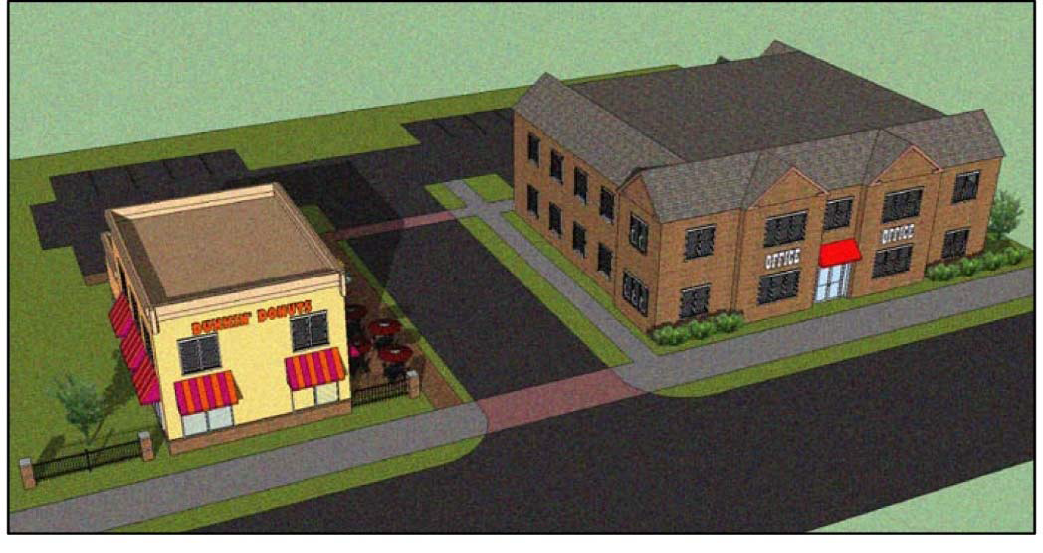
(g)
Commercial buildings are encouraged to share a common entrance from the roadway to their respective parking lots that are located to the rear of each building.
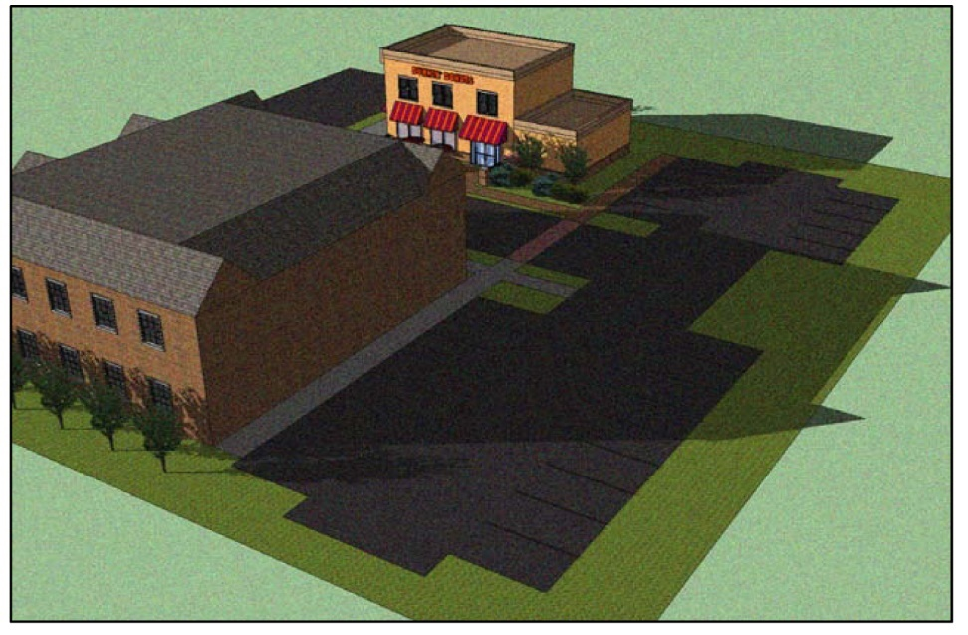
(h)
A parallel parking row shall be limited to 15 consecutive parking spaces interrupted by a 15-foot by nine-foot landscaped island to separate adjacent parking spaces. Two trees and two low-lying shrubs shall be required for each landscaped island.
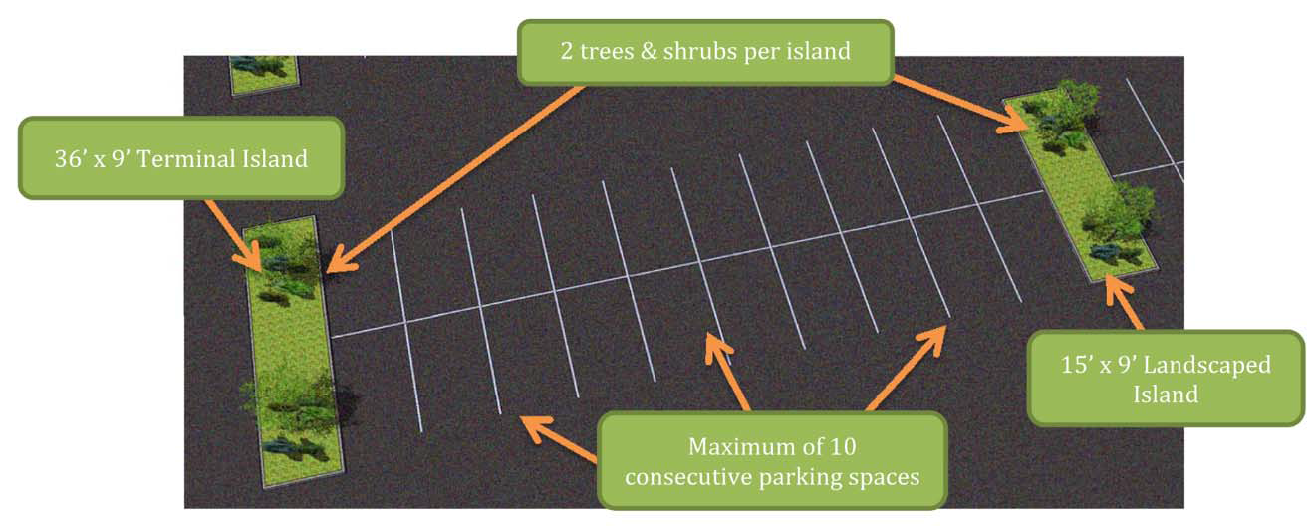
(i)
All parking rows shall be terminated with a 36-foot by nine-foot landscaped, terminal island to protect parked vehicles and confine moving traffic to aisles and driveways. Two trees and two low-lying shrubs shall be required per terminal island.
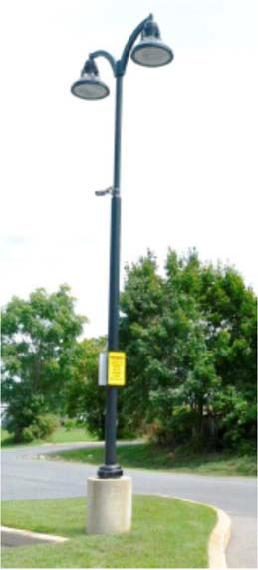
(j)
Parking lot trees shall be pruned so that branches do not obstruct the light from any street lamp or obstruct the view of any street intersection. Trees shall also be pruned to a minimum height of 14 feet to provide a clear space above surface sidewalks, parking lots and driveways to allow for unobstructed passage of pedestrians and vehicles.
(k)
Parking lot lights shall be installed and maintained in all off-street parking lots to ensure pedestrian lighting and safety.
(l)
All parking lot lights shall have one or two downward facing decorative u-shaped lamps, including a round pole shaft with a round cast base in a black, powder coated finish. Cobra headed light pole styles are prohibited. An alternative parking lot light style may be approved by the planning commission.
(m)
A maximum of five consecutive parallel parking rows are permitted prior to a full row length landscaped area a minimum of six feet wide.
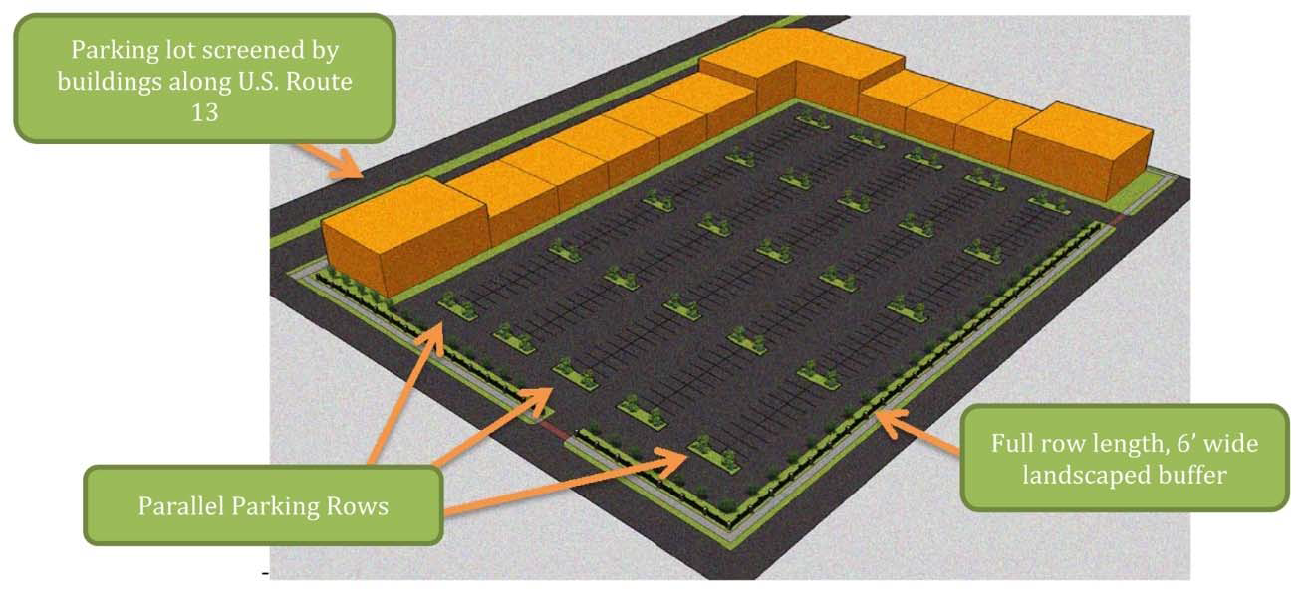
(n)
A minimum six-foot wide, full row length landscaped buffer shall be installed between all parking rows abutting adjacent properties and secondary access roads. One tree shall be planted for every 30 linear feet of frontage. An exception may be made if the parking lot is designed to create interconnectivity through shared parking for adjacent lots. Landscaping shall be permanently maintained by the property owner and/or development association.
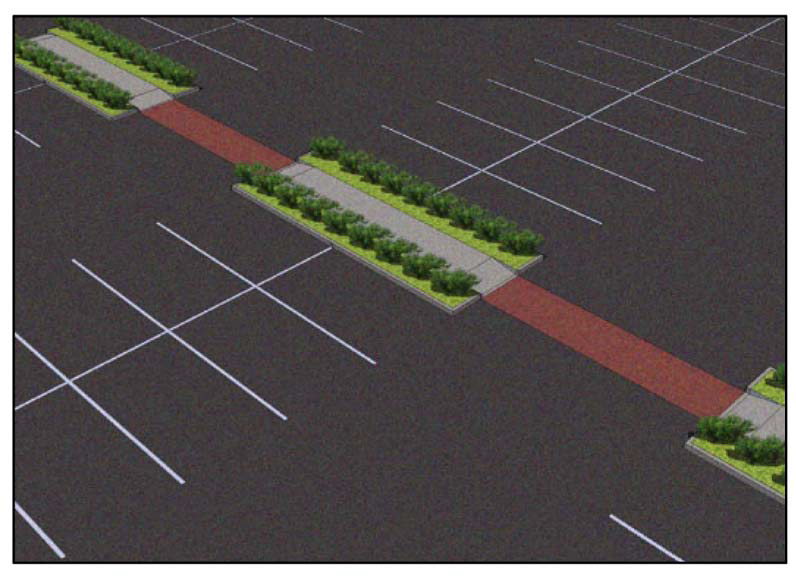
(o)
Parking lots with more than five parallel parking rows shall construct sidewalks and crosswalks through landscaped islands bisecting the parking lot at or near the midpoint to increase pedestrian safety and connectivity. Developers may also submit an alternative design subject to planning and zoning commission approval.
(3)
Modified parking lot design. To minimize the overall footprint of parking lots, the construction of a modified parking design is encouraged.
Property owners, land developers, or land users of any parcels in the CCM (corridor commercial) zoning district may install off-street spaces with modified designs with planning commission approval.
Modified parking designs include, but are not limited to:
(a)
Double stacking residential parking spaces for each residential unit.
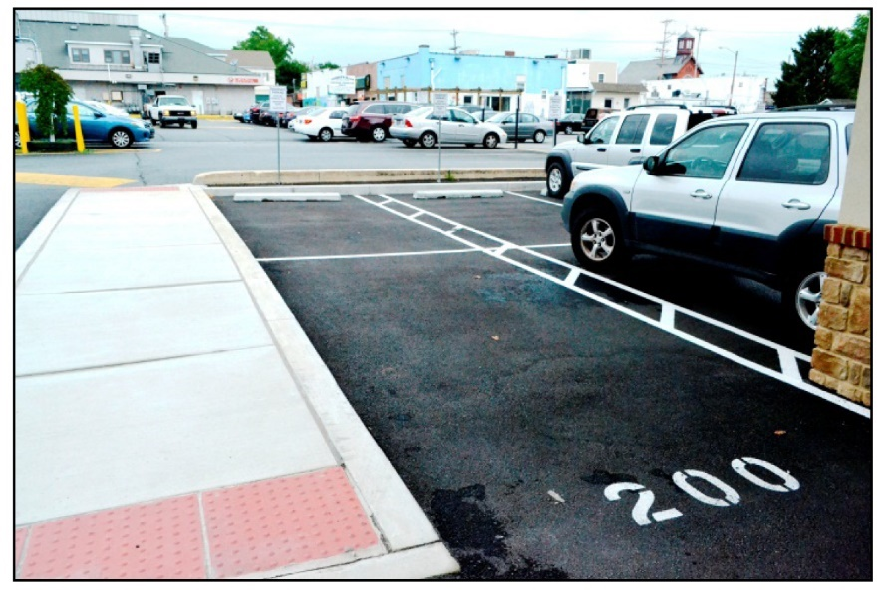
(b)
Placing parking spaces on the ground story of a building, but behind retail/office uses or a facade wall.
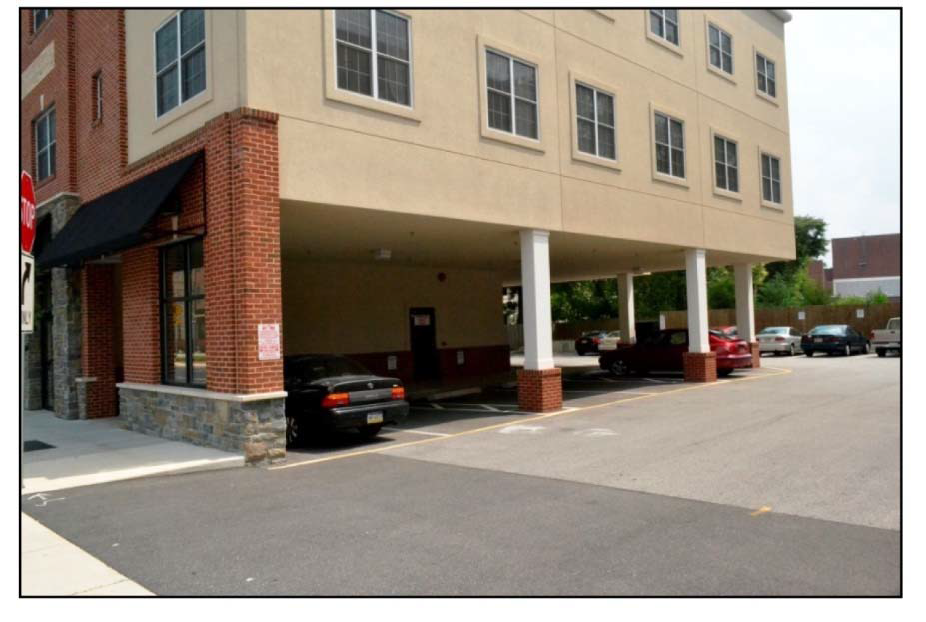
(c)
Multi-story structured parking garages are permitted so long as they are located behind retail/office uses or buildings or behind a facade wall designed to replicate a multi-story commercial building. Structured parking garages may not directly front U.S. Route 13 but may front an internal public or private side street.
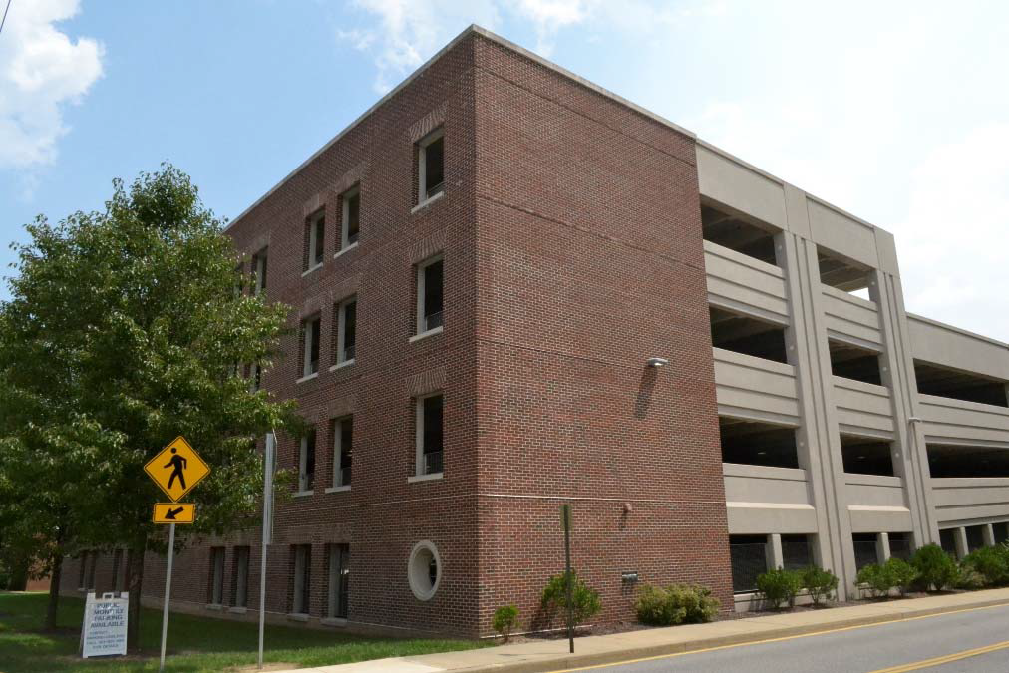
k.
Building entrances.
(1)
Intent. Buildings are encouraged to be oriented towards U.S. Route 13 or internal commercial boulevards, and thus provide entrances that are accessible to and in sight of the roadway and sidewalk. Entrances are encouraged to be prominently displayed and include architectural embellishments so as to highlight their location(s) along the building.
(2)
All buildings along U.S. Route 13 and internal commercial boulevards shall include entrances facing the roadway along the ground story.
(3)
All buildings and/or tenant space must have clearly defined, highly visible customer entrances, easily identifiable from the street and sidewalk.
(4)
Walls facing side streets and/or access roads must have windows and are strongly encouraged to have doors.
(5)
Corner buildings and end units are strongly encouraged to place their primary entrance at the corner of the intersection and a secondary entrance along the side street.
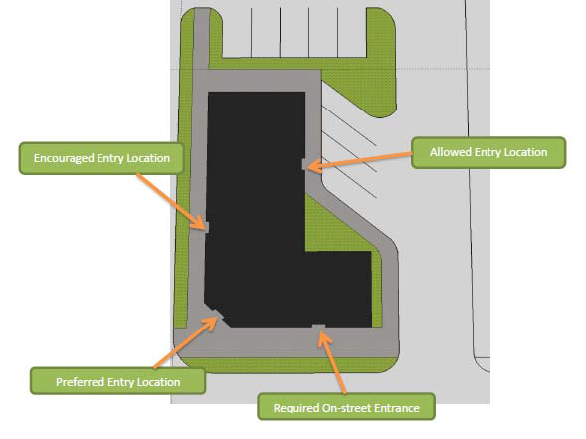
l.
Common amenity space.
(1)
Intent. Commercial and mixed-use development in the corridor commercial (CCM) zoning district shall provide a variety of useable common amenity spaces and amenities that are integrated into the overall site design and plan that enhances the character of U.S. Route 13. The open space requirements outlined in section 5.07(b)(5) of the Subdivision and Land Development Ordinance shall not apply to the CCM district, which district shall instead be bound by the common amenity space standards set forth herein.
(2)
Standards.
(a)
Non-residential projects shall be required to provide at least one of the following amenities for the first 10,000 square feet of gross floor area and one additional amenity for every 25,000 square feet of gross floor area thereafter rounded to the nearest increment of 25,000 square feet. Residential projects shall provide at least one of the following amenities for every 50 dwelling units, rounded to the nearest increment of 50 dwelling units. The number of amenities required for mixed-use projects shall be calculated based on the collective number of amenities required for each of the residential and non-residential portions based on the calculations herein provided.
(b)
Common amenity space shall be visible and accessible from a public sidewalk. It is preferred that such space be in close proximity to the main entrance of a building to take advantage of pedestrian traffic, but other locations may be considered if they are visible and accessible. Common amenities shall be ADA accessible unless an exemption is lawfully granted pursuant to all applicable laws and regulations.
(c)
Common amenity space shall be provided in one or more of the following forms, based on the calculations set forth in subsection (a):
(i)
Pocket parks. Pocket parks shall be incorporated into the site design at building entrances, street corners, and/or sidewalks and shall range in size from 500 square feet to 1,000 square feet. Two pocket parks of the before-mentioned size and with the below features shall be counted as the equivalent of one common amenity space.
To enhance the attractiveness of the overall site design and to encourage pedestrian connectivity between buildings, parking lots and adjacent commercial uses, pocket parks shall feature at least three different elements from the following list:
(a)
Sitting areas (such as benches, low seating walls).
(b)
Covered structure (such as a gazebo, pergola or pavilion).
(c)
Decorative paving (such as colored/stained concrete, brick or other type of paver).
(d)
Decorative planters.
(e)
Decorative flowering or evergreen shrubs.
(f)
Decorative, pedestrian-scale lighting.
(g)
Public art (such as monuments, sculptures, statuary).
(h)
Decorative water feature (such as a fountain, rain garden).
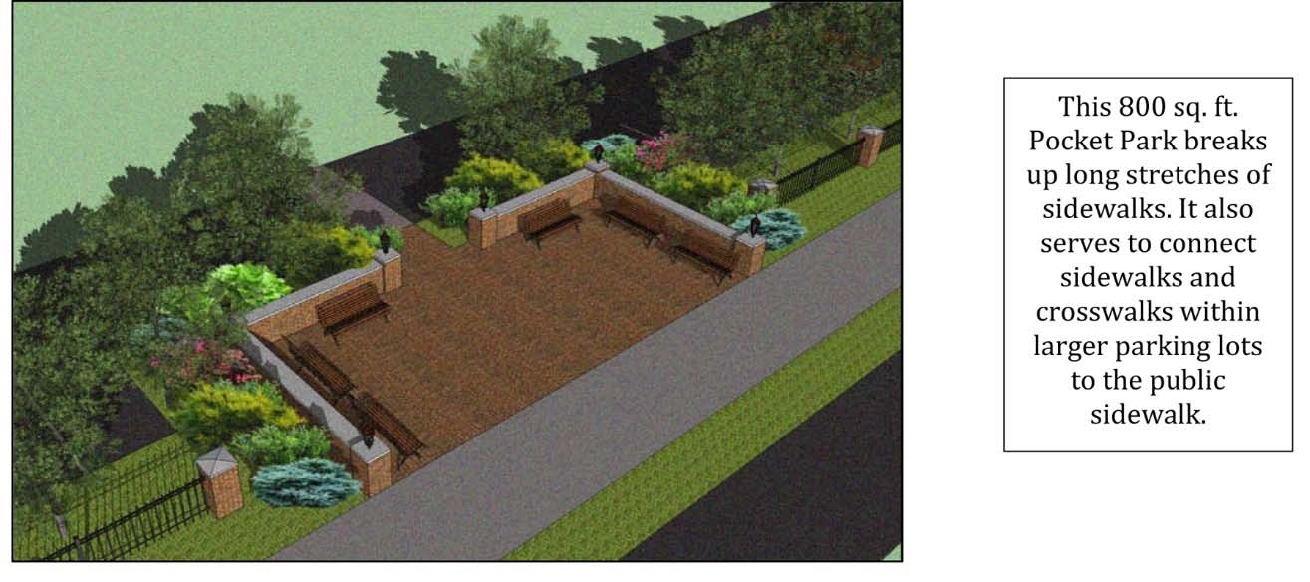
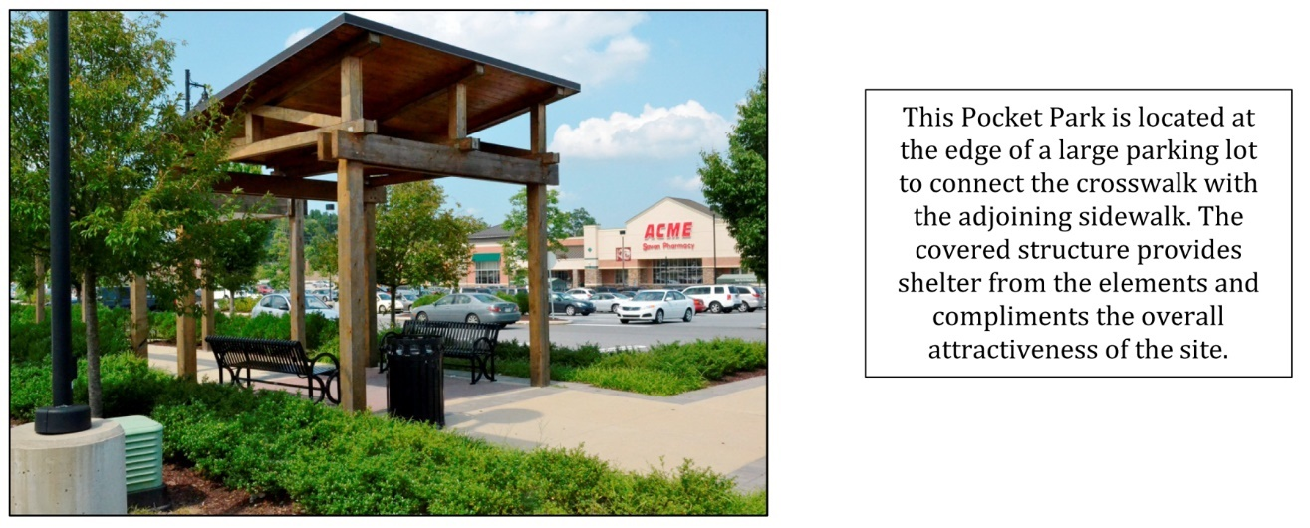
(ii)
Public squares or plazas. Public squares and plazas shall be incorporated into the overall site design so that primary building facade(s) front the respective public square or plaza and shall range in size from 2,500 square feet to 10,000 square feet.
To enhance the attractiveness of the overall site design and to encourage pedestrian connectivity between buildings, parking lots and adjacent commercial uses, public squares or plazas shall feature at least five different elements from the following list:
(a)
Sitting areas (such as benches, low seating walls).
(b)
Covered structure (such as a gazebo, pergola or pavilion).
(c)
Decorative paving (such as colored/stained concrete, brick or other type of paver).
(d)
Decorative planters.
(e)
Decorative flowering or evergreen shrubs.
(f)
Decorative, pedestrian-scale lighting.
(g)
Public art (such as monuments, sculptures, statuary).
(h)
Decorative water feature (such as a fountain, rain garden).
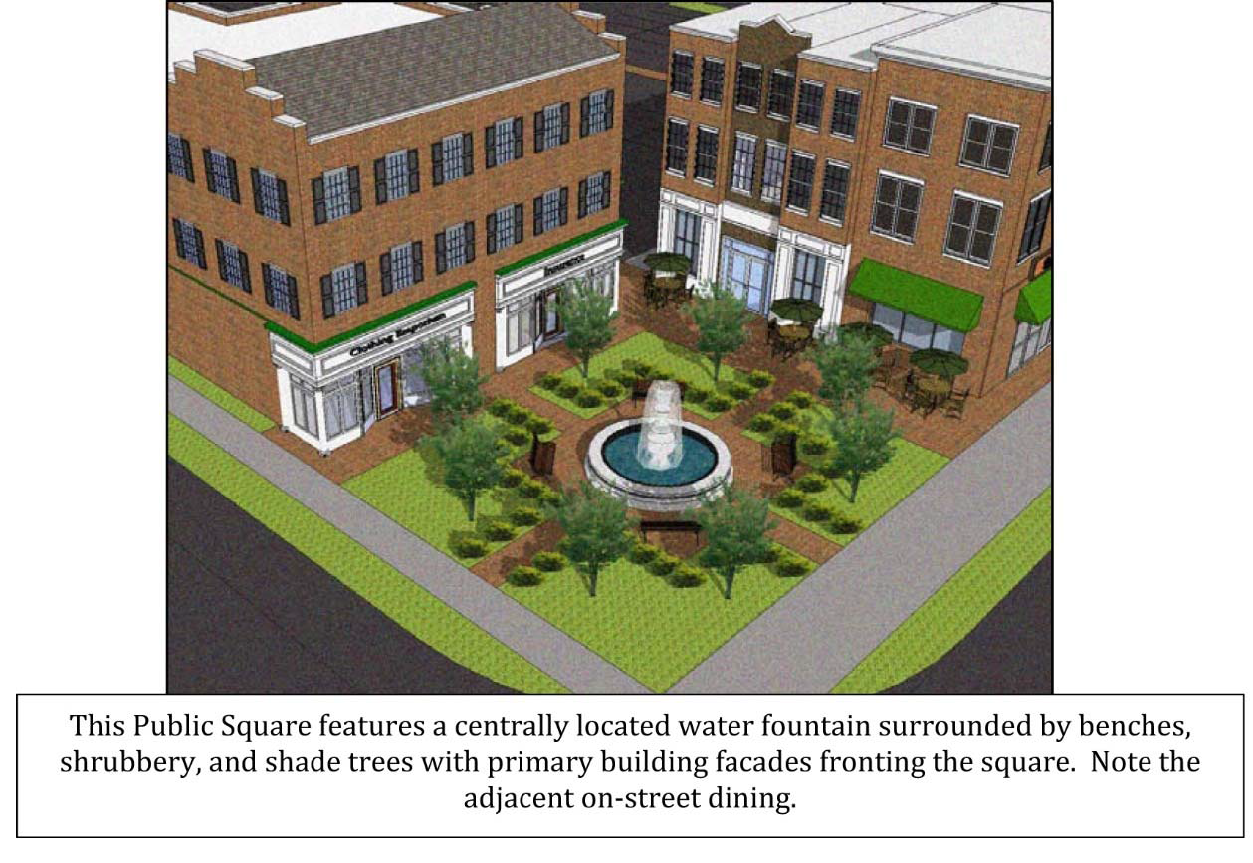
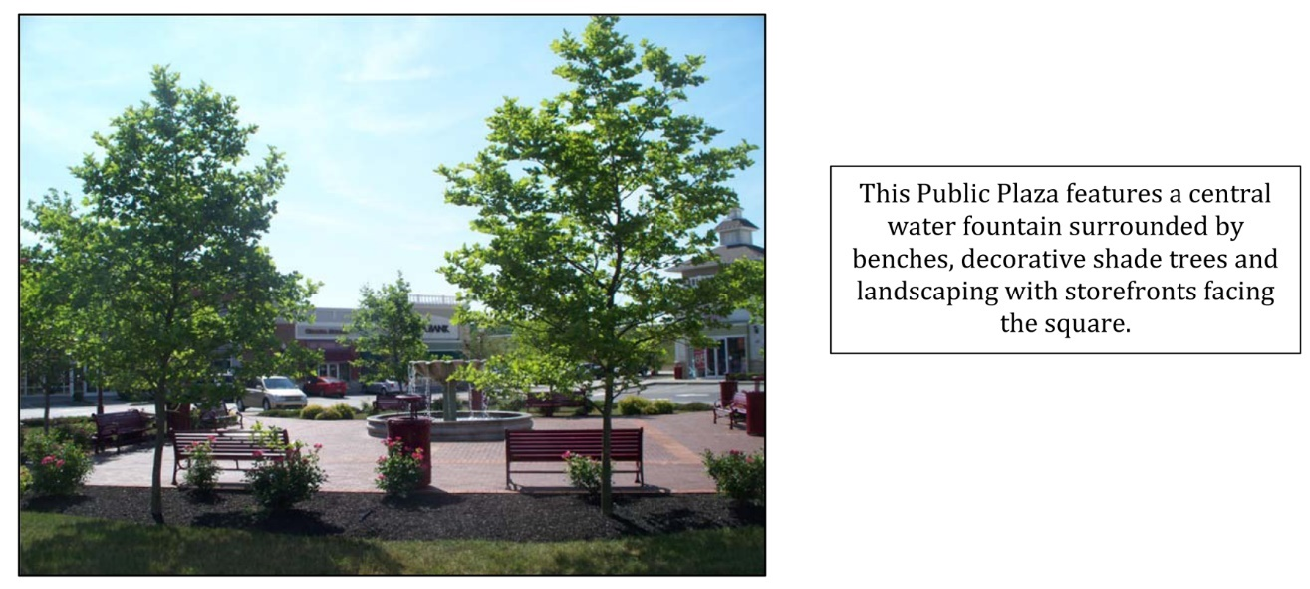
(iii)
Town center greens. Town center greens shall be generally rectangular in shape and shall be allowed on parcels greater than five acres in size. They shall be not be permitted to be located directly on the corner of intersections along U.S. Route 13.
Town center greens shall range in size from 10,000 square feet to 45,000 square feet. Any design in excess of 45,000 square feet may be approved by the planning and zoning commission if it meets the intent of these standards.
Primary building facades shall directly front onto the town center green on at least three sides and are strongly encouraged to front the green on all four sides.
To enhance the attractiveness of the overall site design and to encourage pedestrian connectivity between buildings, parking lots and adjacent commercial uses. Town center greens shall feature at least six different elements from the following list:
(a)
Sitting areas (such as benches, low seating walls).
(b)
Covered structure (such as a gazebo, pergola or pavilion).
(c)
Decorative paving (such as colored/stained concrete, brick or other type of paver).
(d)
Decorative planters.
(e)
Decorative flowering or evergreen shrubs.
(f)
Decorative, pedestrian-scale lighting.
(g)
Public art (such as monuments, sculptures, statuary).
(h)
Decorative water feature (such as a fountain, rain garden).
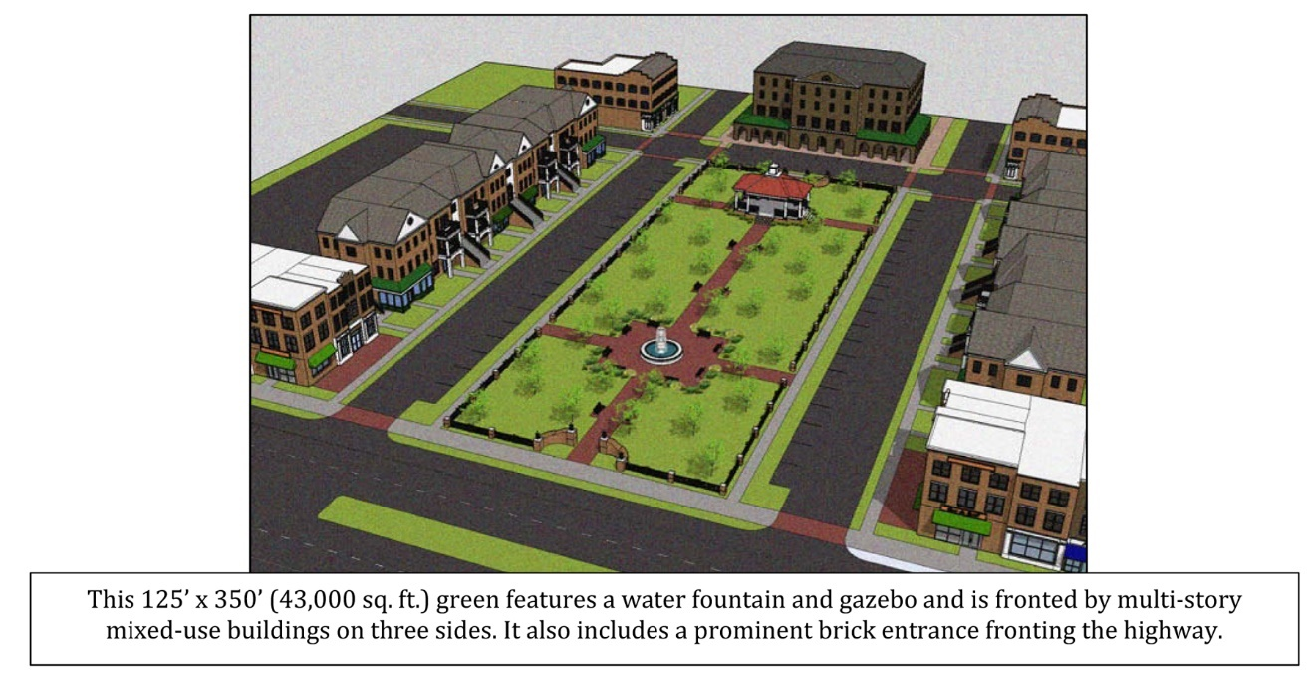
(iv)
Picnic area. This amenity is generally 2,500 to 10,000 square feet in size and must include at least six tables with accompanying seating.
(v)
Playground. This amenity must be at least 3,000 square feet in size and must include at least five pieces of recreational equipment suitable for children, with at least one ADA compliant piece of equipment.
(vi)
Clubhouse. This amenity is appropriate for mixed-use and residential projects, and must be at least 1,500 square feet in size, at least one and one-half stories, and include meeting space, recreational space, and restrooms.
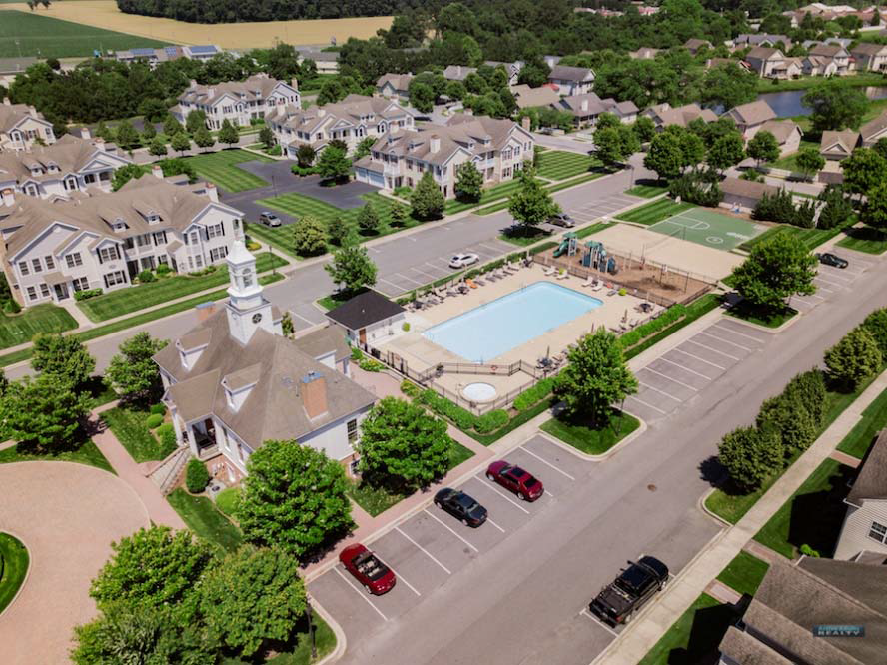
Illustration - Clubhouse, pool, and playing courts at Paynter's Mill (Milton, DE)
(vii)
Swimming pool. This amenity is appropriate for mixed-use and residential projects, and must also include accompanying restrooms and changing areas.
(viii)
Fitness center. This amenity may be located inside a clubhouse (must be in addition to the square footage requirement for the clubhouse), and must include at least 15 pieces of equipment.
(ix)
Pet park. This amenity is appropriate for mixed-use and residential projects. It must be a minimum of 10,000 square feet in size and shall be enclosed with a fence made of materials and a design the department of planning and inspections determines will withstand the weather and climate conditions common to the town and will be able to contain dogs of various sizes and breeds.
(x)
Developer's option. Other forms of common amenity space which meets the standards of this section may be permitted if approved by the planning and zoning commission.
(xi)
Site furniture standards.
(a)
Benches. Benches installed in common amenity spaces shall be black, six feet wide, Keystone Ridge Lamplighter (Model L16) as pictured below, or an approved alternative.
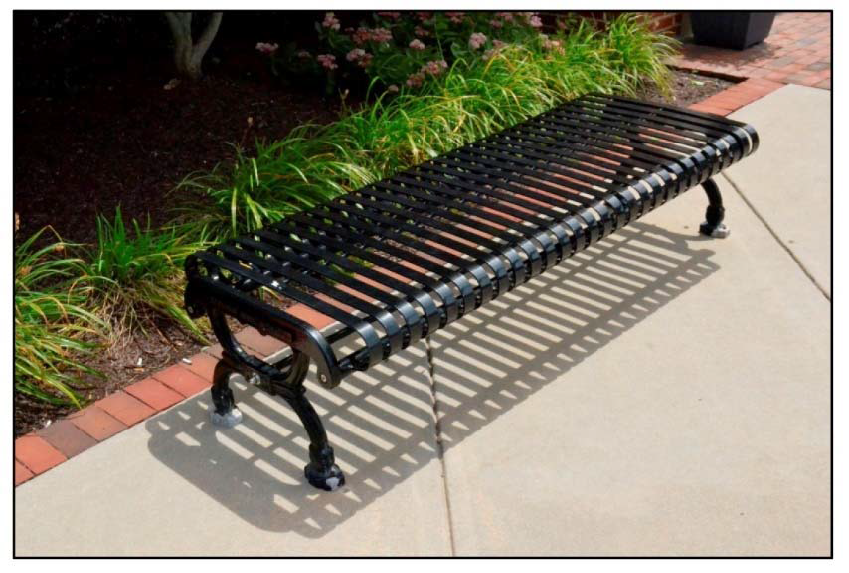
(b)
Trash receptacles. Trash receptacles installed in common amenity spaces shall be black, 32-gallon Keystone Ridge Midtown (Model MT3-32) as pictured below, or an approved alternative.
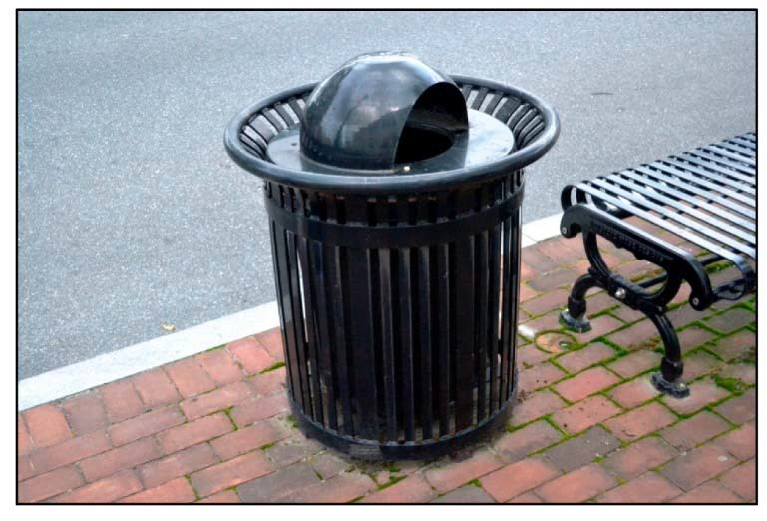
m.
Sign design.
(1)
Intent. Signage along the U.S. Route 13 Corridor shall be designed and installed in such a way that it becomes a cohesive part of site design, improving the overall visual quality and pedestrian scale of U.S. Route 13. All signage shall be consistent with and complimentary to the architectural design and materials of the building it serves. The sign design regulations outlined herein shall be in addition to those sign regulations outlined in subsection 6.15 (Signs) of this Zoning Code. With respect to the CCM district, any inconsistencies between these regulations and those in subsection 6.15 (Signs) shall be resolved in favor of these regulations.
(2)
Monument sign standards.
(a)
Monument signs shall mean any stand-alone, self-supporting structure affixed to a base that is equal to or wider than the sign itself.
(b)
The height of the monument sign shall be no taller than eight feet in height, and the area of the monument sign shall be no greater than 75 square feet. A monument sign located on a property with one or more multi-tenant building shall have a height not to exceed 16 feet and an area not to exceed 125 square feet.
(c)
The minimum monument sign setback is five feet from the existing right-of-way.
(d)
Monument signs shall be designed and constructed utilizing the same building materials used in the construction of the associated building and/or site.
(e)
Monument signs may be externally or internally illuminated; external illumination must be directed downward.
(f)
Only one monument sign per street frontage shall be permitted on a property. A property with more than one street frontage may have up to a maximum of two monument signs, provided that the collective sign area of the two monument signs shall not exceed 150 percent of the maximum area permitted for one monument sign.
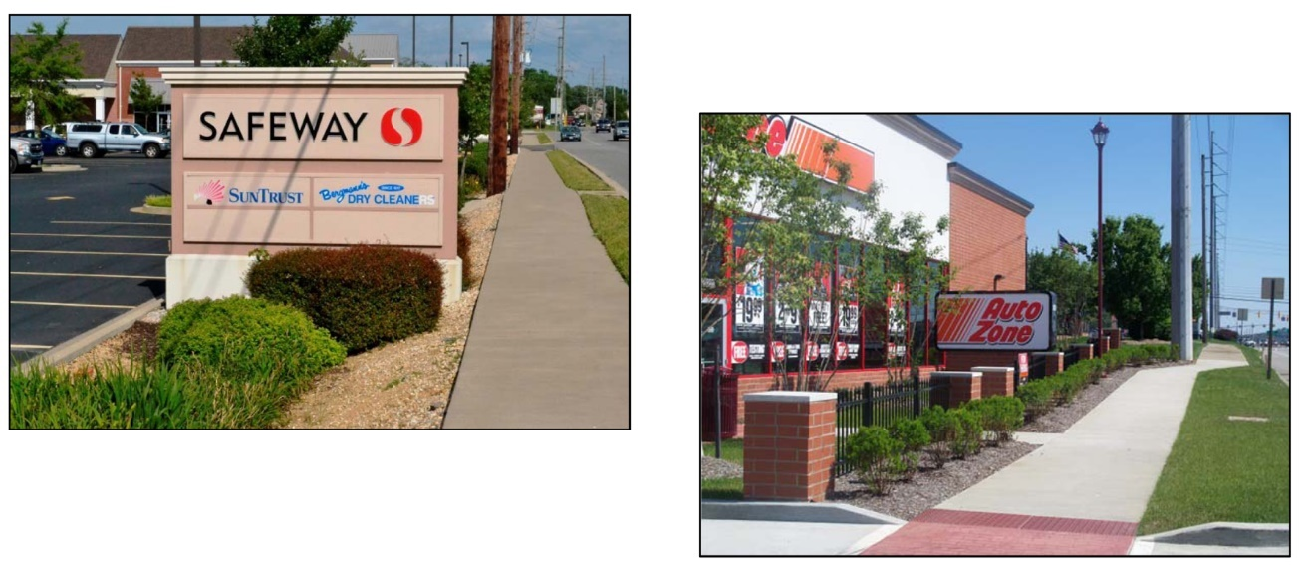
(3)
Wall signs.
(a)
Wall signs shall not project above the roof, parapet or exterior wall.
(b)
Wall signs shall be appropriately scaled to the building. Signable area for wall signs shall be no greater than 150 square feet. An increase may be granted for those wall signs that are painted onto the building and are incorporated as a major element of the facade.
(c)
In multi-occupant, multi-story buildings, walls signs for first floor occupants shall not extend above the window sill of the second-floor windows.
(d)
Wall signs are encouraged to compliment the architectural style of the building.
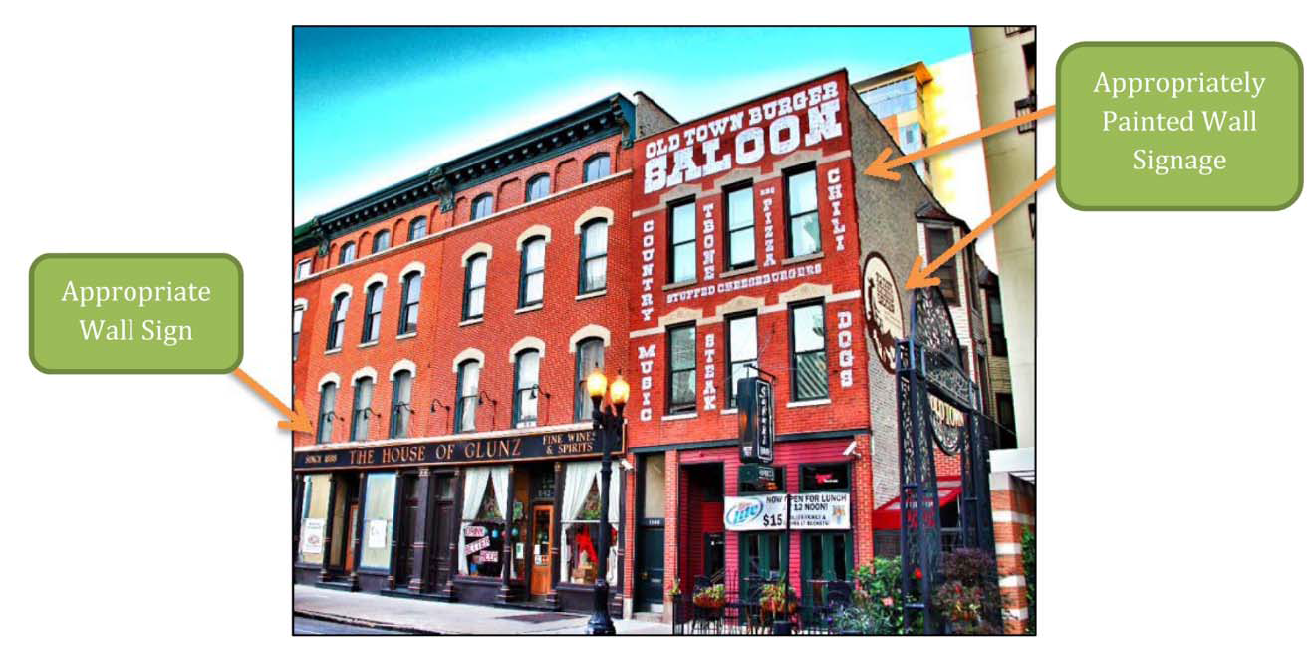
(4)
Window signs.
(a)
Window signs shall not cover more than 50 percent of the window area on the frontage of a building or tenant space and shall be comprised of individual letters, logos or design elements that are not encompassed by a solid opaque background so as not to obscure the view through the window.
(b)
Window signs are permitted on the first floor of a building only.
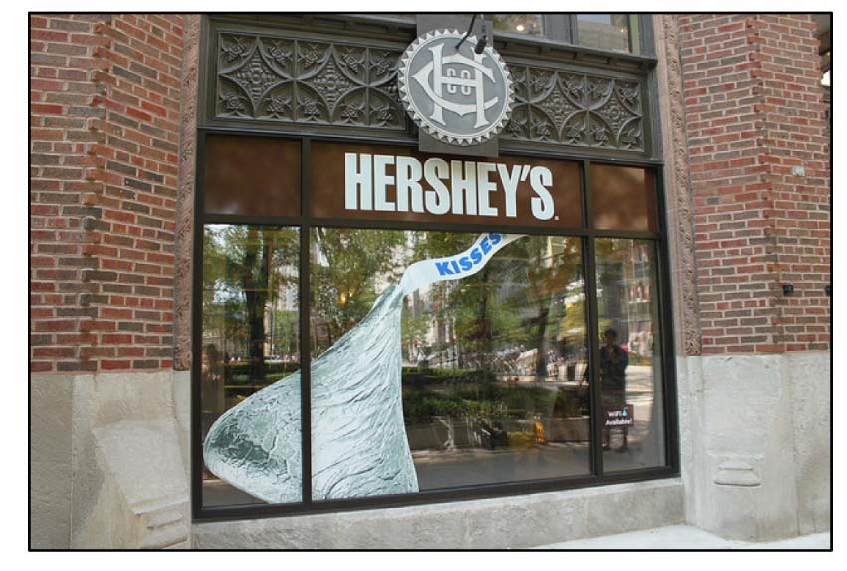
(5)
Projecting signs.
(a)
Projecting signs shall project no more than 18 inches from a building face or wall.
(b)
Projecting signs shall not exceed 30 square feet for all faces.
(c)
Projecting signs shall have a minimum of eight feet of clearance from the ground, a maximum height of 25 feet, measured to the top of the sign, and shall not extend beyond the roofline.
(d)
Projecting signs shall not extend more than five feet from the building face nor extend beyond the curb line of any street or parking area.
(e)
Multi-tenant buildings are permitted one projecting sign per tenant. Only those tenants with ground floor occupancy are permitted to install a projecting sign.
(f)
Projecting signs are encouraged to compliment the architectural style of the building.
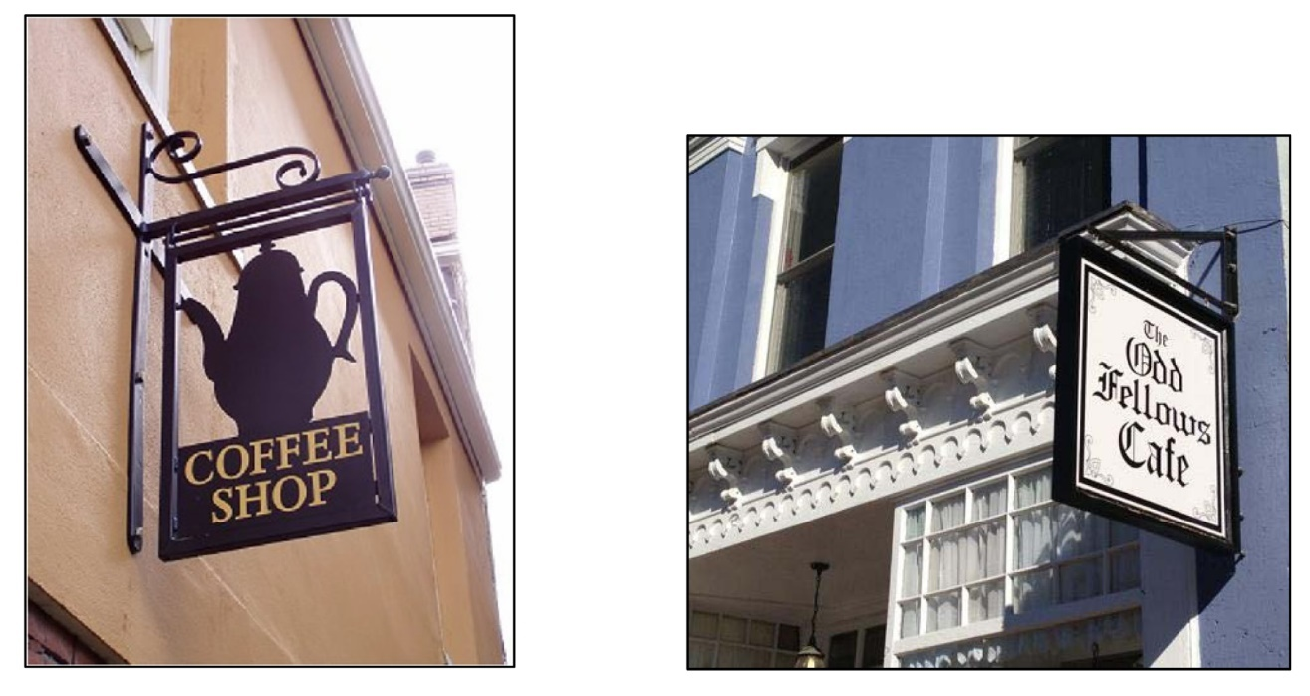
(6)
Awning signs.
(a)
Awning signs are permitted on the ground floor of a building only.
(b)
Awning signs shall have a minimum of eight feet clearance from the ground.
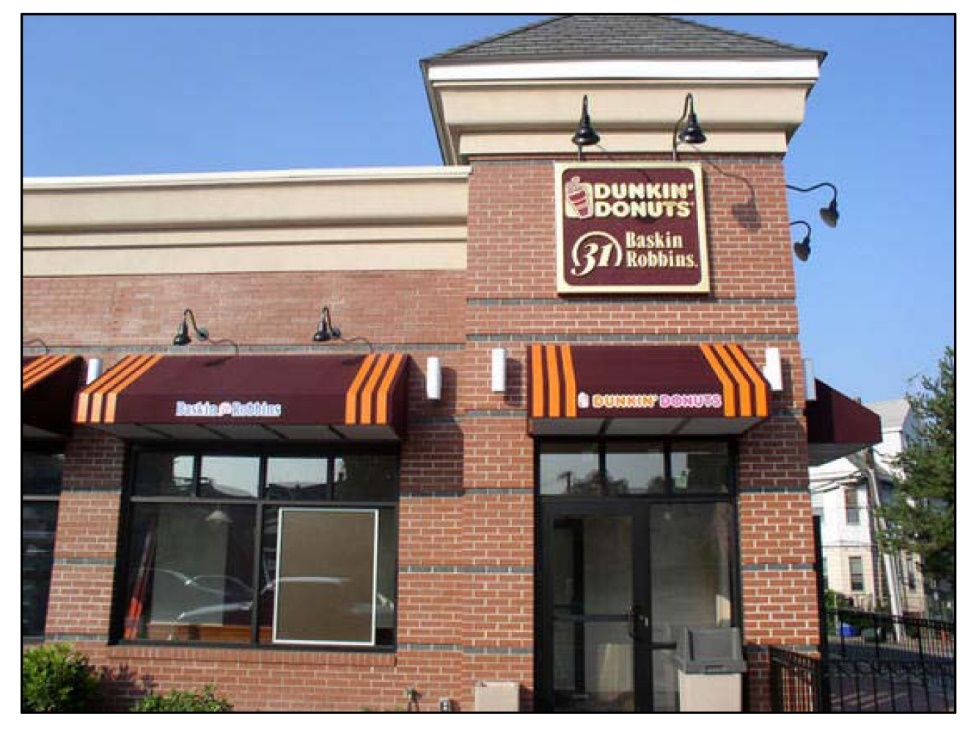
(7)
Prohibited signs.
(a)
Temporary or portable signs with changeable letter and numbers and portable trailer signs with changeable text panels.
(b)
Digital electronic signs of any kind with a sign area exceeding 25 square feet. For permitted digital electronic signs, the message displayed shall be static and shall not change more frequently than once every 15 minutes. The digital electronic sign shall not be located within 75 feet of any residential use, as measured from the sign to the closest point on the property line of the residential use.
(c)
Flashing signs.
(d)
Animated or revolving signs.
(e)
Signs that produce noise, sounds, emit smoke or vapor, particles or odors.
(f)
Signs with intermittent lights resembling or seeming to resemble the flashing lights customarily associated with emergency responder vehicles.
(g)
Vehicles and trailers used primarily as a sign.
(h)
Neon signs.
n.
Site design standards.
(1)
Sites shall be developed and generally laid out in a block or grid pattern formed by an interconnected network of streets and alleys. Blocks are encouraged to range in size from approximately 400 to 700 feet in length. Blocks larger than 700 feet shall have mid-point pedestrian connections. Dead end cul-de-sac streets are prohibited.
(2)
Buildings are encouraged to directly face the street or a public green, square, or courtyard. Those dwellings and buildings that directly front a green, square or courtyard shall directly abut a sidewalk.
(3)
Higher-density multi-story commercial, office, hotels, and mixed-use buildings are encouraged to front directly on U.S. Route 13 near the primary street entrance(s). Townhouses, apartment buildings, and big box and grocery stores (which require larger parking areas) shall be located in the interior or rear of the site(s). Townhouses and apartment buildings shall be prohibited from directly fronting U.S. Route 13.
(4)
Connections and/or street stubs shall be made to adjacent properties to provide interconnectivity between other developed or potentially developable residential neighborhoods and commercial centers. Connections shall be made to all adjacent streets and roadways wherever practicable.
(5)
A street hierarchy shall be utilized to ensure that street and ROW widths are appropriately scaled based upon their functional classification. Commercial and mixed-use buildings shall front on wider boulevard streets (with or without a landscaped median) while apartment buildings and townhouse blocks are encouraged to be located on narrower neighborhood-type streets.
(6)
On-street parking is strongly encouraged where practical on both commercially-oriented boulevard-type streets and residentially-oriented neighborhood-type streets. Curb extensions shall be installed where practical while marked crosswalks shall be required at all intersections.
(7)
A bus stop with a corresponding bus shelter shall be provided, at a location approved by DART, wherever practical based on the proximity and condition of nearby bus stops.
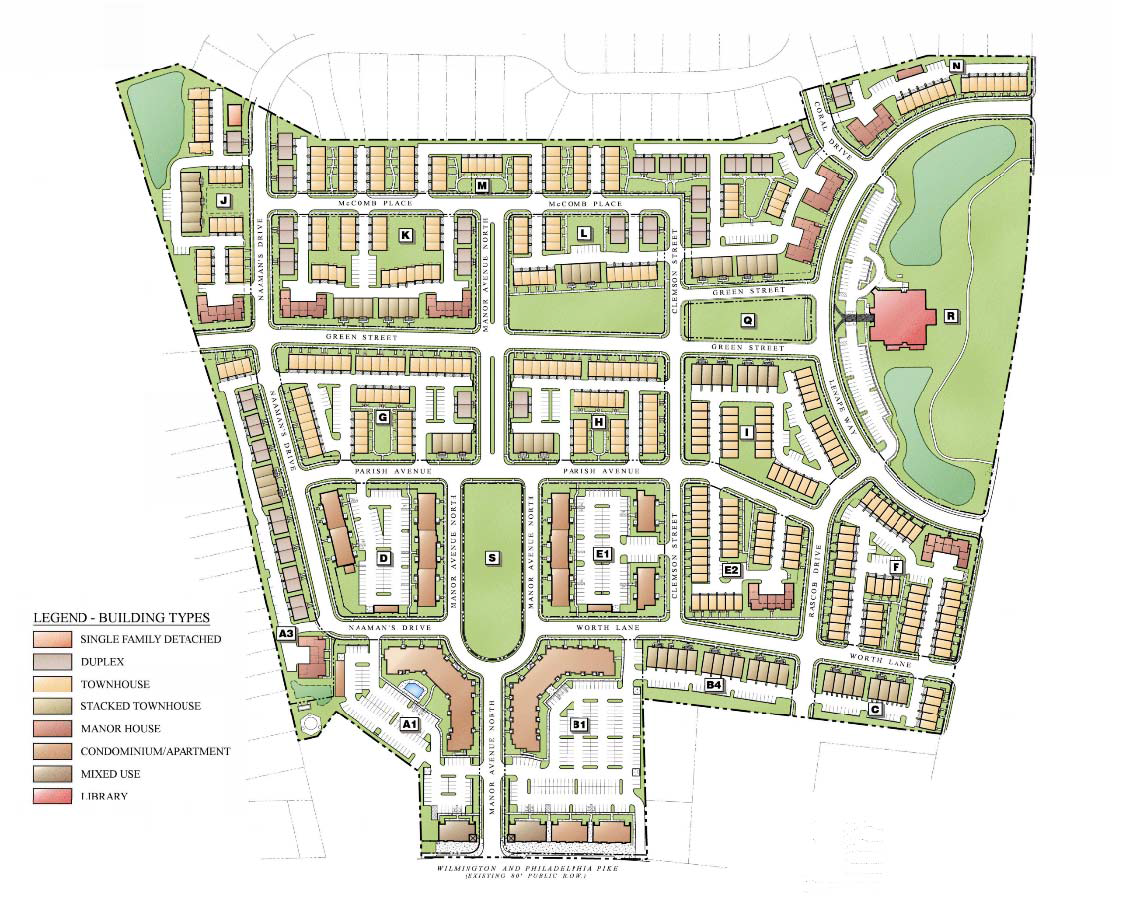
Illustration - Darley Green mixed-use project along U.S. Route 13 in Claymont, DE
with commercial and mixed-use buildings along the highway, followed by larger apartment
buildings immediately behind the entrance fronting a central boulevard, and with smaller
apartment and townhouse dwellings to the rear and periphery of the project.
o.
Residential use standards.
(1)
One- and Two-Family Dwellings. One-Family (also known as Single-Family Detached) and Two-Family Dwellings shall be permitted on those parcels 0.25 acres or smaller in size, which are of record in the Office of the Recorder of Deeds as of November 1, 2022. Any such residential uses approved by the Town Council may front directly on U.S. Route 13.
(2)
Townhouses Dwellings. Townhouse dwellings shall follow the bulks standards (i.e. setbacks, height, lot coverage, etc.) and design standards set forth in the Planned Village Conditional use option in Section 6.14(1)F(3) of the Smyrna Zoning Ordinance.
(3)
Apartment buildings.
(a)
Apartment buildings shall be two to four stories in height.
(b)
Apartment buildings may not exceed 36 units in size. Projects with 48 to 96 dwelling units shall have a minimum of two apartment building sizes. Projects with 97 to 192 dwelling units shall have three apartment building sizes. Projects with 193 or more dwelling units shall be required to have at least four apartment building sizes.
(c)
Apartment buildings shall be designed to resemble either: a block of attached (townhouse) dwellings, or a multi-story mixed-use or commercial building in the historic downtown of Smyrna or another historic downtown in Delaware.
(d)
Off-street parking areas serving apartment dwellings shall be located to the rear of said building(s) or to the side of said building if the configuration of the development makes rear parking impractical. Apartment dwellings may also be served by attached or detached garages or carports along rear-access alleys.
(e)
An unenclosed covered porch or stoop, at least four feet by four feet in size, shall be located at every ground floor exterior entrance in each apartment building.
(f)
A concrete sidewalk at least four feet in width must extend from the street to every exterior ground floor entrance of every apartment building.
(Ord. No. 017-22, § 1, 10-17-22)
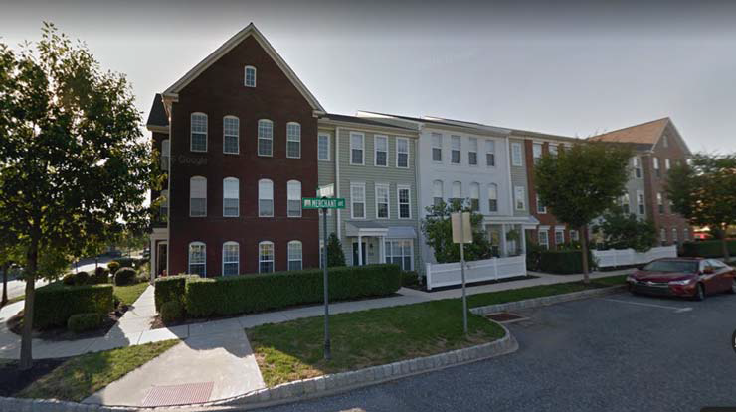
Illustration - 12-unit 3-story apartment building at Florin Hill (Mount Joy - Lancaster
County, PA)
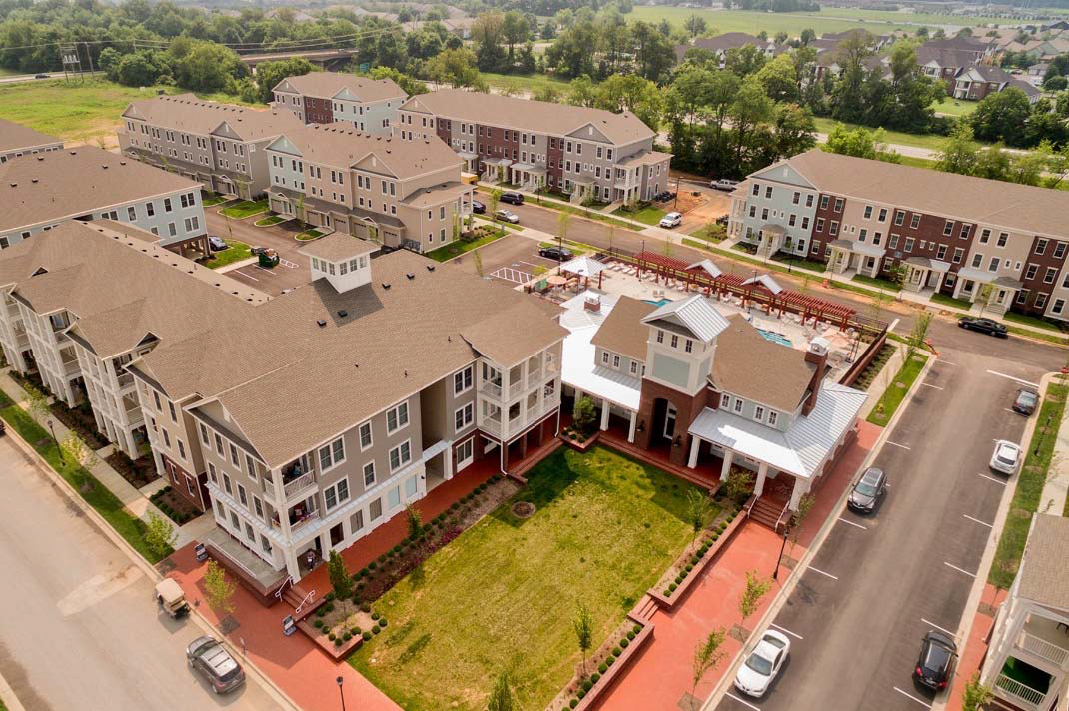
Illustration - Variously sized apartment buildings (6 - 15 units in size) on a traditional
grid street neighborhood with rear-accessed garages and parking areas at the Veranda
of Norton Commons (Louisville, KY)
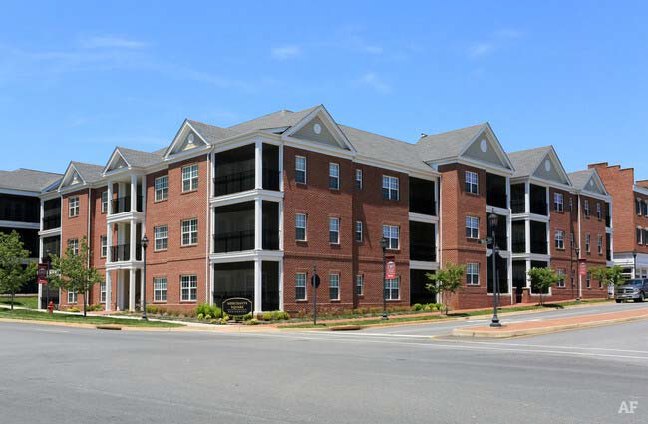
Illustration - Three-story 24-unit apartment building at Merchants Square at Spotsylvania
Courthouse, VA
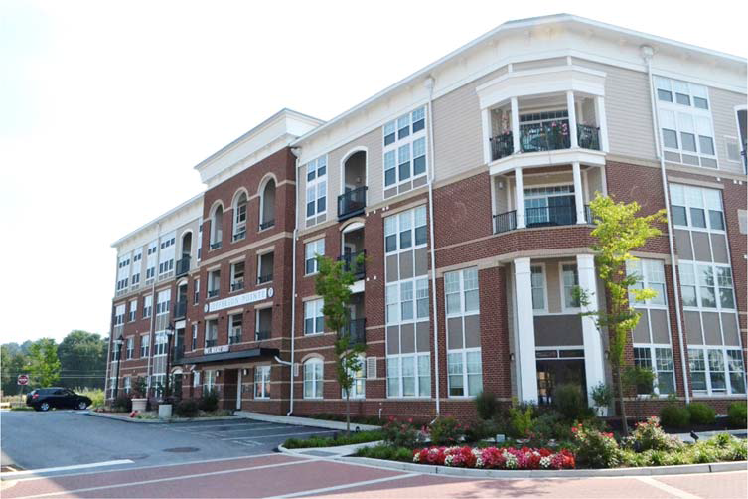
Illustration - Four-story 36-unit apartment building at Jefferson Pointe in West Chester,
PA
p.
Definitions.
Arcade: A continuous covered passageway parallel to and open to a street, open space or building and accessible and open to the public.
Awning: A roof-like cover that is temporary in nature and projects from the wall of a building for the purpose of shielding a doorway or window from the elements; also called a canopy
Balustrade: An entire railing system, including a top rail and its balusters and often a bottom rail, found along the edge of a porch, balcony or roof deck.
Belfry: That part of a steeple or top of a tower in which one or more bells are hung; also called a bell tower.
Belt course: A horizontal band of masonry extending horizontally across the facade of a building and occasionally encircling the entire perimeter; usually projects beyond the face of the building.
Cornice: Any molded horizontal projection that crowns or finishes the top of a wall where it meets the edge of a roof; the exterior trim of a structure where the wall and roof meet.
Cupola: A small roof tower, usually rising from the roof ridge.
Decorative window lintel: A decorative horizontal beam that spans the top of a window opening.
Dormer: A projection from a sloping roof that contains a window.
Marquee: A permanent canopy, usually of metal and glass, that projects over an entrance to a building, especially that of a theater or hotel.
Parapet: A decorative low wall or similar barrier at the edge of a roof, balcony, or terrace.
Pergola: A structure of open construction supported by regularly spaced posts or columns, often latticed and covered by climbing plants such as vines or roses.
Pilaster: A column partially embedded in a wall and usually non-structural.
Porch: A roofed, open area, attached to or part of a building, and with direct access to or from it, providing shelter to a building entrance.
Portico: A covered entrance having a roof supported by a series of columns or piers, commonly at the front entrance to a building.
Turret: A cylindrical tower that is usually corbelled from one corner of the structure.
Wall offset: A projection or recess of at least two feet in depth. Wall offsets that are incorporated onto buildings having a length of at least 60 feet or greater shall be integrated at a minimum of every 40 feet, each offset shall have a minimum length of 20 feet.
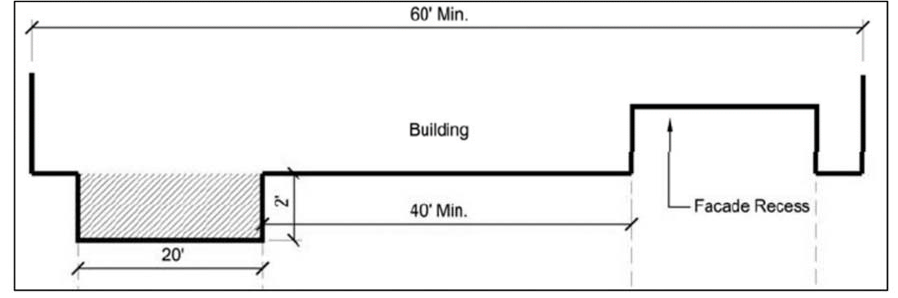
q.
Land use. Land uses permitted in the corridor commercial (CCM) zoning district shall be those uses outlined in the land use table located below. Any use not listed herein shall be expressly prohibited.
(Ord. No. 017-21, § 2, 11-1-21; Ord. No. 017-22, § 2, 10-17-22; Ord. No. 018-22, § 9, 10-17-22 Ord. No. 003-25, § 1, 2-18-25)
Editor's note— Ord. No. 017-21, §§ 1, 2, adopted November 1, 2021, repealed the former §§ 5.21 and 5.22, and enacted a new § 5.21 as set out herein. The former § 5.21 pertained to North Corridor (NC) and derived from Ord. No. 008-14, § 1, 5-7-14; Ord. No. 021-14, § 4, 1-20-15; Ord. No. 003-16, § 5, 3-21-16; Ord. No. 009-19, §§ 2, 4, 5, 12-2-19; and Ord. No. 016-20, § 1, 7-20-20. The former § 5.22 pertained to South Corridor (SCZ) and derived from Ord. No. 015-14, § 1, 11-3-14; Ord. No. 003-16, § 6, 3-21-16; Ord. No. 009-19, §§ 3, 6, 7, 12-2-19; and Ord. No. 016-20, § 1, 7-20-20.
22.
Planned village community district.
A.
Declaration of legislative intent and design standards requirement. The purpose of this district is to foster the development of traditional neighborhoods, like those found in the historic core of Smyrna, and in other small towns and cities of Delaware, on vacant greenfield tracts. A traditional neighborhood is compact, pedestrian in scale, with an interconnected network of streets and sidewalks, with a variety of dwelling types and sizes (to accommodate a variety of household sizes and incomes) built close to the street, including a variety of appropriately-scaled active and passive open spaces and recreational amenities, along with a mix of uses like schools, public buildings, and neighborhood commercial. Unless otherwise specified below, all uses and design standards shall conform to the planned village community conditional use standards set forth in section 6.14(1) of Appendix A - Zoning of the Smyrna Town Code.
B.
Permitted uses. The following uses are permitted: No building or premises shall be used and no building or part of a building shall be erected which is arranged, intended or designed to be used, in whole or in part, for any purpose except the following and in accordance with the Smyrna Zoning Ordinance and the Subdivision and Land Development Ordinance regulations:
(1)
One-family dwellings.
(2)
Two-family dwellings.
(3)
Semi-detached dwellings.
(4)
Attached (townhouse) dwellings.
(5)
Parks and playgrounds.
(6)
Family day care home.
(7)
Accessory uses and structures:
(a)
Minor home occupation pursuant to section 6.19 of this ordinance.
(b)
Other accessory uses and structures clearly incidental and customary to and associated with the permitted use.
C.
Uses permitted as special exception. The following uses are permitted only if approved as a special exception pursuant to section 9(2) of this ordinance:
(1)
Temporary real estate offices in developments containing a minimum of ten lots.
(2)
School bus stop shelters, as defined in section 19 of this ordinance.
(3)
Major home occupation pursuant to section 6.19 of this ordinance.
D.
Uses permitted as conditional uses. The following uses are permitted only if approved as a conditional use pursuant to section 6.14 of this ordinance:
(1)
Institutions of an educational nature.
(a)
Minimum requirements. Institutions of education in this zoning district shall be subject to the following requirements:
(1)
Maximum height: 45 feet.
(2)
Minimum front yard setback, principal structure: ten feet.
(3)
Maximum front yard setback, principal structure: 30 feet.
(4)
Minimum side yard setback: 20 feet.
(5)
Minimum rear yard setback: 50 feet.
(6)
Maximum lot coverage: N/A
(2)
Public utility uses.
(3)
Governmental buildings, structures, facilities and uses including, but not limited to, police stations, fire houses, ambulance stations, government offices, library.
(a)
Minimum requirements. Government buildings in this zoning district shall be subject to the following requirements:
(1)
Maximum height: 45 feet.
(2)
Minimum front yard setback, principal structure: ten feet.
(3)
Maximum front yard setback, principal structure: 20 feet.
(4)
Minimum side yard setback: ten feet.
(5)
Minimum rear yard setback: 20 feet.
(6)
Maximum lot coverage: N/A
(4)
Religious and fraternal organizations.
(a)
Minimum requirements. Religious and fraternal organizations in this zoning district shall be subject to the following requirements:
(1)
Maximum height: 45 feet.
(2)
Minimum front yard setback, principal structure: ten feet.
(3)
Maximum front yard setback, principal structure: 20 feet.
(4)
Minimum side yard setback: ten feet.
(5)
Minimum rear yard setback: 20 feet.
(6)
Maximum lot coverage: N/A
(5)
Apartment dwellings.
(a)
Minimum requirements. Apartment dwellings in this zoning district shall be subject to the following requirements:
(1)
Maximum number of units in building: 24 dwelling units.
(2)
Maximum height: 45 feet.
(3)
Minimum front yard setback, principal dwelling: six feet.
(4)
Maximum front yard setback, principal dwelling: 20 feet.
(5)
Minimum side yard setback: six feet.
(6)
Minimum rear yard setback: 20 feet.
(7)
Maximum lot coverage: N/A
(6)
Mixed-use buildings.
(a)
Mixed-use buildings shall only have commercial and/or office uses on the first floor, which shall be limited to the following uses: general retail, personal services, day care/nursery school, restaurant/bar, professional/medical offices, gyms and fitness centers, and financial institutions. Residential dwelling units are only permitted on the second and third floors.
(b)
Minimum requirements. Mixed-use buildings in this zoning district shall be subject to the following requirements:
(1)
Minimum building height: 24 feet (two stories).
(2)
Maximum height: 45 feet (three stories).
(3)
Maximum building footprint: 10,000 square feet.
(4)
Minimum front yard setback, principal structure: six feet.
(5)
Maximum front yard setback, principal structure: 20 feet.
(6)
Minimum side yard setback: ten feet.
(7)
Minimum rear yard setback: 20 feet.
(8)
Maximum lot coverage: N/A
(7)
Commercial/office buildings.
(a)
The following uses are permitted in commercial/office buildings: general retail, personal services, day care/nursery school, restaurant/bar, professional/medical offices, gyms and fitness centers, and financial institutions.
(b)
Minimum requirements. Commercial/office buildings in this zoning district shall be subject to the following requirements:
(1)
Minimum building height: 16 feet (one story).
(2)
Maximum height: 45 feet (three stories).
(3)
Maximum building gross floor area: 15,000 square feet.
(4)
Minimum front yard setback, principal structure: six feet.
(5)
Maximum front yard setback, principal structure: 20 feet.
(6)
Minimum side yard setback: ten feet.
(7)
Minimum rear yard setback: 20 feet.
(8)
Maximum lot coverage: N/A
(8)
Bed and breakfast establishments, subject to the following requirements:
(a)
Requirements for bed and breakfast establishments outlined in section 9.a(7) of the central commercial district (CC) shall be complied with unless otherwise specified herein.
(b)
Off-street parking spaces are encouraged to be located to the rear of the building, though side parking is also acceptable. With corner lots, the property owner shall designate one of the street frontages as the side yard for parking purposes. All parking areas fronting any public street, including side yard parking on a corner lot, must be screened by appropriate vegetative screening. Garages must be located to the rear of the building.
(c)
Anything in this Appendix A - Zoning to the contrary notwithstanding, each bed and breakfast is limited to one wall sign no greater than eight square feet in size and one monument sign no greater than eight square feet in size and no greater than four feet in height. Illuminated and electronic variable messaging signs are prohibited.
(d)
Where directly adjacent to a residential property, the adjoining property line(s) shall be adequately screened.
(9)
Accessory dwelling units, in accordance with the standards outlined in section 6.14 (Conditional uses, general guides and standards) and the following.
(a)
All building entrances must be served by a covered porch or portico at least four feet in width and four feet in depth.
(b)
A concrete sidewalk at least four feet in width must extend from the street to each exterior entrance and/or entry porch/stoop of the building.
(Ord. No. 018-22, § 10, 10-17-22)
E.
Parking. Parking shall be in accordance with section 6, Supplementary district regulations.
F.
Minimum requirements.
(1)
Dwelling, one family and two family:
a.
Minimum lot area: 3,200 square feet.
b.
Minimum lot width: 40 feet.
c.
Maximum lot width: 70 feet.
d.
Minimum lot depth: 80 feet.
e.
Maximum height, two and one-half stories: 35 feet.
f.
Minimum front yard setback: ten feet.
g.
Maximum front yard setback: 20 feet.
h.
Side yard setback: minimum six feet.
i.
Rear yard setback: 20 feet.
j.
Maximum lot coverage: N/A
(2)
Dwelling, semidetached (per unit):
a.
Minimum lot area: 2,400 square feet.
b.
Minimum lot width: 30 feet.
c.
Maximum lot width: 50 feet.
d.
Minimum lot depth: 80 feet.
e.
Maximum height: two and one-half stories, 35 feet; three stories, 45 feet.
f.
Minimum front yard setback: ten feet.
g.
Maximum front yard setback: 20 feet.
h.
Unattached side yard setback: six feet.
i.
Attached side yard setback: zero feet.
j.
Rear yard setback: 20 feet.
k.
Maximum lot coverage: N/A
(3)
Dwelling, attached (per unit):
a.
Minimum lot area: 1,600 square feet.
b.
Minimum lot width: 20 feet.
c.
Maximum lot width: 50 feet.
d.
Minimum lot depth: 80 feet.
e.
Maximum height, three stories: 45 feet.
f.
Minimum front yard setback: six feet.
g.
Maximum front yard setback: 20 feet.
h.
Unattached side yard setback: six feet.
i.
Attached side yard setback: zero feet.
j.
Rear yard setback: 20 feet.
k.
Maximum lot coverage: N/A
G.
Accessory buildings. For minimum requirements, see section 6.8, Accessory buildings.
H.
Maximum gross density. The maximum gross density shall be 12 units per acre.
(Ord. No. 016-21, § 1, 11-1-21)

