
Smyrna City Zoning Code
SECTION 6
- Supplementary district regulations.
1.
Off-Street Parking and Loading Requirements.
A.
Off-Street Parking Requirements.
1.
There shall be provided at the time of construction or enlargement of any main building or structure a minimum number of off-street parking spaces in accordance with the minimum national standards as designated by AAHSTO (American Association of State Highway and Transportation Officials) and the ANSI (American National Standards Institute) A117-1. The minimum parking space dimensions shall be based upon the following configurations:
(a)
Perpendicular (90 degrees): 9′ × 18′
(b)
Angled (60 degrees): 9′ × 20′ (22 ft stall depth)
(c)
Angled (45 degrees): 9′ × 20′ (21 ft stall depth)
(d)
Angled (30 degrees): 9′ × 20′ (18 ft stall depth)
(e)
Parallel (0 degrees): 8′ × 22′
2.
Parking space as required shall be located on the same lot with the main buildings or within walking distance of the main building.
3.
Reserved.
4.
Parking lots, located in all commercial zoning districts, with the exception of the Central Commercial zoning district, with frontage on the public rights-of-way are required to have a set-back distance of ten feet (10) from the property line and suitably landscaped with year round green plantings to aesthetically improve the appearance of the area. The plantings should not interfere with line-of-sight distances.
The Board of Adjustment may grant variances from the requirements of this paragraph following notice and public hearing.
5.
The quantity and dimensions of off-street parking spaces provided for disabled individuals shall be in accordance with those standards outlined in the Americans with Disabilities Act.
6.
Parking of vehicles on unpaved surfaces within the front yard of all districts shall be prohibited. Exception: Emergency vehicles responding to an emergency, special delivery or moving vehicles which require front door access on a one-time basis. Off-street parking areas for all new construction shall be asphalt, concrete, pavers, or another hardened surface approved by the Town of Smyrna.
7.
Bicycle parking racks are required to be provided for non-residential establishments in all zoning districts except the IORP and LM Districts, and shall be placed in a brightly illuminated section of the parking area safe from vehicular traffic. A minimum of one rack (5 bicycle spaces) shall be provided in every parking lot containing twenty spaces or more.
8.
Interior parking lot landscaping requirements:
(a)
Blocks of parking stalls shall be limited to fifteen (15) consecutive spaces interrupted by a fifteen (15) foot by nine (9) foot landscaped island.
(b)
A maximum of five (5) consecutive rows of parking are allowed prior to a full row length landscaped island a minimum six (6) feet wide.
(c)
All parking rows are to be terminated with a minimum eighteen (18) by nine (9) foot landscaped island.
(d)
All islands are to be a mix of grass covering, shrubs and at least one (1) street tree per 160 square feet of interior parking lot landscaping required.
9.
The minimum number of parking spaces is as follows:
(a)
Residential structures:
(i)
Single-family dwellings, two (2) spaces per unit (including garage).
(ii)
Two-family dwellings, two (2) spaces per unit (including garage).
(iii)
Semidetached dwellings, two (2) spaces per unit (including garage).
(iv)
Townhouse dwellings, two (2) spaces per unit (including garage).
(v)
Apartment dwellings:
(a)
Efficiency and one-bedroom, 1.5 spaces per unit (including garage).
(b)
Two bedrooms or more, 2 spaces per unit (including garage).
(b)
Institutional Uses:
(i)
Emergency Department or Urgent Care Center, one (1) space per 300 square feet of gross floor area ("GFA")
(ii)
Golf Course, three (3) spaces per hole
(iii)
Government Offices, one (1) space per 300 square feet of GFA
(iv)
Hospital, five (5) spaces per bed
(v)
In-patient Rehabilitation Hospitals & Nursing Homes, 0.5 spaces per bed
(vi)
Library, one (1) space per 250 square feet of GFA
(vii)
Museum, 1.5 spaces per 1,000 square feet of GFA
(viii)
Private Clubs, Lodges, & Philanthropic Organizations, one (1) space per 400 square feet of GFA
(ix)
School (Elementary/Middle), one (1) space per five (5) students
(x)
School (High), one (1) space per three (3) students
(xi)
Religious Institutions, 15 spaces per 1,000 square feet of GFA or one (1) space per three (3) seats
(xii)
University/College (Non-Resident), one (1) space per three (3) students
(xiii)
University/College (Resident), one (1) space per two (2) students
(xiv)
Parks (Passive Recreation), four (4) spaces per acre
(xv)
Parks (Active Recreation), 20 spaces per playing field
(c)
Commercial Uses:
(i)
Adult Entertainment, one (1) space per 100 square feet of GFA
(ii)
Automobile Parts and Service Center, three (3) spaces per 1,000 square feet of GFA
(iii)
Automobile Service (Gas) Station, one (1) space per 100 square feet of GFA
(iv)
Automobile, Truck, Farm & Marine Equipment Sales & Service, one (1) space per 250 square feet of GFA
(v)
Banks and Financial Institutions, one (1) space per 200 square feet of GFA
(vi)
Bar (Defined as Alcohol Beverage Establishment), one (1) space per 100 square feet of GFA
(vii)
Big Box Retail (>50,000 SF), one (1) space per 500 square feet GFA
(viii)
Bowling Alley, four (4) spaces per lane
(ix)
Breweries and Distilleries, one (1) space per 125 square feet of tasting room
(x)
Building Materials Sales Yard, one (1) space per 1,000 sq. ft. GFA
(xi)
Car Wash, two (2) spaces per stall
(xii)
Coffee Shop, fifteen (15) spaces per 1,000 square feet GFA
(xiii)
Commercial Services, three (3) spaces per 1,000 square feet of GFA
(xiv)
Convenience Store (No Gas Pumps), one (1) space per 250 square feet GFA
(xv)
Day Care and Nursery School, one (1) space per three (3) children
(xvi)
Dental and Veterinary Clinics, one (1) space per 250 square feet GFA
(xvii)
Funeral Home, twenty (20) spaces per 1,000 square feet of viewing area
(xviii)
General Retail, one (1) space per 200 square feet GFA
(xix)
Grocery Store or Supermarket, one (1) space per 250 square feet GFA
(xx)
Gym and Fitness Centers, one (1) space per 125 square feet GFA
(xxi)
Hotels, one (1) space per room plus one (1) space per 400 square feet of banquet area
(xxii)
Ice skating rink, one (1) space per 200 square feet GFA
(xxiii)
Indoor Entertainment Facility, one (1) space per 300 square feet GFA
(xxiv)
Liquor Stores, one (1) space per 400 square feet GFA
(xxv)
Marijuana Dispensary, one (1) space per 125 square feet GFA
(xxvi)
Medical Offices, one (1) space per 250 square feet GFA
(xxvii)
Ministorage Facilities, one (1) space per 5,000 square feet GFA
(xxviii)
Personal Services, one (1) space per 200 square feet GFA
(xxix)
Professional Offices, three (3) spaces per 1,000 square feet GFA
(xxx)
Recreational Vehicle Sales & Service, one (1) space per 500 square feet GFA
(xxxi)
Restaurant (Drive-Thru), one (1) space per 125 square feet GFA
(xxxii)
Restaurant (Full-Service), twelve (12) spaces per 1,000 square feet GFA
(xxxiii)
Theater, one (1) space per 100 square feet GFA or one (1) space per three (3) seats
(d)
Industrial Uses:
(i)
Food Processing Facilities, one (1) space per 500 square feet GFA or one (1) space per employee on the largest shift, whichever is greater
(ii)
Lumber and Contractors Yard, 0.75 space per 1,000 square feet GFA
(iii)
Manufacturing, one (1) space per 500 square feet GFA or one (1) space per employee on the largest shift, whichever is greater
(iv)
Research, Design, Testing and Development Laboratories, one (1) space per 400 square feet GFA or one (1) space per employee on the largest shift, whichever is greater
(v)
Warehouse and Distribution Centers, one (1) space per 800 square feet GFA or one (1) space per employee on the largest shift, whichever is greater
(e)
There shall be no minimum number of required off-street parking spaces in the central commercial (CC) district, irrespective of the use of the property.
The parking requirements shall be proportionately calculated, rounded down to the nearest parking space, and all uses shall be required to have the minimum spaces identified herein. Any use not specifically referenced shall be required to have the minimum number of parking spaces required for the most closely analogous use identified herein.
(Ord. No. 009-25, § 1, 4-21-25)
B.
Off-street Loading Requirements.
1.
The minimum standard for off-street loading spaces is (unless otherwise noted): each required off-street loading space shall have minimum dimensions of twelve (12) feet wide and sixty (60) feet long. If more than one (1) loading space is required, subsequent loading spaces may have minimum dimensions of twelve (12) feet wide and forty (40) feet long. At no time shall any part of a truck or van be allowed to extend into a public thoroughfare or right-of-way while the truck or van is being loaded or unloaded. If the outdoor loading area is covered, but not totally enclosed, the minimum height of the outdoor loading space area shall be fourteen (14) feet. When more than one building is located on a parcel, the standards outlined herein shall be calculated based on the total square footage of all the buildings located on the parcel.
(a)
Hospitals or similar welfare institutions, one (1) off-street loading space for a floor area of 10,000 square feet, one (1) additional off-street loading space for each additional 25,000 square feet or fraction thereof.
(b)
Hotels and motels, one (1) off-street loading space for each 25,000 square feet of floor area or fraction thereof.
(c)
Clubs and lodges, one (1) off-street loading space for a floor area of 10,000 square feet, one (1) additional off-street loading space for each additional 25,000 square feet or fraction thereof. (In lieu of the standard dimensions found in Section B.1, all loading spaces for clubs and lodges shall be at least ten (10) feet wide, twenty (20) feet long and seven and one-half (7½) feet high.)
(d)
Manufacturing buildings, sufficient off-street loading spaces shall be required. Staff will determine the sufficiency of the off-street loading spaces after reviewing written documentation from the applicant through the site plan review process.
(e)
Reserved.
(f)
Physician's office, one (1) off-street loading space for a floor area of 10,000 to 25,000 square feet, one (1) additional off-street loading space for each additional 25,000 square feet or fraction thereof.
(g)
Bowling alley, one (1) off-street loading space for 8,000 square feet to 25,000 square feet of floor area, and one (1) additional off-street loading space for each additional 25,000 square feet of floor area or faction thereof so used.
(h)
Schools, one (1) off-street loading space for a floor area of 10,000 square feet, one (1) additional off-street loading space for each additional 25,000 square feet or fraction thereof.
(i)
Theater, one (1) off-street loading space for 8,000 square feet to 25,000 square feet of floor area, and one (1) additional off-street loading space for each additional 25,000 square feet of floor area or faction thereof so used.
(j)
Offices, one (1) off-street loading space for a floor area of 10,000 to 25,000 square feet, one (1) additional off-street loading space for each additional 25,000 square feet or fraction thereof.
(k)
Retail, one (1) off-street loading space for 5,000 square feet to 25,000 square feet of floor area, and one (1) additional off-street loading space for each additional 25,000 square feet of floor area or faction thereof so used.
(l)
Restaurant, (1) one off-street loading space for 5,000 square feet to 25,000 square feet of floor area, and one (1) additional off-street loading space for each additional 25,000 square feet of floor area or faction thereof so used.
(m)
Services, one (1) off-street loading space for 5,000 square feet to 25,000 square feet of floor area, one (1) additional off-street loading space for each additional 25,000 square feet of floor area or faction thereof so used.
(n)
Funeral home, one (1) off-street loading space for each chapel (such loading spaces shall be at least ten (10) feet wide, twenty (20) feet long and seven and one-half (7½) feet high, in lieu of the standard dimensions found in Section B.1.)
C.
Planning and Zoning Commission Waiver. The Planning and Zoning Commission may waive required off-street parking and loading spaces in the following instances:
(1)
On an improved lot, when it can be demonstrated that retrofitting the site for off-street parking and loading space(s) is impractical or impossible;
(2)
When the applicant can demonstrate that the intended use is such that no deliveries by large vehicles is expected, now or in the future;
(3)
When the applicant can demonstrate that the requirements of this ordinance are far in excess of the actual needs on the site;
(4)
Where on-street parking and loading areas are provided nearby.
All unique situations or special exceptions for off-street parking requirements regarding the size of the parking space or the width of travel lanes must also meet the approval of the Planning and Zoning Commission.
(Ord. of 8-16-93(2), § 5; Ord. of 3-6-00(2), § 2; Ord. No. 024-03, § 1, 9-15-03; Ord. No. 019-04, § 1, 11-15-04; Ord. No. 003-08, § 1, 10-6-08; Ord. No. 009-18, §§ 3—5, 7-16-18)
2.
Travel lanes for off-street commercial parking.
(a)
Ninety-degree parking requires a 20-foot wide single travel lane. Ninety-degree parking adjacent to two directions of travel requires a 24-foot wide (12-foot wide each direction) travel opening.
(b)
Sixty-degree parking requires an 18-foot wide travel land [lane] (one direction only).
(c)
Forty-degree parking requires a 16-foot wide travel land [lane] (one direction only).
(d)
Thirty-degree parking requires a 12-foot wide travel land [lane] (one direction only).
(e)
Angles of parking which are in between the above will be required to meet the next higher requirement.
3.
Reserved.
(Ord. No. 009-18, § 6, 7-16-18)
4.
Visibility at intersections in zoning districts. On a lot in any zoning district, nothing shall be erected, placed, planted, or allowed to grow in such a manner as to impede vision between a height of 2½ and ten feet above the centerline grades of the intersecting streets in the area bounded by the street lines of such corner lots and a line joining points along said street lines 25 feet from the point of intersection.
5.
Stripping of topsoil. No topsoil shall be stripped, excavated, or otherwise removed for use other than in connection with the construction or alteration of a building on such premises and excavations and grading incidental thereto.
6.
Height regulations. The height restrictions in the schedule of district regulations do not apply to spires, cupolas, chimneys, antennas, water tanks, belfries, flagstaffs, hose towers or other structures placed above roof level, not intended for human occupancy and necessary for the operation of the permitted use.
7.
Front yard adjustment. The front yard required for a dwelling in an R-2 and R-3 district may be reduced in the case of a dwelling located between two dwellings which lack the required front yard and which are less than 100 feet apart. In such case, the front yard depth shall be no less than that of the deeper adjoining lot.
8.
Accessory buildings. An accessory building may be located in any required side or rear yard provided:
a.
Such building shall not exceed 15 feet in height.
b.
Such buildings shall be set back at least six feet from any property line and shall not be located less than ten feet from the principal building. Exception: Wood frame decks on pier foundations without a roof shall not be considered part of the principal structure for the purpose of this section.
(Ord. of 9-21-92; Ord. of 12-18-00(7), § 1)
c.
All such buildings in the aggregate shall not occupy more than 30% of the area of the required rear and side yard. Accessory buildings constructed at the same time may be located in pairs or groups in the required rear or side yard along the common sideline or rear line of contiguous lots.
d.
Handicap ramps may be located in the front, side and rear yard set back(s) subject to design and location as approved by the administrative authority. The planning department shall ensure the ramp location to be least obtrusive to abutting property owners. The building permit will be conditional in that the ramp must be removed within 30 days when the ramp is no longer required. The applicant shall provide the planning department with a physician's note stating a handicap ramp is required and the name of the individual for whom it is required. The individual must reside at the address that the building permit is being issued for. A letter from a physician is required annually documenting the continued need for the ramp.
e.
Waste container enclosures may extend up to four feet into the front, side, and rear yard setbacks. A waste container enclosure shall be a solid opaque wall or fence constructed of vinyl, lattice, brick, wood, stucco, or metal, that screens a waste or recycling container.
(Ord. No. 002-03, § 1, 3-18-03; Ord. No. 009-23, § 4, 6-20-23)
9.
Performance standards. The following standards are applicable to all structures and uses. The purpose of these standards is to regulate any use which may be objectionable through the emission of smoke, odor, fumes, gases, dust, fly ash, vapors or other forms of air pollution, noise, vibration, fire, explosive, and radioactive hazards, electromagnetic disturbance, and any other element that may have an adverse effect on any structure or use located outside of the property limits of the creator. Provisions for administration of these standards are set forth in section 7.5 of this ordinance.
a.
Fire and explosion hazards. All activities involving and all storage of inflammable and explosive materials shall be provided at any point with adequate safety devices against the hazard of fire and explosion and adequate firefighting and fire suppression equipment and devices standard in the industry. Burning of waste materials in open fires is prohibited at any point.
b.
Air pollution.
(1)
Smoke density. No smoke from any source of combustion, the shade or appearance of which is darker than no. 1 on the Ringelmann smoke chart, shall be emitted into the open air except that a density described as no. 2 in the Ringelmann chart may exist for a total of not more than three minutes in any 15-minute period of time when building a new fire or combustion equipment breakdown occurs. The Ringelmann chart, as published and used by the Bureau of Mines, United States Department of the Interior, is hereby adopted and made a part of these regulations.
(2)
Fly ash, dust, fumes, vapors, gases, and other forms of air pollution. No emission shall be permitted which can cause any damage to health, animals, vegetation, or other forms of property, or which can cause any excessive soiling, at any point, and in no event any emission from any chimney or otherwise of any solid or liquid particles in concentrations exceeding 0.3 grains per cubic feet of the conveying gas at any point. For measurement of the amount of particles in gases resulting from combustion, standard corrections shall be applied to a stack temperature of 500 degrees Fahrenheit and 50 percent excess air.
c.
Emission of heat, glare, radiation, fumes or odors. Every use shall be so operated that it does not emit an obnoxious, offensive or detrimental (to health or property) degree of heat, glare, radiation, fumes or odors at any point beyond any lot line of the lot on which the use is located.
d.
Vibration generated. Every use shall be so operated that the ground vibration inherently and recurrently generated is not perceptible at any point beyond any lot line of the lot on which the use is located.
e.
Volume of sound generated. Every use shall be so operated that the volume of sound inherently and recurrently generated by any use shall not exceed the standards set forth below as measured along any lot line of the lot on which the use is located.
(1)
Sound levels shall be measured with a sound level meter and associated octave band filter manufactured according to the most recent standards prescribed by the American Standards Association.
(2)
The maximum permitted sound pressure levels, in decibels, for the designated octave bands shall be as set forth in the following table:
Corrections to be made for noise not radiated continuously of or special character.
*Apply one of these corrections only
f.
Electrical disturbance. Every use shall be so operated so that no electrical disturbance (except from domestic household appliances) adversely affecting the operation at any point of any equipment other than that of the creator of such disturbance.
(Ord. of 8-16-93(2), § 6)
10.
Planned development. The purpose of these provisions is to encourage the development of areas within the town as integrated, well-planned units allowing for flexibility of lot and yard sizes, structure types, while at the same time providing for more open space resulting in a more desirable living environment. It is not the intent of this section to permit any development which would not be in keeping with the general intent of this ordinance.
In any R-1, R-2, R-3 district, the planning commission may authorize, after public hearing (see section 14), deviation from the regulations of this ordinance pertaining to minimum lot size, area per family, lot width and depth, front and year yard requirements, and may allow any one or a combination of residence types as permitted within the residential districts of this ordinance subject to the following restrictions:
a.
The planning commission must determine if the result of the proposal will be an integrated site plan no less beneficial to the residents of such neighboring properties than would be obtained under the use, area, yard, and width and depth regulations of this ordinance for buildings developed on separate lots.
b.
The plan shall have been approved in accordance with the Town of Smyrna land subdivision regulations.
c.
The average lot area per family within contiguous portions of the development in a single zoning district is not reduced thereby to an amount less than that required by this ordinance in such district; provided that no land of such size as to be capable of further subdivision under the applicable district regulations shall be included in determining the average lot area, unless the possibility of such further subdivision under the applicable district regulations shall be included in determining the average lot area, unless the possibility of such further subdivision is eliminated either by a deed restriction or agreement in form acceptable to the town solicitor and duly recorded in the office of the recorder of deeds, or by transfer of development rights to the town, or by a dedication for park purposes.
d.
The building area shall not exceed the percentage of lot area prescribed in this ordinance for the district in which it is located.
e.
The minimum side yard requirements of any lot shall not be reduced to a width less than that prescribed in this ordinance for the district in which said lot is located.
f.
The space between any two principal buildings on a single lot shall be at least equivalent to such space as would be required under terms of this ordinance between like buildings on separate lots.
11.
Day care centers and nursery schools.
a.
Hours shall not commence until 6:00 a.m. and shall end by 7:00 p.m.
b.
All day care centers and nursery schools must meet the state department of services for children, youth and their family license service requirements and have this license available for inspection by the Town of Smyrna building inspection department.
(Ord. of 10-19-98(2), § 2)
12.
Buffer screening required along the boundary lines of certain districts and properties. There shall be maintained on those properties as specified below, a substantial solid wall or fence, grade level change or thick hedge to a height of six feet, adequate to screen all operations and activities on those properties from view from adjacent properties as specified herein. The use of natural plant material as a screen shall be conditioned on proper maintenance, as determined by the building inspector, throughout the life of any use on the lot required to have buffer screening. Except as otherwise specified in this Code, this requirement of buffer screening shall apply as follows:
a.
Where abutting residential or institutional-recreational zoning districts, on all commercial or manufacturing district parcels of land (i.e., local commercial LC, central commercial CC, highway commercial HC, and manufacturing M), along the boundaries of all such residential and institutional-recreational districts, agricultural district A, residential district R-1, R-2, R-3, and institutional and recreational district I & R, except that buffer screening shall not be required along street lines abutting the front of the commercial or manufacturing district parcel. The front of the parcel shall be the property line on which the primary entrance is located.
b.
In the R-2 and R-3 residential zones, along the property lines (excepting street lines) of any parcel of land improved by apartment buildings or buildings containing more than one dwelling (e.g., duplex, townhouses, etc.); provided however, that this requirement shall not apply to those property lines abutting parcels improved by the same use (i.e., apartment buildings abutting apartment buildings; duplex abutting duplex, etc.) or where the abutting property is zoned manufacturing or commercial.
After the effective date of this ordinance (7-21-86) no building permit, certificate of occupancy, special exception or subdivision approval shall be granted to any lot or parcel of land not complying with the provisions of this paragraph 10; provided, however, that the board of adjustment may grant a variance from such compliance where the requisite showing is made under section 9 of this ordinance.
(Ord. of 8-16-93(2), § 7; Ord. of 10-19-98(2), § 2; Ord. No. 005-19, § 1, 4-15-19)
13.
Screening of dumpsters in all zoning districts other than (A) agricultural and (R-1) residential districts.
a.
In all zoning districts of the Town of Smyrna other than the A agricultural and R-1 residential districts, all trash receptacles or garbage disposal units commonly referred to as "dumpsters" shall be situated at an appropriate location on all properties so as not to constitute a nuisance for users of the property and adjoining property owners and shall be appropriately screened to improve the appearance of the area. The location of the units on the property and the type of screening necessary shall be approved by the building inspector.
b.
In areas under the joint or overlapping jurisdiction of the Delaware department of highways and transportation and the Town of Smyrna, the regulations of the Delaware department of highways and transportation relating to ingress and egress drives shall control.
c.
It shall be unlawful for any person to maintain such a unit on his property unless approved by the building inspector where such approval is required.
d.
Any such trash receptacle or garbage disposal units, commonly referred to as "dumpsters," already in place as of the effective date of this ordinance (7-21-86) shall be deemed nonconforming unless approved and screened as required by this paragraph and shall be subject to section 4, paragraph 6 ("Nonconforming Uses—Gradual Elimination of Certain Uses") of this ordinance.
(Ord. of 10-19-98(2), § 2)
14.
Conditional uses, general guides and standards. The purpose of the "conditional use" procedure is to provide for certain uses which cannot be well-adjusted to their environment in particular locations with full protection offered to surrounding properties by rigid application of the district regulations.
These uses either have unusual characteristics or are generally of a public or semipublic character and are essential and desirable for the general convenience and welfare but, because of the nature of the use, the importance or relationship to the comprehensive plan and possible impact, not only on neighboring properties, but on a large section of the town, require the exercise of planning judgment on location and site plan.
A "conditional use" should be approved by the mayor and council after compliance with the applicable section of this code concerning public hearings and only if it is found that the location is appropriate and not in conflict with the comprehensive plan, that the public health, safety, morals and general welfare will not be adversely affected, that necessary safeguards will be provided for the protection of surrounding property, persons and neighborhood values and, further provided that the additional standards of this article are complied with. Unless otherwise specified in this article or specified as a condition of approval, the height limits, yard spaces, lot area, sign and parking requirements shall be the same as for other uses in the district in which the conditional use is located.
1.
Accessory Dwelling Units (ADUs).
(a)
Minimum Requirements.
(1)
ADUs are only permitted on lots with single-family detached dwellings, and only one accessory dwelling unit is permitted per lot.
(2)
ADUs must have their own exterior entrance, along with water and electric meters separate from the primary single-family detached dwelling.
(3)
Size Requirements.
i.
An ADU shall have a minimum size of 300 sq. ft. and a maximum size of 800 sq. ft.
(4)
Setback Requirements.
i.
ADUs attached to a single-family detached dwelling shall comply with the underlying setback and bulk standards for the primary single-family detached dwelling.
ii.
ADUs located within an accessory structure constructed prior to July 1, 2022 shall comply with the bulk standards and requirements for accessory structures as set forth in Section 6.8 of the Appendix A - Zoning, subject to any applicable non-conforming provisions in Section 4 (Nonconforming lots, nonconforming uses of land, nonconforming structures and nonconforming uses of structures and premises).
iii.
ADUs may not be located in accessory structures constructed after July 1, 2022.
(5)
The owner of the lot on which the ADU is located is required to reside full time in either the primary single-family detached dwelling or within the ADU. If more than one person has an ownership interest in a lot, at least 50% of the owners must reside full time in either the primary single-family detached dwelling or within the ADU.
(6)
One off-street parking space is required for an ADU, in addition to the two spaces required for the primary single-family detached dwelling.
(7)
An ADU must obtain an annual rental license and inspection and is subject to all standards and requirements set forth in Article XI - Rental Properties of Chapter 18 of the Smyrna Town Code.
(Ord. No. 018-22, § 11, 10-17-22)
2.
Planned village community (PVC) conditional use option.
A.
Legislative intent. The purpose of this conditional use option is to foster the development of traditional neighborhoods, like those found in the historic core of Smyrna, and in other small towns and cities of Delaware, on vacant greenfield tracts. A traditional neighborhood is compact, pedestrian in scale, with an interconnected network of streets and sidewalks, with a variety of dwelling types and sizes (to accommodate a variety of household sizes and incomes) built close to the street, a variety of appropriately-scaled active and passive open spaces and recreational amenities, and includes a mix of uses like schools, public buildings, and neighborhood commercial where feasible and practicable.
B.
Criteria. To be eligible for the planned village community conditional use option, properties (either alone or as a group) must comprise at least ten acres in size, and be zoned either R-1, R-1A, R-2, R-2A, or R-3.
C.
Subdivision design standards.
(a)
Neighborhoods shall be laid out in a generally block or grid pattern formed by an interconnected network of streets and alleys. Blocks should generally be 180—300 feet in depth, and 400—700 feet in length. Blocks longer than 700 feet shall have mid-point pedestrian connections. Dead-end cul-de-sac streets are prohibited.
(b)
Connections and/or street stubs should be made to adjacent properties to provide interconnectivity between other developed or potentially developable residential neighborhoods and commercial centers. Connections should also be made to all adjacent streets and roadways wherever practicable.
(c)
Buildings should directly face the street or a public green, square, or courtyard. Those dwellings and buildings that directly front a green, square or courtyard shall directly abut a sidewalk.
(d)
A variety of lot sizes should be provided, even within the same block, to increase the diversity of dwelling sizes and configurations and to avoid an overly regimented or barracks-like streetscape. Multiple dwelling types and compatible uses are encouraged to be located together on the same block.
(e)
At least two different residential dwelling types must be included in a PVC project situated in the R-2 zoning district, and at least three different residential dwelling types must be included in a PVC project situated in the R-2A or R-3 zoning district. Dwelling types shall not be clustered in specific areas of the project, but rather appropriately interspersed throughout the project.
(f)
At least 60 percent of all single-family detached dwelling lots and semi-detached lots shall be served by rear access alleys. One hundred percent of all attached (townhouse) dwelling lots shall be served by rear-access alleys.
(g)
Off-street parking areas for apartment dwellings and other non-residential buildings shall not be located at the front of the building, but shall be located to the rear or, when rear parking is impractical, the side of said buildings. Off-street parking areas shall not be located at street corners. Off-street parking areas for all building types shall be situated at the rear of the building where practical. Off-street parking areas may directly front a street so long as said parking areas are situated to the side of buildings, and shall be screened by any of the following, not to exceed three feet in height: a wall, vegetative hedge, fence, or an alternative approved by the planning commission.
(h)
Non-residential buildings shall be of an appropriate scale, massing, and character to complement the adjoining residential neighborhood.
(i)
Sidewalks shall be installed along both sides of all streets (except alleys). Sidewalks shall be at least five feet in width and may be wider along commercial, office, or mixed-use street frontages/blocks. Sidewalks shall be connected using crosswalks where appropriate. Shared use paths shall be a minimum of eight feet in width.
(j)
Traffic calming measures, including but not limited to, curb extensions, medians, narrower "queuing" travel lanes, and traffic circles should be used wherever possible to slow vehicular traffic within the neighborhoods.
(k)
A street hierarchy shall be utilized to ensure that street and ROW widths are appropriately scaled based upon their functional classification.
(l)
The streetscape shall be lined with street trees and streetlights.
(m)
Neighborhoods shall feature a variety of open space types and sizes including, but not limited to, pocket parks, tot lots, playgrounds, greens, squares and plazas, playing fields, basketball/racquet ball/tennis courts, pet parks, and larger parks and passive recreation areas. Open spaces shall be adorned with pedestrian seating, gazebos, pavilions, pergolas, kiosks, fountains, and other pedestrian furniture where appropriate.
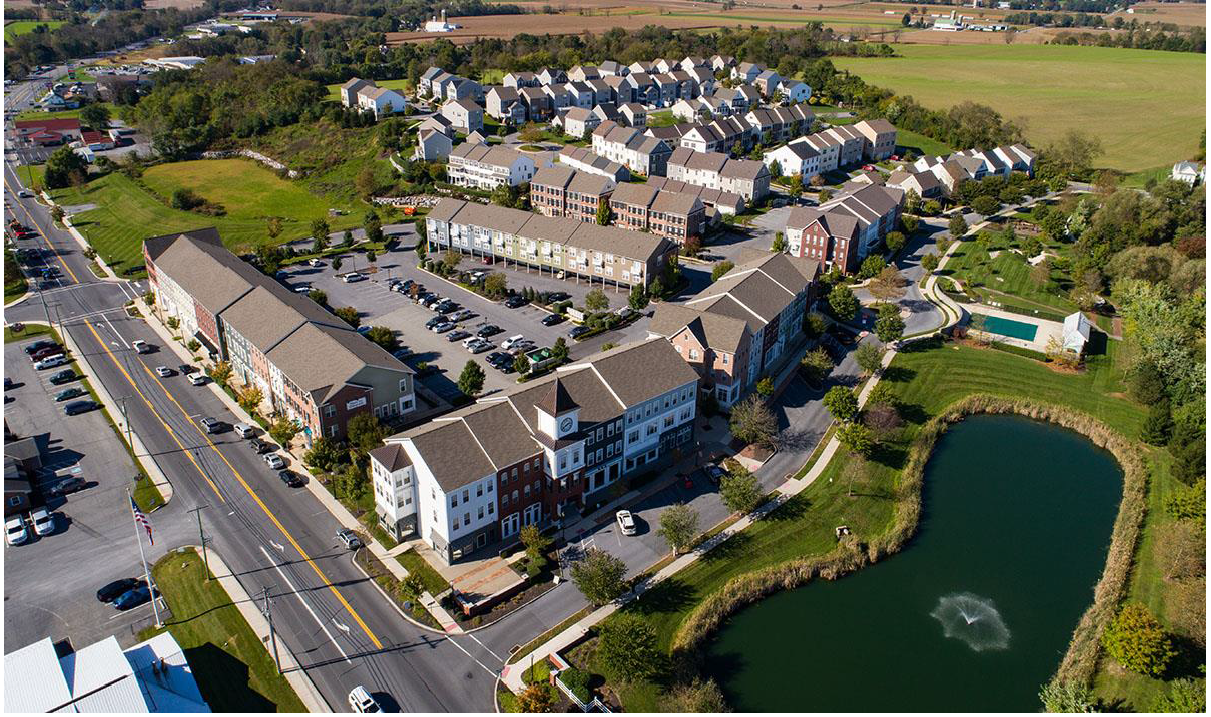
Florin Hill. A traditional mixed-use subdivision of 462 dwelling units on 61 acres
(Mount Joy — Lancaster County, PA). The project includes an appropriate mix of dwelling
types and uses; seamlessly going from a higher density near the highway to lower density
along the farm fields to the rear (emulating the density of a traditional small town
or village).
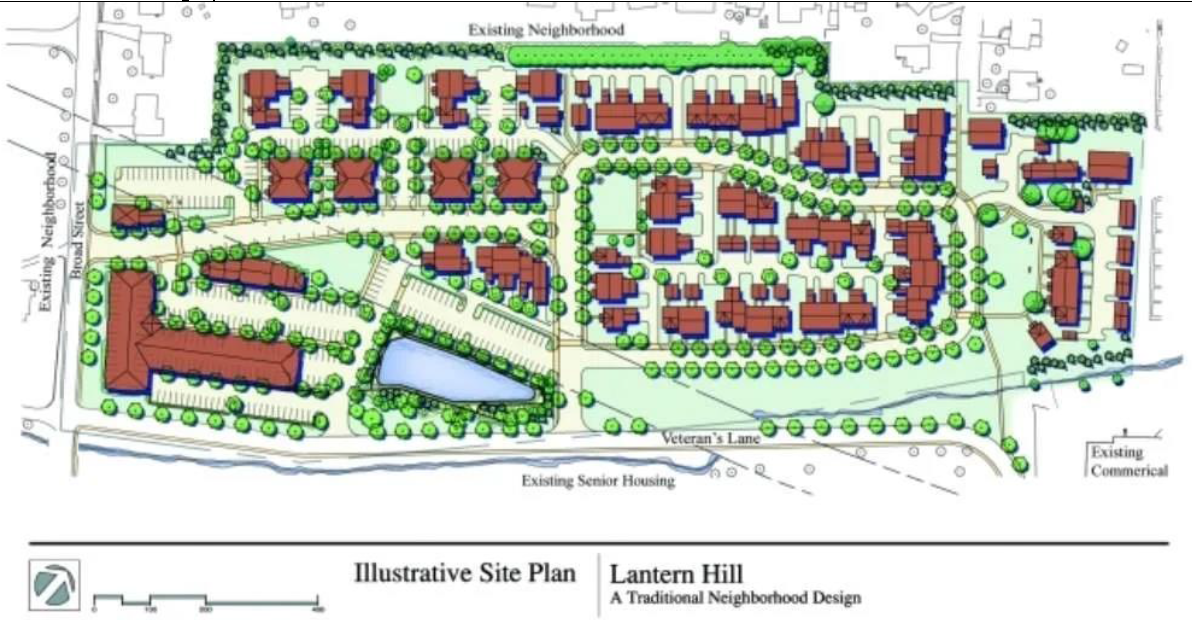
Lantern Hill. This traditional mixed-use subdivision features commercial and office
uses near the highway, and an appropriate mix of single-family dwellings, semi-detached
dwellings, townhouses (with varying block sizes), and smaller mansion house apartments;
all in a generally grid layout.
D.
Streetscape requirements.
(a)
Legislative intent. The streetscape in a PVC shall provide an aesthetically pleasing and multi-modal thoroughfare. The width of travel lanes shall be reduced to the maximum extent practicable to discourage vehicular speeding. In addition to their aesthetic value, street trees, streetlights, marked crosswalks, and sidewalks set back from the street, all provide a safe travel path and atmosphere for pedestrians.
(b)
Street hierarchy and typologies. There are three basic street types permitted in a PVC project: Boulevard, Neighborhood, and Alley. Each street type may have one or more design alternatives based upon the need for on-street parking, and the presence of non-residential uses. The street types and design alternatives are as follows:
i.
Boulevard street design alternatives. Boulevard streets provide the primary thoroughfare or spine through the PVC, connect to existing and adjacent state and municipal streets and roads, and serve as collectors from the narrower neighborhood streets. Commercial and mixed-use buildings are limited to frontages on these streets. Marked crosswalks shall be provided at the intersection of all boulevard streets. On-street parking spaces along all boulevard streets must be striped and marked. Bulb-outs (also known as curb-extensions) must be constructed at all intersections with boulevard streets.
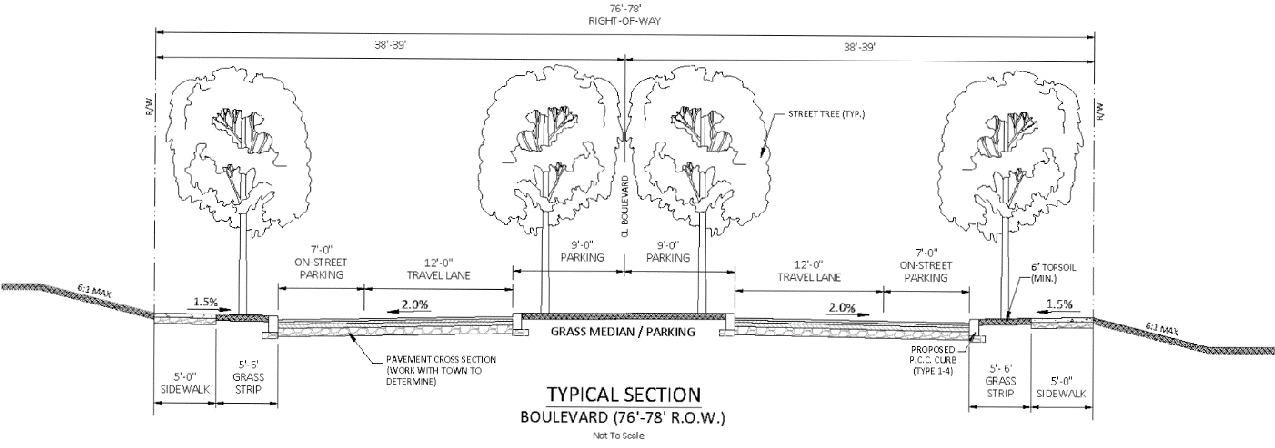
This street design alternative may only be used along Mixed-Use and Commercial Blocks.
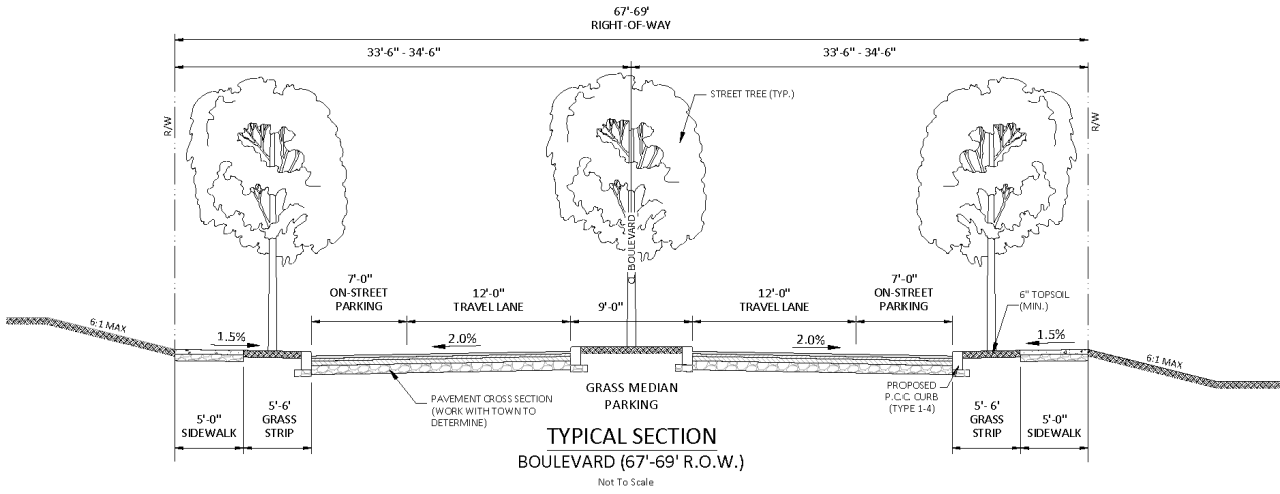
This street design alternative may only be used along Mixed-Use and Commercial Blocks.
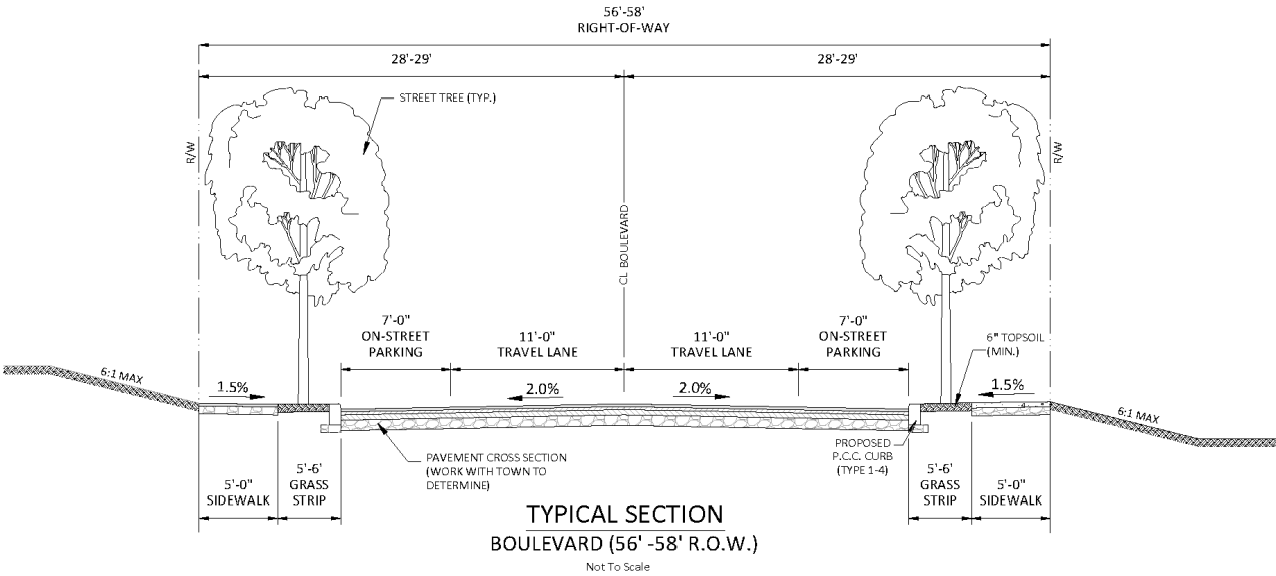
This street design alternative be used along a Residential, Mixed-use, or Commercial
Blocks.
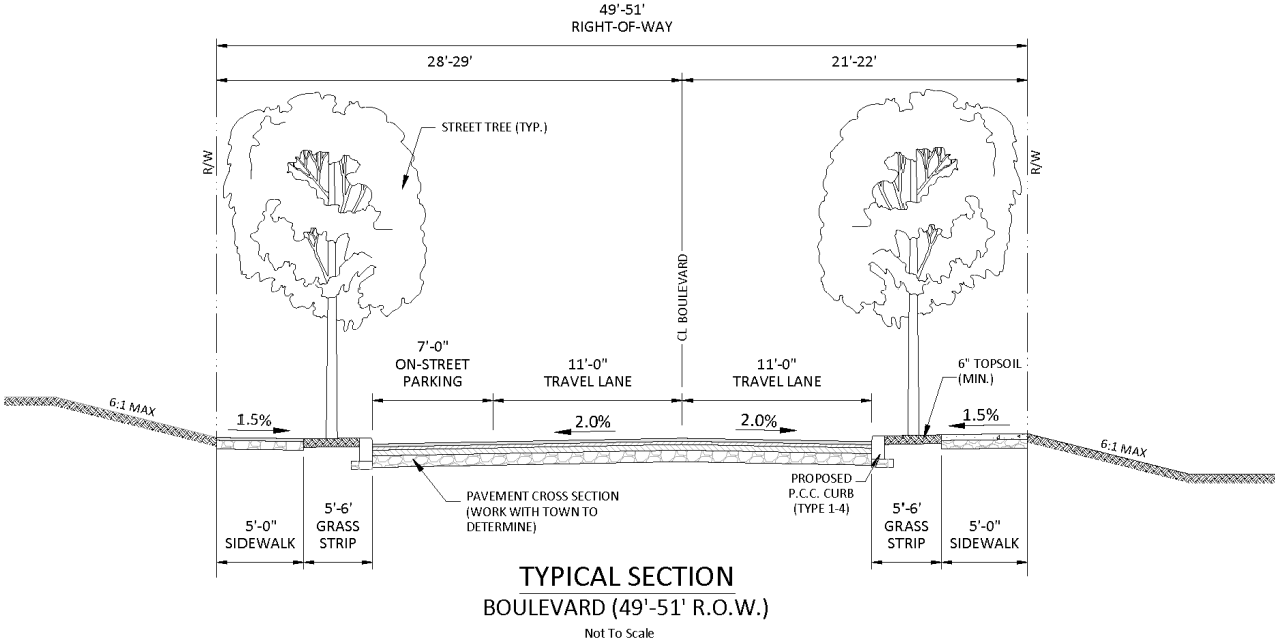
This street design may only be used along Residential blocks.
ii.
Neighborhood street design alternatives. Neighborhood streets, sometimes referred to as local or side streets, have narrower travel lanes, are limited to residential blocks, and connect to boulevard streets or other neighborhood streets. On-street parking shall be striped and marked along all neighborhood streets except with the 24-foot-wide travel lane street alternative. Bulb-outs (also known as curb extensions) may be utilized at intersections, but are not required.
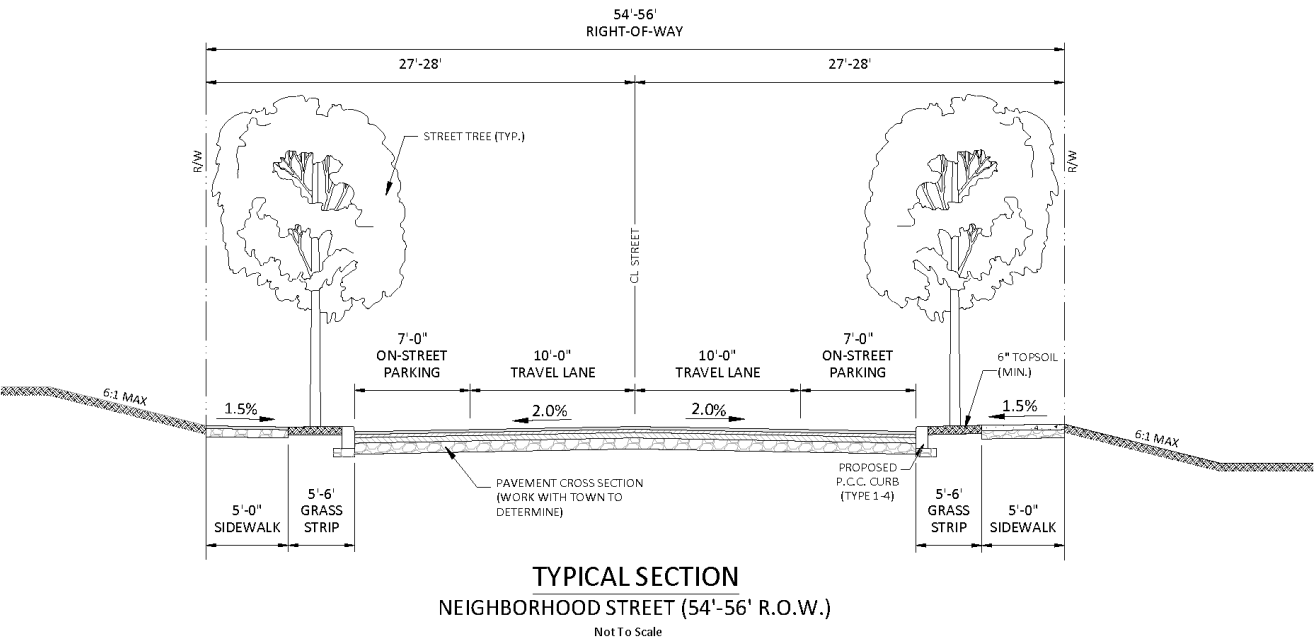
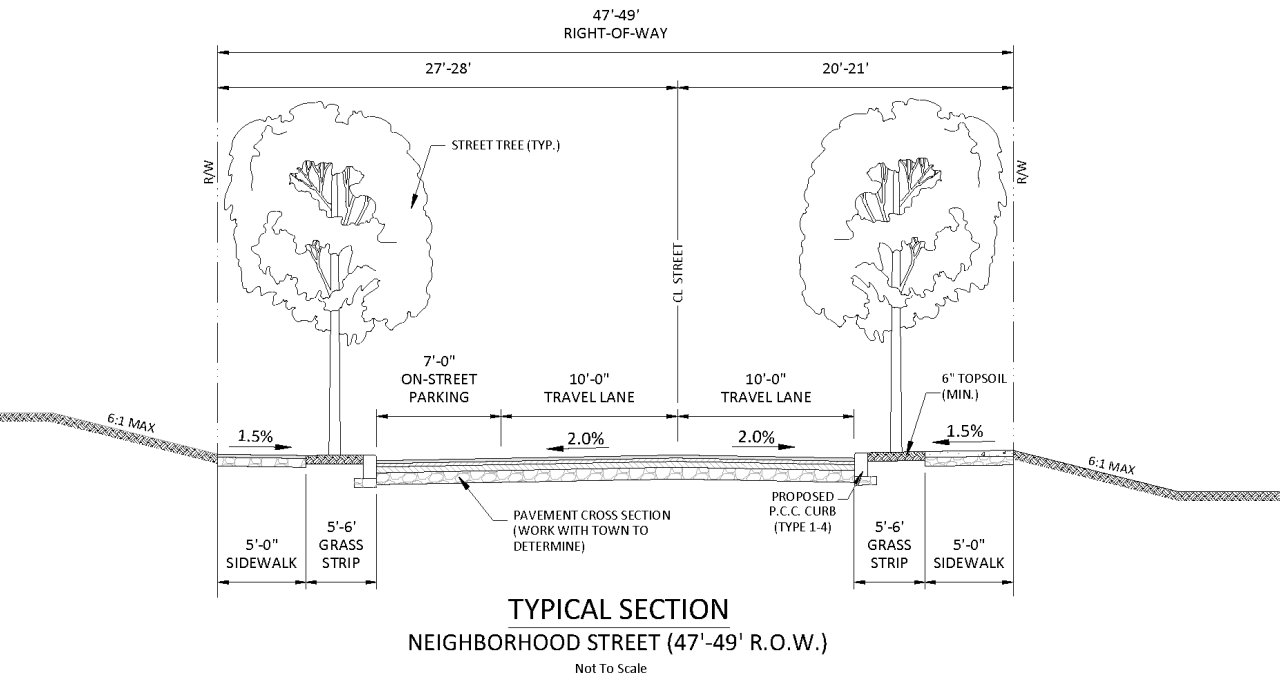
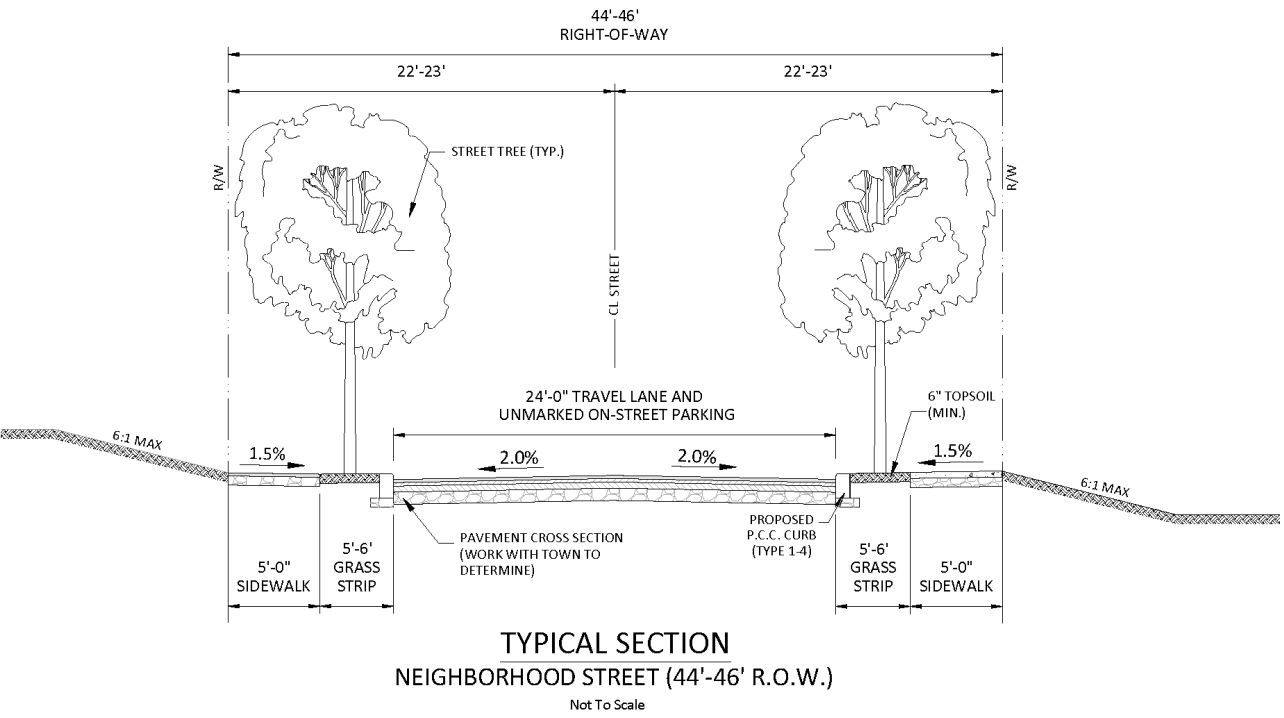
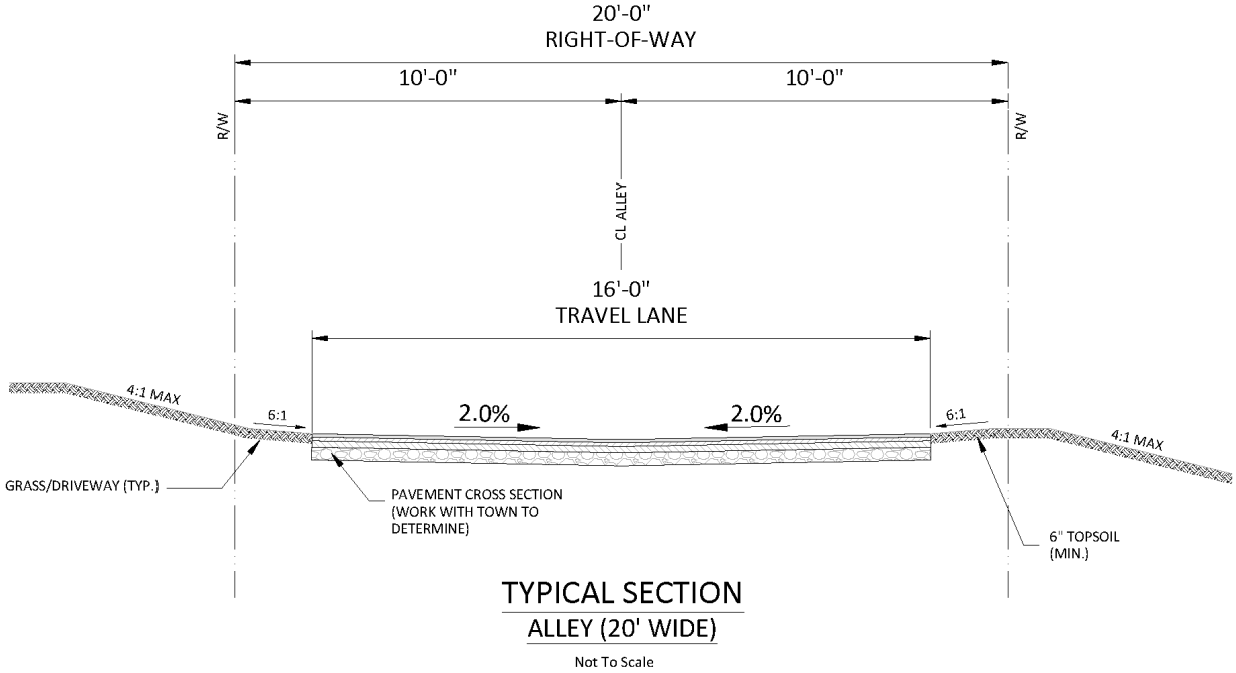
iii.
Alley design standard. The purpose of alleys are to provide rear-access to residential and commercial uses. Alleys are not to be striped, and on-street parking is strictly prohibited.
iv.
The planning commission may approve an alternate design for any of the before-mentioned street types so long as it meets the overall intent of the PVC.
(c)
Street trees. Street trees shall be continuously planted along both sides of the street throughout a PVC project. The street trees shall be planted every 30 linear feet between the street curb and sidewalk. No more than three of the same street tree species may be planted in a row. The following street trees may be planted based upon the width of grass strip between the street curb and sidewalk:
i.
Six-foot wide grass strip.
• Ginkgo biloba 'Princeton Sentry' (Male no fruit)
• Shawnee Brave Bald cypress (Taxodium distichum 'Mickelson')
• Hardy rubber tree (Eucommia ulmoides)
• Freeman maple (Acer x freemanii 'Scarsen'} Scarlet Sentinel
• Thornless Honeylocust (Gleditsia triacanthos var. inermis 'Shademaster'}
ii.
Five-foot wide grass strip.
• American Hornbeam (Carpinus caroliniana)
• New Horizon Elm (Ulmus 'New Horizon')
• Hornbeam (Carpinus betulus 'Fastigiata')
• Eastern Hop Hornbeam (Ostrya virginiana)
• Trident Maple (Acer buergeriaman)
• Miyabei Maple (Acer miyabei 'Morton' State Street)
iii.
Alternate street tree species may be approved on a case-by-case basis by the Smyrna Shade Tree Commission.
(d)
Street lights. Should be installed every 60 linear feet (approximately off-centered and between the street trees planted every 30 linear feet) to ensure pedestrian lighting and safety. Street lights shall be a Sternberg Lighting Model Town Square A880SRLED as shown in figure 1 or a close alternative approved by the planning commission.
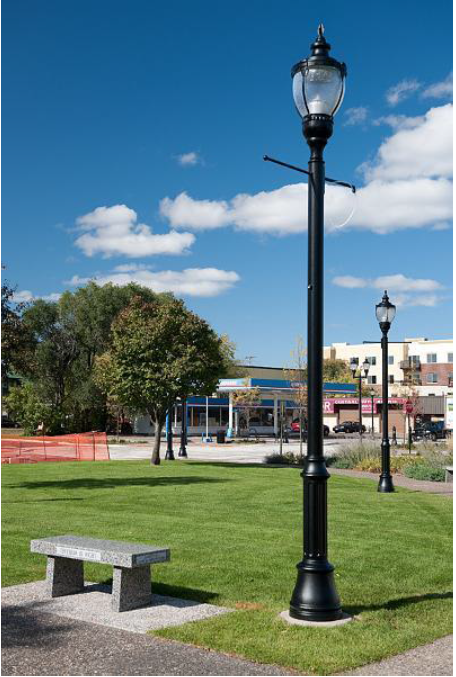 | 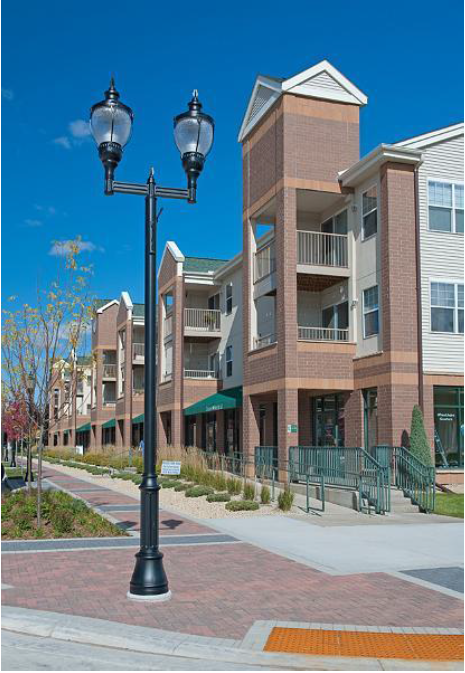 |
| Sternberg Lighting Model Town Square A880SRLED with a single (1) acorn-shaped luminaire. | Sternberg Lighting Model Town Square A880SRLED with dual (2) acorn-shaped luminaires. |
E.
Open space design requirements.
(a)
Open space and recreational areas shall be incorporated as central and primary design features of each PVC, and not just remnant, vacant, and/or unusable pieces of land used as open space. Open space and recreational amenities should be interspersed throughout the project to ensure that each neighborhood and series of blocks has its own pockets of usable open space and amenities (within a two- or three-minute walking distance). Larger open spaces and amenities (i.e., town center greens and pavilions, clubhouse, pool) should be centrally located for the enjoyment and convenience of the maximum number of residents.
(b)
Each PVC shall include a variety of open space types, sizes, and recreational amenities to meet the needs of all ages, and to provide for a diversity of recreation activities. Projects shall be required to provide at least one of the following open space features or recreational amenities for every 50 dwelling units, rounded to the nearest increment of 50. The various neighborhoods and areas of larger PVC projects are better served by multiple smaller features, and more than one of each open space/amenity type may be used to meet the required number. The total acreage/square footage of required open space for each project shall be based upon the chart set forth in section 5.07(b)(5) of the subdivision and land development ordinance. The breakdown and allocation of open space types and recreational amenities shall be approved by the planning commission based upon the intent of the PVC. The planning commission may grant waivers from the minimum and maximum sizes of the approved open space and recreational amenities options, which are as follows:
(i)
Two separate pocket parks in different locations of the PVC (400—3,000 square feet each with pedestrian seating, trash receptacles, lighting, and/or plantings).
(ii)
Playground (minimum 3,000 square feet in size and furnished with at least five pieces of recreational equipment suitable for children).
(iii)
Neighborhood green (5,000—25,000 square feet).
(iv)
Town center green (40,000—80,000 square feet with at least one pergola, gazebo, or pavilion).
(v)
Walking/biking trails (most often as part of a larger one-plus acre passive open space).
(vi)
Square or plaza (2,500—10,000 square feet mixture of pavement and landscaped green space with a fountain, public art, statue, etc.).
(vii)
Picnic area (5,000—20,000 square feet with at least six tables).
(viii)
Club house (at least 1,500 square feet in size with meeting and recreational space, restrooms, etc.).
(ix)
Fitness center (may be part of a club house, and must include at least 15 pieces of equipment).
(x)
Swimming pool.
(xi)
Sports courts (tennis, basketball, volleyball, racquetball, etc.).
(xii)
Athletic fields (soccer/lacrosse, football, baseball, etc.).
(xiii)
Pet parks (minimum 20,000 square feet in size).
(c)
Pedestrian and site furnishings, including, but not limited to pedestrian benches, trash cans, bike racks and tables should be included and appropriately sited throughout the different open space and recreational areas. Each open space type and recreational amenity shall also be appropriately landscaped with trees, shrubs, raised plantings and/or flower beds. Informational kiosks should be centrally located in larger projects to provide information about community events, amenities, etc. Pet parks shall include a perimeter fence at least four feet in height, and a water source for the animals. Pet parks are encouraged to have equipment, trails, and/or courses for the enjoyment of the animals.
(d)
Open space examples:
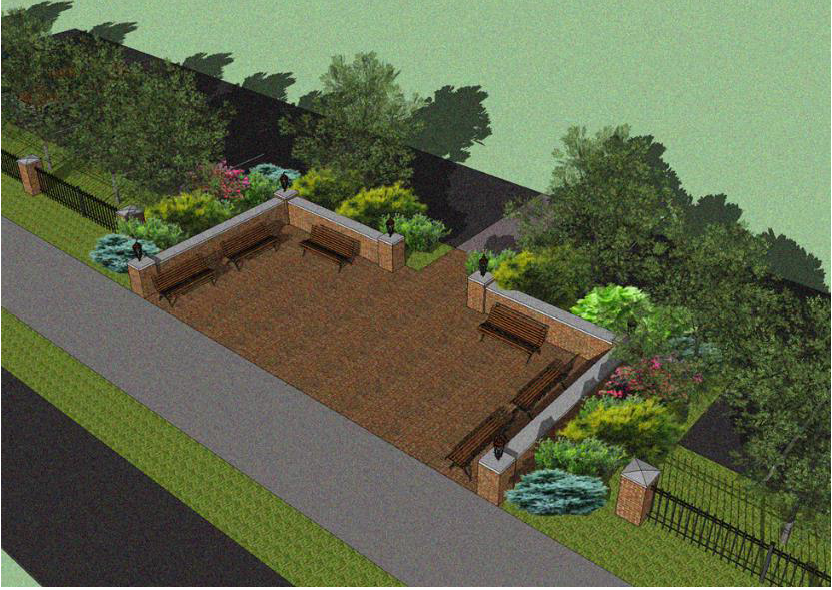
This 800 square foot pocket park is adorned with public seating and knee-wall at a
mid-block location.
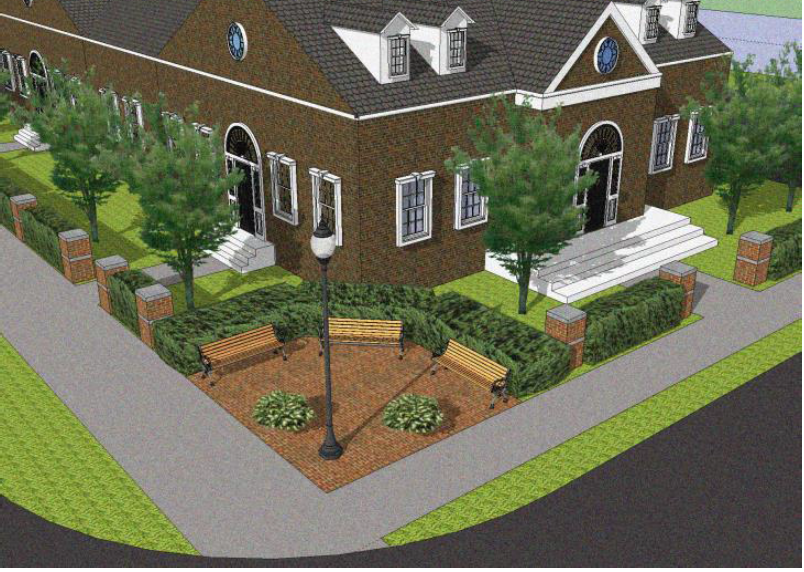
This 400 square foot pocket park anchors a commercial corner with pedestrian seating,
plantings, and lighting.
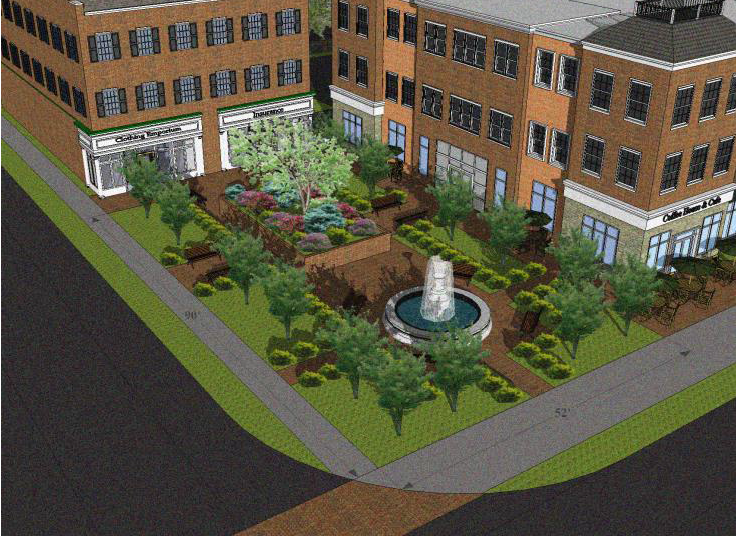
This 5,000 square foot public square/plaza includes a fountain, pedestrian seating,
raised planting beds, and landscaping, and is best suited in higher density/commercial
areas.
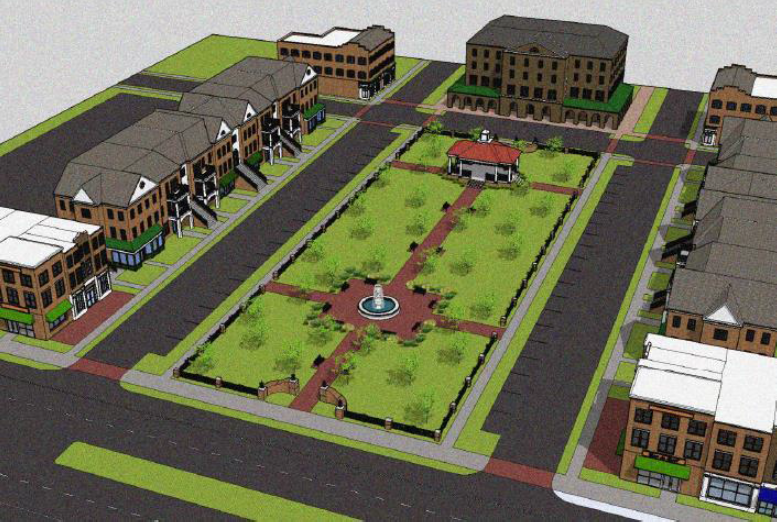
This 50,000 square foot town center green should be centrally located and adorned
with pedestrian seating, fountain, pergola, gazebo, and/or a pavilion.
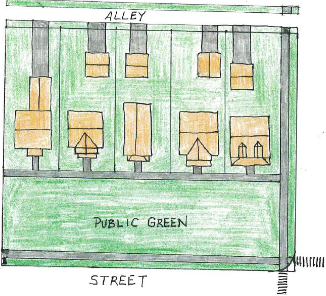
This 15,000 square foot green is sited so that the dwelling units directly face and
overlook it.
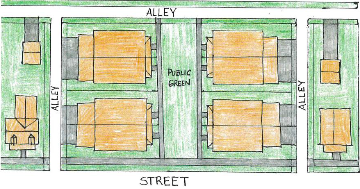
Under this option, dwelling units mirror one another overlooking an approximately
5,000 square feet green/courtyard.
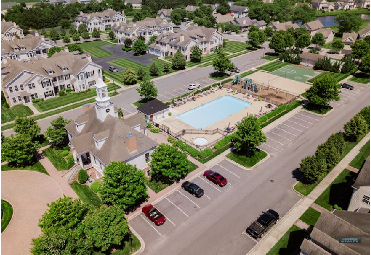
Clubhouse, pool, and playing courts centrally located at Paynter's Mill (Milton —
Sussex County, DE).
F.
Building type standards.
1.
Single-family detached and semi-detached dwellings.
(a)
Garage configurations.
(i)
At least 60 percent of single-family detached and semi-detached dwelling lots must be served by rear-access alleys.
(ii)
Front-loaded garages must be set back from the front of the dwelling a minimum of 18 feet.
(b)
At least 75 percent of all single-family dwellings must have an unenclosed covered porch six feet in depth that extends at least one-half of the front façade.
(c)
Dwellings must be at least one and one-half and no more than two and one-half stories in height.
(d)
A concrete sidewalk at least four feet wide must extend from the street to the front entrance and/or entry porch/stoop of the dwelling.
(e)
On corner lots for single-family detached dwellings, front-loaded garages must be located on the interior (side) lot line of the block. Alternatively, garages may be located to the rear of the dwelling, and empty onto the secondary street frontage.
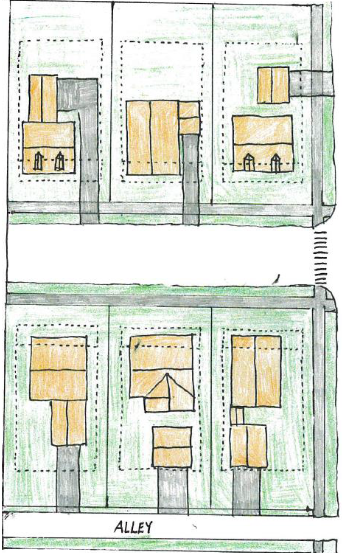 | 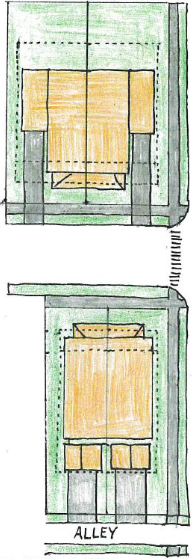 |
| Potential Single-Family Dwelling Configurations. |
Potential Semi-Detached
Dwelling Configurations. |
2.
Reserved.
3.
Attached (townhouse) dwelling.
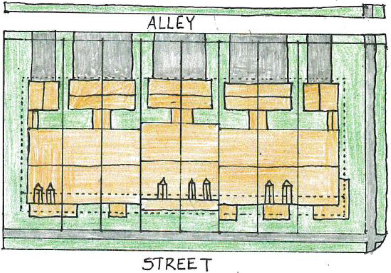
(a)
All attached dwelling units must be served by rear-access alleys and may have attached or detached garages or carports.
(b)
Attached dwelling blocks may range in size from three to eight units. For projects with less than 50 attached dwelling unit lots, a minimum of three different block sizes must be constructed. For projects with between 50 to 99 attached dwelling unit lots, a minimum of four different block sizes must be constructed. For those projects with 100 or more attached dwelling unit lots, a minimum of five different block sizes must be constructed.
(c)
No more than three adjoining attached dwelling units shall be constructed along the same front plane without a minimum two feet change in plane (distance from front property line). This requirement may be waived if there are varying numbers of stories among and between units, and/or a change in the roof pitch, roof type, or roof height between units.
(d)
No more than two adjoining dwelling units within the same block shall be constructed of the same exterior building material or color.
(e)
Attached dwellings must be two or three stories in height.
(f)
At least 50 percent of the attached dwelling units in each dwelling block must have an unenclosed front covered entry porch a minimum six feet in depth and six feet in width.
(g)
On corner lots, the front entrance to the end attached dwelling unit may face either the primary or secondary street frontage.
(h)
A concrete sidewalk at least four feet in width must extend from the street to the front entrance and/or entry porch/stoop of the dwelling.
(i)
A vegetative hedge (either evergreen or flowering) or a raised flower bed shall be planted directly in front of the dwellings and/or along the sidewalk to create a continuous street buffer. A vegetative hedge shall not exceed three feet in height. The building code official may approve alternative buffer types, including but not limited to a low vinyl or wood picket fence.
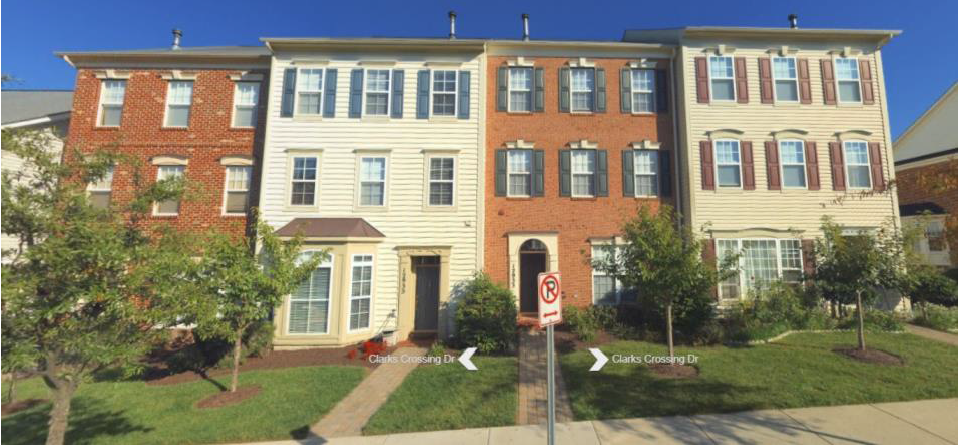
Three-story townhouses with two-foot alternating projections, varied building materials
& window/entry fenestration at Clarks Crossing (Clarksburg, Montgomery County, MD).
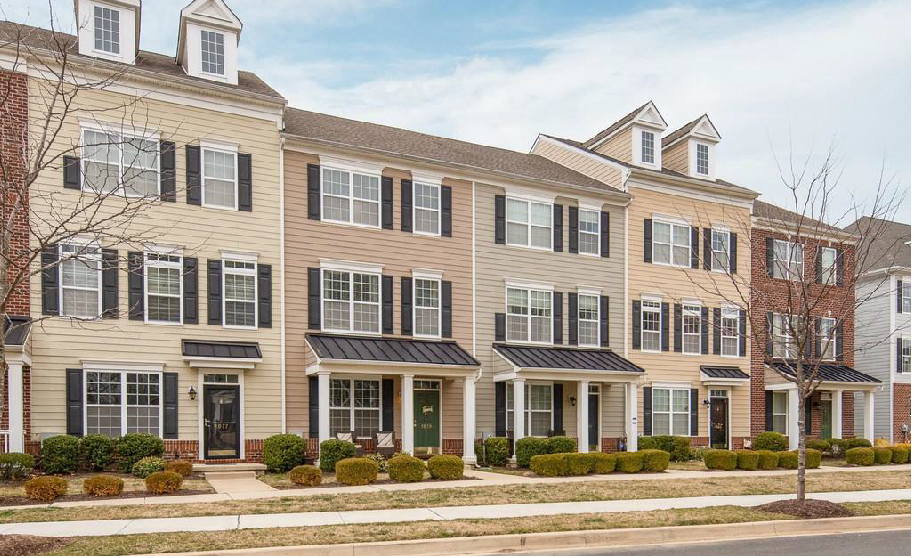
Three-story townhouses with two-foot alternating roof heights, alternating façade
colors and materials and entry porches at Darley Green (Claymont — New Castle County,
DE).
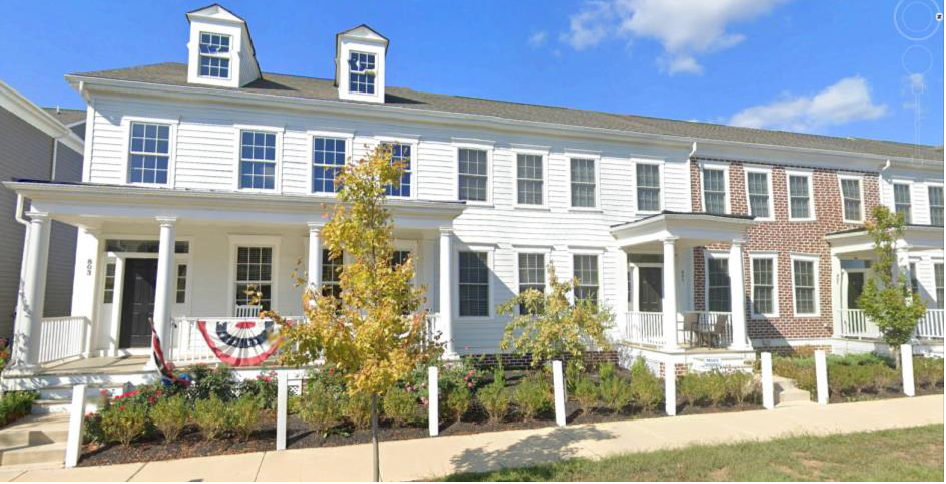
Two-story townhouses with alternating façade materials, faux dormers, and variously-sized
entry porches at Whitehall (Middletown — New Castle County, DE).
4.
Apartment dwelling.
(a)
Off-street parking areas serving apartment dwellings must be located to the rear of said building(s), provided that off-street parking areas may be situated on the side of said building if the configuration of the development makes rear parking impractical. Apartment dwellings may also be served by attached or detached garages or carports along rear-access alleys. Modified parking designs are encouraged, including but not limited to, double stacking residential parking spaces and placing parking spaces on the rear ground story of apartment buildings or behind a front façade wall.
(b)
Apartment buildings may not exceed 15 dwelling units. Projects with 36 to 72 dwelling units shall have a minimum of two apartment building sizes. Projects with 73 to 144 dwelling units shall have three apartment building sizes. Projects with 145 or more dwelling units shall be required to have at least four apartment building sizes.
(c)
Apartment dwellings shall be two stories or three stories in height.
(d)
Apartment dwellings of six or fewer units should generally be constructed to resemble a large single-family dwelling or mansion found in the historic downtown of Smyrna or another historic downtown in Delaware. Apartment buildings of seven or more dwelling units should be generally constructed to resemble either: a block of attached (townhouse) dwellings, or multi-story mixed building in the historic downtown of Smyrna or another historic downtown in Delaware.
(e)
Apartment buildings greater than 50 feet in length shall incorporate design elements that break up the expanse of building facades every 20—50 feet to mimic the façade of an historic townhouse block or mixed-use building that was constructed in sections over time utilizing various traditional architectural styles. The following design elements may be used to break up the facades of apartment buildings at said intervals:
i.
Varied roof height (of at least two feet) or roof type. This also includes the varied use of dormers along said roof sections.
ii.
Varied building material and/or colors, to include the use of scales/shingles and ground level wainscoting.
iii.
The use of staggered wall offsets of at least two feet in depth.
iv.
The use of variously sized and detailed exterior covered entry porches, projecting balconies and 2 nd /3 rd floor porches.
v.
The use of variously sized and shaped windows, window moldings and pediments, and window shutters between each section of the building façade.
(f)
An unenclosed covered porch/stoop, at least four feet by four feet in size, shall be located at every ground floor exterior entrance in each apartment building.
(g)
A concrete sidewalk at least four feet in width must extend from the street to every exterior ground floor entrance of every apartment building.
(h)
A vegetative hedge (either evergreen or flowering) shall be planted either (or both) directly in front of the dwellings and/or along the sidewalk to create a continuous street buffer. A vegetative hedge shall not exceed three feet in height. The building code official may approve alternative buffer types, including but not limited to a low vinyl or wood picket fence.
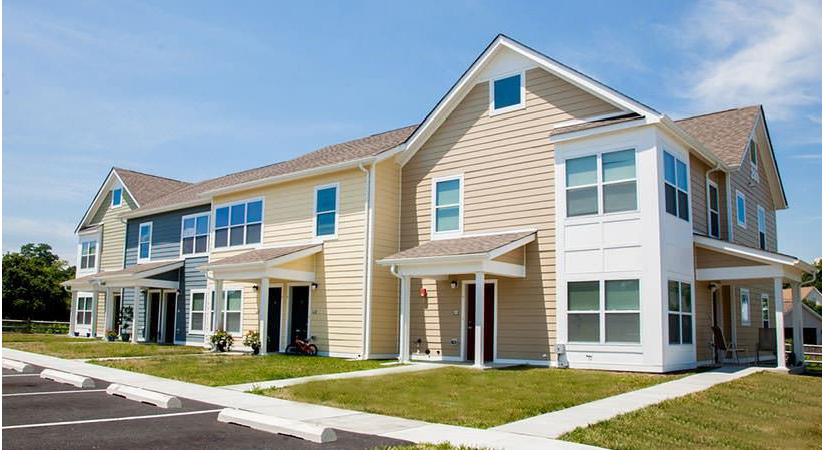
Eight-unit two-story apartment building at The Willows (Cecilton — Cecil County, MD).
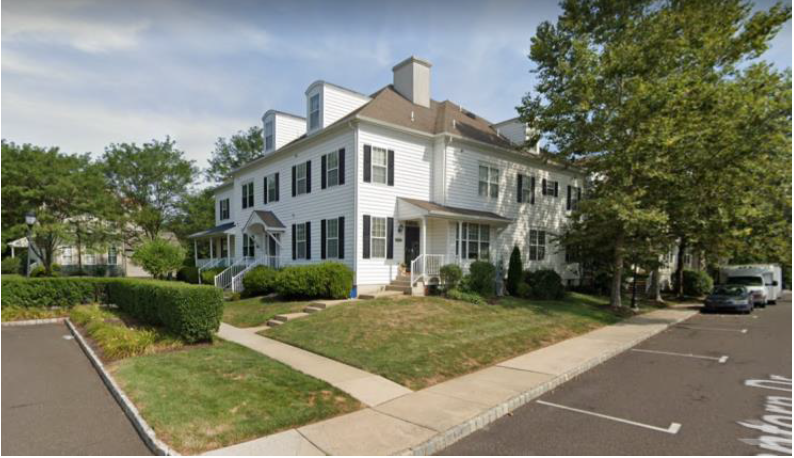
Six-unit two-story apartment building at Lantern Hill (Doylestown — Bucks County,
PA).
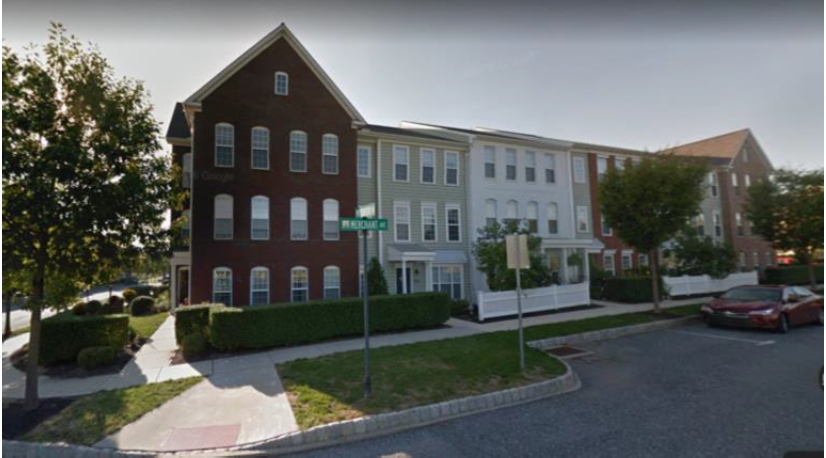
Twelve-unit three-story apartment building at Florin Hill (Mount Joy — Lancaster County,
PA).
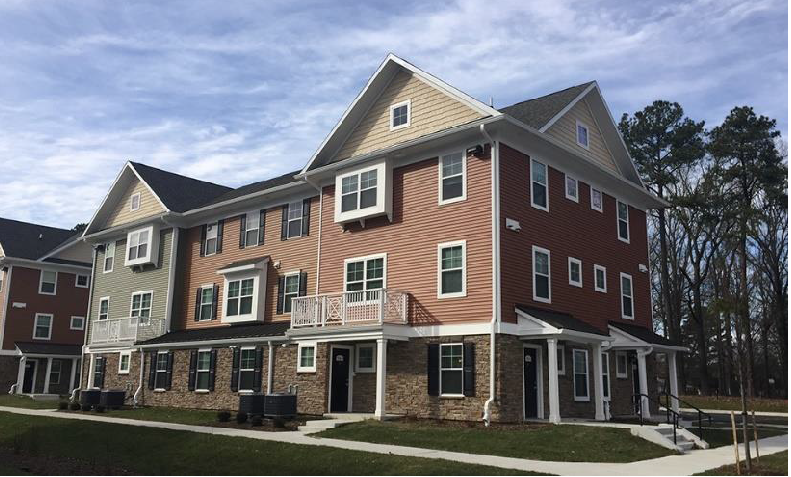
Nine-unit three-story apartment building at Stone Grove Crossing (Salisbury — Wicomico
County, MD).
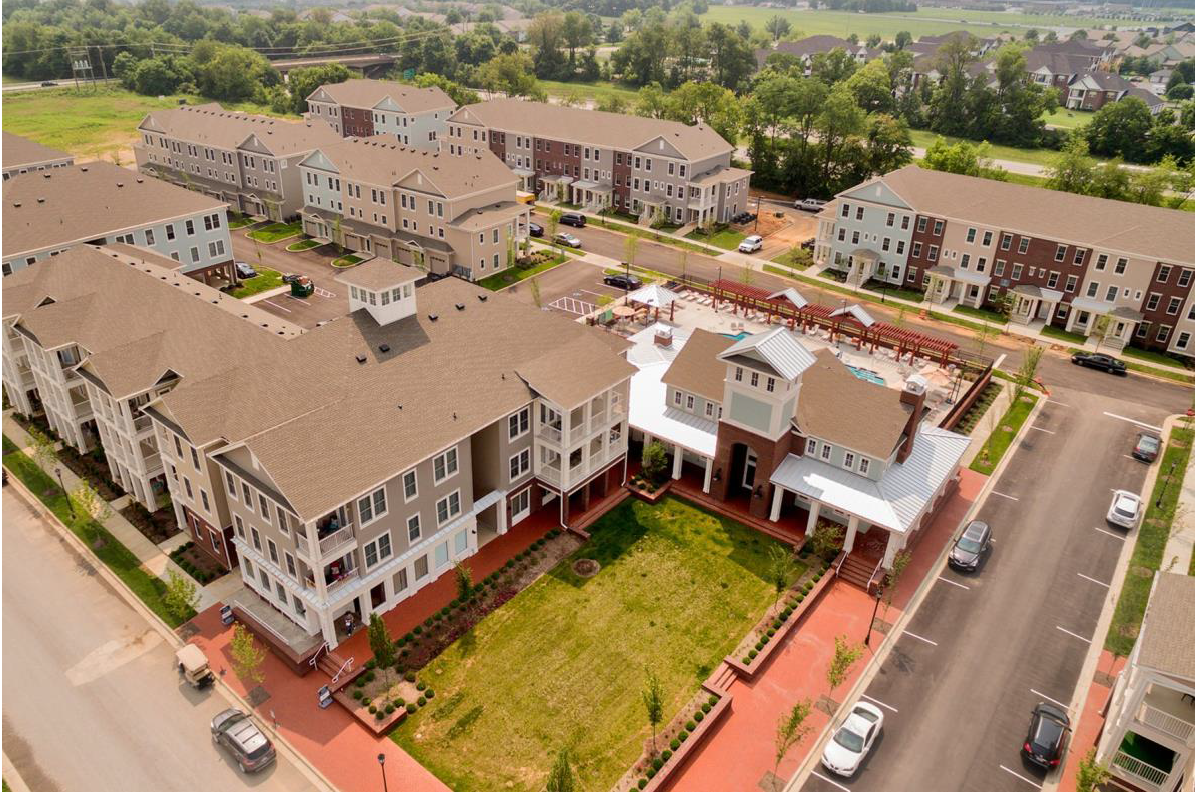
Variously sized apartment buildings (six—15 units in size) on a traditional grid street
neighborhood with rear-accessed garages and parking areas at the Veranda of Norton
Commons (Louisville, KY).
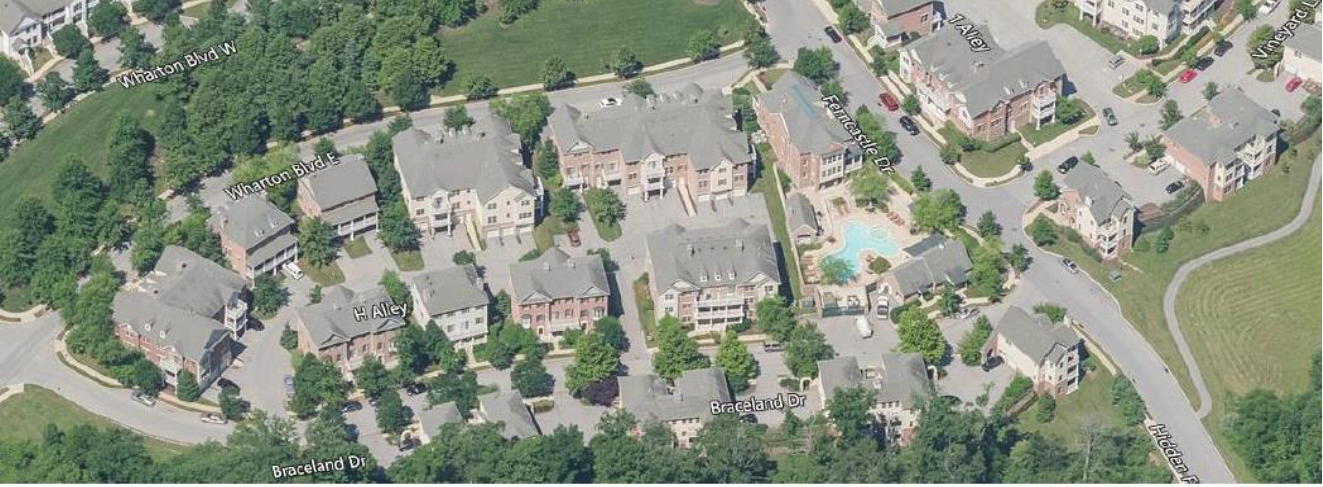
Claremont Apartments at Eagleview features 244 multi-family dwelling units in 45 apartment
buildings (including six different building sizes from two—12 units) with grid street
pattern, and rear-accessed parking and garages (Upper Uwchlan Township — Chester County,
PA).
5.
Mixed-use buildings and commercial/office buildings.
(a)
Off-street parking areas serving mixed-use and commercial buildings must be located to the rear of said building(s); provided that off-street parking areas may be situated on the side of said building if the configuration of the development makes rear parking impractical. Shared parking between nearby non-residential uses and buildings is strongly encouraged, and may be counted towards the required number of vehicular parking spaces if approved by the planning commission.
(b)
Mixed-use buildings may also be served by attached or detached garages or carports along rear-access alleys. Modified parking designs are encouraged, including but not limited to, double stacking residential parking spaces, and placing parking spaces on the rear ground story of mixed-use buildings or behind front façade wall.
(c)
Mixed-use and commercial buildings shall front boulevard streets where on-street parking is provided on both sides of the street. Parking lots should be accessed through rear-access alleys or streets, or, when not practical, by adjacent neighborhood streets. Parking lots should not have entrances or exits onto boulevard streets where practicable. As a last resort, commercial curb cut entrances onto boulevard streets should be shared among neighboring internal parking lots on the same block. Curb cuts shall be minimized to enable uninterrupted pedestrian movement along sidewalks. Parking lots should not front boulevard streets if at all practicable, and should instead be directed along adjacent neighborhood streets if they cannot be fully accommodated behind a building.
(d)
Parking lots which face boulevard or neighborhood streets shall be screened by a low vegetative hedge not to exceed three feet in height, or an alternative buffer screen approved by the planning commission.
(e)
The footprint of mixed-use buildings shall not exceed 10,000 square feet, and the gross floor area of commercial/office buildings shall not exceed 15,000 square feet.
(f)
Mixed-use buildings shall be two or three stories in height. The first floor shall consist of commercial, retail, and office-related uses, while the second and third floors may contain apartment dwelling units. Buildings used solely for commercial and/or office purposes may be one, two, or three stories in height, with a minimum building height of 16 feet, which may be achieved with a pitched roof, raised parapet, and/or faux second story façade.
(g)
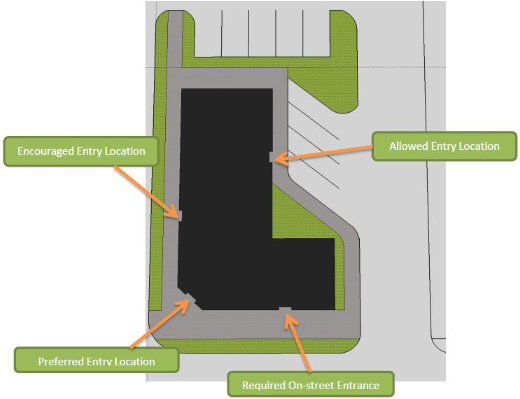
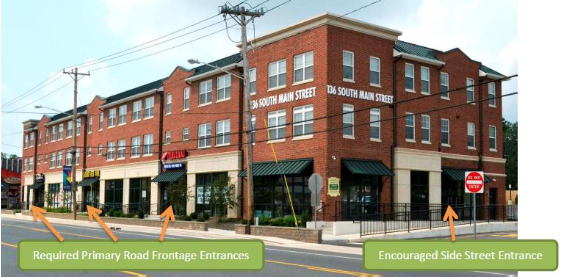
Mixed-use and commercial buildings shall have at least one exterior entry onto the boulevard street face of the building. Mixed-use and commercial buildings located at intersections are strongly encouraged to have additional exterior entries at the corner of the building, and along the neighborhood street face of the building.
(h)
Smaller commercial buildings are strongly encouraged to mimic the appearance of a traditional single-family dwelling in Smyrna's historic downtown. One-story commercial buildings shall have either: (a) raised parapet, (b) pitched roof, and/or (c) faux second story façade.
(i)
If any mixed-use building or commercial building has a façade that is at least 50 feet in length, the building shall include design elements that break up the expanse of the building façade every 20—50 feet to mimic a traditional mixed-use building in Smyrna's historic downtown commercial district that was constructed incrementally in smaller sections over time. The following design elements may be used to break of the facades of apartment buildings at said intervals:
i.
Varied roof height (of at least two feet) or roof type. This also includes the varied use of dormers along said roof sections.
ii.
Varied building material and/or colors, to include the use of scales/shingles and ground level wainscoting.
iii.
The use of staggered wall offsets of at least two feet in depth.
iv.
The use of variously sized and detailed exterior covered entry porches, projecting balconies, arcades, marquee, parapets, terraces, spires, towers, cupolas, faux dormers, etc.
v.
The use of variously sized and shaped windows, window moldings and pediments, and window shutters between each section of the building façade.
(j)
The area of a 1st floor building façade situated between two feet and ten feet from the ground and which is facing the boulevard Street shall consist of at least 40 percent transparent windows. Those facades facing neighborhood streets are strongly encouraged to include transparent windows on the 1st floor (or at least appropriately matched and scaled faux windows).
(k)
Heating, ventilation, and air conditioning (HVAC) systems shall not be visible from collector or boulevard streets or any other streets on which the building fronts and shall be screened using materials and architectural features that are consistent with the building's architectural style.
Windo Façade Comparison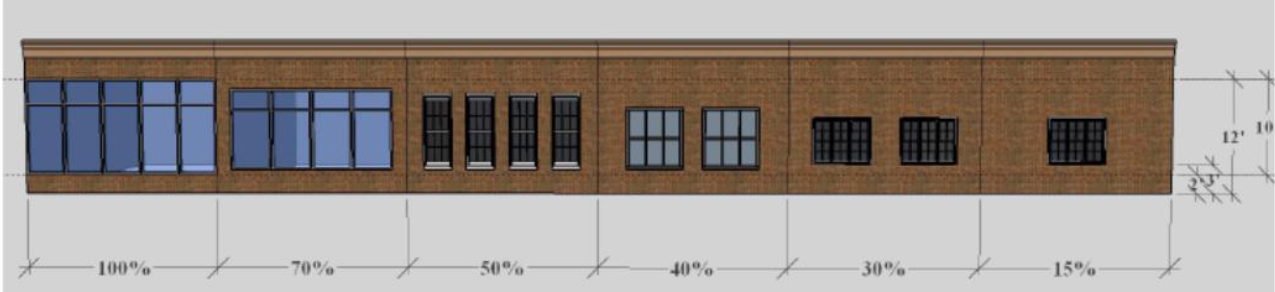
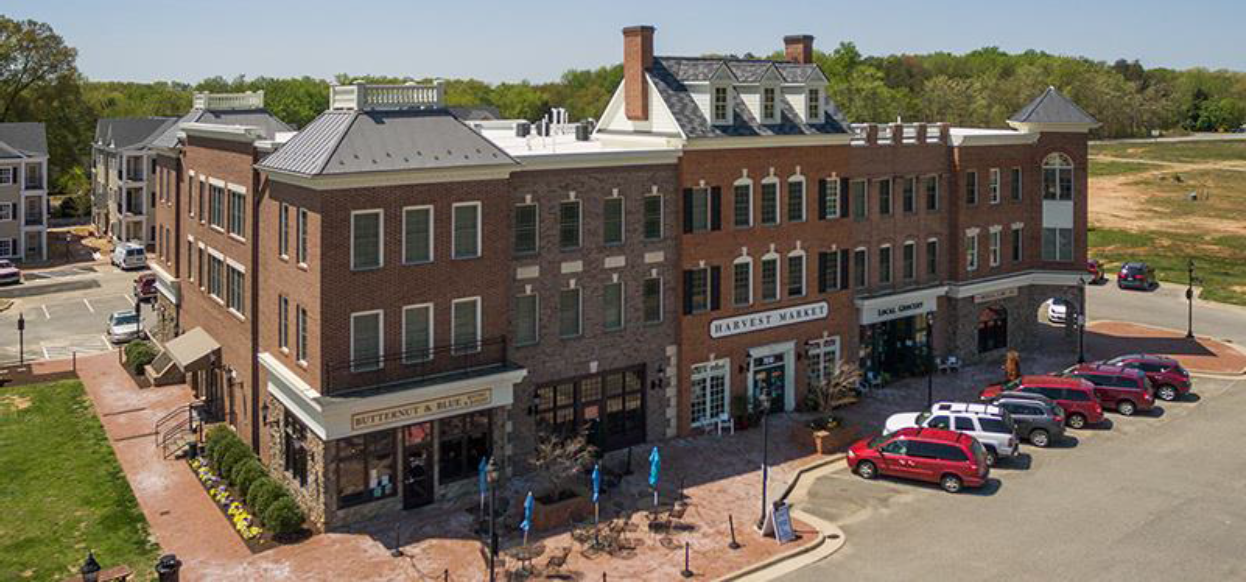
Three-story mixed-use building at the 'Spotsylvania Courthouse Village — Spotsylvania
County, VA). This 10,000 square foot footprint (30,000 square feet GFA) features numerous
façade design features, and variously-spaced breaks, to emulate a series of much smaller
buildings constructed at different time periods and architectural styles.
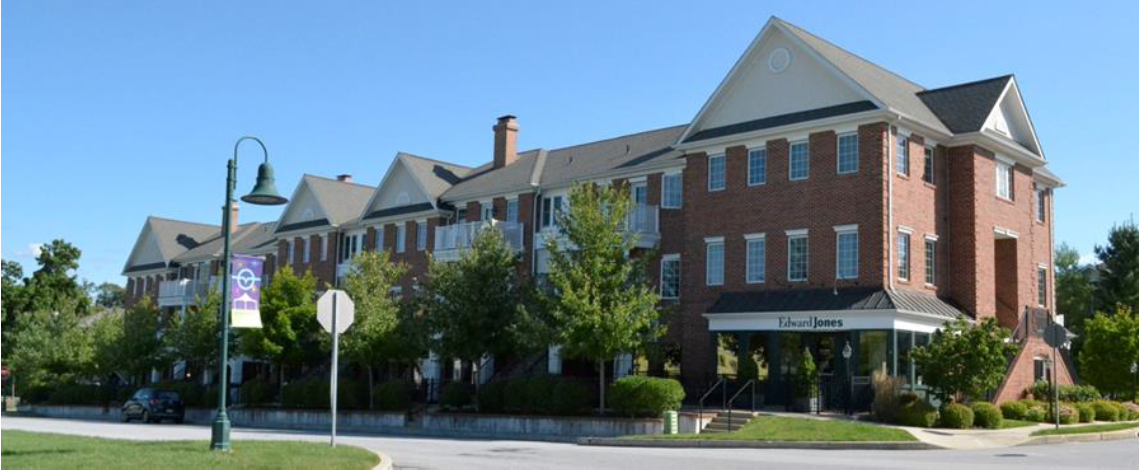
Three-story mixed-use building at 'Eagleview' (Lionville — Chester County, PA) with
a 10,000 square foot footprint. While the same brick material/color is used through
the exterior façade, appropriately-spaced façade projections, arcade porches, and
the use of cross gables help to break up the façade of this large building.
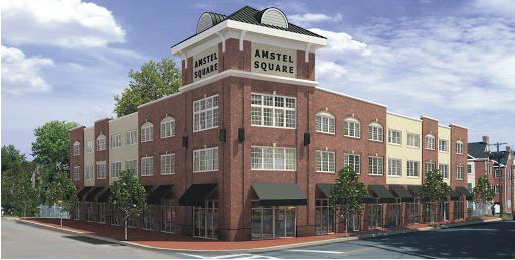
Three-story mixed-use building along South Main Street in Newark, Delaware with an
approximately 9,000 square foot footprint.
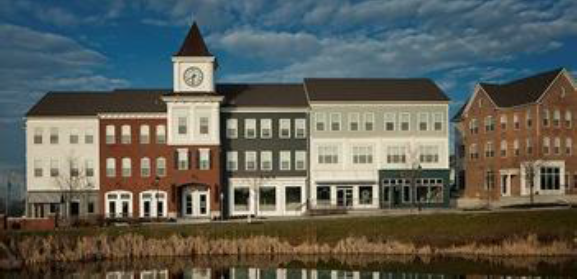
Three-story mixed-use building at 'Florin Hill' (Mount Joy — Lancaster County, PA)
features a central tower and spire with alternating façade fronts, colors, and building
materials.
Commercial Building Examples.
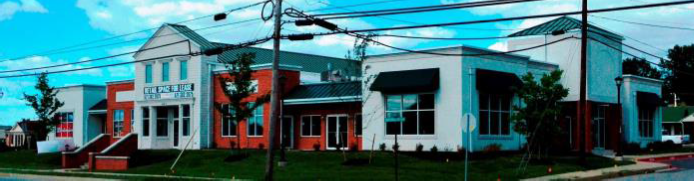
One-story 12,000 square feet multi-tenant commercial in Chestertown (Kent County,
MD) building features numerous façade breaks, material changes, and varying roof heights
and types to give the allusion that it is a series smaller (but multi-story) downtown
commercial/mixed-use buildings.
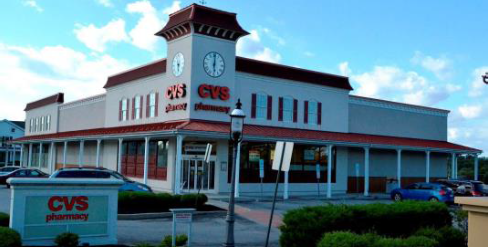
One-story CVS in Eagle, PA (Chester County) with façade breaks, corner tower, and
raised parapet to give the allusion that it is a two-story building. Faux windows
are used to compliment the transparent windows, and again add scale to the building.
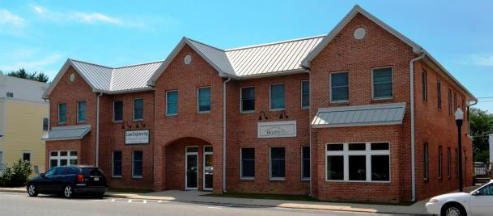
This two-story office building in Centreville, MD (Queen Anne's County) features staggered
façade projections and cross gables to break up the façade.
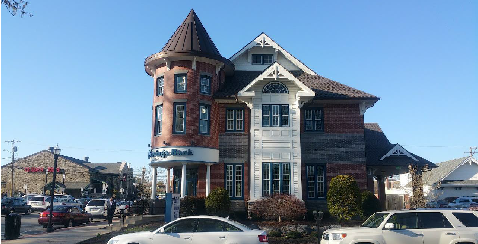
This two-story bank in downtown Media, PA (Delaware County) is meant to resemble an
historic Victorian mansion in the general vicinity.
Mixed-Use/Commercial/Office Building Entrance Requirements.
(Ord. of 10-19-98(2), § 2; Ord. of 3-15-99(3), § 1; Ord. No. 015-20, § 6, 7-20-20; Ord. No. 001-21, § 1, 1-19-21)
15.
Signs. Any sign erected, altered, or maintained after the effective date of this Ordinance shall conform to the following regulations.
A.
Purpose and intent. Signs perform an important function in identifying and promoting properties, businesses, services, residences, events, and other matters of interest to the public. The intent of this subsection is to regulate all signs within the town to ensure that they are appropriate for their respective uses, in keeping with the appearance of the affected property and surrounding environment, and protective of the public health, safety, and general welfare by: (1) setting standards that permit reasonable use of signs and preserve the character of the town; (2) prohibiting the erection of signs in such numbers, sizes, designs, illumination, and locations as may create a traffic safety hazard to pedestrians and motorists; (3) avoiding excessive conflicts from large or multiple signs, so that permitted signs provide adequate identification and direction while minimizing clutter, unsightliness, and confusion, all of which negatively impact the aesthetics of the town; and (4) establishing a process for the review and approval of sign permit applications.
B.
General. Signs may be located within the setback prescribed for a property, provided that all signs except those affixed directly to a building shall be located a minimum of five feet from all property lines. Except for traffic safety signs, street identification signs, and traffic and parking instructional signs affixed to posts as approved by DelDOT, signs shall be positioned outside vehicular sight triangles, defined as the triangular area formed by measuring from the corner where two intersecting streets abut a property a distance of 25 [feet] along the property line abutting each of the two adjacent streets. Except as otherwise indicated herein, the maximum height for any sign is 25 feet.
C.
Definitions. The following definitions shall apply to the terms identified herein, wherever those terms are used throughout the Zoning Code.
1.
A-frame signs are designed to stand on their own either on public or private property, so long as there remains four feet of unobstructed passageway. A-frame signs are not to be permanently affixed to any object, structure, or the ground. The maximum sign area per sign is eight square feet, and sign area is calculated on one side only. The maximum size for rectangular A-frame signs is four feet in height and two feet in width. A-frame signs must be taken indoors each evening. One A-frame sign is permitted per building; corner buildings are permitted one A-frame sign per street frontage.
2.
Banners shall mean a temporary sign of cloth or similar material no larger than four feet wide by eight feet long. Banners shall be carefully designed and constructed in order to withstand the elements to which they will be exposed and not become a hazard to the public safety or aesthetics of the town.
3.
Billboard shall mean a structure which is erected by an advertising company for the purpose of the placement of a sign for hire. Each such space for hire shall be considered a specific billboard regardless of whether or not the face is incorporated into the ground structure.
4.
Electronic variable message sign (EVMS) means a sign or portion thereof where the message copy includes characters, letters or illustrations that can be changed or rearranged electronically without touching or physically altering the primary surface of the sign. Message copy may be changed in the field or from a remote location.
5.
Ground sign means a detached sign supported by uprights, pylons, poles or braces for support and not attached to any structure. Ground signs do not include monument signs.
6.
Government sign means a sign that is constructed, placed or maintained by the federal, state or local government or a sign that is required to be constructed, placed or maintained by the federal, state or local government either directly or to enforce a property owner's rights.
7.
Height shall mean the distance measured from the finished grade immediately adjacent to the base of the sign to the sign's highest point.
8.
Illuminated shall mean the provision of light provided either internally or externally.
9.
Marquee sign means a sign erected upon any awning, canopy, hood or permanent construction projecting from a wall of the building above the entrance, thoroughfare, walkway or sidewalk.
10.
Monument sign means any stand-alone, self-supporting structure affixed to the ground.
11.
Off-premises or off-site sign means a sign advertising goods, products, or services which are not sold, manufactured or distributed on or from the premises or facilities on which the sign is located.
12.
On-site sign shall mean a sign advertising goods, products, or services which are sold, manufactured or distributed on or from the premises or facilities on which the sign is located. On-site signs do not include signs erected by the outdoor advertising industry in the conduct of the outdoor advertising business.
13.
Portable sign. Any device designed to inform or attract the attention of persons not on the premises on which the sign is located, that is not constructed or erected with a fixed location on the ground or attached to something having a fixed location on the ground.
14.
Roof sign shall mean any sign erected, constructed and maintained wholly upon or over the roof of any building with the principal support on the roof structure, subject to the requirements of the definition of wall sign.
15.
Sign means a name, identification, description, display or illustration, which is affixed to, painted or represented directly or indirectly upon a building or other outdoor surface, and which directs attention to or is designed or intended to direct attention to the sign face or to an object, product, place, activity, person, institution, organization or business. Signs located completely within an enclosed building, and not exposed to view from a street, must not be considered a sign.
16.
Sign area shall mean the entire space enclosed within the extreme edges of the sign for each sign face, including trim, moldings, battens and nailing strips but not including the supporting structure. Where attached directly to a building wall or surface, sign area shall be the space within the outline enclosing all the characters of the words, numbers, or design.
17.
Small ground sign shall mean a ground sign that does not exceed three feet in height and has a total surface area of less than two square feet.
18.
Temporary sign shall mean a banner, pennant, poster or advertising display constructed of paper, cloth, canvas, plastic sheet, cardboard, wallboard, plywood or other like materials and that appears to be intended to be displayed for a limited period of time.
19.
Two-faced sign shall mean signs that are back to back and are not more than 60 inches from one another at any time. The signs are to be identical in words and representations. Permissible size shall be determined by the square footage of one side of the sign.
20.
Wall sign shall mean any sign, not including a marquee sign or nameplate sign, erected against the wall of any building or displayed with the exposed face thereof in a plane parallel to the plane of the wall. Wall signs shall include any signs painted directly upon any wall.
D.
Exempt from permit or fee (non-illuminated only). A permit is required for the installation of all signs in all zoning districts, with the exception of the following signs:
1.
Temporary signs.
2.
Traffic safety signs, street identification signs, and traffic and parking instructional signs affixed to posts as approved by DelDOT.
3.
Signs painted on windows with exception of the historic preservation overlay district (HPOD) requiring review and approval by the historic district review board.
4.
Government signs.
5.
Signs bearing occupants' names, house numbers, and street names, not exceeding one square foot.
6.
In residential zoning districts, up to two flags may be displayed on a property at the same time, and no flag shall be larger than 15 square feet in area. The height of the flag pole shall not exceed 25 feet or the highest point of the principal building's roof, whichever is lower.
7.
In non-residential zoning districts, one flag is permitted on a property per 50 feet of right-of-way frontage, up to a maximum of four flags. No flag shall exceed 24 square feet in area. The height of the flag pole may not exceed 25 feet or the highest point of the principal building's roof, whichever is lower.
8.
Legal notices, municipal signs, railroad crossings, and related safety signs.
9.
Signs which are attached or are an integral part of fuel pumps and do not extend permanently beyond the area of the pump.
10.
Balloons no larger than 18 inches in diameter.
E.
District regulations.
1.
The following types of signs are allowable in the listed zoning district, subject to compliance with all permitting requirements.
P: Permitted
NA: Not allowed
SE: Special exception
1 Allowable for hospitals and emergency medical center.
2 Two square feet per linear ft. of building frontage, up to 100 square feet maximum area.
3 Three square feet per linear ft. of building frontage, up to 150 square feet maximum area.
4 One sign of 200 square feet maximum area.
5 One sign for management office, four square feet maximum area.
6 One sign not to exceed one square feet per linear ft. of building frontage, up to 200 square feet maximum area.
7 One sign not to exceed 75 square feet maximum area; height shall not exceed 16 feet.
8 Subject to additional review by the historic district review board.
9 Up to four small ground signs permitted per property.
10 See regulations specific to CMM zone for additional sign standards.
11 Reserved.
12 One sign with up to 25 square feet maximum area; height shall not exceed ten feet.
13 One sign with up to 32 square feet maximum area; height shall not exceed five feet.
14 Only allowed for non-residential uses.
(Ord. No. 003-24, § 1, 5-8-24; Ord. No. 004-25, § 1, 2-18-25)
2.
Where the permitted size of a sign is calculated based on the linear feet of the frontage of a building, if a property has multiple tenants, the authorized sign area for each tenant shall be calculated independently for each separate tenant based on the linear feet of frontage of the building unit for the tenant requesting the sign. The front of a building shall be the side of a building with the main public entrance facing a public or private right-of-way or parking lot, and the building frontage shall be the length of that portion of the front of the building occupied by a tenant as measured in linear feet.
3.
Monument signs in residential zoning districts shall not exceed a maximum of two per entrance road to any specific development. Monument signs shall not be allowed at more than one entrance to a development for every 1,500 feet of common road frontage on which the entrances are situated. No more than one monument sign per street frontage shall be permitted on a property. A property with more than one street frontage may have up to a maximum of two monument signs, provided that the collective sign area of the two monument signs shall not exceed 150 percent of the maximum area permitted for one monument sign in that zoning district. Monument signs situated at shopping centers are to be located along the landscaped area between the sidewalk and the parking areas, a minimum of five feet from the property line. These signs are to be consistent in structure, design, and materials.
4.
For the purpose of determining the number of signs permitted on a property, a sign shall be considered to be a single display surface or display device containing elements organized, related and composed to form a unit. Where matter is displayed in a random manner without organized relationship of elements, or where there is reasonable doubt about the relationship of the elements, each element shall be considered to be a single sign.
5.
For those zoning districts where both ground signs and monument signs are permitted, properties with only one street frontage may have either a monument sign or a ground sign, but not both. Properties with more than one street frontage shall also be permitted to have one of the following for each additional public or private street frontage: (a) either an additional ground sign or an additional monument sign, provided that the total aggregate area for all ground signs and monument signs on the property do not exceed 300 square feet, or (b) an additional 50 square feet added to the total maximum permitted area for a monument sign.
6.
Properties with more than one street frontage shall be permitted to have, for each additional public or private street frontage, an additional 50 square feet added to the total maximum permitted area for wall signs and marquee signs.
F.
Not permissible at any time in any zoning district.
1.
Billboards within the incorporated area of the town.
2.
Roof signs of any kind.
3.
Flashing or rotating lights.
4.
Noise emitting signs or lights.
5.
Signs located within any right-of-way whether dedicated or owned in fee simple or as an easement, except for traffic safety signs, street identification signs, and traffic and parking instructional signs affixed to posts as approved by DelDOT.
6.
Signs erected in such a manner as to obstruct free and clear vision or, by reason of the position, shape or color, may interfere with, obstruct the view of, or be confused with any authorized traffic sign, signal or device or which makes use of words "stop," "look," "danger" or any other word, phrase, symbol or character in such manner as to interfere with, mislead or confuse vehicular traffic.
7.
Signs erected, constructed or maintained so as to obstruct or be attached to any firefighting equipment, windows, doors or openings used as a means of ingress or egress or for firefighting purposes, or placed so as to interfere with any opening required for proper light and ventilation.
8.
Construction height greater than 25 feet.
9.
Dimensions greater than 200 square feet, except as otherwise expressly provided for herein.
10.
Signs on public property, except for government signs and traffic safety signs, street identification signs, and traffic and parking instructional signs affixed to posts as approved by DelDOT.
G.
Temporary signs. Temporary signs shall be permitted in all zoning districts as follows:
1.
One temporary sign may be located on a property at any given time provided that the sign area is no larger than 16 square feet for properties greater than 1.0 acre in size or four square feet for properties less than 1.0 acre in size. A temporary sign may be displayed up to a maximum of 30 consecutive days, two times per year. Anything herein to the contrary notwithstanding, property owners or occupants that have received a credibility/merit award may display a banner for one year from the date the honor was awarded.
2.
One temporary sign no larger than eight and one-half inches by 11 inches displayed in a window on a property at any time.
3.
In addition to the temporary signs permitted in subsections G.1 and 2, one temporary sign not to exceed four square feet may be placed on a property from the time the property is being offered for sale, either through a licensed real estate agent or by the owner, through the date the property is conveyed to the new owner.
4.
In addition to the temporary signs permitted by subsections G.1, 2, and 3, 60 days prior to and ten days following an election involving federal, state, or local offices or referendum issues for the voting district in which a property is located, one or more additional temporary signs not to exceed four square feet in size may be placed on a property, provided that the total number of additional temporary signs authorized by this subsection G.4 shall not exceed the total number of offices up for election and referendum issues on the ballot for the election district in which the property is located.
H.
Off-premises signs.
1.
Off-premises signs are allowable by special exception only in the HC, NC, and SCZ zoning districts.
2.
[Reserved]
3.
Only one off-premises sign is to be located on any given parcel in the HC, NC, and SCZ zoning districts.
4.
Such signs are not to exceed five square feet in area.
5.
Such signs are to be set back a minimum of five feet from the right-of-way/property line of all public streets/roads.
6.
Such signs are not to be higher than three feet above grade.
7.
Such signs are not to be placed within vehicular sight triangles.
8.
Such signs are to be no further than 1,000 feet from the property line of the premises of the business it refers to.
I.
Electronic variable message signs (EVMS).
1.
Electronic variable message signs permitted pursuant to section 15.E.1 herein shall be further restricted by the additional standards in this subparagraph. No more than one EVMS shall be permitted per property.
2.
The EVMS is restricted to no more than 50 square feet of sign area, and shall not be located within 75 feet of any residential use. The distance from the EVMS to any nearby residential use shall be measured in a straight line from the nearest property line of the residential use to the sign structure.
3.
The message displayed on the EVMS shall be static and shall not be changed more than once every 15 minutes.
4.
The applicant for an electronic variable message sign permit shall certify in writing to the Town of Smyrna that the message to be displayed on the sign shall remain static and shall not flash or scroll at any time and that the message will remain unchanged for at least 15 minutes at a time.
J.
Permit procedures. An application for a sign permit must be filed with the town. The applicant must provide sufficient information to determine if the proposed sign is allowed under this Code and other applicable laws, regulations, and ordinances, and it must state the date when the applicant intends to erect the sign. The town must promptly process the sign permit application and approve the application, reject the application, or notify the applicant of deficiencies in the application within 15 business days of the application's submission. An application that complies with all provisions of this Code and all other applicable laws, regulations, and ordinances must be approved. If an application is rejected, the town shall provide the applicant with a written list of the code deficiencies that must be remedied for the permit to be issued. A nonrefundable fee as set forth in the town's fee schedule shall be paid prior to the issuance of the sign permit. A sign permit shall expire if the sign is not installed within six months following the issuance of the permit.
K.
Maintenance and removal of signs.
1.
Maintenance. The owner, lessee or person or entity in control of any premises upon which a sign as defined in this subsection 15 (Signs) is present, in any form, shall be responsible for maintaining said sign, together with all supports, braces, guys, anchors or other fastening or hanging devices, in a structurally sound and safe condition and otherwise in good repair.
2.
Removal of signs. The owner, lessee or person or entity in control of any premises upon which a sign is present, in any form, shall be responsible for the removal of any sign, together with all supports, braces, guys, anchors or other fastening or hanging devices, within 180 days of the permanent closing, relocation or cessation of operation of the building or establishment situated on the property, or pursuant to the timeframe specified herein for the maximum display of temporary signs.
L.
Abandoned signs. Any sign remaining on a premise 180 days or more after the permanent closing and/or relocation of the business or establishment situated on the property shall be deemed abandoned. A business or establishment will be considered permanently closed and/or relocated by written or posted notice to the town and/or the public of such closing or relocating, or upon such other usual indication including, but not limited to:
1.
The cessation of the sale of goods and/or the rendering of services;
2.
The lack of business operating hours, including hours by appointment;
3.
The extended absence of employees from the establishment;
4.
The closing and/or securing of the means of egress to the business or establishment.
M.
Removal of signs on public property.
1.
Removal of signs on public property. Any signs placed or erected in a public street, alley or right-of-way, or other public property, except as otherwise expressly permitted in this Zoning Code, shall be deemed an unlawful sign, and the town may cause the sign to be removed. Such removal may be without written or other notice to the owner of the sign or the owner, lessee or occupant of the property adjacent to the public street, alley, or right-of-way, or other public place upon which such sign is located.
N.
Notice.
1.
The town shall, upon a determination that any sign or any support, brace, guy, anchor or other fastening or hanging device of a sign is not properly maintained or has been abandoned, or that a temporary sign has been displayed on the property in excess of the maximum display time outlined herein for a temporary sign, prior to taking any other action to enforce compliance with this subsection 15 (Signs), give written notice (delivered in person or by certified mail, return receipt requested and by posting upon the subject property) to the owner, lessee, or person or entity in control of the premises, that the sign has been deemed abandoned and/or not properly maintained and/or otherwise in violation of this subsection 15 (Signs) or any other town regulations. The notice shall also:
a.
If the sign is found to be not properly maintained, specify the nature of the deficiency;
b.
For all non-temporary signs, provide notice of the need to repair if not properly maintained or, if abandoned, the need to remove said sign, and all supports, braces, guys, anchors or other fastening or hanging devices of the sign, within 30 days of the effective date of the notice;
c.
For temporary signs, provide notice of the need to remove the sign within five business days of the effective date of the notice;
d.
State that upon failure to comply with the notice and order to repair or remove, the town may repair or remove said sign, together with all supports, braces, guys, and/or other fastening or hanging devices, as provided in subsection O (Removal of signs), and/or institute proceedings against such person or entity to collect a civil penalty for violation of this subsection 15 (Signs);
e.
State that a property owner or occupant may appeal the violation to the board of adjustment pursuant to Section 9 (The Board of Adjustment; Powers and Duties) of the Zoning Code. Any appeal must be filed within the time period outlined herein for removing or repairing the sign.
2.
The effective date of notice shall be the later of:
a.
The date of personal delivery or, if mailed, the date the return receipt is signed, or if not signed, the date the notice is marked refused, unclaimed or otherwise undeliverable by the U.S. Postal Service; or
b.
The date the property is posted. The fact that such notice was not actually received by the person or entity shall not be a defense to the town's subsequent enforcement of this subsection 15 (Signs).
3.
Should the town determine a sign presents an immediate threat or danger to the health, safety and welfare of the community, the notice set out in subsection 1 above shall not be required and the town may take immediate action to make safe the danger, including repair or removal of the sign, and all supporting or mounting devices or hardware. Notice shall then be sent to the owner, lessee, or person or entity in control of the premises advising them of the action taken, the costs incurred and the means of recovery pursuant to subsection P (Costs of Removal).
O.
Removal of signs.
1.
If the violation is not remedied within the time set forth in the notice and order as provided above, the town is authorized to order the repair or removal of any sign, together with all supports, braces, guys, anchors or other fastening or hanging devices deemed by the town as being:
a.
Not properly maintained, in a state of disrepair, structurally unsound, unsafe or otherwise deficient;
b.
Situated on the property in excess of the maximum timeframe outlined herein for displaying the sign; or
c.
Abandoned, as that term is defined at subsection L (Abandoned Signs).
2.
All signs which are determined to be not properly maintained and which have not been repaired within the time set forth in the required notice and order of subsection N may, at the town's reasonable discretion, be repaired, or be totally removed, including the support structure and/or mounting hardware, at any time after the effective date of the notice.
3.
All signs which are deemed abandoned and which have not been removed within the time set forth in the required notice and order of subsection N (Notice) may, at the town's reasonable discretion, be refaced with a blank or blacked out face or be totally removed, including the support structure and/or mounting hardware, at any time after the effective date of the notice. Covering sign copy with tarps, paper, tape, cardboard, or other non-permanent materials is not an acceptable method of re-facing.
4.
Any sign which has been removed from the premises shall be considered discarded, and replacement shall constitute a new sign and require a new permit.
P.
Costs of removal.
1.
When the town exercises the option under this subsection to repair or remove any non-temporary sign, the charge shall be: (1) the town's actual cost if contracted out, or (2) if performed by town personnel, $50.00 per hour, with a minimum charge of $50.00, plus any equipment or other incidental charges incurred. There also shall be assessed an administrative fee of $50.00. For each temporary sign removed by the Town as provided for herein, the owner of the sign shall be responsible for the removal cost of $20.00 per sign removed. All signs removed by the town shall be stored for at least 30 days prior to disposal, and no sign may be reclaimed by the owner of the sign until the removal costs and penalties provided for herein have been paid in full.
2.
The cost to repair or remove any sign in accordance with this subsection, together with any civil penalties and costs, shall be recoverable by the town. Such costs and fines may be collected as any other fine or cost is collected. Costs shall include court costs and reasonable attorney's fees, whenever permitted by law. Pursuant to 25 Del. C. § 2901(a)(1) the town may add any costs to repair or remove a sign to the property taxes for the property at issue and may collect these abatement costs in the same manner the Town collects real estate taxes, including the use of monition proceedings.
Q.
Penalties. Any person determined by any court of competent jurisdiction to have violated this subsection 15 (Signs) shall forfeit and pay to the town pursuant to Section 17 (Penalties for Violation), a civil penalty in the amount of not more than $100.00 per day, plus costs. Each day of a continuing violation shall be a separate offense.
R.
Substitution clause. Any sign erected pursuant to the provisions of this Zoning Code may, at the option of the applicant, contain either a noncommercial message unrelated to the business located on the premises where the sign is erected or a commercial message related to the business located on the business premises. The noncommercial message may occupy the entire sign face or portion thereof. Such substitution of message may be made without any additional approval or permitting. This provision prevails over any more specific provision to the contrary within this Code. This provision does not create a right to increase the total amount of signage on a parcel, nor does it affect the requirement that a sign structure or mounting device be properly permitted according to all other provisions of this Zoning Code.
(Ord. of 2-5-01, § 2; Ord. No. 003-07, § 2, 10-15-07; Ord. No. 009-19, § 1, 12-2-19; Ord. No. 017-20, §§ 1—3, 7-20-20)
16.
Waiver of sidewalk requirement for residential properties in existing subdivisions. Upon the recommendation of the town manager, the council may waive the sidewalk requirement for existing vacant lots in existing residential subdivisions (those approved prior to the effective date of this ordinance) if all of the following conditions are met:
a)
The lot(s) for which a waiver is requested is part of an existing residential subdivision where no sidewalks previously existed or where sidewalks were not required at the time the subdivision was approved;
b)
The subdivision is substantially complete with few remaining undeveloped but properly recorded building lots (for the purpose of this provision "substantially complete" shall mean that greater than 90 percent of the total approved lots have been built upon);
c)
There is no demonstrable public purpose served by the installation of sidewalks on the remaining properties;
d)
The properties are not subject to a major or minor site plan requirement or further subdivision so as to create additional lots which would otherwise have to comply with the town's sidewalk requirements; and
e)
The provisions of the subdivision ordinance and the Town Code as relate to sidewalks are met.
An applicant for a waiver must submit a written request to the town manager in the manner prescribed by the town manager; the town manager must review the request and, if he/she concurs, submit a recommendation to the town council; the town council must by act by resolution to waive the requirement; and the approved waiver must be recorded with the building permit for the property in question.
(Ord. No. 010-03, § 1, 4-21-03)
17.
Exceptions for projections into required yard setbacks. The following exceptions from the required yard setbacks are permitted for residential dwellings:
a.
Bay windows, oriels or balconies may project not more than three feet into the required rear yard setback;
b.
Chimneys, cornices and eaves may project not more than two feet into the required rear yard setback;
c.
Sills, leaders, belt courses and similar ornamental or structural features may project not more than six inches into the required rear yard setback;
d.
An open fire balcony, a fire escape or a fire tower may project not more than four feet into the required rear yard setback;
e.
An uncovered patio at ground level may project into the required rear yard, provided that it is setback from any lot line by a minimum of two feet;
f.
An uncovered porch or deck or any part thereof elevated above ground level may project up to 12 feet into the required rear yard setback. Stairs leading from the porch or deck, with an uncovered landing area at ground level not greater than nine square feet, may project an additional two feet into the rear yard setback. The porch or deck must remain uncovered and not be improved in any manner, including, but not limited to, enclosing the porch or deck with screens or windows, the installation of temporary overhangs, or the installation of a trellis;
g.
Uncovered stairs and covered enclosures of basement stairs providing entry directly to a dwelling and including a landing above ground level of not more than 25 square feet may project up to eight feet into the rear yard setback;
h.
Fences may be constructed in any yard setback pursuant to any other town code, including the Town Zoning Code, governing the installation, placement, location and construction of fences.
(Ord. No. 019-21, § 1, 11-15-21)
18.
Hotel and conference centers.
a.
No building shall exceed 60 feet in height, exclusive of roof tanks and supports, chimneys or enclosures for elevators or air conditioning machinery or other apparatus.
b.
No building shall be closer than 40 feet to any abutting street right-of-way line with a maximum 25 percent of the required parking maintained within the front yard with the exception of limited access roadways. Waivers may be considered for properties having more than one roadway frontage.
c.
No building shall be closer than 20 feet to a side yard and rear yard lot line with exception of residential districts where the building setback line is to be a minimum 50 feet plus two feet for each foot of building height with a maximum 120 feet setback.
d.
A minimum 20-foot wide landscaped buffer is to be provided along the entire perimeter of the hotel and conference center, provided that a buffer shall not be required along any property line abutting a street situated at the front of the parcel, and a corner parcel shall not be required to have buffering on either property line abutting the street. This buffer is to provide six and one-half-foot high screening adjacent to all residential districts. Screening is to consist of evergreen trees and bushes and berms.
(Ord. No. 005-19, § 3, 4-15-19)
e.
A hotel and conference center shall provide off-street parking at the rate of one parking space for each guest room. In addition to those required for guest rooms, parking is to be provided at the rate of one space for every 200 square feet of floor area of said meeting space facilities, ballroom, conference suites, restaurant and/or bar.
f.
A hotel and conference center shall be permitted on a site containing a minimum of five acres.
g.
A hotel and conference center is to provide a combination of minimum 150 guest rooms and 10,000 square feet of conference/meeting space area.
h.
Any restaurant as an accessory use to a hotel operation shall only be permitted if it is located within the hotel building. Also permitted as an accessory use to a hotel operation if located within the hotel building, are stores, shops and service facilities, primarily for the use and convenience of hotel guests.
19.
Home occupation/home-based business (major and minor/no impact). A home occupation/home-based business is defined as any activity carried out for gain by a resident and conducted in the resident's dwelling.
Minor home occupation/no impact home-based business and major home occupation/major home-based business shall be permitted when in accordance with the following standards:
A.
Minor home occupation. Minor home occupations shall meet all of the following requirements:
(1)
The business activity shall be compatible with the residential zoning of the property and surrounding uses.
(2)
The use is carried on entirely by the inhabitants of the dwelling, and shall employ no employees other than family members residing in the dwelling.
(3)
The use does not involve any customer, client, or patient visits, whether vehicular or pedestrian, to the dwelling.
(4)
Such use involves no pickup, delivery, or removal functions to or from the premises in excess of those normally associated with the residential use.
(5)
There shall be no display or sale of retail goods and no stockpiling or inventory of a substantial nature.
(6)
There shall be no outside appearance of a business use, including, but not limited to, parking, signs or lights.
(7)
The business activity may not use any equipment or process which creates noise, vibration, glare, fumes, odors or electrical or electronic interference, including interference with radio or television reception, which is detectable in the neighborhood.
(8)
The business activity may not generate any solid waste or sewage discharge, in volume or type, which is not normally associated with residential use in the neighborhood.
(9)
The business activity shall only be conducted within the dwelling and the floor area devoted to such use shall not exceed 20 percent of the total floor area of the principal residential structure.
(10)
Such business use shall not involve any illegal activity.
B.
Major home occupation. A home occupation that does not meet one or more of the criteria listed under subsection A. above shall be defined as a major home occupation/major home-based business. Major home occupations shall be permitted only by special exception in those zoning districts where major home occupations are permitted and when other applicable criteria of this Section and Ordinance can be met.
C.
Prohibited home occupations. Home occupations shall not include the following uses, which shall be classified as commercial or institutional uses:
(1)
Animal shelter, commercial kennel or veterinary office;
(2)
Rooming or boarding home;
(3)
Bed and breakfast;
(4)
Funeral home;
(5)
Restaurant;
(6)
Outdoor café;
(7)
Club or lodge;
(8)
Medical or dental clinic (two or more doctors or dentists);
(9)
Retail shop;
(10)
Rental business;
(11)
Furniture stripping;
(12)
Auto or small engine repair;
(13)
Painting of vehicles, trailers, or boats;
(14)
Manufacturing, repairing or other mechanical work performed in connection with the home occupation performed in any outdoor area;
(15)
Private school with organized classes; private schools are defined as any building or groups of buildings, the use of which meets state requirements for elementary, secondary or higher education and which does not secure the major part of its funding from any governmental agency.
(16)
Welding shop; or
(17)
Other uses of similar character to those listed above.
D.
[Home occupation—Minor, major or prohibited.] The town manager or his designee shall determine whether a proposed home occupation falls under the category of minor, major, or prohibited. The applicant shall be responsible for supplying such information as deemed necessary by the town manager or his designee to make this determination. The following requirements for approval and permitting shall apply:
(1)
Upon determining that the proposed use is a minor home occupation and is in conformance with the requirements of this ordinance, the town zoning officer shall issue a certificate of zoning compliance.
(2)
Where the town manager or his designee determines that the proposed use is a major home occupation, the use shall be permitted only as a special exception and shall require review and approval by the board of adjustment in accordance with the provisions is section 9.2., Special Exceptions; conditions governing; procedures, and the criteria of this section. The board of adjustment may attach such reasonable conditions and safeguards as it deems necessary to implement the purposes of this Ordinance. Following approval, the town zoning officer shall issue a certificate of zoning compliance.
(3)
An approved certificate of zoning compliance for a home occupation shall not be transferable to another property or to another type of home occupation. The certificate of zoning compliance issued shall only be valid for the use and on the property for which it was originally issued. In the event that a property with an existing home occupation is sold, leased, or rented to someone other than the original permit holder, the new owner, lessee or renter, shall be required to obtain a certificate of zoning compliance, demonstrating full compliance with the requirements of this ordinance and any other applicable regulations.
(4)
Per the 2003 Property Maintenance Code, Section 104, Duties and Powers of the Code Official, 104.4 Right of entry and the 2003 International Building Code, Section 104, Duties and Powers of the Building Official, 104.6, Right of entry, a town official shall be permitted to inspect the home occupations to ensure that the requirements of this Section and other applicable town regulations are being carried out.
E.
General standards applicable to home occupations. The following standards shall apply to all home occupations, whether major or minor:
(1)
As long as all other criteria is met, more than one home occupation shall be permitted per lot or dwelling in the case of minor home occupations.
(2)
The practice of a home occupation shall be conducted entirely within the dwelling which is the bona fide residence and under ownership of the principal practitioner or contained entirely within an accessory building and located on the same lot as the dwelling.
(3)
All applicants for a home occupation shall be required to obtain an approved certificate of zoning compliance from the town in accordance with the requirements of subsection D. above within 30 days prior to beginning operation of the use.
(4)
There shall be no change in the exterior appearance of the dwelling, any accessory building and/or the lot, which would cause the premises to differ from its residential character by the use of advertising, materials, show windows, or special lighting visible from the outside of the premises to attract customers or clients. No public display of any goods and/or product, information and/or advertising concerning any goods and/or product or interior display shall be visible from the outside.
(5)
The home occupation shall not cause noise, glare, vibration, fumes, dust and/or electrical interference detectable to normal senses beyond the property in excess of levels customarily generated by a residential use.
(6)
There shall be no storage or use upon the premises (beyond normal household use) of toxic, explosive, polluting, dangerous, or other substances defined as hazardous by DNREC, or through applicable regulations.
(7)
Deliveries form major commercial suppliers which may be disruptive to the neighborhood shall not be made between the hours of 8:00 p.m. prevailing time and 8 a.m. prevailing time.
(8)
There shall be no unenclosed exterior storage of material or refuse resulting from the home occupation. All home occupations shall meet applicable outdoor storage standards set forth in this ordinance.
(9)
All commercial vehicles shall be parked on the same lot as the home occupation, and only one commercial vehicle may be parked outside of a garage, enclosed structure, or screened parking space within the lot boundaries. Such a commercial vehicle shall have no more than two axles. There shall be no storage of tractor-trailers on the lot on which the home occupation is located.
F.
Standards applicable to minor home occupations. In addition to other applicable criteria of this Ordinance, the following standards shall apply to minor home occupations:
(1)
No employees shall be permitted, except the inhabitants of the dwelling in which the home occupation is located.
(2)
A minor home occupation shall be permitted in any dwelling type.
G.
Standards applicable to major home occupations. In addition to other applicable criteria of this ordinance, the following standards shall apply to major home occupations:
(1)
Major home occupations shall be permitted only in single-family detached dwellings or an accessory structure to a single-family detached dwelling.
(2)
The area used for a major home occupation shall not exceed 30 percent or 600 square feet of the total floor area of the principal residential structure or accessory structure.
(3)
No more than one person, other than resident members of the immediate family may be employed or subcontracted at the residence. Use of nonresident employees must have prior approval from the board of adjustment.
(4)
No more than two clients at any one given time shall be permitted to visit the premises to conduct business related to the major home occupation.
(5)
No articles shall be sold or offered for sale except those produced on the premises. Such sales must have prior approval by the board of adjustment.
(6)
Where employees or customer visits are anticipated, off-street parking shall be provided in a sufficient capacity to prevent interference with normal residential parking in the neighborhood. Minimum off-street parking requirements shall apply as designated in section 6.1.
(7)
Beauty parlors and barber shops may be permitted as a major home occupation provided that no more than two stylist or barber chairs are provided and all other provisions of this ordinance are met.
(8)
Instructional services may be permitted as a major home occupation provided that a maximum of three students may be instructed at any one time, and there shall be no more than two trips per hour.
20.
Temporary storage. The following temporary activities shall be permitted in all zoning districts in the Town of Smyrna: temporary storage of construction materials (including dirt, stone, gravel, and the like), equipment, or vehicles used only in connection with and during construction; temporary placement of construction-related facilities (e.g. "porta-potties", dumpsters, temporary fuel tanks, security lighting, storage pods) used only in connection with and during construction; temporary parking areas for vehicles operated by workers involved in the construction project; and the temporary placement of storage pods for use in connection with relocating personal property from the premises to another location. These activities shall be conducted in accordance with the requirements outlined below. To the extent these requirements are inconsistent with any requirements found in Section 5 ("District regulations") for a specific zoning district, any such inconsistencies shall be resolved in favor of the requirements specific to a particular zoning district. The activities identified herein shall be permitted as long as they are:
(a)
Located on the property upon which the related project is taking place, or on a parcel immediately abutting the same, from and to which direct access is available, provided written permission has been granted by the owner of the abutting property;
(b)
Located within the public right-of-way directly adjacent to the property upon which the related project is taking place in such a way that it will not impede the flow of vehicular or pedestrian traffic where it is determined by the town manager or his/her designee that site restrictions will not allow placement on the property;
(c)
Used only by contractors or workers involved in the project;
(d)
Removed from the property or public right-of-way upon the expiration of three months (or one month if located within a public right-of-way) from the date that such storage area, parking area, or facility was first placed on the property or removed prior to the issuance of a certificate of occupancy, whichever occurs first. Notwithstanding the foregoing, the town manager or his/her designee may, for good cause shown, extend such time for up to an additional three months (which shall be done in no greater than one-month increments if located within a public right-of-way). If two or more adjacent lots are owned and actively being developed by the same individual or entity, extensions for up to 12 months may be granted, subject to the other conditions outlined herein.
(e)
Maintained in good order, repair, and condition, and free of all rubbish and debris (with the exception of rubbish and debris deposited in dumpsters).
(f)
In compliance with such additional site conditions (e.g. placement, screening, protective barriers, reflective markings, lighting, light-shielding, fencing, dust abatement, security, fire protection) as reasonably imposed by the town manager and his/her designee, subject to appeal to the board of adjustment.
(Ord. No. 018-05, § 1, 11-7-05; Ord. No. 004-07, § 2, 7-2-07; Ord. No. 007-07, § 2, 7-16-07; Ord. No. 004-08, §§ 2, 3, 5-19-08; Ord. No. 007-17, § 1, 11-20-17; Ord. No. 005-19, § 3, 4-15-19; Ord. No. 020-14, § 10, 12-15-14; Ord. No. 022-21, § 3, 12-6-21)

