
Sonora City Zoning Code
17.34
Hillside Preservation
17.34.010 - Findings and Purpose
The city finds that the management of the city's hillsides is critical to maintaining the foothill character of Sonora which contributes to the economic, social and psychological well-being of its residents and visitors.
The purpose of this chapter is to provide a framework for the management of the city's hillsides and hilltops which both encourages compatible development and protects the city's natural setting for the present and future benefit of residents and visitors by establishing predictable and consistent standards for hillside development.
(Ord. 708 (part), 1996.)
17.34.020 - Applicability
The provisions of this chapter shall apply to:
A.
Major residential subdivisions as defined in Section 16.02.030 of this code;
B.
Residential projects requiring a site plan review as defined in Section 17.52.020 of this code; and
C.
Minor land divisions as defined in Section 16.02.030 of this code, for residential purposes, only when the minor land division includes a hilltop. The community development director may waive the provisions of this chapter for minor land divisions including a hilltop where it is clear that new development on proposed hilltop lots will not significantly alter the hilltop. For the purposes of this chapter, hilltop is defined as a natural watershed boundary, or series of relatively high points along a landform that is often seen as the horizon line or skyline. A series of vegetation high points along a landform may be seen as the horizon line or skyline and be defined as a hilltop.
(Ord. 708 (part), 1996.)
17.34.030 - Preliminary Development Plan; Advisory Opinion
The submittal of preliminary development plans for large projects is encouraged. A preliminary development plan may be submitted by an applicant, at his option, to the planning commission for the purposes of receiving an advisory opinion on the land use, density and other plan features being proposed. The plan shall be clearly labeled preliminary and shall include a location plan, plot plan showing the approximate location of buildings, building sizes and use, parking areas, circulation and may include any special features being proposed. The plan shall be of sufficient scale and accuracy to clearly show the intentions of the applicant.
A preliminary development plan shall be accompanied by an application and fees equivalent to one-half the fees normally required for planned developments. Application and fees shall entitle the applicant to one hearing before the planning commission and one advisory opinion of the proposed development.
An advisory opinion of the planning commission issued on a preliminary development plan shall not be construed as approval or disapproval of the project. The purpose of the advisory opinion is to provide assistance and advice to the applicant in the preparation of a formal proposal.
(Ord. 708 (part), 1996.)
17.34.040 - Development Plan
An application made pursuant to this chapter shall be accompanied by a development plan. The development plan shall include:
A.
A map showing the proposed street system, lot design and areas proposed to be dedicated or reserved for parks, greenbelts, playgrounds, school sites, public buildings or other uses.
B.
A plot plan showing the approximate location of each proposed building footprint or footprints including maximum and minimum distances between proposed buildings and between buildings and property lines, off-street parking areas, means of site access from primary streets and anticipated location and grades of proposed driveways.
C.
Elevations and/or perspective drawings of each proposed structure. Drawings need not be highly detailed or be the result of final architectural decisions. The purpose of such drawings is to indicate, within stated limits, the height and bulk of proposed buildings and to reflect consideration of the hillside and hilltop management guidelines, or of equivalent alternatives, in the overall project design.
D.
Geotechnical/soils report unless waived by the city engineer.
E.
Drainage control plan illustrating the methods to be used to comply with Section 17.34.110.
F.
Erosion control plan for construction during the period between October 15th and April 15th and indicating proposed methods for limiting on-site erosion as described in Section 17.34.120.
G.
A circulation plan indicating the proposed movement of vehicles, goods and pedestrians within the project site and to and from adjacent public thoroughfares and special engineering features and traffic regulation devices unless waived by the city engineer.
H.
A map showing the topography of the site before and after construction to engineering standards of scale; contour interval of two feet for grades to thirty percent, and five feet for grades thirty percent and above, or as agreed upon in preliminary development plan review; and including slope/density calculations as specified in Section 17.34.130. This map may be combined with the preliminary grading plan.
I.
A preliminary grading plan prepared by a registered civil engineer detailing existing and proposed grades; significant rock outcroppings; location and design of proposed retaining walls; the top, toe and slopes of all proposed cuts and fills; cross sections through the site, of sufficient number and scale as required by the city engineer. A materials sample for retaining walls shall be submitted.
J.
A landscaping plan as required pursuant to Chapter 12.20 of this code. A fuel modification plan may be requested as part of the landscaping plan to assess the extent of vegetation removal required for compliance with fire standards.
K.
An accurate, three dimensional representation (e.g. computer generated imaging, architectural rendering, physical model) of the entire project site which clearly delineates the proposed development of those areas being altered (clearing and grading limits) by the development. Where an EIR is required, visual simulation shall be required. When a negative declaration is required, visual simulation may be required. Visual simulation shall be submitted prior to issuance of a grading permit.
L.
Other information as deemed necessary by the community development director and city engineer to demonstrate compliance with the Sonora Municipal Code.
(Ord. 708 (part), 1996.)
17.34.050 - Modifications to Development Plan
Following public hearings for project approval, changes to the development plan, or in permit conditions, for the following shall require further public hearings and approval:
A.
Grading and/or clearing of areas not shown on the approved grading or development plan in excess of five percent of the disturbed areas shown on those plans;
B.
Removal of any heritage tree or removal of three or more trees six inches or greater in diameter at breast height identified for preservation in the project description or identified for preservation in the conditions of project approval; or
C.
Removal of a geological formation identified for preservation in the project description or identified for preservation in the conditions of project approval.
(Ord. 708 (part), 1996.)
17.34.060 - Hillside Preservation Principles; Alternatives
The hillside preservation principles described in Sections 17.34.070 through 17.34.150 are preferred methods for achieving the purposes of this chapter. In addition, they are intended to provide guidance to new development for maintaining or avoiding or reducing impacts to visual quality in compliance with the California Environmental Quality Act.
It is recognized that hillside development is a function of site specific characteristics and a single formula cannot address the variables encountered in evaluating these complex projects. Therefore, creative alternatives and solutions may be substituted for or modify these standards. When alternative solutions are proposed, the following findings shall be considered by the city in evaluating the acceptability of the proposed alternative design proposal(s):
A.
The alternative achieves, to the same or a greater degree than the city's adopted standard, one or more of the following goals: reduces grading, increases fire safety, reduces erosion, protects views and view corridors, protects existing vegetation or creates, preserves or protects greenbelts, open space or watersheds; or
B.
The proposed alternative will not result in a greater visible change to the hillside than the city's adopted standard.
(Ord. 708 (part), 1996.)
17.34.070 - Roads
New roads shall follow, rather than be perpendicular to, the natural contours of the hillside unless the city engineer determines that a perpendicular roadway is a desirable alternative to access the project site and substantial design features are included by the project proponent to reduce the visible impacts of grading.
With the approval of the city engineer and the fire chief, the following alternative road standards may be incorporated into project design when the design standard assists in maintaining a hillside or hilltop and maintains public safety:
A.
Reduced street widths on loop or cul-de-sac roads where the street will not be a bus route;
B.
Reduced shoulder widths for all categories of roadways to a minimum of two feet on both sides of the road or to four feet on one side of the road;
C.
Reduced centerline radii to promote slower traffic and to match existing contours while maintaining traffic safety;
D.
Reduced minimum lot width of up to fifty percent. Alternatively, flag lots may be permitted;
E.
Reduced turning bulb size or allow loop roads or hammerhead turnarounds in- lieu of turning bulbs. A turning bulb is defined as a section of roadway, circular in shape, provided for the purpose of reversing direction with one turning movement;
F.
Reduced roadway widths/or shoulder requirements for short distances where the reduction minimizes grading and/or preserves an important site feature, such as heritage tree or rock outcropping, or otherwise maintains hillside integrity;
G.
Split roadways generally increase grading when used on slopes, however, they may be used where it can be clearly demonstrated to the city engineer that the use of a split roadway will reduce grading or lessen visual impact. If permitted, each one-way road section in the split roadway shall be a minimum of sixteen feet in width, excluding on-street parking, to provide access for emergency vehicles;
H.
Underground utilities shall be located within the road Right-of-Way wherever feasible.
(Ord. 708 (part), 1996.)
17.34.080 - Parking
The use of in-tandem parking and parking bays as an alternative to curbside parking is permitted and encouraged. Front setbacks for structures located along primary streets may be reduced with the approval of the community development director and the fire chief to allow the construction of off-street parking facilities adjacent to roadways.
(Ord. 708 (part), 1996.)
17.34.090 - Driveways
The location, width, design, grade, and type of material for driveways shall be sensitive to potential visual impacts, the terrain of the hillside and to fire safety concerns. To achieve this, the following shall apply:
A.
New development shall, where feasible, install common driveways on flag lots and/or adjacent lots and within subdivisions with five or more lots (CC&Rs to address joint maintenance agreement for common driveways).
B.
Driveways shall be constructed of asphalt concrete or an all weather surface (e.g. concrete, textured or stamped concrete, or interlocking pavers).
C.
Driveways serving structures located beyond one hundred fifty feet from a public street shall comply with fire department standards.
D.
Adequate site distance shall be maintained where driveways enter public or private streets.
E.
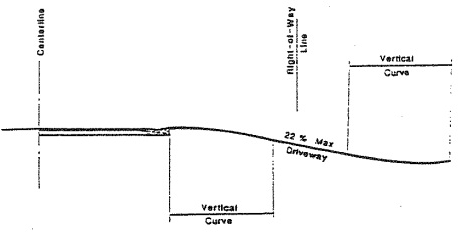
Driveways shall have a maximum grade of twenty-two percent as illustrated below:
(Ord. 708 (part), 1996.)
17.34.100 - Cut and Fill Slopes
All cut and fill slopes shall be kept to a minimum horizontal expanse or footprint and shall comply with the following:
A.
Cut Slopes. Cut slopes should be made as steep as possible while maintaining public safety. It is strongly suggested that cut slopes be as steep as technically justifiable in a geotechnical report. Where cut slopes will produce a horizontal disturbed earth area of fifteen feet or more in width, they shall be retained at the toe of the slope so that the horizontal disturbed earth area is no more than fifteen feet in width. Retaining walls should be constructed in compliance with the hillside preservation guidelines as described in Section 17.34.150.
B.
Fill Slopes. Fill slopes should not be steeper than 2:1 except for slopes that have a horizontal distance of five feet, which may be 1-1/2:1 when justifiable in a geotechnical report and/or when aesthetically justifiable. Fill slopes producing a horizontal disturbed earth area of fifteen feet or more shall be retained at a point fifteen feet (maximum) from the top of the slope. Retaining walls should be constructed in compliance with the hillside preservation guidelines. (Ord. 708 (part), 1996.)
17.34.110 - Drainage
Drainage plans shall be submitted for all projects subject to this chapter and shall comply with "best management practices" and/or the following provisions:
A.
Drainage from the site shall be directed to natural drainage courses or perimeter ditches or similar devices which direct runoff to natural drainage courses or storm flowing swales. If perimeter ditches are used, they are to be maintained by the landowner.
B.
Where drainage empties into a natural drainage course, sedimentation traps, settling ponds, or other devices shall be installed to reduce siltation entering natural drainage courses.
C.
Drainage easements shall be recorded and indicated on the final map for all drainage structures which cross adjacent parcels. No increased or concentrated drainage shall cross exterior property lines without the existence of an easement or the consent of the downstream property owner, except where a natural drainage course or storm flow swale already exists.
(Ord. 708 (part), 1996.)
17.34.120 - Erosion Control
Erosion control plans shall be submitted for all projects subject to this chapter and shall comply with "best management practices" and/or the following provisions:
A.
All erosion control measures shall remain in place during any rainfall and shall be installed during the period October 15th through April 15th of the year of construction, or as determined by the community development director.
B.
All seeding and erosion control measures shall be maintained throughout the first winter/spring season following construction.
C.
Where erosion may drain into a natural drainage course located either on or off- site, sedimentation traps, settling ponds, or other devices shall be installed to reduce siltation entering natural drainage courses.
(Ord. 708 (part), 1996.)
17.34.130 - Slope/Density
The project engineer shall prepare and submit slope/density calculations for the project site. In calculating slopes to establish density criteria, the following formula, or alternative approved by the city engineer, shall be used:
S = [(I × L)/A] × 100, where S = the average slope in percent rounded to the nearest whole number; I = the contour interval, in feet; L = the combined length in feet of all contour lines within that portion of the project site with slopes of 10% or greater and A = the gross area of that portion of the project site with slopes of 10% or greater, measured in square feet, prior to further subdivision.
A.
Residential Construction. New residential development subject to this chapter shall not exceed the following slope/density maximums, except as provided herein:
10-15% - 6 dwelling units per gross acre
16-20% - 5 dwelling units per gross acre
21-25% - 4 dwelling units per gross acre
26-30% - 3 dwelling units per gross acre
31-35% - 2 dwelling units per gross acre
36-40% - 1 dwelling unit per gross acre
41-45% - .5 dwelling unit per gross acre (1 dwelling unit per 2 acres)
46-49% - .3 dwelling unit per gross acre (1 dwelling unit per 3 acres)
50%+ - .1 dwelling unit per gross acre (1 dwelling unit per 10 acres)
These maximums indicate densities which, when exceeded, are expected to increase fire hazard, grading, and erosion, substantially reduce vegetation and increase visible changes to hillsides which cannot be offset even with the application of special design features. For project sites with multiple average slopes, the project engineer shall calculate the total acreage subject to each average slope to assist in determining the appropriate density for each portion of the project site. These maximums are not intended to be used as a basis for requesting general plan amendments to increase densities on hillsides and hilltops where existing general plan designations and zoning establish stricter density standards.
B.
Density Bonus. Increased densities, of up to twenty percent of the maximums established above, may be granted for creative design solutions, or in response to site specific characteristics, which fulfill the purposes of this chapter. Preferred design alternatives include, but are not limited to:
1.
Clustering structures where clustering results in reduced roadway surfacing and/or increased vegetation retention and open spaces;
2.
Concentrating development on hillsides and preserving the hilltop;
3.
Clustering structures in existing clearings to reduce vegetation removal; or
4.
Preserving seventy-five percent or more of the on-site vegetation.
(Ord. 708 (part), 1996.)
17.34.140 - Vegetation Management
A landscaping plan, shall be submitted for new development subject to this chapter pursuant to Chapter 12.20 of this code, and the hillside preservation guidelines. Landscaping plans shall seek to maintain the preproject vegetative cover mix throughout a majority of the project site. Vegetation management may be achieved through avoidance, replacement or a combination of the two.
(Ord. 708 (part), 1996.)
17.34.150 - Hillside Preservation Guidelines
To clarify and expand upon regulations set forth herein, the city shall adopt by resolution hillside preservation guidelines.
(Ord. 708 (part), 1996.)
17.34.160 - Penalties
If trees, soils or geologic formations, identified for protection through the environmental review process, are damaged, the city has the authority to stop construction and require that trees, geologic formations and soil be replaced to the city's satisfaction. Each and every violation of this chapter shall be a misdemeanor, with penalties assessed in accordance with Chapter 1.08 of this code. Each and every protected tree, soil area or geologic formation damaged or removed shall be a separate offense.
(Ord. 708 (part), 1996.)
17.34.170 - Effect of Decision
The final decision of the decision-making body pursuant to this chapter shall be binding on all future property owners and users of the property subject to this chapter. Failure of any person to abide by the conditions of approval imposed pursuant to this chapter shall constitute a violation pursuant to Section 17.70.050 of this code.
(Ord. 708 (part), 1996.)
17.34.180 - Appeal
Decisions of the staff or the planning commission pursuant to this chapter may be appealed by the applicant or any interested party in accordance with the provisions of this title, upon payment of a fee as adopted by resolution of the city council.
(Ord. 708 (part), 1996.)

