
South Chicago Heights
City Zoning Code
City Zoning Code
CHAPTER 11
- STREET GRAPHICS CODE
Part I. - Purpose and application.
1-101:
Purpose. The purpose of this chapter is to set out regulations for the erection and maintenance of signs while preserving the right of free speech and expression.
1-102:
Scope. This chapter's regulations shall provide a balanced and fair legal framework for design, construction, and placement of signs that:
A.
Promotes the safety of persons and property by ensuring that signs do not create a hazard by:
1.
Collapsing, catching fire, or otherwise decaying;
2.
Confusing or distracting motorists; or
3.
Impairing drivers' ability to see pedestrians, obstacles or other vehicles, or to read traffic signs; and
B.
Promotes the efficient communication of messages, and ensures that persons exposed to signs:
1.
Are not overwhelmed by the number of messages presented; and
2.
Are able to exercise freedom of choice to observe or ignore said messages according to the observer's purpose; and
C.
Protects the public welfare and enhances the appearance and economic value of the landscape by protecting scenic views and avoiding sign clutter that can compromise the character, quality, and viability of commercial corridors;
D.
Ensures that signs are compatible with their surroundings, and prevents the construction of signs that are a nuisance to occupants of adjacent and contiguous property due to brightness, reflectivity, bulk, or height;
E.
Promotes the use of signs that are aesthetically pleasing, of appropriate scale, and integrated with the built environment, in order to meet the objectives related to the quality and character of development set forth in the village's comprehensive plan;
F.
Enhances property values and business opportunities;
G.
Assists in wayfinding; and
H.
Provides fair and consistent permitting and enforcement.
1-103:
Authority. The board of trustees finds that:
A.
The village has the authority to regulate signs under the United States Constitution, the Constitution of the State of Illinois, and the zoning division of the Illinois Municipal Code;
B.
This chapter advances important and substantial governmental interests;
C.
The regulations set out in this chapter are unrelated to the suppression of constitutionally protected free expression and do not involve the content of protected messages which may be displayed on signs, nor do they involve the viewpoint of individual speakers;
D.
The incidental restriction on the freedom of speech is no greater than is essential to the furtherance of the interests protected by this chapter; and
E.
Certain types of speech are not protected by the First Amendment due to the harm that they cause to individuals or the community, and speech that is harmful to minors may be prohibited in places that are accessible to minors.
1-104:
General findings of fact. The board of trustees finds that:
A.
The ability to display signs of reasonable size and dimensions is vital to the health and sustainability of many businesses, and the display of signs with noncommercial messages is a traditional component of the freedom of speech, but the constitutional guarantee of free speech may be limited by appropriate and constrained regulation that is unrelated to the expression itself;
B.
The village has an important and substantial interest in preventing sign clutter (which is the proliferation of signs of increasing size and dimensions as a result of competition among property owners for the attention of passing motorists), because sign clutter degrades the character of the community, makes the community a less attractive place for commerce and private investment, and dilutes or obscures messages displayed along the village's streets by creating visual confusion and aesthetic blight;
C.
Sign clutter can be prevented by regulations that balance the legitimate needs of individual property owners to convey their commercial and noncommercial messages against the comparable needs of adjacent and nearby property owners and the interest of the community as a whole in providing for a high-quality community character;
D.
Temporary signs that are not constructed of weather-resistant materials are often damaged or destroyed by wind, rain, and sun, and after such damage or destruction, degrade the aesthetics of the village's streets if they are not removed;
E.
The village has an important and substantial interest in keeping its rights-of-way clear of obstructions and litter;
F.
The village has an important and substantial interest in protecting the health of its tree canopy, which contributes to the character and value of the community; and
G.
The uncontrolled use of off-premises outdoor advertising signs and their location, density, size, shape, motion, illumination and demand for attention can be injurious to the purposes of this chapter, and destructive to community character and property values, and that, as such, restrictions on the display of off-premises commercial messages are necessary and desirable.
1-105:
Application of this chapter.
A.
Generally. Hereinafter, all construction, relocation, enlargement, alteration, and modification of signs within the village shall conform to the requirements of this chapter, all state and federal regulations concerning signs and advertising, and applicable building codes. Generally, signs are approved by issuance of a sign permit. However, there are some signs that do not require a permit. These signs are listed in subsection C, below.
B.
Signs requiring a permit. A sign permit shall be required for all permitted signs exceeding six square feet in area, unless otherwise exempted by subsection C, below. In addition, a sign permit shall be required at any time the sign area is increased, if the increase is allowable within the zoning district in which the sign is located. This subsection shall not be interpreted so as to grant permission for prohibited signs with sign areas less than six square feet.
C.
Signs that do not require a sign permit. The following signs do not require a sign permit, but may require a building permit or other related permit (if subject to building or electrical codes). Temporary signs that do not require permits shall still comply with the standards of part V, temporary signs, and part III, general design and maintenance standards, or the applicable standards of this subsection.
1.
Official and legal notice. Official and legal notice signs that are issued by any court, public body, person, or officer in performance of a public duty, or in giving any legal notice;
2.
Signs with de minimus area. Signs that are affixed to a building or structure (even if wall signs are not permitted in the district or for the use), which do not exceed one square foot in sign area, provided that only one such sign is present on each elevation that is visible from public rights-of-way or neighboring property; and signs that are less than three-fourths of a square foot in area that are affixed to machines, equipment, fences, gates, walls, gasoline pumps, public telephones, or utility cabinets;
3.
Flags. Flags that are not larger than 30 square feet in area that are affixed to permanent flagpoles or flagpoles that are mounted to buildings (either temporary or permanent);
4.
Decorative signs. Clearly incidental, customary, and commonly associated with a holiday, provided that such signs shall be displayed for a period of not more than 60 consecutive days nor more than 60 total days in any one year;
5.
Carried signs. Signs that are being carried by people (however, such signs are not exempt if they are set down or propped on objects);
6.
Bumper stickers. Bumper stickers on vehicles;
7.
Interior signs. Signs that are not visible from residential lots, abutting property or public rights-of-way;
8.
Traffic control signs. Traffic control signs and other signs related to public safety that the village or another jurisdiction installs or requires a developer to install;
9.
Holiday decorations. Holiday decorations that are displayed for not more than two months per year.
1-106:
Exemption for addressing. The board of trustees finds that the posting of the addresses of buildings in locations that are visible from the street is necessary for the effective delivery of public safety services. The efficient and timely delivery of emergency services is a compelling governmental interest. Accordingly, the village requires that street addresses shall be posted as follows:
A.
Nonresidential and mixed-use districts. In nonresidential districts, street addresses shall be posted at:
1.
All primary building entrances; and
2.
On detached signage if the address on the building is not visible from the street.
B.
Residential districts. In residential districts, street addresses shall be posted:
1.
On the façade of the building that faces the street from which the address is taken; and
2.
On the mailbox or mailbox support, if the mailbox is detached from the building.
C.
Exclusion from sign area calculation. Because address signs are required, numbers and letters used for addressing are not included in the calculation of sign area if they are not more than 14 inches in height.
1-107:
Signs permitted before effective date. If a permit for a sign has been issued in accordance with all village ordinances in effect prior to the effective date of this chapter, and provided that construction is begun within six months of the effective date of this chapter and diligently pursued to completion, said sign may be completed in accordance with the approved plans on the basis of which the permit has been issued, subject thereafter, if applicable, to the provisions of this code regarding nonconforming signs.
1-108:
Relationship to other regulations. These regulations recognize other regulations pertaining to signage. Where any provision of this chapter covers the same subject matter as other regulations, the more restrictive regulation shall apply.
Part II. - Measurements and calculations.
1-201:
Measurements.
A.
Generally. The regulations of this chapter shall be applied using the measurements set out in this section.
B.
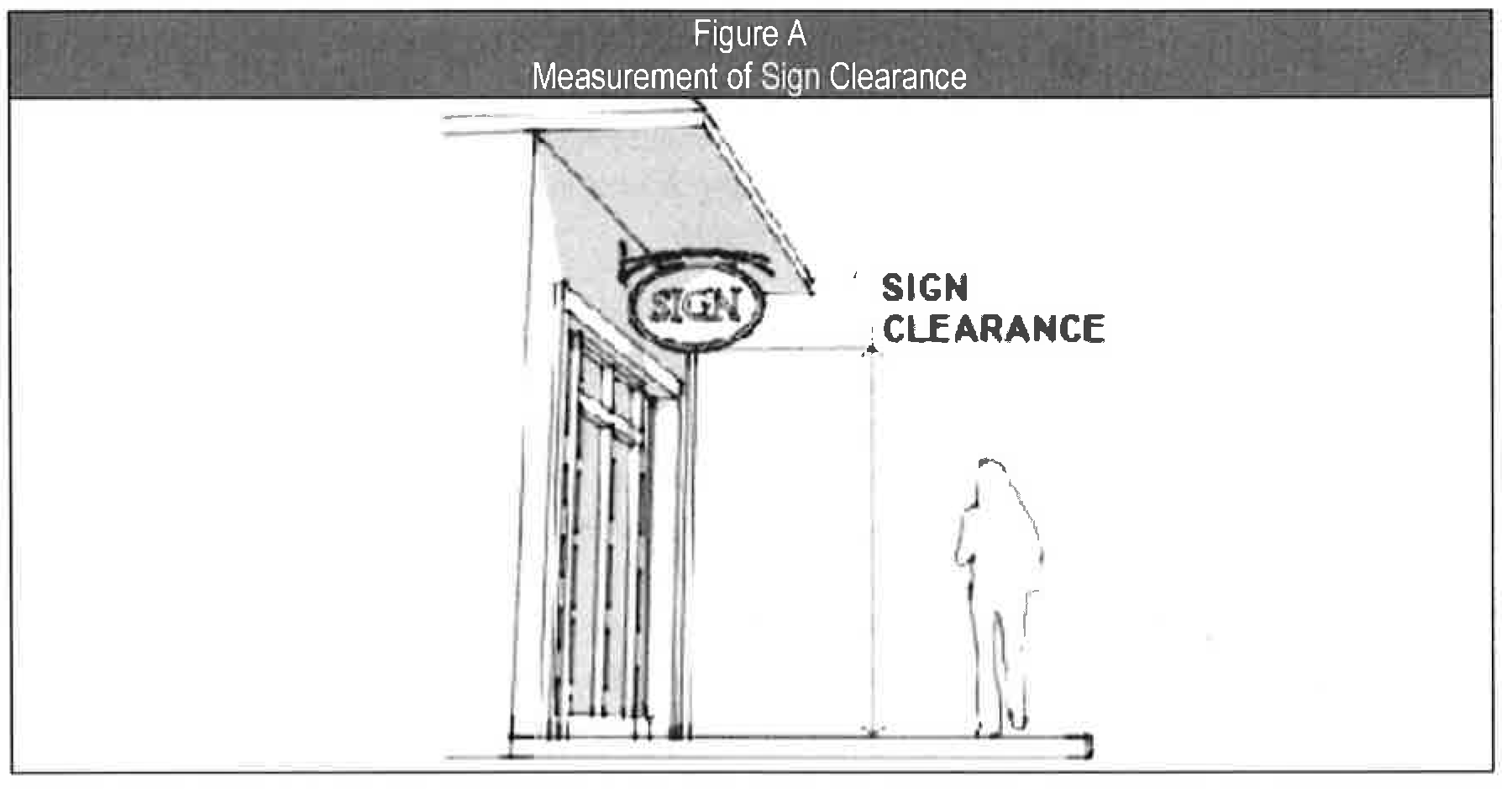
Sign clearance. Sign clearance is the distance between the bottom of a sign face or structural element that is not affixed to the ground and the nearest point on the surface under it. See figure A, measurement of sign clearance.
C.
Sign height. For detached signs (temporary and permanent), sign height is:
1.
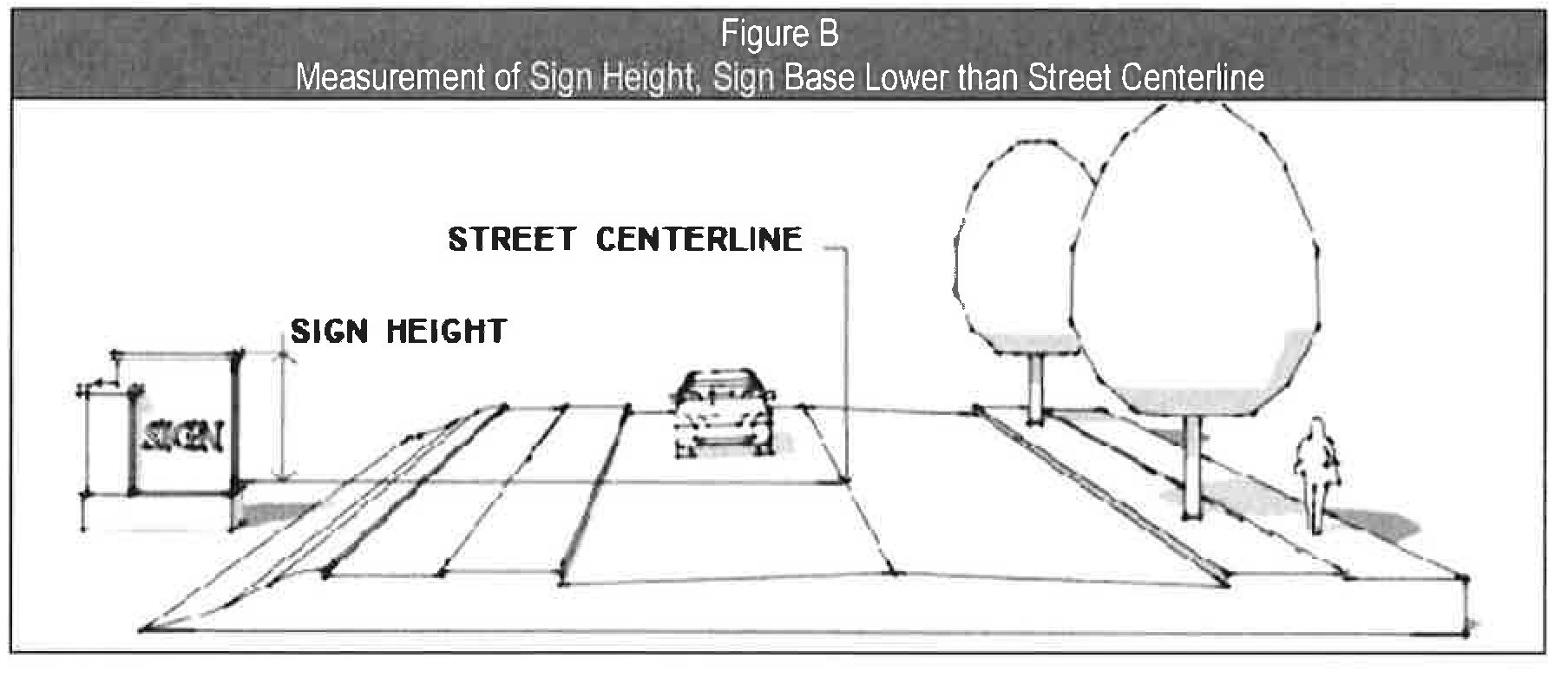
Where the natural grade of the ground where the sign is to be located is lower than the street centerline, the vertical distance to the top of the sign face or sign structure, whichever is higher, measured from the elevation of the centerline of the adjacent street. See figure B, measurement of sign height, sign base lower than street centerline.
2.
Where the natural grade of the ground where the sign is to be located is higher than the street centerline, the vertical distance to the top of the sign face or sign structure, whichever is higher, measured from the elevation of the average grade around the base of the sign.
D.
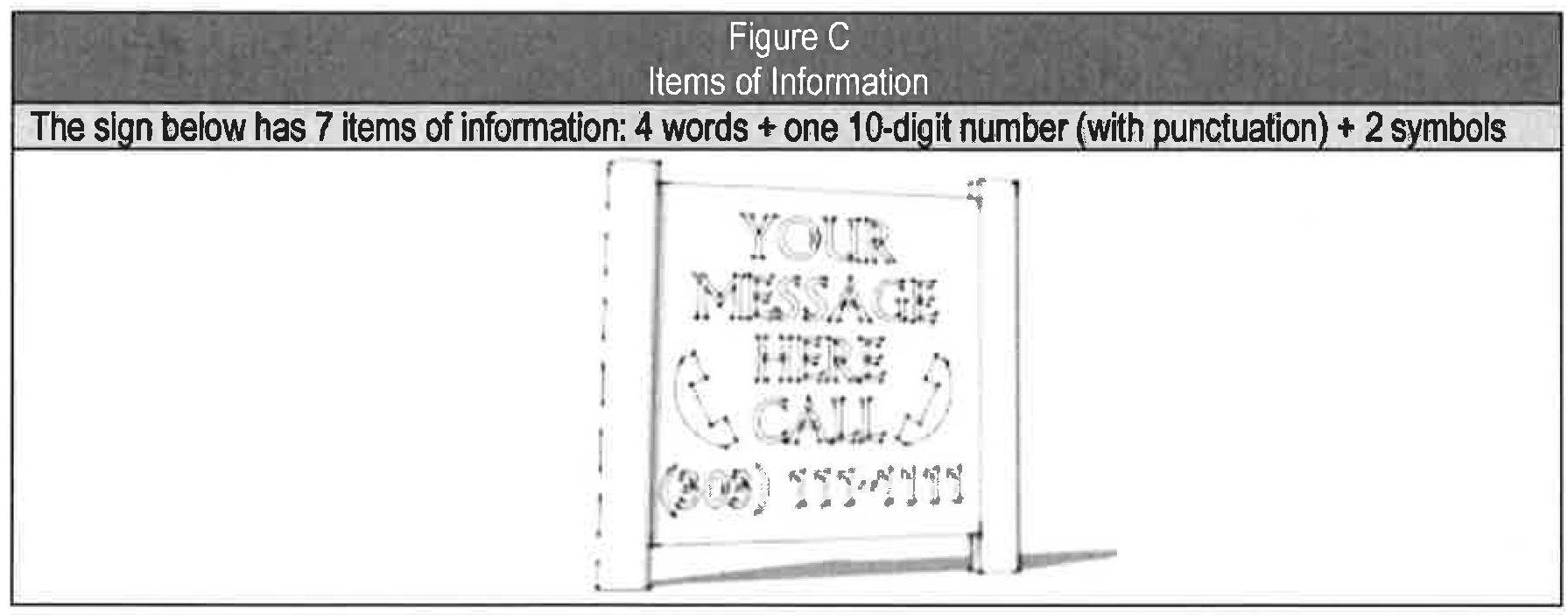
Items of information. An item of information is a word, logo, abbreviation, symbol, geometric shape, image, or number with ten or fewer digits (punctuation of numbers does not increase the number of items of information). See figure C, items of information.
1-202:
Calculations.
A.
Generally. The calculations required by the regulations of this chapter shall be according to the methodologies of this section.
B.
Sign area.
1.
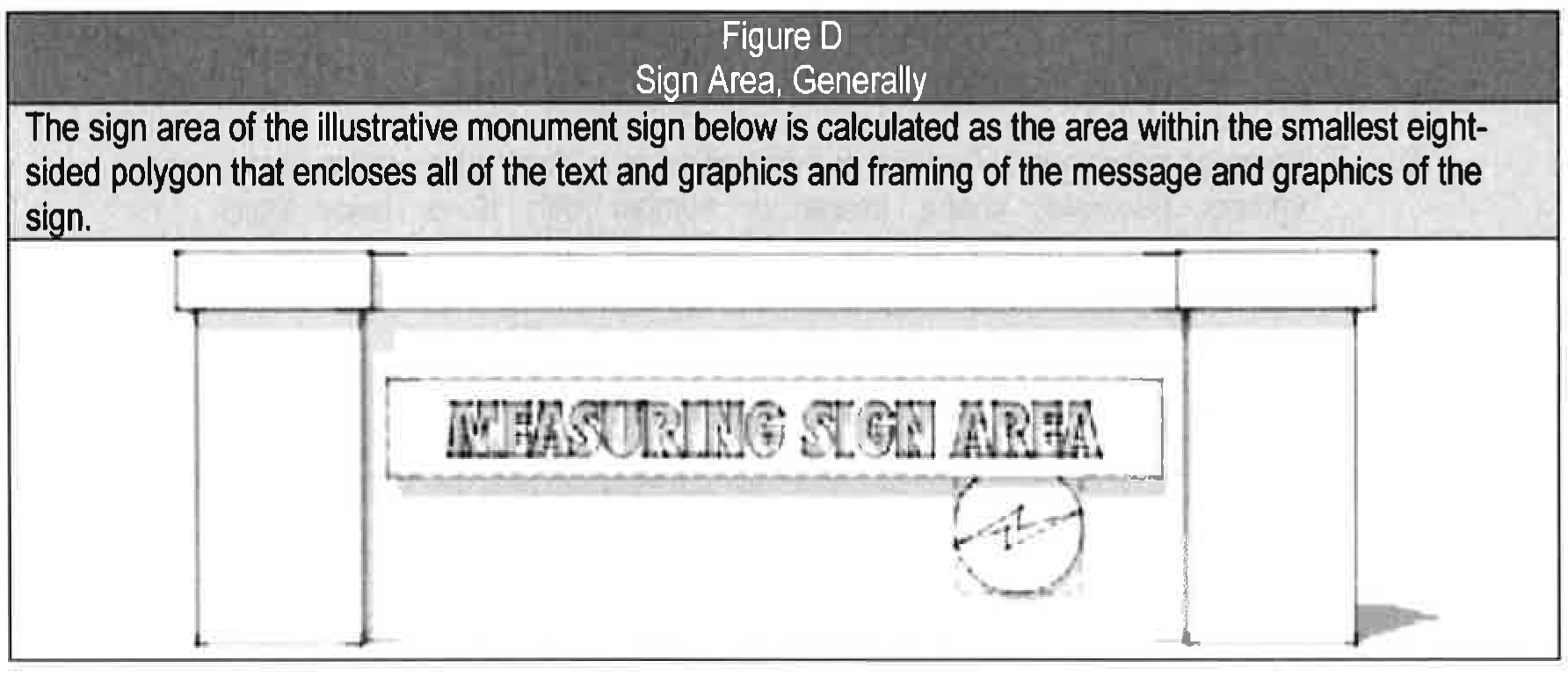
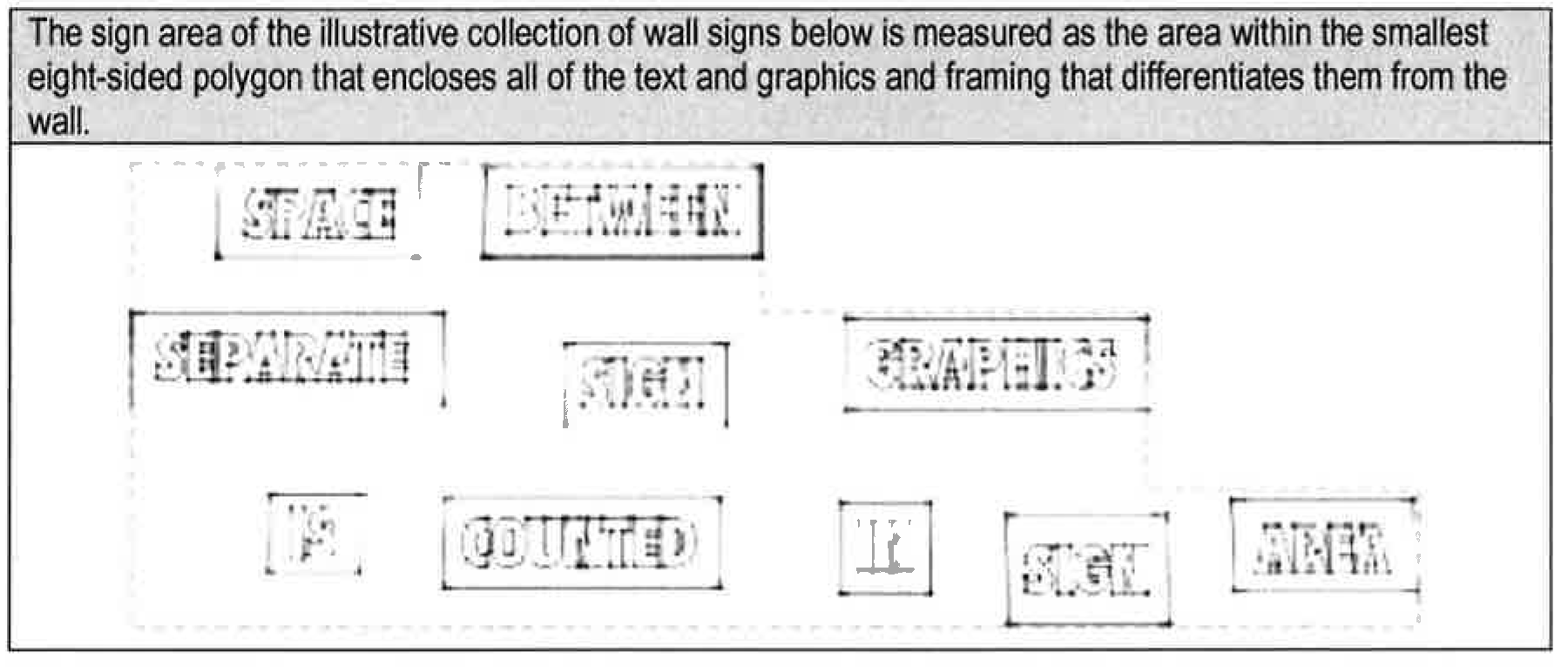
Generally. Sign area is calculated as the area within a continuous perimeter with up to eight straight sides that encloses the limits of text and graphics of a sign, together with any frame or other material or color forming an integral part of the display or used to differentiate the sign's message from the background against which it is placed. The area excludes the structure upon which the sign is placed (unless the structure is an integral part of the display or used to differentiate it), but includes any open space contained within the outer limits of the display face of a sign, or between any component, panel, strip, or figure of any kind composing the display face, whether this open space is enclosed by a frame or border or not. See figure D, sign area, generally.
2.
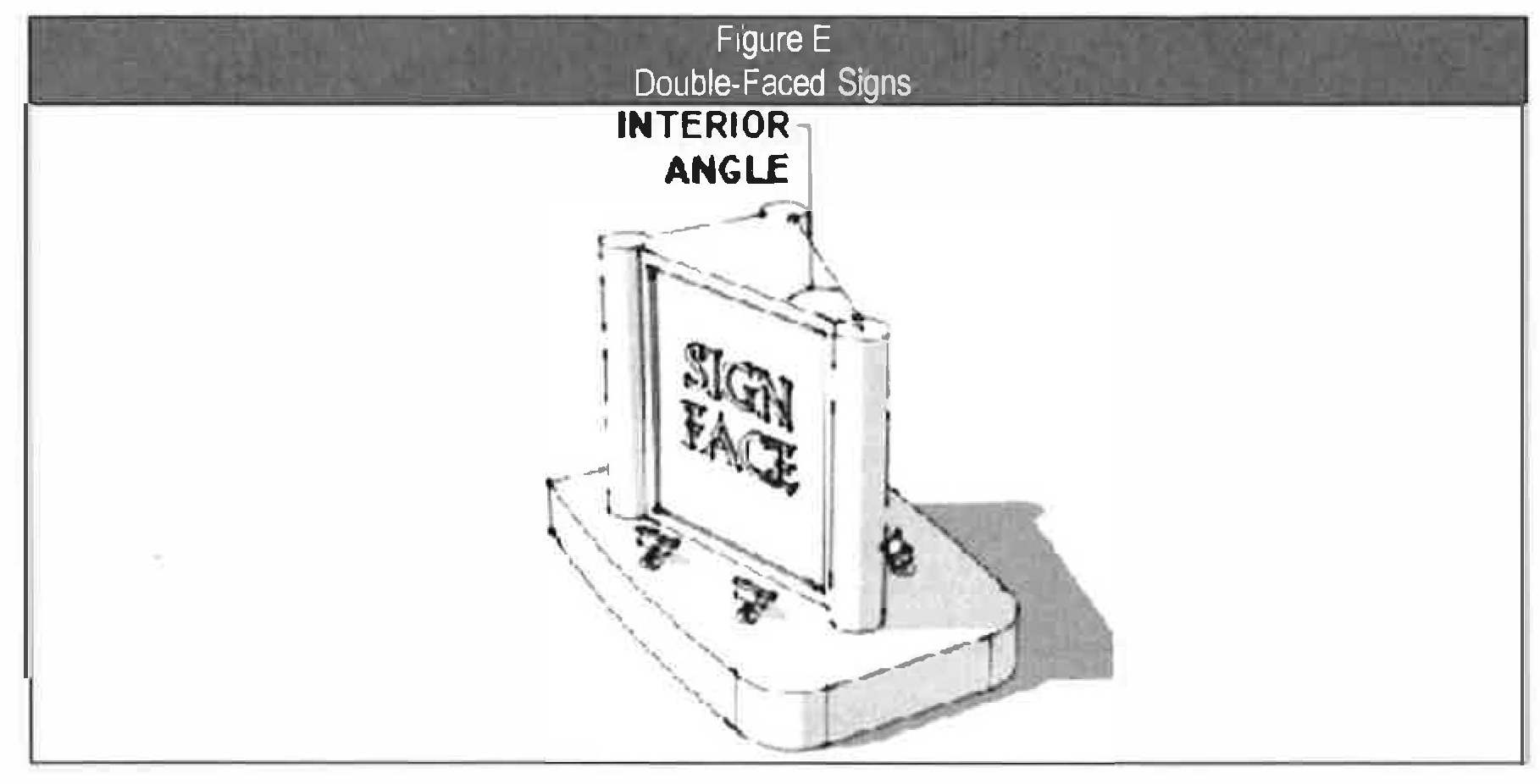
Double-faced signs. For projecting, suspended, or other double-faced signs:
(a)
Only one display face is measured if the sign faces are parallel or form an interior angle of less than 45 degrees, provided that the signs are mounted on the same structure. If the faces are of unequal area, then sign area is equal to the area of the larger face.
(b)
Both display faces are measured if:
(i)
The interior angle is greater than 45 degrees; or
(ii)
The sign faces are mounted on different structures.
C.
Signable area. Signable area is calculated as follows:
1.
Wall signs. A two-dimensional area on the facade of a building that describes the largest square, rectangle, or parallelogram which is free of architectural details.
2.
Window signs. The area of glass within a window frame.
3.
Other signs. The area of the face of the sign which is designed to be used for text and graphics (the signable area does not include the sign's supporting frame or structure, if any, provided that such frame or structure is not designed to display text or graphics).
D.
Signable area ratio. Signable area ratio is the sign area divided by the signable area. It is expressed as a percentage.
E.
Relationship between maximum sign area and maximum signable area ratio. Where both a maximum sign area and a maximum signable area ratio are set out, the standard that results in polygram that encloses all of the text and graphics and framing that differentiates them from the wall.
Part III. - General design and maintenance standards.
1-301:
Prohibited signs and design elements.
A.
Generally. This section identifies signs and sign elements that are not allowed anywhere in the village.
B.
Prohibited signs.
1.
The following signs are prohibited in all areas of the village:
(a)
Signs with more than two sign faces;
(b)
Signs that are a traffic hazard because they simulate or imitate (in size, color, lettering, or design) any traffic sign or signal;
(c)
Animated or moving signs that are visible from public rights-of-way, including any moving, swinging, rotating, flashing, blinking, scintillating, fluctuating, or otherwise animated light (except as allowed in section 1-305, message centers);
(d)
Vehicle signs;
(e)
Portable signs, except as specifically permitted in part V, temporary signs;
(f)
Inflatable signs and signs otherwise animated or supported by manufactured air pressure; and
(g)
Billboards.
2.
Other signs may be prohibited in certain districts. See part IV, permanent signs, and part V, temporary signs, for requirements.
C.
Prohibited design elements.
1.
The following elements shall not be used as an element of signs or sign structures, whether temporary or permanent:
(a)
Sound, smoke, or odor emitters;
(b)
Awnings that are back lit and/or made of plastic;
(c)
Stacked products (e.g., tires, soft drink cases, bagged soil or mulch); and
(d)
Unfinished wood support structures, except that stake signs may use unfinished stakes.
2.
The following elements shall not be used as an element of signs or sign structures, whether temporary or permanent, which are visible from public rights-of-way:
(a)
Flags, banners, or comparable elements that are designed to move in the wind that are not affixed to permanent flagpoles or flagpoles that are mounted to buildings;
(b)
Spinning or moving parts;
(c)
Bare light bulbs, except on holiday displays which are exempted from regulation by section 1-105, application of this chapter;
(d)
Flashing lights, except on holiday displays which are exempted from regulation by section 1-105, application of this chapter;
(e)
Motor vehicles, unless:
(i)
The vehicles are functional, used as motor vehicles, and have current registration and tags;
(ii)
The display of signage is incidental to the motor vehicle use; and
(iii)
The motor vehicle is properly parked in a marked parking space or is parked behind the principal building.
(f)
Semi-trailers, shipping containers, or portable storage units, unless:
(i)
The trailers, containers, or portable storage units are functional, used for their primary storage purpose, and, if subject to registration, have current registration and tags;
(ii)
The display of signage is incidental to the use for temporary storage, pick-up, or delivery; and
(iii)
The semi-trailer is parked in a designated loading area or on a construction site at which it is being used for deliveries or storage.
D.
Prohibited content.
1.
The following content is prohibited without reference to the viewpoint of the individual speaker:
(a)
Text or graphics of an indecent or immoral nature and harmful to minors;
(b)
Text or graphics that advertise unlawful activity;
(c)
Text or graphics that are obscene, fighting words, defamation, incitement to imminent lawless action, or true threats; or
(d)
Text or graphics that present a clear and present danger due to their potential confusion with traffic control signs or signs that provide public safety information (for example, signs that use the words "stop," "yield," "caution," or "danger," or comparable words, phrases, symbols, or characters in such a manner as to imply a safety hazard that does not exist).
2.
The narrow classifications of content that are prohibited by this subsection are either not protected by the United States or Illinois Constitutions, or are offered limited protection that is outweighed by the substantial governmental interests in protecting the public safety and welfare. It is the intent of the board of trustees that each paragraph of this subsection (e.g., subsection 1-301.D.1.(a) through (d)) be individually severable in the event that a court of competent jurisdiction were to hold one or more of them to be inconsistent with the United States or Illinois Constitutions.
1-302:
Prohibited sign locations.
A.
Generally. Attached signs shall be installed on signable areas of buildings, as defined by part II, measurements and calculations. Detached signs shall be set back as required by section 1-402, detached signs. Signs that are in violation of this section are subject to immediate removal.
B.
Prohibited obstructions. In no event shall a sign, whether temporary or permanent, obstruct:
1.
Building ingress or egress, including doors, egress windows, and fire escapes;
2.
Features of the building or site that are necessary for public safety, including standpipes and fire hydrants; or
3.
Within any vision clearance triangle, as defined by part VI, definitions.
C.
Prohibited mounts. No sign, whether temporary or permanent, shall be posted, installed, or mounted on any of the following locations:
1.
On trees; or
2.
On utility poles, light poles, or on utility cabinets, except signs posted by the village or the utility that are necessary for public safety or identification of the facility by the utility provider.
D.
Prohibited locations. In addition to the setback requirements of this chapter, and the other restrictions of this section, no sign shall be located in any of the following locations:
1.
In or over public rights-of-way (which, in addition to streets, may include other elements, such as sidewalks, parkways, retaining walls, utility poles, traffic control devices, medians, and center islands that are within the public right-of-way), except:
(a)
Traffic control signs installed by a governmental entity or which are required to be installed by a governmental entity (e.g., permanent traffic control devices such as stop, yield, and speed limit signs, as well as temporary signs related to street construction or repair);
(b)
Signs posted by governmental entities that support emergency management, such as wayfinding to disaster relief locations;
(c)
Banners posted by the village on utility or light poles according to the standards of section 1-302.c;
(d)
Signs constructed by the village or another governmental or quasi-governmental entity pursuant to terms and conditions set forth in an approved intergovernmental agreement with the village; and
(e)
Signs authorized by agreement with the village board.
2.
In locations that have less horizontal or vertical clearance from authorized communication or energized electrical power lines than that prescribed by the laws of the State of Illinois and the regulations duly promulgated by agencies thereof.
3.
Within easements for overhead utilities (placement in other utility easement areas is allowed only if approved by the utility service provider and if the other applicable requirements of this code are met).
1-303:
Items of information. No sign face shall contain more than 20 items of information. Items of information are measured as provided in section 1-201, measurements.
1-304:
Illumination of signs.
A.
Generally. Signs shall be internally illuminated or, if external illumination is used, the source of illumination shall be shielded.
B.
Hours of illumination. Signs shall be turned off each day by the later of 10:00 p.m. or upon closing of the associated land use (signs may be turned back on at 5:00 a.m.).
_____
C.
Sign illumination. Signs shall not exceed the following illumination levels:
1-305:
Message centers.
A.
Generally. Manual and electronic message centers may be used in detached signs and marquee signs to a limited degree, pursuant to the applicable standards of this section.
B.
Electronic message centers. Electronic message centers may be incorporated into signage as follows:
1.
Design requirements.
(a)
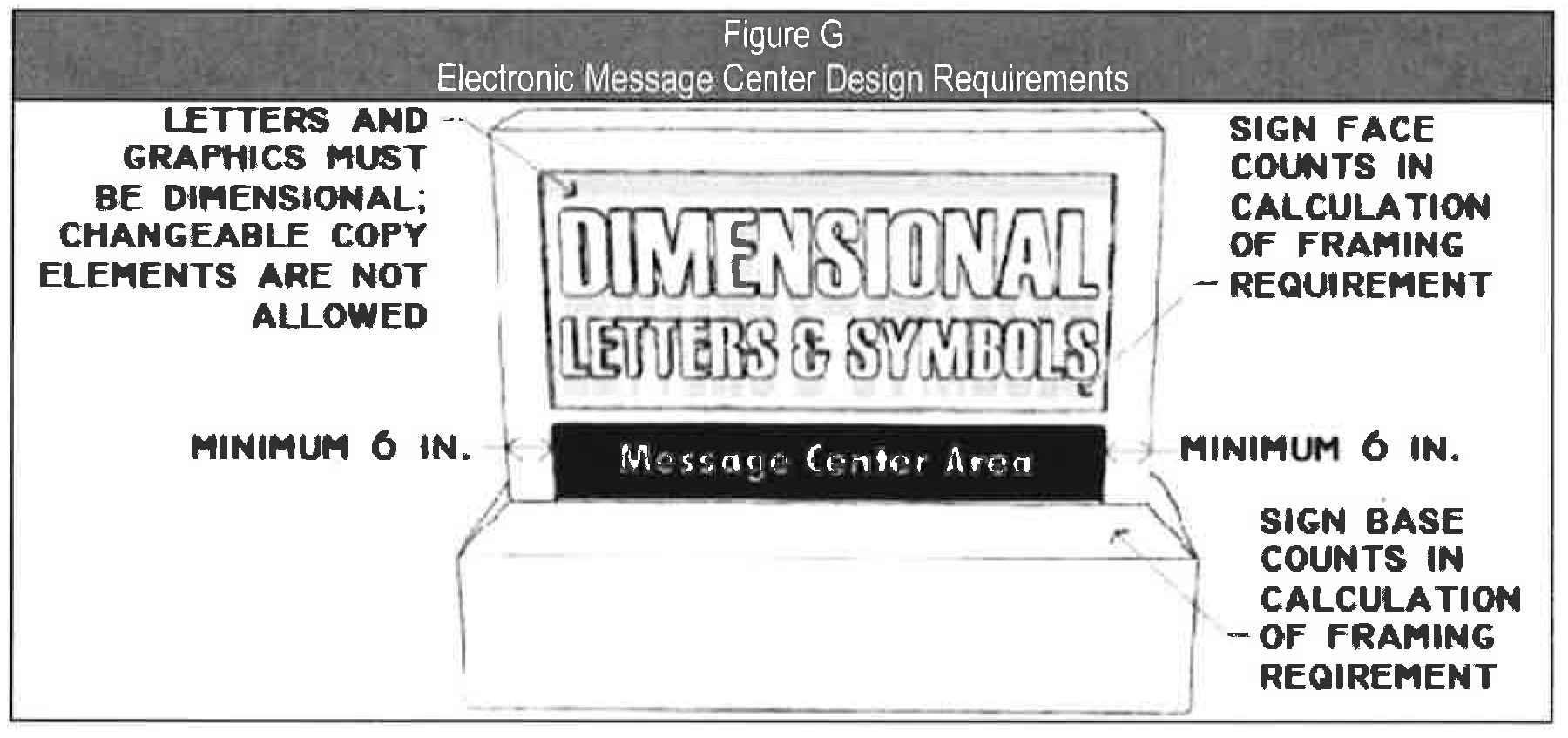
Electronic message centers are only permitted on monument signs or marquee signs which enclose the electronic message center component on all sides with a finish of brick, stone, stucco, powder coated (or comparably finished) metal, or the surface of the sign face. The enclosure shall extend not less than six inches from the electronic message center in all directions.
(b)
Electronic message centers shall make up not more than 50 percent of the sign area of a monument sign or 75 percent of the sign area of a marquee sign. The balance of the sign area shall utilize permanent, dimensional letters or symbols.
(c)
No sign structure that includes a cabinet, box, or manual changeable copy sign may also include an electronic message center. See figure F, electronic message center design requirements.
(d)
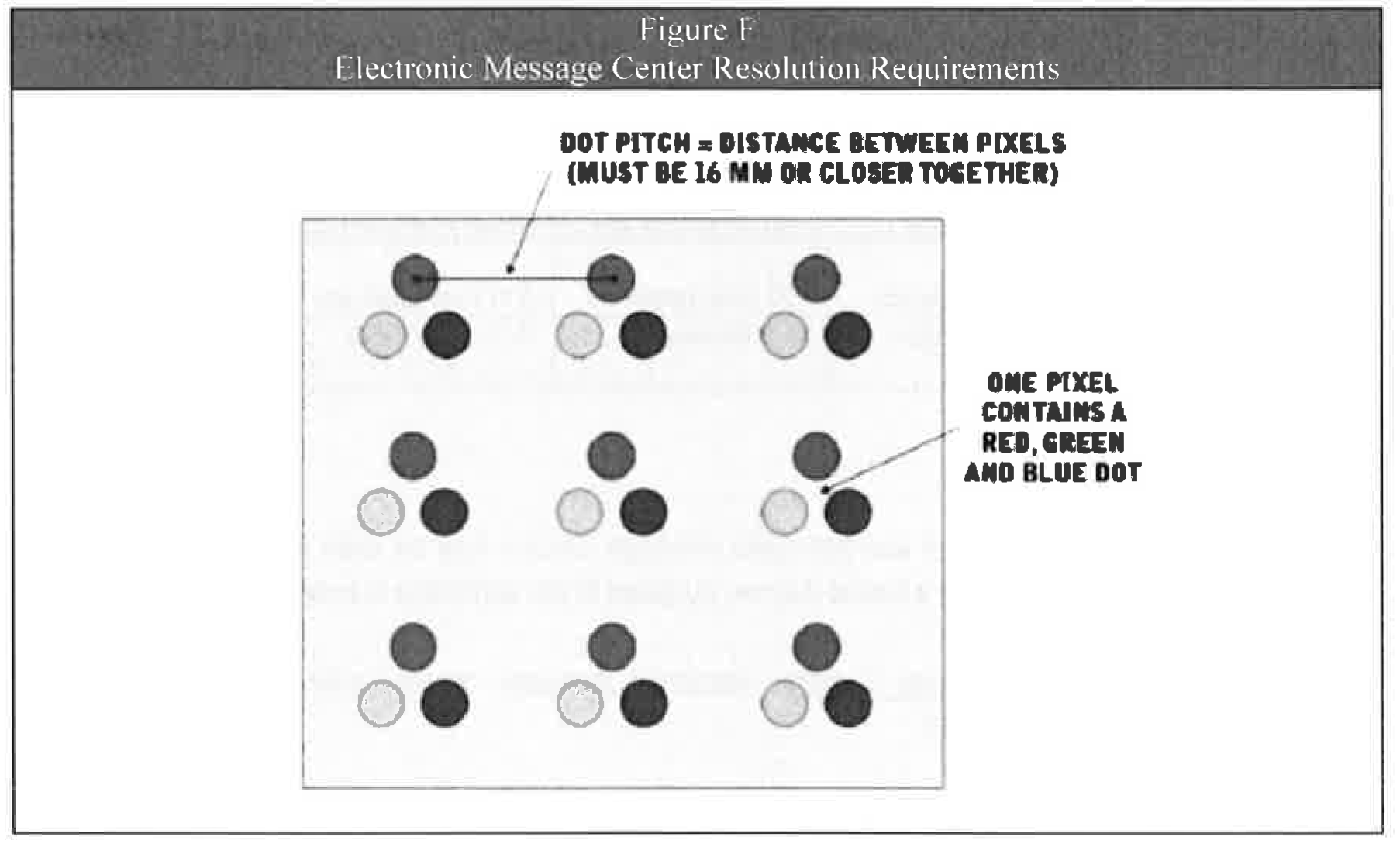
All electronic message center display components shall be full color with a minimum pitch resolution of 16 mm spacing or better (i.e. 10 mm, 12 mm, etc.)
2.
Operational requirements. Electronic message centers:
(a)
Shall contain static messages only;
(b)
Shall display messages for a period of not less than ten seconds (multiple electronic message centers, if used on the same sign, shall be synchronized to change messages at the same time);
(c)
Shall not use transitions or frame effects between messages; and
(d)
Shall conform to the illumination standards as set forth in subsection 1-305.B.3.
3.
Illumination standards. The illumination standards set forth in this section shall apply to all electronic message center signs, including multi-tenant electronic message centers.
(a)
Measurement criteria. The illuminance of an electronic message center shall be measured with an illuminance meter set to measure foot-candles accurate to at least two decimals. Illuminance shall be measured with the electronic message center off, and again with the electronic message center displaying a white image for a full color-capable electronic message center, or a solid message for a single-color electronic message center. Measurements shall be taken after sunset with the site fully illuminated by installed site lighting. All measurements shall be taken perpendicular to the face of the electronic message center at the distance determined by the total square footage of the electronic message center as set forth below:
Large sign: 98 feet
Medium sign: 73 feet for symmetrical and asymmetrical sign types; 84 feet for horizontal sign type
Small sign: 49 feet for symmetrical and asymmetrical sign type; 57 feet for horizontal sign type
Other sign sizes: Measurement distance = √ (area of sign (in sq. ft.) x 100)
(b)
Electronic message center illumination limits. The difference between the off and solid-message measurements using the EMC measurement criteria shall not exceed 0.3 foot-candles on either side of the sign. If there is a difference in measurement of illumination levels on either side of the sign, the side of the sign facing residentially zoned properties shall take precedent.
(c)
Dimming capabilities. All electronic message centers shall be equipped with a sensor or other device that automatically determines the ambient illumination and programmed to automatically dim according to ambient light conditions, or that can be adjusted to comply with the 0.3 foot-candle measurements.
C.
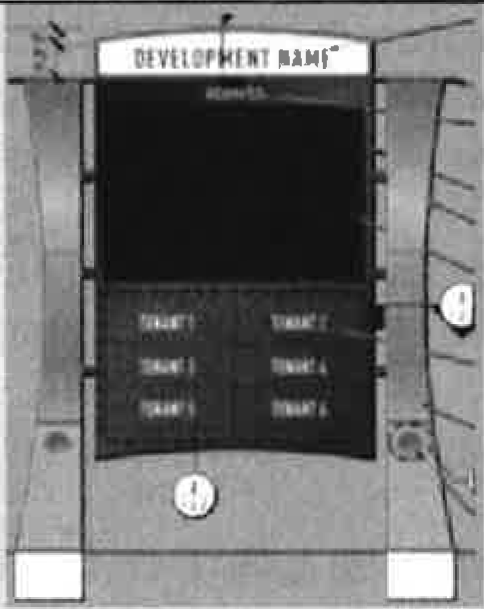
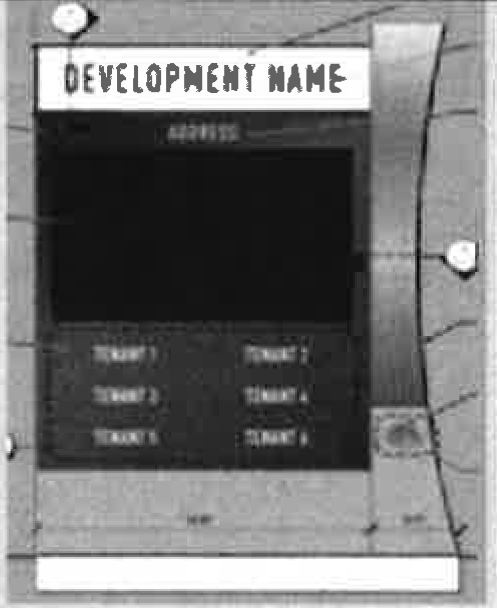
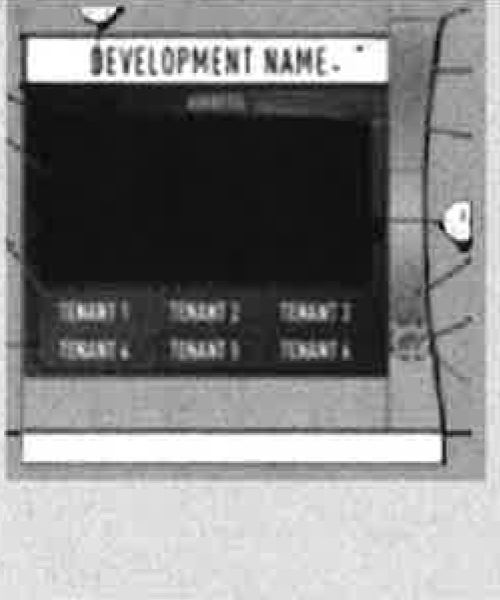
Multi-tenant electronic message centers. Multi-tenant electronic message centers are intended to provide an opportunity for unified, multi-tenant developments to advertise on-site businesses through uniform sign designs subject to the requirements set forth in this subsection. Developments that do not meet the criteria set forth in this subsection are permitted to display electronic message center signs in accordance with section 1-305.B.
1.
Development eligibility requirements. Multi-tenant electronic message centers are permitted in mixed use or nonresidential developments that meet all of the following criteria:
(a)
Unified mixed use or non-residential development that meets the minimum floor area requirements as specified in Table 2, whether existing or proposed through an approved site plan, and contains at least ten existing or proposed tenants, storefronts, or businesses.
(b)
The development must be located in the B-1 or TCR zoning districts.
(c)
Through the sign permit application, the development must identify tenants, storefronts, and businesses eligible for signage on the multi-tenant electronic message center sign.
2.
Sign design, location, and requirements. A mixed use or non-residential development that meets all of the criteria of section 1-305.C.1, may display multi-tenant electronic message centers on signs that meet all of the following criteria:
(a)
The sign shall conform to the sign prototypes and criteria set forth in Table 2.
(b)
A maximum of one large sized multi-tenant electronic message center sign may be displayed per eligible development meeting the criteria in section 1-305.C.1, except that a maximum of two large sized multi-tenant electronic message center signs may be displayed if the total square footage of existing floor area for the development exceeds 400,000 square feet and is adjacent to Chicago Road or Sauk Trail.
(c)
A maximum of one medium sized multi-tenant electronic message center sign may be displayed per eligible development meeting the criteria in section 1-305.C.1.
(d)
All electronic message center display components shall be full color with a pitch resolution of no greater than 16 mm spacing (e.g. 12 mm, 10 mm are acceptable).
(e)
The sign must meet the minimum setback requirements set forth in Table 2.
(f)
The sign must be located adjacent to the rights-of-way specified in Table 2 under "eligible ROW frontage."
3.
Operational requirements. Multi-tenant electronic message centers:
(a)
Shall contain static messages only;
(b)
Shall display messages for a period of not less than ten seconds;
(c)
Shall not use transitions or frame effects between messages;
(d)
Shall meet the illumination standards set forth in subsection 1-305.B.3; and
(e)
No more than four separate images on the electronic message center display shall be displayed at any given time.
| Table 2 Multi-tenant EMC Requirements | ||||||||
|---|---|---|---|---|---|---|---|---|
| Sign Prototype | Symmetrical | Asymmetrical | Horizontal | |||||
 |  |  | ||||||
| Sign Size | Large | Medium | Small | Large | Medium | Small | Medium | Small |
| Maximum Sign Height | 25 ft. | 18 ft. | 12 ft. | 25 ft. | 18 ft. | 12 ft. | 14 ft. | 10 ft. |
| Maximum EMC Component Size | 8'x12" | 6'x9" | 4'x6" | 8'x12" | 6'x9" | 4'x6" | 6'x12" | 4'x8" |
| Minimum Total Floor Area | 200,000 sf. | 75,000 sf. | 15,000 sf. | 200,000 sf. | 75,000 sf. | 15,000 sf. | 75,000 sf. | 15,000 sf. |
| Eligible ROW Frontage | Chicago Road or Sauk Trail | Chicago Road or Sauk Trail | Chicago Road or Sauk Trail | |||||
| Required Setback from Residentially Zoned Properties | 500 ft. | 250 ft. | 100 ft. | 500 ft. | 250 ft. | 100 ft. | 250 ft. | 100 ft. |
| Required Setback from Other Property Lines | 10 ft. | 10 ft. | 10 ft. | 10 ft. | 10 ft. | 10 ft. | 10 ft. | 10 ft. |
D.
Manual changeable copy message centers. Manual changeable copy signs may be incorporated into signage as follows:
1.
Manual changeable copy message centers are only permitted on monument signs or marquee signs which enclose the message center component on all sides with a finish of brick, stone, stucco, powder coated or comparably finished metal, or sign face that extends not less than six inches from the message center in all directions. Gaps between the message center and the finish are permitted to accommodate locks and hinges for a cover for the changeable copy area, but only to the extent necessary for such locks and hinges to operate.
2.
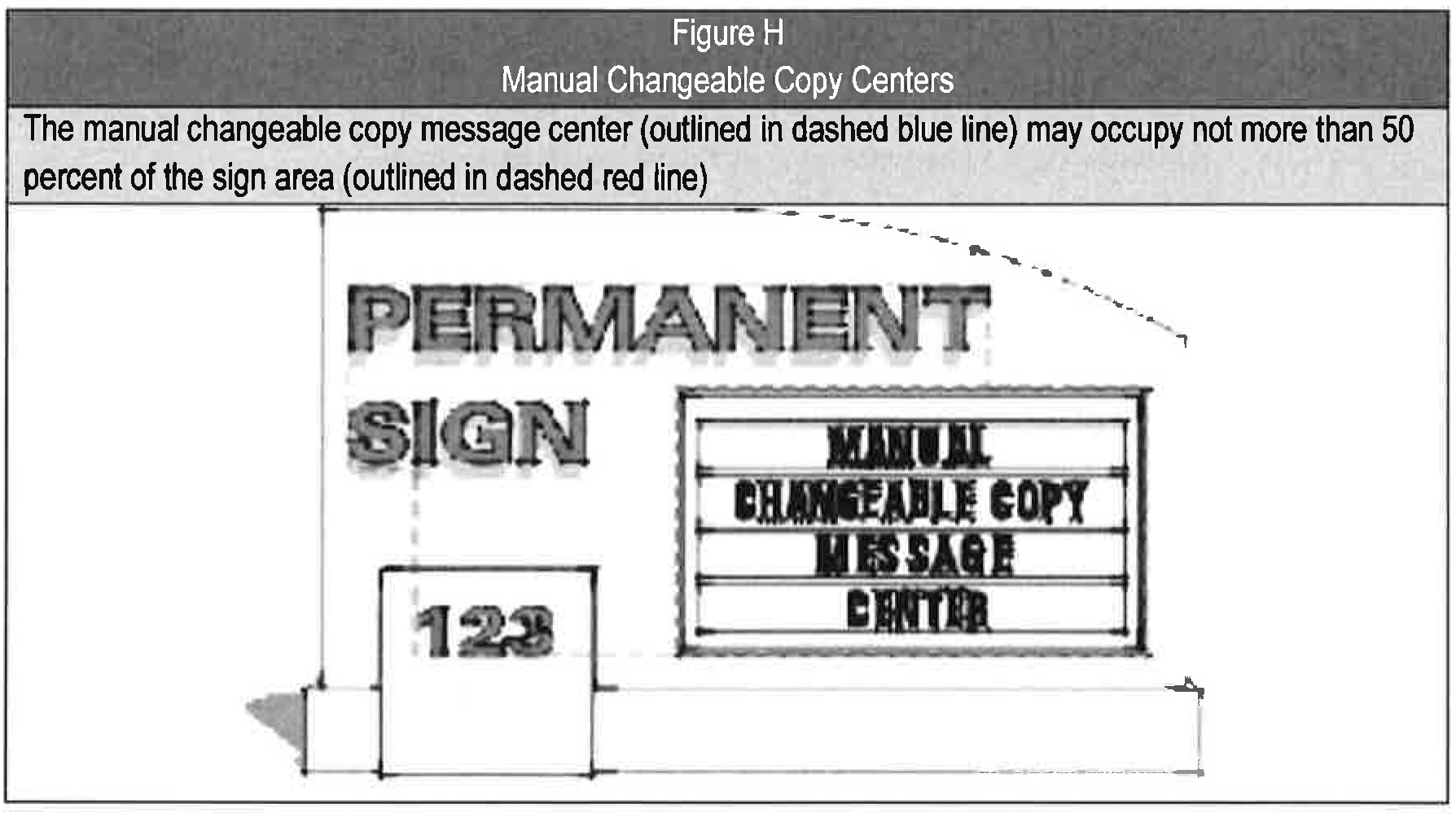
Manual changeable copy message centers, including their frames, shall make up not more than 50 percent of the sign area. The balance of the sign area shall utilize permanently affixed letters or symbols. See figure H, manual changeable copy centers.
3.
Manual changeable copy message centers shall not be internally lit unless:
(a)
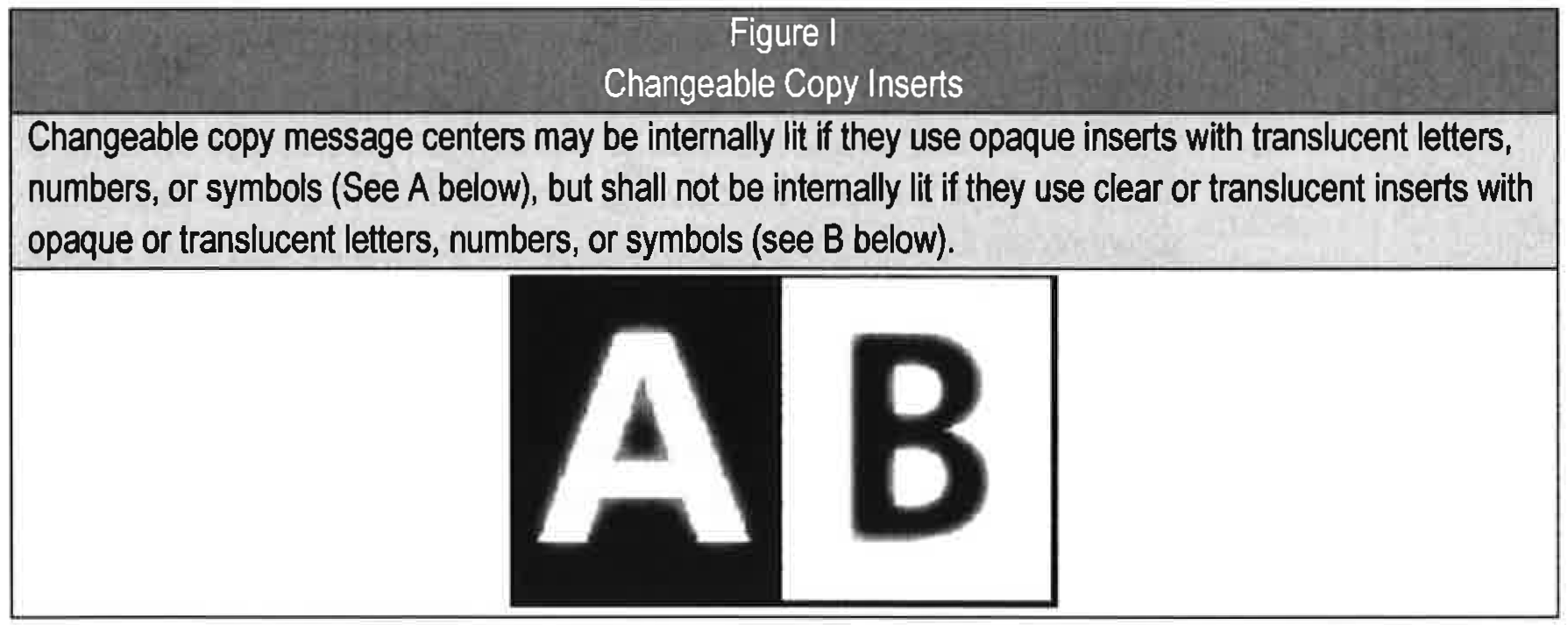
They use opaque inserts with translucent letters, numbers, or symbols (see figure I, changeable copy inserts);
(b)
Blank opaque inserts that are the same color as the opaque portions of the letters, numbers, and symbols are used over all areas of the sign where copy is not present; and
(c)
The opaque portion of the letters, numbers, and symbols is the same color.
1-306:
Sign maintenance.
A.
Generally. Signs and sign structures of all types (attached, detached, and temporary) shall be maintained as provided in this section.
B.
Message. Signs shall display messages. Signs that do not display a message for a period of more than 30 days are abandoned.
C.
Paint and finishes. Paint and other finishes shall be maintained in good condition. Peeling finishes shall be repaired. Signs with running colors shall be repainted, repaired, or removed if the running colors were not a part of the original design.
D.
Mineral deposits and stains. Mineral deposits and stains shall be promptly removed,
E.
Corrosion and rust. Permanent signs and sign structures shall be finished and maintained to prevent corrosion and rust. A patina on copper elements is not considered rust.
F.
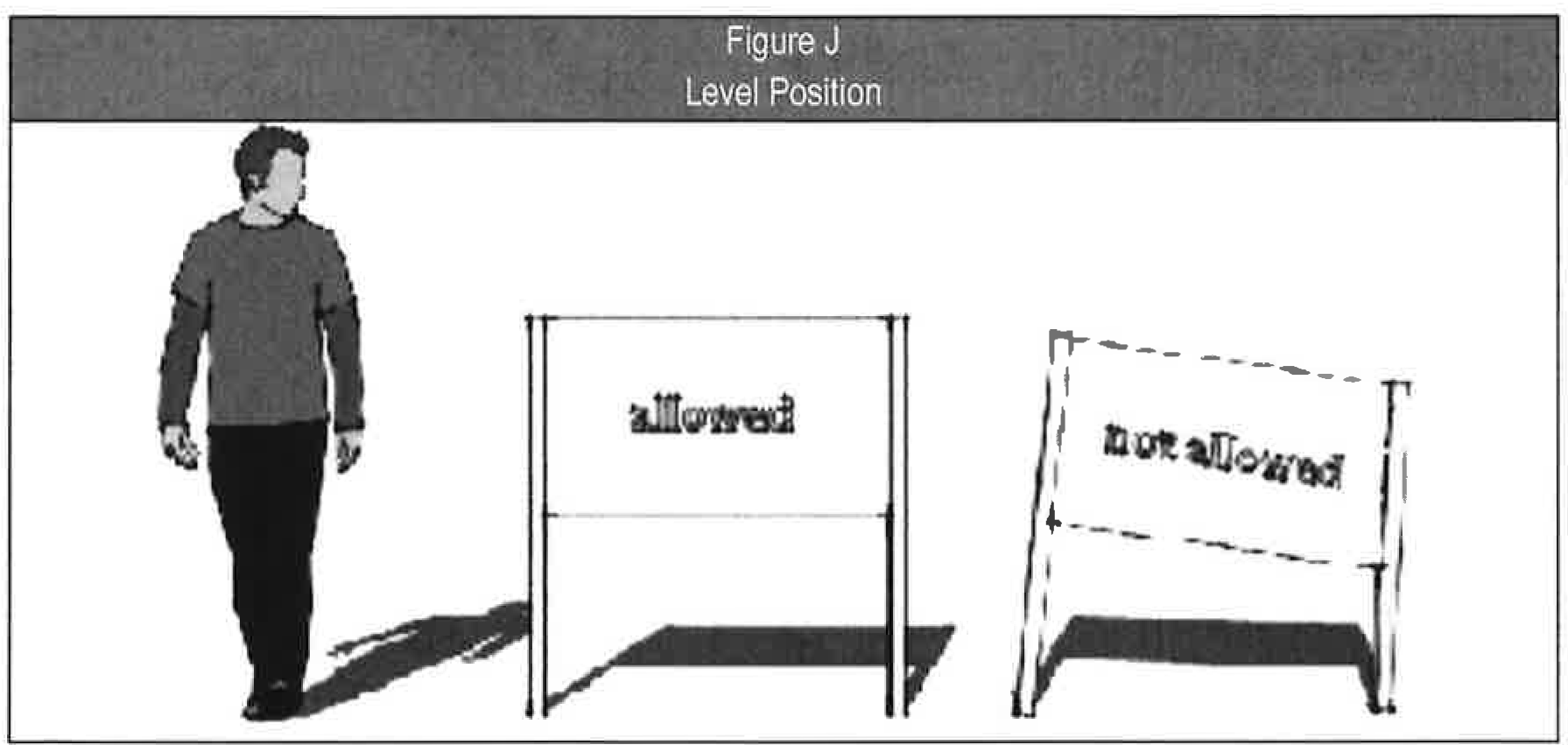
Level position. Signs that are designed to be level, whether temporary or permanent, shall be installed and maintained in a level position. See figure J, level position.
Part IV. - Permanent signs.
1-401:
Attached signs.
A.
Generally. There are many forms of attached signs. This section sets out which forms of attached signs are allowed in each zoning district and the standards that apply to them. Attached signs that are not listed in a table are not allowed as-of-right in any of the districts set out in the table.
B.
Residential districts.
1.
The standards of Table 3, Permissible Attached Sign Types in Residential Districts, apply to multifamily and nonresidential uses in the districts that are set out in the table.
2.
Attached signs are not allowed for home occupations, except for required address signs.
C.
Nonresidential districts. The standards of table 4, permissible attached sign types in nonresidential/mixed-use districts, apply in the districts that are set out in the table.
1-402:
Detached signs.
A.
Generally. There are many forms of detached signs. This section sets out which forms of detached signs are allowed in each zoning district, and the size and height standards that apply to them.
B.
Required setbacks. All detached signs shall be set back at least ten feet from all property lines. This standard may be waived if:
1.
The waiver would lower the elevation of the base of the sign by more than three feet and:
(a)
The sign will be set back at least one foot from any sidewalk;
(b)
The sign will not encroach on any utility easement;
(c)
The sign will not obstruct a vision clearance triangle (see part VI, definitions); and
(d)
There is at least five feet of landscaped parkway between the edge of pavement and the property line; or
2.
The sign is a wayfinding sign used to identify a residential subdivision or development and:
(a)
The sign will be set back at least one foot from any sidewalk;
(b)
The sign will not encroach on any utility easement;
(c)
The sign will not be located within a vision clearance triangle (see part VI, definitions).
Part V. - Temporary signs.
1-501:
General standards for freestanding temporary signs.
A.
Generally. There are many forms of temporary signs. This section sets out which forms of temporary signs are allowed in each zoning district, and the size and height standards that apply to them. Sign types that are not listed in Table 7, permissible freestanding temporary sign types in residential and agricultural districts, or Table 8, permissible freestanding temporary sign types in nonresidential/mixed-use districts, are not permitted as freestanding signs.
B.
Setbacks. All temporary signs shall be set back at least five feet from all property lines, except as provided in section 1-502, prevention of visual clutter in principal corridors. Temporary signs that are not visible from public rights-of-way or abutting property are not restricted by this section.
1-502:
Prevention of visual clutter in principal corridors.
A.
Generally. The board of trustees finds that the proliferation of temporary signage along the principal corridors of the village causes visual clutter that is detrimental to the character of the community, and tends to be distracting to motorists. The board of trustees also finds that the application of this section does not restrict the ample alternative ways that residents and business owners may communicate their messages.
B.
Corridor setback requirement.
1.
No temporary sign shall be placed within the right-of-way (as provided in section 1-302, prohibited sign locations), or within 30 feet of the edge of pavement (whichever creates a greater setback from the edge of pavement), along the following street corridors: Chicago Road or Sauk Trail.
2.
The setback requirement of this section shall not apply in the following circumstances:
(a)
Where the front yard of any lot that is used or zoned for single-family residential purposes abuts any right-of-way identified in section 1-502.B.1; or
(b)
Where an intervening private fence, wall, or other structure clearly delineates the boundary of private property outside of the prescribed public right-of-way, in which case the required setback shall include only the area up to and including the outside surface of such private fence, wall, or other structure.
1-503:
Standards for attached temporary signs.
A.
Generally. Attached temporary signs are permitted subject to the standards of this section, for a duration as set out in section 1-504, duration of temporary signs.
B.
Banners. Banners are permitted in the TCR and B-1 zoning districts, provided that:
1.
There is only one banner per tenant per principal building;
2.
The banner is attached to the principal building, and complies with the standards of section 1-302, prohibited sign locations.
3.
The sign area on the banner is not larger than the sign area allowed for a wall sign on the building upon which the banner is attached.
C.
Sock signs and temporary wall signs. Sock signs and temporary wall signs are permitted in the TCR and B-1 zoning districts, and may be installed upon issuance of a building permit for a permanent sign, and may remain in place for not more than 30 days. Such signs shall have a sign area that is not more than 15 percent larger than that which is permitted for the permanent sign for which the permit application was filed.
D.
Window signs. Temporary window signs are allowed in all locations where permanent window signs are allowed, provided that the transparency standards of section 1-401, attached signs, are met.
1-504:
Duration of temporary signs.
A.
Generally. The purpose of temporary signs is to display messages for a temporary duration. Temporary signs shall not be used as a subterfuge to circumvent the regulations that apply to permanent signs or to add permanent signage to a parcel proposed for development in addition to that which is permitted for permanent signs by section 1-401, attached signs and section 1-402, detached signs.
B.
Duration of display.
1.
In general, temporary signs shall be removed as of the earlier of the date that:
(a)
A commercial message is obsolete and has become misleading or off-premises (e.g., a "for lease" or "for sale" sign in front of a building that is fully occupied);
(b)
The sign falls into disrepair (see section 1-306, sign maintenance); or
(c)
The number of days set out in Table 9, duration of detached temporary signs, or Table 10, duration of attached temporary signs, expires.
C.
Administrative interpretations. The board of trustees finds that materials technology is a rapidly evolving field of study, and that materials for signage that are not listed in Table 9, duration of detached temporary signs, or Table 10, duration of attached temporary signs, may be introduced into the market. When an unlisted material is proposed, the community development director shall determine to which class of materials the new material is comparable, based on the new material's appearance, durability, and colorfastness. No sign displays shall be longer in duration than the longest permitted display in Table 9, duration of detached temporary signs, or Table 10, duration of attached temporary signs, regardless of the material.
1-505:
Exception for outdoor political campaign signs on residential property. Other than regulations as to size, nothing in this section prohibits the display of outdoor political campaign signs on residential property.
Part VI. - Definitions.
1-601:
Application. When used in this chapter, the following terms shall have the meanings herein ascribed to them:
Billboard means a sign advertising a land use, business, product or service, not located or available upon the premises whereon the sign is located. These signs are distinguished from other off-premises signs by their larger than otherwise permitted size and typical location along state highways and major arterial roadways. Additionally, billboards are often erected to attract attention to land uses, businesses, products, and/or services that may be utilized by motorists unfamiliar with area-wide land uses, businesses, products and/or services, such as tourists and out-of-state visitors.
Façade means the exterior walls of a building exposed to public view or that will be viewed by persons not within the building.
Footcandle (fc) means the unit of illuminance equal to one lumen per square foot.
Illuminance means a measure of how much light is falling onto a surface, typically measured in footcandles.
Logo means a distinctive symbol which identifies a business.
Luminance means the brightness or the amount of light coming off a surface in a given direction, typically measured in candela per square meter (abbreviated as cd/m 2 ).
Normal viewing angles means the view of the surroundings obtained by eyes located at five feet (1.5 m) above grade looking horizontally in any direction.
Shielded means a light fixture in which the lamp is not in sight from normal viewing angles. All fully shielded and full cut-off fixtures are considered to be shielded.
Sign means any object or device containing letters, figures and/or other means of communication or part thereof, situated outdoors or indoors, of which the effect produced is to advertise, announce, communicate, identify, declare, demonstrate, direct, display, and/or instruct potential users of a use, product and/or service.
Sign, animated means any sign, or any part thereof which changes physical position by means of movement, rotation or change in illumination to depict movement.
Sign, awning means a sign that is mounted, painted, or attached to an awning or other window or door canopy. Any projecting canvas or other material over a structural framework used for a small amount of shelter or shade on a façade that has signage displayed on the visible surface
Sign, blade or shingle means a sign which projects from a vertically oriented wall.
Sign, banner means a temporary advertising sign which is not attached to a permanently mounted backing.
Sign, directional means any sign on a lot that directs the movement or placement of pedestrian or vehicular traffic with or without reference to, or inclusion of, the name of a product sold or service performed on the lot or in a building, structure or business enterprise occupying the same.
Sign, electronic message means a sign which exhibits changing and/or illuminated messages.
Sign, kiosk means a freestanding sign structure used for posting other signs or information.
Sign, marquee means any sign made a part of marquee and designed to have changeable copy letters, either manually or electronically.
Sign, message means the thought or idea conveyed or expressed by the words, letters, insignia, figures, designs, fixtures, colors, motion, illumination, sound or projecting images or any combination thereof.
Sign, monument means a freestanding sign, other than a pole sign, in which the entire bottom is in contact with or close to the ground.
Sign, neon means a sign consisting of glass tubing, bent to form letters, symbols, or other shapes and illuminated by neon or a similar gas through which an electrical voltage is discharged.
Sign, off-premises means a sign advertising a land use, business, product or service not located or available upon the premises whereon the sign is located.
Sign, parapet means a sign placed upon a low wall or protective railing along the edge of a roof, balcony or terrace.
Sign, permanent means a sign constructed of durable material and affixed, lettered, attached to or placed upon a fixed, nonmovable, nonportable supporting structure.
Sign, portable means a sign that is designed to be easily moved from one location to another, and when placed, is neither fastened to a permanent structure or building, nor mounted in the ground. Portable signs include signs mounted on trailers, wheeled carriers, or frames that are designed to be placed onto a surface without being secured to it.
Sign, roof means a sign upon or above the roofline or parapet of the building or structure.
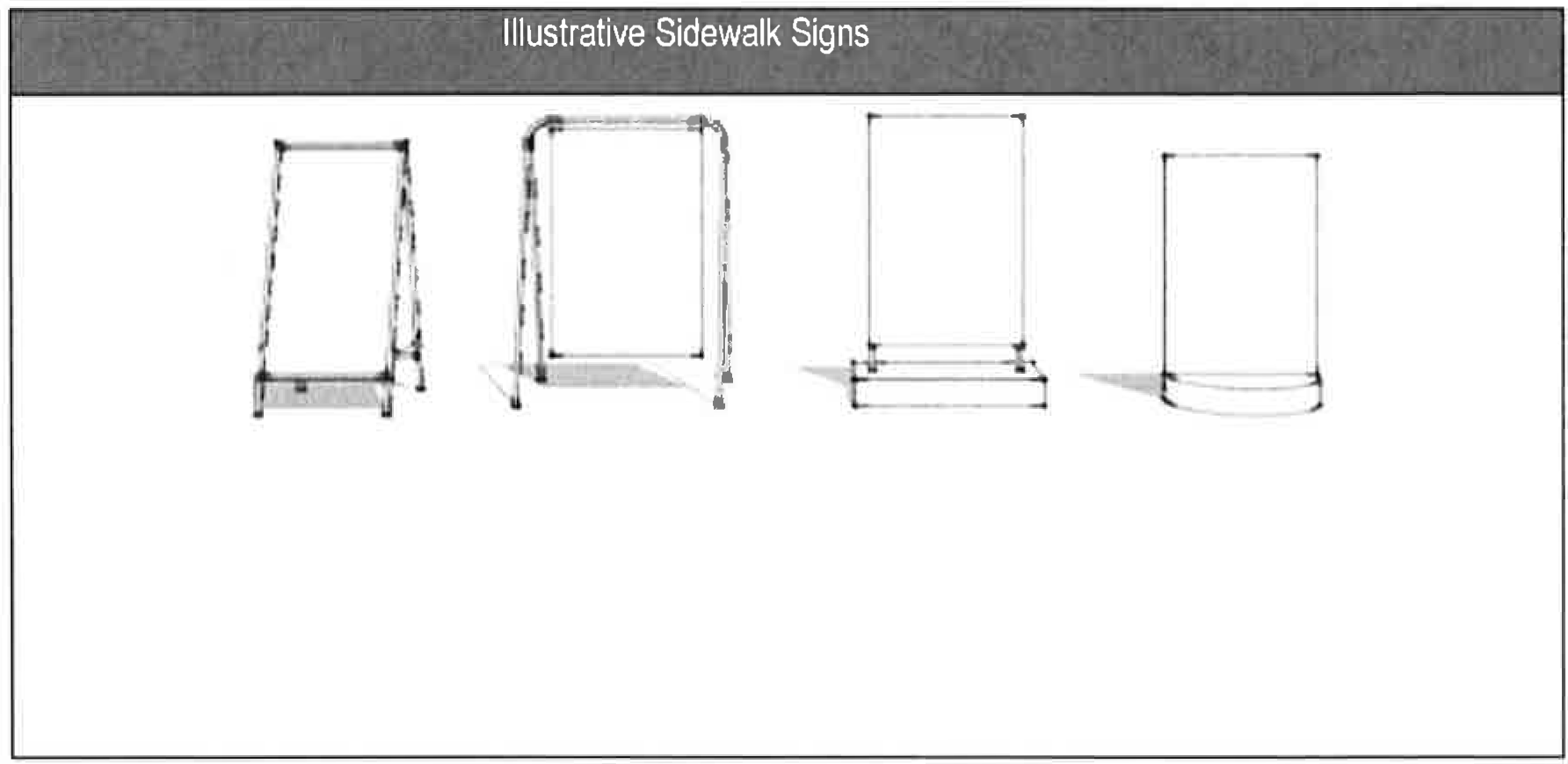
Sign, sidewalk means a type of portable sign that is intended to be placed on a hard surface, most commonly a sidewalk. These signs include A-frame signs, signs that are suspended from the top member of an A-frame, signs with weighted bases, and comparable signs. See illustrative sidewalk signs, below.
Sign, site means a temporary freestanding sign constructed of vinyl, plastic, wood or metal and designed or intended to be displayed for a short period of time.
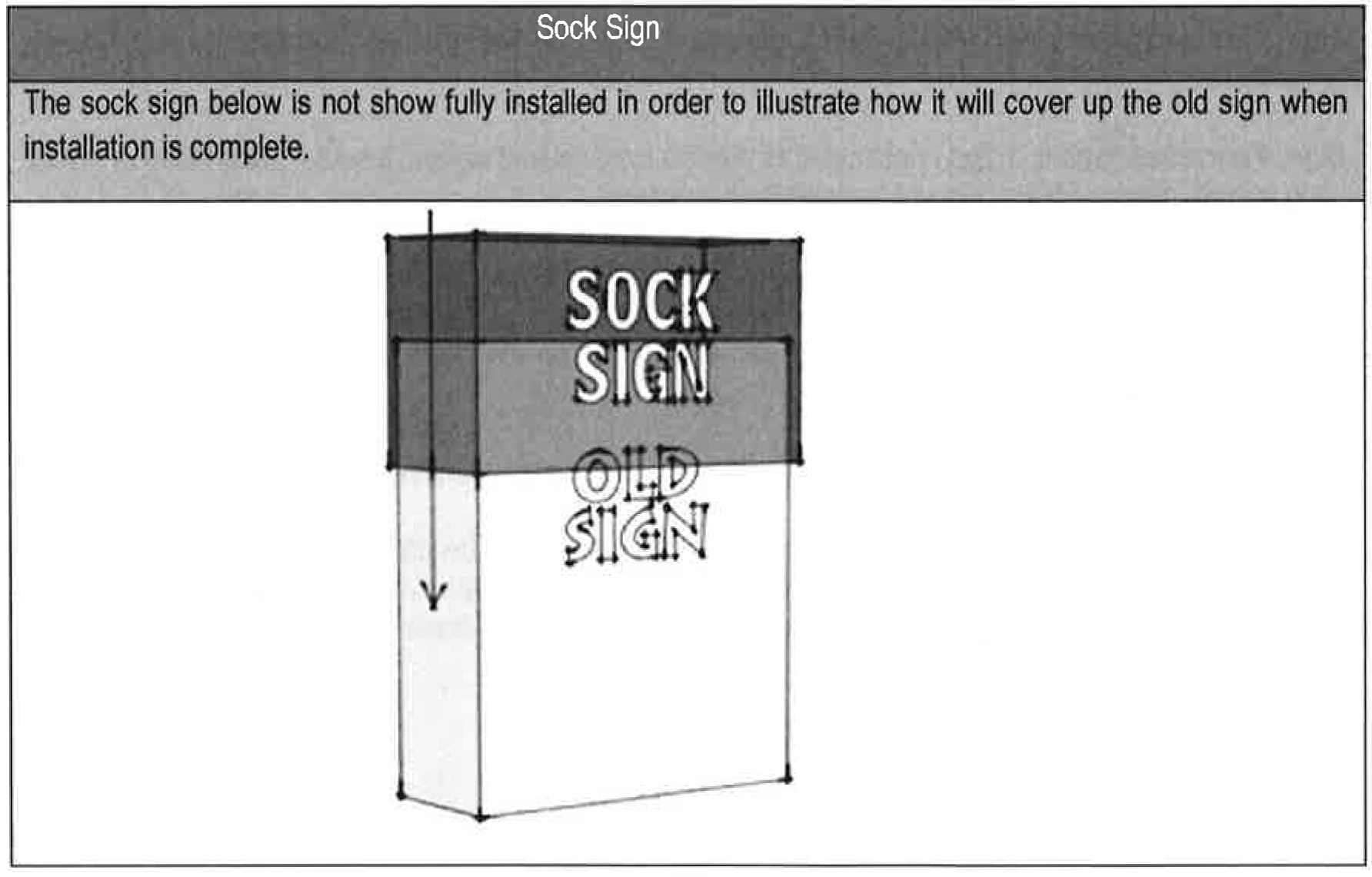
Sign, sock means a temporary sign constructed of flexible material, designed to fit over a permanent sign face or mount. Sock signs are typically installed while a new permanent sign is being designed and fabricated.
Sign structure means a sign structure shall include, but not be limited to, the supports, uprights, braces, backing, sign board, and framework designed to contain a sign message. Sign structure is not meant to include the message conveyed by the sign.
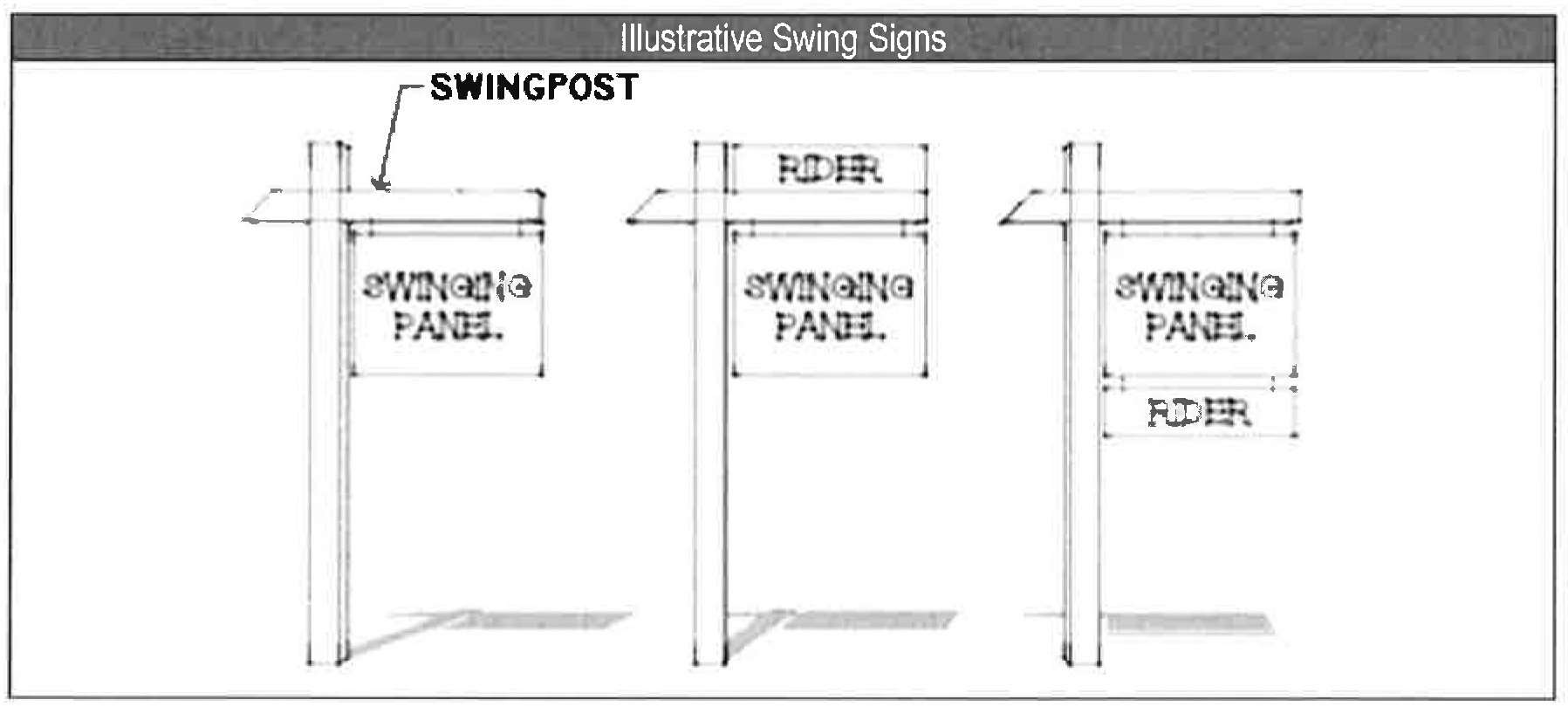
Sign, swing means a sign that is suspended from a horizontal support (a swingpost) that is attached to a vertical support mounted in the ground. A swing sign may also include riders. See illustrative swing signs, below.
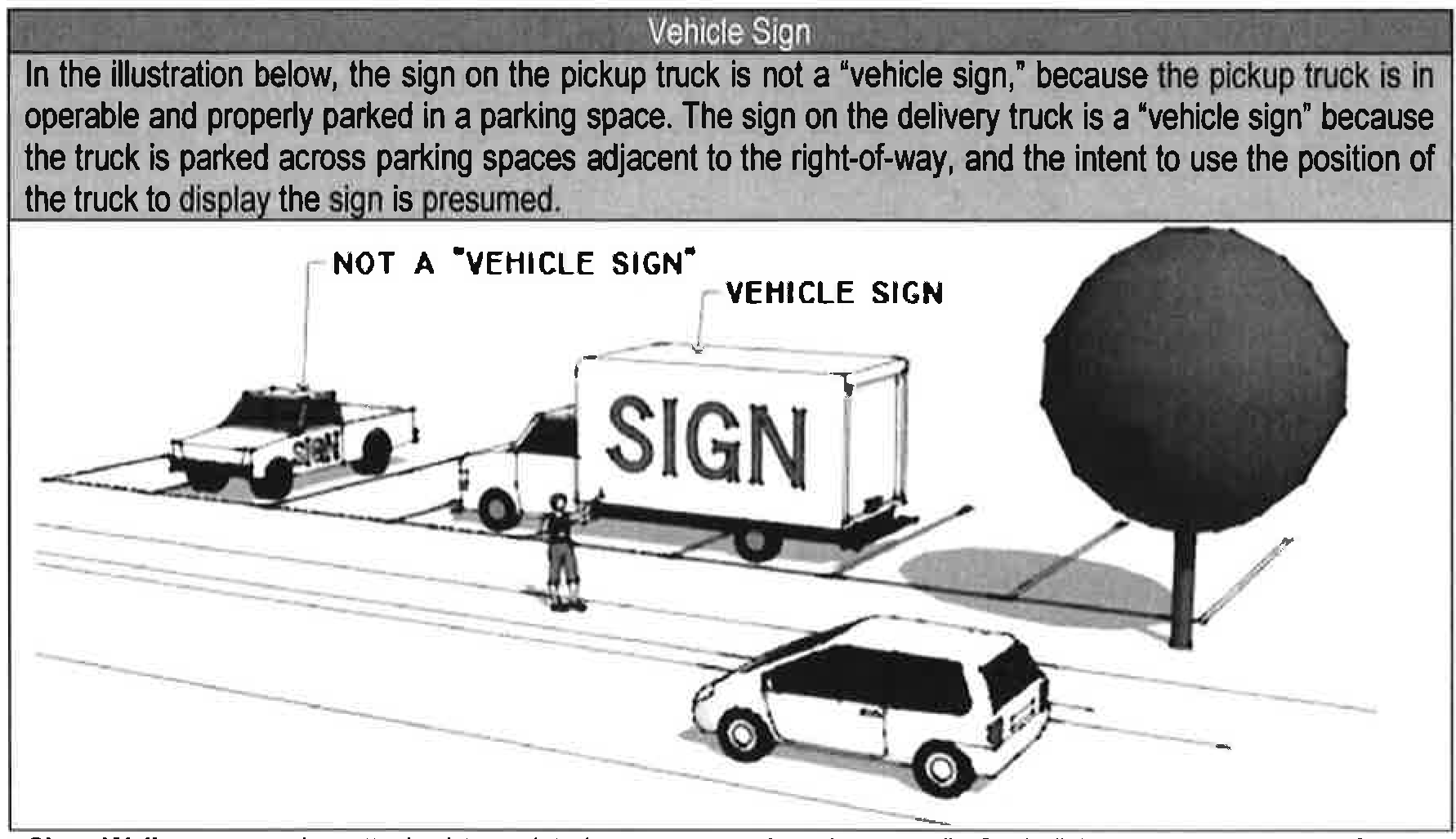
Sign, vehicle means a sign attached to or painted on a vehicle parked and visible from the public right-of-way, unless said vehicle is used for transporting people or materials in the normal operations of the business and it is properly parking in a designated parking space. Signs attached to trailers or inoperable vehicles are presumed to be vehicle signs if they are parked in plain view from the right-of-way. Bumper stickers are not vehicle signs.
Sign, wall means a sign attached to, painted on, or erected against a wall of a building, whose display surface is parallel to the face of the building, structure, or fence, and whose height does not exceed the height of the wall, structure, or fence to which said sign is attached, painted upon, or against which said sign is erected.
Sign, window means a sign which is applied or attached to the exterior of a window, or applied to, attached to, or located within one foot of the interior of a window, which can be seen through the window from the exterior of the structure.
Sign without backing means any word, letter, emblem, insignia, figure, or similar character or group thereof that is neither backed by, incorporated in, or otherwise made a part of any larger display area.
Sign, yard means a temporary portable sign constructed of paper, vinyl, plastic, wood, metal or other comparable material, and designed or intended to be displayed for a short period of time.

