
South Chicago Heights
City Zoning Code
City Zoning Code
CHAPTER 2
- DEFINITIONS
Part I. - Word usage.
1-101:
For the purposes of this chapter, certain terms or words used herein are hereby defined and the following definitions shall be used in the interpretation of the provisions of this chapter.
A.
Words used in the present tense shall include the future tense.
B.
The singular number shall include the plural, the plural the singular.
C.
The word "person" shall include a firm, association, organization, partnership, trust, company or corporation.
D.
The words "used or occupied" include the words "intended, designed or arranged to be used or occupied".
E.
The word "shall" or "will" is mandatory.
F.
The word "may" is permissive.
G.
The word "village" means the Village of South Chicago Heights, Illinois.
H.
The word "county" means the County of Cook, Illinois.
I.
In the event of a conflict or inconsistency between the text of this chapter and any heading, caption or figure, illustration, table, or map, the text shall control. Graphics and other illustrations are provided for informational purposes only and should not be relied upon as a complete and accurate description of all the applicable regulations or requirements.
J.
Lists or examples that use terms "such as," for example," "including," or other similar language are intended to provide examples and are not exhausted lists.
K.
Any other words used and not defined herein shall be construed as having the commonly accepted meaning as defined in a standard dictionary, except those words employed to refer to the permitted and special permit uses of this code which will be interpreted, insofar as applicable, in accordance with the meaning established in the North American Industry Classification System Manual, 2012, as amended through the effective date of this code and as further amended by the village.
L.
The time within any act required by this code is to be performed shall be computed by excluding the first day and including the last day, unless the last day is a Saturday or Sunday or holiday declared by the United States Congress or the Illinois General Assembly, in which event it shall also be excluded.
Part II. - General definitions.
1-201:
The following definitions, unless otherwise defined and noted, apply throughout this code:
Accessory use or structure: A use or structure incidental and subordinate to the principal use of the land or a building on the same lot, serving a purpose customarily incidental to the principal use or structure and located behind the front wall of the principal building. An accessory use or structure is not allowed without the existence of a principal structure or use on the zoning lot. See figure 1.
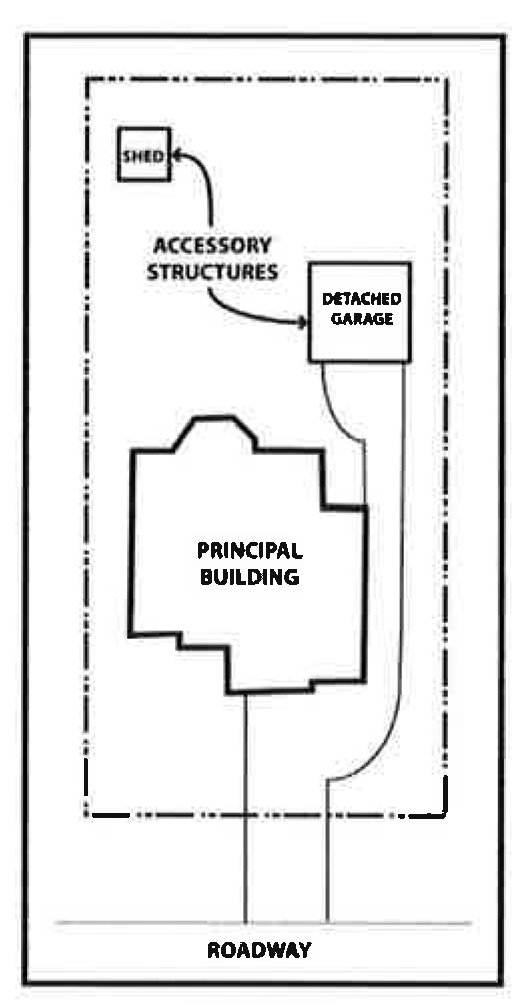
Figure 1
Administrative and/or sales space: The area of a model home used actively for administration, supervision and clerical services in conjunction with dwelling sales, rental, or project construction, but not including the area of model home used for decorated room mock up, materials and/or product display, or material storage.
Adult-use cannabis cultivation center means a facility operated by an organization or business that is licensed by the Illinois Department of Agriculture to cultivate, process, transport and perform necessary activities to provide cannabis and cannabis-infused products to licensed cannabis business establishments, per the Cannabis Regulation and Tax Act, (P.A. 101-0027), as it may be amended from time-to-time, and regulations promulgated thereunder.
Adult-use cannabis dispensing organization means a facility operated by an organization or business that is licensed by the Illinois Department of Financial and Professional Regulation to acquire cannabis from licensed cannabis business establishments for the purpose of selling or dispensing cannabis, cannabis-infused products, cannabis seeds, paraphernalia or related supplies to purchasers or to qualified registered medical cannabis patients and caregivers, per the Cannabis Regulation and Tax Act, (P.A. 101-0027), as it may be amended from time-to-time, and regulations promulgated thereunder.
Adult-use cannabis infuser organization or infuser means a facility operated by an organization or business that is licensed by the Illinois Department of Agriculture to directly incorporate cannabis or cannabis concentrate into a product formulation to produce a cannabis-infused product, per the Cannabis Regulation and Tax Act, (P.A. 101-0027), as it may be amended from time-to-time, and regulations promulgated thereunder.
Adult-use cannabis processing organization or processor means a facility operated by an organization or business that is licensed by the Illinois Department of Agriculture to either extract constituent chemicals or compounds to produce cannabis concentrate or incorporate cannabis or cannabis concentrate into a product formulation to produce a cannabis product, per the Cannabis Regulation and Tax Act, (P.A. 101-0027), as it may be amended from time-to-time, and regulations promulgated thereunder.
Adult-use cannabis transporting organization or transporter means an organization or business that is licensed by the Illinois Department of Agriculture to transport cannabis on behalf of a cannabis business establishment or a community college licensed under the Community College Cannabis Vocational Training Pilot Program, per the Cannabis Regulation and Tax Act, (P.A. 101-0027), as it may be amended from time-to-time, and regulations promulgated thereunder.
Attic: Unfinished space between the ceiling joists of the story and the roof rafters.
Basement: That portion of a building that is partly or completely below grade.
Bleachers: A grandstand where the seats are not provided with backrests.
Block: A tract of land bordered on all sides by streets or by one or more streets and railroad right-of-way, stream or river or other lines of demarcation.
Breezeway: A porch or roofed passageway for connecting two buildings or parts of two buildings. A breezeway must meet the following requirements:
(A)
Is constructed on a 42-inch deep foundation;
(B)
Is enclosed by a roof and permanent walls;
(C)
Is at least six feet wide;
(D)
Is not longer than 20 feet measured between two buildings.
Builder, contractor developer or management company: The individual, company, or corporation responsible for the development, sales, and/or rental of dwellings.
Building: Any structure for the shelter, support or enclosure of persons, animals, chattels, or property of any kind.
Building, accessory: See "accessory use" or "accessory structure".
Building, principal: A building that contains the main or principal use of a site on which the building is situated. See figure 1 for typical location.
Building height: The vertical distance, as measured from the average finished grade of all four corners of the building to the average height of the roof.
Building line: A line parallel to the street right-of-way line at any story or level of a building and representing the minimum distance which all or any part of the building is setback from said right-of-way line.
Building setback line (setback): A minimum distance a building must be located from a property line. SEE "setback". See figure 2.
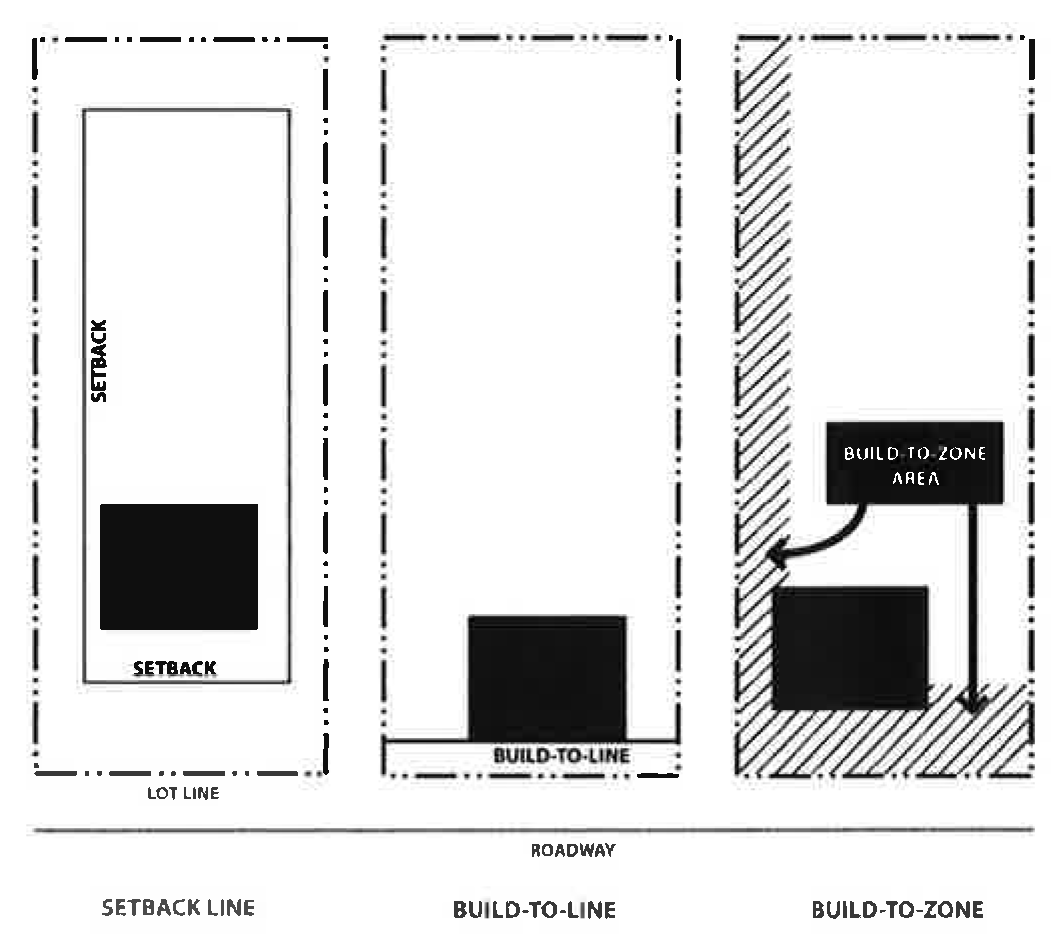
Figure 2
Build-to-line: The exact distance that a building must be located from the street right-of-way. See figure 2.
Build-to-zone: An area from a street right-of-way in which the front or corner side façade of a building shall be placed. See figure 2.
Code: The Village of South Chicago Heights Zoning Ordinance, as amended.
Comprehensive plan: The comprehensive plan, adopted sub-area plans, and amendments thereto for the Village of South Chicago Heights which has been officially adopted to provide development policies for current and long-range development within the village and which may include, but not be limited to, the plan for land use, land subdivision, circulation, and community facilities.
Corporate authorities: The mayor and board of trustees of the village.
Court: An open unoccupied and unobstructed space, other than a yard on the same lot with a building or group of buildings.
Density, gross: The numerical value obtained by dividing the total number of dwelling units in a development by the gross area of all land (in acres) within the development. This would include all nonresidential land uses and private streets of the development as well as rights-of-way of dedicated streets; the result being the number of dwelling units per gross acre of land.
Density, residential: The numerical value obtained by dividing the total number of dwelling units in a development by the area of the actual tract of land (in acres) upon which the dwelling units are proposed to be located and including private streets, common open space and associated recreational facilities within the area; the result being the number of dwelling units per net residential acre of land.
Disability: A physical or mental impairment which substantially limits one or more of a person's major life activities, impairs their ability to live independently, or a record of having such an impairment, or being regarded as having such an impairment.
District: Any section of the village for which the regulations governing the use of buildings and premises and the height and area of buildings are uniform.
Drainage course: A watercourse or indenture for the drainage of surface water.
Dwelling: Any residential building that is occupied for living purposes (See figure 3):
Duplex: A building designed for or occupied by two families totally separated from each other by an un-pierced wall extending from ground to roof.
Multiple-family: A building designed for use by several or many families, including units that are located one over the other.
Single-family: A detached building having no wall in common with another unit designed for or occupied by one family.
Townhomes: A single-family dwelling unit constructed in a group of three or more attached units.
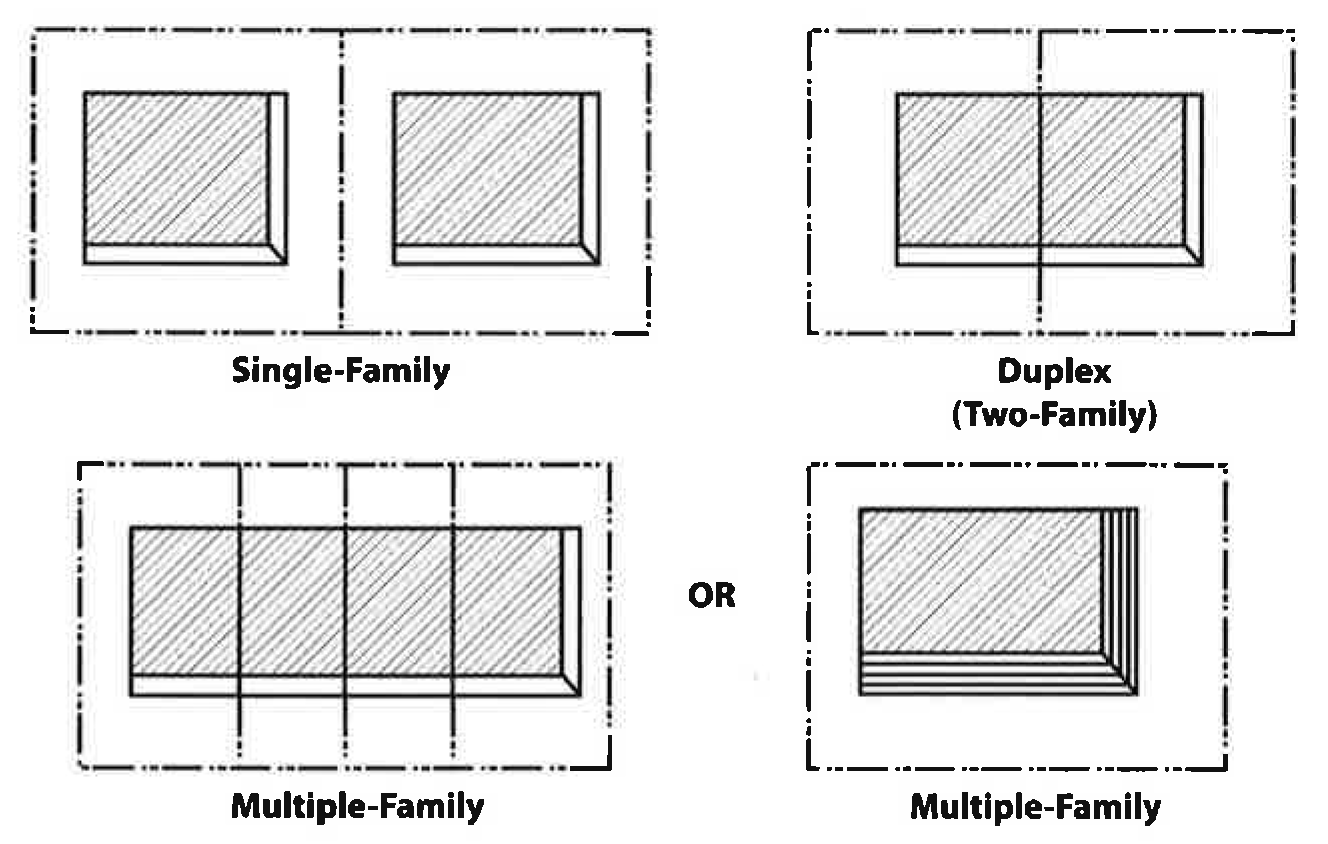
Figure 3: Types of Dwellings
Easement: A grant by a property owner for the use of a strip of land for the purpose of constructing and maintaining utilities, including, but not limited to, sanitary sewers, water mains, electric lines, telephone lines, storm sewer or storm drainage courses and gas lines.
Family: A person living alone, or two or more persons related by blood, marriage, legal guardianship, or adoption (including foster children) living together as a housekeeping unit and occupying a single dwelling unit or a group of not more than three persons not related by blood, marriage, legal guardianship, or adoption (including foster children) living together as the functional equivalent of a traditional family and a single housekeeping unit.
Fixture: The assembly that houses the lamp or lamps and can include all or some of the following parts: a housing, a mounting bracket or pole socket, a lamp holder, a ballast, a reflector or mirror, and/or a refractor or lens.
Floor area, gross: The sum of the gross horizontal areas of all floors of a building, measured from the exterior face of exterior walls. Gross floor area shall include areas such as basement floors, but not cellar floors; elevator shafts and stairwells at each floor; floor spaces and shafts used for mechanical, electrical and plumbing equipment, except equipment located in a cellar or on the roof; penthouses; attic floors; interior balconies and mezzanines; enclosed porches and floor space used for accessory uses. It shall not include floor area devoted to off street parking or loading.
Foot-candles (fc): A quantitative unit measuring the amount of light (illumination) falling onto a given point, one foot-candle equals one lumen per square foot.
Frontage: All the property on one side of a street or place between two intersecting streets or places (crossing or terminating) measured along the line of the street or place, or if the street or place is dead ended, then all the property abutting on one side between an intersecting street or place and the dead end of the street or place, but not including the dead end of the street. Multiple frontages shall not be construed to allow additional square footage of sign area beyond the maximum areas permitted under the zoning district in which the premises are situated.
Garage, private: An accessory building designed or used for the storage of motor driven vehicles which are owned by the occupants of the building to which it is accessory.
Glare: The effect produced by a light source within the visual field that is sufficiently brighter than the level to which the eyes are adapted, to cause annoyance, discomfort, or loss of visual performance and ability.
Grade: The finished ground level adjoining the building at all exterior walls.
Home occupation: Any ongoing activity conducted on the property with the intent to gain income whether it be the primary source of income or secondary source of income and incidental to the primary use of the property as residential.
Impervious surface: Any hard surface that does not absorb water, including, but not limited to, building roofs, sidewalks, parking, driveways, swimming pools, or other paved surfaces.
Lot: A piece or parcel of land occupied or to be occupied by a building or a use, or as a unit for the transfer of ownership.
Lot, building: For zoning purposes, as covered by this title, a lot is a parcel of land of at least sufficient size to meet minimum zoning requirements for use, coverage and area, and to provide such yards and other open spaces as are herein required. Such lot shall have frontage on an improved public street and is a single lot of record. See figure 4, types of lots.
Lot, corner: A lot located at the intersection of two or more streets. A lot abutting on a curved street or streets shall be considered a corner lot if straight lines drawn from the foremost points of the side lot lines to the foremost point of the lot meet at an interior angle of less than 120 degrees.
Lot, interior: A lot other than a corner lot with only one frontage on a street, other than an alley.
Lot of record: A lot which is part of a subdivision, the map of which has been recorded in the office of the county recorder.
Lot, reversed frontage: A lot in which the frontage is at right angles, or approximately right angles, to the general pattern in the area involved. A reversed frontage lot may also be a corner lot or an interior lot.
Lot, through: A lot other than a corner lot with frontage on more than one street other than an alley. Through lots with frontage on two streets may be referred to as "double frontage lots".
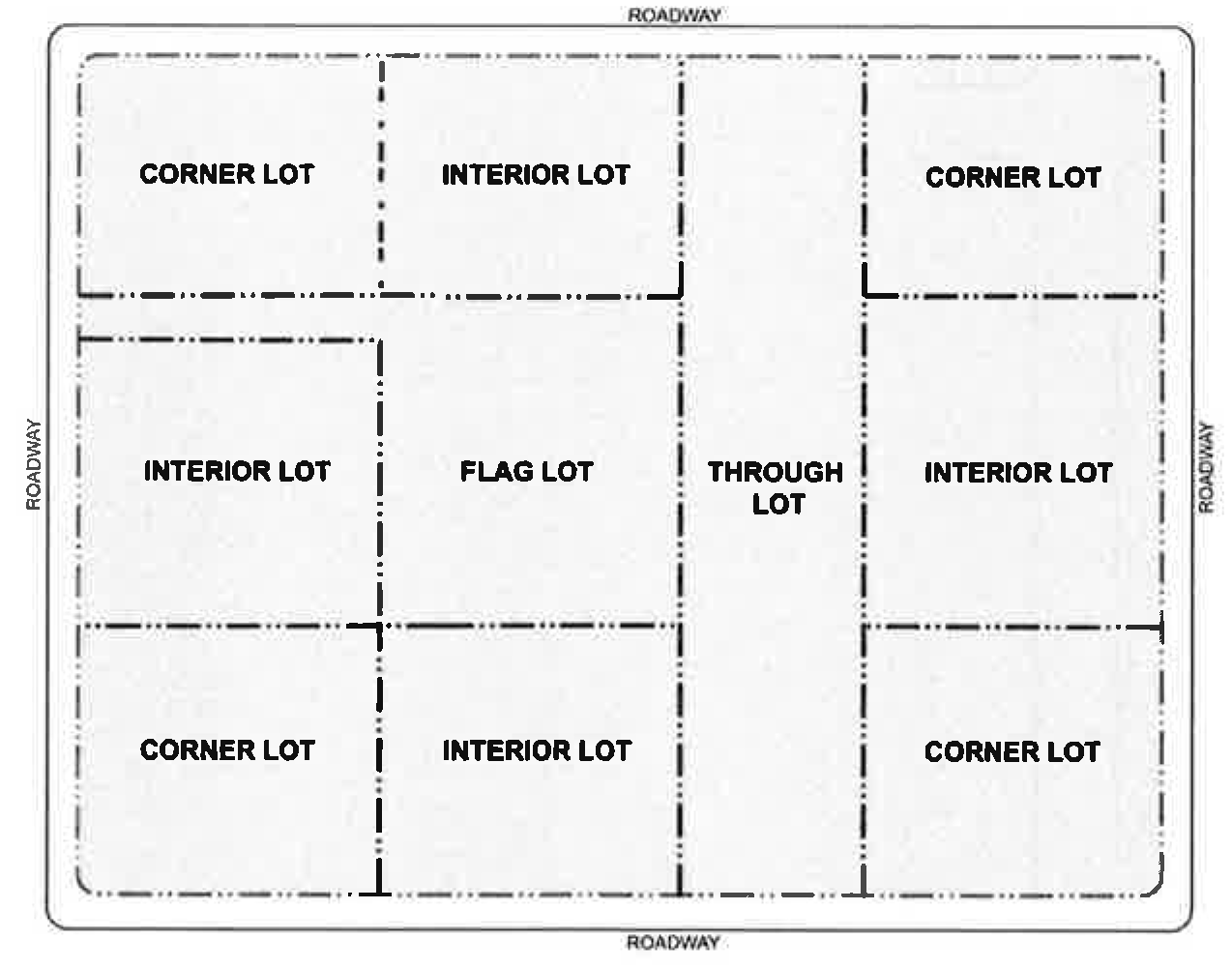
Figure 4: Types of Lots
Lot coverage: That percentage of a lot occupied by buildings, structures, or any impervious surface.
Lot frontage: The front of a lot shall be construed to be the portion nearest the street. For the purpose of determining yard requirements on corner lots and through lots, all sides of a lot adjacent to streets shall be considered frontage, and yards shall be provided as indicated under "yards" in this section. See figure 5.
Lot lines: The lines bounding a lot.
Lot measurements:
(A)
Depth of a lot shall be considered to be the distance between the midpoints of straight lines connecting the foremost points of the side lot lines in front and the rearmost points of the side lot lines in the rear.
(B)
Width of a lot shall be considered to be the distance between the straight lines connecting front and rear lot lines at each side of the lot measured across the rear of the required front yard; provided, however, that width between side lot lines at their foremost points (where they intersect with the street line) shall not be less than 80 percent of the required lot width except in the case of lots on the turning circle of a cul-de-sac, where the 80 percent requirement shall not apply.
(C)
Area of a lot shall be computed from the area contained in horizontal plane defined by the lot lines.
Lot width: The dimension of a lot measured on the building setback line. See figure 5.
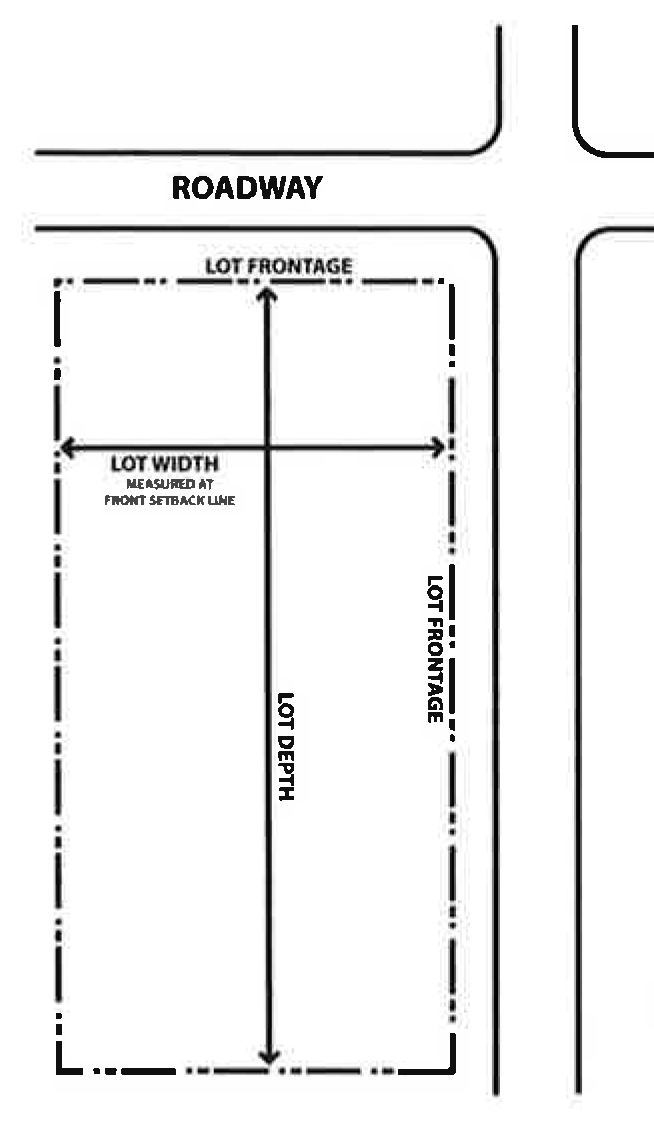
Figure 5: Lot depth/Lot frontage/Lot width
Model homes: Any sample or archetype of a dwelling and its attendant accessory uses as "dwelling" and "accessory use" are defined in this chapter of this code. The term "model home" shall not include "structures" as defined in this chapter, except archetypes of dwellings and accessory uses. In addition, temporary buildings constructed as dwelling mock ups may be considered as model homes. Mobile homes, trailers, or construction trailers shall not be considered as model homes for dwelling display purposes. A model home may be further defined as a dwelling used initially for display purposes which typifies the type of dwelling that will be constructed and sold or rented in other parts of the development.
Nonconforming use: A building, structure or premises legally existing and/or used at the time of adoption of this title, or any amendment thereto, and which does not conform with the use provisions of this title for the district in which the premises is located.
Open space: Land and/or water unoccupied by structures, buildings, streets, rights-of-way and automobile parking lots. Open space may contain walls, patios and structures for recreational use. Not more than 50 percent of the area used to satisfy stormwater management requirements set forth in other areas of this code shall be counted as open space required by this title.
Open space, common: Land and/or water unoccupied by structures, buildings, streets, rights-of-way and automobile parking lots and designed and intended for the use or enjoyment of all residents of a planned development or of all residents of the entire area in the advent of public dedication. Common open space may contain walks, patios, and structures for recreational use. Areas used for private open space, such as private courtyards, patios, gardens and not available to all residents of a planned unit development shall not be included as common open space.
Open space, private: Land and/or water unoccupied by structures, buildings, streets, rights-of-way and automobile parking lots, and designed and intended for the private use or enjoyment of an individual or limited number of individuals.
Outdoor lighting: The nighttime illumination of an outside area or object by any manmade device located outdoors that produces light by any means.
Owner: An individual, firm, association, syndicate, co-partnership, corporation, trust or any other legal entity having sufficient proprietary interest in the land sought to be subdivided to commence and maintain proceedings to subdivide the same under this title.
Parking lot: A parcel of land containing one or more unenclosed parking spaces whose use is principal to the lot as differentiated from an accessory use, as in a residential lot.
Parking, off-street parking: As used in this title, "parking" and "off street parking" shall be deemed to include parking spaces, access driveways, aisles and all additional ancillary parking facilities.
Parking space: A surfaced area, enclosed or unenclosed, sufficient in size to store one motor vehicle, together with a paved driveway connecting the parking space with a street or alley and permitting ingress and egress of an automobile.
Parks: Areas of public land developed and maintained primarily as pleasurable landscaped areas providing for both active and passive recreational pursuits, including tot lots, playgrounds, neighborhood parks, play fields and special purpose areas.
Permittee: That person to whom a sign is issued.
Person: An individual, corporation, association, firm, partners and the like, singular or plural.
Place: An open unoccupied space, other than a street or alley, permanently reserved as the principal means of access to abutting property.
Planned unit development (PUD): A tract of land which is originally developed as a unit under single ownership or unified control, which includes one or more principal buildings or uses, and is processed under the planned unit development provisions of this title. Also, a parcel of land planned as a single unit rather than as an aggregate of individual lots, with design flexibility from traditional siting regulations (such as side yards, setbacks, and height limitations) or land use restrictions (such as prohibitions against mixing land uses within a development). The greater flexibility in locating buildings and in combining various land uses often makes it possible to achieve certain economies in construction, as well as the preservation of open space and the inclusion of many amenities.
Planned unit development plan: A drawing or map made to a measurable scale upon which is presented a description and definition of the way in which the design requirements of the planned unit development are to be met and intended for recording with the county recorder of deeds.
Plat: A map showing a plan for the subdivision of land which is submitted for approval and is intended in final form for recording.
Posterboard or billboard: A sign used for the display of advertising posters not usually associated with the product or major enterprise offered on the premises on which the sign is located.
Private street: A purported street, way or strip of land reserved for the use of a limited number of persons or purposes as distinguished from a publicly dedicated street.
Public walkway: A public way designated for the use of pedestrian traffic.
Religious institution: The term includes the following: church, synagogue, rectory, parish house or similar building incidental to the particular use which is maintained and operated by an organized group of people for religious purposes.
Right-of-way: A strip dedicated to the public and occupied or intended to be occupied by a street, crosswalk, railroad, electric transmission line, oil or gas pipeline, water main, sanitary or storm sewer main, public utility easements or for another special use.
Roofline: Either the edge of the roof or the top of the parapet, whichever forms the top line of the building silhouette; and where a building has several roof levels, this roof or parapet shall be the one belonging to that portion of the building on whose wall the sign is located.
Sanitary sewer: A constructed conduit connected with a sewer system for the carrying of liquids and solids other than stormwaters to a sanitary treatment facility.
School; primary, secondary, college or university: Any school having regular sessions with regularly employed instructors teaching subjects which are fundamental and essential for a general academic education, under the supervision of and in accordance with the applicable statutes of the state.
Setback (building setback line): A minimum distance a building must be located from a property line. See figure 6.
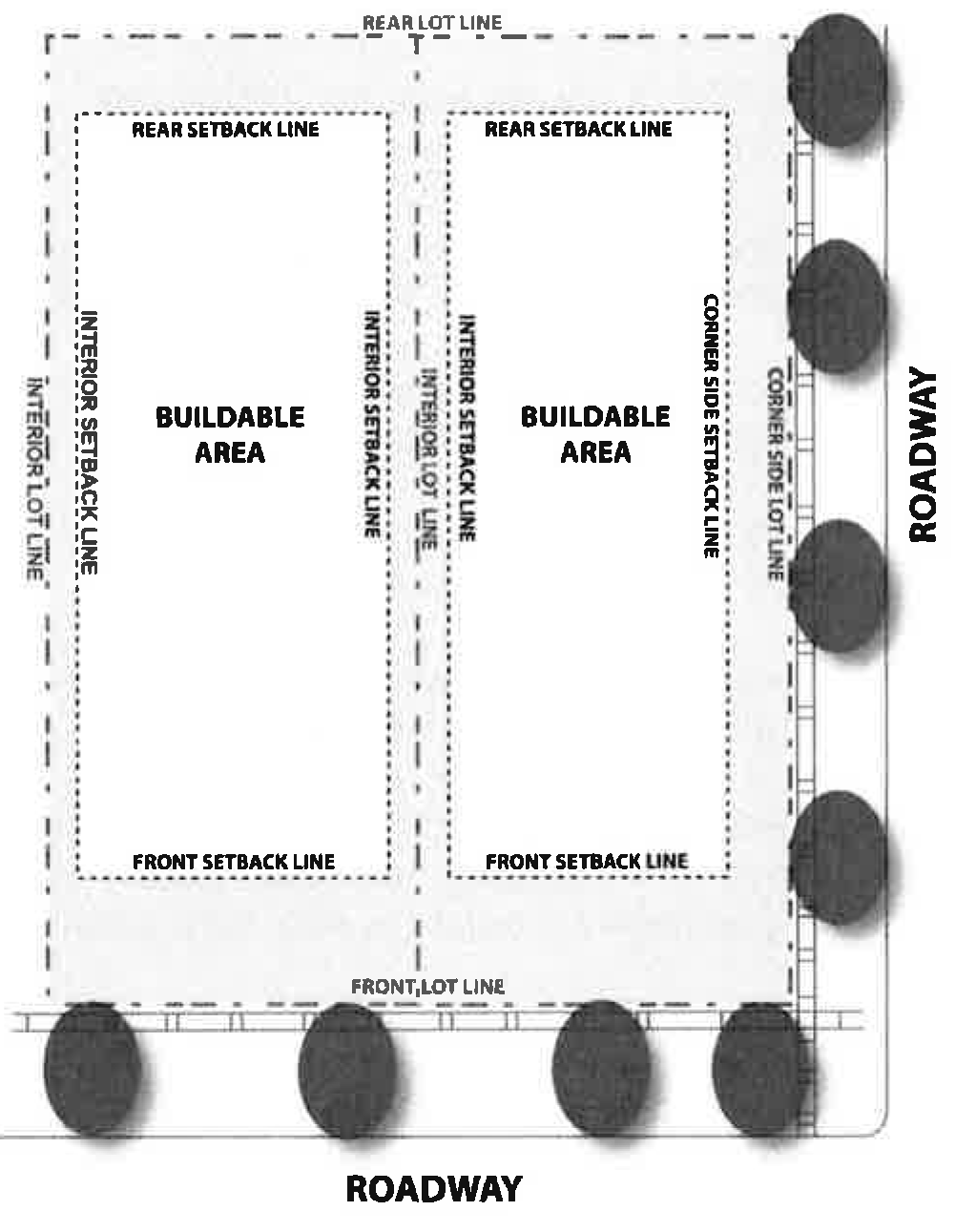
Figure 6: Setback Lines
Front setback: A line parallel to and at a distance from the front lot line that establishes the minimum distance between said lot line and a structure on a lot.
Interior side setback: A line parallel to and at a distance from the interior lot line that establishes the minimum distance between the interior lot line and a structure on a lot.
Corner side setback: A line parallel to and at a distance from the corner side lot line that establishes the minimum distance between the corner side lot line and a structure on a lot.
Rear side setback: A line parallel to and at a distance from the rear lot line that establishes the minimum distance between the rear lot line and a structure on a lot.
Shopping center: Any concentration of retail stores and service establishments in one or more buildings under single ownership or management with common parking facilities.
Special use: A specific use of land, buildings or both described herein, subject to special provisions which, because of unique characteristics, have not been specifically classified as a permitted use (also referred to as a "conditional use").
Story: That portion of a building above grade included between the surface of any floor and the surface of the floor next above it, or, if there be no floor above it, then the space between the floor and the ceiling next above it.
Story, half: A space under a sloping roof which has the line of intersection of roof decking and wall face not more than three feet above the top floor level, and in which space not more than two-thirds of the floor area is finished off for use. A half story containing independent apartment or living quarters shall be counted as a full story.
Street: A way set aside for vehicular traffic, regardless of size or designation, but excluding private driveways serving only one parcel of land.
Alleys: Minor ways which are used primarily for vehicular service access to the backs or to the sides of properties which otherwise abut on streets.
Arterial streets and highways: Those designed or utilized primarily for high vehicular speeds and/or for heavy volumes of traffic.
Collector streets and highways: Those designed or utilized to carry intermediate volumes of traffic from minor streets to arterial streets.
Local streets: Those which are used or will be used primarily for access to abutting properties and which carry limited volumes of traffic.
Service access streets (frontage streets): Minor streets which are parallel and adjacent to higher classified thoroughfares and which serve to reduce the number of access points to those thoroughfares and thereby increase traffic safety.
Street line: A dividing line between a lot, tract or parcel of land and a contiguous street.
Structural alterations: Any change in the supporting members of a building such as bearing walls or partitions, columns, beams or girders or any substantial change in the roof or in the exterior walls.
Structure: Anything constructed or erected, the use of which requires permanent location on the ground or which is attached to something having a permanent location on the ground. The term structure shall also include "tents" as that term is defined herein, notwithstanding that said tent may be erected on a temporary basis only.
Subdivision: Any of the following shall constitute a subdivision as that term is used in this title:
(A)
The division of any parcel of land shown as a unit or as contiguous units on the last preceding tax roll, into two or more parcels, sites or lots, any one of which is less than five acres for the purpose, whether immediate or future, of transfer of ownership;
(B)
Any construction or development which has an impact upon, involves or relates to present or proposed facilities fostering the public health, safety and welfare, including, but not limited to, streets, alleys and ways, easements of access, curbs, gutters, sidewalks, streetlights, parks, playgrounds, stormwater drainage and/or management facilities, water supply and distribution systems, sanitary sewers, or sewage collection and treatment;
(C)
Any changes or alterations or any other activity having an impact upon existing topography or grades, or any other surface features, including, but not limited to, changes to same made in connection with the construction, development, installation or operation of irrigation or sprinkler systems designed to distribute water, excavation or other disturbance of the surface for construction of stormwater management facilities, or of ornamental or reflecting ponds; and partial or complete installation of new or reconfiguration of existing outdoor amusement or sporting facilities; and
(D)
The improvement of one or more parcels of land for residential, commercial or industrial structures involving the division or allocation of land for the opening, widening or extension of any street or streets except private streets serving industrial structures;
(E)
The revision or amendment of a recorded plat of subdivision or planned unit development if such revision constitutes a subdivision under subsections (A), (B) or (C) of this definition; or
(F)
The development of one or more lots or parcels as one unified use or development. Example: A five-lot parcel developed as one unit, improved with a shopping center containing several buildings and a parking lot.
Tent: A portable shelter consisting of canvas, other coarse cloth or flexible material stretched out and extended over support structures or supported by forced air, and attached to stakes or other anchoring devices. A "tent" as used herein, shall be considered a "structure".
Title: The Village of South Chicago Zoning Ordinance, as amended.
Unified control: The combination of two or more tracts of land wherein each owner has agreed that his tract of land shall be developed as part of a planned unit development and shall be subject to the controls applicable to the planned unit development.
Unusually shaped signs: Such as globes, cylinders or pyramids shall be considered double faced signs, and the sign area shall be computed as one-half the total of the exposed surfaces.
Video gaming café: An establishment whose primary or major focus is video gaming, and the service of alcohol and food is incidental to the operation of video gaming. Annual revenue is at least 60 percent generated from video gaming activities, which can be certified by request of the village from the operator and State of Illinois. This definition does not prohibit other qualified and licensed businesses from operating video gaming terminals as accessory uses.
Vision clearance triangle: An area located at the intersection of two streets delineated by measuring 30 feet from the intersection of the two right-of-way lines as depicted in figure 7 below.
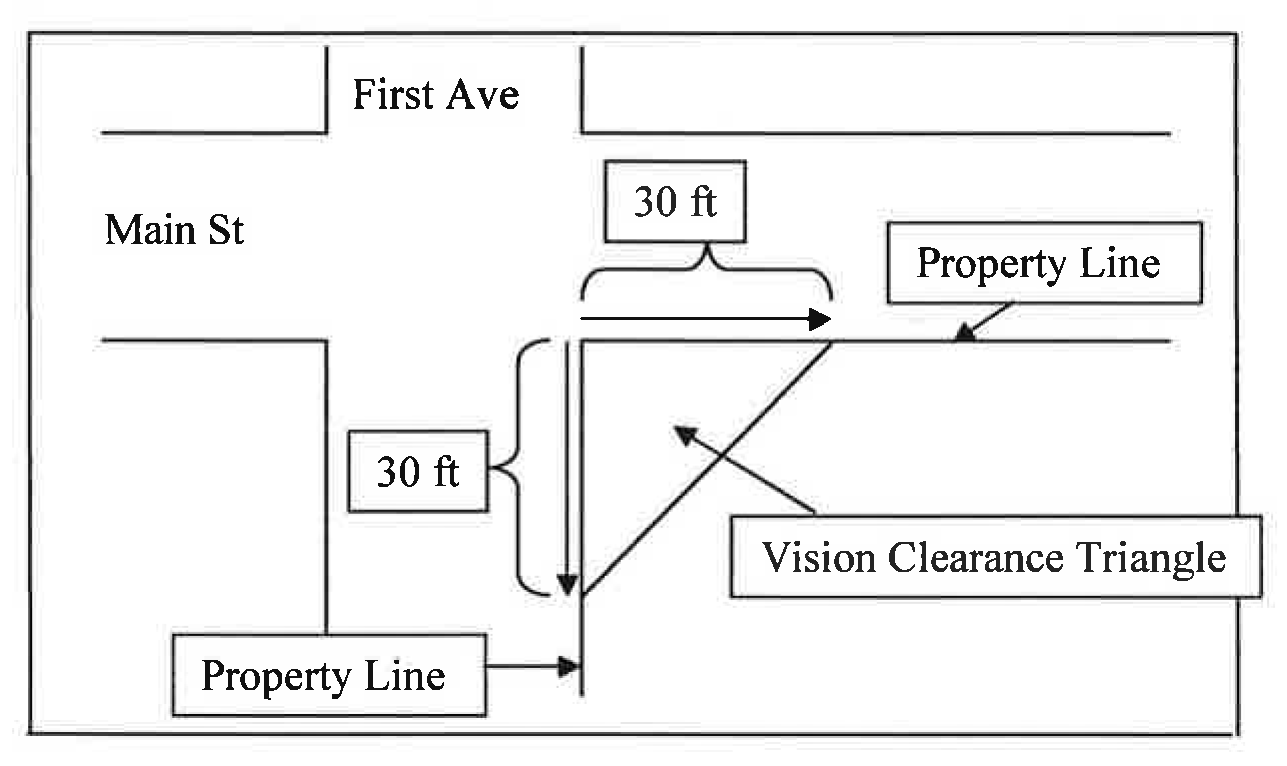
Figure 7: Vision Clearance Triangle
Zoning lot: A tract of land consisting of individual parcels of land located within a block, which is designated by its owner or developer as a tract to be used, developed or built upon as a unit, under single ownership. See figure 8.
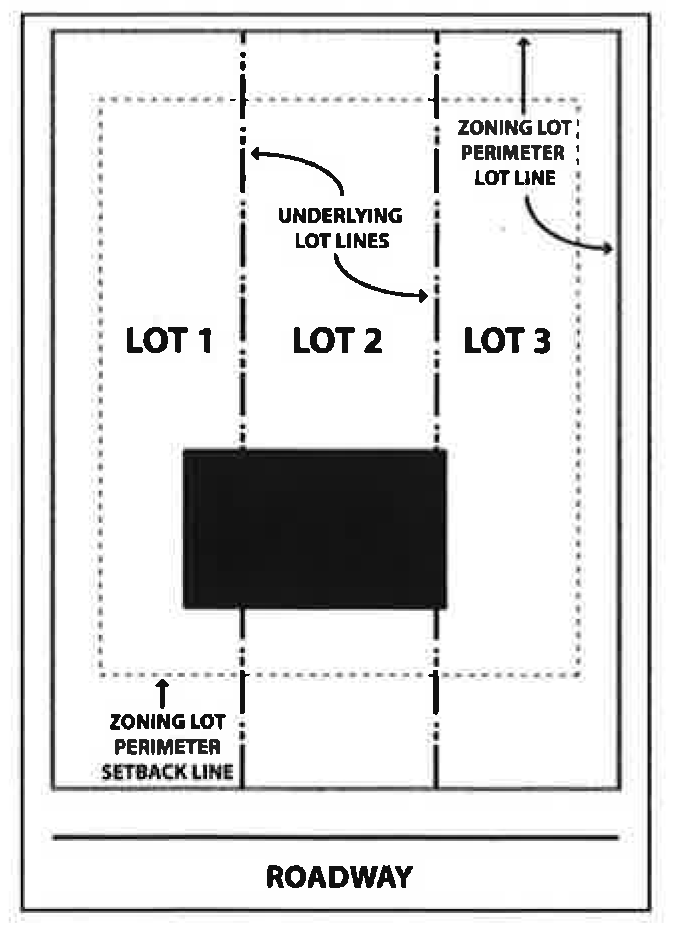
Figure 8: Zoning Lot
Yard: An open space unoccupied and unobstructed by any structure or portion of a structure; except otherwise permitted in this ordinance that extends along a lot line and right angles to a depth or width extending to the specified line or lines of the principal building. See figure 9, types of yards.
(A)
Front yard: A yard extending between lot lines which intersect a street line, the depth of which is the horizontal distance between the street right-of-way line and a line on the lot which is at all points equidistant from and parallel to the street line.
In the case of through lots, unless the prevailing front yard pattern on adjoining lots indicates otherwise, front yards shall be provided on all frontages. Where one of the front yards that would normally be required on a through lot is not in keeping with the prevailing yard pattern, the community development director, or authorized designee, may waive the requirement for the normal front yard and substitute therefore a special yard requirement which shall not exceed the average of the yards provided on adjacent lots.
In the case of corner lots, a front yard of the required depth shall be provided in accordance with the prevailing yard pattern and a second front yard of half the depth required generally for front yards in the district shall be provided on the other frontage.
In the case of corner lots with more than two frontages, the community development director, or authorized designee, shall determine the front yard requirements, subject to the following limitations:
1.
At least one front yard shall be provided having the full depth required generally in the district.
2.
No other front yard on such lot shall have less than half the full depth required generally.
Depth of required front yard shall be measured at right angles to a straight line joining the foremost points of the side lot lines and the foremost point of the lot. The foremost point of the side lot line, in the case of rounded property corners at street intersections, shall be assumed to be the point at which the side and front lot lines would have met without such rounding.
(B)
Yard, rear: A yard extending across the rear of the lot between inner side yard lines. In the case of through lots there will be no rear yard. In the case of corner lots, the rear yard shall extend from the inner side yard line of the side yard adjacent to the interior lot to the rear line of the half depth front yard.
Depth of required rear yards shall be measured at right angles to a straight line across the lot joining the rearmost points of the side lot lines or in the case of a dedicated alley it shall be measured from the rearmost points of the side lot lines when extended to the centerline of said alley. The forward rear yard line of a required rear yard shall be parallel to the straight line so established.
(C)
Yard, side: A yard extending from the rear line of the required front yard to the rear lot line.
In the case of through lots, side yards shall extend from the rear lines of the front yards required.
Width of required side yards shall be measured at right angles to a straight line joining the ends of front and rear lot lines on the same side of the lot. The inner side yard line of a required side yard shall be parallel to the straight line so established.
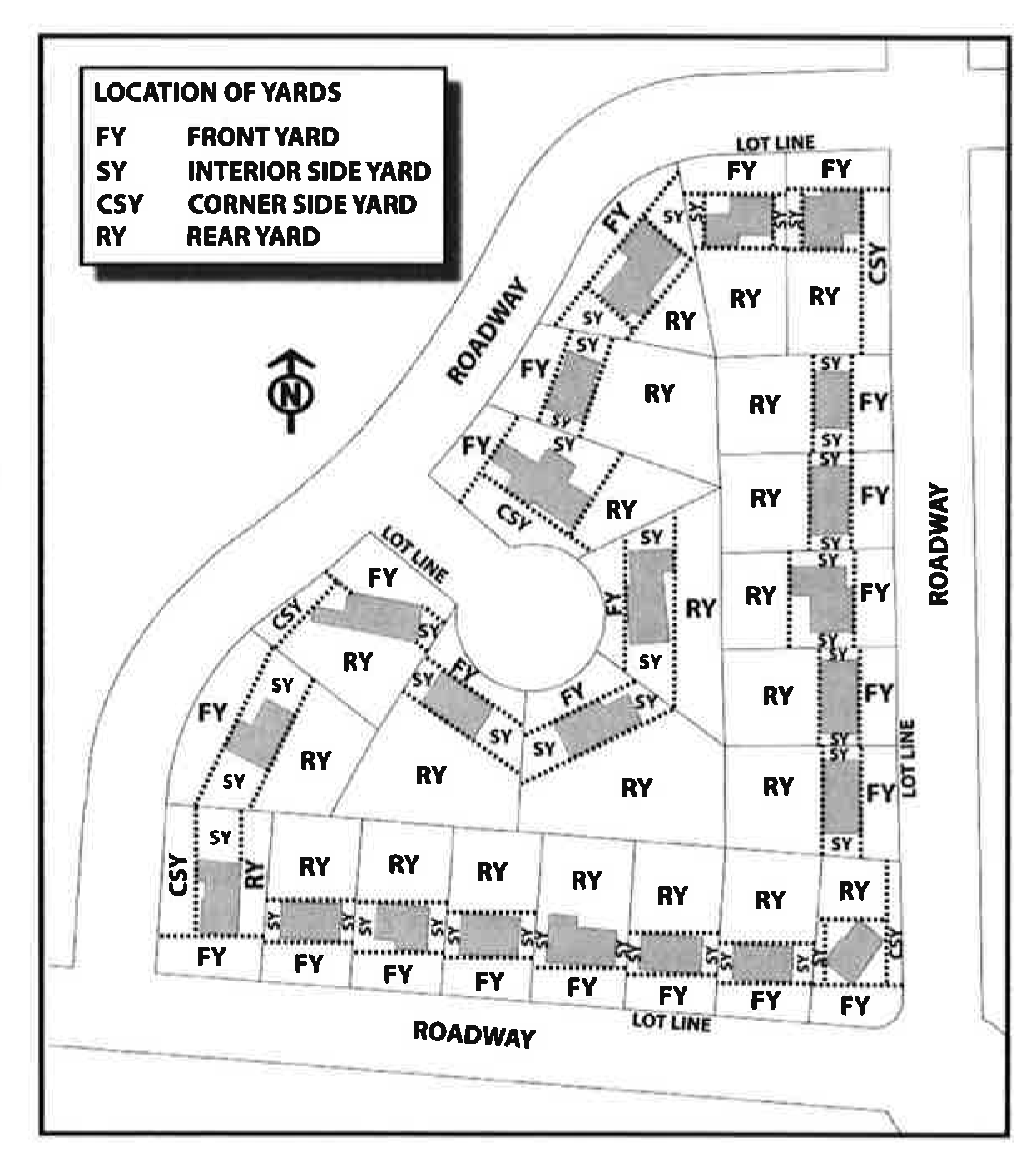
Figure 9: Types of Yards
(Ord. No. 2019-ORD-16, § 3, 12-16-2019; Ord. No. 2020-ORD-25, § 3, 6-15-2020; Ord. No. 2022-ORD-7, § 3, 3-21-2022; Ord. No. 2023-ORD-3, § 3, 1-3-2023)

