
Southampton County Unincorporated
City Zoning Code
City Zoning Code
ARTICLE II
AGRICULTURAL DISTRICT, A-1
Sec. 18-36.- Purpose of the district.
The purpose of the agricultural district, A-1, is to encourage and enhance existing and future agricultural and forestry operations, to provide for the preservation of agricultural and forestal lands, and preserve the natural beauty of rural areas of the county where urban services, such as sewer and water services, are not planned. The district is also intended to provide for spacious residential development for those who choose to live in a rural environment, and to protect this development where it occurs, but to foster a dispersed residential development pattern which will reduce conflicts with agriculture, maintain the rural appearance of the countryside, reduce traffic hazards on county roads, and have limited needs for public services. The district regulations are intended to control the process of land subdivision in furtherance of this pattern. Since normal operation of some agricultural and forestal uses, produces noise, odors and other effects, a certain level of tolerance for these effects is to be expected of those who elect to live in this district where such uses are intended. Development standards for intensive agricultural operations provide for the orderly development of such uses at appropriate locations.
(Ord. of 6-18-90, § 19-2.1; Ord. of 2-27-95)
Sec. 18-37. - Permitted uses.
In an agricultural district A-l, structures to be erected or land to be used shall be for one (1) or more of the following uses:
(1)
General agriculture, farming and forestry, including tilling the soil, raising of crops, truck gardens, field crops, orchards or nurseries for growing or propagation and harvesting of plants, turf, trees and shrubs and in general uses commonly classed as general agriculture and including use of heavy cultivating and tree harvesting machinery, aquaculture, spray planes and irrigating machinery, and the raising of livestock, but not commercial slaughtering or processing of animals or poultry.
(2)
Intensive agriculture as herein defined.
(3)
Livestock operations, as defined, subject to the development standards as set forth in section 18-49 of this chapter.
(4)
In order to seek improved compatibility between certain uses and intensive agricultural uses, subject to the procedures, guides and standards of article XVIII, a conditional use permit shall be required for any single-family dwelling or manufactured home, two-family dwelling, country general store, school, park (commercial, recreational or otherwise), library, church or other similar use for housing or assembly of people if any of these uses are to be located within one thousand five hundred (1,500) lineal feet of the operational limits of an intensive agricultural use as herein defined. Operational limits shall generally mean a line encompassing the compact grouping of buildings, structures and animal holding areas, pens, waste lagoons and the like which comprise the use and as delineated on a set of maps for the purpose to be maintained in the office of the zoning administrator. This section shall not apply to the dwelling of the owner or manager of the intensive agricultural use or to additions or expansions to such uses which are located within one thousand five hundred (1,500) lineal feet of existing intensive agricultural uses at the time of passage of this chapter or which may become so located by future approval of conditional use permits for said uses or for intensive agricultural uses.
(5)
Detached single-family dwellings.
(6)
Detached single-family dwelling or manufactured home on a farm of fifty (50) acres or more for use as a dwelling unit by one (1) or more persons employed on the farm as farm labor or by members of the family operating the farm, no separate lot required, with a conditional use permit and subject to the provisions of article XVIII if within one thousand five hundred (1,500) lineal feet of an intensive agricultural use.
(7)
Modular home as herein defined.
(8)
Manufactured home, subject to the provisions set forth in section 18-46 below and to the general subdivision and placement standards for other dwellings as specified in this article.
(9)
Canine training facility, commercial, with a conditional use permit.
(10)
Manufactured home, temporary, as defined.
(11)
Reserved.
(12)
Industrialized buildings, as an accessory use, with a special use exception granted by the board of zoning appeals pursuant to section 18-47 below and to the general placement standards for other accessory buildings as specified in this article.
(13)
Airports and landing fields, heliports or helistops, and accessory uses, with a conditional use permit and subject to requirements of the Federal Aviation Administration.
(14)
Bed and breakfast inn.
(15)
Camps, day or boarding, church camp, scout camp or similar camp involving permanent commercial or noncommercial facilities, with a conditional use permit.
(16)
Camping area or campgrounds for tents and tent campers, travel trailers or other recreational vehicles with a conditional use permit.
(17)
Cemeteries not accessory to a church with a conditional use permit.
(18)
Churches and Sunday schools, rectories, parish houses, convents and monasteries, temples and synagogues and cemeteries accessory thereto.
(19)
Convalescent homes, nursing homes or homes for the aged, and family care homes, with a conditional use permit.
(20)
Country inn with more than four (4) guest rooms with a conditional use permit.
(21)
Dog kennels, commercial, with a conditional use permit.
(21.1)
Dog kennel, private, as specified in section 18-50, development standards for private kennels.
(22)
Extraction and processing of sand, gravel, or stone; borrow pits (but not including farm pond construction or any operations engaged in mining and disturbing less than one (1) acre of land and removing less than five hundred (500) tons of minerals at any particular site), with a conditional use permit.
(23)
Facilities and structures necessary for rendering public utility service, including poles, wires, transformers, telephone booths and the like for electrical power distribution or communication service, and underground pipelines or conduits for electrical, gas, sewer, or water service, but not including buildings, treatment plants, water storage tanks, pumping or regulator stations, major transmission lines, storage yards and sub-stations which are permitted with a conditional use permit.
(24)
Firewood operation as herein defined, with a conditional use permit.
(25)
General advertising sign limited in area to one hundred (100) square feet as a special exception subject to the special standards for signs in article XV.
(26)
Greenhouse, commercial.
(27)
Home occupation, rural.
(28)
Hospital or clinic for humans with a conditional use permit.
(29)
Hospital or clinic for large or small animals; provided that the minimum lot size for large animals shall be ten (10) acres and for small animals five (5) acres and further provided that all buildings, structures, pens, or open kennels shall be located at least two hundred (200) feet from any lot line.
(30)
Hospital or clinic for small animals (dogs, cats, birds, and the like); provided on a lot less than five (5) acres such hospital or clinic and any treatment rooms, cages, pens, or kennels be maintained within a completely enclosed, soundproof building, and that such hospital or clinic be operated in such a way as to produce no objectionable odors outside its walls.
(31)
Hunting club, private, provided that any pens or open kennels shall be located at least two hundred (200) feet from any dwelling not on the same property.
(31.1)
Hunting club, commercial, with a conditional use permit, provided that any pens or open kennels shall be located at least two hundred (200) feet from any dwelling not on the same property.
(32)
Livestock auction market with a conditional use permit.
(33)
Lodges, with a conditional use permit.
(34)
Marina or yacht club with a conditional use permit.
(35)
Nursery schools, kindergartens, child care centers, day nursery or child day care centers with a conditional use permit.
(36)
Peanut or grain buying station with a conditional use permit.
(37)
Private schools, colleges, or universities with a conditional use permit.
(38)
Public or governmental buildings and uses, including schools, fire stations (volunteer or otherwise), parks, parkways, playgrounds and public boat landings except those which have been approved as a part of the subdivision plan, with a conditional use permit.
(39)
Radio or television transmission or receiving station or tower less than one hundred twenty-five (125) feet in height; tower more than one hundred twenty-five (125) feet in height with a conditional use permit.
(40)
Recreational uses or facilities, commercially operated or for a private membership, such as golf courses, game courts, swimming pools, archery range, fishing or boating lakes, picnic grounds, dude ranch or similar activities, and accessory facilities, including sale of food, beverages, bait, incidentals, supplies and equipment. Amusement parks, event venues, fairs, circuses and carnivals may be permitted with a conditional use permit.
(41)
Rifle or pistol range, trap or skeet shooting, with a conditional use permit.
(42)
Sanitary land fill or refuse collection site with a conditional use permit.
(43)
Sawmill, temporary, for cutting timber not grown on the premises, with a conditional use permit.
(44)
Stable, commercial; provided that any buildings for keeping of animals shall be located at least two hundred (200) feet from any side or rear lot lines.
(45)
Stable, private, for keeping of horses, ponies or other livestock for personal enjoyment and not as a business, provided that any building for keeping of animals shall be located at least one hundred (100) feet from any side or rear lot line.
(46)
School bus passenger shelter without advertising.
(46.1)
Wireless communication facilities per section 18-427 of this chapter.
(47)
Yard sale or garage sale for disposal of used household items, provided such sales are not held more frequently than twice a year on the same lot, are not conducted for more than three (3) days, and include items assembled only from households in the immediate neighborhood.
(48)
Accessory buildings and uses, including, but not limited to, accessory private garages, an accessory dwelling unit per section 18-424(h)(8), accessory farm buildings and other structures, servants or caretakers quarters, temporary family health care structures, as prescribed by §15.2-2292.1 of the 1950 Code of Virginia, as amended, guest houses, swimming pools, accessory storage and accessory off-street parking and loading spaces and accessory nonilluminated or indirectly illuminated signs as follows:
a.
A name plate or directional sign, limited in area to two (2) square feet, to identify the owner or occupant of a dwelling or building.
b.
A sign limited in area to thirty-two (32) square feet for identification of a permitted home occupation.
c.
No trespassing or no hunting signs, without limitations on number or placement, limited in area to two (2) square feet.
d.
A sign, limited in area to twelve (12) square feet advertising products raised or made on the premises.
e.
A sign, limited in area to thirty-two (32) square feet for identification of a farm or estate or a subdivision or its occupants.
f.
A sign, limited in area to thirty-two (32) square feet, for a church bulletin board or identification of permitted public or semi-public uses, wildlife reservations, recreational uses, or clubs.
g.
Temporary nonilluminated signs, limited in area to four (4) square feet, directing the way to premises which are for sale or rent.
h.
A temporary, nonilluminated sign, limited in area to thirty-two (32) square feet, advertising real estate for sale or lease or announcing contemplated improvements of the real estate on which it is placed.
i.
A temporary sign, limited in area to thirty-two (32) square feet, erected in connection with new construction work and displayed on the premises only during such time as the actual construction work is in progress.
j.
Temporary signs at appropriate locations, on or off the premises, for direction of the traveling public, truck deliveries and employees to an activity or event, a church, school, historic place, subdivision or community, a construction site or excavation, airport, or other center of employment or visitor center or recreation facility in an isolated area of the county, limited in area to thirty-two (32) square feet and subject to approval of location, design, and wording, by the administrator. This permitted sign is not intended as an ordinary advertising device.
k.
Temporary nonilluminated paper signs.
(Ord. of 6-18-90, § 19-2.2; Ord. of 2-27-95; Ord. of 8-28-95; Ord. of 9-28-98(2); Ord. of 9-23-03(2); Ord. of 5-23-05(2); Ord. of 12-19-05(2); Ord. of 12-17-07; Ord. of 12-21-15(2); Ord. of 6-25-18; Ord. of 7-22-19, § 1; Ord. of 1-25-22)
Sec. 18-38. - Minimum lot area.
Except as provided elsewhere in this chapter, the minimum lot area for permitted uses shall be forty thousand (40,000) square feet.
(Ord. of 6-18-90, § 19-2.3; Ord. of 2-27-95)
Sec. 18-39. - Setback regulations.
Except as provided elsewhere in this chapter, structures shall be at least fifty (50) feet from any street right-of-way, except that where an addition is planned to an existing nonconforming structure, such addition may extend or project into the required front yard provided such addition does not extend or project any closer to the street right-of-way than the original structure and provided that such addition does not exceed fifty (50) percent of the gross floor area of the existing structure and except that permitted signs may be erected up to ten (10) feet from the street right-of-way. On a U.S. highway structures other than signs shall be set back at least one hundred (100) feet from the right-of-way and on a state highway at least seventy-five (75) feet.
(Ord. of 6-18-90, § 19-2.4; Ord. of 5-24-93)
Sec. 18-40. - Minimum lot frontage.
(a)
Except as provided elsewhere in this chapter, the minimum lot frontage shall be one hundred fifty (150) feet.
(b)
The site of an existing dwelling and its accessory buildings, whether or not occupied and regardless of the condition of the structures, may be sold as a separate lot with minimum lot area of forty thousand (40,000) square feet, whether or not in a field or pasture, provided an accessway of twenty-five-foot minimum width is provided to a public street or road.
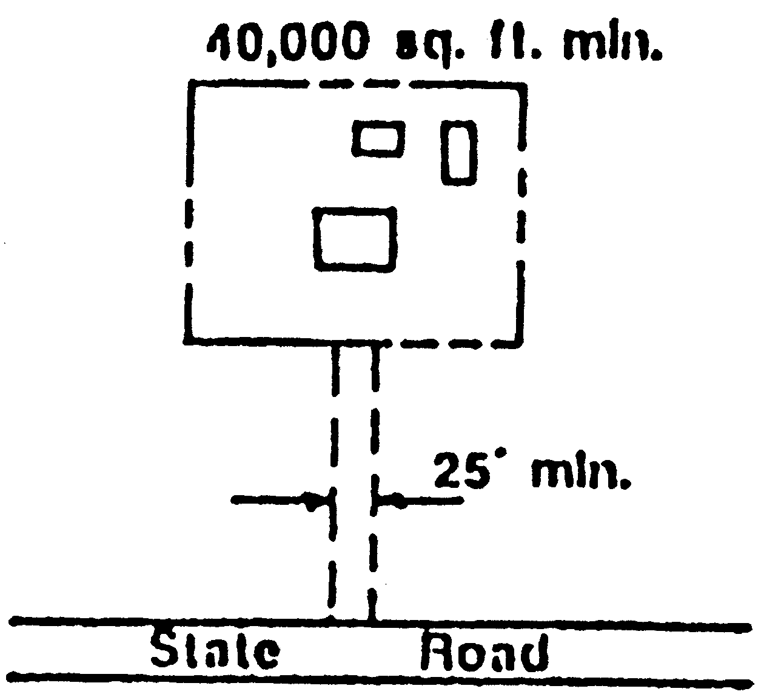
Existing Home Site
(Ord. of 6-18-90, § 19-2.5)
Sec. 18-41. - Minimum lot width.
Except as provided elsewhere in this chapter, the minimum lot width shall be one hundred fifty (150) feet.
(Ord. of 6-18-90, § 19-2.6)
Sec. 18-42. - Yard regulations.
(a)
Side. The minimum sideyard for each main structure in an A-1 district shall be fifteen (15) feet and the total width of the two (2) required side yards shall be thirty-five (35) feet or more, except as provided elsewhere in this chapter.
(b)
Rear. Each main structure shall have a rear yard of thirty-five (35) feet or more, except as provided elsewhere in this chapter.
(Ord. of 6-18-90, § 19-2.7; Ord. of 2-27-95)
Sec. 18-43. - Height restrictions.
Buildings in an A-1 district may be erected up to thirty-five (35) feet in height; except, that:
(1)
A public or semi-public building such as a school, church, library or general hospital may be erected to a height of sixty (60) feet from grade; provided, that required front, side and rear yards shall be increased one (1) foot for each foot in height over thirty-five (35) feet.
(2)
Church spires, belfries, cupolas, monuments, water towers, chimneys, flues, flagpoles, and television antennae and radio aerials less than one hundred twenty-five (125) feet in height, are exempt. Parapet walls may be up to four (4) feet above the height of the building on which the walls rest.
(3)
No accessory building which is within twenty (20) feet of any party lot line shall be more than one (1) story or fifteen (15) feet in height.
(Ord. of 6-18-90, § 19-2.8)
Sec. 18-44. - Special provisions for corner lots.
(a)
Of the two (2) sides of a corner lot in an A-1 district, the front shall be deemed to be the shortest of the two (2) sides fronting on streets.
(b)
The minimum side yard on the side facing the side street shall be thirty-five (35) feet for both main and accessory building.
(c)
Each corner lot shall have a minimum width at the setback line of one hundred fifty (150) feet.
(d)
Landscaping of corner lots shall be limited to plantings, fences or other landscaping features of no more than three (3) feet in height within the space between the setback line and the property line on the street side of the lot.
(Ord. of 6-18-90, § 19-2.9)
Sec. 18-45. - Limitation on the number of divisions of a parcel in the agricultural A-1 zoning district.
(a)
Each tax parcel, as of the effective date of this section, shall be limited to two (2) further divisions, with said divisions complying with the minimum standards as relating to lot area, lot frontage and lot width. There shall be no further division of any parcel divided from a parent tract after the effective date of this section. The provisions of this section shall expire one (1) year after the effective date.
(b)
The provisions of this section shall not apply or pertain to a single division of a lot or parcel for the purpose of sale or gift to a member of the immediate family of the property owner(s).
All such lots of less than five (5) acres shall have a reasonable right-of-way of not less than ten (10) feet or more than twenty (20) feet, providing ingress or egress to a dedicated recorded public street or thoroughfare.
Only one such division shall be allowed per grantee, and shall not be for the purpose of circumventing this section.
For the purpose of this section, a member of the immediate family is defined as any person that is a natural or legally defined offspring, spouse, sibling, grandchild, grandparent, or parent of the owner.
(Ord. of 2-28-05)
Editor's note— This section shall become effective on March 1, 2005.
Sec. 18-46. - Standards for manufactured homes.
(a)
The towing tongue of each unit shall be removed.
(b)
Any vacant space between the points where two (2) modules are joined shall be enclosed with material of matching exterior appearance in accordance with the Virginia Uniform Statewide Building Code.
(c)
All manufactured homes must meet the requirements of the Virginia Manufactured Home Regulations.
(Ord. of 6-18-90, § 19-2.11; Ord. of 9-28-98(2))
Sec. 18-47. - Special regulations for industrialized buildings.
(a)
Because of their functional and transportable nature in addition to lesser costs when compared to conventional accessory buildings, industrialized buildings are considered a valid alternative for farm offices, storage and the like. By reason of the contrast in appearance of these units as compared to conventional construction and the potential for adverse effect on rural and residential property values from inappropriate location and placement of these units, a special use exception from the board of zoning appeals is required for all industrialized buildings located in the A-1 and A-2 agricultural zoning districts. The board of zoning appeals may approve such an exception on an individual lot or farm in the agricultural A-1 or A-2 districts provided:
(1)
That notice of the application has been posted conspicuously on the property in accordance with the requirements of this chapter.
(2)
That adjacent landowners have been notified in accordance with Code of Virginia, § 15.1-431, as amended.
(3)
In consideration of the general character of the area, proposed location with respect to street or road, the location of other accessory buildings, the characteristics of the proposed site, open or wooded, proposal for landscaping and screening, and the design, age and condition of the unit itself including roof lines, peaked, shed or flat, siding and roofing material and color, skirting material and color, and proposed location proximate to historic sites or structures or homes of conventional or permanent construction, existing or planned, or is not incompatible therewith.
(4)
That prior to the zoning/building/electrical inspection the industrialized building is anchored in accordance with the Uniform Statewide Building Code and the open space underneath the unit is skirted with the material approved by the board of zoning appeals.
(b)
The board of zoning appeals may require submittal of complete information on the characteristics of the proposed unit and placement, including color photographs, sample of materials, site plan and landscape plan to assist with their decision and may subject their approval to such reasonable conditions as are appropriate in a particular case. All information shall be filed with the zoning administrator no later than seven (7) days prior to the advertised hearing date.
(Ord. of 6-18-90, § 19-2.12)
Sec. 18-48. - Development standards for intensive agriculture operations.
(a)
Area requirements for intensive agriculture operations.
(1)
The minimum lot area for an intensive agriculture operation shall be ten (10) acres, except as provided for elsewhere in this chapter.
(2)
A ratio of one (1) acre of open land per thirteen (13) slaughter or feeder cattle, thirty-three (33) swine, seven (7) horses, one hundred thirty (130) sheep or eight (8) mature dairy cattle shall be provided for each intensive agricultural operation.
(3)
No more than one thousand (1,000) veal, cattle, horses or similar animals or seven thousand five hundred (7,500) swine or fifty thousand (50,000) turkeys or one hundred thousand (100,000) laying hens or broilers or three thousand (3,000) sheep, lambs, goats or similar animals be confined at any one (1) site.
(b)
Setbacks for intensive agriculture operations.
(1)
Any intensive agriculture operation shall be located a minimum of five hundred (500) feet from any public road or street, if the property does not front on a road or street then the property line closest to a road or street shall have a setback of five hundred (500) feet.
(2)
An intensive agriculture operation shall be setback off the side and rear property lines a minimum of two hundred (200) feet.
(3)
An intensive agriculture operation shall be located no closer than four hundred (400) feet from an existing dwelling.
(4)
All intensive agriculture operations shall be located at least one thousand five hundred (1,500) feet from incorporated towns; residential subdivisions; residentially zoned districts; public schools; churches, county, town and community recreation areas; public wells.
(5)
The setbacks as noted above apply to all accessory uses or structures associated with the intensive agriculture operation, including litter storage sites, incinerators, manure storage sites, manure disposal pits and/or disposal pits or cold storage chests used for collection of dead animals.
(c)
Replacement and reconfiguration of livestock, dairy and poultry facilities.
(1)
Any intensive agriculture use in existence as of the effective date of this amendment to the zoning ordinance that does not meet the requirements of this chapter may be replaced or reconfigured provided that:
a.
There is no increase in the square footage devoted to the intensive agriculture operation on the parcel and no increase in the number of animals kept on the parcel at any one (1) time.
b.
Replacement facilities do not encroach upon any setbacks required under this chapter to a greater extent than the facilities being replaced.
c.
A nutrient management plan is obtained as provided in this chapter.
(d)
Development plans for intensive agriculture operations.
(1)
A development plan may be filed by the operator of any existing or proposed intensive agriculture operation with the zoning administrator which indicates the number, size and location of intensive agriculture operations planned for the subject parcel. When such development has been approved and filed with the zoning administrator and during the period in which it remains in effect, the planned facilities shall be obliged to meet setbacks only from those dwellings and uses existing at the time the development plan is approved.
(2)
The development plan shall be based on the requirements of this chapter and shall be accompanied by a plat prepared and signed by a land surveyor or civil engineer certified by the Commonwealth of Virginia verifying accuracy of the distances shown in the development plan and containing all of the data required on certified plat as specified herein.
(3)
The development plan shall remain in force only so long as the facilities proposed are constructed in accordance with the development plan and are placed in service in a timely manner.
(4)
At least one-third (⅓) of the number of the head of livestock or dairy animals, subject to this chapter of the ordinance or one (1) poultry operation indicated in the development plan must be placed in service within twelve (12) months of the date on which the development plan is approved by the zoning administrator, unless at least one-third (⅓) of the number of livestock, dairy or one (1) such poultry facility is already in service on the subject parcel at the time the development plan is filed. Zoning approval for any subsequent facilities indicated in the development plan may only be obtained if no more than two (2) years have passed since the date on which the development plan was approved for a parcel by the zoning administrator.
(5)
The operator shall notify the zoning administrator in writing within thirty (30) days of placement into service of any facility indicated in his development plan.
(6)
Should an operator fail to build or have in place the minimum required in section (4) above, the zoning administrator shall revoke the development plan and all future development plans of facilities on the subject property shall strictly conform to the requirements of this chapter. Each parcel for which a development plan has been approved by the zoning administrator shall display at its entrance a sign no smaller than two (2) square feet, or larger than four (4) square feet, clearly visible from the nearest roadway, indicating that a development plan is in effect for the parcel and containing the words "Certified Intensive Agriculture Development Site."
(e)
Nutrient management plan for intensive agriculture operations.
(1)
After the effective date of this amendment to the zoning ordinance, no facility permit shall be issued until a nutrient management plan for the proposed facility has been reviewed and accepted by the zoning administrator.
(2)
The nutrient management plan shall provide for the safe disposal or use of all manure or animal waste produced by each facility. Disposal or use shall be accomplished by means of land application at approved locations and agronomic rates, as established by the Virginia Cooperative Extension Service and other appropriate agencies. Alternative methods of disposal may be used, as approved by appropriate state and local agencies. The nutrient management plan shall take into account, among other things, the presence of rivers, streams, public and private wells, springs and sinkholes and slopes and geological formations that indicate a high susceptibility to ground or surface water pollution. Each nutrient plan shall be subject to review by an agent of the Virginia Cooperative Extension Service or other appropriate agency.
(3)
The nutrient management plan shall also provide for a site, with or without a permanent structure, for the storage of animal wastes and shall:
a.
Meet the setback requirements of this chapter;
b.
Be protected from the elements;
c.
Is out of all drain ways; and
(4)
Notwithstanding the provisions of this section, an operator whose facilities were in operation prior to the effective date of this amendment to the zoning ordinance may locate an animal waste storage site within any setback otherwise required in this chapter upon satisfaction that the storage site will not encroach upon setbacks to a greater extent than the existing facility.
(5)
The nutrient management plan shall be reviewed and updated every five (5) years by an agent of the Virginia Cooperative Extension Service or other appropriate agency and by the zoning administrator, and more frequently if deemed necessary or advisable by the county or its agent.
(f)
Certified plat required. Each application for an intensive agriculture operation shall be accomplished by a plat of the entire parcel with location of proposed facility prepared and signed by a land surveyor or civil engineer licensed by the Commonwealth of Virginia certifying that the proposed intensive agriculture operation meets all applicable setback requirements of this ordinance and showing the direction and distances to nearest residences, adjacent zoning districts, platted residential subdivisions, rural service areas, public school; recreation areas; wells listed under setbacks.
(Ord. of 2-27-95)
Sec. 18-49. - Development standards for livestock operations.
(a)
Minimum setbacks for buildings used to confine animals associated with a livestock operation shall be as follows:
(1)
Five hundred (500) feet from any public road or street, if the property does not front on a road or street then the property line closest to a road or street shall have a setback of five hundred (500) feet.
(2)
Two hundred (200) feet off side and rear property lines.
(3)
No livestock operation shall be located closer than four hundred (400) feet form an existing dwelling.
(4)
All livestock operations shall be located at least one thousand five hundred (1,500) feet from incorporated towns; residential subdivisions; residentially zoned districts; public schools; churches; county, town and community recreation areas; and public wells.
(5)
The setbacks noted above apply to all accessory uses or structures associated with the livestock operation, including litter storage sites, incinerators, manure storage sites, manure disposal pits and/or disposal pits or cold storage chests used for collection of dead animals.
(b)
Replacement and reconfiguration of livestock operations.
(1)
Any livestock operation in existence as of the effective date of this amendment to the zoning ordinance that does not meet the requirements of this chapter may be replaced or reconfigured provided that:
a.
There is no increase in the square footage devoted to the livestock operation on the parcel and no increase in the number of animals kept on the parcel at any one (1) time.
b.
Replacement facilities do not encroach upon any setbacks required under this amendment to a greater extent than the facilities being replaced.
(Ord. of 8-28-95)
Sec. 18-50. - Development standards for private kennels.
(a)
Any application for the keeping of six (6) to twenty (20) dogs shall meet the following standards:
(1)
An application and application fee shall be filed with the administrator listing the number of dogs and breeds of dogs. Dogs shall not be of the following breeds: American Pit Bull Terrier, Rottweiler, German Sheppard, Alaskan Malamute, Husky, Doberman Pinscher, Chow Chow, Great Dane or Saint Bernard.
(2)
A plan shall be submitted with the application describing the method of care for the animals regarding food, water, shelter, and waste disposal.
(3)
An acceptable site plan shall be submitted with the application showing the location of kennels and distances from all property lines, residences and waters sources.
(4)
The kennel shall be twenty-five (25) feet from all property lines.
(5)
The kennel shall not be located in the front yard.
(6)
The kennel shall be fifty (50) feet from all water sources, wells (unless solely designed for use by the kennel), rivers, ponds, and streams.
(7)
The kennel shall be one hundred fifty (150) feet from all residences (excluding the applicant's residence).
(8)
The kennel shall be screened to an appropriate height with fencing, foliage, shrubs or other material suitable as determined by the administrator.
(9)
The property shall contain a minimum of two (2) acres.
(10)
There shall be no commercial sales of animals, defined as more than five (5) dogs sold in any calendar year.
(11)
There shall be an annual review and/or inspection by the administrator to ensure conditions are in order.
(12)
The permit holder shall secure appropriate dog tags from the treasurer's office annually.
If the applicant meets all of these requirements (items (1) through (12) of section (a) herein above) the administrator shall send written notice, via first class mail, to all adjacent property owners indicating that a private kennel permit is being sought. Additionally, the administrator shall post a zoning sign on the property of the proposed kennel and send written notice to the animal control officer and health department. Adjacent property owners and agencies shall have thirty (30) days from the date of notice to submit written comments regarding the application. If all standards are met and no written objections are received during the referral process, then the administrator may issue the permit. If the permit is issued administratively, the permit fee is one hundred dollars ($100.00). If the applicant does not meet all of the above described standards or if written objections are received from adjacent property owners or agencies during the thirty (30) day period, then the application will be presented to the board of zoning appeals for consideration under the special use permit process outlined in sections 18-482(6a), (6b) and (6c). The application fee for a special use permit from the BZA is three hundred dollars ($300.00).
(b)
Any application for the keeping of twenty-one (21) to fifty (50) dogs shall meet the following standards:
(1)
An application and application fee shall be filed with the administrator listing the number of dogs and breeds of dogs. Dogs shall not be of the following breeds: American Pit Bull Terrier, Rottweiler, German Sheppard, Alaskan Malamute, Husky, Doberman Pinscher, Chow Chow, Great Dane or Saint Bernard.
(2)
A plan shall be submitted with the application describing the method of care for the animals regarding food, water, shelter, and waste disposal.
(3)
An acceptable site plan shall be submitted with the application showing the location of kennels and distances from all property lines, residences and waters sources.
(4)
The kennel shall be twenty-five (25) feet from all property lines.
(5)
The kennel shall not be located in the front yard.
(6)
The kennel shall be fifty (50) feet from all water sources, wells (unless solely designed for use by the kennel), rivers, ponds, and streams.
(7)
The kennel shall be one hundred fifty (150) feet from all residences (excluding the applicant's residence).
(8)
The kennel shall be screened to an appropriate height with fencing, foliage, shrubs or other material suitable as determined by the administrator.
(9)
The property shall contain a minimum of five (5) acres.
(10)
There shall be no commercial sales of animals, defined as more than five (5) dogs sold in any calendar year.
(11)
There shall be an annual review and/or inspection by the administrator to ensure conditions are in order.
(12)
The permit holder shall secure appropriate dog tags from the treasurer's office annually.
If the applicant meets all of these requirements (items (1) through (12) of section (b) hereinabove) the administrator shall send written notice, via first class mail, to all adjacent property owners indicating that a private kennel permit is being sought. Additionally, the administrator shall post a zoning sign on the property of the proposed kennel and send written notice to the animal control officer and health department. Adjacent property owners and agencies shall have thirty (30) days from the date of notice to submit written comments regarding the application. If all standards are met and no written objections are received during the referral process, then the administrator may issue the permit. If the permit is issued administratively, the permit fee is one hundred dollars ($100.00). If the applicant does not meet all of the above described standards or if written objections are received from adjacent property owners or agencies during the thirty (30) day period, then the application will be presented to the board of zoning appeals for consideration under the special use permit process outlined in sections 18-482(6a), (6b) and (6c). The application fee for a special use permit from the BZA is three hundred dollars ($300.00).
(c)
An application for the keeping of more than fifty (50) dogs shall meet the following standards:
(1)
An application and application fee shall be filed with the administrator listing the number of dogs and breeds of dogs. Dogs shall not be of the following breeds: American Pit Bull Terrier, Rottweiler, German Sheppard, Alaskan Malamute, Husky, Doberman Pinscher, Chow Chow, Great Dane or Saint Bernard.
(2)
A plan shall be submitted with the application describing the method of care for the animals regarding food, water, shelter, and waste disposal.
(3)
An acceptable site plan shall be submitted with the application showing the location of kennels and distances from all property lines, residences and waters sources.
(4)
The kennel shall be twenty-five (25) feet from all property lines.
(5)
The kennel shall not be located in the front yard.
(6)
The kennel shall be fifty (50) feet from all water sources, wells (unless solely designed for use by the kennel), rivers, ponds, and streams.
(7)
The kennel shall be one hundred fifty (150) feet from all residences (excluding the applicant's residence).
(8)
The kennel shall be screened to an appropriate height with fencing, foliage, shrubs or other material suitable as determined by the administrator.
(9)
The property shall contain a minimum of ten (10) acres.
(10)
There shall be no commercial sales of animals, defined as more than five (5) dogs sold in any calendar year.
(11)
There shall be an annual review and/or inspection by the administrator to ensure conditions are in order.
(12)
The permit holder shall secure appropriate dog tags from the treasurer's office annually.
The application will be presented to the board of zoning appeals for consideration under the special use permit process outlined in sections 18-482(6a), (6b) and (6c). The application fee for a special use permit from the BZA is three hundred dollars ($300.00).
(Ord. of 12-17-07)
Sec. 18-51. - Development standards for hunt club kennels.
(a)
Any application for the keeping of up to fifty (50) dogs shall meet the following standards:
(1)
An application and application fee shall be filed with the administrator listing the number of dogs and breeds of dogs. Dogs shall not be of the following breeds: American Pit Bull Terrier, Rottweiler, German Sheppard, Alaskan Malamute, Husky, Doberman Pinscher, Chow Chow, Great Dane or Saint Bernard.
(2)
A plan shall be submitted with the application describing the method of care for the animals regarding food, water, shelter, and waste disposal.
(3)
An acceptable site plan shall be submitted with the application showing the location of kennels and distances from all property lines, residences and waters sources.
(4)
The kennel shall be twenty-five (25) feet from all property lines.
(5)
The kennel shall not be located in the front yard.
(6)
The kennel shall be fifty (50) feet from all water sources, wells (unless solely designed for use by the kennel), rivers, ponds, and streams.
(7)
The kennel shall be one hundred fifty (150) feet from all residences (excluding the applicant's residence).
(8)
The kennel shall be screened to an appropriate height with fencing, foliage, shrubs or other material suitable as determined by the administrator.
(9)
The property shall contain a minimum of one (1) acre.
(10)
There shall be no commercial sales of animals, defined as more than five (5) dogs sold in any calendar year.
(11)
There shall be an annual review and/or inspection by the administrator to ensure conditions are in order.
(12)
The permit holder shall secure appropriate dog tags from the treasurer's office annually.
If the applicant meets all of these requirements (items (1) through (12) of paragraph (a) herein above) the administrator shall send written notice, via first class mail, to all adjacent property owners indicating that a hunt club kennel permit is being sought. Additionally, the administrator shall post a zoning sign on the property of the proposed kennel and send written notice to the animal control officer and health department. Adjacent property owners and agencies shall have thirty (30) days from the date of notice to submit written comments regarding the application. If all standards are met and no written objections are received during the referral process, then the administrator may issue the permit. If the permit is issued administratively, the permit fee is one hundred dollars ($100.00). If the applicant does not meet all of the above described standards or if written objections are received from adjacent property owners or agencies during the thirty (30) day period, then the application will be presented to the board of zoning appeals for consideration under the special use permit process outlined in sections 18-482(6a), (6b) and (6c). The application fee for a special use permit from the BZA is three hundred dollars ($300.00).
(b)
Any application for the keeping of more than fifty (50) dogs shall meet the following standards:
(1)
An application and application fee shall be filed with the administrator listing the number of dogs and breeds of dogs. Dogs shall not be of the following breeds: American Pit Bull Terrier, Rottweiler, German Sheppard, Alaskan Malamute, Husky, Doberman Pinscher, Chow Chow, Great Dane or Saint Bernard.
(2)
A plan shall be submitted with the application describing the method of care for the animals regarding food, water, shelter, and waste disposal.
(3)
An acceptable site plan shall be submitted with the application showing the location of kennels and distances from all property lines, residences and waters sources.
(4)
The kennel shall be twenty-five (25) feet from all property lines.
(5)
The kennel shall not be located in the front yard.
(6)
The kennel shall be fifty (50) feet from all water sources, wells (unless solely designed for use by the kennel), rivers, ponds, and streams.
(7)
The kennel shall be one hundred fifty (150) feet from all residences (excluding the applicant's residence).
(8)
The kennel shall be screened to an appropriate height with fencing, foliage, shrubs or other material suitable as determined by the administrator.
(9)
The property shall contain a minimum of one (1) acre.
(10)
There shall be no commercial sales of animals, defined as more than five (5) dogs sold in any calendar year.
(11)
There shall be an annual review and/or inspection by the administrator to ensure conditions are in order.
(12)
The permit holder shall secure appropriate dog tags from the treasurer's office annually.
The application will be presented to the board of zoning appeals for consideration under the special use permit process outlined in sections 18-482(6a), (6b) and (6c). The application fee for a special use permit from the BZA is three hundred dollars ($300.00).
(Ord. of 12-17-07)

