
Southwest Ranches City Zoning Code
Subpart 1
GENERAL PROVISIONS
ARTICLE 40. - TELECOMMUNICATION TOWERS AND ANTENNAS[2]
Editor's note— Ord. No. 2015-008, § 2, adopted Sept. 29, 2015, amended Art. 40, §§ 040-010—040-210, in its entirety to read as herein set out. The former Art. 40 pertained to similar subject matter and derived from Ord. No. 2005-005, § 4(040-010)—(040-210), 4-14-2005.
Sec. 005-010.- Purpose and intent; division of town into districts.
(A)
The purpose of this Unified Land Development Code (ULDC) is to protect the high quality of living; the rural, semi-rural and agrarian character; and the public health, safety and general welfare of the community through regulations that implement the comprehensive plan; and control the subdivision, use and development of land, including the use of land, buildings, structures, and other improvements thereon; protect the overall appearance of the community, and ensure the availability of public facilities and services concurrent with demand.
(B)
In order to effectively protect and promote the general welfare and to accomplish the goals, objectives and policies of the comprehensive plan, the town is divided into zoning districts of such number, shape and area, and of such common unity of purpose and use, that are deemed most suitable to provide for the best general civic use, to protect the rural, semi-rural, and agrarian character of the town, to protect the common rights and interests of all, and to promote compatibility between land uses.
(Ord. No. 2005-005, § 4(005-010), 4-14-2005)
Sec. 005-020. - Short title; scope.
This chapter shall be known and cited as the Town of Southwest Ranches Unified Land Development Code (ULDC).
(Ord. No. 2005-005, § 4(005-020), 4-14-2005)
Sec. 005-030. - Enforcement, interpretation, purpose and conflict.
(A)
The town administrator, town attorney and town council, as applicable, shall designate town personnel and contractual agents of the town, who shall have the authority to enforce the provisions of the ULDC.
(B)
Where it is found that any of the provisions of the ULDC are being violated, enforcement proceedings may be initiated against the real property owner, the tenant if applicable, and any other person violating the provisions of the ULDC as provided in the town Code and as otherwise provided by law. Any enforcement procedure authorized by the town Code, county or state law, may be used to enforce the provisions of the ULDC. It shall be at the discretion of the town attorney to determine which method of enforcement is appropriate and whether more than one (1) method of enforcement should be brought, as provided by law.
(C)
In addition to enforcement by the town administrator, the provisions of the ULDC may be enforced by the town's law enforcement agency as violations of a town ordinance and, as such, shall be punishable as provided by law.
(D)
Further, the town council or town administrator may authorize the town attorney to bring legal action in a court of competent jurisdiction.
(E)
Where the ULDC includes regulations on the same point as contained in any other law or ordinance, the provisions of the ULDC shall govern unless otherwise prohibited by law; except that where the regulations of the other law or ordinance are more restrictive than those of the ULDC, the other shall govern.
(F)
Where the numeric and spelled-out expressions of a given standard contained within the ULDC are not in agreement, the stricter and least permissive of the two (2) shall prevail. For example, if a minimum yard requirement is expressed as "twenty-five (5) feet," the text, "twenty-five feet" prevails, and if, for example, a maximum height requirement is expressed as "twenty-five (20) feet," the numeric expression, "(20)" prevails.
(Ord. No. 2005-005, § 4(005-030), 4-14-2005)
Sec. 005-040. - Official zoning map.
(A)
The areas assigned to the town's zoning districts, the designations of same, and the boundaries of said districts shown upon the map adopted with these regulations, which map may be amended from time to time by ordinance, and which is made a part of the ULDC by reference, is hereby established, said map being designated as the "Official Zoning Map"; and said map and the proper notations, references and other information shown thereon shall be as much a part of the ULDC as if the matters and information set forth by said map was fully described herein.
(B)
Each district shall be subject to the regulations stipulated in this ULDC.
(Ord. No. 2005-005, § 4(005-040), 4-14-2005)
Sec. 005-050. - District boundaries.
(A)
Defined. Unless otherwise shown, the district boundaries are street lines, alley lines, watercourses, or the subdividing or boundary lines of recorded plats or lots, or the extensions thereof, and where the districts designated on the Official Zoning Map are approximately bounded by street lines, alley lines, watercourses, or the subdividing or boundary lines of recorded plats or lots, such lines or the extension thereof shall be considered to be district boundaries.
(B)
Town authority to designate location. Where, due to the scale or illegibility of the Official Zoning Map, or due to the absence of a street, alley, watercourse, or recorded subdividing, plat or lot lines, there is any uncertainty, contradiction or conflict as to intended location of any district boundary, the town council shall have the power and duty of interpreting the intent of said zoning map so as to determine and designate the proper location of such district boundary in accordance with the spirit and purpose of the ULDC.
(C)
Water areas. The water surface and the land under the water surface of all waterways not otherwise zoned are hereby placed in the same zoning district as the land which it abuts as shown on the Official Zoning Map. Where the zoning districts shown on the Official Zoning Map are different on opposite sides of the water area, then the zoning district on each side shall extend to the centerline or midpoint of the water area.
(D)
Districting of vacated ways. Where a street or alley shown on the official zoning map is hereafter officially vacated by replatting or otherwise, the land formerly in such street or alley right-of-way shall be included within the zoning district of adjoining property on either side of said vacated street or alley. In the event such street or alley was a district boundary between two (2) or more different zoning districts, the district boundary shall be the former centerline of such vacated street or alley.
(Ord. No. 2005-005, § 4(005-050), 4-14-2005)
Sec. 005-060. - Regulation of unzoned property.
Any property which has not been placed in a zoning district, or which has not otherwise been zoned is hereby classified as the most restrictive zoning district classification consistent with the designation of said unzoned lands as indicated on the future land use plan map of the comprehensive plan.
(Ord. No. 2005-005, § 4(005-060), 4-14-2005)
Sec. 005-070. - Consistency with the land use plan.
(A)
Whenever the permitted uses or district regulations applicable to any zoning district permit some uses that are not permitted by the applicable land use plan designation for the property, the provisions of the land use plan shall operate to prohibit those uses on that property as if such restrictions were fully set forth in this ULDC. Where an existing lawful use of land or a building is no longer permitted by the land use plan, such use of land or building shall be considered nonconforming and subject to article 30, "Nonconforming Uses, Structures, and Plots," unless a contrary result is specifically provided for in the land use plan.
(B)
The development of land within the town shall conform to the comprehensive plan.
(Ord. No. 2005-005, § 4(005-070), 4-14-2005)
Sec. 005-080. - Permits required; expiration of permits and development orders.
(A)
It shall be unlawful to use, erect, move, or otherwise alter a building, structure, or part thereof; or to use, clear, fill, excavate, move, pave, grade, or otherwise alter land or water, unless a permit consistent with all applicable provisions of the ULDC shall have been first obtained for such work, except that this provision shall not be deemed to require issuance of building permits for the erection, movement or alteration of farm buildings and structures. The town, via resolution, shall establish all requirements for such permits, including, but not limited to, application requirements, fees, and required inspections, except that fees for permits issued under the state building code may be set by the county to the extent it is under contract to issue such permits for the town.
(B)
Any permit or development order issued pursuant to this section shall be valid for a period of one hundred eighty (180) days from the date of issuance unless a different expiration is otherwise provided for within this ULDC for a specific permit or development order, or by official action of the town council or special magistrate. The town administrator may renew such a permit or development order for one (1) additional six-month period subject to compliance with current requirements of the ULDC in effect at the time of application for renewal. After the date of expiration, the development order shall be null and void. A new development application shall be filed and shall be subject to the current requirements of the ULDC.
(C)
Whenever development is occurring on a property pursuant to a town permit, a permit card, or copy thereof, shall be conspicuously posted on the site and visible from the adjoining street at all times. A set of approved plans and a final as-built survey, where applicable, shall be available on the site where development is occurring at all times that a scheduled inspection is being conducted to ensure compliance with such approved plans.
(Ord. No. 2005-005, § 4(005-080), 4-14-2005; Ord. No. 2011-07, § 2, 6-23-2011)
Sec. 005-090. - Compliance required.
(A)
No development order or permit shall be issued which is not in conformity with all the provisions of the ULDC and the adopted comprehensive plan.
(B)
No license, permit or certificate shall be issued by any department or official of the town, nor authorized agent for the town, for the use of any premises or the operation of any business, enterprise, occupation, trade, profession or activity which would involve, in any way, or constitute, a violation of the ULDC, nor shall any license, permit or certificate be issued upon any premises where there is a violation of the ULDC. The town administrator is authorized to require the execution of an agreement for recording where the administrator deems it necessary for enforcement of these regulations.
(C)
A development order, permit or decision issued by an agent, officer or employee of the town, with ostensible authority over the interpretation or enforcement of this ULDC, shall not stop or otherwise prevent the town from strict enforcement of the provisions of this ULDC.
(D)
Any application for a development permit required or authorized under the ULDC shall require an effective development order to be granted by the town administrator or the town council, as applicable, prior to issuance of the development permit. No permit may be issued that is inconsistent with a development order.
(E)
The town shall withhold issuance of a permit or development order when there are outstanding code violations on a property, and the property owner has not been placed into compliance by the town. Development orders and permits necessary for correcting the violation are not subject to this provision. Any violation of a previously approved development order or permit, including any condition of approval attached thereto, shall constitute such a violation.
(Ord. No. 2005-005, § 4(005-090), 4-14-2005)
Sec. 005-100. - Conformance with approved site plan required.
All plots shall be maintained in accordance with the approved site plan, building permit plans and any other town-approved plans unless the town approves subsequent changes pursuant to the procedures and requirements of the ULDC.
(Ord. No. 2005-005, § 4(005-100), 4-14-2005)
Sec. 005-110. - Effect of development order.
(A)
No development permit shall be issued except pursuant to an effective development order.
(B)
No development permit shall be issued for a development which is inconsistent with the development order governing such development.
(Ord. No. 2005-005, § 4(005-110), 4-14-2005)
Sec. 005-120. - Certificates required.
(A)
No nonresidentially zoned building or premises or part thereof, except farm buildings or structures, or premises zoned to permit any community facility, commercial or industrial use, except farms, or premises established as a legal nonconforming use, existing as of the effective date of the ordinance from which this ULDC is derived which undergoes a change of occupancy or upon which a new or different use is established, shall be occupied or used unless a certificate of use shall have been issued therefor. The original certificate shall be posted at the business location at all times.
(B)
No home occupation is permitted unless a certificate of use shall have been issued therefor.
(C)
The town administrator shall notify the holder of any certificate of use, in writing, of the intent to revoke a certificate of use for any of the following reasons:
(1)
The town administrator has reasonable grounds to believe that the premises is being used in a manner that is inconsistent with, or contrary to, the provisions of the ULDC or any other applicable code or statute;
(2)
In the event of a conviction of any owner, operator, manager, supervisor, or any employee acting at the direction or with the knowledge of the owner, operator, manager, or supervisor, by a court of competent jurisdiction, for the violation of any criminal statute committed in conjunction with the business operation;
(3)
It has been ascertained that the holder of the certificate of use falsified any information on the application for the certificate of use; or
(4)
The holder of the certificate of use, or the holder's designated manager, operator or supervisor refuses to permit an authorized law enforcement officer or code compliance officer to inspect the premises during normal business hours for the purpose of investigating a complaint which has been filed against the business operation.
(D)
All written notifications from the town of the intent to revoke a certificate of use shall be sent to the certificate holder by certified mail, return receipt requested, with a copy by regular mail, to the business location. The notice shall state the following:
THE HOLDER OF THE CERTIFICATE OF USE SHALL HAVE TEN (10) DAYS FROM THE DATE OF THIS NOTIFICATION TO EITHER BRING THE PREMISES INTO COMPLIANCE OR TO REQUEST A HEARING, IN WRITING, BEFORE THE SPECIAL MAGISTRATE. IF NO WRITTEN REQUEST FOR A HEARING IS RECEIVED FROM THE CERTIFICATE HOLDER BY THE TOWN ADMINISTRATOR WITHIN TEN (10) DAYS OF THE DATE OF THIS NOTIFICATION, THE CERTIFICATE OF USE SHALL BE CONSIDERED IMMEDIATELY REVOKED.
If the holder of the certificate of use requests a hearing before the special magistrate, the certificate of use shall remain in effect during the pendency of the action before the special magistrate.
(Ord. No. 2005-005, § 4(005-120), 4-14-2005)
Sec. 005-130. - Right of entry.
For the purpose of enforcing the provisions of the ULDC, officials and inspectors shall have a right of entry as provided by law whenever said officials and inspectors find such entry necessary for the proper discharge of their duties under the ULDC. The office of the town attorney is hereby authorized to seek inspection warrants as necessary.
(Ord. No. 2005-005, § 4(005-130), 4-14-2005)
Sec. 005-140. - Validity.
Should any article, section, paragraph, sentence, clause, phrase, or other part of the ULDC be declared by a court of competent jurisdiction to be invalid, such decisions shall not affect the validity of the ULDC as a whole, or any part thereof, other than the part so declared to be invalid.
(Ord. No. 2005-005, § 4(005-140), 4-14-2005)
Sec. 005-150. - Town council to amend zoning regulations.
Whenever the public necessity, convenience, general welfare, or good planning and zoning practice requires, the town council may, by ordinance, amend, supplement, or change the regulations, district boundaries, or classifications of property, now or hereafter established by the ULDC or amendments hereto.
(Ord. No. 2005-005, § 4(005-150), 4-14-2005)
State Law reference— Adoption and amendment procedures, F.S. §§ 163.3202, 166.041.
Sec. 005-160. - Authority of town council to establish widths of thoroughfares, setbacks; dedications required.
The town council is hereby authorized and empowered to prescribe the width of roads, streets, alleys and other thoroughfares, and setbacks therefrom. All plats and new development shall be required to dedicate rights-of-way or grant ingress and egress easement rights as necessary to satisfy the minimum width requirements of this ULDC for rights-of-way as a prerequisite of the approval for record. The town in its sole discretion shall determine whether such dedication shall be in the form of dedication or easement. Minimum thoroughfare widths by road classification are established in article 90. Thoroughfare widths for each existing road are established on the section maps prepared, and previously maintained, by the county department of transportation office of engineering prior to the incorporation of the town. The section maps, as may be amended or replaced from time to time by resolution of the town council, are hereby adopted as the Town of Southwest Ranches Right-of-Way Plan. The widths of state and county roads shall be as such may be prescribed by the state department of transportation and the county trafficways plan.
(Ord. No. 2005-005, § 4(005-160), 4-14-2005)
Sec. 005-170. - Authority of town council to name, rename, number or renumber roads, alleys, etc.
The town council is authorized and empowered to name or number any road, subdivision street, alley or other thoroughfare within the town limits and to change such names or numbers. The town is authorized to designate and issue house numbers for properties abutting upon such roads, subdivision streets, alleys or other thoroughfares.
(Ord. No. 2005-005, § 4(005-170), 4-14-2005)
Sec. 005-180. - Approval required prior to dedications and conveyances for public purposes being made.
No dedication of, or attempt to dedicate, any land or water for any public purpose whatsoever, and no conveyance of, or attempt to convey, any land or water for any public purpose whatsoever, that may be made hereafter, shall be effective unless and until the same shall be accepted and approved by resolution or ordinance of the town council, as applicable.
(Ord. No. 2005-005, § 4(005-180), 4-14-2005)
Sec. 005-190. - Separations and other measurements.
(A)
Any separation, distance limitation or setback required by the ULDC shall be applied without regard to municipal boundaries, and shall be applied in the same manner as if the abutting jurisdictions were part of the town.
(B)
Unless otherwise specified, all distance separations required by the ULDC shall be measured in a straight line, using the shortest airline distance between the two (2) or more points being measured (e.g., properties, buildings, portions of buildings, entrances to buildings etc., as applicable to each specific provision).
(Ord. No. 2005-005, § 4(005-190), 4-14-2005)
Sec. 005-200. - Misrepresentation or withholding of information.
Misrepresentation or withholding of information by an applicant or party to an application, whether intentional or not, is grounds for revocation of any approvals or permits issued based in any part upon misrepresentation or withheld information.
(Ord. No. 2005-005, § 4(005-200), 4-14-2005)
Sec. 005-210. - Local planning agency.
The town council or its designee shall act as the local planning agency (LPA) for the town for purposes of F.S. § 163.3174, as may be amended from time to time. The LPA may also be known as the planning and zoning board (PZB).
A member appointed by the county school board shall serve as a nonvoting member on the town's local planning agency, in furtherance of F.S. § 163.3174, when the local planning agency considers comprehensive plan amendments and rezonings that would, if approved, increase residential density for the property that is the subject of the application.
(Ord. No. 2005-005, § 4(005-210), 4-14-2005; Ord. No. 2007-05, § 2, 4-12-2007)
Sec. 005-220. - Computation of time.
If the last day of a time period is a Saturday, Sunday or legal holiday, the period shall run until the end of the next day which is neither a Saturday, Sunday nor legal holiday.
(Ord. No. 2005-005, § 4(005-220), 4-14-2005)
Sec. 005-240. - Authority to withhold permits and approvals; zoning in progress.
When a change of text of the comprehensive plan or ULDC, or town-initiated change in the future land use plan map or zoning map is being considered by the town council, no permit or development order shall be issued by the town for a period of time not to exceed six (6) months after notice of a public hearing before the town council for such a change has been published, where the issuance of such permit or development order might result in the nonconforming or unlawful use of property should such proposed change be adopted; provided that, the council may extend the zoning in progress by up to six (6) additional months if deemed necessary for the public health, safety and welfare; and further provided that, if final action by the town council is not taken on the proposed change within the timeframe prescribed in this section, the permit or development order shall be issued if it is consistent with existing permitted land uses or zoning district requirements.
(Ord. No. 2005-005, § 4(005-240), 4-14-2005)
Sec. 005-250. - Town uses.
The provisions of this ULDC are not intended, and shall not be construed, to preclude the use of any property by the town in any town government capacity, function or purpose as determined by the town council.
(Ord. No. 2005-005, § 4(005-250), 4-14-2005)
Sec. 005-260. - Street closures.
The town council is authorized to close streets within the town pursuant to F.S. § 316.008.
(Ord. No. 2005-005, § 4(005-260), 4-14-2005)
Sec. 005-270. - Use of right-of-way or swales.
A town permit is required for any use of any right-of-way and or swales that involves installation, erection, placement or removal of any structure object or landscaping material, earthwork, grading, paving, physical occupation, and any commercial business or use, including but not limited to, use of rights-of-way and swales to grow or store plants or material incidental to a plant nursery or other agricultural use for wholesale or retail. Motorists shall be prohibited from parking, and property owners shall be prohibited from allowing motorized vehicles to be parked, on any right-of-way or swale in association with any non-residential use of land.
(Ord. No. 2006-03, § 3, 10-20-2005; Ord. No. 2008-13, § 2, 7-24-2008)
Sec. 010-010.- General construction of terms.
For the purpose of the ULDC, certain terms used herein are defined. When not inconsistent with the context:
(A)
Tense, number. Words used in the present tense include the future, words in the singular number include the plural and words in the plural number include the singular number.
(B)
Shall. The term "shall" is always mandatory and not merely directory.
(C)
May. The term "may" is permissive.
(D)
Structure. The term "structure" includes the term "building."
(E)
Used. The term "used" includes the terms "arranged," "designed," "constructed," "altered," "converted," "rented," "leased," or "intended to be used."
(F)
Occupied. The term "occupied" includes the terms "arranged," "designed," "built," "altered," "converted," "rented," or "leased," or "intended to be occupied."
(G)
Land. The term "land" includes water surface.
(H)
Person. The term "person" includes individuals, firms, corporations, associations, trusts, joint venture, partnership, estate, syndicate, fiduciary, government agency, two (2) or more persons having a joint or common interest, any combination of the preceding, and other similar entities.
(I)
Town. The term "town" means the Town of Southwest Ranches, Florida.
(J)
Council. The term "council" means the Town Council of the Town of Southwest Ranches, Florida.
(K)
Councilmember. The term "councilmember" means the members of the town council.
(L)
County. The term "county" refers to Broward County, Florida.
(M)
Plan. The term "plan" means the Town of Southwest Ranches Comprehensive Plan.
(N)
Administrator. The term "administrator" means the town administrator.
(O)
Administrative officials. Any reference to the town administrator, town attorney, town engineer, director of community development, or other administrative official of the town includes their designees.
(P)
Town engineer. Any reference to the town engineer includes any of the engineering firms the town may utilize for town permit review, general development review, or infrastructure planning or review.
(Q)
Tertiary drainage plan. The term "tertiary drainage plan" means the adopted town of Southwest Ranches Master Tertiary Drainage Exhibit to Town Resolution No. 2005-08, as same may be amended or replaced from time to time. The tertiary drainage plan is a schematic plan, based upon information available at the time of its preparation, that is intended to provide means of stormwater drainage storage and/or conveyance toward secondary and primary drainage canal systems as regulated by the applicable local drainage and/or water control districts and the South Florida Water management district, using best management practices.
(R)
Building code. The term "building code" means the Florida Building Code, Broward County Edition, as may be amended from time to time.
(Ord. No. 2005-005, § 4(010-010), 4-14-2005; Ord. No. 2006-05, § 2, 11-3-2005)
Sec. 010-020. - Abbreviations.
The following abbreviations are used in the ULDC and are intended to have the following meanings:
(Ord. No. 2005-005, § 4(010-020), 4-14-2005)
Sec. 010-030. - Terms defined.
Any term not defined in this section shall have the meaning given by the most recent edition of Webster's Unabridged Dictionary.
Accessory building. The term "accessory building" means a separate building, subordinate in area and height to a principal building or use, as applicable, devoted to an accessory use on the same plot with the principal building or principal use.
Accessory use. The term "accessory use" means a use naturally and customarily incidental, subordinate, and subservient, to the principal use of the premises, and located on the same plot as the principal use. The area of an accessory use shall be subordinate to that of the principal use.
Acre, gross. The term "gross acre" means forty-three thousand five hundred sixty (43,560) square feet of land which includes contiguous, private property under the same ownership, extended to the centerline of any abutting right-of-way or ingress/egress easement; provided that if the right-of-way or easement was not obtained equally from properties on both sides of the thoroughfare, the gross acreage shall only include that portion of the right-of-way or easement obtained from the property counting the thoroughfare towards gross density.
Acre, net. The term "net acre" means forty-three thousand five hundred sixty (43,560) square feet of land which includes contiguous, private property under the same ownership, excluding the following:
(1)
Any easement, reservation or other encumbrance existing, in whole or in part, for the purpose of providing access to real property, provided that an easement for ingress/egress and utilities shall be included as net acreage if the town requires the easement to be granted for the purpose of fully accommodating a town capital improvement to an existing street; and
(2)
Water bodies that are not wholly contained within a single plot, including but not limited to, canals, wet retention areas and lakes; and
(3)
Portions of surface water management areas, drainage easements or equivalent areas in the RE district, designated by the town or applicable drainage district for retaining or conveying stormwater, that:
(a)
Exceed fifteen (15) feet in width within lots of record measuring five and one-half (5.5) gross acres or more as of April 28, 2022; or
(b)
Exceed ten (10) feet in width on lots of record measuring seven and one-half (7.5) gross acres or more as of April 28, 2022.
Adult day care center. The term "adult day care center" means an establishment which provides day care and activities for adolescents or adults who require supervision due to physical or mental limitations.
Agricultural uses. The term "agricultural uses" means farms, the cultivation of crops, groves, thoroughbred and pleasure horse ranches, including horse boarding, private game preserves, fish breeding areas, tree and plant nurseries, cattle ranches and similar activities.
Alcoholic beverage. The term "alcoholic beverage" means and includes, for the purpose of this ULDC, any beverage containing one-half (½) of one (1) percent or more alcohol by volume.
Alcoholic beverage establishment. The term "alcoholic beverage establishment" means any bar, lounge, saloon, bottle club, nightclub, private club, package store or any place or premises, other than a private residence or a fast-food or full service restaurant as defined herein, where alcoholic beverages are sold or dispensed for consumption by customers, patrons or members on or off of the premises, and not in conjunction with a meal. Establishments that provide only snack foods or prepackaged foods incidental to consumption of alcoholic beverages on the premises shall be considered alcoholic beverage establishments. This definition shall not apply to the sale of malt beverages for off-premises consumption as provided for in F.S. § 563.02(1)(a).
Alter. The terms "alter," "altered" or "alteration" shall mean any change in size, occupancy or use of a building or structure; any repair or modification to a building or structure, or use; the erection or placement of any sign; the excavation or filling of any water area; the addition or removal of fill and movement of earth; the addition, removal or modification of any paving or landscaping.
Americans With Disabilities Act of 1990. A Civil Rights Act signed into law July 26, 1990, as Public Law 101-336, 104 Stat. 327, as may be amended from time to time.
Antenna. See article 40, "Telecommunication Towers and Antennas."
Archaeological site. The term "archaeological site" means a location that has yielded or may be likely to yield information important in history or prehistory, and is a site that contains physical evidence of past human activity. An archaeological site may be identified using on-site investigations or site predictive models. Archaeological sites are evidenced by the presence of artifacts on or below the ground surface indicating the past use of a location by people. A designated archaeological site is one (1) that meets this criterion, has been designated by the Broward County Commission and appears on the Broward County Land Use Plan Map Series or has been designated by the town.
Art gallery. The term "art gallery" means a room or building where paintings, pieces of sculpture and other works of art or aesthetic objects are exhibited, or exhibited and sold.
Arterial. The term "arterial" means a street having that meaning given in F.S. § 334.03. Arterials are identified in the transportation element of the comprehensive plan.
Auditorium. The term "auditorium" means a building or complex of buildings that has facilities for cultural, entertainment, recreational, athletic and convention activities or performances.
Automobile repair, major. The term "major automobile repair" means a general repair, rebuilding or reconditioning of engines, motor vehicles or trailers; collision service, including body, frame or fender straightening or repair; overall painting or paint shop; and vehicle steam cleaning.
Automobile repair, minor. The term "minor automobile repair" means incidental body or fender work, other minor repairs, painting and upholstering, replacement of parts and motor service to passenger cars and trucks not exceeding one and one-half (1½) tons capacity, but not including any operations listed under the term "automobile repair, major" or any other operation similar thereto.
Back-out parking. The term "back-out parking" means a parking lot design which forces a vehicle to use the public or private right-of-way to maneuver in and out of a parking stall.
Bar, lounge or saloon. The term "bar," "lounge," or "saloon" means any place devoted primarily to the retailing and consumption on the premises of malt, vinous or other alcoholic beverages not served as an accessory to meals prepared on the premises, and any place where one (1) or more signs are displayed indicating that alcoholic beverages are obtainable for consumption on the premises.
Bed and breakfast. The term "bed and breakfast" means an owner-occupied and operated detached dwelling unit, other than a hotel, roominghouse or boardinghouse, where sleeping accommodations without individual food preparation facilities are provided for transient guests, with at least one (1) meal per day prepared within a centralized kitchen for guests included for a nightly fee, and which does not utilize outside services or employees, except for those customarily found in single-family residential neighborhoods such as housekeeping and landscape maintenance. Bed and breakfasts accept reservations directly on the premises and advertise themselves as bed and breakfasts.
Bicycle facilities. The term "bicycle facilities" denotes improvements and provisions made by public agencies to accommodate or encourage bicycling, including parking facilities, maps, bikeways and shared roadways not specifically designated for bicycle use.
Bicycle lane or bike lane. The term "bicycle lane" or "bike lane" means a portion of a roadway which has been designated by striping, signing, and pavement markings for the preferential or exclusive use of bicyclists.
Bicycle path or bike path. The term "bicycle path" or "bike path" means a bikeway physically separated from motorized vehicular traffic by an open space or barrier and either within the street or within an independent right-of-way or easement.
Bicycle way. The term "bicycle way" means any road, path or way which, in some manner, is specifically designated as being open to bicycle travel, regardless of whether such facilities are designated for the exclusive use of bicycles or are to be shared with other transportation modes.
Boardinghouse or roominghouse. The term "boardinghouse" or "roominghouse" means an establishment providing transient lodging that is not a hotel or bed and breakfast dwelling.
Bottle club. The term "bottle club" means any business or private club which does not hold a state license for the sale of alcoholic beverages, but which permits its members, patrons or customers to bring or store their own bottles containing alcoholic beverages for consumption on the premises.
Broward County trafficways plan. The plan promulgated by the county planning council pursuant to Laws of Fla. ch. 59-1154, and the Broward County Charter, which depicts a network of trafficways for the county.
Building. The term "building" means any structure having a solid roof and having walls on all sides, and used or built for the shelter or enclosure of persons, animals, chattels, or property of any kind.
Building permit.
(A)
The term "building permit" means, for purposes of concurrency/adequacy determination and required parking calculations, a permit required by the building code, for the erection or construction of a new building, addition to an existing building, or change in occupancy that may require additional parking pursuant to article 80, "off-street parking and loading" or may impact services or facilities subject to concurrency requirements, including one (1) or more additional dwelling units, or additional nonresidential building area.
(B)
In any other context, the term refers to any permit required under the building code.
Business zoned property. The term "business zoned property" means any land or water area whose zoning district classification is one (1) of the commercial zoning districts established in the ULDC.
Cannabis. The term, "cannabis" shall have the meaning given in F.S. § 893.02(3), (2013), as may be amended from time to time.
Cannabis-related use. The term, "cannabis-related use" means any activity that involves growing, cultivating, processing (including development of related products such as food, tinctures, aerosols, oils or ointments), selling, dispensing, processing orders for, or administering cannabis, products containing cannabis, or related supplies, except that this term shall not apply to cultivating and processing facilities approved by the State of Florida for which local governments are preempted from regulating pursuant to F.S. § 381.986, as may be amended from time to time.
Carports. The term "carports" means a private garage not completely enclosed by walls and doors.
Cemetery. The term "cemetery" means a place dedicated to and used or intended to be used for the permanent interment of human remains. A cemetery may contain land or earth interment; mausoleum, vault, or crypt interment; a columbarium, ossuary, scattering garden, or other structure or place used or intended to be used for the interment or disposition of cremated human remains; or any combination of one (1) or more of such structures or places. This definition shall not be construed to permit a crematory, nor shall it be construed to permit a funeral home.
Certificate of use.
(A)
The term "certificate of use" means a document issued by the town officially authorizing establishment of uses consistent with the terms of the ULDC.
(B)
Note: A certificate of use does not negate the requirement of obtaining an occupational license from the county.
Change of occupancy. The term "change of occupancy" means a discontinuance of an existing use and the substitution therefore of a use of a different kind or class. Change of occupancy is not intended to include a change of tenants or proprietors unless accompanied by a change in the type of use.
Child care center. The term "child care center" means a place for the day care and/or instruction of children not remaining overnight, includes preschools.
Civic association. The term "civic association" means a formal organization of residents within a specified geographic area of the town, the purpose of which is to address issues common to the group of residents that has formally notified the town clerk of its existence, that meets regularly, and that has elected officers.
Civic center. The term "civic center" means a building that houses governmental offices and services, and/or which may include cultural, recreational, athletic, convention and entertainment facilities owned or operated by a governmental agency.
Club, private. The term "private club" means buildings and facilities or premises used or operated by associations and organizations of a fraternal or social character, not operated or maintained for profit. The term "private club" shall not include casinos, nightclubs or other institutions operated as a business. Such organizations and associations shall be incorporated under the laws of the state as nonprofit organizations.
Code compliance officer or code inspector. The term "code compliance officer" or "code inspector" means the officers and/or agents of the town officially authorized by the town to enforce the provisions of this ULDC.
Collector. The term "collector" means a street having that meaning given in F.S. § 334.03.
Commercial equestrian operations. The term "commercial equestrian operations" means businesses and activities, other than for the personal enjoyment of the property owners or lessees, and their family and friends, limited to horse boarding, riding instruction, horse grooming and care instruction, horse training, horse breeding, guided or unguided horseback riding, and equestrian accessory uses, where the ratio of human participants to horses is consistently no greater than two (2) to one (1), unless the use involves a one-time group instruction on horse care, training, riding, or similar equestrian instruction, whereby all participants are engaged simultaneously in such instruction.
Commercially zoned land. The term "commercially zoned land" means any land or water area whose zoning district classification is community business or mixed use services.
Common party wall. The term "common party wall" means a solid wall, without any openings, which separates contiguous dwelling units or nonresidential tenant spaces.
Community residential facility. The term "community residential facility" means a "special residential facility" as defined in the adopted comprehensive plan, as may be amended from time to time.
Completely enclosed building. The term "completely enclosed building" means a building separated on all sides from adjacent open space, or from other buildings or other structures, by a permanent roof and by exterior walls or party walls pierced only by windows and normal entrance or exit doors.
Composting or mulching operation. The term, "composting or mulching operation" means the processing of any organic, plant, or tree material into compost, or the processing of any organic, plant, tree, or other material, into small chips or pieces consistent with that of mulch (hereinafter referenced as "mulch" regardless of intended use), typically through grinding or cutting, when: (1) any of the source materials are obtained from offsite; or (2) any of the compost or mulch is removed from the property where processed; or (3) deposition of compost or mulch alters the grade of any portion of the land on the plot where the activity is occurring, including deposition into a water body or excavated area. Composting or mulching operations are industrial uses, and are expressly not agricultural uses.
Contiguous. The term "contiguous" means directly adjoining; immediately adjacent; contiguous plots have at least one (1) side of each plot which touches one (1) side of the other plot with no separator between the plots including, but not limited to, a public right-of-way, private street, or canal.
Density. The term "density" means the maximum number of dwelling units permitted on one (1) net or gross acre of property, as specified herein as a function of minimum plot size. For example, a maximum allowable density of one-half (½) dwelling unit per net acre is equivalent to a minimum plot size requirement of two (2) net acres.
Developed. The term "developed" means land or water upon which a permitted building, structure, other improvement or use has been constructed or established, and including land that has undergone development as defined herein, but excluding solely underground utilities, pipes, wires, cable, culverts, conduits or other similar underground improvements and excluding structures bearing overhead power transmission lines that carry at least five hundred kilovolts (500 kv) of electrical power, provided such lands contain no other buildings or structures. This term shall not include containers having a maximum capacity of forty (40) gallons or less.
Developer. The term "developer" means any person undertaking any development as defined in this section.
Development. The term "development" has the meaning given in F.S. § 380.04, provided the term specifically includes any construction, clearing, filling, excavating, grading, or paving, whether or not any such activities are occurring on a previously improved property.
Development order. The term "development order" means an order authorizing the granting, denying, or granting with conditions of an application for a development permit.
Development permit. The term "development permit" means any building permit, engineering permit, zoning permit, subdivision or plat approval, modification to a condition of plat approval, including an amendment or revision to a nonvehicular access line, site plan approval, amendment to the notation on the face of a plat, application for placement of a notation on the face of a plat, rezoning, variance or other official action of the town having the effect of permitting the development of land, but does not include any variance or other official action necessary solely for the purpose of issuing a permit, other than a building permit, pursuant to the building code, as may amended from time to time.
Display. The term "display" means an arrangement of goods reflecting the occupation or business, wares or other objects used or sold on the premises, for the purpose of bringing the subject thereof to the attention of others without the use of a sign.
District. The term "district" means a portion of the territory of the town within which certain uniform regulations and requirements or various combinations thereof apply under the provisions of this ULDC. Short for the term "zoning district."
Domesticated pig. The term "domesticated pig" means a swine of the Hampshire, Landrace, Duroc, or Yorkshire species, which has been tamed by generations of breeding, to live in close association with human beings as a pet or work animal and usually creating a dependency so that the animal loses its ability to live in the wild.
Drive-through facility. The term "drive-through facility" means any place or premises used for the sale or dispensing of products to patrons who enter upon the premises in automobiles and purchase products through a window or door without leaving their vehicle.
Driveway. The term "driveway" means an area that connects the parking aisles of a parking lot, the parking area of a dwelling unit, a loading area, or otherwise provides vehicular access from private property, to the public right-of-way, to a private street, or to another driveway.
Driveway entrance. The term "driveway entrance" means the real portion of a driveway that immediately abuts the public right-of-way or a private street.
Driveway spacing. The term "driveway spacing" means the length of the straight tangent between the point of curvature of the arc, or chord, of a driveway and the point of tangency of the arc, or chord of another driveway, unless otherwise noted.
Dumpster. The term "dumpster" means a container constructed of impervious material and provided with a cover of impervious material that is intended and designed to be used for the retention or storage of garbage, refuse or recyclable materials.
Dwelling. The term "dwelling" means any building, or part thereof, occupied in whole or in part, as the residence or living quarters of one (1) or more persons, permanently or temporarily, continuously or transiently.
Dwelling, detached. The term "detached dwelling" means a single dwelling unit physically detached from other buildings, dwelling units or structures.
Dwelling, single-family. The term "single-family dwelling" means a free-standing dwelling unit, sharing no walls with another dwelling unit, having all habitable areas within the building accessible from the interior of the building. Single-family dwellings shall not include mobile homes, roominghouses or boardinghouses, or dormitories, fraternities and sororities.
Dwelling unit. The term "dwelling unit" means a room not less than four hundred (400) square feet in total floor area, with direct access from the outside of the building or through a common hall, which includes independent and complete kitchen and sanitary facilities designed to provide complete, longterm living accommodations exclusively for one (1) family, and which have no access to another dwelling unit or are designed in such a manner that access to another dwelling unit may be eliminated by closing or sealing interior doorways or openings.
Encounter studio. The term "encounter studio" means all establishments offering nude encounter sessions between persons, nude dance encounter sessions, or any establishment, other than an adult nightclub, where private nude performances are offered.
Environment. The term "environment" includes, but is not limited to, ambient air, surface water, land surface, subsurface soil strata or groundwater.
Environmental regulation.
(A)
The term "environment regulation" means any federal, state, county or town law relating to pollution or protection of the environment. It includes, but is not limited to, any federal, state, county or town statute, or regulation, that pertains, in whole or part, to any existing or potential emission, discharge or release of any pollutant, contaminant, chemical, toxic waste, hazardous waste or solid waste into the environment.
(B)
The term "environmental regulation" also includes, without limitation, any such statute or regulation relating to the manufacture, processing, distribution, use, treatment, storage, disposal, transport or handling of any pollutant, contaminant, chemical, toxic waste, hazardous waste or solid waste.
Environmentally sensitive lands. The term "environmentally sensitive lands" means those lands defined as environmentally sensitive in the 1989 Broward County Land Use Plan, as may be amended from time to time.
Erected. The term "erected" means built, constructed, reconstructed or moved on or upon any property.
Escort or dating service. The term "escort" or "dating service" means an establishment where customers, patrons or members are provided with an escort or companion on a shortterm basis, or which arranges for social meetings between two (2) or more people.
Essential services. The term "essential services" means the erection, construction, alteration or maintenance by public utilities or municipal or other governmental agencies, of underground or overhead sanitary sewer, communication, gas, electrical, steam or water transmission or distribution systems, and drainage facilities, including poles, wires, mains, drains, sewers, pipes, conduits, cables, fire alarm boxes, police call boxes, traffic signals, hydrants, transformer substations and other similar equipment and accessories in connection therewith, reasonably necessary for the furnishing of adequate service by such public utilities or municipal or other governmental agencies or for the public health or safety or general welfare.
Family. The term "family" means a person living alone, or any of the following groups living together as a single, nonprofit housekeeping unit and sharing common living, sleeping, cooking, and eating facilities:
(A)
Any number of people related by blood, marriage, adoption, guardianship, or other duly authorized custodial relationship; and their gratuitous guests and domestic workers.
(B)
Three (3) unrelated people;
(C)
Two (2) unrelated people and any children related to either of them; or,
(D)
Not more than six (6) people who [are] residents of a "community residential home" as defined in F.S. ch. 419.
(E)
Any of the above groups may also include gratuitous guests and domestic workers, but shall not include paying guests. For the purpose of this provision, a "domestic worker" is a person who is employed and paid to perform duties within their employer's private household. Examples of domestic workers include maids, cooks, housekeepers, butlers, nannies, and caregivers.
Family day care home. The term "family day care home" has the meaning given in F.S. § 402.302, and regulated by F.S. § 402.313.
Farm. The term "farm" means the land, buildings, structures, support facilities, machinery, and other appurtenances used in the production of farm and agricultural products when such land is classified agricultural pursuant to F.S. § 193.461(3)(b), as may be amended from time to time.
Farm building or structure. The term "farm building" or "structure" means any building or structure located on a plot classified as a farm, which is used to house or store farm products or materials and equipment necessary to farm operations. A farm structure shall also include fences, walls and hedges along the plot line of a farm.
Farm operation. The term "farm operation" means and includes all conditions or activities by the owner, lessee, agent, independent contractor, and supplier that occur on a farm in connection with the production or marketing of a farm's products.
Farm product. The term "farm product" means any plant, as defined in F.S. § 581.011, any animal, except household pets, useful to humans including any product derived therefrom, the cultivation of crops, groves, thoroughbred and pleasure horse ranches, including horse boarding, private game preserves, fish breeding areas, tree and plant nurseries, cattle ranches, and other similar activities involving livestock or poultry.
Fire protection facilities. The term "fire protection facilities" means a building that houses the offices and services of the town fire department or any other fire protection agency serving the town.
Floor area and gross floor area.
(A)
The terms "floor area" and "gross floor area" mean where a specified minimum floor area is required in the ULDC for a dwelling or other building, the term "floor area" shall mean the total gross horizontal area of all of the floors within the external perimeter of the exterior enclosing walls, including Florida rooms, sun rooms and utility rooms which are fully enclosed and directly accessible from the interior of the dwelling, but excluding other utility rooms, unenclosed porches, terraces or breezeways, and carports or garages.
(B)
For purposes of floor area ratio and parking calculations, the terms "floor area" or "gross floor area under roof" means the total gross horizontal area of all of the floors within the external perimeter of the exterior enclosing walls.
Floor area, gross under roof. The terms "gross under roof floor area" or "gross floor area under roof" mean the gross horizontal area of all the floors under roof, whether or not enclosed, but excluding roof overhangs (eaves) projecting no more than four (4) feet from the exterior walls.
Floor area ratio (F.A.R.). The term "floor area ratio" means the total gross floor area of all buildings or structures on a plot divided by the net plot area.
Florida site file. The state site file is a comprehensive listing of all recorded cultural resources, including those listed in the National Register, maintained by the Department of State, Division of Historical Resources.
Food service. The term "food service" means preparation and/or provision of food for consumption intended for individual portion service on or off the premises regardless of whether there is a charge for the food.
Food service establishment. The term "food service establishment" means any place where food service is provided, and includes the site at which food is prepared and the site at which individual portions are provided, regardless of whether consumption is on or off the premises. The term does not include private homes where food is prepared or served for individual family consumption.
Friction or lap dancing. The term "friction" or "lap dancing" means the use by an employee, whether clothed or partially or totally nude, of a part of her body to touch, massage, rub, stroke, caress or fondle the genital or pubic area of a person while at the establishment, or the touching of the genital or pubic or genital area of an employee by a person while at the establishment. It shall be considered a friction or lap dance regardless of whether the touch or touching occurs while the employee is displaying or exposing a specified anatomical area. It shall also be considered a friction or lap dance regardless of whether the touch or touching is direct or through a medium.
Frontage of a building. The term "frontage of a building" means the wall of a building approximately parallel and nearest to a street.
Frontage of property. The term "frontage of a property" means any plot line which separates a plot from a street, or the line separating an ingress/egress easement within a plot from the remainder of the plot.
Garage, private. The term "private garage" means an accessory building or portion of a single-family dwelling designed or used for inside parking of self-propelled private passenger vehicles by the occupants of the dwelling.
Gasoline station. The term "gasoline station" means any building, structure, or land used for retail sale and dispensing of vehicle fuel.
Governmental administration. The term "governmental administration" means a building that houses the administrative offices of the town, any department, commission, district, authority, board, independent agency or instrumentality of the United States, the state, county, or any other governmental unit.
Grade, established or grade, finished. The term "established grade" or "finished grade" means the elevation of land above mean sea level (NAVD 88), in its final, graded condition.
Guesthouse. The term "guesthouse" means a structure or any part of a structure ancillary to a detached single-family dwelling unit, excluding mobile homes, and located on the same plot as the principle dwelling unit, that is occupied or designed, in whole or in part, as the temporary residence or living quarter of one (1) or more persons. This definition shall include any such living quarter that is connected to the principal dwelling unit by an open or enclosed breezeway or other structure that serves to merely connect the guest quarter to the principal dwelling, as contrasted with a customary home addition that is physically and functionally integral to the principal dwelling. If a temporary or permanent residence or living quarter does not meet the definition of "guesthouse," it shall be deemed to be a dwelling unit for purposes of density calculation.
Habitable room area. The term "habitable room area" means the total floor area of a dwelling unit excluding closets, bathrooms, garages, utility rooms, storage areas, and rooms not accessible from the interior of the dwelling unit.
Hazardous substances. The term "hazardous substances" means any substance or material which, by reason of its toxic, caustic, corrosive, abrasive, explosive, pyric, or otherwise injurious properties, may be detrimental or deleterious to the health or safety of any person handling or using or otherwise dealing with such material or substances.
Health and fitness club and spa. The terms "health and fitness club" and "spa" mean an establishment which provides accommodations and equipment to its membership for purposes of physical fitness and/or relaxation.
Hedge. The term, "hedge," shall have the meaning ascribed to it in section 075-020.
Height. The term, "height," means as follows:
1)
For all buildings and roofed structures, the vertical distance from the highest point of finished grade at the location of the building pad to the highest point of the roof surface for a flat roof, to the deck line for a mansard roof, and to the mean height level between eaves and ridge for gable, hip and gambrel roofs, provided that any portion of the finished grade exceeding 8.5 feet NAVD 88 shall be included in the height calculation.
2)
For signs, as defined in article 70, "Sign Regulations."
3)
For fences, freestanding walls, retaining walls, all other structures, hedges and berms, the vertical distance from the lowest finished grade abutting the structure, hedge or berm to the highest point of the structure, hedge or berm; provided that:
a.
The height of structures, hedges and berms placed within any required yard abutting a public or private street right-of-way shall be measured from the average finished grade of the abutting public or private right-of-way line. Where a street is not contained within a public or private right-of-way, height shall be measured from the average elevation of the closest edge of street pavement between the side lot lines.
b.
The height of structures, hedges and berms placed within any required yard abutting a canal shall be measured from the average finished grade at the public or private right-of-way line of the canal between the lot lines, except as follows:
When spoil from canal dredging has been deposited primarily on one (1) side of a canal, as determined by the town engineer, height shall be measured from the average finished grade at the lower of the opposing right-of-way lines.
c.
The height measurement of any structure or hedge placed on a berm, or placed on property elevated by a retaining wall, shall include the height of the berm or retaining wall.
Holiday wayside stand. The term "holiday wayside stand" means a temporary outside sales location for the retail sale of holiday items associated with the particular holiday for which the location is established, and not associated with or part of any existing use on the plot upon which it is located.
Home occupation. The term "home occupation" means conduct of a business in a home office.
Home office. The term "home office" means an office designed for and operated as a business location within the confines of a dwelling unit, and carried on only by persons residing in the dwelling unit involving only written correspondence, phones, computers, or other common office equipment, and which is clearly incidental and secondary to the use of the dwelling for residential purposes. Home offices shall preclude any business operation that requires or permits customers, patrons, or other employees to visit the dwelling or is conducted within any structure other than the primary residence.
Home-based business. A business that operates in whole or in part from a residential plot as a secondary, incidental and accessory use to the residential use of the property, which meets the strict criteria contained in F.S. § 559.955, as may be amended from time to time.
Homeowners association. The term "homeowners association" means an incorporated, nonprofit organization responsible for maintaining commonly owned property, established under recorded agreements through which each lot owner is automatically a member; each occupied dwelling unit is automatically subject to a charge for a proportionate share of the expenses for the organization's activities and maintenance costs; and each owner or tenant has the right to use the common property.
Hospital. The term "hospital" means an institution providing primary health services, medical and/or surgical care to persons, primarily in-patients, suffering from illness, disease, injury, deformity and other physical or mental conditions, and including, as an integral part of the institution, related facilities such as laboratories, out-patient facilities or training facilities.
Hotel. The term "hotel" means a public lodging establishment containing individual rooms or suites of rooms accessed primarily through an inside lobby, each having a private bathroom, for the purpose of providing overnight, transient lodging accommodations to the general public for compensation with or without meals, which has common, on-site facilities for reservations, cleaning services and on-site management, and may provide additional, accessory services such as restaurants, meeting rooms, health and fitness, spa, entertainment and/or recreational facilities.
Household pet. The term "household pet" means an animal kept for pleasure, rather than for utility, by a family, within the family's dwelling unit or on the same plot as the family's dwelling unit. The term shall include no more than one (1) non-breeding domesticated pig on a plot of land which is at least thirty-five thousand (35,000) square feet, and excludes livestock, poultry and farm products. All domesticated pigs shall be spayed or neutered and de-tusked.
Impervious area. The term "impervious area" means any area with a surface that is covered or hardened so as to prevent or impede the percolation of water into the soil mantle, including pools and areas covered with brick pavers.
Industrially zoned land. The term "industrially zoned land" means and refers to any land or water area whose zoning district classification is M, manufacturing and industrial district.
Inflammable liquid. The term "inflammable liquid" means any liquid, which under operating conditions gives off vapors which, when mixed with air, is combustible and explosive.
Junkyard. The term "junkyard" means a place, structure or plot where junk, waste, discarded salvage, or similar materials such as old metals, wood, slush, lumber, glass, paper, rags, cloth, bagging, cordage, barrels, containers, etc., are bought, sold or exchanged, baled, packed, disassembled or handled, including auto wrecking yards, used lumberyards, housewrecking yards and yards or places for storage or handling of salvaged house wrecking and structural steel materials. This definition shall not include pawnshops and establishments for the sale, purchase or storage of usable secondhand cars, salvaged machinery, used furniture, radios, stoves, refrigerators or similar household goods and appliances, nor shall it apply to the processing of used, discarded or salvaged materials as part of manufacturing operations.
Kennel. The term "kennel" means any place or premises where dogs, cats, or other household pets are housed temporarily with or without compensation for the same.
Kitchen, complete. The term "complete kitchen" refers to a room or area within a building designed or used primarily for providing food storage and food preparation that contains at least a sink with piped water, refrigerator and conventional gas or electric range or cookstove facilities.
Land, platted. The term "platted land" means any land recorded by plat in the county public records, and can be referenced by a plat name, plat book and page.
Land, unplatted. The term "unplatted land" means any land or part thereof not recorded by plat in the county public records and cannot be referenced by plat name, plat book and page.
Library. The term "library" means a building or room in which literary, musical, artistic or reference materials, such as books, manuscripts, recordings, films, paintings, etc., are kept for public use.
Liquid nicotine. Any liquid product composed either in whole or in part of pure nicotine which can be used with nicotine vaporizers.
Livestock. The term "livestock" means grazing animals, such as cattle, horses, sheep, goats, other hoofed animals, ruminants, ostriches, emus, and rheas.
Lot. The term "lot" means a parcel or tract of land designated and identified as a single unit of area in a subdivision plat officially recorded in the county public records.
Lot line. The term "lot line" means the property boundary lines of a lot.
Massage therapy and massage establishment. The terms "massage therapy" and "massage establishment" mean the administering of massage and related modalities within the scope of practice permitted under F.S. ch. 480, by therapists licensed under F.S. ch. 480, working at an establishment also licensed under said chapter.
Medical clinic. The term "medical clinic" means a public or private facility, which staff includes state-licensed physicians and nurses, which provides health-related services or treatment designed to prevent medical problems, maintain a healthful condition, or restore an individual to a condition of health.
Mobile collection center. The term "mobile collection center" means a trailer or mechanical depository used for the collection and temporary storage of aluminum cans or other aluminum products, paper or clothing material.
Mobile food unit. The term "mobile food unit" refers to any vehicle-mounted food service establishment that is self-propelled or otherwise movable from place to place, meeting all applicable requirements of F.A.C. 61C-4.0161, and the town ULDC.
Mobile home. The term "mobile home" has the same meaning given in F.S. § 320.01.
Mobile services unit. The term, "mobile services unit" means a van, truck, other motor vehicle, or motor vehicle-trailer combination with equipment and facilities to provide on-location personal services or animal care services for residential customers as an alternative to the customer traveling to a fixed business location for such services. Examples include, but are not limited to, shoe repair, hair styling, veterinary care and dog grooming. A mobile services unit only provides services while parked on the premises of the customer who is receiving the services, and never offers services at any other location within the town, including the premises of its owner, operator or overnight parking location. As an itinerant service, a mobile services unit is not a land use for the purpose of regulation under this chapter.
Modeling and lingerie studio. The term "modeling and lingerie studio" means an establishment that offers persons the opportunity to view or photograph models who are clothed in lingerie, or which offers encounter sessions with models who are clothed in lingerie.
Museum. The term "museum" means a building or room devoted to the procurement, care, study or display of antiques, objects of historical, scientific or cultural interests, or other objects of lasting interest or value.
Neighborhood. The term "neighborhood" means an adjacent group of buildings and uses whose occupants and/or owners are part of an established homeowners' or business owners' association.
Nicotine vaporizer. Any electronic or battery-operated device that can be used to deliver an inhaled dose of nicotine or other substances and includes those composed of a mouthpiece, heating element, and battery or electronic circuits that provide a vapor of liquid nicotine and/or other substances to the user. This term shall include such devices whether they are manufactured, distributed, marketed, or sold as an electronic cigarette, an electronic cigar, an electronic cigarillo, an electronic pipe, an electronic hookah, an e-cigarette, an e-cigar, e-cigarillo, an e-pipe, an e-hookah or under any other product name.
Nightclub. The term "nightclub" means a restaurant, dining room, bar or other similar establishment where music is played at or above normal conversation sound level such that the music is primary entertainment and not merely background music for ambiance, or where floor shows or other forms of lawful entertainment are provided for guests.
Noncommercial farm. The term "noncommercial farm" means the use of a property for bona fide agricultural purposes, that fails to meet the requirements of F.S. § 193.461(3)(b), as may be amended from time to time.
Nonconforming building. The term "nonconforming building" means a building or structure, or portion thereof, other than a sign, lawfully existing at the effective date of the ordinance from which these regulations are derived, or any amendment hereto, that does not comply with the provisions of these regulations, other than use regulations.
Nonconforming plot. The term "nonconforming plot" means a plot of record lawfully existing at the effective date of the ordinance from which this ULDC is derived, or any amendment hereto, that does not comply with the provisions of these regulations, other than use regulations.
Nonconforming use. The term "nonconforming use" means the use of a structure or premises, lawfully existing at the effective date of the ordinance from which these regulations are derived, or any amendment hereto, for any purpose not permitted for a new use in the zoning district in which it is located.
Nonprofit neighborhood social and recreational facility. The term "nonprofit neighborhood social and recreational facility" means an accessory building or plot of land devoted entirely to providing customary social activities and/or recreation facilities only for the residents and their guests of the subdivision where the building or plot is located.
Nonresidential plot. The term "nonresidential plot" means a plot of land other than a residential plot.
Nonresidentially zoned land. The term "nonresidentially zoned land" means land or water area with any zoning other than an agricultural or rural zoning district.
Nonvehicular access line (NVAL) The term "nonvehicular access line" means a line illustrated on a plat which prohibits installation of driveways for regular use by motor vehicles.
Not-for-profit corporation. The term "not-for-profit corporation" means a corporation of which no part of the corporate income is distributable to its members, directors or officers as defined by F.S. ch. 617.
Off-street loading area. The term "off-street loading area" means an area provided off of any public or private right-of-way for the temporary parking of trucks being loaded or unloaded.
Opaque. The term "opaque" means any nontranslucent, nontransparent, nonliving material which provides a visual barrier from one-side to the other.
Outdoor event. The term "outdoor event" means a carnival, circus, concert, festival, commercial promotion, show, sale and other similar types of events, as well as any outdoor activity that is not a permitted principal or accessory outdoor use of the premises. Outdoor events shall also include permitted accessory uses of a scale, intensity or frequency that exceeds the customary and incidental scale, intensity or frequency of the given accessory use.
Package store. The term "package store" means an establishment where the sale of alcoholic beverages in containers for consumption off the premises is the predominate purpose of the establishment.
Parking. The term "parking" means the temporary, transient storage of vehicles or equipment as an accessory use to a dwelling or other use for a period generally not exceeding twenty-four (24) hours, while their operators are engaged in other activities. This definition excludes the storage of vehicles or equipment.
Parking aisle. The term "parking aisle" means the area immediately adjacent to the car parking stalls which permits maneuvering of the cars entering and leaving a parking stall, and which connects the parking stalls to the driveway.
Parking facility, full circulation. The term "full circulation parking facility" means a parking lot design which permits a car entering a parking lot to circulate in front of all parking stalls and restart the same movement again without using a street or alley and without backing up and then turning around.
Parking facility, off-street. The term "off-street parking facility" means an area designated for the parking of private passenger vehicles not on a street or other thoroughfare. It shall not include storage of new or used cars for sale, service, rental, or any other purpose than specified above.
Parking facility, partial circulation. The term "partial circulation parking facility" means a parking lot design which permits a car entering a parking lot to circulate in front of all parking stalls without using any public or private street right-of-way, and without the need to back up and turn around, but which does not allow complete recirculation through the parking facility without using a street or alley and without the need to back up and turn around.
Parking stall. The term "parking stall" means the space that is necessary to park a car, excluding aisles and driveways, and conforming to the minimum dimensions and other requirements of this ULDC. Synonymous with the term "parking space."
Personal services. The term "personal services" means establishments where the principal use is engaged in the repair, care of, maintenance or customizing of personal properties that are worn or carried about the person or are a physical component of the person. Personal services shall include, but need not be limited to, barbershops, beauty shops, dry cleaning and other garment servicing establishments, tailors, dressmaking shops, shoe cleaning or repair establishments, and other similar places of business.
Pervious area. The term "pervious area" means an area maintained in its natural condition, or covered by a material that permits infiltration or percolation of water directly into the soil mantle.
Place of worship. The term "place of worship" means a building, or part thereof, designed and arranged for religious services, on land held in fee simple ownership or on a longterm lease, a minimum of five (5) years duration, by a chartered religious organization, which utilizes the building for regular, continuing religious services.
Plat. The term "plat" means a map or delineated representation of a tract or parcel of land showing the designation of such land as lot, block, parcel, or other portions thereof, however the same may be designated. The verb "to plat," in whatever tense used, means to prepare a plat in accordance with the town and county platting requirements, showing the division or subdivision of land into lots, blocks, parcels, tracts or other portions thereof, however the same may be designated. "Plat" does not refer to a boundary plat unless the term "boundary plat" is used specifically.
Platted land. See, "land, platted."
Plot. The term "plot" means any quantity of land capable of being described with such definiteness that its location and boundaries may be established, which is occupied or to be occupied by a building, structure, or use, and their accessory buildings and accessory uses, together with such yards and open spaces as are required by this ULDC as a unit. A plot may consist of one (1) or more platted lots, or portions of a platted lot and/or unplatted land.
Plot, corner. The term "corner plot" means a plot of which at least two (2) adjacent sides abut for their full length upon a street, provided that such two (2) sides intersect at an interior angle of not more than one hundred thirty-five (135) degrees. Where a plot is on a curve, if tangents through the intersections of the lot lines with the street lines make an interior angle of not more than one hundred thirty-five (135) degrees, such a plot is a corner plot. In the case of a corner plot with a curved street line, the corner shall be considered to be that point on the street line nearest to the point of intersection of the tangents herein described.

Plot coverage. The term "plot coverage" means the percentage of the plot area covered or occupied by buildings or roofed structures or portions thereof. Swimming pools, decks, barbecue pits, terraces and other appurtenances not roofed-over shall not be included in computing plot coverage.
Plot depth. The term "plot depth" means the mean horizontal distance between the front and rear plot lines.
Plot, flag. The term "flag plot" means a plot that is located at least partially behind another (intervening) plot and does not have the majority of its required plot width fronting a street. Flag plots often access streets by narrow extensions of the plot which connect to the street as depicted in figure 10-1 for illustrative purposes only.
Figure 10-1. Prototypical Flag Lot Illustration.
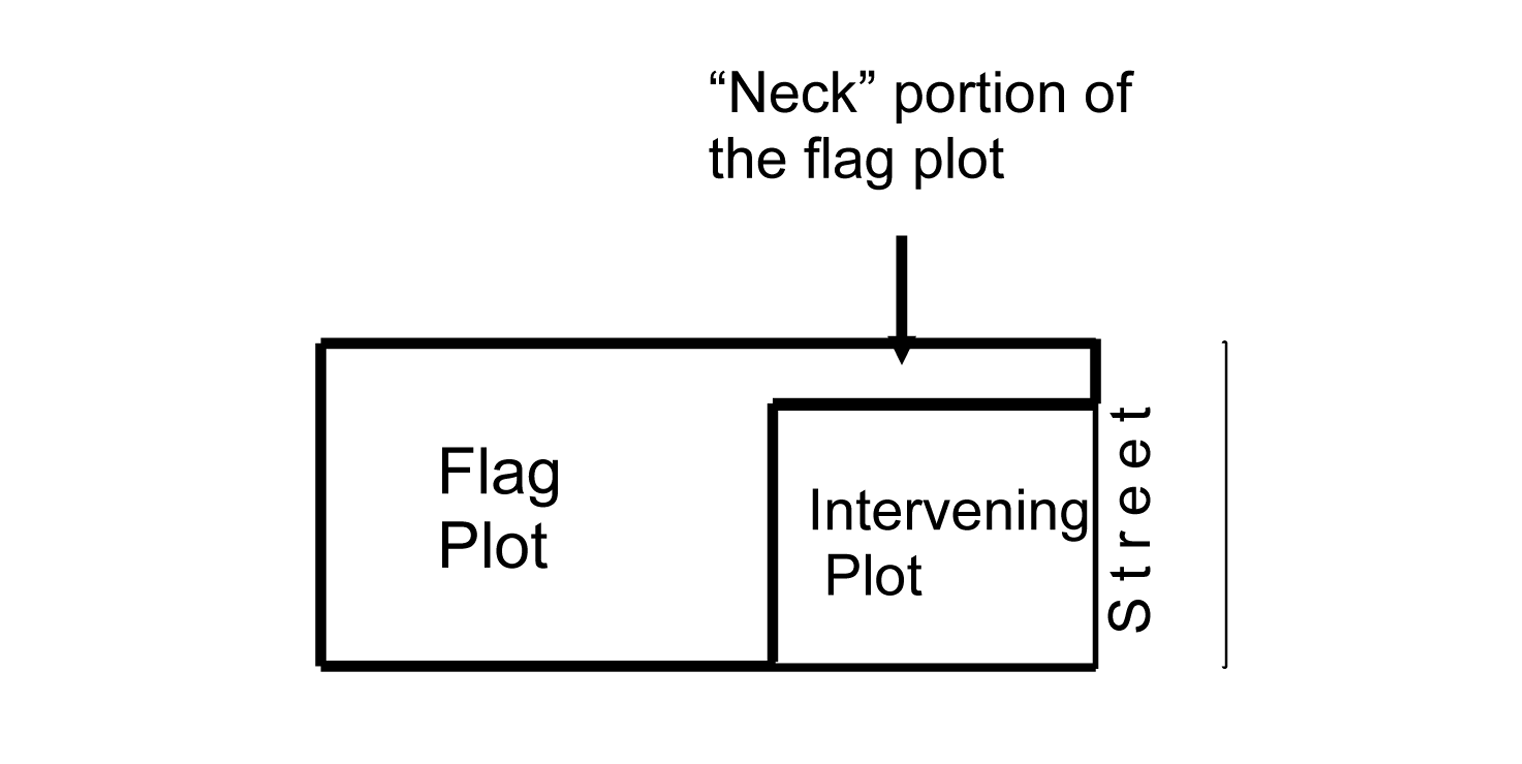
Plot, interior. The term "interior plot" means a plot other than a corner plot.
Plot line. The term "line plot" means the boundary lines of a plot. Has the same meaning as the term, "property line."
Plot line, front. The term "front plot line" means the plot line coinciding with, or adjacent and parallel, to the street line. For corner plots and through plots, the front plot line shall be determined using the methodology set forth in the definition of "street line, front" as it applies to corner and through plots.
Plot line, rear. The term "rear plot line" means the plot line opposite and most distant from the front plot line. In the case of a triangular or gore-shaped lot wherein the two (2) side plot lines converge in the rear, the rear plot line shall be considered to be a line ten (10) feet in length within the plot parallel to and at the maximum distance from the front plot line.
Plot line, residential. The term "residential plot line" means any plot line of a residential plot.
Plot line, side. The term "side plot line" means any plot line other than a front or rear plot line. A side plot line separating a plot from a street is called a corner side plot line, and is considered a street line. A side plot line separating a plot from another plot is called an interior or side plot line.
Plot, residential. The term "residential plot" means a plot with an agricultural or rural zoning district classification.
Plot, through. The term "through plot" means a plot abutting two (2) streets, not at their intersection, if any, which may be an interior plot or also a corner plot.
Plot width, required. The term "required plot width" means the minimum required horizontal distance between the side plot lines at the full depth of the required front yard.
Police protection facilities. The term "police protection facilities" means a building, portion thereof, complex of buildings or premises that houses the offices, services, fleet and/or fleet maintenance facilities of any police agency serving the town.
Porch. The term "porch" means a roofed-over space attached to the outside of an exterior wall of a building, which has no enclosure other than the exterior walls of such building. Open mesh screening shall not be considered an enclosure.
Portable storage unit. The term "portable storage unit" means any container designed for the storage of personal property which is typically rented to owners or occupants of residences or businesses for their temporary use, and which may be delivered to a residence or business and later retrieved from the premises by vehicle and stored in a commercial storage facility until needed by the renter. Portable storage units shall not include shipping containers located upon a plot as a permissible accessory structure.
Potable water. The term "potable water" means water which is satisfactory for drinking, culinary and domestic purposes and which meets the quality standards of the state department of environmental protection, F.A.C. ch. 62-550.
Poultry. The term "poultry" means any chickens, turkeys, ducks, geese, peafowl or guinea fowl.
Principal building. The term "principal building" means a building occupied by, and devoted to, a permitted principal use.
Principal use. The term "principal use" means the primary use of a parcel of land as distinguished from secondary or accessory uses. There may be more than one (1) principal use on a parcel of land unless prohibited within a given zoning district.
Private property. The term "private property" means all lands and water areas owned by other than the town, county, state or federal government or any of its subdivisions.
Property owner. The term "property owner" means the person or entity holding title to real property as indicated in the current tax roll of the county, unless the town has received by certified mail an official document establishing that a person or entity other than the person or entity shown on the tax roll is the actual owner.
Public lodging establishment. The term "public lodging establishment" means any group of rooms or dwelling units within a single building or on a single plot of record held in single ownership, which are rented to transient guests more than three (3) times in a calendar year, which are advertised to the public as a place regularly rented to transient guests, and which are required to maintain a guest register and post room rates in each room or dwelling unit rented and be inspected and licensed by the state division of hotels and restaurants of the department of business and professional regulation in accordance with F.S. ch. 509.
Public property. The term "public property" means all streets, canals, waterways, other rights-of-way, lands, and improvements owned by a governmental agency.
Quarry. The term "quarry" means a place where natural materials or deposits are excavated for use as building materials, road materials, land fill, etc., at a different location. The excavation of materials for use on the premises where the excavation occurs shall not be included in this definition.
Rehabilitation center. The term "rehabilitation center" means a public or private facility that provides specialized services or treatment designed to restore an individual with a specific health condition to a condition of health or useful and constructive activity, excluding drug and alcohol treatment centers and halfway houses.
Remodeling, redecorating or refinishing. The term "remodeling," "redecorating" or "refinishing" means any change, removal, replacement or addition to walls or sides, floors, ceiling and roof surfaces or coverings which do not support any beam, ceiling, floor load, bearing partition, columns, exterior walls, stairways, roof or other structural elements of a building or structure. This definition applies to all structures, including pools, slabs, etc.
Reserve strip.
(A)
The term "reserve strip" means a piece of land or line on one (1) side of a street in the control of the owner of the land on the opposite side of the street which, because it prevents access to the street by development immediately beyond the piece of land or line, is illegal.
(B)
The term "reserve strip" may also mean any, often narrow, strip of land that, because it also serves no development purpose other than to prevent access to other property under separate ownership, is illegal.
Residential plot. See "Plot, residential."
Residential zoning district. The term "residential zoning district" means any of the agricultural and rural zoning districts.
Residentially zoned land. The term "residentially zoned land" means any land or water area within a residential zoning district.
Restaurant. The term "restaurant" means a building or room, where food is prepared and served for pay, which may include consumption on the premises.
Restaurant, fast food. The term "fast food restaurant" means a restaurant which functions for the purpose of serving either short-order meals or individual food items, but is not a full service restaurant as defined herein. A fast food restaurant may or may not have drive-thru window.
Restaurant, full service. The term "full service restaurant" means a restaurant which functions for the purpose of serving complete meals both ordered from a menu and brought to the customer via table service by a restaurant employee, prepared and cooked in a kitchen within the restaurant for on-premises consumption, but shall include cafeterias. Full service restaurants do not have drive-through windows.
Retail store. The term "retail store" means a commercial establishment for the sale of merchandise directly to the ultimate consumer.
Right-of-way. The term "right-of-way" means an area of land and/or water that has been dedicated, deeded, reserved, or otherwise conveyed to the public for public use, ownership and control, and intended to be occupied by uses such as a street, walkway, trail, utility infrastructure, canal or other stormwater conveyance. The term "right-of-way" means a "public right-of-way" unless preceded by the term "private," which for the purpose of the ULDC has the same meaning as an easement.
Right-of-way line. See "Street line."
Right-of-way line, ultimate. See "Street line, ultimate."
Roofline. The term "roofline" means the top edge of the roof or the top of the parapet, whichever forms the top line of the building silhouette.
Setback. The term "setback" means the minimum distance measured from a property line, or ultimate street line if the plot abuts a street, and any part of any building or structure on the plot, unless a specific improvement is specifically excepted as a permitted encroachment or called out separately with a different setback. Setbacks for flag plots are determined exclusive of the narrow portion connecting to the street (see "Yard, front" and "Plot, flag"), and are measured inward from the point at which the plot achieves and maintains the minimum required plot width. All areas in between the setback line and the plot or street line, as applicable, are yards.
Setback line. The term "setback line" means the line or vertical plane representing the setback distance and yard depth, also described as the edge of any required yard, demarcating the vertical plane that separates a required yard from the buildable portion of the plot where principal structures may be erected.
Setback line, required. The term "required setback line" means the line representing the minimum required setback/yard depth.
Setback, required. The term "required setback" means the minimum setback required by any ULDC provision. A minimum setback requirement creates a minimum yard requirement, and a minimum yard requirement has the same effect as requiring a minimum setback.
Shipping container. The term "shipping container" means any heavy-gauge steel container originally designed for transporting cargo on a marine freighter vessel, flatbed truck or flatbed railroad car, or a container manufactured to the same strength and weight specifications that is similar in design or function to such a container, but excluding a portable storage unit.
Shopping center. The term "shopping center" means a group of three (3) or more individual tenant spaces in a nonresidential building, each of which shares at least one (1) common wall with another unit.
Shopping center outparcel. The term "shopping center outparcel" means a plot containing a commercial building that provides its own required parking, landscaping and pervious areas, which is contiguous on at least one (1) side to a shopping center or other larger commercial development, and which is connected to the larger development through parking or access facilities.
Shrub. The term, "shrub," shall have the meaning ascribed to it in section 075-020.
Site assessment survey. The term "site assessment survey" means a systematic archaeological survey utilizing field methodology based on the types of sites known or expected to be present in the survey area. Field methodology in this type of survey involves subsurface testing at depths and intervals sufficient to leave little doubt that all or nearly all sites in the survey were:
(A)
Identified;
(B)
Bounded horizontally and vertically;
(C)
Presented in the resulting report at a level sufficient to permit (a) an assessment of National Register eligibility, and (b) recommendations of appropriate site treatments; and
(D)
Recorded and submitted to the state site file in an acceptance form (i.e., on standard state site file forms with photographic and map attachments).
Smoke shop or lounge. (i) The term, "smoke shop or lounge" means an establishment whereupon tobacco, tobacco products or paraphernalia is sold, distributed, displayed, presented, exchanged, serviced, stored, modified, or used. (ii) For the purpose of this definition, the term, "paraphernalia" means equipment, apparatus or items that are intended for, customarily used for, or adapted for, the smoking or inhaling of tobacco, tobacco products, vaporized nicotine, marijuana, or other substance that is intended or known to be smoked or inhaled. (iii) Convenience stores, grocery stores and similar establishments that display such items for retail sale only are not a smoke shop or lounge provided that the display and inventory of such items comprises less than one (1) percent of the total number of products on display and in stock, and further provided that the establishment does not otherwise comport with this definition.
Special exception use. The term, "special exception use" means a use with one (1) or more characteristics that may be incompatible with the permitted uses and intended character of a particular zoning district, and which therefore requires special review and consideration to ensure that each instance of the proposed use is appropriately sited, designed and operated within the zoning district.
Special exception use permit. The term "special exception use permit" means a resolution of the town council authorizing a special exception use on a specific property, including terms and conditions of such authorization.
Storage of vehicles. The term "storage of vehicles" means the keeping of vehicles or equipment upon a plot for a period exceeding twenty-four (24) hours that does not constitute "parking" as defined herein. Whenever storage of vehicles is permitted within these regulations, parking is also permitted by inference.
Street. The term "street" means a thoroughfare or any other vehicular accessway recorded in the county public records as right-of-way, reservation, ingress/egress easement or similar instrument for the sole purpose of providing access to and from abutting properties. Streets may be publicly dedicated or private.
Street line, front.
(A)
The term "front street line" means, for corner lots, the shorter of the two (2) street lines unless they are each equal or within fifty (50) feet of equal length, in which case the town administrator shall designate one (1) such street line as the front street line and designate one (1) rear lot line based upon neighboring building orientation and access considerations. (Note: section 015-060, "Determination of required yards" provides for alternative yard determinations in unique instances.)
(B)
For through lots, both street lines shall be front street lines.
Street line, ultimate. The term "ultimate street line" means the street line that would result from dedication of right-of-way or granting of an access easement based upon the total public or private right-of-way prescribed for any given street by these regulations, the county trafficways plan, the comprehensive plan, or other official plan. The term "ultimate street line" means the same as the term "ultimate right-of-way."
Street lines. The term "street lines" shall mean the lines that form the boundaries of a public street right-of-way, public or private ingress/egress easement, or other access reservation or conveyance.
Structural alteration. The term "structural alteration" means any change, except for repair or replacement, in supporting members of a building or structure, such as bearing walls, columns, beams or girders.
Structure. The term "structure" means anything constructed, installed, erected or portable, the use of which requires a location in or on the ground, or attached to something having location upon the ground, such as buildings, trailers, fences, billboards, swimming pools, poles, pipelines, transmission lines, tracks and advertising signs.
Surface water management system. The term "surface water management system" means the collection of devices, improvements or natural systems whereby surface waters are controlled, impounded, or obstructed. The term "surface water management system" includes dams, impoundments, reservoirs and appurtenant works as defined in F.S. § 373.403(1-4), as well as all artificial structures including, but not limited to, ditches, canals, conduits, channels, culverts, pipes, and other construction that conveys, impounds, or controls surface water.
Swale. The term "swale" means land within a street other than the travel surface, and land adjacent to a street that holds, is designed to hold, or is required by the applicable drainage district, tertiary drainage plan or ULDC to contain and/or to convey stormwater runoff from a street and private property abutting the street. Further, the term "swale" shall also include the area of land necessary to create the necessary clear zones established by table 3-12 of the Manual of Uniform Minimum Standards for Design, Construction and Maintenance for Streets and Highways, published by American Association of State Highway and Transportation Officials (AASHTO), as may be amended from time to time or replaced.
Tent. The term "tent" means any structure or enclosure, the roof of which and/or one half (½) or more of the sides, are silk, cotton, canvas, fabric or light material.
Trafficway. The term "trafficway" means any one (1) of the expressways, principal arterials, minor arterials or collector streets shown on the county trafficways plan, promulgated by the county planning council pursuant to Laws of Fla. ch 59-1154, and the Broward County Charter.
Trafficway corridor. The term "trafficway corridor" means the land area comprised of a trafficway and its intersections, and that part of any intersecting nontrafficway street and its intersections as follows:
Case A. Any intersecting nontrafficway collector street which is within three hundred (300) feet of the trafficway as measured along the centerline of the nontrafficway collector from a point opposite the chord; or
Case B. Any intersecting local street which is within one hundred (100) feet of the trafficway as measured along the centerline of the local street from a point opposite the chord.
Trailer. The term "trailer" means a manufactured structure inspected, approved and licensed by the state department of motor vehicles, constructed so as to permit occupancy thereof as sleeping or living quarters, or use for storage or conveyance for tools, equipment or machinery on a construction site, and so designed that it is or may be mounted on wheels and conveyed on highways and streets, propelled or drawn by other motive power from one location to another.
Translucent. The term "translucent" means any material which allows the passage of light, but does not permit a clear view of any object or person.
TRIPS model. The term "TRIPS model" refers to a computer model maintained in the county development management division that accounts for the traffic from approved development that has not yet been completed.
Truck berth or truck loading space. The term "truck berth" or "truck loading space" means an area provided adjacent to a loading dock for parking a truck while loading or unloading.
Use. The term "use" means the purpose of which land or a structure thereon is designed, arranged or intended to be occupied or utilized, or for which it is utilized, occupied or maintained.
Use (v.). The term "use" or "used" means the continuation of an existing use, establishment of a new use, or any expansion or change of an existing use, of a building, structure or part thereof, or of any land or water area.
Use, nonresidential. The term "nonresidential use" means a use other than residential use (see "use, residential").
Use of land. The term "use of land" includes use of water surfaces and land under water to the extent covered by zoning districts, and over which the town has jurisdiction.
Use, principal or use, main. The term "principal use" or "main use" means the primary use of the plot as distinguished from secondary or accessory uses. There may be more than one (1) principal or main use on a plot when permitted by district regulations.
Use, residential. The term "residential use" means a use such as a one-family dwelling for the living or sleeping of persons, not commercial or institutional in character such as a lodging establishment or nursing home.
Variance. The term "variance" means a modification of, or deviation from, a regulation of the ULDC which is authorized and approved by the town council after it finds through competent substantial evidence that the literal application of the provisions of the ULDC would cause unnecessary hardship in the use or development of a specific plot, building, or structure, and that such modification or deviation satisfies the criteria for the granting of variances set forth in article 140, "Variances."
Vehicle and equipment, agricultural. The term "agricultural vehicle and equipment" means any operable vehicle and equipment necessary for conducting a permitted agricultural or equestrian use. Landscape maintenance equipment used on the plot (ex. lawn tractor) is also included in this definition, but landscape and lawn maintenance vehicles and equipment associated with a business that provides such services off-site are not included in this definition.
Vehicle and equipment, construction. The term "construction vehicle and equipment" means any equipment used in land clearing and development, building construction, utility construction, or road construction.
Vehicle, commercial. The term "commercial vehicle" means any operable vehicle designed, intended or used for the transportation of people, goods or things, other than private passenger vehicles, agricultural equipment and personal recreation vehicles; provided that any vehicle with a commercial sign placed upon it shall be considered a commercial vehicle. The term "commercial vehicle" shall include, but is not limited to the following:
(A)
Semitrailer. A semitrailer includes all two (2) or more axle vehicles designed to be coupled to and drawn by a motor vehicle.
(B)
Truck. A truck is a motor vehicle designed with or modified to contain a bed, platform, cabinet, rack or other equipment for the purpose of carrying items or things or performing commercial activities and weighing eight thousand (8,000) pounds or more. This term includes, but is not limited to, wreckers, tow trucks, dump trucks, utility or service vehicles, and moving vans.
(C)
Truck-tractor. A truck tractor is a motor vehicle having four (4) or more wheels designed to draw a semitrailer and often equipped with a fifth wheel for this purpose.
(D)
Bus. A bus is any vehicle designed or modified for transportation of fifteen (15) or more people in seats permanently placed in the vehicle.
(E)
Business vehicle. A business vehicle is any vehicle upon which a business name is displayed. This term includes, but is not limited to, taxis, limousines, ambulances, and vans, but excludes security vehicles which are providing security services to the area where the vehicle is parked.
Vehicle, personal recreation. The term "personal recreation vehicle" means any operable motor vehicle or trailer designed and used for general recreation purposes or temporary living quarters for recreational, camping, or travel use, including, but not limited to, camping trailers; travel trailers; truck campers; motor homes, but excluding mobile homes which are considered housing; watercraft; and, trailers designed or used for transporting watercraft or other recreational vehicles, but excluding any trailer classified as a commercial vehicle or which is pulled or designed to be pulled specifically by a commercial vehicle.
Vehicle, private passenger. The term "private passenger vehicle" means a motor vehicle weighing under eight thousand (8,000) pounds, designed and used for personal transportation, including cars, pickup trucks, sport utility vehicles, minivans, and motorcycles.
Vehicle, recreational. The term "recreational vehicle" means one of the following:
(A)
Camping trailer. A camping trailer is a vehicular, portable unit mounted on wheels and constructed with collapsible partial side walls which fold for towing by another vehicle, and unfolded at the site to provide temporary living quarters for recreational, camping or travel use.
(B)
Truck camper. A truck camper is a truck equipped with a portable unit, designed to be loaded onto, or affixed to, the bed or chassis of the truck and constructed to provide temporary living quarters for recreational, camping or travel use.
(C)
Motor home. A motor home is a vehicular unit which does not exceed the length and width limitations provided in F.S. § 316.515, is built on a self-propelled motor vehicle chassis, and is primarily designed to provide temporary living quarters for recreational, camping or travel use.
(D)
Off-road vehicle. An offroad vehicle is a motorized vehicle designed and intended solely for recreational activities and not as a means of transportation on public streets.
(E)
Travel trailer, including fifth-wheel travel trailer. A travel trailer, including a fifth-wheel travel trailer, is a vehicular, portable unit mounted on wheels, of such a size or weight as not to require special highway movement permits when drawn by a motorized vehicle. It is primarily designed and constructed to provide temporary living quarters for recreational, camping or travel use. It has a body width of no more than eight and one-half (8½) feet and an overall body length of no more than forty (40) feet when factory-equipped for the road.
Vehicular use area. The term "vehicular use area" means parking facilities, driveways, and any area designed or used for vehicular circulation, parking, loading, stacking or storage.
Veterinary clinic. The term, "veterinary clinic" means a facility that provides medical or dental treatment and care for animals. A veterinary clinic is not a mobile services unit.
Water management area. The term "water management area" means a portion of a development that is a functional part of the "surface water management system" and is designed for the normal impoundment, storage, or conveyance of surface water or stormwater.
Waterway. The term "waterway" means a stream, canal or body of water.
Wayside stand. The term "wayside stand" means a structure designed and used for the sale or display of farm products produced on the premises on which said structure is located.
Wetlands. The term "wetlands" means those areas which are inundated by water, with sufficient frequency to support, and normally do support an assemblage of organisms that is adapted to saturated or seasonally saturated soil conditions for growth and reproduction including, but not necessarily limited to, swamps, marshes, bogs, sloughs, potholes, wet meadows, river floodplains, mud flats and wet prairies.
Wholesale store. The term "wholesale store" means a commercial establishment primarily for the sale of merchandise directly to the ultimate consumer, but which also provides for the resale of new merchandise to other commercial enterprises as an accessory use.
Wildlife pets. The term "wildlife pets" includes only those animals that have been designated as endangered species, threatened species, or species of special concern by the state or federal government. This definition shall not include any dangerous or poisonous animal of the reptile or amphibian species.
Wireless communication facility. The term "wireless communication facility" means an antenna, stealth facility or wireless communication tower.
Yard. The term "yard" means a space on the same plot with a structure or use, open and unobstructed from the ground to the sky, except by encroachments specifically permitted in section 015-100, "Yard encroachments." Yard measurements shall be the minimum horizontal distances. Yards shall extend and be measured inward from the respective plot lines except for yards abutting streets, in which case they shall be measured from ultimate street lines, and except for flag plots, in which case the depth of a street-side yard extends from the street line to a point where the plot first achieves its minimum required width, and then a distance equal to the minimum required yard depth (see figure 10-2).
Yard, front. The term "front yard" means a yard extending across the full width of the plot between the front street line and the nearest line of the buildings or structures on the plot. For plots along cul-de-sacs, the front yard shall be measured parallel to the arc of the cul-de-sac. For flag plots, a front yard located on the side of the plot with a neck as illustrated in figure 10-1 includes the area in between the required front setback line and the street line.
Figure 10-2. Flag plot; required front yard determination.
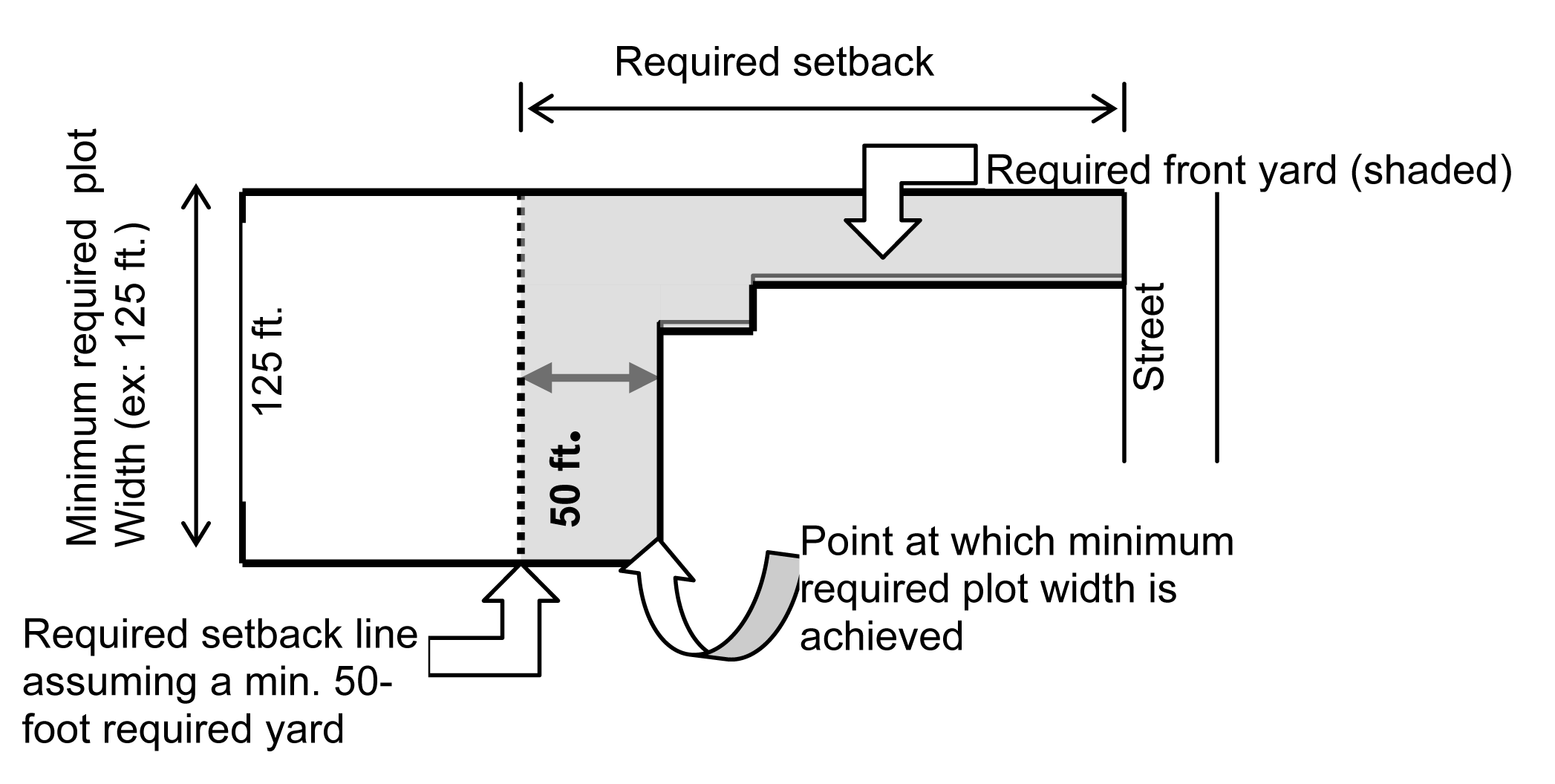
Yard, rear. The term "rear yard" means a yard extending across the full width of the plot between the rear plot line and nearest line of a building or structure.
Yard, required. The term "required yard" means the minimum yard depth required by these regulations. Any yard space supplied in excess of the minimum amount specified shall not be deemed to be a required yard. Note: A minimum setback requirement creates a minimum yard requirement, and a minimum yard requirement has the same effect as requiring a minimum setback (see figure 10-2).
Yard sale or garage sale. The term "yard sale" or "garage sale" means the sale of a residential occupant's personal or household belongings to the public from the occupant's residence, either inside or outside of the building.
Yard, side. The term "side yard" means a yard extending from the front yard to the rear yard, between the side plot line, or side street line if applicable, and the nearest line of any building or structure on the plot. The width of a side yard shall be the shortest distance between the side plot line or side street line and the nearest use or building or structure on the plot.
(Ord. No. 2005-005, § 4(010-030), 4-14-2005; Ord. No. 2006-01, § 2, 10-6-2005; Ord. No. 2006-02, § 2, 10-6-2005; Ord. No. 2006-03, § 3, 10-20-2005; Ord. No. 2006-05, § 3, 11-3-2005; Ord. No. 2006-06, § 2, 3-2-2006; Ord. No. 2006-15, § 3, 6-1-2006; Ord. No. 2008-05, § 2, 3-6-2008; Ord. No. 2010-08, § 1, 6-3-2010; Ord. No. 2011-01, § 2(Exh. A), 11-3-2010; Ord. No. 2011-06, § 2, 2-24-2011; Ord. No. 2014-2, § 2, 3-27-2014; Ord. No. 2015-001, § 2, 12-11-2014; Ord. No. 2015-002, § 5, 12-11-2014; Ord. No. 2017-03, § 2, 2-23-2017; Ord. No. 2017-007, § 2, 7-27-2017; Ord. No. 2017-014, § 2, 9-28-2017; Ord. No. 2020-003, § 2, 2-13-2020; Ord. No. 2021-009, § 2, 3-25-2021; Ord. No. 2022-006, § 2, 2-10-2022; Ord. No. 2022-011, § 2, 4-28-2022; Ord. No. 2023-009, § 2, 9-14-2023; Ord. No. 2024-008, § 2, 8-22-2024)
Sec. 015-010.- Applicability.
The provisions of this article shall apply to all zoning districts.
(Ord. No. 2005-005, § 4(015-010), 4-14-2005)
Sec. 015-020. - Reduction of required areas prohibited.
No plot area, yard, setback, clearance, separation, parking area, landscape area or other space shall be reduced in area or dimension so as to make said area or dimension less than the minimum required by this ULDC; and if already less than the minimum required by this ULDC for a new structure or use, said area or dimension shall not be further reduced, without first obtaining a variance pursuant to article 140, "Variances," that would specifically allow such reduction. No part of a required yard, setback, clearance, parking area or other space provided for any building, structure or use for the purpose of complying with the provisions of this ULDC shall be included as part of a yard, setback, clearance, parking area or other space required under this ULDC for another building, structure, or use, unless specifically permitted under this ULDC.
(Ord. No. 2005-005, § 4(015-020), 4-14-2005)
Sec. 015-030. - Exclusions from height limits.
This section applies to both roofed structures and structures detached from a building, as applicable. Scenery lofts, towers, cupolas, steeples and domes, not exceeding in gross area, at maximum horizontal section, thirty (30) percent of the roof area, and flagpoles, airplane beacons, broadcasting towers and antennas, other than those regulated by article 40, "Telecommunication Towers and Antennas," chimneys, stacks, tanks, and roof structures used only for ornamental or mechanical purposes, may exceed the permissible height limit in any district by not more than twenty-five (25) percent. Parapet walls may extend not more than five (5) feet above the allowable height of a building.
(Ord. No. 2005-005, § 4(015-030), 4-14-2005)
Sec. 015-040. - Minimum plot frontage on arterial and collector roadways.
Plots fronting on arterial or collector roadways shall comply with the minimum frontage and access requirements of section 090-080, "Access to development."
(Ord. No. 2005-005, § 4(015-040), 4-14-2005)
Sec. 015-050. - Minimum plot frontage on cul-de-sac roadways.
Plots fronting on a cul-de-sac roadway shall comply with the minimum frontage and access requirements of section 090-070, "Lots, generally."
(Ord. No. 2005-005, § 4(015-050), 4-14-2005)
Sec. 015-060. - Determination of required yards.
For any lot that, because of its unusual shape or orientation relative to a street or other properties, or orientation of its improvements, would clearly lend itself to a different determination of front, rear and side yards, lot width and depth in order to be more functionally developed, the town administrator may designate said yards, provided the alternate designation is not inconsistent with building orientation and access of adjacent lots in such a manner as to be deleterious to the adjacent property owners or the neighborhood.
(Ord. No. 2005-005, § 4(015-060), 4-14-2005)
Sec. 015-070. - Dumpster enclosures.
Dumpsters existing as of the effective date of the ordinance from which this ULDC is derived and dumpsters constructed subsequent to the effective date of the ordinance from which this ULDC is derived shall comply with the following:
(A)
All dumpsters shall be kept within opaque enclosures. No dumpster or dumpster enclosure shall be located within a required landscape buffer, and may be located within a required yard only if a street or dedicated alley separates the plot from any adjacent residential plot.
(B)
Dumpsters shall be maintained free of jagged or sharp edges or inside parts that could prevent the free discharge of their contents.
(C)
A licensed collector shall empty dumpsters at intervals that will preclude overflow. Dumpsters and the area around the dumpster and dumpster enclosure shall not be used for disposal of furniture and major appliances and shall be maintained by the property owner free of overflowing refuse at all times. If a continuous problem of insufficient dumpster capacity is proven to exist, additional or larger capacity dumpsters and enclosures or increased frequency of pick-up shall be required in order to eliminate the overflow problem.
(D)
All dumpster pads shall be at least two (2) feet larger than the dumpster on all sides. Wheel stops or posts shall be permanently affixed to the pad at least one foot inside the perimeter of the pad to prevent the dumpster from striking the enclosure during collection. The base of the enclosure must be poured concrete, in accordance with the requirements of the building code as may be amended from time to time. The base shall extend three (3) feet beyond the front opening of the enclosure as an apron, and all concrete must be level with adjacent asphalt.
(E)
Dumpsters and dumpster enclosures shall be located in a position accessible for collection by the equipment of the collector.
(F)
The dumpster enclosure shall be constructed so as to accommodate recycling bins, if the recycling bins are over forty (40) gallons.
(G)
The gates of the enclosure shall be constructed of a frame with opaque walls affixed thereto, and both the frame and walls shall be of a material of sufficient strength to withstand normal use. Gates shall be attached to metal posts at least three (3) inches in diameter with at least two (2) hinges. Each gate shall have a wheel at the bottom to prevent sagging and shall have drop pins or rods to hold the gates in place in both open and closed positions.
(Ord. No. 2005-005, § 4(015-070), 4-14-2005)
Sec. 015-080. - Farms.
(A)
Generally. In the event of conflict between any provision of this chapter and F.S. § 604.50, which pertains to nonresidential farm buildings, farm fences and farm signs, F.S. § 604.50, shall prevail.
(B)
Noncommercial farm buildings and structures.
(1)
In all zoning categories, any property owner proposing to erect a noncommercial, nonresidential farm building or roofed farm structure, which is not in accordance with F.S. § 604.50, as may be amended from time to time, that would deviate from the applicable plot coverage, setback and/or height regulations of this chapter, shall comply with the procedures and requirements of article 155, "Noncommercial farm special exceptions."
(2)
Any property owner that erected a nonresidential farm building or roofed farm structure as of July 1, 2013, which is not in accordance with F.S. § 604.50, as may be amended from time to time, or which no longer meets the legal requirements of F.S. § 604.50, as may be amended from time to time, is required to comply with the procedures and requirements of section 155-070, "Existing structures", prior to the issuance of any permit. Such compliance shall include, but may not be limited to, recording a deed restriction in the public records of Broward County, Florida, in a form and format approved by the town attorney, restricting the use of the noncommercial, nonresidential farm buildings and/or roofed farm structures to bona fide agricultural purposes, and acknowledging the requirements as contained in subsection 155-070(D), as may be amended from time to time. Such deed restriction shall be removed in the event that the noncommercial, nonresidential farm buildings and/or roofed farm structure has been legally converted to an alternative use in accordance with this chapter.
(C)
Except as provided in subsection (B), within ninety (90) days of any plot or portion thereof ceasing to be a farm as defined in section 010-030, all farm buildings and structures shall be made to comply with the requirements of this chapter.
(Ord. No. 2005-005, § 4(015-080), 4-14-2005; Ord. No. 2014-005, § 3, 7-24-2014; Ord. No. 2015-002, § 1, 12-11-2014; Ord. No. 2015-006, § 2, 9-15-2015)
Sec. 015-090. - Prohibited accessory structures.
(A)
Portable storage units shall not be permitted as accessory buildings or structures on plots within all zoning districts except the M, manufacturing and industrial district. Temporary use of portable storage units within the agricultural and rural zoning districts is regulated in section 045-030(D), "General provisions/ miscellaneous storage."
(B)
Truck bodies shall be prohibited in all zoning districts as accessory structures provided that properties owned or used by the town are exempt from this prohibition.
(Ord. No. 2005-005, § 4(015-090), 4-14-2005; Ord. No. 2006-01, § 3, 10-6-2005; Ord. No. 2015-002, § 1, 12-11-2014; Ord. No. 2015-006, § 3, 9-15-2015)
Sec. 015-100. - Yard encroachments.
(A)
The following structures may encroach into required yards, as provided:
(1)
Vehicular use areas, and walkways up to six (6) feet in width, subject to special setbacks from property lines set forth in section 080-190, "Minimum separation requirements."
(2)
Utility poles and transmission lines.
(3)
Fences, walls and hedges subject to district regulations.
(4)
Landscaping.
(5)
Underground utilities, including stormwater pipes, culverts, septic tanks, and drainfields.
(6)
Signs, subject to article 70, "Sign Regulations."
(7)
Lighting, subject to article 95, "Outdoor Lighting Standards;" provided that any free-standing lights within a rural or agricultural zoning district shall be no taller than eight (8) feet above the established grade.
(8)
Irrigation water pumps, wells, water meters, electrical meters and similar above-ground telephone and cable utility company equipment typically found on single-family residential plots.
(9)
Sewer or water lift stations.
(10)
Roof projections and eaves may encroach not more than two and one-half (2½) feet into any required yard.
(11)
Air conditioning condenser units, permanent generators, pool equipment, other customary mechanical equipment, and their associated slabs, may encroach not more than five (5) feet into a required side and/or rear yard, but shall not encroach into a required front yard.
(B)
The following structures are specifically not permitted to encroach into required yards:
(1)
Slabs, decks, and any pavered area other than a walkway of six (6) feet or less in width.
(2)
Anything not specifically permitted under subsection (A) of this section.
(Ord. No. 2005-005, § 4(015-100), 4-14-2005; Ord. No. 2006-09, § 2, 4-6-2006)
Sec. 015-110. - Flag plots.
(A)
In addition to meeting the minimum plot size requirement for the zoning district within which the flag plot is located, every flag plot shall meet the following requirements to ensure that flag plots are buildable without variances and provide adequate open space on the buildable portion of the plot:
(1)
In the RE district, each flag plot shall have at least thirty-five thousand (35,000) square feet of net acreage excluding the required front yard; and
(2)
In the RR, A-1 and A-2 districts, each flag plot shall have at least seventy thousand (70,000) square feet of net acreage excluding the required front yard.
(B)
In addition to the lot width requirements in section 045-070, no portion of a flag plot shall have a width, depth or street frontage dimension of less than twenty-five (25) feet.
(C)
Flag plots of record, lawfully existing as of February 10, 2022, that do not comply with the requirements of paragraph (A)(2) and subsection (B), are nonconforming plots of record and are subject to section 030-080, "Nonconforming plots of record."
(Ord. No. 2005-005, § 4(015-110), 4-14-2005; Ord. No. 2022-006, § 3, 2-10-2022)
Sec. 015-120. - Uses to be within enclosed buildings.
All principal permitted uses and their accessory uses shall be located and shall occur within completely enclosed buildings, unless the ULDC specifically authorizes the use to occur in an unenclosed structure, or the use is an outdoor use by its very nature. For example, agricultural uses, the retail sale of motor vehicle fuels, carwashes accessory to gas stations, and many recreational uses, such as those occurring on school grounds or in parks, are presumed to occur outdoors or within unenclosed structures.
(Ord. No. 2005-005, § 4(015-120), 4-14-2005)
Sec. 015-130. - Sex offender residency prohibition.
(A)
Definitions. The following words, terms and phrases, when used in this section, shall have the meanings ascribed to them in this subsection, except where the context clearly indicates a different meaning:
(1)
Permanent residence means a place where the person abides, lodges, or resides for fourteen (14) or more consecutive days.
(2)
Temporary residence means a place where the person abides, lodges, or resides for a period of fourteen (14) or more days in the aggregate during any calendar year and which is not the person's permanent address, or a place where the person routinely abides, lodges, or resides for a period of four (4) or more consecutive or nonconsecutive days in any month and which is not the person's permanent residence.
(3)
Park means an area of land set aside for public use or maintained for recreational and ornamental purposes, usually consisting of grass, trees, paths, trails, sports fields, playgrounds, picnic areas and/or other features for amusement and relaxation.
(4)
Sexual offender, for purposes of this section, shall be defined as provided by F.S. § 943.0435(a).
(5)
Sexual predator, for purposes of this section, shall be defined as a repeat sexual offender, a sexual offender who uses physical violence, a sexual offender who preys on children or as otherwise defined by F.S. § 775.21, also known as The Florida Sexual Predators Act.
(B)
Sexual offender and sexual predator residence prohibition.
(1)
It is unlawful for any sexual offender or sexual predator, regardless of whether adjudication has been withheld, in which the victim of the offense was less than sixteen (16) years of age, as that term was applied and used by the state in which the person was convicted, to establish a permanent residence or temporary residence within two thousand five hundred (2,500) feet of any school, designated school bus stop, day care center, park, playground, or other place where children regularly congregate.
(2)
It is unlawful for any person who is required to register as a sexual offender, to establish a permanent residence or temporary residence within two thousand five hundred (2,500) feet of any school, designated school bus stop, day care center, park, playground, or other place where children regularly congregate.
(3)
For purposes of determining the minimum distance separation, the requirement shall be measured by following a straight line from the outer property line of the permanent residence or temporary residence to the nearest outer property line of a school, designated school bus stop, day care center, park, playground, or other place where children regularly congregate.
(C)
Penalties.
(1)
A person found to be in violation of this section shall be subject to arrest or issued a notice to appear and shall appear at the prearranged court date to answer the charge. Once notified of the residency restriction, the person shall have two (2) weeks to vacate the premises. A person who fails to vacate the premises within two (2) weeks after receiving notice of the residency restriction shall be subject to arrest.
(2)
A person who violates this section shall be punished by a fine not exceeding five hundred dollars ($500.00), or by imprisonment for a term not exceeding sixty (60) days, or by both such fine and imprisonment; for a second or subsequent conviction of a violation of this section, such person shall be punished by a fine not to exceed one thousand dollars ($1,000.00) or imprisonment in the county jail not more than twelve (12) months, or by both such fine and imprisonment.
(D)
Exceptions.
(1)
A person residing within two thousand five hundred (2,500) feet of any school, designated school bus stop, day care center, park, playground, or other place where children regularly congregate does not commit a violation of this section if any of the following apply:
a.
The registered person established the permanent residence prior to July 12, 2007.
b.
The person was a minor when he committed the offense and was not convicted as an adult.
c.
The person is a minor and is not emancipated.
d.
The school, designated school bus stop or day care center within two thousand five hundred (2,500) feet of the person's permanent residence was opened after the person established the permanent residence.
(E)
Property owners and property managers prohibited from renting real property to certain sexual offenders and sexual predators; penalties.
(1)
It is unlawful for any property owner or property manager or his agent or assignee to knowingly let, rent, or allow to be occupied free of charge any place, structure, or part thereof, trailer or other conveyance, with the knowledge that it will be used as a permanent residence or temporary residence by any person prohibited from establishing such permanent residence of temporary residence pursuant to any provision of this ULDC, if such place, structure, or part thereof, trailer or other conveyance, is located within two thousand five hundred (2,500) feet of any school, designated school bus stop, day care center, park, playground, or other place where children regularly congregate.
(Ord. No. 2007-08, § 3, 7-12-2007)
Sec. 015-140. - Sale of nicotine vaporizer or liquid vaporizers to minors prohibited.
(A)
Sale prohibited. No person shall sell, give or furnish a nicotine vaporizer or liquid nicotine to a person under the age of eighteen (18) years old. The buyer or recipient's identification shall be examined to confirm that the buyer or recipient is at least eighteen (18) years of age.
(B)
Self-service vending machines. In order to minimize the physical accessibility to minors, no person shall offer nicotine vaporizers or liquid nicotine in vending machines.
(Ord. No. 2014-2, § 3, 3-27-2014)
Sec. 015-150. - Use of helicopters within the town.
(A)
Aside from emergency services providers, law enforcement, and in the case of an emergency, no helicopter may land or takeoff within the town.
(B)
The town council, upon a super majority vote, may approve a limited permit for helicopter landings and/or takeoffs provided that the applicant is able to demonstrate the following:
(1)
That residents within seven hundred fifty (750) feet of the site have been notified of the request;
(2)
That the request is limited to a specific date and time;
(3)
That the request will not be deleterious to the surrounding community;
(4)
That there is no livestock maintained within seven hundred fifty (750) feet. The applicant is exempted from this provision for their own livestock; and
(5)
That the request has been made at least sixty (60) days in advance; and
(6)
That the landing and/or takeoff site meet FAA standards.
(C)
A violation of this provision shall be deemed to cause irreparable harm to the community and shall be enforced to the maximum amount allowed by law.
(D)
Nothing herein seeks to usurp the Federal Aviation Administration's regulation of aeronautic travel. If any of the provisions stated herein conflict with any state or federal law to the contrary, such state or federal law shall take precedence.
(Ord. No. 2023-005, § 2, 8-24-2022)
Sec. 015-160. - Use of fireworks within the town.
(A)
It shall be unlawful for any person, firm, partnership, corporation, or business entity of any other type to offer for sale or display or to use or explode any fireworks within the Town of Southwest Ranches except as provided in F.S. ch. 791, as may be amended from time to time.
(B)
It shall be unlawful to discharge any fireworks in public rights-of-way, streets, parks, or other public properties.
(C)
It shall be unlawful for any person to throw, cast or propel fireworks of any kind in the direction of or into the path of any person or group of persons, animal, or farm animal, or from, in the direction of or into any vehicle of any kind.
(D)
Low-decibel fireworks (one hundred (100) decibels or less) may be permitted provided that a permit is issued by the town. In determining whether a permit should be issued the applicant shall demonstrate, to the reasonable satisfaction of the Town that:
(1)
That residents within four hundred fifty (450) feet of the site have been notified of the request.
(2)
That the request is limited to a specific date and time;
(3)
That the request will not be deleterious to the surrounding community;
(4)
That there is no livestock maintained within seven hundred fifty (750) feet. The applicant is exempted from this provision for their own livestock; and
(5)
That the request has been made at least thirty (30) days in advance.
(E)
When permitted under state law, noise from firework activity must conclude at 11:59 p.m., except for New Year's Eve leading into New Year's Day, and all debris from fireworks must be collected within twenty-four (24) hours, placed in a solid waste container, and placed for pick-up on the next available waste collection day.
(F)
A violation of this provision shall be deemed to cause irreparable harm to the community and shall be enforced to the maximum amount allowed by law.
(G)
Nothing herein seeks to usurp the State of Florida's regulation of fireworks. If any of the provisions stated herein conflict with any state or federal law to the contrary, such state or federal law shall take precedence.
(Ord. No. 2023-007, § 2, 9-14-2023)
Sec. 020-010.- Purpose and intent.
(A)
It shall be the purpose and intent of this article to:
(1)
Establish and define minimum standards for the proper care and maintenance of public and private properties within the town and the swale areas contiguous to such lands, to provide an environment free of junk vehicles and vessels, derelict aircraft, junk, litter, garbage, debris, trash, overgrown groundcover and hedges, and unmaintained buildings or structures, to preserve the public health and safety, protect and enhance property values and enhance the quality of life in the town;
(2)
Establish procedures for the abatement of unsanitary and unsafe conditions created by the accumulation of junk, litter, garbage, debris, trash, overgrown groundcover and hedges, and unmaintained buildings or structures on lands;
(3)
Encourage the use of approved landfill and resource recovery sites by clarifying the duty of property owners to take reasonable precautions to prevent, discourage or eliminate unauthorized dumping of junk, litter, garbage, debris or trash upon lands; and
(4)
Require owners of real and personal property to be responsible for the costs of removal of junk vehicles, items, and vessels, derelict aircraft, litter, garbage, debris, trash, and overgrown groundcover and hedges.
(B)
This article shall not be construed to:
(1)
Discourage property owners from planting, preserving or maintaining native vegetation in its natural state upon their land;
(2)
Prohibit the collection of garbage or recyclable materials in authorized receptacles for collection by authorized garbage and trash collectors or authorized collectors of recyclable materials; nor the placement of debris in the swale area for a reasonable time, not to exceed two (2) days prior to the date for a special bulk collection by an authorized garbage or trash collector; or
(3)
Require clearing activities in violation of chapter 5, article XII, "Natural Resource Areas" of the Code of Broward County;
(4)
Prohibit, restrict, regulate, or otherwise limit any activity of a farm operation as defined in article 10, "Definition of Terms", where such activity is regulated through implemented best management practices or interim measures developed by the state department of environmental protection, the state department of agriculture and consumer services, or water management districts and adopted under F.S. ch. 120, as part of a statewide or regional program;
(5)
Prohibit, restrict, regulate, or otherwise limit any activity of a farm operation, so long as such activity has not been determined to be a nuisance pursuant to section 020-030, "Public nuisances."
(C)
In order to restore, enhance, and maintain the health, safety, and welfare of properties within the town and promote an attractive community in which people may reside and do business, this article is intended to apply to all existing buildings and structures on developed properties and to all undeveloped properties within the town.
(Ord. No. 2005-005, § 4(020-010), 4-14-2005; Ord. No. 2015-006, § 4, 9-15-2015)
Sec. 020-020. - Definitions.
In addition to the terms defined in article 10, "Definition of Terms," the following words, terms, and phrases, when used in this article, shall have the meanings ascribed to them in this section except where the context clearly indicates a different meaning:
Debris means waste materials resulting from the construction or demolition of structures or buildings or waste accumulation of lawn, grass, shrubbery, tree trimmings, fruit or other matter usually created as refuse in connection with trees or other landscape plants.
Derelict aircraft means aircraft stored in the open to which one (1) or more of the following applies:
(A)
An aircraft that does not hold a current and valid airworthiness certificate issued by the Federal Aviation Administration, or other appropriate aircraft certifying authority, together with necessary endorsement by an appropriately rated certificate holder that the aircraft is in airworthy condition;
(B)
An aircraft that has been issued a condition notice by the Federal Aviation Administration that specifies that the aircraft has one (1) or more conditions which causes it not to be airworthy;
(C)
An aircraft which has had major components, accessories, flight controls, or portions of the airframe or engines removed so as to render the aircraft not airworthy.
Garbage means every waste accumulation of animal or vegetable matter which attends the preparation, use, cooking, processing, handling or storage of meats, fish, fowl, fruits, vegetables or other organic matter, which is subject to decomposition, decay, putrefaction or the generation of noxious or offensive gases or odors, or which during or after decay, may serve as a breeding or feeding material for flies, insects or animals.
Junk items mean wrecked, dismantled, partially dismantled or discarded items including, but not limited to, tires, machinery, appliances, plumbing fixtures, household items, unusable construction materials, and other similar items which are inoperable, unusable or in deteriorated condition.
Junk property means junk items, junk vehicles, junk vessels and derelict aircraft, as those terms are defined herein.
Junk vehicles and vessels mean vehicles, trailers or vessels which are wrecked, dismantled, partially dismantled or discarded, and which are inoperable or in a severely deteriorated condition.
Litter means discarded paper, paper or plastic products, and containers of any kind.
Overgrown groundcover means grass, weeds, and other low-growing plants, except native vegetation, that by the nature of their own horizontal growth habits, cover the ground, and which are not regularly cared for and maintained, and grow in an uncontrolled manner exceeding six (6) inches in height on nonresidentially zoned properties and exceeding eighteen (18) inches in height in agricultural and rural zoning districts, and on plots contiguous to, or separated by a street or right-of-way from a plot containing a single-family residence.
Storm panel means any window or door covering designed, intended, or used to protect the window or door opening from wind and flying debris damage during a windstorm. Examples include, but are not limited to, plywood panels, aluminum panels, steel panels, polycarbonate panels, movable awnings, and accordion shutters.
Swale means that portion of a street intended to provide drainage that lies between private property (or in the case of a private road, private property lying outside of an ingress/egress easement) and the actual pavement of the street.
Trash means every waste accumulation of sweepings, dust, rags, cartons or any other such discarded material, except garbage, junk, and litter.
(Ord. No. 2005-005, § 4(020-020), 4-14-2005)
Sec. 020-030. - Public nuisances.
(A)
The following are prohibited as public nuisances: the open storage or discarding of junk vehicles and vessels, derelict aircraft, junk items, debris, garbage, trash, and litter, except in facilities approved by the town for storage or discarding of such items or materials, the existence of overgrown groundcover or vegetation, unmaintained buildings and structures within the town, and the covering of windows and door openings with storm panels in violation of section 020-040(G). Such storage, discarding and conditions have been determined by the town council to constitute a public nuisance in that such items create an eyesore to the community, become a breeding ground for rats and other vermin, create an attractive nuisance to children, lead to the further accumulation of junk, garbage, trash, litter, and debris, and contribute to the deterioration of both residential and nonresidential areas. The town council has further determined, in accordance with state law, that the failure of a property to contain the quantity of stormwater it is required to contain by the applicable drainage district standards and ULDC shall constitute a nuisance, in that the premature runoff of stormwater onto adjacent properties and rights-of-way contributes to flooding conditions which interferes with the enjoyment of property, damages structures and vegetation, and impedes the safe use of streets.
(B)
The town council has determined that the removal of overgrown groundcover and hedges, junk items, trash, garbage, litter and debris, after providing notice to the property owner and a reasonable period of time in which to remove the items, is an appropriate means of furthering the health, safety and welfare of the citizens of the town.
(C)
The town council has determined that the removal and destruction of junk vehicles and vessels and derelict aircraft from private property after the reasonable opportunity for a hearing is an appropriate means of furthering the health, safety, and welfare of the citizens in the town.
(D)
A farm operation, as defined in section 010-030, "Terms defined", that has been in existence for one (1) year or more since its established date of operation and which was not a nuisance at the time of its established date of operation, shall constitute a public or private nuisance if the farm operation does not conform to generally accepted agricultural and management practices or if it is determined by the special magistrate that any of the following conditions exist:
(1)
The presence of untreated or improperly treated human waste, garbage, offal, dead animals, dangerous waste materials, or gases that are harmful to human or animal life.
(2)
The presence of improperly built or improperly maintained septic tanks, water closets, or privies.
(3)
The keeping of diseased animals that are dangerous to human health, unless such animals are kept in accordance with a current state or federal disease control program.
(4)
The presence of unsanitary places where animals are slaughtered, which may give rise to diseases which are harmful to human or animal life.
(E)
No farm operation shall become a public or private nuisance as a result of a change in ownership, a change in the type of farm product being produced, a change in conditions in or around the locality of the farm, or a change brought about to comply with best management practices adopted by local, state, or federal agencies if such farm has been in operation for one (1) year or more since its established date of operation and if it was not a nuisance at the time of its established date of operation.
(F)
The expansion of a farm operation will not be permitted to a more excessive farm operation with regard to noise, odor, dust, or fumes where the existing farm operation is adjacent to an established homestead or business on March 15, 1982.
(Ord. No. 2005-005, § 4(020-030), 4-14-2005; Ord. No. 2006-03, § 3, 10-20-2005; Ord. No. 2015-006, § 5, 9-15-2015)
Sec. 020-040. - Duty to maintain property.
(A)
Property to be kept free of junk, unmaintained structures. It shall be the responsibility of all property owners in the town to maintain their property and contiguous swale free of junk vehicles and vessels, junk items, garbage, trash, litter, debris and unmaintained buildings or structures.
(B)
Restrictions on garbage storage. The open storage of debris, garbage, trash, litter, junk vehicles and vessels or derelict aircraft shall be permitted only on property where such storage is a permitted use or a valid nonconforming use and the property is maintained and operated in accordance with all applicable zoning, land development, health, and environmental regulations.
(C)
Proper storage of junk items. Junk vehicles and vessels and junk items may be stored on residential property only within a completely enclosed structure in a manner so that the junk is not visible from other public or private property and does not create a health hazard. Such storage shall only be permitted as an accessory use.
(D)
Land to be free of all encumbrances. It shall be the responsibility of all owners of parcels of land to maintain such lands and contiguous swales free of overgrown groundcover hedges and groundcover and free of any and all encumbrances unless a permit for such encumbrances has first been issued by the town pursuant to section 005-270, Use of rights-of-way and swales.
(E)
Owner responsible for keeping building in state of good repair; defined. It shall be the responsibility of all property owners of developed land to maintain buildings or structures on their property in a state of good repair. As used in this subsection, "state of good repair" shall mean:
(1)
Color. All buildings and structures shall be painted and maintained free of chipping paint, graffiti or other discoloration.
(2)
Doors and windows. All door and window openings on occupied buildings shall be covered by windows and doors in working order with no cracks, holes or other signs of disrepair. Any door and window coverings shall be painted to match the remainder of the building.
(3)
Accessory structures. Any accessory structure on a plot, including, but not limited to, attached or detached carports and garages, awnings, screen porches, utility buildings, and wood decks, shall be maintained free of visual disrepair, including, but not limited to, bent, broken or missing fence posts, slats or other fencing materials, cut or missing mesh screening or broken or missing decking materials. Concrete fences shall be finished with stucco on both sides and painted in a color compatible with the principal and accessory structures on the plot. Signs shall be maintained in accordance with requirements of section 070-060, "Maintenance and removal."
(F)
Owner responsible for keeping premises junk free. It shall be the responsibility of any property owner and the authorized occupant of public property to maintain the premises free of any junk vehicles, items, and vessels, derelict aircraft, debris, trash, garbage, and litter, except for junk vehicles, vessels or derelict aircraft stored within a building or other facility approved by the governmental authority having jurisdiction over such public property.
(G)
Storm panels prohibited before and after hurricane season. It shall be prohibited to cover any window or door opening with storm panels prior to the beginning of the Atlantic hurricane season on June 1 of each year, and after the conclusion of the Atlantic hurricane season on November 30 of each year. This requirement shall not apply should the National Hurricane Center declare a tropical storm watch for the area encompassing the town in any period preceding or following the Atlantic hurricane season; provided that the panels shall be removed and properly stored, hidden from view by adjacent properties and streets, within thirty (30) days after issuance of the tropical storm watch. Should the federal government declare that the town is a disaster area eligible for federal aid following a tropical storm event, the town council may, by resolution, extend the period for which storm panels may be utilized.
(H)
Duty to procure and maintain display of assigned address numbers. In order to preserve the continuity and uniformity of numbers of real property, it shall be the duty of the owner to procure the correct address number assigned for the property from the town's engineering department. The owner shall maintain a display of address numbers on the property, provided the address numbers are in good condition and in a conspicuous place where same can be seen and easily read from the street.
(I)
Display of address numbers on property. All properties located within the town shall have the assigned address number conspicuously displayed on the street side of the property or on the side off the property facing the normal route of approach to enter the property or both when the address number is first identified from the street and entry to the property is on a different side. The address numbers shall be posted on a mailbox or fence that can be seen and easily read from the street.
(J)
Size and visibility of address numbers. All letters and numbers depicting the assigned address of a property shall have a minimum height of three inches and shall not have a height greater than ten (10) inches. A greater height may be permitted upon approval of the town council based on the size of the structure or other unusual circumstance. All displays of address numbers required by this article shall be either address signs approved by the town's volunteer fire department or Arabic or block font, and shall be of a contrasting color with the background surface to which such numbers are affixed. No neon or electrically illuminated signs shall be permitted.
(K)
Compliance with numbering requirements. All numbering required pursuant to this article shall be completed prior to the issuance of a building permit for the property. All properties presently existing which are not numbered as provided herein shall be so numbered within three (3) months from the effective date of the ordinance from which this ULDC is derived.
(Ord. No. 2005-005, § 4(020-040), 4-14-2005; Ord. No. 2006-03, § 3, 10-20-2005; Ord. No. 2008-02, § 2, 11-8-2007)
Sec. 020-050. - Procedure for violations; notices.
(A)
In furtherance of F.S. § 162.06, whenever a violation of the code is found, the code compliance officer shall notify the violator and shall give him a reasonable time to correct the violation. Should the violation continue beyond the time specified in the correction, the code compliance officer shall schedule the matter to be heard by the town's special magistrate. The property owner, who will be determined in accordance with the tax rolls of the county, unless the code compliance officer has received by certified mail an official document establishing a subsequent property owner, shall be sent notice of the violation, pursuant to F.S. § 162.12.
(B)
Pursuant to F.S. ch. 162, in addition to notice as provided by subsection (A) of this section, notice may be provided by posting. Such notice shall be posted for at least ten (10) days in at least two (2) locations, one (1) of which shall be the property upon which the junk property is alleged to exist and the other shall be town hall. Proof of posting shall be by affidavit of the person posting the notice, which affidavit shall include a copy of the notice posted and the date and places of its posting. Notice by posting may run concurrently with, or may follow, an attempt to provide notice by mail as required by subsections (B) and (C) of this section.
(C)
Whenever a code compliance officer determines that overgrown groundcover or hedges, junk items, debris, garbage, litter or trash are being stored on private property or in the swale in violation of this article, the officer shall cause a notice to be provided to the property owner of the real property upon which the overgrown groundcover or hedges, junk items, debris, garbage, litter or trash are located. If the junk items, overgrown groundcover or hedges, debris, garbage, litter or trash are located in the swale, the notice shall be provided to the owner of the real property contiguous to the swale. The owner shall be determined in accordance with the tax rolls of the county, unless the code compliance officer has received, by certified mail, an official document establishing a subsequent property owner.
(D)
If the junk vehicle, vessel or derelict aircraft is on private property, the code compliance officer shall cause a copy of the notice, or a notice in substantially the same form as the notice described in subsection (A) of this section, to be mailed by certified mail, return receipt requested, to the owner of the real property upon which the junk vehicle, vessel, or derelict aircraft is located, the owner to be determined in accordance with the tax rolls of the county, unless the compliance officer has received an official document by certified mail of a subsequent property owner.
(E)
If the junk vehicle, vessel or derelict aircraft is on private property, the code compliance officer shall cause a copy of the notice, as described in subsection (A) of this section, to be mailed by certified mail, return receipt requested, to the owner of the real property upon which the junk vehicle, vessel or derelict aircraft is located, the owner to be determined in accordance with the tax rolls of the county, unless the code compliance officer has received an official document establishing a subsequent property owner.
(F)
If a code compliance officer determines that any building or structure is being maintained in a state of disrepair, a notice of violation shall be sent to the property owner in accordance with the notice procedures specified in F.S. ch. 162, as incorporated in the town's code enforcement procedures.
(Ord. No. 2005-005, § 4(020-050), 4-14-2005)
Sec. 020-060. - Abatement of violations.
(A)
Abatement of violations relating to land clearance. If the land-clearing violation is not corrected following notice as set forth in section 020-050, "Procedures for violations; notices," the town may correct the violation by clearing the property or causing it to be cleared, removing or causing the removal of litter, debris, garbage, overgrown groundcover or hedges, junk items or conducting such other activity necessary to bring the property into compliance with this article. The town shall send notice by mail to the responsible party specifying the costs of removal, administrative costs, including the cost of prosecution, and requesting payment within thirty (30) days of the mailing.
(B)
Abatement of violations relating to unmaintained buildings and structures. Any building or structure which is not brought into compliance with this article within thirty (30) days from the date of notice shall be enforced pursuant to the provisions contained in F.S. ch. 162, as incorporated in the town's code enforcement procedures. If authorized pursuant to F.S. § 162.09, the town may make all reasonable repairs to bring the property into compliance and charge the property owner for the reasonable cost of the repairs.
(Ord. No. 2005-005, § 4(020-060), 4-14-2005)
Sec. 020-070. - Pre-taking hearings for junk vehicles, vessels, items, and derelict aircraft.
(A)
If a contest has been filed with the town attorney to any notice of violation issued pursuant to the requirements of section 020-050, "Procedures for violations; notices," the special magistrate shall conduct a hearing and make a determination as to whether the vehicle, vessel, item or aircraft is in violation of the provisions of this article. The special magistrate shall receive evidence and testimony from the person contesting the charge, if present, or his representative; from anyone claiming an interest in the vehicle, vessel, aircraft or junk item; from any witness the owner of the vehicle, vessel, aircraft or junk item wish to present; from any witness presented by the town; and those members of the public the special magistrate determines have relevant evidence or testimony. Hearsay evidence shall be admissible to support other testimony but shall not be sufficient alone to support a finding. Sworn testimony shall be given greater weight than unsworn testimony. Following a hearing, the special magistrate shall make findings of fact and conclusion of law determining whether the junk property cited with a notice of violation is in violation of the provisions of this article. In addition, the special magistrate shall prescribe a date by which the junk property must be removed or properly stored by the property owner. The date shall be at least five (5) business days after the hearing. If the junk property is not removed or properly stored by the date set by the special magistrate, the town may remove and destroy the junk property.
(B)
Any person who intends to appeal a decision of the special magistrate relating to a junk property shall file a notice with the town attorney no later than two (2) business days prior to the date set by the special magistrate for removal of the junk property. Such notice shall advise the town attorney that an appeal will be filed and that the junk property should not be removed. If such notice is received, the code compliance officer shall not authorize the removal of such junk property until a determination is made whether an appeal has been filed in a timely manner. If an appeal has not been filed within the time prescribed, the junk property may be removed immediately, or following the date set by the special magistrate for removal, whichever is later. If an appeal has been filed, the junk property shall not be removed until after the appeal is decided unless removal is authorized by the court.
(C)
All appeals to the decisions of the special magistrate shall be writ of certiorari to the Seventeenth Judicial Circuit within thirty (30) days after rendition of the decision pursuant to F.S. § 162.11.
(Ord. No. 2005-005, § 4(020-070), 4-14-2005)
Sec. 020-080. - Responsibility for costs of junk property removal.
(A)
Private property. If the junk property removed by the town pursuant to this article is a boat or motor vehicle located on private property, the last registered owner of the boat or motor vehicle and/or the owner of the property on which the boat or motor vehicle is located shall have the obligation to pay the costs of removal, including an administrative fee, which shall be set by the town council to offset the costs of administering and enforcing this article. If the junk property is other than a boat or motor vehicle and is located on private property, the owner of the property upon which the item is located shall be responsible for the costs of removal.
(B)
Notice of costs. The town shall send notice by mail to the responsible party specifying the costs of removal, administrative costs, including the cost of prosecution, and requesting payment within thirty (30) days of the notice. If payment is not made, the town may seek recovery of its costs by appropriate civil action or as provided by law.
(Ord. No. 2005-005, § 4(020-080), 4-14-2005)
Sec. 020-090. - Pre-assessment and special assessment hearings relating to land clearance.
(A)
If any owner whose property has been cleared by the town fails to pay the bill sent pursuant to section 020-060, "Abatement of violations," within thirty (30) days, the town council may, by resolution, levy a special assessment on behalf of the town against the property for costs of clearance, together with interest thereon from the date such costs became due at the maximum rate allowed by law for special assessments, plus all costs related to assessment and recording of the lien as provided by resolution of the council. The council may levy the total costs incurred or any mitigated or reduced amount recommended by the town administrator at the conclusion of the pre-assessment hearing specified in subsection (C) of this section, or may levy any amount less than the total costs which the council finds appropriate and equitable.
(B)
At least fifteen (15) days before the town council shall consider levying the costs and recording a special assessment lien, notice of the date and place when such consideration will be made shall be published in a newspaper of general circulation in the county and shall also be sent by certified mail, return receipt requested, to the property owner as shown on the current tax roll of the county, unless the code compliance officer has received, by certified mail, notice of a subsequent property owner. Evidence that the notice has been mailed, as provided in this section, together with proof of publication, shall be sufficient to show that the notice requirements of this section have been met, without regard to whether or not the property owner actually received such notice. Both notices shall contain the following:
(1)
A statement that, prior to the date set for the public hearing before the town council, the property owner or authorized representative of property owner (hereinafter collectively referred to as "property owner") may contest any of the costs, fees or expenses described in the notice at an informal hearing before the town administrator;
(2)
The name, address, and telephone number of a town official to contact to request an informal hearing as specified in subsection (C) of this section;
(3)
A statement that the informal hearing will be held at a time and place to be set by the town administrator;
(4)
A statement that the property owner should bring any witness, pictures, records, receipts or other documentation to the informal hearing which the property owner feels are relevant to the violation;
(5)
A statement that, in lieu of attending the informal hearing, the property owner may submit written documentation pertaining to the violation to the town administrator for consideration at the informal hearing; and
(6)
A statement that the property owner shall have the right to appear at the public hearing before the town council to discuss the violation regardless of whether or not the property owner requests or participates in an informal hearing procedure.
(C)
At the informal pre-assessment hearing, the town administrator may consider the statements of the property owner and other persons with personal knowledge pertaining to the violation, and any documentation or information submitted which pertains to the violation.
(D)
At the conclusion of the informal hearing, based on the amount of costs and administrative fees incurred by the town in clearing the property and any statements and documentation presented at the informal hearing, the town administrator may recommend settlement, adjustment, or otherwise compromise the violation pursuant to the provisions of section 1-51.3, "Claims against or on behalf of the Town; limit, rules and regulations; role of Town Attorney," of the county code. Recommended settlements, adjustments, or compromises of land clearance costs and fees up to twenty-five hundred dollars ($2,500.00) may be forwarded to the town council pursuant to the provisions of section 1-51.3(A) of the county code. Recommended settlements, adjustments, or compromises of land clearance costs and fees in excess of twenty-five hundred dollars ($2,500.00) shall be approved by the town council pursuant to section 1-51.3(E)(1) of the county code.
(E)
Nothing contained herein shall prohibit the town from seeking recovery of its costs by appropriate civil action or as provided by law.
(F)
The special assessment lien levied pursuant to this section shall be a first lien superior to all other liens on the property and shall be equal to the lien of all state, county, district and municipal taxes until paid.
(Ord. No. 2005-005, § 4(020-090), 4-14-2005)
Sec. 025-010.- Alcoholic beverage establishments in general.
The following regulations shall apply to the location, design, construction, operation and maintenance of all alcoholic beverage establishments and shall be in addition to other requirements or limitations of this ULDC.
(Ord. No. 2005-005, § 4(025-010), 4-14-2005)
Sec. 025-020. - Separation requirements for alcoholic beverage establishments.
Alcoholic beverage establishments shall be located at least five hundred (500) linear feet from any other such establishment and at least one thousand (1,000) linear feet from any educational center, place of worship or child care center.
(A)
The required five hundred (500)-foot distance shall be measured and computed by following a straight line from the nearest point of the existing building or structure, or part thereof, in which an alcoholic beverage establishment is located or has received approval to locate, to the nearest point of the building or structure, or part thereof, in which an alcoholic beverage establishment is proposed to be located.
(B)
The required one thousand (1,000)-foot distance shall be measured and computed as the shortest straight, airline distance between the plot of the educational center, place of worship or child care center and the building or structure, or part thereof, in which the alcoholic beverage establishment is proposed to be located.
(C)
Distance separation requirements shall not apply if one (1) or both of the two (2) establishments are:
(1)
An alcoholic beverage establishment within a hotel, motel, resort or convention center; or
(2)
An alcoholic beverage establishment operated as part of a permitted outdoor event.
(D)
For the purpose of determining the distance between alcoholic beverage establishments and places of worship, educational centers, child care centers, and other alcoholic beverage establishments, the applicant for such use shall furnish a certified survey from a land surveyor registered in the state, indicating the distance between the proposed establishment and any place of worship, education center, child care center and any existing alcoholic beverage establishment. The survey shall indicate the shortest distance as measured and computed in the manner set forth herein. In case there are no places of worship, educational centers, child care centers or existing alcoholic beverage establishments within the distances set forth herein, the survey shall so certify.
(E)
If the proposed establishment is to be located within a single building or structure containing multiple tenants, which includes an existing alcoholic beverage establishment, educational center, place of worship or child care center, the required distances shall be measured and computed by utilizing the main entrances of the proposed establishment and the existing alcoholic beverage establishment, educational center, place of worship or child care center therein.
(Ord. No. 2005-005, § 4(025-020), 4-14-2005)
Sec. 025-030. - Alcoholic beverage establishments; application to new educational centers, places of worship or child care centers.
Where an alcoholic beverage establishment is located in conformity with the provisions of this article, the subsequent locating of a place of worship, educational center or child care center within one thousand (1,000) linear feet of the existing alcoholic beverage establishment shall not be construed to cause such establishment to be in violation of this article or to be considered a nonconforming use.
(Ord. No. 2005-005, § 4(025-030), 4-14-2005)
Sec. 025-040. - Existing alcoholic beverage establishments.
Except as provided in section 025-030, "Alcoholic beverage establishments; application to new educational centers, places of worship or child care centers," any existing alcoholic beverage establishment which does not conform to the provisions of this article, but which conformed to the regulations in effect when such establishment began operating and which was approved through the issuance of a zoning certificate or certificate of use, shall be considered a legal nonconforming use, subject to the provisions of article 30, "Nonconforming Uses, Structures, and Plots."
(Ord. No. 2005-005, § 4(025-040), 4-14-2005)
Sec. 025-050. - Adult entertainment establishments; findings and purpose.
In the development, enforcement and amendment of this ULDC, it is recognized that there are principal and accessory uses which because of their very nature are recognized as having serious objectionable characteristics particularly when several of them are concentrated in any given location, thereby having a deleterious effect upon the adjacent business and residential areas. Further, it is recognized that the location of even one (1) such use near a residential area or other incompatible use causes such deleterious effects on the neighborhood and on the businesses that serve the neighborhood. Special regulation of these uses is necessary to ensure that these adverse effects will not contribute to the blighting and downgrading of the surrounding neighborhood. Adult entertainment establishments are also regulated under chapter 20, article XVI, "Adult Entertainment Code," of the county code.
(Ord. No. 2005-005, § 4(025-050), 4-14-2005)
Sec. 025-060. - Distance limitations for adult entertainment establishments.
(A)
No adult entertainment establishment shall be located or operated nearer than one thousand (1,000) feet from any other adult entertainment establishment, place of worship, child care center, or educational center, except vocational and technical schools, colleges and universities (hereinafter called "educational center" for purposes of this article). Measurement of the one thousand (1,000) feet shall be made in accordance with subsection (C) of this section.
(B)
No adult entertainment establishment shall be located or operated nearer than five hundred (500) feet of a residential zoning district as defined in section 010-030, "Terms defined." Measurement of the five hundred (500) feet shall be made in accordance with subsection (C) of this section.
(C)
For the purposes of this article, an adult entertainment establishment shall be deemed to be within one thousand (1,000) feet of another adult entertainment establishment, place of worship, child care center or educational center, or within five hundred (500) feet of a residential zoning district, if any part of the building in which an adult entertainment establishment is proposed to be located is within one thousand (1,000) feet of the plot where another adult entertainment establishment is located; or is within one thousand (1,000) feet of the plot of land upon which a place of worship, child care center or educational center is located; or within five hundred (500) feet of the district boundary line of a residential zoning district, as measured by an actual or imaginary line upon the ground or in the air. To determine the distances regulated by this article, the person seeking to establish or operate an adult entertainment establishment shall furnish to the town a survey sealed by a land surveyor certified by the state. The survey shall indicate the distance between the proposed adult entertainment establishment and any other adult entertainment establishment, residential zoning district, place of worship, child care center, or educational center in the manner set forth herein.
(Ord. No. 2005-005, § 4(025-060), 4-14-2005)
Sec. 025-070. - Adult entertainment establishments; application to new places of worship, educational centers, childcare centers or residentially zoned districts.
Where an adult entertainment establishment licensed in accordance with chapter 20, article XVI, "Adult Entertainment Code," of the county Code of Ordinances, is located in conformity with the provisions of this ULDC, the subsequent locating of a place of worship, educational center or child care center within one thousand (1,000) feet, or a residential zoning district within five hundred (500) feet, of the adult entertainment establishment shall not be construed to cause the establishment to be in violation of this ULDC or to be classified as a nonconforming use.
(Ord. No. 2005-005, § 4(025-070), 4-14-2005)
Sec. 025-080. - Nonconforming adult entertainment establishments.
Except as provided in section 025-070, any existing adult entertainment establishment licensed in accordance with chapter 20, article XVI, "Adult Entertainment Code," of the county code, which conformed to the regulations in effect when such adult entertainment establishment was established, that becomes nonconforming by the enactment of this article, shall be removed or discontinued within five (5) years of the effective date of the ordinance from which this ULDC is derived.
(Ord. No. 2005-005, § 4(025-080), 4-14-2005)
Sec. 030-010.- Purpose and intent.
The purpose and intent of this article is to regulate and limit the development and continued existence of lawfully established uses, structures, and plots established prior to the original effective date of the ordinance from which this ULDC is derived or any amendments hereto that do not conform to the requirements of these regulations. The provisions of this article are designed to generally curtail substantial investment in nonconformities and bring about their eventual elimination in order to preserve the integrity of these regulations. Any nonconforming use, structure or plot that does not conform to the requirements of this ULDC and that lawfully existed as of the effective date of the ordinance from which this ULDC is derived, and any use, structure or plot that has become nonconforming as a result of the adoption of these regulations or any subsequent amendment hereto may be continued or maintained only in accordance with the terms of this article as well as all other provisions in this ULDC pertaining to nonconformities. Where a period of time is specified in this article, or in any other article of this ULDC, for the removal or discontinuance of nonconforming structures or uses, said period shall be computed from the effective date of such reclassification or change of regulations.
(Ord. No. 2005-005, § 4(030-010), 4-14-2005)
Sec. 030-020. - Establishment of nonconformities.
(A)
The town attorney shall make a determination as to the existence of a nonconformity based upon evidence furnished by the applicant for the determination. Although the attorney may make use of affidavits and investigation as the attorney determines necessary in a particular case, the applicant, for the determination shall bear the burden of proof that the property is entitled to nonconforming status.
(B)
The question as to whether a nonconforming use exists shall be a question of fact, and the determination of the attorney may be appealed pursuant to the procedures of article 135, "Appeals of Administrative Decisions."
(Ord. No. 2005-005, § 4(030-020), 4-14-2005)
Sec. 030-030. - Repair, expansion and reconstruction of nonconforming uses.
(A)
Nonconforming use of structures. The nonconforming use of a structure may be extended throughout any part of the structure clearly designed for such use, but not so used at the effective date of the ordinance from which this ULDC is derived. Any nonconforming use that occupied a portion of a structure not originally designed or intended for such use shall not be extended to any other part of the structure or any other structure on the plot.
(B)
Nonconforming use of land. A nonconforming use shall not be extended to any land outside of a structure. The nonconforming use of land shall not be extended or moved to any area on the plot not so used at the effective date of the ordinance from which this ULDC is derived.
(C)
Repair, alteration, enlargement of structures used for nonconforming uses. No structure utilized for a nonconforming use shall be enlarged, extended or structurally altered, unless the use is changed to one which complies with the provisions of this ULDC; provided, that repairs and maintenance may be carried out in any one (1) year period in an amount not to exceed twenty-five (25) percent of the assessed value of the structure for that year; and, further provided, that such work does not increase the cubical content of the structure nor the floor area devoted to the nonconforming use, nor increase the number of dwelling units. Improvements specifically required by this ULDC, for example, bringing the site into compliance with article 75, "Landscaping Requirements," shall be exempt from this subsection. Nothing herein shall prevent compliance with applicable laws or statutes relative to the safety and sanitation of a structure occupied by a nonconforming use.
(Ord. No. 2005-005, § 4(030-030), 4-14-2005)
Sec. 030-040. - Change of nonconforming use.
(A)
There may be a change of tenancy, ownership or management of a nonconforming use provided there is no change of occupancy as defined in section 080-010(D), "Off-street parking required," except as provided in subsection (B) of this section.
(B)
Any change of a nonconforming use shall be to a conforming use.
(Ord. No. 2005-005, § 4(030-040), 4-14-2005)
Sec. 030-050. - Discontinuance, destruction or abandonment of a nonconforming use.
(A)
Nonconforming use of land. If for any reason a nonconforming use of land ceases or is discontinued for a period of more than sixty (60) days, the land shall not thereafter be used for a nonconforming use. Maintenance of an occupational license for the nonconforming use shall not in and of itself be considered proof that the use has been in continuous operation.
(B)
Nonconforming use of a structure. If for any reason the nonconforming use of a structure ceases or is discontinued for a period of six (6) months or more, the structure shall not thereafter be used for a nonconforming use. Maintenance of an occupational license for the nonconforming use shall not in and of itself be considered proof that the use has been in continuous operation.
(C)
Reconstruction. If any nonconforming structure in which there is a nonconforming use is damaged by fire, flood, explosion, collapse, wind, war, other catastrophe, or demolition to such an extent that the cost of rebuilding, repair and reconstruction will exceed fifty-one (51) percent of the current county tax-assessed value of the structure, it shall not be again used or reconstructed except in full conformity with the regulations of the district in which it is located.
(Ord. No. 2005-005, § 4(030-050), 4-14-2005)
Sec. 030-060. - Unlawful use not authorized.
(A)
Nothing in this article shall be interpreted as authorization for, or approval of, the continuation of the use of a structure or premises in violation of any ordinance in effect at the time the use was initially begun at the premises.
(B)
The casual, temporary or illegal use of land or a structure, or part thereof, shall not be sufficient to establish the existence of a nonconforming use or to create any vested rights in the continuance of such a use.
(Ord. No. 2005-005, § 4(030-060), 4-14-2005)
Sec. 030-070. - Nonconformity other than use.
(A)
Nonconforming structures and improvements. The foregoing provisions of this article are intended to apply only to nonconforming uses, and are not intended to apply to conforming uses that occupy nonconforming structures that may also have associated nonconforming plot improvements insofar as height, yards, coverage, separation, or other similar dimensional requirements, required lighting, amount of off-street parking, loading or other development standards.
(B)
Additions, extensions or alterations. Any additions, extensions or alterations to such existing nonconforming structures shall comply with all applicable provisions of this ULDC. In the event any nonconforming structure is damaged or destroyed by fire, flood, explosion, collapse, wind, war, other catastrophe, or demolition, such that the cost of repair or replacement would exceed fifty-one (51) percent of the current county tax-assessed value of the structure, the structure and its associated on-site improvements shall not be reconstructed unless the structure and its associated on-site improvements will be in conformance with all requirements of this ULDC, except that nonconforming single-family dwelling units on residential plots inclusive of accessory pools, slabs and structures over two hundred fifty (250) square feet permanently located on slabs, may be reconstructed to the same dimensional requirements as the original structure, provided the original foundation is to be utilized.
(C)
Discontinuance of use. If the use of a nonconforming structure for a conforming nonresidential use ceases for any reason for a period of six (6) months or more, the structure shall not thereafter be occupied, unless the structure and accessory plot improvements comply with all ULDC requirements. Maintenance of an occupational license for the nonconforming use shall not in and of itself be considered proof that the use has been in continuous operation.
(Ord. No. 2005-005, § 4(030-070), 4-14-2005)
Sec. 030-080. - Nonconforming plots of record.
(A)
A nonconforming plot of record may be used for any use permitted by the zoning district within which the plot is located, provided the plot complies with all development standards, except for required plot area and dimensions; and provided that specific uses required to have different plot area or dimensional requirements than generally required for other uses within the same zoning district shall not be permitted on a nonconforming plot of record that does not comply with said plot area or dimensional requirement unless the town grants a variance for the area or dimensional requirement pursuant to the procedures and standards of article 140, "Variances."
(B)
Residential plot vesting criteria are set forth in section 045-070, "Minimum plot size and dimensions."
(Ord. No. 2005-005, § 4(030-080), 4-14-2005)
Sec. 035-010.- Purpose and intent.
Certain uses may be harmonious under special conditions and in specific locations within a zoning district, but may not be appropriate under the general conditions of the zoning district regulations as stated. These uses are set forth in this article subject to specific limitations intended to protect the health, safety, and welfare, ensure compatibility with adjacent properties, contribute to the community as a whole, comply with the policies and objectives of the town comprehensive plan, and provide flexibility of design.
(Ord. No. 2005-005, § 4(035-010), 4-14-2005)
Sec. 035-020. - Compliance with conditions.
The permitted conditional uses listed in this article shall not be subject to waiver of any provision of this article by the town council.
(Ord. No. 2005-005, § 4(035-020), 4-14-2005)
Sec. 035-030. - Home-based businesses.
Home-based businesses as defined in article 10, "Definition of Terms," shall be permitted in all residential zoning districts subject to the following limitations:
(A)
Only residents of the single-family dwelling and up to two (2) additional people who do not reside at the dwelling may be engaged in the business at the dwelling. The business may have additional, remote employees that do not work at the dwelling, provided they do not park or store their vehicles on the plot, nor on any public or private right-of-way.
(B)
Any parking or storing of commercial, construction, agricultural or recreational vehicles, equipment and machinery at the home-based business in all residential districts shall be subject to section 045-030(C) "Parking and storage."
(C)
The need for parking generated by the home-based business shall not be greater in volume than would normally be expected at a similar residence where no business is conducted. Vehicles and trailers used in connection with the business shall not be parked within any public or private right-of-way.
(D)
No sign for the home-based business shall be visible from the exterior of the dwelling.
(E)
As viewed from the street, the plot must appear to be consistent with that of the surrounding rural residential areas within the town, and shall not have the appearance of a business as indicated by physical improvements, equipment, vehicle parking, activity, or other perceivable characteristic. Any external modifications made to a dwelling to accommodate a home-based business must conform to the rural residential character and architectural aesthetics of the neighborhood.
(F)
The home-based business shall not conduct retail transactions at a structure on the plot other than the dwelling; however, incidental business uses and activities may be conducted on the plot containing the home-based business.
(G)
The home-based business shall not create noise, vibration, heat, smoke, dust, glare, fumes, or noxious odors of an intensity, frequency or duration that is not customary for a single-family residential property where no business is conducted.
(H)
The home-based business shall not use, store or dispose of any corrosive, combustible, or other hazardous or flammable materials or liquids of a type, quantity or manner that are not customary for a single-family residential property where no business is conducted.
(I)
A certificate of use from the town and business tax receipt from the county shall be obtained for any home-based business.
(Ord. No. 2023-009, § 3, 9-14-2023)
Editor's note— Ord. No. 2023-009, § 3, adopted Sept. 14, 2023, amended § 035-030 in its entirety, in effect repealing and reenacting said § 035-030 to read as set out herein. The former § 035-030 pertained to similar subject matter and derived from Ord. No. 2005-005, § 4(035-030), adopted April 14, 2005.
Sec. 035-040. - Outdoor event permits.
(A)
Types of events permitted. Permits for certain outdoor events may be issued subject to compliance with this section. The following outdoor events may be permitted in the zoning districts designated, provided that any other type of outdoor event not listed is prohibited:
(1)
Carnival or circus. A carnival and circus is permitted in commercial and industrial districts; the CF district if sponsored by nonprofit organization; and, the OSR district within town parks only.
(2)
Concerts, festivals. Concerts and festivals are permitted in commercial and industrial districts, and the OSR district within town parks only.
(3)
Commercial promotions, shows, sales, and other similar outdoor events. Commercial promotions, shows, sales and other similar outdoor events are permitted in commercial and industrial districts.
(4)
Outdoor religious or place of worship related activities on same plot occupied by a place of worship. Outdoor religious or place of worship related activities on the same plot occupied by a place of worship are permitted in the CF district.
(B)
Minimum site requirements. All outdoor events shall require a minimum of one (1) net acre of open space with not less than two hundred (200) feet of street frontage on a trafficway with a planned width of at least eighty (80) feet.
(C)
Setbacks. No activity, temporary tent, mechanical device, temporary sanitary facility, or animal associated with any outdoor event shall be closer than three hundred (300) feet from any residential plot, nor closer than one hundred (100) feet from a street line.
(D)
Access. Vehicular access onto any plot used for an outdoor event shall be only from a public street as specified in subsection (B) of this section.
(E)
Parking. Off-street parking shall comply with requirements of article 80, "Off-street parking and loading" insofar as the amount of spaces required, minimum parking space size, and minimum aisle widths. All parking spaces may be on an unpaved surface. Temporary barriers, guides, signs, and other temporary markings shall be erected and placed around and within the parking area to facilitate safe and efficient vehicular traffic flow on site.
(F)
Lighting. Temporary lighting used to illuminate the outdoor event after dusk shall be designed and arranged to reflect away from adjacent properties and away from any street, and shall comply with article 95, "Outdoor Lighting Standards."
(G)
Temporary structures, exhibits, and mechanical riding devices. Temporary structures, exhibits, and mechanical riding devices shall be permitted in conjunction with outdoor events subject to permit and inspection requirements of all applicable town, county and state agencies. No temporary structure shall be used for living quarters. All such structures, exhibits, and mechanical riding devices shall be removed from the premises within seven (7) days after the conclusion of the event.
(H)
Signs. One (1) temporary sign advertising the event may be erected on the plot where the event will be held not more than fourteen (14) days prior to the event. Such signs shall be no larger than twenty-four (24) square feet in sign area and no higher than ten (10) feet above the ground, and shall observe the site distance triangle requirement of section 085-030, "Site distance triangle." The sign shall be removed by the permit holder at the conclusion of the outdoor event.
(I)
Frequency and duration. No outdoor event shall be permitted for a period of time exceeding seven (7) consecutive days. No more than two (2) of each category of outdoor event permits shall be issued on any plot during a calendar year. The total number of outdoor events within a calendar year on any given property shall be limited to six (6). Hours of operation of any event shall be limited to 9:00 a.m. to 10:00 p.m., Sunday through Thursday, and 9:00 a.m. to 12:00 midnight on Friday and Saturday.
(J)
Liability insurance. Before any permit for an outdoor event is issued, the applicant must provide a certificate showing proof of a public premises liability and product liability insurance policy that provides coverage in the amount as currently established or as hereafter adopted by resolution of the town council from time to time. The policy must name the town as an additional insured and must be issued by an insurance company authorized by the state department of insurance to do business in the state. The policy must be approved by the town attorney prior to issuance of any outdoor event permit.
(K)
Performance bond. Before any permit for an outdoor event is issued, a performance bond or similar security acceptable to the town and naming the town as beneficiary in the sum as currently established or as hereafter adopted by resolution of the town council from time to time, shall be executed by the applicant, as principal, and a surety company authorized to do business in the state and on the list of the United States Treasury. Such security must be approved by the town attorney, and shall be in effect for the duration of the outdoor event and for six (6) months subsequent to the end of the event. The security shall be released at the conclusion of the six-month time period upon submittal of an affidavit from the applicant that all conditions of the security have been met. The conditions of such security shall be that:
(1)
The applicant shall comply fully with all the provisions of the town ULDC and all applicable county, state or federal laws regarding the sale of goods as permitted;
(2)
The applicant will pay all judgments rendered against said applicant for any violation of said laws; and
(3)
The applicant will pay all judgments and costs that may be recovered against said applicant by any persons for damage from any misrepresentation or deceptive practice during the transacting of such business.
(L)
Plans. A plan, drawn to scale, shall be submitted to the town administrator at the time of the permit application indicating the following:
(1)
Plot dimensions;
(2)
Adjoining streets and points of access to the plot;
(3)
Location of all activities and temporary structures and setbacks from plot lines;
(4)
Location and use of any permanent structures and uses existing on the plot;
(5)
Location and amount of existing off-street parking areas, proposed temporary additional off-street parking areas and aisles, including dimensions, location of traffic markings, and signs.
(M)
Permit applications. A permit application shall be submitted to the town administrator at least thirty (30) days prior to the outdoor event. The permit application shall include the following:
(1)
The name and address of the applicant;
(2)
The address and legal description of the plot where the event will be held;
(3)
The date of the event;
(4)
The type of event and sponsor, if any;
(5)
The plan required by subsection (L) of this section;
(6)
An executed performance bond as required in subsection (K) of this section;
(7)
Proof of insurance as required in subsection (J) of this section;
(8)
Notarized authorization of all property owners of record or their authorized agent, for use of the property for the outdoor event;
(9)
A notarized affidavit of proof of posting the notice sign required by subsection (Q) of this section; and
(10)
The applicable processing and inspection fee, in accordance with the fee schedule in effect.
(N)
Agency reviews. Prior to issuance of a permit for an outdoor event, the following entities, as deemed appropriate on a case-by-case basis, shall review and approve the event in accordance with applicable statutes, ordinances and codes:
(1)
Town engineering division;
(2)
Town attorney;
(3)
Health department (State of Florida) if approval is required;
(4)
Department of agriculture and consumer services (State of Florida) (if food service is to be provided) if approval is required;
(5)
Fire marshal;
(6)
Building official;
(7)
The county sheriff's office; and
(8)
The county department of planning and environmental protection.
(O)
Permit issuance. If the application and plot are in compliance with this section and any other applicable code, statute or ordinance, the town administrator, shall issue the permit upon payment by the applicant of a cleanup deposit in the amount as currently established or as hereafter adopted by resolution of the town council from time to time to the town to guarantee site restoration. The permit must be posted on the plot for the duration of the outdoor event.
(P)
Site restoration. The permit holder shall be responsible for restoring the plot to its original condition within seven (7) days after the end of the outdoor event. Failure to restore the site to its original condition shall result in forfeiture of the cleanup deposit to the town. The cleanup deposit shall be used for restoration of the location.
(Q)
Posting of notice. The applicant must post a sign of sufficient size at least thirty (30) days prior to the beginning date of the outdoor event in a visible location on each street frontage to inform the public of the dates and nature of the outdoor event which will be held on the property.
(R)
Not-for-profit corporations holding events on their own property.
(1)
Not-for profit corporations which abut or are adjacent to agricultural, estate, and rural districts which hold outdoor events on their own property shall be subject to all of the requirements set forth in this section, except the requirements for obtaining a performance bond (subsection (K) of this section), a cleanup deposit (subsection (O) of this section) and posting of notice (subsection (Q) of this section). However, the not-for-profit corporation shall be responsible for restoring the plot to its original condition within seven (7) days after the end of the outdoor event.
(2)
Not-for-profit corporations that abut or are adjacent to residential plots and hold outdoor events on their own property shall be subject to the additional requirement that the property shall consist of a minimum of one (1) net acre of open space.
(Ord. No. 2005-005, § 4(035-040), 4-14-2005)
Sec. 035-050. - Holiday wayside stands.
(A)
Permits for holiday wayside stands may be issued for the following holidays for the maximum time periods specified:
(B)
An application, signed by the applicant, for a holiday wayside stand permit shall be filed with the town administrator at least thirty (30) days prior to commencement of the sales period for Halloween and Christmas and at least sixty (60) days prior to commencement of the sales period for Independence Day. The application shall contain the following:
(1)
The notarized signature of the applicant;
(2)
The names and permanent addresses of all persons responsible for the management or supervision of the holiday wayside stand; the local address of such person while engaged in such business; the capacity in which such person will act (that is, whether as proprietor, agent or otherwise);
(3)
The name and address of the person for whose account the business will be conducted, if any; and if a corporation, under the laws of that state in which it is incorporated and the name and address of its registered agent in the state; and the federal employer's identification number (EIN) or social security number of the business owner;
(4)
The exact address and legal description of the property where the holiday wayside stand will be located;
(5)
Proof of a state sales tax number;
(6)
For vendors of pyrotechnical items who are required to register with the Division of the State Fire Marshal of the Department of Financial Services under F.S. ch. 791, proof of a completed registration form. Proof of actual registration shall be submitted prior to permit issuance;
(7)
Written, notarized permission from all owners of record of the property, or authorized agent of the owner, where the holiday wayside stand will be located;
(8)
Proof of a public premises liability insurance policy that provides coverage in the amount as currently established or as hereafter adopted by resolution of the town council from time to time at each sales location, naming the town as an additional insured, and is issued by an insurance company authorized by the state department of financial services to do business in the state. The policy must be approved by the town attorney;
(9)
A performance bond or similar security acceptable to the town naming the town as beneficiary in the sum as currently established or as hereafter adopted by resolution of the town council from time to time executed by the applicant, as principal, and a surety company authorized to do business in the state and on the list of the United States Treasury. Such security shall be approved by the town attorney, and shall be in effect for the duration of the sales period and for six (6) months subsequent to the end of the sales period. The security shall be released at the conclusion of the six-month time period upon submittal of an affidavit from the applicant that all conditions of the security have been met. The conditions of such security shall be that:
a.
The applicant shall comply fully with all the provisions of the town ULDC and all applicable county, state, or federal laws regarding the sale of goods as permitted;
b.
The applicant will pay all judgments rendered against said applicant for any violation of said laws; and
c.
The applicant will pay all judgments and costs that may be recovered against the applicant by any persons for damage from any misrepresentation or deceptive practice during the transacting of such business.
(10)
Not-for-profit corporations having holiday wayside stands on their own property. Not-for-profit corporations which have holiday wayside stands on their own property, for other than the sale of pyrotechnical items, shall not be subject to the requirements for obtaining a performance bond and a cleanup deposit. However, the not-for-profit corporation shall be responsible for restoring the plot to its original condition within seven (7) days after the end of the sales period for the holiday wayside stand.
(C)
Number of permits. No permittee shall be issued more than two (2) permits per event. For the purpose of this subsection, the permittee shall be deemed the same if any one (1) principal in the legal entity under which the permittee is operating is identical, regardless of the structure of the legal entity. At any given location permitted under this section, there shall be a maximum of one (1) holiday wayside stand. Each individual sales location shall require a separate permit.
(D)
Permitted locations. Locations for sales of merchandise permitted under this section are subject to the following restrictions:
(1)
Pyrotechnical items may only be sold at locations within a commercial or industrial zoning district. Such sales shall not be permitted in areas located within fifty (50) feet of:
a.
Any fuel storage facility of any kind; and
b.
Any area required to provide parking in connection with a restaurant or lounge.
(2)
Pyrotechnical items may be sold only if each sales location has been approved by the fire marshal.
(3)
Halloween and Christmas items may be sold at locations within a commercial or industrial zoning district, as well as from any property owned by a nonprofit organization, provided the nonprofit organization is conducting the holiday wayside stand operations for charitable or fund-raising purposes and the purpose is specifically indicated on the permit application.
(4)
There shall be a minimum of one thousand five hundred (1,500) feet between any two (2) locations permitted under this section. For purposes of determining which permit application of two (2) or more applications proposing sites within one thousand five hundred (1,500) feet of one another shall be approved, the date and time each completed application is accepted for processing shall determine the priority.
(E)
Conditions of permits.
(1)
A permittee must, at the time the permit is issued, pay to the town a cleanup deposit fee as currently established or as hereafter adopted by resolution of the town council from time to time. The deposit will be returned if the permittee restores the permitted location to its original presale condition within one (1) week subsequent to the end of the sales period. Otherwise, the deposit will be retained by the town and used to restore the location.
(2)
The permit issued pursuant to this section shall be posted conspicuously at the sales location.
(3)
No permit for the sale of pyrotechnical items may be issued unless such items may be lawfully sold pursuant to F.S. ch. 791.
(4)
One (1) temporary structure for overnight storage of merchandise shall be permitted at each sales location, subject to compliance with all applicable codes and permit requirements. No temporary structure shall be used for temporary living quarters. Temporary storage structures shall be removed not more than one (1) week after the end of the sales period.
(F)
Signs. One (1) four-by-eight (4 x 8) foot sign on each side of the plot abutting a public street shall be permitted in connection with an approved holiday wayside stand during the sales period. Such signs shall comply with all applicable codes, including permitting requirements.
(Ord. No. 2005-005, § 4(035-050), 4-14-2005)
Sec. 035-060. - Yard sales.
(A)
On any plot used for residential purposes, aside from the town's annual yard sale event, two (2) yard sales may be held in a calendar year by the residents of the plot to sell their personal belongings to the public. Each yard sale may be for a maximum of three (3) consecutive days.
(B)
Signs may not exceed two (2) square feet in size and shall be exempt from permit requirements. The signs may not be displayed more than one (1) day prior to the yard sale. Signs must be removed at the end of the yard sale.
(Ord. No. 2005-005, § 4(035-060), 4-14-2005)
Sec. 035-070. - Exhibition of Class I and Class II wildlife.
Individuals providing care and permanent habitat for Class I and Class II wildlife that have been abused, neglected or otherwise need sanctuary may request a license from the town to allow limited exhibition of said wildlife, subject to the provisions of this section. The town will establish a one-time application fee for licensure to cover the cost of processing the application.
(A)
For purposes of this section only, exhibition of wildlife shall be defined as a public or private showing of Class I and Class II wildlife for financial or other consideration.
(B)
For purposes of this section, Class I and Class II wildlife are defined pursuant to F.S. § 372.922.
(C)
The property on which the animals are kept (hereinafter called, "the property") shall have a minimum plot size of five (5) net acres and a minimum plot width of two hundred fifty (250) feet and must conform with all of the minimum requirements established in the state administrative code.
(D)
The property shall be located on a collector or arterial roadway where all abutting properties at the time of the application are zoned RR, A-1 or A-2, and average at least two (2) net acres in area.
(E)
No wildlife exhibition license may be issued for a location that is within one (1) mile of another licensed wild animal habitat.
(F)
The owner of the animals must hold a USDA, Animal Welfare Act, Class C Exhibitor License and a Florida Fish and Game Conservation Commission Class I or II (as applicable) license, and must live on the property on a permanent basis.
(G)
The owner of the animals shall maintain 501(C)(3) non-profit status for the specific purpose of caring and providing habitat for the wild animals.
(H)
A six (6) foot-high barrier shall be erected along the entire perimeter of the property, consisting of chain link, iron, masonry, or other comparable material sufficient to prevent unauthorized access to the property. The property shall be fully screened along all property lines to a height of six (6) feet through the use of landscape materials or a masonry wall.
(I)
Signage is not permitted.
(J)
Public premises liability coverage in the amount as currently established or as hereafter adopted by resolution of the town council from time to time shall be maintained at all times. The policy must name the town as an additional insured and must be issued by an insurance company authorized by the state department of financial services to do business in the state. The town attorney must approve the policy.
(K)
The number of wild animals on the property shall be limited to three (3) per net acre.
(L)
At no time shall the property be unattended and without the presence of someone licensed to handle wild animals, or with at least six (6) months experience working under the jurisdiction of the licensee's federal and state licenses when the owner of the animal is away from the premises.
(M)
All parking shall be accommodated on-site, and shall be screened from view along all property lines adjoining any private or public street, or residential plot. Parking areas shall be set back at least fifty (50) feet from any residential plot line. Parking areas need not be paved.
(N)
Public admission shall be by appointment only, and shall be limited to forty (40) people on the property at any given time, except that groups from educational institutions arriving by bus shall be limited to one hundred (100) people, and that special events with attendance greater than that provided for herein may be held up to twelve (12) times per year, provided the owner notifies the town clerk's office in writing at least five (5) days prior to the event. The notification shall state the date and time, nature of the event, and maximum number of people expected.
(O)
Noise levels resulting from public admission, not including noises made by the wild animals, shall not exceed the limits set by the noise control ordinance for single-family residential areas, as measured from any abutting residential plot.
(P)
Upon determination that an application for an exhibition of Class I and Class II wildlife license satisfies the criteria of this section, the town shall notice property owners within seven hundred fifty (750) feet of the subject property, by certified mail, that an application for a wild animal habitat license will be administratively approved and issued ten (10) days from the mailing date indicated on the notice, unless a written objection is received by the town clerk within the ten-day period.
(Q)
Upon satisfying all of the conditions for licensure, a license under this section shall be issued administratively, unless the town receives written objection from a noticed property owner within the ten-day response period. In the case of a timely objection, the application for licensure shall be scheduled for the next available town council agenda as an advertised public hearing. After hearing the testimony of affected property owners, the town council may approve, approve with conditions, or deny the application for licensure based upon consideration of the following criteria:
(1)
That the use is compatible with the existing natural environment and other properties in the vicinity;
(2)
That there will be adequate provision for safe traffic movement, both vehicular and pedestrian, in the area which will serve the use;
(3)
That there are adequate setbacks, buffering, and general amenities in order to control any adverse effects of noise, light, dust and other potential nuisances; and
(4)
That the land area is sufficient, appropriate and adequate for the use as proposed.
Conditions placed upon the license by the town council may supplement the requirements of this section contained in subsections (A) through (N) of this section.
(R)
Licenses are valid only to the person named on the license and shall not be transferable.
(S)
Upon a second violation of any one (1) or more provisions of this section within a twenty-four-month period, as determined pursuant to the town's code enforcement procedures, the town shall notify the licensee, by certified mail, of its intent to revoke the license. The licensee or his designee may initiate an appeal of the revocation by filing written notice of intent to appeal with the town clerk's office no later than fifteen (15) days from receipt of the town's notice of intent to revoke the license. The license will be administratively revoked should the licensee not file an appeal within the allotted time. The town clerk shall schedule the appeal for the next available town council meeting. In determining the existence of extenuating factors contributing to the code violation, the council may uphold the revocation or continue the license with any conditions the council may deem appropriate to protect the public health, safety and welfare.
(T)
Nothing within this section shall be construed to prevent the town council from revoking the license at any time, provided that after conducting an advertised public hearing on the matter, a supermajority of councilmembers make a determination that the licensed activity no longer satisfies the criteria for licensure. The council shall provide the licensee with notice of their intent to revoke the license by certified mail. The notification shall state the date, time and place of the public hearing.
(Ord. No. 2005-005, § 4(035-070), 4-14-2005)
Sec. 035-080. - Indoor and outdoor assembly in rural and agricultural districts.
Assembly within the rural and agricultural districts is permitted as an accessory use only. This section defines the parameters of accessory assembly. Any assembly that exceeds the parameters established herein shall be unlawful, and a violation of this Code.
(A)
Intent. It is the intent of this section to help regulate large and recurring assemblies that disrupt the quiet use and enjoyment of residential properties.
(B)
Definition. The following definition applies to this section: "assembly" is defined as the gathering of unrelated persons other than the residents and/or owners of the property upon which the gathering occurs, for any organized purpose. The term shall be used synonymously with the term "gathering."
(C)
Vacant property. Assembly upon vacant and undeveloped property, and upon property with an unoccupied dwelling is not a valid accessory use, and is prohibited. Assembly upon farms for agricultural-related purposes, and upon properties owned by a governmental entity is not regulated by this section.
(D)
Permissible assembly. Assembly shall be deemed an accessory use of an occupied single-family detached residence when the assembly complies with this subsection, as follows:
(1)
Assembly is limited to family, friends and acquaintances of the property owner(s) and/or permanent resident(s) of the premises, and their permitted guests.
(2)
In no event shall any assembly be held for profit, nor shall there be any admission fee, payment or other consideration, aside from normal congratulatory gifts, given for participation in the assembly or for use of the premises, and in no event shall any assembly be advertised or open to the general public.
(3)
Amplified and nonamplified noise from the assembly shall not be audible from within an adjacent dwelling or guest house (with windows and doors closed) from 8:00 p.m. to 9:00 a.m. Sunday through Thursday and 11:00 p.m. to 9:00 a.m. Friday and Saturday. National Holidays shall follow the Friday and Saturday schedule. On New Year's Eve nonamplified noise shall not be audible from within an adjacent dwelling or guest house from 1:00 a.m. on New Year's Day to 9:00 a.m. In no event shall amplified noise from a permitted assembly exceed four (4) hours in duration. This section is supplemental and is not intended to replace section 27 of the town's Code concerning noise restrictions. The more stringent of the provisions shall apply.
(4)
An assembly with amplified noise shall not occur on any parcel of land within the town more than two (2) times in any one (1) calendar year period and may only occur upon the proper issuance of a permit by the town. All such assemblies shall be attended for the full duration by an owner or permanent resident of the premises.
(5)
The issuance of a permissible assembly permit shall exempt the permittee from the "Noise" regulations set forth in section 9-5 of chapter 9 of the town's Code of Ordinances; however, the permittee shall abide by the noise, sound, and vibration limitations set forth herein.
(E)
Permit submittal requirements. To apply for an amplified assembly permit, a property owner or permanent resident of the premises shall submit an application to the town no later than fifteen (15) business days prior to a proposed gathering, detailing at a minimum:
(1)
The proposed date of the gathering;
(2)
The anticipated number of persons that will be in attendance;
(3)
Whether there will be any live entertainment or temporary structures;
(4)
Where the vehicles of attendees will be parked;
(5)
The cause and extent of the amplified noise;
(6)
The proposed hours during which the gathering will occur, which in no event can exceed four (4) hours or extend beyond 11:00 p.m.;
(7)
Any other information stipulated on the application form; and,
(8)
Any fee and/or deposit that the town council may establish by resolution.
(9)
Acknowledgement by the applicant that they shall notify all adjacent property owners by U.S. mail, or signed petition, including those directly across a canal or roadway, at least ten (10) calendar days prior to the event.
(10)
That the applicant posts the issued permit in a conspicuous place that is visible from the street.
(11)
Acknowledgement by the property owner that they shall not allow their guests to park on the town right-of-way.
(12)
In the event that an applicant desires to utilize the swale parking the town may authorize the use of same provided that the town finds that such parking will not create a life safety issue and provided that the resident provides the town with insurance as approved by the town listing the town as an additional insured.
(13)
The permittee shall work with the town to establish a circumference ring that extends five hundred (500) feet from the edge of the property. The town shall then delineate the property addresses of all properties that are contained, in whole or in part, within that circumference ring. This ring shall be known as the "affected area". The permittee, in its application, shall provide evidence of its plan to mitigate and to limit the sound being emanated and the steps being taken to avoid impacts beyond the "affected area". As part of the notice provision contained herein, the "affected area" property owners shall be provided written notice advising them that they are within the "affected area" and the steps that the permittee is taking to limit impacts. The permittee shall stipulate and agree in its application that it will not allow noise, sound, or vibration, to extend beyond the "affected area". If noise, sound, or vibration, is audible to a town representative, using a plainly audible standard, outside of the "affected area" the permittee shall be told to immediately lower its noise to an acceptable level. Failure to do so, or failure to keep the noise level at an acceptable level, shall be documented and shall subject the permittee to a violation of this Code.
(F)
Disposition of permit. The town administrator shall determine whether to issue the permit or deny the permit within three (5) business days of a complete application submittal and shall notify the applicant immediately upon such determination. Failure of the administrator to act upon a complete application within the allotted time shall constitute an approval of the application. The town administrator shall approve the application if the administrator finds that it is consistent with all of the following criteria:
(1)
That the proposed gathering, as described on the application, will be consistent with the provisions of this section;
(2)
That no assembly has occurred in violation of this section within two (2) years preceding the proposed gathering;
(3)
That neither a code compliance officer nor law enforcement officer has been called to the subject property in relation to a gathering within the two (2) year period preceding the date of the proposed gathering, due to a verified complaint about unpermitted noise, parking, disorderly conduct, litter, property damage, or other similar complaint;
(4)
That public safety will not be substantially compromised as a result of the assembly; and,
(5)
That the frequency of recurrence, scale and character of assembly at the location has not and will not disturb the peaceful use and enjoyment of properties in the immediate area.
(6)
The town administrator may waive any of the timeframes set forth herein, in the town administrator's sole discretion, for good cause shown.
(G)
Enforcement and penalty. The code compliance department and the town's law enforcement agency are authorized to enforce the provisions of this section to the fullest extent allowed by law, including the authority to shut-down an assembly that is in violation of this section. All amplified noise that exceeds the timeframes set forth herein shall be immediately turned off by the responding officer.
(1)
Upon a second violation of this section, no further amplified assemblies shall be permitted on the property for a period of two (2) years from the date of the second violation.
(2)
A violation of article 35, repeat violations, and section 9-8 of the town's Code, shall constitute a violation that is irreparable or irreversible in nature, and may be assessed a fine to the maximum amount permitted by law. In addition, notwithstanding and without limitation to anything in the town's Code or state law to the contrary, in the case of a habitual violation or repeat violation relating to a violation of section 9-8 or article 35 of the town's Code, the town shall utilize the alternative code enforcement proceeding process outlined in F.S. § 162.23, as may be amended from time to time, which may subject the violator to the penalties set forth in F.S. § 162.22, as may be amended from time to time. A habitual violation shall be defined as a finding of three (3) or more violations of the section 9-8 or article 35 of the town's Code.
(H)
Nothing in this section shall be construed as repealing other laws or code provisions requiring separate applications for permits, such as building or related permits. Those permits must be applied for separately and in accordance with the laws or code provisions governing those activities.
(Ord. No. 2024-004, § 2, 1-25-2024; Ord. No. 2025-010, § 2, 8-14-2025)
Sec. 040-010.- Purpose and intent.
The regulations and requirements of this section are intended to:
(A)
Promote the health, safety and general welfare of the citizens by regulating the siting of telecommunications towers and antennas within the town; and ensure compliance with all applicable federal statutory requirements;
(B)
Provide for the appropriate location and development of telecommunications towers and antennas within the town;
(C)
Minimize adverse visual effects of telecommunications towers and antennas through careful design, siting, landscaping, screening and innovative camouflaging techniques;
(D)
Avoid potential damage to adjacent properties from tower failure through engineering and careful siting of tower structures; and
(E)
Protect residential areas and land uses from potential adverse impacts of telecommunication towers and antennas by maximizing use of any new or existing telecommunications towers through shared use, i.e., collocation, and combining to reduce the number of towers needed.
(Ord. No. 2015-008, § 2, 9-29-2015)
Sec. 040-020. - Definitions.
The following words, terms and phrases, when used in this article, shall have the meaning ascribed to them in this section, except where the context clearly indicates a different meaning:
Accessory use means a use incidental to, subordinate to, and subservient to the main use of the property. As defined in this section, an accessory use is a secondary use.
Antenna means a transmitting and/or receiving device and/or relays used for wireless services that radiates or captures electromagnetic waves, including directional antennas, such as, but not limited to, panel and microwave dish antennas, digital antenna system (DAS), and omni-directional antennas, such as whips, excluding radar antennas, amateur radio antennas and satellite earth stations.
Antenna support structure means any building or structure, other than a tower, that can be used for the location of telecommunications facilities.
Antenna support structures for personal radio services means any poles, masts, towers and/or support structures for supporting antenna used in the operation of personal radio services.
Base station means a structure or equipment at a fixed location that enables FCC-licensed or authorized wireless communications between user equipment and a communications network. The term does not encompass a tower as defined herein or any equipment associated with a tower. Base station includes, without limitation:
a.
Equipment associated with wireless communications services such as private, broadcast, and public safety services, as well as unlicensed wireless services and fixed wireless services such as microwave backhaul.
b.
Radio transceivers, antennas, coaxial or fiber-optic cable, regular and backup power supplies, and comparable equipment, regardless of technological configuration (including distributed antenna systems (DAS) and small-cell networks).
c.
Any structure other than a tower that, at the time the relevant application is filed under this section, supports or houses equipment described in paragraphs (a) or (b) that has been reviewed and approved under the applicable zoning or siting process, or under another state or local regulatory review process, even if the structure was not built for the sole or primary purpose of providing that support.
Base station does not include any structure that, at the time the relevant application is filed under this section, does not support or house equipment described in paragraphs (a) or (b) of this section.
Combined antenna means an antenna or an array of antennas designed and utilized to provide services for more than one (1) carrier.
Distributed antenna system, or DAS, is a network of spatially separated antenna nodes connected to a common source via a transport medium that provides wireless service within a geographic area or structure. DAS antenna elevations are generally at or below the clutter level and node installations are compact. A distributed antenna system may be deployed indoors (an iDAS) or outdoors (an oDAS).
Eligible facilities request means any request for modification of an existing tower or base station pursuant to Section 6409(a) of the Middle Class Tax Relief and Job Creation Act of 2012, 47 U.S.C. §1455(a), that does not substantially change the physical dimensions of such tower or base station, involving:
a.
Collocation of new transmission equipment;
b.
Removal of transmission equipment; or
c.
Replacement of transmission equipment,
As such terms are defined by FCC regulations.
Equipment facilities means equipment that facilitates transmission for any FCC-licensed or authorized wireless communication service, including, but not limited to, radio transceivers, antennas, coaxial or fiber-optic cable, and regular and backup power supply and related structure or enclosure that houses such equipment. The term includes equipment associated with wireless communications services including, but not limited to, private, broadcast, and public safety services, as well as unlicensed wireless services and fixed wireless services such as microwave backhaul.
Extraordinary conditions occur subsequent to a hurricane, flood, or other natural hazard or subsequent to a defective finding on a previous inspection.
Guyed tower means a telecommunications tower that is supported, in whole or in part, by guy wires and ground anchors.
Master microcell facility means a telecommunications facility consisting of an antenna (as defined in this section) and related equipment which is located either on a telecommunications tower or affixed to a structure in some fashion for the provision of wireless services.
Microwave dish antenna means a dish-like antenna used to link wireless service sites together by wireless transmission of voice or data.
Monopole tower means a telecommunications tower consisting of a single pole or spire self-supported by a permanent foundation, constructed without guy wires and ground anchors.
Panel antenna means an array of antennas designed to concentrate a radio signal in a particular area.
Personal radio services include the following services as defined by the Federal Communications Commission (FCC) as amended: the General Mobile Radio Service, the Family Radio Service, the Radio Control Radio Service, the Citizens Band Radio Service, the Low Power Radio Service, the Wireless Medical Telemetry Service, the Medical Device Radio Communications Service, the Multi-Use Radio Service, and the Dedicated Short-Range Communications Service On-Board Units. Personal radio services provide short-range, low power radio for personal communications, radio signaling, and business communications not provided for in other wireless services. The range of applications is wide, spanning from varied one- and two-way voice communications systems to non-voice data transmission devices used for monitoring patients or operating equipment by radio control. Licensing and eligibility rules vary. Some personal radio services require a license grant from the FCC, while others require only the use of equipment that is properly authorized under the FCC's rules. The personal radio services are: Citizens Band (CB) Radio Service—1-5 mile range two-way voice communication for use in personal and business activities. Family Radio Service (FRS)—1 mile range Citizen Band service for family use in their neighborhood or during group outings. General Mobile Radio Service (GMRS)—5-25 mile range Citizen Band service for family use in their neighborhood or during group outings. Low Power Radio Service (LPRS)—private, one-way communications providing auditory assistance for persons with disability, language translation, and in educational settings, health care, law, and AMTS coast stations. Medical Implant Communications Service (MICS)—for transmitting data in support of diagnostic or therapeutic functions associated with implanted medical devices. Multi-Use Radio Service (MURS)—private, two-way, short-distance voice or data communications service for personal or business activities of the general public. Personal Locator Beacons (PLB)—used by hikers, and people in remote locations to alert search and rescue personnel of a distress situation. Radio Control Radio Service (R/C)—one-way non-voice radio service for on/off operation of devices at places distant from the operator. Wireless Medical Telemetry Service (WMTS)—for remote monitoring of patients' health through radio technology and transporting the data via a radio link to a remote location, such as a nurses' station.
Roofline means the overall ridge line of the structure which does not include cupolas, elevator towers, clock towers or other features that are permitted to exceed the maximum height of the structure.
Self-support lattice tower means a tapered structure, broad at the base and more narrow at the top, consisting of cross-members and diagonal bracing and without guyed support.
Stealth/camouflaged monopole means a telecommunication tower consisting of a single pole or spire self-supported by a permanent foundation, constructed without guy wires and ground anchors and designed to blend into the surrounding environment. Examples of stealth/camouflaged monopole towers telecommunication and/or wireless services towers designed to look like light poles, flag poles, power poles or trees.
Stealth facility means any telecommunications facility which is designed to blend into the surrounding environment. Examples of stealth facilities include architecturally screened roof mounted antennas, antennas integrated into architectural elements, and telecommunication and/or wireless services towers designed to look like light poles, flag poles, power poles, trees or other similar structures.
Telecommunication facility means a combination of equipment which is located either upon a telecommunication tower or a structure which includes some form of antenna for the purpose of transmitting and receiving wireless services.
Telecommunications tower or tower means a stealth/camouflaged monopole, monopole, self-support/lattice, or guyed tower, constructed as a free-standing structure, containing one (1) or more antennas, used in the provision of wireless services, excluding radar towers, amateur radio support structures licensed by the FCC, private home use of satellite dishes and television antennas and satellite earth stations installed in accordance with applicable needs.
Whip antenna means a cylindrical antenna that transmits and/or receives signals in three hundred sixty (360) degrees.
(Ord. No. 2015-008, § 2, 9-29-2015)
Sec. 040-030. - Telecommunication tower siting in certain zoning districts.
(a)
Free-standing telecommunication towers shall be located in the following order of hierarchy:
(A)
Town-owned property;
(B)
M, manufacturing and industrial district;
(C)
CB, community business district.
(b)
Town-owned property shall take preference over privately owned property. If the proposed site is other than town-owned property, the applicant shall provide an affidavit stating that there is a demonstrated need for the placement of the facility at that location and that there is not a technically suitable location available to accommodate the need.
(A)
Telecommunications towers shall be deemed a permitted use on any town-owned property in accordance with an executed lease agreement acceptable to the town. The town shall have no obligation whatsoever to execute such lease even if the applicant can meet the criteria set forth herein. The town reserves the right to require a tenant to reimburse the town for reasonable costs incurred in connection with the lease of town property, including consultant and attorneys' fees.
(1)
The town may, as appropriate, to protect its property and the public interest, establish additional requirements beyond the minimum requirements of a permit for town-owned property. Setback and distance requirements in the town Code may be modified to the extent necessary to provide for the public interest as determined by the town council. This provision further does not preclude the town from issuing a letter of interest for the purposes of leasing sites on designated town property for the construction and installation of telecommunications facilities. For designated town-owned property, the town will encourage the installation of telecommunications facilities which have a minimal impact on the surrounding areas and are consistent with the development of the affected area.
(B)
Telecommunications towers shall be deemed a permitted use in the M district subject to the applicant showing that he has met the requirements of the minimum standards for the development of towers as specified in this article and subject to site plan review by the town administrator or a designee with final approval by the town council.
(C)
Telecommunications towers shall be deemed a conditional use within the CB District.
(1)
Each conditional use pursuant to subsection (C) of this section shall be reviewed by the town administrator to determine if said conditional use is appropriate in the area where same is to be placed, based upon the criteria set forth herein, and approval is subject to review by the town administrator or a designee with final approval by the town council.
(D)
Telecommunications facilities may be permitted on existing utility poles as a conditional use pursuant to paragraph (c) in the Florida Power & Light Easement, Use for Major Electric Transmission. Nothing herein shall be deemed to authorize equipment facilities in such Florida Power & Light Easement. No free-standing towers constructed exclusively for wireless service shall be permitted other than as provided in subsections (A), (B) and (C) of this section. No additional rights other than provided herein shall be deemed created by this designation.
(E)
The location of a new telecommunications tower on a property other than those specified in subsection (A), (B), (C) or (D) of this section shall be prohibited.
(F)
Once a telecommunications tower is approved by the town, a building permit application shall be submitted within six (6) months.
(Ord. No. 2015-008, § 2, 9-29-2015)
Sec. 040-040. - Minimum standards for development of towers.
All telecommunications towers must meet the following minimum standards:
(A)
Tower types. To minimize adverse visual impacts, tower types shall be selected based upon the following hierarchy:
(1)
Stealth/camouflaged monopole.
(2)
Monopole.
(3)
Self-support/lattice tower.
The applicant shall be required to demonstrate, in a technical manner acceptable to the town council why each choice in the hierarchy cannot be used for the particular application in order to justify the selection of a tower type lower in the hierarchy.
(B)
Guyed towers. Guyed towers shall not be permitted.
(C)
Site development plan required for permit. Prior to the issuance of a building, electrical, engineering or construction permit, a site development plan shall be presented to the town council. If, however, the proposed tower is located on town property, since the lease agreement will be reviewed by the town council prior to the submittal of a site development plan application, prior to the issuance of a building, electrical, engineering or construction permit, a site development plan shall be presented to the town administrator. Each application for a proposed telecommunications tower shall include all requirements for site development plan approval as required in other sections of the town ULDC. To help ensure compatibility with surrounding land uses, each application for a proposed communication tower shall include the following information:
(1)
The exact location of the proposed tower location on a town official zoning map;
(2)
The maximum height of the tower;
(3)
The location of the proposed tower, placed upon an aerial photograph possessing a scale of not more than one (1) inch equals three hundred (300) feet, indicating all adjacent land uses within a radius of three thousand (3,000) feet from a property line of the proposed tower location site;
(4)
The names, addresses and telephone numbers of all owners of other towers or antenna support structures within the search area of the proposed new tower site, including town-owned property;
(5)
Written documentation that the applicant made diligent but unsuccessful efforts for permission to install or collocate the applicant's telecommunications facilities on all town-owned towers or antenna support structures located within the search area of the proposed tower site;
(6)
Written documentation that the applicant made diligent but unsuccessful efforts for permission to install or collocate the applicant's telecommunications facilities on all towers or antenna support structures owned by other persons located within the search area of the proposed tower site;
(7)
A delineation of the search area needed for the coverage or capacity;
(8)
A line of sight analysis which shall include the following information:
a.
An identification of significant existing natural and manmade features adjacent to the proposed tower location, to indicate those features that will provide buffering for adjacent properties and public rights-of-way;
b.
A statement as to the potential visual and aesthetic impacts of the proposed tower on all adjacent residential zoning districts;
c.
An identification of specific points, measured two thousand (2,000) feet north of the proposed tower, two thousand (2,000) feet south of the proposed tower, and two thousand (2,000) feet east and west of the proposed tower from which the line of sight analysis is presented or the closest accessible public property from each of the above delineated points;
d.
A graphic illustration of the visual impact of the proposed tower, at a scale that does not exceed five (5) degrees of horizontal distance, presented from specific points identified within the line of sight analysis.
(9)
A report shall be submitted, prepared by a licensed professional engineer, which describes the tower height and design, including a cross section of the structure; through rational engineering analysis demonstrates the tower's compliance with applicable standards as set forth in the building code, latest Broward County edition; and describes the tower's capacity, including number and type of antennas and dishes it can accommodate;
(10)
Proof of adequate insurance coverage acceptable by the town for any potential damage caused by the tower. Thirty-days notice of cancellation of insurance to the town is required.
(11)
Such other additional information as may be reasonably required by town staff to fully review and evaluate the potential impact of the proposed tower, including:
(i)
The existing cell sites (latitude, longitude, power levels) to which this proposed site will be a handoff candidate;
(ii)
An RF plot indicating the coverage of existing sites, and that of the proposed site;
(iii)
Antenna heights and power levels of the proposed site;
(iv)
A written affidavit stating that there are no existing alternative sites within the provided search area, and there are no alternative technologies available which could provide the proposed service enhancement without the tower.
Town staff may utilize the services of a registered professional engineer or a radio frequency engineer who has at least a four (4) year engineering degree to confirm the statements made as a requirement of subsection (11) of this section and may use the services of an outside consultant to assist the town in processing the application. The cost of same shall be borne by the applicant.
(D)
Standards for new towers. No new tower shall be built, constructed or erected in the town unless such tower is capable of accommodating, at a future date, additional telecommunications facilities owned by other persons and the tower owners agree to comply with section 040-140, "Existing towers." All new towers shall be designed and built to accommodate multiple users; at a minimum, stealth/camouflaged monopole and monopole towers shall be able to accommodate three (3) users and at a minimum, self-support/lattice towers shall be able to accommodate four (4) users. As wireless technology advances, applicants may be required to construct facilities utilizing advancing technologies including, but not limited to, combined antennas when determined necessary for health, safety, welfare aesthetics, and compatible with providers technical, capacity and coverage requirements. The applicant shall state in any application for a permit that it will, as a condition of issuance of the permit, accommodate antenna facilities of other providers, on a nondiscriminatory basis on terms which are reasonable in the industry, unless the applicant can affirmatively demonstrate, based on verifiable objective data, why it cannot do so. Refusal to continually comply with this obligation shall be a violation of this article and shall be grounds for revoking the applicant's permit.
(E)
Noninterference. Each applicant to allow construction of a telecommunications tower shall include a certified statement, prepared by a radio frequency (RF) engineer who has at least a four (4) year engineering degree or a licensed professional engineer, that the construction and placement of the tower will not unnecessarily interfere with public safety communications and the usual customary transmission or reception of radio and television service enjoyed by adjacent residential and nonresidential properties. A statement shall be prepared by a radio frequency (RF) licensed professional engineer or a radio frequency engineer who has at least a four (4) year engineering degree, identifying any interference that may result from the proposed construction and placement.
(F)
Access. A parcel of land upon which a tower is located must provide access during normal business hours to at least one (1) paved vehicular parking space adjacent to each tower location.
(G)
Towers to comply with FCC standards. Each application for a telecommunications tower may be required to include a statement that there is no objection from other federal or state agencies that may regulate telecommunications tower siting, design and construction. All proposed telecommunication towers shall comply with current radio frequency emissions standards of the Federal Communications Commission, or other legally regulating body.
(H)
Waiving requirements. Requirements in this section may be waived where it is determined that based upon site, location or facility, such waiver is in the best interest of the health, safety, welfare or aesthetics of the town and in the best interest of telecommunication service to the community. Such waiver shall require four (4) affirmative votes of the town council.
(I)
Notice of public notification. Notice of an application for a telecommunications tower shall be set via certified mail to all property owners within a fifteen hundred (1,500) foot radius of the affected property. The applicant shall provide the notification mailing labels and shall pay the town's costs for the preparation of the notification letters and the mailing as well as the cost of the certified mailing.
(J)
Timeframes for application.
(1)
The town may establish separate applications for the various administrative approvals needed by an applicant including, but not limited to, site plan, zoning compliance, public safety, and building permit reviews.
(2)
Notification of completeness. The town shall notify the applicant within twenty (20) business days after the date the application is submitted as to whether the application is, for administrative purposes only, properly completed, containing sufficiently reliable information, and has been properly submitted in accordance with the requirements set forth above. However, such determination shall not be deemed as an approval of the application. Such notification shall indicate with specificity any deficiencies which, if cured, could make the application properly completed. If the application has been properly submitted, the application shall be scheduled for the next regularly scheduled public hearing of the planning and zoning board, if such a hearing is required by applicable law.
(3)
Timeframe for decision. Each application for a new tower or antenna shall be approved or denied by the town within ninety (90) business days after the date that the properly completed application is submitted to the town, provided that such application complies with all applicable federal regulations, and applicable local zoning and/or land development regulations, including but not limited to any aesthetic requirements. If applicable law provides for a different time frame, the town shall comply with such law.
(4)
Each application for collocation of a second or subsequent antenna on a tower, building, or structure within the town's jurisdiction shall be approved or denied by the town within forty-five (45) business days after the date the properly completed application is submitted to the town, provided that such application complies with all applicable federal regulations, and applicable local zoning and/or land development regulations, including but not limited to any aesthetic requirements. If applicable law provides for a different time frame, the town shall comply with such law.
(5)
For an eligible facilities request, within sixty (60) days of the date on which an applicant submits an application seeking approval of an eligible facilities request, the town shall approve the application unless it determines that the application is not covered by such provision. The 60-day review period begins to run when the application is filed, and may be tolled only by mutual agreement by the town and the applicant, or in cases where town determines that the application is incomplete.
(6)
Extension and waiver. Unless prohibited by applicable law, where action by a town board, committee, or the town council is required on an application, the town may, by letter to the applicant, extend the timeframe for a decision until the next available regularly scheduled meeting of the town board, committee, or town council. Notwithstanding the foregoing, the applicant may voluntarily agree to waive the timeframes set forth above.
(7)
Emergency extension. In addition to the extensions referenced in subsection C(6), the town shall also have the discretion to declare a one (1) time waiver of the time frames set forth herein in the case of a declared local, state, or federal emergency that directly affects the administration of all permitting activities in the town.
(Ord. No. 2015-008, § 2, 9-29-2015)
Sec. 040-050. - Height/setbacks and related location requirements.
(A)
The height of a telecommunication tower shall not exceed one hundred fifty (150) feet, not including nonstructural lightning rods and required safety lightning rods. Tower height shall be measured from the crown of the road of the nearest public street.
(B)
Telecommunication towers shall, at a minimum, conform with the setback established for the underlying zoning district.
(C)
Stealth/camouflaged monopole, monopole, or self-support/lattice telecommunication towers shall not be permitted in proximity to any residential zoned parcel that is within four (4) times the height of the tower. By way of illustration, if the tower is one hundred fifty (150) feet, it must be at least six hundred (600) feet from any residential plot.
(D)
All buildings and other structures to be located on the same property as a telecommunications tower shall conform with the setbacks established for the underlying zoning district.
(E)
The provision in subsection (D) of this section may be waived where it is determined that based upon site, location or facility, such waiver is in the best interest of the health, safety, welfare or aesthetics of the town or compliance with other regulations, and in the best interest of telecommunication service to the community. Any waiver shall require four affirmative votes of the town council.
(Ord. No. 2015-008, § 2, 9-29-2015)
Sec. 040-060. - Buffering.
(A)
An eight (8) foot high fence or wall, as measured from the finished grade of the site, shall be required around the tower and any accessory buildings or structures. In no case will barbed wire or razor wire fencing be permitted. Access to the tower shall be through a locked gate.
(B)
Landscaping, consistent with the requirements of section 075-070, "Nonresidential perimeter and vehicular use area landscape requirements" shall be installed around the entire outside perimeter of any fence or wall. Additional landscaping may be required around the perimeter of a fence or wall and around any or all anchors or supports if deemed necessary to buffer in order to enhance compatibility with adjacent residential and nonresidential land uses.
(C)
Landscaping consistent with section 075-070 shall be installed around any accessory buildings or structures.
(Ord. No. 2015-008, § 2, 9-29-2015)
Sec. 040-070. - High voltage, "No Trespassing" and other warning signs.
(A)
If high voltage is necessary for the operation of the telecommunications tower or any accessory structures, "High Voltage-Danger" warning signs shall be permanently attached to the fence or wall and shall be placed no more than forty (40) feet apart.
(B)
"No Trespassing" warning signs shall be permanently attached to the fence or wall and shall be spaced no more than forty (40) feet apart.
(C)
The letter for the "High Voltage-Danger" and "No Trespassing" warning signs shall be at least six (6) inches in height. The two (2) warning signs may be combined into one (1) sign. The warning signs shall be installed at least five (5) feet above the finished grade of the fence.
(D)
The warning signs may be attached to free-standing poles if the content of the signs may be obstructed by landscaping.
(E)
Signs noting federal registration (if required) shall be attached to the tower structure in compliance with federal regulation.
(F)
The use of any portion of a tower for signs or advertising purposes, including, but not limited to, a company name, banners, streamers, religious icons, etc., shall be strictly prohibited.
(Ord. No. 2015-008, § 2, 9-29-2015)
Sec. 040-080. - Equipment facilities.
(A)
Equipment facilities for a telecommunications tower or antennas mounted on a tower shall not occupy more square feet or be of greater height than reasonably necessary and in no event shall exceed one thousand (1,000) square feet of gross floor area not including the surrounding concrete pad, or be more than ten (10) feet in height and shall be located in accordance with the minimum yard requirements of the zoning district in which it is located.
(B)
Equipment facilities used in association with antennas mounted on structures or rooftops shall comply with the following:
1.
All equipment facilities for an array on a structure or rooftop shall not exceed six hundred (600) square feet of gross floor area or be more than ten (10) feet in height or as otherwise allowed by the town. This ten (10) foot height limitation shall be measured from the top of the structure or roofline to the highest point of the equipment facility. The base pad shall be considered part of the facility for purposes of measuring the height. In addition, for structures which are less than four (4) stories in height, the related unmanned equipment facility, if over one hundred (100) square feet of gross floor area or six (6) feet in height, including base pad, shall be located on the ground or inside the structure and shall not be located on the top of the structure or rooftop unless the structure is completely screened from site.
2.
Providers shall place equipment facilities inside the building or structure where technically feasible. If the equipment facility is located on the roof of a building, the area of the equipment facility and all other equipment and structures shall not occupy more than fifty (50%) percent of the roof area. Once fifty (50%) percent of the roof area has been occupied by telecommunications equipment and all other equipment and structures, no additional antennas or equipment may be placed on that rooftop. The town may grant an exception to this provision allowing for additional equipment on a particular rooftop, if the applicant first, at its own cost, conducts an examination of the structural integrity of the roof to determine whether the roof can accept the placement of additional equipment. The town shall balance this report with the aesthetic issues related thereto in considering whether to allow for additional equipment.
3.
The town may require that equipment facilities installed on a building shall be of a neutral color that is identical to, or closely compatible with, the color of the supporting building and shall be screened as required by the town so as to make the equipment facility as visually unobtrusive as possible. The town shall have the discretion to require that any aesthetic screening exceed the height of the equipment associated with the antenna by a minimum of one (1) foot.
(C)
Equipment facilities shall comply with all applicable zoning and building codes, including minimum setback requirements as provided herein.
(D)
Mobile or immobile equipment not used in direct support of a telecommunications tower shall not be stored or parked on the site of the telecommunication tower, except while repairs or inspections of the telecommunications tower are being made.
(E)
All buildings and equipment cabinets shall be unoccupied at all times except for routine maintenance.
(F)
Equipment facilities associated with towers or antennas shall not be located in public rights-of-way unless located underground, on existing utility poles or an existing tower, or in existing buildings adjacent to the public rights-of-way. All lines and cabling to and from such equipment facilities shall be located underground. Design and size of such equipment facilities shall be subject to regulation of the town.
(G)
Portable emergency generators may be temporarily located at a telecommunications facility in the event of a power outage but must be removed upon resumption of power. Nothing in this section shall preclude the placement of a permanent generator onsite; provided that the generator meets the criteria set forth in the town Code and is in compliance with the building code. Portable emergency generators and permanent generators are required to obtain a permit from the town prior to installation.
(H)
All accessory buildings or structures shall meet all building design standards as listed in the town Code and in accordance with the provisions of the building code. All accessory buildings or structures shall require a building permit.
(I)
Accessory structures shall be designed to resemble the basic design of the principal use or be designed to resemble the neighborhood's basic building design. In no case will metal exteriors be allowed for accessory buildings or structures.
(Ord. No. 2015-008, § 2, 9-29-2015)
Sec. 040-090. - Removal of abandoned or unused facilities.
All abandoned or unused telecommunications tower facilities shall be removed by the tower owner/operator within ninety (90) days of the cessation of use. A tower shall be considered abandoned if use has been discontinued for one hundred eighty (180) consecutive days. Telecommunications towers being utilized for other purposes, including, but not limited to, light standards and power poles, may be exempt from this provision where superseded by the requirements of other county, state or federal regulatory agencies. The town may require a bond when issuing a permit to ensure the removal of towers pursuant to this section.
(Ord. No. 2015-008, § 2, 9-29-2015)
Sec. 040-100. - Public safety and town communications.
(A)
Town telecommunications facilities and wireless services. The town may reasonably require appropriate space on towers and structures for location of town communications facilities as necessary for the town internal communications, public safety, or public purposes as determined by the town for the health, safety and welfare of the town's residents.
1.
The town reserves the right to negotiate with an applicant for a telecommunications tower for space on the proposed telecommunications tower as may be determined by the town and the applicant. If such negotiations do not result in an agreement, the parties shall submit such dispute to mediation under terms to which the parties shall agree.
2.
The town may reasonably require a developer or property owner seeking approvals from the town to permit the town without charge to the town to locate town communications facilities on or in their building, on another structure, or on their property to allow for the provision of town public safety or internal communications.
3.
All developers or property owners allowing wireless facilities on their buildings, on other structures, or on their property that requires the town's approval shall reserve on their structure or property sufficient space as reasonably specified and required by the town to accommodate town telecommunications facilities.
4.
The town may reasonably require a developer or property owner seeking approvals from the town to permit service providers to locate telecommunications facilities on their buildings, on another structure, or on their property with reasonable compensation to allow for the provision of personal wireless services within the town limits.
(B)
Interference with town telecommunications facilities. To the extent not inconsistent with applicable law, all service providers of and owners of telecommunications facilities, buildings, or property within the town shall comply with the following:
1.
No telecommunications facility, building, or structure shall interfere with any public frequency or town telecommunications facilities. Any service provider that causes interference with any public frequency or the operations of town telecommunications facilities, shall, after receiving notice, rectify the interference immediately.
2.
The town shall not issue a building permit for any proposed building that will interfere with town telecommunications facility or public frequency unless such building complies with this division.
(Ord. No. 2015-008, § 2, 9-29-2015)
Sec. 040-110. - Personal radio antenna support structures.
Antenna support structures used in the operation of personal radio services shall be exempted from the provisions contained within this article except as noted within this section. Personal radio services' antenna support structures shall be governed by the following:
(A)
Application requirements and fees. An application shall comply with the requirements of sections 040-040 (C)(1), (3), (4) and (8). The town may establish a filing fee for such application. The timeframes for review contained within section 040-040(J) shall not apply to such application. Other application requirements may be requested as determined by the department completing the review.
(B)
Required reviews and permits.
1.
By right review. Applications for antenna support structures less than fifty (50) feet in height shall be submitted to the building and zoning department for review and permit issuance.
2.
Conditional use review. Antenna support structures greater than fifty (50) feet in height require conditional use review pursuant to the conditional use provisions of the zoning code. Conditional use review applications shall be submitted to the planning department for review. The department shall provide a recommendation which shall be forwarded for public hearing review by the town council at which all interested persons shall be afforded an opportunity to be heard.
3.
Permits shall be required for installation of all antenna support structures.
4.
If approval is recommended and/or granted, town staff and town council may proscribe conditions and safeguards to such approval.
(C)
Requirements.
1.
Such antenna support structures as a minimum shall be subject to the following standards.
a.
Measurement of height. In computing the height of the installation, the top section of the pole, mast or tower, including antennae array, when fully extended, shall be considered the top for the purpose of these provisions.
b.
Permitted locations and number permitted. A maximum of one (1) antenna support structure shall be permitted on each building site with a A-1, A-2, RE and RU zoning districts.
c.
Building site location. Antenna support structures shall be located behind the required primary/principle building within the rear and interior side yard of the property. Antenna support structures are prohibited within the front and side street yard areas.
d.
Setbacks. Antenna support structures shall maintain the same rear and side setbacks as required for the principal building of the building site. All of the above shall also be a minimum of eight (8) feet from any overhead utility line(s) and power line(s). Where such antenna support structure is located on a building site which is fronting upon two or more streets and/or alleys, the antenna support structure shall maintain the same primary/principle building setback as required for each such street or alley.
e.
Dismantling/tilting provisions for antenna support structures exceeding fifty (50) feet in height. An antenna support structure exceeding fifty (50) feet in height shall have the capability of being cranked up and down or being tilted over. Tilted antenna support structures shall comply with all setbacks contained herein. In case of an impending hurricane or other natural disasters, the antenna support structure shall be cranked down to its nested position or tilted over and antenna shall be removed. Antennae engaged in emergency communications shall be exempted from the dismantling provisions.
f.
Installation. The installation or modification of an antenna support structure and foundation shall be in accordance with the manufacturer's prescribed installation and safety procedures and shall meet all applicable town, state and federal requirements, as amended including but not limited to following: Florida Building Code, town Code, Zoning Code, National Electric Code and FCC regulations.
(D)
Violations. Violations of any conditions and safeguards, when made part of the terms under which the application is approved, shall be deemed grounds for revocation of the permit and punishable as a violation of the Zoning Code.
(Ord. No. 2015-008, § 2, 9-29-2015)
Sec. 040-120. - Colors.
Except where superseded by the requirements of other county, state, or federal regulatory agencies possessing jurisdiction over telecommunications towers, telecommunications towers shall be painted or constructed in neutral colors, designed to blend into the surrounding environment such as noncontrasting gray.
(Ord. No. 2015-008, § 2, 9-29-2015)
Sec. 040-130. - Inspection report required.
(A)
Telecommunication tower owners shall submit a report to the town administrator certifying structural and electrical integrity on the following schedule:
(1)
Stealth/camouflaged monopole towers: once every two (2) years;
(2)
Monopole towers: once every two (2) years;
(3)
Self-support/lattice towers: once every two (2) years.
(B)
Inspections shall be conducted by an engineer licensed to practice in the state. The results of such inspections shall be provided to the town administrator. Based upon the results of an inspection, the town administrator may require repair or removal of a telecommunication tower.
(C)
The town may conduct periodic inspections with the cost of such inspection paid by the tower owner of the telecommunications tower to ensure structural and electrical integrity. The owner of the telecommunication tower may be required by the town to have more frequent inspections if there is evidence that the tower has a safety problem or is exposed to extraordinary conditions.
(Ord. No. 2015-008, § 2, 9-29-2015)
Sec. 040-140. - Existing towers.
(A)
All telecommunications towers existing as of the effective date of the ordinance from which this article is derived (Sept. 29, 2015), which do not meet the requirements of this article shall be considered legally nonconforming under this section and allowed to continue their legal usage as they presently exist, provided that they comply with applicable federal and state regulations. Any modification of a legal nonconforming tower must be submitted for review as required herein for modifications. New construction, other than routine maintenance on an existing telecommunications tower, shall comply with the requirements of this section.
(B)
An existing tower may be modified to accommodate collocation of additional telecommunications facilities as follows:
(1)
Application for a development permit shall be made to the town administrator who shall have the authority to issue a development permit without further approval by the town council.
(2)
The total height of the modified tower and telecommunications facilities attached thereto shall not exceed the pre-modification height approved for that location. If no height restriction was specified for such tower, the collocation may increase the height pursuant to applicable federal law.
(3)
A tower that is being rebuilt to accommodate the collocation of additional telecommunications facilities may be moved on site subject to the setback requirements of the zoning district where the tower is located.
(4)
A request to collocate or an eligible facilities request for additional antennas, communication dishes and similar receiving or transmission devices proposed for attachment to an existing telecommunications tower, shall require review of the town administrator. The application for approval to install additional antennas shall include certification from an engineer registered in the state indicating that the additional device installed will not adversely affect the structural integrity of the tower, providing an explanation that it complies with the requirements of an eligible facilities request under federal law regulations, and complies with all requirements on the tower when approved. A visual impact analysis shall be included as part of the application for approval to install one (1) or more additional devices to an existing tower. However, a request to add equipment on an existing tower that does not satisfy the requirements for an eligible facilities request under federal law or collocation under state law shall require the review and approval of the town council. Applicants must still demonstrate the structural integrity of the tower with the additional antennas to the town prior to construction.
(Ord. No. 2015-008, § 2, 9-29-2015)
Sec. 040-150. - Permit fees, application and inspection fees required.
(A)
Permit required. Construction without a town permit is prohibited. No construction shall be started until a permit to construct has been granted by the town administrator. At the time of filing the construction drawings and documents referred to herein, the developer or owner or applicant as the case may be shall provide a detailed cost analysis of the cost of construction of the telecommunications facilities covered by this section. The applicant, developer, or owner, as the case may be, shall pay the town permit fees in accordance with the schedule of permit fees of the town Code.
(B)
Application fee required. A filing fee in an amount necessary to cover the costs for the processing of the application shall be submitted for site development approval. In addition, a biennial inspection fee in the amount necessary to cover the costs of the inspection process is due to the town at the time of inspection. In addition to application fees, the town reserves the right to charge applicants reasonable costs and fees for experts and consultants used for a particular application.
(Ord. No. 2015-008, § 2, 9-29-2015)
Sec. 040-160. - Maintenance.
(A)
Providers shall at all times employ ordinary and reasonable care and shall install and maintain in use nothing less than commonly accepted methods and devices for preventing failures and accidents which are likely to cause damage, injuries, or nuisances to the public.
(B)
Providers shall install and maintain towers, telecommunications facilities, wires, cables, fixtures and other equipment in substantial compliance with the requirements of the National Electrical Safety Code and all FCC, state and local regulations, and in such a manner that will not interfere with the use of other property.
(C)
All towers, telecommunications facilities and antenna support structures shall at all times be kept and maintained in good condition, order, and repair so that the same shall not menace or endanger the life or property of any person.
(D)
All maintenance or construction on a tower, telecommunications facilities or antenna support structure shall be performed as provided by law.
(E)
All antennas and towers shall maintain compliance with current radio frequency emissions standards of the FCC.
(F)
In the event any portion of the use of the tower is discontinued by any provider, that tower owner shall provide written notice to the town of its intent to discontinue use and the date when the use shall be discontinued. The tower owner shall obtain a permit from the town to remove the tower.
(Ord. No. 2015-008, § 2, 9-29-2015)
Sec. 040-170. - Antennas not located on telecommunications towers.
(A)
Districts where permitted. Stealth and nonstealth rooftop or building-mounted antennas not exceeding twenty (20) feet above the roofline and not exceeding ten (10) feet above maximum height of the applicable zoning district shall be permitted as a conditional use in the following districts:
(1)
Town-owned property.
(2)
M, manufacturing and industrial district.
(3)
CB, community business district.
(B)
Approval subject to site plan review. The approval of any antenna not located on telecommunications towers shall be subject to site plan review by the town administrator or a designee with a showing that the minimum standards as specified in this ULDC have been met with a final approval by the town council.
(C)
Preference for town-owned property. Town-owned property shall take preference over privately owned property. If the proposed site is other than town-owned property, the applicant shall provide an affidavit stating that there is a demonstrated need for the placement of the facility at that location and that there is not a technically suitable location available to accommodate the need.
(1)
Stealth and nonstealth rooftop or building-mounted antennas shall be deemed a permitted use on any town-owned property in accordance with an executed lease agreement acceptable to the town. The town shall have no obligation whatsoever to execute such lease even if the applicant can meet the criteria set forth herein. The town may, as appropriate, to protect its property and the public interest establish additional requirements beyond the minimum requirements of a permit for town-owned property. Setback and distance requirements in the town ULDC may be modified to the extent necessary to provide for the public interest as determined by the town council. This provision further does not preclude the town from issuing a letter of interest for the purposes of leasing sites on designated town property for the construction and installation of telecommunications facilities. For designated town-owned property, the town will encourage the installation of telecommunications facilities which have a minimal impact on the surrounding areas and are consistent with the development of the affected area.
(D)
Minimum standards. Buildings or rooftop antennas shall be subject to the following standards:
(1)
No commercial advertising or religious icons shall be allowed on an antenna;
(2)
No signals, lights, or illumination shall be permitted on an antenna, unless required by the Federal Communications Commission or the Federal Aviation Administration;
(3)
Any related unmanned equipment building shall not contain more than seven hundred fifty (750) square feet of gross floor area or be more than twelve (12) feet in height;
(4)
If the equipment building is located on the roof of the building, the area of the equipment building shall not occupy more than twenty-five (25) percent of the roof area;
(5)
Each application shall contain a rendering or photograph of the antenna including, but not limited to, colors and screening devices. This shall be subject to administrative approval for consistency with the definition of stealth facility;
(6)
Antennas shall only be permitted on buildings which are at least two (2) stories in height;
(7)
Antennas may not exceed more than ten (10) feet above the highest point of a roof. Stealth antennas attached to, but not above rooftop structures shall be exempt from this provision;
(8)
Antennas and related equipment buildings shall be located or screened to minimize the visual impact of the antenna upon adjacent properties and shall be of the material or color which matches the exterior of the building or structure upon which it is situated;
(9)
When located on a building facade, building mounted antennas shall be painted and texturized to match the existing building.
Requirements in this section may be waived where it is determined that based upon site, location or facility, such waiver is in the best interest of the health, safety, welfare or aesthetics of the town and in the best interest of telecommunication service to the community.
(E)
Antenna types. To minimize adverse visual impacts, antenna types shall be selected based upon the following hierarchy:
(1)
Panel.
(2)
Dish.
(3)
Whip.
If a nonstealth antenna is proposed, the applicant shall be required to demonstrate, in a technical manner acceptable to the town, why each choice in the hierarchy cannot be used for the particular application in order to justify the selection of an antenna type lower in the hierarchy. This does not preclude a combination of the various types of antennas.
(F)
Antenna dimensions. A statement shall be submitted, prepared by a professional registered engineer licensed to practice in the state, or a radio frequency engineer who has at least a four (4) year engineering degree, who is competent to evaluate the suitability of antenna types, to certify the need for required dimensions.
(G)
Aircraft hazard. Prior to the issuance of a building permit, the application shall provide evidence that the telecommunications towers or antennas are in compliance with Federal Aviation Administration (FAA) regulations. Where an antenna will not exceed the highest point of the existing structure upon which it is mounted, such evidence shall not be required.
(Ord. No. 2015-008, § 2, 9-29-2015)
Sec. 040-180. - Shared use of communication towers.
(A)
Notwithstanding any other provision of this article, to minimize adverse visual impacts associated with the proliferation and clustering of telecommunication towers, collocation of facilities on existing or new towers shall be encouraged by:
(1)
Only issuing permits to approved shared facilities at locations where it appears there may be more demand for towers than the property can reasonably accommodate; or
(2)
Giving preference to approved shared facilities over other facilities in authorizing use at particular locations.
(B)
Collocation of communication antennas by more than one (1) provider on existing or new telecommunications tower shall take precedence over the construction of a new single-use telecommunications tower. Accordingly, each application for a telecommunications tower shall include the following:
(1)
A written evaluation of the feasibility of sharing a telecommunication tower, if appropriate telecommunications towers are available. The evaluation shall analyze one (1) or more of the following factors:
a.
Structural capacity of the towers;
b.
Radio frequency interference;
c.
Geographical search area requirements;
d.
Mechanical or electrical incompatibility;
e.
Inability or ability to locate equipment on the tower;
f.
Availability of towers for collocation;
g.
Any restrictions or limitations of the Federal Communications Commission that would preclude the shared use of the tower;
h.
Additional information requested by the town.
(2)
The town may deny an application if an available collocation is feasible and the application is not for such collocation.
(3)
For any telecommunications tower approved for shared use, the owner of the tower shall provide, upon request, the location of the telecommunications tower and sharing capabilities.
(4)
The owner of any telecommunications tower approved for shared use shall cooperate and negotiate fairly with all other possible tower users regarding collocation.
(5)
Requirements in this section may be waived where it is determined that based upon site, location, or facility, such waiver is in the best interest of the health, safety, welfare, or aesthetics of the town and in the best interest of telecommunication service to the community. Any waiver shall require four affirmative votes of the town council.
(D)
A filing fee in the amount necessary to process the collocation application shall be submitted upon the application for collocation approval.
(Ord. No. 2015-008, § 2, 9-29-2015)
Sec. 040-190. - Satellite receiving antenna (SRA).
(A)
Defined. As used in this section, the term "satellite receiving antenna" means a round dish-like antenna larger than one (1) meter (39.37 inches) in diameter, intended to receive signals from orbiting or geo-stationary satellites and other sources, or to link wireless service sites together by wireless transmission of voice or data.
(B)
Single- and two-family residential standards.
(1)
Any SRA located on residential property shall be restricted to residential use.
(C)
Nonresidential and multifamily standards.
(1)
All SRAs shall be ground-mounted and located in the rear yard so as not to be visible from any public right-of-way.
(2)
A SRA may not be located in the rear yard if the rear lot lines abut a public right-of-way or lands zoned residential.
(3)
Landscaping, including shrubs a minimum of thirty-six (36) inches on all sides, an opaque screen (e.g., wood fence, translucent mesh, etc.), or both, shall be incorporated on any dish located in a rear yard.
(4)
No SRA shall exceed twenty (20) feet in height measured from grade. No dish shall exceed fifteen (15) feet in diameter.
(5)
Nonresidential SRAs may be considered for roof installation, provided that application is made to the development review committee as a conditional use and the same shall be grated or denied by the town council. Roof-mounted SRAs must be screened by parapets that appear to be an integral part of the building so that not more than twenty-five (25) percent of the antenna height is visible from the grade level of adjacent property and adjacent public or private rights-of-way.
(6)
All SRAs shall not be light reflective. Dish antennas shall not have any sign copy on them nor shall they be illuminated.
(7)
Each person wishing to place SRAs in nonresidential and multifamily zoned property shall make application to development review committee as a conditional use and the same shall be granted or denied by the town council.
(8)
There shall be no more than one (1) antenna as described in subsection (A) of this section on any plot. However, where business is licensed by the town as a dealer of electronic equipment, such business may have two (2) antennas as described in subsection (A) of this section for their plot.
(Ord. No. 2015-008, § 2, 9-29-2015)
Sec. 040-200. - Payment to the town for telecommunication towers and antennas.
All monies received for the leasing of town property for telecommunication towers and antennas shall be deposited in the town's general fund.
(Ord. No. 2015-008, § 2, 9-29-2015)
Sec. 040-210. - Waiver.
Any provision of this article may be waived by the town council where it is determined that based upon site, location or facility, such waiver is in the best interest of the health, safety, welfare or aesthetics of the town or compliance with other regulations, and in the best interest of telecommunication service to the community. Any waiver shall require four (4) affirmative votes of the town council.
(Ord. No. 2015-008, § 2, 9-29-2015)

