
Southwest Ranches City Zoning Code
Subpart 3
DEVELOPMENT STANDARDS
ARTICLE 70. - SIGN REGULATIONS[1]
Editor's note— Ord. No. 2011-01, § 2(Exh. A), adopted Nov. 3, 2010, repealed the former Art. 70, §§ 070-010—070-120, and enacted a new Art. 70 as set out herein. The former Art. 70 pertained to similar subject matter and derived from Ord. No. 2005-005, 4-14-2005.
State Law reference— Right to establish sign ordinances, F.S. § 166.0425; regulation of signs in rights-of-way, F.S. § 337.407; outdoor advertising, F.S. ch. 479.
ARTICLE 90. - SUBDIVISION DESIGN AND ACCESS STANDARDS[2]
State Law reference— Platting, F.S. § 177.011 et seq.
ARTICLE 95. - OUTDOOR LIGHTING STANDARDS[3]
Editor's note— Ord. No. 2025-008, § 2(Exh. A), adopted June 26, 2025, amended Art. 95 in its entirety, in effect repealing and reenacting said Art. 95 to read as set out herein. The former Art. 95, §§ 095-010—095-070, pertained to similar subject matter and derived from Ord. No. 2005-005, § 4(095-010—095-060), adopted April 14, 2005.
Sec. 070-010. - Purpose, noncommercial copy and severability.
(A)
The purpose of this article is to create the framework for a comprehensive but balanced system of sign control for the town thereby facilitating clear and pleasant communications and reducing traffic or structural hazards. It is the belief of the town council that the nature of signs is to provide an index to needed goods and services. It is the intention of this article to develop specific sign criteria which:
(1)
Are compatible with their surroundings;
(2)
Are legible under circumstances in which they are seen;
(3)
Are expressive of the identity of individual businesses or organizations or the community as a whole;
(4)
Promote the aesthetic appearance of the community;
(5)
Effectively and efficiently communicate the intent and nature of the business;
(6)
Improve pedestrian and traffic safety;
(7)
Lessen the visual clutter that may otherwise be caused by the proliferation, improper placement, illumination, animation, excessive height, and excessive size (area) of signs which compete for the attention of pedestrian and vehicular traffic;
(8)
Protect property values by precluding to the maximum extent possible sign-types that create a nuisance to the occupancy or use of other properties as a result of their size, height, illumination, brightness, or movement;
(9)
Protect property values by ensuring that sign-types, as well as the number of signs, are in harmony with buildings, neighborhoods, and conforming signs in the area;
(10)
Regulate the appearance and design of signs in a manner that promotes and complements the natural surroundings of the town in an effort to sustain the town as an attractive place to live and conduct business;
(11)
Not regulate signs more than necessary to accomplish the objectives described herein; and
(12)
Enable the fair and consistent enforcement of these sign regulations.
(B)
Substitution of noncommercial speech for commercial speech; content-neutrality as to sign message (viewpoint).
(1)
Notwithstanding anything to the contrary contained in this chapter, it is not the purpose of this article to regulate or control the copy, content or viewpoint of signs. Nor is it the intent of this article to afford greater protection to commercial speech than to noncommercial speech. Any sign, display or device allowed under this article may contain, in lieu of any other copy, any otherwise lawful noncommercial message that complies with all other requirements of this article.
(2)
Notwithstanding anything to the contrary contained in this chapter, any sign permitted by this code may be permitted to substitute or change the lettering on said sign face to convey noncommercial messages as often as the person owning or in control of the sign wishes, provided that all other criteria of this code relating to design criteria, size, setbacks, etc. are satisfied. The noncommercial message may occupy the entire sign area or any portion thereof, and may substitute for or be combined with the commercial message. The sign message may be changed from commercial to noncommercial, or from one (1) noncommercial message to another, as frequently as desired by the sign's owner, provided that the sign is not prohibited and the sign continues to comply with all requirements of this chapter.
(C)
Severability.
(1)
If any part, section, subsection, paragraph, subparagraph, sentence, phrase, clause, term, or word of this chapter is declared unconstitutional by the final and valid judgment or decree of any court of competent jurisdiction, this declaration of unconstitutionality or invalidity shall not affect any other part, section, subsection, paragraph, subparagraph, sentence, phrase, clause, term, or word of this article.
(2)
Severability where less speech results. This paragraph shall not be interpreted to limit the effect of paragraph (1) above, or any other applicable severability provisions in the code or any adopting ordinance. The town council specifically intends that severability shall be applied to these sign regulations even if the result would be to allow less speech in the town, whether by requiring previously exempt signs to obtain permits or by some other means.
(3)
Severability of provisions pertaining to prohibited signs. This paragraph shall not be interpreted to limit the effect of paragraph (1) above, or any other applicable severability provisions in the code or any adopting ordinance. The town council specifically intends that this severability clause shall be applied to section 070-030 "Prohibited signs," so that each of the prohibited sign types listed in that section shall continue to be prohibited irrespective of whether any part, section, subsection, paragraph, subparagraph, sentence, phrase, clause, term, or word of this chapter that pertains to prohibited signs, including specifically those signs and type-signs prohibits and not allowed under section 070-030 of this chapter. Furthermore, if any part, section, subsection, paragraph, subparagraph, sentence, phrase, clause, term, or word of section 070-030 is declared unconstitutional by the valid judgment or decree of any court of competent jurisdiction, the declaration of such unconstitutionality shall not affect any other part, section, subsection, paragraph, subparagraph, sentence, phrase, clause, term, or word of [section] 070-030.
(4)
Severability of prohibition on off-premises signs. This subsection shall not be interpreted to limit the effect of paragraph (1) above, or any other applicable severability provisions in the code or any adopting ordinance. If any part, section, subsection, paragraph, subparagraph, sentence, phrase, clause, term, or word of this chapter and/or any other code provisions and/or laws are declared invalid or unconstitutional by the valid judgment or decree of any court of competent jurisdiction, the declaration of such unconstitutionality shall not affect the prohibition on off-premise as contained herein.
(D)
Noncommercial signs erected by the Town of Southwest Ranches shall be exempt from the regulations as set forth herein.
(Ord. No. 2011-01, § 2(Exh. A), 11-3-2010)
Sec. 070-020. - Definitions.
In addition to terms defined in article 10, "Definition of Terms," the following words, terms and phrases, when used in this article, shall have the meanings ascribed to them in this section, except where the context clearly indicates a different meaning:
Abandoned sign means any sign that no longer pertains to any person, organization, product, service, activity or business located on or available at the premises where such sign is displayed; any sign that no longer contains a message; and/or any sign in a state of disrepair; and any sign located within a swale without a valid permit.
Address sign means a sign listing at least the numerical prefix of the street address, and where applicable, the bay, suite, or unit number.
Animated sign means a sign which utilizes motion, or the optical illusion of motion or change, of any part by any means, including but not limited to use of: movement powered by wind; changes in color; flashing; rotating; scintillating; blinking; sequencing; oscillating, or intermittent lighting, or lighting that flickers or changes intensity; scrolling electronic messages or moving video images; or, emission of visible smoke, vapor, particles, noise, or sounds. The definition of animated sign shall not include changeable copy signs, as defined herein, and shall not apply to any portion of a sign containing time-temperature information, or game information on a scoreboard.
Area of sign means the total area of each sign face which may be used to display copy, including background, but not including the frame and structural supporting elements. Where a sign is composed of individual letters, characters or symbols applied directly to a canopy, marquee, mansard, fascia, façade, parapet, awning, wall or fence, the area of the sign shall be the smallest rectangle, triangle or circle which will enclose all of the letters, characters or symbols. The area of a double-faced sign shall be the area of each sign face.
Arterial street. for the purpose of this article, means Sheridan Street east of Dykes Road, Griffin Road east of SW 163rd Avenue, Flamingo Road, and US-27.
Awning or umbrella means a shelter made of fabric, plastic, vinyl or other nonrigid material supported by a metal frame.
Awning sign means a sign that is painted, stitched, stamped, perforated, painted or otherwise affixed to an awning or umbrella.
Balloon sign means a temporary, three (3) dimensional sign of nonrigid material, inflated by air or other means to a point of semi-rigidity and used for advertising purposes, with or without copy.
Banner or pennant sign means a sign, with or without a frame and with or without characters, letters, symbols or illustrations, made of cloth, fabric, paper, vinyl, plastic or other nonrigid material for the purpose of gaining the attention of persons.
Bench sign means any sign painted on or affixed to a bench or to a shelter for persons awaiting public transportation.
Billboard sign means a sign, also known as an off-premise sign, which directs attention to a business, commodity, service, product, activity or ideology not conducted, sold, offered, available or propounded on the premises where such sign is located and the copy of which is intended to be changed periodically.
Box or cabinet sign means any sign, other than a banner or pennant sign, the sign face of which is enclosed, bordered or contained within a boxlike structure or cabinet, frame or other similar device.
Building frontage means the distance along a building or portion thereof occupied by a single tenant, as applicable which:
(1)
Is situated on a plot, with vehicular access, fronting a collector or arterial street; or
(2)
Contains a shopfront regardless of street frontage or lack thereof.
Building identification sign means a sign listing at least the numerical prefix of the street address and, in certain cases, the bay, suite or unit number, and/or the name of a building or complex other than a single-family dwelling or subdivision of single-family dwellings. The sign may be part of a permitted building wall or free-standing sign.
Building wall sign means a sign where its entire area is displayed upon or attached to any part of the exterior of a building wall, façade or parapet, approximately parallel to and not more than twelve (12) inches from the face of the wall upon which it is displayed or attached. Signs that meet the definition of window signs, but which are placed higher than eight (8) feet above the lowest finished floor elevation of a building, shall be considered wall signs.
Canopy or marquee means a permanent, unenclosed shelter attached to and extending from a building or a free-standing permanent shelter.
Canopy sign means a sign that is painted on or otherwise affixed to the fascia of a canopy, marquee or mansard roof.
Changeable copy means a static display sign with copy that can be changed either manually, electronically or by other method without altering the sign face, through the use of: attachable letters, numbers, symbols or changeable pictorial panels, and other similar characters; internal rotating or moveable parts; a matrix of light emitting diodes or other light source; light apertures; or, other methods.
Collector street, for the purpose of this article, means Sheridan Street west of Dykes Road, Griffin Road west of SW 163rd Avenue, SW 148th Avenue, and Dykes Road.
Commercial message. Any sign wording, logo, or other representation or image that directly or indirectly names, advertises, or calls attention to a product, service, sale or sales event or other commercial activity.
Contractor sign means a temporary sign identifying those engaged in construction or remodeling on a building site, including the developer, contractor, subcontractor, architect, engineer or artisans involved in the project.
Copy means the linguistic and graphic content of a sign, either in permanent or removable form.
Directory sign means a sign consisting of an index containing the names of tenants in an office building, shopping center or other multitenant complex.
Disrepair (sign) means a state of neglect or dilapidation to the extent that:
(1)
The message of the sign has become obliterated, unreadable or indiscernible and has remained in such a state for at least one hundred twenty (120) days; or
(2)
Approximately twenty-five (25) percent or more of the structural components of the sign are in a visibly bent, broken, leaning or otherwise dilapidated condition.
Double-faced sign means a sign with two (2) sign faces which are parallel to each other and back to back.
Edge of pavement (EOP) means the outermost edge of the outermost automobile travel lane, not including shoulders, curb or gutter.
Election sign means a temporary sign indicating the name, cause or affiliation of any person seeking office or which indicates any issue or referendum question for which any election is scheduled to be held. This includes, but is not limited to, signs advertising candidates, referendums or any campaign information.
Electronic copy means copy that is formed by an array of light emitting diodes or other light sources, a cathode ray tube, a liquid crystal display, a plasma display, a digital light processing display, or image projection. Electronic copy may be part of an animated sign but is not considered an animated sign.
Embellishment means an extension of the sign face which contains a portion of the message or informative content and which is added, modified or removed when the message is changed.
Façade means that portion of any exterior building elevation extending from grade to the top of roofline building frontage. See also "Signable façade area."
Fascia means the flat, outside horizontal member of a cornice, roof, soffit, canopy or marquee.
Flag means a piece of fabric, often attached to a staff, containing distinctive colors, patterns or symbols, identifying a government or political subdivision.
Free-standing sign means any self-supported sign not attached or affixed in any way to a building or other structure.
Free-standing wall sign means a sign attached to and erected parallel to the face of, or painted on, a fence or free-standing wall and supported solely by such fence or free-standing wall.
Grand opening sign means a temporary sign announcing the opening of a newly licensed business not previously conducted at the location by the same person.
Graphic sign means a sign which is an integral part of the building façade in that it is carved in, or otherwise permanently embedded in the façade.
Hanging sign means a sign hung or suspended from a free-standing wood or metal frame, such frame being not higher than five (5) feet, nor wider than three (3) feet.
Holiday or seasonal sign means temporary lighting, garlands, wreaths or other decorations relating to a particular regional or nationally recognized holiday and containing no advertising.
Identification sign means a sign indicating the name, owner, address, use, and/or service of a particular activity located on the premises where such sign is displayed.
Illuminated sign means any sign that is wholly or partially illuminated by one (1) or more artificial lights or luminous tubes designed for that purpose, whether or not said lights or tubes are physically attached to the sign. Signs that utilize an arrangement of lights or pixels to form the sign copy are not classified as illuminated signs for the purpose of this article.
Internal illumination. A light source concealed or contained within the sign which becomes visible by shining through a translucent surface.
Incidental sign means a sign that does not contain any commercial advertising or names of tenants or residents, that:
(1)
Directs the public to a facility or services, directs and controls on-premises traffic, such as entrance and exit signs, often using or shaped as arrows;
(2)
Warns or notifies the public regarding the premises where the sign is located, such as "caution," "no trespassing," "no parking," "tow-away zone," "disabled parking," "restrooms," etc.
Interior sign means any sign inside a building which is not clearly visible from and not intended to be seen from the exterior of the building.
Internal illumination means a light source concealed or contained within the sign which becomes visible by shining through a translucent surface, but does not electronic signs.
Logo means a sign consisting only of a symbol used to signify or represent an organization, corporation, business, service or product, whether registered or not.
Mansard roof (or wall) means a false roof projecting over the front of a building; a sloping section of an exterior wall above the functional roofline or deck of a building at an angle with the exterior wall from which it extends. It may be covered with roofing material to simulate a roof, but serves as an aesthetic rather than functional purpose.
Menu sign means a sign indicating food items, products, services or activities provided on the premises. Such signs are commonly, but not necessarily, associated with fast-food restaurants at the entrance to drive-through facilities.
Model sign means a sign which designates a particular dwelling unit design which is not for sale, but rather represents other units of a similar design that are for sale.
Monument sign means a free-standing sign supported by an internal structural framework or integrated into a solid structural feature other than support poles.
Mural means a graphic, artistic representation painted on a wall, not including graffiti, which contains no advertisement or relationship to any product, service or activity provided, offered or available on the premises.
Nameplate sign means a sign indicating the address and/or name of a person residing on the premises.
Neon sign means a sign formed by luminous or gaseous tubes in any configuration.
Noncommercial message. A noncommercial message is any message, which is not a commercial message.
Nonconforming sign means a sign or advertising structure which was lawfully erected and maintained prior to the current provisions of this code regulating signs, which by its height, type, square foot area, location, use or structural support does not conform to the requirements of this article.
Nonilluminated sign means a sign which has no source of artificial or person-made illumination either directly or indirectly.
Off-premises sign means a sign, including a billboard which directs attention to a business, commodity, service, product or activity not conducted, sold, offered or available on the premises where such sign is located.
Opinion sign/free expression sign means a sign containing language, wording or an expression not related to the economic interests of the speaker and its audience, such speech generally considered to be ideological, political or of a public interest nature; or a sign indicating belief concerning an issue, name, cause or affiliation which is not scheduled for an election, including, but not limited to, signs advertising political parties or any political information.
Outdoor event sign means a temporary sign identifying an outdoor event which is of general interest to the community.
Panel sign means a sign having the sign face supported between two (2) columns, with no open area between such columns or poles and the sign face.
Parapet means a false front or wall extension above the roofline of a building.
Pennant sign. See "Banner or pennant sign."
Permanent sign means any sign which, when installed, is intended for permanent use. For the purposes of this article, any sign with an intended use in excess of six (6) months from the date of installation shall be deemed a permanent sign.
Pole sign means a free-standing sign erected upon one (1) pole that is visible and wholly independent of any building or other structure for support.
Primary or principal frontage means that building frontage designated by the owner tenant to be the primary frontage when the building/tenant space has more than building frontage.
Project sign means a temporary sign announcing a project to be under construction or an intended use of the premises, upon which such sign is located, in the immediate future.
Projecting sign means a sign attached to and supported by a building or other structure and which extends at any angle a distance of more than twelve (12) inches.
Promotional sign means a temporary sign promoting a special business event.
Public service sign means a sign erected by a governmental authority, within or immediately adjacent to a right-of-way, indicating the location of public or governmentally owned facilities, such as town hall, public safety facilities, schools, parks or indicating street names or other messages of public concern.
Public street means any street for which public ingress and egress rights are dedicated or granted.
Pylon means an enclosed, tower-like structure which is erected as an extension above or an addition to a building primarily for nonfunctional or decorative purposes.
Pylon sign means a sign affixed to a pylon.
Real estate sign means a temporary sign erected by the owner or his agent indicating property which is for rent, sale or lease, including signs pointing to a property which is open for inspection by a potential purchaser (open house sign), the development team for the project, or a sign indicating "Shown By Appointment Only" or "Sold."
Roof line means the lowest continuous horizontal line of a roof. On a sloping roof, the roof line is the eave. On a flat roof, the roof line is the highest continuous line of the roof or parapet, whichever is higher. On a mansard roof, the roof line is the bottom of the mansard.
Roof sign means a sign erected or placed over or on a roof which is dependent upon the roof, parapet or upper walls of any building for support, or which extends above the roofline of the building.
Sales office sign means a sign identifying a construction project sales office.
Sandwich or sidewalk sign means a movable sign not permanently secured or attached to the ground or to a structure and which may have two (2) faces, usually hinged at the top.
Scoreboard means a sign or portion of a sign that is an accessory structure to an academic school or public park athletic field, and is used for displaying the score and other details of a football, baseball or other athletic game.
Shopfront means a building façade that has a principal public entrance into a tenant space, or which has at least sixty (60) percent fenestration, measured from a height of two (2) feet to eight (8) feet above the abutting grade. When a principal public entrance is at the corner of two (2) building façades, both façades shall be credited as having said entrance.
Shopping center means a building or buildings planned as a single development on the same plot, sharing access and parking, containing at least three (3) tenants and seventy-five thousand (75,000) square feet of gross leasable floor area. Single and double tenant buildings containing less than seventy-five thousand (75,000) square feet of gross leasable area are not included in this definition.
Sign means every device, frame, letter, figure, graphic, character, mark, permanently fixed object, ornamentation, plane, point, design, picture, logo, stroke, stripe, symbol, trademark, reading matter or other representation for visual communication that is used for the purpose of bringing the subject thereof to the attention of others.
Signable façade area means an area of the building façade that comprises the intended/designed location for building wall signage. The signable façade area is measured as the largest square, rectangle, or parallelogram on the façade that is free of fenestration and other architectural details.
Sign face means the part of a sign, visible from one (1) direction, that is or can be used for communication purposes, including any background material, panel, trim, color or direct or self-illumination used that differentiates the sign from the building, structure, backdrop surface or object upon which or against which it is placed.
Sign structure means any structure erected for the purpose of supporting a sign, including decorative cover and/or frame.
Snipe sign means any sign of any material that is stapled, tacked, nailed, taped, pasted, glued or otherwise affixed to a pole, stake, fence, structure, building, trailer, dumpster or other object, tree, telephone or power pole, public service sign, or traffic control sign or structure, and is not specifically permitted herein.
Street frontage means the length of property lines, or portions thereof, that are directly adjacent to arterial or collector streets.
Strip lighting means lighting in the form of luminous or gaseous tubes used to draw attention to a building or structure, usually outlining a building, or portion thereof, or a sign.
Subdivision sign means a sign indicating the name of a subdivision or neighborhood or other residential development.
Temporary sign means any sign, other than a snipe sign, with an intended use of six (6) months or less. For purposes of this code, temporary signs includes the following: election sign, opinion sign, garage sale sign, model sign, real estate sign, and yard sale sign.
Tenant means:
(1)
The sole nonresidential occupant of a single-tenant building; and
(2)
A nonresidential use occupying part of a multiple-tenant building, which part is designated for such use occupant, is physically separate from the space devoted to other occupants, and has its own building frontage and entrance. Examples include a store within a shopping center, and a walk-up office space with its own external entrance located within a professional office building.
Traffic control sign means any sign used to control traffic on public streets or private property, such as speed limit, stop, caution, one-way, do not enter, tow-away zone or no parking signs.
Trailer sign means a sign which is designed to be transported, as a trailer is transported, on its own wheels, even though the wheels of such signs may be removed and the remaining chassis placed on or attached to the ground.
Under canopy sign means a sign permanently affixed to and suspended from the underside of a canopy or marquee, with its sign face at roughly a ninety (90) degree angle from the building façade, intended for pedestrian way finding.
Vehicle sign means a sign affixed to or painted on a transportation vehicle including automobiles, trucks, boats, trailers, and campers for the purpose of identification or advertisement. Vehicle signs required by law signifying licensing information shall not be included in this definition.
Wall sign, building. See "Building wall sign."
Wall sign, free-standing. See "Free-standing wall sign."
Window sign means a sign located on a window, door or other transparent surface, or within a building or other enclosed structure, which is visible from the exterior through a window or other opening intended to attract the attention of the public, and which does not exceed, in whole or in part, eight (8) feet above the lowest finished floor elevation of the building. This term shall not include merchandise located in a window or interior signs.
Yard sign means a temporary sign placed on personal property by the owner of the property. A yard sign can include one (1) or all of the following: election sign, opinion sign, garage sale sign, model sign, real estate sign, and yard sale sign.
(Ord. No. 2011-01, § 2(Exh. A), 11-3-2010)
Sec. 070-030. - Prohibited signs.
Any sign not specifically permitted is prohibited, including, but not limited to, the following signs:
(A)
Animated signs including revolving or rotating signs;
(B)
Abandoned signs;
(C)
Any sign located in a sight visibility triangle;
(D)
Banner or pennant signs, except as permitted by section 070-120, "Promotional signs";
(E)
Balloon signs, except as permitted by section 070-120, "Promotional signs";
(F)
Bench signs;
(G)
Billboard signs except for any lawfully erected billboard sign permitted by FDOT along any portion of the interstate or federal-aid primary highway system. For the purposes of this provision, the interstate and the federal-aid primary highway system shall mean U.S. 27, I-75 and Flamingo Road;
(H)
Changeable copy signs, unless specifically provided for herein;
(I)
Electronic copy within or upon a sign; unless specifically provided for herein;
(J)
Exposed neon tubes or bare bulb signs placed in geometric forms to outline structures, or roofs in such a manner as to attract attention;
(K)
Flags, except as permitted by sections 070-110, "Temporary signs," and 070-120, "Promotional signs";
(L)
Flashing signs;
(M)
Inflatable balloons displaying advertising, except as specifically provided for herein;
(N)
Murals;
(O)
Off-premises signs;
(P)
Painted wall signs;
(Q)
Pole signs;
(R)
Projecting signs;
(S)
Roof signs;
(T)
Sandwich or sidewalk signs, except as permitted by section 070-120, "Promotional signs";
(U)
Snipe signs;
(V)
Strip lighting;
(W)
Trailer signs, except as permitted by section 070-120, "Promotional signs";
(X)
Vehicle signs with a total sign area on any vehicle in excess of ten (10) square feet, when the vehicle:
a.
Is parked for more than sixty (60) consecutive minutes within one hundred (100) feet of any street right-of-way; or
b.
Is visible from the street right-of-way that the vehicle is within one hundred (100) feet of; and
c.
Not in conflict with subsection 045-030(C)(4), "Commercial vehicles."
(Ord. No. 2011-01, § 2(Exh. A), 11-3-2010)
Sec. 070-040. - Nonconforming signs.
(A)
Any legal nonconforming permanent sign erected under the provisions of Article VI of the Broward County Zoning Code as it existed prior to April 14, 2005, but not conforming to the provisions of this article, or any amendment hereto, are subject to removal as follows:
(1)
Any sign that was exempt from the requirement to obtain a permit at the time it was erected shall be removed or otherwise made to conform to this article no later than two (2) years from the effective date of this article, November 3, 2010, except as provided in subsection (B), whichever occurs first;
(2)
Any sign that was subject to the requirement to obtain a permit at the time it was erected shall be removed or otherwise made to conform to this article no later than five (5) years from the effective date of this article, November 3, 2010, except as provided in subsection (B), whichever occurs first, except billboards.
(B)
Nonconforming signs shall be removed or made to conform to this article upon any of the following events:
(1)
Any change of copy on a sign pertaining to a single entity or a change of more than fifty (50) percent of copy on a directory sign or other multi-tenant sign within a ninety-day period;
(2)
Abandonment of a sign, as defined in section 070-020, "Definitions";
(3)
Repair or reconstruction of a sign in disrepair that requires or involves structural alteration, regardless of the reason for the deteriorated condition of the sign;
(4)
Relocation of any sign for any reason;
(5)
Expiration of any temporary sign permit; or
(6)
Improved by more than fifty (50) percent of its value.
(C)
At the end of the period specified in subsection (A) or upon the occurrence of an event listed in subsection (B), all signs other than billboard signs, shall comply with the provisions of this code, including the master sign plan requirements in section 070-100, "Master sign plans."
(D)
Nonconforming signs may be refurbished or repaired, provided no structural alterations are involved.
(E)
Signs or sign structures which were never lawfully erected, including but not limited to any sign within a street, shall not be determined as legally nonconforming signs and shall be subject to immediate removal without the benefit of any amortization period.
(F)
Billboard signs except for any lawfully erected sign along any portion of the interstate or federal-aid primary highway system shall be determined to be a nonconforming use.
(G)
Any off-premise signs shall be removed as follows:
(1)
Off-premise signs for which a permit was issued prior to January 1, 2000, shall be removed immediately upon adoption of this article.
(2)
Off-premise signs for which a permit was issued by the Town of Southwest Ranches prior to April 14, 2005, the original date of adoption of the provisions from which this ULDC is derived, shall be removed within five (5) years of the effective date of this article, November 3, 2010.
(H)
No variance may be granted from the provisions of this section. However, repairs, maintenance, and improvements may be carried out in an amount not to exceed fifty (50) percent of the market value of the sign and, provided, that such work does not increase the height, size or setback deficiency of the nonconforming sign.
(I)
Changeable copy and embellishments requested to be added to nonconforming signs shall be considered an expansion of a nonconforming and shall not be permitted.
(Ord. No. 2011-01, § 2(Exh. A), 11-3-2010)
Sec. 070-050. - Sign permits.
(A)
Permit applications. No permanent sign, other than those specified in subsection (C) of this section or as specifically provided for billboard signs, shall be placed or altered on any plot, nor any existing sign copy changed which change requires a building permit under the building code, until a certificate of use has been issued and until a permit as required by section 005-080, "Permits required; expiration of permits and development orders," has been obtained. Sign permit applications shall, at a minimum, contain and be accompanied by the following:
(1)
An indication of the specific type of sign and sign structure;
(2)
The address and legal description of the plot where the sign will be located;
(3)
A plan or design of the sign, drawn to scale, showing the dimensions, square foot area, sign face, copy, height of letters, colors, lighting, and the sign structure;
(4)
The location and type of all other signs on the same plot;
(5)
A copy of the master signage plan for the development, if applicable;
(6)
For free-standing signs, the overall height of the sign;
(7)
For building, wall, parapet, façade, graphic, and pylon, signs, each building frontage and height of each building wall, parapet, façade or pylon, or silhouette of the building for which signage is proposed;
(8)
For window signs, the building frontage and height of the building wall, parapet, façade or pylon within which window signage is proposed, the area of all windows, and the area of such windows to be used for signs; and
(B)
Licensed contractor required. A licensed contractor shall be required for all signs requiring permits per the Florida Building Code.
(C)
Exempt signs. Permits shall not be required for the following signs, provided the sign area is six (6) square feet or less and the sign is nonilluminated:
(1)
Building identification signs;
(2)
Flags, as permitted by [sub]section 070-080(K);
(3)
Yard signs;
(4)
Hanging signs;
(5)
Incidental signs;
(6)
Interior signs;
(7)
Nameplate signs;
(9)
Window signs.
(D)
Permit requirement exceptions. Permits shall not be required for the following signs:
(1)
Public service signs;
(2)
Traffic control signs;
(3)
Any sign on a farm that pertains to farm activities; and any sign on a plot, or portion of a plot, used as a noncommercial farm and pertaining to permitted agricultural activities, provided that a building permit is not required under the building code.
(E)
Permit issuance. Signs larger than thirty-two (32) square feet in area shall require town council approval, pursuant to the procedures and requirements of article 120. If, upon review, it is determined that an application is in accordance with the provisions of this article, a permit shall be issued in accordance with section 005-080, "Permits required; expiration of permits and development orders." Fees for permits shall be in accordance with the schedule established by the town.
(1)
Upon submission of an application, staff shall have twenty (20) business days to determine whether it is complete, and if not, to provide the applicant with written notice of the deficiencies. Upon resubmission of the application, staff shall have fifteen (15) additional business days to determine whether the applicant's revisions are sufficient to complete the application, and if not, to again inform the applicant of any remaining deficiencies in writing. This process shall continue until the applicant has submitted a complete application or demands that the application be reviewed as is.
(2)
The town administrator shall review all of the information submitted to determine conformity with this article, including the location of the proposed sign. Upon payment of the required fee, the administrator shall approve or deny the sign permit based on whether it complies with the requirements of this article, within twenty (20) business days after receipt of a complete application.
(3)
The town administrator shall prepare a written notice of decision, describing the applicant's appeal rights, and mail it to the applicant. The applicant may file a written notice of appeal to the town council within ten (10) business days after the date of receipt of the town administrator's decision. The town council shall hear and decide the appeal at the next available council meeting that is at least twenty (20) business days after the date of receiving the written notice of appeal. If the council does not grant the appeal, then the appellant may immediately seek relief in the Circuit Court for Broward County, as provided by law.
(F)
Signs erected without permits.
(1)
Signs that were not lawfully permitted and do not comply fully with this article shall be removed immediately upon receipt of notice from town code compliance personnel.
(2)
Signs that were not lawfully permitted but which comply fully with this article shall require a permit within fifteen (15) days from receipt of notice from town code compliance personnel.
(G)
Permit revocation. Permits for signs may be revoked by town code compliance personnel if it is determined that any sign fails to comply with the terms of this article and the owner of such sign fails to bring the sign into conformity within fifteen (15) days from receipt of any written notice of noncompliance. Revocation of a sign permit shall require removal of the sign in violation.
(Ord. No. 2011-01, § 2(Exh. A), 11-3-2010; Ord. No. 2015-002, § 4, 12-11-2014)
Sec. 070-060. - Maintenance and removal.
(A)
All permitted signs and sign structures shall be maintained in good condition and not allowed to remain in a state of disrepair. Any sign that is not in good condition shall either be removed or repaired within thirty (30) days of notice to the property owner.
(B)
Any abandoned sign shall be removed by the property owner, if the sign owner cannot be verified or located, within fifteen (15) days of notice to the sign owner and/or property owner.
(C)
Any sign located within a street right-of-way, reservation, easement, or within the clear zone without a permit shall be removed and disposed of without notice.
(Ord. No. 2011-01, § 2(Exh. A), 11-3-2010)
Sec. 070-070. - General sign requirements for permanent signs.
(A)
For any multi-tenant commercial development in the town, a uniform sign program shall be established and approved by the town council as required under section 120-020 of the Town Code of Ordinances. Existing multi-tenant commercial development shall have one (1) year from the effect date of this article, November 3, 2010, to provide a uniform sign program indicting all existing signs upon the property.
(B)
Illumination of signs. Where permitted, sign illumination shall be limited to one (1) of the following methods.
(1)
Internally illuminated message. The sign face is made of an opaque material and the copy is cut out of the material and replaced with translucent material. The sign's light source is inside the sign.
(2)
Internally illuminated sign. The sign face is made of translucent material with an internal light source.
(3)
Back lighting. The copy is raised beyond the sign face and the lighting illuminates the copy from behind in the form of back lighting or reversed channel lighting.
(4)
Shielded directional luminaire. The sign face and copy are lighted by directional luminaires specifically directed at it. Such luminaires shall be fully shielded so that they are not visible from streets or adjoining property, and so that there is no light glare, including reflected glare, and no spillage beyond the sign face.
(Ord. No. 2011-01, § 2(Exh. A), 11-3-2010; Ord. No. 2025-008, § 3(Exh. B), 6-26-2025)
Sec. 070-075. - Rural identification signage.
(a)
All signs placed on town property, after January 1, 2020, including but not limited to the town's right-of-way, shall conform with the standards and design guidelines set forth within the town's Rural Identification Program Manual. Any identification sign currently located on town property that needs to be repaired or replaced after January 1, 2020, shall be repaired or replaced in conformity with the standards and design guidelines set forth within the town's Rural Identification Program Manual as "Exhibit A" (attached to the ordinance from which this section derives).
(b)
All signs placed on town property, including but not limited to the town's right-of-way, shall be approved by the town prior to installation. If town approval has not been obtained, the sign may be removed by the town at installers expense.
(Ord. No. 2020-004, §§ 2, 3, 2-13-2020)
Sec. 070-080. - Basic design schedule for signs.
It is the intent of these regulations to provide signage within the Town of Southwest Ranches that is reflective of the small town rural atmosphere that the residents actively protect. To this end, these regulations are intended to provide for a consistent aesthetic pattern that provides for communication of message while protecting the residents from unsightly visual clutter having nothing to do with either commercial or noncommercial messages.
(A)
Design and structural requirements.
(1)
All structural members utilized in the construction or erection of signs shall be concealed except for vertical supports or other supporting members which are designed and arranged so as to be an integral part of the aesthetic composition of a sign.
(2)
All signs shall be designed so as to be architecturally compatible. No sign or sign face shall cross or disrupt architectural features of the building to which it is attached. Carved wood panels and wooden posts and poles sign design shall be encouraged to reflect the town's rural heritage.
(3)
Permanent ground signs allowed in this chapter shall be landscaped in accordance with [sub]section 075-100(D).
(4)
Temporary free-standing signs allowed in this chapter shall not exceed six (6) feet in height above the crown of the (any abutting) road.
(5)
Wall signs on multi-tenant and free standing buildings (including those on out-parcels) located in the same commercial center shall be stylistically consistent and compatible with one another. The color and font/style of letters used for such signs shall be identical unless otherwise specifically approved by the town council. The height of letters used for different signs in the same commercial center must fall within a four-inch range unless otherwise specifically approved by the town council.
(6)
All wood permitted to be used, whether for new permanent signs, for replacement of existing signs, or for any part thereof, shall be rot and termite resistant, through open cell preservation methods as specified by the American Wood Preservation Association, or by any other open cell preservation treatment approved by the town.
(7)
The use of lettering and sign design shall enhance the architectural character of the façade on which the sign is located.
(8)
All signs must be removed immediately upon discontinuance of their intended or approved use.
All permitted permanent signs shall comply with the following limitations and requirements unless otherwise specified:
(B)
Basic sign lettering height. The basic sign lettering in all commercial zoning districts shall be limited as set forth below:
In residential zoning district sign lettering shall be limited to twenty-three (23) inches in height.
(C)
Address signs. Address signs are required in all zoning districts for every building, and complex of buildings (such as a shopping center or office park), and every tenant space within a building. Address signs shall comply with section 020-040 of this Code, and shall not count toward the maximum signage allowance for any tenant, building or property.
(1)
Every property zoned for commercial, industrial or community facility use shall display the address or address range of the property (as applicable) upon each monument sign along the street frontage. Each individual building within a complex shall display its own street address upon the building or upon a directional sign adjacent to the building, limited to one (1) sign per building frontage. Each tenant space within every building shall display its street address on the door or building wall, not to exceed one (1) sign.
(2)
Every property zoned for rural or agricultural use shall display its street address on the street-side mailbox, wall or fence adjacent to the driveway or upon a separate sign placed along the street frontage. One (1) sign is permitted per street frontage, limited to four (4) square feet in area. The sign may be illuminated only with shielded spotlights.
(D)
Awning or umbrella signs. On awning or umbrella signs the sign copy may only be located on the portion of the awning or umbrella which is parallel to the building to which it is affixed or at a ninety (90) degree angle to the ground.
(E)
Box or cabinet signs. Such signs are not permitted except in conformance with a signage master plan or site plan that has been specifically approved by the town council and upon a showing that the signs as proposed present a unified and cohesive overall signage design and is compatible with the architecture of the existing building(s) and consistent with the town's rural lifestyle.
(F)
Building wall signs, graphic signs, canopy/marquee signs. On building wall signs, graphic signs, canopy/marquee signs:
(1)
Letters, cabinets or borders shall not exceed the height of any canopy or marquee upon which the sign is affixed; and
(2)
The maximum length of signage upon any building frontage shall not exceed sixty (60) percent of the building frontage; and
(3)
The total signage area allocated to each building frontage shall not exceed fifteen (15) percent of the façade area, and shall not exceed seventy-two (72) square feet.
(G)
Changeable copy. Where permitted, such changeable copy shall not exceed twenty (20) percent of the maximum permitted area of a sign. Changeable copy shall not change in any aspect more than two (2) times in any seventy-two-hour period, except where provided for by law.
(H)
Free-standing signs.
(1)
Setbacks. Free-standing signs of any type shall not be subject to front yard or street side setbacks specified in any zoning district, but shall be located outside of the sight distance triangle pursuant to section 085-030, and except for free-standing wall signs, shall be no closer than five (5) feet from any street line and edge of street pavement, three (3) feet from any pedestrian way, a distance equal to the height of the sign from any common side or rear property line, and not closer than twenty-five (25) feet from any residentially zoned property line. Setbacks shall be measured from the outermost edge of the sign structure. The required setback for free-standing wall signs is subject to the standards governing the placement of fences and walls.
(2)
Separation between free-standing signs. No free-standing identification or other non-incidental sign shall be located closer than five hundred (500) feet to another free-standing sign located on the same side of an arterial or collector street, measured from the closest points of any two (2) signs, except as follows:
a.
No such free-standing sign is permitted to be located within the first seventy-five (75) percent of the street frontage measured from the point of intersection of two (2) street rights-of-way or ingress/egress easements, unless the signage allowance for one (1) of the street frontages is forfeited and only a single sign is placed near the street intersection and such forfeited sign shall be immediately removed. When the street right-of-way intersection is formed by a corner chord, the rights-of-way or easement lines, as applicable, shall be extended to a point of intersection, which shall form the starting point basis for the measurement. See Figure 70-1 for illustration, in which the arrows represent the minimum distance from the street intersection from which the signs must be located.
b.
Signs on adjacent corner lots that are separated by a right-of-way or ingress/egress easement of fifty (50) feet or more in width shall be separated by not less than one hundred fifty (150) feet.
Figure 70-1. Corner signage
setbacks.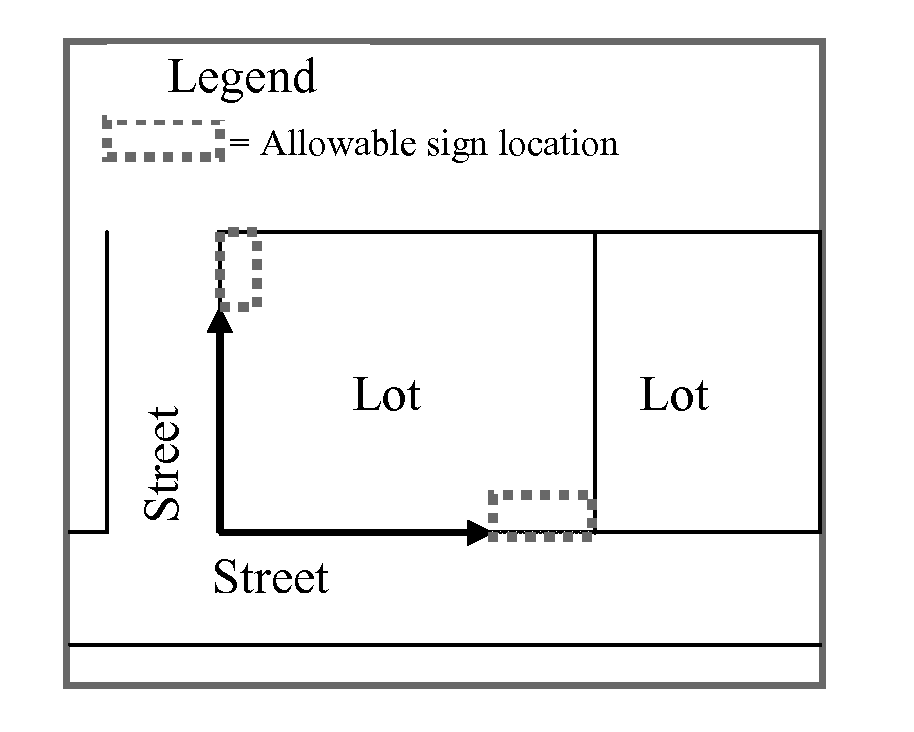
(I)
Logos and registered trademarks. Logos and registered trademarks shall not exceed twenty (20) percent of the area of any sign.
(J)
Sign lighting. Sign lighting is subject to article 95, "Outdoor lighting." Nothing in said article shall be construed to prohibit the external illumination of signs pursuant to this subsection.
(K)
Noncommercial copy. Noncommercial copy may constitute all or any part of the total area of any sign permitted in this article. Such signs shall only be illuminated in commercial and industrial zoning districts, as provided for in Table 70-20, sign design.
(L)
Sight distance triangle. (See section 085-030, "Site distance triangle.")
(1)
Free-standing sign height measurement.
a.
Free-standing wall signs. The height of free-standing wall signs shall be measured in the same manner as the wall itself, pursuant to the definition of height for structures other than buildings and signs in section 010-030.
b.
All other free-standing signs. Height shall be measured from the elevation of the edge of pavement at its closest point to the sign location.
(2)
Permitted height and area. All free-standing signs shall comply with the table below and the standards in section 070-090.
Table 70-1. Free-standing Sign Height and Area Standards.
* For each one (1) foot that a sign is set back from the closest edge of street pavement (E.O.P.), a sign can be increased in height and area from the base height and area allowances as indicated in the table. However, no additional height or area shall be accrued for signs set back in excess of the minimum setback requirement in subsection (H)(1), above. Fractional measurements shall be rounded up to the next highest whole number.
** Free-standing wall signs are limited to twelve (12) feet in height, provided that at least fifty (50) percent of the sign shall not exceed ten (10) feet in height.
*** The maximum areas specified apply to each sign face of a double-faced sign.
**** Anchor tenants are those with at least twenty-five thousand (25,000) s.f. of gross leasable floor area. If there are no anchor tenants, each seventy-five thousand (75,000) s.f. of gross leasable floor area shall be the equivalent of one (1) anchor tenant.
(3)
Landscaping. All developed nonresidential properties shall provide landscaping at the base of any free-standing sign on the plot in accordance with article 75, "Landscaping Requirements."
(M)
Free-standing wall signs. Free-standing wall signs shall be affixed to a masonry wall except for agricultural use signage and single-family residential use signage, and for subdivision signs subject to town council site plan approval at time of site plan or through another process as may be determined.
(N)
Incidental signs. Such signs may be double-faced, may be monument or building wall signs, shall be adjacent to paths of vehicular or pedestrian traffic, and shall be no larger than six (6) square feet in sign area and four (4) feet in height.
(O)
Flag poles and flags in all zoning districts.
(1)
All flags on nonresidentially used property shall be displayed on a flag pole and shall be maintained in accordance with section 070-060, "Maintenance and removal." Flags shall not be displayed on vehicles for sale or lease at an automobile, truck, recreational vehicle or boat dealership. A permit in accordance with section 005-080, "Permits required; expiration of permits and development orders," shall be required for any flag pole.
(2)
Except for residential lots of record which are over five (5) acres in size, there shall be one (1) flag pole, allowed per parcel or lot of record for the display of flags. For residential parcels greater than five (5) acres, two (2) flag poles shall be permitted. Commercial parcels and community facilities, excluding government owned parcels, shall be permitted to have no more than two (2) flag poles and the location of the flag pole shall be identified on the site plan prior to receiving a building permit.
(3)
Except as set forth herein, the maximum height of the flag pole in any residential zoning district shall not exceed thirty-five (35) feet. Flagpoles in nonresidential zoning districts shall not exceed the allowed height of the zoning district or forty-nine (49) feet, whichever is less.
(4)
The maximum dimensions of any flag shall be proportional to the flag pole height. The hoist side of the flag shall not exceed twenty (20) percent of the vertical height of the pole. In addition, flags are subject to the following dimensional limitations:
(5)
The setback of the flag pole from all property lines shall be equal to the height of pole. The maximum number of flags allowed per flag pole shall be three (3).
(6)
In addition to the display of flags on a flag pole, one (1) flag may be displayed on a pole mounted on a bracket at a building entrance.
(7)
In the event that a flag pole is proposed to camouflage a cellular tower as part of a proposal to limit the adverse visual appearance of a lattice or other noncamouflaged cellular tower, the location of which is otherwise necessary, the town council may allow a flag pole to reach a height greater than set forth herein and may allow for a flag size greater than set forth herein.
(P)
Monument signs. The supporting structure of a monument sign shall not be less in width than seventy-five (75) percent of the width of the sign face, inclusive of any box, cabinet or frame. No copy shall be permitted on the supporting structure other than the building address.
(Q)
Under canopy signs. Such signs shall have a minimum vertical clearance of eight (8) feet above any pedestrian way and shall not exceed six (6) square feet in sign area. Copy shall be limited to the name or the main character of the establishment the sign serves.
(R)
Window signs. Temporary, nonilluminated window signs are allowed in all zoning districts. Window signs shall not be in excess of fifteen (15) percent of the window area and may be located on or adjacent to the window. A temporary "Grand Opening" sign may be in excess of fifteen (15) percent of the window area, but shall not constitute in excess of fifty (50) percent of the window area and may be placed directly on or adjacent to the window surface for a period of time not to exceed fourteen (14) days after the date of issuance of the initial occupational license or a one-time period at the initial beginning of the business. No letter shall be greater in height than four (4) inches, and logos or symbols shall not be greater than eight (8) inches in height.
(Ord. No. 2011-01, § 2(Exh. A), 11-3-2010)
Sec. 070-090. - Permitted permanent signs.
This section lists the permitted sign types and functions within each zoning district.
P = Permitted
X = Prohibited
C = Restricted to certain land uses
Table 70-2. Permitted Signs.
Signs specified in Table 70-2 shall be permitted, subject to limitations contained in section 070-080, "Basic design schedule for nonresidential signs," and subject to the following additional limitations and requirements:
(A)
Noncommercial farms.
(1)
One (1) non-illuminated identification sign, which may be double-faced, identifying the name of the noncommercial farm shall be permitted on the portion of any plot occupied by a noncommercial farm, not to exceed twelve (12) square feet in area and five (5) feet in height along arterial and collector road frontages, and not to exceed eight (8) square feet in area and four (4) feet in height along all other road frontages. The standards for sign area in Table 70-1 shall not apply.
(2)
One (1) non-illuminated sign, which may be double-faced, is permitted for the advertising of the noncommercial farm activities offered on the premises, limited to six (6) square feet on arterial and collector road frontages and three (3) square feet on all other road frontages, not to exceed four (4) feet in height along any frontage. Said signage may be incorporated onto the identification sign in lieu of a second sign, in which case the permitted area of the single sign shall be the sum of the permitted identification and product/service signage allowance. Such signage shall be approved by the town administrator to verify such noncommercial farm activities, at no cost to the applicant.
(3)
The signage permitted in this subsection for noncommercial farms shall be in lieu of the identification signage allowance for single-family homes set forth in subsection (F).
(B)
Gasoline stations and convenience stores. The following signs shall be permitted for gasoline stations and convenience stores:
(1)
One (1) free-standing identification sign, which may be double-faced, in the form of a panel sign, monument sign or free-standing wall sign, which may include changeable copy for gasoline prices not to exceed twenty (20) percent of the sign or fifteen (15) square feet, whichever is greater;
(2)
One (1) canopy sign per collector or arterial street frontage not to exceed ten (10) square feet;
(3)
One (1) building wall sign on each building frontage subject to the sign area limitations of subsection (F). If additional businesses are located within the principal building, one (1) additional building wall sign may be utilized, provided there shall be no increase in the allowable signage area per building frontage;
(4)
Incidental signs;
(5)
One (1) sign not to exceed three (3) square feet may be placed on each fuel pump unit dispenser, with copy limited to gasoline price rates;
(6)
Window signs;
(7)
Address signs;
(8)
Signs for gasoline stations and convenience stores may be illuminated by any of the methods specified in [sub]section 070-070(B).
(C)
Free-standing schools, places of worship, community facilities, and hospitals. The following identification signs shall be permitted for free-standing schools, places of worship, community facilities, and hospitals:
(1)
One (1) free-standing identification sign, which may be double-faced and which may be a monument sign, free-standing wall sign or panel sign along the street frontage. If there is more than one (1) street frontage, one (1) sign shall be permitted along the primary or principal street frontage, and one (1) additional sign shall be permitted along one (1) additional street frontage, not larger than three-quarters (¾) the permissible height and one-half (½) the permissible area of the primary frontage sign, or as permitted in Table 70-1 for the applicable secondary street frontage, whichever is less. Box or cabinet signs may be internally illuminated. Painted or graphic signs may be illuminated by shielded spotlights. Individual letter signs may be illuminated either by internal illumination or by shielded spotlights. May include changeable and electronic copy;
(2)
One (1) identification sign in the form of a building wall sign, graphic sign, canopy sign, marquee sign or pylon sign on each building frontage facing arterial or collector streets. Such signs may be box or cabinet or individual letter signs. Signs may be illuminated by internal illumination or shielded spotlights;
(3)
Incidental signs;
(4)
Address signs;
(5)
Under canopy signs designed specifically and exclusively for the purpose of pedestrian way finding within a facility containing at least two (2) principal buildings in excess of twenty thousand (20,000) square feet each, or a single building in excess of forty thousand (40,000) square feet of floor area.
(D)
Shopping centers, business parks, and other multiple tenant buildings. The following signs shall be permitted for shopping centers, business parks and other multiple tenant buildings:
(1)
One (1) free-standing identification sign, which may be double-faced, in the form of a monument sign, panel sign, or free-standing wall sign along the primary street frontage, plus one (1) additional such sign, which may be double-faced, along all other street frontages of the property, not more than three-quarters (¾) of the permissible height and one-half (½) the permissible area of the primary sign, or as permitted in Table 70-1 for the applicable secondary street frontage, whichever is less;
(2)
One (1) building wall sign, graphic sign, canopy sign, awning sign, or pylon sign per tenant building frontage, not to exceed a total of two (2) building frontages. Signage on one (1) additional façade facing a public parking lot is permitted at thirty-five (35) percent of the building sign allowance of the smallest building frontage. Such signs may be illuminated by any means specified in [sub]section 070-070(B), "General requirements for permanent signs." Individual letter signs may only be internally illuminated;
(3)
One (1) under canopy sign for each tenant;
(4)
Incidental signs;
(5)
One (1) directory sign per entrance into an office park or industrial park, which may be a double-sided free-standing sign or building wall sign, not to exceed nine (9) square feet in area per sign face and six (6) feet in height.
(6)
Window signs, any or all of which may be use-related informational signs;
(7)
One (1) nameplate for each tenant in an office complex, not to exceed six (6) square feet in sign area;
(8)
Address signs; and
(9)
Menu signs adjacent to a drive-through facility not visible from a street or other thoroughfare and not higher than eight (8) feet. A logo may be affixed to any side of the sign, not to exceed three (3) square feet in area.
(E)
Single and two-tenant commercial and industrial properties, shopping center outparcels, and other nonresidential uses not specifically mentioned. The following signs shall be permitted for single- and two-tenant commercial and industrial properties, including shopping center outparcels:
(1)
One (1) free-standing identification sign, which may be double-faced, and may be a panel sign, monument sign or a free-standing wall sign along the primary street frontage, plus one (1) additional such sign along all other street frontages of the property, not more than three-quarters (¾) the height and one-half (½) the permissible area of the primary sign or as permitted in Table 70-1, whichever is less. Such sign may include one (1) or both tenants of the property. Outparcels shall be limited to one (1) free-standing identification sign, which may be double-faced, and may be a panel sign, monument sign or a free-standing wall sign.
(2)
Directional and general information signs;
(3)
Opinion signs;
(4)
Window signs, any or all of which may be use-related signs;
(5)
Address signs;
(6)
Menu signs adjacent to a drive-through facility, not visible from a street or other thoroughfare, and not higher than eight (8) feet. A logo may be affixed to any side of the sign not containing menu information, not to exceed three (3) square feet in sign area;
(7)
One (1) building wall sign, graphic sign, canopy sign, marquee sign, or awning sign per building frontage, not to exceed a total of two (2) building frontages. Signage on one (1) additional façade facing a public parking lot is permitted at thirty-five (35) percent of the building sign allowance of the smallest building frontage. Such signs may be illuminated by any means specified in [sub]section 070-070(B), "General requirements for permanent signs," provided that individual letter signs may only be internally illuminated.
(F)
Single-family residences. The following signs shall be permitted for all single-family residences:
(1)
One (1) identification sign or nameplate not larger than three (3) square feet in area, which shall be a building wall sign, a fence or free-standing wall sign or a hanging sign;
(2)
Incidental signs.
(G)
Subdivision signs. Subdivision signs shall be permitted in all residential zoning districts subject to the following limitations:
(1)
Two (2) signs shall be permitted at the primary entrance to a subdivision or neighborhood, a maximum of thirty-two (32) square feet in sign area per sign and not exceeding eight (8) feet in height. One (1) additional sign shall be permitted at any other entrance, one-half (½) the permissible area and three-fourths (¾) the permissible height of a primary sign;
(2)
Subdivision signs shall be monument signs or free-standing wall signs; and
(3)
Signs may be illuminated by any means specified in [sub]section 070-070(B), "General requirements for permanent signs."
(H)
Civic association signs. Prior to the town's incorporation, the town was divided into five (5) main not-for-profit volunteer civic/homeowner associations consisting of Country Estates, Deems Ranches, Green Meadows, Rolling Oaks and Sunshine Ranches. Each of these civic/homeowner associations maintained its own rural identification signage. These associations shall be permitted to maintain rural entry feature signs subject to the following:
(1)
Two (2) signs shall be permitted at the primary entrances to a civic association, a maximum of thirty-two (32) square feet in sign area per sign and not exceeding eight (8) feet in height, are permitted at each entrance from an arterial or collector roadway.
(2)
Civic association signs shall be monument signs, free-standing wall signs, or other rural identification signage as approved by the town council; and
(3)
Signs may be externally illuminated only.
(4)
Signs may be located within the public right-of-way, provided that the erection of any sign requires a right-of-way encroachment permit from the town.
(Ord. No. 2011-01, § 2(Exh. A), 11-3-2010; Ord. No. 2015-002, § 4, 12-11-2014; Ord. No. 2015-006, § 16, 9-15-2015)
Sec. 070-100. - Master sign plans.
(A)
For all plots having more than two (2) tenants displaying signs, a master sign plan must be approved by the town concurrently with site plan approval.
(B)
No sign permits shall be issued contrary to the master sign plan.
(C)
The master sign plan shall meet all of the provisions of this article and shall include the following:
(1)
An elevation plan, drawn to scale, clearly depicting all signs placed or to be placed on the buildings on the plot;
(2)
A site plan, drawn to scale, clearly identifying the location of all free-standing signs erected or to be erected on the plot, including setbacks;
(3)
A scale drawing of all free-standing signs depicting the sign type, height, dimensions and sign area, including the sign structures;
(4)
For directory signs or other signs providing for more than one (1) tenant, the amount of sign area allocated for each tenant shall be indicated;
(5)
Sign design consistent with the town's rural lifestyle;
(6)
The standards for letter styles, letter colors, letter heights, and background colors to be used for the various types of signs on the plot. The size and type of items of information may be varied for major or anchor tenants in a shopping center; and
(7)
The types of illumination to be used for each type of sign.
(D)
Once the master sign plan has been approved for a plot, the criteria shall apply to the entire plot shown on the master sign plan, as well as each individual tenant or occupant, and shall remain as long as the building exists, regardless of change of ownership, management or occupancy, or until a complete new master sign plan has been submitted and approved.
(E)
Where a master signage plan is amended, or a new plan approved, all existing signs on the plot must conform to the master sign plan within a period of one (1) year from approval of the plan.
(Ord. No. 2011-01, § 2(Exh. A), 11-3-2010)
Sec. 070-110. - Temporary signs.
(A)
The provisions of this section shall pertain to the erection, placement, and maintenance of all temporary signs, other than promotional signs, regulated under section 070-120. Temporary signs shall be permitted in addition to any other permitted sign on private property and shall be exempt from all other provisions of this article, provided such signs fully comply with this section.
(B)
The following types of signs may be erected as temporary signs:
(1)
Election signs and free expression signs;
(2)
Project signs;
(3)
Real estate signs;
(4)
Sales office signs.
(C)
A permit as required in section 005-080, "Permits required," shall be obtained for any temporary sign six (6) square feet or larger in size.
(D)
Temporary signs on developed plots shall not be larger or higher than any permanent sign permitted on the premises where the sign will be located.
(E)
Temporary signs on undeveloped plots shall not exceed the following:
(1)
For parcels between one (1) and ten (10) acres in area, a maximum of sixteen (16) square feet in area and six (6) feet in height above the ground; and
(2)
For parcels over ten (10) acres in area, a maximum of twenty-four (24) square feet in sign area and eight (8) feet in height above the ground.
(F)
Temporary signs, except as herein provided shall be limited to one (1) sign of each type specified herein for each one thousand (1,000) lineal feet of street or waterway frontage of a plot, except that:
(1)
After the qualification of a candidate, one (1) election sign shall be permitted for each street frontage per plot for each candidate and issue.
(G)
Such signs may be double-faced and may be a hanging sign, a building wall sign, or window sign. All free-standing signs shall be set back a minimum of five (5) feet from any plot line or street line.
(H)
Where two (2) or more types of temporary signs are combined on one (1) sign face or sign structure, then the sign area may be increased by twenty (20) percent.
(I)
No temporary sign shall be placed on public property or in a private ingress/egress easement. Signs placed in violation of this provision shall be considered abandoned and shall be subject to removal without notice by the town.
(J)
A real estate sign in a residential area may be increased in size by a maximum of fifty (50) percent of the permitted sign size to accommodate additional information such as "By Appointment Only," "Sold" or "Open House." "Open House" sign and may only be displayed while the premises are actually available for inspection by a prospective buyer or tenant; said sign shall be removed immediately upon entering into a binding contract.
(K)
All temporary signs shall be removed within ten (10) days after the development, construction or sale of any building or property to which any temporary sign pertains, or shall be removed after the expiration of six (6) months from the erection of the sign, whichever occurs first.
(L)
Election signs and opinion/free expression signs.
(1)
Election signs. Notwithstanding any other provision of this chapter to the contrary, election signs shall be allowed on private property in all zoning districts subject to the following limitations as to number, size (area), height, setback and duration:
(a)
Number. For any parcel, there shall be a limit of one (1) election sign per candidate and per issue. No more than one (1) election sign per candidate and one (1) election sign per issue shall be permitted on any one (1) private lot or parcel property unless it is a corner lot, in which case two (2) signs per candidate and per issue may be placed, so long as there is no more than one (1) sign per street frontage and the signs are no closer than twenty-five (25) feet from the corner or intersection. No election sign shall be allowed to be located within a public or private right-of-way.
(b)
Size. The size (area) of an election sign shall be limited to sixteen (16) square feet.
(c)
Height. The height of an election sign shall be limited to six (6) feet above the ground.
(d)
Setback. Election signs under three (3) square feet shall be setback a minimum distance of five (5) feet from the public or private right-of-way. Election signs over three (3) square feet shall be setback a minimum distance of ten (10) feet from the public or private right-of-way. The town shall not remove or interfere with the placement of political signs at a polling place, which otherwise complies with state law, on an election day, unless necessary for public safety.
(e)
Duration. Election signs may be placed on a parcel no earlier than ninety (90) days prior to the town's general election. In the event of a town special election, election signs may be placed on a parcel any time after the candidate qualification period. All election signs shall be removed within ten (10) calendar days following the election that pertains to the candidate or the issue that is the subject of the election sign. All signs shall be discarded in a proper manner so as to prevent litter and trash from accumulating within the town.
(f)
The prohibition contained in this subsection shall in no way apply to election announcement signs posted by the town, announcing each election to be held in the town.
(g)
Election signs shall not be placed upon property without the permission of the owner of the property or other person in legal control of the property. Election signs placed upon vacant property shall require a written authorization signed by the property owner, which shall be submitted to the town clerk prior to the posting of any election sign. Failure to submit written authorization signed by the property owner shall enable the town to remove the improperly placed signage in accordance with the town's code enforcement procedures.
(h)
It is unlawful to attach election signs to rooftops, trees, shrubs, or utility or similar poles.
(i)
The property owner shall be responsible for compliance with the requirements stated herein.
(2)
Opinion/free expression signs. A free expression sign is not subject to any durational limits and shall be in addition to any other allowed sign, including political signs. Notwithstanding any other provision of this chapter to the contrary, free expression signs shall be allowed on private property in all zoning districts subject to the following limitations as to number, size (area), height, and setback:
(a)
Number. There shall be a limit of one (1) free expression sign per parcel.
(b)
Size. The size of a free expression sign shall be limited to four (4) square feet.
(c)
Height. The height of a free expression sign shall be limited to six (6) feet above the ground.
(d)
Setback. Free expression signs that are posted in the ground shall be setback a minimum distance of ten (10) feet from the right-of-way.
(3)
Removal; cost reimbursement. Any election or free expression sign found posted or otherwise affixed upon any public property contrary to the provisions of this section shall be removed by the town. The person responsible for any such posting shall be liable for the cost incurred in the removal thereof, and the town is authorized to effect the collection of said cost. The town reserves the right to remove and dispose of all signs located within public rights-of-way or easements.
(Ord. No. 2011-01, § 2(Exh. A), 11-3-2010; Ord. No. 2023-002, § 2, 10-13-2022; Ord. No. 2025-009, § 2, 8-14-2025)
Sec. 070-120. - Promotional signs.
(A)
Any nonresidential use or commercial enterprise, other than a home-based business, which has been issued a certificate of use, may make application for a temporary sign permit for any of the following purposes:
(1)
Grand opening;
(2)
Holiday or post-holiday sale;
(3)
Change of management;
(4)
Special promotions.
(B)
Permits shall be limited as follows:
(1)
No more than three (3) such permits shall be issued to any one (1) nonresidential use commercial enterprise in any one (1) calendar year.
(2)
No permit shall be issued for a period exceeding fourteen (14) consecutive days.
(3)
No permit shall be issued for temporary promotional signs within forty-five (45) days of the issuance of any previous temporary sign permit for the same commercial enterprise on the same plot.
(C)
Notwithstanding the provisions of section 070-030, "Prohibited signs," temporary signs that may be permitted on the premises of the commercial enterprise are as follows:
(1)
Banners, flags and pennants;
(2)
Balloon signs;
(3)
Sidewalk signs;
(4)
Trailer signs without animation and subject to the requirement contained herein.
(D)
All signs shall be placed on the private property occupied by the commercial enterprise. No trailer sign or sidewalk sign shall block or interfere with any pedestrian or vehicular areas.
(E)
Temporary signs permitted in subsection (C) of this section shall be limited as follows:
(1)
Banners, flags and pennants shall not be limited.
(2)
Balloon signs shall be limited to one (1) per commercial enterprise.
(3)
Balloon signs shall not be elevated to a height exceeding twenty-five (25) feet from the ground, and shall be a maximum of twenty-four (24) feet wide.
(4)
Balloon signs and trailer signs shall not be placed in any landscaped area, shall not be located less than ten (10) feet from any right-of-way line or other private property line and shall not be located within any district boundary line separation or setback area.
(5)
Sidewalk signs shall be limited to two (2) signs, a maximum twenty-four (24) inches by thirty (30) inches in size per sign.
(6)
Trailer signs shall be limited to one (1) per commercial enterprise, a maximum twenty-four (24) square feet in area.
(F)
Any commercial enterprise which is found to be in violation of this section by the special magistrate shall not be issued a temporary promotional sign permit for one (1) year after adjudication of the violation by the special magistrate.
(G)
Yard sale signs. Yard sale signs accessory to a residential use shall not exceed four (4) square feet in area. Yard sale signs shall not be displayed more than twenty-four (24) hours prior to the yard sale, and shall be removed at the end of the yard sale, or forty-eight (48) hours after posting, whichever comes first.
Cross reference— Section 035-060, "Yard sales."
(H)
Outdoor event signs. When permitted in accordance with section 035-040 and as indicated on the approved plan, four (4) off-premise directional signs no larger than shall be permitted to assist travelers in safely finding their way to their destination and shall not exceed four (4) square feet in area. Said signs shall be located on town public rights-of-way and shall be erected no more than two (2) hours before the event and removed no later than two (2) hours after said event.
(Ord. No. 2011-01, § 2(Exh. A), 11-3-2010)
Sec. 075-010. - Purpose and intent.
The general purposes of this article are as follows:
(A)
To promote the establishment of a functional landscape in the town;
(B)
To protect and enhance the aesthetic rural character of the town;
(C)
To provide the physical benefits of using plant material as a functional and integral part of the town's development;
(D)
To provide minimum standards for landscaping new developments or for redevelopment; and
(E)
To promote water conservation and vegetation protection objectives by providing for:
(1)
The preservation of existing plant communities pursuant to the requirements of the town's tree preservation and abuse regulations;
(2)
The reestablishment of native plant communities;
(3)
The use of site-specific plant materials; and
(4)
The implementation of xeriscape principles as identified in South Florida Water Management District's Xeriscape Plant Guide II, as amended, and as provided by law.
The provisions of this article shall be a minimum standard.
(Ord. No. 2005-005, § 4(075-010), 4-14-2005)
Sec. 075-020. - Definitions.
In addition to the definitions set forth under article 10, "Definition of Terms," the following definitions shall apply to this article:
Accessway means a private vehicular roadway intersecting a public right-of-way.
Applicant means the owner or the authorized agent of the subject property.
Berm means a linear earthen mound.
Canopy means the upper portion of a tree consisting of limbs, branches and leaves.
Clear trunk means the distance between the top of the root ball along the vertical trunk or trunks of a tree to the point at which lateral branching or fronds begin.
Clear wood means the portion of the palm trunk which is mature hardwood measured from the top of the root ball to the base of green terminal growth or fronds.
CPTED is an acronym for Crime Prevention Through Environmental Design; which is a design approach to reduce crime and fear of crime by creating a safe climate within a building environment.
Diameter breast height (DBH) means the diameter of the tree trunk measured at four and one-half (4½) feet above grade.
Disturbed land/ground. Means any land where the original natural vegetation has been removed, displaced, overtaken or raked.
Functional landscaping means the combination of living and nonliving materials that, when installed or planted, creates an ongoing system providing aesthetic and environmental enhancement to a particular site and surrounding area.
Groundcover means a low-growing plant that, by the nature of its growth characteristics, completely covers the ground and does not usually exceed two (2) feet in height.
Hedge means a row of evenly spaced shrubs planted to form a continuous, unbroken visual screen.
Irrigation means the method of supplying plant materials with water other than by natural rainfall.
Landscape and landscaping:
(A)
When used as a noun, the terms "landscape and landscaping" mean living plant materials such as grasses, groundcover, shrubs, vines, trees or palms and nonliving durable materials commonly used in environmental design such as, but not limited to, rocks, pebbles, sand, walls or fences, aesthetic grading or mounding, but excluding paving and structures.
(B)
When used as a verb, the terms "landscape and landscaping" mean the process of installing or planting materials commonly used in landscaping or environmental design.
Mulch means organic material such as wood chips, pinestraw or bark placed on the soil to reduce evaporation, prevent soil erosion, control weeds and enrich the soil.
Native plant species means, for the purpose of this article, native plant species shall be those plant species indigenous to the ecological communities of South Florida, as indicated on lists provided by the county, or that can be scientifically documented to be native to South Florida.
Nonvehicular use open space means all areas, excluding areas defined as vehicular use areas, areas preserved as ecological communities, required landscaping adjacent to public rights-of-way and abutting property, existing structures to remain, and proposed structures. This definition includes areas permanently covered with water.
Planting soil means a medium composed of up to fifty (50) percent muck or horticulturally acceptable organic material, including solid waste compost.
Shrub means a woody plant usually with several stems produced from the base that could be maintained in a healthy state.
Site-specific plant materials means the use of plant species selected to minimize supplemental irrigation, fertilization and pest control.
Tree means a self-supporting, woody perennial plant, usually with one (1) vertical stem or main trunk, which naturally develops a distinct, elevated crown and provides, at maturity, natural characteristics of the species.
Turf means the upper layer of soil matted with roots of grass and covered by viable grass blades.
Vegetation means angiosperms, gymnosperms, ferns and mosses.
Vehicular encroachment means any protrusion of a motor vehicle outside of the boundaries of a vehicular use area into a landscape area.
Vehicular use area means areas used for the display or parking of any type of vehicle, boat or construction equipment, whether self-propelled or not, and all land upon which such vehicles traverse.
Vine means any plant with a long, slender stem that trails or creeps on the ground or climbs by winding itself on a support.
Xeriscape means a landscaping method that maximizes the conservation of water by use of site-appropriate plants and an efficient watering system.
(Ord. No. 2005-005, § 4(075-020), 4-14-2005)
Sec. 075-030. - Landscape plans.
(A)
All landscape plans or proposals and development activities that would involve the removal of an existing tree are subject to the tree removal permit requirements of section 10-27 of the Code of Ordinances, in addition to the requirements of article 75 "Landscape Requirements."
(B)
A landscape plan and irrigation plan shall be submitted with all site plan and site plan modification applications that are made pursuant to article 120. A landscape plan, and irrigation plan if applicable, shall also be submitted with any building or site improvement permit application concerning a nonresidential and non-agricultural plot, whenever such application requires additional landscaping under this article, or may affect or conflict with on-site landscaping, including, but not limited to, permits for parking lot lighting, addition or relocation of impervious area, tree removal, and drainage improvements. Landscape plans shall be prepared by a landscape architect, or other person authorized pursuant to F.S. ch. 481, part II. The landscape plan shall be no larger than twenty-four (24) inches by thirty-six (36) inches, and include the following information:
(1)
A minimum scale of one (1) inch equals fifty (50) feet.
(2)
Tree survey signed and sealed by a professional who is qualified to identify trees, meeting the requirements of F.S. § 472.025, as amended, which must provide, at a minimum, the following information:
a.
The location, plotted by accurate techniques, of all existing non-nuisance trees;
b.
The common and scientific name of each tree;
c.
The quality of each tree;
d.
The DBH of each tree, canopy square feet, or if a multiple-trunk tree, the sum DBH for all trunks; and
(3)
Trees to be removed and trees to be relocated, with proposed relocations and mitigation, planting details, shown on plan. Tree relocation requires a one-year guarantee and reinspection.
(4)
Location of existing and proposed structures, improvements, water bodies, site uses and site improvements, dimensioned and referenced to property lines.
(5)
Existing and proposed site elevations, grades and major contours, including water retention areas.
(6)
Location of existing or proposed utilities and easements, including drainage easements, drainage features, drainfields and septic tanks, underground utilities and overhead power lines.
(7)
Location of all landscape material to be used, including height, caliper and canopy spread of species at time of planting.
(8)
Landscape material schedule listing all plants being used with their botanical and common name, their quantity and size, and degree of drought tolerance (as determined by the South Florida Water Management District Xeriscape Plant Guide II, as amended) and indication of whether native to South Florida.
(9)
Spacing of plant material where a given spacing is required by code, including, but not limited to, center to center distance between individual shrubs, and center to center distance between trees within landscape buffers.
(10)
Description of landscape installation practices to be utilized.
(C)
The irrigation plan shall meet the following requirements:
(1)
Subsections (B)(1) through (B)(6) of this section.
(2)
Main or well location, size and specifications.
(3)
Valve location, size and specifications.
(4)
Pump location, size and specifications or water source.
(5)
Backflow prevention device type and specifications.
(6)
Controller locations and specifications.
(7)
Zone layout plan (minimum scale one (1) inch equals twenty (20) feet):
a.
Indicating head type, specifications and spacing; and
b.
Indicating methods used to achieve compliance with xeriscape principles as required by F.S. § 125.568.
(Ord. No. 2005-005, § 4(075-030), 4-14-2005; Ord. No. 2011-07, § 3, 6-23-2011)
Sec. 075-040. - Installation of landscaping and irrigation.
All landscaping and irrigation shall be installed according to accepted planting procedures with the quality of plant materials as hereinafter described.
(A)
Topsoil shall be of the minimum quality as specified in the plant materials section of this article. Excluding palm trees, all trees and shrubs shall be planted with a minimum of six (6) inches of topsoil around and beneath the root ball. A minimum of two (2) inches of shredded, approved organic mulch or groundcover shall be installed around each tree planting for a minimum of eighteen (18) inches beyond its trunk in all directions, including palms, and throughout all hedge and shrub planting. The use of mulch obtained from melaleuca, eucalyptus, or other invasive plant species is encouraged in order to reduce their impact on the environment and to preserve the remaining native plant communities.
(B)
All trees shall be properly guyed and staked at the time of planting until establishment. The use of nails, wire or rope, or any other method which damages the trees or palm, is prohibited. All plants shall be installed so that the top of the root ball remains even with the soil grade.
(C)
All landscape areas, including residential common-area landscape areas and landscape easements, but excluding individual residential plots, shall be provided with an automatically operating, underground irrigation system designed to have one hundred (100) percent coverage with one hundred (100) percent overlap. Drip, trickle or other low-volume irrigations systems shall be permitted if designated on approved landscape plans. Irrigation systems shall be designed to minimize application of water to impervious areas.
(1)
Pursuant to F.S. § 373.62, any irrigation system installed after May 1, 1991, shall install a rain sensor device or switch which will override the irrigation cycle of the sprinkler system when adequate rainfall has occurred.
(2)
Use of nonpotable water, including, but not limited to, water from a canal, lake or a treated water source, in the irrigation of landscaped areas is required when determined to be available and safe.
(3)
Automatic controlling devices shall be used on all irrigation systems.
(D)
Inspections of site for landscape installation:
(1)
A preinspection will be required to determine site conditions and appropriate use and selection of landscape material prior to installation.
(2)
A final landscape inspection will be required upon completion.
(Ord. No. 2005-005, § 4(075-040), 4-14-2005)
Sec. 075-050. - Maintenance of landscaped areas.
(A)
An owner of land subject to this article shall be responsible for the maintenance of said land and landscaping so as to present a healthy, vigorous and neat appearance free from refuse and debris. All landscaped areas shall be sufficiently fertilized and irrigated to maintain the plant material in a healthy condition.
(B)
Three (3) inches of clean, weed-free, organic mulch shall be maintained at all times over all areas originally mulched. Turfgrass shall be mowed regularly.
(C)
Irrigation systems shall be maintained to eliminate water loss due to damaged, missing or improperly operating sprinkler heads, emitters, pipes and all other portions of the irrigation system.
(D)
Preserved and created ecological communities shall be maintained in a natural state without the use of mechanical equipment.
(E)
A property owner is responsible for ensuring that landscaping required pursuant to this article, or installed in compliance with the landscape requirements previously in effect, is maintained in Florida Grade One condition. If landscaping is found to be in a state of decline, dead or missing, it must be replaced with equivalent landscape material. If total replacement is required, species conforming to this article shall be used. If any preserved vegetation dies, which vegetation is needed to satisfy current landscape code requirements, such vegetation shall be replaced with the same landscape material selected from nursery-grown native stock only.
(F)
Property owners are required to install and maintain landscaping in such a manner that it does not interfere with, disrupt, impede, prevent, or alter the flow of a utility.
(G)
No individual shall deny the right, or impede the ability of a utility company to enter private property for the purpose of entering a utility easement to remove or prune a plant or tree that is interfering with or impeding the utility company's ability to deliver safe and reliable utility services, nor shall an individual refuse to permit a utility company to remove or prune, when on private property, a plant or tree that is interfering with or impeding the utility company's ability to deliver safe and reliable utility services, when it is determined by the utility company that the condition caused by the offending plant or tree constitutes a hazardous condition as defined by town Ordinance No. 2004-07 (see sections 26-1 through 26-3 of the town Code), which also provides penalties for violations of these provisions.
(Ord. No. 2005-005, § 4(075-050), 4-14-2005)
Sec. 075-060. - Plant material.
(A)
Quality. Plant materials used in accordance with this article shall conform to the standards for Florida Grade One, or better, as provided for in the most current edition of Grades and Standards for Nursery Plants, 2nd edition, February 1998, state department of agriculture and consumer services, as amended. Sod shall be clean and visibly free of weeds, noxious pests and diseases. Grass seed shall be delivered to the job site in sealed bags with the state department of agriculture tags attached.
(B)
Native vegetation. Fifty (50) percent of all vegetation this article requires to be planted, excluding all turfgrass, shall be indigenous to South Florida.
(C)
Preserved/created ecological communities. Ecological communities shall be preserved or created as required by chapter 5, article XII, of the county code. Sites which consist of five (5) acres or more, where there is no viable ecological community, the applicant shall show on the landscape plan an area equivalent to two and one-half (2½) percent of the site to be planted and preserved as an ecological community, pursuant to the conservation goals, objectives and policies of the 1989 county comprehensive plan, volume 2, adopted components, as may be amended from time to time. Sites that consist of two (2) to five (5) acres may incorporate an ecological community into the landscape buffer or interior landscaping requirements. For sites of five (5) acres or more, this shall constitute an additional requirement.
(D)
Trees.
(1)
Trees shall be of a species having an average mature crown of greater than twenty (20) feet and having trunks that can be maintained with over six (6) feet of clear wood. Trees or palms having an average mature crown spread of less than twenty (20) feet may be substituted by grouping the same so as to create the equivalent of a twenty-foot crown spread. Such a grouping shall count as one (1) tree towards meeting tree requirements for any provision herein. If palms are used, they shall constitute no more than twenty (20) percent of the total tree requirements for any provision herein, and shall have a minimum of six (6) feet of clear wood. On projects requiring more than ten (10) trees, a minimum of two (2) species shall be used.
(2)
Nonconforming sites with less than five (5) feet of nonvehicular planting space for required buffers may use canopy trees with a twelve- to fifteen-foot height at maturity, with canopy equivalent to such height.
(3)
Trees used in the required landscaping adjacent to a public street are subject to approval by the town so that the character of the public street can be maintained.
(4)
The following plant species, in addition to select species contained within the Florida Exotic Pest Plant Council's List of Category I Invasive Plant Species, current edition, shall not be planted as required or optional landscaping and, in addition, these species shall be removed from all construction sites prior to issuance of a building permit for any construction that is subject to submittal of a landscape plan or tree survey pursuant to section 075-030(A) or (B), and section 075-110 prior to issuance of a building permit for a principal structure:
(5)
Reserved.
(6)
Tree species shall be a minimum overall height of ten (10) to twelve (12) feet, Florida Grade One material, with a minimum trunk diameter of two and one-half (2½) inches and a minimum of one-half (½) the overall height of clear trunk immediately after installation. Minimum canopy spread shall be characteristic of the species at such height requirements. Credit for existing trees preserved on a site shall be granted toward meeting the tree requirements of any landscaping provisions of this article. No credit shall be granted for any type of fruit tree or any preserved trees that are in extremely poor condition or declining health.
(E)
Shrubs and hedges.
(1)
Shrubs shall be a minimum of two (2) feet in height, except where required for screening and buffering pursuant to section 075-070, "Nonresidential perimeter and vehicular use area landscape requirements," in which case the minimum planting height shall be three (3) feet, and shall be full to base and planted two (2) feet on center when measured immediately after planting.
(2)
Required buffer hedges shall be planted and maintained so as to form a continuous, unbroken and solid visual screen. The hedge material shall be capable of reaching, and maintained at its required height within one (1) year if the required height is no greater than four (4) feet, and within two (2) years for required heights in excess of four (4) feet.
(3)
Ficus spp., when planted as a hedge, shall be maintained at a height not to exceed eight (8) feet, provided the hedge shall be set back from any structure a distance of at least eight (8) feet.
(F)
Vines. Vines shall be a minimum of thirty (30) inches in supported height immediately after planting, and may be used in conjunction with fences, visual screens or walls, planted at ten (10) foot intervals, to meet landscape buffer requirements as specified.
(G)
Groundcover. Groundcovers shall be planted with a minimum of fifty (50) percent coverage with one hundred (100) percent coverage occurring within six (6) months of installation.
(H)
Turf.
(1)
All turf areas shall be sodded using species suitable as permanent lawns in the county, including St. Augustine, Bahia, and their cultivars. Large turf areas not subject to erosion, such as playfields, and areas to be used for livestock and equestrian areas, may be grassed with methods other than sod using permanent species suitable for the county.
(2)
Turf shall not be treated as a fill-in material, but rather as a major planned element of the landscape and shall be placed so that it can be irrigated separately from planting beds.
(3)
Turfgrass areas shall be consolidated and limited to those areas on the site that require pedestrian traffic, provide for recreation use or provide soil erosion control such as on slopes or in swales, or surface water management areas, and where turf is used as a design unifier, or other similar practice use. Turf areas shall be identified on the landscape plan.
(I)
Xeriscape. Landscape design must incorporate the principles of xeriscaping. These include the following, which must be noted on the landscape plans:
(1)
Soil improvements. Improve the soil with organic materials prior to the installation of any irrigation system.
(2)
Efficient irrigation. Plan irrigation system according to water needs and group planting according to water requirements. Reference to irrigation in landscape notes (i.e., rain shutoff valve, moisture sensor, electric or hydraulic solenoid valves).
(3)
Drought tolerant plants. Drought tolerant plants.
(4)
Mulches. Place mulch directly on the soil or on a breathable or biodegradable material. Use around trees, shrubs, and in the planting beds.
(5)
Appropriate maintenance. Use proper mowing, pruning, and weeding techniques and limit the use of fertilizer and pest control to further water savings.
(J)
Topsoil. Topsoil shall be clear and reasonably free of construction debris, weeds and rocks. The topsoil for all planting areas shall be composed of a maximum of fifty (50) percent muck or horticulturally acceptable organic material.
(Ord. No. 2005-005, § 4(075-060), 4-14-2005; Ord. No. 2017-013, § 4, 9-28-2017)
Sec. 075-070. - Nonresidential perimeter and vehicular use area landscape requirements.
(A)
Applicability. All vehicular use areas (VUAs) serving nonresidential and nonagricultural uses and zoning districts, and the perimeters of all nonresidential and nonagricultural uses and plots shall conform to the minimum landscaping requirements hereinafter provided.
(B)
VUAs abutting a street line. On the site of a building or open lot providing a VUA where such area will not be entirely screened visually by an intervening building or structure from any abutting street and property lines, including dedicated alleys, a landscape strip of land at least fifteen (15) feet in depth measured inward from the abutting street line towards the VUA shall be provided, providing the town may require increased buffer depth as provided in subsection (J) of this section. This buffer shall not be counted toward meeting the interior VUA landscape requirements.
(1)
The landscape strip shall contain one (1) tree for each thirty (30) lineal feet of street line frontage or fraction thereof.
(2)
A hedge, berm, wall or other opaque, durable landscape barrier, as determined by the town, shall be placed along the inside perimeter of such landscape strip, and shall be maintained at a height of three (3) feet above the VUA pavement surface to meet CPTED principles. If such durable barrier is of nonliving material, for each ten (10) feet thereof, one (1) shrub or vine shall be planted along the street side of such barrier.
(3)
The remainder of the required landscape area shall be landscaped with turfgrass, groundcover or other landscape treatment, excluding paving.
(4)
The pervious area between the edge of the pavement and the required landscape buffer shall be sodded.
(C)
VUAs abutting an interior nonresidential plot line. On the site of a building or open lot providing a VUA where such area will not be entirely screened visually by an intervening building or structure from any abutting streets and property lines, including dedicated alleys, a landscape strip of land, at least ten (10) feet in depth shall be provided, measured inward from the plot lines towards the VUA, shall be landscaped, providing the town may require increased buffer depth as provided in subsection (J) of this section. This buffer shall not be counted toward meeting the interior VUA landscape requirements.
(1)
The landscape strip shall contain one (1) tree for each thirty (30) lineal feet or fraction thereof.
(2)
The tree planting requirement will be waived in whole or in part if the adjoining plot has already planted trees along the interior plot line, based upon a determination of whether the adjoining trees have limited or eliminated the feasibility of planting additional trees on the other side of the same plot line.
(3)
A hedge, berm, wall or other durable and opaque landscape barrier, as determined by the town, shall be placed within the landscape strip and shall be maintained at a maximum height of three (3) feet from the established grade to meet CPTED principles.
(4)
The remainder of the required landscape area shall be landscaped with turfgrass, groundcover or other landscape treatment, excluding paving. This buffer may not be counted toward meeting the interior landscape requirements.
(D)
Perimeter buffer adjacent rural, agricultural and open space zoning and use. Any nonresidential use that is contiguous to, or separated only by an FPL primary transmission easement or right-of-way, or canal right-of-way from a rural, agricultural or recreation and open space zoning district, or residential, agricultural or open space plot line, shall provide the landscape buffer described in subsection (B)(2) of this section, which shall extend along the entirety of the common plot line.
(1)
The durable and opaque barrier shall be increased to six (6) feet in height unless a contiguous residential or recreation and open space plot already contains an equivalent barrier that would make the six (6) foot requirement redundant for purposes of screening and buffering the nonresidential plot from the residential or recreation and open space plot.
(2)
The town council shall require a barrier eight (8) feet in height if the additional height would more effectively screen the nonresidential buildings and improvements from adjacent residential or recreation and open space plots. In making this determination, the town council shall consider the height and setbacks of buildings and resulting site lines of adjacent residential uses, potential noise impact from the nonresidential use, the type and effectiveness of the barrier proposed, and other such relevant factors the council deems appropriate for determining the appropriate height of the barrier.
(3)
The council may modify the proposed placement of required elements within the landscape strip based upon the nature of any screening on adjacent plots and the presence of any intervening right-of-way or easement that would allow for maintenance of the required landscaping improvements. Where a required landscape strip would abut an existing fence, wall or hedge on adjoining property, it shall be desirable to avoid the creation of a nonaccessible, unmaintained and ineffective strip of land running between parallel fences and walls.
(E)
Industrial uses or plots to provide buffer. Industrial uses or plots shall provide a landscape buffer as required in subsection (D) of this section, along plot and street lines. For open air storage in the M and commercial districts, and all outdoor industrial operations and activities, the opaque wall requirement shall be increased to eight (8) feet with openings only for ingress and egress of pedestrians and vehicles. Such openings shall be equipped with opaque gates the same height as the wall. Storage of materials shall not exceed the height of the enclosing wall.
(F)
Accessways. Necessary accessways from a street through all such landscaping buffers and barriers shall be permitted to service the vehicular use areas, and such accessways may be subtracted from the lineal dimension used to determine the number of trees required. Otherwise, the required landscape buffers and materials required therein shall be continuous and unpierced.
(G)
Chain link fences. A chain link fence shall not be used as a required opaque barrier within a buffer unless it is accompanied by a hedge that will reach the required height of the fence and render the barrier opaque within one (1) year after planting.
(H)
Wall requirements. All walls required and permitted herein shall be constructed of poured concrete, prefabricated concrete panels or masonry construction, finished on both sides with two (2) coats of cement stucco and painted on both sides to complement or match the color of adjacent structures. Dark colors shall be prohibited.
(I)
Landscape buffers. The landscape buffers required in this section are minimum buffer widths and may need to be increased in width to comply with the light trespass limitations of article 95, "Outdoor Lighting Standards."
(J)
Parking area interior landscaping. An area, or a combination of areas, equal to ten (10) percent of the total VUA, exclusive of perimeter landscape buffers required under this subsection, shall be devoted to interior landscaping.
(1)
Any perimeter landscaping provided in excess of that required by this section shall be counted as part of the interior landscaping requirements, as long as such landscaping is contiguous to the VUA and fulfills the objective of this subsection.
(2)
All parking areas shall be so arranged so that if there are ten (10) or more contiguous parking stalls along the same parking aisle, the eleventh (11th) space shall be a landscaped peninsula a minimum of five (5) feet in width. Other suitable solutions or innovative designs may be substituted when approved by the town.
(3)
There shall be a minimum of one (1) tree planted for every landscaped area, and in no instance shall there be less than one (1) tree and three (3) shrubs for each two hundred (200) square feet, or fraction thereof, of required interior landscaped area.
(4)
All approved grass parking areas shall meet the same landscaping requirements as paved parking, and will not count as pervious space.
(Ord. No. 2005-005, § 4(075-070), 4-14-2005)
Sec. 075-080. - Sight distance for landscaping adjacent to street intersections and points of access.
Placement of landscaping materials shall observe the site distance requirements of section 085-030, "Site distance triangle."
(Ord. No. 2005-005, § 4(075-080), 4-14-2005)
Sec. 075-090. - Landscaping within streets, public rights-of-way and swales.
The owner of every developed plot shall be responsible for sodding the area in between the plot line and the adjacent street to the edge of the pavement. Installation of trees and shrubs within any public right-of-way, private street, and swale requires a town permit.
(Ord. No. 2005-005, § 4(075-090), 4-14-2005; Ord. No. 2006-03, § 3, 10-20-2005)
Sec. 075-100. - Nonvehicular open space.
All nonvehicular open space on any site except residential plots, which are governed by section 075-110, "Single-family requirements," shall conform to the following requirements:
(A)
General landscape treatment.
(1)
Groundcover, shrubs and other landscape materials shall be installed to cover all nonvehicular open space areas not covered by paving or structures. No substance that prevents water percolation shall be used in areas not approved for paving or structures. Planting practices shall comply with xeriscape requirements.
(2)
Each structure shall be treated with landscaping to enhance the appearance of the structure and to screen any unattractive or unsightly appearance, with a minimum of twenty (20) percent of the front of the structure being planted with shrubs at a minimum of two (2) feet in height.
(B)
Shrub and tree requirements. Shrubs and trees shall be planted in the nonvehicular open spaces to meet the following requirements:
(C)
Screening of equipment. Dumpsters, mechanical equipment and electrical transformers shall be screened on at least three (3) sides by landscape material that is a minimum of thirty (30) inches in height. Such screening shall not interfere with normal operation of equipment. In addition, bus shelters which are located within property lines shall be screened with plant material a minimum of two (2) feet in height on three (3) sides, and one canopy tree, ten (10) feet in height.
(D)
Signs. All free-standing sign installations require the installation and establishment of plant material to enhance the structure, at a minimum of one shrub for every two (2) feet of lineal width of the sign structure on each side; and ground cover, a minimum of five (5) feet around the perimeter of the sign base, designed in such a manner so as to not block the message on the sign.
(E)
Billboard signs. All billboards require the installation and establishment of plant material to soften the appearance of the structure. A minimum of four (4) trees, chosen from a list of trees that will attain a height of not more than fifteen (15) feet, and a minimum of one (1) shrub for every two (2) lineal feet of sign structure width shall be planted around the base of the sign.
(F)
Minimum landscape credits and adjustments. An owner shall receive credit against the minimum landscape code requirements of this article for preservation, replacement or relocation of existing trees as set forth in chapter 27, article XIV, Tree Preservation and Abuse, other than preserved ecological communities, on a one-for-one basis.
(Ord. No. 2005-005, § 4(075-100), 4-14-2005)
Sec. 075-110. - Single-family requirements.
All lots developed with single-family dwellings shall conform to the following minimum landscaping requirements:
(A)
Landscape plans. Building permit applications for new single-family residences shall demonstrate compliance with the requirements of this article by submitting a landscaping plan in conformance with section 075-030. Modifications to existing single-family residences and construction pursuant to subsection 075-130(A), shall demonstrate compliance with the requirements of this article by submitting either a landscaping plan in conformance with section 075-030, or a landscape permit application that identifies the name, quantity, size, and quality of plant material to be installed, including planting specifications, as required by this article. Actual landscape drawings are not required for single-family dwellings. Landscaping for the common areas of a residential subdivision is subject to the requirements of section 075-030.
(B)
Tree surveys.
(1)
Applications for permits to construct a single-family dwelling on an undeveloped plot shall include submittal of a tree survey that satisfies the minimum requirements of subsection 075-030(B).
(2)
Applications for permits to construct any improvement to or upon a lot that is already developed with a single-family dwelling shall demonstrate that the construction will not cause or require the damaging or removal of existing trees, or shall identify trees to be relocated or removed with mitigation pursuant to chapter 10 of the Code. In order to document the existing location, type, number and size of trees, the applicant shall submit documentation as follows:
a.
A professional tree survey that complies with section 075-030; or
b.
In lieu of a tree survey, a tree location plan may be provided.
1.
In the event that a tree location plan is submitted, it may be hand-draw on a copy of a current as-built survey, accompanied by digital color pictures of the trees that are of sufficient clarity and detail to allow for the identification of the type and approximate size of each tree and shall be labeled to correspond to the location of the tree on the as-built survey. An as-built survey shall be deemed current if it accurately depicts all existing site improvements. It shall also identify the location and common name of the existing trees, which shall be dimensioned relative to property lines, existing structures, and proposed improvements.
2.
In the event that a tree location plan is submitted, the town shall perform an on-site inspection prior to the issuance of any permit, at the applicant's expense.
3.
If, upon inspection, the town determines that the tree location plan is incomplete or inaccurate, the applicant shall revise and resubmit the tree location plan with payment of twice the applicable resubmission fee pursuant to the town's fee schedule. Thereafter, every additional inspection, as may be deemed necessary by the town, shall be in accordance with the town's fee schedule.
c.
The tree survey or tree location plan shall identify all trees on the plot located within fifty (50) feet of the proposed construction or improvement, as well as all trees within the path that construction equipment will take to access the portion of the plot to be improved. The tree survey or tree location plan shall additionally identify all trees which shall be required to have a tree protection barrier around its canopy. The town may require the tree survey or tree location plan to encompass the entire plot when the area to be improved is five hundred (500) square feet or larger, and when multiple improvements are proposed in different locations within the plot.
(C)
Turf requirements; removal of prohibited trees. Turf shall be used in the front yard but is not required to extend past the first one (1) acre of property, measured from each abutting street line. The remainder of the property must be maintained, either in its natural state, in pasture land or other approved open space. This area, however, may not contain any invasive or prohibited species as identified in this article, which must be removed from the site prior to issuance of a building permit for construction of a principal structure.
(D)
Shrub and tree requirements.
(1)
A minimum of three (3) trees of two (2) different species and ten (10) shrubs shall be planted per lot, plus one (1) tree and three (3) shrubs per three thousand (3,000) square feet of lot area; however, there shall be no more than ten (10) trees and thirty (30) shrubs required per net acre.
(2)
Where possible as determined by the town administrator, a minimum of two (2) trees shall be required in the front of the plot. Shrubs shall be incorporated in a manner on the site so as to be a visual screen for mechanical equipment or other accessories to the residence.
(3)
Trees required in this subsection shall have a minimum overall height of ten (10) feet to twelve (12) feet with a minimum canopy spread characteristic of the species at such height and DBH requirements.
(Ord. No. 2005-005, § 4(075-110), 4-14-2005; Ord. No. 2011-07, § 4, 6-23-2011; Ord. No. 2017-013, § 3, 9-28-2017)
Sec. 075-120. - Farms.
Plots, or portions thereof that are farms or noncommercial farms are exempt from the requirements of this article, provided that a noncommercial farm is exempt only from on-site landscaping requirements, and only to the extent such requirements prohibit, restrict, or otherwise limit a generally acceptable farming practice.
(Ord. No. 2005-005, § 4(075-120), 4-14-2005; Ord. No. 2015-006, § 17, 9-15-2015)
Sec. 075-130. - Nonconforming properties.
(A)
All developed residential plots shall be required to comply with this article prior to issuance of a certificate of occupancy for any new construction on a plot exceeding the lowest of either twenty-five (25) percent of the square footage of the existing dwelling, or one thousand (1,000) square feet.
(B)
All developed nonresidential plots shall be required to achieve maximum possible compliance with this article prior to issuance of a certificate of occupancy for any improvement requiring site plan modification or a new site plan. Maximum compliance shall not be construed to require a variance or a creation or exacerbation of a nonconformity.
(Ord. No. 2005-005, § 4(075-130), 4-14-2005)
Sec. 085-010. - Pervious areas and ecological communities.
(A)
Minimum pervious area requirements are set forth for each zoning district within the town under the district regulations of articles 45 through 65. The provisions of this section apply to all zoning districts.
(B)
Pervious areas may be used to satisfy requirements for landscaping and setbacks, buffer strips, drainfields, passive recreation areas, or any other purpose that does not require covering with a material that prevents infiltration of water into the ground.
(C)
In the case of the use of an impervious material that does not cover the entire surface to which it is applied, credit towards the computation of the pervious area shall be given according to the percentage of pervious area that is retained.
(1)
In cases where the ULDC allows some required parking stalls to be grassed, no credit towards the computation of pervious area shall be granted for such areas.
(2)
Upon demonstration by the applicant that special conditions peculiar to the location or physical characteristics of a particular site are present, or special conditions resulting from the design of existing facilities or surrounding land uses are present, the town administrator may permit variation from the impervious area standards, subject to the following limitations:
a.
Variation from the stated requirements shall be proportional to mitigating design improvements provided in excess of the minimum required engineering and landscaping standards. The minimum required pervious area of a plot shall not be reduced by more than ten (10) percent of plot area, except for property zoned M district, for which required pervious area is based upon stormwater drainage considerations as provided in section 055-060, "Pervious area, floor area ratio and plot coverage."
b.
Mitigating design improvements may include the use of curvilinear berms to aid in screening; increased vegetation size and quantity, native species utilization, and preservation of existing significant vegetation to increase the quality of greenspace areas; the use of interlocking paving blocks along pedestrian walkways; and grassed retention/detention basins and swales to aid in the filtration of stormwater runoff.
(D)
Each proposed development shall include provisions for the application of best management practices to enhance retention/detention areas such as grass ponds, grass swales, french drains, or combinations thereof, and shall meet all requirements of the applicable 208 Areawide Wastewater Treatment Management Plan.
(E)
Where one (1) or more of the nine (9) ecological communities listed in appendix 17-1 of the county land use plan are present within a proposed development, (except in jurisdictional wetlands as determined by the county department of planning and environmental protection), a minimum of fifty (50) percent of the pervious area required by this subsection shall consist of these ecological communities in preservation areas.
(Ord. No. 2005-005, § 4(085-010), 4-14-2005)
Sec. 085-020. - Natural resource areas.
If a proposed development includes all or any part of any lands identified by the town or the county as a natural resource area, or any lands for which a notice of public hearing for designation as a natural resource area has been given, the proposed development shall incorporate the natural resource area in such a fashion as to significantly conserve the integrity of the area as appropriate to the affected resource in accordance with the requirements contained within the ULDC and applicable provisions of the county land development code.
(Ord. No. 2005-005, § 4(085-020), 4-14-2005)
Sec. 085-030. - Site distance triangle.
(A)
Within the triangular areas described in subsection (C) of this section, it shall not be permissible to install, set out or maintain, or to allow the installation, setting out or maintenance of, either temporarily or permanently, any vehicular parking space, sign, wall, hedge, shrubbery, tree, earth mound, natural growth or other obstruction of any kind which obstructs cross-visibility at a level between thirty (30) inches and eight (8) feet above the level of the center of the adjacent intersection except as provided in subsection (B) of this section. Any wall or fence within the sight triangle must be constructed in such a manner as to provide adequate cross-visibility over or through the structure between thirty (30) inches and eight (8) feet in height above the driving surface.
(B)
The following will be permitted within the triangular areas described below:
(1)
Trees having limbs and foliage trimmed in such a manner that no limbs or foliage extend into the area between thirty (30) inches and eight (8) feet above the level of the center of the adjacent intersection. Trees must be so located so as not to create a traffic hazard. Landscaping, except required grass or ground cover, shall not be located closer than five (5) feet from the edge of any roadway pavement unless in conflict with the state department of transportation clearance criteria which shall prevail, and three (3) feet from the edge of any alley or driveway pavement.
(2)
Fire hydrants, public utility poles, street markers and traffic control devices.
(C)
The triangular areas referred to are:
(1)
Cross-visibility requirements at the intersection of driveways and street lines. Where a driveway intersects a street, the triangular area of property on both sides of a driveway formed by the intersection of each side of the driveway and the ultimate street line, with two (2) sides of each triangle being ten (10) feet in length from the point of intersection and the third side being a line connecting the ends of the two other sides. The town engineer may waive this requirement where not necessary to ensure adequate cross-visibility, such as for driveways that cross canals.
(2)
Cross-visibility requirements at pedestrian crosswalks and other areas of pedestrian concentration. Where a crosswalk intersects a vehicular access aisle, driveway or an ultimate right-of-way or street line, the triangular area of property on both sides of a crosswalk or walkway formed by the intersection of each side of the walkway and the ultimate street line or aisle with two (2) sides of each triangle being ten (10) feet in length from the point of intersection and the third side being a line connecting the ends of the two sides.
(3)
Cross-visibility requirements at the intersection of two streets. Where two (2) streets intersect, the triangular area of property on all sides of the intersection, formed by the intersection of two (2) or more private or public roads with two (2) sides of the triangle area being twenty-five (25) feet in length along the abutting street lines, measured from their point of intersection, and the third side being a line connecting the ends of the other two sides.
(4)
Setback required. Any fence or hedge which will cause a sight visibility obstruction within one hundred (100) feet of a driveway or cross street, which is to be installed along a nontrafficway collector street shall be set back a minimum of five (5) feet from the ultimate street line of the collector.
(Ord. No. 2005-005, § 4(085-030), 4-14-2005)
Sec. 085-040. - Lands designated as archaeologically significant.
If the proposed site plan includes any land designated as an archeological site in the county land use plan or in the Florida Site File, or designated as an archaeological cultural resource site, then site plan approval shall include requirements for management of the archaeological site. Those requirements shall be based upon an archaeological report prepared by a professional archaeologist and submitted by the applicant prior to final site plan application. The report shall include a brief history of the area, the field survey methods, the results of the field survey, an assessment of the archaeological significance and a proposed plan for management. The requirements for management shall be approved by the town administrator after consultation with the DPEP and any other agencies deemed appropriate. It shall be the purpose of the management plan to provide for protection and preservation of the site to the extent feasible and to allow salvage excavation only where other methods of preservation would not permit reasonable development of the site. The decision of the town administrator may be appealed to the town council which may uphold the decision of the administrator or impose alternate requirements for site management.
(Ord. No. 2005-005, § 4(085-040), 4-14-2005)
Sec. 085-050. - Consideration of impact on wetlands.
The town administrator may require an applicant for site plan, building permit, clearing permit or filling permit approval to obtain a wetlands determination from the DPEP in cases where the department has not previously made such a determination.
(Ord. No. 2005-005, § 4(085-050), 4-14-2005)
Sec. 085-060. - Retaining walls.
(A)
Definition. A retaining wall is defined as a wall or other structure that holds back earth (fill) or fluid on one side of it.
(B)
Stem walls. Retaining walls for the primary fill pad of a roofed structure may be located at the minimum horizontal distance from the property line necessary to maintain a minimum 4:1 (4 horizontal to 1 vertical) slope ratio in order to determine its height, (e.g., 4 feet high retaining wall must be set 16 feet minimum from property line). Decorative walls acting as retaining walls are permitted to be used in place of perimeter berms provided they comply with the Town's Tertiary Drainage Exhibit, applicable provisions of the ULDC, and the building code.
(C)
Driveway retaining walls. When a driveway over fill is proposed to be located close to an interior property line, such that it is not possible to maintain a 4:1 slope ratio from the driveway to the property line, a retaining wall shall be allowed, provided that:
(1)
The retaining wall shall not exceed two and one-half (2 ½) feet in height;
(2)
The town engineer may require that a drainage swale or berm be graded along the property line if necessary to contain the on-site stormwater run-off;
(3)
Retaining walls shall meet the applicable drainage district criteria;
(4)
Retaining walls shall not adversely impact the drainage of the adjacent property;
(5)
Retaining walls shall not conflict with the Town's Tertiary Drainage Exhibit; and
(6)
See sec. 080-190(B) for the minimum allowable driveway setback from an interior property line.
(D)
Decorative retaining walls. The town engineer and town administration shall consider retaining walls for decorative terrain features such as planters, waterfalls, patios and swimming pool amenities for permitting on a case-by-case basis.
Sec. 085-070. - Maximum allowable fill elevations.
(A)
Purpose. The purpose of this section is to establish standards that govern the allowable height of fill that can be placed upon any portion of a lot.
(B)
Definitions. Fill is defined as material that is likely to retain its physical and chemical structure, and that will not leach contaminants when deposited into water, or as defined by Broward County Code. Fill material includes soil, rock and clean debris. Illegal fill is defined as any substance or material that is employed for the purpose of filling or modifying the elevation of a tract of land in a manner that contravenes applicable local, state, or federal regulations, codes, or ordinances governing land use, environmental protection, or land development. Such materials may encompass, but are not limited to, soil, crushed concrete, base clay, sand, topsoil, or any nonbiodegradable substance, and their use becomes illegal when it leads to violations of established land-use standards.
(C)
Maximum slope for all lots. The maximum slope ratio for all lots occupied by a single-family dwellings shall be 4:1 (4 horizontal to 1 vertical), except for perimeter berms, which shall be permitted to have 3:1 maximum slope.
(D)
Same—All other lots. The maximum slope ratio for all other lots shall be 3:1, except where this 3:1 slope conflicts with the requirements of any other jurisdictional agency.
(E)
Maximum building pad. The maximum building pad elevation and maximum elevation adjacent to any structure shall be eleven (11) feet N.G.V.D., except as provided in subparagraph (F), below.
(F)
Elevation. An area up to ten (10) percent of the net acreage of a lot may be filled higher than eleven (11) feet N.G.V.D., provided that:
(1)
No elevation shall exceed twelve (12) feet N.G.V.D.;
(2)
The slope criteria and adequacy of water management shall not be exceeded; and
(3)
No elevation exceeding ten (10) feet shall be located closer than twenty-five (25) feet from any property line.
(G)
Illegal Fill prohibited. No person shall bring illegal fill onto a portion of a lot. Failure of any person to remove such illegal fill within five (5) business days after receipt of a notice of violation shall constitute a violation of this article. Level One permits shall be exempt from this section.
(H)
Abatement of violations relating to illegal land fill. If the illegal land fill violation is not corrected within twelve (12) months following notice, the town may correct the violation by clearing the property or causing it to be cleared, removing or causing the removal of the illegal fill or conducting such other activity necessary to bring the property into compliance with this article. The town shall send notice by mail to the responsible party specifying the costs of removal, administrative costs, including the cost of prosecution, and requesting payment within thirty (30) days of the mailing.
(Ord. No. 2024-002, § 2, 11-16-2023)
Sec. 090-010. - Arrangement of streets.
(A)
No subdivision may occur unless every lot or parcel created or altered through the subdivision of land has access to a street, and such access complies with the standards of this article.
(B)
Reserved.
(C)
Streets shall be arranged and limited in extent so as to prevent or discourage their use by through traffic. Residential streets shall not connect with industrial areas except in cases where it is unavoidable.
(D)
New through-streets, and connections between streets that facilitate through traffic, are prohibited. This provision does not apply to established trafficway corridors.
(E)
Where development borders on or contains a right-of-way for a railroad, U.S. Highway 27, drainage canal or waterway, a street may be required approximately parallel to and on each side of such right-of-way, at a distance suitable for the appropriate use of the intervening land and in compliance with all provisions of this section.
(F)
Reserve strips controlling access to streets shall be prohibited.
(G)
New half or partial streets shall not be permitted unless the half or partial street constitutes adequate public access to the development as determined by the town engineer. Whenever a tract borders on an existing half or partial street, the other part of the street shall be dedicated within such tract unless the town council determines that the additional right-of-way is no longer necessary.
(H)
New streets, and extensions of existing streets, that provide additional means of ingress and egress from arterial and collector roads on the town's perimeter are prohibited, unless the town council finds that such street is necessary to provide access to property that has no other means of access that complies with the requirements of this article.
(Ord. No. 2005-005, § 4(090-010), 4-14-2005; Ord. No. 2017-008, § 2, 7-27-2017)
Sec. 090-020. - Residential collector streets.
(A)
The residential collector street serves as the principal circulation facility within the residential neighborhood unit. Its function is to collect traffic from the interior and deliver it to the closest perimeter intra-neighborhood transportation between the residential units and the local centers of attraction such as neighborhood shopping centers, schools, and neighborhood parks.
(B)
Collectors shall not form a continuous network, thus discouraging through traffic. When discontinuity of local collectors is obtained by offsetting the intersections with the arterials or other collector streets, such offsetting shall comply with the requirements of the county land development code, section 5-195(b)(3)a), as may be amended from time to time, regulating the spacing of street intersections with trafficways.
(Ord. No. 2005-005, § 4(090-020), 4-14-2005; Ord. No. 2017-008, § 3, 7-27-2017)
Sec. 090-030. - Local residential streets.
The primary function of the local street is to provide the access of vehicles to single-family residential development fronting on the street. Local streets shall provide access to low-density residential development and connect local traffic from private driveways to collector streets.
(Ord. No. 2005-005, § 4(090-030), 4-14-2005)
Sec. 090-040. - Right-of-way required.
An applicant will be required to dedicate rights-of-way in addition to the rights-of-way requirements of tables 90-2 through 90-5 of section 90-100, "Roadway capacity, construction and design standards," in the following situations:
(A)
If proposed access from the development to an existing dedicated and accepted street does not meet the total right-of-way requirement for a complete road.
(B)
If a development has a greater impact on an existing road than that for which the roadway width had previously been designed.
(C)
If a development abuts or contains an existing street of inadequate right-of-way width.
(Ord. No. 2005-005, § 4(090-040), 4-14-2005)
Sec. 090-050. - Alleys.
(A)
Alleys may be provided to serve residential, business, commercial and industrial areas and shall be a minimum of thirty (30) feet in width.
(B)
Changes in direction of the alignment of an alley shall be made on a centerline radius of not less than fifty (50) feet.
(C)
Dead-end alleys shall be prohibited where possible, but if unavoidable, shall be provided with adequate turnaround and facilities for service trucks at the dead-end, with a minimum external diameter of one hundred (100) feet of right-of-way, or consistent with an alternate design shown in figure 90-1, as determined to be adequate by the town engineer and the fire marshal for the specific circumstances.
(D)
At intersections with streets or other alleys, a corner chord right-of-way based on not less than a twenty-foot radius shall be provided by dedication or, if acceptable to the town engineer, by grant of easement.
(Ord. No. 2005-005, § 4(090-050), 4-14-2005)
Sec. 090-060. - Blocks.
(A)
The length, width and shape of blocks shall be determined with due regard to:
(1)
Provision of adequate building sites, suitable for the needs of the use contemplated.
(2)
Zoning requirements as to the plot sizes and dimensions.
(3)
Need for convenient and safe access, circulation and control of pedestrian and vehicular traffic.
(4)
Limitations and opportunities of topographic features.
(B)
Block lengths shall not exceed one thousand three hundred twenty (1,320) feet nor be less than five hundred (500) feet, unless found unavoidable by the town engineer. Where deviation from the grid pattern requirement of this provision is requested, alternative designs will be permitted if approved by the town engineer upon a finding that substantially equivalent protection of the public safety can be achieved without adhering to the grid pattern requirement.
(C)
Pedestrian crosswalks, of not less than ten (10) feet in width, may be required in blocks if necessary to provide safe and convenient access to schools, playgrounds, shopping centers, transportation or other community facilities.
(Ord. No. 2005-005, § 4(090-060), 4-14-2005)
Sec. 090-070. - Lot arrangement and design; dimensions and areas.
(A)
The lot arrangement and design shall be such that all lots will provide satisfactory and desirable building sites, properly related to topography and to the character of the area.
(B)
Lot dimensions and areas shall not be less than those specified by the applicable zoning regulations.
Figure 90-1(A). Temporary "Shunt" Turnaround.
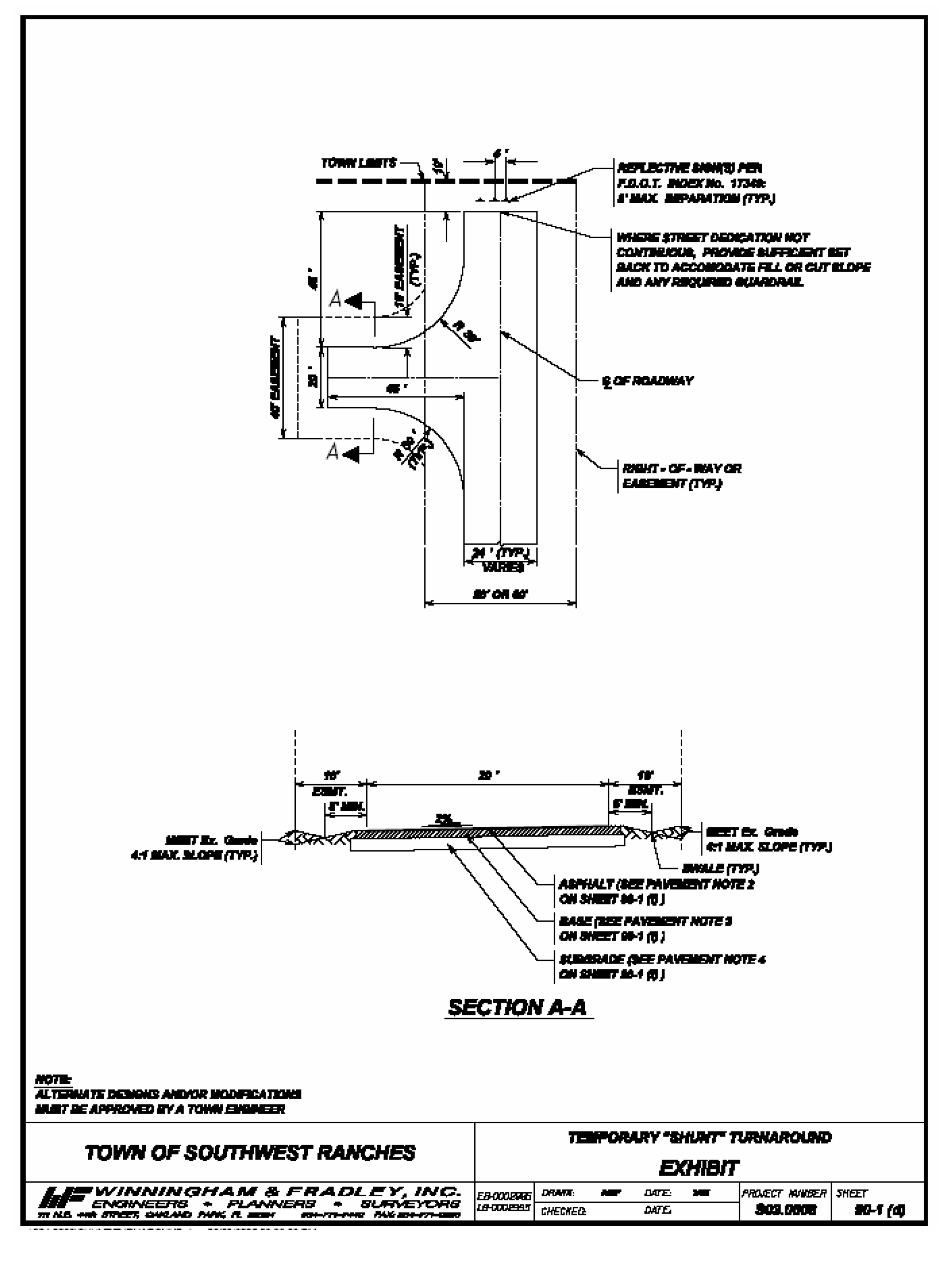
Figure 90-1(B). Temporary "Wye" Turnaround.
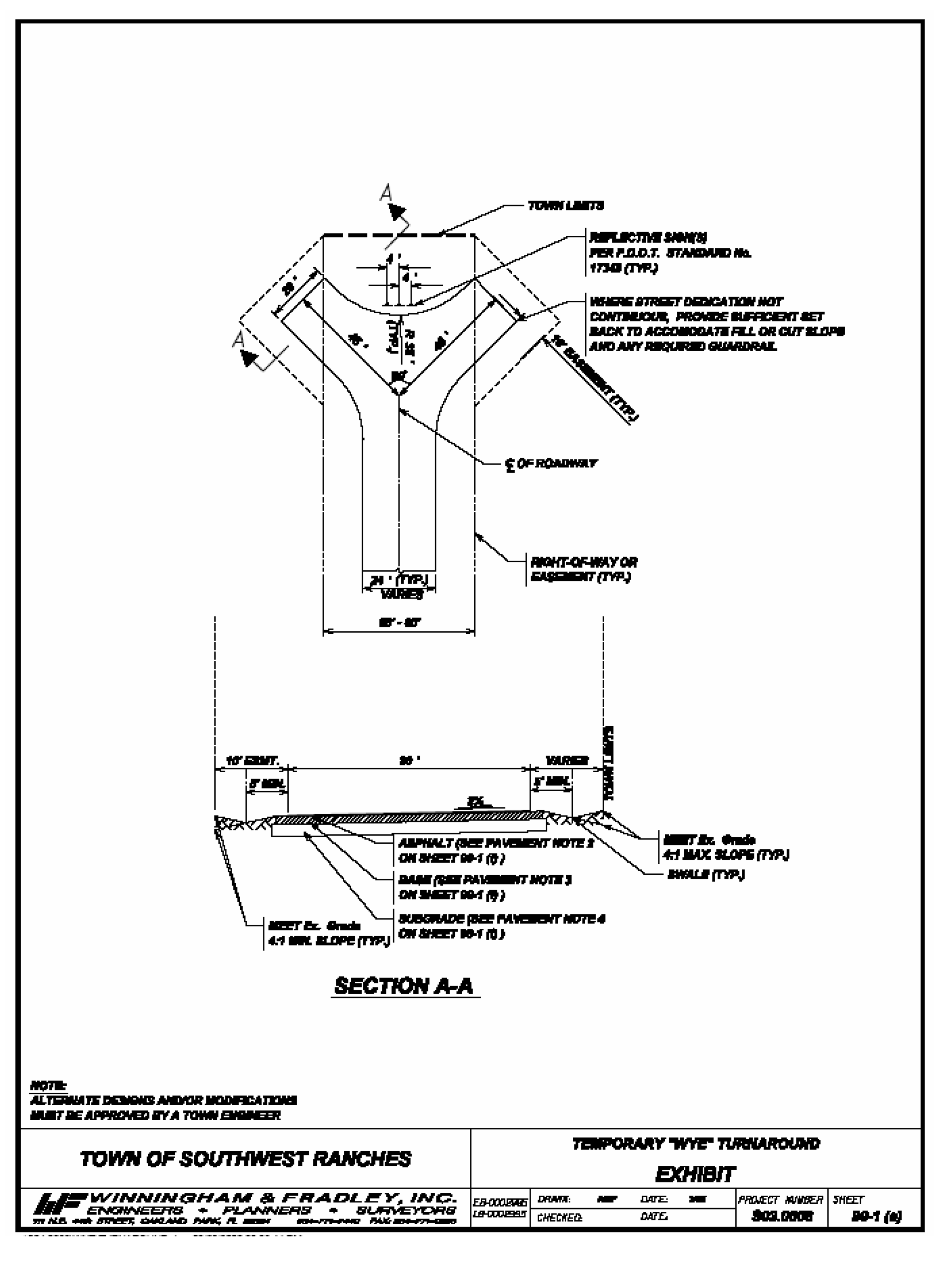
Figure 90-1(C). Temporary "T" Turnaround Within 50-Foot Right-of-Way.
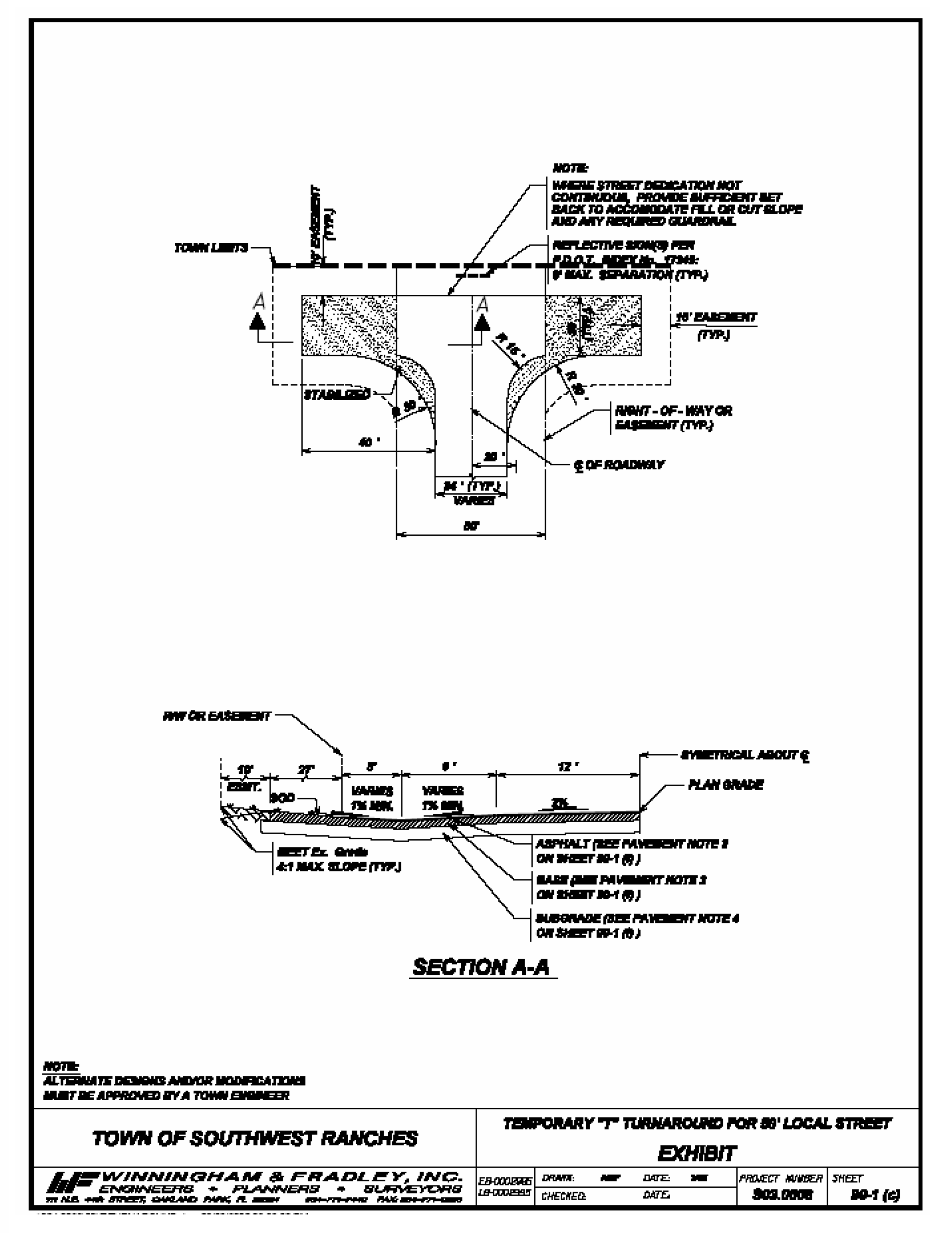
Figure 90-1(D). Temporary "T" Turnaround for 60-Foot Right-of-Way.
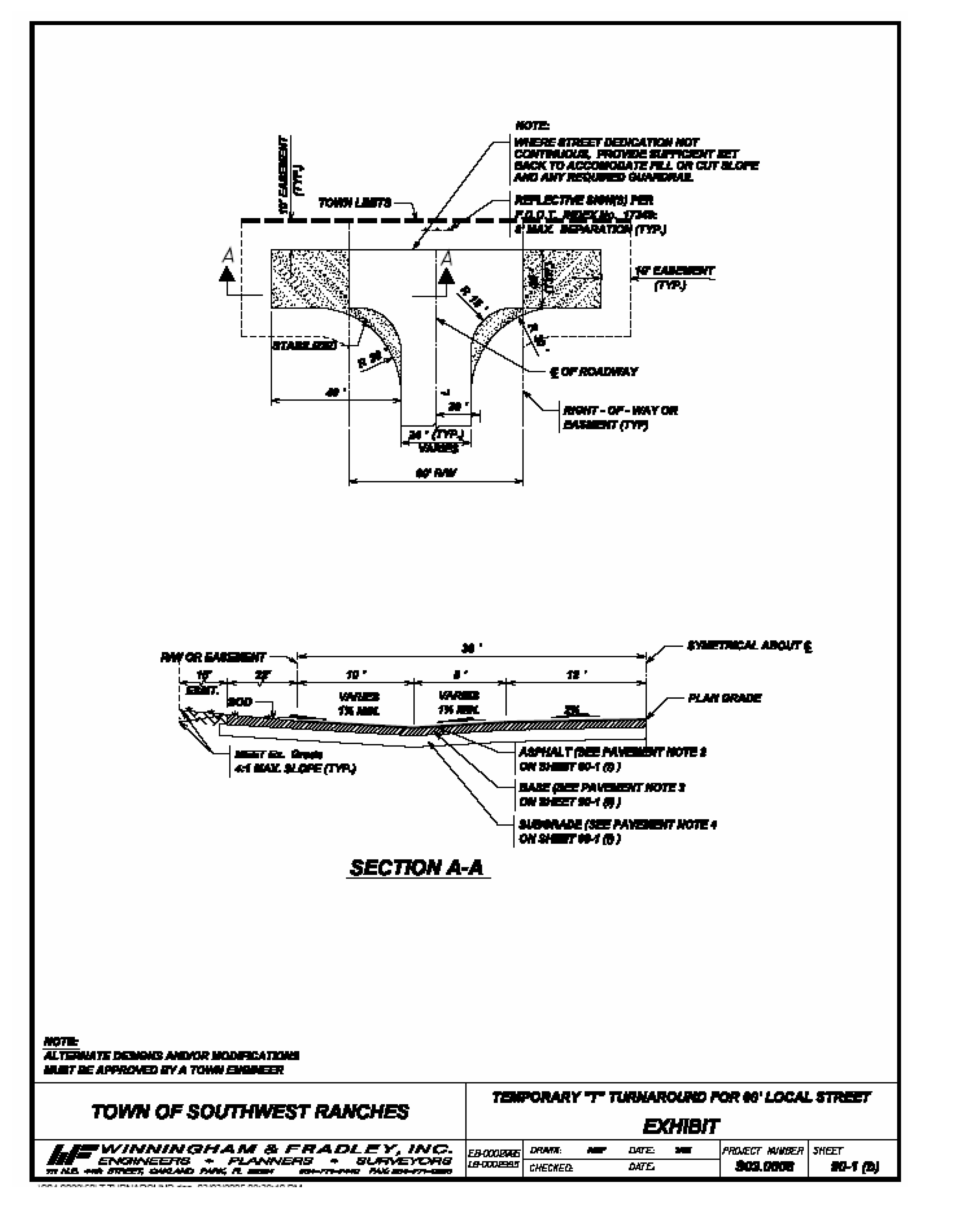
Figure 90-1(E). Cul-de-sac.
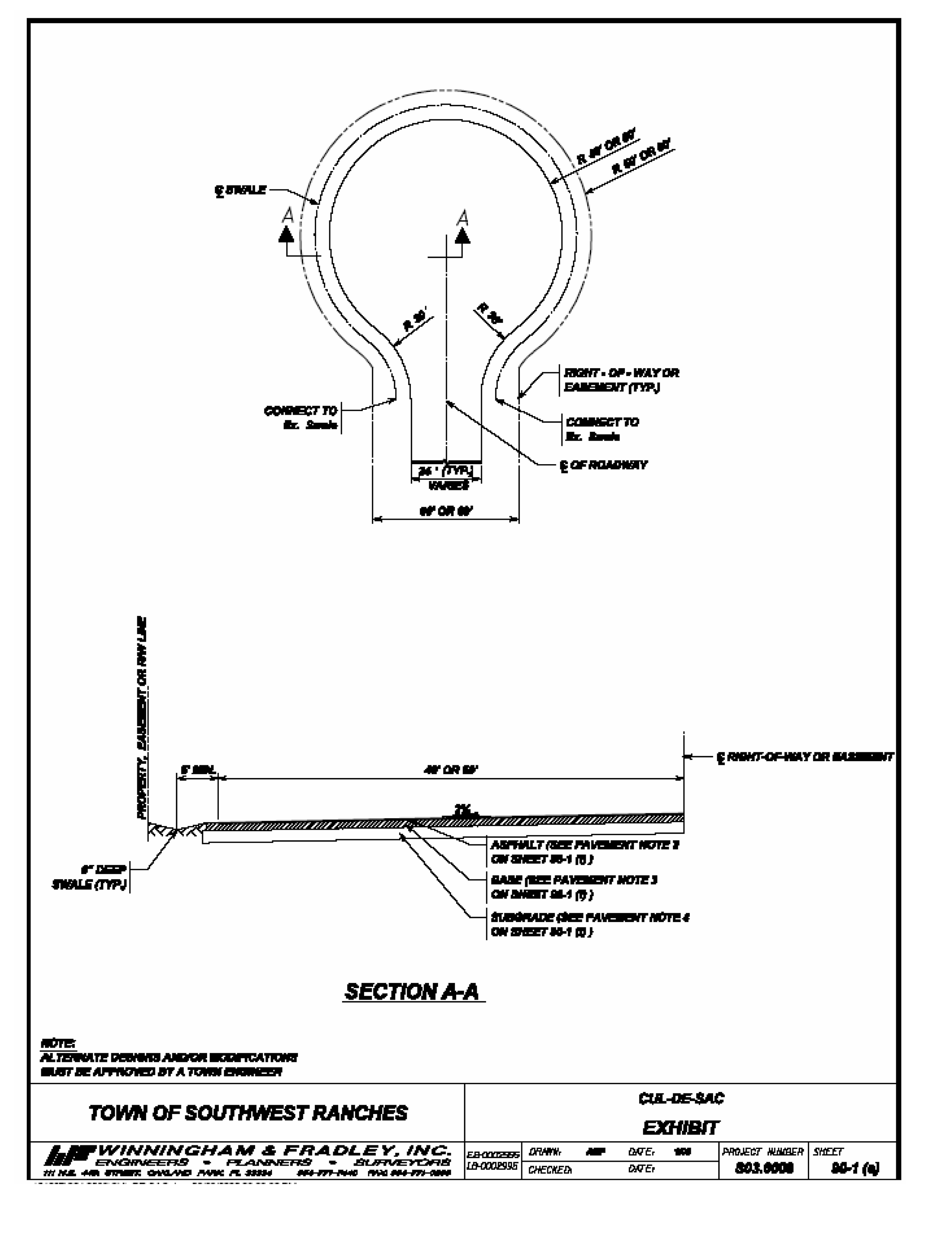
Figure 90-1(F). Temporary Turnaround Alternatives For Existing Streets.
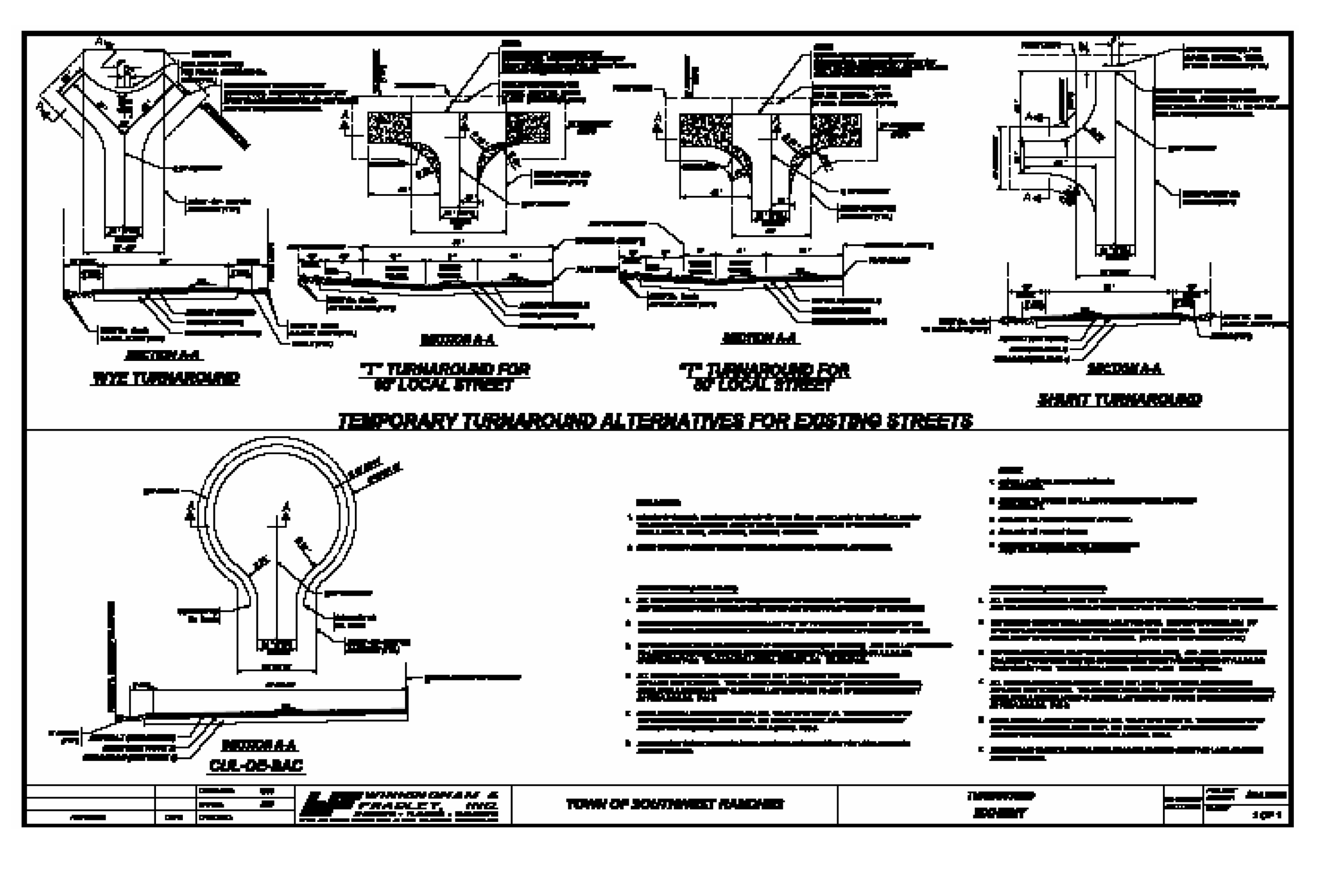
Figure 90-1(G). Temporary Turnaround Details Notes.
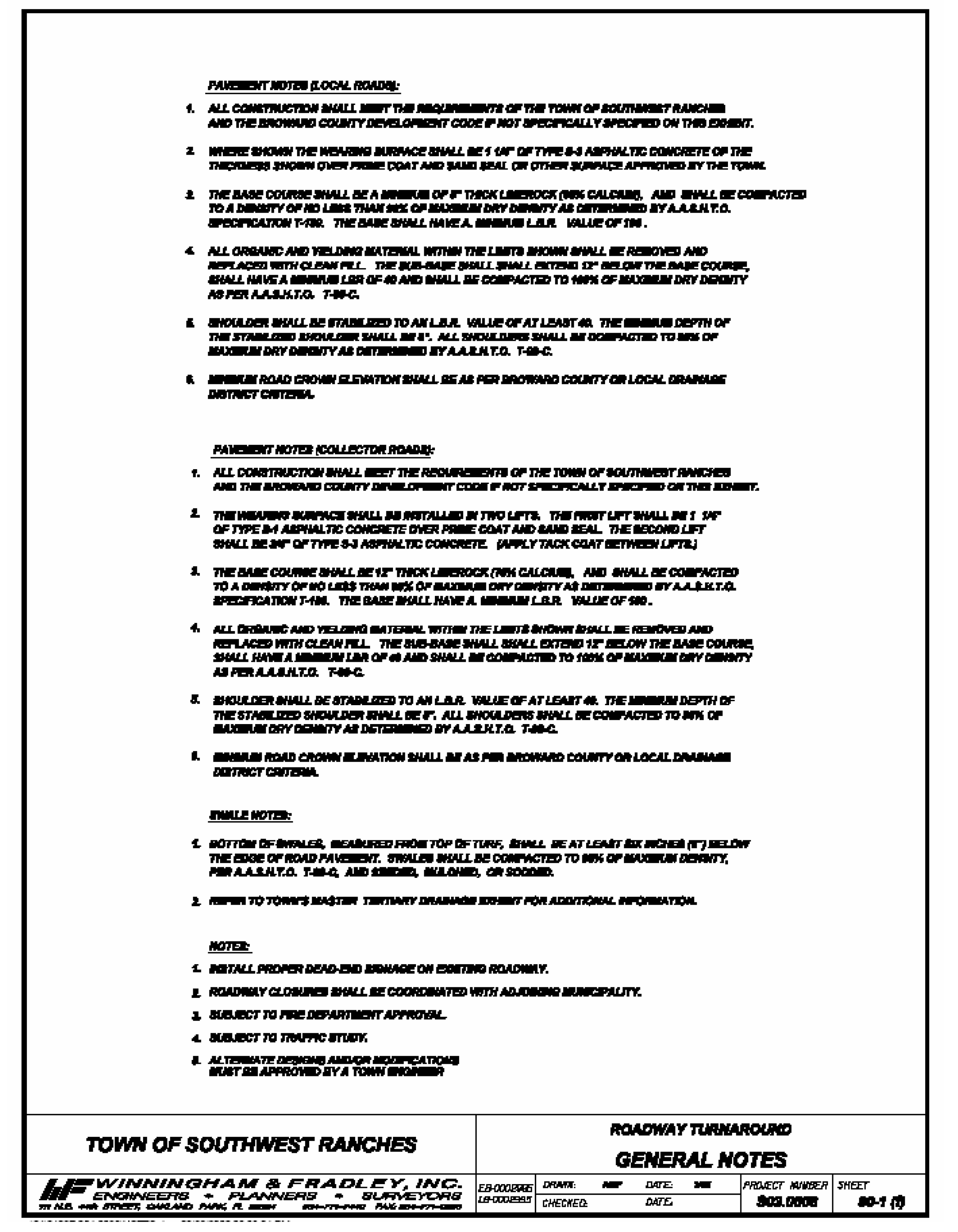
(C)
Side lot lines shall be substantially at right angles or radial to street lines.
(D)
The minimum arc frontage for lots abutting the turnaround of a cul-de-sac shall be twenty-five (25) feet for residential uses and sixty (60) feet for uses other than residential.
(E)
The frontage of a plot along an arterial shall comply with section 090-080, "Access to development."
(Ord. No. 2005-005, § 4(090-070), 4-14-2005)
Sec. 090-080. - Access to development.
(A)
Access to trafficway corridors. Access to trafficway corridors shall be designed pursuant to the county land development code provisions regulating same. All access to a trafficway and all driveways and streets within a trafficway corridor shall be approved by both the county engineering and traffic engineering division, and the town engineer.
(B)
Access to development adjacent to arterial and collector roadways. Access to development adjacent to arterial and collector roadways shall comply with the following requirements, as applicable:
(1)
The frontage of a plot along an arterial shall be not less than two hundred (200) feet unless one of the following conditions is met:
a.
Access to the plot is limited to streets other than the arterial; provided, however, that community facilities, commercial and industrial developments other than public safety facilities, shall not be given access on local residential streets, and agricultural uses shall not be given access on local residential streets, provided other access is available.
b.
Access to the plot is provided jointly with other plots created as part of the same development or another development such that minimum driveway spacing and corner clearance requirements are satisfied by the combination of plots served by the existing or relocated joint access driveway.
c.
Access to the plot is to be provided from a frontage road paralleling the arterial which has been planned and officially approved by the town and right-of-way dedication therefore has been provided.
(2)
No new single-family residential plot which is under one (1) net acre in size or has less than two hundred (200) feet of frontage shall have access to an arterial or collector street unless access is shared with an adjoining property with frontage on the arterial or collector. Such plots shall otherwise access a frontage road or adjoining local street. Frontage roads outside the required public right-of-way may be provided by easements.
(3)
When the back of residential plots abut a collector or arterial street, a nonvehicular access line shall be provided along the collector or arterial street.
(4)
Whenever possible, single-family residential plots smaller than one (1) acre shall have no direct access to four (4) lane collector streets. If the sides of such adjoining residential plots abut the collector street, with the house and driveway facing the local street, the spacing between intersections shall be not less than two hundred fifty (250) feet, and a nonvehicular access line shall be provided along the collector street.
(C)
Exceptions to street access. Every plot shall front on and access a publicly dedicated street, except as follows:
(1)
A developer may retain as private a local street nontrafficway street if the following conditions are met:
a.
The public right-of-way is not required in order to serve adjacent development that is existing or projected on the town future land use plan map;
b.
A permanent access easement is granted for service and emergency vehicles and for maintenance of public and semipublic utilities;
c.
A reciprocal easement for ingress and egress is granted all residents of the development; and
d.
Private local streets shall comply with all applicable construction standards contained in the "Minimum Construction Standards Applicable to Public Rights-of-Way Under Broward County Jurisdiction," adopted by Resolution No. 85-3606, set out in the county administrative code. Existing private local streets are subject to the construction standards of subsection (C)(3)a of this section. Curbing of private streets is prohibited unless determined necessary by the town engineer in specific instances to protect the public safety, where other, less objectionable methods consistent with Policy II-A1.5 of the town's land use plan are not available. Policy II-A1.5 seeks to maintain the town's semi-rural lifestyle.
(2)
A plot without direct frontage on a public or private street may be created if the following conditions are met:
a.
Individual access to a landlocked parcel. One (1) landlocked lot or parcel may be served by an ingress/egress easement at least twenty-five (25) feet wide, with a ten (10) foot-wide travel surface connecting the landlocked lot or parcel to a public or private street through an intervening lot or parcel. The easement shall provide for access by emergency vehicles and government officials, employees or contractual service providers during the course of their official duties. Geometry shall be approved by the town engineer, fire department and other applicable service providers; or
b.
Shared access to multiple landlocked parcels. Up to four (4) lots or parcels may be served by an ingress/egress easement at least thirty-five (35) feet wide, providing access for emergency vehicles and government officials, employees or contractual service providers during the course of their official duties, and providing a travel surface, pull-off shoulders and traffic markings as depicted by figure 90-2.
(3)
Both individual and shared access to landlocked parcels must meet the following conditions:
a.
The base course and wearing surface materials and specifications shall be as specified in figure 90-2 or alternate surface approved by the town engineer, including, but not limited to, reinforced stabilized limerock with a base course of a minimum of eight (8) inches thick limerock (sixty (60) percent calcium), and shall be compacted to a density of no less than ninety-eight (98) percent of maximum dry density as determined by the American Association of State Highway and Transportation Officials (AASHTO) specification T-180, or as may be amended from time to time. The base shall have a minimum limerock bearing ratio (L.B.R.) value of one hundred (100) and the subbase shall have a minimum L.B.R. of forty (40);
b.
The town shall determine the actual width of the easement after review and approval by applicable utilities and governmental agencies requiring a permit, and subject to drainage agreements, and/or other miscellaneous agreements approved by the town attorney;
c.
The developer and property owner shall enter into, and shall record in the public records of the county, a declaration of restrictive covenants for private roadways and access in a form approved by the town attorney, which shall, in part, indemnify and hold harmless the town and its agents for the construction of an access easement, which is less than the access easement set forth in the "Minimum Construction Standards Applicable to Public Rights-of-Way Under Broward County Jurisdiction," adopted by county Resolution No. 85-3606, set out in the county administrative code, and adopted by reference by the town;
d.
For shared access, all property owners utilizing the shared access easement shall enter into an agreement defining the rights and responsibilities of the parties in regards to the maintenance of the access easement and shall record such agreement in the public records of the county;
e.
The permissibility of driveways pursuant to this subsection is conditioned upon no further subdivision being possible that would require dedication and construction of a public or private street in lieu of a driveway under this subsection;
f.
The address of all properties without direct street frontage shall be displayed at the street entrance of the driveway and again at the entrance to each property from the driveway;
g.
The maximum length of a driveway under this subsection shall be one-quarter mile (1,320 feet);
h.
No plantings or other obstructions shall be permitted within the ingress/egress easement or within the site distance triangle pursuant to section 085-030, "Site distance triangle;" and
i.
A turn-around acceptable to the town engineer and/or fire marshal shall be provided at the end of the shared driveway, consistent with one (1) of the details shown in figure 90-1 and shall be fully contained within the ingress/egress easement.
Figure 90-2. Shared driveway design and construction standards.
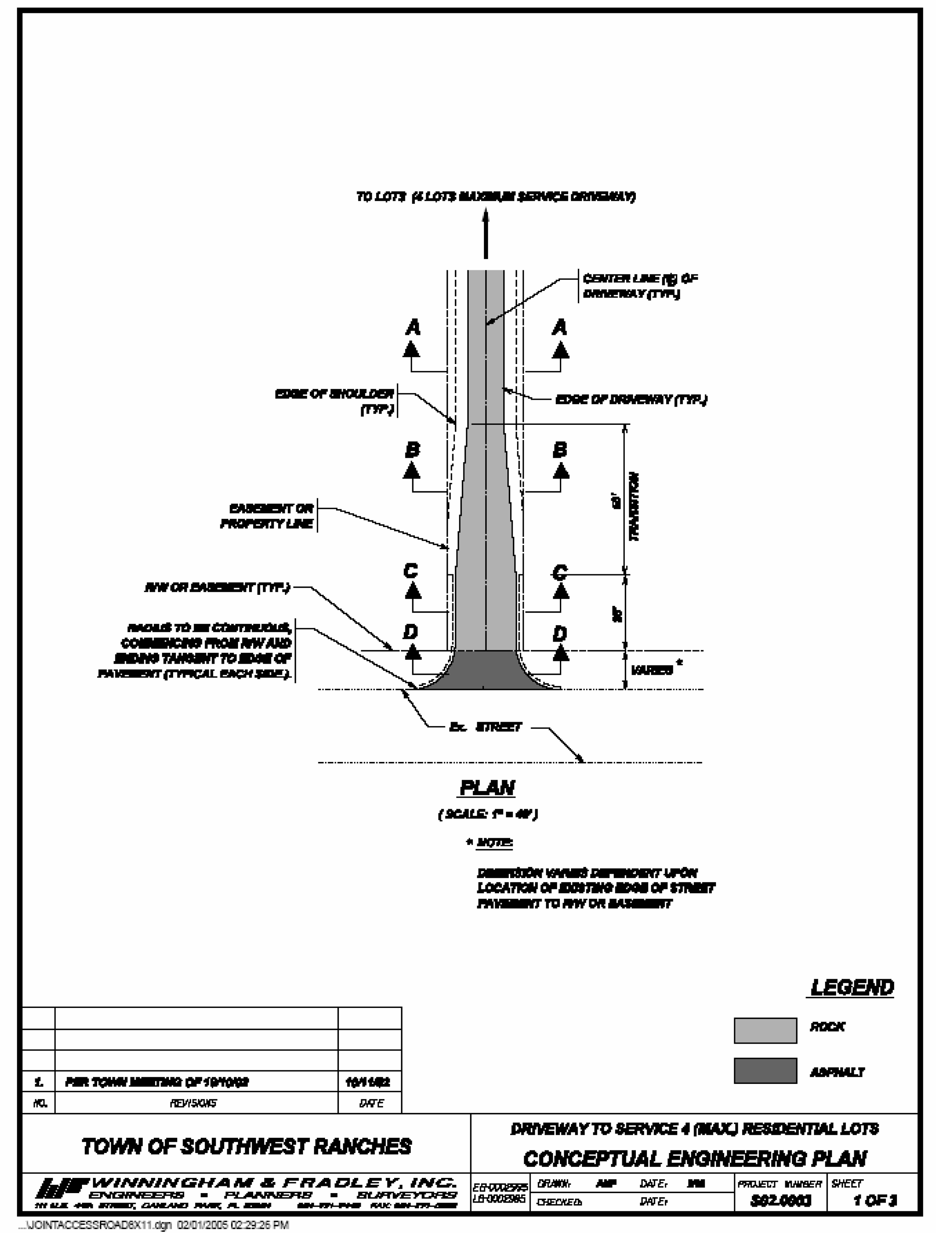
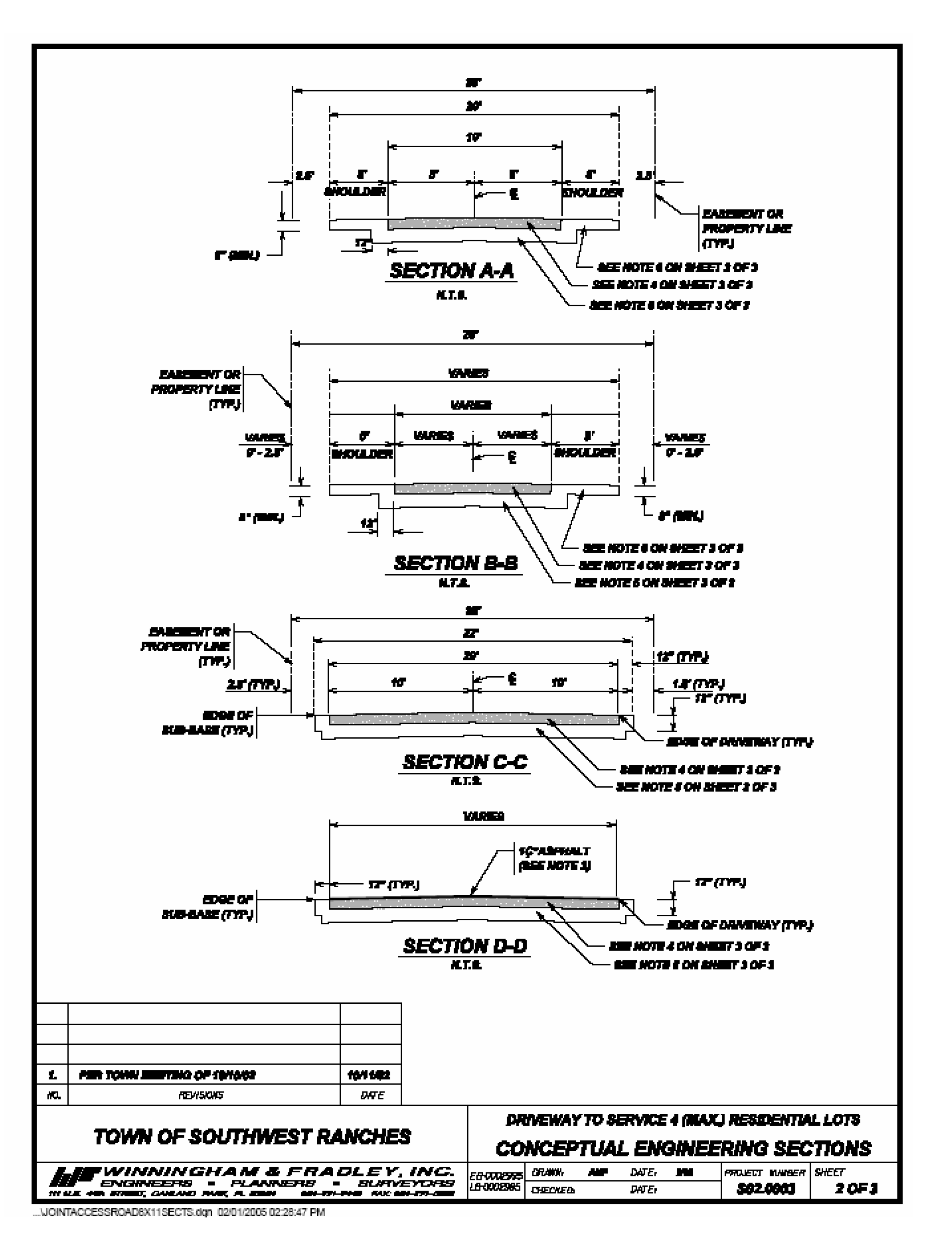
(D)
Nonvehicular access line. All plats adjacent to a trafficway corridor or nontrafficway collector street shall provide a nonvehicular access line along all road frontages, specifying that, along the ultimate right-of-way line of the abutting roadway, no access shall be permitted except at those points of access provided in conformance with the standards of this article. Amendment of the nonvehicular access line shall be via town council approval with associated delegation request/plat amendment agreement through the county board of commissioners.
(E)
Number and location of driveway entrances. In order to provide the maximum safety with the least interference to the traffic flow on public streets, and to provide ease and convenience in ingress and egress to private property, the number and location of driveways shall be regulated relative to the intensity or size of the property served and the amount of frontage which that property has on a given street as follows:
(1)
One (1) driveway shall be permitted for ingress and egress purposes to a single property or development.
(2)
Two (2) driveways entering on a particular street from a single property or development may be permitted if all other requirements of this section are met and if:
a.
The minimum driveway spacing between the two (2) driveways on the same plot equals or exceeds twenty (20) feet for single-family residential and agricultural use plots and fifty (50) feet for all other plots; and
b.
The recommended minimum spacing between driveways on abutting properties is fifty (50) feet. Requests for deviation from this standard shall be considered by the town engineer if the driveway layout is constrained by the property geometry and it will not create a safety hazard based upon existing field conditions, roadway classification and sound, professionally accepted engineering practice, but in no case shall the required spacing be less than twenty (20) feet.
(3)
Three (3) driveways entering on a particular street from a single property or development may be permitted if all other requirements of this section are met and if:
a.
The minimum driveway spacing between adjacent driveways on the same plot equals or exceeds forty (40) feet for single-family residential and agricultural use plots and one hundred (100) feet for all other plots; and
b.
Each driveway is spaced at least one hundred (100) feet from any driveway on abutting plots; provided that service driveways need only be separated twenty (20) feet or more from driveways on abutting property. A service driveway is defined as a driveway that is not used on a daily basis, which generally provides access to one or more accessory uses to the rear or side of a property, including, but not limited to, an equestrian barn, a storage structure for a boat or recreational vehicle, or a water body.
(4)
In general, not more than three (3) driveways will be permitted from a single property or development. However, in the case of extensive property development (property exceeding ten (10) acres in total land area and/or containing more than one thousand (1,000) parking stalls), additional driveways may be permitted, provided all other requirements of this section are met and the minimum driveway spacing between adjacent driveways equals or exceeds three hundred (300) feet.
(5)
Nonresidential parking facilities, when located along a collector residential street, shall be served by driveways having a minimum spacing of two hundred fifty (250) feet.
(6)
Residential driveways, legally in existence, that do not meet the separation requirements specified in subsection (E)(5) of this section will not have to be relocated as a condition of any permit to pave or otherwise improve the existing driveway, provided a minimum twenty (20) foot separation is maintained to driveways on the same and adjacent properties.
(F)
Driveway design and construction standards.
(1)
Ramp-type or swale-type driveway entrance. Except as provided in subsection (F)(2) of this section, all driveways shall be constructed with the standard ramp type or swale-type driveway entrance and shall conform to the following width requirements:
(Widths to be measured from the street line.)
The width of a curb opening for a ramp type driveway entrance shall not exceed the driveway width by more than five (5) feet on each side.
(2)
Street-type driveway entrance. Construction of a street-type driveway shall be required for entrances of any development which includes a parking area for three hundred (300) or more vehicles or where the development anticipates substantial loading or trucking operations. Such driveway shall be a minimum width of thirty (30) feet and a maximum width of sixty (60) feet.
(3)
Limitations on driveway entrance improvements.
a.
There shall be a minimum of fifteen (15) feet of straight tangent length between a driveway and the radius return or chord of the ultimate right-of-way line of an intersection of local streets. At all other intersections the minimum straight tangent length shall be fifty (50) feet.
b.
There shall be a minimum of forty-five (45) feet between the closest radius return of a driveway and the intersection of local street ultimate right-of-way lines. At all other intersections, the distance shall be eighty (80) feet.
(4)
Driveway entrance restrictions. No driveway entrance shall include any public facility such as traffic signal poles, crosswalks, loading zones, utility facilities, fire alarm supports, meter boxes, sewer clean outs, or other similar type structures.
(5)
Driveway grade recommendation; requirements. Within the ultimate right-of-way limits, the maximum recommended driveway grade is approximately three (3) percent. The maximum allowable grade is four and two-tenths (4.2) percent or one-half (½) inch per foot. The maximum slope immediately beyond the ultimate right-of-way line shall not change in excess of five (5) percent for either angle of approach or break over angle. Variations from these standards shall be permitted if adherence to these standards would cause incompatibility with existing swales.
(6)
Change of existing driveway approach. Existing driveway approaches shall not be relocated, altered, or reconstructed without approval for relocation, alteration, or reconstruction of such driveway approaches. When the use of any driveway approach is changed, making any portion or all of the driveway approach unnecessary, the developer of the abutting property shall obtain a permit to abandon the driveway approach and shall, at the developer's expense, replace all necessary curbs, gutters, swale areas and sidewalks.
(7)
Restrictions on traffic movements to and from driveways. If the closest intersection involves two (2) streets classified as arterial or collector, then traffic movements to and from any driveway within one hundred twenty-five (125) feet of an intersection with a collector and two hundred fifty (250) feet of an intersection with an arterial shall be limited to right turns only.
(8)
Permit required. No driveway shall be constructed prior to issuance of a permit for work in the right-of-way by the appropriate governmental agency.
(9)
Replacement of abandoned driveways. Existing driveway approaches shall not be relocated, altered, or reconstructed without approval for relocation, alteration, or reconstruction of such driveway approaches. When the use of any driveway approach is changed, making any portion or all of the driveway approach unnecessary, the developer of the abutting property shall obtain a permit from the town engineer to abandon the driveway approach and shall, at his expense, replace all necessary curbs, gutters, and sidewalks.
(10)
Minimum width. Nonresidential two (2) way driveways shall be a minimum of twenty-four (24) feet wide. One (1) way driveways shall be a minimum of fifteen (15) feet wide except where required for emergency vehicle access, in which case the minimum width is twenty (20) feet. For both one (1) and two (2) way driveways, required widths shall be increased according to vehicle type or if the number of parking stalls connected or the number of trips generated justifies such an increase in width. (See section 080-160(C), "Parking space, loading space and aisle dimensions.)
(Ord. No. 2005-005, § 4(090-080), 4-14-2005; Ord. No. 2006-14, § 2, 6-1-2006; Ord. No. 2023-006, § 2, 9-14-2023)
Sec. 090-090. - Design of trafficway corridors.
A site connected to a street at any point within a trafficway corridor shall meet the design criteria, requirements and standards of section 5-195(b), "Access to Trafficway Corridors," of the county land development code, as may be amended from time to time.
(Ord. No. 2005-005, § 4(090-090), 4-14-2005)
Sec. 090-100. - Roadway capacity, construction and design standards.
(A)
Capacities determined by Highway Capacity Manual. Street capacities shall be determined by the standards established by the Highway Capacity Manual, prepared by the Transportation Research Board of the National Research Council, Washington, D.C.
(B)
Construction to conform to county standards; exceptions. The construction of roadways, and work in the public right-of-way shall conform to county Resolution No. 85-3606, county administrative code, "Minimum Construction Standards Applicable to Public Rights-of-Way Under Broward County Jurisdiction or the Florida Department of Transportation Standards Specifications for Road and Bridge Construction," except that low volume roadways with eighteen (18) feet of pavement width, as permitted in tables 90-2 and 90-3, may utilize any pavement design method attaining a minimum structural value of two and a quarter (2.25), in lieu of the less flexible county and state department of transportation specifications, but shall comply with all other safety and operational criteria set forth in The Florida Green Book (The Florida Manual of Uniform Minimum Standard for Design, Construction, and Maintenance). However, Phosphogypsum shall not be used as a construction material, including on any town-owned or privately owned road.
(C)
Criteria for local streets and collector streets not identified on trafficways plan. Local streets and collector streets that have not been identified on the county trafficways plan shall conform to the criteria and characteristics of tables 90-2 through 90-5 and other provisions of this section.
(D)
Curbing of roadways with rural, agricultural districts prohibited. Notwithstanding subsections (A) through (C) of this section, curbing of roadways within the rural and agricultural zoning districts is prohibited unless determined necessary by the town engineer in specific instances to protect the public safety, where other, less objectionable methods consistent with policy II-A1.5 of the town's land use plan are not available. Policy II-A1.5 seeks to maintain the town's semi-rural lifestyle.
(E)
Intersections.
(1)
Spacing of street intersections.
a.
A collector may intersect an arterial, but only if aligned with and extending an existing collector which intersects the arterial, or at a minimum distance of one-quarter (¼) mile (1,320 feet) from the intersection of an existing collector and the arterial, or at a minimum distance of fourteen hundred twenty (1,420) feet from the intersection of two (2) arterials.
b.
A local street may not intersect an arterial unless unavoidable, in which case the local street may intersect an arterial, but only if aligned with and extending an existing local street which intersects the arterial or at a minimum distance of six hundred sixty (660) feet from any other intersection of the arterial, except at a minimum distance of seven hundred sixty (760) feet from the intersection of two (2) arterials.
c.
A collector may intersect another collector, but only if aligned with and extending an existing collector or at a minimum distance of six hundred sixty (660) feet from any other intersection of the collector.
d.
A local street may intersect a collector if spaced at a minimum distance of six hundred sixty (660) feet from any other intersection or, in the case of a T-type intersection, at a minimum distance of three hundred thirty (330) feet from any other intersection.
e.
The minimum spacing requirements of this section may be reduced upon a finding by the town that, given the particular conditions of the proposed development, such reduction will not compromise operational and safety standards.
(2)
Additional rights-of-way required for traffic control equipment. Additional rights-of-way shall be required at major intersections to accommodate installation of traffic control equipment in the form of a corner chord as shown in table 90-1, and/or additional approach lane capacity, as depicted by figure 90-2.
Table 90-1. Corner Chord Requirements
If conditions warrant special consideration as determined by the town engineer, alternate provisions for additional rights-of-way at intersections may be approved.
(F)
Local street requirements. Local streets are required when connections of driveways or private streets to a collector would be otherwise closer than two hundred fifty (250) feet.
(1)
Minimum distance between intersecting streets. There shall be a minimum distance of two hundred fifty (250) feet between the intersection of any two (2) local streets with a single collector, except that there may be a minimum distance of one hundred twenty-five (125) feet between T intersections.
(2)
Streets shall be patterned to prohibit continuous traffic between collectors. Local streets shall be patterned in such a way that continuous traffic from one (1) collector to another collector, or from a collector to an arterial, is not possible.
(3)
Dead end streets.
a.
Dead end streets shall be designed and constructed with a turnaround at the closed end pursuant to the requirements of the building code, and providing a minimum fifty-foot radius, accommodating at least WB-40 geometric design vehicles.
b.
The turnaround shall be paved except for unpaved streets permitted pursuant to section 90-80(C)(1), "Access to development for private streets." Adequate easement or right-of-way area shall be provided for construction of the paved surface, roadway drainage, and sidewalks, if required, adjacent to the turnaround.
c.
Where existing right-of-way or ingress/egress easement width is inadequate to accommodate the required turnaround, and additional right-of-way or easement area cannot practically be obtained, an alternate turnaround consistent with figure 90-1 may be provided subject to approval by the fire marshal and town engineer.
Figure 90-2. Approach Lane Requirements.
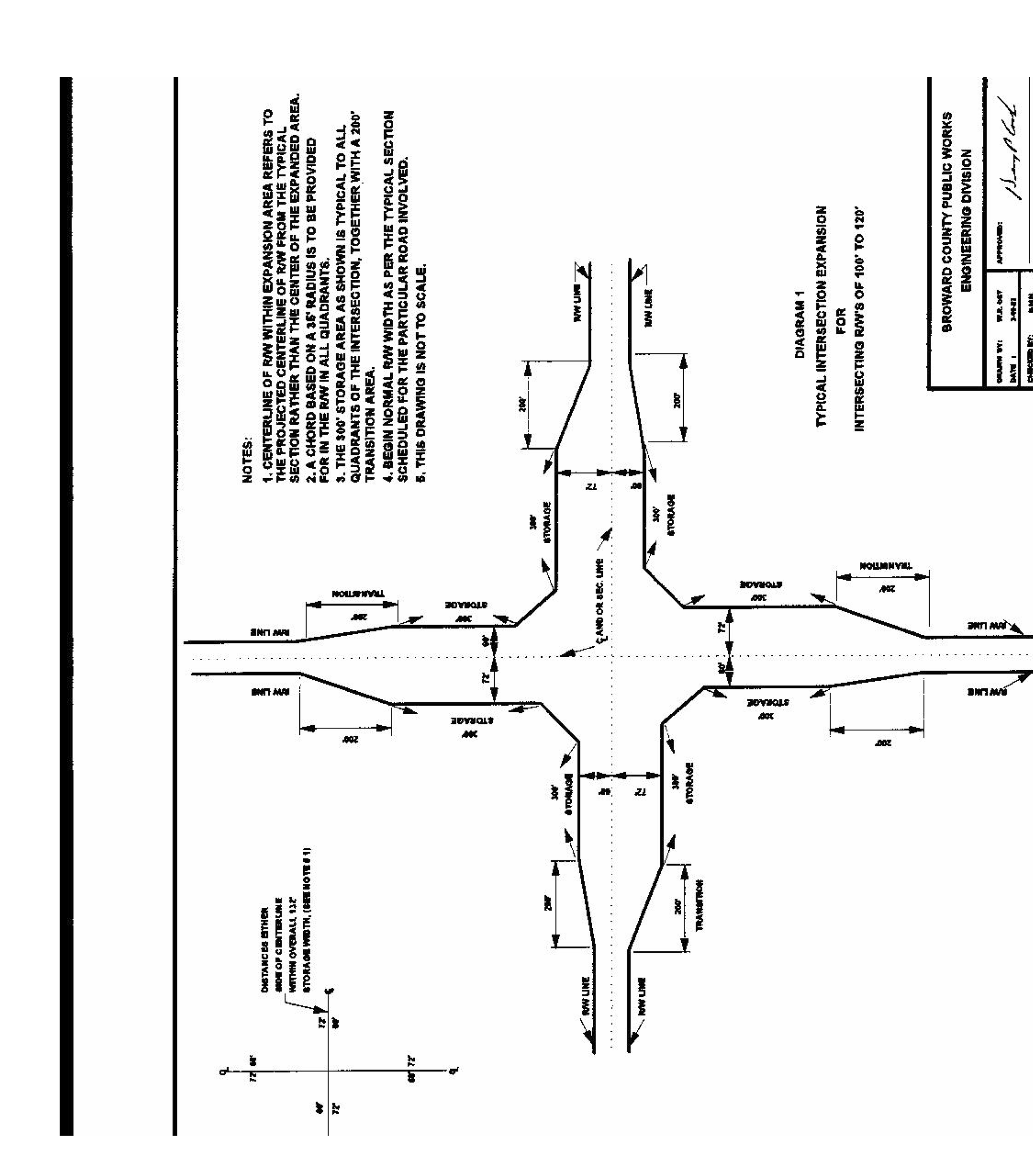
(4)
Requirements for loop and/or local streets. A loop street and/or a local street which begins and ends at the same collector, shall be subject to the following requirements:
a.
A loop street may be designed with a right angle corner serving as a cul-de-sac, providing that a recessed circular pavement at such corner allowing greater frontage for irregularly shaped lots is provided.
b.
A loop street may begin at a collector and end at a local street, provided that the system does not exceed the maximum number of trips permitted.
(G)
Bridge embankment requirements. If a street requires a bridge, additional right-of-way will be required to accommodate the width of necessary bridge design features including, without limitation, grade, fill slopes and drainage requirements.
(H)
Limitations on improvements in the ultimate right-of-way. No obstructions of any type which are deemed unsafe by town standards shall be left in the ultimate right-of-way as a result of any improvements in the ultimate right-of-way.
(I)
Design criteria for local streets by development type. The design of local streets shall comply with the requirements of the provisions and tables 90-2 through 90-5, depending on the type of development proposed. Deviations from the numerical standards of tables 90-2 through 90-5 may be allowed, but only where approved by the town engineer upon a finding that substantially equivalent protection of the public safety can be achieved by alternative standards; provided, however, that no alternative standard having more than a ten (10) percent deviation from the numerical standard stated below shall be permitted. If a proposed development includes more than one (1) type of use, the highest criteria shall apply.
(1)
Residential development.
a.
Residential streets shall be adequate to permit neighborhood traffic circulation to flow from the highest element of the hierarchical classification, the expressway, arterial or collector, to the lowest element, the local residential street. Circulation within a residential development shall be adequate when the criteria of tables 90-2 through 90-5 are met and when collectors and local streets are provided which meet the standards specified in this section. If all lots in a development are more than two and one-half (2½) acres, the development shall conform to the minimum design standards of table 90-2. If all lots in a development are between one (1) acre and two and one-half (2½) acres, the development shall conform to the minimum design standards of table 90-3. Table 90-5 applies to any portion of a street within a trafficway corridor. Design requirements for trafficway streets are set forth in section 195(b), table VII of the county land development code, as may be amended from time to time.
b.
Plots having frontage on both a collector roadway and a noncollector, nonarterial roadway shall obtain access from the lowest classification roadway, and shall place a nonvehicular access line along the plot line fronting the collector or arterial roadway.
Table 90-2. Rural Development Design Standards
Minimum lot size: More than 2.5 acres gross.
*Further explanation in provisions of this section.
**N/A = Not applicable.
(a) Net= fee simple ownership
(b) Over three hundred (300) VPD may be allowed if an alternate emergency access is provided.
(c) Residential access may be allowed for lots with a minimum of two hundred (200) feet frontage or for collectors if volume does not exceed a projection of three thousand (3,000) VPD.
(d) Reserved.
(e) See section 090-100(E)(1).
(f) As delineated in the Manual on Uniform Traffic Control Devices (MUTCD).
(g) On collectors—For collector/collector intersections or local/collector intersections with more than one thousand (1,000) VPD.
(h) If determined acceptable by the town engineer, existing roads may be resurfaced to the same pavement width that exists prior to resurfacing.
(i) Rural Road Criteria. The minimum required right-of-way for a local cul-de-sac street shall be fifty (50) feet unless all of the following criteria are satisfied, in which case the minimum required right-of-way shall be thirty (30) feet:
(1) The street shall have been in existence as of June 6, 2000 (the date of the Town's incorporation).
(2) The street shall be located entirely within the town limits of the Town of Southwest Ranches.
(3) There shall be at least one dwelling that was issued a building permit by Broward County as of June 6, 2000 (date of Town's incorporation), built less than seventy-five (75) feet from the centerline of the right-of-way.
(4) The street shall be designated as a local, dead-end street with a total projected traffic volume of not more than three hundred (300) average daily trips (ADT) once all land currently and potentially accessing the street is developed at the full density permitted by the ULDC.
(5) The street shall not be planned for a future traffic way, thoroughfare or collector road, nor future connection to another public street.
(6) The street shall be no longer than one quarter mile (1,320 feet), measured from the terminus of the road to the center of the closest intersection with another street.
(7) Any part of any street that connects any two (2) or more dead-end street segments shall not be eligible for the reduced right-of-way requirement under this section.
(8) The street design shall be a maximum of two (2) travel lanes.
(9) If more than thirty (30) feet of right-of-way has already been dedicated, the full width of dedicated right-of-way shall remain in place unless affected property owner(s) successfully petition for vacation of the additional right-of-way.
(10) A speed limit of twenty (20) MPH shall be posted on the street.
(11) These criteria do not pre-empt the requirement in this article for additional street right-of-way necessary for a turn around, provided that additional right-of-way for a turnaround shall not be required to the extent that it would reduce the established front yard of a dwelling to less than the minimum yard requirement of this ULDC.
(j) The street which meets the criteria for reduction of street rights-of-way requirement listed in (i), above shall be classified as local rural road which will allow the following design standards:
(1) Street rights-of-way: thirty (30) feet, minimum.
(2) Street travel lanes or pavement width: eighteen (18) feet, minimum.
(3) Grassed area shoulder and swale on each side of the street: six (6) feet.
(4) Grass swale side slope: maximum of four (4) to one (1).
(5) There shall be no centerline or edge-of-pavement paint striping.
Table 90-3. Low Density Residential Development Design Standards
(Thirty-five thousand (35,000) square feet net (a) to two and one-half (2½) acres gross)
*Further explanation in provisions of this section.
N/A Not applicable.
(a) Net= fee simple ownership.
(b) Over 300 VPD may be allowed if an alternate emergency access is provided.
(c) Residential access may be allowed for lots with a minimum of 200 feet frontage or for collectors if volume does not exceed a projection of 3,000 VPD.
(d) Reserved.
(e) See section 90-100(F), "Local street requirements."
(f) As delineated in the Manual on Uniform Traffic Control Devices (MUTCD).
(g) On Collectors—For collector/collector intersections or local/collector intersections with more than 1,000 VPD.
(h) If determined acceptable by the town engineer, existing roads may be resurfaced to the same pavement width that exists prior to resurfacing.
(i) Rural Road Criteria. The minimum required right-of-way for a local cul-de-sac street shall be fifty (50) feet unless all of the following criteria are satisfied, in which case the minimum required right-of-way shall be thirty (30) feet:
(1) The street shall have been in existence as of June 6, 2000 (the date of the Town's incorporation).
(2) The street shall be located entirely within the town limits of the Town of Southwest Ranches.
(3) There shall be at least one dwelling that was issued a building permit by Broward County as of June 6, 2000 (date of Town's incorporation), built less than 75 feet from the centerline of the right-of-way.
(4) The street shall be designated as a local, dead-end road with a total projected traffic volume of not more than three hundred (300) average daily trips (ADT) once all land currently and potentially accessing the street is developed at the full density permitted by the ULDC.
(5) The street shall not be planned for a future traffic way, thoroughfare or collector road, nor future connection to another public street.
(6) The street shall be no longer than one-quarter mile (1,320 feet), measured from the terminus of the road to the center of the closest intersection with another street.
(7) Any part of any street that connects any two (2) or more dead-end street segments shall not be eligible for the reduced right-of-way requirement under this section.
(8) The street design shall be a maximum of two (2) travel lanes.
(9) If more than thirty (30) feet of right-of-way already have been dedicated, the full width of dedicated right-of-way shall remain in place unless affected property owner(s) successfully petition for vacation of the additional right-of-way.
(10) A speed limit of twenty (20) MPH shall be posted on the street.
(11) These criteria do not pre-empt the requirement in this article for additional street right-of-way necessary for a turn around, provided that additional right-of-way for a turnaround shall not be required to the extent that it would reduce the established front yard of a dwelling to less than the minimum yard requirement of this ULDC.
(j) The street which meets the criteria for reduction of street rights-of-way requirement listed in (i), above shall be classified as local rural road which will allow the following design standards:
(1) Street rights-of-way: thirty (30) feet, minimum.
(2) Street travel lanes or pavement width: eighteen (18) feet, minimum.
(3) Grassed area shoulder and swale on each side of the street: six (6) feet.
(4) Grass swale side slope: maximum of four (4) to one (1).
(5) There shall be no centerline or edge-of-pavement paint striping.
(2)
Commercial development. Commercial development shall be designed to satisfy the needs generated by residential development. The size and location of the proposed commercial development shall be appropriate to support the proposed use.
a.
Commercial streets. Commercial streets shall be designed to facilitate the efficient and safe movement of vehicles from major arterials to regional commercial facilities, and from collectors and local residential streets to community and neighborhood commercial development. The design of commercial streets shall comply with the standards of table 90-4. Table 90-5 applies to all portions of a street within a trafficway corridor.
b.
Pedestrian access. Neighborhood and community commercial facilities shall have an efficient and direct pedestrian connection to the residential areas the facilities are intended to serve. The design of local commercial facilities shall allow pedestrian and bike riders direct access from adjacent neighborhood areas, with due consideration to the elimination of points of conflict between pedestrians and vehicles.
(3)
Industrial development. Industrial development shall be designed to provide easy and safe access for incoming raw materials, and for the personnel operating the industrial facilities. Adequate location and size shall ensure that noise levels, smells and odors, vibration, radiation and other sources of nuisance will not affect residential development. Industrial streets shall be designed to provide direct access from arterials and collectors to industrial local streets. Local residential streets shall not be used to provide access to immediately adjacent industrial development. Industrial streets shall comply with the standards of table 90-4. Table 90-5 applies to all portions of a street within a trafficway corridor.
Table 90-4. Commercial and Industrial Development Design Standards
*Further explanation in provisions of this section.
(a) Culs-de-sac may be approved for traffic volumes more than one thousand (1,000) VPD if an alternate is approved by the town engineer.
(b) As permitted in section 090-080(E), "Number and location of driveway entrances."
(c) Or one hundred sixty-five (165) feet for opposing offset T intersections.
(d) As delineated in the Manual on Uniform Traffic Control Devices (MUTCD).
(e) Or alternate approved by the town engineer.
(f) Bicycle lanes or three (3) foot unmarked lanes shall be included if right-of-way is available.
Table 90-5. Design Criteria for Construction of Local Streets Within Trafficway Corridors
* Further explanation in provisions of this article.
N/A Not applicable
(a) Or alternate approved by the town engineer.
(b) As delineated in the Manual of Uniform Traffic Control Devices (MUTCD).
(c) Reserved.
(d) Interim trafficway road cross section.
(e) Individual roadway volume capacities are determined pursuant to the comprehensive plan.
(f) Variations from design speeds must be approved by the town engineer based on an evaluation of design elements.
(g) Some roadways may be constructed with a continuous paved center lane twelve to fourteen (12 to14) feet in width.
(h) Or alternative pursuant to section 5-195(b)(11)c) of the county land development code, as may be amended from time to time.
(i) The interim two (2) lane roadway shall be positioned within the right-of-way for the future construction of a divided roadway.
(j) Median widths must be approved by the town engineer based on an evaluation of design elements.
(k) Two (2) lane divided roadways may be approved by the town engineer—Minimum lane width = fifteen (15) feet.
(Ord. No. 2005-005, § 4(090-100), 4-14-2005; Ord. No. 2006-08, §§ 2—4, 4-13-2006; Ord. No. 2013-004, § 2, 11-24-2013; Ord. No. 2017-008, § 4, 7-27-2017; Ord. No. 2023-011, § 2, 9-14-2023)
Sec. 090-110. - Pavement markings and signing plans.
The pavement marking and signing improvement plans shall conform to the "Manual on Uniform Traffic Control Devices." The pavement marking and signing plans shall be approved by the town engineer. No construction shall be commenced until the provisions set forth in section 090-160, "Installation of improvements," have been satisfied. Pavement markings for driveway connections to trafficways that are functionally classified as state roads shall conform to the state department of transportation "Roadway and Traffic Design Standards" and the state department of transportation "Standards Specifications."
(Ord. No. 2005-005, § 4(090-110), 4-14-2005)
Sec. 090-120. - Bicycle facilities.
(A)
Location. Bicycle facilities shall be indicated by site plans in accordance with the Bicycle Facilities Network Plan adopted by the county commission, as may be supplemented by the town council.
(B)
Dimensions. All bicycle facilities (bicycle paths, lanes, routes, multipurpose and recreational paths) shall follow, at least, the minimum specifications provided for in the Guide For Development of New Bicycle Facilities prepared by the American Association of State Highway and Transportation Officials (AASHTO).
(Ord. No. 2005-005, § 4(090-120), 4-14-2005)
Sec. 090-130. - Sidewalks.
Sidewalks are not permitted within the rural, agricultural and community facility zoning districts, consistent with policy II-A1.5 of the town's land use plan, which seeks to maintain the town's semi-rural character. Commercial and industrial zoning districts are subject to the following requirements:
(A)
Minimum width. A minimum five (5) foot wide sidewalk shall be constructed as specified in tables 90-2 through 90-5 of section 090-100, "Roadway capacity, construction and design standards."
(B)
Sidewalk construction. All sidewalks shall be constructed in accordance with the Minimum Constructions Standards Applicable to Public Rights-of-Way, latest edition. Sidewalks shall be separated from the road surface by a curb or swale. At intersections, midblock crossings, bus stops, bus bays, and bus shelters, sidewalk connections to the road surface or drop curb ramps shall be constructed to provide accessibility to disabled persons per state department of transportation Index 304. Sidewalks shall not be constructed within utility easements where existing or future utility poles, service boxes, or other obstructions will reduce the width of the sidewalk below five (5) feet, or as mandated for accessibility by the Americans with Disabilities Act, as same may be amended from time to time.
(C)
Pedestrian barriers. The town administrator may require that a site plan indicate fences, hedges, berms, other landscaping, or other barriers on site plans, in order to discourage pedestrians from crossing hazardous streets at unsafe points or at numerous points. When possible, sites shall be designed so as to promote pedestrian street crossings only at traffic control signals, crosswalks, or intersections.
(Ord. No. 2005-005, § 4(090-130), 4-14-2005)
Sec. 090-140. - Public utility and drainage easements and rights-of-way.
A utility or drainage easement or right-of-way shall be of a width determined by the applicable utility companies, drainage district, governmental entities, or town engineer, as appropriate. Such rights-of-way or easements shall run parallel to the street and shall not be included as part of the road dedication, ingress/egress easement or reservation unless waived by all of the aforementioned entities, and may be required along side or rear lot lines as well. The town shall specifically require granting of a right-of-way or drainage easement, in the town engineer's sole discretion, prior to issuance of a development order where the town engineer determines such easements or rights-of-way will implement the tertiary drainage plan and its intent, based upon generalized conveyance ways shown on the plan, or review of site-specific surveys or site inspection.
(Ord. No. 2005-005, § 4(090-140), 4-14-2005; Ord. No. 2006-05, § 4, 11-3-2005)
Sec. 090-150. - Turning lanes.
(A)
Left turn lane requirement immediately adjacent to the development. A left turn lane with a minimum of two hundred (200) feet of storage with one hundred (100) feet transition shall be provided at each driveway that meets the minimum spacing requirements of this article, when the speed limit equals or exceeds thirty-five (35) miles per hour, or if the ADT of the driveway is one thousand (1,000) vehicles or more and/or the average peak hour inbound left turn volume is twenty-five (25) vehicles or more.
(B)
Right turn lane requirements immediately adjacent to the development. A right turn lane with a minimum of one hundred fifty (150) feet of storage and one hundred (100) feet of transition shall be provided at each driveway when the speed limit equals or exceeds thirty-five (35) miles per hour, or if the development will generate one hundred (100) or more right turn movements during the peak hour.
(C)
Intersection improvements immediately adjacent to the development. At intersections which abut the development, the following improvement shall be provided:
(1)
A right turn lane shall be provided if the street's speed limit equals or exceeds thirty-five (35) miles per hour or if the development will generate one hundred (100) or more right turns during the peak hour.
(2)
A left turn lane shall be provided if the street's speed limit equals or exceeds thirty-five (35) miles per hour or if the development will generate twenty-five (25) or more left turns during the peak hour.
(D)
Modification of storage, transition lengths. Required storage and transition lengths may be modified where conditions warrant and are acceptable to the town engineer. When storage and transition lengths are so modified, the minimum distances storage and transition lengths may be correspondingly adjusted if appropriate.
(E)
Modifying storage, transition length requirements to fulfill bus bay, driveway spacing requirements. In carrying out the intent of the storage and transition length requirements, such requirements may be modified in order to coordinate the implementation of bus bay and driveway spacing requirements.
(Ord. No. 2005-005, § 4(090-150), 4-14-2005)
Sec. 090-160. - Installation of improvements; improvement agreements and financial security.
(A)
Improvements required. A developer shall be responsible for all roadway and drainage improvements, pursuant to subsections (A)(1) and (A)(2) of this section, for those streets lying within or adjacent to the proposed development and necessary to provide access and to accommodate the traffic generated by the development. A developer shall also be responsible for all drainage improvements within and adjacent to the proposed development, pursuant to subsections (A)(1) and (A)(2) of this section, that the town engineer determines will implement the tertiary drainage plan and its intent, based upon specific improvements identified in the plan, review of site-specific surveys, other data, and/or site inspection. Such improvements shall be in accordance with the applicable portions of the following: Resolution No. 85-3606, "Minimum Construction Standards Applicable to Public Rights-of-Way Under Broward County Jurisdiction," set out in the county administrative code; the Manual for Uniform Minimum Standards for the Design, Construction and Maintenance of Streets and Highways (the "Green Book"); the Grading and Drainage Regulations and Standards, Water Management Regulations and Standards and Drainage Design Criteria and Standards of the Broward County Water Resources Management Division; town tertiary drainage plan, and the Manual of Uniform Traffic Control Devices, as approved by the county traffic engineering division.
(1)
On-site improvements. A developer shall be required to bond for and construct the on-site improvements required by the provisions of this article and any additional improvements necessary for traffic safety, including, but not limited to, the following: pavement, rock base, fill, curbs, gutters, sidewalks, bikeways, guardrail, shoulder areas, swales, roadside recovery areas, bridges, drainage outlets, catch basins, drainage pipes, culverts, drainage ditches, headwalls, endwalls, rip-rap, traffic signals and interconnecting facilities, traffic control signs and pavement markings, street name signs, identification signs, left and right turn lanes, median openings, bus turnouts, and traffic separators.
(2)
Off-site improvements. A developer shall be required to bond for and construct, the roadway and roadway drainage improvements on property adjacent to the proposed development necessary to connect the new development to an existing adequately paved adjacent street system, and provide drainage improvements to implement the tertiary drainage plan and its intent, unless bonding is not required pursuant to subsections (A)(3) or (A)(4) of this section.
(3)
Alternative forms of surety acceptable. At the town attorney's discretion, the town may accept alternative forms of surety.
(4)
Surety requirements may be waived. The town administrator may waive the surety requirements of this section when the administrator determines that such surety is not necessary to ensure that the improvements are constructed in a timely manner, that the town will be able to recoup the cost of any improvements it constructs should a developer default on its responsibilities, and that public health and safety will not be compromised.
(B)
Installation required. All improvements required from the developer as a condition to the approval of an application for a development order shall be installed and completed before the issuance of any certificate of occupancy, except as provided in subsection (C) of this section. Any water, sewer or drainage improvements proposed or required to be constructed within the proposed road right-of-way shall be installed and completed before acceptance by the town.
(C)
Improvement agreements. At the discretion of the town administrator, the applicant may provide, in a form acceptable to the town council, a recordable agreement which includes all of the required improvements and the date of completion as an alternative to all required improvements being installed and completed prior to the issuance of a development permit, and provided that all other applicable requirements of this code are met. Any nonstandard agreement or security proposed by a developer pursuant to this subsection shall be considered for approval by the town council. Improvement agreements may be secured by lien, cash bond, surety bond executed by a company authorized to do business in the state, or an irrevocable letter of credit. The amount of the security shall be sufficient to ensure the completion of all required improvements, and providing for and securing to the public the actual construction and installation of said required improvements, within a reasonable period of time or before issuance of building permits or certificates of occupancy as required by the town council and expressed in the bond or other security. The council may also approve standard form agreements and securities for the installation of improvements, which do not require individual approval by the town council. A standard form agreement and security presented by a developer shall be approved by the town attorney prior to plat recordation, recordation of an agreement to place or amend the note on a plat, recordation of a document amending the nonvehicular access line, or the issuance of a development order for a site plan. Town attorney approval is required for all such agreements.
(D)
Enforcement. The town council is authorized to enforce such bonds, security deposits or other collateral agreements by appropriate legal proceedings. If the required improvements have not been completed prior to issuance of a certificate of occupancy or as otherwise specifically indicated in the terms of such bond or other security, the town council may thereupon declare the bond or other security to be in default and require that all the improvements be installed, regardless of the extent of the development at the time the bond or other security is declared to be in default. In addition to the town council's authority to enforce agreements under this subsection, no certificate of occupancy shall be issued prior to the actual construction and installation of improvements provided for in the agreement, unless expressly authorized in the agreement.
(E)
Bonds to other regulatory entities. With respect to improvements required by this section, where such improvements are required by and bonded to any other appropriate unit of local government or regulatory entity, the town council shall not require duplicate bonds or additional bonds unless it determines that the bond or security already required is inadequate to assure completion of such required improvements. Where such improvements are not required by and bonded to any other appropriate unit of government or regulatory entity, said security shall be payable to the town.
(F)
Bonding required improvements. The amount necessary to secure required paving, grading and drainage improvements and water and sewer improvements, and all other improvements required under the ULDC shall be based upon approved plans for those improvements, a registered professional engineer's cost estimates submitted by the applicant and approved by the town engineer, or cost estimates developed by the town engineer. Security amounts for the required improvements, including pavement markings and signing, shall be submitted to the town engineer prior to the town's issuance of the development order for which the improvements are required. Security amounts for the required improvements, including pavement markings and signing, shall be submitted to the town engineer for approval prior to submittal of any improvement agreement. Security amounts shall be approved based on the following procedure:
(1)
Engineer's cost estimate. The applicant may submit an engineer's cost estimate for each of the required improvements listed in the staff report, utilizing the approved and current unit prices available from the town engineer.
(2)
Cost estimate by the town engineer. The applicant may submit a written request for the town engineer to prepare a cost estimate for each of the required improvements listed in the staff report. The cost to the town for the preparation of the estimate shall be reimbursed by the applicant.
(3)
Submittal of plans. An applicant may submit engineering plans, including plans for pavement markings and signing, for the required improvements listed in the staff report. Required improvement plans shall conform to the "Minimum Construction Standards Applicable to Public Rights-of-Way Under Broward County Jurisdiction" adopted by Resolution No. 85-3606, set out in the county administrative code, as well as any other applicable standards. When the plans and supporting documents provide sufficient information for the town engineer to make a determination, the town engineer shall calculate and issue an approved security amount for the required improvements. Upon receipt of the approved security amount, the town engineer shall approve the construction plans, and the applicant shall obtain all necessary permits.
(4)
Security document standards. When the security is based upon a registered professional engineer's cost estimates or cost estimates developed by the town engineer, the applicant shall provide security in an amount which is twenty-five (25) percent greater than the estimated cost. The security document shall provide for approval of improvement plans, including plans for pavement markings and signing, by the town prior to commencement of construction or issuance of the first building permit, whichever first occurs. Failure to submit said improvement plans shall be deemed a default of the obligation secured and the security document shall provide for said default. No security shall be accepted nor construction commenced until the provisions set forth in this section have been satisfied.
(5)
School zone flasher improvements. The amount necessary to secure required school zone flasher installation shall be determined by the town engineer. Prior to construction of school zone flasher improvements, plans prepared by a registered professional engineer shall be approved by the town engineer.
(Ord. No. 2005-005, § 4(090-160), 4-14-2005; Ord. No. 2006-05, § 5, 11-3-2005)
Sec. 095-010. - Purpose, intent and applicability.
The purpose and intent of this article is to create lighting standards that preserve the rural character of the town and promote the health, safety and welfare of its residents by establishing maximum intensities of lighting and controlling glare from luminaires. The provisions of this article shall apply to all permanent outdoor lighting from an artificial light source.
(Ord. No. 2025-008, § 2(Exh. A), 6-26-2025)
Sec. 095-020. - Definitions.
In addition to terms defined in article 10, "Definition of Terms," the following words, terms and phrases, when used in this article, shall have the meanings ascribed to them in this section, except where the context clearly indicates a different meaning. In the absence of a specific technical definition, words and phrases shall have those definitions and meanings as provided by the Illuminating Engineering Society of North America.
Area light means a luminaire that produces more than six hundred (600) lumens.
Bulb means the light-producing source in a luminaire; a device that produces light upon the application of electricity. Bulbs include, but are not limited to, the following technologies: incandescent; fluorescent; light emitting diode, and noble gasses such as neon.
Correlated color temperature (CCT) is a specification of the color appearance of the light emitted by a bulb, relating its color to the color of light from a reference source when heated to a particular temperature, measured in degrees Kelvin (K). The CCT rating for a lamp is a general "warmth" or "coolness" measure of its appearance. Lamps with a CCT rating below three thousand (3,000) K are usually considered "warm" sources, while those with a CCT above three thousand (3,000) K are usually considered "cool" in appearance.
Cutoff, full, means a luminaire that emits zero (0) percent of its light above ninety (90) degrees and ten (10) percent above eighty (80) degrees from horizontal.
Directional luminaire means a luminaire that primarily concentrates or exclusively emits light in a specific direction.
Downlighting means light projected below the horizontal plane formed by the bottom of a luminaire.
Floodlight means any luminaire that produces a broad beam designed to saturate or illuminate a given area with light. Generally, floodlights produce from one thousand (1,000) to eighteen hundred (1,800) lumens. Floodlights are directional luminaires.
Footcandle, horizontal means the number of footcandles at a given location measured on the horizontal plane at grade level, with the sensor of the light meter facing up toward the sky, parallel to the ground.
Footcandle, vertical means the number of footcandles at a given location, at any height above grade level, measured on the vertical plane, with the sensor of the light meter facing ninety (90) degrees to the ground.
Glare means light entering the eye directly from a luminaire or reflection that results in annoyance, discomfort or a reduction of visual performance and visibility. Directional luminaires, area lights that are not fully shielded and the reflection of any luminaire with an output of more than eighteen hundred (1,800) lumens onto adjacent properties or streets shall be considered to cause glare.
Luminaire, also known as a light fixture, means an electrical lighting device containing one (1) or more light sources, such as bulbs, and all the accessory components required for its operation to provide illumination to the environment. All luminaires have a body and one (1) or more bulbs.
Lumens is a term that is used in this article to describe the amount of light that a luminaire produces, measured at the light source.
Outdoor lighting means lighting located outside of an enclosed building, or otherwise installed in a manner that lights any area other than the inside of an enclosed building.
Residential and agricultural recreational lighting mean luminaires of a type or intensity designed or used to light sports courts or equestrian riding areas within a residential zoning district.
Spotlight means any luminaire designed to direct the output of a contained bulb in a specific, narrow and focused beam, with a reflector located external to the bulb, or any floodlight in excess of eighteen hundred (1,800) lumens. Spotlights are directional luminaires.
Shielded luminaire, fully means a luminaire within which all bulbs are fully shielded from view.
Strip light means a linear, tube-like or ribbon-like luminaire that produces a linear lighting effect, typically used in exterior applications as accent or decorative lighting.
Temporary lighting means portable lights used for a special purpose, on a temporary and rare or infrequent basis, limited to motor vehicle lights during the normal operation of the vehicles, emergency services lights and handheld flashlights and spotlights.
Uplighting means light projected above the horizontal plane formed by the top of a luminaire.
(Ord. No. 2025-008, § 2(Exh. A), 6-26-2025)
Sec. 095-030. - Regulations.
(A)
Uplighting and downlighting are limited as follows:
(1)
Only directional luminaires may be used.
(2)
Uplights shall be shielded by an architectural overhang or landscape element unless used to illuminate the flag of the United States of America, or a freestanding sign when authorized in article 70, "Sign Regulations."
(B)
Reserved.
(C)
Any directional light with a bulb visible from an adjacent property or street is prohibited; provided that luminaires activated only when motion is detected within the property upon which they are located may cause glare if the luminaire shuts off within two (2) minutes of being activated, is not aimed at any residential window or other translucent surface on an adjacent property, and is not for more than fifteen (15) minutes in any ninety (90) minute period after 11:00 p.m. Motion-activated directional luminaires that are not shielded shall be programmed for a sensitivity level that avoids unnecessary activation when not needed, and shall be maintained to ensure there is no malfunction.
(D)
Luminaires shall not be mounted at a height greater than thirty-five (35) feet.
(E)
Area lights shall be full cutoff.
(F)
The following regulations apply to all luminaires in a residential zoning district within forty-five (45) feet of a street line:
(1)
Area lights shall be fully shielded.
(2)
Any visible bulb shall have a CCT of three thousand (3,000) K or less, except as provided in section 095-030(C), above.
(3)
Luminaires on fences or walls that are not strip lights may only be affixed to structural columns or posts, and are limited to one (1) luminaire per column or post. In absence of structural posts or columns, luminaires shall be spaced at least twenty (20) feet apart.
(4)
Strip lights may be affixed to a fence or wall if concealed. Exposed strip lights are prohibited.
(G)
The following luminaires are prohibited:
(1)
Spotlights.
(2)
Street-lights within residential zoning districts, except as determined necessary by the town council to protect the public health, safety and welfare based upon consideration of traffic volumes and roadway conditions.
(3)
Blinking, flashing, moving, revolving, or flickering lights; lights that change intensity or color; and chase lighting. Exceptions: lighting for temporary seasonal displays, lighting for public safety and lighting required for air traffic safety.
(4)
Any luminaire that may be confused with or construed as a traffic control device.
(5)
Laser source lights, strobe lights, or lights that flash or intermittently change intensity. Changes in color are allowed.
(6)
Exposed strip luminaires affixed to the surface of a wall or fence located within any required streetside yard and visible from the street.
(H)
The overspill of light originating from any plot, regardless of zoning, shall not exceed one-tenth (0.1) horizontal or vertical footcandle onto any other plot located within a residential or open space zoning district, measured at any location on the receiving plot.
(I)
The overspill of light originating from any plot onto any portion of a street that traverses a residential or open space zoning district shall not exceed any of the following values, measured from within the public or private street right-of-way:
(1)
One (1) vertical footcandle measured five (5) feet from the street line closest to the plot.
(2)
Thirty hundredths (0.30) vertical footcandle, measured ten (10) feet from the street line closest to the plot.
(3)
The values in [subsections (1) and (2)] above may be increased by up to fifty (50) percent for one (1) vehicular driveway per street frontage of a plot. Overspill shall return to the maximum levels in [subsections (1) and (2)] within fifteen (15) feet of the driveway centerline, measured perpendicular to the centerline and parallel to the street line.
(J)
All vehicular use areas, other than those that are accessory to a single-family residence, shall be lighted in compliance with the minimum standards established by the Illuminating Engineering Society of North America. For purposes of this provision, "vehicular use area" does not include streets.
(K)
Vegetation screens shall not be employed as the primary means for controlling glare. Glare control shall be achieved primarily through the use of cutoff luminaires, shields and baffles, and the appropriate application of luminaire mounting height, lighting intensity, placement and angle.
(L)
Electrical feeds for all pole mounted luminaires installed after the effective date of Ordinance 2005-005 shall run underground, not overhead.
(M)
Open air parking lighting shall be controlled by automatic devices that extinguish the lighting between 11:00 p.m. and dawn unless otherwise provided by law.
(N)
Recreational lights, such as those for tennis courts and equestrian arenas shall be turned off when the facilities are not in active use.
(Ord. No. 2025-008, § 2(Exh. A), 6-26-2025)
Sec. 095-040. - Nonconforming outdoor lighting.
(A)
Any legally installed outdoor lighting that did not conform to all of the provisions of this article as enacted by Ordinance No. 2005-005 was required to comply no later than April, 2010.
(B)
Any legally installed outdoor lighting that does not conform to the amendments to this article adopted on June 12, 2025 shall come into compliance no later than the following dates, except that approval of any application for a development permit that seeks to increase the existing total square footage of structures on a plot by twenty (20) percent or more shall require that all lighting on site be brought into compliance with these regulations:
(1)
Nonconformities that can be made compliant, or more compliant, by reducing the intensity setting of dimmable lamps or decreasing the sensitivity of motion sensors are required to comply or achieve greatest possible compliance immediately.
(2)
Nonconformities that can be made compliant by replacing bulbs shall comply no later than June 12, 2026.
(3)
Nonconformities that can be made compliant by installing shielding shall comply no later than June 12, 2027.
(4)
Nonconformities that require replacing or lowering the height of luminaires to achieve compliance shall comply no later than June 12, 2030.
(Ord. No. 2025-008, § 2(Exh. A), 6-26-2025)
Sec. 095-050. - Outdoor lighting permits.
(A)
The erection or placement of any luminaire with output of six hundred (600) lumens or more within any required yard, and all area lights shall require approval of a town development order prior to installation. The application for a development order shall be accompanied by a plans and specifications of sufficient detail to demonstrate compliance with these regulations, including mounting heights, and luminaire specifications. The town may require a photometric plan, prepared by a licensed engineer, with isofootcandle plots for individual luminaire installations or a ten-foot by ten-foot (10'×10') luminance grid for multiple fixture installations. All photometric plans shall overlay a site plan showing all structures, vehicular use areas and walkways. Photometric plans for vehicular use area lighting shall also show all existing and proposed trees within twenty-five (25) feet of any existing or proposed luminaire within the area that is the subject of the photometric plan.
(B)
Prior to final inspection and the subsequent issuance of a final approval of any development permit for the construction of outdoor lighting, a letter of compliance from a registered professional engineer shall be provided to the town stating that the installation has been field checked and meets the requirements of these regulations.
(C)
The town reserves the right to conduct a post-installation nighttime inspection to verify compliance with the requirements of this article, and if appropriate, to require remedial action at no expense to the town.
(Ord. No. 2025-008, § 2(Exh. A), 6-26-2025)
Sec. 095-060. - Maintenance.
Luminaires and ancillary equipment shall be maintained so as to always meet the requirements of this article.
(Ord. No. 2025-008, § 2(Exh. A), 6-26-2025)
Sec. 080-010. - Off-street parking required.
(A)
Every building, use or structure, except buildings and structures on portions of plots occupied by a farm, instituted or erected after the effective date of the ordinance from which this ULDC is derived shall be provided with off-street parking facilities in accordance with the provisions of this article for the use of occupants, employees, visitors or patrons.
(B)
All existing off-street parking facilities and all off-street parking facilities instituted after the effective date of the ordinance from which this ULDC is derived shall be maintained and continued as an accessory use as long as the building with which the off-street parking facilities are associated continues to exist.
(C)
When any building is modernized, altered or repaired, and provided there is no increase in floor area, capacity, density, or change of occupancy, no additional parking space shall be required.
(D)
When any structure or use, either existing prior to the effective date of the ordinance from which this ULDC is derived or constructed or instituted subsequent to the effective date of the ordinance from which this ULDC is derived is changed in use or occupancy, or is increased in capacity, floor area or density, any additional parking spaces required by this article for the new use or additional floor area, capacity or density over and above what would be required for the existing use, floor area, capacity or density shall be provided. Any such change in use or occupancy or increase in floor area, capacity or density shall also require full site compliance with the requirements of article 75, "Landscaping Requirements." For the purpose of this section, a change of use or occupancy shall mean a change from one category of off-street parking requirements to another such category under section 080-070, "Amount of off-street parking."
(E)
Any change of use or occupancy, or any increase in floor area, capacity or density pursuant to subsection (D) of this section, that would result in more than a fifty (50) percent increase of parking spaces to the existing off-street parking facilities, shall require the entire premises to be brought into full conformance with the requirements of this article, as a condition of the issuance of any site plan approval or permit required for such changes.
(F)
It shall be unlawful for any owner or operator of any building, structure or use affected by this article to discontinue, change or dispense with the required parking facilities, apart from the discontinuance of such structure or use, without establishing alternative vehicle parking facilities which meet the requirements of this article. It shall be unlawful for any person to occupy such building or structure for any purpose without providing the off-street parking facilities to meet the requirements of, and be in compliance with this article. Failure to maintain the required off-street parking facilities in accordance with this article shall constitute grounds for revocation of any certificate of use and occupational license issued for use of the premises, and mandatory cessation of the use.
(G)
It shall be unlawful to use any part of private or public property for off-street parking or storage of vehicles which is not constructed, designated and maintained in compliance with this article.
(Ord. No. 2005-005, § 4(080-010), 4-14-2005)
Sec. 080-020. - Use of off-street parking facilities.
Parking spaces approved in conformance with this article may be used only for parking of vehicles of owners, tenants, employees and customers utilizing the building or site served by such required parking space. The following uses and activities are prohibited in off-street parking facilities:
(A)
Parking to serve an off-site building, except as provided under sections 080-040, "Shared usage," and 080-100, "Off-site parking lots";
(B)
Storage, repair or commercial display of any vehicles, equipment or merchandise;
(C)
Parking or storage of commercial vehicles owned, operated or used in the business of a commercial occupant of a building between the hours of 8:00 a.m. and 5:00 p.m.;
(D)
Parking of recreational vehicles, boats and accessory equipment on nonresidentially zoned or used property;
(E)
Parking of any vehicle, which due to its size, shape, contents or location, creates an obstruction or public safety hazard or which cannot be contained within a single designated parking space;
(F)
Parking or storage of any vehicle on a nonresidential plot for purposes of advertising a vehicle for sale.
(Ord. No. 2005-005, § 4(080-020), 4-14-2005)
Sec. 080-030. - Alterations, additions and modifications.
In cases of a nonconforming structure or structure occupied by a nonconforming use, where repairs, alterations or refurbishing are carried out in accordance with article 30, "Nonconforming Uses, Structures, and Plots," to bring a structure and/or use into compliance with the ULDC, or when a modification to an approved site plan is proposed, existing off-street parking facilities and landscaping shall be repaired, refurbished and brought into compliance with the ULDC to the maximum extent possible. In so doing, the provision of required parking shall take precedence over the provision of landscaped areas.
(Ord. No. 2005-005, § 4(080-030), 4-14-2005)
Sec. 080-040. - Shared usage.
Required parking spaces may be permitted to be utilized for meeting the parking requirements of two (2) or more separate permitted uses when it is clearly established by the applicant that the different uses will utilize the spaces at different times of the day, week, month or year, such as an office sharing spaces with a dinner-only restaurant, such that the total number of parking spaces required by this article for each use is fully available during the operation of each use. A recordable covenant, with the correct legal description, shall be submitted by the owners of the property and all businesses or tenants involved in a form acceptable to the town attorney. The covenant shall be recorded in the public records of the county at the applicant's expense, and shall run with the land. The covenant shall provide that the use or portion of a use, that requires the shared parking in order to obtain the necessary permits or licenses, shall cease and terminate upon any change in the uses' respective schedules of operation that results in conflicting or overlapping usage of the parking facilities, and that no use may be made of that portion of the property until the required parking facilities are available and provided. The covenant shall also provide that the town may collect attorneys' fees if litigation is necessary to enforce the requirements of this section.
(Ord. No. 2005-005, § 4(080-040), 4-14-2005)
Sec. 080-050. - Combined off-street parking.
Nothing in this article shall be construed to prevent collective provision for, or joint use of, off-street parking facilities for two (2) or more buildings or uses by two (2) or more owners or operations; provided that the total of such parking spaces when combined or used together shall not be less than the sum of the requirements of the several individual uses computed separately in accordance with this article. In such cases, a recorded agreement shall be executed in the same manner as provided for in section 080-040.
(Ord. No. 2005-005, § 4(080-050), 4-14-2005)
Sec. 080-060. - Calculating required parking.
(A)
Uses not specifically mentioned. The parking requirements for uses not specifically mentioned shall be the same as provided in this article for the most similar use as determined by the town administrator.
(B)
Fractional spaces. When units or measurements determining the total number of required off-street parking spaces result in a fractional space, any such fraction shall require a full off-street parking space.
(C)
Mixed uses.
(1)
Total requirement. In the case of mixed uses, the total requirement for off-street parking spaces shall be the sum of the various uses computed separately, except that shopping centers, general industrial complexes and storage or distribution warehouses, as specified each have single, comprehensive parking ratios to account for all permitted uses within such centers.
(2)
Shared usage.Section 080-040, "Shared usage," designates the requirements for time of operation differences between uses.
(D)
Measurements. Gross floor area shall mean the gross floor area inside the exterior walls. In stadiums, sports arenas, religious facilities, bars and other places of assembly in which occupants utilize benches, pews, stools or other similar seating facilities, every twenty (20) lineal inches of such seating shall be counted as one (1) seat for the purpose of computing off-street parking requirements. Assembly areas without seating affixed to the floor shall be deemed to have a seating capacity equal to the maximum occupancy capacity allowed by the Florida Fire Prevention Code for such assembly area.
(E)
Open air seating. Open air seating shall mean any seating area without a heating or cooling system and where a minimum of two (2) sides are open and unenclosed by walls other than canvas or mesh screening.
(F)
Insufficient parking. When a developed property complies with the minimum off-street parking requirement hereunder, but the town, through its own investigation, determines that the property consistently lacks sufficient parking to accommodate the actual demand for the same, any application for expansion of the use, or for site modification, shall be evaluated as if the existing supply of off-street parking spaces is inadequate and does not conform to the requirements of this division. The actual parking requirement, in such cases, shall be based upon the demonstrated demand during typical peak parking periods unless the applicant proposes mitigation acceptable to the town.
(Ord. No. 2005-005, § 4(080-060), 4-14-2005; Ord. No. 2008-06, § 2, 5-1-2008)
Sec. 080-070. - Amount of off-street parking.
(A)
The following minimum amounts of off-street parking shall be provided for all residential buildings and uses:
(B)
The following minimum amounts of off-street parking shall be supplied for all business and commercial buildings and uses:
(C)
The following minimum amounts of off-street parking shall be provided for all industrial uses of buildings and properties:
(D)
The following minimum amounts of off-street parking shall be provided for all outdoor recreational uses and properties:
(E)
The following minimum amounts of parking shall be provided for uses of buildings or property specified below:
(Ord. No. 2005-005, § 4(080-070), 4-14-2005; Ord. No. 2008-06, § 3, 5-1-2008; Ord. No. 2015-006, § 18, 9-15-2015)
Sec. 080-080. - Parking for disabled persons.
All applicable state and federal laws relating to parking spaces for certain disabled persons in all public and private parking areas, including minimum dimensions, requirements, location and posting of signs shall be adhered to on all proposed developments and parking facilities which require revisions.
(Ord. No. 2005-005, § 4(080-080), 4-14-2005)
Sec. 080-090. - Location of off-street parking spaces.
(A)
Location. The off-street parking facilities required by this article shall be located on the same plot or parcel of land such facilities are intended to serve, except as provided in section 080-100, "Off-site parking lots." All off-street parking facilities shall be located on property that is in a zoning district permitting such use, and shall be designed, developed and maintained in accordance with all applicable provisions of this article.
(B)
Overhead garage doors. No required off-street parking space may be located in front of any overhead garage door or other loading area in a nonresidential building, except self-storage warehouses. Such area may, however, be used to satisfy the requirements of section 080-140, "Off-street loading," providing sufficient driveway or aisle width according to table 80-1 is provided adjacent to such off-street loading area.
(Ord. No. 2005-005, § 4(080-090), 4-14-2005)
Sec. 080-100. - Off-site parking lots.
For nonresidential uses, a separate plot, the nearest property line of which is located within five hundred (500) feet of the nearest property line of the premises it is intended to serve, may be used to satisfy up to twenty-five (25) percent of the required off-street parking. Such off-site facilities shall be permitted in commercial and community facility zoning districts only.
When the required off-street parking is to be provided upon a separate plot of land, the owner of such separate plot of land and the owner of the land intended to be served by such off-street parking facilities shall enter into an agreement with the town, whereby the land providing the additional parking area shall never be sold or disposed of except in conjunction with the sale of the building or the use which the additional parking area serves, so long as such parking facilities are required; and said agreement shall be approved by the town attorney, and recorded in the public records of the county, at the expense of the owner. The agreement shall be considered to be a restriction running with the land, and shall bind the heirs, successors and assigns of said owner; however, if an alternative parking location is found which complies with the provisions of the ULDC, and is made subject to a recorded agreement as specified, it may be substituted for the previous separate plot of land utilized for parking. In the case of a new or substitute agreement for the use of a separate plot of land to meet off-street parking requirements, the original or preceding agreement shall be voided by the execution and recording of the new agreement.
(A)
Except as provided in subsection (F) of this section, the minimum plot size for off-site parking lots shall be ten thousand (10,000) square feet of net area with a minimum street frontage of one hundred (100) feet on a public right-of-way at least sixty (60) feet in width which is designated as a collector or arterial road on the county trafficways plan.
(B)
Except as provided in subsection (F) of this section, access to the parking lot shall only be from the designated collector or arterial road.
(C)
A landscape buffer shall be provided on all sides of the plot in accordance with section 075-070, "Nonresidential perimeter and vehicular use area landscape requirements."
(D)
The off-site parking facility must comply with all requirements of this article. New or modified parking lots must receive site plan approval pursuant to article 120, "Site Plan Procedures and Requirements."
(E)
No signs shall be permitted except entrance and exit signs, and signs identifying the purpose of the off-site parking lot. Such signs shall be no larger than six (6) square feet and not higher than four (4) feet above the ground unless affixed flush on the required visual barrier. No exterior illumination of such signs shall be permitted.
(F)
Off-site parking lots shall be used only for the temporary parking of operable, currently licensed private passenger vehicles of patrons of the nonresidential property which the parking lot serves.
[(G)
Reserved.]
(H)
Where a residential plot used for off-site parking is contiguous to or separated from the nonresidential property it serves by a dedicated alley, such plot may be used for all or any portion of required parking for the nonresidential plot it serves. The provisions of the beginning paragraphs of this section shall not be applicable, provided the off-site parking is accessed only from the dedicated alley or from the nonresidential plot it serves.
(Ord. No. 2005-005, § 4(080-100), 4-14-2005)
Sec. 080-110. - Additional and overflow parking.
Every building, use or structure which complies with the off-street parking requirements of this article may provide additional parking spaces. Such parking spaces may be designed as tandem if attendant parking is utilized. The town council may require that any such additional parking spaces be surfaced with grass.
(Ord. No. 2005-005, § 4(080-110), 4-14-2005)
Sec. 080-120. - Drive-through facilities.
(A)
Businesses that provide a drive-through service are required to provide drive-through service lanes with stacking spaces for stacking or queuing motor vehicles, as separate and distinct lanes from the circulation lanes necessary for entering or exiting the plot.
(B)
Each drive-through lane or stacking space shall be separated from other on-site lanes and aisles. Each such drive-through lane or stacking space shall be curbed, striped, marked or otherwise distinctly delineated.
(C)
Drive-through lanes leading to or from gasoline pumps or pump islands shall provide a minimum width of twelve (12) feet for one-way entrance and exit. All drive-through lanes which lead to two (2) gasoline pump islands shall provide a minimum of twenty-four (24) feet from curb to curb, between pumps or pump islands.
(D)
All drive-through bank facilities shall provide a minimum eight (8) feet wide vehicular service position between each drive-in teller facility.
(E)
A separate and distinct escape lane shall be provided, unless the drive-through lane and stacking spaces adjoin and are parallel to a parking aisle at least twenty-four (24) feet in width. A public street or alley shall not be counted as an escape lane.
(F)
Drive-through lanes or stacking spaces shall not conflict or otherwise hamper access to or from any parking space.
(G)
Pedestrian walkways shall be clearly separated from drive-through lanes or stacking spaces.
(H)
Except for drive-through teller facilities at banks and gasoline pump island drive-through lanes as specified, any other drive-through lane shall be nine (9) feet wide, and each stacking space shall be nine (9) feet wide by twenty-two (22) feet in length.
(I)
Inbound stacking spaces shall be counted from the first stopping point. Outbound stacking spaces shall be counted from the last stopping point.
(J)
The required amount of stacking spaces shall be as described in subsection (K) of this section; any business not listed shall have the same requirements as the most similar use described therein as determined by the town administrator.
(K)
Stacking spaces necessary per service position or drop-off point for the provisions of this section shall be determined using the following table:
(Ord. No. 2005-005, § 4(080-120), 4-14-2005)
Sec. 080-130. - Vehicular reservoir areas.
Adequate reservoir capacity shall be required for both inbound and outbound vehicles to facilitate the safe and efficient movement between the public right-of-way and the development. An inbound reservoir shall be of sufficient size to ensure that vehicles will not obstruct the adjacent roadway, the sidewalk and the circulation within the facility. An outbound reservoir shall be required to eliminate backup and delay of vehicles within the development.
(A)
Design. A reservoir area shall be designed to include a space twelve (12) feet wide by twenty-two (22) feet long for each vehicle to be accommodated within the reservoir area and so that vehicles within the reservoir area do not block parking stalls, parking aisles or driveways of off-street parking facilities.
(B)
Adjacent to trafficway. The number of vehicles required to be accommodated within a reservoir area adjacent to a trafficway shall be in conformance with table VI.
(C)
Adjacent to nontrafficway street. All off-street parking facilities shall provide a reservoir area at the point of connection of a driveway with a public right-of-way. The reservoir area for any use other than single-family detached shall accommodate at least one (1) percent of the number of parking stalls served by the driveway. For parking lots with fewer than one hundred (100) cars, the reservoir area shall be able to accommodate at least one (1) car.
TABLE VI. VEHICLE RESERVOIR AREA REQUIREMENTS
(Ord. No. 2005-005, § 4(080-130), 4-14-2005)
Sec. 080-140. - Off-street loading.
(A)
There shall be provided and maintained adequate space for loading and unloading of materials, goods or things, and for delivery and shipping on the same plot with every structure or use specified herein, except as provided in subsection (B) of this section, that is hereafter erected or created, so that vehicles for these services may use this space without interfering with the public use of streets, alleys and off-street parking areas by pedestrians and vehicles. The off-street loading facility shall be designed to accommodate both the parking of and maneuvering of the design vehicle exclusive of those areas designated for aisles, driveways or parking stalls.
(B)
On-street loading shall be permitted on a nonresidentially zoned local cul-de-sac street abutting commercial and industrial development. Where permitted, such on-street loading areas shall berth the design vehicle exclusive of the public right-of-way.
(C)
Where any structure is enlarged or any use is extended so that the size of the resulting occupancy comes within the scope of this section, the full amount of off-street loading space shall be supplied and maintained for the structure or use in its enlarged or extended size. Where the use of a structure or land or any part thereof is changed to a use requiring off-street loading space under this section, the full amount of off-street loading space shall be supplied and maintained to comply with this section.
(D)
For the purposes of this section, an off-street loading space shall be an area at the grade level at least twelve (12) feet wide by forty-five (45) feet long with a fourteen (14) foot vertical clearance, except that for plots containing an aggregate amount of less than ten thousand (10,000) square feet of gross floor area of buildings, and for office buildings and banks, an off-street loading space may be ten (10) feet in width by twenty-five (25) feet long. Each off-street loading space shall be directly accessible from a street, alley or driveway without crossing or entering any other required off-street loading space, shall be clearly marked as to purpose, and shall be arranged for convenient and safe ingress and egress by motor truck and/or trailer combination. Off-street loading spaces shall not be located in a parking aisle and shall not be more than thirty (30) feet from the building which the off-street loading space serves. Any pedestrian walkway crossing ingress and egress to an off-street loading space shall be clearly marked.
(E)
Off-street loading spaces shall be provided and maintained in accordance with the following schedule:
(1)
For each retail complex, storage warehouse excluding self-storage warehouses, wholesale establishment, industrial plant, factory, freight terminal, restaurant, mortuary, laundry, office building, dry cleaning establishment or other use that receives and/or ships materials or merchandise by truck, which has an aggregate gross floor area of:
Over 2,000 sq. ft. but not over 20,000 sq. ft. .....1 space
Over 20,000 sq. ft. but not over 60,000 sq. ft. .....2 spaces
Over 60,000 sq. ft. but not over 120,000 sq. ft. .....3 spaces
Over 120,000 sq. ft. but not over 200,000 sq. ft. .....4 spaces
Over 200,000 sq. ft. but not over 290,000 sq. ft. .....5 spaces
Plus, for each additional 90,000 sq. ft. over 290,000 sq. ft. or major fraction thereof .....1 space
(2)
For each auditorium, convention hall, exhibition hall, museum, hotel, sports arena, stadium, hospital, or similar use which has an aggregate gross floor area of:
Over 20,000 sq. ft. but not over 40,000 sq. ft. .....1 space
Plus, for each additional 40,000 sq. ft. over 40,000 sq. ft. or major fraction thereof .....1 space
(3)
For any use not specifically mentioned in this section, the requirements for off-street parking for a use which is so mentioned and to which the unmentioned use is similar shall apply. Residential uses shall not require off-street loading facilities.
(F)
Off-street loading facilities supplied to meet the needs of one use shall not be considered as meeting off-street loading needs of any other use.
(G)
No area or facilities supplied to meet the required off-street parking facilities for a use shall be utilized for or be deemed to meet the requirements of this article for off-street loading facilities.
(H)
Nothing in this section shall prevent the collective, joint or combined provision of off-street loading facilities for two (2) or more buildings or uses on the same site; provided that such off-street loading facilities are equal in size and capacity to the combined requirements of the several buildings or uses and are so located and arranged as to be usable thereby.
(Ord. No. 2005-005, § 4(080-140), 4-14-2005)
Sec. 080-150. - Plans.
New parking lots, loading areas and modifications to existing parking lots and loading areas require site plan approval pursuant to article 120, "Site plan procedures and requirements."
(Ord. No. 2005-005, § 4(080-150), 4-14-2005)
Sec. 080-160. - Parking space, loading space, driveway and aisle dimensions.
(A)
Parking spaces.
(1)
The minimum size (in feet) of a parking space shall be as follows:
(2)
Parking spaces in self-parking facilities shall be designed according to, and shall not be smaller than, the minimum required dimensions in table 80-1 and as depicted in figure 80-1.
(3)
Wheel stops shall be placed two and one-half (2½) feet from the front of the parking space.
(B)
Drive aisles. The minimum width of a parking aisle shall be twelve (12) feet for one-way traffic, and shall be clearly marked for one-way traffic, and twenty-four (24) feet for two-way traffic. If a parking aisle requires access for emergency vehicles, garbage trucks or trucks moving to or from a loading area, that parking aisle shall be at least twenty-four (24) feet wide. In self-parking facilities, drive aisles shall be designed according to, and shall not be smaller than, the minimum required dimensions in table 80-1 and as depicted in figure 80-1.
(C)
Space requirements. Each parking space and parking aisle shall not be less than the parking dimension standards depicted in table 80-1, "Minimum Space Requirements At Various Parking Angles For Self-Parking Facilities."
(D)
Distance from street line. The minimum distance from the ultimate street line at any ingress or egress driveway to any interior service drive or parking stall with direct access to such driveway shall be twenty-two (22) feet.
(E)
Entrance or exit to street from a major development. In the case of a main ingress or egress point to a public street or highway from a site of a major development such as a shopping center or industrial park, the minimum distance from the ultimate street line of the driveway to any interior service drive or parking stall having direct access to such driveway shall be fifty (50) to one hundred (100) feet, as determined by the town engineer based upon the location, purpose and configuration of the particular driveway, as well as any available traffic study.
Table 80-1. Minimum Space Requirements At Various Parking Angles For Self-parking Facilities
;sz=8q; *Dimensions are for one-way direction movement. Two (2) way direction movement requires a minimum of twenty-four (24) feet, regardless of parking angle and dimensions given in the table.
Figure 80-1
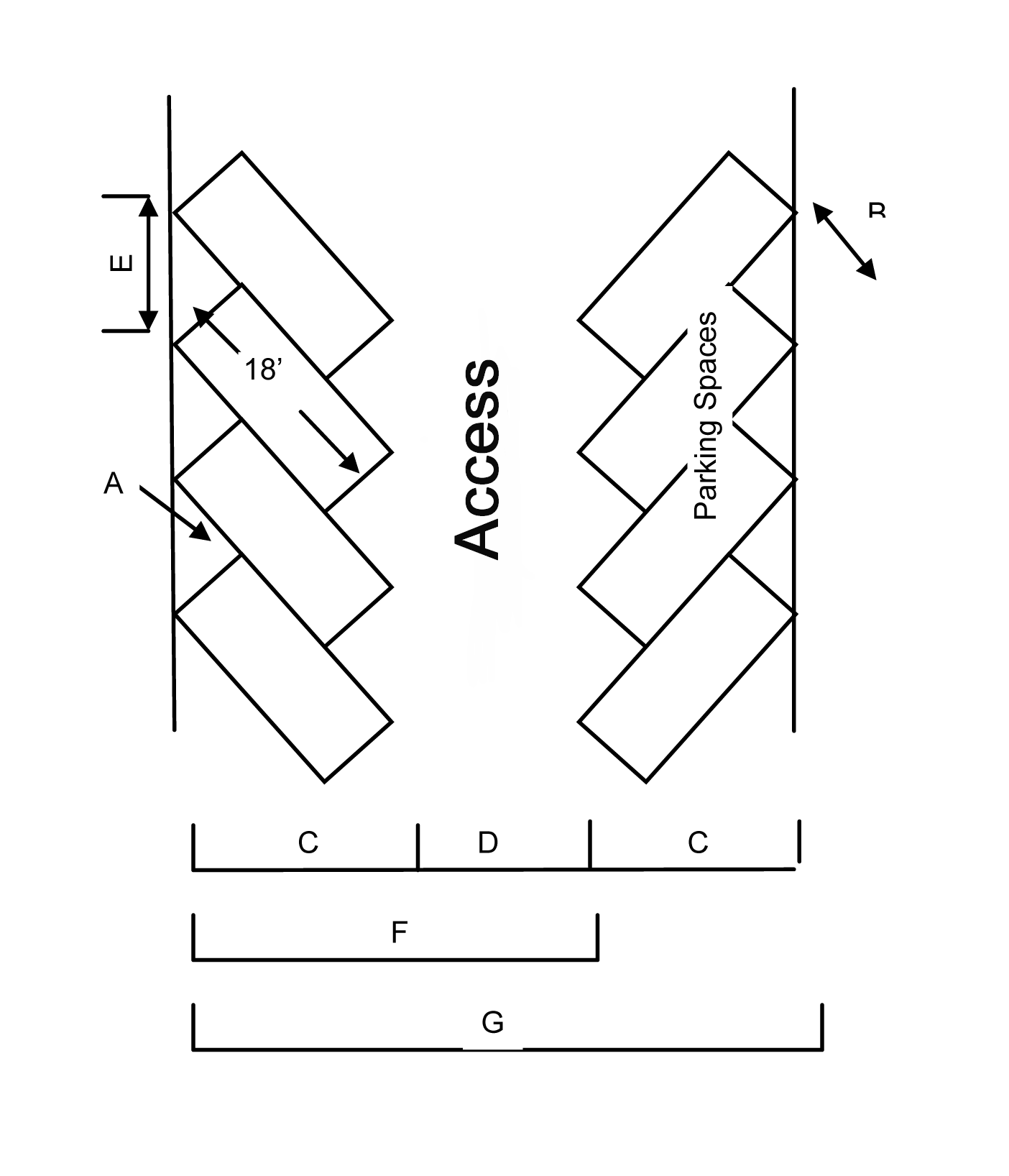
**Parallel parking shall be designed according to the following diagram. for additional parameters not described herein, refer to pages 53-57 of Architectural Graphic Standards, latest edition, The American Institute of Architects:
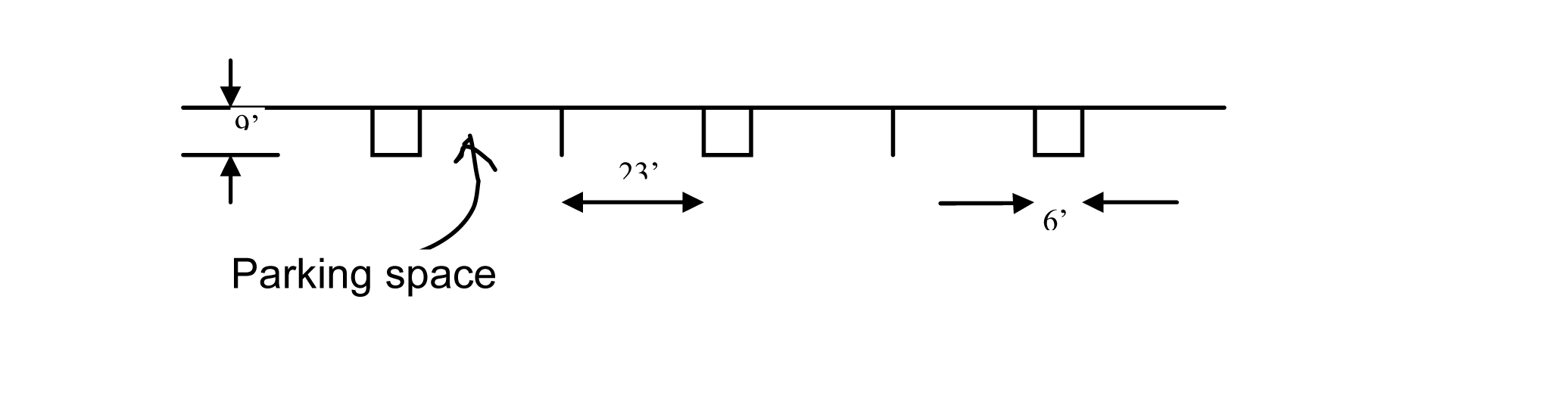
(Ord. No. 2005-005, § 4(080-160), 4-14-2005)
Sec. 080-170. - Access requirements for parking facilities.
(A)
Access to streets; restrictions. All required parking areas shall be directly accessible from a public or private street, alley, or recorded ingress and egress easement. All off-street parking areas shall be designed to permit safe maneuvering of vehicles, and each space shall be accessible without driving over or through any other parking space, except for one (1) family detached dwellings, two (2) family dwellings, and townhouses having a carport or garage as part of the dwelling unit. No parking space shall be designed to permit backout parking onto a public right-of-way, except a dedicated alley, nor shall parking spaces be located so as to require backing onto or across a sidewalk, pedestrian crosswalk or other area of high pedestrian concentration except for one (1) family detached and two (2) family dwellings and townhouses which have an attached carport or garage as part of the townhouse unit. Backout parking shall not be permitted in any case, on trafficways and non-trafficway collector roadways.
(B)
Access for vehicles other than automobiles. Parking facilities for structures intended for principal uses shall be made accessible to the following type of vehicles:
(1)
Residential uses, other than single family: Single unit truck (SU).
(2)
Commercial uses: Single Unit Truck and semitrailer (WB-40) combination intermediate.
(3)
Industrial use: Single Unit Truck (SU) and semitrailer-full trailer combination (WB-60).
Definitions of, and required specifications for, the above vehicle types shall be those found in AASHTO Geometric Highway Design.
(C)
Emergency vehicle access requirements.
(1)
When necessary for adequate accessibility for fire protection purposes, emergency access for fire rescue apparatus, equipment and operations shall conform to the requirements of the building code and the following additional requirements:
a.
Developments may be required to provide a minimum of two (2) separate and remote emergency access areas or lanes into the internal on-site circulation system of the development.
b.
Fire rescue emergency access roads shall be continuous and extend around the perimeter of the structures.
c.
Where possible, all elevations of a structure shall be accessible for fire rescue emergency use. In all cases, a minimum of two (2) elevations shall be made accessible.
d.
Emergency access areas or lanes, fire access roads, and fire lanes shall have a minimum vertical clearance of sixteen (16) feet and shall have a sign indicating the minimum vertical clearance.
e.
Emergency access areas or lanes, fire access roads, and fire lanes shall be maintained free of trees, bushes, or any other obstructions, and clearly designated for this purpose.
f.
In the event physical barriers are permitted by the fire marshal's office to block emergency access areas or lanes, such barriers shall be constructed in such a manner that they will immediately break-away in an emergency situation. The design of break-away barriers or any other physical barriers shall be approved by the fire marshal's office.
g.
Construction standards for emergency access areas or lanes are contained within section 080-220, "Construction standards."
(Ord. No. 2005-005, § 4(080-170), 4-14-2005)
Sec. 080-180. - Onsite and offsite circulation.
(A)
Offsite circulation design. A parking lot abutting a trafficway shall be designed for full circulation. A parking lot abutting a street other than a trafficway may be designed for partial circulation. Acceptable plans must illustrate that proper consideration has been given to the surrounding street plan, traffic volumes, proposed street improvements, vehicular street capacities, pedestrian movement and safety. Plans for adequate pedestrian movement shall include sidewalks that are accessible by disabled persons connecting the buildings and uses within the plot to existing or planned bus stops, bus bays, and bus shelters; and the roadway sidewalk adjacent to the project, where existing. In addition, where applicable, there shall be sidewalks that are accessible by disabled persons connecting the roadway sidewalk and the interior street system sidewalk or, in the case of multifamily residential or nonresidential development, between the roadway aislewalk and doorway entrances to the buildings. Where sidewalks cross streets and driving aisles, proper curb drops and pavement markings delineating the cross walk shall be installed.
(B)
On-site design requirements.
(1)
Car parking stalls, parking aisles, driveways, reservoir areas and entrances are the basic functional elements of the on-site circulation system. Additional elements, including, but not being limited to, perimeter roads, rear collector roads, service roads within the proposed development, left turning lanes, right turning lanes, traffic lights, and frontage roads in the public right-of-way immediately adjacent to the proposed development may also be required, pursuant to article 90 and this article.
(2)
Internal site circulation shall follow a functional classification and hierarchical design criteria to assure that the movements between the public right-of-way, which is the high-speed movement facility, and the parking stall, which is the terminal facility, are conducted in an efficient and orderly form. All streams of departing traffic from the parking stalls in a parking lot shall be assembled and delivered to an internal collector facility that combines them into a few concentrated streams which will then be connected to the public right-of-way at a few properly spaced access locations.
(3)
All required parking stalls shall have direct and unobstructed access from a parking aisle.
(4)
No parking stall shall directly abut a driveway.
(5)
All parking aisles shall connect to a driveway.
(6)
A parking lot which exceeds sixty (60) parking stalls shall be designed with at least one (1) two-way directional driveway loop system connecting the entrance to the parking stalls and the principal building. Other innovative designs may be approved.
(7)
Any off-street parking facility shall have either driveway approaches of sufficient width to allow for two (2) way traffic, or one (1) way driveways connected to aisles, parking areas or maneuvering areas in such a manner as to permit traffic to both enter and leave the property, facing forward, at the same time. A driveway which is only wide enough for one (1) way traffic shall not be used for two (2) way access.
(Ord. No. 2005-005, § 4(080-180), 4-14-2005)
Sec. 080-190. - Minimum separation requirements.
(A)
Nonresidential pedestrian walkways shall be at least ten (10) feet from any building wall which provides less than twenty (20) percent of clear, unobstructed glass in an imaginary band located between five (5) feet and five (5) feet, six (6) inches above the finished floor elevation, and extending the length of the facade along the sidewalk. The intent of this provision is to enhance safety by providing cross-visibility between pedestrians and building occupants.
(B)
Single-family residential driveways shall be separated from any property line by at least five (5) feet; provided that additional separation shall be required to accommodate drainage easements pursuant to the tertiary drainage plan. All other driveways, walkways, parking aisles and other pavement/impervious areas shall be separated from any building or structure by at least five (5) feet, and from any property line by at least ten (10) feet.
(Ord. No. 2005-005, § 4(080-190), 4-14-2005; Ord. No. 2006-14, § 6, 6-1-2006)
Sec. 080-200. - Striping and signage
(A)
Off-street parking. All off-street parking areas shall be so arranged and marked as to provide for orderly safe loading, unloading, parking and storage of vehicles with individual parking stalls clearly defined with directional arrows and traffic signs provided as necessary for traffic control.
(B)
Parking space designation. All required off-street parking spaces shall be clearly delineated by four (4) inch wide, white, painted striping wherever section 080-220, "Construction standards," requires a hard-paved or paved parking surface, with the exception of driveway parking spaces for one (1) family detached and two (2) family dwellings and townhouse dwellings that have an attached carport or garage as part of the townhouse unit. Parking stalls which abut landscaped areas, sidewalks, structures or property lines shall be designed with bumper guards, wheel stops or contiguous curbing. The required bumper guards and wheel stops shall be located a minimum of two and one-half (2½) feet from any landscaped area, sidewalk and property line. Curbing shall be also be located two and one-half (2½) feet from any sidewalk and property line, and if used in lieu of a wheel stop or bumper guard abutting a landscaped area, the two and one-half (2½) foot vehicle overhang area within the landscape area abutting the curb shall not count towards required landscape or pervious area.
(C)
Identification of parking lots. All off-street parking areas required by this article shall be provided with identification as to purpose and location in the form of signage visible to vehicular traffic when such parking areas are not clearly evident from a street or alley. Signage shall comply with the requirements of article 70, "Sign Regulations."
(Ord. No. 2005-005, § 4(080-200), 4-14-2005)
Sec. 080-210. - Landscaping.
Landscaping requirements for vehicular use areas are listed in section 075-070, "Nonresidential perimeter and vehicular use area landscape requirements."
(Ord. No. 2005-005, § 4(080-210), 4-14-2005)
Sec. 080-220. - Construction standards.
(A)
Drainage. All off-street parking facilities required by this article shall be drained so as not to cause any nuisances on adjacent or public property and shall be in accordance with the requirements of the appropriate enforcing agency.
(B)
Composition. Unless otherwise specifically permitted in subsection (C) of this section, the required off-street parking areas, access aisles and driveways shall be constructed of at least an eight (8) inch course of native limerock, surfaced with asphaltic concrete or Portland concrete for driveways and aisles, and six (6) inches for parking stalls. Brick or interlocking pavers may be utilized for one (1) family and two (2) family dwellings, and townhouses with attached carports or garages as parking and driveway facilities subject to execution of a restrictive covenant and agreement provided by the town for use of pavers in the right-of-way. The permitted paving surface shall be maintained in a smooth and well-graded condition. Off-street parking areas shall be designed to ensure safe and efficient traffic circulation. The parking facilities shall be of sufficient size to allow necessary functions for loading, unloading and parking maneuvers to be carried out on private property, and completely off the street right-of-way.
(C)
Grassed overflow parking.
(1)
Twenty-five (25) percent of the required off-street parking facilities may be provided through the use of grass parking for the following specific uses:
a.
Theaters and convention centers;
b.
Schools;
c.
Places of worship; religious facilities;
d.
Hospitals, category three (3) community residential facilities.
(2)
Fifty (50) percent of the required off-street parking facilities may be provided through the use of grass parking for the following specified uses:
a.
Stadiums and sports arenas;
b.
Racetracks, fairgrounds, circus grounds;
c.
Outdoor recreation establishments;
d.
Funeral homes, mortuaries, cemeteries;
e.
Outdoor flea market or swap meet.
(3)
Notwithstanding anything to the contrary herein, subject to the town council's approval during the site plan review process, up to one hundred (100) percent of the required off-street parking spaces for any use in the CF and ROS districts may be provided through the use of stabilized grass parking, subject to compliance with the Americans With Disabilities Act requirements, building code requirements, and approval of the engineering design by the town and the fire marshal. Parking access aisles, however, shall be paved unless the town council waives this requirement in whole or in part based upon the review and recommendation of the town engineer and the fire marshal. In considering whether to increase the allowable percentage of stabilized grass parking and/or to permit stabilized grass parking access aisles, the town council shall consider the following as they pertain to:
a.
Anticipated wear and tear;
b.
Ease of navigation;
c.
Delineation of parking spaces and parking access;
d.
The type of use the parking will serve;
e.
The frequency of the use;
f.
The anticipated traffic volume;
g.
The types of vehicles that will utilize the facility; and
h.
The impact on the surrounding community.
(4)
The town council may require the hours and/or days of operation of any CF or ROS district use seeking increased grassed parking area pursuant to subsection (C)(3) of this section, to be recorded as a covenant running with the land.
(5)
Required off-street parking facilities for buildings and uses in agricultural and rural zoning districts may be provided through the use of grass parking.
(6)
Grass parking surfaces shall conform to town specifications, which includes at least an eight (8) inch course of natural limerock, surfaced with a species of grass acceptable for high-traffic use, with a six (6) inch course allowed for parking stalls. All requirements for landscaping vehicular use areas shall be met as well as all required interior-landscaping requirements for parking areas. Grass parking areas shall not count toward satisfying any landscaping area required by article 75, nor the pervious area requirements of each zoning district.
(D)
Curbing. Except for one (1) family dwellings, all parking and loading areas shall be constructed with a six (6) inch raised curb, bumper blocks or, adjacent to landscape areas, landscape timbers. All parking islands and landscape strips shall be installed with continuous curbing or landscape timbers to prevent damage to the plant material and the displacement of topsoil and mulch. Curbing and permitted alternatives shall be located along sidewalks, safety islands, driveways, sight distance triangles, and other places as needed, unless determined to be unnecessary by a finding of the town that given the particular circumstances of the site, such curb or alterative can be eliminated in certain areas without creating safety hazards. The raised curb shall be constructed in such a manner as to prevent vehicles from crossing sidewalks or other pedestrian walkways, other than by means of an approved driveway approach.
(E)
Emergency access areas or lanes construction standards.
(1)
Emergency access areas or lanes, fire access roads, or fire lanes shall be designed to accommodate fire apparatus weighing a minimum of thirty-two (32) tons and shall be surfaced with solid pavement, or natural or concrete stones, or grass turf reinforced by concrete grids, or stabilized subgrade covered with eight (8) inches of limerock and covered with grass turf. Fire rescue apparatus shall be considered, at a minimum, as a WB-40 as defined by the AASHTO Geometric Highway Design.
(2)
When emergency access areas or lanes are designed to enhance "green areas," by not using solid pavement, the areas or lanes shall be clearly designated and properly marked.
(3)
With the exception of one (1) story single-family dwellings, buildings and structures that do not have adequate accessibility for fire protection purposes shall provide laddering areas designated for fire rescue emergency use conforming to the following, as required by the building code, and the following additional requirements:
a.
Surface construction of laddering areas shall be capable of meeting the needs of vehicles considered as WB-40 as defined by the AASHTO Geometric Highway Design.
b.
Laddering areas shall be constructed with no vertical obstructions.
c.
Laddering areas shall be clearly designated and properly marked as specified by the fire marshal's office.
d.
Laddering area surfaces shall be a minimum of fifteen (15) feet in width or as determined by the fire marshal.
(F)
Storage lots for vehicles, boats and equipment. All open-air storage lots for vehicles, boats or trucks located in a commercial zoning district shall be surfaced with asphalt or concrete. All open air storage lots for commercial vehicles, heavy equipment or other motor-driven equipment in an industrial zoning district may be on a nonpaved surface, provided the same is compacted, stabilized and dust-free.
(Ord. No. 2005-005, § 4(080-220), 4-14-2005)

