
Spring Park City Zoning Code
ARTICLE I
- IN GENERAL
Sec. 42-1. - Title.
This chapter shall be known as the "Spring Park Zoning/Shoreland Ordinance", except as referred to herein, where it shall be known as "this chapter".
(Ord. No. 62, § 1(Subd. A), 9-13-1993)
Sec. 42-2. - Statutory authorization.
This chapter is adopted pursuant to the authorization and policies contained in Minn. Stat. chapter 103F; Minnesota Rules, parts 6120.2600 through 6120.3900; and the planning and zoning enabling legislation in Minn. Stat. chapter 462.
(Ord. No. 62, § 1(Subd. B), 9-13-1993)
Sec. 42-3. - Intent and purpose.
The intent of this chapter is to protect the public health, safety, and general welfare of the community and its people through the establishment of minimum regulations governing land development and use. This chapter shall divide the city into use districts and establish regulations in regard to location, erection, construction, reconstruction, alteration and use of structures and land. Such regulations are established to protect such use areas; to regulate the uncontrolled use of shorelands which contribute to pollution of public waters and thus preserve and enhance the quality of surfacewaters; to conserve the economic and natural environmental values of shorelands; to provide for the wise use of waters and related land resources; to promote orderly development; to provide adequate light, air and convenience of access to property; to prevent congestion in the public right-of-way; to prevent overcrowding of land and undue concentration of structures by regulating land, buildings, yards and density of population; to provide for compatibility of different land uses; to provide for the administration of this chapter; to provide for amendments; to prescribe penalties for violation of such regulations; and to define powers and duties of the city staff, the board of adjustment and appeals, and the city council in relation to the zoning ordinance.
(Ord. No. 62, § 1(Subd. C), 9-13-1993)
Sec. 42-4. - Jurisdiction.
The provisions of this chapter shall also apply to all the land within the corporation boundaries of Spring Park and to the shorelands of the public water bodies as classified in section 42-251.
(Ord. No. 62, § 1(Subd. D), 9-13-1993)
Sec. 42-5. - Relation to comprehensive plan.
It is the policy of the city that the enforcement, amendment, and administration of this chapter be accomplished with due consideration of the recommendations contained in the comprehensive plan as developed and amended from time to time by the city council of the city. The council recognizes the comprehensive plan as the policy guide responsible for regulation of land use and development in accordance with the policies and purpose herein set forth. In the event of any conflict between the provisions of this chapter and the comprehensive plan, the provisions of this chapter shall control.
(Ord. No. 62, § 1(Subd. E), 9-13-1993)
Sec. 42-6. - Minimum requirements.
(a)
Where the conditions imposed by any provision of this chapter are either more or less restrictive than comparable conditions imposed by other ordinance, rule or regulation of the city, the ordinance, rule or regulation which imposes the more restrictive condition, standard, or requirement shall prevail. The zoning administrator shall determine which is more "restrictive" and appeals from such determination may be made in the manner provided herein.
(b)
In their interpretation and application, the provisions of this chapter shall be held to be the minimum requirements for the promotion of the public health, safety, and welfare, and shall not be deemed a limitation or repeal of any other powers granted by state statutes.
(Ord. No. 62, § 1(Subd. F), 9-13-1993)
Sec. 42-7. - Conformance with this chapter.
(a)
No structure shall be erected, converted, enlarged, reconstructed or altered, and no structure or land shall be used for any purpose nor in any manner which is not in conformity with the provisions of this chapter.
(b)
The use of any shoreland of public waters; the size and shape of lots; the use, size, type, and location of structures on lots; the installation and maintenance of water supply and waste treatment systems, the grading and filling of any shoreland areas; the cutting of shoreland vegetation; and the subdivision of land shall be in full compliance with the terms of this chapter and other applicable regulations.
(c)
Except as herein provided, no building, structure, or premises shall hereafter be used or occupied and no building permit shall be granted that does not conform to the requirements of this chapter.
(Ord. No. 62, § 1(Subd. G), 9-13-1993)
Sec. 42-8. - Enforcement.
The zoning administrator is responsible for the administration and enforcement of this chapter. Any violation of the provisions of this chapter or failure to comply with any of its requirements (including violations of conditions and safeguards established in connection with grants of variances or conditional uses) shall constitute a misdemeanor and shall be punishable as provided in article VII.
(Ord. No. 62, § 1(Subd. H), 9-13-1993)
Sec. 42-9. - Uses not provided for within zoning districts.
Whenever in any zoning district a use is neither specifically permitted nor prohibited, the use shall be considered prohibited. In such case, the city council, on its own initiative or upon request, may conduct a study to determine if the use is acceptable and if so, what zoning district would be most appropriate and to determine the conditions and standards relating to development of the use. The city council or property owner, upon receipt of the staff study, shall, if appropriate, initiate an amendment to the zoning ordinance to provide for the particular use under consideration or the city council shall find that the use is not compatible for development within the city.
(Ord. No. 62, § 1(Subd. I), 9-13-1993)
Sec. 42-10. - Rules.
The language set forth in the text of this chapter shall be interpreted in accordance with the following rules of construction:
(1)
The singular number includes the plural, and the plural the singular.
(2)
The present tense includes the past and the future tenses, and the future the present.
(3)
The word "shall" is mandatory while the word "may" is permissive.
(4)
The masculine gender includes the feminine and neuter.
(5)
Whenever a word or term defined hereinafter appears in the text of this chapter, its meaning shall be construed as set forth in such definition thereof.
(6)
All measured distances expressed in feet shall be the nearest tenth of a foot.
(Ord. No. 62, § 1(Subd. J), 9-13-1993)
Sec. 42-11. - Separability.
It is hereby declared to be the intention of the city that the several provisions of this article are separate in accordance with the following:
(1)
If any court of competent jurisdiction shall adjudge any provision of this chapter to be invalid, such judgment shall not affect any other provision of this chapter not specifically included in said judgment.
(2)
If any court of competent jurisdiction shall adjudge invalid the application of any provision of this chapter to a particular property, building, or other structure, such judgment shall not affect the application of said provision to any other property, building, or structure not specifically included in said judgment.
(Ord. No. 62, § 1(Subd. K), 9-13-1993)
Sec. 42-12. - Abrogation and greater restrictions.
It is not intended by this chapter to repeal, abrogate, or impair any existing easements, covenants, or deed restrictions. However, where this chapter imposes greater restrictions, the provisions of this chapter shall prevail. All other ordinances inconsistent with this chapter are hereby repealed to the extent of the inconsistency only.
(Ord. No. 62, § 1(Subd. L), 9-13-1993)
Sec. 42-13. - Comprehensive revision.
The council intends this chapter to be a comprehensive revision to the Spring Park Zoning Ordinance, as amended. Except as otherwise provided herein, the provisions of this chapter are not intended to alter, diminish, or increase or otherwise modify any rights or liabilities existing on its effective date. Any act done, offense committed, or rights accruing or accrued, or liability, penalty incurred or imposed prior to the effective date of this chapter is not affected by its enactment.
(Ord. No. 62, § 1(Subd. M), 9-13-1993)
Sec. 42-15. - Repeal.
The previous Ordinance 56, Spring Park Zoning Ordinance, as amended, is hereby repealed and replaced by this chapter.
(Ord. No. 62, § 1(Subd. N), 9-13-1993)
Sec. 42-15. - Fees, escrows, and expenses.
(a)
Fees and escrows, as well as expenses incurred by the city for engineering, planning, attorney, and other services related to the processing of applications shall be established by this zoning chapter and collected by the zoning administrator for deposit in the city's accounts. Fees/escrows shall be established as follows. The council may establish charges for public hearings, special meetings, or other such council or planning commission actions as are necessary to process applications.
(b)
Such fees and escrows shall be collected prior to city action on any application. All such applications must be accompanied by a Spring Park "General Land Use Application" which is an agreement between the city and the applicant/landowner (when the applicant is not the same person or entity as the landowner, both the landowner and the applicant must sign the application) whereby the applicant/landowner agrees to pay all applicable fees, escrows, administrative, planning, engineering, and legal expenses associated with the review and processing of the development application. If these expenses exceed the application escrow. This agreement allows the city to assess the above fees, escrows, and expenses against the landowner if such monies are not paid within 30 days after a bill is sent to the applicant/landowner. Escrow funds received in excess of review expenses shall be returned to the applicant/landowner.
(c)
These fees shall be in addition to sewer access charges, water access charges, building permit fees, inspection fees, subdivision fees, escrows, and expenses and other such fees, escrows, and expenses currently required by ordinance or which may be established by ordinance in the future.
(Ord. No. 62-16, § 1, 12-4-2006)
Sec. 42-16. - Temporary family health care dwellings
Pursuant to authority granted by Minn. Stat., § 462.3593, subd. 9, the city opts-out of the requirements of Minn. Stat. § 462.3593, which defines and regulates temporary family health care dwellings.
(Ord. No. 16-02, § 1, 8-15-2016)
Sec. 42-35. - A.
Accessory building or use. A secondary building or use that is located upon the same lot on which the main building or use is situated and which is incidental to the conduct of the primary use of such main building or use.
Accessory equipment. Equipment that is located upon the same lot on which a main building or use is situated and is reasonably necessary and incidental to the conduct of the primary use of such main building or use.
Alley. A public or private right-of-way primarily designed to serve as secondary access to the side or rear of those properties whose principal frontage is on a street.
Alternative energy system. A ground source heat pump, wind or solar energy system.
Animals, domestic. For the purpose of this chapter, a domestic animal shall be defined as house pets such as dogs, cats, and birds, which can be contained within a principal structure throughout the entire year, provided that containment can be accomplished without special modification to the structure requiring a building permit from the city. In addition, it includes birds and rabbits normally sheltered outside of the home.
Antenna. Any of the below described uses requiring an antenna shall be subject to the regulations of this Ordinance and more specifically subsection 42-64(k) and section 42-75 herein.
(1)
Antenna, personal wireless service. A device consisting of metal, carbon fiber, or other electromagnetically conducive rods or elements, usually arranged in a circular array on a single supporting pole or other structure, and used for the transmission and reception of wireless communication radio waves including cellular, personal communication service (PCS), enhanced specialized mobilized radio (ESMR), paging and similar services.
(2)
Antenna, public or commercial radio and television, broadcast transmitting. A wire, set of wires, metal or carbon fiber rod or other electromagnetic element used to transmit public or commercial broadcast radio, or television programming.
(3)
Antenna, public utility microwave. A parabolic dish or cornucopia shaped electromagnetically reflective or conductive element used for the transmission and/or reception of point to point UHF or VHF radio wave in wireless telephone communications.
(4)
Antenna, radio and television receiving. A wire, set of wires, metal or carbon fiber element(s), other than satellite dish antennas, used to receive radio, television, or electromagnetic waves.
(5)
Antenna, satellite dish. A device incorporating a reflective surface that is solid, open mesh or bar configured and is in the shape of a shallow dish, cone, horn, or cornucopia. Such device is used to transmit and/or receive radio or electromagnetic waves between terrestrially and/or orbitally based uses. This definition shall include, but not be limited to, what are commonly referred to as satellite earth stations, TVROs (television, receive only) and satellite microwave.
(6)
Antenna, short-wave radio transmitting and receiving. A wire, set of wires or a device, consisting of a metal, carbon fiber, or other electromagnetically conductive element used for the transmission and reception of radio waves used for short-wave radio communications.
(7)
Antenna, accessory. Accessory antennas are radio and television receiving antennas, satellite dishes, and short-wave radio transmitting and receiving antennas that are accessory to the principal use of the property on which they are located.
Antenna support structure. Any building or other structure other than a tower which is used or intended for use for location of antennas.
Antenna tower. A self-supporting lattice, guyed or monopole structure constructed from grade which supports antennas. The term "Antenna Tower" shall not include amateur radio operators' equipment, as licensed by the FCC.
Apartment. A room or suite of rooms which is designed for, intended for, or occupied as a residence by a single family or individuals, and is equipped with cooking and sanitation facilities. Includes dwelling unit and efficiency unit.
Aquifer recharge areas. All land surface areas which by nature of their surface and/or subsurface characteristics contribute to the replenishment of subsurfacewater supplies.
Artificial obstruction. Any obstruction which is not a natural obstruction (see obstruction).
Automobile repair, major. General repair, rebuilding or reconditioning of engines, motor vehicles or trailers; collision service, including body, frame or fender straightening or repair; overall painting or paint job; vehicle steam cleaning.
Automobile repair, minor. Minor repairs, incidental body and fender work, painting and upholstering, replacement of parts and motor services to passenger automobiles and trucks not exceeding 12,000 pounds gross weight, but not including any operation specified under "Automobile repair, major".
Automobile or trailer sales area. An open area, other than a street, used for the display, sale or rental of new or used motor vehicles or trailers in operable condition and when no repair work is done.
Automobile wrecking or junk yard. Any place where two or more vehicles not in running condition and/or not licensed, or parts thereof, are stored in the open and are not being restored to operation or any land, building or structure used for wrecking or storing of such motor vehicles or parts thereof; and including any commercial salvaging and scavenging of any other goods; articles or merchandise.
Awning. A temporary hood or cover which projects from the wall of a building and of a type which can be retracted, folded or collapsed against the face of a supporting building.
(Ord. No. 62, § 2(Subd. A), 9-13-1993; Ord. No. 62.07, § 1, 8-17-1998; Ord. No. 13-02, § 1, 9-16-2013; Ord. No. 14-02, § 1, 6-16-2014)
Sec. 42-36. - B.
Balcony. An elevated landing or porch projecting from the wall of a building, and which may also provide egress or ingress.
Banners. Attention getting devices which resemble flags and are of a paper, cloth, or plastic-like consistency.
Basement. A portion of a building located partially underground, but having less than one-half its floor to ceiling height below the average land grade.
Block. That property abutting on one side of a street and lying between the two nearest intersecting or intercepting streets or railroad rights-of-way or unsubdivided acreage.
Bluff. A topography feature such as a hill, cliff, or embankment having the following characteristics (an area with an average slope of less than 18 percent over a distance of 50 feet or more shall not be considered part of the bluff):
(a)
Part of all of the feature is located in a shoreland area.
(b)
The slope rises at least 25 feet above the ordinary high-water level of the waterbody.
(c)
The grade of the slope from the toe of the bluff to a point 25 feet or more above the ordinary high-water level averages 30 percent or greater.
(d)
The slope must drain toward the waterbody.
Bluff impact zone. A bluff and land located within 20 feet from the top of a bluff.
Board. The Zoning Board of Appeals of the city.
Boarding house. A building other than a hotel where, for compensation and by prearrangement for definite periods, meals, or lodgings and meals are provided to three or more persons, not of the principal family therein, pursuant to previous arrangements, but not including a building providing these services for more then ten persons.
Boulevard. The portion of a street right-of-way not occupied by pavement.
Brewery. Manufactures, processes and warehouses beer for wholesale distribution in off-sale packages to retail liquor establishments and may retail beer product for on-site consumption in a taproom or for off-site consumption as growlers. A brewer may not have an ownership interest in a brewery licensed under Minn. Stat. § 34-A.409, subd. 6, clause (d).
Brewpub. A restaurant-brewery that sells 85 percent or more of its beer on-site. The beer is brewed primarily for sale in the restaurant and bar, and may be dispensed directly from the brewery's storage tanks. Brewpubs may also sell beer for off-sale consumption in growler containers.
Buildable area. The portion of a lot remaining after required yards have been provided.
Building. Any structure used or intended for supporting or sheltering any use or occupancy.
Building height. A distance to be measured from the mean ground level to the top of a flat roof, to the mean distance of the highest gable on a pitched or hip roof, to the deck line of a mansard roof, to the uppermost point on all other roof types.
Building line. A line measured across the width of the lot at the point where the principal structure is permitted in accordance with setback provisions.
Business. Any establishment, occupation, employment or enterprise where merchandise is manufactured, exhibited or sold, or where services are offered for compensation.
(Ord. No. 62, § 2(Subd. B), 9-13-1993; Ord. No. 16-03, § 1, 10-17-2016)
Sec. 42-37. - C.
Carport. A canopy constructed of metal or other materials supported by posts either ornamental or solid and completely open on three sides.
Cellar. That portion of a building having more than one-half of the floor-to-ceiling height below the average land grade.
Channel. A natural or artificial depression of perceptible extent, with definite bed and banks to confine and conduct water either continuously or periodically.
Church. A building, together with its accessory buildings and uses, where persons regularly assemble for religious worship and which building, together with its accessory buildings and uses, is maintained and controlled by a religious body organized to sustain public worship.
City. The incorporated City of Spring Park, Hennepin County, State of Minnesota.
Club or lodge. A nonprofit association of persons who are bona fide members paying annual dues, use of premises being restricted to members and their guests.
Commercial use. The principal use of land or buildings for the sale, lease, rental, or trade of products, goods, and services.
Commission. The Planning and Zoning Commission of the City of Spring Park, Minnesota.
Commissioner. The commissioner of the department of natural resources.
Comprehensive plan. The group of maps, charts and text that make up the comprehensive long-range plan of the city.
Conditional use. A use which, although possibly compatible with the basic use classification of a particular zone, is not permitted to be located as a matter of right in every area included within the zone because of:
(a)
Hazards inherent in the use.
(b)
Specific problems which its proposed location may present.
(c)
Specific threats to the health, safety or general welfare of the community, or surrounding area.
(d)
Inability of the use to fully comply with the comprehensive plan.
Conditional use permit. A permit issued by the council in accordance with the procedures specified in this chapter setting forth the conditions and restrictions which must be complied with before a conditional use may be created and the restrictions under which such conditional use will be allowed to continue.
Condominium, commercial-industrial. A commercial and/or industrial structure containing individually owned work areas and jointly owned and shared facilities. This structure shall be subject to the provisions of the Uniform Condominium Act, Minn. Stat. §§ 515.A.1-101 through 515.A.4-118, as may be amended.
Condominium, residential. A multiple dwelling containing dwelling units designed for individual ownership and jointly owned and shared areas and facilities, which dwelling is subject to the provisions of the Uniform Condominium Act, Minn. Stat. §§ 515.A.1-101 through 515.A.4-118, as may be amended.
Convalescent home. A home designed and licensed to provide care for aged or infirmed persons requiring or receiving personal care or custodial care complying with the standards established by the Minnesota State Board of Health.
Convenience food establishments. A retail establishment which primarily serves food in or on disposable containers for consumption on and off the premises.
Cooperative (housing). a multiple-family dwelling owned and maintained by the residents and subject to provisions of either Minn. Stat. chapter 308. Cooperative Associations; or Minn. Stat. chapter 317, Non-Profit Corporations; as they may be amended.
Council. The City Council of Spring Park, Minnesota.
Court. An open, unoccupied and unobstructed space, other than a yard on the same lot with a building or group of buildings.
(Ord. No. 62, § 2(Subd. C), 9-13-1993)
Sec. 42-38. - D.
Day care facilities. Any facility, public or private, which for gain or otherwise, regularly provides one or more unrelated persons with care, training, supervision, habitation, rehabilitation, or development guidance on a regular basis for a period of less than 24 hours per day, in a place other than the person's own home and subject to the provisions of Minn. Stat. § 245.781, as may be amended. Day care facilities include, but are not limited to, family day care homes, group family day care homes, day care centers, day nurseries, nursery schools, daytime activity centers, day treatment programs and day services.
Deck/balcony. A horizontal, unenclosed platform with or without attached railings, seats, trellises, or other features, attached or functionally related to a principal use.
Department store. A business that is conducted under a single owner's name wherein a variety of unrelated merchandise and services are housed and are exhibited and sold directly to the customer for whom the goods and services are furnished.
Deposition. Any rock, soil, gravel, sand or other material deposited naturally or by man into a waterbody, watercourse, floodplain or wetland.
Derelict vehicles: Any motorized vehicle, trailer, watercraft, or recreational vehicle that meets any of the following criteria: unlicensed; inoperable (immediate startup and moving under its own power); unmaintained related to the condition of the vehicles appearance and immediate operation; vehicles used as storage containers. This requirement does not intend to prohibit the outdoor storage of antique or classic cars that are in good repair, are covered, and holding a pioneer, collector, classic, or street rod vehicle license from the State of Minnesota, pursuant to Minn. Stat. § 168.10.
District. A section or sections of the city for which the regulations and provisions governing the use of buildings and lands are uniform for each class of use permitted therein.
Diversion. A channel that intercepts surfacewater runoff and that changes the accustomed course of all or part of a stream.
Dock. A structure extending into navigable waters used for landing and mooring of watercraft.
Dock, commercial. A dock or dock structure owned and operated in conjunction with a commercial or other revenue-producing business enterprise, including private clubs.
Dock, multiple. A dock or combination of docks, or a mooring area occupying more than 50 percent of the authorized dock use area, or a dock or mooring area for the use of five or more watercraft.
Dock, transient. A commercial dock in which any overnight mooring is prohibited. Commercial dock facilities characterized by a high turnover rate, associated with lakeshore commercial activities such as restaurants and taverns.
Draining. The removal of surfacewater or groundwater from land.
Dredging. To enlarge or clean out a waterbody, watercourse, or wetland.
Drive-in establishment. An establishment that accommodates the patron's automobile from which the occupants may receive a service or in which products purchased from the establishment may be consumed.
Dwelling. A building, or portion thereof, designated exclusively for residential occupancy, including one family, two-family, and multiple dwellings, but not including hotels, motels, and boarding houses.
Dwelling, mobile home. A detached dwelling unit designed for transportation on streets or highways on its own wheels or on flatbed or other trailers, and arriving at the site where it is to be occupied as a dwelling complete and ready for occupancy except for minor and incidental unpacking and assembly operations, location on jacks or other temporary or permanent foundations, connections to utilities, and the like. A travel trailer is not to be considered a mobile home.
Dwelling, multiple (apartment). A building designed with three or more dwelling units exclusively for occupancy by three or more families or groups of individuals living independently of each other, but sharing hallways and main entrances and exits (see Family).
Dwelling, single-family. A dwelling unit designed exclusively for occupancy by one family. A single-family dwelling may be either:
(a)
Attached. A dwelling which is joined to another at one or more sides by a party wall; or
(b)
Detached. A dwelling unit not attached to another dwelling or structure.
Dwelling, two-family. A dwelling designed exclusively for occupancy by two families living independently of each other. A two-family dwelling may be either a:
(a)
Double bungalow. A two-family dwelling with two units side-by-side; or
(b)
Duplex. A two-family dwelling with one unit above the other.
Dwelling unit. A residential building or portion thereof intended for occupancy by a family, but not including hotels, motels, nursing homes, seasonal cabins, boarding or rooming houses, tourist homes, or trailers.
(Ord. No. 62, § 2(Subd. D), 9-13-1993; Ord. No. 17-05, § 1, 11-20-2017)
Sec. 42-39. - E.
Earth-sheltered dwelling unit. A structure which complies with applicable building standards and which is constructed so that:
(a)
Eighty percent or more of the roof area is covered with a minimum depth of 12 inches of earth.
(b)
Fifty percent or more of the wall area is covered with a minimum depth of 12 inches of earth.
Easement. A grant by a property owner for the use of a portion of land for the benefit of others, including, but not limited to, grants for the purpose of constructing and maintaining drives, utilities, wetlands, ponding areas, sanitary sewer, water mains, electric lines, telephone lines, storm sewer or storm drainageways and gas lines. Easements are included when calculating lot area for both benefitted and burdened lots.
Elderly (senior citizen) housing. A publicly-owned or -controlled multiple dwelling building with open occupancy limited to persons over 60 years of age.
(a)
The dwelling units must be publicly owned and controlled to insure that this housing is maintained for the elderly population and will not be converted for general-population occupancy.
(b)
Public control includes any agreement with government agencies or government housing financing or subsidy programs where such agreement limits occupancy of the building to persons over 60 years of age.
Efficiency apartment. A dwelling unit consisting of one principal room exclusive of bathroom, hallway, closets, or dining alcove.
Essential services. The erection, construction, alteration, or maintenance by private or public utilities or the city of underground or overhead telephone, gas, electrical, communication, water or sewer transmission, distribution, collection, supply or disposal systems including poles, wires, mains, drains, sewers, pipes, conduits, cables, fire alarm boxes, police call boxes, traffic signals, hydrants and other similar equipment and accessories in connection therewith for the furnishing of adequate service by such private or public utilities or municipal departments, but not including buildings. Personal wireless service and commercial broadcasting antennas and towers shall not be considered an essential service.
(Ord. No. 62, § 2(Subd. E), 9-13-1993; Ord. No. 62.07, § 1, 8-17-1998)
Sec. 42-40. - F.
Family. A person living alone or any of the following groups, provided that the members of the group live together within a single dwelling unit and do not exceed the maximum occupancy limits of the city code and/or state building code:
(a)
An individual plus one or more persons related by blood, marriage, adoption, guardianship or other duly-authorized custodial relationship, including foster children and bona fide domestic servants employed on a full-time basis by the family in the dwelling unit; or
(b)
Two unrelated people and any children related to either of them; or
(c)
One or more persons occupying a premises, subject to a limit of not more than four unrelated persons 18 years of age or older; or
(d)
Group residential facilities having six or fewer residents licensed by the Minnesota Department of Human Services or the Minnesota Department of Corrections.
Fence. Any partition, structure, landscape hedge, wall or gate erected as a dividing marker, barrier, or enclosure.
Fence, boundary line. All fences located within five feet of a property line.
Fence, interior yard. All fences located more than five feet from a property line.
Filling. The act of depositing any rock, soil, gravel, sand or other material so as to fill or partly fill a waterbody, watercourse, wetland, lot or building site.
Floodplain. The areas adjoining a watercourse which have been or hereafter may be covered by the regional flood.
Floor area. The sum of the gross horizontal areas of the several floors of the building or portion thereof devoted to a particular use, including accessory storage areas located within selling or working space such as counters, racks or closets, and any basement floor area devoted to retailing activities, to the production or processing of goods, or to business or professional offices. However, the floor area shall not include basement floor area other than area devoted to retailing activities; the production or processing of goods; or to business or professional offices.
Footcandle (fc). A unit of measure of illuminance. A unit of illuminance on a surface that is one foot from a uniform point source of light of one candle and equal to one lumen per square foot.
(Ord. No. 62, § 2(Subd. F), 9-13-1993; Ord. No. 62-17, § 1, 11-5-2007; Ord. No. 11-07, § 1, 12-19-2011)
Sec. 42-41. - G.
Garage, private. An accessory building or accessory portion of the principal building which is intended for and used to store the private passenger vehicles or recreational vehicles of the family or families resident upon the premises, and in which no business service or industry is carried on.
General development lake. General development lakes are generally large, deep lakes or lakes of varying sizes and depths, with high levels and mixes of existing development. These lakes often are extensively used for recreation and, except for the very large lakes, are heavily developed around the shore. Second and third tiers of development are fairly common. The latter examples in this class can accommodate additional development and use. For purposes of this chapter, Lake Minnetonka is declared to be a general development lake.
Glare. The sensation produced by lighting that causes discomfort or loss in visual performance and visibility to the eye.
Grade (adjacent ground elevation). The lowest point of elevation of the finished surface of the ground, paving or sidewalk within the area between the building and the property line, or when the property line is more than five feet from the building, between the building and a line five feet from the building.
Grading. Changing the natural or existing topography of land.
Ground source heat pump system related:
(a)
Closed loop ground source heat pump system. A system that circulates a heat transfer fluid, typically food-grade antifreeze, through pipes or coils buried beneath the land surface or anchored to the bottom in a body of water.
(b)
Ground source heat pump system. A system that uses the relatively constant temperature of the earth or a body of water to provide heating in the winter and cooling in the summer. System components include open or closed loops of pipe, coils or plates; a fluid that absorbs and transfers heat; and a heat pump unit that processes heat for use or disperses heat for cooling; and an air distribution system.
(c)
Horizontal ground source heat pump system. A closed loop ground source heat pump system where the loops or coils are installed horizontally in a trench or series of trenches no more than 20 feet below the land surface.
(d)
Heat transfer fluid. A non-toxic and food grade fluid such as potable water or aqueous solutions commonly used as coolants.
(e)
Open loop ground source heat pump system. A system that uses groundwater as a heat transfer fluid by drawing groundwater from a well to a heat pump and then discharging the water over land, directly in a water body or into an injection well.
(f)
Vertical ground source heat pump system. A closed loop ground source heat pump system where the loops or coils are installed vertically in one or more borings below the land surface.
Group care facility. A facility which provides resident services to seven or more individuals of whom one or more are unrelated. These individuals are handicapped, aged, or disabled, are receiving care, treatment, or rehabilitation, and are provided services to meet their needs. Category includes uses such as homes for the physically handicapped, mentally retarded, chemically dependent, and half-way houses.
Guest room. A room occupied by one or more guests for compensation and in which no provision is made for cooking, but not including rooms in a dormitory for sleeping purposes primarily.
(Ord. No. 62, § 2(Subd. G), 9-13-1993; Ord. No. 62-17, § 1, 11-5-2007; Ord. No. 13-02, § 1, 9-16-2013)
Sec. 42-42. - H.
Home occupations. Any occupation or profession engaged in by the occupants of the dwelling or accessory building when conducted within said dwelling or accessory building, or when conducted upon a parcel of land containing the dwelling unit, provided that evidence of the occupation is not visible from the street. The acts of gardening in such a parcel shall be included therein, but excepted from the requirement that it not be visible from the street. In cases of home occupation as defined herein, there shall be no over-the-counter sale of merchandise produced off the premises, except for those products that are not marketed and sold in a wholesale or retail outlet; examples of such products include, but are not limited to, the following: Avon, Fuller Brush, and Shakley products. In no instances shall the home occupation adversely affect the character or the uses permitted in the zoning district in which the property is located.
Hotels. Any building or portion thereof where lodging is offered to transient guests for compensation and in which there are more than five sleeping rooms, with no cooking facilities in individual lodging rooms.
(Ord. No. 62, § 2(Subd. H), 9-13-1993; Ord. No. 13-01, § 1, 3-18-2013)
Sec. 42-43. - I.
Impervious surface. Any structure or surface which interferes to any degree with the direct absorption of water into the ground, including, but not limited to roofs, sidewalks, paved and unpaved driveways and parking areas, patios, tennis courts, swimming pools, or any other similar surface.
Individual sewage disposal system. A septic tank, seepage tile sewage disposal system, or any other approved sewage treatment device.
Intensive vegetation clearing. The complete removal of trees or shrubs in a contiguous patch, strip, row, or block.
Interim use. A temporary use of property until a particular date, until the occurrence of a particular event, or until zoning regulations no longer allow said use.
Interim use permit. A permit issued by the council in accordance with the procedures specified in this chapter setting forth the conditions and restrictions which must be complied with before an interim use may be created, the restrictions under which such interim use will be allowed to continue, and the date, event, or change to zoning regulation which will result in termination of said use.
Intermittent drainageway. A stream or portion of a stream that flows only in direct response to precipitation.
(Ord. No. 62, § 2(Subd. I), 9-13-1993; Ord. No. 20-04, § 1, 12-21-2020)
Sec. 42-44. - J.
Junk or refuse. Any scrap, waste, reclaimable material or debris, whether or not stored or used in conjunction with dismantling, processing, salvaging, storing, baling, disposal or other use or disposition. Junk includes, but is not limited to, unlicensed vehicles or RVs, inoperable vehicles or RVs, derelict vehicles or RVs, unmaintained vehicles or RVs, tires, vehicle parts, equipment, paper, rags, metal, glass, building materials, household appliances, brush, wood and lumber.
Junk yard. Land or buildings where junk, refuse, discarded or salvaged materials are bought, sold, exchanged, stored, cleaned, packed, disassembled, or handled, including, but not limited to, scrap metal, rags, paper packaging, rubber products, glass products, lumber products, and products resulting from the wrecking of automobiles or other vehicles.
(Ord. No. 62, § 2(Subd. J), 9-13-1993; Ord. No. 17-05, § 2, 11-20-2017)
Sec. 42-45. - K.
No definitions.
(Ord. No. 62, § 2(Subd. K), 9-13-1993)
Sec. 42-46. - L.
Land reclamation. The process of the re-establishment of acceptable topography (i.e., slopes), vegetative cover, soil stability and the establishment of safe conditions appropriate to the subsequent use of the land.
Light trespass. Light emitted by a lighting installation which extends beyond the boundaries of the property on which the installation is sited.
Loading. The act of putting materials to be transported upon a carrier for periodic removal from a site.
Loading space or berth. A space accessible from a street, alley, or way, in a building or on a lot, for the use of vehicles while actively loading and unloading merchandise, materials or passengers.
Lodging house. A building other than a hotel, where for compensation for definite periods, lodging is provided for three or more persons not of the principal family, but not including a building providing this service for more than ten persons.
Lodging room. A room rented as sleeping and living quarters but without cooking facilities and with or without an individual bathroom. In a suite of rooms without cooking facilities, each room which provides sleeping accommodations shall be counted as one lodging room.
Lot. A parcel of land intended to be occupied by a principal building or use and its accessory building or use, together with such open spaces as are required under the provisions of this zoning chapter. Said parcel shall not have less than the minimum area required by this zoning chapter for a building site in the district in which such lot is situated and shall have its frontage on a street or a proposed street approved by the city council.
Lot area. The area of a horizontal plane within the lot lines.
Lot area per unit. The lot area required by this chapter to be provided for each dwelling unit.
Lot, base. A lot meeting all the specifications within its zoning district.
Lot, corner. A lot situated at the junction of and abutting on two or more intersecting streets; or a lot at the point of deflection in alignment of a single street, the interior angle of which is one hundred thirty-five (135) degrees or less.
Lot depth. The shortest horizontal distance between the front lot line and the rear lot line measured from a 90-degree angle from the street right-of-way within the lot boundaries.
Lot, double front. An interior lot having frontage on two nonintersecting streets or an interior lot having frontage on both a lakeshore line and a street.
Lot front. The front of a lot shall be that boundary line having the least width abutting a public right-of-way or shoreline.
Lot improvement. Any building, structure, place, work of art, or other object or improvement of the land on which it is situated constituting a physical attachment to real property, or any part of such attachment. Certain lot improvements shall be properly bonded as provided in this chapter.
Lot, interior. A lot other than a corner lot, including through lots.
Lot line. A property boundary line of any lot; except that where any portion of a lot extends into an abutting street or alley, the lot line shall be deemed to be the street or alley right-of-way boundary.
Lot of record.
(a)
A parcel of land, whether subdivided or otherwise legally described, recorded in the land records of Hennepin County as of the effective date of this chapter.
(b)
A parcel of land that has been approved by the city as a lot subsequent to the date of this chapter.
Lot, through. A lot fronting on two parallel streets.
Lot, unit. Lots created from the subdivision of a two-family dwelling or a quadraminium base lot.
Lot width. The shortest horizontal distance between the side lot lines measured at right angles to the lot depth at the required minimum building setback line.
(Ord. No. 62, § 2(Subd. L), 9-13-1993; Ord. No. 62-17, § 1, 11-5-2007)
Sec. 42-47. - M.
Manufactured home (mobile home). A manufactured home means a structure, transportable in one or more sections, which in the traveling mode is eight body feet or more in width, or 40 body feet or more in length, or, when erected on site, is 320 or more square feet, and which is built on a permanent chassis and designed to be used as a dwelling with or without permanent foundation when connected to the required utilities, and includes the plumbing, heating, air conditioning, and electrical systems contained therein; except that the term includes any structure which meets all the requirements and with respect to which the manufacturer voluntarily files a certificate required by the Secretary of the United States Department of Housing and Urban Development and complies with the standards established under Minn. Stat. [chapter] 327 including the Manufactured Home Building Code adopted therein.
Manufacturing use. The use of land or buildings for the production, manufacture, warehousing, storage, or transfer of goods, products, commodities, or other wholesale items.
Marina. An area of concentrated small-craft mooring, where ancillary facilities may be provided for some or all of such services as fueling, sewage pumpout, boat launching, boat repair, and boat storage; except that marina does not mean temporary docks associated with riparian residential development if the mooring area is of a size not to exceed the individual residential docks serving a property owner and his guests.
Medical and dental clinic. A structure intended for providing medical or dental examinations and service available to the public. This service is provided without overnight care available.
Motel/motor hotel. A building or group of detached, semidetached or attached buildings containing guest rooms or units, each of which has a separate entrance directly from the outside of the building or a corridor, with garage or parking space conveniently located to each unit, and which is designed, used or intended to be used primarily for the accommodation of transient guests travelling by automobile.
Motor fuel station. A place where gasoline (stored only in underground tanks), kerosene or motor oil and lubricants or grease, for operation of motor vehicles and motorcraft are retailed directly to the public on the premises, together with minor accessories and services for automobiles, but not including places where major automobile repair is conducted.
(Ord. No. 62, § 2(Subd. M), 9-13-1993)
Sec. 42-48. - N.
Natural drainage system. All land surface areas which by nature of their contour configuration, collect, store, and channel surfacewater runoff.
Natural obstruction. Any rock, tree, gravel or analogous natural matter that is an obstruction and has been located within a waterbody, watercourse, or wetland by a non-human cause.
Nonconforming building. Any building which on the effective date of this chapter does not conform (even though lawfully established) to the zoning performance requirements of this zoning chapter.
Nonconforming structure. Any structure which on the effective date of this chapter does not conform (even though lawfully established) to the zoning performance requirements of this zoning chapter.
Nonconforming use. Any use which on the effective date of this chapter does not conform (even though lawfully established) to the zoning performance requirements of this zoning chapter.
Nonconformity. Any legal use, structure, or lot of record in existence, or authorized before the adoption of official controls or amendments thereto that would not have been permitted to become established under the terms of the official controls as subsequently written.
Nursing home. A building having accommodations where care is provided for two or more invalid, infirmed, aged convalescent or physically disabled persons who are not of the family providing the care; but not including hospitals, clinics, sanitariums, or similar institutions.
(Ord. No. 62, § 2(Subd. N), 9-13-1993)
Sec. 42-49. - O.
Obstruction. Any dam, wall, embankment, levee, dike, pile, abutment, soil material, bridge, conduit, culvert, building, wire, fence, refuse, fill, structure or other matter in, along, across or projecting into any channel, watercourse, or floodplain which may impede, retard, or change the direction of the flow of water, either in itself or by catching debris carried by such water, or that is placed where the flow of water might carry the same downstream.
Off-street loading space. A space accessible from the street, alley or way, in a building or on the lot, for the use of vehicles while loading or unloading merchandise or materials.
Office, general or corporate. A building used primarily for conducting the affairs of business, profession, service, industry, or government, or like activity, that may include ancillary services for office workers such as a restaurant, coffee shop, newspaper or candy stand.
Open sales lot. Any open land used or occupied for the purpose of buying, selling, and/or renting merchandise and for the storing of same prior to sale.
Ordinary high-water level. The boundary of public waters and wetlands, and shall be an elevation delineating the highest water level which has been maintained for a sufficient period of time to leave evidence upon the landscape, commonly that point where the natural vegetation changes from predominantly aquatic to predominantly terrestrial. For watercourses, the ordinary high-water level is the elevation of the top of the bank of the channel. For reservoirs and flowage, the ordinary high-water level is the operating elevation of the normal summer pool.
Outdoor sales and rental. Displaying of goods for purchase, sale, rent or trade where such goods are not enclosed within a building.
Outdoor storage. The storage of equipment, goods, materials, manufactured products, or similar items not fully enclosed by a building.
Out-patient care. Medical examination or service available to the public in a hospital or clinic. This service is provided without overnight care and shall be considered a separate, independent, principal use when combined or operated in conjunction with a hospital.
(Ord. No. 62, § 2(Subd. O), 9-13-1993; Ord. No. 11-06, § 1, 10-17-2011)
Sec. 42-50. - P.
Parks and playgrounds. Public land and open space in the city dedicated or reserved for recreational purposes.
Parking ramp. An accessory structure, other than a private garage, designed and used for the storage of motor vehicles at, below, and/or above grade.
Parking space/stall. An area enclosed in the main building, in an accessory building, or unenclosed, sufficient in size to store one automobile, which has adequate access to a public street or alley permitting satisfactory ingress and egress of an automobile.
Permitted use. A use which may be lawfully established in a particular district or districts, provided it conforms with all requirements, regulations, and performance standards (if any) of such districts.
Person. Any individual, firm, partnership, association, corporation, or organization of any kind.
Planned unit development. A development procedure whereby internal site design standards are allowed to deviate from this chapter in order to accommodate two or more principal structures, and/or facilitate improved site design and operation.
Planning commission. The Planning Commission of Spring Park, Minnesota.
Principal (or main) building. The building located on a lot, the use of which building is the primary use or purpose of the lot (e.g. for a lot located in a Residential district, a dwelling unit is the primary purpose of the lot and, therefore, a dwelling unit would be the principal building for that lot).
Principal use. The main use of land or buildings as distinguished from subordinate or accessory uses. A "principal use" may be either permitted or conditional.
Protective (restrictive) covenants. Contracts or deed restrictions relating to the manner in which land may be used, with the view to protecting and preserving the physical and economic integrity of any given area.
Public improvements. Any drainage ditch, roadway, parkway, sidewalk, pedestrian way, tree, lawn, off-street parking area, lot improvement, or other facility for which the city has assumed responsibility for maintenance and operation, or which may affect an improvement for which local government responsibility is established.
Public structure. An edifice or building of any kind, or any piece of work artificially built up or composed of parts joined together in some definite manner which is owned or rented, and operated by a federal, state, or local government.
Public uses. Uses owned or operated by municipal, school district, county, state, or other governmental units.
Public waters. Any waters as defined in Minn. Stat. § 103G.005, subd. 15 and 16.
(Ord. No. 62, § 2(Subd. P), 9-13-1993; Ord. No. 62.07, § 1, 8-17-1998; Ord. No. 62.10, § 1, 7-16-2001)
Sec. 42-51. - Q.
Quadraminium. A single structure which contains four separately owned dwelling units, all of which have individually separate entrances and in which each unit shares common walls with two other units.
(Ord. No. 62, § 2(Subd. Q), 9-13-1993)
Sec. 42-52. - R.
Recreation field or building. An area of land, water, or any building in which amusement, recreation or athletic sports are provided for public or semipublic use, whether temporary or permanent, except a theater, whether provision is made for the accommodation of any assembly or not. A golf course, arena, baseball park, stadium, circus or gymnasium is a recreation field or building for the purpose of this chapter.
Recreational vehicle. Self-propelled vehicles, trailers, or vehicle(s) stored on the trailer itself that can be pulled by a motor vehicle of less than 14,000 pounds GWT, which are used primarily for recreational-leisure time activities including, but not limited to campers, tent trailers, motor homes or other vehicles used for temporary living quarters, boats, canoes, kayaks, personal watercraft, all-terrain vehicles, snowmobiles, golf carts, race cars, stock cars, motorcycles, utility trailers, watercraft trailers, off-road vehicles and similar vehicles or equipment. A trailer which contains multiple vehicles shall be considered one recreational vehicle.
Registered engineer. An engineer properly licensed and registered in the state.
Registered land surveyor. A land surveyor properly licensed and registered in the state.
Regulatory flood protection elevation. A point not less than one foot above the elevation of the floodplain, plus any increases in flood height attributable to encroachment on the floodplain. It is the elevation to which uses regulated by this Ordinance are required to be elevated or floodproofed.
Residential facility. Any facility, public or private, which for gain or otherwise regularly provides one or more persons with a 24-hour-per-day substitute for care, food, lodging, training, education, supervision, habilitation, rehabilitation, and treatment they need, but which for any reason cannot be furnished in the person's own home. Residential facilities include, but are not limited to, state institutions under the control of the commissioner of human services, foster homes, residential treatment centers, maternity shelters, group homes, and residential programs or schools for handicapped children.
Restaurant. A commercial establishment which serves food to be consumed primarily while seated at tables or booths within the building.
Restrictive covenants. (see Protective covenants)
Right-of-way. A strip of land occupied or intended to be occupied by a public street, crosswalk, railroad, electric transmission line, oil or gas pipeline, water main, sanitary sewer or storm sewer main, shade trees or for another similar use. The usage of the term "right-of-way" for land platting purposes shall mean that every right-of-way hereafter established and shown on a final plat is to be separate and distinct from the lots or parcels adjoining such right-of-way and not included within the dimensions or areas of such lots or parcels. Rights-of-way intended for streets, crosswalks, water mains, sanitary sewer, storm drains, shade trees, or any other use involving maintenance by a public agency shall be dedicated to public use by the maker of the plat on which such right-of-way is established.
Roof line. The top of the coping or, when the building has a pitched roof, as the intersection of the outside wall with the roof.
(Ord. No. 62, § 2(Subd. R), 9-13-1993; Ord. No. 17-05, § 3, 11-20-2017)
Sec. 42-53. - S.
Screening. A method of visually shielding or obscuring an abutting or nearby structure or use from another by fencing, berms, or densely planted vegetation.
Secondary use. A use of land or of a building or a portion thereof which is subordinate to and does not constitute the primary use of the land or building.
Semipublic use. The use of land by a private, nonprofit organization to provide a public service that is ordinarily open to some persons outside the regular constituency of the organization.
Sensitive resource management. The preservation and management of areas unsuitable for development in their natural state due to constraints such as shallow soils over groundwater or bedrock, highly erosive or expansive soils, steep slopes, susceptibility to flooding, or occurrence of flora or fauna in need of special protection.
Setback. The minimum horizontal distance between a building and street, lot line, ordinary high-water mark or top of bluff. Distances are to be measured from the most outwardly extended portion of the structure at ground level.
Sewer system. Pipelines or conduits, pumping stations, force mains, and all other construction, devices, appliances, or appurtenances used for conducting sewage or industrial waste or other waste to a point of ultimate disposal.
Shopping center. An integrated grouping of commercial stores, which is under single ownership or control.
Shore impact zone. Land located between the ordinary high-water level of a public water and a line parallel to such level at a setback of 50 percent of the required structure setback.
Shoreland. Land located within the following distances from public waters: 1,000 feet from the ordinary high-water level of a lake, pond, or flowage; and 300 feet from a river or stream, or the landward extent of a floodplain designated by ordinance on a river or stream, whichever is greater. The limits of shorelands may be reduced whenever the waters involved are bounded by topographic divides which extend landward from the waters for lesser distances and when approved by the commissioner.
Sidewalk. A path specially arranged or paved which is used for walking.
Sign. The use of any words, numerals, figures, devices or trademarks by which anything is made known such as are used to show an individual, firm, profession or business and are visible to the general public. Please refer to City Code Ordinance 59 [sections 10-91 through 10-172] for specific regulations regarding signs.
Slope. The degree of deviation of a surface from the horizontal usually expressed in percent or degree.
Solar energy system related:
(a)
Building-integrated solar energy system. A solar energy system that is an integral part of a principal or accessory building, rather than a separate mechanical device, replacing or substituting for an architectural or structural component of the building including, but not limited to, photovoltaic or hot water solar systems contained within roofing materials, windows, skylights and awnings.
(b)
Flush-mounted solar energy system. A roof-mounted system mounted directly abutting the roof. The pitch of the solar collector may exceed the pitch of the roof up to five percent but shall not be higher than ten inches above the roof.
(c)
Passive solar energy system. A system that captures solar light or heat without transforming it to another form of energy or transferring the energy via a heat exchanger.
(d)
Photovoltaic system. A solar energy system that converts solar energy directly into electricity.
(e)
Solar energy system. A device or structural design feature, a substantial purpose of which is to provide daylight for interior lighting or provide for the collection, storage and distribution of solar energy for space heating or cooling, electricity generation or water heating.
Steep slope. Land where agricultural activity or development is either not recommended or described as poorly suited due to slope steepness and the site's soil characteristics, as mapped and described in available county soil surveys or other technical reports, unless appropriate design and construction techniques and farming practices are used in accordance with the provisions of this chapter. Where specific information is not available, steep slopes are lands having average slopes over 12 percent, as measured over horizontal distances of 50 feet or more, that are not bluffs.
Story. That portion of a building included between the upper surface of any floor and the upper surface of the floor next above, except that the topmost story shall be that portion of a building included between the upper surface of the topmost floor and the ceiling or roof above. If the finished floor level directly above a basement or cellar, or unused under floor space is more than six feet above grade as defined herein for more than 50 percent of the total perimeter or is more than 12 feet above grade as defined herein at any point, such basement, cellar, or unused under floor space shall be considered as a story.
Story, half. That portion of a building under a gable, hip or gambrel roof with not more than two feet of exterior wall area between the roof line and upper surface of any floor, and basements where less than one-half of the floor-to-ceiling height is below the average grade abutting the structure.
Street. A public right-of-way affording primary access by pedestrians or vehicles or both, to abutting properties, whether designated as a street, highway, thoroughfare, parkway, road, avenue, or boulevard.
Street frontage. The edge of the parcel of land which is abutting a public street, right-of-way or primary private access easement. A corner lot has two street frontages.
Streets, arterial. Those streets carrying larger volumes of traffic and serving as links between various subareas of the community. Arterial streets are intended to provide for collection and distribution of traffic between highways and collector streets; hence regulation of direct access to property is critical.
Streets, collector. Those streets which carry traffic from local streets to the major system of arterials and highways. Collector streets primarily provide principal access to residential neighborhoods, including, to a lesser degree, direct land access.
Streets, local streets. Those streets which are used primarily for access to abutting properties and for local traffic movement.
Structure. Anything which is built, constructed or erected; an edifice or building of any kind or any piece of work artificially built up and/or composed of parts joined together in some definite manner whether temporary or permanent in character. For purposes of the foregoing, surfacing performed in conformance with the provisions of subsection 42-67(g)(5)h. shall be regarded as being a "structure or building".
Structural alterations. Any change in the supporting members of a building, such as bearing walls, column, beams or girders.
Subdivision. The separation of an area, parcel, or tract of land into two or more parcels, tracts, lots or long term leasehold interests, including planned unit developments, where the creation of the leasehold interest necessitates the creation of streets, roads, or alleys for residential, commercial, industrial or other use or any combination thereof, except those separations:
(a)
Where all the resulting parcels, tracts, lots or interests will be 20 acres or larger in size and 50 feet in width for residential uses and five acres or larger in size and 300 feet in width for commercial and industrial uses.
(b)
Creating cemetery lots.
(c)
Resulting from court orders, or the adjustment of lot line by the relocation of a common boundary.
Surfacewater-oriented commercial use. The use of land for commercial purposes, where access to and use of a surfacewater feature is an integral part of the normal conduct of the use. Marinas, resorts, and restaurants with transient docking facilities are examples of such use.
(Ord. No. 62, § 2(Subd. S), 9-13-1993; Ord. No. 62.07, § 1, 8-17-1998; Ord. No. 13-02, § 1, 9-16-2013)
Sec. 42-54. - T.
Taproom. A room that is ancillary to the production of beer at a production brewery where the public can purchase and/or consume only the beer produced on site. A taproom may also sell beer for off-sale consumption in growler containers.
Toe of the bluff. The point on a bluff where there is, as visually observed, a clearly identifiable break in the slope, from gentler to steeper slope above. If no break in the slope is apparent, the toe of bluff shall be determined to be the lower end of a 50-foot segment, measured on the ground, with an average slope exceeding 18 percent.
Top of the bluff. The point on a bluff where there is, as visually observed, a clearly identifiable break in the slope, from steeper to gentler slope above. If no break in the slope is apparent, the top of bluff shall be determined to be the upper end of a 50-foot segment, measured on the ground, with an average slope exceeding 18 percent.
Townhouses. Regardless of whether forms of ownership are pursuant to common law or the Minnesota Condominium Law for the purposes of this chapter, townhouses shall be defined as being structures housing three to ten contiguous dwelling units of not more than two stories each and having separate and individual front and rear entrances, such structures to be of the town or row house type as contrasted to multiple dwelling apartment structures.
Trailers, travel. Any nonself-propelled vehicle used or so constructed as to permit its being used as a conveyance upon public streets and highways and designed, constructed, reconstructed, or added to by means of an enclosed addition or room in such a manner as will permit the occupancy thereof as a dwelling or sleeping place for one or more persons, generally having no foundation other than wheels and jacks.
Trailers, utility. A structure standing on wheels, towed or hauled by another vehicle and used for short-term carrying of materials, recreational vehicles and equipment, goods or objects.
(Ord. No. 62, § 2(Subd. T), 9-13-1993; Ord. No. 16-03, § 1, 10-17-2016)
Sec. 42-55. - U.
Uniformity ratio. The uniformity of light levels across an area. The ratio of maximum to minimum illumination, as measured by footcandle readings. Example: for a uniformity ratio of 20:1, the highest level of illumination should be no more than 20 times the minimum footcandle reading. The purpose is to limit extreme ranges of lighting to enhance visibility and security.
Upland. All lands at an elevation above the normal high-water mark.
Use. The purpose or activity for which the land or building thereon is designated, arranged, or intended, or for which it is occupied, utilized or maintained, and shall include the performance of such activity as defined by the performance standards of this chapter.
Usable open space. A required ground area or terrace area on a lot which is graded, developed and equipped and intended and maintained for either active or passive recreation or both, available and accessible to and usable by all persons occupying a dwelling unit or rooming unit on the lot and their guests. Such areas shall be grassed and landscaped or covered only for a recreational purpose. Roofs, driveways, and parking areas shall not constitute usable open space.
(Ord. No. 62, § 2(Subd. U), 9-13-1993; Ord. No. 62-17, § 1, 11-5-2007)
Sec. 42-56. - V.
Variance. A change or modification of the provisions of the zoning ordinance as applied to a specific property.
Vegetation. The sum total of plant life in some area; or a plant community with distinguishable characteristics.
(Ord. No. 62, § 2(Subd. V), 9-13-1993; Ord. No. 13-01, § 2, 3-18-2013)
Sec. 42-57. - W.
Waterbody. A body of water (e.g. lake, pond) in a depression of land or expanded part of a river, or an enclosed basin that holds water and is surrounded by land.
Watercourse. A channel or depression through which water flows year-round or intermittently, such as rivers, streams, or creeks.
Watershed. The area drained by the natural and artificial drainage system, bounded peripherally by a bridge or stretch of high land dividing drainage areas.
Wetlands. Lands transitional between terrestrial and aquatic systems where the water table is usually at or near the surface or the land is covered by shallow water. For purposes of this definition, wetlands must have the following three attributes:
(a)
Have a predominance of hydric soils.
(b)
Are inundated or saturated by surface or groundwater at a frequency and duration sufficient to support a prevalence of hydrophytic vegetation typically adapted for life in saturated soil conditions.
(c)
Under normal circumstances, support a prevalence of such vegetation.
Wetlands does not include public waters-wetlands as defined in this chapter.
Wetlands, public waters. An area where water stands near, at, or above the soil surface during a significant portion of most years, saturating the soil and supporting a predominantly aquatic form of vegetation, and which may have the following characteristics:
(a)
Vegetation belonging to the marsh (emergency aquatic), bog, fen, sedge, meadow, shrub land, southern lowland forest (lowland hardwood), and northern lowland forest (conifer swamp) communities. (These communities correspond roughly to wetland types 1, 2, 3, 4, 6, 7, and 8 described by the United States Fish and Wildlife Service, Circular 39, 1971.)
(b)
Mineral soils with gley horizons or organic soils belonging to the histosol order (peat and muck).
(c)
Soil which is water logged or covered with water at least three months of the year.
Wind energy system related:
(a)
Horizontal axis wind turbine. A wind turbine design in which the rotor shaft is parallel to the ground and the blades are perpendicular to the ground.
(b)
Hub. The center of a wind generator rotor, which holds the blades in place and is attached to the shaft.
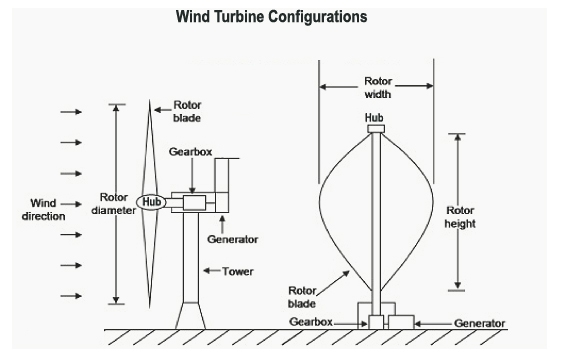
Horizontal Turbine / Vertical Turbine
(c)
Hub height. The distance measured from natural grade to the center of the turbine hub.
(d)
Monopole tower. A tower constructed of tapered tubes that fit together symmetrically and are stacked one section on top of another and bolted to a concrete foundation without support cables.
(e)
Small wind turbine. A wind turbine of 100 kW nameplate generating capacity or less.
(f)
Total wind turbine height. The highest point above natural grade reached by a rotor tip or any other part of a wind turbine.
(g)
Tower. A vertical structure that supports a wind turbine.
(h)
Utility wind turbine. A wind turbine of more than 100 kW nameplate generating capacity.
(i)
Vertical axis wind turbine. A type of wind turbine where the main rotor shaft runs vertically.
(j)
Wind energy system. An electrical generating facility that consists of a wind turbine, feeder line(s), associated controls and may include a tower.
(k)
Wind turbine. Any piece of electrical generating equipment that converts the kinetic energy of blowing wind into electrical energy through the use of airfoils or similar devices to capture the wind.
(Ord. No. 62, § 2(Subd. W), 9-13-1993; Ord. No. 13-02, § 1, 9-16-2013)
Sec. 42-58. - X.
No definitions.
(Ord. No. 62, § 2(Subd. X), 9-13-1993)
Sec. 42-59. - Y.
Yacht club. A private club established for the recreational and educational enjoyment of boating and sailing. Yacht club activities may include programs for sailing, sail boarding, swimming and boat safety. Yacht club facilities shall be limited to a clubhouse containing meeting and social areas and dock and mooring slips for the exclusive use of yacht club members.
Yard. An open space on the lot which is unoccupied and unobstructed from its lowest level to the sky. A yard extends along a lot line at right angles to such lot line to a depth or width specified in the yard regulations for the zoning district in which such lot is located.
Yard, front. A yard extending across the front of the lot between the front line and the nearest building line.
Yard, rear. A yard extending across the full width of the lot and lying between the rear line of the lot and the nearest line of the building.
Yard, rear depth. The mean horizontal distance between the rear line of the building and the center line of an alley, where an alley exists; otherwise, the rear lot line.
Yard, side. A yard between the side line of the lot and the nearest line of the building and extending from the front line of the lot to the rear yard.
(Ord. No. 62, § 2(Subd. Y), 9-13-1993)
Sec. 42-60. - Z.
Zoning administrator. An officer or other designated authority charged with the administration and enforcement of this chapter, or his duly authorized representative.
(Ord. No. 62, § 2(Subd. Z), 9-13-1993)

