
Spring Park City Zoning Code
ARTICLE II
GENERAL PROVISIONS
Sec. 42-61.- Purpose.
The purpose of this article is to establish general development performance standards. These standards are intended and designed to ensure compatibility of uses; to prevent urban blight, deterioration and decay; and to enhance the health, safety and general welfare of the residents of the community.
(Ord. No. 62, § 3(Subd. A), 9-13-1993)
Sec. 42-62. - Nonconforming buildings, structures and uses.
(a)
Purpose. It is the purpose of this section to provide for the regulation of nonconforming buildings, structures and uses and to specify those requirements, circumstances and conditions under which nonconforming buildings, structures and uses can be operated and maintained. This chapter establishes separate districts, each of which is an appropriate area for the location of uses which are permitted in the district. It is necessary and consistent with the establishment of these districts that nonconforming buildings, structures and uses not be permitted to continue without restriction.
(b)
[Enlargement of use.] Except as expressly provided in this chapter, any use lawfully existing upon the effective date of this chapter shall not be enlarged, but may be continued at the size and in the manner of operation existing upon such date.
(c)
[Change to lessen nonconformity.] A lawful nonconforming use of a structure or parcel of land may be changed to lessen the nonconformity of use or the area of the structure or parcel so used. Once such nonconforming use has been so changed, it shall not thereafter be expanded to occupy a larger portion of such structure or parcel or altered to increase the nonconformity of use.
(d)
[Discontinued nonconforming use.] Whenever a lawful nonconforming use of a structure or land is discontinued for a period of one year, any future use of said structure or land shall be made to conform with the provisions of this chapter within 60 days of written notice from the zoning administrator.
(e)
[Normal maintenance.] Normal maintenance of a building or other structure containing or related to a lawful nonconforming use is permitted, including necessary repairs and incidental alterations which do not physically extend or intensify the nonconforming use.
(f)
[Restoration, replacement.] Lawful nonconforming buildings or structures which are in whole or in part torn down, razed or removed from the parcel of land for reasons other than those associated with remodeling, alteration, expansion or a casualty as provided for in this section shall be restored or replaced in such a manner so that such new building or structure, or that part thereof which was nonconforming and which was so torn down, razed or removed from the parcel, will conform to all of the restrictions of the district in which it is located.
(g)
Single-family buildings.
(1)
Lawful nonconforming buildings and structures may be expanded to improve livability and/or utility, provided the structure is not expanded into the required setback areas, for uses which conform to the provisions of this chapter. Nonconforming buildings or structures may be remodeled and/or altered, both structurally and nonstructurally, with respect to the exterior and/or interior and/or roof of such buildings or structures, as well as maintained and repaired in their state as of November 20, 1984, as well as in any state in which they shall have been put as provided for in this chapter from and after November 20, 1984, provided that the nonconformity of the buildings or structures will not be increased. For single-family homes located outside of a FEMA Floodplain, vertical expansion of the house above the existing footprint of a structure shall not constitute an increase in the nonconformity.
(2)
Legally nonconforming accessory and principal buildings on a single-family lot may be attached to another conforming building by conditional use permit provided the following standards are met:
a.
The new building additions/expansions connecting the single-family home and the accessory building shall meet all required setbacks.
b.
The accessory building being connected to the single-family home shall meet the required shoreline and street side setbacks.
c.
The combined building width, after connecting the buildings, shall provide a minimum required side yard setback on at least one side of the lot.
d.
A nonconforming accessory building that is nonconforming due to encroachment into a side yard setback shall not be expanded vertically.
e.
Nonconforming accessory buildings connected to a single-family home shall not be converted to living space.
f.
Roof drainage from a nonconforming single-family home or accessory building shall be captured in gutters and directed away from adjoining properties.
(h)
Multiple-family buildings. Multiple-family buildings within the R-3 district existing prior to the enactment of this chapter shall not be deemed to be nonconforming in regards to density, setbacks, and height and may be re-established if partially or totally destroyed by fire, wind, earthquake, explosion, flood, or other casualty provided the density, setbacks or height of the buildings will not be otherwise increased and the use complies with all other general performance standards of this Ordinance.
Multiple-family buildings which do not meet the required 50-foot shoreland setback within the R-3 district destroyed to 100 percent of their total value may be re-established at the same height and density. The city council may impose greater shoreland setbacks than existed previously if determined that the site is capable of accommodating the equivalent density in an alternative building design.
(i)
Commercial/manufacturing buildings. If a nonconforming commercial or manufacturing structure is destroyed to a point where necessary repairs exceed 50 percent of its fair market value, the structure may be restored to the same setbacks and height provided all other applicable performance standards as stipulated in this chapter are upheld.
If a nonconforming commercial or manufacturing structure is destroyed to a point where necessary repairs do not exceed 50 percent of its fair market value, the structure may be restored to the same setbacks and height provided the restoration is started within a period of one year from the date of such damage or destruction and is diligently prosecuted to completion. If such restoration is not timely commenced, or having been so commenced is not diligently prosecuted to completion, then the said building or structure shall not be restored unless said building or structure, and the use thereof, conform to all of the restrictions of the district in which it is located.
(Ord. No. 62, § 3(Subd. B), 9-13-1993; Ord. No. 11-05, § 1, 6-6-2011)
Sec. 42-63. - General building and performance requirements.
(a)
Purpose. The purpose of this section is to establish general development performance standards. These standards are intended and designed to assure compatibility of uses; to prevent urban blight, deterioration and decay; and to enhance the health, safety and general welfare of the residents of the community.
(b)
Dwelling unit restriction. No cellar, basement, garage, tent or accessory building shall at any time be used as an independent residence or dwelling unit, temporarily or permanently, except as follows:
(1)
Basements may be used as living quarters or rooms as a portion of a residential dwelling if proper enhancement and egress is provided in conformance with the state building code and approved by the city building official.
(2)
Earth-sheltered housing shall not be considered as a basement or cellar.
(3)
All dwelling units are required to have access to hook up to municipal sewer.
(c)
Design criteria for structures—High-water elevations. Structures must be placed in accordance with any floodplain regulations applicable to the site. Where these controls do not exist, the elevation to which the lowest floor, including basement, is placed or floodproofed must be determined as follows: by placing the lowest floor at a level at least three feet above the highest known water level, or three feet above the ordinary high-water level, whichever is higher.
(d)
Platted and unplatted property.
(1)
Any person desiring to improve property shall submit to the building official a site plan of said premises and information on the location and dimensions of existing and proposed buildings, location of easements on the property, encroachments, and any other information which may be necessary to insure conformance to the city ordinances. The city building official may require a certificate of survey.
(2)
A lot of record existing upon the effective date of this chapter in a residential district which does not meet the requirements of this chapter applicable in such district as to area or width may be utilized for single-family detached dwelling purposes provided that:
a.
It has been assessed for water/sewer service.
b.
Setbacks shall be in conformance with this chapter.
(3)
If two or more contiguous lots of record within shorelands are combined under one ownership after the effective date of this chapter, and such lots, taken together, could not be divided into two or more lots each having at least 80 percent of the required lot area and lot width from the ordinary high-water mark and building line, then such lots shall be considered as one lot for building and zoning purposes. The lots shall be tied together with restrictive covenants acceptable to the city and filed with the county recorder permanently requiring that the lots be considered as one lot only. This shall be required before any building permit is issued thereon.
(4)
Lots joined together for building permit purposes shall not be conveyed separately in the future, but shall be tied together by restrictive covenants acceptable to the city and filed with the county recorder.
(5)
Not more than one principal building shall be located on a lot.
(6)
On a through lot, both street lines shall be front lot lines for applying the yard and parking regulations of this Ordinance.
(e)
Commercial/manufacturing building requirements.
(1)
All commercial/manufacturing structures shall comply with applicable provisions of the Uniform Building Code.
(2)
No travel trailer, utility trailer or semitruck trailer shall be considered a commercial or manufacturing principal structure.
(f)
Building height. The building height limits established herein for districts shall not apply to the following:
(1)
Belfries.
(2)
Chimneys or flues.
(3)
Church spires.
(4)
Cooling towers.
(5)
Cupolas and domes which do not contain usable space.
(6)
Elevator penthouses.
(7)
Flag poles.
(8)
Monuments.
(9)
Water towers.
(10)
Poles, towers and other structures for essential services.
(11)
Accessory television and radio antennas (the height of which is regulated by subsection 42-64(k)(1)a.).
(12)
Personal wireless service antennas (the height of which is regulated by subsection 42-74(b)(3)).
(13)
Antenna towers (the height of which is regulated by subsection 42-74(c)(7)).
(g)
Traffic visibility. On corner lots in all districts, no structures or planting in excess of 30 inches above the street center line grade shall be permitted within a triangular area defined as follows: beginning at the intersection of the projected property lines along the two intersecting streets, thence 30 feet along one property line, thence diagonally to a point 30 feet from the point of beginning.
(h)
Exterior lighting.
(1)
Purpose. It is the purpose of this subsection to provide adequate lighting systems where health, safety, and welfare may be a concern. The subsection also encourages the use of lighting systems that will reduce light pollution and promote energy conservation.
(2)
Exemptions. The provisions of this section shall not apply to the following:
a.
This subsection does not prohibit the use of temporary outdoor lighting used during customary holiday seasons.
b.
This subsection does not prohibit the use of temporary outdoor lighting used for civic celebrations and promotions.
c.
Lighting required by a government agency for the safe operation of airplanes, or security lighting required on government buildings or structures.
d.
Emergency lighting by police, fire and rescue authorities.
e.
Public street lights are exempt from this subsection.
(3)
Nonconforming uses.
a.
[Exemptions.] All outdoor lighting fixtures existing and legally installed prior to the effective date of this subsection (December 16, 2006) are exempt from regulations of this subsection but shall comply with the previous ordinance requirements for glare as follows: Any lighting used to illuminate an off-street parking area, sign or other structure, shall be arranged as to deflect light away from any adjoining residential zone or from the public streets. Direct or sky-reflected glare, where from flood lights or from high temperature processes such as combustion or welding shall not be directed into any adjoining property. The source of lights shall be hooded or controlled in some manner so as not to light adjacent property. Bare incandescent light bulbs shall not be permitted in view of adjacent property or public right-of-way; building construction is not exempt from this provision. Any light or combination of lights which cast light on a public street shall not exceed one footcandle (meter reading) as measured from the center line of said street. Any light or combination of lights which cast light on residential property shall not exceed four-tenths footcandle (meter reading) as measured from said property.
b.
New fixtures. Whenever a light fixture that was existing on the effective date of this subsection (December 16, 2006) is replaced by a new outdoor light fixture, the new fixture shall comply with the provisions of this subsection.
(4)
Light trespass performance standards. No light source or combination thereof which casts light on a public street shall exceed one footcandle meter reading as measured from the centerline of said street nor shall any light source or combination thereof which casts light on adjacent property exceed four-tenths footcandles as measured at the property line, per the method outlined in subsection (5).
(5)
Method of measuring light intensity. The footcandle level of a light source shall be taken after dark with the light meter held six inches above the ground with the meter facing the light source. A reading shall be taken with the light source on, then with the light source off. The difference between the two readings will be identified as the light intensity.
(6)
Performance standards.
a.
Residential standards. For all residential properties with four or fewer units, any lighting used to illuminate an off-street parking area, driveway, structure, or area shall be arranged as to deflect light away from any adjoining residential property or from any public right-of-way in accordance with the following provisions:
1.
[Light source control.] The light source shall be hooded or controlled so as not to light adjacent property in excess of the maximum intensity defined in subdivision d of Section 3, subdivision C-8.
2.
[Bare light bulbs.] Bare light bulbs shall not be permitted in view of adjacent property or public right-of-way, unless part of a permanent fixture.
3.
[Buildings under construction.] Illumination of buildings under construction shall comply with this chapter.
4.
Height. The maximum height above the ground grade permitted for light sources mounted on a pole is 20 feet. A light source mounted on a building shall not exceed the height of the building. In no case shall the height of a light source mounted on a pole or on a building exceed the height limits of the zoning district in which the use is located unless allowed by conditional use permit.
b.
Public/institutional, multifamily, commercial and manufacturing uses. Any lighting used to illuminate an off-street parking area, structure, or area shall be arranged so as to deflect light away from any adjoining property or from any public right-of-way in accordance with the following provisions:
1.
Cutoff. The luminaire shall contain a cutoff fixture so that light intensity at or above 90 degrees is no more than two and one-half percent of lamp lumens, and no more than ten percent of lamp lumens at a vertical angle of 80 degrees above nadir.
2.
Intensity. Light sources shall not be permitted so as to light adjacent property in excess of the maximum intensity defined in Subdivision d. of Section 3, subdivision C-8.
3.
Exceptions. Architectural/historical light fixtures that feature globes that are not shielded, or lighting of entire facades or architectural features of a building shall be approved by the city council. In no case shall the light affect adjacent property in excess of the maximum intensity defined in Subdivision C-8-(d) of Section 3.
4.
Height. The maximum height above the ground grade permitted for light sources mounted on a pole is 20 feet. A light source mounted on a building shall not exceed the height of the building. In no case shall the height of a light source mounted on a pole or on a building exceed the height limits of the zoning district in which the use is located unless allowed by conditional use permit.
5.
Location.
i.
The light source of an outdoor light fixture shall be setback a minimum of five feet from a street right-of-way and five feet from an interior side or rear lot line.
ii.
No light sources shall be located on the roof unless said light enhances the architectural features of the building and is approved by the zoning administrator.
6.
Illumination levels. The level of illumination shall be subject to Subdivision C-8-(d) of Section 3.
7.
Glare. Direct or reflected glare from high temperature processes such as combustion or welding shall not be visible from any adjoining property.
c.
Outdoor recreation. Outdoor recreational uses such as, but not limited to, baseball fields, football fields, and tennis courts have special requirements for night time lighting. Due to these unique circumstances, a conditional use permit shall be required for outdoor lighting systems which do not comply [with] regulations of this section.
1.
No outdoor recreation facility whether public or private shall be illuminated after 11:00 p.m.
2.
Off-street parking areas for outdoor recreation uses which are illuminated shall meet the requirements stated for commercial and industrial applications of subdivision f.2).a., b., c., e., and g of Section 3, subdivision C-8.
3.
The provisions for a conditional use permit, article IV, division 2, are considered and satisfactorily met.
d.
Outdoor signs. All lighting of signing and informational or visual communication devices shall be in compliance with Section 10 of the Spring Park City Code.
(7)
Prohibitions. The following outdoor lights are prohibited in the city:
a.
The use of search lights for any business shall be limited to not more than four events per calendar year. During any one event, the use of search lights shall be limited to five days consecutively and shall not be used between the hours of 10:30 p.m. and sunrise.
b.
Flashing lights.
c.
Lighting fixtures mounted in a way so as to cause confusion or hazard to traffic or to conflict with traffic control signs or lights.
(8)
Minimum lighting requirements. Adequate lighting shall be provided for parking and pedestrian areas, subject to the following performance standards:
a.
Minimum light levels. The minimum light level shall be no less than two-tenths footcandle. Measurement shall be taken on the surface, without any shadowing effect from parked vehicles or other obstructions at 20-foot intervals.
b.
Uniformity ratio. The ratio of maximum to minimum lighting levels shall not exceed 20:1.
(i)
Smoke, odors, dust and other particulate matter. The emission of smoke, odor, dust, fly ash or other particulate matter by any use shall be in compliance with and regulated by the State of Minnesota Pollution Control Standards, Minnesota Regulation APC-1-15 as amended.
(j)
Noise. The emission of noise by any use shall be in compliance with and regulated by the State of Minnesota Pollution Control Standards, Minnesota Regulation NPC 1, as amended.
(k)
Refuse. The piling of junk in yards in all residential districts shall not be permitted, except that junk in yards as of the effective date of this chapter shall be removed within a period of 15 days after notification by the city.
(l)
Exterior storage. All materials and equipment except as provided for in subsections (d) through (n) shall be stored within a building or located as such so as not to be visible from adjoining properties, except for the following:
(1)
Clothes line poles and wires.
(2)
Stationary recreational equipment.
(3)
One personal recreational vehicle.
(4)
Construction and landscaping materials currently being used on the premises.
(5)
Off-street parking of passenger vehicles and trucks not exceeding a gross capacity of 12,000 pounds in residential areas.
(m)
Waste material. Waste material resulting from or used in commercial servicing, processing or trimming shall not be washed into the public storm sewer system nor the sanitary sewer system, but shall be disposed of in a manner approved by the Minnesota State Fire Marshal and the [Minnesota] Pollution Control Agency.
(n)
Bulk storage (liquid). All uses associated with the bulk storage of gasoline, liquid fertilizer, chemical, flammable and similar liquids shall comply with the requirements of the Minnesota Pollution Control Agency, Minnesota State Fire Marshal, and Minnesota Department of Agriculture offices, as applicable, and have documents from those offices stating the use is in compliance.
(o)
Bulk storage (gas). All uses associated with the bulk storage of LP gas or other flammable and similar gases shall comply with the requirements of the Minnesota Pollution Control Agency, Minnesota State Fire Marshal, and Minnesota Department of Agriculture offices, as applicable, and have documents from those offices stating the use is in compliance.
(p)
Radiation emission. All activities that emit radioactivity shall comply with the minimum requirements of the Minnesota Pollution Control Agency.
(q)
Electrical emission. All activities which create electrical emissions shall comply with the minimum requirements of the Federal Communication Commission.
(r)
Water supply and sewage treatment.
(1)
All new development is required to hook up to municipal sewer and water.
(2)
Manufacturing uses requiring water supply for the processing, cooling or manufacturing of a product shall be required to be hooked up to municipal water. A water recycling plan shall be required and approved by the city for such use.
(s)
Plumbing permits. Prior to installation of a system of plumbing with independent plumbing service, complete plumbing plans and specifications, together with any additional information that the building official may require, shall be submitted in triplicate to the building official and approved by the building official. No construction shall proceed except in accordance with the approved plans. Any alteration or extension of any existing plumbing system shall be subject to these same requirements. The foregoing notwithstanding, this subparagraph c shall not apply to plumbing systems serving single-family or two-family dwellings, including, without limitation, townhouses, twin homes, double bungalows, and duplexes. See chapter 10 of the Spring Park Code of Ordinances for additional building code and plan requirements.
(Ord. No. 62, § 3(Subd. C), 9-13-1993; Ord. No. 62.05, §§ 1, 2, 3-2-1998; Ord. No. 62.07, § 1, 8-17-1998; Ord. No. 62-12, § 1, 12-4-2006; Ord. No. 62-20, 10-20-2008)
Sec. 42-64. - Accessory buildings, uses and equipment.
(a)
[Construction time frame.] No accessory building or use shall be constructed or developed on a lot prior to the time of construction of the principal building to which it is accessory.
(b)
Within the R-1 and R-2 zoning districts, accessory buildings shall meet the following standards:
(1)
Accessory building size.
a.
Detached accessory buildings. The total area as measured by foundation size of all detached accessory buildings shall not exceed 1,200 square feet.
b.
Attached garage. The foundation size of an attached garage shall not be larger than 80 percent of the foundation size of the principal building or 1,200 square feet, whichever is larger. The floor area of the attached garage is not counted against the 1,200 square feet of eligible detached accessory building allowance.
(2)
Building heights. Within the R-1, R-2, R-3, and C-3 districts, detached accessory buildings and garages shall not exceed 16 feet in height.
(3)
Number of accessory buildings. The number of accessory buildings in the R-1 and R-2 districts shall be limited to one of the following:
a.
One attached garage, one detached accessory building, plus one detached accessory building not to exceed 100 square feet or eight feet in height; or
b.
Two detached accessory buildings plus one detached accessory building not to exceed 100 square feet or eight feet in height.
(4)
Exterior materials. Residential accessory buildings shall utilize complimentary exterior materials and colors to that of the principal structure on the lot. Non-decorative concrete block, corrugated or flat metal panels, or unfinished metal may comprise no more than thirty percent of each wall area.
(5)
Plumbing. Shower and bath facilities are prohibited in accessory buildings. A toilet, wash sink, or water connection are allowed in an accessory building provided:
a.
Water connection must meet all city standards and be metered.
b.
Connection can be made to the municipal sanitary sewer.
c.
Payment of any applicable utility fees and sewer availability charge.
(6)
Prohibited uses. Accessory buildings may not be used for the following:
a.
Home occupation.
b.
Dwelling unit.
c.
Commercial business.
(c)
[Connection to principal building.] An accessory building is considered to be an attached garage when it shares a continuous foundation and at least one wall or portion thereof with the principal building.
(d)
[Setbacks.] All accessory buildings and uses shall meet the setbacks required by the district and shall not be located between the principal structure and the shoreline Ordinary High Water Line (OHWL) with the following exceptions:
(1)
Residential docks and boat lifts.
(2)
One detached accessory building not exceeding eight feet in height, nor 100 square feet in area in the rear yard provided it is not located within five feet from any lot line, or within 50 feet of the ordinary high-water mark.
(3)
One open air structure without walls not exceeding 144 square feet in floor area.
(e)
Reserved.
(f)
Temporary outdoor sales. Temporary outdoor sales of products as accessory to a principal structure shall be allowed within commercial and/or manufacturing zoning districts upon the issuance of a temporary use permit by the zoning administrator. All temporary outdoor sales of products as accessory to a principal structure shall comply with the following:
(1)
Temporary sales are limited to not more than 14 consecutive days.
(2)
No more than six temporary sales shall occur in a 12-month period.
(3)
Upon sale termination, all sale items, storage materials, and equipment must be promptly removed from the subject site.
(4)
Outdoor temporary sales areas shall have a paved surface with asphalt, cobblestone, paver block, or other form of concrete. Pervious pavement materials may be permitted subject to review and approval by the city engineer. No sale display may be located in landscaped areas of the site as defined in subsection (j)(5)f.2. of this chapter.
(5)
Temporary sales displays shall not be located within a public right-of-way.
(6)
Outdoor temporary sales areas shall be located on the site in a manner that does not interfere with on-site parking or traffic circulation.
(7)
Permit applications shall be accompanied by a site plan that illustrates the size and location on the site of the temporary outdoor sale area.
(g)
Residential docks/boat lifts. Docks and boat lifts shall be permitted as accessory uses in all residential districts subject to the applicable rules and regulations of the Lake Minnetonka Conservation District and the conditions and restrictions contained in article VIII, divisions 2, 3, and 4.
(h)
Stairways, lifts, and landings. Stairways and lifts are the preferred alternative to major topographic alterations for achieving access up and down bluffs and steep slopes to shore areas. Stairways and lifts must meet the following design requirements:
(1)
Stairways and lifts must not exceed four feet in width on residential lots. Wider stairways may be used for commercial properties and public open-space recreational properties.
(2)
Landings for stairways and lifts on residential lots must not exceed 32 square feet in area. Landings larger than 32 square feet may be used for commercial properties and recreation fields and buildings.
(3)
Canopies or roofs are not allowed on stairways, lifts, or landings.
(4)
Stairways, lifts, and landings may be either constructed above the ground on posts or pilings, or placed into the ground, provided they are designed and built in a manner that ensures control of soil erosion.
(5)
Stairways, lifts, and landings must be located in the most visually inconspicuous portions of lots, as viewed from the surface of the public water assuming summer, leaf-on conditions, whenever practical.
(6)
Facilities such as ramps, lifts, or mobility paths for physically handicapped persons are also allowed for achieving access to shore areas, provided that the dimensional and performance standards of subitems a to e are complied with in addition to the requirements of Minnesota Rules, chapter 1340.
(i)
Fences—General requirements.
(1)
Permits.
a.
Requirement. No person shall hereafter construct or cause to be constructed or erected any fence without first making an application for and securing a fence permit, except as allowed by this Ordinance. By receiving a fence permit, the property owner agrees to maintain the fence in a condition of reasonable repair and appearance in accordance with this Ordinance.
b.
Exceptions. The following temporary fences may be installed or erected without a fence permit:
1.
Construction fences needed to secure a construction or excavation site, provided:
i.
The project site has an active building permit, demolition permit, or excavation permit.
ii.
Said fence location is approved by the city building official.
2.
Inner yard fences used to protect gardens, shrubs or landscaping from damage from animals or ornamental fencing that accents a landscape feature may be allowed within a residential zoning district provided:
i.
Inner yard fences shall not exceed 42 inches in height.
ii.
Inner yard fences shall not be a boundary line fence and shall not be located closer than five feet from any lot line.
3.
Snow fences for the purpose of controlling drifting snow shall be allowed provided:
i.
Snow fences shall be of a temporary design. These fences shall not be installed prior to November 15th and shall be removed no later than March 15th.
4.
Screen panels attached to a deck, balcony or patio for the purpose of providing privacy, shade or protection from the wind provided:
i.
The deck, balcony or patio is attached to the principal building on the site and is compliant with the required setbacks of the respective zoning district.
ii.
The screen panels do not exceed six feet in height.
(2)
Submission requirements. An application for a fence permit shall be accompanied by the following materials:
a.
Certificate of survey. A current certificate of survey (not older than five years or otherwise certified by a licensed land surveyor as being accurate), providing exact lot dimensions and the location of the proposed fence, shall be required. At the discretion of the city administrator, a final plat detail of the lot with the required information shown may suffice if no certificate of survey is available. Applicant shall be required to physically identify the property corners at the site for city inspection.
b.
Fence details. Details regarding the fence design, including height, amount of open space, and proposed materials shall be required.
c.
Photographs. Photographs of the proposed locations of the fence in relationship to structures/buildings on the subject property and on adjacent properties shall be required.
(3)
Locations.
a.
All fences shall be located entirely upon the private property of the person constructing, or causing the construction, of such fence unless the owner of the property adjoining agrees, in writing, that such fence may be erected on the division line of the respective properties.
b.
All fences shall be set back five feet from any lot line abutting a city street or county road right-of-way and shall comply with the traffic visibility setback requirements of subsection 42-63(g) of this Ordinance. Where the street boulevard is less than ten feet in depth, the city shall require a greater setback from the property line for snow storage and general street maintenance.
c.
In no case shall any fence obstruct the normal passage of runoff water.
d.
No fence shall be located within a drainage or utility easement without written permission of the city administrator and/or the private utility provider and the filing of an encroachment agreement.
e.
If a fence is constructed within an easement and it is required to be removed, the city shall not be required to replace or relocate the fence or to pay compensation for removal of such fence and shall not be responsible for costs of repairing any damage to such fence caused by the use of the easement for its intended purpose.
(4)
Height.
a.
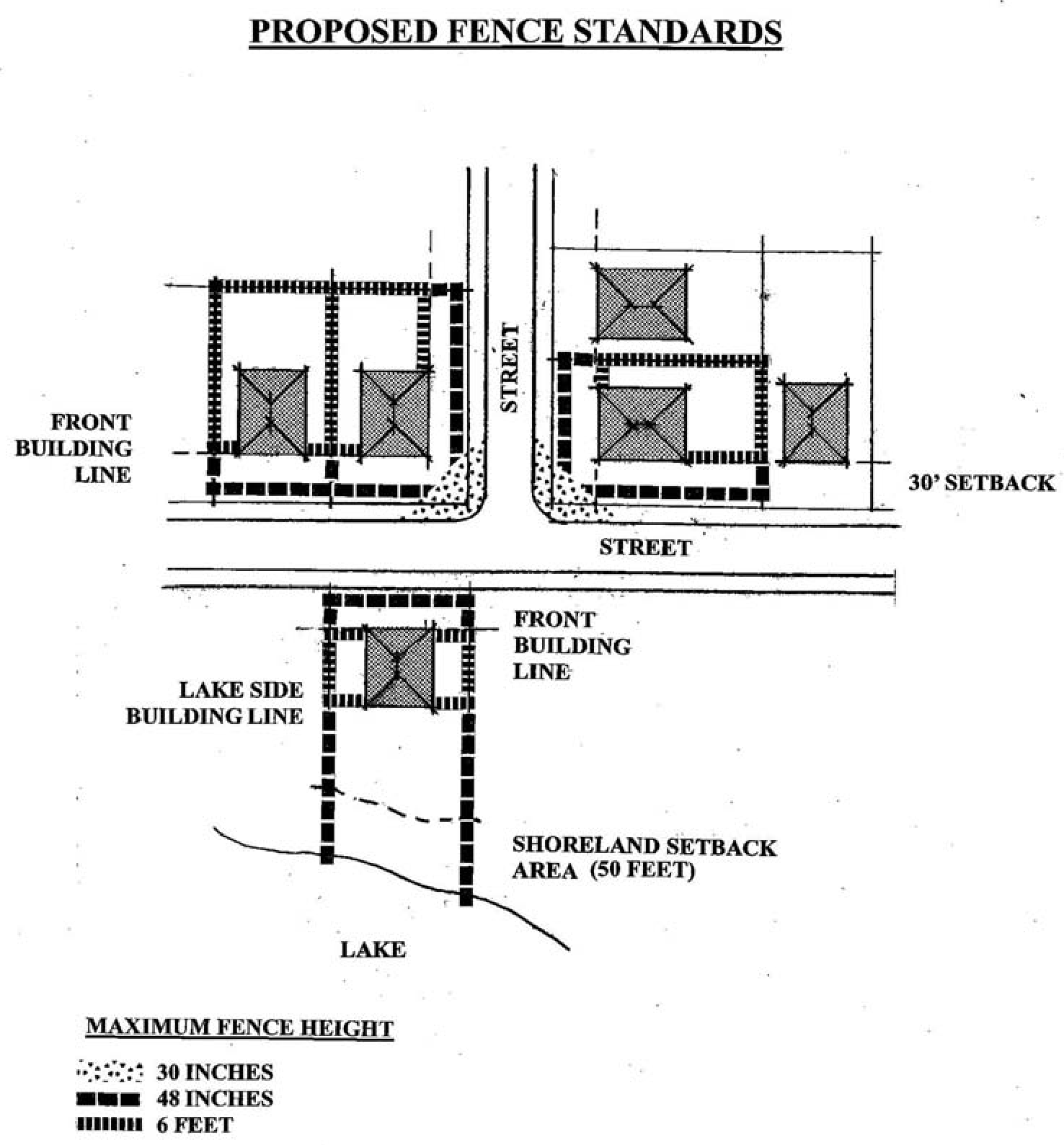
Street side. Any fence located between the building line and a street right-of-way shall not exceed forty-eight (48) inches in height. Individual fence posts may exceed the maximum fence height by six inches to accommodate decorative fence post caps. (See Exhibit A).
b.
Lake side. On riparian lots, in no case shall any fence exceed 48 inches in height from a line extended from the lake side building line of the principal building to the ordinary high water mark (OHWM). Individual fence posts may exceed the maximum fence height by six inches to accommodate decorative fence post caps. Fences within the C, M, and R-3 districts may exceed this height limitation in the shoreland area for security fences (see Exhibit A).
c.
Side and rear yard.
1.
Residential districts. A fence up to seven feet in height may be erected from a line extended from the street side building line of the principal building to the side lot lines, and then along the side lot lines and the rear lot line. Individual fence posts may exceed the maximum fence height by six inches to accommodate decorative fence post caps.
2.
Commercial and industrial districts. In commercial and industrial districts, a fence up to eight feet in height may be erected from a line extended from the street side façade of the principal building to the side lot lines, and then along the side lot lines and the rear lot line or shoreland setback line (see Exhibit A).
3.
All districts. Should the rear lot line of a lot be common with the side lot line of an abutting lot, that portion of the rear or side lot equal to the required front yard setback of the abutting lot shall not be fenced to height of more than 48 inches (see Exhibit A). Individual fence posts may extend six inches above the maximum height of the fence to accommodate decorative fence post caps.
d.
Fence height shall be measured from grade to the top of the fence panels.
EXHIBIT A
FENCE LOCATIONS AND HEIGHTS
(5)
Construction and maintenance.
a.
That side of the fence considered to be the face shall be oriented toward abutting property or rights-of-way.
b.
All fences shall be constructed in such a manner that provides a minimum of one-inch open clearance between the ground and the main body of the fence to allow for passage of water and yard maintenance.
c.
In those instances where a boundary line fence exists as an enclosure which restricts access from the street, a recognizable gate shall be provided. Such ingress points shall be unobstructed and a minimum of two and one-half feet in width.
d.
Every fence shall be constructed in a substantial, workmanlike manner and of substantial material reasonably suited for the purpose for which the fence is proposed to be used.
e.
Every fence shall be maintained in a condition of reasonable repair and shall not be allowed to become and remain in a condition of disrepair or danger, or constitute a nuisance, public or private. The fence permit holder shall be responsible for all weeds or debris that may occur on or under the fence on their property.
f.
Any such fence which is, or has become dangerous to the public safety, health or welfare, is a public nuisance, and the city administrator shall commence proper proceedings for the abatement thereof, when directed to do so by the city council.
g.
All fences shall be constructed with materials comparable in grade and quality to the following:
1.
Treated cedar;
2.
Plastic composite board;
3.
Vinyl;
4.
Chain-link;
5.
Wrought iron.
h.
Link fences, wherever permitted, shall be constructed in such a manner that no barbed ends shall be at the top.
i.
Barbed wire fences, electric fences, or permanent fabric fences (i.e., silt fence, cloth) are prohibited in all districts, except barbed wire stands [strands] on top of fences over seven feet high may be allowed as an antivaulting measure on fences in C and M districts.
j.
Lots containing a nonconforming structure in terms of property line setbacks, or lots located adjacent to a lot with a nonconforming structure in terms of property line setbacks, shall be required to install removable panels as the fencing material adjacent to the nonconforming structure in order to allow access to accommodate maintenance of such structures and for fire protection. The city administrator shall specify the location of the removable panels as a part of the fence permit review.
(j)
Required fencing, screening, and landscaping.
(1)
Nonresidential use. Where any commercial, institutional or manufacturing use (i.e., structure, parking or storage) abuts property zoned for residential use, the owner of the commercial or manufacturing shall provide screening along the boundary of the residential property. Screening shall also be provided where a commercial or manufacturing use is across the street from a residential district, except on that side of such use considered to be the front (as determined by the building official). All the fencing and screening required by this chapter shall be subject to subsection 42-63(g) (traffic visibility setback) and shall consist of either a fence or a green belt planting strip as provided for below.
a.
A green belt planting strip shall consist of evergreen trees and/or deciduous trees and plants and shall be of sufficient width and density to provide an effective visual screen. This planting strip shall be designed to achieve 75 percent opacity year round and to a minimum height of six feet. Earth mounding or berms may be used but shall not be used to achieve more than three feet of the required screen. The planting plan and type of plantings shall require the approval of the zoning administrator.
b.
A required screening fence shall be constructed of commercially available building materials including, but not limited to, masonry, plastic, brick, wood or metal. Such fence shall provide a solid screening effect six feet in height. The use of plastic, vinyl or wood slats in combination with chain link fence shall not be considered as a permitted screening method. The design and materials used in constructing a required screening fence shall be subject to the approval of the zoning administrator.
(2)
Multiple-family uses. Where multifamily buildings of four or more units abut property containing a single-family residential use, the higher density residential use shall provide screening along all off-street parking areas and between multifamily and single-family units to mitigate possible adverse impacts.
(3)
Landscaping—General residential. The lot area remaining after providing for off-street parking, off-street loading, sidewalks, driveways, building site and/or other requirements shall be landscaped using ornamental grass, shrubs, trees or other acceptable vegetation or treatment generally used in landscaping. Trees on or extending above utility easements containing overhead wires shall not exceed 20 feet in height. (The planting of large trees is not recommended under overhead wires.)
(4)
Landscaping—New residential subdivisions, semipublic and all commercial and manufacturing property uses, except residential structures containing less than four (4) dwelling units. Prior to approval of a building permit for the above referenced uses, a landscape plan shall be presented for approval by the city. Said landscape plan shall be developed with an emphasis upon the boundary or perimeter of the proposed site at points adjoining other property and the immediate perimeter of the structure.
(5)
Landscape design standards. All landscaping incorporated in said plan shall conform to the following standards and criteria:
a.
Tree preservation. The site development plan shall attempt to preserve existing significant trees. Significant trees shall mean healthy trees having a six-inch trunk diameter measured five feet above the ground.
b.
Required plantings for nonresidential and multifamily residential uses. The minimum number of plantings on any given site shall be the greater of:
1.
One deciduous shade or coniferous tree per 1,000 square feet of gross building floor area; or
2.
Two deciduous, shade, or coniferous trees per 50 lineal feet of frontage on the public right-of-way.
3.
Ornamental trees and/or shrubs may be substituted for up to 50 percent of the required number of trees. In such cases, three ornamental trees/shrubs may be substituted for one shade or coniferous tree.
c.
Minimum size. All plants must be at least equal the following minimum size at time of planting:
d.
Types of new trees/shrubs/ground cover.
1.
Suitable trees may include:
Acer (maple)—Platanoides, saccharinum, Saccharum, rubrum.
Betula (birch)—Papyrifera, nigra.
Celtis (hackberry)—Accidentalis.
Fraxinus (ash)—pennsylvanica, Americana.
Ginkgo (ginkgo)—Biloba.
Gleditsia (honeylocust)—Triacanthos var. inermis.
Quercus (oak)—All varieties.
Tilia (linden)—Americana, cordata, tomentosa.
2.
All tree and plant species shall be appropriate to the physical characteristics of the site and hardy to USDA zone 4b. Wherever possible, native, drought-resistant trees shall be utilized. Invasive and exotic species listed by the Minnesota Department of Natural Resources are not permitted in the city. Fruit- or nut-bearing trees are not permitted as street trees in addition to the following:
3.
Prairie grass may be used as a ground cover if accompanied by a maintenance agreement. Seed mixtures shall be approved by the city.
4.
All stormwater management ponds shall be seeded and planted with native wetland and upland perennial and shrub species as approved by the city. All stormwater management plantings shall be warranted for three years from date of planting.
5.
Before a certificate of occupancy is issued, any area of the lot determined to be subject to erosion shall be sodded and staked. Areas needing erosion protection shall be determined by the building official or city engineer.
e.
Spacing.
1.
Plant material centers shall not be located closer than three feet from the fence line or any lot line and shall not be planted to conflict with public drainage and utility easements, sidewalks, trails, fences, parking areas, driveways, or public plantings based on the judgment of the city.
2.
Where plant materials are planted in two or more rows, plantings shall be staggered in rows unless otherwise approved by the zoning administrator.
3.
Deciduous trees shall be planted not more than 40 feet apart.
4.
Where massing of plants or screening is intended, large deciduous shrubs shall not be planted more than four feet on center, and/or evergreen shrubs shall not be planted more than three feet on center.
5.
A 30-foot traffic visibility area shall be provided at all street corners and driveway entrances consistent with subsection 42-63(g).
6.
Any fences or retaining walls shall be located entirely on the private property of the person constructing the fence or causing the construction of the fence. Boundary line fences may be permitted with written agreement of the adjoining property owner. Fences shall be set back five feet from any lot line abutting public street right-of-way in accordance with Section 3, Subd. C.9.g of this Ordinance.
7.
Any plantings, fences, or retaining walls that are placed within drainage and utility easements may be subject to removal by the city without compensation or replacement by the city.
f.
Design.
1.
The landscape plan must show some form of designed site amenities (i.e., composition of plant materials and/or creative grading, decorative lighting, exterior sculpture, etc. which are largely intended for aesthetic purposes).
2.
All areas within the lot lines (or beyond, if site grading extends beyond) shall be treated. All exterior areas not paved or designated as roads, parking, or storage must be planted into ornamental vegetation (lawns, ground covers, or shrubs) unless otherwise approved by the city.
3.
Turf slopes in excess of 3:1 are prohibited.
4.
All ground areas under the building roof overhang must be treated with a decorative ground cover and/or foundation planting.
5.
Commercial, industrial, multifamily, public, semipublic, institutional uses shall install irrigation systems to ensure survivability of landscape materials.
6.
Sites shall be designed to preserve significant trees where possible. Landscape plans shall include tree preservation measures that will be implemented during site development.
7.
Temporary erosion control measures shall be installed and maintained until establishment of sod, seed and/or permanent erosion control measures are in place and functioning properly.
(6)
Timing/responsibility of installation. Weather permitting, all buffer, berm, and/or plantings shall be constructed or planted prior to occupancy. Exceptions made for weather will be granted a temporary occupancy permit which will require a financial security to cover the incomplete portions of the approved landscape plan. Unfinished plan elements shall be completed within nine months of the temporary occupancy permit.
(7)
Maintenance.
a.
Except for plantings that are part of the city's beautification plan, maintenance of the landscape and screening shall be the responsibility of the individual property owner or successor property association.
b.
All repairs to screening or walls shall be consistent with the location and appearance of the original design.
c.
All plants required as part of an approved landscaping plan, including the Shoreline Drive Beautification Plan, shall be maintained and kept alive and in good condition. Dead or diseased plants shall be replaced in accordance with the approved landscape plan.
d.
All repair or plant replacement shall be done within 45 days of written notification from the city, between May 1 and October 31.
e.
Removal of plantings as part of an approved landscape plan, including the Shoreline Drive Beautification Plan, shall not occur unless a landscape replacement plan or an alternative landscape plan is approved by the city council. All improvements shall be at the owner's expense.
f.
Trimming of trees at any point higher than eight feet above ground level that have been installed as part of the Shoreline Drive Beautification Plan project shall require the approval of the city.
(8)
Landscape guarantee. All new plants shall be guaranteed for two full years from the time planting has been completed. All plants shall be alive and in satisfactory growth at the end of the guarantee period or be replaced.
(9)
Financial security. A financial security in the form of a letter of credit, cash escrow, or other form acceptable to the city attorney, shall be provided by the applicant prior to the issuance of any permit for land alteration. The amount of the security shall be 125 percent of the estimated cost to furnish and install materials including plants, irrigation, mulch, and other landscape materials. The estimated cost shall be provided by the applicant subject to approval by the city. The city reserves the right in its sole discretion to determine the estimated cost in the event the applicant's estimated cost is not approved. With the completion of work and provision of the landscape guarantee, the security shall be released.
(10)
Mechanical equipment. Ground-mounted and/or rooftop-mounted mechanical equipment shall be screened as follows:
a.
Equipment shall be screened from view from adjoining public streets and the surface of Lake Minnetonka.
b.
Rooftop equipment shall not be more than ten feet in height above the maximum building height.
c.
Mechanical equipment screening shall be of materials similar to the exterior materials of the building and the screening shall be integral to the building architecture.
(k)
Accessory antennas. Accessory antennas are permitted accessory uses in all zoning districts, provided they meet the following conditions:
(1)
Height. Accessory antennas whether they are ground mounted or roof mounted shall not exceed 20 feet above the roof line of the principal building on the lot.
(2)
Yards. Accessory antennas shall not be located within the required front yard setback or side yard setback abutting a street, except for antennas which are mounted to the wall of a principal building, are less than 24 inches in any dimension, and do not encroach more than two feet into such setback area.
(3)
Signal obstruction. If vegetation or obstructions interfere with satellite signals at a location in any allowable placement area, the accessory antenna may be placed on the roof of any permitted structure on the premise.
(4)
Setbacks. Accessory antennas shall not be located within five feet of any lot lines of adjoining lots or within a drainage and utility easement.
(5)
Lightning protection. Each accessory antenna shall be grounded to protect against natural lightning strikes in conformance with the National Electrical Code as adopted by the city.
(6)
Electrical code. Accessory antenna electrical equipment and connections which shall be designed, installed and maintained in conformance with the National Electrical Code as adopted by the city.
(7)
Color/content. Accessory antennas shall be of a neutral color and any lettering or scenes contained on said device qualifying it as a sign shall be subject to the regulations of the Spring Park Sign Code.
(8)
Effective date. The provisions of this section shall be applicable to all accessory antennas erected after publication. All accessory antennas which exist as of the effective date but which do not conform to the requirements of this subdivision shall be regarded as nonconforming uses and structures and are subject to the provisions of section 42-62.
(Ord. No. 62, § 3(Subd. D), 9-13-1993; Ord. No. 62.07, § 3, 8-17-1998; Ord. No. 62.10, §§ 2, 3, 7-16-2001; Ord. No. 62-15, § 1, 6-19-2006; Ord. No. 62-19, § 1, 12-18-2006; Ord. No. 09-02, § I, 4-20-2009; Ord. No. 11-04, § 1, 6-6-2011; Ord. No. 11-06, § 2, 10-17-2011; Ord. No. 11-09, § 1, 9-6-2011; Ord. No. 12-03, § 1, 8-6-2012; Ord. No. 14-02, § 2, 6-16-2014; Ord. No. 18-05, § 1, 12-17-2018)
Sec. 42-65. - Yard requirements.
(a)
Purpose. This section identifies general yard requirements applicable in all zoning districts, and exceptions thereto.
(b)
[Reduction in area, dimension.] No lot, yard or other open space shall be reduced in area or dimension so as to make such lot, yard or open space less than the minimum required by this chapter, and if the yard or other open space as existing on the effective date of this chapter is less than the minimum required, it shall not be further reduced. No open space required to be provided about any building or structure shall be included as part of any open space required for another structure.
(c)
Shoreland setback. Notwithstanding any provision to the contrary in this chapter, in all districts the setback from the ordinary high-water mark of any public body of water shall be 50 feet.
(d)
The following shall not be considered as encroachments on required yard setbacks:
(1)
Chimneys, flues, belt courses, sills, pilasters, lintels, ornamental features, cornices, eaves, gutters and the like provided they do not project more than two feet into a required yard.
(2)
A one-story enclosed entrance for a detached single-family, two-family or townhouse dwelling provided it does not extend into the front yard setback more than four feet.
(3)
Steps, uncovered porches, stoops, landings or similar features in front or rear yards provided they do not extend above the entrance floor level of the building or more than six feet into the required yard.
(4)
Laundry drying and recreational equipment such as swing sets and teeter totters, arbors, trellises, air conditioning or heating equipment in rear yards provided they do not project within five feet from any lot line.
(5)
One detached accessory building not exceeding eight feet in height, nor 100 square feet in area in the rear yard provided it is not located within five feet from any lot line, or within 50 feet of the ordinary high-water mark.
(e)
[Decks.] Deck additions are allowed without a variance to a structure not meeting the required setback from the ordinary high-water level if all of the following criteria and standards are met:
(1)
The structure to which the deck is added existed on the date setback was established;
(2)
A thorough evaluation of the property and structure reveals no reasonable alternative location for a deck meeting or exceeding the existing ordinary high-water level setback applicable to the structure;
(3)
The deck encroachment toward the ordinary high-water level does not exceed 15 percent of the existing setback of the structure from the ordinary high-water level or does not encroach within than 30 feet of such level, whichever is more restrictive; and
(4)
The deck is constructed primarily of wood, and is not roofed or screened.
(f)
[Setbacks differing from requirements.] Where adjacent structures within the same block have setbacks from the street different from those required, the minimum setbacks from the street shall be the average of the setbacks of the adjacent structures fronting on such street. If there is only one adjacent structure, the minimum setback from the street shall be the average of the required setback and the setback of the adjacent structure. In no case shall the required setback from the street exceed the minimum setback established for the district.
(g)
Reserved.
(Ord. No. 62, § 3(Subd. G), 9-13-1993; Ord. No. 07-01, § 1, 3-19-2007)
Sec. 42-66. - Subdivision of two-family or quadraminium lots.
The subdivision of base lots upon which two-family dwellings or quadraminiums are, or will be, located to permit individual private ownership of a single dwelling unit within such a structure and individual private ownership of a portion of the base lot upon which the structure is located is acceptable only upon approval of the city council. Approval of a subdivision request is contingent on the applicant meeting the following requirements:
(1)
Prior to a two-family dwelling or a quadraminium subdivision, the base lot must meet all the requirements of the zoning district.
(2)
The following are minimum lot requirements for two-family dwelling and quadraminium subdivision:
a.
Setbacks shall conform to the setback requirements in the district where the development is proposed.
b.
Each dwelling must have access to public water and sewer.
c.
Side yard setback is not applicable to the shared wall(s) of two-family and quadraminiums.
d.
The base lot, prior to subdivision, must have an area of not less than 12,000 square feet. The base lot upon which the two-family dwelling or quadraminium is located may itself be subdivided only if, after the subdivision of the base lot, each dwelling unit has a lot with an area of at least 6,000 square feet. If the base lot cannot be subdivided in a manner meeting the foregoing lot area requirement, then no subdivision of the lot (other than that portion directly under the dwelling units) shall be permitted.
(3)
Permitted accessory uses allowed in the zoning district are acceptable provided they meet all the zoning requirements.
(4)
A written property maintenance agreement in recordable form must be drafted by the applicant and submitted to the city attorney for review and approval. The agreement shall insure the maintenance and upkeep of the structure and the lot(s) to meet minimum city standards. The agreement is to be filed in the Hennepin County Recorder's Office as a deed restriction against the title of the lot(s).
(5)
Separate public utility service shall be provided to each subdivided unit and shall be subject to the review and approval of the city engineer.
(6)
The subdivision is to be platted and recorded in conformance with the requirements of the Spring Park Subdivision Ordinance.
(Ord. No. 62, § 3(Subd. F), 9-13-1993; Ord. No. 62.01, § 1, 10-17-1994)
Sec. 42-67. - Off-street parking regulations.
(a)
Purpose. The purpose of the off-street parking regulations is to alleviate or prevent congestion of the public right-of-way and to promote the safety and general welfare of the public, by establishing minimum requirements for off-street parking of motor vehicles in accordance with the utilization of various parcels of land or structures.
(b)
Application of off-street parking regulations. The regulations and requirements set forth herein shall apply to all off-street parking facilities in all of the zoning districts of the city.
(c)
Exemptions. The off-street parking regulations shall not be applicable to the commercial establishments located as of November 20, 1984, on Spring Street, as the city specifically finds that the parking available to the public on Spring Street is sufficient in ratio, size, surfacing and accouterments so as to eliminate the need for compliance by said commercial establishments with this section. The city shall be entitled, at any future time, to modify or revoke this finding in the event that changing conditions should justify such modification or revocation.
(d)
Site plan drawing necessary. All applications for a building or an occupancy permit for any zoning district shall be accompanied by a site plan drawn to scale and dimensioned indicating the location of off-street parking and loading spaces in compliance with the requirements set forth in this subdivision and Section 3, Subd. D of this Ordinance. Every detached single family dwelling unit erected after the effective date of this Ordinance shall be so located on the lot so that at least a one (1) car garage, either attached or detached, can be located on said lot in conformance with this Ordinance.
(e)
[Requirements for shore impact zones.] Public and private watercraft access ramps, approach roads, and access-related parking areas may be placed within shore impact zones provided the vegetative screening and erosion control conditions of section 42-70 are met. For private facilities, the grading and filling provisions of section 42-71 must be met.
(f)
Roads, driveways, and parking areas.
(1)
Public and private roads and parking areas must be designed to take advantage of natural vegetation and topography to achieve maximum screening from view from public waters. Documentation must be provided by a qualified individual that all roads and parking areas are designed and constructed to minimize and control erosion to public waters consistent with the field office technical guides of the minimum Watershed district, or other applicable technical materials.
(2)
Roads, driveways, and parking areas must meet structure setbacks from the ordinary high-water level (OHWL—929.4 feet) and must not be placed within bluff and shore impact zones, when other reasonable and feasible placement alternatives exist. If no alternatives exist, they may be placed within these areas, and must be designed to minimize adverse impacts providing the following criteria are met:
a.
The location does not adversely impact vegetation or topography.
b.
Erosion control into waters is minimized.
c.
Roads and parking areas are screened from view from the water.
(g)
General provisions.
(1)
Floor area. Except as hereinafter may be provided, the term "floor area" for the purpose of calculating the number of off-street parking spaces required shall be determined on the basis of the exterior floor dimensions of the building, structure or use times the number of stories minus ten percent.
(2)
Change of use of buildings. Any change of use of any building or building additions thereto requiring more parking area shall not be permitted until there is furnished such additional parking spaces as required by this chapter.
(3)
[Off-street parking—Residential use.] Off-street parking facilities necessary to residential use shall be utilized solely for the parking of licensed and operable passenger automobiles and no more than one truck not to exceed gross capacity of 12,000 pounds. Under no circumstances shall the required number of parking spaces accessory to residential structures be reduced by the storage of recreational vehicles, equipment or commercial vehicles.
(4)
Calculating space.
a.
When computing the number of off-street parking spaces required by this section, any resulting fraction shall be rounded to the nearest whole number.
b.
Except as hereinafter may be provided, should a structure contain two or more types of use, calculations shall be made separately for each use to determine the total off-street parking spaces required.
(5)
Stall, aisle and driveway design
a.
Parking space size. Each parking space shall not be less than eight feet, nine inches wide and 18 feet in length, exclusive of access aisles. Parking lot design including stall width, drive aisle, and length shall comply with the following table:
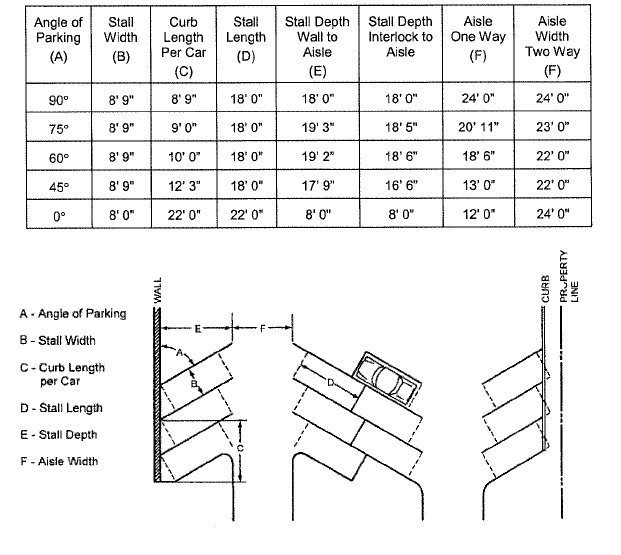
Up to 20 percent of the total required parking may be designated for compact cars with stalls not less than seven feet wide and 15 feet in length, exclusive of access aisles. Parking for compact cars must be appropriately marked. Each space shall be adequately serviced by access aisles.
b.
Within structures. The off-street parking requirements may be met by providing a space so designed within the principal building or one structure attached thereto, however, no building permit shall be issued to convert said parking structure into a dwelling unit or living area or other use until other adequate provisions are made to comply with the required off-street parking provisions of this chapter.
c.
[Circulation between bays, aisles.] Except in the case of single-family, two-family, townhouse and quadraminium dwellings, parking areas shall be designed so that circulation between parking bays or aisles occurs within the designated parking lot and does not depend upon a county road, city street, or alley. Except in the case of single-family, two-family, townhouse and quadraminium dwellings, parking area design which requires backing into the public street is prohibited.
d.
[Curb cut access at intersections.] No curb cut access shall be located within 30 feet of the intersection of two or more street rights-of-way, except on approval of the city engineer.
e.
[Curb cut access width.] No curb cut access shall exceed 25 feet in width, except on the approval of the city engineer.
f.
[Curb cut openings.] Curb cut openings shall be at minimum five feet, not including curb radius, from side or rear property lines.
g.
Boundary line driveways. Joint use boundary line driveways are permitted, provided the adjoining property owners present a joint use agreement to the city council for approval. Upon approval of said agreement it shall be recorded by the property owners in the Hennepin County Recorder's Office or Registrar of Title Office and shall be filed with the city zoning administrator.
h.
Surfacing. Except for single-family and two-family dwellings, all areas intended to be utilized for parking space and driveways shall be surfaced with asphalt, cobblestone, paver block or other form of concrete. Plans for surfacing and drainage of driveways and parking lots containing five or more stalls shall be submitted to the city engineer and the Minnehaha Creek Watershed District for review and written approval.
i.
Striping. Except for single-family, two-family, townhouse and quadraminium dwellings, all bituminous or concrete parking stalls shall be marked with white or yellow paint lines not less than four inches wide.
j.
Lighting. Public, commercial, manufacturing and multiple-family parking areas shall have installed lights of sufficient intensity and number to permit unimpaired vision to and in all areas of the parking facility. Any lighting used to illuminate an off-street parking area shall be so arranged as to reflect the light away from adjoining property, abutting residential uses and public rights-of-way and be in compliance with subsection 42-63(g).
k.
Signs. No sign shall be so located as to restrict the sight lines and orderly operation and traffic movement within any parking lot.
l.
Landscaping. Grass or landscape plantings shall be provided in areas bordering the parking areas.
(h)
Maintenance. It shall be the joint and several responsibility of the lessees and owners of the principal use, uses or building to maintain in a neat and adequate manner, the parking space, accessways, striping, landscaping, and required screening.
(i)
Location. All accessory off-street parking facilities required by this chapter shall be located and restricted as follows:
(1)
Required accessory off-street parking shall be on the same lot under the same ownership as the principal use being served, except under the provisions of subsection (k).
(2)
Except for single-family, two-family, townhouse and quadraminium dwellings, head-in parking directly off of and adjacent to a county road where drivers have their own direct access to the county road shall be prohibited.
(3)
The boulevard portion of the right-of-way shall not be used for parking.
(j)
Use of required area. Required accessory off-street parking spaces in any district shall not be utilized for open storage, sale or rental of goods, storage of inoperable vehicles, and/or storage of snow.
(k)
Number of spaces required. The following minimum number of off-street parking spaces shall be provided and maintained by ownership, easement and/or lease for and during the life of the respective uses hereinafter set forth:
(1)
Single-family, two-family, townhouse and quadraminium units. Two spaces per unit.
(2)
Boarding house. At least one parking space for each person for whom accommodations are provided for sleeping.
(3)
Townhomes and multiple-family dwellings. Two spaces per unit, plus one visible and accessible space per four units designated as parking for residents' guests and visitors.
(4)
Community centers, health or exercise club, libraries, private clubs, lodges, museums, art galleries. Ten spaces plus one for each 150 square feet in excess of 2,000 square feet of floor area in the principal structure.
(5)
Convalescent home, rest home, nursing home or day nurseries. One for each three beds, plus one for each two employees, plus one for staff or visiting physician.
(6)
Elderly (senior citizen) housing. Reservation of area equal to one parking space per unit. Upon initial development only one-half the reserved area shall be required to be developed for parking. Said number of parking spaces shall continue until such time as the city council determines that a need for additional parking spaces has been demonstrated.
(7)
Office buildings, medical and dental clinics, veterinary clinics and hospitals, and professional offices. One space for each 200 square feet of floor area.
(8)
Retail store and service establishment. At least one off-street parking space for each 200 square feet of floor area.
(9)
Retail sales and service business with fifty (50) percent or more of gross floor area devoted to storage and/or warehouses. At least five spaces or one space for each 200 square feet devoted to public sales or service, whichever is greater, plus one space for each 500 square feet of storage area.
(10)
Restaurants, cafes, private clubs serving food and/or drinks, bars, taverns, nightclubs.: At least one space for each three seats in the establishment.
(11)
Shopping centers. Five and one-half spaces per each 1,000 square feet of gross leasable floor area (exclusive of common area).
(12)
Motor fuel station or auto repair. At least four off-street parking spaces plus two off-street parking spaces for each service stall. Those facilities designed for sale of other items than strictly automotive products, parts or service shall be required to provide additional parking in compliance with other applicable sections of this chapter.
(13)
Manufacturing, fabricating or processing of a product or material. One space for each five hundred (500) square feet of floor area, or one space for each two employees on maximum shift, whichever is greater, plus one space for each truck based at the facility and operated by or for the owner or operator of the use (if not stored inside principal building).
(14)
Warehousing, storage or handling of bulk goods. That space which is solely used as office shall comply with the office use requirements and one space per each 2,000 square feet of floor area, plus one space for each two employees on maximum shift and one space for each truck based at the facility and operated by or for the owner or operator of the use (if not stored inside principal building).
(15)
Other uses. Other uses not specifically mentioned herein shall be determined on an individual basis by the city council. Factors to be considered in such determinations shall include (without limitation) size of building, type of use, number of employees, expected volume and turnover of customer traffic and expected frequency of delivery of service vehicles.
(l)
Off-site parking.
(1)
Any off-site parking which is used to meet the requirements of this chapter shall be approved by the city council and shall be subject to the conditions listed below. Notwithstanding any other provisions of this chapter to the contrary, where parking is provided on a lot which is separated from the principal use being served by a city, county or state street, highway or other roadway, such lot shall be regarded as being a part of the site of the principal use, and shall not be subject to the conditions listed below.
(2)
Off-site parking shall be developed and maintained in compliance with all requirements and standards of this chapter.
(3)
Reasonable public access from off-site parking facilities to the use being served shall be provided.
(4)
The site used for meeting the off-site parking requirements of this chapter shall be under the same ownership or lease as the principal use being served or under public ownership.
(5)
Off-site parking for multiple-family dwellings shall not be located more than 100 feet from any normally used public entrance of the principal use served.
(6)
Off-site parking for nonresidential uses shall not be located more than 300 feet from the main entrance of the principal use being served. No more than one main entrance shall be recognized for each principal building. An overflow parking lot may be exempted from this provision if a shuttle service between the overflow lot and the principal use is provided.
(7)
The owner of a use requiring off-site parking to conform with this chapter shall continue to own and utilize such site for parking until either on-site parking is provided or a site in closer proximity to the use is acquired and developed for parking.
(Ord. No. 62, § 3(Subd. G), 9-13-1993; Ord. No. 62-13, § 1, 6-19-2006; Ord. No. 62-18, § 1, 12-18-2006; Ord. No. 07-04, § 1, 6-4-2007)
Sec. 42-68. - Off-street loading.
(a)
Purpose. The regulation of loading spaces in these zoning regulations is to alleviate or prevent congestion of the public right-of-way and so to promote the safety and general welfare of the public, by establishing minimum requirements for off-street loading and unloading from motor vehicles in accordance with the utilization of various parcels of land or structures.
(b)
Location.
(1)
All required loading spaces shall be off-street and located on the same lot as the building or use to be served. All loading spaces beyond one shall be separate from areas used for off-street parking.
(2)
Loading spaces located at the front, or at the side of buildings on a corner lot, shall meet the following conditions:
a.
Loading areas shall not conflict with pedestrian movement.
b.
Loading areas shall not obstruct the view of the public right-of-way from accessways to off-street parking spaces.
(3)
Each loading area shall be located with appropriate means of vehicular access to a street or public alley designed in a manner which will cause the least interference with traffic.
(c)
Surfacing. All loading areas and accessways shall be improved to control the dust and drainage according to a plan submitted to and approved by the city engineer.
(d)
Accessory use, parking and storage.
(1)
Any space allocated as a required loading area or access drive so as to comply with the terms of this chapter shall not be used for the storage of goods, inoperable vehicles or snow and shall not be included as part of the space requirements to meet the off-street parking area.
(2)
All designated loading areas shall be actively utilized for the loading and unloading of goods. In no case shall the act of loading and removal of goods from a site exceed 14 days.
(e)
Size. Loading berths (areas) shall not be less than 50 feet in length, 12 feet in width, and 15 feet in height, exclusive of aisle and maneuvering space. Upon review of the proposed use, the city council may require additional or lesser loading area to accommodate the types of trucks associated with the proposed use.
(f)
Number of loading spaces required. The number of required off-street loading areas shall be as follows:
(1)
Commercial and manufacturing buildings and uses. For each building, one loading area and one (1) additional area for each 20,000 square feet or fraction thereof.
(2)
Multiple-family dwelling. Where such building has ten or more dwelling units, one loading area per structure.
(g)
Off-street loading required. Any structure substantially altered for a use which requires the receipt or distribution of materials or merchandise by trucks or similar vehicles shall provide off-street loading space as required for a new structure.
(Ord. No. 62, § 3(Subd. H), 9-13-1993)
Sec. 42-69. - Home occupation.
A home occupation may be conducted only in accordance with the following requirements:
(1)
Subordinate use. The use of the dwelling unit for the home occupation shall be clearly incidental and subordinate to its residential use.
(2)
Outside appearance. Conduct of the home occupation shall result in no change in the outside appearance of the building or land, or other visible evidence of the conduct of the home occupation other than one sign, not exceeding one square foot in area, nonilluminated, and mounted flat against the wall of the dwelling.
(3)
Traffic. No traffic shall be generated by such home occupation in greater volume than would normally be expected in a residential neighborhood, and any need for parking generated by the conduct of such home occupation shall be met off the street and other than in a required front yard.
(4)
One-customer service. A beauty shop or similar service home occupation shall serve no more than one customer at a time.
(5)
Requirements—General provisions. All home occupations shall comply with the following general provisions:
a.
No home occupation shall produce light glare, noise, odor or vibration that will in any way have an objectionable effect upon adjacent or nearby property.
b.
No equipment shall be used in the home occupation which create electrical interference at surrounding properties.
c.
No home occupation shall require internal or external alterations or involve construction features not customarily found in dwellings except where required to comply with local and state fire and police recommendations.
d.
There shall be no exterior storage of equipment or material used in the home occupation, except personal automobiles used in the home occupation may be parked on the site.
e.
The home occupation shall meet all applicable fire and building codes.
f.
All home occupations shall comply with the provisions of the city nuisance ordinance.
g.
No home occupation shall be open to the public for business between the hours of 10:00 p.m. and 7:00 a.m.
(6)
Nonconforming use. Existing home occupations lawfully existing on the effective date of this chapter may continue as nonconforming uses. Any existing home occupation that is discontinued for a period of more than 30 days, or is in violation of the ordinance provisions under which it was initially established, shall be brought into conformity with the provisions of this subdivision if re-established.
(7)
Inspection. The city hereby reserves the right upon receiving an application for any home occupation permit to inspect the premises in which the occupation is proposed to be conducted to insure compliance with the provisions of this subdivision or any additional conditions imposed. After a home occupation permit is granted, inspections may be conducted with reasonable notice.
(Ord. No. 62, § 3(Subd. I), 9-13-1993)
Sec. 42-70. - Shoreland alterations.
Alterations of vegetation and topography are hereby regulated to prevent erosion into public waters, fix nutrients, preserve shoreland aesthetics, preserve historic values, prevent bank slumping and protect fish and wildlife habitat.
(1)
Vegetation alterations.
a.
Vegetation alterations necessary for the construction of structures and the construction of streets and parking areas regulated by subsection 42-67(f) are exempt from the vegetation alteration standards that follow.
b.
Removal or alteration of vegetation is allowed subject to the following standards:
i.
Intensive vegetation clearing within the shore and bluff impact zones and on steep slopes is not allowed.
ii.
In shore and bluff impact zones and on steep slopes, limited clearing of trees and shrubs and cutting, pruning, and trimming of trees is allowed to provide a view to the water from the principal dwelling site and to accommodate the placement of stairways and landings, picnic areas, access paths, provided that:
(A)
The screening of structures, vehicles, or other facilities as viewed from the water, assuming summer, leaf-on conditions, is not substantially reduced.
(B)
The above provisions are not intended to prohibit the removal of trees, limbs, or branches that are dead, diseased, or pose safety hazards.
(Ord. No. 62, § 3(Subd. J), 9-13-1993)
Sec. 42-71. - Topographic alterations/grading and filling.
(a)
Grading, filling and excavations necessary for the construction of structures and driveways under validly issued building permits for these facilities do not require the issuance of a separate grading and filling permit. However, the grading and filling standards in this subdivision must be incorporated into any permit issued for construction of structures, and driveways.
(b)
Public roads and parking areas are regulated by subsection 42-67(f).
(c)
Notwithstanding items (a) and (b) above, a grading and filling permit will be required for:
(1)
The movement of more than ten cubic yards of material on steep slopes or within shore or bluff impact zones; and
(2)
The movement of more than 50 cubic yards of material outside of steep slopes and shore and bluff impact zones.
(d)
The following considerations and conditions must be adhered to during the issuance of construction permits, grading and filling permits, conditional use permits, variances and subdivision approvals:
(1)
Applications for permits for grading and filling in any type 2, 3, 4, 5, 6, 7, or 8 wetland shall be in accordance with the Minnesota Wetlands Conservation Act of 1991; Minnesota Law, chapter 354; Army Corps of Engineers National Wetland Inventory Map; and shall be evaluated by the city engineer to determine how extensively the proposed activity would affect the following functional qualities of the wetland: *
a.
Sediment and pollutant trapping and retention;
b.
Storage of surface runoff to prevent or reduce flood damage;
c.
Fish and wildlife habitat;
d.
Recreational use;
e.
Shoreline or bank stabilization; and
f.
Noteworthiness, including special qualities such as historic significance, critical habitat for endangered plants and animals, or others.
* This evaluation must also include a determination of whether the wetland alteration being proposed requires permits, reviews, or approvals by other local, state, or federal agencies such as the Minnehaha Creek Watershed District, the Minnesota Department of Natural Resources, or the United States Army Corps of Engineers. The applicant will be so advised.
(2)
Alterations shall be designed and conducted in a manner that ensure only that the smallest amount of bare ground practicable is exposed for the shortest time possible.
(3)
Mulches or similar materials shall be used, where necessary, for temporary bare soil coverage, and a permanent vegetation cover shall be established as soon as possible.
(4)
Methods to minimize soil erosion and to trap sediments before they reach any surfacewater feature shall be used.
(5)
Altered areas shall be stabilized to acceptable erosion control standards consistent with the field office technical guides of the local soil and water conservation districts and the United States Soil Conservation Service.
(6)
Fill or excavated material shall not be placed in a manner that creates an unstable slope.
(7)
Plans to place fill or excavated material on steep slopes must be reviewed by qualified professionals for continued slope stability and shall not result in finished slopes of 30 percent or greater.
(8)
Fill or excavated material shall not be placed in bluff impact zones.
(9)
Any alterations below the ordinary high-water level of public waters shall be authorized by the commissioners acting under Minn. Stat. § 103G.245.
(10)
Alterations of topography shall be allowed only if they are accessory to permitted or approved conditional uses and do not adversely affect adjacent or nearby properties.
(11)
Placement of natural rock rip rap, including associated grading of the shoreline and placement of a filter blanket, is permitted if the finished slope does not exceed three feet horizontal to one foot vertical, the landward extent of the rip rap is within ten feet of the ordinary high-water level, and the height of the rip rap above the ordinary high-water level does not exceed three feet.
(e)
Connections to public waters. Excavations where the intended purpose is connection to a public water, such as boat slips, canals, lagoons, and harbors, shall be controlled by local shoreland controls. Permission for excavations may be given only after the commissioner has approved the proposed connection to public waters.
(f)
Steep slopes. The zoning administrator must evaluate possible soil erosion impacts and development visibility from public waters before issuing a permit for construction of streets, driveways, structures, or other improvements on steep slopes. When determined necessary, the zoning administrator is authorized to prevent erosion subject to conditions designed to prevent erosion and to preserve existing vegetation screening of structures, vehicles, and other facilities as viewed from the surface of public waters, assuming summer leaf-on conditions.
(g)
Land reclamation. Land reclamation shall be allowed in all districts. Any person desiring to deposit 50 cubic yards or more of fill on a lot or parcel shall be required to have a land reclamation permit. Land reclamation shall not be interpreted to include the depositing of fill from a building excavation on the same property.
The application for a reclamation permit shall include a finished grade plan from which it can be determined that the reclamation will not adversely affect adjacent land. As further conditions to issuing the permit, the City may regulate the type of fill permitted, require a program for rodent control, plans for fire control and general maintenance of the site, controls for vehicular ingress and egress, and impose requirements to control the hauling of material to or from the site and to limit the dispersal of material from the site by wind.
(Ord. No. 62, § 3(Subd. K), 9-13-1993)
Sec. 42-72. - Stormwater management.
The following standards shall apply.
(1)
General standards.
a.
[Stormwater runoff.] When possible, existing natural drainageways, wetlands, and vegetated soil surfaces shall be used to convey, store, filter, and retain stormwater runoff before discharge to public waters.
b.
[Disturbed areas, etc.] Development shall be planned and conducted in a manner that will minimize the extent of disturbed areas, runoff velocities, erosion potential, and reduce and delay runoff volumes. Disturbed areas must be stabilized and protected as soon as possible with facilities or methods to retain sediment on the site.
c.
[Constructed facilities.] When development density, topographic features, and soil and vegetation conditions are not sufficient to adequately handle stormwater runoff using natural features and vegetation, various types of constructed facilities such as diversions, settling basins, skimming devices, dikes, waterways, and ponds may be used. Preference must be given to designs using surface drainage, vegetation, and infiltration rather than buried pipes and manmade materials and facilities.
d.
Drainage plans. In the case of all multiple-family, commercial, and manufacturing developments, the drainage plans shall be submitted to the Minnehaha Creek Watershed District for review and the final drainage plan shall be subject to their written approval.
(2)
Specific standards.
a.
When constructed facilities are proposed to be used for stormwater management, certification must be provided by a qualified individual, retained by the applicant, that such facilities are designed and will be installed consistent with the field office technical guide of the local soil and water conservation districts.
b.
Stormwater outfalls to public waters shall be constructed so as to provide for filtering or settling of suspended solids and skimming of surface debris before discharge.
(Ord. No. 62, § 3(Subd. L), 9-13-1993)
Sec. 42-73. - Special provisions for commercial, manufacturing, public/semipublic.
(a)
Standards for commercial, manufacturing, public and semipublic uses.
(1)
Commercial uses and manufacturing, public, or semipublic uses with similar needs for access to and use of public waters may be located on parcels or lots with frontage on public waters. Those uses with water-oriented needs must meet the following standards:
a.
In addition to meeting impervious coverage limits, setbacks, and other zoning standards in this chapter, the uses must be designed to incorporate topographic and vegetative screening of parking areas and structures.
b.
Uses that require short-term watercraft mooring for patrons must centralize these facilities and design them to avoid obstructions of navigation and to be the minimum size necessary to meet the need, and conform to the regulations of the Lake Minnetonka Conservation District.
c.
Uses that depend on patrons arriving by watercraft may use signs and lighting to convey needed information to the public, subject to the following general standards:
i.
No advertising signs or supporting facilities for signs may be placed in or upon public waters. Signs conveying information or safety messages may be placed in or on public waters by a public authority or under a permit issued by the county sheriff;
ii.
Signs may be placed, when necessary, within the shore impact zone if they are designed and sized to be the minimum necessary to convey needed information. They shall convey only the location and name of the establishment and the general types of goods or services available. The signs must not contain other information such as product brands or prices, and shall not exceed 32 square feet in size. If illuminated by artificial lights, the lights must be shielded or directed to prevent illumination out across public waters; and
iii.
Other outside lighting may be located within the shore impact zone or over public waters if it is used to illuminate potential safety hazards and is shielded or otherwise directed to prevent direct illumination out across public waters. This does not preclude use of navigational lights.
(2)
Uses without water-oriented needs must be located so as to be substantially screened from view from the water by vegetation or topography, assuming summer, leaf-on conditions.
(Ord. No. 62, § 3(Subd. M), 9-13-1993)
Sec. 42-74. - Personal wireless service antennas and towers.
(a)
Purpose and intent. The purpose of this section is to regulate the siting and screening of wireless communication equipment in order to accommodate the growth of wireless communication systems within the city while protecting the public against any adverse impacts on the city's aesthetic resources and the public welfare.
(b)
Personal wireless service antennas. Personal wireless service antennas erected on an antenna support structure may be allowed as a permitted secondary use in P, Public and Semi-Public zoning districts if the applicant complies with the conditions set forth below and secures a building permit and certificate of occupancy:
(1)
Unless the antenna, support structure, and land are under the same ownership, the applications for antenna erection shall be signed by both the property owner and the applicant.
(2)
The antenna support structure is not less than 36 feet in height.
(3)
The antenna shall not exceed the height of the antenna support structure by more than 20 feet.
(4)
The antenna support structure and antenna shall be in compliance with the Minnesota State Building Code and all other applicable federal, state and local regulations and permits.
(5)
Structural design, mounting and installation of the antenna shall be in compliance with manufacturer's specifications and shall be verified and approved by a registered professional engineer.
(6)
No advertising message shall be affixed to the antenna.
(7)
Antennas shall not be artificially illuminated unless required by law or by the Federal Aviation Administration (FAA) to protect the public's health and safety.
(8)
Applications to erect new antenna shall be accompanied by any required federal, state, or local agency licenses.
(9)
Transmitting, receiving, and switching equipment shall be housed within the existing structure whenever possible. If a new equipment building is necessary for transmitting, receiving and switching equipment, it shall be situated in the rear yard of the principal use and shall be screened from view by landscaping.
(10)
All obsolete and unused antennas shall be removed within 12 months of cessation of operation at the site. The removal shall be the joint and several responsibility of the utility or communication provider and land owner.
(11)
Antennas and their appurtenances located above the primary roof of an antenna support structure shall be set back one foot from the edge of the primary roof for each one foot in height above the primary roof of the antenna. This setback requirement shall not apply to the following:
a.
Antennas which are mounted to the exterior of antenna support structures below the primary roof, and do not protrude more than six inches from the side of such antenna support structure.
b.
Screened antennas and their appurtenances.
(12)
Antennas shall utilize camouflaging techniques or shall be side mounted to an antenna support structure in order that such facilities harmonize with the character and environment of the area in which they are located.
(c)
Personal wireless service antenna towers. Personal wireless service antennas erected on an antenna tower may be allowed as a conditionally permitted use within the Public/Semi-Public zoning districts, provided they comply with the following standards:
(1)
Unless the antenna tower and land are under the same ownership, the applications for antenna and antenna tower erection shall be signed by both the property owner as well as the applicant.
(2)
All obsolete and unused antenna towers shall be removed within 12 months of cessation of operation at the site. The removal shall be the joint and several responsibility of the utility or communication provider and landowner.
(3)
All antenna towers shall be in compliance with the Minnesota State Building Code and all other applicable federal, state and local regulations and permits.
(4)
Structural design, mounting and installation of the antenna towers shall be in compliance with manufacturer's specifications and shall be verified and approved by a registered professional engineer.
(5)
Applications to erect new antenna towers shall be accompanied by any required federal, state, or local agency licenses.
(6)
Antenna towers shall be built within building setback lines established for the zone in which they are located.
(7)
The height of the antenna shall be the minimum necessary to function satisfactorily as verified by an electrical engineer or other appropriate professional. Maximum height of any antenna tower shall be 165 feet.
(8)
Antenna towers shall not be artificially illuminated unless required by law or by the Federal Aviation Administration (FAA) to protect the public's health and safety.
(9)
No advertising message shall be affixed to the antenna tower.
(10)
Antenna towers shall be painted silver or have a galvanized finish to reduce visual impact, unless otherwise required by federal law.
(11)
The applicant shall demonstrate by providing coverage/interference analysis and capacity analysis prepared by a registered professional engineer that the location of the tower and antenna as proposed is necessary to meet the frequency spacing needs of the personal wireless service system and to provide adequate portable personal wireless service coverage and capacity to areas which cannot be adequately served by locating antennas on an existing antenna support structure or tower.
(12)
A security fence eight feet in height shall be provided around the base of the antenna tower. A locked anti-climb device shall be installed on all towers extending more than 12 feet above the ground.
(13)
Transmitting, receiving and switching equipment shall be housed within an existing structure whenever possible. If a new equipment building is necessary for transmitting, receiving and switching equipment, it shall be situated in the rear yard of the principal use and shall be screened from view by landscaping where appropriate.
(14)
If a new antenna tower is to be constructed, it shall be designed so as to accommodate other users including, but not limited to other personal wireless service companies, local police, fire, and ambulance companies.
(15)
The conditional use permit provisions of Section 6 of this Ordinance must be satisfied.
(Ord. No. 62.07, § 4, 8-17-1998)
Sec. 42-75. - Construction staging plan.
(a)
Purpose. To promote the safety and general welfare of the public by controlling nuisance issues such as exhaust emissions, dust control, litter, employee parking, fencing, loading and project staging, noise, and street clean up associated with construction projects.
(b)
Application. The provisions of this subdivision shall apply to all commercial, multifamily, industrial, or institutional development or redevelopment projects that require a site plan review and approval under article IV, division 1, Plan Review. Any modification to the construction staging plan for multiple phases of a project must be approved by the city.
(c)
Submission requirements. A construction staging plan that complies with all standards of this section shall be submitted for any project that requires submission of a site plan pursuant to article IV, division 1, Plan Review. A construction staging plan may be submitted in graphic/visual or narrative form, or any combination thereof.
(d)
Construction staging standards.
(1)
Employee parking. The construction staging plan must contain a detailed parking plan that provides off-street parking in the amount of one space for each employee at the peak employment of the project. The contractor must identify peak employment and equipment storage periods and identify parking for all employees and subcontractors and locations for all company vehicles and equipment. Parking may be provided on site or arrangements may be made with neighboring property owners to provide off-site parking.
a.
On-site parking. Any on-site parking must be properly delineated on the site.
b.
Off-site parking. Off-site parking may be provided subject to city approval and the following conditions:
1.
Applicant must submit to the city a written agreement between the applicant and the owner of the off-site parking area(s) which describes the parking arrangement.
2.
The off-site location must provide reasonable and safe access from the off-site parking areas to the project site.
3.
Off-site parking must be located within a reasonable distance from the project site.
4.
Applicant must demonstrate that valid insurance coverage will be extended to all off-site parking areas.
5.
Hours allowed for employee parking.
c.
[Signage.] The city may require signage (at applicant's expense) in designated locations to discourage on-street employee parking.
d.
[Traffic control.] The city may require the applicant to provide (at applicant's expense) traffic control elements near the project site access to public streets. Said elements may include, but are not limited to, restricted traffic patterns for site access, restricted turns, and flag men.
(2)
Construction trailer and sales office. The location of all construction trailers and/or sales offices must be indicated on the construction staging plan. The applicant must also include the locations of any additional parking required for said trailers and the days and hours of operation for sales offices.
(3)
Exhaust emissions and dust. The discharge or production of dust, exhaust, dense smoke, noxious fumes, gas, or soot in quantities sufficient to make the project site and surrounding properties uncomfortable to a person of ordinary sensibilities is prohibited. The construction staging plan must include strategies for mitigating potential problems associated with the production, discharge and emission of exhaust, smoke, fumes, gas, soot and dust. In order to properly address these nuisances, the city requires the following:
a.
Erosion control elements to prevent water and wind erosion and restoration of ground cover for any disturbed land.
b.
Watering of the site and/or street(s) to control dust and airborne particles.
c.
Windbreaks or other enclosures to contain and control gravel or other materials, and to provide a separation of such materials from surrounding properties.
d.
Identification on the construction staging plan of all potential site locations for the mixing of dry and/or wet cement and the operation of related equipment.
e.
All vehicles and equipment must be turned off when not in operation or when continued operation is not required for the proper use of such vehicles or equipment (e.g. the idling of diesel engines may be permitted in cold weather). No unnecessary idling of vehicles shall be permitted.
(4)
Fencing. All construction sites must be properly enclosed by a temporary chain-link fence a minimum of six feet in height and installed in a manner that prevents pedestrian or motor vehicle access, discourages vandalism and theft, and maintains safety on the project site. The fence must surround the entire portion of the project site where construction activities will occur.
(5)
Hours of operation. No person shall engage in or permit outdoor construction activities that:
a.
May generate nuisance noise issues,
b.
Involve the use, operation, fueling, or repair of any kind of electric, diesel, or gas-powered machine or other power equipment, except between the hours of 7:00 a.m. and 8:00 p.m. on any weekday or between the hours of 8:00 a.m. and 5:00 p.m. on Saturdays. Exceptions may be made for delivery of equipment to site to comply with highway load and time restrictions.
No outdoor construction activities shall be permitted on Sundays or the following holidays: New Year's Day, Memorial Day, the Fourth of July, Labor Day, Thanksgiving, and Christmas Day. Hours of operation must be posted at all entrances to the project site.
(6)
Noise. No noise that would generate a nuisance or complaint from surrounding property owners shall be permitted on construction sites outside the permitted hours of operation set forth in this Ordinance.
(7)
Litter. Discarded construction material or other litter at a construction site must be placed in an adequate waste container or trash enclosure. The collection and disposal of any refuse or debris that is blown from the site shall be the responsibility of the applicant. Trash enclosures that contain refuse and recyclable material or equipment may be moved around the site for convenience of daily activities. Locations for overnight storage of waste containers and trash enclosures and their storage locations when not in use shall be indicated on the construction staging plan and must meet the following requirements:
a.
The trash and/or recycling containers and enclosures must be in an accessible location for pick up by trash/garbage hauling vehicles.
b.
All dumpsters, recycling bins, handling equipment, and enclosures must be approved by the zoning administrator, be kept in a good state of repair, and be designed to prevent spilling and spread of debris and access by animals.
c.
Inspection of the construction site and surrounding area must be performed at the end of each day and all construction materials, refuse, debris and litter must be properly disposed of or contained on the site. A person or persons shall be designated to perform daily clean-up of the site and surrounding area and the zoning administrator must be advised of the name and contact information for such designated person(s).
(8)
Loading and staging plan. A plan shall be submitted for each project that includes all potential locations for loading and staging of materials. All loading and staging locations must be secured within the fenced area. All potential locations shall be located away from adjacent properties in order to mitigate dust, noise, and other nuisances. The loading and staging plan shall include the following:
a.
All locations for delivery and receipt of dirt, sand, sod, concrete, and other materials. All locations must provide for adequate truck maneuvering.
b.
All locations for the storage of materials. Any piles of wood or other materials must be neatly stacked or stacked and secured in a stable manner to avoid collapse.
c.
All concrete mixing locations.
d.
Directional signage shall be posted for all delivery areas.
e.
An off-site staging and loading area may be provided subject to the following conditions:
1.
Applicant must submit to the City a written agreement between the applicant and the owner of the off-site property which describes the arrangement.
2.
The off-site location must provide reasonable and safe access from the off-site staging and loading area to the project site.
3.
Off-site staging and loading shall be located within a reasonable distance from the project site, as approved by the City.
4.
Applicant must demonstrate that valid insurance coverage will be extended to all off-site parcels necessary to implement the construction staging plan.
(9)
Streets and roadways. The deposit of dirt, rocks, mud or other debris from construction or landscaping activities onto streets, sidewalks, ditches, or other public ways and the gutters is prohibited. Persons participating in construction activities shall perform daily clean-up of all affected areas. Wet sweepers shall be utilized for dust mitigation as needed. If the city determines that the surrounding streets, sidewalks and other public ways are not adequately cleaned and maintained, the city may hire a street sweeper at the applicant's expense.
(10)
Signage. A comprehensive construction signage plan shall be submitted with detailed information on the location and placement of signs related to construction, including:
a.
Employee/worker parking areas.
b.
No parking areas.
c.
Hours of operation/deliveries/sales.
d.
Delivery location and loading areas.
e.
Traffic control elements.
f.
Construction and sales trailer directional signage.
(e)
Administration. Upon approval of the construction staging plan, the applicant, developer, general contractor, or signatory of the development agreement shall sign a written agreement with the city to implement and abide by all provisions and requirements contained in the construction staging plan. Said agreement shall be posted with any building permits.
(1)
The construction staging plan shall include a list of all contact persons and backup contact persons responsible for enforcement of the plan. The name, phone number, address, and e-mail address (if available) of all contact persons shall be provided and updated whenever changes occur. At least one contact person must be present on the site during work hours for emergency purposes.
(2)
The city may require development contracts for all multifamily, commercial, industrial, and institutional development and redevelopment projects. Said contracts shall require compliance with the above provisions and conditions of the approved construction staging plan.
(3)
The city shall require a financial security equal to 125 percent of all site improvements (defined as grading, utilities, streets, erosion control and landscaping) as established by the city engineer as part of any development contract. Said escrow may be utilized to ensure immediate enforcement of the staging plan.
(4)
The city council may waive any provision of the staging plan upon presentation of information that demonstrates unique conditions of the site, construction operations, or size of project.
(5)
The developer or general contractor shall attend regular, ongoing meetings as scheduled by the city with the city council and/or city staff to address any issues that may arise during construction.
(f)
Enforcement. Any violation of this subdivision shall be enforced as follows:
(1)
When and where there is probable cause to believe a violation of the provisions of this section has occurred or is occurring, the city shall notify the construction manager or other appropriate contact person of the violation in writing via, mail, e-mail, or personal delivery. Except in the case of an emergency situation which requires immediate correction, the city will allow 24 hours for correction of the violation. If the violation is not corrected within 24 hours of notification (or immediately in the case of an emergency situation), the city may issue a stop-order for the project, stopping any and all construction activities, or take corrective action at the expense of the contractor or developer.
(2)
The stop order shall remain in effect until the violation has been corrected as determined by the city zoning administrator and/or building official.
(3)
Probable cause may be determined by conditions found during random site inspections or complaints by residents or surrounding property owners.
(4)
In addition, if the applicant fails to comply with the provisions of this Ordinance, the applicant will be subject to the penalties described in article V.
(5)
The city reserves the right to require amendment of the construction staging plan in the event that it does not meet the needs of the city.
(Ord. No. 62-11, § 1, 7-17-2006)
Sec. 42-76. - Alternative energy systems.
(a)
Purpose and intent. The purpose of this section is to:
(1)
Accommodate alternative energy sources by removing regulatory barriers and creating a clear regulatory path for approving alternative energy systems.
(2)
Create a livable community where development incorporates sustainable design elements such as resource and energy conservation and use of renewable energy.
(3)
Protect and enhance air quality and decrease use of fossil fuels.
(4)
Accommodate alternative energy development in locations where the technology is viable and environmental, economic and social impacts can be mitigated.
(b)
Ground source heat pump systems.
(1)
Zoning district allowance. Ground source heat pump systems in accordance with the standards in this section are allowed as a permitted accessory use in all zoning districts.
(2)
Standards.
a.
System requirements.
1.
Only closed loop ground source heat pump systems utilizing heat transfer fluids as defined in article 1, division 2 are permitted. Open loop ground source heat pump systems are prohibited.
2.
Ground source heat pump systems located within public waters are prohibited.
b.
Setbacks.
1.
Except as otherwise allowed for systems within public waters (by conditional use permit), all components of ground source heat pump systems including pumps, borings and loops shall be set back at least ten feet from all lines and 25 feet from the ordinary high water level of any public water body.
2.
Above-ground equipment associated with ground source heat pumps shall not be installed in the streetside yard of any lot and shall meet all required principal building setbacks for the applicable zoning district.
c.
Easements. Ground source heat pump systems shall not encroach on public drainage, utility, roadway or trail easements.
d.
Noise. Audible noise from ground source heat pump systems shall not exceed 55 dB(A) when measured from the outside of the nearest residence, business, school, hospital, religious institution, or other inhabited structure. All equipment must be maintained to prevent infrequent, disruptive, excessive or unusual noise such as grating, grinding, screeching, rattling or other noise. Noise and/or nuisance related issues resulting from the operation of a ground source heat pump system shall be subject to the requirements of chapter 18, article III of the City Code.
e.
Screening. Ground source heat pumps are considered mechanical equipment and subject to the screening requirements of section 42-64(j) of this chapter.
f.
Safety. Ground source heat pumps shall be certified by Underwriters Laboratories, Inc. and meet the requirements of the State Building Code.
(3)
Abandonment. If a ground source heat pump system remains nonfunctional or inoperative for a continuous period of one year, the system shall be deemed to be abandoned and shall constitute a public nuisance. The property owner shall remove the abandoned system and restore vegetation upon the site at his/her expense after a demolition permit has been obtained in accordance with the following:
a.
The heat pump and any external mechanical equipment shall be removed.
b.
Pipes or coils below the land surface shall be filled with grout to displace the heat transfer fluid. The heat transfer fluid shall be captured and disposed of in accordance with applicable regulations. The top of the pipe, coil or boring (where it connects to mechanical equipment) shall be capped in a secure manner.
(4)
Permits.
a.
A building permit shall be obtained for any ground source heat pump system prior to installation.
b.
Borings for vertical systems are subject to approval by the state department of public health.
c.
Ground source heat pump systems shall be subject to inspection by the city's building official every three years and at the property owner's expense in accordance with the city's fee schedule.
(c)
Wind energy systems.
(1)
Zoning district allowance. Small wind turbine systems in accordance with the standards in this chapter are allowed as a permitted accessory use in all zoning districts.
(2)
General standards. The following standards shall be applicable to small wind turbine systems in all zoning districts:
a.
Setbacks. The base of the wind turbine tower shall be set back from all property lines a distance equal to the highest possible extension of the system apparatus. In no case shall the tower encroach upon required principal structure setbacks.
b.
Mounting. Subject to the requirements of this chapter, wind energy systems may either be roof-mounted or ground-mounted. Roof-mounted wind turbines shall be certified by a registered architect or engineer and shall be permitted only when a determination is made by the city building official that the underlying roof structure will support such system and all applicable building standards are satisfied.
c.
Rotor clearance. No part of a ground-mounted rotor blade shall be located within 20 feet of the ground, the nearest tree canopy, structure or above-ground utility facility.
d.
Noise. Audible noise from wind energy systems shall not exceed 45 dB(A) when measured from the outside of the nearest residence, business, school, hospital, religious institution, or other inhabited structure. All equipment must be maintained to prevent infrequent, disruptive, excessive or unusual noise such as grating, grinding, screeching, rattling or other noise. Noise and/or nuisance related issues resulting from the operation of a wind energy system shall be subject to the requirements of chapter 18, article III of the City Code.
e.
Screening. Wind energy systems are exempt from the screening requirements of section 42-64(j) of this chapter.
f.
Aesthetics. All portions of the wind energy system shall be a non-reflective, non-obtrusive color, subject to the approval of the zoning administrator. The appearance of the turbine, tower and any other related components shall be maintained throughout the life of the wind energy system pursuant to industry standards. Systems shall not be used for displaying any advertising. Systems shall not be illuminated.
g.
Feeder lines. The electrical collection system shall be placed underground within the interior of each parcel. The collection system may be placed overhead near substations or points of interconnection to the electric grid.
h.
Safety.
1.
Wind energy systems shall meet minimum standards such as International Electrotechnical Commission (IEC) 61400-2 or the American Wind Energy Association's (AWEA) small wind turbine performance and safety standard or other standards as determined by the city building official.
2.
Wind energy systems shall be certified by Underwriters Laboratories, Inc. and the national renewable energy laboratory, the small wind certification council or other body as determined by the city. The city reserves the right to deny a building permit for proposed wind energy systems deemed to have inadequate certification or testing for operation in a severe winter climate.
3.
Wind energy systems shall be maintained under an agreement or contract by the manufacturer or other qualified entity.
4.
All grid connected systems shall have an agreement with the local utility prior to the issuance of a building permit. A visible external disconnect shall be provided if required by the utility.
i.
Abandonment. If a wind energy system remains nonfunctional or inoperative for a continuous period of one year, the system shall be deemed to be abandoned and shall constitute a public nuisance. The property owner shall remove the abandoned system and restore vegetation upon the site at his/her expense after a demolition permit has been obtained. Removal includes the entire structure including foundations to below natural grade and transmission equipment.
j.
Permits.
1.
A building permit shall be obtained for any wind energy system prior to installation.
2.
Wind energy systems shall be subject to inspection by the city's building official every three years and at the property owner's expense in accordance with the city's fee schedule.
(3)
Residential district standards:
a.
Number. No more than one wind energy system is permitted per parcel.
b.
Height.
1.
Ground-mounted wind energy systems shall conform to the maximum height requirements of the applicable residential zoning district.
2.
Roof-mounted wind energy systems shall not extend more than eight feet above the highest point of the roof.
c.
Boat lifts. Wind energy systems integrated into the design of boat lifts are permitted as accessory uses in all residential zoning districts subject to the following:
1.
Applicable rules and regulations of the Lake Minnetonka conservation district and the applicable residential zoning district shall be satisfied for residential docks.
2.
The wind energy system shall not exceed 20 feet in height.
3.
The length of system rotor blades shall not exceed three feet in diameter.
(4)
Commercial, manufacturing and public/semi-public district standards:
a.
Number. One wind energy system is permitted per 100 feet of public street frontage.
b.
Height.
1.
Ground-mounted wind energy systems shall conform to the maximum height requirements of the applicable commercial, manufacturing or public/semi-public zoning district.
2.
Roof-mounted wind energy systems shall not extend more than 15 feet above the highest point of the roof.
c.
Ground-mounted systems.
1.
Ground-mounted wind energy systems shall not be installed in the streetside yard of any lot.
2.
Only monopole towers are permitted.
3.
System height shall be measured from the base of the tower to the highest possible extension of the system apparatus.
4.
Ground-located wind energy systems shall not encroach on public drainage, utility roadway or trail easements.
(d)
Solar energy systems.
(1)
Zoning district allowance. Solar energy systems in accordance with the standards in this chapter are allowed as a permitted accessory use in all zoning districts.
(2)
Standards.
a.
Exemption. Passive or building-integrated solar energy systems are exempt from the requirements of this section and shall be regulated as any other building element.
b.
Height. Roof-mounted solar energy systems shall comply with the maximum height requirements in the applicable zoning district. Ground-mounted solar energy systems shall not exceed six feet in height.
c.
Setbacks. Ground-mounted solar energy systems shall comply with all principal structure setbacks of the applicable zoning district. Roof-mounted systems shall comply with all building setbacks in the applicable zoning district and shall not extend beyond the exterior perimeter of the building on which the system is mounted.
d.
Roof mounting. Roof-mounted solar collectors may be flush-mounted or bracket-mounted. Bracket-mounted collectors shall be shall be certified by a registered architect or engineer and shall be permitted only when a determination is made by the city building official that the underlying roof structure will support apparatus, wind, and snow loads and all applicable building standards are satisfied.
e.
Easements. Solar energy systems shall not encroach on public drainage, utility roadway or trail easements.
f.
Screening. Ground mounted solar energy systems shall be screened from view to the extent possible without impacting their function.
g.
Maximum area. Ground-mounted solar energy systems shall be limited in size to the maximum area requirement allowed for accessory structures or no more than 25 percent of the rear yard, whichever is less.
h.
Aesthetics. All solar energy systems shall minimize glare towards vehicular traffic and adjacent properties.
i.
Feeder lines. The electrical collection system shall be placed underground within the interior of each parcel. The collection system may be placed overhead near substations or points of interconnection to the electric grid.
j.
Boat lifts. Solar energy systems integrated into the design of boat lifts are permitted as accessory uses in all residential zoning districts subject to the following:
1.
Applicable rules and regulations of the Lake Minnetonka conservation district and the applicable residential zoning district shall be satisfied.
2.
The solar energy system shall not exceed four square feet in area and six feet in height.
(3)
Safety.
a.
Standards. Solar energy systems shall meet the minimum standards outlined by the International Electrotechnical Commission (IEC), the American Society of Heating, Refrigerating, and Air-conditioning Engineers (ASHRAE), ASTM International, British Standards Institution (BSI), International Electrotechnical Commission (IEC), International Organization for Standardization (ISO), Underwriter's Laboratory (UL), the Solar Rating and Certification Corporation (SRCC) or other standards as determined by the city building official.
b.
Certification. Solar energy systems shall be certified by Underwriters Laboratories, Inc. and the national renewable energy laboratory, the solar rating and certification corporation or other body as determined by the community development director. The city reserves the right to deny a building permit for proposed solar energy systems deemed to have inadequate certification.
c.
Utility connection. All grid connected systems shall have an agreement with the local utility prior to the issuance of a building permit. A visible external disconnect shall be provided if required by the utility.
(4)
Abandonment. If a solar energy system remains nonfunctional or inoperative for a continuous period of one year, the system shall be deemed to be abandoned and shall constitute a public nuisance. The property owner shall remove the abandoned system and restore vegetation upon the site at his/her expense after a demolition permit has been obtained. Removal includes the entire structure including transmission equipment.
(5)
Permits.
a.
A building permit shall be obtained for any solar energy system prior to installation.
b.
Solar energy systems shall be subject to inspection by the city's building official every three years and at the property owner's expense in accordance with the city's fee schedule.
(Ord. No. 13-02, § 2, 9-16-2013)
Sec. 42-77. - Short-term rentals.
(a)
Definitions. In addition to the definitions contained in article I, division 2 of this chapter, the following definitions shall apply to this section.
(1)
Operator. A person or enterprise, or its agent, who is the owner of a dwelling, which is being offered for rent to transients, whether such person's ownership interest in the property is as the owner, lessor, lessee, sublessee, mortgagee-in-possession, licensee, or any other interest. Where the operator performs their functions through a rental agent, the managing agency or the rental agent has the same duties as the operator hereunder.
(2)
Rent. Compensation, in money or other consideration, given in exchange for the occupancy, use, or possession of real property which is charged, whether or not received.
(3)
Short-term rental. Any temporary occupancy or use of a dwelling or dwelling unit that is offered for rent to a transient for fewer than 30 consecutive calendar days for various purposes, including, but not limited to, tourist or transient use, or as a vacation home, or bed and breakfast.
(4)
Transient. Any person who, at their own expense or at the expense of another, exercises occupancy or possession, or is entitled to occupancy or possession, by reason of any rental agreement, whether in writing or otherwise, concession, permit, right-of-access, option to purchase, license, time-sharing arrangement, or any other type of agreement for a period of fewer than 30 consecutive calendar days.
(b)
Short-term rentals prohibited.
(1)
Purpose. The city finds that short-term rentals constitute a commercial use of residential property, which conflict with the fundamental character of residential zoning districts, disrupt the residential character of neighborhoods, and have a negative impact on the livability of residential neighborhoods. The city further finds that, while short term rentals are prohibited under the current provisions contained in the City Code, an ordinance amendment clarifying those regulations is necessary. The city has received complaints from residents regarding short-term rentals, including, but not limited to complaints related to noise, over- occupancy, and illegal parking. To ensure adequate housing options for residents, preserve the residential character of the city's residential districts, preserve property values, and reduce land use conflicts, the city determines, in furtherance of the public health, safety and general welfare, that it is necessary to limit short-term rentals to hotels, motels, lodging establishments, and similar accommodations which are appropriately licensed, zoned, and which have the appropriate infrastructure and services for such short-term use.
(2)
Prohibition. Short-term rental in any residential zoning district in the city is prohibited except where allowed by interim use permit within a respective district. State licensed hotels, motels, and lodging establishments located in areas where permitted by the city's land use regulations are allowed, pursuant to all applicable law and rules.
(3)
Enforcement.
a.
An owner, operator, tenant, or occupant of any building or property in violation of the provisions of this section may be charged and found guilty of a misdemeanor and may be held responsible for the cost of enforcement in addition to penalties.
b.
The city may exercise any and all remedies at law or in equity to ensure compliance with this section. All unpaid costs, charges and penalties may be certified as a special assessment levy against the property.
c.
The city hereby further declares the short-term rental of a dwelling or dwelling unit may constitute a public nuisance pursuant to chapter 18, article IV of the Spring Park City Code and the city may exercise its authority to abate such nuisances.
d.
To address violations of this section, and in addition to any other remedy available to it at law or in equity, the city may exercise its enforcement authority pursuant to chapter 1, section 1-14 of the City Code and applicable state law.
(Ord. No. 20-02, § 1, 9-21-2020; Ord. No. 20-04, § 3, 12-21-2020)
Sec. 42-78. - As-built requirements.
As-built surveys shall be furnished to the city by the subdivider for all required improvements upon their completion and prior to a certificate of occupancy for each home/structure or building addition that is part of such subdivision. Such as-built surveys shall be certified to be true and accurate by the registered engineer responsible for the installation of improvements. As-built surveys shall include the following:
(1)
Shall certify the final topography of the site.
(2)
Shall verify the drainage patterns existing upon completion of work.
(3)
Shall include calculations of setback information for all structures and hard surfaces/groundcover/impervious.
(4)
As-built surveys must be approved prior to placement of trees, sod, and lawn irrigation systems.
(5)
Shall include any additional information needed by the city to ensure compliance with code.
(Ord. No. 25-06, 10-20-2025)

