
Springdale City Zoning Code
ARTICLE 12
- BALLPARK AREA/SOUTHWEST SPRINGDALE DISTRICT OVERLAY
Sec. 1. - General parameters.
1.1
Purpose.
a.
To create a strong framework for moving the entire overlay district area from its current uses into a fully developed, active destination.
b.
To create a unique development as a regional attraction for entertainment, shopping, restaurants, offices, residences, and other uses.
c.
To create an identifiable focal point within the many potential uses as well as creating a unique "brand" for the area.
d.
To encourage the creation of a distinctive style and feel for development in this overlay district that is easily identified, punctuated by unique individualized building design, and not dictated by franchise architecture.
e.
To encourage an orderly and logical pattern of development in the area interspersing multiple uses among the various primary components to create a truly unique destination.
f.
To recognize the economic development potential for the area, ensuring that development is held to the highest levels of quality and consistency, both in terms of actual construction materials as well as overall aesthetic standards.
g.
To offer clear quantitative review standards that are easy to administer and to offer certainty to developers, and citizens alike, while maintaining a requisite degree of design flexibility to allow and encourage creative site and building design.
h.
To create overlay district guidelines that are more specific than the general design standards now in place. Overlay district guidelines will be tailored to this geographic area.
1.2
Background and analysis.
a.
History of site, ballpark, and overlay. The development site is over one thousand (1,000) acres. There are numerous landowners with holdings ranging from fewer than five (5) acres to over five hundred (500) acres. The site is largely undeveloped and currently home to livestock farming, miscellaneous businesses, and single-family residences.
The site has had a varied history. It was previously used for vineyards and fruit groves. It was also a key poultry farming location. In 2008, through a cooperative effort between property owners and the City of Springdale, Arvest Ballpark was completed and opened as home to the Northwest Arkansas Naturals minor league baseball team. The ballpark is located at an interior location in the southern portion of the development. It represents a major initial regional attraction for the overlay district area. Further development is envisioned to take place over a period of approximately twenty (20) to thirty (30) years. The City of Springdale and development property owners have worked together to create specific overlay district guidelines to provide a framework in which multiple property owners can proceed with a mixed-use development that will benefit both the landowners and users, as well as generate economic benefit to the region.
b.
Analysis of area development impact. Stakeholders such as landowners, businesses, institutions, and local citizens look forward to a development that is unique with a mix of uses and tenants that make it a regional destination.
They also hope to create a distinct "brand" for the development utilizing the rich history of the land, area industry, and local entrepreneurs. Additionally, stakeholders look forward to other key features such as consistent design standards, sustainability, public art, long term planning, transportation options, and a sense of neighborhood.
The development site is anticipated to have many potential uses such as entertainment, office, multi-family residential, retail, restaurants, hotels, movie theaters, medical, educational, recreational, among others. As the development progresses, it will have a significant impact on the local economy through increased business activity, job creation, and tax revenue. Arvest Ballpark represents a major initial step toward that goal.
(Note: The findings in this section were derived from the Pizutti Solutions Analysis dated 2-9-09, as commissioned by the Springdale Chamber of Commerce.)
1.3
Boundaries.
a.
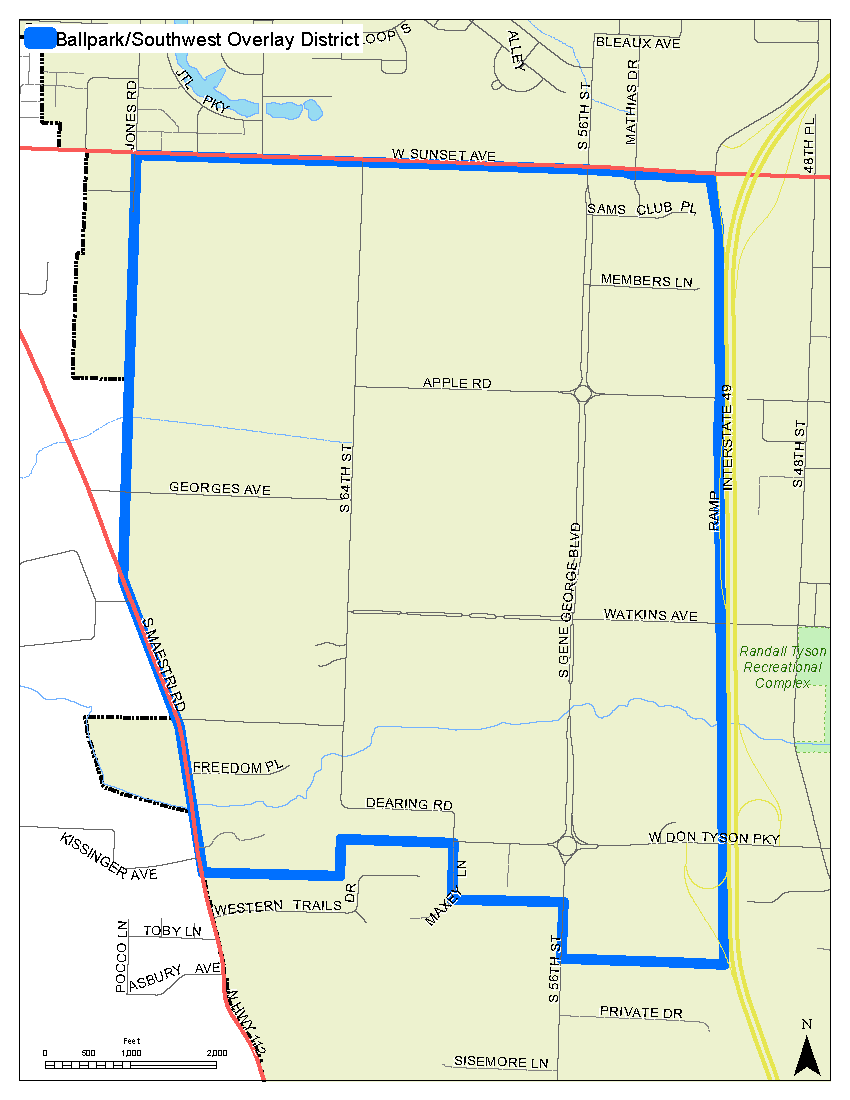
Current boundaries. The boundaries of the overlay district shall be noted on the official zoning map of the city as set forth in article 3, section 3 and described as follows:
Beginning at the intersection of S. 48th Street and W. Sunset Avenue (U.S. HWY 412), thence southerly along the west right-of-way boundary of I-49 to a point which is approximately 1,400 feet south of the centerline of W. Don Tyson Parkway; thence west to the centerline of S. 56th Street, thence north along said centerline approximately 660 feet, thence west to the east boundary line of Western Trails Subdivision; thence north along said boundary line to the northeast corner of said subdivision; thence west along the north boundary line of said subdivision to the centerline of S. Maestri Road (AR HWY 112); thence Northerly along said road and the Western city limits boundary of Springdale, Arkansas to the intersection of Jones Road and W. Sunset Avenue (U.S. HWY 412); thence East to the point of beginning.
b.
Land adjacent to the district. Properties adjacent to the boundaries which has been, or will be annexed by the city is expected to be included into the overlay district.
1.4
General requirements.
a.
Applicability. All improvements proposed within this district shall be subject to procedures, standards, and guidelines as specified in this overlay district.
In regard to the use unit designation in the overlay district, the underlying zoning district designations (permitted uses, conditional uses on appeal to the planning commission, temporary uses) shall apply unless specific changes are made by the overlay district, in which case the overlay district shall override the zoning district designation, but in no case shall a use not otherwise allowed in a zoning district be added to the zoning district by the overlay district.
Improvements shall be defined as any permanent structure that becomes a part of, is placed upon, or is affixed to, real estate located within the boundaries of the overlay district.
b.
References. Other City of Springdale regulations related to this overlay district include, but are not limited to, the following:
Chapter 42 — Article III Noise.
Chapter 56 — Landscape and Buffers.
Chapter 98 — Signs.
Chapter 106 — Stormwater Drainage.
Chapter 112 — Subdivisions.
In all existing zoning districts located within the overlay district, the regulations for the zoning district, other zoning codes, and the overlay district shall apply.
In the event of a conflict between this overlay district ordinance and the zoning ordinance district standards, this overlay district ordinance shall control. No other provisions of the Springdale Zoning Ordinance now in effect, or as hereafter amended, including, but not limited to, any existing or future overlay district regulations, shall apply to the development or use of the property.
c.
Exemptions. The following structures or uses shall be exempt from the overlay district requirements and development review, although they may be reviewed under separate administrative procedures where noted in this section or in other sections of the Springdale Code of Ordinances:
(1)
Non-conforming structures. If a non-conforming structure is to be retained then the structure shall not be rebuilt, altered, or undergo major rehabilitation if such construction would exceed fifty (50) percent of its replacement cost. If rebuilding, alteration, or repair of a nonconforming structure exceeds fifty (50) percent of the replacement cost, then the building shall be required to conform to all provisions of the overlay district.
Major rehabilitation shall mean any renovation, restoration, modification, addition, or retrofit of a structure that exceeds fifty (50) percent of the current appraised value of any structure as established by Washington County. Rehabilitation costs shall be aggregated over a five (5) year period to determine whether the development is subject to these rules effective on the date of this ordinance.
Major rehabilitation shall not include routine maintenance and repair of a structure or other feature on the surrounding site, such as roof replacement or general repairs to a parking area or other site feature.
(2)
Non-conforming uses. If an existing use is to stay in place as an existing non-conforming use, then the use shall not be changed. If the use is changed, then the building which houses the use shall be required to conform to the provisions of the overlay district at the time the use is changed.
(3)
Change in use designation. A change in use unit designation of existing structure or structures on a tract or parcel of land that exists at the time approval of this overlay district will be determined by the most current business license of record in the city clerk's office. If a business license has not been acquired for the tract or parcel it will be assumed to be a change in use and must meet the design standard.
d.
Review process. Each development will be reviewed to determine its compatibility with the stated purposes for the overlay district. The review will be processed through the city as required by current city regulations. It is recommended that any submittal of a zoning change be accompanied by a concept plan showing a preliminary site layout for the anticipated development.
e.
Variances. Variances will be considered only on a very limited basis and will be reviewed pursuant to article 2, section 10 of the chapter. No other variances will be considered.
(1)
The planning commission may approve variances to depart from the literal requirements of this chapter, where strict enforcement of said requirements would cause undue hardship due to circumstances unique to the individual property under consideration, and the granting of such variance is demonstrated to be within the spirit and intent of the provisions of this chapter, the planning commission my grant requests for variances of any requirements of this chapter according to the following guidelines:
(a)
The planning commission may modify such requirements to the extent deemed just and proper so as to relieve such difficulty or hardship, provided that such relief may be granted without detriment to the public interest.
(b)
When the applicant can show that his or her property was acquired in good faith and where by reason the strict application of such provisions would prohibit or unreasonably restrict the use of the property, and the planning commission is satisfied that the granting of a variance would alleviate a demonstrable hardship, as distinguished from a special privilege or convenience sought by the applicant, such variance may be granted; provided that all variances shall be in harmony with the intended purpose of this chapter.
(2)
A variance may not be requested for the following:
(a)
Landscaping—Buffers and screening. Street buffers section 2.5g of this article and section 2.5g(2) parking lot screening.
(b)
Street lighting. Section 2.6c of this article.
(c)
Access management. Section 2.9 of this article.
(d)
Signs. Section 3 of this article.
1.5
Overlay district modification of use units as established in article 5.
The use units as established in article 5 section 1 of this chapter are hereby modified as follows:
a.
Permitted uses.
Unit 1: Citywide public uses by right;
Unit 2: Citywide uses by conditional use permit;
Unit 4: Cultural, recreational, and health facilities;
Unit 5: Institutional facilities (not including city or county jail or detention facility);
Unit 8: Single-family dwellings;
Unit 9: Zero lot line;
Unit 10: Townhouse;
Unit 11: Duplexes;
Unit 12: High density residential;
Unit 13: Three and four family residential;
Unit 16: Offices, studios, and related services;
Unit 17A, Unit 17B: Eating places;
Unit 18: Hotel, motel, and entertainment facilities;
Unit 19: Neighborhood shopping goods;
Unit 20: Shopping goods;
Unit 27: Parking lot;
Unit 29: Home office;
Unit 36: Horses kept in residential areas;
Unit 38: Open display retail sales;
Unit 41: Automobile sales;
Unit 42: Church/synagogue;
Unit 45: Health care clinic;
Unit 49: Commercial assembly.
b.
Uses not permitted.
Unit 14: Residential manufactured housing (RMH);
Unit 15: Manufactured home park;
Unit 26: General industrial;
Unit 31: Recycling collection facilities;
Unit 43: Automobile sales - damaged vehicles;
Unit 47: Flea market outdoor;
Unit 48: Automotive/machinery/equipment open display retail sales.
c.
Conditional uses on appeal.
Unit 3: Utility facilities;
Unit 21: Trades and services;
Unit 22: Automotive services;
Unit 23: Commercial large sites;
Unit 24: Dedicated warehousing;
Unit 25: Limited manufacturing;
Unit 28: Home occupation;
Unit 30: Recreational vehicle park;
Unit 32: Temporary buildings and/or storage;
Unit 33: Self-supporting tower or antenna structure or monopole;
Unit 35: Transportation services;
Unit 37: Auction houses;
Unit 39: Temporary storage units;
Unit 40: Temporary classrooms;
Unit 44: Mobile vending site;
Unit 46: Flea market indoor;
Unit 50: Agricultural occupation.
d.
Temporary uses.
Unit
34: Model home/temporary marketing office.
1.6
Criteria for conditional uses on appeal.
The uses listed as conditional uses in section 1.5d above will be considered on a case-by-case basis, upon the ability to meet the following criteria in addition to the development guidelines and standards listed in section 2 of this article.
a.
Review process. Must meet conditional use requirements of the city as set forth in article 2, section 12 of this chapter.
b.
Traffic. Traffic from trucks, delivery vehicles, or patrons shall be limited, so that the level of service on the public and private street system remains at Level C or above based upon traffic movement criteria. In addition, trip generation must be controlled as to not affect surrounding development. A traffic impact analysis performed in accordance with the requirements of the Arkansas Highway and Transportation Department must be provided.
c.
Noise. No sound shall be emitted from the operations on the property that exceeds the city noise ordinance. Temporary variances for concerts or outdoor performances may be granted after review.
d.
Screening. Potentially offensive uses shall provide additional screening through the use of landscaping or solid masonry walls as required. These uses shall not be visible to adjacent properties or public right-of-way.
e.
Structures. Any conditional use in the overlay district which may be changed to a use by right and operates in a permanent structure shall meet all of the requirements of the overlay district.
(Ord. No. 4886, § 1, 2-24-15; Ord. No. 5168, § 1, 4-25-17; Ord. No. 5315, § 1, 9-25-18)
Sec. 2. - Development guidelines.
2.1
General.
These guidelines and standards are intended to encourage an orderly and logical pattern of development that enhances the design aesthetic, convenience, safety, and livability of the district and encourages a creative approach in the utilization of the land through forethought and consideration of both a development's external relationships as well as its internal organization. The goal is to provide for a development that is superior to that which could be accomplished utilizing the basic zoning districts.
2.2
Site planning process.
Preliminary development or site plans for new development subject to these design standards shall include proposed uses for the full development of the site, even where final development will be phased. The preliminary development plan or site plan shall show contiguous land under the applicant's control. Site plans will be reviewed through the plat review process.
2.3
Site design.
a.
Site layout—Non-residential. A side of a principal building that directly faces an abutting public right-of-way should be upgraded to include the design requirements of this article. A customer entrance is encouraged, but not required, to be provided. Where a principal building directly faces more than two (2) abutting public rights-of-way, this requirement shall apply only to two (2) sides of the building, including the side of the building facing the primary street, and another side of the building facing a secondary street.
b.
Site coverage. Maximum site coverage for impervious surface, building, or parking lot is as follows: Lot coverage — ninety (90) percent; Landscape/pervious area — ten (10) percent.
c.
Location of parking. The percentage of off-street parking between front façades and abutting streets shall not be restricted as long as buffers at streets, in addition to parking lot landscaping, are utilized.
d.
Pedestrian connectivity.
(1)
Sidewalks at least five (5) feet in width shall be provided along all sides of the lot that abut a public right-of-way, excluding interstate highways or alleys.
(2)
At least one (1) internal pedestrian walkway (or designated area), no less than five (5) feet in width, clear of obstruction including vehicular overhangs, shall be provided from the public sidewalk or right-of-way to the principal customer entrance of all principal buildings on the site. At a minimum, walkways shall connect focal points of pedestrian activity such as, but not limited to, transit stops, street crossings, and building and store entry points.
(3)
Sidewalks, no less than five (5) feet in width, shall be provided along the major length of the building along any façade featuring a customer entrance, and along any façade abutting public parking areas.
(4)
If the sidewalk is part of the trail system, it must meet all city trail regulations, including, but not limited to, the city's minimum width requirements.
e.
Amenities. Each non-residential establishment shall contribute to the establishment or enhancement of community and public spaces by providing at least two (2) of the following amenities: Patio/seating areas, pedestrian plaza with art work, benches, transportation center, window shopping walkways, outdoor play area, kiosk area, water feature, clock tower, or steeple. Any such areas shall have access to the public sidewalk network and such features shall be constructed of materials that are either an accent or complement to the principal materials of the building and landscape. Areas should be provided or designed to accommodate possible future transit service.
(1)
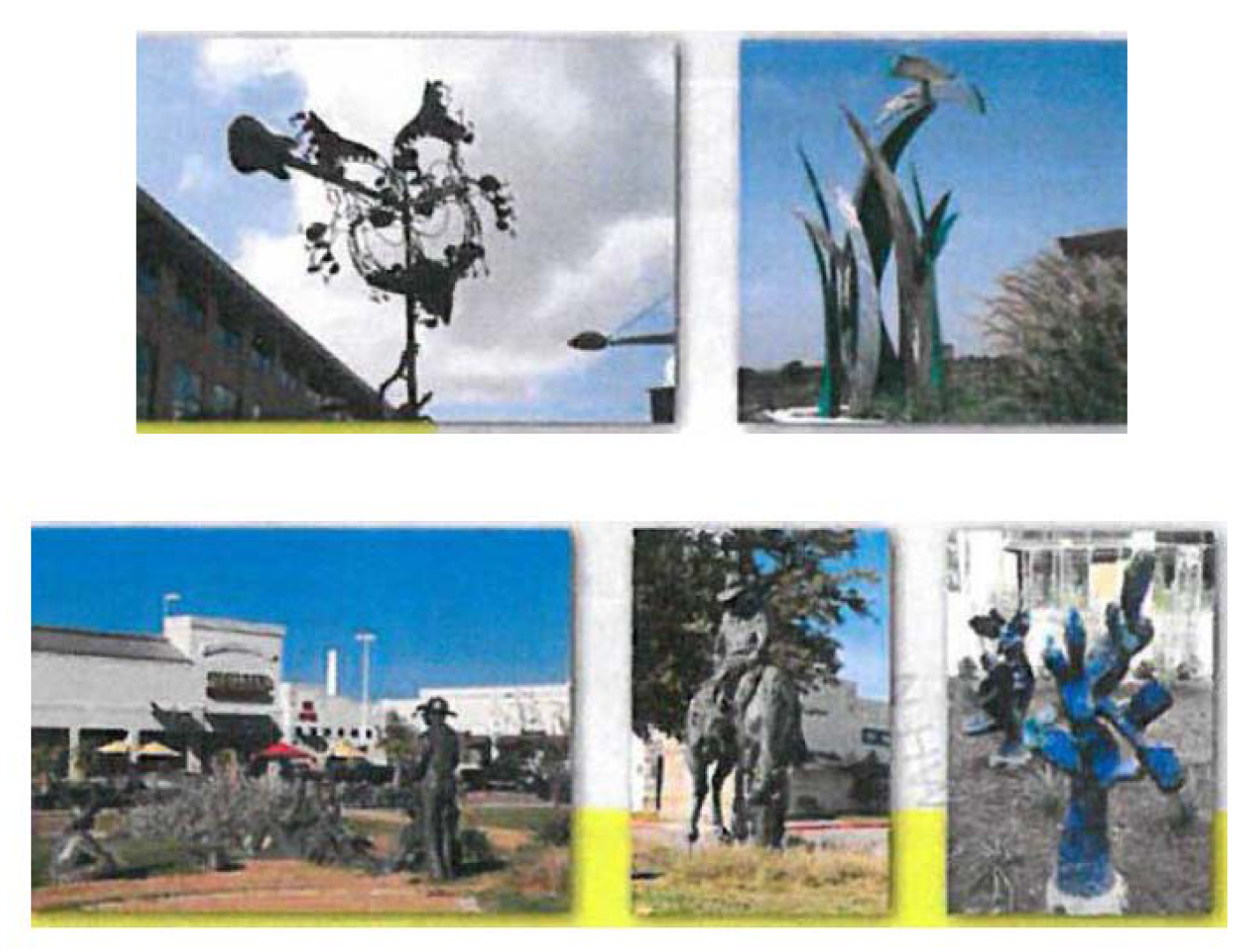
Artwork. Artwork for public viewing or active participation is encouraged. Artwork shall be within a planned public outdoor space. See examples in below:
(2)
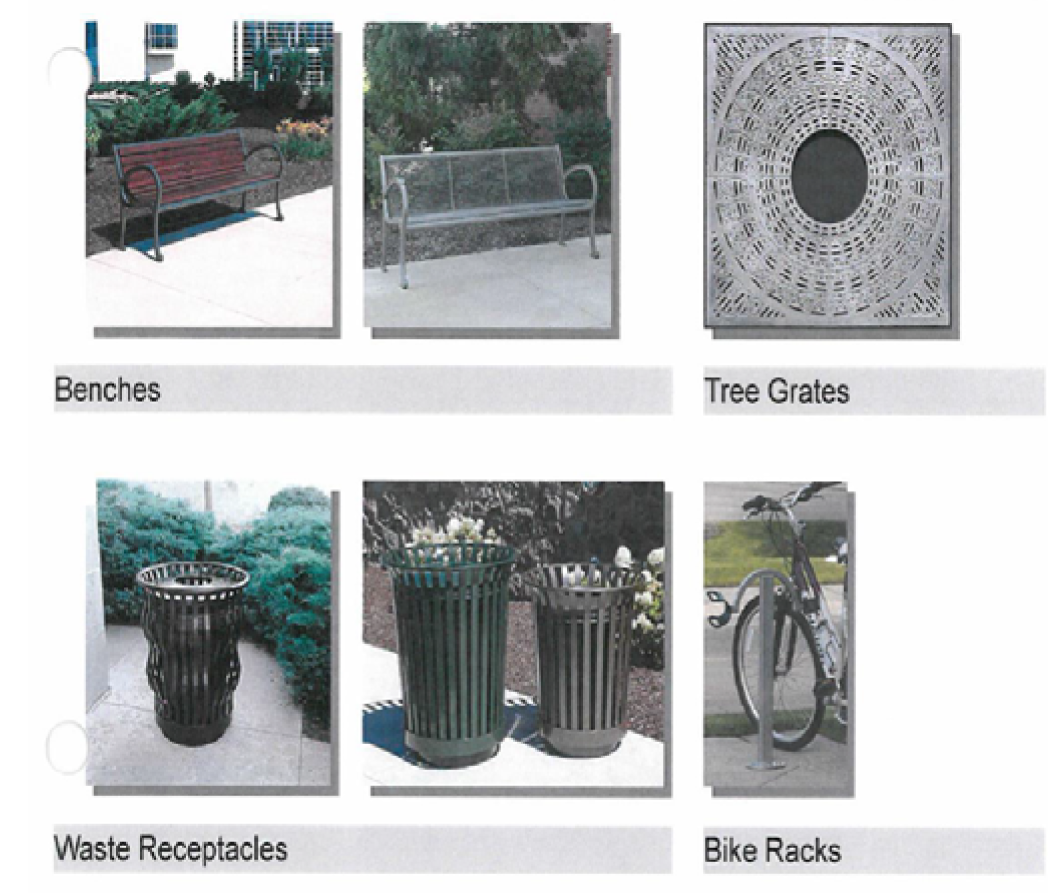
Site furnishings. Site furnishings including benches, trash and recycling containers, bollards, pedestrian scale lighting, and pedestrian directional signage are to be designed and placed to complement the exterior experience. Consistent or complementary designs are required. See examples in below:
(3)
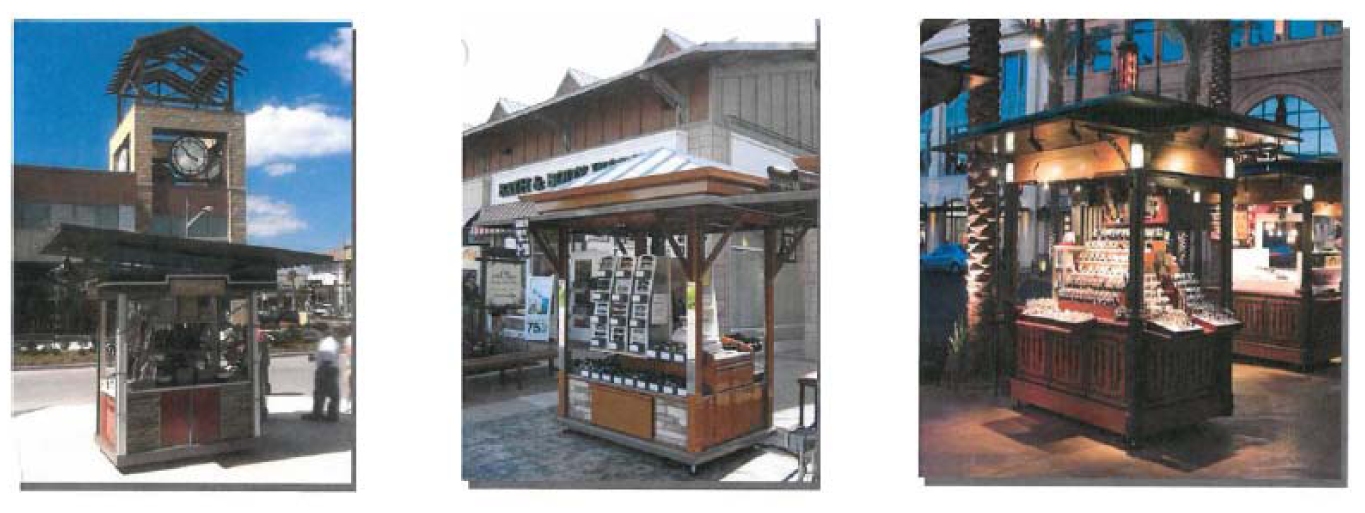
Kiosks. Freestanding kiosks, such as for display or sale of merchandise, are to be placed at positions within the site that encourage pedestrian activity. Sight lines and access for circulation shall be maintained. The exterior design of the kiosk shall incorporate similar materials to the building design. See examples below:
(4)
Monumentation and identity icons. Monumentation and identity icon elements are encouraged and will count for both of the required elements. This includes obelisk and monumental features that are visible from a substantial distance due to height or volume related to the adjacent building or site features. These icons are to assist in place-finding. See examples below:
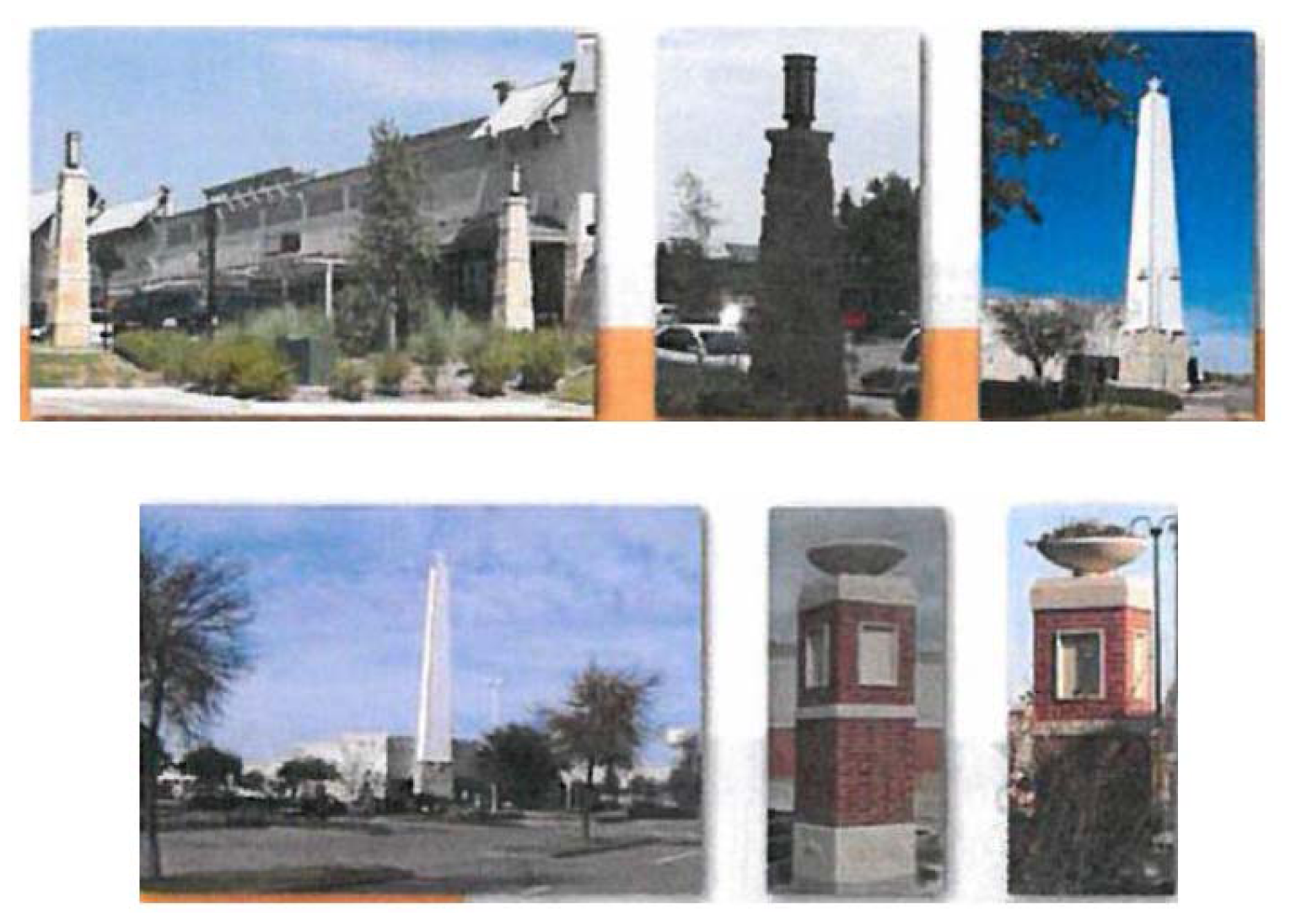
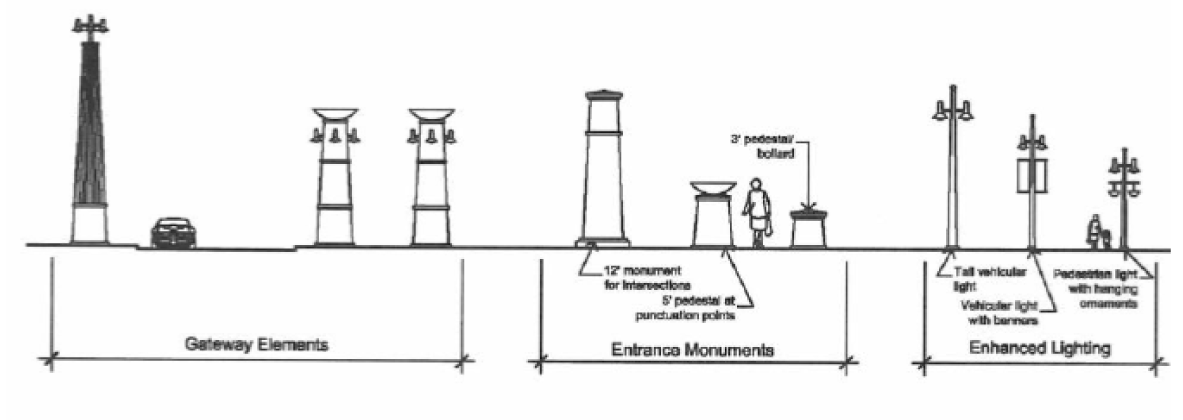
Identity Elements
f.
Screening. Loading docks, trash and recycling containers, storage areas, and mechanical equipment shall be screened from public right-of-way, internal streets, and public/customer areas by evergreen shrubbery, trees, masonry, or concrete screen wall treated with graffiti resistant coating.
If screening a loading dock with shrubbery, the shrubbery must be a minimum of five (5) feet tall at time of planting and must comply with the planting standards set forth in Springdale Code of Ordinances chapter 56 — Landscape and Buffers. If screening equipment, the shrubbery must be a minimum of one (1) foot taller than the item they are to screen at time of planting (with maximum required height at five (5) feet at the time of planting) and must comply with the planting standards set forth in Springdale Code of Ordinances chapter 56 — Landscape and Buffers. Landscaping must be maintained at all times, and replaced immediately when needed.
(1)
Trash container screen. Trash containers, trash compactors, and recycling bins shall be located in a manner to avoid undue interference with off street loading or parking area. Screened from public view on all four (4) sides with a solid fence, wall, or gate constructed of masonry, concrete, or other compatible building material with a metal gate, a minimum one (1) foot taller than trash container (minimum seven (7) feet tall), and shall be appropriately landscaped. If the building walls form screening for the trash container, the screen wall may be eliminated on that side that is formed by the building wall.
(2)
Service/loading corridor screen. Service corridors and loading areas shall be screened with landscaping or walls a minimum one (1) foot taller than item to be screened at a minimum seven (7) feet tall, and a minimum ten (10) feet tall at truck docks. Siting and design of such services areas shall reduce the adverse effects of noise, odor, and visual clutter upon adjacent residential uses.
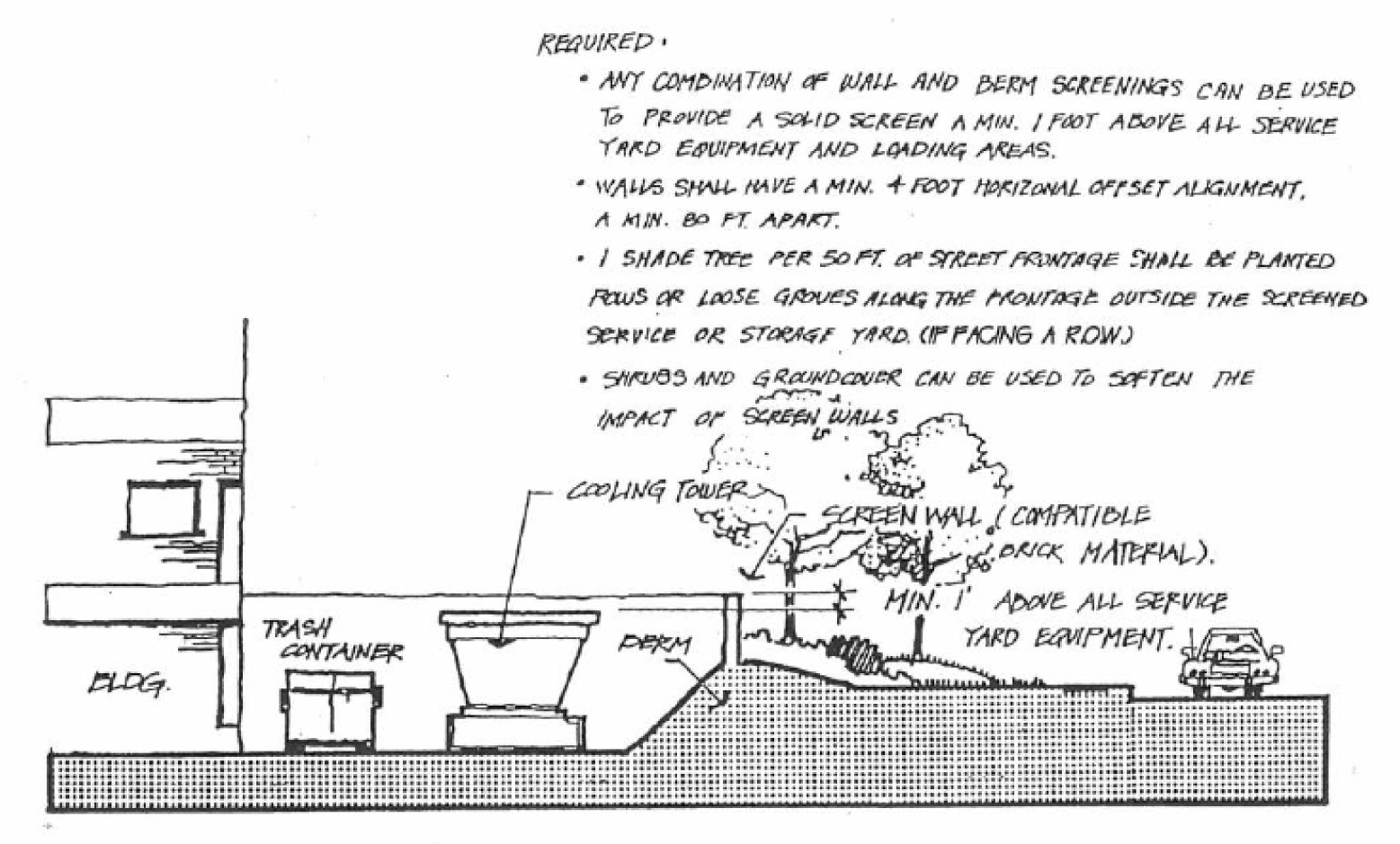
Service, Loading, Storage Screening
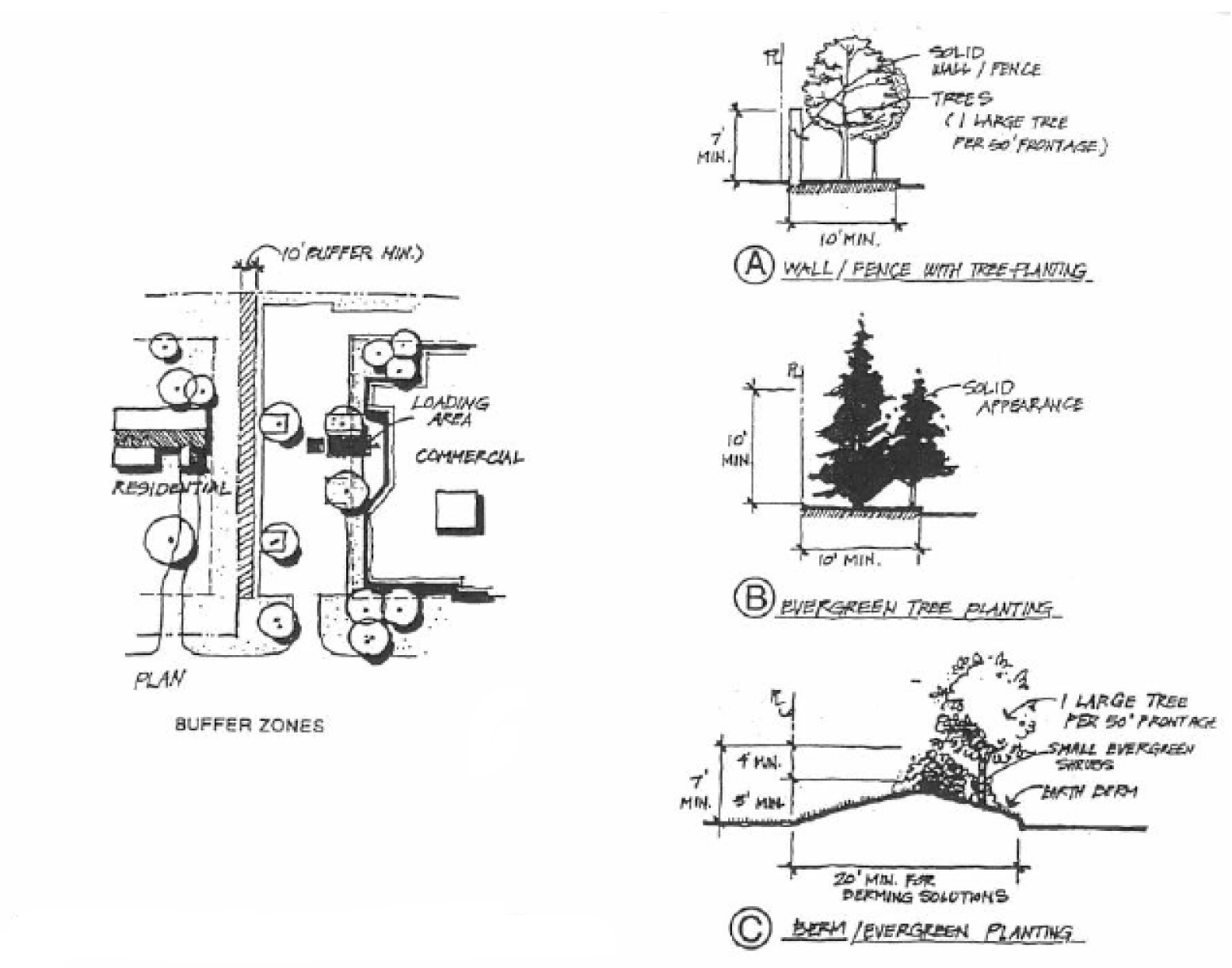
Methods of Screening Loading Areas
(3)
Mechanical equipment screen. Exterior ground-mounted or building-mounted equipment including, but not limited to, mechanical equipment, solar panels, utilities and banks of meters, shall be screened from any public right-of-way or residential use/zoning district (either on the same site or on an adjacent site). Equipment can be screened with evergreen shrubbery or masonry or concrete screen wall. Gates, if incorporated in the design of the screen wall, can be constructed of metal. Screening is subject to approval by the appropriate controlling utility company and easements, and may be adjusted as required.
(4)
Roof top. All rooftop equipment shall be screened from public view with parapet, sloping roof, or an architectural treatment that is compatible with the building architecture. Equipment shall not be visible from adjoining property lines or any property line adjacent to a right-of-way. Screening shall not include painted mechanical units or prefinished mechanical units. A consideration may be made for supplementary screening provided by the use of ornamental metal screening or other lightweight screening material, if specifically approved by the planning commission. The height of the parapet/screen shall be no lower than the height of the unit as measured from the roof surface.
(5)
Location. No areas for outdoor storage, trash or recycling collection or compaction, loading or other such uses shall be located within twenty (20) feet of any right-of-way of a public street.
(6)
Non-residential building façade. Where a non-residential building façade faces residential uses or areas designated on the comprehensive land use plan as residential use, one (1) of the following three (3) types of screening methods shall be employed:
(a)
An earthen berm shall be installed, no less than six (6) feet in height, containing at a minimum, a double row of evergreen or deciduous trees planted at intervals of fifteen (15) feet on center.
(b)
A solid masonry screen fence or wall not less than six (6) feet in height along all rear and side property lines which are common to property zoned for residential purposes, except that such screening shall not extend in front of the building line or adjacent dwellings.
(c)
An opaque or semi-opaque landscape screen per chapter 56 of the Springdale Code of Ordinances.
(7)
Visual impact. Loading docks, truck parking, outdoor storage, utility meters, HVAC equipment, trash dumpsters, recycling bins, trash compaction, and other service functions shall be incorporated into the overall design of the building and the landscaping so that the visual and acoustic impacts of these functions are fully contained and out of view from adjacent residential property and public streets. No attention should be drawn to the functions by the use of screening materials that are different from or inferior to the principal materials of the building and landscape.
g.
Outdoor sales.
(1)
Not in the front sidewalk.
(a)
Areas in excess of two hundred (200) square feet shall be screened as follows: wrought iron, solid wall of brick, stone, concrete, or landscape screen. If an open type screen is used, it shall have ten (10) percent solid masonry wall area of two (2) feet eight (8) inches minimum width. Screen shall be minimum six (6) feet tall or the height of the sales items, whichever is taller.
(b)
Areas less than or equal to two hundred (200) square feet refer to city requirements.
(2)
In the front sidewalk. Outdoor sales within the front sidewalk adjacent to the building wall are limited to two hundred (200) square feet, or two percent of store area, whichever is greater.
h.
Shopping cart collection and storage areas. All corrals for the temporary collection of shopping carts and all shopping cart storage areas shall be designated on preliminary and final site plans. If these areas are not shown on the plan, the plan shall contain the following note: "There shall not be any shopping collection or storage areas permitted on the site." Shopping carts shall be removed from parking lots and collection corrals on a regular basis to avoid hazards to pedestrians and vehicular traffic or when collection corrals become unsightly. Shopping cart collection corrals should be painted dark green, brown, silver or black to complement the retail establishment. Shopping cart storage areas located adjacent to the front of the building should be fully screened from the public view by architectural features that match the principal building.
i.
Outdoor storage. All outdoor storage shall be screened with a solid wall, minimum eight (8) feet tall or the height of the storage, whichever is taller.
j.
Satellite dish. No satellite dish shall be placed in an area visible from a public right-of-way or customer areas, and no dish shall be mounted on a balcony.
k.
Vending areas. Vending machines or other remote sales/service areas shall be screened or inset into a wall extension to create an alcove. Screen materials shall match the building materials.
l.
Vehicle access. Vehicular access shall be designed to provide safe, efficient, and logical transportation from public streets to and from the interior of the development. Internal circulation shall be well defined by the use of landscape islands and striping.
m.
Public transportation access. Public transportation access will be incorporated into the design of the site. Consideration for an integrated transportation system is to be provided. General location of public transportation nodes should be established in conjunction with a "loop" road system and the trail system with trailhead locations through the overlay district. Siting and location of public transportation design is to be determined as part of the master plan.
n.
Transitions between land uses.
(1)
Prior to the division of real property, circulation and access standards shall be applied, through the use of cross access easements to allow for circulation throughout the development, and use of shared curb cuts where appropriate.
(2)
At retail or restaurant outparcel pad sites. Cross access is required between adjacent pad sites approximately thirty (30) feet inside property line. There must also be access between the pad site and the larger adjacent development.
2.4
Building design.
a.
Setbacks—Commercial.
Building setbacks are as follows:
Front: Thirty (30) feet.
Front (if parking is provided between R-O-W and the building): Fifty (50) feet.
Side: Zero (0) feet.
Side (when adjacent to a residential district): Twenty (20) feet.
Rear: Ten (10) feet
b.
Setbacks—Office.
Building setbacks are as follows:
Front: Thirty (30) feet.
Front (if parking is provided between R-O-W and the building): Fifty (50) feet.
Side: Ten (10) Feet.
Side (when adjacent to a residential district): Twenty (20) feet.
Rear: Ten (10) feet.
c.
Setbacks—Residential. Building setbacks as required by the base zoning district.
d.
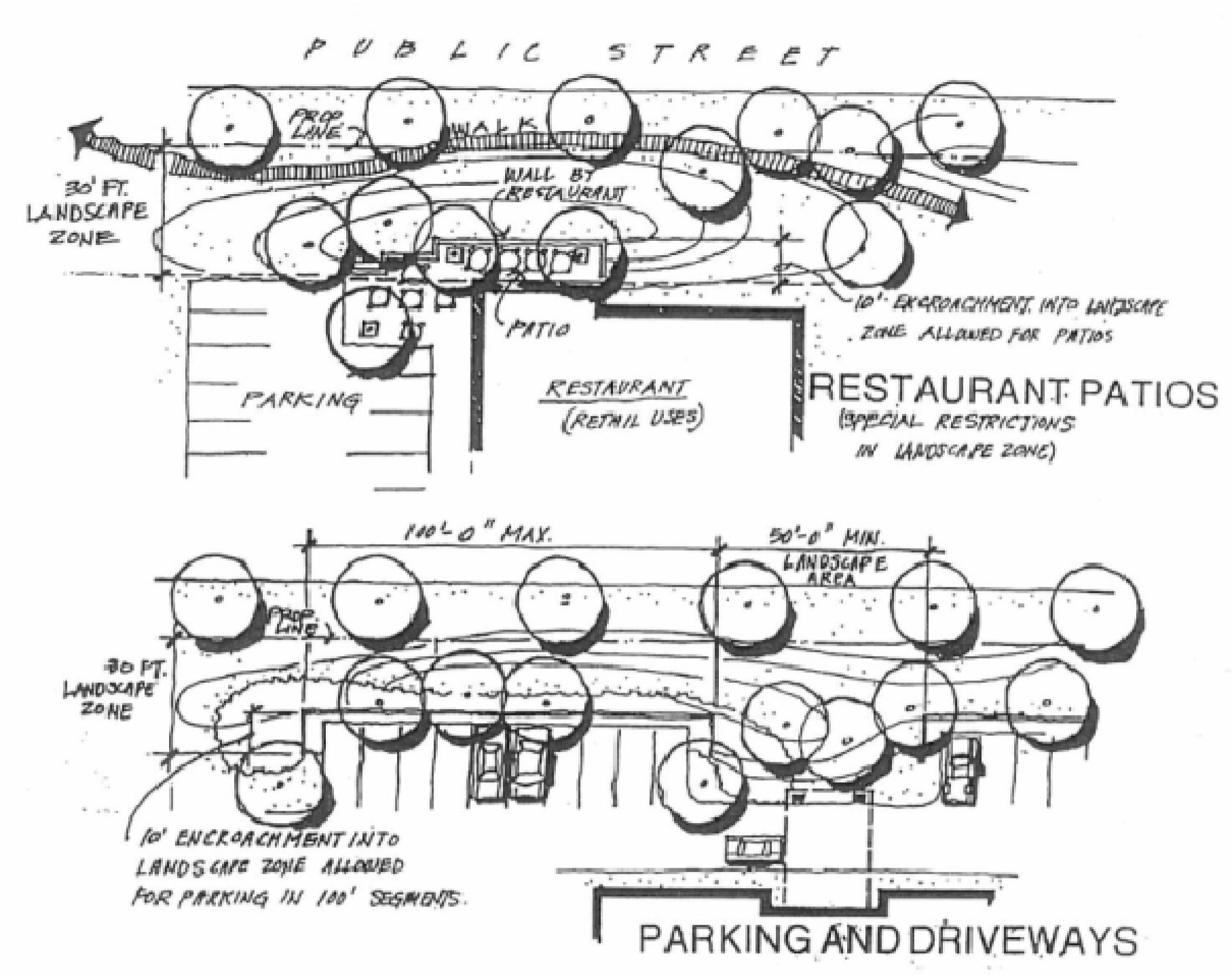
Setback encroachments. Building features, outdoor patios (covered or uncovered), and Architectural building feature elements (fountains, towers, awnings, trellis, or similar) may encroach upon the front setback by no more than ten (10) feet, within restrictions. Encroachment may occur on one (1) side only. See diagram below:
e.
Heights.
(1)
Non-residential. There shall be no maximum height limits in the district; provided, however, that any building which exceeds the height of twenty (20) feet shall be set back from any common property or boundary line of any residential district a distance of one (1) foot for each two feet of height in excess of twenty (20) feet.
(2)
Residential. Heights as required by the base zoning district.
f.
Areas. Floor area ratio shall not exceed 4:1. This includes enclosed buildings and parking garages. Any development requesting a floor area ratio exceeding 4:1 shall apply for a variance.
g.
Façades.
(1)
Breaks in façade. Non-residential building façades over 100 feet in linear length facing a public street or customer area shall incorporate design elements which break up the large expanse of the wall.
This shall be accomplished through the use of two (2) of the following:
•
Wall projections or recesses a minimum of one (1) foot depth and a minimum of three contiguous feet within each one hundred (100) feet of façade length.
•
Articulating features such as arcades, display windows, entry areas, or awnings along at least fifty (50) percent of the front façade.
(2)
Pattern. Wall building façades shall include a pattern that shall include no less than three (3) of the elements listed below. All elements shall repeat at intervals of no more than one hundred (100) feet horizontally or thirty (30) feet vertically.
•
Windows for twenty-five (25) percent of façade length.
•
Color change.
•
Texture change.
•
Material change.
•
Medallions/accent pieces, minimum size of two (2) feet by two (2) feet, such as cast stone, or EIFS.
•
Decorative light fixtures.
•
A change in plane of no less than sixteen (16) feet in width, for seventy-five (75) percent of the height of the building.
h.
Windows. Where principal non-residential buildings contain separately owned stores, which occupy less than eight thousand (8,000) square feet of gross floor area each, with separate, exterior entrances, the street level principal entrance storefront façade of such stores shall be transparent between the height of three (3) feet and eight (8) feet above the walkway grade for no less than forty (40) percent of the horizontal length of the building façade.
i.
Unifying element. Unifying elements are encouraged throughout the development to provide consistent design integration and recognizable features. These elements are to be provided in kiosks, signs, amenity items, icons and common area improvements and may be provided in building design on the façade of the building. The unifying element shall be natural stone consistent with the stonework of Arvest Ballpark.
j.
Roofs. Roof line or parapet lines shall be varied with a change in height of a minimum of two (2) feet every one hundred (100) linear feet in the building length. Parapets, gable roofs, high roofs, or dormers shall be used to conceal flat roofs and roof top equipment from public view. Alternating lengths and designs may be acceptable and can be addressed during the development plan. Any flat roofs shall be energy efficient, and shall meet Energy Star rating or similar.
k.
Site coordination in materials and colors. All improvements that contain multiple buildings, including pad sites, shall comply with the following design guidelines and standards:
(1)
Use of similar building materials. In order to achieve coordination of design between all buildings in a development area, all buildings in a particular development area, including pad site buildings, shall be constructed of building materials from the color and material palette approved for the development area.
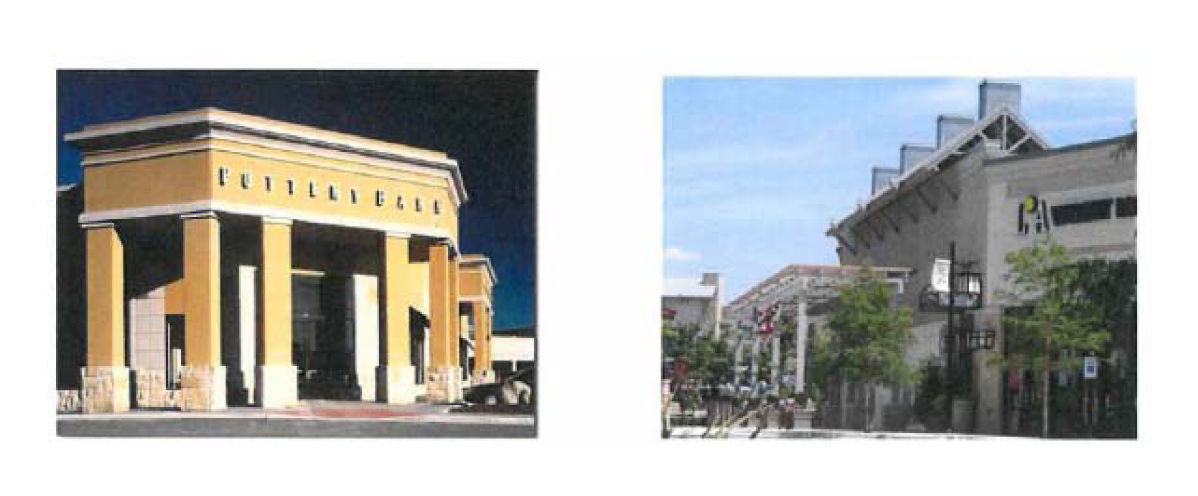
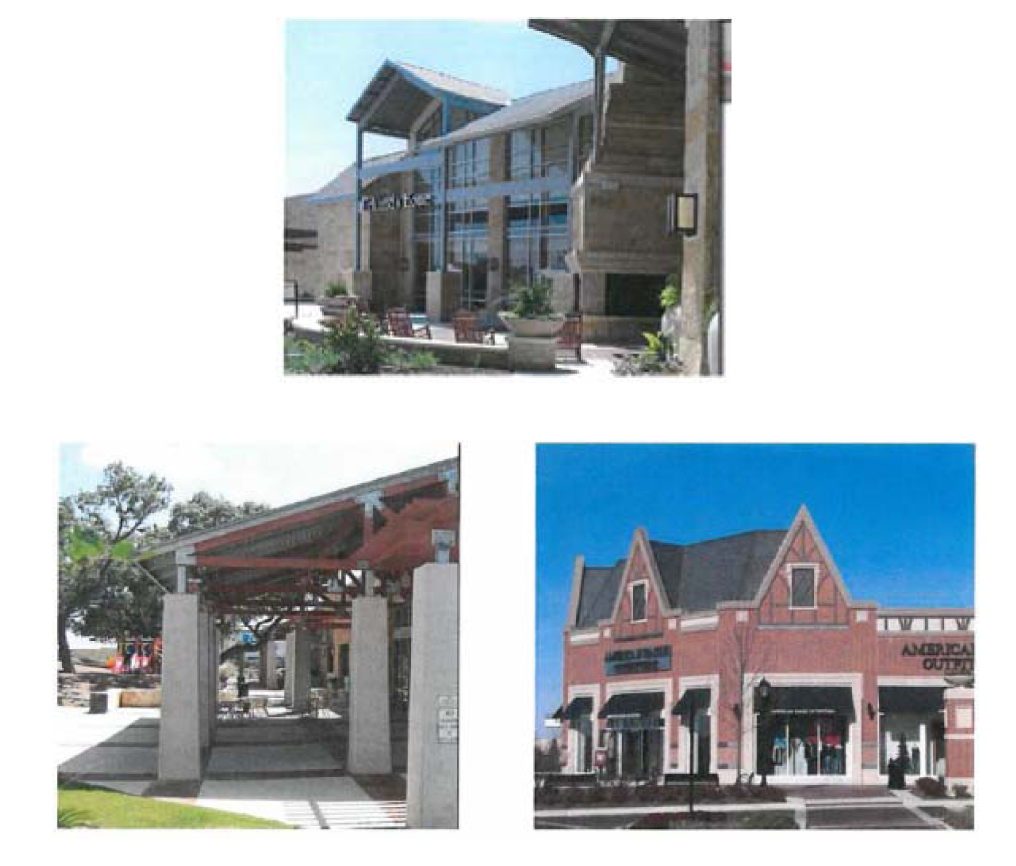
(2)
Use of similar architectural styles or theme in development area. A coordinated architectural style or theme should be used throughout a development area, and in particular to tie outlying pad site buildings to the primary building; building entrances or accent façades are appropriate locations to express individual building character or identity.
l.
Materials and colors.
(1)
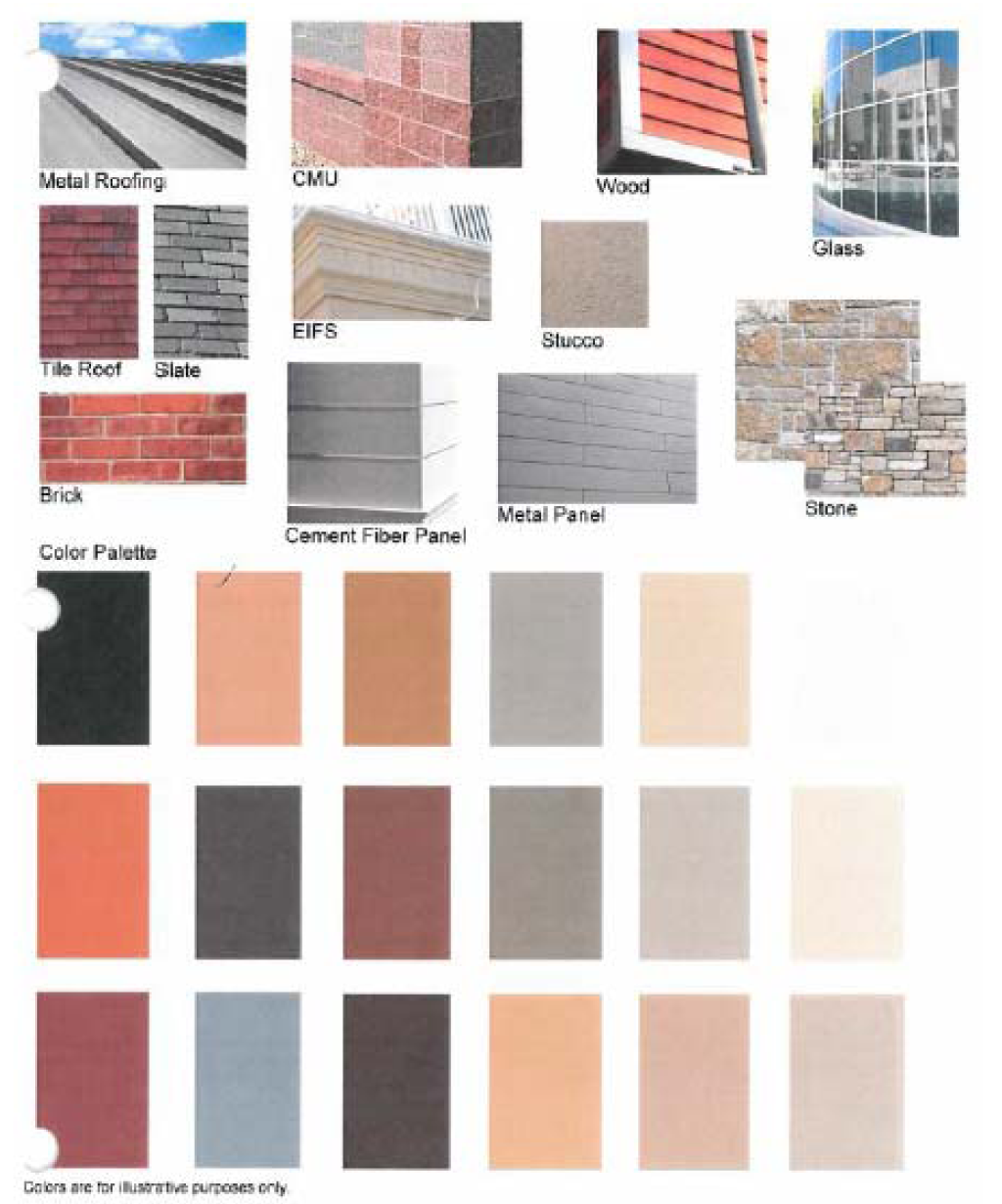
Exterior building materials. Exterior building materials for all façades shall be high quality materials. These include, without limitation:
•
Brick.
•
Natural quarried stone.
•
Stucco or EIFS.
•
Architectural precast concrete.
•
Decorative face concrete masonry units, such as split-face, scored, ground face, burnished.
•
Glass, glass curtain wall.
•
Wood, natural.
•
Textured or texture coated concrete panels.
•
Cement fiber panels (maximum twenty (20) percent of façade area).
•
Pre-fabricated steel panels such as Alucobond or prefinished metal interlocking panels.
•
Roofing materials for visible portions of roof surfaces may be slate, synthetic slate, clay tile, concrete tile, standing seam metal, metal shingles. Also, architectural asphalt shingles.
(2)
Material minimum. All buildings shall have a minimum of twenty (20) percent of the solid wall surface (not including glass and glazing or trim/coping) as stone, brick, or high quality composite panels on the façades visible to the public.
(3)
Façade color. Façade colors shall be low reflectance, subtle, neutral, or earth tone colors. Building trim, entry elements and accent areas may feature brighter colors, including primary colors, for a maximum ten (10) percent of the façade area.
If high intensity colors, metallic colors or fluorescent colors are used, such as part of a trade dress, branding, etc. for example, such colors or materials will be limited to the trim and accent areas of the façade.
Trade dress means features that represent a tenant's or owner's unique or distinct colors, materials, elements, shapes, designs, or other similar features that are trade-marked, service marked, or copyrighted designs that identify a national business that presents to the public a recognizable brand or business concept.
(4)
Compatibility with surrounding area. Exterior building materials as well as accents should be compatible with the surrounding area and not include the following:
•
Smooth-faced concrete block.
•
Smooth (not textured or texture coated) or exposed aggregate tilt-up concrete panels.
•
Pre-fabricated corrugated metal deck panels.
(5)
Awnings. Awnings may be varying shapes and colors and are to be metal or long lasting fire resistant fabric (not vinyl). Backlit awnings are not allowed.
(6)
Changes in exterior façade color. After the building is constructed and approved, any changes to the exterior appearance of a building must be approved by the planning commission.
m.
Entries. Each principal building on a site (except for multi-tenant retail buildings) shall have clearly defined, highly visible entrances featuring any three (3) of the following:
•
Canopies, porticos, or awnings.
•
Overhangs.
•
Recesses/projections.
•
Arcades.
•
Raised corniced parapets over the door.
•
Peaked roof forms.
•
Arches.
•
Outdoor patios.
•
Display windows.
•
Architectural details such as tile work and moldings which are integrated into the building structure and design.
•
Integral planters or wing walls that incorporate landscaped areas and/or places for sitting.
n.
Elevated parking garages. Façades of elevated parking garages may contain unifying elements, and for the facades visible to the public, a minimum of ten (10) percent of the total façade area that is visible shall incorporate materials to match the materials of the building it is serving. Open façade areas are to incorporate a screen to obscure the view of vehicles within the garage.
o.
Modifications. Limited modifications to applicable architectural design standard or sign regulation may be authorized to the extent necessary to accommodate architectural requirements, or signage of a specific user's trade dress. Trade dress may apply to buildings, signs, and other structures, but will not allow applicant a variance to the materials standards in subsection i. above.
2.5
Landscaping.
a.
General. Landscaping shall be as outlined below. Refer also to enclosed diagrams for additional info. Remaining requirements for landscaping are as outlined in Springdale Code of Ordinances chapter 56.
(1)
Specific information. The following specific information is required on landscape plans:
(a)
Existing vegetation. Location, type and quality of trees and other vegetation shall be inventoried by a licensed landscape architect, certified arborist, or horticulturalist.
(b)
Preservation. Location of existing trees and other vegetation to be saved.
(c)
Protection. Methods and details for protecting existing trees and other vegetation during construction and approved sediment control plan, if available.
(d)
Trees. Location of all trees to be planted and a tree list including the common name, scientific name, caliper size, height at maturity and quantity. Trees referred to in this section shall be chosen from the approved list located in section 2.12 of this article.
•
Shade trees. At time of planting, shade trees shall have a minimum caliper size of two and one-half (2½) inches. Caliper is defined as the measurement of the diameter of the trunk six (6) inches above ground level for trees up to four (4) inches in caliper size.
•
Ornamental trees. At time of planting, ornamental trees shall have a minimum caliper size of two (2) inches. Caliper is defined as the measurement of the diameter of the trunk six (6) inches above ground level for trees up to four (4) inches in caliper size.
(e)
Plants. Location of all plants and a plant list including the common name, scientific name, size and quantity
(f)
Flowering perennials. At the time of planting, flowering perennials shall be a minimum of one (1) gallon in size.
(g)
Shrubs. At the time of planting, shrubs shall be a minimum of three (3) gallons in size and eighteen (18) inches.
(h)
Other landscaping improvements. Location of all other landscaping improvements including benches, paving, screens, fountains, statues or other landscape features.
(i)
Maintenance. Description of maintenance provisions, a maintenance schedule shall be submitted with the landscape plan.
(j)
Maintenance guarantee statement. A note shall be added to the landscape plan that states, once installed, landscaping shall be maintained in healthy living condition and all plant material that dies shall be replaced.
(2)
Materials in public right-of-way. Any materials used in public right-of-way must be low maintenance and water saving, natively adapted plantings.
(3)
Tree easements. Trees may be planted in easements provided if acceptable to the utility company — subject to agreement for owner to replace if damaged or removed during maintenance.
b.
Sidewalk landscaping. Landscaping and site amenities along pedestrian walkways are encouraged, but not restricted to a fixed percentage.
c.
Entrance landscaping. Main entryways (minimum one (1) per site frontage) shall be planted with ornamental plant material, such as ornamental trees, flowering shrubs and perennials, and ground covers; landscaping should break down in scale and increase in detail, color, and variety to mark entryways into development; and plantings shall be massed and scaled as appropriate for the entryway size and space. Entrance landscaping shall also include accent lighting.
d.
Interior parking lot landscaping. The planting area adjacent to parking areas shall be designed to provide necessary green space to give relief to expansive parking areas and assist with vehicular circulation.
(1)
Applicability. Interior parking lot landscaping shall apply to all parking lots that have six (6) or more parking spaces.
(2)
Requirement. To provide sufficient interior landscaping within vehicular parking areas, to break up the large expanses of pavement, to provide relief from reflected glare and heat, and to guide vehicular and pedestrian traffic.
(3)
Standard. Not less than six (6) percent of the interior of a parking lot shall be landscaped.
The interior of a parking lot shall be calculated by multiplying the number of parking spaces by two hundred eighty (280) square feet. Plantings required along the perimeter of a parking lot shall not be considered as part of the interior landscaping requirement.
(4)
Landscaping and planting areas shall be reasonably dispersed throughout the parking lot.
(5)
The interior dimensions of any planting area or planting median shall be sufficient to protect the landscaping materials planted therein and to ensure proper growth; in no event shall any such area be less than one hundred seventy-one (171) square feet in area or less than nine (9) feet in width.
(6)
Each area shall be protected by appropriate curbs or wheel stops.
(7)
The primary landscaping materials used in parking lots shall be trees which provide shade or are capable of providing shade at maturity. Shrubbery, hedges and other planting materials may be used to complement the tree landscaping, but shall not be the sole means of landscaping. Effective use of earth berms and existing topography is also encouraged as a component of the landscaping plan.
(8)
There shall be a minimum of one (1) tree per one hundred twenty-five (125) square feet or fraction thereof of interior parking lot landscaping areas.
(9)
Landscape islands in parking lots may alternately be designed and planted to serve as a dual-purpose landscape area and stormwater treatment facility. When landscape islands are designed as a stormwater treatment facility, usage of trees as the primary landscaping material shall not be required when the city determines that trees are incompatible with native plantings proposed for use as a means of stormwater treatment.
(10)
No landscaping, tree, shrub, fence, wall or similar item shall be placed in zones of ingress or egress at street corners, or in the intersection of a public right-of-way, that is an obstruction to visibility, extends into a sight distance triangle as set forth in section 2.5g(1)(d) of this article or is otherwise a traffic hazard.
e.
Building landscaping.
(1)
Building foundations are encouraged to be planted with ornamental plant material, such as ornamental trees, flowering shrubs and perennials, and ground covers. Owners shall provide water mitigation techniques to avoid compromising the building soil preparation.
(2)
Landscaping at retail locations typically will not be placed against foundation walls. Retail landscaping will include leave outs within sidewalks, or at edges of sidewalks, or adjacent to parking, or may include potted plants.
(3)
Planting shall be massed and scaled as appropriate for the entryway size and space.
f.
Fencing and walls.
(1)
The maximum typical height of a fence or wall shall be eight (8) feet.
(2)
Walls and fences shall be constructed of high quality materials, such as decorative cmu, brick, stone, redwood, and wrought iron (color of fence to be compatible with building materials).
(3)
Breaks in the length of a fence shall be made to provide for required pedestrian connections to the perimeter of a site or to adjacent development minimum three (3) feet wide.
(4)
The maximum length of continuous, unbroken, and uninterrupted fence or wall place shall be one hundred (100) feet. Evenly spaced breaks shall be provided through the use of columns, transparent sections, and/or a change to different high quality materials, minimum two (2) feet wide, and four (4) inches deep.
(5)
Breaks may be provided through the use of a landscaping pocket of a species, width and depth approved by the planning commission, a minimum of four (4) feet wide and two (2) feet deep.
(6)
Use of landscaping beyond the minimum required in these standards is strongly encouraged to soften the visual impact of fences and walls.
g.
Buffers and screening.
(1)
Street buffers. A landscaped street frontage buffer is the planting area parallel to and including the public street right-of-way.
(a)
Requirement. All development plans submitted in the overlay district shall show the landscaped street frontage buffer.
(b)
Variances. As outlined in section 1.4e above, a variance may not be requested for street buffer landscaping. The exception would be for a development proposal for a C4 planned commercial district, which may in the discretion of the planning commission be allowed variances upon request for the buffer and setback requirements set forth herein, subject to the other requirements of the overlay district and the Springdale Code of Ordinances.
(c)
Minimum width. The landscaped street frontage buffer shall be a minimum of thirty (30) feet and is the planting area parallel to and including the public street right-of-way. Street trees may be planted in the right-of-way with adjustments made when significant utility conflicts exist.
(d)
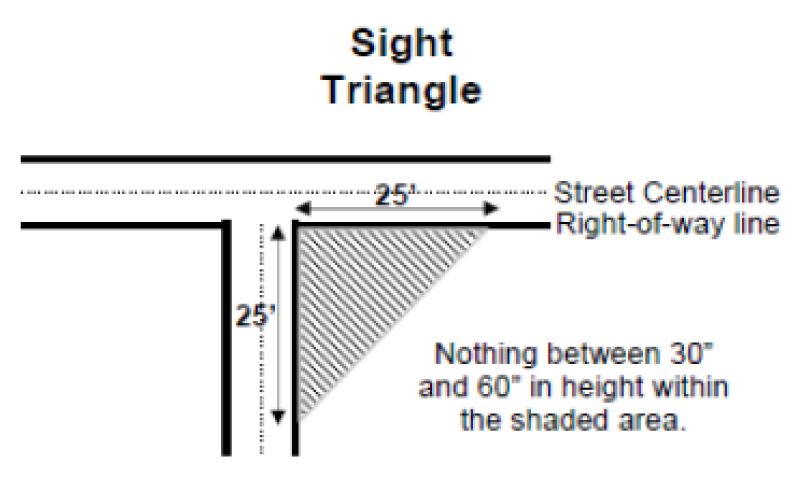
Site distances. Safe sight distances at intersections and points of access shall be maintained. In order to provide a reasonable degree of traffic visibility, landscaping constructed near street intersections shall stay clear of the "sight distance triangle" shown below:
(e)
Number of trees. Shade trees shall be provided at a rate of one (1) shade tree per every forty (40) linear feet or fraction thereof of street frontage or one (1) ornamental tree per every twenty-five (25) linear feet or fraction thereof of street frontage. Trees are not to be evenly spaced but should be clustered or grouped for a decorative effect following professional landscaping standards for spacing, location and design.
(f)
Mulch. At the time of planting and for the life of the tree, all tree root areas shall be mulched with a minimum four (4) foot diameter ring of mulch, three (3) to four (4) inches deep. Mounding or piling mulch against the tree trunk is prohibited. Organic mulch such as shredded bark mulch, pecan hulls, cotton seed hulls or cypress mulch shall be used.
(g)
Landscaping materials. The intent is to minimize expansive areas without plant coverage.
•
Living material. Living materials, such as lawn grass or herbaceous groundcovers like juniper or liriope, etc., shall cover a minimum of eighty (80) percent of the landscaped street frontage buffer. Herbaceous groundcover shall be planted and maintained in a mulched bed. One hundred (100) percent of living material is strongly encouraged.
•
Non-living material. Gravel, concrete, brick paver, other pavement, or organic mulch such as shredded bark mulch, pecan hulls, cotton seed hulls or cypress mulch may cover up to twenty (20) percent of the landscaped street frontage buffer. Weed barrier or pre-emergent herbicides shall be installed or applied. For purposes of this calculation, the material used to construct a sign allowed in section 2.6 of this article shall not be counted.
(h)
Encroachment. Parking areas may encroach upon the street buffer a maximum of ten (10) feet for one hundred (100) foot segments provided the screening provisions of section b. below are met. In addition, a patio area may encroach upon the street buffer a maximum of ten (10) feet provided the screening provisions of section 2.3g above for screening of outdoor sales areas.
(2)
Parking lot screening. The planting area adjacent to parking areas and designed to provide necessary green space to give relief to expansive parking areas and assist with vehicular circulation.
(a)
Requirement. All development plans submitted in the overlay district for parking lots shall show parking lot screening.
(b)
Variances. As outlined in section 1.4e above, a variance may not be requested for parking lot screening.
(c)
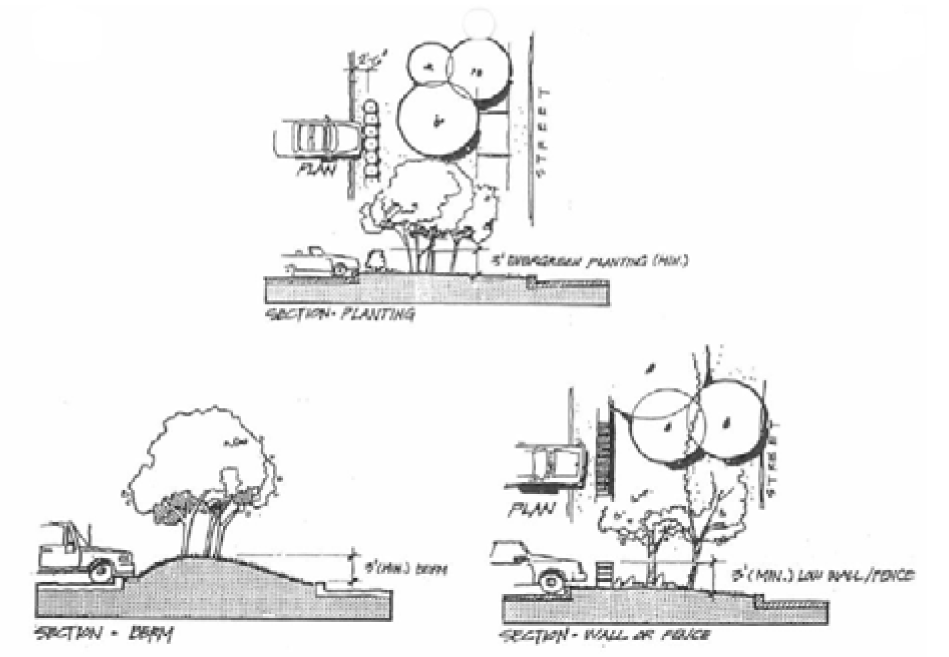
Available options. The applicant may choose among five (5) options illustrated below, choosing one or a combination of several to meet the particular site constrains of the development. Parking lot screening is only required for the portion of the development where a parking lot fronts on a public street, and in any case may overlap with street buffers so long as the parking lot screening area is placed nearest the parking lot and not nearest the public street and so long as the portion of the area identified as parking lot screening complies with one (1) of the options below:
•
Option 1: A minimum buffer of ten (10) feet in width, planted with seven (7) shrubs and one (1) small tree, that according to American Standards for Nursery Stock (ANSI Z60.1 Latest Edition) will grow to a spread of twenty-five (25) feet or less at maturity per 25 linear feet (25') street frontage or one (1) large tree, that according to American Standards for Nursery Stock (ANSI 760.1 Latest Edition) will grow to a spread of greater than twenty-five (25) feet at maturity per fifty (50) feet of linear frontage. Shrubs must be planted in a row and must be sufficiently sized and spaced to screen the headlights and grilles of parked cars. Trees may be clustered so as to appear naturally located.
•
Option 2: Earth berms, at least two and one-half (2½) feet higher than the finished elevation of the parking lot, planted with a minimum of one (1) small tree, as defined above and three (3) shrubs per twenty-five (25) linear feet or one (1) large tree, as defined above, for each forty (40) linear feet and three (3) shrubs per twenty-five (25) linear feet of street frontage, with no set dimension with a 3:1 slope.
•
Option 3: A six (6) foot landscaped buffer with three (3) feet of fall that includes a minimum of one (1) small tree, as defined above, and three (3) shrubs per twenty-five (25) linear feet or one (1) large tree, as defined above, for each forty (40) linear feet of street frontage and three (3) shrubs per twenty-five (25) linear feet of street frontage.
•
Option 4: A three (3) foot high solid wall made of brick, stone, along with a ten (10) foot buffer area including one (1) small tree, as defined above, per twenty-five (25) linear feet or one (1) large tree, as defined above, per forty (40) linear feet along street frontage.
•
Option 5: A landscaped buffer area with existing woodlands maintained in a twenty-five (25) foot strip along the street frontage.
Parking Screening
(d)
Tree size. At the time of planting, shade trees shall have a minimum caliper size of two and one-half (2½) inches. Caliper is defined as the measurement of the diameter of the trunk six (6) inches above ground level for trees up to four (4) inches in caliper size.
(e)
Mulch. at the time of planting and for the life of the tree, all tree root areas shall be mulched with a minimum four (4) foot diameter ring of mulch, three (3) to four (4) inches deep. Mounding or piling mulch against the tree trunk is prohibited. Organic mulch such as shredded bark mulch, pecan hulls, cotton seed hulls or cypress mulch shall be used.
(f)
Landscaping materials. The intent is to minimize expansive areas without plant coverage.
•
Living material. Living materials, such as lawn grass or herbaceous groundcovers like juniper or liriope, etc., shall cover a minimum of eighty (80) percent of the landscaped street frontage buffer. Herbaceous groundcover shall be planted and maintained in a mulched bed. One hundred (100) percent of living material is strongly encouraged.
•
Non-living material. Gravel, concrete, brick paver, other pavement, or organic mulch such as shredded bark mulch, pecan hulls, cotton seed hulls or cypress mulch may cover up to twenty (20) percent of the landscaped street frontage buffer. Weed barrier or pre-emergent herbicides shall be installed or applied. For purposes of this calculation, the material used to construct a sign allowed shall not be counted.
(3)
Perimeter landscaping and screening. Perimeter landscaping is a planting strip along the rear and side lot lines that includes landscaping and screening if required.
(a)
Width. the perimeter landscape strip shall be a minimum width of seven (7) feet.
(b)
Adjacent properties. A seven (7) foot wide perimeter landscape strip is required for each development regardless if one is already in place from an adjacent, developed lot.
(c)
Landscaping materials. Intent is to minimize expansive areas without plant coverage.
•
Living material. Living materials, such as lawn grass or herbaceous groundcovers like juniper or liriope, etc., shall cover a minimum of eighty (80) percent of the perimeter landscaped strip. Herbaceous groundcover shall be planted and maintained in a mulched bed. One hundred (100) percent of living material is strongly encouraged.
•
Non-living material. Organic mulch such as shredded bark mulch, pecan hulls, cotton seed hulls or cypress mulch may cover up to twenty (20) percent of the perimeter landscaped area. Weed barrier or pre-emergent herbicides shall be installed or applied.
•
Prohibited. Gravel, concrete, brick pavers or other pavement is prohibited.
(4)
Adjacent property buffers. When adjacent to the property line of a residential use, a five (5) foot landscaped area and a six (6) foot opaque screen, as defined in Springdale Code of Ordinances chapter 56, shall be required.
2.6
Lighting.
a.
Photometric plans. Applicants shall submit a lighting plan subject to these lighting standards. A point-by-point calculation to show compliance with the lighting standards is required. The calculations shall be measured at grade for lighting levels within the development site. A cut sheet of proposed fixtures, including a candlepower distribution curve, shall also be submitted. A vertical plan footcandle calculation shall be submitted, based upon "maintained" values.
b.
General lighting standards.
(1)
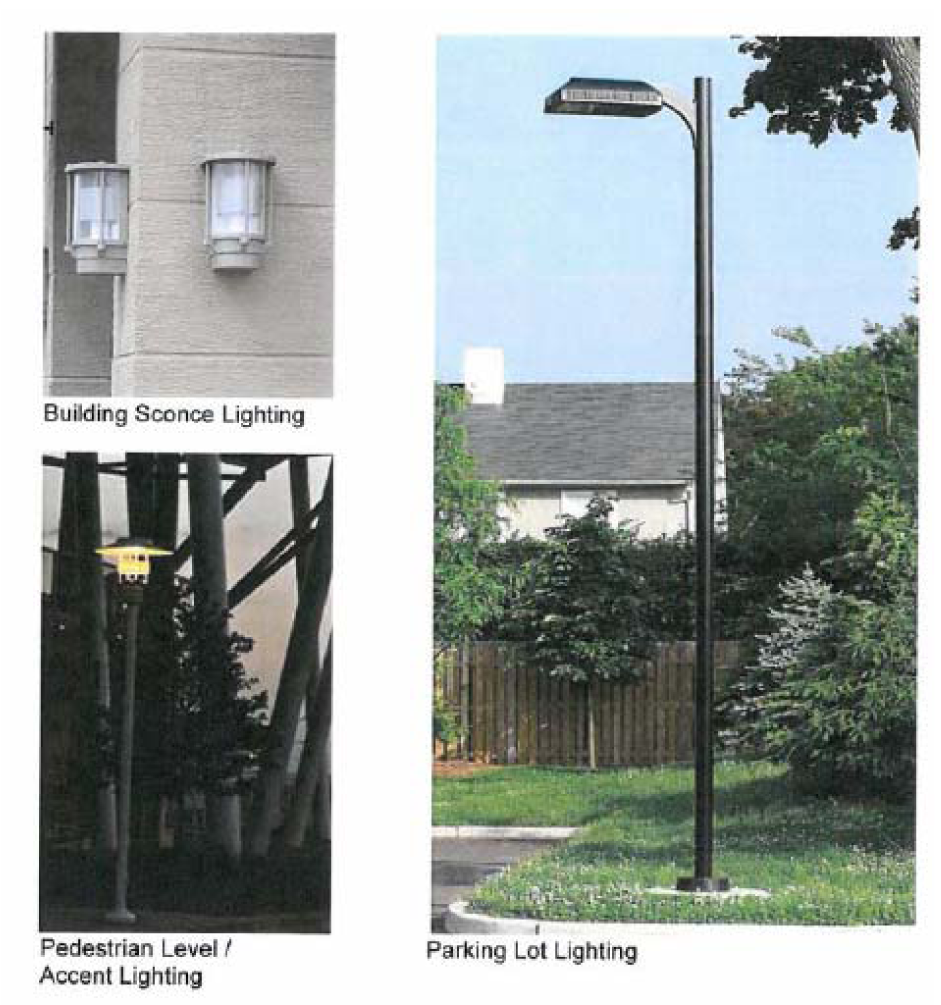
Pedestrian walkway lighting. Pedestrian-level, bollard light, ground-mounted lighting, or other low, glare-controlled fixtures mounted on building or landscape walls shall be used to light pedestrian walkways.
(2)
Lighting height. Bollard type lighting shall be no more than four (4) feet high. See subsection below for lighting standards specific to parking areas.
(3)
Lighting for security. Accent lighting on buildings is encouraged as a security feature and interior and exterior lighting shall be uniform to allow for surveillance and avoid isolated areas.
(4)
Illumination levels. Pedestrian areas shall be illuminated to a minimum of one (1) footcandle.
(5)
Design of fixtures/prevention of spillover glare. Light fixtures shall use cutoff lenses or hoods to prevent glare and light spill off the project site onto adjacent properties, buildings, and roadways.
(6)
Color of light source. Lighting fixtures should be white, color-correct types such as metal halide or LED to ensure true-color at night and ensure visual comfort for pedestrians.
c.
Public and private street light standards.
(1)
Luminaire fixture height.
•
The mounting height for roadway luminaire fixtures shall be forty (40) feet as measured to the top of the fixture from grade.
•
Mounting height for accent fixtures at entry to be fourteen (14) feet high.
(2)
Average maintained footcandles.
(a)
Non-residential. The minimum average maintained footcandle shall be .25 footcandle[s]. For the purpose of this standard, the average maintained footcandle shall be calculated at 0.8 of initial footcandles (maintained).
(b)
Maximum footcandle adjoining residential property. The maximum maintained vertical footcandle at any adjoining residential property line shall be 0.3 footcandles, measured at five (5) feet above grade.
(c)
Tall pole fixtures. tall pole fixtures are to be Lithonia, D Series, Size 2, or Phillips RX1 Series with Pole 195 round tapered, graphite finish. Accent fixture at entry to be "Luminous Lighting Eclipse" or Lithonia "Omero" on round pole, graphite finish. Lamps to be color corrected LEDº, 5000.
(d)
Street light banners. Pole banners may be used on street lights with a pole banners may not have dimensions larger than twenty-four (24) inches by forty-eight (48) inches and may be approved by the planning commission only for community or development events. The streetlight pole banner attachment brackets may only be mounted at fifteen (15) feet above grade to the lowest bracket, and are to be included on every second pole. Such brackets should be of a size and material approved by the city.
d.
Parking lot lights.
(1)
Luminaire fixture height non-residential. The mounting height for luminaire fixtures shall not exceed forty-two (42) feet as measured to the top of the fixture from grade, including the concrete base.
(2)
Average maintained foot candles—Non-residential. The maximum average maintained footcandles for all parking lot lighting shall be five (5) footcandles; the minimum average maintained footcandles shall be two (2) footcandles. For the purpose of this standard, the average maintained footcandle shall be calculated at 0.8 of initial footcandles (maintained). All areas within ten (10) feet of the building must have 0.5 footcandle minimum illumination.
(3)
Average maintained foot candles—All uses. The maximum average maintained footcandles for all parking lot lighting shall be five (5) footcandles; the minimum average maintained footcandles shall be two (2) footcandles. For the purpose of this standard, the average maintained footcandle shall be calculated at 0.8 of initial footcandles (maintained). All areas within ten (10) feet of the building must have 0.5 footcandle minimum illumination.
(4)
Uniformity ratios. Luminaire fixtures shall be arranged in order to provide uniform illumination throughout the parking lot of not more than a 6:1 ratio of average to minimum illumination, and not more than 20:1 ratio of maximum to minimum illumination.
e.
Canopy lights.
(1)
Average maintained footcandles. The maximum average maintained footcandles under a canopy shall be twenty-five (25) footcandles. Areas outside the canopy shall be regulated by the standards above.
(2)
Fixtures. Acceptable fixtures and methods of illumination include:
•
Recessed fixtures. Recessed fixtures incorporating a lens cover that is either recessed or flush with the bottom surface (ceiling) of the canopy.
•
Indirect lighting. Indirect lighting where light is beamed upward and then reflected down from the underside of the canopy. Such fixtures shall be shielded such that direct illumination is focused exclusively on the underside of the canopy.
f.
Strobe lights. Strobe lighting is prohibited in all areas with the exception of lighting required in connection with automatic sprinkler system and building fire alarm water-flow alarms activated by water flow required by the Springdale Fire Department.
g.
On-site access and parking lot lighting. On-site and parking lot lighting shall be high quality design throughout the development. Lighting to be Metal Halide or LED, color corrected to three thousand six hundred (3,600) degrees to five thousand (5,000) degrees Kelvin, and must include permanently affixed concrete or metal poles prefinished. Other lighting types may be considered on a specific case-by-case basis.
h.
Building lighting. Wall mounted lighting and ground mounted lighting may shine upward provided it is designed to keep light overspill to a minimum. Lighting shall be provided at special building design features and at all public entrances.
i.
Security lighting. Security lighting must be provided around all sides of the building at the minimum lighting levels as noted above.
2.7
Parking and loading areas.
a.
General. Parking shall be as outlined below. Remaining requirements for parking are as outlined in chapter 130, article 7 of the Springdale Code of Ordinances.
b.
Parking layout and design. Width and depth of standard parking space shall be nine (9) feet by nineteen (19) feet. Also, compact parking may be permitted for up to twenty (20) percent of total parking spaces in a parking lot that contains at least twenty-five (25) parking spaces. Compact space size shall be eight (8) feet by sixteen (16) feet.
c.
Accessibility. Accessible spaces must meet the current version of the Americans with Disabilities Act (ADA) and any state requirements. In general, spaces shall be minimum eight (8) feet wide with a five (5) feet wide access aisle adjacent to the space. Van spaces shall be a minimum of eight (8) feet wide with an eight (8) feet wide access aisle adjacent to the space. Alternatively, a van space may be eleven (11) feet wide minimum with a five (5) feet wide access aisle adjacent to the space.
d.
Off-street parking.
(1)
Entrance and/or exit drives. Permitted entrance and/or exit drives may provide for off-street parking areas so long as the parking is set back from the street right-of-way line a minimum of ten (10) feet. No off-street parking area shall be located within five (5) feet of any other property.
(2)
Parking garages. Parking garages may be provided for satisfying the off-street parking requirements so long as it otherwise meets the provisions of Springdale Code of Ordinances chapter 130article 7 section 14 relating to off street parking. Exterior design of the parking garage to meet the requirements of section 2.4n of this article.
e.
On-street parking. On-street parking is allowed as provided by City Code. This cannot be assigned or dedicated parking. On street parking shall be parallel parking, minimum eight (8) feet wide by twenty-two (22) feet long spaces, striped with contrasting color (white or yellow).
f.
Combined parking. In the event the POA is established and if the property owner is a member of the POA, certain uses that do not share the same operating hours may share parking spaces. Shared parking requires a written reciprocal parking agreement by involved parties and with approval calculations by the City. Uses with hours of operation different from commercial or retail might include educational, entertainment, cultural, religious, etc.
g.
Off-street loading. A loading space of twelve (12) foot by thirty (30) foot and fourteen (14) foot height clearance shall be provided for a building of eight thousand (8,000) square feet up to fifty thousand (50,000) square feet, and one (1) additional space for every fifty thousand (50,000) square feet of building or fraction thereof for any commercial use.
h.
Parking and storage of certain vehicles. In commercial districts, recreational vehicles, trailers, commercial vehicles, or combinations of vehicles exceeding twenty-four (24) feet in length shall not be parked within any commercial zoned property, except for the purpose of loading or unloading or if allowed through a conditional use permit on the site. No vehicle shall be parked overnight and used for permanent or temporary habitation.
i.
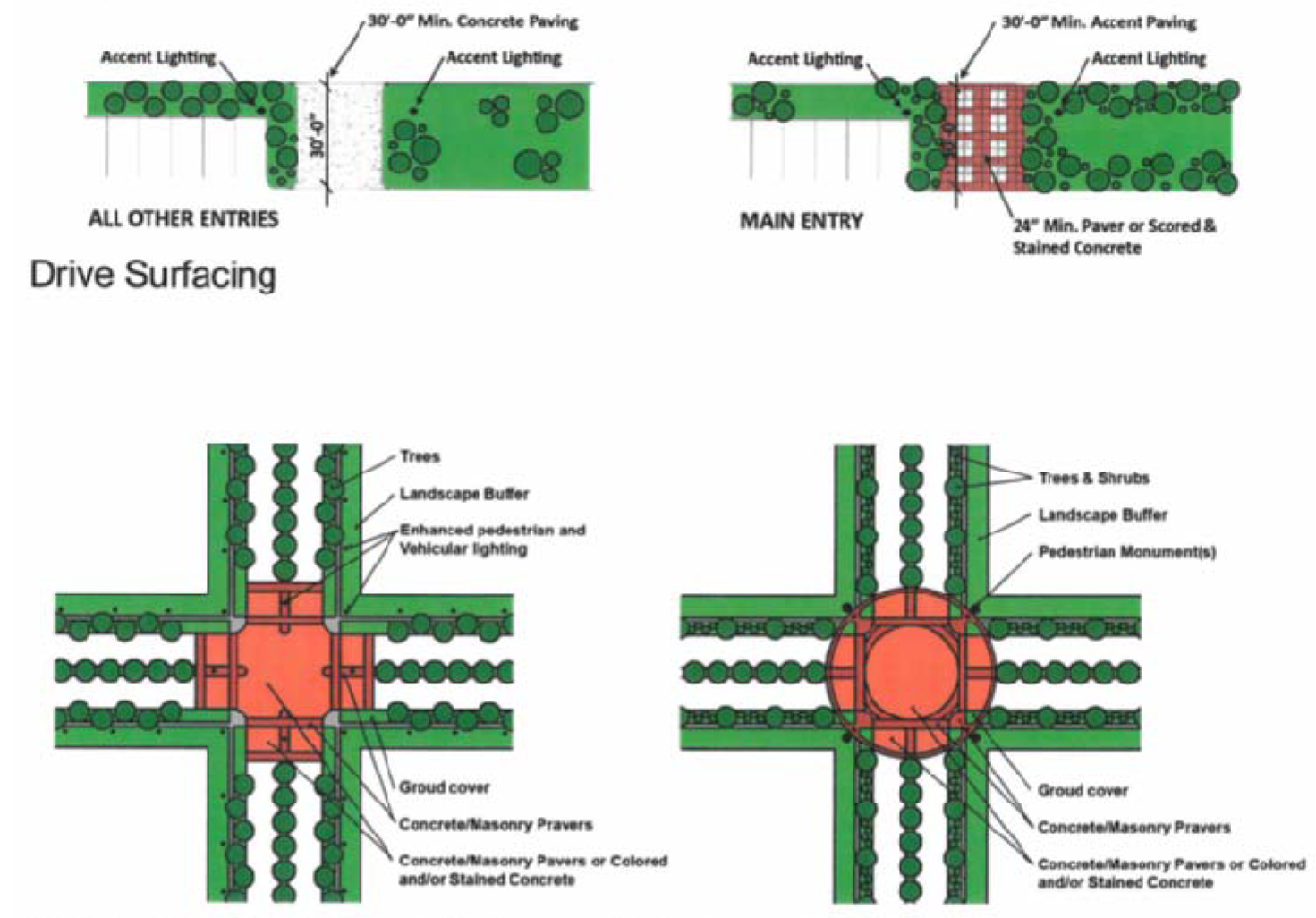
Surfacing. Asphalt paving or concrete paving is required in all parking and drive areas — also for all areas used for storage. An approach depth of thirty (30) feet of concrete paving is required at all drive connections to public streets.
Intersection Hardscape & Softscape Enhancement Suggestions
2.8
Water management.
a.
Water elements and standing water. Water features are encouraged to be incorporated into the project. These may be used for retention, detention, or for amenities for the site development. Specific design should incorporate a hard edge or soft edge, fountains, aquatic plantings, and other features to provide for a well-maintained amenity.
b.
Retention/detention. Each site development is encouraged to incorporate water management practices, including allowable storm water runoff. Refer to the latest edition of the City of Springdale Drainage Criteria Manual. If needed, retention or detention may be accomplished on site assuming then that a regional detention program has been established. If a regional detention program is established temporary detention will be encouraged until the regional detention site has been completed.
c.
Off-site drainage. With the establishment of a regional retention or detention program, landowners may be allowed to participate in the program with an agreement to provide funding to the off-site owner upon whose land the regional retention or detention will occur.
d.
Irrigation. All landscaping areas located on non-residential and multi-family developments are required to be irrigated with underground piped irrigation systems. The water source may be from city provided water, or from other natural sources.
2.9
Access management.
Access management, control points, roadway design, and circulation shall meet all requirements of the City of Springdale ordinances and access control standards.
2.10
General items.
a.
Wind turbines. Turbines or windmills may only be allowed as generating equipment or an aesthetic icon. Maximum size to be one and one-half (1½) times maximum building height on site, not to exceed sixty (60) feet. Fan blade to be vertical style.
b.
Solar panels. Solar panels may occur on roofs only, and are to be positioned flat onto a sloped building roof, or placed in an area visible to the customer areas or adjacent residential zoning.
(1)
Noise level of unit or sound equipment may not exceed sixty-five (65) decibels when measured at the property line.
(2)
May not include drive in service.
(3)
Must have hooded or shielded exterior lighting.
(4)
May not have signage that projects more than six (6) inches from unit.
(5)
Must keep the area clear of liter and debris at all times.
(6)
May operate only between the hours of 6:00 a.m. and 10:00 p.m. without specific variance.
(7)
No permanent water or wastewater connection is permitted. Electrical power may be provided by temporary service by connection or on board generator.
c.
Crime prevention through environmental design. The Design Standards and Operational Guidelines of C.P.T.E.D. (Crime Prevention through Environmental Design) are strongly recommended.
d.
Sound levels. Sound level maximums to be per city standards.
e.
Sustainable design. Sustainable principals are strongly encouraged to be incorporated into the site and building design and operational parameters of the development. Guidelines such as the USGBC — LEED rating system or Green Building Initiative — Green Globes rating system and Low Impact Design on Landscaping (L.I.D. Manual) are provided to establish minimum guidelines for design, construction, and operations of the project. (Buildings meeting the minimum of "Certified" under the LEED system or an equivalent will be given special consideration in exterior design review - for design elements required to meet the rating.)
2.11
Definitions.
For the purposes of this article, certain terms or words used herein shall be interpreted as follows:
The word "person" includes a firm, association, organization, partnership, trust, company, or corporation, as well as an individual.
The present tense includes the future tense, the singular number includes the plural, and the plural number includes the singular.
Accessory structure means a structure detached from a principal building and customarily used with, and clearly incidental and subordinate to, the principal building or use, and ordinarily located on the same lot site or with such principal building.
Adjacent or abutting means to physically touch or border upon, or to share a common property line or border. "Adjacent" or "abutting" shall include properties or uses that are separated by a drive, street, or other public-dedicated right-of-way.
Arcade means a series of arches supported on piers or columns.
Balcony means a platform projecting from the wall of an upper-story enclosed by a railing, with an entrance from the building and supported by brackets, columns, and cantilevered out.
Berm means an earthen mound designed to provide visual interest, screen undesirable views, decrease noise, and/or control or manage surface drainage.
Buffer means open spaces, landscaped areas, fences, walls, berms, or any combination thereof, used to physically separate or screen one use or property from another so as to visually shield or block noise, lights, or other nuisances.
Building form means the shape and structure of a build as distinguished from its substance or material.
Building mass means the three (3) dimensional bulk of a building height, width, and depth.
Building scale means the size and portion of a building relative to surrounding buildings and environs, adjacent streets, and pedestrians.
Carport means an accessory structure used for a parking of motor vehicles. A carport has roof, but is distinguished from a garage in that a carport is enclosed on no more than three (3) sides.
Commercial center, large. A "large commercial center" contains one (1) or more commercial buildings or establishments with fifty thousand (50,000) square feet or more (gross floor area).
Commercial center, small. A "small commercial center" contains one (1) or more commercial buildings or establishments and all the buildings in the center contain less than fifty thousand (50,000) square feet (gross floor area).
Commercial development means all retail, office, restaurant, service, hotels, motels, and similar businesses, but shall not include industrial uses. However, any office or industrial development or building that includes more than a twenty (20) percent retail component by square footage shall be subject to these commercial design guidelines and standards.
Common open space means land within or related to a multi-family development, not individually owned or dedicated for public right-of-way use but generally owned and maintained by the developer, owner, or a property owners association, that is designed and intended for the common use or enjoyment of the residents of the development and their guests, and may include such complementary structures and improvements as are necessary, appropriate, and permitted under this chapter.
Density means the number of dwelling units allowed per acre of a development site or parcel.
Development area means the area defined by a single development plan, as defined by the Springdale Code of Ordinances, for the development of one (1) or more parcels of land.
Elevation means the external faces of a building; also a mechanically accurate, "head-on" drawing of any one (1) face (or elevation) of a building or object, without any allowance for the effect of the laws of perspective.
Façade means any side of a building. The front façade is the front or principal face of a building, generally defined by the location of the majority of public entrances into the building.
Fence means a man-made barrier of any material or combination of materials erected to enclose, screen, or separate areas.
Floor area ratio means the relationship of the total gross floor area of a building to the land area of its site, as defined in a ratio which the numerator is the gross floor area, and the denominator is the site area.
Garage means an accessory building or portion of a main building primarily used for storage of motor vehicles. A garage is distinguished from a carport in that a garage is enclosed on more than three (3) sides, so that the stored or parked car is contained entirely inside the building.
Guidelines means advisory regulations, which are indicated by use of the terms may and should.
Kiosks sign means a multi-sided structure for the display of signs.
Major tenant means within a commercial center that does not fit the definition of "large commercial center" any user or tenant containing fifteen thousand (15,000) square feet or more of gross floor area. Where more than one (1) user or tenant in such a center contains more than fifteen thousand (15,000) square feet, the user or tenant with the largest amount of gross floor area shall be considered the center's "major tenant."
Maximum extent feasible means nor feasible and prudent alternative exists, and all possible efforts to comply with the regulation or minimize potential harm or adverse impacts have been undertaken. Economic considerations may be taken into account but shall not be the overriding factor in determining "maximum extent feasible."
Maximum extent practicable means under the circumstances, reasonable efforts have been undertaken to comply with the regulations or requirements, that the cost of additional compliance measures clearly outweigh the potential benefits to the public or would unreasonably burden the proposed project, and reasonable steps have been undertaken to minimize any potential harm or adverse impacts resulting from the noncompliance.
Mixed-use development means a single building containing more than one (1) principal permitted land use or a single development of more than one (1) building containing more than one (1) principal permitted land use. Such land uses may include office, retail, residential, or services uses such as hotels and motels. In a mixed-used development, the different types of land uses are in close proximity, planned as a unified complementary whole, and functionally integrated to the use of vehicular and pedestrian access and parking areas.
Multi-family development means a building or portion thereof designed exclusively for occupancy by five (5) or more families in five (5) or more dwelling units and commonly referred to as a townhome or townhouse, or apartment.
Natural features means includes, but are not limited to, flood plains, and surface drainage channels, stream corridors and other bodies of water, steep slopes, prominent ridges, bluffs, or valleys, and existing trees and vegetation.
Orient means to bring in relation to, or adjust to, the surroundings, situation, or environment; to place with the most important parts (e.g., the primary building entrance and the designed "front" of a building) facing in certain directions; or to set or arrange in a determinate position, as in "to orient a building."
Pad site means typically used in the context of retail shopping center development, a building or building site that is physically separate from the principal or primary building and reserved for free-standing commercial uses, each such sue containing nor more than fifteen thousand (15,000) square feet of gross floor area. Typical pad site uses include, by way of illustration only, free-standing restaurants, banks, and auto services.
Primary or principal building means the building or structure on a commercial development site used to accommodate the majority of the principal permitted use(s). When there are multiple buildings on a commercial development site, such as in a shopping center, the primary or principal building shall be the one containing the greatest amount of gross floor area. Buildings sited on pad sites or free-standing kiosk/ATM machines cannot be "primary" or "principal" buildings.
Standards means mandatory regulations, which are indicated by use of the terms "shall" and "must."
Steep slopes means any portion of a development site where the natural grade of the land has a slope of thirty (30) percent or greater.
2.12
Approved tree list.
All plant material shall meet the requirements established by the American Association publication "American Standards for Nursery Stock" (ANSI 760.1 Latest Edition).
Approved Tree List
2.13
Prohibited tree and plant list.
The following trees and plants are prohibited:
Common Name
Autumn Olive
Bradford Pear
Common Privet
Empress Tree (Paulownia Tomentosa)
Garlic Mustard
Japanese Honeysuckle
Kudzu Vine
Lespedeza
Mimosa
Mulberry
Multiflora Rose
Purple Loosestrife
Shrub Honeysuckle
Siberian Elm
Silver Maple
Silver Poplar
Tree of Heaven
Sec. 3. - Signs.
3.1
Purpose.
This section governs the type, size and location of signs in the overlay district. Only the sign types and locations provided for herein shall be allowed and no variances from the provisions of this section shall be permitted within the overlay district.
3.2
Definitions.
The definitions set forth in Springdale Code of Ordinances chapter 98 except as modified below:
Awning sign means an attached sign with its copy on a shelter made of any material, such as fabric, flexible plastic, or metal, that is supported by or stretched over a frame and attached to an exterior wall of a building or other structure.
Attached sign means a type of sign allowed in the overlay district that is permanently attached to or painted on a wall of a building or structure.
Banner means a miscellaneous sign attached to or applied on a strip of cloth, vinyl, or similar material.
Blade means an attached sign that projects from an attachment to a wall which is mounted with at least seven (7) feet six (6) inches clearance from the bottom of the sign to grade (sidewalk or ground).
Canopy sign means an attached sign that is mounted, painted, or otherwise applied on or attached to a canopy or structural protective cover over an outdoor area.
Changeable message sign means a sign displaying static images that may display different designs, messages, or advertisements and that may include LED/LCD elements, slide lettering, or other changeable message technology. The message or image cannot flash or change more often than once every thirty (30) seconds.
Construction identification sign means a miscellaneous sign which identifies architects, engineers, contractors and other individuals or firms involved with construction on premises, the name of the building or development, the intended purpose of the building, and/or the expected completion date.
Door sign means an attached sign which is painted on or etched onto or into a door. A sign in a window which is part of a door is a door sign for the purposes of this exhibit.
Exterior building wall means a wall that fronts on a street, drive, parking lot, or public area.
Free-standing sign means a type of sign allowed in the overlay district that is a permanent sign that is supported wholly or in part by some structure other than a building or other structure whose principal function is something other than the support of the sign.
Illuminated sign means any sign that is directly lighted by any electrical light source, internal or external. This definition does not include signs that are illuminated by street lights or other light sources owned by any public agency or light sources that are specifically operated for the purpose of lighting the area in which the sign is located rather than the sign itself.
Incidental sign means a miscellaneous sign giving information or direction for the convenience and necessity of the public such as "entrance", "exit", "no admittance", "parking", etc.
Kiosk sign—Commercial means a free-standing on premise sign that carries a message, statement, or expression related to the commercial interest of the sign owner, lessee, author or other person responsible for the sign message. Commercial kiosk signs shall not exceed eight (8) feet in height and thirty (30) square feet in area; however, a round kiosk sign may be a maximum of fifty (50) square feet in area. Kiosk signs may be internally or externally illuminated.
Kiosk sign—Noncommercial means a free-standing sign that may be an on premise sign or a non-premise sign that carries no message, statement, or expression related to the commercial interest of the sign owner, lessee, author or other person responsible for the sign message. Noncommercial kiosk signs shall not exceed eight (8) feet in height and thirty (30) square feet in area; however, a round kiosk sign may be a maximum of fifty (50) square feet in area. Kiosk signs may be internally or externally illuminated.
Miscellaneous sign means a type of sign outlined in the overlay district that may be an attached or a free-standing sign as specifically set forth in this exhibit.
Monument sign means a free-standing sign that is supported by a solid base (other than poles) such that the bottom of the sign face is three (3) feet or less above grade and no air space is visible within or between any portion of the sign display area and sign structure. A monument sign may identify a project or district, or marking an entrance, which can incorporate a single or multiple licensed business listing.
Multiple tenant sign means a sign intended to provide identification to a multiple tenant commercial development in which more than two (2) tenants occupy.
Obsolete sign means a sign relating to or identifying a business or activity which has not been conducted on the premises for six (6) months, or to a transpired event or a sign which has missing or broken panels, broken or damaged supports or frame, or otherwise displays inadequate maintenance, dilapidation, obsolescence or abandonment.
Project announcement signs means a miscellaneous sign that is used to announce upcoming events such as "grand opening" or "coming soon" or an incoming business.
Project banner means a miscellaneous sign attached to or applied on a strip of cloth, vinyl, or similar material and attached to a wall, pole, or light standard. Project banners may have an area up to fifteen (15) square feet. A permit is not required to install a project banner sign.
Project identification sign means a miscellaneous sign located on the premises for identification of the development area.
Projecting sign means an attached sign forming an angle with a building which extends from the building and is supported by the building.
Pylon sign means a free-standing-sign in excess of ten (10) feet in height that is detached from a building and is supported by one (1) or more structural elements which are architecturally similar to the design of the sign identifying a district or marking an entrance, for multiple licensed business listings.
Real estate sign means a free-standing sign advertising the premises for sale, rent or lease.
Roof sign means an attached sign which is higher than the roof to which it is attached. Signs attached to the lower slope of a roof or attached to a parapet wall above a flat roof are considered wall signs. Signs on mansard or canopy roofs are considered wall signs.
Sandwich board means a free-standing sign with two (2) large boards bearing a sign display on each side, hinged at the top with one (1) board in front and the other behind creating an "A" frame, used for advertising.
Secondary sign means a sign that does not identify the licensed business, but references goods sold or services performed in the facility.
Sign area means the area enclosed by the smallest imaginary regular shape (e.g., parallelogram, triangle, circle, trapezoid, etc.), or combination of regular shapes that will encompass the extreme limits of the writing, representation, emblem, or other display, together with any material or color forming an integral part of the display or used to differentiate the sign from the backdrop or structure against which it is placed. Sign area does not include such features as decorative or ornamental elements or features, borders, trims, or any supporting structure that is used solely for support of the sign, such as poles, columns, and cable or decorative fence, screening device, or wall.
Single tenant sign means a sign intended to provide identification to a building with a single tenant only.
Suspended sign means an attached sign which is attached to the underside of a horizontal plane or arm and is supported by the horizontal plane.
Temporary sign means a miscellaneous sign which is intended for temporary use or which is not permanently mounted and intended for a designated period of time.
Trade dress means branding or other features that represent a licensed business's unique or distinct colors, materials, elements, shapes, designs, or other similar features that are trade-marked, service marked, or copyrighted designs that identify a national business or that presents to the public a recognizable brand, product or business concept.
Wall sign means an attached sign other than a projecting sign or a temporary banner sign, which is permanently attached to or painted on any wall of any building and projects from the plane of the wall less than twelve (12) inches.
Window sign means an attached sign which is not a temporary sign and which is attached to, painted on or etched into a window or which is displayed within twelve (12) inches of the window and is legible from outside the window.
3.3
Common Signage Plan.
Sign permits shall be issued pursuant to Springdale Code of Ordinance chapter 98 however, prior to the issuance of any sign permit in the overlay district a common signage plan for the development shall be filed with the planning department and approved.
a.
The common signage plan shall consist of drawings, sketches and/or photographs to be submitted and kept on file to demonstrate the common signage plan. The common signage plan shall consist of three (3) elements:
(1)
Location. Identification of sign locations on all buildings and property.
(2)
Materials. Description of the type of allowed sign and sign materials, including construction materials and proposed lighting, if any.
(3)
Size. Itemization of each sign type, size and/or area at identified locations.
b.
Multiple signs. Where more than one (1) sign is located on a property, or where more than one (1) building or business is located in a single development project, such as a shopping center, the common signage plan will demonstrate that these elements create consistency and uniformity among signs within the project. The requirements of a common signage plan shall apply to all businesses within a related project, even if the properties have been subdivided.
c.
Review and approval of common signage plan. The common signage plan shall be reviewed by the planning department for compliance with zoning and overlay district requirements.
d.
Minor alterations. Minor alterations in sign locations resulting from unexpected conditions on site may be approved by the planning and community development director or the director's designated representative and shall be documented by the submission of a revised common signage plan.
e.
Amendments. Revisions or amendments to the common signage plan shall require documentation from all tenants on the property and shall be submitted for approval.
3.4
Sign permitting.
a.
Permit application. A sign permit application as set forth in Springdale Code of Ordinances chapter 98 shall be submitted and reviewed by the Building Inspection Department for compliance with construction and installation standards, electrical and ICC Building Code requirements prior to issuance of a sign permit.
b.
Sign installation permit. A sign installation permit to erect or install the approved signs may be issued following the approval of the common signage plan and sign permit application. The applicant shall request an inspection after installation of permanent signs.
c.
Sign permit. A sign permit shall not be issued until inspections have been conducted and any outstanding issues corrected.
d.
Expiration of sign installation permit. A sign installation permit, to erect or install a permanent sign, shall be null and void if sign installation is not completed within six (6) months or the signs are not in conformance with the approved common signage plan and permit application. The building inspector may grant one (1) thirty (30) day extension to the sign permit.
e.
Revocation of permits. The planning director and building inspector or their designee may revoke a sign installation permit or an approved sign permit if a sign is found to be in violation of this section.
3.5
Signs allowed without a permit.
a.
Identification signs. Customary identification signs, such as: building number, addresses, private parking signs, or no trespassing signs that are no larger than three (3) square feet in sign area.
b.
Incidental or directional signs. Signs that give information or direction for the convenience and necessity of the public, such as "entrance", "exit", "no admittance", "telephone", or "parking, subject to the following regulations:
(1)
Maximum area: Three (3) square feet.
(2)
Maximum height: Four (4) feet.
(3)
Subject: Shall not contain any logos.
c.
Interior signs/window sign. Signs visible only from the interior of a structure, such as in a mall, where they are not visible from a public right-of-way or public space. Any sign, pictures, symbol or combination thereof that is placed inside a window or upon the window panes or glass and is visible from the exterior of the window shall not exceed forty (40) percent of the window area.
d.
Non-profit announcements. Announcements by public or non-profit organizations of fund raising events, special events or activities of interest to the general public, other than political signs, subject to the following regulations.
(1)
Maximum area: Thirty-two (32) square feet.
(2)
Maximum number allowed: One (1) per lot, tract or parcel.
(3)
Time period: Signs may be erected up to two (2) weeks prior to the event.
(4)
Removal: Signs shall be removed within three (3) days after the event.
(5)
Banner attachment: Shall be attached to a fixed structure, either a building or freestanding sign.
e.
Allowed special event signs. When a property owner agrees to allow a non-profit announcement on their property, such sign shall not count toward the special sales event and promotion signage allowed by this article.
f.
Political signs. As allowed in Springdale Code of Ordinances chapter 98.
g.
Public notice. Any notice or warning required by valid and applicable federal, state or local law, regulation or ordinance.
h.
Public sign. Any federal, state or local traffic control or other public sign.
i.
Institutional directional signs. Off-site signs directing a person to an institution shall meet the following conditions:
(1)
Maximum area: Six (6) square feet.
(2)
Maximum height: Eight (8) feet.
(3)
Maximum number permitted: Four (4) per institution.
(4)
Subject: Such signs may only bear the name and address of the institution with direction and distance to the facility.
(5)
Permission: Such signs require property owner permission and may not be placed on the right-of-way.
j.
Historical or memorial marker. A sign or tablet attached to a building, indicating the date of construction and/or the names of the building or the principals involved in its construction. Also an attached sign on bona fide historic buildings.
k.
Traffic control signs. Traffic control signs on private property such as "stop", "yield", and similar signs, the face of which meet Arkansas Department of Transportation standards, subject to the following regulations:
(1)
Maximum area: Eight (8) square feet.
(2)
Subject: Such sign shall not contain a logo or commercial message.
l.
Vending machine signs. Signs on the face of a vending machine or product dispenser that refers to the product being sold or dispensed, or provides instructions for machine use. In addition, one (1) sign not exceeding four (4) square feet in area and containing information on the product being sold or dispensed or on products available on the same site may be attached to a vending machine or product dispenser.
m.
Temporary window signs. Signs of a temporary nature affixed to or painted on the inside surface of a window, provided that such signs are not illuminated.
3.6
Prohibited signs.
a.
Obsolete signs. As defined in section 3.2 above or are overgrown with vegetation.
b.
Off-site signs. Signs that direct attention to a business, commodity, service or entertainment not conducted, sold or offered on the premises where the sign is located. Off-site signs include any sign which has been used as an off-site sign at any point after the adoption of this overlay district. This provision shall not prohibit the following signs:
(1)
Off-site signs that existed on or before the adoption of this overlay district.
(2)
Off-site signs that are located along federal aid primary highways or interstate highways for which sign compensation is regulated by state and federal law.
(3)
Off-site signs that were erected and are permitted and maintained in compliance with state regulations and this exhibit; and
(4)
Off-site signs specifically permitted within this overlay district.
c.
Pole sign. A freestanding sign in excess of six (6) feet in height that is detached from a building and is supported by one (1) or more structural elements that are either: (1) architecturally dissimilar to the design of the sign; or (2) less than one-fourth (¼) the width of the sign face.
d.
Portable signs. Any sign not permanently attached to the ground or other permanent structure, including but not limited to signs: with attached wheels; gas, air or hot air filled displays; and hand carried signs promoting a commercial interest.
e.
Vehicle signs. Signs attached to or painted on vehicles including automobiles, trucks, boats, campers, and trailers, which are parked on or otherwise utilizing a public right-of-way, public property or on private property so as to be intended to be viewed from a vehicular right-of-way for the basic purpose of providing advertisement for products or services or directing people to a business or activity. This definition is not to be construed to include those signs that identify a firm or its principal products on a vehicle or such advertising devices as may be attached to and within the normal unaltered lines of the vehicle of a licensed transit carrier, when and during that period of time said vehicle is regularly and customarily used to traverse the public highways during the normal course of business.
f.
Signs placed upon a tree or a natural, in place rock.
3.7
Nonconforming, obsolete, and unpermitted signs.
Signs which were lawful at the time of their construction or placement but are not in conformance with this exhibit shall be permitted to be maintained as nonconforming signs until such time that the sign is damaged or in a state of disrepair or with a change of use of the site. At that time, the sign shall be replaced with a sign compliant with this section.
3.8
Permitted signs.
a.
General requirements.
(1)
Code compliance. All signs shall be erected, displayed, altered, and reconstructed in conformance with this article, applicable city regulations and applicable provisions of the ICC Building Code and the National Electrical Code.
(2)
Materials. All signs shall be constructed of permanent materials and permanently affixed to the ground or building except as otherwise set forth in this article and except for the following signs; real estate signs; window signs; and political and election signs.
(3)
Sight triangle. Installation of a sign shall not constitute a hazard to traffic including but not limited to signs located within the site triangle of an intersection. The sight triangle is defined by a triangular area formed by a diagonal line connecting two (2) points on intersecting street rights-of-way, measured twenty-five (25) feet along each right-of-way starting at the intersection point.
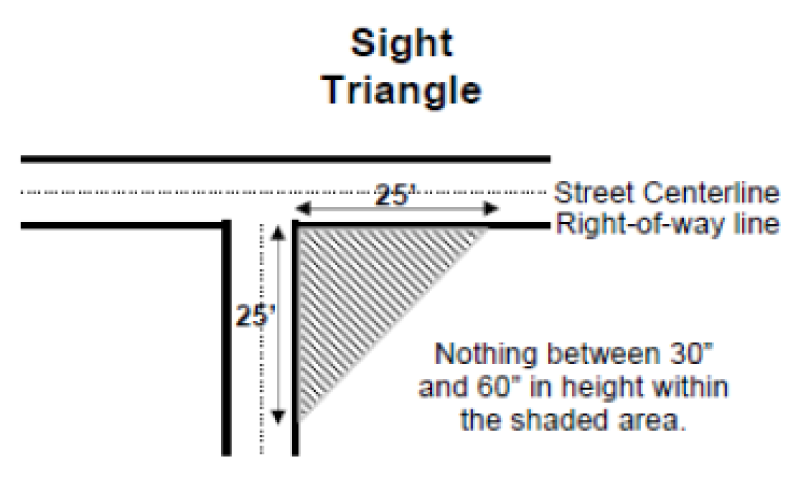
(4)
Maintenance. All signs, to include permanent and temporary signs and signs that do and do not require a permit, shall be maintained in good condition, kept free of cracked or peeling painting, missing or damaged sign panels or supports, and weeds, grass or vegetation which obscures the view of the sign message. Sign landscaping shall be maintained so as not to interrupt the view of the sign.
(5)
Obstruction. Installation of a sign shall not block entrances or exits to buildings including windows, doors, and fire escapes.
(6)
In public right-of-way. Signs, including supports, frames, and embellishments, shall not be located within a public right-of-way and/or attached, affixed, or painted on any utility pole, light standard, utility box or pedestal, tree, rock or other natural object located within the public right-of-way or on public property, except as specifically permitted in this section. Generally, signs located away from the street behind the sidewalk or utility poles shall be considered to be located outside the public right-of-way.
(7)
Illumination. Signs may be illuminated as outlined below:
(a)
Source. Illumination shall be in a manner which avoids glare or reflection which in any way interferes with traffic safety. External illumination is preferred.
(b)
External illumination. External illumination shall be selected, located, aimed and shielded so that direct illumination is focused solely on the sign face, away from adjoining properties and public street right-of-way. Down-lighting is preferred.
(c)
Strung lights. Signs shall not be illuminated by a string of lights placed around the sign.
(8)
Changeable copy signs. Manual changeable copy signs and electronic changeable copy signs shall be allowed as outlined subject to the following:
(a)
Areas. See specific type sign for maximum areas of a sign devoted to changeable copy.
(b)
Copy rotation. Each message and/or image shall be displayed for at least thirty (30) seconds before alternating to the next.
b.
Permitted sign types. The following sign types are the only signs allowed in the overlay district and must be permitted as outlined in section 3.4 above prior to installation:
(1)
Free-standing signs. Pylon; gateway; icon; monument, kiosk, sandwich board.
(2)
Attached signs. Wall, canopy and awning signs, door and window signs and blades.
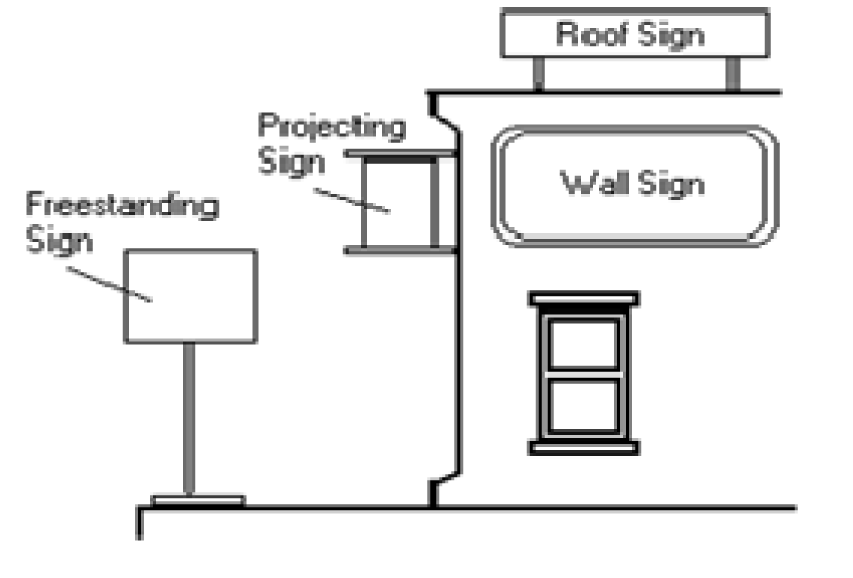
(3)
Miscellaneous signs. Banners, project announcement signs, land available and real estate signs, wind devise signs.
c.
Requirements for specific sign types.
(1)
Free-standing signs.
(a)
Pylon sign type 1. See examples in section 3.8c(5) for sign design.
•
Size. Maximum allowable height of sixty (60) feet ; maximum area of seven hundred (700) square feet per sign area.
•
Location. Allowed only along the road frontage of an expressway as identified on the adopted master street plan. Signs shall be placed no closer than two hundred (200) feet from side property lines.
•
Setback. Minimum setback of fifteen (15) feet from the right-of-way of said street and a maximum setback of twenty-five (25) feet.
(b)
Pylon sign type 2. See examples in section 3.8c(5) for sign design.
•
Size. Maximum allowable height of forty (40) feet; maximum sign area of five hundred (500) square feet per sign area.
•
Location. Allowed only along the road frontage of an expressway; and arterials as identified on the adopted master street plan. Signs shall be placed no closer than one hundred (100) feet from side property lines.
•
Setback. Minimum setback of fifteen (15) feet from the right-of-way of said street and a maximum setback of twenty-five (25) feet.
(c)
Pylon sign type 3. See examples in section 3.8c(5) for sign design.
•
Size. Maximum allowable height of twenty (20) feet; maximum sign area of two hundred eighty (280) square feet per sign area.
•
Location. Allowed only along the road frontage of an expressway; arterials; and major or minor collector as identified on the adopted master street plan. Signs shall be placed a minimum of two hundred (200) feet for another sign on the same property. Although this will not restrict the ability to place at least one (1) sign per property.
(d)
Monument sign 1. See examples in section 3.8c(5) for sign design.
•
Size. Maximum allowable height of twelve (12) feet; maximum sign area of one hundred (100) square feet per sign area.
•
Location. Allowed along all street frontage in the overlay district. Signs shall be placed a minimum of one hundred fifty (150) feet apart.
(e)
Monument sign 2. See examples in section 3.8c(5) for sign design.
•
Size. Maximum allowable height of ten (10) feet; maximum sign area of one hundred (100) square feet per sign area.
•
Location. Allowed along all street frontage in the overlay district. Signs shall be placed a minimum of one hundred (100) feet apart.
(f)
Monument sign 3. See examples in section 3.8c(5) for sign design.
•
Size. Maximum allowable height often (10) feet; maximum sign area of one hundred (100) square feet per sign area for single tenant only.
•
Location. Allowed along all street frontage in the overlay district. Signs shall be placed a minimum of one hundred fifty (150) feet apart.
(g)
Sandwich board or "A'' frame. Designed and constructed so as to promote and not visually obscure the significant architectural features of the overlay district.
•
Size. Maximum sign height shall be three (3) feet, maximum sign width shall be two (2) feet.
•
Location. Sidewalks must be at least ten (10) feet wide in order to erect or maintain a sandwich board or "A" frame sign. Signs must be properly anchored (temporarily) or weighted against the wind. Sign shall not be placed in front of adjoining tenant.
•
Removal. Sidewalk signs permitted under this section shall be removed each day by close of business, and be replaced or removed when the appearance or condition of the sign deteriorates through damage, weathering etc.
(h)
Changeable message board. Chalkboards or changeable letters may be used for daily changing messages. Signs must be removed after business hours.
(i)
Highway icons. Obelisks, towers, freestanding columns or other vertical freestanding elements.
•
Size. Shall be allowed up to seventy-five (75) feet tall and ten (10) feet by ten (10) feet at the base.
•
Informational sign. An icon sign may have an information sign included for community activities, but no specific tenant advertising.
•
Changeable message board. May have a changeable message board with a maximum size of two hundred fifty (250) square feet.
(j)
Gateway signs.
(k)
Kiosk signs. See examples in section 3.8c(5) for sign design.
•
Size. Maximum height eight (8) feet; maximum sign areas thirty (30) square feet; however a round kiosk sign may be a maximum of fifty (50) square feet in sign area.
•
Location. May be placed on private developments, or in public right-of-way by specific agreement with the city. Minimum spacing is two hundred (200) feet between signs and fifty (50) feet from a street intersection with confirmation of compliance with visibility triangle requirements.
(2)
Attached signs.
(a)
General requirements. Includes wall, canopy an awning signs.
•
Total square footage of all attached signs located on a canopy or on a given side of a building shall not exceed twenty (20) percent of the total square footage of the wall area on that side of the building, up to a maximum eight hundred (800) square feet.
•
Signs shall be composed of individual, freestanding letters unless this conflicts with a part of the tenant's national identity or trade dress. The freestanding letters may be placed on a backing plate. Signs that propose non-freestanding letters may be allowed, with specific approval. All necessary sign supports and electrical connections shall be concealed.
•
Illumination, internally. Illuminated signs must derive light from a concealed source, except exposed neon signs must be enclosed with a can and have a clear cover of Plexiglas. No other exposed lamps, or tubes will be permitted. The minimum depth for illuminated signs shall be four (4) inches. Illuminated signs maybe "pegged out" from mounting surface for silhouette effects.
•
Illumination, externally. Signs may be externally illuminated by wall mounted fixtures. External illumination must direct light at the sign only and avoid spill-over of light.
•
No exposed Neon or LED "strip" or "accent" lighting is allowed on the building or adjacent facades. Neon or LED within a cove, which hides the lamp source but allows light to spill outward on the building face, may be allowed with specific approval.
(b)
Wall signs.
i.
Total square footage of all attached signs located on a canopy or on a given side of a building shall not exceed twenty (20) percent of the total square footage of the wall area on that side of the building, up to a maximum eight hundred (800) square feet.
ii.
Signs shall be composed of individual, freestanding letters unless this conflicts with a part of the tenant's national identity or trade dress. The freestanding letters may be placed on a backing plate. Signs that propose non-freestanding letters may be allowed, with specific approval. All necessary sign supports and electrical connections shall be concealed.
iii.
Illumination, internally. Illuminated signs must derive light from a concealed source, except exposed neon signs must be enclosed with a can and have a clear cover of Plexiglas. No other exposed lamps, or tubes will be permitted. The minimum depth for illuminated signs shall be four (4) inches. Illuminated signs maybe "pegged out" from mounting surface for silhouette effects.
iv.
Illumination, externally. Signs may be externally illuminated by wall mounted fixtures. External illumination must direct light at the sign only and avoid spill-over of light.
v.
No exposed neon or LED "strip" or "accent" lighting is allowed on the building or adjacent facades. Neon or LED within a cove, which hides the lamp source but allows light to spill outward on the building face, may be allowed with specific approval.
(c)
Canopy sign. One (1) sign is permitted per licensed business for each of the business's customer entrances.
•
Attached canopy. Shall not extend upward to a height greater than the highest part of the roof or any exterior wall on which it is mounted. In no case shall the sign extend beyond the vertical edge of the canopy to which it is attached.
•
Freestanding canopy. For determining the maximum allowable signage area for a free standing canopy the side of the building with the customer entrance that allows the canopy sign shall be the side of the building that is used for calculating the square footage of wall space.
•
Fuel canopies. Signage for fuel canopies shall be limited to log signs.
(d)
Awning sign. One (1) fixed awning sign is permitted per awning and are allowed in addition to canopy signs. The sign shall be flat against the surface of the awning with a clearance of eight (8) feet above a public right-of-way or front yard. The sign shall be not be closer than two (2) feet, measured in horizontal distance, from the curb line of any street. Any fabric awning valance may not extend more than one (1) foot below the rigid mount of the awning.
(e)
Door sign.
(f)
Window sign. Any sign, pictures, symbol or combination thereof that is placed inside a window or upon the window panes or glass and is visible from the exterior of the window shall not exceed forty (40) percent of the window area.
(g)
Blade sign. Refer to section (5)(e) below for an example.
•
Number of signs. A one (1) blade sign is permitted per tenant. Corner tenants are permitted two (2) blade signs, one (1) on each storefront opening or entry.
•
Size. Maximum sign area of twelve (12) square feet per tenant. Minimum clearance below sign to be seven (7) feet six (6) inches.
(3)
Miscellaneous signs. The following types of miscellaneous signs shall be permitted:
(a)
Banners. Sign ordinance requirements.
(b)
Project announcement signs.
•
Size. Maximum sign areas not exceeding one hundred (100) square feet per sign area for the purposes of selling or leasing parcels. All project announcement signs must be at least two hundred (200) feet apart.
•
Materials. All signs must be constructed with a metal frame (or painted wood posts of three (3) inches by three (3) inches minimum), and have acrylic or metal panels and comply with the color palate adopted as part of the overlay design standards. A typical project announcement sign can be found in section (5)(f) below.
(c)
Land available and real estate signs. Signs offering land available for sale or lease.
•
Size. Maximum sign areas not exceeding ninety-six (96) square feet per sale or lease parcel provided that no more than one (1) sign be installed for each three hundred (300) feet of frontage.
•
Materials. All signs must be constructed with a metal frame (or painted wood posts of three (3) inches by three (3) inches minimum), and have acrylic or metal panels.
•
Sign duration.
(d)
Wind devise signs. On premise, windblown signs such as pennants, flags and streamers for special events and grand openings.
•
Size. Maximum size twenty (20) square feet in area.
•
Allowable number. No limit to number of wind device signs along main circulation routes or in development areas where said signs are not visible from I49 or Highway 412. If visible from one of these highways, wind device signs shall be spaced a minimum of two hundred fifty (250) feet apart.
(4)
Sign requirements for specific uses. Churches, schools, libraries, community centers or other public/semi-public facilities shall be allowed signs as follows:
(a)
Facilities with a land area of ten (10) acres or less shall be allowed two (2) wall signs, with not more than one (1) on a façade. Total square footage of all attached signs located on a given side of a building shall not exceed twenty (20) percent of the total square footage of the wall area on that side of the building, up to a maximum eight hundred (800) square feet. Wall signs shall be composed of individual, freestanding letters unless this conflicts with a part of the tenant's national identity or trade dress. The freestanding letters may be placed on a backing plate. Signs that propose non-freestanding letters may be allowed, with specific approval. All necessary sign supports and electrical connections shall be concealed. In lieu of one (1) of the wall signs, one (1) monument sign 3 as specified in section (f) above shall be permitted.
(b)
Facilities with a land area of more than ten (10) acres shall be allowed three (3) wall signs, with not more than one (1) on a façade. Total square footage of all attached signs located on a given side of a building shall not exceed twenty (20) percent of the total square footage of the wall area on that side of the building, up to a maximum eight hundred (800) square feet. Wall signs shall be composed of individual, freestanding letters unless this conflicts with a part of the tenant's national identity or trade dress. The freestanding letters may be placed on a backing plate. Signs that propose non-freestanding letters may be allowed, with specific approval. All necessary sign supports and electrical connections shall be concealed. In lieu of one (1) or two (2) of the wall signs, one (1) or two (2) monument signs 2 and/or 3 as specified in section (f) above.
(5)
Signage examples. All signage examples are for illustrative purposes and to further define size calculations required for various sign types.
(a)
Pylon and monument signs.
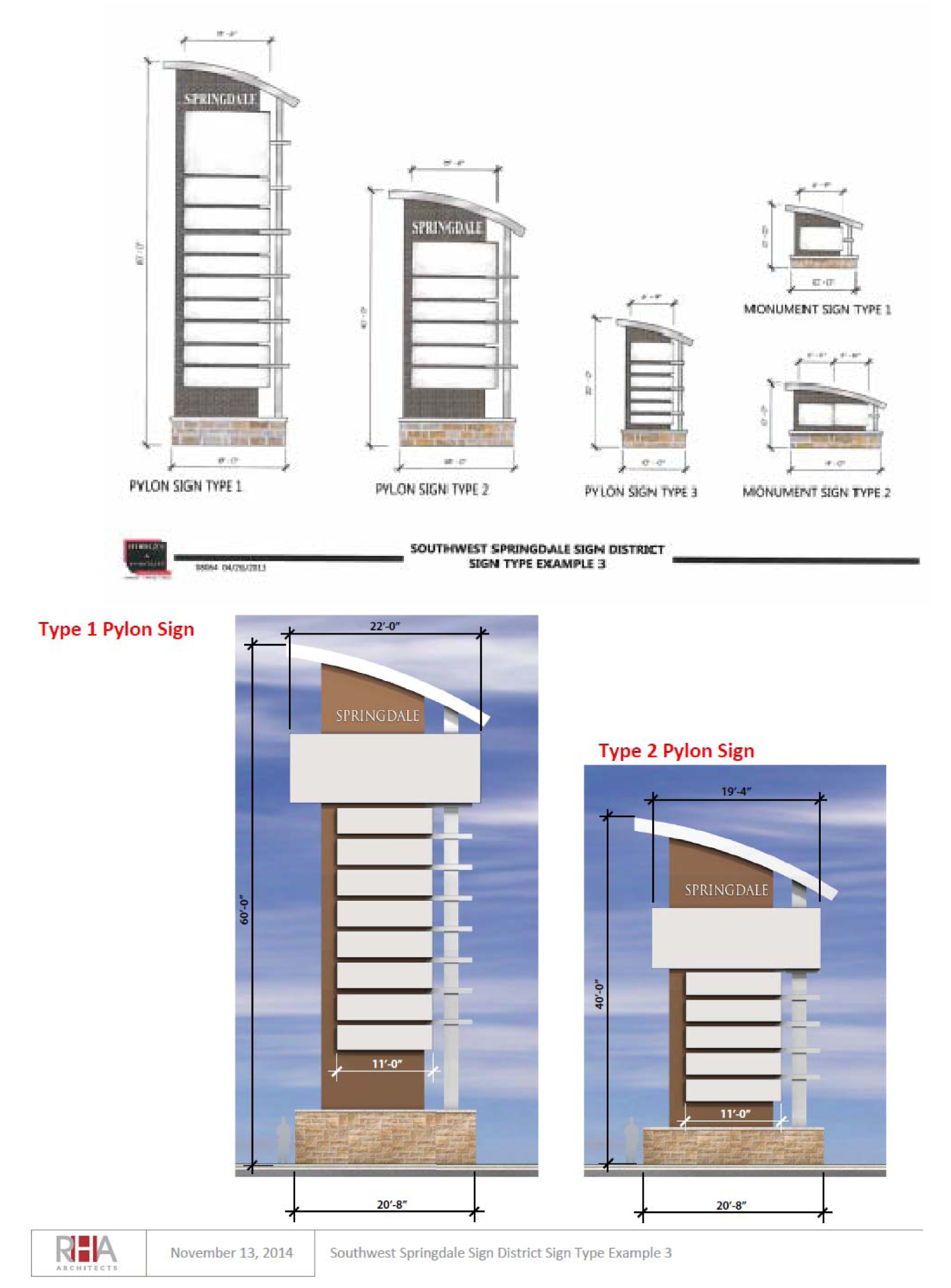
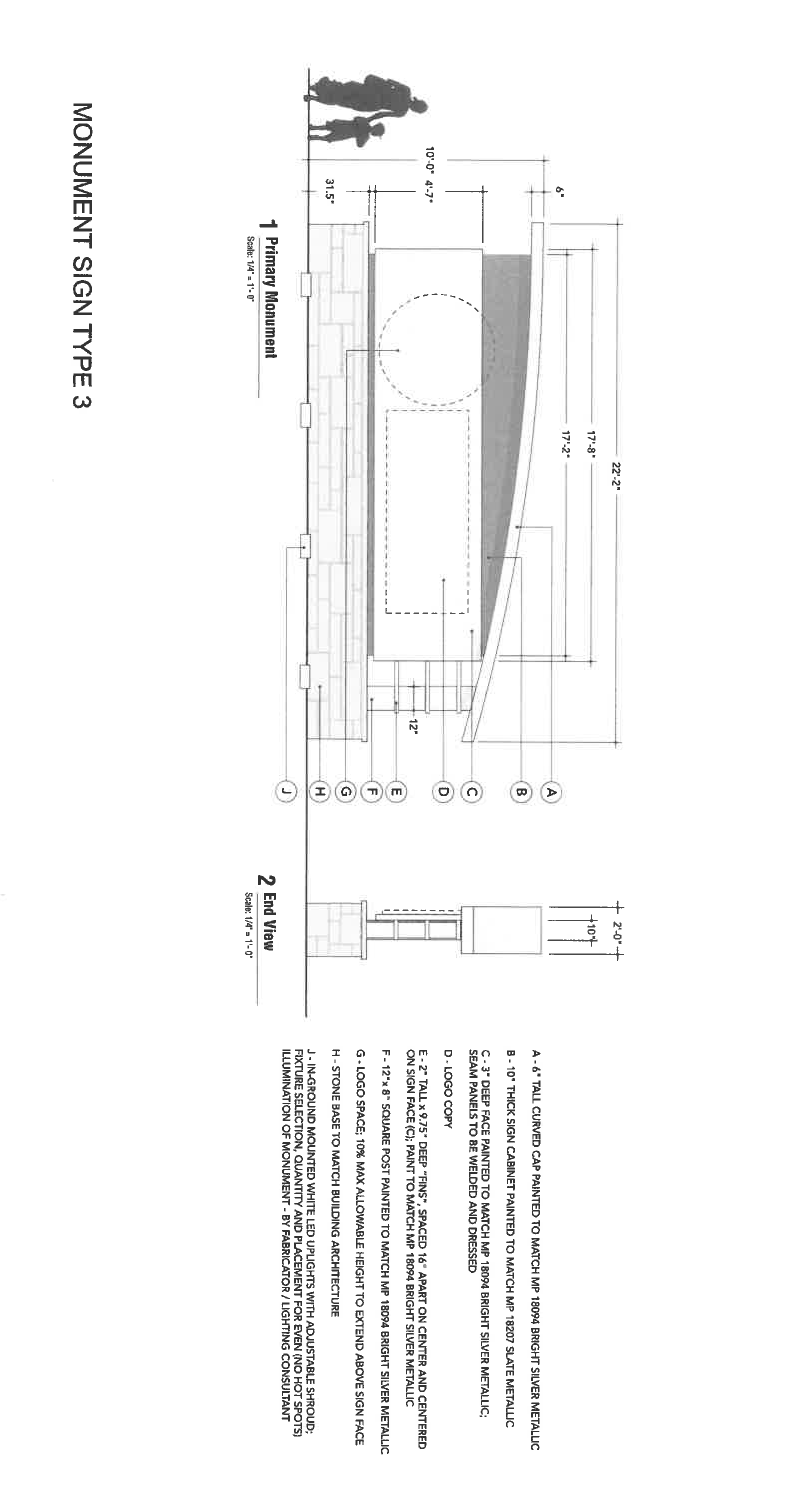
(b)
Kiosk sign examples.
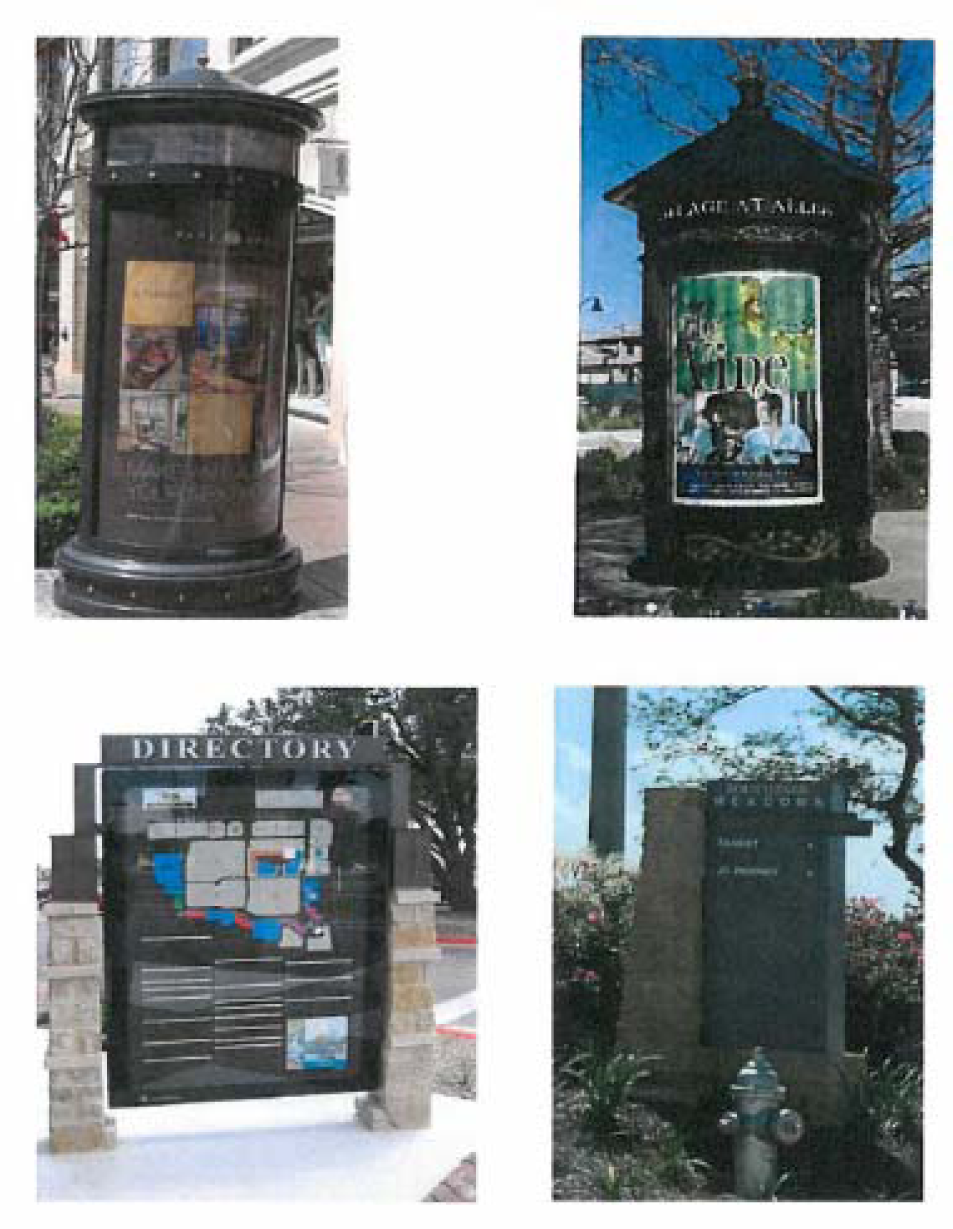
(c)
Site sign example.
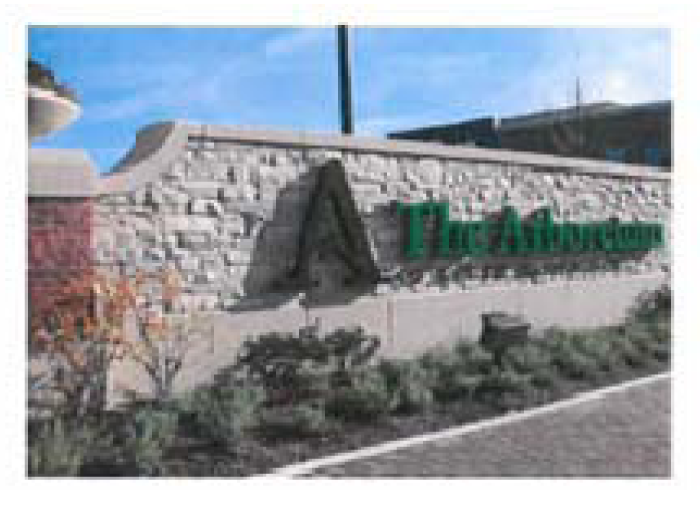
(d)
Pole banner sign examples.
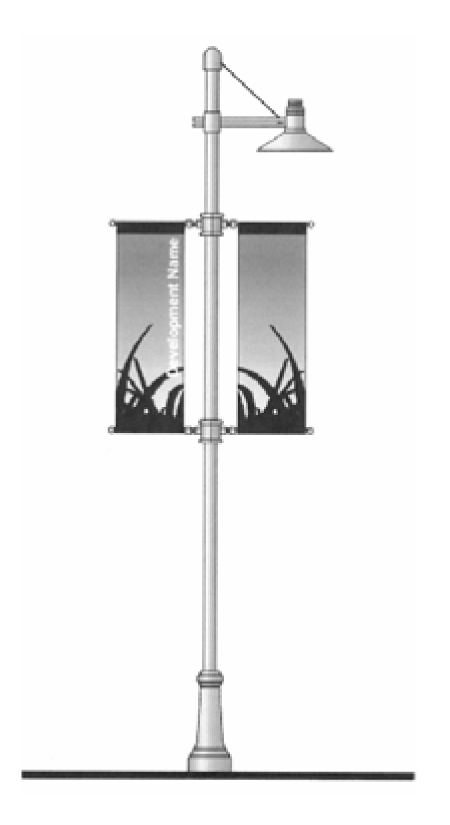
(e)
Blade sign.
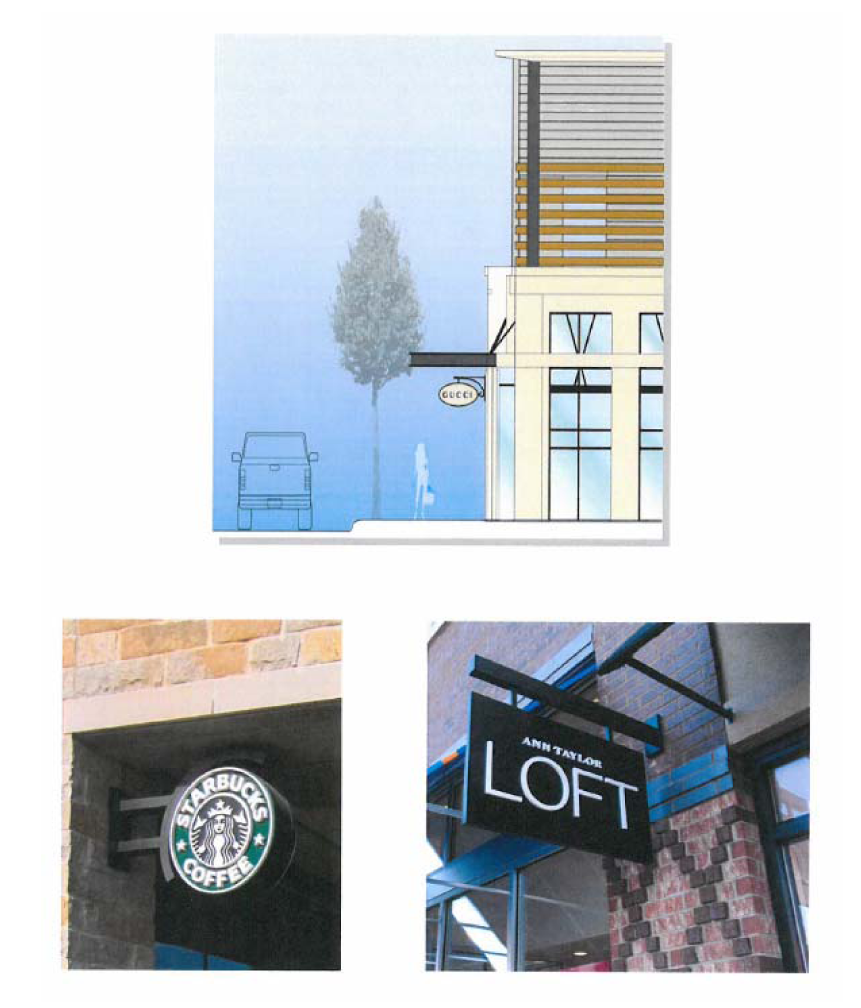
(f)
Project announcement sign examples.
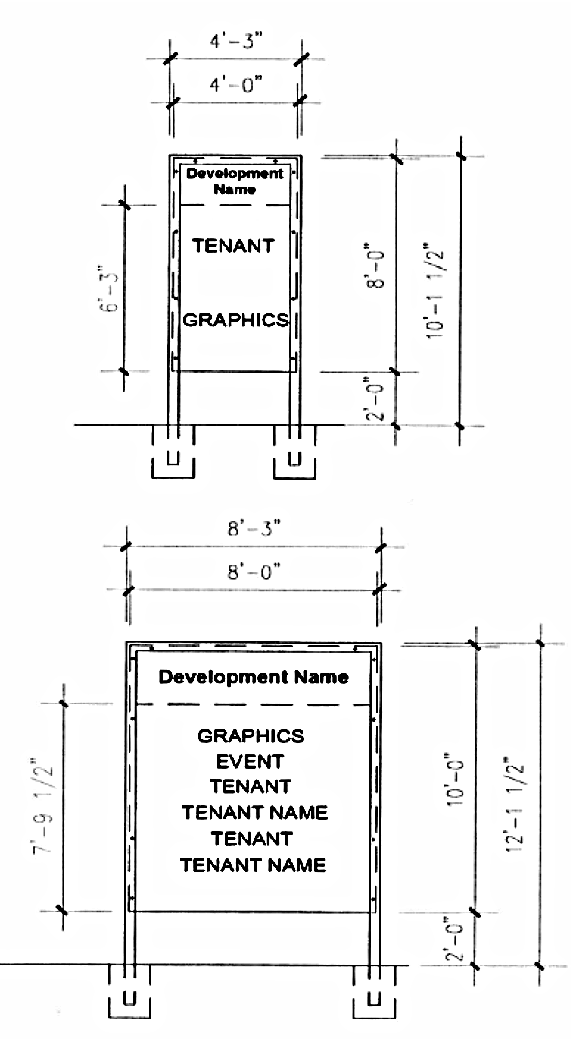
(g)
Building signage examples.
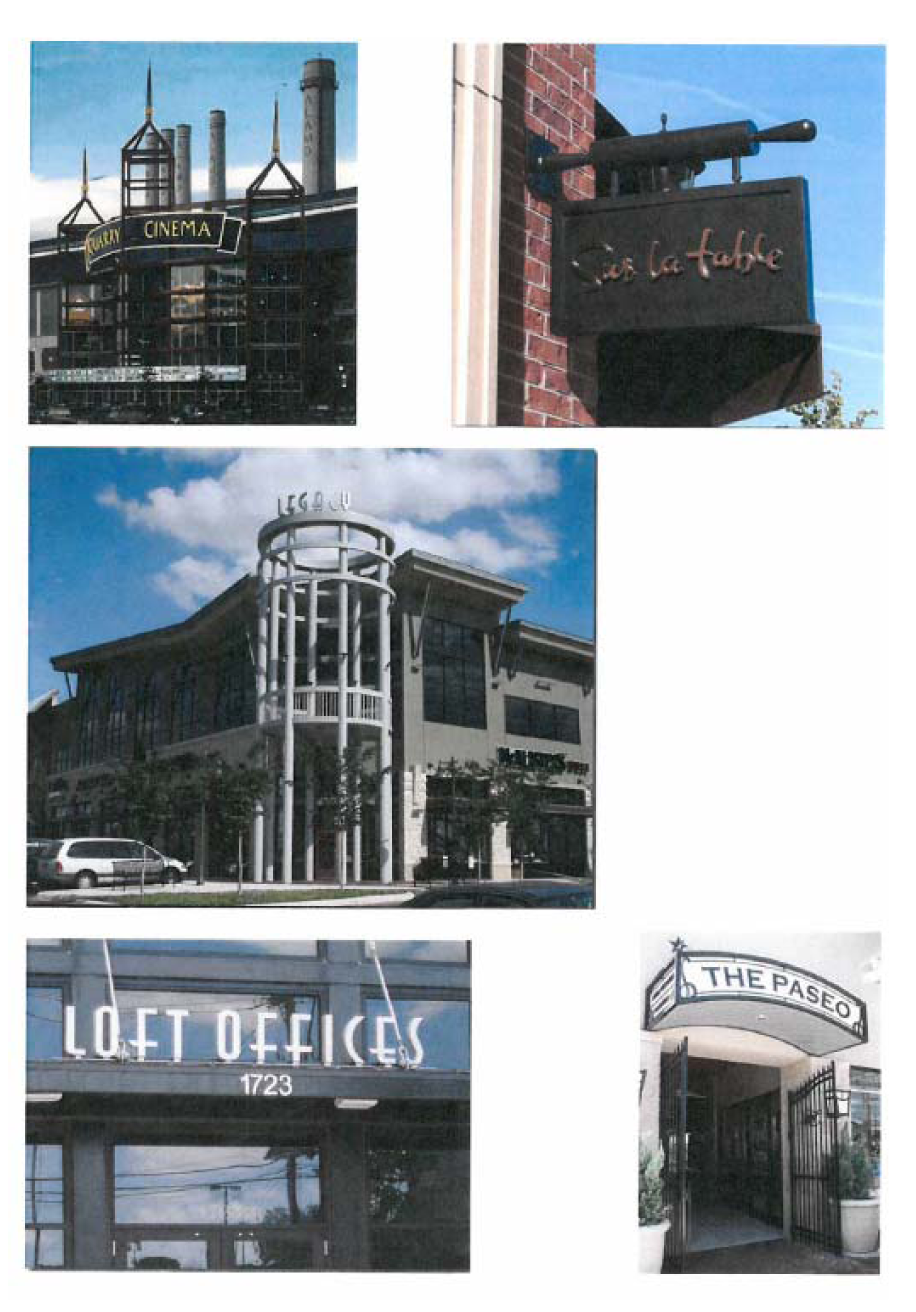
(Ord. No. 4886, § 1, 2-24-15; Ord. No. 5251, §§ 1, 2, 2-13-18; Ord. No. 5467, § 1, 3-24-20)

