
Springdale City Zoning Code
ARTICLE 4
- DISTRICT REGULATIONS
Sec. 1. - A-1 Agricultural district.
PURPOSE.
The agricultural district is designed to protect agricultural land until an orderly transition to urban development has been accomplished. It provides a usable district for certain uses which may be annexed to the city. The regulations of the agricultural district are designed to protect agricultural land until an orderly transition to urban development has been accomplished. This zone will encourage single family residential usage on large tracts. In addition, due to the low density of development, agricultural uses such as crop and livestock production are allowed.
USES PERMITTED.
Unit 1, citywide public uses by right.
Unit 6, agriculture.
Unit 7, animal husbandry.
Unit 8, single-family dwellings.
Unit 29, home office.
CONDITIONAL USES PERMISSIBLE ON APPEAL TO THE PLANNING COMMISSION.
Unit 2, city-wide uses by conditional use permit.
Unit 3, utility facilities.
Unit 4, cultural, recreation and health facilities.
Unit 5, institutional facilities.
Unit 9, zero lot line.
Unit 14, medium density single family affordable housing (SF-4).
Unit 17A, eating places.
Unit 23, commercial, large sites.
Unit 28, home occupation.
Unit 30, recreational vehicle park.
Unit 33, self-supporting tower or antenna structure or monopole.
Unit 36, horses kept in residential areas.
Unit 37, auction houses.
Unit 40, temporary classrooms.
Unit 42, church/synagogue.
Unit 45, health care clinic.
Unit 50, agricultural occupation.
TEMPORARY USES.
Unit 32, temporary buildings and/or storage.
Unit 34, model home/temporary marketing office.
ACCESSORY USES.
The following accessory structures and land uses shall be permitted only where clearly incidental to the permitted primary use, except as otherwise permitted herein:
a.
Accessory buildings, including private garages, storage facilities and children's playhouses.
b.
Private greenhouses.
c.
Swimming pools, tennis courts and similar recreation facilities.
SITE PLAN REVIEW.
When a conditional use is proposed in an A-1 district, except for use unit 28 home occupation and use unit 36, horses kept in residential areas; a site plan review shall be required. See article 2, section 13 of this chapter for the procedure and requirements of a site plan review.
AREA REGULATIONS.
(1)
Lot area. There shall be a lot area of not less than two acres for both residential and non-residential use. In addition, there shall be a minimum lot width of not less than two hundred (200) feet on a public street at the front setback line.
(2)
Density. One (1) unit per two acres.
(3)
Front setback. There shall be a front setback having a depth of not less than thirty-five (35) feet. In keeping with the definition of a corner lot, all sides adjacent to streets shall be required to have front setbacks of thirty-five (35) feet.
(4)
Side setback. There shall be a side setback on each side of the lot having a width of not less than twenty (20) feet.
(5)
Rear setback. There shall be a rear setback having a depth of not less than thirty-five (35) feet.
OFF STREET PARKING.
See article 7 of this chapter.
(Ord. No. 3307, 3-25-03; Ord. No. 3436, § 1, 1-13-04; Ord. No. 3533, § 1, 7-13-04; Ord. No. 4024, § 5, 2-13-07; Ord. No. 4030, § 1, 2-13-07; Ord. No. 4597, § 1, 6-12-12; Ord. No. 5168, § 1, 4-25-17)
Sec. 2. - Residential districts.
2.1
General purpose. The residential districts, established by this chapter, are designated to promote and protect the health, safety, convenience, order, property and other aspects of the general welfare. The general goals include, among others, the following more specific purposes:
(1)
Protect the positive aspects of neighborhood character throughout the city.
(2)
Assure adequate land allocation for residential purposes by providing lots of adequate size.
(3)
Stabilize property values and maintain the integrity of neighborhoods by protecting residential neighborhoods from non-residential influences and providing buffers between residential and non-residential uses.
(4)
Assure safety of neighborhoods through the design of streets that discourages through-traffic in residential neighborhoods and by excluding from them those uses that generate non-residential traffic.
(5)
Encourage the development of a variety of housing types appropriate to the size and income of all households living and working in the city.
(6)
Allow an increase to medium or high density residential use when land value prevents economical development of low density residential rather than allow the loss of residential uses altogether.
(7)
Allow the development of residential-office uses between residential and commercial/industrial areas to stabilize and buffer the limits of each type of development.
(8)
Require landscaping and open recreation areas in medium and high density development.
2.2
R-E—Residential estate district.
PURPOSE.
The R-E district is established to accommodate single-family residential and complementary land uses on large lots. This zone is generally applied to fringe areas of the city, between the built-up areas of the city and those areas that are agricultural in nature.
USES PERMITTED.
Unit 1, city-wide public uses by right.
Unit 8, single-family dwellings.
Unit 28, home occupation.
Unit 29, home office.
CONDITIONAL USES PERMISSIBLE ON APPEAL TO THE PLANNING COMMISSION.
Unit 2, city-wide uses by conditional use permit.
Unit 3, utility facilities.
Unit 9, zero lot line.
Unit 36, horses kept in residential areas.
Unit 40, temporary classrooms.
TEMPORARY USES.
Unit 34, model home/temporary marketing office.
ACCESSORY USES.
The following accessory structures and land uses shall be permitted only where clearly incidental to the permitted primary use, except as otherwise permitted herein:
a.
Accessory buildings, including private garages, storage facilities and children's playhouses as set forth in article 6, subsection 2.7 of this chapter.
b.
Private greenhouses and horticultural collections.
c.
Flower and vegetable gardens.
d.
Swimming pools, tennis courts and similar recreation facilities.
SITE PLAN REVIEW.
When a conditional use is proposed in an R-E district, except for use unit 28 home occupation and use unit 36, horses kept in residential areas; a site plan review shall be required. See article 2, section 13 of this chapter for the procedure and requirements of a site plan review.
HEIGHT REGULATIONS.
No building hereafter erected or structurally altered shall exceed a height of thirty-five (35) feet.
AREA REGULATIONS.
(1)
Lot area. There shall be a lot area of not less one acre. In addition, there shall be a minimum lot width of not less than one hundred (100) feet on a public street at the front setback line.
(2)
Density. One (1) unit per acre.
(3)
Front setback. There shall be a front setback having a depth of not less than fifty (50) feet. In keeping with the definition of a corner lot, all sides adjacent to streets shall be required to have front setbacks of fifty (50) feet.
(4)
Side setback. There shall be a side setback on each side of the lot having a width of not less than twenty (20) feet.
(5)
Rear setback. There shall be a rear setback having a depth of not less than twenty (20) feet.
OFF STREET PARKING.
See article 7 of this chapter.
2.3
SF-1—Low density single family residential district.
PURPOSE.
The SF-1 single-family district is established in order to provide areas in the city for development of single-family residences on lots not less than ten thousand (10,000) square feet in area with a minimum frontage on a public street of eighty (80) feet.
USES PERMITTED.
Unit 1, city-wide public uses by right.
Unit 8, single-family dwellings.
Unit 29, home office.
CONDITIONAL USES PERMISSIBLE ON APPEAL TO THE PLANNING COMMISSION.
Unit 2, city-wide uses by conditional use permit.
Unit 3, utility facilities.
Unit 4, cultural, recreational and health facilities.
Unit 9, zero lot line.
Unit 28, home occupation.
Unit 36, horses kept in residential areas.
Unit 40, temporary classrooms.
Unit 45, health care clinic.
TEMPORARY USES.
Unit 34, model home/temporary marketing office.
ACCESSORY USES.
The following accessory structures and land uses shall be permitted only where clearly incidental to the permitted primary use, except as otherwise permitted herein:
a.
Accessory buildings, including private garages, storage facilities and children's playhouses as set for in article 6, subsection 2.7 of this chapter.
b.
Private greenhouses and horticultural collections.
c.
Flower and vegetable gardens.
d.
Swimming pools, tennis courts and similar recreation facilities.
SITE PLAN REVIEW.
When a conditional use is proposed in an SF-1 district, except for Use unit 28 home occupation and use unit 36, horses kept in residential areas; a site plan review shall be required. For use unit 36, see article 2, section 13 of this chapter for the procedure and requirements of a site plan review.
HEIGHT REGULATIONS.
No building hereafter erected or structurally altered shall exceed a height of thirty-five (35) feet.
AREA REGULATIONS.
(1)
Lot area. There shall be a lot area of not less than ten thousand (10,000) square feet. In addition, there shall be a minimum lot width of not less than eighty (80) feet on a public street at the front setback line.
(2)
Density. Less than four (4) units per acre.
(3)
Front setback. There shall be a front setback having a depth of not less than thirty (30) feet. In keeping with the definition of a corner lot, all sides adjacent to streets shall be required to have front setbacks of thirty (30) feet.
(4)
Side setback. There shall be a side setback on each side of the lot having a width of not less than eight (8) feet.
(5)
Rear setback. There shall be a rear setback having a depth of not less than twenty (20) feet.
BUILDING AREA.
On any lot, the area occupied by all buildings shall not exceed forty (40) percent of the total area of the lot.
OFF-STREET PARKING.
See article 7 of this chapter.
2.4
SF-2—Low/medium density single family residential district.
PURPOSE.
The SF-2 single-family district is designed to permit and encourage the development of single-family detached dwellings on smaller lots to encourage flexibility in housing and lot sizes.
USES PERMITTED.
Unit 1, city-wide public uses by right.
Unit 8, single-family dwellings.
Unit 29, home office.
CONDITIONAL USES PERMISSIBLE ON APPEAL TO THE PLANNING COMMISSION.
Unit 2, city-wide uses by conditional use permit.
Unit 3, utility facilities.
Unit 4, cultural, recreational and health facilities.
Unit 9, zero lot line.
Unit 28, home occupation.
Unit 36, horses kept in residential areas.
Unit 40, temporary classrooms.
Unit 45, health care clinic.
TEMPORARY USES.
Unit 34, model home/temporary marketing office.
ACCESSORY USES.
The following accessory structures and land uses shall be permitted only where clearly incidental to the permitted primary use, except as otherwise permitted herein:
a.
Accessory buildings, including private garages, storage facilities and children's playhouses as set for in article 6, subsection 2.7 of this chapter.
b.
Private greenhouses and horticultural collections.
c.
Flower and vegetable gardens.
d.
Swimming pools, tennis courts and similar recreation facilities.
SITE PLAN REVIEW.
When a conditional use is proposed in an SF-2 district, except for use unit 28 home occupation and use unit 36, horses kept in residential areas; a site plan review shall be required. See article 2, section 13 of this chapter for the procedure and requirements of a site plan review.
HEIGHT REGULATIONS.
No building hereafter erected or structurally altered shall exceed a height of thirty-five (35) feet.
AREA REGULATIONS.
(1)
Lot area. There shall be a lot area of not less than eight thousand (8,000) square feet. In addition, there shall be a minimum lot width of not less than seventy (70) feet on a public street at the front setback line.
(2)
Density. Four (4) units per acre.
(3)
Front setback. There shall be a front setback having a depth of not less than thirty (30) feet. In keeping with the definition of a corner lot, all sides adjacent to streets shall be required to have front setbacks of thirty (30) feet.
(4)
Side setback. There shall be a side setback on each side of the lot having a width of not less than eight (8) feet.
(5)
Rear setback. There shall be a rear setback having a depth of not less than twenty (20) feet.
BUILDING AREA.
On any lot, the area occupied by all buildings shall not exceed forty (40) percent of the total area of the lot.
OFF-STREET PARKING.
See article 7 of this chapter.
2.5
SF-3—Medium density single family residential district.
PURPOSE.
The SF-3 single-family district is designed to provide an appropriate district for existing developed areas occupied by smaller scale single-family dwellings and to provide more compact single family residential development, to promote more efficient use of land and utilities, and to promote the development of less expensive housing on smaller lots.
USES PERMITTED.
Unit 1, city-wide public uses by right.
Unit 8, single-family dwellings.
Unit 29, home office.
CONDITIONAL USES PERMISSIBLE ON APPEAL TO THE PLANNING COMMISSION.
Unit 2, city-wide uses by conditional use permit.
Unit 3, utility facilities.
Unit 4, cultural, recreational and health facilities.
Unit 9, zero lot line.
Unit 28, home occupation.
Unit 36, horses kept in residential areas.
Unit 40, temporary classrooms.
Unit 45, health care clinic.
TEMPORARY USES.
Unit 34, model home/temporary marketing office.
ACCESSORY USES.
The following accessory structures and land uses shall be permitted only where clearly incidental to the permitted primary use, except as otherwise permitted herein:
a.
Accessory buildings, including private garages, storage facilities and children's playhouses as set for in article 6, subsection 2.7 of this chapter.
b.
Private greenhouses and horticultural collections.
c.
Flower and vegetable gardens.
d.
Swimming pools, tennis courts and similar recreation facilities.
SITE PLAN REVIEW.
When a conditional use is proposed in an SF-1 district, except for use unit 28 home occupation and use unit 36, horses kept in residential areas; a site plan review shall be required. See article 2, section 13 of this chapter for the procedure and requirements of a site plan review.
HEIGHT REGULATIONS.
No building hereafter erected or structurally altered shall exceed a height of thirty-five (35) feet.
AREA REGULATIONS.
(1)
Lot area. There shall be a lot area of not less than seven thousand (7,000) square feet. In addition, there shall be a minimum lot width of not less than sixty (60) feet on a public street at the front setback line.
(2)
Density. Six (6) units per acre.
(3)
Front setback. There shall be a front setback having a depth of not less than thirty (30) feet. In keeping with the definition of a corner lot, all sides adjacent to streets shall be required to have front setbacks of thirty (30) feet.
(4)
Side setback. There shall be a side setback on each side of the lot having a width of not less than eight (8) feet.
(5)
Rear setback. There shall be a rear setback having a depth of not less than twenty (20) feet.
BUILDING AREA.
On any lot, the area occupied by all buildings shall not exceed forty (40) percent of the total area of the lot.
OFF-STREET PARKING.
See article 7 of this chapter.
2.6
MF-2—Low density multi-family residential district.
PURPOSE.
The MF-2 multi-family district is established in order to provide areas for development with a maximum of two dwelling units per residential structures (duplexes). Provides more compact residential development, and promotes more efficient use of land and utilities, and the development of less expensive housing on smaller lots.
PERMITTED USES.
Unit 1, city-wide public uses by right.
Unit 8, single-family dwellings.
Unit 10, townhouses.
Unit 11, duplexes.
Unit 29, home office.
CONDITIONAL USES PERMISSIBLE ON APPEAL TO THE PLANNING COMMISSION.
Unit 2, city-wide uses by conditional use permit.
Unit 3, utility facilities.
Unit 4, cultural, recreational and health facilities.
Unit 9, zero lot line.
Unit 28, home occupation.
Unit 40, temporary classrooms.
Unit 45, health care clinic.
TEMPORARY USES.
Unit 34, model home/temporary marketing office.
ACCESSORY USES.
The following accessory structures and land uses shall be permitted only where clearly incidental to the permitted primary use, except as otherwise permitted herein:
a.
Accessory buildings, including private garages, storage facilities and children's playhouses as set for in article 6, subsection 2.7 of this chapter.
b.
Private greenhouses and horticultural collections.
c.
Flower and vegetable gardens.
d.
Swimming pools, tennis courts and similar recreation facilities.
SITE PLAN REVIEW.
When a conditional use is proposed in an MF-2 district, except for use unit 28 home occupation, a site plan review shall be required. See article 2, section 13 of this chapter for the procedure and requirements of a site plan review.
HEIGHT REGULATIONS.
No building hereafter erected or structurally altered shall exceed a height of thirty-five (35) feet.
AREA REGULATIONS.
(1)
Lot area. There shall be a lot area of not less than ten thousand (10,000) square feet for a single family dwelling and twelve thousand (12,000) square feet for a duplex. In addition, there shall be a minimum lot width of not less than eighty (80) feet on a public street at the front setback line for a single family dwelling, and ninety (90) feet on a public street at the front setback line for a duplex with a minimum structure size of one thousand four hundred (1,400) square feet of heated living space per side.
(2)
Density. Four (4) units per acre.
(3)
Front setback. There shall be a front setback having a depth of not less than thirty (30) feet. In keeping with the definition of a corner lot, all sides adjacent to streets shall be required to have front setbacks of thirty (30) feet.
(4)
Side setback. There shall be a side setback on each side of the lot having a width of not less than eight (8) feet.
(5)
Rear setback. There shall be a rear setback having a depth of not less than twenty (20) feet.
BUILDING AREA.
On any lot, the area occupied by all buildings shall not exceed forty (40) percent of the total area of the lot.
OFF-STREET PARKING.
See article 7 of this chapter.
LANDSCAPED OPEN SPACE.
On any lot, there shall be a minimum of ten (10) percent of landscaped open space in accordance with article 6 section 2.16 of this chapter.
2.6.5
MF-3—Low/medium density duplex district. [1]
PURPOSE.
The MF-3 multi-family district is established to provide areas for development of duplexes with a maximum of two dwelling units per residential structures. Provides more compact residential development, and promotes more efficient use of land and utilities, and the development of less expensive housing on smaller lots.
PERMITTED USES.
Unit 11, duplexes.
CONDITIONAL USES PERMISSIBLE ON APPEAL TO THE PLANNING COMMISSION.
Unit 2, city-wide uses by conditional use permit.
Unit 3, utility facilities.
Unit 4, cultural, recreational and health facilities.
Unit 28, home occupation.
Unit 29, home office.
Unit 40, temporary classrooms.
Unit 45, health care clinic.
TEMPORARY USES.
Unit 34, model home/temporary marketing office.
ACCESSORY USES.
The following accessory structures and land uses shall be permitted only where clearly incidental to the permitted primary use, except as otherwise permitted herein:
a.
Accessory buildings, including private garages, storage facilities and children's playhouses as set for in article 6, subsection 2.7 of this chapter.
b.
Private greenhouses and horticultural collections.
c.
Flower and vegetable gardens.
d.
Swimming pools, tennis courts and similar recreation facilities.
SITE PLAN REVIEW.
When a conditional use is proposed in an MF-3 district, except for use unit 28 home occupation or use unit 29 home office a site plan review shall be required. See article 2, section 13 of this chapter for the procedure and requirements of a site plan review.
HEIGHT REGULATIONS.
No building hereafter erected or structurally altered shall exceed a height of thirty-five (35) feet.
AREA REGULATIONS.
(1)
Lot area. There shall be a lot area of not less than twelve thousand (12,000) square feet for a duplex. In addition, there shall be a minimum lot width of not less than ninety (90) feet for a duplex on a public street at the front setback line.
(2)
Density. Eight (8) units per acre.
(3)
Front setback. There shall be a front setback having a depth of not less than thirty (30) feet. In keeping with the definition of a corner lot, all sides adjacent to streets shall be required to have front setbacks of thirty (30) feet.
(4)
Side setback. There shall be a side setback on each side of the lot having a width of not less than eight (8) feet.
(5)
Rear setback. There shall be a rear setback having a depth of not less than twenty (20) feet.
BUILDING AREA.
On any lot, the area occupied by all buildings shall not exceed forty (40) percent of the total area of the lot.
OFF-STREET PARKING.
See article 7 of this chapter.
LANDSCAPED OPEN SPACE.
On any lot, there shall be a minimum of ten (10) percent of landscaped open space in accordance with article 6 section 2.16 of this chapter.
MULTIFAMILY PLAY AREAS.
See article 6 subsection 2.17 of this chapter.
2.7
MF-4—Low/medium density multi-family residential district.
PURPOSE.
The MF-4 multi-family district is established to provide areas for development with a maximum of four dwelling units per residential structures. Provides more compact residential development, and promotes more efficient use of land and utilities, and the development of less expensive housing on smaller lots.
PERMITTED USES.
Unit 1, city-wide public uses by right.
Unit 8, single-family dwellings.
Unit 10, townhouses.
Unit 11, one and two family residential.
Unit 13, three and four family residential.
Unit 29, home office.
CONDITIONAL USES PERMISSIBLE ON APPEAL TO THE PLANNING COMMISSION.
Unit 2, city-wide uses by conditional use permit.
Unit 3, utility facilities.
Unit 4, cultural, recreational and health facilities.
Unit 9, zero lot line.
Unit 28, home occupation.
Unit 40, temporary classrooms.
Unit 45, health care clinic.
TEMPORARY USES.
Unit 34, model home/temporary marketing office.
ACCESSORY USES.
The following accessory structures and land uses shall be permitted only where clearly incidental to the permitted primary use, except as otherwise permitted herein:
a.
Accessory buildings, including private garages, storage facilities and children's playhouses as set for in article 6, subsection 2.7 of this chapter.
b.
Private greenhouses and horticultural collections.
c.
Flower and vegetable gardens.
d.
Swimming pools, tennis courts and similar recreation facilities.
SITE PLAN REVIEW.
When a conditional use is proposed in an MF-4 district, except for use unit 28 home occupation, a site plan review shall be required. See article 2, section 13 of this chapter for the procedure and requirements of a site plan review.
HEIGHT REGULATIONS.
No building hereafter erected or structurally altered shall exceed a height of thirty-five (35) feet.
AREA REGULATIONS.
(1)
Lot area. There shall be a lot area of not less than seven thousand (7,000) square feet for a single family dwelling; ten thousand five hundred (10,500) square feet for a duplex; thirteen thousand five hundred (13,500) for a triplex; and eighteen thousand (18,000) for a four-plex. In addition, there shall be a minimum lot width of not less than sixty (60) feet for a one family; seventy (70) feet for two family; eighty (80) for a three family and ninety (90) feet for a four family on a public street at the front setback line.
(2)
Density. Eight (8) units per acre.
(3)
Front setback. There shall be a front setback having a depth of not less than thirty (30) feet. In keeping with the definition of a corner lot, all sides adjacent to streets shall be required to have front setbacks of thirty (30) feet.
(4)
Side setback. There shall be a side setback on each side of the lot having a width of not less than eight (8) feet.
(5)
Rear setback. There shall be a rear setback having a depth of not less than twenty (20) feet.
BUILDING AREA.
On any lot, the area occupied by all buildings shall not exceed forty (40) percent of the total area of the lot.
OFF-STREET PARKING.
See article 7 of this chapter.
LANDSCAPED OPEN SPACE.
On any lot, there shall be a minimum of ten (10) percent of landscaped open space in accordance with article 6 section 2.16 of this chapter.
MULTIFAMILY PLAY AREAS.
See article 6 subsection 2.17 of this chapter.
2.8
MF-12—Medium density multi-family residential district.
PURPOSE.
The MF-12 multi-family district is established to provide areas for development allowing more units per structure and a higher density. Provides more compact residential development, and promotes more efficient use of land and utilities, and the development of less expensive housing on smaller lots.
PERMITTED USES.
Unit 1, city-wide public uses by right.
Unit 8, single-family dwellings.
Unit 10, townhouses.
Unit 11, duplexes.
Unit 13, three and four family residential.
Unit 29, home office.
CONDITIONAL USES PERMISSIBLE ON APPEAL TO THE PLANNING COMMISSION.
Unit 2, city-wide uses by conditional use permit.
Unit 3, utility facilities.
Unit 4, cultural, recreational and health facilities.
Unit 9, zero lot line.
Unit 12, high density residential.
Unit 28, home occupation.
Unit 40, temporary classrooms.
Unit 45, health care clinic.
TEMPORARY USES.
Unit 34, model home/temporary marketing office.
ACCESSORY USES.
The following accessory structures and land uses shall be permitted only where clearly incidental to the permitted primary use, except as otherwise permitted herein:
a.
Accessory buildings, including private garages, storage facilities and children's playhouses as set for in article 6, subsection 2.7 of this chapter.
b.
Private greenhouses and horticultural collections.
c.
Flower and vegetable gardens.
d.
Swimming pools, tennis courts and similar recreation facilities.
SITE PLAN REVIEW.
When a conditional use is proposed in an MF-12 district, except for use unit 28 home occupation a site plan review shall be required. See article 2, section 13 of this chapter for the procedure and requirements of a site plan review.
HEIGHT REGULATIONS.
No building hereafter erected or structurally altered shall exceed a height of thirty-five (35) feet.
AREA REGULATIONS.
(1)
Lot area. There shall be a lot area of not less than six thousand (6,000) square feet for a single family dwelling; ten thousand five hundred (10,500) square feet for a duplex; fourteen thousand (14,000) for a triplex; twenty thousand (20,000) for a four-plex and twenty thousand (20,000) plus two thousand five hundred (2,500) for each unit over five. In addition, there shall be a minimum lot width of not less than sixty (60) feet for a one family; seventy (70) feet for a two family; eighty (80) feet for a three family or larger on a public street.
(2)
Density. Twelve (12) units per acres
(3)
Front setback. There shall be a front setback having a depth of not less than thirty (30) feet. In keeping with the definition of a corner lot, all sides adjacent to streets shall be required to have front setbacks of thirty (30) feet.
(4)
Side setback. There shall be a side setback on each side of the lot having a width of not less than eight (8) feet.
(5)
Rear setback. There shall be a rear setback having a depth of not less than twenty (20) feet.
BUILDING AREA.
On any lot, the area occupied by all buildings shall not exceed forty (40) percent of the total area of the lot.
OFF-STREET PARKING.
See article 7 of this chapter.
LANDSCAPED OPEN SPACE.
On any lot, there shall be a minimum of ten (10) percent of landscaped open space in accordance with article 6 subsection 2.16 of this chapter.
MULTIFAMILY PLAY AREAS.
See article 6 subsection 2.17 of this chapter.
2.9
MF-16—Medium/high density multi-family residential district.
PURPOSE.
The MF-16 multi-family district is established to provide areas for development allowing more units per structure. Provides more compact residential development, and promotes more efficient use of land and utilities, and the development of less expensive housing on smaller lots. MF-16 districts are restricted to sites abutting collector or arterial streets and may be developed either adjacent to or in conjunction with neighborhood commercial or shopping center developments.
PERMITTED USES.
Unit 1, city-wide public uses by right.
Unit 8, single-family dwellings.
Unit 10, townhouses.
Unit 11, duplexes.
Unit 13, three and four family residential.
Unit 12, high density residential.
Unit 29, home office.
CONDITIONAL USES PERMISSIBLE ON APPEAL TO THE PLANNING COMMISSION.
Unit 2, city-wide uses by conditional use permit.
Unit 3, utility facilities.
Unit 4, cultural, recreational and health facilities.
Unit 9, zero lot line.
Unit 28, home occupation.
Unit 40, temporary classrooms.
Unit 45, health care clinic.
TEMPORARY USES.
Unit 34, model home/temporary marketing office
ACCESSORY USES.
The following accessory structures and land uses shall be permitted only where clearly incidental to the permitted primary use, except as otherwise permitted herein:
a.
Accessory buildings, including private garages, storage facilities and children's playhouses as set for in article 6, subsection 2.7 of this chapter.
b.
Private greenhouses and horticultural collections.
c.
Flower and vegetable gardens.
d.
Swimming pools, tennis courts and similar recreation facilities.
SITE PLAN REVIEW.
When a conditional use is proposed in an MF-16 district, except for use unit 28 home occupation a site plan review shall be required. See article 2, section 13 of this chapter for the procedure and requirements of a site plan review.
AREA REGULATIONS.
(1)
Lot area. There shall be a lot area of not less than six thousand (6,000) square feet for a single family dwelling; nine thousand (9,000) square feet for a duplex; fourteen thousand (14,000) for a triplex; twenty thousand (20,000) for a four-plex; and more than four-plex twenty thousand (20,000) plus one thousand nine hundred (1,900) square feet per unit. In addition, there shall be a minimum lot width of not less than sixty (60) feet a one family; seventy (70) feet for a two family; eighty (80) feet for a three family or larger on a public street at the front setback line for all dwelling unit types.
(2)
Density. Sixteen (16) units per acre.
(3)
Front setback. There shall be a front setback having a depth of not less than thirty (30) feet. In keeping with the definition of a corner lot, all sides adjacent to streets shall be required to have front setbacks of thirty (30) feet.
(4)
Side setback. There shall be a side setback on each side of the lot having a width of not less than eight (8) feet.
(5)
Rear setback. There shall be a rear setback having a depth of not less than twenty (20) feet.
BUILDING AREA.
On any lot, the area occupied by all buildings shall not exceed forty (40) percent of the total area of the lot.
OFF-STREET PARKING.
See article 7 of this chapter.
LANDSCAPED OPEN SPACE.
On any lot, there shall be a minimum of ten (10) percent of landscaped open space in accordance with article 6 subsection 2.16 of this chapter.
MULTIFAMILY PLAY AREAS.
See article 6 subsection 2.17 of this chapter.
2.10
MF-24—High density multi-family residential district.
PURPOSE.
The MF-24 multi-family district is established to provide areas for development of the maximum number of dwelling units per acre. Provides more compact residential development, and promotes more efficient use of land and utilities, and the development of less expensive housing on smaller lots. MF24 districts restricted to sites abutting collector or arterial streets and may be developed either adjacent to or in conjunction with neighborhood commercial or shopping center developments.
PERMITTED USES.
Unit 1, city-wide public uses by right.
Unit 8, single-family dwellings.
Unit 10, townhouses.
Unit 11, duplexes.
Unit 13, three and four family residential.
Unit 12, high density residential.
Unit 29, home office.
CONDITIONAL USES PERMISSIBLE ON APPEAL TO THE PLANNING COMMISSION.
Unit 2, city-wide uses by conditional use permit.
Unit 3, utility facilities.
Unit 4, cultural, recreational and health facilities.
Unit 9, zero lot line.
Unit 28, home occupation.
Unit 40, temporary classrooms.
Unit 45, health care clinic.
TEMPORARY USES.
Unit 34, model home/temporary marketing office.
ACCESSORY USES.
The following accessory structures and land uses shall be permitted only where clearly incidental to the permitted primary use, except as otherwise permitted herein:
a.
Accessory buildings, including private garages, storage facilities and children's playhouses as set for in article 6, subsection 2.7 of this chapter.
b.
Private greenhouses and horticultural collections.
c.
Flower and vegetable gardens.
d.
Swimming pools, tennis courts and similar recreation facilities.
SITE PLAN REVIEW.
When a conditional use is proposed in an MF-24 district, except for use unit 28 home occupation a site plan review shall be required. See article 2, section 13 of this chapter for the procedure and requirements of a site plan review.
AREA REGULATIONS.
(1)
Lot area. There shall be a lot area of not less than five thousand (5,000) square feet for a single family dwelling; six thousand (6,000) square feet for a duplex; eight thousand five hundred (8,500) for a triplex; ten thousand five hundred (10,500) for a four-plex; and more than four-plex thirteen thousand (13,000) plus one thousand five hundred (1,500) square feet per unit. In addition, there shall be a minimum lot width of not less than sixty (60) feet for one family; seventy (70) feet for two family; eighty (80) feet for three family or larger on a public street at the front setback line for all dwelling unit types.
(2)
Density. Twenty four (24) units per acre.
(3)
Front setback. There shall be a front setback having a depth of not less than thirty (30) feet. In keeping with the definition of a corner lot, all sides adjacent to streets shall be required to have front setbacks of thirty (30) feet.
(4)
Side setback. There shall be a side setback on each side of the lot having a width of not less than eight (8) feet.
(5)
Rear setback. There shall be a rear setback having a depth of not less than twenty (20) feet.
BUILDING AREA.
On any lot, the area occupied by all buildings shall not exceed forty (40) percent of the total area of the lot.
OFF-STREET PARKING.
See article 7 of this chapter.
LANDSCAPED OPEN SPACE.
On any lot, there shall be a minimum of ten (10) percent of landscaped open space in accordance with article 6 subsection 2.16 of this chapter.
MULTIFAMILY PLAY AREAS.
See article 6 subsection 2.17 of this chapter.
2.11
SF-4—Medium density single family affordable housing.
PURPOSE.
The SF-4 district is designed to be a low density residential district of six (6) dwelling units or less per acre designed to permit and encourage the location of manufactured housing units in a typical single family environment, application to parcels with a minimum of five (5) acres.
USES PERMITTED.
Unit 1, city-wide public uses by right.
Unit 8, single-family dwellings.
Unit 14, medium density single family affordable housing (SF-4).
Unit 29, home office.
CONDITIONAL USES PERMISSIBLE ON APPEAL TO THE PLANNING COMMISSION.
Unit 2, city-wide uses by conditional use permit.
Unit 3, utility facilities.
Unit 4, cultural, recreational and health facilities.
Unit 28, home occupation.
Unit 40, temporary classrooms.
Unit 45, health care clinic.
TEMPORARY USES.
Unit 34, model home/temporary marketing office.
SITE PLAN REVIEW.
When a proposal is made to develop a conditional use in the SF-4 district, except for home occupation, a site plan shall be required. See article 2, section 13 of this chapter for the procedure and requirements of a site plan review.
HEIGHT REGULATIONS.
No building hereafter erected or structurally altered shall exceed a height of thirty-five (35) feet.
AREA REGULATIONS.
(1)
Lot area. There shall be a lot area of not less than six thousand (6,000) square feet. In addition, there shall be a minimum lot width of not less than sixty (60) feet on a public street at the front setback line.
(2)
Density. Six (6) units per acre.
(3)
Front setback. There shall be a front setback having a depth of not less than thirty (30) feet. In keeping with the definition of a corner lot, all sides adjacent to streets shall be required to have front setbacks of thirty (30) feet.
(4)
Side setback. There shall be a side setback on each side of the lot having a width of not less than eight (8) feet.
(5)
Rear setback. There shall be a rear setback having a depth of not less than twenty (20) feet.
BUILDING AREA.
On any lot, the area occupied by all buildings shall not exceed forty (40) percent of the total area of the lot.
OFF-STREET PARKING.
See article 7 of this chapter.
PERFORMANCE STANDARDS.
See article 6 subsection 2.11 of this chapter regarding appearance standards.
2.12
MHP—Manufactured home park.
PURPOSE.
The purpose of the MHP district is to locate manufacture homes near residential facilities such as schools, play areas, and convenience shops in courts with a density of ten (10) dwelling units per acre or less.
USES PERMITTED.
Unit 1, city-wide public uses by right.
Unit 4, cultural, recreational and health facilities.
Unit 5, institutional facilities.
Unit 15, manufactured home park.
Unit 27, parking lot.
Unit 29, home office.
Unit 30, recreational vehicle park.
Unit 42, church/synagogue.
CONDITIONAL USES PERMISSIBLE ON APPEAL TO THE PLANNING COMMISSION.
Unit 2, city-wide uses by conditional use permit.
Unit 3, utility facilities.
Unit 28, home occupation.
Unit 40, temporary classrooms.
ACCESSORY USES.
See article 6 subsection 2.7 of this chapter.
SITE PLAN REVIEW.
When a proposal is made to develop a conditional use in the MHP district a site plan shall be required. See article 2, section 13 of this chapter for the procedure and requirements of a site plan review.
AREA REGULATIONS.
(1)
Minimum tract requirements.
Area, total .....2 acres
Area per manufactured home .....4,000 sq. ft.
Width at principal entrance areas .....50 feet
Width, elsewhere .....100 feet
Building setback from public thoroughfare .....50 feet
Building setback from side and rear boundary line .....10 feet
(2)
Minimum berth requirements. .....
Area .....3,000 sq. ft.
Setback from centerline of internal street or drive .....30 feet
Separation between manufactured homes (measured from exterior wall of original manufactured home or exterior wall or eave if no wall exists of any addition, carport, garage, covered porch or deck if one is attached thereto) .....15 feet
Separation from boundary of manufactured home lot (except exterior boundaries) .....7½ feet
Separation from exterior boundary of park .....10 feet
Minimum width .....40 feet
(3)
Density. Ten (10) units per acre.
(4)
Common recreation space. There shall be at least three hundred (300) square feet of common recreation place per manufactured home lot; however, the minimum area of any common recreation area shall be eight thousand (8,000) square feet, and the minimum width of any such areas shall be sixty (60) feet. Each required common recreation area shall be within three hundred (300) feet of each of the manufactured homes it is intended to serve, measured along a route of pedestrian access. Such recreation area shall be no closer than twenty-five (25) feet to any property line.
(5)
Compliance with chapter 66. All manufactured home parks shall in addition to the above, comply in all respects with chapter 66 of this Code governing manufactured home parks.
OFF-STREET PARKING.
See article 7 of this chapter.
(Ord. No. 3307, 3-25-03; Ord. No. 3423, § 1, 12-9-03; Ord. No. 3436, § 1, 1-13-04; Ord. No. 3533, § 1, 7-13-04; Ord. No. 3651, §§ 1—3, 3-22-05; Ord. No. 3771, § 2, 10-11-05; Ord. No. 3772, § 1, 10-11-05; Ord. No. 4024, §§ 6—10, 2-13-07; Ord. No. 4030, § 1, 2-13-07; Ord. No. 4165, § 1, 2-12-08)
Editor's note— Ord. No. 3772, § 1, adopted Oct. 11, 2005, set out provisions intended for use as ch. 130, art. 4, § 2.7. At the editor's discretion, due to the existence of § 2.7, these provisions have been included as ch. 130, art. 4, § 2.6.5.
Sec. 3. - Commercial districts.
3.1
General purpose. The commercial districts, established by this chapter, are designed to promote and protect the health, safety, convenience, order, prosperity and other aspects of the general welfare. These goals include among others, the following more specific purposes:
(1)
To promote the most desirable use of land and direction of building development types, to promote the stability of commercial development, to strengthen the economic base of the city, to protect the character of the districts and their peculiar suitability for particular uses and to conserve the value of land and buildings.
(2)
To provide sufficient space, at appropriate locations and in proximity to established residential areas, for local retail and service trades catering specifically to the recurring shopping needs of the occupants of nearby residences.
(3)
To protect both retail and service developments and nearby residences against congestion, by regulating the intensity of retail and service developments consistent with their marketing functions, by restricting those type of establishments which generate heavy traffic, and by providing for off-street parking and loading facilities.
(4)
To provide sufficient and appropriate space, and in particular, sufficient area, to met the city's anticipated future need for modern, planned commercial developments in central shopping districts, regional, community and neighborhood shopping centers.
(5)
To provide off-street parking space in conjunction with the development of commercial areas, and to encourage commercial establishments to concentrate in integrated planned developments to the mutual advantage of both consumers and merchants.
(6)
To provide appropriate locations for transitional uses separating commercial developments and residential areas, and thereby alleviating the frictions inherent between dissimilar activities.
3.2
O-1—Neighborhood office district.
PURPOSE.
The O-1 neighborhood office district is designed to provide for an orderly conversion of older structures that are no longer useful, serviceable or desirable in their present uses to office use. It anticipates that office uses will be located in established areas of the city and in close proximity to apartments and other residential uses with limits to a maximum structure size of five thousand (5,000) square feet. New construction designed to reinforce existing desirable characteristics of the neighborhood and not detrimental to the continued use of surrounding properties for residential purposes may also be accommodated in this district.
USES PERMITTED.
Unit 1, city-wide public uses by right.
Unit 8, single family dwellings.
Unit 10, townhouse.
Unit 11, duplexes.
Unit 16, offices, studios and related services.
Unit 28, home occupation.
Unit 29, home office.
Unit 45, health care clinic.
CONDITIONAL USES PERMISSIBLE ON APPEAL TO THE PLANNING COMMISSION.
Unit 2, city-wide uses by conditional use permit.
Unit 3, utility facilities.
Unit 9, zero lot line.
Unit 27, parking lot.
Unit 40, temporary classrooms.
ACCESSORY USES
The following accessory structures and land uses shall be permitted only where clearly incidental to the permitted primary use, except as otherwise permitted herein:
a.
Accessory buildings, including private garages, storage facilities and children's playhouses as set for in article 6, subsection 2.7 of this chapter.
b.
Private greenhouses and horticultural collections.
c.
Flower and vegetable gardens.
d.
Swimming pools, tennis courts and similar recreation facilities.
SITE PLAN REVIEW.
When a conditional use is proposed in an O-1 district a site plan review shall be required. See article 2, section 13 of this chapter for the procedure and requirements of a site plan review.
HEIGHT REGULATIONS.
No building hereafter erected or structurally altered shall exceed two (2) stories.
AREA REGULATIONS.
a.
Residential uses.
(1)
Lot area. There shall be a lot area of not less than seven thousand (7,000) square feet for a single family dwelling and twelve thousand (12,000) square feet for a duplex. In addition, there shall be a minimum lot width of not less than sixty (60) feet on a public street at the front setback line for a single family dwelling, and seventy (70) feet on a public street at the front setback line for a duplex.
(2)
Front setback. There shall be a front setback having a depth of not less than thirty (30) feet. In keeping with the definition of a corner lot, all sides adjacent to streets shall be required to have front setbacks of thirty (30) feet.
(3)
Side setback. There shall be a side setback on each side of the building having a width of not less than ten (10) feet. The side setback shall be subject to applicable fire and building codes.
(4)
Rear setback. There shall be a rear setback having a depth of not less than twenty (20) feet.
b.
Office uses.
SETBACKS.
Front setback .....30′
Front setback if parking is allowed between R-O-W and the building .....50′
Side setback (subject to applicable fire and building codes) .....10′
Side setback when contiguous to a residential district .....20′
Rear setback .....20′
GREENSPACE.
Each developed lot (non residential use only) shall provide and maintain:
1.
A landscaped buffer, not less than ten (10) feet wide, along the front property line. When adjacent to the property line of a residential use a five (5) foot landscaped area and a six (6) foot opaque screen shall be required.
2.
Landscaping, including grass, shrubs and trees, and without structure or pavement, of a minimum of ten (10) percent of the total surface area of the lot or development.
OFF-STREET PARKING.
See article 7 of this chapter.
3.3
C-1—Neighborhood commercial district.
PURPOSE.
The C-1 neighborhood commercial district is designed to accommodate limited retail developments within or adjacent to neighborhood areas for the purpose of supplying daily household needs of the residents for food, drugs and personal services. Commercial uses within this district should not depend on market areas larger than the neighborhood served. The district may also be used in conjunction with existing commercial developments as an extension of such established commercial district. The C-1 district shall generally be located at arterial or collector street intersections and within walking distance of residential areas.
DEVELOPMENT CRITERIA.
1.
Developments shall be designed to accommodate between one (1) to fifteen (15) stores on a site not more than five (5) acres in size.
2.
Maximum gross leasable area of five thousand (5,000) square feet per establishment, except that one (1) establishment may have not more than ten thousand (10,000) square feet.
USES PERMITTED.
Unit 1, city-wide public uses by right.
Unit 4, cultural, recreational and health facilities.
Unit 16, offices, studios and related services.
Unit 17A, eating places.
Unit 19, neighborhood shopping goods.
Unit 27, parking lot.
Unit 45, health care clinic.
CONDITIONAL USES PERMISSIBLE ON APPEAL TO THE PLANNING COMMISSION.
Unit 2, city-wide uses by conditional use permit.
Unit 3, utility facilities.
Unit 8, single family dwellings.
Unit 28, home occupation.
Unit 29, home office.
Unit 40, temporary classrooms.
Unit 44, mobile vending site.
Unit 46, flea market, indoor.
Unit 49, commercial assembly.
ACCESSORY USES.
See article 6 subsection 3.1 of this chapter.
SITE PLAN REVIEW.
When a conditional use is proposed in a C-1 district, except for home occupation a site plan review shall be required. See article 2, section 13 of this chapter for the procedure and requirements of a site plan review.
HEIGHT REGULATIONS.
There shall be no maximum height limits in C-1 district; provided, however, that any building which exceeds the height of twenty (20) feet shall be set back from any boundary line of any residential district a distance of one (1) foot for each foot of height in excess of twenty (20) feet.
AREA REGULATIONS.
SETBACKS.
Front setback .....30′
Front setback if parking is allowed between R-O-W and the building .....50′
Side setback (subject to applicable fire and building codes) .....0
Side setback when contiguous to a residential district .....20′
Rear setback .....20′
GREENSPACE.
Each developed lot shall provide and maintain:
1.
A landscaped buffer, not less than ten (10) feet wide, along the front property line. When adjacent to the property line of a residential use a five (5) foot landscaped area and a six (6) foot opaque screen shall be required.
2.
Landscaping, including grass, shrubs and trees, and without structure or pavement, of a minimum of ten (10) percent of the total surface area of the lot or development.
OFF-STREET PARKING.
See article 7 of this chapter.
3.4
C-2—General commercial district.
PURPOSE.
The C-2 general commercial district is established in order to be a broader range of retail uses, which comprise the commercial function of the city including groupings of freestanding commercial structures. Permitted uses include most types of retail activity except those involving open displays of merchandise and those which generate large volumes of vehicular traffic or are otherwise incompatible with the purpose and intent of the C-2 general commercial district. Retail areas zoned C-2 shall be generally concentrated as to geographical configuration. It is anticipated, however, that in some situations, change to another commercial or office classification may be appropriate to permit the transition of strip retail areas to other productive forms of land use. It is the intent of these regulations that the C-2 district be concentrated at the intersections of arterial streets. Extension of the district along major arterial streets in linear fashion shall be discouraged.
USES PERMITTED.
Unit 1, city-wide public uses by right.
Unit 4, cultural, recreational and health facilities.
Unit 16, offices, studios and related services.
Unit 17A, eating places.
Unit 19, neighborhood shopping goods.
Unit 20, shopping goods.
Unit 21, trades and services.
Unit 22, automotive services.
Unit 27, parking lot.
Unit 32, temporary buildings.
Unit 35, transportation services.
Unit 45, health care clinic.
Unit 46, flea market, indoor.
CONDITIONAL USES PERMISSIBLE ON APPEAL TO THE PLANNING COMMISSION.
Unit 2, city-wide uses by conditional use permit.
Unit 3, utility facilities.
Unit 31, recycling collection facilities.
Unit 33, self-supporting tower or antenna structure or monopole.
Unit 37, auction houses.
Unit 40, temporary classrooms.
Unit 41, automobile sales.
Unit 42, church/synagogue.
Unit 44, mobile vending site.
Unit 49, commercial assembly.
Unit 52, food truck court.
Unit 53, transitional housing.
ACCESSORY USES.
See article 6, subsection 3.1 of this chapter.
SITE PLAN REVIEW.
When a conditional use is proposed in a C-2 district a site plan review shall be required. See article 2, section 13 of this chapter for the procedure and requirements of a site plan review.
HEIGHT REGULATIONS.
There shall be no maximum height limits in C-2 district; provided, however, that any building which exceeds the height of twenty (20) feet shall be set back from any boundary line of any residential district a distance of at least one (1) foot for each foot of height in excess of twenty (20) feet.
AREA REGULATIONS.
SETBACKS.
Front setback .....30′
Front setback if parking is allowed between R-O-W and the building .....50′
Side setback (subject to applicable fire and building codes) .....0
Side setback when contiguous to a residential district .....20′
Rear setback .....20′
GREENSPACE.
Each developed lot shall provide and maintain:
1.
A landscaped buffer, not less than ten (10) feet wide, along the front property line.
When adjacent to the property line of a residential use a five (5) foot landscaped area and a six (6) foot opaque screen shall be required.
2.
Landscaping, including grass, shrubs and trees, and without structure or pavement, of a minimum of ten (10) percent of the total surface area of the lot or development.
OFF-STREET PARKING.
See article 7 of this chapter.
3.5
Reserved.
Editor's note— Ord. No. 5152, § 2, adopted March 28, 2017, in effect repealed § 3.5, which pertained to the C-3—Downtown district. There are three copies of the "Downtown District Form-Based Code" on file in the city clerk's office for further reference.
3.6
C-4—Planned commercial district.
PURPOSE.
The C-4 planned commercial district is established in order to provide for well-designed neighborhood community and regional scale shopping facilities in appropriate locations. Such developments are intended to serve the broad commercial needs of the community and shall be laid out and developed as a unit according to an approved plan. Inasmuch as the C-4 district will frequently be situated in close proximity to residential development, building setback, screening and other development criteria are included to achieve a compatible relationship between the retail development and adjacent residential areas. It is anticipated that the C-4 district will be utilized where retail areas are needed to serve developing residential communities.
DEVELOPMENT CRITERIA.
1.
All properties shall be contiguous and shall be totally developed under a unified site plan submitted to and adopted by the planning commission.
2.
All commercial uses shall be restricted to closed buildings, except parking lots and the normal pump island services of service station operations.
USES PERMITTED.
Unit 1, city-wide public uses by right.
Unit 4, cultural, recreational and health facilities.
Unit 16, offices, studios and related services.
Unit 17A, Unit 17B, eating places.
Unit 18, hotel, motel and entertainment facilities.
Unit 19, neighborhood shopping goods.
Unit 20, shopping goods.
Unit 21, trades and services.
Unit 22, automotive services.
Unit 27, parking lot.
Unit 32, temporary buildings.
Unit 35, transportation services.
Unit 45, health care clinic.
Unit 46, flea market, indoor.
Unit 49, commercial assembly.
CONDITIONAL USES PERMISSIBLE ON APPEAL TO THE PLANNING COMMISSION.
Unit 2, city-wide uses by conditional use permit.
Unit 3, utility facilities.
Unit 12, high density residential.
Unit 23, commercial large site.
Unit 24, dedicated warehousing.
Unit 37, auction houses.
Unit 40, temporary classrooms.
Unit 53, transitional housing.
ACCESSORY USES.
See article 6, subsection 3.1 of this chapter.
SITE PLAN REVIEW.
When a conditional use is proposed in a C-4 district a site plan review shall be required. See article 2, section 13 of this chapter for the procedure and requirements of a site plan review.
HEIGHT REGULATIONS.
There shall be no maximum height limits in C-4 district; provided, however, that any building which exceeds the height of twenty (20) feet shall be set back from any boundary line of any residential district a distance of one (1) foot for each foot of height in excess of twenty (20) feet.
AREA REGULATIONS.
SETBACKS.
Front setback .....30′
Front setback if parking is allowed between R-O-W and the building .....50′
Side setback (subject to applicable fire and building codes) .....0
Side setback when contiguous to a residential district .....20′
Rear setback .....20′
GREENSPACE.
Each developed lot shall provide and maintain:
1.
A landscaped buffer, not less than ten (10) feet wide, along the front property line. When adjacent to the property line of a residential use a five (5) foot landscaped area and a six (6) foot opaque screen shall be required.
2.
Landscaping, including grass, shrubs and trees, and without structure or pavement, of a minimum of ten (10) percent of the total surface area of the lot or development.
OFF-STREET PARKING.
See article 7 of this chapter.
3.7
C-5—Thoroughfare commercial district.
PURPOSE.
The C-5 thoroughfare commercial district is established in order to provide adequate locations for retail uses which serve the needs of the motoring public and are characterized by a high level of vehicular ingress and egress. Among these uses are transient sleeping accommodations, and eating and drinking establishments; certain limited industrial uses which are compatible with one another and do not produce objectionable environmental influences in their operation and appearance as well as storage and transfer of goods. Such uses are not generally compatible with pedestrian-oriented commercial districts and shopping centers since they tend to obstruct and interfere with pedestrian movement. Appropriate locations for this district are along heavily traveled major traffic arterials.
USES PERMITTED.
Unit 1, city-wide public uses by right.
Unit 4, cultural, recreational and health facilities.
Unit 5, institutional facilities.
Unit 16, offices, studios and related services.
Unit 17A, Unit 17B, eating places.
Unit 18, hotel, motel and entertainment facilities.
Unit 19, neighborhood shopping goods.
Unit 20, shopping goods.
Unit 21, trades and services.
Unit 27, parking lot.
Unit 37, auction houses.
Unit 38, open display retail sales.
Unit 42, church/synagogue.
Unit 45, health care clinic.
Unit 46, flea market, indoor.
Unit 49, commercial assembly.
CONDITIONAL USES PERMISSIBLE ON APPEAL TO THE PLANNING COMMISSION.
Unit 2, city-wide uses by conditional use permit.
Unit 3, utility facilities.
Unit 23, commercial, large sites.
Unit 24, dedicated warehousing.
Unit 25, limited manufacturing.
Unit 30, recreational vehicle park.
Unit 31, recycling collection facilities.
Unit 33, self-supporting tower, antenna structure or monopole.
Unit 35, transportation services.
Unit 40, temporary classrooms.
Unit 44, mobile vending site.
Unit 52, food truck court.
Unit 53, transitional housing.
TEMPORARY USES.
Unit 32, temporary buildings.
ACCESSORY USES.
See article 6 subsection 3.1 of this chapter.
SITE PLAN REVIEW.
When a conditional use is proposed in a C-5 district a site plan review shall be required. See article 2, section 13 of this chapter for the procedure and requirements of a site plan review.
HEIGHT REGULATIONS.
There shall be no maximum height limits in C-5 district; provided, however, that any building which exceeds the height of twenty (20) feet shall be set back from any boundary line of any residential district a distance of one (1) foot for each foot of height in excess of twenty (20) feet.
AREA REGULATIONS.
There shall be a minimum lot area of fourteen thousand (14,000) square feet. In addition, there shall be a lot width of not less than one hundred (100) feet.
SETBACKS.
Front setback .....30′
Front setback if parking is allowed between R-O-W and the building .....50′
Side setback (subject to applicable fire and building codes) .....0
Side setback when contiguous to a residential district .....20′
Rear setback .....20′
GREENSPACE.
Each developed lot shall provide and maintain:
1.
A landscaped buffer, not less than ten (10) feet wide, along the front property line. When adjacent to the property line of a residential use a five (5) foot landscaped area and a six-foot opaque screen shall be required.
2.
Landscaping, including grass, shrubs and trees, and without structure or pavement, of a minimum of ten (10) percent of the total surface area of the lot or development.
OFF-STREET PARKING.
See article 7 of this chapter.
3.8
C-6—Large product retail sales district.
PURPOSE.
The C-6 open display district is established in order to provide adequate locations for retail uses which serve the needs of the motoring public and are characterized by a high level of vehicular ingress and egress. Among these uses are automobile and other vehicular service establishments. The C-6 district is also intended to provide a location for the limited amount of merchandise, equipment and material being offered for retail sale that, because of the type of material or transportation requirements, is suitable for display and storage outside the confines of an enclosed building. Such uses are not generally compatible with pedestrian-oriented commercial districts and shopping centers since they tend to obstruct and interfere with pedestrian movement. Appropriate locations for this district are along heavily traveled major traffic arterials.
DEVELOPMENT CRITERIA.
1.
All yards unoccupied by buildings or merchandise or used as traffic ways shall be landscaped with grass and shrubs and maintained in an orderly condition.
2.
All of the lot used for the parking of vehicles, for the storage and display of merchandise shall be paved with a sealed surface pavement and maintained in such a manner that no dust will be produced by continued use.
3.
All servicing of vehicles and assembly of equipment carried on as an incidental part of the sales operation shall be conducted within a completely enclosed building.
4.
No article or material stored or offered for sale in connection with the permitted or conditional uses listed herein shall be stored or displayed outside the confines of the building unless it is so screened by a permanent opaque screening fence or wall so that it cannot be seen from an adjoining lot. The following screening and display criteria shall apply to uses located in the C-6 open display district:
a.
Except as provided in use unit 43: Automobile sale—Damaged vehicles, automobile, truck, tractor, mobile home, boat or motorcycle sales areas are not required to screen fully assembled merchandise that is ready for sale.
b.
No permanent open display will be permitted on sidewalks, or public right-of-way.
c.
Automobile service stations shall be permitted open display of merchandise commonly sold by such operations as long as the area of said display is not taller than the building nor larger than an area equal to one-half of the façade areas of the front of the building.
d.
Automobile service stations may be used for the storage of rental trucks or trailers, provided, however, the storage space shall be paved, shall not exceed four thousand (4,000) square feet in area and the above screening requirements are met.
5.
There shall be no open display of any kind whatsoever within fifteen (15) feet of the back of the curb or edge of pavement.
6.
All property must be designed and, at all times, maintained to provide adequate circulation on the property to allow emergency services to respond to and navigate around the property.
7.
Parked vehicles must be able to egress from a parked position without impediment.
8.
Vehicles parked in designated services lanes are exempt from development criteria #7 above during normal business hours.
USES PERMITTED.
Unit 1, city-wide public uses by right.
Unit 22, automotive services.
Unit 27, parking lot.
Unit 41, automobile sales.
Unit 48, Automotive, machinery and equipment open display retail sales.
CONDITIONAL USES PERMISSIBLE ON APPEAL TO THE PLANNING COMMISSION.
Unit 2, city-wide uses by conditional use permit.
Unit 3, utility facilities.
Unit 23, commercial large sites.
Unit 33, self-supporting tower or antenna structure or monopole.
Unit 43, automobile sales—Damaged vehicles.
Unit 44, mobile vending site.
TEMPORARY USES.
Unit 32, temporary buildings.
ACCESSORY USES.
See article 6, subsection 3.1 of this chapter.
SITE PLAN REVIEW.
When a conditional use is proposed in a C-6 district a site plan review shall be required. See article 2, section 13 of this chapter for the procedure and requirements of a site plan review.
HEIGHT REGULATIONS.
There shall be no maximum height limits in C-6 district; provided, however, that any building which exceeds the height of twenty (20) feet shall be set back from any boundary line of any residential district a distance of at least one (1) foot for each foot of height in excess of twenty (20) feet.
AREA REGULATIONS.
There shall be a minimum lot area of fourteen thousand (14,000) square feet. In addition, there shall be a lot width of not less than one hundred (100) feet.
SETBACKS.
Front setback .....30′
Front setback if parking is allowed between R-O-W and the building .....50′
Side setback (subject to applicable fire and building codes) .....0
Side setback when contiguous to a residential district .....20′
Rear setback .....20′
GREENSPACE.
Each developed lot shall provide and maintain:
1.
A landscaped buffer, not less than ten (10) feet wide, along the front property line.
When adjacent to the property line of a residential use a five (5) foot landscaped area and a six (6) foot opaque screen shall be required.
2.
Landscaping, including grass, shrubs and trees, and without structure or pavement, of a minimum of ten (10) percent of the total surface area of the lot or development.
OFF-STREET PARKING.
See article 7 of this chapter.
The provisions of Development Criteria Nos. 6, 7, and 8 shall be applicable to Use Unit 21: Automotive Services and Use Unit 41: Automobile Sales for all existing uses in the City of Springdale as of the date of passage of this amendment with full compliance of these regulations by August 15, 2011.
(Ord. No. 3307, 3-25-03; Ord. No. 3436, § 1, 1-13-04; Ord. No. 3497, § 1, 4-27-04; Ord. No. 3498, § 1, 4-27-04; Ord. No. 3499, § 1, 4-27-04; Ord. No. 3533, § 1, 7-13-04; Ord. No. 3634, § 1, 1-25-05; Ord. No. 3677, § 1, 5-10-05; Ord. No. 3694, § 1, 6-14-05; Ord. No. 3695, § 1, 6-14-05; Ord. No. 3771, § 2, 10-11-05; Ord. No. 3849, §§ 1—3, 3-14-06; Ord. No. 3860, § 1, 3-14-06; Ord. No. 3915, §§ 1—3, 6-27-06; Ord. No. 4024, § 11, 2-13-07; Ord. No. 4030, § 1, 2-13-07; Ord. No. 4068, § 1, 6-26-07; Ord. No. 4166, § 1, 2-12-08; Ord. No. 4168, § 1, 2-12-08; Ord. No. 4294, § 1, 2-10-09; Ord. No. 4316, § 1, 5-12-09; Ord. No. 4503, 5-10-11; Ord. No. 4504, 5-10-11; Ord. No. 4605, 7-10-12; Ord. No. 4702, § 1, 5-14-13; Ord. No. 4858, § 1, 11-25-14; Ord. No. 5168, § 1, 4-25-17; Ord. No. 5356, § 1, 2-26-19; Ord. No. 5727, § 2, 6-14-22)
3.9
C-7—Recreational vehicle park district.
PURPOSE.
The purpose of the C-7 recreational vehicle park district is to create an area for the use of recreational vehicles (RVs), as a commercial district in the City of Springdale to provide temporary housing. Each C-7 rezoning shall be subject to the supplementary district regulations of article 6, section 3.13 of this chapter.
DEVELOPMENT CRITERIA.
1.
All RV parks shall have frontage on, and direct access to, an arterial, or collector, as identified by the master street plan.
2.
All RV parks shall be processed as large-scale developments, as required by the zoning ordinance.
3.
The access drives, and parking pads, shall be paved with a dust-free hard surface.
4.
All RV parks shall be provided with central, and separate (male, female), lavatory facilities and showers, and central human waste disposal and solid waste disposal facilities.
5.
Each parking pad shall be equipped with electrical hook-ups.
6.
All RV parks shall be maintained in a clean, safe, and healthy manner.
7.
Water and sewage disposal facilities shall be provided in each RV park, and shall be approved by the city and the Health Department
USES PERMITTED.
Unit 1, city-wide public uses by right.
Unit 30, recreational vehicle park.
CONDITIONAL USES PERMISSIBLE ON APPEAL TO THE PLANNING COMMISSION.
Unit 4, cultural, recreational and health facilities.
ACCESSORY USES.
Clubhouse/recreational building.
Rental office for RV lots.
Manager's office.
Bathhouses.
Laundry rooms.
Storage area/storage building.
Private swimming pools or cabanas.
Cooking/barbecue grill structure.
SITE PLAN AND APPEARANCE REVIEW REQUIREMENTS.
A site plan and review is required of all RV parks submitted with the rezoning application, and shall be subject to the supplementary district regulations of article 6, section 3.13 of this chapter.
HEIGHT REGULATIONS.
There shall be no maximum height limits in C-7 district; provided, however, that any building which exceeds the height of twenty (20) feet shall be set back from any boundary line of any residential district a distance of one (1) foot for each foot of height in excess of twenty (20) feet.
AREA REGULATIONS.
See article 6, section 3.13 of this chapter.
SETBACKS.
Front setback .....30′
Front setback if parking is allowed between R-O-W and the building .....50′
Side setback (subject to applicable fire and building codes) .....20′
Side setback when contiguous to a residential district .....200′
Rear setback .....20′
Rear setback when contiguous to a residential district .....200′
GREENSPACE.
Each development shall provide a landscaping plan in accordance with the requirements of chapter 56.
OFF-STREET PARKING.
See article 7 of this chapter.
(Ord. No. 6100, § 2, 6-24-25)
Sec. 4. - Industrial districts.
4.1
General purpose. The industrial zoning districts are intended to provide for the development of light to heavy industrial uses and their related facilities. Appropriate standards for the various districts are designed to assure compatibility with other similar uses. In the city, such factors as location, availability of transportation, utilities and other factors have combined to create a well-established industrial base. In order to maintain quality industrial development and to protect the health, safety and welfare of the general public the specifics purposes of industrial districts are:
1.
To provide sufficient space, at appropriate locations, to meet the needs of the city's projected requirements for all types of distributive, industrial and related activities, with due allowance for the need for choice of suitable sites.
2.
To protect distributive, industrial and related activities, as well as residential and related activities by providing for the separation of these uses; to ensure that appropriate space needs for distributive and industrial activities are available or prohibiting the use of space for residential purposes.
3.
To protect industrial activities and related developments against congestion, as appropriate for each area, by limiting the bulk of buildings in relation to the land around them and to one another, and by requiring off-street parking and loading facilities to be provided with such developments.
Unless otherwise specifically provided in this section, the following restrictions shall apply to all the industrial districts:
(1)
Any lighting visible from outside the site shall be designed to reflect away from adjacent residential districts. No noise, odor or vibration shall be emitted so that it constitutes a nuisance which substantially exceeds the general level of noise, odor or vibration emitted by uses adjacent to or immediately surrounding the site. Such comparisons shall be made at the boundaries of the site.
(2)
Outdoor storage of trash receptacles shall be at the sides or rear of the site and shall be totally encircled or screened by a fence, planting or other suitable visual barrier.
4.2
W-1—Warehouse district.
PURPOSE.
The W-1 warehouse district is designed to provide areas within the city for the storage and transfer of goods. This district is best suited for areas close to other industrial and commercial areas and is intended to be located along arterial and collector streets.
USES PERMITTED.
Unit 1, city-wide uses by right.
Unit 24, dedicated warehouse.
Unit 25, limited manufacturing.
Unit 27, parking lot.
Unit 32, temporary buildings.
Unit 33, self-supporting tower or antenna structure or monopole.
Unit 35, transportation services.
CONDITIONAL USES PERMISSIBLE ON APPEAL TO THE PLANNING COMMISSION.
Unit 2, city-wide uses by conditional use permit.
Unit 3, utility facilities.
Unit 49, commercial assembly.
HEIGHT REGULATIONS
There shall be no maximum height limits in W-1 district; provided, however, that any building which exceeds the height of twenty (20) feet shall be set back from any boundary line of any residential district a distance of one (1) foot for each foot of height in excess of twenty (20) feet.
AREA REGULATIONS.
SETBACKS.
Front setback .....30′
Front setback if parking is allowed between R-O-W and the building .....50′
Side setback (subject to applicable fire and building codes) .....0
Rear setback .....25′
Setbacks adjacent to residential uses .....50′
GREENSPACE.
Each developed lot shall provide and maintain:
1.
A landscaped buffer, not less than ten (10) feet wide, along the front property line. When adjacent to the property line of a residential use a five (5) foot landscaped area and a six (6) foot opaque screen shall be required.
2.
Landscaping, including grass, shrubs and trees, and without structure or pavement, of a minimum of ten (10) percent of the total surface area of the lot or development.
OFF-STREET PARKING.
See article 7 of this chapter.
4.3
I-1—Light industrial districts.
PURPOSE.
The I-1 light industrial district is designed to accommodate a wide range of industrial and related uses which conform to high development standards. Industrial establishments of this type may either be located in extensive areas devoted solely to these uses or may provide a buffer between commercial districts and other industrial uses which involve more objection able influences. Residential development is excluded from this district, both to protect residents from an undesirable environment and to facilitate maximum efficiency of industrial activity.
USES PERMITTED.
Unit 1, city-wide uses by right.
Unit 21, trades and services.
Unit 22, automotive services.
Unit 24, warehousing and wholesale.
Unit 25, limited manufacturing.
Unit 27, parking lot.
Unit 32, temporary buildings.
Unit 33, self-supporting tower or antenna structure or monopole.
Unit 35, transportation services.
Unit 49, commercial assembly.
CONDITIONAL USES PERMISSIBLE ON APPEAL TO THE PLANNING COMMISSION.
Unit 2, city-wide uses by conditional use permit.
Unit 3, utility facilities.
Unit 16, offices, studios and related services.
Unit 48, automotive, machinery and equipment open display retail sales.
Unit 51, airport hanger with flight crew quarter.
Unit 54, digital asset mining.
HEIGHT REGULATIONS.
There shall be no maximum height limits in I-1 district; provided, however, that any building which exceeds the height of twenty (20) feet shall be set back from any boundary line of any residential district a distance of one (1) foot for each foot of height in excess of twenty (20) feet.
AREA REGULATIONS.
SETBACKS.
Front setback .....30′
Front setback if parking is allowed between R-O-W and the building .....50′
Side setback (subject to applicable fire and building codes) .....0
Rear setback .....25′
Setbacks adjacent to residential uses .....50′
GREENSPACE.
Each developed lot shall provide and maintain:
1.
A landscaped buffer, not less than ten (10) feet wide, along the front property line. When adjacent to the property line of a residential use a five (5) foot landscaped area and a six (6) foot opaque screen shall be required.
2.
Landscaping, including grass, shrubs and trees, and without structure or pavement, of a minimum of ten (10) percent of the total surface area of the lot or development.
OFF-STREET PARKING.
See article 7 of this chapter.
4.4
I-2—General industrial districts.
PURPOSE.
The I-2 general industrial district is designed to accommodate industrial uses which involve potentially objectionable uses and hazards, and which, therefore, cannot be reasonably expected to conform to a high level of performance standards, but which are essential to the economic viability of the city.
USES PERMITTED.
Unit 1, city-wide public uses by right.
Unit 21, trades and services.
Unit 24, warehousing and wholesale.
Unit 25, limited manufacturing.
Unit 26, general industrial.
Unit 27, parking lot.
Unit 32, temporary buildings.
Unit 33, self-supporting tower or antenna structure or monopole.
Unit 35, transportation services.
CONDITIONAL USES PERMISSIBLE ON APPEAL TO THE PLANNING COMMISSION.
Unit 2, city-wide uses by conditional use permit.
Unit 3, utility facilities.
Unit 16, offices, studios and related services.
Unit 54, digital asset mining.
HEIGHT REGULATIONS.
There shall be no maximum height limits in I-2 district; provided, however, that any building which exceeds the height of twenty (20) feet shall be set back from any boundary line of any residential district a distance of at least one (1) foot for each foot of height in excess of twenty (20) feet.
AREA REGULATIONS.
SETBACKS.
Front setback .....30′
Front setback if parking is allowed between R-O-W and the building .....50′
Side setback (subject to applicable fire and building codes) .....0
Rear setback .....25′
Setbacks adjacent to residential uses .....50′
GREENSPACE.
Each developed lot shall provide and maintain:
1.
A landscaped buffer, not less than ten (10) feet wide, along the front property line.
When adjacent to the property line of a residential use a five (5) foot landscaped area and a six (6) foot opaque screen shall be required.
2.
Landscaping, including grass, shrubs and trees, and without structure or pavement, of a minimum of ten (10) percent of the total surface area of the lot or development.
OFF-STREET PARKING.
See article 7 of this chapter.
4.5
I-3—Planned industrial district.
PURPOSE.
The I-3 planned industrial district is established in order to provide for modern, efficient, and well-designed industrial facilities within a "park-like" setting. As the city's most restrictive industrial district, the I-3 zone is designed to conform to high development standards while providing for a full array of industrial and related uses. The siting of buildings, parking, landscaping and the location of this district in relation to adjacent residential and commercial areas will be of particular importance in determining the appropriateness of allowing the I-3 district at a given location.
DEVELOPMENT CRITERIA.
1.
All properties within this district shall be contiguous and shall be totally developed under a unified site plan submitted to and approved by the planning commission and city council. Criteria for submittal of the accompanying site plan shall follow the guidelines set forth in article 2, section 13.
2.
Every use, or part thereof, that is not conducted within a building completely enclosed on all sides shall be enclosed within a wall or fence of six (6) feet in height. Such wall or fence shall completely screen all operations conducted within such wall or fence from observation. No exterior storage area shall encroach into any of the required yards.
3.
All buildings shown on the required site plan shall cover an aggregate areas of not more than fifty (50) percent of such site.
4.
No loading or storage of materials or products shall be permitted in the required front yard.
5.
Notwithstanding the yard regulations for this district, no part of any building or accessory structure shall be located closed than one hundred (100) feet to any residential district boundary.
USES PERMITTED.
Unit 1, city-wide uses by right.
Unit 21, trades and services.
Unit 24, warehousing and wholesale.
Unit 25, limited manufacturing.
Unit 26, general industrial.
Unit 27, parking lot.
Unit 32, temporary buildings.
Unit 33, self-supporting tower or antenna structure or monopole.
Unit 35, transportation services.
CONDITIONAL USES PERMISSIBLE ON APPEAL TO THE PLANNING COMMISSION.
Unit 2, city-wide uses by conditional use permit.
Unit 3, utility facilities.
HEIGHT REGULATIONS.
There shall be no maximum height limits in I-3 district; provided, however, that any building which exceeds the height of twenty (20) feet shall be set back from any boundary line of any residential district a distance of one (1) foot for each foot of height in excess of twenty (20) feet.
AREA REGULATIONS.
SETBACKS.
Front setback .....30′
Front setback if parking is allowed between R-O-W and the building .....50′
Side setback (subject to applicable fire and building codes) .....0
Rear setback .....25′
Setbacks adjacent to residential uses .....50′
GREENSPACE.
Each developed lot shall provide and maintain:
1.
A landscaped buffer, not less than ten (10) feet wide, along the front property line. When adjacent to the property line of a residential use a five (5) foot landscaped area and a six (6) foot opaque screen shall be required.
2.
Landscaping, including grass, shrubs and trees, and without structure or pavement, of a minimum of ten (10) percent of the total surface area of the lot or development.
OFF-STREET PARKING.
See article 7 of this chapter.
(Ord. No. 3307, 3-25-03; Ord. No. 3677, § 1, 5-10-05; Ord. No. 4294, § 1, 2-10-09; Ord. No. 4352, § 1, 8-11-09; Ord. No. 4502, 5-10-11; Ord. No. 4670, § 1, 2-26-13; Ord. No. 4922, § 1, 5-26-15; Ord. No. 5884, § 2, 9-12-23)
Sec. 5. - Special districts.
5.1
PUD—Planned unit development district.
PURPOSE.
The planned unit development district is established to permit the subdivision of land and zoning review into one process. The combination review permits a development proposal to be acted upon simultaneously by the developer and the city. This system is advantageous when the developer that plats the land and provides access and utilities also provides the amenities that make the overall project marketable. An additional advantage is that the approved PUD plan remains intact even if transfer in ownership occurs. The approved PUD plan represents a commitment by both the developer and the city.
The PUD process permits more flexibility in the choice of building types, the arrangement of varied land uses, and the use of generalized rather than specific development regulation. By permitting and encouraging the use of such procedures the planning commission and the city council will be able to make more informed land use decisions and thereby guide development more effectively in the best interest of the city. The PUD should:
(1)
Facilitate and encourage a maximum of social and community interactions and activity among those who live, shop, play and work there.
(2)
Provide open space not only for traditional private use in setbacks and yards surrounding structures, but also conveniently located with respect to points of residential and commercial concentration for the general benefit of the community and public as places for relaxation, recreation and social activity.
(3)
Provide a comprehensive, multi-modal circulation system separated from vehicular roadways which links residential, non-residential and open space areas
(4)
Preserve the natural environment by minimizing the grading necessary for construction.
(5)
Achieve a maximum of safety, convenience and amenity for both the residents of the PUD and the residents of neighboring areas and assure compatibility with existing and proposed surrounding land uses.
The development plan may be submitted in conjunction with the rezoning of the site or prior to the development of the site.
USES PERMITTED.
Unit 1, city-wide public uses by right.
Unit 4, cultural, recreation and health facilities.
Unit 8, single-family dwellings.
Unit 9, zero lot line.
Unit 10, townhouse.
Unit 11, duplexes.
Unit 12, multi-family dwellings-high density.
Unit 13, three and four family residential.
Unit 16, offices, studios and related services.
Unit 17A, Unit 17B, eating places.
Unit 18, hotel, motel and entertainment facilities.
Unit 19, neighborhood shopping goods.
Unit 20, shopping goods.
Unit 22, automotive services.
Unit 27, parking lot.
Unit 29, home office.
Unit 42, church/synagogue.
Unit 45, health care clinic.
CONDITIONAL USES PERMISSIBLE ON APPEAL TO THE PLANNING COMMISSION.
Unit 2, citywide uses by conditional use permit.
Unit 3, utility facilities.
Unit 6, agriculture.
Unit 7, animal husbandry.
Unit 15, manufactured home park.
Unit 20, shopping goods.
Unit 28, home occupation.
Unit 40, temporary classrooms.
Unit 49, commercial assembly.
ACCESSORY USES.
See article 6, subsection 2.7 of this chapter for residential uses and article 6, subsection 3.1 for commercial uses.
SITE PLAN REVIEW.
When a proposal is made to develop a planned unit development, a PUD site plan review shall be required. See article 6, section 5 of this chapter for the planned unit development application review procedure.
DENSITY, BULK, AREA AND YARD REGULATIONS.
Density. PUD densities may be determined on the basis of any and all of the following considerations; the densities designated by the land use plan, the densities of surrounding development, the densities allowed under the various zoning districts, the urban development goals and other policies of the city, topography and character of the natural environment and the impact of a given density on the specific site and adjacent properties. The city also has the discretion to consider any other relevant factors.
Lot size. There shall be no minimum standards for lot size although existing standards of zoning and subdivision regulations may be used as a guide.
Setback. There shall be no minimum standard although existing standards of the zoning and subdivision regulations will be used as a guide.
OFF-STREET PARKING.
See article 7 of this chapter.
ENCLOSURE OF USES.
All commercial uses shall be restricted to closed buildings except parking lots, plant nurseries, temporary farmers markets and craft fairs, promotional events, and normal pump island fuel services. In addition, outdoor display of merchandise is allowed in an area equal to one-half (½) of the facade area of the front of the building as long as said display of merchandise is stored inside the building or other completely enclosed structure after normal working hours.
SCREENING AND LANDSCAPING.
In order to enhance the integrity and attractiveness of the development, and when deemed necessary to protect adjacent properties, the planning commission shall require landscaping and screening as part of a PUD. The nature and extent of screening and landscaping shall be determined by the planning commission in relation to the overall character of the development and its specific location. The required screening shall be submitted to the planning commission as part of the final development plan. Landscape plans shall show the general location, type and quality (size/age) of plant material. Screening plans shall include typical details of fences, berms and plant material to be used.
OPEN SPACE.
Due to the flexibility allowed in development density, well-designed open space is an important factor in providing for innovative design and visual attractiveness. A minimum of fifteen (15) percent of gross residential areas shall be designated as common usable open space.
5.2
P-1—Institutional district.
PURPOSE.
The P-1 institutional district is designed to protect and facilitate use of property owned by larger public institutions and church related organizations.
USES PERMITTED.
Unit 1, city-wide public uses by right.
Unit 4, cultural recreation and health facilities.
Unit 5, institutional facilities.
Unit 40, temporary classrooms.
Unit 42, church/synagogue.
Unit 45, health care clinic.
CONDITIONAL USES PERMISSIBLE ON APPEAL TO THE PLANNING COMMISSION.
Unit 2, city-wide uses by conditional use permit.
Unit 3, utility facilities.
Unit 27, parking lot.
Unit 49, commercial assembly.
HEIGHT REGULATIONS.
There shall be no maximum height limits in P-1 district, provided, however, that any building which exceeds the height of twenty (20) feet shall be set back from any boundary line of any residential district a distance of one (1) foot for each foot of height in excess of twenty (20) feet.
AREA REGULATIONS.
SETBACKS.
Front setback .....30′
Front setback if parking is allowed between R-O-W and the building .....50′
Side setback (subject to applicable fire and building codes) .....0
Side setback when contiguous to a residential district .....25′
Rear setback .....25′
GREENSPACE.
Each developed lot shall provide and maintain:
1.
A landscaped buffer, not less than ten (10) feet wide, along the front property line. When adjacent to the property line of a residential use a five (5) foot landscaped area and a six (6) foot opaque screen shall be required.
2.
Landscaping, including grass, shrubs and trees, and without structure or pavement, of a minimum of ten (10) percent of the total surface area of the lot or development.
OFF-STREET PARKING.
See article 7 of this chapter.
5.3
FP—Floodplain overlay district.
PURPOSE.
The floodplain district is designed to provide regulations in undeveloped areas on properties situated within the floodplain of rivers, creeks, streams and watercourses. This district is designed to protect the lives and property of persons living in such vicinity; protect public health, safety and welfare; and to reduce the burden on the city and its inhabitants and property owners by eliminating or reducing the need for the construction of flood control channels, dams, levies and other flood control improvements that would be required if scattered and unplanned development is permitted to occur.
The floodplain areas within the jurisdiction of the city are hereby defined as those identified by the Federal Emergency Management Agency in a scientific and engineering report entitled "Flood Insurance Study, Washington County, Arkansas and Incorporated Areas" dated December 20, 2000 with accompanying flood insurance rate maps and flood boundary-floodway maps (FIRM and FBFM) and any revisions thereto are hereby adopted by reference and declared to be a part of this article.
INTERPRETATION OF DISTRICT BOUNDARIES.
The boundaries of the floodplain districts shall be determined from the aforementioned flood hazard boundary maps as digitized and placed on the city's Geographic Information System. Where interpretation is needed as to the exact location of the boundaries of the district shown on the flood hazard boundary map, the certified flood plain administrator shall make the necessary interpretation. The regulatory flood protection elevation shall be the governing factor in locating a district boundary on any property. Appeals from the administrative judgment of the staff shall be filed with the planning commission serving as the board of adjustment. The content of the filing shall consist of a cover letter addressed to the chairman and members of the board setting forth the request and a copy of all pertinent graphic materials or correspondence. This filing shall occur within thirty (30) calendar days of the action by staff. The board shall accept the engineering data of a registered professional engineer unless conflicting engineering data is proved to be correct.
OVERLAY ZONE.
The FP floodplain district will be used as an overlay zone and this zoning classification is superimposed on any existing zoning classification. The bulk and area requirements of the base zoning classification shall be applied to buildings within an overlay of FP floodplain zoning.
PERMITTED USES.
1.
Within the floodplain (one-hundred year flood elevation) there exists an area of the channel or streambed called the floodway and so designated on the city's flood boundary-floodway maps (FBFM). No building or structure shall be allowed within the floodway.
2.
In order to build or operate any structure or use, it must be an allowable use among those specified as allowable uses in the base or principal zoning classification; provided further no such use shall adversely affect the capacity of the channels or floodways of any designated creek, stream, tributary to the main stream, drainage ditch, or other drainage facility or system; and provided still further, no such use or combination of uses shall raise the level of the one-hundred-year flood a distance of one (1) foot.
PROHIBITED USES.
In the floodplain district, the storage or processing, above ground, and the storage, below ground of materials or fuel which is flammable or explosive or which could otherwise be injurious to human, animal or plant life in time of flood shall be unlawful.
5.4
Airport overlay district.
The Airport Overlay District regulations are hereby adopted by reference and declared to be a part of this chapter as if fully set out herein. A copy of the regulations, as amended, will be permanently kept on file and available for public review in the office of the city clerk.
5.5.
SEED—Springdale Elective Enhancement District.
PURPOSE.
In 2015, the city council of the City of Springdale passed an ordinance establishing the Downtown Master Plan. The intent of the Downtown Master Plan was to promote, preserve, and enhance the development, preservations, and beautification of downtown Springdale. A collaborative effort was undertaken to develop regulations for downtown Springdale to ensure the goals of the adopted Master Plan. The Downtown District Form-Based Code was created and designed to foster a setting for economic growth and development in a sustainable mixed-use pattern integrating residential with employment and commercial uses as well as civic and recreational opportunities.
The Downtown District Form-Based Code was applied to new, infill development and re-development in a designated downtown area in order to achieve the vision set forth in the downtown master plan and to provide a mechanism to implement the goals enumerated in the Downtown District Form-Based Code using both public and private sector investment that would serve to enhance the aesthetic beauty of the city and the economic value of property and general welfare of the citizens in the city.
The Downtown District Form-Based Code was created by Ordinance No. 5152, adopted by the Springdale City Council on March 28, 2017, and completely replaced any and all existing zoning codes for any property within the boundaries as designated in the Downtown District. The Downtown District Form-Based Code is codified as Chapter 32 of the Code of Ordinances of the City of Springdale, Arkansas.
The Downtown District Form-Based Code created a core area for implementation that is different than traditional zoning. Traditional zoning regulates development primarily by use (residential, industrial, commercial) where districts are filled by a primary use category. This categorization makes mixed-use, pedestrian-oriented development difficult or even illegal. Traditional zoning results in dispersed land uses with excessive land consumption and pedestrian unfriendly streets. Form-based codes de-emphasizes land use in favor of building form and typology encouraging a greater mix of uses and housing types and while placing stronger emphasis on the design of the public realm.
The Springdale Elective Enhancement District (SEED) is a special zoning district designed to unify outlying neighborhoods of the downtown Springdale area into the thriving, livable community vision set forth within the Downtown District Form-Based Code by establishing a framework for incremental progress towards an application of the Downtown District Form-Based Code in a specifically outlined area. Areas adjacent to the Downtown District Form-Based Code areas are mapped and identified below giving individual properties the option to request the provision of the SEED or develop under the standard provision of the adopted zoning map of the City.
The SEED district provides developers and property owners with the tools and creative flexibility found within the Downtown District Form-Based Code in areas of the city which are currently regulated under the traditional zoning boundaries. By allowing for high quality development which serves the growing need for a variety of housing options and overly housing affordability, the SEED district creates increased opportunity for infill-focused development.
The SEED district is designed to promote quality infill that exhibits sustainable construction and excellence through architectural design, preserving significant aspects of the natural character of the land creating cohesive and engaging communities through the use of pedestrian oriented design elements. With the ability to use single or multiple land use activities organized in a comprehensive manner developers and business owners are able to better serve the needs of the community while keeping with the context of the surrounding neighborhood.
The SEED district permits flexibility in the choice of building envelope standards along with building development standards that places a primary emphasis on physical form and placemaking, with a secondary focus on land uses as outlined and contained in the adopted Downtown District Form-Based Code, as amended from time to time.
Similar to the Planned Unit Development (PUD) district, the SEED district is established to permit the development and zoning review into one process. The combined review permits a development proposal to be acted upon simultaneously by the developer and the city to effectively regulate in a cohesive, consistent, and predictable manner. The SEED development remains intact even if transfer in ownership occurs and represents a joint commitment by both the developer and the city.
APPLICATION PROCESS.
A request for a Springdale Elective Enhancement District shall follow the rezoning procedures initiated by private parties set forth in article 2, section 11 of this chapter. In addition, the application for certificates of conformity outlined in the Downtown District Form-Based Code referred to above shall be included with the rezoning application for the areas authorized for SEED development.
The following factors shall be used for the evaluation of a request for a Springdale Elective Enhancement District:
a.
Evaluation of the existing structures of the area at the block or neighborhood level, specifically in regards to compatibility of typical bulk, form, and architectural character.
b.
Reference to the existing subdivision plat (if available) for historical context of the area.
c.
Ability of the proposed development to function cohesively within the surrounding area or neighborhood to create quality placemaking based on the proposed building envelope type.
d.
Location of the proposed development in relation to nearby amenities such as public parks, schools, and trail systems.
APPLICABILITY.
Upon approval of a SEED zoning as set forth in article 2, section 11 of this chapter on a parcel or combination of parcels, all proposed improvements thereon shall be subject to procedures, standards, and guidelines as specified in the Downtown District Form-Based Code. The use requirements in the zones shall apply unless specific changes are made to the Downtown District Form-Based Code and in no case shall a use not otherwise allowed in a zone be added.
REFERENCES.
The Downtown District Form-Based Code above completely replaces any and all existing zoning codes as set forth in this chapter that would currently exist with the previous zoning. In interpreting and applying the provision of the Downtown District Form-Based Code, they are the minimum requirements.
OTHER APPLICABLE REGULATIONS.
All development must comply with relevant federal, state and other city regulations. Whenever any provision of this section imposes a greater requirement or a higher standard than is required in any state or federal statute or other city ordinance or regulation, the provisions of this section shall govern unless preempted by state or federal law.
CONFLICTS.
Where apparent conflicts exist between the provisions of this section and other existing ordinances, regulations, or permits, or by easements, covenants, or agreements the planning director shall determine, based on which best meets the requirements of this section which provisions shall govern.
DESIGNATED SEED AREAS.
Two areas adjacent to the downtown district have been identified as potential areas of transition between the downtown core, with its mixed use emphasis to the lower density residential neighborhoods on the outskirts or edge of the defined downtown and areas of greatest potential for infill and redevelopment.
5.5.1.
Powell Street SEED.
a.
District boundary: Beginning at the intersection of Thompson Avenue (Highway 71B) and Quandt Avenue east to Holcomb Street; south on Holcomb Street to the intersection of Caudle Avenue; east on Caudle Avenue to Ellis Lane (western boundary of the Springdale Municipal Airport property); western boundary of the Springdale Municipal Airport to Robinson Avenue (Highway 412 E); Robinson Avenue west to South Turner Street; north on Turner Street to Quandt Avenue.
b.
Regulating plan: The purpose of the regulating plan for the district is to establish zones of a particular desired scale and bulk within the Downtown District Form-Based Code in order to effectively regulate the form of improvements and to enhance the atmosphere of the neighborhood through cohesive urban form and character.
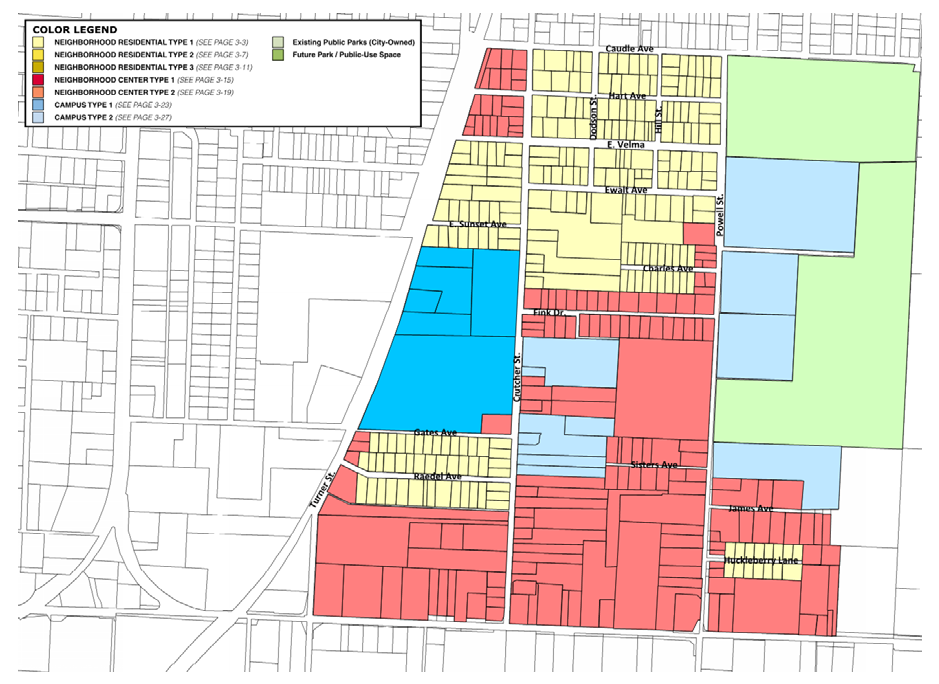
5.5.2.
Mill Street SEED.
a.
District boundary: Beginning at the intersection of Huntsville Avenue and N. Shiloh Street; north along Shiloh Street to Sanders Avenue; Sanders Avenue east to Mill Street; continuing east along a property lines to the western right-of-way of the Arkansas Missouri Railroad; south along the western right-of-way line to Huntsville Avenue; west along Huntsville Avenue to N. Shiloh Street.
b.
Regulating plan: The purpose of the regulating plan for the district is to establish zones of a particular desired scale and bulk within the Downtown District Form-Based Code in order to effectively regulate the form of improvements and to enhance the atmosphere of the neighborhood through cohesive urban form and character.
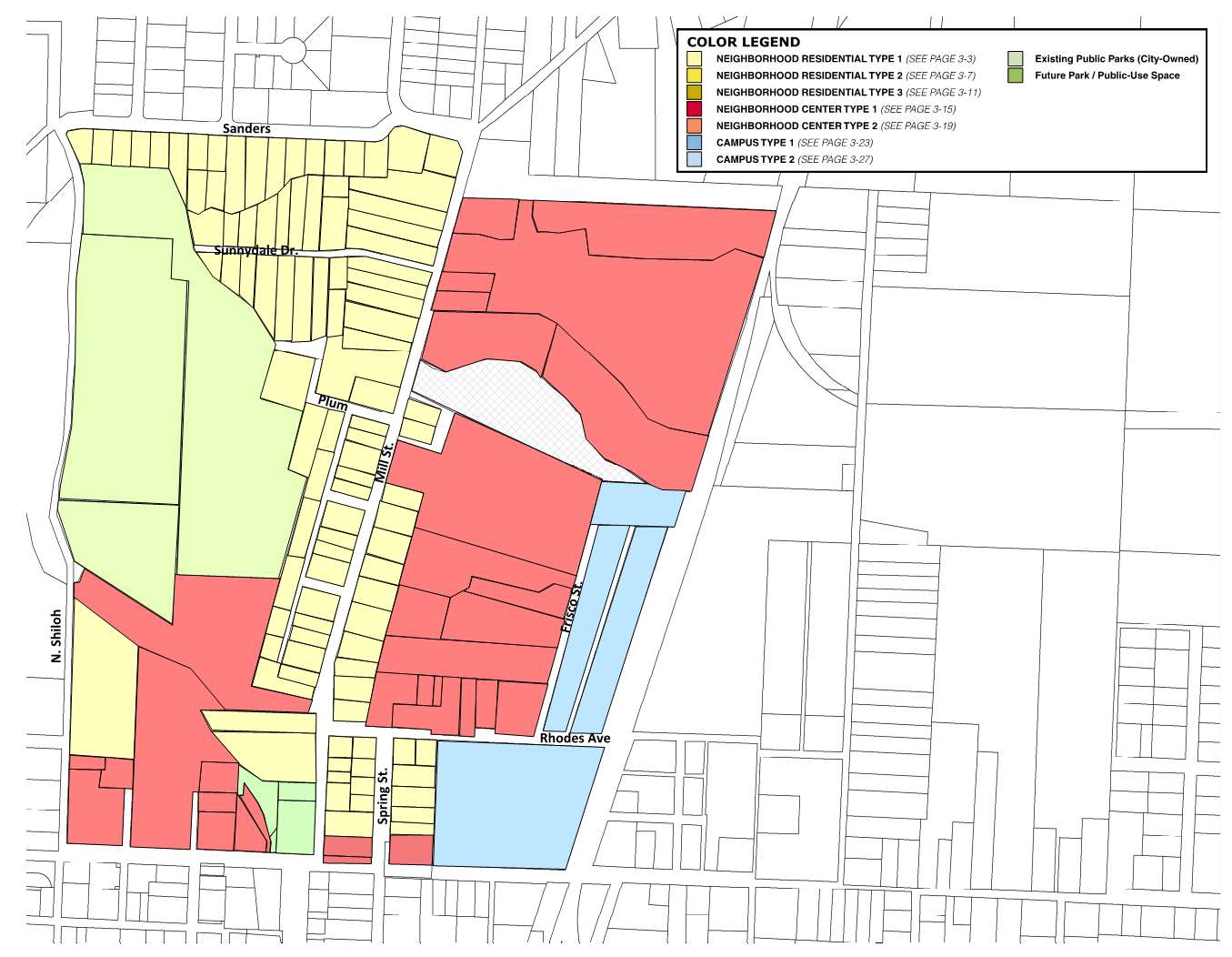
(Ord. No. 3307, 3-25-03; Ord. No. 3436, § 1, 1-13-04; Ord. No. 3523, 6-22-04; Ord. No. 3533, § 1, 7-13-04; Ord. No. 3771, § 2, 10-11-05; Ord. No. 3860, § 1, 3-14-06; Ord. No. 4030, § 1, 2-13-07; Ord. No. 4294, § 1, 2-10-09; Ord. No. 5168, § 1, 4-25-17; Ord. No. 5575, § 1, 3-9-21)

