
Springfield City Zoning Code
ARTICLE V
- SIGNS
Sec. 30-677.- Permit required.
(a)
The purpose of this article is to encourage the orderly and appropriate design, scale and placement of signs. The provisions of this section are intended to protect public safety, promote effective identification, communication and wayfinding and to maintain and enhance an attractive visual environment that fosters a healthy economy.
(b)
A zoning permit is required for the construction or erection of new signs, as defined in section 30-6, and/or the movement, enlargement, alteration, or reconstruction of existing permitted signs shall be deemed land development as herein defined and shall require a zoning permit except as may be specifically provided in this article. Repainting or changing the message on an existing permitted sign shall not be considered alteration.
(c)
A theater marquee shall be considered an accessory use and shall not be considered a sign under this chapter. See section 30-577.
(Ord. No. O-2019-2, § 4.18(intro. ¶), 9-23-2019; Ord. No. 2022-2, 10-24-2022)
Sec. 30-678. - General sign standards.
The following standards shall apply to all signs in all districts:
(1)
Location. Signs shall be located where they will be most easily read to reduce the size needed for legibility. the administrative officer may require the adjustment or relocation of any sign to ensure vehicular or pedestrian safety.
a.
Wall signs and projecting signs shall be securely fixed to the wall of a principal structure and shall not obscure architectural features of the building.
b.
No permanent signs shall be placed on the river side of a building unless the main entrance to the building is located on the river.
c.
No signs shall be placed within the state right-of-way. See 19 V.S.A. § 702. Applicants must contact Vermont Agency of Transportation (802-279-9599).
d.
No sign shall be placed within the town right-of-way. The town right-of-way is presumed to be three rods wide (49½ feet). The town right-of-way shall be measured one and pone-half rods (24.75 feet) from the center of the traveled portion of the roadway. Many roads are less than three rods wide and roads in commercial areas may be substantially wider. Contact town highway superintendent (886-2208).
(2)
Design. Every sign shall be designed, lighted, illuminated and located so that it does not:
a.
Impair public safety;
b.
Obstruct the lines of vision for pedestrians or vehicles entering or leaving a street (see subsection (13) of this section for restrictions applicable to freestanding signs);
c.
Obstruct or confuse the meaning of any traffic sign or signal; or
d.
Obstruct any door, window or fire escape.
(3)
Materials. All signs shall be constructed of durable materials and shall be maintained in safe condition and repair at all times.
(4)
Light sources, externally illuminated signs. Light sources illuminating any sign shall be shielded with the light primarily focused on the sign, preferably from above to avoid illumination of the night sky or to create glare, undue distraction, or hazard, either to the surrounding area or to pedestrian or vehicular traffic.
(5)
Internally illuminated signs.
a.
Internally illuminated signs shall not be allowed in the land reserve 25-acre, land reserve 10-acre, residential/agricultural 5-acre, residential/agricultural 2-acre, medium density residential, high density residential, or residential commercial districts;
b.
Internally illuminated signs shall be designed so as to not produce unnecessary glare or brightness. Letters and logos shall make up no more than 40 percent of the sign area and shall be of a material with a luminous transmittance no greater than 35 percent;
c.
Light sources shall be fluorescent, LED or other energy efficient light source, no closer than three and one-half inches from the surface, and shall be no less than 12 inches on center;
d.
The applicant shall provide a certificate from the sign manufacturer that any internally illuminated sign conforms to these requirements.
(6)
Sign area. The sign area shall be computed as the area of the sign board which carries or supports the lettering or message. The number of on-premises signs and the maximum area (size) of signs permitted for specific uses within each zoning district is set forth in subsections (7) through (10) of this section.
a.
The sum of the areas of each part of a sign built in separate sections shall constitute its area.
b.
A single sign (other than a wall sign) may contain two faces and the area of the sign shall be computed as the area of one face.
c.
A rectangle shall be drawn around an irregularly shaped sign, logo or free-standing channel letters to calculate the total square footage of the sign or message.
(7)
Signs in land reserve 25-acre, land reserve 10-acre, residential/agricultural 5-acre, residential/agricultural 2-acre, medium density residential, high density residential districts. The following signs are permitted when located on the premises on which the structure, use or business is located:
a.
One sign announcing a home occupations or home business, not exceeding six square feet; or
b.
Up to two signs identifying any other use allowed in the district, the total of the two signs not to exceed 20 square feet.
(8)
Signs in the residential commercial district. The following signs are permitted when located on the premises on which the structure, use, or business is located:
a.
One sign announcing a home occupation or home business not exceeding six square feet; or
b.
For other uses allowed within the district, any two of the following:
1.
One freestanding sign per lot, no larger than 20 square feet;
2.
One wall sign for business. This sign shall be no longer than 85 percent of the lineal frontage of the building occupied by the business, and in no case shall exceed 32 square feet in area.
3.
One projecting sign per business, no larger than 20 square feet.
(9)
Signs in the general business, industrial and industrial/commercial districts. The following signs are permitted when located on the premises on which the structure, use or business is located:
a.
One sign announcing a home occupations or home business, not exceeding six square feet; or
b.
Signs for other permitted uses may include:
1.
One freestanding sign per lot, no larger than 32 square feet; and
2.
One wall sign per business. This sign shall be no longer than 85 percent of the lineal frontage of the building occupied by the business, and the lettering shall not exceed the height of 36 inches; or
3.
One projecting sign per business, no larger than 32 square feet, located on the building in which the business being advertised is located.
(10)
Signs in central business district. The following signs are permitted when located on the premises on which the structure is situated:
a.
Business with basement level or ground floor location. Each allowed business or use with a basement level or ground floor location in the central business district shall be permitted one projecting sign or one freestanding sign is specified in option 2 below.
Option 1:
1.
One projecting sign only, which shall not exceed 32 square feet in area;
2.
One freestanding sign only, which shall not exceed 32 square feet in area.
Option 2:
1.
A combination of signs which may include any two of the following:
i.
One wall sign which:
(A)
Shall not be greater than three feet in overall height; and
(B)
Shall be no longer than 85 percent of the overall length of the storefront;
ii.
One projecting sign which:
(A)
Shall not exceed ten square feet in overall area; and
(B)
Shall not be more than six feet in overall height; or
iii.
One freestanding sign which shall not exceed ten square feet in area.
b.
Business with location above the ground floor. A business with a location above the ground or street-level shall be allowed a sign mounted near a window of the business being identified, as either of the following:
1.
One wall-mounted sign, no larger than eight square feet in area; or
2.
One projecting sign which shall not exceed eight square feet in area and shall not extend more than four feet from the face of the building wall.
(11)
Special signs; administrative officer discretion. The following special signs may be permitted upon approval by the administrative officer if the administrative officer finds that such a sign is in the public interest, that it will not be detrimental to surrounding properties, and that it will not create a safety hazard:
a.
Signs necessary and beneficial to the public safety and welfare may be permitted in all districts.
b.
Temporary signs due to street closure may be placed off-site to direct patrons to area merchants at the discretion of the administrative officer.
c.
A sign identifying the commonly accepted name of a commercial building, provided that the following conditions are met:
1.
The sign shall be located on the same lot as the building;
2.
Embedded, historical signs may remain whether the original business is currently viable or not;
3.
If the sign is freestanding, there shall be suitable landscaping around the sign's base;
4.
The sign shall not contain more than 12 square feet of sign area per face and contain no more than two faces;
5.
The sign shall be no more than ten feet in height.
d.
State of Vermont Official Business Directory signs.
e.
Shopping plaza/industrial park/mall signs. A shopping plaza, industrial park or mall may have one freestanding directory sign. Each business within the plaza, park or mall may have a sign within the directory sign. The entire directory sign shall not exceed:
1.
Fifty square feet for five or fewer businesses;
2.
Seventy-five square feet for six to ten businesses;
3.
One hundred square feet for ten to 15 businesses;
4.
One hundred fifty square feet for more than 15 businesses; and
5.
Twenty-five feet in height.
f.
A business with two separate street frontages (each with its own entrance open for public access) may be permitted one additional secondary wall-mounted sign only on the secondary frontage; such sign shall be:
1.
No greater than two feet in overall height; and
2.
No longer than 85 percent of the overall length of the business' secondary store frontage or 20 feet, whichever is less.
g.
Business without frontage on a public road: A free-standing sign may be placed along a public road with permission of the property owner. State approval is required for businesses along a state highway.
h.
A business directory sign may be permitted for the identification of ground floor businesses without direct access on to the street or businesses with a principal location above the ground floor. Said directory shall be located within the immediate vicinity of the building entrance. Each business identified by the directory shall be permitted. No more than two square feet in area of directory signing is allowed. Each directory sign shall not exceed eight square feet in overall area.
i.
Signs announcing the name of the subdivision or development. A freestanding sign indicating the name of a housing development, subdivision or apartment complex may be allowed, provided that the following conditions are met:
1.
The sign shall be on the same parcel as the development;
2.
The sign shall not contain more than 24 square feet per face, and shall not contain more than two faces;
3.
The sign shall be no more than ten feet in height;
4.
There shall be appropriate landscaping around the sign's base;
5.
The sign shall not be illuminated.
j.
Sign requests may be scheduled for a development review board hearing at the discretion of the administrative officer.
(12)
Special signs; development review board discretion; plaza/industrial park/mall signs only.
a.
The development review board may approve larger plaza/industrial park/mall signs after making a finding that such a sign is in the public interest, that it will not have an undue adverse detrimental effect on the surrounding properties, and that it will not create a safety hazard.
b.
Exceptionally long buildings (i.e., 100 River Street): the development review board may approve a master sign plan to include an additional free-standing sign on a separate street entrance and other signage as deemed reasonable. Multiple upper floor signs mounted on a building must be compatible in type, scale and placement.
c.
Temporary signs at the recommendation of the zoning administration to the development review board hearing process.
(13)
Freestanding signs. No freestanding sign may:
a.
Except for "special signs" as provided in subsections (11) and (12) of this section, exceed 20 feet in overall height above finished grade for nonresidential uses, or ten feet for subdivision, apartment or housing complex.
b.
Be closer than ten feet to a neighboring property line except with the approval of the downtown design review advisory commission in the central business district.
c.
Be placed within the town or state right-of-way (see subsections 30-678(1)c. and (1)d.) and no closer than ten feet to the street, whichever is less.
d.
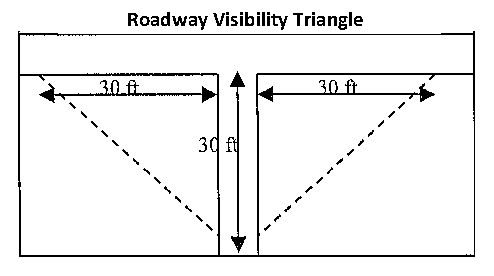
Be located within the visibility triangle at the intersection formed by connecting points on the right-of-way lines located 30 feet from the point of intersection of those intersection of those right-of-way lines (see diagram, below).
e.
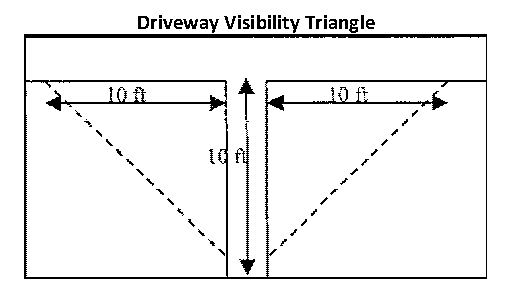
Be located within the visibility triangle at the intersection of a street and a driveway formed by connecting points located ten feet along the right-of-way and the edge of the driveway, as shown in the driveway visibility triangle diagram.
f.
All freestanding signs shall be appropriately landscaped around the base of the sign.
(14)
Projecting signs. Projecting signs shall be securely fixed to the front wall of a building and shall not obscure any architectural features of the building. Signs mounted on a roof are considered projecting signs. No projecting sign may:
a.
Extend within the area used by vehicular or pedestrian traffic;
b.
Extend more than five feet from the building wall, or as otherwise restricted in this chapter;
c.
Be less than ten feet above finished grade;
d.
Be constructed so that its highest point extends above the peak of the roof of the building on which it is mounted. Signs may not be mounted on roofs in the central business district.
(15)
Wall signs.
a.
With the exception of raceway and channel letter signs, wall signs shall be mounted on and flush with the front wall of a building and shall not obscure architectural features of a building.
b.
A wall sign may be located in a front window as long as it does not exceed 25 percent of the area of the window in which it is located.
c.
Channel letter signs: Channel letter signs are wall signs that are composed of three-dimensional graphics with individual letters and may or may not have separate illumination. Channel letter signs may be mounted by a raceway mount, direct or flush mount or a backer mount and shall be no longer than 85 percent of overall lineal frontage of the storefront. Unlit channel letter signs are usually referred to as dimensional letters. Channel letter signs are prohibited on historic brick or masonry buildings due to the need for excessive wall penetrations.
d.
Raceway signs: A raceway sign consists of a mounted platform which houses wiring and electrical components. The raceway platform is mounted to the building with minimal drilling. Individual letters are then attached to the raceway. The raceway may be painted to match the color of the building or sign band. Raceway signs shall not project from the wall in excess of 15 inches from the wall to which it is attached and shall be no longer than 85 PERCENT of overall lineal frontage of the storefront.
(16)
Portable signs.
a.
A portable sign may not be located in any public right-of-way, where it interferes with vehicular or pedestrian circulation, or where it obstructs lines of sight for traffic entering or leaving a public roadway.
b.
In the central business district, portable signs must be placed next to the building so as not to interfere with car doors; and must be no more than the narrower of either two feet in width or one-half the width of the sidewalk.
c.
A portable sign may be used to advertise a special sale or other event, but for no more than one week in duration.
d.
A business may use a single portable sign not exceeding six square feet per face to advertise daily specials or sales, but must be removed when the business is not open.
e.
Illuminated portable signs must meet all other provisions of this article.
(17)
Gasoline stations. In addition to other signs permitted under subsections (9) and (10) of this section, gasoline stations are permitted one pump affixed pricing sign per pump, each not to exceed two square feet in area, in addition to subsections (1) through (12) of this section.
(18)
Electronic message display signs. Electronic message display (EMD) signs must meet the following standards and are subject to conditional use review by the development review board:
a.
An EMD sign shall be permitted only on municipal and school properties only.
b.
An EMD sign shall have two components: a traditional sign (top) and an electronic message display (bottom).
c.
An EMD sign shall not exceed a maximum of 32 square feet and shall be a maximum height of ten feet.
d.
An EMD sign shall be static and shall not have any distracting appearance of motion, including, but not limited to, flashing, blinking, shimmering, scrolling, pulsating as well as animation, streaming or live-time video or holographic displays.
e.
An EMD sign that is readily visible to drivers of vehicles on any public way shall have characters of sufficient size to be easily discerned and must not constitute a safety hazard by being a distraction to drivers.
f.
The message display area may have a maximum of three lines of characters, including all letters, numbers, spaces, or other symbols.
g.
The area occupied by the message on an electronic message display may comprise no more than 50 percent of the maximum total allowable sign area.
h.
A maximum of two colors shall be used for an electronic message or at the discretion of the development review board.
i.
Dwell time/frequency change. Messages may change no more than once every 45 seconds unless modified by the development review board.
j.
When the display of an electronic message changes, it must change as rapidly as is technologically practicable with no phasing, rolling, scrolling, flashing, or blending.
k.
An EMD sign shall include internal ambient light monitors that automatically adjust the brightness level of its display according to natural ambient light conditions.
l.
An EMD sign shall contain a default mechanism that freezes the sign in one position if a malfunction occurs.
m.
The hours of operation of an EMD shall be permitted from 6:00 a.m. to 11:00 p.m. except in the case of a public emergency such as an "amber alert," weather advisory or other public emergency.
n.
Signs placed along state highways, must contact VTrans (802-279-9599).
o.
The EMD sign must meet all local and state setback requirements.
p.
EMD signs must be FCC compliant and must not interfere with wireless technology.
q.
EMD signs in existence at the time of the adoption of this chapter, which do not conform to the requirements of this chapter, shall be considered nonconforming signs.
r.
All permanent signs and sign structures shall be brought into conformance with the sign standards ordinance when and if the following occurs:
1.
The sign is removed, relocated, or significantly altered. Significant alterations include changes in the size or dimension of the sign. Change to the copy or the replacement of a sign face on a nonconforming sign shall not be considered a significant alteration.
2.
If more than 50 percent of the sign area is damaged, it shall be repaired to conform to this chapter.
3.
An alteration in the structure of a sign support.
4.
A change in the mechanical facilities or type of illumination.
5.
A change in the material of the sign face.
(19)
Temporary business signs. New or relocated businesses may apply for one sign made of temporary and durable materials for a period not to exceed six months. All existing sign standards regarding placement and size shall be adhered to. There will be no permit fee with the exception of the town clerk recording fee. A permanent sign permit must be obtained after the six-month waiver.
(Ord. No. O-2019-2, § 4.18(A), 9-23-2019; Ord. No. 2022-2, 10-24-2022)
Sec. 30-679. - Signs which do not require a permit.
The following signs do not require a permit and are permitted in all districts:
(1)
Signs wholly within the confines of a building.
(2)
Entrance and exit signs located near a driveway not exceeding two square feet each, and which do not include a business name or logo.
(3)
Two enclosed display cases for a theater, which display cases shall not exceed 16 square feet in overall area each. Said display cases shall be used exclusively for the display of advertising/promoting for the motion picture/pictures currently being shown, or coming attractions.
(4)
Signs to be maintained for not more than two weeks announcing an auction, campaign, drive or event of a civic, philanthropic or religious organization. Each sign shall not exceed two square feet and must be placed on private property.
(5)
Street spanning signs (banners) to be maintained for not more than two weeks announcing an auction, campaign, drive or event of a civic, philanthropic or religious organization. Each shall be allowed only in central business and general business zoning districts.
(6)
Temporary signs.
a.
Temporary real estate signs, none of which exceed six square feet in overall area. Said sign shall only be permitted on property which is either being sold or leased, and shall be removed within 30 days from the date on which its intended purpose has been fulfilled.
b.
A temporary construction sign located on the property which is being developed. Said sign shall not exceed 32 square feet in area and shall be removed immediately when its stated purpose has been fulfilled.
c.
Temporary signs due to street closure may be placed off-site to direct patrons to area merchants at the discretion of the administrative officer.
d.
Temporary signs advertising a yard, garage, estate or lawn sale so long as the sign or signs are removed within 24 hours of the end of the sale. Signs may be placed on private property other than the location of the actual yard sale with permission of the land owner. Such signs are prohibited within the public right-of-way including the town traffic islands by the Springfield Plaza and the intersection of Clinton Street and Mineral Street or other town owned properties.
e.
Temporary signs due to street closure may be placed off-site to direct patrons to area merchants at the discretion of the administrative officer.
f.
Temporary business signs: New or relocated businesses may apply for one sign, made of temporary and durable materials for a period not to exceed six months. All existing sign ordinance regarding placement and size must be adhered to. There will be no permit fee with the exception of the town clerk recording fee. A permanent sign permit must be attained after the six-month waiver.
(7)
A theater marquee shall be considered an accessory use and shall not be considered a sign under this chapter.
(8)
Political campaign signs announcing a candidacy or issue for an election, provided:
a.
They are on private property with the owner's permission;
b.
They are not posted within the public highway right-of-way; and
c.
The signs are removed within 24 hours of the end of the election.
(9)
Local nonprofit and local agricultural product/produce signs may be placed on the town owned traffic island by the Springfield Plaza. Signs must be removed within 24 hours of the event and after the growing sales season. Signs may not be larger than six square feet or taller than three feet from the ground to the top of the sign. Yard sale signs are prohibited. The definition of the word local is "entities which are located and operated within Springfield".
(10)
One banner/flag sign may be attached to a building. The lowest part must be eight feet above the sidewalk or street as to not interfere with pedestrian traffic in the public right-of-way. The banner/flag sign must have permission of the building owner.
(11)
Menu boards no larger than four square feet permanently mounted to the building or a post. This sign does not count towards the total square footage allowed.
(12)
Wayfinding signs are exempt and do not require a zoning permit.
(13)
A farm stand may display not more than four non-illuminated signs advertising seasonal products. Such signs shall not count towards the maximum area of signs allowed. Each sign shall not be more than four square feet in area and shall not be displayed longer than the specific growing season.
(14)
Murals and art installations do not require a permit provided such signs do not contain commercial messaging.
(Ord. No. O-2019-2, § 4.18(B), 9-23-2019; Ord. No. 2022-2, 10-24-2022)
Sec. 30-680. - Prohibited signs.
The following signs shall be prohibited in every district:
(1)
Signs that move, flash or oscillate or signs that incorporate any ribbon, streamer, spinner, balloon, inflatable or other similar moving device designed to attract attention. "Time and temperature" signs shall not be considered a flashing sign. Barber shop poles and generic seasonal holiday displays shall not be considered signs and do not require a permit.;
(2)
In the central business district, any freestanding objects or devices designed to catch attention, other than temporary signs as described in subsection 30-679(6);
(3)
Freestanding signs in excess of 20 feet in the general business, industrial or industrial/commercial districts or higher than ten feet in all other districts;
(4)
Signs which impair public safety;
(5)
Signs not in conformance with this chapter;
(6)
Any sign, permanent or temporary, located within a town or state highway right-of-way, except for official business directory signs maintained by the state, and official traffic control signs (this prohibition includes political campaign signs); and
(7)
The use of a stationary vehicle or trailer specifically placed at an off-site location for commercial marketing purposes. Utility vehicles parked on-site are exempted from this prohibition.
(8)
Snipe signs. A sign tacked, nailed, posted, pasted, glued, or otherwise attached to trees, poles, stakes, fences, public benches, streetlights, or other objects, or placed on any public property or in a public right-of-way or on any private property without the permission of the property owner. This does not include the town kiosk board at the Main Street bus stop shelter.
(9)
Signs not prohibited or provided elsewhere in this section may be permitted upon written decision and approval of the development review board after a public hearing if the development review board finds that such a sign is in the public interest and is not detrimental to surrounding properties.
(Ord. No. O-2019-2, § 4.18(C), 9-23-2019; Ord. No. 2022-2, 10-24-2022)
Sec. 30-681. - Removal of signs.
All signs relating to a business shall be removed by the owner of the property on which the signs are located within 90 days following the closing of said business. A business shall be deemed closed when it ceases to admit the general public onto the business premises on a regular weekly basis. Seasonal closures are exempted from this provision.
(Ord. No. 2022-2, 10-24-2022)
Sec. 30-682. - Nonconforming signs.
Signs legally in existence at the time of the adoption of this chapter, which do not conform to the requirements of this chapter, shall be considered nonconforming signs and shall be brought into conformance with the sign ordinance if the following occurs:
(1)
The sign is removed, relocated, or significantly altered. Significant alterations include changes in the size or dimension of the sign. Changes to the sign copy or the replacement of a sign face on a nonconforming sigh shall not be considered a significant alteration.
(2)
If more than 50 percent of the sign area is damaged, it shall be repaired to conform to this chapter.
(3)
An alteration in the structure of a sign support.
(4)
A change in the mechanical facilities or type of illumination.
(5)
A change in the material of the sign face.
(6)
The property on which the nonconforming sign is located submits a subdivision or land development application requiring municipal review and approval.
(7)
The property on which the nonconforming sign is located undergoes a change of land use requiring the issuance of either a use and occupancy permit.
(8)
Signs on the premises of legally nonconforming uses may remain until the existing use of the premises is discontinued.
(Ord. No. 2022-2, 10-24-2022)
Sec. 30-683. - Violations and enforcement.
The placement of a sign that is not in conformance with the provisions of this chapter shall constitute a violation. Violators shall be required to remove the sign. the administrative officer shall follow the enforcement requirements of the zoning ordinance found in division 6(c).
(Ord. No. 2022-2, 10-24-2022)
Sec. 30-684. - Application.
As provided in article 5, [it] is necessary for those requests pertaining to all signs covered by the requirements of this section. Submission requirements shall also include all the following as applicable:
(1)
A completed application form, signed by the property owner with applicable fee.
(2)
A scaled rendering of the proposed sign indicating its dimensions in square inches or feet (length, width, height).
(3)
Applications involving freestanding signs shall include a scaled site plan indicating location of all existing and proposed signs on the lot, all setbacks in feed from property lines and/or rights-of-ways, and the location of any clear sight triangle if applicable. Proposed signs along state roads, shall contact Vermont Agency of Transportation (802-279-9599).
(4)
Applications involving awning, canopy, outdoor display case, projecting, window, and/or wall signs shall include a scaled building elevation (a photograph is permissible) indicating location of all existing and proposed signs on the building façade and the linear frontage of the establishment.
(5)
Where applicable, the type and method of illumination (i.e., external, internal, or backlit), including the fixture style, placement, and bulb wattage. Applications involving an electronic messaging display sign shall also provide written certification from the sign manufacturer that the sign includes an internal ambient light monitor that automatically adjust the brightness level of its display according to natural ambient light conditions. Sign permit applications, submission requirements, review and decision-making.
(Ord. No. O-2019-2, § 4.18(D), 9-23-2019; Ord. No. 2022-2, 10-24-2022)

