
St Augustine Beach City Zoning Code
ARTICLE VI
DEVELOPMENT DESIGN AND IMPROVEMENT STANDARDS5
Editor's note—Ord. No. 18-08, § 1(Exh. 1), adopted July 2, 2018, repealed the former Art. VI, §§ 6.00.00—6.00.03, 6.01.00—6.01.03, 6.02.00—6.02.07, 6.03.00—6.03.11, 6.04.00—6.04.03, 6.05.00—6.05.04, 6.06.00—6.06.06, 6.07.00—6.07.10, 6.08.00—6.08.04, and enacted a new Art. VI as set out herein. The former Art. VI pertained to similar subject matter. See the Code Comparative Table for complete derivation.
Sec. 6.00.01. - Purpose.
The purpose of this article is to provide development design and improvement standards applicable to all development activity within the municipal limits of St. Augustine Beach.
(Ord. No. 18-08, § 1(Exh. 1), 7-2-18)
Sec. 6.00.02. - Responsibility for improvements.
All improvement required by this article shall be designed, installed, and paid for by the developer, owner, or successors in title.
(Ord. No. 18-08, § 1(Exh. 1), 7-2-18)
Sec. 6.00.03. - Principles of development design.
The provisions of this article are intended to ensure functional and attractive development. Development design shall first take into account the protection of natural resources as prescribed in Article V of this Code. All development shall be designed to avoid unnecessary impervious surface cover; to provide adequate access to lots and sites; and to avoid adverse effects of shadow, glare, noise, odor, traffic, drainage, and utilities on surrounding properties.
(Ord. No. 18-08, § 1(Exh. 1), 7-2-18)
Sec. 6.01.01. - Minimum lot area requirements.
A.
Requirements for all developments. All developments and improvements shall have a total land area sufficient to meet all development design standards in this Code.
B.
Specific requirements for residential development. There is a minimum lot area for individual lots within a residential development as listed in paragraphs C. and D. Those lots platted before the adoption of this Code that will be served by both central water and central sewer or an approved septic system, will have a minimum lot area of four thousand one hundred (4,100) square feet, provided that all of the following requirements are met:
1.
The land area for the total project is sufficient to meet standards of this Code as stated in paragraph A. of this section.
2.
A single family residence may be constructed on any lot four thousand one hundred (4,100) square feet or greater. In all other cases, the gross density of the area shall not exceed that specified in the section 3.02.04.
3.
Land, exclusive of individual lots to be conveyed in fee simple ownership, shall be controlled and maintained through a condominium association, property owners' association, or other similar provision, or may be conveyed to governmental or not-for-profit organizations.
4.
The minimum lot depth in subdivisions platted prior to the adoption of this Code shall be ninety-three (93) feet, and after the adoption of this Code shall be one hundred (100) feet.
C.
Specific requirements for low density residential.
1.
Single-family lots shall have a minimum area of seven thousand five hundred (7,500) square feet.
2.
The minimum floor area for a building on a lot platted after the adoption of this Code shall be one thousand four hundred (1,400) square feet excluding porches, attached garages, carports and breezeways.
3.
For a two (2) story building, the minimum enclosed floor area of at least one (1) story shall be one thousand (1,000) square feet, excluding porches, garages, carports, and breezeways.
4.
The minimum floor area for a building on lots platted prior to the adoption of this Code shall be one thousand (1,000) square feet for a one-story building.
5.
A single-family dwelling shall not be supported wholly or partially on stilts if the dwelling is located to the west of the coastal construction control line established under Florida Statutes § 161.053.
6.
The maximum density allowed in the low density residential district is four (4) units per acre.
D.
Specific requirements for medium density residents.
1.
In medium density residential districts, the minimum lot sizes shall be as follows:
Duplex: Seventy-five (75) foot frontage with minimum square footage of twelve thousand four hundred forty-four (12,444) square feet.
Triplex: One hundred (100) foot frontage with minimum square footage of eighteen thousand six hundred sixty-six (18,666) square feet.
Four Plex: One hundred twenty-two and five-tenths (122.5) feet minimum frontage with minimum square footage of twenty-four thousand eight hundred eighty-eight (24,888) square feet.
Townhouses: Townhouses shall be treated, depending upon the number of units, in the same manner as duplexes, triplexes and fourplexes.
2.
The land area is sufficient to meet all applicable setbacks and height requirements as well as the supplemental requirements of all codes applicable to the development in St. Augustine Beach.
3.
Gross density of the area shall not exceed seven (7) units per acre in medium density areas and twelve (12) units per acre for high density areas as depicted on the future land use map.
4.
Land exclusive of individual lots to be conveyed in fee simple ownership, shall be controlled and maintained through a condominium association, property owners' association or other similar provision and recordable instruments. Common ownership lands shall be submitted for review with the application for development plan review.
5.
The minimum floor area for a building within the medium density residential category shall be eight hundred (800) square feet excluding porches, attached garages, carports and breezeways.
6.
For a two (2) story building, the minimum enclosed floor area of at least one (1) story shall be eight hundred (800) square feet, excluding porches, garages, carports, and breezeways.
7.
A single family or multifamily dwelling shall not be supported wholly or partially on stilts if the dwelling is located to the west of the coastal construction control line established under Florida Statutes § 161.053.
(Ord. No. 18-08, § 1(Exh. 1), 7-2-18)
Sec. 6.01.02. - Impervious surface coverage.
A.
Generally. Impervious surface on a development site shall not exceed the ratios provided in the table in paragraph D. of this section.
B.
Ratio calculation. The impervious surface ratio is calculated by dividing the total impervious surface area by the gross site area.
C.
Alternative paving materials. If porous paving materials are used, then the area covered with porous paving materials shall not be counted as impervious surface for high density residential and commercial only. Low and Medium density residential shall be allowed a 15% increase in impervious surface ratio if the materials used have a 10% or greater permeability.
D.
Table of impervious surface ratios.
1 The maximum impervious surface ratio is given for each district, regardless of the type of use proposed and allowable pursuant to Article III.
* In Low Density Residential land use district a 465 square feet allowance shall be provided for the construction and installation of a pool and pool decking only.
(Ord. No. 18-08, § 1(Exh. 1), 7-2-18; Ord. No. 20-02, § 6(Exh. 1), 3-2-20; Ord. No. 20-15, § 3, 1-4-21; Ord. No. 21-10, § 3, 10-4-21)
Sec. 6.01.03. - Building setback requirements.
A.
Subject to paragraph B. and any other provisions of this section, no portion of any building may be located on any lot closer to any lot line or to the street right-of-way line than authorized in the table set forth in this section. This will apply to any subdivision that does not have setback modifications approved by the City Commission, and by approval of respective Homeowner's Associations.
1.
Roof overhangs for single family land use may project past the setbacks up to 18 inches.
2.
Flexible setback to save trees for single family land use:
a.
In all cases, the justification for a change in a setback requirement must be to save a significant tree, which per the Board's motion to approve this Application is defined as being eight (8) inches in diameter at breast height (DBH) or greater, as demonstrated on a site plan with a tree and topography survey.
b.
Flexible setbacks shall be as per the table below:
c.
All requests for flexible setbacks to save trees must have the approval of the City's Building Official, the applicable Homeowners Association (if required) and the Comprehensive Planning and Zoning Board.
3.
Certain architectural features, such as roofs over exterior doors, bump outs, bay windows, etc. may project no more than 2.5 feet including overhangs into the required minimum setbacks as prescribed in section 6.01.03.A. These architectural features shall not exceed 25% of the wall that they are serving nor shall they be supported by the earth.
4.
Any lot with a width of fifty (50) feet or less shall have a 7.5-foot side setback.
5.
Exterior stairs shall be required to have the same setbacks as decks.
6.
Setbacks for equipment such as pool equipment, AC units, generators, etc., shall be placed a minimum of three (3) feet from the side and rear property lines. No equipment shall be placed in the front of a main structure.
B.
Minimum setbacks decks and for non-structural components of a structure.
1.
Decks: Any deck twelve (12) inches and less above finished grade is not subject to setbacks requirements and does not require a building permit. However, this type of deck is not allowed within two (2) feet of an adjacent property line.
a.
Any deck exceeding thirty (30) inches in height is subject to the setback requirements as specified in the table. If the main structure is built to the twenty (20) foot setback line, a deck over twelve (12) inches and less than thirty (30) inches may encroach into the rear yard setback a distance not to exceed eight (8) feet from the principal structure and may encroach into the front setback a distance of five (5) feet from the principal structure. If the main structure is built to the twenty-five (25) foot setback line, a deck may extend twelve (12) feet into the rear setback and for the front, the deck may extend ten (10) feet into the front setback. Permitting shall be required as per the Florida Building Code.
b.
For second and third level decks, the allowable extension from the main structure built at the twenty (20) foot setback is five (5) feet into the front or rear setback from the main structure. For a structure built at the twenty-five (25) foot setback, the allowable extension is ten (10) feet into the front or rear setback.
2.
Auxiliary structures:
a.
This applies to features such as open air arbors, trellises and free standing tiki bars that do not exceed twelve (12) feet in height. These structures shall have a minimum setback of five (5) feet from the rear and side lot lines. Tiki bars are not allowed in front yards.
b.
Screen rooms and patio covers are allowed to encroach a maximum of ten (10) feet into the rear yard setback providing the roof line for the enclosure does not exceed twelve (12) feet in height and the addition to new or existing construction does not exceed the allowed impervious surface coverage as specified in the city's land development regulations. The screen room shall comply with the allowed side setbacks as established by these land development regulations.
c.
Swimming pools and screen enclosures (regardless of whether or not enclosing a pool)shall be, at a minimum five (5) feet from the rear and side setbacks. This applies to the water line or the screen enclosure.
d.
Storage sheds not exceeding eight (8) feet in width and twelve (12) feet in length shall be allowed a five (5) foot rear and side setback. Any storage shed exceeding ninety-six (96) square feet shall meet the same setbacks as specified in the table for new and existing construction. Storage sheds are not allowed in the front setback area, nor shall a shed be placed forward of the existing main structure.
3.
Minimum setbacks between buildings:
a.
The minimum setback between adjacent structures shall be ten (10) feet except that no setback is required where an attachment easement has been created.
b.
Distance shall be measured at the narrowest point between structures of the main living unit, principal structure, an allowable attachment or an accessory use or to the ordinary projections of chimneys or flues, not exceeding two feet (2) feet. The measurement shall be taken from the structures walls, not including overhangs.
c.
Dry cleaning establishments must meet the required commercial setbacks and cannot be located in a shopping center where zero (0) setbacks are allowed between adjacent stores. The exception shall be where a facility is for pick-up only with no actual dry-cleaning performed within the facility.
4.
Variances to section 6.01.03.B of the city's Land Development Code require a hardship which may not be self-created and must comply with all the requirements of section 1002.00 of the city's Land Development Code.
C.
Administrative waivers for errors in setback measurements. If an error is discovered in the location of a building or structure relative to the minimum setback requirements, the property owner, or their authorized representative, may file a request for an administrative waiver. The review of the request and the final decision shall be made by the director of building and zoning, and shall be made in conformance with the following criteria:
1.
Approval of the waiver shall not allow the structure to exceed the required setback more than ten percent (10%).
2.
The corresponding opposite setback must be larger than required by the same distance as the waiver request (to insure that the waiver is not just an attempt to place a larger building on the lot) or the waiver request concerns an intrusion of only a small corner of the building (such as a house too close to the front of a cul-de-sac lot such that it violates the side setback requirements at the front corner but nowhere else).
3.
Any waiver request which does not meet paragraphs a. and b. above shall be denied an administrative waiver and must comply with the setback requirements or seek a variance pursuant to the City of St. Augustine Beach Land Development Regulations Article X Section 10.02.00.
4.
A fee of fifty-three dollars ($53.00) must be paid to the building and zoning department to apply for the administrative waiver.
(Ord. No. 18-08, § 1(Exh. 1), 7-2-18; Ord. No. 20-02, § 6(Exh. 1), 3-2-20; Ord. No. 21-04, § 2, 6-7-21; Ord. No. 21-15, § 3, 1-3-22; Ord. No. 23-03, § 2, 6-5-23)
Sec. 6.01.04. - Building height measurement, exceptions and applications.
a.
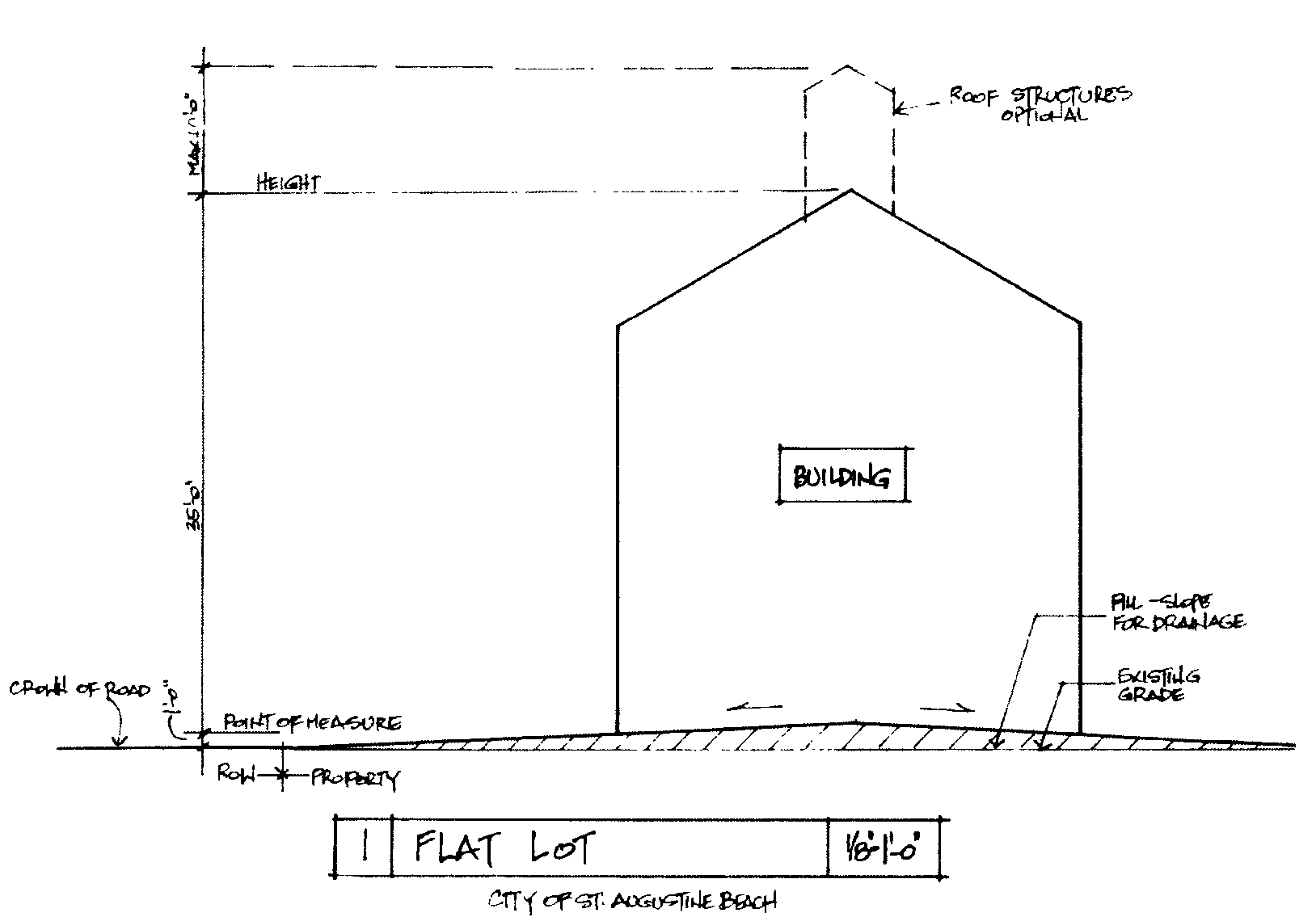
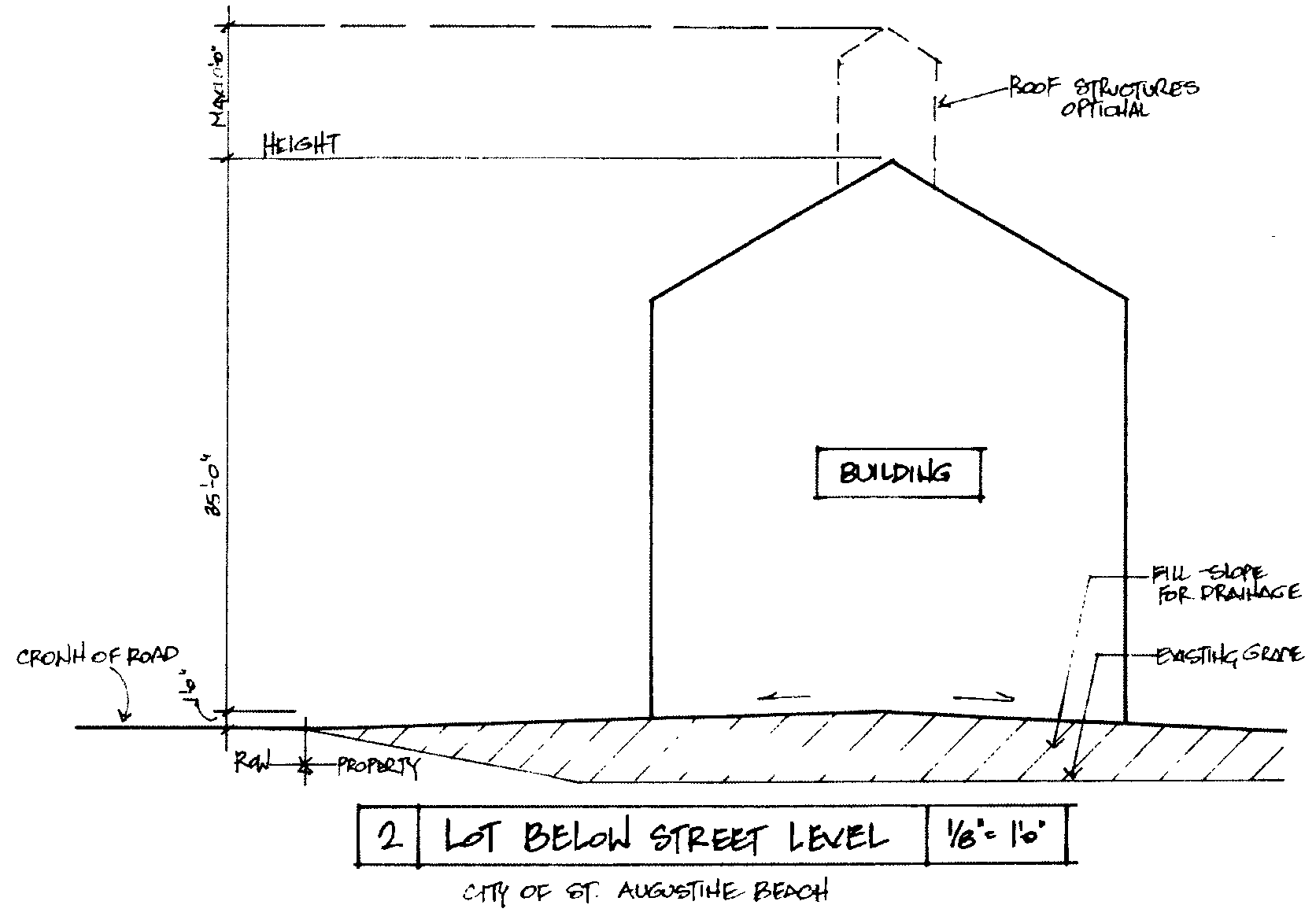
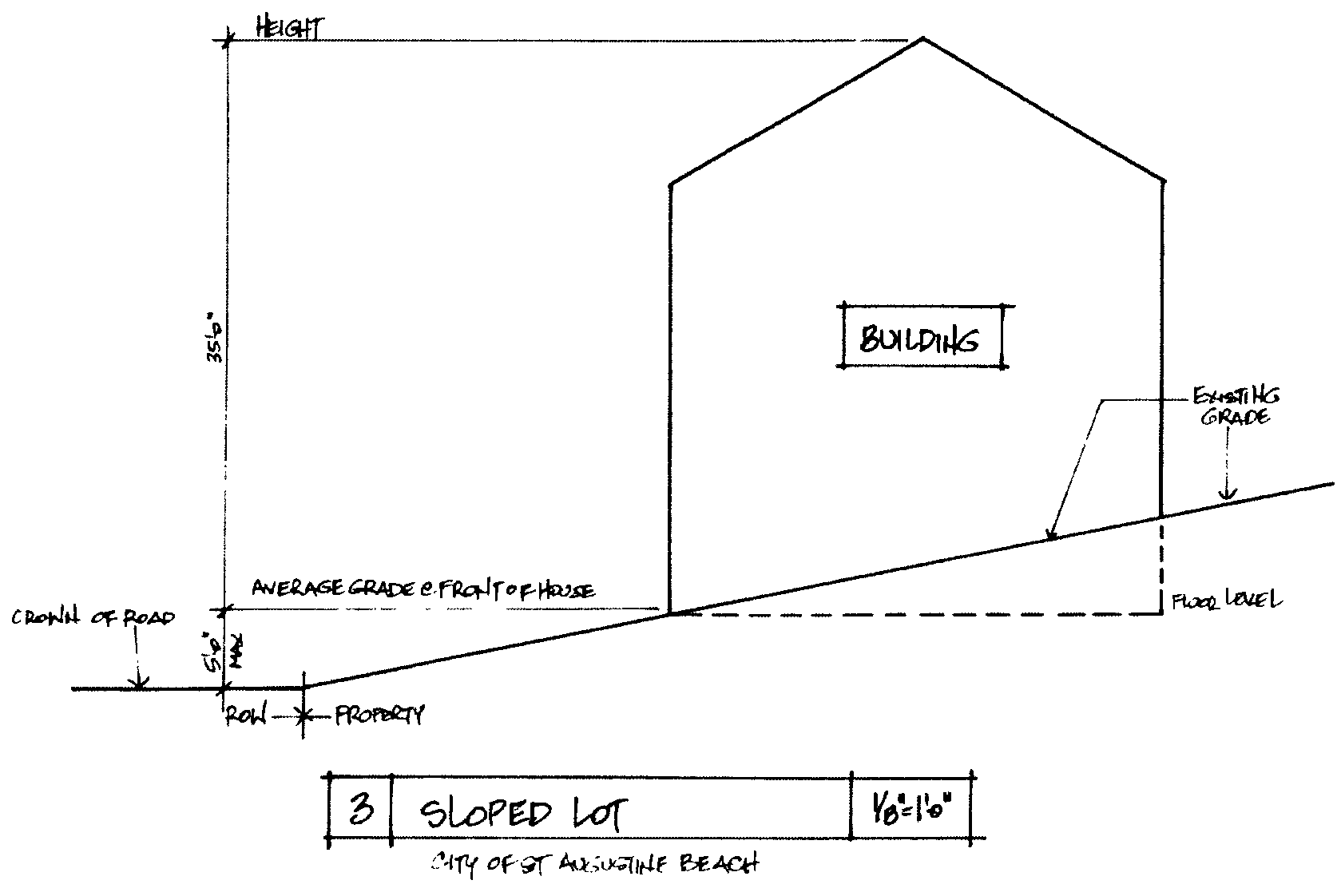
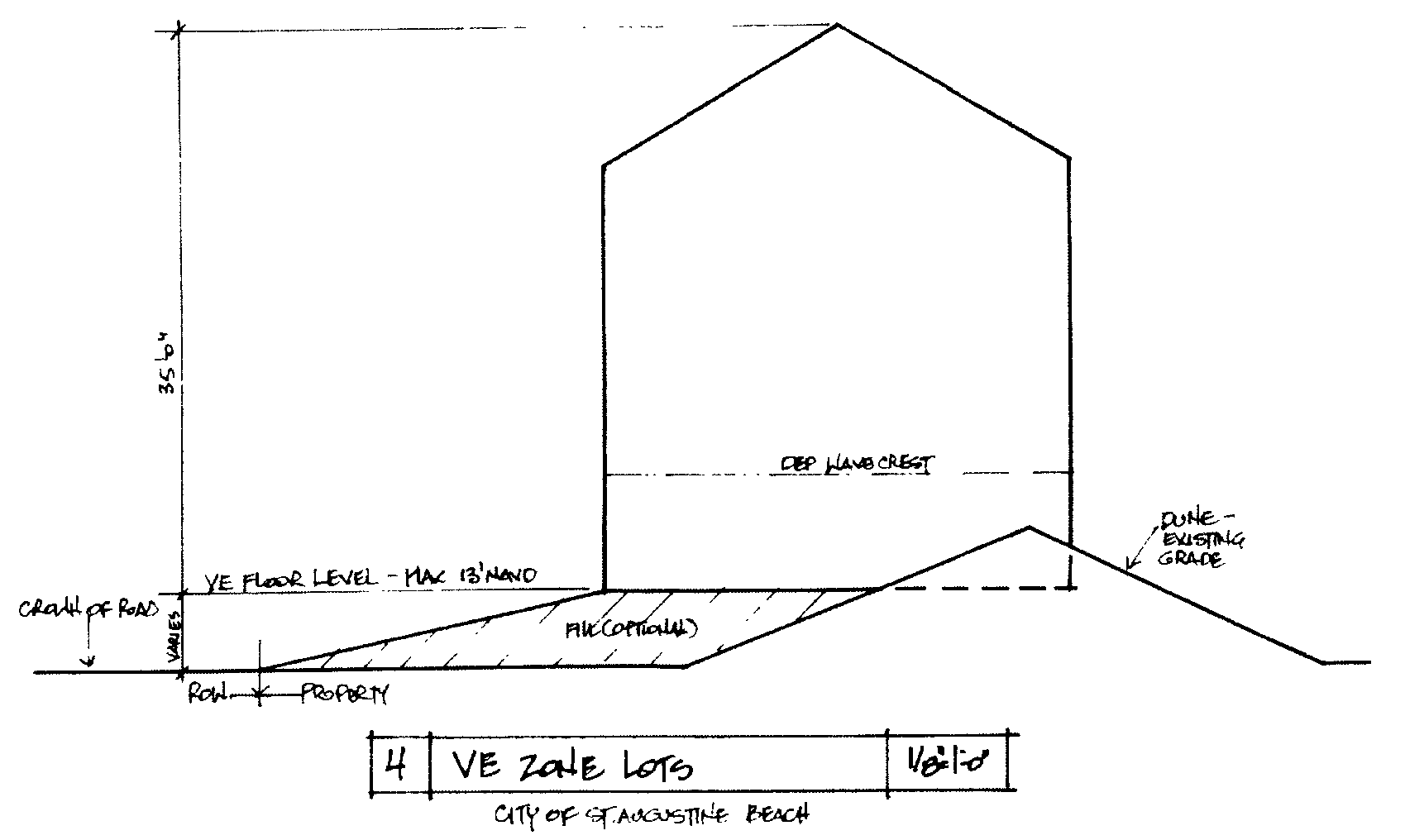
Buildings and Structures within the City of St. Augustine Beach shall be limited to a maximum building height of thirty-five (35) feet. Building Height is measured as (1) foot above the higher of either the Front Existing Grade or the Crown of Road (to which the Structure is addressed) to the highest point of the Building or Structure. The amount of Fill is limited to no more than five (5) feet.
Illustration of height measurement follows with a 1) Flat lot; 2) Fill Lot; 3) Sloped Lot; and 4) Velocity Zone Lot. Where a discrepancy may exist between the graphic illustrations and the text, the graphics shall control.
b.
The building height limitation shall not apply to architectural features or any roof structures for housing elevators, stairways, tanks, mechanical equipment, ventilation fans, solar energy collectors, or similar equipment, not to church spires, steeples, belfries, cupolas, domes, monuments, water towers, skylights, flag poles, chimneys, vents or similar structures, which may be erected above the height limit, nor to fire or parapet walls, provided, however that such features and items shall not extend more than ten (10) feet above the structure.
1.
Items or structural elements proposed to exceed the City's height limitations due to requirements by other state laws or the Federal Telecommunications Act shall not be included in determining building height but shall require approval of the City Commission in order to ensure consistency with the spirit of the code.
2.
If an existing building over thirty-five (35) feet is destroyed or substantially damaged by terrorist attack, accidental fire, or natural and disastrous force, such building may be built back up (reconstructed) but must be:
a.
Within its pre-disaster footprint; and
b.
Within the three dimensional envelope of the area of the pre disaster building; and
c.
Up to its pre-disaster gross square footage; and
d.
Up to the same number of dwelling units or commercial square footage (or combination thereof) and pre disaster floor area ratio, but elevated above the base flood elevations required by federal flood regulations, state regulations or city code; and
e.
Conforming in all other respects to City Code, the Florida Building Code, other federal and state regulations, and state coastal construction control lines in effect at the time the substantially damaged building is built back (reconstructed).
c.
Permits. Copies of applicable Permits, including Permit conditions, from all agencies having jurisdiction shall be provided to the City concerning Building Height. These Permits include, but are not limited to: work in or near Wetland areas, Stormwater Management Systems, Special Flood Hazard Areas, Coastal Construction and Roadway Construction. The burden of obtaining these Permits, if required, will be the sole responsibility of the Application including any work to upgrade existing Public or Private Roadway and drainage facilities which will be impacted by the Project. Agencies that may have jurisdiction over the proposed work include but are not limited to, the following:
a.
St. Johns River Water Management District
b.
Florida Department of Environmental Protection
c.
Florida Department of Transportation
d.
United States Army Corps of Engineers
e.
United States Environmental Protection Agency
f.
Federal Emergency Management Agency
(Ord. No. 18-08, § 1(Exh. 1), 7-2-18)
Sec. 6.01.05. - Drainage requirements for new development.
A.
The director of building and zoning or designee may require construction of retaining walls, roof gutters, underdrains, swales, or any other method deemed necessary to provide adequate drainage on all buildings
B.
Roof gutters are required for two-story or greater residential buildings as deemed necessary by the building and zoning department.
(Ord. No. 23-09, § 2, 11-13-23)
Sec. 6.02.01. - General provisions.
A.
Purpose. This section 6.02.00 establishes minimum requirements applicable to the development transportation system, including public and private streets, bikeways, pedestrian ways, parking and loading areas, and access control to and from public streets. The standards in this section are intended to minimize the traffic impacts of development, to assure that all developments adequately and safely provide for the storage and movement of vehicles consistent with good engineering and development design practices.
B.
Compliance with construction requirements. All required elements of the transportation system shall be provided in compliance with the engineering design and construction standards approved by the St. Augustine Beach City Commission.
C.
Any building erected or moved on property shall be on a lot adjacent to a roadway or driveway approved by the City Manager or designee in accordance with this article. Plans for the roadway or driveway must be approved prior to the issuance of a building permit for any building. The roadway must be approved prior to commencement of construction or placement of any building. The driveway must be approved prior to issuance of a certificate of occupancy.
(Ord. No. 18-08, § 1(Exh. 1), 7-2-18)
Sec. 6.02.02. - Streets.
A.
Street classification system established.
1.
Streets in St. Augustine Beach are classified and mapped according to function served in order to allow for regulation of access, road and right-of-way widths, circulation patterns, design speed, and construction standards.
2.
Private streets and streets that are to be dedicated to St. Augustine Beach are classified in a street hierarchy system with design tailored to function. The street hierarchy system shall be defined by road function and average daily traffic (ADT), calculated by trip generation rates prepared by the Institute of Transportation Engineers. Trip generation rates from other sources may be used if the developer demonstrates the alternative source better reflects local conditions.
3.
When a street continues an existing street that previously terminated outside the subdivision, or is a street that will be continued beyond the subdivision or development at some future time, the classification of the street will be based upon the street in its entirety, both within and outside of the subdivision or development.
4.
The following streets hierarchy is established: residential, collector, and arterial. Each street type is divided into subcategories. All development proposals containing new streets or taking access from existing streets shall conform to the standards and criteria contained in this section 6.02.00.
B.
Residential streets. Residential streets are primarily suited to providing direct access to residential development, but may give access to limited nonresidential uses, provided average daily traffic (ADT) volume generated by the nonresidential use does not exceed applicable standards for the affected streets. All residential streets should be designed to minimize unnecessary and/or speeding traffic. Each residential street shall be classified and designed for its entire length to meet the minimum standards.
This is the lowest order street in the hierarchy. A residential street is a frontage street which provides direct access to abutting properties and is designed to carry no more traffic than is generated on the street itself. Residential streets may take access from any higher order street type. Both ends of a residential loop street must take access from a single higher order street. The design speed for residential streets is twenty-five (25) miles per hour. Residential access streets shall have a maximum ADT of five hundred (500). Culs-de-sac shall have a maximum ADT of two hundred (200). Loop streets shall have a maximum ADT of four hundred (400).
C.
Collector roads. Collector roads provide access to nonresidential uses and connect lower order streets to arterial streets. Design speeds and average daily traffic volumes will be higher than for lower order streets. Local collector streets give direct access to commercial and residential projects, but not to individual dwelling units. Collectors may take access from other collector streets or arterials. Collectors may give access to any residential street type. Collectors shall have a design speed of thirty (30) miles per hour. Collectors shall have a maximum ADT of three thousand (3,000).
D.
Arterial roads. Arterial roads provide links between communities and are designed for speeds up to forty-five (45) miles per hour. No parking is allowed on any arterials. These roads link communities to regional or state highways. They may also give direct access to regionally significant land uses. These roads may take access from other arterials or freeways and may give access to any lower order nonresidential street type.
E.
Special purpose streets. Under special circumstances a new local street may be classified and designed as one of the following:
1.
Alley. An alley is a special type of street which provides a secondary means of access to lots. It will normally be on the same level in the hierarchy as a residential access street, although different design standards will apply.
2.
Marginal access street. A marginal access street is a street parallel and adjacent to a collector or higher level street which provides access to abutting properties and separation from through traffic. It may be designed at the level of a residential access street or a residential sub-collector as anticipated traffic volumes will dictate.
3.
Divided streets. For the purpose of protecting environmental features or avoiding excessive grading, the municipality may require that the street be divided. In such a case, the design standards shall be applied to the aggregate dimensions of the two (2) street segments.
F.
Future traffic circulation map. The future traffic circulation map and any amendments thereto, adopted by St. Augustine Beach as a part of the comprehensive plan, is hereby made a part of this Code. All existing roadways within the jurisdiction of St. Augustine Beach shall be designated on this map according to the foregoing classification scheme. Any street abutting or affecting the design of a subdivision or land development which is not already classified on the future traffic circulation map shall be classified according to its function, design, and use by the St. Augustine Beach City Manager or designee at the request of the applicant or during plan review. The map shall be the basis for all decisions regarding required road improvements, reservation or dedication of rights-of-way for required road improvements, or access of proposed uses to existing or proposed roadways.
G.
Street classification standards. Table 6.02.02A, specifies the number of lanes and pavement and right-of-way widths for residential, collector, and arterial streets. These requirements should be read in conjunction with the foregoing street type descriptions.
TABLE 6.02.02A
(Ord. No. 18-08, § 1(Exh. 1), 7-2-18)
Sec. 6.02.03. - Rights-of-way.
A.
Right-of-way widths. Right-of-way requirements for road construction shall be as specified in Table 6.02.02A of this Code. The right-of-way shall be measured from lot line to lot line.
B.
Protection and use of rights-of-way.
1.
No encroachment shall be permitted into existing rights-of-way, except for temporary use authorized by the St. Augustine Beach City Commission.
2.
Use of the right-of-way for public or private utilities, including, but not limited to, sanitary sewer, potable water, telephone wires, cable television wires, gas lines, or electricity transmission, shall be allowed subject to the placement specifications in any applicable St. Augustine Beach regulations.
3.
Sidewalks and bikeways shall be placed within the right-of-way.
C.
Vacation of rights-of-way. Applications to vacate a right-of-way shall be approved by ordinance upon a finding that all of the following requirements are met:
1.
The requested vacation is consistent with the Transportation Circulation Element of the St. Augustine Beach Comprehensive Plan.
2.
The right-of-way does not provide the sole access to any property. Remaining access shall not be by easement.
3.
The vacation would not jeopardize the current or future location of any utility.
4.
The proposed vacation is not detrimental to the public interest and provides a positive benefit to St. Augustine Beach.
5.
The proposed vacation was not acquired or dedicated for state, county or federal highway purposes.
6.
The proposed vacation was not acquired or dedicated for utility purposes;
7.
The proposed vacation does not provide access to the ocean and/or beach, or other recreational resource;
8.
The proposed vacation does not provide access to public drainage facilities.
9.
No portion of a street or alley lying between two (2) intersecting streets shall be vacated unless the entire portion of the street or alley between such intersecting streets is vacated.
D.
Residential driveways in the city rights-of-way shall be limited to a maximum of eighteen (18) feet in width with a maximum five (5) by five (5) foot apron flare on either side for single family residences and thirty-eight (38) feet in width with a maximum five (5) by five (5) foot apron flare on either side for multifamily dwellings. Any addition to a driveway over the eighteen (18) foot width in the right of way shall consist of material that is at least ten percent (10%) or greater permeability. The city shall not be responsible for the repair and maintenance of residential driveways in city rights-of-way.
E.
Vehicular traffic through city rights-of-way at the end of dead end or no access streets shall be prohibited except by:
1.
All governmental vehicles.
2.
A rights-of-way permit as authorized by the public works director, not to exceed thirty (30) days for a fee of one hundred fifty dollars ($150.00), extensions may be granted for thirty-day intervals at a fee of fifty-three dollars ($53.00) each as authorized by the public works director.
(Ord. No. 18-08, § 1(Exh. 1), 7-2-18; Ord. No. 18-18, § 1, 1-7-19; Ord. No. 20-12, § 2, 10-5-20; Ord. No. 25-07, § 2, 7-14-25)
Sec. 6.02.04. - Street design standards.
A.
General design standards.
1.
All streets in a new development shall be designed and constructed pursuant to the standards approved by the St. Augustine Beach City Commission. Streets shall be dedicated to St. Augustine Beach upon completion, inspection, and acceptance by St. Augustine Beach.
2.
The street system of the proposed development shall conform to the natural topography of the site, preserving existing hydrological and vegetative patterns, and minimizing erosion potential, runoff, and the need for site alteration.
3.
Streets shall be laid out to avoid environmentally sensitive areas.
4.
Private streets may be allowed within developments that will remain under common ownership, provided they are designed and constructed pursuant to the standards approved by the St. Augustine Beach City Commission.
5.
Streets shall intersect as nearly as possible at right angles and in no case shall be less than seventy-five (75) degrees.
6.
New intersections along one (1) side on an existing street shall, where possible, coincide with existing intersections. Where an offset (jog) is necessary at an intersection, the distance between centerlines of the intersecting streets shall be no less than one hundred fifty (150) feet.
7.
No two (2) streets may intersect with any other street on the same side at a distance of less than four hundred (400) feet measured from centerline to centerline of the intersecting street. When the intersected street is an arterial, the distance between intersecting streets shall be no less than one thousand (1,000) feet.
B.
Paving widths. Paving widths for each street classification shall be as provided in Table 6.02.02A of this Code.
C.
Curbing requirement.
1.
Curbing shall be required for the purposes of drainage, safety, and delineation and protection of pavement edge along streets.
2.
All curbing shall conform to the construction standards approved by the St. Augustine Beach City Commission.
D.
Shoulders. Shoulders, where required, shall measure at least four (4) feet in width and shall be required on each side of streets and shall be located within the right-of-way. Shoulders shall consist of stabilized turf or other material permitted by the design standards approved by the St. Augustine Beach Code. Shoulders and/or drainage swales are required as follows:
1.
Shoulders are required on residential access and residential collector streets only where necessary for stormwater management or road stabilization.
2.
All residential collector streets shall provide two (2) four (4) foot wide shoulders. Shoulders should be grassed.
3.
Where shoulders are required by the Florida Department of Transportation.
4.
Collector streets where curbing is not required.
5.
Arterial streets where curbing is not required.
E.
Acceleration, deceleration, and turning lanes.
1.
Deceleration or turning lanes will be required by St. Augustine Beach along existing and proposed streets based on traffic design standard in the FDOT Manual.
2.
Deceleration lanes shall be designed to the following standards:
a.
The lane width shall be the same as the required width of the roadway moving lanes.
b.
The minimum lane length shall be as follows:
3.
Acceleration lanes shall be required when indicated as needed by traffic. The design shall be as per the recommendation of St. Augustine Beach, St. Johns County, and FDOT. Where needed, a paved taper shall be provided for right hand turns.
F.
Culs-de-sac turnarounds. An unobstructed twelve-foot wide moving lane with a minimum outside turning radius of thirty-eight (38) feet shall be provided at the terminus of every permanent cul-de-sac.
G.
Stub streets.
1.
Residential access and subcollector stub streets may be permitted only within subsections of a phased development for which the proposed street in its entirety has received final site plan approval.
2.
Residential collector and higher order stub streets may be permitted or required by the St. Augustine Beach Building and Zoning Department provided that the future extension of the street is deemed desirable by the St. Augustine Beach City Commission.
3.
Temporary turnarounds shall be provided for all stub streets providing access to five (5) or more lots or housing units. Where four (4) or fewer units or lots are being served, a sign indicating a dead-end street shall be posted.
H.
Clear visibility triangle. In order to provide a clear view of intersecting streets to the motorist, there shall be a triangular area of clear visibility formed by two (2) intersecting streets or the intersection of a driveway and a street. The following standards shall be met:
1.
Nothing shall be erected, placed, parked, planted, or allowed to grow in such a manner as to materially impede vision between a height of two (2) feet and ten (10) feet above the grade, measured at the centerline of the intersection.
2.
The clear visibility triangle shall be formed by connecting a point on each street centerline, to be located at the distance from the intersection of the street center lines indicated below, and a third line connecting the two (2) points.
Figure 6.02.04-A:
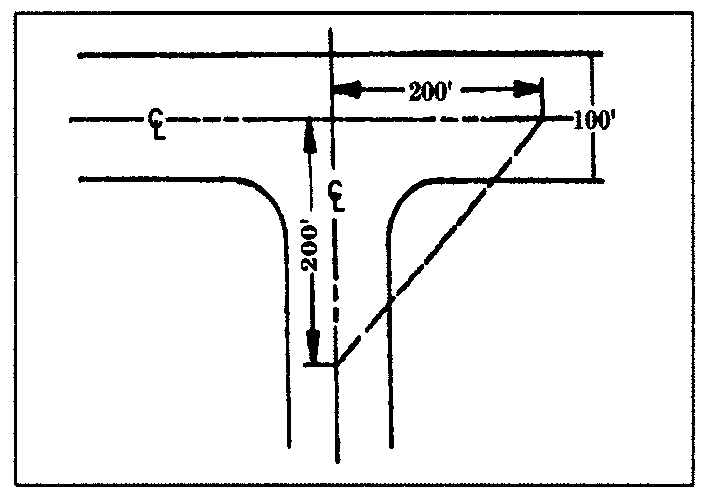
Example of Clear Visibility Triangle
3.
The distance from the intersection of the street center lines for the various road classifications shall be as follows:
I.
Street trees.
1.
Street trees shall be provided in accordance with the standards established in this Code.
J.
Blocks.
1.
Where a tract of land is bounded by streets forming a block, said block shall have sufficient width to provide for two (2) tiers of lots of appropriate depths.
2.
The lengths, widths, and shapes of blocks shall be consistent with adjacent areas. In no case shall block lengths in residential areas exceed two thousand two hundred (2,200) feet nor be less than four hundred (400) feet in length.
(Ord. No. 18-08, § 1(Exh. 1), 7-2-18)
Sec. 6.02.05. - Sidewalks and bikeways.
A.
When required.
1.
Projects abutting collector or arterial facilities shall provide sidewalks adjacent to the collector or arterial roadway. Location of sidewalks shall be consistent with planned roadway improvements.
2.
Sidewalks shall be provided on at least one (1) side of all residential streets.
3.
Where a proposed development includes improvements or new construction of collector facilities, facility designs shall include provision for sidewalks and bikeways within the right-of-way.
4.
Residential projects adjacent to or in the immediate vicinity of an activity center comprised of commercial, office, service, or recreation activities shall provide pedestrian and bicycle access from the development to the activity center.
5.
Pedestrian-ways or crosswalks, not less than ten (10) feet wide with a sidewalk meeting the requirements of this Code, may be required to be placed in the center of blocks more than eight hundred (800) feet long where deemed necessary to provide circulation or access to playgrounds, shopping centers, and other community facilities.
B.
Design and construction standards. Design and construction of sidewalks, bikeways, or other footpaths shall conform to the standards approved by the St. Augustine Beach City Commission, including provisions for access by physically handicapped persons.
(Ord. No. 18-08, § 1(Exh. 1), 7-2-18)
Sec. 6.02.06. - Access.
All proposed development shall meet the following standards for vehicular access and circulation:
A.
Number of access points.
1.
All projects shall have access to a public right-of-way.
2.
Notwithstanding the provisions in paragraph 1. above:
a.
A nonresidential development, or a multifamily residential development, on a corner lot may be allowed two (2) points of access. However, no more than one (1) access shall be onto an arterial.
B.
Separation of access points.
1.
The separation between access points onto arterial and collector roadways, or between an access point and an intersection of an arterial or collector with another road, shall be as shown in the following table:
2.
The distance between access points shall be measured from the centerline of the proposed driveway or roadway to the centerline of the nearest adjacent roadway or driveway.
C.
Alternative designs. Where natural features or spacing of existing driveways and roadways cause the foregoing access requirements to be physically infeasible, alternate designs may be approved as a part of issuing the final development order.
D.
Access to residential lots.
1.
Access to nonresidential uses shall not be through an area designed, approved, or developed for residential use.
2.
All lots in a proposed residential subdivision shall have frontage on and access from an existing street meeting the requirements of this Code.
3.
No more than one access point will be allowed on a lot of less than 50 feet of frontage.
(Ord. No. 18-08, § 1(Exh. 1), 7-2-18)
Sec. 6.02.07. - Standards for drive-up facilities.
A.
Generally. All facilities providing drive-up or drive-through service shall provide on-site stacking lanes in accordance with the following standards.
B.
Standards.
1.
The facilities and stacking lanes shall be located and designed to minimize turning movements in relation to the driveway access to streets and intersection.
2.
The facilities and stacking lanes shall be located and designed to minimize or avoid conflicts between vehicular traffic and pedestrian areas such as sidewalks, crosswalks, or other pedestrian access ways.
3.
A by-pass lane shall be provided.
4.
Stacking lane distance shall be measured from the service window to the property line bordering the furthest street providing access to the facility.
5.
Minimum stacking lane distance shall be as follows:
a.
Financial institutions shall have a minimum distance of two hundred (200) feet. Two (2) or more stacking lanes may be provided which together total two hundred (200) feet.
b.
All other uses shall have a minimum distance of one hundred twenty (120) feet.
6.
Alleys or driveways in or abutting areas designed, approved, or developed for residential use shall not be used for circulation of traffic for drive-up facilities.
7.
Where turns are required in the exit lane, the minimum distance from any drive-up station to the beginning point of the curve shall be thirty-four (34) feet. The minimum inside turning radius shall be twenty-five (25) feet.
8.
Construction of stacking lanes shall conform to the specifications approved by the St. Augustine Beach City Commission.
(Ord. No. 18-08, § 1(Exh. 1), 7-2-18)
Sec. 6.03.01. - Generally.
A.
Applicability. Off-street parking facilities shall be provided for all development within St. Augustine Beach pursuant to the requirements of this Code. The facilities shall be maintained as long as the use exists that the facilities were designed to serve. All off-street parking spaces shall be paved for all uses except for single family dwelling units.
B.
Computation.
1.
When determination of the number of off-street spaces required by this Code results in a fractional space, the fraction of one-half (½) or less may be disregarded, and a fraction in excess of one-half (½) shall be counted as one (1) parking space.
2.
In churches and other places of assembly such as banquet halls, convention space, meeting rooms within hotels/motels in which those in attendance occupy benches, pews or other similar seating facilities, and/or which contain an open assembly area, the occupancy shall be based on the maximum occupancy rating given the building by the fire department.
3.
Gross floor area shall be the sum of the gross horizontal area of all floors of a building measured from the exterior faces of the exterior walls.
(Ord. No. 18-08, § 1(Exh. 1), 7-2-18)
Sec. 6.03.02. - Number of parking spaces required.
A.
Requirements in matrix. The matrix below specifies the required minimum number of off-street automobile parking spaces, and, in the notes, any special requirements that may apply.
B.
Matrix.
TABLE 6.03.02A
OFF-STREET PARKING REQUIREMENTS
C.
Uses not specifically listed in matrix. The number of parking spaces required for uses not specifically listed in the matrix shall be determined by the City Manager or designee. The City Manager or designee shall consider requirements for similar uses and appropriate traffic engineering and planning data, and shall establish a minimum number of parking spaces based upon the principles of this Code. This decision shall take into account the similarity of the use to those specifically listed in the matrix, the type and amount of parking likely to be required to serve employees, clients, customers, or other visitors. This decision shall also consider peculiarities of the city like its traffic intensity and patterns and the extent and type of commercial traffic in the city.
D.
Treatment of mixed uses. Where a combination of uses is developed, parking shall be provided for each of the uses as prescribed by the matrix, unless a reduction is granted by the comprehensive planning and zoning board.
E.
Special parking spaces.
1.
Any parking area to be used by the general public shall provide suitable, marked parking spaces for handicapped persons. The number, design, and location of these spaces shall be consistent with the requirements of sections 316.1955 and 316.1956, Florida Statutes, or succeeding provisions. No parking space required for the handicapped shall be counted as a parking space in determining compliance with Table 6.03.02A, of this section 6.03.00, but optional spaces for the handicapped shall be counted. All spaces for the handicapped shall be paved.
2.
A portion of the parking spaces required by this Code may be designated as exclusively for motorcycle parking if the following conditions are met:
a.
The City Manager or designee recommends that the spaces be so designated, based upon projected demand for them and lessened demand for automobile spaces.
b.
The comprehensive planning and zoning board approves the recommendation and the designated spaces are shown on the final development plan.
c.
The designated spaces are suitably marked and striped.
d.
The designation does not reduce the overall area devoted to parking so that if the motorcycle spaces are converted to automobile spaces the minimum requirements for automobile spaces will be met. The approval may later be withdrawn, and the spaces returned to car spaces, if the City Manager or designee finds that the purposes of this Code would be better served thereby, based upon actual demand for motorcycle and automobile parking.
F.
Reduction for mixed or joint use of parking spaces. The comprehensive planning and zoning board shall authorize a reduction in the total number of required parking spaces for two (2) or more uses jointly providing off-street parking when their respective hours of need of maximum parking do not normally overlap. Reduction of parking requirements because of joint use shall be approved if the following conditions are met:
1.
The developer submits sufficient data to demonstrate that hours of maximum demand for parking at the respective uses do not normally overlap.
2.
The developer submits a legal agreement approved by the St. Augustine Beach Attorney guaranteeing the joint use of the off-street parking spaces as long as the uses requiring parking are in existence or until the required parking is provided elsewhere in accordance with the provisions of this Code.
G.
Reduction for low percentage of leasable space. The requirements of Table 6.03.02A of this section 6.03.00 assume an average percentage of gross leasable building to total gross building area (approximately eighty-five (85) percent). If a use has a much lower percentage of leasable space because of cafeterias, athletic facilities or covered patios; multiple stairways and elevator shafts; atriums; or for other reasons; the comprehensive planning and zoning board may reduce the parking requirements if the following conditions are met:
1.
The developer submits a detailed floor plan describing how all of the floor area in the building will be used.
2.
The developer agrees in writing that the usage of the square footage identified as not leasable shall remain as identified, unless and until additional parking is provided to conform fully with this Code.
(Ord. No. 18-08, § 1(Exh. 1), 7-2-18)
Sec. 6.03.03. - Off-street loading.
A.
Generally. Spaces to accommodate off-street loading or business vehicles shall be provided as required below.
B.
Spaces required.
1.
Health care and other similar institutional uses shall provide one (1) loading space for the first one hundred thousand (100,000) square feet of gross floor area or fraction thereof, and one (1) space for each additional one hundred thousand (100,000) square feet or fraction thereof.
2.
Theaters, and other buildings for public assembly shall provide one (1) space for the first twenty thousand (20,000) square feet of gross floor area or fraction thereof, and one (1) space for each additional one hundred thousand (100,000) square feet.
3.
Offices and financial institutions shall provide one (1) space for the first seventy-five thousand (75,000) square feet of gross floor area or fraction thereof, and one (1) space for each additional twenty-five thousand (25,000) square feet.
4.
Retail commercial, service, service and commercial entertainment uses shall provide one (1) space for the first ten thousand (10,000) square feet of gross floor area, and one (1) space for each additional twenty-thousand (20,000) square feet.
(Ord. No. 18-08, § 1(Exh. 1), 7-2-18)
Sec. 6.03.04. - Alteration of conforming development.
A.
Decreased demand for parking or loading. The number of off-street parking or loading spaces may be reduced if the City Manager or designee finds that a decrease in floor area, seating capacity, or other factor controlling the number of parking or loading spaces would permit the site to remain in conformity with this Code after the reduction.
B.
Increased demand for parking or loading. The number of off-street parking or loading spaces must be increased to meet the requirements of this Code if the City Manager or designee finds that an increase in floor area, seating capacity, or other factor controlling the number of parking or loading spaces required by this Code causes the site not to conform with this Code.
(Ord. No. 18-08, § 1(Exh. 1), 7-2-18)
Sec. 6.03.05. - Design standards for off-street parking and loading areas.
A.
Location.
1.
Except as provided herein, all required off-street parking spaces and the use they are intended to serve shall be located on the same parcel.
2.
The comprehensive planning and zoning board may approve off-site parking facilities as part of the parking required by this Code if:
a.
The location of the off-site parking spaces will adequately serve the use for which it is intended. The following factors shall be considered:
(1)
Proximity of the off-site spaces to the use that they will serve.
(2)
Ease of pedestrian access to the off-site parking spaces.
(3)
Whether or not off-site parking spaces are compatible with the use intended to be served, e.g., off-site parking is not ordinarily compatible with high turnover uses such as retail commercial.
b.
The location of the off-site parking spaces will not create unreasonable:
(1)
Hazards to pedestrians.
(2)
Hazards to vehicular traffic.
(3)
Traffic congestion.
(4)
Interference with access to other parking spaces in the vicinity.
(5)
Detriment to any nearby use.
c.
The developer supplies a written agreement, approved by the St. Augustine Beach Attorney, assuring the continued availability of the off-site parking facilities for the use they are intended to serve.
3.
All parking spaces required by this Code for residential uses should be located no further than the following distances from the units they serve:
Resident parking: 200 feet
Visitor parking: 350 feet
Distances shall be measured from a dwelling unit's entry to the parking space. Where a stairway or elevator provides access to dwelling units, the stairway or elevator shall be considered to be the entrance to the dwelling unit. For purposes of measuring these distances, each required parking space shall be assigned to a specific unit on the development plan, whether or not the developer will actually assign spaces for the exclusive use of the specific unit.
B.
Size.
1.
Standard parking spaces shall be nine (9) feet by twenty (20) feet.
2.
Parallel parking spaces shall be a minimum of eight (8) feet wide and twenty-two (22) feet long. If a parallel space abuts no more than one (1) other parallel space, and adequate access room is available, then the length may be reduced to twenty (20) feet.
3.
Tandem parking spaces must be a minimum of nine (9) feet wide and twenty (20) feet long.
4.
Compact parking spaces must be a minimum of eight (8) feet wide and sixteen (16) feet long.
5.
Spaces for handicapped parking shall be the size specified in section 316.1955, Florida Statutes.
6.
The standard off-street loading space shall be ten (10) feet wide, twenty-five (25) feet long, provide vertical clearance of fifteen (15) feet, and provide adequate area for maneuvering, ingress, and egress. The length of one (1) or more of the loading spaces may be increased up to fifty-five (55) feet if full-length tractor-trailers must be accommodated. Developers may install spaces that are larger than the standard, but the number of spaces shall not be reduced on that account.
7.
The comprehensive planning and zoning board may modify these requirements where necessary to promote a substantial public interest relating to environmental protection, heritage conservation, aesthetics, tree protection, or drainage.
C.
Layout.
1.
Pedestrian circulation facilities, roadways, driveways, and off-street parking and loading areas shall be designed to be safe and convenient.
2.
Parking and loading areas, aisles, pedestrian walks, landscaping, and open space shall be designed as integral parts of an overall development plan and shall be properly related to existing and proposed buildings.
3.
Buildings, parking and loading areas, landscaping and open spaces shall be designed so that pedestrians moving from parking areas to buildings and between buildings are not unreasonably exposed to vehicular traffic.
4.
Landscaped, paved, and gradually inclined or flat pedestrian walks shall be provided along the lines of the most intense use, particularly from building entrances to streets, parking areas, and adjacent buildings. Pedestrian walks should be designed to discourage incursions into landscaped areas except at designated crossings.
5.
Each off-street parking space shall open directly onto an aisle or driveway that, except for single-family and two-family residences, is not a public street.
6.
Aisles and driveways shall not be used for parking vehicles, except that the driveway of a single-family or two-family residence shall be counted as a parking space for the dwelling unit, or as a number of parking spaces as determined by the city manager or designee based on the size and accessibility of the driveway.
7.
The design shall be based on a definite and logical system of drive lanes to serve the parking and loading spaces. A physical separation or barrier, such as vertical curbs, may be required to separate parking spaces from travel lanes.
8.
Parking spaces for all uses, except single-family and two-family residences, shall be designed to permit entry and exit without moving any other motor vehicle.
9.
No parking space shall be located so as to block access by emergency vehicles.
10.
Compact car spaces should be located no more and no less conveniently than full size car spaces, and shall be grouped in identifiable clusters. Up to five (5) percent of the parking spaces required per section 6.03.02 may be designed as compact car parking spaces. The five (5) percent will be rounded up.
(Ord. No. 18-08, § 1(Exh. 1), 7-2-18; Ord. No. 23-03, § 3, 6-5-23)
Sec. 6.03.06. - Prohibited parking.
A.
No trailers, recreational vehicles or mobile homes shall be kept, stored, or parked within the city limits except for the following:
1.
In the case of a mobile home, only, if the mobile home is permitted as a residence and is in conformance with this Code and all other St. Augustine Beach requirements.
2.
If enclosed within the confines of a garage, and unoccupied; or
3.
If temporarily stopped on any public street as required by any traffic law, or parked in any public parking facility; or
4.
In the case of a recreational vehicle only, for the purpose of loading, unloading or for minor maintenance while unoccupied, for no more than two (2) continuous twenty-four-hour periods within any two (2) consecutive calendar weeks beginning Sunday at 12:01 a.m. and ending at midnight on Saturday of the following week;
5.
In the case of a recreational vehicle only, parking the same for no more than one (1) continuous seven-day period with a permit between January 1 and June 30, and an additional one (1) continuous seven-day period with a permit between July 1 and December 31, and unoccupied at any time.
B.
Recreational vehicles.
1.
Any person owning and desiring to park a recreational vehicle, as provided in section 6.03.06A.5., must obtain a permit.
2.
No fee will be charged for the permit.
3.
The permit shall expire seven (7) days from the date of issuance, and shall state the date of expiration.
4.
The permit shall be affixed by the applicant on a window or windshield of the vehicle in a location visible from the road.
5.
A recreational vehicle may only receive one (1) permit in each six-month period above provided.
6.
This section does not prohibit the parking of recreational vehicles at hotels, motels, condominiums having more than ten (10) units, and properties used for operating as a business provided the parking is in the course of the usual conduct of business.
7.
Any violation of this section or any subsection hereof is a civil infraction punishable by a civil penalty not to exceed the maximum amount of five hundred dollars ($500.00).
(Ord. No. 18-08, § 1(Exh. 1), 7-2-18)
Sec. 6.03.07. - Surfacing of parking areas.
A.
Off-street parking areas, loading areas, and vehicular entrances and exits for all new and existing development shall be surfaced with "erosion-resistant material", as defined in section 2.00.00 of this Code.
B.
Off-street parking areas, loading areas, and vehicular entrances and exists constructed prior to the adoption of this section, which are not surfaced with erosion-resistant material and are located on property that does not abut on County Road A1A, may remain in use without being surfaced with erosion-resistant material as nonconforming structures.
C.
Off-street parking areas, loading areas, and vehicular entrances and exits constructed prior to the adoption of this section, and which are on property abutting the portion of County Road A1A located between "F" Street and Pope Road shall be surfaced with erosion-resistant material within thirty (30) days after completion of the widening of said portion of County Road A1A.
D.
Off-street parking areas, loading areas, and vehicular entrances and exits constructed prior to the adoption of this section, and which are on property abutting the portion of County Road A1A located between State Road 3 and "F" Street shall be surfaced with erosion-resistant material within thirty (30) days after completion of the widening of said portion of County Road A1A.
E.
Off-street parking areas, loading areas, and vehicular entrances and exits constructed prior to the adoption of this section, and which are on property abutting the portion of County Road A1A not described in paragraphs C. and D. shall be surfaced with erosion-resistant material within thirty (30) days after completion of the widening of the portion of County Road A1A abutting such property.
F.
At the option of a property owner, any off-street parking area, loading area, and vehicular entrance and exit, described in paragraphs C., D., or E., may remain in use without being surfaced with erosion-resistant material as a nonconforming structure, provided that the property owner, within the time period specified in paragraphs C., D., or E., as applicable, builds a raised and landscaped buffer or other barrier approved by the City Manager or designee that is reasonably sufficient to prevent sand and dirt from being carried off-site by stormwater to damage, obstruct, or accumulate in the public stormwater drainage system.
G.
The office of the city manager shall mail a notice to each property owner, subject to paragraphs C., D., and E., of the date of completion of the widening of any portion of County Road A1A adjacent to such owner within three (3) days after completion thereof. For purposes of this section, "completion" shall occur upon substantial completion of construction of the widening of the paved roadway, installation of public stormwater drainage improvements, and sidewalks abutting such property.
H.
Any nonconforming parking area, loading area, and vehicular entrance and exit, allowed under paragraphs B. or F., shall be surfaced with erosion-resistant material in conjunction with any expansion of a building served by such parking area when the gross floor area of the building is increased by more than twenty-five (25) percent, or upon reconstruction of the principal building served by a parking area after the building has been demolished or substantially destroyed by fire or other calamity.
I.
This section imposes requirements that are additional and supplemental to the paving requirements under section 6.03.01 and other sections of this Code. This section shall not affect or delay the application or enforcement of any other sections of this Code to any premises.
(Ord. No. 18-08, § 1(Exh. 1), 7-2-18)
Sec. 6.03.08. - Prohibited driveways.
A.
Driveways, bridges, and culverts to provide vehicular access to residential or commercial property are prohibited across the ditches in the right-of-way of any road located on the:
1.
East side of Mickler Boulevard from A Street to Pope Road;
2.
North side of 11th Street from Raintree Subdivision to the western boundary of State Road 3;
3.
East side of 2nd Avenue from "D" Street to 11th Street;
4.
North side of 16th Street from Anastasia Oaks condominium property to Mickler Boulevard; and
5.
South side of Pope Road, from Mickler Boulevard to Lee Drive.
B.
Driveways to provide vehicular access to residential or commercial property are prohibited when the driveway would cross over any publicly owned underground drainage pipe located in the right-of-way of any road.
C.
A driveway permit may be granted by the city manager or designee when the only available way of vehicular access to property is across one (1) of the above listed ditches or over an underground drainage pipe.
(Ord. No. 18-08, § 1(Exh. 1), 7-2-18)
Sec. 6.03.09. - Parking of commercial vehicles, trailers, and heavy vehicles.
A.
Commercial vehicles shall not be stopped or parked on any street, driveway, lot, parcel, or other public or private property in any residential land use district.
B.
Commercial trailers shall not be stopped or parked on any street, driveway, lot, parcel, or other public or private property in any residential land use district.
C.
Heavy vehicles shall not be stopped or parked on any street, driveway, lot, parcel, or other public or private property in any residential land use district.
D.
The prohibitions in section 6.03.10.A., B., and C. are subject to the following exceptions:
1.
A commercial vehicle, commercial trailer, or heavy vehicle may be temporarily stopped on any street in a residential district as required by traffic signs or regulations.
2.
A commercial vehicle, commercial trailer, or heavy vehicle may be parked in a residential district when engaged in a business activity which requires its presence for a temporary time and for a specific purpose, such as: lot mowing, product delivery, residential relocation, or construction.
3.
A commercial vehicle of less than six thousand (6,000) pounds net weight may be parked on a lot or parcel whose principal use is residential provided the commercial vehicle is customarily used by a resident of the premises in his or her business, trade, or profession. This exception does not apply to a commercial trailer or heavy vehicle.
4.
A commercial vehicle or commercial trailer may be parked in an enclosed garage on a lot or parcel whose principal use is residential provided the commercial vehicle or trailer is customarily used by a resident of the premises in his or her business, trade, or profession. This exception does not apply to a heavy vehicle.
(Ord. No. 18-08, § 1(Exh. 1), 7-2-18)
Sec. 6.03.10. - Parking of semi-trailers, storage containers and pod type storage units.
A.
The parking of semi-trailers and storage containers within any land use district for the City shall be illegal if parked for a period of more than seven (7) calendar days (regardless of whether the unit is repositioned, moved or relocated on the property during a seven (7) day time period) without authorization from the Building Department, with the following exceptions:
1.
Semi-trailers at hotels and motels when room improvements are being done or furniture is being changed out. However, when multiple room improvements are being done or furniture is being changed out or when meeting space is being improved, the allowed period shall be increased to ninety (90) calendar days.
2.
Semi-trailers at Anastasia Plaza for delivery or pick-up of goods.
3.
The use of the aforementioned units at a construction site for materials storage for the length of permitted construction.
B.
POD type storage units are allowed for use by residents at their residence or a business for purposes of packing or unpacking associated with moving or temporary storage of goods when required for interior renovations to a residence or business and approved by the Building Department. The total amount of time a POD type storage unit may remain on any property shall be thirty (30) calendar days, regardless of whether the unit is repositioned, moved or relocated on the property during a thirty (30) day time period.
C.
Properties within the City currently having any of the aforementioned units on their property, as of the date of the enactment of this section are afforded a period of sixty (60) calendar days to remove the said units currently on their property.
(Ord. No. 18-08, § 1(Exh. 1), 7-2-18)
Sec. 6.04.01. - Requirements for all developments.
A.
Generally. The following basic utilities are required for all developments subject to the criteria listed herein.
B.
Electricity. Every principal use and every lot within a subdivision shall have available to it a source of electric power adequate to accommodate the reasonable needs of such use and every lot within such subdivision.
C.
Telephone. Every principal use and every lot within a subdivision shall have available a telephone service cable adequate to accommodate the reasonable needs of such use and every lot within such subdivision.
D.
Water and sewer. Every principal use and every lot within a subdivision shall have central potable water and wastewater hookup whenever required by the St. Augustine Beach Comprehensive Plan.
E.
Illumination. All streets in new developments shall have illumination provided by the developer, meeting the standards approved by the St. Augustine Beach City Commission.
F.
Fire hydrants. All developments served by a central water system shall include a system of fire hydrants consistent with the construction standards approved by the St. Augustine Beach City Commission.
(Ord. No. 18-08, § 1(Exh. 1), 7-2-18)
Sec. 6.04.02. - Design standards.
A.
Compliance with construction standards. All utilities required by this Code shall meet or exceed the minimum standards approved by the St. Augustine Beach City Commission.
B.
Placement of utilities underground.
1.
All electric, telephone, cable television, and other communication lines (exclusive of transformers or enclosures containing electrical equipment including but not limited to, switches, meters, or capacitors which may be pad mounted), and gas distribution lines shall be placed underground within easements or dedicated public rights-of-way, installed in accordance with the design standards approved by the St. Augustine Beach City Commission.
2.
Lots abutting existing easements or public rights-of-way where overhead electric, telephone, or cable television distribution supply lines and service connections have previously been installed may be supplied with such services from the utilities' overhead facilities provided the service connection to the site or lot are placed underground.
3.
Screening of any utility apparatus placed above ground shall be required.
(Ord. No. 18-08, § 1(Exh. 1), 7-2-18)
Sec. 6.04.03. - Utility easements.
When a developer installs or causes the installation of water, sewer, electrical power, telephone, or cable television facilities and intends that such facilities shall be owned, operated, or maintained by a public utility or any entity other than the developer, the developer shall transfer to such utility or entity the necessary ownership or easement rights to enable the utility or entity to operate and maintain such facilities.
(Ord. No. 18-08, § 1(Exh. 1), 7-2-18)
Sec. 6.05.01. - Relationship to other stormwater management requirements.
In addition to meeting the requirements of this Code, the design and performance of all stormwater management systems shall comply with applicable state regulations (section 5.03.00 of the St. Augustine Beach Code) or rules of the St. Johns River Water Management District. In all cases the strictest of the applicable standards shall apply.
(Ord. No. 18-08, § 1(Exh. 1), 7-2-18)
Sec. 6.05.02. - Exemptions.
The following development activities are exempt from these stormwater management requirements, except that steps to control erosion and sedimentation must be taken for all development:
A.
The construction of a single-family or duplex residential dwelling unit and accessory structures on a single parcel of land.
B.
Any development within a subdivision if each of the following conditions have been met:
1.
Stormwater management provisions for the subdivision were previously approved and remain valid as part of a final plat or development plan; and
2.
The development is conducted in accordance with the stormwater management provisions submitted with the final plat or development plan.
C.
Maintenance activity that does not change or affect the quality, rate, volume or location of stormwater flows on the site or of stormwater runoff.
D.
Action taken under emergency conditions to prevent imminent harm or danger to persons, or to protect property from imminent fire, violent storms, hurricanes or other hazards.
(Ord. No. 18-08, § 1(Exh. 1), 7-2-18)
Sec. 6.05.03. - Stormwater management requirements.
A.
Performance standards. All development must be designed, constructed and maintained to meet the following performance standards:
1.
While development activity is underway and after it is completed, the characteristics of stormwater runoff shall approximate the rate, volume, quality, and timing of stormwater runoff that occurred under the site's natural unimproved or existing state, except that the first half-inch of stormwater runoff shall be treated in an off-line retention system or according to the requirements of the State of Florida Department of Environmental Regulations and the St. Johns River Water Management District.
2.
The proposed development and development activity shall not violate the water quality standards as set forth in Chapter 17-3, Florida Administrative Code.
B.
Design standards. To comply with the foregoing performance standards the proposed stormwater management system shall conform to the following design standards:
1.
Detention and retention system shall be designed to comply with Chapter 17-3, F.A.C.
2.
To the maximum extent practicable, natural systems shall be used to accommodate stormwater.
3.
The proposed stormwater management system shall be designed to accommodate the stormwater that originates within the development and stormwater that flows onto or across the development from adjacent lands.
4.
The proposed stormwater management system shall be designed to function properly for a minimum twenty-year life.
5.
The design and construction of the proposed stormwater management system shall be certified as meeting the requirements of this Code by a professional engineer registered in the State of Florida.
6.
Dredging, clearing of vegetation, deepening, widening, straightening, stabilizing or otherwise altering natural surface waters shall be minimized.
7.
Natural surface waters shall not be used as sediment traps during or after development.
8.
Water reuse and conservation shall, to the maximum extent practicable, be achieved by incorporating the stormwater management system into irrigation systems serving the development.
9.
Vegetated buffers of sufficient width to prevent erosion shall be retained or created along the shores, banks or edges of all natural or man-made surface waters.
10.
All detention and retention basins, except natural water bodies used for this purpose, shall be accessible for maintenance from streets or public rights-of-way.
C.
Review. In order to determine whether applications for development permits are in compliance with the requirements of this section, all applications for development permits for commercial developments or for residential development containing more than one (1) acre, or for residential development containing more than one (1) acre, or for residential development on property which has been designated by the comprehensive planning and zoning board as being of critical concern, shall be reviewed by a professional engineer employed by or under contract to the city for conformity with the provisions of this section 6.05.03. The city comprehensive planning and zoning board is authorized to designate upon recommendation of the city's public works director, after public hearing with notice to the owner, properties being of critical concern. In designating property as being of critical concern the comprehensive planning and zoning board shall take into consideration whether such property receives natural drainage from adjacent properties, and whether such property contains any protected wetlands. Any determination of the comprehensive planning and zoning board is subject to appeal to the city commission in accordance with section 12.06.02 of the Land Development Regulations.
(Ord. No. 18-08, § 1(Exh. 1), 7-2-18)
Sec. 6.05.04. - Dedication or maintenance of stormwater management systems.
A.
Dedication. If a stormwater management system approved under this Code will function as an integral part of the St. Augustine Beach-maintained system, as determined by the city, the facilities should be dedicated to St. Augustine Beach.
B.
Maintenance by an acceptable entity.
1.
All stormwater management systems that are not dedicated to the city of St. Augustine Beach shall be operated and maintained by one (1) of the following entities:
a.
A local governmental unit including a county, municipality, or municipal service taxing unit, special district or other governmental unit.
b.
An active water control district created pursuant to Chapter 298 Florida Statutes or drainage district created by special act, or community development district created pursuant to F.S. Ch. 190, or special assessment district created pursuant to F.S. Ch. 170.
c.
A state or federal agency.
d.
An officially franchised, licensed or approved communication, water, sewer, electrical or other public utility.
e.
The property owner or developer if:
(1)
Written proof is submitted in the appropriate form by either letter or resolution, that a governmental entity or such other acceptable entity as set forth in paragraphs B.1.a. through d., above, will accept the operation and maintenance of the stormwater management and discharge facility at a time certain in the future.
(2)
A bond or other assurance of continued financial capacity to operate and maintain the system is submitted.
f.
For profit or nonprofit corporations including homeowners associations, property owners associations, condominium owners associations or master associations if:
(1)
The owner or developer submits documents constituting legal capacity and a binding legal obligation between the entity and St. Augustine Beach affirmatively taking responsibility for the operation and maintenance of the stormwater management facility.
(2)
The association has sufficient powers reflected in its organizational or operational documents to:
(a)
Operate and maintain the stormwater management system as permitted by St. Augustine Beach.
(b)
Establish rules and regulations.
(c)
Assess members.
(d)
Contract for services.
(e)
Exist perpetually, with the Articles of Incorporation providing that if the association is dissolved, the stormwater management system will be maintained by an acceptable entity as described above.
2.
If a project is to be constructed in phases, and subsequent phases will use the same stormwater management facilities as the initial phase or phases, the operation/maintenance entity shall have the ability to accept responsibility for the operation and maintenance of the stormwater management systems of future phases of the project.
3.
In phased developments that have an integrated stormwater management system, but employ independent operation/maintenance entities for different phases, the operation/maintenance entities, either separately or collectively, shall have the responsibility and authority to operate and maintain the stormwater management system for the entire project. That authority shall include cross easements for stormwater management and the authority and ability of each entity to enter and maintain all facilities, should any entity fail to maintain a portion of the stormwater management system within the project.
4.
The applicant shall be an acceptable entity and shall be responsible for the operation and maintenance of the stormwater management system from the time construction begins until the stormwater management system is dedicated to and accepted by another acceptable entity.
(Ord. No. 18-08, § 1(Exh. 1), 7-2-18)
Sec. 6.05.05. - Pumping water off property.
A.
Water shall not be pumped off of any motor vehicle parking area or open space on any property and into or upon any city or county owned or maintained ditch or road right-of-way at any time when water is overflowing the ditch or right-of-way and entering into or upon any adjacent or nearby property or upon the paved portion of the road.
B.
If any person violates this section, the City Manager or designee may institute a code enforcement proceeding in accordance with Chapter 162 of the Florida Statutes.
(Ord. No. 18-08, § 1(Exh. 1), 7-2-18)
Sec. 6.06.00. - Landscaping.
A.
Landscaping plans. All paved ground surface areas that require landscaping shall meet or exceed the requirements of this Code.
B.
Approval. All commercial landscape plans will be reviewed by the planning and zoning division. Prior to the certificate of occupancy or completion the division will inspect the site for conformance with the approved landscaping plan. The planning and zoning division shall be required to approve any and all applications that clearly meet the requirements set forth in this section.
(Ord. No. 18-08, § 1(Exh. 1), 7-2-18; Ord. No. 22-02, § 3, 3-7-22; Ord. No. 25-03, § 2, 3-3-25)
Sec. 6.06.01. - Installation.
All landscaping shall be installed according to accepted commercial planting procedures. Soil, free of limerock, pebbles, or other construction debris, shall be provided. All landscaped areas shall be protected from vehicular encroachment by wheel stops or curbing. If curbing is used abutting landscaped areas, it shall be perforated to permit drainage from the paved ground surface area onto the landscaped areas.
(Ord. No. 18-08, § 1(Exh. 1), 7-2-18)
Sec. 6.06.02. - Maintenance.
The owner of a property shall be responsible for the maintenance of all landscaping in good condition so as to present a neat, healthy, and orderly appearance free of refuse and debris. All landscaped areas shall be provided with an automatic in-ground irrigation system designed in accordance with al applicable state and water management district regulations or a readily available water supply within 50' of all proposed landscaping. Maintenance shall include the replacement of all dead plant material.
(Ord. No. 18-08, § 1(Exh. 1), 7-2-18)
Sec. 6.06.03. - Plant materials.
A.
Quality. Plant materials used in conformance with the provisions of this Code, shall conform to the Standard for Florida No. 1 or better as given in Grades and Standards for Nursery Plants, State of Florida, Department of Agriculture and Consumer Services, Tallahassee most recent edition. Plant materials contained within the Category 1 classification of the Florida Exotic Pest Plant Council Listing, most current edition, or plants which are not adaptable to the area, as determined by the Planning and Zoning Division, shall not be used.
B.
The use of 75% Florida native plant material is required and the remaining 25% shall be designated Florida friendly plant material is required. Non-designated Florida native and Florida friendly vegetation is prohibited as a plant material.
(Ord. No. 18-08, § 1(Exh. 1), 7-2-18; Ord. No. 22-02, § 3, 3-7-22)
Sec. 6.06.04. - Buffer requirements between uses.
The total of screening landscape plus internal landscaping shall not be less than ten (10) percent of the total developed area.
A.
Adjacent to public rights-of-way.
1.
Adjacent to public rights-of-way where paved ground surface areas are located adjacent to sidewalks, streets, and other public rights-of-way, landscaping shall be provided between the public right-of-way and the paved ground surface area. The landscaping shall include a landscaped area at least five (5) feet in depth and at least three (3) feet in height. The screen may be composed of a berm at least two (2) feet in height, or a screen of landscaping at least two and one-half (2½) feet in height at time of planting. If a berm is utilized, additional landscaping at least one (1) foot in height shall be planted. If a screen of living land seeping material is utilized, it shall attain opacity and a height of three (3) feet within twelve (12) months of planting under normal growing conditions. One (1) tree shall be planted for each fifty (50) linear feet or a fraction thereof, of frontage on a public right-of-way.
2.
As a credit against other requirements of these Land Development Regulations, developments or development activities fronting on County Road A1A shall include as a part of required landscaping the placement of one (1) Sabal Palmetto Palm of a minimum trunk height of twelve (12) feet and a maximum trunk height of fifteen (15) feet from the ground, with the trunk cleanly cut to a height of ten (10) feet, be regenerated crown trimmed, evenly spaced, so as to provide four (4) palms in each one-half (½) block along the frontage on County Road A1A and shall be placed in conformity with the city's "Avenue of Palms" concept plans for the beautification of said County Road A1A. In areas without blocks, the palm trees shall be planted twenty-three (23) feet apart on center. Developments and development activities that were in compliance with the provisions of this section as originally adopted by Ordinance No. 98-8, as of May 1, 2000, shall not be required to relocate or provide additional palm trees; anything in the St. Augustine Beach Code to the contrary notwithstanding. The Planning and Zoning Division or the Public Works Director or designee is authorized to permit a variance from the "Avenue of Palms" concept plans and the requirements of this section, in those instances where the placement of the palms will interfere with highway safety or will interfere with overhead utility lines.
B.
Between properties.
1.
Where paved ground surface areas are adjacent to surrounding properties, landscaping shall be installed to screen paved ground surface areas from adjacent properties as provided below. Screening is not required if the paved ground surface area is completely screened from surrounding properties by intervening buildings or structures or existing landscaping.
2.
Where paved ground surface areas are adjacent to properties whose land use is residential, all land between the paved ground surface area and the property line shall be landscaped. Said landscaping shall include: a buffer yard at least five (5) feet in width, containing either a berm at least two (2) feet in height, or a hedge or other durable screen of landscaping at least six (6) feet in height. If a berm is utilized, additional landscaping at least one (1) foot in height at time of planting shall be installed. Where the screen of landscaping is composed of living plant material, it shall be thirty (30) inches in height at time of planting and shall attain opacity within twelve (12) months under normal growing conditions. A minimum of one (1) tree shall be planted for each fifty (50) linear feet of common lot line or fraction thereof.
3.
Where the adjacent property is zoned for nonresidential land use or where the adjacent property contains a conforming hedge, wall, or other durable landscape feature, the provisions of paragraph B.1. shall not apply to the rear or side lot lines, except that the tree planting provisions shall still apply. The trees shall be installed in the buffer areas adjacent to each of the adjoining properties at a minimum of fifteen (15) feet.
C.
Between zoning. A fifteen (15) foot wide vegetative and structural barrier between noncompatible zoning, such as between commercial and residential land zoning. The barrier shall screen noise and glare and visually screen adjacent non-compatible land zones, while maintaining the aesthetic purposes of the buffer zone. Existing natural vegetation within such zones shall be preserved to the maximum extent possible. No inconsistent use of the buffer zone, such as parking or use as retention or detention ponds, shall be permitted. Screening under this section shall include a continuous evergreen hedge with a height of thirty-six (36) inches at time of planting and evergreen trees planted no more than thirty (30) feet apart.
(Ord. No. 18-08, § 1(Exh. 1), 7-2-18; Ord. No. 22-02, § 3, 3-7-22)
Sec. 6.06.05. - Internal landscaping regulations.
All parking areas and other paved ground surface areas used shall have internal landscaping to provide visual and climatic relief from broad expanses of pavement, and to channelize and define pedestrian and vehicular circulation to promote safe traffic flow.
A.
Within each parking area of nine thousand (9,000) square feet or more, there shall be a minimum of five (5) percent of landscaped area which shall be reasonably distributed within each nine thousand (9,000) square feet area as to be prorated to meet the objectives of this section.
B.
Each separate landscaped area shall contain at least one (1) tree, and a tree shall be planted for each one hundred (100) square feet of internal landscaping.
C.
When thirty (30) or forty-five (45) degree angle parking is used, the "waste" area at the end of a parking stall is larger than the minimum area and dimension requirements for tree planting. In the case of sixty (60) degree angle parking, this space will also be considered as acceptable. In all cases, a fifteen (15) foot buffer zone is required where adjacent property is zoned residential use.
(Ord. No. 18-08, § 1(Exh. 1), 7-2-18)
Sec. 6.06.06. - Intersection visibility.
Where an accessway intersects a public right-of-way, landscaping shall be used to define the intersection, provided, however, that all landscaping within the triangular areas described below shall provide unobstructed cross-visibility at a level between two (2) and six (6) feet. Trees having limbs and foliage extending into cross-visibility shall be allowed, provided they are located so as not to create a traffic hazard. Landscaping, except grass and ground cover, shall not be located closer than three (3) feet from the edge of any accessway pavement. The triangular areas are the areas of property on both sides of an accessway formed by the intersection of each side of the accessway and the public right-of-way pavement line with two (2) sides of each triangle being ten (10) feet in length from the point of intersection and the third side being a line connecting the ends or the other sides. The area of property located at a corner formed by the intersection of two (2) or more public streets with two (2) sides of the triangular area being measured thirty (30) feet in length along the abutting edges of pavement, from their point of intersection, and the third being a line connecting the ends of the other two (2) lines.
The following is Figure 6.06.06.1 and may be so cited:
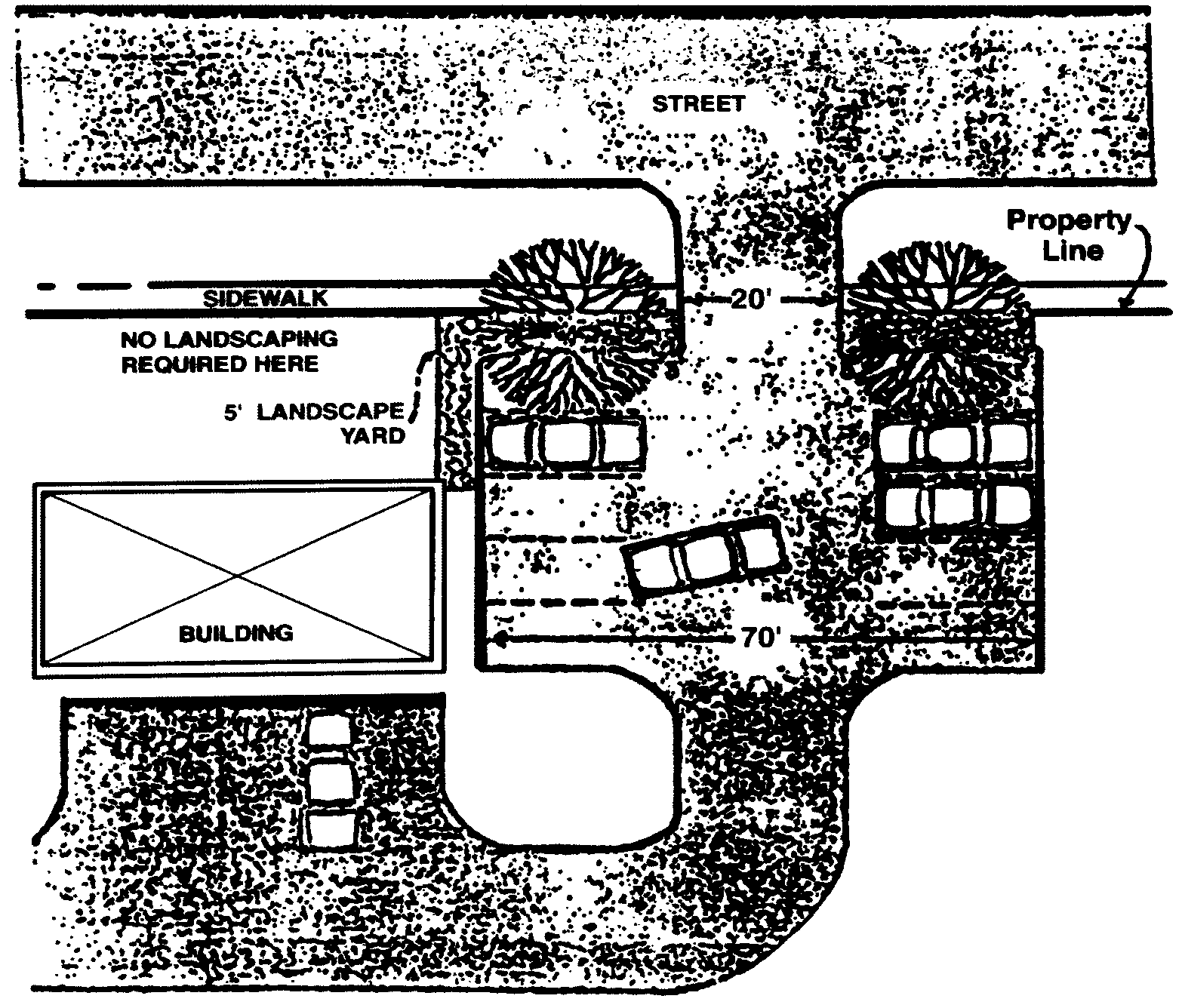
Required Landscaping Adjacent to Public Rights-of-Way
The following is Figure 6.06.06.2 and may be so cited:
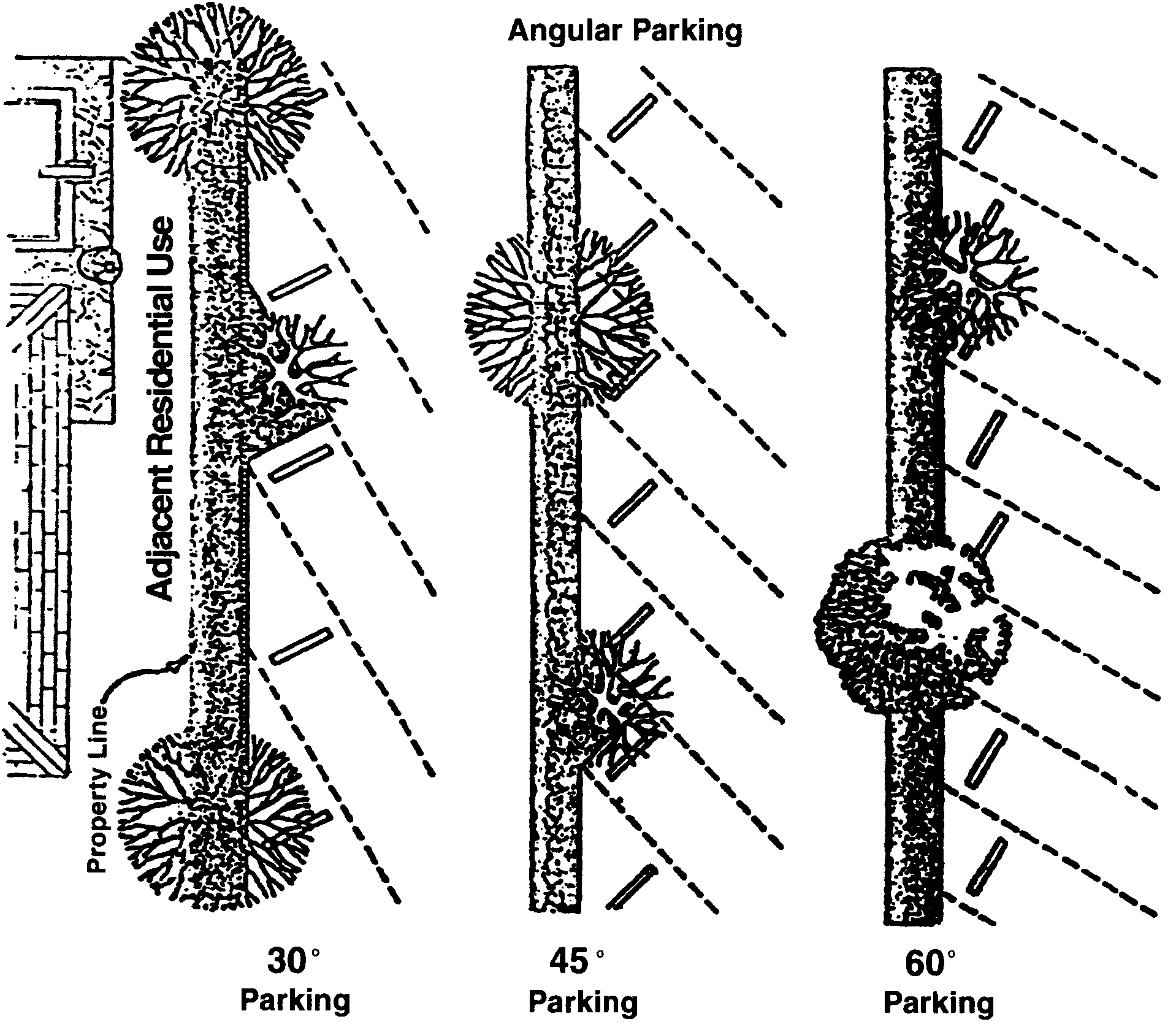
Angular Parking
The following is Figure 6.06.06.3 and may be so cited:
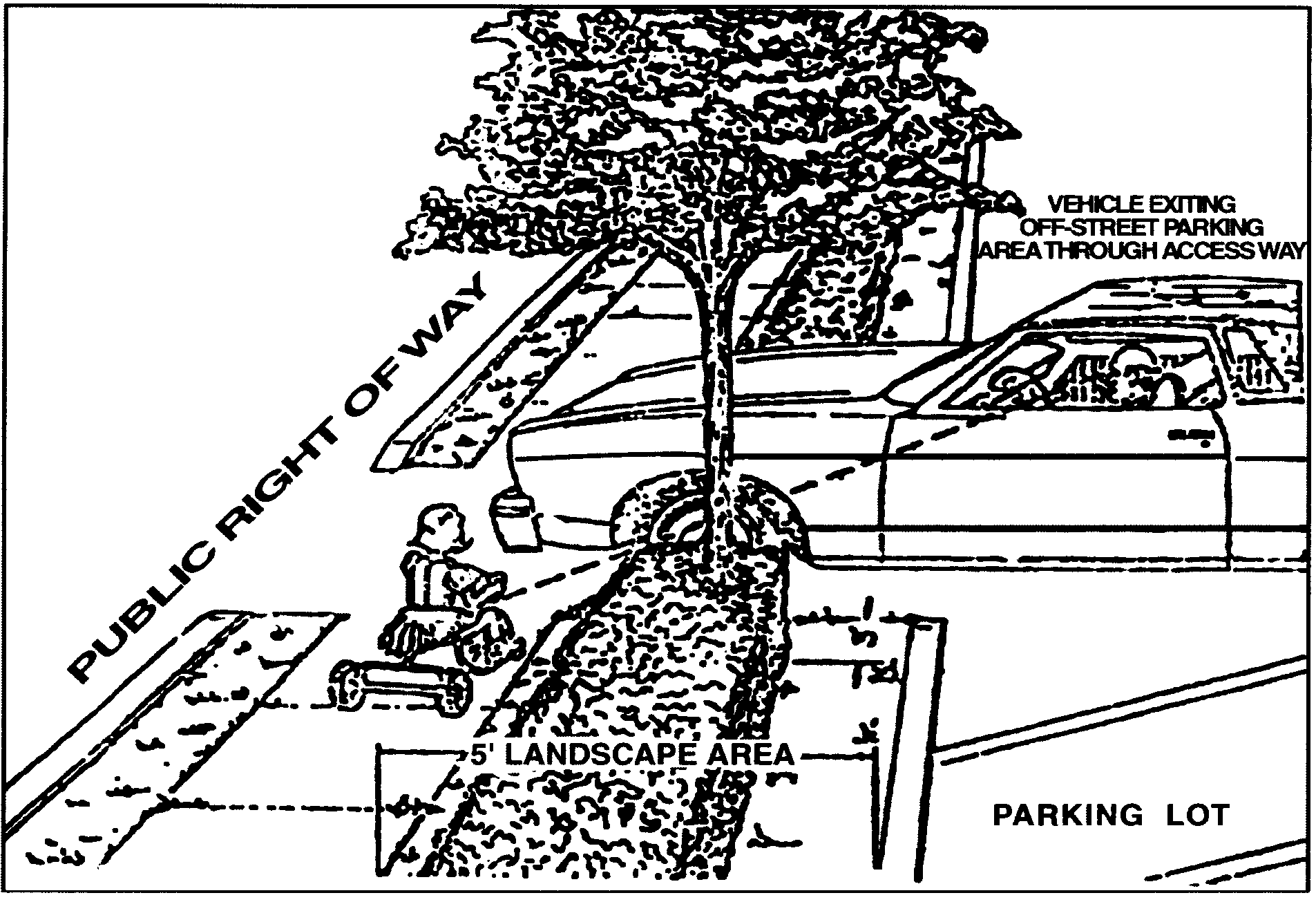
Offstreet Parking Accessway
The following is Figure 6.06.06.4 and may be so cited:
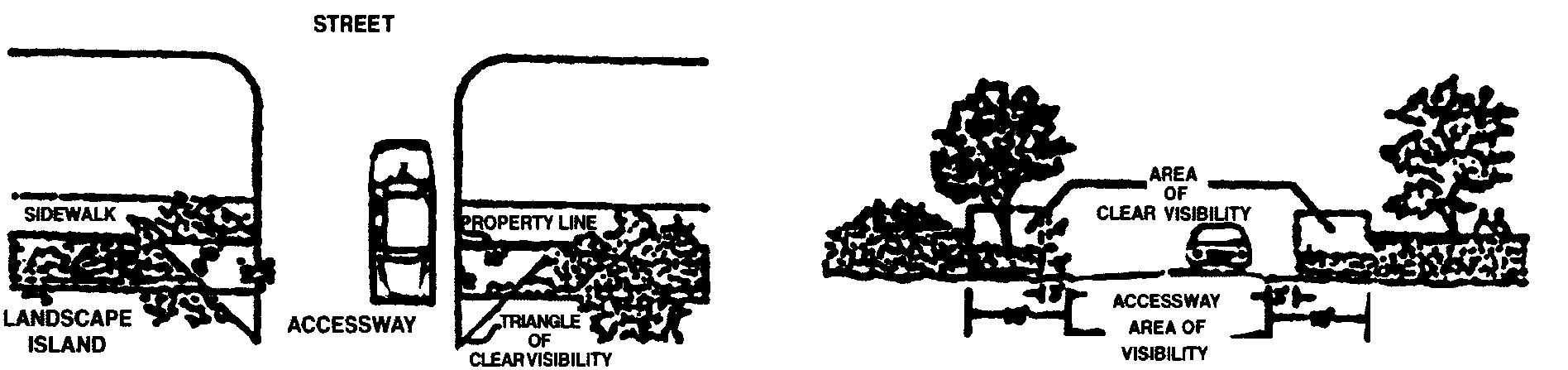
Accessway
The following is Figure 6.06.06.5 and may be so cited:
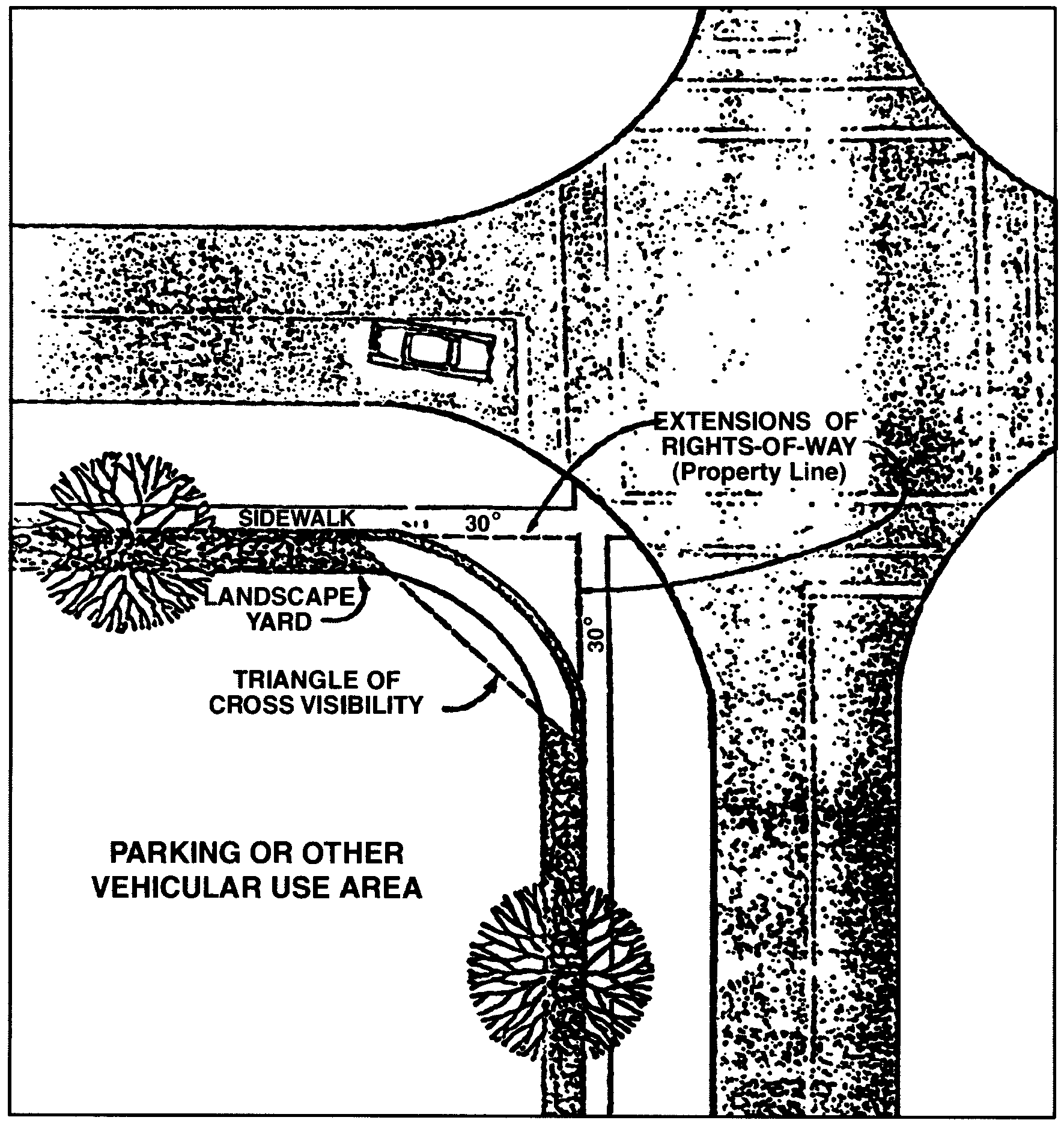
Sight distance for Landscaping Adjustment to Intersections
(Ord. No. 18-08, § 1(Exh. 1), 7-2-18)
Sec. 6.07.01. - General.
No person shall occupy as owner-occupant or let or sublet to another for occupancy any dwelling or dwelling unit designed or intended to be used for the purpose of living, sleeping, cooking, or eating therein, nor shall any vacant dwelling building be permitted to exist which does not comply with the requirements contained in the provisions of this article or those provisions of the Standard Housing Code or Standard Unsafe Building Abatement Code hereafter adopted by reference.
(Ord. No. 18-08, § 1(Exh. 1), 7-2-18)
Sec. 6.07.02. - Structural requirements.
A.
Foundation systems. The building foundation systems shall be maintained to provide a safe, firm base for the support of the structure. Foundation members shall not lean or be damaged, decayed, deteriorated or insect-infested to the extent that causes unsafe sagging, leaning or buckling of other structural members.
B.
Walls. Every exterior wall shall be free of holes, cracks, breaks, loose or rotting and deteriorated coverings which might admit rain, cold, rodents or insects to the interior of the wall or occupied portions of the dwelling.
C.
Roofs. Roofs shall not leak with such volume as to cause damage to any of the components of the structure.
D.
Stairs, porches and appurtenances. Stairs, porches and appurtenances shall contain no loose, deteriorated or damaged material that would constitute a hazard.
E.
Accessory buildings. Accessory building and other structures built on the same premises with a dwelling but not attached to it and not used as living quarters shall be kept in sound condition and good repair in accord with this article and the applicable portions of the Codes of the city.
F.
Exterior doors. Exterior doors and hatchways shall be substantially weather tight, rodent proof and insect proof and kept in sound working condition and good repair.
(Ord. No. 18-08, § 1(Exh. 1), 7-2-18)
Sec. 6.07.03. - Plumbing.
A.
Water supply. Water supply shall be drawn from a source approved by the state board of health or county health department. All plumbing fixtures and piping shall meet the plumbing code requirements that were in effect at the time of installation of the fixtures and piping.
B.
Connection. All plumbing fixtures, facilities and equipment shall function properly and be properly connected to the Anastasia Sanitary District sanitary sewer system or to some other disposal system approved by the state board of health or county health department.
(Ord. No. 18-08, § 1(Exh. 1), 7-2-18)
Sec. 6.07.04. - Electric service.
A.
Service and/or feeder. Service equipment shall be dead front having no live parts exposed where accidental contact could be made.
(Ord. No. 18-08, § 1(Exh. 1), 7-2-18)
Sec. 6.07.05. - Heating and cooking equipment.
A.
Supplied and required facilities.
1.
Cooking, heating and water heating equipment in a dwelling unit shall be so maintained and operated so that it will function safely and effectively, free from fire, health and accident hazards.
2.
Use of portable heating or cooking equipment employing open flame from gasoline or kerosene or other liquid fuel is prohibited in a dwelling unit. All other portable kerosene units shall likewise be prohibited unless they have an Underwriters Laboratory label attached.
3.
Where they exist, chimneys, flues, and smoke and vent pipes shall be reasonably clean, in a good state of repair, and free from cracks or openings which would permit leakage of gases within the dwelling unit.
(Ord. No. 18-08, § 1(Exh. 1), 7-2-18)
Sec. 6.07.06. - Care of premises.
A.
All buildings and structures shall be maintained so as to discourage the harboring and breeding of rodents, mice, snakes, insects, and other vermin. Insofar as the natural drainage will permit, yards and premises appurtenant to a dwelling unit shall be sloped or graded to provide for disposal of surface water and to prevent the accumulation of surface water in the yard or next to the building.
B.
Every occupant of a single dwelling building and every owner of a building containing two (2) or more dwelling units shall be responsible for the extermination of any insects, rodents, or other pests within the building or premises. Provided however, extermination of wood-destroying organisms shall, in all cases, be the responsibility of the building owner.
C.
1.
It shall be unlawful for the owner or occupant of a residential building, structure, or property to cause or allow the premises of such residential property to be used for the outdoor storage of any of the following:
a.
Rubbish, garbage, trash, dead trees, or items of junk;
b.
Refrigerators, washing machines, water heaters, stoves, sinks, and household appliances and fixtures not customarily used outside a residential building; and,
c.
Construction material, such as lumber, concrete blocks, and pipes.
2.
The requirements of this section are subject to the following exceptions:
a.
The outdoor storage of construction material is allowed if there is an active permit for construction at the address the material is stored, and the material will be incorporated into the improvements to be made at said address;
b.
The outdoor storage of construction material is allowed without an active permit if the material may reasonably be used for future improvements to the premises on which the construction material is stored, and the material, including any plastic sheet, canvas or other covering over it, is not visible from any street or road; and
c.
The placement of garbage, rubbish, trash, junk, and appliances and fixtures for collection and removal from a property is allowed in accordance with Chapter 10 of the St. Augustine Beach Code.
D.
1.
Motor vehicles or nonmotorized vehicles of any type without valid and current license plates shall not be parked or stored other than in completely enclosed buildings on any property.
2.
Boats of any type, without valid and current registration and a decal affixed to the boat in the manner described in Chapter 327 of the Florida Statutes, shall not be parked or stored other than in completely enclosed buildings on any property. This paragraph shall not apply to boats which are not required to be registered and have a decal affixed to the boat for use on water in the state.
3.
Racing vehicles of any type which may not lawfully be used on a highway in the state shall not be parked or stored other than in completely enclosed buildings on any property.
E.
The outdoor storage of any motor vehicle which, though having a valid and current license plate, is in a state of disrepair and incapable of being moved under its own power, is prohibited.
F.
Any building, structure or other place or location where any activity which is in violation of local, state or federal law is conducted, performed or maintained shall be in violation of this article.
(Ord. No. 18-08, § 1(Exh. 1), 7-2-18)
Sec. 6.07.07. - Unsafe buildings.
A.
There is adopted by reference the currently adopted Florida Building Code, with the exception of section 113 pertaining to the composition and procedures of the board of adjustments and appeals.
B.
The comprehensive planning and zoning board shall serve as the board of adjustments and appeals in accordance with the provisions of the currently adopted Florida Building Code.
(Ord. No. 18-08, § 1(Exh. 1), 7-2-18; Ord. No. 20-15, § 4, 1-4-21)
Sec. 6.07.08. - Implementation.
A.
For the purpose of providing for the administration and enforcement of this article, there is adopted by reference all of Article 1 of the current edition of the Standard Housing Code as promulgated by the Southern Building Code Congress International, Inc., with the exception of sections 106.1 and 106.2 pertaining to the composition and meetings of the housing board of adjustments and appeals, and further there is adopted by reference sections 309.1 through 309.6, inclusive, of said current edition of the Standard Housing Code, pertaining to unfit dwellings and condemnation procedures.
B.
The comprehensive planning and zoning board shall serve as the housing board of adjustments and appeals, and the City Manager or designee shall serve as the housing official in accordance with the provisions of the Standard Housing Code.
C.
The St. Augustine Beach Code Enforcement Board shall serve as the enforcing agency of the St. Augustine Beach Housing and Residential Property Maintenance Standards in accordance with Chapter 162 of the Florida Statutes.
(Ord. No. 18-08, § 1(Exh. 1), 7-2-18)
Sec. 6.07.09. - Fire prevention code.
A.
For provisions related to fire prevention, refer to the Florida Fire Prevention Code. The Florida Fire Prevention Code shall apply to matters affecting or relating to structures, processes and premises from the hazard of fire and explosion arising from the storage, handling or use of structures, materials or devices; from conditions hazardous to life, property or public welfare in the occupancy of structures or premises; and from the construction, extension, repair, alteration or removal of fire suppression, automatic sprinkler systems and alarm systems or fire hazards in the structure or on the premises from occupancy or operation
(Ord. No. 18-08, § 1(Exh. 1), 7-2-18)
Sec. 6.07.10. - Reserved.
Editor's note— Ord. No. 20-15, § 2, adopted Jan. 4, 2021, repealed § 6.07.10, which pertained to occupancy permits and derived from Ord. No. 18-08, § 1(Exh. 1), adopted July 2, 2018.
Sec. 6.08.01. - Intent and scope of application.
The purpose of this section is to improve the travel conditions for persons and vehicles on public ways by reducing glare, to reduce light trespass, to protect the general health, safety and welfare of the public in St. Augustine Beach, to decrease the expense of lighting, to decrease light pollution, and to improve the aesthetics of the city in general while providing adequate night-time safety, utility, and security.
(Ord. No. 18-08, § 1(Exh. 1), 7-2-18)
Sec. 6.08.02. - Procedure.
In accordance with section 12.01.02, at the time of development permit approval the applicant must supply a lighting plan in accordance with the procedures of the comprehensive planning and zoning board.
(Ord. No. 18-08, § 1(Exh. 1), 7-2-18)
Sec. 6.08.03. - Standards.
A.
All areas:
1.
All lights shall be shielded in such a way to direct all light toward the Earth's surface and away from reflective surfaces.
2.
Light fixtures or lamps shall be shielded/shaded in such a manner as to direct incident rays away from all adjacent property.
3.
Lights on poles shall not be taller than the building whose area the illuminate nor taller than fifteen (15) feet whichever is shorter.
4.
All fixtures must meet the building code requirements for their particular zoning district.
5.
Any facilities which may require floodlighting may not arrange to light in such a way that it will shine towards roadways, onto adjacent residential property or residential use property or into the night sky.
6.
Any interior lighted signs may not be lit at night when any face of the sign is removed or damaged in such a way that the light may distract drivers or homeowners.
7.
Signs shall comply with illumination requirements of section 5-10(f)(3).
8.
Except as stated elsewhere in these regulations, light levels will be limited to those published as recommendations by the Illuminating Engineering Society of North America.
B.
Commercial, business, industrial, and natural resources zones and any roadway adjacent to residential zones:
1.
Any light fixture must be placed in such a manner that no light emitting surface is visible from any residential area or public/private roadway, walkway, trail or other public way when viewed at ground level.
2.
The level of lighting shall not exceed one-half (0.5) footcandle at any residential property line or one (1.0) footcandle at any nonresidential property line.
3.
Any canopy structure used at a business location must have recessed lights with diffusers which do not extend below the surface of the canopy.
4.
Any luminaire on a pole, stand or mounted on a building must have a shield, an adjustable reflector and nonprotruding diffusor.
C.
Installation and operation cost: The cost of installing and operating approved roadway lighting on any public road shall be through a financial method approved by the city commission or by the St. Johns County Commission. The costs of all other lighting systems shall be borne by the developer/property owner.
(Ord. No. 18-08, § 1(Exh. 1), 7-2-18)
Sec. 6.08.04. - Exceptions.
A.
The comprehensive planning and zoning board may waive any of the provisions stated in section 5-11(c) when after a request for such an exception has been made and reviewed, the comprehensive planning and zoning board determines that such an exception is necessary for the lighting application. Requests for such an exception shall be made to the comprehensive planning and zoning board in such form as the comprehensive planning and zoning board shall prescribe and shall include, but not limited to, a description of the lighting plan, a description of the efforts that have been made to comply with the provisions of these regulations and the reasons such an exception is necessary. In reviewing a request for such exception, the planning commission shall consider safety, design, and other factors deemed appropriate by the planning commission and shall consider the following:
1.
The new or replacement luminaire is a full-cutoff luminaire when the rated output of the luminaire is greater than one thousand eight hundred (1,800) lumens.
2.
If a lighting recommendation or regulation applies, the minimum/maximum illuminance specified by the recommendations or regulation is used.
3.
If no lighting recommendation or regulation applies, the minimum illuminance adequate for the intended purpose is used, giving full consideration to safety, energy conservation, glare and minimizing light trespass.
4.
For roadway lighting, a determination is made that the purpose of the lighting installation or replacement cannot be achieved by installation of reflectorized roadway makers, lines, warnings or informational signs, or other passive means.
5.
Adequate consideration has been given to conserving energy and minimizing glare, light pollution and light trespass.
B.
Exemptions from the provisions of this section are permitted only when:
1.
Federal or state laws, rules and regulations take precedence over these provisions.
2.
Fire, police, rescue, or repair personnel need light for temporary emergency situations.
3.
There are special requirements, such as sports facilities and monument or flag lighting; all such lighting; all such lighting shall be selected and installed to shield the lamp(s) from direct view to the greatest extend possible, and to minimize upward lighting and light trespass.
4.
A determination has been made by the comprehensive planning and zoning board, established through an open, public hearing process, that there is a compelling safety interest that cannot be addressed by any other method.
(Ord. No. 18-08, § 1(Exh. 1), 7-2-18)

