
St John The Baptist Parish
City Zoning Code
City Zoning Code
ARTICLE VI
SIGNS
Sec. 113-624. - Purpose and intent.
The purpose of this article is to establish a comprehensive system of sign controls that govern the display, design, construction, location, installation, and maintenance of signs, in order to:
(1)
Comply with and implement the goals and objectives of the comprehensive plan, adopted on September 15, 2014.
(2)
To promote and protect the health, safety, and welfare of the parish by ensuring the compatibility of signs with surrounding architecture and land uses.
(3)
To create a more attractive business and economic climate by enhancing and protecting the orderly and effective display of signs.
(4)
To discourage excessive signage.
(5)
To protect the public from hazardous conditions that result from the indiscriminate use and placement of signs, structurally unsafe signs, signs that obscure pedestrians' or motorist' visibility, and signs that compete or conflict with traffic signals and warning signs.
(6)
To avoid visual clutter that is potentially harmful to traffic and pedestrian safety, property values, business opportunities, and community appearance.
(Ord. No. 17-06, § IX, 2-7-2017)
Sec. 113-625. - Interpretation.
(a)
Conflicts. Where there is a conflict between a land use regulation and a structural regulation, or other conflict not otherwise addressed by this article, the more restrictive will apply.
(b)
No standard. Where the Code is silent or where the rules of this Code do not provide a basis for concluding that a sign is allowed, the sign in question will be prohibited.
(c)
Building code. Unless otherwise provided, all signs must be constructed and erected in accordance with the building codes for the parish.
(d)
Message. This article is not intended to and does not restrict speech on the basis of its content, viewpoint, speaker, or message. Any classification of signs in this article that permits speech by reason of the type of sign, identity of the sign user, or otherwise, will also be interpreted to allow noncommercial speech on the sign. To the extent that any provision of this chapter is ambiguous, the term will be interpreted not to regulate on the basis of the content or speaker of the message.
(Ord. No. 17-06, § IX, 2-7-2017)
Sec. 113-626. - Applicability.
(a)
In general. Except as provided in this section, the requirements of this article apply to all signs, sign structures, awnings, and other types of sign devices located in the parish.
(b)
Permit required. Except as provided for in this section, it is unlawful for any person to erect, relocate, or structurally alter any sign without first obtaining a sign permit in accordance with this article.
(c)
Exempt activities. The following sign activities do not require a permit:
(1)
Normal maintenance and repair of an existing conforming or legally nonconforming sign, including, but not limited to painting, repainting, cleaning, or changing sign face; none of which involves structural changes to the existing size, height, area, location, or electronic message portion of a sign.
(d)
Exempt signs. The following signs do not require a permit:
(1)
Temporary signs, in all zoning districts, provided they comply with the following criteria:
a.
No illumination;
b.
The sign may be located on a development site for a one-time period (per sign) of no more than 60 days;
c.
Limited to one temporary sign per development site, with the exception of development sites with multiple street frontages, which may have one temporary sign for each street frontage; and
d.
Does not exceed a maximum permitted area of 32 square feet per sign.
e.
Any temporary sign proposed to be placed or constructed which exceeds any of the criteria listed in (a.) through (c.) above must be proposed as a permanent sign a-nd permitted in accordance with section 113-642 - detached signs.
(2)
Flags, pennants, or other similar signage.
(3)
Small, detached signs provided they comply with the following criteria:
a.
Located within 50 feet of an access way that connects private property to a public street or a driveway providing internal circulation within a development site;
b.
Does not exceed four square feet in area;
c.
Does not exceed six feet in height above the ground;
d.
May be illuminated, but not animated; and
e.
Does not flash, blink, or fluctuate.
(4)
A-frame signs, provided each sign is:
a.
No more than six square feet in area per sign face;
b.
No more than four feet in height;
c.
Displayed outdoors only during the hours of 7:00 a.m. to 10:00 p.m. and stored indoors at all other times;
d.
Limited to one sign per use;
e.
Separated by a minimum distance of 20 linear feet from the nearest A-frame sign;
f.
Located within 20 feet of a building entrance;
g.
Located so as to not interfere with pedestrian traffic or violate standards of accessibility as required by the ADA or other accessibility codes.
(5)
Window and door signs and signage located within a building.
(6)
Bench signs, as defined by this article.
(Ord. No. 17-06, § IX, 2-7-2017; Ord. No. 18-31, § XV, 10-9-2018)
Sec. 113-627. - Severability.
If any article, section, subsection, sentence, clause or phrase of these regulations is, for any reason, held unconstitutional or invalid, such decision or holding will not affect the validity of the remaining portions hereof. It being the intent of the parish council to enact each section and portion thereof, individually and each such section will stand alone, if necessary, and be in force not with the validity of any other article, section, subsection, sentence, clause or phrase of these regulations.
(Ord. No. 17-06, § IX, 2-7-2017)
Sec. 113-628. - Sign location restrictions.
Except where specifically authorized by this article, the following signs are prohibited in the locations set forth below.
(1)
Any sign that prevents free ingress or egress from any door, window, or fire escape;
(2)
Any sign attached to a stand-pipe or fire escape;
(3)
Any sign that obstructs free and clear vision at any location where, by reason of position, it may interfere with or obstruct the view of traffic sign lines or traffic control devices; and
(4)
Any sign attached to any public utility pole, structure or street light, tree, fence, fire hydrant, bridge, curb, sidewalk, park bench, statue, memorial, or other location on public property, except those signs constructed, approved, or permitted by the parish. Nothing in this section will be construed to prohibit a person from holding a sign while located on public property, provided the person holding the sign is located on public property determined to be a traditional public forum and does not block ingress and egress from buildings or create a safety hazard by impeding travel on sidewalks, bike and vehicle lanes, and trails.
(Ord. No. 17-06, § IX, 2-7-2017)
Sec. 113-629. - Prohibited signs.
(a)
Prohibited signs are subject to removal (except legal nonconforming signs as defined by this article) by the parish at the owner's or user's expense.
(b)
The following sign types are prohibited:
(1)
Abandoned signs;
(2)
Permanent beacons, search lights, or other lights visible from a significant distance;
(3)
Billboards, except when provided in accordance with this article;
(4)
Flashing signs;
(5)
Inflatable signs; however, these signs may be permitted no more than two times per year for a period of two days each;
(6)
Lasers;
(7)
Portable or trailer signs;
(8)
Revolving or rotating signs;
(9)
Roof signs;
(10)
Signs that resemble traffic control devices or emergency devices;
(11)
Signs that encroach into a public right-of-way; and
(12)
All signs not expressly permitted in this article.
(Ord. No. 17-06, § IX, 2-7-2017)
Sec. 113-631. - Sign permit application.
(a)
Permit agency. The department of planning and zoning will provide and review applications for compliance with this article, and determine whether proposed signs meet the requirements of this Code.
(b)
Submittal requirements. Applications and permit fees, in accordance with chapter 14 of this Code, must be submitted to the department of planning and zoning. Applications must include:
(1)
Detailed information for the proposed sign, as applicable, including, but not limited to: elevation drawings that detail dimensions, location, construction, materials, and manner of illumination, securing or fastening.
(2)
Site information, as applicable, including, but not limited to: a site plan that details the total number and location of all proposed and existing signs, total square footage of proposed and existing signage on site, dimensions of existing buildings, and the length of lot lines that abut a public street or roadway.
(c)
Engineered plans. The building official may establish when engineered plans are required to ensure signs are constructed in accordance with the building and electrical codes of the parish. When required, plans must be signed and sealed by a state-licensed engineer and be submitted as part of a sign permit application.
(Ord. No. 17-06, § IX, 2-7-2017)
Sec. 113-632. - Sign permit review.
(a)
Sign area.
(1)
Signs on a background. Measurement includes the entire area of the background, including any material or color forming the sign face and the background used to differentiate the sign from the structure against which it is mounted.
(2)
Freestanding letters or logos. For signs consisting of freestanding letters or logos, sign area is calculated as the sum of the area of the squares or rectangles that encompass the text and/or logo(s) or, if available, the calculated total sum of the area of each freestanding letter or logo component.
(3)
Sculptural signs. The sign area of a three-dimensional, free-form, or sculptural (non-planar) sign is calculated as 50 percent of the sum of the area of the four vertical sides of the smallest cube that will encompass the sign.
(4)
Monument signs. The base is not included in the total area of a monument sign.
(5)
Double faced signs. Measurement is limited to a single sign face.
(6)
Sign area does not include any supports or bracing.
(b)
Sign height.
(1)
Generally. Sigh height includes the entire structure, including decorative elements and base. For detached signs, height is calculated as the total vertical distance measured from grade to the highest point of the sign.
(2)
Monument signs. Measurement of the height of a monument sign shall be limited to the sign structure, shall include the sign base, and shall not include the height of an earthen berm underneath the sign. Any sign exceeding twelve feet in height must not be considered a monument sign, and must be considered either a pole or pylon sign for regulatory purposes.
(c)
Sign clearance. Sign clearance is calculated as the vertical distance measured from grade, or the base of the building, to the lowest point of the sign.
(Ord. No. 17-06, § IX, 2-7-2017)
Sec. 113-633. - Sign permit issuance and on-site requirements.
(a)
Prior to permit issuance, any sign constructed, erected, modified, or altered must comply with the provisions of this article and all requirements of the Code.
(b)
Upon permit issuance, a permit placard must be obtained from the planning and zoning department and be posted on site in a prominent and visible location at all times during the course of construction.
(c)
Applicants are responsible for requesting inspections, including a preliminary planning and zoning inspection, wherein a parish inspector will verify that sign location and area meet the requirements of the Code, as approved, before the start of construction.
(Ord. No. 17-06, § IX, 2-7-2017)
Sec. 113-634. - Permit expiration.
(a)
Applicants are granted six months from the day a sign permit is issued to construct proposed sign(s).
(b)
After this timeframe, the permit will become null and void and a new permit will be required; however, the planning director may grant in writing one or more extensions, for a period not to exceed six months. The extension must be requested in writing and justifiable cause demonstrated.
(Ord. No. 17-06, § IX, 2-7-2017)
Sec. 113-635. - Enforcement and sign removal.
(a)
Authority. The department of planning and zoning, division of code enforcement is authorized to enforce this article. The administration of any violation or nuisance shall be in accordance with procedures outlined in chapters 2.5, 14, 26, and 113.
(b)
Misrepresentation. The planning director may revoke any sign permit where there has been a violation of the provisions of this article or misrepresentation of fact on the sign permit application.
(c)
Authority to remove signs. The department of planning and zoning, division of code enforcement is authorized to remove prohibited signs, unsafe signs, abandoned signs, signs constructed without a permit, and signs that have lost their legal nonconforming status as per chapter 26 and division 4 of this article.
(d)
Removal of unlawful signs.
(1)
Any unlawful, permanent sign that has not been removed within one month after conviction of violation or imposition of penalty may be removed by the parish and the costs charged to the violator. If removal costs have not been paid and the sign reclaimed within one month of its removal by the parish, the parish may sell or otherwise dispose of the sign and apply the proceeds toward costs of removal.
(2)
Signs upon public streets, sidewalks, right-of-way or other public property may be immediately removed without prior notice.
(3)
Any unlawful temporary or portable type sign located on private property that has not been removed after 24 hours from notification may be removed by the parish. The sign may be reclaimed by the owner after a penalty fee of $100.00 has been paid. If the sign has not been reclaimed within one month of its removal, the parish may sell or otherwise dispose of the sign and apply the proceeds toward costs of the removal.
(4)
Neither the parish, nor any of its agents are liable for any damage to the sign when removed in accordance with this section.
(Ord. No. 17-06, § IX, 2-7-2017)
Sec. 113-640. - Attached signs and canopy signs.
(a)
The following regulations apply to attached signs in the Rural, C-1, C-2, C-3, I-1, I-2, I-3, B-1, and B-2 districts:
(1)
General regulations.
a.
All signs must be safely and securely attached in accordance with this Code.
b.
Signs must not cover windows, doors or other architectural features.
(2)
Number. Attached signs and canopy signs are not limited in number.
(3)
Area.
a.
Buildings with a single street-facing facade. The total cumulative area of all attached and canopy signage must not exceed 1.5 square feet per linear foot of building or tenant space width, as measured along the side of the building featuring the primary entrance, or 300 square feet, whichever is less. See figure 113-640(1) for further clarification.
Figure 113-640(1): Primary building façade measurement.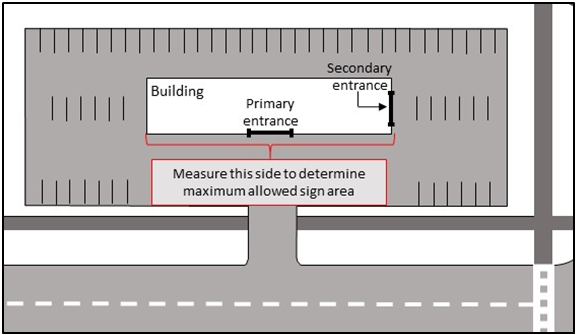
b.
Buildings with multiple facades facing a public street or route of internal circulation. The total cumulative area of all attached and canopy signage must not exceed 1.5 square feet per linear foot of building or tenant space width, as measured along the side of the building featuring the primary entrance, or 450 square feet, whichever is less.
(4)
Height.
a.
No attached or canopy sign, including its support structure, is permitted to project beyond the ends of the wall or beyond the top of the roof line of the building or canopy to which it is attached.
b.
When a proposed attached or canopy sign is located on a parapet wall as part of proposed new construction, the parapet must be consistent with the architectural design of the building.
c.
No attached or canopy sign can be attached to an un-reinforced masonry parapet.
(5)
Illumination. Attached and canopy signs may be illuminated, but cannot flash, blink or fluctuate.
(6)
Animation. No sign can be animated or change physical position by any movement or rotation.
(b)
The following regulations apply to attached or canopy signs located in the R-1, R-1A, R-2, R-3, R-4, and MHP zoning districts:
(1)
General regulations.
a.
All signs must be safely and securely attached in accordance with this Code.
b.
Signs must not cover windows, doors or other architectural features.
(2)
Number. Only one attached or canopy sign may be permitted per development site.
(3)
Area. Any permitted attached or canopy sign must be no larger than 12 square feet.
(4)
Illumination. Attached or canopy signs may not be illuminated, flash, blink or fluctuate.
(5)
Animation. No sign can be animated or change physical position by any movement or rotation.
(6)
Height.
a.
No attached or canopy sign, including its support structure, can project beyond the ends of the wall or beyond the top of the roof line of the building or canopy to which it is attached.
b.
When a proposed attached or canopy sign is located on a parapet wall as part of proposed new construction, the parapet must be consistent with the architectural design of the building.
c.
No attached or canopy sign can be attached to an un-reinforced masonry parapet.
(Ord. No. 17-06, § IX, 2-7-2017; Ord. No. 18-31, § XVI, 10-9-2018)
Sec. 113-641. - Hanging signs.
The permitted number and area of hanging signs is calculated separately from that of total attached signage. Along a multitenant building, or a pedestrian oriented commercial corridor, one hanging sign may be permitted per individual tenant space, provided:
(1)
The sign is located below a canopy, awning, or breezeway;
(2)
The sign is mounted perpendicular to the building façade and extends over a pedestrian walkway;
(3)
The sign does not exceed 18 inches in height;
(4)
The sign does not exceed six square feet in area; and
(5)
The sign maintains a clearance height of eight feet above the ground.
(6)
Location. Hanging signs may only be located in the following zoning districts:
a.
Rural District (Rural)
b.
Commercial District One (C-1)
c.
Commercial District Two (C-2)
d.
Commercial District Three (C-3)
e.
Industrial District One (I-1)
f.
Industrial District Two (I-2)
g.
Industrial District Three (I-3)
h.
Nonindustrial Batture District (B-1)
i.
Nonindustrial Batture District (B-2)
(Ord. No. 17-06, § IX, 2-7-2017)
Sec. 113-642. - Detached signs.
(a)
Applicability.Section 113-642 is applicable to all pole, pylon, or other detached signs, excluding billboards, monument signs, and applicable exempt signs. Any detached sign exceeding twelve feet in height, as measured from grade, must comply with this Section, except those classified as billboards, according to section 113-670, sign definitions.
(b)
Number. Only one detached sign is permitted per development site. If a monument sign is existing or proposed on site, an additional detached sign must not be permitted.
(c)
Area. Total sign area cannot exceed one square foot per linear foot of lot frontage along the adjacent public right-of-way, or 300 square feet, whichever is less.
(d)
Setback. The sign must be setback from any adjacent property line or edge of a street (whichever is closer to the sign structure) a minimum distance equal to the height of the sign. The setback will be measured at the shortest distance between the sign and the closest adjacent property line or edge of a street (whichever is closer).
(e)
Height. The sign must not exceed 25 feet in height, as measured from the adjacent grade to the highest point of the sign structure.
(f)
Illumination. Signs may be internally or externally illuminated, but cannot flash, blink or fluctuate.
(g)
Animation. No detached sign can be animated or change physical position by any movement or rotation.
(h)
Electronic display. If proposed, electronic display must be provided in accordance with section 113-660 of this article.
(i)
Location. Detached signs are only permitted in the following zoning districts:
(1)
Rural District (Rural)
(2)
Commercial District One (C-1)
(3)
Commercial District Two (C-2)
(4)
Commercial District Three (C-3)
(5)
Industrial District One (I-1)
(6)
Industrial District Two (I-2)
(7)
Industrial District Three (I-3)
(8)
Nonindustrial Batture District (B-1)
(9)
Nonindustrial Batture District (B-2)
(Ord. No. 17-06, § IX, 2-7-2017)
Sec. 113-643. - Monument signs.
(a)
Applicability.Section 113-643 is only applicable to those signs classified as monument signs in section 113-670, sign definitions. Any detached signs exceeding 12 feet in height, as measured from grade, must comply with section 113-642 or section 113-644, as applicable.
(b)
The following regulations apply to monument signs in the Rural, C-1, C-2, C-3, I-1, I-2, I-3, B-1, and B-2 districts:
(1)
Number.
a.
Only one monument sign may be permitted per site, except as allowed by section 113-643(b)(1)b. below. If a detached sign, including a pole or pylon sign, is existing or proposed on site, a monument sign must not be permitted as an additional sign.
b.
A second monument can be permitted for lots with more than 500 feet of contiguous frontage along a property line or on corner lots.
(2)
Area. To reduce sign clutter and avoid conflict with required trees, total cumulative monument sign area cannot exceed 1.2 square feet per linear foot of lot frontage along the adjacent public right-of-way, or 360 square feet, whichever is less.
(3)
Height.
a.
Monument signs must not exceed a height of eight feet. Mounds or earthen berms on which a monument sign is located can be no more than two feet in height measured from grade.
b.
Monument signs located within a landscaped bed with a minimum size of 100 square feet can have a height up to 12 feet, provided they comply with the following:
i.
The mound or earthen berm on which the monument sign is located can be no more than two feet in height measured from grade.
ii.
The landscaped bed shall consist of shrubs, ground cover (excluding grass) and/or other suitable plant materials, and exclude any impervious surface.
(4)
Illumination. Monument signs may be internally or externally illuminated.
(5)
Electronic display. If proposed, electronic variable message boards and display must be provided in accordance with section 113-660 of this article.
(6)
Setbacks. A monument sign must be setback a minimum five feet from any adjacent property line or edge of a street (whichever is closer to the sign structure).
(7)
Clear vision. Monument signs must observe a 15 foot sight triangle setback along the intersection of any public or private streets with an access way and a 35 foot sight triangle setback along the intersection of any public or private street with another public or private street. Such sight triangles must be measured from the street curb or the edge of pavement. See figure 113-643 (1) below:
Fig. 113-643(1): Clear vision areas.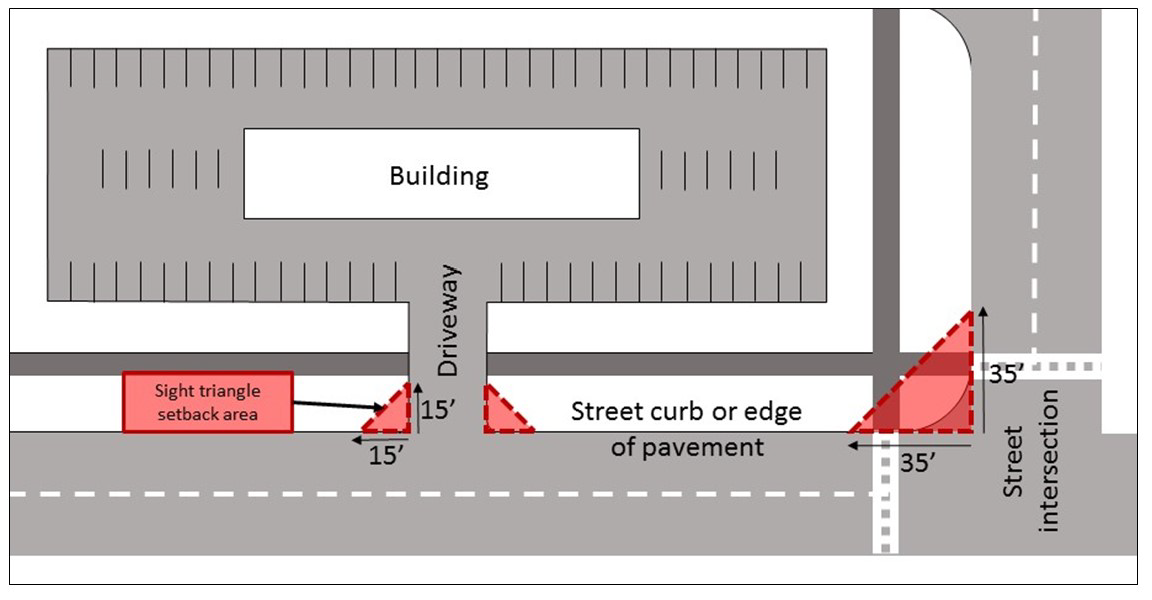
(c)
The following regulations apply to detached monument signs located in the R-1, R-1A, R-2, R-3, R-4, and MHP zoning districts:
(1)
Number.
a.
One monument sign is permitted at the entrance to or near an access way for a planned development or major subdivision of record.
b.
For planned developments or subdivisions of record with more than one entrance or access way, a second monument sign may be permitted at or near this entrance.
c.
Sign location must comply with 113-643(b)(7) above (clear vision).
d.
St. John the Baptist Parish takes no responsibility or liability for the maintenance, repair, or removal of any private sign, including any private sign installed in a parish right-of-way or servitude.
(2)
Area. Monument signs may be no larger than 120 square feet in area.
(3)
Height. Monument signs cannot exceed a height of eight feet. Mounds or earthen berms on which a monument sign is located must be no more than two feet in height as measured from the grade.
(4)
Illumination. Monument signs may be internally or externally illuminated.
(5)
Electronic display. Electronic displays and/or variable message boards are not allowed for monument signs regulated by this subsection.
(6)
Setbacks. A monument sign must be setback a minimum five feet from the edge of a street or any adjacent property line (whichever is closer to the sign structure).
(Ord. No. 17-06, § IX, 2-7-2017)
Sec. 113-644. - Drive-through signs.
There is no limit on the number of drive-through signs, however drive-through signs must comply with the following standards:
(1)
The construction of such signs requires a sign permit and such signs must conform to applicable building code requirements.
(2)
Such signs can be no larger than 48 square feet per sign.
(Ord. No. 17-06, § IX, 2-7-2017)
Sec. 113-645. - Billboards.
(a)
Billboards must comply with the following standards:
(1)
Number of display faces. Billboards must display no more than two sign faces per structure.
(2)
Area. Total sign area cannot exceed 672 square feet.
(3)
Width. Sign width cannot exceed 48 feet.
(4)
Height. Sign height cannot exceed 60 feet above the adjacent grade.
(5)
Location.
a.
Zoning districts. Billboards may only be permitted within areas zoned I-1, I-2, and I-3.
b.
Spacing. Billboards must be located at least 500 feet apart, measured radially and including both sides of the street.
c.
Setbacks.
i.
From the public right-of-way. Billboards must be set back from all adjacent public street rights-of-way a distance at least equal to the height of the sign. The setback must be measured from the nearest part of the sign to the public street right-of-way.
ii.
From public and residential uses. Billboards must be setback a minimum of 250 feet from any existing parks, playgrounds, residential districts, or residential uses.
(6)
Electronic display. If proposed, electronic variable message boards and display must be provided in accordance with section 113-660 of this article. Electronic billboards must be located at least 1,000 feet apart from each other, measured radially and including both sides of the street.
(Ord. No. 17-06, § IX, 2-7-2017)
Sec. 113-650. - Establishment.
(a)
All signs that existed legally before the adoption of this article and do not conform to its provisions will be permitted to remain in accordance with this division and be termed a legally nonconforming sign.
(b)
The burden of establishing a sign to be legally nonconforming under this division rests upon the person or persons, firm or corporation claiming legal status for a sign.
(Ord. No. 17-06, § IX, 2-7-2017)
Sec. 113-651. - Applicability.
(a)
Alterations prohibited. A legally nonconforming sign may not be enlarged or altered in any way that would increase its nonconformity with the provisions of this article. This condition does not prohibit regular maintenance, painting, or repairs including the replacement of an existing sign face, or a change in a sign face when these changes do not require the temporary removal of a sign structure, nor affect the location, size, height, electronic message portion, or area of a sign.
(b)
Violations. Any violation of this article will immediately terminate the right to maintain a nonconforming sign.
(Ord. No. 17-06, § IX, 2-7-2017)
Sec. 113-652. - Loss of legal nonconforming status.
(a)
A nonconforming sign will lose its legal nonconforming status and be required to be removed if any of the following events occur:
(1)
Relocation. The sign is relocated on the same premises or moved to a different premises.
(2)
Alteration. The supporting structure, height, electronic message portion, or size of the sign is altered in any way that increases its height or size, including an increase to the size of the electronic message portion. Nothing in this section shall inhibit the routine maintenance and/or routine repair of a structure containing a legally nonconforming sign.
(3)
Damage or destruction. Legally nonconforming signs that are in whole or in part destroyed by force majeure or acts of public enemy may be restored, provided that the restoration is accomplished with no increase in height or area, including any increase to the size of the electronic message portion of the sign, provided that such restoration complies with the current provisions of chapter 105, buildings and building regulations, the applicable regulations of the Code of Federal Regulations, the National Flood Insurance Program, and any other relevant regulations.
a.
Such restoration of a legally nonconforming sign must be commenced within six months after the nonconforming sign was damaged or destroyed. Said six month period shall begin on the date that a state of emergency is lifted from the property in question or from the earliest date that the property can reasonably be accessed by the property owner following a disaster that prevents access.
b.
Commencement of restoration shall be evidenced by submittal of a complete application for a sign permit with the department of planning and zoning.
c.
Restoration of legally nonconforming sign must be completed within the time frame prescribed by the building permit. Any extension to the requirements of this section must be approved by the building official and evidenced by an extended building permit.
(Ord. No. 17-06, § IX, 2-7-2017)
Sec. 113-653. - Removal.
When the planning and zoning department determines that a sign remains nonconforming after termination of the time periods provided for above, procedures for sign removal are in accordance with section 113-635 of this article.
(Ord. No. 17-06, § IX, 2-7-2017)
Sec. 113-660. - Electronic variable message signs and display.
(a)
General standards.
(1)
Prohibition. No electronic variable message (EVM) sign can be permitted within an area zoned R-1, R1-A, R-2, R-3, R-4, or MHP.
(2)
Location requirements. Electronic variable message signs may only be permitted when located along a street frontage as part of a pole or monument sign or as an electronic billboard spaced in accordance with paragraph (c) below. Electronic variable message signs are not permitted as attached or hanging signs.
(3)
Number. Only one electronic variable message sign may be permitted per development site.
(4)
Hold time. EVMs must utilize only static messages having a minimum hold time of eight seconds. Messages must not move or have the appearance or optical illusion of movement.
(5)
Nuisance and traffic safety. Illumination cannot cause glare into any residential premises or interfere with the safe movement of motor vehicles on public thoroughfares.
(6)
Nonconforming conversion. An existing legal nonconforming sign will not be permitted to convert, in whole to in part, to an electronic variable message board sign.
(7)
Audio. Electronic displays cannot contain or utilize audio speakers or audio components.
(8)
Default image. Electronic signs must have a default design or image that will freeze in one position if a malfunction occurs. If a partial or incomplete message freezes or remains static on the sign due to a technical malfunction or a portion of the display face malfunctions, the sign's illumination must be turned off until the sign is repaired.
(b)
Illumination.
(1)
Illumination measurement criteria. The illumination of an EVM shall be measured with an illuminance meter set to measure footcandles accurate to at least two decimals. Illuminance shall be measured with the EVM off, and again with the EVM displaying a white image for a full color-capable EVM, or a solid message for a single-color EVM. All measurements shall be taken as close as practical to a perpendicular plane of the sign at a distance determined by the following formula: Measurement distance = √ (square root) of (the area of the sign in sq. ft. x 100).
(2)
Illumination limits. The difference between the off and solid-message measurements using the above listed measurement criteria must not exceed 0.3 footcandles at night.
(3)
Dimming capabilities. All EVM signs must be equipped with a sensor or other device that automatically determines the ambient illumination and is programmed to automatically dim according to ambient light conditions, or that can be adjusted to comply with the illumination limits listed above.
(c)
Spacing.
(1)
Pole, pylon, and monument signs. Pole, pylon, and monument signs that utilize electronic variable message boards must be located at least 100 feet from any existing electronic billboard, measured radially and including both sides of the street.
(2)
Measurement. For the purpose of this division, all spacing requirements are measured radially and include both sides of a street.
(d)
Setbacks. Electric variable message signs shall be setback at least 300 feet from buildings that contain residential dwelling units and from residential zoning districts, measured in a straight line from the nearest point of the sign to the nearest point of the property line of the residential dwelling unit or district.
(e)
Area. For pole and monument signs, the image component of any electronic message sign cannot exceed 35 percent of the sign's total area.
(Ord. No. 17-06, § IX, 2-7-2017)
Sec. 113-670. - Sign definitions.
Definitions herein are based on the meaning given to them. Unless specifically defined as referenced above, words or phrases used in this article have the meaning of common usage which gives this article its most reasonable application.
A-frame sign means a sign, ordinarily in the shape of an "A" or some variation such as a "T" shape, made of metal, wood, chalkboard, or white board, located on the ground and generally oriented to pedestrians, not permanently attached, and easily movable.
Figure 113-670(1): A-frame sign example.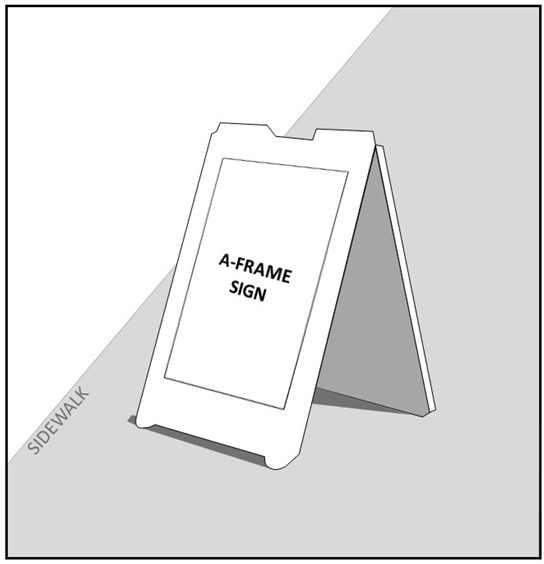
Alteration means a change in a sign's size, shape, electrical display, position, location, construction or supporting structure.
Animated sign means a sign that contains visible moving parts, flashing or osculating lights, visible mechanical movement of any description, or other apparent visible movement achieved by any means that move, change, flash, osculate or visibly alters in appearance in a manner that is not permitted by these regulations.
Attached sign means a sign painted on, attached, or affixed to a building including, but not limited to a wall, awning, canopy, blade, marquee, or projecting sign.
Awning means a shelter supported entirely from the exterior wall of a building.
Awning sign means a sign that is attached to or painted onto an awning, canopy, or other fabric, plastic or structural protective cover over a door, entrance, window, or outdoor service area.
Figure 113-670(2): Awning sign example.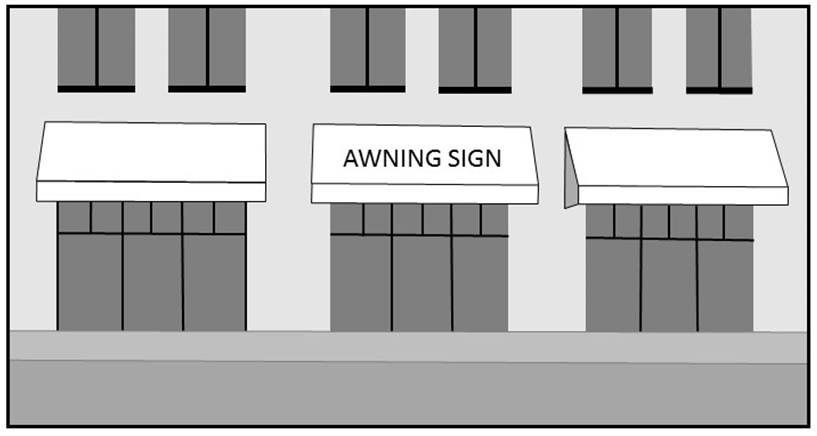
Balloon sign means an inflatable circular or round object tethered in a fixed location that displays signage either on its surface or as an attachment.
Figure 113-670(3): Balloon sign example.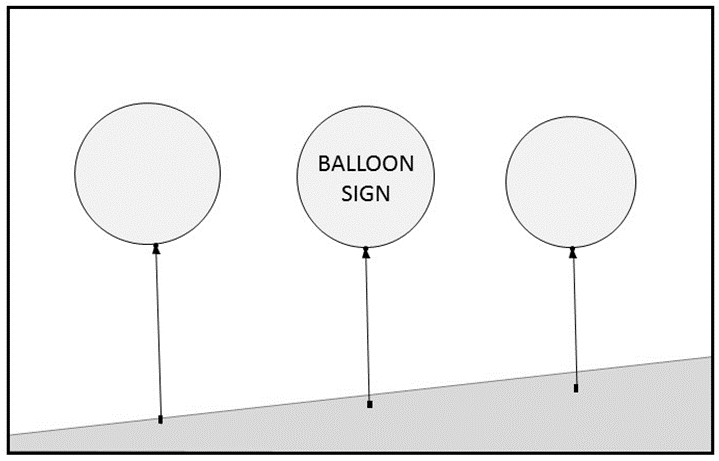
Banner sign means a sign located on flexible substrate or lightweight fabric or similar material attached at one or more edges to a pole, building, or structure. A flag is not considered a banner.
Figure 113-670(4): Banner sign example.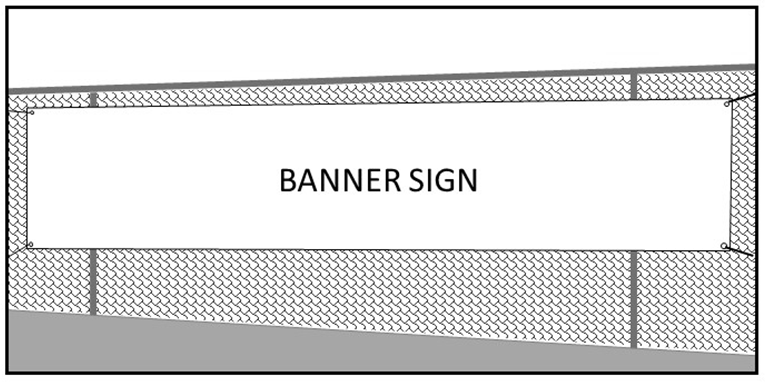
Beacon means a strong or bright light focused in one or more directions.
Bench sign means a sign applied or affixed to the seat or back of a bench.
Figure 113-670(5): Bench sign example.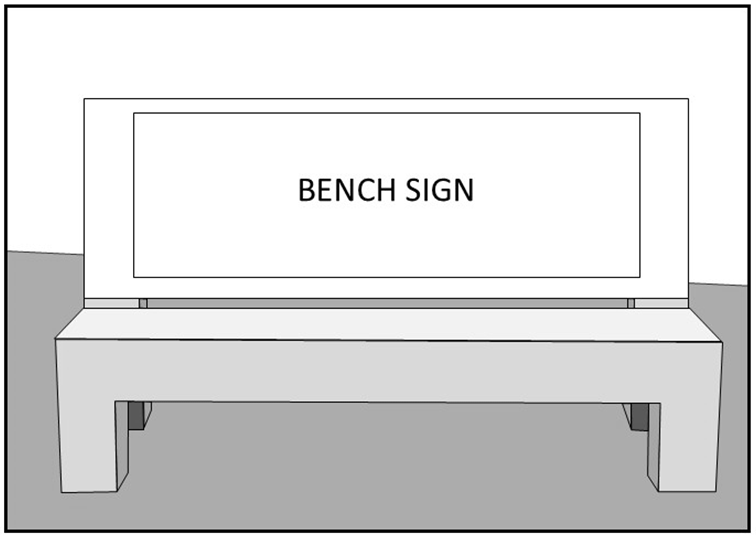
Billboard means a detached pole sign specifically oriented toward vehicular traffic on expressways, highways, and arterial streets with a total area in excess of 450 square feet.
Canopy means an overhead structure that provides weather protection for pedestrians. Awnings and marquees (defined herein) are different types of canopies.
Canopy sign means a sign that is part of, or attached to, a canopy cover or canopy structure.
Figure 113-670(6): Canopy sign examples.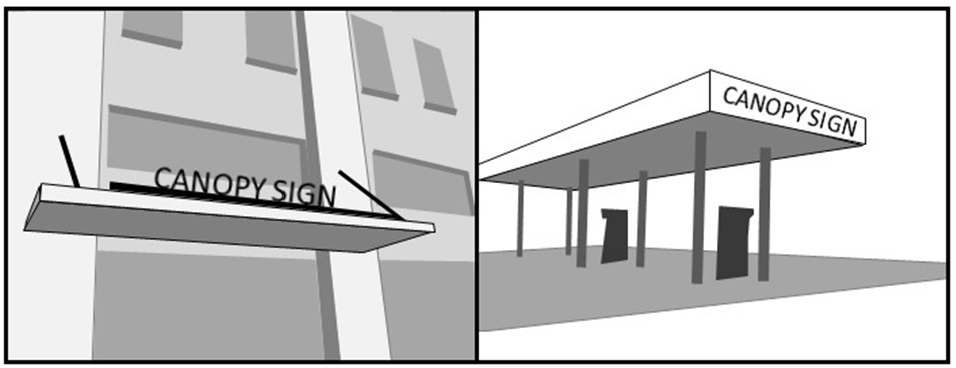
Changeable copy or message sign means a sign or portion thereof with characters, letters, or illustrations that can be changed or rearranged without altering the face or surface of the sign.
Conforming sign means a sign that is legally installed in conformance to all prevailing jurisdictional laws and ordinances.
Copy means the graphic content or message of a sign.
Detached sign means a sign that is not affixed or attached to a building. Detached sign may describe a pole, pylon, billboard, or monument sign.
Double-faced sign means a sign with two faces that are oriented back to back.
Drive-through sign means a sign that is specifically oriented toward vehicles within a drive-through queue and is not oriented toward traffic on a public right-of-way, regardless of sign content.
Electric sign means a sign activated or illuminated by means of electrical energy.
Electronic variable message [EVM] sign means an electrically activated changeable sign whose variable message and/or graphic presentation capability can be electronically programmed by computer from a remote location. EVMs typically use light emitting diodes (LEDs) as a lighting source.
Flag means fabric or bunting containing colors, patterns, symbols, or copy that can be raised and lowered on a flag pole. A photo, drawing or similar depiction of a flag on non-fabric material is not included in this definition. A feather sign is also not included in this definition.
Feather sign means a vertical portable sign that contains a harpoon-style pole or staff driven into the ground for support or supported by means of an individual stand.
Figure 113-670(7): Feather sign example.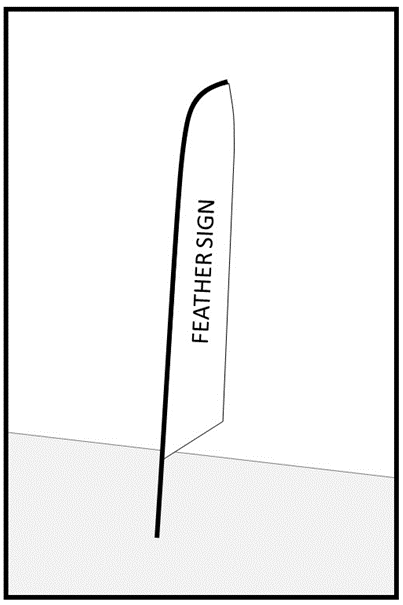
Grade means the elevation or level of the street closest to the sign to which reference is made, as measured at the street's centerline, or the relative ground level in the immediate vicinity of the sign.
Hanging sign means a sign that is hung perpendicular to a building façade beneath the underside of an awning, canopy, or other structural protective cover over a door, entrance, window, or outdoor service area.
Figure 113-670(8): Hanging sign example.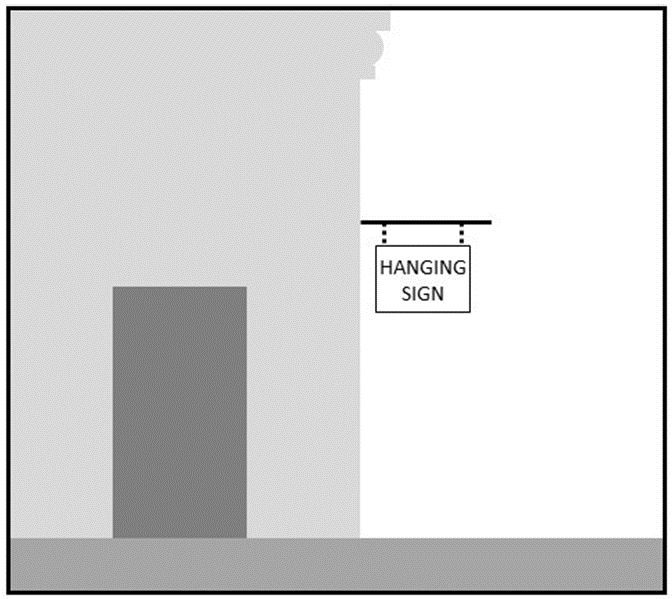
Home business or home occupation sign means a sign located in a residential district in conjunction with a home business or home occupation.
Illuminated sign means a sign for which an artificial source of light is used in order to make readable the sign's message, including internally and externally lighted signs and reflectorized, glowing or radiating signs.
Inflatable sign means a sign that is not a round/circular shape (i.e. balloon sign) but is displayed via air inflation.
Figure 113-670(9): Inflatable sign example.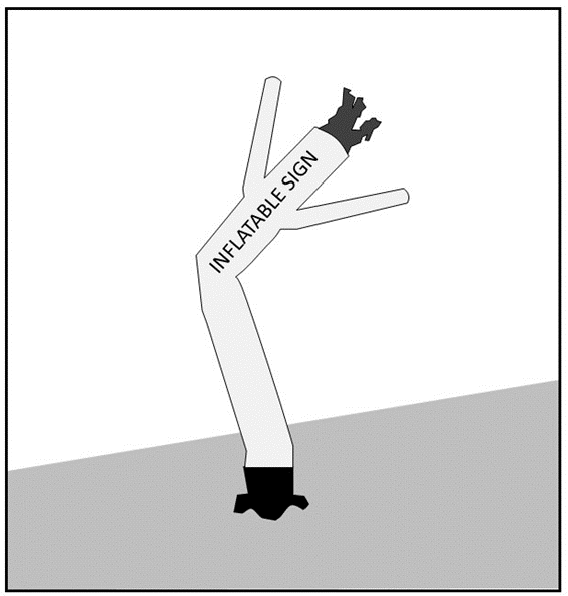
Legal nonconforming sign means a sign that was lawfully maintained and had been lawfully erected in accordance with the provisions of any prior sign ordinance or code before the effective date of this chapter, but does not conform to the applicable limitations established by this chapter to-date.
Marquee sign means a permanent roofed structure attached to and projecting beyond a building or extending along and projecting beyond the wall of the building, generally designed and constructed to provide protection from the weather.
Figure 113-670(10): Marquee sign example.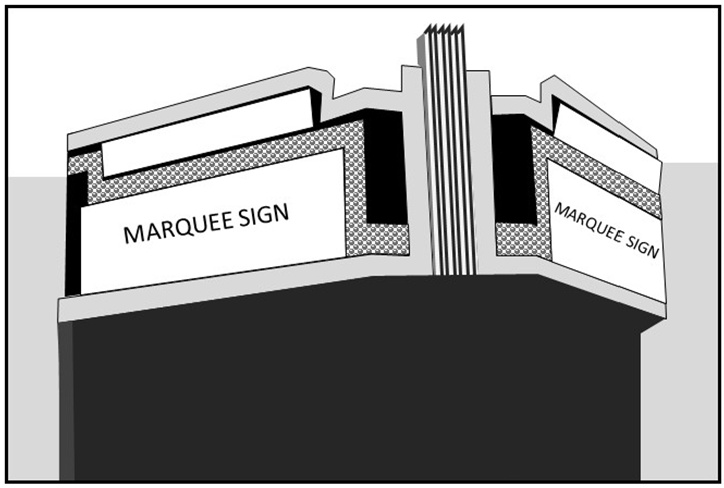
Monument sign means a detached, low, freestanding sign with the entire length of the sign in contact with the ground or a pedestal that rests upon the ground. A monument sign must not exceed a maximum height of eight feet, except as provided for in section 113-643(b)(3) of this Code, as measured from grade. See pole sign or pylon sign for other types of detached signage.
Figure 113-670(11): Monument sign example.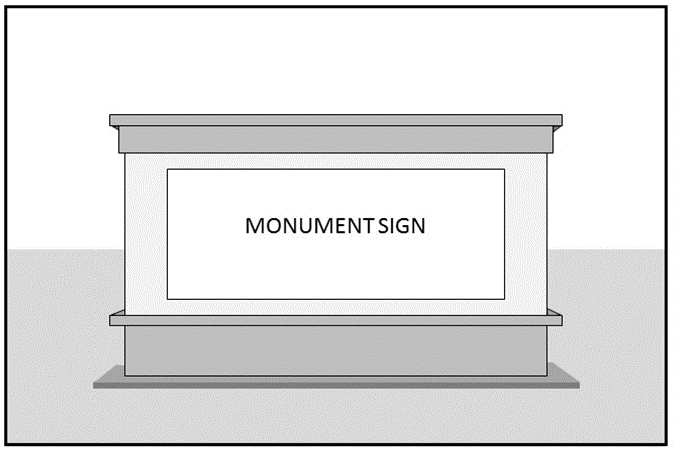
Nonconforming (or pre-existing) sign means a sign that does not comply with the requirements of this Code and is legally permitted to remain because the sign was in existence on or before the effective date of this Code.
Pole sign or pylon sign means a sign anchored directly to the ground or supported by one or more posts, columns, or other vertical structures or supports and not attached to or dependent for support from any building.
Portable sign means a sign, display or advertising device designed for movement or transportation; which is not attached permanently to a foundation or a permanent location on site. Portable signs include, but are not limited to, signs mounted upon a trailer, wheeled carrier or other non-motorized mobile structure, with wheels or with wheels removed.
Projecting sign means a sign affixed to a building or wall in such a manner that its leading edge extends more than six inches beyond the surface of such building or wall.
Figure 113-670(12): Projecting sign example.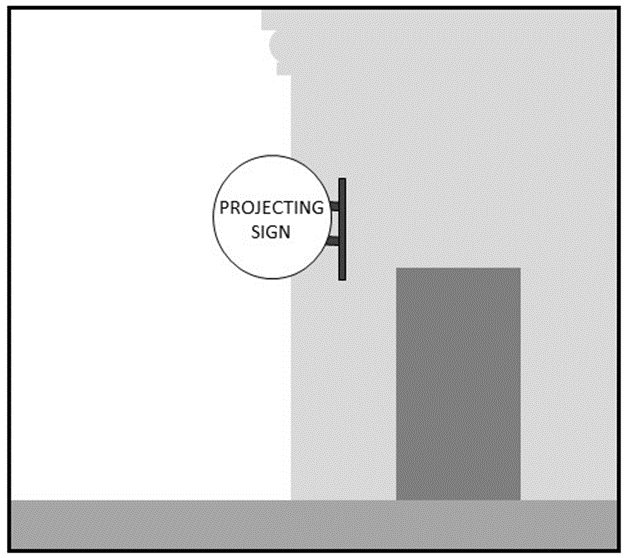
Public sign means a sign owned by a governmental entity and installed by a governmental official or employee in the performance of his or her public duty. Such signs include, but are not limited to safety, danger, trespassing, traffic control, memorial, and historic landmark signs.
Revolving or rotating sign means a sign whose sign face is designed to move or turn on any axis.
Roof sign means a sign constructed on the roof of a building and supported by the roof structure or that is attached to the roof of a building that projects above the parapet wall or apex of the roof to which it is attached.
Figure 113-670(13): Roof sign example.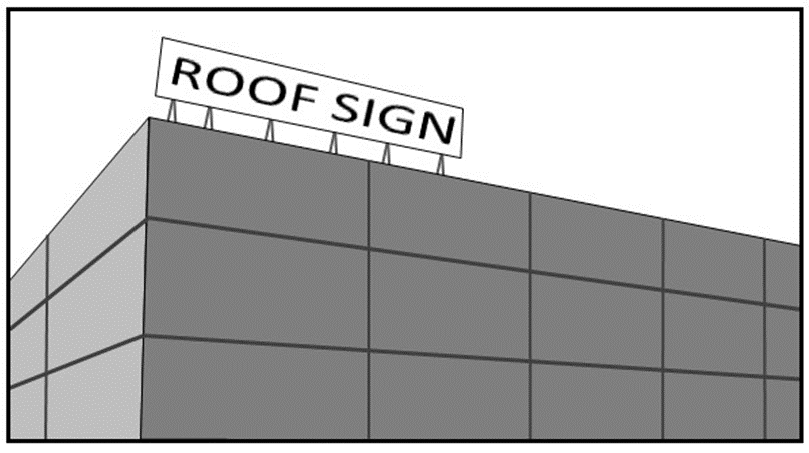
Searchlight means a strong or bright light with a reflector in a swivel capable of directing a beam of light in various directions.
Sign means any structure, display, device or inscription bearing graphics, symbols or written copy, which is located upon, attached to, or painted or represented on any land, building or structure, or on an awning, canopy, marquee, or similar appendage, and which displays or includes any numeral, letter work, model, banner, emblem, insignia, symbol, device, light, trademark, or other representation.
Sign area means the entire area of a sign on which copy is to be placed calculated in accordance with this article.
Sign face means the part of the sign that bears graphics, symbols, or written copy. "Sign face" also includes any background material, panel, trim, frame, color and direct or self-illumination that differentiates the sign from the building, structure, backdrop surface or object upon which or against which it is placed. The sign structure is not included as a portion of the sign face provided that no message, symbol or any of the aforementioned sign face criteria are displayed on or designed as part of the sign structure, unless it is outlined in neon or other lighting.
Sign height means the vertical distance as measured from the finished grade to the highest point of either the sign or sign structure, whichever is greater.
Snipe sign means a temporary sign which is tacked, nailed, posted, pasted, glued or otherwise attached to poles, stakes, fences, or to other like objects.
Street banner sign means a banner sign that is stretched across or hung over a public right-of-way.
Temporary sign means a nonpermanent sign including, but not limited to, balloon signs, banners, feather signs, snipe signs, and portable signs. Attributes of a temporary sign may include, but are not limited to, wooden stakes as a support structure, cloth, fabric, plastic wallboard or other like materials intended to be displayed for a limited period of time.
Vehicle sign means a sign displayed on or from any mode of transportation, including but not limited to cars, buses, trucks/trailers, trains, boats, or airplanes.
Wall means any member or group of members which defines the exterior boundaries of a building. The height of a wall is measured from the average finish grade of the particular architectural building elevation adjacent to the wall to the finish roof plane.
Wall sign means a sign attached to or painted directly on a wall; a sign constructed against the wall of a building being parallel or approximately parallel to said wall; a sign located no more than six inches from a wall or building, and a sign erected and confined within the limits of the outside wall of any building or structure, which is supported by such wall or building and displays only one sign surface.
Window sign means a sign placed inside a window or door, upon the panes of glass of a window or door, and visible from the exterior of the window or door.

