
St John The Baptist Parish
City Zoning Code
City Zoning Code
ARTICLE VII
PARKING.
Sec. 113-676.- Purpose and intent.
This article establishes standards for off-street parking in order to:
(1)
Comply with and implement the goals and objectives of the comprehensive plan, adopted by the planning commission on September 15, 2014.
(2)
Provide a minimum number of off-street parking spaces for any building, structural improvement or place of assembly in proportion to the calculated demands of the proposed use.
Clarification: Parishwide on-street parking regulations are provided in chapter 26, article IV - stopping, standing and parking.
(3)
Provide accessible, attractive, secure and well-maintained off-street parking areas.
(4)
Increase public safety by reducing parking congestion on public streets through the appropriate storage of vehicles on-site.
(5)
Encourage the use of alternative modes of transportation and creative solutions to stormwater management which reduce parking demand and provide for more sustainable development patterns Parishwide.
(6)
Protect the character of all residential neighborhoods, including, but not limited to rural, historic and/or distinct areas of the parish.
(7)
Ensure that incompatible non-residential uses are not located in residential areas in order to maintain the viability of existing residential neighborhoods.
(Ord. No. 18-16, § V, 6-2-2018)
Sec. 113-677. - Severability.
If any section, subsection, sentence, clause or phrase of this article is, for any reason, held unconstitutional or invalid, such decision or holding will not affect the validity of the remaining portions hereof. It being the intent of the parish council to enact each section and portion thereof, individually and each such section will stand alone, if necessary, and be in force not with the validity of any other division, section, subsection, sentence, clause, or phrase of these regulations.
(Ord. No. 18-16, § V, 6-2-2018)
Sec. 113-678. - Applicability.
(a)
The provisions of this article apply in the following circumstances:
(1)
New development. All new development must provide off-street parking in accordance with the regulations of this article.
(2)
Existing development. The existing number of off-street parking spaces must not be reduced below the minimum requirements of this article. Further, existing deficiencies must not be exacerbated.
(3)
Damage or destruction. When a structure on a site with an insufficient number of off-street parking spaces is destroyed by force majeure or acts of public enemy, restoration provisions will be in accordance with sction 113-51 of this Code.
(4)
Change in use. If an existing development experiences a change in use (i.e. through application for an occupational license or a building permit) that results in a higher calculated number of required parking spaces than the previous use, than all required parking spaces must be provided, except as otherwise provided for in section 113-678(b)(1) below.
(5)
Intensification of use. If the intensity of a use is increased such that there is an increase in the required number of parking spaces (e.g. expansion of a building's footprint), than additional parking spaces must be provided, except as otherwise provided for in section 113-678(b)(1) below.
(6)
Restriping of existing parking. If there is restriping of an existing parking area that results in a reconfiguration of the layout, design or number of parking spaces provided, than compliance with this article is required.
(7)
Heavy commercial vehicles. Unless otherwise provided, the off-street parking of any heavy commercial vehicle on a residential site, as defined in section 113-1, definitions of this Code, shall be prohibited.
(8)
Vehicle storage. To avoid the development of any temporary or informal parking lot within residential districts or areas, the storage of vehicles on a residential site must not exceed 75 percent of a site's total area.
a.
Parking scenarios as described in section 113-678(7),(8) above, will be cited as zoning violations and processed in accordance with section 26-23 of this Code.
b.
Total site area will be equal to the rear, sides and front undeveloped portions of a site visible from the public street or an adjacent site, including parking pads or concrete slabs.
(b)
Exemptions. Compliance with the regulations of this article will not be required in the following circumstances:
(1)
Change in number of spaces less than ten percent or one space. When a change in or intensification of use necessitates additional parking, compliance is required only if the change exceeds ten percent of the number of required parking spaces for the previous use or previous intensity or if the change exceeds more than one additional space.
(2)
Temporary uses. Temporary uses are exempt from the provisions of this article.
(3)
Heavy commercial vehicles may be parked or stored off-street under the following temporary circumstances:
a.
Emergency vehicles parked while said vehicle and its operator are on call for emergency services; or
b.
Vehicles and persons actually engaged in repairing or otherwise improving public utilities or infrastructure or performing other activities authorized by the parish; or
c.
Vehicles parked for the purpose of delivering, picking up materials or merchandise, or performing services for the actual time necessary to accomplish said delivery, pick up, or service.
(4)
Vehicle storage on residential sites may be permitted in accordance with chapter 26, article V.
(5)
Modular office buildings associated with lay-down yards and similar outdoor industrial storage uses are exempt from the provisions of this article provided the structure is set back at least 300 feet from the front property line.
(Ord. No. 18-16, § V, 6-2-2018)
Sec. 113-679. - Compliance with other regulations.
All parking and access areas required by this article must be in compliance with all applicable Federal and State regulations, including the Americans with Disabilities Act of 1990 (ADA), as amended.
(Ord. No. 18-16, § V, 6-2-2018)
Sec. 113-680. - Required number of parking spaces.
(a)
Required off-street parking for specific land uses. When off-street parking is required by this article, the minimum required number of parking spaces will be in accordance with table 113-680(1) below:
Table 113-680(1): Parking requirements for specific land uses.
Note: GSA refers to gross surface area and GFA refers to gross floor area.
(b)
Uses not specified. For uses not specifically mentioned in this section, the planning and zoning director, or his/her designee, may determine the required number of parking spaces based upon a similar use.
(c)
Mixed-use development sites. When a development site contains a mix of land uses, the required number of parking spaces will be calculated by combining all separate uses into a total number of parking spaces required for the development site, except for shopping centers, and may be reduced in accordance with section 113-682(e).
(d)
Fractions. When the calculation of a site's required number of parking spaces results in a fraction of 0.5 or more, the result will be rounded upward to the next highest whole number. When such calculation results in a fraction of 0.49 or less, the result will be rounded downward to the next lowest whole number.
(e)
Minimum number of off-street parking spaces. All non-residential uses must provide a minimum of three parking spaces.
(f)
Excess off-street parking spaces. When new construction of a non-residential use is proposed with over 120 percent of the required number of off-street parking spaces and the total number of required spaces provided exceeds 100, the use of a permeable pavement system in compliance with the regulations listed in section 113-681(c) is required for the spaces in excess of 120 percent.
(g)
Shared parking. Parking requirements for two or more uses of the same or different type may be satisfied by the allocation of a common or collective parking facility when such uses adjoin the area to be allocated for the parking facility and are not zoned residential. The use of shared parking will entitle the development site to a 20 percent reduction in the number of required off-street parking spaces. Verification must be made through submittal of a parking dedication or servitude recorded with the clerk of court.
(Ord. No. 18-16, § V, 6-2-2018; Ord. No. 18-31, § XVIII, 10-9-2018)
Sec. 113-681. - Design standards for parking areas.
(a)
Location.
(1)
Off-street parking for single-family and two-family dwellings must be provided on the same lot as the principal building or an adjacent lot in shared ownership.
(2)
Off-street parking for all other uses (multi-family, commercial, industrial, etc.) may be located up to 300 feet away from the principal building or site, provided the zoning district of the lot to be used for off-site parking is the same or more permissive than the zoning for the principal building's lot. Such situations must be effectuated through submittal of a parking dedication or servitude recorded with the clerk of court and approved by the planning and zoning director.
(3)
Notwithstanding any other regulations, pavement cannot be constructed within the Parish drainage or utility easements, except as approved by the department of public works or department of utilities.
(4)
Required landscaping areas must not be used for parking or vehicle inventory display.
(b)
Dimensions. At minimum, off-street parking spaces must be designed in accordance with the figure 113-681(1) and table 113-681(1) below:
Figure 113-681(1): Off-street parking space design.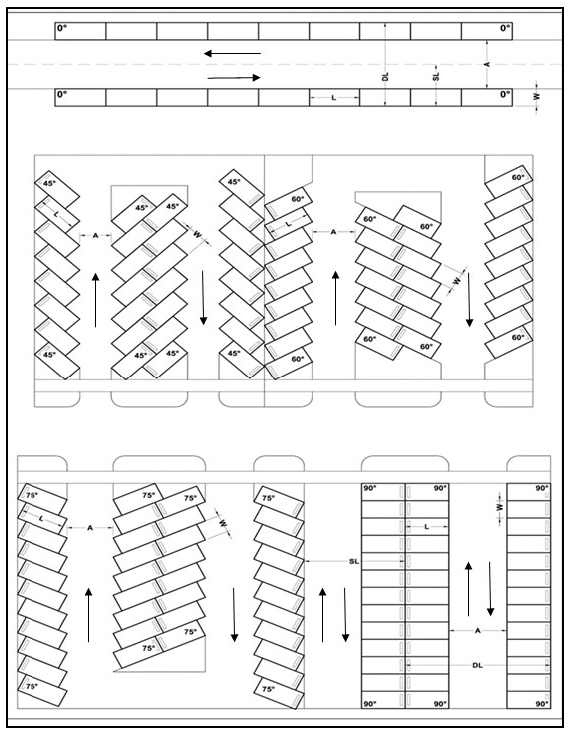
Table 113-681(1): Off-street parking space design.
a Two-way traffic permitted.
b A module is defined as a drive aisle with automobiles parked on either one side (single) or both sides (double) of the drive aisle.
c Single-family and two-family homes, bed and breakfasts, boarding houses, community homes and food services containing drive-thru stacking areas may utilize drive aisles to meet the parking requirements of this article.
(c)
Surfacing. When off-street parking is required, the parking area must be surfaced with a permanent, dust-free paving or surfacing method, except as otherwise provided for in this article. Permeable paving systems or other surfacing methods that allow for the infiltration of stormwater are preferred.
(1)
Permeable pavement systems: Permeable pavement systems are preferred and permitted when compliant with all of the following:
a.
The system must be capable of supporting an emergency vehicle (standard fire truck) without damage to the system as certified by a licensed engineer, noted on the plans, or as indicated in the system specifications issued by the manufacturer. The property owner and/or occupant shall indemnify and hold harmless the parish from any loss or damage to the pavement system that may directly or indirectly be occasioned by the provision of emergency services or parking of emergency vehicles on the site.
b.
If pavers are employed, there must be a minimum space between units of 1/4 inch. The system must maintain a minimum infiltration rate of 200 inches per hour as certified by a licensed engineer, noted on the plans, or as indicated in the system specifications issued by the manufacturer.
c.
The system must be adequately drained to eliminate standing water over 24 hours and prevent damage to adjacent property and/or public streets or alleys as certified by a licensed engineer, noted on the plans, or as indicated in the system specifications issued by the manufacturer.
d.
The system must not pose any negative impact to abutting properties or rights-of-way, and must not allow dust or media to be transferred outside of the subject site.
e.
All proposals for a permeable pavement system must include a maintenance plan and must remain properly maintained by the property owner.
(2)
Gravel surfacing.
a.
Locations. Dust-free shells, gravel, and crushed stone surface materials may only be permitted in the following zoning districts, historic districts, and sites:
1.
Rural District.
2.
Garyville Historic District.
3.
LaPlace Historic District.
4.
River Road Historic District: The Historic Towns of Edgard, Lucy and Wallace.
5.
Reserve Historic District.
6.
Any designated local landmark site.
7.
Individual mobile home sites.
8.
Mobile home parks.
9.
Campgrounds.
b.
Design standards. When gravel surfacing is employed, all of the following conditions must be met:
1.
Permanent apron. In order to retain gravel or similar movable Permeable materials on site, a dust-free concrete, asphalt, stone, or similarly constructed permanent apron at least ten feet in depth must be provided between the street and the shortest side of the driveway or accessway.
2.
Edge restraints. Along the edges of parking areas, some form of edge restraints (for example: bricks, stone, or concrete curbing) must be provided to keep movable driveway/parking materials in place.
3.
Commercial gravel parking areas. Any gravel surfacing to be used within a commercial site as a parking area must be part of a stabilized gravel system including plastic (or similar material) grid pavers filled with gravel or organic fill, such that the fill material is stabilized to prevent displacement, compaction, and washout. Such system must be compliant with the criteria listed in section 113-681(c)(1)(a) through (e) above.
(3)
All single-family and two-family dwellings are permitted to construct driveways that consist of two concrete wheel strips, each of which is at least 18 inches wide. A permeable surface (i.e. grass, rocks, shells, etc.) must be maintained between such wheel strips. Both concrete wheel strips and permeable surface must be maintained in a smooth, dust-free, orderly, and clean condition. Under these circumstances, the concrete wheel strips may be permitted to function as required edge restraints for gravel surfacing.
(d)
Striping. When three or more off-street, paved parking spaces are required, spaces must be marked by clearly visible painted lines, curbs, or other means to effectively indicate individual spaces.
(e)
Access. Access to a parking area from a public right-of-way must comply with the following standards:
(1)
Number. A development site is permitted one two-way accessway or two one-way accessways per 100 feet of lot frontage. No more than two accessways are permitted on a development site. Corner lots are permitted no more than three accessways.
(2)
Design. A two-way accessway may be no more than 35 feet wide. A one-way accessway may be no more than 20 feet wide.
(3)
Spacing. An accessway must be a distance of at least 25 feet from another accessway on either the same site or neighboring site.
(4)
Residential uses. Residential uses with fewer than fourunits are exempt from this subsection.
(f)
Wheel stops. When three or more off-street parking spaces are required, wheel stops must be provided to prevent vehicles from damaging or encroaching upon any adjacent parking space, sidewalk, landscaped area, or parking lot island, fence, wall or building.
(g)
Curbing. When three or more off-street parking spaces are required, curbing must be provided to prevent vehicles from damaging or encroaching upon any adjacent parking spaces, sidewalk, landscaped area, or parking lot island, fence, wall or building. Curbing must be at least six inches in height.
(h)
Drainage and maintenance.
(1)
Off-street parking areas must be adequately drained to eliminate standing water over 24 hours and prevent damage to adjacent property and/or public streets or alleys.
(2)
It is the responsibility of the property owner to maintain off-street parking areas in a clean, orderly, and dust-free condition. Clarification: gravel and similarly loose surface material must be retained on-site.
(3)
The property owner is responsible for drainage and maintenance of all paved or surfaced area on site and shall indemnify and hold harmless the parish from any loss or damage to the site or property that may directly or indirectly result from insufficient drainage of the site.
(i)
Lighting.
(1)
Adequate lighting must be provided if off-street parking spaces are to be used at night.
(2)
Lighting shall not be aimed, directed, or reflected, focused, or mounted to cause direct light from the luminaire to be directed toward residential uses, or to create up light, spill light, or glare perceptible to persons operating motor vehicles on public ways.
(3)
The maximum permitted illumination at any property line abutting a residential district or use is 0.5 foot-candles.
(4)
Prohibited light sources. The installation of any mercury-vapor fixture or lamp for use as outdoor lighting is prohibited.
(5)
Enforcement. If any luminaire is aimed, directed, reflected, focused, or mounted to cause direct light from the luminaire to be directed toward residential uses, or to create up light, spill light, or glare perceptible to persons operating motor vehicles on public ways, the luminaire shall be redirected or relocated, its height remounted, or its light output and illumination levels controlled as necessary and determined by the Planning and Zoning Department to eliminate such conditions.
(j)
Safe and efficient site design.
(1)
Parking spaces may not immediately back out onto any public rights-of-way or roads, as illustrated in figure 113-681(2) below:
Figure 113-681(2): Back out parking onto public roads prohibited.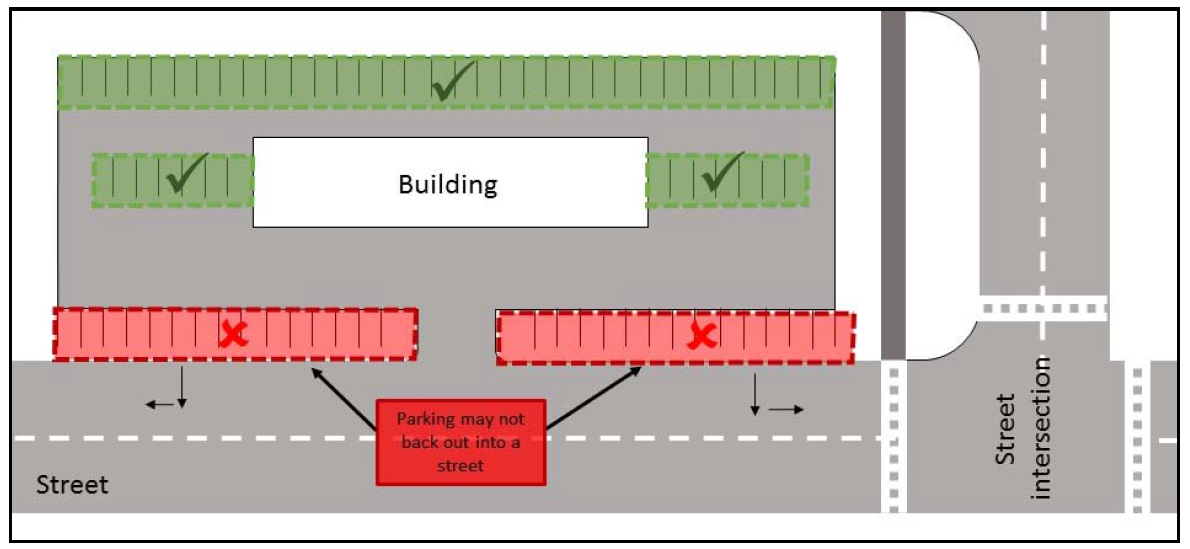
(2)
Parking spaces must observe a 15-foot sight triangle setback along the intersection of any public street or private accessway and a 35-foot sight triangle setback along any street intersection or site corner. Such sight triangles must be measured from the street curb or the edge of the pavement, whichever is nearest to the site, as illustrated in figure 113-681(3) below:
Figure 113-681(3): Required sight triangle setback areas.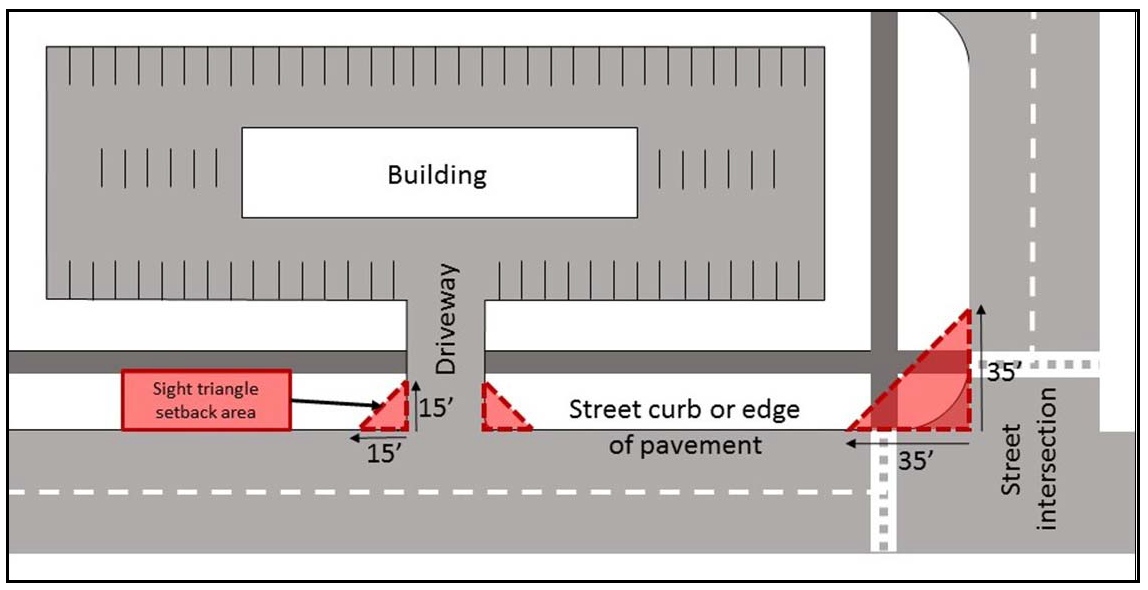
(Ord. No. 18-16, § V, 6-2-2018; Ord. No. 19-54, § V, 12-10-2019)
Sec. 113-682. - Parking reductions.
The following reductions may be permitted, subject to review and approval by the planning and zoning director.
(1)
Permeable pavement. The use of a permeable pavement system in compliance with the regulations listed in section 113-681(c) for the total number of off-street parking spaces will entitle the same development site to a 15 percent reduction in the total required number of parking spaces.
(2)
Pedestrian-oriented development. The placement of a principal building with its primary entrance oriented towards the sidewalk and/or public street, such that all parking is located behind the front building line, will entitle a development site to a 15 percent reduction in the total required number of parking spaces.
(3)
Bicycle parking. The inclusion of any number of bicycle parking spaces will entitle a development site to a reduction of one required parking space.
(4)
Tree preservation. The preservation of existing, noninvasive, native trees species over 24 inches in diameter at breast height and in good health will entitle the development site to a reduction in the required number of parking spaces by one space for every tree within the parking area, not to exceed five percent of the total required number of parking spaces.
(5)
Mixed-use development sites. The development of a site with a mix of both residential and commercial uses will entitle the same site to a 20 percent reduction in the total required number of parking spaces.
(6)
Maximum reduction. The maximum parking reduction available for any development site is 30 percent of the total required number of parking spaces.
(Ord. No. 18-16, § V, 6-2-2018)

