
Stanton City Zoning Code
CHAPTER 18
- SIGNS
Sec. 18.01. - Purpose & intent.
a)
This article is intended to regulate the size, number, location and manner of display of signs in the City of Stanton consistent with the following purposes:
1)
To protect and further the health, safety and welfare of residents, property owners, and visitors.
2)
To prevent traffic hazards and pedestrian accidents caused by signs which obstruct vision, distract or confuse drivers, or are improperly secured or constructed.
3)
To conserve and enhance community character.
4)
To promote uniformity in the size, number, or placement of signs within zoning districts.
5)
To promote the economic viability of commercial areas by minimizing visual clutter and allowing for placement of signs to safely direct motorists to their destination.
6)
To balance the public's right to be informed and its desire to avoid visual pollution and hazardous conditions with the communication rights of businesses and other non-business uses.
7)
To recognize that special circumstances or events may create a need for temporary signage for a limited and reasonable period of time.
8)
The purpose of this article does not include the regulation of the content or any information included on the sign.
b)
Substitution clause. Signs which contain noncommercial speech are permitted anywhere that advertising or business signs are permitted subject to the same regulations applicable to such signs. The owner of any sign which is otherwise allowed by this article may substitute noncommercial language in lieu of any other commercial or noncommercial language.
This substitution may be made without any additional approval or permitting. The purpose of this provision is to prevent an inadvertent favoring of commercial speech over noncommercial speech or favoring of any particular noncommercial message over any other noncommercial message.
Sec. 18.02. - Definitions.
Abandoned sign: A sign which no longer identifies or advertises a currently operating business, lessee, service, owner, product, or activity, and/or for which no legal owner can be found.
Balloon sign: (See Inflatable sign.)
Banner sign: A portable sign of fabric, nylon, plastic, or other non-rigid material without an enclosing structural framework attached to or hung from a pole or rope or to a building or structure. Banner signs also mean include flag signs, feather flags, and flutter flag signs.
Commercial establishment: A business operating independent of any other business located in a freestanding building; in a strip mall, a business completely separated from other businesses by walls from the ground up and with a door which may regularly be used by the public for exclusive ingress and egress to that business; in an enclosed structure with a shared climate controlled area, a business completely separated from other businesses by walls from the ground up and with a door or entrance which may regularly be used by the public for exclusive ingress and egress to that business and which may be closed to the public even while the common area is open to the public; and in an office building, a business holding itself out to the public as a single entity, independent of other businesses or persons.
Directional sign: A sign used primarily to give information about locations or possible destinations to a driver of a motorized vehicle, a pedestrian, bicyclist or others. Although this is a content-based distinction, these signs are important to prevent public confusion and facilitate collision-free flow of traffic.
Electronic reader board/digital display sign: A sign or portion thereof that displays electronic, digital, pictorial, or text information in which alphanumeric characters, graphics, or symbols are defined by a small number of matrix elements using different combinations of light emitting diodes (LEDs), fiber optics, light bulbs, or other illumination devices within the display area. Such signs can include computer programmable, microprocessor controlled electronic displays, and video display signs.
Festoons: A string of ribbons, tinsel, flags, pennants or pinwheels.
Flag sign: See Banner sign.
Freestanding sign: A sign not attached to a building or wall which is supported by one or more poles or braces or which rests on the ground or on a foundation resting on the ground.
Government sign: A sign erected, permitted by, or required to be erected by a government agency.
Ground sign: A freestanding sign supported by a base resting directly on the ground. The width of the base shall be at least 50 percent of the width of the sign in order to be a ground sign.
Identification sign: A sign intended to communicate information about services and facilities. Although this is a content-based distinction, these signs are important to prevent public confusion and facilitate collision-free flow of traffic.
Illuminated sign: A sign that provides artificial light directly (or through any transparent or translucent material) from a source of light connected with the sign, or a sign illuminated by a light shielded so that no direct rays from it are visible from any public right-of-way or from the abutting property.
Inflatable sign: Any three-dimensional object, including a tethered balloon, capable of being filled with air or gas depicting a container, figure, product, or product trademark, whether or not such object contains a message or lettering.
Mansard: A sloped roof or roof-like façade architecturally comparable to a building wall.
Mansard sign: A sign that is mounted, painted on, or attached to a mansard.
Mural: A design or representation painted or drawn on a wall which does not advertise an establishment, product, service, or activity.
Manual sign: A sign on which the letters or pictorials are changed by hand.
Multi-vision sign: Any sign composed in whole or in part of a series of vertical or horizontal slats or cylinders that are capable of being rotated at intervals so that partial rotation of the group of slats or cylinders produces a different image or images.
Nonconforming sign: (also called a "legal nonconforming sign") A sign that does not comply with the size, placement, construction or other standards or regulations of this chapter or article but was lawfully established prior to its adoption. Signs for which the zoning board of appeals has granted a variance are exempt and shall not be defined as nonconforming.
Painted wall sign: A sign which is applied with paint or similar substance on the face of a wall or the roof of a building.
Pennant: A flag or cloth that tapers to a point.
Permanent sign: A sign installed on a support structure, not intended to be moved or removed, but to remain for an indefinite period of time.
Pole sign: A freestanding sign which is supported by a structure, or poles, or braces. The width of the supporting structures must be less than 50 percent of the width of the sign.
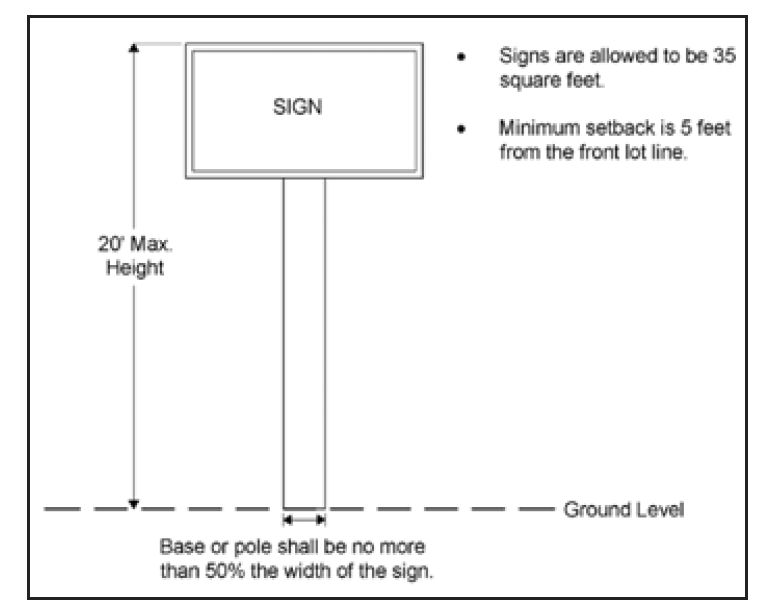
Figure 18-1
Projecting sign: A display sign which is attached directly to the building wall, extends more than 15 inches from the face of the wall and projects in such a way that the message is not parallel to the wall to which it is attached.
Right-of-way signs: Signs erected by the city, county, state, federal and other public/quasi-public agencies and located within the public right-of-way.
Roof line: The top of a roof or parapet wall, whichever is higher, but excluding any cupolas, chimneys, or other minor projections.
Roof sign: A sign erected above the roof line of a building.
Rotating sign: A sign in which the sign itself or any portion of the sign moves in a revolving or similar manner. Such motion does not refer to methods of changeable copy.
Sidewalk sign: An A-frame sign which is portable and designed to be placed on the sidewalk in front of the use it advertises. This may also be called a "sandwich board sign."
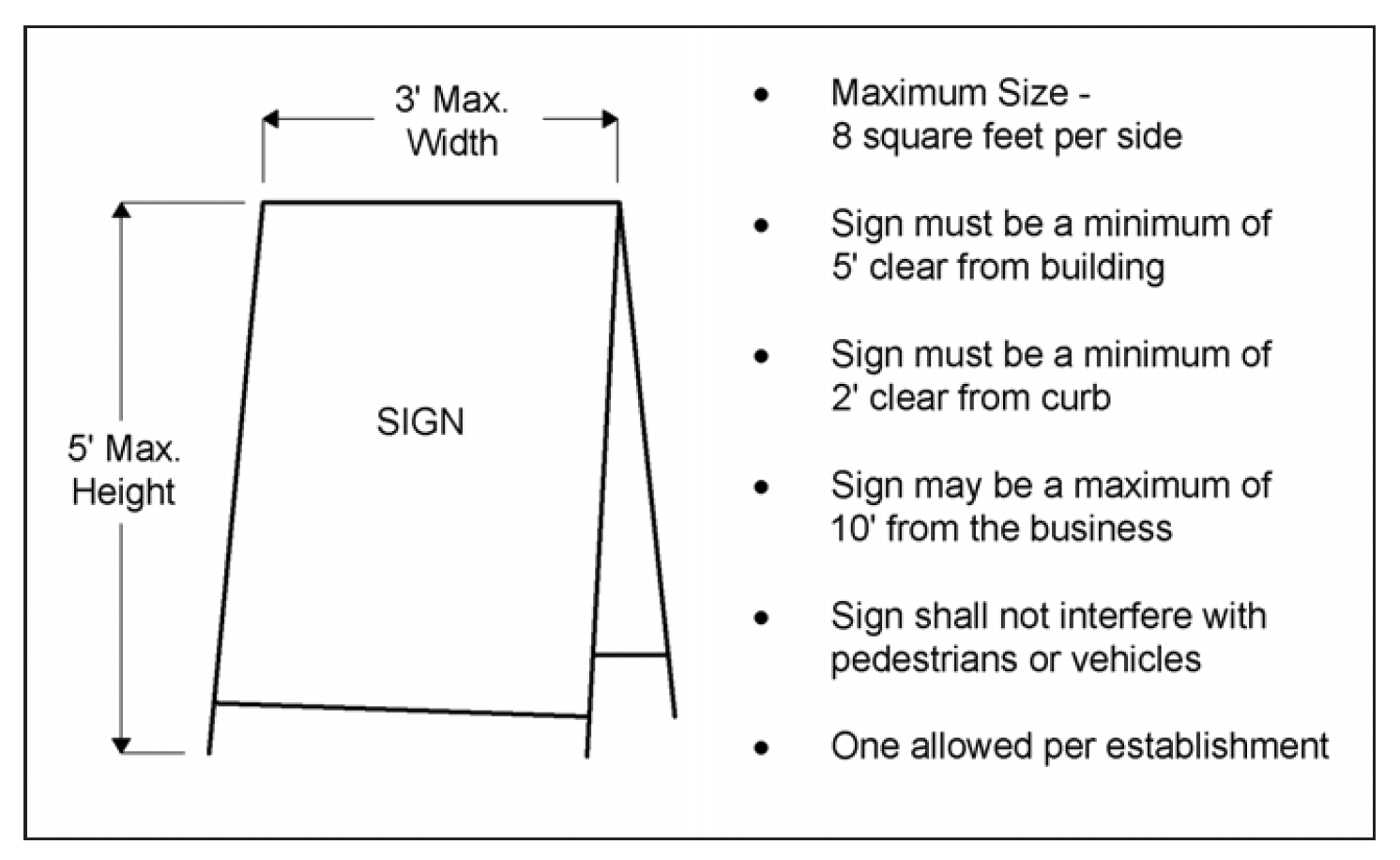
Figure 18-2
Sign: A device, structure, fixture, figure or placard which may or may not use graphics, symbols, emblems, numbers, lights and/or written copy designed specifically for the purpose of advertising, identifying, or directing attention to an establishment, product, service, person, place, organization, institution, activity, or idea.
Streamers: A long, narrow strip of material used as a decoration or symbol.
Temporary sign: A sign installed for a limited period of time, intended to be removed within a time period as specified herein.
Traffic warning sign: A sign that indicates a hazard ahead on a road that may not be readily apparent to a driver.
Video sign: a sign which displays moving images as on a television.
Wall sign: A sign painted or attached directly to and parallel to the exterior wall of a building extending no greater than 12 inches from the exterior face of a wall to which it is attached.
Window sign: A sign installed inside a window and intended to be viewed from the outside.
Sec. 18.03. - Signs prohibited.
A sign not expressly permitted by this chapter is prohibited. Specifically, the following types of signs are expressly prohibited:
a)
Any sign, including window signs, which have flashing, moving, oscillating, scrolling or blinking lights, except as may otherwise be permitted herein.
b)
Roof signs.
c)
Rotating signs.
d)
Searchlights, laser lights, strobe lights, and lights of a similar nature.
e)
A sign using the words "stop," "danger," or other words, phrases, symbols, or characters in such a manner as to interfere with, mislead, or confuse a vehicle driver. Although this is a content-based distinction, these signs must be prohibited to prevent public confusion, risks to safety, and traffic collisions.
Sec. 18.04. - Sign permit required.
a)
A sign permit shall be required for the erection and construction of all permanent signs except those exempted by section 18.05.
b)
Sign permits are also required for all temporary signs exceeding 20 sq. ft. unless specifically exempted. Permits for temporary signs shall specifically state a date or a time frame by which the sign must be removed.
c)
A sign permit is not required for ordinary maintenance of signs such as painting, cleaning and light replacement and alteration of sign message.
d)
Application information. An application for a sign permit shall be made to the city zoning administrator along with a fee as required by city commission resolution. The application, at a minimum, shall include the following:
1)
Name, address, and telephone number of applicant and the person, firm or corporation erecting the sign.
2)
Address or permanent parcel number of the property where the sign will be located.
3)
A sketch showing the location of the building, structure, or lot upon which the sign is to be attached or erected and showing the proposed sign in relation to buildings and structures along with setback from lot lines.
4)
An accurate drawing to scale of the plans and specifications, method of construction and attachment to structures or ground. If required by the zoning administrator, the applicant shall provide engineered stress sheets (sealed plans) and calculations showing that the structure is designed according to the requirements of the Montcalm County Building Code for wind load restrictions.
5)
Any required electrical permit shall be attached to the application.
6)
The zoning district in which the sign is to be located.
7)
Any other information which the zoning administrator may require in order to demonstrate compliance with this article.
8)
Signature of applicant or person, firm, or corporation erecting the sign.
9)
For temporary signs which require a permit the permit shall designate the days on which the sign may be displayed.
10)
The zoning administrator shall issue a sign permit if all provisions of this chapter and other applicable city regulations are met. A sign authorized by a permit shall be installed within six months of the date of issuance of the sign permit or else the permit shall expire. In the case of an expired permit, a new permit may be issued upon filing of a new application and fee.
Sec. 18.05. - Signs not requiring permit.
The following signs shall not require a sign permit but shall be subject to the requirements of section 18.06 and other applicable provisions of this section:
a)
Government signs.
b)
Window signs.
c)
Right-of-way signs.
d)
Ordinary maintenance of signs such as painting, cleaning and light replacement and alteration of sign message.
e)
Temporary signs less than 20 sq. ft. as permitted and regulated by the zoning district within which the sign is located.
f)
Signs which are three square feet or less in area.
g)
Directional, identification, traffic warning, or government signs, provided the size of each sign does not exceed four square feet and three feet in height and each sign is located at least five feet from any lot line.
h)
Flags of any nation, state, city, government, government authorized agency, or educational institution.
i)
Signs erected for ordering or viewing drive-through window services or products when adjacent to a drive-through window vehicle driving lane.
j)
Pennants, streamers and festoons.
k)
Wall signs which are four sq. ft. or less in area.
Sec. 18.06. - Requirements for all signs.
All signs including signs which do not require a permit are subject to the requirements of this section 18.06 and 18.08 and all other applicable requirements of this ordinance.
a)
Signs may be internally illuminated or, if externally illuminated, the source of the light shall be enclosed and directed to prevent the source of light from shining directly onto traffic or any residential district or property. For externally lit signs, the lighting fixture shall be mounted on the top only and the light fixture shielded so that light is directed downward so that no direct rays interfere with the vision of persons on adjacent streets or properties.
b)
Signs shall not be placed in, upon or over any public right-of-way, or alley, except as may be otherwise permitted by the Stanton City Commission or Michigan Department of Transportation.
c)
No light pole, utility pole, publicly owned landscaping, fire hydrant, or other supporting member shall be used for the placement of any sign unless specifically designed and approved for such use.
d)
A sign shall not, by reason of its position, shape, color, or other characteristic, interfere with, obstruct the view of, or be confused with any authorized traffic sign, signal, or device, or constitute a nuisance per se.
e)
A sign shall not, in the opinion of the zoning administrator, interfere with or obstruct the view of drivers or those on foot or bicycle, or create any type of safety hazard or distraction to vehicle drivers.
f)
No commercial vehicles or trailers, which in the opinion of the zoning administrator have the intended function of acting as a sign, shall be parked in any area abutting the street.
g)
No sign shall contain any moving or animated parts nor have the appearance of having any moving or animated parts.
h)
No wall sign shall extend beyond the edge of the wall to which it is affixed, and no wall sign shall extend above the roof line of a building.
i)
All ground, wall, and freestanding signs may include reader boards as permitted by section 18.07 herein.
j)
Signs shall not obstruct sidewalk passage of pedestrians.
k)
A window sign may consist of illuminated letters including neon lights.
l)
Unless otherwise specifically stated in chapter 12 regulating PUDs, and/or included in an approved PUD development plan, signs for uses or buildings located in the PUD district shall be subject to the sign limitations allowed for buildings or uses of a similar type built in the respective zoning districts.
m)
Signs used by or for services, businesses, attractions, activities, lessors, owners that are no longer in operation and the owner has demonstrated an intent to abandon the use or building, then the use shall be considered abandoned and the sign face shall be removed or replaced with a blank face within 90 days after written notification from the city to the sign owner, the property owner where the sign is located, or any other party having control over the sign. The determination of abandonment shall be made by the zoning administrator. Evidence of such intent may include, but is not limited to, the following:
1)
Discontinuance of utility service;
2)
Removal of building fixtures needed for the use;
3)
Property falling into disrepair;
4)
Elimination of postal service;
5)
Nonpayment of property taxes.
Sec. 18.07. - Sign measurement.
a)
The area of a sign is the entire area within a circle, triangle, or parallelogram enclosing the extreme limits of writing, representation, emblem, or any figure of similar character, together with any frame or other material or color forming an integral part of the display or used to differentiate such sign from the background against which it is placed; excluding the necessary supports or uprights on which the sign is placed.
b)
Where a sign has two or more faces, the combined area of all faces shall be included in determining the area of the sign, except that where two faces are placed back-to-back and are at no point more than two feet from one another, the area of the sign shall be taken as the area of one face. In the case of a sphere, the total area of the sphere is divided by two for purposes of determining the maximum permitted sign area.
c)
The height of a sign shall be measured as the vertical distance from the highest point of the sign to the grade of the adjacent street or the average grade of the ground immediately beneath the sign, whichever is less.
Sec. 18.08. - Electronic reader boards/digital signs.
Electronic reader boards/digital signs shall comply with the following regulations:
a)
An electronic reader board shall not consist of more than 75 percent of the allowable sign area except for signs which are 32 square feet or less in area.
b)
An electronic reader board shall not exceed a maximum illumination of 6,500 nits (candelas per square meter) during daylight hours and a maximum illumination of 325 nits (candelas per square meter) between dusk to dawn as measured at the sign's face at maximum brightness.
c)
Prior to the issuance of a sign permit for an electronic reader board, the applicant shall provide to the zoning administrator certification that the illumination settings for the sign comply with the maximum illumination requirements of this section.
d)
An electronic reader board shall be equipped with a brightness control sensor that allows for the brightness to be adjusted either manually or automatically.
e)
An electronic reader board sign shall not have a white background in order to reduce glare.
f)
An electronic reader board is allowed as a window sign and shall comply with the requirements for electronic reader boards as set forth in this article.
g)
Electronic reader boards legally in existence upon the effective date of this chapter shall be required to comply with the illumination requirements of this article insofar as practicable.
h)
Any premises or parcel on which an electronic reader board sign is located may also display a temporary sign in accordance with the requirements of this chapter.
Sec. 18.09. - Construction and maintenance of signs.
a)
All signs shall be constructed and maintained in accordance with the current Michigan construction code.
b)
Signs shall be maintained free of peeling paint or paper, fading, staining, rust, or other conditions which impair legibility.
c)
All signs, sign supports, frames, braces, wiring, guys and anchors shall be maintained in such a manner that they do not create a hazard for pedestrians and vehicles.
d)
All signs shall be designed to ensure a dead load and wind pressure in any direction of not less than 30 pounds per square foot of area. All signs shall be securely anchored or otherwise made immobile.
Sec. 18.10. - Nonconforming signs.
a)
Every legal permanent sign which does not conform to the height, size, area or location requirements of this chapter as of the date of the adoption of this ordinance, is hereby deemed to be nonconforming.
b)
Nonconforming signs may be maintained and repaired so as to continue the useful life of the sign but may not be altered, expanded, enlarged, or extended.
c)
A nonconforming sign may be diminished in size or dimension or the copy of the sign amended or changed without jeopardizing the privilege of nonconforming use.
d)
A sign accessory to a nonconforming use may be erected in the city in accordance with the sign regulations for the district in which the property is located.
e)
Nonconforming signs shall not:
1)
Be replaced or changed to another nonconforming sign;
2)
Be repaired if such repair involves any of the following:
3)
Necessitates the replacement of both the sign frame and sign panels;
4)
Replacement of the signs primary support pole(s) or other support structure;
5)
Be enhanced with any new feature including the addition of illumination;
6)
Be re-established after damage or destruction, if the replacement cost thereof exceeds 60 percent of the fair market value of the nonconforming sign prior to its damage or destruction. The fair market value shall be as determined by the zoning administrator or their agent.
Sec. 18.11. - Regulations for temporary signs.
a)
A temporary sign may be installed concurrent with the event or occurrence and removed upon the end of the event. The zoning administrator shall have the discretion to determine the beginning and end date of the event.
b)
The zoning administrator shall have the discretion to determine when a temporary sign is a permanent sign and subject to the rules for permanent signs.
c)
Permits are required for temporary signs that exceed 20 square feet in size. The applicant shall designate on the application form the days on which the sign will be displayed. Display of the sign on any day other than those days designated on the permit shall be a violation of this section.
d)
A temporary sign permit may be issued as part of and in conjunction with a building permit. The sign permit issuance shall be noted on the building permit.
e)
The size and number of temporary signs allowed shall be as specified within each zoning district provided in sections 18.12 through 18.14.
f)
Signs shall be anchored in a safe and secure manner. The anchoring of signs by tying or attaching weighted objects (such as cinder blocks or tires) is prohibited.
g)
The sign shall be located a minimum of five feet from the edge of any street right-of-way or public or private sidewalk except for sandwich board signs as regulated herein.
h)
A sign shall not be displayed if it is torn, bent, faded, not upright, unreadable, or otherwise unsightly.
i)
Temporary signs held by a person shall not be displayed in the road right-of-way and shall not hamper the visibility of a driver on or off the site.
j)
Temporary signs shall only be internally illuminated.
k)
An electronic reader board/digital display sign may serve as a temporary sign and shall comply with the requirements of section 18.08.
Sec. 18.12. - Sign regulations for the R-1 zoning district.
a)
The following signs are permitted per parcel as part of an application for and approval of a special land use permit according to the following requirements:
1)
One permanent ground sign as follows:
i.
One per parcel not to exceed 35 square feet in area.
ii.
The height of the sign shall not exceed six feet.
iii.
The sign shall be set back a minimum of ten feet from all lot lines.
iv.
The sign may be illuminated.
2)
One wall sign per public or private street frontage as follows:
i.
The sign shall not exceed 35 square feet in area.
ii.
The wall sign shall be placed on that side of the building which directly faces the street.
iii.
All signs shall be placed flat against the building and shall not project beyond a wall or architectural feature by more than one foot. No wall sign shall project above or beyond the roof or parapet to which it is attached.
iv.
A wall sign may be internally illuminated.
b)
Temporary signs are permitted as follows:
1)
Temporary signs are permitted, provided that the square footage of a single sign or the total square footage of all temporary signs shall not exceed 16 square feet.
2)
Temporary signs shall comply with the requirements of section 18.11.
c)
Additional signs. One permanent ground sign may be provided at each entrance to a subdivision or site condominium subdivision. The area of one sign shall not exceed 35 square feet. The sign must be set back at least ten feet from the right-of-way line of any arterial or collector street and at least five feet from a local street. The sign shall not exceed six feet in height.
Sec. 18.13. - Sign regulations for the R-M and MHP zoning districts.
The following signs are permitted in the R-M and MHP zoning districts:
a)
One permanent ground sign per parcel as follows:
1)
One per parcel not to exceed 35 square feet in area.
2)
The height of the sign shall not exceed six feet.
3)
The sign shall be set back a minimum of ten feet from all lot lines.
4)
The sign may be illuminated.
b)
One wall sign per public or private street frontage as follows:
1)
The sign shall not exceed 35 square feet in area.
2)
The wall sign shall be placed on that side of the building which directly faces the street.
3)
All signs shall be placed flat against the building and shall not project beyond a wall or architectural feature by more than one foot. No wall sign shall project above or beyond the roof or parapet to which it is attached.
4)
A wall sign may be internally illuminated.
c)
For parcels with more than one principal building, a ground sign or wall sign is permitted for each building. Such sign shall not exceed 24 square feet in size and may be illuminated. A ground sign shall not exceed six feet in height.
d)
Temporary signs are permitted as follows:
1)
Temporary signs are permitted, provided that the square footage of a single sign or the total square footage of all temporary signs shall not exceed 16 square feet.
2)
Temporary signs shall comply with the requirements of section 18.11.
Sec. 18.14. - Sign regulations for the C-1, C-2, C-R, and I zoning districts.
a)
One permanent ground or pole sign per parcel as follows:
1)
The size of the sign shall not exceed 35 square feet in area per sign face.
2)
The height of a ground sign shall not exceed six feet and the height of a pole sign shall not exceed 20 feet.
3)
The sign shall be set back a minimum of five feet from the front lot line.
4)
The sign may be illuminated.
5)
Where two or more commercial establishments are located in the same building or on the same lot, signage for each business shall be combined on one sign. The maximum sign area shall be 1.5 times the size permitted by section 18.14(a)(1).
b)
Wall signs.
1)
More than one sign may be attached to each wall, which directly fronts a public street or public or private off-street parking area provided the total sign area does not exceed 20 percent of the area of the wall to which it is attached.
2)
All signs shall be placed flat against the building and shall not project beyond a wall or architectural feature by more than one foot. No wall sign shall project above or beyond the roof or parapet to which it is attached.
3)
A wall sign may be internally or externally illuminated per section 18.06(a).
c)
Projecting, awning and canopy signs. Projecting signs, awnings and canopy signs may be used as an alternative to wall signs listed in section 18.14(b), provided the signs meet the sign area requirements of that section and the following standards:
1)
Any sign area on a canopy shall be included in calculations of maximum wall sign square footage.
2)
Projecting or canopy signs in the C-1 district shall be set back at least two feet from any street curb line, shall not extend more than six feet over the public right-of-way, and shall leave a minimum clearance of eight feet above the ground.
3)
Projecting, awning or canopy signs, other than those in the C-1 district, shall have a minimum ground clearance of ten feet, shall be set back at least six feet from any adjacent public right-of-way, nor project over an alley or private access lane. A projecting sign shall not extend for more than two feet from the building to which it is attached.
4)
No awning, canopy or projecting sign shall extend above the roof or parapet of the structure to which it is attached by more than one foot.
5)
Wood posts or supporting arms shall not be used in conjunction with any projecting sign, unless it is decorative in nature and part of the character of the sign.
6)
Projecting signs shall not exceed ten square feet in area per side or three feet in width. The area of such sign shall be in addition to any permitted sign provided for herein.
d)
Sandwich board signs.
1)
The sign may be placed within the public right-of-way on a public sidewalk but not within any public street vehicle travel lane.
2)
The sign shall be located outside of the business it serves but shall be located, no more than ten feet from the customer entrance to the business, be a minimum of two feet from the edge of the curb and be located so that at least a five-foot-wide unobstructed walkway is maintained.
3)
One sign per customer entrance shall be permitted regardless of the number of tenants on the premises.
4)
The sign may be displayed only during operating business hours.
5)
Each sign shall not exceed an overall height of 60 inches and an overall width of 36 inches.
6)
No sign shall be located in such a manner as to interfere with vehicular or pedestrian traffic flow or visibility.
7)
All signs must be constructed of weatherproof, durable material and kept in good repair.
8)
The sandwich board sign shall not be illuminated in any manner.
9)
Sandwich board signs within the public right-of-way may be moved/removed by the city for municipal purposes (i.e., code enforcement, snow removal, traffic issues, maintenance, etc.).
10)
All sandwich board signs must be marked in such a way as to identify the owner of the sign or the party responsible for placement of the sign. Such information must be readily identifiable upon reasonable inspection.
11)
A permit is not required for a sandwich board sign.
e)
Window signs. Window signs are permitted but shall not exceed 25 percent of the window area and shall be placed so as to maintain clear vision into the building for public safety reasons.
f)
Temporary signs.
1)
Temporary signs are permitted provided that the total square footage of all temporary signs shall not exceed 50 square feet and eight feet in height with no single sign being larger than 32 square feet.
2)
One additional temporary sign of up to 32 square feet may be allowed if it is issued in conjunction with a building permit for a building to be constructed on that same property.
3)
Temporary signs shall comply with the requirements of section 18.11.

