
Stephenville City Zoning Code
ARTICLE I
- ZONING REGULATIONS
Sec. 154.01. - Title.
This ordinance shall be known, and may be cited as the "Zoning Ordinance of the City of Stephenville, Texas."
As passed on March 1, 2006.
Sec. 154.02. - Purpose.
The zoning regulations and districts, as herein established, have been made in accordance with the comprehensive plan for the purpose of promoting health, safety, morals and the general welfare of the City of Stephenville, Texas. They have been designed to lessen the congestion in the streets; to secure safety from fire, panic or other dangers; to provide adequate light and air; to prevent the overcrowding of land; to avoid concentration of population; to facilitate the adequate provision of transportation, water, sewerage, schools, parks and other public requirements. They have been made with reasonable consideration, among other things, to the character of the district and its peculiar suitability for particular uses, and with a view to conserving the value of buildings and encouraging the most appropriate use of land throughout the City of Stephenville, Texas.
Sec. 154.03. - Definitions.
For the purpose of this ordinance, certain terms and words are defined. Words used in the present tense shall include the future; the singular number shall include the plural, and the plural the singular. The word "building" shall include the word "structure"; the word "lot" includes the words "tract" or "parcel"; and the word "shall" is mandatory and not merely permissive or directory.
Abut or abutting. Having lot lines or boundary lines in common or structures that touch or lie adjacent to each other.
Accessory building. A subordinate building located on the same lot as the primary building the activity of which is clearly integral to the permitted use of the main building. Container storage shall not be used as an "accessory building."
Accessory use. A land use activity that is customarily incidental, appropriate and subordinate to the principal use of the land or buildings located upon the same premises.
Adult day care facility. Any place, home or institution which receives three or more adults over the age of 18 years who need care or supervision due to a physical disability or functional impairment; for care apart from their legal guardians or custodians, when received for regular periods of time, for less than 24 continuous hours, for compensation. "Adult day care" may include personal care, nursing services, supervision, meal preparation and transportation.
Alley. A public thoroughfare which affords a secondary means of access to abutting property.
Animal clinic or hospital. An office or group of offices and accompanying facilities for one or more veterinarians engaged in treating diseases or injuries of domestic animals.
Assisted living center. An establishment that furnishes, in one or more buildings, food and lodging to individuals who have contracted with the owner of the establishment; and provides personal care services; and in addition, provides minor treatment or services which meets some need beyond the provision of food, shelter and laundry. "Assisted care" shall not mean full-time nursing care.
Attached. Having one or more walls common to a primary building, or joined to a primary building by a covered porch or passageway, the roof of which is a part or extension of a primary building.
Automobiles or motor vehicles. A self-propelled mechanical vehicle designed for use on streets and highways for the conveyance of goods and persons including but not limited to the following: passenger cars, trucks and vans (one-ton G.V.W. or less), motor scooters, motorcycles and sports utility vehicles.
Automobile paint and body repair shop. A building and its premises where motor vehicles undergo body repair and painting. This does not include permanent vehicle storage or mechanical repair except that a vehicle being repaired may be stored on the premises for a period not to exceed 30 days while repairs related to the damage are performed.
Automobile repair shop. A building and its premises where motor vehicles undergo repairs and maintenance. This does not include permanent vehicle storage except that a vehicle being repaired may be stored on the premises for a period not to exceed 60 days.
Automobile sales facility. A lot or portion thereof to be used only for the purchase, trade, display and sale of automobiles that are in condition to be driven on or off the lot, under their own power. These facilities are not to be used for the storage of wrecked automobiles, the dismantling of automobiles or the storage of automobile parts.
Automobile salvage or wrecking yard. An area outside of a building where motor vehicles are disassembled, dismantled, junked or "wrecked," or where motor vehicles not in operable condition or used parts of motor vehicles are stored.
Automobile service station. Any area of land, including structures thereon, that is used for the sale of gasoline, oil or other fuels, and automobile accessories; which may include facilities for lubricating, washing, cleaning, minor mechanical repair and other normal servicing of automobiles.
Bed and breakfast or boarding house. A building, other than a hotel or motel, where for compensation and by prearrangement for definite periods, meals or lodging and meals, are provided for three or more persons, but not exceeding 20 persons.
Block. A tract of land bounded by public highways, streets, shoreline of waterways, railway rights-of-way, public parks, cemeteries or boundary lines of municipalities, or a combination thereof. A part of a legal description as continued in an approved plat.
Building. Any structure intended for business, shelter, housing or enclosure of persons, animals, moveable property including household goods, inventory, records, furniture, fixtures and equipment. When separated by dividing walls without openings, each portion of the structure so separated will be deemed a separate structure.
Building area. That portion of a lot upon which buildings may be placed, excluding required yards, set back lines and limited by the maximum building coverage as specified for each zoning district.
Building coverage. The percentage of the lot area covered by the building, excluding all overhanging roofs.
Building height. The vertical distance from the average line of the highest and lowest points of that portion of the lot covered by the building to the highest point of the coping of a flat roof, or a deck line of a mansard roof or to the average height of the highest gable of a pitch or hip roof.
Building setback line. A line defining an area on the building lot between the street right-of-way or property line and the building line within which no building shall be constructed, encroach or project except as specifically authorized in an adopted ordinance of the City of Stephenville.
Carhop. An establishment for employees to physically deliver goods to patrons remaining in their automobiles.
Carport. A permanent roofed structure open on at least two sides, designed for the parking and shelter of private vehicles.
Car wash. A facility designed primarily for washing automobiles, not including trucks or heavy machinery as defined in this ordinance.
Child care facility. Any place, home or institution which receives three or more children under the age of 16 years, for care apart from their natural parents, legal guardians or custodians for regular periods of time for compensation. However, this definition does not include public and private schools organized, operated or approved under the laws of Texas, custody of children fixed by a court of appropriate jurisdiction, children related by blood or marriage within the third degree of the custodial person, or to churches or other religious or public institutions caring for children within the institutional building while their parents or legal guardians are attending services or meetings or classes or engaged in church activities.
(1)
Day-care center. Twelve or more children.
(2)
Group day-care home. Seven to 12 children.
(3)
Registered family home. Six or fewer children plus six or fewer siblings after school hours.
Child care institutions. A child care facility which provides care for more than 12 children for longer than a 24-hour period. This does not include specialized treatment programs such as that offered by an emergency shelter, therapeutic camp, residential treatment center, half-way house or institution serving mentally ill or retarded children.
Citizen collection station. Facility where the primary intent is to collect solid waste generated by rural and unincorporated residents living within Erath County and such waste is unloaded from collection vehicles or containers for reloading into larger, long-distance vehicles for transport to landfills or other permitted solid waste facilities for final disposal.
City. The City of Stephenville, Texas.
City council. The governing body of the City of Stephenville, Texas.
Clinic. An office or group of offices for one or more physicians, dentists or health care professional engaged in treating the sick or injured, but not including rooms for the abiding of patients.
Community home. A dwelling for not more than six disabled persons, regardless of their legal relationship to one another, and having no more than two supervisory personnel residing in the home at the same time as provided, mandated and defined in Texas Human Resources Statute Chapter 123 (Community Homes for Disabled Persons Location Act).
Conditional use. A use which shall be permitted in a particular district only upon fulfillment of the regulations of the appropriate district and any additional requirements set forth by the City Council, including, but not limited to, special yards, lot sizes, open spaces, buffers, fences, walls or screening; requirements for installation and maintenance of landscaping or erosion control measures; requirements for street improvements, regulation of vehicular ingress and egress, and traffic circulation; regulation of signs; regulation of hours or other characteristics of operation; establishment of development schedules or time limits for performance or completion; and such other reasonable conditions as the City Council may deem necessary to insure compatibility with surrounding uses and to preserve the public health, safety, and welfare.
Container. A structure constructed for the primary use of transporting goods by ship, rail or truck. Use is prohibited as an accessory building within the city limits.
Convalescent, nursing or long-term care facility. An institution, licensed by the State of Texas, where persons suffering from generally permanent types of illness, injury, deformity, deficiency or age are given care and treatment on a prolonged or permanent basis.
Convenience store. Any area of land including the structures thereon (except that the primary building shall not exceed 5,000 square feet) that is used to provide goods and services to a neighborhood including food products, snacks, newspapers, household cleaning supplies, paper goods, lottery tickets and gasoline. Drive-in, drive-thru and/or carhop are not permitted.
Detached. Fully separated from any other building.
Disabled person. A person whose ability to care for himself or herself, perform manual tasks, learn, work, walk, see, hear, speak or breathe is substantially limited.
Double frontage. A lot having lot lines formed by the intersection of two streets, whether public or private; where the interior angle of the intersection is less than 135 degrees shall be considered a corner.
Drive-in restaurant. Any establishment where food and/or non-alcoholic beverages are served to the consumers. Motor vehicle parking spaces are provided where patrons may be served in their respective vehicles or inside the establishment.
Dry cleaner or laundry. Any attended or unattended building or portion thereof, available to the general public for the purpose of washing, drying, extracting moisture from or dry cleaning wearing apparel, cloth, fabrics and textiles of any kind by means of a mechanical appliance(s).
Dwelling. Any building or portion thereof which is designed and used exclusively for residential purposes.
Dwelling, condominium. A single dwelling unit in a multiunit dwelling or structure, which is separately owned and which may be conveyed with an undivided interest in the common areas and facilities of the property.
Dwelling, multiple-family. A building having accommodations for five or more families living independently of each other. This excludes recreational vehicle camps, hotels, motels or resort facilities. Occupancy is restricted to one family per unit.
Dwelling, single-family. A building having accommodations for and occupied exclusively by one family.
Dwelling townhouse. A single-family dwelling which is attached to one or more similar dwellings by a common fire wall or fire walls, interior to both, and which in combination with the attached dwellings constitutes an architectural whole, on a separate lot, having its principal frontage on a street. Such dwelling units when so constructed may be under separate ownership.
Dwelling, two—four family. A building having accommodations for and occupied exclusively by at least two, but not more than four families. Occupancy is restricted to one family per unit.
Easement. An interest in land granted to the city or other governmental entity, to the public generally, and/or to a private utility corporation for access to the back or the side of properties otherwise abutting on a street.
Family. A single individual or two or more persons related by blood or marriage, including adopted children, or a group of no more than four individuals who are unrelated by blood, legal adoption, marriage or conservatorship.
Floor area. The total floor area within a building devoted or intended to be devoted to a particular use, with structural headroom of seven feet or more, whether above or below the finished lot grade, including basements, penthouses, attic space providing headroom of seven feet or more, interior balconies, mezzanines and enclosed covered porches.
Foster group home. A child care facility located in a private residence which provides parental care and nurture 24 hours per day for seven to 12 children.
Fraternal building. A building occupied and maintained by a social club, organization or an association. The building may have meeting facilities for the members and offices or headquarters for the organization.
Fraternity or sorority. A social club or an association having meeting facilities for the members. A fraternity or sorority house may have dormitory facilities for its members. Any such fraternity or sorority house shall be deemed a rooming house or boarding house, depending upon the circumstances in each instance.
Frontage. Linear measurement of property adjacent to a street that lies between the property lines running perpendicular to the street.
Garage apartment. A dwelling unit for one family attached to a private garage.
Garage, private. A separate building or portion of the primary use building, designed for or used for the housing of motor vehicles which are the property of and for the use of the occupants of the lot on which the private garage is located. Not more than one of the vehicles may be a commercial vehicle and not more than one-ton G.V.W. excluding recreational vehicles.
Grade. The average elevation of the highest and lowest elevation measured at the finished surface of the ground at any of the exterior edge of the building or structure.
Green space. A designated area of land where grass, turf, ground cover, trees, shrubs and the like are maintained.
Heavy machinery. A mechanical vehicle (self-propelled or otherwise), whose primary use is in connection with construction, farming and the like and is not designed for use on streets or highways.
Hospital (acute care). An institution, licensed by the State of Texas, providing health services primarily for human inpatient, medical or surgical care for the sick or injured and including related facilities, including but not limited to laboratories, out-patient departments, training facilities, central service facilities and staff offices, which are all integral part(s) of the facilities. The treatment is intended to restore them to health and an active life.
Hospital (chronic care). Refer to "convalescent, nursing or long-term care facility."
Hotel or motel. A building or group of buildings under single ownership containing six or more sleeping rooms occupied, intended or designed as temporary lodging for compensation.
Junk or salvage yard. A building or tract of land where waste, discarded or salvaged metals, used plumbing fixtures and other materials are bought, sold, exchanged, stored, baled or cleaned. A building or tract of land for the storage of salvaged materials and equipment from house wrecking and salvaged structural steel materials and equipment. This excludes establishments for the sale, purchase or storage of used cars in operable condition, salvaged machinery, used furniture, household equipment and the processing of used, discarded or salvaged materials as a part of a manufacturing operation.
Lodging house or rooming house. A building or place where lodging is provided, or is equipped to provide lodging regularly, by prearrangement for definite periods, for three or more persons in contrast to hotels that are open to transients.
Lot. Any tract or parcel of land occupied or intended to be occupied by one building or a group of buildings, accessory buildings and uses, which has its principal frontage on a street and bounded by lot lines. This includes such open spaces as required by this ordinance and other laws and ordinances.
Lot area. The total horizontal area included within lot lines.
Lot corner. A lot that has at least two adjacent sides along its lot lines that abuts on a street, provided that the interior angle at the intersection of the two sides is less than 135 degrees.
Lot depth. The average distance from the street line of the lot to its rear lot line, measured in the general direction of the sidelines of the lot line.
Lot interior. A lot whose side lines do not abut upon a street.
Lot lines. The lines bounding a tract or parcel of land described by a metes and bounds description of the exterior boundaries of a particular tract or parcel of land.
Lot width. The horizontal distance between the side lot lines of a lot, located at the building front set back line, measured as a straight line.
Manufactured housing or home. A HUD-Code manufactured home or a mobile home, as defined in Tex. Rev. Civ. Stat., Art. 5221f. This term shall not include any of the following:
(1)
Industrialized housing or buildings, as defined in Tex. Rev. Civ. Stat., Art. 5221f-1;
(2)
Ready-built homes or portable buildings built as a single unit or section at a temporary location for the purpose of selling it and moving it to another location; and/or
(3)
Recreational vehicles.
Masonry construction or masonry-like construction. Masonry construction is that form of construction composed of stone which is at least one inch in diameter, brick, concrete, structural clay tile, concrete split-face design block materials or combination of these materials laid up unit by unit and set in mortar. Concrete tilt wall, pour-in-place concrete wall and precast wall panel construction will be considered masonry-like construction and shall have an architectural exterior finish. Masonry or masonry-like construction shall be at least two inches thick.
Mobile home. A movable, detached single-family dwelling unit conforming to the minimum housing code requirements of both the State of Texas and the City of Stephenville for permanent long-term occupancy; is constructed or fabricated within a factory, complete with an integral utility system capable of being connected to an outside system; can be transported over the road on its own chassis and wheels to the site where it is to be connected semi-permanently to a separate utility system and is not permanently attached to any foundation as required for a permanent conventional dwelling or structure.
Mobile home park. Any development site, parcel or tract of land designed, maintained or intended to be used for the purpose of providing long-term occupancy of more than 30 days for the placement of ten or more mobile homes, including all buildings used or maintained for the use of the residents of the development. This term is not to be used in conjunction with any mobile home or trailer sales lots which contain unoccupied units that are intended for purposes of inspection and sale.
No impact, home based business is a home-based business that: (1) at any time on the property where the business is operated, has a total number of employees and clients at the property does not exceed a city's occupancy limits; (2) does not generate on-street parking or a substantial increase in traffic in the area; (3) operates in a manner in which none of its activities are visible from the street; and (4) does not substantially increase noise in the area or violate a city noise ordinance, regulation, or rule.
Any home occupation that does not meet the criteria of a "no-impact home-based business" is only permissible by a conditional use permit if the property is located in a zoning district that allows such use contingent upon the issuance of a conditional use permit. Operating a home occupation without a conditional use permit is a violation of this section.
Nonconformance. A structure or tract of land which does not conform to the regulations of the zoning district in which it is situated.
Nonconforming use. A structure or tract of land occupied by a land use activity that does not conform to the regulations of the zoning district where it is located.
Open storage and outside display.
(1)
Open storage of products or materials. The keeping in an unroofed area of new or used goods, merchandise or any materials used in the production, repair or replacement of goods related to the principal business activity of the property on which the open storage occurs. The term "open storage" shall not apply to primary uses indicated by the use chart, which customarily have open storage, such as automotive sales.
(2)
Outside display of goods. The display of any product, or item, offered for sale by the occupant of the main use of the property on which the display of goods occurs, in plain view of the public without screening, provided the display meets all of the following conditions:
(a)
The area used shall not be greater than 10% of the gross floor area of the establishment maintaining such display;
(b)
Items may not occupy any required parking areas;
(c)
Items may not be displayed in any required front, side or rear yard setback or public right-of-way; and
(d)
Items may not obstruct vision sight lines from any public right-of-way or driveway, or be located in any required sight visibility easements.
Parking space. An area enclosed or unenclosed, sufficient in size to store one automobile, accessible by a sealed surfaced driveway connecting the parking space with a street or alley, permitting ingress or egress of an automobile. For purposes of this ordinance, the size of a parking space for one vehicle shall be accordance with Section 11 of this ordinance.
Planned development or PD. An area of not less than one acre to be developed as a single entity according to a unified site design plan, affording increased compatibility to adjacent property and utilizing innovative land development concepts consistent with the Comprehensive Land Use Plan.
Planning and zoning commission. A board, appointed by the City Council as an advisory body, authorized to recommend changes in the zoning and other planning functions as delegated by the City Council. Also referred to as the "commission."
Primary use building. A building in which the primary activity associated with the lot is conducted. In any residential district, any dwelling will be the "primary building."
Recreational vehicle. A vehicle, towed or self-propelled, on its own chassis or attached to the chassis of another vehicle and designed or used for temporary dwelling, recreational or sporting purposes. This includes, but is not be limited to, travel trailers, pick-up campers, camping trailers, motor homes, converted trucks and buses, boats and boat trailers.
Recreational vehicle camping area. Any development, site, parcel or tract of land designed, maintained or intended to be used for the purpose of providing short term occupancy of camper vehicles, recreational vehicles, tents or trailers.
Refuse facilities. Containers that are recognized and utilized by the city or the city's refuse collection service, that are used to temporarily store trash and refuse on a lot until a refuse collection truck empties them (including, but not limited to metal dumpsters, plastic refuse carts and individual plastic refuse containers).
Residential density. The number of lots, dwelling units or persons located or residing within a residential area.
(1)
Gross density. The number of lots, dwelling units or persons located within the total acreage of a residential area.
(2)
Net density. The number of lots, dwelling units or persons located within the total acreage of residential area, exclusive of street right-of-way, easements, non-residential land use sites and acreage unsuitable for development.
Restaurant, café or cafeteria. An establishment serving food to the general public where customers are primarily served at tables or self-served. Food is consumed on the premises, which may include a drive-through window. At least 70% of the sales at such establishments shall be for food products.
Retirement housing complex.
(1)
A development providing dwelling units specifically designed for the needs of ambulatory elderly persons. To qualify as a retirement housing complex, a minimum of 80% of the total units shall have a head of household who is 60 years of age or older. The remaining units may qualify by meeting one of the following conditions:
(a)
A unit is occupied by a household head who is 55 years of age or older;
(b)
A unit is occupied by a surviving member(s) of a household, regardless of age, and the household head meeting the age requirement has died; and
(c)
A unit is occupied by management personnel and his or her family.
(2)
In addition to the dwelling units, a retirement housing complex may include special facilities and services for the exclusive use of the residents. This may include a cafeteria and/or dining room, snack bar, convenience retail shop (food, household and gift items), infirmary, library, game room, swimming pool, exercise room, arts and crafts facilities, meeting room, greenhouse, housekeeping service, beauty and/or barber shop, chapel, transportation service and related uses to provide a comfortable and convenient living atmosphere.
Seasonal sales. A facility or site used for the sale of merchandise which is available or needed during certain seasons of the year. Use shall generally require one to three months of operation and be similar to fire wood sales or Christmas tree sales, seasonal plant material or other types of items for sale.
Setback. A minimum horizontal distance between the lot line and the building line.
Site development plan. A map, drawing or chart showing the location of all existing and planned structures, landscaping, design, entrance and exit, parking, height of structures, common open space, public facilities, private streets, together with information pertaining to all covenants relating to land use, location and bulk of structures, intensity of use or density of development, private streets, ways and parking facilities, common open space and public facilities, and all other reasonable information required by the City of Stephenville Subdivision Ordinance regulations which control the review process.
Skirting. (As used in reference to the installation of manufactured housing) "skirting materials" shall consist of materials compatible with the design of the home, enhancing its appearance. Unpainted or untreated corrugated metal, screen or wire or lattice-style skirting is prohibited.
Small animal clinic. An office or group of offices for one or more veterinarians engaged in treating diseases or injuries to small domestic animals. Structures are to be soundproof and no outside facilities are permitted.
Story. That portion of a building included between the upper surface of a floor and the upper surface of the floor or roof next above. It is measured as the vertical distance from top to top of two successive tiers of beams or finished floor surfaces and, for the topmost story, from the top of the floor finish to the top of the ceiling joists or, where there is not a ceiling, to the top of the roof rafters.
Street. A public right-of-way which provides primary vehicular access to adjacent land, whether designated as a street, highway, thoroughfare, parkway, throughway, avenue, lane, boulevard, road, place, drive or however otherwise designated.
(1)
Cul-de-sac. A street having one end open to vehicular traffic and having one end closed or terminated with a turn-around. A "cul-de-sac" shall not be longer than 600 feet and at the closed end shall have a turn-around provided for, having an outside roadway diameter of at least 80 feet and a street property line diameter of at least 100 feet. A "cul-de-sac" shall have a minimum right-of-way width of 50 feet.
(2)
Local. A street that is used primarily for access to abutting residential property and circulation of traffic within residential neighborhoods. It is of a width and design to discourage through traffic, thereby protecting the residential area. A LOCAL STREET shall have a minimum right-of-way width of 50 feet.
(3)
Marginal access. A minor street which is parallel to and adjacent to arterial streets and highways and which provide access to abutting properties and protection from through traffic. A "marginal access street" shall have a minimum width of 50 feet.
(4)
Major arterial. A street whose primary function is to provide traffic movement between major traffic generators such as principal neighborhoods, commercial centers and industrial areas, and to connect with surrounding municipalities. A major arterial shall have a minimum right-of-way width of 120 feet.
(5)
Major collector. The function of a collector street is to collect and distribute traffic from local access streets and to convey it to the arterial system. "Major collectors" provide limited access to abutting property and parking is generally limited or restricted. A "major collector street" shall have a minimum right-of-way width of 90 feet.
(6)
Minor arterial. A street whose primary function is to serve secondary traffic generation, such as community shopping areas, office complexes, high schools and larger parks and recreation areas. They also serve to collect and distribute traffic from streets of lower classification to major arterials. A "minor arterial street" shall have a minimum right-of-way width of 100 feet.
(7)
Minor collector. Minor collectors in residential areas collect traffic from local streets within a residential district and are not intended to continue through several districts. In commercial/industrial areas minor collectors generally serve one district providing access for abutting property and providing the most direct access to other collectors and arterials. A "minor collector street" shall have a minimum right-of-way width of 70 feet.
(8)
Private or service drive. A vehicular access way under private ownership and maintenance, that has not been dedicated to the city and accepted by the city. A "private street or service drive" shall have a minimum width of 25 feet.
Structure. A building of any kind or any piece of work built or composed of parts joined together in some definite manner.
Structural alteration. Any change in the supporting members of a building, such as load bearing walls or partitions, columns, beams or girders, or any substantial change in the roof elevation or exterior walls.
Trailer, camping, recreational or travel trailer. A mobile living unit used for temporary occupancy away from the place of residence of the occupants.
Trailer, hauling. A vehicle to be pulled behind an automobile or truck which is designed for hauling animals, produce, goods or commodities, including boats.
Trucks. A self propelled mechanical vehicle designed for use on streets and highways for the conveyance of goods and people and having a G.V.W. (gross vehicle weight) in excess of one ton.
Variance. An adjustment in the application of the specific regulations of the Zoning Ordinance to a particular parcel of property which, because of special conditions or circumstances of hardship peculiar to the particular parcel, is necessary to prevent the property from being deprived of rights and privileges enjoyed by other parcels in the same vicinity and zoning district. Only the Board of Adjustment of the City of Stephenville can grant a "variance."
Yard. An open space on the same lot with a building, unoccupied and unobstructed by any portion of a structure from the ground upward. The horizontal distance between the lot line and the main building shall be used in measuring a yard for the purpose of determining the width of a side yard, the depth of a front yard or the depth of a rear yard.
Yard, front. A yard extending across the front of a lot between the side yard lines, and being the minimum horizontal distance between the street line and the main building or any projections thereof other than the projection of the usual steps, unenclosed balconies or open porch.
Yard, rear. A yard extending across the rear of a lot, measured between the side lot lines, and being the minimum horizontal distance between the rear lot line and the rear of the main building or any projections other than steps, unenclosed balconies or unenclosed porches. On both corner lots and interior lots, the REAR YARD shall in all cases be at the opposite end of a lot from the front yard.
Yard, side. A yard between the main building and the side line of the lot, and extending from the front yard line to the rear yard line.
Zero lot line. The construction of a building on any of the boundary lines of a lot and having no yard requirement on that lot line.
Zoning district. A section or sections of the City of Stephenville, Texas, for which regulations governing the use of buildings and premises, the height of buildings, the size of yards and the intensity of use are uniform.
Zoning district map. The official map upon which the boundaries of the various zoning districts are drawn and which is an integral part of the Zoning Ordinance.
Zoning officer. The City of Stephenville has officially designated the Director of Community Development or his or her designee as the individual responsible for determining and enforcing compliance with the regulations and policies in this ordinance.
(Am. Ord. 2006-31, passed 11-7-2006; Am. Ord. 2012-28, passed 12-4-2012; Am. Ord. 2014-32, passed 12-2-2014; Am. Ord. 2018-O-32, § 1, passed 8-28-2018; Am. Ord. 2024-O-33, § 1, passed 11-5-2024; Ord. No. 2025-O-11, § 1, 3-4-2025; Ord. No. 2026-O-01, § 1, 1-6-2026)
Sec. 154.04. - Districts.
4.A
Description. To promote orderly growth and provide for compatible uses within areas and between areas, Stephenville regulates development through a variety of districts. These districts shall regulate the heights and square footage of structures, the size of lots, the dedication of yards and other open spaces, and the general density of population within given areas. These districts shall govern the location and uses of buildings, structures and land for residences, industry, trade and other purposes. These districts are:
4.B
Boundaries. The boundaries of these districts are illustrated on the "Zoning District Map." The District Map and all notations, references and other information shown on or attached to the map are a part of this ordinance. The District Map has the same force and effect as it would if it were printed as a part of this printed ordinance. The map is identified as and bears the title "Zoning District Map—Stephenville, Texas," and will be kept in the municipal building of the city.
4.C
Zoning of Annexed Territory. All territory annexed to the city shall by[be] unzoned until reviewed by the Planning and Zoning Commission and zoned by the City Council to a classification in conformance with the Comprehensive Plan. All territory annexed into the city must be zoned within six months of the date of annexation. No building permit will be issued for unzoned property.
4.D
Exempt Uses and Prohibited Uses.
(A)
From the effective date of this ordinance, no land shall be used nor any building erected or converted to any use or physical configuration, other than as provided in the regulations established for the District in which it is located, other than as may be provided as exceptions or exemptions.
(B)
The following structures and uses are exempt from district regulations:
(1)
Poles, wires, cables, conduits, vaults, laterals, pipes, mains, valves or other similar equipment for distribution to consumers of public utility and communication services, but not including substations and towers located on or above the surface of the ground which are permitted only specific districts;
(2)
Railroad tracks, signals, bridges and similar facilities and equipment located on a railroad right-of-way; and
(3)
City owned property and municipal facilities.
4.E
Zoning of Vacated City Right-of-Way. Whenever any street, alley or other public way is lawfully vacated by the Stephenville City Council, the zoning district adjoining each side of the street, alley or public way will be automatically extended to the center of the vacated area. All land included in the vacated area will immediately be subject to the applicable regulations of the extended districts.
(Am. Ord. 2011-05, passed 4-5-2011)
Sec. 154.05.1. - Residential estate district (RE) (43,560 ft ).
5.1.A
Description. This residential district provides for low-density development, centered on country-style living. The primary land use allows for single-family dwelling development appropriate to the character of the neighborhood. The estate district consists of lots of not less than one acre in size, and shall be separated and protected from the encroachment of land use activities that do not contribute to and/or sustain the residential environment.
5.1.B
Permitted Uses.
(1)
Single-family detached dwelling, limited to occupancy by a family having no more than four individuals who are unrelated by blood, legal adoption, marriage or conservatorship. The owner and any agent of the owner shall be legally responsible for directly or indirectly allowing, permitting, causing or failing to prohibit residential use of a dwelling in this district by more than four unrelated individuals;
(2)
Accessory buildings;
(3)
Churches, temples, mosques and related facilities;
(4)
Community home;
(5)
Park or playground; and
(6)
SISD school—public.
5.1.C
Conditional Uses.
(1)
Home occupation; and
(2)
Common facilities as the principal use of one or more platted lots in a subdivision.
5.1.D
Height, Area, Yard and Lot Coverage Requirements.
(1)
Maximum density: one dwelling unit per lot.
(2)
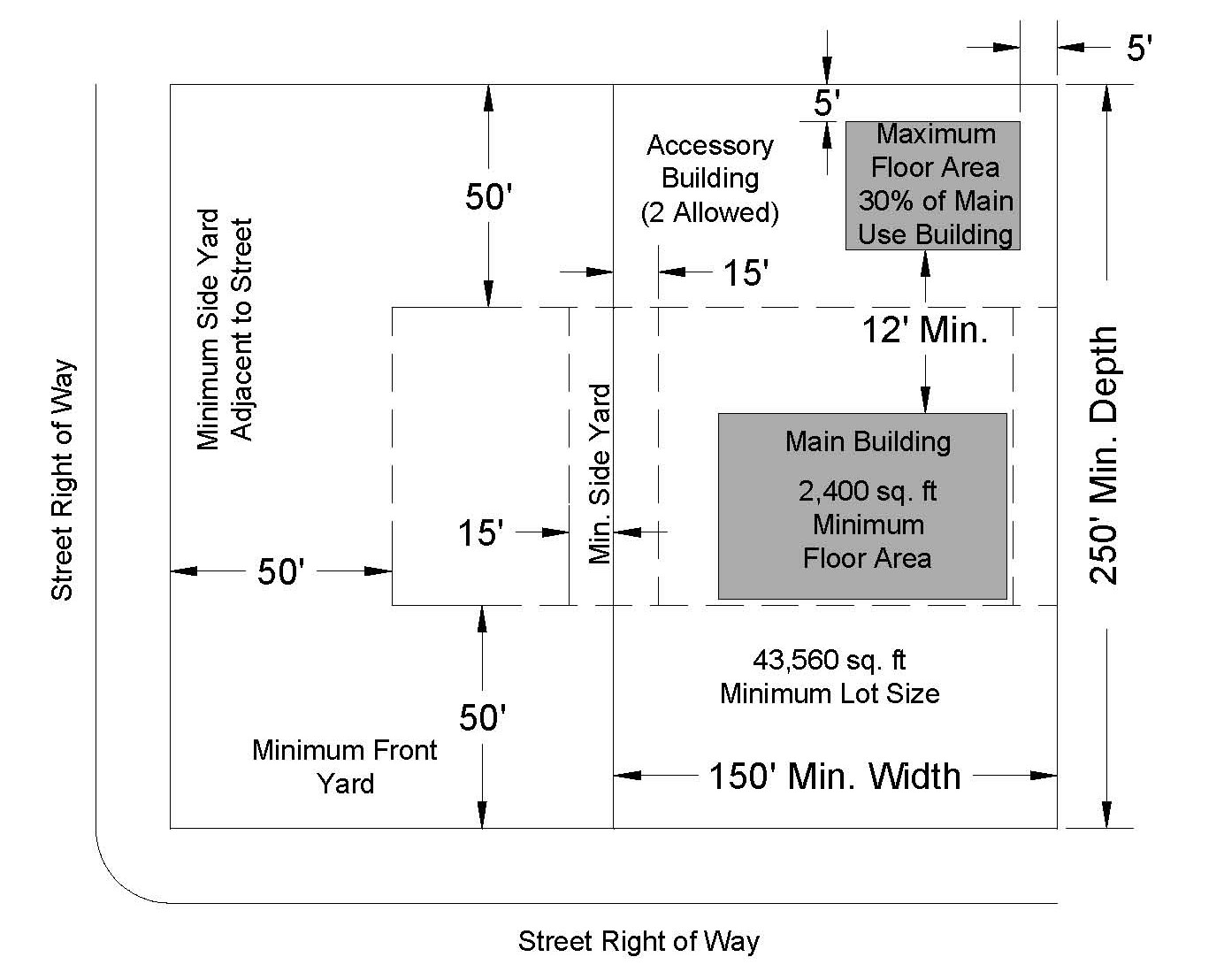
Minimum lot area: 43,560 ft 2 (one acre).
(3)
Minimum lot width and lot frontage: 150 feet.
(4)
Minimum lot depth: 250 feet.
(5)
Minimum depth of front setback: 50 feet.
(6)
Minimum depth of rear setback: 50 feet.
(7)
Minimum width of side setback:
(a)
Internal lot: 15 feet; and
(b)
Corner lot: 50 feet from intersecting side street.
(8)
Building size:
(a)
Maximum main building coverage as a percentage of lot area: 40%.
(b)
Minimum area of main building: 2,400 ft 2 .
(9)
Accessory buildings:
(a)
Maximum accessory buildings coverage: 30% of main use building.
(b)
Maximum number of accessory buildings: two.
(c)
Minimum depth of side setback: five feet.
(d)
Minimum depth of rear setback: five feet.
(e)
Minimum depth from the edge of the main building: 12 feet.
(10)
Maximum height of structures: 35 feet.
(11)
Public, semi-public or public service buildings, hospitals, institutions or schools may not exceed a height of 60 feet. Churches, temples and mosques may not exceed 75 feet, if the building is set back from each yard line at least one foot for each two feet additional height above the height limit in this district.
5.1.E
Parking Regulations. A Single-Family, RE District lot shall provide a minimum of two vehicle parking spaces, with a driveway connecting the parking spaces with a street or alley, and meet all the pertinent requirements contained in this ordinance, Section 11, Parking Regulations of this ordinance.
5.1.F
Type of Construction.
(1)
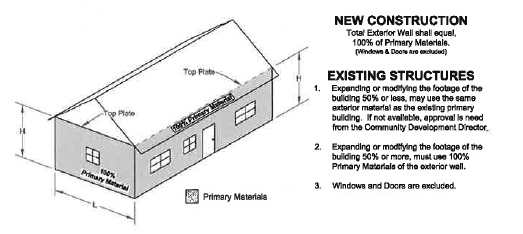
The exterior walls of all new dwellings to the top plate, shall be constructed exclusively of primary materials, excluding doors, windows, and porches. See Section 10.E(1): Exterior Building Material Standard—Primary Materials.
(2)
Existing dwellings expanding the total square footage of the building 50% or less, or modifying the exterior walls, may use the same exterior construction material as the existing primary building. If the material is not available, similar material may be used if approved by the Community Development Director.
(3)
Existing dwellings expanding the total square footage of the building by more than 50%, or proposing to use a material consistent with the primary structure for any expansion must use primary materials, Section 10.E(1): Exterior Building Material Standard—Primary Materials, for the expansion area.
5.1.F Exterior Building Material Standards
(Ord. 2011-26, passed 12-6-2011; Am. Ord. 2024-O-33, § 1, passed 11-5-2024)
Sec. 154.05.2. - Single-family residential district (R-HA) (21,780 ft ).
5.2.A
Description. This residential district provides for a low density neighborhood development. The primary land use allows for single-family dwelling development appropriate to the suburban character of the neighborhood. Other uses within this district shall contribute to the basic elements of a balanced and attractive neighborhood. Suburban area development is intended to be separate from and protected from the encroachment of land activities that do not contribute to the esthetic and functional well-being of the residential environment.
5.2.B
Permitted Uses.
(1)
Single-family detached dwelling, limited to occupancy by a family having no more than four individuals who are unrelated by blood, legal adoption, marriage or conservatorship. The owner and any agent of the owner shall be legally responsible for directly or indirectly allowing, permitting, causing or failing to prohibit residential use of a dwelling in this district by more than four unrelated individuals;
(2)
Accessory buildings;
(3)
Churches, temples, mosques and related facilities;
(4)
Community home;
(5)
Park or playground; and
(6)
SISD school—public.
5.2.C
Conditional Uses.
(1)
Home occupation; and
(2)
Common facilities as the principal use of one or more platted lots in a subdivision.
5.2.D
Height, Area, Yard and Lot Coverage Requirements.
(1)
Maximum density: one dwelling unit per lot.
(2)
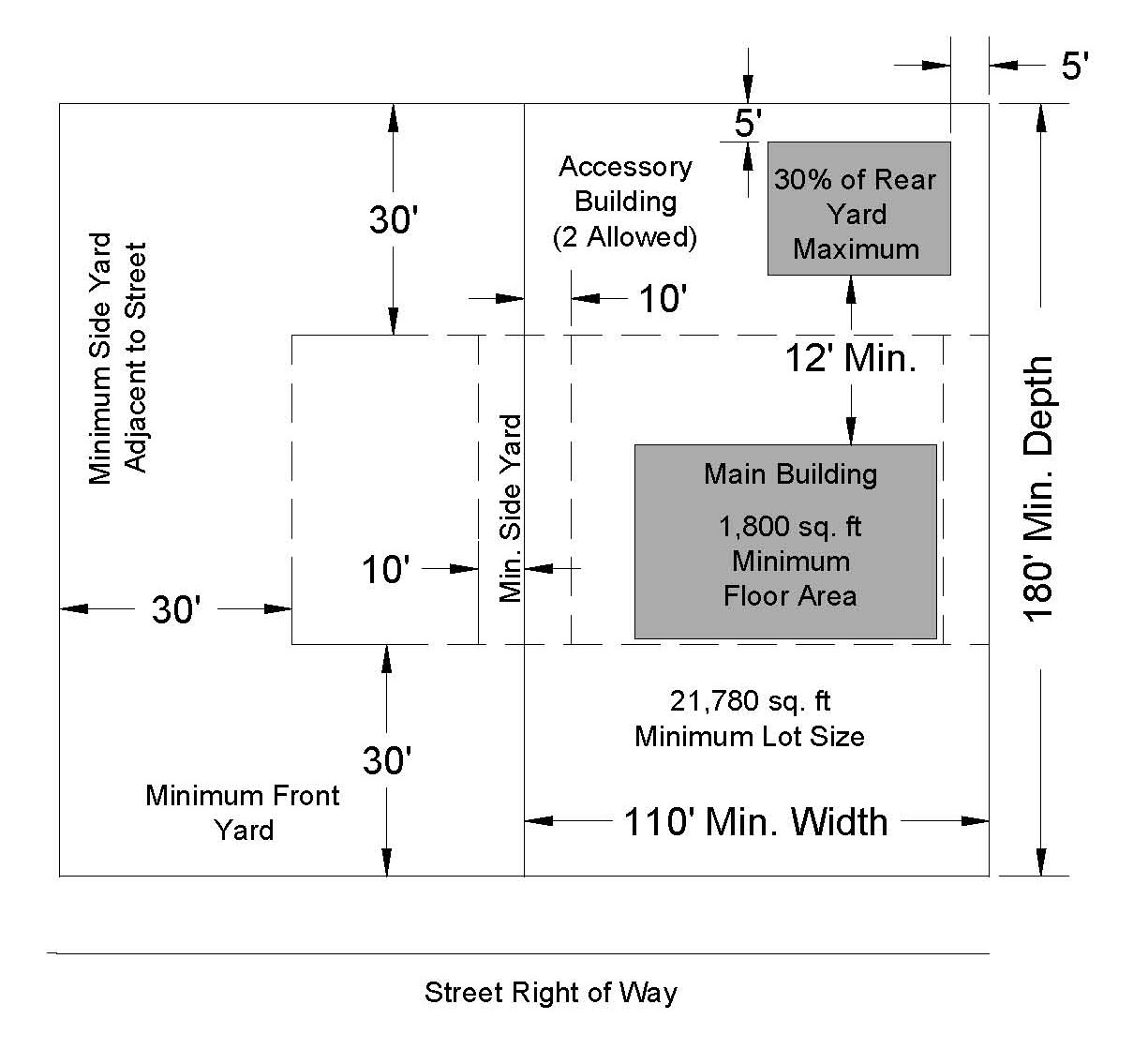
Minimum lot area: 21,780 ft 2 (one-half acre).
(3)
Minimum lot width and lot frontage: 110 feet.
(4)
Minimum lot depth: 180 feet.
(5)
Minimum depth of front setback: 30 feet.
(6)
Minimum depth of rear setback: 30 feet.
(7)
Minimum width of side setback:
(a)
Internal lot: ten feet.
(b)
Corner lot: 30 feet from intersecting side street.
(8)
Building size:
(a)
Maximum main building coverage as a percentage of lot area: 40%.
(b)
Minimum area of main building: 1,800 ft 2 .
(9)
Accessory buildings:
(a)
Maximum accessory buildings coverage of rear yard: 30%.
(b)
Maximum number of accessory buildings: two.
(c)
Minimum depth of side setback: five feet.
(d)
Minimum depth of rear setback: five feet.
(e)
Minimum depth from the edge of the main building: 12 feet.
(10)
Maximum height of structures: 35 feet.
(11)
Public, semi-public or public service buildings, hospitals, institutions or schools may not exceed a height of 60 feet. Churches, temples, and mosques may not exceed 75 feet, if the building is set back from each yard line at least one foot for each two feet additional height above the height limit in this district.
5.2.E
Parking Regulations. A Single-Family, R-HA District lot shall provide a minimum of two vehicle parking spaces, with a driveway connecting the parking spaces with a street or alley, and meet all the pertinent requirements contained in this ordinance, Section 11, Parking Regulations of this ordinance.
5.2.F
Type of Construction.
(1)
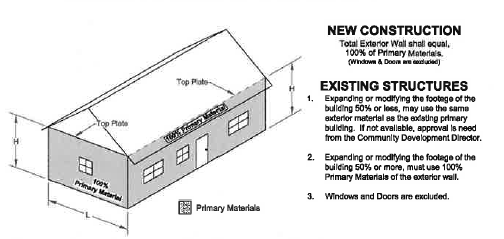
The exterior walls of all new dwellings to the top plate, shall be constructed exclusively of primary materials, excluding doors, windows, and porches. See Section 10.E(1): Exterior Building Material Standard—Primary Materials.
(2)
Existing dwellings expanding the total square footage of the building 50% or less, or modifying the exterior walls, may use the same exterior construction material as the existing primary building. If the material is not available, similar material may be used if approved by the Community Development Director.
(3)
Existing dwellings expanding the total square footage of the building by more than 50%, or proposing to use a material consistent with the primary structure for any expansion must use primary materials, Section 10.E(1): Exterior Building Material Standard—Primary Materials, for the expansion area.
5.2.F Exterior Building Material Standards
(Ord. 2011-26, passed 12-6-2011; Am. Ord. 2024-O-33, § 1, passed 11-5-2024)
Sec. 154.05.3. - Single-family residential district (R-1) (7,500 ft ).
5.3.A
Description. This residential district provides for a generally lesser density city neighborhood development. The primary land use allows for single-family dwelling development appropriate to a city-style neighborhood. Other uses within this district shall contribute to the nature of the neighborhood. Development within this district is intended to be separate from and protected from the encroachment of land activities that do not contribute to the esthetic and functional well being of the intended district environment.
5.3.B
Permitted Uses.
(1)
Single-family detached dwelling, limited to occupancy by a family having no more than four individuals who are unrelated by blood, legal adoption, marriage or conservatorship. The owner and any agent of the owner shall be legally responsible for directly or indirectly allowing, permitting, causing or failing to prohibit residential use of a dwelling in this district by more than four unrelated individuals;
(2)
Accessory buildings;
(3)
Churches, temple, mosques and related facilities;
(4)
Community home;
(5)
Park or playground; and
(6)
SISD school—public.
5.3.C
Conditional Uses.
(1)
Home occupation;
(2)
Common facilities as the principal use of one or more platted lots in a subdivision; and
(3)
Child care—registered family home.
5.3.D
Height, Area, Yard and Lot Coverage Requirements.
(1)
Maximum density: one dwelling unit per lot.
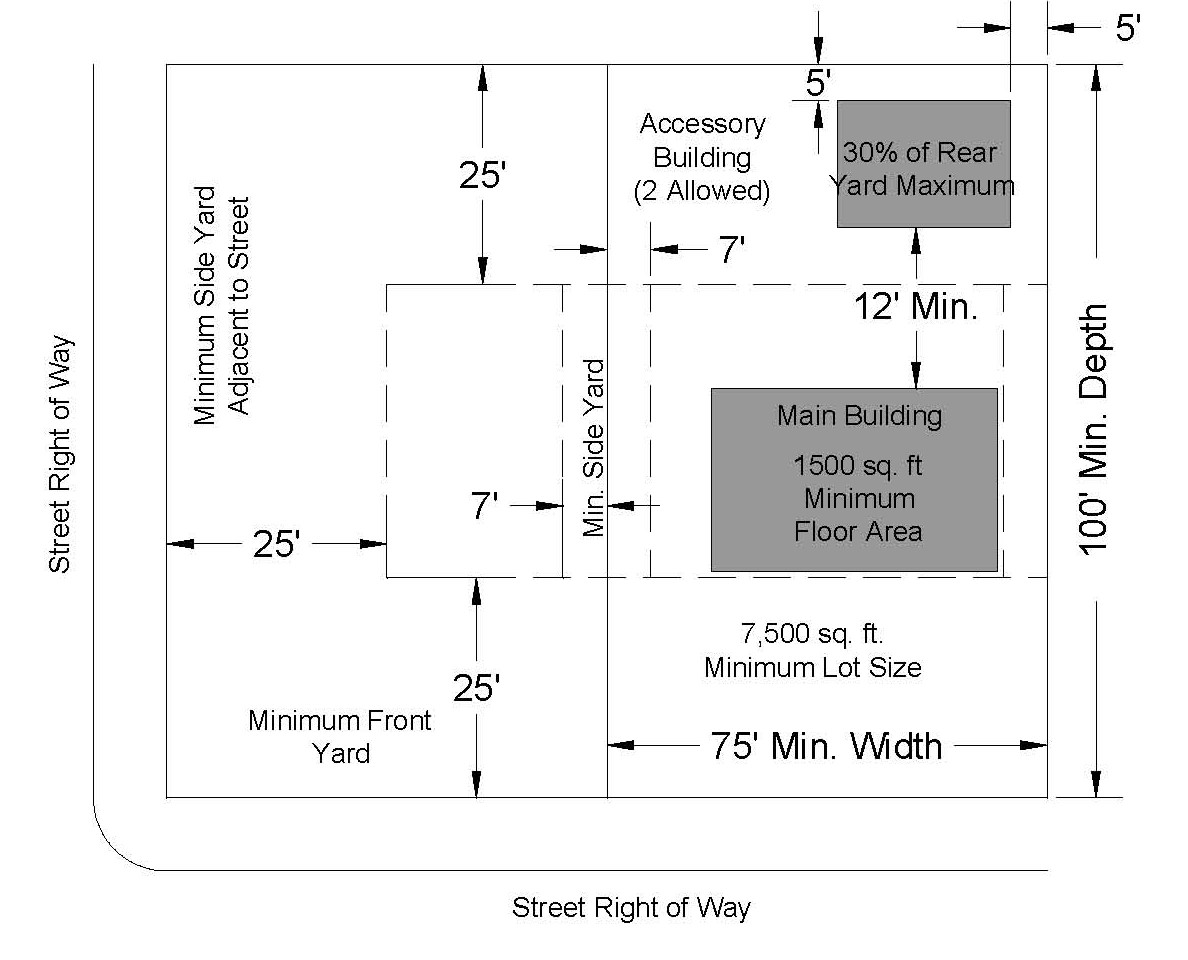
(2)
Minimum lot area: 7,500 ft 2 .
(3)
Minimum lot width and lot frontage: 75 feet.
(4)
Minimum lot depth: 100 feet.
(5)
Minimum depth of front setback: 25 feet.
(6)
Minimum depth of rear setback: 25 feet.
(7)
Minimum width of side setback:
(a)
Internal lot: seven feet.
(b)
Corner lot: 25 feet from intersecting side street.
(8)
Building size:
(a)
Maximum main building coverage as a percentage of lot area: 40%.
(b)
Minimum area of main building: 1,500 ft 2 .
(9)
Accessory buildings:
(a)
Maximum accessory buildings coverage of rear yard: 30%.
(b)
Maximum number of accessory buildings: two.
(c)
Minimum depth of side setback: five feet.
(d)
Minimum depth of rear setback: five feet.
(e)
Minimum depth from the edge of the main building: 12 feet.
(10)
Maximum height of structures: 35 feet.
(11)
Public, semi-public or public service buildings, hospitals, institutions or schools may not exceed a height of 60 feet. Churches, temples and mosques may not exceed 75 feet, if the building is set back from each yard line at least one foot for each two feet additional height above the height limit in this district.
5.3.E
Parking Regulations. A Single-Family, R-1 District lot shall provide a minimum of two vehicle parking spaces, with a driveway connecting the parking spaces with a street or alley, and meet all the pertinent requirements contained in this ordinance, Section 11, Parking Regulations of this ordinance.
5.3.F
Type of Construction.
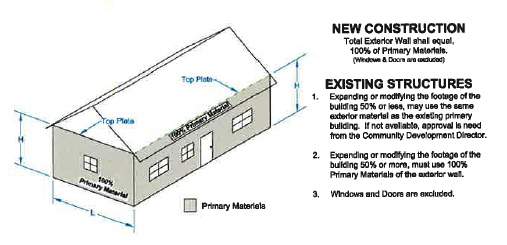
(1)
The exterior walls of all new dwellings to the top plate, shall be constructed exclusively of primary materials, excluding doors, windows, and porches. See Section 10.E(1): Exterior Building Material Standard—Primary Materials.
(2)
Existing dwellings expanding the total square footage of the building 50% or less, or modifying the exterior walls, may use the same exterior construction material as the existing primary building. If the material is not available, similar material may be used if approved by the Community Development Director.
(3)
Existing dwellings expanding the total square footage of the building by more than 50%, or proposing to use a material consistent with the primary structure for any expansion must use primary materials, Section 10.E(1): Exterior Building Material Standard—Primary Materials, for the expansion area.
5.3.F Exterior Building Material Standards
(Ord. 2011-26, passed 12-6-2011; Am. Ord. 2024-O-33, § 1, passed 11-5-2024)
Sec. 154.05.4. - Single-family residential district (R-1.5) (6,000 ft ).
5.4.A
Description. This residential district provides for a neighborhood development of medium density. The primary land use allows for single-family dwelling development on smaller lots. Recreational, religious and educational uses normally appropriate to such a residential neighborhood are also permitted to contribute to the natural elements of a convenient, balanced and attractive neighborhood. Development within this district is intended to be separate from and protected from the encroachment of land activities that do not contribute to the esthetic and functional well being of the intended district environment.
5.4.B
Permitted Uses.
(1)
Single-family detached dwelling, limited to occupancy by a family having no more than four individuals who are unrelated by blood, legal adoption, marriage or conservatorship. The owner and any agent of the owner shall be legally responsible for directly or indirectly allowing, permitting, causing or failing to prohibit residential use of a dwelling in this district by more than four unrelated individuals;
(2)
Accessory building;
(3)
Churches, temples, mosques and related facilities;
(4)
Community home;
(5)
Park or playground; and
(6)
SISD school—public.
5.4.C
Conditional Uses.
(1)
Home occupation;
(2)
Common facilities as the principal use of one or more platted lots in a subdivision; and
(3)
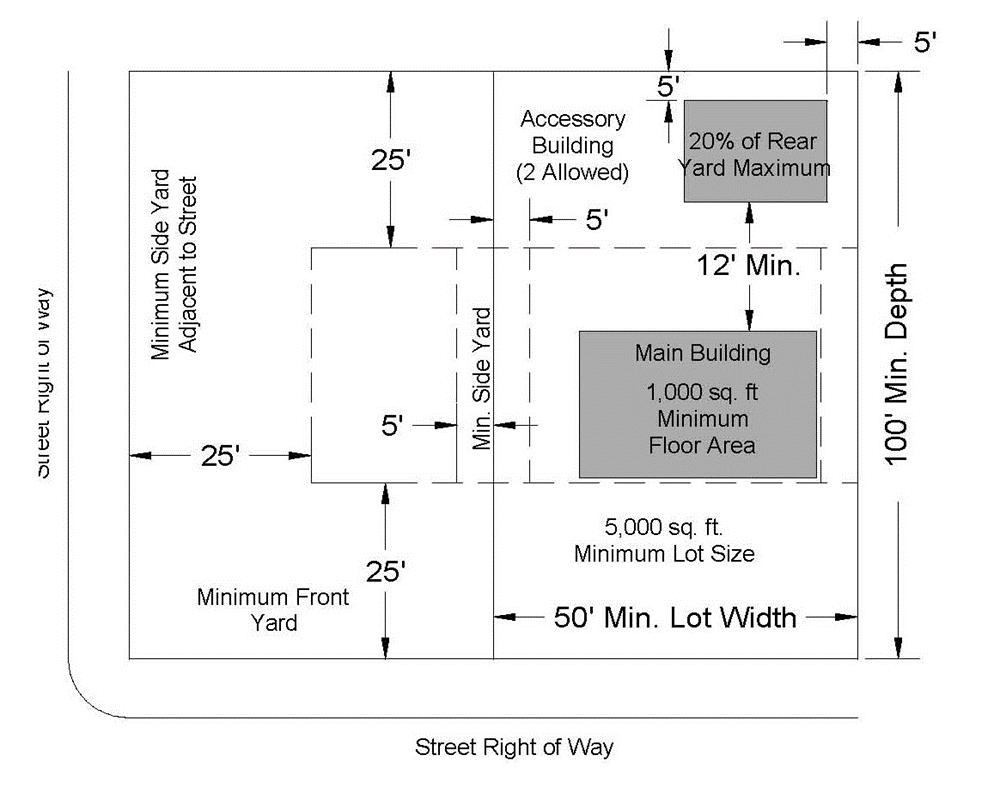
Child care—registered family home and group day care home.
5.4.D
Height, Area, Yard and Lot Coverage Requirements.
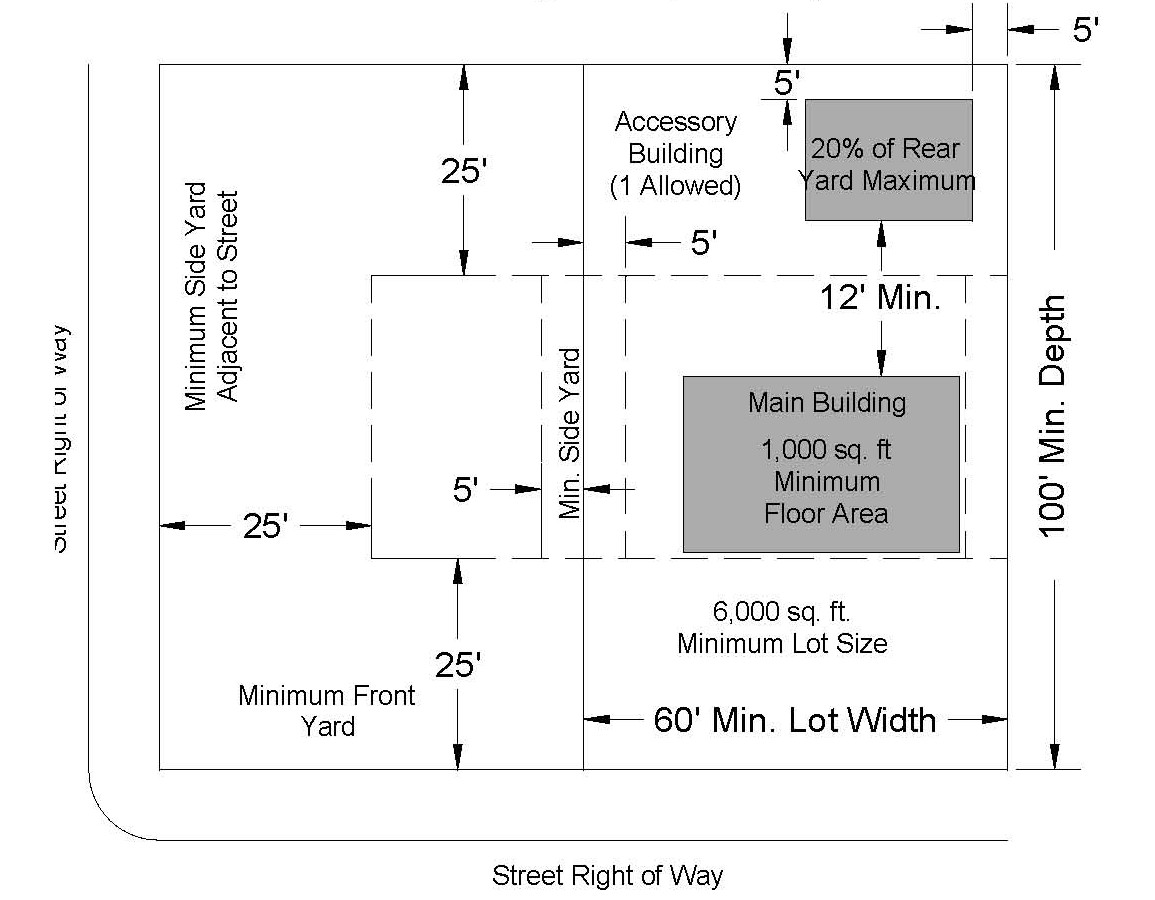
(1)
Minimum lot area: single-family dwelling: 5,000 ft 2 .
(2)
Minimum lot width and lot frontage: 50 feet.
(3)
Minimum lot depth: 100 feet.
(4)
Minimum depth of front setback: 25 feet.
(5)
Minimum depth of rear setback: 25 feet.
(6)
Minimum width of side setback:
(a)
Internal lot: five feet.
(b)
Corner lot: 25 feet from intersecting side street.
(7)
Building size:
(a)
Maximum main building coverage as a percentage of lot area: 40%.
(b)
Minimum area of main building: 1,000 ft 2 .
(8)
Accessory buildings:
(a)
Maximum accessory building coverage of rear yard: 20%.
(b)
Maximum number of accessory buildings: one.
(c)
Minimum depth of side setback: five feet.
(d)
Minimum depth of rear setback: five feet.
(e)
Minimum depth from the edge of the main building: 12 feet.
(9)
Maximum height of structures: 35 feet.
(10)
Public, semi-public or public service buildings, hospitals, institutions or schools may not exceed a height of 60 feet. Churches, temples and mosques may not exceed 75 feet, if the building is set back from each yard line at least one foot for each two feet additional height above the height limit in this district.
Height, Area, Yard and Lot Coverage Requirements
Single-Family Dwelling
5.4.E
Parking Regulations. A Single-Family, R-1.5 District lot shall provide a minimum of two vehicle parking spaces, with a driveway connecting the parking spaces with a street or alley, and meet all the pertinent requirements contained in this ordinance, Section 11, Parking Regulations of this ordinance.
5.4.F
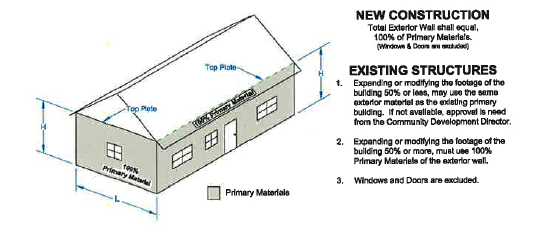
Type of Construction.
(1)
The exterior walls of all new dwellings to the top plate, shall be constructed exclusively of primary materials, excluding doors, windows, and porches. See Section 10.E(1): Exterior Building Material Standard—Primary Materials.
(2)
Existing dwellings expanding the total square footage of the building 50% or less, or modifying the exterior walls, may use the same exterior construction material as the existing primary building. If the material is not available, similar material may be used if approved by the Community Development Director.
(3)
Existing dwellings expanding the total square footage of the building by more than 50%, or proposing to use a material consistent with the primary structure for any expansion must use primary materials, Section 10.E(1): Exterior Building Material Standard—Primary Materials, for the expansion area.
5.4.F Exterior Building Material Standards
(Ord. 2011-26, passed 12-6-2011; Ord. 2018-O-22, § 1, 6-12-2018; Am. Ord. 2024-O-33, § 1, passed 11-5-2024)
Sec. 154.05.5. - One- and two-family residential district (R-2).
5.5.A
Description. This residential district provides for a neighborhood development of medium density. The primary land use allows for single-family dwellings, along with two family dwelling units. Recreational, religious and educational uses normally appropriate to such a residential neighborhood are also permitted to contribute to the natural elements of a convenient, balanced and attractive neighborhood. Development within this district is intended to be separate from and protected from the encroachment of land activities that do not contribute to the esthetic and functional well being of the intended district environment.
5.5.B
Permitted Uses.
(1)
Single-family detached dwelling, limited to occupancy by a family having no more than four individuals who are unrelated by blood, legal adoption, marriage or conservatorship. The owner and any agent of the owner shall be legally responsible for directly or indirectly allowing, permitting, causing or failing to prohibit residential use of a dwelling in this district by more than four unrelated individuals;
(2)
Two-family dwelling units, with each family limited as in division (1) above;
(3)
Accessory buildings;
(4)
Churches, temples, mosques and related facilities;
(5)
Community home;
(6)
Park or playground; and
(7)
SISD school—public.
5.5.C
Conditional Uses.
(1)
Home occupation;
(2)
Common facilities as the principal use of one or more platted lots in a subdivision;
(3)
Child care—registered family home and group day care home; and
(4)
Foster group home.
5.5.D
Height, Area, Yard and Lot Coverage Requirements.
(A)
Single family.
(1)
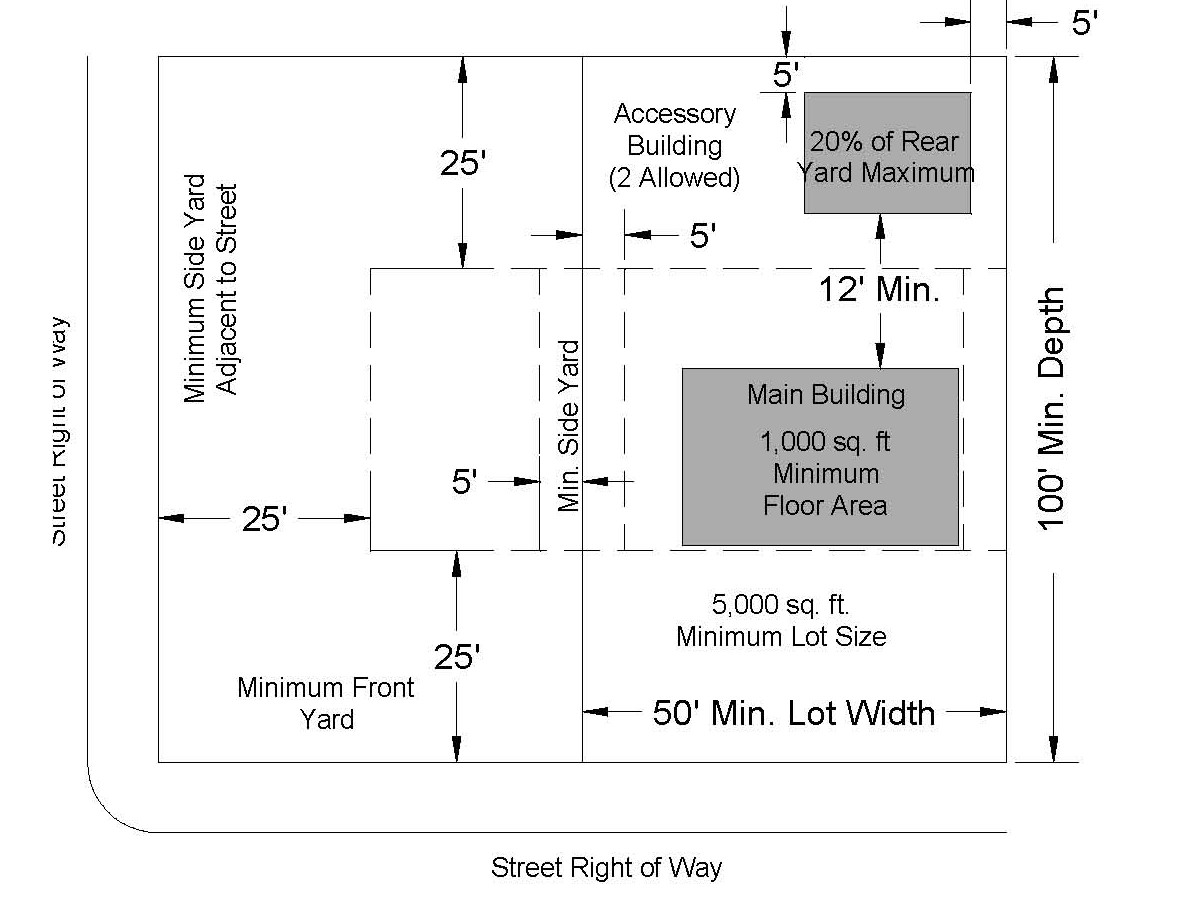
Minimum lot area: 5,000 ft 2 .
(2)
Minimum lot width and lot frontage: 50 feet.
(3)
Minimum lot depth: 100 feet.
(4)
Minimum depth of front setback: 25 feet.
(5)
Minimum depth of rear setback: 25 feet.
(6)
Minimum width of side setback:
(a)
Internal lot: five feet.
(b)
Corner lot: 25 feet from intersecting side street.
(7)
Building size:
(a)
Maximum main building coverage as a percentage of lot area: 40%.
(b)
Minimum area of main building: 1,000 ft 2 .
(8)
Accessory buildings:
(a)
Maximum accessory buildings coverage of rear yard: 20%.
(b)
Maximum number of accessory buildings: one.
(c)
Minimum depth of side setback: five feet.
(d)
Minimum depth of rear setback: five feet.
(e)
Minimum depth from the edge of the main building: 12 feet.
(9)
Maximum height of structures: 35 feet.
(10)
Public, semi-public or public service buildings, hospitals, institutions or schools may not exceed a height of 60 feet. Churches, temples, and mosques may not exceed 75 feet, if the building is set back from each yard line at least one foot for each two feet additional height above the height limit in this district.
Height, Area, Yard and Lot Coverage Requirements
Single-Family Dwelling
5.5.E
Parking Regulations. A Single-Family, R-2 District lot shall provide a minimum of two vehicle parking spaces, with a driveway connecting the parking spaces with a street or alley, and meet all the pertinent requirements contained in this ordinance, Section 11, Parking Regulations of this ordinance.
(B)
Two-family.
(1)
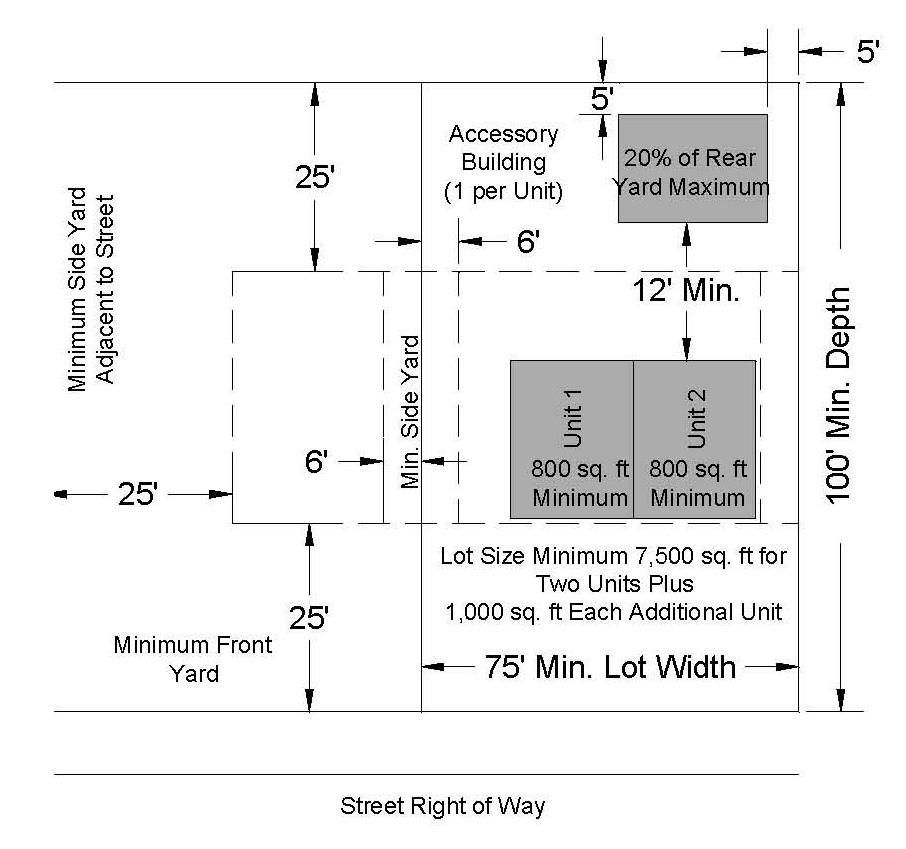
Minimum lot area: minimum of 7,500 ft 2 for two-family dwelling unit.
(2)
Minimum lot width and lot frontage: 75 feet.
(3)
Minimum lot depth: 100 feet.
(4)
Minimum depth of front setback: 25 feet.
(5)
Minimum depth of rear setback: 25 feet.
(6)
Minimum width of side setback:
(a)
Internal lot: six feet.
(b)
Corner lot: 25 feet from intersecting side street.
(7)
Building size:
(a)
Maximum main building coverage as a percentage of lot area: 40%.
(b)
Minimum area of each dwelling unit: 800 (two-family unit = 1,600 ft 2 ; two units of 800 ft 2 each).
(8)
Accessory buildings:
(a)
Maximum accessory building coverage of rear yard: 20%.
(b)
Maximum area of each accessory building: 200 ft 2 .
(c)
Maximum number of accessory buildings: one per unit.
(d)
Minimum depth of side setback: five feet.
(e)
Minimum depth of rear setback: five feet.
(f)
Minimum depth from the edge of the main building: 12 feet.
(9)
Maximum height of structures: 35 feet.
(10)
Public, semi-public or public service buildings, hospitals, institutions or schools may not exceed a height of 60 feet. Churches, temples and mosques may not exceed 75 feet, if the building is set back from each yard line at least one foot for each two feet additional height above the height limit in this district.
Height, Area, Yard and Lot Coverage Requirements
Two-Family Dwelling
A Two-Family, R-2 District lot shall provide a minimum of two vehicle parking spaces, with a driveway connecting the parking spaces with a street or alley, and meet all the pertinent requirements contained in this ordinance, Section 11, Parking Regulations of this ordinance.
5.5.F
Type of Construction.
(1)
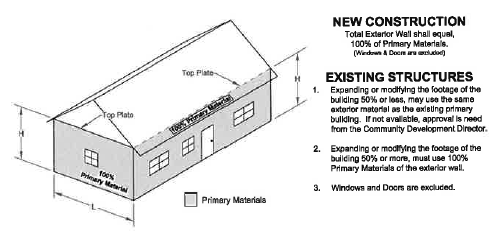
The exterior walls of all new dwellings to the top plate, shall be constructed exclusively of primary materials, excluding doors, windows, and porches. See Section 10.E(1): Exterior Building Material Standard—Primary Materials.
(2)
Existing dwellings expanding the total square footage of the building 50% or less, or modifying the exterior walls, may use the same exterior construction material as the existing primary building. If the material is not available, similar material may be used if approved by the Community Development Director.
(3)
Existing dwellings expanding the total square footage of the building by more than 50%, or proposing to use a material consistent with the primary structure for any expansion must use primary materials, Section 10.E(1): Exterior Building Material Standard—Primary Materials, for the expansion area.
5.4.F Exterior Building Material Standards
(Ord. 2011-26, passed 12-6-2011; Am. Ord. 2024-O-33, § 1, passed 11-5-2024)
Sec. 154.05.6. - Multiple family residential district (R-3).
5.6.A
Description. This residential district provides for medium to high-density city neighborhood development. The primary land use allows for single-family dwellings, two-to-four family dwelling units, and multiple family housing buildings and complexes platted as one parcel and sole source management. All R-3 zoning will be appropriate to a city-style neighborhood. Recreational, religious and educational uses are also permitted so as to contribute to the natural elements of a convenient, balanced and attractive neighborhood. Development within this district is intended to be protected from the encroachment of land activities that do not contribute to the esthetic and functional well being of the intended district environment.
5.6.B
Permitted Uses.
(1)
Single-family detached dwelling, limited to occupancy by a family having no more than four individuals who are unrelated by blood, legal adoption, marriage or conservatorship. The owner and any agent of the owner shall be legally responsible for directly or indirectly allowing, permitting, causing, or failing to prohibit residential use of a dwelling in this district by more than four unrelated individuals;
(2)
Two-to-four family dwellings, with each family limited as in division (1) above;
(3)
Multiple family dwellings, with each family limited as in division (1) above; Student living complexes will be subject to a variance request for units designed to occupy more than four unrelated students per unit;
(4)
Assisted living center;
(5)
Convalescent, nursing or long term-care facility;
(6)
Retirement housing complex;
(7)
Accessory buildings;
(8)
Churches, temples, mosques and related facilities;
(9)
Community home;
(10)
Park or playground;
(11)
SISD school—public;
(12)
Bed and breakfast/boarding house;
(13)
Group day care home;
(14)
Registered family home;
(15)
Day care center; and
(16)
Fraternity or sorority house.
5.6.C
Conditional Uses.
(1)
Home occupation;
(2)
Common facilities as the principal use of one or more platted lots in a subdivision;
(3)
Adult and/or children's day care centers;
(4)
Foster group home; and
(5)
Residence hall.
5.6.D
Height, Area, Yard and Lot Coverage Requirements.
(A)
Single family dwelling.
(1)
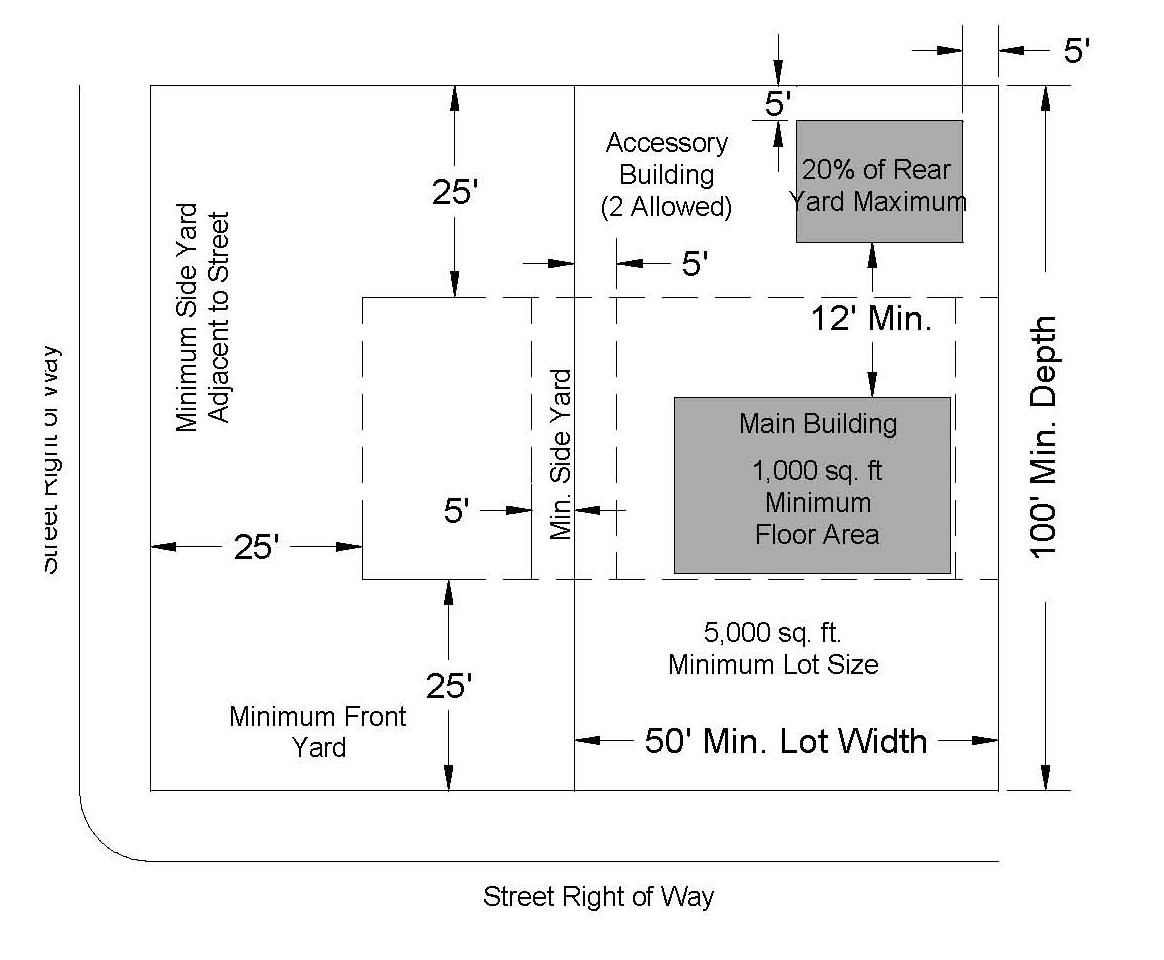
Minimum lot area: 5,000 ft 2 .
(2)
Minimum lot width and lot frontage: 50 feet.
(3)
Minimum lot depth: 100 feet.
(4)
Minimum depth of front setback: 25 feet.
(5)
Minimum depth of rear setback: 25 feet.
(6)
Minimum width of side setback:
(a)
Internal lot: five feet.
(b)
Corner lot: 25 feet from intersecting side street.
(7)
Building size:
(a)
Maximum coverage as a percentage of lot area: 40%.
(b)
Single family dwelling: 1,000 ft 2 .
(8)
Accessory buildings:
(a)
Maximum accessory buildings coverage of rear yard: 20%.
(b)
Maximum number of accessory buildings: one.
(c)
Minimum depth of side setback: five feet.
(d)
Minimum depth of rear setback: five feet.
(e)
Minimum depth from the edge of the main building: 12 feet.
(9)
Maximum height of structures: 35 feet.
(10)
Public, semi-public or public service buildings, hospitals, institutions or schools may not exceed a height of 60 feet. Churches, temples and mosques may not exceed 75 feet, if the building is set back from each yard line at least one foot for each two feet additional height above the height limit in this district.
Height, Area, Yard and Lot Coverage Requirements
Single-Family Dwelling
(B)
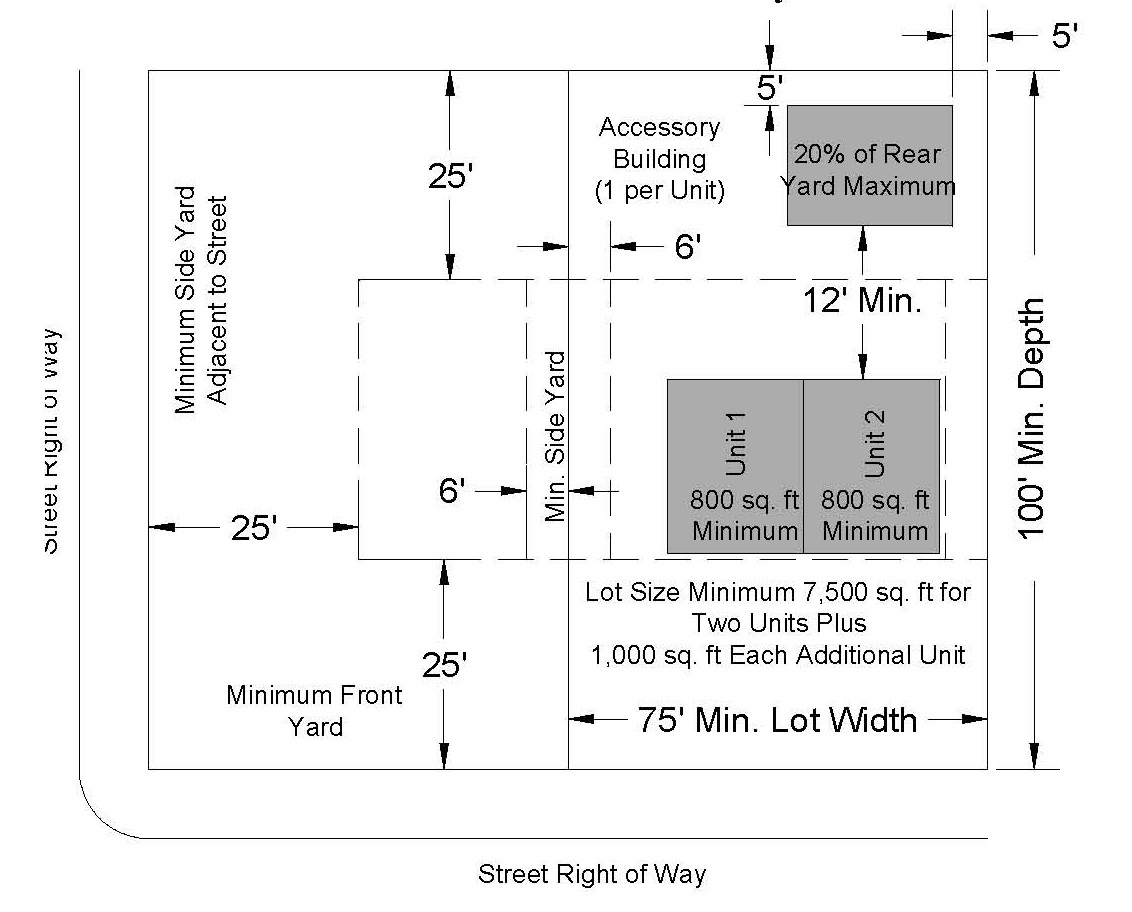
Two-to-four family.
(1)
Minimum lot area: 7,500 ft 2 for two dwelling units, plus 1,000 ft 2 for each additional dwelling unit.
(2)
Minimum lot width and lot frontage: 75 feet.
(3)
Minimum lot depth: 100 feet.
(4)
Minimum depth of front setback: 25 feet.
(5)
Minimum depth of rear setback: 25 feet.
(6)
Minimum width of side setback:
(a)
Internal lot: six feet.
(b)
Corner lot: 25 feet from intersecting side street.
(7)
Building size:
(a)
Maximum coverage as a percentage of lot area: 40%.
(b)
Minimum area of each dwelling unit: 800 ft 2 .
(8)
Accessory buildings:
(a)
Maximum accessory building coverage of rear yard: 20%.
(b)
Maximum area of each accessory building: 200 ft 2 .
(c)
Maximum number of accessory buildings: one per unit.
(d)
Minimum depth of side setback: five feet.
(e)
Minimum depth of rear setback: five feet.
(f)
Minimum depth from the edge of the main building: 12 feet.
(9)
Maximum height of structures: 35 feet.
(10)
Public, semi-public or public service buildings, hospitals, institutions or schools may not exceed a height of 60 feet. Churches, temples and mosques may not exceed 75 feet, if the building is set back from each yard line at least one foot for each two feet additional height above the height limit in this district.
Height, Area, Yard and Lot Coverage Requirements
Two-to-Four Family Dwelling
(C)
Reserved.
(D)
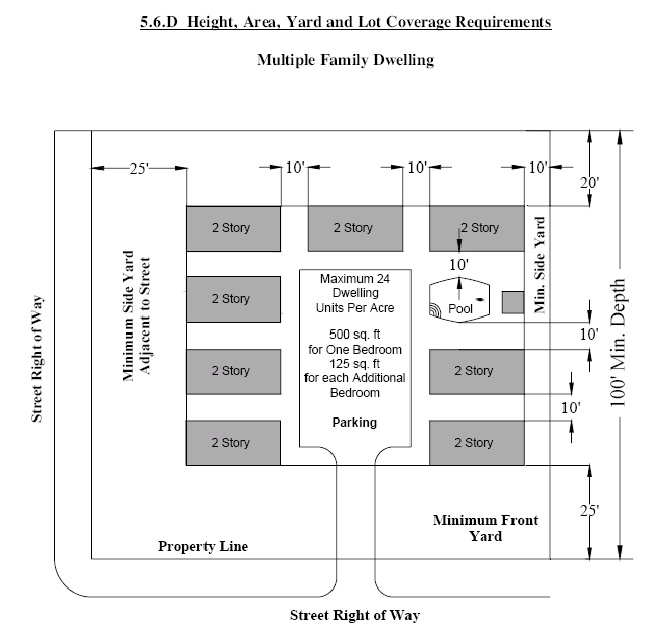
Multiple family dwellings.
(1)
Minimum lot area: maximum density of 24 dwelling units per acre, which includes parking, access and all other area improvements.
(2)
Minimum lot depth: 100 feet.
(3)
Minimum depth of front setback: 25 feet.
(4)
Minimum depth of rear setback: 20 feet.
(5)
Minimum width of side setback:
(a)
Internal lot: ten feet.
(b)
Corner lot: 25 feet from intersecting side street.
(6)
Building size: Minimum area of each dwelling unit: 500 ft 2 for one bedroom or less plus 125 ft 2 of floor area for each additional bedroom.
(7)
Maximum height of structures: 35 feet.
(8)
Public, semi-public or public service buildings, hospitals, institutions or schools may not exceed a height of 60 feet. Churches, temples and mosques may not exceed 75 feet, if the building is set back from each yard line at least one foot for each two feet additional height above the height limit in this district.
Height, Area, Yard and Lot Coverage Requirements
Multiple-Family Dwelling
5.6.E
Parking Regulations. Lots in this District shall provide a minimum of two vehicle parking spaces per dwelling unit, with a driveway connecting the parking spaces with a street or alley, and meet all the pertinent requirements contained in Section 154.11Parking spaces for vehicles of this ordinance. Student housing whereby individual rooms are leased by unit must require 1.5 spaces per rented bed.
5.6.F
Type of Construction.
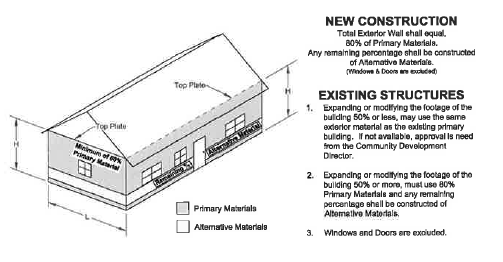
(1)
The exterior walls of all new dwellings to the top plate, shall be constructed of at least 80% of the total exterior walls of primary materials, excluding doors, windows, and porches. See Section 10.E(1): Exterior Building Material Standard—Primary Materials.
(2)
Any remaining exterior walls of all new dwellings shall construct the remaining exterior walls of alternative materials. See Section 10.E(2): Exterior Building Material Standard—Alternative Materials.
(3)
Existing dwellings expanding the total square footage of the building 50% or less, or modifying the exterior walls, may use the same exterior construction material as the existing primary building. If the material is not available, similar material may be used if approved by the Community Development Director.
(4)
Existing dwellings expanding the total square footage of the building more than 50%, or proposing to use a material inconsistent with the primary structure for any expansion, must meet the 80% minimum primary materials, Section 10.E: Exterior Building Material Standard, for the total exterior walls of the structure.
5.6.F Exterior Building Material Standards
(Am. Ord. 2007-24, passed 12-4-2007; Am. Ord. 2008-13, passed 7-1-2008; Ord. 2011-26, passed 12-6-2011; Am. Ord. 2021-O-29, § 1, passed 9-7-2021; Am. Ord. 2024-O-33, § 1, passed 11-5-2024)
Sec. 154.05.7. - Manufactured housing district (MH).
5.7.A
Description. The Manufactured Housing District is intended to serve as a residential district for persons living in manufactured homes outside of a mobile home park. The primary use of land is for single-family dwellings, along with related uses to provide the basic elements of an attractive living area.
5.7.B
Permitted Uses.
(1)
Single-family detached dwelling, limited to occupancy by a family having no more than four individuals who are unrelated by blood, legal adoption, marriage or conservatorship. The owner and any agent of the owner shall be legally responsible for directly or indirectly allowing, permitting, causing or failing to prohibit residential use of a dwelling in this district by more than four unrelated individuals;
(2)
Accessory building to main use;
(3)
Manufactured homes; and
(4)
Home occupation.
5.7.C
Conditional Uses. None.
5.7.D
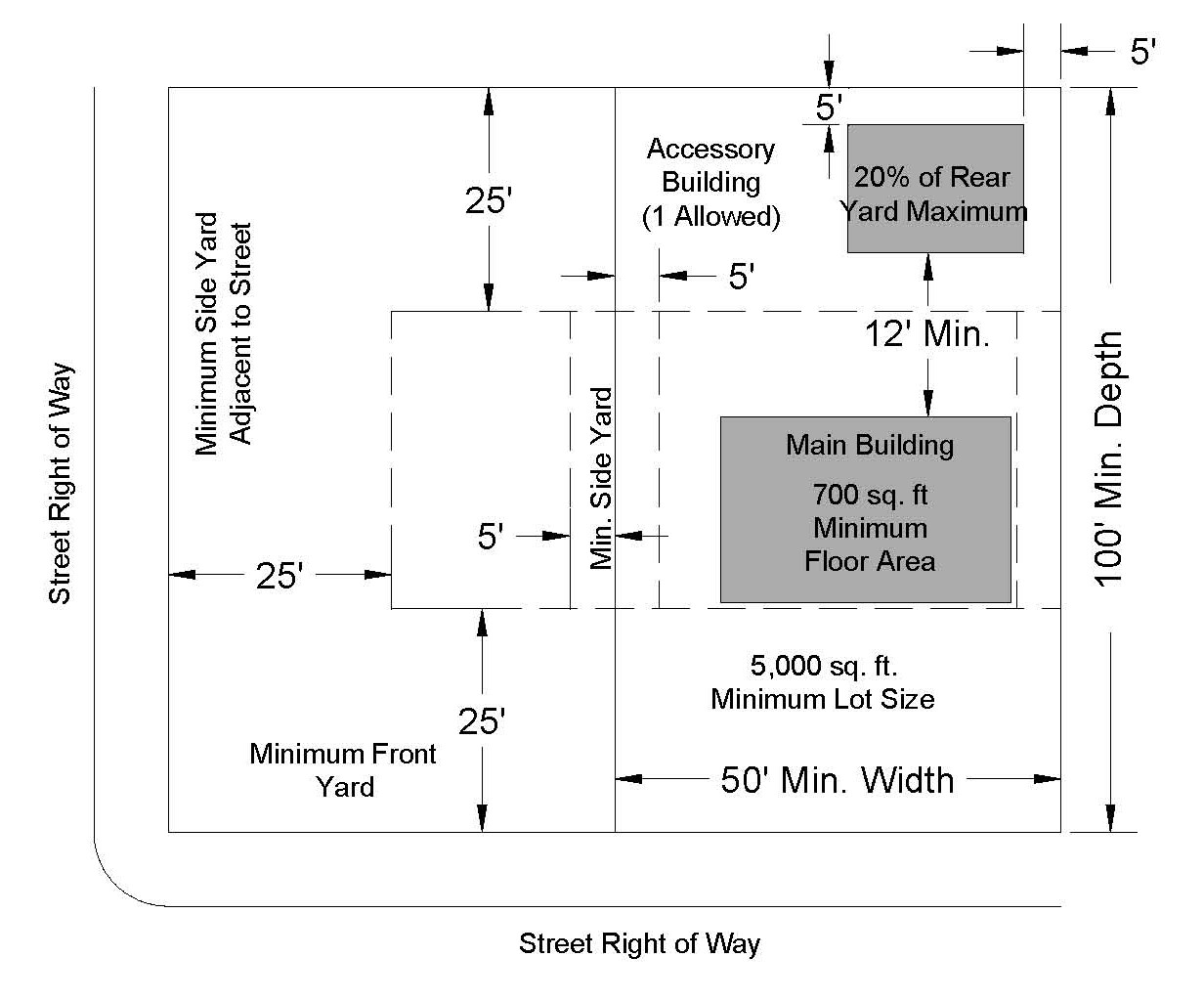
Height, Area, Yard and Lot Coverage Requirements.
(1)
Maximum density: one dwelling unit per lot.
(2)
Minimum lot area: 5,000 ft 2 .
(3)
Minimum lot width and lot frontage: 50 feet.
(4)
Minimum lot depth: 100 feet.
(5)
Minimum depth of front setback: 25 feet.
(6)
Minimum depth of rear setback: 25 feet.
(7)
Minimum width of side setback:
(a)
Internal lot: five feet.
(b)
Corner lot: 25 feet from intersecting side street.
(8)
(a)
Minimum area of main building: 700 ft 2 .
(b)
Maximum main building coverage as a percentage of lot area: 40%.
(9)
Accessory buildings:
(a)
Maximum accessory building coverage of rear yard: 20%.
(b)
Maximum number of accessory buildings: one.
(c)
Minimum depth of side setback: five feet.
(d)
Minimum depth of rear setback: five feet.
(e)
Minimum depth from the edge of the main building: 12 feet.
(10)
Maximum height of structures: 35 feet.
(11)
Public, semi-public or public service buildings, hospitals, institutions or schools may not exceed a height of 60 feet. Churches, temples, and mosques may not exceed 75 feet, if the building is set back from each yard line at least one foot for each two feet additional height above the height limit in this district.
5.7.E
Parking Regulations. A Single-Family, MH District lot shall provide a minimum of two vehicle parking spaces, with a driveway connecting the parking spaces with a street or alley, and meet all the pertinent requirements contained in this ordinance, Section 11, Parking Regulations of this ordinance.
5.7.F
Development and Installation Regulations. Any property developed within the MH district as a HUD Code Manufactured Home or as a Manufactured Housing Subdivision shall meet the following requirements:
(A)
The axles, wheels and tow bar or tongue shall be removed.
(B)
Secured to a permanent foundation or footing and piers, in accordance with manufacturer's specifications.
(C)
Permanent steps installed at all exits.
(D)
Skirting will be installed on all sides within 30 days of home installation. Skirting materials shall consist of materials compatible with the design of the home, enhancing its appearance. Unpainted or untreated corrugated metal, screen or wire, or lattice-style skirting is prohibited.
(E)
A building official of the City of Stephenville must approve any structural alteration or modification made on site. All structural additions shall comply with the city's building codes and ordinances.
(Ord. 2024-O-33, § 1, passed 11-5-2024)
Sec. 154.05.8 - Integrated housing district (R-2.5).
5.8.A
Description. This integrated residential housing district provides for medium-density city neighborhood development. The primary land use allows for single-family dwellings, two-to-four family dwelling units, patio homes, condominiums and townhomes Generally, this district is for developments resulting in individually platted homes or dwelling units and generally, owner occupied. Recreational, religious and educational uses are also permitted so as to contribute to the natural elements of a convenient, balanced and attractive neighborhood. Development within this district is intended to be protected from the encroachment of land activities that do not contribute to the aesthetic and functional well being of the intended district environment. The Integrated Housing District will be applicable to for all Residential Districts, B-1 Neighborhood Business District (B-1), Central Business District (B-3), and Downtown District (DT).
5.8.B
Permitted Uses.
1.
Single-family detached dwelling, limited to occupancy by a family having no more than four individuals who are unrelated by blood, legal adoption, marriage or conservatorship. The owner and any agent of the owner shall be legally responsible for directly or indirectly allowing, permitting, causing, or failing to prohibit residential use of a dwelling in this district by more than four unrelated individuals;
2.
Two-to-four family dwellings, with each family limited as in division (1) above;
3.
Townhouse dwellings, with each family limited as in division (1) above;
4.
Condominium dwellings, with each family limited as in division (1) above;
5.8.C
Conditional Uses.
1.
Home occupation;
2.
Common facilities as the principal use of one or more platted lots in a subdivision;
3.
Adult and/or children's day care centers;
4.
Foster group home; and
5.
Residence hall.
5.8.D
Height, Area, Yard and Lot Coverage Requirements.
A.
Single family dwelling.
1.
Minimum lot area: 3,000 ft 2 .
2.
Minimum lot width and lot frontage: 50 feet.
3.
Minimum lot depth: 60 feet.
4.
Minimum depth of front setback: 15 feet.
5.
Minimum depth of rear setback: 15 feet.
6.
Minimum width of side setback:
a.
Internal lot: five feet.
b.
Corner lot: 15 feet from intersecting side street.
7.
Building size:
a.
Maximum coverage as a percentage of lot area: 40%.
b.
Single family dwelling: 1,000 ft 2 .
8.
Accessory buildings:
a.
Maximum accessory buildings coverage of rear yard: 20%.
b.
Maximum number of accessory buildings: one.
c.
Minimum depth of side setback: five feet.
d.
Minimum depth of rear setback: five feet.
e.
Minimum depth from the edge of the main building: 12 feet.
9.
Maximum height of structures: 35 feet.
10.
Public, semi-public or public service buildings, hospitals, institutions or schools may not exceed a height of 60 feet. Churches, temples and mosques may not exceed 75 feet, if the building is set back from each yard line at least one foot for each two feet additional height above the height limit in this district.
B.
Two-to-four family.
1.
Minimum lot area: 7,500 ft 2 for two dwelling units, plus 1,000 ft 2 for each additional dwelling unit.
2.
Minimum lot width and lot frontage: 75 feet.
3.
Minimum lot depth: 100 feet.
4.
Minimum depth of front setback: 15 feet.
5.
Minimum depth of rear setback: 15 feet.
6.
Minimum width of side setback:
a.
Internal lot: six feet.
b.
Corner lot: 15 feet from intersecting side street.
7.
Building size:
a.
Maximum coverage as a percentage of lot area: 40%.
b.
Minimum area of each dwelling unit: 800 ft 2 .
8.
Accessory buildings:
a.
Maximum accessory building coverage of rear yard: 20%.
b.
Maximum area of each accessory building: 200 ft 2 .
c.
Maximum number of accessory buildings: one per unit.
d.
Minimum depth of side setback: five feet.
e.
Minimum depth of rear setback: five feet.
f.
Minimum depth from the edge of the main building: 12 feet.
9.
Maximum height of structures: 35 feet.
10.
Public, semi-public or public service buildings, hospitals, institutions or schools may not exceed a height of 60 feet. Churches, temples and mosques may not exceed 75 feet, if the building is set back from each yard line at least one foot for each two feet additional height above the height limit in this district.
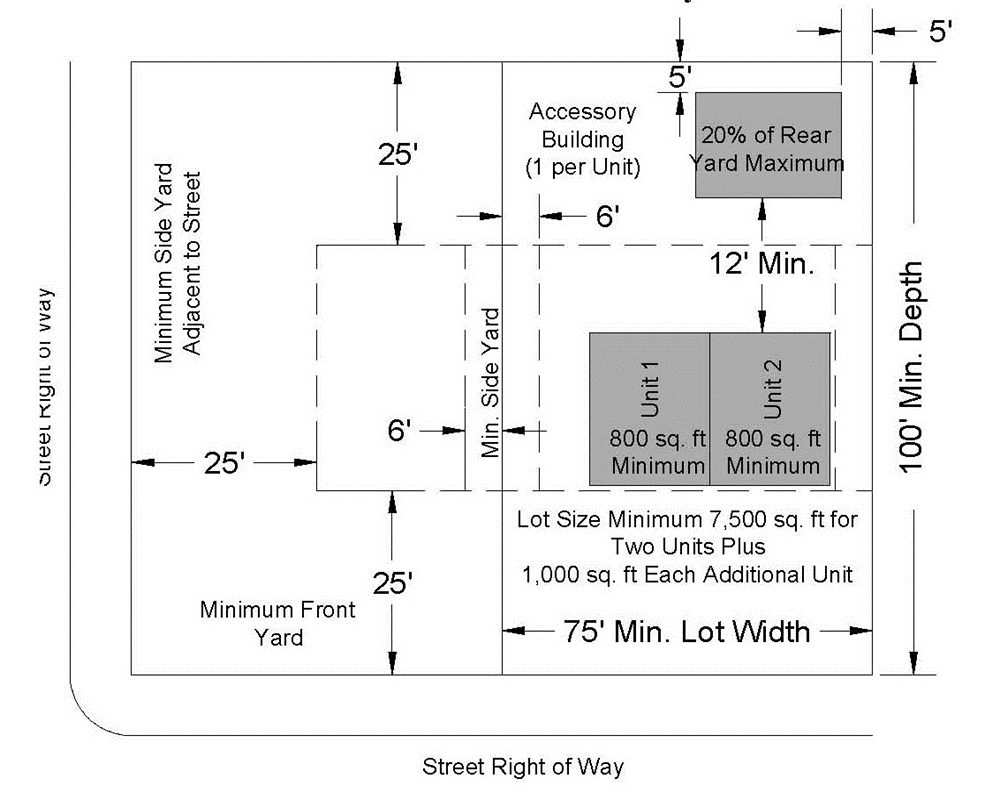
C.
Townhouse/Condominium.
1.
Minimum lot area: 3,000 ft 2 per unit.
2.
Minimum average lot width and lot frontage: 30 feet.
3.
Minimum lot depth: 100 feet.
4.
Minimum depth of front setback: 15 feet.
5.
Minimum depth of rear setback: 15 feet.
6.
Minimum width of side setback:
a.
Internal lot: five feet.
b.
Corner lot: 15 feet from intersecting side street.
7.
Building size:
a.
Maximum building coverage as a percentage of lot area: 40%
b.
Minimum area of each Townhouse dwelling unit: 800 ft 2 .
c.
Minimum area of each Condominium of each dwelling unit: 500 ft 2 for one bedroom or less, plus 125 ft 2 of floor area for each additional bedroom.
8.
Accessory buildings:
a.
Maximum accessory building coverage of rear yard: 20%.
b.
Maximum area of each accessory building: 200 ft 2 .
c.
Maximum number of accessory buildings: one per unit.
d.
Minimum depth of side setback: five feet.
e.
Minimum depth of rear setback: five feet.
f.
Minimum depth from the edge of the main building: 12 feet.
9.
Maximum height of structures: 35 feet.
10.
Public, semi-public or public service buildings, hospitals, institutions or schools may not exceed a height of 60 feet. Churches, temples and mosques may not exceed 75 feet, if the building is set back from each yard line at least one foot for each two feet additional height above the height limit in this district.
11.
Maximum density of Townhome or Condominium Housing within the R-2.5 District shall not exceed 14 units per acres with each unit platted separately.
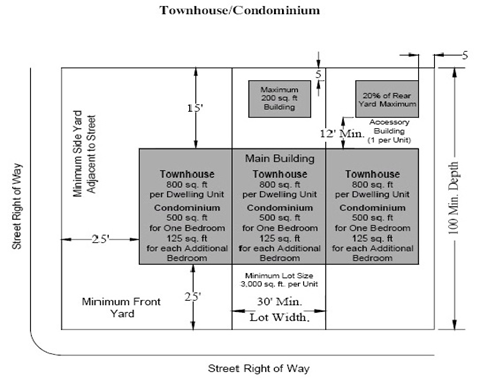
5.8.E
Parking Regulations. Lots in this District shall provide a minimum of two vehicle parking spaces per dwelling unit, with a driveway connecting the parking spaces with a street or alley, and meet all the pertinent requirements contained in Section 154.11Parking spaces for vehicles of this ordinance.
(Ord. No. 2021-O-28, § 1, passed 9-7-2021; Ord. No. 2023-O-03, § 1, passed 1-3-2023; Am. Ord. 2024-O-33, § 1, passed 11-5-2024)
Sec. 154.06.1. - Neighborhood business district (B-1).
6.1.A
Description.
(1)
The Neighborhood Business District accommodates trade and personal services facilities that meet the needs and enhance the quality of life of residential neighborhoods throughout the city.
(2)
The various retail trade and service uses in the Neighborhood Business District are intended to become an integral part of the neighborhood, requirements for open space and off street parking are more restrictive and are compatible with adjacent residential areas. Spacing, air circulation, landscaping and unrestricted sight lines are included as requirements for the Neighborhood Business District to provide a harmonious relationship with other residential, educational, religious and recreational land uses.
6.1.B
Permitted Uses.
(1)
Accessory building to main use;
(2)
Animal grooming;
(3)
Antique shop/art gallery—sales in building;
(4)
Assisted living center;
(5)
Bakery—Retail;
(6)
Banks or other financial institutions;
(7)
Bed and breakfast/boarding house;
(8)
Church, temple, mosque (and the like) and related facilities;
(9)
Cleaning and pressing—small shop, pick-up and delivery;
(10)
Clinic;
(11)
Convalescent, nursing or long term care facility;
(12)
Convenience/grocery store (without pumps);
(13)
Day care center (12 or more children);
(14)
Drapery, needlework or weaving shop;
(15)
Farmers market;
(16)
Florist;
(17)
Fraternal organizations, lodge or civic club;
(18)
Handcraft shop;
(19)
Group day care home (7-12 children);
(20)
Laundry and cleaning (self service);
(21)
Municipal facilities/state facilities/federal facilities;
(22)
Neighborhood grocery store (no fuel service);
(23)
Office—professional and general administration;
(24)
Park, playground, public community recreation center;
(25)
Personal service shop (beauty, barber and the like);
(26)
Private kindergarten;
(27)
Retail stores and shops—other than listed;
(28)
Restaurant or cafeteria—without drive-in service; and
(29)
Retirement housing complex.
(30)
Restaurant with alcoholic beverage service.
6.1.C
Conditional Uses (Special Use Permit required). None.
6.1.D
Height, Area, Yard and Lot Coverage Requirements.
(1)
Maximum density: There is no maximum density requirement.
(2)
Minimum lot area: There is no minimum area requirement.
(3)
Minimum lot width: There is no minimum width requirement.
(4)
Minimum lot depth: There is no minimum depth requirement.
(5)
Minimum depth of front setback: 25 feet.
(6)
Minimum depth of rear setback: There is no minimum rear setback requirement unless the lot abuts upon a Residential District, then a minimum 25 feet is required.
(7)
Minimum width of side setback:
(a)
Internal lot: There is no minimum side setback requirement unless the lot abuts upon a Residential District, then a minimum 25 feet is required.
(b)
Corner lot: 25 feet
(8)
Building size: There are no minimum size regulations
(9)
Maximum height of structures: 35 feet.
(10)
Public, semi-public or public service buildings, hospitals, institutions or schools may not exceed a height of 60 feet. Churches, temples and mosques may not exceed 75 feet, if the building is set back from each yard line at least one foot for each two feet additional height above the height limit in this district.
Height, Area, Yard and Lot Coverage Requirements
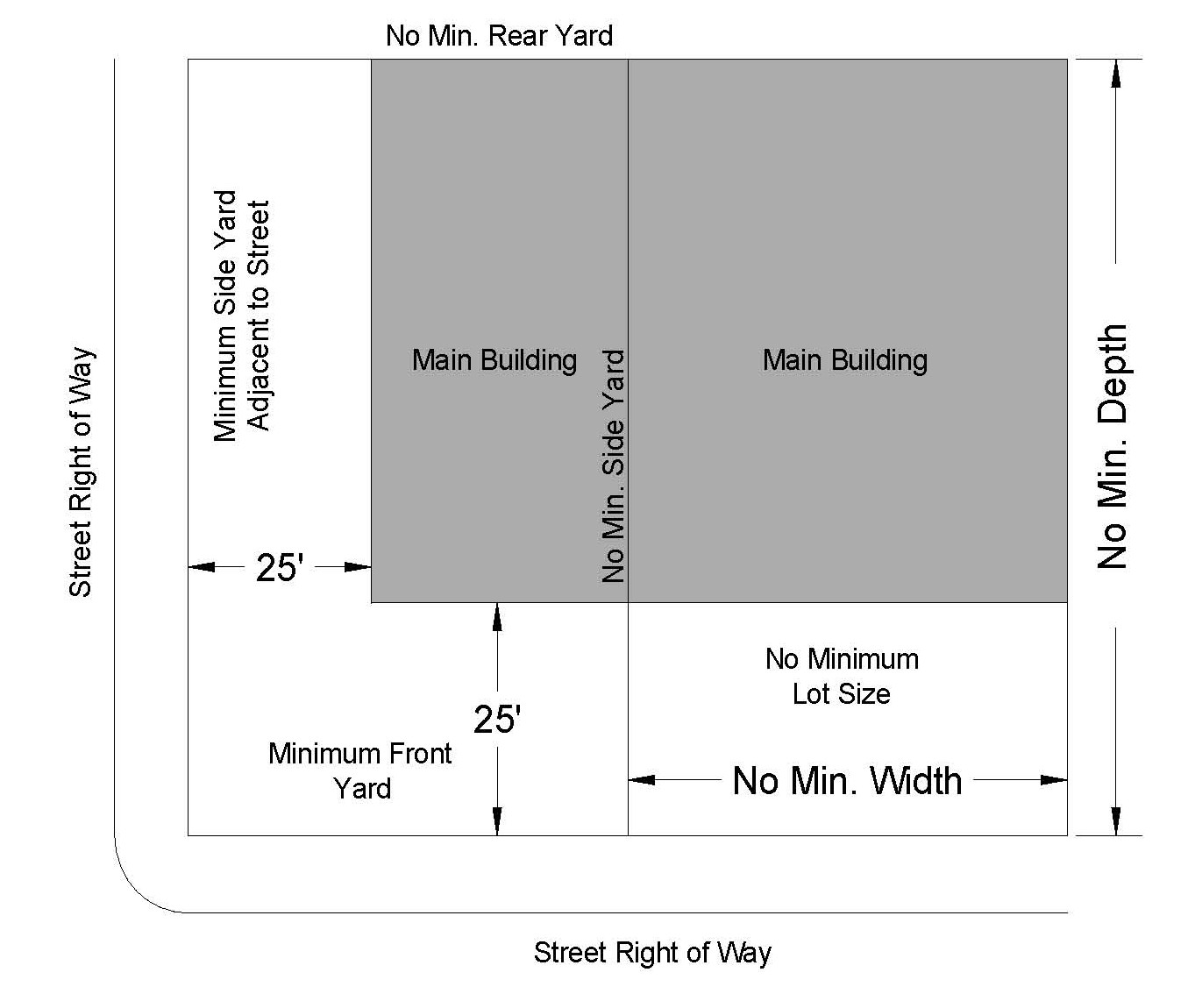
Note: No rear or side yard except when the lot abuts upon a Residential District, then the minimum setback is 25 feet.
6.1.E
Miscellaneous Provisions. Wherever a Neighborhood Business District adjoins a residential district and is not separated by a street, a six-foot or taller solid sight-barring fence or landscape barrier will be constructed and maintained along the boundary or property line as permanent screening. All outside lighting features will be placed and reflected so as to not create annoyances, nuisances or hazards.
6.1.F
Type of Construction.
(1)
At least 80% of the exterior walls of all structures visible from a public street shall be of masonry constructions, with an architectural exterior finish, exclusive of door and window openings.
(2)
The roofs of all structures shall be pitched with a slope of not less than 4/12.
6.1.G
Parking Regulations. All Uses Permitted in the B-1 District: See Section 11 for Parking Regulations.
6.1.H
Sign Regulation. See Section 12 for Sign Regulations.
6.1.I
Exceptions to Use, Height and Area Regulations. See Section 10.
6.1.J
Garbage Regulations. Neighborhood Business District businesses will provide a serviceable area specifically for refuse collection designed for refuse canisters. Each designated canister area will be nine feet wide and eight feet deep (72 square feet), with a cement slab base. If the location of the cement slab is adjacent to a residential district, the slab must be at least five feet from the property line. The refuse area will be enclosed on three sides by a privacy fence. Approach areas will meet the requirements of Subsection 6.1.K.
6.1.K
Loading and Unloading Regulations. All loading, unloading and maneuvering of vehicles connected with the activity must be on the premises and will not be permitted in any street. Loading and unloading areas must be paved with a sealed surface pavement and maintained in such a manner that no dust will be produced.
(Am. Ord. 2009-23, passed 12-1-2009; Am. Ord. 2015-03, passed 3-3-2015; Am. Ord. No. 2018-O-25, § 1, 8-7-2018; Ord. No. 2021-O-17, §§ 1, 2, passed 6-1-2021)
Sec. 154.06.2. - Retail and commercial business district (B-2).
6.2.A
Description. The Retail and Commercial Business District provides areas for the grouping of retail shops and stores offering goods and services for the residents in general. These shopping areas will generally be more densely concentrated and more traffic intensive than allowed in the Neighborhood Business Districts.
6.2.B
Permitted Uses.
(1)
Animal grooming;
(2)
Antique shop/art gallery—sales in building;
(3)
Assisted living center;
(4)
Athletic field;
(5)
Automobile service station and car care center;
(6)
Auto parking lot or building (commercial);
(7)
Auto parts sales;
(8)
Auto repair/mechanic garage;
(9)
Auto sales;
(10)
Automobile rental;
(11)
Bail bond service;
(12)
Bakery—Retail;
(13)
Banks or other financial institutions;
(14)
Bicycle sales and rental;
(15)
Boat sales;
(16)
Bottling works (wholesale);
(17)
Building material sales;
(18)
Cabinet and upholstery shop;
(19)
Car wash;
(20)
Care facility for narcotic, alcoholic or psychiatric patients;
(21)
Cemetery/mausoleum;
(22)
Church, temple or mosque;
(23)
Civic/community center;
(24)
Cleaning and pressing—small shop, pickup and delivery;
(25)
Clinic;
(26)
College or university;
(27)
Commercial amusement (indoor);
(28)
Commercial amusement (outdoor);
(29)
Convalescent, nursing or long term care facility;
(30)
Convenience/grocery store (without pumps) convenience store (with pumps);
(31)
Construction equipment rental and sales;
(32)
Construction yard (temporary);
(33)
Contractor shop and storage yard;
(34)
Department store;
(35)
Discount warehouse store;
(36)
Drapery, needlework or weaving shop;
(37)
Farmers Market;
(38)
Feed, seed and fertilizer store—no bulk storage;
(39)
Field office (temporary);
(40)
Florist;
(41)
Fraternal organization, lodge or civic club;
(42)
Furniture or appliance store;
(43)
Golf course or country club, driving range;
(44)
Greenhouse or nursery for retail plant sales with outside storage;
(45)
Handcraft shop;
(46)
Health club, weight and aerobic center;
(47)
Home improvement center;
(48)
Hospital—general acute care (human);
(49)
Hotels and motels;
(50)
Household appliance service and repair;
(51)
Kennel;
(52)
Kiosk;
(53)
Laboratory (medical);
(54)
Landscaping service;
(55)
Laundry and cleaning (self service);
(56)
Lawn equipment and small engine sales and services;
(57)
Micro brewery;
(58)
Mini storage/warehouses;
(59)
Monument retail sales (outside storage);
(60)
Mortuary or funeral home;
(61)
Moving company;
(62)
Neighborhood grocery store (no fuel service);
(63)
Office—professional and general administration;
(64)
Park, playground, public community recreation center;
(65)
Pawn shop;
(66)
Personal service shop (beauty, barber and the like);
(67)
Pet shop—small animals within building;
(68)
Plumbing shop;
(69)
Portable building sales;
(70)
Printing;
(71)
Produce stand;
(72)
Psychic/Tarot card reader;
(73)
Recreational vehicle sales;
(74)
Recycling kiosk;
(75)
Research lab (non-hazardous);
(76)
Restaurant (drive-in type);
(77)
Restaurant or cafeteria—without drive-in service;
(78)
Restaurant with alcoholic beverage service;
(79)
Retail shops and stores other than listed;
(80)
Roofing and siding supply;
(81)
Sale of alcohol as licensed by the Texas Alcoholic Beverage Commission;
(82)
Schools—public, private and parochial;
(83)
Shopping center;
(84)
Storage or repair of furniture and appliances (display inside of building);
(85)
Studio (photographer, musician, artist);
(86)
Studio for radio and television;
(87)
Tattoo parlor/body piercing studio;
(88)
Taxidermy;
(89)
Theater—indoor;
(90)
Tobacco shop;
(91)
Tool and equipment rental shop;
(92)
Trailer rental and sales;
(93)
Veterinary clinic or hospital; and
(94)
Veterinary services.
6.2.C
Conditional Uses (Special Use Permit required).
(1)
Day care center—12 or more children;
(2)
Flea market;
(3)
Frozen foods locker;
(4)
Scientific and research laboratories;
(5)
Theater (drive-in);
(6)
Trade and commercial schools; and
(7)
Auto paint and body shop/repair.
6.2.D
Height, Area, Yard and Lot Coverage Requirements.
(1)
Maximum density: There is no maximum density requirement.
(2)
Minimum lot area: There is no minimum area requirement.
(3)
Minimum lot width: There is no minimum width requirement.
(4)
Minimum lot depth: There is no minimum depth requirement.
(5)
Minimum depth of front setback: 20 feet.
(6)
Minimum depth of rear setback: There is no minimum rear setback requirement unless the lot abuts upon a Residential District, then a minimum ten feet is required.
(7)
Minimum width of side setback:
(a)
Internal lot: There is no minimum side setback requirement unless the lot abuts upon a Residential District, then a minimum five feet is required.
(b)
Corner lot: 20 feet.
(8)
Building size: There are no minimum size regulations.
(9)
Maximum height of structures: 35 feet.
(10)
Public, semi-public or public service buildings, hospitals, institutions or schools may not exceed a height of 60 feet. Churches, temples and mosques may not exceed 75 feet, if the building is set back from each yard line at least one foot for each two feet additional height above the height limit in this district.
Height, Area, Yard and Lot Coverage Requirements
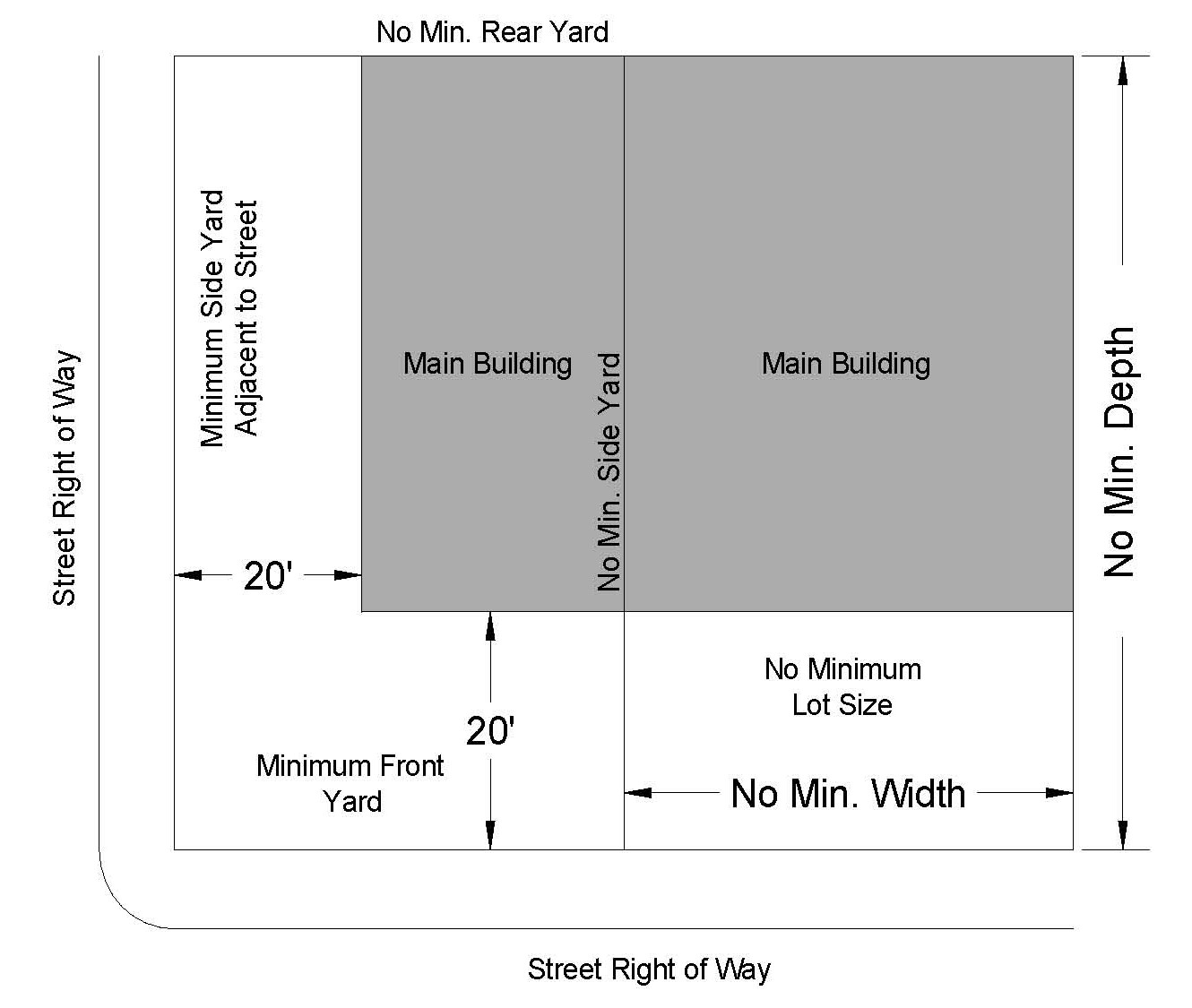
Note: No rear or side yard except when the lot abuts upon a Residential District, then the minimum setback for rear yard is 10 feet and side yard is five feet.
6.2.E
Parking Regulations. All uses permitted in the B-2 District: See Section 11 Parking Regulations.
6.2.F
Sign Regulation. See Section 12 for Sign Regulations.
6.2.G
Exceptions to Use, Height and Area Regulations. See Section 10.
6.2.H
Garbage Regulations. Retail and Commercial District businesses will provide a serviceable area specifically for refuse collection designed for refuse canisters. Each designated canister area will be nine feet wide and eight feet deep (72 square feet), with a cement slab base. If the location of the cement slab is adjacent to a residential district, the slab must be at least five feet from the property line. The refuse area will be enclosed on three sides by a privacy fence. Approach areas will meet the requirements of Subsection 6.2.I.
6.2.I
Loading and Unloading Regulations. All loading, unloading and maneuvering of vehicles connected with the activity must be on the premises and will not be permitted in any street. Loading and unloading areas must be paved with a sealed surface pavement and maintained in such a manner that no dust will be produced.
(Am. Ord. 2008-07, passed 5-6-2008; Am. Ord. 2009-23, passed 12-1-2009; Am. Ord. No. 2018-O-25, § 1, 8-7-2018; Ord. No. 2021-O-17, §§ 1, 3, passed 6-1-2021; Ord. No. 2021-O-32, § 1, passed 8-3-2021; Ord. No. 2025-O-11, § 1, 3-4-2025)
Sec. 154.06.3. - Central business district (B-3).
6.3.A
Description. The Central Business District is intended to encourage the redevelopment of the downtown business area, which includes the historic courthouse, all types of offices, retail business and residences. The varying land uses included in the Central Business District are compatible with existing uses to preserve the integrity of the Central Business District and deter urban deterioration. This district also facilitates the maintenance of the area and provides for the vibrant interaction between retail, service, residential and citizens citywide.
6.3.B
Permitted Uses.
(1)
Accessory building to main use;
(2)
Antique shop/art gallery—sales in building;
(3)
Auto parking lot or building (commercial);
(4)
Bakery—Retail;
(5)
Banks or other financial institutions;
(6)
Bed and breakfast/boarding house;
(7)
Bicycle sales and rental;
(8)
Church, temple or mosque;
(9)
Civic or community center;
(10)
Cleaning and pressing—small shop, pickup and delivery;
(11)
College or university;
(12)
Condominium (amended definition of family);
(13)
Convenience/grocery store (without pumps);
(14)
Department store;
(15)
Drapery, needlework or weaving shop;
(16)
Farmers market;
(17)
Florist;
(18)
Fraternal organization, lodge or civic club;
(19)
Furniture or appliance store;
(20)
Handcraft shop;
(21)
Health club, weight and aerobic center;
(22)
Home occupation;
(23)
Hotels and motels;
(24)
Household appliance service and repair (no outside storage);
(25)
Kiosk;
(26)
Laboratory (medical);
(27)
Micro brewery;
(28)
Multi-family dwelling (five more units) (amended definition of family);
(29)
Municipal facilities/state facilities/federal facilities;
(30)
Office—professional and general administration;
(31)
Park, playground, public community recreation center;
(32)
Personal service shop (beauty/barber shop and the like);
(33)
Pet shop—small animals within building (no boarding);
(34)
Railroad or bus passenger station;
(35)
Registered family home (six + six children);
(36)
Restaurant or cafeteria—without drive-in service;
(37)
Restaurant with alcoholic beverage service;
(38)
Retail shops;
(39)
Retirement housing complex;
(40)
Sale of alcohol as licensed by the Texas Alcoholic Beverage Commission;
(41)
Schools—private/parochial;
(42)
Schools—public;
(43)
Single family dwelling (amended definition);
(44)
Studio for photographer, musician, artist and the like;
(45)
Studio for radio and television;
(46)
Tattoo parlor/body piercing studio;
(47)
Theater—indoor;
(48)
Townhouse (amended definition of family); and
(49)
Two-four family dwelling (amended definition of family).
6.3.C
Conditional Uses (Special Use Permit required).
(1)
Assisted living center;
(2)
Auto parts sales;
(3)
Automobile service station and car care center;
(4)
Clinic;
(5)
Day care center (12 or more children);
(6)
Hospital—general acute care (human);
(7)
Printing;
(8)
Plumbing shop;
(9)
Scientific and research laboratories;
(10)
Storage, sale or repair of furniture and appliances (inside building);
(11)
Tobacco shop;
(12)
Tool and equipment rental shop; and
(13)
Trade and commercial schools.
6.3.D
Height, Area, Yard and Lot Coverage Requirements.
(A)
Single family dwelling.
(1)
Maximum density: one dwelling unit per lot.
(2)
Minimum lot area: 6,000 ft 2 .
(3)
Minimum lot width and lot frontage: 60 feet.
(4)
Minimum lot depth: 100 feet.
(5)
Minimum depth of front setback: 25 feet.
(6)
Minimum depth of rear setback: 25 feet.
(7)
Minimum width of side setback:
(a)
Internal lot: five feet.
(b)
Corner lot: 25 feet from intersecting side street.
(8)
Building size:
(a)
Maximum coverage as a percentage of lot area: 40%.
(b)
Minimum area of main building: 1,000 ft 2 .
(9)
Accessory buildings:
(a)
Maximum accessory building coverage of rear yard: 20%.
(b)
Maximum number of accessory buildings: one.
(c)
Minimum depth of side setback: five feet.
(d)
Minimum depth of rear setback: five feet.
(e)
Minimum depth from the edge of the main building: 12 feet.
(10)
Maximum height of structures: 35 feet.
(11)
Public, semi-public or public service buildings, hospitals, institutions or schools may not exceed a height of 60 feet. Churches, temples and mosques may not exceed 75 feet, if the building is set back from each yard line at least one foot for each two feet additional height above the height limit in this district.
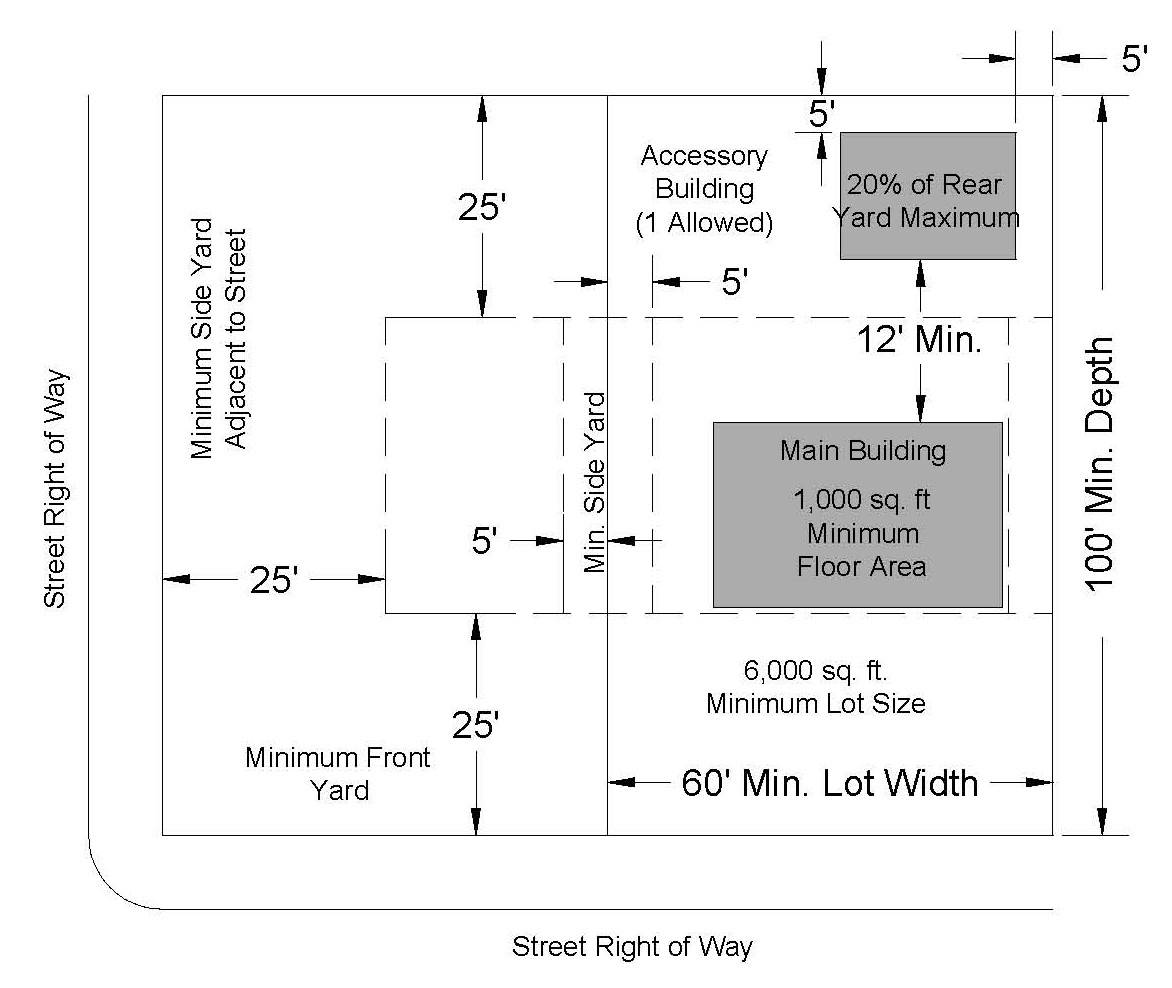
(B)
Two-four family dwelling.
(1)
Minimum lot area: 7,500 ft for two dwelling units, plus 1,000 ft for each additional dwelling unit.
(2)
Minimum lot width and lot frontage: 75 feet.
(3)
Minimum lot depth: 100 feet.
(4)
Minimum depth of front setback: 25 feet.
(5)
Minimum depth of rear setback: 25 feet.
(6)
Minimum width of side setback:
(a)
Internal lot: six feet.
(b)
Corner lot: 25 feet from intersecting side street.
(7)
Building size:
(a)
Maximum coverage as a percentage of lot area: 40%.
(b)
Minimum area of each dwelling unit: 800 ft 2 .
(8)
Accessory buildings:
(a)
Maximum accessory building coverage of rear yard: 20%.
(b)
Maximum area of each accessory building: 200 ft 2 .
(c)
Maximum number of accessory buildings: one per unit.
(d)
Minimum depth of side setback: five feet.
(e)
Minimum depth of rear setback: five feet.
(f)
Minimum depth from the edge of the main building: 12 feet.
(9)
Maximum height of structures: 35 feet.
(10)
Public, semi-public or public service buildings, hospitals, institutions or schools may not exceed a height of 60 feet. Churches, temples, and mosques may not exceed 75 feet, if the building is set back from each yard line at least one foot for each two feet additional height above the height limit in this district.
Height, Area, Yard and Lot Coverage Requirements
Two-Four Family Dwellings
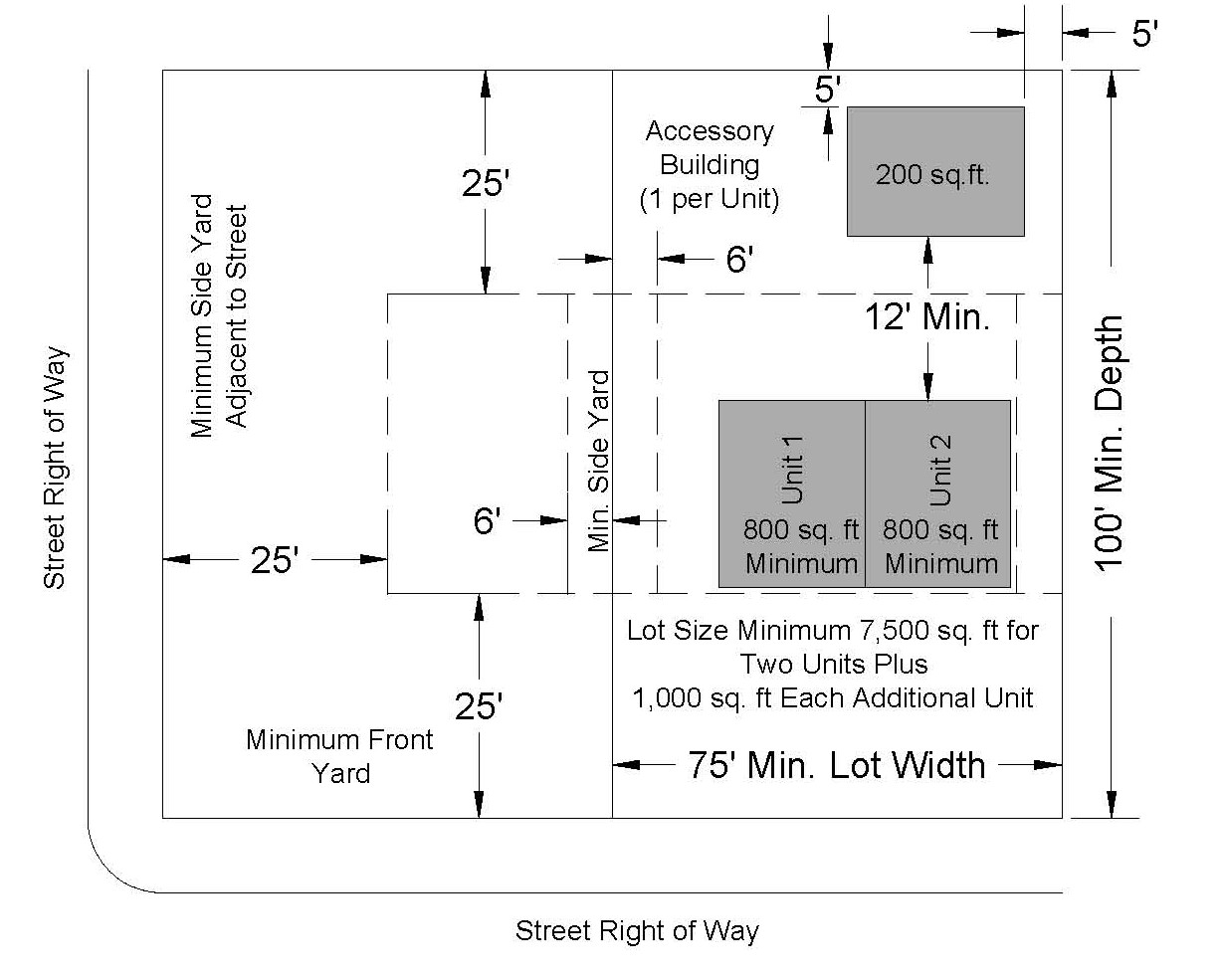
(C)
Townhouse/Condominium.
(1)
Minimum lot area: 3,000 ft 2 per unit.
(2)
Minimum average lot width and lot frontage: 30 feet.
(3)
Minimum lot depth: 100 feet.
(4)
Minimum depth of front setback: 25 feet.
(5)
Minimum width of rear setback: 15 feet.
(6)
Minimum width of side setback:
(a)
Internal lot: five feet.
(b)
Corner lot: 25 feet from intersecting side street.
(7)
Building size:
(a)
Maximum main building coverage as a percentage of lot area: 40%
(b)
Minimum area of each Townhouse dwelling unit: 800 ft 2 .
(c)
Minimum area of each Condominium of each dwelling unit: 500 ft 2 for one bedroom or less, plus 125 ft 2 of floor area for each additional bedroom.
(8)
Accessory buildings:
(a)
Maximum accessory building coverage of rear yard: 20%.
(b)
Maximum area of each accessory building: 200 ft 2 .
(c)
Maximum number of accessory buildings: one per unit.
(d)
Minimum depth of side setback: five feet.
(e)
Minimum depth of rear setback: five feet.
(f)
Minimum depth from the edge of the main building: 12 feet.
(9)
Maximum height of structures: 35 feet.
(10)
Public, semi-public or public service buildings, hospitals, institutions or schools may not exceed a height of 60 feet. Churches, temples and mosques may not exceed 75 feet, if the building is set back from each yard line at least one foot for each two feet additional height above the height limit in this district.
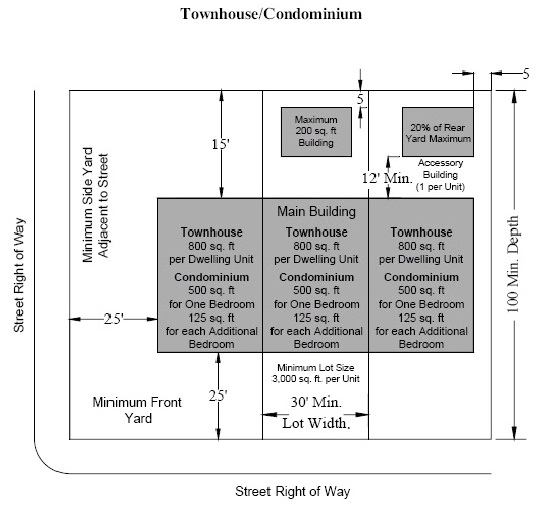
(D)
Multiple family dwellings.
(1)
Minimum lot area: maximum density of 24 dwelling units per acre, which includes parking, access and all other area improvements.
(2)
Minimum lot depth: 100 feet.
(3)
Minimum depth of front setback: 25 feet.
(4)
Minimum depth of rear setback: 20 feet.
(5)
Minimum width of side setback:
(a)
Internal lot: ten feet.
(b)
Corner lot: 25 feet from intersecting side street.
(6)
Building size: Minimum area of each dwelling unit: 500 ft 2 for one bedroom or less plus 125 ft 2 of floor area for each additional bedroom.
(7)
Maximum height of structures: 35 feet.
(8)
Public, semi-public or public service buildings, hospitals, institutions or schools may not exceed a height of 60 feet. Churches, temples and mosques may not exceed 75 feet, if the building is set back from each yard line at least one foot for each two feet additional height above the height limit in this district.
Height, Area, Yard and Lot Coverage Requirements
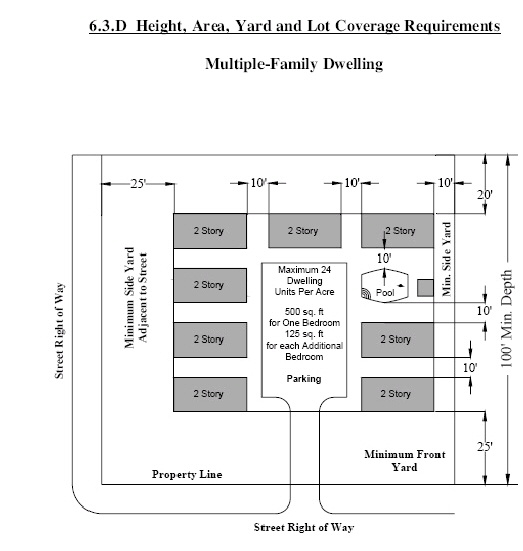
Note: Building size for a multiple family dwellings shall have a minimum area for efficiency or one bedroom unit at 350 feet squared. All other dwelling units shall have a minimum of 800 feet squared.
(E)
All other uses.
(1)
Maximum density: There is no maximum density requirement.
(2)
Minimum lot area: There is no minimum area requirement.
(3)
Minimum lot width: There is no minimum width requirement.
(4)
Minimum lot depth: There is no minimum depth requirement.
(5)
Minimum depth of front setback: There is no front setback requirement.
(6)
Minimum depth of rear setback: There is no minimum rear setback requirement unless the lot abuts upon a Residential District, then a minimum ten feet is required.
(7)
Minimum width of side setback:
(a)
Internal lot: There is no minimum side setback requirement unless the lot abuts upon a Residential District, then a minimum five feet is required.
(b)
Corner lot: There is no setback requirement.
(8)
Building Size: there are no minimum size regulations.
(9)
Maximum height of structures: No building shall exceed 75 feet.
(10)
Public, semi-public or public service buildings, hospitals, institutions or schools may not exceed a height of 60 feet. Churches, temples and mosques may not exceed 75 feet, if the building is set back from each yard line at least one foot for each two feet additional height above the height limit in this district.
Height, Area, Yard and Lot Coverage Requirements. All Other Uses
Height, Area, Yard and Lot Coverage Requirements
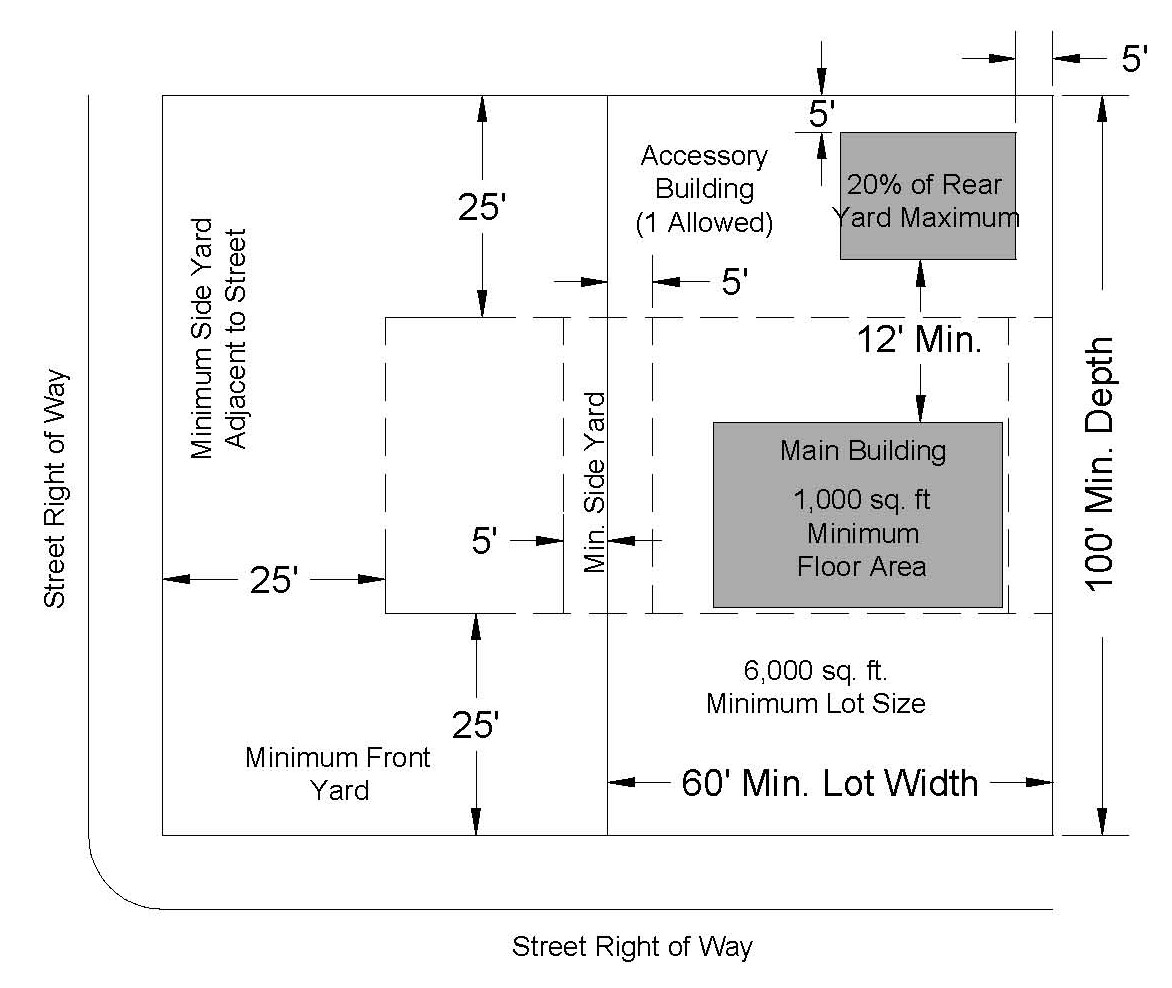
Note: No rear or side yard except when the lot abuts upon a Residential District, then the minimum setback for rear yard is ten feet and side yard is five feet.
6.3.E
Parking Regulations.
(1)
A Single-Family, B-3 District lot shall provide a minimum of two vehicle parking spaces, with a driveway connecting the parking spaces with a street or alley, and meet all the pertinent requirements contained in Section 11 the Parking Regulations of this ordinance.
(2)
A Two-Four-Family, B-3 District lot shall provide a minimum of two vehicle parking spaces per dwelling unit and meet all the pertinent requirements contained in Section 11 the Parking Regulations of this ordinance.
(3)
A Townhouse/Condominium, B-3 District lot shall provide a minimum of two vehicle parking spaces per dwelling unit and meet all the pertinent requirements contained in Section 11 the Parking Regulations of this ordinance.
(4)
A Multiple Family, B-3 District lot shall provide a minimum of two vehicle parking spaces per dwelling unit and meet all the pertinent requirements contained in Section 11 the Parking Regulations of this ordinance.
(5)
All uses permitted in the B-3 District: See Section 11 for Parking Regulations.
6.3.F
Type of Construction.
(1)
The exterior walls of all new dwellings to the top plate, shall be constructed of at least 80% of the total exterior walls of primary materials, excluding doors, windows, and porches. See Section 10.E(1): Exterior Building Material Standard—Primary Materials.
(2)
Any remaining exterior walls of all new dwellings shall construct the remaining exterior walls of alternative materials. See Section 10.E(2): Exterior Building Material Standard—Alternative Materials.
(3)
Existing dwellings expanding the total square footage of the building 50% or less, or modifying the exterior walls, may use the same exterior construction material as the existing primary building. If the material is not available, similar material may be used if approved by the Community Development Director.
(4)
Existing dwellings expanding the total square footage of the building more than 50%, or proposing to use a material inconsistent with the primary structure for any expansion, must meet the 80% minimum primary materials, Section 10.E: Exterior Building Material Standard, for the total exterior walls of the structure.
6.3.F Exterior Building Material Standards
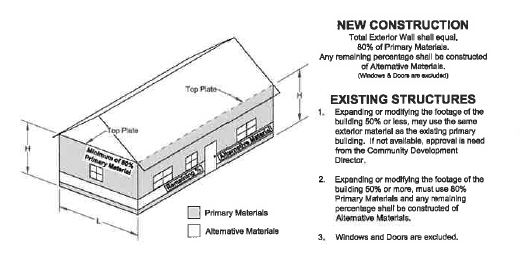
6.3.G
Sign Regulation. See Section 12 for Sign Regulations.
6.3.H
Exceptions to Use, Height and Area Regulations. See Section 10.
6.3.I
Garbage Regulations. Central Business District businesses will provide a serviceable area specifically for refuse collection designed for refuse canisters. Each designated canister area will be nine feet wide and eight feet deep (72 square feet), with a cement slab base. If the location of the cement slab is adjacent to a residential district, the slab must be at least five feet from the property line. The refuse area will be enclosed on three sides by a privacy fence. Approach areas will meet the requirements of Subsection 6.3.J.
6.3.J
Loading and Unloading Regulations. All loading, unloading and maneuvering of vehicles connected with the activity must be on the premises and will not be permitted in any street. Loading and unloading areas must be paved with a sealed surface pavement and maintained in such a manner that no dust will be produced.
(Am. Ord. 2007-24, passed 12-4-2007; Am. Ord. 2008-13, passed 7-1-2008; Am. Ord. 2009-23, passed 12-1-2009; Am. Ord. 2011-26, passed 12-6-2011; Am. Ord. No. 2018-O-25, § 1, 8-7-2018; Ord. No. 2021-O-17, §§ 1, 4, passed 6-1-2021; Ord. No. 2021-O-32, § 1, passed 8-3-2021; Am. Ord. 2024-O-33, § 1, passed 11-5-2024)
Sec. 154.06.4. - Private club district (B-4).
6.4.A
Description. The B-4 District is intended to provide for private clubs providing on-the-premises consumption of alcoholic beverages.
6.4.B
Permitted Uses.
(1)
Fraternal organization, lodge, civic club;
(2)
Golf course or country club (private);
(3)
Hotels and motels; and
(4)
Private clubs.
6.4.C
Conditional Uses (Special Use Permit required). None.
6.4.D
Height, Area, Yard and Lot Coverage Requirements.
(1)
Maximum density: There is no maximum density requirement.
(2)
Minimum lot area: There is no minimum area requirement.
(3)
Minimum lot width: There is no minimum width requirement.
(4)
Minimum lot depth: There is no minimum depth requirement.
(5)
Minimum depth of front setback: 20 feet.
(6)
Minimum depth of rear setback: There is no minimum rear setback requirement unless the lot abuts upon a Residential District, then a minimum ten feet is required.
(7)
Minimum width of side setback:
(a)
Internal lot: There is no minimum side setback requirement unless the lot abuts upon a Residential District, then a minimum five feet is required.
(b)
Corner lot: 20 feet.
(8)
Building size: There are no minimum size regulations.
(9)
Maximum height of structures: 35 feet.
(10)
Public, semi-public or public service buildings, hospitals, institutions or schools may not exceed a height of 60 feet. Churches, temples and mosques may not exceed 75 feet, if the building is set back from each yard line at least one foot for each two feet additional height above the height limit in this district.
Height, Area, Yard and Lot Coverage Requirements
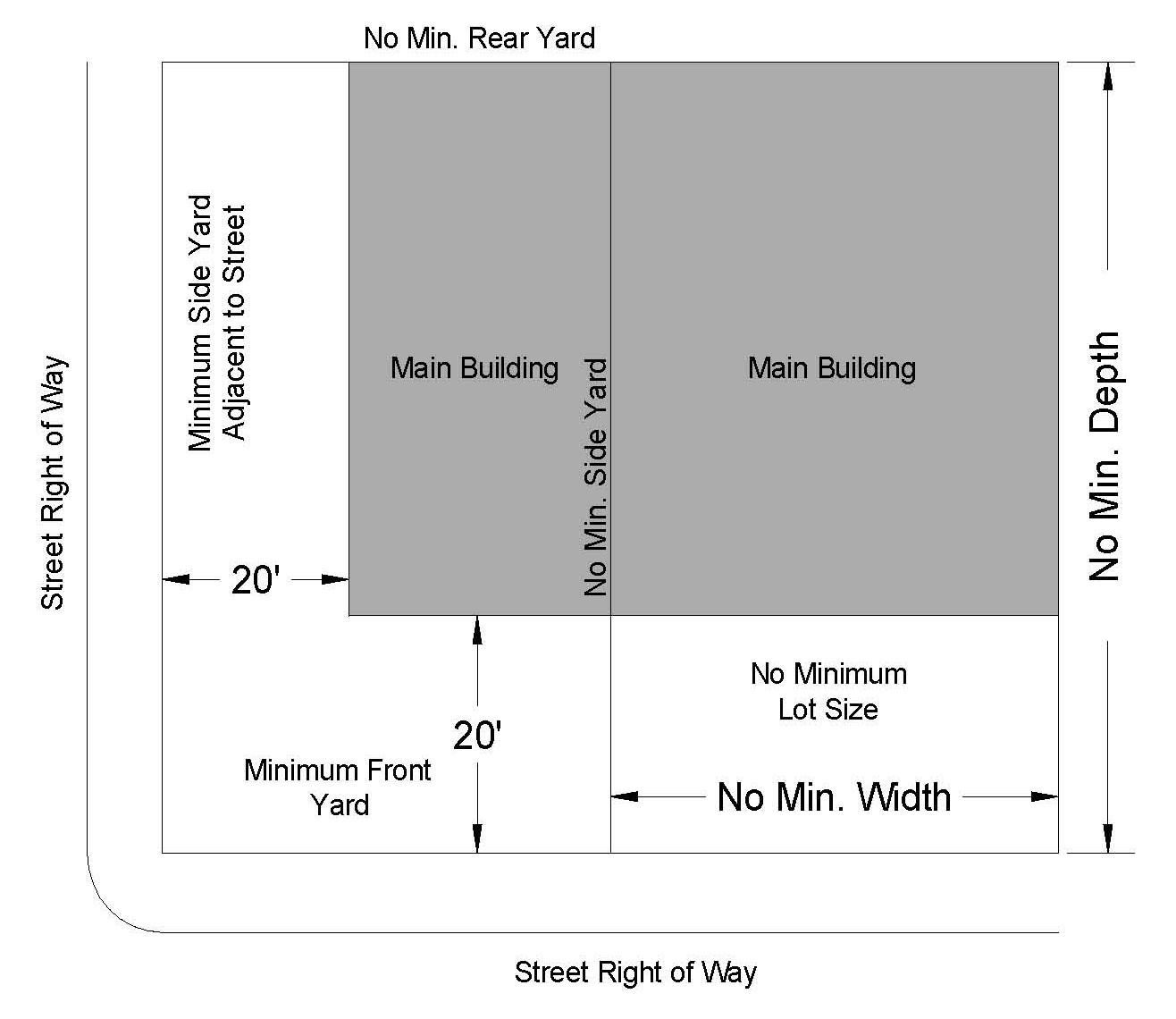
Note: No rear or side yard except when the lot abuts upon a Residential District, then the minimum setback for rear yard is ten feet and side yard is five feet.
6.4.E
Parking Regulations. All uses permitted in the B-4 District: See Section 11 for Parking Regulations.
6.4.F
Sign Regulation. See Section 12 for Sign Regulations.
6.4.G
Exceptions to Use, Height and Area Regulations. See Section 10.
6.4.H
Garbage Regulations. Private Club District businesses will provide a serviceable area specifically for refuse collection designed for refuse canisters. Each designated canister area will be nine feet wide and eight feet deep (72 square feet), with a cement slab base. If the location of the cement slab is adjacent to a residential district, the slab must be at least five feet from the property line. The refuse area will be enclosed on three sides by a privacy fence. Approach areas will meet the requirements of Subsection 6.4.I.
6.4.I
Loading and Unloading Regulations. All loading, unloading and maneuvering of vehicles connected with the activity must be on the premises and will not be permitted in any street. Loading and unloading areas must be paved with a sealed surface pavement and maintained in such a manner that no dust will be produced.
Sec. 154.06.5. - Reserved.
Editor's note— Ord. No. 2018-O-25, § 3, passed August 7, 2018, repealed § 154.06.5. Former § 154.06.5 pertained to restaurant—alcoholic beverage service (B-5).
Sec. 154.06.6. - Industrial district (I).
6.6.A
Description. The Industrial District is intended to serve as the location for general industrial activities.
6.6.B
Permitted Uses.
(1)
Airport, heliport or landing field;
(2)
Animal grooming;
(3)
Athletic field;
(4)
Auto paint and body shop/repair;
(5)
Auto parking lot or building (commercial);
(6)
Auto parts sales;
(7)
Auto repair/mechanic garage;
(8)
Auto sales;
(9)
Auto storage;
(10)
Auto wrecking or salvage yard;
(11)
Automobile rental;
(12)
Automobile service station and car care center;
(13)
Bail bond service;
(14)
Bakery—Wholesale and distribution;
(15)
Banks or other financial institutions;
{16)
Boat sales;
(17)
Bottling works (wholesale);
(18)
Building material sales;
(19)
Bulk grain/feed storage;
(20)
Cabinet and upholstering shop;
(21)
Car wash;
(22)
Chemical supply;
(23)
Civic/community center;
(24)
College or university;
(25)
Commercial amusement (indoor and outdoor);
(26)
Concrete or asphalt batching plant;
(27)
Convenience store (with pumps); including the sale of alcohol, as licensed by the Texas Alcoholic Beverage Commission;
(28)
Convenience/grocery store (without pumps); including the sale of alcohol, as licensed by the Texas Alcoholic Beverage Commission;
(29)
Construction equipment rental and sales;
(30)
Construction yard (temporary);
(31)
Contractor shop and storage yard;
(32)
Feed, seed and fertilizer store-no bulk storage;
(33)
Feed store;
(34)
Field office (temporary);
(35)
Flea market;
(36)
Frozen foods locker;
(37)
Health club, weight and aerobic center;
(38)
Heavy machinery sales and storage;
(39)
Heavy manufacturing or industrial;
(40)
Home improvement center;
(41)
Hotels and motels; including the sale of alcohol, as licensed by the Texas Alcoholic Beverage Commission;
(42)
Industrial manufacturing/fabrication/assembly (closed);
(43)
Industrial manufacturing/fabrication/assembly (outside storage);
(44)
Kennel;
(45)
Kiosk;
(46)
Laboratory (medical);
(47)
Landscaping service;
(48)
Laundry plant;
(49)
Lawn equipment and small engine sales and services;
(50)
Light manufacturing or industrial;
(51)
Machine shop;
(52)
Micro brewery; including the sale of alcohol, as licensed by the Texas Alcoholic Beverage Commission;
(53)
Mini storage/warehouses;
(54)
Mobile homes/manufactured home parks;
(55)
Mobile home display and sales;
(56)
Moving company;
(57)
Newspaper printing;
(58)
Office-professional and general administration;
(59)
Overnight delivery and service center;
(60)
Package Store; including the sale of alcohol, as licensed by the Texas Alcoholic Beverage Commission;
(61)
Pawn shop;
(62)
Plumbing shop;
(63)
Portable building sales;
(64)
Printing;
(65)
Produce stand;
(66)
Propane sales (filling stations);
(67)
Radio, television, microwave or electric generating tower;
(68)
Recreational vehicle sales;
(69)
Railroad or bus passenger station;
(70)
Recycling collection center;
(71)
Recycling kiosk;
(72)
Research lab (non-hazardous);
(73)
Restaurant (drive-in type); including the sale of alcohol, as licensed by the Texas Alcoholic Beverage Commission;
(74)
Restaurant or cafeteria-without drive-in service; including the sale of alcohol, as licensed by the Texas Alcoholic Beverage Commission;
(75)
Restaurant with alcoholic beverage service; including the sale of alcohol, as licensed by the Texas Alcoholic Beverage Commission;
(76)
Roofing and siding supply;
(77)
Sand/gravel/caliche/stone sales (storage);
(78)
Shopping center; including the sale of alcohol, as licensed by the Texas Alcoholic Beverage Commission;
(79)
Sign manufacturing;
(80)
Stone/clay/glass manufacture;
(81)
Storage or repair of furniture and appliance (inside);
(82)
Studio for radio and television;
(83)
Tattoo parlor/body piercing studio;
(84)
Taxidermy;
(85)
Tobacco shop;
(86)
Trade or commercial schools;
(87)
Tire retreading;
(88)
Tool equipment rental shop;
(89)
Trailer rental/sales;
(90)
Truck stop;
(91)
Veterinary clinic or hospital;
(92)
Veterinary services;
(93)
Warehouse, wholesale (enclosed and outside storage);
(94)
Welding shop;
(95)
Wholesale distribution centers;
(96)
Wholesale production and distribution of ice (mfg. by machine only); and
(97)
Wrecking yard.
6.6.C
Conditional Uses (Special Use Permit required).
(1)
Day care center—12 or more children; and
(2)
Sexually oriented business;
(3)
Citizen collection station;
(4)
Permitted uses not specifically designated for alcohol sales when licensed for the sale of alcohol by the Texas Alcoholic Beverage Commission.
6.6.D
Height, Area, Yard and Lot Coverage Requirements.
(1)
Maximum density: There is no maximum density requirement.
(2)
Minimum lot area: There is no minimum area requirement.
(3)
Minimum lot width: There is no minimum width requirement.
(4)
Minimum lot depth: There is no minimum depth requirement.
(5)
Minimum depth of front setback: 20 feet minimum.
(6)
Minimum depth of rear setback: There is no minimum rear setback requirement unless the lot abuts upon a Residential District, then a minimum ten feet is required.
(7)
Minimum width of side setback:
(a)
Internal lot: There is no minimum side setback requirement unless the lot abuts upon a Residential District, then a minimum five feet is required.
(b)
Corner lot: 20 feet minimum.
(8)
Building size: There are no minimum size regulations
(9)
Maximum height of structures: No building shall exceed 75 feet.
(10)
Public, semi-public or public service buildings, hospitals, institutions or schools may not exceed a height of 60 feet. Churches, temples and mosques may not exceed 75 feet, if the building is set back from each yard line at least one foot for each two feet additional height above the height limit in this district.
Height, Area, Yard and Lot Coverage Requirements
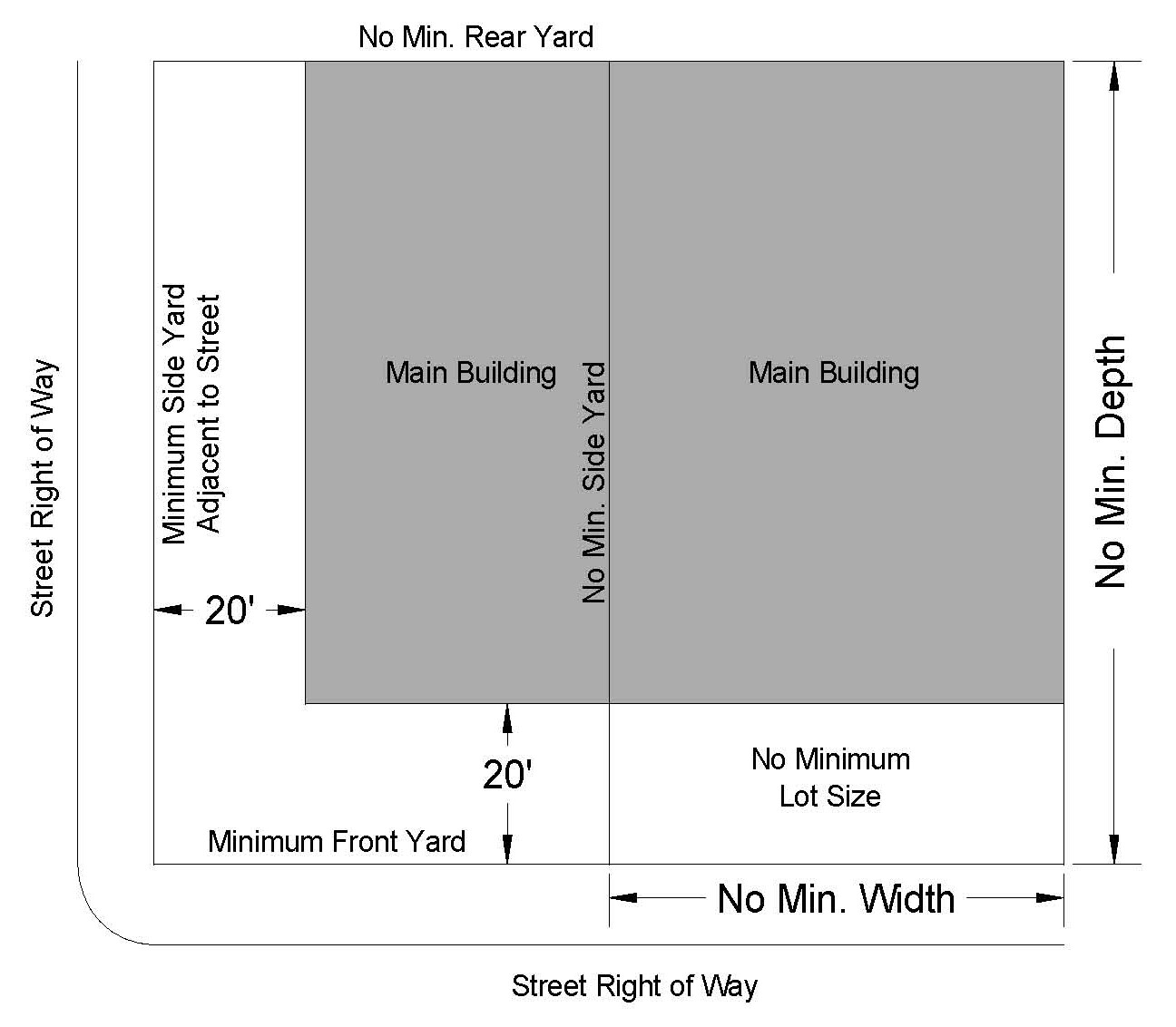
Note: All uses, no rear or side yard except when the lot abuts upon a Residential District, then the minimum set back for the rear yard is ten feet and side yard is five feet.
6.6.E
Parking Regulations. All uses permitted in the I District: See Section 11 for Parking Regulations.
6.6.F
Sign Regulation. See Section 12 for Sign Regulations.
6.6.G
Exceptions to Use, Height and Area Regulations. See Section 10.
6.6.H
Garbage Regulations. Industrial District businesses will provide a serviceable area specifically for refuse collection designed for refuse canisters. Each designated canister area will be nine feet wide and eight feet deep (72 square feet), with a cement slab base. If the location of the cement slab is adjacent to a residential district, the slab must be at least five feet from the property line. The refuse area will be enclosed on three sides by a privacy fence. Approach areas will meet the requirements of Subsection 6.6.I.
6.6.I
Loading and Unloading Regulations. All loading, unloading and maneuvering of vehicles connected with the activity must be on the premises and will not be permitted in any street. Loading and unloading areas must be paved with a sealed surface pavement and maintained in such a manner that no dust will be produced.
(Am. Ord. 2008-07, passed 5-6-2008; Am. Ord. 2009-23, passed 12-1-2009; Am. Ord. No. 2018-O-25, § 1, 8-7-2018; Am. Ord. 2009-23, passed 12-1-2009; Am. Ord. 2018-O-32, § 2, passed 8-28-2018; Ord. No. 2021-O-17, §§ 1, 5, passed 6-1-2021; Ord. No. 2022-O-26, § 1, passed 9-6-2023)
Sec. 154.06.7. - Downtown district (DT).
6.7.A
Description. The Downtown District is intended to encourage the redevelopment of the original township, which includes the historic courthouse, offices, retail business and residences. The varying land uses included in the Downtown District are compatible with existing uses to preserve the integrity of the area Downtown District and deter urban deterioration. This district also facilitates the maintenance of the area and provides for the vibrant interaction between retail, service, residential, government and public use.
6.7.B
Permitted Uses.
(1)
Banks or other financial institutions;
(2)
Bed and breakfast/boarding house;
(3)
Bicycle sales and rental;
(4)
Book and card/gift stores;
(5)
Church, temple or mosque;
(6)
Civic or community center;
(7)
Clinic;
(8)
Commercial parking garage/lot;
(9)
Condominium (four or less units) (amended definition of family);
(10)
Convenience/grocery store (without pumps);
(11)
Day spa;
(12)
Florist;
(13)
Fraternal organization, lodge or civic club;
(14)
Health club, weight and aerobic center;
(15)
Home occupation;
(16)
Hotels and motels;
(17)
Library;
(18)
Micro brewery/winery (retail sales)—without drive-in service;
(19)
Municipal facilities/state facilities/federal facilities;
(20)
Museums and galleries;
(21)
Office—professional and general administration;
(22)
Personal service shop (beauty/barber shop);
(23)
Restaurant or cafeteria—without drive-in service;
(24)
Restaurant with alcoholic beverage service;
(25)
Retail shops;
(26)
Sale of alcohol as licensed by the Texas Alcoholic Beverage Commission;
(27)
Single family dwelling (amended definition);
(28)
Studio for photographer, musician, artist;
(29)
Tattoo parlor;
(30)
Theater-indoor;
(31)
Townhouse (four or less units) (amended definition of family);
(32)
Travel agencies; and
(33)
Two-four family dwelling (amended definition of family).
6.7.C
Conditional Uses (Special Use Permit required).
(1)
Restaurant (drive-in type);
(2)
Micro brewery/winery (distribution);
(3)
Tobacco shop;
(4)
Reserved.
6.7.D
Height, Area, Yard and Lot Coverage Requirements.
(A)
Single family dwelling.
(1)
Maximum density: one dwelling unit per lot.
(2)
Minimum lot area: 6,000 ft 2 .
(3)
Minimum lot width and lot frontage: 60 feet.
(4)
Minimum lot depth: 100 feet.
(5)
Minimum depth of front setback: 25 feet.
(6)
Minimum depth of rear setback: 25 feet.
(7)
Minimum width of side setback:
(a)
Internal lot: five feet.
(b)
Corner lot: 25 feet from intersecting side street.
(8)
Building size:
(a)
Maximum coverage as a percentage of lot area: 40%.
(b)
Minimum area of main building: 1,000 ft 2 .
(9)
Accessory buildings:
(a)
Maximum accessory building coverage of rear yard: 20%.
(b)
Maximum number of accessory buildings: one.
(c)
Minimum depth of side setback: five feet.
(d)
Minimum depth of rear setback: five feet.
(e)
Minimum depth from the edge of the main building: 12 feet.
(10)
Maximum height of structures: 35 feet.
(11)
Public, semi-public or public service buildings, hospitals, institutions or schools may not exceed a height of 60 feet. Churches, temples and mosques may not exceed 75 feet, if the building is set back from each yard line at least one foot for each two feet additional height above the height limit in this district.
6.7.D Height, Area, Yard and Lot Coverage Requirements
Single-Family Dwelling
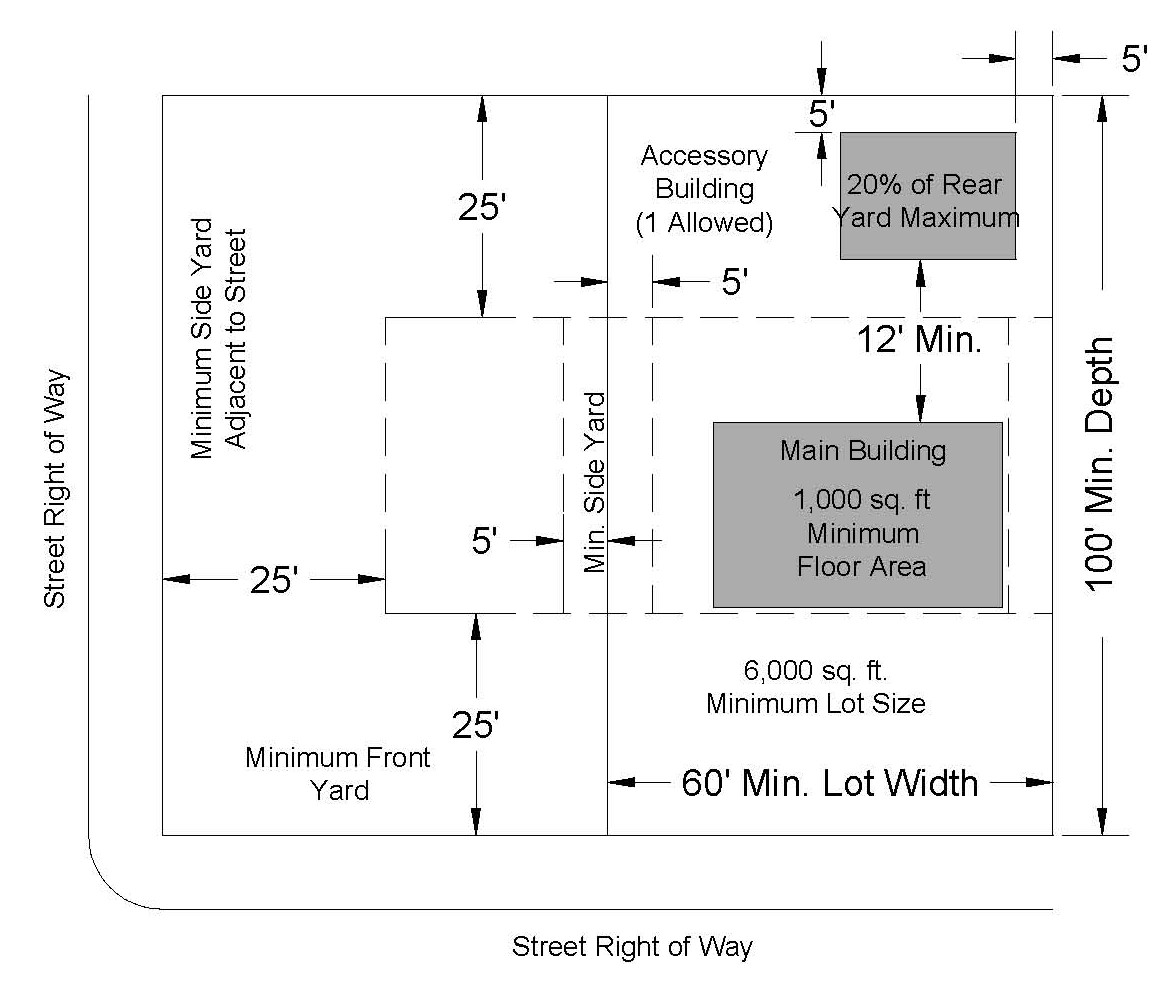
6.7.E
Parking Regulations. A Single-Family, DT District lot shall provide a minimum of two vehicle parking spaces, with a driveway connecting the parking spaces with a street or alley, and meet all the pertinent requirements contained in Section 11 the Parking Regulations.
(B)
Two-four family dwelling.
(1)
Maximum density: four family unit per lot.
(2)
Minimum lot area: 7,500 ft 2 for two dwelling units, plus 1,000 ft 2 for each additional dwelling unit.
(3)
Minimum lot width and lot frontage: 75 feet.
(4)
Minimum lot depth: 100 feet.
(5)
Minimum depth of front setback: 25 feet.
(6)
Minimum depth of rear setback: 25 feet.
(7)
Minimum width of side setback:
(a)
Internal lot: six feet.
(b)
Corner lot: 25 feet from intersecting side street.
(8)
Building size:
(a)
Maximum coverage as a percentage of lot area: 40%.
(b)
Minimum area of each dwelling unit: 800 ft 2 .
(9)
Accessory buildings:
(a)
Maximum accessory building coverage of rear yard: 20%.
(b)
Maximum area of each accessory building: 200 ft 2 .
(c)
Maximum number of accessory buildings: one per unit.
(d)
Minimum depth of side setback: five feet.
(e)
Minimum depth of rear setback: five feet.
(f)
Minimum depth from the edge of the main building: 12 feet.
(10)
Maximum height of structures: 35 feet.
(11)
Public, semi-public or public service buildings, hospitals, institutions or schools may not exceed a height of 60 feet. Churches, temples, and mosques may not exceed 75 feet, if the building is set back from each yard line at least one foot for each two feet additional height above the height limit in this district.
6.7.D Height, Area, Yard and Lot Coverage Requirements
Two-Four Family Dwellings
A Two-Four-Family, DT District lot shall provide a minimum of two vehicle parking spaces per dwelling unit and meet all the pertinent requirements contained in Section 11 the Parking Regulations.
(C)
Townhouse/Condominium.
(1)
Maximum density: four family unit per lot
(2)
Minimum lot area: 3,000 ft 2 per unit.
(3)
Minimum average lot width and lot frontage: 30 feet.
(4)
Minimum lot depth: 100 feet.
(5)
Minimum depth of front setback: 25 feet.
(6)
Minimum width of rear setback: 15 feet.
(7)
Minimum width of side setback:
(a)
Internal lot: five feet.
(b)
Corner lot: 25 feet from intersecting side street.
(8)
Building size:
(a)
Maximum main building coverage as a percentage of lot area: 40%
(b)
Minimum area of each townhouse dwelling unit: 800 ft 2 .
(c)
Minimum area of each condominium of each dwelling unit: 500 ft 2 for one bedroom or less, plus 125 ft 2 of floor area for each additional bedroom.
(9)
Accessory buildings:
(a)
Maximum accessory building coverage of rear yard: 20%.
(b)
Maximum area of each accessory building: 200 ft 2 .
(c)
Maximum number of accessory buildings: one per unit.
(d)
Minimum depth of side setback: five feet.
(e)
Minimum depth of rear setback: five feet.
(f)
Minimum depth from the edge of the main building: 12 feet.
(10)
Maximum height of structures: 35 feet.
(11)
Public, semi-public or public service buildings, hospitals, institutions or schools may not exceed a height of 60 feet. Churches, temples and mosques may not exceed 75 feet, if the building is set back from each yard line at least one foot for each two feet additional height above the height limit in this district.
6.7.D Height, Area, Yard and Lot Coverage Requirements
Townhouse/Condominium
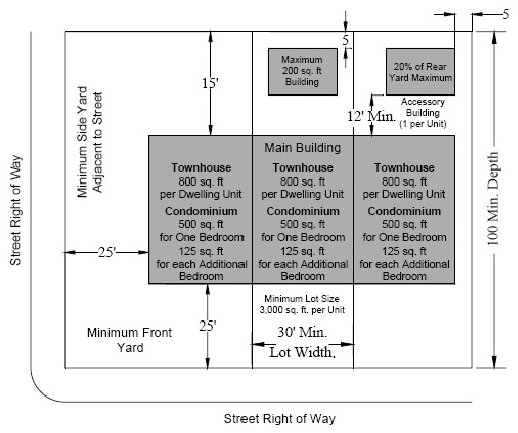
A Townhouse/Condominium, DT District lot shall provide a minimum of two vehicle parking spaces per dwelling unit and meet all the pertinent requirements contained in Section 11 the Parking Regulations.
(D)
All other uses.
(1)
Maximum density: There is no maximum density requirement.
(2)
Minimum lot area: There is no minimum area requirement.
(3)
Minimum lot width: There is no minimum width requirement.
(4)
Minimum lot depth: There is no minimum depth requirement.
(5)
Minimum depth of front setback: There is no front setback requirement.
(6)
Minimum depth of rear setback: There is no minimum rear setback requirement unless the lot abuts upon a Residential District, then a minimum ten feet is required.
(7)
Minimum width of side setback:
(a)
Internal lot: There is no minimum side setback requirement unless the lot abuts upon a Residential District, then a minimum five feet is required.
(b)
Corner lot: There is no setback requirement.
(8)
Building size: there are no minimum size regulations.
(9)
Maximum height of structures: No building shall exceed 75 feet.
(10)
Public, semi-public or public service buildings, hospitals, institutions or schools may not exceed a height of 60 feet. Churches, temples and mosques may not exceed 75 feet, if the building is set back from each yard line at least one foot for each two feet additional height above the height limit in this district.
Height, Area, Yard and Lot Coverage Requirements
Note: No rear or side yard except when the lot abuts upon a Residential District, then the minimum setback for rear yard is ten feet and side yard is five feet.
6.7.F
Type of Construction.
(1)
The exterior facade of all structures visible from a public street shall be of an architectural exterior finish similar to the surrounding structures within the District, exclusive of door and window openings.
(2)
Exterior siding and trim coloring shall be compatible to the surrounding structures in the District.
(3)
Exterior metal facades are prohibited in the DT "Downtown District."
(4)
The exterior walls of all new dwellings to the top plate, shall be constructed exclusively of primary materials, excluding doors, windows, and porches. See Section 10.E(1): Exterior Building Material Standard—Primary Materials.
(5)
Existing dwellings expanding the total square footage of the building 50% or less, or modifying the exterior walls, may use the same exterior construction material as the existing primary building. If the material is not available, similar material may be used if approved by the Community Development Director.
(6)
Existing dwellings expanding the total square footage of the building more than 50%, or proposing to use a material inconsistent with the primary structure for any expansion, must meet the 80% minimum primary materials, Section 10.E: Exterior Building Material Standard, for the total exterior walls of the structure.
Exterior Building Material Standards
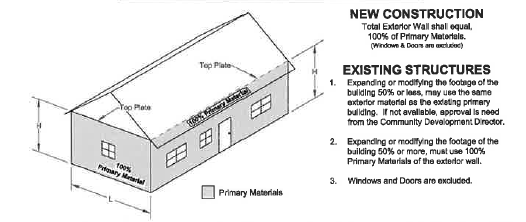
6.7.G
Miscellaneous Provisions. Wherever a commercial use adjoins a Residential District and is not separated by a street, a six-foot or taller solid sight-barring fence or landscape barrier will be constructed and maintained along the boundary or property line as permanent screening. All outside lighting features will be placed and reflected so as to not create annoyances, nuisances or hazards.
6.7.H
Parking Regulations. See Section 11 Parking Regulations.
6.7.I
Sign Regulation. See Section 12 for Sign Regulations.
6.7.J
Exceptions to Use, Height and Area Regulations. See Section 10.
6.7.K
Garbage Regulations.
(1)
Downtown District will provide a serviceable area specifically for refuse collection designed for refuse canisters. Each designated canister area will be nine feet wide and eight feet deep (72 square feet), with a cement slab base. If the location of the cement slab is adjacent to a Residential District, the slab must be at least five feet from the property line. The refuse area will be enclosed on three sides by a privacy fence. Approach areas will meet the requirements of Subsection 6.7.L.
(2)
Containers, polycarts, receptacles and any other unacceptable waste or recyclables, shall be removed from the curb or other designated collection point by the customer no later than 7:00 a.m. on the day following their scheduled collection day. Each designated area shall be four feet wide and four feet deep (16 square feet), impervious slab. The refuse area will be completely screened by a privacy fence or landscaping.
6.7.L
Loading and Unloading Regulations.
(1)
All loading, unloading and maneuvering of vehicles connected with the activity on the premises, must be paved with a sealed surface pavement and maintained in such a manner that no dust will be produced.
(2)
All loading, unloading and maneuvering of vehicles connected with the activity on city streets, must be loaded and unloaded between the hours of 12:00 a.m. (midnight) to 11:00 a.m. The activity must not impede public traffic on city streets.
6.7.M
Sidewalk. Property with new construction and/or residential use changing to a commercial use, shall construct a sidewalk along the city right(s)-of-way in accordance with Subdivision Ordinance design standards.
(Ord. 2011-05, passed 4-5-2011; Am. Ord. 2011-26, passed 12-6-2011; Am. Ord. 2014-03, passed 2-4-2014; Am. Ord. 2014-05, passed 3-4-2014; Am. Ord. No. 2018-O-25, § 1, 8-7-2018; Ord. No. 2021-O-17, §§ 1, 6, passed 6-1-2021; Ord. No. 2021-O-32, § 1, passed 8-3-2021; Am. Ord. 2024-O-33, § 1, passed 11-5-2024)
Sec. 154.07. - Agricultural district (AG).
7.A
Description. The regulations herein established have been adopted to provide a designation for undeveloped or vacant land together with any improvements situated thereon; the land being located on the outer boundaries of the city and being used for agricultural purposes. The agricultural activities conducted in the District shall be within environmental restrictions and regulations and not be detrimental to adjacent urban land uses. The type of uses and the area and intensity of uses permitted in the District shall encourage and protect agricultural uses until urbanization is warranted. The District is also intended to protect areas that may be unsuitable for development because of physical problems, lack of infrastructure, potential health or safety hazards such as flooding, as well as providing for preservation of natural open space areas.
7.B
Permitted Uses.
(1)
Farms, ranches, orchards, truck gardens, nurseries for the growing of plants, and similar agrarian activities involving the growing of plants and raising and pasturing of livestock, including accessory feeding pens and dairy operations, which are permitted and conducted in compliance with state and federal guidelines;
(2)
Single-family dwellings clearly incidental to the operation of the activities listed in No. 1 above including dwellings on the same farm or ranch used exclusively for the housing of employees living on the premises;
(3)
Single-Family Estates. Semi-Urban estate-type residential properties with large lots or small acreage and are serviced by either or both septic tanks and/or domestic wells (amended definition of family);
(4)
Accessory buildings and structures clearly incidental to the above operations including but not limited to barns, stables, arenas, equipment sheds, processing sheds, dairy barns, poultry houses, swine pens, granaries, pump houses, water tanks and silos;
(5)
Installations owned and operated by the City of Stephenville, Erath County, the State of Texas or public utility companies, which installations are necessary for the public safety, governmental services or the furnishing of utility services including communication equipment and towers into or through the Agricultural District;
(6)
Public and parochial schools, colleges and universities;
(7)
Parks, playgrounds, community centers or recreational areas owned and operated by the City of Stephenville, Erath County, the State of Texas or other governmental entity or owned by such agencies and operated under their control and supervision; and
(8)
Churches and all church property and improvements including, but not limited to houses and structures of worship, fellowship and recreation.
7.C
Conditional Uses (Special Use Permit required).
(1)
Cemeteries public and private including accessory building and structures;
(2)
Country club; and
(3)
Golf course.
7.D
Area Regulations. All buildings and structures must be set back from the street or road right-of-way lines a minimum of 30 feet.
7.E
Intensity of Use. Every lot or tract of land shall have an area of not less than two acres, except that if a lot or tract should have less area than is herein required and its boundary lines along their entire length should touch lands under other ownership on the effective date of this ordinance and shall not have changed since the date, such parcel of land may be used for a primary use in the zoning district.
7.F
Height Regulations.
(1)
No building shall be erected to exceed a height of 35 feet.
(2)
Public, semi-public or public service buildings, hospitals, institutions or schools, permitted in this district, may be erected to a height not exceeding 75 feet if the building is set back from each yard line at least one foot for each two feet additional height above the height limit in this district.
(3)
Chimneys, fire towers, monuments, tanks, water towers, ornamental towers and spired church steeples, radio-television-telephone and all communication towers, or necessary mechanical appurtenances may be erected to a height in accordance with existing or hereafter adopted ordinances of the City of Stephenville, Texas.
(Am. Ord. 2024-O-33, § 1, passed 11-5-2024)
Sec. 154.08. - Planned development district (PD).
8.A
Description.
(1)
Planned development districts are designed for greater flexibility and discretion in the application of residential and non-residential zoning and for increased compatibility and the more effective mitigation of potentially adverse impacts on adjacent land than in possible under standard district regulations. It is recognized that it is desirable for certain areas of the city to be developed in accordance with development plans prepared and approved as a part of the ordinance authorizing the zoning necessary for the proposed development.
(2)
Improvements in a "PD" District are subject to conformance with a development plan approved by the City Council on Planning and Zoning Commission recommendation and after public hearing thereon. No development plan may increase gross density in excess of that allowed by the base district.
8.B
Permitted Uses. In a PD Development District, no land shall be used and no building shall be installed, erected for/or converted to any use other than a hereinafter provided.
NON-RESIDENTIAL PLANNED DEVELOPMENTS. Considered appropriate where the following conditions prevail:
(1)
The project utilized innovative land development concepts and is consistent with the Comprehensive Land Use plan and the goals and objectives of the city;
(2)
Non-residential uses are situated such that an appreciable amount of land is available for open space or joint use as parking space and is integrated throughout the planned development;
(3)
The site exhibits environmentally natural features which should be considered for preservation and/or enhancement;
(4)
Aesthetic amenities may be provided in the planned development design which are not economically feasible to provide in conventional non-residential projects; and
(5)
The project provides a compatible transition between adjacent existing single-family residential projects and provides a compatible transition for the extension of future single-family projects into adjacent undeveloped areas.
RESIDENTIAL PLANNED DEVELOPMENT. Considered appropriate where the following conditions prevail:
(1)
The project utilized innovative land development concepts and is consistent with the Comprehensive Land Use plan and the goals and objectives of the city;
(2)
Dwelling units are situated such that an appreciable amount of land for open space is available and is integrated throughout the planned development;
(3)
The project utilizes an innovative approach in lot configuration and mixture of single-family housing types;
(4)
Higher densities than conventional single-family projects of the same acreage is achievable with appropriate buffering between existing conventional single-family developments and increased open space;
(5)
The site exhibits environmentally natural features which should be considered for preservation and/or enhancement;
(6)
Aesthetic amenities may be provided in the planned development design which are not economically feasible to provide in conventional single-family projects; and
(7)
The project provides a compatible transition between adjacent existing conventional single-family residential projects and provides a compatible transition for the extension of future conventional single-family projects into adjacent undeveloped areas.
8.C
Prohibited Uses.
(1)
Any building erected or land used for other than the use shown on the Planned Development Site Plan, as approved by the City Council.
(2)
Any use of property that does not meet the required minimum lot size; front, side and rear yard dimensions; and/or lot width, or exceeds the maximum height, building coverage or density per gross acreage as shown in the development's recorded Planned Development Site Plan, as approved by City Council.
(3)
Any use deemed by the City Council as being detrimental to the health, safety or general welfare of the citizens of Stephenville.
8.D
Ownership. An application for approval of a Planned Development Plan under the Planned Development District regulations may be filed by a person having legal ownership of the property to be included in the Development Plan. In order to ensure unified planning and development of the property, the applicant shall provide evidence, in form satisfactory to the City Attorney, prior to final approval of the Development Plan, that the property is held in single ownership or is under single control. Land shall be deemed to be held in single ownership or under single control if it is in joint tenancy, tenancy in common, a partnership, a trust or a joint venture. The Development Plan shall be filed in the name(s) of the record owner(s) of the property, which shall be included in the application.
8.E
Development Schedule.
(1)
An application for a Planned Development District shall be accompanied by a development schedule indicating the approximate date on which construction is expected to begin and the rate of anticipated development to completion. The development schedule, adopted and approved by the City Council, shall become part of the Planned Development Ordinance and shall be adhered to by the owner, developer and their assigns of successors in interest.
(2)
Annually, upon the anniversary date, or more frequently if required, the developer shall provide a written report to the Planning and Zoning Commission concerning the actual development accomplished as compared with the development schedule.
(3)
The Planning and Zoning Commission may, if in its opinion the owner or owners of the property are failing or have failed to meet the approved development schedule, initiate proceedings to amend the Official Zoning map or the Planned Development District by removing all or part of the Planned Development District from the Official Zoning Map and placing the area involved in another appropriate zoning district. After the recommendation of the Planning and Zoning commission and for good cause shown by the owner and developer, the City Council may extend the development schedule as may be indicated by the facts and conditions of the case.
8.F
Plat Requirements. No application for a building permit for the construction of a building or structure shall be approved unless a plat, meeting all requirement of the City of Stephenville has been approved by the City Council and recorded in the official records of Erath County.
8.G
Concept Plan. The applicant for any PD Planned Development shall submit a concept plan to the Planning and Zoning Commission for review prior to submitting a Development Plan. The concept plan shall contain appropriate information to describe the general land use configuration, proposed densities or lot sizes, proposed amenities and proposed regulation.
8.H
Development Plan Approval Required. No building permit or certificate of occupancy shall be issued and no use of land, buildings or structures shall be made in the "PD" District until the same has been approved as part of a development plan in compliance with the procedures, terms and conditions of this section of the ordinance.
8.I
Approval Procedures.
(1)
An application for development plan approval shall be filed with the Director of Community Development accompanied by a development plan.
(2)
The procedures for hearing a request for a zoning change to "PD" shall be the same as for a requested change to any other district as set forth Section 20 of the Zoning Ordinance.
(3)
Any substantive revision to a development plan between the public hearing before the Planning and Zoning Commission and the public hearing before the City Council shall necessitate the development plan being referred back to the Planning and Zoning Commission for review and evaluation unless the revision constitutes a minor change as provided below, or the change was condition of the approval.
(4)
Any revisions to the development plan after the public hearing before the City Council shall be submitted to the Director of Community Development for distribution, review and written evaluation by city staff prior to submission to and approved by the City Council.
(5)
Minor changes to an approved development plan, which will not cause any of the following circumstances to occur, may be authorized by the Director of Community Development or his or her designee:
(a)
A change in the character of the development;
(b)
An increase in the gross floor areas in structures;
(c)
An increase in the intensity of use;
(d)
A reduction in the originally approved separations between buildings;
(e)
Any adverse changes in traffic circulation, safety, drainage and utilities;
(f)
Any adverse changes in such external effects on adjacent property as noise, heat, light, glare, vibration, height scale or proximity;
(g)
A reduction in the originally approved setbacks from property lines;
(h)
An increase in ground coverage by structures;
(i)
A reduction in the ratio of off-street parking and loading space; and
(j)
A change in the size, height, lighting or orientation of originally approved signs.
(6)
The decision of the Director of Community Development or his or her designee as to whether minor changes are being requested may be appealed to the Planning and Zoning Commission. Any change deemed not to be minor change, as indicated above, shall be processed as a new application in accordance with the provisions of this section and Section 20.1 of the Zoning Ordinance.
8.J
Development Plan Requirements. The development plan submitted in support of a request for development plan approval shall contain sufficient information delineating the characteristics of the site, changes in those characteristics as may be proposed by the development, how the development will relate to public services and facilities and what protection features are included to insure that the development will be compatible with existing and allowable development on adjacent property. The development plan shall show at least the following items of information:
(1)
The location of all existing and planned non-single-family structures on the subject property;
(2)
Landscaping lighting and/or fencing and/or screening of common areas;
(3)
General locations of existing tree clusters, providing average size and number and indication of species;
(4)
Location and detail of perimeter fencing if applicable;
(5)
General description/location of ingress and egress with description of special pavement treatment if proposed;
(6)
Off-street parking and loading facilities, and calculations showing how the quantities were obtained for all non single-family purposes;
(7)
Height of all non-single-family structures;
(8)
Proposed uses;
(9)
Location and description of subdivision signage and landscaping at entrance areas;
(10)
Street names on proposed streets;
(11)
Proposed minimum area regulations including, set-backs, lot-sizes, widths, depths, side-yards, square footage or residential structures;
(12)
Indication of all development phasing and platting limits; and
(13)
Such additional terms and conditions, including design standards, as the Planning and Zoning Commission and the City Council deem necessary.
8.K
Conditions for Development Plan Approval.
(1)
A development plan shall be approved only if all of the following conditions have been found during the review and process:
(a)
That the uses will be compatible with and not injurious to the use and enjoyment of other property, nor significantly diminish or impair property values with the immediate vicinity;
(b)
That the establishment of the use or uses will not impede the normal and orderly development and improvements of surrounding vacant property;
(c)
That adequate utilities, access roads, drainage and other necessary supporting facilities have been or will be provided;
(d)
That the design, location and arrangement of all driveways and parking spaces provides for the safe and convenient movement of vehicular and pedestrian traffic without adversely affecting the general public or adjacent developments;
(e)
That adequate nuisance prevention measures have been or will be taken to prevent or control offensive odor, fumes, dust, noise and vibration;
(f)
That directional lighting will be provided so as not to disturb or adversely affect neighboring properties.
(2)
In approving a development plan, the City Council may impose additional conditions necessary to protect the public interest and welfare of the community.
8.L
Additional Conditions. Every Planned Development District approved under the provisions of this Ordinance shall be considered as an amendment to the Ordinance as applicable to the property involved. In an approved Planned Development District, the City Council may impose conditions relative to the standard of development, and such conditions shall be complied with before a certificate of occupancy is issued for the use of the land or any structure which is part of the Planned Development District; and such condition shall not be construed as conditions precedent to the approval of the zoning amendment, but shall be constructed as conditions precedent to the granting of a certificate of occupancy.
8.M
Revocation.
(1)
Approval of a development plan may be revoked or modified, after notice and hearing, for either of the following reasons:
(a)
Approval was obtained or extended by fraud or deception; or
(b)
That one or more of the conditions imposed by the City Council on the development plan has not been met or has been violated.
(2)
Development controls:
(a)
The City Council may impose more restrictive requirements than those proposed in the development plan in order to minimize incompatibilities;
(b)
A "PD" District shall have a minimum lot area of not less than one acre under unified control;
(c)
The parking requirements of the Zoning Ordinance shall apply to all uses in the "PD" District unless otherwise specified on the development plan; and
(d)
"PD" provisions may vary setbacks with approval.
Sec. 154.09. - Sexually oriented businesses (SOB).
9.A
Purpose and Intent. It is the purpose of this section to regulate sexually oriented businesses to promote the health, safety, morals and general welfare of the citizens of the city, and to establish reasonable and uniform regulations to prevent the concentration of sexually oriented businesses within the city. Sexually oriented businesses are allowed in I "Industrial District" zoning classifications with a special use permit granted by the Board of Adjustment. The provisions of this section have neither the purpose nor effect of imposing a limitation or restriction on the content of any communicative materials, including sexually oriented materials. Similarly, it is neither the intent nor effect of this section to restrict or deny access by the distributors and exhibitors of sexually oriented entertainment to their intended market.
9.B
Definitions. For the purpose of this section, the following definitions shall apply unless the context clearly indicates or requires a different meaning.
Adult arcade. Any place to which the public is permitted or invited wherein coin-operated or slug-operated or electronically, electrically or mechanically controlled still or motion picture machines, or projectors or other image-producing devices are maintained to show images to five or fewer persons per machine at any one time, and where the images so displayed are distinguished or characterized by the depicting or describing of specified sexual activities or specified anatomical areas.
Adult bookstore or adult video store. A commercial establishment which as its business purpose offers for sale or rental for any form of consideration any one or more of the following:
(1)
Books, magazines, periodicals or other printed matter, or photographs, films, motion pictures, video cassettes or video reproductions, slides or other visual representations which depict or describe specified sexual activities or specified anatomical areas; or
(2)
Instruments, devices or paraphernalia which are designed for use in connection with specified sexual activities.
Adult cabaret. A nightclub, bar, restaurant or similar commercial:
(1)
Establishment which at any time features;
(2)
Persons who appear in a state of nudity;
(3)
Live performers which are characterized by the exposure or specified anatomical areas or by specified sexual activities; or
(4)
Films, motion pictures, video cassettes, slides or other photographic reproductions which are characterized by the depiction or description of specified sexual activities or specified anatomical areas.
Adult encounter parlor. An establishment whose business is at any time the provision of premises where customers either congregate, associate or consort with employees who engage in specified sexual activities with or in the presence of such customers, or who display specified anatomical areas in the presence of such customers, with the intent of providing sexual stimulation or sexual gratification to the customers.
Adult lounge. An adult cabaret, as defined above, which is a permitted or licensed premise, pursuant to the Texas Alcoholic Beverage Code, where alcoholic beverages may be served or sold.
Adult modeling studio. An establishment whose business is at any time the provision, to customers, of figure models who are so provided with the intent of providing sexual stimulation or sexual gratification to such customers who engage in specified sexual activities or display specified anatomical areas while being observed, painted, painted upon, sketched, drawn, sculptured, photographed or otherwise depicted by such customers.
Adult motel. A hotel, motel or similar commercial establishment which:
(1)
Offers accommodations to the public for any form of consideration; provides patrons with closed-circuit television transmissions, films, motion pictures, video cassettes, slides or other photographic reproductions which are characterized by the depiction of description of specified sexual activities or specified anatomical areas; and/or has a sign visible from the public right-of-way which advertises the availability of this adult type of photographic reproductions; or
(2)
Allows a tenant or occupant of a sleeping room to sub rent the room for a period of time that is less than ten hours.
Adult motion picture theater. A commercial establishment where, for any form of consideration, films, motion pictures, video cassettes, slides or similar photographic reproductions are regularly shown which are characterized by the depiction or description of specified sexual activities or specified anatomical areas.
Adult theater. A theater, concert hall, auditorium or similar commercial establishment which at any time features persons who appear in a state of nudity or live performers which are characterized by the exposure of specified anatomical areas or by specified sexual activities.
Applicant. The applicant for a permit shall be the operator of the sexually oriented business.
Arcade device. Any coin or slug-operated or electronically or mechanically controlled machine or device that dispenses or effectuates the dispensing of entertainment that is intended for the viewing of five or fewer persons to exchange for any payment of any consideration.
Chief of Police. The Chief of Police of the City of Stephenville or his or her designated agent.
Church. A building, whether situated within the city or not, in which persons regularly assemble for religious worship intended primarily for purposes connected with such worship or for propagating a particular form of religious belief.
Conduct any business in a sexually oriented business. Any person who does any one or more of the following shall be deemed to be conducting a business in a sexually oriented business:
(1)
Operates a cash register, cash drawer or other depository on the sexually oriented business premises where cash funds or records of credit cards or other credit transactions generated in any manner by the operation of the sexually oriented business or the activities conducted therein are kept;
(2)
Displays or takes orders from any customer for any merchandise, goods, entertainment or other services offered on the sexually oriented business premises;
(3)
Delivers or provides to any customer any merchandise, goods, entertainment or other services offered on the sexually oriented business premises;
(4)
Acts as a door attendant to regulate entry of customers or other persons into the sexually oriented business premises; or
(5)
Supervises or managers other persons in the performance of any of the foregoing activities on the sexually oriented business premises.
Customer. Any person who:
(1)
Is allowed to enter a regulated sexually oriented business in return for the payment of an admission fee or any other form of consideration or gratuity;
(2)
Enters a regulated sexually oriented business and purchases, rents or otherwise partakes of any merchandise, goods, entertainment or other services offered therein; or
(3)
Is a member of and is on the premises of a regulated sexually oriented business operating as a private club.
Employee. Any person who renders any service whatsoever to the customers of a regulated sexually oriented business or who works in or about a regulated sexually oriented business and who receives compensation for such service or work from the operator or owner of the regulated sexually oriented business or from the customers therein.
Entertainment. Any act or performance, such as a play, skit, reading, revue, pantomime, scene, song, dance, musical rendition or striptease, whether performed by employees, agents, contractors or customers. The term "entertainment" shall also mean bartenders, waiters, waitresses or other employees exposing specified anatomical areas or engaging in specified sexual activities in the presence of customers.
Nude model studio. Any place where a person who appears in a state of nudity of displays specified anatomical areas is provided to be observed, sketched, drawn, painted, sculptured, photographed or similarly depicted by other persons who pay money or any form of consideration.
Nudity or a state of nudity. That appearance of a human bare buttock, anus, male genitals, female genitals or female breast.
Operator. That manager or other natural person principally in charge of a regulated sexually oriented business.
Owner or owners. The proprietor if a sole proprietorship, all partners (general and limited) if a partnership, or all officers, directors and persons holding ten or more of the outstanding shares if a corporation. The term "owner" shall not include any such person who has given to the operator a statement under oath that he or she does not desire to be listed on the permit application and that he or she waives any right to any notice that is required or permitted to be given under this ordinance.
Permit. A current, valid permit issued by the City Inspector pursuant to the terms of this ordinance to an operator for a sexually oriented business.
Person. An individual, proprietorship, partnership, corporation, association or other legal entity.
Regulated establishment. Any sexually oriented business, ad defined herein.
Residential. Pertains to the use of land, whether situated within the city or not, for premises such as homes, town homes, patio homes, mobile homes, duplexes, condominiums and apartment complexes, which contain habitable rooms for no transient occupancy and which are designed primarily for living, sleeping, cooking and eating therein. A premise which is designed primarily for living, sleeping, cooking and eating therein shall be deemed to be residential in character unless it is actually occupied and used exclusively for other purposes.
Sexually oriented business. An adult arcade, adult bookstore or adult video store, adult cabaret, adult motel, adult motion picture theater, adult theater or nude model studio.
Specified anatomical areas.
(1)
Less than completely and opaquely covered:
(a)
Human genitals, pubic region or pubic hair;
(b)
Buttock;
(c)
Female breast or breasts below a point immediately above the top of the areola; or
(d)
Any combinations of the foregoing.
(2)
Human male genitals in a discernibly erect state, even if completely and opaquely covered.
Specified sexual activities. Any of the following:
(1)
The fondling or other erotic touching of human genitals, pubic region, buttocks, anus or female breasts;
(2)
Sex acts, normal or perverted, actual or simulated, including intercourse, oral copulation or sodomy;
(3)
Masturbation, actual or simulated; or
(4)
Excretory functions as part of or in connection with any of the activities set forth in divisions (1) through (3) above.
Tract. A contiguous parcel or land under common ownership, whether situated within the city or not.
9.C
Location of Sexually Oriented Businesses.
(1)
A person commits an offense if he or she operates or causes to be operated a sexually oriented business within 1,000 feet of:
(a)
A church;
(b)
A public or private elementary or secondary school;
(c)
Residentially zoned property;
(d)
A public park;
(e)
A lot devoted to residential use;
(f)
Another sexually oriented business;
(g)
Licensed day care center.
(2)
A person commits an offense if he or she causes or permits the operation, establishment or maintenance of more than one sexually oriented business in the same building, structure or portion thereof, or the increase of floor area of any sexually oriented business in any building, structure or portion thereof containing another sexually oriented business.
(3)
A person commits an offense if he or she operates or causes to be operated, a sexually oriented business without a permit for said business issued by the designated agent of the City of Stephenville.
(4)
For the purpose of division (1) above, measurement shall be made in a straight line, without regard to intervening structures or objects, from the nearest portion of the building or structure used as a part of the premises where a sexually oriented business is conducted, to the nearest property line of the premises of a church or public or private elementary or secondary school, licensed day care center or to the nearest boundary of an affected public park, residential district or residential lot.
(5)
For purposes of division (1)(f) above, the distance between any two sexually oriented businesses shall be measured in a straight line, without regard to intervening structures or objects, from the closest exterior wall of the structure in which each business is located.
(6)
Any sexually oriented lawfully operating prior to the effective date of this ordinance, which is in violation of division (1) or (2) above shall be deemed a nonconforming use. The nonconforming use will be permitted to continue for a period of not to exceed six months, unless sooner terminated for any reason or voluntarily discontinued for a period of 30 days or more. Such nonconforming use shall not be increased, enlarged, extended or altered except that the use may be changed to a conforming use. If two or more sexually oriented businesses are within 1,000 feet of one another and otherwise in a permissible location, the sexually oriented business which was first established and continually operating at a particular location is the conforming use and the later-established business(es) in nonconforming.
(7)
A sexually oriented business lawfully operating as conforming use after the effective date of this ordinance is not rendered a nonconforming use by the location, subsequent to the operation of the sexually oriented business, of a church, public or private elementary or secondary school, public park, residential district or residential lot within 1,000 feet of the sexually oriented business.
9.D
Additional Regulations for Adult Motels.
(1)
Evidence that a sleeping room in a hotel, motel, or similar commercial establishment has been rented and vacated two or more times in a period of time that is less than ten hours creates a rebut table presumption that the establishment is an adult motel as that term is defined in this section.
(2)
For purpose of division (1) above, the terms RENT or SUB-RENT mean the act of permitting a room to be occupied for any form of consideration.
9.E
Permit—Required.
(1)
It shall be unlawful for any person to own, operate or conduct any sexually oriented business located within the city unless there is a permit for the sexually oriented business.
(2)
It shall be unlawful for any person to own, operate or conduct any sexually oriented business located within the city unless the permit is posted at or near the principal public entrance to the sexually oriented business in such a manner that it will be conspicuous to patrons who enter the premises.
(3)
In any prosecution under division (1) above, it shall be presumed that there was no permit at the time of the alleged offense, unless a permit was then posted as provided in division (2).
9.F
Application for Permit.
(1)
Application for a permit, whether original or renewal, must be made to the designated agent of the City of Stephenville by the intended operator of the sexually oriented business. Applications must be submitted by hand delivery to the City Hall during regular business hours (8:00 a.m. to 5:00 p.m., Monday through Friday, city holidays excepted). Application forms shall be supplied by the City of Stephenville. The intended operator shall be required to give the following information.
(a)
The name, street address (and mailing address if different) and Texas driver's license number of the intended operator, and any and all aliases. Notification required within 48 hours of change of operator. Information required as stated above. The name and street address (and mailing address if different) of the owner(s). Corporations shall be required to have written authorization from the president of chief executive officer.
(b)
The name under which the sexually oriented business is to be operated and a general description of the services to be provided;
(c)
The telephone number of the sexually oriented business;
(d)
The address and legal description of the parcel of land on which the sexually oriented business is to be located;
(e)
The date on which the owner(s) acquired the sexually oriented business for which the permit is sought, and the date on which the sexually oriented business began operations at the location for which the permit is sought; and
(f)
A list of all employees or contractors involved in providing the services to be provided by the sexually oriented business.
(2)
The application shall be accompanied by the following:
(a)
The application shall be accompanied by a diagram of the sexually oriented business showing a plan thereof and designating any portion of the sexually oriented business in which patrons will not be permitted. Such diagram shall also designate the place at which patron the permit will be posted if granted. A professionally prepared diagram in the nature of an engineer's or architect's blueprint shall not be required; however each diagram should be drawn to a designated scale or with marked dimensions sufficient to show the various internal dimensions of all areas of the interior of the sexually oriented business. The designated agent of the City of Stephenville shall waive the foregoing diagram for renewal applications if the applicant adopts a diagram that was previously submitted and certifies that the sexually oriented business has not been altered since it was prepared;
(b)
Original application fee; (Fee to be set annually by the City Council. Payment of application fee to be made by certified check, cashiers check or money order, which fee shall not be refundable under any circumstances.)
(c)
Renewal application fee; (Fee to be set annually by the City Council. Payment of application fee to be made by certified check, cashiers check or money order, which fee shall not be refundable under any circumstances.)
(d)
The application shall contain a statement under oath that:
(1)
That applicant has personal knowledge of the information contained in the application and that the information contained therein is true and correct; and
(2)
The applicant has read the provisions hereof.
(e)
A separate application and permit shall be required for each sexually oriented business.
9.G
Issuance of Denial or Permit Application.
(1)
Within 20 days of receipt of any application, either original or renewal, the designated agent of the City of Stephenville shall grant or deny the requested permit and have written notice to the applicant as to the decision.
(2)
The designated agent of the City of Stephenville shall issue a permit to the applicant unless one or more of the following conditions exist:
(a)
The applicant's sexually oriented business is located within 1,000 feet of any school, church, licensed day care center, residentially zoned property, public park, lots devoted to residential use, or another sexually oriented business. Measurements shall be made as outlined in divisions (4) and (5) of 9.C;
(b)
The applicant failed to supply all of the information requested on the application;
(c)
The applicant gave materially false, fraudulent or untruthful information on the application;
(d)
The application or the sexually oriented business does not meet any other requirement of this ordinance;
(e)
The applicant has not fully complied with all state, federal and local laws or regulations affecting he or she conduct of its business; or
(f)
The operator has had a permit revoked for the same sexually oriented business within the 180-day period next proceeding the date that the application was filed.
9.H
Term of Permit. Each permit shall be valid for a period of one year and shall expire on the anniversary of its date of issuance, unless sooner revoked, or surrendered. Each permit shall be subject to renewal as of the expiration date by the filing of a renewal application with the designated agent of the City of Stephenville. Renewal applications must be filled at least 20 days prior to the expiration date of the permit that is to be renewed.
9.I
Revocation or Suspension of Permit. The designated agent of the City of Stephenville shall have the authority to revoke a permit for any one or more of the following reasons:
(1)
The owner of operator of the permitted sexually oriented business knowingly allowed a person under 18 years of age to enter a sexually oriented business;
(2)
The permitted sexually oriented business does not conform to the provisions of 9.K;
(3)
Three or more cumulative violations of any of the offenses contained in Chapter 21, Chapter 43, §§ 22.011 or 22.021 of the Texas Penal Code or of the offenses contained in this article have occurred on the premises of the permitted sexually oriented business. These violations must have occurred in a consecutive period of 12 months, and the owner or operator must have knowingly allowed such violations to occur or did not make a reasonable effort to prevent the occurrence of such violations;
(4)
The operator of the permitted sexually oriented business gave materially false, fraudulent or untruthful information on the original, or renewal application form;
(5)
The sexually oriented business has been closed for business for a period of 30 consecutive days, unless such closure is due to circumstances beyond the control of the owner, and the owner is proceeding with due diligence, given all attendant circumstances, to reopen the establishment.
9.J
Other Permit Provisions.
(1)
Permit is valid only at the location for which it is issued.
(2)
It shall be unlawful for any person to counterfeit, forge, change, deface or alter a permit.
(3)
A permit may be cancelled upon written request of the owner(s) or operator and surrender of the permit itself to the designated agent of the City of Stephenville. Permits shall be surrendered at the same place and at the same time a permit applications as provided herein. The surrender of a permit shall be effective upon its filing in the office of the designated agent of the City of Stephenville.
9.K
Exterior Portions of Sexually Oriented Businesses.
(1)
It shall be unlawful for an owner or operator of a sexually oriented business to allow the merchandise or activities of the sexually oriented business to be visible form any point outside such sexually oriented business.
(2)
It shall be unlawful for the owner or operator of a sexually oriented business to allow the exterior portions of the sexually oriented business to have flashing lights, or any words, lettering, photographs, silhouettes, drawings or pictorial representations of any manner.
9.L
Enforcement.
(1)
Except as provided by division (4) below, any person violating division (4)(c), upon conviction shall be punished by a fine not to exceed $1,000 for each offense. Each day that a violation is permitted to exist shall constitute a separate offense.
(2)
Except as provided by division (4) below, any person any provision of this ordinance other than division (4)(c) shall be punished by a fine not to exceed $200 for each offense. Each day that a violation is permitted to exist shall constitute a separate offense.
(3)
If the sexually oriented business involved is a nude model studio, then a violation of this ordinance shall be punishable as a Class B misdemeanor.
(4)
It is a defense to prosecution under division (4)(c) that a person appearing in a state of nudity did so in a modeling class operated:
(a)
By a proprietary school licensed by the State of Texas; a college, junior college or university supported entirely or partly by taxation;
(b)
By a private college or university which maintains and operates educational programs in which credits are transferable to a college, junior college or university supported entirely or partly by taxation;
(c)
In a structure:
(1)
Which has no sign visible from the exterior of the structure and no other advertising that indicates a nude person is available for viewing;
(2)
Where in order to participate in a class a student must enroll at least three days in advance of the class; and
(3)
Where no more than one nude model is on the premises at any one time.
Sec. 154.10. - Additional use, height and area regulations.
10.A
Use Regulations. On all existing right-of-way of railroad companies, regardless of the zoning district in which such rights-of-way are located, railroad track age and accessories to railroad movement may be constructed or maintained.
10.B
Area and Density Regulations.
(1)
In a district in which commercial buildings are built with one or more stories for residential purposes above commercial uses, no side yards will be required for the residential portions of the building.
(2)
No yard or other open space provided about any building for the purposes of complying with the provisions of these regulations shall again be used as a yard or an open space for another building. Every part of a required yard shall be open to the sky and unobstructed by buildings except for accessory buildings in the rear yard and except in the ordinary projections of skylights, sills, belt courses, cornices and other ornamental features which may project into such yards a distance of not more than two feet.
(3)
Open, unenclosed porches, platforms or landing places not covered by a roof or canopy may extend or project into the yard for a distance not exceeding six feet.
(4)
Terraces, uncovered porches, platforms and ornamental features which do not extend more than three feet above the floor level of the ground (first) story may project into a required side yard, provided these projections be a distant of at least two feet from the adjacent side of the lot line.
(5)
Front yard:
(a)
Where 40% or more of the frontage on one side of a street between two intersecting streets is developed with buildings that have observed (with a variation of five feet or less), a front yard greater in depth than herein required, new buildings shall be erected closer to the street than the front yard so established by the existing buildings.
(b)
Where 40% or more frontage on one side street between two intersecting streets is developed with buildings that have not observed a front yard as described above, then:
(1)
Where a building is to be erected on a parcel of land that is within 100 feet of an existing buildings on both sides, the minimum front yard shall be a line drawn between the two closest corners of the adjacent buildings on the two sides;
(2)
Where a building is to be erected on a parcel of land that is within 100 feet of an existing building on one side only, such building may be erected as close to the street as the existing adjacent building; and
(3)
In determining such front yard depth, buildings located entirely on the rear one-half of a lot shall be counted.
(c)
On any corner lot on which a front or side yard is required, no wall, fence, sign or other structure, or any plant growth shall be permitted or maintained higher than two feet above the curb level within 15 feet of the intersection of the property lines.
(6)
Side yards:
(a)
The minimum width of a side yard of a corner lot in all Residential Districts shall be not less than ten feet. If the street side line of a corner lot is in the same block frontage with a lot or lots, whose street line is a front yard of the lot or lots, the side yard shall extend to the average alignment of the buildings along the same side of the street, unless the buildings are more than 25 feet back from the street line, in which case the side yard need not be more than 25 feet.
(b)
A side yard of not less than 25 feet on the side of the lot adjoining on any Residential District shall be provided for all schools, libraries, churches, community houses, clubs and other public or semi-public buildings hereafter erected or structurally altered.
(c)
A garage, detached or attached to the main use building entering on the side street of a corner lot shall maintain a side yard of 25 feet in front of the garage.
(7)
Rear yard: In computing the depth of a rear yard where such yard opens into a alley, one-half of the width of such alley may be assumed to be a portion of the required yard.
10.C
Garbage Collection and Refuse Receptacles. R-3, B-1, B-2, B-3, B-4, B-5 and I District businesses will provide a serviceable area specifically for refuse collection designed for refuse canisters. Each designated canister area will be nine feet wide and eight feet deep (72 square feet), with a cement slab base. If the location of the cement slab is adjacent to a residential district, the slab must be at least five feet from the property line. The refuse area will be enclosed on three sides by a privacy fence.
10.D
Wind Energy Conversion Systems. It shall be unlawful to construct, erect, or install a wind energy conversion system within the city limits of Stephenville, Texas. A wind energy conversion system is defined as aggregation of parts including the base, tower, generator, rotor, blades, supports, guy wires and accessory equipment such as utility interconnect and battery banks, etc. in such configuration as necessary to convert the power of wind into mechanical or electrical energy, wind charger, windmill, or wind turbine.
10.E
Exterior Building Materials Standard.
(1)
Primary materials:
(a)
Natural stone;
(b)
Brick;
(c)
Stucco;
(d)
Exterior wood siding (stained or painted);
(e)
Concrete masonry units (architectural finish);
(f)
Concrete fiber siding (painted);and
(g)
Shiplap metal siding.
(2)
Alternative materials:
(a)
Galvanized metal;
(b)
Aluminum;
(c)
Metal coating;
(d)
Zinc-aluminum;
(e)
Metal coating;
(f)
Glass block; and
(g)
Ceramic tile. (Am. Ord. 2009-18, passed 11-3-2009; Ord. 2011-26, passed 12-6-2011)
Sec. 154.11. - Parking spaces for vehicles.
11.A
General Intent and Application.
(1)
These parking regulations set minimum standards for off street parking for all districts. Each land use activity creates specific needs for safe and adequate parking areas. The basis of the regulations reflects these parking demands. The parking regulations apply to all zoning districts unless otherwise specified.
(2)
No parking is allowed on any yard area. Parking spaces and driveways will be paved with a sealed surface (concrete/asphalt) pavement and maintained so that no dust will be produced.
(a)
Residential parking. All residential dwelling units, regardless of district, will provide two vehicle parking spaces. Each space, enclosed, or unenclosed, will be not less than ten feet by 18 feet sufficient in size to store one automobile. Each parking space will connect by a driveway to a street or alley.
(1)
Single and two family dwelling units (DT, RE, R-HA, R-1, R-1.5, R-2, R-3 and B-3) will provide a double width driveway for each dwelling unit as the connecter to the street or alley.
(2)
Two-four family and multiple family dwellings in the DT, R-3 and B-3 Districts will maintain two parking spaces on the lot for each dwelling unit in the building. Each space will be connected by a driveway with a street or alley.
(b)
Joint parking facilities. Whenever two or more uses are located together in a common building, shopping center or other integrated building complex, the parking requirements may be met by providing a permanent common parking facility cooperatively established and operated, which contains the required number of spaces for each use. The total number of spaces provided cannot be less than the sum of the individual requirements.
(c)
Other. If the use of any building or premises is not specifically mentioned herein, the parking space provisions for a similar use listed in this section shall apply. If no similar use is listed the Planning and Zoning Commission shall determine the parking space requirements for said use subject to approval by the City Council.
(d)
Downtown District (DT). All commercial uses permitted in the Downtown (DT) District are not subject to Section 11: Parking Regulations on-site parking. If new construction provides on-site parking it shall be located behind buildings, out of view from the street. This area will be paved with asphalt, concrete or brick.
(e)
Spaces provided. For each permissible use hereinafter stated or implied in all other districts, unless served (or ever having been served) by parking meters, parking spaces will be provided on the property or on a site within 300 feet from the principal use property according to the following use classifications:
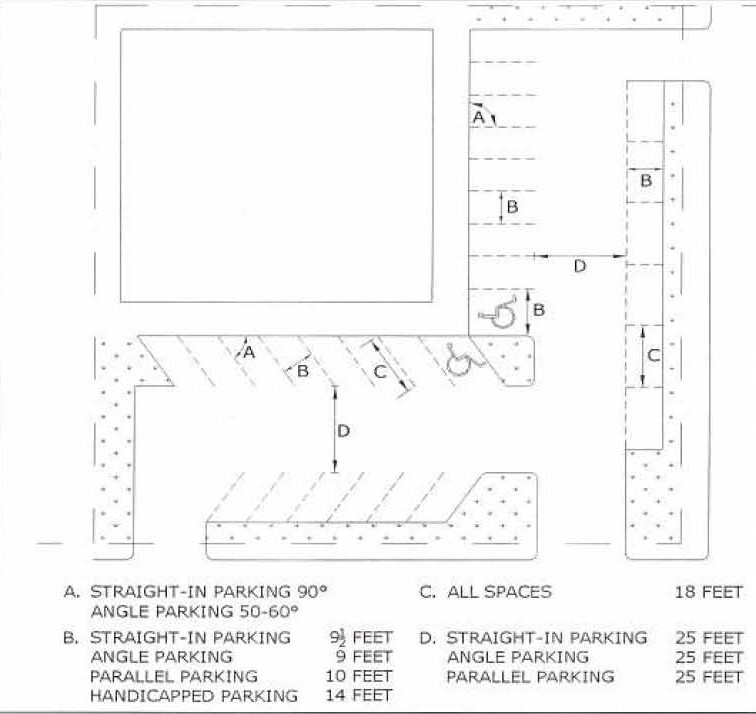
(Am. Ord. 2009-18, passed 11-3-2009; Am. Ord. 2011-05, passed 4-5-2011)
Sec. 154.12. - Sign regulations.[6]
ARTICLE I. ADMINISTRATION
12-1
Purpose. This chapter regulates the location, size, construction, erection, duration, use and maintenance of all signs within the jurisdiction of the City of Stephenville, Texas. The purpose of this chapter is:
1.
To promote the creation of an attractive visual environment that promotes a healthy economy by:
a.
Permitting businesses to inform, identify and communicate effectively; and
b.
Directing the general public through the use of signs while maintaining attractive and harmonious application of signs on the buildings and sites.
2.
To foster public safety along public and private streets within the community by assuring that all signs are in safe and appropriate locations and cause minimum driver distractions.
12-2
New signs. All new signs and face changes on existing signs will follow the regulations of this chapter and shall be required to obtain appropriate permits per section 12-10.
12-3
Nonconforming signs. All nonconforming permanent signs, legally existing on January 1, 2018, may continue to exist and shall be allowed the changing of advertising copy or message on theater marquee signs and similar signs specifically designed for the use of replaceable copy, change of face panel, or where the sign frame was designed for replaceable plates. In addition, all non-conforming signs shall be subject to the following:
1.
Shall not be changed to another nonconforming sign.
2.
Shall not be structurally altered so as to change the shape, size, type or design of the sign; except where alterations are necessary to abate a threat to public safety. This does not include a structural modification whereby an upgrade to a sign's existing electronic changeable message technology is made pursuant to section 12-3.
3.
Shall not be re-established after damage or destruction if the estimated expense of reconstruction exceeds 50 percent of the reproduction cost.
4.
Any structural change, alteration, modification, or change in the name, design, letters, message or other matter on the nonconforming sign, other than a face (copy) change, shall require the sign to be brought into conformity with the requirements of this chapter unless otherwise exempt by section 12-10. This does not include a structural modification whereby an upgrade to a sign's existing electronic changeable message technology is made according to the following:
a.
Overall sign area and height do not increase;
b.
Changeable message sign area does not increase;
c.
Total number of changeable message signs do [not] exceed one per premise; and
d.
Changeable message sign operates in conformance with section 12-70.
12-4
Noncommercial messages. Notwithstanding any provision in this chapter to the contrary, any sign authorized in this chapter is allowed to contain a noncommercial message in place of any other authorized message.
12-5—12-9
Reserved.
12-10
Sign permits.
(a)
No sign, unless excepted by this chapter, shall be located, constructed, altered attached, or painted until a building permit has been approved by the building official in accordance with the requirements of this chapter.
(b)
All signs shall be built in accordance with the drawings attached with the permit application and as approved by the building official.
(c)
Sign permit applications shall contain or be submitted with the following:
(1)
A completed application form;
(2)
The appropriate fees;
(3)
A dimensioned site plan showing:
a.
The location of the proposed sign in relation to all other structures on the property and the property line itself;
b.
All adjacent properties and location of signs within 200 feet of the proposed sign;
c.
An elevation of the sign showing industry specifications and construction details if necessary.
(d)
Window signs, restricted or incidental parking signs, "A"-frame signs, residential yard signs, and movable signs do not require a permit but are required to follow all other provisions and regulations of this chapter.
(e)
The following signs are exempt from the provisions and regulations of this chapter:
(1)
Public signs. Signs specifically required by any law, statute or ordinance. Such public signs may be of any type, number, area, height, location or illumination as required by the law, statute or ordinance.
(2)
Signs on vehicles.
a.
Signs placed on or affixed to vehicles or trailers where the sign is incidental to the primary use of the vehicle or trailer as transportation.
b.
Signs attached or affixed to vehicles being displayed on vehicle sales or rental lots are deemed to be exempt from these regulations, if the purpose of the attached or affixed sign is to advertise the sale or rental of the vehicle upon which it is attached or affixed.
c.
Temporary construction trailers and vehicles located on construction sites that bear the contractor advertising are exempt from these regulations.
d.
Signs on vehicles passing through town for the purpose of advertising at a destination outside city limits are deemed to be exempt from these regulations.
(3)
Vehicle signs. Attached, affixed or painted on vehicles when primary use of the vehicle is for the daily transportation of products or the delivery of services in connection with the business.
(4)
Warning signs. Signs warning the public of the existence of danger but containing no advertising material; to be removed within three days upon the subsidence of danger. Such warning signs may be of any type, number, area, height, location, or illumination as deemed necessary to warn the public of the existence of danger.
(5)
Governmental signs. Signs of duly constituted governmental body, including traffic or similar regulatory devices, legal notices, warnings at railroad crossings, and other instructional or regulatory signs having to do with health, hazards, parking, swimming, dumping, etc.
(6)
Address numerals. Address numerals and other signs required to be maintained by and placed in accordance with law or governmental order, rule or regulation.
(7)
Athletic signs. Signs used as scoreboards in athletic stadiums.
(8)
Directional signs. Signs which direct vehicles and pedestrian traffic, which may display arrows, words, or other symbols to indicate direction of facilities.
(9)
Directory signs. Signs that are located in or adjacent to entrances or foyers.
(10)
Instructional signs. Signs, providing no advertising of any kind, which provide direction or instruction to guide persons to facilities intended to serve the public, including, but not specifically limited to, the signs identifying restrooms, public telephones, public walkways, parking areas and other similar facilities.
(11)
Decorations. Seasonal, holiday or festival decorations in residential districts.
(12)
Flags. Flags of any state, nation, political subdivision or entity, any non-profit group, corporation or entity, or any flag displaying any other noncommercial message.
(f)
The building official shall review a permit application and make a decision on whether to grant or deny the permit within 14 days of submittal of a fully completed application. If additional information is required of an applicant in order to complete an application, the applicant shall be notified of that fact within 7 days. Thereafter, the building official shall make a decision on whether to grant or deny the permit within 14 days of receiving the additional information or a written certification from the applicant that the application is complete.
(g)
If the work authorized by a permit issued under this chapter has not been commenced within 180 days after the date of issuance, the permit shall become null and void.
(h)
Any decision rendered by the building official under this chapter may be appealed to the board of adjustment by any person, agent, or representative affected by such decision. The decision of the board of adjustment shall be final.
12-11
Prohibited signs.
(a)
The following signs are prohibited from installation, construction, repair, alteration or relocation within the city and the extraterritorial jurisdiction (ETJ) except as otherwise permitted in this chapter:
(1)
Inflatable signs, bandit signs and portable signs shall be prohibited in the city or ETJ unless permitted through a special exception.
(2)
Any search lights, bullhorns, spinners (rotating signs), streamers, string lights or strip lighting (except those allowed as holiday and festival decorations as temporary signs in this chapter), pennant, hot air balloon or similar device that is intended to move freely in the wind. Examples of such signs are shown below in Figure A.
Figure A: Examples of prohibited rotating, spinning and streamer signs
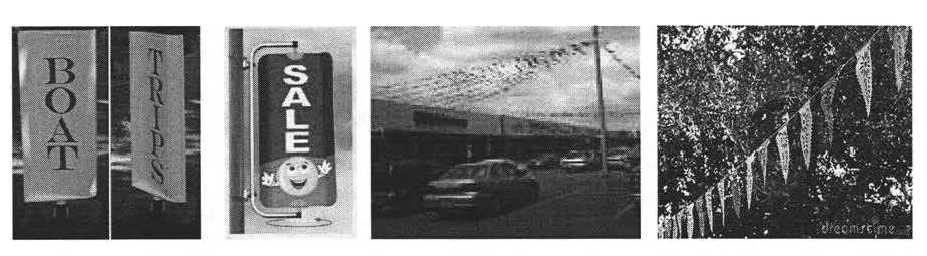
(3)
Moving/whirling and flashing signs except for reader boards, which convey a message. Any light source that produces a revolving beam or beacons that resemble emergency vehicle lights shall be prohibited.
(4)
Parked vehicles as temporary signs: except as allowed by section 12-86, signs mounted, bolted, or constructed on a vehicle, truck beds or trailers, where the sole apparent purpose is to advertise a product or direct people to a business or activity located on the same or nearby property.
(5)
Signs extending into Stephenville Clark Regional Airport Runway Protection Zone or which have external illumination that is directed upward and toward aircraft.
(6)
Signs that resemble traffic control signs or emergency information signs.
(7)
Signs attached to utility poles or other surfaces which are not the properties of the utility or which serve a public purpose and are located within a public right-of-way or easement.
(8)
Any sign, which is not included under the types of signs, permitted in this chapter.
(9)
Any signs, advertisement, poster, placard or handbill upon any lamp post, electric light, railway, telephone or telegraph pole, fire hydrant, shade tree, stone cliff or other natural object, or boxing covering public utilities, or on any bridge, pavement, sidewalk or crosswalk.
(10)
Any sign, advertisement, poster, or other matter on privately or publicly owned property without having obtained the written permission of the owner, agents, or occupants of the premises, and without having complied with other provisions of this chapter that apply.
(11)
Any sign or sign structure which constitutes a hazard to public safety or health.
(12)
Any sign that obstructs free ingress or egress from a fire escape, door, window or other required exit way.
(13)
Any sign that interferes with any opening required for ventilation, or that obstructs openings intended as a means of entrance or exit, or signs that obstruct light or air from any room or building, or block (physically/visually) any public governmental or warning signs.
(14)
Any sign, which makes use of words such as stop, look, one way, danger, yield or any other similar words, phrases, symbols, lights or characters in such a manner as to interfere with, mislead or confuse the vehicular traffic.
(15)
Any structure or part thereof, or any device or representation attached to, painted on, or represented on a building, fence, pole or other structure, which is used as or in the nature of an announcement, direction, advertisement, or other attention-getting purposes, and which is not originally designed or intended to be a sign.
(16)
Home occupation signs that advertise for a business operated in the home.
(17)
Signs placed on property without permission of owner or agent.
(18)
Any sign displayed, installed or erected without the approval of the governing body that owns or controls publicly owned property, street rights-of-way, roadway medians, public parks, fire stations, police stations, libraries, city hall facilities and other buildings and lands owned by a government authority.
(19)
Roof signs as defined in section 12-20 of this chapter.
(20)
Reserved.
(Ord. No. 2019-O-03, § 1, passed 3-5-2019; Ord. No. 2019-O-32, § 1, passed 9-3-2019)
12-12
Variances.
(a)
Variance authorized. The Board of Adjustment (BOA) may authorize a variance to any restriction set forth in this chapter, including, but not limited to, the number, type, area, height or setback of signs, or any other aspect involved in the sign permitting process.
(b)
Approval standards. In granting any variance, BOA shall consider the following criteria and shall grant the variance only if:
(1)
Special conditions exist which are peculiar to the land, structure or building involved and are not applicable to other lands, buildings or structures in the same vicinity. The city may attach such conditions to granting all or a portion of any variance necessary to achieve the purpose of this chapter; and
(2)
The strict interpretation of the provisions of the chapter would deprive the applicant of rights commonly enjoyed by other properties in the vicinity under the terms of the chapter; and
(3)
The special conditions and circumstances do not result from the actions of the applicant and such conditions and circumstances do not merely constitute pecuniary hardship or inconveniences; and
(4)
Granting the variance will meet the objectives of the chapter and not be injurious to the adjoining property owners or otherwise detrimental to the public welfare; and
(5)
The request will be the minimum variance necessary to alleviate the special hardship or practical difficulties faced by the applicant in meeting the requirements of this chapter; and
(6)
Granting of the variance will be in harmony with the spirit and purpose of this chapter.
(7)
In granting special exceptions under this section, the Board of Adjustment may impose such conditions as are necessary to protect adjacent property owners and to ensure the public health, safety and general welfare, including but not limited to conditions specifying the period during which the nonconforming use may continue to operate or exist before being conformed to the standards of the Zoning Ordinance.
12-13—12-19 Reserved.
ARTICLE II. SIGN STANDARDS
DIVISION 1. DEFINITIONS
12-20
Definition of sign types. The following words, terms and phrases, when used in this article, shall have the meanings ascribed to them in this section, except where the context clearly indicates a different meaning:
Architectural element sign means a freestanding sign that is attached to an architectural element (a structure such as a pergola, freestanding canopy, fence, or retaining wall) that is built for the purpose of serving as an architectural enhancement of the site, is architecturally compatible to the main building and the overall site but not including sign structures for other sign types and/or structures for antennas or similar type structures.
Awning sign means a wall sign attached to an awning structure (a structure made of metal or other material with frames affixed to a building and carried by a frame, but which does not have supports to the ground other than the main building). If the sign projects over the surface of the awning then it is considered a roof sign.
Bandit signs means signs that are placed on public rights-of-way, public property, public infrastructure, or equipment by a nongovernmental agency for any purpose.
Banner sign means a sign made of flexible materials (paper, plastic, or fabric), with or without a frame, and supported along one or more sides, or at two or more corners, by one or more fixed, rigid supports such as poles or rods. Banner does not include a flag or a pennant.
Bow banner means a freestanding, lightweight, and usually vertically-oriented banner with minimal framing that curves outward at the top to match the curved shape of the fabric, also known as a fin, shark, feather banner or teardrop sign, which by design allows some movement to attract attention whether by pivoting or by movement of the material while still allowing for readability.
Canopy sign means a wall sign attached to a canopy structure (a structure made of metal or other material with frames affixed to a building and carried by a frame, which has supports to the ground other than the main building). If the sign projects over the surface of the canopy then it is considered a roof sign.
Changeable message sign means a sign designed to allow the changing of copy through manual, mechanical, or electrical means including time and temperature.
Channel letter sign means a wall sign or a freestanding sign that is made of only text, symbols, or logos and the sign may or may not be illuminated.
Construction sign means a temporary sign identifying individuals or companies involved in design, construction, wrecking, or development on the same premises as the sign.
Electronic billboard means a sign that can change its copy or sign face by changing or altering a fixed display screen composed of electrically illuminated elements; that also directs attention to a business, product, service, conducted, sold, or offered at a location other than on the premises on which the sign is located.
Exempt sign means a sign that is not required to follow the regulations included in this Code.
Flag sign means a freestanding sign, which displays a commercial message on a flag.
Flashing sign means a sign that creates the perception or actual change in color, brightness, intensity or reflectivity or an illuminated sign on which the artificial source of light is not maintained stationary or constant in intensity and color when the sign is illuminated. For the purpose of this Code, any moving sign displaying alternating illumination being turned on and off which induces a strobe or pulsing effect shall be deemed to be a flashing sign.
Freestanding sign means any non-movable sign not attached to a building and that is not a temporary sign.
Homebuilder sign means a sign that advertises the name of the builder of single-family residential homes who owns one or more lots in a particular subdivision.
Human sign means a person dressed in costume, holding a sign, or having a sign affixed to the person where the sign or costume has a commercial message.
Inflatable sign, including lighter-than-air or gas-filled inflatable objects that may be connected with a tether. The term includes balloons but does not include inflatable gyms or games.
Kiosk sign means a freestanding sign structure located in or adjacent to public right-of-way that features a city identification panel at the top of each structure and displays directional information according to the requirements of section 12-53.
Light pole sign means a temporary sign that attaches to the specified dimensions of a light pole designed for the purpose or has been approved for the modified purpose of displaying a vertically oriented banner sign of no less than 24 inches and no more than 30 inches in height and is attached to the light pole.
Marquee sign means a wall sign that is attached to a marquee structure and comprised of non-permanent letters, numerals, or symbols which may be changed electronically or manually by adding, removing, or rearranging the letters, numerals, or symbols.
Message Board means a sign, display or device, including a digital electronic sign and LED (light emitting diode) sign that changes its message or copy by programmable electron or mechanical processes, regardless of size. Also, a sign utilizing a fixed light source to provide a message in text, images, pictures, and/or symbols that may appear to move or may appear as an on/off message.
Monument sign means a freestanding sign integrated into landscaping or other solid structural features supported by masonry base (no poles or columns) on the ground.
Movable sign means any temporary sign, made of vinyl, paper, cloth or fabric, polyboard, coroplast or corrugated plastic, poster board, plastic core, cardboard, lightweight plastic, plywood or similar material including signs with wood or wire framing, posts or stakes, supported by the ground but not permanently attached to the ground, which can be regularly moved from a location at periodic intervals. The term includes "A"-frame or sandwich board signs and bow banner or swooper flags. The term does not include residential yard signs. A movable sign is not considered to be a portable sign. Examples of movable signs are shown in figure B below.
Figure B: Examples of movable signs attached to the ground

Moving/whirling sign means a sign which has any actual or apparent moving, revolving, flashing or rotating parts activated by electric, electronic, kinetic or mechanical devices, or by wind current, and shall include, but not be limited to, balloons, signs which are constructed of or faced with reflective tape or other similar materials, signs which change color, and signs where the intensity of lighting changes or appears to change, this definition does not include the display of time and/or temperature on a sign face. Certain signs and devices of this type are prohibited as described in subsection 12-11 of this Code.
Mural sign means a wall sign that is a part of a graphic displayed on the exterior of a building, generally for the purposes of decoration or artistic expression, including but not limited to a painting, fresco, or mosaic.
Pennant means any cloth, paper, plastic, or similar non-rigid material used for advertising purposes attached to any structure, staff pole, line, framing, tether, or vehicle.
Permanent sign means a sign that is fixed in the nature that is erected, affixed, or maintained on the premises and is not a temporary sign as defined in this chapter.
Pole sign means a freestanding sign that is affixed, attached, or erected on a column, pole, upright or brace placed in or upon the ground and is not part of a building. This term does not include light poles.
Political sign means a sign pertaining to any national, state, county, or local election involving a candidate for a public office, taxation or bond proposal, legal or legislative amendment, an issue being considered for public referendum, or for a similar purpose or cause.
Portable sign means a temporary sign supported by the ground but not permanently attached to the ground, which is mounted on a trailer or wheels, or is part of a trailer, and by its design can be towed from one location to another by the use of attached wheels or by attaching an axle to existing mounts.
Poster sign means a wall sign that is static, not electronic and is mounted flat against and projecting less than 12 inches from, or painted directly on an exterior wall of, a building or structure with the exposed face of the sign in a plane parallel to the face of the wall to which it is attached.
Projection sign means a wall sign attached to a building or other structure and extending in whole or in part between 12 inches and four feet beyond the exterior surface of the building.
Pylon sign means a permanent freestanding sign which has at least 25 percent of the sign structure width in contact with the ground and in which the sign face is separated from ground level by means of one or more supports such as poles, pole covers or columns. Poles and supports shall be concealed.
Figure C: Example of pylon signs
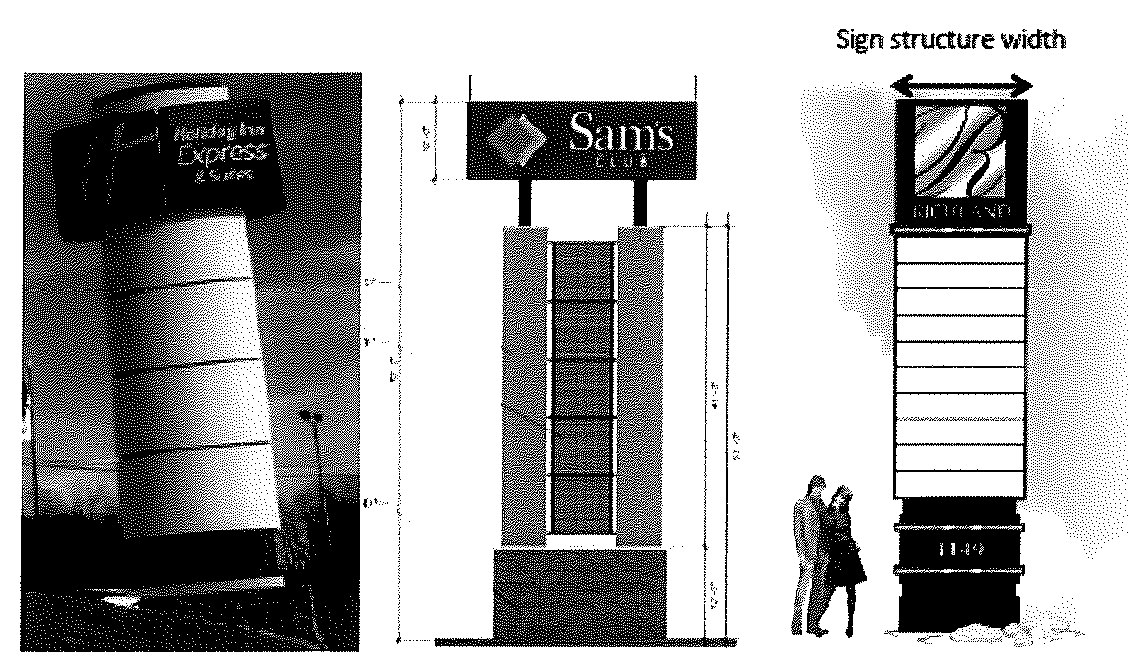
Residential yard sign means a sign for the purpose of advertising the sale or rent of real estate, and also including signs advertising yard sales, estate sales, garage sales, or children's lemonade or similar stands, and only when the sign is on the same premises as the location of the residential use.
Restricted or incidental parking sign means a temporary or permanent sign in a parking lot, or curbside parking area, which designates restricted parking of any type, including, but not limited to, customer parking only, employees of the month, time-limited parking, emergency parking, and similar restricted designations. (See figure D below for examples.)
Figure D: Example of signs used to restrict parking
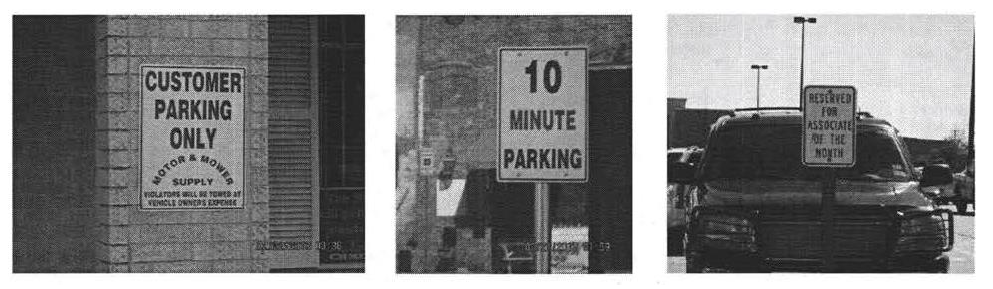
Roof sign means a wall sign erected in whole or in part on a roof, or against, or directly above the highest point of the roofline, parapet, fascia of the building or above the surface of an awning or canopy.
Seasonal, holiday and festive decoration. "Holiday" or "festive" shall mean a calendar date or dates associated with a specific event or season, including, but not limited to, New Year's Day, Martin Luther King, Jr. Day, Valentine's Day, Easter, Memorial Day, Independence Day, Labor Day, Halloween, Thanksgiving, and Christmas; "decorations" shall mean ornaments, figures, statues, signs, inflatable characters, seasonal lighting, and related products that are placed on a building or in a yard for a temporary period of time in observance of a holiday or festival.
Sign means any name, number, identification, description, announcement, declaration, demonstration, device, display, flag, banner, pennant, illustration, logo, balloon, streamer, valance, advertising display, poster, beacon, light or insignia, and structure supporting any of the same, affixed directly or indirectly to or upon any building or outdoor structure, or erected or maintained upon a piece of land, which directs attention to any object, project, service, place, activity, person, institution, organization, or business. A sign includes any or all of the following, the advertisement, copy, face, structure or any [appurtenances] in erecting or attaching the sign. Except for signs included in the definition of "human signs," the term does not include words or images depicted on clothing or pickets, posters, signs or other items that are carried or held by one or more persons that are not attached, placed into, or rested on the ground.
Sign base means the footing, foundation, or similar support to support the sign but not including poles.
Sign cabinet means a wall or freestanding sign that contains all the text and/or logo symbols within a single enclosed cabinet, which may or may not be illuminated.
Sign structure means the structure or other means whereby the sign face or copy is attached in one or more points. Attachments include, but are not limited to, poles, brackets, concrete footings, framework, uprights, catwalks, etc.
Temporary sign means a non-permanent sign made of non-rigid material, designed and displayed for a seasonal or brief activity such as, but not limited to, sales, specials, promotions, holidays, auctions, business grand openings, and signs advertising the lease or vacancy of rental units in residential developments.
Vehicle sign means a sign mounted, painted or otherwise placed on a truck, bus, car, boat, trailer or other vehicle or equipment and used in such a manner that the sign is visible from a public street or right-of-way. Vehicles and equipment engaged in active construction or repair projects, and the on-premises storage of equipment and vehicles offered to the general public for rent or lease, shall not be considered to be vehicle signs. The term does not include bumper stickers, window stickers, or license plate frames.
Wall sign means a sign mounted flat against and projecting less than 12 inches from, or painted directly on an exterior wall of a building or a structure that is attached to the building with the exposed face of the sign in a plane parallel to the face of the wall to which it is attached.
Wayfinding sign means a directional sign that is part of a sign system for the purpose of directing traffic, both vehicular and pedestrian, to the public's desired location.
Wind sign means a cloth or plastic or other flexible light material made in strips, triangles or other shapes, figures, or objects which are fastened together or to ground by wire, rope, cord, string or other means in such manner as to move by wind pressure.
Window sign means a sign attached to, placed upon, or painted on the exterior or interior of a window or door, of a building, which is intended for viewing from the exterior of such building.
12-21
Definitions of ancillary terms and performance standards.
Accessory building. An accessory building as that term is defined in section 3 of this Code.
Area of sign. The area of the smallest rectangle enclosing the extreme limits of characters, lettering, illustrations, ornamentations, or other fixtures, material, or color forming part of the sign. Structural supports bearing no sign copy shall not be included in gross surface area; however, if any portion of the required structural supports becomes enclosed for decorative or architectural purposes, that portion will be included in the total gross surface area of the sign. Gross surface area shall be measured on one side only of a two-faced (back-to-back) sign carrying the same image and message on both faces. Two-faced signs carrying different messages and images on each side shall be considered as separate signs.
Certificate of occupancy. A certificate of occupancy as approved by the Building Official
Commercial message. Any message contained on any sign that advertises, promotes, solicits, or endorses a product or service of an establishment, organization, corporation, company, or individual for the purpose of encouraging a consumer to purchase said product or service. This term does not include messages that contain a specific public or civic announcement that do not advertise, endorse, display, or encourage any purchase of a service or product offered by any establishment, corporation, company, or individual.
Election day. Any day or days that are scheduled for city residents to vote in an election at a selected polling place in the city. Such day or days may include, but not be limited to, uniform local, state and federal election dates, early voting day(s), absentee voting days, general election days, special election days, run-off election days, and other voting days established and defined by federal, state or local laws.
Figure E: Illustration depicting various wall planes composing each building elevation
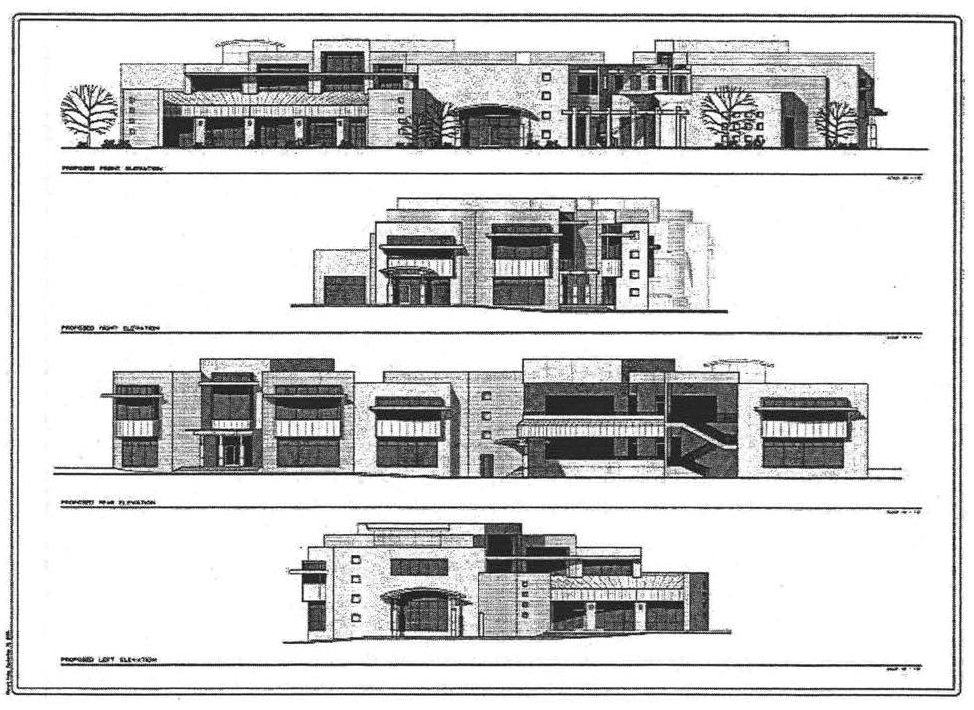
Elevation. An architectural drawing that shows the style, shape, and complexity of a building or structure. It is the view of a building elevation, and its various wall planes, when viewing the entire building straight on—where a horizontal line passing through your shoulders would be parallel to the face of the building. Figure E above shows the various wall planes that compose a building elevation for each side of a building.
Entertainment venue. A public entertainment facility property, as defined as the building(s) and land that is primarily designed and used for live entertainment events other than sports.
Facade. The exterior cladding of a building or structure.
Face change. The change of the copy or when in order to change copy the sign face must be changed too. Face change shall include converting a traditional billboard to an electronic billboard (including the structure changes needed to allow for the face change).
Face of sign. The entire area of sign that the copy should be attached but is not the copy, itself.
Footcandle. A measure of illumination on a surface that is one foot from a uniform source of light of one candle and equal to one lumen per square foot.
Height of sign. The vertical distance from the uppermost point used in measuring the area of a sign to the average grade immediately below the sign, including its base or the top of the nearest curb of the street on which the sign fronts, whichever measurement is the greatest (see section 12-100, measurement standards, for how to measure height).
Length of frontage. The length of any primary or secondary frontage shall be the sum of all wall lengths parallel, or nearly parallel, to such frontage, excluding any such wall length clearly unrelated to the frontage criteria. For buildings with two or more frontages, the length and allowable sign area shall be calculated separately for each such frontage. The building frontage for a building unit shall be measured from the centerline of the party walls defining the building unit.
Marquee. A structure that is attached to, in any manner, or made a part of any permanent roof-like structure projecting beyond a building or extending along and projecting beyond the wall of a building, generally designed and constructed to provide protection from the weather projecting above an exterior door and over a sidewalk, terrace, or similar waiting area, including, but not limited to, a theater or restaurant.
Motion. The perceived or actual occurrence of movement generally created by a change in shape, size, color, luminosity, reflectivity, or animation, not static or fixed.
Nits. A measure of lumination or luminance that is used to compare the brightness of a digital or LED sign. One nits is equal to one candela per meter squared.
Noncommercial message. Any message or speech that does not meet the definition of "commercial message" as defined in this section.
Nonconforming sign. A sign that was a legally permitted sign when installed but does not conform to the existing ordinance due to the amendments made after the permit was issued.
Off-premises sign. A sign that directs attention to a business, profession, activity, commodity, service, or entertainment other than one conducted, sold, or offered upon the premises where such sign is located.
Payload capacity. The manufacturer's payload capacity rating for the vehicle, or can be determined by the gross vehicle weight rating. The curb weight, typically the payload capacity or weights can be found inside the driver side door jamb of the vehicle.
Premises. A tract of land including its existing buildings.
Premises sign. A sign which is located upon the premises where the business, profession, activity, commodity, service or entertainment referred to by the sign is located.
Primary and secondary frontage. The frontage of any building or site shall include the elevation(s) facing a public street, facing a primary parking area for the building or tenants, or containing the public entrance(s) to the building or building units. For multi-tenant buildings, the portion of such building that is owned or leased by a single tenant shall be considered a building unit:
(1)
The primary frontage shall be considered the portion of any frontage containing the primary public entrance(s) to the building or building units.
(2)
The secondary frontage shall include frontages containing secondary public entrances to the building or building units, and all walls facing a public street or primary parking area not designated as the primary frontage. (See figure F below.)
Prohibited sign. A sign that is not allowed in the city.
Roofline. The horizontal line where the wall ends and the roof begins.
Shopping center. A retail site that has at least one 75,000-square feet or more single retail user or for a retail site that is minimum five-acres with at least 100,000 square feet of rentable retail space.
Shopping center sign plan. A plan showing all signage for a shopping center as defined in this section and approved per the regulations of this chapter.
Sports venue. A public entertainment facility property, as defined as the building(s) and land that is primarily designed and used for live sporting events.
Street grade. The average elevation of the projected corners of a property, adjacent to a dedicated street right-of-way or roadway easement, the elevation of the corners being measured at the top of curb, or centerline of street if no curb is present.
Visibility triangle. Also referred to as a "corner clip," it is an area located at the intersection of a public street with another public street, a driveway, an access easement or an alley, which must remain unobstructed by permanent or temporary objects at heights between two and seven feet above ground level or top of curb, whichever is more critical. See Code of Ordinances, City of Stephenville, for size and dimensional requirements specified for visibility triangles.)
F: Illustrating typical locations for primary and secondary building frontages
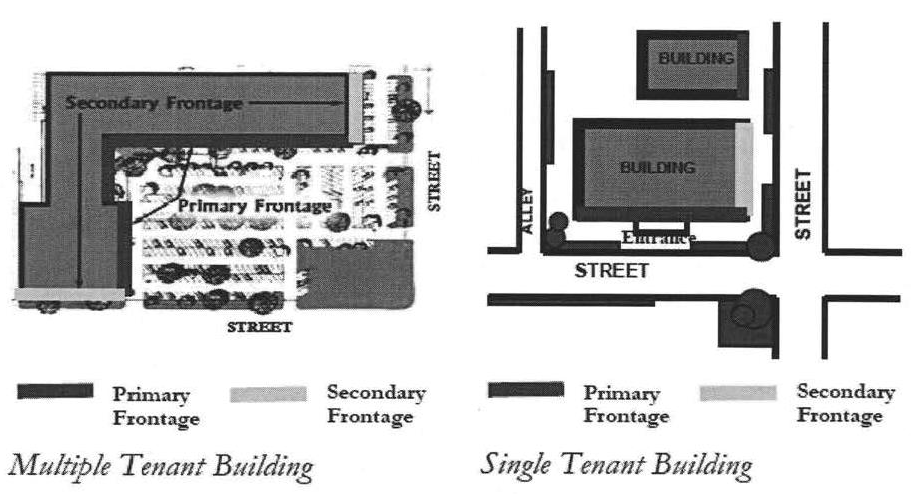
Figure G: Illustration of various types of permitted signs and their typical locations
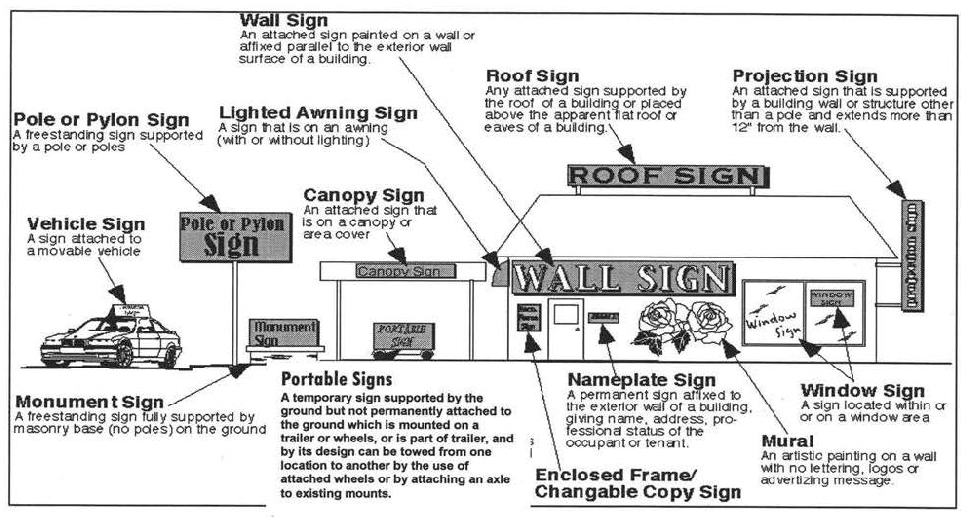
12-22—12-29 Reserved.
DIVISION 2. WALL SIGNS
12-30
Generally.
(a)
All wall signs on a building elevation shall not exceed 30 percent of the area of that elevation.
(b)
Wall signs shall be allowed on all building elevations.
(c)
Wall signs shall not be allowed on accessory buildings.
(d)
Each elevation shall be allowed to cover a maximum of 30 percent of the area of the elevation with any combination of wall signs.
12-31
Awning sign.
(a)
Location.
(1)
Signs must be premises signs.
(2)
Signs shall be attached to the elevation of the awning. If signs project above the structure of the awning they will be considered roof signs.
(b)
Area. Maximum 30 percent of the area of the awning elevation.
(c)
Number of signs. Shall not exceed the total area of all awning signs on each awning elevation does not exceed 30 percent of the area of that awning elevation.
12-32
Canopy sign.
(a)
Location.
(1)
Signs must be premises signs.
(2)
Signs shall be attached to the elevation of the canopy. If signs project above the structure of the canopy they will be considered roof signs.
(b)
Area. Maximum 30 percent of the area of the canopy elevation.
(c)
Number of signs. Unlimited as long as the total area of all canopy signs on each canopy elevation does not exceed 30 percent of the area of that canopy elevation.
12-33
Channel letter sign.
(a)
Location.
(1)
Signs must be premises signs.
(2)
Signs shall be attached to the elevation of the building.
(b)
Area. Maximum 30 percent of the area of the building elevation to which it is attached.
(c)
Number of signs. One per elevation per certificate of occupancy.
12-34
Marquee sign.
(a)
Location.
(1)
Signs must be premises signs.
(2)
Signs shall be attached to a marquee on theatres, sports venues and other entertainment venues.
(b)
Area. Maximum 60 percent of the area of the marquee to which it is attached.
(c)
Number of signs. One per building elevation.
12-35
Mural sign.
(a)
Location.
(1)
Signs shall be painted directly on the surface of the building.
(b)
Area. Maximum 100 percent of the area of the building elevation on which it is painted. Off-premise content shall not exceed 15% of the total area of the sign.
(c)
Number of signs. One per building structure.
12-36
Poster sign.
(a)
Location.
(1)
Signs must be premises signs.
(2)
Signs shall be attached directly to the surface of the building.
(b)
Area. Maximum 30 percent of the area of the building elevation to which it is attached.
(c)
Number of signs. One per elevation per certificate of occupancy.
12-37
Projection sign.
(a)
Location.
(1)
Signs must be premises signs.
(2)
Sign shall be attached to the building and extending in whole or part between 12 inches and four feet beyond the exterior surface of the building but not protruding into the ROW or another property.
(b)
Area. The surface area of the sign where text and graphics are displayed shall not exceed a maximum of 30 percent of the area of the building elevation to which it is attached.
(c)
Number of signs. One per building elevation.
12-38
Sign cabinet.
(a)
Location.
(1)
Signs must be premises signs.
(2)
Signs shall be attached directly to the surface of the building.
(b)
Area. Maximum 30 percent of the area of the building elevation to which it is attached.
(c)
Number of signs. One per elevation per certificate of occupancy.
12-39
Window sign.
(a)
Location. Signs must be premises signs.
(b)
Area. Maximum 30 percent of the area of the window.
12-40—12-49. Reserved.
DIVISION 3. FREESTANDING SIGNS
12-50
Generally.
(a)
All freestanding signs shall be setback a minimum ten feet from the property line.
(b)
Combination of freestanding sign types allowed on a premises at any given time is as follows:
(1)
A premises may either have a pole sign, or a pylon sign or a monument sign if permitted by this chapter;
(2)
A premises may combine architectural element sign or a vehicle sign with any other freestanding signs;
(3)
A premises may combine flag signs only with monument signs.
12-51
Architectural element sign.
(a)
Location.
(1)
Signs must be premises signs.
(2)
Signs shall be attached to the surface of the architectural element.
(b)
Area. Maximum 200 square feet.
(c)
Height. May not extend beyond the surface of the architectural element to which it is attached.
(d)
Number of signs. One per elevation of the architectural element.
12-52
Flag sign.
(a)
Location.
(1)
Signs must be premises signs.
(2)
Signs may only display logos, symbols, tag lines and name of business.
(b)
Area. Maximum 200 square feet.
(c)
Height.
(1)
Maximum 35 feet
(d)
Number of signs. One per premises.
12-53
Kiosk signs.
(a)
The city council may, by duly executed license agreement, grant the exclusive right to design, erect and maintain kiosk signs within the city limits of the city.
(b)
Kiosk signs shall be designed and constructed in accordance to the specifications contained in the aforementioned license agreement and in this section.
(c)
Prior to erecting any kiosk sign, the licensee shall submit a sign location map to the director of community development for approval. The sign location map shall contain the location, orientation, and number of individual location signs available for each kiosk sign.
(d)
Kiosk sign installation shall include break-away design features as required for traffic signs in the street right-of-way.
(e)
Advertisement of price information shall be prohibited on kiosk signs.
(f)
No additional or extraneous signs, pennants, flags or other devices for visual attention or other appurtenances shall be attached to kiosk signs.
(g)
Kiosk signs shall not be illuminated.
(h)
Individual sign panels on kiosks shall have a uniform design and color.
(i)
Kiosk signs shall not:
(1)
Interfere with the use of sidewalks, walkways, bike and hiking trails;
(2)
Obstruct the visibility of motorists, pedestrians or traffic control signs; and
(3)
Be installed in the immediate vicinity of street intersections.
(j)
Signs shall comply with the visibility triangle requirements contained in the subdivision regulations or other visibility easements provided by code or subdivision plat.
(k)
Kiosk sign plazas may be located on private premises along the 377, 281, and Hwy 8 corridors, or other state-maintained roadways, provided written permission is obtained from the premises owner.
(l)
Kiosk signs are intended to create a uniform coordinated method of providing direction for prospective patrons of local businesses, prospective purchasers of houses, and parties interested in school or municipal events and facilities within the city limits while discouraging the placement of other unsightly and hazardous off-site directional signs.
(m)
In accordance to the specifications contained in the aforementioned license agreement a percentage of the kiosk sign panels shall be reserved for the city to use as directional signage to municipal or community facilities, or locations for community events.
(n)
The licensee shall be responsible for all construction, installation, maintenance and repair of the kiosk signs at no cost to the city.
(o)
Notwithstanding anything contained herein to the contrary, any sign authorized under this section to contain commercial copy may contain noncommercial copy in lieu of commercial copy.
(p)
The licensee shall administer the kiosk signs and shall fill the individual location sign spaces in accordance with the following criteria:
(1)
The spaces shall be filled according to the date the requesting location submits an application or request is received by the licensee on a first-come, first-served basis.
(2)
The number of kiosk signs and spaces on each sign shall be set by the sign location map approved by the director of community development. The licensee may request the placement of additional kiosk signs only if the number of unserved requests will fill an additional sign.
(3)
The licensee shall have no discretion to award or not award a space on a kiosk sign based on the type of organization or business that requests placement on a kiosk sign.
(4)
The locations listed on a kiosk sign must be within the city limits of the city and the property line of the location must be no less than 1,000 feet from the kiosk sign.
12-54
Monument sign.
(a)
Location. Signs must be on-premises signs.
(b)
Area.
(1)
Maximum 300 square feet for single tenant sign constructed along 377, 281, and Hwy 8.
(2)
Maximum 400 square feet for multi-tenant sign constructed along 377, 281, and Hwy 8.
(3)
Maximum 100 square feet for single tenant sign constructed along all other roadways.
(4)
Maximum 150 square feet for multi-tenant sign constructed along all other roadways.
(c)
Height.
(1)
Sign base shall be between two feet and four feet.
(2)
Maximum 14 feet for multi-tenant sign constructed along 377, 281, and Hwy 8. Sign height is measured from bottom of the sign base at grade to the top of the sign. Where the average grade of the lot on which a sign is placed is at or above the adjacent street grade, the sign shall be measured from the grade level adjacent to the sign. Where the average grade of the lot is below the adjacent street grade, the sign height shall be measured from the adjacent street grade.
(3)
Maximum ten feet for single tenant sign constructed along 377, 281, and Hwy 8. Sign height is measured from bottom of the sign base at grade to the top of the sign. Where the average grade of the lot on which a sign is placed is at or above the adjacent street grade, the sign shall be measured from the grade level adjacent to the sign. Where the average grade of the lot is below the adjacent street grade, the sign height shall be measured from the adjacent street grade.
(4)
Maximum 12 feet for multi-tenant sign constructed along all other roadways. Where the average grade of the lot on which a sign is placed is at or above the adjacent street grade, the sign shall be measured from the grade level adjacent to the sign. Where the average grade of the lot is below the adjacent street grade, the sign height shall be measured from the adjacent street grade.
(5)
Maximum nine feet for single tenant sign constructed along all other roadways. Where the average grade of the lot on which a sign is placed is at or above the adjacent street grade, the sign shall be measured from the grade level adjacent to the sign. Where the average grade of the lot is below the adjacent street grade, the sign height shall be measured from the adjacent street grade.
(d)
Number of signs. One per street frontage, two maximum.
(e)
A landscaping bed shall not be required around the base of the monument sign; however landscaping and xeriscaping shall be considered and is encouraged to help beautify the property and the community. Any landscaping shall be maintained include mowing, watering, trimming, pruning, etc.
(f)
Monument signs must be wrapped in masonry material to match or compliment building, exposed sign cabinets or poles are prohibited. The masonry material wrapping the advertising area shall not exceed 100 percent nor fall below 30 percent of the commercial advertising area.
12-55
Regulations regarding off-premises signs (billboards).
(a)
Purpose. Billboards are recognized as a legitimate form of commercial use in the city. The size, number, location, and illumination of billboards can have significant influence on the city's visual environment, but may, without adequate zoning control, create or contribute to visual blight conditions negatively affecting the quality of life in the community. The purpose of this zoning section is to provide reasonable billboard control, recognizing that community appearance is an important factor in ensuring the general community welfare.
Billboards in existence on the effective date of this ordinance may continue to legally exist and be maintained pursuant to this ordinance but shall be subject to the terms of the ordinance as stated in the ordinance.
(b)
Definitions. The following definitions are applicable to this chapter.
1.
Billboard. Any off-premise location of a static billboard or any location of an electronic billboard either of which is located in a Billboard Overlay Zone of the City of Stephenville, Texas. All such billboards shall be governed by the regulations of this ordinance and any other applicable ordinance of the City of Stephenville. In the event of any conflict between regulations, the terms of this ordinance shall take precedence over any conflicting or ambiguous terms insofar as the terms relate to billboards.
2.
Static billboard. A static or revolving freestanding sign that identifies or communicates a commercial or noncommercial message related to an activity conducted, a service rendered, or a commodity sold at a location other than where the sign is located. This includes, but is not limited to, building graphics and wall drop signs containing off-site messages, and billboards painted or applied to building walls. The terms "billboard" and "off-premises sign" may be used interchangeably to mean the same thing.
3.
Electronic billboard. A billboard with a fixed display surface composed of electronically illuminated or electronically actuated or motivated elements that, utilizing digital message technology, is capable of changing the alphabetic, pictographic, or symbolic informational content on the sign electronically. This includes billboards with displays that must be preprogrammed to display only certain types of information (i.e., time, date, temperature) and billboards whose informational content can be changed or altered by means of computer-driven electronic impulses. This includes, without limitation, billboards also known as digital billboards or LED billboards. An electronic billboard may be internally or externally illuminated.
4.
Billboard Overlay Zone (BOZ). A zone map that has been approved by the City Council of the City of Stephenville, Texas which overlays an existing industrial or commercial zone and that allows for the placement of billboards that conform to this ordinance in that zone.
5.
Mobile billboard advertising display. Any billboard installed upon, mounted, attached, or applied to any motor vehicle, non-motorized vehicle, bicycle, scooter, trailer, or other equipment whose primary purpose is conveyance, transportation, or support of the billboard message surface. The term does not include advertising signs painted on a motor vehicle door.
(c)
General requirements.
1.
Location restriction. Billboards shall be allowed in the BOZ only after a development agreement has been approved by the City Manager. A development agreement shall be entered into prior to approval of any project involving installation or construction of a new billboard, expansion, modification, or digitization of a billboard, or addition of additional face(s) to a billboard.
2.
A billboard or digital billboard in existence on the effective date of this ordinance pursuant to a development agreement (including any amendments or extensions thereof) may be relocated and rebuilt within 100 feet of its existing location within the BOZ.
(d)
Billboard Overlay Zone (BOZ). For purposes of this ordinance the Billboard Overlay Zone for the City of Stephenville is established as the Extraterritorial Jurisdiction from the City Limits of City of Stephenville, Texas as established from time to time.
(e)
Authorized locations. Billboards shall be allowed only in the BOZ, and shall not be permitted in any location which would result in violation of any applicable federal, state, or local law.
1.
No billboard will be approved without the applicant first providing proof of lease, easement, or other entitlement demonstrating the right to install the billboard on the subject property, including the written consent of the property owner if not readily ascertainable from the foregoing documents.
2.
No billboard will be approved and no billboard may be maintained unless a designated maintenance service or responsible individual is available by telephone 24 hours per day, 7 days per week to be contacted and to respond in the event a billboard becomes damaged or dilapidated.
3.
Texas Department of Transportation Permit. Notwithstanding other provisions, no permit under this ordinance shall be issued for a billboard governed by Texas Transportation Code Chapter 391, unless the Texas Department of Transportation has issued a permit for the billboard location. In the event of any conflict between the requirements of Texas Transportation Code Chapter 391 and this chapter, the provision with the more stringent regulation shall be applicable.
(f)
Physical requirements.
1.
Minimum distances.
i.
The minimum distance between any two (2) billboards shall be 1,000 feet if placed on a Federal or State highway as authorized by this ordinance. Distance shall be measured from the vertical centerline of each billboard and parallel to the highway or street toward which the billboards are oriented. The minimum distance requirements shall not be applicable to billboards in existence on the date this ordinance was adopted.
ii.
No Billboard shall be installed within 300' of a Residential Zoned District.
2.
Utilities. All utilities for each billboard shall be underground.
3.
Display surface. No billboard (except electronic billboard) shall have more than one (1) face (display surface) which shall be oriented in one (1) vertical plane.
4.
Name of owner. All Billboards shall plainly display, to be visible from no less than 100 feet, the name of the person or company owning or maintaining the billboard and the billboard identification number.
5.
Minimum surface clearance and maximum height. All billboards shall have a minimum surface clearance from ground level of eight (8) feet unless the billboard projects over a driveway or driving aisle in which event the minimum surface clearance shall be sixteen (16) feet. No billboard shall exceed a maximum of 35 feet in height.
(g)
Operational requirements.
1.
No billboard shall display any statements, words or images of an "obscene, indecent, or immoral character," as defined by existing judicial decisions interpreting the terms.
2.
No billboard shall display any advertising of any drugs, including, but not limited to, marijuana; tobacco products; adult-sexual products; adult novelty items; nude or partial nude images; adult books or magazines; adult videos, DVDs, or tapes of a sexual nature.
3.
All digital billboard must be connected to the National Emergency Network and provide emergency information, including child abduction alerts (i.e., "Amber Alerts"), in accordance with local and regional first responder protocols.
(h)
Digital billboard operating criteria.
1.
All digital billboards shall contain static messages only, and shall not have movement or the appearance or optical illusion of movement during the required static display period. Each static message shall not include flashing lighting or the varying of light intensity during the required static display period
2.
Minimum static display period. Each static display for a message on an electronic billboard must be displayed for a minimum of four (4) seconds each but in no event less than the time required by Texas Department of Transportation if the regulation exceeds four (4) seconds.
3.
Brightness. All digital billboards shall not operate at brightness levels of more than 0.3 footcandles above ambient light, as measured using a footcandle meter at a pre-set distance. Each digital billboard must have a light sensing device that will adjust the brightness as ambient light conditions change.
4.
Measurement distance criteria. Pre-set distances to measure the footcandle's impact vary with the expected viewing distances of each size sign.
5.
Malfunction. All digital billboards shall be designed to freeze the display in one static position, display a full black screen, or turn off in the event of a malfunction.
6.
Billboard base. All billboards shall have walls or screens at the base of the each billboard which shall not create a hazard to public safety or provide an attractive nuisance and each billboard base shall be continually maintained by its owner so that it is operated in a safe manner and is maintained free of graffiti.
7.
Safety and legal compliance.
i.
Billboards shall not be operated in a manner that constitutes a hazard to the public or in a manner that is not safe for the operation of vehicles on public streets.
ii.
No billboard shall simulate or imitate any directional, warning, danger, or information sign, or any display likely to be mistaken for any permitted sign intended or likely to be construed as giving warning to traffic by, for example, the use of the words "stop" or "slow down."
iii.
No billboard may use any red, blinking, or intermittent light likely to be mistaken for warning or danger signals, nor shall any billboard illuminate to impair the vision of travelers on the adjacent freeway and/or roadways.
iv.
All billboards must comply with all applicable local, state, and federal laws and regulations.
v.
Any person violating any of the provisions of this subchapter shall be deemed guilty of a misdemeanor and upon conviction thereof shall be fined in any sum not to exceed $200.00.
(Ord. No. 2019-O-03, § 1, passed 3-5-2019; Ord. No. 2019-O-32, § 1, passed 9-3-2019)
12-56
Pole sign.
(a)
Location.
(1)
Signs must be premises signs.
(2)
Signs shall not be allowed in residentially zoned districts.
(3)
Signs shall maintain a 100-foot separation from an adjacent pole sign on each premises and minimum of 50 feet on adjacent premises on the same side of the street.
(b)
Area.
(1)
Maximum 150 square feet.
(c)
Height.
(1)
Maximum 35
(2)
Signs must maintain a eight-foot clearance from ground to sign.
(d)
Number of signs. One per premises.
12-57
Pylon sign.
(a)
Location.
(1)
Signs must be premises signs.
(b)
Area.
(1)
Maximum 150 square feet for multi-tenant.
(2)
Premises adjacent 377, 281, and Hwy 8—Maximum 300 square feet.
(c)
Height.
(1)
Maximum 35 feet.
(2)
Signs must maintain a fifteen-foot clearance from ground to bottom of sign cabinet.
(3)
Where the average grade of the lot on which a sign is placed is at or above the adjacent street grade, the sign shall be measured from the grade level adjacent to the sign. Where the average grade of the lot is below the adjacent street grade, the sign height shall be measured from the adjacent street grade.
(d)
Number of signs. One per premises.
(e)
A landscaping bed shall not be required around the base of the monument sign; however landscaping and xeriscaping shall be considered and is encouraged to help beautify the property and the community. Any landscaping shall be maintained include mowing, watering, trimming, pruning, etc.
(f)
A minimum of 25 percent of the sign structure width must be in contact with the ground. Poles and supports shall be concealed. Pylon signs shall be of similar color, material and design so as to be consistent with the architectural design of the primary structure.
12-58
Directional sign.
(a)
Location. Must be premises signs.
(b)
Area. Maximum ten square feet.
(c)
Height. Maximum four feet.
(d)
Number of signs. One per driveway entrance.
12-59—12-69 Reserved.
DIVISION 4. OTHER SIGNS
12-70
Changeable message signs.
(a)
These may be manual or electronic.
(b)
Changeable message signs:
(1)
Shall be allowed on all permitted signs.
(2)
May be a part of a wall sign or a freestanding sign.
a.
Shall not comprise an area greater than 50 percent of the allowed area of the monument or pylon sign.
b.
If constructed as part of a monument or pylon sign, the changeable message sign cabinet must be wrapped in material to match or compliment building.
(3)
Shall not be allowed on temporary signs.
(c)
Number of signs. Only one sign per premises shall be allowed as a changeable message sign.
(d)
Illumination of changeable message signs shall not be of such intensity or brilliance as to cause glare or impair vision.
(e)
All electronic changeable message signs shall have an auto dimmer photo eye installed in the sign.
(1)
Maximum daytime (7:00 a.m. to 6:00 p.m.) brightness shall be 5.000 nits; and
(2)
Maximum nighttime (6:01 p.m. to 6:59 a.m.) brightness shall be 500/660 nits.
(f)
Message changes shall be allowed at two-second transition with an eight-second hold time.
Figure I: Example of permitted and prohibited changeable message signs constructed
on freestanding signs
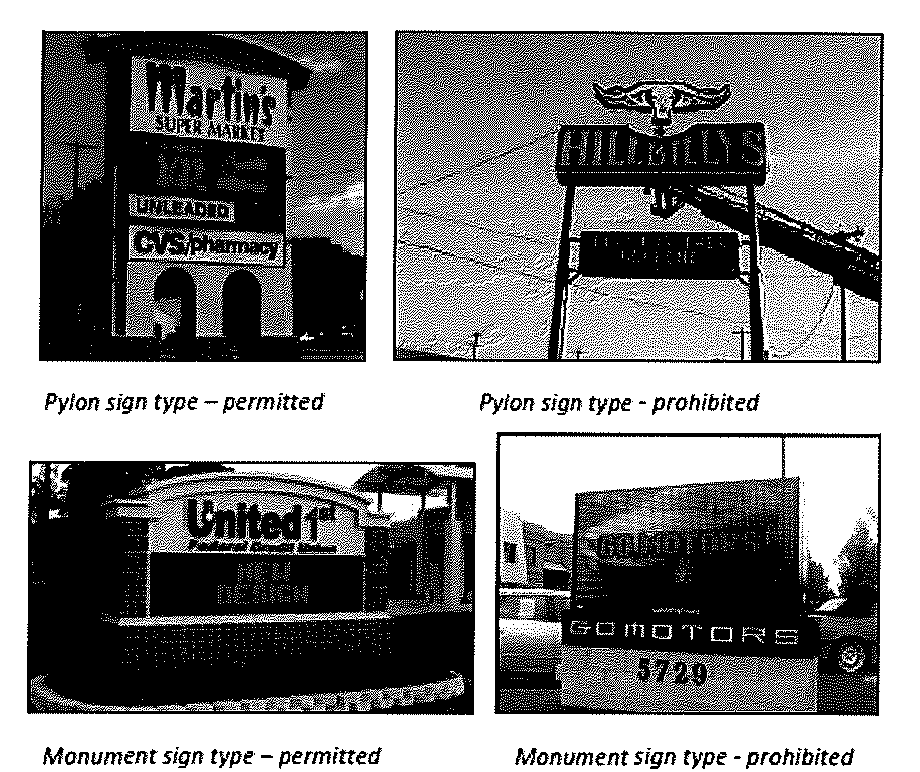
12-71
Signs in public rights-of-way.
(a)
All signs in public right-of-way shall have a right-of-way agreement or a license agreement between the sign owner and the city council.
(b)
The application for a right-of-way agreement or license agreement shall include the types, locations, size, area, height, number, materials, design and construction of all proposed signs.
(c)
This data shall be a part of the agreement and will be attached to the agreement.
(d)
The process for right-of way agreement or license agreement shall be as follows:
(1)
The application will be submitted to the Planning and Building department, will be reviewed, and shall be placed on a planning and zoning commission agenda.
(2)
The city manager will then place the item on a city council agenda.
(3)
The director of community development department shall put a notice in the newspaper 15 days before the day of the meeting for both the planning and zoning commission meeting and city council meetings (this notice may be sent at one time). The planning and zoning commission shall review the sign details and design and make a recommendation to the city council.
(e)
The sign placement agreement shall be approved if the following criteria are met:
(1)
The sign will be placed in right-of-way adjacent to and in the frontage of the business location or other establishment referenced in the sign.
(2)
There would be an unnecessary hardship if the business location or establishment were not allowed to place the sign in the right-of-way due to lack of visibility from the right-of-way due to the placement of other existing structures.
12-72
Shopping center sign plan.
(a)
A shopping center sign plan application shall be a written and/or illustrated document to depict all temporary and permanent proposed signs on site which shall include:
(1)
Proposed sign palette, which may include any combination of wall, freestanding, and changeable message sign types that are allowed in this chapter;
(2)
Location of all proposed signs included in the sign palette;
(3)
Size and number of all proposed signs including maximum area, letter height, number, and height;
(4)
Materials proposed for all signs and sign structures;
(5)
Color and style palette for all signs (letter colors, background colors, text fonts, etc.) including context of where signs are to be placed on any given facade;
(6)
Type of illumination proposed, and whether external or internal;
(7)
Landscaping or ornamental structures including fences, fountains, public art, ground cover, and other landscaping elements that are intended to complement the proposed sign palette and design; and
(8)
Any other information as required by the decision-making bodies.
(b)
Design guidelines.
(1)
The sign design guidelines are designed to help ensure quality signs that communicate their message in a clear fashion; however, the "guidelines" are not as strict as sign "standards." The Building Official may interpret the design guidelines with some flexibility in their application to specific signs/projects, as not all design criteria may be workable or appropriate for each sign or project. In some circumstances, one guideline may be relaxed to facilitate compliance with another guideline determined by the review authority to be more important in the particular case. The overall objective is to ensure that the intent and spirit of the design guidelines are followed.
a.
Compatibility with surroundings.
1.
Proportional size and scale. The scale of signs should be based on the building facade on which they are placed and the area in which they are located. The size and shape of a sign should be proportional with the scale of the structure. Large storefronts such as big boxes will be allowed to have proportionally larger signs than smaller storefronts. Signs should not overwhelm the section of the building facade on which it is placed upon.
2.
Integrate signs with the building. Signs should be designed so that they are integrated with the design of the building. A well designed building facade or storefront is created by the careful coordination of sign and architectural design, and a coordinated color scheme. Signs in multiple-tenant buildings should be designed to complement or enhance the other signs in the building. Sign placement and design should be reviewed within the context of building design.
3.
Corporate franchise signage. Corporate franchise signage should conform to the community's visual desires while maintaining some elements of corporate identity. Corporate logos should fit the context, color, scale and building elements.
b.
Location and mounting.
1.
Signs should be mounted in locations that respect the design of a building and site, including the arrangement of bays and openings. Signs should not obscure windows, (including second-story windows), window trim/molding, grillwork, piers, pilasters, and other ornamental features.
2.
Attached signs on fascias above storefront windows should be sized to fit within existing friezes, lintels, spandrels, and other such features and not extend above, below, or beyond them. Typically, attached signs should be centered on horizontal surfaces (e.g., over a storefront opening).
3.
When a large building contains several storefronts, signs for the individual businesses should relate well to each other in terms of locations, height, proportion, color, and illumination. Maintaining continuity will reinforce the building's facade composition while still retaining each business's identity.
c.
Color.
1.
Avoid using too many colors. Colors or color combinations that interfere with legibility of the sign copy or that interfere with viewer identification of other signs should be avoided.
2.
Use contrasting colors. Contrast is an important influence on the legibility of signs. A substantial contrast should be provided between the color and material of the background and the letters or symbols to make the sign easier to read in both day and night. Light letters on a dark background or dark letters on a light background are most legible. Light letters on a dark background work best for both day and night time use.
d.
Materials.
1.
Compatibility of materials. Sign materials should be compatible with the design of the facade on which they are placed. Consider the architectural design of the building's facade and select materials that complement the design. The selected materials should also contribute to the legibility of the sign. For example, glossy finishes are often difficult to read because of glare and reflections.
2.
Appropriate materials. Sign materials should be extremely durable. Paper and cloth signs are not suitable for exterior use (except on awnings) because they deteriorate quickly. If wood is used, it should be properly sealed to keep moisture from soaking into the wood and causing the sign's lettering to deteriorate.
e.
Sign legibility.
1.
Concise name identification. A concise name or limited lines of copy should be used whenever possible given the limited amount of time the vehicle traveling public has to identify and read the sign. The fewer number of words, the more effective the sign. A simple and succinct sign is easier to read and looks more attractive because it is less cluttered.
2.
Use symbols and logos. Symbols and logos can be used in place of words whenever appropriate. Pictographic images will usually register more quickly in the viewer's mind than a written message. And they can be an expression of the owner's creativity.
3.
Limit the number of letter styles. The number of lettering styles that are used on a sign should be limited in order to increase legibility. As a general rule, limit the number of different letter types to no more than two for small signs and three for larger signs. Intricate typefaces and symbols that are difficult to read reduce the sign's ability to communicate.
f.
Sign illumination.
1.
Internal illumination. Individually illuminated letters, either internally illuminated or backlit solid letters (reverse channel) are a preferred alternative to internally illuminated plastic cabinet signs. Signs comprised of individual letters mounted directly on a structure can often use a distinctive element of the structure's facade as a backdrop, thereby providing a better integration of the sign with the structure.
2.
Use a projected light source. Signs along roadways with slower moving traffic or in pedestrian-oriented environment should consider illumination by a projected light source (e.g., spotlight). Projection lighting is usually a better alternative because the sign will appear to be integrated with the building's architecture. Light fixtures supported in front of the sign cast light on the sign and generally a portion of the building's face as well. Projected lighting emphasizes the continuity of the structure's surface and signs become an integral part of the facade. The use of small, unobtrusive fixtures for external (projection) lighting is encouraged. Avoid the use of oversized fixtures that are out of scale with the sign and structure. Whenever projection lighting is used (fluorescent or incandescent), care should be taken to properly shield the light source to prevent glare from spilling over into residential areas and any public right-of-way. Signs should be lighted only to the minimum level required for nighttime readability.
3.
Cabinet signs. The use of internally illuminated cabinet signs is discouraged. When such signs are proposed, the background field is required to be opaque so that only the lettering appears illuminated (e.g., routed or push-through lettering/graphics). When the background is not opaque, the entire sign face becomes bright and the sign becomes visually separated from the building. As a result, this type of sign can disrupt the continuity of the facade.
4.
Electrical raceways and conduits. Electrical transformer boxes and raceways are required to be concealed from public view. If a raceway cannot be mounted internally behind the finished exterior wall, the exposed metal surfaces of the raceway should be finished to match the background wall, or integrated into the overall design of the sign. If raceways are necessary, they should be as thin and narrow as possible and should never extend in width or height beyond the area of the sign's lettering or graphics. All exposed conduit and junction boxes should also be concealed from public view.
5.
Neon signs. Neon/L.E.D. or similar types of lighting are discouraged.
12-73
Restricted or incidental parking signs.
(a)
Location.
(1)
Can be affixed to a pole at the curb.
(2)
Can be vertically mounted or suspend from a pole or affixed to a building.
(3)
Must be located on private property only.
(b)
Area. Maximum two square feet.
(c)
Height. If vertically mounted or suspended cannot be more than 60 inches above the ground floor or paving surface.
(d)
Prohibited signs.
(1)
Signs that restrict the use of a parking space that is wholly or substantially located within public right-of-way are prohibited even if the sign is located on private property. This subsection does not apply to signs required by other law outside this chapter.
(2)
Notwithstanding section 12-3, non-conforming signs, the building official may require removal of signs that violate this subsection. To require immediate removal the building official must render a decision and give notice as provided by subsection 12-10. The owner or tenant must remove the sign or appeal the decision of the building official as provided by subsection 12-10.
12-74—12-80 Reserved.
DIVISION 5. TEMPORARY SIGNS
12-81
Banner sign.
(a)
Location.
(1)
Signs may be premises or non-premises signs.
(2)
Signs shall be attached to a main building or on light poles.
(3)
Signs may be allowed in the public right-of-way for large community events.
(4)
Banners shall not be allowed on accessory structures/buildings or fences.
(b)
Area.
(1)
Maximum 80 square feet; except:
(2)
Maximum 35 square feet each when located on light poles, letters, symbols, logos, etc., shall be allowed to cover only 15 percent of the total area of each light pole banner.
(c)
Height.
(1)
On light poles:
a.
Minimum ten feet from the ground; and
b.
Shall not obstruct pedestrian or vehicular traffic.
(d)
Number.
(1)
Two vertical banners per light pole.
(e)
Time limitations.
(1)
Grand openings.
a.
Once for each separate certificate of occupancy;
b.
Within 30 days of the issuance of the certificate of occupancy;
c.
Maximum for 15 consecutive days.
(2)
Special events. Banner signs are allowed with a special event permit for 14 days prior to the event and two days after the event is over.
(3)
There is no time limitation for banners on light poles.
12-82
Construction sign.
(a)
Location. Signs must be premises signs.
(b)
Area.
(1)
Maximum 50 square feet in residential districts.
(2)
Maximum 100 square feet in nonresidential districts.
(c)
Height. Fifteen feet as measured from the sign base.
(d)
Number of signs. One sign for each abutting street.
(e)
Time limitation. Maximum 60 days prior to construction up to 14 days after completion (issuance of certificate of occupancy).
12-83
Movable sign.
(a)
Location.
(1)
Signs must be premises signs.
(2)
Except for "A"-frame or sandwich board signs, must be ten feet from curb or edge of paving and 15 feet from access drive.
(3)
Fifty feet from any other movable signs.
(4)
Movable signs are prohibited in the public right-of-way.
(b)
Area.
(1)
Generally: Maximum eight square feet.
(2)
Bow banners or swooper flags: 15 square feet.
(3)
"A"-frame or sandwich board signs: 25 square feet.
(c)
Height.
(1)
Generally: Maximum four feet from ground.
(2)
Bow banners or swooper flags: Maximum ten feet from the ground.
(3)
"A"-frame or sandwich board signs: Maximum five feet from the ground.
(d)
Number of signs. Each business may display one movable sign per street frontage, regardless of the size of the premises.
(e)
Time limitation. "A"-frame or sandwich board signs shall only be allowed during business hours.
(f)
Illumination. Movable signs shall not be illuminated.
12-84
Pennants.
(a)
Location.
(1)
Signs must be premises signs.
(2)
Pennants are only allowed for grand openings and for holidays and festivals.
(b)
Time limitation.
(1)
Grand openings.
a.
Once for each separate certificate of occupancy (CO).
b.
Within 30 days of the issuance of the CO.
c.
Maximum for 15 consecutive days.
(2)
Holiday and festivals. Forty days prior to the holiday event and up to two days after the holiday event for each premises.
12-85
Residential yard sign.
(a)
Location. Except for noncommercial signs, signs must be premises signs; except for garage sale signs.
(b)
Area. Maximum ten square feet; except for garage sale signs.
(c)
Height. Maximum four feet.
(d)
Number of signs. One sign per premises.
(e)
Time limitation. For the duration of the activity but removed 30 days following completion; except for garage sale signs 24 hours following completion.
12-86
Vehicle sign.
(a)
Permits. A permit for a vehicle sign shall be issued for both a sign and its location.
(b)
Location.
(1)
Vehicle signs shall not be permitted within 1,000 feet of a location permitted in the previous three-month period.
(2)
Vehicles upon which signs are displayed shall have current license and inspection according to the licensing and inspection regulation of the state.
(3)
Vehicles upon which signs are displayed are maintained in operable condition.
(4)
Vehicles (moving or parked) may have a sign, if the sign is:
a.
Securely mounted on a two-ton payload capacity truck and the sign faces are soft face and secured to the vehicle using a keder welt bead and mounting track.
b.
Not a changeable message sign.
(c)
Area. Minimum 20 feet to maximum 22 feet in length.
(d)
Height. Minimum eight feet to maximum ten feet in height.
(e)
Number of signs. Two signs citywide at any given time on a first come first serve basis.
(f)
Time limitation.
(1)
Maximum 15 days with an ability to file for an extension of an additional 15 days; and
(2)
Maximum of 30 days every three months would be allowed for each individual sign.
(g)
Purpose. The primary purpose of such vehicle or equipment is for the display of such signage if the vehicle/equipment is any one of the following:
(1)
Not properly parked in a designated parking space, unable to fit in a parking space, except that a passenger vehicle with a curb vehicle weight of less than 6,500 pounds may be parked on private property on a hard, paved surface outside of a designated parking space, provided it does not interfere with the circulation of traffic into, out of, or within said property and displays one or more signs that are magnetic, decals, or painted upon an integral part of the vehicle as originally designed by the manufacturer and do not break the silhouette of the vehicle; or
(2)
Used primarily as a static display for the display of such signage.
12-87
Wind sign.
(a)
Location.
(1)
Signs must be premises signs.
(2)
Wind signs are only allowed for grand openings and for holidays and festivals.
(b)
Time limitation.
(1)
Grand openings.
a.
Once for each separate certificate of occupancy (CO).
b.
Within 30 days of the issuance of the CO.
c.
Maximum for 15 consecutive days.
(2)
Holiday and festivals. Forty days prior to the holiday event and up to two days after the holiday event for each premises.
12-88
Residential subdivision development sign.
(a)
Location.
(1)
Sign may be non-premises or premises within 250 feet of the subdivision entrance and within the subdivision boundaries.
(2)
Sign shall be located:
a.
On property of the subdivision where the lots of the homebuilder are located or on property of an earlier phase of the subdivision where the lots of the homebuilder are located; or
b.
Within 250 feet of the entrance to the subdivision.
(3)
No signs shall be allowed in the public right-of-way.
(b)
Area. Maximum 32 square feet.
(c)
Height. Maximum 12 feet.
(d)
Number of signs. One sign per homebuilder per subdivision entrance.
(e)
Time limitation. After 100 percent of the homebuilder's sites are completed, and then they have 48 hours to remove the sign.
12-89
Political signs.
(a)
Political signs not exceeding 36 square feet may be erected on private real property only with the permission of the property owner. Private real property does not include real property subject to an easement or other encumbrance that allows a municipality to use the property for a public purpose.
(b)
Political signs shall be removed within ten days after completion of the election in question.
(c)
In the case of a run-off election, signs advertising those candidates who are in the run-off election may be continued to be displayed during the interim period, but must be removed within ten days after the run-off election.
(d)
A political sign shall not require a sign permit and shall comply with the following requirements:
(1)
The total signage area for political signs shall not exceed 36 square feet in area, shall not exceed eight feet in height.
(2)
Political signs shall not be located in the city rights-of-way or in roadway medians, nor be placed on city-owned property such as city parks, fire stations, police stations, libraries, city hall and other city-owned buildings. However, such signs may be placed on public property designated as an official polling place on a designated election day, with such signs being located outside the specified distance from the polling place entrance as permitted by state election laws.
(3)
Political signs may not be placed in the state rights-of-way situated within the city.
(4)
Political signs shall not be installed in any manner that may result in a potential safety hazard of any type.
(5)
Political signs shall not be placed in visibility triangles as defined in the subdivision ordinance of the city.
(6)
Political signs shall be kept in repair and proper state of preservation.
(7)
Political signs may be erected no earlier than 90 days before the date of the election for which the sign is designated.
(8)
Notwithstanding any provision in this chapter to the contrary, if a political sign is authorized to be placed or erected under this section, a temporary sign with any other noncommercial message is allowed to be erected in its place provided it otherwise complies with the provisions of this section.
12-90
Human signs.
(a)
Location.
(1)
Each sign shall be located on private property where a sale, event, promotion, or a similar limited-duration event is taking place.
(2)
Human signs shall not be permitted in residential districts.
(3)
Human signs are prohibited within any public right-of-way.
(4)
A person acting as a human sign is not permitted to hold or carry wind devices, flags or balloons. Podiums, risers, stilts, vehicles, roofs, or other structures or devices shall not support a human sign.
(b)
Area. Eight square feet.
(c)
Height. May not extend 12 feet above ground.
(d)
Number of signs.
(1)
No more than one human sign per business location.
(2)
A human sign counts as a type of moveable sign for purposes of the number limitation set forth in subsection 12-83.
(e)
Time limitation. Human signs shall only be allowed during business hours.
12-91—12-99 Reserved.
DIVISION 6. SUPPLEMENTARY REGULATIONS
12-100
Measurement standards.
(a)
Sign area measurement.
(1)
For a wall sign, which is framed, outlined, painted or otherwise prepared and intended to provide a background for a sign display, the area and dimensions, shall include the entire portion within such background or frame.
(2)
For a wall sign comprised of individual letters, figures or elements on a wall or similar surface of the building or structure, the area and dimensions of the sign shall encompass a regular geometric shape (rectangle, circle, trapezoid, triangle, etc.), or a combination of regular geometric shapes, which form, or approximate, the perimeter of all elements in the display, the frame, and any applied background that is not part of the architecture of the building. When separate elements are organized to form a single sign, but are separated by open space, the sign area and dimensions shall be calculated by determining the geometric form, or combination of forms, which comprises all of the display areas, including the space between different elements. (See figure J below for walls signs, and figure K for freestanding signs.)
Figure J: Example of geometric area applied to sign area calculations
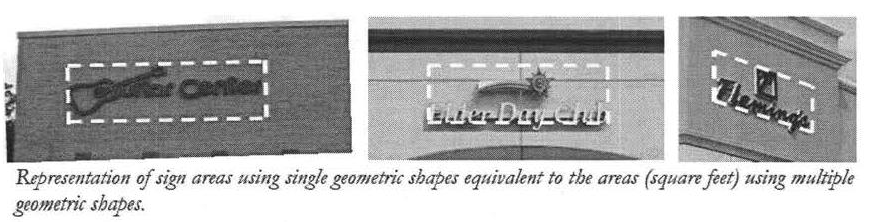
Figure K: Example of calculation for freestanding sign area
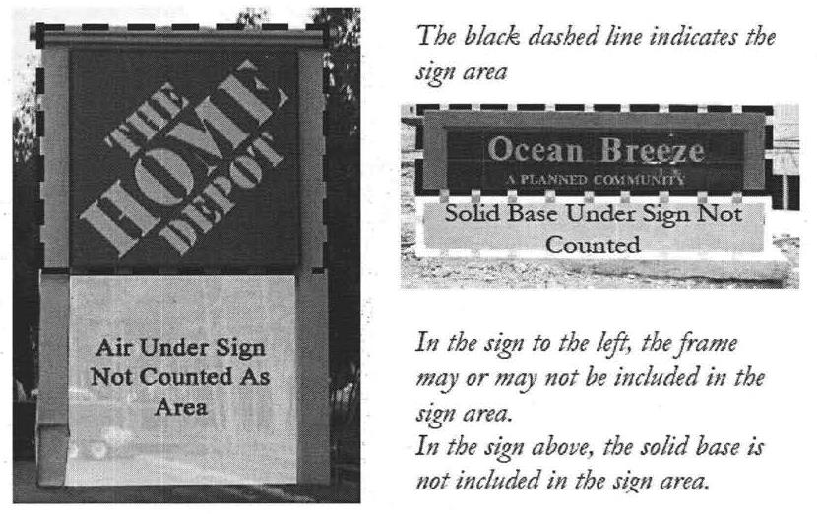
(3)
For a vehicle sign the area and height of the sign does not include the vehicle, itself.
(4)
For a freestanding sign, the sign area shall include the frame, if any, but shall not include:
a.
A pole or other structural support unless such pole or structural support is internally illuminated or otherwise so designed to constitute a display device, or a part of a display device.
b.
Architectural features that are either part of the building or part of a freestanding structure, and not an integral part of the sign, and which may consist of landscaping, building or structural forms complementing the site in general.
(5)
When two identical sign faces are placed back to back so that both faces cannot be viewed from any point at the same time, and are part of the same sign structure, the sign area shall be computed as the measurement of one of the two faces. When the sign has more than two display surfaces, the area of the sign shall be the area of largest display surfaces that are visible from any single direction. The area of a sign with more than two faces would be calculated as the area of the largest rectangular plane of the panels that are visible from any single location. (See figure L below.)
Figure L: Example of a sign area with multiple faces
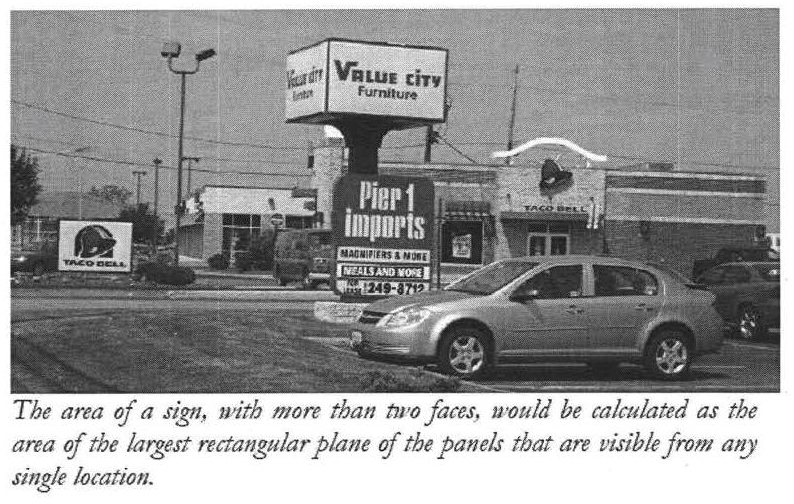
(6)
In the event of a dispute in determining the area or dimensions of any sign, the decision of the building official may be appealed by the applicant through the submittal of a formal application to the director of community development department in accordance with the variance process described in this chapter.
(7)
Determining sign height. The height of a freestanding sign shall be measured from the base of the sign or supportive structure at its point of attachment to the ground, to the highest point of the sign. A freestanding sign on a manmade base, including a graded earth mound, shall be measured from the grade of the nearest pavement or top of any pavement curb.
(8)
Clearance for freestanding and projecting signs shall be measured as the smallest vertical distance between finished grade and the lowest point of the sign, including any framework or other embellishments.
Figure M: Indicated method for measuring sign height from street level
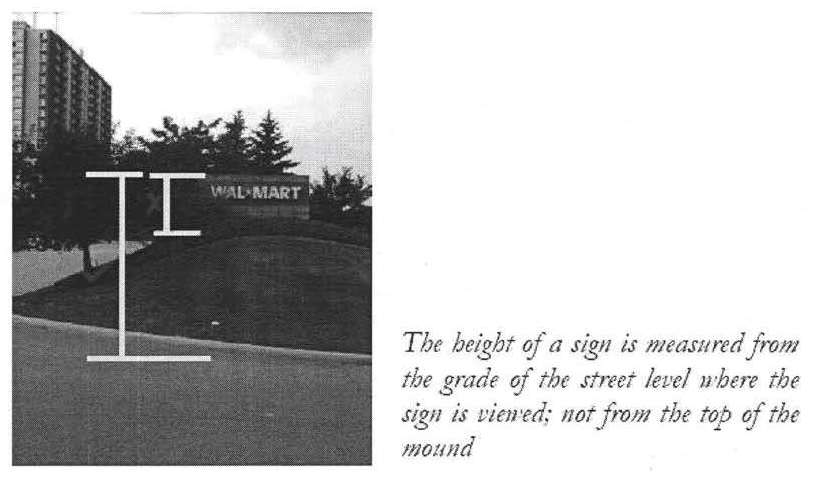
12-101
Construction standards.
(a)
Design required. Before a sign permit shall be granted, the applicant shall submit to the building official a design or plan containing information as to the type, size, shape, location, construction, lighting/illumination, and materials of the proposed sign.
(b)
The design and erection of all signs shall be constructed as specified in sections 1609 (wind), 1604 (working stress), and 2204 and 2304—2306, respectively, of the latest adopted edition of the International Building Code:
(1)
Signs shall be structurally sound and located so as to pose no reasonable threat to pedestrian or vehicular traffic.
(2)
All permanent freestanding signs shall have self-supporting structures erected on, or permanently attached to, concrete foundations.
(3)
If possible, signs should not be in locations that obscure architectural features such as pilasters, arches, windows, cornices, etc.
(4)
The signs should not be in locations that interfere with safe vehicular and pedestrian circulation or public safety signals and signs.
(5)
No signs shall be erected, constructed or maintained so as to obstruct any fire escape, required exit, window, or door opening used as a means of egress.
(6)
Signs shall be structurally designed in compliance with ANSI and ASCI standards. All elective signs shall be constructed according to the technical standards of a certified testing laboratory.
12-102
Lighting standards. Signs may be illuminated—by external or internal means—and in addition to the requirements and regulations of the ordinance codified herein, provided that:
(1)
The brightness and intensity shall not be greater than necessary to meet reasonable needs of the business or use served;
(2)
Light sources shall be shielded from all adjacent buildings and streets; and
(3)
The lighting shall not create excessive glare to pedestrians and/or motorists, and will not obstruct traffic control or any other public informational signs.
12-103
Enforcement and maintenance.
(a)
All signs shall be maintained in accordance with the following:
(b)
The property owner shall maintain the sign; in a condition appropriate to the intended use; to all city standards; and has a continuing obligation to comply with all building code requirements.
(c)
If the sign is deemed by the code enforcement officer to be in an unsafe condition, the owner of the business shall be immediately notified in writing, and shall, within 48 hours of receipt of such notification, respond to the city with a plan to correct the unsafe condition, remove the unsafe sign, or cause it to be removed. If after 30 days the unsafe condition has not been corrected through repair or removal, the code enforcement officer may cause the repair or removal of such sign at the expense of the property owner or lessee. If the total costs are not paid in full within 30 days of the repairs or removal, the amount owned shall be certified as an assessment against the property of the sign owner, and lien upon that property, for collection as prescribed for unpaid real estate taxes.
(d)
In cases of emergency, the code enforcement officer may cause the immediate removal of a dangerous or defective sign without notice.
(e)
Whenever any sign, either conforming or nonconforming to these regulations, is required to be removed for the purpose of repair, re-lettering or repainting, the same may be done without a permit or without any payment of fees provided that all of the following conditions are met:
(1)
There is no alteration or remodeling to the structure or the mounting of the sign itself;
(2)
There is no enlargement or increase in any of the dimensions of the sign or its structure;
(3)
The sign is accessory to a legally permitted, conditional or nonconforming use.
(Ord. 2018-O-05, 1-2-2018; Am. Ord. 2018-O-12, 3-6-2018; Ord. No. 2018-O-26, passed 8-7-2018; Ord. No. 2021-O-39, § 1, passed 2-2-2021)
Editor's note— Ord. 2018-O-05, passed January 2, 2018, repealed § 12 and enacted a new § 12 as set out herein. Former § 12 pertained to similar subject matter and derived from Ord. 2011-05, passed April 5, 2011.
Sec. 154.13. - Landscape requirements.
13.A
Purpose. It is the purpose of this section to establish regulations pertaining to landscaping within the city for all multi-family dwellings and nonresidential uses located in residential districts and all uses located in the business and industrial zoning districts. These regulations provide standards and criteria for new landscaping and the retention of existing trees, which are intended to:
(1)
Preserve the value of property, enhance the welfare, and improve the physical appearance of the city;
(2)
Reduce the negative effects of glare, noise, erosion and sedimentation caused by expanses of impervious and un-vegetated surfaces within the urban environment;
(3)
Preserve and improve the natural and urban environment by recognizing that the use of landscaping elements and retention of existing trees can contribute to the processes of air purification, oxygen regeneration, groundwater recharge, abatement of noise, glare and heat, and enhance the overall beauty of the city.
13.B
Landscape Plan Requirements—Landscape Plan Required.
(1)
The landscape plan may be prepared by the applicant, or applicant's designee. The landscape plan is not required to be prepared by a registered or certified professional.
(2)
The landscape plan shall be submitted as a part of the site plan. A landscape plan meeting the requirements of this ordinance shall be provided and approved prior to the issuance of a building permit.
(3)
The landscape plan shall contain the following information:
(a)
Drawn to scale;
(b)
North arrow;
(c)
Date of plan submittal;
(d)
Location, size and species of all trees to be preserved. The method of preservation during the construction phase of development shall be according to Section 13.F, Tree Protection;
(e)
Location of all plants and landscaping material to be used including paving, benches, screens, fountains, statutes, topography, ponds/lakes, or other landscape features;
(f)
Size and type of all plant material to be used;
(g)
Spacing of plant material where appropriate;
(h)
Layout and description of irrigation, sprinkler or water system; including placement of water sources;
(i)
Description of maintenance provisions of the landscape plan;
(j)
Persons responsible for the preparation of the landscape plan.
13.C
Landscape Installation Required.
(1)
Fifteen percent of the total land area in any proposed development or construction that occurs for any use after the effective date of this ordinance shall be landscaped. This 15% requirement shall apply to each phase as it is developed.
(2)
The minimum plantings for every 1,000 square feet of required landscape, shall be one three-inch caliper or larger canopy tree and either two ornamental trees or six shrubs.
(3)
Where the construction is to be a single phase of a multi-phase development, only the area being constructed in the current phase need be subject to the landscape regulations. However, each phase will be required to meet the landscaping requirements as they may hereafter be amended when that phase is developed.
(4)
The use of drought tolerant plants is encouraged to meet requirements of this section.
(5)
Artificial plants or turf are expressly prohibited.
(6)
Alternative species of trees may be used upon approval by the Director of Community Development or his or her designee.
(7)
An irrigation system must be provided.
13.D
Location Criteria.
(1)
No less than 30% of the total landscaping area and planting materials shall be located in the designated front yard. Parcels that are adjacent to more than one roadway may count the street yards of all adjacent roadways towards satisfying the front yard requirement.
(2)
In the I "Industrial" zoning district, only the front-yard 30% of the total 15% of required landscaping shall be required. The rear and side yard landscape requirements may be waived upon submittal of a landscape plan showing compliance with all other requirements.
(3)
There shall be a 15-foot landscaping buffer located along the right-of-way of U.S. Hwy. 377, Hwy. 67, Hwy. 281, Hwy. FM 8, and Hwy. FM 988. All landscaping that occurs within this 15-foot foot buffer shall be included within the landscape calculation toward meeting the landscape requirements contained in this Section 13, Landscape Requirements.
(4)
The required landscaping around monument signs shall count towards total landscaping requirements and towards front yard landscaping requirement.
(5)
All landscape material shall comply with visibility requirements of the Subdivision Ordinance regulations.
13.E
Tree Survey. A tree survey shall be provided for any new construction prior to permit issuance. A tree survey will also be required for any remodeling or construction that proposes to enlarge the footprint of the structure and/or requires a building permit:
(1)
This requirement is limited to sites which are located in any non-residential district or for any non-residential use located in a residential district.
(2)
The tree survey shall be provided prior to any construction, including any earthwork on any site.
(3)
The survey shall be submitted with the building permit application, or may be submitted prior to the building permit application if the applicant so desires. As soon as the Director of Community Development approves the tree survey, earthwork may be initiated at the discretion of the Director of Community Development; however, no work may be initiated on structural elements of the building without an approved building permit.
(4)
The tree survey shall show the exact location of the tree, size of the tree measured by diameter, and the common name of all trees of a six-inch caliper or height of seven feet.
13.F
Tree Protection. The following procedures shall be followed on all construction projects to protect existing trees, to be preserved, in order to satisfy the requirements of this section:
(1)
All preserved trees shall be flagged with bright fluorescent orange vinyl tape wrapped around the main trunk at a height of four feet or more so that the tape is visible to workers operating construction equipment.
(2)
A protective fencing shall be required for trees to be preserved if the trees are located so close to the construction that construction equipment will infringe upon the root systems. The fence will be placed between the trees and the construction activity in a manner to ensure that the tree roots, up to the drip line, will be protected from construction equipment.
13.G
Additional Requirements Adjacent to Residential. The following standards shall apply to all multifamily and nonresidential developments. These standards may be met by saving existing trees on the site of six inches caliper or more, measured 12 inches above grade, or by planting new trees from the approved tree list contained in this section. Minimum requirements for development located within the multifamily, business and industrial districts shall be as follows:
(1)
A landscape buffer of 20 feet will be required along any property line abutting a RE, R-HA, R-1, R-1.5, R-2, R-3, and B-3 residential district.
(2)
Not less than 15% of the gross site area shall be devoted to open space, including required yards and buffer areas. Open space shall not include areas covered by structures, parking areas, driveways, and internal streets.
(3)
Landscaping consisting of the planting of new or retention of existing shrubs, trees, and flowering plants shall be placed in the yard facing any public roadways.
(4)
The method of irrigation must be indicated on site plan.
13.H
Landscaping Within the City Rights-of-Way. Landscaping requirements pertaining to the city rights-of-way shall apply only to non-residentially zoned property and non-residential development located in residential districts.
(1)
At the option of the owner-developer, and issuance of a permit by the city, the owner-developer may landscape the city rights-of-way easements, including parkways and medians, on public streets adjoining the subject property in accordance with this section and with the following limitations.
(2)
Trees located in the public right-of-way shall be located on an average of 25 feet on center, and shall be a minimum of three inches in diameter at the time of planting. Trees planted in street rights-of-way must be maintained such that the lowest branches are no lower than nine feet above the ground in order to allow adequate visibility.
(3)
The trees located in the right-of-way shall not be arranged in a manner to interfere with traffic flow or traffic view.
(4)
Trees shall not be permitted in rights-of-way containing city water and sanitary sewer mains.
(5)
No trees or vertical plants shall be permitted within five feet of any fire hydrant.
(6)
The owner recognizes that the city or any franchised utility will not be responsible for damage to any landscaping while performing repairs or maintenance to its system.
(7)
An irrigation system must be provided.
(8)
If the owner-developer elects hereunder to provide landscaping within the right-of-way, this landscaping will count toward the total landscaping required. For each one square foot, exclusive of driveways, sidewalks and paved areas, there shall be allowed a four square foot credit against the overall landscaping requirement of 15% of the total land area in the development up to a maximum and not to exceed 5%.
13.I
Parking Area Requirements. Landscaping requirements pertaining to parking areas shall apply only to non-residentially zoned property, non-residential development located in residential districts, and multifamily development.
(1)
Landscape planting shall not be erected or installed in such a manner to interfere with traffic view or impose safety hazards.
(2)
Interior parking lot landscaped areas must be provided in each parking lot at a minimum average density of one shade tree a minimum of three inches in caliper for each 12 parking spaces. Additionally, interior parking lot landscaping shall be provided in accordance with the following:
(a)
One landscaped parking island (9' x 18') shall be provided for each 12 parking spaces located in the parking lots.
(b)
Parking lot landscaping shall be met for all customer and employee parking. Parking lot landscaping requirements do not apply to storage or standing parking spaces incidental to uses such as sales and rental of motor vehicles, mobile homes, boats, trailers or other similar uses.
(3)
The required landscaping for parking lots shall be evenly distributed throughout the parking lot, although adjustments may be approved by the Director of Community Development or his or her designee where the shape and size of the parking lot, the location of existing trees or other natural constraints reasonably prevent such distribution.
(4)
All landscaped areas, including the permeable areas and drip lines around trees and planting beds used for visual screening which abut any parking lot or vehicular travel area, shall be protected with curbs, tire stops/parking blocks or similar barriers sufficient to protect them from vehicular intrusion.
(5)
The requirements listed in this section shall not apply to single family and two to four family residential development.
13.J
Credits Towards Landscaping Requirements.
(1)
Grass is an appropriate landscape material. However, a variety of plant material is recommended. Additional Enhancement Credit may be obtained by providing the optional landscaping elements listed in the Landscape Area Credit table.
(2)
In no instance shall the total amount of landscaping on a lot be reduced through credits by more than 50% of the landscaped area required by this section.
(3)
Xeriscaped area and methodology shall be clearly located and detailed on the site plan.
(4)
A flower bed is any area where the soil has been specifically prepared for the planting of flowering plants. In order to be considered for credit calculations, at least 80% of the prepared area must be covered with flowering plant material at the time of peak growth.
(5)
Caliper of trees are to be measured at a point 12 inches above top of ground.
(6)
In order to receive credit for protecting and keeping existing trees, the area within the dripline of the tree must be protected by fencing during grading and construction.
13.K
Non-Conforming Landscape. All landscaping, in existence at the time of the adoption of this Ordinance, which does not meet the landscape requirements of this section, will be considered a nonconformity. Nonconforming landscaping will be subject to nonconforming uses and structures, unless otherwise provided in the section.
13.L
Installation and Maintenance of Landscaping—General.
(1)
All required landscaped area shall be permanently landscaped with living plant material and be served with an automatic irrigation system. Water conservation measures are highly encouraged.
(2)
Landscaped areas shall be kept free of trash, litter, weeds, and other such material or plants not a part of the landscaping.
(3)
All plant materials shall be maintained in a healthy and growing condition as is appropriate for the season of the year. Maintenance shall include mowing, watering, trimming, pruning, and the like.
(4)
Plant materials which die shall be replaced with plant material of similar variety and size within 90 days, with a one time extension not exceeding 90 days being provided upon approval of the Director of Community Development or his or her designee.
13.M
Certificate of Occupancy.
(1)
All landscaping shall be completed and installed in accordance with the approved landscape plan prior to a certificate of occupancy being issued. A one time temporary certificate of occupancy, not to exceed 90 days, may be granted based upon documentation of a hardship.
(2)
If a temporary certificate of occupancy is granted and the landscaping requirements have not been satisfied within the 90-day period from when the temporary certificate of occupancy is issued, the property owner shall be considered in violation of this Ordinance.
13.N
Approved Tree List. Trees preserved or planted to satisfy the requirements of this Ordinance must be according to the following approved tree list:
Sec. 154.14. - Non-conforming uses.
14.A
Non-Conforming Use of Land. The non-conforming use of land where no building is involved existing at the time of the passage of this ordinance may be continued for a period of not more than two years therefrom, provided that no such non-conforming use of land shall in any way be expanded or extended either on the same or adjoining property, and that if the non-conforming use of land or any portion thereof is discontinued or changed, any future use of the land shall be in conformity with regulations of the district in which it lies.
14.B
Non-Conforming Use of Buildings.
(1)
Except as otherwise provided in this Article, the non-conforming use of a building existing at the time this ordinance becomes effective may be continued, and the use of a non-conforming building may be changed to another use of the same or more restricted classification, but where the use is changed to a more restricted classification it shall not thereafter be changed back to a use of a less restricted classification. A non-conforming building which is or may hereafter become vacant and which shall remain unoccupied or its non-conforming use discarded for a continuous period of one year, shall not thereafter be occupied except by a use which conforms to regulations of the district in which it is located. A non-conforming building may be maintained or kept in good repair except as otherwise provided in this section.
(2)
No existing non-conforming building may be enlarged, extended, reconstructed or altered unless its use is changed to a use permitted in the district in which such building is located except in the event the enlargement, extension, reconstruction or alteration is required by court decision, law or ordinance.
(3)
No non-conforming building shall be moved in whole or in part to any other location on the lot unless every portion of the building is made to conform to all the regulations of the district in which it is located.
(4)
A non-conforming building which is damaged by fire, explosion, flood, wind, earthquake or other calamity or act of God or the public enemy to the extent of 50% or more of its reasonable value may not be restored except in conformity with the regulations of the district in which it is located.
Sec. 154.15. - Permits—Plans.
(A)
No permit for the erection, alteration or enlargement of any building shall be issued by the Building Inspector unless there first be filed in his or her office by the applicant, a plan, drawn to scale and in such form as may be prescribed by the Building Inspector, correctly showing the location and actual dimensions of the lot to be occupied, the dimensions and location on the lot of the building to be erected, altered or enlarged, together with a true statement in writing, signed by the applicant, showing the use for which the building is arranged, intended or designed, and furnishing, such other information as the Building Inspector may require in the enforcement of the provisions of this ordinance, and any failure to comply with the provisions of the ordinance shall be good cause for the revocation of any such building permit by the Building Inspector. A record of the applications and plans shall be kept in the office of the Building Inspector.
(B)
All outstanding permits shall be valid for a maximum period of six months after adoption of this ordinance. All building permits issued after the adoption of this ordinance shall be valid for a period of six months.
Sec. 154.16. - Certificate of occupancy.
(A)
No vacant land shall be occupied or used, except for agricultural uses, until a certificate of occupancy shall have been issued by the Building Inspector.
(B)
No premises shall be used and no buildings hereafter erected or structurally altered shall be used, occupied or changed in use, until a certificate of occupancy shall have been issued by the Building Inspector in compliance with all applicable codes and the provisions of this ordinance.
(C)
Certificates of occupancy and compliance shall be applied for coincident with the application for a building permit and shall be issued within ten days after the erection or structural alterations of the buildings shall have been completed in conformity with the provisions of these regulations. A record of all certificates shall be kept on file in the office of the Building Inspector.
(D)
No permit for excavation for any building shall be issued before application has been made for certificate of occupancy and compliance.
Sec. 154.17. - Boundaries of districts.
Rules where uncertainty may arise; where uncertainty exists with respect to the boundaries of the various districts as shown on the zoning map, the following rules apply:
(A)
The district boundaries are either streets or alleys unless otherwise shown, and where the districts designated on the zoning map are bounded approximately by street or alley lines, the street or alley shall be construed to be the boundary of the district.
(B)
Where the district boundaries are not otherwise indicated and where the property has been or may hereafter be divided into blocks and lots. The district boundaries shall be into blocks and lots. The district boundaries shall be construed to be the lot lines, and where the districts designated on the zoning map are bounded approximately by lot lines, the lot lines shall be construed to be the boundary of the districts unless the boundaries are otherwise indicated on the map.
(C)
In unsubdivided property, the district boundary lines on the zoning map shall be determined by use of the scale appearing on the map.
Sec. 154.18. - Changes and amendments.
(A)
The City Council may from time to time amend, supplement or change by ordinance the boundaries of the districts or the regulations herein established.
(B)
Before taking any action on any proposed amendment, supplement or change, the City Council shall submit the same to the City Planning and Zoning Commission for its recommendation and report.
(C)
A public hearing shall be held by the City Council before adopting any proposed supplement, amendment or change. Notice of the hearing shall be given by publication once in the official publication of the City of Stephenville, Texas, stating the time and place of the hearing, which time shall be before the 15th day before the date of the hearing.
(D)
A protest against the amendment, supplement, or change may be filed with the City Secretary in accordance with Texas Local Government Code 211.006. If a proposed change to a regulation or boundary is protested in accordance with this section, the proposed change must receive, in order to take effect, the affirmative vote of at least three-fourths of all members of the City Council.
(Am. Ord. 2014-31, passed 12-4-2014; Ord. No. 2020-O-01, § 1, passed 1-7-2020)
Sec. 154.19. - Enforcement and penalty for violation.
(A)
It shall be the duty of the Building Inspector to enforce the provisions of this ordinance and to refuse to issue any permit for any building, or for the use of any premises, which would violate any of the provisions of the ordinance.
(B)
In case any building is erected, constructed, reconstructed, altered, repaired or converted or any building or land is used in violation of this ordinance, the Building Inspector is authorized and directed to institute any appropriate action to put an end to any such violation.
(C)
Any person or corporation who shall violate any of the provisions of this ordinance or fail to comply therewith or with any of the requirements thereof or who shall build or alter any building in violation of any detailed statement or plan submitted and approved hereunder shall be guilty of a misdemeanor and shall be liable to a fine of not more than $2,000, and each day the violation shall be permitted to exist shall constitute a separate offense. The Owner or Owners of any building or premises, or part thereof, where anything in violation of this ordinance shall be placed, or shall exist, and any architect, engineer, builder, contractor, agent, person or corporation employed in connection therewith and who may have assisted in the commission of any such violation shall be guilty of a separate offense and upon conviction thereof shall be fined as hereinbefore provided.
Sec. 154.20.1. - Planning and zoning commission—Proposals.
20.1.A
Creation. A Planning and Zoning Commission is hereby created as provided in Chapter 211 of the Local Government Code.
20.1.B
Purpose.
(1)
To identify community needs and to advise the City Council of their short-range and long-range implications for the total development of the city;
(2)
To recommend achievable community goals as a basis for long-range planning and development programs;
(3)
To recommend plans, programs and policies that will aid the entire community in achieving its defined goals;
(4)
To interpret the adopted plans and programs to concerned citizens so that private activities and desires may be accomplished in harmony with public needs and policies; and
(5)
To exercise all the powers set out in the Zoning and Subdivision Ordinances of the City of Stephenville.
20.1.C
Written Proposal Required. Every proposal submitted for Commission action shall be made in writing. Where appropriate application forms are provided by the city. The proposal shall be filed on the forms, shall be accompanied by all prescribed fees, and shall be complete in all respects before being accepted for filing.
20.1.D
Filing Deadline. Every proposal shall be filed with the Community Development Division not later than 21 days prior to the next regular meeting date. Proposals filed after the deadline shall be scheduled for the next regular meeting. When the filing deadline falls on a city holiday the following workday shall be observed as the filing deadline.
20.1.E
Notices. Public notice of any proposal affecting a specific property shall be given as prescribed in the Zoning Ordinance by means of a written notice deposited in the United States Mail, postage prepaid, not less than ten days prior to the date of hearing. The notice shall identify the applicant, the location of the property in question, the nature of the proposal and the applicable Zoning Ordinance requirements. (Publication of the agenda to serve as the "Notice of Public Hearing").
20.1.F
Submission of Supporting Evidence. Information supporting a request or recommendation to approve or disapprove any proposal before the Commission shall be submitted only through the Community Development Division in writing or to the Commission in public meeting.
20.1.G
Withdrawal of Proposal. When any applicant desires to withdraw his or her proposal he or she may do so by filing a written request to that effect with the Secretary. The request shall be effective upon the date of its official receipt, provided, however, that no request shall be valid after notices have been mailed, except on action of the Commission. Withdrawal of the proposal at any stage of its processing shall terminate all consideration of it by the city, and the case file thereon shall be closed.
20.1.H
Powers. The Planning and Zoning Commission is hereby invested with the authority to:
(1)
Inspect property and premises at reasonable hours where required in the discharge of its responsibilities under the laws of the State of Texas and of the City of Stephenville;
(2)
Formulate and recommend to the City Council for its adoption a city plan for the orderly growth and development of the city and its environs, and from time to time recommend the changes in the plan as it finds will facilitate the movement of people and goods, and the health, recreation, safety and general welfare of the citizens of the city;
(3)
Formulate a zoning plan as may be deemed best to carry out the goals of the city plan; hold public hearings and make recommendations to the City Council relating to the creation, amendment, and implementation of zoning regulations and districts as provided in Chapter 211 of the Local Government Code, authorizing cities and incorporated villages to pass regulations; all powers granted under the Act are specifically adopted and made a part hereof;
(4)
Exercise all powers of a Commission as to approval or disapproval of plans, plats or replats and vacations of plans, plats or replats set out in Chapter 212 of the Local Government Code;
(5)
Study and recommend on the location, extension and planning of public rights-of-way, parks or other public places, and on the vacating or closing of same;
(6)
Study and recommend on the general design and location of public buildings, bridges, viaducts, street fixtures and other structures and appurtenances. Study and recommend on the design or alteration and on the location or relocation of works of art which are, or may become, the property of the city;
(7)
(1)
Initiate, in the name of the city, for consideration at public hearing all proposals:
(a)
For the opening, vacating or closing of public rights-of-way, parks or other public places;
(b)
For the original zoning of annexed areas; and
(c)
For the change of zoning district boundaries on an area-wide basis.
(2)
No fee shall be required for the filing of any such proposal in the name of the City.
(8)
Formulate and recommend to the City Council for its adoption policies and regulations consistent with the adopted City Plan governing the location and/or operation of utilities, public facilities and services owned or under the control of the city;
(9)
Keep itself informed with reference to the progress of City Planning in the United States and other countries and recommend improvements in the adopted plans of the city; and
(10)
Submit a progress report each January to the City Council summarizing its activities, major accomplishments for the past year, and a proposed work program for the coming year. The report shall contain for the year the attendance record of all members and the identity of Commission Officers.
Sec. 154.20.2. - Planning and zoning commission—Rules of procedure.
Roberts Rules of Order, the latest revision, shall be the Commission's final authority on all questions of procedures and parliamentary law not covered by these Rules of Procedures.
20.2.A
Membership and Appointment. The Planning and Zoning Commission shall be composed of seven qualified voters of the City of Stephenville and two alternate members. The City Council will consider for appointment to the Commission only those persons who have demonstrated their civic interest, general knowledge of the community, independent judgment, interest in planning and zoning and availability to prepare for and attend meetings. It is the intent of the City Council that members shall, by reason of diversity of their individual occupations, constitute a Commission which is broadly representative of the community.
20.2.B
Terms of Office. The terms of three (3) of the members and one (1) alternate member shall expire on December 31 of each odd-numbered year and the terms of four (4) members and one (1) alternate member shall expire on December 31 of each even-numbered year. The members of the Commission shall be identified by place numbers one through seven. The odd-numbered places shall expire in the odd-numbered years; the even-numbered places shall expire in the even-numbered years. Commission members may be appointed to succeed themselves. Vacancies shall be filled for unexpired terms, but no members shall be appointed for a term in excess of two years. Newly appointed members shall be installed at the first regular Commission meeting after their appointment.
A member of this board will not be eligible for reappointment after they have served three consecutive terms until after they have taken a one-year hiatus. Members may apply for another board or commission without taking a one-year hiatus. The city council may appoint members to additional terms past the term limit if no applications have been received to fill a vacancy.
20.2.C
Officers.
(1)
A Chairperson and Vice-Chairperson shall be elected annually from among the Commissions' membership at the first meeting in January and at such other times as these offices may become vacant. In the absence of both the Chairperson and Vice-Chairperson, the Commission shall elect an Acting Chairperson.
(2)
A Secretary shall be appointed from the members of the Commission or from staff personnel assigned by the city's Chief Executive Officer to serve the Commission.
20.2.D
Duties.
(1)
The Commission shall advise the City Council on those matters falling within its charged responsibilities in a manner reflecting concern for the overall development and environment of the city as a setting for human activities.
(2)
The members of the Commission shall regularly attend meetings and public hearings of the Commission and shall serve without compensation, except for reimbursement of authorized expenses attendant to the performance of their duties.
(3)
The Chairperson, or in his or her absence the Vice-Chairperson, shall preside at all meetings, shall decide all points of order or procedure. All letters of transmittal from the Commission to the City Council shall be over the signature of the Chairperson.
(4)
The Secretary shall be custodian of the minutes and other official records, shall attend to the correspondence of the Commission, and shall cause to be given such notices as are required and in the manner prescribed by law.
20.2.E
Quorum. A quorum for the conduct of business shall be a majority of the members of the Commission.
20.2.F
Meetings. All meetings shall be held in full compliance with the provisions of the Open Meetings Law, V.T.C.S., Section 551, the zoning ordinance, and these Rules of Procedure. Any party in interest may appear in his or her own behalf or be represented by counsel or agent.
(1)
Regular meetings shall be held on the third Wednesday of each month at 5:30 p.m. in City Council Chambers at City Hall or at such place as the Commission may direct on its notices.
(2)
Special meetings for any purpose may be held on:
(a)
On the call of the Chairperson;
(b)
On request of two or more members and by giving written notice to all members deposited in the mail at least 48 hours before the meeting; or
(c)
As may be scheduled by a majority of the Commission at any previous meeting. The time and place of the special meeting shall be determined by the convening authority.
(3)
The members of the Commission shall call the Secretary as far ahead of the meeting date as possible when they are unable to attend a meeting.
(4)
Three consecutive absences from meetings of the commission shall be considered voluntary resignation. In addition, four absences in any twelve-month period shall be considered a voluntary resignation. The council shall fill vacancies created by voluntary resignations in the same manner as all other vacancies.
20.2.G
Planning Sessions. The Commission may be convened as a committee of the whole for the purpose of holding a planning session, provided that no official business shall be conducted there at and no quorum shall be required.
20.2.H
Agenda.
(1)
An agenda shall be prepared by the Secretary for each meeting of the Commission. There shall be attached to each agenda a report of matters pending further action by the Commission. A copy of the agenda shall be posted in the City Hall as required by law for a period of three full calendar days not counting the day of the meeting or the day of the posting.
(2)
The agenda shall be published as the "Notice of Public Hearing."
20.2.I
Order of Business.
(1)
The Chairperson shall call the Commission to order, and the members present and absent shall be recorded. The minutes of any preceding meeting shall be submitted for approval. The public shall be advised of the procedures to be followed in the meeting. The Executive Secretary shall publicly advise the Commission of any communications received pertaining to any matter before the Commission.
(2)
The Commission shall then hear and act upon those proposals scheduled for consideration or public hearing together with such other matters of business and reports as the Commission or Executive Secretary finds to require Commission consideration.
20.2.J
Procedure of Hearing.
(1)
The Commission shall call, or cause to be called by the Executive Secretary, each proposal in the order as to be in accord with the hearing time specified in the notice of public hearing.
(2)
The Chairperson shall next call on the staff for a factual summary and presentation relative to the proposal and shall afford the staff an opportunity to call to the attention of the Commission any additional pertinent communications.
(3)
The Chairperson shall then call on persons present who wish to speak to the proposal and shall direct that they speak in the following order:
(a)
The applicant or his or her representative;
(b)
Those persons in support; and
(c)
Those persons in opposition.
(4)
Whenever necessary the Chairperson shall direct that all remarks shall be germane to the proposal. No rebuttal shall be permitted by either side, but the Commission may direct questions to any speaker in order to clarify statements and facts presented.
(5)
The Chairperson shall then declare the public presentation or hearing closed, as to that proposal.
20.2.K
Motions.
(1)
A motion may be made by any member other than the presiding officer.
(2)
A motion to approve any matter before the Commission or to recommend approval of any request requiring Council action shall require two-thirds favorable vote of the members present.
(3)
A motion to deny any matter before the Commission or to recommend denial of any request requiring Council action shall require a majority vote of those present.
(4)
If the Commission fails to obtain the minimum votes required, the item before the Commission requiring Council action shall be forwarded with no recommendation.
20.2.L
Recording of Vote. The minutes of the Commission's proceeding shall show the vote of each member, or if absent or failing to vote shall indicate that fact.
20.2.M
Disqualification From Voting.
(1)
A member shall disqualify himself or herself from voting whenever he or she finds that he or she has a personal or monetary interest in the property under appeal, or that he or she will be directly affected by the decision of the Commission.
(2)
A member shall disqualify himself or herself from voting whenever any applicant, or his or her agent, has sought to influence the vote of the member on his or her application, other than in the public hearing.
20.2.N
Official Records. The official records shall be these rules and regulations and the minutes of the Commission together will all findings, decisions and other official records of the Commission.
20.2.O
Files—Retention. All matters coming before the commission shall be filed in the city's records. Original papers of all requests and proposals shall be retained as a part of the permanent record.
20.2.P
Public Record. The official records and citizens requests filed for Commission action in regular or special meetings shall be on file in the City Hall and shall be open to public inspection during customary working hours.
(Amd. Ord. 2018-O-43, § 6, passed 11-6-2018; Amd. Ord. 2018-O-44, § 6, passed 11-6-2018; Ord. No. 2019-O-38, §§ 1, 2, passed 11-5-2019; Ord. No. 2022-O-38, § 1, passed 11-1-2022)
Sec. 154.20.3. - Planning and zoning commission—Conditional use permit.
20.3.A
Definition. A conditional use permit is defined in Section 154.03. The terms "Conditional Use Permit" and "Special Use Permit" may be used interchangeably.
20.3.B
Effective Date. A Conditional Use Permit shall be deemed effective upon the date approved by the City Council.
20.3.C
Termination of Conditional Use Permit. A Conditional Use Permit shall terminate and become null and void as follows:
(1)
Failure to Commence the Use: Upon a finding by the City Manager that the conditional use for which the Conditional Use Permit was issued has not commenced within 180 calendar days after the effective date of the Conditional Use Permit or the date set forth in the Conditional Use Permit, whichever is applicable. For purposes of this paragraph, the use shall be deemed to have commenced:
a.
If no new construction or renovation of an existing building is required, when actual use for the purposes described in the permit commences; or
b.
If new construction or renovation of an existing building is required before the use can commence, when a completed application for a building permit, all required construction drawings, and the applicable permit fees have been delivered to the City Building Inspections Department;
(2)
Failure to Commence Actual Use Within Two Years of New Construction or Renovation: If new construction or renovation of an existing building is required before the use can commence, upon a finding by the City Manager that actual use of the property has not commenced within two (2) years after the effective date of the Conditional Use Permit or the date set forth in the permit, whichever is applicable;
(3)
Cessation of Use Not Related to Destruction of Property: After commencement of the actual use of the property for the purpose set forth in the permit, upon a finding by the City Manager that actual use of the property for the purpose for which the Conditional Use Permit was approved:
a.
Has not occurred for a period of 180 consecutive days after the commencement of the actual use for which the Conditional Use Permit was approved; and
b.
That the conditional use ceased for reasons other than destruction of buildings due to fire, flood, or windstorm;
(4)
Cessation of Use Related to Destruction of Property: After commencement of the actual use of the property for the purpose set forth in the permit, upon a finding by the City Manager that actual use of the property for the purpose for which the Conditional Use Permit was approved has not occurred for a period of two consecutive years after the date of destruction by fire, flood, or windstorm of the buildings in which the use was occurring;
Upon a finding of the City Manager that the use of the property has not been or is not in compliance with the provisions of the permit, the City Manager shall send written notice that the permit will be terminated fifteen (15) days from the date of the receipt of the notice, said notice to be sent by certified mail, return receipt requested to the owner of the property at the last known address indicated on the property rolls of the Erath County Appraisal District, a copy of which notice shall also be placed on the property. Said notification shall contain a summary of the findings by the City Manager citing the provisions of the permit or City Code which have been violated.
20.3.D
Appeals.
(1)
Appeal of Termination for Non-Compliance: The owner of the property may file a written appeal of the City Manager's decision with the City Council by delivering to the City Secretary a summary of the property owner's basis for appeal not later than ten (10) calendar days from receipt of the City Manager's notice. The appeal shall be heard at the next regular City Council meeting which occurs on or after the tenth calendar day following the receipt of the notice of appeal. The appeal to the City Council shall be conducted in accordance with procedures adopted by the City Council.
On appeal, the City Council may:
a.
Uphold the decision of the City Manager and terminate the permit;
b.
Uphold the decision of the City Manager, but grant additional time for compliance, after which date the permit shall terminate if the City Council determines that compliance has not been achieved during the additional time; or
c.
Overrule the decision of the City Manager. The decision of the City Council shall be final.
(2)
Failure to File an Appeal: If the owner of the property fails to file an appeal as set forth in Section 1, above, on the fifteenth day following delivery of written notice to the owner of the property for which a Conditional Use Permit is issued that the City Manager has determined that violates the provisions of the permit, the conditional use permit will be terminated.
(Ord. No. 2018-O-28, 8-7-2018)
Sec. 154.21.1. - Board of adjustment—Appeals.
21.1.A
Creation. A Board of Adjustment is hereby established as provided in Chapter 211 of the Local Government Code.
21.1.B
Appeals.
(1)
Appeals to the Board of Adjustment may be taken by any person aggrieved or by any officer, department, board or bureau of the municipality affected by any decision of the enforcing officer. The appeal shall be taken within a reasonable time, as provided by the rules of the Board, by filing with the officer from whom the appeal is taken and with the Board of Adjustment a notice of specifying the grounds thereof. The officer from whom the appeal is taken shall forthwith transmit to the Board all the papers constituting the record upon which the action appealed from was taken.
(2)
An appeal stays all proceedings in furtherance of the action appealed from, unless the officer from whom the appeal is taken certifies to the Board of Adjustment after the notice of appeal shall have been filed with him or her that by reason of facts stated in the certificate a stay would, in his or her opinion, cause imminent peril to life or property. In such case proceeding shall not be stayed otherwise than by a restraining order which may be granted by the Board of Adjustment or by a court of record on application or notice to the officer from whom the appeal is taken and on due cause shown.
(3)
No appeal shall be taken to the Board until and unless the Enforcing Officer has first refused a permit for plans submitted or has rendered an interpretation of the Zoning Ordinance.
(4)
Every appeal shall be filled on application forms provided by the city, shall be accompanied by the prescribed fee, and shall be complete in all respects before being accepted for filing. The application shall bear the signature of the owner of the property under appeal or shall be accompanied by a letter from the owner acknowledging taking of the appeal. An incomplete application or a communication purporting to be an application and not made in the form prescribed shall be regarded only as a notice of intent to appeal, and shall not be considered or acted upon by the Board.
(5)
Every appeal shall be prepared by the applicant and shall be considered by the Board according to the guidelines contained in this ordinance for the type of appeal under consideration. Where two or more different types of appeals are included in the same application, each set of guidelines shall apply to the consideration of the appeals.
(6)
An appeal shall be filed with the Board within ten days after the date of decision of the Enforcing Officer. Every appeal shall be filed with the Executive Secretary of the Board not later than 15 days prior to the regular meeting date of the Board. Appeals filed after the deadline shall be scheduled for the next regular meeting. When the filing deadline falls on a city holiday the following workday shall be observed as the filing deadline.
21.1.C
Notices.
(1)
Public notice of any appeal affecting a specific property shall be given as prescribed in the Zoning Ordinance by means of a written notice deposited in the United States Mail, postage prepaid, not less than ten days prior to the date of hearing. The notice shall identify the applicant, the location of the property in question, the nature of the request and the applicable Zoning Ordinance requirements.
(2)
Public notice of any appeal seeking an interpretation of Zoning Ordinance regulations which would apply throughout the city, shall be given by means of a legal advertisement appearing in the official newspaper of the city not less than ten days prior to the date of hearing. Written notice shall also be given to the applicant and his or her agent as provided in division (A) above. The notices shall identify the applicant, the nature of the question involved, and the affected provisions of the Zoning Ordinance.
(3)
Notice of any appeal seeking a special use or variance affecting a specific property shall be given to all persons within 200 feet of the property in question by means of a written notice deposited in the United States Mail, postage prepaid, not less than ten days prior to the date of the hearing.
21.1.D
Withdrawal of Appeal. Any appeal may be withdrawn upon written notice to the Executive Secretary; but no appeal shall be withdrawn after giving of public notice and prior to Board action thereon without formal consent of the Board.
21.1.E
Appeal After Board Denial. No appeal that has been denied shall be further considered in a new appeal resulting from the filing of new plans and the obtaining of a new decision from the Enforcing Officer, unless the new plans materially change the nature of the case.
21.1.F
Expiration of Granted Appeal. Approval of any appeal shall expire 90 days after the Board's decision unless authorized construction or occupancy permits have been obtained or unless a greater time is requested in the application and is authorized by the Board. Any approval may be granted one extension of an additional 90 days on written request filed with the Board before expiration of the original approval. The time limit for every granted appeal shall commence on the first day of the month succeeding the month in which the Board renders its decision.
21.1.G
Interpretation. The Board of Adjustment shall have the following powers:
(1)
For interpretation of the meaning or intent of the Zoning Ordinance. To hear and decide appeals where it is alleged there is error in any order, requirement, decision or determination made by an administrative official in the enforcement of this ordinance.
(a)
Papers required. An appeal shall include:
(1)
A statement by the applicant describing the way it is alleged the regulation should be interpreted, together with diagrams and charts illustrating the erroneous and the proper application of the may or text provisions.
(2)
A statement by the Enforcing Officer giving his or her reasons for his interpretation of the Zoning Regulations.
(b)
Basis for action.
(1)
Before acting on an appeal for interpretation the Board shall consider:
a.
The facts and statements filed in the application;
b.
The testimony presented at the public hearing;
c.
The city staff's technical report on the appeal; and
d.
The Board's independent investigation of the language of the ordinance and of related ordinance bearing thereon.
(2)
The Board shall make such interpretation as should be made provided the applicant has demonstrated to the satisfaction of the Board that one or more of the following conditions exist and that the decision of the Board would be in the interest of the community and would carry out the spirit and intent of the Zoning Regulations:
a.
That there is reasonable doubt of difference of interpretation as to the specific intent of the regulations or map;
b.
That an appeal of use provisions would clearly permit a use which is in character with the uses enumerated for the various zones and with the objectives of the zone in question; and
c.
That the resulting interpretation will not grant a special privilege to one property inconsistent with other properties or uses similarly situated.
21.1.H
Special Exceptions.
(1)
Expansion of a nonconforming use within an existing structure a maximum of 20% provided that, in the case of a nonconforming residential use, such expansion does not increase the number of dwelling units to more than the number existing when the use first became nonconforming.
(2)
Expansion of the gross floor area of a nonconforming structure, a maximum of 20%.
(3)
Change from one nonconforming structure that has been totally destroyed, or resumption of a nonconforming use previously abandoned only upon finding that the failure to grant the special exception deprives the property owner of substantial use or economic value of the land.
(4)
In granting special exceptions under this section, the Board of Adjustment may impose such conditions as are necessary to protect adjacent property owners and to ensure the public health, safety and general welfare, including but not limited to conditions specifying the period during which the nonconforming use may continue to operate or exist before being conformed to the standards of the Zoning Ordinance.
21.1.I
Variance.
(1)
A variance from the literal enforcement of the Zoning Ordinance in order to achieve a reasonable development of property. Whenever, owning to exceptional and extraordinary conditions, the literal enforcement of the zoning regulations will result in unnecessary hardship in the development of the property, an appeal for a variance may be filed with the Board of Adjustment.
(2)
When a property owner can show that a strict application of the terms of this ordinance relating to the use, construction or alteration of buildings or structures or the use of land will impose upon him or her practical difficulties or particular hardship, the Board may consider and allow variations of the strict application of the terms of this ordinance if the variations are in harmony with the general purpose and intent of this ordinance, and the Board is satisfied, under the evidence heard by it, that a granting of the variation will not merely serve as a convenience to the applicant, but will alleviate some demonstrable hardship or difficulty so great as a to warrant a variation from the Zoning Regulations.
(3)
The Board may authorize a variance where by reason of exceptional narrowness, shallowness, or shape of specific piece of property of record at the time of the adoption of this ordinance, or by reason of exceptional situation or condition of a specific piece of property, the strict application of a provision of this ordinance would result in peculiar and exceptional practical difficulties and particular hardship upon the owner of the property and amount to a practical confiscation of the property as distinguished from a mere inconvenience to the owner, provided the variation can be granted without substantial detriment to the public good, and without substantially impairing the general purpose and intent of the comprehensive plan as established by the regulations and provisions contained in this ordinance.
(a)
Papers required. An appeal for a variance shall include:
(1)
A site plan, drawn to scale, showing the location and dimension of the lot and of all existing and proposed improvements:
a.
When an appeal is based upon hardship resulting from sharp changes in topography or unusual terrain features, the site plan shall include topographic information related to known base points of surveys, and profiles of the particular problem involved, including relationship to topographic features of adjoining properties.
b.
When an appeal is submitted for variance of side yard or rear yard requirements, the applicant shall provide the same information for the properties adjoining the common lot line as may be applicable to the appealed requirements.
c.
When an appeal is submitted for a variance from front yard setback, or for side yard setback on a side street, the applicant shall furnish a strip map showing the setback of main walls of all buildings on the same side of the street within a distance of 200 feet of the applicant's property.
(2)
A statement of facts and reasons why the Zoning Regulations should not be applied to the property in question and how the standards governing the Board's action would be satisfied; and
(3)
A statement by the Enforcing Officer citing the reasons for refusing to issue a permit under the plans submitted.
(b)
Basis for action.
(1)
Before acting on an appeal for variance the Board shall consider:
a.
The facts filed with the application;
b.
The testimony presented at the public hearing on the appeal;
c.
The City Staff's technical report on the appeal; and
d.
The Board's findings in its field inspection of the property.
(2)
The Board may grant an appeal, subject to such terms and conditions as it may fix, provided the applicant has demonstrate to the satisfaction of the Board that the conditions governing the granting of a variance as set forth in the Zoning Regulations are satisfied and that the decisions of the Board would be in the interest of the community and would carry out the spirit and intent of the Zoning Regulations.
21.1.J
Files—Retention. All appeals and other matters coming before the Board shall be filed in the city's records. Original papers of all appeals shall be retained along with other special matter as the Executive Secretary deems essential for the permanent record.
(Am. Ord. 2014-33, passed 12-4-2014)
Sec. 154.21.2. - Board of adjustment—Rules and regulations.
21.2.A
Roberts Rules of Order.Roberts Rules of Order, latest revision, shall be the Board's final authority on all questions of procedure and parliamentary law not covered by these Rules of Procedure.
21.2.B
Organization. The Board of Adjustment shall consist of five members appointed by the City Council and who are qualified voters of the City of Stephenville, each to be appointed for terms of two years and removable for cause by the City Council upon written charges and after public hearing. Vacancies shall be filled for the unexpired term of any member whose term becomes vacant. The City Council may appoint four alternate members of the Board of Adjustment who shall serve in the absence of one or more regular members. These alternate members, when appointed, shall serve for the same period as the regular members and any vacancies shall be filled in the same manner and shall be subject to removal as the regular members.
A member of this board will not be eligible for reappointment after they have served three consecutive terms until after they have taken a one-year hiatus. Members may apply for another board or commission without taking a one-year hiatus. The city council may appoint members to additional terms past the term limit if no applications have been received to fill a vacancy.
21.2.C
Quorum. A quorum shall consist for four members.
21.2.D
Officers. A Chairperson and Vice-Chairperson shall be elected from among the Board's membership at the annual meeting of the Board and at such times as these offices may become vacant. The city's Chief Executive Officer shall designate his or her representative to serve the Board as Executive Secretary.
21.2.E
Duties.
(1)
The Chairperson, or in his or her absence the Vice-Chairperson, shall preside at all meetings, shall decide all points of order or procedure, and as necessary shall swear in witnesses or compel their attendance.
(2)
The Executive Secretary shall be custodian of the minutes and other official records, shall attend to the correspondence of the Board, and shall cause to be given notices as are required and in the manner prescribed by law.
21.2.F
Meetings. All meetings shall be held in full compliance with the provisions of the Open Meetings Law, V.T.C.S., Article 551, the Zoning Ordinance of the City of Stephenville, and these Rules of Procedure. Any party in interest may appear in his or her own behalf or be represented by counsel or agent.
(1)
Regular meetings shall be held on the second Thursday of each month at 4:00 p.m. in City Council Chambers at City Hall or at such place as the Board may direct on its notices.
(2)
Special meetings for any purpose may be held:
(a)
On the call of the Chairperson;
(b)
On request of two or more members by giving written notice to all members deposited in the mail at least 48 hours before the meetings; or
(c)
As may be scheduled by a majority or the Board at any previous meeting.
(3)
The members of the Board shall call the Secretary as far ahead of the meeting date as possible when they are unable to attend a meeting.
(4)
Three consecutive absences from meetings of the commission shall be considered cause for removal as specified in Section 154.21.2 B. In addition, four absences in any twelve-month period shall be considered cause for removal as specified in Section 154.21.2 B. The council shall fill vacancies created by voluntary resignations in the same manner as all other vacancies.
21.2.G
Agenda. An agenda shall be prepared by the Executive Secretary for each meeting of the Board. The agenda shall include appeals and other matters scheduled for consideration by the Board. There shall be attached to the agenda a list of matters pending further action by the Board and pending report of disposition by the Executive Secretary. A copy of the agenda shall be posted in the City Hall as required by law for a period of three full calendar days not counting the day of the meeting or the day of posting.
21.2.H
Order of Business. The Chairperson shall call the Board to order and the Executive Secretary shall record the members present and absent. The Chairperson shall publicly advise those present of the procedures followed in the hearing and disposition of appeals; he or she shall call each appeal in the order filed and shall announce the name of the applicant, the location of the property involved and the nature of the request. The Executive Secretary shall publicly advise the Board of any communications received. Supporting evidence for and against each case shall be presented to the Board. Each case may be taken under advisement until all have been heard.
21.2.I
Procedure for Hearing.
(1)
The Chairperson shall first call upon the applicant to present his or her case and all evidence supporting his or her plea. The Chairperson shall then inquire of the applicant if there are others affected who support the appeal.
(2)
The Chairperson shall next call on those opposed to the granting of the appeal to present their arguments. The applicant shall then have the right of rebuttal to arguments presented by the opposition. Following the rebuttal the Chairperson shall order the hearing closed.
(3)
Each side shall proceed without interruption by the other, and all arguments and pleadings shall be addressed to the Board. No questioning or arguments between individuals will be permitted. During the hearing no member shall discuss, debate or argue an issue with the applicant, nor indicate his probable vote on the appeal.
(4)
The Board shall not continue hearing on any appeal for which the applicant or his or her representative fails to appear unless the applicant has requested that the Board act without his or her being present at the hearing. However, the Board shall hear those persons appearing in response to the notice of hearing.
(5)
The Board shall set and announce publicly a "specified date" for the continuance of the hearing. If a specified date cannot be set, then new notices will be required and the same time intervals will apply as with a new application. There shall be only one continuance hearing per applicant.
21.2.J
Board Questions. The Chairperson may direct any question to the applicant or any persons speaking in order to bring out all relevant facts, circumstances and conditions affecting the appeal, and shall call for questions from other members of the Board and from the staff before closing the hearing on each appeal.
21.2.K
Decision. After all appeals have been heard each appeal shall be reviewed and acted upon. During its review the Board may call back any applicant for clarification of facts presented by him or her in the hearing.
21.2.L
Disposition of Appeals. The Board may grant, may grant with modifications, or may deny an appeal. The Board may also defer action on any appeal whenever it concludes that additional evidence is needed or that alternate solutions need further study. An appeal may be dismissed when the Board finds that the appeal has been improperly filed or, upon notification by the enforcing officer, that permits have been issued for a conforming use or development of the property.
21.2.M
Vote Required. The concurring vote of four members shall be necessary to grant, or to grant conditionally, any matter appealed to the Board. When a motion in favor of an applicant fails to receive four affirmative votes, the Executive Secretary shall record that fact and shall spread on the minutes an entry stating that the Board has denied the appeal.
21.2.N
Recording of Vote. The minutes of the Board's proceedings shall show the vote of each member on each decision of the Board, or if absent of failing to vote shall indicate that fact.
21.2.O
Definition. The official records shall include these rules and regulations, and the minutes of the Board together with all findings, decisions and other official actions. Stenographic notes of the Recording Secretary and tape recordings of proceedings and discussions shall not constitute the official record of the Board.
21.2.P
Files—Retention. All appeals and other matters coming before the Board shall be filed in the city's records. Original papers of all appeals shall be retained along with other special matter as the Executive Secretary deems essential for permanent record.
21.2.Q
Certified Copy. A certified copy of these Rules and Regulations and of any amendments thereto will be placed on record in the office of the City Secretary within ten days following their date of adoption.
(Amd. Ord. 2018-O-43, § 7, passed 11-6-2018; Amd. Ord. 2018-O-44, § 7, passed 11-6-2018; Ord. No. 2019-O-39, § 1, passed 11-5-2019)
Sec. 154.21.3 - Board of adjustment—Variances.
21.3.A
Definition. A variance is defined in Section 154.03. The terms "Variance" and "Special Exception" may be used interchangeably.
21.3.B
Effective Date. A variance shall be deemed effective upon the date approved by the Board of Adjustment.
21.3.C
Variance for the Construction of a Carport
(1)
Granting a Variance without a Public Hearing:
a.
Upon receipt of an application to construct a carport, the city manager or his designee shall determine the following:
i.
The carport is compatible with the existing home and other homes in the neighborhood.
ii.
The carport is within the minimum setbacks.
iii.
The carport is no larger than 25 feet in width by 30 feet in length.
b.
If the above criteria are met, the city manager or his designee will mail notice of the proposed carport to every property owner within 200 feet of the property. The letter must include the procedure and time limits for protest.
c.
Within 14 days from the date of the notification letter, a petition with signatures from 35% of the property owners within the notification area must be returned to the city manager or his designee or the special exception is considered granted without a hearing before the board of adjustment.
(2)
Granting a Variance with a Public Hearing:
a.
If the criteria listed above are not met, or if a petition is filed with the city manager or his designee as described above, a public hearing will be scheduled by the board of adjustment to determine if a variance will be granted.
b.
Notice of a public hearing to allow the construction of a carport shall be mailed to every property owner within 200 feet of the property for which the special exception is requested at least ten days prior to the meeting date.
c.
Notice of the public hearing shall be published in the newspaper of record at least ten days prior to the meeting date.
d.
The concurring vote of 75% of the members of the board will be required to grant the special exception.
(3)
The city manager or his designee shall issue to the applicant appropriate documentation showing the grant of the special exception. Such documentation and grant may contain restrictions, use limitations, building requirements, and other matters determined to be appropriate and/or necessary to meet the terms of this section.
21.3.D
Reserved.
21.3.E
Variance for Wireless Communication Facilities.
(1)
In considering whether to grant a special exception from the regulations specified in 154.74 Wireless Communication Facilities, the Board of Adjustment shall consider the following factors:
a.
The effect on public health, safety, and welfare of the citizens;
b.
The effect on the value of the surrounding property;
c.
The potential for interference with the enjoyment and/or use of surrounding properties;
d.
Aesthetics;
e.
The necessity of the special exception for the public health, safety, and welfare of the citizens, or for governmental purposes; and
f.
The zoning district and the adjoining zoning districts of the property for which the special exception is sought.
(Ord. No. 2018-O-29, passed August 7, 2018; Ord. No. 2019-O-03, § 1, passed 3-5-2019)
Sec. 154.22. - Interpretation, purpose and conflict.
In interpreting and applying the provisions of this ordinance, they shall be held to be the minimum requirements for the promotion of the public safety, health, convenience, comfort, morals, prosperity and general welfare. It is not intended by this ordinance to interfere with or abrogate or annul any ordinance, rules, regulations or permits previously adopted or issued not in conflict with any of the provisions of this ordinance, or which shall be adopted or issued pursuant to the law relating to the use of building on premises, and likewise not in conflict with this ordinance; nor is it intended by this ordinance to interfere with or abrogate or annul any easements, covenants or other agreements between parties, except that, if this ordinance imposes a greater restriction, this ordinance shall control.
Sec. 154.23. - Validity.
(A)
If any section, paragraph, subdivision, clause, phrase or provision of this ordinance shall be adjudged invalid or held unconstitutional, the same shall not affect the validity of this ordinance as a whole or any part or provision thereof other than the part so decided to be invalid or unconstitutional.
(B)
All ordinances or parts of ordinances in conflict herewith are hereby repealed.
Sec. 154.74. - Wireless communication facilities.
A.
Purpose. Certain radio equipment used in transmitting and receiving signal energy are essential and are deemed to promote the health, safety, and general welfare of the citizens of the city. Such equipment shall be located so that the health, safety, welfare, and aesthetic quality of the community shall not be compromised. The regulations governing the location of such equipment shall also consider the aesthetic quality of the city as a significant aspect of the health, safety, and general welfare of the community. The antennas, masts, and towers hereinafter enumerated shall be installed, constructed and maintained in accordance with the provisions of this section.
B.
Wireless communication facilities definitions. The following definitions shall apply:
Antenna. A device used in communications which transmits or receives electromagnetic waves.
Antenna, building attached. Antenna attached to existing structures in two general forms: (1) roof-mounted, in which antennas are placed on the roofs of buildings, or (2) building-mounted, in which antennas are mounted to the sides of buildings. These antennas can also be mounted on structures such as water tanks, billboards, church steeples, electrical transmission towers, etc.
Antenna facility. A building or independent support structure and the antennas mounted thereon, including any associated and necessary equipment building.
Co-location. The act of locating wireless communications equipment from more than one provider on a single antenna facility.
Equipment storage. A small unmanned, single story equipment building less than 500 square feet in size used to house radio transmitters and related equipment.
Monopole. An antenna facility composed of a single spire used to support communications equipment. No guy wires are used or permitted.
Lattice tower. A tower having three or four support steel legs and holding a variety of antennas. These towers range from 60 to 200 feet in height and can accommodate a variety of users.
Satellite receive-only antenna. An antenna that enables the receipt of television signals transmitted directly from satellites to be viewed on a television monitor. Such antennas are commonly known as a satellite dish, television receive-only antenna, dish antenna, parabolic antenna, or satellite earth station antenna.
Stealth facility. An antenna facility that is virtually transparent or invisible to the surrounding neighborhood. Stealth facilities may include totally enclosed antennas, wireless facilities that replicate or duplicate the construction of common structures such as flagpoles, and camouflaged wireless facilities that are constructed to blend into the surrounding environment.
C.
Residentially zoned districts ((RE), (R-HA), (R-1), (R1.5), (R-2), (R-3), (MH))—Amateur radio equipment, communications equipment and tv antennas. Amateur radio equipment, including ham radio and CB equipment and personal use TV antennas or Communications antennas, shall be allowed in the residential zoning districts if they comply with the following regulations:
1.
In the residential districts, a special exception must be obtained from the board of adjustment for any antenna facility which does not comply with the regulations in this section.
2.
Telescoping antenna support poles, i.e. push-up poles, monopoles or lattice towers shall not require a permit when installed in compliance with manufacturer's recommendations
3.
Up to three antenna facilities may be located on a lot of record, co-location is encouraged;
4.
An antenna facility, exclusive of the height of any antenna or mast, shall not exceed 65 feet in height. Provided, however, that an antenna facility shall be permitted additional height at the ratio of one added foot in height for each additional foot of setback beyond the minimum setback required of an accessory building in the zoning district regulations contained in section 6-3, accessory building regulations. Regardless of the above, the maximum height for a tower permitted in any residential district shall be 80 feet unless a special exception is approved by the board of adjustment;
5.
The height of an antenna, including the height of any antenna facility to which they may be fastened or attached shall not exceed 80 feet in height unless a special exception is approved by the board of adjustment;
6.
An antenna not fastened to an antenna facility shall not exceed 80 feet without a special exception approved by the board of adjustment, except for an antenna which does not extend more than eight feet above a building on which it is mounted;
7.
An antenna facility shall be limited to having the number and size of antennas attached to it that are allowed by the antenna facility manufacturer's designs and specifications for maximum wind load requirements;
8.
Setbacks:
(a)
Antennas and antenna facilities shall not be permitted in front or side yards. Guy wires are not permitted in front yards;
(b)
Guy wires are permitted in required side and rear yards;
(c)
Setback for antenna facilities shall be the same as those required for accessory buildings in residential districts;
9.
Separation: There shall be no minimum or maximum separation requirements for antenna facilities from other structures on the same lot of record;
10.
Prohibited in easements: Antenna facilities shall not be permitted in any easement;
11.
Lights: No auxiliary or outdoor lighting shall be allowed on antenna facilities located on residentially zoned property except such lights or lighting as may be required by the Federal Aviation Administration or the Federal Communications Commission; or lights for security purposes.
12.
Construction standards: A building permit must be obtained prior to the construction and/or installation of an antenna facility. Antenna facilities must be installed in accordance with the manufacturers recommendations or under the seal of a registered professional engineer of the State of Texas. Regardless of the above, all such antenna facilities must meet the Electronic Industries Association Standard EIA-222-D, Structural Standards for Steel Antenna Towers and Antenna Supporting Structures and the Building Code; with the exception of non-permanent antenna facilities.
13.
Maintenance: Antennas and/or antenna facilities obviously not in use or obviously in need of maintenance as determined by the building official, shall be removed or brought into compliance within a reasonable time determined by the building official. This shall not preclude immediate action by the city manager to safeguard life, limb, health, property, and public welfare;
14.
No extension beyond property lines: No part of an antenna facility or any attachment thereto may extend beyond the property lines of the owner of such antenna or antenna facility.
15.
Any antenna, the radiating portion of which is accessible from ground level, shall have adequate fencing around it, or shall have signage providing constructive notice of radio frequency exposure/burn hazard.
D.
Residentially zoned districts ((RE), (R-HA), (R-1), (R1.5), (R-2), (R-3), (MH))—Commercial radio equipment and commercial tv antennas. Only building attached antennas shall be allowed in residentially zoned districts under the following conditions:
1.
Special exception: A special exception must be obtained from the board of adjustment.
2.
Attachment or enclosure: The proposed antenna must be attached to or enclosed in an existing structure currently or last occupied by a nonresidential use as listed in section 3-1, permitted use table, or attached to a power or telephone pole, water storage tower, or other utility structure;
3.
Height: The antenna must not exceed fifteen feet above the structure to which it is attached;
4.
Attachment to exterior structure: If attached to the exterior of a structure or a power or telephone pole, water storage tower or other utility structure the antenna must be at least 75 feet above grade and painted to match the structure to which it is attached;
5.
Enclosed antennas: The antenna may be placed lower than 75 feet above grade if completely enclosed within existing architectural elements of a building so as not to be visible;
6.
Equipment storage buildings: Any associated equipment storage building shall be screened from public view by a decorative masonry wall, with landscaping for aesthetic purposes;
7.
Driveways: All driveways accessing any antenna facility site or equipment storage site shall be constructed of an all weather hard surface as approved by the director of public works;
8.
Lights: No auxiliary or outdoor lighting shall be allowed on antennas located on residentially zoned property except such lights or lighting as may be required by the Federal Aviation Administration or the Federal Communications Commission or lights for security purposes;
9.
Construction standards: A building permit must be obtained prior to the construction and/or installation of a tower, antenna or mast. Towers must be installed according to the manufacturers recommendations or under the seal of a registered professional engineer of the State of Texas. Regardless of the above, all such towers, antennas or masts must meet the current Electronic Industries Association Standard, Structural Standards for Steel Antenna Towers and Antenna Supporting Structures and the Building Code;
10.
Maintenance: Antennas, not in use or in need of maintenance as determined by the administrative official, shall be removed or brought into compliance within a reasonable amount of time determined by the building official. This shall not preclude immediate action by the administrative official to safeguard life, limb, health, property, and public welfare;
11.
No extension beyond property lines: No part of an antenna, or any attachment thereto may extend beyond the property lines of the owner of such antenna;
12.
Property owner's permission required: No permit shall be issued for the installation of an antenna, on a structure or property unless a notarized statement of permission from the owner is presented to the administrative official.
E.
Nonresidential districts ((B-1), (B-2), (B-3), (B-4), (B-5), (I). Radio, television, microwave broadcast relay, receiving towers, transmission and re-transmission facilities, satellite receiving only earth stations (home dish antenna), and any electronic emission equipment of a commercial nature shall be allowed in the nonresidential zoning districts if it complies with the following regulations:
1.
Number of antennas per lot: One antenna facility may be located on a lot of record, co-location is encouraged;
2.
Height:
a)
With the exception of stealth facilities, an antenna facility, exclusive of the height of any attached antenna, shall not exceed 35 feet in height. Provided, however, that an antenna facility shall be permitted additional height at the ratio of one added foot in height for each additional foot of setback beyond the minimum setback required of an accessory building in the zoning district where the antenna facility is located. Regardless of the above, with the exception of stealth facilities, the maximum height for an antenna facility permitted without a special exception in any nonresidential district shall be 80 feet;
b)
With the exception of stealth facilities, the height of an antenna, including the height of any antenna facility to which they may be fastened or attached, shall not exceed 65 feet in height without a special exception;
c)
With the exception of stealth facilities, an antenna shall not extend more than fifteen feet above a building on which it is attached;
3.
Manufacturer's design and specifications: An antenna facility shall be limited to the number and size of antennas attached to it that are allowed by the antenna facility manufacturer's designs and specifications for maximum wind load requirements;
4.
Setbacks: With the exception of stealth facilities, antennas and antenna facilities shall not be permitted in front or side yards;
5.
Prohibited in easements: Antenna facilities shall not be permitted in any easement;
6.
Lights: No auxiliary or outdoor lighting shall be allowed on antennas located on residentially zoned property except such lights or lighting as may be required by the Federal Aviation Administration or the Federal Communications Commission;
7.
Construction standards: A building permit must be obtained prior to the construction and/or installation of a tower, antenna, or mast. Antenna facilities must be installed according to the manufacturers recommendations or under the seal of a registered professional engineer of the State of Texas. Regardless of the above, all such antenna facilities and antennas must meet the current Electronic Industries Association Standard, Structural Standards for Steel Antenna Towers and Antenna Supporting Structures and the Building Code;
8.
Maintenance: Antenna facilities and antennas obviously not in use or obviously in need of maintenance as determined by the administrative official, shall be removed or brought into compliance within a reasonable amount of time determined by the building official. This shall not preclude immediate action by the administrative official to safeguard life, limb, health, property, and public welfare;
9.
No extension beyond property lines: No part of an antenna facility and antennas or any attachment thereto may extend beyond the property lines of the owner of such antenna or antenna facility;
10.
Special exceptions for noncomplying facilities: A special exception must be obtained from the board of adjustment for any antenna or tower, which is in a nonresidential zoning district and does not comply with the regulations in this section.
11.
Stealth facilities: Stealth facilities, as defined in section 6-10, wireless communication facilities definitions shall be exempt from the height and location requirements of this section. In addition, the administrative official shall be the final authority as to whether or not any facility meets the definition of a "stealth facility."
12.
Distance from residential properties: No part of an antenna facility and antennas or any attachment thereto may be constructed within 500 feet of a residential property without a special exception obtained from the board of adjustment.
F.
Satellite receive-only antennas:
1.
Generally: Satellite receive-only antennas assist individuals in the receipt of satellite transmitted television signals. Satellite receive-only antennas which comply with the regulations in this section shall be permitted. Such regulations are hereby found to be reasonable and clearly defined
2.
Small satellite receive-only antennas: A satellite receive only antenna shall be allowed if it complies with the following regulations:
(a)
The satellite receive-only antenna is two meters or less in diameter and is located or proposed to be located in any area where commercial or industrial uses are generally permitted by this ordinance or;
(b)
The satellite receive-only antenna is less than one meter in diameter and is located or proposed to be located in any residential zoning district.
3.
Large satellite receive-only antennas. Satellite receive-only antennas that are greater than one meter in diameter in residential districts or greater than two meters in diameter in nonresidential districts shall be allowed in any zoning district if they comply with the following regulations:
(a)
A special exception must be obtained from the board of adjustment for any satellite receive only antenna which does not comply with the regulations specified below.
(b)
Only one satellite receive-only antenna per lot of record;
(c)
A satellite receive-only antenna shall not exceed ten feet in height;
(d)
Setbacks:
(1)
Front and side: Satellite receive-only antennas shall not be permitted in front or side yards;
(2)
Rear: Satellite receive-only antennas shall be permitted in rear yards provided they meet the minimum setback as is required for accessory buildings in residential districts and as for all buildings in nonresidential districts;
(e)
Separation: There shall be no minimum or maximum separation requirements for satellite receive-only antennas from other structures on the same lot of record;
(f)
Not permitted in easements: Satellite receive-only antennas shall not be permitted in easements;
(g)
Lights: No auxiliary or outdoor lighting shall be allowed on satellite receive-only antennas except such lights or lighting as may be required by the Federal Aviation Administration or the Federal Communications Commission;
(h)
Construction standards: A building permit must be obtained prior to the construction and/or installation of a satellite receive-only antenna. Satellite receive-only antennas must be installed according to the manufacturers recommendations or under the seal of a registered professional engineer of the State of Texas;
(i)
Maintenance: Satellite receive-only antennas not in use or in need of maintenance as determined by the administrative official, shall be removed or brought into compliance within 30 days following notice given by the administrative official. This shall not preclude immediate action by the administrative official to safeguard life, limb, health, property, and public welfare;
(j)
No extension beyond property lines: No part of a satellite receive-only antenna or any attachment thereto may extend beyond the property lines of the owner of such satellite receive-only antenna;
(k)
Screening: All satellite receive-only antennas shall be screened from view from adjoining properties by fencing or evergreen plants. A satellite receive-only antenna located within a fence surrounding the yard in which the satellite receive-only antenna is located shall be considered to be screened.
G.
Special exception relief from regulations. A special exception must be obtained from the board of adjustments for any antenna, tower, and/or satellite receive-only antenna which does not comply with the regulations specified in this section. In considering whether to grant a special exception from the regulations specified above, the board of adjustment shall consider the following factors:
1.
The effect on the value of the surrounding property;
2.
The potential for interference with the enjoyment of surrounding properties;
3.
Aesthetics;
4.
The necessity of the special exception for the public health, safety, and welfare of the citizens or for governmental purposes;
5.
The zoning district and the adjoining zoning districts of the property for which the special exception is sought;
6.
The provisions of 47 C.F.R. § 25.104 which preempt local zoning or other regulations that differentiate between satellite receive-only antennas and other types of antenna facilities unless such regulations:
(a)
Have a clearly defined health, safety or aesthetic objective; and
(b)
Further the stated health, safety, or aesthetic objectives without unnecessarily burdening the federal interest in ensuring access to satellite services and in promoting fair and effective competition among competing communications service providers;
7.
To properly evaluate all applications to locate commercial antennas or towers which do not comply with the regulations specified above, the following information must be provided by the applicant:
(a)
Describe the nature of the antenna site. Indicate whether the proposed structure is a monopole or mounted to a self-supporting structure. Indicate the proposed height;
(b)
Provide photos or drawings of all equipment, structures and antenna;
(c)
Describe why the antenna or tower is necessary;
(d)
Address whether or not the applicant has made an effort to co-locate the facilities proposed for this antenna or tower on existing towers or facilities in the same general area and, if so, identify the location of these existing sites. If yes, describe in detail these efforts and explain in detail why these existing sites were not feasible. Attach all studies or tests performed which demonstrate why the existing sites will not provide sufficient signal coverage. Provide written documentation from existing sites' owners and/or operators, which confirm the statements provided. Indicate whether or not the existing sites allow or promote co-location and, if not, describe why not;
(e)
If the requested location is in a residential district the applicant shall address whether or not the applicant has made an effort to locate the facility in a commercial or industrial district and identify the location of these commercial and or industrial district sites. Describe in detail these efforts and explain in detail why these commercial or industrial district sites were not feasible. Attach all studies or tests performed which demonstrate why the commercial or industrial sites will not provide sufficient signal coverage. Provide written documentation from commercial or industrial district sites' owners and/or operators which confirm the statements provided;
(f)
Indicate the proposed provider's current coverage area for the city. Attach maps showing the areas the proposed provider's existing antennas currently cover, the areas the applicant's existing sites and other existing sites would cover, and the areas the applicant's existing sites and the requested site would cover;
(g)
Describe the applicant's master antenna and tower plan for the city. Attach maps and other related documentation. Provide information indicating each phase of the plan;
(h)
Describe the applicant's plan to minimize the number of telecommunications antenna and towers needed to cover the city;
H.
Written report upon denial of request. The administrative official and/or the board of adjustment shall document any denial of a request to place, construct, or modify an antenna facilities in writing. Such documentation shall be supported by substantial evidence within the written record.
(Ord. 2018-O-03, 1-2-2018; Am. Ord. 2018-O-27, 8-7-2018)

