
Sterling City Zoning Code
CHAPTER VII
SPECIAL REGULATIONS2
Cross reference— Licenses, permits and business regulations, Ch. 9; motor vehicles and traffic, Ch. 10.
Sec. 701.- Purpose.
Each use proposed within a zone district, whether by right, conditional use, or otherwise, will have actual and potential effects on the site, surrounding area, and the City. The degree of effect depends in large part on the type of use proposed and its location. This Chapter, therefore, lists certain regulations which may be necessary to address, depending upon the use proposed.
Sec. 702. - Compliance.
In the event that a special regulation is denoted on the schedule of permitted uses, the applicant shall, with the assistance of City staff, address all applicable regulations for the proposal and submit such information along with other required material in conformance with the application requirements attendant to the provisions of the use procedure being pursued.
Sec. 703. - Accessory buildings, structures and uses.
Accessory buildings or uses include, but are not limited to, the following:
A.
Home occupations;
B.
Household pets;
C.
Satellite dishes;
D.
Private swimming pools;
E.
Greenhouses;
F.
Storage sheds;
G.
Garages, automobile parking; and
H.
Trailers, campers, motor homes, boats, snow vehicles, and other similar recreational vehicles stored in rear yard.
703.1 Home Occupations: Some types of work can be conducted at home with little or no effect on the surrounding neighborhood. The home occupation, regulations of this section are intended to permit residents to engage in home occupations, while ensuring that home occupations will not be a detriment to the character and livability of the surrounding area. The regulations require that home occupations (an accessory use) remain subordinate to the allowed principal use (residential), and that the residential character of the dwelling unit is retained. Such use shall be conducted entirely within a structure or dwelling.
There are two types of home occupations: major home occupations and minor home occupations. Both types are considered an accessory use. Home occupations shall not be allowed unless a conditional use permit is reviewed and approved in accordance with Chapter V. Conditional Uses. Major and minor home occupation permits will be renewed annually.
Home occupation permits are non-transferable. The permit expires upon the close of the business or the sale of the property.
A.
Application and Approval Required: Home occupations [commencing after the adoption of this Ordinance] must file an application for said home occupation with the Department of Public Works. Applications must be approved by the Director of Public Works or designee.
B.
Minor Home Occupations: The regulations of this subsection shall apply only to minor home occupations. Minor home occupations shall be allowed as an accessory use, provided that all regulations of this section are met
1.
Approval: Minor home occupations will be reviewed and approved in accordance with the Conditional Use procedures of Chapter V.
2.
Annual Renewal: A minor home occupation permit is required to be renewed once a year. The renewal process will include completing a Conditional Use Permit, along with the appropriate fee and an inspection by the Code Enforcement Specialist. The application will be reviewed by the Planning Commission in accordance with the Conditional Use Procedures of Chapter V. Violations of this Ordinance may result in the home occupation permit being revoked.
3.
Where Allowed: Minor home occupations that comply with the regulations of this section may be allowed in R1, R2, R3, and MH zoning districts.
4.
Allowed Uses: The minor home occupation regulations of this subsection establish performance standards rather than detailed lists of allowed home occupations. Uses that comply with all of the standards of this subsection will be allowed as minor home occupations unless they are specifically prohibited.
5.
Prohibited Uses:
a.
Vehicle and Large Equipment Repair. Any type of repair or assembly of vehicles or equipment with internal combustion engines (such as autos, motorcycles, scooters, snowmobiles, outboard marine engines, lawn mowers, chain saws, and other small engines), or of large appliances (such as washing machines, dryers, and refrigerators), or any other work related to automobiles and their parts, is prohibited as a minor home occupation.
b.
Animal Care or Boarding Facilities. Animal care or boarding facilities are not allowed as minor home occupations. This includes animal hospitals, kennels, stables, and all other types of animal boarding and care facilities.
c.
Medical Offices or Clinics. Medical offices and medical clinics are not allowed as minor home occupations. This includes doctor's offices, dentist's offices, psychologists' offices, hospitals, and all other medical use facilities. The prohibited will not be interpreted as preventing medical practitioners from seeing patients in their home on an emergency basis.
d.
Restaurants.
e.
Nursing Homes.
6.
Employees: No minor home occupation shall have nonresident employees. For the purpose of this provision, the term "nonresident employee" includes an employee, business partner, co-owner, or other person affiliated with the home occupation, who does not live at the site, but who visits the site as part of the home occupation.
7.
Resident Operator: The operator of a minor home occupation shall be a full time resident of the dwelling unit.
8.
Customers: Customers may visit the site only during the hours of 8 a.m. to 7 p.m., and no more than six (6) customers or clients may visit the site in any single day.
9.
Floor Area: Such use shall be conducted entirely within a dwelling or structure. No more than twenty-five (25) percent of the total floor area of the dwelling unit or existing accessory structure may be used to house a minor home occupation. Such use shall be clearly incidental and secondary to the use of the dwelling for dwelling purposes and shall not change the character thereof.
10.
Signs: There shall be no signs associated with the home occupation on the premises.
11.
Exterior Appearance: There shall be no visible evidence of the conduct of a minor home occupation when viewed from the street right of way or from an adjacent lot. There may be no change in the exterior appearance of the dwelling unit that houses a minor home occupation, or the site upon which it is conducted that will make the dwelling appear less residential in nature or function. Examples of such prohibited alterations include construction of parking lots, paving of required setbacks, or adding commercial-like exterior lighting.
12.
Operational Impacts: No minor home occupation, or equipment used in conjunction with a minor home occupation, may cause odor, vibration, noise, electrical interference or fluctuation in voltage that is perceptible beyond the lot line of the lot upon which the home occupation is conducted. No hazardous substances may be used or stored in conjunction with a home occupation
13.
Sales: There shall be no wholesaling of merchandise, supplies or products conducted on or adjacent to the premises. Retail sale of goods is prohibited except when conducted entirely as an accessory activity to any services provided on the site (i.e., hair care products sold to hair style customers).
14.
Number: No more than one minor home occupation may be conducted on a single site.
15.
Storage: There shall be no exterior storage on the premises of material used in the home occupation nor of any highly explosive or combustible material. Materials stored should be no more than what is normally used for family, domestic or household purposes.
16.
Parking: A home occupation, including studios or rooms for instruction, shall provide additional off-street parking adequate to accommodate the needs created by the home occupation subject to approval of the Public Works Director or designee.
17.
Utilities: A minor home occupation shall not cause an increase in the use of any one (1) or more city-provided utilities so that the combined total use for dwelling and home occupation purposes exceeds the average for residences in the neighborhood.
C.
Major Home Occupations: The regulations of this subsection apply only to major home occupations.
1.
Annual Renewal: A major home occupation permit is required to be renewed once a year. The renewal process will include completing a conditional use permit, along with the appropriate fee and an inspection by the Code Enforcement Specialist. The application will be reviewed by the Planning Commission in accordance with the conditional use procedures of Chapter V. Violations of this Ordinance may result in the home occupation permit being revoked.
2.
Where Allowed: Major home occupations that comply with the regulations of this section may be allowed in R1, R2, R3, and MH zoning districts, but only if reviewed and approved in accordance with the conditional use procedures of Chapter V.
3.
Allowed Uses: Major home occupation regulations of this subsection establish performance standards rather than detailed lists of allowed home occupations. Uses that comply with all of the standards of this subsection will be allowed as major home occupations unless they are specifically prohibited.
4.
Prohibited Uses:
a.
Vehicle and Large Equipment Repair. Any type of repair or assembly of vehicles or equipment with internal combustion engines (such as autos, motorcycles, scooters, snowmobiles, outboard marine engines, lawn mowers, chain saws, and other small engines) or of large appliances (such as washing machines, dryers, and refrigerators), or any other work related to automobiles and their parts.
b.
Animal Care or Boarding Facilities. Animal care or boarding facilities are not allowed as major home occupations. This includes animal hospitals, kennels, stables, and all other types of animal boarding and care facilities.
c.
Medical Officer or Clinics. Medical offices and medical clinics are not allowed as major home occupations. This include doctor's offices, dentist's offices, psychologists' office, hospitals and all other medical use facilities. The prohibition will not be interpreted as preventing medical practitioners from seeing patients in their home on an emergency basis.
d.
Restaurants.
e.
Nursing Homes.
5.
Employees: A maximum of one (1) nonresident employee is allowed with a major home occupation. For the purposes of this provision, the term "nonresident employee" includes an employee, business partner, co-owner, or other person affiliated with the home occupation, who does not live at the site, but who visits the site as part of the home occupation.
6.
Resident Operator: The operator of a major home occupation shall be a full-time resident of the dwelling unit.
7.
Customers: Customers may visit the site only during the days and hours as approved in a conditional use permit, and no more than twelve (12) customers or clients may visit the site in any single day.
8.
Floor Area: No more than twenty-five (25) percent of the total floor area of the dwelling unit or existing accessory structure may be used to house a major home occupation.
9.
Signs: Major home occupations shall be limited to nameplate signs, not exceeding two (2) square feet in area. Such signs shall be mounted on the house.
10.
Exterior Appearance: There shall be no visible evidence of the conduct of a major home occupation when viewed from the street right-of-way or from an adjacent lot. There may be no change in the exterior appearance of the dwelling unit that houses a major home occupation, or the site upon which it is conducted that will make the dwelling appear less residential in nature or function. Examples of such prohibited alterations include construction of parking lots, paving of required setbacks, or adding commercial-like exterior lighting.
11.
Operational Impacts: No major home occupation, or equipment used in conjunction with a major home occupation, may cause odor, vibration, noise, electrical interference or fluctuation in voltage that is perceptible beyond the lot line of the lot upon which the home occupation is conducted. No hazardous substances may be used or stored in conjunction with a home occupation.
12.
Sales: There shall be no wholesaling of merchandise, supplies or products conducted on or adjacent to the premises. Retail sale of goods is prohibited except when conducted entirely as an accessory activity to any services provided on the site (i.e., hair care products sold to hair style customers).
13.
Number: No more than one major home occupation may be conducted on a single site.
14.
Storage: There shall be no exterior storage on the premises of material used in the home occupation nor of any highly explosive or combustible material. Materials stored should be no more than what is normally used for family, domestic or household purposes.
15.
Off-street parking: As per Section 804, Required Off Street Parking Spaces.
703.2. Household Pets: Pets, such as dogs and cats but not livestock, which are generally kept within a dwelling, shall be considered as a permitted accessory use, provided not more than three (3) animals (more than four (4) months old) are kept in any one (1) dwelling.
703.3. Satellite Dishes:
A.
Residential Zoning Districts: Ground-mounted satellite dish antennas up to twelve feet (12′) in diameter may be permitted subject to the following criteria:
1.
All installations must comply with all accessory use, yard, height, bulk, and setback requirements specified within the district.
2.
All installations shall employ (to the extent possible) materials and colors that blend with the surroundings.
3.
All installations shall be located to prevent obstruction of the antenna's reception window from potential permitted development on adjoining properties.
4.
All satellite dishes must have a building permit. All provisions of the Building Code, as may pertain to satellite dishes, shall be met.
Roof-mounted satellite dishes four feet (4′) in diameter or less may be permitted. Larger roof-mounted satellite dishes may be permitted in an R-3 zone as part of the Conditional Use provision for uses permitted in an R-3 as a Conditional Use, such as hospitals and nursing homes.
B.
Commercial or Industrial Zoning Districts: Ground-mounted or roof-mounted satellite dish antennas up to twelve feet (12′) in diameter may be permitted subject to the following criteria:
1.
All primary use installations or accessory use installations that abut land zoned for residential purposes shall comply with the principal setback requirements specified within the underlying district. All accessory use installations not abutting residentially zoned land shall comply with the district's accessory use setbacks.
2.
All installations shall comply with the maximum height restrictions imposed on primary uses for primary use installations, and accessory uses for accessory use installations.
3.
All installations shall be located to prevent obstruction of the antenna's reception window from potential permitted development in adjoining properties.
4.
All satellite dishes must have a building permit. All provisions of the Building Code, as may pertain to satellite dishes shall be met.
703.4. Radio and TV Towers:
A.
Construction Requirements: Each radio or television tower which is twenty feet (20′) or more above the ground including antenna hereinafter constructed, erected, enlarged or altered shall meet the following requirements:
1.
All towers must have a building permit and shall be accompanied by plans which are sufficient to determine compliance with the construction requirements herein.
2.
FCC licensed commercial and amateur radio communication towers, including antenna, shall not exceed the maximum height of seventy-five feet (75′).
3.
Residential towers including antenna shall not exceed the maximum height of thirty-five feet (35′), except for amateur radio antennas and supporting towers erected in conformity to the Building Code to heights reasonably needed for a licensed amateur's reasonable uses subject to the federal preemption of the Federal Communications Commission.
4.
Every tower and guy wire must be adequately grounded for protection against a direct strike of lightning with a ground wire as specified in the Uniform Electrical Code.
5.
In no case shall a tower of twenty feet (20′) in height or more be installed nearer to a street or sidewalk than the height of the tower including antenna.
6.
No wires, cables or guy wires shall cross or extend over any part of a public street or sidewalk.
703.5. Swimming Pools: Swimming pools may be permitted in any district as an accessory use subject to the following additional requirements:
1.
No public or private pool may be located in any required front or side yard abutting a street.
2.
Every pool must be completely surrounded by a fence or wall not less than six feet (6′), with no openings large enough to permit children to pass through other than self-closing, self-latching gates or doors which can protect against entry. Such doors or gates shall be closed at all times when not in actual use.
703.6. Storage, Parking, and Use of Recreational Vehicles: The following regulations shall apply in all residential districts to the storage, parking, and use of self-contained trailers, campers, and motor homes, and boats, snow vehicles, and other similar recreational vehicles:
1.
Such equipment shall not be stored or parked closer than twenty-four inches (24″) to any proposed or existing public sidewalk.
2.
On corner lots, any such vehicular equipment which exceeds thirty six inches (36″) in height shall not be parked in the triangular area formed by the three (3) points established by: The intersection of property lines at the corner, and by measuring thirty feet (30′) back from this intersection on each property line.
3.
Such equipment shall not be used for living or housekeeping purposes except when located in an approved mobile home park or in a campground providing adequate sanitation facilities, or on a temporary basis not to exceed seven (7) days.
4.
No business shall be conducted within any such equipment in a residential district.
703.7. Location and Maximum Area Coverage of Accessory Buildings:
A.
Location in Side Yard: Any accessory building may be built in a side yard, providing such accessory building is not less than forty-five (45) feet to the front yard line (if the accessory structure is attached to the principal structure then the setbacks for the principal structure need to be followed) and not closer than three (3) feet to the nearest interior side lot line.
B.
Location in Rear Yard: Accessory buildings may be built in rear yards, but such accessory buildings shall not occupy more than sixty (60) percent of the rear yard area; provided that, in any case where accessory buildings are not built on the side or rear lot lines, such accessory buildings shall not be located closer than three (3) feet to either side lot line or rear lot line.
C.
Area; Number: The combined gross area of all accessory buildings or portions thereof located in side and rear yards shall not exceed sixty (60) percent of the rear yard area, nor shall more than one (1) accessory building cover any part of a side yard.
D.
If a proposed accessory building in a rear yard or proposed accessory buildings combined gross area exceeds sixty (60) percent, then that proposed building or buildings may be considered as a variance, pursuant to App. A, Chapter XIII, Section 1301 et seq. of this Code.
(Ord. No. 11-1991, 7-9-91, eff. 7-22-91; Ord. No. 10-1992, 3-24-92, eff. 4-6-92; Ord. No. 35-2000, 11-14-00, eff. 11-24-00; Ord. No. 18-2002, 5-28-02, eff. 6-8-02)
Sec. 704. - Adult business.
In order to minimize adverse effects that the operation of an adult business may have on a neighborhood or area in which it is located, the following regulations are established. Adult businesses may be permitted only, in the HI (Heavy Industrial) zone, subject to the following conditions:
A.
No such business shall be located within five hundred (500) feet of the nearest point of a lot on which is located a religious and/or educational institution, a public park or recreation facility;
B.
No such business shall be located within five hundred (500) feet of any lot on which another adult business is located;
C.
No such business shall be located within five hundred (500) feet of any lot within any residential zone.
For the purpose of this Ordinance, "adult businesses" shall be a commercial establishment having as a principal activity an adult business. "Principal activity" is a use accounting for twenty percent (20%) or more of a business's stock in trade, display space, floor space or movie display time per month for adult activities characterized by an emphasis on matter depicting, describing or relating to the following exposed bodily parts: buttocks, genitals, pubic area or female breasts.
(Ord. No. 5-2009, 2-24-09, eff. 3-6-09)
Sec. 705. - Arcades.
In order to minimize adverse effects that arcades and electronic games may have on the neighborhood or area in which it is located, the following regulations are established. Arcades may be permitted only in the CB (Community Business) zone, subject to the following conditions:
A.
No arcade shall be permitted within five hundred (500) feet of the nearest point on a lot on which is located a religious and/or educational institution, a public park or recreation facility;
B.
Adult supervision (eighteen (18) years or older) shall be provided on the premises during all hours of operation and shall be stationed so as to have direct visibility over all machines;
C.
A minimum of one (1) bicycle parking stall per video game machine shall be provided within twenty-five (25) feet of the arcade in a safe, convenient location with bicycle racks to accommodate said bicycles;
D.
No electronic video or electrical coin operated game in a commercial business establishment shall be operated within the City by a person sixteen (16) years old or younger during normal public school hours, or after curfew;
E.
All alcoholic and fermented malt beverage sale and/or consumption on-site is prohibited;
F.
All gambling on-site is prohibited;
G.
The operation of four (4) or less machines shall be permitted in all commercial zones provided their operation is accessory to the use of the building and said use does not materially alter the principal use of the building.
Sec. 706. - Mobile home development.
The MH Mobile Home District is comprised of residential areas intended for mobile homes and is further divided into the following:
1.
Mobile Homes on Platted Lots: Residential development where primarily mobile homes placed on individual lots create a low density, quiet, single-family environment.
2.
Mobile Home Parks: Residential development intended for mobile homes located in a mobile home park.
706.1. Compliance Procedures:
A.
Existing Mobile Home Parks: All existing mobile home parks located within the City at the time of adoption of this Ordinance, regardless of the zone district in which they are located, shall comply with the requirements and regulations of the following Sections (706.2, 706.3, 706.4, 706.5) and shall be exempt from compliance with the remaining provisions;
1.
Section 706.2, Mobile Home Requirements and Construction Standards.
2.
Section 706.3, Mobile Home Park Permit Procedures. (A, B1—5, 7, 12, 13, C, G)
3.
Section 706.4, Mobile Home Park Requirements. (D2, J, K)
4.
Section 706.5, Mobile Home Hook-Up Inspection Procedure.
B.
Future Mobile Home Parks: Applicants to establish a mobile home park within the boundaries of the City on or after the date of adoption of this Ordinance shall comply with all rules, regulations, and requirements set forth herein.
C.
Existing Mobile Homes on Individual Platted Lots: All existing mobile homes on platted lots within the boundaries of the City at the time of adoption of this Ordinance, regardless of the zone district in which they are located, shall comply with the requirements and regulations of the following Sections (706.2 and 706.5) and shall be exempt from compliance with the remaining provisions:
1.
Section 706.2, Mobile Home Requirements and Construction Standards.
2.
Section 706.5, Mobile Home Hook-Up Inspection Procedures.
D.
Future Mobile Homes on Individual Platted Lots: All mobile homes established on individual lots within the boundaries of the City on or after the date of adoption of this Ordinance shall comply with Sections 706.2, 706.5 and 403.1.
1.
Section 706.2, Mobile Home Requirements and Construction Standards.
2.
Section 706.5, Mobile Home Hook-Up Inspection Procedure.
3.
Section 403.1, Residential Regulations. For the applicable zone district in which the mobile home is located.
706.2. Mobile Home Requirements and Construction Standards:
1.
Every conventional structure shall be designed and constructed in accordance with the applicable provisions of the Uniform Building Code, adopted by the City of Sterling.
2.
Every mobile home shall be certified as such by HUD, pursuant to the Federal Manufactured Home Construction and Safety Standard Act, 42 U.S.C. 778 5401, et seq., as amended.
3.
Every mobile home in existing mobile home parks or on individually plated lots shall be designed and constructed in accordance with the provisions of Federal and State Construction and Safety Standards applicable at the time of construction.
4.
Each mobile home shall be properly and separately serviced with the necessary utilities and services to include water supply, sewage disposal, electrical and/or gas supply.
5.
Permanent additions to the mobile home or free standing structures built on the mobile home lot shall meet the applicable provisions of current Federal, State, and City Codes; and a permit for such construction shall be obtained from the City.
6.
All mobile homes shall meet the following requirements for tie-downs and anchors:
Each tie-down component must be able to withstand a vertical load of four thousand seven hundred fifty (4,750) pounds without pullout, continuous creep, or ultimate mechanical failure. Anchors must be capable of withstanding a load of five thousand seven hundred (5,700) pounds without failure. All expandable pullout additions to mobile homes shall be secured with tie-downs and anchors.
7.
All mobile home stands shall provide adequate support for the placement of the mobile homes.
8.
All mobile home stands shall be provided with anchors and tie-downs such as cast in place concrete "deadmen," eyelits embedded in concrete slabs or runways, screw augers, arrowhead anchors, or other devices to be used to stabilize the mobile home.
9.
Within sixty (60) days of entering a park or moving into a platted lot, skirting shall be installed which completely encloses the space beneath the mobile home. Readily openable access panels or doors shall be installed to permit entrance for servicing utility connections. The skirting shall at a minimum be constructed of materials which are the same or similar in design, texture and color as the exterior material used in the construction of the mobile home. The skirting shall not be permanently attached to the ground or used to anchor the mobile home to its pad.
10.
Any electrical repairs, alterations, or installation of equipment, conductors, connections etc., within or on a mobile home or conventional building, shall be performed in accordance with the applicable provisions of the current National Electrical Code and current Federal Construction and Safety Standards.
11.
Any fuel gas line equipment repairs, alterations, or installations within a conventional building or a mobile home shall comply with the applicable portions of the current local, State and Federal gas piping, oil piping, ventilation, and appliance standards.
12.
Any plumbing equipment repairs, alterations, or installations within or on a conventional building or a mobile home shall comply with the applicable provisions of the current Colorado State Plumbing Code, the currently adopted Edition of the Uniform Building Code, Federal Construction and Safety Standards and applicable regulations of the City of Sterling.
706.3. Mobile Home Park Permit Procedures:
A.
It shall be unlawful for any person to construct, install, establish, begin, or continue operation of a mobile home park within the City unless such person shall have first been granted a Mobile Home Park Permit from the City as hereinafter provided.
B.
All applications for a Mobile Home Park Permit shall include a Mobile Home Park Plan and shall set forth the following information unless the Department of Public Works waives those requirements not applicable to an applicant for a Mobile Home Park Permit for an existing mobile home park.
1.
The location, legal description, area, and dimension of the tract of land to be occupied by the park.
2.
Entrances to and exits from the mobile home park.
3.
The number, location, and size of all mobile home spaces.
4.
The location and width of all roadways and sidewalks.
5.
The location of service buildings, recreation facilities, laundry facilities, storage facilities and paved off-street parking.
6.
Topography of the proposed park at two foot (2′) contour intervals.
7.
Location, widths and other dimensions of all easements.
8.
Provisions for storm water drainage.
9.
Fencing, landscaping and screen planting.
10.
Lighting of roadways, driveways and pedestrian walks.
11.
The location, plans and specifications for any permanent structures.
12.
The name under which the mobile home park shall be known.
13.
The location and description of all utility services including water supply, sewage disposal, electrical and/or gas supply.
C.
All applications for a Mobile Home Park Permit or a permit for an expansion of an existing mobile home park shall be accompanied by a fee as determined by City Council. (Fee schedules may be found in the Public Works Department.) The Mobile Home Park Permit fee shall be required in addition to, and not in lieu of other applicable fees for various subdivisions or rezonings applied for in conjunction with the permit.
D.
Upon receipt of a completed application for a Mobile Home Park Permit the administrative staff shall consult with any other agencies necessary to determine the conformity of the site of the proposed mobile home park with the requirements of this Ordinance; its compatibility with the surrounding neighborhood; and the conformity with the planned development and land uses of the area.
E.
Upon completion of the review by the Public Works Department, the application for the Mobile Home Park Permit shall be referred to the Planning Commission which shall proceed to hold a public hearing; after due public notice, and make recommendations with findings relating to F below to City Council. The City Council shall then proceed to hold a public hearing on the application.
F.
A Mobile Home Park Permit may be granted by City Council upon finding:
1.
That the proposed location of the mobile home park is consistent with and further implements the purposes of the Comprehensive Master Plan and design for development of the area.
2.
That the proposed location of the mobile home park would not be injurious to the general health, safety and welfare of the public.
3.
That the requirements of this Ordinance are provided for in the application for the Mobile Home Park Permit.
G.
Upon acceptance of the application and final approval being granted for the issuance of the Mobile Home Park Permit, the specifications and data contained in the application and plan shall be binding upon the owners, their heirs, successors and assigns, and changes of lot sizes, location of facilities, roadways, or any other matter designated in the application and plan may not be made without review by the Planning Commission and approval by the City Council.
706.4. Mobile Home Park Requirements:
A.
General Requirements: Nothing in this Ordinance shall be construed to affect the requirements of the City for obtaining a building permit. It shall be necessary to provide two (2) copies of a plan of the mobile home space to be built upon; drawn to scale; showing its shape and dimensions, and the shape, size, and location of the mobile home and other structures existing in the said space. The plan shall be of sufficient detail to enable the Director of Public Works or designee to ascertain whether the proposed construction, erection or emplacement is in uniformity with the ordinances of the City.
B.
Location: The mobile home park shall be located only within Mobile Home zoning districts (MH). The park site shall be such that it is compatible with adjacent and surrounding land uses and in conformance with the Comprehensive Master Plan.
C.
Area: The minimum area of the Mobile Home Park shall be no less than five (5) acres, shall have a minimum frontage of 280 feet, and shall be large enough to accommodate:
1.
The number of mobile home spaces designated on the application for a Mobile Home Park Permit.
2.
Necessary roadways and streets.
3.
Parking areas for motor vehicles.
4.
Service, utility and recreational areas.
D.
Space Requirements:
1.
New Mobile Home Parks:
(a)
Minimum lot area shall be 4,000 square feet.
(b)
Maximum height of all principal buildings shall be twenty-five (25′) feet. Maximum height of all accessory buildings shall be fifteen (15′) feet.
(c)
Minimum front-yard setback of a mobile home shall mean the commonly used front entry side of the mobile home. The minimum front-yard setback of the mobile home shall be twenty (20′) feet from the lot line.
(d)
Minimum rear-yard setback of the mobile home shall mean that portion of the yard opposite the front-yard. Minimum rear-yard setback for all structures shall be ten (10′) feet.
(e)
Minimum side yard setback (all structures) from a street [shall be] ten (10′) feet [and] from an interior lot line [shall be] five (5′) feet.
(f)
There shall be a minimum of fifteen (15′) feet between mobile homes.
(g)
Minimum width of a mobile home site shall be forty (40′) feet.
2.
Replacement Units Within Existing Mobile Home Parks:
(a)
A replacement mobile home unit shall maintain the following setbacks pursuant to National Fire Code:
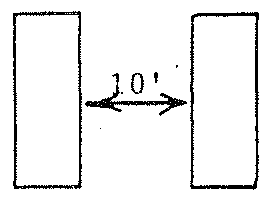
1.
Setback a minimum distance of ten feet (10′) from the side of a mobile home to the side of an adjoining mobile home unit and/or conventional structure.
ms 2971
2.
Setback a minimum distance of six feet (6′) from the end of a mobile home to the end of an adjoining mobile home.

ms 2972
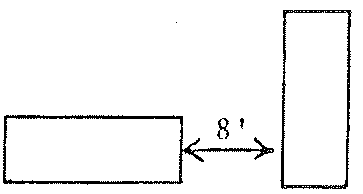
3.
Setback a minimum distance of eight feet (8′) from the side of a mobile home to the end of an adjoining mobile home.
ms 2973
4.
Not withstanding paragraphs 1, 2, 3 above, a minimum setback of five feet (5′) shall be maintained between the mobile home unit and the mobile home park property line.
(b)
The Director of Public Works or designee shall make an interpretation of the setback provisions as they apply to irregular lots and irregular configuration of mobile home units.
(c)
Replacement mobile homes shall be certified as such by HUD, pursuant to the Federal Manufactured Home Construction and Safety Standards Act, 42 U.S.C. 778 5401, et seq., as amended.
E.
Required Mobile Home Park Setbacks: Each mobile home park shall set aside along the perimeter of the mobile home park the following areas which shall be landscaped:
1.
Minimum front yard setback of park is twenty feet (20′), except if the mobile home park fronts a highway, then the minimum front yard setback shall be forty feet (40′).
2.
Minimum side yard setback of park shall be fifteen feet (15′), except if the side yard of the park abuts a highway, then the side yard setback shall be twenty-five feet (25′).
3.
Minimum rear yard setback of park is fifteen feet (15′), except if the rear yard of the park abuts a highway, then the minimum rear yard setback shall be twenty-five feet (25′).
F.
Park Street System:
1.
General Requirements: All mobile home parks shall be provided with safe vehicular access from abutting public streets to each mobile home space. All streets shall meet the requirements of the City's Engineering Specifications. Street plans shall be submitted to the Public Works Department prior to issuance of any building permits.
2.
Access. Access to mobile home parks shall be designed to minimize congestion and hazards at the entrance or exit and allow free movement of traffic on adjacent streets. Entrance and exit roadways shall connect the mobile home park streets with a public street.
3.
Internal Streets. All streets within the park shall be built to the City's Engineering Specifications, and shall include curb and gutter. No lot shall be laid out so as to permit direct access to any public street or highway. Street plans shall be submitted to and approved by the Public Works Department prior to issuance of any building permits.
4.
Road Signs. All construction and installation of road signs shall comply with the applicable requirements of the City.
G.
Walkways: All parks shall be provided with safe all-season pedestrian access for intended use between individual mobile homes, the park streets, and all community facilities provided for park residents.
1.
All roadway sidewalks shall meet the City's Engineering Specifications.
2.
A common walk system shall be provided and maintained. Such common walks shall have a minimum width of three feet (3′).
3.
All mobile home sites shall be connected to common walks, to paved streets, or to paved driveways or parking spaces connecting to a paved street. Such individual walks shall be a minimum of two feet (2′).
H.
Required Recreation Area:
1.
Ten percent (10%) of the gross park area shall be maintained as a recreational site for park residents. The site may include any combination of open space and recreational facilities adequate to meet their needs. Walkways, driveways and parking areas shall not be included in the calculation of the required recreational site area.
2.
Recreation areas shall be located as to be free of traffic hazards, and shall, where the topography permits, be centrally located.
I.
Nonresidential Uses: No part of any mobile home park shall be used for non-residential purposes.
J.
Area Lights: Street lights shall be provided in such number and intensity as to ensure safe movement of vehicles and pedestrians at night. A light shall be located at each outside entrance of the service buildings and at all entrances and exits of the park.
706.5. Mobile Home Hook-Up Inspection Procedure:
A.
[Inspection Required:] The Director of Public Works or designee shall conduct an inspection prior to the hook-up of any mobile home to determine satisfactory compliance with applicable provisions of this Section.
1.
It shall be the duty of the mobile home park owner (in the case of a mobile home parks) or the mobile home owner (in the case of mobile homes on single lots) to notify the Public Works Department not less than seventy-two (72) hours in advance of placement, set-up, and connection of utilities to the mobile home.
2.
The Public Works Director or designee shall make an interpretation of the advance notice procedures as they apply to the timing requirements.
3.
Upon finding that the installation of the mobile home is in compliance with the applicable provisions of this Section, the Public Works Director or designee shall issue a certificate of occupancy.
4.
The Certificate of Occupancy shall be issued to the mobile home unit and its placement site or lot and is not transferable to another mobile home unit or site location.
B.
Hook-Up Inspection Fees: The mobile home owner shall be assessed an inspection fee upon the issuance of a Certificate of Occupancy as determined by City Council. Fee schedules may be found in the Public Works Department.
C.
Responsibilities of Mobile Home Park Owner:
1.
The Mobile Home Park owner shall operate the park in compliance with this Section.
2.
The Mobile Home Park owner or agent shall notify park occupants of all applicable provisions of this Section.
3.
The Mobile Home Park owner shall supervise the placement of each mobile home on its mobile home site which includes securing its stability and installing all utility connections.
4.
It shall be the duty of the park owner to:
(a)
Pay promptly to the City all fees required by the City.
(b)
Report promptly to the proper authorities any violation of this Section.
(c)
See that no mobile home is occupied for dwelling purposes unless it is properly placed on a mobile home site and complies with all the requirements of this Section.
(Ord. No. 32-2000, 10-10-00, eff. 10-20-00; Ord. No. 31-2009, 12-22-09, eff. 1-1-10)
Sec. 707. - Temporary uses.
Temporary uses allowed under Section 402 of this code shall not exceed the period of time as indicated below for that temporary use in any year at that location. If such temporary use is not listed below, the time limit shall be one (1) week.
A.
Carnivals, circuses, bazaars, fairs: One (1) week;
B.
Christmas tree lots: Two (2) months;
C.
Construction office and yards incidental thereto from construction on the premises: During construction;
D.
Garage sales: Two (2) days;
E.
Parking for authorized temporary uses: granted on an as-needed basis; and
F.
Auctioneering: Two (2) days.
Additional temporary uses and time extensions may be granted by the Planning Commission.
(Ord. No. 26-1991, 1-14-92, eff. 1-27-92)
Sec. 708. - Regulations applicable to all zoning districts.
708.1. Building Height Requirements: The height limitations of this Ordinance shall not apply to schools or portions of structures or buildings not used for human occupancy or activities provided that such exceptions will not impose a negative material impact on the use, safety, or access of light and air to adjacent properties, or intent and purposes of this Ordinance. Applicants requestingexceptions to the height limitations for buildings or structures shall only be approved by the Planning Commission upon written finding that the applicant has satisfactorily addressed the following:
1.
Adequacy of light and air for adjacent properties;
2.
Minimization of visual impacts upon adjacent or neighboring properties;
3.
Adequacy for fire fighting and emergency responses.
4.
The following noninclusive list of uses may be excepted from the maximum height requirements provided the above mentioned conditions are met:
a.
Church steeples.
b.
Water tanks.
c.
Grain elevator enclosures.
d.
Public utility poles.
e.
Monuments.
f.
Chimneys, cupolas, vanes.
708.2. Building, Multiple Uses: Multiple uses allowed by right shall be allowed in the same principal building for the zoning district in which the building is located. Uses allowed by right mixed with uses allowed by conditional use shall be allowed in the same principal building for the zoning district in which the building is located if the conditional uses have been approved as conditional uses pursuant to the provisions of this Ordinance.
708.3. Building, Same Lot: Only one (1) principal building shall be permitted on any lot in R1, R2, and MH districts unless approved as part of a Planned Unit Development described in Chapter VI of this Ordinance. Two or more principal buildings on any lot in R3, NB, CB, CBD, LI and HI districts shall be permitted only upon approval by the Director of Public Works.
708.4. Building, Use Change: Any change in use of an existing building shall conform to the requirements and review procedures of the district within which it is located. For changes in uses in nonconforming buildings, refer to Chapter XI of this Ordinance.
708.5. Drive-In/Drive-Through Facilities: In addition to the review provisions under the Planned Unit Development or Conditional Use, the applicant must satisfactorily demonstrate that the traffic circulation on and adjacent to the site conforms to the following criteria:
1.
Arranged so that the drive-through lane is off the public street, alley or right-of-way; and
2.
Arranged so that internal pedestrian traffic and vehicular movements are compatible and traffic hazards are minimized; and
3.
Arranged so as to avoid hazardous or adverse effects on adjacent sites and streets.
708.6. Minimum Ordinance Requirements: No lot area, yard or other open space, or required off-street parking or loading area existing on or after the effective date of this Ordinance shall be reduced in area, dimension or size below the minimum required by this Ordinance, nor shall any lot area, yard or other open space or off-street parking or loading area which is required by this Ordinance for one use be used as the lot area, yard or other open space or off-street parking or loading area requirement for any other use.
708.7. Projections into Required Yards: Every part of a required yard area shall be unobstructed from ground level to the sky except for projections of architectural features as follows:
1.
Unroofed terraces or patios, cornices, sills, mansards, chimneys, eaves or similar features up to a distance of three (3) feet from the face of the principal building and two (2) feet from an accessory building.
2.
Open fire escapes up to a distance of four (4) feet.
3.
Temporary awnings or shading devices.
708.8. Supplementary Yard and Setback Requirements:
1.
On lots extending from one (1) street to another paralleling street, both streets shall be considered as front streets for purposes of calculating front yard setbacks.
2.
On lots bordered on two (2) contiguous sides by streets, the required front yard setback shall be the narrow side.
3.
For purposes of setback calculation, a two-family dwelling or an attached multiple family dwelling shall be construed as one (1) building occupying one (1) lot.
4.
On a vacant lot bordered on two sides by previously constructed buildings which do not meet the required front yard setback for the zoning district, the required front yard setback for the vacant lot shall be established as the average front yard setback of the two adjacent buildings. Where a vacant lot is bordered on only one side by a previously constructed building which does not meet the required front yard setback, the front yard setback for the vacant lot shall be established as the average of the front yard setback for the adjacent building and the minimum front yard setback for the zoning district.
708.9. Utilities: Nothing in this Ordinance shall be construed to prevent the construction or installation of public utilities or transmission facilities including mains or distribution lines in any zone district. Substations for a public utility, storage, maintenance facilities and business offices shall be restricted to their appropriate zone district. Location of power transmission lines with a capacity of 100 KV or over shall be subject to review by the Planning Commission and approval by City Council.
708.10. Outdoor Storage: All outdoor storage areas shall be enclosed by a solid fence or wall or landscaping which screens the storage from adjacent streets and buildings, or a combination of the above which is at least six feet (6′) in height.
708.11. Public Projects: All public projects from any governmental agency must go before the Planning Commission in order to mitigate pending problems such as traffic, parking, access.
708.12. Enclosure of Uses. Every permitted use in any district, except in LI-Light Industrial and HI-Heavy Industrial, shall be conducted entirely within a completely enclosed structure, except those uses expressly exempted from the complete enclosure requirement, as listed in this section. Such uses are not exempt from obtaining a certificate of occupancy for a permanent on-premises structure, from which general business operations must be conducted. Exemptions from the enclosure requirement are as follows:
1.
Vehicular or equipment and machinery sales, including but not limited to automobiles, boats, trucks, farm equipment, trailers, manufactured housing or other similar uses.
2.
Live bait sales.
3.
Plant nurseries.
4.
Lumberyards.
5.
Stone monument sales.
6.
Service stations and carwashes.
7.
Contractor's storage yard for vehicles, materials or supplies.
8.
Dog pound.
9.
Public schools, private schools, childcare centers, kindergartens, nurseries or other similar uses.
10.
Golf courses, driving ranges and skeet and trap ranges.
11.
Parks, playgrounds or other similar recreational uses, or facilities contained therein.
12.
Amusement places.
13.
Drive-in theaters, drive-in restaurants, drive-in banks or other similar drive-in facilities.
14.
Farm operations and sales and private gardens.
15.
Parking lots and garages.
16.
Cemeteries.
17.
Restaurant cafes.
18.
Vending machines.
19.
Accessory patio lounges, i.e., a type of lounge which must be attached to an existing, operating, indoor lounge; provided, however, that these patio lounges are situated exclusively in a CB-Commercial Business, are fenced, screened or otherwise closed off from public rights-of-way and adjoining properties by means of a minimum four foot high fence or wall, and meet all other requirements of this chapter and other ordinances, as applicable.
20.
Temporary uses, including but not limited to: fairs, street vendors, carnivals, and sidewalk sales. (See Section 707. Temporary Uses for time limits on these uses.)
(Ord. No. 26-1991, 1-14-92, eff. 1-27-92; Ord. No. 32-1997, 7-22-97, eff. 8-1-97; Ord. No. 26-1999, 11-9-99, eff. 11-19-99)
Sec. 709. - Veterinary clinics and hospitals.
In order to minimize adverse effects that the operation of an animal veterinary clinic or hospital may have on an area in which it is located, the following regulations apply. Animal veterinary clinics or hospitals may be permitted in the CB (Community Business) and LI (Light Industrial) zones, subject to the following conditions:
A.
All facilities of an animal veterinary clinic or hospital, including all treatment rooms, cages, pens, kennels and exercise runs, shall be maintained within a completely enclosed, soundproof building;
B.
All such veterinary clinics and hospitals shall be designed and constructed in a manner that shall eliminate any emission of odor offensive to persons in the area of such clinics or hospitals.
C.
All such veterinary clinics and hospitals shall be designed and constructed in a manner that shall reduce the sound coming from any such clinic or hospital to the level of sixty-five (65) decibels at any given adjacent property line.
Sec. 710. - Buffers and landscaping.
Buffers and landscaping shall be required for nonresidential uses located adjacent to or across a street, as defined in Section 302, from residentially zoned lands, and a buffering and landscape plan shall be submitted by the nonresidential owner to the Director of Public Works for determination as to whether the plan addresses off-site impacts such as noise, glare, odor or objectionable or harmful substances, conditions or operations, by eliminating or sufficiently reducing such off-site impacts through the use of landscape, screen or natural features, taking into account line-of-sight clearance, where applicable, as defined in Chapter IX, Fence Regulations, Section 905.B. The Director of Public Works shall review the plan and shall forward a written recommendation of approval, conditional approval or denial to the Board of Adjustment. Such recommendation shall include the findings upon which the recommendation was made. A recommendation of conditional approval shall set forth the conditions and those requirements which the Director of Public Works deems necessary to meet, before final action can be taken.
(Ord. No. 1-1993, 2-9-93)
Sec. 711. - Environmental performance standards.
Where otherwise not provided for in this Ordinance, applicants for new construction or reconstruction of existing structures for other than single family residential purposes shall demonstrate that the proposal satisfactorily addresses such factors as:
A.
Drainage and storm water runoff;
B.
Natural hazards where affecting the site;
C.
Erosion controls during and after construction;
D.
Reclamation and/or revegetation and landscaping;
E.
Preservation of unique natural features;
F.
Visual impacts on adjacent properties;
G.
Disposition of any historic features or structures; and
H.
Adequacy of public improvements to serve the proposed use.
Sec. 712. - Industrial performance standards.
Any application for an industrial use shall comply with applicable state and federal regulations as required by law and administered by the Environmental Protection Agency, Occupational Safety and Health Administration, Colorado Department of Health, and others which govern or establish guidelines for controls on the following:
A.
Noise and sound volume in decibels;
B.
Odor;
C.
Glare in footcandles;
D.
Vibration generated in cycles/second or hertz;
E.
Visible and nonvisible emissions including vapors, particulate matter, dust, and degree of opacity;
F.
Types and volumes of wastes generated and proposed storage/disposal methods;
G.
Storage and use of flammable/explosive materials;
H.
Discharged water quality levels and site drainage;
I.
Any other factors such as heat, humidity, or electromagnetic radiation which may produce adverse impacts.
Where not otherwise specified by a governing regulation, the determination of compliance with these items shall be based upon measurements taken at the boundaries of the property in which such uses are proposed or at the boundaries of residentially zoned districts adjacent to or across any street from such proposed uses.
Upon receipt of an application for an industrial use, the City shall send referrals to appropriate county, state, and/or federal agencies to solicit responses to the adequacy of the information as submitted and the most appropriate methods and time schedules for monitoring compliance with any imposed standards if a proposal is approved.
Sec. 713. - Marijuana sales.
Medical marijuana sales are not allowed within two thousand (2000) feet of schools, five hundred (500) feet from areas zoned as "public," five hundred (500) feet from other marijuana stores, and two hundred (200) feet from residential areas.
Retail marijuana sales are not allowed within two thousand (2000) feet of schools, five hundred (500) feet from areas zoned as "public," five hundred (500) feet from other marijuana stores, and two hundred (200) feet from residential areas.
(Ord. No. 11-2024, § 2, 1-14-25)
Sec. 714. - Harboring of livestock, fowl, swine.
Limited to slaughtering houses and sale barns, except as may otherwise be specifically permitted by the City Code.
(Ord. No. 3-2014, 1-28-14)

