
Stokesdale City Zoning Code
Sec. 4-4
Dimensional requirements.
Within the zoning districts as shown on the official zoning map, all the following dimensional requirements shall be complied with.
4-4.1
Agricultural and single-family districts.
(A)
Dimensional requirements for agricultural and single family districts. Dimensional requirements for agricultural and single family districts are found in Table 4-4-1.
(B)
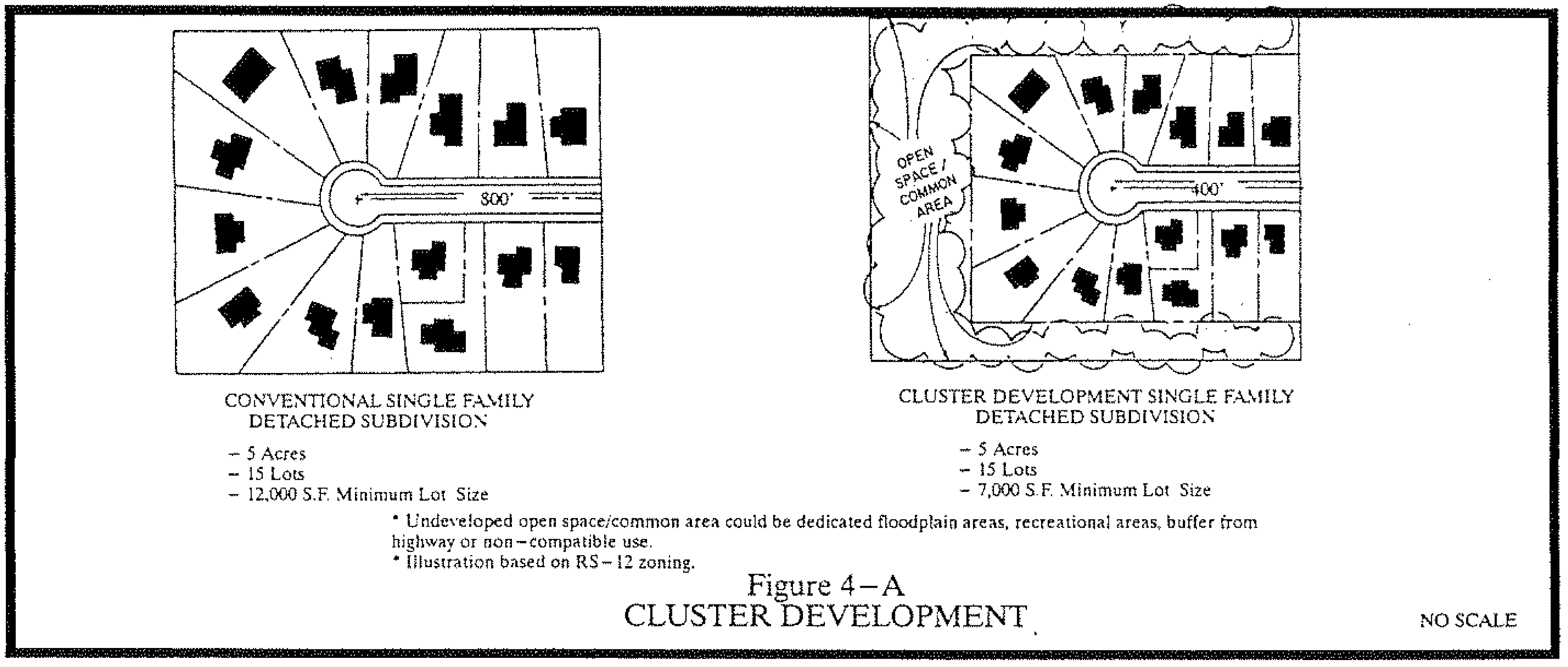
Cluster development.
1)
Cluster option.
a)
Cluster development may be used in any district which permits single-family uses if the tract is ten acres or more and is served by municipal sanitary sewer.
b)
Cluster development may be used on tracts smaller than ten acres if street right-of-way in a street or highway corridor pursuant to N.C.G.S. 136-66.10 is dedicated and the development will be served by municipal sanitary sewer.
c)
Cluster development is allowed in WCA and GWA areas of WS-III and WS-IV water supply watersheds under the performance requirement listed in section 7-1.7(B). For all WCA and GWA areas, the total number of lots shall not exceed the number of units allowed for single family detached developments under the low density option as listed in Table 2-1-1.
2)
Cluster required. The planning board or town council may require that cluster development be used if right-of-way dedication is required pursuant to N.C.G.S. 136-66.10 or the development lies partially or wholly within a watershed critical area.
3)
Development standards. The objective of the cluster option is to place the houses in a development closer together and on smaller lots than would normally be permitted by the zoning district in which the development is located, and to place land which would otherwise have been included in private lots into public dedication or common area.
a)
When cluster development is employed, all lot size and other dimensional requirements for single-family dwellings are decreased to comply with all requirements of a smaller-lot RS zone.
b)
The sum of those areas placed into common area as open space, those areas dedicated as public open space in excess of any required dedication for such purposes, and those areas dedicated as street right-of-way pursuant to N.C.G.S. 136-66.10(a) shall not be less than 15 percent of the total area of the development.
c)
The maximum number of lots shall be determined as follows:
i)
Calculate the gross acreage of the tract, excluding any existing street right-of-way;
ii)
Subtract three-fourths of the area of any drainageway and/or open space required to be dedicated by this Ordinance.
iii)
Multiply by the density factor from Table 4-4-2.
d)
Common areas shall be located within the development to:
i)
Preserve stands of trees, lakes, steep slopes, historic sites or other significant features;
ii)
Provide common green space in the development for aesthetic purposes and pedestrian use;
iii)
Provide space for common recreation facilities and meeting places; or
iv)
Provide buffering from adjacent land uses of higher intensity.
v)
Minimize stormwater flow and runoff impacts to receiving waters in WCA and GWA areas.
e)
Common area for open space shall be of usable dimensions, including a minimum width of 24 feet and shall be accessible to all homeowners in the development.
f)
If approved by the governing body, a site may be reserved for a school, church, civic club, public recreation center or public library within the area that would otherwise have been common area
(C)
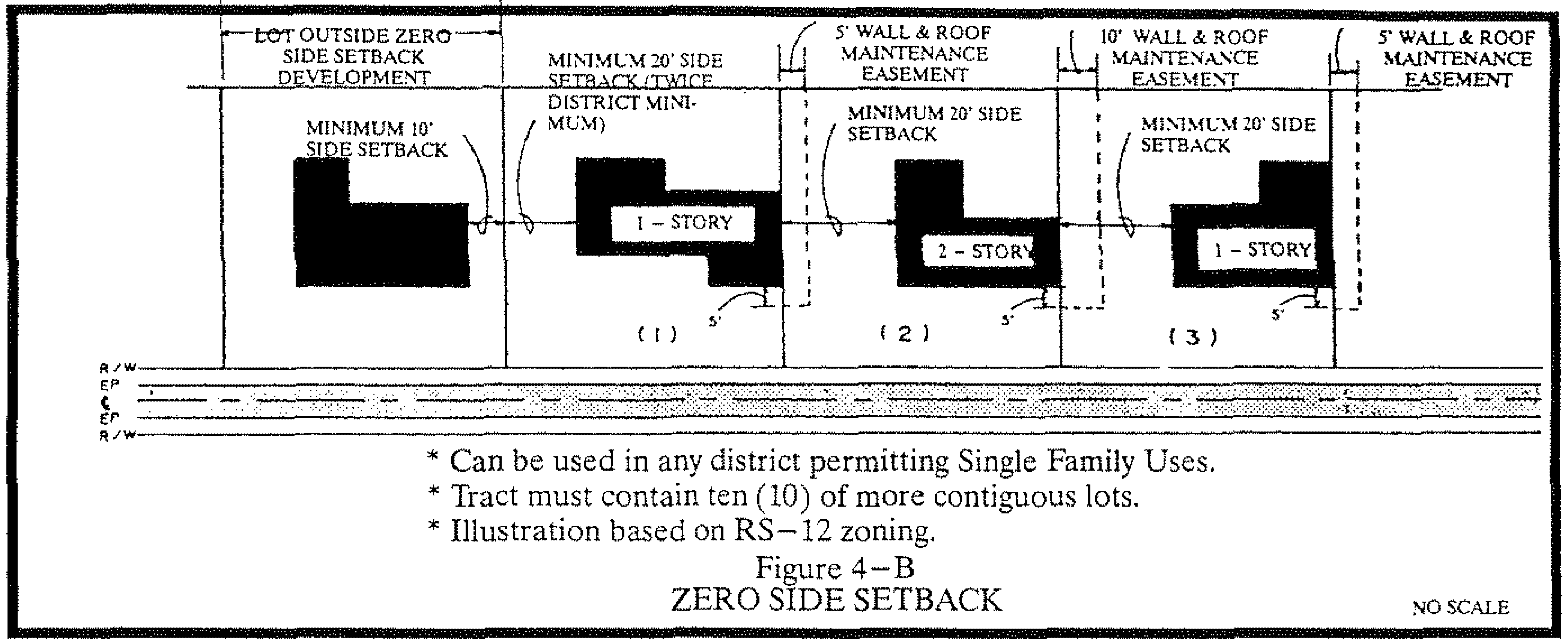
Zero side setback. See Figure 4-B.
1)
Zero side setback option. Zero side setback development may be used in any district which permits single-family uses if the development contains ten or more contiguous lots and is served by municipal sanitary sewer.
2)
Development standards.
a)
Setbacks of zero feet are permitted only where the lots on both of the affected lot line are part of a zero side setback development
b)
A wall and roof maintenance easement (five feet along one-story walls, ten feet along two-story walls) shall be provided on the opposite side of the zero setback lot line.
c)
Whenever one side setback is zero, the minimum setback on the opposite side of the same lot shall be twice the minimum side setback required by this Ordinance for the zoning district in which the development is located.
(D)
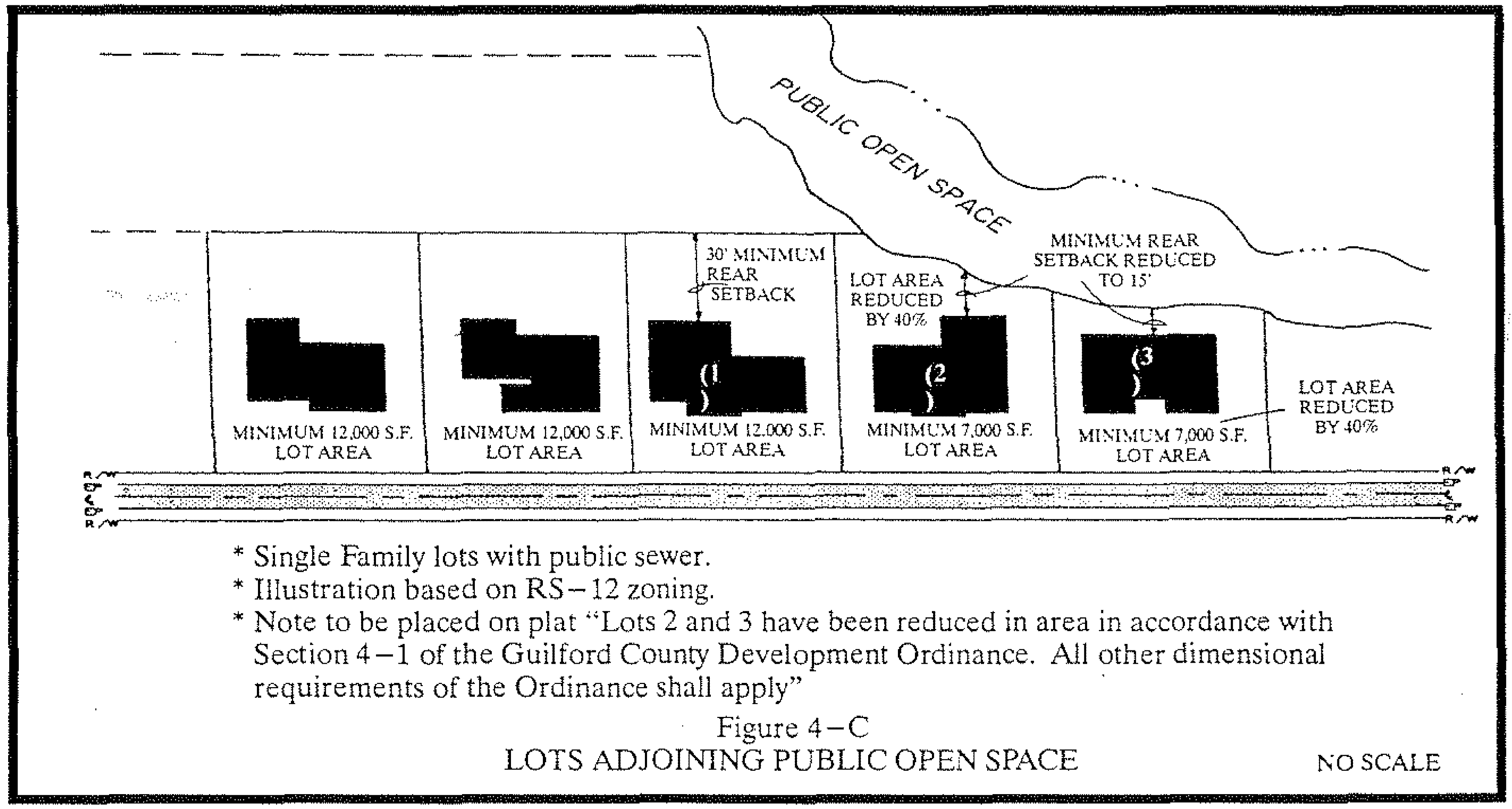
Lots adjoining public open space. See Figure 4-C.
1)
Lot area reduction option. Single-family lots with public sewer service which abut dedicated public drainageway and open space may be developed with less than the area required in Table 4-4-1, provided the following requirements are met.
2)
Development standards.
a)
No lot shall be less than 60 percent of the minimum lot area for the zoning district in which it is located, or 5,000 square feet, whichever is greater.
b)
Rear setbacks may be reduced to 15 feet, if the rear property line(s) abut public drainageway and open space areas.
c)
A note shall be placed on the plat stating:
"Lots have been reduced in area in accordance with section 4-4.1(D), and that all other dimensional requirements of this Ordinance apply."
4-4.2
Multi-family districts.
(A)
Dimensional requirements for permitted single-family district uses and two-family dwellings in RM, GO-M, and GO-H districts. See Table 4-4-3.
(B)
Dimensional requirements for multi-family developments with three or more units. Dimensional requirements for multi-family developments with three or more units are found in Table 4-4-4.
(C)
Additional requirements for multi-family developments.
1)
A multi-family dwelling shall not be placed behind and on the same lot as a single-family dwelling.
2)
In order to permit adequate fire protection, all portions of every building shall be located within 300 feet of a public street that furnishes direct access to the property unless the fire marshall determines that the fire hydrants and service drives within the development will offer adequate protection.
3)
All common driveways within the development shall have approved traffic circulation and shall be kept available for emergency and service use by any public vehicle.
4)
Off-street parking spaces shall be located within 200 feet of each building in an amount proportional to the number of dwelling units in each building. No parking area with five or more spaces shall be located closer than ten feet to a dwelling wall with windows or doors.
5)
All walkways within two feet of and perpendicular to parking spaces shall have a minimum width of six feet. Any walkway serving only one dwelling unit, other than a handicapped unit, shall have a minimum width of three feet. All other walkways shall have a minimum width of four feet. Walkways shall be of dustless all-weather surfaces.
6)
Open space and/or recreation facilities.
a)
Open space and/or recreation facilities shall be provided at the rate of ten percent of the total land area in developments of under three acres or in the GO-H district with a building more than four stories, and shall be at a single location.
b)
In developments of three acres or more, open space shall be provided at the rate of one acre per 100 dwelling units. Such open space and/or recreation facilities may be at more than one location, but each such area must have at least 10,000 square feet to be counted toward this requirement.
c)
All such areas must have a minimum width of at least 24 feet and be accessible to residents of the development at no charge. All such areas shall be occupied by recreational activities, grass and landscaping, or woods. Uses suggested for these areas are swimming pools, tennis courts, play areas, passive recreation, etc. Uses not permitted in such areas are parking, garbage areas, mechanical equipment, or other similar uses. Land dedicated as parkland or as drainageway and open space shall count toward this requirement.
7)
No building shall exceed 250 feet in length unless it is designed for the elderly and has central facilities for dining and recreation.
8)
Trash containers (dumpsters or compacters) of a number and size conforming with the requirements of the jurisdiction shall be provided. Each container shall be located so as not to interfere with sight distance or the free movement of vehicles on streets or access drives and so as to allow collector trucks adequate maneuvering space to empty the containers without interference from utility lines or other structures and to leave the property without excessive backing. Concrete pads shall be located beneath and in the approach to each trash container.
Note: Developments with two or fewer principal buildings and a width at all potential building locations of 120 feet or less are exempt from the following requirements.
9)
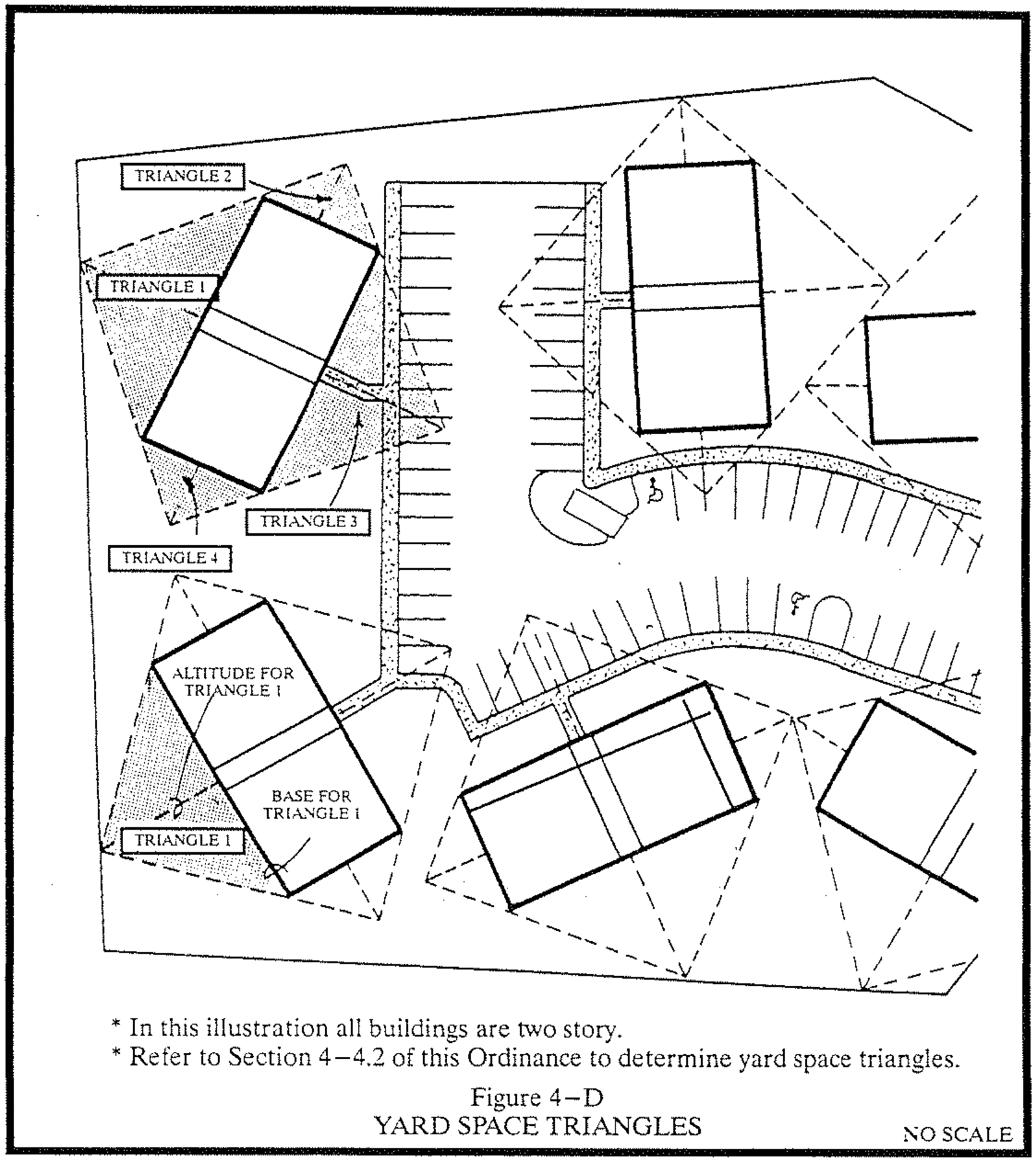
On the site plan an isosceles triangle (yard space triangle) shall be drawn from each building facade which, at its closest point, lies within 100 feet of a lot line other than a street right-of-way line or within 100 feet of another building in the development. Facades shall be designated so that a minimum number, normally four, results. The base of the triangle shall be a line connecting the extreme ends of the facade (ignoring one-story storage rooms and other one-story protrusions of 100 square feet or less, exterior stairways, and decks), and its altitude shall be the length of the base line multiplied by a factor related to the height of the building as shown below.
An isosceles triangle thus established may not overlap any portion of another building, another triangle, or another property, unless that property is public parkland, dedicated drainageway and open space, or street right-of-way. See Figure 4-D.
10)
Private drives shall be no closer than 15 feet to a dwelling.
11)
Play areas and sports facilities shall not be placed within 50 feet of adjacent land used or zoned for single-family residential purposes.
12)
All electric, communications, water, and sewer utility lines shall be installed underground.
13)
Arrangement of buildings in parallel rows shall be avoided.
4-4.3
Nonresidential districts.
(A)
Dimensional requirements for non-residential districts. Dimensional requirements for non-residential districts are shown in Table 4-4-5.
a Lots of record having less than minimum required area may be developed pursuant to section 3-14.1 (Nonconforming lots of record).
b Maximum district size of three acres (excluding any street right-of-way).
c Setbacks from right-of way line or property line/street centerline, whichever is greater.
d Zero setback if no setback is provided. If setback is provided it must be a minimum of five feet.
e A through lot has two street setbacks but no rear setback.
f Increase all setbacks by one foot for every foot in height between 50 and 80 feet. No additional setback is required for buildings above 80 feet in height.
g Smaller lots are permitted for residential uses (refer to Table 4-4-3).
h No more than three full or partial stories entirely above grade.
i Development perimeter only.
j Minimum street setback refers to principal structure(s). Corner lots may be required to provide for adequate site distance thereby increasing the minimum setback to a distance not to exceed ten feet. Accessory buildings shall be a minimum of 15 feet from public right-of-way.
(Ord. of 4-9-2007(1); Ord. of 11-17-2011(1); Ord. of 11-17-2011(2))

