
Stonecrest City Zoning Code
ARTICLE 5
- SITE DESIGN AND BUILDING FORM STANDARDS
All development shall comply with this article's site, design, and building form standards, in addition to the requirements in article 2 of this chapter, zoning districts, and chapter 14, land development.
(Ord. of 8-2-2017, art. 5)
Sec. 5.1.1. - Blocks.
A.
Intent. The intent of this section is to have the lengths, widths and shapes of blocks in residential subdivisions designed with due regard to:
1.
Provision of building sites suitable to the special needs of:
a.
The building form contemplated;
b.
The conservation of open space; and/or
c.
Existing historic features.
2.
Zoning requirements for lot sizes and dimensions;
3.
Needs for convenient access by pedestrians and bicyclists to public transit, nearby schools, and commercial districts, vehicular circulation at safe speeds and adequate access for emergency vehicles;
4.
Limitations of, and opportunities for, topography to minimize land disturbance and erosion;
5.
Connectivity standards in section 5.3.2.
B.
Block length.
1.
When blocks are subdivided by new streets or created as part of a new development, including mixed-use, the minimum length of resulting new blocks shall be 200 to 300 linear feet.
2.
The maximum block length for new subdivisions in the Suburban Neighborhood character area is 600 linear feet.
C.
Blocks and pedestrian access. If a new development provides for a path with an easement through a block:
1.
An easement for pedestrian use only shall be at least five feet wide.
2.
An easement for pedestrian and bicycle use shall be at least ten feet wide.
(Ord. of 8-2-2017, § 1(5.1.1); Ord. No. 2021-06-03, § 1(Exh. A, § BB), 8-23-2021)
Sec. 5.1.2. - Lots.
All lots shall conform to the minimum requirements for the zoning district in which such lot is located, to all applicable requirements of this article, and the requirements of chapter 14 of the Code. In the event of a conflict between the provisions of this chapter and chapter 14 of the Code with respect to regulation of lots, the provisions of this chapter shall prevail.
(Ord. of 8-2-2017, § 1(5.1.2))
Sec. 5.1.3. - Lots, access.
Each lot shall have vehicular access to a public or approved private street, or, in the case of townhouses, fee simple condominiums or cottage lots, to an alley or private internal drive, provided the overall townhouse or cottage development site provides access to a public street. In new subdivisions with three or more single-family detached or single-family attached units, lots on minor or major thoroughfares with lot frontages less than 100 feet shall have driveway access via shared driveways.
(Ord. of 8-2-2017, § 1(5.1.3))
Sec. 5.1.4. - Lots, corner.
A.
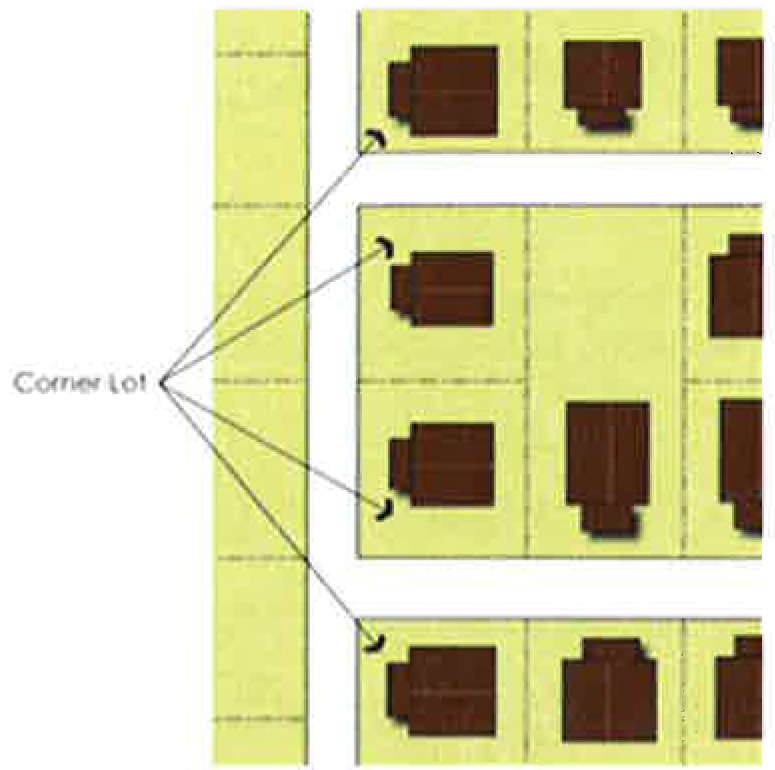
Front yard building setback. On corner lots, the lot frontage with the shortest distance to a public right-of-way shall be designated as the front yard, and development shall comply with front yard building setback requirements of the zoning district in which the lot is located.
B.
Side corner yard. Once the front of a corner lot is determined pursuant to subsection A. of this section, the remaining side adjacent to a street is the side corner yard.
C.
Side corner yard building setback. The minimum side corner yard building setback on corner lots shall be as designated by the zoning district regulations in article 2 of this chapter. Unless otherwise restricted, buildings may face either the front or side corner.
D.
Lot width. The minimum width of corner lots with residential uses shall be increased by 15 feet above the minimum width required for the zoning district in which the lot is located.
E.
Side corner yard for nonconforming residential. The side corner yard building setback in residential districts may be reduced to 60 percent of the minimum front yard building setback in the zoning district if:
1.
The lot is a legal nonconforming lot; and
2.
The lot does not abut a thoroughfare.
(Ord. of 8-2-2017, § 1(5.1.4))
Sec. 5.1.5. - Lots, double frontage.
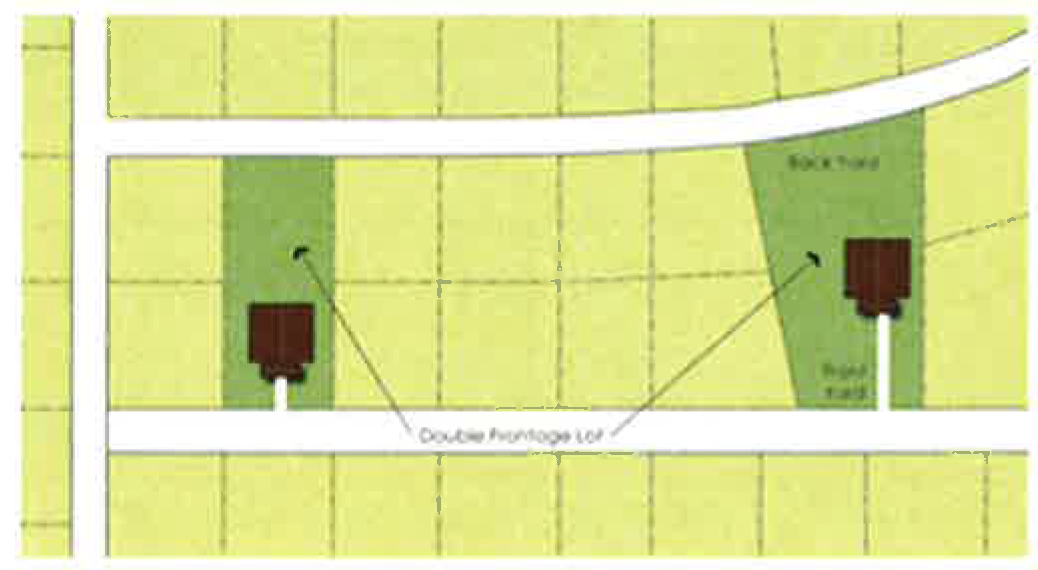
Double Frontage Lot
A.
Lots which adjoin public streets in both the front and rear shall provide the minimum required front yard setback on each street.
B.
For the purposes of front yard regulations, there shall be only one front yard designated, depending on which street the front of the house is built to face.
C.
Driveway access on double frontage lots shall be limited to one street only. A ten-foot, no-access easement shall be provided along the frontage of the street not used for a driveway.
(Ord. of 8-2-2017, § 1(5.1.5))
Sec. 5.1.6. - Every use must be upon a lot of record.
No building or structure shall be erected and no use shall be established unless upon a lot of record.
(Ord. of 8-2-2017, § 1(5.1.6))
Sec. 5.1.7. - Buildings on single-family and duplex lots.
On all single-family detached and two-family residential lots, only one principal building, together with its permitted accessory structures and uses, shall occupy each lot.
(Ord. of 8-2-2017, § 1(5.1.7))
Sec. 5.1.8. - Multiple principal buildings on a lot.
Multiple principal buildings with nonresidential uses, mixed-uses and mixed attached or multi-dwelling residential uses (triplex, duplex, condominium, apartment) may be established on a single unified lot, provided that all other provisions of this article 5 and this chapter are met.
(Ord. of 8-2-2017, § 1(5.1.8))
Sec. 5.1.9. - Minimum lot size and minimum lot width.
A.
No lot shall be created that fails to meet the minimum lot size and minimum lot width for the zoning district in which the lot is located as established in article 2 of this chapter, except as otherwise provided in article 8 of this chapter.
B.
Flag lots are prohibited.
(Ord. of 8-2-2017, § 1(5.1.9))
Sec. 5.1.10. - Maximum lot coverage.
No lot shall be developed to exceed the maximum allowable coverage by buildings, structures, driveways or parking areas, or any other impervious surface specified for the zoning district in which the lot is located. In addition to the maximum impervious surface amount, pervious materials may be added up to a maximum amount of 15 percent of the total lot area for non-vehicular uses only, such as walkways, patios and pool decks.
(Ord. of 8-2-2017, § 1(5.1.10))
Sec. 5.1.11. - Street frontage for lots.
All lots shall meet the minimum street frontage requirements of the zoning district in which the lot is located.
(Ord. of 8-2-2017, § 1(5.1.11))
Sec. 5.1.12. - Lots served by wells and septic tanks; sewer and water connections.
A.
Any lot that is to be served by an individual well or septic tank shall have an area of not less than that required by state and DeKalb County health regulations. The site location on the lot of the facility shall be approved by the county board of health in accordance with applicable board of health regulations.
B.
Sewer and water facilities and connections shall be approved by the director of planning.
(Ord. of 8-2-2017, § 1(5.1.12))
Sec. 5.2.1. - Minimum required yards and building setbacks.
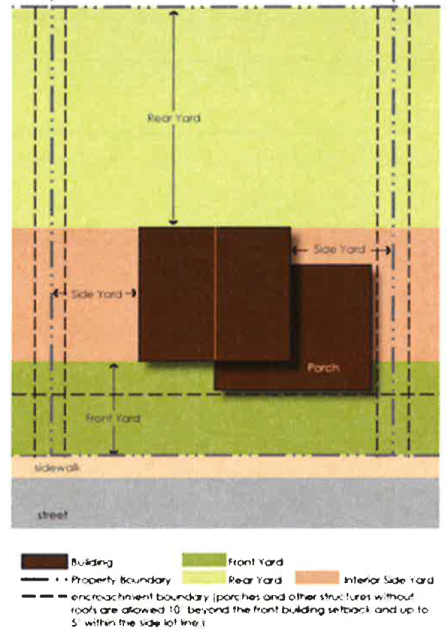
Projections into Yards
A.
Projections into yards.
1.
Every part of a required yard shall be open to the sky and unobstructed except for the ordinary projections of sills, belt courses, cornices, eaves, awnings, chimneys, buttresses and other ornamental and architectural features, provided that these features do not project more than three feet into any required yard and do not encroach on other lots or rights-of-way.
2.
An open, unenclosed porch, balcony or hard-surfaced terrace, steps, stoops and similar fixtures of a building may project into a required front yard or rear yard for a distance not to exceed ten feet, and into a side yard to a point not closer than five feet from any lot line.
3.
Enclosed porches may encroach for a distance of up to eight feet into the front or rear yard, but shall be no closer than five feet from the side property line.
B.
Spacing between buildings. For single-family attached buildings and multifamily buildings:
1.
Building shall be separated a distance as required by the International Codes Council (ICC).
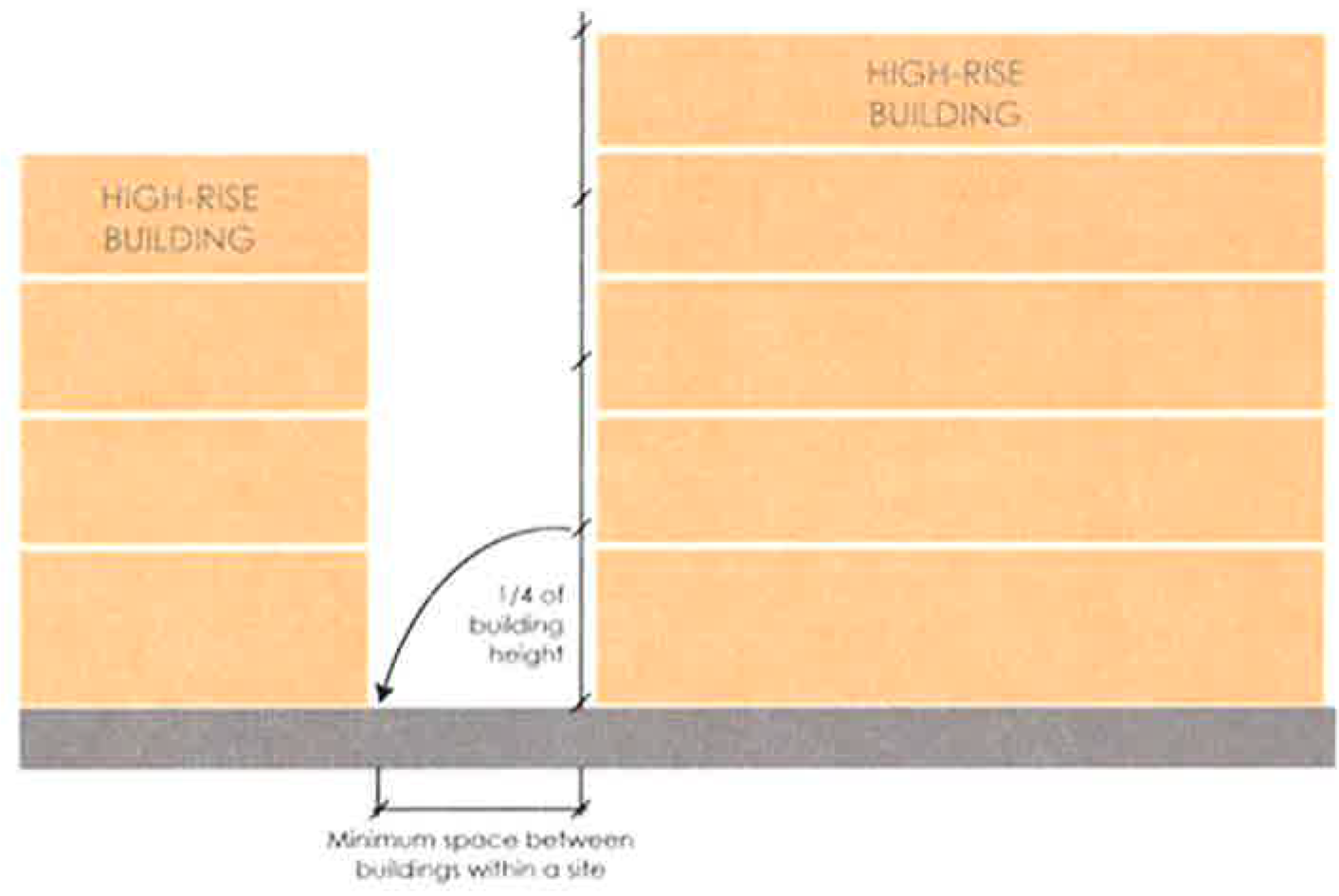
High-rise multifamily spacing
C.
Setback averaging. When a vacant lot located in a zoning district authorized for single-family detached dwellings is proposed for development, and is located where at least 60 percent of the other lots on the same block face are occupied by single-family detached dwellings, then setback averaging shall apply. Where setback averaging applies, the minimum front setback for the vacant lot to be developed shall be the average of the actual front setbacks of the existing dwellings adjacent to the vacant lot and on the same blockface. Where application of setback averaging would require that the proposed dwelling be located closer to the street than the otherwise applicable minimum front setback for the zoning district where the vacant lot is located, then setback averaging shall not be applied. Where application of setback averaging would make it impossible for the proposed dwelling to comply with the applicable zoning district's rear yard setback requirement, then the proposed dwelling may be constructed closer to the street, up to the minimum front setback required in the subject zoning district, only to the extent necessary to satisfy the minimum rear yard setback requirement. If the actual front setbacks of the existing dwellings on the adjacent lots on the same blockface as the vacant lot differ from each other by more than 30 feet, then the minimum front setback for the vacant lot shall be the actual front setback of the dwelling closest to the street.
(Ord. of 8-2-2017, § 1(5.1.1); Ord. No. 2021-06-03, § 1(Exh. A, §§ U, CC), 8-23-2021)
Sec. 5.2.2. - Minimum floor area per dwelling unit.
A.
No new dwelling unit shall have less than the minimum floor area of the applicable zoning district specified in article 2 of this chapter.
B.
No existing dwelling unit shall be reduced in size so that its floor area is less than the minimum floor area for a dwelling unit established by the applicable zoning district specified in article 2 of this chapter.
(Ord. of 8-2-2017, § 1(5.1.2))
Sec. 5.2.3. - Compatibility of new and existing subdivisions.
A.
Lot size variability. Lots created as part of a new or redeveloped single-family detached subdivision, containing 20 or more lots, shall be compatible with existing developed single-family lots to which they are adjacent as described in subsection B. of this section.
B.
Compatibility of new lots with adjacent lots shall be demonstrated by at least two of the following:
1.
The lot width of the new lot is at least 80 percent of the lot width of an adjacent existing subdivision lot;
2.
The lot size of the new lot is at least 80 percent of the lot size of an adjacent existing subdivision lot or eight-tenths of an acre, whichever is less;
3.
The new lot provides a minimum transitional buffer of 20 feet;
4.
The lot depth of the new lot is at least 20 feet deeper than the depth of the adjacent existing lot.
C.
Calculations for measuring compatibility:
1.
Only lots with existing residential structures adjacent to the proposed development will be used in the calculation.
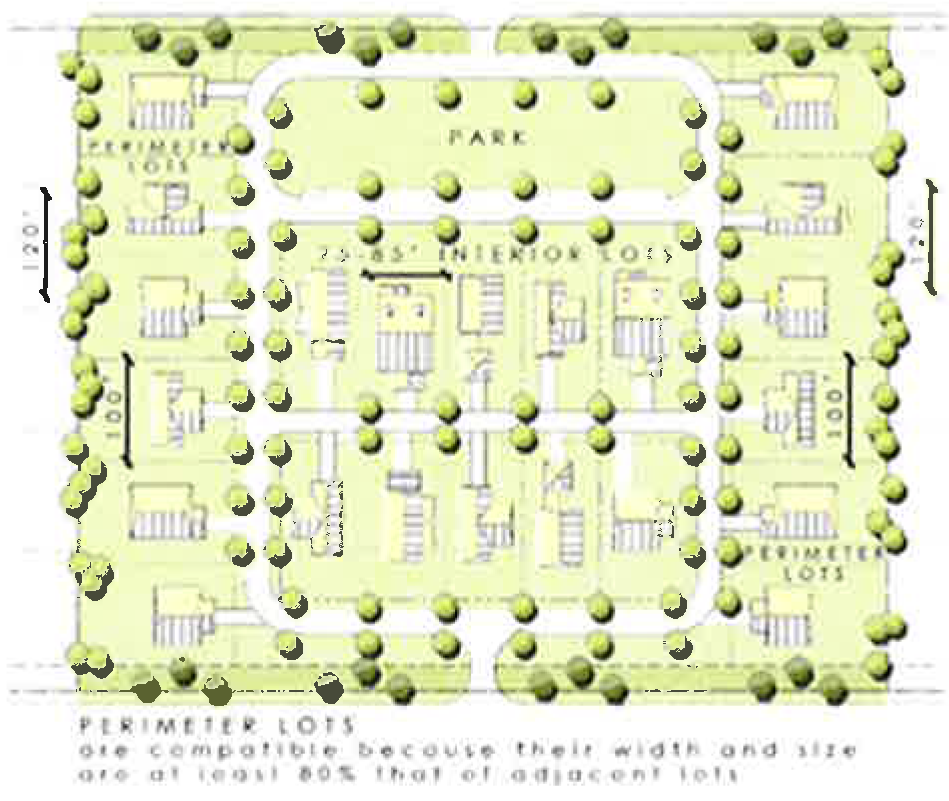
Perimeter Lot Diagram
(Ord. of 8-2-2017, § 1(5.1.3))
Sec. 5.2.4. - Transitional height plane.
A transitional height plane shall apply to commercial or multifamily buildings that is either:
(1)
Adjacent to; or
(2)
Separated by a street with a width of 50 feet or less from any property zoned RE, RLG, R-60, R-75, R-85, R-100, MHP, RNC or RSM.
No portion of a commercial or multifamily structure shall protrude into a transitional height plane. The transitional height plane shall begin at a point 35 feet above any setback or transitional buffer line, whichever is furthest from the property line, and then extend at an upward angle of 45 degrees over the lot of the commercial or multifamily building.
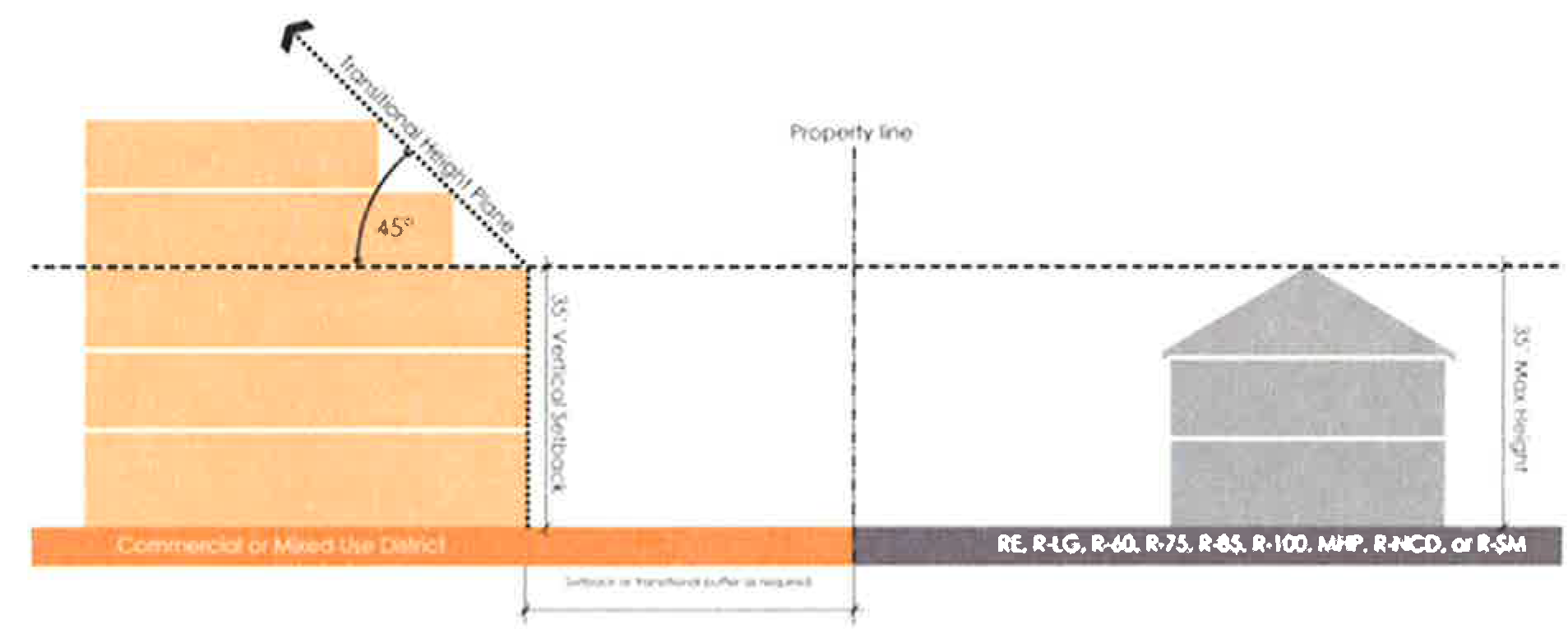
Transitional Height Plane Diagram
(Ord. of 8-2-2017, § 1(5.1.4))
Sec. 5.2.5. - Height measurement requirements and thresholds.
A.
Building height of all structures other than single-family detached dwellings shall be measured from average finished grade (determined by averaging the elevations of finished grade around the entire footprint of the structure) to the top of the highest roof beams on a flat roof, to the deck level on a mansard roof, and to the average distance between the eaves and the ridge level for gable, hip, shed and gambrel roofs.
B.
Building height for single-family detached dwellings shall be measured from the front-door threshold of the structure to the highest point of the roof of the structure. Threshold means the top of the subfloor in the opening that is designated as the front door of a dwelling.
C.
Reserved.
D.
Elevation of single-family detached dwelling thresholds. The following standards shall apply to single-family detached dwellings:
1.
Replacement of a single-family detached dwelling. If new construction of a single-family detached dwelling would require alteration or eradication of the threshold of a previously existing residential structure, the proposed front door threshold elevation for the new single-family detached dwelling shall not be more than two feet higher than the front door threshold elevation of the previously existing residential structure, which shall be measured and certified by a licensed surveyor or engineer.
2.
Construction on vacant or undeveloped lot. If no dwelling previously existed on the lot, the threshold shall be no higher than the average elevation of the existing natural grade at the front building line.
3.
Sewer conditions. If the existing residence or lot is not connected to county sewer and if an applicant for a building permit establishes that the minimum threshold height prevents gravity flow connections to county sewer, the director of planning may grant an administrative variance to allow the threshold height to be up to five feet above the threshold of the previously existing residence in order to allow for gravity flow into the existing sewer tap. Should a greater increase in threshold height be required, a variance from the zoning board of appeals must be obtained in accordance with the process set forth in article 7 of this chapter.
4.
Topographical conditions. If exceptional topographical restrictions exist on the subject lot that were not created by the owner or applicant, then the director of planning may grant an administrative variance to allow the threshold to be up to three feet above the threshold of the previously existing house.
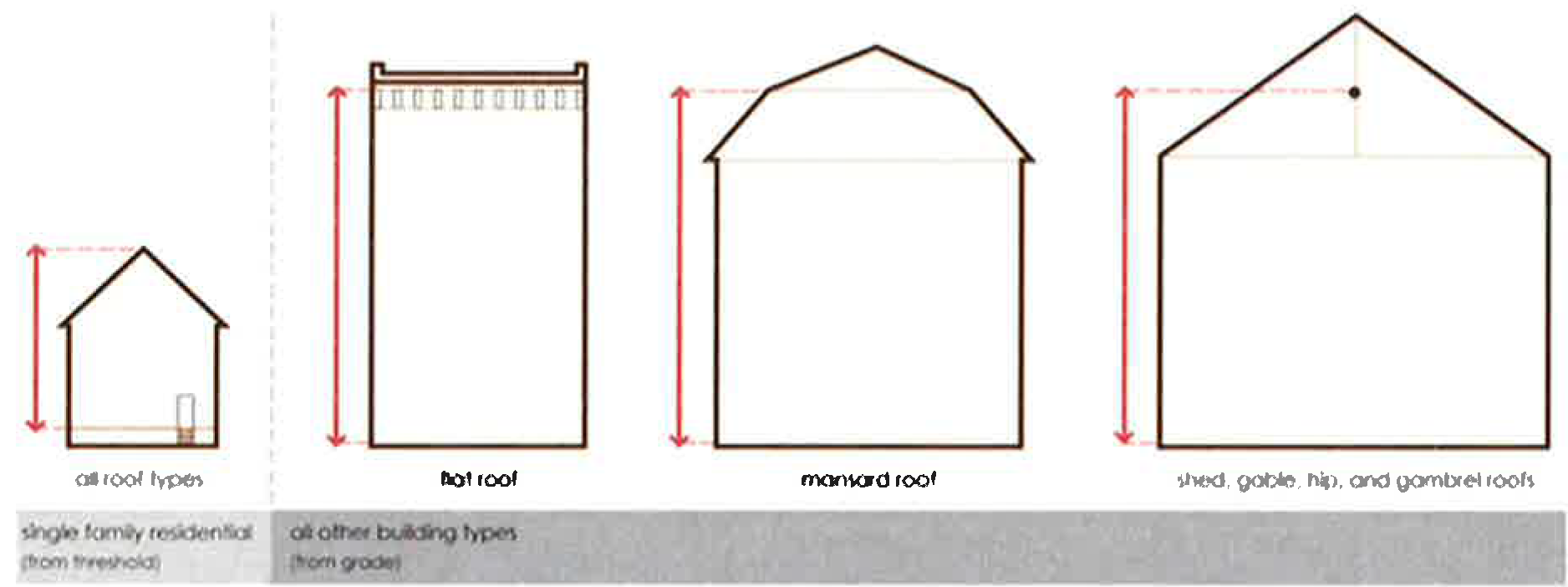
Building Height Measurement
E.
Height requirements.
1.
The maximum height of a new single-family detached dwelling shall comply with the requirements of Table 2.2.
2.
The height limitations established in this chapter shall not apply to the following:
a.
Barns, silos or other similar structures when located on farms; belfries, steeples, cupolas and domes; chimneys; and flagpoles.
b.
Bulkheads, elevator penthouses, rooftop mechanical equipment, water tanks and scenery lofts and similar structures, provided that these structures shall not cover more than 25 percent of the total roof area of the building on which the structures are located.
c.
Telecommunications towers and antennas otherwise permitted by this chapter by special administrative permit or permitted by special land use permit by the city council pursuant to section 4.2.57.
d.
Any single-family detached dwelling that exceeds the building height limitations set forth in subsection E.2.a. of this section and has been damaged by fire or other act of nature may be reconstructed to its verifiable original height.
e.
When an undeveloped single-family lot is located within a platted subdivision in which at least 60 percent of the lots have had certificates of occupancy issued for single-family detached homes that exceed the building height limitations set forth in subsection E.(1) of this section, a single-family detached residential structure built on the undeveloped single-family lot may be built to a maximum height equal to the average building height of the existing single-family detached homes within the same block in which the undeveloped single-family lot is located.
f.
Rooftop mechanical equipment, vent pipes, lightning rods, solar panels, and/or wind vanes that are less than six feet in height measured from top of roof adjacent to such structure.
(Ord. of 8-2-2017, § 1(5.1.5))
Sec. 5.3.1. - Design standards by street type.
Public and private streets shall be designed according to standards for street classification established in chapter 14 of the Code, except as otherwise provided in section 5.7.6 of this chapter.
(Ord. of 8-2-2017, § 1(5.3.1))
Sec. 5.3.2. - Street connectivity.
A.
Connectivity measures. New streets shall be designed to create an interconnected system of grid-patterned roads, modified only to accommodate topographic conditions. Each new street shall connect to the existing street grid.
B.
Pedestrian connectivity. Common areas shall be connected by pedestrian pathways in accordance with section 5.1.1.C.
C.
Small area transportation plan conformity. New streets shall demonstrate conformance with the intent of any and all city adopted transportation plans, thoroughfare plans and subarea plans.
D.
Waivers. The requirements of subsections A. and B. of this section may be waived by the director of planning in accordance with article 7 of this chapter and as provided below:
1.
Waivers may only be granted for hardships resulting from unusual topography or when access constraints or other requirements imposed by city departments impede compliance.
2.
As part of the waiver request, the applicant shall prepare and submit a site plan, drawn to scale and showing the existing public and private street network, and shall provide an explanation as to how the proposed street plan supports the intent of this section to design an interconnected system of grid-patterned roads.
(Ord. of 8-2-2017, § 1(5.3.2))
Sec. 5.3.3. - Sight visibility triangles.
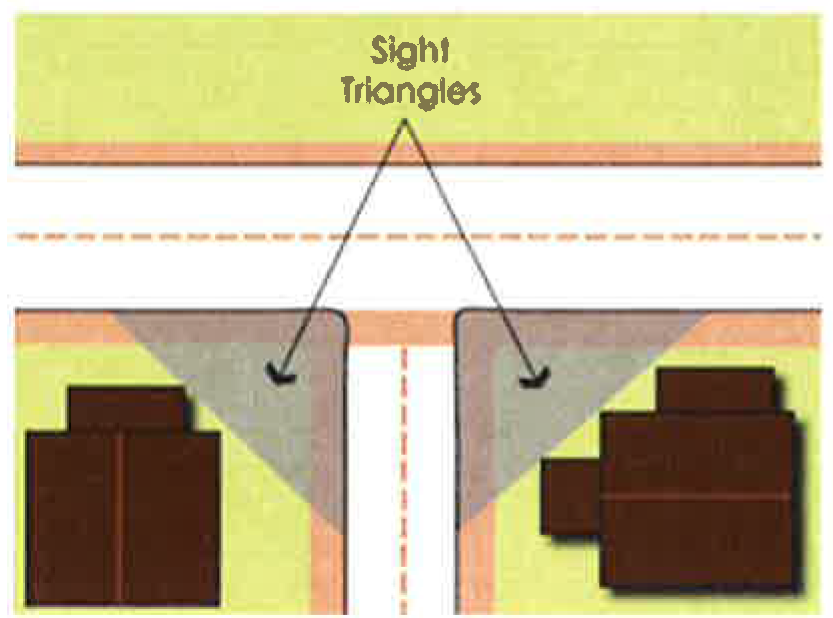
Sight Triangles
A.
No structure, fence, wall, sign, hedge or planting, or any similar improvement will be permitted to obstruct the sight lines or visibility of motorists and/or pedestrians at any intersection of public or private streets or at any driveway intersection with a public or private street. All intersecting streets and driveways must meet the intersection and stopping sight distance requirements as outlined in the American Association of State Highway and Transportation Official's (AASHTOs) A Policy of Geometric Design of Highways and Streets, current edition.
B.
For the purposes of this section, obstructions shall be prohibited if any part thereof is more than 30 inches and less than eight feet above local streets and driveways, or more than 30 inches and less than 12 feet above any street classified as collector or higher.
C.
Properties requiring GDOT approvals shall also comply with GDOT standards for sight visibility triangles and sight distances.
(Ord. of 8-2-2017, § 1(5.3.3))
Sec. 5.3.4. - Traffic impact study.
A traffic impact study, the scope of which shall be determined by the director of the planning department or his designee, necessary to establish the impact of a development project on the surrounding roads and what improvements may be available to mitigate such impacts, is required for any rezoning, special land use permit, sketch plat, and land disturbance or building permit applications for projects reasonably expected to meet any of the following criteria:
A.
Multifamily development with over 300 new units at build-out;
B.
Single-family developments with over 200 new lots or units at build-out;
C.
Retail developments with over 125,000 gross square feet (GSF);
D.
Office developments with over 200,000 GSF;
E.
Medical office developments with over 55,000 GSF;
F.
Industrial/warehouse developments with over 280,000 GSF, employing more than 650 workers, or covering more than 200 acres;
G.
Any mixed-use development which could reasonably expect to generate 2,000 or more gross daily trips; or
H.
Special traffic generating uses, including truck stops, quarries, landfills, stadiums, etc. which would require development of regional impact review.
(Ord. of 8-2-2017, § 1(5.3.4))
Sec. 5.3.5. - Traffic calming features.
New subdivisions may provide a traffic calming structure for every 500 feet of road length. Traffic calming structures, curves and other traffic calming features are subject to the approval of director of the planning department, or his designee, which approval shall be given where the proposed traffic calming structure or traffic calming feature is designed in such a way as to reduce traffic speeds to a reasonably safe speed for the location.
(Ord. of 8-2-2017, § 1(5.3.5))
Sec. 5.4.1. - Purpose and intent.
The requirements and regulations for landscaping in the City of Stonecrest are a critical public concern that are necessary in order to preserve and enhance property values, the aesthetic beauty of the city, and the safety and general welfare of its residents. The intent of landscape regulations is to:
A.
Provide buffering between non-compatible land uses.
B.
Protect, preserve, and promote aesthetic appeal and scenic beauty.
C.
Reduce noise pollution and air pollution.
D.
Reduce stormwater run-off, erosion and degradation of water quality.
E.
Filter and reduce glare from artificial light sources.
F.
Provide shaded areas along streets and in parking areas.
G.
Reduce solar heat islands.
(Ord. of 8-2-2017, § 1(5.4.1))
Sec. 5.4.2. - Applicability.
A.
New developments, principal building or use. The requirements and regulations for streetscape and landscaping apply to principal buildings, new developments or open uses of land constructed or established after the effective date of this zoning ordinance.
B.
Change of use, expansions or reconstruction. Where a change of use, expansion to, or reconstruction of an existing building or site improvements (such as parking lots) impact streetscape and/or landscape improvements, the landscaping requirements shall apply only to the area disturbed in the development process.
C.
Publicly-owned buildings. To the extent allowed by law, the requirements and regulations for streetscape and landscaping apply to improvements to land owned by public agencies except utility rights-of way or easements.
(Ord. of 8-2-2017, § 1(5.4.2))
Sec. 5.4.3. - Streetscape elements and dimensions.
All development shall comply with the streetscape element requirements described below and in Table 5.1. Topping of canopy trees within this section is prohibited.
A.
Streetscape dimensions and placement.
1.
New streets.
a.
Applicability. New streets shall be constructed with continuous streetscape zones on both sides of the street, beginning from back of curb.
b.
Streetscape zone elements for new streets. The streetscape zone on new streets shall consist of a landscape strip, a sidewalk, and, when required per Table 5.1, a supplemental zone.
c.
Sidewalks. Sidewalks shall be provided between the landscape strip and the supplemental zone, as required in Table 5.1 and the figures following the table.
d.
Landscape strips.
i.
Landscape strips shall be located between the curb and the sidewalk.
ii.
Landscape strips shall be designed with street trees and pedestrian scale streetlights as required in Table 5.1 and the figures following the table.
iii.
See subsection C. of this section for planting and materials requirements.
iv.
Large scale retail has additional landscape standards adjacent to streets as provided in section 5.7.8.
e.
Supplemental zone. New streetscape zones in nonresidential areas shall provide a supplemental zone outside the right-of-way on a private easement. Private easement agreements shall be submitted to the director of planning. See subsection D. of this section.
(2)
Improvements on existing streets.
a.
Applicability. New development and redevelopment occurring on existing streets shall provide a streetscape zone on the side of the street where the development takes its access.
b.
Streetscape zone elements for existing streets.
i.
The streetscape zone for existing streets shall consist of a minimum of 11 feet along the existing shoulder, as indicated in Table 5.1.
ii.
The streetscape zone for existing streets shall consist of a landscape strip and a sidewalk, as shown in Table 5.1 and the figures following the table.
c.
Sidewalk and landscape strip dimensions. The width and location of sidewalks and landscape strips shall be determined by the director of the planning department or his designee, based on GDOT standards, if applicable, and compatibility with existing sidewalks and utilities.
d.
Landscape strips.
i.
Landscape strips shall be located between the curb and sidewalk, and/or between the sidewalk and the property line. The required total width of the landscape strip may be distributed on either side of the sidewalk so as to accommodate existing infrastructure.
ii.
Landscape strips shall be designed with street trees and pedestrian scale streetlights as shown in Table 5.1 and the figures following the table.
iii.
See subsection C. of this section for planting and materials requirements.
iv.
Large-scale retail has additional landscape standards as provided in section 5.7.8.
e.
Programmed road improvement projects. If DeKalb County, the City of Stonecrest, or GDOT has a programmed road improvement project along the frontage to be developed, then the streetscape shall be constructed consistent with the design standards for such road improvements plans.
f.
Administrative variance. The director of planning shall have the power to grant administrative variances for streetscape requirements on existing streets upon written request by the property owner and compliance with article 7 of this chapter based on a finding that the requirement of the subsection A.2. of this section would have a significant adverse effect on the historic pattern or cannot be met due to circumstances beyond the control of the applicant, including, but not limited to,
i.
Inadequate right-of-way;
ii.
Conflicting standards between this section and GDOT design standards;
iii.
Unique topographic or subsurface conditions;
iv.
Need to relocate existing utilities.
B.
Sidewalks and interior walks.
1.
Sidewalks shall be paved in concrete and paver accents approved by the director of planning and kept clear and unobstructed for the safe and convenient use of pedestrians.
2.
Sidewalks shall adhere to ADA guidelines.
3.
Sidewalks shall be continued across intervening driveways by continuation of the sidewalk paving materials or other methods of differentiation.
4.
Where newly constructed sidewalks abut existing sidewalks, the newly constructed sidewalk shall provide safe transition of pedestrian traffic flow to the adjacent sidewalks. Development that disturbs existing sidewalks on another property shall replace disturbed areas to their pre-disturbance state and condition.
5.
For uses other than single-family residential, safe and convenient paved pedestrian pathways shall be provided from sidewalks along streets to each building entrance, including pedestrian access routes to parking decks and through parking lots and between adjacent buildings, transit stops, street crossings within the same development. All such pathways shall have a minimum width of three feet.
C.
Landscape strip materials and maintenance.
1.
Required mix of materials. Landscape strips in the streetscape zone shall be planted with a variety of deciduous, over story and understory trees. Species of shrubs, flowering plants, grass and other ground covers, which are well adapted to the local climate, may be included in the landscape strip.
2.
Sidewalks. Sidewalks shall be paved in concrete and paver accents approved by the director of planning and kept clear and unobstructed for the safe and convenient use of pedestrians.
3.
Pedestrian crossing. Landscape strips may include brick, concrete, or granite pavers where on-street parking is provided or regular pedestrian crossing of the landscape strip is reasonably anticipated to occur.
4.
Maintenance. Required landscape strips shall be established and maintained by the owners. Topping of canopy trees is prohibited.
5.
Permanent structures. Permanent structures such as buildings, driveways that are not perpendicular to the landscape strip, parking spaces, dumpsters, drainage structures and detention facilities shall be prohibited in required landscape strips. The prohibition of this subsection shall not include crossings perpendicular to the strip, necessary retaining walls four feet or lower, bike racks, benches, trash receptacles, signs, mailboxes, and drainage swales.
6.
Planting specifications, all trees.
a.
Planting areas for trees shall contain a minimum depth of 12 inches of screened topsoil. Below 12 inches the soil shall be uncompacted to a depth sufficient to allow proper drainage and root growth.
b.
Use of root barriers such as U.B.36 or an equivalent is required at the back of the sidewalk or back of the curb if no sidewalk exists.
c.
Trees shall meet the standard for American Nursery Stock ANSI Z60.1.
7.
Street trees.
a.
Street trees shall be overstory trees unless site constraints prohibit the use of large maturing trees, subject to the approval of the director of planning.
b.
Street trees shall be provided with spacing as depicted in Table 5.1.
c.
Street trees shall not be planted closer than 20 feet from the curb line of intersecting streets and not closer than ten feet from intersecting lines of alleys or private drives.
d.
Street trees shall not be planted closer than 12 feet from light standards. No new light standard location shall be positioned closer than ten feet to any existing street tree.
e.
Street trees shall not be planted closer than 2½ feet from the back of the curb.
f.
Where there are overhead power lines, street tree species are to be chosen from a list provided by the city arborist that will not interfere with those lines.
g.
Street trees, as they grow, shall be pruned to provide at least eight feet of clearance above sidewalks and 12 feet above driveways and roadway surfaces.
h.
Street trees shall be a minimum of two-inch caliper measured at six feet above ground level at the time of planting and shall have a mature height of at least 25 feet.
i.
Street trees shall be planted in a mulched area of at least 25 square feet.
D.
Supplemental zone.
1.
In supplemental zones in commercial areas where building setbacks are 15 feet or less, the supplemental zone must contain hardscape and street furniture such as trash receptacles, bike racks, and benches.
2.
For additional requirements for supplemental zones abutting parking lots, see section 5.4.4.
E.
Street lighting. Street lighting shall be accomplished with pedestrian scale lighting and street lights. Street lights shall be placed on property lot lines abutting the street. Lighting plans must be approved by the director of the planning department or his designee. Lighting shall be installed by local power company employees or contractors.
F.
Administrative variance. An administrative variance to streetscape standards may be granted by the director of planning for adaptive reuse and redevelopment projects as specified in this section or to preserve historic patterns. In addition to other required materials, an applicant for an administrative variance to the streetscape standards shall include a site plan, drawn to scale, showing the existing right-of-way and specific conditions of the lot.
Table 5.1. Required Streetscape Dimensions
* Location of street trees is subject to infrastructure and utility locations and approval by the city arborist and GDOT if state roads.
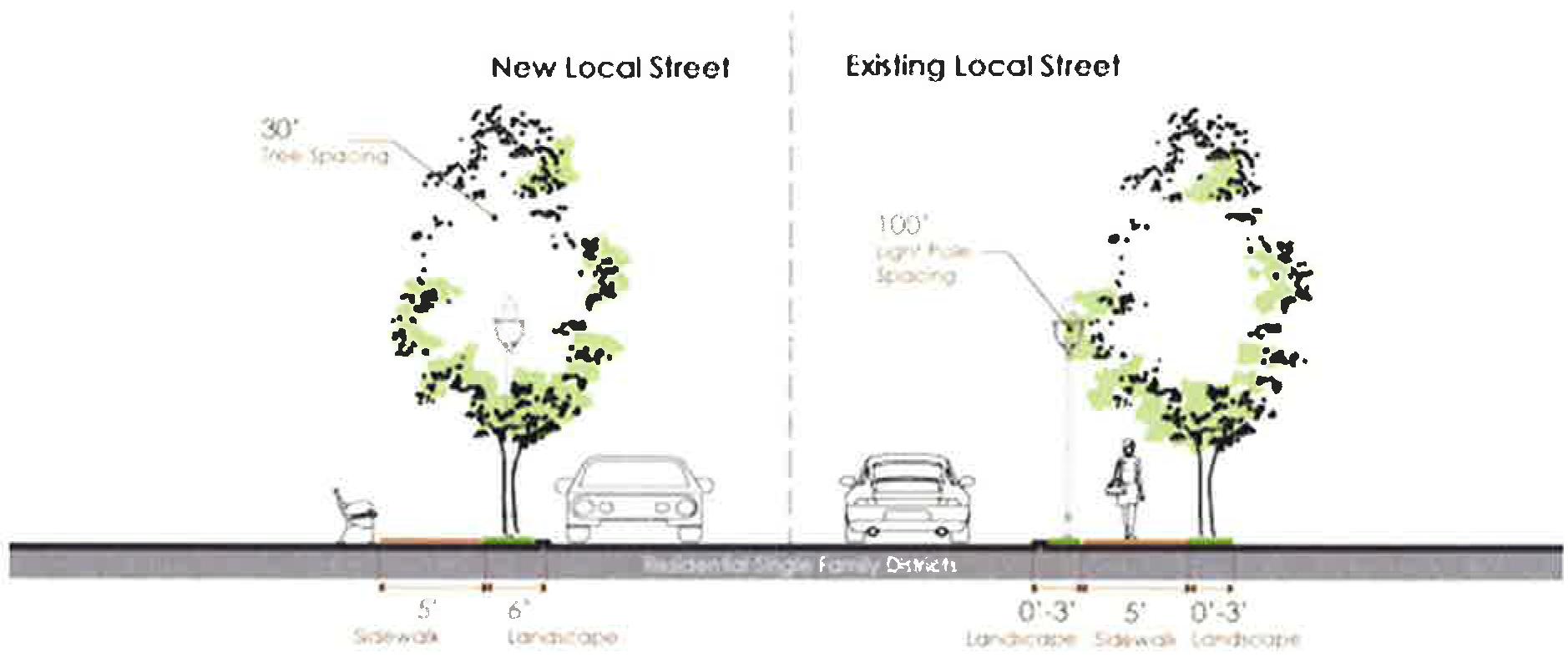
Streetscape Figure—Local Streets, Single-family Residential Districts
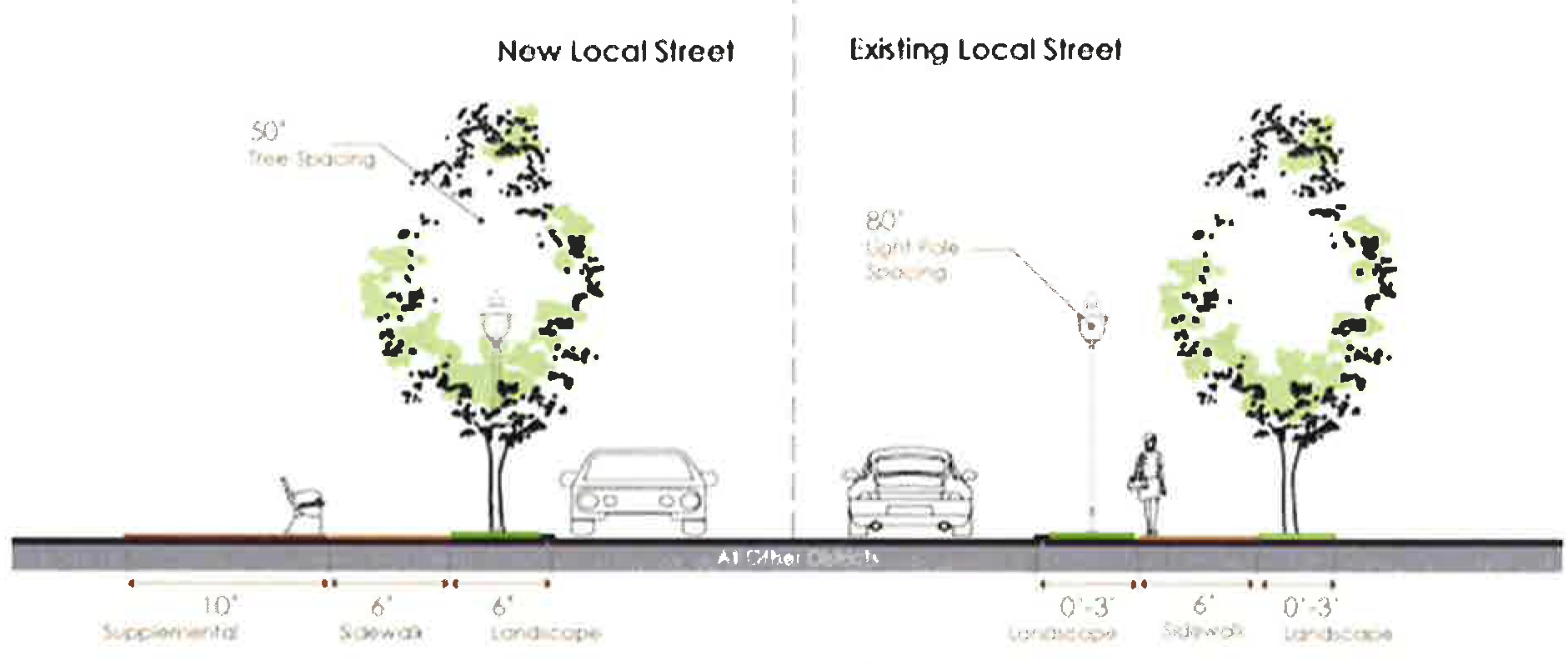
Streetscape Figure—Local Streets, all Other Districts
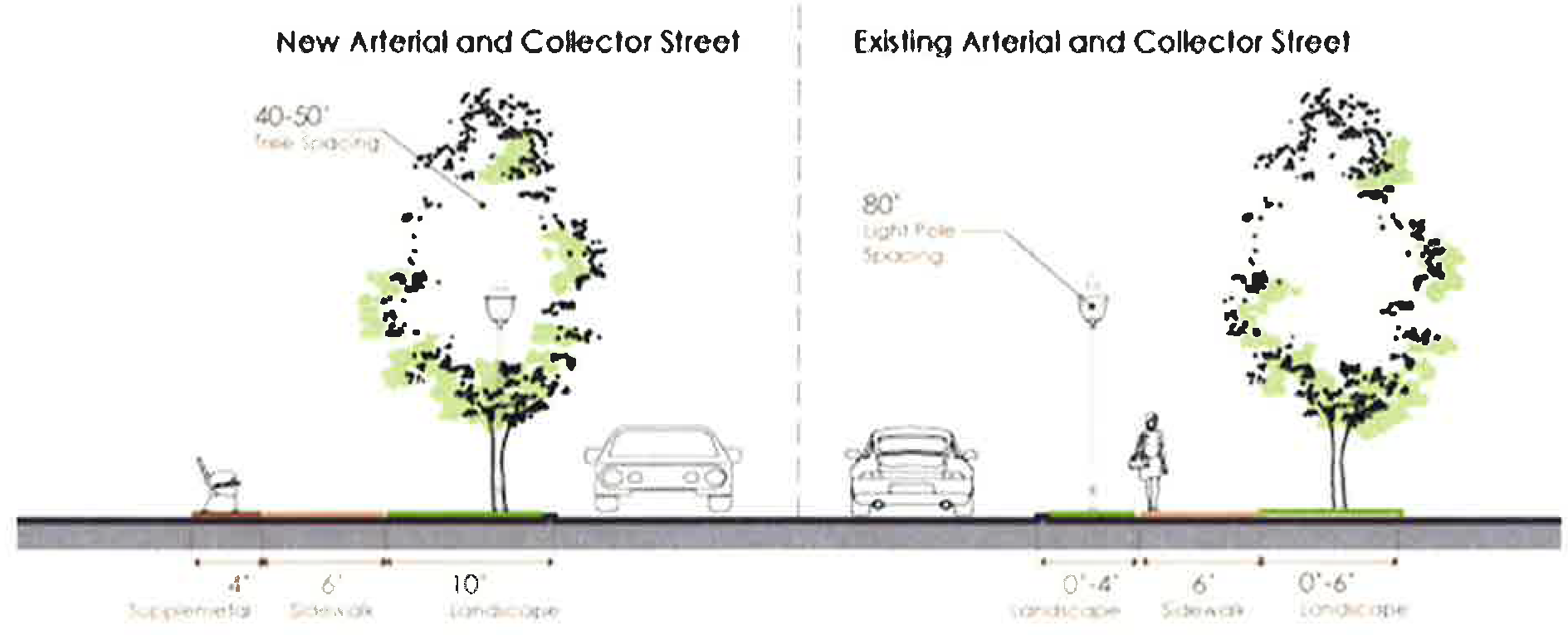
Streetscape Figure—Arterial and Collector Streets
(Ord. of 8-2-2017, § 1(5.4.3))
Sec. 5.4.4. - Site and parking area landscaping.
A.
Single-family residential lots. Each single-family residential lot on which new development occurs shall be planted with a minimum of three new trees. Street trees along the lot frontage shall count towards this requirement. The species and specifications for the trees to be planted in compliance with this requirement shall meet the requirements of a list approved by the city arborist.
B.
Interior strips. Interior to nonresidential, mixed-use and multifamily developments, three-foot-wide planted landscape strips shall be required along all interior drives and pedestrian paths.
C.
Property perimeter landscape strip. Along nonresidential, mixed-use and multifamily development perimeter lot lines, a perimeter landscape strip shall be required, as follows:
1.
A five-foot-wide continuous perimeter landscape strip is required along all property lines that are not subject to streetscape requirements. This applies to individual tenant sites interior to a master planned project, even in instances where individual tenant sites do not have separately platted lot lines.
2.
A perimeter landscape strip shall include one overstory deciduous shade tree, or three understory or three evergreen trees, for every 50 linear feet at a minimum size of two-inch caliper for deciduous trees and eight-foot height for evergreen trees.
3.
A perimeter landscape strip is not required where a transitional buffer is also required.
D.
Parking area landscaping. All surface parking lots that contain a total of 15 or more parking spaces that are constructed or redeveloped subsequent to the effective date of the ordinance from which this chapter is derived shall comply with the following requirements:
1.
A minimum of ten percent of the total lot area of the parking lot shall be landscaped.
2.
Non-continuous barrier curbs shall be installed around the perimeter of the parking lot and around landscaped areas that are required herein, except where the perimeter abuts an adjacent building or structure and except at points of ingress and egress into the facility, so as to prevent encroachment of vehicles onto adjacent property, rights-of-way, sidewalks and landscaped areas.
a.
Barrier curbs shall be a minimum of six inches in height and six inches in width, shall be concrete or stone, shall be securely installed, and shall be maintained in good condition.
3.
A continuous hedge, berm, or short wall with landscaping thereon, not to exceed three feet in height shall be required between surface parking and an adjacent public street right-of-way.
4.
Tree and island quantity. A minimum of one tree per eight parking spaces, and one island per ten parking spaces, shall be provided.
5.
Landscape islands. All trees planted in a parking lot shall be planted in a landscape island, which island shall be a minimum of 250 square feet.
6.
In addition to trees, ground cover shall also be provided in order to protect tree roots and to prevent erosion. Ground cover shall consist of shrubs, ivy, liriope, pine bark mulch, or other similar landscaping material.
7.
Ground cover shrubs in parking area landscaping shall be maintained at a maximum height of 30 inches, except where such shrubs are screening the parking surface from an adjacent residential area.
8.
Newly planted trees in parking area landscaping shall be a minimum of two-inch caliper as measured at a height of six inches above ground level, shall be a minimum of ten feet in height at planting, shall have a 30-foot minimum mature height, and shall be drought tolerant. Trees shall be planted at least 30 inches from any barrier curb, so as to prevent injury to trees from vehicle bumpers. A minimum of 75 percent of the trees planted pursuant to these requirements shall be deciduous hardwood shade trees.
9.
All landscaped areas shall be properly maintained in accordance with landscape plans approved as part of the land disturbance permit. In the event that a tree or any plant material dies, it shall be replaced within 12 months so as to meet all requirements of this section and to allow for planting in the appropriate planting season.
10.
All trees planted pursuant to the requirements of this section shall be counted for the purpose of meeting the tree planting and tree replacement requirements required by chapter 14 of the Code.
(Ord. of 8-2-2017, § 1(5.4.4))
Sec. 5.4.5. - Transitional buffers.
A.
Intent. Transitional buffers are intended to create a visual screen in order to diminish the potential negative impacts of nonresidential and mixed land uses on adjacent residential land uses. Similarly, transitional buffers diminish the potential negative impacts of higher intensity residential development on adjacent single-family residential land uses.
B.
General requirements. Natural or planted transitional buffers required by this article shall be established and permanently maintained by the property owner as follows:
1.
The required transitional buffer shall be depicted in detail on each site plan or plat prior to final approval. Type and location of natural and planted vegetation shall be included.
2.
Within the transitional buffer, the natural topography of the land shall be preserved and existing growth shall not be disturbed except where necessary to remove dead or diseased trees and undergrowth or to enhance the buffer with additional landscaping in order to provide a screen so as to prevent view of the higher density development from the lower density development.
3.
Grading or construction adjacent to the transitional buffer zone shall not disturb or encroach upon the transitional buffer zone.
4.
Notwithstanding subsection B.3. of this section, if grading is required in the transitional buffer in order to prevent or control erosion, the area of such grading shall cover no more than 20 percent of the required transitional buffer, shall be immediately replanted upon completion of easement improvements and shall avoid disturbance of the soil within the dripline of trees within the transitional buffer.
5.
Any approved utility crossings shall be perpendicular to the transitional buffer.
6.
A pedestrian walkway, a maximum width of five feet, may be located in the buffer to provide pedestrian access to the adjoining property. Where a pedestrian walkway is provided, a gate shall be installed in the required screening fence.
7.
If existing vegetation in a buffer area does not meet the transitional buffer standards, a five-foot-high, landscaped berm may be installed subject to the approval of the city arborist. Grading to construct the berm shall not remove significant plants designated by the city arborist as part of the approval of the landscaped berm.
C.
Buffer planting and materials. When the conditions of the existing natural topography and vegetation are insufficient to achieve the visual screening required by this section, a landscape planting plan to enhance the transitional buffer shall be prepared and implemented to supplement existing natural growth or to provide new plant materials of such growth characteristics as will provide a screen meeting the standards below:
1.
Planting height. Proposed planting as part of an enhanced transitional buffer shall have a height of at least six feet at the time of planting and planted in a minimum of two rows, with staggered on center spacing such that a continuous opaque screen is created within two years of planting.
2.
Plant types. Plant species in an enhanced transitional buffer shall be evergreen, native, naturalized or other species well-adapted to the local climate and rainfall patterns, disease and pest-free, healthy and vigorous, and meet standard for American Nursery Stock, ANSI Z60.1.
3.
Plant functions. Plants shall be approved from a list made available from the planning department, but shall not be exclusive of other plants which may be suitable, provided they can provide a continuous opaque screen.
4.
Fences. Fences are required with transitional buffers and shall meet the requirements of section 5.4.7.
5.
Wall and fence finishes. Walls and fences shall be constructed with the finished or decorative side facing outward from the property.
D.
Buffer dimensions and specifications. Table 5.2(a) identifies the transitional buffer class required for each zoning district based on the zoning district to which it is adjacent. Table 5.2(b) summarizes the minimum width of the required transitional buffer for each transitional buffer class (A-E).
Table 5.2(a). Transitional Buffer Class by District
* R= RE, RLG, R-100, R-85, R-75, R-60 (except when R-60 use is single-family attached).
** Where the Mixed Residential District has single-family units along an adjacent residential (R) boundary, then a transitional buffer is not required.
Table 5.2(b). Transitional Buffer Minimum by Buffer Class
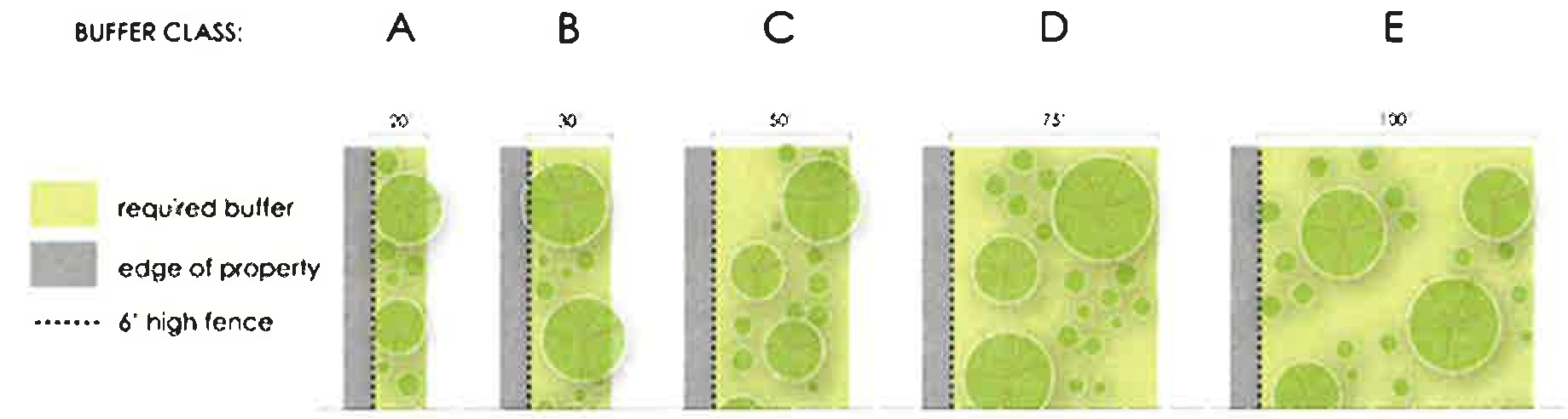
Transitional Buffers Figure
(Ord. of 8-2-2017, § 1(5.4.5))
Sec. 5.4.6. - Screening.
Trash and recycling areas, loading areas, mechanical and utility equipment, parking decks, detention facilities, and outdoor storage shall be surrounded by opaque fences, walls, or vegetation. Vegetative screening shall be at least 75 percent evergreen, with a minimum of two rows of plants, and shall grow to a height of six feet in two years.
A.
Loading areas. All loading areas must be screened from view so as not to be visible from any public street or adjacent property.
B.
Trash and recycling areas. All dumpsters must be screened from view on all four sides so as not to be visible from adjacent properties and the public street. The screen may incorporate access to the dumpster by using a wood fence or other opaque device to serve as a gate.
C.
Parking decks. All parking decks and aboveground parking structures shall have a six-foot-wide landscape strip immediately contiguous to the facade of the parking deck or structure, unless otherwise screened from view by an intervening building.
D.
Mechanical and utility equipment. All mechanical and utility equipment must be screened from view so as not to be visible from any public street.
E.
Detention facilities. In addition to fencing requirements set forth in chapter 14 of the Code, detention facilities shall be planted with evergreen plant material consistent with buffer standards in section 5.4.5.C. No trees shall be allowed in the ten-foot maintenance shelf. However, detention facilities designed as open space amenities may be approved by the director of planning and in compliance with division 5 of this article. A detention facility located in an historic district that is subject to architectural design review shall require a certificate of appropriateness, for appearance only, from the City of Stonecrest Historic Preservation Commission.
F.
Outdoor storage. See section 4.2.38 for screening regulations for outdoor storage of materials, supplies, equipment or vehicles regulations.
(Ord. of 8-2-2017, § 1(5.4.6))
Sec. 5.4.7. - Walls, fences, and retaining walls.
A.
General.
1.
When this chapter requires a wall or fence to be constructed, the wall or fence shall be completed prior to the issuance of a certificate of occupancy for the principal structure.
2.
No wall or fence shall be constructed in any public right-of-way.
3.
See Table 5.3, Fence and Wall Standards for additional requirements.
B.
Single-family residential standards.
1.
Fences or free-standing walls constructed in a front yard shall not exceed four feet in height.
2.
No freestanding wall or fence, other than a retaining wall, shall be more than eight feet high from finished grade.
3.
Subdivision or project identification monuments at the entrance to a subdivision or residential development that incorporates a wall or fence shall only be located in a common area or private easement and shall not exceed six feet in height.
4.
Retaining walls on lots developed with single-family dwellings shall abide by the following:
(1)
The entire wall structure, including footer, shall not encroach on adjacent property;
(2)
Drainage shall be properly conveyed on both sides of the wall in conformance with state and city codes; and
(3)
A construction/maintenance easement shall be obtained from the adjoining property owner, if applicable.
Newly constructed retaining walls shall not be higher than four feet; however, existing retaining walls may be repaired and replaced so long as the height of the repaired or replaced wall is no greater than the original height of the wall.
a.
If exceptional topographical restrictions exist that were not created by the owner or his agent on a lot, and it is established to the reasonable satisfaction of the director of planning that no practical alternative design of such wall is feasible, then the director of planning may, upon application therefor, grant an administrative variance allowing up to two additional feet in the applicable retaining wall maximum height limitation set forth in this subsection B.4 of this section. An applicant for a retaining wall administrative variance shall include with the application a certified field-run site plan or a topographical map certified by an engineer or landscape architect.
b.
If exceptional topographical restrictions exist that were not created by the owner or his agent on the lot, and it is established to the satisfaction of the zoning board of appeals that no practical alternative design of such wall is feasible, the zoning board of appeals may, upon application therefor, grant a variance allowing newly constructed retaining walls to be greater than six feet. Notwithstanding any provision in this chapter to the contrary, no variance may be granted to allow the height of a retaining wall above eight feet. In addition to the materials otherwise required for a variance in division 5 of article 7 of this chapter, an applicant for a retaining wall variance shall provide a certified field-run site plan or a topographical map certified by an engineer or landscape architect with the application for the variance.
C.
Height. The height of a wall or fence is measured along the adjacent finished grade. However, if located within 15 feet of any street, and if the street grade is above the adjacent finished grade, the fence or wall height may be measured from the street grade.
D.
Material composition.
1.
No freestanding walls, retaining walls or fences may be composed of exposed common concrete block, tires, junk, pallets, railroad ties, loose stone, vinyl and other discarded materials.
2.
With the exception of M and M-2 zoning districts, fences, freestanding walls or retaining walls erected within the front yard shall be constructed of brick, stone, wood, wrought iron, or aluminum that looks like wrought iron. Any other material, including, but not limited to, chain link and other wire fences are prohibited in the front yards of all districts, with the exception of M and M-2 zoning districts.
E.
Security gates. Entrance gates for vehicles shall be located at least 50 feet from the property line in order to ensure safe queuing, ingress to and egress from the property.
F.
Temporary fencing may be erected during construction for security and public safety purposes.
G.
Fences and walls in the M and M-2 zoning districts are exempt from regulations governing the height and materials of fences and walls.
H.
No freestanding wall or fence in a multifamily, nonresidential or mixed use zoning district may be more than ten feet in height.
Table 5.3. Fence and Wall Standards
(Ord. of 8-2-2017, § 1(5.4.7))
Sec. 5.5.1. - Applicability.
A.
All development that is required to have open space shall, upon application for a land disturbance permit, identify all open space by a functional category established pursuant to the requirements of this chapter. Further, in commercial and mixed-use developments, open space requirements of individual parcels may be met by open spaces that are owned, maintained, and held in common for use by multiple properties that are subject to legal agreement for maintenance and association approved by the director of planning.
B.
The open space requirements in division 5 of this article do not apply to residential subdivisions with less than five acres or less than 36 residences.
C.
The minimum quantity of open space for approved developments is established by zoning district and controlled by Table 5.4.
D.
Open space shall be maintained as open space until such time that the entire existing development is proposed for redevelopment and shall be landscaped with trees, shrubs, flowers, grass, stones, rocks or other landscaping materials.
E.
Open space may include hardscape elements depending on functional type as described in Table 5.6. If serving a conservation function, open space may be preserved in a natural state without enhancements.
(Ord. of 8-2-2017, § 1(5.5.1))
Sec. 5.5.2. - Maintenance, management and ownership.
A.
Ownership and management of open space . Open space shall be owned by one of the following entities, which shall be responsible for maintenance and management as described herein:
1.
City of Stonecrest.
a.
Open space agreements may be made with the city to deed the required open space to the city. City of Stonecrest is under no obligation to accept any proposed dedication of open space used to meet the requirements of this division.
b.
Public access easement agreements may be made with the city for open space so dedicated by the owner for city trails, parks or other public recreational amenities, as agreed to by City of Stonecrest and whereby maintenance agreements shall be executed between the owner and city.
2.
Land conservancy or land trust. The responsibility for maintaining the open space and any facilities located thereon may be transferred to a land conservancy or land trust, subject to prior approval by City of Stonecrest.
3.
Homeowners or property owners association. A homeowners or property owners association representing residents or property owners of the subdivision may own and be responsible for maintenance and management of open space. Membership in the association shall be mandatory and automatic for all homeowners or property owners, and their successors. The homeowners/property owners association shall have lien authority to ensure the collection of dues from all members. The Homeowners or property owners association organizational documents must first be submitted to the director of planning for review to ensure compliance with this subsection. The homeowners or property owners association shall be formed and maintained in compliance with all applicable state law.
4.
Recording of open space. Open space shall be shown on the final approved plat as a conservation easement, permanent restrictive covenant or equivalent legal document in a form approved by the City of Stonecrest, which shall include a provision rendering the covenant or document void when a property is being redeveloped or redesigned, in which case applicable zoning standards shall apply to ensure consistency with this chapter. At no time shall the development provide less than the required open space.
B.
Maintenance of open space.
1.
Undeveloped open space used to satisfy the requirements of this division shall be preserved in a natural state except for the removal of litter, dead trees, invasive species and plant materials that obstruct pedestrian movement, as well as other maintenance necessary to preserve the natural state of the open space as approved by the director of planning. Natural water courses and stream channels shall be kept free of litter and obstructions and shall be maintained so as to not alter floodplain levels, and as required by stream buffer regulations in chapter 14 of the Code.
2.
Open space shall be maintained so that there exist no hazards, nuisances or unhealthy conditions.
3.
Permitted elements as described in Table 5.6 shall be maintained in good repair.
4.
New landscaping in required open space shall be maintained such that planted materials that die within one year of the installation, shall be replaced within six months or the next appropriate planting season as determined by the city arborist.
(Ord. of 8-2-2017, § 1(5.5.2))
Sec. 5.5.3. - Standards and design.
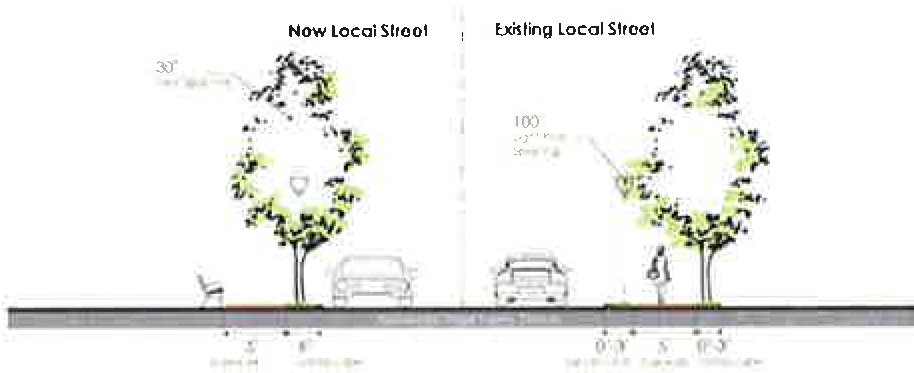
Open Space and Enhanced Open Space Calculations
A.
Required open space shall meet the standards of Table 5.4, Enhanced Open Space: Minimum Requirements.
B.
All deeded open space created shall be platted and provide a public access easement in a form approved by the City of Stonecrest.
C.
Prior to issuance of a land disturbance permit or building permit:
1.
For development projects with residential uses requiring enhanced open space, no lot or multifamily building shall be more than one-quarter mile distance from a designated enhanced open space. If site constraints limit access to the enhanced open space, the distance may exceed the minimum setback requirement of this subsection, subject to the approval of the director of planning. Measurement of distance shall be based on the distance of road and/or pathway providing connectivity to the enhanced open space.
2.
A development project with residential uses not within one-half mile distance to a public park or recreation facility that is required to provide enhanced open space shall incorporate at least one enhanced open space type identified as clubhouse/pool amenity, neighborhood park with active recreation, and/or playground. If a development is intended for senior housing, a passive park with benches and paved paths, common patio, courtyard, barbecue/fire pit shall be considered an enhanced open space.
3.
For development projects with residential uses within one-half mile of an existing or programmed public school, park, trail or library, the applicant for a land disturbance permit shall provide for pedestrian access to the school, park, trail or library. If an existing or future pedestrian network and/or multi-use trail is identified by City of Stonecrest, the applicant may be required to provide a future reservation for such a connection. Where a programmed facility has no current concept design for potential alignment, an applicant for a land disturbance permit requiring connection to a park shall meet with the planning department to determine whether any reasonable spur connection would be possible.
a.
For measurement of distance to a qualifying public amenity, measurement shall be taken along an improved walkway or sidewalk to the entrance of the public amenity.
b.
For measurement to nearby existing or proposed public trail or greenway, measurement shall be taken from a point along the exterior boundary of the development directly to the nearest point of the trail or greenway.
D.
Enhanced open space. Enhanced open space shall be required as set forth in Table 5.4. Standards for enhanced open space are found in Tables 5.5 and 5.6. In addition, each function may be designated as either public (subject to the approval of and acceptance by the City of Stonecrest) or private ownership.
E.
Open space and enhanced open space standards.
1.
Required open space shall conform to the zoning district requirements in article 2 of this chapter. Where Table 5.4 conflicts with article 2 of this chapter, article 2 shall prevail. Open space and enhanced open space design within an historic district that is subject to architectural design review shall require a certificate of appropriateness from the City of Stonecrest Historic Preservation Commission.
2.
Lakes or ponds may be included as part of the open space requirements in a development, provided they are incorporated as part of enhanced open space design, subject to limitations of the riparian buffer as set forth in chapter 14 of the Code.
3.
Dry detention basins shall be designed by a professional engineer and may not count toward open space area requirements unless designed as an amenity or aesthetic feature.
4.
Enhanced open space may include hard space surface areas in accordance with the permitted elements identified in Table 5.6.
5.
Below ground utilities or facilities may be located in the open space area.
6.
Designated wetlands and dedicated conservation areas for native species and/or vegetation may count toward open space requirements in accordance with Table 5.5.
7.
Open space adjacent to existing buildings that have historical or cultural significance may be counted toward the minimum required open space if made accessible for the common usage of the development. However, the enclosed building area may not be included in the minimum required open space requirement.
8.
Stormwater facilities may be located within open space if the stormwater facility is designed and approved as an amenity and/or low impact stormwater management technique, and is in compliance with applicable regulation of chapter 14 of the Code, including approved best management practices. Such facilities may be exempt from fencing, provided that the public health safety and welfare is not jeopardized by the lack of fencing as determined by the director of planning.
F.
Residential lots and yards. No residential lots shall be allowed to extend into the required open space nor shall individual residential yards count toward open space requirements.
Table 5.4. Enhanced Open Space: Minimum Requirements
G.
Enhanced open space standards and types.
1.
Enhanced open space areas are areas readily accessible, practical, and generally acceptable for active or passive recreation uses. If able to meet these characteristics, enhanced open space areas may not include required setback areas, drainage easements required by the City of Stonecrest or DeKalb County, dedications with existing above ground facilities, or contain structures not intended for landscape or recreational purposes.
2.
Maintenance of such areas is not the responsibility of the City of Stonecrest unless formally established and approved by the city through legal agreements. Maintenance shall be the responsibility of the owner or homeowner association in a form approved by the City of Stonecrest.
3.
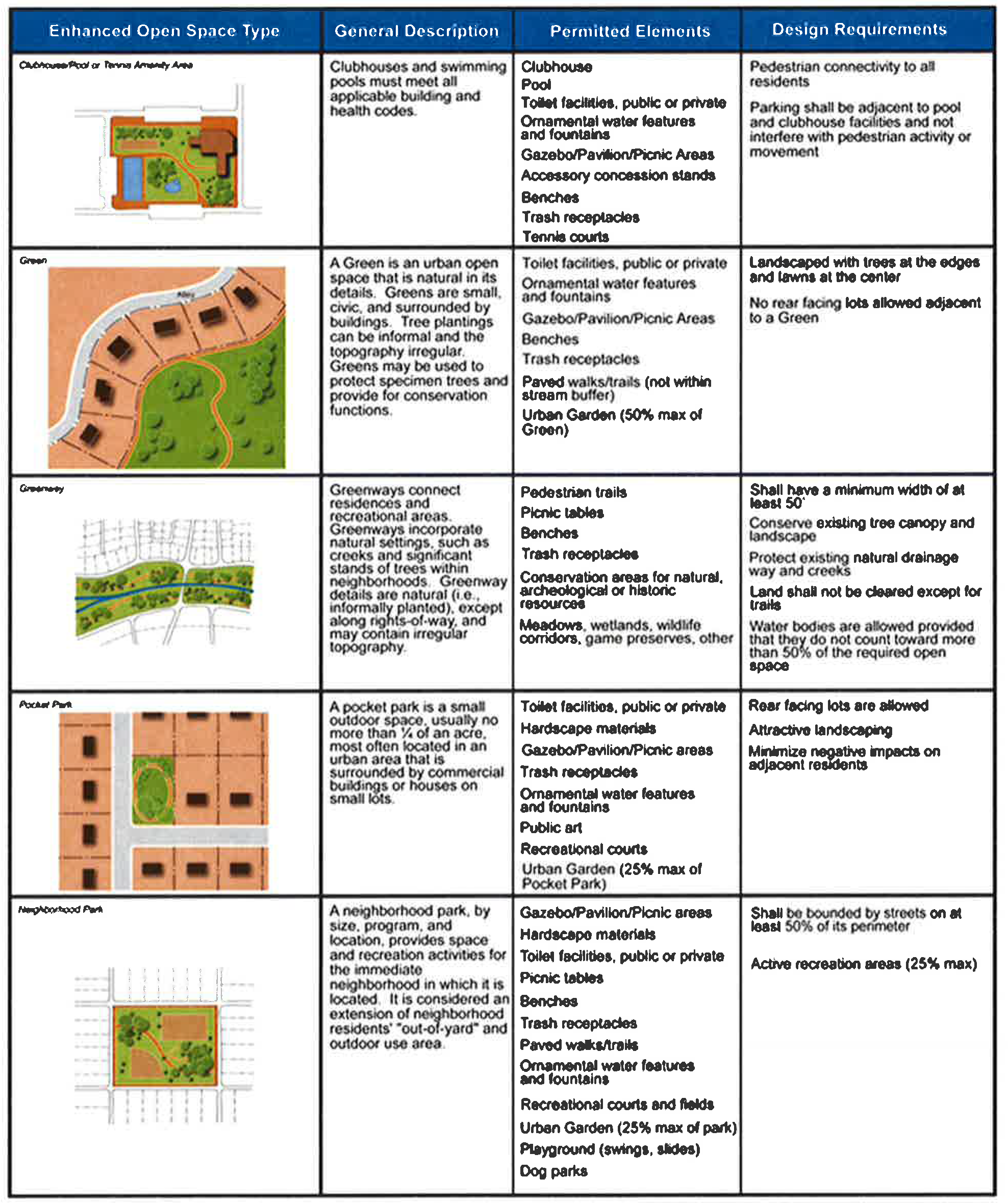
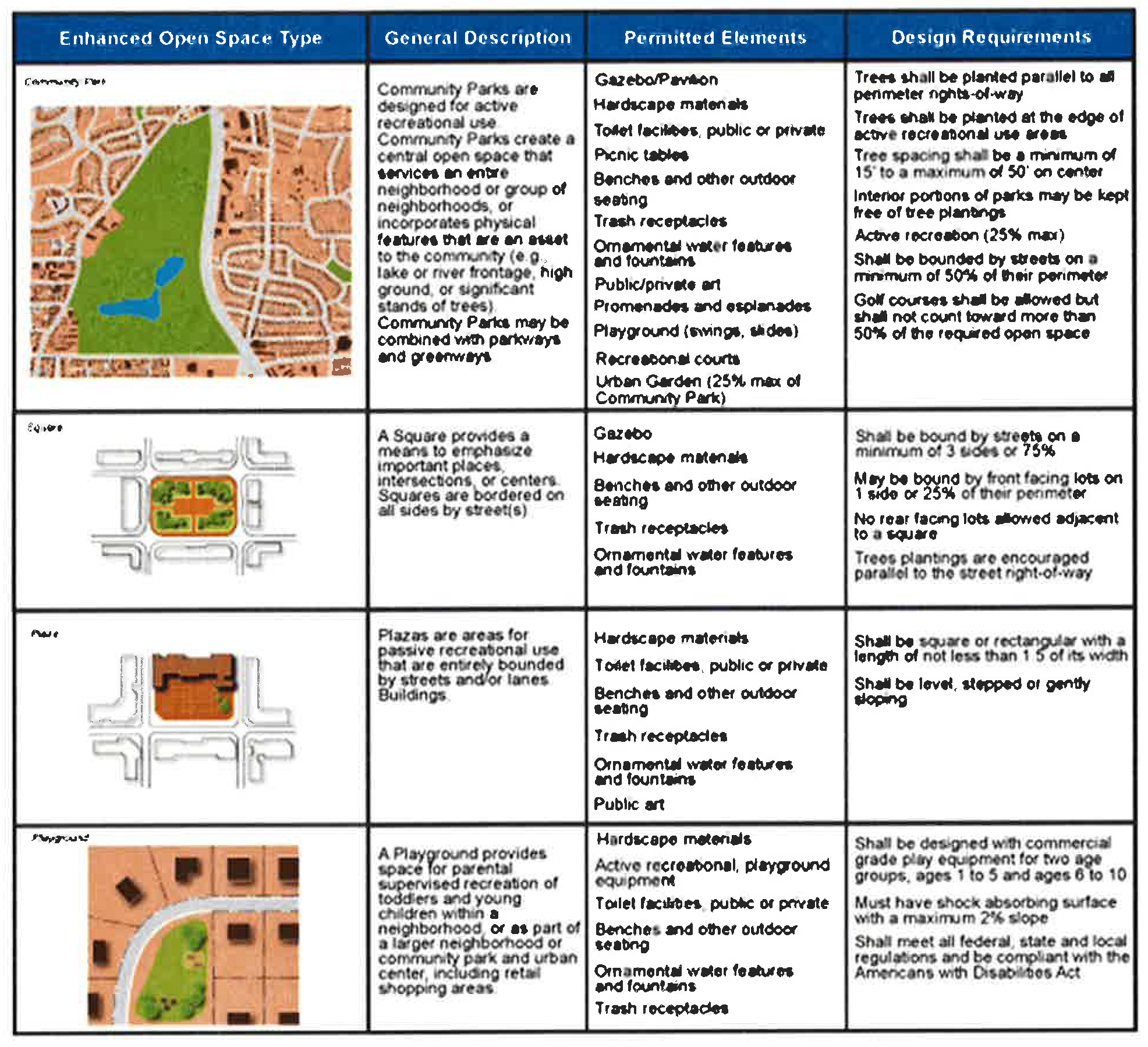
Total enhanced open space may be distributed throughout the project, but each individual enhanced open space type shall meet the enhanced open space dimensional standards of Table 5.5.
4.
Elements shown under the Permitted Elements column in Table 5.6 are allowed for the various enhanced open space types. Other elements that are not listed may be allowed by the director of planning if they are consistent with the enhanced open space type.
5.
Table 5.5 establishes enhanced open space types and minimum dimensional standards. The minimum size for any enhanced open space type shown in Table 5.5 may be reduced below the minimum amount if another enhanced open space type in the same development is increased by a corresponding amount above the minimum size shown in Table 5.5. Table 5.5 is supplemented further by Table 5.6 which provides design requirements for each type.
6.
Table 5.6 establishes the requirements for each enhanced open space type and its associated design requirements. Elements may be required by specific development types according to Table 5.6.
Table 5.5. Enhanced Open Space Types with Minimum Size
H.
Phasing provisions. If a project's required open space is developed in phases, the amount of open space shall be computed separately for each phase, but may be combined with existing open space in earlier phases:
1.
The first phase of development shall contain, at a minimum, its pro rata share of the total amount of required open space based on the size and type of the development; and
2.
The total amount of open space set aside in each phase shall meet the open space standard as applied to the total area of the phase and previously approved phases.
I.
Conservation or water quality.
1.
No more than 50 percent of required open space may consist of floodplain, wetlands, steep slopes, streams and buffers.
2.
Green roofs may contribute to open space minimum area requirements with documentation from a licensed professional that such feature serves a water quality or alternative stormwater function.
J.
Prohibited uses of open space. The following shall not be considered when calculating open space:
1.
Individual wastewater disposal systems, such as septic tanks, septic fields, etc.
2.
Private yards that are not subject to an open space or conservation easement.
3.
Public street rights-of-way or private street easements, including streetscapes located within those rights-of-way or easements.
(Ord. of 8-2-2017, § 1(5.5.3))
Sec. 5.6.1. - Outdoor lighting.
Lighting must provide adequate vehicular and pedestrian visibility and security of on-site areas, such as building entrances, parking, service delivery and pedestrian walkways. A professional outdoor lighting plan shall be required for all non-single-family residential developments of three acres or more and for community recreation that proposes to use outdoor lighting.
A.
Exceptions. This section shall not apply to the following:
1.
Lighting established by a governmental authority within public rights-of-way.
2.
Lighting activated by motion sensor.
3.
Construction or emergency lighting provided it is temporary and is discontinued immediately upon construction completion or emergency cessation.
4.
Security lighting less than two average footcandles.
5.
Sites requiring fewer than five lighting fixtures.
6.
In subsections A. 1. through A.5. of this section, lighting in all zoning districts shall be established in such a way that no direct light is cast upon or adversely affects adjacent properties and roadways.
B.
All lighting fixtures.
1.
Lighting in all zoning districts shall be established in such a way that no direct light is cast upon or adversely affects adjacent properties and roadways.
2.
Light fixtures shall include glare shields to limit direct rays onto adjacent residential properties.
3.
All lighting fixtures (luminaries) shall be cutoff luminaries whose source is completely concealed with an opaque housing. Fixtures shall be recessed in the opaque housing. Drop dish refractors are prohibited.
4.
Light source shall be light emitting diodes (LED), metal halide, or color corrected high-pressure sodium not exceeding an average of 4½ footcandles of light output throughout the parking area. A single light source type shall be used for any one site. Fixtures must be mounted in such a manner that the cone of the light is not directed at any property line of site.
5.
The minimum mounting height for a pole is 12 feet. The maximum mounting height for a pole is 25 feet, excluding a three-foot base.
C.
Lighting plans. Lighting plans shall include the following:
1.
The location and mounting information for each light.
2.
Illumination calculations showing light levels in footcandles at points located on a ten-foot center grid, including an illustration of the areas masked out per the requirements regarding points of measurements.
3.
A schedule listing the fixture design, type of lamp, distribution and wattage of each fixture, and the number of lumens.
4.
Manufacturer's photometric data for each type of light fixture, including initial lumens and mean depreciation values.
5.
An illumination summary including the minimum average and maximum footcandle calculation (array values) and the total number of array points (points used on the ten-foot grid calculations).
6.
Points of measure shall not include the area of the building or areas which do not lend themselves to pedestrian traffic.
7.
Average level of illumination shall not exceed the calculated value, as derived using only the area of the site included to receive illumination.
8.
An outdoor lighting plan required within a locally designated historical district that is subject to architectural design review shall require a certificate of appropriateness from the City of Stonecrest Historic Preservation Commission.
Table 5.7. Lighting Level Standards by Footcandle
(Ord. of 8-2-2017, § 1(5.6.1))
Sec. 5.6.2. - Stormwater detention facilities.
Stormwater detention facilities shall be located on an individual parcel of land not meant for other improvements. A detention facility for a subdivision of fee simple single-family residences shall not be located on the same lot with a single-family home.
(Ord. of 8-2-2017, § 1(5.6.2))
Sec. 5.7.1. - Application of standards.
A.
This division establishes standards for the form and configuration for the following building types:
1.
Detached and attached houses;
2.
Multifamily;
3.
Live/work; and
4.
Nonresidential except industrial use buildings.
B.
Compliance review. Review of proposed development to ensure compliance with the standards of division 7 shall occur concurrent with any zoning compliance review conducted during the process of approving a rezoning, use permit, variance or modification of conditions, a sketch plat, a land disturbance permit, a development permit, or any other applicable permit or license.
C.
These standards apply to new buildings as well as to the substantial redevelopment and renovation of such buildings, as applicable per article 8 of this chapter regarding nonconformities.
(Ord. of 8-2-2017, § 1(5.7.1))
Sec. 5.7.2. - Exemptions and variances.
A.
Historic structures and structures in historic districts that are subject to architectural design review and structures that are individually designated historic are exempt from the requirements of this division 7.
B.
New residential infill.
1.
Modification of building form. Article 7 of this chapter provides for an administrative procedure that allows an applicant to request a waiver from the building form or materials standards on a case-by-case basis during the compliance review process.
2.
Where the architectural style of existing residential development building types on the same block as the proposed project conflicts with the building form standards herein, a land disturbance permit applicant may apply to the director of planning for an administrative waiver from the building form standards in accordance with article 7 of this chapter.
(Ord. of 8-2-2017, § 1(5.7.2))
Sec. 5.7.3. - Conflict with other standards and review.
A.
Conflict with overlay standards. In the event the standards of this division conflict with the overlay district standards in article 3 of this chapter, as determined by the director of planning, the standards in article 3 of this chapter shall prevail.
B.
Conflict with other provisions in the zoning code. In the event the standards of this division conflict with any other provision of this chapter, the more restrictive provision, as determined by the director of planning, shall prevail.
C.
Conflict with other city standards. In the event the standards in this division conflict with any city ordinance not included within this chapter, as determined by the director of planning, this division shall prevail.
(Ord. of 8-2-2017, § 1(5.7.3))
Sec. 5.7.4. - Materials.
A.
Exterior building materials.
1.
Except for exempted buildings described in subsection A.5. of this section, exterior wall materials of primary buildings shall consist of any of the following types:
a.
Brick masonry;
b.
Stone masonry;
c.
Cement wood or fiber cement siding, including simulated half-timbering;
d.
Hard coat stucco;
e.
Cedar shingles or fiber cement;
f.
Textured face concrete block;
g.
Architectural concrete;
h.
Precast or tilt-up panel (for industrial buildings only);
i.
Glass;
j.
Material not listed in this section, which shall contribute to innovative design or green construction as determined by the director of planning on a case-by-case basis; and/or
k.
Architectural accent materials as approved by the director of planning.
2.
Exterior building material requirements do not preclude solar panel installation on building roofs.
3.
The following materials may be used as secondary building material or siding, up to 40 percent of total facing:
a.
Standing seam or corrugated metal siding;
b.
Exterior insulation and finish system (EIFS). If within three feet of grade or within six feet of grade adjoining a public right-of-way or a parking area, the EIFS shall have ultra-high impact resistance in accordance with ASTM E2468. EIFS is prohibited for use on single-family, two-family, and three-family dwellings.
c.
Vinyl siding and other polymeric siding provided the siding shall:
1.
Be installed by a certified installer or an individual certified as trained through the VSI certified installer program sponsored by the Vinyl Siding Institute, Inc. (VSI) or an approved equivalent program;
2.
Be certified and labeled as conforming to the requirements of ASTM D3679 Standard Specifications for Rigid Poly (Vinyl Chloride) (PVC) Siding by an approved quality control agency:
3.
Have a minimum thickness of 0.046 inches;
4.
Have panel projections of no less than five-eighths-inch for clapboard and Dutch lap styles;
5.
Have double (rolled over) nail hem, up to 0.92-inch nominal thickness strength;
6.
Meet or exceed the color retention requirement of ASTM D6864, 3679 or D7251;
7.
Be installed in accordance with the manufacturers' instructions and in accordance with ASTM D4756. Polypropylene siding shall be certified and labeled as conforming to the requirements of ASTM D7254 Standard Specification for Polypropylene (PP) siding by an approved quality control agency. Insulated Vinyl Siding shall be certified and labeled as conforming to the requirements of ASTM D7793 Standard Specification for Insulated Vinyl Siding by an approved quality control agency.
4.
The following exterior building materials shall be prohibited on all buildings:
a.
Plywood;
b.
Common concrete block;
c.
Oriented strand board (OSB).
5.
Universities, and structures located in M or M-2 zoned districts shall be exempt from the requirements of subsections A.1. and A.3. of this section, provided:
a.
Such structures are located interior to the site with an intervening building facing the street.
b.
If materials in subsection A.3. of this section are used as primary exterior building materials, at least 30 percent of total facade area shall be brick or stone masonry.
B.
Arrangement of materials.
1.
Where two or more materials are proposed to be combined on a facade, the heavier and more massive material shall be located below the lighter material.
2.
Material changes on a facade shall occur along a continuous horizontal line or where two building forms meet. Secondary building materials may be used as trim, around windows, doors, cornices, at corners, or as a repetitive pattern within a wall covered in a primary building material.
3.
Primary facade materials shall wrap around at outside building corners for at least four feet.
C.
Roof and accessory structure materials.
1.
Sloped roofs on primary buildings shall be clad in wood shingles, standing seam metal, clay or concrete tile, stone coated metal tile, painted metal tile, recycled rubber tile, slate, asphalt shingles or similar material or combination of materials. This regulation does not prohibit the application of solar panels, which shall not be considered an architectural material for the purposes of building form regulations.
2.
The exterior of accessory buildings shall be constructed of materials that are similar to those used on the principal structures.
(Ord. of 8-2-2017, § 1(5.7.4))
Sec. 5.7.5. - Detached houses.
A.
This section shall apply to the following housing types:
1.
Conventional single-family detached. A development with one dwelling unit per lot of record with private yards on all four sides.
2.
Single-family cottage. A development with one or 1½ story small detached dwelling units arranged whereby cluster around a commonly shared open space and each dwelling unit is located on a separate lot with private rear, side, and front yards.
3.
Urban single-family detached. A development with single-family detached dwelling units located on small lots. Urban single-family (Urban-SF) residential buildings share similar configurations to townhouse developments; however, they are detached and may have lot lines that coincide with the building envelope, provided that a yard area is provided in the dimensions required by the zoning district.
B.
Dimensional and use requirements. Minimum lot size, width, and setbacks shall meet the dimensional requirements set forth for the applicable base zoning district in article 2 of this chapter.
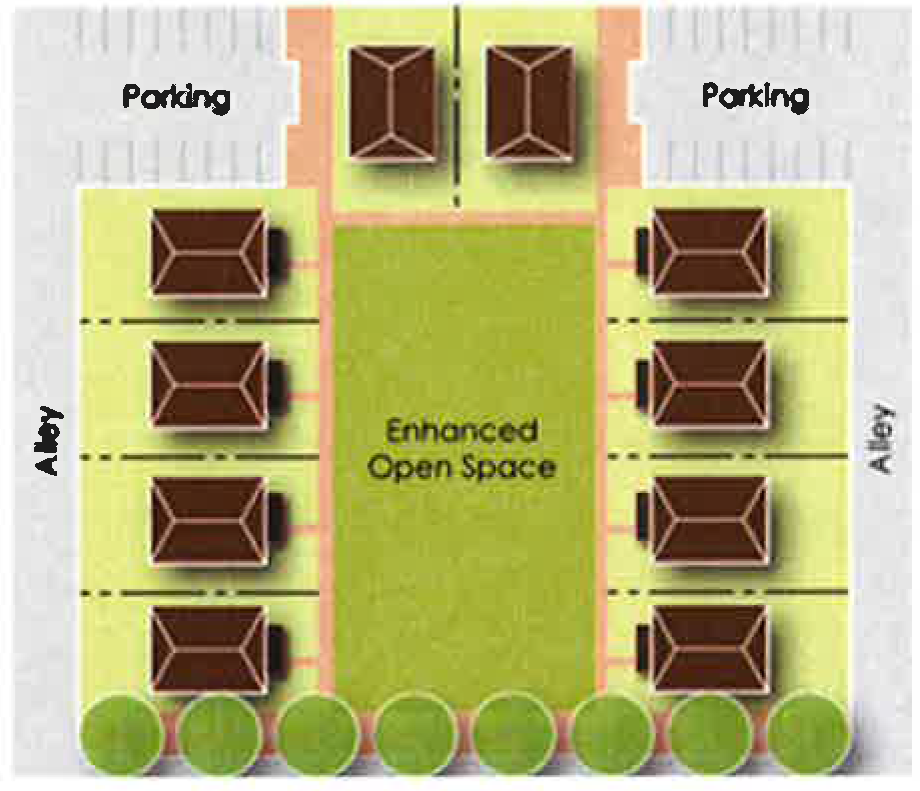
Cottage housing orientation
C.
Orientation.
1.
Lots along the perimeter of a development of single-family detached residences shall be oriented so that dwellings front internal local streets instead of a thoroughfare. Lots with rear yards abutting a thoroughfare shall provide a ten-foot no access easement and: a 20-foot landscape strip, a six-foot-high decorative fence, or a five-foot-high landscaped berm to screen the rear view of houses from the thoroughfare.
2.
Single-family cottage lots shall be oriented toward the enhanced open space.
3.
Street frontage requirements in chapter 14 of the Code shall not apply to individual lots within a cottage or urban type residential development, provided the overall site complies with minimum street frontage requirements and an alley or private drive provides access directly to a public street.
D.
Each dwelling unit shall be metered for water individually.
E.
An easement for water and sewer shall be required and subject to the approval of the director of planning.
F.
Access driveway, internal private drive and alley standards.
1.
Single-family cottage or urban residences shall have vehicular access from the rear of the property from an alley or similar private drive, or may have an off-street parking area located on the side or rear of the development. Such parking area may not occupy more than 30 feet of frontage and be located no more than 200 feet from the unit's entrance. The alley shall be at least 20 feet in width and meet the standards of International Fire Code (IFC) 503, unless another width is approved by the director for one-way direction only.
2.
Single-family detached residences may share a driveway serving two lots, provided that the width of the driveway at the street shall not exceed the width requirements established in chapter 14 of the Code, and that the driveway width not increase for the first ten feet of drive.
G.
Urban single-family dwellings may gain access through private drives that meet the standards of section 5.7.6C.4.
H.
Driveways shall not exceed ten feet between garage door and sidewalk.
I.
Maximum size.
1.
Conventional single-family detached residences shall follow the requirements set forth in article 2 of this chapter.
2.
Single-family cottages shall not exceed a building footprint of 800 square feet and gross floor area of 1,200 square feet.
J.
Architectural variability.
1.
Residential subdivisions of three or more lots intended for conventional single-family detached residences shall include distinctly different front facade designs within each phase of the development. The term "distinctly different" shall mean that each front facade must differ from adjacent buildings' front facades in at least four of the following six ways:
a.
The use of different primary exterior materials;
b.
Variation in the width or height of the front facade by four feet or more;
c.
Variation of the type, placement or size of windows and doors on the front facades;
d.
Variations in rooflines, including the use of dormers and changes in the orientation of rooflines;
e.
Variation in the location and proportion of front porches; and
f.
Variation in the location or proportion of garages and garage doors.
2.
No conventional single-family detached residence shall be of the same front facade design as any other conventional single-family detached residence along the same block face within eight lots of the subject residence. Mirror images of the same configuration are not permitted on the same block face.
3.
No single front facade design may be used for more than 25 percent of the total units of any single phase of a conventional single-family detached residence subdivision.
K.
Porches and stoops. Any porch shall have minimum dimensions of four feet by eight feet for porches, and any stop shall have minimum dimensions of and four feet by four feet. Porches and stoops shall be no closer than two feet from a utility easement.
L.
Facades. Any conventional single-family detached residence with a front facade width of 40 feet or more shall incorporate wall offsets in the form of projections or recesses in the front facade plane. Wall offsets shall have a minimum depth or projection of two feet so that no single wall plane exceeds 25 feet in width.
M.
Roof and overhangs. Conventional single-family detached residences shall incorporate the following standards:
1.
Roofs covering the main body of the structure shall be symmetrical gables, hip-style, or mono-pitch (shed) style.
2.
Mono-pitch roofs shall have a minimum pitch of 4:12, and all other roofs covering the main body of a detached house shall have a minimum roof pitch of 6:12.
3.
Overhanging eaves shall extend at least 12 inches beyond the exterior wall.
4.
To the maximum extent practicable, all roof vents, pipes, antennas, satellite dishes, and other roof penetrations and equipment (except chimneys) shall be located on the rear facades or configured to have a minimal visual impact as seen from an adjacent street.
N.
Garages. The following standards shall apply:
1.
Street-facing garage facades shall not comprise more than 45 percent of the total width of the conventional single-family detached residence's front facade. Street-facing garages shall be at least two feet behind the primary front facade plane of a conventional single-family detached residence.
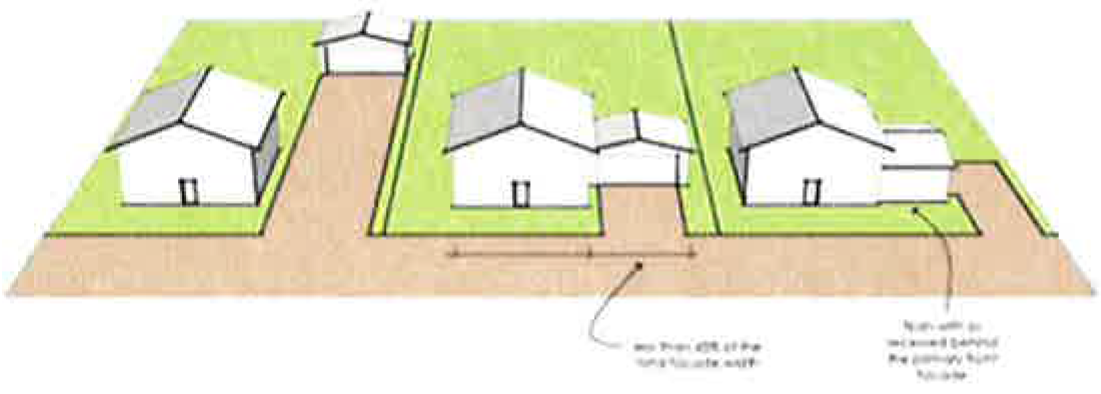
Acceptable Garage Configurations
O.
Enhanced open space.
1.
Clubhouse/pool amenity areas, greens, playgrounds, pocket parks, neighborhood parks, or detention facilities designed to serve as amenities shall meet dimensional requirements in the base zoning district (article 2 of this chapter) and the standards of article 5, division 5 of this chapter, open space standards.
2.
Cottage residential development enhanced open space.
a.
Single-family cottages shall be clustered around an enhanced open space green that is a minimum of 3,000 square feet or 400 square feet per cottage served by the enhanced open space, whichever is greater.
b.
The enhanced open space green shall have a minimum dimension of 20 feet on each side.
c.
At least two sides of the enhanced open space green shall have cottages along its perimeter.
(Ord. of 8-2-2017, § 1(5.7.5))
Sec. 5.7.6. - Single-family attached buildings.
Single-family attached residential buildings are buildings in which dwelling units are attached to one another in a variety of ways, each with its own external entrance. Fee simple condominiums share similar configurations to townhouse developments, and they have lot lines that coincide with the building footprint. This section applies to the following development types:
A.
Single-family attached, two- or three-family attached (also called duplex or triplex). A house with two or three attached principal dwelling units located on a single lot. The units may be located on separate floors or side-by-side. A side-by-side, single-family attached duplex may also be permitted to be located on two lots, whereby each unit is located on its own lot.
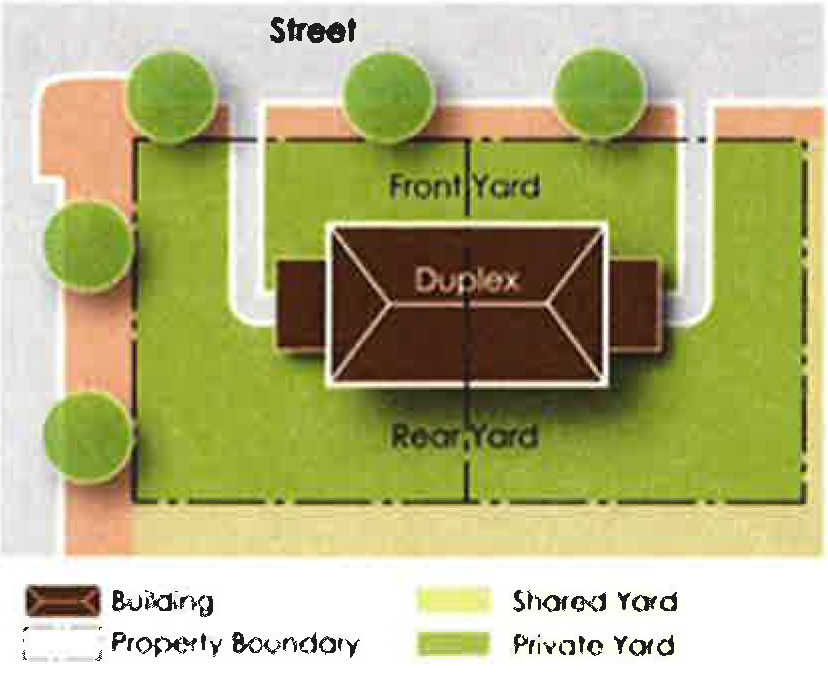
Single-Family Attached Housing on Two Lots
B.
Fee simple condominium. One or more single-family attached buildings where the owner has fee simple title to the building and the land beneath the building. The building may or may not have a small yard in front of or behind the building. The remaining land is under common ownership.
C.
Single-family attached, and townhouse developments shall meet the following standards.
1.
The overall tract of land for townhouse or fee simple condominium development shall have frontage on a public or private street.
2.
The overall tract of land for townhouse or fee simple condominium development must meet the dimensional requirements of the zoning district.
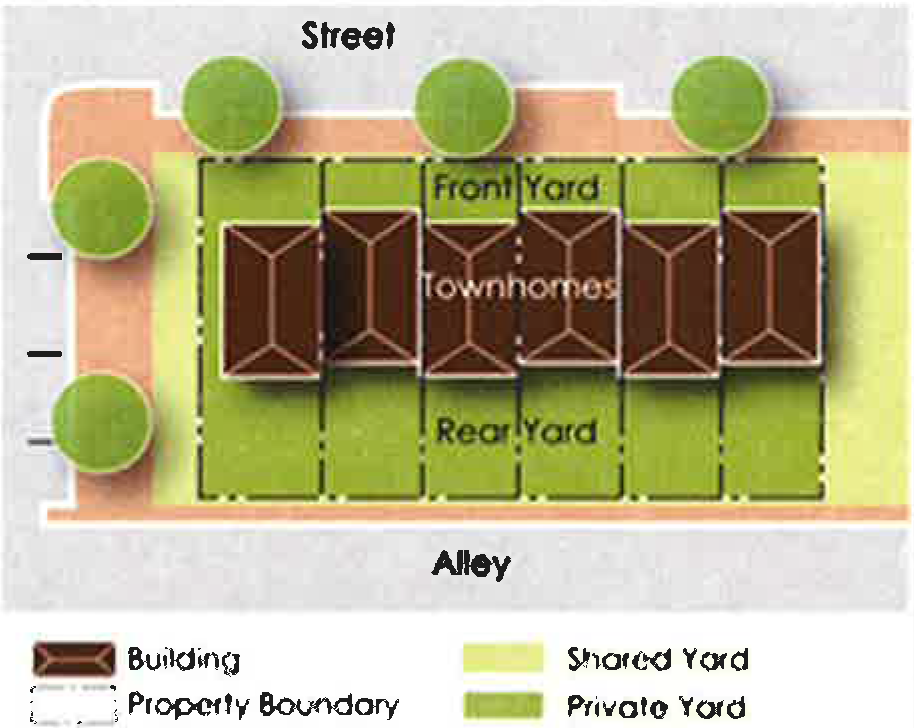 | Traditional Townhouse lot: Townhomes which include yards on the individual property. |
| Urban Single-Family (Urban-SF) Detached lot: Urban-SF lot lines may coincide with the building envelope. Yard area designated for each unit, however, must still be provided even if held in common ownership. Dimensions of yard areas shall equal the setback that is specified by the zoning district (or approved master plan). | 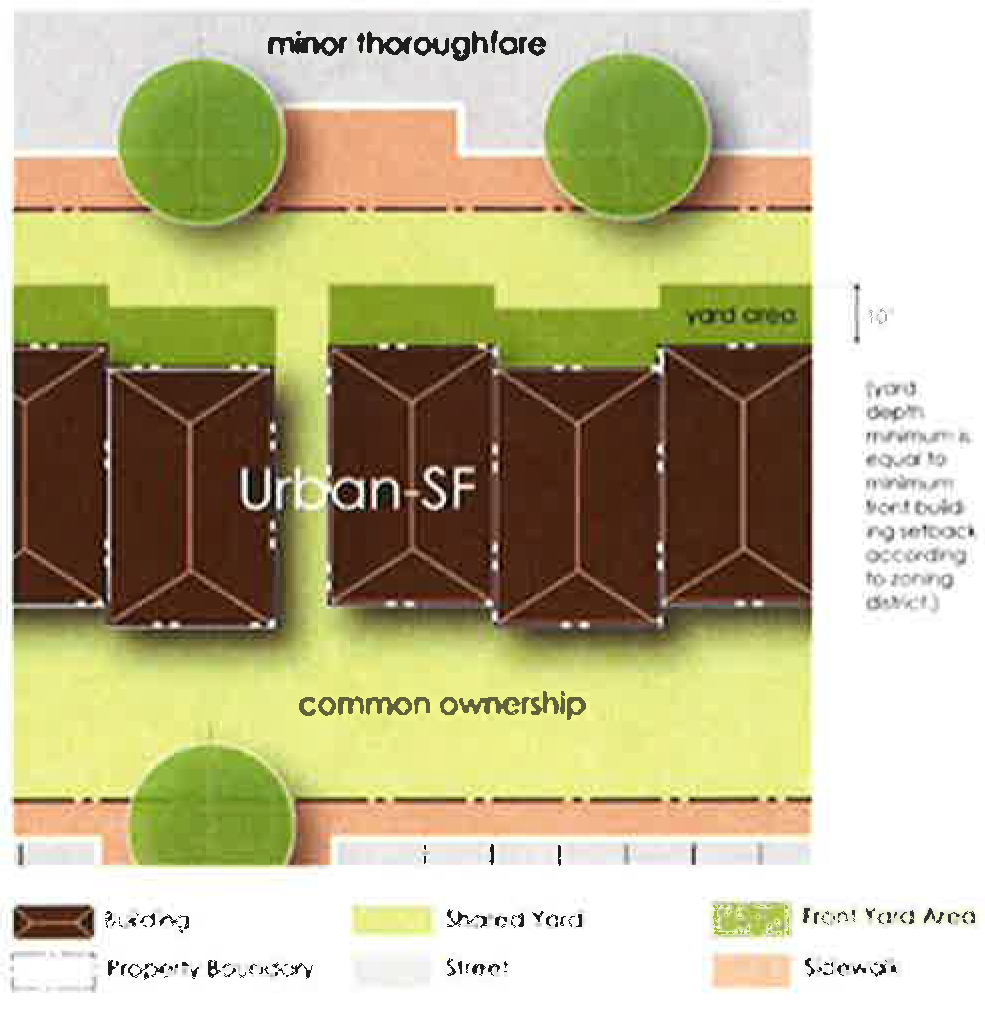 |
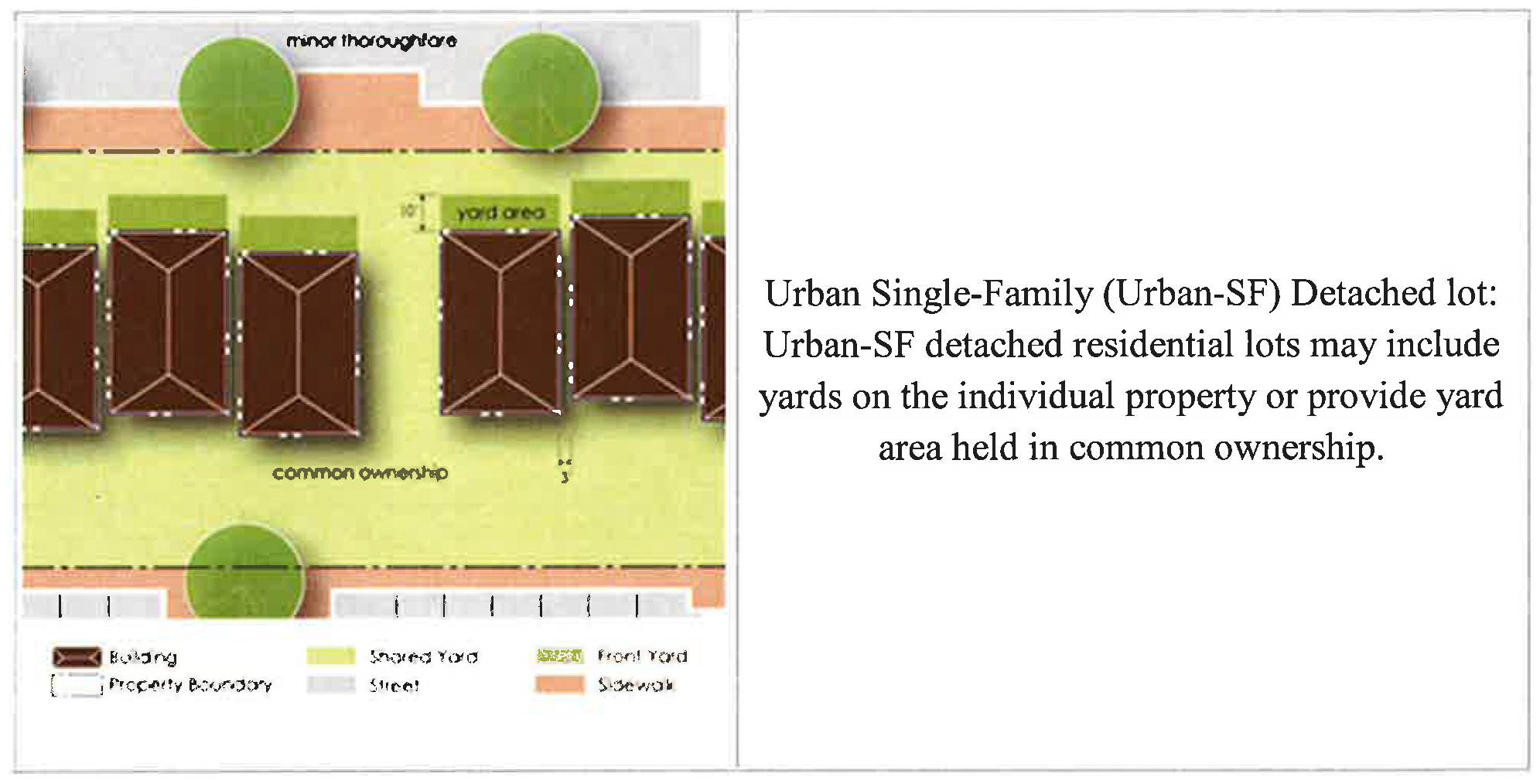 | Urban Single-Family (Urban-SF) Detached lot: Urban-SF detached residential lots may include yards on the individual property or provide yard area held in common ownership. |
3.
Private drives shall meet the requirements of section 14-189.1 of the Code, except as follows:
a.
Private drives shall provide a ten-foot unobstructed easement on both sides of the drive, measured from back of curb.
b.
Private drives shall have a minimum 22-foot road width measured from back of curb to back of curb.
c.
Private drives shall have the same base and paving specifications as required for public streets.
d.
Roadway shoulders for private drives shall consist of a combination of five-foot sidewalk, five-foot landscape strip for street trees, and may include parallel parking spaces.
e.
Private drives shall be maintained in accordance with chapter 14.
4.
The development shall incorporate a pedestrian circulation plan that separates pedestrians from automobiles by providing rear access to the units or designing an alternative location for pedestrian paths or sidewalks.
5.
Sidewalks and pedestrian ways shall provide a continuous network that connects each dwelling unit with adjacent public streets and all on-site amenities designed for use by residents of the development.
6.
Sidewalks may go to back of curb when adjoining on-street parking space.
7.
Street trees shall be planted on both sides of the street 50 feet on center or every other unit, whichever distance is less.
8.
Buildings shall be no more than 200 feet in length.
9.
Spacing of buildings shall be consistent with International Codes Council (ICC).
10.
Alleys.
a.
Alleys shall be at least 12 feet wide, subject to the standards of IFC 503.
b.
Dead end alleys over 150 feet in length are prohibited.
11.
Ownership.
a.
There shall be a mandatory property owners association clearly stating the residents' responsibility to share in the ownership and maintenance of common areas including roadways, alleys, parking, utilities, landscaping, and stormwater management facilities subject to chapter 14 of the Code. The city shall have no ownership or maintenance responsibility of any common areas unless expressly agreed otherwise.
b.
Individual ownership of the units shall comply with the Georgia Condominium Act or shall require membership in a property owners association in accordance with Georgia law.
c.
Upon approval of the development plans, a final plat shall be recorded before any units are sold.
D.
Building orientation. The primary entrance and front facade of individual buildings within a townhouse development may be oriented toward streets, private drives or enhanced open space, and shall not be oriented toward off-street parking lots, garages, or carports.
E.
Each dwelling unit shall be metered for water individually.
F.
An easement for water and sewer shall be required with the location subject to approval of the City of Stonecrest, or its designee.
G.
Roofs. Roofs of attached residential buildings shall comply with the following standards:
1.
Roofs shall be symmetrical gables, flat with parapet, hip-style, or mono-pitch (shed) style, but alternative roof forms or pitches may be used over porches, entryways, and similar features. Overhangs allowed on principal structures shall be no less than 12 inches.
2.
Mono-pitch roofs shall have a minimum pitch of 4:12.
3.
Gable and hip-style roofs shall have a minimum roof pitch of 6:12.
4.
Roof forms shall be designed to shelter building entrances.
H.
Roof penetrations and equipment. To the maximum extent practicable, roof vents, pipes, antennas, satellite dishes, and other roof penetrations and equipment (except chimneys) shall be located on the rear facades or screened from view so as to have a minimal visual exposure as seen from an adjacent street.
I.
Facades. For the purposes of this subsection, a building facade shall be considered the entire wall surface on a building side from grade level to underneath an overhanging eave or to the top of a cornice. All single-family attached buildings shall comply with the following facade standards:
1.
Facades facing a street shall provide doors, porches, balconies, or windows in the following ratios:
a.
A minimum of 60 percent of front facade; and
b.
A minimum of 30 percent of side and rear building facades.
2.
All front facades shall provide a minimum of three of the following design features for each residential unit:
a.
Projections or recesses in the facade plane that contrast with an adjoining unit, with a minimum depth or projection of one foot;
b.
Exterior building materials or colors different from the materials or colors of the other units;
c.
Decorative patterns on exterior finish (e.g., shingles, wainscoting, window box, and similar ornamental features);
d.
A dormer window, cupola, turret, tower, or canopy;
e.
A recessed entrance;
f.
A covered porch or balcony;
g.
Pillars, posts, or pilasters;
h.
A box or bay window with a minimum 12-inch projection from the facade plane;
i.
Eaves with either exposed rafters or a cornice projecting a minimum 12 inches from the facade plane; or
j.
A parapet wall with an articulated design that varies in height.
3.
Front facades should be varied to avoid long, flat building fronts so that no more than 20 percent of the front facades of the units in the same building are substantially the same, unless designed as brick row houses.
J.
Garages.
1.
Garages for dwelling units shall not face public streets, and shall be accessed by alleys or private drives. Garages that face private drives must comply with subsection C.5 of this section for pedestrian and vehicle separation plan.
2.
Parking spaces for dwelling units shall be located behind buildings, within individual units, on designated on-street spaces or off-street parking lots as provided in subsection K. of this section, off-street parking.
3.
Garage entrances shall be set back between three and ten feet from adjacent streets and sidewalks.
4.
Garage entrances shall be set back a minimum of three feet and a maximum of ten feet from alleys.
K.
Off-street parking.
1.
Off-street surface parking lots (including access and travel ways) located on the side of an attached residential building shall not occupy more than 30 percent of the primary street frontage for the attached residential building.
Off-Street Parking on the Side of Attached Residential Buildings
2.
Off-street parking required for each attached residential unit is not required on the same lot as the dwelling unit, but the edge of the off-street parking lot shall be no more than 200 feet from the unit's entrance.
L.
The architectural features of a parking deck or structure shall be compatible with the primary buildings.
M.
Streetscape design. Single-family attached residential developments shall comply with the streetscape design standards in division 4 of this article.
(Ord. of 8-2-2017, § 1(5.7.6))
Sec. 5.7.7. - Multifamily, nonresidential, live/work and mixed-use buildings.
A.
Multifamily residential building and nonresidential buildings include the following building types: multifamily low rise (three stories and fewer); multifamily high rise (four stories and greater); live/work buildings; and large-scale retail.
1.
Multifamily residential buildings contain four or more residential dwelling units consolidated into a single structure. Dwelling units within a building may be situated either wholly or partially over or under other dwelling units, and units share common walls. Structures appearing as townhouses but with internal units that are located one below the other (also known as "stacked townhouses") are also considered multifamily residential buildings.
2.
Large-scale retail refers to freestanding buildings containing single-tenant retail sales uses that exceed 60,000 square feet in size.
3.
Live/work units incorporate both living and working space in a single unit. A kitchen and a bathroom must be included in each unit. The residential portion may not be less than 33 percent of the unit's total floor area. Within two-story live/work buildings, nonresidential uses shall be located on the ground floor only. Within single story units, the nonresidential use shall be located in the front, with street access. Living space within the live/work unit shall have direct and internal access to work space. Each live/work unit may have a primary entrance from the sidewalk, enhanced open spaces, arcades or public spaces. See also section 4.2.33 for additional live/work use requirements. Multifamily residential orientation shall comply with section 5.7.6.
B.
All development types other than single-family, shall comply with the following:
1.
Dimensional and use requirements. Lot size, width, and setbacks shall meet the dimensional requirements set forth for the applicable base zoning district in article 2 of this chapter.
2.
Building plane and scale.
a.
Building facades shall not exceed 40 feet in length without projections, recesses or other architectural features.
b.
Windows and doorways. Structures built to the edge of the street right-of-way or located within mixed-use and nonresidential districts shall have windows and/or doorways that occupy at least 25 percent of the width of the first floor street-level front facade.
c.
All buildings regulated by this section that are four stories or greater shall:
1.
Clearly articulate the building base, middle and top through materials, architecture details and/or changes in the plane of the wall (projections and recessions).
Building Articulation: Clearly defined base, middle and top
2.
Provide side step-backs at the fourth story when adjacent to the side of another building four stories or greater and along a private or public street.
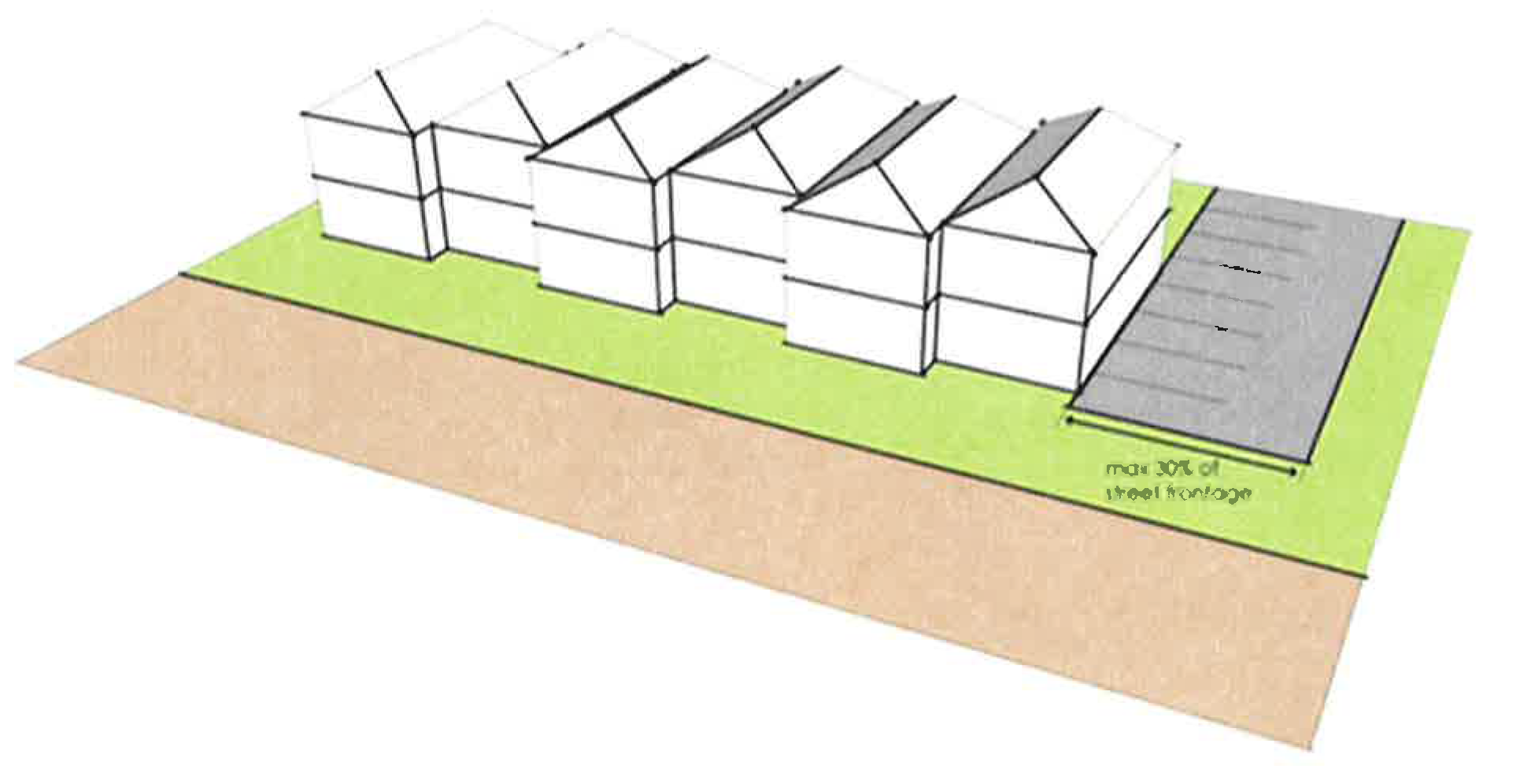
Side step-backs between mid-and high rise buildings
C.
Roofs.
1.
Multifamily low-rise buildings regulated by this section shall have roof design and features that comply with section 5.7.6.G.
2.
Multifamily buildings adjacent to a courtyard may be designed with a flat roof.
3.
Rooflines of large-scale retail buildings shall be varied to add interest and variety to the large building form through the use of parapets, hips, gables, eaves, dormers or other similar features. These features shall be incorporated along a minimum of 50 percent of the length of the roofline facing a public street.
4.
Flat roofs shall provide parapets to screen mechanical equipment from street view and from the primary drive facing the front facade.
D.
Parking configuration. Nonresidential and mixed-use buildings, shall:
1.
Have no more than one double row of parking within the front yard where there is no intervening building between parking and the street; and
2.
Be allowed to locate parking along the side or rear or as on-street parking dedicated as right-of-way by the applicant for a land disturbance permit or building permit.
E.
Multifamily developments shall meet the building separation requirements provided in section 5.2.1.B.
F.
Off-street surface parking lots (including access and travel ways) consisting of five or more spaces shall be located on the side or to the rear of a multifamily structure or development.
G.
Multifamily housing developments shall provide and maintain outdoor play and recreation areas with a minimum area of five percent of the total area of the lot or 4,000 square feet, whichever is greater.
H.
Low-rise multifamily building types. The following low-rise multifamily buildings shall be allowed, provided they meet the requirements set forth herein:
1.
Mansion. The mansion style low-rise multifamily building shall have four to eight units within the structure, which shall be distinguished as a building designed to appear as a typical single-family detached home.
2.
Courtyard. The courtyard building shall be oriented such that the courtyard faces the street or roadway and has buildings facing along the other three sides.
a.
Minimum width of the courtyard is 30 feet and depth is 15 feet.
b.
Building walls facing a courtyard may be separated by more than the maximum building separation requirements.
3.
All other. To reduce massing and promote livability, all other low-rise multifamily building types shall provide:
a.
Functional balconies for all exterior units;
b.
Landscaping around each building within ten feet of building and along both sides of all internal sidewalks.
I.
Multi-building nonresidential development, excluding industrial. Buildings in a nonresidential development composed of multiple buildings totaling 100,000 square feet or more for the whole development shall:
1.
Be configured to break up the site into a series of smaller blocks defined by streets with pedestrian walkways forming an interconnected circulation route;
2.
Face the corner of an existing street intersection or entry point to the development;
3.
Frame and enclose:
a.
A main street pedestrian or vehicle access corridor entering the development site;
b.
At least three sides of parking areas, public spaces, or other site amenities; and
c.
Provide outdoor gathering spaces for pedestrians between buildings.
J.
Outparcel development.
1.
Outparcels and their buildings shall be aligned in order to define continuous street edges with well-defined entry points.
2.
Spaces between buildings shall be improved to provide landscaped pedestrian amenities such as plazas, seating areas, arcades, pedestrian connections, and gathering spaces.
(Ord. of 8-2-2017, § 1(5.7.7); Ord. No. 2021-06-03, § 1(Exh. A, § DD), 8-23-2021)
Sec. 5.7.8. - Large-scale retail; additional standards.
A.
Entrances.
1.
The primary entryway into a large-scale retail building shall be clearly articulated by greater architectural detail, incorporating no fewer than three of the following elements:
a.
Projecting or recessed, covered entrance;
b.
Distinct roof form above entrance shall include at least one of the following:
1.
Roof overhangs;
2.
Awnings, canopies or porticos;
3.
Raised corniced parapets;
4.
Gabled or peaked roof form;
5.
Arches;
c.
Display windows directly adjacent to the entrance;
d.
Architectural details and ornamentation emphasizing the building entrance;
e.
Arcades connecting the entrance to adjacent pedestrian attractions;
f.
Outdoor plaza with a minimum depth of 20 feet adjacent to the entrance and having seating and a water feature or landscaping; or
g.
Landscape areas or seating areas.
B.
Off-street parking.
1.
Parking for large-scale retail development shall be distributed around the principal structure on at least two sides.
2.
No more than 50 percent of parking may be located between the principal structure and primary street. If located within an activity node, no parking shall be allowed between the principal structure and the primary street, except required parking spaces.
C.
Pedestrian circulation.
1.
Continuous internal sidewalks and pedestrian walkways shall be provided to connect the public sidewalk or right-of-way with the principal building entrance of all principal buildings on the site. Such sidewalks shall also connect key pedestrian focal points such as transit stops, street crosswalks, and building entry points.
2.
Internal pedestrian walkways and sidewalks shall be at least five feet in width.
3.
Sidewalks shall be provided along all sides of the lot adjacent to a public street.
4.
Sidewalks shall be provided for the principal building along any facade featuring a public entrance and along any facade leading to a public parking area.
5.
Internal pedestrian walkways and sidewalks shall be differentiated from vehicular driveways and parking spaces through the application of colors and durable surface materials such as pavers, brick, or scored concrete, in order to enhance pedestrian safety and appearance of the pedestrian walkway or sidewalk.
D.
Landscaping. In addition to the landscape and screening requirements of division 4 of this article, the following requirements shall also apply:
1.
Building frontage. Beginning 15 feet from the principal customer entrance, along the building facade, a landscape area with trees shall be required for the entire length of the building. Each of the trees required herein shall be at least four and one-half-inch caliper and eight feet tall at installation. Trees required herein shall be spaced no more than 100 feet apart.
2.
Landscape strip. A landscape strip at least 15 feet wide shall be required along any property line adjacent to a public street. When parking lot landscape strip requirements coincide with this location, the 15 feet shall not be required in addition to the parking lot landscaping, but shall serve as the parking lot dimensional requirement and planted according to parking lot landscaping standards in division 4 of this article.
3.
Walkways. Pedestrian walkways connecting a public street adjacent to the lot on which the principal building is located and parking aisles shall be provided approximately every 120 feet perpendicular to street frontages.
E.
Open space and enhanced open space areas.
1.
An outdoor gathering space (plaza or square) shall be developed with requirements by open space functional category and enhanced open space types as specified in division 5 of this article.
2.
Sites containing one or more large-scale retail building shall include an outdoor gathering space equal to at least three percent of the total square footage of the building.
3.
Outdoor gathering spaces shall be connected to the sidewalk and pedestrian walkway network, and shall provide at least three of the following features per space:
a.
Lighted bollards;
b.
Tables and chairs;
c.
Fountains or other water features;
d.
Benches;
e.
Seat walls and/or raised landscape planters;
f.
Shade trees lining the gathering space;
g.
Pots or hanging baskets filled with seasonal plant material;
h.
Information kiosks;
i.
Sculptures or other public art features; or
j.
Other features as approved by the director of planning if the feature enhances the visual impact of the outdoor gathering space.
(Ord. of 8-2-2017, § 1(5.7.8))

