
Tamarac City Zoning Code
ARTICLE 4
- DEVELOPMENT AND DESIGN STANDARDS
10-4.1 - General Provisions
(A)
Purpose. This article includes standards that regulate the physical layout and design of all development within the City of Tamarac to ensure the protection of the health, welfare, safety, and quality of life for all citizens, businesses, and visitors. These provisions address the physical relationship between development and adjacent properties, public rights-of-way, neighborhoods, and the natural environment, in order to implement the comprehensive plan's vision for the community.
(B)
Applicability
(1)
New Development. The requirements of this article shall apply to all new development and land uses established subject to this Code under §10-1.5, Applicability and Jurisdiction, other than temporary uses and structures.
(2)
Existing Development. Except where expressly provided otherwise in this Code, this article shall apply to all existing development in accordance with the following:
(a)
Change in Use. Changes in use of an existing development to a more intensive use shall be subject to these standards to the maximum extent practicable as determined by the Director. For purposes of this provision, such changes in use include one or more of the following:
(i)
Any change in use that would require additional parking under this Code;
(ii)
Any change from a residential use to any public, institutional, or civic; commercial; or industrial use;
(iii)
Any change from any public, institutional, or civic use to a commercial or industrial use; or
(iv)
Any change from any commercial use to an industrial use.
(b)
Upgrading of Nonconforming Off-Street Parking and Loading. A modification of an existing development may be required to upgrade off-street parking and loading and/or landscaping pursuant to §10-1.9(E), Nonconforming Site Features.
10-4.2 - Transportation and Connectivity
(A)
Purpose. This section ensures that development is served by a coordinated, multimodal transportation system that permits the safe and efficient movement of motor vehicles, emergency vehicles, transit, bicyclists, and pedestrians. This multimodal transportation system intends to:
(1)
Provide transportation options and alternatives for drivers, bicyclists, and pedestrians including facilitating and encouraging the use of public transportation, walking, and bicycling;
(2)
Increase the effectiveness of local service delivery and reduce emergency response times;
(3)
Contribute to the attractiveness of the development and community, connect neighborhoods, and increase opportunities for interaction between neighbors;
(4)
Improve air quality and reduce greenhouse gas emissions while reducing vehicle miles of travel, travel times, congestion, and traffic conflicts; and
(5)
Connect development and neighborhoods to each other and local destinations such as employment, schools, parks, and shopping centers.
(B)
Streets and Vehicular Circulation
(1)
Purpose. Street and block patterns should include a clear hierarchy of well-connected streets that distribute traffic over multiple streets and avoid traffic congestion on principal routes. Within each development, the access and circulation system and a grid of street blocks should accommodate the safe, efficient, and convenient movement of vehicles, bicycles, transit users, and pedestrians through the development and provide ample opportunities for linking adjacent neighborhoods, properties, and land uses.
(2)
Street Standards. All streets shall meet the standards in §10-4.11, Subdivision Design and Development Standards, and the City's Engineering Specifications, as determined by the City Engineer.
(3)
Street Connectivity
(a)
Purpose. Local neighborhood street systems are intended to provide multiple direct connections to and between local destinations such as parks, schools, and shopping. These connections should knit separate developments together, rather than forming barriers between them.
(b)
Vehicular Access to Public Streets and Adjacent Land
(i)
All development shall provide public street connections to all existing, adjacent public streets.
(ii)
If there are no adjacent public streets, subdivisions, and/or site plans shall provide for connections along each boundary abutting adjacent vacant land for future connections. These connections shall be spaced at intervals not to exceed 1,000 feet for arterials, or 660 feet for other street types, or as otherwise approved by the City Engineer.
(iii)
When connections to surrounding streets are proposed or required by the City, public right-of-way shall be dedicated and streets developed to existing paved rights-of-way. The City may also require temporary turnarounds to be constructed for temporary cul-de-sacs between development phases.
(c)
Vehicular Interconnections to Similar or Compatible Adjacent Uses. Every proposed public or private street system shall be designed to provide vehicular interconnections to all similar or compatible adjacent uses (existing and future) when such interconnections would facilitate internal and external traffic movements in the area.
(i)
Such connections shall be provided during the initial phase of the project approximately every 1,250 to 1,500 linear feet for each direction (north, south, east, west) in which the subject property abuts similar or compatible uses.
(ii)
If the common property boundary in any direction is less than 1,250 linear feet, the subject property shall provide an interconnection if the Director determines that the interconnection in that direction can best be accomplished through the subject property.
(iii)
When the City Engineer deems a vehicular connection impractical, he or she can increase the length requirement and/or require pedestrian connections. The City Engineer may delay the interconnection if such interconnection requires state approval or will result in significant hardship to the property owner.
(d)
Cul-de-Sacs and Dead-End Streets Discouraged. The general design of the City's street system shall use through-streets. Permanent cul-de-sacs and dead-end streets shall only be used when topography, the presence of natural features, and/or vehicular safety factors make a vehicular connection impractical.
(e)
Residential Streets
(i)
Traffic-calming techniques such as diverters, neck-downs, street gardens, and curvilinear alignments are encouraged to reduce speeds and cut-through collector or residential streets. All traffic-limiting devices must be approved by the City and the use of speed control devices shall be administered through the City's traffic-calming policy.
(ii)
Should topography or other constraints require the use of straight local streets that extend more than 660 feet without interruption, an oblong median, traffic-calming device, or similar feature shall be used to slow traffic. In addition, traffic-calming devices may be required to address public safety concerns.
(iii)
To the maximum extent practicable, residential streets shall be arranged to follow the natural contours of the site.
(4)
Driveways and Access
(a)
General
(i)
Every lot shall have access that is sufficient to afford a reasonable means of ingress and egress for emergency vehicles, as well as for those needing access to the property in its intended use.
(ii)
All driveway entrances and other openings onto streets shall be constructed so that:
A.
Vehicles may safely enter and exit from the lot in question;
B.
Interference with the free and convenient flow of traffic in abutting or surrounding streets is minimized; and
C.
Joint driveways are desirable whenever possible in order to minimize the number of access points to streets and access easements.
(b)
Single-Family Residential. In addition to the above general requirements, all residential development shall be subject to the following:
(i)
All single-family residential properties shall be limited to one driveway per lot (non-circular).
(ii)
Alleys adjacent to a single-family use may not be used for loading or parking.
(iii)
A three-foot side yard setback is required for driveways; however, the City Engineer may authorize exceptions to this standard for irregularly shaped lots.
(iv)
No circular driveway in a single-family zoning district may be constructed on property with less than 50 linear feet of road frontage. All circular driveways must maintain a minimum of 15 feet between interior driveway opening points, with a minimum 7.5-foot radius.
(v)
No drive shall be located closer than 25 feet to the right-of-way of a street intersection. At signalized intersections, the City Engineer will specify distances from right-of-way or pavement edge to allow for sufficient stacking of vehicles in the street prior to the driveway location.
(vi)
Double drives shall be separated by a minimum of 20 feet or as required so that the driveway return radii do not overlap.
(vii)
There shall be no direct driveway access (ingress or egress) from any single-family residential lots to any arterial street or highway unless no other legal access alternative is available.
(viii)
The driveway shall not be less than 18 feet in length and nine feet in width per space required and shall be completely contained within the property line for the required driveway.
(ix)
Each residential driveway at its widest point shall be not more than 24 feet in width, measured at right angles to the center line of the driveway, except as that distance may be increased by permissible curb return radii. The City Engineer may authorize exceptions on lots of one acre or more to allow wider driveways.
(x)
Cul-de-sacs, permanently designed as such, shall not exceed 600 feet in length, as measured along the centerline from the intersection to the centerline termination which is also the centerline of the cul-de-sac, unless it is demonstrated to the satisfaction of the city engineer that a cul-de-sac longer in length satisfies community planning standards, engineering standards and fire safety standards, and is not otherwise detrimental to the public safety and welfare. Cul-de-sacs shall be provided at the closed end with a circular turnaround having a paved area of a minimum of 80 feet in diameter.
(c)
Multi-Family Residential. In addition to the above general requirements, all multi-family residential development shall be subject to the following:
(i)
All multi-family buildings, structures, parking, and loading areas shall be physically separated from all non-arterial or collector streets by vertical curbs and other suitable barriers and landscaping to prevent unchanneled motor vehicle access.
(ii)
Each property shall not have more than two access ways to any one street unless unusual circumstances demonstrate the need for additional access points.
(iii)
Multi-family development sites greater than five acres shall include a minimum of two through-access drives. An exception may be made where a site is landlocked by existing development or other physical constraints, or where existing natural features on the site require the use of protective measures that would otherwise make a second access drive infeasible.
(d)
Mixed-Use and Nonresidential
(i)
All mixed-use and nonresidential buildings, structures, parking, and loading areas shall be physically separated from all non-arterial or collector streets by vertical curbs and other suitable barriers and landscaping to prevent unchanneled motor vehicle access. Each property shall not have more than two access ways to any one street unless unusual circumstances demonstrate the need for additional access points.
(ii)
In addition, each access way shall comply with the following:
A.
Unless no other practicable alternative is available, all driveways and other openings shall be located a minimum of:
1.
75 feet from a street intersection;
2.
40 feet from another access driveway; and
3.
20 feet from an interior property line.
B.
For any development of one acre or more, the width of any access way leading to the full access of an arterial street shall be divided by a median of at least four feet in width to provide separation from incoming and outgoing traffic. Construction and maintenance of such onsite medians shall be the responsibility of the property owner/developer.
(e)
Visibility at Intersections. On all lots or parcels of land on which a front setback is required, no obstruction that will obscure the view of motor vehicle drivers shall be placed within the triangular area per §10-4.4(D)(6), Sight Distance, except that trees may be permitted within said triangular area provided that those trees are placed in the street planter strip and the limbs are pruned to at least six feet above the grade level of the adjacent street.
(f)
Guardhouses
(i)
Guardhouses may be installed within required setbacks.
(ii)
Maintenance of each guardhouse must be specifically provided in homeowners association documents.
(iii)
All manual security devices, if provided with lock, shall have Tamarac Fire Rescue approved locking devices.
(iv)
Automatic security devices must have a Tamarac Fire Rescue approved key override, a Broward County Universal override system, and a back-up system to allow for operation in the event of power failure or failure in the open position.
(C)
Pedestrian Circulation
(1)
Purpose. Street and block patterns should include a clear hierarchy of well-connected streets that distribute traffic over multiple streets and avoid traffic congestion on principal routes. Within each development, the access and circulation system and a grid of street blocks should accommodate the safe, efficient, and convenient movement of vehicles, bicycles, transit users, and pedestrians through the development, and provide ample opportunities for linking adjacent neighborhoods, properties, and land uses.
(2)
Sidewalks Required
(i)
Sidewalks shall be installed on all arterials, collector streets, and local streets (including loop streets and cul-de-sacs), and within and along the frontage of all new development or redevelopment.
(ii)
Sidewalk shall be constructed in accordance with the current City of Tamarac Engineering Construction Standards/City of Tamarac Engineering Design and Processing Manual.
(iii)
The City Engineer may determine that sidewalks are not required due to unique site features and/or engineering constraints.
(3)
Onsite Connections
(i)
All mixed use, non-residential, and multi-family development shall provide a network of onsite pedestrian walkways with a minimum width of five feet to and between the following areas:
A.
Entrances to each building on the site;
B.
Public sidewalks or walkways on adjacent properties that extend to the boundaries shared with the subject development; and
C.
Adjacent to public transit station areas, transit stops, park and ride facilities, or other transit facilities; and
D.
Onsite recreational areas, mail kiosks, and other similar property features.
(ii)
Onsite pedestrian walkways and crosswalks shall be identified to motorists and pedestrians through the use of one or more of the following methods:
A.
Changing paving material, patterns, or paving color (this shall not include the painting of the paving material);
B.
Changing paving height;
C.
Decorative bollards;
D.
Raised median walkways with landscaped buffers; or
E.
Stamped or stained concrete.
(iii)
Sidewalks through the right-of-way shall be provided to:
A.
Any adjacent public park, greenway, open space, trails, or other civic use such as schools, places of worship, public recreational facilities, or government offices; and
B.
Adjacent land uses and developments, including, but not limited to, adjacent residential developments, retail shopping centers, office buildings, or restaurants.
(4)
Stormwater Runoff. All paved walkways and bicycle paths provided pursuant to this Section shall be designed to minimize stormwater runoff. Pervious and permeable pavement shall be designed in accordance with the City's Engineering Specifications.
(5)
Trails and Multi-Use Paths. All new development shall construct onsite portions of trails and multi-use paths that are identified in adopted plans, provided that any such improvements are directly related to the impacts of the proposed use or development and are roughly proportional in both extent and amount to the anticipated impacts of the proposed use or development.
(Ord. No. 2024-003, § 2, 1-24-24; Ord. No. O-2024-024, § 2, 11-13-24)
10-4.3 - Off-Street Parking and Loading
(A)
Purpose. This section ensures that off-street parking and loading facilities are provided in rough proportion to the general transportation demands of different land uses. By requiring such facilities, it is the intent of this Code to help avoid the negative impacts associated with spillover parking into adjacent neighborhoods while avoiding the negative environmental and urban design impacts that can result from vehicular use areas. The provisions of this section are intended to help protect the public health, safety, and general welfare by:
(1)
Encouraging multi-modal transportation options and enhancing pedestrian safety;
(2)
Mitigating and helping to avoid traffic congestion;
(3)
Providing methods to reduce stormwater runoff and the heat island effect of large paved areas; and
(4)
Providing flexible methods of responding to the transportation and access demands of various land uses in different areas of the City.
(B)
Applicability. Every building, use, or structure instituted or erected after the effective date of this Code shall be provided with off-street parking and loading facilities in accordance with the provisions of this section for the use of occupants, employees, visitors, and patrons.
(C)
General Standards for Off-Street Parking and Loading Areas
(1)
Use of Parking and Loading Areas. Off-street parking areas required by this section shall be used solely for the parking of licensed motorized vehicles in operating condition.
(a)
Residential Districts. Except as otherwise provided in §14-30, Parking or Storage of Commercial or Recreational Vehicles, Boats, and Boat Trailers, required off-street parking areas in residential districts are to be used solely for the parking of licensed motor vehicles in operating condition.
(b)
Mixed-Use and Nonresidential Districts. Required off-street parking and loading spaces for nonresidential districts and uses shall not be used for the display of goods for sale, or the sale, lease, storage, dismantling, or service of any vehicles, boats, motor homes, campers, mobile homes, building materials, equipment, or supplies.
(2)
Surfacing
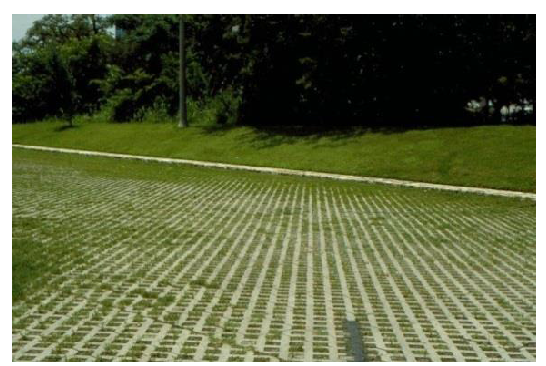
Figure 10-4.4.3-1:
Example of Pervious Pavers
(a)
General
Except as provided in subsection (b) below, all off-street parking and loading areas shall be surfaced with asphalt, concrete, brick, stone, pavers, or an equivalent hard, dustless, and bonded surface material. Use of surfacing that includes recycled materials such as glass, rubber, used asphalt, brick, block, and concrete is encouraged. Surfaces shall be maintained in a smooth, well-graded, well-drained, clean, orderly, and dust-free condition.
(b)
Pervious or Semipervious Surfacing. The use of pervious or semipervious surfacing materials including, but not limited to, pervious asphalt and concrete, open joint pavers, and reinforced grass/gravel/shell grids may be approved for off-street parking and loading areas, provided such surfacing is subject to an on-going maintenance program (e.g., sweeping, annual vacuuming). Any pervious or semipervious surfacing used for aisles within or driveways to parking and loading areas shall be certified as capable of accommodating anticipated traffic loading stresses and maintenance impacts. Where possible, such materials should be used in areas proximate to and in combination with onsite stormwater control devices.
(3)
Location and Arrangement
(a)
Safe and Convenient Access
(i)
Off-street parking and loading areas shall be arranged for convenient access from adjacent streets to facilitate ease of mobility, ample clearance, and safety of vehicles and pedestrians. Each off-street parking space and loading area shall have adequate, unobstructed means for the ingress and egress of vehicles and pedestrians.
(ii)
Except for parking areas serving residential uses, off-street parking areas shall be arranged so no parking or maneuvering incidental to parking shall occur on a public street or sidewalk.
(iii)
Except for parking areas serving residential uses, off-street parking areas shall be arranged so a vehicle may be parked or unparked without moving another vehicle, unless within an automated or mechanical parking deck or garage, or part of valet or tandem parking in accordance with §10-4.3(F)(4) and §10-4.3(E)(1)(b), Valet and Tandem Parking.
(iv)
Off-street loading areas shall be arranged so no loading area extends into the required aisle of a parking lot or required fire access lane.
(b)
Markings
(i)
Off-street parking areas shall be marked with individual parking stalls clearly defined with directional arrows and traffic signs provided as necessary for traffic control.
(ii)
Except for driveways serving as off-street parking areas for residential uses, each required off-street parking area and space, and each off-street loading area and space, shall be identified by surface markings.
(iii)
Markings shall be arranged to provide for orderly and safe loading, unloading, parking, and storage of vehicles. Such markings shall include painted lines, wheel stops, or other methods of identifying individual parking spaces and loading areas, and distinguishing such spaces or areas from aisles. Posted signs and markers shall ensure sufficient traffic control and shall be maintained to be readily visible and legible at all times.
(c)
Slope. All off-street parking and loading areas shall be constructed on a lateral incline of not more than three percent and a longitudinal incline of not more than ten percent beyond the adjacent street or sidewalk level.
(d)
Drainage. All off-street parking and loading areas shall be properly drained so as to eliminate standing water and prevent damage to abutting property and/or public streets and alleys.
(e)
Exterior Lighting Lighted off-street parking and loading areas shall comply with the standards of §10-4.9, Exterior Lighting.
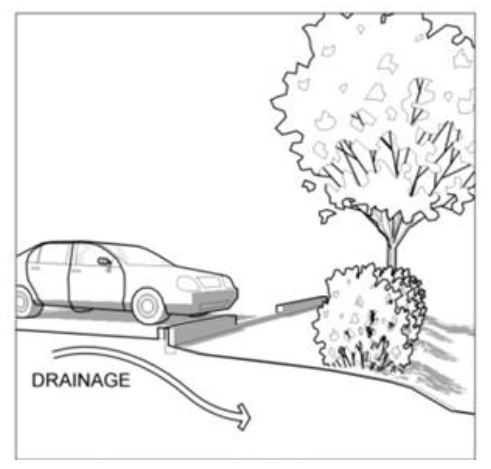
Figure 10-4.4.-3: Curb Stops and Drainage
(f)
Landscaping. Except for off-street parking areas serving single- and two-family dwellings, all off-street parking and loading areas shall comply with the standards set forth in §10-4.4(D)(5), Vehicular Use Area Landscaping.
(g)
Curbing
(i)
Except for off-street parking areas serving single- and two-family dwellings, each off-street parking space shall be bounded by a continuous curb unless the City Engineer determines otherwise due to unique engineering circumstances. Curbs shall be provided with openings to accommodate surface collection of stormwater runoff in vegetated swales and detention facilities.
(ii)
In place of continuous curbs, wheel stops may be provided when required for compliance with accessibility guidelines promulgated under the Americans with Disabilities Act (ADA).
(h)
Maintained in Good Repair. All off-street parking and loading areas shall be periodically painted or otherwise restored to maintain a clear identification of separate parking spaces or loading berths. Off-street parking and loading areas shall be maintained in a clean, orderly, and dust-free condition at the expense of the owner or lessee.
(i)
Completion. All off-street parking and loading areas shall be completed prior to the issuance of a Certificate of Occupancy for the development they serve. In the case of phased construction, off-street parking and loading areas should only be provided for the phase being constructed.
(D)
Off-Street Parking Requirements
(1)
Calculation of Off-Street Parking Requirement for Per-Bed and Per-Seat Uses. For uses with a per-bed requirement, bassinets shall not count as beds. For uses with a per-seat requirement, each 20 lineal inches of such seating facilities shall be counted as one seat for the purpose of computing off-street parking requirements.
(2)
Schedule A-Minimum Number of Off-Street Parking Spaces. Unless otherwise provided in this Section, off-street parking spaces shall be provided in accordance with Table 10-4.1.
(3)
Schedule B. Uses that reference "Schedule B" in Table 10-4.1, shall provide the minimum number of off-street parking spaces listed in Table 10-4.2: Off-Street Parking Schedule B, below. Unless otherwise approved, lots containing more than one use shall provide parking and loading in an amount equal to the total number of requirements for all uses.
(4)
Schedule C: Uses with Variable Vehicle Parking Demand Characteristics and Unlisted Uses. Table 10-4.1 refers to this subsection for some uses that have widely varying vehicle parking and loading demand characteristics, making it difficult to establish a single appropriate standard. Upon receiving an application proposing such a use, or proposing a use not expressly listed in Table 10-4.1, the Director is authorized to:
(a)
Establish the minimum off-street parking space requirement by referencing parking standard resources published by the National Parking Association or the American Planning Association; or
(b)
Establish the minimum off-street parking space requirement based on local or national best practices.
(5)
Maximum Parking Spaces Allowed. No commercial or industrial use shall provide off-street parking spaces in an amount that is more than 125 percent of the minimum requirements established in Table 10-4.1.
(a)
Calculating Maximum Spaces
(i)
For the purpose of calculating parking requirements, the following types of parking spaces shall not count against the maximum parking requirement:
A.
Accessible parking;
B.
Vanpool and carpool parking;
C.
On-street parking adjacent to the lot or lots on which the parking located; and
D.
Structured parking, underground parking, and parking within, above, or beneath the building(s) it serves.
(b)
Exceptions to Maximum Parking Requirement. Exceptions to the maximum parking requirement may be allowed by the Director in situations that meet the following criteria:
(i)
The proposed development has unique or unusual characteristics such as high sales volume per floor area or low turnover, that create a parking demand that exceeds the maximum ratio and that typically does not apply to comparable uses;
(ii)
The parking demand cannot be accommodated by on-street parking, shared parking with nearby uses, or by increasing the supply of spaces that are exempt from the maximum ratio;
(iii)
The request is the minimum necessary variation from the standards; or
(iv)
If application of the maximum parking standard would result in fewer than six parking spaces, the development shall be allowed six parking spaces.
(E)
Dimensional Standards for Parking Spaces and Aisles
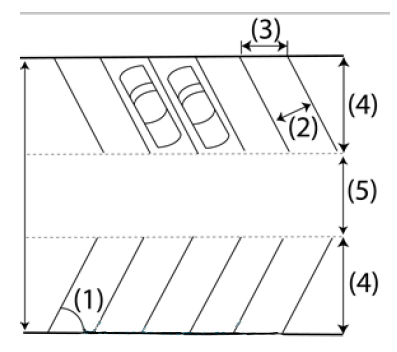
Figure 10-4.4.3-3
(1)
General
(a)
Except as otherwise provided in subsection (3)(b) below, standard vehicle parking spaces and parking lot aisles shall comply with the minimum dimensional standards established in Table 10-4.3: Dimensional Standards for Parking Spaces and Aisles below.
(b)
Overhang Protection. Curbs shall be installed at a minimum of two feet from the face of walls, fences, buildings, and other structures adjacent to the boundaries of parking areas.
(2)
Motorcycle Parking Spaces
(a)
Up to five percent of the total required parking spaces may be used for motorcycle parking.
(b)
Motorcycle parking spaces shall be a minimum of four feet wide by six feet long for 90-degree parking, or the equivalent dimensions required for an angle space to maintain the four-by-six foot rectangle.
(c)
Motorcycle spaces shall be clearly signed and marked "Motorcycle Only."
(3)
Smaller Parking Spaces for Tandem Parking and Certain Uses and Districts. The dimensions of off-street parking stalls may be reduced to a width of nine feet and a depth/length of 18 feet where the parking stalls are:
(a)
Used for tandem parking as described in §10-4.3(F)(4), Valet and Tandem Parking;
(b)
Located within a development containing industrial services uses, manufacturing and production uses, or warehouse, wholesale, and freight movement uses; or
(c)
Located within Tamarac Village, or the Mixed-Use Districts.
(d)
Vertical Clearance. All off-street parking spaces shall have a minimum overhead clearance of seven feet.
(F)
Off-Street Parking Alternatives. The Director may approve alternatives to providing the number of off-street parking spaces required by this Code in accordance with the following standards.
(1)
Alternative Parking Plan. The Director may approve an alternative parking plan that proposes another course of action to achieve the goals of the minimum off-street parking requirements in Table 10-4.1, in accordance with the standards listed below. The alternative parking plan shall be submitted with an application for Site Plan Approval or Business Revenue License, as appropriate. Additional fees shall be assessed to defray the additional processing costs in reviewing alternative parking plans and any subsequent agreements as detailed in the Administrative Manual.
(2)
Shared and/or Off-Site Parking. The Director may approve shared parking facilities for developed properties with extenuating circumstances or uses with different operating hours or different peak business periods if the shared parking complies with all of the following standards.
(a)
Location
(i)
Shared parking spaces shall be located within 500 feet walking distance of the primary pedestrian entrances to the uses served by the parking.
(ii)
Shared parking spaces shall not be separated from the use they serve by a major or minor thoroughfare unless pedestrian access across the thoroughfare is provided by a grade-separated pedestrian walkway or appropriate traffic controls (e.g., signalized crosswalk).
(iii)
Adequate and safe pedestrian access shall be provided between the shared parking areas and the primary pedestrian entrances to the uses served by the parking.
(iv)
Required parking spaces for persons with disabilities shall not be located off-site.
(b)
Signage Directing Public to Parking Spaces. Signage complying with the standards of §10-4.10, Signs, shall be provided to direct the public to the shared parking spaces.
(c)
Shared Parking Study. Applicants proposing to use shared parking as a means of satisfying off-street parking requirements shall submit a shared parking analysis to the Director that demonstrates the feasibility of shared parking. The applicant(s) shall demonstrate that any parking reduction requested as part of the shared parking study will not result in a reduction to an amount less than that required for any use by itself. Furthermore, the applicant shall demonstrate that shared parking will not result in the spillover of parking onto other properties or the public right-of-way.
(d)
Shared Parking Agreement
(i)
An approved shared parking arrangement shall be established in a written agreement among all of the owners or long-term lessees of lands containing the uses proposed to share off-street parking spaces. The agreement shall provide all parties the right to joint use of the shared parking area for at least 20 years or other date as specified by the City, to ensure the shared parking spaces comply with this Code and shall be binding on subsequent owners or long-term lessees. The agreement shall be submitted to the Director for review and approval. An attested copy of an approved and executed agreement shall be recorded with the Broward County Records Division before issuance of a Building Permit or Certificate of Occupancy for any use to be served by the shared parking area.
(ii)
Any termination of the agreement does not negate the parties' obligations to comply with parking requirements and thus may constitute a violation of this Code. No use served by the shared parking may be continued if the shared parking becomes unavailable to the use unless substitute off-street parking spaces are provided in accordance with this Section. Notice of the termination shall be provided within 30 days.
(3)
Deferred Parking. An alternative parking plan may propose to defer construction of up to 20 percent of the required off-street parking spaces per Table 10-4.1, in accordance with the standards below:
(a)
Justification. The alternative parking plan shall include a study demonstrating that, because of the location, nature, or mix of uses, there is a reasonable probability that the number of parking spaces actually needed to serve the development is less than the minimum required in Table 10-4.1.
(b)
Reserve Parking Plan. The alternative parking plan shall include a reserve parking plan identifying the amount of off-street parking being deferred and the location of the area to be reserved for future parking, if future parking is needed.
(c)
Parking Demand Study
(i)
The alternative parking plan shall provide assurance that, within 18 months after the initial Certificate of Occupancy is issued for the proposed development, an off-street parking demand study evaluating the adequacy of the existing parking spaces in meeting the off-street parking demand generated by the development will be submitted to the Director.
(ii)
If the Director determines that the study indicates the existing parking is adequate, then construction of the remaining number of parking spaces shall not be required. If the Director determines that the study indicates additional parking is needed, such parking shall be provided consistent with the reserve parking plan, the standards of this Section, and shall be provided within 12 months of the Director's determination.
(iii)
The Director shall have the authority to review the parking demand study and request a revised parking demand study with a change in use or other circumstances resulting in adverse impacts to adjacent properties.
(d)
Limitations on Reserve Areas. Areas reserved for future parking shall be brought to the finished grade and shall not be used for buildings, storage, loading, or other purposes.
(e)
Landscaping of Reserve Areas Required. Areas reserved for future off-street parking shall be landscaped with an appropriate ground cover in compliance with Chapter 9, Health, Sanitation, and Nuisances. If ultimately developed for off-street parking, the reserve areas shall be landscaped in accordance with §10-4.4, Landscaping and Tree Preservation.
(4)
Valet and Tandem Parking. An alternative parking plan may propose to use valet and tandem parking to meet a portion of the off-street parking spaces required in Table 10-4.1, in accordance with the standards below.
(a)
Maximum Valet or Tandem Spaces
(i)
No more than 20 percent of the total number of parking spaces provided shall be designated for valet or tandem spaces except for hotels, where up to 50 percent of parking spaces may be designated for valet parking.
(ii)
Tandem and valet spaces shall be designed to accommodate not more than two vehicles per tandem/valet parking space.
(b)
Drop-Off and Pick-Up Areas. Should an owner or their agent elect to use valet or tandem parking, the development shall provide a designated drop-off and pick-up area. The drop-off and pick-up area may be located adjacent to the building served, but may not be located in a fire lane, where its use would impede vehicular and/or pedestrian circulation, or where it could cause queuing in a public right-of-way or internal drive aisle serving the development.
(c)
Valet Parking Agreement. An approved valet parking plan shall be established in conjunction with a written agreement. The agreement shall include provisions ensuring that a valet parking attendant will be on duty during the hours of operation of the uses served by the valet parking. The agreement shall be submitted to the Director for review and approval.
(5)
Payment of Fee in Lieu of Providing Required Parking. In non-residential zoning districts, an alternative fee payment may be considered in lieu of meeting minimum parking space requirements in conjunction with a Variance application in accordance with the standards below.
(a)
The Planning Board may review, and the City Commission may authorize applicable off-street parking requirements for a nonresidential use to be satisfied, in whole or in part, by the applicant's payment of a proportionate share in lieu fee established by the City Commission that is consistent with, but does not exceed, costs the City will incur to provide the equivalent number of public parking spaces that can serve the use.
(b)
A request to pay an in lieu fee shall be submitted in writing to the Director, who shall forward it to the Planning Board for review. The Planning Board shall make a recommendation to the City Commission to approve or deny such a request after considering whether:
(i)
Due to the availability of transit or unique characteristics of the use or area, the unavailability of the off-street parking spaces for which the fee is made as part of the development will not result in traffic congestion and will be compatible with the character of surrounding properties, and
(ii)
Sufficient public parking exists or is budgeted and scheduled within 1,320 feet of the development to satisfy the parking demand it generates.
The City Commission shall make a final determination on the application.
(c)
If an applicant requests to pay an in lieu fee for a number of parking spaces exceeding 25 spaces or 50 percent of the minimum number of off-street parking spaces required by this Section, the request shall be accompanied by a traffic study prepared by a licensed professional engineer or traffic consultant showing that the unavailability of the off-street parking spaces as part of the development will not result in traffic congestion or spillover into surrounding properties or neighborhoods.
(6)
Reduced Parking Demand Strategies. The minimum number of parking spaces required in Table 10-4.1 may be reduced through implementation of one or more of the following strategies for reducing parking demand.
(a)
Transit Accessibility. The Director may authorize up to a 15 percent reduction in the minimum number of off-street parking spaces required by Table 10-4.1 for uses located within 1,000 feet of a bus or rapid transit stop.
(b)
Transportation Demand Management. The Director may, through approval of a Transportation Demand Management (TDM) plan, authorize up to a 15 percent reduction in the minimum number of off-street parking spaces required by Table 10-4.1 for nonresidential or mixed-use developments having a floor area of at least 25,000 square feet, in accordance with the standards below.
(i)
TDM Plan Requirements The TDM plan shall include facts and/or projections including the type of development, proximity to transit and/or other multi-modal systems, anticipated number of employees and/or patrons, minimum parking requirements, and indicate the types of transportation demand management activities that will be instituted to reduce single-occupant vehicle use and ease traffic congestion.
(ii)
TDM Activities. The TDM plan shall provide at least three of the following TDM activities:
A.
Establishment of a development-specific website that provides multi-modal transportation information such as real-time travel/traffic information, bus schedules and maps, and logging of alternative commutes (e.g., bicycle, pedestrian, carpool, and vanpool).
B.
Written disclosure of transportation information and educational materials to all employees.
C.
Formation of transportation demand reduction programs such as carpooling, vanpooling, ridesharing, guaranteed ride home, teleworking, and shuttle service programs.
D.
Creation of a preferential parking management plan that specifically marks spaces for registered carpool and/or vanpool vehicles that are located near building entrances or in other preferential locations.
E.
Institution of off-peak work schedules that allow employees to arrive and depart at times other than the peak morning commute period, defined as 7:00 a.m. to 9:00 a.m., and peak evening commute period, defined as 5:00 p.m. to 7:00 p.m.
F.
Establishment of an office staffed by a transportation coordinator that makes transportation and ride-sharing information available to employees, residents, and nonresidents.
G.
Any other TDM activity as may be approved by the Director as a means of complying with the parking reduction provisions of this subsection.
(iii)
TDM Program Coordinator
A.
The applicant shall appoint a TDM program coordinator to oversee TDM activities.
B.
The TDM program coordinator shall be a licensed engineer or a traffic consultant that is also a qualified or trained TDM professional.
C.
The TDM program coordinator shall be appointed prior to issuance of a Building Permit or Certificate of Occupancy for the buildings to be served by the TDM program.
(iv)
TDM Annual Report
A.
The TDM program coordinator shall submit to the Director an annual report that details implementation of the approved TDM plan. The report may include, but is not limited to, the following:
1.
A description of TDM activities undertaken;
2.
An analysis of parking demand reductions based on employee and/or resident use of ridership programs or alternative transportation options;
3.
Changes to the TDM plan to increase transit ridership and other commuting alternatives; and
4.
The results of an employee transportation survey.
B.
A copy of the approved TDM plan shall be recorded with the Broward County Records Division before issuance of a Building Permit or Certificate of Occupancy for the development to be served by the plan.
(v)
Amendments. The Director may approve amendments to an approved TDM plan following the same process required for the initial approval.
(vi)
Parking Required if TDM Terminated If the applicant and/or successors in interest in the property covered by the TDM plan stop implementing the plan or fail to submit a TDM annual report to the Director in a timely fashion, the TDM plan shall be considered terminated. Any such termination of the TDM plan shall not negate the parties' obligations to comply with parking requirements and shall constitute a violation of this Code. No use served by the TDM plan may be continued unless another TDM plan is approved or all required off-street parking spaces are provided in full in accordance with this Section.
(c)
Other Eligible Alternatives. The Director may authorize up to a ten percent reduction in the minimum number of off-street parking spaces required by Table 10-4.1, in exchange for any other strategy that an applicant demonstrates will effectively reduce parking demand on the site of the subject development. The applicant shall also demonstrate that the proposed development plan will continue to protect surrounding neighborhoods, maintain traffic-circulation patterns, and promote quality urban design as would strict compliance with the otherwise applicable off-street parking standards.
(G)
Bicycle Parking Facilities
(1)
Bicycle Racks or Lockers Required
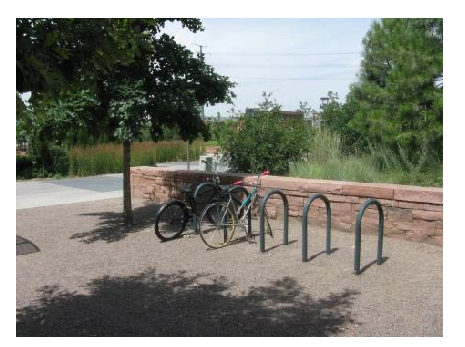
Figure 10-4.4.3-4: Bicycle Parking Example
All parking areas containing more than ten parking spaces shall provide bicycle racks or lockers sufficient to accommodate the parking of at least four bicycles for each ten parking spaces, or major fraction thereof above 10 spaces. No more than 20 bicycle parking spaces shall be required in any one parking area.
(2)
Bicycle Rack and Locker Location. Required bike racks and/or lockers shall be installed on a paved surface and located in visible, well-lit areas conveniently accessible to the primary entrances of a development principal building(s). They shall be located where they do not interfere with pedestrian traffic and are protected from conflicts with vehicular traffic. For residential uses, bicycle parking within a garage or inside a building shall satisfy this requirement.
(H)
Loading Area Requirements
(1)
Minimum Number of Off-Street Loading Berths. Except as otherwise provided in this Section, accessory off-street loading areas shall be required when any building or structure is erected, structurally altered increasing the gross floor area by 50 percent or more, or there is a change in use. A sufficient number of off-street loading berths shall be required to accommodate the delivery and shipping operations of the development's uses in a safe and convenient manner. Table 10-4.4: Minimum Number of Off-Street Loading Berths below, sets forth the minimum number of loading berths that presumptively satisfies the loading area needs of the listed principal uses. For proposed uses not listed in Table 10-4.4, the requirement for the use most similar to the proposed use shall apply. The Director may require more loading berths or fewer loading berths upon determining that the characteristics of a particular development warrant such addition or reduction ensuring the general standard is met.
(2)
Dimensional Standards for Loading Areas
(a)
Each loading berth shall be sized appropriately to accommodate the vehicles likely to use the loading area.
(b)
The minimum loading berth size shall be at least 12 feet wide and 25 feet long.
(c)
Properties and uses that require semi-truck trailers for loading shall be required to appropriately increase the length of the loading zone to accommodate this type of vehicle.
(d)
The Director may require a larger loading berth or allow a smaller loading berth upon determining that the characteristics of the particular development warrant such increase or reduction ensuring the general standard is met.
(e)
Each loading berth shall have at least 14 feet of overhead clearance.
(3)
Location of Loading Areas
(a)
Where possible, loading areas shall be located to the rear of the use they serve.
(b)
The loading areas shall be located adjacent to the building's loading doors, in an area that promotes its practical use.
(c)
The loading area shall be located and designed so vehicles using them can maneuver safely and conveniently to it from a public street or alley and complete loading without obstructing or interfering with any public right-of-way, parking space, dumpster facility, or parking lot aisle.
(d)
Tandem loading zones are not permitted.
(I)
Drive-Through Vehicle Stacking Standards. The following standards apply to properties with a drive-through facility designed for access from a vehicle (rather than a walk-up facility).
(1)
Uses for which Drive-Through Facilities are Prohibited. Drive-through facilities shall not be allowed for convenience stores, wedding chapels, or other uses not listed in Table 10-4.5, unless authorized by the Director based on the need and/or appropriateness of a drive through facility for such use.
(2)
Stacking Space Requirements. Vehicle stacking spaces for drive-through facilities shall be provided to comply with Table 10-4.5: Drive-Through Stacking Space Requirements.
(3)
Location and Design of Stacking Lanes
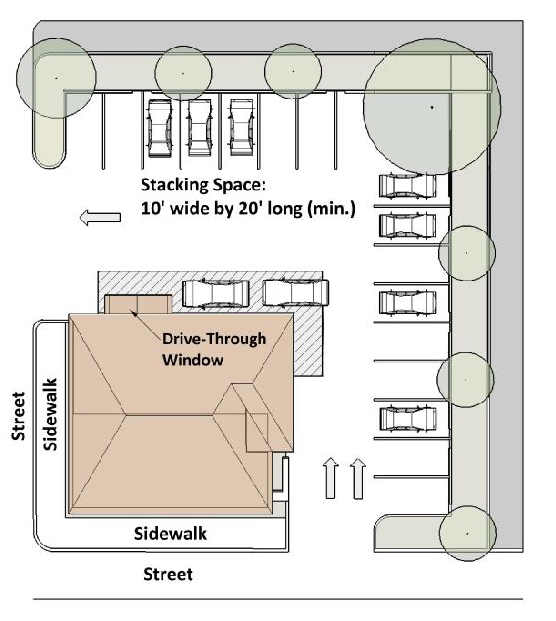
Figure 10-4.4.3-5: Stacking Spaces
(a)
Audible electronic devices such as loudspeakers, automobile service order devices, and similar instruments shall not be audible beyond the property line of the site.
(b)
No service shall be rendered, deliveries made, or sales conducted within the required front yard or corner side yard; customers shall be served in vehicles through service windows or facilities located on the non-corner sides and/or rear of the principal building. The Director may authorize exceptions to this requirement based on anticipated needs and ability to comply with other standards of this code.
(c)
Drive-through stacking lanes shall have a minimum width of ten feet and a minimum length of 20 feet.
(d)
A bypass lane shall be incorporated in all drive-through facilities.
(e)
Stacking spaces for drive-through facilities shall be located so that waiting vehicles do not block parking stalls or interfere with the movement of traffic on-site, off-site, or pedestrians and bicyclists. Landscaping shall be installed to screen drive-through windows and order boxes along building facades facing the principal street.
(J)
Electric Vehicle Parking Requirements
(1)
General.
(a)
Electric vehicle parking spaces and charging stations required pursuant to this section shall meet the following design standards, in addition to all other design standards set forth in this article.
(i)
Any mixed-use, non-residential, or multi-family development with twenty (20) or more parking spaces shall install and provide access to electrical power supply rated at two hundred forty (240) volts or greater, in all off-street parking facilities, to allow for the installation of electric vehicle parking spaces.
(ii)
Electric vehicle parking spaces shall be marked by green painted lines or curbs.
(iii)
Each electric vehicle parking space shall be marked by a sign designating the parking space as an electric vehicle parking space. in accordance with the Manual on Uniform Traffic Control Devices {MUTCD) of the Federal Highway Administration.
(iv)
Each electric vehicle charging station shall be equipped with a sign that includes the following information: {i) voltage and amperage levels. {ii) any applicable usage fees. {iii) safety information. and {iv) contact information for the owner of the charging station. to allow a consumer to report issues relating to the charging station.
(v)
Electric vehicle charging stations shall contain a retraction device. coiled cord. or a fixture to hang cords and connectors above the ground surface.
(vi)
Electric vehicle charging stations shall be screened from view when installed in such a manner that the apparatus would not be visible from any public right-of-way.
(2)
Calculation of Electric Vehicle Parking Required. Except in single-family residential districts, wherever off-street parking is required pursuant to the land development code, a minimum of two (2) percent of the required off street parking spaces, with a minimum of one (1) parking space, shall contain electric vehicle parking spaces, in accordance with the following standards:
(a)
In mixed-use and non-residential districts, where twenty (20) or more off-street parking spaces are required by the land development code, all electric vehicle parking spaces shall be reserved for the exclusive use of electric vehicles.
(b)
In mixed-use, non-residential districts, and multi-family districts, electric vehicle parking spaces shall, at a minimum, be equipped with an electric vehicle charging station rated at electric vehicle charging level 2.
(c)
For residential uses, electric vehicle charging stations shall be limited to the use of building residents and their invited guests.
(3)
Electric vehicle parking required for existing developments. Any new development, redevelopment, or expansion of any facility in a mixed-use non-residential, or multi-family district resulting in an increase of at least twenty (20) or more required off street parking spaces shall be subject to the electrical vehicle parking standards outlined in §10-4.3(J)(1) of this Code.
(Ord. No. 2021-004, § 2, 2-24-21; Ord. No. O-2021-020, § 2, 5-12-21; Ord. No. 2021-029, § 4, 9-22-21; Ord. No. 2024-003, § 2, 1-24-24)
10-4.4 - Landscaping and Tree Preservation
(A)
Purpose. This section contains the minimum standards for the development, installation, and maintenance of landscaping and screening and the preservation of trees within the City of Tamarac. The intent of this section is to protect, and preserve the quality of the air, water, soil, wildlife habitats, and other natural resources, as well as enhance property values, and aesthetic qualities in the City, while promoting the general public health, safety, and welfare of its residents and visitors. The City also recognizes that Improper tree care and removal have a detrimental effect that causes or cumulatively worsens environmental deterioration, air and water pollution, and blight. These standards ensure landscaping is an integral part of every development that will:
(1)
Conserve existing landscaping and natural vegetation while maintaining, preserving, expanding and enhancing the existing tree canopy in the City, and protecting the natural environment and beauty of the City by regulating the unnecessary destruction, removal, or damaging of desirable trees and plant life;
(2)
Mitigate against erosion and sedimentation by stabilizing the soils through the cultivation and protection of root systems that hold and consolidate soil and other loose earthen materials as well as restore soils and land bared as a result of construction or grading;
(3)
Reduce stormwater runoff and associated impacts by intercepting, dispersing, and absorbing rainfall, slowing down surface flow, filtering pollutants from runoff, and conserving water supplies by allowing more rainfall to stay in the water table, minimizing water used for landscaping maintenance;
(4)
Encourage building and paved surface cooling through shading and the channeling of breezes, thereby helping to offset global warming and lowering ambient temperatures through transpiration;
(5)
Contribute and encourage of air movement, air purification, and oxygen regeneration by removing carbon dioxide and pollutant gases from the air and producing oxygen that helps dilute air pollutant concentrations;
(6)
Stimulate economic development by increasing the City's attractiveness and quality of life for shoppers, visitors, residents, and employers through incorporating human scale into the urban environment by breaking up the visual impact of structures and parking lots while providing a sense of privacy from neighbors and public rights-of-way;
(7)
Maintain the continued vitality of natural habitats for the propagation and protection of wildlife, birds, game, fish, and other aquatic life;
(8)
Buffer excessive or undesirable impacts from street traffic or adjacent land uses and activities by absorbing and deflecting sounds, limiting glare created by exterior lighting, and screening undesirable views; and
(9)
Support the core components of crime prevention through environmental design (CPTED) through natural surveillance, access control, and territoriality.
(B)
Documents Incorporated by Reference. The following documents, as amended, are adopted as standards and are incorporated by reference in this Section: The American National Standards Institute ("ANSI") A-300, Standards for Tree Care Operations: Tree, Shrub and Other Woody Plant Maintenance-Standard Practices, and Z133.1-2006, Arboricultural Operations: Pruning, Trimming, Repairing, Maintaining, and Removing Trees, and Cutting Brush—Safety Requirements; Florida Department of Agriculture and Consumer Services, Division of Plant Industry, Grades and Standards for Nursery Plants; Nelda Matheny and Jim Clark, Trees and Development: A Technical Guide to Preservation of Tree During Land Development; Council of Tree and Landscape Appraisers, Guide for Plant Appraisal, Tenth Edition, 2019; Richard Harris, Arboriculture Integrated Management of Landscape Trees, Shrubs and Vines, Fourth Edition; Gary W. Watson and E.B. Himelick, Principles and Practices of Planting Trees and Shrubs; Florida Urban Forestry Council's poster, Selecting and Planting Trees for the South Florida Urban Forest; and Florida Power and Light's brochure, Plant The Right Tree In the Right Place, South Florida version; Timothy K. Broschat & Alan W. Meerow, Betrock's, Reference Guide to Florida Landscape Plants, Third Printing, 1994; Edward F. Gilman, Trees for Urban and Suburban Landscapes, 1st Edition, 1997; and Dr. George K. Rogers, Landscape Plants For South Florida: A Manual For Gardeners, Landscapers & Homeowners, 1st Edition, 2009; and Florida Invasive Species Council's List of Invasive Plant Species.
(C)
Definitions. When a word, term, or phrase is not defined herein, the definitions set forth in § 10-4.4 of the Code and publications recognized as authoritative in the scientific and engineering fields, as applicable, shall apply. Such publications shall include the publications incorporated by reference in subsection (C) of this section.
The following words, phrases, and terms when used in this section shall have the indicated meanings:
Breast height means a height of four and one-half feet above the natural grade.
Canopy coverage means the areal extent of ground within the drip line of the tree.
Conservation easement means a right or interest in real property as defined in F.S. §704.06, as amended.
Department means City of Tamarac Community Development Department.
Destruction of the natural habit of growth means pruning that causes irreparable damage and permanent disfigurement to a tree such that, even with regrowth, the tree will never regain the original characteristics of its tree species; or pruning which amounts to tree abuse as defined herein that results in the death of the tree.
Diameter breast height (DBH) means the diameter of the trunk of a tree measured at breast height. The DBH of trees with multiple trunks shall be the sum of the individual trunk diameters at breast height. Trees with less than four and one-half feet of clear trunk shall be measured as the diameter of the largest vertical branch or leader at breast height.
Director means Director of Community Development.
Drip line means the peripheral limits of the horizontal crown of a tree spread vertically to the ground; provided, however, that the same shall not be less than a circle with a five-foot radius measured from the center of the tree.
Effectively destroy means to cause, suffer, allow or permit any act which will cause a tree to die or go into a period of unnatural decline within a period of one year from the date of the act. Acts which may effectively destroy a tree include, but are not limited to, damage inflicted upon the root system by heavy machinery, excessive trimming, changing the natural grade above the root system or around the trunk, damage inflicted on the tree permitting infection or pest infestation, application of herbicides or other chemical agents or intentional fire damage to the tree permitting infection or pest infestation, the infliction of a trunk wound that is 50 percent or greater of the circumference of the trunk, or the removal of sufficient canopy to cause the unnatural decline of the tree.
Environmentally sensitive land means a land designation as defined in the Broward County Land Use Plan.
Hatrack shall mean to sever the leader or leaders, or to prune a tree by stubbing of mature wood.
Hazardous tree means any tree that poses a threat to public safety, property, or the lawful use of land. This includes trees that create a safety hazard to pedestrian or vehicular traffic or that may disrupt public utility services; trees that endanger existing buildings, structures, or other improvements; trees that obstruct reasonable access to a lot or parcel, provided the proposed access complies with applicable regulations; diseased trees that threaten the health or safety of people, buildings, improvements, or other trees; trees significantly weakened by age, storm, fire, or other injury such that they present a danger to persons or property; or trees that prevent the lawful development or physical use of a lot or parcel.
Historical tree means a particular tree or group of trees which has historical value because of its unique relationship to the history of the region, state, nation or world as designated by the City Commission.
Horizontal plane shall mean an imaginary line that begins at the base of the live frond petioles.
Land clearing means the clearing of vegetation and soils for the purpose of land development activities. This includes, but is not limited to, construction for buildings, rights-of-way, utility easements, access or drainage ways, parking lots and other structures, rock mining, the control of weeds or the initial clearing of vegetation to enhance property value or agricultural activities that involve the removal of trees as defined by this section.
Local area of particular concern means a land designation as defined in Section 5-182(j) of the Broward County Land Development Code, as amended.
Mitigation means to compensate for impacts to tree(s).
Natural Forest Community means a vegetated area generally comprised of a canopy, subcanopy and groundcover, and which meets the criteria for the classification of an area as a Natural Forest Community under Chapter 27, Article XIV, Section 411 of the Broward County Code of Ordinances.
Natural Resource Area means a land designation as defined in Article IX, Section 5-280 of the Broward County Land Development Code, as amended.
Nuisance Trees means any non- native plants or trees as determined by the Florida Exotic Pest Plant Council, that are altering native plant communities by displacing native species, changing community structures or ecological functions, or hybridizing with natives.
Owner-occupied means a dwelling in a habitable condition occupied by the owner of record, as the owner's primary residence, and holding a valid Certificate of Occupancy.
Overlift means the removal of the majority of the inner lateral branches and foliage thereby displacing weight and mass to the ends of the branches. The alteration of the tree's live crown ratio may be considered as evidence of overlifting
Person means any natural person, individual, owner, operator, public or private corporation, firm, association, joint venture, partnership, municipality, governmental agency, political subdivision, public or private utilities, public officer, responsible party or any other entity whatsoever, or combination thereof, of whatever kind.
Power line or power lines means a cable carrying electrical power that is supported by poles or pylons.
Preservation area means the portion of a Natural Forest Community which shall be preserved in perpetuity, pursuant to a tree removal license.
Property owner means the person or persons shown on the county real estate tax records as the owner of the property.
Protective barrier means conspicuously colored fences or like structures constructed of sturdy materials that are at least four feet in height which prevent or obstruct passage.
Prune or trim means to cut away, remove, cut off or cut back parts of a tree.
Public right-of-way means all streets, roads, alleys, lanes, waters or other public ways where the public has the right to travel or which are open to the use of the public.
Remedial action means a corrective action required to offset the impacts of Tree Abuse, as defined herein.
Remedial pruning means the cutting and trimming of branches and foliage so as to alleviate the danger of the tree damaging power lines, consulting with American Natural Standards Institute ("ANSI") A300 (Part I)—2001 Pruning Standards, as amended, and ANSI Z133.1-2000 Pruning, Repairing, Maintaining, and Removing Trees, and Cutting Brush—Safety Requirements, as amended.
Removal means to cut down, dig up, destroy, effectively destroy, or the unlicensed relocation of any tree.
Resource Management Plan means a plan that will enhance a preservation area of a Natural Forest Community to compensate for the development of a portion of the Natural Forest Community.
Right Tree, Right Place Guidelines shall mean those guidelines for planting trees near power lines, published within Florida Power and Light Company's "Right Tree, Right Place" brochure. These guidelines require that trees be placed as follows:
(1)
Trees, including palms, less than 20 feet in height at maturity may not be planted under power lines.
(2)
Trees, other than palms, 20 feet to 30 feet in height at maturity shall be planted at least 20 feet away from power lines.
(3)
Trees, other than palms, greater than 30 feet in height at maturity shall be planted at least 30 feet away from power lines.
(4)
Palm trees greater than 20 feet in height at maturity shall be planted either 20 feet or at one maximum palm frond length plus ten feet away from power lines, whichever is greater.
Shape means the regular and frequent shearing of outer tree branches, making pruning cuts of one inch in diameter or less, for the purpose of controlling the size and shape of the tree canopy.
Shearing means the cutting of many small diameter stems of one (1) inch in diameter or less.
Specimen tree means any tree which has a DBH of 18 inches or greater with a condition rating of 60 percent or greater in accordance with the condition rating guidelines as specified in the Guide for Plant Appraisal, 9th edition, as amended; with the exception of the following:
(1)
Non-native fruit trees that are cultivated or grown for the specific purpose of producing edible fruit, including, but not limited to: mangos, avocados, or citrus.
(2)
Species of the genus Ficus except F. aurea (strangler fig), F. laevigata (short leaf fig), F. rubiginosa (rusty fig or rusty leaf fig), F. jacquinifolia;
(3)
All multi-trunk palms.
(4)
Trees that are in poor condition or form as determined by the Community Development Department.
Structure means anything built or constructed. Examples include, but are not limited to, buildings, trailers, fences, billboards, swimming pools, poles, pipelines, ditches, roads, utility installation, transmission lines, track and advertising signs.
Subcanopy means an intermediate level of trees and other vegetation within a Natural Forest Community.
Substantial deviation means any proposed modification or modification to a development, a license or a license application which, either individually or cumulatively with other changes, creates a reasonable likelihood of additional environmental impact, as covered by the scope of this section, or any change or proposed change that may result in any impacts on trees or Natural Forest Communities not previously reviewed by the Community Development Department as covered by the scope of this section.
Topiary pruning means the practice of pruning a tree into an ornamental shape by pruning branches one inch in diameter or less.
Tree means any living, self-supporting, dicotyledonous or monocotyledonous woody perennial plant which has a DBH of no less than three inches and which normally grows to an overall height of no less than ten feet in Southeast Florida.
Tree canopy means the upper portion of the tree consisting of limbs, branches, and leaves.
Tree removal license means a written authorization with conditions issued by the Community Development Department to remove or relocate a tree.
Tree survey means a document signed and sealed by a Florida Registered Land Surveyor meeting the requirements of F.S. §472.025, as amended, which must provide, at a minimum, the following information:
(1)
The location, plotted by accurate techniques, of all existing non-nuisance trees;
(2)
The common and scientific name of each tree;
(3)
The DBH of each tree, or if a multiple-trunk tree, the sum DBH for all trunks; and
(4)
Canopy coverage.
Unacceptable risk means tree removal is the only means of practically mitigating a tree's risk rating to below moderate, as determined by the tree risk assessment procedures outlined in International Society of Arboriculture's Best Management Practices—Tree Risk Assessment, Second Edition (2017).
Urban Wilderness Inventory Area means an area of land included in the Urban Wilderness Inventory pursuant to Section 25½-27 of the Broward County Code of Ordinances, as amended.
Wildlife utilization means an area used by wildlife for habitat/feeding.
(D)
General Prohibitions. Unless otherwise authorized by this section, no person shall cause, suffer, permit or allow:
(1)
The removal of any Historical tree without first obtaining approval from the City Commission to conduct the removal.
(2)
The removal of any tree without first obtaining a tree removal license from the Department as herein provided.
(3)
Tree abuse as defined by this section.
(4)
Any encroachments, excavations, or change of the natural grade within the drip line of a tree unless it can be demonstrated to the Department prior to the commencement of said activity, that the activity will not negatively impact any tree.
(5)
Land clearing or the operation of heavy equipment in the vicinity of a tree without placing and maintaining a protective barrier around the drip line of the tree. The protective barrier shall be conspicuous enough and high enough to be seen easily by operators of trucks and other equipment.
(6)
The storage or use of materials or equipment within the drip line of any tree, or attachments, other than those of a protective and non-damaging nature, to any tree.
(7)
Land clearing, including the removal of understory, in an area designated as a Natural Forest Community without first obtaining a letter of authorization or a Tree Removal License from the Department as herein provided.
(E)
General Exemptions.
(1)
During emergency conditions caused by a hurricane or other natural disaster, the provisions of this Section may be suspended by the direction of the City Manager.
(2)
Nuisance Trees. Nuisance trees as defined by this section are exempt from the prohibitions set forth in subsection (D) provided that no condition is created which poses an imminent threat to public safety or property. In such cases, the nuisance tree shall be removed to alleviate any threat. Failure to remove said tree after warning from the Department shall constitute a violation of this section.
(3)
Tree Risk. The pruning, trimming, removal, or replanting of, or mitigation for impacts to, a tree on residential property is exempt from any notice, application, approval, permit, fee, or mitigation requirements of this Section if the property owner possesses documentation from an arborist certified by the International Society of Arboriculture or a Florida licensed landscape architect that the tree poses an unacceptable risk to persons or property. This exemption implements and adopts by reference Section 163.045, Florida Statutes, as amended, including, but not limited to, the definitions of documentation and residential property, and the standards therein for determining whether a tree poses an unacceptable risk. This exemption does not apply to the exercise of specifically delegated authority for mangrove protection pursuant to F.S. §§ 403.9321—403.9333, as amended.
(F)
Tree Removal License Requirements and Standards.
(1)
License Requirements:
(a)
Unless otherwise exempted by this section, a person shall obtain a tree removal license prior to relocating or removing a tree.
(b)
Unless otherwise exempted by this section, any person who removes a tree or who negatively impacts a Natural Forest Community in violation of this section shall be required to offset any environmental impacts through mitigation.
(c)
Exemptions from Licensing: Unless otherwise prohibited by the City Code, the following activities are exempted from the licensing requirements of this section provided that no nuisance or any condition which adversely affects the environment or public health is created, and provided that the activity does not violate any provisions of the City Code, or Broward County, or federal, state:
i.
Removal of any tree that is hazardous to the extent that its continued existence creates an imminent threat to public safety or property. In order to claim this exemption, the owner of the property must document by photographs or other evidence that such condition(s) existed prior to the removal of the tree. In the case of Natural Forest Communities, specimen trees or historic trees, documentation of the condition must be presented to the Department within 48 hours of removal;
ii.
Removal of any tree on owner-occupied residential properties of one acre or less developed for detached single-family and duplex usage, except the following:
A.
Previously preserved, relocated or replaced trees that were preserved, relocated or replaced pursuant to a tree removal license; or
B.
Historical or specimen trees; or
C.
Trees that, if removed, would result in the property not satisfying the minimum tree quantity requirements specified in Table 10-4.6.
iii.
Removal of trees by all City and Broward County-licensed nurseries, botanical gardens and commercial grove operations, but only in relation to those trees which are planted and grown for the sale or intended sale to the general public in the ordinary course of the licensed business;
iv.
Removal of trees by all governmental and private nurseries with respect to trees which have been planted and grown for future relocation;
v.
Removal of trees, except historical or specimen trees, by franchised utility companies other than electrical utilities, provided that:
A.
The utility company provides written notice to the Department and the record owner of the property on which the trees proposed to be removed are located of the intent to remove trees; the written notices shall be delivered, at minimum, 15 days prior to the intended tree removal; and
B.
The utility company can demonstrate to the Department prior to tree removal that:
1.
The tree will cause a continual disruption of service. A specimen palm tree may be removed under this exemption;
2.
The easement or property was in actual use conveying utilities prior to the effective date of this section; and
3.
The threat of service interruption cannot be remedied by tree pruning in accordance with standards as set by the American National Standards Institute, as amended;
vi.
Removal of a tree by an electrical utility company if the tree is located within the electrical utility company's right-of-way or utility easement where power lines are located. The electrical utility company may also remove a tree outside of its right-of-way or utility easement if the tree does not comply with the Right Tree, Right Place Guidelines. In the case of the removal of specimen trees or historical trees, the electrical utility shall document by photographs or other evidence that the tree does not comply with the Right Tree, Right Place Guidelines prior to removal of the tree and must present such documentation to the Department within 48 hours after removal;
vii.
Removal of a tree on private property by the private property owner if the tree does not comply with the Right Tree, Right Place Guidelines. Except as provided for in this subsection, the owner of the property must document by photographs or other evidence that the tree is not in compliance with the Right Tree, Right Place Guidelines prior to removal. In the case of Natural Forest Communities, specimen trees, or historical trees, documentation of the condition must be presented to the Department within 48 hours after removal. The collection and presentation of documentation shall not be required if the private property owner has received a notice of violation for the tree; or
viii.
Removal of nuisance trees.
(2)
License Application Requirements:
(a)
Application forms: A license application for removing or relocating trees shall be submitted by a property owner or authorized agent of the owner, on City approved application form(s).
(b)
Fees: The license application must be accompanied by the required fee(s) as established by the City. License application fees are non-refundable and non-transferable.
(c)
Required application data: The license application must be accompanied by documents and drawings as required by the Department that describe the proposed activities to be performed in sufficient detail to meet the standards in this section and to clearly identify all potential impacts to the environment and public health. Application data required shall include, but is not limited to:
i.
A map showing the size and location of the site where the licensed activities are to be conducted;
ii.
A starting date and duration of the proposed activities;
iii.
A brief description of the work to be performed, including a drawing of the proposed work or a certified site plan, as determined by the Department, showing the location of all existing or proposed buildings, structures, and site uses;
iv.
For development on undeveloped property or for redevelopment of property, a certified tree survey and site plan of identical scale designating those trees which are proposed to be preserved, relocated, or removed is required. All tree survey(s) or site plan(s) must be prepared by a person(s) qualified to do so under the Laws of Florida;
v.
The legal description of the site.
(3)
Licensing Standards for Tree Removal, Relocation, and Replacement:
(a)
Any person conducting tree removal activities shall only remove a tree or trees from a site as approved for removal in a City tree removal license.
(b)
Damage to any other tree or trees on the site during tree removal activity shall constitute a violation of this section.
(c)
An applicant may be eligible to receive a tree removal license if one of the following considerations is present:
i.
Whether a proposed development cannot be located on the site without tree removal;
ii.
Whether the applicant has made every reasonable effort to incorporate existing trees in the development project and to minimize the number of trees removed;
iii.
Whether a tree proposed to be removed is of poor quality and condition;
iv.
Whether a tree proposed to be removed is obstructing safe vehicular cross visibility;
v.
Whether a tree proposed to be removed is damaging existing improvements;
vi.
Whether a tree proposed to be removed is creating ongoing safety problems for existing development;
vii.
Whether a tree proposed to be removed is growing too close in proximity to another tree(s) to permit normal growth and development of the affected tree(s); or
viii.
Whether a tree proposed to be removed is listed on the Florida Exotic Pest Plant Council's List of Invasive Plant Species, as amended.
If an application meets the above criteria, the Department will prior to issuing any tree removal license conduct a tree relocation evaluation pursuant to §10-4.4(F)(4).
(d)
Removal or relocation of a tree or trees found in an area designated as a Natural Forest Community shall be conducted pursuant to Broward Code of Ordinances, Chapter 27, Article XIV, Section 411(b) in addition to the requirements of Chapter 27, Article XIV, Section 408.
(4)
Tree Relocation Evaluation:
(a)
For tree relocation, the Department shall make the following evaluations:
i.
A tree which meets the criteria for removal as specified in §10-4.4(F)(3)(c) shall be relocated, unless it is demonstrated that relocation is not a viable alternative for a particular tree. If relocation is not a viable solution, the applicant shall replace a removed tree, pursuant to the requirements set forth in this section; and
ii.
Whether relocation is on the property or off the property, due to lack of available space on the property. Where relocation is to occur onto another property, written authorization from the property owner shall be required.
(5)
Tree Relocation Requirements: Any person conducting tree relocation activities shall:
(a)
Not unnecessarily damage any other tree or trees remaining on-site while relocating a tree;
(b)
Relocate a tree so that it will not interfere with existing or proposed utilities, either above or below ground. Relocated trees shall be in compliance with the Right Tree, Right Place Guidelines.
(c)
Relocate a tree to an area with adequate space for root and canopy development;
(d)
Ensure successful relocation and transplanting of trees by adhering to the following guidelines for transplanting a tree:
i.
Any tree being relocated shall not be unnecessarily damaged during removal, transport or replanting of that tree;
ii.
If a tree has a dormant period, it should be transplanted during that time. A tree should not be transplanted during periods of strong, dry winter winds or during droughts;
iii.
Adequate space for root and canopy development shall be provided;
iv.
Prior to transplanting, the tree shall be root and canopy pruned according to sound arboricultural standards. All crown pruning shall be done in accordance with standards set by the American National Standards Institute, as amended;
v.
During and following transplanting of a tree, the root ball and trunk shall be protected. The root ball must be kept moist at all times;
vi.
A transplanted tree shall be braced for at least one year after its relocation; and
vii.
A transplanted tree shall be fertilized as appropriate and shall be watered sufficiently until tree growth is re-established.
(6)
Tree Relocation Maintenance/Monitoring Requirements: Any person conducting tree relocation activities shall:
(a)
Maintain the health of a relocated tree for a period of one year from the date of planting;
(b)
Replace, within 60 days, a relocated tree that dies or is determined by the Department to be effectively destroyed within one year of being relocated. The one year maintenance period shall begin anew whenever a tree is replaced. For projects that include the relocation of ten or more trees, a ten percent mortality allowance will apply. If 90 percent or more of the relocated trees are determined to be viable after a period of one year, the project shall be considered successful and replacement trees will not be required for the remaining ten percent of the trees that die or are in a state of decline; and
(c)
Remove all strapping and bracing material from all relocated trees at the end of the one-year monitoring period. This should normally occur after seven months for broad leaf trees and 12 months for palm trees. Exemptions to this rule shall require the Department's approval.
(7)
Tree Relocation Bond Requirements:
(a)
Unless otherwise exempted by this section, any person conducting tree relocation activities involving specimen trees must post a bond to ensure the survival of specimen trees designated for preservation. Said bond shall meet the approval of the City Attorney and may be in the form of a letter of credit drawn upon banks or savings and loan institutions legally doing business in the State of Florida, cash bonds issued by an insurance company legally doing business in Florida or other acceptable means as approved by the City Attorney. This bond shall be in addition to any other bond that may be required by any other governmental entity.
(b)
Determination of the bond amount shall be computed based upon the most current version of the Guide for Plant Appraisal, published by the International Society of Arboriculture.
(c)
Government entities are exempt from bond requirements.
(d)
Release of Bonds:
i.
Tree relocation bonds will be released upon successful tree relocation as set forth in §10-4.4(F)(6) and written approval by the Department. Bonds involving specimen trees shall be released upon completion of construction activities, if it is determined by the Department that the tree(s) is/are not effectively destroyed.
ii.
Bonds may be released by the Department when a tree removal license is transferred. The Department may condition the release of the bond upon the posting of a new bond by the subsequent licensee.
(e)
Drawing on Bonds:
i.
If a tree is determined by the Department to be effectively destroyed within one year from the date of relocation, the bond shall be drawn upon and funds will be deposited into the City Tree Preservation Fund.
(8)
Tree Replacement in Lieu of Tree Relocation:
(a)
When it is determined by the Department that tree relocation cannot be accomplished, an applicant shall replace trees pursuant to §10-4.4(F)(9).
(9)
Tree Replacement Requirements:
(a)
Tree Replacement Requirements for Non-Specimen Trees:
i.
If the Department determines that a removed tree cannot be successfully relocated, said tree shall be replaced to compensate for lost tree canopy coverage.
ii.
The following criteria shall be used by the Department to determine the tree replacement requirements:
A.
The tree canopy coverage of a site shall be determined using any combination of the following methods:
1.
Review of aerial photography;
2.
On-site inspection; and/or
3.
Review of a tree survey.
B.
A tree that is successfully relocated pursuant to §10-4.4(F) need not be replaced.
C.
Native trees identified in Tables 10-5.0, 5.1, 5.2, 5.3 of this Section must be planted to replace native tree canopy coverage removed.
D.
For tree replacement requirements of one to five trees, a minimum of one species shall be utilized as a replacement tree. For six to ten replacement trees required, a minimum of two species shall be utilized. For 11 to 20 replacement trees required, a minimum of three species shall be utilized. For 21 to 50 replacement trees required, a minimum of four species shall be utilized. For 51 or more replacement trees required, a minimum of five species shall be utilized.
E.
Per §§10-4.4(F)(3)(c)(i) and (ii), for trees removed prior to obtaining a Tree Removal License, and trees meeting development criteria, an additional 50 percent tree replacement shall be required.
F.
Failure of an owner to replace a removed tree with an equivalent replacement within 60 days after being notified by the Department shall be a violation of this Code.
G.
No Improvement Permit shall be issued without an approved Tree Removal License.
H.
Removal, replacement, or relocation shall take place before a Certificate of Occupancy is granted.
I.
The number of required replacement trees shall be based upon the size of area of impact and the category of replacement trees selected by the applicant. The canopy of the replacement trees at maturity shall at least equal the canopy removed. The following table shall be used to determine the number of required replacement trees:
(b)
Tree Replacement for Specimen Trees:
i.
A tree appraisal will be performed by the Department to determine the dollar value of any specimen tree approved by the Department for removal. This appraisal shall be pursuant to the Guide for Plant Appraisal, 9th Edition, as amended, by the Council of Tree and Landscape Appraisers.
ii.
The Department will then calculate the number of replacement trees required to equal the appraised value of the specimen tree removed. This calculation shall include the purchase price of the replacement tree, plus installation costs. The applicant will be required to compensate the number of replacement trees indicated by the Department for the removal of the specimen tree(s).
(c)
Minimum Standards for Replacement Trees:
i.
All replacement trees shall be a minimum quality of Florida No. 1 grade or better, as identified in Grades and Standards, Florida Department of Agriculture;
ii.
Only trees listed in Tables 10-4.7, 4.8, 4.9 (Replacement Tree Species) shall be used as replacement trees. The applicant shall have the option of choosing the category of trees for replacement provided at least 50 percent of the replacement trees are from Category 1 or Category 2 with respective size as follows:
A.
Category 1: Minimum of 12 feet in height and two inches DBH at time of planting;
B.
Category 2: Minimum of eight feet in height at time of planting;
C.
Category 3: Minimum of six feet in height at time of planting;
D.
Category 4: For replacement palm trees, a minimum of six feet clear trunk or greywood at time of planting.
iii.
If the minimum tree size is commercially unavailable, smaller trees may be substituted with the approval of the Department. Additional credit may be given for the installation of larger trees, at the Department's discretion.
(d)
General Requirements for Replaced Trees: Any person conducting tree replacement activities shall:
i.
Refrain from unnecessarily damaging any other tree or trees remaining on site while planting or preparing the site for any replacement tree(s);
ii.
Plant the replacement tree so that it will not interfere with existing or proposed utility lines or cables, either above or below ground. A tree which may reach a height of 30 feet shall not be planted within 20 feet of an overhead powerline;
iii.
Plant replacement tree species and use installation and maintenance methods that follow xeriscape principles, where practicable;
iv.
Plant a replacement tree in an area in conformity with the Right Tree, Right Place Guidelines. Large canopy trees from the Category 1 list (Live Oak, Mahogany, Black Olive, etc.) shall not be planted in parking lot islands less than ten feet in width, or adjacent to buildings or in any small confined space with less than ten feet of available rooting space or less than 20 feet of available canopy space. Exceptions to this rule shall require the Department's approval;
v.
Complete tree replacement within the time frames specified in the Tree Removal License.
(e)
Maintenance/Monitoring Requirements for Replaced Trees: Any person conducting tree replacement activities shall:
i.
Maintain the health of a replacement tree for a period of one year from the date of planting;
ii.
Replace within 60 days any replaced tree that dies or is determined to be effectively destroyed within one year of being planted, as determined by the Department. The one year maintenance period shall begin anew whenever a tree is replaced. For projects that include the planting of 100 or more replacement trees, a ten percent mortality allowance will apply. If 90 percent or more of the replacement trees are determined to be viable after a period of one year, the project shall be considered successful and replacement trees will not be required for the remaining ten percent of the trees that die or are in a state of decline; and
iii.
Remove all strapping and bracing material from all replaced trees at the end of the one-year monitoring period.
(f)
Remuneration in Lieu of Tree Replacement: If it is determined by the Department that the replacement is not feasible due to lack of available planting space, the following applies:
i.
The person conducting the tree replacement activity shall pay into the City Tree Preservation Trust Fund a replacement contribution in lieu of actual tree replacement;
ii.
The replacement contribution will be determined using a schedule for current value of replacement trees plus installation and maintenance as established by the Department;
iii.
Specimen tree calculations shall be in accordance with §10-4.4(F)(9)(b).
(G)
Construction and Land Clearing.
(1)
General Requirements: Any person engaged in construction or land clearing shall:
(a)
Clear vegetation within the drip line of trees designated for preservation only by hand or with the use of light rubber-wheeled equipment, which will not damage tree roots; said equipment shall be a maximum of 48 inches wide, tire to tire, with a maximum weight of 3,500 pounds.
(b)
Utilize retaining walls and drywells to protect any tree to be preserved from severe grade changes.
(c)
Promptly repair any tree designated for preservation pursuant to a tree removal license which is damaged during construction by:
i.
Corrective pruning for damage to tree canopy;
ii.
Measures such as corrective root pruning, fertilization, and soil enhancements for damage to tree roots.
(H)
Tree Abuse.
(1)
Tree abuse is prohibited in the City. Tree abuse includes:
(a)
Hatracking a tree; or
(b)
Destroying the natural habit of tree growth; or
(c)
Pruning which leaves stubs or results in a flush cut; or splitting of limb ends; or
(d)
Removing tree bark to the extent that if a line is drawn at any height around the circumference of the tree, over one-third of the length of the line falls on portions of the tree where bark no longer remains; or
(e)
Using climbing spikes, nails, or hooks, except for purposes of total tree removal or as specifically permitted by standards set by the American National Standards Institute, as amended; or
(f)
Pruning that does not conform to standards or recommendations set by the American National Standards Institute, as amended; or
(g)
Pruning of live palm fronds which initiate above the horizontal plane; or
(h)
Overlifting a tree; or
(i)
Shaping a tree.
(2)
Exemptions from Tree Abuse: The following are exempt from the prohibition of tree abuse:
(a)
Topiary pruning when:
i.
The trees are located on owner occupied property developed for detached single family or duplex usage, or;
ii.
The trees were not installed to meet minimum landscape requirements and are identified on an approved landscape plan as appropriate for topiary pruning.
(b)
Tree abuse necessary to alleviate a dangerous condition posing an imminent threat to the public or property provided that the threat cannot be remedied by pruning that is not defined as tree abuse;
(c)
Shaping of trees to protect property, such as buildings and infrastructure, in which there is adequate evidence accepted by the Department that shaping has occurred historically; or
(d)
Remedial pruning.
(3)
Remedial Measures for Tree Abuse: Any person that abuses a tree in violation of this section shall:
(a)
Undertake pruning and other remedial action as determined by the Department, not limited to the removal of severely abused trees to protect public safety and property, and corrective pruning to improve the health and form of affected trees. A Tree Removal License shall be applied for by the violator(s) and/or property owner(s) and is required for the removal of severely abused trees.
(b)
Plant replacement trees pursuant to §10-4.4(F)(9) of the Code, if the natural habit of growth of the abused tree is destroyed.
(I)
Tree Preservation Trust Fund.
(1)
Establishment of the Trust Fund: The City of Tamarac Tree Preservation Trust Fund has been established for the purpose of accepting and disbursing the contributions made to the City as part of tree removal licenses, fees, and any other monies deposited with the City for tree preservation purposes. This fund shall be used to enhance tree canopy coverage in the City.
(2)
Term of Existence: The trust fund shall remain in existence unless specifically terminated by the City Commission.
(3)
Trust Fund Assets: All monies received hereunder from public or private concerns shall be placed in trust for and inure to the use and benefit of the City.
(4)
Trust Fund Expenditures: Monies in the trust fund shall be expended, utilized, and disbursed for the planting of trees and any other ancillary costs associated with the planting of trees in the City, including but not limited to planting trees and removing hazardous trees on real property within the City, supporting tree maintenance and preservation activities, funding educational outreach programs, providing tree giveaways to residents to promote long-term canopy preservation, and to cover the expense of relocation of trees to public lands. Expenditures from the Trust Fund shall be ecommended by the Director and shall be made in accordance with adopted City policies and procedures. Ancillary costs related to the planting of trees on public lands shall not exceed twenty percent of the cost of the particular tree planting project, and shall include landscape design services, irrigation, additional landscaping, and any other items or materials necessary for the proper installation and maintenance of tree planting projects.
(5)
Trust Fund Administration:
(a)
Trust funds shall be expended, utilized, and disbursed only for the purposes designated by the Department in accordance with this section.
(b)
All monies deposited hereunder shall be deposited in the trust fund, in a separate account established and maintained apart from the general revenue funds and accounts of the City.
(c)
Monies obtained hereunder may be accepted on behalf of the City by the Director or designee and, upon receipt, shall be delivered to the City's Financial Services Department, which shall cause the same to be credited to the trust fund.
(J)
Landscape Plan Required.
(1)
A landscape plan shall be included as part of any application as required for Site Plan Approval (§10-5.4(H)), Improvement Permit (§10-5.4(I)) or Building Permit (§10-5.4(N)), subject to the standards in this section. Landscape plans shall be prepared in accordance with the requirements of the Administrative Manual and shall be approved by the Director, Planning Board, and City Commission, as appropriate.
(2)
Landscape plans shall be prepared and sealed by a landscape architect or other authorized person pursuant to F.S. ch. 481, as amended from time to time.
(3)
All required landscaping shall be maintained in accordance with the approved landscape plan, including approved specifications for plant size, number, location, and type of landscaping material.
(4)
All plant material shown on an approved landscape plan shall be replaced if it dies, is seriously damaged, or removed.
(5)
No final Certificate of Occupancy shall be issued by the City unless the landscaping requirements are met as evidenced by an approved final landscaping inspection by the Department.
(K)
General Requirements for All Landscaping.
(1)
Plant Material. All required plant material shall be Florida Grade #1 or better, in accordance with Grades and Standards for Nursery Plants (Florida Division of Plant Industry).
(a)
All plant material shall, to the greatest extent possible:
(i)
Be based on the plant's adaptability to the landscape area, desired effect, color, texture, and ultimate plant size;
(ii)
Be frost- and drought-tolerant, and grouped in accordance with their respective water and maintenance needs;
(iii)
Be appropriate for the ecological and urban setting in which the materials are to be planted, including the shielding of buildings from the sun, from radiating surfaces such as parking areas, and as a screen for noise abatement;
(iv)
Be commercially available; and
(v)
Comply with CPTED principles.
(b)
All minimum dimensions of landscaped material refer to dimensions at the time of planting.
(c)
Growth of plant material at maturity shall be considered prior to planting to ensure no future conflicts arise related to views, signs, overhead and underground utilities, security lighting, fire access, drainage easements, pedestrian walkways, and traffic circulation.
(d)
All landscaped areas shall be maintained free of nuisance species, including natural areas within developed property. The following species are considered nuisance species:
(i)
Schinus terebinthifolius (Brazilian pepper tree/Florida holly).
(ii)
Metopium toxiferum (poison wood).
(iii)
Melaleuca quinquenervia (cajeput tree/melaleuca).
(iv)
Casuarina spp. (Australian pine, all species).
(v)
Bischofia javanica (bischofia, bishopwood).
(vi)
Acacia auriculaeformis (earleaf acacia).
(vii)
Araucaria excelsia (Norfolk Island pine).
(viii)
Brassia actinophylla (schefflera).
(ix)
Leucaena leucocephala (lead tree).
(x)
Cupaniopsis anacardiopsis (carrotwood).
(xi)
All trees specifically identified asCategoryIon the Florida Invasive Species Council's List of Invasive Plant Species, as may be amended.
(2)
Native Vegetation and Diversity.
(a)
All landscaped areas shall include placement of native vegetation in substantial conformity with the principles outlined in The Florida-Friendly Landscaping Guide to Plant Selection & Landscape Design (University of Florida) and the Administrative Manual.
(b)
The City encourages use of the Xeriscape Landscaping Principles as included in the South Florida Water Management District's publication Waterwise, South Florida Landscapes, Landscaping to Promote Water Conservation Using the Principles of Xeriscape, which is hereby incorporated by reference into this section, amended from time to time.
(c)
Existing healthy and well-formed trees and understory vegetation may be preserved and may be used toward meeting the requirements of this section to the extent that they meet the minimum standards.
(d)
Plant species identified as invasive species in List of Invasive Plant Species (Florida Exotic Pest Plant Council) are prohibited.
(e)
The eradication of nuisance vegetation is required on all sites including, but not limited to, abutting rights-of-way and privately owned natural areas, prior to the issuance of a final Certificate of Occupancy or final approval of any structural modification including vehicular use areas.
(3)
Installation. All required landscaping and landscape areas shall be installed in accordance with landscaping best management practices, Florida-friendly landscaping principles, American National Standards Institute (ANSI) A-300 standards, and the standards in this subsection.
(a)
Topsoil
(i)
Topsoil shall be sandy loam and contain a 25 percent minimum amount of decomposed organic matter. There must be a slight acid reaction to the soil with no excess of calcium carbonate.
(ii)
Topsoil shall have a minimum depth of six inches for groundcover, flowers, shrubs, and hedges and a minimum depth of three inches for turf grasses.
(iii)
Trees shall receive 12 inches of topsoil around and beneath the root ball. No topsoil shall be placed on top of the root ball. The root flare of all newly installed trees shall be visible upon installation.
(iv)
Topsoil shall be clean and reasonably free of clay, stone, roots, construction debris, weeds, rocks, noxious pests, diseases, and other foreign materials.
(v)
Topsoil for all planting areas shall be amended with horticulturally acceptable organic material.
(vi)
All soils used shall be suitable for the intended plant material.
(b)
Mulch
(i)
A three-inch minimum thickness of approved organic mulch material shall be applied after initial watering in all areas not covered by buildings, structures, pavement, turf grass, preserved areas, and annual flower beds.
(ii)
Each tree and shrub shall have a ring of organic mulch no less than three feet in diameter around its trunk.
(c)
Turf Grass
(i)
Turf grass shall be drought-tolerant and a species of grass that will survive as a permanent lawn in Broward County assuming adequate watering and fertilizing as described in this Section and the Administrative Manual.
(ii)
Turf grass shall be viable, free of weeds, and capable of growth and development.
(iii)
Planted as sod, strips shall be aligned with tightly fitted joints and no overlap of butts or sides. Sod subgrade shall be reasonably free of all stones, sticks, roots, and other matter prior to placement.
(iv)
Turf grass areas may be seeded to meet the requirements of this Code, provided that the area presents a finished appearance and complete coverage before a final Certificate of Occupancy or other approval is issued.
(v)
Use of turf grass shall be limited to being a design unifier, shall not be treated as fill-in material, but as a planned element of the landscape. Turf grass shall be consolidated and placed so it can be irrigated separately from other types of plant material. Turf grass shall be restricted to areas that receive pedestrian traffic, provide for practical or recreational use, or provide soil erosion control (e.g., on slopes or in swales).
(vi)
St. Augustine turf shall be installed within all unpaved areas of all rights-of-way.
(vii)
The Director may authorize large grassed areas not subject to soil erosion, such as playfields, to be grassed by other methods.
(d)
Groundcover
(i)
At the time of installations, groundcover shall be planted with a minimum of 75 percent coverage of the intended groundcover area, with 100 percent coverage occurring within three months of planting.
(ii)
For all developed properties, all yards and other portions of land not utilized for structures, parking areas, walkways, driveways, decking, pools, or other amenities shall be covered with turf grass or living groundcover.
(iii)
Nonliving groundcover shall be limited to borders, sidewalks, step stones, and other similar materials, and shall not cover more than 15 percent of the landscaped area. Use of pervious paving materials is strongly encouraged.
(iv)
An applicant may apply for an Administrative Adjustment, as described in §10-5.4(P), Administrative Adjustment, of up to 50 percent of the area to be covered with nonliving groundcover for industrial, special utility, and agricultural properties subject to the criteria for Administrative Adjustment approval.
(e)
Vines. Vines shall be a minimum of 30 inches in supported height upon installation and may be used in conjunction with fences, visual screens, or walls.
(f)
Trees. Fifty percent of the trees required in this section shall be water-conserving native plant material.
(i)
Palm Trees
A.
Palms shall constitute no more than 20 percent of the total trees required. Any palms provided in excess of this amount shall not count towards the tree requirement.
B.
Palms shall have a minimum height of 12 feet and 2 inches DBH at the time of planting, measured from the base of the palm to the tip of the bud, and shall have substantial gray wood characteristics at the time of maturity shall have a minimum of two feet of gray wood at the time of planting.
C.
No large palm trees shall be located closer than 25 feet to light poles or overhead utility lines. Refer to Florida Light & Power's "Right Tree, Right Place" guidelines.
D.
Certain palms, as determined by the Director, may be substituted for shade trees by grouping three or more palms in close proximity together to create the equivalent crown spread. Certain palms, as determined by the Director, may be substituted on a one for one basis in lieu of shade trees. Refer to §10-4.4(J), Approved Palm and Tree Lists.
(ii)
Shade Trees
A.
Shade trees shall constitute 50 percent of the total trees required, unless specifically addressed in this section.
B.
At the time of installation, shade trees shall have a minimum:
1.
Trunk caliper of three inches;
2.
Height of 15 feet;
3.
Crown spread of six feet; and
4.
Four and a half feet of clear trunk.
C.
No shade tree shall be located closer than 25 feet to light poles or 30 feet to overhead utility lines. Refer to Florida Light & Power's "Right Tree, Right Place" guidelines.
(iii)
Small Trees
A.
Small trees shall have a minimum height of ten feet and the minimum crown characteristics of the species at that height upon installation.
B.
Trees with a multiple trunk growth characteristic shall have no more than five main trunks.
C.
All small trees shall have a minimum of 30 inches of clear trunk at the time of planting.
(g)
Shrubs. Fifty percent of shrubs required shall be installed as native plant material. Shrubs shall have a minimum height of 24 inches with a spread of 18 inches upon installation. Shrubs used as a required continuous hedge shall touch one another upon installation.
(h)
Lakes, Canals, and Other Water Bodies
(i)
All lakes, canals, wet retention areas, and other water bodies shall include soil erosion control in the form of turf grass to the edge of the mean high water mark as described in §10-4.4(K)(3)(c), Turf Grass.
(ii)
No turf grass that requires mowing shall be allowed on slopes greater than four to one.
(iii)
All dry retention areas shall be landscaped with turf grass or groundcover in accordance with §10-4.4(K)(3)(c), Turf Grass, and §10-4.4(K)(3)(d), Groundcover.
(i)
Berms
(i)
Berms shall be planted with turf grass or groundcover in accordance with §10-4.4(K)(3)(c), Turf Grass, and §10-4.4(K)(3)(d), Groundcover.
(ii)
The maximum slope for berms shall not exceed one foot in height for every three feet in width.
(j)
Fertilizer
(i)
Fertilizers applied to plant material, including turf grass, within the City shall be formulated and applied in accordance with requirements and directions provided by Rule 5E-1.003(2), Florida Administrative Code, "Labeling Requirements for Urban Turf Fertilizers."
(ii)
Nitrogen and phosphorus fertilizer shall not be applied to turf grasses or landscape plants except as provided in §10-4.4(K)(3)(j)(i) above unless a soil or tissue deficiency has been verified by an approved test.
(iii)
Fertilizer containing nitrogen and/or phosphorus shall not be applied to turf grasses or landscape plants from June 1 to September 30 unless approved by the Director.
(k)
Installation Timing
(i)
Prior to Certificate of Occupancy. All required landscaping, including groundcover, shall be installed in accordance with the approved landscape plan or in accordance with any phasing plan and the required planting standards presenting in this Section prior to the issuance of a final Certificate of Occupancy unless otherwise approved by the Director.
(ii)
Extensions
A.
The Director may, for good cause shown, grant extensions to the above time limit, allowing a developer and/or owner to delay the installation of required landscaping.
B.
Circumstances that may warrant an extension include, but are not limited to, completion of utility work occurring in the proposed landscape area that is incomplete or delayed.
C.
Any extension of the time limit shall be conditioned on the required landscaping being installed as soon as practicable after the delay-warranting circumstances cease to exist. The provision of a performance guarantee shall be required to ensure installation of the required landscaping is performed within one year as described in §10-5.4(I)(3)(c)(i), Performance Guarantees.
(4)
Protection of Public Infrastructure. All shade and medium trees installed within six feet of public infrastructure shall utilize a root barrier system, as approved by the Director.
(5)
Obstructions to Emergency Response Vehicles
(a)
No landscaping or related obstructions shall be placed within seven and a half feet of any fire hydrant.
(b)
Landscaping or related obstructions shall not be placed around buildings and structures in a manner that impairs or impedes accessibility for firefighting and rescue operations.
(6)
Stabilization
(a)
Stabilization shall be in accordance with the International Society of Arboriculture standards as amended from time to time.
(b)
All palm and shade trees planted as trees shall be securely guyed, braced, and/or staked at the time of planting until establishment. The use of nails, wire, rope, or any other method which could damage the tree or palm is prohibited.
(c)
All stabilization systems shall be clearly marked with flags, paint, or other visible medium to prevent hazards and protect the public. Trees shall be re-staked in the event of failure of the staking and guying.
(d)
All guys and staking material must be removed when the tree is stable and established, but in no case more than one year after initial planting. Failure to do so will be considered tree abuse and will lead to enforcement action as described in 10-4.4(H), Tree Abuse.
(e)
All plants shall be installed so that the top of the root ball remains even with or slightly above the soil grade.
(f)
All required landscape planting areas and berms shall be stabilized and maintained with turf grass, groundcover, mulch, or other approved materials to prevent soil erosion and allow rainwater infiltration.
(7)
Irrigation System Required
(a)
Irrigation systems shall be provided in all landscaped areas and designed to meet the needs of the plant material within the landscape areas, in accordance with The Florida-Friendly Landscaping Guide to Plant Selection & Landscape Design (University of Florida) and in compliance with the watering restrictions of the South Florida Water Management District.
(b)
When feasible, irrigation systems shall be designed separately to serve turf grass and non-turf grass areas.
(c)
Irrigation and landscape design, installation, and maintenance shall consider soil, slope, and other site characteristics in order to minimize water waste, including overspray, the watering of impervious surfaces and other non-vegetated areas, and off-site runoff. Furthermore, irrigation systems shall not create a hazard to vehicular use areas.
(d)
In the event of damage or other mechanical failure, irrigation systems shall be designed to minimize free flow conditions.
(e)
Rain-sensing shutoff switch equipment shall be required on automatic irrigation systems installed after May 1, 1991, to avoid irrigation during periods of sufficient soil moisture, in accordance with Florida Law (F.S. §373.62). Such equipment shall consist of an automatic mechanical or electronic sensing device or switch that will override the irrigation cycle of the sprinkler system when adequate rainfall has occurred. Such switches and devices shall be located and installed so that building eaves, balconies, and similar overhands do not interfere with effective operation of the device or switch.
(f)
Low-volume, drip, trickle, and emitter irrigation is encouraged, primarily for trees and shrubs, to promote Xeriscape principles.
(g)
Irrigation systems shall only be operated before 10:00 a.m., and after 4:00 p.m., or as amended by the State of Florida, Broward County, the City, and/or South Florida Water Management District regulations. It is strongly recommended that irrigation systems operate primarily in the early morning hours after 4:00 a.m. to reduce the likelihood of any horticultural plant diseases developing. Operation of the irrigation system for maintenance, repair, turf grass installation for new construction, and landscape maintenance activities such as required application of water to apply fertilizer, herbicides, and pesticides shall not be limited to these hours.
(h)
All new development shall use non-potable water for irrigation source unless a waiver relief letter is provided and approved by the City Engineer.
(L)
Minimum Landscaping Requirements
(1)
Minimum Development Site Planting Requirements
(a)
New developments shall provide plantings within pervious areas of the development site in accordance with the standards in Table 10-4.6 below, for the base zoning district in which the development is located and the size of the lot containing the development.
(b)
The pervious area not covered by buildings, vehicular use areas, waterways, and walkways shall be landscaped including, but not limited to, turf grass, groundcover, trees, shrubs, and other plant material.
(c)
The area between the street pavement and the property line or swale shall be turf grass or groundcover.
(d)
Existing trees and vegetation that are preserved, replaced, or relocated may be credited towards achieving the minimum landscape requirements of this section, provided they meet all applicable requirements of §10-4.4(K), General Requirements for All Landscaping.
(2)
Perimeter and Waterway Frontage Landscaping
(a)
Properties in any district, except RE, R-1, and R-2, shall provide three trees (one of which is a shade tree) for every 40 linear feet or major fraction thereof, and a continuous hedge along the property perimeter. This requirement is in addition to the other requirements in this section, except along street frontages that shall only require two trees (one of which is a shade tree) and a continuous hedge in addition to the street tree requirements as described in §10-4.4(N).
(b)
MUN, MUC, MUG, NC, BP, I-1, and I-2 District properties with main public right-of-way frontage involving only one perimeter, shall reduce this requirement to one shade tree in addition to a continuous hedge and the street tree requirements as described in §10-4.4(N). Corner properties or double frontage property without store fronts facing it shall not be eligible for reduction.
(c)
Where abutting properties have the same perimeter landscaping requirement, the perimeter landscaping requirement can be met jointly by the abutting property owners and does not have to be duplicated by each property owner as approved by the Director.
(d)
A landscaped area shall be a minimum of ten feet from the property line to any vehicular use area or permanent structure other than permitted fences, walls, or landscaping unless specifically required elsewhere in this Section.
(e)
Waterway frontage shall be landscaped the same as the perimeter requirements stated above. The continuous hedge requirement may be reduced upon determination by the Director for waterway frontages only.
(3)
Buffers
(a)
Parking Area Buffers. In all districts except RE, R-1, and R-2, parking areas that abut the public right-of-way shall be required to install a hedge planted a minimum of 24 inches high at time of installation and maintained no higher than 30 inches. Alternatively, a berm 30 inches high shall be installed to screen such parking area from the public right-of-way. Appropriate sight triangles shall be maintained.
(b)
Buffer Between Multi-Family and Single/Two-Family Residential. Where multi-family residential property directly abuts single- and two-family residentially zoned property, a buffer area shall be provided on the multi-family property. This buffer shall be a minimum continuous depth of ten feet of landscaped area and shall follow the perimeter and waterway frontage requirements required in §10-4.4(L)(2), Perimeter and Waterway Frontage Landscaping.
(c)
Properties Abutting or Across from Right-of-way or Water Body. Properties that directly abut or are directly across from any public right-of-way, canal, other water body, or any other separator from any Residential or RC District, or property zoned open space (including golf courses), shall provide a buffer area on the nonresidential plot per the standards below.
(i)
This area shall be a minimum continuous depth of 25 feet of landscaped area.
(ii)
A solid masonry wall, stuccoed and painted, or earthen berm, or combination thereof, of at least six feet in height shall be required within this buffer unless the buffer is within a front yard, along a major arterial, or along a Broward County collector street.
A.
On the side of the wall or earthen berm that abuts the Residential or RC Districts, or is zoned open spaces (including golf courses), two trees, one tree being a shade tree, shall be installed for every 30 linear feet or major fraction thereof. Additionally, a continuous hedge shall be provided.
B.
On the side of the wall or earthen berm that is interior to the nonresidential plot, one shade tree shall be spaced every 40 linear feet. Additionally, a continuous hedge shall be provided.
C.
If a berm is utilized, one continuous hedge shall be installed at the top of the berm only.
D.
If a wall is utilized, it shall contain a door to permit access necessary for the owners to maintain the required landscaping material. The nonresidential user is responsible for maintenance of both sides of any wall. An optional design or material of such wall may be considered by the Director as long as such wall is designed to be an architectural enhancement to the overall property other than strictly for separation purposes.
(iii)
Additional buffer width will be required on property where the building height is five stories or higher or when the property abuts or is across a water body from a residential district. In this case, the minimum width of the buffer shall be 35 feet where there is a water body separator and 50 feet where there is no water body separator.
(d)
SU District Buffers
(i)
A landscape buffer consisting of hedges, trees, berms, or walls shall be installed to provide a visual screen for all lots in the SU district. Any combination of hedges, berms, and walls shall be at least six feet in height at the time of installation in order to screen all the special utility lot from view from any contiguous Residential, Mixed-Use, and Nonresidential Districts, and recreational uses.
(ii)
When fences and wall are used as the visual screen, hedges of 36 inches in height at the time of planting shall be planted outside of such fence or all.
(4)
Pedestrian Zones along Building Façades. Trees and other plantings visually and aesthetically buffer and enhance building façades to reduce air and noise pollution and to conserve energy within the structure.
(a)
There shall be a landscaped pedestrian zone along the entire length of all building walls that are the primary frontage as well as building walls that face a vehicular use area, excluding sections of such façade that are utilized for direct access into the building or the pickup location for the drive-through.
(b)
These provisions shall be applicable to all zoning districts including all covered parking structures or multi-level parking garages except single-family and duplex single-family properties. However, these provisions shall not be applicable when a building wall faces a dedicated alleyway.
(c)
The minimum width of such landscaped zone for all structures shall be measured from the base of the building to the top of a parapet wall, flat roof, or the midpoint of the eave and ridge for a slopped roof as follows:
(i)
For buildings with heights up to and including 60 feet, the landscape zone width shall equal 50 percent of the building height or ten feet, whichever is greater.
(ii)
For building with heights greater than 60 feet, the landscape zone width shall equal not less than 30 percent or more than 50 percent of the building height as determined by the Director.
(iii)
The required width of the landscape pedestrian zone shall exclusive of any two foot car overhang.
(d)
Paved areas in the landscape pedestrian zone may not constitute more than 50 percent of the width of landscape pedestrian zone or seven feet, whichever is less.
(e)
One tree shall be installed in this zone per each 30 lineal feet, or fraction thereof, of façade width.
(f)
Trees must be of a size as required by §10-4.4(K), General Requirements for All Landscaping.
(g)
Trees may be grouped, but there must be a minimum of one tree per façade.
(h)
The remainder of the landscape area of the zone shall be treated appropriately with plantings, seating, sidewalks, and other pedestrian accessways.
(i)
Palms may be substituted for trees in landscape zones of limited width. Palms shall be required at the rate of three palms for each tree that would otherwise be required under this section and must be grouped together within the landscape pedestrian zone, unless the Palm species is designated as a one-for-one substitute.
(j)
The Director has the ability to administratively reduce the width of the landscape pedestrian zone and increase sidewalk width. It must be demonstrated that the reduced green space is provided elsewhere onsite and functions to help soften the mass of the structure.
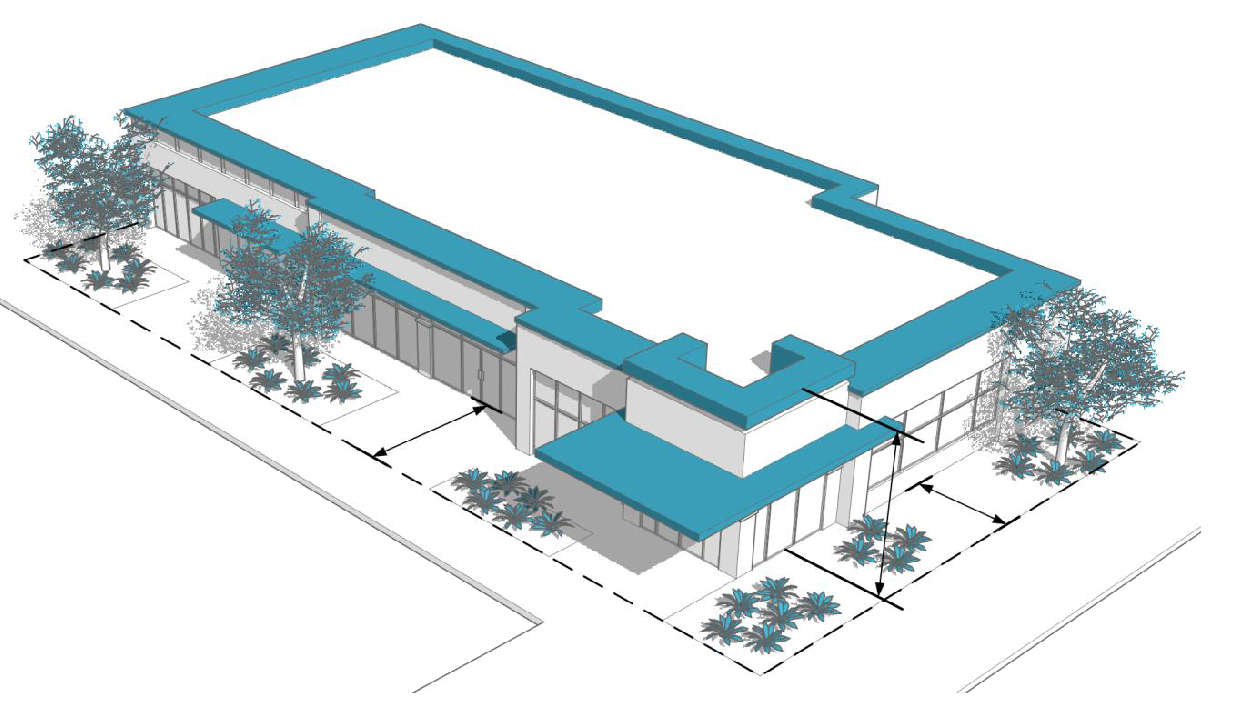
Figure 10-4.4-1: Pedestrian Zones
(5)
Vehicular Use Area Landscaping. Except as otherwise provided by the provisions of this subsection, all vehicular use areas in all districts shall include landscaping around and within the vehicular use areas as a means of mitigating the microclimate and visual aspects as well as providing safe and secure means for pedestrians to navigate these areas.
(a)
Adjacent to Public Rights-of-Way or Private Roadways
(i)
On the site of a building or open lot providing an off-street parking area or other vehicular use area, landscaping shall be provided between the area and adjacent right-of-way or private roadway as follows:
(ii)
At least a width of 15 feet of landscaping, measured from the property line to the closest parking stall and a width of 25 feet measured from the property line to the parallel interior drive aisle, excluding egress and ingress drives, shall be provided.
(b)
Interior Landscaping
(i)
An area or a combination of areas, equal to 15 percent of the total vehicular use area, shall be devoted to interior landscaping.
(ii)
Any perimeter landscaping provided in excess of that required by this Code may be counted as part of the interior landscaping requirement as long as such landscaping is contiguous to the vehicular use area and fulfills the objective of this subsection.
A.
Each parking row shall begin and end with a landscaped island unless the parking row terminates into a required perimeter or buffer area.
B.
For parking rows which provide more than ten parking spaces, one additional landscaped island shall be provided for every ten parking spaces. The Director may approve a greater number of parking spaces between rows based on unique site constraints.
C.
A pedestrian walkway of any kind shall be added to the overall required width of a landscape parking island to maintain the minimum continuous nine-foot foot permeable area to accommodate a shade tree.
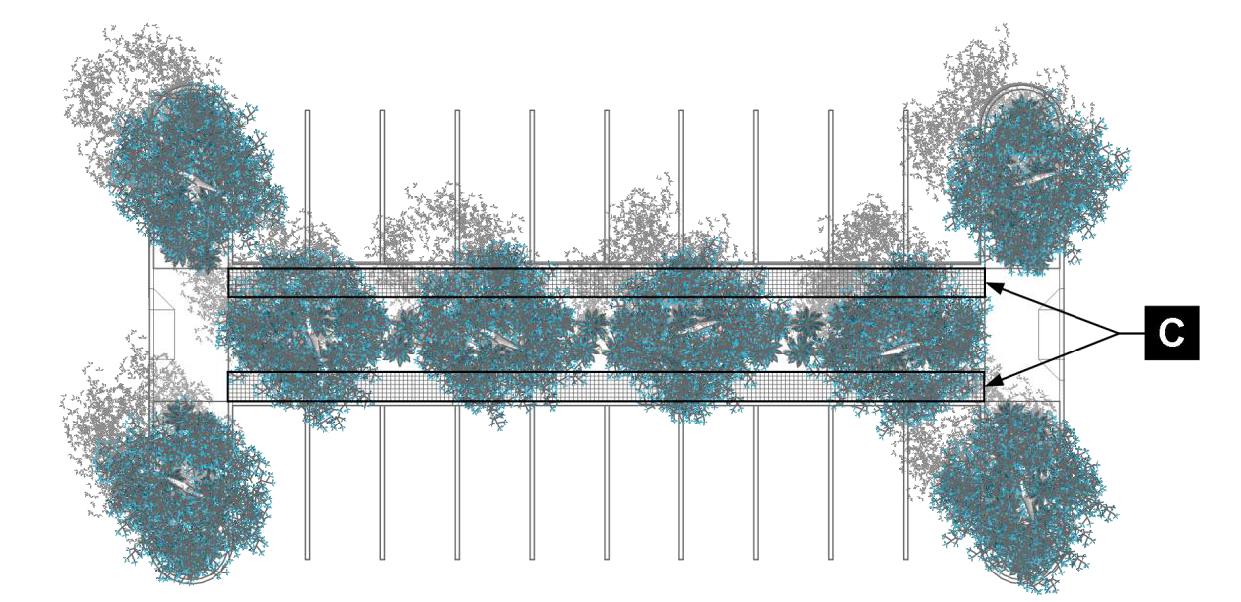
Figure 10-4.4-2: Pedestrian Walkway in Landscape Parking Island
D.
The location of islands can deviate from the above if the purpose of this is to preserve existing on site trees as approved by the Director.
E.
Landscaped islands shall be at least ten feet in overall width, nine feet inside curb permeable area, by 18 feet in overall length, 16 feet inside curb permeable area and shall have at least one shade tree.
F.
The island shall be covered with turf, mulch, or other living ground cover.
G.
The soil utilized within parking lot islands must be a minimum of 36 inches in depth of natural soil not consisting of road rock, imported fill, or other miscellaneous debris. Any grassed parking areas shall comply with the parking island requirements above.
H.
Other suitable solutions or innovative designs to reduce heat and glare from vehicles may be substituted when approved by the Director, providing that no parking stall is further away than 50 feet from a tree, measured in a straight line from the tree trunk. Plans may be submitted showing aggregate clusters of tree planting equivalent to or greater than the total area of all required parking islands. These plans must be reviewed and found acceptable by the Director.
I.
A landscaped area having a width of at least nine feet inside curb permeable area shall be provided between abutting parallel rows of parking spaces and shall contain one shade tree for every 30 lineal feet of landscaped area. The soil utilized within this area shall be a minimum of 36 inches in depth of natural soil not consisting of road rock, imported fill, or other miscellaneous debris. A pedestrian walkway of any kind shall be added to the overall required width of a landscape area and shall be located on one side in order to maintain the minimum continuous nine-foot permeable area and accommodate the row of shade trees.
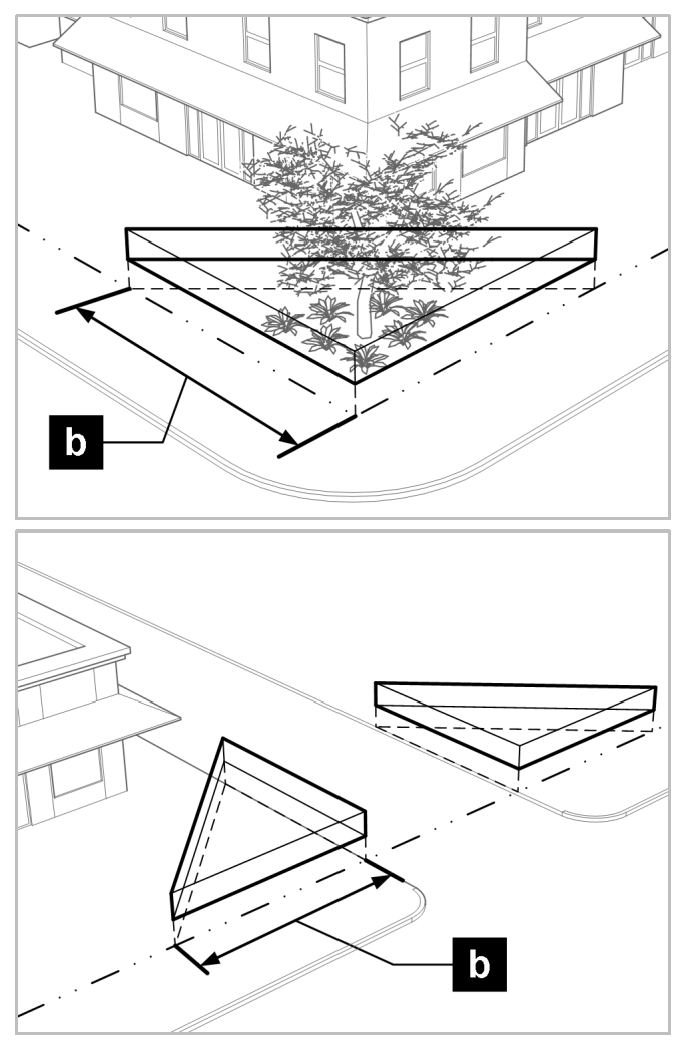
Figure 10-4.4-3: Sign Visibility Triangle
(6)
Sight Distance. When an accessway intersects a public right-of-way, or when the subject property abuts the intersection of two or more public rights-of-way, a sight visibility triangle shall be provided. The sight visibility triangle shall provide unobstructed cross-visibility for vehicular, pedestrian and bicycle traffic at a level between three feet and six feet measured from grade level. The sight visibility triangles are formed as follows:
(a)
The areas of property on both sides of an accessway formed by the intersection on each side of the accessway and the public right-of-way line, with two sides of each triangle being 25 feet in length from the point of intersection and the third side being a line connecting the ends of the other two sides.
(b)
The area of property located at a corner formed by the intersection of two or more public rights-of-way, with two sides of the triangular area being 30 feet in length along the abutting public right-of-way lines, measured from their point of intersection, and the third side being a line connecting the ends of the other two sides.
(c)
Obstructions to be restricted in the sight visibility triangles are found in the City's Engineering Standards.
(7)
Landscape Requirements for Existing Uses
(a)
Development Thresholds Requiring Compliance with Landscaping Requirements. Existing properties, including parking lots, that are not in compliance with these regulations shall, upon the occurrence of any one of the following events, be subject to the provisions of this §10-4.4, Landscaping and Tree Preservation, if:
(i)
The total square footage of the vehicular use area is increased by more than 20 percent; or
(ii)
There is a structural addition that increases the combined total gross floor area of all existing buildings on the property more than 1,000 square feet or by 50 percent, whichever is less; or
(iii)
Building elevation changes, excluding minor cosmetic items such as painting, lighting fixtures, awnings, and signs, involving 50 percent or more of the exterior walls of a roofed structure on the property within a two-year period. A modification to only part of elevation shall constitute a change in the entire elevation of that exterior wall; or
(iv)
Any tenant change for a stand-alone non-residential structure that also involves any change to any building elevation, excluding minor cosmetic items such as painting, lighting fixtures, awnings, and sign painting; or
(v)
Any tenant change for a non-residential structure that is the anchor tenant of a property that also involves any change to any building elevation, excluding minor cosmetic items such as painting, lighting fixtures, awnings, and signs.
In the event an existing property cannot abide by the current provisions of this Section, if the above actions occur, the Director may require a property owner to bring the site to current standards to the greatest extent possible as determined through the Development Review Committee process.
(b)
Existing Parking Lot Compliance
(i)
Existing parking lots that do not meet the requirements of this Code with regards to the size of landscaped parking island dimensions must increase the size of such islands to meet Code requirements to such a level that will not substantially reduce actual parking spaces below required parking as required by 10-4.3(L), Off-Street Parking Requirements, above. The Director shall make this determination after the Director and property owner have done a complete review of required parking and existing and proposed uses in the property. This process will be initiated by criteria detailed in subsection (7) above regarding nonconforming properties criteria. The following options may be employed, as an alternative to accomplish this objective:
A.
Smaller size trees may be substituted in parking islands as determined by the Director.
B.
Parking islands may be eliminated and grouped to provide larger parking islands in other areas of the property as described in the above Section.
C.
A combination of the above options may be employed to maximize the amount of larger islands and maintaining required parking spaces for the property.
(M)
Screening
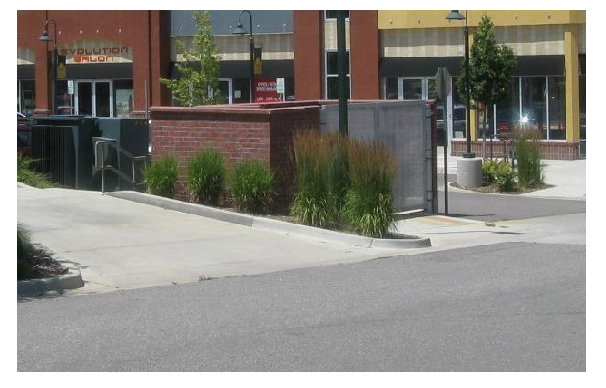
Figure 10-4.4.4-4: Dumpster Enclosure Example
(1)
Accessory Structures. Generators, air conditioning units, bottled gas tanks, irrigation pumps, swimming pool pumps and heaters, garbage containers at ground level, utility boxes, and similar accessory structures shall be screened with shrubs or an opaque fence on all applicable sides. Shrubs planted for this purpose shall be in addition to the requirements in Table 10-4.6 above. A hedge, berm, wood fence, or wall, maintained at a minimum of six inches above the items to be screened, may be used to satisfy the screening requirements as approved by the Director.
(2)
Dumpster Enclosures. A minimum 24-inch high continuous hedge shall be provided around any dumpster enclosure except for the access gate and pedestrian opening. This includes any dumpster used for waste, recycling, or other purposes.
(3)
Outdoor Storage Areas
(a)
Outdoor storage areas that are adjacent to a residential zoning district, a lot containing a residential use in a mixed-use zoning district, public open space, public trail, or public street, shall be screened from view by a vegetative screen or by a solid wall or fence.
(b)
The walls or vegetative screen shall be a minimum of six feet in height, but in any event the walls or vegetative screen shall be higher than the screened outdoor storage and 100 percent opaque.
(c)
The fence or wall design shall incorporate at least one of the primary materials and colors of the nearest wall of the primary building (but excluding unfinished CMU block).
(N)
Street Trees. The following standards shall be required in addition to other tree requirements in this §10-4.4, Landscaping and Tree Preservation.
(1)
General.
(a)
Non-residential and multifamily property owners may apply for a permit to plant a tree in the swale area of a public or private street abutting the property owned by the applicant. The location and species of the tree or trees shall be approved by the Director.
(b)
The property owner shall maintain the tree or trees. The City reserves the right to disallow trees in the swale that conflict with a public drainage purpose.
(c)
Residents may apply for Minor Site Plan Approval as described in §10-5.4(H)(3)(f) for tree planting approval within the rights-of-way of local streets. Costs of trees and installation may be assessed and be paid for by the respective groups or property owners.
(2)
New Development. In conjunction with new construction or development, street trees shall be placed in the landscaped area of public or private streets prior to the issuance of a Certificate of Occupancy.
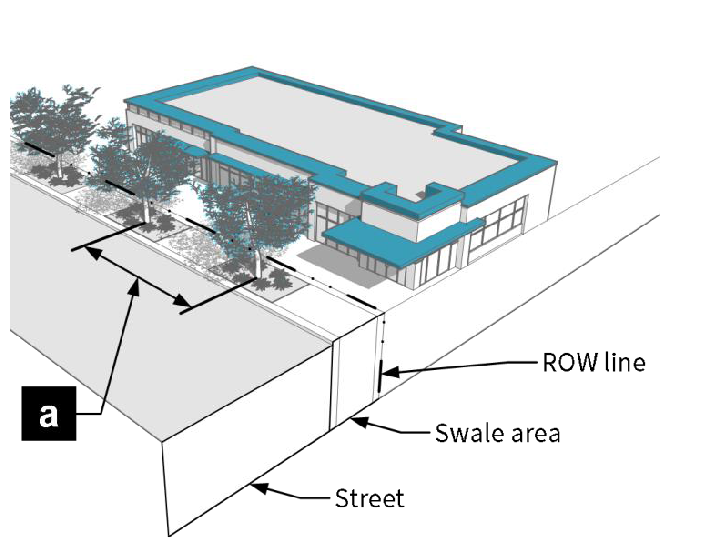
Figure 10-4.4-5: Street Trees
(a)
One street tree shall be required for every 40 linear feet of separate street frontage and shall be planted no further than 60 feet and no closer than 15 feet apart.
(b)
All street trees are to be placed in the swale area of the public or private street or a location in accordance with the requirements of this Section in order to accommodate location of utilities and/or street widening.
(c)
Street trees shall be approved shade trees species, unless an alternative tree species is approved by the Director.
(3)
Nonconforming Properties. Nonconforming landscaping on the site of a remodeled structure, expanded structure, or expanded use area shall comply with the requirements of this Section to the maximum extent practicable.
(O)
Historic Trees.
(1)
The Director may recommend from time to time the designation of certain trees located within the City as historic trees based on the criteria below. The City Manager shall review such recommendation and add thereto their own comments and recommendations, and the matter shall be presented to the City Commission for its determination.
(a)
The tree is located on historically significant property and is related to an historic event; or
(b)
The tree is uniquely related to the heritage of the City and/or Broward County; or
(c)
The tree is at least 75 years old.
(2)
The City Commission shall consider the report of the Director and the recommendation of the City Manager and shall either accept, modify, or deny the recommendation.
(3)
The City Commission may designate by resolution those trees it deems appropriate as historic trees.
(P)
Landscape Maintenance.
(1)
All landscaped areas shall be maintained in a live, healthy, and growing condition, properly watered and trimmed according to the standards below.
(a)
All owners of land or their agents shall be responsible for the maintenance of all landscaping.
(b)
All landscaping includes mowing and maintaining abutting rights-of-way, swales, lakes, and canal banks.
(c)
Landscaping shall be maintained to minimize property damage and public safety hazards. All property owners shall be responsible for maintaining any unpaved public right-of-way abutting their property including keeping grass, weeds, and other vegetation trimmed to a height not exceeding six inches above ground level. Maintenance shall also include the removal of living, dead, or decaying plant material; trimming of low-hanging branches and those obstructing street lighting and affecting required sight distance standards; and pruning of root structures to prevent damage to public improvements and/or infrastructure.
(d)
Dead or declining plant material considered to be part of a natural habitat feature located on public property are exempt from these landscape maintenance provisions except where maintenance is necessary to avoid damage to public property or to mitigate safety hazards.
(e)
There shall be no use of mechanical equipment for the purpose of maintaining a preserved ecological community, as identified in a natural resource protection area plan or a development of regional impact, unless specifically authorized in writing by the Director.
(f)
It is unlawful for a property owner to allow any hazardous tree, or any part thereof, to remain on the property. A hazardous tree shall be removed when, in the professional judgment of a certified arborist recognized by the International Society of Arboriculture or a landscape architect licensed by the Florida Board of Landscape Architecture, the tree is defective, diseased, dying or dead; poses a high risk of structural failure that presents a danger to persons or property; or is causing damage to public or private property or structures, where such damage cannot reasonably be addressed by any means other than removal. The Director shall have final authority to determine whether a tree qualifies as hazardous under this subsection and, in the case of an open code enforcement action, whether a tree removal permit shall be required.
(2)
Maintenance Standards. Landscaping shall be maintained in accordance with the standards below.
(a)
Insects and Disease. Landscaping shall be kept free of visible signs of insect infestation and disease.
(b)
Mulching.
(i)
Three inches of clean, weed-free, approved organic mulch shall be maintained over all areas originally mulched at all times until landscaped area matures to 100 percent coverage. Mulch must be kept a minimum of six inches from the trunk of any tree. The use of heat-treated mulch obtained from Melaleuca, eucalyptus, or other invasive plant species is encouraged in order to reduce their impact on the environment and to preserve the remaining plant communities. For this reason, the use of cypress mulch is strongly discouraged.
(ii)
Mulch shall be maintained in accordance with the standards of §10-4.4(P)(2)(b), Mulch.
(c)
Mowing and Trimming.
(i)
Landscaping shall be weeded, mowed, pruned, and/or trimmed in a manner and at a frequency so as not to detract from the appearance of the general area.
(ii)
Turf grasses shall be mowed by removing no more than one-third of the leaf blade at each cutting.
(iii)
St. Augustine and Bahia turf shall be mowed at a height no less than three inches.
(iv)
All public rights-of-way, curbs, and sidewalks shall be edged to prevent encroachment from the adjacent turfed areas. Line trimmers shall not be used to trim turf abutting trees or other plant material.
(d)
Pruning.
(i)
General.
A.
All property owners or their agents must prune trees in accordance with ANSI A-300, as amended from time to time. Any pruning performed without conformance to these standards shall be subject to enforcement by the City.
B.
All tree pruners who provide services in the City shall hold a valid local business license in Broward County as well as a valid Broward County tree trimmer license.
C.
If pruning is deemed tree abuse per §10-4.4(H), Tree Abuse, and causes tree removal, a Tree Removal License shall be required from the City.
D.
Any landscaping found growing into public rights-of-way shall be pruned at a minimum to the vertical clearances below:
1.
Eight and a half feet above sidewalks;
2.
14 feet above local and collector streets; and
3.
18 feet above arterial streets.
E.
Any landscaping found growing into a canal right-of-way shall be pruned to provide a minimum vertical clearance of eight feet above the mean water level or top of seawall.
F.
Topiary pruning of shade and small trees by shearing or trimming into an unnatural shape, such as round like a lollipop, is not prohibited, but strongly discouraged. Trees pruned in this manner will not be counted towards fulfilling the minimum landscape requirements outlined in this Section.
(ii)
Exemptions.
A.
The removal of diseased or dead portions, such as palm fronds, of one tree that does not result in said tree creating a threat to public safety or adjacent property is allowed.
B.
The removal of an interfering, obstructing, or weak branch of a tree such that it does not result in said tree creating a threat to public safety or adjacent property is allowed.
C.
Pruning to reduce or eliminate interference with or obstruction of street lights, stop signs, or traffic signals is allowed provided tree abuse does not occur per §10-4.4(H), Tree Abuse.
D.
Failure to remove or properly prune a tree damaged by a natural disaster within 30 days shall be a violation of this Code.
(e)
Maintenance of Irrigation Systems.
(i)
Irrigation systems shall be maintained and promptly repaired to eliminate water loss due to damaged, missing, or improperly operating sprinkler heads, emitters, pipes, and other parts necessary for a fully functioning irrigation system.
(ii)
Irrigation systems shall be designed, installed, and maintained to minimize application of water to impervious areas and/or so as not to create a hazard to vehicular use areas.
(iii)
Low-volume, drip, trickle, and emitter irrigation is encouraged to promote good Xeriscape principles where applicable.
(iv)
A functioning rain sensor/shutoff device shall be required on all irrigation systems installed after May 1, 1991, as mandated by F.S. §373.62.
(v)
In order to reduce the amount of water lost to evaporation, irrigation systems shall be operated between the hours of 4:00 p.m. and 10:00 a.m. only, or as amended by state, county, city and/or South Florida Water Management District regulations. It is furthermore strongly recommended that irrigation systems operate primarily in the early morning hours after 4:00 a.m. to reduce the likelihood of any horticultural plant diseases developing. Operation of the irrigation system for maintenance, repair, sod installation for new construction and landscape maintenance activities (such as required application of water to apply fertilizer, herbicides and pesticides) is not limited to these hours.
(vi)
The duration that zones are operated should be adjusted to reflect the size of the zone as well as the needs of the plant material in the zone. Unnecessary and excessive watering can promote root rot and other plant diseases.
(vii)
Under drought conditions, compliance with the watering restrictions of the South Florida Water Management District is required.
(f)
Golf Course Landscaping and Maintenance. Any site upon which a golf course is developed shall be landscaped and maintained in a neat, clean, live, healthy, and growing condition, adequately watered and trimmed, free of any structure, refuse, or debris. Golf course design should aim to preserve and support existing natural features, including multiple vegetation types not just turf grass. Utilizing more natural, less resource-intensive non-turf and transitional vegetation can encourage more biodiversity and decrease habitat fragmentation.
(g)
Replacement Requirements and Enforcement.
(i)
Improper maintenance shall include, but not be limited to, tree abuse, failure to supply adequate water, failure to replace missing or deficient landscaping, failure to maintain landscaping so as to meet the intent of the landscape code, such as buffering.
(ii)
Landowners or their agents shall be responsible for ensuring that plant material required by this section, or installed pursuant to a landscape code previously in effect, are replaced if such plant material dies, or are abused, following the issuance of a Certificate of Occupancy. The owner shall have 45 days to install the required landscaping.
(iii)
In the case of improper maintenance of any landscaping, the owner or agent shall desist immediately, and shall replace or repair all damaged landscaping, at the discretion of the Department.
(iv)
Preserved vegetation which dies following the issuance of a Certificate of Occupancy shall be replaced with the equivalent replacement of plant material.
(v)
Prohibited plant species and nuisance trees shall not be replaced in-kind but shall be replaced with plant species approved by the Department.
(vi)
Any planting of turf grasses, shrubs, or trees which become dead or badly damaged shall be replaced with similar sound, healthy plant materials. The diameter of the replacement tree shall be equal to or greater than the diameter of the abused tree. More than one tree may be utilized for replacement if the aggregate sum of the diameters of the replacement trees is equal to or greater than the diameter of the abused tree.
(vii)
Each replacement tree shall be on the approved tree list. The equivalent replacement trees shall be Florida No. 1 quality or better. Each replacement tree shall have the largest diameter commercially available in Dade, Broward, and Palm Beach counties for the tree species selected, provided that no replacement tree shall have a diameter of less than three inches. Diameter measurements shall be made at four and a half feet above the ground.
(viii)
Replacement trees shall be installed onsite. In the event the site cannot accommodate all required replacement trees, the remaining replacement trees shall be installed on public lands if approved by the enforcement agency and the applicable jurisdiction that owns such lands.
(ix)
Remedial actions and replacement required under this Section shall be completed within established time frames through the City's code enforcement procedures. The enforcement agency may require the violator to immediately undertake remedial actions in the event the abused tree is an immediate threat to the public or property.
(x)
Any violations of this subsection shall be referred to the code compliance division for enforcement. Each individual tree which is missing, removed, or damaged shall be considered a separate violation. In addition, any other missing, removed, or damaged landscaping shall be considered as additional violations. Each day such failure or neglect continues shall be deemed a separate offense. Violator shall mean a person who violates this Section. The owner of property upon which the abused tree is located shall also be deemed a violator if the tree abuse is undertaken by the owner's employee, agent or person under the owner's control.
(xi)
Missing, damaged, or removed irrigation (where required) shall also be considered a separate violation of this Code. Each day such failure or neglect continues shall be deemed a separate offense.
(h)
Root Systems.
(i)
Complete removal of root systems and stumps is required to the greatest extent possible, as applicable.
(ii)
Root pruning must be performed in a manner that does not irreparably damage the tree or create a safety hazard.
(i)
Emergencies and Utilities.
(i)
In emergencies such as floods, hurricanes, or other disasters, or in cases where a fallen tree is interrupting service or is limiting access to utility facilities, the requirements for implementing ANSI A-300 shall not apply to utility companies.
(ii)
Failure to remove or properly prune a tree damaged by a natural disaster within a reasonable period of time corresponding to the severity of the disaster as determined by the Director shall be a violation of this Code.
(iii)
The Hazard Pruning Standards and the Crown Reduction Standards of the American National Standards Institute apply to utility companies' tree pruning activities.
(Q)
Tree Preservation.
(1)
Tree Preservation. The following minimum standards shall apply to all trees designated for preservation from damage during development activities.
(a)
Land designated for conservation by Broward County or the City shall be exempted from this section.
(b)
No impervious surface including, but not limited to, paving or buildings, shall be located within the dripline of any tree proposed for preservation.
(c)
Retaining walls and dry wells shall be utilized where needed to protect trees from severe grade changes.
(d)
For shallow fills, all fill material shall be gently sloped down to the level of the tree roots leaving the tree in a depression larger than the spread of its crown.
(e)
No parking, vehicle maintenance, storage of construction materials or debris, or cleaning of equipment shall occur within areas marked for preservation, including, but not limited to, the dripline of any individual tree.
(f)
In areas of unique natural or unusual vegetation, both the understory and the trees shall be preserved. Any alteration or mitigation are subject to the natural resource protection provisions of §10-4.4 of the City Code.
(g)
Trees to be preserved shall be designated as such in either a Tree Removal License approved by the City or a tree protection plan approved by the Department.
(h)
Prior to any clearing of improved, vacant, or unimproved land, unless specifically exempted from this section, trees to be preserved shall have barriers constructed around them to prevent physical damage from heavy equipment and other activities incidental to development.
(2)
Barriers and Barricades.
(a)
Encroachment into any barricade area shall be prohibited with the exception of activities specifically permitted by an approved tree permit including dripline encroachment plan. Required barriers shall be subject to inspection prior to any clearing by the City or Broward County as a condition of permit approval.
(b)
Barriers or barricades shall be:
(i)
Large enough to encompass the entire area inside the dripline of the tree;
(ii)
Noticeable and tall enough to be clearly visible to equipment operators;
(iii)
Constructed of sturdy four by four scrap wood, or other sturdy material as approved by Broward County or the City. Flags and ribbons are not permitted as the sole barrier but can be utilized to increase visibility of the study material;
(iv)
Constructed as a condition of the issuance of any land clearing, building, or development permit;
(v)
Constructed prior to any construction or other development activities, and are required to remain in place through the construction period; and
(vi)
Completely removed from the site at the end of the construction period immediately prior to the issuance of a Certificate of Occupancy by the City, unless otherwise stipulated in the approved tree removal license.
(c)
Underground Utility Lines.
(i)
Underground utility lines shall, to the maximum extent possible, be routed around the outside of the dripline of existing non-prohibited and noninvasive root systems and trees.
(ii)
A tunnel made by a power-driven soil auger may be used under the tree, as an alternative subject to approval by the City.
(d)
Fences and Walls.
(i)
Installation of fences and walls shall not conflict with the root systems of existing trees. Post-holes and trenches close to trees shall be dug by hand and adjusted as necessary to avoid damage to major roots.
(ii)
Continuous footers for masonry walls shall be ended at the point where major or large roots are encountered and those roots shall be bridged.
(R)
Stop Work Orders. Whenever any work is being done by a person not in compliance with §10-4.4, a Code Enforcement Officer may order that work be stopped and such persons performing such work shall immediately cease such work. The work may not resume until such time as the person is in compliance with §10-4.4.
(S)
Approved Palm and Tree Lists. The Director may grant special written permission to allow the planting of trees, other than those listed in the tables below, to meet the minimum landscape requirements. Such request shall be submitted in writing with supporting documentation. Written approval for such deviation shall be obtained prior to the planting of such trees or shrubs. Only small Palm and trees approved by the Director shall be used under power and utility lines.
(1)
Palm Trees.
(2)
Shade Trees.
(3)
Small Trees. Trees listed in Table 10-4.9: Approved Small Trees, shall be used under power and utility lines.
(Ord. No. O-2023-014, § 2, 6-28-23; Ord. No. 2024-003, § 2, 1-24-24; Ord. No. O-2025-017, § 2, 9-10-25)
10-4.5 - Environmental Protection and Infrastructure
(A)
Purpose. This section ensures that development integrates stormwater and floodplain protection, as well as incorporates safe, reliable, and adequate public facilities. The intent of this section is to protect and enhance the environment, aesthetic qualities, and property values in the City, while promoting the general public health, safety, and welfare. These standards ensure environmental protection and infrastructure are essential parts of every development that will:
(1)
Protect sensitive environmental areas such as pervious areas required for groundwater recharge and riparian areas required for floodplain management;
(2)
Mitigate impacts to development related to storm events, hurricanes, and other natural disasters primarily resulting in increased precipitation;
(3)
Conserve water resources through managing surface and stormwater, ensuring efficient use of water onsite, as well as reducing potential water waste; and
(4)
Provide potable water, wastewater, and solid waste facilities with adequate capacity to meet the current and future needs of development in the City.
(B)
General Standards and Criteria
(1)
The requirement for development review findings by the City as a prerequisite to the issuance of an Improvement Permit is found within the implementation section of the County land use plan and the City land use element of its comprehensive plan. The standards and criteria in this section are intended to implement those requirements.
(2)
No application for an Improvement Permit may be approved unless and until it is determined by the Director that the development review requirements set forth in this section are met. However, except to the extent limited in this section, in stages of development prior to Site Plan Approval, an application for an Improvement Permit may be approved (at the option of the City) on the condition that the developer agrees in writing that at the time of Site Plan Approval the requirements of this section are to be met.
(3)
Plats and site plans may be processed simultaneously under the regulations of the City. However, the City Commission realizes and acknowledges that situations exist wherein a developer may choose to plat his property prior to the property being site-planned. In those instances, if development review is conducted (at the option of the City), the maximum impact for each criterion reviewed allowed under the applicable zoning district shall be assumed for the property subject to the plat.
(4)
There shall be no reservation of water or sewer capacity or other service unless all conditions precedent to such reservation such as entry into a water and sewer developer's agreement, which specifically sets forth a phasing for the payment of fees in accordance with the phasing shown on the approved site plan, and until fees are paid.
(5)
The developer should note that the County, during plat review, may independently review development review criteria contained herein. A finding by the City that such criteria have been satisfied is not to be construed as a guarantee that the County will come to the same conclusion.
(6)
Before an application for an improvement permit may be granted within the City limits, the requirements of this Section below shall be satisfied.
(C)
Floodplain Management. The standards to be applied for flood protection of buildings are set forth in Chapter 8 of the City Code as the same may be amended from time to time, and 100-year flood criteria. The City Engineer shall have the right to require the developer to submit any documents or material necessary to aid in the evaluation of a subject property.
(D)
Drainage
(1)
System Generally
(a)
A storm drainage system shall be provided that will drain the entire improvement to positive outlets that can be legally maintained in permanent use or into a public drainage system of adequate capacity which discharges into such positive outlets, including all rights-of-way, easements and necessary construction at no expense to the city. Side ditches along public roads shall not necessarily be considered as such public drainage systems or positive outlets. If a retention basin is to be utilized, it shall be of adequate storage capacity to accommodate a ten-year storm. The pipe shall be sloped and structures channeled to develop sufficient scouring velocity at design flow to minimize sedimentation.
(b)
Data of the drainage system shall be submitted along with the construction plans in a report form prepared by the developer's engineer indicating the method of control of stormwater and groundwater, including the method of drainage, existing water elevations, recurring high-water elevations, proposed design water elevations, drainage structures, canals, ditches and other pertinent information pertaining to the system.
(c)
If the construction of a positive outlet drainage system causes a hardship, an alternate system may be submitted for the review of the city engineer. A detailed design and cost estimate of a positive outlet system shall be submitted with an explanation why such system causes a hardship. The alternate system shall also include a detailed design and cost estimate.
(2)
Design of System
(a)
The storm drainage system required for land development shall be designed in accordance with the engineering principles accepted by the state department of transportation and in conformance with the following design criteria:
(i)
Rational formula (Q = ciA) shall be used.
(ii)
Coefficient of runoff shall be 0.95 for impervious areas and from 0.5 to 0.9 for grassed areas.
(iii)
Storm drainage shall be designed by outlet methods to the effect that a ten-year design storm will produce a headwater no higher than four inches above the lowest catch basin rim in parking lots or two inches below the edge of pavement in subdivisions and a 25-year storm will produce a headwater no higher than one inch below the centerline crown of the roadway or the inside edge of the roadway on roadways with medians. The minimum gutter and pavement gradient shall be 0.003 feet per foot. The minimum grass swale gradient shall be 0.006 feet per foot. The length of roadside swale shall be less than 200 feet unless approved by the City Engineer.
(iv)
Manning's "n" shall be 0.013 for reinforced concrete or fully paved or lined corrugated metal pipe, 0.019 for unpaved, helically corrugated aluminum pipe and 0.024 for unpaved, unlined, annularly corrugated pipe.
(b)
The developer's engineer shall submit a copy of his design calculations to the City Engineer for his approval on the standard form available from the City Engineer's office.
(c)
The City Engineer may permit other design criteria to be used or may require the developer's designer to use criteria other than those given in this section.
(d)
Inlets, catch basins, manholes, headwalls, and other drainage structures shall be of a design approved by the city engineer.
(3)
Construction, Materials. All storm drainage materials and construction shall be in accordance with city standards. All outlets shall be protected by headwalls. Pipes shall be visually clean and straight. The developer shall cause the pipes to be stoppered, pumped nearly dry and illuminated for inspections by the city engineer prior to acceptance of the installation.
(4)
Ditches and Swales. Ditches and swales as defined in this article will not be approved except for roadside or yard drainage swales.
(E)
Stormwater Management. Adequate provisions shall be made for the management of stormwater, including erosion and sedimentation control, in accordance with the requirements of the city engineer, the city public works department, engineering division, minimum standards of design and construction, the county environmental protection department, the South Florida Water Management District (SFWMD), the Florida Department of Environmental Protection (FDEP) and any other agency that may have jurisdiction over such activities. In case of any conflict, the most stringent requirements shall govern. Contractors or owners shall be liable for the full cost of clean-up or fines or both for spilling or causing to spill any harmful substance, including, but not limited to, chemicals, oil, tar, asphalt, concrete, debris, soils, etc. that may ultimately flow into a public conveyance system, including, but not limited to, public rights-of-way, pipes, canals or lakes.
(1)
Stormwater Pollution Prevention Plan. A stormwater pollution prevention plan (SWPPP) shall be developed and submitted with all applications for building, utilities, and engineering permits. The SWPPP shall be in substantial compliance with the requirements of Chapter 62-621, Florida Administrative Code (F.A.C.) as amended from time to time. A copy of the SWPPP and notice of intent (NOI) filed with the FDEP shall be considered sufficient for permitting by the city.
(2)
Water Quality Standards. All runoff from any construction site flowing into the public right-of-way, public drainage system or any water body controlled by the city, county or state shall be managed so as not to degrade the water quality of the public drainage or conveyance system. The city's standards and requirements for maintaining water quality shall be in substantial compliance with sections 27-195 and 27-196 of the Broward County Code of Ordinances as amended from time to time.
(3)
Violations and Penalties. Any person or entity found in violation of this section after notice and opportunity to be heard, shall pay a fine of one hundred dollars ($100.00) plus costs. Any person or entity which allows said violation to continue beyond 24 hours of initial notification shall pay an additional fine of two hundred fifty dollars ($250.00). Any person or entity who allows said violation to continue beyond 48 hours shall pay a fine of one thousand dollars ($1,000.00) and may be issued a stop work order, and for each day of violations thereafter shall also pay a fine of one thousand dollars ($1,000.00). These fines are in addition to any fines that may be imposed by other agencies having jurisdiction over such activities. Repeat violations may result in fines up to ten thousand dollars ($10,000.00) per day including stopping work if the violation is of a serious nature, affecting health, safety and welfare of the residents or environment.
(4)
Use of Funds. Funds collected from the fines shall be deposited in the stormwater management utility fund and shall be used to pay for these services as outlined in §22-257 of the City Code as amended from time to time.
(F)
Potable Water
(1)
Potable Water Required
(a)
Potable water service shall be available prior to Issuance of a Temporary Certificate of Occupancy or Final Certificate of Occupancy to provide for the needs of the proposed development.
(b)
All references to the availability of potable water service in this Code include the water supply, treatment, distribution, and transmission system.
(c)
In situations where plats are not processed with site plans, a finding of availability of water at the time of plat approval shall not be a guarantee by the City that there will be adequate potable water service at the time of site plan consideration.
(d)
The proposed development shall be designed to provide adequate areas and easements which may be necessary for the installation and maintenance of a potable water service transmission system which will meet all applicable health and environmental regulations.
(e)
A water distribution system, providing potable water from an approved treatment facility, shall be provided to serve all parcels of the subdivision or principal buildings of the development. The pipes shall be sized to provide fire protection and an adequate supply of domestic water for all reasonably anticipated construction and occupancies.
(f)
The standards pertaining to potable water systems and other items pertaining to potable water set forth in Chapter 22 of this Code as the same may be amended from time to time shall be required to be complied with.
(g)
The design of potable water systems shall be in accordance with the City of Tamarac Engineering Design and Processing Manual and approved by the City Engineer.
(2)
Approval Without Conditions. The Director may grant an application for an Improvement Permit without conditions as to potable water service upon finding that potable water service is available. A finding that potable water service is available shall be based upon a certification by the City Engineer or the City's consulting engineer for utilities. Said certification shall include findings that the utility providing water service to the proposed site has sufficient capacity to provide for the potable water needs of:
(a)
The development proposed by application;
(b)
Other developments in the service area which are occupied;
(c)
Other developments in the service area available for occupancy;
(d)
Other developments in the service area for which building permits are in effect; and
(e)
Other developments in the service area for which potable water treatment capacity is reserved.
(3)
Approval with Express Conditions
(a)
The Director may grant an application for an Improvement Permit with an express condition as to potable water service upon finding that potable water service is not available but will be made available. A finding that water service will be made available must be based upon a certification by the City Engineer or the City's consulting engineer for utilities that there is an economically and fiscally feasible plan to construct or expand a water treatment facility which will have sufficient capacity to provide for the potable water needs of:
(i)
The development proposed by application;
(ii)
Other developments in the service area which are occupied;
(iii)
Other developments in the service area available for occupancy;
(iv)
Other developments in the service area for which building permits are in effect; and
(v)
Other developments in the service area for which potable water treatment capacity is reserved.
(b)
This certification shall state the source of funds or proposed source of funds to make the capacity available and shall state any required improvements to the system that must be made by the applicant or some other party prior to the issuance of either a Building Permit or a Certificate of Occupancy as appropriate.
(4)
Denial. The Director shall deny an application for an Improvement Permit upon finding that potable water service is not available and will not be made available. A finding that potable water service will not be made available must be made in the absence of a certification by the City Engineer or by the City's consulting engineer for utilities that there is an economically and fiscally feasible plan to construct or expand a water treatment facility which will have sufficient capacity to provide for the potable water needs of:
(a)
The development proposed by application;
(b)
Other developments in the service area which are occupied;
(c)
Other developments in the service area available for occupancy;
(d)
Other developments in the service area for which building permits are in effect; and
(e)
Other developments in the service area for which potable water treatment capacity is reserved.
(5)
Developer's Agreement
(a)
Prior to issuance of an Improvement Permit, a developer shall have entered into a potable water developer's agreement with the entity to provide service for the development.
(b)
The water and sewer developer's agreement sets forth the phasing and timing exhibit for the payment of all fees for water contribution or other charges in accordance with the phasing shown on the approved site plan.
(c)
Fees shall be paid at the time of utilities permit or in accordance with an approved phasing plan. Fee shall be paid in accordance with the fee schedule in effect at the time the utilities permit is applied for and not the fee schedule in effect at the time the water and sewer developer's agreement is approved by the City Manager or their designee.
(d)
There shall be no reservation of capacity or service until fees are paid.
(G)
Wastewater Treatment and Disposal
(1)
Wastewater Treatment and Disposal Services Required
(a)
Wastewater treatment and disposal services shall be available prior to issuance of a Temporary Certificate of Occupancy or Final Certificate of Occupancy to provide for the needs of the proposed development.
(b)
In situations where a plat is to be processed prior to a site plan, a finding that there is adequate wastewater treatment and disposal services shall not be a guarantee by the City that the services will be available at the time of site plan review.
(c)
The proposed development shall be designed to provide adequate areas and easements which may be necessary for the installation and maintenance of a wastewater disposal system which will meet all applicable health and environmental regulations.
(d)
A system of sanitary sewers, together with all necessary pumping stations and appurtenances, shall be provided to serve all parcels of the subdivision or principal buildings of the development. The system shall be designed to accommodate all reasonably anticipated construction and occupancies. The collection system shall conduct the sewage directly or indirectly through existing sewers or adequate capacity to an approved treatment facility.
(e)
The standards pertaining to wastewater discharge and other items pertaining to wastewater set forth in Chapter 22 of this Code, as the same may be amended from time to time, shall be required to be complied with.
(f)
The design of Wastewater systems shall be in accordance with the City of Tamarac Engineering Design and Processing Manual and approved by the City Engineer.
(2)
Approval without Conditions. The Director may grant an application for an Improvement Permit without conditions as to wastewater treatment and disposal services upon finding that wastewater treatment, sanitary sewers, and disposal services are available. A finding that wastewater treatment and disposal services are available shall be based upon a certification by the City Engineer or the City's consulting engineer for utilities that an existing wastewater treatment and disposal facility has sufficient capacity to provide for the treatment and disposal needs of:
(a)
The development proposed by the application;
(b)
Other developments within the service area of the utility which are occupied;
(c)
Other developments within the service area of the utility which available for occupancy;
(d)
Other developments within the service area of the utility which for which building permits are in effect; and
(e)
Other developments within the service area of the utility which for which wastewater treatment and disposal capacity has been reserved.
(3)
Approval with Express Condition. The Director may grant an application for an Improvement Permit with an express condition as to wastewater treatment and disposal services upon finding that wastewater treatment and disposal services are not available but will be made available. A finding that wastewater treatment and disposal services will be made available must be based upon a certification by the City Engineer or City's consulting engineer that there is an economically and fiscally feasible plan to construct or expand a wastewater treatment and disposal facility which will have sufficient capacity to provide for the treatment and disposal needs of:
(a)
The development proposed by the application;
(b)
Other developments within the service area of the utility which are occupied;
(c)
Other developments within the service area of the utility which available for occupancy;
(d)
Other developments within the service area of the utility which for which building permits are in effect; and
(e)
Other developments within the service area of the utility which for which wastewater treatment and disposal capacity has been reserved.
This certification shall state the source of funds or proposed source of funds to make the capacity available and shall state any required improvements to the system that must be made by the applicant or some other party prior to the issuance of either a Building Permit or a Certificate of Occupancy as appropriate.
(4)
Denial The Director shall deny an application for an Improvement Permit upon finding that wastewater treatment and disposal services are not available and will not be made available. A finding that wastewater treatment and disposal services will not be made available must be made in the absence of a certification by the City Engineer or the City's consulting engineer for utilities that there is an economically and fiscally feasible plan to construct or expend a wastewater treatment and disposal facility which will have sufficient capacity to provide for the treatment and disposal needs of:
(a)
The development proposed by the application;
(b)
Other developments within the service area of the utility which are occupied;
(c)
Other developments within the service area of the utility which available for occupancy;
(d)
Other developments within the service area of the utility which for which building permits are in effect; and
(e)
Other developments within the service area of the utility which for which wastewater treatment and disposal capacity has been reserved.
(5)
Developer's Agreement
(a)
Prior to issuance of an Improvement Permit, a developer must have entered into a wastewater developer's agreement with the entity to provide service therefore.
(b)
The water and sewer developer's agreement shall set forth the phasing and the timing exhibit for the payment of all fees for sewer contribution or other charges in accordance with the phasing shown on the approved site plan.
(c)
Fees shall be paid at the time of utilities permit in accordance with the fee schedule in effect at the time the utilities permit is applied for and not the fee schedule in effect at the time the water and sewer developer's agreement is approved by the City Manager or their designee.
(d)
There shall be no reservation of capacity or service until fees are paid.
(H)
Solid Waste
(1)
Solid Waste Disposal Service Required. Solid waste disposal service shall be available prior to occupancy of any unit—residential, commercial, industrial or other—to provide for the needs of the proposed development.
(2)
Approval, Approval with Condition, or Denial
(a)
The Director may grant an application for an Improvement Permit without conditions as to solid waste disposal service upon finding that solid waste disposal service is available.
(b)
The Director may grant an application for an Improvement Permit with an express condition as to solid waste disposal service upon finding that solid waste disposal service is not available but will be made available.
(c)
The Director shall deny an application for an Improvement Permit upon finding that solid waste disposal service is not available and will not be made available.
(3)
Standards and Other Considerations for Determination
(a)
The standard to be applied by the Director in determining whether solid waste disposal service shall be available is a comparison of the projected construction period set forth by the developer in a written document to be submitted to the City with its request for final site plan approval or with its request for final plat approval if the plat is to be processed independently with the term of the City's franchise agreement with a company for the removal of solid waste for residential service if the project is residential. If the project is a mixed-use or nonresidential project, the developer shall submit a contract with a franchised garbage company wherein the garbage company agrees that it is bound to remove the solid waste generated by the proposed development for a period of one year subsequent to the issuance of the projected Certificate of Occupancy. If the City's franchise agreement with a collector—residential or nonresidential—expires prior to the proposed issuance date of a Certificate of Occupancy, approval shall be subject to the condition that the City enter into a new franchise agreement for residential or nonresidential solid waste collection, as appropriate.
(b)
The City shall review data submitted by the County or any other entity licensed to operate a disposal site concerning projected capacity at its site; and if projected capacity extends beyond the date that a Certificate of Occupancy is expected for a particular portion of a proposed development, the City shall not deny approval of an improvement permit due to the inadequacy of solid waste disposal sites.
(c)
The City reserves the right during the site development plan review process to require commercial or curbside service for multifamily residential units, herein defined as any building or structure containing three or more attached dwelling units.
(d)
All multifamily residential projects shall provide a site for recycling dumpsters or other containers that may be provided by a vendor or required by the City. The size of the area to be set aside for the dumpsters shall be determined at the time of site plan approval. The specifications for recycling dumpster areas are technology based. Recycling technology is rapidly changing; thus, the specifications will be set forth at the time of site plan approval.
(e)
All mixed-use and nonresidential projects shall provide a site for recycling dumpsters or other containers that may be provided by a vendor or required by the City. The size of the area to be set aside for the dumpsters shall be determined at the time of site plan approval. The specifications for recycling dumpster areas are technology based. Recycling technology is rapidly changing; thus, the specifications will be set forth at the time of site plan approval.
(f)
When required by the City, all multifamily projects shall show a separate dumpster location. A site plan shall indicate which buildings are served with which dumpster for each building, including recreation buildings over 550 square feet in size. Recreation buildings over 500 square feet shall be required to have a dumpster location on a site plan and a contract for sanitation services.
(I)
Utility Lines Location
(1)
Requirements
(a)
In new development and redevelopment projects, all utility lines, including, but not limited to, those required for electrical power distribution, telephone communications, cable television, street lighting, electrical distribution system, including service lines to individual properties necessary to serve the development under consideration, shall be installed underground.
(b)
This section shall not apply to wires, conductors, or associated apparatus and supporting structures whose exclusive function is in transmission of electrical energy between generating stations, substations, and transmission lines of other utility systems.
(c)
Telephone and cable television utility lines may be attached to Florida Power and Light (FPL) electrical transmission facilities when such are allowed by the provisions of this section.
(d)
Appurtenances such as transformer boxes, pedestal-mounted terminal boxes and meter cabinets may be placed above ground on a level concrete slab and shall be located in such a manner as to minimize noise effects upon the surrounding residential properties.
(e)
All underground wires shall be buried a minimum of 18 inches below the finished ground line.
(2)
Easements. Recorded easements shall be provided for the installation of all underground utilities facilities in conformance with such size and location of easements as may be determined by the City Engineer to be compatible with the requirements of all utility companies involved with respect to a particular utility service.
(3)
Furnishing Utility Services
(a)
The subdivider or developer shall make the necessary financial compensation and other arrangement for such underground installation with each of the franchised utilities that are involved with respect to a particular development.
(b)
The subdivider or developer shall submit written evidence of a satisfactory arrangement with each of the franchised utilities involved with respect to a particular development before the final site development plan of the project is submitted to the Planning Board for its consideration.
(Ord. No. 2024-003, § 2, 1-24-24)
10-4.6 - Multi-family Residential Site and Building Design
(A)
Purpose. The purpose of these standards is to improve the appearance of design and functionality of multi-family development, recognizing the importance of design in the economic success of urban areas, the need to be more efficient in the use of land, and the need to ensure the adequate protection of the surrounding area. More specifically, these standards are intended to:
(1)
Provide a distinctive architectural character in new multi-family residential developments that avoids featureless design, large building masses, and repetition of facades within a single development;
(2)
Promote sensitive design and planning of multi-family housing units that preserves or improves the characteristics of surrounding development;
(3)
Promote building design, placement, and orientation that contributes to a sense of neighborhood and community; and
(4)
Improve the quality of life of residents of multi-family residential dwellings.
(B)
Applicability
(1)
All development or substantial renovation of multi-family residential structures of four stories or less shall comply with the standards in this section. In the case of mixed-use buildings, these standards and the standards of §10-4.7, Mixed-Use and Nonresidential Site and Building Design, below shall both apply.
(2)
All multi-family residential dwellings that are five stories or greater in height shall comply with the development standards for mixed-use and nonresidential buildings set forth in §10-4.7 below.
(C)
Building and Parking Location, Layout, and Orientation
(1)
In multi-building developments, the buildings are encouraged to be arranged to enclose and frame common areas. Common areas and courtyards should be convenient to a majority of units.
(2)
When more than one multi-family structure is constructed:
(a)
The front wall of a multi-family structure shall be the wall that includes the primary entrance. No front wall of a multi-family structure shall be located within 40 feet of the front wall of any other multi-family structure;
(b)
No non-front wall of a multi-family structure shall be located within 20 feet of a non-front of any other multi-family structure; and
(c)
No non-front wall of a multi-family structure shall be located within 30 feet of the front wall of any other multi-family structure.
(3)
For purposes of measurement in this subsection, projections such as decks and bay windows shall not be counted.
(D)
Parking. In addition to the parking lot landscaping requirements set forth in § 10-4.4(D)(5), Vehicular Use Area Landscaping:
(1)
No more than one double-loaded or two single-loaded rows of parking may be located between any building on the site and an adjacent public street.
(E)
Building Mass and Articulation
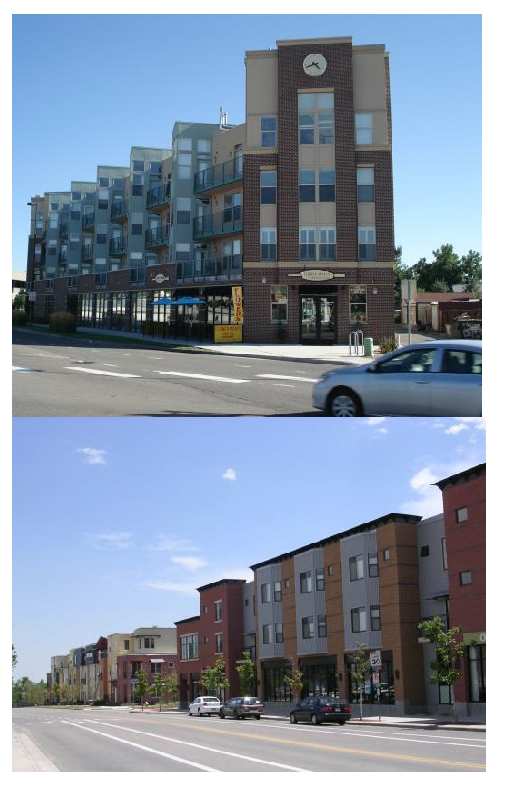
Figure 10-4.4.6-1: Articulation Examples
(1)
Each façade greater than 50 feet in length, measured horizontally, shall incorporate wall plane projections or recesses having a depth of at least 10 percent of the length of the façade, and extending at least 20 percent of the length of the façade.
(2)
The facades of all multi-family buildings shall be articulated through the incorporation of at least three or more of the following:
(a)
Balconies;
(b)
Bay or box windows;
(c)
Porches or covered entries;
(d)
Dormers;
(e)
Variations in materials;
(f)
Variations in roof forms;
(g)
Variation in window sizes and shapes; or
(h)
Vertical elements that demarcate building modules.
(3)
The height of each multi-family building taller than 35 feet shall be stepped down from its highest roofline at least one full story on any end of the building located within 50 feet of a street-right-of-way or an adjacent area zoned or used for single-family residential.
(F)
Roof Form
(1)
To help provide a variety of roof forms, upper-level residential floors shall be incorporated into the roof form to reduce the apparent height and mass of buildings.
(2)
Multi-family residential buildings shall be designed to avoid any continuous roofline longer than 50 feet. Rooflines longer than 50 feet shall include at least one vertical elevation change of at least two feet.
(G)
Façades and Detail Elements
(1)
Highly reflective materials shall not be used in areas where the location of the building will create undue solar, reflective glare on surrounding properties.
(2)
Natural, smooth-face concrete masonry units shall not be used as a primary exterior finish.
(3)
Siding material shall be continued down to finished grade with the following exceptions:
(a)
If a secondary wainscot finish precludes this condition; or
(b)
If grade dictates a siding transition. If this occurs then the area in question must not exceed 18 inches above grade and must be screened by approved landscaping.
(4)
In multi-building complexes, individual building elements shall incorporate various architectural details, color palettes, or building materials different from the adjacent buildings.
(H)
Colors
(1)
The predominant exterior colors on multi-family buildings shall be earth tones to minimize the visual impact of these buildings.
(2)
Darker accent colors shall be utilized on garage door surfaces to minimize their visual prominence.
(3)
The use of bright, fluorescent, metallic, highly reflective, or other high-intensity colors and finishes shall be limited to accent materials and may be used on no more than 30 percent of any elevation.
(I)
Entrances and Porches. Building/development entries shall comply with at least two of the following requirements:
(1)
At least one main building entry shall face the primary adjacent public street;
(2)
Building entrances face a courtyard that has a direct and visible connection to an adjacent public street;
(3)
Building entries are connected to a public sidewalk by walkways that are not routed through a parking lot;
(4)
The pedestrian entry to the site from the public right-of-way is emphasized with landscaping, special paving, gateways, arbors, or similar features; or
(5)
No more than one curb cut per 100 feet of frontage. Shared driveways are encouraged.
(6)
The front entry of any structure shall be emphasized by the use of at least two of the following:
(a)
A porch or landing;
(b)
Double doors;
(c)
A roofed structure such as a portico, awning, or marquee;
(d)
The inclusion of side-lights (glazed openings to the side of the door), and transom-lights (glazed opening above the door) in the entry design;
(e)
Decorative lighting; or
(f)
Enhanced landscaping.
(J)
Accessory Elements
(1)
Storage. A multi-family project that is at least three stories in height with individual dwelling units on each floor shall provide covered, enclosed, and secure storage areas for bicycles and other belongings that typically cannot be accommodated within individual dwelling units. Storage and other accessory buildings shall be designed with materials and/or architectural elements that are related to the principal building(s).
(2)
Trash Receptacles/Dumpsters. Dumpsters shall not be allowed in developments or sites with six or fewer dwelling units. Developments or sites with six or fewer units shall provide covered storage for trash receptacles. Such storage shall not be located between any building and the primary adjacent street frontage.
(K)
Garages
(1)
Attached or Detached Garages
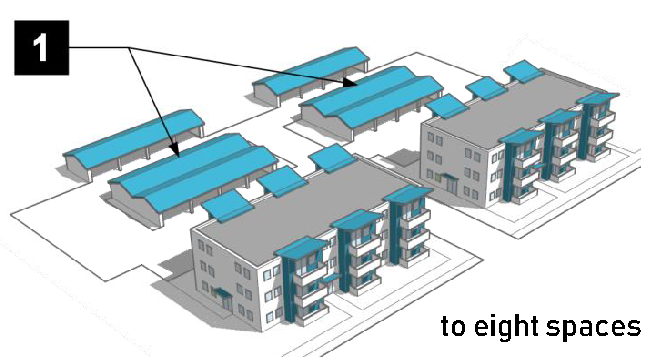
Figure 10-4.6-2: Multi-Family Garages
(2)
Size. Garage and carport structures shall be limited to eight spaces per structure to avoid a continuous row of garages. No more than 12 garage doors may appear on any multi-family building elevation containing front doors, and the plane of each garage door shall be offset at least 18 inches from the plane of the garage door adjacent to it.
(3)
Design
(a)
Detached garages and carports shall be integrated in design with the principal building architecture.
(b)
Detached garages and carports shall incorporate similar and compatible forms, scale, materials, color, and details.
(4)
Parking Structures. Structured parking, and parking within, above, or beneath the building it serves are all strongly encouraged for multi-family developments.
10-4.7 - Mixed-Use and Nonresidential Site and Building Design
(A)
Purpose. This section ensures that mixed-use and nonresidential design and development standards foster high-quality, attractive, and sustainable development that is compatible with the City's Comprehensive Plan. These standards are intended to:
(1)
Protect and enhance the character and quality of residential, mixed-use, and nonresidential areas in Tamarac;
(2)
Protect and enhance the long-term market value of property within the City;
(3)
Enhance the human and pedestrian scale of mixed-use and nonresidential developments, ensuring compatibility between residential neighborhoods and adjacent mixed-use and nonresidential uses;
(4)
Mitigate negative visual impacts arising from the scale, bulk, and mass of large buildings and centers;
(5)
Promote building designs and construction practices that are sustainable and adaptable to multiple uses for extending building lifecycles;
(6)
Minimize negative impacts of on-site activities to adjacent uses; and
(7)
Balance the community's economic and aesthetic concerns.
(B)
Applicability. All development or substantial renovation of any mixed-use or nonresidential principal structure and any multi-family residential structure of five stories or more shall comply with the standards in this section.
(C)
General Site Layout Standards
(1)
Purpose. Site design standards address a development's relationship to its surrounding natural features and development patterns. These standards are intended to:
(a)
Ensure development relates to the physical characteristics of the site;
(b)
Ensure building scale, orientation, and design relates to the surrounding uses and streets, and creates a cohesive visual identity and an attractive street scene;
(c)
Ensure site design for efficient pedestrian, bicycle, transit, and vehicular circulation patterns, and create a high-quality pedestrian environment;
(d)
Promote design environments built to human scale;
(e)
Ensure delivery, trash, and loading facilities are located so as not to impede regular vehicular and pedestrian circulation and access routes; and
(f)
Ensure safe and efficient access between buildings and parking areas.
(2)
Building Orientation
(a)
Primary Entrance. Buildings shall be oriented so that the principal building entrance faces the principal street or the street providing main access to the site. In cases where the principal entrance does not face the principal street, connect the entrance to the street and adjacent parking areas with sidewalks.
(b)
Building Locations in Multi-Building Developments. Multi-building developments with three or more buildings shall be arranged and grouped using one or more of the following techniques:
(i)
Frame the corner of an adjacent street intersection or entry point to the development; or
(ii)
On sites of 15 acres or more, frame and enclose a "main street" pedestrian and/or vehicle access corridor within the development; or
(iii)
Frame and enclose parking areas on at least two sides; or
(iv)
Frame and enclose outdoor dining and/or outdoor gathering spaces between buildings.
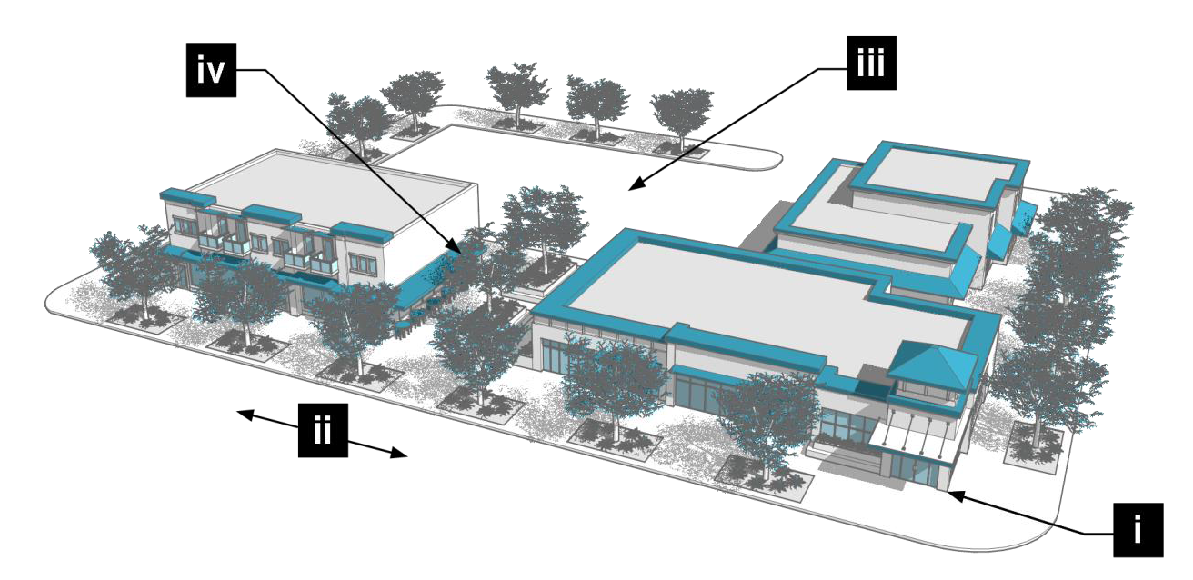
Figure 10-4.7-1: Multi-Building Developments
(c)
Solar Access and Shading. To mitigate the sun's heat and maximize easterly breezes, buildings shall be sited according to the following standards:
(i)
Buildings shall be oriented and grouped to reduce exposure to midday sun while maximizing northern and southern sun exposure to utilize consistent, glare-free interior daylighting.
(ii)
To maximize building solar access, buildings and blocks shall be oriented with east-west lengths equal to or greater than north-south building lengths, and east-west axis within 15 degrees of geographic east-west.
(iii)
Buildings shall be designed to provide shading for windows, entrances, and outdoor spaces—for example, by locating outdoor gathering spaces on the north and east sides of buildings under shade devices such as awnings, verandahs, or deep balconies.
(3)
Outdoor Gathering Spaces
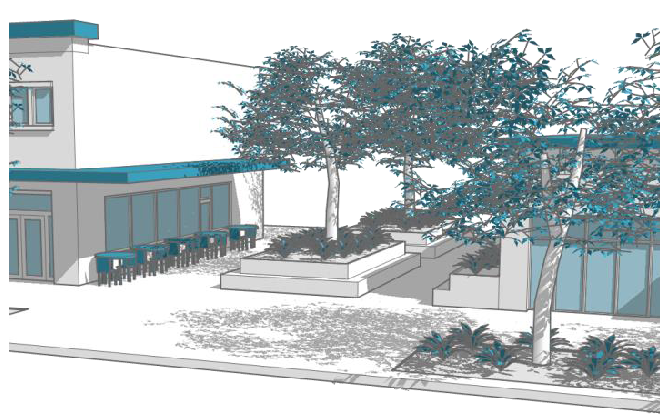
Figure 10-4.7-2: Outdoor Gathering Spaces
(a)
Definition
For purposes of this requirement, an outdoor gathering space is an open or partially open area intended for the benefit of residents, employees, or visitors to a site. The following shall not be counted toward any requirement of this section:
(i)
Private yards;
(ii)
Public or private streets or rights-of-way; and
(iii)
Parking areas and driveways.
(b)
Standards. Developments on sites of 10 acres or larger shall devote a minimum of two percent of the net site area to an outdoor gathering place that:
(i)
Is integrated as part of the overall design of the site and located in an area that provides benefit to a large number of users;
(ii)
Helps establish or improve functional relationships and linkages within a site or between adjacent sites. Potential locations include near anchor tenants, transit stops, as a centralized site feature, or as a continuation of an adjacent natural area, trail, canal, or other waterway;
(iii)
Is designed as a single, contiguous space, rather than multiple smaller spaces;
(iv)
Incorporates a minimum of five of the following pedestrian-scaled features:
A.
Lighted bollards;
B.
Movable tables and chairs;
C.
Benches;
D.
Seat walls and/or raised landscape planters;
E.
Shade and/or palm trees;
F.
Pots or hanging baskets filled with seasonal plant material;
G.
Information kiosks;
H.
Stage, amphitheater, or other performance space; and
I.
Sculptures or other public art features;
(v)
Integrates landscaping and/or structures to provide shading for outdoor gathering spaces, particularly those with a southern or western exposure. The shading may be freestanding or integrated with the adjacent building;
(vi)
Provides direct access to sidewalks and pedestrian walkways; and
(vii)
Is maintained by the owners of the development, unless otherwise agreed to as part of the development approval process.
(D)
General Building Design Standards
(1)
Purpose. Building design directly impacts the character and function of mixed-use and nonresidential development. These standards are intended to:
(a)
Ensure that multi-building or phased mixed-use and/or nonresidential developments use compatible schemes of materials, colors, and architectural vocabulary to ensure consistency;
(b)
Ensure building materials are durable and have low maintenance requirements in the tropical environment;
(c)
Ensure buildings are designed to a human scale;
(d)
Ensure design that is sensitive to the subtropical climate;
(e)
Encourage sustainable development by limiting the amount of resources necessary to construct and operate buildings, and by designing buildings to be adaptable for multiple uses; and
(f)
Require buildings that incorporate standardized formulas or market prototypes to meet a higher level of building design.
(2)
Architectural Character
(a)
Four-Sided Design. Architectural detailing shall be incorporated on all sides of a building that reflects the front facade. Blank walls void of architectural details or other variation are prohibited.
(b)
Exterior Trademarked Design Features. Each building with exterior trademarked architectural design features located 12 feet or more above finished grade, including trademarked roof and parapet design features but not including signs, shall provide a higher level of building design by meeting the following additional requirements:
(i)
Section 10-4.7(D)(4)(a) Horizontal Articulation: Meet four or more of the listed standards; and
(ii)
Section 10-4.7(D)(5)(a) Primary Building Entrance: Meet four or more of the listed standards.
(iii)
For purposes of this provision, a trademarked design feature is any building design element, including but not limited to specific colors, pattern, or shape, but not including signs, associated with a registered federal trademark or trade dress (i.e., the general visual characteristics of a product or its packaging).
(3)
Response to the Subtropical Environment
(a)
Shaded Sidewalks
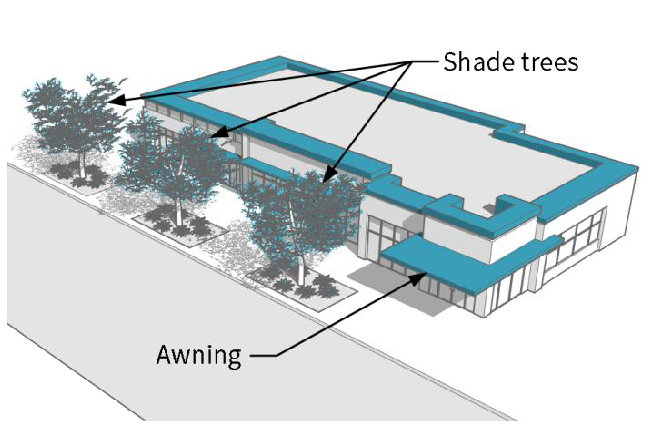
Figure 10-4.7-3: Shaded Sidewalks
(i)
Shaded sidewalks shall be provided along at least 50 percent of all building facades adjacent to or facing streets, outdoor gathering spaces, or parking areas.
(ii)
Shaded sidewalks shall constitute a minimum of 30 percent of the sidewalks within the site (i.e., not including perimeter sidewalks that are adjacent to a public street right-of-way).
(iii)
For purposes of these requirements, a shaded sidewalk shall be any one of the following:
A.
A sidewalk at least ten feet wide made of pervious concrete with shade trees at 30-foot intervals or of standard concrete with the trees planted in grates at the same distance.
B.
A five-foot sidewalk adjacent to a landscape strip at least ten feet wide planted with shade trees at 30-foot intervals.
C.
A sidewalk at least six feet wide covered with weather-protection materials (such as awnings, an arcade, or other structure).
(b)
Contextual References. Developments shall include features typical of Tamarac and Broward County's architecture and the subtropical environment in the building design, such as, but not limited to:
(i)
Architectural shade devices or roofs with canopies that extend over the exterior envelope below;
(ii)
Deeply recessed windows;
(iii)
Covered porches or arcades; and
(iv)
Gabled roof forms.
(c)
Sustainable Design. To the maximum extent practicable, new buildings shall incorporate two or more of the features below:
(i)
Integration of renewable power in the design of buildings or sites. Renewable power may be derived from solar, wind, geothermal, biomass, or low impact hydro sources;
(ii)
Avoidance of dark colors on exterior walls exposed to the sun;
(iii)
Energy-efficient materials, including recycled materials that meet the standards of §10-4.7(D)(6), Architectural Details, Materials, and Colors, in the building design;
(iv)
Fully shaded ground surfaces to reduce glare;
(v)
A sustainable roof or light colored roofing materials; or
(vi)
Skylights, atria, light shelves, clerestory windows, or light tubes to maximize the amount of natural light that enters the building.
(4)
Building Mass
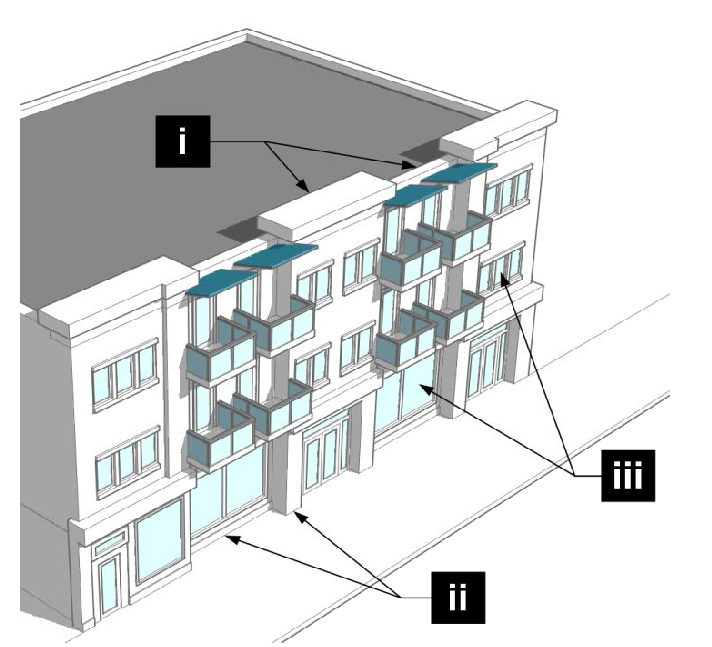
Figure 10-4.7-4: Outdoor Gathering Spaces
(a)
Horizontal Articulation Buildings shall be designed to reduce apparent mass by dividing facades into a series of smaller components. No individual component shall have a length of more than 60 feet. Distinguish components from one another through two or more of the following:
(i)
Variations in roof form or variations in roof height of two feet or more;
(ii)
Changes in wall plane depth of 12 inches or more;
(iii)
Variations in the arrangement and recessing of windows;
(iv)
Recognizable changes in texture, material, or surface colors; or
(v)
Engaged columns (i.e., a column embedded in and partially projecting from a wall).
(b)
Vertical Articulation
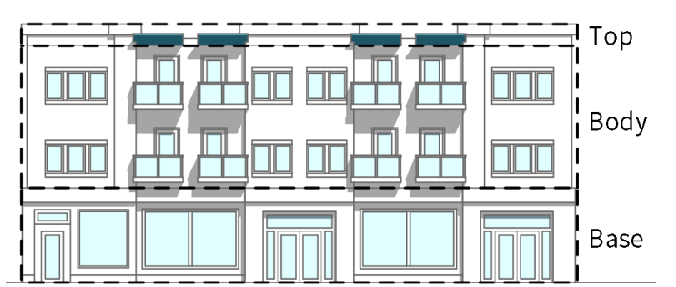
Figure 10-4.7-5: Vertical Articulation
Buildings shall be designed to reduce apparent mass by including a clearly identifiable base, body, and top, with horizontal elements separating these components. The component described as the body must constitute a minimum of 50 percent of the total building height.
(5)
Design for Pedestrians
(a)
Primary Building Entrance. Design shall include visually prominent primary building entrances including providing shade for pedestrians. Unless otherwise provided in this Code, a combination of two or more of the following features shall be incorporated:
(i)
Canopy, portico, archway, arcade, or similar projection that provides architectural interest and protection for pedestrians;
(ii)
Prominent tower, dome, or spire;
(iii)
Peaked roof;
(iv)
Projecting or recessed entry;
(v)
Outdoor features, such as seat walls, landscaping with seasonal color, or permanent landscape planters with integrated benches; or
(vi)
Other comparable techniques/features.
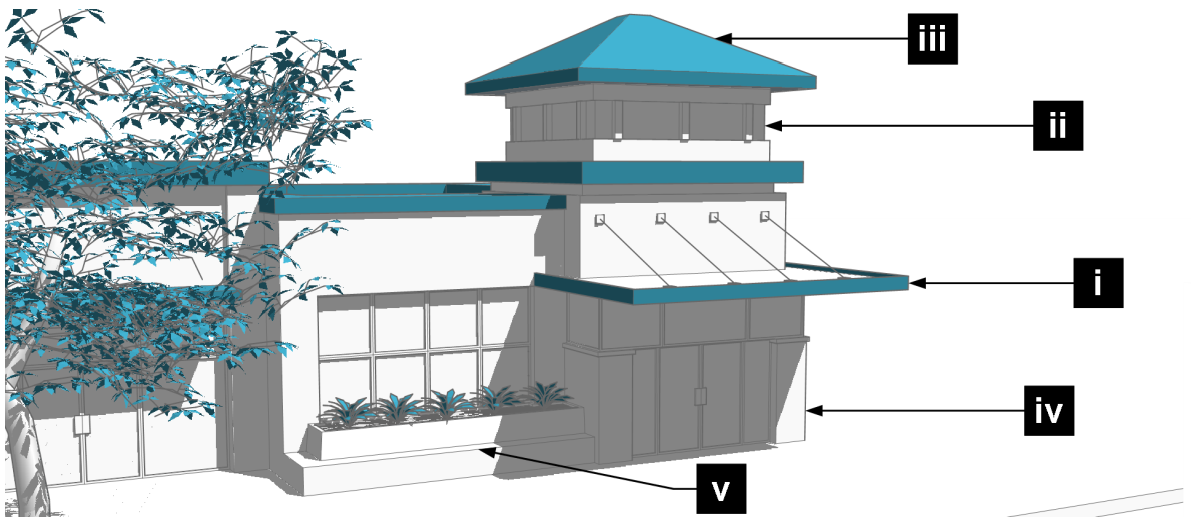
Figure 10-4.7-6: Primary Building Entrance
(b)
Transparency
(i)
Throughout the City, on the façade facing the principal street:
A.
At least 30 percent of the ground-floor wall area between two and ten feet above grade shall consist of transparent glazing;
B.
At least 20 percent of each upper-floor wall area shall consist of transparent or nontransparent glazing.
(ii)
Glazing required by this Code should be concentrated in areas of high pedestrian activity and, to maximize energy efficiency, should be used in conjunction with shade features required by §10-4.7(D)(3), including awnings, shaded sidewalks, deeply recessed windows, and covered porches or arcades.
(iii)
Except as otherwise permitted in this section and in §10-4.10, Signs, transparent glazing required by this Code shall be maintained without interior or exterior obstructions that substantially limit visibility, including, but not limited to, window signs, interior shelving, tinting, or window coverings (except window blinds) during hours of business operation. This section shall not apply to signage, shelving, displays, or the like, set back at least three feet from the glazing surface.
(c)
Pedestrian Amenities. Ground-floor facades that face public streets or other public areas (e.g., outdoor gathering spaces, parks or open space, parking areas with more than five spaces) shall incorporate pedestrian-oriented design features along no less than 60 percent of their horizontal length. Pedestrian-oriented design features may include arcades, display windows, entryways, awnings, or other features. Shaded sidewalks required by §10-4.7(D)(3) that are part of the building design may be credited toward this standard, as well.
(6)
Architectural Details, Materials, and Colors
(a)
Permitted Wall Materials. The following materials are permitted for use on exterior building walls, individually or in combination:
(i)
Brick;
(ii)
Stone (natural or simulated);
(iii)
Painted, stained, or integrally-colored concrete masonry units (CMU), split face or ground face;
(iv)
Textured tilt-up concrete panels, with or without reveals;
(v)
Stucco;
(vi)
Exterior Insulation and Finish Systems (EIFS);
(vii)
Clear and tinted glass;
(viii)
Tile;
(ix)
Wood; and
(x)
Architectural metal.
Other materials may be used provided they are of comparable quality, durability, and character, as determined by the Director.
(b)
Accent Wall Materials. A minimum of 10 percent and a maximum of 25 percent of the exterior building wall facing the principal street (not including windows and doorways) shall consist of an accent material from the list in subsection (a) above that is different than the remainder of the building façade material.
(c)
Prohibited Wall Materials. The following materials are prohibited:
(i)
Un-textured tilt-up concrete panels (acceptable for industrial buildings);
(ii)
Pre-fabricated steel panels (acceptable as an accent element);
(iii)
Corrugated metal (Corten or rust finish acceptable as an accent element); and
(iv)
Mirrored or otherwise highly reflective glass.
(d)
Roof Materials. Flat roofs, standing seam metal roofs, and concrete and clay tile roofs are permitted. Asphalt shingle roofs are not permitted.
(e)
Metal Finishes
(i)
Metal may be painted or left it in a natural state to derive its character from weathering and oxidation.
(ii)
Bright or highly reflective metal finishes are prohibited.
(f)
Colors
(i)
The predominant exterior colors on buildings shall be earth tones to minimize the visual impact of these buildings.
(ii)
The use of bright, fluorescent, metallic, highly reflective, or other high-intensity colors and finishes shall be limited to accent materials and may be used on no more than 30 percent of any elevation.
(E)
Supplemental Standards: Mixed-Use Districts
(1)
Purpose. These standards are intended to preserve and enhance the unique character and identity of Tamarac. They are intended to ensure that future infill and redevelopment will be context-sensitive and have high-quality site layout, architectural detailing, façade articulation, and other features that provide a distinct character and pedestrian scale.
(2)
Applicability. Development of any structure that will contain a use categorized in Table 10-3.1, Allowed Uses, as a commercial use, or a mix of commercial and other uses, and that is located within the Mixed-Use Corridor or Mixed-Use General districts, shall comply with the general site layout and building design standards of §10-4.7(C) and §10-4.7(D) above, plus the standards of this section.
(3)
Site Planning
(a)
Parking Location. Surface parking shall be located behind buildings. Surface parking is not permitted between the building and the primary street frontage or to the side of the building where it may be viewed from the primary street frontage.
(b)
Ground-Floor Uses. The incorporation of retail shops and/or restaurants is encouraged at the street level to promote a more active environment for pedestrians and to support residential and office uses located within the same building (on upper floors) or nearby. This configuration of uses is particularly encouraged along Commercial Boulevard, McNab Road, State Road 7, NW 57 Street, NW 70 Street, and University Drive, as well as adjacent to major public spaces, including canals and waterways, where a high level of activity and visibility is desirable. If a limited portion of a structure's ground level will be devoted to retail or restaurant space, such space should be located along those facades adjacent to or most visible from primary street frontages or major pedestrian walkways.
(c)
Build-To Line. First floors of all buildings shall "build to" the back of the sidewalk or edge of property. Exceptions to the build-to line may be permitted if:
(i)
The space set back from the build-to line is used for an outdoor gathering space, as defined in §10-4.7(C)(3)(a);
(ii)
The space set back from the build-to line is designed as a protected walkway for pedestrians, with the second floor placed at the build-to line; or
(iii)
The space set back from the build-to line is used to provide a mid-block pedestrian connection to an outdoor gathering space provided at the rear of the building or to an adjacent canal or waterway. Mid-block pedestrian connections shall be a minimum of 15-feet in width.
(F)
Supplemental Standards: Business Park District
(1)
Industrial Activities in Enclosed Buildings. Except as expressly provided otherwise in this Code, all activities associated with any industrial use (as listed in Table 10-3.1: Allowed Uses) shall be conducted within a totally and permanently enclosed building.
(2)
Façade Articulation. Each street-facing building facade shall be horizontally and/or vertically articulated to avoid long, blank wall planes, by meeting at least one of the following standards:
(a)
Wall Plane Horizontal Articulation. Each facade greater than 100 feet in width shall be articulated with wall offsets (e.g., projections or recesses in the facade plane), changes in facade color or material, or similar features that visually interrupt the wall plane horizontally such that the width of uninterrupted facade does not exceed 100 feet.
(b)
Vertical Articulation. Each facade greater than 30 feet in height shall incorporate a change in the wall surface plane or in facade color or material that visually interrupts the wall plane vertically such that the height of uninterrupted facade does not exceed 30 feet.
(c)
Roof Line Variation. The facade shall include variations in roof planes and/or in the height of a parapet wall at least every 60 feet of roofline length along the facade.
(3)
Entrance
(a)
Each principal building shall have clearly defined, highly visible primary entrances for occupants and patrons.
(b)
Street-facing facades of the ground level floor shall not include overhead doors, sliding glass doors, removable panels, or similar type of doors.
(4)
Building Façade Materials. The use of vinyl siding aluminum siding, corrugated metal siding, any other metal siding, unfinished or untreated tilt-up concrete panels, or standard single- or double-tee concrete systems as a primary exterior facade material shall be limited to those portions of rear and side building facades that are not visible from the public right-of-way or an adjacent residential, institutional, or commercial use.
(5)
Loading and Service Areas. Loading and service areas shall be separated from patron parking, pedestrian areas, and main drive aisles, and shall be located as far as practicable from any abutting single-family residential development.
(6)
Off-Street Parking Location. No more than two bays of off-street parking may be located between the front building facade and the street it faces. This may be doubled for buildings of two or more stories.
10-4.8 - Fences, Walls, and Hedges
(A)
Purpose. This section ensures that fences, walls, and hedges are regulated to ensure the location, height, and appearance of fences, walls, and hedges:
(1)
Maintain visual harmony within neighborhoods and the City;
(2)
Protect adjacent properties from the indiscriminate placement and unsightliness of fences, walls, and hedges; and
(3)
Ensure the safety, security, and privacy of properties.
(B)
General Standards
(1)
All Districts
(a)
Except where specifically noted, all walls and fences shall be constructed of one of the following materials or a combination thereof:
(i)
Wood,
(ii)
Rock,
(iii)
Stone,
(iv)
Solid masonry with stucco and paint,
(v)
Pierced masonry,
(vi)
Ornamental metal,
(vii)
Vinyl coated chain link, or
(viii)
Plastic Vinyl Coated (PVC).
(b)
No electrified fences are permitted.
(c)
Bare metal chain link fences are not permitted unless utilized for temporary or construction fencing. All chain link fences shall be vinyl coated.
(d)
Bamboo or materials similar in appearance are not permitted.
(e)
Fences and walls shall not be comprised of more than one material unless it is done in a decorative manner at the discretion of the Director.
(f)
The height of all fences, walls, and hedges shall be measured from the finished elevation of the property at the point of installation.
(g)
No fence or wall shall be erected or installed within the City's jurisdiction unless the design and structurally sound materials have been approved by and a permit for same has been issued by the building department of the City.
(h)
At all roadway intersections, fences, walls, or hedges shall not obstruct visibility of traffic as determined by the City Engineer. (See §10-4.4(D)(6), Sight Distance.)
(i)
The continued maintenance of any fence, wall, or hedge within the City shall be the responsibility of the owner or other person responsible for the property upon which such fence, wall, or hedge lies.
(j)
Fences, walls, and hedges shall always be maintained in a condition that will ensure safety, functional use, and a proper aesthetic appearance. Such maintenance shall include but not be limited to painting, repairing, or pruning.
(k)
The City Commission shall, in approving site development plans, require that appropriate fence, wall or hedge protection is provided to prevent or minimize hazards to contiguous residential properties from noise, glare, odors, smoke, vibrations, flying objects, or traffic.
(l)
The Director may allow a maximum of two additional feet in height for a decorative rail on top of walls. The rail can exceed the maximum allowable wall height by no more than 2 feet if the applicant can provide safety and/or security reasons for the justification at the discretion of the Director.
(m)
Within the I-1, I-2, BP, PF, and SU zoning districts, fences for utility sites and industrial sites shall be permitted for security reasons with a maximum height of eight feet.
(n)
Where a canal maintenance easement exists, an opening shall be provided for maintenance purposes, which shall be a minimum of eight feet in width. If there is a gate, it shall be hinged or removable for access. A gate also shall be required if the property contains any area that cannot be accessed due to the fence to allow access for maintenance.
(2)
Residential Districts
(a)
Fences and Walls
(i)
Fences and walls may be erected to a maximum height of six feet along the rear property line; except, if the rear property line abuts a nonresidential zoned property, then such maximum height permitted shall be eight feet.
(ii)
The maximum height permitted to be installed along the side property line or elsewhere within the required side yard between the required street front setback and the rear property line shall be six feet for fences and walls.
(iii)
Fences and walls are prohibited from extending beyond the front line of the house and no fence or wall shall be allowed within the front setback.
(iv)
No fences or wall shall be installed or be permitted to remain in required front street setback areas of single- and two-family dwellings or public rights-of-way, except those properties containing two street yards may erect a fence or wall on or near the property line adjacent to the secondary street. A secondary street shall be defined as the street front not used as the primary entrance to a residential dwelling.
(v)
Multi-family residential developments may install decorative style fences or walls within the front street setback up to six feet in height. Decorative style fences or walls shall not be chain link, PVC, or wood fences.
(vi)
Fences or walls are permitted within existing planting strip easements.
(vii)
In instances where a double-frontage lot is fenced, walled, or hedged, a gate shall be installed to allow access to utilities and maintenance of the right-of-way. Gates are prohibited from being installed in such a way that access is required from private property.
(viii)
A fence wing shall not extend into a canal area that is not on the subject property without written approval from the entity with jurisdiction for the waterway or easement. The wing wall may not extend more than three feet into such waterway.
(b)
Hedges
(i)
All hedges, whether abutting residential, nonresidential, mixed-use, or special purpose districts, or public rights-of-way shall be maintained at a maximum of ten feet along the front setback line, side, and rear property lines.
(ii)
Palm species planted to create a solid buffer, and maintained according to §10-4.4 standards shall be exempt from the height restrictions of this Section. Palms may not be used as a solid buffer along waterway property.
(iii)
No hedge shall be installed or be permitted to remain in required front street setback areas or public rights-of-way, except those properties containing two street yards may erect a hedge on or near the property line adjacent to the secondary street. A secondary street shall be defined as the street front not used as the primary entrance to a residential dwelling.
(iv)
Where a canal maintenance easement exists, an opening must be provided for maintenance purposes, which shall be a minimum of eight feet in width.
(3)
Mixed-Use and Nonresidential Districts
(a)
Fences, walls, and hedges may be erected to a maximum height of eight feet along the rear and side property lines.
(b)
Developments may install decorative style fences or walls within the front street setback up to six feet in height. Decorative style fences or walls shall not be chain link, PVC, or wood fences.
(c)
Along the street property lines, the maximum height permitted for fences, walls, and hedges shall be six feet and shall be allowed no closer than five feet from such property lines. When the fence, wall, or hedge is set back at least ten feet from such a property line, the maximum height may be increased to eight feet.
(4)
Special Purpose Districts
(a)
Along the street property lines, a fence, wall, or hedge may be erected within five feet of street property lines providing that the maximum height does not exceed six feet. The maximum height permitted along the rear and side property lines shall also be six feet except whenever a Special Purpose district abuts a residentially zoned district, in which case no fence, wall, or hedge shall exceed six feet in height.
(b)
The Director may approve additional fence, wall, or hedge height at their discretion for fences, walls, and hedges.
(c)
In industrial districts, barbed-wire fencing is prohibited.
10-4.9 - Exterior Lighting
(A)
Purpose. The purpose of this section is to regulate exterior lighting to ensure the safety of motorists and pedestrians as well as minimize adverse impacts to adjacent properties. More specifically, this section is intended to:
(1)
Ensure exterior lighting does not adversely impact land uses on adjacent lands by minimizing light trespass, obtrusive light, and glare;
(2)
Ensure the safety of motorists by minimizing light spillage and glare onto adjacent streets;
(3)
Curtail light pollution and preserve the nighttime environment for the enjoyment of residents and visitors;
(4)
Conserve energy and resources to the greatest extent possible; and
(5)
Provide security for people and property.
(B)
Applicability
(1)
General Applicability. All exterior lighting for any type of residential or nonresidential development shall comply with the standards of this section, unless exempted in subsection (2) below.
(2)
Exemptions. The following are exempted from the exterior lighting standards of this §10-4.9:
(a)
Emergency Lighting. Lighting used only under emergency conditions.
(b)
Seasonal Lighting. Temporary seasonal lighting between Thanksgiving and January 15, provided such lighting does not create glare to motorists or result in light trespass onto adjacent properties.
(c)
Lighting Required by FAA or FCC. Lighting required by the Federal Aviation Administration or the Federal Communications Commission.
(d)
Special Events. Special events that have been issued a temporary use permit shall be allowed temporary lighting for the duration of the event, provided such lighting does not create glare to motorists or result in light trespass onto adjacent properties.
(e)
Underwater Lighting. Underwater lighting used for the illumination of swimming pools and decorative water fountains shall not be subject to this §10-4.9, though they must conform to all other provisions of this Code.
(f)
Lighting Required by Building Code. Any lighting that is required by the building code for life safety purposes such as stairway lighting, walkways, and building entrances, shall not be prohibited by this §10-4.9 but shall be subject to the lighting standards.
(g)
Single-and Two-Family Dwellings. Single- and two-family dwellings are exempt from the exterior lighting standards of this Section except:
(i)
§10-4.9(C)(1),Maximum Lighting Height; and
(ii)
§10-4.9(C)(3), Hours of Illumination and Lighting Controls.
(3)
CPTED Waiver. The Director may waive all or part of the standards in this §10-4.9 if it is demonstrated that the implementation of the standards results in a conflict with the City's adopted CPTED guidelines.
(4)
Security Plan. Government maintenance facilities, public safety facilities, parks and public spaces, and other uses where sensitive or dangerous materials are stored may submit to the Director a site security plan proposing exterior lighting that deviates from the standards in this section. The Director shall approve, or approve with conditions, the site security plan and its proposed deviation from the standards of this section, on finding that:
(a)
The proposed deviation from the standards is necessary for the adequate protection of the public;
(b)
The condition, location, use of the land, or the history of activity in the area, indicates the land or any materials stored or used on it are in significantly greater danger of theft or damage, or members of the public are at greater risk for harm than on surrounding land; and
(c)
The proposed deviation from the standards is the minimum required, and will not have a significant adverse effect on neighboring lands.
(5)
Lighting Plan Required. Applications for approval of Major or Minor Site Plan shall include a lighting plan, including a photometric plan, that addresses the standards in this section. An outdoor lighting installation shall not be placed in permanent use until a letter of compliance signed and sealed by a registered engineer or architect is provided to the City stating that the lights have been field- tested and meet the standards of this Code.
(C)
General Requirements
(1)
Maximum Lighting Height
(a)
Except for street lights (addressed in §10-4.9(F)) and outdoor recreational facilities (addressed in §10-4.9(I)), the maximum height of exterior lighting fixtures, whether mounted on poles, walls, or by other means, shall be:
(i)
17.5 feet in single-family residential (RE and R-1) zoning districts;
(ii)
20 feet in multifamily residential (R-2 and R-3) zoning districts and those parts of nonresidential district within 200 feet of a residential zoning district; and
(iii)
30 feet in all other parts of nonresidential districts.
(b)
Wherever possible, illumination of outdoor seating areas, building entrances, and walkways shall be accomplished by use of ground-mounted fixtures not more than four feet in height.
(2)
Maximum Illumination Levels. All exterior lighting shall have intensities and a uniformity ratio consistent with the IESNA Lighting Handbook (Illuminations Engineering Society of North America) and shall be designed and located so that the illumination measured in foot-candles at finished grade shall comply with the standards in Table 10-4.10: Minimum and Maximum Illumination Levels. The illumination shall take into account changes in finished grade, walls, and other existing or proposed building and site conditions.
(3)
Hours of Illumination and Lighting Controls
(a)
General. All exterior lighting not necessary for security or emergency purposes shall be reduced, activated by motion sensors, or turned off during non-operating hours. For the purposes of this requirement, lighting "necessary for security or emergency purposes" shall be construed to mean the minimum amount of exterior lighting necessary to illuminate possible points of entry or exit into a structure, to illuminate exterior walkways, or to illuminate outdoor storage areas or parking lots. Such lighting may be activated by motion sensor devices.
(b)
Controls. To minimize the amount of excess lighting at night, the use of the following types of lighting controls to control the amount and duration of nighttime illumination is encouraged and for some applications may be required.
(i)
Motion Sensors. These mechanisms are the preferred method for controlling nighttime illumination since they turn on lights only when activated by motion and will remain on during the activity and for a set period of time (typically up to 30 minutes) following the last detection of motion. Sensors must be triggered by activity within the owner's property lines and should be used with incandescent, compact fluorescent, or halogen lamps.
(ii)
Timer/Photocell Combinations. These are also a preferred method for control when used for nighttime control at primary points of entrance (e.g., front entries) and at commercial and industrial properties. These activate the light source at dusk and turn it off at a selected time several hours later, well before dawn.
(iii)
Photocells. Use of photocells is appropriate when illumination is required all night for safety, their use is otherwise discouraged. These controls are activated by sunlight, turning lights on at dusk and off at dawn and illuminate an area for the entire night.
(iv)
Timers. These mechanisms are prohibited when used alone.
(4)
Illumination Direction and Shielding
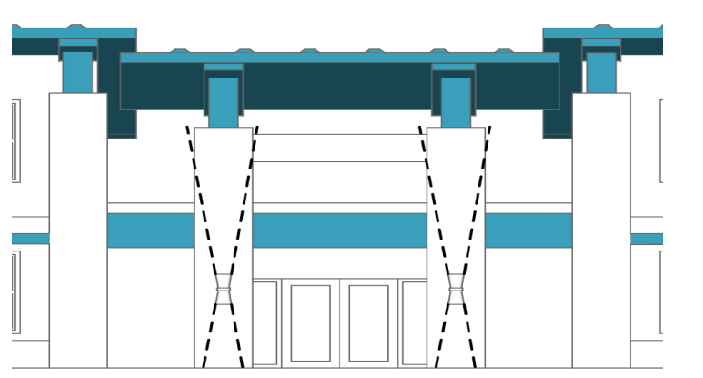
Figure 10-4.9-1: Upwardly-Directed Lighting
(a)
Upwardly-directed lighting used to illuminate all or part of a structure or building facade shall use low-wattage architectural or decorative lighting so that direct light emissions are contained by the structure or facade and are not visible above the building roof line.
(b)
Light fixtures used to illuminate flags, statutes, or other objects mounted on a pole, pedestal, or platform shall use a narrow cone beam of light that does not extend beyond the illuminated object.
(c)
Any light source forming a lineal pattern shall be recessed within the structure in which it is located.
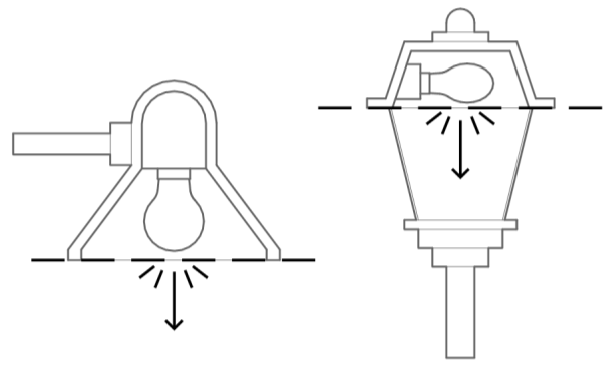
Figure 10-4.9-2: Full-Cutoff Light Fixture (Section)
(d)
Any light source or lamp that emits more than 900 lumens shall be concealed or shielded with a full cut-off style fixture with an angle not exceeding 90 degrees to minimize glare and unnecessary light diffusion onto adjacent properties and streets.
(5)
Wall Pack Lights
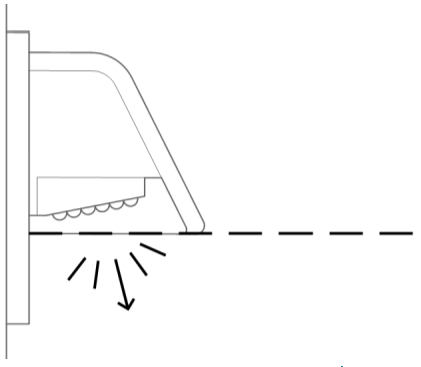
Figure 10-4.9-3: Wall Pack Light (Section)
Wall packs on buildings may be used at entrances to a building to light unsafe areas. They are not intended to draw attention to the building or provide general building or site lighting. Wall packs on the exterior of the building shall be fully shielded with true cut-off type bulb or light source not visible from off-site, or similar, to direct the light vertically downward and have a light output of 900 lumens or less.
(6)
Electrical Service. Electrical service shall be placed underground unless the fixtures are mounted directly on utility poles.
(D)
Residential Lighting Standards. The following lighting standards shall be applicable in all residential districts:
(1)
General Standards
(a)
Glare. All exterior lighting shall be designed so that the point light source or bulb is not directly visible from adjoining properties or public rights of way. Placement of a fixture shall minimize light glare and shall comply with the limits in Table 10-4.10: Minimum and Maximum Illumination Levels, at the property line.
(b)
Flood Lights. Flood lights shall be restricted as follows:
(i)
The point light source shall not be visible from adjoining lots or streets.
(ii)
Lights shall be focused on the task, fully shielded, down directed, and screened from adjacent properties in a manner that prevents light trespass.
(iii)
Maximum incandescent wattage for a flood is 75 watts per bulb and 150 watts total per fixture.
(iv)
Light level shall not exceed ten foot-candles at grade.
(v)
Incandescent flood lights shall be controlled by a motion sensor for uses after 10:00 p.m.
(vi)
Compact fluorescent floodlights shall not exceed a maximum 2,400 lumens (32 watts) per fixture and can be controlled by photocell/timer.
(2)
New Construction
(a)
Maximum Wattage
Incandescent light sources including halogen shall not exceed 75 watts per lamp or 150 watts per fixture. Compact fluorescent sources shall not exceed 15 watts per lamp. Outdoor lighting with high-intensity discharge (HID) light sources in excess of 3,400 lumens shall be prohibited.
(b)
Fixtures. Fully shielded, down-directed light sources are required. Point sources or bulbs shall not be visible from adjoining properties or adjoining public rights of way. Clear, wavy, or seeded glass shall not be acceptable. Frosted or translucent glass that does not show the light source is acceptable for retrofit applications.
(E)
Nonresidential and Mixed-Use Lighting Standards. The lighting standards below shall be applicable in all nonresidential, mixed-use, and special purpose districts.
(1)
Reduce Glare from Point Sources. Outdoor lighting used to illuminate parking spaces, loading areas, driveways, maneuvering areas, or buildings shall be designed, arranged, and screened so that the point light source shall not be visible from adjoining lots or streets.
(2)
Entrances and Storefront Windows. Maximum light level range including spillage from inside to outside shall be no more than 15 foot-candles (fc). Maximum light level reading shall be no more than 15 fc, measured at ground, between two feet from the building façade and either the edge of the curb or eight feet from the building façade, whichever is closer to the building.
(3)
Walkways/Bikeways and Pedestrian Areas. Illumination is encouraged for these areas. If an applicant chooses to illuminate areas the following standards apply:
(a)
The ground area shall be illuminated to a maximum level of five fc, no more than 0.5 fc average;
(b)
The vertical illumination level at a height of five feet above grade shall be no more than 0.5 fc; and
(c)
Lighting shall be directed downward, pedestrian-friendly, and fully shielded or with full cut-off luminaires. Light sources for luminaries mounted 12 feet above grade or lower shall have a maximum of 3,200 lumens. Light sources for luminaries mounted between 12 and 16 feet shall have a maximum of 5,000 lumens.
(4)
Lower Light Levels in Mixed-Use Areas. Mixed-use areas that include residential occupancies shall comply with the residential lighting standards in §10-4.9(D) on those floors or areas that are more than 50 percent residential based on square footage of uses.
(5)
Wattage Specifications. Maximum bulb wattage shall be 75 watts incandescent or 32 watts fluorescent, with a maximum two bulbs per fixture. HID light sources are limited to 14,000 lumens; 2,800 to 3,200 degree Kelvin lamp is preferred. Standards for HID light sources may be established by the City for new technology consistent with the above restrictions.
(6)
Fixture Types. Fixtures shall be fully shielded or full-cutoffs. In certain applications cut-off fixtures with louvers or shields may be used for aesthetic purposes.
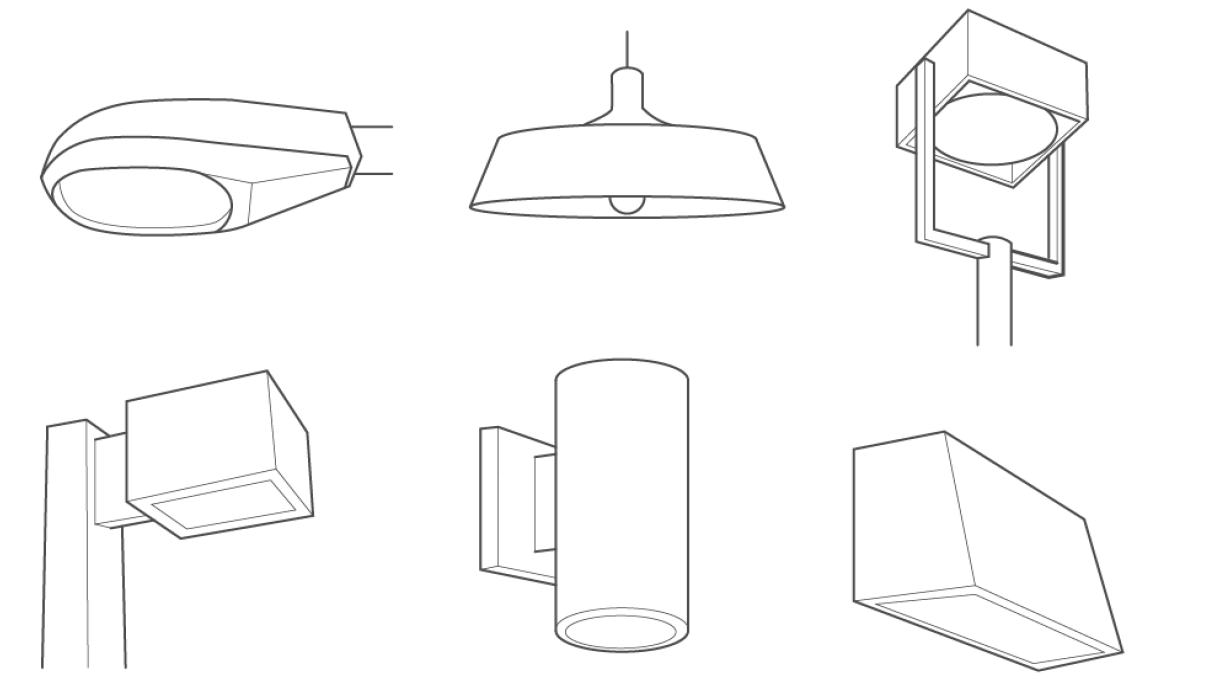
Figure 10-4.9-4: Example Light Fixture
(7)
Security Lighting. Lighting for entrances, stairways, and loading areas shall not exceed five fc and for parking lots shall not exceed two fc. Other areas of specific security concern may be lit at a level not to exceed 1.5 fc.
(F)
Street Lighting
(1)
Required
(a)
A street lighting system shall be provided in all subdivisions or as part of the improvements in any new land development project. Installation of all underground facilities must be completed before streets are paved.
(b)
The first 12 months of estimated maintenance and service charges for the street lighting system shall be paid by the developer of the project before the issuance of a building permit. In cases where the estimated completion time of a project exceeds 12 months, the City Commission may require payment of additional maintenance and service charges until such time as the Director releases the public improvement bond.
(2)
Design and Construction Standards. All street lighting as required by this subsection shall conform to the following standards of design and construction:
(a)
All designs for lighting shall be approved by the City Engineer and the franchised electric utility, who will follow, as a minimum, the current edition of the IESNA Lighting Handbook, published by the Illuminating Engineers Society of North America.
(b)
Wiring for street lighting shall be underground except in areas where primary distribution conductors are overhead. Subject to the approval of the City engineer, the primary poles may be used for streetlights and associated wiring.
(c)
All luminaries shall be a minimum of 9,500 lumen lights, mounted on concrete poles.
(3)
Enforcement
(a)
No building permit shall be issued in any subdivision or new land development project unless the engineering drawings therefor contain adequate provisions for street lighting.
(b)
No Certificate of Occupancy shall be issued to any structure until the street lighting is completed and operable or a commitment acceptable to the City engineer has been provided by the electric utility for that area.
(c)
The design standards of this subsection may be waived by the City Commission where a waiver would not be detrimental to the public health, safety or welfare of the citizens of the City, subject to agreement or covenant providing for installation and maintenance, plans to be approved by City engineer.
(G)
Vehicular Use Area Lighting
(1)
Illumination Levels. Illumination of vehicular use areas, including parking lots and accessways, shall comply with the limits in Table 10-4.10: Minimum and Maximum Illumination Levels.
(2)
Fixture Type. All lighting fixtures serving parking lots shall be full cut-off fixtures, maximum of two fixtures per pole.
(3)
Height. Lighting poles in vehicular use areas shall not exceed 15 feet in height.
(4)
Vehicular Use Area Lighting Design Generally. Parking lots and other background spaces shall be illuminated as unobtrusively as possible while meeting the functional needs of safe circulation and protection of people and property. Foreground spaces, such as building entrances and outside seating areas, shall utilize local lighting that defines the space without glare. Up-lighting (including floodlighting) shall not be utilized to illuminate all or any portion of a building façade; down-lighting is acceptable.
(H)
Prohibited Lights. This subsection identifies applications of lighting that cause glare, decrease our ability to see in dark, low-level ambient light environments, produce unattractive lighting environments, or excessive light pollution. These types of lighting are prohibited.
(1)
Roof Lights. Light sources shall not be affixed to the top of a roof, except where required by building code requirements.
(2)
Unshielded Light Sources. Unshielded light sources are prohibited except as listed in residential section.
(3)
Building Illumination. Flood illumination of buildings shall be prohibited from the ground, on pole-mounted lights, or by lights mounted on adjoining structures. Buildings with exceptional symbolic (i.e. churches or public buildings) or historical significance may request exemptions to this prohibition.
(4)
Nuisance Lights. Lights that flash, move, revolve, blink, flicker, vary in intensity, change color, or use intermittent electrical pulsation are prohibited unless specifically approved as part of the lighting code exemption. Winter holiday lights are exempt.
(5)
Other Lamps. Mercury vapor and low-pressure sodium lighting shall be prohibited.
(6)
Architectural Lighting. Linear lighting such as: fluorescent awnings, rope light, or neon, except neon signs as permitted in §10-4.10, is prohibited. Façade lighting primarily intended as an architectural highlight to attract attention or used as means of identification or advertisement shall be prohibited.
(7)
Neon Lights. Existing neon lights are considered a pre-existing, nonconforming use. New uses are prohibited. These pre-existing, nonconforming lights must be brought into conformance when a major alteration is made to the exterior lighting or which increases the square footage of the building.
(I)
Outdoor Recreational Facilities
(1)
Condition. Conditions placed on the lighting for the recreational facility may include: limited hours of operation, limits on lighting intensity, specific requirements for fixture design and others.
(2)
Light Trespass. Designs should address limiting light trespass to surrounding neighborhoods. Floodlights in this application should not be aimed above 62 degrees from vertical. In order to minimize light pollution and light spillage into the neighborhood, the lights should have louvers and external shields.
(3)
Maximum Wattage. Wattage of lamps shall be 250 watts HID or less.
10-4.10 - Signs
(A)
Purpose. This section sets fort the criteria for the location, installation, configuration, removal, and other standards for signs within the City. It is the intent of this section to authorize the uses of signs that:
(1)
Are compatible with their surroundings, legible in the circumstances in which they are seen, and appropriate to the activity that displays them;
(2)
Are expressive of the identity of individual activities and the community as a whole;
(3)
Promote the creation of an attractive visual environment that integrates signs into the architectural design and promotes an aesthetically pleasing community; and
(4)
Foster public safety along public and private streets within the community by assuring that all signs are in safe and appropriate locations that do not create a nuisance, conflict with traffic control devices, or unreasonably distract motorists.
(B)
Sign Permits
(1)
General. A Sign Permit is required pursuant to §10-5.4(L), Sign Permit, before the construction, erection, installation, posting, relocation, or alteration of any sign unless it is exempt under 10-4.10(B)(2), Exemptions.
(2)
Exemptions. A Sign Permit is not required for the following signs, though the signage standards in §10-4.10 do apply to such signs, and all signs within City public easements or rights-of-way and all traffic regulatory or traffic control signs are subject to Improvement Permits:
(a)
Entrance signs installed by the City at or near the city limits, on which may be listed institutional names and points of interest;
(b)
Off-premises signs installed by the City that announce subdivisions and projects currently under development;
(c)
Signs installed by the City that provide for the health, safety, and welfare of the community;
(d)
Signs installed under the direction of federal, State, County, or City agencies, including community service signs, community directional signs, and directional signs;
(e)
Window signs;
(f)
Yard signs for single-family lots;
(g)
Flags of nations, states, counties, municipalities, civic organizations, and corporations;
(h)
Nameplate signs, building address signs, general information signs, "open" signs, and business signs, where such signs do not exceed three square feet in sign area;
(i)
Change of copy in permitted changeable copy signs;
(j)
Individual tenant panels in permitted multiple tenant monument signs; and
(k)
The refurbishing of a sign where copy is not changed, the cost of any repair does not exceed 50 percent of the original cost of the sign, and no electrical work other than for normal maintenance is necessary.
(C)
Comprehensive Sign Plan (CSP) A Comprehensive Sign Plan provides for uniformity and in many instances enhance the aesthetic appeal of multi-tenant commercial, public, institutional, civic and/or mixed used developments. New and significantly modified multi-tenant commercial, public, institutional, civic and/or mixed used developments for which a building permit for vertical construction is filed after the effective date of the ordinance from which this section is derived shall adopt a Comprehensive Sign Plan subject to the following provisions.
(1)
A multi-tenant commercial, public, institutional, civic and/or mixed-use developments shall submit a Comprehensive Sign Plan that establishes a coordinated approach to site signage. Comprehensive Sign Plans shall provide specifications regarding sign:
(a)
Type;
(b)
Materials;
(c)
Illumination;
(d)
Colors
(e)
Dimensions; and
(f)
Location
(2)
Developments utilizing a CSP may propose variations from City signage standards that address sign size and the number of signs allowed. Variations of up to 10 percent from the general requirement may be approved administratively. Variations above 10 percent must be reviewed by the Planning Board and approved by the City Commission.
(D)
General Sign Requirements. Only such permanent signs detailed in this section shall be permitted to be erected or maintained upon any building, lot, or parcel of land. Permits for permanent signs shall be reviewed by applicable city staff and issued by the building department based upon the signage regulations in effect, unless exempted from permit requirements.
(1)
Signs Permitted in All Zoning Districts Generally. The signs below are allowed generally in all zoning districts, subject to the listed standards.
(a)
Signs installed under the direction of federal, state, county, or municipal agencies;
(b)
General information signs, each not to exceed three square feet in area; and
(c)
One nameplate sign per residence or business, each attached to a front wall or door and not to exceed three square feet in total area. An additional nameplate sign displaying the business name or building number or suite number may be attached to the rear door or the wall space immediately above the rear door not to exceed three square feet in total area. The sign shall be installed in a manner so that it is visible at night through the use of reflective material or direct/indirect lighting.
(2)
Signs Permitted in Residential Districts. The signs below are allowed generally in all residential zoning districts, subject to the listed standards.
(a)
Community Directional Signs. The standards below shall be applied to general information, community directional signs, and directional signs.
(i)
The maximum sign area shall be three square feet;
(ii)
The maximum sign height shall not exceed three feet; and
(iii)
In no case shall such signs be located in the public rights-of-way.
(b)
Entrance Wall or Monument Signs
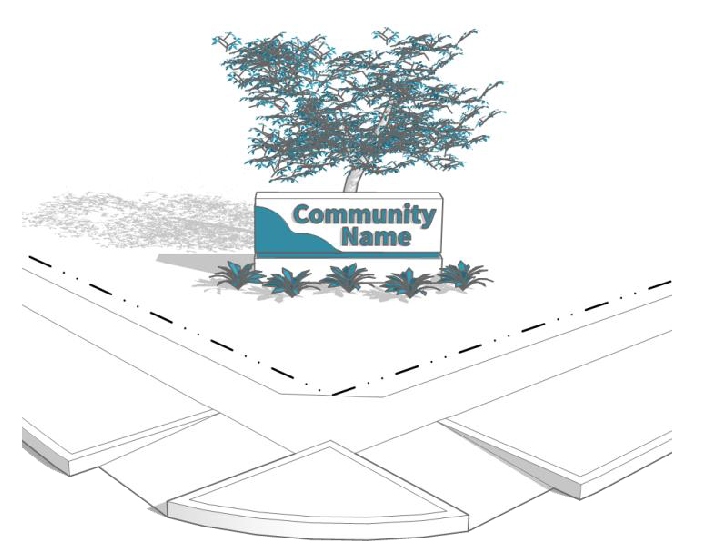
Figure 10-4.10-1: Entrance Monument Sign
(i)
A maximum of two entrance wall or monument signs are permitted per subdivision or multi-family residential development for each vehicular entrance.
(ii)
Entrance wall or monument signs shall be located on the adjacent sides of the vehicular entrance unless placed in the entrance median.
(iii)
In no case shall such signs be located in a public right-of-way.
(c)
Multi-Family Building Identification Signs. Each building shall include an address sign no smaller than six inches in height. A building identification sign is also permitted at the same height as a building address sign.
(d)
Yard Signs in Residential Districts. Yard signs, except for temporary yard signs, are allowed in residential districts without a sign permit pursuant to the following:
(i)
Shall not exceed more than four signs per property at any one time;
(ii)
Shall not exceed four (4) square feet per sign;
(iii)
Shall not exceed 24 square feet total yard signage on any property;
(iv)
Shall not exceed a height of 42 inches;
(v)
Shall not be located in the public right-of-way;
(vi)
Shall be located at least five feet from any property line; and
(vii)
Shall not be displayed for a period of more than 90 days per calendar year.
(3)
Signs Permitted in Nonresidential, Mixed-Use, and Special Purpose Districts. The signs below are allowed generally in all nonresidential, mixed-use, and special purpose districts, subject to the listed standards.
(a)
Automatic Teller Machines (ATM)
(i)
ATMs are permitted one sign per machine not to exceed eight square feet in sign area.
(ii)
The ATM sign shall be located adjacent to the machine and shall not exceed nine feet in height above grade.
(iii)
ATM signs shall display only the business name and/or business logo offering or maintaining the ATM.
(b)
Business Hours and Open Signs
(i)
One business hours sign and one open sign is permitted per building or bay entrance on the primary frontage which advertises the hours of business operation and the availability of the business, respectively.
(ii)
Business hours and open signs shall not exceed three square feet in sign area per sign.
(iii)
Business hours and open signs are only permitted on the window or door of the primary frontage and are excluded from the total allowable window sign coverage percentage.
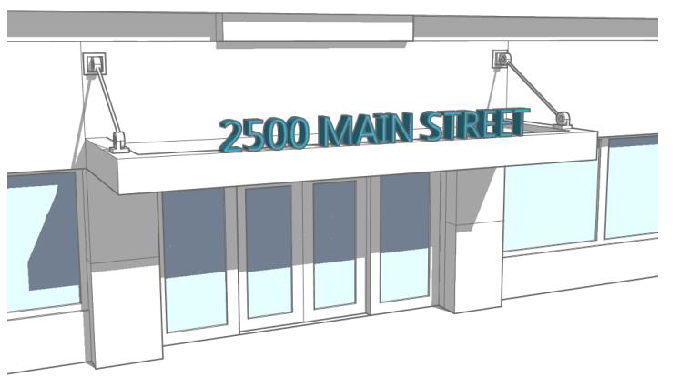
Figure 10-4.10-2: Canopy Sign
(c)
Canopy Sign. One canopy sign per store front located directly adjacent to the main entrance of the bay, not to exceed three square feet in area is permitted. The sign must be positioned 90 degrees to façade.
(d)
Changeable Copy Signs
(i)
Theatres, playhouses, convention centers, educational, governmental, or religious uses shall be permitted changeable copy signs as part of the monument sign detailed in this section.
(ii)
Theatres and playhouses may also display changeable copy signs in lieu of façade signs permitted in accordance with section 10-4.10(E), Design Criteria. Changeable copy signs displayed in lieu of the façade signs shall not be larger in height than the maximum character and graphic height permitted by the design criteria.
(iii)
Changeable copy signs shall provide a minimum distance of 250 feet separation as measured directly from changeable copy sign to changeable copy sign on the same property.
(e)
Directional and Directory Signs
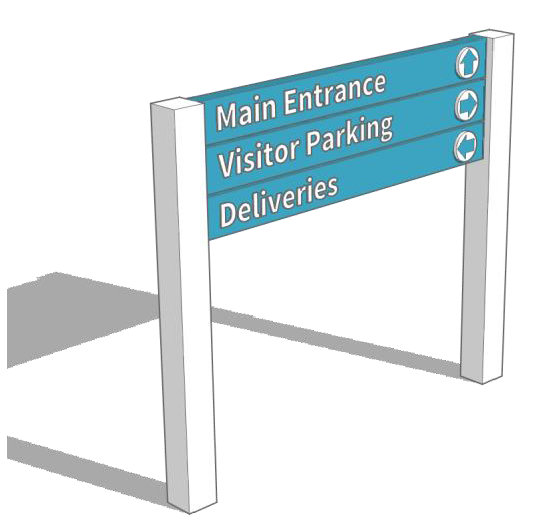
Figure 10-4.10-3: Directional Sign
(i)
Directional and Directory signs may be permitted where there are two or more buildings on a property, a building on the property contains a drive-through for service, where there are multiple driveways leading to different buildings within a development or campus, or when a building on the property is not visible from the primary frontage of the development. Such directional signs shall only display the name of the complex, building address,, building identification number, letter, or symbol, use, location of the building or bay tenants, and corresponding directional arrows.
(ii)
Directional and Directory signs shall comply with section 10-4.10(E), Design Criteria.
(iii)
One directional or directory sign is permitted per each vehicular access from the official rights-of-way.
(iv)
Additional directional signs shall be permitted on the property for each separate vehicular driveway leading to a separate building on the property.
(v)
The Director may grant approval of additional directory signage based on the unique needs of a campus or development containing multiple buildings after review of a signage site plan submitted by an applicant depicting extenuating circumstances or conditions warranting the need for additional signs.
(f)
Façade Signs
(i)
For single tenant stand-alone buildings, one façade sign per street frontage is allowed. In no instance shall there be more than one façade sign per façade.
(ii)
For multiple tenant buildings with internal access to the individual tenant bays, one façade sign per street frontage identifying the name of the building, business name and/or business logo, or primary use of the anchor tenant only, is allowed. There shall be no more than one façade sign identifying the name of the building, business name and/or business logo, or primary use of the anchor tenant, per façade, however a directory sign may be installed in the area immediately in front of the building entrance identifying the internal tenants name, bay or suite number compliant with the provisions of 10-4.10(D)(3)(e) above.
(iii)
For multiple tenant buildings with external access to the individual tenant bays, one façade sign per tenant bay located on the primary frontage of the tenant bay is allowed.
(iv)
For multi-story buildings, façade signs located above the top of the first floor of a two-story building shall not exceed the maximum character and graphic heights of existing façade signs located on the first floor.
(v)
No façade sign shall be located higher than the top of the first floor of a multi-story building excluding two-story buildings with external access to the individual tenant bays. Façade signs which identify the name the building, or business name and/or business logo or the primary use of the single tenant or anchor tenant, located above the top of first floor of a multi-story building shall be placed at the top of the top floor on the uppermost portion of the building. The Director may grant approval, on a case-by-case basis, of an alternate location of façade signs which identify the name of the building, business name and/or business logo, or the primary use of the single tenant or anchor tenant, located above the top of first floor on a multi-story building. The Director's decision may be based on architectural building features and will be considered through a written request from the property owner or their authorized agent.
(vi)
Outparcel buildings of commercial shopping centers or office complexes are allowed one façade sign facing the primary right-of-way the outparcel building directly faces as well as one additional façade sign on one of the remaining façades. In no case shall an outparcel building be permitted more than two façade signs.
(vii)
All façade signs shall comply with section 10-4.10(E), Design Criteria.
(viii)
Upon the removal of any façade sign, the building façade shall be repaired and repainted to match existing façade in one uniform color.
(g)
Menu Board Signs
(i)
One (1) freestanding menu board is permitted per drive-way lane providing service for the direct delivery of food or beverages to customers at facilities designated as fast food, fast casual, or restaurant establishments.
Each menu board sign shall comply with the following provisions:
A.
Maximum height of the menu board sign measured from the ground elevation shall not exceed ten (10) feet including any required footing or base which may not exceed two (2) feet in height.
B.
Maximum width of the menu board sign shall not exceed eight (8) feet.
C.
The sign face area of the menu board sign shall not exceed forty-eight (48) square feet.
D.
The menu sign shall not create any visual or physical hazards as outlined in the provisions of this Code.
(h)
Menu Board Preview Sign
(i)
One menu board preview sign may be permitted per drive-way lane providing service for the direct delivery of food or beverages to customers at facilities designated as fast food, fast casual, or restaurant establishments.
Each menu board preview sign shall comply with the following provisions:
A.
Maximum height of the menu board preview sign measured from the ground elevation shall not exceed six (6) feet including any required footing or base which may not exceed two (2) feet in height.
B.
Maximum width of the menu board preview sign shall not exceed five (5) feet.
C.
The sign face area of the menu board preview sign shall not exceed twenty (20) square feet.
(i)
Menu Board Wall Sign
(i)
Stand-alone dine-in restaurants may have a single menu sign within a display case attached to the building wall adjacent to the entrance, which shall not extend more than six (6) inches from the building wall, or a single menu board on the inside of a window adjacent to the entrance, which shall count as part of the window signage allowance. Neither menu sign shall exceed four (4) square feet in area.
(j)
Monument Signs
(i)
For single-tenant stand-alone buildings, one monument sign per street frontage is allowed. Monument signs for single-tenant stand-alone buildings shall only display the name of the business, business logo, numeric address, and/or the primary use of the occupant.
(ii)
For multiple tenant complexes, one monument sign per street frontage is allowed. Monument signs for multiple tenant complexes shall convey complex center name. Monument signs for multiple tenant complex centers may:
A.
Display the anchor tenant name and/or anchor tenant logo;
B.
Incorporate a list of tenants into the sign area identifying the business name and/or logo; or
C.
Display the primary use of the occupants of the multiple tenant complex center.
(iii)
The name of the multiple tenant complex center must occupy a minimum of 25 percent of the allowable copy area and be placed above any tenant listing or sign copy.
(iv)
For outparcel buildings of commercial shopping centers or office buildings, one monument sign per street frontage is allowed. Monument signs for outparcel buildings of commercial shopping centers or office buildings shall only display the name of the business, business logo, numeric address, and/or the primary use of the occupant.
(v)
The standards below shall be applied to monument signs for gasoline stations and the gasoline station portion of a convenience store including price rate signs.
A.
Monument signs for gasoline stations and the gasoline station portion of a convenience store shall comply with section 10-4.10(E), Design Criteria.
B.
The monument sign area shall include the business name offering or supplying the gasoline and shall not exceed six square feet within the sign area permitted with a maximum character or graphic height of 12 inches.
C.
One price rate sign advertising the price of gasoline is permitted on gasoline monument signs. The price rate sign shall not exceed 16 square feet within the sign area permitted.
D.
The price rate sign may have changeable copy.
E.
Price rate signs placed on gasoline pump unit dispensers are permitted and may include the type of fuel and octane rating; however, such signs may not exceed three square feet in sign area per pump unit dispenser. Price rate signs placed on gasoline pump unit dispensers do not require a permit.
F.
The adoption of mandatory regulations regarding gasoline pricing signs by the federal, state, or local government shall preempt and govern gasoline pricing signs permitted by this section.
(vi)
All monument signs shall comply with section 10-4.10(E), Design Criteria.
(k)
Off-Premises Signs. In cases where unique situations exist regarding limited access to the property as determined by the Director, the sign owner may request to locate a sign in an adjacent property or right-of-way, provided that the applicant can meet the following criteria:
(i)
Provide a certified written letter from the property or right-of-way owner to receive the sign that he/she does not object to the location of the sign in the adjacent property or right-of-way.
(ii)
Provide a hold harmless agreement with the property or right-of-way owner to receive the sign recorded in the Public Records of Broward County.
(iii)
Provide a written agreement with the City of Tamarac and property owner that when the property or right-of-way owner to receive the sign requests removal of the sign through certified letter to the sign owner, the sign owner will remove the sign within ten days of notice from the property or right-of-way owner and return said property or right-of-way to a finished condition in accordance with section 10-4.4, Landscaping and Tree Preservation.
(iv)
Off-Premises sign types shall be limited to Directory or Directional sign types and shall follow all setback, design, construction, distance separation, sight visibility and any other applicable provision of this Code to protect the city's and ROW owner's interests.
(v)
A maximum of one off-premises sign is permitted per ROW or legally bound parcel.
(vi)
In no instance, shall any off-premises sign be placed within twenty-five (25) feet of an existing sign installed on the ground within the same ROW or property, final placement of the sign shall be at the discretion of the Director to ensure the city's corridors remain free of visual advertisement clutter.
(vii)
The business being advertised by the off-premises sign must not have road frontage which provides an opportunity for an advertising sign on-premises.
(viii)
Permits issued for off-premises signs shall automatically become void upon vacation of the existing business for which the off-premises sign was originally issued. The new owner or tenant of the business shall apply for a new building permit for the off-premises sign according to the provisions set forth in this Code and provide a copy of the lease to the city's Business Revenue Division indicating occupancy of the premises for which the off-premises sign was originally issued. This does not preclude the removal of the existing off-premises sign, however a new sign permit will be required for any alterations to the sign including sign face and copy changes as stipulated by the provisions of this Code.
(l)
Portable Signs. In the mixed-use districts, portable signs are allowed pursuant to the following standards:
(i)
One per tenant with street frontage;
(ii)
Eight square feet maximum total sign area;
(iii)
Four feet maximum sign height;
(iv)
Shall maintain five feet sidewalk clearance;
(v)
Shall be located directly in front of tenant space and not off-premises;
(vi)
Shall be separated from other portable signs by 15 feet; and
(vii)
Signs shall not be affixed to street lights, traffic poles, sign posts, or other site or landscape features.
(m)
Rear Identification and Building Identification Signs
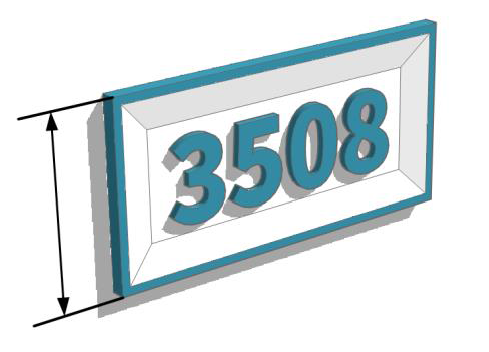
Figure 10-4.10-4: Address Sign
(i)
One rear identification sign per rear bay door, not to exceed three square feet in area is required. For purposes of this standard, the rear bay door is that portion of the building containing the service or employee entrances.
(ii)
Each building shall include an address sign no smaller than six inches in height. A building identification sign at the same height as the building address sign is also permitted for properties containing multiple buildings.
(n)
Window Signs
Figure 10-4.10-5: Window Sign
(i)
Window signs shall not exceed 40 percent of the total window area per building or bay frontage. The total window area is defined as the contiguous window panels separated by dividers or mullions less than six inches in width.
(ii)
Window signs shall be professionally drawn, placed, and/or constructed, and shall include any signs located within two feet of the window.
(iii)
One illuminated sign including those with exposed neon tubing may be displayed on the interior of a window in accordance with these provisions for window signs. These signs shall count towards the total allowable coverage percentage of the window area. Illuminated window signs shall be statically illuminated and shall not flash or scroll.
(iv)
Window signs shall meet the standards below.
A.
Maximum character or graphic height is eight inches.
B.
Logos may not exceed the maximum character or graphic height for windows signs.
C.
Window signs must be kept in a condition that will maintain the original aesthetic appearance of the structure and may not be placed across window dividers or mullions, regardless of size.
(v)
Existing non-conforming window signs that are not compliant with the provisions of this Code upon its effective date of adoption shall have a period not to exceed twenty-four (24) months/two (2) years to comply with the provisions outlined in this section of the Code.
(o)
Yard Signs in Mixed-Use, Nonresidential, and Special Purpose Districts. Yard signs, except for temporary yard signs, are allowed in mixed-use, nonresidential, and special purpose districts without a sign permit pursuant to the following:
(i)
Shall not exceed more than four signs per property at any one time;
(ii)
Shall not exceed 24 square feet total yard signage on any property;
(iii)
Shall not exceed a height of six feet, or 42 inches if placed within a sight distance triangle;
(iv)
Shall not be located in the public right-of-way; and
(v)
Shall not be displayed for a period of more than 90 days per calendar year.
(p)
Posting of Human Trafficking Public Awareness Signs. Human trafficking means transporting, soliciting, recruiting, harboring, providing, enticing, maintaining, or obtaining another person for the purpose of exploitation of that person regulated pursuant to F.S. Ch. 787, and defined in F.S. § 787.06, as may be amended.
(i)
The employer at each of the following establishments shall display public awareness signs in a conspicuous location that is clearly visible to the public and employees of the establishment:
(A)
A strip club or other adult entertainment business.
(B)
A massage establishment.
(C)
A business or establishment that offers massage services for compensation that is not owned by a health care professional regulated pursuant to F.S. Ch. 456, and defined in F.S. § 456.001.
(D)
A hotel.
(ii)
The required public awareness sign must be at least eight and one-half inches by 11 inches in size, must be printed at least in at least 16 point type, and must state substantially the following in English, Mandarin and Spanish:
"If you or someone you know is being forced to engage in an activity and cannot leave - whether it is prostitution, housework, farm work, factory work, retail work, restaurant work, or any other activity - call the National Human Trafficking Resource Center at 1-888-3737-888 or text INFO or HELP to 233-733 to access help and services. Victims of slavery and human trafficking are protected under United States and Florida law." Posted pursuant to F.S. § 787.29 and Tamarac Land Development Code section 10-4.10(D)(3)(m).
(4)
Signs Permitted on City-Owned Property/Right-of-Way. The signs below are allowed on city owned property or public right-of-way:
(a)
Billboard Signs. Billboard signs shall be allowed on city owned property or public rights-of-way pursuant to the following standards:
(i)
Billboard signs shall be subject to special exception approval pursuant to the standards set forth in section 10-5.4(G).
A.
Location
1.
Billboard signs shall only be permitted on city owned property or right-of-way adjacent or contiguous to a major expressway within the city's municipal boundaries. For the purposes of this section, major expressway shall mean SR 869/Sawgrass Expressway and the Florida Turnpike.
B.
Orientation
1.
All billboards must be oriented solely for advertisement to the traveling public on major expressways, meaning that the billboard shall be placed in such a manner that sign face is directed at motor vehicles on the major expressway.
C.
Number of Sign Faces Permitted
1.
In instances where the billboard structure is within one thousand five hundred (1,500) feet of residential property, the billboard sign shall be limited to a single sign face directed at motor vehicles on major expressways. For the purposes of this section distance measurement shall be taken from the nearest point of the residentially zoned parcel's property line in a straight-line distance to the sign structure.
2.
Billboard structures located more than one thousand five hundred (1,500) feet away from residentially zoned property may have up to but not more than two (2) sign faces.
3.
Billboard signage with more than one (1) face shall be placed at an angle to form a single "V" or placed back-to-back and shall not be placed in a straight line. For V-type, or back-to back signs, to be considered one (1) sign for spacing purposes, the sign facings must either be connected by the same sign structure or cross-bracing, or the sign structures must be not more than fifteen (15) feet apart at their nearest point.
D.
Setbacks
1.
All billboard signs shall comply with the setback requirements stipulated by the Florida Department of Transportation for structures placed along major expressways in addition to the established setback requirements stipulated by the city during individualized special exception review.
E.
Distance Separation Requirements
1.
No billboard sign structure, or billboard sign, or portion thereof, shall be located within one thousand five hundred (1,500) feet of another billboard sign or billboard sign structure, regardless of which side of any major expressway that the sign is located. The distance shall be calculated as the shortest straight airline measurable distance between the edge of one (1) sign to the edge of the other sign.
2.
No billboard sign shall be erected within one hundred fifty (150) feet of an existing residential use. All measurement of distances shall be along a straight airline route from the nearest point of the edge of the sign face to the property line of the existing residence.
3.
Placement of a billboard sign shall not obstruct any government, municipal, or privately owned legally constructed sign and shall be spaced a minimum of fifty (50) feet from any other building façade sign that is visible from a major expressway, this includes signs that are erected on private property of the city's existing businesses and municipal structures.
4.
No billboard sign shall be erected within twenty-five (25) feet of an existing non-residential building in a commercial or industrial zoned district. All measurement of distances shall be made from the nearest edge of the sign face by straight airline measurement to the nearest point of the building or proposed building.
F.
Design Guidelines
1.
No portion of a permitted billboard sign face or structure shall exceed fifty (50) feet in height.
2.
No billboard sign face area shall exceed fourteen (14) feet by forty-eight (48) feet (six hundred seventy-two (672) square feet) in area. All sign face images shall be confined to the internal borders of the sign face.
3.
Where landscaping is required by the city during individualized special exception review of the application for the billboard sign, the applicant shall utilize native landscape material as stipulated by the City's Code. At a minimum, the applicant shall be required to plant trees typically grown in Broward County which normally mature to a height of at least twenty (20) feet and shall have a clear trunk of four (4) feet, an overall height of twelve (12) feet and a minimum caliper of two (2) inches (as measured pursuant to the provisions of the LDC) at time of planting; provided, however, that native trees and vegetation shall be managed such that no tree or vegetation on the property obscures vision of motorists on the city's major expressway.
4.
The proposed billboard structure shall be required to meet all other requirements of this Code and the Florida Building Code and shall have a painted finish for the pole and frame.
5.
No embellishments extending from the sign face or sign structure are permitted on any billboard sign.
G.
Illumination and Animated Messages
1.
No auditory message, smoke, or mechanical sounds shall be emitted from the sign.
2.
The sign shall not display any illumination that moves, appears to move, blinks, fades, rolls, dissolves, flashes, zooms, scrolls, shows animated movement, or changes in intensity during the static display period.
3.
All digital signs shall have installed ambient light monitors and always shall allow such monitors to automatically adjust the brightness level of the sign based on ambient light conditions.
4.
All billboard signs shall comply with the lighting, brightness, Nits, and lumens requirements of the Florida Department of Transportation for illuminated, digital, and animated billboard signs. The sign shall also comply with the division's requirements for message display of any illuminated, moving, changing intervals, or copy transition on the sign. As such, the change from one (1) message to the next message shall be instantaneous over the entire sign face.
5.
Any digital sign that malfunctions, fails, or ceases to operate in its usual or normal programmed manner shall immediately revert to a black screen and shall be restored to its normal operation conforming to the requirements of this section within twenty-four (24) hours.
6.
For public safety purposes, any signs which use the word "stop" or "danger" or imply the need or requirement of stopping, or which are copies or imitations of official signs shall be prohibited.
7.
Red, green, blue, or amber (or any color combination thereof) revolving or flashing light giving the impression of a police or caution light is prohibited.
H.
External Agency Approvals Required
1.
The applicant shall furnish a copy of the applicable permit application and approval from Florida Department of Transportation and Broward County prior to approval of the city permit for the erection of the billboard sign structure.
Ownership of the approved billboard sign must be maintained by the original applicant/entity and may not be sold, transferred, leased, or subcontracted to any firm or entity without prior approval from the city.
The city reserves the right to reject any application or permit for a billboard sign regardless of distance separation if it is determined that the sign will poses a detriment to the health, safety, and welfare of the public.
(E)
Design Criteria
(1)
Directional, Directory, Monument and Entrance Wall Signs
(a)
Standards. The following table shows the sign standards for monument and entrance wall signs:
(b)
Implementation
(i)
All directional, directory, monument and entrance wall signs shall be landscaped around the base of the sign in a manner which conceals the entire base of the sign on all sides but which does not obscure the message or address on the sign. At a minimum, mulch and/or sod and small ground shrubbery shall be installed to enhance the aesthetic appearance of the sign.
(ii)
Non-residential monument signs may only display the legitimate business name, as listed on a City of Tamarac business tax receipt, incorporation documents or otherwise registered to the company of the business or use requesting the sign.
(iii)
Monument signs shall have a minimum distance of separation of 150 feet as measured directly from sign-to-sign on the same side of the street for non-residential properties.
(iv)
For corner properties along official rights-of-way, the maximum monument sign height and area may be increased up to 25 percent if monument signage is limited to one sign at the corner of the intersection of the official rights-of-way in lieu of one sign per street frontage.
(v)
An address sign shall be prominently displayed on all monument signs with a minimum height of six inches.
(vi)
All monument signs allowed per street frontage must match in design, color, illumination method, and method of construction.
(2)
Façade Signs
(a)
Standards. The following table shows the sign standards for façade signs:
(b)
Implementation
(i)
All signs shall have an unobstructed sign face border on any background space in which the sign is located with a minimum border height and width of 25 percent of the largest character or graphic height.
(ii)
Allowance for additional character and graphic height:
A.
The maximum character and graphic height may be increased one inch for each rounded increment of 50 feet the building to receive a façade sign is from property line of the primary street right-of-way.
B.
For a building to receive a façade sign in which the building is not equidistant from the primary right-of-way, the allowance for additional character and graphic heights shall be determined by the average of the distance between the portion of the building that is closest to the property line of the street right-of-way in which the property is addressed and the portion of the building that is the farthest from the property line of the street right-of-way in which the property is addressed.
(iii)
The wall or space in which the façade sign is located shall be considered in determining the sign dimensions. Façade sign dimensions may not exceed 70 percent of the width of any wall or space on the building in which the sign is located. For an individual tenant bay in a multiple tenant building, façade sign dimensions may not exceed 70 percent of the width between the tenant's demising partitions which separate adjacent bays.
(iv)
Each separate street frontage shall be considered individually for the purpose of determining maximum character and graphic heights, unless otherwise specified elsewhere in this Section.
(v)
Non-residential façade signs shall only display the business name and/or business logo, or the primary use of the occupant except for façade signs which identify the name of the building.
(vi)
Non-residential façade signs may only display the legitimate business name, as listed on a City of Tamarac business tax receipt, incorporation documents, or otherwise registered to the company of the business or use requesting the sign.
(vii)
All façade signs are limited to two lines of copy.
(viii)
All façade signs allowed per street frontage shall be designed to be in proportion to the architectural façade upon which it is placed, shall be no greater in character or graphic height than the façade sign placed on the primary frontage, and must match the façade sign placed on the primary frontage in design, color, illumination method, and method of construction.
(3)
Illuminated Signs
(a)
Generally. Signs shall not create glare or unduly illuminate the surrounding area. Signs shall be illuminated in a manner that encourages the use of alternative power sources such as solar lighting where possible in alignment with the city's sustainable development design practices.
(b)
Externally Illuminated Signs
(i)
The average level of illumination on the vertical surface of the sign shall not exceed ten foot candles.
(ii)
Point source of light or bulbs shall not be visible to a passerby.
(iii)
Lighting fixtures for illuminating signs shall be carefully located, aimed, and shielded so that light is directed only onto the sign façade. Down directed lighting for signs is preferred. If ground mounted lighting is used, the light source must be fully shielded by landscaping or other means.
(c)
Internally Lit Signs, the Preferred Method of Illumination
(i)
Illumination sources shall not exceed a total of 9,600 lumens.
(ii)
Pan channel-lit signs are preferred versus internally-lit signs.
(F)
Construction and Location. Any and all signs shall be constructed, erected, placed, repaired, altered, or maintained in accordance with the standards below.
(1)
Every sign and all components of such sign shall be kept in good structural condition and be in conformance with the applicable building code at the time of permitting, as may be amended from time to time.
(2)
All structural, electrical, and mechanical members utilized in the construction, erection, and operation of signs shall be concealed except for vertical supports of other supporting members which are designed and arranged so as to be an integral part of the aesthetic composition of a sign.
(3)
No visible wires or face jumping to signs shall be permitted.
(4)
Every sign shall be constructed in accordance with the applicable building code, as may be amended from time to time.
(5)
All wood permitted to be used for signs shall be of a type or condition that is resistant to rot and deterioration.
(6)
The height of a permanent sign shall not extend beyond the building height including parapets.
(7)
All signs shall be setback a minimum of ten feet from all property lines to any portion of the sign, and no sign shall be permitted to overhang into the minimum sign setback. The Director may grant a reduction in the minimum sign setback on a case-by-case basis, based on physical site constraints through a written request from the property owner or their authorized designee.
(8)
Signs shall not obstruct sight distance triangles determined by §10-4.4(D)(6), Sight Distance.
(9)
All sign copy four inches or larger on permanent signs shall extrude from the sign face a minimum of one-half-inch or intrude into the background by routing the copy out of the sign face background.
(10)
No illuminated signs shall face a residential use in such a way as to be a distraction at night to the persons living in the residential structure.
(11)
Once a sign is erected, no additional signs may be attached to or displayed on any sign on a temporary or permanent basis.
(12)
There shall be a minimum of eight feet vertical height clearance from the bottom of any sign projecting from the underside of a canopy to the surface of a walkway below.
(13)
A sign may be internally illuminated, backlit, or ground-lit. For internally illuminated signs, sign copy shall illuminate and the remainder of the sign must remain permanently opaque, except for individual tenant panels on a multiple tenant monument sign that conveys the complex center name.
(14)
No logo or trademark shall be displayed that is greater than the maximum character or graphic height permitted on the sign.
(15)
No sign shall create a traffic or fire hazard, be dangerous to the general welfare of the citizenry, or interfere with the free use of public rights-of-way.
(16)
No sign shall display intermittent lights or simulated traffic control signs resembling the flashing lights which are customarily associated with danger, customarily used by police, fire, or ambulance vehicles, or for navigational purposes are prohibited.
(17)
No advertising sign shall be displayed which uses the word "stop" or "danger." No advertising sign shall be displayed which presents or implies the need for stopping or the existence of danger, or which is a copy or imitation of an official sign. This provision regarding the word "stop" and "danger" does not apply when the words are part of an attraction title for a motion picture, theater event, opera or concert event, or when they are used in advertising, so long as they are not used to simulate, copy, or imply any official traffic warning either for vehicles or pedestrians.
(18)
No sign shall be displayed so as to provide background of colored lights blending with the traffic signals so as to confuse a motorist.
(19)
No sign shall display any statement, word, character, or illustration of any obscene, indecent, or immoral nature.
(20)
Sign location shall not interfere with public alarms, signals, or signs. No sign or support shall be placed in such position or manner as to obstruct or interfere, either physically or visually, with any fire alarm, police alarm, traffic signal or sign, or any devices maintained by or under public authority.
(21)
All signs must be placed on the property in which they serve unless approval of the placement of an off-premises sign has been granted by the Director in alignment with the provisions on this Code.
(22)
Properties containing multiple sign types shall install signs that are architecturally compatible to the principal structure and have a visual appearance of uniformity to the greatest extent possible.
(G)
Maintenance
(1)
All components of every sign type, together with its framework and structural supports, shall be well-maintained and aesthetically pleasing in appearance. Signs must also be in a good and safe condition, properly secured, supported, and able to withstand wind pressures as required by the applicable building code or any other regulatory code or ordinance in effect within municipal limits.
(2)
All letters, lights, and luminous tubes illuminating a sign shall be maintained in good working condition. All replacement bulbs and lenses shall be of the same wattage and color as the light it is replacing unless a change is required to meet applicable lighting code requirements.
(3)
When visible components are replaced, the colors of the replacement parts should match the existing components, taking into consideration fading due to sun and environmental conditions, otherwise all parts of the sign should be refurbished if this is not possible.
(4)
In the event that a wall sign is removed, all anchor holes shall be repaired in such a way that all anchor holes are no longer visible and the wall must be repainted to match the existing color of the building within 30 days of the removal of such sign.
(5)
The required perimeter landscaping for a monument sign must be maintained by the owner in a safe and aesthetically pleasing condition at all times. The owner is responsible for maintaining such required sign landscaping so that the entire sign, exclusive of the base, is visible at all times.
(6)
In the event that a monument or ground sign is removed, the location of the removed monument or ground sign must be returned to a finished condition in accordance with the landscaping provisions of this Code.
(H)
Temporary Signs. Only such temporary signs, as prescribed herein shall be permitted to be erected or maintained upon any building, lot, parcel of land, bay, or space.
(1)
Temporary Signs, Residential Districts
(a)
Up to four temporary signs may be placed either on the owner's property or offsite for the purpose of directing the public when the property owner is opening the property to the public for a residential or nonprofit activity (e.g. real estate open house, garage/yard sale, estate sale), subject to the following:
(i)
A maximum of one sign may be located on-site;
(ii)
A maximum of three signs may be located off-site, with no more than one sign per turning movement; and
(iii)
Signs may be displayed a maximum of 12 times per year.
(b)
For new construction, a maximum of one sign per project frontage, not exceeding 20 square feet. erected from the date of final site plan approval up to the issuance of the final Certificate of Occupancy.
(c)
Signs shall not exceed three square feet in area and three feet in height.
(d)
Signs shall not be illuminated.
(e)
Signs shall not be placed so as to create a traffic hazard, as determined by city staff. Signs shall not be placed in state right-of-way, traffic medians, public sidewalks, or bicycle paths.
(f)
Signs may be placed in city right-of-way in residential districts, but shall not be attached to any trees, fences, utility poles, light posts, street signs, or any other public facility located within city right-of-way.
(g)
Signs shall have sufficient weight and durability to withstand wind gusts, storms, and other weather elements.
(h)
Signs shall not be made of flimsy or unstable materials such as cardboard boxes, poster board, or paper.
(i)
Signs shall not have attachments, including, but not limited to, balloons, ribbons, loud speakers, etc.
(j)
Signs may be placed on privately owned property within residential districts with the written permission of the property owner.
(2)
Temporary Signs: Mixed-Use, Nonresidential, and Special Purpose Districts. Temporary signs are allowed in mixed-use, nonresidential, and special purpose districts subject to the following limitations:
(a)
Temporary signs may be displayed on-site five times per year for a maximum of five consecutive days each time, or for new construction, one sign per project frontage, from the date of final site plan approval up to the issuance of the final Certificate of Occupancy.
(b)
New businesses shall be permitted to display one temporary sign for a maximum of 30 days. This 30-day period shall not start prior to issuance of a Tenant Occupancy permit and shall not extend beyond installation of the permanent sign for the business or 30 days after issuance of a Certificate of Occupancy, whichever is sooner.
(c)
Temporary signs shall not exceed 20 square feet in area.
(d)
Temporary signs shall be attached to the building of the business of which they are advertising or on the fencing enclosing the project site for new projects.
(i)
Temporary signs may be freestanding if the overall height does not exceed 8 feet.
(ii)
When attached to the building, temporary signs shall not be mounted higher than the eave line or top of the parapet wall of the building and no portion of the sign shall extend beyond the ends of the wall to which it is attached.
(iii)
Temporary off-premises wayfinding signs for non-residential properties may be permitted by the Director under the following circumstances:
A.
Signs used to the direct the public to government resources during declared emergencies.
B.
Signs used to the direct the public to safe havens or shelters during declared emergencies.
C.
Signs used to the direct the public to government sponsored activities such as election sites and distribution of health-related resources.
D.
Temporary off-premises signs for non-residential properties may also be approved by the Director as deemed necessary to protect the health, safety, welfare, and well-being of Tamarac's residents, businesses, and visitors.
(iv)
Temporary off-premises signs are prohibited in residential districts except for temporary wayfinding signs for nonprofit or residential activities which are permitted, subject to the conditions in §10-4.10(H)(1), Temporary Signs, Residential Districts, for nonprofit or residential activities occurring adjacent to commercial districts.
(v)
The following signs may be permitted only through a Temporary Sign Permit:
A.
Flag-mounted signs;
B.
Banners;
C.
Pennants;
D.
Streamers;
E.
Balloons;
F.
Inflatable signs;
G.
Costumed characters;
H.
Sandwich board or A-frame signs.
(I)
Sign Variances. Variances to this section shall be reviewed and administered in accordance with §10-5.4(Q), Variance.
(J)
Violations and Penalties
(1)
Any persons, residents, business owners, or property owners violating any of the terms, conditions, regulations, or provisions of this article shall be subject to the enforcement actions prescribed by this section.
(2)
Contractors installing signs without a permit in the City are subject to fines, penalties, or other legal remedies authorized pursuant to state or local law.
(3)
No sign shall be permitted or placed in the City contrary to the provisions of this section.
(K)
Enforcement
(1)
The Director is hereby designated and authorized to enforce this section and directed to remove signs which are contrary to the provisions of this section.
(2)
Violations of the provisions of this article shall be subject to enforcement by the City using any duly enacted provisions available. Violation hearings shall be conducted by the special magistrate in accordance with Chapter 162, Florida Statutes and sections 2-71 through 2-76 of the Code of Ordinances of the City.
(3)
Permitted signs shall be subject to all appropriate inspections, including, but not limited to, electrical, structural, and zoning. All signage on the property receiving the permitted sign shall be in conformance with the provisions of this article to receive consent of inspections.
(4)
Prohibited signs placed in the City shall be subject to enforcement and shall be removed by the City.
(5)
Permanent and temporary signs placed in the City without a permit shall be subject to enforcement. Temporary signs placed within public rights-of-way without a permit shall be removed by the City.
(6)
When determined by the Chief Building Official that a sign causes imminent danger to the public safety and contact cannot be made with the sign or property owner, the City shall correct the danger by removing the sign.
(7)
Signs removed by the City shall become the property of the City of Tamarac and may be disposed of in any manner deemed appropriate by the City. The cost of removal of the sign by the City shall be collected from the owner of the property on which the sign was located pursuant to any authorized legal process. The cost of sign removal shall include any and all incidental expense incurred by the City in connection with removal of the sign.
(L)
Prohibited Signs. The following are signs which shall not be installed in the municipal boundaries of the city:
(1)
Animated signs including signs which intermittently illuminate, flash, or change illumination colors, except permitted billboard signs;
(2)
Sidewalk, sandwich signs, or A-frame signs, except as allowed as portable signs under section 10-4.10(D)(3)(i);
(3)
Snipe signs;
(4)
Exposed neon tubes except for window signs described elsewhere in this article;
(5)
Roof mounted signs;
(6)
Mansard signs, except where there is no other available area to place a sign on the façade of the existing building, as determined by the Director;
(7)
Signs exceeding the height of the façade or parapet wall;
(8)
Billboard signs, except as permitted on city owned property or right-of-way;
(9)
Internally illuminated ground or monument signs in the form of box or cabinet signs, except where the box or cabinet sign consists of illuminated sign copy that extrudes from or intrudes into the sign face and the remainder of the sign is permanently opaque in accordance with the construction, location, and design standards of this article;
(10)
Façade signs in the form of box or cabinet signs, except where the box or cabinet sign consists of individual characters or an individual logo;
(11)
Vehicle signs with the exception of the following:
(a)
Vehicles with vehicle signs may be parked on nonresidential property when parked within the confines of a building or in a manner so that the vehicle is screened from view from any public right-of-way;
(b)
Vehicles with vehicle signs shall not be parked overnight in a front yard in a residential zoning district with the exception of vehicles displaying removable magnetic signs or that are covered. Other vehicles with signage and/or utility trailers shall be in an enclosed garage or parked in a side yard;
(12)
Cantilever or projecting signs in excess of 18 inches from the structure upon which it is constructed;
(13)
Painted signs except window signs;
(14)
Mobile billboards;
(15)
Inflatable or wind-blown signs, including cold or hot air balloons with advertising;
(16)
A sign which covers or interrupts architectural features of building;
(17)
Signs, pennants, and banners attached to poles, trees, or other vegetative or landscaping material, or stuck in the ground in a manner not approved as a ground, monument, or temporary sign;
(18)
Electronic sign displays excluding changeable copy signs permitted elsewhere in this article;
(19)
Electronic message centers and electronic time/temperature displays;
(20)
Pole or pylon signs except for traffic regulatory and traffic control signs.
(21)
Façade signs on parapet walls, unless no other façade is available to erect a façade sign;
(22)
Signs erected on public property other than signs erected by a public authority for a public purpose;
(23)
Human signs;
(24)
Skylights, gas flood lights, or search lights;
(25)
Exposed bare bulb lighting of any type that is utilized on a building exterior or interior specifically to attract attention to such building for advertising purposes and not used as an architectural feature;
(26)
Window signs located above the top of the first floor of a multi-story building excluding two-story buildings with external access to the individual tenant bays; and
(27)
Façade signs which are raceway mounted or otherwise attached with supports except where existing structural conditions warrant this type of attachment as determined by the Chief Building Official.
(M)
Nonconforming Signs
(1)
An existing nonconforming sign may be maintained and/or repaired, including the changing of individual tenant panels in multiple tenant monument signs as allowed by this section, but shall not be structurally or mechanically extended to further the nonconformity.
(2)
Any sign that had been granted a waiver or variance that existed and was maintained on the effective date of this section or any amendment thereto may continue although the sign does not conform to all the provisions contained in this section.
(3)
A nonconforming sign that is destroyed or damaged to the extent of 50 percent or more of its replacement value shall not be repaired or rebuilt.
(4)
Where a nonconforming sign exists, such sign shall be brought into conformance with this Code or be removed when the name of the enterprise, business advertised, or the copy on the sign is changed. This shall be done prior to the issuance of a local business license for any new business or enterprise.
(5)
Existing non-conforming window signs that are not compliant with the provisions of this Code upon its effective date of adoption shall have a period not to exceed twenty-four (24) months/two (2) years to comply with the provisions outlined in this section of the Code.
(N)
Dilapidated and Abandoned Signs
(1)
Any sign permitted in accordance with the terms, conditions, regulations, and provisions of this section which is no longer in full compliance with the provisions of this Section or any sign which has become dilapidated shall be repaired, corrected, returned to full compliance with the provisions of this section, or removed.
(2)
Any sign permitted in accordance with the terms, conditions, regulations, and provisions of this section which has become abandoned shall be removed.
(3)
The owner of any property on which a dilapidated or abandoned sign is located shall be subject to fines, penalties, or other legal remedies available to the City pursuant to state or local law enforcement.
(Ord. No. O-2019-11, § 2, 7-10-19; Ord. No. O-2021-020, § 3, 5-12-21; Ord. No. 2022-006, §§ 2—7, 4-27-22; Ord. No. O-2022-013, §§ 2, 3, 7-13-22; Ord. No. 2024-003, § 2, 1-24-24)
10-4.11 - Subdivision Design and Development Standards
(A)
Purpose. This section ensures that subdivisions are designed and developed to assure the orderly and efficient development of the City.
(B)
General Standards
(1)
Blocks
(a)
Length, Width, and Shape. Block length shall not exceed 1,320 feet, nor be less than 500 feet, unless found unavoidable by the Director. The length, width, and shape of blocks shall be determined with due regard to:
(i)
Provision of building sites adequate for the contemplated use;
(ii)
Zoning district requirements;
(iii)
Need for convenient and safe access, circulation, and control of pedestrian and vehicular traffic;
(iv)
Limitations and opportunities of topographic features.
(b)
Pedestrian Crosswalks. Pedestrian crosswalks not less than ten feet in width shall be required in blocks over 1,000 feet in length to provide safe and convenient access to schools, playgrounds, shopping centers, transportation, transit stops, or other community facilities.
(2)
Lots
(a)
General Arrangement and Design
(i)
The lot arrangement and design shall be such that all lots will provide satisfactory and desirable building sites, properly related to topography and to the character of the surrounding development.
(ii)
Lot dimensions and areas shall not be less than specified by applicable provisions of the City zoning regulations.
(iii)
Every lot shall abut upon and have permanent access to a public street.
(iv)
Residential lots shall have a street frontage of not less than 20 feet.
(v)
Side lot lines shall be substantially at right angles or radial to street lines.
(b)
Corner Lots. Corner lots shall be a minimum of five feet wider than the minimum width required by the City dimensional standards for interior lots.
(c)
Double- and Reverse-Frontage Lots for Residential Use. Double- and reverse-frontage lots for residential use shall be avoided except where essential to provide separation of residential development from trafficways or to overcome specific handicaps of topography and orientation. A non-vehicular access line, across which there shall be no right of vehicular movement or use, shall be provided along the property line of lots abutting such trafficway or other disadvantageous situation.
(C)
Streets and Alleys
(1)
Conformity to Official Trafficways Plan and Existing Streets
(a)
The location, direction, and width of all highways shall conform to the official Broward County trafficways plan.
(b)
Streets in new subdivisions shall make provisions for proper extension of existing dedicated streets in existing subdivisions, where such extension is appropriate.
(c)
Where a residential subdivision or residential property abuts on an existing or proposed trafficway, the Director may require:
(i)
Marginal-access streets;
(ii)
Reverse frontage with screen planting contained in a non-access strip along the rear property line; or
(iii)
Deep lots with or without rear service alleys or such other treatment as may be necessary for adequate protection of residential properties and to minimize conflict of through and local traffic.
(2)
Circulation and Access
(a)
The circulation pattern of new development and the design and installation of all streets and sidewalks shall comply with §10-4.2, Transportation and Connectivity.
(b)
Streets in new subdivisions shall be arranged to provide for local circulation, convenient access to neighborhood facilities, pedestrian and bicycle access, and access to transit stops.
(c)
Residential streets shall not connect with industrial areas, unless no other routing is possible as determined by the Director.
(d)
The vehicular access and circulation for a development shall incorporate the continuation and connection of public streets and associated rights-of-way that have been extended or connected to the boundary of the development site from existing or approved abutting developments.
(e)
Minor and collector residential streets shall be laid out and arranged so as to discourage their use by through traffic. Residential streets shall not connect with industrial areas, unless unavoidable.
(3)
Plats Adjacent to or Containing Rights-of-Way. Where a subdivision borders on or contains a right-of-way for a railroad, expressway, drainage canal, or waterway, the City Engineer may require a street approximately parallel to and on each side of such right-of-way, at a distance suitable for the appropriate use of the intervening land. Such distances shall also be determined with due regard for the requirements of approach grades for future grade separations.
(4)
Adjoining Unplatted Areas. The arrangement of streets in new subdivisions shall facilitate and coordinate with the desirable future platting of adjoining unplatted property of a similar character.
(5)
Reserve Strips. Reserve strips controlling access to streets shall be prohibited except where their control is definitely placed under conditions approved by the City Engineer.
(6)
Private Streets. Private streets shall be allowed within the City only at the absolute discretion of the Director of Public Services or their designee in individual circumstances and subject to the following terms and conditions in addition to any other terms and conditions deemed necessary by the Director of Public Services or their designee to protect the health, safety and welfare of the citizens of the City.
(a)
There shall be no waiver from any of the requirements of this Section.
(b)
All private streets must be constructed to standards applicable for publicly dedicated streets within the City as such requirements exist when a permit to construct a private street is obtained. If a permit lapses, the standards that will apply are those in effect when the next permit is obtained.
(c)
All private streets must be self-contained, that is, they must be interior residential streets and not through streets or streets connecting directly onto through streets.
(d)
There must be a covenant placed upon the public records requiring future owners of property surrounding the private street to maintain the street for as long as it remains a private street.
(e)
All private streets shall be open to all City vehicles, all emergency vehicles, and all City personnel at all times. City police shall be authorized to have complete access at all times to enforce all existing laws, ordinances, and motor vehicle regulations on all private streets.
(f)
All private streets must be completely constructed with the first three-fourths-inch layer of asphalt surface, and approved by the City Engineer, prior to the issuance of any building permits for homes to be located thereon. Upon completion of all building on the street, the last three-fourths-inch or greater layer of asphalt surface shall be constructed and approved by the City Engineer. It is not intended that this subsection modify or reduce any applicable municipal construction standards, and any stricter standards will control in the event of a conflict.
(g)
The party developing a private street shall be required to post with the City a cash bond, irrevocable letter of credit, negotiable certificate of deposit, or surety bond executed by a company authorized to do business in the state, in the full amount of the cost of the streets and drainage therefor guaranteeing completion of the work within 18 months of commencement of construction to City's standards. If the work is not completed within 18 months, the City shall be given the right to complete the work. Any extra costs would be chargeable to the developer. This bond would be in addition to all other bonds required by City regulations.
(h)
Private streets shall only be permitted in RE and R-1 zoning districts or in other residential districts when building is to be at a density of seven dwelling units per acre or less.
(i)
Prior to approval by the Director of Public Services or their designee, there must be recorded a covenant relieving the City, County and any other entity of any liability for any injuries which may occur as a result of the street being a private street. The covenant shall also hold the City and County harmless for all attorneys' fees incurred.
(j)
A private street will be allowed only if all utilities are authorized to go thereon for any improvements or utility work needed on, near, or about the road and if all utility easements required by the utilities prior to construction are provided.
(k)
Streetlights shall be erected in accordance with City standards, unless alternative designs are approved by the Director of Public Services. The homeowners within the area served by private streets shall be responsible for payment of the streetlights, electricity, and maintenance therefor.
(l)
As a prerequisite to acceptance of ownership of a private street at the request of those obligated to maintain it by the City, the physical condition of that street must meet then-existing City standards and be so certified by the City Engineer or by an engineer licensed in the state whose certification is concurred with by the City Engineer and City Commission.
(7)
Half or Partial Streets
(a)
New half or partial streets shall not be permitted except where essential to allow the subdivision of a tract in conformance with this section or where satisfactory assurance for dedication of the remaining part of the street is provided.
(b)
Whenever a tract to be subdivided borders on an existing half or partial street, the other part of the street shall be dedicated within such tract.
(8)
Future Subdivision Right-of-Way. If lots resulting from original subdivision are large enough to permit or require resubdivision, or if a portion of the tract is not subdivided, adequate street right-of-way to permit future subdivision shall be provided as necessary.
(9)
Dead-End Streets. Dead-end streets shall be prohibited except where appropriate as stubs to permit future street extension into adjoining unsubdivided tracts or when designed as cul-de-sacs.
(10)
Minimum Widths of Rights-of-Way. Unless otherwise indicated or required by the trafficways plan or specifically excepted by the Director of Public Services or their designee, street rights-of-way shall not be less than the following widths:
(a)
*A limited service street:
(i)
Serves 25 dwelling units or less.
(ii)
Connects to another street besides a limited service street at each end.
(iii)
Shall be properly signed to prohibit parking within the right-of-way.
(iv)
Will only be allowed where required by court order.
(11)
Excessive Street Width. No street shall be platted to a width of more than 200 percent of the minimum width specified in this chapter for the type of street involved. No street shall be platted for center island development, except where such center islands may be desirable or necessary for traffic separation and safety, as determined by the Director of Public Services or their designee.
(12)
Alleys. Alleys should be provided to serve multiple dwelling, business, commercial, and industrial areas. The Director of Public Services or their designee may waive this requirement where other definite and assured provision is made for service access, off-street loading, unloading, and parking, consistent with and adequate for the uses permissible on the property involved. Alleys shall be provided per the standards detailed below.
(a)
The width of an alley shall be at least 24 feet.
(b)
Changes in alignment or intersections of alleys shall be made on a centerline radius of not less than 35 feet.
(c)
Dead-end alleys shall be avoided where possible, but if unavoidable, shall be provided with adequate turnaround facilities for service trucks at the dead end, with a minimum external diameter of 94 feet, or as determined to be adequate by the City Engineer.
(d)
Block corners adjacent to alleys shall have a minimum radius of 15 feet in residential areas and 25 feet in business, commercial, and industrial areas.
(13)
Easements
(a)
Easements across lots or centered on rear or side lot lines shall be provided for public utilities where necessary and shall be at least 12 feet in total width.
(b)
Where a subdivision is traversed by a watercourse, drainage way, canal, or stream, there shall be provided a drainage easement or right-of-way, conforming substantially with the lines of such watercourses. Parallel streets or maintenance easements may be required where necessary for service or maintenance.
(c)
Easements may be required for drainage purposes, of such size and location as may be determined by the City Engineer, or by a drainage district if the plat lies within its jurisdiction. Such easements shall be required if necessary to tie into the City drainage plan or any drainage district plan as certified to by the City Engineer or the drainage district engineer.
(14)
Curvilinear Streets
(a)
Curvilinear streets are recommended for residential minor and collector streets, in order to discourage excessive vehicular speeds and to provide attractive vistas.
(b)
Whenever a street changes direction, or connecting street lines deflect from each other by more than ten degrees, there may be a horizontal curve.
(c)
To ensure adequate right distance, should curvilinear streets be designed, minimum centerline radii for horizontal curves shall be as follows:
(i)
*A limited service street:
A.
Serves 25 dwelling units or less.
B.
Connects to another street besides a limited service street at each end.
C.
Shall be properly signed to prohibit parking within the right-of-way.
D.
Will only be allowed where required by court order.
(d)
A tangent of at least 100 feet shall be inserted between horizontal curves in opposite directions on collector streets. On secondary thoroughfares this tangent shall be 150 feet. Such tangent distances on major thoroughfares will be evaluated considering the overall plat layout, intersections, etc.
(15)
Intersections
(a)
Streets shall be laid out to intersect as nearly as possible at right angles. No street shall intersect another at an angle of less than 60 degrees, except as a Y intersection of two minor streets.
(b)
Multiple intersections involving the junction of more than two streets shall be prohibited, except where found to be unavoidable by the City Engineer.
(c)
As far as possible, intersections with trafficways other than secondary thoroughfares shall be located not less than 660 feet apart, measured from centerline to centerline, unless otherwise approved by the City Engineer.
(d)
Street intersections shall be a minimum of 125 feet apart, except where both centerlines are continuous through the intersection.
(e)
Property line corners at intersections shall have minimum radii of 25 feet. Where the angle of intersection is less than 60 degrees, a greater radius may be required by the City Engineer.
(D)
Waterways
(1)
Canals and Water Areas
(a)
Right-of-Way
(i)
Future canals are to be dedicated to the public and shall have a minimum right-of-way width of 80 feet.
(ii)
Lakes shall be dedicated to the public and shall be a minimum of 150 feet in width.
(b)
Maintenance Easements. A maintenance easement 20 feet in width shall be provided adjacent to the entire boundary of a lake or canal.
(Ord. No. 2024-003, § 2, 1-24-24)

