
Tamarac City Zoning Code
ARTICLE 6
- RULES OF CONSTRUCTION AND DEFINITIONS
10-6.1 - Rules of Construction.
(A)
Meanings and Intent. All provisions, terms, phrases, and expressions contained in this Code shall be construed according to the general purposes set forth in §10-1.4, Purpose, and the specific purpose statements set forth throughout this Code. When, in a specific section of this Code, a different meaning is given for a term defined for general purposes in this Article 6, the specific section's meaning and application of the term shall control.
(B)
Headings, Illustrations, and Text. In the event of a conflict or inconsistency between the text of this Code and any heading, caption, figure, illustration, table, or map, the text shall control.
(C)
Lists and Examples. Unless otherwise specifically indicated, lists of items or examples that use terms such as "for example," "including," and "such as," or similar language are intended to provide examples and are not exhaustive lists of all possibilities.
(D)
Computation of Time. The time in which an act is to be done shall be computed by excluding the first day and including the last day. If a deadline or required date of action falls on a Saturday, Sunday, or holiday observed by the city, the deadline or required date of action shall be the next day that is not a Saturday, Sunday, or holiday observed by the City. References to days are calendar days unless otherwise stated.
(E)
References to Other Regulations/Publications. Whenever reference is made to a resolution, ordinance, statute, regulation, or document, it shall be construed as a reference to the most recent edition of such regulation, resolution, ordinance, statute, regulation, or document, unless otherwise specifically stated.
(F)
Delegation of Authority. Any act authorized by this Code to be carried out by a specific official of the City may be carried out by a designee of such official.
(G)
Technical and Non-Technical Terms. Words and phrases shall be construed according to the common and approved usage of the language, but technical words and phrases that may have acquired a peculiar and appropriate meaning in law shall be construed and understood according to such meaning.
(H)
Public Officials and Agencies. All public officials, bodies, and agencies to which references are made are those of the City of Tamarac, Florida, unless otherwise indicated.
(I)
Mandatory and Discretionary Terms. The words "shall," "must," and "will" are mandatory in nature, establishing an obligation or duty to comply with the particular provision. The words "may" and "should" are permissive in nature.
(J)
Conjunctions. Unless the context clearly suggests the contrary, conjunctions shall be interpreted as follows:
(1)
"And" indicates that all connected items, conditions, provisions or events apply; and
(2)
"Or" indicates that one or more of the connected items, conditions, provisions, or events apply.
(K)
Tenses, Plurals, and Gender. Words used in the present tense include the future tense. Words used in the singular number include the plural number and the plural number includes the singular number, unless the context of the particular usage clearly indicates otherwise. Words used in the masculine gender include the feminine gender, and vice versa.
10-6.2 - Use Categories and Use Types Defined
(A)
Residential Uses
(1)
Household Living. Uses characterized by residential occupancy of a dwelling unit by a household. Tenancy is arranged on a month-to-month or longer basis. (Lodging where tenancy may be arranged for a period of less than 30 days is classified under the "lodging facilities" category). Common accessory uses include recreational activities, raising of pets, gardens, personal storage buildings, hobbies, and parking of the occupants' vehicles. Specific use types include:
(a)
Dwelling, Live/Work. An integrated housing unit and working space, occupied and used by a single household in either a single-family dwelling or multifamily dwelling in a mixed use or non-residential zone district, that has been designed or structurally modified to accommodate joint residential occupancy and work activity.
(b)
Dwelling, Manufactured Home. A factory-built structure, transportable in one or more sections, that is built on a permanent chassis and designed to be used as a dwelling when connected to the required utilities, and includes the plumbing, heating, air conditioning and electrical systems contained therein. This includes any structure with respect to which the manufacturer voluntarily files a certification required by the Secretary of the United States Department of Housing and Urban Development and complies with the standards established under the National Manufactured Housing Construction and Safety Standards Act of 1974 (42 U.S.C. § 5401 et seq.), as amended. This does not include travel trailers or recreation vehicles.
(c)
Dwelling, Multi-family. A building or portion of a building used for occupancy by three or more dwelling units. For purposes of this ordinance, a condominium structure containing three or more individual dwelling units shall be defined as a multiple family dwelling unit.
(d)
Dwelling, Single-family. A detached building designed for or occupied exclusively by one family.
(e)
Dwelling, Two-family. A detached dwelling, on a single lot, divided horizontally or vertically, and designed to contain two dwelling units occupied by two families living independently of each other.
(2)
Group Living. Uses characterized by residential occupancy of a structure by a group of people who do not meet the definition of "household living." Tenancy is arranged on a monthly or longer basis, and the size of the group may be larger than a family. Generally, group living structures have a common eating area for residents. The residents may receive care, training, or treatment, and caregivers may or may not also reside at the site. Accessory uses commonly include recreational facilities and vehicle parking for occupants and staff. Specific use types include:
(a)
Assisted Living Facility or Nursing Home or Convalescent Facility. Residential care facilities that provide housing, meals, personal care, and supportive services to older persons and disabled adults who are unable to live independently. Any building(s) or part(s) of a building or residential facility, including licensed facilities, that provides housing, meals, and one or more personal services for a period exceeding 24 hours to one or more adults who are not relatives of the owner or administrator. Personal services includes direct physical assistance with or supervision of the activities of daily living (e.g., eating, bathing, dressing, toileting, transferring, continence) and the self-administration of medication and other similar services—but does not include the provision of medical, nursing, dental, or mental health services. Accessory uses may include dining rooms and recreation rooms for facility residents, and offices and storage facilities for supervisory staff.
(b)
Community Residential Home, Type I. A community residential home with six or fewer residents is a state-licensed dwelling unit providing a family living environment and care for a group of six or fewer unrelated persons who meet statutory requirements of F.S. §419.001(2), as amended. A community residential home with six or fewer residents may include such supervision and care by supportive staff as may be necessary to meet the physical, emotional, and social needs of the residents.
(c)
Community Residential Home, Type II. A community residential home with seven to 14 residents is a state-licensed dwelling unit to provide a family living environment and care for seven to 14 unrelated persons who meet statutory requirements of F.S. §419.001(1)(a), as amended. A community residential home with seven to 14 residents may include such supervision and care by supportive staff as may be necessary to meet the physical, emotional, and social needs of the residents.
(d)
Continuing Care Retirement Community. A continuing care retirement facility is an integrated development that offers senior citizens a full continuum of housing options and assistance, ranging from fully independent dwelling units, to assistance with personal care in assisted living facilities, to long-term skilled nursing care in a nursing home facility.
(B)
Public, Institutional, and Civic Uses
(1)
Community and Cultural Facilities. Uses including buildings, structures, or facilities owned, operated, or occupied by a governmental entity or nonprofit organization to provide a service to the public. Specific use types include:
(a)
Club or Lodge, Private. Nonresidential organization of persons for special purposes or for the promulgation of sports, arts, literature, politics, or other common goals, interests or activities, characterized by membership qualifications, dues, regular meetings, minutes, and/or board members. This definition includes uses such as fraternal lodge; and singing society. This definition shall not include residential facilities or social membership clubs.
(b)
Country Club. An establishment associated with a golf course that is intended as a place of social and recreational gatherings for members of a club which may include accessory uses such as restaurants, bar, hotel, and retail uses related to the golfing industry.
(c)
Hall for Hire. A facility or hall available for lease by private parties to accommodate private functions, and is not open to the general public. The hall may or may not include kitchen facilities for the preparation of food. Private functions can include, but are not limited to, banquets, weddings, anniversaries, and other similar celebrations.
(d)
Library, Art Gallery, or Museum. Facilities containing collections of books, manuscripts, and similar materials for study and reading, or exhibiting works of art or objects in one or more of the arts and sciences.
(e)
Municipal Facilities. Municipal Facility uses include buildings, structures, or facilities owned, operated, or occupied by a governmental agency to provide a service to the public.
(f)
Religious Assembly. A structure or group of structures that is intended for regular gatherings of people to attend, participate in, or conduct religious services and other related activities and associated accessory uses. Accessory uses may include Sunday School and caretaker's quarters.
(g)
Stadium or Arena. Facilities containing stands that draw large numbers of people to specific events primarily of a sporting variety, or shows. Activities are generally of a spectator nature, although participatory events can also be classified as stadium uses. Accessory uses may include concessions, restaurants, retail, and offices.
(2)
Day Care Facilities. Establishments that provide care for individuals on a regular basis away from their primary residence. Accessory uses include offices, recreation areas, and parking. This category does not include public or private schools or facilities operated in connection with an employment use, shopping center, or other principal use, where children are cared for while parents or guardians are occupied on the premises.
(a)
Adult Day Care Center. An adult day care center is any building(s) or part(s) of a building that provides basic non-medical services for part of a day to three or more persons who require such services, are 18 years of age or older, and are unrelated by blood or marriage to the owner or operator. Basic services include providing a protective setting that is as noninstitutional as practicable, therapeutic programs of social and health activities and services, leisure activities, self-care training, rest, nutritional services, and respite care. Accessory uses include recreational facilities, food preparation and eating areas, and offices.
(b)
Child Care Facility. A child care facility is a place or child care arrangement, other than an occupied residence, that is licensed by Broward County's Child Care Licensing and Enforcement Section per the Broward County Child Care Ordinance (Chapter 7), as amended, that provides care for more than five children unrelated to the operator and that receives a payment, fee, grant, or some other form of compensation for any of the children in child care, whether or not operated for profit. A child care facility can include a before and/or after care school program. A child care facility includes public school and private school programs referenced in F.S. §§ 402.3025(1)(b) and (2)(a), as amended. A child care facility does not include arrangements exempted from licensure. Arrangements exempt from licensure include the following:
(i)
Public and private school programs referenced in F.S. §§402.3025(1)(a), (2)(b) and (2)(c);
(ii)
Summer camps having children in full-time residence;
(iii)
Bible or other religious schools normally conducted during vacation periods and sponsored and supervised by a recognized religious group or institution;
(iv)
Summer day camps for school age children;
(v)
Operators of transient public lodging establishments, as defined in Chapter 509, Florida Statutes, that provide child care services solely for the guests of their establishment (Such child care is subject to the personnel screening requirements of the Broward County Child Care Ordinance.);
(vi)
Drop-in child care (as defined in this section); and
(vii)
All programs that provide child care exclusively for children grades six and above, regardless of location.
Accessory uses include recreational facilities, food preparation and eating areas, and offices. This use does not include family child care homes or large family child care homes, which are accessory uses to a dwelling.
(3)
Educational Facilities. Public, private, and parochial institutions at the primary, elementary, middle, high school, or post-secondary level, or trade or business schools, that provide educational instruction to students. Accessory uses include play areas, cafeterias, recreational and sport facilities, auditoriums, dormitories, and before- or after-school day care. Specific use types include:
(a)
Business, Trade, or Vocational School, Heavy. A specialized instructional establishment that provides more intense and impactful on-site training of business or commercial skills, or a trade school that prepares students for jobs in a trade (e.g., HVAC). Examples include, but are not limited to, automotive mechanic, heavy equipment operation, and welding school.
(b)
Business, Trade, or Vocational School, Light. A specialized instructional establishment that provides on-site training of business, artistic, or commercial skills, or a trade school that prepares students for jobs in a trade (e.g., carpentry). Examples include, but are not limited to, fine arts schools, cosmetology, computer instructional services, and driving schools.
(c)
College or University. A degree-granting institution, other than a business, trade, or vocational school, that provides education beyond the high school level. The use includes, but is not limited to, classroom buildings, offices, laboratories, lecture halls, athletic facilities, and dormitories.
(d)
Parochial School, Incidental. An accredited institution of learning under the sponsorship of a religious agency, having a curriculum generally equivalent to public elementary or secondary schools, not including commercial institutions of learning, and that is allowed as an accessory use under this Code, incidental to a religious assembly use on the same premises.
(e)
School. An accredited institution of learning under the sponsorship of a public, private, or religious agency, having a curriculum generally equivalent to public elementary or secondary schools, not including commercial schools. Schools shall include programs for children who are between three and five years of age, which are not child care facilities, provided the programs in the schools are operated and staffed directly by the schools, provided the programs meet age-appropriate standards as adopted by the State Board of Education for public schools, provided a majority of the children enrolled in the schools are five years of age or older for private schools, and provided there is compliance with the screening requirements for personnel pursuant to F.S. §402.305, for private schools.
(4)
Health Care Facilities. Uses characterized by activities focusing on medical services, that provide primary health services and medical or surgical care to persons suffering from illness, disease, injury, or other physical or mental conditions. Accessory uses may include laboratories, outpatient, or training facilities, or other amenities primarily for the use of employees in the firm or building. Specific use types include:
(a)
Clinic, Medical, Urgent Care, or Dental. A public or private facility primarily engaged in furnishing, on an outpatient basis, chiropractic, dental, medical, surgical, medical imaging, or other services to individuals, including the offices of chiropractors, physicians, dentists, and other health practitioners, medical and dental laboratories, outpatient care and outpatient care facilities. Also includes an outpatient health care facility designed to evaluate and treat conditions that generally are not severe enough to require treatment in a hospital emergency room but still require immediate treatment usually beyond normal physician office hours or before a physician appointment is available. Overnight care is prohibited. This use does not include detoxification facilities.
(b)
Detoxification Facility. A facility that provides subacute care on an inpatient or an outpatient basis to assist individuals to withdraw from the physiological and psychological effects of substance abuse and who meet the applicable placement criteria for this type of clinical treatment under state law.
(c)
Hospital, Public or Private. An institution consisting of a single or multiple buildings or campus that provides health services, primarily for in-patients and medical or surgical care of the sick or injured, including related facilities such as laboratories, out-patient facilities, training facilities, central service facilities, and staff offices. This use does not include detoxification facilities.
(5)
Parks and Open Space. Uses with a focus on natural areas, large areas consisting mostly of vegetative landscaping or outdoor recreation, community gardens, or public squares. Lands tend to have few structures. Accessory uses may include playgrounds, maintenance facilities, concessions, and parking. Specific use types include:
(a)
Botanical Garden. A public or private facility for the demonstration and observation of the cultivation of flowers, fruits, vegetables, or ornamental plants without the sale of such plants. Permitted accessory uses include gift shops, cafes, snack bars, and parking.
(b)
Community Garden. A facility on private or public property for the cultivation of fruits, flowers, vegetables, or ornamental plants by more than one person or family that is open to the public.
(c)
Golf Course. A tract of land with at least nine holes for playing the game of golf and improved with tees, greens, fairways, and hazards. Accessory uses of a golf course may include a country club, shelters, a driving range, putting green, maintenance facilities, and an irrigation system.
(d)
Park and Playground. A property used for recreational purposes whether active or passive in nature. Uses include a neighborhood park, an urban park, a community-wide park, and/or a natural area with buildings and facilities supporting the park or playground.
(C)
Commercial Uses
(1)
Agriculture and Animal-Related Services. Agricultural services involve farming, dairying, pasturage, apiculture, horticulture, floriculture, viticulture, and animal husbandry. Animal-related services include the boarding and care of animals on a commercial basis. Accessory uses may include confinement facilities for animals, parking, and storage areas. Specific use types include:
(a)
Agriculture, General. The raising of food and feed crops and products, and including tree and vine products, animal husbandry including beekeeping, dairying, poultry, and pasturage. This use includes the ordinary accessory uses and structures for preparing, treating, and storing agricultural products, equipment and machinery, but does not include fat rendering, meatpacking, or tanning, cutting curing, cleaning or storing of green hides or skins, slaughtering or meatpacking of animals, or poultry dressing of animals.
(b)
Animal Boarding Kennel. Any establishment where animals are lodged and cared for, exclusive of veterinary care. Only the grooming of lodged animals is permitted.
(c)
Pet Care Daily. Business primarily engaged in providing pet care services (except veterinary), such as grooming (including pet clipping and pedicure services), pet day care services, training pets, and incidental retail sales of pet care products. No overnight stay is allowed.
(d)
Stable. A facility to house horses and provide riding classes or equestrian activities to the public. This definition includes but is not limited to horse barns and horse boarding and riding facilities.
(e)
Veterinary Office/Clinic. A place where animals are given medical care and the boarding of animals limited to short-term care incidental to the hospital use.
(2)
Food and Beverage Services. Establishments involved in serving prepared food or beverages for consumption on or off the premises. Accessory uses may include food preparation areas and storage areas, and offices. Specific use types include:
(a)
Bar, Lounge, or Tavern. A structure or part of a structure used primarily for the sale or dispensing and on-site consumption of alcoholic beverages or liquor by the drink, which may or may not serve food. Any facility providing both food and alcoholic beverages or liquor by the drink for on-site consumption that does not meet the definition of a restaurant shall be considered a bar, lounge, or tavern. Any establishment that meets the definition of "adult cabaret" or "adult nightclub" is not included under this definition.
(b)
Bottle Club. Commercial establishment operated for a profit wherein patrons consume alcoholic beverages which are brought onto the premises and not sold by the establishment.
(c)
Brewery. An establishment primarily engaged in the brewing ale, beer, malt liquors, and nonalcoholic beer that is licensed to do so in accordance with applicable state regulations, with a capacity less than 15,000 barrels per year, and with 75 percent or more of its ale, beer, and malt liquors sold off-site. Accessory uses include a restaurant, a public tasting room, and the retail sales of ale or beer, or related products.
(d)
Nightclub. A commercial establishment dispensing alcoholic beverages for consumption on the premises and in which dancing and musical entertainments are permitted. Nightclubs shall not be permitted within 250 feet of a residential zone district or an existing residential use, excluding residential uses located in a non-residential zone district.
(e)
Restaurant. An establishment where meals or prepared food, including beverages and confections, are served to customers. Accessory uses may include bars, banquet rooms, catering services, pick-up facilities for take-out orders, windows for walk-up service, and outdoor seating. Drive-through or drive-in service may be approved as an accessory use however this shall not include alcohol or convenience item sales. An establishment that sells both alcoholic beverages and food is classified as a bar or lounge if it dedicates less than 50 percent of its gross floor area to the sale of food and nonalcoholic beverages consumed on the premises.
(f)
Restaurant, Fast Casual. An establishment that dispenses food for consumption on or off the premises, with no table service, and that advertises food that is healthier and with fewer frozen or processed ingredients than a fast food restaurant.
(g)
Restaurant, Fast Food. Any establishment that dispenses food for consumption on or off the premises, and that has the following characteristics: a limited menu, items prepared in advance or prepared or heated quickly, no table orders, and food served in disposable wrapping or containers.
(a)
Restaurant, with Microbrewery. A restaurant with a component of brewing ale, beer, malt liquors, and nonalcoholic beer that is licensed to do so in accordance with applicable state regulations, with a capacity less than 15,000 barrels per year, and where more than 25 percent of produced ale, beer, and malt liquors are sold onsite. Accessory uses a public tasting room and the retail sales of ale or beer, or related products.
(3)
Funeral and Interment Services. Establishments primarily engaged in the provision of services involving the care, preparation, or disposition of human dead other than in cemeteries or religious assembly uses. This use includes mortuaries, which are facilities in which dead bodies are prepared for burial or cremation, crematoriums, columbariums, and funeral homes.
(a)
Cemetery or Mausoleum. An area of land and related facilities used for the interment of the dead. This definition includes columbaria and mausoleums.
(b)
Crematorium. A facility containing furnaces for the reduction of dead bodies to ashes by fire.
(c)
Funeral Home. An establishment used primarily for human funeral services, which may or may not include facilities on the premises for embalming, performance of autopsies, or other surgical procedures.
(4)
Lodging. For-profit facilities providing lodging units or rooms for short-term stays of typically less than 30 days for rent, lease, or interval occupancy. This use category does not include rooming houses, which are generally occupied for tenancies of a month or longer, and thus categorized as group living uses. Accessory uses may include pools and other recreational facilities, restaurants, bars, limited storage, laundry facilities, gift shops, supporting commercial activities, meeting facilities, and offices. Specific use types include:
(a)
Bed and Breakfast. One building containing no more than eight sleeping rooms that are occupied or intended or designed to be occupied as the temporary abiding place of persons who are lodged with or without meals, for compensation, but not including a trailer court or camp, hospital, asylum, orphanage, or building where persons are housed under restraint. The building is occupied by either the owner or a resident manager.
(b)
Hotel. A building or group of buildings used, kept, maintained, advertised as, or held out to the public as a place where at least nine or more guest rooms are offered for rental for occupancy by transient or permanent guests or tenants, on an overnight basis, and with generally indoor covered access (not outdoor) provided to each room. Such uses may include kitchenettes, microwaves, and refrigerators for each guest unit. Accessory use may include restaurants, bars or lounges, conference and meeting rooms, business centers, newsstands, gift shops, exercise or fitness facilities, swimming pools, etc. This use does not include a motel, which is a building or a group of buildings in which sleeping accommodations are offered to the public and has direct outside access to each room.
(5)
Offices, Business, and Professional Services. Uses that provide executive, management, administrative, or professional services, but do not involve the sale of merchandise except as incidental to a permitted use. Prohibited uses include daily employment waiting services. Typical uses include real estate, insurance, property management, investment, employment, travel, advertising, law, architecture, design, engineering, accounting, call centers, and similar offices. Accessory uses may include cafeterias, health facilities, parking, or other amenities primarily for the use of employees in the firm or building. Other specific use types include:
(a)
Bank/Financial Institution. An establishment that provides banking services, lending, or similar financial services to individuals and businesses. This definition includes those institutions engaged in the on-site circulation of cash money and check-cashing facilities, but shall not include bail bond brokers. A drive-through facility may be included as an accessory use.
(b)
Office, Professional and Business. An establishment that provides executive, management, administrative, or professional services, but not involving the sale of merchandise except as incidental to a permitted use, and not including a medical office or clinic. Typical examples include real estate, insurance, property management, investment, employment, travel, advertising, law, architecture, design, engineering, accounting, broadcasting, and similar offices. Temporary employment offices are prohibited.
(c)
Telephone Call Center. An establishment primarily engaged in answering telephone calls and relaying messages to clients or in initiating or receiving communications for telemarketing purpose, such as promoting clients' products or services, taking orders for clients, or soliciting contributions or providing information for clients.
(6)
Personal Services. Establishments that provide individual services related to personal needs directly to customers at the site of the business, or that receive goods from or return goods to the customer, which have been treated or processed at that location or another location. Specific use types include:
(a)
Coin Laundry and Dry Cleaning (no chemical processing onsite). An establishment where laundry or dry cleaning is dropped off by customers or picked up by customers and that also includes on-site laundry and/or cleaning activities, including related operation of equipment and machinery without the use of chemical. Establishments that do not include on-site cleaning activities are classified as "personal service establishments."
(b)
Day Spa. An establishment that offers a variety of health, beauty, and relaxation services and treatments or other services related to hygiene or body care, or similar services, but does not include a massage establishment.
(c)
Dry Cleaning (chemical processing onsite). An establishment where laundry or dry cleaning is dropped off by customers or picked up by customers and that also includes on-site laundry and/or cleaning activities, including related operation of equipment and machinery including the use of chemicals. Establishments that do not include on-site cleaning activities are classified as "personal service establishments."
(d)
Massage Establishment. A site or premises, or portion thereof, wherein a licensed Massage therapist practices massage, and which meets the requirements of chapter 480.043, Florida Statutes, as may be amended from time to time, and Chapter 64B7-26, F.A.C. et. Seq., as may be amended from time to time, and §10-3.3(D)(9), Massage. This definition shall not be construed to include a hospital, nursing home, medical clinic, or the office of a physician, surgeon, physical therapist, chiropractor or osteopath duly licensed by this state.
(e)
Stylist/Salon. A business primarily engaged in the provision of hair care and/or cosmetology, including barber and beauty shops, hair stylists, cosmeticians, toning or tanning salons, and nail care salons. The use does not include an adult establishment or a tattoo or body-piercing establishment.
(f)
Tailor/Shoe Repair. A business primarily engaged in the construction, modification, and repair of shoes and/or clothing.
(g)
Tattoo or Body-Piercing Establishment. An establishment whose principal business activity, either in terms of operation or as held out to the public, is the practice of one or more of the following: (1) making indelible marks or designs on or visible through the skin of a human by puncturing or pricking the skin with a needle or other instrument and inserting ink or other pigments; or (2) creating an opening in any part of the human body, other than the outer perimeter or lobe of the ear, for the purpose of inserting jewelry or other decorative object for a non-medical purpose.
(7)
Recreation and Entertainment. Uses that provide recreation or entertainment activities. Accessory uses may include concessions, snack bars, parking, and maintenance facilities. Specific use types include:
(a)
Adult Entertainment. Any business, club (private or public), or establishment which advertises or conducts activities for any number of persons that is designed or intended to establish a sexual or social relationship, manner of communication, or engagement, whether on or off the premises, between its clients, employees, individuals, or members, and characterized by an emphasis on depicting, describing, or relating to specified anatomical areas, sexual conduct or sexual excitement (see section 10-6.3, "Other terms defined," of this Land Development Code for additional specific adult entertainment and use definitions).
(b)
Amusement Arcade. An establishment providing multiple machines or devices (mechanical or electronic) that, upon insertion of a coin or similar object or payment of a consideration, may be operated by the general public as a game, entertainment, or amusement. Such machines and devices include video games, pinball machines, mechanical grab machines, pool tables, foosball tables, and other games of skill or scoring. This use does not include any machines or devices regulated under state gambling laws. The use term does not include vending machines that do not incorporate game or amusement features, nor does the use include any coin-operated musical devices or rides.
(c)
Fitness or Recreational Center. A facility primarily featuring equipment for exercise and other active physical fitness and/or recreational sports activities, such as swimming, racquet sports, aerobic dance, gymnasium facilities, yoga, and other kinds of fitness facilities.
(d)
Indoor Recreation, General Commercial. An establishment offering entertainment, game playing, rides, or similar amusements to the public within an enclosed building. This shall include bowling alleys, laser tag parlors, skating, batting cages, indoor soccer and indoor shooting ranges. This use does not include bingo games or activities that meet the definition of "amusement arcades."
(e)
Movie Theater, Indoor. A facility with fixed seats for the viewing of movies.
(f)
Outdoor Recreation, General Commercial. Intensely developed recreational uses for commercial use, lighted or unlighted, such as amusement parks, miniature golf courses, commercial tennis courts, batting cages, skateboard or skate parks or courses, bicycle motocross courses, commercial pools, courses for paramilitary games, and archery facilities. This use does not include bingo games or activities that meet the definition of "amusement arcades."
(g)
Shooting Range. An area or facility to be used for firearm target practice, competitions, or similar uses, including but not limited to archery, skeet, trap, paintball, and similar shooting activities, and including both indoor and outdoor facilities.
(8)
Retail Sales. Uses involving the sale of a product directly to the final consumer for whatever purpose but not specifically or exclusively for the purpose of resale.
(a)
Bulk Pool Chemical Sales. A commercial establishment primarily engaged in the retail sale of bulk swimming pool chemicals including but not limited to sodium hypochlorite and muriatic acid.
(b)
Equipment Sales and Repair, Heavy. A commercial establishment primarily engaged in the retail sale and repair of intensive and/or heavy equipment such as welding supplies, but not including pool and cleaning supplies.
(c)
Farmer's Market, Outdoor. A public market held open area, where farmers sell produce and other farm products they have grown, gathered, or raised directly to consumers. A farmers' market occurring regularly for all or most of the year, or a temporary use, occurring only occasionally or periodically for only a limited time period during the year.
(d)
Medical Marijuana Dispensary. Any state certified medical marijuana dispensing facility where medical cannabis, low-THC cannabis, as well as cannabis delivery devices, is dispensed at retail and is operated by a Medical Marijuana Treatment Center authorized to operate in Florida under Art. X, § 29 of the Florida Constitution, F.S. §381.986, as amended.
(e)
Nursery. The use of land, buildings or structures for the production of flowers, shrubs, and plants and their retail sales.
(f)
Pawn Shop. A business that advances funds to a person on the security of pledged tangible personal property on condition that the pledged property is left in the possession of the pawnbroker until redeemed by the pledger within an established default time period, after which title in unredeemed property vests in the pawnbroker, who may then sell the property.
(g)
Personal and Household Goods Repair. An establishment primarily engaged in the provision of repair services for TVs, bicycles, clocks, watches, shoes, guns, canvas products, appliances, and office equipment—including tailor, and locksmith.
(h)
Pharmacy. A retail establishment offering on-site dispensing of prescription drugs, nonprescription drugs or both. Pharmacies include a community pharmacy, an institutional pharmacy, a nuclear pharmacy or a special pharmacy as defined by Chapter 465 and F.S. §465.003, as amended from time to time.
(i)
Print Shop. A retail establishment that includes a quick print shop or the operation of offset printing and other related equipment including reproduction machines, paper cutters, collating machines, multi-colored press equipment, plate burners, binding, and photographic developing equipment.
(j)
Retail Sales, General. A commercial enterprise that provides goods directly to the consumer for immediate purchase and removal from the premises by the consumer. Examples include, but are not limited to: apparel shops, appliance sales, auto parts store, bait shop, bakeries, bookstores, convenience stores without gas pumps, department stores, factory outlet stores, precious metals dealer, and florists.
(k)
Thrift, Consignment, and Used Merchandise. A retail establishment that purchases and offers for sale used clothing, furniture, household goods, and similar items.
(9)
Vehicle and Equipment. Uses include a broad range of uses for the maintenance, sale, or rental of motor vehicles and related equipment. Accessory uses may include incidental repair and storage and offices. Specific use types include:
(a)
Boat and Marine Sales. An establishment primarily engaged in the display, sale, or lease of boats and other marine vehicles.
(b)
Vehicle Fuel Sales. Buildings and premises where gasoline and similar fuels for automotive use are supplied and dispensed at retail (or in connection with a private operation where the general public is excluded from use of facilities).
(c)
Vehicle Rental. An establishment engaged in the rental of new or used motor vehicles. Vehicles included, but are not limited to, automobiles, light trucks, vans, trailers, recreational vehicles, motorcycles, personal watercraft other than boats, utility trailers, all-terrain vehicles, and mobile homes. Minor vehicle repair is allowed as an accessory use.
(d)
Vehicle Sales, New. An establishment engaged in the display, sale, or leasing of new motor vehicles. Vehicles included, but are not limited to, automobiles, light trucks, vans, trailers, recreational vehicles, motorcycles, personal watercraft other than boats, utility trailers, all-terrain vehicles, and mobile homes. Vehicle repair is allowed as an accessory use.
(e)
Vehicle Sales, Used. An establishment engaged in the retail sale of more than five used motor vehicles a year, or the display of two more used motor vehicles for sale in any month. Vehicle repair is allowed as an accessory use.
(f)
Vehicle Service and Repair, Major. An establishment engaged in the major repair and maintenance of automobiles, motorcycles, trucks, vans, trailers, recreational vehicles, or mobile homes. Services include engine, transmission, or differential repair or replacement; body, fender, or upholstery work; and painting.
(g)
Vehicle Service and Repair, Minor. An establishment engaged in light maintenance activities such as engine tune-ups; oil change or lubrication; carburetor cleaning; muffler replacement; brake repair; tire shops; minor interior vehicle repair/installations; including prefabricated parts; audio equipment; window tint; vehicle wraps; and seat covers that do not require the use of heavy machinery or a vehicle lift to install. Vehicle parts are sold and are ordinarily installed on the premises.
(D)
Industrial Uses
(1)
Communications. Telecommunications facilities transmit analog or digital voice or communications information between or among points using electromagnetic signals via antennas, microwave dishes, and similar structures. Supporting equipment includes buildings, shelters, cabinets, towers, electrical equipment, parking areas, and other accessory development. Specific use types include, but are not limited to:
(a)
Broadcast Studio. A building or portion of a building used as a place for radio or television broadcasting or recording but without a transmission tower.
(b)
Communication Facility. A facility for the offices and supporting equipment of a communications company such as telephone or internet service provider.
(c)
Motion Picture Studio. A facility for the production and/or broadcasting of motion pictures, videos, television programs, or sound recordings. The use may also include facilities for the rehearsal of dance, music, or other performing arts.
(2)
Industrial Services. Uses are engaged in the repair or servicing of agricultural, industrial, business, or consumer machinery, equipment, products, or by-products. Firms that service consumer goods do so by mainly providing centralized services for separate retail outlets. Contractors and similar uses perform services off-site. Few customers come to the site. Accessory activities may include sales, offices, parking, and storage, as permitted under the Broward County Land Use Plan. Specific use types include, but are not limited to:
(a)
Building Material Sales, Indoor Retail. An establishment for the sale of materials, hardware, and lumber customarily used in the construction of buildings and other structures, and where most display and sale of materials occurs inside the primary structure.
(b)
Building Material Sales, Outdoor or Wholesale Outdoor sale of materials, hardware, and lumber customarily used in the construction of buildings and other structures.
(c)
Industrial Service, General. Establishments engaged in the storage, repair, or servicing of agricultural, industrial, business, or consumer machinery, equipment, products, or by-products. Examples include: construction materials storage; welding shops, machine shops; tool repair; electric motor repair; repair of scientific or professional instruments; repair, storage, salvage, or wrecking of heavy machinery; heavy truck servicing and repair; aircraft servicing and repair; swimming pool equipment sales and storage; tire retreading or recapping; and gas and liquid fuel distributors.
(d)
Laboratory, Research. A facility for conducting medical or scientific research, investigation, testing, or experimentation; however, this does not include facilities for the manufacture or sale of products, except as incidental to the main purpose of the laboratory. This definition includes electronic and telecommunications laboratories, including assembly.
(3)
Manufacturing and Production. This use category includes firms involved in the manufacturing, processing, fabrication, packaging, or assembly of goods. Natural, constructed, raw, secondary, or partially completed materials may be used. Products may be finished or semi-finished and are generally made for the wholesale market, for transfer to other plants, or to order for firms or consumers. Custom industry is included (i.e., establishments primarily engaged in the on-site production of goods by hand manufacturing involving the use of hand tools and small-scale equipment). Goods are generally not displayed or sold on site, but if so, such activity is a subordinate part of sales. Relatively few customers come to the manufacturing site. Accessory activities may include retail sales, offices, cafeterias, parking, employee recreational facilities, warehouses, storage yards, repair facilities, truck fleets, and caretaker's quarters as permitted under the Broward County Land Use Plan. Specific use types include, but are not limited to:
(a)
Assembly, Light. An establishment engaged only in the on-site assembly of goods. No manufacturing of parts occurs. Goods are shipped to the establishment, assembled, packaged, and reshipped. Assembly and packaging involves only the use of hand tools or domestic mechanical equipment not exceeding two horsepower or a single kiln not exceeding eight kilowatts.
(b)
Food Processing. The sorting, treatment, or preparation of food products for sale such as bakeries, or as inputs to further processing, but not including the slaughtering of small or large livestock or confined animal feeding operations.
(c)
Manufacturing, Artisan. An establishment primarily engaged in the on-site production of goods by hand manufacturing involving the use of hand tools and small-scale equipment, such as jewelry manufacture and ceramic studios. Activities do not involve the creation of noxious by-products.
(d)
Manufacturing, Heavy. An establishment engaged in the manufacture or compounding process of raw materials. Such activities may include the storage of large volumes of highly flammable, toxic matter or explosive materials needed for the manufacturing process. Examples include, but are not limited to: refining or initial processing of raw materials; rolling, drawing, or extruding of metals; asphalt batching plants; sawmills; and manufacture or packaging of cement products, feed, fertilizer, flour, glue, paint, petroleum products, soap, turpentine, varnish, charcoal, or distilled products.
(e)
Manufacturing, Light. An establishment engaged in the manufacture, predominantly from previously prepared materials, of finished products or parts, including processing, fabrication, assembly, treatment, and packaging of such products, and incidental storage, sales, and distribution of such products, but excluding basic industrial processing. Examples of allowable uses include, but are not limited to: airplane, automobile, or truck assembly, remodeling, or repair; bottling works; boat building, machine or blacksmith shops; metalworking or welding shops; and paint shops.
(4)
Utilities. All lines, buildings, passageways, or structures used or intended to be used by any public or private utility related to the provision, distribution, collection, transmission, or disposal of power, oil, gas, water, sanitary sewage, communication signals, or other similar services at a local level.
(a)
Utility Facility, Major. A service that is necessary to support regional development that typically has employees on the site on an ongoing basis. Examples include, but are not limited to: wastewater treatment plans, water works, reservoirs, power or heating plants, and steam generating plants.
(b)
Utility Facility, Minor. A service that is necessary to support development within the immediate vicinity and that involves only minor structures. The structure or facility by itself is a relatively minor component of an infrastructure system providing community- or region-wide services and that needs to be located in or near the neighborhood or use type where the service is provided. Employees typically are not located at the site on an ongoing basis. Examples include, but are not limited to: electric lines and transformer stations; gas transmission lines and regulator stations; telephone lines and exchange buildings; stormwater and retention/detention facilities; well, water, and sewer lines and pumping stations; water storage tanks; and water pressure regulating stations.
(c)
Wind Energy Conversion Systems. The equipment that converts and then stores or transfers energy from the wind into usable forms of energy, including any base, blade, foundation, generator, nacelle, rotor, transformer, turbine, vane, wind tower, wire, or other component used in the system. In the case of multiple wind energy conversion systems, this shall also include the collection, transmission lines, and any related accessory use, building, or structure.
(5)
Warehouse, Wholesale, and Freight Movement. Uses that are engaged in the storage or movement of goods for themselves or other firms. Goods are generally delivered to other firms or the final consumer, except for some will call pickups. There is little on site sales activity with the customer present. Accessory uses may include offices, truck fleet parking, and maintenance areas. Specific use types include:
(a)
Contractor's Storage Yard and Supply. Contractor activities and incidental storage on lots other than construction sites. Also includes landscape contractors and landscape maintenance businesses.
(b)
Distribution Center. The intake of goods and merchandise, individually or in bulk, the short-term holding or storage of those goods or merchandise, and/or the breaking up into lots or parcels and subsequent shipment off-site of such goods and merchandise. Distribution may be provided to an entity with an identity of interest with the distribution facility or to businesses and individuals unrelated to the distributor. The term "Distribution Facility" shall also include a transshipment facility for the temporary holding, storage, and shipment of goods or vehicles.
(c)
Food and Other Products, Wholesale. A structure containing an area available for the purpose of storing food products for wholesale sales. The use may include incidental sales.
(d)
Parcel Delivery Service. An establishment primarily engaged in the delivery of individually addressed letters, parcels, and packages.
(e)
Personal Hobby Activity. An establishment engaged in the repair or creation of items for personal use only, such as making a guitar, surf boards, or rebuilding cars.
(f)
Self-service Storage, Indoor. A building or group of buildings with controlled access that contains varying sizes of individual, compartmentalized, and controlled access stalls or lockers for the storage of customers' goods or wares, and in which only indoor access is provided to storage units.
(g)
Self-service Storage, Outdoor. A building or group of buildings with controlled access that contains varying sizes of individual, compartmentalized, and controlled access stalls or lockers for the storage of customers' goods or wares, and which allows outdoor access to storage units.
(h)
Storage Buildings. A structure containing an area available for the purpose of storing raw materials, goods, or property. Such storage may include heavy equipment and machinery.
(i)
Wholesale Establishment. An establishment primarily engaged in the bulk sale or distribution of goods and materials in large quantity to retailers or other businesses for resale to individual or business customers, and limited retail uses when directly associated with the wholesale use. This term shall not include retail sales to the general public, heavy manufacturing, resource extraction, bulk storage of hazardous materials, or scrap or salvage operations.
(6)
Waste and Salvage. Uses that receive solid or liquid wastes from others for disposal on the site or for transfer to another location. The category includes uses that collect sanitary wastes, or uses that manufacture or produce goods or energy from the composting of organic material or processing of scrap or waste material. Waste and Salvage uses also include uses that receive hazardous wastes from others. Accessory uses may include recycling of materials, offices, and repackaging and shipment of by-products. Specific use types include, but are not limited to:
(a)
Auto Towing. The removing of a vehicle or vessel of any kind, which is capable or incapable of being operated due to condition or lack of license or registration, by towing, carrying, hauling, or pushing from public or private property when such vehicle has been ordered to be impounded to a public or private impound lot. This shall include the sale of a vehicle or vessel at public sale for cash in compliance with F.S. §713.78(6) and shall not include an "automobile servicing" use that has a tow truck and repair vehicles onsite.
(b)
Auto Wrecking and Salvage Yard. Any lot upon which two or more vehicles or vessels of any kind, which are incapable of being operated due to condition or lack of license or registration, have been placed for the purpose of obtaining parts for recycling or resale. This does not include vehicles or vessels incapable of being operated due to condition or lack of license or registration that have been towed, carried, hauled, or pushed from public or private property when such vehicle or vessel has been ordered to be impounded to a public or private impound lot.
(c)
Recycling Center. A facility in which recoverable resources such as newspapers, glassware, plastics, and metal cans are recycled, reprocessed, and treated to return such products to a condition in which they can again be used for production, and in which some of the operations or storage take place outside or inside of an enclosed building. This facility is not a junkyard or salvage yard.
(7)
Wireless Communication Facilities
See §10-3.3(F).
(E)
Accessory Uses
(a)
Accessory Dwelling Unit (ADU). An additional dwelling unit with separate cooking, sleeping, and sanitation (bathroom) facilities. An accessory dwelling unit is intended to be subordinate to a primary single family residential structure.
(b)
Assembly Hall. A public or private building or structure, or group of buildings or structures, owned or operated by a public entity, intended primarily for the conducting of organized assembly. Accessory uses may include meeting rooms, kitchen facilities for preparation of food to be consumed on the premises, parking, and childcare provided for persons while they are attending assembly functions. Schools associated with assembly uses are not an accessory use.
(c)
Bingo Game. The activity, commonly known as "bingo," in which participants pay a sum of money for the use of one or more bingo cards. When the game commences, numbers are drawn by chance, one by one, and announced. The players cover or mark those numbers on the bingo cards which they have purchased until a player receives a given order of numbers in sequence that has been preannounced for that particular game. This player calls out "bingo" and is declared the winner of a predetermined prize. More than one game may be played upon a bingo card, and numbers called for one game may be used for a succeeding game or games.
(d)
Building-mounted or Rooftop Antenna. Any antenna directly attached or affixed to a building, tank, tower, building-mounted mast, or structure, excluding satellite dish antennas. (Antenna with supports resting directly on the ground are defined as "antenna, ground-mounted.")
(e)
Car Wash and Auto Detailing, Automatic. A facility (coin-operated or otherwise automatic) for the cleaning of automobiles.
(f)
Car Wash and Auto Detailing, Non-automatic. A facility (coin-operated or hand wash) for the cleaning of automobiles, providing either self-serve facilities or employees to perform washing and detailing operations.
(g)
Drive-through Service Facility. Establishments offering goods and services directly to customers waiting in motor vehicles such as but not limited to banks, financial institutions, restaurants, drug stores, dry cleaners, and pharmacies, excluding alcohol sales and convenience stores.
(h)
Dormitory or Residence Hall. A building intended or used principally for sleeping accommodations where such building is related to an educational or public institution, including religious institution. The dormitory or residence shall be accessory to a principal use.
(i)
Dwelling, Caretaker. A permanent structure used as a dwelling on the same site as a building, operation, plant or recreation facility that is occupied by an employee of those premises.
(j)
Garage or Carport. An accessory building or part of a principal building used primarily for the storage of passenger vehicles as an accessory use.
(k)
Home Occupation. An activity conducted for gain entirely within a residential unit, or an accessory unit thereto, that is incidental and secondary to the use of such unit for dwelling purposes and that does not change the essential residential character of such unit.
(l)
Outdoor Courts, Fields, Playgrounds, and Pools. Public or private land that is developed and maintained for active or passive recreational use including courts, fields, playgrounds and pools.
(m)
Outdoor Seating, Commercial (Accessory to Eating and Drinking). Picnic tables, benches, counters and any similar facilities, or area, provided in conjunction with a restaurant for the serving and/or consumption of food out-of-doors, not contained within a building.
(n)
Outdoor Storage Non-sales, Accessory. Storage of materials, merchandise, products, stock, supplies, machines, operable vehicles, equipment, manufacturing materials, or personal property of any nature that are not kept in a structure having at least four walls and a roof, regardless of how long such materials are kept on the premises. This use shall be permitted as an accessory to General Retail Sales ≥ 10,000 sq. ft. and shall be secured by a wall on at least one side.
(o)
Outdoor Vehicle Storage, Accessory. The holding or storage of a commercial vehicle including but not limited to automobiles, trucks, buses, boats, mobile homes, trailers, recreational vehicles, farm machinery, or construction machinery or equipment.
(p)
Satellite Dish. A round or parabolic antenna and its supporting structure for the purposes of sending or receiving radio or electromagnetic signals.
(q)
Small Wind Energy System. A wind energy conversion system consisting of a wind turbine, a tower, and associated control or conversion electronics that has a rated capacity of not more than 100 kilowatts (kW) and that is intended primarily to reduce on-site consumption of utility power.
(r)
Solar Energy Collection System, Accessory Use. A solar collector or other device or structural design feature of a structure that relies upon sunshine as an energy source and is capable of collecting, distributing and storing (if appropriate to the technology) the sun's radiant energy for a beneficial use.
(s)
Utility Shed. An outbuilding or other structure that is accessory to a principal use on the same lot. Storage shipping containers shall be allowed only in I-1 and I-2 zoning districts.
(F)
Temporary Uses
(a)
Construction-related Structure or Facility. A temporary building or structure used for a project located on the same site during its construction.
(b)
Food Truck. Mobile food vendor housed within a self-driven vehicle associated with a temporary event.
(c)
Garage or Yard Sale. A sale of personal property including used general household items to the general public on any portion of a residential property, excluding properties in nonresidential zoning districts that are used for residential purposes. The temporary use shall not limit the sale of arts and crafts, baked goods, or other food products.
(d)
Mobile Classroom, Temporary. A manufactured structure not permanently attached to the ground, used on a temporary basis in conjunction with a permanent structure to provide educational services.
(e)
Model Home. A dwelling unit temporarily used for display purposes as an example of a dwelling unit to be available for sale or rental in a particular residential development and located within that development.
(f)
Office Space/Equipment Storage, Temporary. A space or structure used as a temporary office or storage facility. Outside storage and trailers are prohibited.
(g)
Outdoor Sales, Seasonal. Temporary display and sales of merchandise sold seasonally (i.e. fireworks, Christmas trees, etc.).
(h)
Portable Storage Unit, Temporary. A container designed and rented or leased for the temporary storage of household goods, and does not contain a foundation or wheels for movement. This definition includes facilities such as piggyback containers that can be transported by mounting on a chassis, and "POD" type boxes that can be transported on a flatbed or other truck; but do not include prefabricated sheds that are not designed for transport after erection, or commercial trailers used by construction or other uses in the regular performance of their business.
(i)
Real Estate Sales Office, Temporary. A temporary trailer or similar temporary office space associated with real estate sales.
(j)
Special Event. A temporary use held on private or public property, including, but not limited to, carnivals, celebrations, community or cultural events, festivals, fairs musical or arts events, or an activity or event organized or promoted via a social media platform, or where admission is charged, that substantially increases or disrupts the normal flow of traffic on a roadway, street, or highway, or requires the city to allocate its personnel, law enforcement officers, equipment and/or property at levels of service that exceed the ordinary allocations of such resources for the benefit of the public. City Commission approval shall be required for associated alcohol consumption.
(k)
Temporary Use. An activity, event, sale or similar use which is open to the public and normally conducted upon the exterior portion of a parcel, lot, or on city owned streets or rights-of-way, parking lots or other open space reasonably be expected to materially affect the ordinary use of public streets, rights-of-way, sidewalks or private or public property, or require the city to allocate its personnel, law enforcement officers, equipment and/or property at levels of service that exceed the ordinary allocations of such resources for the benefit of the public. Furthermore, the use is for a limited and defined time, with the intent to discontinue such activity upon the expiration of a specific time.
(Ord. No. 2019-15, § 4, 9-25-19; Ord. No. O-2022-002, § 2, 1-12-22; Ord. No. 2022-019, § 2, 10-12-22; Ord. No. O-2023-012, § 3, 5-10-23; Ord. No. O-2023-015, § 2, 7-12-23; Ord. No. 2024-004, § 2, 2-14-24)
10-6.3 - Other Terms Defined
Abutting. The condition of two adjoining properties having a common property line or boundary, including cases where two or more lots adjoin a corner, but not including cases where adjoining lots are separated by a street or alley.
Accent Lighting. Any luminary that emphasizes a particular object or draws attention to a particular area for aesthetic purposes.
Accent Material. Building materials used to integrate with the primary building materials of a wall elevation.
Accessory Building. A subordinate building, the use of which is incidental to that of the primary building and located on the same lot.
Accessory Structure. A structure that is detached from a principal structure on the same lot and is incidental and subordinate in use and size to the principal structure and the principal use of the lot.
Accessory Use. A use of land or of a building or portion thereof customarily used with, and clearly incidental and subordinate to, the principal use of the land or building and ordinarily located on the same lot with such principal use.
Accessway. A private vehicular roadway or driveway intersecting a public right-of-way.
Acre. A measure of land area (43,560 square feet).
Adjacent. The condition of being near to or close to, but not necessarily sharing a common dividing line (e.g. two properties that are separated only by a street or alley shall be considered as adjacent to one another).
Administrative Adjustment. A development approval authorizing limited deviations from certain of this Code's dimensional or development standards and that is reviewed and decided under §10-5.4(P).
Administrative Appeal. An appeal of an administrative decision-maker's interpretation or decision on certain applications and other matters, and that is reviewed and decided under §10-5.4(R).
Administrative Manual. A manual containing details on the mechanics of the development review process, information for potential applicants, and development review forms.
Adult bathhouse. A sauna which excludes minors by reason of age, or which prohibits entry of persons under the age of eighteen (18) and provides a steam bath or heat bathing room used for the purpose of bathing or relaxation, in conjunction with services characterized by an emphasis on depicting, describing, or relating to specified anatomical areas, sexual conduct or sexual excitement.
Adult bookstore. Any business, club (private or public), or establishment having as a significant portion of its stock in trade books, magazines, periodicals, still or motion pictures, sexual prosthetic devices, or other materials characterized by an emphasis on depicting, describing, or relating to specified anatomical areas, sexual conduct or sexual excitement; or an establishment with a segment or section devoted to the sale or display of such material; or an establishment which advertises or otherwise indicates that such materials, or a segment or section devoted to such materials, are open to and available for examination or purchase only by persons over the age of eighteen (18) years.
Adult business or establishment. Any business, club (private or public), or establishment characterized by an emphasis on depicting, describing, or relating to specified anatomical areas, sexual conduct, or sexual excitement; or devoted to materials for sale, rent or use which are characterized by their emphasis on depicting, describing, or relating to specified anatomical areas, sexual conduct, or sexual excitement.
Adult cabaret or theater. A business, club (private or public), or establishment, whether licensed for sale of alcoholic beverages consumed on the premises or not, presenting performances or other live activity characterized by an emphasis on depicting, describing, or relating to specified anatomical areas, sexual conduct, or sexual excitement.
Adult dancing establishment. A business, club (private or public), or establishment, whether licensed for sale of alcoholic beverages consumed on the premises or not, that permits, promotes, or allows persons to display or expose specified anatomical areas or allows persons to use or simulate use of sexually oriented paraphernalia, instruments or devices with humans or animals characterized by an emphasis on depicting, describing, or relating to specified anatomical areas, sexual conduct, or sexual excitement.
Adult dating service. Any business, club (private or public), establishment, individual person, or persons who irrespective of means of compensation, percentage, profit, or any other valuable consideration of any kind whatsoever and however styled, which advertises or conducts activities that is designed or intended to establish sexual or social communication, engagement, or relationship, whether on or off the premises, between its clients, employees, individuals, or members.
Adult encounter parlor. Any, business, club (private or public), or establishment other than a hotel, motel, or similar establishment offering public or private accommodations, which, for any form of consideration, provides a place where two (2) or more persons may congregate, associate, or consort, and characterized by an emphasis on depicting, describing, or relating to specified anatomical areas, sexual conduct or sexual excitement. This definition does not include an establishment where a medical practitioner, psychologist, psychiatrist, or similar professional person licensed by the state engages in sexual therapy.
Adult escort service. Any business, club (private or public), establishment, person or person(s) who irrespective of means of compensation, percentage, profit, or any other valuable consideration:
(1) Provides the name, telephone number and/or address of any employee to a client or member;
(2) Provides an introduction of any employee to a client or member; or
(3) Arranges a meeting of any employee with a client or member, for the purpose of the escort accompanying the client or member to social affairs, entertainment events or places of amusement, or to consort with others in or about any public or private locations as described above.
Adult mini-motion-picture theater. An enclosed building or portion thereof with a seating capacity for less than fifty (50) persons, used for presenting material having as a dominant theme or presenting material characterized by an emphasis on matters depicting, describing, or relating to specified anatomical areas, sexual conduct, or sexual excitement for observation by patrons therein.
Adult motion picture theater. An enclosed building or portion thereof with a seating capacity for more than fifty (50) persons, or an open-air, or drive-in facility of any size or capacity, used for presenting material having as a dominant theme or presenting material characterized by an emphasis on matters depicting, describing, or relating to specified anatomical areas, sexual conduct, or sexual excitement for observation by patrons therein.
Adult photography/modeling studio. A business, club (private or public), or establishment providing for the viewing of figure models characterized by an emphasis on matters depicting, describing, or relating to specified anatomical areas, sexual conduct, or sexual excitement for observation, painting, painted upon, sketched, drawn, sculptured, photographed, or otherwise depicted by clients or members. This shall include body paint application and the production of nude photographic art and nude entertainment painting studios.
Nothing in this section pertaining to adult uses shall be construed to permit or authorize any act or activities prohibited by state law and these sections are meant to be in addition to any acts or activities prohibited by state law. For the purposes of determining whether a use constitutes an "adult use," the relevant inquiry shall be as to the nature of the primary activity at the premises. Therefore, it is immaterial and irrelevant that: a.) Some ancillary activity may occur incident to the otherwise adult activity, if the activity taken as a whole appeals to the prurient interest in sex and is intended to sexually stimulate or sexually gratify any person, notwithstanding the presence of the incidental activity; b.) The absence or presence of the requirement of fees, dues, or any other membership requirement including application fees for entry; or c.) Any particular word or term is or is not associated with, or utilized in, the name or description of a business, club (private or public), or establishment, including, but not limited to, the words: agency, arcade, cabaret, center, club, company, gymnasium, hall, lounge, parlor, pool, review, salon, sauna, service, shop, spa, store, studio, or theater.
Advertising Circular. Any publication that contains only advertising and no news reports.
Aggrieved or Adversely Affected Party. Any person or local government that will suffer an adverse effect to an interest protected or furthered by this Code and the City's decision on the application for a development permit or approval being considered, including interests related to: health and safety; law enforcement and fire protection service systems; densities or intensities of development; transportation facilities; health care facilities, equipment, or services; and environmental or natural resources. The alleged adverse impact may be shared in common with other members of the community at large, but must exceed in degree the general interest in community good shared by all persons. The term includes the owner, developer, or applicant for a development permit or approval.
Amendment to Text of Development Code. A change to the text of this Code, decided by the City Commission under §10-5.4(D).
Antique Shop. An establishment that sells items such as furniture, household wares, and decorations, and related articles, which have value and significance because of factors such as age, rarity, historical significance, design, and sentiment. This use falls within the "Thrift, Consignment, and Used Merchandise" land use category. This use does not include pawn shops.
Applicant. A person who submits a development application requesting a development permit or approval authorized by this Code.
Application Acceptance. The formal acceptance of a development application for review following determination that the application, as submitted, complies with all applicable submittal requirements, in accordance with §10-5.3(D).
Arcade. A ground level semi-enclosed walkway contiguous to a street or building that is accessible to the public at all times. Arcades include a series of arches on one (1) or both sides, while colonnades consist of a row of columns supporting a beam or entablature.
Area, Gross. A measure of land area that includes the net area plus the area of half of the right-of-way that is contiguous to the property.
Area, Net. The gross area of land excluding the half of the right-of-way area contiguous to the property.
Architectural Feature. Ornamental or decorative embellishments attached to or protruding from an exterior wall of a building.
Assembly Area. Part of a building used for the gathering together of persons primarily for the purposes of group meetings, deliberation or entertainment.
Assisted Living Facility. State-licensed building or buildings, section or distinct part of a building, private home, boarding home, home for the aged, or other residential facility, whether operated for profit or not, which undertakes through its ownership or management to provide housing, meals, and one or more personal services for a period exceeding 24 hours to one or more adults who are not relatives of the owner or administrator.
Awning. A roof-like cover designed and intended for protection from weather or as a decorative embellishment that projects from a wall of a building over a walk, window, door or the like.
Bench Mark. A securely set concrete or stone monument into which a brass marker has been secured on which its elevation above mean sea level has been stamped or engraved and bearing the registration number of its surveyor or engineer.
Berm. A natural or constructed earthen mound used in landscape design to provide a barrier to visual views and noise and to provide a feature of interest or decoration or to provide other buffering functions.
Bike Path. That portion of a right-of-way improved, designed or ordinarily used for bicycle traffic.
Boat. Any watercraft used or capable of being used as a means of transportation on water.
Body Rub or Bathhouse Establishment. Any establishment having a fixed place of business, other than a massage establishment licensed and regulated under F.S. chapter 480, which advertises or administers, as a substantial or significant portion of its business activity, without limitation, baths, showers, sauna baths, steam baths or similar devices.
Broward County Land Use Plan. The future land use plan element for all of Broward County, Florida adopted by the Broward County Commission in conformance with the requirements of the Broward County Charter and the Community Planning Act.
Buffer. A continuous area of land along the perimeter of a plot, lot, parcel or tract to provide a transition between one type of land use and another or one intensity or density of use to another.
Building. A structure having one or more stories and roof, designed primarily for the shelter, support, or closure of persons, animals or property of any kind.
Building Area. The building footprint and any other areas in which structures or roofed impervious areas are placed on a lot, plot, or parcel.
Building Height. The vertical dimension measured from the average elevation of the finished lot grade at the front of the building to the top of a parapet or to the top of a flat roof, or to the mid-height of an angular roof, whichever is the tallest. Elevator housing and stairwells may extend up to ten feet above the height of a building. All references to a height of a specified number of stories or a specified number of feet shall mean a maximum of that number of stories and within that number of stories the number of feet enumerated may not be exceeded. For example, a maximum height of three stories or 40 feet means that the maximum number of stories shall be three and that the maximum height of the building, including any walls necessary to hide air-conditioning equipment and all other equipment except elevator housing and stairwells shall be 40 feet.
Build-to Line. An alignment established a certain distance from the property line and parallel to the curb line where a building wall must be located for the purpose of reinforcing the spatial definition and visual character of the street as illustrated below.
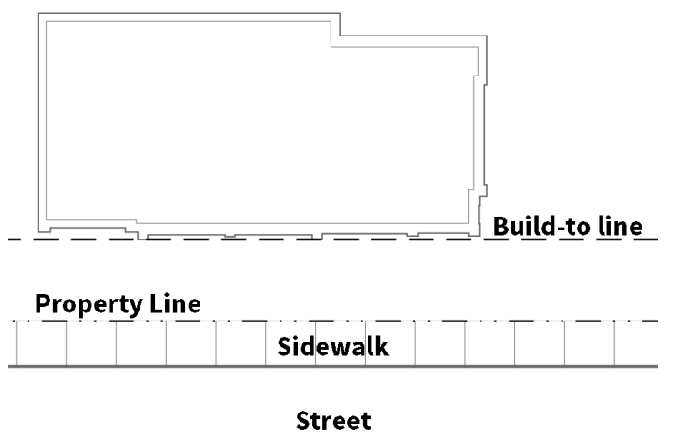
Figure 10-6-1: Build-to Line3.
Building Code. The Florida Building Code, as adopted and modified pursuant to Chapter 5 (Buildings and Building Regulations) of the Tamarac City Code.
Building Permit. An official document or certification that is issued by the Chief Building Official pursuant to the Building Code and authorizes the construction, alteration, enlargement, conversion, reconstruction, remodeling, rehabilitation, erection, demolition, moving, or repair of a building or structure as being in compliance with Building Code standards.
Caliper. See "diameter at breast height (dbh)."
Canopy. Any roof-like cover projecting over a walk, driveway, entry or similar area, for the purpose of sheltering pedestrians or inanimate objects from environmental elements, which may be wholly supported by a building or wholly or partially supported by columns, poles or braces extending from the ground.
Certificate of Compliance. For purposes of the newsrack regulations of this Code, the certificate that authorizes the construction for and placement of a newsrack in an approved location, prior to the placement of vended material.
Certificate of Occupancy. A document issued by the Chief Building Official pursuant to the Building Code that allows the occupancy and use of building(s) and structure(s) and certifying that said building(s) and structure(s) and use(s) have been constructed and will be used in compliance with all applicable municipal codes.
Change in Use. See §10-1.9(B)(3), Change in Use.
Chief Building Official. The Chief Building Official of the City of Tamarac, or a designee.
City. The City of Tamarac, Florida.
City Attorney. The City Attorney of the City of Tamarac, or a designee.
City Code. The Tamarac City Code.
City Commission. The elected legislative governing body of the City of Tamarac.
City Manager. The City Manager of the City of Tamarac, or a designee.
Clear Trunk. The point above the root ball along the vertical trunk or trunks of a tree at which lateral branching or fronds begin.
Code Enforcement Officer/Inspector. Any authorized agent or employee of the city whose duty it is to assure Code compliance.
Collector Street. A street which, in addition to giving access to abutting properties, carries traffic from minor streets to the major system of arterial streets and highways, including the principal entrance street of a residential development, as defined by the Comprehensive Plan.
Colonnade. See "arcade."
Commercial Vehicle. Any vehicle which is not used solely for personal nonbusiness activities. The following types of vehicles shall be considered commercial: truck cab; trailer; semitrailer; tractor crane; power shovel; well driller; bus; taxi, limousine, and other vehicles for hire; ambulance; wrecker (tow truck); hearse; vehicles with more than two axles; vehicles which exceed 20 feet in length and eight feet in height; vehicles with visible outside lettering, licensure information, decals, logos, vehicle wraps, or other commercial information; and/or vehicles with visible ladder, bucket, aerial device, refrigerated box, or having any equipment for the purpose of performing any work of a commercial nature or carrying goods other than for personal effects of passengers.
Completed Application. An application packet that contains all required information and documentation.
Comprehensive Plan. The Comprehensive Plan of the City of Tamarac, including the elements or portions thereof, as adopted and amended by ordinance of the City Commission.
Comprehensive Plan Amendment. A change to the text of the Comprehensive Plan, or to its land use classifications of land, reviewed and decided by the City Commission under §10-5.4(B).
Comprehensive Plan Amendment, General. A Comprehensive Plan Amendment that changes the Plan's land use classification of a relatively large number of properties.
Comprehensive Plan Amendment, Site-Specific. A Comprehensive Plan Amendment that changes the Plan's land use classification of a single or limited number of properties for small-scale development activities.
Conceptual Plan. An instrument for discussing the feasibility of a proposed project, with minimum drawings required.
Condominium. A building, or group of buildings, in which dwelling units, offices, or floor area are owned individually and the structure, common areas, and facilities are owned by all the owners on a proportional, undivided basis.
Conforming Use. Any lawful use of a building, structure, or parcel of land that complies with the provisions of this Code.
Consignment. The act of delegating the custody of personal effects to a merchandiser with an agreement to transfer earnings from the sale of such personal effects to the original owner after they are sold.
Consignment Shop. A retail establishment primarily engaged in selling used household goods and merchandise (e.g., clothing, furniture, books, shoes, small appliances), where all such goods and merchandise are sold on consignment. This use does not include thrift shops or antique shops or pawn shops.
Consistent. As applied to the relationship between this code and the Comprehensive Plan, "consistent" means compatible with—i.e., not in conflict with— and furthers—i.e., takes action in the direction of realizing the Plan's goals and policies.
Contractor. Any person who accepts orders or is engaged in the business of accepting orders or contracts on a cost plus, fixed fee, stated sum or percentage basis, or any combination thereof, or for compensation other than wages for doing work on or in any building or structure requiring the use of paint, stone, brick, mortar, cement, wood, structural steel or iron, sheet iron, metallic piping, tin, lead or any other building material; or to do any paving or curbing on sidewalks or streets, on public or private property, using asphalt, brick, stone, cement or wood or any combination thereof; or to excavate for foundations or any other purpose; or to construct bridges, seawalls and bulkheads of any and all descriptions; and who is engaged in the business of building, remodeling, repairing, razing or moving, whether by contract, fixed fee or sublet, percentage, or any combination thereof, or for compensation other than wages.
Construction. Any improvement, development, or change of the land from its present state, or building, repairing, relocating, or demolishing a structure. A permit shall be obtained before any of the above actions or uses are begun.
Cornice. An ornamental, structural or nonstructural horizontal molding that projects from the exterior wall and spans the top of a building's structural beam. A cornice is typically a decorative architectural feature that frames or crowns a building.
County. Broward County, Florida.
Crown Spread. The outermost branches of a tree in all directions.
Density. The allowable number of residential dwelling units per gross area.
Developer. Any person, including a governmental agency, undertaking development.
Development. The carrying out of any building activity or mining operation, the making of any material change in the use or appearance of any structure or land, or the dividing of land into three or more parcels, including all acts and activities included in the definition of "development" set forth in F.S. §380.04, or its successor provision.
Development Application. The completed form or forms and all accompanying plans, documents, exhibits, and fees required to be submitted, and submitted, as part of the review of a request for a development permit or approval.
Development Order. An order issued by the city commission authorizing the granting, denying, or granting with conditions of an application for a development permit.
Development Permit or Approval. Any engineering permit, building permit, zoning permit, subdivision or plan approval, site plan approval, rezoning, special exception, variance or other official action of a unit of local government having the effect of permitting the development of land, but does not include any variance or other official action necessary solely for the purpose of issuing a permit, other than a building permit, pursuant to the Florida Building Code, Broward County Amendments, and other regulatory codes of the State of Florida.
Diameter at Breast Height (DBH). The measurement of a tree's trunk diameter in inches at breast height (four and one-half feet) above ground level). For trees with less than four and one-half feet of clear trunk, diameter shall be of the largest leader measured four and one-half feet above ground level. For multi-trunk trees it shall be the sum of the diameter of the individual trunks measured four and one-half feet above ground level.
Director. The Director of the Department of Community Development, or such other person as designated in writing by the City Manager.
Distributor. For purposes of the newsrack regulations of this Code, the person responsible for placing and maintaining a newsrack, the owner of the newsrack or the publisher of the newspaper vended therein.
Dormer. A window set vertically in a structure projecting through a sloping roof; also, the roofed structure containing that window.
Double Frontage Lot. A lot having frontage on two separate parallel or approximately parallel dedicated streets. (Also known as a "through lot."). Dripline. A vertical line extending from the outermost branches of a tree to the ground however, that the same shall not be less than a circle with a five-foot radius measured from the center of the tree.
Dripline Encroachment. Any activity that has the effect of causing soil compaction, injury to lower limbs, grade change, contamination of soil, or damage to the root system. Specifically, this definition shall include acts such as parking of vehicles, use of heavy earth moving or grading equipment, placement of construction materials, excavation and filling, trenching, and the exposure of paints, oils, or chemicals within a tree's dripline. Specifically excluded from this definition are routine maintenance activities such as mowing or walking within the tree's dripline.
Drive Aisle. Any lane in a parking lot devoted to the passage of vehicles, as opposed to the parking spaces/stalls. The term drive aisle does not include lanes used for drive-in customer service.
Driveway. Every entrance or exit used by vehicles to enter or exit from properties connected to a public or private roadway and intended to provide vehicular access into that property in a manner that will not cause the blocking of any sidewalk, border area, or street roadway.
Drop-In Child Care. An occasional child care arrangement within a shopping mall or business establishment, the sole purpose of which is to provide babysitting for no more than a four-hour period while the parent remains on the premises. (Drop-in child care is subject to the licensing requirements of the Broward County Child Care Ordinance (Chapter 7 of the Broward County Code of Ordinances), as amended.)
Dwelling. A building, part of a building, or combination of buildings, located on a lot, used as living quarters. Not included are group living uses, nursing home facilities, shelters or halfway houses.
Easement. An interest in land granted by the property owner to another party (including the City, other government entities, utility providers, ort other persons) that entitles the holder to a specific usage of the land for specified purposes.
Electric vehicle. Any motor vehicle registered to operate on public roadways that operates either partially or exclusively on electric energy. Electric vehicles include (1) battery-powered electric vehicles; (2) plug-in hybrid electric vehicles; (3) electric motorcycles; and (4) a fuel cell vehicle.
Electric vehicle charging level. The standardized indicator of electrical force, or voltage, at which the battery of an electric vehicle is recharged.
1.
Level 1 transfers one hundred twenty (120) volts (1.4—1.9 kW) of electricity to an electric vehicle battery.
2.
Level 2 transfers two hundred forty (240) volts (up to 19.2 kW) of electricity to an electric vehicle battery.
3.
DC fast charging transfers a high voltage (typically four hundred (400) to five hundred (500) volts or 32-100 kW, depending on the electrical current) of direct current to vehicle batteries.
Electric vehicle parking space. An off-street parking space that is equipped with an electric vehicle charging station.
Electric vehicle charging station. Battery charging equipment utilized for the primary purpose of transferring electric energy (by conductive or inductive means) to a battery or other energy storage device in an electric vehicle.
Emergency. Any occurrence or circumstances involving actual or imminent physical injury to persons or damage to property, which demands immediate action. It shall be the burden of the alleged violator to prove the emergency.
Emergency Vehicle. A motor vehicle used in response to a public emergency or to protect persons or property from imminent danger.
Emergency Work. Work necessary to restore property to a safe condition following a public calamity, work to restore public utilities, or work required to protect persons or property from an imminent exposure to danger.
Employee. Any person directly connected with the business, owner or operator.
Engineering Drawings, Final. Drawings, specifications, and calculations prepared and sealed by an engineer registered in the state which specifically describes parameters required for construction of all on-site and off-site improvements necessary for the ultimate development of land for the project.
Engineering Drawings, Schematic. Diagram of wastewater collection and transmission, water distribution, storm drainage systems, designating direction of flow and connections with existing facilities, ground floor elevations, fire hydrants and street and parking area paving.
Entrance, Primary. The means of ingress and egress to a building that pedestrians are expected to use.
Entryways. Open areas, adjoining entry doors to a defined space, which may or may not be roofed.
Equivalent Newsrack. Any newsrack that is of the same size, dimensions, and style of the specified newsrack.
Equivalent Replacement. For purposes of the landscaping provisions of this Code, the replacement of a removed or damaged tree to compensate for that tree's removal is determined through Broward County's Tree Removal and Replacement Permit procedures.
Equivalent Value. For purposes of the landscaping provisions of this Code, an amount of money which reflects the estimated cost of equivalent tree replacement, as determined by Broward County.
Façade. The exterior walls of any side of a building.
Façade, Primary. The façade of a building oriented toward the primary street frontage.
Family
1 or more persons related by blood, marriage, or adoption and living as a single housekeeping unit in a dwelling. The following persons shall be considered related for the purpose this chapter:
1.
Not more than 5 persons under 19 years of age, residing a foster home licensed or approved by the state:
2.
Any person who is living with a family at the direction of a court.
A number of persons, but not exceeding 3, living as a single housekeeping unit, though not related by blood, marriage or an adoption, shall be deemed to constitute a family for the purpose of this chapter.
Family Child Care Home. A licensed residence in which child care is regularly provided for compensation (e.g., payment, fee, or grant)—whether or not operated for profit—for children that come from at least two unrelated families.
Family Child Care Home, Large. A licensed residence in which child care is regularly provided for compensation (e.g., payment, fee, or grant), —whether or not operated for profit—for children that come from at least two unrelated families.
Fence. An artificially constructed barrier which is erected to enclose, screen, buffer, enhance or separate areas.
Fenestration. The windows, doors, and other openings that form a part of a building facade.
Fire Protection Water Supply, Private. Water used as part of the fire protection system which is not a part of the potable water supply, but which requires positive pressure from such sources as canals, deep wells or lakes.
Floor Area Ratio (FAR). The total gross floor area of the building or buildings on a building site divided by the net area of the site. The total floor area shall include the gross horizontal area of the several stories of any building or buildings on the site, as measured from the exterior facing of exterior walls.
Fountain. An amenity that pours, jets, drips, or sprays water into a basin or into the air for a decorative or aesthetic effect.
Full Circulation Parking Lot. A parking lot design, which permits a car entering a parking lot to circulate in front of all parking stalls and restart the same movement again without using the public right-of-way.
Glazing. The portion of an exterior building surface occupied by glass or windows.
Grasses. See "turf."
Gross Floor Area. The floor area inside of the exterior walls of a building.
Ground Cover. Plant material that normally reaches a maximum height of not more than 18 inches.
Hat Racking. Flat-cutting the top or sides of a tree, severing the leader or leaders, or pruning a tree by stubbing of mature wood.
Hedge. An evenly spaced planting of shrubs to form a compact, dense, visually opaque living barrier or screen.
Horizontal Articulation. The way in which a building wall surface is broken down into horizontal modules, sub-parts, or major elements, which are distinguished by changes in materials, texture, plane, or other architectural elements.
Impervious Area. Land surfaces that do not allow, or minimally allow, the penetration of water. Examples include building roofs, normal concrete and asphalt pavements, and some fine-grained soils such as clays.
Improvements, Private. Development of land in private ownership for any use—including, but not limited to, the construction of a golf course, waterway, lake, rockpit, canal, filling, grading, dredging, building, and landscaping.
Improvements, Public. Installations in the public right-of-way or easements, including but not limited to canals, bulkheads, curb cuts, driveways, aprons, street pavement, curb, gutters, sidewalks, public parking areas, alley pavement, water mains, sanitary sewers, storm drains, street name signs, landscaping, medians, median openings and sprinkling systems.
Infill. Land development that occurs within designated areas based on local land use or adopted plan where the surrounding area is generally developed, and where the site or area is either vacant or has been previously used for another purpose.
Intermittent Parking. The periodic parking of licensed vehicles of employees, occupants, owners, tenants or customers utilizing a commercial building during business hours (not to exceed a period of 24 hours).
Irrigation. The supply and application of water other than natural rainfall.
Land. The earth, water, and air, above, below, or on the surface, and including any improvements or structures customarily regarded as land.
Landscaping. Living plant material such as grass, sod, turf, ground cover, shrubs, vines, trees and palms; grading of land area; irrigation; and nonliving durable materials commonly used in landscape design such as, but not limited to, rocks, crushed stone, mulch, sand, walls, paved blocks, fences and water features which are used separately or in combination with each other or with living plant materials to meet the requirements of this chapter. Nonliving material usage must meet the intent of the landscape code and be approved by the city during the approval process. Decorative rocks, pebbles, stone, etc., should only be used to accent organic landscape material.
Lawn/Turf. See "Turf."
Limited Service Street. See §10-4.11(C)(10), Minimum Widths of Rights-of-Way.
Liner Building. A building specifically designed to mask a parking lot or a parking garage from a frontage.
Local Street. A street used primarily for access to abutting property.
Lot. A parcel or tract of land.
Lot of Record. A parcel or tract of land which is or may be occupied by a building, and including open spaces required under this chapter, which parcel or tract of land is described by a plat recorded among the public records of the county.
Lot, Corner. A lot abutting on two intersecting streets.
Lot Depth. The distance measured from the midpoint of the street lot line to the midpoint of the opposite rear lot line. In the case of a corner lot, the depth shall be the longer of the two possibilities.
Lot, Double-Frontage (also "Through Lot"). A lot extending between, having frontage on and vehicular access from two streets.
Lot Line. The lines bounding a lot.
Lot Width. The average horizontal distance between side lot lines. For lots with irregularly shaped front building lines, the lot shall be as determined by the Director.
Management. Anyone who conducts, directs the affairs of a business, either for his own interest or that of an owner and includes those responsible for operation and supervision.
Manufactured Home. A transportable, factory-built structure that is designed to be used as a single dwelling unit, that was manufactured after 1976 or otherwise complies with the construction standards in the federal Manufactured Housing Construction and Safety Standards Act of 1974 (42 U.S.C. Sec. 5401).
Massage Apprentice. For purposes of the Massage Establishment regulations of this Code in §10-3.3(D)(9): A person approved by the State Board of Massage therapy (meeting the qualifications stated in Chapter 64B7-20.002, F.A.C.) to study massage under the control, and instruction of a massage therapist.
Massage Services. For purposes of the Massage Establishment regulations of §10-3.3(D)(9): The manipulation of the soft tissue of the human body with the hand, foot, arm, or elbow, whether or not such manipulation is aided by hydrotherapy, including colonic irrigation, or thermal therapy; any electrical or mechanical device; or the application to the human body of a chemical or herbal preparation.
Maximum Extent Practicable. Under the circumstances, reasonable efforts have been undertaken to comply with the regulation or requirement, the costs of compliance clearly outweigh the potential benefits to the public or would unreasonably burden the proposed project, and reasonable steps have been undertaken to minimize any potential harm or adverse impacts resulting from noncompliance.
Mixed Occupancy. Occupancy of a building for more than one use.
Merchandise. Any goods, wares, or commodities bought or sold in the usual course of trade or business.
Mixed-use Development. A development site that includes any combination of residential and non-residential uses, such as but not limited to retail, office, commercial, institutional, civic, restaurant, or entertainment, mixed vertically (e.g. housing above commercial uses) or horizontally (e.g. housing next to and integrated with commercial uses) in one or more buildings.
Mixed-use Structure, Traditional. A single building which contains dwelling units located above the ground floor of a retail, office, commercial, institutional, civic, restaurant, or entertainment use.
Motorboat. Any vehicle which is primarily operated on water or which does operate on water, such as boats, barges, amphibious craft, or hover craft, and which is propelled by mechanical power.
Muffler. Any apparatus consisting of baffles, chambers, or acoustical absorbing material whose primary purpose is to transmit liquids or gases while causing a reduction in sound emission at one (1) end.
Mobile Home. A structure, transportable in one or more sections, that is at least 8 feet wide and 35 feet long (with the hitch), is built on an integral chassis, includes plumbing, heating, air-conditioning, and electrical systems, and is designed to be used as a single dwelling unit when connected to required utilities.
Mulch. An organic material such as wood chips, or bark placed on the soil to reduce evaporation, prevent erosion, control weeds, enrich the soil, and lower soil temperature.
Multi-Use Path. A trail or path, either within a public right-of-way or an easement on private property, which is physically separated from vehicular traffic by an open space or barrier.
Native Tree. A tree of a species identified as native to this area by the Association of Florida Native Nurseries as may be amended from time to time.
Net Floor Area. The net floor area of each floor or story of the total net lot area inside of the exterior walls of a building excluding elevators, stair wells, trash rooms, meter rooms and power equipment rooms.
Newsrack. Any self-service or coin-operated box, container, storage unit or other dispenser installed, used, or maintained for the display, sale, or distribution of newspapers or other news periodicals or advertising circulars.
Noise. Any sound which is plainly audible from a distance of twenty-five (25) feet, or from the property of another.
Noise-sensitive Area. Includes, but is not limited to, real property normally used for sleeping, or normally used as a school, church, hospital or public library.
Non-Business Community Facilities. Facilities that include library, art gallery, museum, municipal facility, religious assembly, or educational facility uses.
Nonconforming Site Feature. Any driveway, off-street parking and loading, landscaping, buffer, screening, or exterior lighting that lawfully existed before adoption of this Code, or subsequent amendment thereto, but does not comply with the driveway, off-street parking and loading, landscaping, buffer, screening, or exterior lighting standards of this Code, or the subsequent amendment.
Nonconforming Structure. A structure that was lawfully established before the effective date of this Code, or a subsequent amendment thereto, but no longer complies with this Code.
Nonconforming Use. A use of land, buildings, and/or structures that was lawfully established before the effective date of this Code, or a subsequent amendment thereto, but does not comply with the use standards applied by this Code, or the subsequent amendment.
Nonconformity. A use, sign, structure, or site feature that does not meet the requirements of this Code.
Nuisance Vegetation. Certain non-native trees and landscaping, as listed by the Florida Exotic Pest Plant Council Invasive Plant List as amended from time to time.
Off-street Loading Area. An area provided off the public right-of-way for the temporary parking of trucks being loaded or unloaded.
Open Space. An at-grade, non-impervious, non-water outdoor or unenclosed area that is permanently set aside for active or passive recreational use and is accessible to the public all or most of the time. Such space must be unoccupied by any vehicular use area or by any structure, except structures such as fountains, open gazebos, trellises and similar open accessory structures which enhance the use of the open space.
Outdoor Dining/Café. A dining area with seats and/or tables located outdoors which is accessory to a licensed and operating restaurant where food and beverage are served and consumed for pay. Outdoor dining shall not include the preparation of food or beverages, cooking, storage or placement of equipment of any kind, except the temporary placement of implements associated with the service of food.
Overlifting. The removal of the majority of the inner lateral branches and foliage thereby displacing weight and mass to the ends of the branches. The alteration of the tree's live crown ration may be considered as evidence of overlifting.
Owner. The person or persons reflected as the property owner in the most current deed.
Parcel of Land (or "Tract"). Any quantity of land capable of being described with such definiteness that its location and boundaries may be established, which is designated by its owner or developer as land to be used or developed as a unit or which has been used or developed as a unit.
Parking Space/Stall. A permanently maintained space improved and used for the parking of one motor vehicle.
Parking Aisle. The driving lane area immediately adjacent to the car parking spaces which permits maneuvering of the cars entering and leaving a parking space.
Partial Circulation Parking Lot. A parking lot design which permits a car entering a parking lot to circulate in front of all parking stalls without using the public right-of-way.
Party. The applicant, City, and any affected person who has requested to be heard at a hearing on an application.
Patios. A paved area abutting a structure that is open to the sky.
Pawn Shop. A pawn shop is a business that advances funds to a person on the security of pledged tangible personal property on condition that the pledged property is left in the possession of the pawnbroker until redeemed by the pledgor within an established default time period, after which title in unredeemed property vests in the pawnbroker, who may then sell the property. This does not include antique shops or consignment shops or thrift shops.
Person. Any individual, corporation, government agency, government official, business trust, partnership, two or more persons having a joint interest, or any other legal entity. Persons subject to the remedies and penalties established in §10-5.5 (Enforcement) for violating this Code shall include: an architect, engineer, builder, contractor, developer, agency, or any other person who participates in, assists, directs, creates, causes, or maintains a condition that results in or constitutes a violation of this Code; or an owner, any tenant or occupant, or any other person who has control over, or responsibility for, the use or development of the land on which the violation occurs.
Person in Charge. The person in the place of business at any time who is charged with the duty of supervising, operating or managing such business at such time.
Personal Wireless Services. Commercial mobile services, unlicensed wireless services, and common carrier wireless exchange access services, and shall include "wireless service" as defined in F.S. §365.172, as well as "personal wireless services" defined in 47 USC § 332(c)(7)(C)(i), as they may be amended.
Pervious Area. Land surface that allows the penetration of water.
Plainly Audible. Any sound that can be detected by a reasonable person of ordinary sensitivities using his or her unaided hearing faculties.
Plat. A complete and exact drawing, submitted for official recording as required by statute, to identify and define property rights, dedications and public improvements, and incorporating all corrections required by the city.
Plaza. A public space that allows for the congregation of persons for special events, outdoor seating, and similar pedestrian activity.
Plot. See "Parcel of Land."
Plot Plan. See "Site Plan."
Porch. A roofed space attached to the exterior wall of a building, open on one or more sides.
Power Generation Plant. The source of electric energy produced by hydroelectric, thermal, nuclear or other types of generating plants.
Property Owner. See "Owner."
Powered Model Vehicles. Any powered vehicle, either airborne, waterborne or land borne, which are designed not to carry persons or property, such as, but not limited to, model airplanes, boats, cars, rockets, and which are being propelled by mechanical means.
Protected Tree. Any existing tree that is required to be protected by barricades to prevent damage during construction.
Prune. The removal of dead, dying, diseased, weak, or objectionable branches in a manner consistent with the American National Standards Institute (ANSI A-300) standards as incorporated herein and as may be amended from time to time.
Public Amenity. An aesthetic or other character of a development that increases its desirability to a community or its marketability to the public. Such public amenities will be placed in publicly accessible areas or areas visible from the sidewalk or right-of-way.
Public Hearing, Quasi-judicial. A hearing held by a board or the city commission to adjudicate private rights of a particular person after a hearing which comports with due process requirements, and makes findings of fact and conclusions of law on the issue.
Public Hearing, Standard. A public hearing that focuses on providing members of the public the opportunity to present information and comments related to certain types of application, with such information and comments available for consideration as subsequent recommendations and decisions are made.
Public Need. For purposes of the newsrack regulations of this Code, the process to establish a need for and approval of additional newsracks at a specified location based on demonstrated need as described in section 20-149, demonstration of public need.
Public Right-of-way. Any street, avenue, boulevard, highway, alley, or public space, which is dedicated to, owned or controlled by a public governmental entity.
Public Space. Any real property or structures thereon normally accessible to the public.
Quorum. The minimum number of board members that must be present at a meeting for the board to conduct official business or take official actions.
Reconstruction. Any construction that alters the existing pervious area of a plot.
Recreational Vehicle. A vehicle that is built on a single chassis, is designed to be self-propelled or permanently towable by an automobile or light truck, and is designed not for use as a permanent dwelling but as temporary living quarters for recreational, camping, travel, or seasonal use.
Redevelopment. The conversion, relocation, reconstruction, structural alteration, enlargement of any development where more than 25 percent of the gross floor area of the original structure will be removed, replaced or renovated.
Relocation. The transplanting of plant material from one location to another location that is acceptable by the city landscape architect or designee following proper horticultural and arboricultural procedures which includes but is not limited to root pruning for a period of at least six weeks, providing adequate irrigation from the act of root pruning to relocation and providing care and irrigation for a period of one year or until the plant material is established.
Retail Merchant. Any merchant who sells to the consumer or for any purpose other than resale.
Rezoning. A change in the zoning district classification applied to land by the Zoning Map, reviewed and decided by the City Commission under §10-5.4(F). (Also known as a Zoning Map Amendment).
Rezoning, General. A rezoning that is not a site-specific rezoning—i.e., one that has an impact on a relatively large number of properties or applicant, where the decision is contingent on and can be functionally viewed as the setting of policy rather than the application of policy.
Rezoning, Site-specific. A rezoning that has an impact on a single or limited number of properties or applicants, where the decision is contingent on a fact or facts arrived at from distinct alternatives considered at a public hearing on the application, and where the decision can be functionally viewed as policy application rather than policy setting.
Right-of-way. Land reserved, used or to be used for a street, alley, walkway, drainage, or other public purpose and owned by the city, county, state, water management district or any other agency.
Roadway. That portion of a right-of-way improved, designed or ordinarily used for vehicular travel.
Roof Line. The top edge of the roof which forms the top line of the building silhouette or, for flat roofs with or without a parapet, the top of the roof.
Rooftop Photovoltaic Solar System. A system which uses one or more photovoltaic panels installed on the surface of a roof, parallel to a sloped roof or surface- or rack-mounted on a flat roof, to convert sunlight into electricity.
Root Ball. The earthen ball encompassing the root system of a tree or plant.
Sale. The transfer of ownership, title or possession, whether conditional or otherwise, for a consideration.
Setback. The minimum street front, side, or rear yard open space as measured between a building and the boundary lines of the lot on which the building is located.
Setback, Front. The setback extending across the full width of the lot between the front lot line and the closest projection of a building or structure along a line at right angles to the lot line, exclusive of steps, platforms, open terraces, and walls not exceeding five feet in height.
Setback, Rear. A setback extending across the full width of the lot between the rear lot line and the closest projection of a building or structure along a line at right angles to the lot line, exclusive of steps, platforms, open terraces and walls not exceeding five feet in height.
Setback, Side. A setback extending from the front setback area to the rear setback area between the side lot line and the closest projection of a building or structure along a line at right angles to the side lot line, exclusive of steps, platforms, open terraces and walls not exceeding five feet in height.
Sexual or Genital Parts. For purposes of the Massage Establishment regulations of this Code in §10-3.3(D)(9): The genitals, pubic area, anus, perineum of any person, and/or the vulva of a female.
Sexual Activity. For purposes of the Massage Establishment regulations of this Code in §10-3.3(D)(9): Any direct or indirect physical contact by any person or between persons which is intended to erotically stimulate either person or both, or which is likely to cause such stimulation and includes sexual intercourse, fellatio, cunnilingus, masturbation, or anal intercourse. For purposes of this definition, masturbation means the manipulation of any body tissue with the intent to cause sexual arousal. As used herein, sexual activity can involve the use of any device or object, and is not dependent on whether penetration, orgasm, or ejaculation has occurred. Nothing herein shall be interpreted to prohibit a licensed Massage Therapist, duly qualified under Rule 64B7-31.00, from practicing colonic irrigation.
Shaping. The regular and frequent shearing of outer branches, making pruning cuts of one inch in diameter or less, for the purpose of controlling the size and shape of the tree canopy.
Shared Parking. A joint use of a parking area by more than one development or use.
Shrub. A multi-stemmed woody plant with several permanent stems instead of a single trunk and usually not over 10 feet in height.
Sidewalk. A paved pedestrian walkway within the public road right-of-way, easement, or on private property.
Sight Visibility Triangle. See §10-4.4(D)(6), Sight Distance.
Site Area, Gross. The total area of a development, including the width to the center line of the abutting public rights-of-way. Maximum residential densities are based on this area in relation to permitted density in the city land use element.
Site Area, Net. The area of the parcel.
Site Plan. A complete technical submission reviewed by the planning board and approved by the City Commission prior to filing for any development permit except as may be excluded in §10-5.4(H).
Special Exception. A use, designated as a Special Exception in the principal use tables, that may be appropriate in a particular zoning district, but because of its nature, extent, and external effects, requires special use-specific standards and special consideration of its location, design, and methods of operation before it is allowed in the district; also, an application for a development permit allowing such use that is reviewed and decided by the Planning Board under §10-5.4(G).
Special Magistrate. The city special magistrate appointed by the city commission to hear code enforcement violation cases, civil traffic infractions as authorized by law, and any and all other matters authorized by law.
Specified Anatomical Areas
Less than completely and opaquely covered:
1.
Human genitalia, pubic regions;
2.
Buttock; and
3.
Female breast below a point immediately above the top of the areola;
4.
Human male genitalia in a discernibly turgid state, even if completely and opaquely covered.
Specified Sexual Activities
1.
Human genitalia in a state of sexual stimulation or arousal;
2.
Acts of human masturbation, sexual intercourse or sodomy;
3.
Fondling or other erotic touching of human genitalia, pubic region, buttock or female breast.
Specimen Tree. A tree that has a diameter breast height (DBH) of 18 inches or greater with the exception of the following:
1.
Non-native fruit trees that are cultivated or grown for the specific purpose of producing edible fruit, including but not limited to mangos, avocados, or citrus.
2.
Nuisance vegetation.
3.
All multi-trunk palms.
4.
Trees that are in poor condition or form as determined by the city based on the Guide to Judging Plant Condition, International Society of Arboriculture (ISA), as amended from time to time.
Staff. Employees of the City of Tamarac.
State. The State of Florida.
Stealth Facility. Any telecommunications facility which is designed to blend into the surrounding environment. Examples of stealth facilities include architecturally screened roof-mounted antennas, antennas integrated into architectural elements, poles in the rights-of-way that are designed to look like light poles, and telecommunications towers designed to look like light poles, power poles or trees.
Stop Work Order. An order issued by a Code Inspector or other authorized City staff that directs the person responsible for a activity in violation of this Code to cease and desist such activity.
Storefront. The room or set of rooms facing the street on the ground floor of a commercial building, typically used as a retail store, and the location of the primary customer entrance.
Story. That portion of a building included between the upper surface of any floor and the upper surface of the floor next above it, or if there is no floor above, then the space between the floor and the ceiling or roof above the floor.
Street. A public or private way affording principal means of access to abutting property.
Street Frontage. The distance that a lot line adjoins a public or private street from one lot line intersecting the street to the furthest lot line intersecting the same street.
Street Frontage, Primary. Street frontage to which the primary building on the site is oriented, generally the street containing the primary pedestrian entrance to the building and/or the numbered street address of the building.
Street Tree. Any tree placed in the right-of-way; trees adjacent to pavement in cases where the streets are private.
Structure. Anything constructed or erected with a fixed location on the ground, except hedges, shrubs, and trees.
Subdivision. The division of land into two or more lots or parcels for the purpose of transfer of ownership or development, or if a new right-of-way is involved, and division of a parcel of land.
Swale. The area within the public right-of-way between the sidewalk and the edge of the pavement of the roadway, and where there is no sidewalk, the area within the public right-of-way between the edge of pavement of any roadway and the private property line.
Swimming Pool. A body of water in an artificial or semiartificial receptacle or other container, whether located indoors or outdoors, and used or intended to be used for public, or private swimming by adults or children.
Temporary Use Permit. A document authorizing the establishment, construction, or installation of a temporary use or structure designated as requiring such a permit in §10-3.2, reviewed and decided under §10-5.4(K).
Text Amendment. A change to the text of this Code, reviewed and decided by the City Commission under §10-5.4(D).
Topiary Pruning. The practice of pruning a tree into an ornamental shape by pruning branches one inch in diameter or less.
Topsoil. Fertile, friable natural surface soil with an acidity range of pH 5.0 to pH 7.0 containing not less than five percent organic matter.
Townhouse. A residential dwelling unit attached to 2 or more other dwelling units where each individual single family unit is owned in fee simple. Units are joined to one another side-to-side by a common party wall or garage, and/or with connecting permanent and architecturally unified structures such as breezeways.
Trafficway. A public right-of-way, with the primary purpose of facilitating through movement of vehicles in substantial volume, as delineated on the county trafficways plan or the city's transportation element as may be amended.
Traveling Dealers. All traveling dealers who bargain to sell any goods, wares or merchandise from house to house, for cash or otherwise, by sample or in any other manner, for present or future delivery. They shall be deemed peddlers, hawkers or itinerant vendors within the meaning of this chapter, except those persons doing business in interstate commerce as otherwise provided in this chapter, or unless such license tax is prohibited by section 8 of article 1 of the United States Constitution.
Tree. A self-supporting woody perennial plant, usually with one vertical stem or main trunk, which naturally develops a more or less distinct and elevated crown and provides, at maturity, characteristics of the species.
Tree Abuse
1.
Pruning that reduces the height or spread of a tree that has not attained a height or spread of 30 feet, by altering the dominant stem(s) within the tree crown to such a degree as to remove the natural canopy of the tree; or
2.
Pruning that leaves stubs or results in a flush cut; or splitting of limb ends; or
3.
Peeling or stripping of bark; or the removal of bark to the extent that, if a line is drawn at any height around the circumference of the tree, over one-third of the length of the line falls on portions of the tree where bark no longer remains; or
4.
Using climbing spikes, nails or hooks, except for purposes of total tree removal; or
5.
Destroying the natural habitat of growth which causes irreparable damage and permanent disfigurement to a tree such that, even with regrowth, the tree will never regain the original characteristics of its tree species, and is a danger to the public or property; or pruning defined herein as tree abuse that results in the tree's death; or
6.
Hat racking, which is flat-cutting the top or sides of a tree, to sever the leader or leaders or to prune a tree by stubbing of mature wood, except where removal of a branch is necessary to protect public safety; or
7.
Pruning of live palm fronds which initiate above the horizontal plane unless this reflects the natural growth habit of the species in question (i.e. Phoenix dactylifera); or
8.
Overlifting a tree as defined in this chapter; or
9.
Girdling of trees by guying, staking, supports, string trimmers, nonremoval of planting materials from root balls and trunks, or
10.
Removing landscaping required by this Code or required on an approved landscape plan; or
11.
Exception: The removal of diseased or dead portions of a tree (such as palm frond), the removal of an interfering, obstructing, or weak branch shall not constitute tree abuse under this section.
Interference with or obstruction of street lights, stop signs or traffic signals is an example of pruning which, if accomplished by the American National Standards Institute (ANSI A-300) standards, as amended from time to time, is not a violation of this section.
Tree Canopy. The upper portion of a tree consisting of limbs, branches, and leaves.
Tree, Ornamental. A tree that, by habit of growth, form, foliage, flower, or color display, makes it unique to its location.
Tree, Palm. A monocotyledonous tree (of tropical or subtropical species) having fronds with parallel vegetation and no true woody bark.
Tree Removal License. A document authorizing the relocation or removal of trees subject to the Broward County Tree Preservation and Abuse Ordinance.
Tree, Shade. A self-supporting woody perennial plant, usually with one vertical stem or main trunk which naturally develops a more or less distinct and elevated crown and which provides a minimum shade of 30 feet in diameter at maturity.
Tree, Small. Any self-supporting wood perennial plant which at maturity normally attains an overall height less than 20 feet at maturity.
Thrift Shop. A thrift shop is a retail establishment primarily engaged in selling used household goods and merchandise (e.g., clothing, furniture, books, shoes, small appliances), where such goods and merchandise are not sold on consignment. This use does not include consignment shops or antique shops or pawn shops.
Trim. To reduce, shorten or diminish gradually a plant or parts of a plant without altering the natural shape.
Turf. The upper layer of soil matted with roots of grass and covered by viable grass blades.
Understory. Plant material developed as an undergrowth associated in the habitat with trees.
Unlawful Noise. Any sound that (a) endangers the safety or health of any person, (b) disturbs a reasonable person of normal sensitivities, or (c) endangers personal or real property.
Use, Principal. The predominant or primary use or activity taking place on a lot. The principal use does not include any accessory uses occurring on the same lot.
Variance. A development application authorizing a deviation from the standards of this Code where strict application of the standard creates a hardship due to circumstances particular to a lot, and that is reviewed and decided by the Planning Board under §10-5.4(Q).
Vehicular Use Area. Any area (except public thoroughfares) used by motor vehicles for parking, displaying, storage or traversing.
Vertical Articulation. The way in which a building wall surface is broken down into vertical modules, sub-parts, or major elements, which are distinguished by changes in materials, texture, plane, or other architectural elements.
Vine(s). A plant with a long, slender stem that trails or creeps on the ground or climbs by winding itself about a support or holding fast with tendrils.
Violator. The person responsible for the ordinance or code violation which, in the appropriate circumstances, shall be the perpetrator of the violation, the owner of the real property or personal property, or person legally responsible for the property upon which the violation occurred, or all.
Visual Screen. An obstruction used to separate two areas or uses for the purpose of buffering a building or activity from neighboring areas or from a street or private street, which is at least 75 percent opaque. Visual screens may include, but are not limited to, masonry walls, fences, hedges, informal plantings, or berms.
Wholesale Merchant. Any merchant who sells to another merchant for the purpose of resale.
Xeriscape. A type of landscaping utilizing native plants and ground cover that needs little maintenance, which is detailed in the South Florida Water Management District publication Waterwise, South Florida Landscapes, Landscaping to Promote Water Conservation Using the Principles of Xeriscape, incorporated herein by reference, amended from time to time.
Yard. An open space or area unobstructed from the ground upward by any structure.
Zoning Map. The Official Zoning Map on which the boundaries of the various zoning districts are drawn and that is an integral part of this code.
(A)
Sign Definitions.
Abandoned Sign. Any sign that remains in place after an area, community, subdivision, development, entity, enterprise, club, institution, or business has changed names, is no longer licensed, no longer has a certificate of occupancy, is no longer doing business, is closed, or which no longer serves the intended purpose of the sign.
Address Sign. A sign indicating the street address of a building, bay, space, or property and, the numerical prefix of the street address. In certain cases the bay, suite, or unit number must also be included.
Advertising. Any form of public announcement intended to aid, directly or indirectly, in the sale, use or promotion of a product, commodity, service, activity or entertainment.
Anchor Tenant. A tenant in a multiple tenant complex or building whose space has the largest square footage.
Animated Sign. A sign which utilizes motion of any part by any means, or displays flashing, oscillating or intermittent lights.
Announcing Sign. A temporary sign that reveals a project under construction, or an intended use for the premises in the immediate future.
Banner Sign. A temporary sign having the characters, letters or illustrations applied to cloth, paper, fabric, plastic or vinyl of any kind, whether or not attached to any staffs, post, poles, cords, structures with only such material for backing.
Bay. A discrete owned or leased area shown on a floor plan.
Billboard Sign. A large freestanding outdoor structure found in places with high traffic utilized for advertising an establishment, an activity, a product, service or entertainment, which is sold, produced, manufactured, available or furnished at a place other than on the property on which sign is located.
Box or Cabinet Sign. Any type of sign which is enclosed, bordered, or contained within a box-like structure, frame or other device.
Building Identification Sign. A sign indicating the letter or number designation used to identify a building.
Canopy. A covered structure that projects from or extends beyond the main building and provides protection for pedestrians.
Canopy Sign. A sign hung from a canopy.
Cantilever or Projecting Sign. A sign that extends perpendicularly above grade from a building or structure.
Changeable Copy Sign. A sign that is designed so that characters, letters or illustrations can be changed or rearranged without altering the face of the surface of the sign.
Community. A residential area within distinct geographic boundaries defined by plat or site plan.
Community Directional Sign. A sign that is used to direct traffic to a residential community, subdivision, section, or complex.
Community Identification Sign. A sign that displays and is used to identify the name of a residential community, subdivision, section, or complex.
Community Service Sign. A sign that solely advertises a function of a nonprofit organization or corporation as defined by IRS Code.
Contractor Sign. A temporary sign used to identify the name of the general contractor and/or subcontractors who are building, improving, remodeling or renovating a new or existing structure.
Development Sign. See "community identification sign."
Dilapidated Sign. Any sign that is in need of painting or maintenance, overgrown by landscaping, has been defaced, has defective parts, is missing some or all illumination or characters, is structurally unsound, has fallen into disrepair, fails to be in the same form as constructed, or no longer conveys the approved message on the sign.
Directional Sign.
a.
A sign permanently erected and maintained by the city, the county, the state, the United States government, or any agency thereof, which is used to denote the name of any thoroughfare the route to any city, educational institution, public building, park, recreational facility or hospital; to direct and regulate traffic; or to denote any transportation or other agency for the direction or safety of the public.
b.
A sign, notice or symbol used to inform the public as to locations, directions, lands and conditions affecting the safety of aircraft and aviation.
c.
A sign located on and relating to an activity on the premises upon which the sign is located, used to provide information to pedestrians and vehicular traffic, such as providing directions to buildings within a complex; includes general information signs.
d.
A sign within a development or at the entrance(s) thereto, used to show the name(s), directions to the location(s) and addresses of the subdivisions or communities comprising the development.
Directory Sign. A sign consisting of the index of the names of tenants of an office building, shopping center or other multiple tenant business complex.
Electronic Message Center. A changeable copy, lighted sign that moves and/or flashes to create an illusion of movement for the purposes of advertising, promotion or attention-getting with or without copy.
Electronic Time/Temperature Display. A changeable copy, lighted sign that changes to display the current time, current temperature and/or current date for information only.
Electronic Sign Display. An illuminant advertising media which utilizes electronic components to convert electric signals into a visual image (i.e. OLED, LCD, LED technologies).
Entrance Wall Sign. A sign attached to an upright structure of masonry, wood, plaster, or other building material which defines the access to a residential community.
Façade. The exterior surface of a building or structure including awnings.
Façade Sign. A sign on the façade of any building or structure.
Fire Sale. Any offer to sell to the public or a sale to the public of new retail goods, wares, or merchandise at low or discounted prices.
Flag. A shaped piece of cloth, paper, fabric, plastic or vinyl of any kind attached to a singular staff, post, pole or cord.
General Information Sign. A sign providing information or a warning, such as, "Entrance," "Exit," "Caution," "No Trespassing," "Beware of Dog," "Wet Paint" or "Parking in Rear."
Grand Opening. The first opening of a business not previously conducted in the city by the same person(s), group, corporation, or enterprise at the particular location.
Gross Floor Area. The sum of the horizontal areas of the stories of a building or buildings, measured from the exterior faces of exterior walls or from the centerlines of walls which separate buildings. Included within such sum shall be the areas of all stories and attic spaces providing structural head room of at least five and one-half (5½) feet; interior balconies or mezzanines; and any other space reasonably usable for any purpose except parking garage structure, but does not include all other interior spaces including those which are not heated or air conditioned.
Ground Sign. The type of sign that is self-supported, not attached to or affixed in any way to a building or other structure.
Height of Sign. Unless otherwise specified in this article, sign height shall be measured from the predominant finished grade of the entire property in which the sign is located to the top of the sign's highest element.
Holiday. A day of observance set aside by law or statute, identified on a legal United States Gregorian calendar, used to celebrate or commemorate something that happened on or near that date.
Human Sign. A sign held or attached to a person for advertising, or a worker costumed for the purpose of advertising or drawing attention to a business, commodity, service or product.
Illuminated Sign. Any sign having or using characters, letters, designs, logos or outlines illuminated by electric lights or luminous tubes, whether or not such lights or tubes are physically attached to the sign.
Internal Illumination.A light source concealed or/contained within the sign which becomes visible.
Leasing Sign. A temporary sign indicating the availability of property for lease or rent.
Logo. A symbol, emblem, trademark, design, graphic or combination thereof used to identify a business, organization or corporation to identify corporate property or products.
Mansard. A sloping section of an exterior wall extending to the roof line of a building at an angle with the exterior wall from which it extends. It may be covered with roofing material to simulate a roof, but services an aesthetic rather than functional purpose.
Mansard Sign. A sign erected on a mansard.
Master Residential Area. The umbrella designation of a large master planned residential subdivision which may contain two or more residential developments (i.e. Woodmont or The Woodlands).
Mobile Billboard. An advertising display that is attached to a mobile, non-motorized vehicle (such as a trailer), device or bicycle that carries, pulls or transports a sign or billboard and is for the primary purpose of advertising. Also a motorized vehicle with changeable copy for the purpose of advertising.
Model Sign. A temporary sign which designates a new residential unit design which is exhibited to depict other new units of a similar design that are for sale or lease.
Model Sales Office Sign. A temporary sign used to identify a new residential housing project model sales office.
Monument Sign. A freestanding self-supported sign mounted on a solid base from the ground upward, embellished to conceal all structural or support members, where the supporting structure of the sign face is architecturally and aesthetically integrated into the overall design of the sign.
Multi-family residential development. A residential development consisting of four units or more. This definition is for the purposes of this chapter only.
Multiple Tenant. A building or complex which contains more than one bay.
Nameplate Sign. A sign, other than a director sign, indicating the name, profession or business address of the person or entity occupying the premises indicated by this sign.
Nonconforming Sign. A sign existing within the city on the effective date of this article or a sign existing in an area annexed to the city, after the effective date of this article, which, by its design, height, type, content, square footage, surface area, location, use, structural support, or other characteristics does not conform to the current requirements of this article.
Off-premise Project Directional Sign. A sign, not within the boundaries of a project that contains directional information for such project.
Outparcel Building. A building constructed on a parcel of land, adjacent to a larger tract of land in which the parcel was originally an integral part of, which shares common ingress/egress or parking facilities with the adjacent tract of land and is detached from other structures in the center.
Painted Sign. A sign painted directly onto the façade of a building or structure.
Parapet Wall. That portion of an exterior wall or façade that extends above the roof line.
Personal Gain Sign. A temporary sign used for the purpose of advertising the sale of household personal items known as a garage, yard or patio sale.
Pole or Pylon Sign. A sign erected upon one or more poles or posts and which is wholly independent of any building and/or structure for support.
Political Sign. A sign used to indicate the name, cause or affiliation of anyone seeking public office or which indicates any issue for which a public election is scheduled to be held.
Portable Sign. Any sign not permanently attached to the ground or a building, not including signs attached to vehicles, except vehicles parked specifically for the purpose of signage.
Price Rate Sign. A sign used to indicate prices of products or services.
Primary Frontage. For the purpose of the sign regulations of this Code, the primary frontage shall be considered the portion of any frontage containing the primary public entrance to the building or building unit.
Project. An improvement which has received approval of a new or major revised site plan from the city commission.
Promotions. A particular activity that is intended to stimulate the business, service, or enterprise.
Real Estate Sign. A temporary sign, indicating property which is for sale.
Roof Sign. A sign that is fastened to and supported by or on the roof of a building, or which extends over the roof of a building or projects more than 36 inches over or above the roofline, or parapet wall of a building.
Sidewalk, Sandwich, or A-frame Sign. A sign that is movable and is not secured or permanently attached to the ground. It may have more than one (1) face and is usually hinged at the top.
Sign. Any structure and all parts composing the sign, together with the frame, background or support thereof, or any material bearing lettered word(s) or message(s) which is used for advertising or display purposes or any statuary, sculpture, molding or casting used for advertising or display, or any flags, bunting, banners or materials used for display or advertising purposes, or for the purpose of bring the subject matter thereof to the attention of another.
Sign Area. The square footage of the area enclosed by the perimeter of the sign face except for monument signs, ground signs, or entrance wall signs which the area is determined by measuring the overall height and width of the entire sign structure including all components above grade. When a sign is composed of individual characters and/or graphics only, the sign area is the area of rectangles enclosing all characters and graphics excluding spaces between lines of copy or graphics.
Sign Face. The part of the sign that is or can be used for communication purposes, including decorative border(s).
Snipe sign. A sign of any size, made of any material, including paper, cardboard, wood or metal, when such sign is tacked, nailed, pasted, glued, staked, or otherwise attached to trees, poles, stacks, fences or to other objects.
Special Occasion Banner. A temporary sign in the form of a banner announcing a specified activity, function or occasion for a business, enterprise, group or entity for a specified period of time.
Structure. Anything constructed or erected which requires location on the ground or which is attached to an object having a location on the ground.
Temporary Sign. A temporary sign is any sign not permanently affixed or attached to the ground or a structure, which can be removed without special handling.
Traffic-control Sign. Any sign used to control traffic on public or private property, such as "One Way," "Do Not Enter," etc. (see also Directional sign).
Vehicle Sign. A sign affixed to a transportation vehicle or vessel, including automobiles, trucks, boats, trailers or campers, for the purpose of identification of the use of that vehicle or vessel only. Vehicle signs must not inhibit the safe operation of the vehicle or vessel upon which they appear.
Wall Sign. See Façade sign.
Window Sign. A sign located on or adjacent to either inside or outside of a window.
Yard Sign. A temporary sign placed upon or supported by the ground independently of any other structure.
(Ord. No. 2021-004, § 3, 2-24-21; Ord. No. 2022-019, § 3, 10-12-22)

