
Tappahannock City Zoning Code
ARTICLE II
BASIC DEFINITIONS AND INTERPRETATIONS
Sec. 22-15.1. - General usage.
For the purpose of this ordinance, certain words and terms are herein defined a follows:
a.
Words used in the present tense shall include the future tense; words used in the singular number shall include the plural number and words in the plural number shall include the singular number; unless the obvious construction of the wording indicates otherwise.
b.
The word "shall" is mandatory.
c.
The word "building" includes the word "structure"; the word "lot" includes the words "plot" and "parcel."
d.
The word "used" shall be deemed also to include "erected," "reconstructed," "altered," "placed," or "moved."
e.
The terms "land use" and "use of land" shall be deemed also to include "building use" and "use of a building."
f.
The term "state" means Commonwealth of Virginia.
g.
The word "town" means the Town of Tappahannock.
h.
The word "person" includes a firm, association, organization, partnership, trust, company, or corporation as well as individual.
i.
The term "Code of Virginia" shall include "as amended."
j.
The word "adjacent" means "nearby" and not necessarily "contiguous."
Sec. 22-15.2. - Interpretations by zoning administrator or zoning and code compliance officer.
In case of any dispute over the meaning of a word, phrase, or sentence, whether defined herein or not, the Zoning Administrator or Zoning and Code Compliance Officer is hereby authorized to make definitive determination thereof, being guided in such determination by the purposes and intent of this ordinance as set forth in Article I, provided however, that an appeal may be taken from any such determination as provided in Article V.
Sec. 22-15.3. - Specific definitions.
Accessory Apartment. (See [Section] 22-140.)
Accessory building, use, or structure. A subordinate building, use of land, structure, or a portion of a main building or use which is clearly incidental to or customarily found in connection with a and located on same lot, or contiguous lots as the principal use of the premises and in the same ownership as the principal use.
Acreage. Gross. A unit measure, the total land area to be developed including rights-of-way, easements and land set aside for public purpose.
Agriculture. Any activity involving the growing or raising of food or raw material by tilling the soil, raising crops, keeping or raising of animals and including incidental agricultural business, as fruit packing plants, dairies, or similar uses.
Airport, Commercial. An area of land or water which is used, or intended for private or public use, for the landing and take-off of aircraft, and any appurtenant areas which are used, or intended for use, for airport buildings or other airport facilities or rights-of-way, easements and together with all airport buildings and facilities located thereon.
Airport, Licensed. The Tappahannock Municipal Airport and the Essex County Airport.
Airport Approach Surface. A surface longitudinally centered on the extended runway centerline, extending outward and upward from the end of the primary surface, and at the same slope as the approach zone height limitation slope set forth in Article IX, Part III of this ordinance. In plan the perimeter of the approach surface coincides with the perimeter of the approach zone.
Airport Approach, Transitional, Horizontal, and Conical Zones. The airspace zones as set forth in Article IX, Part III of this ordinance.
Airport Conical Surface. A surface extending horizontally 20 feet for every one foot vertically from the periphery of the horizontal surface.
Airport Elevation. The highest point on any usable landing surface expressed in feet above mean sea level.
Airport Horizontal Surface. A horizontal plane 150 feet above the established airport elevation, the perimeter of which in plan coincides with the perimeter of the horizontal zone.
Airport Primary Surface. A surface, with a specified width as provided in Section 22-3 of this ordinance, longitudinally centered on a runway. When the runway has a specifically prepared hard surface, the primary surface extends 200 feet beyond each end of that runway. The elevation of any point on the primary surface is the same as the elevation of the nearest point on the runway centerline.
Airport Safety Obstruction. Any structure, growth, or other object, including a mobile object, which exceeds a limiting height, or penetrates any surface or zone floor, set forth in Article IX, Part III of this ordinance.
Airport Transitional Surfaces. Surfaces which extend outward perpendicular to the runway centerline extended at a slope of seven feet horizontally for each foot vertically from the sides of the primary and approach surfaces to where they intersect the horizontal and conical surfaces.
Airport Zones. All areas provided for in Article IX, Part III of this ordinance, generally described in three dimensions by reference to ground elevation, vertical distances from the ground elevation, horizontal distances from the runway centerline and the primary and horizontal surfaces, with the zone floor set at specific vertical limits by the surfaces found in Article IX, Part III of this ordinance.
Alteration. Any change in the supporting members of a building or structure including bearing walls, partitions, columns, beams, girders or similar parts of a building structure; or change in the total floor area or use of an existing building or structure.
Alley. A right-of-way that provides secondary service access for vehicles to the side or rear of abutting properties.
Amend or Amendments. Any repeal, modification or addition to a regulation; any new regulation; any change in the number, shape, boundary or area of a zone; or any repeal or abolition of any map, part thereof or addition thereto.
Amusement enterprises. Establishments in which a principal use is in the operation of mechanical, electronic, and/or coin-operated games and/or devices for the general amusement of the public. This definition shall include pool halls and billiard parlors.
Antenna. Equipment designed to transmit or receive electronic signals.
Apartment. A building containing three or more dwelling units for rent.
Application. A written request for a zoning permit, an amendment, Special Exception or for action by the Board of Zoning Appeals which has been properly executed on forms supplied by the Zoning Administrator or Zoning and Code Compliance Officer.
Automobile Repair Service. Buildings and premises where the following services may be provided and sales made:
A.
Major mechanical and body work
B.
Straightening of frames and body parts
C.
Steam cleaning, painting, and welding
D.
Upholstering and replacement of glass
Base Flood. The flood having a one percent chance of being equaled or exceeded in any given year. Also known as the 100-year flood.
Basement. That portion of a building below the first-floor joists at least one-half of whose clear ceiling height is below the mean level of the adjacent ground and with a floor-to-ceiling height of not less than six and one-half feet.
Bed and Breakfast Home. "Bed and breakfast home" or "tourist home" means a single-family, owner occupied dwelling for the lodging of up to four transient guests at any one time, none of whom remain for more than seven consecutive nights each, and that provide no food or beverage service for the transient guests other than for breakfast provided in the area of the dwelling that are generally used by the resident family for the consumption of food.
Best Management Practices or "BMPs." Means a practice, or a combination of practices, that is determined by a State or designated area-wide planning agency to be the most effective, practical means of preventing or reducing the amount of pollution generated by non-point resources to a level compatible with water quality goals.
Board, The. Refers to The Board of Zoning Appeals of Tappahannock, Virginia.
Boarding House or Rooming House. A residential use consisting of at least one dwelling unit and where meals and/or lodging for compensation are provided for three or more persons. A rooming house or boarding house is distinguished from a bed and breakfast home or a tourist home in that the former is designed to be occupied by longer-term residents (at least month-to-month tenants) as opposed to overnight or weekly guests.
Body Piercing Salon. Means any place in which a fee is charged for the act of penetrating the skin to make a hole, mark, or scar, generally permanent in nature. "Body piercing" does not include the use of a mechanized, presterilized ear-piercing system that penetrates the outer perimeter or ear lobe of the ear or both.
Buffer. Open spaces, landscaped areas, fences, walls, berms, or any combination thereof used to physically separate or screen one use or property from another so as to visually shield or block noise, lights, or other nuisances.
Building. Any structure having a roof supported by columns, walls, or other means.
Building, Accessory. A minor building that is located in the side or rear yard on the same lot as a principal building and is used incidentally to a principal building or houses an accessory use.
Building Area. The area of that part of the lot not included within the open spaces herein required.
Building, Completely Enclosed. Any building having no outside openings other than ordinary doors, windows, and ventilators.
Building Coverage; (Lot Coverage). That percentage of a lot which, when viewed from above, would be covered by a structure or structures or any part thereof, including roof eaves and steps.
Building, floor area of. The total number of square feet area in a building, excluding cellars, uncovered steps, and uncovered porches, but including the total floor area of accessory buildings on the same lot.
Building, height of. The vertical distance measured from the average grade to the highest point of the roof surface. On corner lots exceeding 20,000 square feet in area, the height of the building may be measured from either adjoining curb grade. For lots extending through from street to street, the height may be measured from either curb grade.
Building line. A line beyond which the foundation wall and/or any enclosed porch, vestibule, or other enclosed portion of a building shall not project.
Building, Main. A building in which is conducted the principal use of the lot on which it is situated. In any residential zone, any dwelling shall be deemed to be main building on the lot on which the same is located if the lot is used primarily for residential purposes.
Building, Public. A building, or part thereof, owned or leased and occupied by an agency or political subdivision of the United States of America, the Commonwealth of Virginia, the County of Essex, or the Town of Tappahannock.
Building, Semipublic. A building part, or part thereof, owned or leased and occupied by a nonprofit organization and which is primarily used for nonprofit activities.
Building setback line, required. That line which is the minimum distance between any property line, right-of-way, or protected feature and that establishes the area within which the principal structure must be erected or placed.
Campground. Any lot or land used, maintained, or held out to be public as a place for use for camping or lodging purposes, whether equipped with tents, tent houses, huts, cabins, cottages, campers, or trailers, or not so equipped, and by whatever name the same may be called, whether any fee is charged for the use thereof or not.
Camper park. Any site, lot, parcel or tract of land which is improved, used or intended to provide a location for the servicing or temporary accommodation of one or more trailers which are used for travel, camping or recreational purposes.
Cellar. A space with less than one-half of its floor-to-ceiling height above the average finished grade of the adjoining ground or with a floor-to-ceiling height of less and six and one-half feet.
Central Sewer System. A publicly or privately owned sewer system, approved by either the State Department of Health or the State Water Control Board, which serves five or more dwelling units or other structures, and which consists of collection and transmission lines or mains, pumping stations, if necessary, and a sewage treatment and disposal facility. Such system functions by transmission of sewage away from the points of origin, collection and treatment of the sewage treatment facility which is not located on any of the lots or parcels served by the system, and disposal or discharge of the treated effluent either on land or in surface waters.
Certify. Whenever this ordinance requires that some agency certify the existence of some fact or circumstance to the Town, the Town may require that such certification be made in any manner that provides reasonable assurance of the accuracy of the certification. By way of illustration, and without limiting the foregoing, the Town may accept certification by telephone from some agency when the circumstances warrant it, or the Town may require that the certification be in the form of a letter or other document.
Central Water System. A publicly or privately owned water system which meets State Department of Health requirements for an approved water supply, and which serves five or more dwelling units or other structures. Such system consists of a well or wells which are not located on any of the lots or parcels served by the system, pump houses, transmission lines or mains, and storage tanks, if necessary.
Chesapeake Bay Preservation Area or CBPA. Means any land designated by the Tappahannock Town Council, pursuant to Part III of the Chesapeake Bay Preservation Area Designation and Management Regulations, 9 VAC 10-20-70 et. Seq., and Code of Virginia (1950), § 10.1-2107, as amended. A Chesapeake Bay Preservation Area shall consist of a Resource Protection Area and a Resource Management Area.
Chesapeake Bay Preservation Area (CBPA) Buffer Area. Means an area of natural or established vegetation managed to protect other components of a Resource Protection Area and State waters from significant degradation due to land disturbances.
Circulation Area. That portion of the vehicle accommodation area used for access to parking or loading areas or other facilities on the lot. Essentially, driveways and other maneuvering areas (other than parking aisles) comprise the circulation area.
Clinic. An establishment where patients who are not lodged overnight are admitted for examination or treatment by physicians or dentists.
Club and Lodges. A building or portion thereof or premises owned or operated for a social, literary, political, educational, or recreational purpose primarily for the exclusive use of members and their guests, but not for profit or to render a service which is customarily carried on as a business.
Coliseum. A large building, amphitheater or stadium used for sports events, shows, exhibitions, etc.
Combination Use. A use consisting of a combination on one lot of two or more principal uses separately listed in the Table of Permissible Uses, [Section] 22-125. (Under some circumstances, a second principal use may be regarded as accessory to the first, and thus a combination use is not established, See [Section] 22-124. In addition, when two or more separately owned or separately operated enterprises occupy the same lot and all such enterprises fall within the same principal use classification, this shall not constitute a combination use.)
Commission, The. Refers to The Town of Tappahannock Planning Commission.
Community Center. A building, group of buildings or other place designed and/or used for the cultural, educational, and/or recreational activities of the inhabitant of a definable geographic area and not operated for profit.
Construction Footprint. Means the area of all impervious surface, including, but not limited to, buildings, road and drives, parking areas, and sidewalks and the area necessary for construction of such improvements.
Construction Equipment Yard. An establishment where equipment including, construction machinery, equipment vehicles, and other material used for construction purposes is stored and/or maintained.
Convalescent, Nursing or Rest Home. Any institution however named, whether conducted for charity or for profit, which is advertised, announced or maintained for the express or implied purpose of caring for persons admitted thereto for the purpose of nursing or convalescent care. Nursing and convalescent care includes care given because of prolonged illness or defect or during the recovery from injury or disease, and includes any and all of the procedures commonly employed in waiting on the sick, such as administration of medicine, preparation of special diets, giving of bedside care, application of dressing and bandages, and carrying out of treatments prescribed by a duly licensed practitioner of medicine. Nursing care and medical supervision is provided at a lower level than that available in a hospital.
Convenience Store. A retail store less than 5,000 square feet that is designed and stocked to sell primarily food, fuel, beverages, and other household supplies to customers who purchase only a relatively few items. It is designed to attract, and depends upon a large volume of, stop-and-go traffic.
Courtyard. An open space, which may or may not have direct street access and around which is arranged a single building or a group of related buildings.
Country Inn. A single-family, manager occupied dwelling that:
A. Provides nightly lodging for up to 20 transient guests in no more than eight rooms with no one guest remaining for more that 14 consecutive nights.
B. May provide meals for the transient guests in the area or areas customarily used by a single family for dining in the structure.
Detached buildings located on the same property may be used to provide additional guest rooms, provided that no more than eight guest rooms are used at any one time and rooms are also offered in the single family, manager occupied dwelling on the property.
Day Care Center. A building and premises used to provide supervision and/or instruction of nonresidents and where meals, toilet facilities, and recreation facilities are provided.
Density. The number of dwelling units that may be constructed per acre or per square foot of a zoning lot area.
Developer. A person who is responsible for any undertaking that requires a zoning permit.
Development. The construction, or substantial alteration of residential, commercial, industrial, institutional, recreational, transportation, or utility facilities or structures.
Diameter at Breast Height or "DBH." Means the diameter of a tree measured outside the bark at a point four and one-half feet above ground.
Dimensional Nonconformity. A nonconforming situation that occurs when the height, size, or minimum floor space of a structure or the relationship between an existing building or buildings and other buildings or lot lines does not conform to the regulations applicable to the district in which the property is located.
District. A part, zone, or geographic area within the municipality within certain zoning regulations.
Drive-in establishment. A place of business being operated for the retail sale of food and other goods, services, or entertainment. It is designed to allow its patrons to be served or accommodated while remaining in their automobiles or allows the consumption of any food or beverage obtained from a carryout window in automobiles or elsewhere on the premises.
Driveway. That portion of the vehicle accommodation area that consists of a travel lane bounded on either side by an area that is not part of the vehicle accommodation area.
Dustless surface. A surface adequately covered, in accordance with good construction standards, with a minimum of either two applications of bituminous surface treatment, concrete, or bituminous concrete, or equivalent paving material approved by the Zoning Administrator or Zoning and Code Compliance Officer and maintained in good condition at all times.
Dwelling. A building or portion thereof, designed or used exclusively for residential occupancy, but not including boats, trailers, mobile homes, motor homes, hotels, motels, motor lodges, tourist courts, or tourist homes, or accessory buildings.
Dwelling, Attached. A dwelling, which is joined to another dwelling at one or more sides by a part wall or walls.
Dwelling, Detached Single-Family. A single-family dwelling entirely surrounded by a yard or other separation from other main buildings on the same lot or on adjacent lots. The term "single-family dwelling" as used in this ordinance shall be considered to mean a detached single-family dwelling.
Dwelling, Duplex. Two single-family dwellings attached by a common vertical wall without openings between them and with separate entrances for each dwelling unit used as a two-family residence in which the dwelling units share a common wall (including, without limitation, the wall of an attached garage or porch) and in which each dwelling unit has living space on the ground floor and a separate, ground floor entrance.
Dwelling, industrialized building unit (modular home). A building assembly or system of building subassemblies, including the necessary electrical, plumbing, heating, ventilation, and other service systems, manufactured off-site and transported to the point of use for installation or erection, with or without other specified components, as a finished building or as a part of a finished building comprising two or more industrialized building units, and not designated for ready removal to or installation or erection on another site. For the purpose of this ordinance, an industrialized building unit shall be deemed a single-family dwelling and shall not be deemed a mobile home dwelling.
Dwelling, Manufactured home (mobile home). A structure subject to federal regulatory standards (42 U.S.C. section 5401, the National Manufactured Home Construction and Safety Standards Act), which is transportable in one or more sections; is eight feet or more in width with a body 40 feet or more in length in traveling mode, or is 320 or more square feet when erected on site; is build on a permanent chassis; is designed to be used as a single-family dwelling, with or without a permanent foundation, when connected to the required utilities; and includes the plumbing, heating, air-conditioning, and electrical systems contained in the structure.
Dwelling, Multi-Family. A residential use consisting of a building containing three or more dwelling units. For purposes of this definition, a building includes all dwelling units that are enclosed within that building or attached to it by a common floor or wall (even the wall of an attached garage or porch). For purposes of this Ordinance, a multi-family residence is a structure arranged or designed to be occupied by three or more families on a single parcel or on contiguous parcels under the same ownership. Density for Multi-family dwellings shall be as per provisions of this ordinance.
Dwelling, Multi-Family Townhouse. A multi-family residential use in which each dwelling unit shares a common wall (including without limitation the wall of an attached garage or porch) with at least one other dwelling unit and in which each dwelling unit has living space on the ground floor and a separate, ground floor entrance. For purposes of this Ordinance, a townhouse is defined as one of a group of attached, single family dwellings, which are designed as single structures, with each dwelling unit separated by firewalls, fire separations, or similar party wall. No more than eight dwelling units shall be attached.
Dwelling, Single-Family. A residential building designed for or occupied exclusively by one family.
Dwelling, Single-Family Detached, One Dwelling Unit Per Lot. A residential use consisting of a single detached building containing one dwelling unit and located on a lot containing no other dwelling units.
Emergency Homeless Shelter. Housing with minimal supportive services for homeless persons that is intended for occupancy or services during the four months (From November 1 to March 1) or during extreme weather conditions in a given year.
(Town Council Adopted on 4-8-2019)
Family. One or more persons occupying a dwelling unit and living as a single, nonprofit housekeeping unit; provided that a group of four or more persons who are not within the second degree of kinship shall not be deemed to constitute a family.
Flea Market/Antique Market. A building or open area in which stalls or sales areas are set aside, and rented or otherwise provided, and which are intended for use by various unrelated individuals to sell articles that are either homemade, homegrown, handcrafted, old, obsolete, or antique and may include the selling or auctioning of goods at retail by businesses or individuals who are generally engaged in retail trade. This definition shall not include private garage and private yard sales
Floodplain. Means all lands that would be inundated by flood water as a result of a storm event of a 100-year return interval.
Floor Area. For the purpose of determining the number of off-street parking spaces required by this Ordinance, floor area shall be the sum of the horizontal areas of the several floors of the building measured from the interior faces of the exterior walls,
Foundation, Permanent. A wall below the floor nearest grade serving as a support. For the purpose of this Ordinance a permanent foundation shall include a perimeter wall, piers, and/or columns.
Frontage. The length of all property fronting on one side of a street between the two nearest intersecting streets, measured along the line of the street; or, if dead-ended, then all of the property abutting on one side between an intersection street and dead end of the same.
Garage, Commercial. A building or portion thereof, other than a private garage, designed or used for repairing, servicing, quipping, or storing motor vehicles in exchange for compensation.
Garage, Private. An accessory building intended for storage of motor vehicles, which are owned and used by the occupants of the dwelling unit.
Golf Course. An area publicly or privately owned, on which the game of golf is played, containing at least nine holes; together with such necessary and usual accessory uses as a club house, caretakers' dwellings, dining and refreshment facilities, and other such uses, provided that the operation of such facilities is incidental and subordinate to the operation of a golf course.
Golf Driving Range. An area on which golf players do not walk, but onto which they drive golf balls from a central driving tee.
Governing Body. Refers to The Tappahannock Town Council of Tappahannock, Virginia.
Gross Floor Area. The total area of a building measured by taking the outside dimensions of the building at each floor level intended for occupancy or storage.
Group Care Facility. A building or group of buildings containing one or more dwellings units designed and/or used for housing mentally retarded or otherwise developmentally disabled persons.
Group Home, Private. A home for not more than eight people who have demonstrated a tendency toward alcoholism, drug abuse, mental illness, or antisocial or criminal conduct, together with not more than two people providing supervision and other services to such persons, all of who live together as a single housekeeping unit.
Hazard to Air Navigation. An obstruction determined by the Virginia Department of Aviation or the Federal Aviation Administration to have a substantial adverse effect on the safe and efficient utilization of navigable airspace in the Commonwealth.
Highly Erodible Soils. Means soils (excluding vegetation) with an erodibility index (El) from sheet and rill erosion equal to or greater than eight. The erodibility index for any soil is defined as the product of the formula RKLS/T, where K is the soil susceptibility to water erosion in the surface layer; R is the rainfall and runoff; LS is the combined effects of slope length and steepness; and T is the soil loss tolerance.
Highly Permeable Soils. Means soils with a given potential to transmit water through the soil profile. Highly permeable soils are identified as any soil having a permeability equal to or greater than six inches of water movement per hour in any part of the soil profile to a depth of 72 inches (permeability groups "rapid" and "very rapid") as found in the "National Soil Survey Handbook" of November 1996, in the "Field Office Technical Guide" of the U.S. Department of Agriculture Natural Resources Conservation Service.
Home Occupation. An occupation, profession, or activity conducted by the occupant of a dwelling which is incidental and secondary to the use of the premises for dwelling purposes, provided that.
A.
The home occupation is contained wholly within the principal building;
B.
There is no exterior sign or indication of the home occupation except for one permitted sign not to exceed four square feet in area;
C.
No alteration is made to the exterior of the principal building;
D.
No outside display or storage of equipment or materials used in conjunction with the occupation shall be permitted;
E.
No more than one person not a member of the family living on the premises shall be employed in the occupation;
F.
The occupation shall not generate more noise, smoke, fumes, glare, traffic or fire hazards than uses permitted in the same District;
G.
The occupation shall not occupy more than 25 percent of the floor area of the principal structure.
Hospital. Any institution receiving in-patients and rendering medical, surgical, and/or obstetrical care. This shall include general hospitals and institutions in which service is limited to special fields such as cardiac, eye, ear, nose and throat, pediatric, orthopedic, skin and cancer, mental, tuberculosis, chronic disease and obstetrics.
Hotel, Motel. Motor Court, Tourist Court or Motor Lodge. A building in which lodging or boarding and lodging are provided for persons, primarily transient and offered to the public for compensation and in which room assignments are made through a lobby or office supervised by a person in charge at all hours. As such, it is open to the public in contradistinction to keeping of boarders or roomers, or a multiple-family dwelling which is herein separately defined. A hotel or motel may include restaurants, taverns or club rooms, public banquet halls, ballrooms, and meeting rooms.
Hydric Soils. Means soils that are saturated, flooded or ponded long enough during the growing season to develop anaerobic conditions that favor the growth and regeneration of hydrophylic vegetation.
Impervious Cover. Means a surface composed on any material that significantly impedes or prevents natural infiltration of water into the soil. Impervious surfaces include, but are not limited to, roofs, buildings, streets, parking areas, and any concrete, asphalt, or compacted gravel surface.
Junkyard. Any establishment or place of business which is maintained, operated or used for storage, keeping, buying, or selling old scrap copper, brass, rope, rags, batteries, paper, trash, rubber, debris, waste, or junked or dismantled or wrecked automobiles, or parts thereof, iron or steel, and other old or scrap materials, operation of a automobile graveyard.
Kennel, Commercial. Any place which is equipped and/or used to house, board, breed, handle, train, or otherwise care for three or more dogs for sale or in return for compensation.
Laundry Service. Establishment that provides services to individual customers for the washing, dying, and/or ironing of clothes. This definition shall include coin operated and self-service facilities.
Livestock Market. A commercial establishment wherein livestock is collected for sale and auctioned off.
Loading and Unloading Area. That portion of the vehicle accommodation area used to satisfy the requirements of [Section] 22-208.
Loading Space. Any off-street space available for loading or unloading of goods from a truck or similar vehicle.
Lot. A parcel of land occupied or to be occupied by a building and its accessory buildings or by group dwellings and their accessory buildings, together with such open spaces as are required under the provisions of this ordinance, having at least the minimum area required by this ordinance for a lot in the zone in which such lot is situated.
Lot, Corner. A lot abutting on two or more streets at their intersection. Of the two sides of a corner lot the front shall be deemed to be the shortest of the two sides fronting on streets.
Lot Coverage. The computed ground area occupied by all buildings within a lot.
Lot, Depth of. The average horizontal distance between the front and rear lot lines, measured along a straight line.
Lot, Frontage. The distance from which the front boundary line of the lot coincides with the abutting street or road. Yards shall be provided as indicated under Yards in this section.
Lot, Interior. A lot other than a corner lot but including a through lot.
Lot Lines. The property lines bounding the lot.
Lot Line, front. That boundary of a lot which is along an existing private or dedicated public street, or where no public street exists, is along a public way. In the case of a corner lot, both boundaries along a public way shall be considered front lot lines.
Lot Line, Rear. Any boundary of a lot which is neither a front lot line nor a side lot line.
Lot Line, Side. Any boundary of a lot which is neither a front lot line nor a rear lot line.
Lot of Record. A lot which has been recorded in the Circuit Court Clerk's Office of Essex County.
Lot, Through. An interior lot, fronting on two parallel or approximately parallel streets.
Lot Width. The horizontal distance between the side lot lines of a lot measured at the front and rear yard setback lines. The front and year line shall be at least the minimum required by this Ordinance, but may be greater.
Manufacture, Manufacturing. The process of converting of raw, unfinished materials or products, or either of them, into articles or substances of different character, or for use for different purpose.
Manufactured home. (See "Dwelling, manufactured home.")
Marina, commercial. Dock or similar structure, which provides for boat mooring and related services to the general public for a fee.
Marina, private. A dock or similar structure, which provides for boat moorings and related services for private use only.
Manufactured Home Park. Any area of land designed to accommodate two or more manufactured homes intended for residential use where residence is in manufactured homes exclusively. For the purposes of this ordinance, the terms "manufactured home park" and "Manufactured Home Park District (MH-l)."
Modular home. (See "Dwelling, industrialized building unit.")
Motor vehicle sales. Storage and display for sale of more than one motor vehicle or any type of trailer provided the trailer is unoccupied, and where repair or body work is incidental to the operation of the new or used vehicle sales.
Neighborhood, Essential Services. Any utility facility needed to provide basic services such as water, sewer, telephone, and cable television to the individual users.
Nonconforming Building. A structure which, due to excessive height or its location on lot, does not comply with the requirements of the district in which it is located.
Nonconforming Lot. An otherwise legally platted lot that does not conform to the minimum area or width requirements of this ordinance for the district in which it is located, either at the effective date of this ordinance or as result of subsequent amendments to this ordinance.
Nonconforming Project. Any structure, development, or undertaking that is incomplete at the effective date and would be inconsistent with any regulation applicable to the district in which it is located if completed as proposed or planned.
Nonconforming Sign. A sign that, on the effective date of this chapter does not conform to one or more of the regulations set forth in this ordinance, particularly Article XVI.
Nonconforming Situation. A situation that occurs when, on the effective date of this chapter, an existing lot or structure or use of an existing lot or structure does not conform to one or more of the regulations applicable to the district in which the lot or structure is located. Among other possibilities, a nonconforming situation may arise because a lot does not meet minimum acreage requirements, because the relationship between existing buildings and the land (in such matters as density and setback requirements) is not in conformity with this chapter, or because land or buildings are used for purposes made unlawful by this chapter. Nonconforming signs shall not be regarded as nonconforming situations for purposes of Article VIII but shall be governed by the provisions of Sections 22-186 and 22-187.
Nonconforming Structure. A otherwise legal building or structure that does not conform with the lot area, yard, lot coverage, or other area regulations of this ordinance, or is designed or intended for a use that does not conform to the use regulations of this ordinance, for the district in which it is located, either at the effective date of this ordinance or as a result of subsequent amendments to Article VIII.
Nonconforming Use. An otherwise legal use of a building or structure or of a tract of land that does not conform to the use regulations of this ordinance for the district in which it is located, either at the effective date of this ordinance or as a result of subsequent amendments to Article VIII.
Nonconformity, Dimensional. A nonconforming situation that occurs when the height, size, or minimum floor space of a structure or the relationship between an existing building or buildings and other buildings or lot lines does not conform to the regulations applicable to the district in which the property is located.
Non-point Source Pollution. Means pollution consisting of constituents such as sediment, nutrients, organic, and toxic substances from diffuse sources, such as runoff from agricultural and urban land development and use.
Nontidal Wetlands. Means those wetlands other than tidal wetlands that are inundated or saturated by surface or ground water at a frequency and duration sufficient to support, and that under normal circumstances support a prevalence of vegetation typically adapted for life in saturated soil conditions, as defined by the U.S. Environmental Protection Agency, pursuant to Section 404 of the Federal Clean Water Act, in 33 C.F.R.328,3b.
Noxious Weeds. Means weeds that are difficult to control effectively, such as Johnsongrass, Kudzu, and multiflora rose.
Occupancy, Certificate of. The certificate issued by the Building Official, after approval by the Administrator, which permits the use of a building in accordance with the approved plans and specifications and which certifies compliance with the provisions of the law for the use and occupancy of the building as specified in the Building Code and in this Ordinance.
Office, General. An office for the use of (1) professional people such as doctors, lawyers, accountants, etc., or (2) general business offices such as insurance companies, trade associations, manufacturing companies, investment concerns, banks and trust companies, real estate companies, etc., but not including any kind of retail or wholesale store or warehouse, except as otherwise provided herein.
Office Park. A development on a tract of land that contains a number of separate office buildings, supporting uses and open space designated, planned, constructed and managed on an integrated and coordinated basis.
Office, Professional. A structure used for professional office purposes by any member of a recognized profession, including doctors, lawyers, architects, accountants, engineers, and medically related offices. Professional offices do not include general business offices, such as the offices of insurance companies, trade associations, manufacturing companies, investment concerns, banks or real estate companies.
Office, Professional—Residential. The office, studio, or occupational room used by one of the following licensed professions: doctor, dentist, lawyer, architect, surveyor, engineer, real estate broker, provided no other persons are engaged in the occupation except two employees of the principal practitioner, and provided such use is incidental to and subordinate to residential use and is conducted within a building retaining the residential character of the neighborhood.
Off-Street Parking Area. Space provided for vehicular parking not on a street or roadway.
On-site Sewer. A septic tank or similar installation, approved by the State Department of Health, located on an individual lot or parcel and serving a single dwelling unit or other structure located on that lot, which provides proper and safe treatment and disposal of sewage.
Parapet. The extension of the main walls of a building above the roof.
Parking Area, Lot, or Structure. A structure, or an off-street area for parking or loading and unloading, whether required or permitted by this Zoning Ordinance, including driveways, access ways, aisles, and maneuvering areas, but not including any public or private street right-of-way.
Parking Area Aisles. A portion of the vehicle accommodation area consisting of lanes providing access to parking spaces.
Parking Space. A portion of the vehicle accommodation area set aside for the parking of one vehicle.
Permit, Sign. A permit issued by the land-use administrator that authorizes the recipient to erect, move, enlarge, or substantially alter a sign.
Personal commercial services. Small retail establishments which serve the regular needs of the immediate community including, but not limited to, hair stylists, laundry and dry-cleaning, pharmacy, specialty food services, florists.
Petroleum Storage. The keeping of gasoline, oil, and/or grease and related products in quantities
Pharmacy. A place where drugs and medicines are prepared and dispensed.
Pier, commercial. A wharf, dock, quay or other structure which provides access to or from a body of water from land for recreational or commercial activity where a user fee is required or the use of the pier involves goods which are introduced into commerce.
Pier, private. A wharf, dock, quay, or other structure, which provides access to or from a body of water from land for private use.
Plan of Development. Means the process for site plan or subdivision plat review to ensure compliance with Code of Virginia (1950), § 10.1-2109, as amended, and this Article, prior to any clearing or grading of a site or the issuance of a building permit.
Porch. A roofed open area, which may be screened, usually attached to a part of and with direct access to or from a building.
Premises. A lot or parcel, together with any building or structure thereon.
Primary Highway. A highway designated as a State Primary Highway or U.S. Highway by the Virginia Department of Transportation.
Private Landing Area. An area for landing aircraft which has been constructed by a person for private use and which is not open to the general public.
Property Lines. The lines bounding a zoning lot, as defined herein.
Public Health Clinic. A building or complex in which physicians or dentists, or both, and nurses offer diagnosis and treatment to the sick and injured. A clinic shall not include inpatient care.
Public Way. Any sidewalk, street, alley, highway, or other public thoroughfare.
Public Water and Sewerage Systems. A water or sewerage system owned and operated by the Town or an authority or owned and operated by a private individual or a corporation approved by the governing body and properly licensed by the State Corporation Commission, and subject to special regulations as herein set forth.
Recreation Facility. A place designated and equipped for the conduct of sports, leisure time activities, and other customary and usual recreational activities.
Redevelopment. Means the process of developing land that is or has been previously developed.
Regulations. The whole body of regulations, text, charts, tables, diagrams, maps, notations, references, and symbols contained or referred to in this Ordinance.
Repair Service Establishment. Any building wherein the primary occupation is the repair and general service of common appliances such as musical instruments, sewing machines, televisions, radios, washing machines, vacuum cleaners, power tools, electric razors, refrigerators, and lawn mowers not exceeding 30 horsepower; or any building wherein the primary occupation is interior decorating, including reupholstering and the making of draperies, slipcovers and other similar articles. All activities, including storage, must be within an enclosed building.
Required Open Space. Any space in any front, side, or rear yard, excluding required off-street parking areas.
Residence, Commercial Apartment. A multi-family residence located above and or behind the principal commercial use.
Residence, Primary with Accessory Apartment. A residential use having the external appearance of a single-family residence but in which there is located a second dwelling unit that comprises not more than 25 percent of the gross floor area of the building nor more than a total of 750 square feet.
Resource Management Area or RMA. The Resource Management Area, (RMA) includes all lands within the Town that are not designated as Resource Protection Area, (RPA).
Resource Protection Area or RPA. The Resource Protection Area includes:
A.
Tidal wetlands;
B.
Nontidal wetlands connected by surface flow and contiguous to tidal wetlands or water bodies with perennial flow;
C.
Tidal shores;
D.
A 100-foot vegetated buffer area located adjacent to and landward of the components listed in subsections A through C above, and along both sides of any water body with perennial flow.
Restaurants.
A.
Restaurant, standard. A food-serving establishment whose principal business is the sale of food, and the principal method of operation is its service when ordered from a menu to seated customers at a table, booth or counter inside the establishment. A snack bar or refreshment stand at a public or nonprofit community swimming pool, playground or park, operated solely for the convenience of its patrons shall not be considered a restaurant.
B.
Restaurant, fast food. An establishment where ready-to-eat food primarily intended for immediate consumption is available upon a short waiting time and wrapped or presented so that it can readily be eaten outside or inside the premises.
C.
Restaurant, fast food cafeteria. Any establishment where ready-to-eat food is available upon a short waiting time and served to customers on a tray through a cafeteria line for consumption at a table, booth, or counter inside the establishment.
D.
Restaurant, fast food carryout. Any establishment where ready-to-eat food primarily intended for immediate consumption is available upon a short waiting time and packaged or presented so it can readily be eaten away from the premises, as there are no facilities for on-premises consumption of food.
E.
Restaurant, drive-in or drive-thru. Any establishment where ready-to-eat food primarily intended for immediate consumption is available upon a short waiting time and packaged or presented so that it can be readily eaten inside the premises and whose method of operation is also to serve customers in motor vehicles either at a drive-thru window or while parked.
F.
Restaurant, mobile. A self-propelled or towed vehicle licensed by the department of motor vehicles containing a mobile kitchen in which food and beverages are stored and/or prepared and from which menu items are served in individual portions to walk-up customers. Examples include catering service, food truck, lunch wagon or truck, pushcart or other mobile facility that sells food.
Retail Stores and Shops. Any building wherein the primary occupation is the sale of merchandise in small quantities, in broken lots or parcels, not in bulk, for use or consumption by the immediate purchasers.
Right-of-way. A strip of land taken or dedicated for use as a public way. In addition to the roadway, it normally incorporates the curbs, lawn strips, sidewalks, lighting, and drainage facilities, and may include special features (required by the topography or treatment) such as grade separation, landscaped areas, and bridges.
Roads, Public. Any vehicular way designed or used primarily for automobile traffic that: (1) is an existing state, county, or municipal roadway; (2) is shown upon a plat approved pursuant to law as a proposed state, county, or municipal roadway; or (3) is approved by other official action by the Commonwealth of Virginia or the Town of Tappahannock as a state or municipal roadway. For the purposes of Article IX, Part II public roads shall be further defined as: (4) a publicly owned road designed and constructed in accordance with water quality protection criteria at least as stringent as requirements applicable to the Virginia Department of Transportation, (VDOT), including regulations promulgated pursuant to (i) the Erosion and Sediment Control Law (Code of Virginia, § 10.1-560 et seq.) and (ii) the Virginia Stormwater Management Act (Code of Virginia, § 10.1-603.1 et seq.). This definition includes those roads where the VDOT exercises direct supervision over the design or construction activities, or both, and cases where secondary roads are constructed or maintained, or both, by the Town of Tappahannock in accordance with Town standards.
Runway. A specified area on an airport prepared for landing and takeoff of aircraft.
Sand, Gravel, or Soil Operations. Any mining, quarrying, excavating, processing, storing, separating, cleaning or marketing of sand, gravel, stone, or soil conducted as an integral part of or connected with any full or part-time ongoing business or industry. Any such operations conducted by or for the State Department of Transportation in connection with highway construction or maintenance are excluded from this definition and are not subject to the regulations and restrictions of this Ordinance.
Sawmill. A permanently located mill or machine for sawing, planning, or otherwise converting logs into marketable wood products, and including any office or accessory building and storage areas.
Seat. For the purpose of determining the number of off-street parking spaces for certain uses, the number of seats is the number of seating units installed or indicated, or each 24 lineal inches of benches, pews, or space for loose chairs.
Secondary Highway. A highway designated as a State Secondary Highway by the Virginia Department of Highways and Transportation.
Setback. The minimum distance by which any regulated activity must be separated from any property line, right-of-way, or protected feature.
Sexual Oriented Business. An adult arcade, adult bookstore, adult novelty store, adult video store, adult live entertainment, adult motel, adult movie theater, adult theater, escort agency, massage parlor, nude model studio, or sexual encounter center.
Short-term Rentals, Partial Unit (Type A). A residential dwelling unit, where the owner is present, as his/her primary residence, and the unit is partially used to rent for transient occupancy in increments of fewer than 30 consecutive days. This use type does not include bed-and-breakfast establishments and does not apply to month-to-month extensions following the completion of a year's lease. A transient lodging tax will be collected, and a business license required.
(Town Council Adopted on 1-11-2021; Town Council Amended on 5-10-2021; Town Council Amended on 1-13-2025)
Short-Term Rental, Whole Unit (Type B). A residential dwelling unit, where the owner is not present, and the unit is advertised for rent for transient occupancy in increments of fewer than 30 consecutive days. This use type does not include bed-and-breakfast establishments and does not apply to month-to-month extensions following the completion of a year's lease. A transient lodging tax will be collected, and a business license required.
(Town Council on 1-13-2025)
Short-Term Rental Operator. The proprietor of any dwelling, lodging, or sleeping accommodation offered as a short-term rental, whether in the capacity of owner, lessee, sublessee, mortgagee in possession, licensee, or any other possessory capacity.
(Town Council on 1-13-2025)
Sign. A sign is any identification, description, illustration, or device which is affixed to or represented directly or indirectly upon a building, structure, or land and which directs attention to a product, place, activity, person, institution, or business.
Sign, Billboard. An off-premises sign, not to exceed 50 square feet in area, owned by a person, corporation, or other entity that engages in the business of selling the advertising space on that sign.
Sign, Building. This is a sign that is attached to or painted on a building for the sole purpose of identifying the activity on the lot or premises (i.e. name of the business, building, etc.) or if the building houses more than one tenant with one entrance/exit, then it can be sign used to identify each tenant housed in the building as well as the name of the building. Suspended signs and canopies are considered to be a building sign.
Sign, Building/Professional Center Identification. An individual sign, for tenants of an office building or professional center (i.e., Business Park) where each tenant has their own entrance and exit. Identification signs are not internally illuminated, bear no advertising, and do not exceed four square feet.
Sign, Church Bulletin Board or Identification. An external sign up to 16 square feet in area on church property which identifies the church on the premises of which it is located and which contains the name of the church, the names of the individuals connected with in and general announcements of events or activities occurring at the church or similar messages.
Sign, Directional—External. Signs up to 16 square feet in area and at least five feet from any street right-of-way for the sole purpose of giving directions to specified churches, community buildings, or business establishments.
Sign, Directional—Internal. A sign up to four square feet in area for the purpose of directing traffic within private property which is not internally illuminated and do not bear any advertising matter.
Sign, Electronic. A sign containing light emitting diodes (LED), fiber optics, light bulbs, plasma display screens or other illumination devices or a series of vertical or horizontal slats or cylinders that are capable of being rotated at intervals used to change the message's intensity of light or colors displayed by such. Allowed in conjunction with public schools or other approved government uses in any zoning district.
(Town Council Adopted on 5-8-2017)
Sign, Governmental. A sign erected and maintained pursuant to and in discharge of any governmental functions, or required by law, ordinance, or other governmental regulation.
Sign, Hunting, Fishing, or Trespassing. A sign up to one and one half square feet in area erected for the purpose of informing individuals of the ability to hunt, fish, or enter onto the property on which the sign is located.
Sign, Freestanding. A sign that is attached to, erected on, or supported by some structure (such as a pole, mast, frame, or other structure) that is not itself an integral part of or attached to a building or other structure whose principal function is something other than the support of a sign. Freestanding signs are erected on the same lot as the activity identified for the purpose of identifying the activity on the lot or premises (name of business, hours of operation, etc.). A sign that stands without supporting elements, such as "sandwich sign," is also a free-standing sign. If the message is removed from a structure that was originally designed and used as a freestanding sign, this structure shall still be considered a sign.
Sign, Internally Illuminated. Signs where the source of the illumination is inside the sign and light emanates through the message of the sign, rather than being reflected off the surface of the sign from an external source. Without limiting the generality of the foregoing, signs that consist of or contain tubes that (1) are filled with neon or some other gas that glows when an electric current passes through it and (2) are intended to form or constitute all or part of the message of the sign, rather than merely providing illumination to other parts of the sign that contain the message, shall also be considered internally illuminated signs.
Sign, Marquee. A sign that is mounted or painted on, or attached to, an awning, canopy, or marquee that is otherwise permitted by ordinance. A marquee sign does not project above, below, or beyond the awning, canopy or marquee.
Sign, Menu. A freestanding sign no more than 25 square feet in area and less than seven feet in height used for the purposes of advertising a carry out food product at a fast food restaurant. Menu signs are located along the drive-through/carryout lane no more than ten feet from the structure selling the food.
Sign, Off-Premises. A sign that draws attention to or communicates information about a business, service, commodity, accommodation, attraction, or other enterprise or activity that exists or is conducted, sold, offered, maintained, or provided at a location other than the premises on which the sign is located. A sign that draws attention to a cause or advocates or proclaims a political, religious, or other noncommercial message shall also be an off-premises.
Sign, On-Premises. A sign that draws attention to or communicates information about a business, service, commodity, accommodation, attraction, or other enterprise or activity that exists or is conducted, sold, offered, maintained, or provided on the premises where the sign is located.
Sign, Portable/Moveable. A sign that is not permanently attached to, erected on, or supported by some structure (such as a pole, building, mast, frame, or other structure) and is manufactured or constructed with the intent that the sign can be moved or relocated with ease.
Sign, Projecting. A sign which is attached to and projects more than 18 inches from the face of a wall or from any other location on the structure (e.g., a porch or foyer).
Sign, Public or Private School. A sign shall not exceed 32 square feet in area and shall not be internally illuminated in order to identify a school facility
Sign, Public Utility. A sign, noncommercial in nature, indicating the presence of a public utility overhead or underground in the area.
Sign, Residential Identification. A sign up to three feet in area, which is customarily associated with residential use and are not of a commercial nature, such as (1) signs giving property identification names or numbers or names of occupants and (2) signs on mailboxes or newspaper tubes.
Sign, Roadside Produce Stand. A sign not internally illuminated up to eight square feet in area erected on a lot for the sole purpose of advertising produce to be sold. A roadside produce sign stand may be portable and not on display when the stand is not in operation, or it may be freestanding.
Sign, Sandwich. A portable sign, not internally illuminated, up to eight square feet in area that is put out at the beginning of each day when such activity opens for business and must be brought in at the end of each day at the close of business. Sandwich signs are not used for any other reason than for the intended purpose such as the advertisement of a sale, menu, etc. (i.e., is not used to express political or religious agendas, negative campaigns, sexual preferences, slandering other businesses, etc.).
Sign, Shopping Center/Industrial Park Identification. A single building sign up to 50 square feet for each shopping center or industrial park tenant which may be internally illuminated.
Sign, Subdivision and Multi-family Entrance. A combination of one or two signs up to 16 square feet each which is place at any entrance to a residential subdivision or multi-family development.
Sign, Temporary. A sign that is used in connection with a circumstance, situation, or event that is designed, intended, or expected to take place or to be completed within a reasonably short or definite period after the erection of such sign. If a sign display area is permanent but the message displayed is subject to periodic changes, that sign shall not be regarded as temporary.
Sign, Temporary—Banner. A banner is a temporary sign bearing information such as advertising a product or service at the location in which it is being offered or sold, and not a special event. Such sign must be attached to a building and shall not be attached to a freestanding sign, a utility pole, or a highway sign. One unilluminated sign can be displayed twice a year, for a period no longer than 30 days. Maximum square footage is 32 square feet in area.
(Town Council Amended on 5-8-2017)
Sign, Temporary—Construction Site Identification. A temporary sign during the period of construction, not illuminated and up to 32 square feet in area, erected and maintained on a lot where a project is being done to identify the project, the owner or developer, architect, engineer, contractor and subcontractors, and funding resources and may contain information including, but not limited to, sale or leasing information. Construction Site Identification signs are removed within ten days of issuance of the final occupancy permit.
Sign, Temporary—Election. A temporary sign up to 16 square feet in area and is not internally illuminated that is erected in connection with an election or political campaign.
Sign Temporary—Sail or Feather Flag. A temporary sign no more than 32 square feet in area and no more than 12 feet in height supported by a single pole in the ground. Shall be removed after 30 days. Cannot be placed in the right-of-way, must be kept in good condition and well maintained. One flag per business.
(Town Council Adopted on 5-8-2017; Town Council Amended on 9-10-2018)
Sign, Temporary—For Sale Signs (non-Real Estate signs). A temporary sign not internally illuminated up to one and one half square feet in area erected for the purpose of advertising personal property for sale (i.e., car, building for sale by owner, etc.) attached to or near the property that is for sale.
Signs, Temporary—Holiday display or sign. A temporary display or sign, including lights that is erected in connection with the observance of a holiday.
Sign, Temporary—Real Estate. A temporary sign up to four square feet in area that contains the message that the real estate on which the sign is located (including building) is for sale, lease, or rent, together with information identifying the owner or agent which is removed immediately after the sale, rental or leasing of the property.
Sign, Temporary—Special Event. A temporary sign (to include banners) up to 16 square feet in area for the purpose of indicating that a special event such as a grand opening, special sale, fair, carnival, festival, or similar event is to take place on the lot where the sign is located. Special event signs are not erected sooner than two weeks before the event do not remain erected later than three days after the event.
Sign, Temporary—Yard/Garage/Estate Sale. A temporary sign, not internally illuminated up to one- and one-half square feet, erected on a piece of property for the purpose of advertising a yard/garage/estate sale.
Silvicultural Activities. Forest management activities, including, but not limited to, the harvesting of timber, the construction of roads and trails for forest management purposes, and the preparation of property for reforestation that are conducted in accordance with the silvicultural best management practices developed and enforced by the State Forester pursuant to Code of Virginia, § 10.1-1105 and are located on property defined as real estate devoted to forest use under Code of Virginia, § 58.1-3230.
Site Plan. A drawing illustrating a proposed development and prepared in accordance with the specifications of this Ordinance.
Special Events. Grand openings, special sales, circuses, fairs, carnivals, festivals, or other types of special events that (1) run for longer than one day but not longer than two weeks, (2) are intended to or likely to attract substantial crowds, and (3) are unlike the customary or usual activities generally associated with the property where the special event is to be located.
Special Exception. A permit issued by the Board of Zoning Appeals that authorizes the recipient to make use of property in accordance with the requirements of this Ordinance as well as any additional requirements imposed by the Board.
Special Exception Permit. A permit issued by the Administrator upon approval by the Board to allow a special exception to be established within a district.
Storage. The keeping, either indoors or outdoors, of equipment, vehicles, or supplies used in the conduct of a trade, business, or profession.
Storm water Management.
A.
For quantitative control, a system of vegetative and/or structural measures that control the increased volume and rate of surface runoff caused by man-made changes to the land; and
B.
For qualitative control, a system of vegetative, structural, and/or other measures that reduce or eliminate pollutants that might otherwise be carried by surface runoff.
Story. That portion of a building, other than the basement, included between the surface of any floor and the surface of the floor next above it. If there is no floor above the space between the floor and the ceiling next above it.
Story, half. A space under a sloping roof, which has the line of intersection of the roof decking and wall face not more than three feet above the top floor level, and in which space not more than two-thirds of the floor area is finished off for use.
Street (Road). A public street or a street with respect to which an offer of dedication has been made.
Street, Arterial. A major street in the town's street system that serves as an avenue for the circulation of traffic onto, out, or around the county and carries high volumes of traffic.
Street, Center Line. The centerline of a street shall mean the center line thereof as shown in any of the official records of the Town or as established by the Virginia Department of Transportation. If no such centerline has been established, the centerline of a street shall be a line lying midway between the sidelines of the right-of-way thereof.
Street, Collector. A street whose principal function is to carry traffic between minor, local and sub collector streets and arterial streets but that may also provide direct access to abutting properties. It serves or is designed to serve, directly or indirectly, more than 100 dwelling units and is designed to be used or is used to carry more than 800 trips per day.
Street, Cul-de-sac. A street that terminates in a vehicular turn around.
Street Line (Right-of-Way). A public or private thoroughfare which affords the principal means of access to abutting properties.
Street, Local. A street whose sole function is to provide access to abutting properties. It serves or is designed to serve at least ten but not more than 25 dwelling units and is expected to or does handle between 75 and 200 trips per day.
Street, Marginal Access. A street that is parallel to and adjacent to an arterial street and that is designed to provide access to abutting properties so that these properties are somewhat sheltered from the effects of the through traffic on the arterial street and so that the flow of traffic on the arterial street is not impeded by direct driveway access from a large number of abutting properties.
Street, Minor. A street whose sole function is to provide access to abutting properties. It serves or is designed to serve not more than nine dwelling units and is expected to or does handle up to 75 trips per day.
Street, Sub-collector. A street whose principal function is to provide access to abutting properties but is also designed to be used or is used to connect minor and local streets with collector or arterial streets. Including residences indirectly served through connecting streets, it serves or is designed to serve at least 26 but not more than 100 dwelling units and is expected to or does handle between 200 and 800 trips per day.
Structural Alteration. Any change in the supporting members of a building or structure, including bearing walls, partitions, columns, beams, girders or similar parts of a building or structure, and any substantial change in the roof of a building.
Structure. Anything constructed or erected, the use of which requires permanent location on the ground, or attachment to something having a permanent location on the ground. This includes, among other things, dwellings, buildings, signs, etc.
Subdivision. The division of land as defined in the Subdivision Ordinance of Tappahannock, Virginia.
Substantial Alteration. Means expansion or modification of a building or development which would result in a disturbance of land exceeding an area of 2,500 square feet in the Resource Management Area only.
Tidal Shore or Shore. Means land contiguous to a tidal body of water between the mean low water level and the mean high-water level.
Tidal Wetlands. Means vegetated and nonvegetated wetlands as defined in Code of Virginia (1950), § 28.2-1300, as amended.
Travel Trailer, Motor Home or Camper. A vehicular, portable structure, built on a chassis, with or without complete kitchen, toilet, bath, or shower facilities, designed to be used for temporary human habitation, for travel, recreational and vocational uses. Use of these vehicles as permanent dwelling units is expressly prohibited by this Ordinance.
Tattoo Parlors and Schools. Means a place in which is offered or practiced the placing of designs, letters. Scrolls figures, symbols or any other marks upon or under the skin of any person with ink or any other substance, resulting in the permanent coloration of the skin, by the aid of needles or any other instrument designed to touch or puncture the skin.
Tower. Any structure whose principal function is to support an antenna.
Townhouse. See "Dwelling, Multi-Family Townhouses."
Tract. (See definition of Lot). The term tract is used interchangeably with the term lot, particularly in the context of subdivisions, where one "tract" is subdivided into several "lots."
Use. The activity or function that actually takes place or is intended to take place on a lot.
Use, permitted. A use, which may be lawfully established in a particular district or districts, provided it conforms with all regulations, requirements, and standards of such district.
Use, Principal. A use listed in the Table of Permissible Uses.
Utility Facilities. Any above-ground structures or facilities (other than buildings, unless such buildings are used as storage incidental to the operation of such structures or facilities) owned by a governmental entity, a nonprofit organization, a corporation, or any entity defined as a public utility by Virginia State law and used in connection with the production, generation, transmission, delivery, collection, or storage of water, sewage, electricity, gas oil, or electronic signals.
Utility Facilities, Community or Regional. All utility facilities other than neighborhood facilities.
Utility Facilities, Neighborhood. Utility facilities that are designed to serve the immediately surrounding neighborhood and that must, for reasons associated with the purpose of the utility in question, be located in or near the neighborhood where such facilities are proposed to be located.
Variance. A variance from application of the strict terms of this Ordinance which may be granted in a specific case by the Board of Zoning Appeals under the terms of this Ordinance and applicable State law.
Vehicle Accommodation Area. That portion of a lot that is used by vehicles for access, circulation, parking, and loading and unloading. It comprises the total of circulation areas, loading and unloading areas, and parking areas (spaces and aisles).
Veterinary Hospital. A place designated or maintained for the treatment of disease of animals. May also include as a secondary use the housing, boarding, breeding, or otherwise keeping of or caring for animals.
Water-Dependent Facility. Means a development of land that cannot exist outside of the Resource Protection Area and must be located on the shoreline by reasons of the intrinsic nature of its operation. These facilities include, but are not limited to, (i) ports; (ii) the intake and outfall structures of power plants, water treatment plants, sewage treatment plants, and storm sewers; (iii) marinas and other boat docking structures; (iv) beaches and other public water-oriented recreation areas; and (v) fisheries or other marine resources facilities.
Watercourse. Any natural or artificial stream, river, creek, ditch, channel, canal, conduit, culvert, drain, waterway, gully, ravine, or wash, in and including any area adjacent thereto which is subject to inundation by reason of overflow of water.
Wayside Stand, Roadside Stand. Wayside Market. Any structure designed and/or used for the sale of agricultural or horticultural produce, livestock, or merchandise produced by the owner or his family on their farm.
Wetlands. Means tidal and nontidal wetlands.
Wholesale Sales. On-premises sales of goods primarily to customers engaged in the business of reselling the goods.
Wooded Area. An area of contiguous wooded vegetation where trees are at a density of at least one six-inch or greater caliper tree per 325 square feet of land and where the branches and leaves form a contiguous canopy.
Yard. An open green space on the same zoning lot with a building or structure, unoccupied and unobstructed from its lowest level to the sky, except as otherwise permitted in this Ordinance. A "yard" extends along a lot line and to a minimum depth or minimum width specified in the yard requirements for the zoning district in which such zoning lot is located.
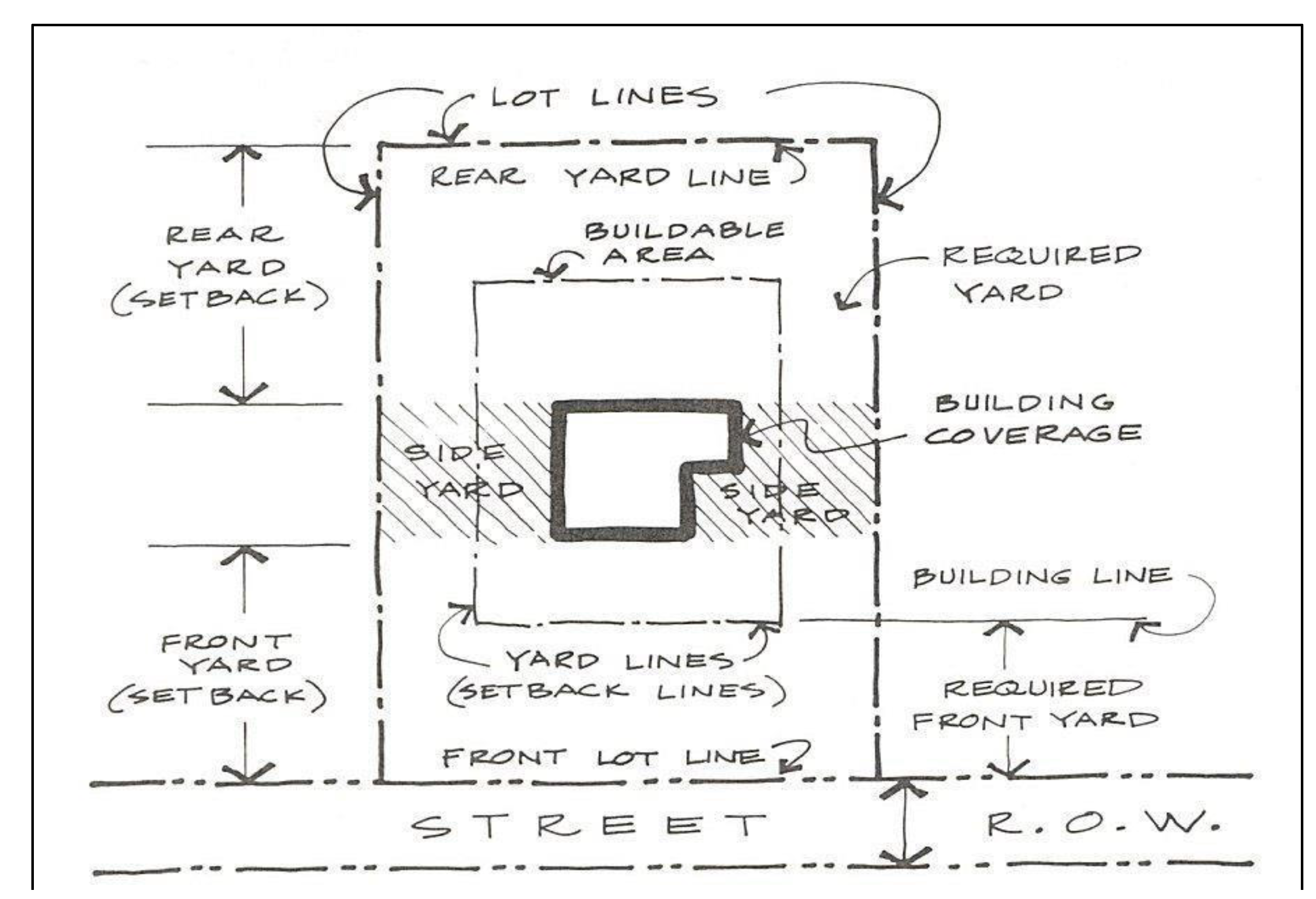
Yard, Front. An open space on the same lot as a principal building between the front line of the building (excluding steps) and the front lot or street line and extending across the full width of the lot.
Yard, Rear. A yard extending along the full length of the rear lot line of the zoning lot.
Yard, Side. A yard extending along a side lot line measured from the front yard to the rear yard.
Yard, Corner Side. A side yard, which adjoins a public street.
Yard, Interior Side. A side yard, which is locate immediately adjacent to another zoning lot or to an alley separating such yard from another zoning lot.
Yard, Transitional. That yard which must be provided on a zoning lot in a business-commercial district which adjoins a zoning lot in a residential district, or that yard which must be provided on a zoning lot in either a residential or business-commercial district.
Zoning Administrator. The official designated by the Town as the official responsible for enforcing and administering all requirements of the Town of Tappahannock Zoning Ordinance.
Zoning and Code Compliance Officer. An authorized agent of the Zoning Administrator whose duties involve the reviewing and approval of plats, subdivisions, site plans, and other planning, zoning, and land development documents to ensure compliance with the provisions of this ordinance and related ordinances, specifications, and regulations.
Zoning Overlay District. A district which is placed over the existing regular or parent zoning because of sighting of a zoning district or imposes additional restrictions and includes all those districts listed as Special Districts in this Ordinance.
Zoning Parent District. Those basic districts initially listed other than Special Districts in this Ordinance.
Zoning Permit. A document issued by the Administrator or the Zoning and Code Compliance Officer authorizing the use of lots, structures, lots and structures, and the characteristics of uses.
(Town Council Amended on 5-8-2017; Town Council Amended on 9-10-2018; Town Council Amended on 4-8-2019; Town Council Amended on 3-11-2024; Town Council Amended on 5-12-2025)

