Temple Terrace City Zoning Code
DIVISION 4
DOWNTOWN COMMUNITY REDEVELOPMENT PLAN OVERLAY ZONING DISTRICT
Sec. 12-282. - Title.
This division shall be known and may be cited as the "Temple Terrace Downtown Community Redevelopment Plan Overlay Zoning District."
(Code 2001, § 29.900)
Sec. 12-283. - Definitions of terms.
Unless specifically defined below or as defined in article II of this LDC, words or phrases used in this division shall have the meaning of common usage which gives this division its most reasonable application:
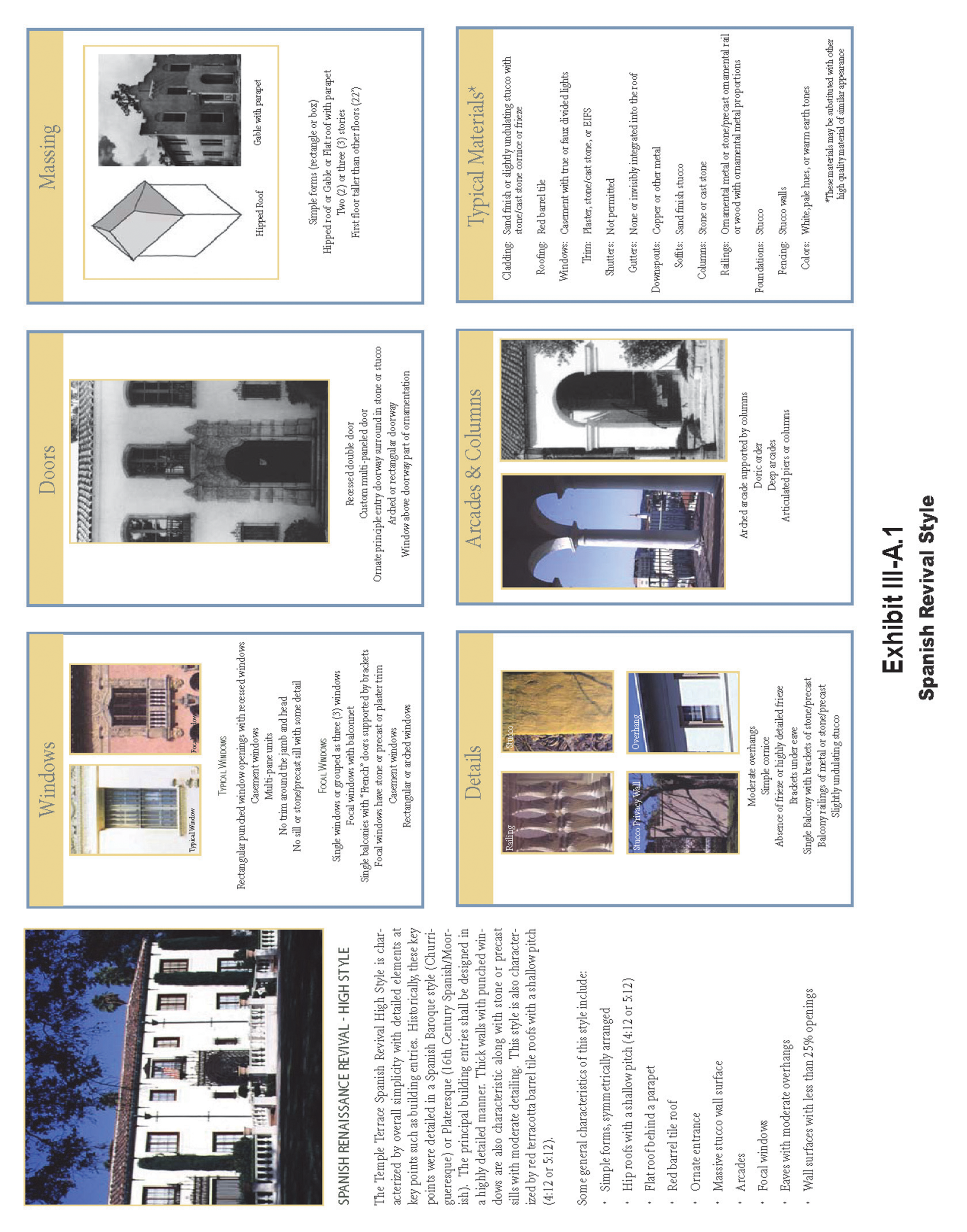
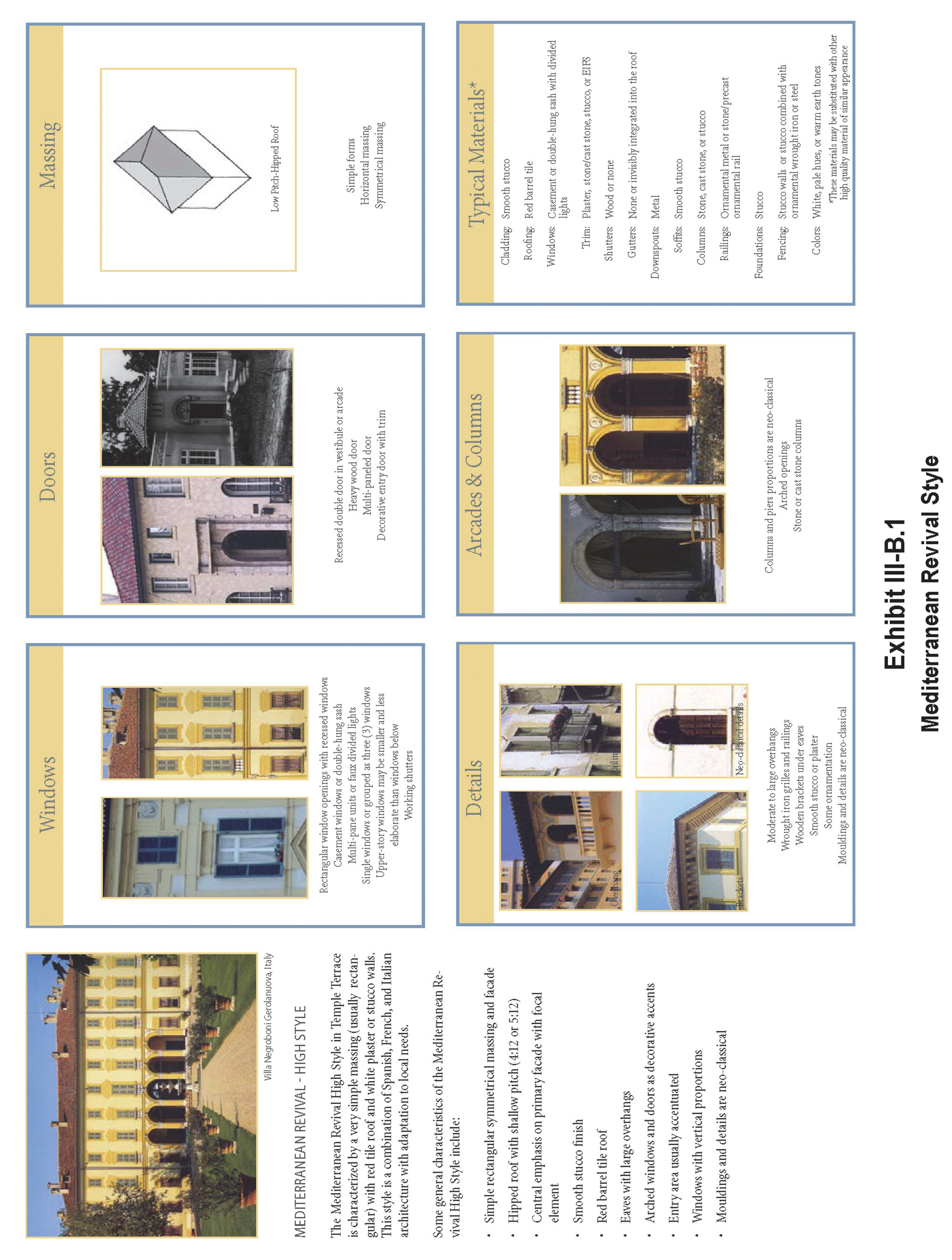
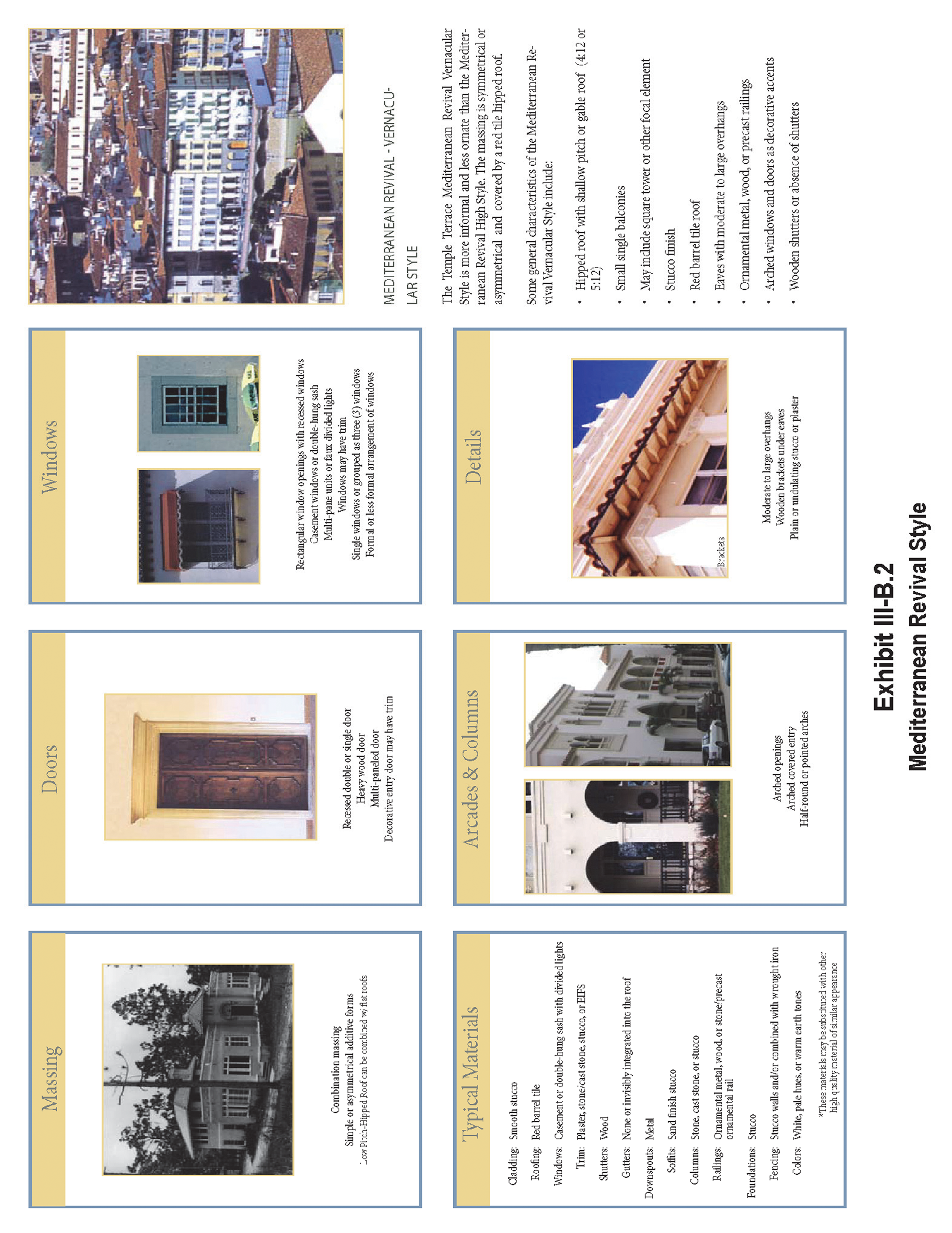
Architectural high style is a more refined and formal architectural design style based on its historical origins that is predicated upon formal and specific rules within a particular style and is characterized by a higher level of composition and design details. Illustrations of the design elements of the Temple Terrace Mediterranean Revival high styles are contained in Exhibits III-A—III-B following this division.
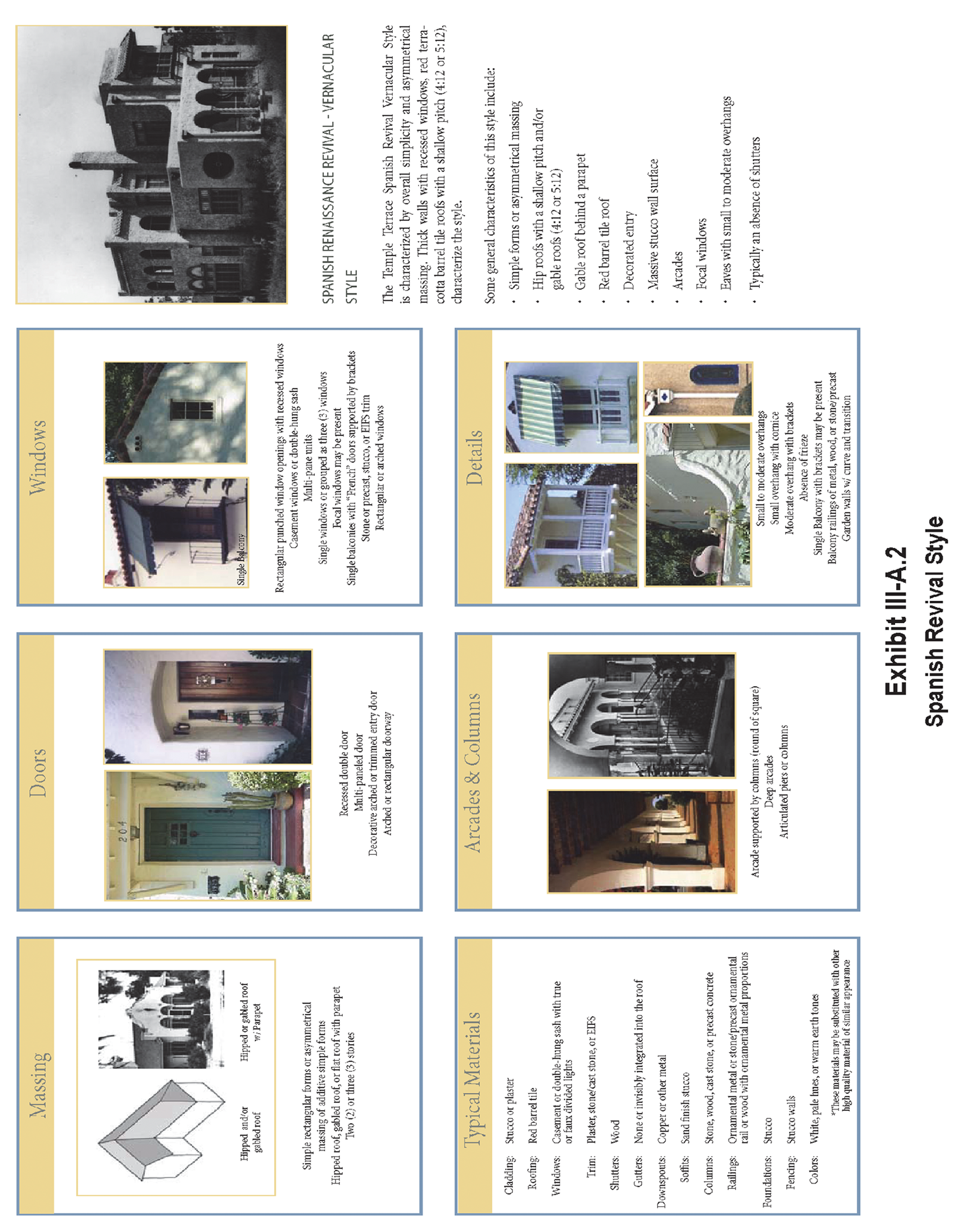
Architectural vernacular style is a style that developed "naturally" in response to local climate, social, and economic factors over time. This architecture creates a more informal character and may be symmetrical or, more typically, asymmetrical in its composition, but exhibits less refined details than the High Style. Illustrations of the design elements of the Temple Terrace Mediterranean Revival vernacular style are contained in Exhibits III-A—III-B following this division.
Blank building wall means any building wall where transparent glazing is equal to twenty-five (25) percent or less of the wall area.
Build-to-line means a line parallel to the property line, along which a building or structure shall be built as specified by the classification of the adjacent street.
Building frontage means and is comprised of the front and street side yard setback areas and the building facade. The building frontage includes the dimensional depth of the building front yard setback, the portion of the building facade along the front yard and the architectural elements that make up the facade such as architectural style details, colonnades, shop fronts, stoops and entrances or balconies.
Compatibility is measured by how the design of a building or project relates to the design elements of the surrounding natural/physical and manmade environments. Compatibility measures include, but are not limited to, building scale, mass and form; building relationship to the street; transitions in building height and; the use of building materials and harmonious reoccurrence of significant facade design features such as window patterns/rhythms, cornice lines and roof lines.
Design elements means the features of a building which includes architectural style, roof and facade details (cornices, arches, building materials), the rhythm (pattern and spacing) and proportion of windows, porches, doors, and vertical and horizontal features (columns, lintels).
Fenestration means the arrangement of windows, doors and other exterior openings on a building.
Focal design elements means design features such as towers, cupolas, dormers, parapets or other unique roof features that create a visual emphasis particularly at street corners to the vertical elements of a building.
Mediterranean Revival Style is defined and illustrated in Exhibits III-B.1 and III-B.2 following this division
Retail means any building that is used or designed and constructed for the display and sale of products purchased on a frequent basis. Products sold may include, but not be limited to, household goods, groceries, furniture, appliances, sale of food and/or beverages (consumption on-site and/or take-out), home entertainment equipment, specialty retail, retail banking, art, jewelry, florists, apparel and footwear, books and stationary, appliances, and camera and art supplies.
Spanish Renaissance Revival Style is defined and illustrated in Exhibits III-A.1 and III-A.2 following this division.
Substantial expansion of existing development as used in this LDC shall be defined as any expansion or redevelopment of an existing site and structure that exceeds fifty (50) percent of its current valuation (land and improvements) as identified by the county property appraiser at the time a development application is submitted to the city. Further, substantial expansion shall also mean any cumulative expansion or redevelopment of an existing site and structure that exceeds fifty (50) percent of its current valuation over a consecutive two-year period.
Unified development is defined as a group of buildings that are either under single ownership or are reviewed by site plan or PUD as a single project.
(Code 2001, § 29.930; Ord. No. 1340, § 1, 4-16-2013)
Sec. 12-284. - Purpose and intent.
The purpose of this division is to:
(1)
Implement the Temple Terrace Downtown Community Redevelopment Plan (Adopted May 15, 2001), and the Downtown Temple Terrace Revitalization Master Plan (January 31, 2005), which establish the basis for the city's vision of the downtown.
(2)
Implement the Downtown Mixed Use District (DMU-35) comprehensive plan future land use category and mobility fee exemption area.
(3)
Recognize the dependency of commercial buildings and development on having high visibility from the public street. Therefore, the design of building(s) and sites determines much of the image and attractiveness of the streetscapes and character of a community. Massive and/or generic developments that do not contribute to, or integrate with, the community in a positive manner can be detrimental to a community's image, and sense of place. The goal is to create and maintain a positive ambiance, pedestrian-oriented scale of development, and strong community image and identity by providing for architectural and site design standards that will enhance the visual appearance of commercial development within the Temple Terrace Downtown Community Redevelopment Plan Area, as well as the city as a whole, while still providing for design flexibility. These standards are intended to enhance the quality of life in the city.
(4)
Establish design guidelines and development standards for the Temple Terrace Downtown Community Redevelopment Plan Area that:
a.
Ensure that the design and development of the public realm and private property are coordinated and tailored to provide high quality development.
b.
Ensure that buildings that face the public realm have architectural designs with detailed facade features to create a pedestrian-scale streetscape and orient parking and service functions to the rear of buildings and interior of blocks.
c.
Create a mixture of uses to include shops, workplaces, residences and civic buildings.
d.
Ensure a design and scale transition of uses and building scale from the downtown core to the adjacent established residential neighborhoods.
(5)
Establish a process for the review of all development within the Temple Terrace Downtown Community Redevelopment Plan Area to evaluate compliance with the provisions of this LDC.
(Code 2001, § 29.905; Ord. No. 1399, § 1(Exh. A), 7-19-2016)
Sec. 12-285. - Temple Terrace Downtown Community Redevelopment Plan Area.
The area referred to as the "Temple Terrace Downtown Community Redevelopment Plan Area" consists of approximately two hundred twenty-five and thirty-one hundreds (225.31) acres that is bounded on the south by the Hillsborough River; on the west by the city limits (less the residential property fronting on Rainbow Drive, Shirley Drive, Grandview Drive, Ridgeway Drive, Riverhills Drive and Beverly Drive south of Grove Hill Road; on the north by the properties fronting on Temple Heights Road to Beverly Drive and the property south of 98th Avenue/Linda Avenue (extended); and on the east by Ridgedale Road, Sunnyside Road, Shadow Lane and Springdale Place. A map and legal description of the Temple Terrace Downtown Community Redevelopment Plan Area is found in Exhibit I following this division.
(Code 2001, § 29.910)
Sec. 12-286. - Development review process.
(a)
With the exception of city-owned lands described in division 5 of this article, Downtown Overlay District, all rezoning requests for property located within the Temple Terrace Downtown Community Redevelopment Plan Area shall be in the form of Planned Development (PD) District rezoning petitions, reviewed and processed pursuant to section 12-235 and other applicable provisions of this LDC.
(b)
All development plans and/or permits shall be reviewed by the city's Development Review Committee (DRC) for compliance with the guidelines and standards in this LDC. The DRC review shall be conducted pursuant to the procedures established in sections 12-74 and 12-377 and all other provisions not in conflict with this LDC. The DRC may recommend approval, approval with conditions or denial of any development plans and/or permits reviewed pursuant to this LDC.
(c)
The DRC may recommend to the city council the granting of waivers, for good cause shown, from the strict application of the design guidelines and standards of this LDC. In reviewing waiver requests from this LDC, the DRC shall consider the overall intent, purpose and objectives of the Temple Terrace Downtown Community Redevelopment Plan, Downtown Temple Terrace Revitalization Master Plan, Downtown Mixed Use-35 future land use category and provisions of this LDC in formulating recommendations.
(d)
Final approval, approval with conditions or denial of all development plans and/or permits may be granted by city council pursuant to the provisions of this LDC.
(e)
In the event that there are any conflicts and/or inconsistencies between this division and the rest of this LDC, the provisions of this article shall prevail. If there is any dispute about which provisions shall prevail, such dispute shall be decided by the city council.
(Code 2001, § 29.915; Ord. No. 1399, § 1(Exh. A), 7-19-2016)
Sec. 12-287. - DRC appeal process.
Decisions of the development review committee (DRC) may be appealed to the city council pursuant to the provisions of this LDC.
(Code 2001, § 29.920)
Sec. 12-288. - Development design guidelines and standards.
(a)
All rezoning petitions, new developments and/or substantial expansion of existing developments on property located within the Temple Terrace Downtown Community Redevelopment Plan Area shall be consistent with the design guidelines and standards contained in this article. A single-family dwelling unit existing at the time of the adoption of this division is exempt from the requirements of this LDC, with the exception of section 12-290(d). Master plans or site plans approved by the city council prior to the adoption of this LDC are exempt, unless there is a modification that requires site plan review or the approval expires prior to issuance of a building permit.
(b)
Waivers to any design guidelines and standards shall only be approved by the city council. A waiver may be granted, provided the waiver is consistent with the intent and purpose of this LDC and the city council finds that:
(1)
There are extraordinary and exceptional conditions pertaining to the particular piece of property in question because of its size, shape or topography;
(2)
The application of the provisions of this LDC to the particular piece of property would create an unnecessary hardship;
(3)
Such conditions are peculiar to the particular piece of property involved;
(4)
Relief, if granted, would not cause substantial detriment to the public good or impair the purposes and intent of this LDC; and
(5)
Any waiver granted shall be the minimum waiver which makes possible the reasonable use of the land, building, or property.
(c)
Waivers may be granted to this LDC for religious and educational institutions existing within the Temple Terrace Downtown Community Redevelopment Plan Area at the time of the adoption of this LDC notwithstanding the above criteria.
(Code 2001, § 29.925)
Sec. 12-289. - Block perimeter standards.
(a)
There is a relationship between block size and pedestrian friendly design and orientation. The smaller the block size, the greater its pedestrian orientation in terms of short walking distances and building facade designs that are pedestrian in scale. A block perimeter is defined as a land area bounded by three (3) or more streets, but does not include alleys.
(b)
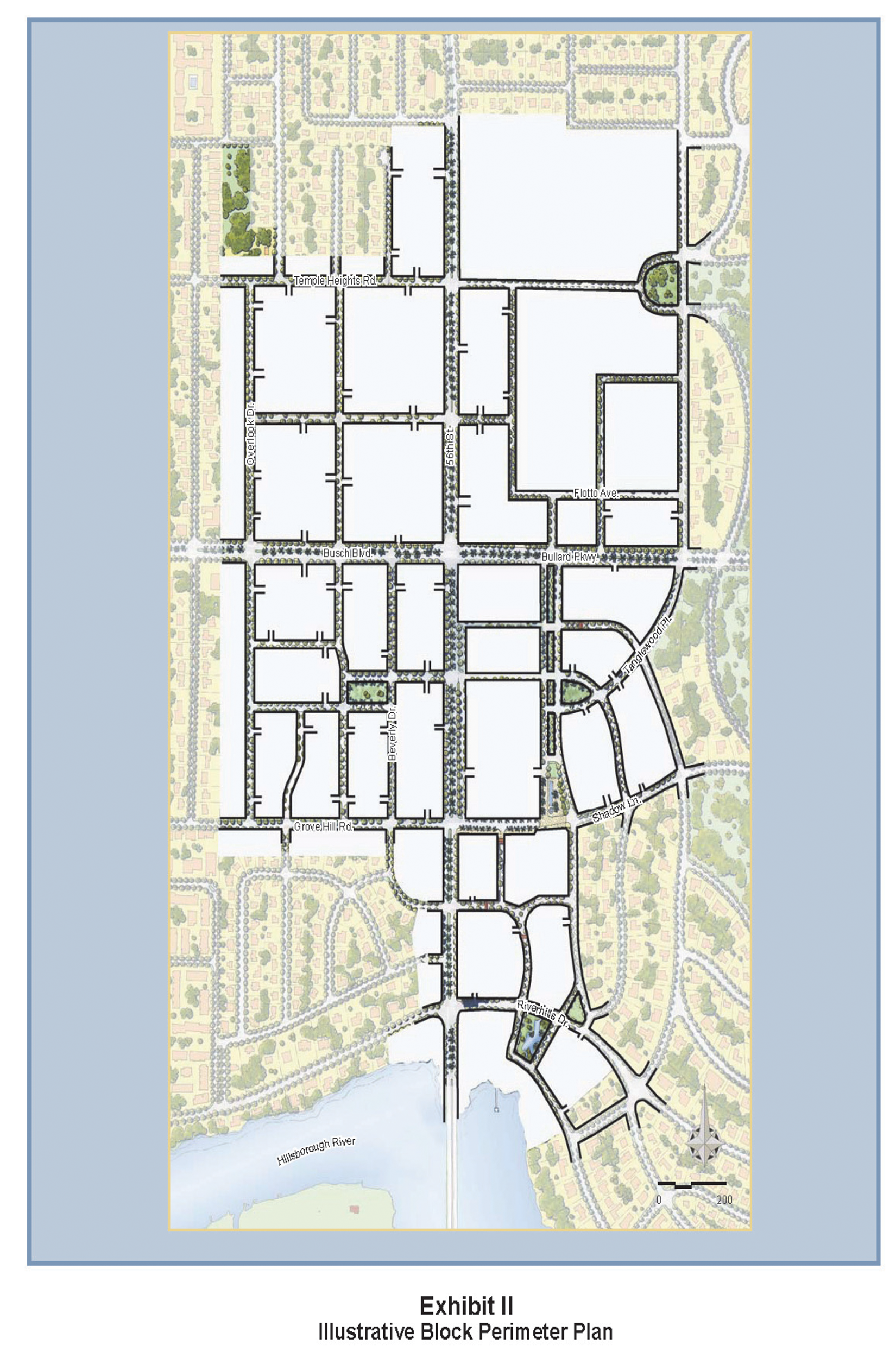
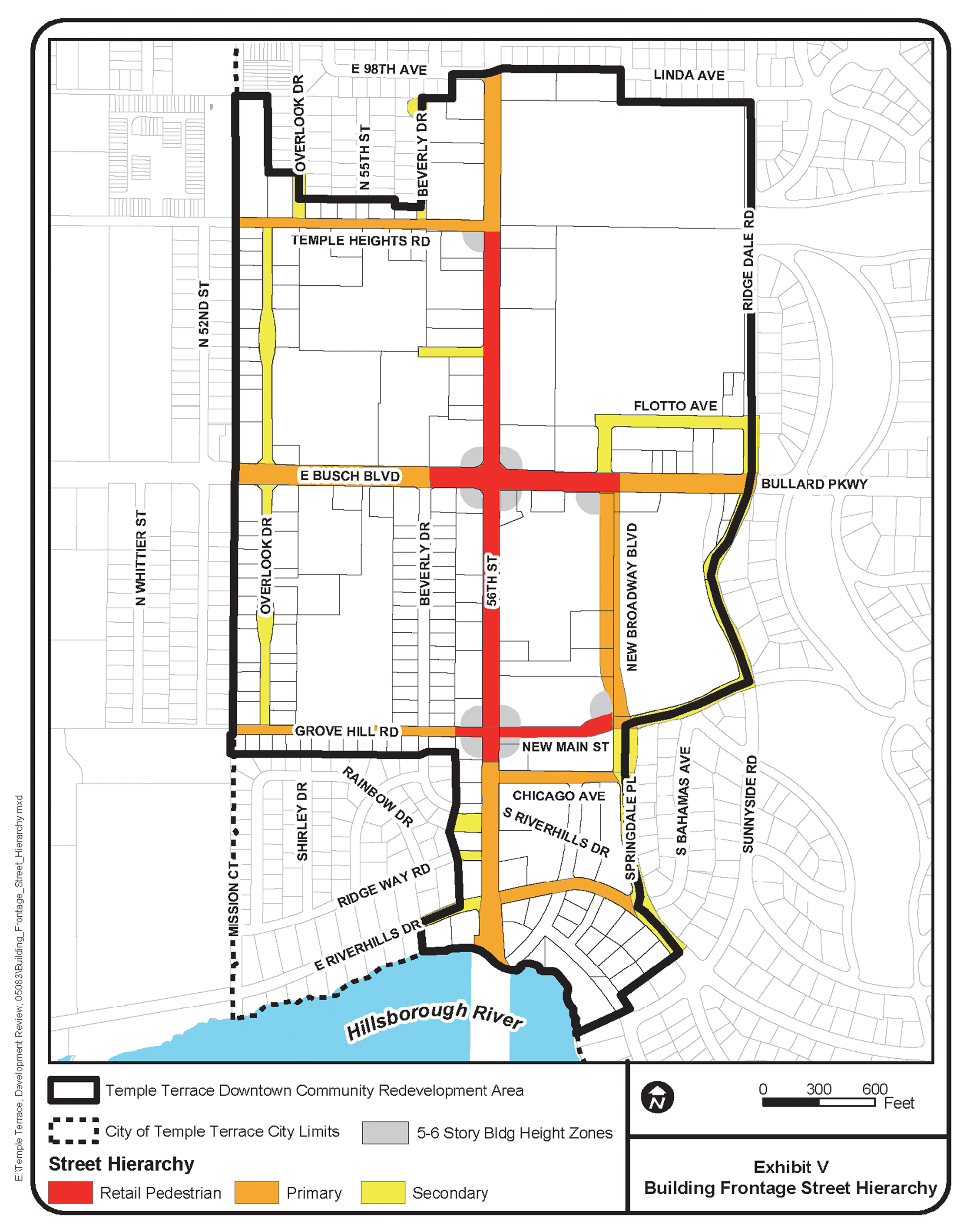
Block perimeter standards for new unified development that encompasses a block area ensure that new developments will be connected to adjacent development along streets, and where appropriate along alleyways to enhance service and parking functions. Block perimeter standards are a function of the degree of pedestrian orientation desired for a particular street frontage. The block plan as shown in Exhibit II following this division illustrates the intent of the block perimeter standards. However, individual parcel developments may require modifications to this plan to fit specific development block size requirements. The streets within the Downtown Community Redevelopment Area are classified in a pedestrian oriented hierarchy of most to least importance. The classifications are Retail Pedestrian, Primary and Secondary Streets (Exhibit V following this division). The following block perimeter standards apply to these street classifications:
(1)
Retail pedestrian street. The maximum block perimeter shall be one thousand six hundred (1,600) linear feet or two thousand two hundred fifty (2,250) linear feet if all parking is structured and located internal to the block.
(2)
Primary and secondary streets. The maximum block perimeter shall be one thousand five hundred (1,500) linear feet or one thousand eight hundred (1,800) linear feet if all parking is structured and located internal to the block.
(c)
Where new development creates new street networks, such new streets shall be aligned with the adjacent existing street network. At least two (2) of the new streets shall be classified as the highest street classification of the adjacent streets.
(Code 2001, § 29.925.1)
Sec. 12-290. - Architectural styles guidelines.
(a)
New development and/or substantial expansion of existing development shall incorporate, at minimum, architectural design elements consistent with one of the following architectural styles: Spanish Renaissance Revival or Mediterranean Revival as defined and illustrated in Exhibits III-A.1—III-B.1 following this division. Development shall include all of the following major design elements as illustrated in Exhibits III-A.1—III-B.1:
(1)
Massing.
(2)
Building facade materials and color.
(3)
Roof form, details and materials.
(4)
Window treatments.
(5)
Building entrance features/details.
(b)
A development project with multiple buildings shall have a consistent architectural style and use of materials throughout the project.
(c)
New development and/or substantial expansion of existing development shall include facade elements that provide shade along the street frontage such as awnings, canopies, arcades or colonnades and provide an additional design element related to the above-referenced architectural styles, such as iron gates, tile fountains, cast terra cotta, wood work, stenciled ornaments, balconies or similar design features as part of a building facade, building frontage and/or zoning lot front yard.
(d)
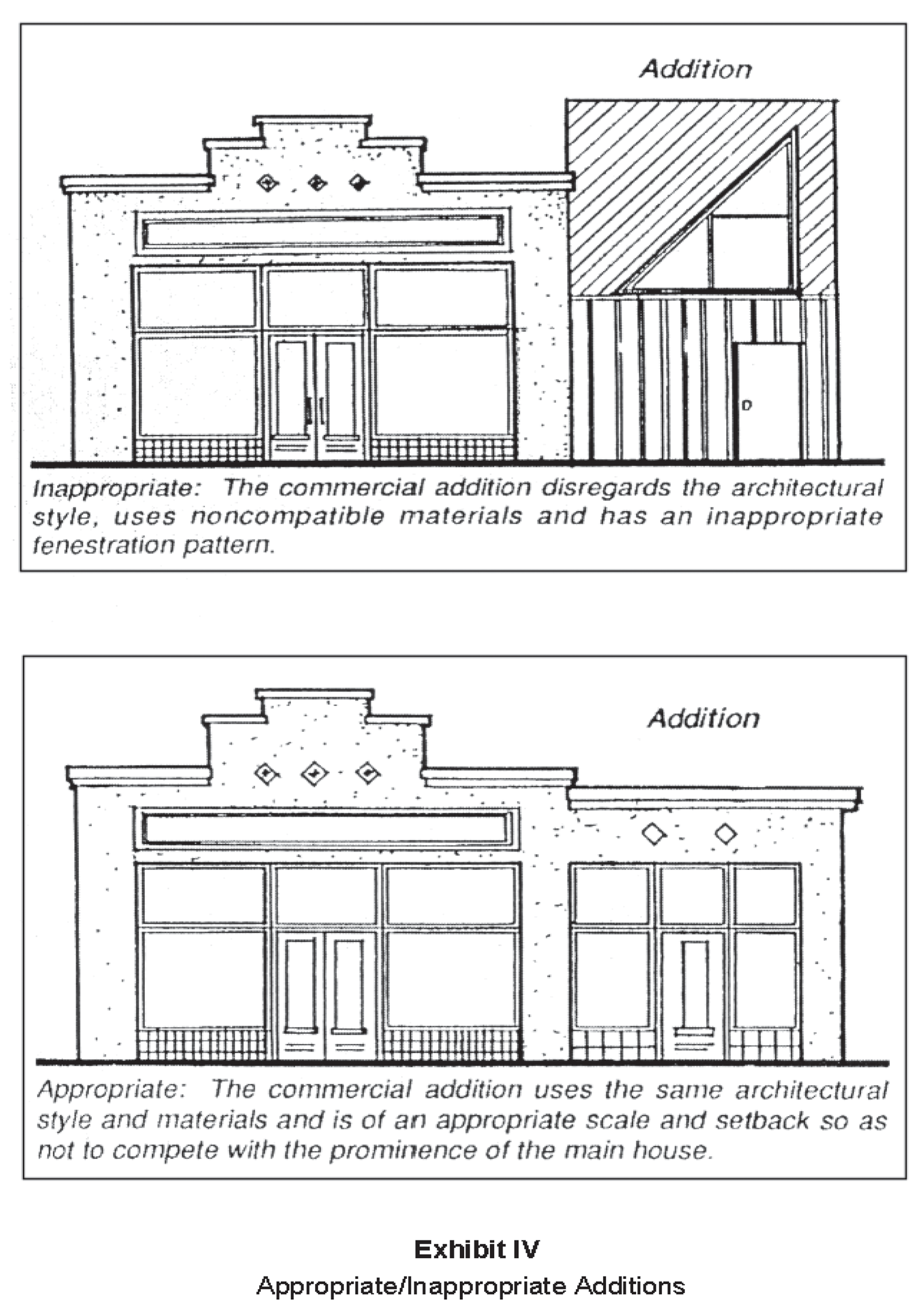
The architectural style of additions that do not meet the definition of substantial expansion to an existing building shall be compatible with the existing building in design elements including, but not limited to, style, form, height, materials, color, and details (Exhibit IV following this division). An addition shall be located in a manner that maintains the integrity or prominence of the principal building. Where feasible, efforts shall be made to incorporate design concepts and elements consistent with the Spanish Renaissance Revival, Mediterranean Revival, or St. Augustine Spanish Colonial architectural styles on the principal building and addition.
(Code 2001, § 29.925.2; Ord. No. 1340, § 1, 4-16-2013)
Sec. 12-291. - Building frontage and build-to-line standard.
(a)
Building frontage and build-to-line standards are based on the hierarchical classification of streets as retail pedestrian street, primary street or secondary street, as shown on Exhibit V following this division.
(b)
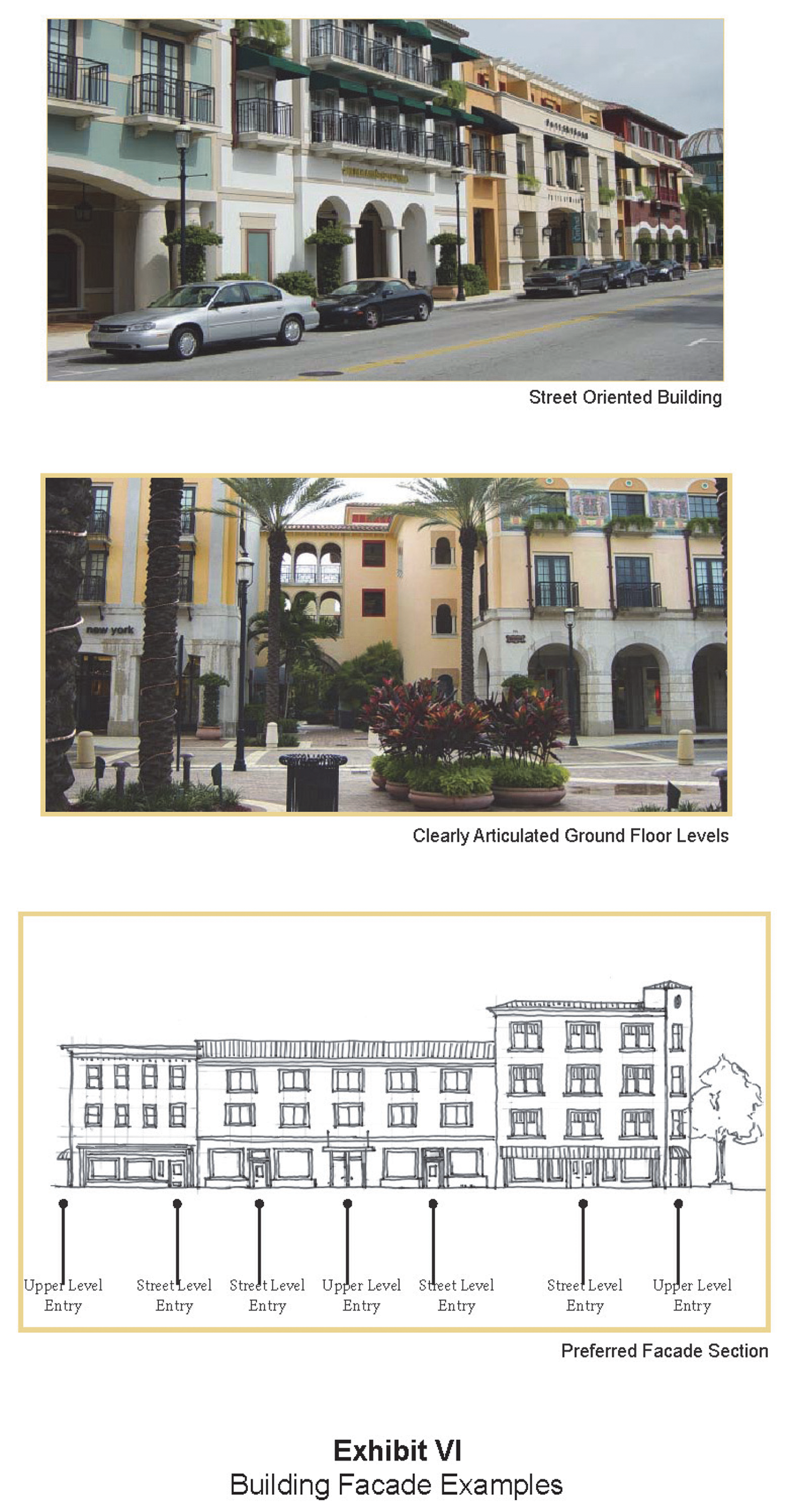
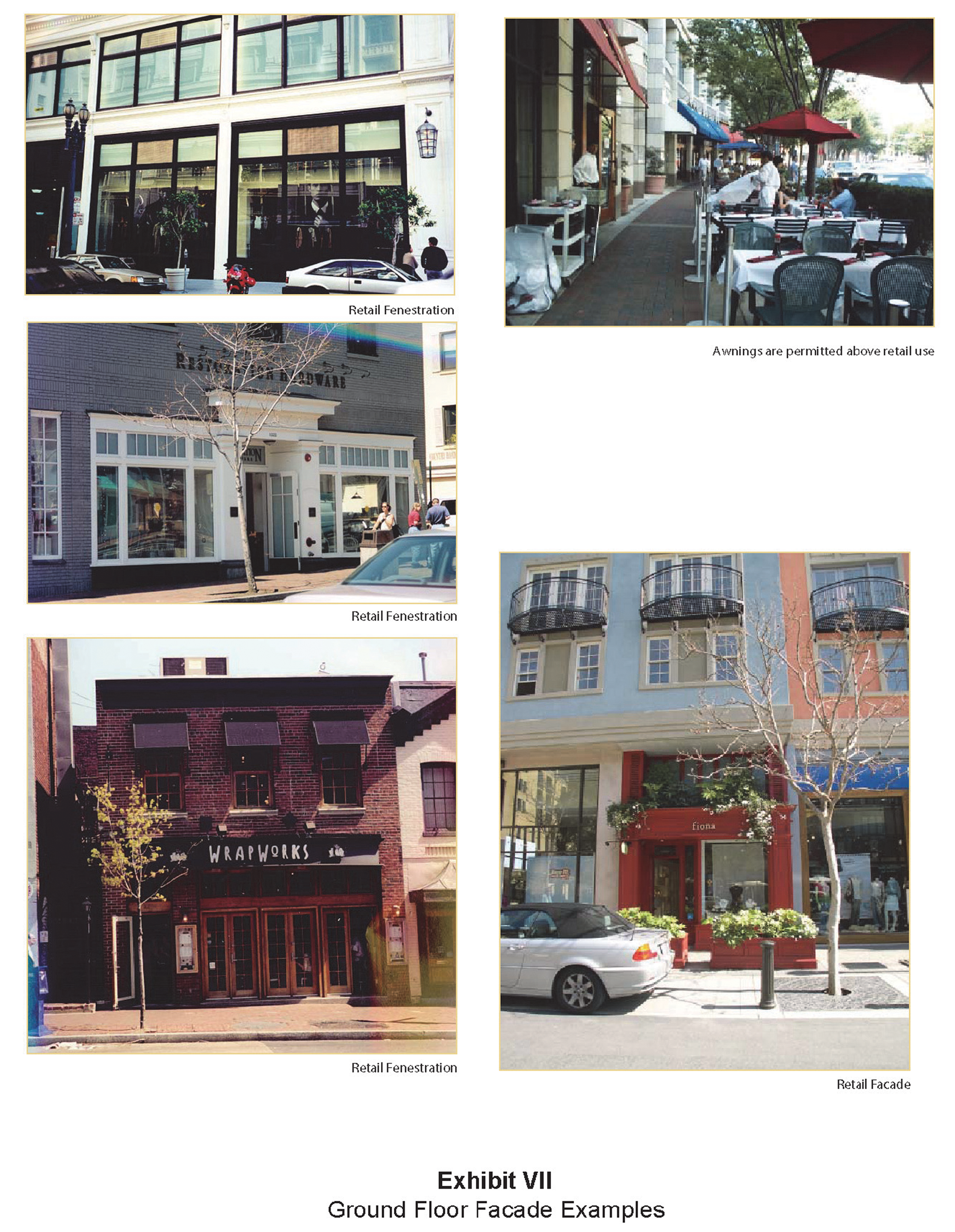
The design standards described below and illustrated in Exhibits VI, VII and VIII following this division shall apply to all development along retail pedestrian streets:
(1)
Building masses and facades along the street shall be articulated with windows, store fronts and entryways oriented to the sidewalk and the street. Variations in exterior building wall plane in depth or articulation (such as use of columns) is encouraged to avoid a monolithic appearance.
(2)
Buildings that are part of a unified development shall line along the street to create a continuous building frontage along each street. At least ninety (90) percent of the total street frontage shall have a continuous building frontage.
(3)
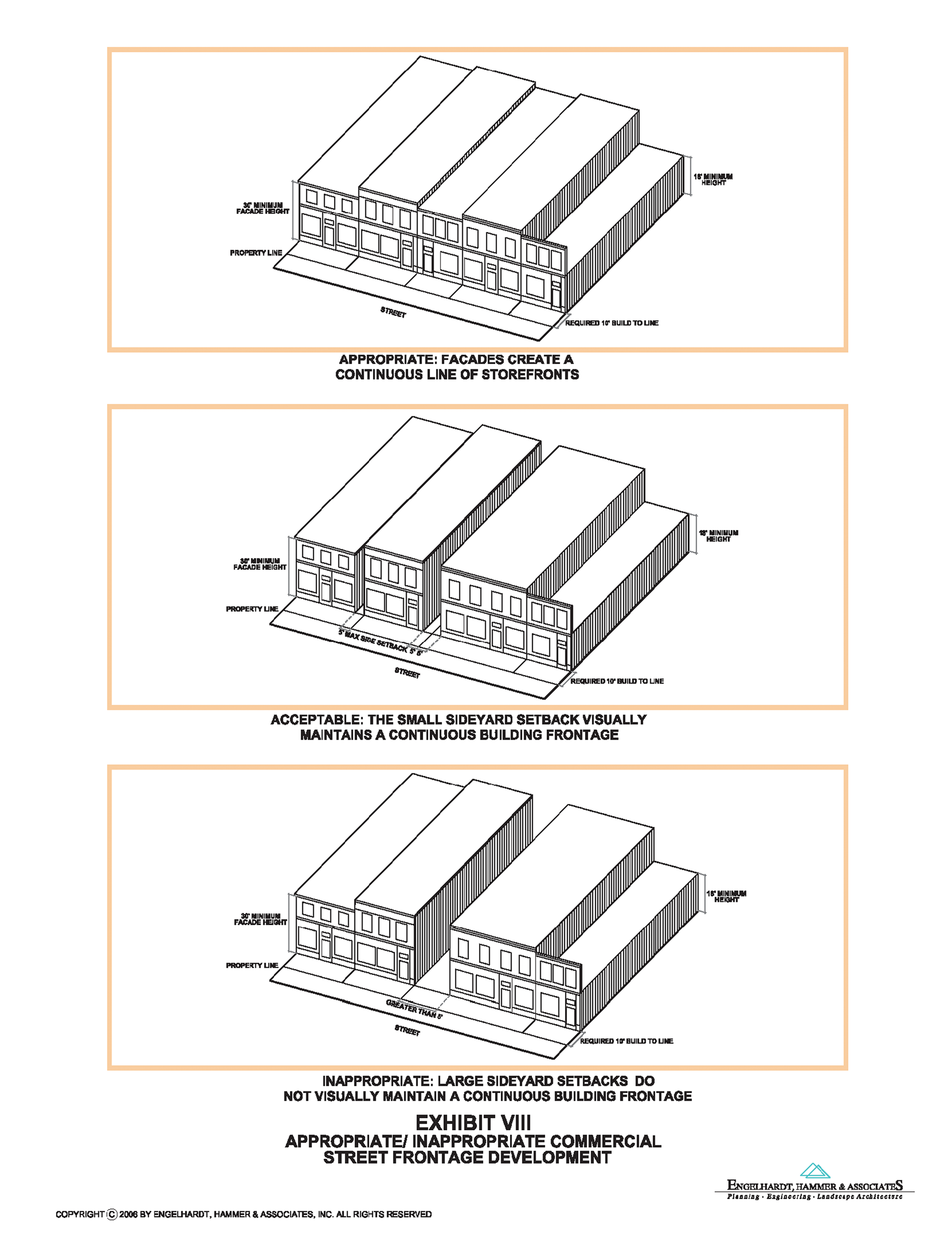
A building that is on a single parcel and not defined a part of a unified development is encouraged to create a continuous building frontage with the adjacent parcels by having zero (0) side yard setbacks (Exhibit VIII following this division). However, such building may have side yard setbacks of not greater than five (5) feet from the property line, except as provided for in section 12-294.
(4)
The distinction between ground floor level and upper floor levels shall be clearly articulated.
(5)
The ground level facade shall have architectural fenestration that creates a pedestrian-scale streetscape. The minimum ground floor ceiling height shall be eighteen (18) feet. The minimum building frontage height shall be two (2) stories or thirty (30) feet. The ground level facade shall have a minimum seventy (70) percent of its total area in transparent glazing up to a height of sixteen (16) feet. The maximum percentage of glazed area that may be blocked by interior fixtures or signage along any street front is thirty (30) percent.
(6)
All retail development shall be at the ground floor level. One hundred (100) percent of the ground floor building frontage shall be designed for and occupied with retail uses.
(7)
Building frontage design elements shall include the use of awnings, arcades or colonnades, or similar features to provide pedestrian comfort zones. Arcades or colonnades may be located at the property line.
(8)
Blank building walls are prohibited on the street frontage and where side or rear walls of buildings are visible from the street. Where side and rear walls are not visible from the street blank walls are discouraged.
(9)
Buildings shall meet the build-to-line, which supersedes any zoning district front or street side yard setback requirement. The build-to-line shall be ten (10) feet from the property line adjacent to right-of-way.
(10)
The pavement finish (for example, patterns, materials, texture, color) in the setback area between the building and the property line shall be consistent with and/or match the existing and/or planned pavement treatment of the adjacent public space and/or sidewalk.
(11)
New development shall maintain a compatible relationship with the surrounding development relative to architectural styles, facade design elements, build-to-lines, building mass, scale and height.
(c)
The design standards described below and illustrated in Exhibits VI, VII, VIII and IX following this division shall apply to all primary and secondary streets:
(1)
Building masses and edges along the street shall be articulated with windows, store or office fronts, green yards/porches (residential) and entryways oriented to the sidewalk and the street. Variations in exterior building wall plane in depth or articulation (such as use of columns) is encouraged.
(2)
Buildings that are part of a unified development shall line along the street to create a continuous building frontage along each street. At least seventy (70) percent of the total street frontage shall have a continuous building frontage.
(3)
A building that is on a single parcel and not defined as part of a unified development is encouraged to create a continuous building frontage with the adjacent parcels by having zero (0) side yard setbacks (Exhibit VIII following this division). However, such building may have side yard setbacks of not greater than five (5) feet from the property line, except as provided for in section 12-294.
(4)
The distinction between ground floor level and upper floor levels shall be clearly articulated.
(5)
Blank building walls are prohibited on the street frontage and where side or rear walls of buildings are visible from the street. Where side and rear walls are not visible from the street blank walls are discouraged
(6)
Buildings shall meet the build-to-line, which supersedes any zoning district front or street side yard setback requirement. The build-to-line shall be ten (10) feet from the property line. Religious and educational institutions existing within the Temple Terrace Downtown Community Redevelopment Plan Area at the time of the adoption of the ordinance from which this article is derived are exempt from this standard.
(7)
Buildings shall be designed for retail, office, residential, recreational or cultural uses at the ground floor. The ground level facade shall have architectural fenestration that creates a pedestrian-scale streetscape. Where the ground level has retail and/or office uses, the facade shall have a minimum fifty (50) percent of its total area in transparent glazing up to a height of fourteen (14) feet. The minimum ground floor ceiling height shall be fourteen (14) feet. The minimum building frontage height shall be two (2) stories or twenty-five (25) feet. The maximum percentage of glazed area that may be blocked by interior fixtures or signage along any street front is thirty (30) percent.
(8)
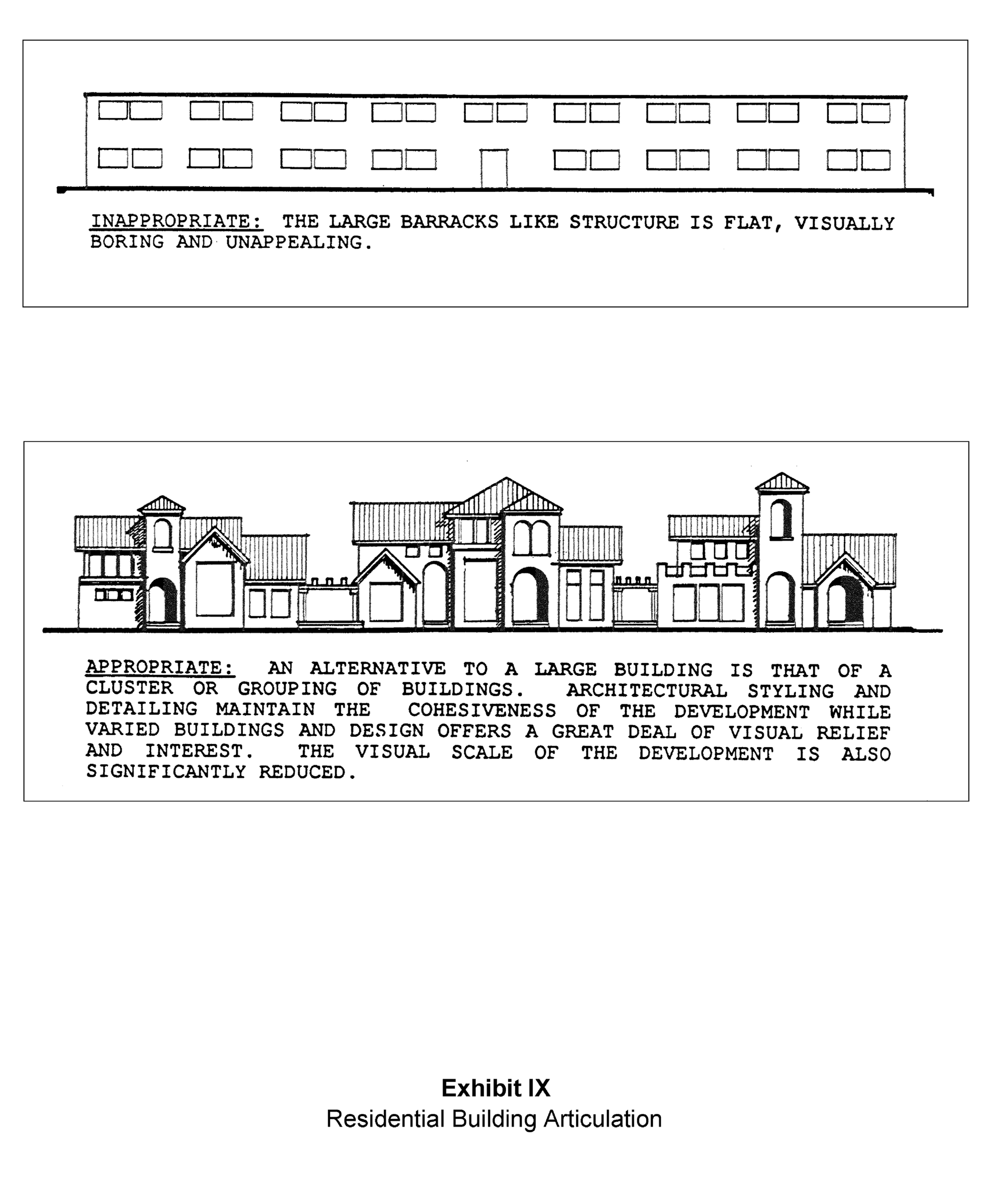
Residential projects with multiple or row type buildings shall provide separations and/or changes in building plane (facade and roof) to avoid the long barracks like quality imparted by flat long continuous walls and roofs (Exhibit IX following this division).
(9)
Commercial development shall provide pavement finish (for example, patterns, materials, texture, color) in the setback area between the building and the property line consistent with and/or match the existing and/or planned pavement treatment of the adjacent public space and/or sidewalk.
(10)
New development shall maintain a compatible relationship with the surrounding development relative to architectural styles, facade design elements, build-to-lines, building mass, scale and height.
(Code 2001, § 29.925.3)
Sec. 12-292. - Building height standards.
(a)
No buildings shall exceed six (6) stories or eighty (80) feet in height, whichever is more restrictive.
(b)
Buildings that are five (5) or six (6) stories in height shall be only permitted within one hundred (100) feet from where Retail Pedestrian Streets intersect or where a Retail Pedestrian Street and Primary Street intersect (Exhibit V following this division). Waivers may be granted to this provision for unified developments.
(c)
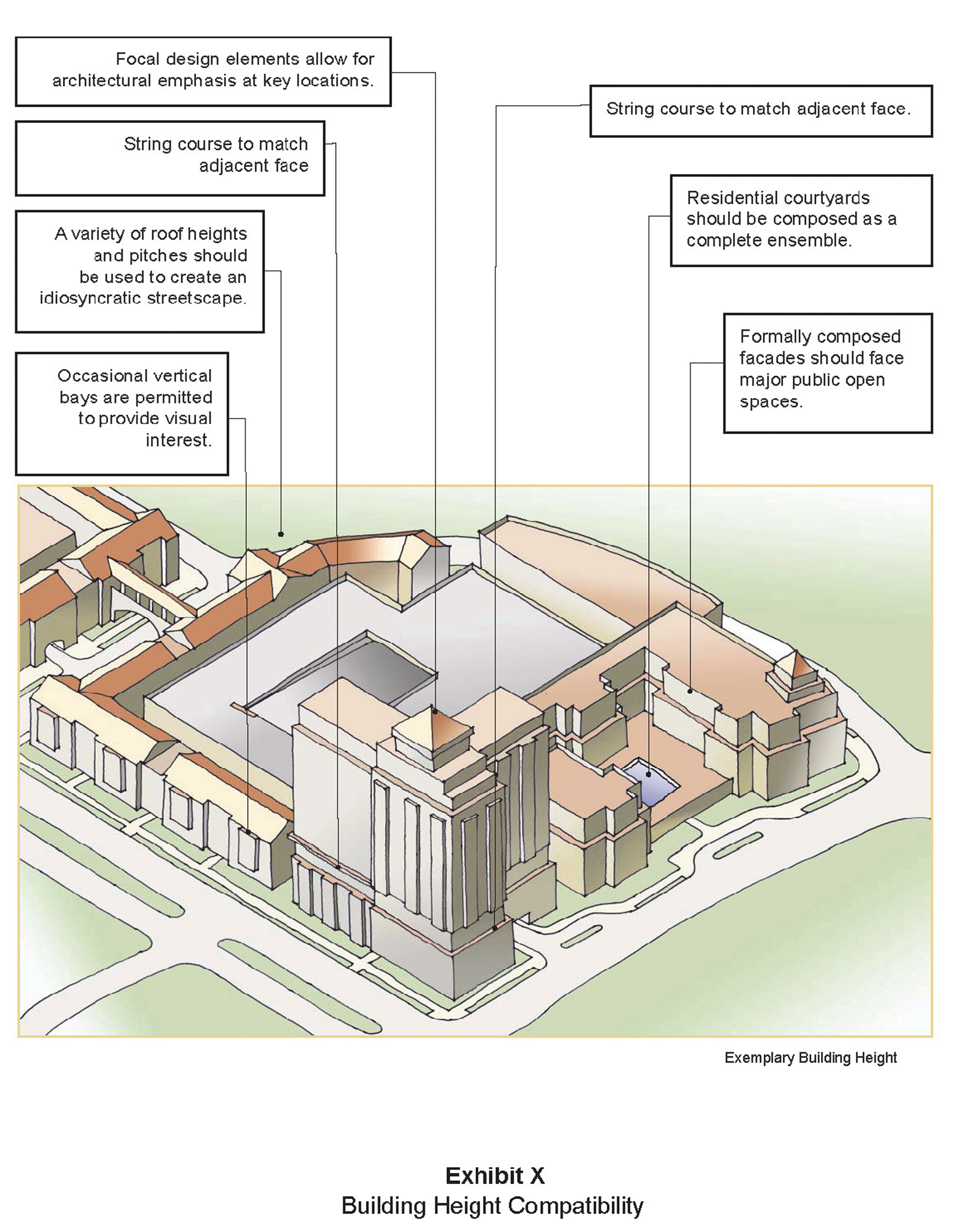
Where adjacent buildings are of different heights, design techniques that architecturally align facade elements and details through the use of such alignment features as balconies, windows, store fronts, or horizontal string courses shall be employed. The purpose of establishing architectural alignment between adjacent buildings is to establish a compatible and harmonious design relationship with adjacent and nearby buildings, and further, to establish and/or maintain a pedestrian-scale streetscape, as illustrated in Exhibit X following this division.
(d)
The maximum height of buildings adjacent to a single-family residential district shall be limited to two (2) stories or thirty-five (35) feet in height, whichever is more restrictive.
(e)
The maximum height of buildings across the street from a single-family residential district shall be limited to two (2) stories or thirty-five (35) feet in height, whichever is more restrictive.
(f)
Buildings of five (5) and six (6) stories in height shall utilize tapering and step back design techniques that reduce building bulk as building height increases (Exhibit X following this division).
(g)
Exceptions to the height limits are appurtenances, trellised roof decks and other similar structures covering not more than twenty-five (25) percent of a building's roof to which the structure is attached. These structures may exceed the maximum permitted height limits by up to ten (10) feet.
(Code 2001, § 29.925.4)
Sec. 12-293. - Accessory structures and site features.
Accessory structures and site features shall meet the following design guidelines:
(1)
Accessory structures and equipment shall be located in the rear yard or at the rear of the commercial building, and in the rear or side yard or at the rear of the residential building. Accessory structures such as sheds shall be the same architectural style, materials and color as the principal structure. Equipment such as heating and air-conditioning machinery, transformers and generators shall be screened with a wall, fence or landscaping in such a manner that the equipment is not visible to the public view.
(2)
Any required fencing or walls shall be decorative and compatible with the architectural style of the principal building and match the principal building in materials and color. Decorative masonry wall finishes and/or wrought iron are appropriate design materials for Spanish Renaissance Revival and Mediterranean Revival architectural style buildings. Wood, wood stockade and chain link fences are not appropriate fencing materials, and therefore, are not permitted.
(3)
Fence or wall planes shall provide for visual variations in the fence/wall plane. Therefore, wall/fence planes shall not extend more than fifty (50) feet without a significant variation in the fence/wall plane through the use of columns or patterned breaks in the fence/wall plane, and use of landscaping.
(4)
Dumpsters shall be enclosed with an opaque wall or opaque fencing that matches the materials and colors of the principal structure.
(5)
Site features such as stormwater ponds shall be located to the rear of the site where possible. Stormwater ponds are not permitted in the front yard, build-to-line area or along any street front. Ponds may be located in the side yard provided the perimeter of the pond has a minimum five-foot-wide landscaped buffer (trees and continuous hedge). Any required fencing or wall shall be a maximum of four (4) feet in height, located behind the landscaping and shall meet the fence/wall design requirements of this article.
(Code 2001, § 29.925.5; Ord. No. 1340, § 1, 4-16-2013)
Sec. 12-294. - Parking areas, loading areas and parking requirements.
(a)
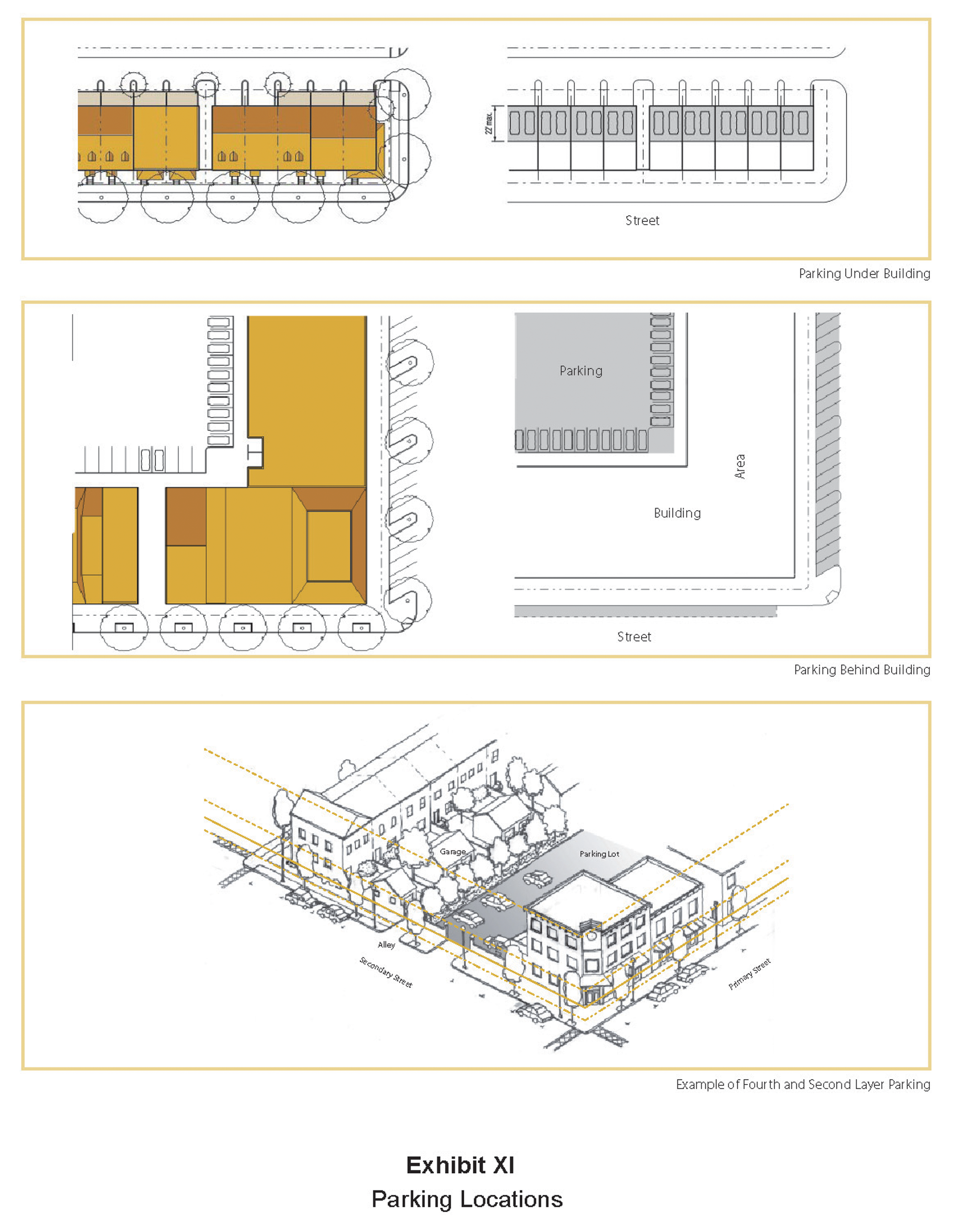
Parking lots, parking garages and loading areas shall meet the following locational criteria and design guidelines (Exhibit XI following this division):
(1)
Parking lots, parking garages and loading areas shall be located to the rear of buildings fronting along retail pedestrian streets and to the rear or side of buildings fronting along primary and secondary streets. Access to parking and loading areas shall be via the secondary street or alleyway. Driveways along retail pedestrian, primary and secondary streets existing at the time of the adoption of this article are required to be removed at the time substantial expansion or redevelopment occurs on the parcel in order to conform with the access requirements of this division.
(2)
In cases where access to a parking lot, garage or loading area is not available via an alleyway or secondary street, access to the parking/loading area shall be located along the side yard or at the side of the building, but no parking or loading is permitted in front of the building or within the street frontage build-to-line area. The access driveway area (driveway and landscaping) shall not exceed thirty (30) feet. A parking lot (access driveway and limited parking, but no loading) that fronts along a primary or secondary street shall not exceed more than fifty (50) percent of the total lot street frontage or a minimum of thirty (30) feet, whichever is greater. All parking lots including required landscape buffers that front along a retail pedestrian, primary or secondary street shall not be located within the build-to-line area.
(3)
Parking garages may front along a primary or secondary street provided the ground floor frontage is designed to accommodate commercial, office and/or recreational/cultural uses. All parking garages shall have decorative facades on all parking levels that front along streets, and such facades shall be designed in one of the architectural styles described in section 12-290. All parking garages shall meet the design guidelines set forth in sections 12-291 and 12-292.
(4)
Uses with drive-through service windows shall be limited to the side of buildings, or to the rear of buildings and accessed via secondary streets or alleys provided they do not substantially disrupt pedestrian activity or surrounding uses. Drive-through service windows shall be accessible by bicyclists.
(b)
Within the Downtown Community Redevelopment Area there shall be established a maximum number of parking spaces permitted within a development to ensure compliance with the DMU-35 plan category and promote pedestrian oriented development. The maximum parking permitted for residential, retail and office is as follows; all other uses shall comply with the minimum standards contained in this LDC:
(1)
Residential three (3) bedrooms or more: two and two-tenths (2.2) spaces per du.
(2)
Residential two (2) bedrooms or less: one and six-tenths (1.6) spaces per du.
(3)
Retail in mixed-use building: four (4) spaces per one thousand (1,000) gross square feet.
(4)
Freestanding retail: four and one-half (4½) spaces per one thousand (1,000) gross square feet.
(5)
Office in mixed-use building: three (3) spaces per one thousand (1,000) gross square feet.
(6)
Freestanding office: three and one-half (3½) spaces per one thousand (1,000) gross square feet.
(Code 2001, § 29.925.6; Ord. No. 1399, § 1(Exh. A), 7-19-2016)
Sec. 12-295. - Signs.
(a)
Only ground and wall signs shall be permitted, except for signs not requiring a permit pursuant to this LDC. One ground sign is permitted pursuant to this LDC for the C-G zoning district. In addition, one wall sign is permitted up to a maximum of twenty (20) percent of the wall area of the building facade, but not to exceed a maximum of one hundred twenty-five (125) square feet in sign area. Wall signs shall be placed on flat, unadorned parts of the building facade, such as the horizontal band between the store front (ground floor) and second floor or the equivalent wall sign area may be placed on awnings.
(b)
At the time of sign permit application or as part of the site plan review process, all projects shall develop a unified sign program for review and approval. The sign program shall address the coordination of the size, style, number, type and color scheme of all the signs to be erected on the site. (These regulations are not meant to regulate or approve the contents of the signage.) Signage for individual sites, while designed to satisfy the objective of expressing individual corporate image, must also be of a character and size consistent with the overall sign program. The following standards shall be incorporated in all new or modified signs:
(1)
All signs within a project shall be consistent in color, size, type and lettering style (font).
(2)
The property address shall be included on the project's wall or ground sign.
(Code 2001, § 29.925.7)
Sec. 12-296. - Site lighting.
The following light standards shall be incorporated into all nonresidential site improvement plans:
(1)
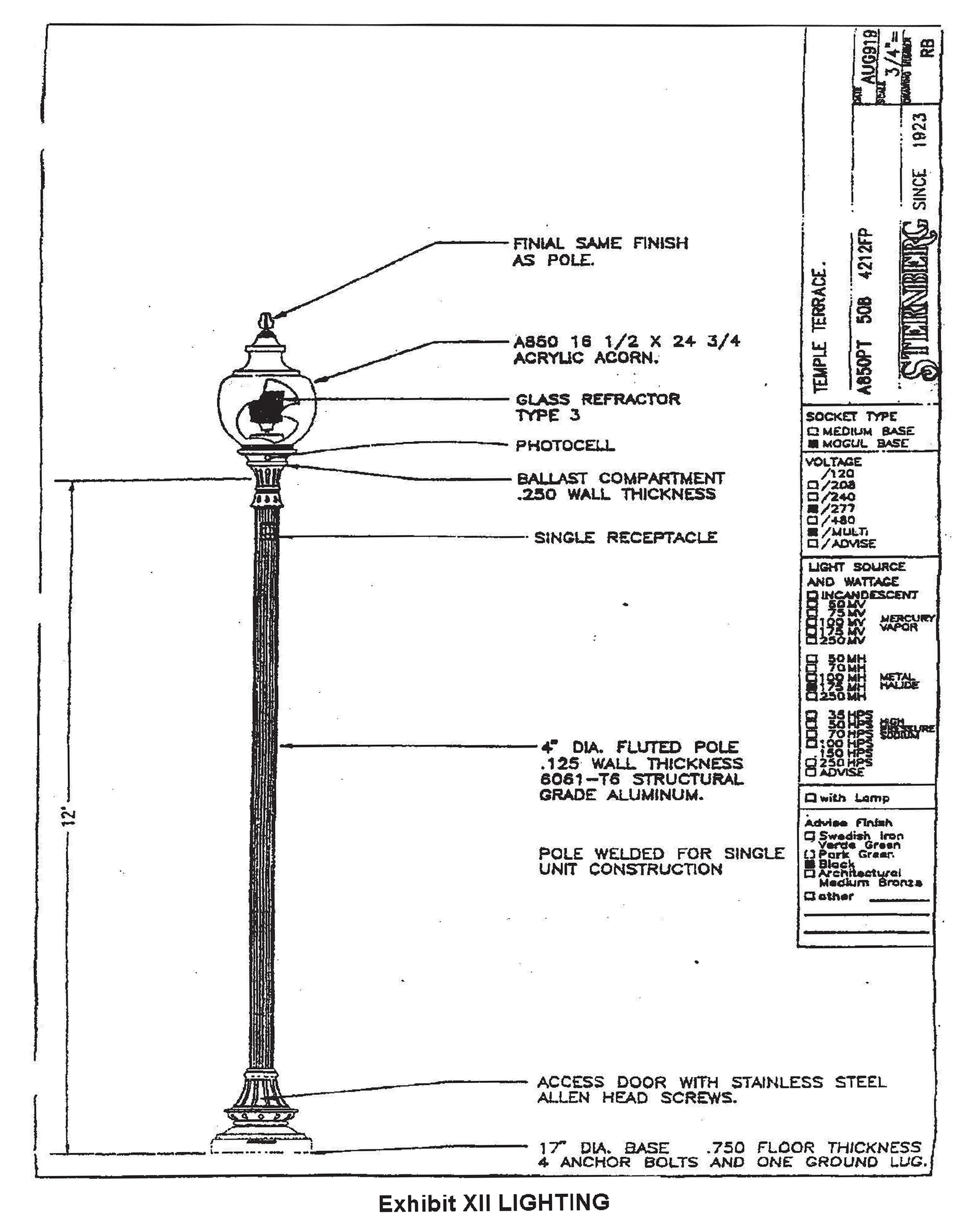
Ornamental poles shall be manufactured by Sternberg Vintage Lighting, or the equivalent thereof; ornamental poles shall be "Augusta Series," Model 4212-FP4, twelve (12) inches in height, standard finish-black, or the equivalent thereof.
a.
Poles shall be required only along Retail Pedestrian and Primary Streets where site plans are submitted for approval. This includes existing properties that are modified and required to follow the site plan approval process.
b.
Poles shall be spaced sixty (60) feet on center maximum, or one pole per sixty (60) linear feet of roadway frontage.
c.
Use of matching ornamental poles and light fixtures shall be encouraged for the interior portions of a site (i.e., parking lots).
d.
Poles shall be installed on concrete base pad. Base pad shall be circular.
(2)
Lighting fixtures shall be manufactured by Sternberg Vintage Lighting; fixtures shall be "Old Town," Model A850/508 polycarbonate acorn, or the equivalent thereof.
a.
Lamping: Metal Halide, 175 watt.
b.
Socket type: Mogul Base.
c.
Finial: Four-vaned, black (standard with fixture).
d.
Optic systems: Glass Refractor, Type III.
e.
Fitters: 508 Series fitter with ballast compartment.
(3)
Miscellaneous lighting accessories include:
a.
Banner arm: Single banner arms eighteen (18) inches by thirty-six (36) inches shall be specified for each pole located adjacent to the right-of-way. Banner arms are not required for internal site lighting.
b.
Single convenience receptacle: Convenience receptacle shall be required for all poles.
c.
Photocells: All street lighting shall utilize photocells to automatically control lights.
d.
Bollard lighting: "Augusta" 4201-LB (optional).
e.
Wall fixtures: "Old Town" A840 on No. 50 WB (optional).
f.
Street sign arm: Optional.
(Code 2001, § 29.925.8)
Sec. 12-297. - Public and private streetscape and open spaces.
(a)
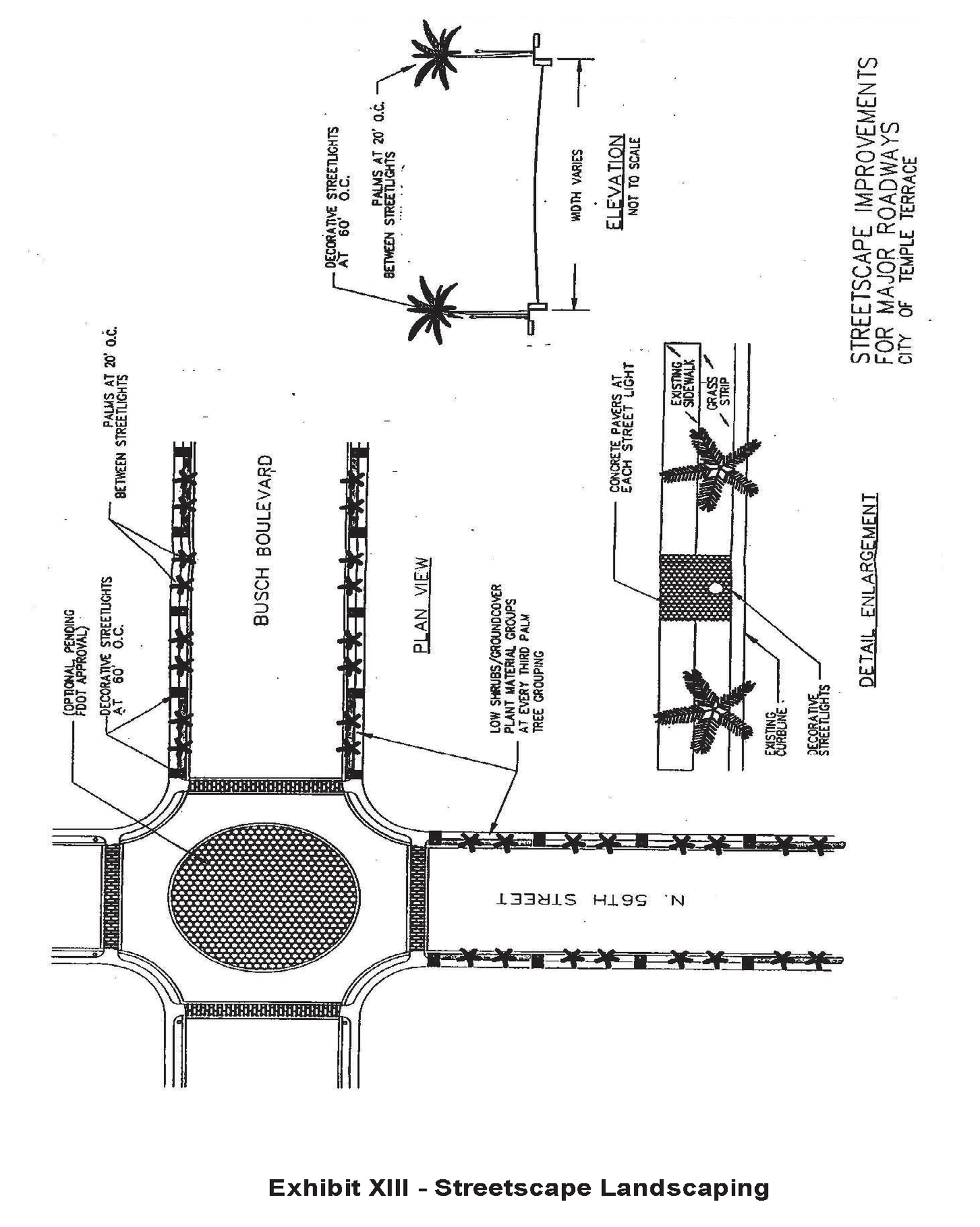
Street planting shall be installed along all major thoroughfares. Trees, shrubs and ground cover will be planted along 56th Street and Busch Boulevard. Landscape materials recommended are:
(1)
Palms along the arterial streets and seasonal annuals planted between the curb and the sidewalks at major intersections; and
(2)
Planter beds with low flowering shrubs (dwarf oleander or plumbago) used as color accent beds along arterial planting strips.
Streetscape improvements are shown in Exhibit XIII following this division.
(b)
Any proposed or required landscaping for private development that fronts along a street and/or is located within parking areas that front along a street pursuant to section 12-294 shall be compatible with the streetscape landscape plan shown in Exhibit XIII following this division by incorporating palm trees such as Royal Palm, Queen Palm, Date Palm or other similar type/scale palm trees in the design.
(c)
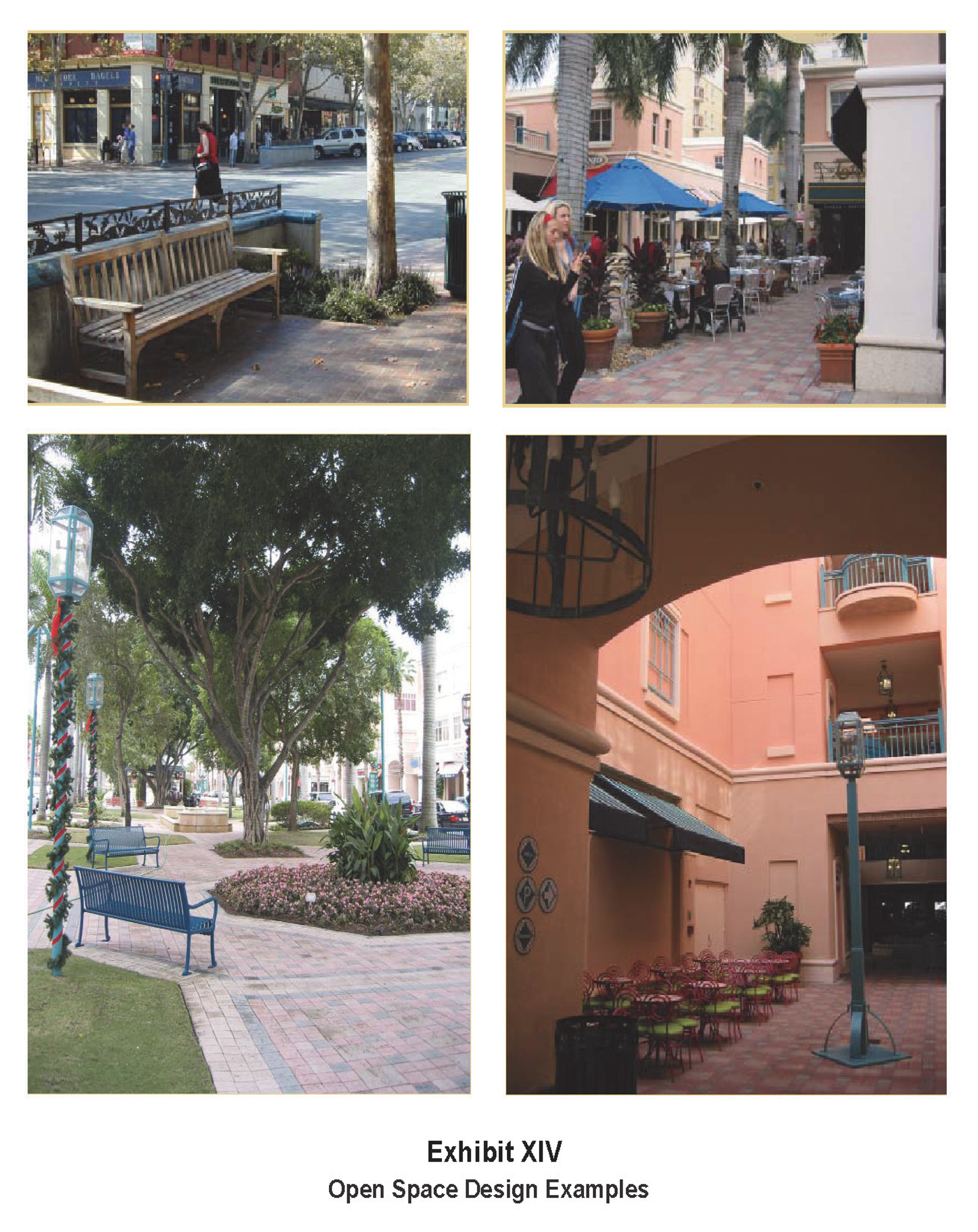
Private and public open spaces shall be located so as to provide for physical and visual connections to adjacent street/public sidewalk networks. Such open spaces shall include the following design features: pedestrian path hardscape materials (brick or stone pavers), water features (fountains, pools, artwork), artwork, and landscape areas (Exhibit XIV following this division).
(d)
Where open spaces abut retail pedestrian streets, open space areas shall provide seating areas and shade (canopies, tables with umbrellas, shade trees and/or awnings) (Exhibit XIV following this division).
(e)
To the greatest extent possible, private and public open spaces shall interconnect physically to create an interconnected system of open spaces throughout the Downtown Redevelopment Area.
(Code 2001, § 29.925.9)
Sec. 12-298. - Color palette.
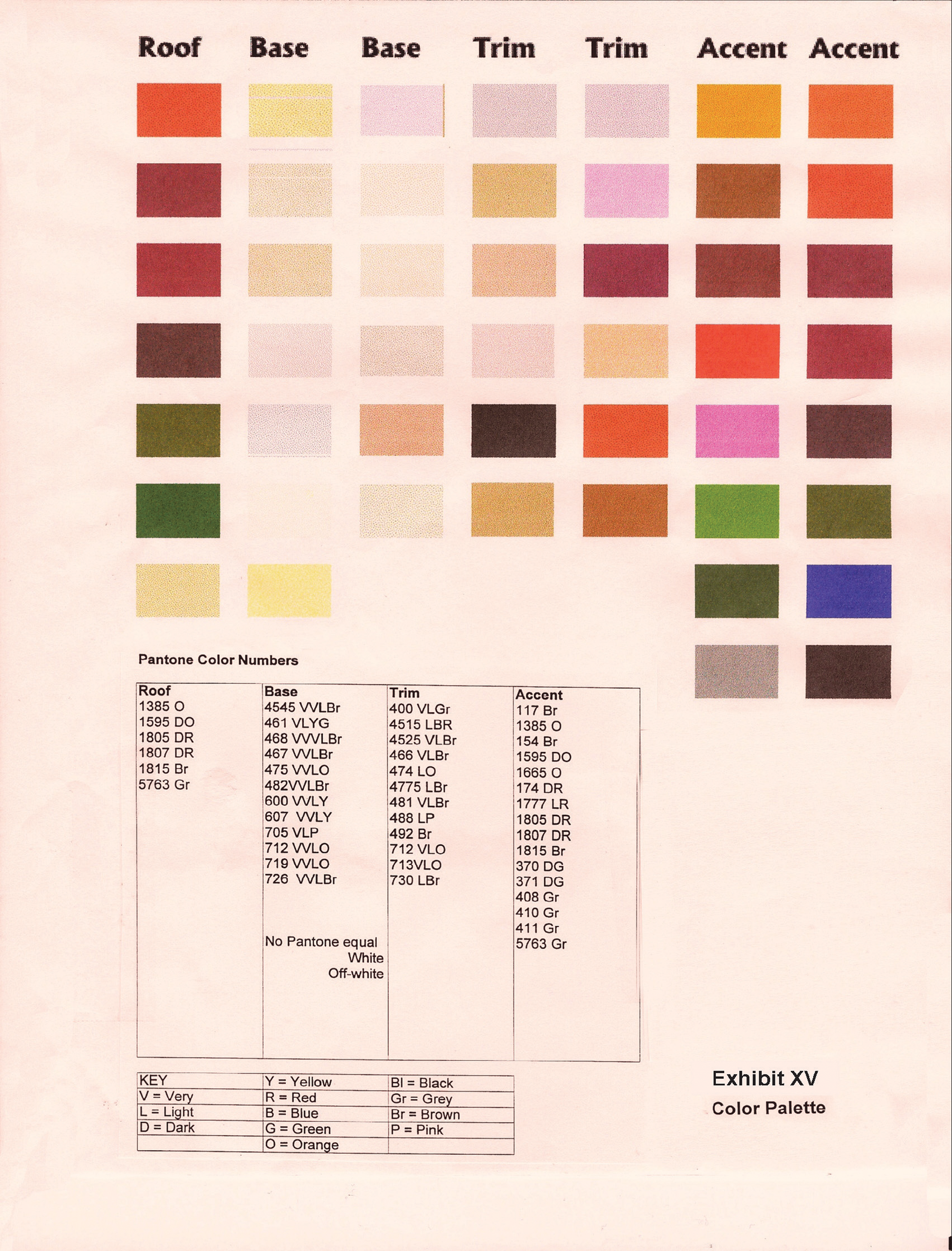
New development or substantial expansion of existing development shall use the color palette, found in Exhibit XV following this division, as a guide and/or use colors appropriate for Spanish Renaissance Revival or Mediterranean Revival architectural styles.
(Code 2001, § 29.925.10; Ord. No. 1340, § 1, 4-16-2013)
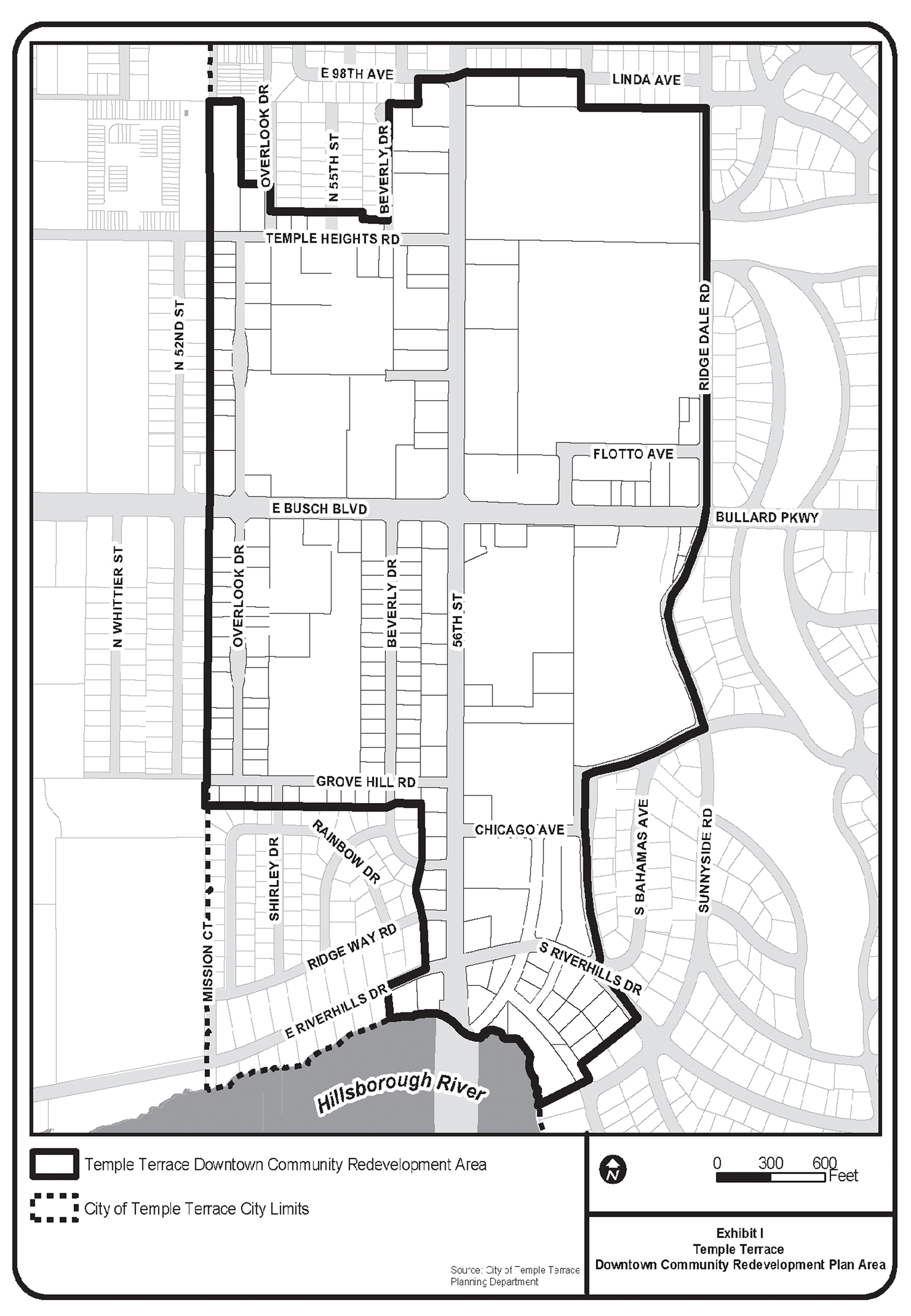
EXHIBIT I. LEGAL DESCRIPTION
BEING A PORTION OF SECTIONS 22 AND 27, TOWNSHIP 28 SOUTH, RANGE 19 EAST, TEMPLE TERRACE, HILLSBOROUGH COUNTY, FLORIDA.
BEGINNING AT THE SOUTHEASTERLY CORNER OF LOT 6A OF RIVERHILLS PARK UNIT NO. 1 ACCORDING TO THE MAP OR PLAT THEREOF AS RECORDED IN PLAT BOOK 30 PAGE 57 AND THE WATERS OF THE HILLSBOROUGH RIVER; THENCE NORTHERLY ALONG THE EASTERLY LINE OF SAID LOT 6A TO THE NORTHEASTERLY CORNER THEREOF TO A POINT ON THE SOUTHERLY RIGHT-OF-WAY LINE OF RIVERHILLS DRIVE; THENCE NORTHEASTERLY ALONG SAID LINE TO A POINT OF INTERSECTION WITH THE SOUTHERLY EXTENSION OF THE WESTERLY LOT LINE OF LOT 3 OF SAID RIVERHILLS PARK; THENCE NORTHERLY ALONG SAID EASTERLY LINE TO THE SOUTHWESTERLY LOT CORNER OF LOT 12, BLOCK 2 OF GRANDVIEW ACRES UNIT N. 1 ACCORDING TO THE MAP OR PLAT THEREOF AS RECORDED IN PLAT BOOK 32 PAGE 19; THENCE NORTHERLY ALONG THE WESTERLY LINE OF SAID LOT 12 TO THE NORTHWESTERLY CORNER THEREOF, ALSO BEING THE SOUTHWESTERLY CORNER OF LOT 2 BLOCK 2; THENCE NORTHERLY ALONG THE WESTERLY LINE OF SAID LOT 2 TO THE NORTHWESTERLY CORNER THEREOF; THENCE NORTHERLY TO A POINT OF INTERSECTION OF THE NORTHERLY RIGHT-OF-WAY LINE OF BEVERLY DRIVE AND THE SOUTHERLY EXTENSION OF THE EASTERLY LINE OF LOTS 4 AND 5 BLOCK 1 OF SAID GRANDVIEW ACRES UNIT NO. 1; THENCE NORTHERLY ALONG SAID LINE TO THE SOUTHEASTERLY CORNER OF LOT 6 OF SAID BLOCK 1; THENCE WESTERLY ALONG THE SOUTHERLY LINE OF SAID LOT 6 AND EXTENDED TO THE INTERSECTION WITH THE WESTERLY RIGHT-OF-WAY LINE OF BEVERLY DRIVE; THENCE SOUTHERLY ALONG SAID LINE TO THE SOUTHEASTERLY CORNER OF LOT 7 BLOCK 5 OF SAID GRANDVIEW ACRES UNIT NO. 1; THENCE WESTERLY ALONG THE SOUTHERLY LINE OF LOTS 7 THROUGH 1 OF SAID BLOCK 5 AND EXTENDED TO THE SOUTHEASTERLY CORNER OF LOT 1 BLOCK 7 OF SAID GRANDVIEW ACRES UNIT NO. 2 ACCORDING TO THE MAP OR PLAT THEREOF AS RECORDED IN PLAT BOOK 32 PAGE 38; THENCE WESTERLY ALONG THE SOUTHERLY LINE OF LOTS 1 THROUGH 5 OF SAID BLOCK 7 TO THE SOUTHWESTERLY CORNER OF LOT 5 OF SAID BLOCK 7; THENCE NORTHERLY ALONG THE WESTERLY LINE OF SAID LOT 5 TO THE NORTHWESTERLY CORNER THEREOF; THENCE NORTHERLY TO THE SOUTHWESTERLY CORNER OF LOT 1 BLOCK 2 OF TERRACE OVERLOOK NO. 1 ACCORDING TO THE MAP OR PLAT THEREOF AS RECORDED IN PLAT BOOK 12 PAGE 36; THENCE NORTHERLY ALONG THE WESTERLY LINE OF LOTS 1 THROUGH 24 AND LOT 27 OF SAID BLOCK 2 TO THE NORTHWESTERLY CORNER OF SAID 27; THENCE NORTHERLY TO THE SOUTHWESTERLY CORNER OF LOT 27 BLOCK 4 OF TERRACE OVERLOOK NO. 2 ACCORDING TO THE MAP OR PLAT THEREOF AS RECORDED IN PLAT BOOK 12 PAGE 24; THENCE NORTHERLY ALONG THE WESTERLY LINE OF LOTS 27 AND 24 THROUGH 1 OF SAID BLOCK 4 TO THE NORTHWESTERLY CORNER OF SAID LOT 1; THENCE NORTHERLY TO THE SOUTHEASTERLY CORNER OF WASHINGTON SQUARE TOWNHOME CONDOMINIUMS ACCORDING TO THE MAP OR PLAT THEREOF AS RECORDED IN CONDOMINIUM PLAT BOOK 6, PAGE 34; THENCE NORTHERLY ALONG THE EASTERLY LINE OF SAID CONDOMINIUM TO THE NORTHEASTERLY CORNER THEREOF SAME ALSO BEING THE SOUTHWESTERLY CORNER OF UNIVERSITY SQUARE UNIT NO. 3 ACCORDING TO THE MAP OR PLAT THEREOF AS RECORDED IN PLAT BOOK 43 PAGE 82; THENCE ALONG THE SOUTHERLY LINE OF SAID UNIVERSITY SQUARE UNIT NO. 3 TO THE NORTHEASTERLY CORNER OF A PARCEL AS DESCRIBED IN O.R. BOOK 4443 PAGE 1642; THENCE SOUTHERLY ALONG THE EASTERLY LINE OF SAID O.R. BOOK 4443 TO THE NORTHWESTERLY CORNER OF A PARCEL AS DESCRIBED IN O.R. BOOK 8420 PAGE 1166; THENCE EASTERLY ALONG THE NORTHERLY LINE OF SAID O.R. BOOK 8420 TO THE NORTHEASTERLY CORNER THEREOF; THENCE SOUTHWESTERLY TO THE SOUTHWESTERLY CORNER OF A PARCEL AS DESCRIBED IN O.R. BOOK 3471 PAGE 185; THENCE EASTERLY ALONG THE SOUTHERLY LINE OF SAID O.R. BOOK 3471 TO THE SOUTHEASTERLY CORNER THEREOF SAID CORNER ALSO BEING THE SOUTHWESTERLY CORNER OF A PARCEL AS DESCRIBED IN O.R. BOOK 4521 PAGE 406; THENCE EASTERLY ALONG THE SOUTHERLY LINE OF SAID O.R. BOOK 4521 TO THE SOUTHEASTERLY CORNER THEREOF; THENCE EASTERLY TO THE SOUTHWESTERLY CORNER OF A PARCEL AS DESCRIBED IN O.R. BOOK 4602 PAGE 1952; THENCE EASTERLY ALONG THE SOUTHERLY LINE OF SAID O.R. BOOK 4602 TO THE SOUTHEASTERLY CORNER THEREOF, SAID CORNER ALSO BEING ON THE WESTERLY BOUNDARY OF TEMPLE HEIGHTS ACCORDING TO THE MAP OR PLAT THEREOF AS RECORDED IN PLAT BOOK 37 PAGE 13; THENCE SOUTHERLY ALONG SAID LINE TO THE SOUTHWESTERLY CORNER OF LOT 7 OF SAID TEMPLE HEIGHTS; THENCE EASTERLY ALONG THE SOUTHERLY LINE OF SAID LOT 7 AND EXTENDED TO THE EASTERLY LINE OF SAID TEMPLE HEIGHTS; THENCE NORTHERLY ALONG SAID LINE TO THE NORTHEASTERLY CORNER THEREOF SAID CORNER ALSO BEING ON THE SOUTHERLY LINE OF TEMPLE TERRACE PLAZA ACCORDING TO THE MAP OR PLAT THEREOF AS RECORDED IN PLAT BOOK 33 PAGE 42; THENCE WESTERLY ALONG SAID LINE TO SOUTHEASTERLY CORNER OF LOT 14 OF SAID TEMPLE TERRACE PLAZA; THENCE NORTHERLY ALONG THE EASTERLY LINE OF SAID LOT 14 TO THE NORTHEASTERLY CORNER THEREOF; THENCE EASTERLY ALONG THE NORTHERLY LINE OF LOTS 15 THROUGH 18 OF SAID TEMPLE TERRACE PLAZA AND EXTENDED TO THE EASTERLY RIGHT-OF-WAY LINE OF 56TH STREET; THENCE NORTHERLY ALONG SAID LINE TO THE SOUTHWESTERLY CORNER OF LOT 1 BLOCK 5, TEMPLE TERRACE HEIGHTS ACCORDING TO THE MAP OR PLAT THEREOF AS RECORDED IN PLAT BOOK 31 PAGE 76; THENCE EASTERLY ALONG THE SOUTHERN LINE OF SAID BLOCK 5 TO THE SOUTHEASTERLY CORNER OF SAID BLOCK 5; THENCE SOUTHERLY ALONG THE WESTERLY RIGHT-OF-WAY LINE OF RACHEL STREET AND LOT 1 BLOCK 4 TO THE SOUTHWESTERLY CORNER OF SAID BLOCK 4; THENCE EASTERLY ALONG THE SOUTHERLY LINE OF BLOCK 4 TO THE SOUTHEASTERLY CORNER THEREOF SAID CORNER ALSO BEING ON THE WESTERLY RIGHT-OF-WAY LINE OF RIDGEDALE ROAD AND ALSO THE INTERSECTION OF THE NORTH LINE OF LOT 7 OF TEMPLE TERRACE ACCORDING TO THE MAP OR PLAT THEREOF AS RECORDED IN PLAT BOOK 25 PAGE 68; THENCE SOUTHERLY ALONG SAID LINE TO THE INTERSECTION OF THE SOUTHERLY LINE OF LOT 8 OF SAID TEMPLE TERRACE AND SAID WESTERLY RIGHT-OF-WAY LINE; THENCE WESTERLY ALONG THE SOUTHERLY LINE OF SAID LOT 8 TO THE NORTHEASTERLY CORNER OF TEMPLE TERRACE ESTATES ACCORDING TO THE MAP OR PLAT THEREOF AS RECORDED IN PLAT BOOK 23 PAGE 25; THENCE SOUTHERLY ALONG THE EASTERLY LINE OF SAID TEMPLE TERRACE ESTATES TO THE P.I. OF THE SOUTHEASTERLY CORNER OF BLOCK F-10 OF SAID TEMPLE TERRACE ESTATES; THENCE SOUTHEASTERLY TO THE NORTHWESTERLY CORNER OF LOT 20 BLOCK C-3 OF TEMPLE TERRACE ESTATES ACCORDING TO THE MAP OR PLAT THEREOF AS RECORDED IN PLAT BOOK 10 PAGE 62; THENCE SOUTHERLY ALONG THE WESTERLY LINE OF SAID LOT 20 TO THE SOUTHWESTERLY CORNER THEREOF; THENCE WESTERLY ALONG THE NORTHERLY LINE OF LOT 22 OF SAID BLOCK C-3 TO THE NORTHWESTERLY CORNER OF SAID LOT 22; THENCE SOUTHERLY ALONG THE WESTERLY LINE OF LOTS 22 THROUGH 25 OF SAID BLOCK C-3 TO THE SOUTHEASTERLY CORNER OF LOT 13 OF SAID BLOCK C-3; THENCE WESTERLY ALONG THE SOUTHERLY LINE OF SAID LOT 13 AND EXTENDED TO THE WESTERLY RIGHT-OF-WAY LINE OF SUNNYSIDE ROAD AND THE EASTERLY LINE OF BLOCK D-8 OF TEMPLE TERRACE ESTATES ACCORDING TO THE MAP OR PLAT THEREOF AS RECORDED IN PLAT BOOK 17 PAGE 22; THENCE SOUTHERLY ALONG SAID LINE TO THE SOUTHEASTERLY CORNER OF SAID BLOCK D-8 AND THE NORTHERLY RIGHT-OF-WAY LINE OF SHADOWLAWN AVENUE; THENCE SOUTHWESTERLY ALONG SAID LINE AND EXTENDED TO THE EASTERLY LINE OF A PARCEL AS DESCRIBED IN O.R. 8237 BOOK 1234; THENCE SOUTHERLY ALONG SAID LINE AND EXTENDED TO THE SOUTHERLY RIGHT-OF-WAY LINE OF CHICAGO AVENUE; THENCE EASTERLY ALONG SAID LINE TO THE NORTHEASTERLY CORNER OF BLOCK D-14 OF TEMPLE TERRACE ESTATES ACCORDING TO THE MAP OR PLAT THEREOF AS RECORDED IN PLAT BOOK 17 PAGE 22; SAME ALSO BEING THE WESTERLY RIGHT-OF-WAY LINE OF SPRING DELE PLACE; THENCE SOUTHERLY ALONG SAID LINE AND EXTENDED TO THE NORTHEASTERLY LINE OF TEMPLE TERRACE ESTATES ACCORDING TO MAP OR PLAT THEREOF AS RECORDED IN PLAT BOOK 10 PAGE 67; THENCE SOUTHEASTERLY ALONG THE EASTERLY LINE OF SAID SUBDIVISION TO THE EASTERLY CORNER OF LOT 10 OF SAID SUBDIVISION; THENCE SOUTHWESTERLY ALONG THE SOUTHEASTERLY LINE OF LOTS 10 AND 7 OF SAID SUBDIVISION TO THE SOUTHERLY CORNER THEREOF; THENCE SOUTHEASTERLY ALONG THE SOUTHWESTERLY LINE OF LOT 8 OF SAID SUBDIVISION TO A POINT OF INTERSECTION WITH THE NORTHEASTERLY EXTENSION OF THE NORTHERLY LINE OF LOT 1, RIVER TERRACE ESTATES ACCORDING TO THE MAP OR PLAT THEREOF AS RECORDED IN PLAT BOOK 53 PAGE 15; THENCE SOUTHWESTERLY ALONG SAID LINE TO THE NORTHWESTERLY CORNER THEREOF AND THE WATERS OF THE HILLSBOROUGH RIVER; THENCE MEANDERING NORTHWESTERLY ALONG THE WATERS OF THE HILLSBOROUGH RIVER TO THE AFORE-DESCRIBED POINT OF BEGINNING AND BINDING THEREWITH TO.