
Tennille City Zoning Code
ARTICLE E
- SIGN REGULATIONS
Sec. 8-4-81 - Purposes.
(a)
It is the purpose of the Mayor and City Council in enacting these regulations to provide standards to safeguard life, public health, property and welfare by regulating the location, size, illumination, erection, maintenance and quality of materials of all signs. More specifically, signs have a powerful impact on the aesthetic environment of the community, and it is the purpose of this article to encourage an aesthetically attractive environment, allowing sufficient opportunities for communications to serve business, interest groups and the public, while complying with the federal and state constitutions and laws. Signs create visual clutter and therefore should be regulated in their size, location, construction and illumination. Signs can detract from the beauty of the neighborhood and lower property values. In seeking to comply with federal and state law, the City has determined the following: large signs are, as the U.S. Supreme Court has recognized, an aesthetic harm; the state supreme court has upheld sign regulations on the basis of aesthetics and preserving the beauty of environment; and, the 11th Circuit has recognized portable signs are visual clutter and a potential traffic hazard. These holdings show that the City's ordinance is within the law and constitutional, which is a goal of the City. The goal of this article is to avoid being an impermissible content-based regulation, and instead to be a permissible time, place and manner restriction.
(b)
Many signs can also be a hazard and negatively impact traffic safety by distracting drivers and blocking views of other vehicles and dangers, by making intersections more treacherous, and by making it difficult to see oncoming traffic when entering a roadway. Therefore, it is also the purpose of this article to prevent those harms by regulating signs to safe locations, safe sizes, with proper and safe illumination and construction.
(Ord. No. 2019-01, 4/15/19)
Sec. 8-4-82 - Jurisdiction and applicability of code requirements.
(a)
This article shall apply to all properties within the incorporated areas of the City. This article shall not relate to the copy or message on signs within the City.
(b)
All signs and sign structures shall be constructed and maintained in conformance with the state minimum standard codes.
(c)
If any provisions or requirements of this article are in conflict with any other provision or requirement of this article or any other applicable governmental law, ordinance, resolution, rule, or other governmental regulation of any kind, the more restrictive rule or standard takes precedence.
(Ord. No. 2019-01, 4/15/19)
Sec. 8-4-83 - General provisions and definitions.
(a)
No sign shall be placed or maintained within the City except in conformity with this article.
(b)
Notwithstanding any other restrictions in this article, any sign, display or device allowed under this article may contain any commercial or non-commercial message, or any political or non-political message; except that such messages cannot depict obscenity, as defined by O.C.G.A. § 16-12-80, nor can they depict sexual conduct or sexually explicit nudity, as defined in O.C.G.A. § 36-60-3.
(c)
Height limitations in this article control over the general height limitations of this article and apply to any structure that contains a sign. For example, a church spire or radio antenna with a sign would be subject to the height limitations of this article, rather than general height limitations.
(d)
Definitions. The general definitions and interpretative rules of this chapter shall also be used. To the extent those general rules or definitions conflict with these specific definitions, these definitions shall control. The following words, terms and phrases, when used in this article, shall have the meanings ascribed to them in this subsection, except where the context clearly indicates a different meaning:
Animated sign means any sign that all or any part thereof visibly moves or imitates movement in any fashion whatsoever. Any sign that contains or uses for illumination any lights (or lighting devices) that change color, flash or alternate, show movement or motion, or change the appearance of said sign or any part automatically.
Area of sign (copy area) means the area within a continuous perimeter enclosing the limits of writing, representation, emblem, or any figure of similar character together with any frame, or material, open space, or color forming an integral part of the display or used to differentiate such sign from the background against which it is placed.
Banner means a sign hung either with or without a frame, possessing characters, letters, illustrations, or ornamentation applied to a non-rigid material such as paper, plastic, or fabric of any kind. This definition expressly excludes all fabric signs mounted from one (1) side to a flag pole. For purposes of regulation under this article, banners shall be treated as a ground sign, but shall not be maintained for more than thirty (30) consecutive days, or more than ninety (90) total days in any calendar year.
Building sign means any sign attached to any part of a building other than a freestanding sign.
Canopy means any permanent roof-like structure, including awnings and marquees, projecting beyond a building or extending along and projecting beyond the wall of a building, generally designed and constructed to provide protection from the weather.
Canopy sign means any sign attached to, or made a part of, the front, side, or top of a canopy. These signs are regulated as wall signs.
Copy means the wording or graphics on a sign surface in either permanent or removable form.
Crown of the road means the highest point of a road, usually the centerline of a road.
Erect means to build, construct, attach, hang, place, suspend, paint or affix.
Establishment means a commercial, industrial, institutional, educational, office, business or financial entity.
Flag means any fabric sign, regardless of the message conveyed, mounted to a flag pole on one (1) side only.
Flashing sign. See "Animated sign."
Freestanding sign means any sign which is independent from any building or other structure and is entirely supported by a single or multiple pedestals that are permanently attached at or below ground level.
Frontage, building, means the length of an outside building wall facing a street.
Frontage, street, means the length of the property line of any one (1) parcel along a street on which it borders.
Ground sign means a sign that is anchored to the ground and is wholly independent of a building for support. Freestanding signs are included in this definition, as are signs on poles, frames, or other mounting structures other than buildings.
Illuminated sign means a sign which contains an internal source of light or which is designed or arranged to reflect light from an artificial source.
Mansard sign means any sign attached to or erected within twelve (12) inches of an actual or simulated mansard of a building, with the sign face parallel to and within the limits of the building, but not exceeding the roofline, and not deemed to be a roof sign. These signs are regulated as wall signs.
Monopole sign or unipole sign means a freestanding sign that is erected on a single pedestal attached to the ground for the display of messages irrespective of the number of faces or the configuration of the faces.
Monument sign means a permanent sign, other than a freestanding pole sign, placed upon or supported by the ground independent of any other structure and constructed of stone, concrete, masonry, stucco or equal architectural material. These signs are regulated as ground signs.
Moving sign. See "Animated sign."
Painted wall sign means any sign that is applied with paint or similar substance on the face of a wall.
Permanent sign means a sign permanently affixed to a building or the ground.
Person means any association, company, corporation, firm, organization, or partnership, singular or plural, of any kind.
Planned center means a nonresidential development with multiple establishments that are separately owned and operated.
Portable sign means any sign supported by its own frame or trailer, with or without wheels, that is designed to move from one (1) place to another.
Projecting sign means any sign affixed to a building or wall, which horizontally extends more than twelve (12) inches beyond the surface of a building or wall.
Revolving sign. See "Animated sign."
Roof sign means any sign erected, constructed, and maintained upon or over the roof of any building and projecting above the roofline.
Roof sign (integral) means any sign erected or constructed as an integral part of a normal roof structure of any design. No part of the sign can extend vertically above the highest portion of the roof, and no part of the sign can be separated from the rest of the roof by a space of more than six (6) inches.
Setback means the distance from the property line to the nearest part of the applicable building, structure, or sign, measured perpendicularly to the property line.
Sidewalk, sandwich or A-frame sign means a sign which is normally in the shape of an "A" of some variation, which is usually two-sided.
Sign means any display of words, shapes or images designed to convey a message to the viewer, located on the exterior of any dwelling, building or structure, or located anywhere on a lot upon a dedicated supporting structure or device, including poles, banners, windows and similar devices.
Sign face means the actual message-carrying portion of the sign that can be used to display content, including any area that can display or does display words, pictures or other communicative elements of the sign, including the background color.
Sign structure means and includes all the elements of the sign, including its supporting structure, sign face, base, lights and every portion of the sign.
Street means any public or private right-of-way for automobile use. This excludes alleyways, parking lots and driveways.
Street frontage means the width in linear feet of a lot or parcel where it abuts the right-of-way of any public street.
Under canopy sign means a sign that is suspended from the underside of a canopy (in awnings and marquees), is perpendicular to the wall surface of a building, and whose copy is not clearly visible from the public right-of-way.
Wall face means a measurement of area equal to the height of the structure from the ground to the coping or eave of the roof multiplied by the width of the wall associated with the individual business. The wall face is to be measured for each wall independently.
Wall sign means a sign that is fastened directly to or is placed or painted directly upon the exterior wall of a building.
Window sign means a sign having its message visible from the exterior of a building that is either located within a building so as to be visible through a window, or affixed directly to the window either inside or outside the building.
(Ord. No. 2019-01, 4/15/19)
Sec. 8-4-84 - Permitted signs.
(a)
Standard permitted signs. The following signs are permitted in the following zoning districts. If not otherwise stated, any sign not specifically permitted in a zoning district as provided under this section shall be prohibited. These regulations apply to signs located on any lot or development. A double-sided (double-faced) sign is counted as one (1) sign. Height is measured from grade to the highest portion of the sign structure.
(b)
Signs permitted in the A-1, R-1, R-2, R-3 and R-4 zoning districts.
(1)
Ground signs. Up to two (2) double-faced signs per lot. No single sign face may exceed sixteen (16) square feet. Total maximum area for all sign faces is thirty-two (32) square feet (e.g., two (2) sixteen-square-foot sign faces, or four (4) eight-square-foot faces, etc.). Height is limited to five (5) feet.
(2)
Window signs. Two (2) per lot, total of up to eight (8) square feet of window signs.
(3)
Wall signs. Not permitted.
(4)
Entrance signs. Two (2) per subdivision development, maximum area of each sign is thirty-two (32) square feet. Entrance signs may only be single-sided, unless only one (1) is erected, in which case it can be double-sided. Entrance signs are only permitted at the entrance to a subdivision development. Entrance signs must be set back from the right-of-way a distance equal to their height plus one (1) foot for safety reasons, and cannot block traffic sight lines. Maximum height is six (6) feet.
(c)
Signs permitted in the C-1, C-2 and I-O zoning districts, for individual uses.
(1)
Ground signs. One (1) double-faced sign per lot. No sign face may exceed one hundred (100) square feet. Total maximum sign face area is two hundred (200) square feet. If the lot contains a principal building of over ten thousand (10,000) square feet, no sign face may exceed two hundred (200) square feet and total maximum sign face area is four hundred (400) square feet. If the principal building exceeds one hundred thousand (100,000) square feet, no sign face may exceed three hundred (300) square feet and total maximum sign face area is six hundred (600) square feet. Maximum height for all ground signs is twenty-five (25) feet in C-1 and I-O, and thirty-five (35) feet in C-2. For lots with frontage on a U.S. highway or state highway, ground signs may have a maximum height of forty (40) feet.
(2)
Window signs. Total signage not to exceed twenty-five (25) percent of the area of windows facing road frontage.
(3)
Wall signs. Up to four (4) signs per lot. Total wall signage not to exceed two hundred (200) square feet on all walls (e.g., four (4) fifty-square-foot signs or one (1) two-hundred-square-foot sign). If the lot contains a principal building of over ten thousand (10,000) square feet, the total amount of permissible wall signage increases to two hundred fifty (250) square feet. If the lot contains a principal building of over one hundred thousand (100,000) square feet, the total amount increases to three hundred (300) square feet. No single wall sign may exceed two hundred fifty (250) square feet.
(4)
Entrance signs. Two (2) per lot, maximum area of each sign is thirty-two (32) square feet. Entrance signs may only be single-sided, unless only one (1) is erected, in which case it can be double-sided. Entrance signs are only permitted at the entrance of the development. Entrance signs must be set back from the right-of-way a distance equal to their height plus one (1) foot for safety reasons, and cannot block traffic sight lines. Maximum height is six (6) feet.
(d)
Signs permitted in I-O, C-1 or C-2 zoning districts, for planned centers.
(1)
Ground signs. One (1) double-faced sign of up to two hundred (200) square feet per face, for the entire planned center. Total maximum sign face area is four hundred (400) square feet. If the development contains over 50,000 total square feet, no sign face may exceed three hundred (300) square feet. Total maximum sign face area is six hundred (600) square feet. Maximum height for all ground signs is twenty-five (25) feet in C-1 and I-O, and thirty-five (35) feet in C-2. For lots with frontage on a U.S. highway or state highway, ground signs may have a maximum height of forty (40) feet.
(2)
Window signs. Total signage not to exceed twenty-five (25) percent of the area of windows facing road frontage.
(3)
Wall signs. Four (4) signs per business. Total area of all signs is not to exceed ten (10) percent of the gross floor area of each business. No single wall sign shall exceed two hundred fifty (250) square feet.
(4)
Entrance signs. Two (2) per planned center, maximum area of each sign is fifty (50) square feet. Entrance signs may only be single-sided, unless only one (1) is erected, in which case it can be double-sided. Entrance signs are only permitted at the entrance to the planned center. Entrance signs must be set back from the right-of-way a distance equal to their height plus one (1) foot for safety reasons, and cannot block traffic sight lines. Maximum height is ten (10) feet.
(e)
Signs permitted in the I-1 and I-2 zoning districts, for individual uses.
(1)
Ground signs. One (1) double-faced sign of up to three hundred (300) square feet per face; maximum total area is six hundred (600) square feet. Maximum height is thirty-five (35) feet.
(2)
Window signs. Total signage not to exceed twenty-five (25) percent of the area of windows facing road frontage.
(3)
Wall signs. Total signage not to exceed two hundred (200) square feet on all walls. If the lot contains a principal building of over fifty thousand (50,000) square feet, the total amount increases to three hundred (300) square feet. No single wall sign may exceed two hundred (200) square feet.
(4)
Entrance signs. Two (2) per lot, maximum area of each sign is fifty (50) square feet. Entrance signs may only be single-sided, unless only one (1) is erected, in which case it can be double-sided. Entrance signs are only permitted at the entrance to the lot. Entrance signs must be set back from the right-of-way a distance equal to their height plus one (1) foot for safety reasons, and cannot block traffic sight lines. Maximum height is ten (10) feet.
(f)
Signs permitted in I-1 and I-2 zoning districts, for planned centers.
(1)
Ground signs. One (1) double-faced sign of up to three hundred (300) square feet per face, for the entire planned center. Total maximum sign face area is six hundred (600) square feet. Maximum height is thirty-five (35) feet.
(2)
Window signs. Total signage per business not to exceed twenty-five (25) percent of the area of windows facing road frontage.
(3)
Wall signs. Total area of all signs is not to exceed ten (10) percent of the gross floor area. No more than four (4) signs per business are permitted, and no single wall sign shall exceed two hundred fifty (250) square feet.
a.
Entrance signs. Two (2) per planned center, maximum area of each sign is fifty (50) square feet. Entrance signs may only be single-sided, unless only one (1) is erected, in which case it can be double-sided. Entrance signs are only permitted at the entrance to the planned center. Entrance signs must be set back from the right-of-way a distance equal to their height plus one (1) foot for safety reasons, and cannot block traffic sight lines. Maximum height is ten (10) feet.
(g)
Signs permitted in the PUD zoning district. Within the residential portion of any PUD, the provisions of subsection (b) of this section apply. A sign plan for any commercial portion of a PUD shall be made a part of the PUD application process and approved during the rezoning process. PUD applicants should seek consistency with the signage provisions of commercial zoning districts as shown above.
(h)
Internal signs. Any sign not visible from the public right-of-way is not restricted or regulated by this article.
(i)
Outdoor facility signs. Any sign that is located at an outdoor event facility that is open to the general public, such as a ball field, race track, or amphitheater, and is mounted on the internal-facing walls of the facility, is exempt from the maximum number and square footage restrictions.
(Ord. No. 2019-01, 4/15/19)
Sec. 8-4-85 - Regulations for signs.
(a)
Location, height, and setback.
(1)
The property owner must give permission for all sign placement on the owner's property, through the issuance of a letter signed by the owner.
(2)
All signs must comply with all side and rear setbacks of this chapter.
(3)
Signs can be located in front setback areas, but all signs and sign structures, except as noted below, must be set back at least ten (10) feet from the public right-of-way. No portion of a sign or sign structure shall encroach on or overhang the public right-of-way or any other person's property. Furthermore, for safety reasons, no sign shall be located closer than ten (10) feet from the back of the curb of a public roadway, or if there is no curb, from the edge of the pavement.
(4)
Distances are measured from the closest portion of the sign (whether that is the base, sign face, or the sign structure) to the right-of-way, curb or pavement.
(5)
The height requirements of a sign shall be computed as the length of a straight vertical line from normal grade to the height of the highest attached component of the sign or sign structure. When the sign is constructed within fifteen (15) feet of a right-of-way, the normal grade shall be considered the elevation of the crown of the road. When a sign is constructed fifteen (15) or more feet from any right-of-way, normal grade shall be considered the lower of:
a.
Existing grade of the site of the sign prior to construction of the sign; or
b.
The newly established grade at the base of the sign after construction, exclusive of any filling, beaming, mounding or excavating solely for the purpose of locating the sign.
(b)
Number. For the purpose of determining the number of signs, ground signs shall be equal to the number of sign structures. All other non-ground signs shall be considered to be a single display surface or display device containing elements organized, related and composed to form a unit.
(c)
Illumination.
(1)
Ground signs cannot be internally illuminated except where expressly permitted by this article. All signs may be externally illuminated. External illumination of any sign in any district shall be positioned and shielded so that the light source does not shine directly into the path of motorists on a public right-of-way or into the windows of adjacent dwellings or businesses without the permission of the owner and resident thereof. Signs located in residential districts shall not be illuminated between the hours of 10:00 p.m. and 7:00 a.m.
(2)
Flashing, blinking or otherwise varying illumination is not permitted. No external or internal illumination that causes confusion with or distraction from any traffic signal or safety device shall be permitted.
(3)
All externally illuminated signs shall utilize low wattage luminaries, mounted in fixtures designed to direct the light and eliminate light trespass, such as light shining into residences or other neighboring structures.
(4)
All internally illuminated signs shall utilize low wattage luminaries designed to reduce light glow.
(5)
All illuminated signs over ten (10) feet in height shall either be internally illuminated or illuminated by external lighting fixtures not visible to passing motorists.
(6)
Internally illuminated signs shall only be permissible on lots zoned for non-residential uses.
(7)
No sign shall give off light which glares, blinds, or has any other adverse effect on traffic or adjacent properties. The light from an illuminated sign shall be established in such a way that adjacent properties and roadways are not adversely affected and that no direct light is cast upon adjacent properties and roadways. This shall be determined by measuring the footcandles (lumens per square foot) that fall on adjacent properties or the public right-of-way. No sign shall exceed 0.5 footcandles at any adjacent property line in a residential district or two (2) footcandles at any public right-of-way.
(8)
Multiple-message signs. Multiple-message signs are those which change the message or copy on the sign face mechanically or electronically by movement or rotation of panels or slates, or by changing electronic display on the sign face. They are subject to the following restrictions:
a.
No multiple-message sign may change its message or copy, or any pictures or images that are part of the message, more frequently than once every minute, provided that multiple-message billboards shall be allowed to change the copy or images that are part of the message not more frequently than once every ten (10) seconds.
b.
When the message of a multiple-message sign is changed mechanically, it shall be accomplished in three (3) seconds or less. When the message of a multiple-message sign is changed in an electronic manner, through the use of light emitting diodes, back lighting or other light source, the transition shall occur within two (2) seconds.
c.
When any multiple-message sign is located within one hundred fifty (150) feet of any residential district, the display of multiple-messages shall discontinue between the hours of 11:00 p.m. and 6:00 a.m., and the sign shall be static and not display more than one (1) message during that period.
(d)
Calculation of area. The area of a sign is calculated by determining the area of the smallest square or rectangle which encloses the sign face and the structure surrounding the sign face. For example, the pole or base would not be included, but any frame holding the sign face in place would be counted. See examples:
Examples of Sign Face Area
Measurements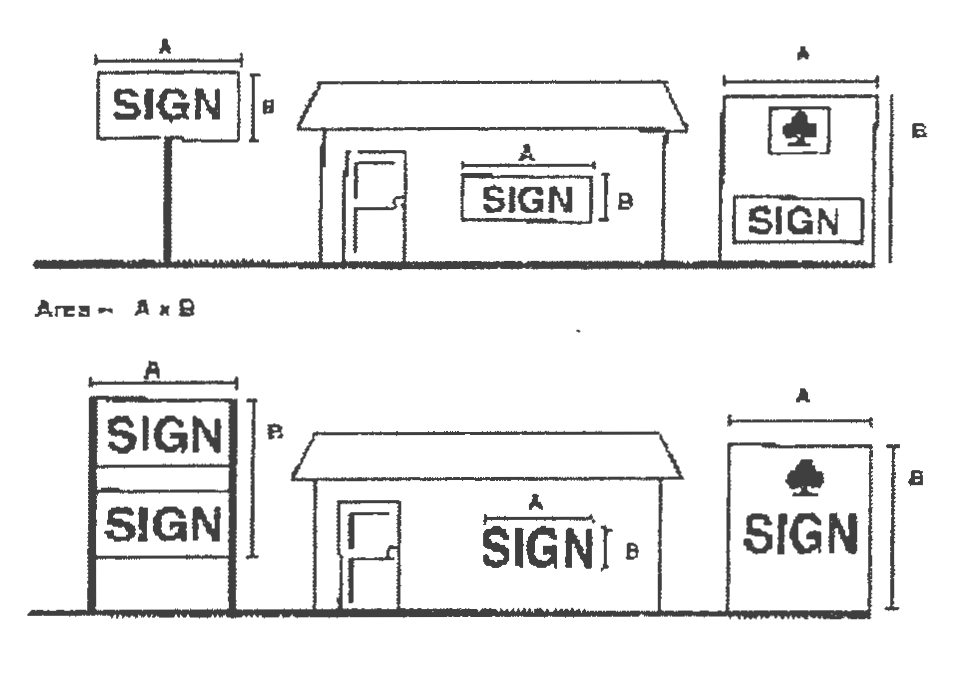
(e)
Unusual shaped signs. Unusual shaped signs are signs that are any shape other than a square or rectangle, and include signs with projecting elements or features, round, oval, and triangular signs, signs with more than four (4) sides, signs in the shape of an animal, object, or device, and so forth. For all such signs, the area is calculated by calculating the area of the smallest rectangle that will completely enclose all elements of the sign face and sign structure supporting the face, not including the base, or any open space.
(f)
Sign support structures. Signs three hundred (300) square feet per face or larger must be constructed with a monopole-type support system.
(Ord. No. 2019-01, 4/15/19)
Sec. 8-4-86 - Safety and construction standards.
(a)
Engineering approval. All signs in excess of fifteen (15) feet in height should be constructed according to plans approved by a state registered professional engineer. The sign owner shall produce such approved plans at the request of the building official.
(b)
Official confusion. Signs which contain or are in imitation of an official traffic sign or signal are prohibited.
(c)
Fire safety. No sign or sign structure may be erected or maintained which obstructs any fire escape, ventilation, or door; nor shall any sign or sign structure be attached to a fire escape.
(d)
Corner visibility. No sign or sign structure above a height of three (3) feet shall be maintained within fifteen (15) feet of the intersection of the right-of-way lines of two (2) streets, or of a street intersection with a railroad right-of-way.
(e)
Traffic visibility. No sign shall obstruct the view of vehicles entering the roadway (i.e., the view of oncoming traffic by vehicles attempting to enter the road).
(f)
Good repair. All signs, together with all their supports, braces, guys, and anchors shall be kept in good repair. Any structure formally used as a sign, but not in use for any other purpose, must be removed by the owner of the property within ten (10) days after written notification from a designated City official or thirty (30) days after its use as a valid sign has ceased, after which time, the City may cause the removal of the sign at the owner's expense.
(g)
Removal of unsafe signs and safety hazards. The City may remove a sign in violation of this article, without giving notice to any party, if said sign is upon the public right-of-way or upon other public property, or said sign poses an immediate safety threat to the life or health of any members of the public.
(Ord. No. 2019-01, 4/15/19)
Sec. 8-4-87 - Prohibited signs.
The following types of signs are prohibited:
(1)
Roof signs (which means signs mounted above a roof or projecting above the roof-line of a structure).
(2)
Rotating signs.
(3)
Signs with more than two (2) sides.
(4)
Except where expressly permitted, changing copy, moving signs, or signs with moving parts are prohibited. This includes animated signs involving motion or sound; fluttering ribbons; "trivision"-type signs; signs displaying moving pictures or images; LED signs or EVMC signs with content that changes more than once daily; signs with moving words; signs with waiving elements, whether motorized or wind-powered; or similar moving signs. This regulation shall not be construed to prohibit flags, which are regulated as other non-moving signs.
(5)
A-frame, sandwich type, sidewalk or curb signs, except in DDA area.
(6)
Swinging or projecting signs, except in DDA area.
(7)
Portable signs (mobile, trailer).
(Ord. No. 2019-01, 4/15/19)
Sec. 8-4-88 - Procedures; sign registration and building permits.
(a)
Except as specifically exempted from the provisions of this article, a person or firm may not legally maintain, post, display, enlarge, erect, move, or substantially change a sign that is larger than four (4) square feet without first obtaining a permit from the zoning administrator. Signs using electrical wiring and connections (i.e., illuminated signs), as well as larger signs, may require additional permits under the City building code, and the building official should be contacted regarding such signs.
(b)
All parties are advised to consult with the zoning administrator to avoid erecting signs that violate this article. No person shall obtain a vested right to maintain a sign that does not comply with this article at the time it is erected. Signs erected in violation of this article shall be removed or reconstructed in compliance with this article.
(c)
Permit applications for conforming signs shall be filed by the sign owner or his agent with the zoning administrator upon forms furnished by the City.
(1)
Applications. Applications shall contain the following:
a.
The type of the sign as defined in this article.
b.
The value of the sign.
c.
The street address and zoning designation of the property where the sign is to be located.
d.
A site plan drawn to scale that shows the location of the sign on the lot, including indicating setbacks from property lines and rights-of-way.
e.
The square foot area per sign and the aggregate square foot area if there is more than one (1) sign face.
f.
The name and address of the owner of the real property upon which the sign is to be located, along with written consent of said owner.
g.
Engineered construction plans for signs exceeding fifteen (15) feet in height, showing they are approved by a state registered professional engineer.
h.
Name, address, phone number and business license number of the sign contractor.
(2)
Fees. No permit shall be issued until the appropriate application has been filed with the zoning administrator and permit fees have been paid as adopted by the Mayor and City Council and as amended from time to time.
(3)
Granting of permit. The zoning administrator or his designee shall grant a permit upon receipt of a completed application if the proposed sign meets the requirements of this article.
(4)
Permit expiration. A permit shall become null and void if construction of the sign has not begun within six (6) months from the date of issuance. Issuance of a permit shall in no way prevent the City from later declaring the sign to be nonconforming or unlawful if, with further review of available information, the sign is found not to comply with the requirements of the ordinance applicable at the time that the complete permit application was filed.
(5)
Violation. A violation of any provisions of this article will be grounds for termination of a permit granted by the City for the erection of a sign. Should it be determined that a permit was issued pursuant to an incomplete application or an application containing a false material statement, or that a permit has been erroneously issued in violation of this article, the zoning administrator or his designee shall revoke the permit. No information shall be required regarding the content of the sign. Any person failing to obtain a permit prior to construction shall be subject to citation and, upon conviction, shall be punished in accordance with the enforcement provisions of this chapter and applicable law.
(Ord. No. 2019-01, 4/15/19)
Sec. 8-4-89 - Nonconforming signs.
Signs existing legally at the time of the adoption or amendment of the ordinance from which this article is derived, but which do not conform to newly adopted or amended provisions of this article solely because of a change in this article, and not because of a change to the sign, may remain as legal nonconforming signs, subject to the following provisions:
(1)
There must be existing property rights in the sign;
(2)
The right to continue a nonconforming sign is confined to the sign owner or his transferee;
(3)
A nonconforming sign may be restored to its original condition, provided that not more than fifty (50) percent of the sign is destroyed. The fifty (50) percent is to be determined by fifty (50) percent of the value of the materials of the sign, inclusive of poles and other structural members, immediately prior to damage;
(4)
A nonconforming sign when relocated or moved shall no longer be considered a nonconforming sign and thereafter shall be subject to all the provisions of law and of these rules relating to outdoor advertising;
(5)
The sign must remain substantially the same as it was on the effective date of the adoption of the ordinance from which this article is derived which rendered the sign nonconforming. Extension, enlargement, replacement, rebuilding, adding lights to a non-illuminated sign or re-erection of the sign will be considered a change in the existing use. The maintenance will be limited to:
a.
Replacement of nuts and bolts;
b.
Additional nailing, riveting or welding;
c.
Cleaning and painting;
d.
Manipulating to level or plumb the device, but not to the extent of adding guys or struts for stabilization of the sign structure;
e.
A change of the message, including changing faces, as long as similar materials are used and the sign face is not enlarged;
(6)
At no time may changes be made in a nonconforming sign which would increase the value of the sign;
(7)
A nonconforming sign may continue as long as it is not abandoned, destroyed, discontinued, or purchased by any governmental agency. Any sign suffering damage in excess of normal wear cannot be repaired without:
a.
Notifying the zoning administrator in writing of the extent of the damage, the reason the damage is in excess of normal wear, and providing a description of the repair work to be undertaken, including the value of the sign materials and the cost of the repair; and
b.
Receiving written notice from the zoning administrator authorizing the repair work as described above. If said repair is authorized by the terms of this article, the zoning administrator shall mail such notice to the applicant within thirty (30) days of receipt of the information described in subsection (7)a of this section.
(Ord. No. 2019-01, 4/15/19)

