
Terrell City Zoning Code
V
DEVELOPMENT STANDARDS
Section 33. - Off-street parking, sidewalks, and loading requirements.
33.1
Purpose. To secure safety from fire, panic, and other dangers; to lessen congestion on public streets; to facilitate the adequate provision of transportation; to conserve the value of buildings; and to encourage the most appropriate and efficient use of land. Minimum off-street parking and loading shall be provided as set forth in the following schedules and provisions.
33.2
Residential districts - Special off-street parking and sidewalk provisions.
A.
Required off-street parking shall be provided on the same lot/site as the use it is to serve.
B.
A minimum of two enclosed parking spaces (garage), located behind the front building line, shall be provided in the AG, TX, EE-32, SF-16, SF-10, SF-7.5, and SF-6 districts. A minimum 12 feet wide paved driveway shall be installed from the street or alley right-of-way line to the garage door with a minimum length of 25 feet from any right-of-way, property line or alley including detached garages. No garage door shall face towards the front property line but shall be rear or side loaded only except in cases of infill development in which the majority of the homes in the vicinity are front loaded or instances where side or rear loading is infeasible due to unique constraints such as topography, floodplain, etc. Exceptions to side or rear loading for new development shall require approval by the city council during normal zoning or platting application review. Exceptions for infill lots shall be approved by the building official during building permit review. Infill redevelopment in the SF-6 district (platted prior to May 2008) a minimum of two spaces one of which shall be enclosed or covered (carport). See specific district requirements for all other residential districts.
C.
All vehicle parking (including motor vehicles, recreational vehicles, boats, trailers, personal watercraft, etc.) shall be on a suitably paved parking surface (defined as concrete or asphalt paving). Existing crushed rock parking areas constructed prior to the date of adoption of this ordinance may be continued to be used, however, they may not be enlarged and all new parking areas shall be constructed of concrete or asphalt paving materials. Minimum construction standards for asphalt paving are four inches of compacted base and two inches of rolled asphalt. Minimum construction standards for concrete paving are four inches of concrete with #3 rebar on 18-inch centers. All driveways and approaches to parking spaces shall be similarly paved, except in the AG in which driveways in excess of 50 feet in length shall be paved in concrete or asphalt for the first 50 feet and the remainder may be constructed of crushed rock in lieu of asphalt or concrete a minimum of six inches thick.
D.
No required enclosed parking space, garage, carport, or other automobile storage space shall be converted into living space unless the required enclosed parking is provided elsewhere on the same lot which meets all other requirements of this ordinance such as, setbacks, exterior façade materials, etc.
E.
All residential development shall install sidewalks in accordance with the district requirements listed herein and the subdivision regulations as adopted or amended.
33.3
Nonresidential and MF districts - Special off-street parking and sidewalk provisions.
A.
To prevent nuisance situations, all parking area lighting shall be designed and operated so as not to reflect or shine on adjacent properties and in accordance with the standards established in section 40.
B.
For safety and firefighting purposes, free access through to adjacent nonresidential parking areas shall be provided in accordance with the adopted International Fire Code. Every parking space shall be located within the minimum required distance of a designated fire lane.
C.
All nonresidential development shall install sidewalks in accordance with the subdivision regulations as adopted or amended.
D.
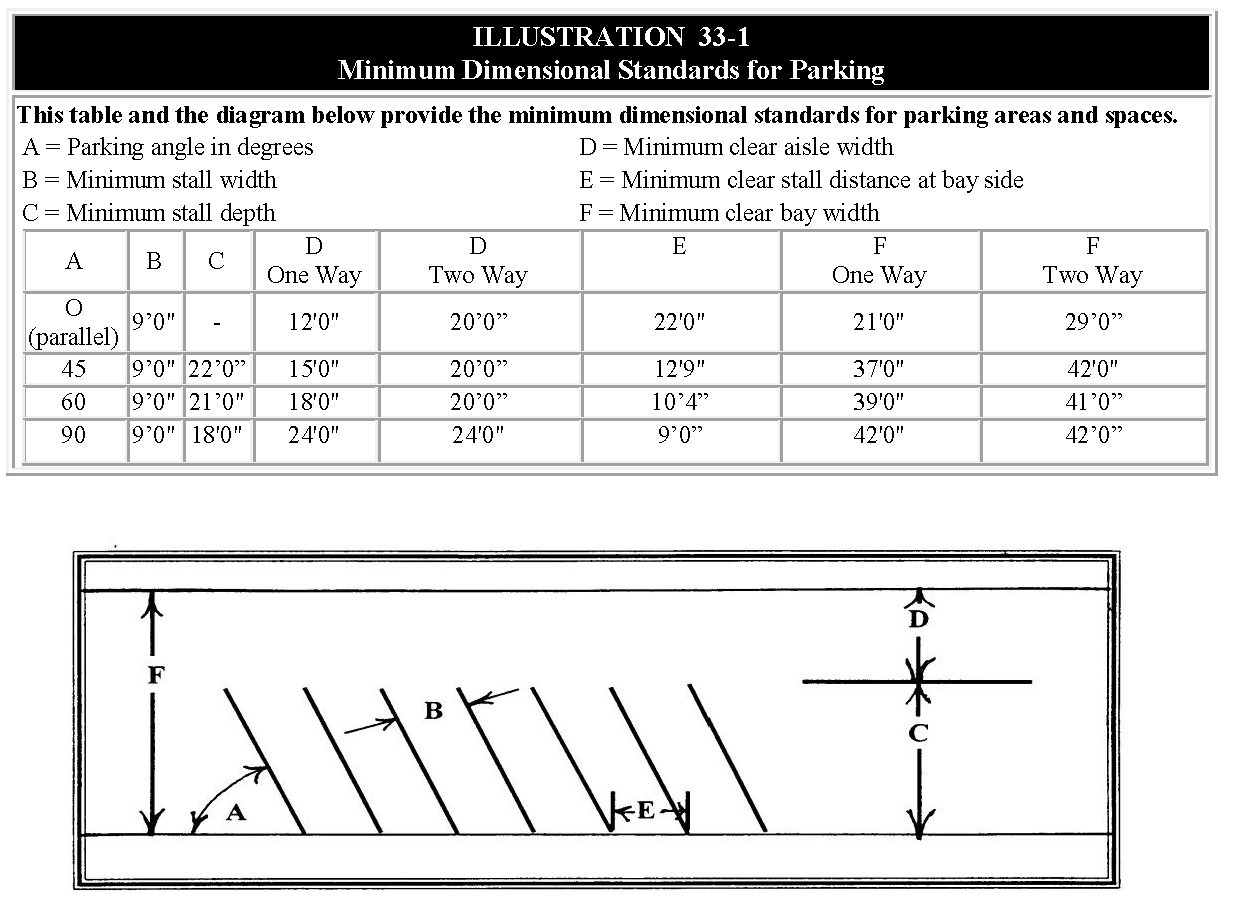
Each standard off-street surface parking space size shall be in accordance with the design standards as shown in Table 33-1 below for space size and aisle design. Specific parking space sizes, exclusive of aisles, driveways and maneuvering areas shall be in accordance with the following minimum sizes:
1.
Standard: Nine feet by 20 feet - Eighteen-foot length is allowed provided that the parking space has a two-foot clear bumper overhang area that does not encroach upon a public right-of-way, a sidewalk of less than six feet in width, or adjacent property.
2.
Parallel: Nine feet by 22 feet.
D.
All drive aisles, fire lanes, off-street parking, maneuvering, loading and storage areas shall be paved with paving in accordance with the city's paving design standards (i.e., no parking shall be permitted on grass, within landscaped areas, or on other unimproved surfaces) and graded to drain properly per city standards (i.e., no standing or pooling of water). All driveway approaches shall be constructed as described above, and shall be curbed to city standards. No paved parking space or area shall be designed such that a vehicle has to back up into a public street or across a public sidewalk, except for single- and two-family dwellings, which shall not be allowed to egress onto roadways that are larger than a residential collector (60-foot right-of-way) street unless specifically permitted by the city with the construction plat application. Parking spaces shall be permanently and clearly identified by stripes, buttons, tiles, curbs, barriers, or other approved methods. Non-permanent type marking, such as paint, shall be regularly maintained to ensure continuous clear identification of the space.
E.
All parking and loading spaces, and vehicle sales areas on private property shall have a vehicle stopping device (e.g., curb, wheel stop, etc.) installed so as to prevent parking of motor vehicles in any required landscaped areas, to prevent vehicles from hitting buildings, to protect public and/or private utility structures/facilities, and to prevent parked vehicles from overhanging a public right-of-way line, public sidewalk, or adjacent private property. An extra-wide walkway on private property may be permitted so as to allow encroachment of vehicle overhang while maintaining an unobstructed four-foot minimum walkway width. Parking shall not be permitted to encroach upon the public right-of-way in any case. For new construction only, all vehicle maneuvering shall take place on-site. No public right-of-way shall be used for backing or maneuvering into or from a parking space (except business locations in the downtown area that are already in existence as of the effective date of this ordinance), or for circulation within the parking lot. All entrances into parking lots shall be at least 24 feet in width, and shall conform to the city's adopted subdivision regulations.
F.
In all nonresidential and multifamily zoning districts, the perimeter of all parking lots and driveways shall be provided with concrete curbs.
G.
Refuse storage facilities placed in a parking lot shall not be located in a designated parking or loading space. Each refuse facility shall be located so as to facilitate pickup by refuse collection agencies and ease of egress from the site without having to back up further than 20 feet and without having to go the wrong way in a traffic aisle.
H.
Handicap parking space(s) shall be provided according to building codes, state and federal laws, and requirements of the Americans with Disabilities Act (ADA) and must be approved by the Texas Department of Licensing and Regulation (TDLR), P.O. Box 12157, Austin, Texas, 78711 (800-803-9202). Parking spaces for persons with disabilities shall be as close as possible to the main entrance of the building, and shall be appropriately and clearly marked. The following are general guidelines and are for reference only:
Access aisles adjacent to handicapped parking spaces shall be a minimum of 48 inches.
I.
In all nonresidential and multifamily zoning categories, designated parking and loading areas shall not be used for the repair, storage, dismantling or servicing (except for normal maintenance of a private vehicle) of vehicles or equipment, or for the storage of materials or supplies, or for any other use in conflict with the designated parking and loading areas (i.e., advertising or open storage of raw materials).
J.
To ensure that all requirements set forth in this section are carried forward, it will be the responsibility of the owner of the parking area to adequately maintain the facility. All off-street parking areas shall be kept free of trash, debris, vehicle repair operation or display and advertising uses.
K.
Off-street stacking requirements for drive-through facilities:
1.
A stacking space shall be an area on a site measuring at least nine feet wide by 20 feet long with direct forward access to a service window or station of a drive-through facility which does not constitute space for any other circulation driveway, parking space, or maneuvering area. An escape lane, of at least nine feet in width and with negotiable geometric design, must be provided to allow vehicles to get out of stacking lane in the event of a stalled vehicle, emergency, accidental entry, etc.
2.
For financial institutions with drive-through facilities, each teller window or station, human or mechanical, shall be provided with a minimum of five stacking spaces. One escape lane shall be provided.
3.
For each service window of a drive-through restaurant, a minimum of five spaces shall be provided for the first vehicle stop (usually the menu/order board), and two spaces shall be provided for each additional vehicle stop (order/pick-up windows, etc.). One escape lane shall be provided from the beginning of the stacking lane to the first stop (e.g., menu/order board).
4.
For retail operations (other than restaurants, banks, etc.) and kiosks that provide drive-up service (e.g., pharmacy, dry cleaners, etc.), a minimum of three stacking spaces for each service window shall be provided.
5.
For a full-service car wash, each vacuum or gas pump lane shall be provided with a minimum of four stacking spaces. For the finish/drying area, adequate vehicle stacking and storage space must be provided to keep finished vehicles out of circulation aisles, access easements, fire lanes, streets, etc.
6.
For each automated self-service (drive-through/rollover) car wash bay, a minimum of three stacking spaces, in addition to the wash bay itself, shall be provided. One additional stacking space shall be provided at the exit end of each wash bay for window-drying and other detailing.
7.
For each wand-type self-service (open) car wash bay, a minimum of two stacking spaces, in addition to the wash bay itself, shall be provided. One additional stacking space shall be provided at the exit end of each wash bay for window-drying and other detailing, unless a separate area/shade structure is provided (outside of circulation aisles) for these activities.
8.
For automobile quick-lube type facilities, a minimum of three stacking spaces shall be provided for each service bay in addition to the service bay itself.
L.
Dead-end parking areas shall be avoided if possible. If dead-end parking is necessary, then it shall be designed such that it is no more than three parking spaces deep unless adequate turnaround space is provided. A minimum five-foot deep hammerhead back-up space shall be provided at the end of any dead-end parking area.
M.
All parking structures must conform to the construction and design standards of the zoning district in which they are located.
33.4
Off-street loading space—All districts.
A.
All retail and similar nonresidential structures shall provide and maintain off-street facilities for receiving and loading merchandise, supplies and materials within a building or on the lot or tract. All drives and approaches shall provide adequate space and clearances to allow for the maneuvering of trucks off-street. Each site shall provide a designated on-site maneuvering area for trucks (see Illustrations 33-2 and 33-3). Such off-street loading space may be adjacent to (but not any portion of) a public alley or private service drive, or it may consist of a truck berth within the structure. The minimum dimensions of a "regular" loading space shall be ten feet by 30 feet, and a "large" loading space shall be at least ten feet by 65 feet. Loading spaces or berths shall be provided in accordance with the following schedule:
1.
Office uses, or portion(s) of building devoted to office uses:
0 to 19,999 square feet: 0 spaces
20,000 to 49,999 square feet: 1 regular space
50,000 to 149,999 square feet: 1 regular space and 1 large space
150,000+ square feet: 2 regular spaces and 1 large space
2.
Retail/commercial and restaurant uses, or portion(s) of building devoted to retail/commercial and restaurant uses:
0 to 3,999 square feet: 0 spaces
4,000 to 9,999 square feet: 1 regular space
10,000 to 29,999 square feet: 1 regular space and 1 large space
30,000 to 99,999 square feet: 2 regular spaces and 1 large space
100,000 to 200,000 square feet: 2 regular spaces and 2 large spaces
Each additional 100,000 square feet, or portion thereof, over 200,000: 1 additional large space
B.
In all nonresidential zoning districts, loading docks or service/delivery entrances shall not be constructed facing any public street (except for large industrial uses; see subsection B.1 below), and shall not be visible from any public street. Such loading areas shall be screened from view of any public street by the building itself, or by a masonry screening wing wall at least eight feet in height. Such masonry wing wall shall match the exterior construction materials and colors of the main building, and shall be located no closer than 100 feet to any public street right-of-way line (see Illustration 33-3).
1.
For large industrial or warehouse uses in the LI zoning district only, the loading docks may face a public street, and shall not be required to provide a masonry screening wing wall, provided that a minimum 30-foot wide landscape buffer area is provided adjacent to the street right-of-way line. One large shade trees shall be provided within the landscape buffer area for every 20 feet of street frontage, or one small ornamental tree shall be provided for every 12 feet of street frontage (or some combination thereof). In addition, a solid massing of large evergreen shrubs and three- to four-foot tall berms shall be provided to further screen loading area from view of the street (see Illustration 33-4).
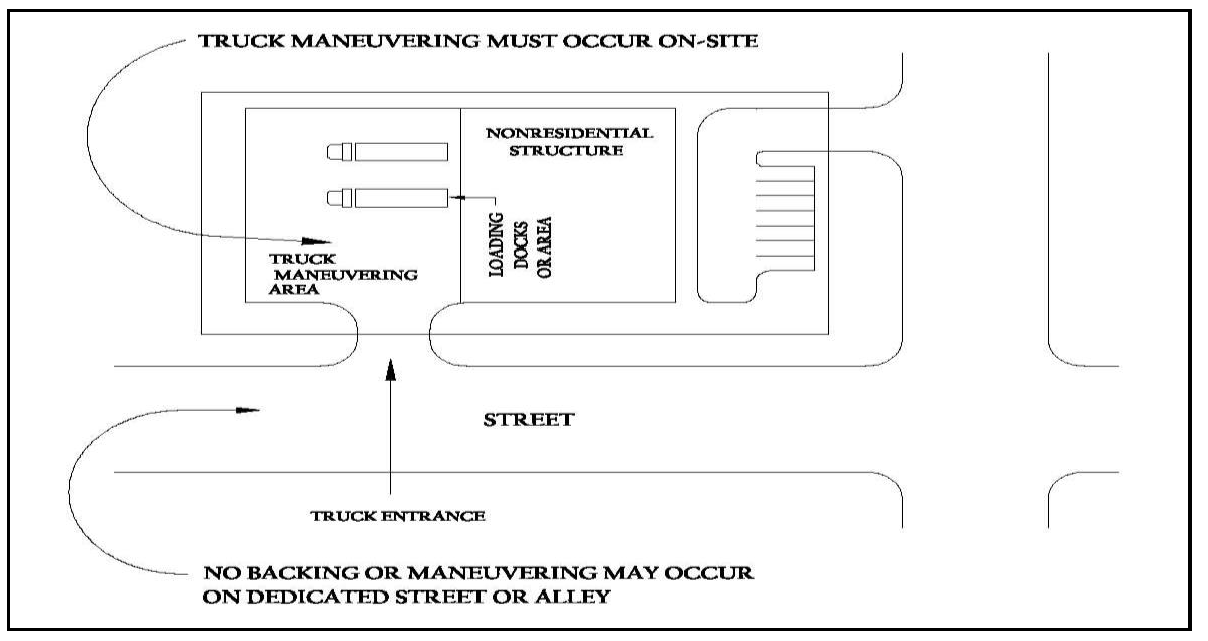
Illustration 33-2: Off-Street Maneuvering for Loading Area
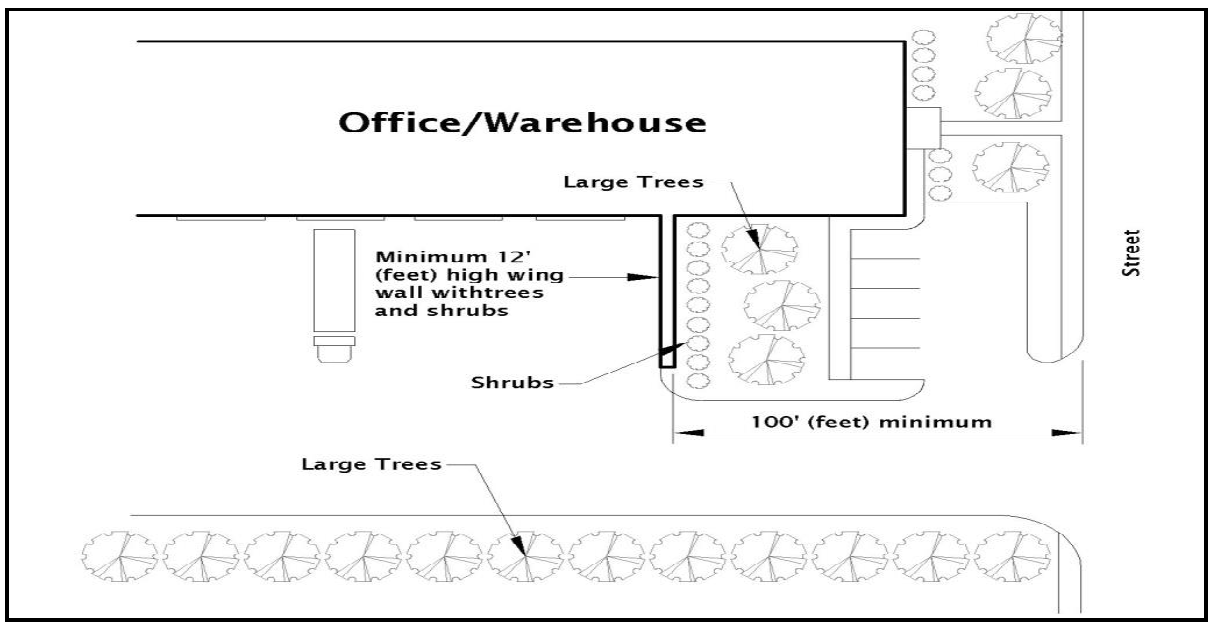
Illustration 33-3: Loading Area Screening
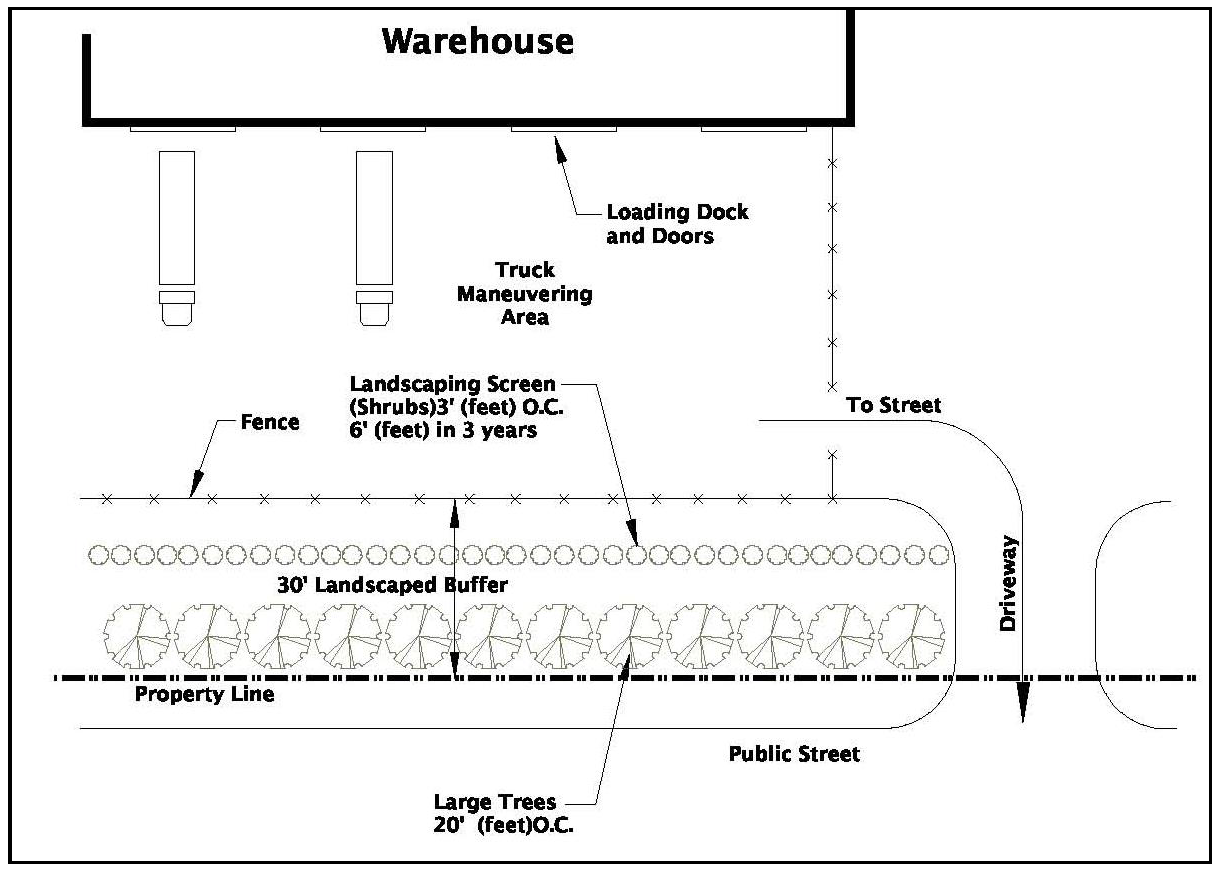
Illustration 33-4: Loading Area Placement and Screening in LI Zoning District
C.
Loading docks for any establishment which customarily receives goods between the hours of 9:00 p.m. and 8:00 a.m. and is adjacent to a residential district shall be designed and constructed so as to enclose the loading operation on at least three sides in order to reduce the effects of the noise of the operation on adjacent residences. Other screening/buffering alternatives may be approved on the required plan (i.e., building permit plan, concept plan, site plan) provided that the approving authority (i.e., city staff, city council) makes a finding that the alternative method of screening/buffering will be adequate to protect nearby residences.
D.
Kindergartens, elementary schools, day schools, and similar child training and care establishments, and middle schools shall provide one paved off-street pedestrian loading and unloading space (i.e., stacking spaces) for an automobile on a through, "circular" drive for each ten students cared for (excluding child care in a residence), not to exceed 30 spaces. An additional lane shall also be required to allow pass-by or through traffic to move while automobiles waiting or parked to pick up children occupy loading/unloading areas. This standard shall be in addition to other off-street parking requirements.
E.
Loading spaces that are adjacent and easily accessible to several buildings or uses, including buildings and uses on separate lots, shall be allowed to satisfy the loading requirements for the individual buildings or uses, provided that:
1.
The number of spaces satisfies the requirements for the combined square footages for the buildings or uses in question; and
2.
For loading spaces to be shared among separate lots, they must be in reasonably close proximity to all potential users and an agreement granting mutual use by the owners of each building shall be executed and provided to the city (for file).
33.5
Parking access from a public street—All districts.
A.
In the approval of the applicable required plan (i.e., building permit plan, concept plan, site plan), design consideration shall be given to providing entrance/exit drives that extend into the site to provide adequate queuing of vehicles on the site.
B.
In all districts (except single-family and duplex zoning districts), the applicable required plan shall provide for entrance/exit drive(s) appropriately designed and located to minimize traffic congestion or conflict within the site and with adjoining public streets. Based upon analysis by the city, if projected volumes of traffic entering or leaving a development are likely to interfere with the projected peak traffic flow volumes on adjoining streets, additional right-of-way and paving in the form of a deceleration lane, a turn lane, or other roadway improvements may be required of a developer in order to reduce such interference and to help ensure traffic safety and efficiency. The dedication of additional right-of-way or street paving may also be required, and shall be determined at the time of site plan and final plat approval.
C.
Vehicular access to nonresidential uses shall not be permitted from alleys serving residential areas, and shall not be configured as "head-in" parking spaces which are accessed directly from the street.
D.
Parking space configuration, location, arrangement, size and circulation in all districts shall be constructed according to Illustration 33-1.
33.6
Parking requirements based upon use.
A.
In all districts, there shall be provided at the time any building or structure is erected or structurally altered, or change of use, off-street parking spaces in accordance with the following requirements:
1.
Automobile sales or service: See motor-vehicle sales.
2.
Bank, savings and loan, or similar depository financial institution: One space per 250 square feet of gross floor area in addition to required stacking spaces (see subsection 33.3 K.) (see non-depository financial establishment)
3.
Bed and breakfast facility: One space per guest room in addition to the requirements for a normal residential use.
4.
Bowling alley or center: Six parking spaces for each alley or lane.
5.
Bus depots, airport terminals and other similar transportation uses: For terminals or other human transportation use, one space per 100 square feet of passenger waiting areas plus 1.2 spaces for each employee of the facility based upon the number of employees on the largest shift.
6.
Car wash (self-serve): One space per washing bay or stall in addition to the washing areas/stalls themselves and required stacking spaces.
Car wash (full service): One space per (150 square feet of floor area in addition to the required stacking spaces (also see subsection 33.3.K.).
7.
Church, rectory, or other place of worship: One parking space for each three seats in the main auditorium/sanctuary (see subsection 33.7.B.).
8.
Commercial amusement (indoor): One space per 100 square feet of gross floor area, or as follows:
a.
Racquetball or handball courts: Three spaces for each court.
b.
Indoor tennis courts: Six spaces for each court.
c.
Gymnasium, skating rinks, and martial arts schools: One space for each three seats at a maximum seating capacity (based upon maximum occupancy), plus one space for each 200 square feet.
d.
Dance/aerobics studio, or assembly/exhibition hall without fixed seats: One parking space for each 100 square feet of floor area thereof.
e.
Swimming pool: One space for each 100 square feet of gross water surface and deck area.
f.
Weight lifting or exercise areas: One space for each 100 square feet.
g.
Indoor jogging or running tracks: One space for each 100 linear feet.
h.
Motion picture theaters (which do not include live performances):
(1)
One space per three and one-half seats for single-screen theaters;
(2)
One space per five seats for motion picture theaters with two or more screens (see subsection 33.7.B.).
i.
Amusement center: One space for each game table and one space for each amusement device.
j.
All areas for subsidiary uses not listed above or in other parts of this section (such as restaurants, office, etc.), shall be calculated in with the minimum specified for those individual uses.
8.
Commercial amusement (outdoor): Ten spaces plus one space for each 500 square feet over 5,000 square feet of building and recreational area.
9.
Commercial use: One space per 250 square feet of floor area.
10.
Community center, library, museum or art gallery: Ten parking spaces plus one additional space for each 300 square feet of floor area in excess of 2,000 square feet. If an auditorium is included as a part of the building, its floor area shall be deducted from the total and additional parking provided on the basis of one space for each four seats that it contains (see subsection 33.7.B.).
11.
Convenience store/gasoline station: One space per 200 square feet of floor area, plus one parking space for each side of a gasoline pump unit (a unit may have up to six nozzles for gasoline disbursement). Spaces within pump areas qualify as spaces for the parking requirement. If no gasoline sales are provided, then the parking requirements shall be the same as for a retail store. Adequate space shall be provided for waiting, stacking, and maneuvering automobiles for refueling.
12.
Day nursery, day care center, pre-school or pre-kindergarten: One space per ten pupils (based upon maximum occupancy and/or licensing capacity), plus one space per classroom and/or office, plus one space for each bus or van stored on the property (and sized to accommodate the vehicle); also see stacking requirements in subsection 33.4.D.
13.
Defensive driving school/class: One space for each classroom seat (see subsection 33.7.B).
14.
Fast-food or drive-in restaurant: One parking space per 100 square feet of gross floor area (including indoor/outdoor play areas and patio dining areas), or one space for every three seats under maximum seating arrangement (i.e., occupancy), whichever is greater; required parking spaces are in addition to any stacking spaces that may be needed/provided for drive-through or drive-in facilities (see subsection 33.3.K.).
15.
Furniture or appliance store, hardware store, wholesale establishments, clothing or shoe repair or service: Two parking spaces plus one additional parking space for each 300 square feet of floor area over 1,000 square feet.
16.
Golf course: Four parking spaces per hole or green plus requirements for retail, office, and club house areas.
17.
Golf driving range: One and one-half spaces for each driving tee.
18.
Health club, health spa or exercise club: One space per 150 square feet of floor area.
19.
Hospital: One space for each bed based on full occupancy.
20.
Hotel or motel: One space per guest room for the first 250 rooms and .75 space per room for each room over (250, plus one space per five restaurant/lounge area seats (based upon maximum occupancy), plus one space per (125 square feet of meeting/conference areas, plus the following:
a.
One and one-tenth spaces for any guest room containing kitchenette facilities; and
b.
Two spaces for any guest room provided with full kitchen facilities.
21.
Lodge, philanthropic or fraternal organization: One space per 200 square feet.
22.
Lumber yard/home improvement center: One space per 400 square feet display area, plus one space per 1,000 square feet of warehouse.
23.
Manufactured home or manufactured home park: Two spaces for each manufactured home unit, plus visitor/supplemental parking in accordance with section 23, plus additional spaces as required herein for accessory uses.
24.
Medical or dental office: One space per 150 square feet of floor area. Facilities over 20,000 square feet shall use the parking standards set forth for hospitals.
25.
Mini-warehouse: Four spaces per establishment, plus two spaces for an on-site manager's residence (if applicable), plus one appropriately sized space for any type of vehicle to be stored on-site (e.g., rental trucks, boats, RVs, etc.).
26.
Mortuary or funeral home: One parking space for each 200 square feet of floor space in slumber rooms, parlors or individual funeral service rooms, or one space for each three seats in the auditorium/sanctuary (see subsection 33.7.B), whichever is greater. Adequate on-site stacking spaces shall also be provided for the organization and forming of processions such that these activities do not cause excessive or extended traffic congestion/delays on a public roadway.
27.
Motor-vehicle sales and new or used car lots: One parking space for each 500 square feet of sales floor/office and other indoor uses, plus one parking space for each 1,000 square feet of exterior lot area used for storage, sales and parking areas, plus one parking space per repair bay in service areas (indoors or outdoors), plus one parking space per service/towing vehicle to be stored on-site (required parking spaces are in addition to those to be used for the storage/display of vehicles for sale/lease).
28.
Non-depository financial establishment: One space per 150 square feet of gross floor area.
29.
Nursing home, convalescent home, or home for the aged: One space per six beds; plus one parking space for each 300 square feet of floor area devoted to offices, cafeterias, exercise/therapeutic rooms, and other similar ancillary uses.
30.
Office (business or professional): One space for each 300 square feet of floor area.
31.
Outdoor display: One space for each 600 square feet of open sales/display area.
32.
Pawn shop: One space for each 200 square feet of floor area.
33.
Places of public assembly not listed: One space for each three seats provided (see subsection 33.7.B).
34.
Restaurant, cafe or similar food service establishment: One parking space for each 100 square feet of gross floor area (including indoor/outdoor play areas and patio dining areas), or one space for every three seats under maximum seating arrangement (i.e., occupancy), whichever is greater; required parking spaces are in addition to any stacking spaces that may be needed/provided for drive-through or drive-in facilities (see subsection 33.3.K.).
35.
Retail or personal service establishment, except as otherwise specified herein: One space per 200 square feet of gross floor area in addition to any required stacking spaces for drive-through facilities (see subsection 33.3.K.).
36.
Retirement housing for the elderly (independent living): One and one-half spaces for each dwelling unit, plus any additional spaces for accessory retail, office, service or recreational uses.
37.
Rooming or boarding house, or group quarters: One parking space for each sleeping room at full occupancy, plus one parking space for each host resident or employee during maximum (i.e., peak) shift.
38.
School, elementary: One parking space for each 15 students (design capacity), plus one large parking space for each bus to be parked on-site for any length of time other than student pick-up/drop-off. Also see subsection 33.4.D.
39.
School, secondary or middle: One parking space for each 12 students (design capacity). Also see subsection 33.4.D.
40.
School, high school, technical school, college or university: One space for each three students, faculty and staff (design capacity). Also see subsection 33.4.D.
41.
Storage or warehousing, wholesale distribution and light manufacturing: Under 100,000 square feet of gross floor area - One space for each 2,500 square feet of total floor area not open to the public, plus one space for each 250 square feet of office space or areas open to the public such as sales areas. For 100,000 square feet or larger buildings in this category with little or no general public access parking may be calculated based on employment - 1.2 spaces for each employee plus five spaces for visitors. The parking calculations shall be based on the number of employees for the largest shift employed at the facility (i.e. 100 employees would require 125 parking spaces including visitors).
42.
Telemarketing: One space for each 250 square feet of floor space.
43.
Terminal facilities, truck terminals, railroad yards, and other similar heavy commercial transportation uses: One space for each 200 square feet of office floor area plus one space for each 2,500 square feet of warehouse space if present.
44.
Theater, indoor or outdoor (live performances), sports arena, stadium, gymnasium or auditorium (except school auditorium): One parking space for each three seats or bench seating spaces (see subsection 33.7.B).
45.
Veterinarian clinic: One space per 300 square feet of gross floor space.
33.7
Rules for computing number of parking spaces and miscellaneous off-street parking requirements. In computing the number of parking spaces required for each of the above uses, the following rules shall govern:
A.
"Floor area" shall mean the gross floor area of the specific use.
B.
"Seat" shall be interpreted as follows:
1.
For fixed (e.g., church pews, grandstands, benches, etc.) seating, one seat equals 18 inches of length; and
2.
For flexible (e.g., folding chairs, etc.) seating areas, one seat equals eight square feet of floor area occupied by such seating area (includes aisles).
C.
Where fractional spaces result, the parking spaces required shall be construed to be the next higher whole number.
D.
The parking space requirements for a new or unlisted use not specifically mentioned herein shall be the same as required for a use of similar nature. If the proposed use is not similar to any of the uses listed herein, a determination shall be recommended by the planning and zoning commission, and shall be approved by the city council, in conjunction with the request for classification of the new or unlisted use, as provided in subsection 32.1.D.
E.
Whenever a building or use is changed or enlarged in floor area, number of dwelling units, seating capacity or otherwise, to create a need for an increase of ten percent or more in the number of existing parking spaces, such spaces shall be provided on the basis of the enlargement or change. If a building or use that was in existence prior to the effective date of this ordinance is enlarged by more than 50 percent in floor area, number of dwelling units, seating capacity or otherwise, then said building or use shall be required to conform with the parking requirements herein for the entire building or use.
F.
For buildings which have a combination of uses within the same structure or on the same premises (such as retail or office), the off-street parking requirement shall be calculated as the summation of the parking requirements for each use, and no parking space for one particular use shall be allowed to count toward the parking requirement for some other use on the premises except in the case of a shared parking arrangement (see subsection G. below).
G.
Shared parking may be allowed in the case of mixed uses (different buildings) under the following conditions: Up to 50 percent of the parking spaces required for a theater or other place of evening entertainment (after 6:00 p.m.), or for a church, may be provided and used jointly by banks, offices, and similar uses not normally open, used, or operated during evening hours. Shared parking must be on the same parking lot. Reduction due to shared parking shall only be allowed if approved on the applicable required plan (i.e., building permit plan, concept plan, or site plan). To assure retention of the shared parking spaces, each property owner shall properly draw and execute an irrevocable mutual parking agreement document expressing the same, shall file this agreement with the county, and shall provide a copy of the filed agreement to the City of Terrell prior to issuance of a certificate of occupancy for any use that relies upon the parking agreement.
33.8
Location of parking spaces. All parking spaces required herein shall be located on the same lot of the building or use served, except as follows:
A.
Where an increase in the number of spaces is required by a change or enlargement of an existing use, or where such spaces are provided collectively or used jointly by two or more existing buildings or establishments, the required additional spaces may be located not to exceed 300 feet from any nonresidential lot served.
B.
In any case where the required parking spaces are not located on the same lot with the building or use served, or where such spaces are collectively or jointly provided and used, approval on the applicable required plan (i.e., building permit plan, concept plan, or site plan) is required according to the following criteria:
1.
Off-site parking may be permitted on an immediately contiguous lot or tract or on a lot or tract within 200 feet of such building or structure providing:
a.
That a permanent, irrevocable easement of the parking facilities in favor of the premises to be benefited shall be dedicated and recorded as a condition of such use; or
b.
That a long-term remote parking lease agreement be provided upon approval by the city as a condition of such use.
33.9
Use of required parking spaces, nonresidential districts.
A.
Off-street parking and loading spaces shall be used only for these respective purposes and shall not be used for refuse containers, cart corrals, recycling kiosks, signs or sign support structures, telecommunications towers or support structures, storage or permanent display of boats, trailers, campers, motor vehicles or other goods, materials, or products for sale/lease/rent.
33.10
Fire lanes.
A.
Fire/emergency vehicle access shall be provided in all single-family, townhouse, multifamily, nonresidential developments, and manufactured home developments as required by the adopted International Fire Code of the City of Terrell and constructed in accordance to the Technical Construction Standards and Specifications (TCSS).
33.11
Special regulations for recreational/utility vehicles (including RVs).
A.
For the purpose of these regulations, the term "recreational/utility vehicle" is defined as including boats, boat trailers, travel trailers, pickup campers and coaches (designed to be mounted upon automotive vehicles), motorized dwellings (RVs), tent trailers, utility trailers, livestock trailers, personal watercraft and the like, as well as cases or boxes used for storage or transporting such vehicles, whether occupied by such vehicles or not. No such vehicles shall be used for living, sleeping or housekeeping or similar purposes when parked or stored on a residential lot, or in any location not approved for such use, except as specified in this ordinance.
B.
No special motor vehicle, heavy load vehicle or recreational vehicle shall be left unattended or parked for more than 24 hours within any parking lot, parking space(s), drive aisle, vacant or unused property, or pervious/unpaved surface area (except an appropriately zoned and approved/paved parking lot for such vehicles).
C.
All recreational/utility vehicles shall be parked on a suitably paved surface per subsection 33.2.C above.
(Ord. No. 3138, Arts. I, II(Exh. A), 9-30-25)
Section 34. - Landscape requirements.
34.1
Purpose. Landscaping is accepted as adding value to property and is in the interest of the general welfare of the city. The provision of landscaped areas also serves to increase the amount of a property that is devoted to pervious surface area that, in turn, helps to reduce the amount of impervious surface area, stormwater runoff, and consequent non-point pollution in local waterways. Therefore, landscaping is hereafter required of new development, except single- and two-family residential and agricultural uses, adjacent to public streets. Single- and two-family uses are generally not required to provide extensive landscaping at the time of development because they rarely fail to comply with the requirements set forth herein.
34.2
Scope and enforcement. The standards and criteria contained within this section are deemed to be minimum standards and shall apply to all new construction, alterations, or additions (i.e., exceeding 60 percent of the original floor area, unless exempt under V.T.C.A. Local Government Code, ch. 245.004) occurring within the city, except that single-family or duplex dwellings shall be exempt. Additionally, any use requiring a specific use permit or a PD zoning designation must comply with these landscape standards unless special landscaping standards are otherwise provided for in the ordinance establishing the SUP or PD district. The provisions of this section shall be administered and enforced by the municipal development department. The landscape standards in this section apply only to nonresidential and multifamily developments (including uses such as schools and churches within a residential zoning district).
If at any time after the issuance of a certificate of occupancy, the approved landscaping is found to be not in conformance with the standards and criteria of this section, the municipal development department shall issue notice to the owner, citing the violation and describing what action is required to comply with this section. The owner, tenant or agent shall have 30 calendar days from date of said notice to establish/restore the landscaping, as required. If the landscaping is not established or restored within the allotted time, then such person shall be in violation of this ordinance.
34.3
Permits.
A.
No permits shall be issued for building, paving, or construction until a detailed landscape plan is submitted and approved by the municipal development department, along with the applicable required plan (i.e., building permit plan, concept plan, or site plan). A landscape plan shall be required as part of the applicable required plan, as outlined in section 12. The landscape plan may be shown on the applicable required plan (provided the plan remains clear and legible) or may be drawn on a separate sheet. Prior to the issuance of a certificate of occupancy for any building or structure, all screening and landscaping shall be in place in accordance with the landscape plan. All final finish grading, mowing of existing natural areas, fence lines, drainage ways, and right-of-way, removal of all rocks, concrete and other debris from areas which will be mowed shall be considered landscaping for the purpose of issuing a certificate of occupancy.
B.
In any case in which a certificate of occupancy is sought at a season of the year in which the municipal development department determines that it would be impractical to plant trees, shrubs or groundcover, or to successfully establish turf areas, a temporary certificate of occupancy may be issued provided a letter of agreement from the property owner is submitted that states when the installation shall occur. All landscaping required by the landscaping plan shall be installed within six months of the date of the issuance of the certificate of occupancy.
C.
Streetscaping or landscaping in right-of-way or common areas must have prior approval from the city and/or the Texas Department of Transportation (TxDOT) as to locations and plant selections.
34.4
Landscape plan. Prior to the issuance of a building, paving, or construction permit for any use other than single-family detached or duplex dwellings, a landscape plan shall be submitted to the municipal development department. The municipal development department shall review such plans and shall approve same if the plans are in accordance with the criteria of these regulations. If the plans are not in conformance, they shall be disapproved and shall be accompanied by a written statement setting forth the changes necessary for compliance.
Landscaping plans shall be prepared by a person knowledgeable in plant material usage and landscape design (e.g., landscape architect, landscape contractor, landscape designer, etc.) and shall contain the following minimum information:
A.
Minimum scale of one-inch equals 50 feet; show scale in both written and graphic form.
B.
Location, size and species of all trees to be preserved (do not use "tree stamps" unless they indicate true size and location of trees).
C.
Location of all plant and landscaping material to be used, including plants, paving, benches, screens, fountains, statues, earthen berms, ponds (to include depth of water), topography of site, or other landscape features.
D.
Species and common names of all plant materials to be used.
E.
Size of all plant material to be used (container size, planted height, etc.).
F.
Spacing of plant material where appropriate.
G.
Layout and description of irrigation, sprinkler, or water systems including location of water sources.
H.
Name and address of the person(s) responsible for the preparation of the landscape plan.
I.
North arrow/symbol, and a small map showing where the property is located.
J.
Date of the landscape plan.
34.5
General standards. The following criteria and standards shall apply to landscape materials and installation:
A.
All required landscaped open areas shall be completely covered with living plant material. Landscaping materials such as wood chips and gravel may be used under trees, shrubs and other plants, but shall not comprise a significant portion of the total landscaped area.
B.
Plant materials shall conform to the standards of current edition of the "American Standard for Nursery Stock" (as amended), published by the American Association of Nurserymen. Grass seed, sod and other material shall be clean and reasonably free of weeds and noxious pests and insects.
C.
Trees shall have an average spread of crown of greater than 15 feet at maturity. Trees having a lesser average mature crown of 15 feet may be substituted by grouping the same so as to create the equivalent of 15 feet of crown spread. Large trees shall be a minimum of three inches in caliper (measured 12 inches above the ground) and seven feet in height at time of planting. Small ornamental trees shall be a minimum of one and one-half-inch in caliper and five feet in height at time of planting.
D.
Select trees which are well suited to the area - soil type, space available for roots or mature crown size and height, disease and pest resistance, moisture levels, sturdiness, color, shape, flowers can all affect the suitability of a tree. The following species are not recommended because of their problems and nuisance factors: Arizona Ash, Fruitless Mulberry, Cottonwood, Silver Maple, Hackberry, Bradford Pear (Aristocrat, Red Spire, and Chanticleer are pear varieties which do not exhibit poor growth habits), Mesquite, Eastern Red Cedar. For help in selecting the right tree for the right place the following link to the Texas Forest Service Tree Selection Guide will guide you in making the right choice: http://texastreeplanting.tamu.edu/ or contact the municipal development department for further information.
E.
Shrubs shall be a minimum size of a three-gallon container grown plant with a full natural shaped crown at the time of planting. Hedges, where installed for screening purposes, shall be planted and maintained so as to form a continuous, unbroken, solid visual screen which will be six feet high within three years after time of planting (except for parking lot/headlight screens, which shall form a continuous, solid visual screen three feet high within two years after planting).
F.
Vines not intended as ground cover shall be a minimum of two feet in height immediately after planting and may be used in conjunction with fences, screens, or walls to meet landscape screening requirements as set forth.
G.
Grass areas shall be sodded, plugged, sprigged, hydro-mulched and/or seeded, except that solid sod shall be used in swales, earthen berms or other areas subject to erosion. If grass seed is planted due to seasonal considerations that is of a temporary nature to prevent erosion (i.e. rye grass) then a permanent variety must be over seeded and established within six months of the original seeding.
H.
Ground covers used in lieu of grass in whole and in part shall be planted in such a manner as to present a finished appearance and reasonably completed coverage within one year of planting.
I.
All required landscaped areas shall be equipped with an automatic, underground irrigation system with freeze and moisture sensors to prevent watering at inappropriate times. Landscaped areas having less than 20 square feet in area may be irrigated by some other inconspicuous method. If appropriate xeriscape planting techniques are utilized, the zoning board of adjustments may waive the requirement for an underground irrigation system (see subsection 9.6.F). However, the landscaping shall be required to be maintained in a healthy, living and growing condition, and any irrigation devices shall not be visible from public streets or walkways.
J.
Earthen berms shall have side slopes not to exceed 33.3 percent (three feet of horizontal distance for each one foot of vertical height). All berms shall contain necessary drainage provisions as may be required by the city's engineer.
34.6
Minimum landscaping requirements for new residential subdivisions or developments.
A.
For all new residential subdivisions or developments of 25 dwelling units or more the following landscape requirements must be met as a condition of approval of the construction and issuance of a certificate of occupancy for each residential structure.
1.
The street parkway shall be defined as the area between the back of curb or edge of pavement and the street right-of-way line.
2.
The front yard shall be defined as the area between the street right-of-way line and the front building line of the house.
3.
A minimum four feet wide sidewalk shall be required to be located adjacent to the right-of-way (front property line) in a private utility/public access easement a minimum of ten feet from the edge of pavement. (sidewalk may meander back and forth across the front property line provided that no portion of the sidewalk is located within seven feet of the edge of pavement).
4.
A minimum of one street tree shall be planted for every 50 feet of street frontage in the parkway in accordance with Illustration 34-1 below.
5.
A minimum of two large shade trees shall be planted at the time of construction in the front yard (care should be exercised in the placement of large shade trees so as not to obscure the view of the front entryway of the house). Two small ornamental trees may be substituted for one large shade tree (see "Recommended Plant List" in this section).
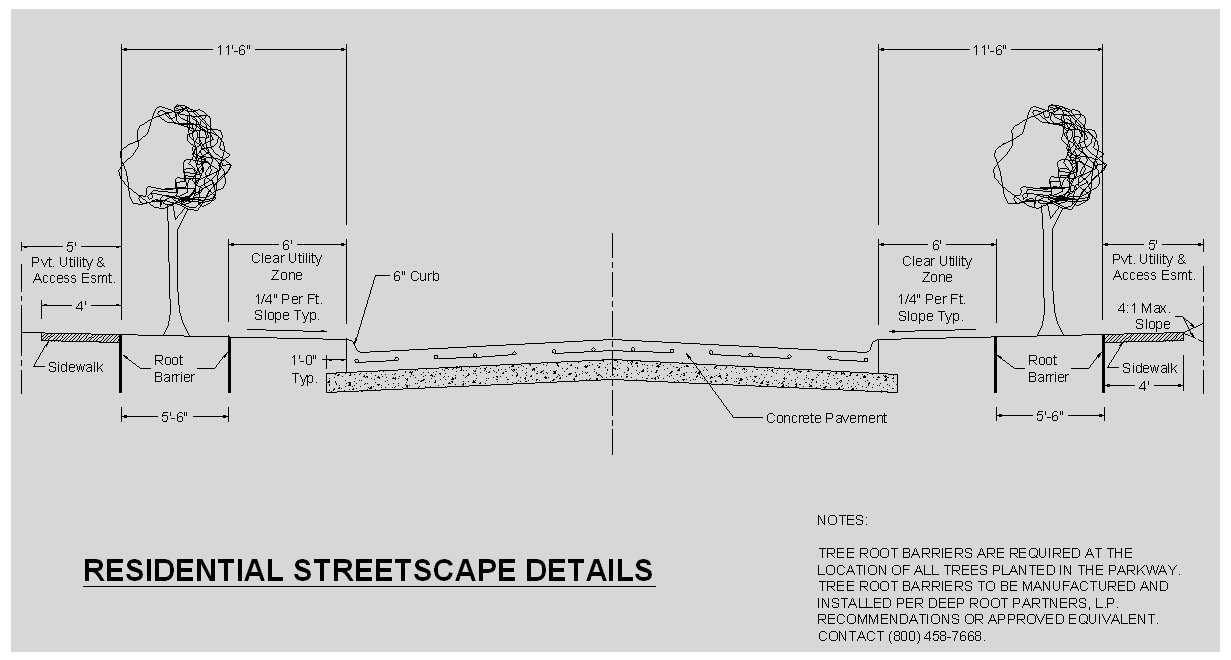
Illustration 34-1: Parkway Landscaping Details
34.7
Minimum landscaping requirements for nonresidential and multifamily developments.
A.
For all nonresidential and multifamily developments (including schools, churches, day care facilities, and other similar uses in a residential district), at least ten percent of the street yard shall be a permanently landscaped area (see Illustration 34-1). The street yard shall be defined as the area between the building front and the front property line (which is not necessarily the edge of the pavement since the street right-of-way width allows for public utilities, traffic safety and drainage ways).
B.
A minimum ten-foot landscape buffer (interior parkway) adjacent to the right-of-way of any major thoroughfare is required. Corner lots fronting two major thoroughfares shall provide the appropriate required landscape buffer on both street frontages. One large shade tree shall be required per 50 linear feet (or portion thereof) of street frontage. Trees may be grouped or clustered to facilitate site design and to provide an aesthetically pleasing, natural looking planting arrangement. The landscaped buffer area may be included in the required street yard landscape area percentage.
C.
Landscape areas within parking lots should generally be at least one parking space in size, with no landscape area less than 50 square feet in area. Landscape areas shall be no less than five feet wide and shall equal a total of at least 16 square feet per parking space. There shall be a landscaped area with at least one tree within 60 feet of every parking space. There shall be a minimum of one tree planted in the parking area for every ten parking spaces for parking lots having more than 20 spaces. Within parking lots, landscape areas should be located to define parking areas and to assist in clarifying appropriate circulation patterns. A landscape island shall be located at the terminus of all parking rows, and shall contain at least one tree. All landscape areas shall be protected by a monolithic concrete curb or wheel stops, and shall remain free of trash, litter, and car bumper overhangs. The area of parking lot landscaping islands shall be in addition to the required street yard landscape area percentage.
D.
Necessary driveways from the public right-of-way shall be permitted through all required landscaping in accordance with city regulations.
E.
Only shrubs, groundcovers or small ornamental trees shall be planted under existing or proposed overhead utility lines or over buried utilities.
34.8
Tree preservation.
A.
During any construction or land development, the developer shall clearly mark all trees to be maintained and may be required to erect and maintain protective barriers around all such trees or groups of trees. The developer shall not allow the movement of equipment or the storage of equipment, materials, debris or fill to be placed within the drip line of any trees.
B.
During the construction stage of development, the developer shall not allow cleaning of equipment or material under the canopy of any tree or group of trees to remain. Neither shall the developer allow the disposal of any waste material such as, but not limited to, paint, oil, solvents, asphalt, concrete, mortar, etc., under the canopy of any tree or groups of trees to remain. No attachment or wires of any kind, other than those of a protective nature, shall be attached to any tree.
C.
All existing trees which are to be preserved shall be provided with undisturbed, permeable surface area under (and extending outward to) the existing drip line of the tree. All new trees shall be provided with a permeable surface under the drip line a minimum of five feet by five feet.
D.
Any trees preserved on a site meeting the herein specifications may be credited toward meeting the tree requirement of any landscaping provision of this section according to the following table:
E.
Due to their limited height, size and value as quality shade trees, mesquite and hackberry trees will receive only 50 percent of the above credit for tree preservation. All other existing trees may receive credit if they are not on the city's recommended plant material list but approved by the director, or his designee. Should any required tree designated for preservation in the landscape plan die, the owner shall replace the tree with a two-inch minimum caliper tree in accordance with the credits listed above. Tree circumference shall be measured four and one-half feet above natural grade. No living trees greater than eight inches in caliper may be cut, destroyed or damaged on the development site until approved as part of the site plan requirements in this ordinance. However, certain nuisance, hazardous, diseased, or noxious trees may be required to be removed in the preparation of the site for construction as determined by a site inspection by the director or his designee and shall not require mitigation.
34.9
Maintenance.
A.
The owner, tenant and/or their agent, if any, shall be jointly and severally responsible for the maintenance of all landscaping. All required landscaping shall be maintained in a neat and orderly manner at all times. This shall include, but not to be limited to, mowing (of grass of six inches or higher), edging, pruning, fertilizing, watering, weeding, and other such activities common to the maintenance of landscaping. Landscaped areas shall be kept free of trash, litter, weeds, and other such material or plants not a part of the landscaping. All plant material shall be maintained in a healthy and growing condition as is appropriate for the season of the year. Plant materials, which die, shall be replaced with plant material of similar variety and size, within 90 days. Trees with a trunk diameter in excess of six inches measured 24 inches above the ground may be replaced with ones of similar variety having a trunk diameter of no less than three inches measured 24 inches above the ground. A time extension may be granted by the director, or his designee, if substantial evidence is presented to indicate abnormal circumstances beyond the control of the owner or his agent.
B.
Failure to maintain any landscape area in compliance with this section is considered a violation of this section and may be subject to penalties of section 7.
34.10
Sight distance and visibility. Rigid compliance with these landscaping requirements shall not be such as to cause visibility obstructions and/or blind corners at intersections. Visibility clearance shall be provided such that no landscaping, fence, wall, architectural feature, screening, earth mounding (berms), signs, etc. shall obstruct the vision of a motor vehicle operator approaching any street, alley or driveway intersection as provided herein. Whenever an intersection of two or more public rights-of-way occurs, a triangular visibility area, as described below, shall be created. Landscaping within the triangular visibility area shall be designed to provide unobstructed cross-visibility at a level between 30 inches and eight feet. A drive access serving large vehicles, such as delivery trucks, shall provide an unobstructed cross-visibility at a level between 30 inches and nine feet. Trees may be permitted in this area provided they are trimmed in such a manner that no limbs or foliage extend into the cross-visibility area. The triangular areas are:
A.
The areas of property on both sides of the intersection of an alley access way and public right-of-way shall have a triangular visibility area with two sides of each triangle being a minimum of 20 feet in length from the point of intersection and the third side being a line connecting the ends of the other two sides.
B.
The areas of property located at a corner formed by the intersection of two or more public rights-of-way (or a private driveway onto a public road) shall have a triangular visibility area with two sides of each triangle being a minimum of 25 feet in length along the right-of-way lines (or along the driveway curb line and the road right-of-way line) from the point of the intersection and the third side being a line connecting the ends of the other two sides. For any intersection where the posted speed limit for cross traffic is 45 miles per hour or more the sides of the visibility triangle shall be increased to 45 feet per side along the right-of-way.
C.
Landscaping, except required grass and low ground cover, shall not be located closer than three feet from the edge of any access way pavement.
D.
In the event other visibility obstructions are apparent in the proposed landscape plan, as determined by the municipal development department, the required landscaping set forth herein may be reduced or relocated to the extent to remove the conflict.
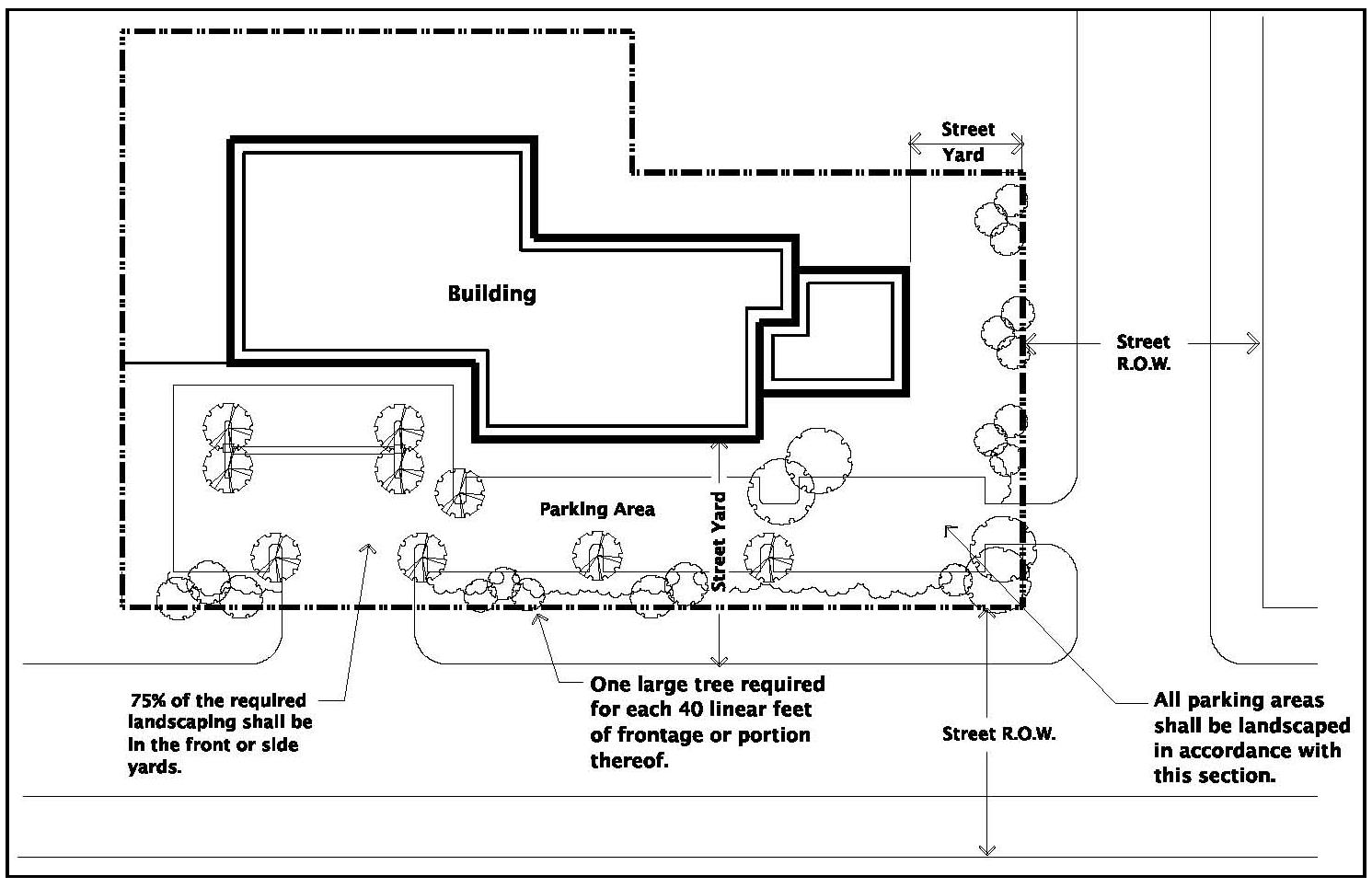
Illustration 34-2: Landscape Requirements
RECOMMENDED PLANT LIST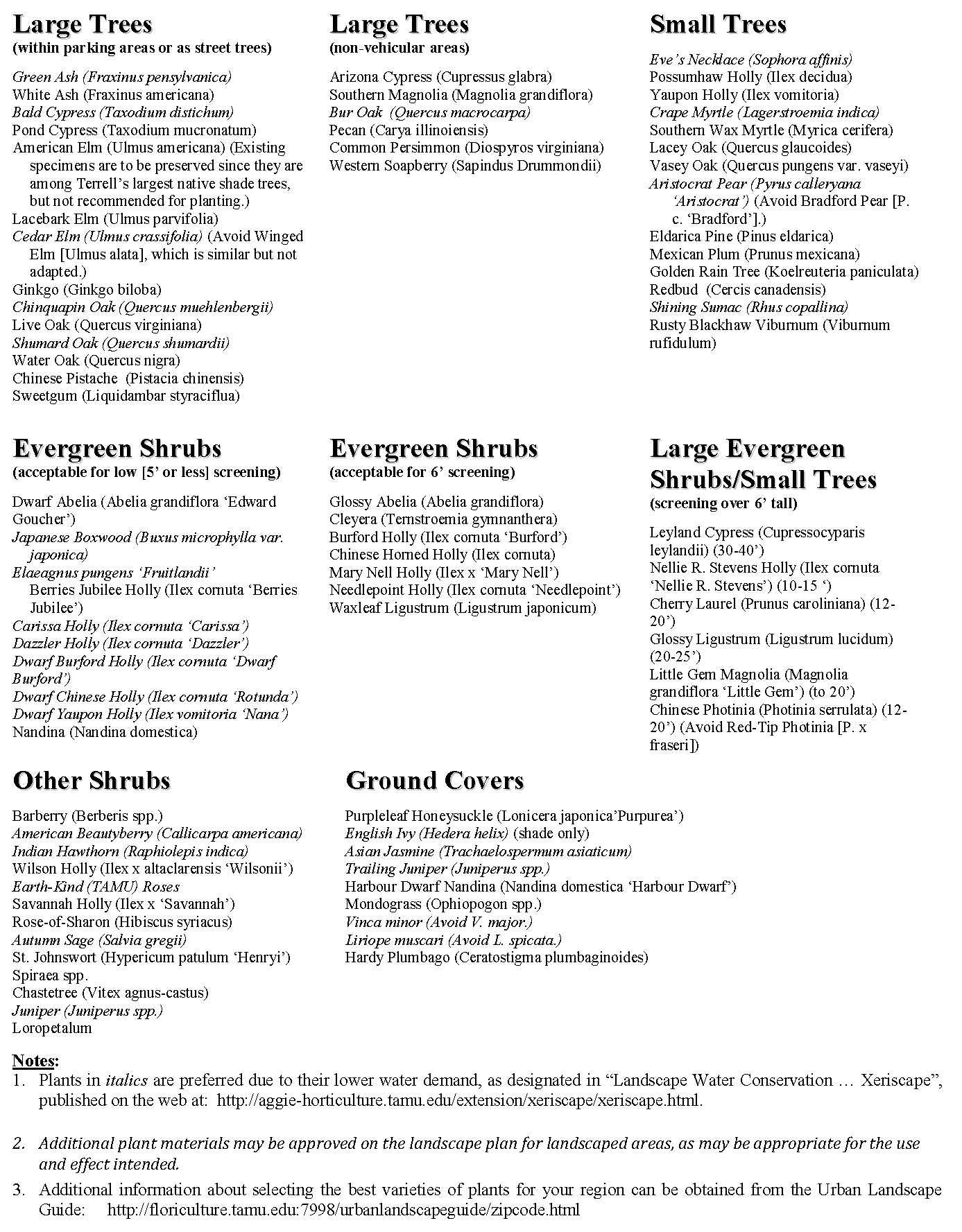
(Ord. No. 3138, Arts. I, II(Exh. A), 9-30-25)
Section 35. - Accessory structure and use regulations.
35.1
In a single-family or multifamily district, an accessory structure is a subordinate or incidental building, attached to or detached from the main building, not used for commercial purposes and not rented. Accessory structures shall be located toward the rear portion of the property, and shall conform to applicable provisions of the building code. (Also see section 37 for exterior construction standards.)
35.2
In nonresidential districts, an accessory structure is a subordinate building, the use of which is secondary to and supportive of the main building. Accessory structures shall not be permitted without a main building or primary use being in existence. Accessory structures should, wherever possible, be located toward the rear portion of the property. Accessory buildings shall conform to applicable provisions of the building code. (Also see section 37 for exterior construction standards.)
35.3
Accessory dwelling units in the AG, EE-32 and SF-16 zoning districts shall be allowed as an incidental residential use of a building on the same lot as the main dwelling unit and used by the same person or persons of the immediate family, and shall meet the following standards:
A.
The accessory dwelling unit must be constructed to the rear of the main dwelling, separate from the main dwelling.
B.
The accessory dwelling unit may be constructed only with the issuance of a building permit, and shall be constructed of masonry materials that are similar in appearance to the main structure if over 240 square feet in size.
C.
The accessory dwelling unit may not be sold separately from sale of the entire property, including the main dwelling unit, and shall not be sublet.
D.
Setback requirements shall be the same as for the main structure.
E.
Accessory dwellings are not permitted without the main or primary structure.
35.4
Accessory dwellings shall conform to the height limitations of the zoning district in which it is located. No such accessory dwelling or quarters shall be used or occupied as a place of abode or residence by anyone other than a bona fide caretaker, servant or farm worker actually and regularly employed by the landowner or occupant of the main building, or is a guest or family member of the owner/occupant. Only one accessory dwelling unit (i.e., garage/accessory dwelling, servants/caretakers' quarters, etc.) shall be allowed on any lot within a residential zoning district, and they shall be clearly incidental to the primary use. These accessory living structures shall not, in any case, be leased or sold.
35.5
Area regulations for accessory buildings in residential and multifamily districts.
A.
Size of yards.
1.
Front yard: Detached accessory buildings shall be prohibited in front of the main building.
2.
Side yard: There shall be a side yard not less than three feet from any side lot line or alley line for any accessory building provided that such building is separated from the main building by a minimum distance of ten feet. In the case of an accessory building being closer than ten feet to the main building, the minimum side yard requirements for the main building shall be observed. Accessory buildings adjacent to a side street shall have a side yard not less than 15 feet. Garages or carports located and arranged so as to be entered from an interior side yard shall have a minimum setback of 25 feet from the side lot line. Carports or garages arranged to be entered from the side yard, facing a public street, shall have a minimum distance equal to the required yard for the main building or 25 feet, whichever is greater.
3.
Rear yard: There shall be a rear yard not less than three feet from any lot line or alley line, except that;
a.
Where apartments are permitted, the main building and all accessory buildings shall not cover more than 60 percent of that portion of the lot lying to the rear of a line erected joining the midpoint of one side lot line with the midpoint of the opposite side lot line;
b.
Carports, garages, or other accessory buildings, located within the rear portion of a lot as heretofore described, constructed closer than ten feet to the main building, shall have a rear yard equivalent to the rear yard requirement for the main building; or
c.
Accessory buildings constructed ten feet or more from the main building shall have a rear yard of three feet.
If an alley exists, accessory buildings may be located within three feet of a rear lot line if the maximum (e.g., ridge) height of the building is no greater than eight feet and if a solid fence or wall of the same height is built on the rear lot line to screen the building from property located to the rear. Garages or carports that are arranged so as to be entered by a motor vehicle from an alley or rear alley easement shall be set back from the rear property line or alley easement line a minimum distance of 25 feet.
4.
[Setbacks for carports.] Setbacks for carports shall be measured from the part of the carport (usually the roof) that is closest to the street or alley (see Illustration 38-2), and shall not project beyond the front façade of the house and shall be constructed of materials like the main building(s) on the premises if located in the side yard and is visible from the street. In single-family and two-family zoning districts, carports shall be a maximum size of 24 feet deep and 24 feet wide. In multifamily and nonresidential zoning districts, carports shall be a maximum size of 12 bays in width and 24 feet deep.
B.
Accessory buildings are not permitted without a main structure.
C.
Barns, stables, or other accessory structures designed to house animals shall be located in accordance with the regulations as set forth in the animal control ordinance, chapter 3 of the Terrell Code of Ordinances as adopted or amended.
D.
Accessory buildings shall not exceed the height allowed for such buildings in the specific zoning district wherein it is located. Garage/accessory dwelling units up to two stories are allowed in certain districts (see subsection 32.2) by SUP if there is no adverse impact upon adjacent properties. Accessory dwellings located in single-family districts shall only be occupied by persons related to the occupants of the main dwelling and shall not be rented, leased or sold separately from the main structure.
E.
Exterior construction standards for accessory buildings: See section 37 of this ordinance.
(Ord. No. 3138, Arts. I, II(Exh. A), 9-30-25)
Section 36. - Fencing, walls and screening requirements.
36.1
Purpose. To encourage the most appropriate use of land and conserve and protect the privacy and value of adjacent permitted uses. Regulations are prescribed for the location and type of various screening devices to be used when required in the various zoning districts or in this section in accordance with the following standards.
36.2
Screening of nonresidential, multifamily areas and manufactured home parks.
A.
In the event that any new multifamily, nonresidential uses, or manufactured home parks side or back upon a single-family, two-family or residential PD district, or in the event that any nonresidential district sides or backs upon a multiple-family district, an engineered solid brick/masonry screening wall of not less than six feet, nor more than eight feet, in height shall be erected on the property line separating these districts. The purpose of the screening wall or fence is to provide a visual and protective barrier between the properties.
1.
The owner of the multifamily or manufactured home property shall be responsible for and shall build and maintain the required wall on the property line dividing the property from the single-family or duplex residential district.
2.
When screening is required between nonresidential and residential uses, it shall be the responsibility of the nonresidential use to construct and maintain the screening wall.
3.
Any screening wall or fence required under the provisions of this section or under a specific use permit, planned development district, or other requirement shall be constructed of masonry, reinforced concrete, or other similar suitable permanent materials which do not contain openings. All wall or fence openings shall be equipped with gates equal in height and screening characteristics to the wall or fence.
4.
Alternative equivalent screening may be approved through the process of approving the required applicable plan (refer to section 12).
B.
In nonresidential, multifamily and manufactured home districts, no fence or wall shall be erected in any front yard or side yard which is adjacent to a public street unless the fence/wall is required to screen the development from an adjacent residential area (particularly if the residence has, or could have, a back yard fence that would be exposed to view from the street if the required screening wall were not extended out to the street right-of-way line). In this case, the screening fence/wall shall be extended out to the street right-of-way line by the developer of the nonresidential, multifamily or manufactured home development, and the fence/wall shall be finished on both sides in a manner/color that is compatible to the exterior finish materials used on the main buildings (except for a manufactured home park). Screening fences/walls shall be placed such that they do not impede visibility for vehicles entering or exiting the nonresidential, multifamily or manufactured home development (see section 34.7 for sight visibility requirements).
C.
See section 34.7 for sight visibility requirements for fences and screening walls.
D.
Open storage of materials, commodities or equipment (see section 32.2, use charts, for zoning districts permitting outside storage) shall be screened with a minimum six-foot fence or wall, and shall not be visible from the street or from adjacent property. (See definition of outside storage in section 44.)
E.
In districts permitting open storage, screening shall be required for those areas used for open storage. No outside storage may exceed the height of the fence. Outside storage exceeding eight feet shall require a specific use permit. A six-foot screening fence or wall shall be provided and maintained at or near the property line adjacent to the area to be screened by one or a combination of the following methods:
1.
Solid masonry (brick, concrete block or concrete panels).
2.
Wrought iron with solid landscape screening.
F.
Refuse storage areas (including all dumpsters) which are not within a screened rear service area and which are visible from a public right-of-way for all nonresidential, single-family attached, multifamily and manufactured home park uses shall be visually screened by a minimum six-foot solid masonry wall on at least three sides (see Illustrations 36-1 and 36-2 for refuse container enclosure diagrams). The fourth side, which is to be used for garbage pickup service, shall provide a gate to secure the refuse storage area and contain loose trash. Dumpsters located within a fenced area behind the front building line may be screened using wooden fencing, chain link with screening cloth or slats or with landscaping. Alternate equivalent screening methods may be approved through the required applicable plan approval process, section 12. Each refuse facility shall be located so as to facilitate pickup by refuse collection agencies. Adequate reinforced paved areas shall be provided for refuse facilities and their approaches for loading and unloading, as per Illustration 36-1.
G.
Plans and specifications for screening and/or fencing around ground-mounted utility structures (e.g., transformers, natural gas regulating stations, etc.) shall be approved in writing by the affected utility company, and shall be submitted, along with an approval letter/document from the utility company, to the municipal development department for review and approval prior to construction of said screening/fencing.
36.3
Fences in residential areas.
A.
All new single-family residential construction including townhouse developments shall be required to erect an approved fence encompassing the entire rear yard as a condition of approval of the final inspection and issuance of the certificate of occupancy.
Exceptions: No fences shall be erected within certain easements, such as, access, drainage or maintenance easements as specified in the subdivision regulations, as adopted or amended.
B.
Any fence or wall located to the rear of the minimum required front yard line shall not exceed eight feet in height.
C.
Except as provided by subsection 1. below, no fence or wall shall be permitted within the required front yard of any single-family or duplex residential lot that is adjacent to a public street. No residential fence shall be closer than 15 feet to a public street except in cases where the side building line of the yards on continuous corner lots adjoin, the fence may be constructed out to the property line of said side yard such that the street side yard may be included as part of the lot's back yard area.
1.
Decorative fences with openings not less than 50 percent of the fence area and not exceeding four feet in height are permitted in front yards. Chain link, woven wire mesh or similar materials are not considered decorative fencing.
2.
Decorative ornamental iron fencing may be constructed up to six feet in height within the front yard only in the AG zoning district, and only on lots exceeding one acre in size in other districts. Such fences shall have openings not less than 50 percent of the fence area, and shall not interfere with traffic visibility (see subsection 34.7).
D.
It shall be unlawful for any owner or person in control of such premises, or his agent or contractor to construct a new fence, extend an existing fence line on any lot without having first obtained a fence permit from the municipal development department. The repair or replacement of fence material already in existence shall be deemed normal routine maintenance and does not require a permit.
E.
Gates designed for vehicular access and all garage doors shall be set back from the property line a minimum of 25 feet.
F.
Fences around swimming pools shall comply with the Standard Swimming Pool Code and the City of Terrell's codes/ordinances pertaining to same.
G.
See subsection 34.7 for sight visibility requirements for fences and screening walls.
H.
Special purpose fencing, such as fencing around tennis courts, is allowed only upon issuance of a permit from the city. The maximum height of such fencing shall be 12 feet.
36.4
Prohibited fences and materials.
A.
No fence or any part of such fence shall be constructed upon or caused to protrude over any adjacent properties. If any fence is constructed on an adjacent property, the owner or person in control of such premises will be notified by mail to remove the fence. After ten days of the receipt of the notification, if the fence is not removed the owner or person in control of such premises, will be deemed in violation of this ordinance.
B.
No fence or any part of such fence shall alter the natural drainage or planned drainage on any lot.
C.
All fences must be maintained in a plane so as not to overhang on a separate lot.
D.
No fence shall be located within any easement or alleys except by prior written approval of those agencies having interest in such easement.
E.
No fence shall be electrically charged.
F.
Materials prohibited are products such as wood, metal or plastic that is not specifically designed as fencing material. These products include aluminum, barbed wire, chain, chicken/hog wire, corrugated metal, electric fence, fiberglass panels, metal panels, netting, paneling, paper, plywood, razor ribbon wire, rope, string, temporary barrier fencing, used or second-hand material, welded wire fabrics, wire fabrics and any material that could be deemed a public safety hazard.
G.
Exceptions: Barbed wire is permitted for fencing when:
1.
Used for farm or ranching purposes on undeveloped land over three acres in size.
2.
In rear and side yards in industrial zoned districts when the following conditions are met:
a.
All strands of barbed wire must be a minimum of six feet above ground level.
b.
All barbed wire fences must be located a minimum of 300 feet from any residential zoned districts.
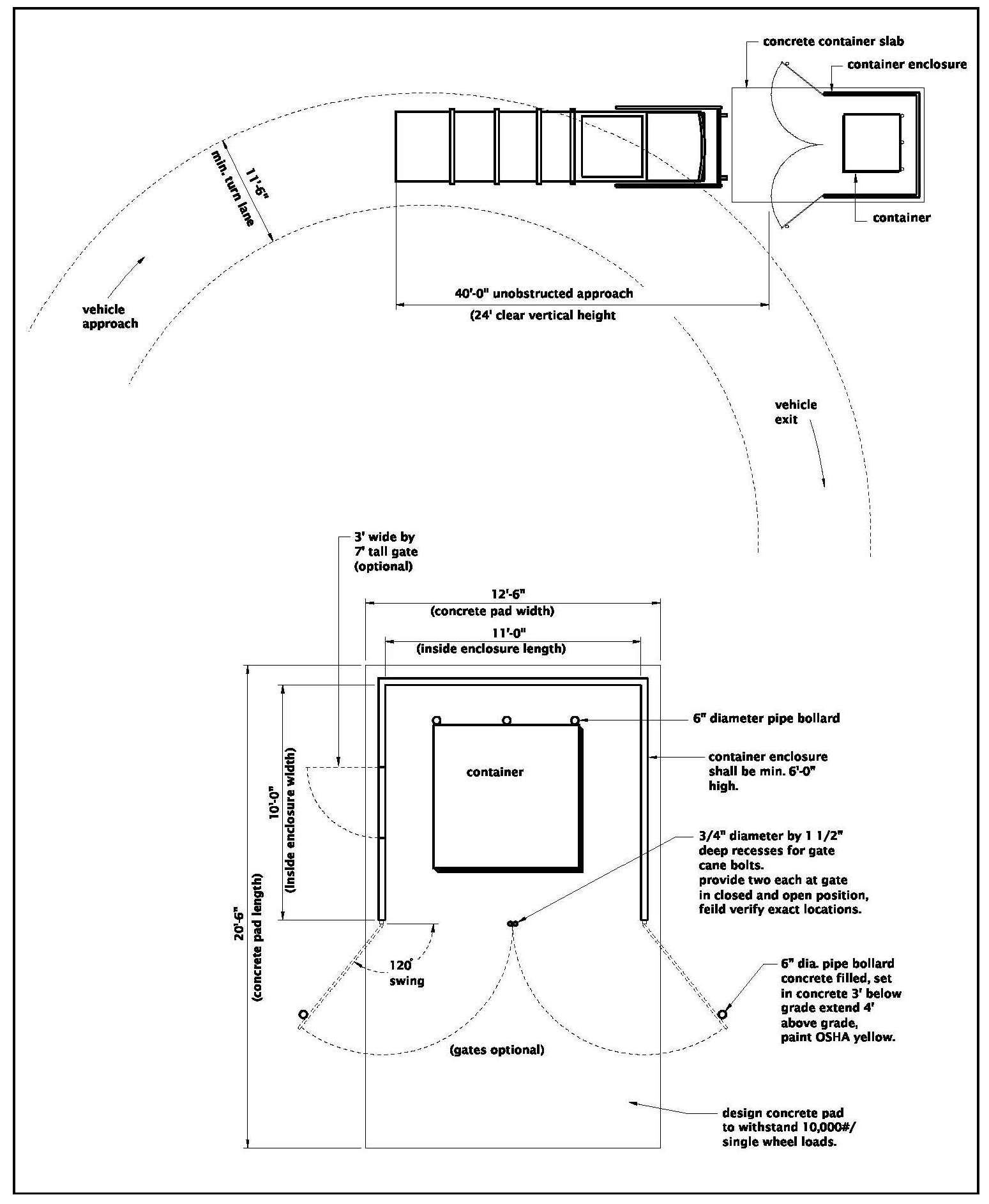
Illustration 36-1: Refuse Containers - Access and Enclosure
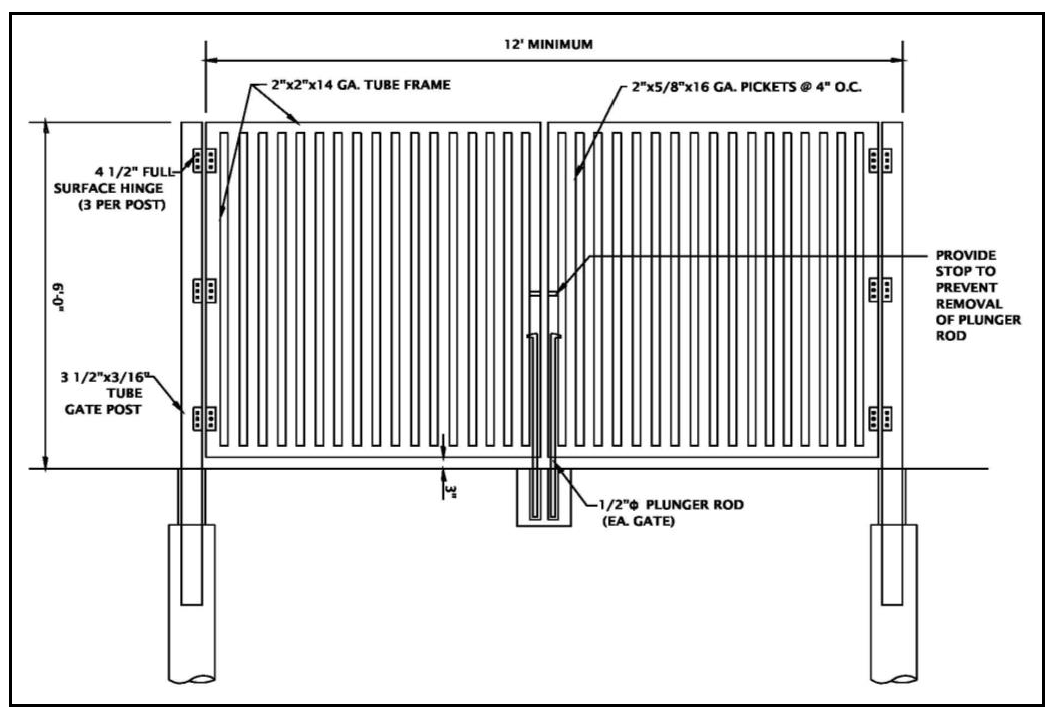
Illustration 36-2: Typical Refuse Container Screening Gate
(Ord. No. 3138, Arts. I, II(Exh. A), 9-30-25)
Section 37. - Exterior construction and design requirements.
37.1
Purpose. The city council of the City of Terrell finds that it is necessary to regulate the exterior finish and appearance of buildings that are erected within the city in order to insure the consistency in quality, compatibility, and character of buildings within comparable zoning districts. The regulation of exterior materials and building construction assures consistent provision of both a high level of structural durability relative to impacts from natural and manmade forces over time and a safe environment for those occupants, equipment, and goods within the structure. The provision of a quality exterior finish compliments the building construction by reducing maintenance needs, providing a surface more resistant to damage, assisting in maintaining structure and property value over a longer period, contributing substantially to the compatibility and character of its neighborhood or surroundings.
37.2
Definitions.
A.
For the purpose of this section, the following definitions shall apply:
Masonry construction. This term shall be construed to mean that form of construction composed of brick, stone, decorative concrete block or tile, or other similar building units or materials (or combination of these materials) laid up unit by unit and set in mortar, and shall exclude wall area devoted to doors and windows. As applicable to meeting the minimum requirements for the exterior construction of buildings within each zoning district, this term shall include the following materials:
Hard fired brick shall be kiln fired clay or slate material and can include concrete brick if it is to the same American Society for Testing and Materials (ASTM) standard for construction as typical hard fired clay brick. The material shall be severe weather grade. Unfired or under-fired clay, sand or shale brick are not allowed.
Stone includes naturally occurring granite, marble, limestone, slate, river rock, and other similar hard and durable all-weather stone that is customarily used in exterior construction material. Cast or manufactured stone product, provided that such product yields a highly textured, stone-like appearance.
Decorative concrete block shall be highly textured finish such as split-faced, indented, hammered, fluted, ribbed, or similar architectural finish. Coloration shall be integral to the masonry material and shall not be painted on.
Concrete pre-cast or tilt wall panel shall be of an architectural finish that is equal to or exceeds the appearance and texture of face brick or stone. Coloration shall be integral to the masonry material and shall not be painted on.
Stucco an exterior plaster made from a mixture of cement, sand, lime and water spread over metal screening or chicken wire or lath.
Exterior insulated finish system. A synthetic stucco cladding system that typically consists of these main components:
Panels of expanded polystyrene foam insulation installed with adhesive or mechanically fastened to the substrate, usually plywood or oriented strand board;
A base coat over the foam insulation panels;
A glass fiber reinforcing mesh laid over the polystyrene insulation panels and fully imbedded in the base coat; and a finishing coat over the base coat and the reinforcing mesh.
Fiber cement siding, also known as "Hardiplank" a building material used to cover the exterior of a building in both commercial and residential cosmetic application. The product is resistant to termites, does not rot, and has fireproof properties.
Exterior wall surface all areas of a structure's wall sections located above the finish floor elevation of the foundation, exclusive of doors and windows.
37.3
Minimum exterior construction standards. The standards and criteria contained within this subsection are deemed to be minimum standards and shall apply to all new building construction occurring within any zoning district in the City of Terrell as follows:
A.
Single-family and two-family residential. The first floor exterior wall surface of all new single-family and two-family dwellings shall be of 100 percent masonry construction. On infill development the minimum exterior façade requirement shall be determined by a survey of the homes on the same street and block and the homes on the street immediately behind the subject property by the building official, the type and percentage of exterior façade materials found on 60 percent of the homes in good repair and upkeep surveyed shall determine the requirement. Exceptions shall be required to apply to the zoning board of adjustments for a variance.
A minimum of 75 percent of the exterior wall surfaces above the first floor shall be of masonry construction. Architectural trim features such as dormers or gables shall not be counted as exterior wall surface when calculating the masonry requirement above the first floor and may be located on any wall surface.
Executive estate-32 (EE-32) single-family residential district shall utilize a combination of two or more approved masonry products on the front façade.
B.
Multiple-family dwellings. All exterior wall surfaces of all new multiple-family dwellings shall be of 100 percent masonry construction. Covered breezeways and areas of exterior walls located directly beneath covered porches, patios and balconies that have a minimum dimension of four feet in depth and eight feet in width shall not be counted as exterior wall surface when calculating the masonry requirement.
C.
Nonresidential structures. All exterior wall surfaces of all new nonresidential structures shall be of 100 percent masonry construction. When located along the front or back elevation of a structure, areas of exterior walls located directly beneath covered porches or patios that have a minimum dimension of four feet in depth and eight feet in width shall not be counted as exterior wall surface when calculating the masonry requirement.
D.
Materials for single-family and two-family residential.
1.
Stucco, EIFS, must be at least 60 inches above the ground; can only consume 30 percent of any exterior wall surface; and must be neutral or earth tone in its color.
2.
Hardiplank must be at least 60 inches above the ground and can consume up to 30 percent of any exterior wall surface.
3.
Stucco, EIFS, Hardiplank may only account for no more than 40 percent of the total exterior wall service.
4.
The percentages of subsections 1, 2, 3, can be increased by 20 percent as long as each exterior wall contains a combination of at least 50 percent brick and stone.
5.
The municipal development director may approve an alternative design for structures with enhanced architectural features which may be utilized such as but not limited to a combination of two or more: wood shingles, a special designed approved metal product; cedar; Masonite, etc. as long as each exterior wall surface is comprised of 50 percent brick and stone.
E.
Materials for multiple-family dwelling and nonresidential.
1.
Apartment complexes follow the same rules as subsections D.1.—D.5 for single-family above unless they are part of a mixed-use project of a planned development.
2.
Retail/commercial must follow the same rules as subsections D.1.—D.5. for single-family above.
F.
[Mixed use development and planned developments.] Mixed use developments and planned developments may contain a waiver from the exterior masonry standards as long as each exterior wall surface contains at least 20 percent of brick and stone; and are thematically and/or are strategically designed.
G.
Applicability. The minimum exterior construction standards established in this section shall not apply to the following class or kind of buildings except as noted:
1.
Public or governmental facilities;
2.
Public or private schools;
3.
Facilities located within industrial parks that were developed or are managed by the Terrell Economic Development Corporation. The Terrell Economic Development Corporation receives funds from 4A sales tax revenues governed by the city council of the City of Terrell. These industrial parks shall abide by deed restrictions governing exterior construction standards as agreed to by the Terrell City Council.
4.
Detached accessory buildings having not more than 240 square feet of floor area when located on the same lot as a single-family or two-family dwelling or nonresidential main building and located behind the front building line and not readily visible from the street (behind the rear yard fence) except any exterior façade of an accessory structure exceeding 240 square feet in size visible from a public street shall be required to match the exterior façade of the main structure. Detached garages, carports, or accessory buildings regardless of size when located in the side or front yard shall be constructed of materials matching the main structure. Accessory dwelling units as defined by the zoning ordinance are not considered detached accessory buildings in the application of this subsection.
5.
Temporary construction and material storage buildings utilized during construction of permanent improvements on a parcel of land, within subdivision or other similar circumstance such as a public works project. The temporary structure temporary structure shall be completely removed upon the expiration of its building permit or upon completion of the permanent improvement, whichever occurs first.
6.
Barns and farm accessory buildings if such buildings are used solely for agricultural purposes.
7.
Historic landmarks designated by the city council.
8.
Remodeling, renovating or expansion of existing single-family or two-family dwellings when matching materials (or materials that simulate the appearance of the existing exterior) are utilized.
37.4
Alternative exterior materials.
A.
The building official may, approve an alternative exterior construction material(s) only upon a determination that the proposed materials are:
1.
Sufficiently durable, and fire and weather resistant to achieve the stated purpose of these requirements; and
2.
The proposed building materials and arrangement of the materials provide consistency of appearance with existing structures on the property or within the neighborhood in which it is located, or
3.
The proposed building material(s) create an appearance that associates a time, a place, an event, or an activity with the development in a thematic manner.
B.
All alternative material requests shall also include two of the following project upgrades:
•
Gabled entry cover.
•
Decorative woodwork.
•
Architectural metals—flex-bar, metal awnings, metal cladding with steel, copper or aluminum.
•
Shutters or decorative trim around windows.
•
Increased landscaping (larger caliper trees, planting beds, perennial Texas native plantings).
•
Decorative columns.
•
Art installation (mural, sculpture).
•
Decorative rock elements.
C.
All requests to utilize an alternative exterior construction material(s) shall be in writing and shall address the durability of the proposed material(s) as described in subsection 37.4.A.1. above, along with an explanation of its use as it relates to subsection 37.4.A.2. or 37.4.A.3. above.
D.
All such requests shall be accompanied by a site plan and a façade plan in the case of an individual structure or group of structures developed as a single nonresidential project. In the case of a residential development involving the utilization of an alternative exterior construction material(s) on a neighborhood wide basis, a concept plan or approved plat and typical façade treatments shall accompany the request. The city may require the submission of an actual sample(s) of the proposed alternative exterior construction material(s).
E.
All requests to utilize an alternative exterior construction material(s) shall be submitted to the building official. The building official shall consider the request within ten days of submittal. The approval of an alternative exterior construction material(s) shall be on a case by case basis and at the discretion of the building official may forward the request to the zoning board of adjustments for a determination.
(Ord. No. 3138, Arts. I, II(Exh. A), 9-30-25)
Section 38. - Supplemental regulations.
38.1
A.
Measuring setbacks. All setback measurements shall be made in accordance with Illustrations 38-1 thru 38-8.
B.
Configuration of lots. Wherever possible, flag lots (i.e., lots with minimal, or panhandle type, frontage) shall be avoided. Similarly, through (i.e., double frontage) lots (particularly within residential zoning districts) shall also be avoided wherever possible. (Also see subdivision ordinance for regulations pertaining to the configuration of lots.)
C.
Building setbacks. All setbacks established on a recorded plat shall be enforced, even if they exceed the required setbacks in this ordinance. Setbacks established on a recorded plat shall only be changed through replat proceedings (see subdivision ordinance).
38.2
Front yard.
A.
On all corner lots, the front yard setback shall be observed along the frontage of both intersecting streets, unless approved specifically otherwise on a final plat. Where single-family and duplex lots have double frontage, extending from one street to another, or are on a corner, a required front yard shall be provided on both streets unless a side or rear yard building line has been established along one frontage on the plat, in which event only one required front yard need be observed. The side and/or rear yards in the case of single-family and duplex uses shall be identified and the front of the structure shall not face the side or rear yard.
B.
Where the frontage on one side of a street between two intersecting streets is divided by two or more zoning districts, the front yard shall comply with the requirements of the most restrictive district for the entire frontage.
C.
The front yard shall be measured from the property line to the front face of the building, to the nearest supporting member of a covered porch or terrace, or to any attached accessory building. Eaves and roof extensions or a porch without posts or columns may project into the required front yard for a distance not to exceed four feet, and subsurface structures, platforms or slabs may not project into the front yard to a height greater than 30 inches above the average grade of the yard. Open porches extending into the front yard shall not be enclosed.
D.
Minimum lot widths for lots with predominate frontage on the curved radius of a street (e.g., cul-de-sac or "eyebrow" portion of a street) shall be measured as the linear distance of the curved front building line, and shall be shown on the subdivision plat. Lot widths for all lots shall be as set forth in the respective zoning district for each lot. The front building line required in a zoning district may be increased by up to five feet on cul-de-sac and street eyebrow lots in order to comply with the minimum lot width required in that zoning district, provided that an adequate building pad area (i.e., has adequate depth) is retained on the lot after moving the front building line back.
E.
See subsection 42.1 for special front yard regulations and setbacks for gasoline service station pump islands and canopies.
F.
Where a future right-of-way line has been established for future widening or opening of a street or thoroughfare, upon which a lot abuts, then the front, side, or rear yard shall be measured from the future right-of-way line.
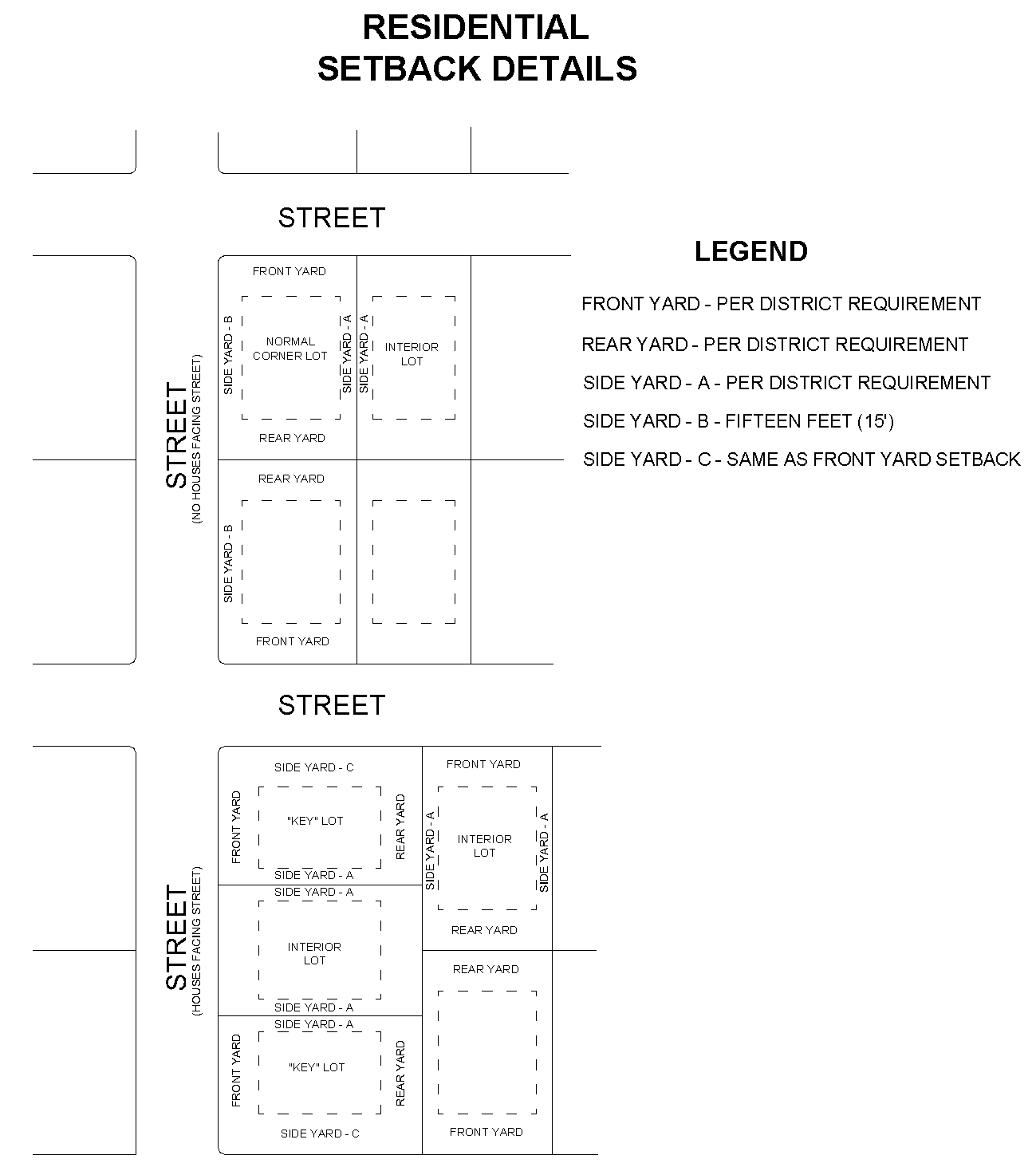
Illustration 38-1
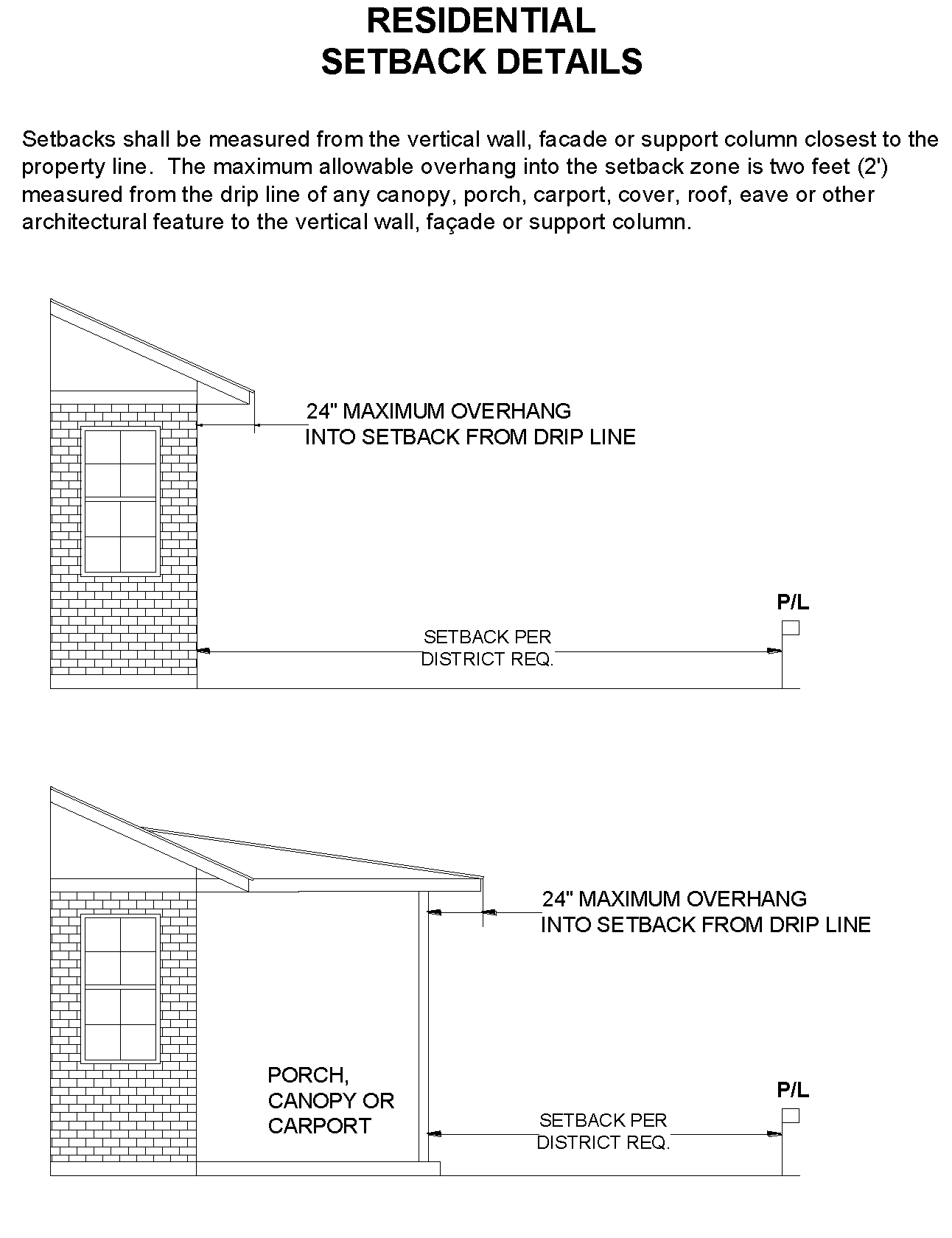
Illustration 38-2
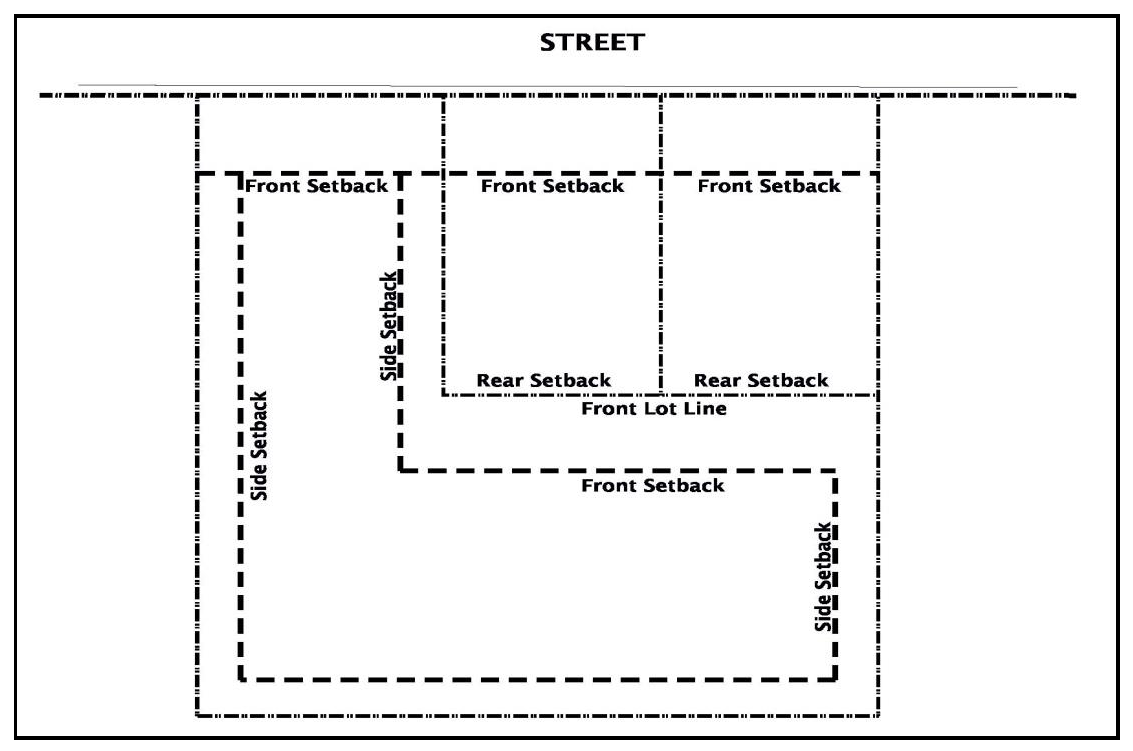
Illustration 38-3: Flag Lot (i.e. front lot line not adjacent to the front street
line)
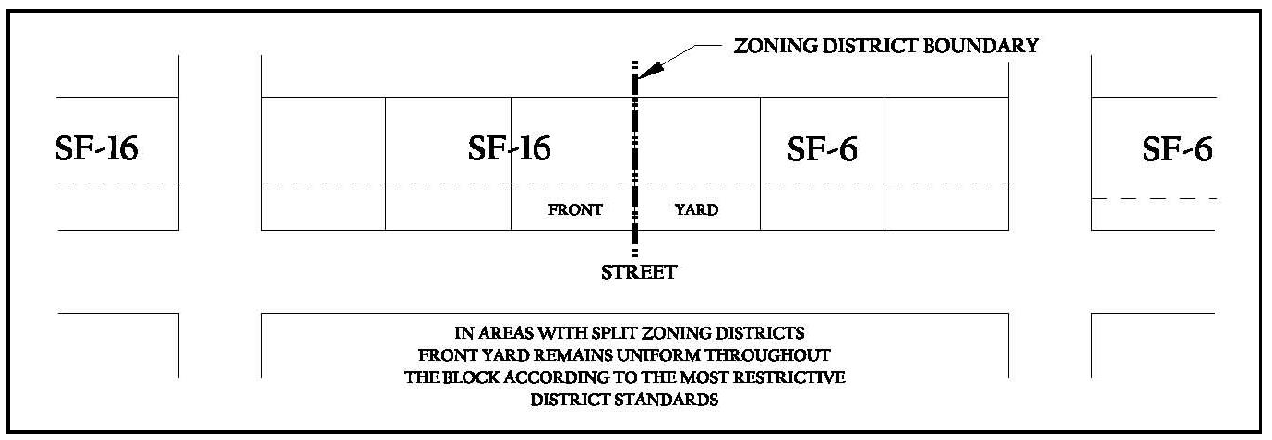
Illustration 38-4: Front yard where zoning changes in block
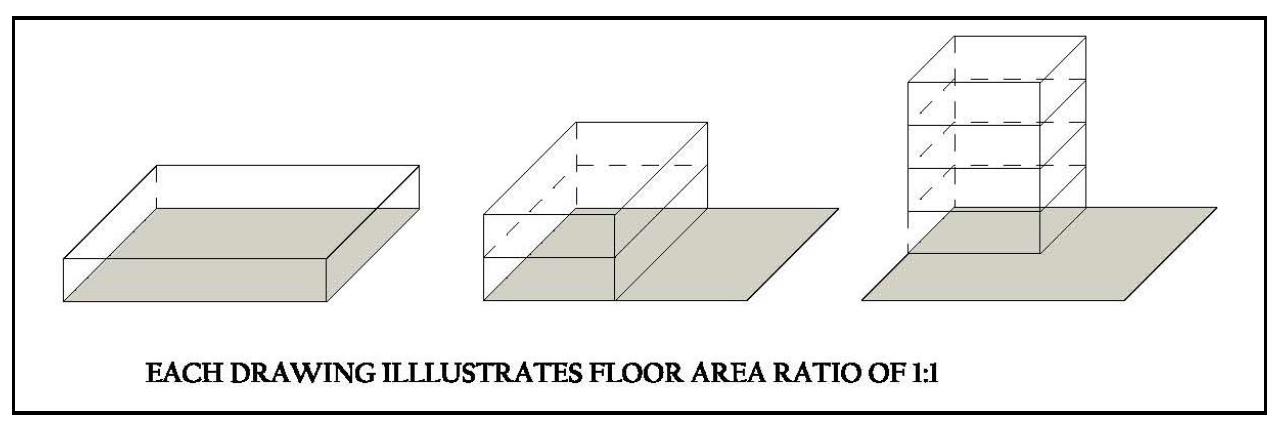
Illustration 38-5: Floor area ratio
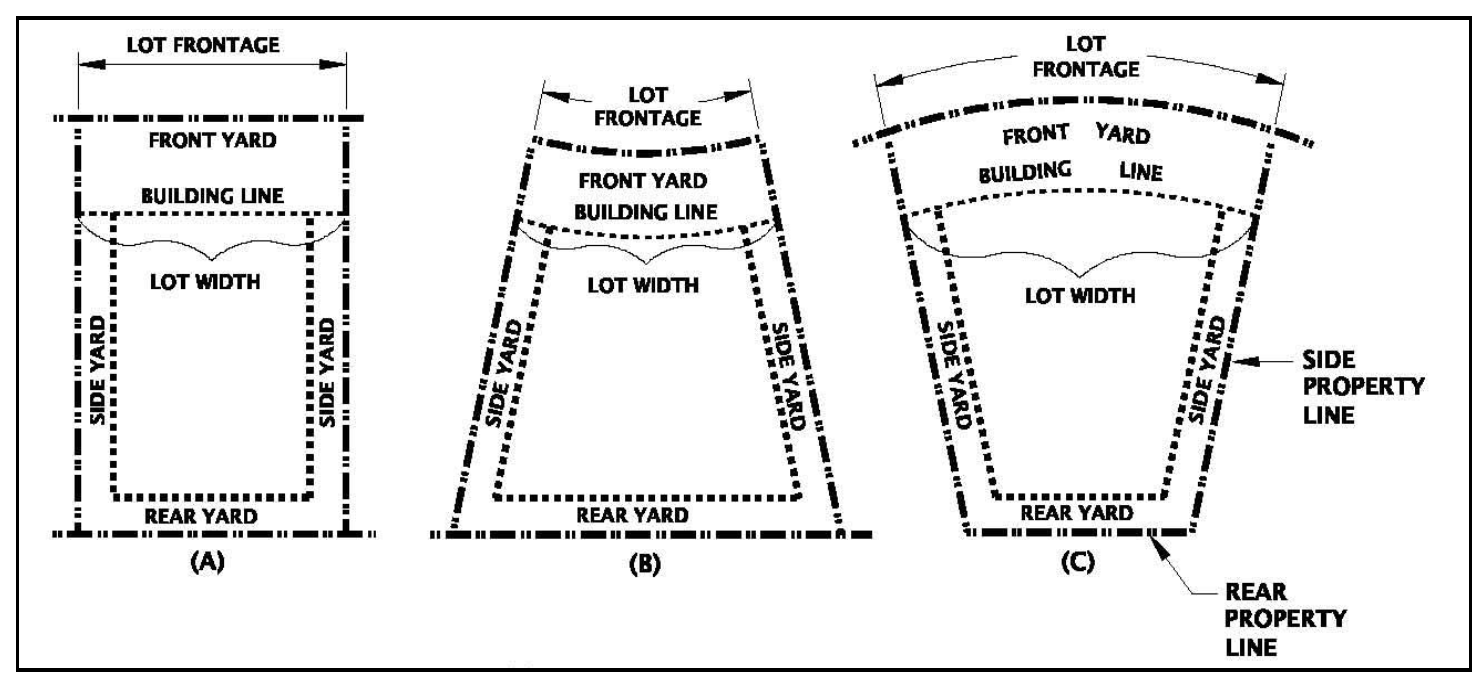
Illustration 38-6: Lot width
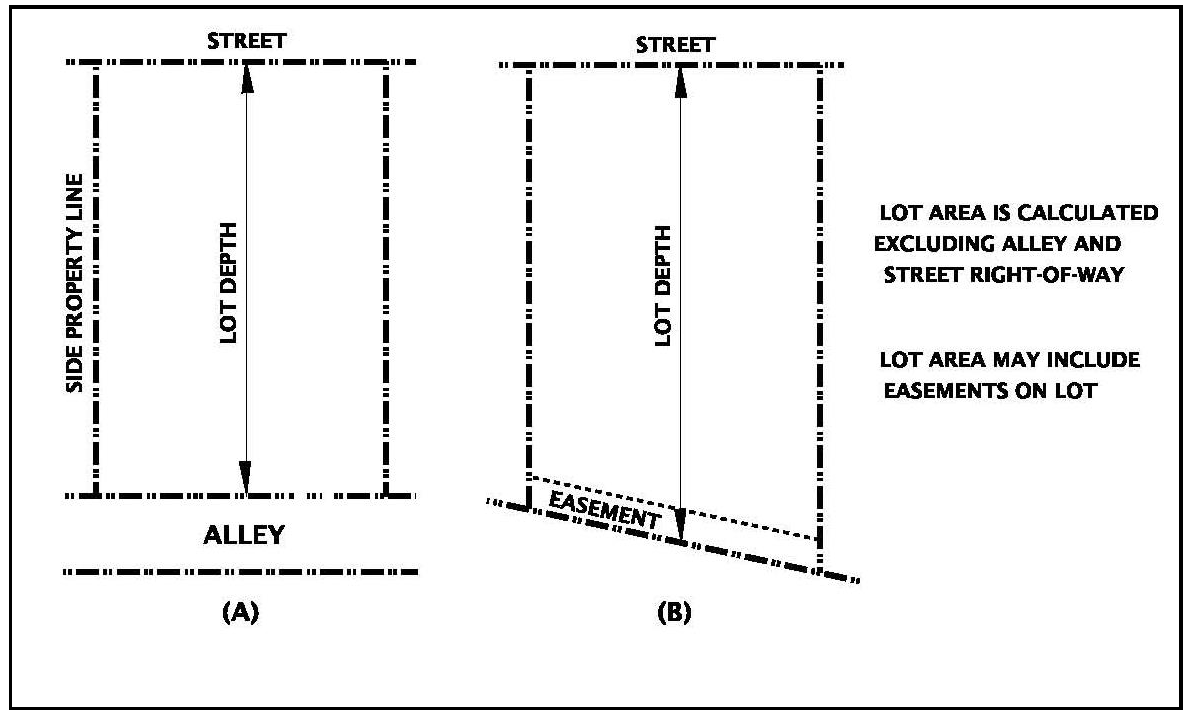
Illustration 38-7: Lot area and depth
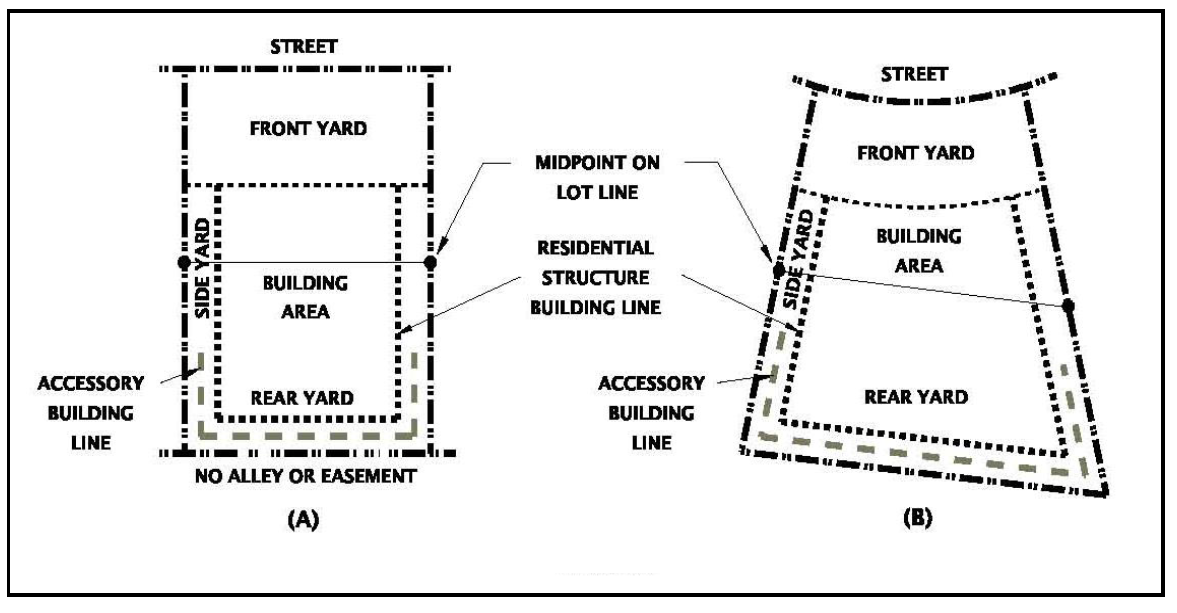
Illustration 38-8: Lot width
38.3
Side and rear yards.
A.
On a corner lot used for one-or two-family dwellings, both street exposures shall be treated as front yards on all lots, except that where one street exposure is designated as a side yard for both adjacent lots or where the two lots are separated by an alley, street right-of-way, creek/flood plain area, or other similar phenomenon. In such case, a building line may be designated by the municipal development department, with a minimum side yard of 15 feet or more (as determined by the applicable zoning district standards). On lots which were official lots of record prior to the effective date of this ordinance, the minimum side yard adjacent to a side street shall comply with the minimum required side yard for the respective district.
B.
Every part of a required side and rear yard shall be open and unobstructed except for the ordinary projections of window sills, belt courses, cornices, and other architectural features not to exceed 12 inches into the required side or rear yard, and roof eaves projecting not to exceed 36 inches into the required side or rear yard. Air conditioning compressors and similar equipment are permitted in the side or rear yard. Open porches extending into a side or rear yard shall not be enclosed. A canopy or awning may project into a required side or rear yard provided that it is not enclosed, and provided that it is at least five feet from the property line. The minimum separation between buildings shall be maintained, per the city's building code.
38.4
Special height regulations.
A.
In any zoning district, water stand pipes and tanks, church steeples, domes and spires, ornamental cupolas, uninhabited (or one-man overseer's penthouse not exceeding 50 square feet in size) utility or industrial structures, and city or school district buildings may be erected to exceed the height limit, as specified in the particular zoning district, provided that two additional feet shall be added to the width and depth of front, side, and rear yards for each foot that such structures exceed the district height limit.
38.5
Communications antennas and support structures/towers.
A.
Applicability.
1.
These regulations apply to all commercial and amateur antennae and support structures, unless exempted in subsection 2 below.
2.
Direct broadcast satellite reception, multi-channel multi-point distribution (as defined by the FCC), television reception antennae, and amateur radio antennae meeting the following requirements do not require a permit unless mounted on a pole or mast that is 20 feet or more in height:
a.
In any zoning district, antennae that are 36 inches or less in diameter;
b.
In a nonresidential zoning district, antennae that are six feet or less in diameter;
c.
In any zoning district, antennae designed to only receive television broadcasts;
d.
In any zoning district, amateur radio antennae concealed behind or located upon or within attics, eaves, gutters or roofing components of the building; and
e.
In any zoning district, amateur radio ground-mounted whips and wire antennae, unless mounted upon a pole or mast over 20 feet in height.
3.
Support structures or antennae legally installed before the effective date of this ordinance are not required to comply with this ordinance, but must meet all applicable state, federal and local requirements, building codes and safety standards.
B.
Special definitions. For the purpose of this section, the following special definitions shall apply:
1.
Antenna, microwave reflector and antenna support structure. An antenna is the arrangement of wires or metal rods used in transmission, retransmission and/or reception of radio, television, electromagnetic or microwave signals (includes microwave reflectors/antennae). A microwave reflector is an apparatus constructed of solid, open mesh, bar-configured, or perforated materials of any shape/configuration that is used to receive and/or transmit microwave signals from a terrestrial or orbitally located transmitter or transmitter relay. Microwave reflectors are also commonly referred to as satellite receive only earth stations (T.V.R.O.S.), or satellite dishes. An antenna support structure is any tower, mast, pole, tripod, box frame, or other structure utilized for the purpose of supporting one or more antennae or microwave reflectors.
2.
Antenna (noncommercial/amateur) An antenna or antenna support structure used for the purpose of transmission, retransmission, and/or reception of radio, television, electromagnetic, or microwave signals for private or personal use and not for the purpose of operating a business and/or for financial gain. A satellite dish antenna not exceeding six feet in diameter shall also be considered as a noncommercial antenna.
3.
Antenna (commercial). An antenna or antenna support structure used for the purpose of transmission, retransmission, and/or reception of radio, television, electromagnetic, or microwave signals primarily for the purpose of operating a business and/or for financial gain (e.g., commercial broadcasting, cellular/wireless telecommunications, etc.). A satellite dish antenna that exceeds six feet in diameter shall also be considered as a commercial antenna.
4.
Collocation. The use of a single support structure and/or site by more than one communications provider.
5.
Communications operations (noncommercial/amateur). The transmission, retransmission and/or reception of radio, television, electromagnetic, or microwave signals for private or personal use, and not for the purpose of operating a business and/or for financial gain.
6.
Communications operations (commercial). The transmission, retransmission, and/or reception of radio, television, electromagnetic, or microwave signals primarily for the purpose of operating a business and/or for financial gain.
7.
Height. The distance measured from the finished grade of the lot/parcel to the highest point on the support structure or other structure, including the base pad and any antennae.
8.
Radio, television or microwave tower. See "antenna, microwave reflector and antenna support structure".
9.
Telecommunications tower or structure. See "antenna, microwave reflector and antenna support structure".
10.
Temporary/mobile antenna. An antenna and any associated support structure/equipment (including, but not limited to, a support pole, a vehicle, etc.) that is placed and/or used on a temporary basis only (i.e., not intended to be permanent), usually in conjunction with a special event, news coverage or emergency situation, or in case of equipment failure or temporary augmentation of permanent communications equipment.
11.
Wind turbines (electrical generation). Wind turbines for electrical generation are prohibited in any residential district within the corporate city limits of Terrell and allowed only in the light industrial (LI) district by specific use permit (SUP).
12.
Wireless communication tower or structure. See "antenna, microwave reflector and antenna support structure".
C.
General requirements.
1.
Antennae and support structures may be considered either principal or accessory uses.
2.
Antenna installations shall comply with all other requirements of the zoning ordinance and the Code of Ordinances with the exception of those specifically cited within these regulations.
3.
No commercial antenna support structure shall be closer to any residential district boundary line or residential dwelling than a distance equal to one and one-half the height of the support structure. Such setback/distance shall be measured as the shortest possible distance in a straight line from the structure to the closest point of a residential district boundary line or residential dwelling. Setbacks from residentially zoned property do not apply to antennae attached to utility structures that exceed 50 feet in height, or to antennae placed wholly within or mounted upon a building.
4.
No amateur or commercial antenna, antenna support structure, microwave reflector/antenna, or associated foundations or support wires or appurtenances shall be located within any required setback area for the front, side or rear yards.
5.
All antennae and support structures must meet or exceed the current standards and regulations of the Federal Communications Commission (FCC), the Federal Aviation Administration (FAA), Texas Historical Commission (THC) review and/or all other applicable federal, state and local authorities. If those standards change, then the owner/user of an antenna or support structure must bring the antenna/structure into compliance within six months or as may otherwise be required by the applicable regulating authority.
6.
A building permit is required to erect or install an antenna, antenna support structure and related structures/equipment, unless the particular antenna is exempt from these regulations (see subsection 38.5.A. above). All installations shall comply with applicable federal, state and local building codes and the standards published by the Electronic Industries Association. Owners/users shall have 30 calendar days after receiving notice that an installation is in violation of applicable codes in order to bring it into full compliance.
7.
Antennae (amateur or commercial) shall not create electromagnetic or other interference with the City of Terrell's and the county's radio frequencies and public safety operations, as required by the FCC. Antennae also shall not interfere with radio or television reception of nearby property owners. In no manner shall the use of such equipment infringe upon adjoining property owners.
8.
No antenna or support structure shall be located so as to create a visual obstruction within critical visibility areas (such as at street intersections or where a private driveway enters a roadway) or a traffic safety problem.
9.
Safeguards shall be utilized to prevent unauthorized access to an antenna installation (e.g., on a water tower or utility structure, a free-standing installation, etc.). Safeguards include certain devices identified/recommended by the manufacturer of the antenna or support structure, a fence, a climbing guard, or other commercially available safety devices. Climbing spikes or other similar climbing device, if utilized, shall be removed immediately following use.
10.
Temporary antennae shall only be allowed in the following instances:
a.
In conjunction with a festival, carnival, rodeo or other special event/activity;
b.
In case of an emergency (e.g., severe weather, etc.) or a news coverage event;
c.
When needed to restore service on a temporary basis after failure of an antenna installation. The city must be notified within 72 hours of the placement of a temporary antenna. If the temporary antenna is to be needed for more than seven calendar days, then the owner/user must apply for and acquire a permit for the temporary installation on or before the eighth day following initial placement of the antenna.
11.
Collocation is greatly encouraged by the city.
a.
All new support structures over 50 feet in height shall be constructed to support antennae for at least two carriers, unless the structure is an alternative or stealth design, or the support structure is replacing an existing utility structure or light standard. Sufficient area for associated structures and equipment shall also be provided.
b.
A support structure which is modified or reconstructed in order to accommodate collocation shall be of the same type, design and height as the existing structure, and it may be moved on the same property within 50 feet of its original location provided that it is not moved any closer to residentially zoned property (if the structure was allowed by SUP, then its new location shall be within the physical/land boundaries of the SUP). The original (i.e., former) support structure shall be removed from the property within 90 calendar days following completion of the new structure.
c.
Where an additional antenna is to be attached to an existing support structure that already has an antenna mounted upon it, the new antenna shall comply with and be compatible with the design of the existing antenna on the collocated structure.
12.
Support buildings and equipment storage areas/buildings shall be screened from public view if mounted on a rooftop, and such screening device shall be architecturally compatible with the design and materials of the building. When ground mounted, they shall meet all applicable front, side and rear yard setback requirements of the applicable base zoning district. They shall also be of a neutral color and shall use exterior finish colors and materials that are compatible with nearby structures.
13.
Satellite dishes and other similar antennae shall be permitted on the roof of a building, as long as satellite dishes do not exceed one meter (39 inches) in diameter and antennae do not extend over ten feet above the roof of the building. A letter certifying the roof's/building's structural stability shall be written and sealed by a registered architect or engineer, and shall be submitted to the municipal development department prior to any approval of a roof-mounted antenna. Roof-mounted antennae that comply with the provisions of these regulations do not require additional yard setbacks or setbacks from residential areas or dwellings.
14.
Only one amateur antenna/support structure shall be permitted per residential lot, except that a maximum of two satellite dishes may be allowed if both units are no larger than 36 inches in diameter (only one allowed if over three feet in diameter). Maximum height of an amateur antenna shall not exceed 50 feet in height measured from the ground and must be located a distance from any property line equal to the height of the antennae.
15.
All commercial signs, flags, lights and attachments other than those required for emergency identification, communications operations, structural stability, or as required for flight visibility by the FAA and/or FCC shall be prohibited on any antenna or antenna support structure. However, lights may remain or be placed upon light standards that are altered or replaced in order for them to serve as antenna support structures provided that said lights are not commercial (i.e., for-profit) in nature, and provided that said lights are placed/replaced as the same size, configuration, number of bulbs, degree of luminance, etc. as they previously existed prior to support structure modification/replacement.
16.
Any publicly owned antennae or antenna support structures shall be permitted in any zoning district (e.g., public safety communications, etc.) however, setbacks and other applicable standards shall apply.
17.
In all residential zoning districts (including AG, EE-32, SF-16, SF-10, SF-7.5, SF-6, TH-12, MF and MH), commercial antennae and antenna support structures are prohibited, except as specified within this section.
a.
A commercial antenna may be attached to a utility structure (e.g., electrical transmission/distribution tower, elevated water storage tank, etc.) provided that the utility structure exceeds 50 feet in height, and provided that the antenna does not extend more than ten feet above the height of the utility structure (see subsection 38.5.C.3. above).
b.
A commercial antenna may be placed wholly within any building permitted in the zoning district (see subsection 38.5.C.3. above). A commercial antenna may also be mounted flush to the exterior of a building/structure if it is painted and/or disguised to integrate into the overall architectural design and it is not readily visible or identifiable as an antenna from public roadways or from neighboring residential properties.
18.
In nonresidential zoning districts (including O, NS, R, CBD, HC, C, and LI), commercial antennae and antenna support structures are allowed as follows:
a.
Commercial antenna support structures are allowed by right if they do not exceed the maximum building height allowed for the zoning district in which they are located. Structures in excess of the height allowed in the zoning district may be allowed by specific use permit (SUP) provided the structure conforms in all other aspects of the base zoning district's regulations, and provided that all applicable setback requirements are satisfied. In all nonresidential zoning districts, antenna support structures must meet all setback requirements, particularly from residential zoning districts.
b.
A commercial antenna may be attached to a utility structure (e.g., electrical transmission/distribution tower, elevated water storage tank, etc.) provided that the utility structure exceeds 50 feet in height, and provided that the antenna does not extend more than ten feet above the height of the utility structure (see subsection 38.5.C.3. above).
c.
A commercial antenna may be placed wholly within any building permitted in the zoning district (see subsection 38.5.C.3. above). A commercial antenna may also be mounted flush to the exterior of a building/structure if it is painted and/or disguised to integrate into the overall architectural design, and it is not readily visible/identifiable as an antenna from public roadways or from neighboring residential properties.
38.6
Minimum dwelling unit area. Minimum dwelling unit areas specified in this ordinance shall be computed exclusive of breezeways, garages, open porches, carports and accessory buildings.
38.7
Open storage areas. Open long-term storage of materials, commodities or equipment (where allowed in the specific zoning district) shall be located behind the front building line and observe all setback requirements for the main structure or building. This standard does not apply to short-term outside display (see definition of outside display in section 44; see screening requirements in section 36.
38.8
Nonresidential structures in residential districts.
A.
Nonresidential structures (e.g., churches, schools, day care centers, etc.) which are permitted in residential zoning districts (AG, EE-32, SF-16, SF-10, SF-7.5, SF-6, TH-12, MF and MH) shall be designed and constructed such that they conform to the development standards set forth in the neighborhood services (NS) district zoning district (i.e., with respect to maximum height, minimum lot size, minimum front/side/rear setbacks, screening, exterior building construction, etc.) unless otherwise stated in this ordinance or in an ordinance establishing a PD.
38.9
Access standards for nonresidential and multifamily lots.
A.
All nonresidential lots (including pad sites) shall share driveway curb openings via mutual access easements from one lot to adjacent lots (for fire and emergency access, as well as for public convenience).
B.
All nonresidential and multifamily lots (including pad sites) shall have either direct or indirect (via mutual access/fire lane easements on adjacent property) access to a median opening if located on a median-divided roadway (existing or planned in the future). Driveways for all nonresidential and multifamily lots (including pad sites) shall align, to the greatest extent possible, with any existing or proposed driveways on the other side of any type of roadway.
38.10
Temporary use permit. The following temporary uses may be allowed under the conditions and for the time specified upon permit application review by the director or his designee and payment of the required fee. Applications must be submitted ten business days prior to the proposed start date of the temporary use.
A.
Temporary use defined. Temporary uses shall include short-term or seasonal uses that would not be appropriate on a permanent basis. Temporary uses are identified in section 32.2, chart 3: accessory and temporary uses and in section 44, definitions. In addition, the following uses and activities shall be considered temporary uses (NOTE: Special events such as parades, block parties, carnivals, circus, processions, events involving use of a public right-of-way, street or publicly owned property, or private parties with 50 or more attendees in which alcohol is to be consumed shall be permitted through the police department with a special events permit.):
1.
Fundraising activities by not-for-profit agencies. Fundraising or noncommercial events for nonprofit educational, community service or religious organizations where the public is invited to participate in the activities and which last longer than 24 hours. An alternate method for permitting fundraising or other non-profit temporary activities is to submit an annual schedule of proposed events to be held on noncontiguous days (such as certain weekends or holidays, etc.) for a total not to exceed 15 days in any one calendar year.
2.
Sales events. Significant temporary indoor commercial activities lasting not longer than three days (a maximum of two extensions may be granted for up to two days each) intended to sell, lease, rent or promote specific merchandise, services or product lines, including, but not limited to, warehouse sales, trade shows, flea markets, or product demonstrations, art work or other goods sold on the same premises as the primary business or sponsor's property. (This does not include peddlers and solicitors which are regulated under separate ordinances (see chapter 5, city Code of Ordinances).
3.
Garage, estate, rummage, yard sales. Occasional sales of tangible personal property at retail in residential zoning districts or property, not to exceed two in number during any calendar year, by the property owner or lessee residing at the address at which the sale is occurring or is an agent of the property owner (estate sales). No new merchandise (i.e. merchandise acquired solely for the purpose of resale) shall be sold nor shall any retail business be operated or conducted on the premises at such occasional sales. Maximum duration of any such occasional sale shall not exceed three consecutive days and shall run only from Friday through Sunday. Exception: estate sales may be conducted for up to five consecutive days only if the property owner's agent or relative submits a written request prior to the sale to the director stating the proposed dates of the sale. One on-premises sign and up to three off-premises signs, not exceeding two square feet in size, shall be allowed per sale and shall be placed on private property only with the property owner's permission. No signs shall be allowed on public right-of-way, utility poles or trees and shall not be placed prior to 8:00 a.m. on Friday and shall be removed prior to 8:00 a.m. on Monday.
4.
Seasonal sales events. Produce, sales of food, farmer's markets, pumpkins, Christmas tree lot sales, etc. for sale during short seasonal or holiday periods lasting not longer than six weeks (a maximum of two extensions may be granted for up to one week each) but in no case shall the sale period exceed 60 days. (This does not include peddlers and solicitors which are regulated under separate ordinances (see chapter 5, city Code of Ordinances).
5.
Special events. (Special events are permitted through the police department.) Short-term cultural and entertainment events including parades, block parties, private parties with 50 or more attendees in which alcohol is consumed, intended primarily for entertainment or amusement, such as concerts, plays or other theatrical productions, circuses, fairs, carnivals or festivals. Special event means a temporary event or gathering, other than those events defined in the special events ordinance as a parade or a neighborhood block party, using either private or public property, including a circus, carnival, fair, or other event, and/or performance of music or celebration of event on a political, religious or social issue which involves one or more of the following activities, except when the activity is for construction or house moving purposes only:
a.
Closing a public street;
b.
Blocking or restriction of public property, limiting the use of parks by the general public, and streets;
c.
Offer of merchandise, food, or beverages on public property or on private property where otherwise prohibited by ordinance;
d.
Erection of a tent on public property, or on private property where otherwise prohibited by ordinance;
e.
Installation of a stage, band shell, trailer, van, portable building, grandstand or bleachers on public property, or on private property where otherwise prohibited by ordinance;
f.
Placement of portable toilets on public property, or on private property where otherwise prohibited by ordinance;
g.
Placement of temporary no parking signs in a public right-of-way; or
h.
A fee or donation is charged for attendance or participation.
6.
Temporary construction projects. Temporary concrete or paving batch plants, construction yards, temporary construction offices, temporary outside storage of equipment or materials are allowed for the duration of a project, however, the site must be kept free of trash and debris and in an orderly appearance. The area must be secured by a fence from unauthorized entry and the site restored to its original condition after the project ends and all construction materials removed.
B.
Application. An application for a temporary use permit shall be submitted to the director or his designee at least five working days before the requested start date for a temporary use and shall include the following:
1.
A written description of the proposed use or event, the duration of the use or event, the hours of operation, anticipated attendance, and any building or structures, signs or attention-attracting devices used in conjunction with the event.
2.
A written description of how the temporary use complies with the review criteria in subsection D, below.
3.
A plan showing the location of proposed structures, including onsite restrooms and trash receptacles, parking areas, activities, signs and attention attracting devices in relation to existing buildings, parking areas, streets and property lines.
4.
A letter from the property owner agreeing to the temporary use.
5.
Any additional information required by the director.
6.
It is strongly recommended that the applicant not commit to contracts, rental agreements or funds prior to approval of the temporary use permit.
C.
Review and action by the director. The director shall make a determination whether to approve, approve with conditions, or deny the permit within five working days after the date of application. Any applicant denied a permit by the director shall be notified in writing of the reasons for the denial and of the opportunity to appeal to the zoning board of adjustment.
D.
Review criteria. Temporary uses shall comply with the following requirements:
1.
Land use compatibility. The temporary use must be compatible with the purpose and intent of this ordinance. The temporary use shall not impair the normal, safe and effective operation of a permanent use on the same site. The temporary use shall not endanger or be detrimental to the public health, safety or welfare, or injurious to property or improvements in the immediate vicinity of the temporary use, given the type of activity, its location on the site, and its relationship to parking and access points.
2.
Compliance with other regulations. The temporary use shall conform in all respects to all other applicable city regulations and standards including additional fees or permits required by the police department or city secretary's office.
3.
Restoration of site. Upon cessation of the event or use, the site shall be returned to its previous condition, including the removal of all trash, debris, signage, attention attracting devices or other evidence of the special event or use. In the event the site was used as a temporary concrete batch plant, no by-products of the operation including concrete slag, remnants, rock, gravel or other related debris shall be buried on site but shall be completely removed and the area re-graded smooth and the sod or grassy vegetation reestablished. The applicant shall be responsible for ensuring the complete restoration of the site.
4.
Hours of operation and duration. The hours of operation and duration of the temporary use shall be consistent with the intent of the event or use and compatible with the surrounding land uses and shall be established by the director at the time of approval of the temporary use permit.
5.
Traffic circulation. The temporary use shall not cause undue traffic congestion given anticipated attendance and the capacity of adjacent streets, intersections and traffic controls.
6.
Off-street parking. Adequate off-street parking shall be provided on-site for the temporary use, and it shall not create a parking shortage for any of the other existing uses on the site(s) or adjacent properties. Off-site parking shall only be allowed on adjacent property with the written permission of the property owner which must be submitted with the TUP application. Off-site parking shall not be permitted across major thoroughfares from the event in order to prevent pedestrian/vehicle hazards.
7.
Public conveniences and litter control. Adequate onsite rest room facilities and litter control may be required. The applicant shall provide a written guarantee that all litter generated by the event or use shall be removed at no expense to the city.
8.
Appearance and nuisances. The temporary use shall be compatible in intensity, appearance and operation with surrounding land uses in the area, and it shall not impair the usefulness, enjoyment or value of adjacent property due to the generation of excessive noise, dust, smoke, glare, spillover lighting, or other forms of environmental or visual pollution.
9.
Signs. The director shall review all signage, although a sign permit is not required. The director may approve the temporary use of attention attracting devices.
E.
Additional conditions. The director may establish additional conditions to ensure land use compatibility and to minimize potential adverse impacts on nearby uses, including, but not limited to, time and frequency of operation, temporary arrangements for parking and traffic circulation, requirements for screening or buffering, and guarantees for site restoration and cleanup following the temporary use.
1.
A temporary building or structure may be used as an office incidental to construction work if such building is located upon the same property as the site under construction and does not provide for a use that is not incidental to construction on the premises. Such buildings or structures shall be removed following final acceptance of the construction by the city. No longer than 30 days maximum shall be allowed for removal of such buildings or structures.
2.
A temporary facility, or a permanent residential structure located on any platted lot in an approved residential subdivision may be used as a construction office, or a sales office, or for display purposes. No more than one office and no more than four display facilities shall be allowed for any purposes in any subdivision. Such temporary uses shall be allowed for a period of up to one year, with extensions upon application and approval, of up to six months possible, provided construction remains continuous and no more than ten lots remain unsold in the subdivision. No more than two such extensions shall be granted.
3.
Temporary sales of seasonal products such as firewood, Christmas trees, pumpkins, plants, fruits and vegetables, and the like may be allowed during their normal and generally accepted season for a period of up to six weeks, except that a maximum of two extensions of up to one week may be possible upon application and approval. All vendors selling food products must first obtain a health permit from the city prior to receiving a temporary use permit.
4.
The director, or his designee, in approving or denying such applications, shall consider the nature of the use; existing uses in the surrounding areas, noise, dust; light and traffic generated; health and sanitary conditions; and compliance with other regulations of this ordinance. The director, or his designee, shall have the right to revoke any temporary use at any time or to deny any extension upon finding that a hazard or nuisance shall exist by continuing such use; after which revocation or denial such temporary use shall immediately cease and shall be removed within 24 hours of such finding.
5.
Any applicant (person, agent, corporation, or entity) renting or leasing a private party rental facility shall be required to comply with the following criteria:
a.
The applicant shall obtain a temporary use permit (TUP) not less than 48 hours prior to renting the facility and the start of their event.
b.
The total number of guests expected to attend shall be listed on the application which shall not exceed the stated safe capacity (occupant load) of the rental facility as determined by the fire marshal or his designee.
c.
Proof of adequate on-site parking shall be required at a ratio of one parking space for each three guests or seats in the rental facility whichever is greater. Parking spaces shall be clearly marked and meet the minimum design standards as set forth in section 33 of this ordinance. Off-site parking shall only be allowed on immediately adjacent properties with written consent of the property owner. Guests shall not be allowed to park across a public street from the facility which may cause a pedestrian traffic hazard unless prior approval from the chief of police, or his designee, is obtained in which crossing guards or other safety devices are employed.
d.
Parties with 50 or more guests in which alcoholic beverages (except ceremonial toasts) are consumed shall be required to hire one off-duty certified peace officer per every 50 guests for security. NOTE: The issuance of a temporary use permit is considered irrevocable consent by the applicant for the City of Terrell Police Department to enter the premises and inspect for compliance with city ordinances or laws as applicable. If violations are found, the Terrell Police may revoke the temporary use permit and require all occupants to vacate the premises and/or take other actions deemed necessary to preserve the peace and protect the public's health, safety and welfare.
e.
In no case shall a cover charge, general admission or entry fee be charged to guests attending an event or party at a private party rental facility.
f.
No alcohol shall be served by an open bar charging guests for alcoholic drinks unless the owner of the property is legally licensed by the Texas Alcoholic Beverage Commission (TABC) to sell alcohol and a permanent specific use permit (SUP) has been approved by the city council in accordance with section 31B of this ordinance. Alcoholic beverages consumed on the premises shall be "bring your own" or provided by the host free of charge. Ceremonial consumption of wine or champagne by guests is exempt from the requirement for off-duty peace officers as security guards if no other alcohol is to be consumed.
g.
A ceremonial drink or toast is no more than one serving of alcohol (typically wine or champagne) consumed per person in recognition of an honoree(s) such as a bride and groom.
h.
Repetitive rental or leasing by the same person, corporation, agent or entity shall be considered a permanent use and a violation of this ordinance. Repetitive shall mean more than once per 30-day period unless the applicant provides information that the rentals are for separate unrelated events.
F.
Appeals. A denial of a temporary use permit by the director may be appealed to the zoning board of adjustment. The appeal shall be made by submitting an application for a variance to the director with the required fee as listed in the fee schedule as adopted or amended.
(Ord. No. 3138, Arts. I, II(Exh. A), 9-30-25)
Section 39. - Performance standards.
39.1
Performance standards—General.
A.
Compliance required. No land or building in any district shall be used or occupied in any manner so as to create any dangerous, injurious, noxious, or otherwise objectionable fire, explosive, or other hazards; noise or vibration; smoke, dust, odor, or other form of air pollution; heat, cold, dampness, electrical, or other substance, condition, or element in such a manner or in such an amount as to adversely affect the surrounding area or adjoining the premise. Any use permitted or not expressly prohibited by this ordinance may be undertaken and maintained if it conforms to the regulations of this section limiting dangerous and objectionable elements at the point of determination of their existence.
B.
Standards.
1.
Smoke: The requirements of the TCEQ.
2.
Particulate matter: The requirements of the TCEQ.
3.
Odor: No establishment or operation shall permit odors which are detectable at the property line in commercial and light industrial districts and which offensively affect the sense of smell.
4.
Toxic material: The emission of toxic and noxious materials shall not produce concentrations exceeding ten percent of threshold limit values for toxic materials in industry as set forth in "threshold limit values" for the current year as adopted as the annual meeting of the American Conference of Governmental Industrial Hygienists, at a zone boundary line.
5.
Glare: No direct or sky-reflected glare, whether from artificial light or from high-temperature processes such as combustion or welding or otherwise shall be allowed to cross a zoning district boundary line, and should be prevented by shielding or other methods or means.
6.
Vibration: No continuous earth borne vibration shall be permitted which is discernible without instruments at the points of measurement along the nearest adjacent property line.
7.
Noise: For properties further than 300 feet from the property line of a hotel, residence or school, any unreasonably loud, disturbing, unnecessary noise in excess of 85 decibels at a distance of 50 feet from the property line, or when measured from any point on the on-site public parking area, which causes material distress, discomfort or injury to persons of ordinary sensibilities in the immediate vicinity thereof is prohibited. For any property within 300 feet of the property line of a hotel, residence or school, any unreasonably loud, disturbing, unnecessary noise in excess of 75 decibels at a distance of 50 feet from the property line, or when measured from any point on the on-site public parking area, which causes material distress, discomfort or injury to persons of ordinary sensibilities in the immediate vicinity thereof is prohibited.
For properties further than 300 feet from the property line of a hotel, residence or school, any noise of such character, intensity and continued duration in excess of 85 decibels at a distance of 50 feet from the property line or when measured from any point on the on-site public parking area which substantially interferes with the comfortable enjoyment of a dwelling, hotel or other type of residence by persons of ordinary sensibilities is prohibited. For any property within 300 feet of the property line of a hotel, residence or school, any noise of such character, intensity and continued duration in excess of 75 decibels at a distance of 50 feet from the property line or when measured from any point on the on-site public parking area which substantially interferes with the comfortable enjoyment of a dwelling, hotel or other type of residence by persons of ordinary sensibilities is prohibited.
8.
Fire hazards: The storage, utilization, or manufacture of solid materials or products ranging from incombustible or moderate burning is permitted in accordance with applicable city codes and ordinances. The storage, utilization, or manufacture of solid materials or products ranging from free or active burning to intense burning is permitted in accordance with applicable city codes and ordinances provided the following conditions are met:
Said materials or products shall be stored, utilized or manufactured within complete enclosed buildings having incombustible exterior walls and protected throughout by an automatic fire extinguishing system.
The storage, utilization or manufacture of flammable liquids or gases which produce flammable or explosive vapors, shall be permitted in accordance with Table 39-1 (exclusive of storage or finished products in original sealed containers) and the city's fire prevention code as interpreted by the City of Terrell Fire Marshal.
9.
Water pollution: No operation or activity shall discharge or cause to be discharged, liquid or solid waste into public water unless in conformance with the rules and regulations of state agencies having jurisdiction of such discharge.
10.
Liquid or solid waste: No discharge at any point shall be allowed into any public sewer, private sewer disposal system or stream or into the ground, except in accordance with standards approved by the state health department or standards equivalent to those approved in such department, for similar uses, of any materials of such nature or temperature as can contaminate any water supply interfere with bacterial process in sewage treatment or otherwise cause the emission of dangerous or offensive elements. All discharges shall comply with all applicable city ordinances.
(Ord. No. 3138, Arts. I, II(Exh. A), 9-30-25)
Section 40. - Lighting and glare standards.
40.1
Purpose.
A.
Standards for controlling lighting and glare are set forth to reduce the annoyance and inconvenience to property owners and traffic hazards to motorists. These standards are intended to allow reasonable enjoyment of adjacent and nearby property by their owners and occupants while requiring adequate levels of lighting of parking areas. Lighting installed by a governmental entity such as the state, county or City of Terrell for public health, safety and welfare or for recreational facilities is exempt from this section.
B.
It is the purpose of this ordinance to preserve, protect, and enhance the lawful nighttime use and enjoyment of any and all property; reduce problems created by improperly designed and installed outdoor lighting; and minimize adverse effects on residents, vehicle operators and pedestrians, the natural environment, and astronomical observations.
C.
It is the intent of this ordinance to encourage "good neighbor" lighting practices and systems that attempt to minimize light trespass and glare from shining onto abutting properties or into street traffic.
D.
See the City of Terrell Subdivision Regulations for other applicable lighting requirements.
40.2
Definitions. For the purposes of this ordinance, terms used shall be defined as follows:
A.
Direct light: Light emitted directly from the lamp, off of the reflector diffuser, or through the refractor or diffuser lens, of a luminary.
B.
Full cutoff (FCO): Describes a luminaire light distribution where 100 candela per 1,000 lamp lumens (ten percent) may emit at all vertical angles beginning at 80 degrees up from nadir to less than 90 degrees, and zero candela per 1,000 lamp lumens (ten percent) is allowed at 90 degrees (horizontal plane) and all angles above. This applies to all horizontal angles around the luminaire. A full cutoff luminaire is also fully shielded (see Figure 40-1).
C.
Foot-candles: A unit of light measurement equal to one lumen per square foot.
D.
Fully shielded: A lighting fixture constructed in such a manner that all light emitted by the fixture, either directly from the lamp or a diffusing element, or indirectly by reflection or refraction from any part of the luminaire, is projected below the horizontal plane as determined by photometric test or certified by the manufacturer. A fully shielded fixture is not necessarily full cutoff.
E.
Glare: A luminance produced by bright sources in the field-of-view superimposed on the image in the eye reducing contrast and hence visibility.
F.
Grandfathered luminaries: Luminaries that were in place at the time this code became effective and did not conform to this code but were otherwise legal. When an ordinance "grandfathers" a luminary, it means that such already-existing outdoor lighting does not need to be changed unless the fixture or bulb are being upgraded or replaced (replacing nonconforming fixtures with matching fixtures shall be allowed if under 50 percent of the fixtures on site are being replaced).
G.
Illuminance: The quantity of light arriving at a surface measured in lux or foot-candles.
H.
Intermittent lighting: Security luminaries that do not remain on for an extended period of time (typically less than five-minute intervals).
I.
Lumen: A unit of luminous flux. One foot-candle is one lumen per square foot. For the purpose of this regulation, the lumen-output values shall be the initial lumen output ratings of a lamp. The lumen rating associated with a given lamp is generally indicated on its packaging or may be obtained from the manufacturer.
J.
Luminary: A complete lighting unit consisting of a lamp or lamps together with the parts designed to distribute the light, to position and protect the lamps and to connect the lamps to the power supply.
K.
Nadir: The direction pointing vertically down from the lowest light emitting part of the luminaire (see Figure 40-1 for an example).
L.
Outdoor lighting: Night-time illumination of an outside area or object by any man-made device that is located outdoors and produces light.
M.
Temporary outdoor lighting: Lighting for a specific unusual purpose of an outside area or object by any manmade device that produces light for a period of less than seven days, with at least 30 days passing before being used again.
N.
Trespass lighting: Light emitted by a luminary which falls outside the boundaries of the property on which the luminary is sited.
40.3
Nonresidential site lighting and glare standards.
A.
Any use shall be operated so as not to produce obnoxious and intense glare or direct illumination across the bounding property line from a visible source of illumination of such intensity as to create a nuisance or detract from the use or enjoyment of adjacent property. All outside lights shall be made up of a light source and reflector so selected that acting together, the light beam is controlled and not directed across any bounding property line above a height of three feet. The allowable maximum intensity measured at the property line of a residential use in a residential district shall be 0.25 foot-candles. Light poles shall be placed on the site a setback equal to its height from all adjacent residential property.
B.
All public and private outdoor lighting installed in the City of Terrell shall be in conformance with the requirements established herein:
1.
Intensity and glare:
a.
Illumination shall not exceed an average of one foot-candle at ground level and shall distribute not more than 0.25 foot-candles of light upon any adjacent residentially zoned area.
b.
Any luminary that is aimed, directed, or focused such as to cause direct light from the luminary to be directed toward residential buildings on adjacent or nearby land, or to create glare perceptible to persons operating motor vehicles on public ways is prohibited. Such luminary shall be redirected or its light output controlled as necessary to eliminate such conditions.
c.
To the extent allowed by federal and state law this ordinance limits luminaries used for public-roadway illumination to a maximum height of 25 feet, the location of which may be positioned at that height up to the edge of any bordering property.
d.
All temporary emergency lighting needed by the police or fire departments or other emergency services, as well as all vehicular luminaries, shall be exempt from the requirements of this article.
e.
The use of temporary lights for construction shall be approved by the building official on a case by case basis if the use does not create a nuisance to adjacent residential properties, hospitals, nursing homes, etc. or create a hazard for aircraft, vehicular or pedestrian traffic.
2.
Height:
a.
The maximum height for poles with lights is 35 feet.
b.
Special lighting or lighting higher than 35 feet may be approved as specifically noted on the applicable required plan (i.e., building permit plan, concept plan, site plan).
3.
Allowable lighting uses and fixtures:
a.
Lighting may be used to emphasize features of architectural or historical significance, and to light roads, parking areas, walkways, bikeways, pathways, parks and gardens. It may be used for advertising or display to promote products or services, or to call attention to commercial premises by means of area lighting and signs.
b.
Lighting shall follow the outline of Figure 40-3, which illustrates the types of acceptable outdoor lighting that are approved under this ordinance. No lighting installed on any commercial property shall be under the "unacceptable fixture" column in Figure 40-3. Instead, all commercial lighting shall follow lighting styles under the "acceptable fixture" column.
c.
Nonconforming lighting. When an ordinance "grandfathers" a luminary, it means that such already-existing nonconforming outdoor lighting does not need to be changed unless the fixture or bulb are being upgraded or replaced.
(1)
Replacing nonconforming fixtures with matching fixtures shall be allowed if fewer than 50 percent of the fixtures on site are being replaced.
(2)
Any structure undergoing major renovations in excess of 50 percent of the appraised value shall upgrade all existing outdoor lighting to conform to this ordinance.
(3)
All nonconforming bulbs shall be replaced with conforming bulbs (luminaires).
4.
Service station/convenience store lighting:
a.
Outdoor sales and gas stations canopies must utilize canopy lights that are fully recessed into the canopy or are fully shielded by the canopy.
b.
The following average maintained illuminance levels for service stations must not be exceeded:
5.
Outdoor advertising signs:
a.
Lighting fixtures used to illuminate an outdoor advertising sign shall conform to the requirements specified in the city's most current sign regulations.
b.
Outdoor advertising signs of the type constructed of translucent materials and wholly illuminated from within do not require shielding. Dark backgrounds with light lettering or symbols are preferred.
6.
Prohibited or restricted lighting:
a.
Laser source lighting. The use of laser source light or any similar high intensity light, such as used for outdoor advertising or entertainment, when projected above the horizontal is prohibited unless authorized by the director with a temporary use permit as a special event such as a laser light show.
b.
Searchlights. The operation of searchlights for advertising purposes is prohibited, except that city council may by ordinance authorize searchlights for special events.
40.4
Luminaires.
A.
Light sources shall be of a down-light type, indirect, diffused, or shielded type luminaires installed and maintained so as to reduce glare effect and consequent interference with use of adjacent properties and boundary streets. Bare bulbs above 75 watts and strings of lamps are prohibited, except for temporary lighting as provided in subsection 40.5 below.
B.
For lighting horizontal tasks such as roadways, sidewalks, entrances and parking area, fixtures shall meet "full cutoff" criteria (no light output emitted above 90 degrees at any lateral angle around the fixture).
C.
NEMA-head fixtures, a.k.a. "barn lights" or "dusk-to-dawn lights," shall not be permitted on any commercial property unless fitted with a city approved reflector to render them full cutoff.
D.
"Park style" or "period style" fixtures shall not be permitted on any commercial property (except in the CBD district or when approved by the city council as part of a zoning application) unless fitted with a city approved reflector to render them full cutoff.
E.
Wall pack fixtures shall not be permitted on any commercial property unless fitted with a city approved reflector to render them full cutoff.
F.
All trespass lighting for nonresidential applications shall not exceed 2.5 foot-candles measured at the property line unless the adjacent property is residential which shall then not exceed 0.25 foot-candles at the property line.
G.
Floodlight fixtures must be aimed so as to prevent direct radiation of light into the open sky at any angle above the horizontal plane as shown in Exhibit 2 and verified using the method shown in Exhibit 3.
H.
All applications for a commercial building permit shall include an outdoor lighting plan which shall comply with the standards as listed herein. All outdoor lighting on commercial property shall be full cutoff and the documentation to prove full cutoff status of outdoor lighting must be provided to the city from the manufacturer or firm handling the installation of said outdoor lighting.
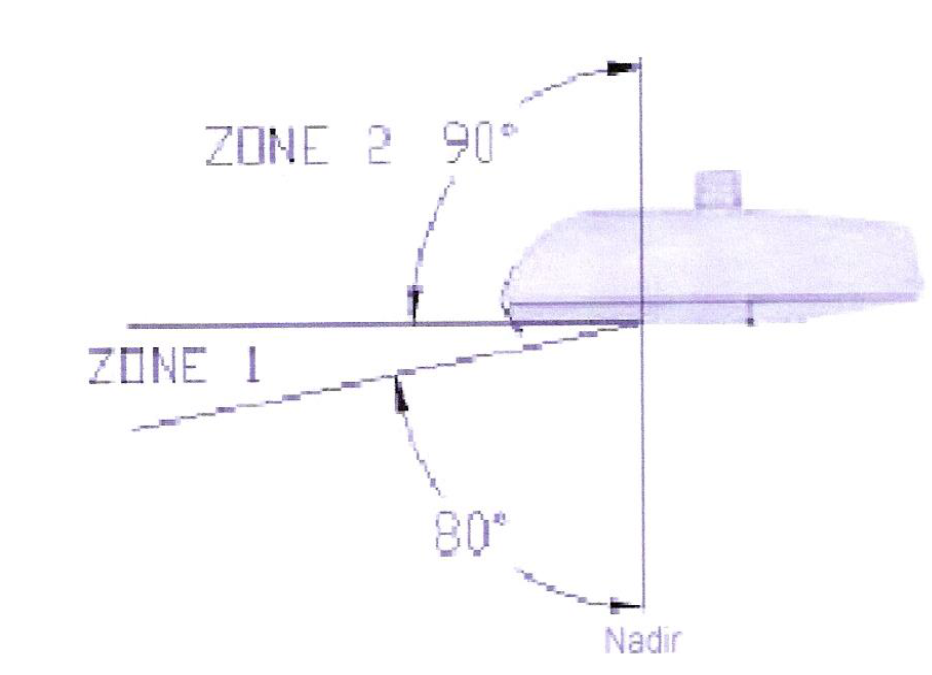
Figure 40-1. The full cutoff (FCO) luminaire on any commercial property (beginning at 80 degrees up from nadir to less than 90 degrees) may emit up to 100 candela per 1,000 lamp lumens (ten percent) at all vertical angles. This applies to all horizontal angles around the luminaire. This information can be provided on the packaging of the outdoor light or from the manufacturer as proof of compliance.
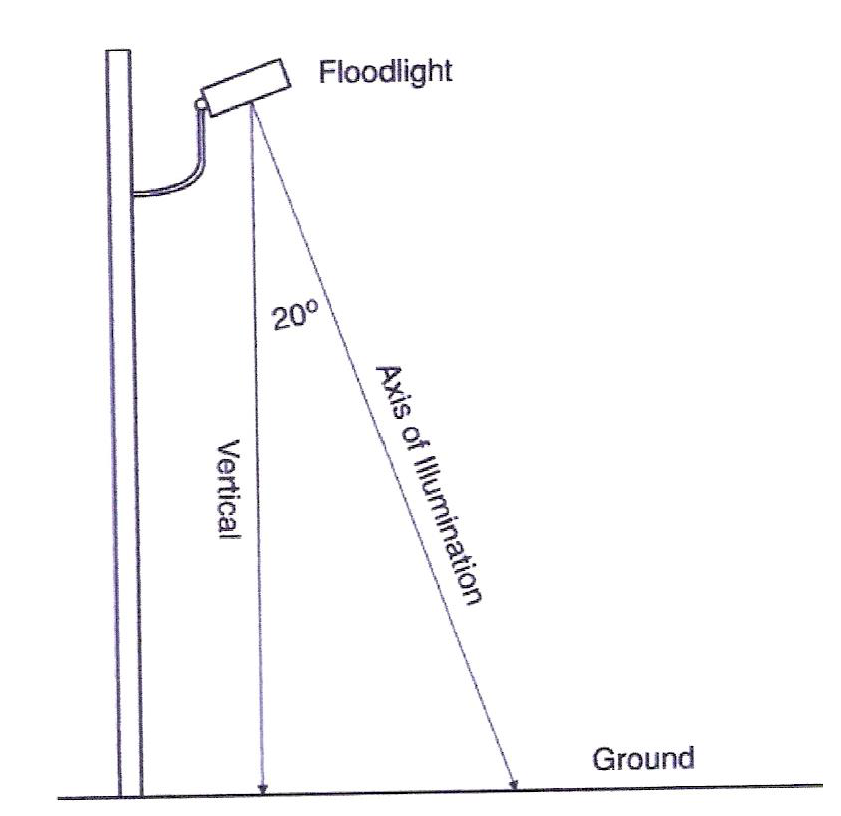
Figure 40-2. For spotlights and floodlights mounted overhead and used for area lighting, the axis of illumination shall be adjusted to an angle not more than 20 degrees from the vertical line between the fixture and the ground.
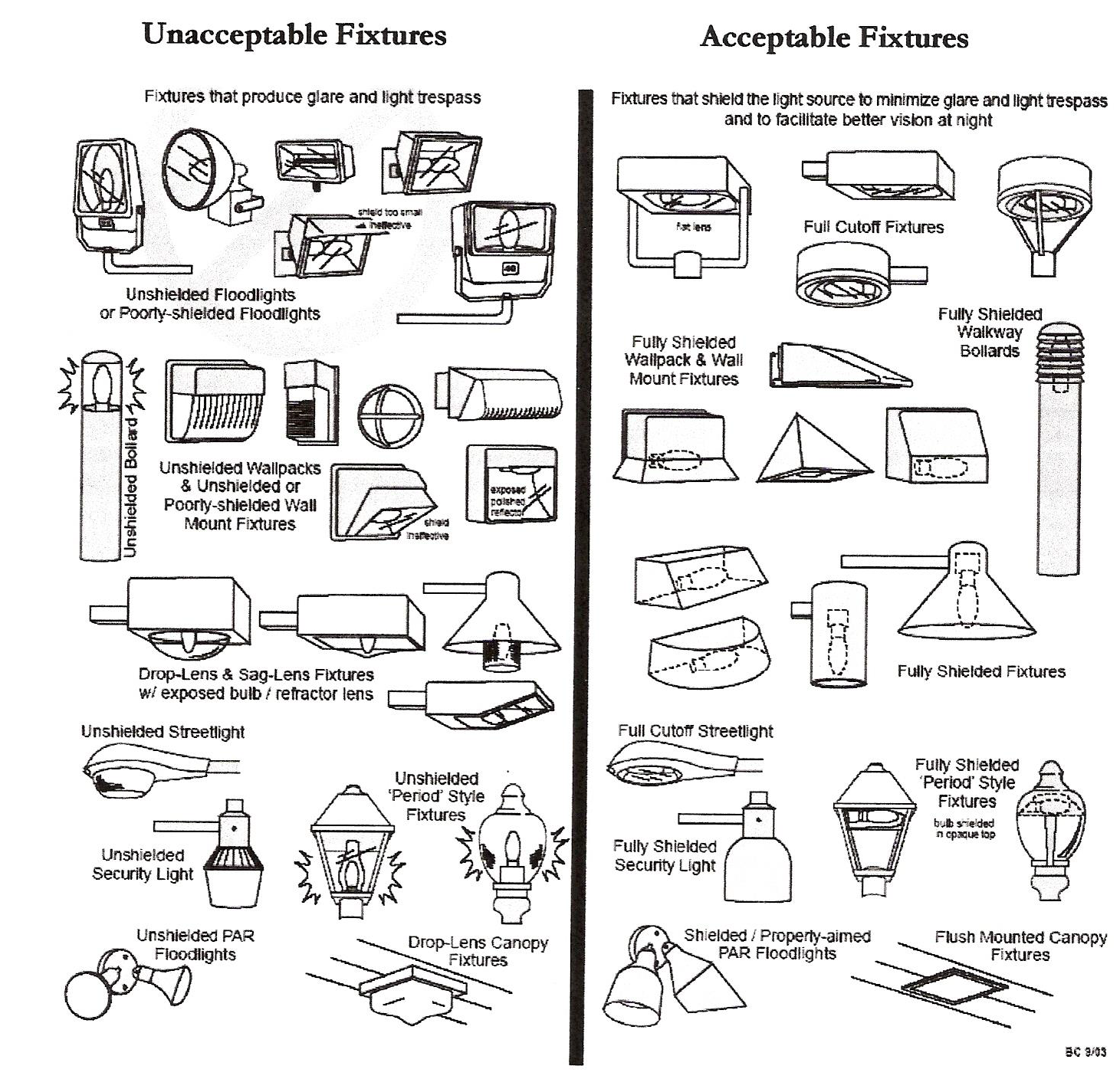
Figure 40-3
40.5
Residential lighting and glare standards.
A.
Residential lighting for security and night recreation use is permitted in all residential districts provided the following requirements are met:
1.
Direct lighting over ten feet in height is shielded from adjacent property.
2.
No light source shall exceed 35 feet in height. Street lights and other traffic safety lighting are exempt from this standard.
3.
Lighting shall not directly shine on adjacent dwellings. All residential trespass lighting shall not exceed 0.25 foot-candles at the property line, with the exception of intermittent lighting.
4.
Intermittent lighting shall be of the "motion sensor" type that stays on for a period of time not to exceed five minutes and has a sensitivity setting that allows the luminary to be activated only when motion is detected on the site.
40.6
Special or holiday lighting—Low wattage.
A.
Bare bulbs or strings of lamps are prohibited, except during holidays special lighting shall be permitted for a maximum time period of 45 calendar days for each holiday used.
(Ord. No. 3138, Arts. I, II(Exh. A), 9-30-25)
Section 41. - Home occupation regulations.
41.1
Purpose. Standards for controlling home occupations are set forth to minimize annoyance and inconvenience to neighboring property owners within residential areas. These standards are intended to allow reasonable and comfortable enjoyment of adjacent and nearby property by their owners and by occupants of neighboring residential dwellings, while providing opportunities for the pursuit of home-based businesses.
41.2
Special provisions for home-based business (HBB).
A.
Home-based business (HBB) is defined as a business that is operated: (a) from a residential property; (b) by the owner or tenant of the property; and (c) for the purpose of manufacturing, providing, or selling a lawful good or providing a lawful service.
B.
"No-impact-home-based-business" (NIHBB) is defined as a HBB that: (a) has at any time on the property where business is operated a total number of employees and clients or patrons of the business that does not exceed the city's occupancy limit for the property; (b) does not generate on-street parking or a substantial increase in traffic through the area; (c) operates in a manner in which none of its activities are visible from a street; and (d) does not substantially increase noise in the area or violate a municipal noise ordinance, regulation, or rule.
C.
Home-based business (HBB) shall be permitted as accessory use in single- and two-family residential zoning districts (i.e., AG, EE-32, SF-16, SF-10, SF-7.5, SF-6, TH-12 and MH) provided that they comply with all restrictions herein;
D.
The HBB shall produce no alteration or change in the character or exterior appearance of the principal building from that of a residential dwelling, and performance of the occupation activity shall not be visible from the street;
E.
Such use shall be incidental and secondary to the use of the premises for residential purposes, and shall not utilize floor area exceeding 25 percent of the combined gross floor area of dwelling unit and any accessory building(s) that are used for the home occupation (in no case shall the combined floor area utilized for a home occupation exceed 500 square feet);
F.
The HBB shall not employ any person who is not a member of the household in which the home occupation occurs.
G.
The operation of such an occupation shall be between the hours of 8:00 a.m. and 6:00 p.m. for outdoor activities, and between 7:00 a.m. and 10:00 p.m. for indoor activities;
H.
The HBB activity shall not increase vehicular traffic flow beyond what normally occurs within a residential district, and shall not require regular and frequent deliveries by large delivery trucks or vehicles with a rated capacity in excess of one and one-half tons, according to the manufacturer's classification;
I.
There shall be no outside storage, including trailers, or outside display related to the home occupation use;
J.
No mechanical or electrical equipment shall be employed on the premises other than that which is customarily found in a home environment, and that which is customarily associated with a hobby or avocation which is conducted solely for pleasure and not for profit or financial gain;
K.
The HBB shall not generate noise, vibration, glare, fumes/odors, heat or electrical interference beyond what normally occurs within a residential district;
L.
The HBB shall not require the use of chemicals on the property that are obnoxious or hazardous to the welfare of the neighborhood;
M.
The HBB shall not involve the use of advertising signs or window displays, or any other device that calls attention to the business use of the premises through audio and/or visual means;
N.
The HBB shall not offer a ready inventory of any commodity for sale on the premises.
O.
The HBB shall not be harmful or detrimental to the health, welfare and safety of the neighborhood, nor shall it interfere with the comfortable enjoyment of life, property and recreation by residents of the area.
P.
The HBB shall comply with federal, state, and local law, including a city fire and building code or city regulations related to health and sanitation, transportation or traffic control, solid or hazardous waste, or pollution and noise control.
41.3
Applicability of other regulations. Home occupations shall also be subject to any and all other provisions of local, state and/or federal regulations and laws that govern such uses.
41.4
Uses allowed as home occupations. Subject to the provisions of subsection 41.2 above, home occupations may include the following uses:
A.
Office facility of an accountant, architect, landscape architect, attorney, engineer, consultant, insurance agent, realtor, broker, or similar profession;
B.
Author, artist or sculptor;
C.
Dressmaker, seamstress or tailor;
D.
Music/dance teacher, or similar types of instruction, provided that instruction shall be limited to no more than six pupils at a time;
E.
Individual tutoring and home schooling;
F.
Millinery;
G.
Office facility of a minister, rabbi, priest or other clergyman;
H.
Home crafts, such as rug weaving, model making, etc.;
I.
Office facility of a salesman, sales or manufacturer's representative, etc., provided that no retail or wholesale transactions or provision of services are personally and physically made on the premises;
J.
Repair shop for small electrical appliances, cameras, watches/clocks, and other small items, provided that the items can be carried by one person without using special equipment, and provided that the items are not equipped with an internal combustion engine;
K.
Food preparation establishments such as cake making/decorating or catering, provided that there is no on-premises consumption by customers, and provided that all aspects of the business comply with all state and local health regulations;
L.
Registered family homes (see definition in section 44), in compliance with applicable state laws, which are incorporated herein by reference, with no more than six children;
M.
Barber shop/beauty salon or manicure studio;
N.
Swimming lessons and water safety instruction provided that such instruction involves no more than six pupils at any one time during daylight hours.
41.5
Uses prohibited as home occupations. Home occupations shall not, in any event, be deemed to include the following uses:
A.
Animal hospitals or clinics, commercial stables, or kennels;
B.
Schooling or instruction, except swimming/water safety classes and home schooling, with more than six pupils at a time;
C.
Restaurants or on-premises food or beverage (including private clubs) consumption of any kind, except for limited food/meal consumption associated with the operation of a licensed registered family home;
D.
Automobile, boat or trailer paint or repair shop; small engine or motorcycle repair shop; welding shop; large household appliance repair shop; or other similar type of business;
E.
Office facility for a doctor, dentist, veterinarian or other medical-related profession;
F.
On-premises retail or wholesale sales of any kind;
G.
Commercial clothing laundering or cleaning;
H.
Mortuaries or funeral homes;
I.
Trailer, vehicle, tool or equipment rentals;
J.
Repair shops or services, except as specifically provided in subsection 41.4 above;
K.
Drapery or furniture upholstery shops;
L.
Antique, gift or specialty shops;
M.
Repair shops for any items having internal combustion engines; and
N.
Any use that would be defined by the building code as an assembly, factory/industrial, hazardous, institutional or mercantile occupancy.
41.6
Home occupation uses not classified.
A.
Any use that is not either expressly allowed nor expressly prohibited by subsections 41.4 and 41.5, respectively, is considered prohibited, unless and until such use is classified by amendment to this ordinance by the Terrell City Council, subsequent to a recommendation by the planning and zoning commission.
41.7
Effect of section 41 upon existing home occupations.
A.
Any home occupation that was legally in existence as of the effective date of this ordinance and that is not in full conformity with the provisions herein shall be deemed a legal nonconforming use, and is subject to the provisions of section 7, provided that the home occupation use was not in violation of any other local, state or federal law or regulation on the effective date of this ordinance. Any home occupation that was legally in existence as of the effective date of this ordinance and that conforms with (i.e., is not in violation of) the provisions herein shall be hereby authorized to continue.
(Ord. No. 3138, Arts. I, II(Exh. A), 9-30-25)
Section 42. - Special regulations for certain types of uses.
42.1
Gasoline sales facilities.
A.
Gasoline service station pump islands that parallel a public street may be located a minimum of 16 feet to the property line adjacent to a public street. For pump islands that are perpendicular or diagonal to a public street, the setback shall be 30 feet in order to prevent vehicles stacking out into the street while waiting for a pump position. Pump islands may extend beyond the front building line as described above (provided that all other requirements of this ordinance are met), but shall not be closer than 16 feet to any property line that is not adjacent to a public street.
B.
Canopies for gasoline service station pump islands shall be located no closer than 15 feet from any street right-of-way line or side or rear property line.
C.
Any oil draining pit, hydraulic hoists, lubrication and greasing devices, repair equipment and similar appurtenances shall be located at least 20 feet away from any front property line, and at least 30 feet away from any residential zoning district, except where such appurtenances are located wholly within a building.
D.
Any service station providing self-service dispensing facilities for customers shall provide an emergency shut-off switch which will completely eliminate the flow of fuels from all of the self-service pumps in any emergency situation, and shall be located in the vicinity where the station attendant will be located most of the time.
E.
Lighting shall be such that it shines downward and does not spill over onto adjacent property (see lighting and glare standards, section 40).
F.
Gasoline service stations which have other uses associated with it (e.g., convenience store, fast food sales, drive-through window service, car wash, dry cleaners, minor or major auto repair, etc.) must be properly zoned for each use to be located on the site (including a SUP, if that zoning district requires such for any of the uses), and the amount of parking and stacking spaces shall be determined cumulatively for all uses (see parking requirements, section 33).
G.
The amount of paved area for gasoline service station sites shall be adequate to accommodate vehicle movements into and out of the site (including large tanker fuel trucks in the vicinity of the fuel storage tanks), but shall be minimized to the greatest extent practical and possible (to reduce stormwater runoff, heat and glare, etc.
42.2
Swimming pools.
A.
A swimming pool shall be defined as any pool or open tank that is intended for human use and that contains, or is capable of containing, water to a depth at any point greater than 24 inches. No such swimming pool shall be constructed, maintained or operated in any district, whether as an accessory use or as a principal use, unless it complies with the following requirements and with any other related codes or policies of the City of Terrell. See Section 4-19, Swimming Pool Code, City of Terrell Code of Ordinances.
B.
If located in any residential zoning district, the swimming pool shall be intended and used solely for the enjoyment of the occupants of the principal building on the property and their guests, or for the enjoyment of bona fide members of a club and their guests (provided the club itself is properly zoned).
C.
Requirements for all swimming pools.
1.
No swimming pool shall be located within a required front yard.
2.
No swimming pool (except decking) shall be located closer than three feet to any side or rear property line.
3.
Enclosures and safety devices. The swimming pool (or the property or compound area in which the pool is located) shall be walled or fenced with a minimum four-foot high fence or wall of masonry, wood or ornamental metal construction or other material that provides a solid barrier which shall be maintained in good condition, and which shall be equipped with a self-closing and self-locking gate to prevent uncontrolled access by children into the pool area. All enclosures and required safety devices shall be in accordance with Section 3109 of the International Building Code as adopted.
4.
Filtration and pump system. The filtration and pump system shall be large enough to completely circulate the pool water once every six hours, and shall not be located within any front yard setback. Such equipment may be located in a side or rear yard provided that it is completely screened from view and noise-buffered from any adjacent property.
5.
Permit. No swimming pool shall be constructed nor altered in any way without issuance of a building permit from the city and without complete compliance with this ordinance.
D.
Special requirements for swimming pools in apartment complexes and in the MF, SFA and MH zoning districts. The swimming pool shall be located behind the front yard setback and behind the front façade of the front-most building, and it shall not be located within any required side or rear yard setback.
42.3
Extraction of minerals.
A.
General requirements. Any owner, leasee, or other person, firm, or corporation, having an interest in mineral lands in the AG zoning district only may file an application for a specific use permit (SUP) with the city for authorization to mine minerals there from, provided, however, that it shall comply with all requirements of the AG zoning district in which said property is located, and with the following additional requirements.
1.
Distance from property lines. No quarrying operation shall be carried on or any stock pile placed closer than 50 feet to any property line, unless a greater distance is specified by the city council where such is deemed necessary for the protection of adjacent property.
2.
Distance from public right-of-way. In the event that the site of the mining or quarrying operation is adjacent to the right-of-way or any public street or road, no part of such operation shall take place closer than 50 feet to the nearest line of such right-of-way.
3.
Fencing. Fencing shall be erected and maintained around the entire site or portions thereof where, in the opinion of the building official, such fencing is necessary for the protection of the public safety, and such fencing shall be of the type and height specified by the building official.
4.
Equipment. All equipment and machinery shall be operated and maintained in such manner as to minimize dust, noise, and vibration. Access roads shall be maintained in dust-free condition by surfacing or other treatment as may be specified by the city engineer or the city council.
5.
Processing. The actions of crushing, washing, refining or other similar processing may be authorized by the city council as an accessory use within the SUP ordinance, but such actions or processing shall not be in conflict with the use regulations of the district in which the operation is located.
6.
Financial ability. In accepting such SUP request for review, the city council must be satisfied that the proponents are financially able to carry out the proposed mining operation in accordance with plans and specification submitted, and in accordance with city health, safety and welfare standards and ordinances.
7.
Application. An application for a SUP for such operation shall set forth the following information (additional information may be required by the municipal development department or by the city council):
a.
Name of land owner from which removal is to be made;
b.
Name of applicant making request;
c.
Name of person or corporation conducting actual removal operation;
d.
Location, description, and size of area from which removal is to be made;
e.
Location of processing plant;
f.
Type of resources or materials to be removed;
g.
Proposed method of removal and if blasting or other use of explosives will be required;
h.
Description of equipment to be used; and
i.
Method of rehabilitation and reclamation of mined area.
8.
Planning and zoning commission recommendation. In accordance with section 31B, specific use permits, the planning and zoning commission of the City of Terrell shall give its recommendation regarding a SUP to the city council prior to the city council's final determination of application.
9.
Rehabilitation. To guarantee restoration, rehabilitation, and reclamation of mined-out areas, every applicant granted a mining permit as herein provided, shall furnish a surety bond to the City of Terrell, in the amount of not less than $5,000.00, the upper limit to be determined by the city council, as a guarantee that such applicant, in restoring, reclaiming, and rehabilitating such land, shall within a reasonable time, but not more than one year, and shall, to the satisfaction of the city council, meet the following requirements.
a.
Surface rehabilitation: All excavation shall be made either to a water producing depth, such depth to be not less than five feet below the low water mark, or shall be graded or backfilled with non-noxious, non-flammable and non-combustible solids, to secure that the excavated area shall not collect or permit to remain therein stagnant water or that the surface or such area which is not permanently submerged is graded or backfilled as necessary so as to reduce the peaks and depressions, so as to produce a gently running surface that will minimize erosion due to rainfall and which will be in substantial conformity to the adjoining land areas.
b.
Vegetation: Vegetation shall be restored by appropriate seeds, grasses, or planting of shrubs or trees in all parts of said mining area where such area is not to be submerged under water as herein above provided.
c.
Banks of excavations: The banks of all excavations not backfilled shall be sloped to the water line at a slope which shall not be less than three feet horizontal to one foot vertical, and said banks shall be seeded.
10.
Additional requirements: In addition to the foregoing, the city council may impose such other conditions, requirements, or limitations concerning the nature and extent of the use and operation of such mines, quarries, or gravel pits as the city council may deem necessary for the protection of adjacent properties and the public interest. The said conditions and the amount of the surety bond shall be determined by the city council prior to issuance of the SUP and issuance of the mining permit. No mining at all will be allowed without a permit as required by this section or by any local, county, state or federal agency.
42.4
Sexually oriented businesses. See chapter 5, section 5-14 of the city's Code of Ordinances as adopted or amended.
42.5
Alcoholic beverage sales. See chapter 5, section 5-2 of the city's Code of Ordinances as adopted or amended.
42.6
Thrift stores.
A.
No thrift store may be located within 1,000 feet of any residential zoning district boundary line, including, but not limited to, the EE-32 executive estate district, all SF single-family districts, the TH-12 townhouse district, the MF multifamily district, the MH manufactured home district, and any property zoned CBD central business district, any area zoned AG agricultural, or any PD planned development district that allows residential uses;
B.
No thrift store may be located within 1,000 feet of another thrift store;
C.
For purposes of this section, the required separation shall be measured in a straight line without regard to intervening structures or objects as follows:
1.
If confirming the separation between a proposed thrift store and residential uses, the CBD central business district, any area zoned AG agricultural, or any planned development district that allows residential uses, the distance shall be measured from the closest point on the property line of the lot containing the proposed thrift store to the nearest portion of the boundary line of the above referenced districts.
2.
If confirming the separation between thrift store locations, the distance shall be measured from the nearest portion of the property line of the commercial district where the existing thrift store is located to the nearest portion of the property line of the commercial district where the new thrift store is proposed.
a.
Outside storage and display shall be prohibited in conjunction with the operation of a thrift store.
b.
Exception. This section does not apply to charitable sales held on a one-time basis by a church or other non-profit organization.
See chapter 5, section 5-17 of the city's Code of Ordinances as adopted or amended and sections 33 and 44 of this ordinance for associated permitted uses and definitions.
42.7
Bail bond service.
A.
No bail bond service office shall be located within 1,000 feet of any residential zoning district boundary line, including the EE-32 executive estate district, all SF single-family districts, the TH-12 townhouse district, the MF multifamily district, the MH manufactured home district, any property zoned CBD central business district or any PD planned development district that allows residential uses;
B.
No bail bond service office shall be located within 1,000 feet of any other tract that the location of a bail bond service;
C.
For purposes of this section, the required separation shall be measured in a straight line without regard to intervening structures or objects:
1.
If confirming the separation between the proposed bail bond service and residential uses, the distance shall be measured from the nearest portion of the boundary line of any residential zoning districts in subsection 42.7.A above, any CBD district, or any PD planned development district for residential uses.
2.
If confirming the separation between bail bond service locations, the distance shall be measured from the nearest portion of the property line of the commercial district where the existing bail bond service is located to the nearest portion of the property line of the commercial district where the new business is proposed.
42.8
Check cashing businesses, payday advance/loan businesses, and car title loan businesses.
A.
No check cashing business, payday advance/loan business or car title loan business may be located within 1,000 feet of any residential zoning district boundary line, including, but not limited to, the EE-32 executive estate district, all SF single-family districts, the TH-12 townhouse district, the MF multifamily district, the MH manufactured home district, and any property zoned CBD central business district, any area designated for agricultural purposes, or any PD planned development district that allows residential uses;
B.
No check cashing business, payday advance/loan business or car title loan business may be located within 1,000 feet of another check cashing business, payday advance/loan business or car title loan business;
C.
For purposes of this section, the required separation shall be measured in a straight line without regard to intervening structures or objects:
If confirming the separation between the proposed check cashing business, payday advance/loan business or car title loan business and residential uses, the distance shall be measured from the nearest portion of the boundary line of any of the residential districts in subsection 42.8.A above, any CBD district, any area zoned for agricultural purposes, or any PD planned development district that allows residential uses.
1.
If confirming the separation between check cashing business, payday advance/loan business or car title loan business locations, the distance shall be measured from the nearest portion of the property line of the commercial district where the existing check cashing business, payday advance/loan business or car title loan business is located to the nearest portion of the property line of the commercial district where the new business is proposed.
Exception: This section does not apply to check cashing activities at a lawful business engaged in the sale of food, beverages, tobacco products and/or sundries (i.e. a convenience or grocery store) and/or check cashing activities at a business duly licensed or permitted to sell alcoholic beverages by the Texas Alcoholic Beverage Commission.
42.9
Gun range (indoor). Screening requirement for indoor gun range shall include a minimum landscape buffer of no less than 30 feet of full landscaped screening to a height of no less than eight feet along any property line that is not a public street.
42.10
Gun range (outdoor).
A.
Operating hours shall be limited to one hour after sunrise to one hour prior to sunset.
B.
Outdoor shooting facilities shall be required to maintain a 300-foot setback from any property line to any end of range barrier, any projectile path and any firing location. Certificates of occupancy for outdoor shooting facilities shall be annual only and may only be issued when the facility demonstrates current liability coverage for a shooting facility and compliance with any applicable SUP requirements.
42.11
Mobile food unit.
1.
A mobile food unit may operate as part of a temporary special event (with a temporary food permit), as part of an approved land use.
2.
The mobile food unit shall be located on private property where an existing business is currently operating with a valid certificate of occupancy (CO). Operation within the public right-of-way is prohibited.
3.
A mobile food unit is not to be permanent use at one location.
4.
Mobile food units shall only operate during the allowed "host business" hours and shall be required to be removed from the property during non-operation hours (i.e., overnight storage on the site is prohibited unless otherwise approved with the specific use permit).
5.
The mobile food unit must obtain an annual mobile food establishment permit, which includes a health and fire inspection.
6.
A mobile food unit health permit shall be issued upon approval of fire and health inspections.
7.
A mobile unit health permit shall be valid for a period of 12 months following issuance thereof.
8.
The mobile food unit shall be equipped with trash receptacles and outside storage of trash shall be prohibited. Water and/or wastewater may not be discharged onto the ground.
9.
The mobile food unit shall have permanent restrooms available within 300 feet of the facility. Portable restroom facilities are not permitted to meet this requirement unless otherwise approved in conjunction with a special event.
10.
The mobile food unit shall have access to a minimum of two dedicated parking spaces and shall not reduce the required parking for the existing building/land use.
11.
All noise and lighting shall be subject to the requirements of the City of Terrell Code of Ordinances and the Zoning Ordinance. In addition, no lights associated with the operation of a mobile food unit may be directed towards an adjacent property or onto a public right-of-way.
12.
All signage must be attached to the mobile food unit, with the exception of one freestanding menu board no greater than eight square feet placed adjacent to the mobile food unit.
13.
A mobile food unit may operate on City of Terrell owned property at any time with written approval of the city manager, or his designee. This request does not require the appropriate food permit and inspection, and payment.
42.12
Mobile food unit court.
A.
A site plan shall be approved prior to locating any Mobile Food Unit on the property.
B.
Permanent restroom facilities available to owners, operators, and customers of the mobile food units operating in the court must be located within 1,000 feet of each location where a mobile food unit may be parked.
C.
All vehicles, including mobile food units shall be parked on an improved surface.
D.
Electricity shall be provided with permanent outlets by way of a portable cord that complies with Section 3.09 (National Electrical Code), as amended.
E.
Any waste, liquid or solid, shall be disposed of safely and properly as per all associated local and state regulations. Trash service and receptacles shall be provided in accordance with city requirements.
F.
A mobile food unit cannot be left unattended or left on site overnight.
42.13
Design standards for repurposed shipping containers. The intent of this section is to promote compatible design of repurposed shipping containers in context to the relationship of scale, materials and architectural elements to surrounding neighborhoods, buildings and structures: Repurposed shipping containers are only allowed within non-residential zoned properties.
A.
Building scale and relationship.
1.
Each building or structure built with repurposed shipping containers, or with any part of a repurposed shipping container, shall be within 20 percent of the average height and within 20 percent of the average width of buildings and structures located in the same block-face; and
B.
Building materials.
1.
The exteriors of each building or structure built with a repurposed shipping container, or with any part of a repurposed shipping container shall consist of 100 percent of the following building materials:
i.
Masonry;
ii.
Glass;
iii.
Wood; and/or
iv.
Siding.
2.
Building materials shall be consistent with building materials for other buildings located in the same block-face.
C.
Architectural elements of each building or structure built with repurposed shipping containers, or with any part of a repurposed shipping container:
1.
The pitch of roof lines shall be within 20 percent of the average pitch of the roof lines of buildings located in the same block-face.
2.
The foundation shall be consistent with the type of foundation of other buildings located in the same block-face. Pier and beam or raised foundation shall be screened with landscaping or covered with a compatible building material.
3.
A porch shall be installed where 50 percent or more of buildings located in a block-face contain a porch.
D.
Building permit application for review by the Municipal Development department shall include full design and engineered plans verifying the structural integrity of the structure and requested build-out options.
(Ord. No. 3138, Arts. I, II(Exh. A), 9-30-25)
Section 44. - Definitions.
44.1
For the purpose of these regulations, certain terms and words are to be used and interpreted as defined hereinafter. Words used in the present tense shall also include the future tense; words used in the masculine gender shall also include the feminine gender; words used in the singular number shall also include the plural number; and words in the plural number shall also include the singular number, except where the natural construction of the writing indicates otherwise. The word "shall" is mandatory and not directory. For any term or use not defined herein, Webster's Dictionary (latest edition) shall be used.
Accessory building/structure (non-residential). In the nonresidential districts, a subordinate building to the main building that does not exceed the height of the main building and does not exceed 50 percent of the floor area of the main building, and that is used for purposes accessory and incidental to the main use (see "accessory use").
Accessory building/structure (residential). In a residential district, a subordinate building that is attached or detached and is used for a purpose that is customarily incidental to the main structure but not involving the conduct of a business (i.e., the building area must be significantly less than that of the main structure). Examples may include, but are not limited to, the following: a private garage for automobile storage, carport, tool shed, greenhouse as a hobby (no business), home workshop, children's playhouse, storage building, gazebo, patio cover, garden shelter, etc.
Accessory dwelling (garage apartment). A separate secondary residential structure located on the same lot as a single-family main/primary building but not attached to the main building, sometimes known as a mother-in-law's quarters. An accessory dwelling shall not be sold, rented, leased, let, or hired out separately from the main/primary residential structure and shall only be occupied by members of the same family occupying the main/primary residential building (see "family" definition).
Accessory use. A use that is customarily incidental, appropriate and subordinate to the principal use of land or building(s) and that is located upon the same lot therewith (i.e., the land/building area that is used for the accessory use must be significantly less than that used for the primary use, and/or the gross receipts/income that is derived from the accessory use must be significantly less than that derived from the primary use).
Aircraft parts and auxiliary parts, manufacturing (excluding manufacture or assembly of fuselage sections. See "manufacturing, general".
Airport or landing field. A place where aircraft can land and take off that is usually equipped with hangars, facilities for aircraft refueling and repair, and various accommodations for passengers.
Alcoholic beverage retail sales. Any establishment, place of business, or person engaged in the selling of alcoholic beverages, as defined in the Texas Alcoholic Beverage Code, as amended, to the general public for off-premise personal or household consumptions. See chapter 5, section 5.2 of the Code of Ordinances, as amended.
Alley. A minor right-of-way that is dedicated to public use and which affords a secondary means of vehicular access to the back or side of properties otherwise abutting a street, and which may be used for public utility purposes, which may or may not be improved. No fences, storage or structures are allowed in alley rights-of-way.
Ambulance service. Provision of private (not operated by the City of Terrell) emergency transportation which may include mobile medical care, and which may include storage and maintenance of vehicles and boarding rooms for ambulance drivers.
Amusement devices/arcade (also video arcade). Any building, room, place or establishment of any nature or kind, and by whatever name called, where more than ten percent of the public floor area is devoted to four or more amusement devices that are operated for a profit, whether the same is operated in conjunction with any other business or not, including but not limited to such amusement devices as coin-operated pinball machines, video games, electronic games, shuffle boards, pool tables or other similar amusement devices. However, the term "amusement device", as used herein, shall not include musical devices, billiard tables which are not coin-operated, machines that are designed exclusively for small children, and devices designed to train persons in athletic skills or golf, tennis, baseball, archery or other similar sports.
Amusement, commercial (indoor). An amusement enterprise that is wholly enclosed within a building which is treated acoustically so that noise generated by the enterprise is not perceptible at the bounding property line, and that provides activities, services and/or instruction for the entertainment of customers or members, but not including amusement arcades. Uses may include, but are not limited to, the following: bowling alley, ice skating rink, martial arts club, racquetball/handball club, indoor tennis courts/club, indoor swimming pool or scuba diving facility, and other similar types of uses.
Amusement, commercial (outdoor). An amusement enterprise offering entertainment and/or games of skill to the general public for a fee wherein any portion of the activity takes place outdoors and including, but not limited to, a golf driving range, archery range, miniature golf course, batting cages, go-cart tracks, amusement parks, and other similar types of uses.
Animal rendering plant (slaughterhouse). An establishment for the processing of animals and the refining of their by products; and/or a facility where animals (including game) are processed; and/or a facility where meat, poultry, or eggs are cooked, smoked, or otherwise processed or packed.
Antenna/tower (commercial). An antenna or antenna tower/support structure used for the purpose of transmission, retransmission, and/or reception of radio, television, electromagnetic, or microwave signals primarily for the purpose of operating a business and/or for financial gain (e.g., commercial broadcasting, cellular/wireless telecommunications, etc.). The antenna tower/support structure shall be setback from all adjacent property lines a distance equal to its height. A satellite dish antenna that exceeds six feet in diameter shall also be considered as a commercial antenna. Antennas may be further restricted as to height and location by the Texas Historic Commission rules; see section 38.5.
Antenna/tower (non-commercial). An antenna and antenna support structure used for the purpose of transmission, retransmission, and/or reception of radio, television, electromagnetic, or microwave signals for private or personal use and not for the purpose of operating a business and/or for financial gain. Antennas located in a residential district shall be limited to 35 feet in height and shall be setback from all adjacent property lines a distance equal to its height. A satellite dish antenna not exceeding six feet in diameter shall also be considered a non-commercial antenna. See section 38.5.
Antique/consignment shop (inside sales). A retail or wholesale establishment engaged in the selling of works of art, architectural antiques, furniture and/or other artifacts of an earlier period (i.e., over 50 years old) and that are in clean, operable and saleable condition (i.e., not junk), with all sales and storage occurring inside a building. An antique shop is differentiated from a "used merchandise store", a "resale shop" or a "consignment shop" in that it does not market common, contemporary used household goods, clothing or furnishings. Rather, it deals primarily in vintage and nostalgia items (generally over 50 years old) and in antiquities (generally over 100 years old) from past eras; outside displays are permitted only in areas designated on the site plan filed with the city; outdoor display areas may not exceed five percent of the primary building floor area; all sales and storage occurs inside.
Appliance (major) sales, rental, repair. See "retail store/shop".
Appliance (minor) sales, rental, repair. See "retail store/shop".
Art gallery or museum. An institution for the collection and/or display of bona fide objects of art or science, and which is typically sponsored by a public or quasi-public agency and generally open to the public. An art gallery/museum can include a small gift shop that sells items to visitors provided that such sales are clearly accessory to the primary use as a gallery/museum. An establishment that sells new art or science objects on the retail market shall be defined as a "retail store", and an establishment that sells used objects (or parts of objects) shall be defined as a "used merchandise store".
Artisan's workshop. An establishment used for the preparation, display, and sale of individually crafted artwork, jewelry, furniture, sculpture, pottery, leather-craft, hand-woven articles, and related items.
Artist studio. An accessory use, building or structure detached from the residence on the lot on which it is located, which is used only by an individual working in the fine arts on a professional basis.
Assembly and fabrication processes. See "light manufacturing or industrial use".
Assisted living facility. A facility providing residence, supervision and daily assistance for individuals, generally persons 55 years of age or older, with common dining and recreational areas designed for the needs of the elderly. Services in these establishments include assistance with routine living functions that are non-medical in nature, such as dressing, grooming, bathing, and social and recreational services, such as meal services, transportation, housekeeping, linen and organized activities. An assisted living facility may include an adult daycare as an accessory use.
Athletic field or stadium (private). An athletic field or stadium owned and operated by a private owner, agency or entity other than the City of Terrell or the Terrell Independent School District.
Athletic field or stadium (public). An athletic field or stadium owned and operated by a public agency (e.g., City of Terrell, Terrell Independent School District, etc.) for the general public including a baseball field, soccer field, golf course, football field or stadium which may be lighted for nighttime play.
Auction/auto storage. The storage or impoundment, on a lot or tract which is paved in accordance with parking lot paving requirements set forth in this ordinance, of operable automobiles for the purpose of holding such vehicles for sale, distribution and/or storage. This definition shall not include the storage of wrecked or inoperable vehicles (see "wrecking yard").
Auto dealership (used auto sales as accessory use only). See "vehicle display, sales, and service".
Auto dealership (used auto sales). See "vehicle display, sales, and service".
Auto muffler shop. See "auto repair, major".
Auto paint and body shop. See "auto repair, major".
Auto parts and accessory sales (indoors). The use of any building or other premise for the primary inside display and sale of new or used parts for automobiles, panel trucks or vans, trailers, or recreation vehicles.
Auto rental or leasing. Short-term renting or leasing of automobiles, motorcycles and light load vehicles with outside storage.
Auto repair garage. An establishment providing major or minor automobile repair services to all motor vehicles except heavy load vehicles.
Auto repair, major. General repair or reconditioning of engines, air-conditioning systems and transmissions for motor vehicles; wrecker service; collision repair services including body, frame or fender straightening or repair; customizing; painting; welding, vehicle steam cleaning; undercoating and rust proofing; those uses listed under "automobile repair, minor"; and other similar uses.
Auto repair, minor. Minor repair or replacement of parts, tires, tubes and batteries; diagnostic services; minor maintenance services such as grease, oil, spark plug and filter changing; tune-ups; emergency road service; replacement of starters, alternators, hoses and brake parts; automobile washing and polishing; installation of minor automobile accessories such as car alarms, radio and stereo equipment, window tinting, pin striping, cellular telephones and similar accessories; performing state inspections and making minor repairs necessary to pass said inspection; normal servicing of air-conditioning systems; and other similar minor services for motor vehicles except heavy load vehicles, but not including any operation named under "automobile repair, major" or any other similar use. Vehicles, which are inoperative or are being repaired, may not remain parked outside for a period greater than seven calendar days.
Auto retail sales/repair. See "auto repair, minor"
Automatic teller machines (ATMs). A machine that dispenses cash and allows you to make other banking transactions; typically consists of a screen, a card reader, a keypad, a cash dispenser, and a printer.
Automobile. A self-propelled mechanical vehicle designed for use on streets and highways for the conveyance of goods and people including but not limited to the following: passenger cars, light duty trucks and sport utility vehicles, vans and mini-vans, motor scooters and motorcycles.
Automobile driving school. Any business or establishment, which employs instructors to teach persons to operate motor vehicles.
Bail bond service. A service arranged by an agent promising money or property to ensure that a person named in a legal action appears in court for the designated criminal proceeding at the date and time specified. (Described by Ordinance 2653 as definition "287.")
Bakery or confectionery (commercial/wholesale). A manufacturing facility which is typically over 2,000 square feet in size for the production and distribution of baked goods and confectioneries to retail outlets.
Bakery or confectionery (retail). A facility which is typically less than 2,000 square feet in size for the production and/or sale of baked goods for human consumption such as (but not limited to) pies, cakes, cookies, doughnuts, desserts, etc.
Bank/financial institution related definitions:
a.
Depository financial institution means a Federal or State chartered depository financial institution such as a bank, savings and loan association, or credit union which conducts transactions regarding the custody, deposit, savings, loan, exchange and/or issue of money, the extension of credit, and/or facilitating the transmission of funds.
b.
Non-depository financial establishment means any establishment, entity, business, corporation, or person required to be registered with the Secretary of State as a "Credit Service Organization" (CSO) under Chapter 393 of the Texas Finance Code, such as, check cashing businesses, payday advance/loan businesses, or car title loan businesses offering one or more of the following services as defined in this section:
i.
Check cashing business a CSO establishment that provides check cashing services for an amount of money equal to the face of the check or the amount specified in the written authorization for an electronic transfer of money, less any fee charged for the transaction; or an agreement not to cash a check or execute an electronic transfer of money for specified period of time in exchange for a cash advance for a fee; or the cashing of checks, warrants, drafts, money orders, or other commercial paper for compensation by any person or entity for a fee.
ii.
Payday advance/loan business a CSO establishment that makes payday cash advances, payroll cash advances, short term cash loans, instant loans, or other short term money loan services and/or similar services for a specified fee, usually secured by a postdated check or authorization to make an electronic debit against an existing financial account, where the check or debit is held for an agreed-upon term, or until a customer's next payday, and then cashed unless the customer repays the loan to reclaim such person's check. Such establishments may charge a flat fee or other service charge and/or a fee or interest rate based on the size of the loan amount. Loan extensions, pay back deadline extensions (often termed rollovers) may be granted subject to additional fees or charges.
iii.
Car title loan business a CSO establishment that makes small or short term consumer loans that leverage the equity value of a motor vehicle, boat, or other recreational vehicle as collateral where the title to such vehicle is owned free and clear by the loan applicant and any existing liens on the car or vehicle cancel the application. Failure to repay the loan or make interest payments to extend the loan allows the lender to take possession of the vehicle.
Exceptions: Convenience store, gasoline stations, super markets, grocery stores or other retail establishments where consumer retail sales constitute at least 75 percent of the gross revenue generated on site. Pawn shops which are regulated under State Law are exempt from this definition.
Barber/beauty shop. A place where barbering, as defined in Texas Barber Act, Vernon's Annotated Civil Statutes (Vernon's Ann. Civ. St.), art 8407, is practices, offered, or attempted to be practiced, except when such place is duly licensed as a barber school or college.
Barn. A structure intended for the purpose of storing farming and ranching related equipment and/or housing livestock. (See section 14 for setback requirements.)
Basement (or cellar). A portion of a building that is partly or wholly underground. For purposes of height measurement, a basement shall be counted as a story when more than one-half of its height is above the average level of the adjoining ground or when subdivided and used for commercial or dwelling purposes by other than a janitor employed on the premises.
Batching plant, concrete or asphalt (permanent). A permanent manufacturing facility for the production of concrete or asphalt.
Batching plant, concrete or asphalt (temporary). A temporary manufacturing facility for the production of concrete or asphalt during construction of a project, and to be removed when the project is completed.
Bed and breakfast inn or facility. A dwelling occupied as a permanent residence by an owner or renter which serves breakfast and provides or offers sleeping accommodations in not more than five rooms for transient guests for compensation.
Billiard/pool facility. Any licensed business premises where there are three or more billiard or pool tables or similar tables, regardless of the fact that they may be coin operated. See Code of Ordinances section 5.9, as amended.
Biotechnology research and application. The research, development, and manufacturing of products by using biotechnology primarily for agricultural application; applications also include the production of certain drugs, synthetic hormones, and bulk foodstuffs as well as the bioconversion of organic waste and use of genetically altered bacteria in the cleanup of oil spills.
Block. A piece or parcel of land entirely surrounded by public highways or streets, other than alleys. In cases where the platting is incomplete or disconnected, the municipal development department shall determine the outline of the block. The term block also refers to part of the legal description of platted subdivisions which contain one or more lots of record.
Boarding home. As defined by State of Texas Health and Safety Code 260, an establishment that furnishes, in one or more buildings, lodging to three or more persons with disabilities or elderly persons who are unrelated to the owner of the establishment by blood or marriage; and provides community meals, light housework, meal preparation, transportation, grocery shopping, money management, laundry services, or assistance with self-administration of medication but does not provide personal care services. See International Fire Code, as adopted and amended.
Boarding house. As defined by International Fire Code 2021 - a building arranged for or used for lodging for compensation, with or without meals, and not occupied as a single-family unit. Structure where the occupants are provided sleeping accommodations or meals and accommodations for a fee. The individual rooms used usually do not contain all of the permanent living provisions of a dwelling unit (e.g., permanent cooking facilities). A facility that is primarily for transient occupants. Depending on the extent of transiency, a boarding house could be classified as Group R-1 when an occupant typically stays for not more than 30 days or Group R-2 when the length of stay is greater than 30 days. See International Fire Code, as adopted and amended.
Boat (marine) dealership. See "vehicle display, sales, and service".
Book bindery. An establishment that performs post-press services only, such as book or paper bronzing, die-cutting, edging, embossing, folding, gilding, gluing, indexing, etc., and does not perform actual printing operations.
Bottling works. A facility where soda, water, etc., is bottled and packaged for the wholesale market rather than for direct sales.
Brewpub. An establishment holding a "brewpub" license issued by the Texas Alcoholic Beverage Commission in accordance with the Texas Alcoholic Beverage Code, as amended, permitting the license holder to manufacture, brew, bottle, can, package, and label malt liquor, ale and beer; sell or offer without charge, on the premises of the brewpub, to ultimate consumers for consumption on or off those premises, malt liquor, ale or beer produced by the license holder, in or from a lawful container, to the extent the sales or offers are allowed under the license holder's other permits or licenses; which license holder must also hold with another TABC permit or license authorizing on-premises consumption. Total production of malt liquor, ale or beer cannot exceed 10,000 barrels for each licensed brewpub.
Building. Any structure intended for shelter, occupancy, housing or enclosure for persons, animals or chattel. When separated by dividing walls without openings, each portion of such structure so separated shall be deemed a separate building.
Building height. The vertical distance from the average line of the highest and lowest points of that portion of the lot covered by the building to the highest point of coping of a flat roof, or to the deck line of a mansard roof, or to the average height of the highest gable of a pitched or hipped roof.
Building line. A line parallel, or approximately parallel, to any lot line at a specific distance there from, marking the minimum distance from the lot line that a building may be erected (see Illustration 38-6).
Building, main or primary. A building in which the principal use of the lot on which it is situated is conducted. In a residential district any separately addressed dwelling shall be deemed to be a main building on the lot on which it is situated.
Building official. The inspector or administrative official charged with responsibility for issuing permits and enforcing the Building Codes of the City of Terrell.
Building site. See "lot" definition.
Bulk grain and/or feed storage. The storage of and the area used for the storage of corn, grain, or other types of food for animals and livestock, excluding commercial feeding pens.
Bus station or terminal/transit center. Any premises for the transient housing and/or parking of motor-driven buses and the loading and unloading of passengers.
Business service. An establishment primarily engaged in providing services not elsewhere classified, to business enterprises on a fee contract basis, including, but not limited to, advertising agencies, computer programming, and software services, and office equipment, sales, rental, leasing, or repair.
Car wash. Washing, waxing or cleaning of automobiles or light duty trucks.
a.
Attended car wash. The owner of the vehicle does not actually wash the vehicle. Instead, he either leaves the vehicle and comes back to retrieve it later, or he waits in a designated area while employees of the car wash facility vacuum, wash, dry, wax and/or detail the vehicle for a fee.
b.
Unattended car wash. The owner of the vehicle causes the vehicle to become washed. One type of unattended car wash facility utilizes automated self-service (drive-through/rollover) wash bays and apparatus in which the vehicle owner inserts money or tokens into a machine, drives the vehicle into the wash bay, and waits in the vehicle while it is being washed. The other type of unattended facility is comprised of wand-type self-service (open) wash bays in which the vehicle owner drives the vehicle into the wash bay, gets out of the vehicle, and hand washes the vehicle with a wand-type apparatus by depositing coins or tokens into a machine.
Caretakers' or guards' residence. A residence located on a premises with a main residential or nonresidential use and occupied only by a caretaker or guard employed on the premises (e.g., residence for guard in a private street development, residence for a guard/manager/caretaker for a self-storage facility or a restricted access business park, etc.).
Carport. A structure that is open on a minimum of two sides and designed or used to shelter vehicles. Also called "covered parking area."
Car title loan business. Any establishment, entity, business, corporation, or person required to be registered with the Texas Secretary of State as a Credit Services Organization (CSO) under Chapter 393 of the Texas Finance Code that makes small or short term consumer loans that leverage the equity value of a motor vehicle, boat, or other recreational vehicle as collateral where the title to such vehicle is owned free and clear by the loan applicant and any existing liens on the car or vehicle cancel the application. (Described by Ordinance 2658 as definition "290".)
Cemetery or mausoleum. Land used or intended to be used for the burial of the human dead and dedicated for cemetery purposes, including columbariums, crematories, mausoleums, and mortuaries when operated in conjunction with and within the boundaries of such cemetery.
Cemetery, animal. Same as cemetery except only for the burial of pets or other animals.
Certificate of occupancy. An official certificate issued by the city through the municipal development department which indicates conformance with the zoning regulations and building codes and which authorizes legal use of the premises for which it is issued.
Check cashing business. Any establishment, entity, business, corporation, or person required to be registered with the Texas Secretary of State as a Credit Services Organization (CSO) under Chapter 393 of the Texas Finance Code that provides check cashing services for an amount of money equal to the face of the check or the amount specified in the written authorization for an electronic transfer of money, less any fee charges for the transaction; or an agreement not to cash a check, or execute an electronic transfer of money for a specified period of time in exchange for a cash advance for a fee; or the cashing of checks, warrants, drafts, money orders, or other commercial paper for compensation by any person or entity for a fee. (Described by Ordinance 2658 as definition "288".)
Children's home. A public institution or house where children and young people live together as a group and are cared for by professional staff.
Church/temple/place of worship. A building for regular assembly for religious worship which is used primarily and designed for such purpose and those accessory activities which are customarily associated therewith, and the place of residence for ministers, priests, nuns or rabbis on the premises (tax exempt as defined by State law). For the purposes of this ordinance, religious study and other similar activities which occur in a person's primary residence shall not apply to this definition.
Church rectory/parsonage. A church house provided for a member of the clergy.
Cigar lounge. An establishment that derives more than 50 percent of its quarterly gross revenue from the sale of cigars for consumption on the premises by customers. A cigar lounge does not allow individuals under the age of 21 to enter the premises, and may have a permit or license to sell alcoholic beverages, and serve food for consumption on the premises by customers. See Code of Ordinances, section 7-10, smoking regulations for additional regulations.
City council. The governing body of the City of Terrell, Texas.
City of Terrell. The City of Terrell, Texas; sometimes referred to as the "city".
Civic/community center (private). A building or complex of buildings that house cultural, recreational, athletic, food service and/or entertainment facilities privately owned and/or operated by a business, non-governmental agency or private nonprofit agency.
Civic/community center (public). A building or complex of buildings that may house municipal offices and services, and which may include cultural, recreational, athletic, food service, convention and/or entertainment facilities owned and/or operated by a municipality.
Civic club, fraternal organization, lodge, or union. An organized group having a restricted membership and specific purpose related to the welfare of the members such as Elks, Masons, Knights of Columbus, or a labor union.
Cleaning plant (commercial/wholesale). An establishment providing dry cleaning and/or laundry as a commercial service to smaller shops, pick-up stations or to industry and commercial enterprises such as linen, drapery, and carpet cleaning.
Clothing manufacturing. See "manufacturing, general".
College or university. An academic institution of higher learning accredited or recognized by the State and covering a program or series of programs of academic study.
Commercial dairy processing plant. See "general commercial plant".
Commercial event center. A facility located on private property that primarily functions to provide a facility for any type of social gathering and consisting of multipurpose meeting and/or recreational facilities, typically consisting of one or more meeting or multipurpose room(s) and a kitchen and/or outdoor barbecue facilities, that are available for use by various private groups for such activities as meetings, parties, weddings, receptions, and dances. Requires specific use permit.
a.
A commercial event center shall provide parking at a ratio of one parking space for each two and one-half people allowed on-site and one parking space for each permanent employee.
b.
A maximum occupancy for buildings on-site shall be determined by the fire marshal in accordance with the standards and guidelines set forth with the current adopted edition of the International Fire Code (IFC) and the most recent editions of National Fire Protection Association (NFPA) codes.
c.
All construction shall be in accordance with commercial construction standards under the Code of Ordinances.
Commercial laundry/wholesale (dry cleaning plant). An industrial facility where fabrics are cleaned with substantially no aqueous organic solvents on a commercial or wholesale basis exceeding 2,500 square feet of floor area.
Community home. A place where not more than six physically or mentally impaired or disabled persons are provided room and board, as well as supervised care and rehabilitation by not more than two persons as licensed by the Texas Department of Mental Health and Mental Retardation (also see Chapter 123 of the Texas Human Resources Code).
Comprehensive plan. A regulatory document adopted by the city that consists of graphic and textual policies which govern the future development of the city and which consists of various components governing specific geographic areas and functions and services of the city which may include a future land use map, thoroughfare plan, park master plan, water and sewer plans, etc. State law requires all zoning to be in accordance with the comprehensive plan.
Congregate living facility. A building or part thereof that contains sleeping units where residents share bathroom and/or kitchen facilities. Congregate living facilities are those pertaining to group housing (i.e., dormitories, fraternities, convents) that combine individual sleeping quarters with communal facilities for food, care, sanitation and recreation. The number of occupants in the facility determines the appropriate occupancy classification. There are two thresholds: ten and 16. A congregate living facility with 16 or fewer nontransient residents falls in the R-3 classification. For more than 16 nontransient residents, the classification is R-2. For transient residents, if there are ten or fewer in the facility, it is also in the R-3 classification. If over ten transient residents, it is an R-1 occupancy. See International Fire Code, as adopted and amended.
Consignment shop/re-sale shop (also thrift store). See "used merchandise store".
Construction yard or field office (temporary). A structure or shelter used in connection with a development or building project for housing on the site of temporary administrative and supervisory functions and for sheltering employees and equipment. Temporary permits for one year for a specific time and location as determined may be issued by the municipal development department and shall be subject to review and renewal for reasonable cause.
Continuing care retirement community. A housing development designed to provide a full range of accommodations for older adults (55 years of age or older), including independent living, assisted living and skilled full-time nursing or medical care. Residents may move from one level to another as their needs change.
Contractor shop and/or storage yard. A building, part of a building, or land area for the storage of materials, equipment, tools, products, and vehicles that are then transported off site for the performance of maintenance, repairs, installation, assembly or construction by various tradesmen.
Contractor supply warehouse. See "warehouse distribution center"
Contractor temporary on-site construction office (only with permit). A structure or shelter used in connection with a development or building project for housing on the site of temporary administrative and supervisory functions and for sheltering employees and equipment. Temporary permits for one year for a specific time and location as determined may be issued by the municipal development department and shall be subject to review and renewal for reasonable cause.
Convenience store with (or without) gasoline sales. Retail establishment selling food for off-premises consumption and a limited selection of groceries and sundries (and possibly gasoline, if pumps are provided). Does not include or offer any automobile repair services.
Convention/conference center (private). See "commercial event center".
Convention/conference center (public). A building or complex of buildings that may house municipal offices and services, and which may include cultural, recreational, athletic, food service, convention and/or entertainment facilities owned and/or operated by a municipality.
Cottage industry. The handcrafting of specialty products crafted in a small-scale setting with custom elements in an individual or small batch production process with a direct to consumer retail sales front and access by consumers to the production process. This does not include businesses that require specialty environmental permits from State or Federal agencies. This does include limited machine applications to customize products. Must meet the requirements of section 41.2.E.
Country club (private). A land area and buildings which may include a golf course, clubhouse, dining room, swimming pool, tennis courts and similar recreational or service uses available only to members and their guests.
Courtyard. An open, unobstructed space, bounded on more than two sides by the walls of a building. An inner court is entirely surrounded by the exterior walls of a building. An outer court has one side open to a street, alley, yard, or other permanent open space.
Coverage. The percentage of lot area covered by all buildings located thereon, including the area covered by all overhanging roofs, impervious coverage includes all paved surfaces in addition to the structures (see district regulations for coverage limits).
Custodial care facility. Assistance with day-to-day living tasks; such as assistance with cooking, taking medication, bathing, using toilet facilities and other tasks of daily living. Custodial care includes persons receiving care who have the ability to respond to emergency situations and evacuate at a slower rate and/or who have mental and psychiatric complications.
Dance hall. An establishment open to the general public for dancing (any sales of alcoholic beverages for on-premise consumption shall be subject to requirements and use restrictions for private clubs - see definition for "private club" (also see chapter 5, section 9 of the City's Code of Ordinances).
Data center. A building or group of buildings primarily used to house computers and/or related equipment for the purpose of collection, processing, storage or retrieval of data.
Day camp for children. A facility arranged and conducted for the organized recreation and instruction of children including outdoor activities on a daytime basis.
Day care center (or child nursery). A commercial institution or place designed for the care or training of seven or more unrelated children under 14 years of age for less than 24-hours a day.
Density. The total number of residential dwelling units allowed upon a given tract of land usually expressed in total number of units per gross acre.
Design transfer manufacturing and wholesale shops. See "manufacturing, general".
Detached. Having no physical connection above the top of the floor line of the first floor with any other building or structure.
Distillery. An establishment holding a "distiller's and rectifiers permit" issued by the Texas Alcoholic Beverage Commission in accordance with the Texas Alcoholic Beverage Code, as amended.
Distribution center. See "warehouse distribution center".
Doctors office or dental office. See "medical office/clinic".
Drainage. Adequate provision for drainage shall be made to drain storm water into the city's man-made or natural drainage systems, in accordance to the city's and State's regulations pertaining to same.
Driving range. An area used for hitting golf balls; may include an indoor management office.
Dry cleaning shop or laundry. A retail custom cleaning shop not exceeding 2,500 square feet of floor area which may include drive-up service but no self-service.
Duplex (two-family dwelling). Two attached dwelling units in one structure that are divided by a property line centered on the common wall with each unit located on its own platted lot, each designed to be occupied by one family.
Dwelling (accessory). A separate secondary residential structure located on the same lot as a single-family main/primary building but not attached to the main building, sometimes known as a mother-in-law's quarters. An accessory dwelling shall not be sold, rented, leased, let, or hired out separately from the main/primary residential structure and shall only be occupied by members of the same family occupying the main/primary residential building. (See "family" definition.)
Dwelling (multi-family). A main/primary residential building or buildings in which three or more dwelling units are located on the same platted lot of record that is used, intended, or designed to be built, used, owned, rented, leased, let or hired out to be occupied for living purposes by a single family in each dwelling unit. (See "family" definition.)
Dwelling (single-family). A main/primary residential building located on a separate platted lot of record that is used, intended, or designed to be built, used, rented, leased, let or hired out to be occupied for living purposes by a single family. (See "family" definition.)
Dwelling size/area. The total square footage of a dwelling unit, including only the livable (i.e., air-conditioned) space within the home (i.e., not the garage, accessory buildings, etc.).
Dwelling unit. A single unit (structure or portion thereof) providing complete independent living facilities for one family, including permanent provisions for living, sleeping, eating, cooking and sanitation. (See "family" definition.)
Easement. A grant of one or more of the property rights by the property owner to and/or for the use by the public, a corporation or another person or entity.
Educational facilities. Public and private primary, secondary and post-secondary educational facilities offering instruction in the branches of learning and study required to be taught by the Texas Education Agency; a professional licensing/certification agency or trade, or such federally funded educational programs for preschool children as the Head Start Program.
Electrical generating plant. A facility that generates electric energy for compensation
Electrical substation (high voltage bulk power). A subsidiary station in which electric current is transformed.
Electrical transmission line (towers). tall structure that supports high-voltage power lines that transport electricity over long distances; usually a lattice tower made of steel that is used to support an overhead power line.
Electronic sales/service (computers, entertainment or telephones). See "retail store/shop".
Enclosed building. A structure which is floored, roofed and surrounded by outside walls, which contains no opening larger than 120 square feet in area normally open to the air and which contains no series of openings forming a divided opening larger than 120 square feet in area normally open to the air. Includes an enclosed garage.
Engine repair/motor manufacturing/re-manufacturing and/or repair. See "manufacturing, general".
Exterminator service/pest control. A commercial enterprise licensed by the State of Texas to engage in the eradication of insects and vermin.
Fair/rodeo grounds or exhibition area. An area or space either outside or within a building for the display of topic-specific goods or information.
Family. One or more persons related by blood, affinity (marriage), or adoption to the second degree of consanguinity; or a group not to exceed six persons not all related by blood or marriage, adoption or guardianship, occupying a dwelling unit. The definition of the second degree of consanguinity for the purpose of defining a single family is spouse, siblings, parents, grandparents, children, or grandchildren in accordance with Chapter 573 of the Texas Government Code.
Family home (child care in place of residence). A facility that regularly provides care in the caretaker's own residence for not more than six children under 14 years of age, excluding the caretaker's own children, and that provides care after school hours for not more than six additional elementary school siblings of the other children given care.
However, the number of children, including the caretaker's own, provided care at such facility shall not exceed 12 at any given time. No outside employment is allowed at the facility. This facility shall conform to Chapter 42 of the Human Resources Code of the State of Texas, as amended, and in accordance with such standards as may be promulgated by the Texas Department of Human Resources.
Farm, garden, crops or orchard. An area used for growing farm products, vegetables, fruits, trees, and grain and for the raising thereon of farm animals such as horses, cattle, and sheep. May also include the necessary accessory uses for raising, treating, and storing products raised on the premises, but does not include the commercial feeding of offal or garbage to swine or other animals. Also does not include any type of agriculture or husbandry specifically prohibited by ordinance or law.
Farm, general (livestock/ranch). A large farm, where cattle or other animals are bred and raised. May also include the necessary accessory uses for raising, treating, and storing products raised on the premises, but does not include the commercial feeding of garbage to swine or other animals.
Feed, grain or farm supply retail, store. An establishment for the selling of corn, grain and other food stuffs for animals and livestock, and including implements and goods related to agricultural processes, but not including farm machinery.
Fire station. See "municipal facility or use".
Flood plain. An area of land subject to inundation by a 100-year frequency flood as determined using standard engineering practices and generally as shown on the FIRM Flood Insurance Rate Map of the City of Terrell.
Floor area. The total gross square feet of floor space within the outside dimensions of a building including each floor level, but excluding carports, residential garages, and breezeways.
Floor area ratio (FAR). The floor area of a main building or buildings on a lot, divided by the lot area (see Illustration 38-5).
Florist shop. An establishment for the display and retail sale of flowers, small plants and accessories.
Food processing. A manufacturing or light industrial use that primarily deals with the processing and packaging of food (such as dairy or grain) products that are intended for human consumption, but which are not typically sold in volume to end users on the premises. Incidental retail sales of food products (e.g., bread and baked goods, dairy products such as cheese, etc.) created and packaged on the premises may be allowed as an accessory use.
Food store/grocery store. A retail business establishment that displays and sells consumable goods that are not to be eaten on the premises. Prepared food may be sold only as a secondary or accessory use.
Franchised private utility (not listed). A utility such as one distributing heat, chilled water, closed circuit television or similar service and requiring a franchise to operate in the City of Terrell.
Front yard. See "yard, front".
Funeral home or mortuary. A place for the storage of human bodies prior to their burial or cremation, or a building used for the preparation of the deceased for burial and the display of the deceased and ceremonies connected therewith before burial or cremation.
Furniture upholstery/repair. An establishment for the repair and reconditioning of furniture and soft coverings for furniture.
Garage, private. An enclosed accessory building, or a part of a main building, used for storage of automobiles and used solely by the occupants and their guests. Also called "enclosed parking space." A garage must be a minimum of 21 feet by 21 feet.
Gas transmission line (regulating station). Line placement stations located along pipeline to reduce the pressure of the gas to the appropriate operating pressure for each system.
Gasoline service station. Any building, land area or other premises, or portion thereof, used or intended to be used for the retail dispensing or sales of automotive fuels, lubricants and automobile accessories, including those operations listed under "automobile repair, minor". Vehicles which are inoperative or are being repaired may not remain parked outside these facilities for a period greater than 48 hours.
General commercial plant. Establishments other than personal service shops for the treatment and/or processing of products as a service on a for-profit basis including, but not limited to, newspaper printing, laundry plant, or cleaning and dyeing plants.
General manufacturing. See "industrial, manufacturing".
General merchandise (dry goods). A retail store which sells several lines of merchandise including, but not limited to dry goods, apparel and accessories, furniture and home furnishings, small wares, small appliances, hardware and food, such as a department store, variety store, general merchandise store, general store, etc.
Golf course. An area of 20 acres or more improved with trees, greens, fairways, hazards, and which may include clubhouses.
Governmental office building or use (city, county, state or federal). Any building, land, area and/or facility (including maintenance/storage yards and shops) which is owned, leased, primarily used and/or occupied by any subdivision or agency of the following: Kaufman County, the State of Texas, the United States, or other public utility or agency. Any facility which is owned, leased, used and/or occupied by the City of Terrell is defined as "municipal facility or use", including city hall, courts, libraries, fire stations or police stations, etc.
Gravestone/tombstone sales. See "retail store/shop".
Greenhouse (non-retail/hobby). An establishment for the cultivation and propagation, display, storage of live trees, shrubs or plants for personal use; not for resale.
Group home. A dwelling unit which provides residence and care to not more than six persons, regardless of legal relationship, who are elderly; disabled; orphaned, abandoned, abused, or neglected children; victims of domestic violence; or rendered temporarily homeless due to fire, natural disaster or financial setbacks, living together with not more than two supervisory personnel as a single housekeeping unit. This definition is subject to Art. 4442c-4 (Personal Care Facility Licensing Act) V.A.C.S. (Tex.) and Art. 1011n (Community Homes for Disabled Persons Location Act) V.A.C.S. (Tex.) as they presently exist or may be amended in the future.
Gun range (indoor). A facility with for practice and competition with firearms meeting the safety requirements of the National Shooting Sports Association.
Gun range (outdoor). A facility with all firing areas 300 feet from a property line so configured than no projectile may reach an area within 300 feet of a property line.
Hay, grain, and/or feed sales (wholesale). An establishment for the selling of corn, grain, and other foodstuffs for animals and livestock, including implements and good related to agricultural processes.
Health club/physical fitness (indoors only). An establishment operated to promote physical health and fitness, activities including exercise, physical therapy, training, and education pertaining to health and fitness. Uses or combinations of uses of facility would typically include, but are not limited to game courts, weight lifting, exercise equipment, aerobics, swimming pools and spas, and running or jogging trails.
Heating and air conditioning sales/service. See "business service".
Heavy load vehicle. A self-propelled vehicle having a manufacturer's recommended gross vehicle weight (GVW) of greater than 16,000 pounds (including trailers), such as large recreational vehicles more than 35 feet in length (originally manufactured as RVs, not converted), tractor-trailers, buses, vans, and other similar vehicles. The term "truck" shall be construed to mean "heavy load vehicle" unless specifically stated otherwise.
Heavy equipment rental or leasing. A building or open area used for the display, rental or leasing of heavy machinery, tractors or similar machines, or a group of machines which function together as a unit.
Heavy equipment sales and service. A building or open area used for the display, sale, rental or storage of heavy machinery, tractors or similar machines, or a group of machines which function together as a unit. Equipment, which are inoperative or are being repaired, may not remain parked outside for a period greater than seven calendar days.
Heliport. An area of land or water or a structural surface which is used, or intended for use, for the landing and taking off of helicopters, and any appurtenant areas which are used, or intended for use for heliport buildings and other heliport facilities.
Helistop/helipad. The same as a heliport, except that no refueling, maintenance, repairs or storage of helicopters is permitted.
Home-based business. An occupation carried on in a dwelling unit, or in an accessory building to a dwelling unit, by a resident of the premises, which occupation is clearly incidental and secondary to the use of the premises for residential purposes (see Section 41). If the activity involves any more than extremely rare and incidental visits from customers, clients, employees, contractors, or others to visit the premise, it is not a home occupation.
Homeless center. Any facility that provides any one or more of the following supportive services for indigent or near indigent individuals and/or families with no regular, secure, independent residential address of their own. Supportive services include, but are not limited to: clothing; overnight lodging; provision of food, meals or beverages; financial advice or assistance; assistance in re-establishing various governmental documents and welfare, disability or other governmental benefits; assistance in obtaining permanent housing; medical counseling, treatment, and/or supervision; psychological counseling, treatment, and/or supervision; assistance in recuperating from the effects of, or refraining from, the use of drugs and/or alcohol; nutritional counseling; employment counseling; job training and placement; showers; clothes laundering, restrooms and other personal care services and child care. Facilities providing such support services on an occasional, temporary or intermittent basis as an accessory use to another primary use shall not be defined as homeless centers. However when such accessory use exceeds either seven consecutive days or 14 total days in a calendar year, then the facility shall be required to obtain zoning approval and a certificate of occupancy for a homeless center specifically identifying the supportive uses to be provided, the staff or volunteer ratio, the skill/ training level of staff, the operating hours and days and the numbers of clients to be served.
Hookah bar. An establishment with a permit or license to sell alcoholic beverages pursuant to the Texas Alcoholic Beverage Code and: (a) generates 60 percent or more of its quarterly gross revenue from the sale of alcoholic beverages for consumption on the premises by customers; (b) generates 30 percent or more of its quarterly gross revenue from the sale of shisha for consumption on the premises by customers and the sale of accessories used for smoking shisha (not any other tobacco products); and (c) does not allow individuals under the age of 21 to enter the premises. See Code of Ordinances, section 7-10, smoking regulations for additional regulations.
Hospital (acute care/chronic care). An institution providing health services primarily for human inpatient medical or surgical care for the sick or injured and including related facilities such as laboratories, outpatient departments, training facilities, central services facilities, and staff offices which are an integral part of the facilities. Any facility with an emergency room and any facility performing outpatient day surgery in a facility designed to accommodate overnight admissions of patients with complications from day surgery. All such facilities must provide a current license from the state of Texas to receive and maintain a certificate of occupancy.
Hotel/lodge—Downtown: Shall mean an establishment located in the CBD zone for the lodging and entertaining of travelers limited to a maximum of 20 rooms, with a minimum floor area of 280 square feet per room. Access to guestrooms shall be restricted exclusively to interior corridors that shall be accessed via the main lobby of the building or entryways individually equipped with some form of security-controlled access system. The building must be designed to have special architectural features that demonstrate adherence to the historic architectural style guide on file in the office of the municipal development department or the website of the City of Terrell, Texas.
Hotel/motel. A building or group of buildings designed for and occupied as a temporary dwelling place (stays of 14 days or less unless contracted with an employer). Access to guestrooms shall be restricted exclusively to interior corridors, that shall be accessed via the main lobby of the building or entryways individually equipped with some form of security-controlled access system. Customary hotel services such as linen, maid service, telephone, and other guest amenities are provided and may also contain various personal services shops. A full-service hotel shall also include the six design elements below.
•
Minimum room count of 100 rooms, four stories.
•
The average size of each guestroom shall have a minimum area of 280 square feet.
•
A limited service restaurant which provides service to guests and/or the general public.
•
On site staff required 24 hours a day, seven days a week.
•
A minimum of 2,000 square feet of meeting or conference room space.
•
Swimming pool with a minimum area of 1,000 square feet.
Hotel, extended stay. A building or group of buildings designed for and occupied as a temporary dwelling place (stays ranging from six to 28 days unless contracted with an employer). Access to guestrooms shall be restricted exclusively to interior corridors, that shall be accessed via the main lobby of the building or entryways individually equipped with some form of security-controlled access system. Customary hotel services such as linen, maid service, telephone, and other guest amenities are provided and may also contain various personal services shops. A full-service extended hotel shall also include the six design elements below.
•
Minimum room count of 60 rooms, three stories.
•
The average size of each guestroom shall have a minimum area of 280 square feet.
•
A limited-service restaurant and/or kitchenettes for at least 50 percent of the rooms.
•
On site staff required 24 hours a day, seven days a week.
•
Full-service laundry room onsite for guest only.
•
Swimming pool with a minimum area of 1,000 square feet.
HVAC equipment manufacturing. See "manufacturing, general".
Lofts: Dwelling unit consisting of single room or series of rooms, which is attached but secondary to a main structure that is used for retail use; and is located above the first floor of the structure. A loft cannot exceed the square footage of the non-residential portion.
Incidental or accessory retail and service uses. Any use different from the primary use but which compliments and/or supplements the primary use (for example, a sundries shop that serves tenants of an office building or hospital). Incidental shall mean an area which constitutes not more than 20 percent of the building or space occupied by the primary use.
Independent living center for elderly/seniors. See "retirement community".
Industrial, general. Establishments engaged in the manufacturing or transformation of materials into new products. These establishments are usually described as plants and factories, and characteristically use power driven machines and materials handling equipment. Manufacturing production is usually carried on for the wholesale market, rather than for direct sale to the domestic consumer. Heavy industrial manufacturing or processing (smoke-stack industries) that produce explosion hazards, hazardous by-products or emissions are prohibited within the corporate city limits.
Institution for alcoholic, narcotic or psychiatric patients. An institution offering out-patient treatment to alcoholic, narcotic or psychiatric patients.
Itinerant vendors/vending. A person or operation that offers merchandise, art or food items, produce, publications and/or services from a temporary (i.e., not permanent) stand, cart, trailer, truck or other type of vehicle that is placed or parked on a piece of property for any period of time (as differentiated from a "peddler" or "solicitor" who is mobile and who goes from place to place to sell goods or services). (Also see chapter 5, section 5-6 of the City Code of Ordinances).
Jewelry manufacturing or assembly. See "light manufacturing or industrial use".
Kennels (indoor). An establishment with indoor pens in which more than four dogs or domesticated animals are housed, groomed, bred, boarded, trained and/or sold for commercial purposes.
Kennels (outdoor). An establishment with outdoor pens in which more than four dogs or domesticated animals are housed, groomed, bred, boarded, trained and/or sold for commercial purposes.
Kindergarten school (private). An establishment where more than three children over the age of five are housed for care and/or educational training during the day or portion thereof.
Kiosk. A small, free-standing, one-story accessory structure having a maximum floor area of 150 square feet and used for retail purposes, such as automatic teller machines or the posting of temporary information and/or posters, notices and announcements. If a kiosk is to be occupied, it shall have a minimum floor area of 50 square feet.
Kitchen, residential. Generally, that portion of a residential dwelling that is devoted to the preparation and/or cooking of food for the purpose of consumption by residents of the dwelling. A kitchen, as referred to within this ordinance, generally indicates the presence of complete cooking facilities (i.e., stove, oven, refrigerator, and/or microwave oven) as differentiated from a "kitchenette" which provides very limited cooking facilities (i.e., single-burner hot plate, under-counter refrigerator, microwave oven only, etc.).
Laboratory equipment manufacturing. A facility that makes or produces equipment or products used for research or testing.
Laboratory, scientific or research. An establishment that engages in research, testing or evaluation of materials or products, but not medical-related (see "medical facilities - medical laboratory").
Landscaping. Material such as, but not limited to, grass, ground covers, shrubs, vines, hedges, trees or palms, and non-living durable materials that are commonly used in landscaping such as, but not limited to, rocks, pebbles, sand, walls or fences, but excluding paving.
Laundromat (or self-serve washateria). A facility where patrons wash, dry and/or dry clean clothing and other fabrics in coin operated machines that are operated by the patron.
Library (public). See "municipal facility or use".
Light equipment sales or service. Shop for the repair of small/light equipment, i.e., lawn mowers, chain saws, lawn equipment, and other machines with one-cylinder engines.
Light load vehicle. A self-propelled vehicle having a manufacturer's recommended gross vehicle weight (GVW) not greater than 16,000 pounds and having no more than two axles, such as pick-up trucks, sport utility vehicles, vans and mini-vans, recreational vehicles (less than 35 feet in length), campers and other similar vehicles but not including automobiles and motorcycles.
Light manufacturing or industrial use. Manufacturing of finished products or parts, predominantly from previously prepared materials, including fabrication, assembly, and packaging of such products, and incidental storage, sales and distribution of such products, but excluding basic industrial processing.
Limousine/taxi service. A pre-booked hire car with a driver.
Liquor package stores. A store that sells bottled or canned alcoholic beverages for consumption off the premises; all TABC laws and licensing is required.
Live/work units. Street level units that are permitted in certain districts which are intended for the resident to operate a home based business or which use accommodates a later transition into small business entities such as professional offices, etc. without major structural renovations being required. They may also be defined as small ground floor retail, office, or service uses with the proprietors, owners or employees living in residential units in part on the ground floor or wholly above the ground floor. Public access is typically from the street frontages and private access to the residential units may be from the side or the rear of the buildings. Front entry shall be ADA compliant for a non-residential use.
Livestock sales (wholesale). A commercial establishment where livestock are collected for sale or auction.
Loading space. An off-street space or berth used for the delivery and loading/unloading of vehicles.
Local utility line. The facilities provided by a municipality or a franchised utility company for distribution or collection of gas, water, surface drainage water, sewage, electric power or telephone service, including pad- and pole-mounted transformers.
Locksmith/security company. An establishment who sells, installs, or maintains locks and mechanical security devices, and advertises locksmith services.
Lodging house. A Group R-3 occupancy where there are five or fewer guestrooms. This definition provides a distinction from Group R-1 (boarding house) occupancies where the occupants are expected to be transient. A lodging house has one or more occupants who are permanent; this is their home. See International Fire Code, as adopted and amended.
Loft. An apartment unit with open space and few interior walls; typically in buildings originally built for commercial, manufacturing, or warehouse use; often feature big, open spaces.
Lot. A platted (as specified in Chapter 212 of the Texas Local Government Code) parcel of land that is owned by a single entity and is intended to be used, developed or built upon as a unit, which has access to a public street. Portions of a lot may not be sold or subdivided without prior approval of a plat by the city. A lot number is part of the legal description assigned to every parcel or tract of land that has been legally subdivided and platted. (See Illustrations 38-6, 38-7, and 38-8.)
Lot area. The total area, measured on a horizontal plane, included within lot lines.
Lot, corner. A lot which has at least two adjacent sides abutting for their full lengths upon a street, provided that the interior angle at the intersection of such two sides is less than 135 degrees. (See Illustration 38-1.)
Lot depth. The mean horizontal distance between the front and rear lot lines. (See Illustration 38-7.)
Lot, double frontage. A lot having frontage upon two non-intersecting streets, as distinguished from a corner lot.
Lot, flag. A lot having access to a street by means of a narrow strip of land generally having a width at the rear of the lot that is much greater than its frontage, but not less than 30 feet. Flag, or panhandle, lots are typically discouraged.
Lot, interior. A lot other than a corner lot.
Lot frontage. That dimension of a lot or portion of a lot abutting onto a street, excluding the side dimension of a corner lot.
Lot, key. A corner lot whose exterior side is adjacent to the front yard of another lot, a front yard setback shall be observed for both street frontages.
Lot line, front. The property line connecting the foremost points of the side lot lines running parallel with and abutting the street right-of-way line. (See Illustration 38-6.) For a lot which has a boundary line which does not abut the front street line such as a flag lot that is not a rear lot line, and lies along the same general directional orientation as the front and rear lot lines, said line shall be considered a front lot line in establishing minimum setback lines. (See Illustration 38-3.)
Lot lines or property lines. The lines bounding a lot as defined herein.
Lot line, rear. The lot line farthest from and most parallel to the front lot line. For triangular lots, the point opposite the front lot line shall be considered the rear lot line and have a value of zero. (See Illustration 38-8.)
Lot line, side. Any lot line not the front or rear lot line.
Lot of record. A lot which is part of a subdivision, the plat of which has been recorded in the office of the County Clerk of Kaufman County.
Lot width. The horizontal distance measured between side lot lines parallel to the front lot line, and measured from the point on the building line which is closest to the front lot line. (See Illustration 38-6.)
Machine shop. See "light manufacturing or industrial use".
Mailing service (private). See "business service".
Main/primary building. The building or buildings on a lot which are occupied by the primary use.
Maintenance and repair service for buildings. An establishment that restores and maintains equipment, machinery, and other products, also providing general routine maintenance. See also "light manufacturing or industrial use".
Manufactured home display or sales (new). The offering for sale, storage, or display of new manufactured housing units (e.g., HUD-Code homes, industrialized homes) on a parcel of land, but excluding the use of such facilities as dwellings either on a temporary or permanent basis.
Manufactured home display or sales (used). The offering for sale, storage, or display of previously owned (i.e., used), movable manufactured housing units (e.g., mobile homes/trailers, HUD-Code homes, industrialized homes) on a parcel of land, but excluding the use of such facilities as dwellings either on a temporary or permanent basis.
Manufactured home park/subdivision. A parcel of land not less than five acres nor greater than 15 acres which is designed, improved, or intended to be used for permanent occupancy by HUD-code manufactured homes or Modular homes on individually platted lots. Facility may include a residence for the owner/manager of the premises, utility hook-ups, accessory structures, playgrounds and open space areas, fenced yard areas for pets, and other similar amenities.
Manufactured housing. Any one of three types of prefabricated housing products which are typically manufactured/assembled at a location other than the end user's permanent site, and which are regulated by the Texas Manufactured Housing Standards Act (Article 5221f and 5221f-1, V.A.C.S.). For the purpose of this ordinance, there are three types of manufactured homes:
a.
Mobile home. A structure that was constructed before June 15, 1976, transportable in one or more sections, which, in the traveling mode, is eight body feet or more in width or 40 body feet or more in length, or, when erected on site, is 320 or more square feet, and which is built on a permanent chassis and designed to be used as a dwelling with or without a permanent foundation when connected to the required utilities, and includes the plumbing, heating, air conditioning and electrical systems. No new or used "mobile homes" shall be moved into the city and placed on any lot for any purpose.
b.
HUD-Code manufactured home. A structure, constructed on or after June 15, 1976, according to the rules of the United States Department of Housing and Urban Development (HUD) pursuant to the requirements of the Texas Manufactured Housing Standards Act (V.A.C.S. Art. 5221f), transportable in one or more sections, which, in the traveling mode, is 12 feet or more in body width and 40 feet or more in body length, or, when erected on site, is a minimum of 1,200 or more square feet, and which is built on a permanent chassis and designed to be used as a dwelling with a permanent foundation (HUD 7584) when connected to the required utilities, and includes the plumbing, heating, air-conditioning and electrical systems. The term does not include a recreational vehicle, as that term is defined herein and by 24 C.F.R., Section 8282.8(g).
c.
Industrialized home (also called modular prefabricated structure or modular home). A residential structure that is designed for the use and occupancy of one or more families, that is constructed in one or more modules or constructed using one or more modular components built at a location other than the permanent residential site, and that is designed to be used as a permanent residential structure when the modules or modular components are transported to the permanent residential site and are erected or installed on a permanent foundation system. The term includes the plumbing, heating, air-conditioning, and electrical systems. The term does not include any residential structure that is in excess of three stories or 49 feet in height, as measured from the finished grade elevation at the building entrance to the peak of the roof. The term shall not mean nor apply to: (a) housing constructed of sectional or panelized systems not utilizing modular components; or (b) any ready-built home which is constructed so that the entire living area is contained in a single unit or section at a temporary location for the purpose of selling it and moving it to another location. The term does not include mobile homes or HUD-Code manufactured homes as defined in the Texas Manufactured Housing Standards Act (Article 5221f, V.A.C.S.). Industrialized homes must meet all applicable local codes and zoning regulations that pertain to construction of traditional site constructed ("stick built") homes.
Manufacturing, general. Establishments engaged in the manufacturing or transformation of materials into new products. These establishments are usually described as plants and factories and characteristically use power driven machines and materials handling equipment. Manufacturing production is usually carried on for the wholesale market, rather than direct sale to the domestic consumer. Heavy industrial manufacturing or processing (smoke-stack industries) that produce explosion hazards, hazardous byproducts or emissions are prohibited within the corporate city limits.
Market (public, flea, produce, etc.). A designated location used for a recurring events at which a majority of the vendors are farmers or other food producers who sell food directly to consumers.
Martial arts school/dance studio. See "performing arts studio".
Masonry construction. (See section 37.)
Massage establishment. Any place of business in which massage therapy is practiced by a massage therapist, as defined in the Texas State Occupations Code Chapter 455 and licensed in accordance with State Law. "Massage therapy", as a health care service, means the manipulation of soft tissue for therapeutic purposes. The term includes, but is not limited to, effleurage (stroking), petrissage (kneading), tapotement (percussion), compression, vibration, friction, nerve strokes, and Swedish gymnastics, either by hand or with mechanical or electrical apparatus for the purpose of body message. Massage therapy may include the use of oil, salt glows, heat lamps, hot and cold packs, tub, shower or cabinet baths. Equivalent terms for "massage therapy" are massage, therapeutic massage. Massage and "therapeutic" do not include diagnosis, the treatment of illness or disease, or any service or procedure for which a license to practice medicine, chiropractic, physical therapy, or podiatry is required by law.
Medical appliance manufacturing or assembly. See "manufacturing, general".
Medical office/clinic (doctor, dentist, optician, or other outpatient). A facility or group of offices for one or more physicians for the examination and treatment of ill and afflicted human outpatients provided that patients are not kept overnight except under emergency conditions.
Medical laboratory. An indoor establishment that includes laboratories and/or experimental equipment for medical testing, prototype design and development, and product testing.
Medical technology research and application. See "research and development center/laboratory".
Mental health research, assessment, treatment, and recovery. See "institution for alcoholic, narcotic, or psychiatric patients".
Micro-brewery. See "manufacturing, general"; chapter 5, section 5-2 of the Code of Ordinances, as amended.
Mineral extraction (including gas, oil, coal). The moving, sorting, breaking, beneficiation, storage or compounding of mineral resources. Processing includes the cleaning, mixing, sorting, washing, and other processing of extracted material, including but not limited to cement mixing. Processing does not include the manufacturing of asphalt, the retail, wholesale or contractual purchase, sale or transfer of mineral products. The leveling, grading, filling or removal of materials during normal site preparation for an approved use (e.g., residential subdivision, commercial development, etc.) does not constitute a mineral processing operation.
Mixed use residential. See "live/work units".
Mobile food unit. A mobile food vendor that sells food and/or beverages that are either pre-packaged or prepared in the confines of a portable truck/trailer, which can be moved from place to place, but is typically in a fixed location for extended periods of time.
Mobile food vendor court. Means one or more lots or parcels of land where three or more mobile food units congregate to offer food or beverages for sale to the public as the principal use of the land. See zoning ordinance, section 42.12.
Model home. A dwelling in a developing subdivision, located on a legal lot of record, that is limited to temporary use as a sales office for the subdivision and to provide an example of the dwellings which have been built or which are proposed to be built within the same subdivision.
Motel. A facility offering temporary lodging accommodations or guest rooms on a daily rate to the general public (for stays of generally 14 days or less) and providing additional services, such as restaurants, meeting rooms, housekeeping service and recreational facilities. A guest room shall be defined as a room designed for the overnight lodging of hotel guests for an established rate or fee.
Motel or hotel, extended stay. A facility offering temporary lodging accommodations or guest rooms on a daily rate to the general public (for stays of generally longer than 14 days) and providing additional services, such as restaurants, meeting rooms, housekeeping service and recreational facilities. A guest room shall be defined as a room designed for the overnight lodging of hotel guests for an established rate or fee.
Motorcycle. A usually two-wheeled, self-propelled vehicle having one or two saddles or seats, and which may have a sidecar attached. For purposes of this ordinance, motorbikes, all-terrain vehicles (ATVs), motor scooters, mopeds and similar vehicles are classified as motorcycles.
Motor freight company. A company using trucks or other heavy load vehicles to transport goods, equipment and similar products. Includes companies that move residential or commercial belongings.
Motorcycle/all terrain sales and repair. See "vehicle display, sales, and service".
Motor vehicle. Any vehicle designed to carry one or more persons which is propelled or drawn by mechanical power, such as automobiles, vans, trucks, motorcycles and buses.
Moving and storage company. See "storage or wholesale warehouse".
Multi-family residential. A main/primary residential building or buildings in which three or more dwelling units are located on the same platted lot of record that is used, intended, or designed to be built, used, owned, rented, leased, let or hired out to be occupied for living purposes by a single family in each dwelling unit. (See "family" definition.)
Municipal facility or use. Any area, land, building, structure and/or facility (including a park, plaza, swimming pool, tennis court, maintenance building, etc.) which is owned, used, leased or operated by the City of Terrell, Texas.
Nonconforming use/structure. A building, structure, or use of land lawfully occupied as of the effective date of this ordinance or amendments thereto, but which does not conform to the use regulations of the district in which it is situated.
Non-profit activity by church. An activity such as, but not limited to, a rummage sale, bake sale, fundraising event, charitable function, etc. that is clearly in furtherance of the religious institution's tax-exempt (i.e., non-profit) purpose. An activity that is intended to generate money for profit for the institution does not qualify as a non-profit activity by a church.
Non-profit organization. A legal entity that is operated for a public or social benefit, rather than generate a profit for its owners.
Nursery/garden center (retail). A facility which is engaged in the selling of flowers, ornamental plants, shrubs, trees, seeds, garden and lawn supplies, and other materials used in planting and landscaping, but not including cultivation and propagation activities outside a building.
Nursery (wholesale). A facility (wholesale or retail), that may include buildings and/or greenhouses or open spaces, for the propagation, production and growth of plants, shrubs, trees, for display and/or sale of plants, shrubs, trees and other materials used in indoor or outdoor planting.
Nursing home (also termed convalescent home or long-term care facility). A residence providing primarily in-patient health care, personal care, or rehabilitative services over a long period of time to persons who are chronically ill, aged or disabled and who need ongoing health supervision but not hospitalization.
Occupancy. The use or intended use of the land or buildings by proprietors or tenants.
Office, (general business or professional). A room or group of rooms used for the provision of executive, management and/or administrative services. Typical uses include administrative offices and services including real estate, insurance, property management, investment, personnel, travel, secretarial services, telephone answering, and business offices of public utilities, organizations and associations, but excluding medical offices.
Office center. A building or complex of buildings used primarily for conducting the affairs of a business, profession, service, industry, government or similar entity, that may include ancillary services for office workers such as a coffee shop, newspaper stand, sundries shop, hair/nail salon, etc.
Office showroom/warehouse. A retail/wholesale establishment which combines a storage and warehousing area which is not accessible to the general public with retail and wholesale sales areas, sales offices, and display areas that is accessible to the general public for products sold and distributed from the storage and warehousing areas.
On-street parking. The available parking spaces for vehicles on a street within a designated area.
Orphanage. See "children's home".
Outside display. See "temporary outside retail sales".
Outside storage (also open storage). The permanent and/or continuous keeping, displaying or storing, outside a building, of any goods, materials, merchandise or equipment on a lot or tract for more than 24 hours (i.e., overnight).
Paint shop. A commercial establishment where painting services are performed (but not automotive-related painting services, which would be included under "automobile repair, major").
Paper manufacturing. See "manufacturing, general"
Parcel. Any unplatted tract of land, or any portion of an unplatted tract of land (also see "tract").
Park or playground/recreation facility (private). See "private recreation facility".
Park or playground/recreation facility (public). See "public recreation facility".
Parking lot. An off-street (i.e., not on a public street or alley), ground level area, paved in accordance with City of Terrell parking lot standards, for the short- or long-term storage of motor vehicles.
Parking lot or structure, commercial (auto). An area or structure devoted to the parking or storage of automobiles for a fee which may include, in the case of a parking structure only, a facility for servicing automobiles provided that such facility is an internal function for use only by automobiles occupying the structure and that such facility creates no special problems of ingress or egress.
Parking space. An off-street (i.e., not on a public street or alley) area, paved in accordance with City of Terrell parking lot standards, that is used for parking a vehicle, and that is accessed from a paved driveway which connects the parking space with a public street. Required parking spaces may not be used for outside storage, displays or accessory structures. Offsite parking that is used to satisfy the minimum parking standards must have written permission of the property owner and must be within 200 feet of the site it is serving. Each use in a combined or shared parking lot, such as a shopping center, must each meet the minimum standards for its own parking requirement (i.e. a parking space cannot be counted towards the requirement for separate uses).
Patio home (zero-lot-line dwelling). A single-family dwelling on a separately platted lot which is designed such that one side yard is reduced to zero feet in order to maximize the width and usability of the other side yard, and which permits the construction of a detached single-family dwelling with one side (i.e., wall) of such dwelling placed on the side property line. (See section 20.)
Pawn shop. An establishment where money is loaned on the security of personal property pledged in the keeping of the owners (pawnbroker). Retail sales of primarily used (i.e., preowned) items is also allowed, provided that the sale of such items complies with local, State and Federal regulations.
Payday advance/loan business. Any establishment, entity, business, corporation, or person required to be registered with the Texas Secretary of State as a Credit Services Organization (CSO) under Chapter 393 of the Texas Finance Code that makes payday cash advances, payroll cash advances, short term cash loans, instant loans, or other short term money loan services and/or similar services for a specified fee, usually secured by a postdated check or authorization to make an electronic debit against an existing financial account, where the check or debt is held for an agreed-upon term, or until a customer's next payday, and then cashed unless the customer repays the loan to reclaim such person's check. Such establishments may charge a flat fee or other service charge and/or a fee or interest rate based on the size of the loan amount. (Described by Ordinance 2658 as definition "289".)
Performing arts studio—Dance/drama/music schools. See "school, business".
Personal service shop or custom personal services. Establishments primarily engaged in providing services generally involving the care of the person or his apparel and including (but not limited to) barber/beauty shops, tanning salons, ear piercing shops, cosmetic tattooing shops, reducing salons, dressmaking, shoe shining and repair, nail salon, tailor or seamstress services, and other similar types of uses (no outside storage) that are not otherwise defined specifically herein.
Pet adoption/humane society. A facility that provides temporary homes for stray, surrendered or abandoned pet animals in an enclosed building and in outside pens or runs enclosed by a permanent type of fencing.
Pet shop and animal grooming. A retail establishment offering small animals, fish and/or birds for sale as pets, where such creatures are housed within the building, and which may include the grooming of dogs, cats and similar animals.
Petroleum distribution/storage/wholesale facility. A facility for the long-term storage and distribution of petroleum that may also involve wholesale sales, but not retail sales, of petroleum and petroleum-based products. No manufacturing or refining of petroleum or petroleum-based products occurs on the premises, only storage and/or distribution functions.
Pharmaceutical development and medicine manufacturing. See "manufacturing, general".
Pharmacy. A place where medicines are compounded or dispensed.
Phone exchange/switching station. A line for the transmission of telephone signals and a central office in which telephone lines are connected to permit communication but not including a business office, storage (inside or outside) or repair yards.
Photocopy/print shop. See "business service".
Physical health research, treatment, surgery, and rehabilitation.
Planned development district. Planned associations of uses developed as integral land use units, such as industrial parks or industrial districts, offices, commercial or service centers, shopping centers, residential developments of multiple or mixed housing, including attached single-family dwellings or any appropriate combination of uses which may be planned, developed or operated as integral land use units either by a single owner or by a combination of owners.
Planning and zoning commission. A board which is appointed by the city council as an advisory body, and which is authorized to recommend changes in the zoning of property and other planning functions as delegated by the city council. Also referred to as the "commission."
Plat. A plan showing the subdivision of land, creating building lots or tracts, showing all essential dimensions and other information in compliance with the subdivision standards of the City of Terrell, and which is approved by the City of Terrell and recorded in the plat records of Kaufman County.
Platted lot. See "lot" and "lot of record".
Playfield or stadium (public). An athletic field or stadium owned and operated by a public agency (e.g., City of Terrell, the school district, etc.) for the general public including a baseball field, soccer field, golf course, football field or stadium which may be lighted for nighttime play.
Playfield or stadium (private). An athletic field or stadium owned and operated by an agency other than the City of Terrell or the school district.
Playhouse theatre. A theater that hosts live dramatic performances.
Police station. See "municipal facility or use".
Porch. A porch is an outdoor covered area, generally on the front façade of the house that provides an area for sitting, for outdoor dining, for interacting with neighbors and for providing shade from heat and protection from rain so that the persons dwelling in the structure can easily step outside and enjoy a private area to view the surrounding streetscape. Unless otherwise allowed by the municipal development director, the minimum depth of a porch is five feet. A porch is different from an entry alcove or an architectural overhang feature because it provides a safety/security function for those in the dwelling unit. In order to perform a security function and provide this view of the surrounding street, all or most of the porch shall be outside the main support walls of the building. No portion of an entry alcove shall count as part of the total square footage calculation of a porch. However, a porch should always include access from the front door to the sidewalk or street. As such every part of the porch beyond the main support walls may by right enter the front yard, setback or side yard.
Portable building sales. An establishment which displays and sells structures capable of being carried and transported to another location, but not including manufactured homes. Such display is wholly or partially out of doors.
Post office (governmental). See "governmental building or use".
Premises. Land together with any buildings or structures situated thereon, same as "lot".
Primary use. The principal or predominant use of any lot or building.
Private access. Access to a property, other than from a dedicated street, which is approved by the City of Terrell.
Private club. An establishment providing social and/or dining facilities which may provide alcoholic beverage service, to an association of persons, and otherwise falling within the definition of, and permitted under the provisions of, that portion of Title 3, Chapter 32, Vernon's Texas Codes Annotated, Alcoholic Beverage Code, as the same may be hereafter amended, and as it pertains to the operation of private clubs. (Also see chapter 5, section 5-2 of the City's Code of Ordinances.)
Private party rental facility. See "commercial event center".
Produce stand. A seasonal use for which the primary purpose and design is to sell fruit, nuts, vegetables and similar foods, typically from a non-permanent structure. No cooking or on-premises consumption of produce occurs on the site. All seasonal sales vendors must have a valid operating permit issued by the city.
Professional service. Work performed which is commonly identified as a profession, and which may be licensed by the State of Texas.
Professional, scientific, technical services, and emerging technologies.
Propane sales. Retail sales of gaseous substances commonly used for household purposes such as propane and/or butane; does not include the storage, sale or distribution of other types of combustible substances or alternative fuels such as containerized natural gas, liquid propane, etc.
Public garage/parking structure. Any building or structure where four or more automobiles or other motor driven vehicles are stored or parked for compensation.
Public health center. A facility primarily utilized by a health unit for providing public health services including related facilities such as laboratories, clinics and administrative offices operated in connection therewith.
Public recreation. Publicly owned and operated parks, recreation areas, playgrounds, swimming pools and open spaces that are available for use by the general public without membership or affiliation. This land use shall include special event type uses such as rodeos, concerts, festivals and other special events requiring special event permits, as set forth in the City of Terrell's Code of Ordinances.
Public view. Public view means areas that can be seen from any public street.
Quadriplex dwelling. Four attached dwellings in one building in which each unit has two open space exposures and shares one or two walls with adjoining unit or units.
Quick lube/oil change/minor inspections. See "automobile repair, minor".
Radio/television tower (commercial—stand alone). See section 38.5.
Railroad yard. A network of tracks in a rail network that is used for storing, sorting, loading, and unloading locomotives and rail vehicles.
Rear yard. See "yard, rear".
Recreation/community center. A public or private facility designed and equipped for the conduct of sports, special events, leisure time activities, and other customary and usual recreational activities.
Recreation facility or park (private). A recreation facility, park or playground which is not owned by a public agency such as the city or school district, and which is operated for the exclusive use of private residents or neighborhood groups and their guests and not for use by the general public.
Recreational vehicle (RV). A self-propelled (i.e., motorized), mobile living unit which is typically used for temporary human occupancy away from the users' permanent place of residence. An RV may also be utilized as a permanent place of residence within districts that allow them to be used as such. (See also "heavy load vehicle".)
Recreational vehicle dearship (RV's, campers, etc.).
Recycling/donation bins or receptacles. A small uninhabited structure (120 square feet maximum) or temporary container (e.g., bin, box, receptacle, "igloo" or dumpster-type container) which provides a self-service location for the depositing of donated materials, non-liquid recyclable materials such as aluminum cans (e.g., "can banks"), glass bottles, magazines/newspapers, metal or plastic containers, etc. Recyclables are picked up periodically from the site. This definition does not include large trailers, containers owned and operated by the business tenant or owner, or manned collection centers.
Rehabilitation care facility/institution. A facility which provides residence and care to seven or more persons regardless of legal relationship who have demonstrated a tendency towards alcoholism, drug abuse, mental illness, or antisocial or criminal conduct living together with not more than two supervisory personnel as a single housekeeping unit.
Research and development center/laboratory (scientific and industrial). Facilities for research include laboratories, experimental equipment, and operations involving compounding or testing of materials or equipment.
Residence. Same as a dwelling unit; also, when used with district, an area of residential regulations.
Residence hotels. A multi-unit, extended stay lodging facility consisting of efficiency units and/or suites with complete kitchen facilities and which is suitable for long-term occupancy. Customary hotel services such as linens and housekeeping, telephones, and upkeep of furniture shall be provided. Meeting rooms, club house, and recreational facilities intended for the use of residents and their guests are permitted. This definition shall not include other dwelling units as defined by this ordinance.
Residential district. District where the primary purpose is residential use.
Restaurant or cafeteria (with drive-through or drive-in service). An eating establishment where vehicular traffic is primary to their business which may have indoor dining facilities as well as drive-in service where customers consume food in their vehicle including drive-through windows for pickup of food for off premise consumption.
Restaurant or cafeteria (with no drive-through service). An eating establishment where customers are primarily served at tables or are self-served, where food is consumed on the premises, and which do not have a drive-through window.
Retail or service, incidental. The rendering of incidental retailing or services incidental to the primary use. In the office district, for example, such uses may include a barber/beauty shop, smoke shop, news stand, candy counter, restaurant, pharmacy or other incidental activity secondary to the primary office occupancy. Incidental uses shall mean uses which occupy less than 20 percent of the building or space that is occupied by the principal use.
Retail store/shop (for dry goods). This major group includes retail stores which sell any number of lines of primarily new merchandise including but not limited to dry goods, apparel and accessories, furniture and home furnishings, building materials, small wares, electronics, appliances, hardware, but not food or alcoholic beverages. Outside storage may or may not be permitted. The stores included in this group are known as department stores, variety stores, general merchandise stores, general stores, home improvement centers, etc. and are divided into buildings containing less than 12,000 square feet or more than 12,000 square feet, which is the threshold for requiring fire sprinkler systems (except when certain occupancy loads require sprinklers regardless of square footage).
Retail store/shop (for food or alcoholic beverages). This major group includes retail stores which sell any number of lines of primarily food products including but not limited to prepared foods, can goods, fresh produce, dairy products, bakery products, meat products, delicatessen, or alcoholic and non-alcoholic beverages. Outside storage may or may not be permitted. The stores included in this group are known as grocery stores, food stores, convenience stores, etc. and are divided into buildings containing less than 12,000 square feet or more than 12,000 square feet, which is the threshold for requiring fire sprinkler systems (except when certain occupancy loads require sprinklers regardless of square footage).
Retirement community (continuing care). A development providing self-contained dwelling units specifically designed for the needs of the elderly. Units may be rented or owner-occupied. To qualify as retirement housing, a minimum of 80 percent of the total units shall have a household head 55 years of age or greater. No long-term or permanent skilled nursing care or related services are provided.
Retirement home/home for the aged. A facility designed to provide a full range of accommodations for older adults (55 years of age or older); including assisted living and skilled full-time nursing or medical care.
Recreational vehicle/camper sales and leasing. An establishment that sells, leases and/or rents new and/or used recreational vehicles, travel trailers, campers, boats/watercraft, and similar types of vehicles.
Recreational vehicle (RV) park. An area or commercial campground for users of recreational vehicles, travel trailers, and similar vehicles to reside, park, rent or lease on a temporary basis.
Room. A building or portion of a building which is arranged, occupied or intended to be occupied as living or sleeping quarters but not including toilet or cooking facilities.
Salvage or reclamation of products (also see wrecking yard). The reclamation and storage of used products or materials.
Sand, gravel or stone extraction and/or storage. The process of extracting and/or storing sand, gravel, stone, topsoil, compost or other products from the earth.
Sanitarium. An institution providing health facilities for inpatient medical treatment or treatment and recuperation making use of natural therapeutic agents.
School, business. A for-profit business that offers instruction and training in a profession, service or art such as a secretarial or court reporting school, barber/beauty college or commercial art school, but not including commercial trade schools.
School, commercial trade. A for-profit business that offers vocational instruction and training in trades such as welding, brick laying, machinery operation/repair, and similar trades.
School, private (primary or secondary). A school under the sponsorship of a private agency or corporation, other than a public or religious agency, which offers a curriculum that is generally equivalent to public elementary and/or secondary schools.
School, public or parochial. A school under the sponsorship of a public or religious agency which provides elementary and/or secondary curricula, but not including private business or commercial trade schools.
School, vocational (business/commercial trade). A for-profit business that offers vocational instruction and training in trades such as welding, brick laying, machinery operation/repair, and similar trades.
Screening. Shielded, concealed, and effectively hidden from the view of a person standing at ground level on an abutting site, or outside the area or feature so screened, by a fence, wall, hedge, berm or similar architectural or landscape feature. Dumpsters, outside storage and loading docks must be screened from view from a public roadway in addition to screen walls that are required to be erected between nonresidential uses and residential uses unless specifically exempted by this ordinance.
Seasonal uses/items. Temporary seasonal uses include the sales of items such as Christmas trees, holiday decorations, pumpkins, snow cones, fresh produce, spring planting materials, and other items which are typically only available or marketed at certain times of the year in a non-permanent setting (i.e., includes itinerant vendors).
Security systems installation and monitoring company. A service provider that offers security solutions to protect a business from a variety of threats, providing 24/7 monitoring from professionally staffed monitoring center.
Self storage facility/mini-warehouse. Small individual storage units for rent or lease, restricted solely to the storage of items. The conduct of sales, business or any other activity within the individual storage units, other than storage, shall be prohibited.
Servant's quarters or guest house. An accessory dwelling in a residential district for the sole use and occupancy of a member of the immediate family or of a person or persons employed on the premises by the occupant on a full-time basis as domestic help such as a maid, nanny/governess, groundskeeper, chauffeur, cook or gardener, but not involving the rental of such facilities or the use of separate utility connections for such facilities.
Sewage lift/pumping station. A pumping station that moves wastewater from a lower elevation to a higher elevation.
Sexually oriented business. See chapter 5, section 5-14 of the City's Code of Ordinances.
Shelter day use. A temporary non-residential facility that provides intermittent safe shelter and incidental services for homeless persons and/or families; for day use only.
Shelter over night use. A temporary residential facility with overnight sleeping accommodations, the primary purpose of which is to provide temporary shelter for the homeless in general or for specific populations of the homeless that provides overnight accommodations and incidental services for homeless persons and/or families on a short-term basis. Includes 35 to 60 SF per bed, bathroom, kitchen, and on-site staff. Not for day use.
Shopping center. A group of primarily retail and service commercial establishments that is planned, constructed and managed as a total entity, and which provides customer and employee parking on-site, unloading/delivery areas which are separated from customer access, and aesthetically appropriate design and protection from the elements.
Side yard. See "yard, side".
Single-family dwelling, attached (townhouse). A dwelling which is joined to another dwelling at one or more sides by a party (i.e., shared) wall, which is designed for occupancy by one family, and which is located on a separate lot delineated by front, side and rear lot lines.
Sign manufacturing. See "manufacturing, general".
Sign shop. See "retail store/shop".
Single-family dwelling, detached. A dwelling designed and constructed as a freestanding structure for occupancy by one family, and located on a lot or separate building tract having no physical connection to a building located on any other lot or tract.
Small engine repair, indoor. The process of inspecting, maintaining, and repairing small engines that power outdoor equipment and vehicles; typically less than 15 horsepower.
SMART Code, Version 9.2. The SMART Code, Version 9.2 is an established published international standard for sustainable development that is based on the model of hundreds of successful, thriving towns that preserves the character of small town neighborhoods through design elements which promote pedestrian friendly walkable development, with strict guidelines which control building placement and architecture, sidewalk and street layout, parking lot design, and landscaping.
Smoke shop. A retail establishment in which tobacco or tobacco derivatives, electronic cigarettes, smoking devices, pipes, accessories, associated products, paraphernalia, liquid products containing nicotine, flavors or other substances intended for use in electronic cigarettes. Definition includes smoke shops, cigar stores, cigarette stores, head shops, vapor shops, etc. which are restricted to persons 21 years of age or older.
Special event/venue. See "commercial event center".
Special events (carnival, circus, festival, or tent service—temporary). Outdoor or indoor private or public amusement provided on a temporary basis (subject to requirements and use restrictions for special event permits issued by the police dept.).
Stable, commercial. A stable used for the rental of stall space or for the sale or rental of horses or mules.
Stable, private. An area used solely for the owner's private purposes for the keeping of horses, mules or ponies which are not kept for remuneration, hire or sale.
Storage or wholesale warehouse. A building used primarily for the storage of goods and materials.
Stone/clay/glass manufacturing. See "manufacturing, general".
Story. That portion of a building (above grade), other than a basement, that is included between the surface of any floor and the surface of the next floor above it or, if there is no floor above it, then the space between the floor and the ceiling above it. The average height for a story shall be defined as 12 feet. The definition of a story does not include parapets, gables and other normal roof structures. In cases where the site has a significant slope, the number of stories (i.e., height) of a building shall be measured from a point representing the average slope from front to back (or side to side) of the building.
Story, half. A space under a sloping roof which has the line of intersection of roof decking and wall face not more than three feet above the top floor level, and in which space not more than two-thirds of the floor area is finished off for use. A half-story containing an independent apartment or self-contained living quarters shall be counted as a full story.
Street. Any dedicated public thoroughfare which affords the principal means of access to abutting property. A street is termed a major thoroughfare or arterial when the right-of-way is greater than 60 feet.
Street intersection. Any street which joins another street at an angle, whether or not it crosses the other.
Street yard. The area between the building line and the property line/right-of-way) line. On most lots, this will be the front yard, but in some instances can also be the side yard and/or rear yard, depending on the configuration of the lot to adjacent rights-of-way.
Structure. Anything constructed or erected, the use of which requires location on the ground or which is attached to something having a location on the ground (also see definition of "building").
Structural alterations. Any change in the supporting members of a building, such as load-bearing walls or partitions, columns, beams or girders, or any substantial change in the roof or in the exterior walls.
Studio, health/reducing/fitness. Includes, but is not limited to, an establishment which provides facilities and equipment (e.g., gymnasiums, weight rooms, swimming pools/spas, exercise apparatus, instruction/classes, etc.) which are intended to promote health, fitness, weight reduction and/or similar health-related activities. Such facilities may include such accessory uses as food service, sales of sundries and apparel, and child care services, provided that such accessory uses are clearly incidental to the primary use and are for the use of studio patrons only (i.e., not the general public). No outside signage may be used to advertise accessory uses.
Studio—Commercial film. A business that creates content for advertising, marketing, and other commercial purposes.
Studio—Radio and television. A building or portion of a building used as a place for radio or television broadcasting.
Studio—Tattoo or body piercing. A building or portion of a building used for selling and/or applying tattoos (by injecting dyes/inks into the skin), and/or for piercing the skin with needles, jewelry or other paraphernalia, primarily for the purpose of ornamentation of the human body.
Surgical out-patient facility. An establishment offering any type of surgical procedures and related care which, in the opinion of the attending physician, can be performed safely without requiring inpatient overnight hospital care and exclusive of such surgical and related care as licensed physicians ordinarily may elect to perform in their private offices.
Swimming instruction as a home occupation. The teaching of swimming in a private swimming pool. (Also see home occupation regulations, section 41.)
Swimming pool, private. A swimming pool constructed for the exclusive use of the residents of a one-family, two-family or multiple-family dwelling and located, fenced and built in accordance with chapter 4, section 4-9 of the City of Terrell Code of Ordinances. A private swimming pool shall not be operated as a business nor maintained in a manner to be hazardous or obnoxious to adjacent property owners.
Swimming pool, commercial. A swimming pool with accessory facilities which is not part of the municipal or public recreational system and which is not a private swim club, but where the facilities are available for use by the general public for a fee.
Swimming pool (public). See "municipal facility or use".
Taxidermist. The art of preparing, stuffing, and mounting the skins of animals.
Telemarketing center. An establishment which solicits business or the purchase of goods and/or services by telephone only. No sales of goods or services to the public occur at or on the premises. No products are stored at or on the premises.
Temporary building. Any nonresidential prefabricated structure which is not originally manufactured or constructed at its use site, required on-site installation of utilities and/or foundation.
Temporary classroom structures (churches and schools). See "temporary building".
Temporary outside retail sales/commercial promotion (also "outside display"). Outside temporary display of finished goods that are specifically intended for retail sale by the owner or lessee of the premises (i.e., does not include itinerant vendors) but not displayed outside overnight.
Temporary uses. Uses lasting for only a limited period of time; not permanent. Short-term or seasonal uses that would not be appropriate on a permanent basis, which typically require a special permit issued by the city.
Tennis court, private. A surface designed and constructed for playing the game of tennis along with all fencing, nets and related appurtenances but excluding lighting for nighttime play in residential areas except as may be otherwise provided or restricted by the specific use permit.
Theater or playhouse (indoor). A building or part of a building devoted to the showing of motion pictures, or for dramatic, musical or live performances.
Theater, (outdoor); drive-in. An open lot with its appurtenant facilities devoted primarily to the showing of motion pictures or theatrical productions on a paid admission basis to patrons seated in automobiles.
Thrift store. A retail store that primarily sells second-hand or used merchandise, furniture, clothing and other goods to the general public excluding an Antique Store as defined herein. (Described by Ordinance 2669 as definition "272".)
Tinsmith/sheet metal shop. A facility that uses thin metal sheets to create parts and structures through cutting, forming, and joining; also known as sheet metal fabrication.
Tire dealer, no outside or open storage. A retail establishment engaged in the sale and/or installation of tires for vehicles, but without open storage.
Tire dealer, with outside or open storage. A retail establishment engaged in the sale and/or installation of tires for vehicles, with open storage.
Tool and machinery rental shop. A building or a portion of a building used for the display and rental of tools, machinery and instruments.
Tract. A single individual parcel or lot.
Trailer rental. The display and offering for rent of trailers designed to be towed by automobiles and light load vehicles.
Trailer, travel or camping. A portable or mobile living unit which is used for temporary human occupancy away from the users' permanent place of residence, which does not constitute the users' principal place of residence, and which is designed to be towed behind another vehicle.
Transfer station refuse. An industrial facility that temporarily holds and sorts municipal solid waste (MSW) before it is transported to a final disposal site.
Transportation and utility structures/facilities. Permanent facilities and structures operated by companies engaged in providing transportation and utility services including but not limited to railroad track rights-of-way, sewage pumping stations, telephone exchanges, transit station turnarounds, water reservoirs and water pumping stations.
Treatment/care facility (psychiatric, alcoholic, narcotic). See "institution for alcoholic, narcotic, or psychiatric patients".
Triplex. A dwelling containing three dwelling units, each of which has direct access to the outside or to a common wall.
Truck. A light or heavy load vehicle (see definitions for "light load vehicle" and "heavy load vehicle").
Truck sales, service, leasing or rental. See "vehicle display, sales, and service".
Truck and bus repair. An establishment providing major and minor automotive repair services to heavy load vehicles.
Truck and bus leasing. The rental of new or used panel trucks, vans, trailers, recreational vehicles or motor-driven buses in operable condition and where no repair work or intensive cleaning operations are performed.
Truck stop. A facility for the parking, refueling and/or minor repair of heavy load tractor-trailer trucks. These facilities may also include retail sales of food and/or other items, restaurant(s), restroom/showers facilities, and/or temporary sleeping quarters.
Truck terminal. An area and building where cargo is stored and where trucks, including tractor and trailer units, load and unload cargo on a regular basis. May include facilities for the temporary storage of loads prior to shipment.
Truck sales (heavy trucks). The display, sale or rental of new or used heavy load vehicles in operable condition.
Two-family dwelling (duplex). Two attached dwelling units in one structure that are divided by a property line centered on the common wall with each unit located on its own platted lot, each designed to be occupied by one family.
Usable open space. An open area or recreational facility which is designed and intended to be used for outdoor living and/or recreation purposes. An area of usable open space shall have a slope not exceeding ten percent, shall have no dimension of less than ten feet, and may include landscaping, walks, recreational facilities, water features and decorative objects such as art work or fountains (see also section 20.5(A—D)).
Use. The purpose for which land or buildings are or may be occupied in a zoning district.
Used merchandise store (also "resale shop" or "thrift store" or "consignment shop"). An establishment that generally markets common, contemporary used household goods, clothing or furnishings on a straight "for sale" basis or on a consignment basis. This term includes a used merchandise store that is operated by a non-profit, charitable or religious organization.
Utility distribution/transmission lines. Facilities which serve to distribute and transmit electrical power, gas and water, including but not limited to electrical transmission lines, gas transmission lines, telephone lines and metering stations, whether operated by the city or private utility company.
Variance. An adjustment in the application of the specific regulations of the zoning ordinance to a particular parcel of property which, because of special conditions or circumstances of hardship peculiar to the particular parcel, is necessary to prevent the property from being deprived of rights and privileges enjoyed by other parcels in the same vicinity and zoning district. Only the board of adjustment of the City of Terrell can grant a variance subject to the restrictions as stated in section 9.
Vehicle display, sales, and service. A facility for the display, service, and retail sale of new or used automobiles, boats, trucks, motorcycles, motor scooters, recreational vehicles, or trailers. Vehicles, which are inoperative or are being repaired, may not remain parked outside for a period greater than seven calendar days.
Veterinarian clinic. An establishment where animals and pets are admitted for examination and medical treatment (also see "kennels").
Video rental/sales (for all audiences). Physical businesses that typically have customers sign a rental agreement or contract to rent a video for a specified period of time.
Warehouse distribution center. Typically a large scale storage facility which receives equipment, products, parts, goods or merchandise that are redistributed to industrial, manufacturing, wholesale or retail customers.
Water/wastewater treatment plant. A destination where wastewater (water which is no longer fit for its current purpose) moves to once it leaves homes and businesses through sewage pipes.
Water supply facility. Any location or facility related to the public water system.
Wedding rental facility. A private secular (non-church) facility which is leased or rented on a temporary basis for private wedding parties or other private parties. (Same as private party rental facility which requires a temporary use permit. See section 38.10.)
Welding shop. A business that specializes in welding, a fabrication process that join two pieces of metal together using heat, pressure, or both; use of heavy machinery and a variety of tools to heat the metal, cut into shape, and smooth out molten metal to create a bond.
Wholesale center. A business that buys products in bulk from manufacturers and sells in smaller quantities to other businesses.
Wind turbine (electrical generation). The process of generating electric power from sources of primary energy.
Winery. A business that produces wine and which business holds a current, valid Texas Alcohol Beverage Commission ("TABC") type G permit, including operations related to the production and sale of wine for both on-site and off-site consumption.
Wood or steel structural fabrication. The process of transforming wood or steel into structures or parts using various fabrication techniques.
Wrecker/salvage yard (junkyard or auto salvage). Any lot upon which two or more motor vehicles of any kind, which are incapable of being operated due to condition or lack of license, have been placed for the purpose of obtaining parts for recycling or resale.
Wrecker service. A business that uses a wrecker, or tow truck, to move vehicles that are disabled, stuck, or otherwise unable to move.
Yard. An open space at grade between a building and the adjoining lot lines, unoccupied and unobstructed by any portion of a structure from the ground upward, except where otherwise specifically provided in this ordinance that the building or structure may be located in a portion of a yard required for a main building. In measuring a yard for the purpose of determining the width of the side yard, the depth of a front yard or the depth of a rear yard, the shortest horizontal distance between the lot line and the main building shall be used. (See Illustration 38-6.)
Yard, front. A yard located in front of the front elevation of a building and extending across a lot between the side yard lines and being the minimum horizontal distance between the front property line and the outside wall of the main building. (See Illustration 38-6.)
Yard, rear. The area extending across the rear of a lot measured between the lot lines and being the minimum horizontal distance between the rear lot line and the rear of the outside wall of the main building. On both corner lots and interior lots, the rear yard shall in all cases be at the opposite end of the lot from the front yard. (See Illustration 38-8.)
Yard, side. The area between the building and side line of the lot and extending from the front lot line to the rear lot line and being the minimum horizontal distance between a side lot line and the outside wall of the side of the main building. (See Illustration 38-8.)
Zero-lot-line dwelling. See "patio home".
Zoning board of adjustment. A board which is appointed by the city council, and which is authorized to make special exceptions to the zoning ordinance (i.e., variances), and to hear and decide any appeals that allege error in an order, requirement, decision or determination made by an administrative official in the enforcement of the zoning ordinance. Also referred to as the "BOA."
Zoning district. A classification applied to any certain land area within the city stipulating the limitations and requirements of land usage and development.
Zoning district map. The official map upon which the boundaries of the various zoning districts are drawn and which is an integral part of the zoning ordinance. The official zoning map is maintained by the city secretary, all other copies, depictions posted on the internet, or electronic versions are for reference only and are not to be considered official for zoning purposes.
Zoo. An establishment which maintains a collection of wild animals, typically in a park or gardens, for study, conservation, or display to the public.
(Ord. No. 3138, Arts. I, II(Exh. A), 9-30-25)

